
Third Door on the Left and Other Stories
Ten short stories from ten cultures, for readers in their twenties
by V. Ashtapad
Foreword
This is a book of fiction. Each of the ten stories stands on its own and centers on a single culture, and each was written in its own voice. The foods, customs, places and histories in these pages are real and described as faithfully as a story allows. Every named character, family, household and business is invented.
Third Door on the Left
*A Afro-Costa Rican story*
**I. Contents of the suitcase you bring from Limón, the first week of February**
Four blouses suitable for an office, ironed by your grandmother and folded in tissue as though they were to be posted overseas.
One cardigan, purchased in the market in Limón specifically for San José, because everyone has told you, all your life, that San José is cold. You did not believe them. You will.
Two jars of chile, the yellow Panamanian kind, crushed with vinegar and onion and carrot, wrapped in a towel and then in a plastic bag and then in a second towel, by your grandmother, who does not trust the bus company.
One bag of coconut, grated and dried, so that you will not be forced to make rice and beans with water, which your grandmother says is how people in the Central Valley make it, and which she says the way other people say *the war*.
A photograph of your mother at nineteen, standing on the seawall at Limón with the waves behind her, the year before she left for New York and did not come back except at Christmas.
Your degree in civil engineering, in a cardboard tube.
The address: a building of five floors in Barrio Escalante, apartment 3B, the third door on the left from the stairs.
* * *
**II. Things you notice in the first week**
That the rain in San José comes at two in the afternoon, every afternoon, as though it has an appointment, and that it is cold rain, without the warmth of the rain at home, which falls on you like bathwater.
That nobody on the bus speaks to anybody else.
That when you speak, in Spanish, people answer you in Spanish, but a fraction of a second late, as if they have had to look at you first and decide.
That the man in apartment 3C, across the hall, is in his seventies and wears a pressed shirt and a flat cap every day, though you do not know where he goes, and that he says "buenas" to you in the corridor with perfect courtesy and no warmth whatsoever, and closes his door with a small, firm click.
That the click is the loudest sound in the building.
* * *
**III. Things your grandmother says on the telephone, every night at eight**
*Yu eat?*
*Wah dem feed yu at dat office?*
*Yu meet anybody?*
*Nuh mind dem. Dem a Pañas.*
By *Pañas*, she means people from the Central Valley, the Spanish-speaking people of the highlands, and she says it without malice and without affection, the way one names a weather system. You explain to her that your colleagues are kind. This is mostly true. You explain that the man across the hall is polite. This is precisely true.
She is quiet for a while. You can hear, behind her, the sea, and the neighbour's radio playing calypso, and a rooster who has never in his life understood the concept of morning.
*When I was a girl,* she says, *we couldn't go up dere. Yu know dat? Dey tell we people not to pass Turrialba.*
You know. You learned it in school, a paragraph, two paragraphs, a date: 1949, the constitution that finally made the coast's children citizens. Your teacher said the rule about Turrialba was never written down anywhere. Your grandmother never needed it written down. You have never heard her say it aloud.
*Now yu live dere,* she says. *In a apartment. Engineer.* And she laughs, and the laugh is not entirely a happy one, and also it is.
* * *
**IV. Sounds through the wall of 3C, March**
A radio, tuned always to the same station: a man reading the news in a slow voice, and then boleros.
A kettle, at six in the morning and four in the afternoon.
The sound, which you do not at first identify, of water being poured slowly through cloth: the old way of making coffee, through a cloth bag hung on a wooden stand, which your colleagues at the office call a chorreador and speak of with nostalgia, as something their grandmothers did.
On a Thursday, a man coughing, for a long time.
On the Friday after, nothing at all.
* * *
**V. Objects exchanged across the corridor, in order**
*One.* A plastic bag of mangos, hung on your door handle, the third week of March, with no note. You assume a mistake. You leave it hanging. It is still hanging the next morning. You take it inside.
*Two.* A plate of patí, which you make on a Saturday with the last of the yellow chile, because you are homesick in a way you cannot describe to anybody at the office, and because the smell of the pastry and the spiced beef filling up the kitchen is the closest you can come to the smell of your grandmother's house. You make twelve. You eat four. You cover six with a cloth and knock on the door of 3C before you can change your mind.
He opens it. He looks at the plate. He looks at you, with the same fraction of a second as everyone else.
"Patí," you say. "From Limón. For the mangos."
He takes the plate. He says "gracias" and the door clicks.
*Three.* The plate returned, washed, on the floor in front of your door on Monday, with a note on a small piece of card in careful, slanted handwriting: *Too hot. Thank you.* And under it, after what appears to have been some hesitation, since the ink is darker: *Very good.*
*Four.* A loaf of pan bon, bought from a Caribbean bakery you have found near the old bus terminals on the west side of the city, dark and heavy with molasses and spice, studded with candied fruit and with a cross of sugar on top. You leave half on his door handle. You do not wait for him to open it.
*Five.* A block of tapa de dulce, the hard brown cane sugar, and a wooden chorreador with a new cloth bag, left in front of your door in April, with a note: *Your coffee smells of a machine. Forgive me.*
You laugh out loud in the corridor, alone, for the first time since February.
* * *
**VI. What you learn about Don Fabián Solano, between April and November**
That he was born in Cartago in 1953 and taught mathematics at a secondary school in San José for thirty-six years.
That his wife, Doña Elena, died two years ago, and that the boleros on the radio were her station, and that he has not changed the dial.
That he has a son in Chicago, who calls on the first Sunday of the month, and a daughter in Heredia, who visits on the third, and that the second and fourth Sundays are long.
That he has never been to Limón. He says this in May, sitting on the plastic chair you have begun putting in the corridor between your two doors in the evenings, so that neither of you is quite inside the other's home. He says it as though it surprises him.
"Seventy-three years," he says, "and I have been to Miami twice and Madrid once and never to the other side of my own country. It is three hours on the bus."
"Four," you say. "With the landslides."
He laughs, then is quiet, then says something you write down afterward on the back of an electricity bill, to keep the exact words: "When I was a boy, my father said that the people on the coast were not really Costa Rican. He said it at the dinner table as though it were the price of rice. I did not question it. I was a boy." He turns his cap in his hands. "I questioned it later. Too late to tell him. I am telling you."
You do not know what to say, so you say nothing, which he seems to accept as an answer.
* * *
**VII. Things you teach him**
That rice and beans, in Limón, is not gallo pinto, and must never be called gallo pinto, and is cooked with coconut milk and thyme and a whole chile laid on top and never cut.
How to say *wah gwan*.
How to answer it.
That the cross of sugar on the pan bon is not religious, or not only; it is how your grandmother knows which loaf is which in the oven.
That it is possible to dance to calypso sitting down.
**Things he teaches you**
How to make the coffee pour slowly enough.
Eleven boleros, by name.
How to fold a tamal in banana leaf so that it does not leak in the pot, which he learned from Doña Elena, who learned from her mother, and which he says nobody in his family has asked him to show them, because they buy them now from a woman in Heredia.
That there is a way to say *I was wrong* without saying those exact words, which is to keep showing up with mangos.
* * *
**VIII. On the table in apartment 3B, the evening of the twenty-fourth of December**
You do not go home this Christmas. The project at work has a deadline in January and the bus ticket costs more than you expected, and your mother, in New York, has not been able to come either. Your grandmother says she understands. She says it twice, which is how you know that she does not.
So you set the table in 3B, which has never had more than one person at it, and you put out:
Twelve tamales, folded by Don Fabián and by you, in the corridor, over the course of a Saturday, with the chairs pulled together and the banana leaves warmed over the gas ring to make them soft, his tamales neat and square, yours shaped like small accidents.
One pot of rice and beans, with coconut, with thyme, with the chile on top, uncut.
One bowl of rondón, which you have never before attempted without your grandmother standing beside you, and which turns out nearly as well as hers, the fish and the yam and the breadfruit soft in the coconut broth.
One bottle of rompope, the eggnog from the Central Valley, which is too sweet for you and not sweet enough for him.
Two telephones, standing up in the fruit bowl among the mangos, so that your grandmother in Limón and his son in Chicago can both see the table, which they do, at the same time, for forty-five minutes, during which your grandmother asks Don Fabián whether the Pañas have finally learned to cook, and he answers, in his slow schoolteacher's voice, that they are trying, and she laughs so hard the rooster wakes.
Two plastic chairs, brought in from the corridor, for the first time.
* * *
**IX. Contents of the suitcase you pack for the bus to Limón, the second week of January**
Four blouses, which you have learned to iron yourself.
One cardigan, which you will not need.
One empty jar, for chile.
One wooden chorreador and one cloth bag, wrapped in a towel, as a gift for your grandmother, who will say she has no use for it and will use it every morning for the rest of her life.
One passenger, seated beside you by the window, in a pressed shirt and a flat cap, holding a plastic bag of mangos on his knees, who is seventy-three years old and has never seen the Caribbean, and who has asked you three times since the bus left the terminal whether the sea at Limón is really as warm as you say.
It is. You tell him so. You tell him it is like bathwater.
© 2026 CRUNOD LLC. All rights reserved.
Transcript: The Hour Before the Shutters
*A Greek story*
*Voice recording. Phone placed on the marble counter beside the flour bin. Bougatsa Kanellou, a side street off Egnatia, Thessaloniki. Recording begins 04:07. Speakers: VANA KANELLOU (25) and her father, STELIOS KANELLOU (61). Background: the oven fan, a radio on low, a moped passing outside.*
* * *
**VANA:** Is it on? Okay. It's on. Say something.
**STELIOS:** What should I say? Good morning, telephone.
**VANA:** Say your name.
**STELIOS:** You know my name.
**VANA:** The telephone doesn't.
**STELIOS:** Stelios Kanellos. Son of Vangelis. Grandson of Stelios. You see, we are not imaginative people. Pass me the oil.
**VANA:** This one?
**STELIOS:** The other one. That one is for the pans. This one is for the dough. Smell it. You smell the difference?
**VANA:** No.
**STELIOS:** Twenty-five years old and you cannot smell oil. What did they teach you in Athens?
**VANA:** Spreadsheets.
**STELIOS:** Spreadsheets. Okay. Come here, put your hands like this. No, flat. Flat like you are holding the sea still.
**VANA:** Baba, I'm recording, I'm not here to work.
**STELIOS:** In this shop at four in the morning there is no such thing as not here to work. Flat. Good. Now lift.
* * *
**VANA:** Okay, I'm going to ask you questions. Real ones.
**STELIOS:** Ask.
**VANA:** How long has the shop been here?
**STELIOS:** Since 1931. My grandfather opened it. Before that he sold bougatsa from a tray on his head in the Kapani market, walking between the fish and the peppers, shouting. Before that he was a boy in Constantinople, in the Tatavla neighbourhood, and before that, who knows. Then there was a fire and a boat and everybody leaving with what they could carry, and what he could carry was this.
**VANA:** The recipe?
**STELIOS:** No recipe. Nobody wrote anything. He carried it in his hands. Look. Watch me.
**VANA:** I've seen you do it a thousand times.
**STELIOS:** You have seen. You have not watched. Watch.
*[Sound of dough slapping marble. A long pause. Then a soft sound, like a sheet being shaken out.]*
**VANA:** It's — okay. I forgot how thin it gets.
**STELIOS:** You can read the newspaper through it. My grandfather said if you cannot read the newspaper through it, go home and start again. This is why I don't read newspapers. I only read dough.
**VANA:** That's a terrible joke.
**STELIOS:** My grandfather's joke. I inherited it with the oven.
* * *
**VANA:** Can I ask about the oven?
**STELIOS:** You can ask the oven yourself. It has been listening to this family since 1958. It knows more than I do.
**VANA:** Baba.
**STELIOS:** Before it, a wood oven, which my father hated, because he had to get up at two to light it. This one, gas. It has moods. In winter it runs hot, in summer it sulks. You have to talk to it.
**VANA:** You talk to it?
**STELIOS:** Every morning. I say, kalimera, old man, be good to me today. Some days it listens.
**VANA:** What do you say on the days it doesn't?
**STELIOS:** Things I will not say to your telephone.
* * *
*[04:31. The bell over the door. A man's voice: "Stelio, is it ready?" STELIOS: "Ten minutes, Panayioti, sit." The man: "Is this Vana? Vana! Back from Athens? Married?" VANA: "No, Kyrie Panayioti." The man: "Good. Don't. Look at me." He laughs and sits.]*
* * *
**VANA:** He's been coming here since I was a baby.
**STELIOS:** Before. Since before your mother. He used to come with his father. Now he comes with his grandson on Saturdays. Three generations, same chair by the window. He sits there, he reads the sports page, he eats one with cream, one with cheese, and he complains the cream is too sweet. Forty years he complains. Forty years he orders it.
**VANA:** Why doesn't he just order something else?
**STELIOS:** Because then what would he complain about? Koukla mou, people don't come here for bougatsa.
**VANA:** It's a bougatsa shop.
**STELIOS:** They come for the chair. For the window. For the same thing at the same hour while everything outside is changing. The bougatsa is only the excuse they give their wives.
* * *
**VANA:** Okay. I need to ask you the thing.
**STELIOS:** I know you do.
**VANA:** You know?
**STELIOS:** You came home on Wednesday with one small bag. You've been watching my shoulder since Thursday like a doctor. Your mother is sleeping very loudly upstairs, which means she is awake and listening through the floor. Ask.
**VANA:** Mama said you're thinking of selling.
**STELIOS:** *[pause]* Your mother says many things.
**VANA:** Baba.
**STELIOS:** Pass the cream. The big bowl. Careful, it's hot.
**VANA:** Baba, she said a company called. The one with the shops at the airport. They want the location.
**STELIOS:** They want the street. They don't want the shop. They want to put a shiny counter here and a machine that makes the coffee by itself and a girl in a hat who has never touched dough. They offered a good price.
**VANA:** How good?
**STELIOS:** Good enough that I said I would think.
**VANA:** And are you? Thinking?
**STELIOS:** *[long pause; the sound of a ladle on a pot]* Every morning at four I lift this dough, and my shoulder says, Stelio, this is the last year. Every morning at five Panayiotis says the cream is too sweet, and my shoulder says, okay, maybe one more.
* * *
**VANA:** Can I tell you something?
**STELIOS:** You are recording me. It's only fair.
**VANA:** I got an offer. In Munich. A firm. Really good money. In four months I'd make what you make here in a year.
**STELIOS:** *[quietly]* Munich.
**VANA:** I haven't said yes.
**STELIOS:** Why not?
**VANA:** Because I keep thinking about the smell.
**STELIOS:** What smell?
**VANA:** This one. Butter and semolina and cinnamon and the burnt edge of the pan. I'd be on the metro in Athens, packed in, everybody on their phones, and someone would walk past with a coffee, and I'd smell — I don't even know what, nothing, just warm sugar — and I'd have to get off at the wrong stop and stand on the platform.
**STELIOS:** Ah.
**VANA:** Every time. For three years.
**STELIOS:** You never said.
**VANA:** You never asked. You just asked if I was eating.
**STELIOS:** That is how I ask everything. Are you eating means are you sad, are you lonely, are you warm enough, do you need money, do you still love us. It is a very efficient question.
**VANA:** *[laughing]* I'm eating, Baba.
**STELIOS:** I can see that. You took two pieces of the cheese one already when you thought I was not looking.
* * *
*[04:58. The bell. Two women in hospital scrubs. "Kalimera, Kyrie Stelio, two with cream, to take, we're late." STELIOS: "You are always late, that's why I make yours first." The sound of a knife, quick and rhythmic, cutting. Paper bags. The women leave. The door closes.]*
* * *
**VANA:** How did you do that so fast?
**STELIOS:** Forty years. Watch the knife. Not up and down. Rocking. Like a boat. Like this. Then the sugar, then the cinnamon, from high up, so it falls like snow on Chortiatis in January. You see? From high up.
**VANA:** Why from high up?
**STELIOS:** Because my grandfather did it from high up.
**VANA:** But why did he?
**STELIOS:** *[pause]* You know, nobody ever asked me that. I think — I think because in Constantinople he did it standing, from a tray on his head, and he had to reach up. And then he came here and he had a counter and he still reached up. His hands remembered the tray.
**VANA:** So you're doing it from high up because of a tray nobody's seen in ninety years.
**STELIOS:** Yes. That is what a family is, Vana. Doing something from high up because of a tray nobody has seen.
* * *
**VANA:** Can I try?
**STELIOS:** The dough or the sugar?
**VANA:** The dough.
**STELIOS:** You will tear it.
**VANA:** Probably.
**STELIOS:** Good. Tear it. Your grandfather tore it for two years. My father tore it for one. I tore it for six months and my father told me I had hands like a shoemaker. Tearing is how the dough introduces itself. Come. Oil your hands. The right oil.
**VANA:** This one?
**STELIOS:** Now you smell it?
**VANA:** *[pause]* Yeah. Actually. Yeah, I do. It's — greener.
**STELIOS:** You see. Three years of spreadsheets and the nose was waiting for you. Flat hands. Hold the sea still. Now lift — slowly — slowly, let it fall over your knuckles, let it hang —
*[A soft tearing sound.]*
**VANA:** No. No no no.
**STELIOS:** *[laughing]* Hello, dough. This is my daughter. Again.
**VANA:** Again?
**STELIOS:** Again. There is plenty of flour. That is one thing this family has always had. Not money. Flour.
*[A long stretch of near silence. The oven fan. The radio playing an old rebetiko song very low. The soft slap of dough. Once, a quiet word from STELIOS: "There." Then: "Higher." Then nothing for a while.]*
* * *
**VANA:** Baba. Look.
**STELIOS:** *[pause]* Hold it up to the light.
**VANA:** I can — I can see the clock through it.
**STELIOS:** Can you read it?
**VANA:** It says five twenty.
**STELIOS:** *[very quietly]* Then you can read the newspaper.
* * *
**VANA:** Can I say something and you don't answer right away?
**STELIOS:** I will try. It's not my best skill.
**VANA:** I don't want to go to Munich. I don't want to sell to the airport people. But I don't want to do it exactly like you, either. Four a.m. every day, alone, until my shoulder goes. I want to do it with you. For a year. And I want to — change some things.
**STELIOS:** *[silence]*
**VANA:** You can answer now.
**STELIOS:** What things?
**VANA:** Small things. A card machine. Opening on Sundays in summer for the tourists. A second person in the mornings, so it's not just you. Maybe the cheese one with spinach, too.
**STELIOS:** Spinach.
**VANA:** People ask for it.
**STELIOS:** Panayiotis will die.
**VANA:** Panayiotis will complain. That's different. He'll order it for forty years.
**STELIOS:** *[a long laugh]* You are your great-grandmother. You know that? She was the one who said, put the cinnamon on the cream one, nobody did that, everyone said she was crazy. Now every shop on this street does it and nobody remembers her name.
**VANA:** What was her name?
**STELIOS:** Evanthia.
**VANA:** I didn't know that.
**STELIOS:** Now the telephone knows too.
* * *
**STELIOS:** One year.
**VANA:** One year. And then we see.
**STELIOS:** And then we see. Your mother will cry.
**VANA:** She's crying now. Listen.
*[Faintly, from upstairs, through the ceiling: a woman's voice, half-laughing, saying something indistinct. STELIOS shouts upward: "We hear you, Eleni, go back to sleep!" The voice answers: "I was never asleep!"]*
**STELIOS:** You see. A whole family of liars and listeners.
* * *
*[05:42. The sound of the metal shutter going up outside, a long rattling roll. Grey-blue light. The street. A bus braking somewhere on Egnatia. The bell over the door: three, four, five people. Voices overlapping. "Kalimera." "Two with cream." "Is that Vana?"]*
**STELIOS:** *[close to the phone, lowered]* Turn off your telephone now. We have work.
**VANA:** One more question.
**STELIOS:** Quickly.
**VANA:** Was it a good morning?
**STELIOS:** Ask the oven.
**VANA:** I'm asking you.
**STELIOS:** *[pause]* It was a good morning. Now cinnamon. From high up.
*Recording ends 05:44.*
© 2026 CRUNOD LLC. All rights reserved.
What the Chair Told the Tablet
*A Norwegian story*
You are new. I can tell. You came in a box with a picture of yourself on it, which is a vain way to arrive, but I won't hold it against you. Everything is new once. I was new in 1841.
I am the chair by the window. Kubbestol, they call me — a log chair, carved out of one aspen trunk by a man named Østen who had a bad temper and very good hands. You can still see his knife marks on my back if you look. Nobody looks anymore. They just sit.
You're on the kitchen table now, plugged into the wall, with your little green light. Halvdan put you there an hour ago and then went to bed, and he patted you before he went, the way he pats the dog. So you should know how you got here. It's quiet, and the stove is ticking, and the snow is doing that thing it does in February in Valdres where it falls straight down without any wind, like it's been told to sit.
Listen.
* * *
It started in October, when Torvild came home.
She came in the front door in a coat that was too thin for the valley and boots that were too clean, and she stood in the hallway stamping snow off them, and Halvdan was sitting in me, right here, by the window, with the newspaper, and he did not get up.
"Hei, Bestefar," she said.
"Hm," he said.
That was all. Two years she'd been gone, and that was all.
You have to understand. Halvdan's wife, Ragnhild, died two Novembers ago, and Torvild did not come to the funeral. She was working in Singapore then, on some project with computers, and she said she couldn't get the time, and the flights were impossible, and she sent flowers and a long letter that Halvdan read once and put in the drawer under the bread knife.
The family went quiet after that. Not angry quiet. Worse. Polite quiet. The kind where everyone asks about the weather.
"I made coffee," said Halvdan finally, not looking up from the paper.
"You always make coffee," said Torvild.
"Then you won't be surprised."
* * *
She stayed in her old room upstairs. The one with the slanted ceiling and the sheepskin on the floor and the window looking up toward the mountain where the family's old summer farm still stands, the seter, empty now except for mice.
The first morning, she came down and sat at this table — where you are — and opened her laptop, and Halvdan looked at it the way a cat looks at a vacuum cleaner.
"What's that for," he said.
"Work, Bestefar. I work remotely now. From Oslo, mostly. I can do it from anywhere."
"Anywhere," he said. "Hm." He turned a page of the paper that he had already read. "Could you do it from a funeral?"
The stove ticked. The dog — that's Bamse, the old grey elkhound, you'll meet him, he sleeps under me — lifted his head.
Torvild closed the laptop.
"Yes," she said. "Probably. I should have."
He went out to shovel the path, which did not need shovelling.
* * *
Here is what you'll learn about Halvdan, little light. He is eighty-eight years old and he can still fell a tree, skin a deer, mend a fence in the dark, and make the best rømmegrøt in the valley — sour cream porridge, with butter melting in a little pool in the middle and cinnamon and sugar on top. But he cannot use a telephone with no buttons. He has a flip phone from 2004 that he answers by shouting "JA?" into it as if the person on the other end is across a lake.
His brother, Sverre, lives in Minnesota. Has lived there since 1961. They have not seen each other's faces in nine years. They talk on Christmas and on Sverre's birthday, by shouting, for four minutes, and then Sverre's daughter has to take the phone because Sverre's hearing is going too.
I've heard every one of those calls. They are very loud and very short and Halvdan always sits in me afterward for an hour without moving.
* * *
On the third day, Torvild came downstairs with a box.
Your box. With your picture on it.
"No," said Halvdan.
"You haven't even—"
"I don't need it."
"It's not for you. It's for Sverre."
That stopped him. He was buttering lefse at the counter — thin potato flatbread, rolled up with butter and sugar, Ragnhild's recipe, which he makes exactly wrong every time and won't let anyone correct.
"What do you mean, for Sverre."
"I talked to Kari. His daughter. She says he can still see fine. It's just the hearing. If you talk on a video, he can see your face. He can read your lips a bit. She'll turn the captions on for him." Torvild put the box on the table. "You could see him, Bestefar. You could show him the farm."
Halvdan held the butter knife in the air for a long time.
"I don't know how," he said.
"I'll teach you."
"You'll get bored."
"I won't."
"You'll go back to Oslo."
"Not until you can do it," said Torvild. "I promise."
He looked at her, then. Really looked. And I felt him decide something, because when Halvdan decides something he shifts his weight, and he was leaning on me with one hand.
"Ragnhild would have learned it in a day," he said.
"I know."
"She'd have been insufferable about it."
Torvild laughed — the first time, that whole visit. "I know."
* * *
The lessons were terrible. You're family now. You deserve the truth.
"Tap it," said Torvild.
"I'm tapping."
"You're stabbing it."
"It's a machine. Machines like a firm hand."
"Not this one. Gently. Like — like you're touching a lamb's nose."
"I've never touched a lamb's nose gently in my life. They bite."
Bamse, under me, sighed so heavily that the floorboards creaked.
* * *
But it got better. By the second week Halvdan could turn you on. By the third week he could find the camera. He took four hundred pictures of the ceiling by accident and one very good picture of Bamse, which he was proud of, and which he showed to the man who delivers the heating oil, twice.
And in the evenings, with the stove going, Torvild started asking him things. Pointing you at him and asking.
"Tell me about the seter."
"What about it."
"Anything. What it was like up there in summer."
And Halvdan, who never talks, talked. He told about going up the mountain with the cows every June when he was a boy. About his mother making cheese in the big copper pot over the fire, stirring for hours, the whey going brown and sweet. About the cowbells at night. About the bear, in 1947, that was probably a very large dog. About the summer Sverre fell in the river and Halvdan pulled him out by the hair, and Sverre never let him forget it, and never thanked him either.
Torvild kept the recordings. She said they'd go somewhere safe, where all the cousins could hear them — the ones in Bergen and Trondheim and the two little ones in Minneapolis who don't speak Norwegian yet. Somewhere private, she said. Just for the family.
"Who would want to hear an old man talk about cows," said Halvdan.
"Everyone," said Torvild. "Everyone, Bestefar."
* * *
On the twentieth of November — the second anniversary of Ragnhild's death — they sat at this table, both of them, and Torvild propped you up against the sugar bowl.
"Are you ready?" she said.
"No," said Halvdan.
"Okay. Tap it."
He tapped. Gently. Like a lamb's nose.
Then a ringing sound. Then a face.
An old face. Thinner than Halvdan's, with bigger ears and the same nose, the exact same nose, the one I've been watching in this family since Østen put down his knife. The face blinked. A woman's hand moved behind it, adjusting something. Words came up along the bottom of the screen.
"Halvdan?" said the face. Quietly. Because he didn't have to shout.
Halvdan didn't say anything. He just sat there.
"Halvdan, is that you? You got old."
"You got older," said Halvdan.
And then both of them laughed. And then neither of them did. And then Halvdan put his hand flat on the table next to you, like he was holding on to something, and he said, "Sverre. Ragnhild died."
"I know," said the face. "I know, brother. I'm sorry I couldn't come."
"Torvild couldn't come either."
"I know."
"It's fine," said Halvdan. And he looked across the table at his granddaughter, who was crying with her hand over her mouth. "It's fine. You're both here now."
* * *
They talked for an hour and ten minutes. Halvdan carried you to the window — to me — and showed Sverre the snow on the mountain and the path to the seter. He showed him Bamse. He showed him the knife marks on my back, Østen's marks, and Sverre said, "I remember those. I used to trace them when I was little, when we had to sit still for Christmas."
I had not known that. A hundred and eighty-five years, and I'm still learning things about the people who sit in me.
* * *
Torvild went back to Oslo in December. She comes every month now. And every Saturday after supper, Halvdan sits in me by the window and props you up against the sugar bowl and taps you, gently, and his brother's face appears, and they argue about the river and who saved whom.
So that's how you got here, little light. That's what you're for.
He'll be up at five. He'll want coffee first. Don't ring before the coffee.
And when he stabs at you — he will, now and then, when he forgets — try to be patient.
He's learning. So am I.
© 2026 CRUNOD LLC. All rights reserved.
What the Left Foot Knows
*A Yemeni story*
**October 3.**
I got the call today. The coach from the Detroit club. Semi-pro, which means they pay you a little and you still need a job. Tryout on November 14, at the field off Michigan Avenue. Bring boots. Bring shin guards. Bring nothing else. He said that twice. Bring nothing else.
I told my mother. She kissed my forehead and said, "Mashallah, ya Nashwan," and then she looked at the door of the back room where my father was counting the register.
I did not tell my father.
I'm twenty-three. I work six days in his store on Joseph Campau. I stock the cooler, I run the lottery machine, I sweep the snow off the sidewalk in front so old Mrs. Kowalczyk doesn't slip. I play in the Sunday league for the Hamtramck Yemeni club on the field by the high school. I score. I score a lot.
I'm going to keep this diary until the tryout. My cousin Wadih says writing things down makes them real. Wadih also says eating raw garlic cures everything, so.
* * *
**October 5.**
My father found out. Hamtramck is two square miles. Of course he found out. Somebody's cousin told somebody's uncle at the mosque, and the uncle told my father over tea at the café, and my father came home and put his keys on the table very slowly.
He said: "Football is for boys."
I said: "I am a boy."
He said: "You are a man. With a store to run."
I said: "It's your store."
That was the wrong thing. I knew it when I said it. He didn't yell. He never yells. He just went into the back room and turned on the Yemeni news on the little TV and turned it up loud.
My mother made shai. Milk tea, cardamom, enough sugar to stand a spoon in. She put a cup in front of me and a cup in front of the closed door.
* * *
**October 9.**
Wadih's father, my uncle Saleh, came over for dinner. Saltah. The stone pot so hot it was still bubbling on the table, the hilbeh foam on top, green and bitter, and we tore the bread and scooped it up and burned our fingers like always.
After dinner, while my father was outside smoking, my uncle leaned over and said, quietly: "You know your father played."
I said: "Played what? Cards?"
He laughed. He said: "Ask him about Crater. Ask him about the match against Tawahi. Ask him why they called him *the left foot.*"
I said, "My father has never kicked a ball in my life."
My uncle said: "Not in your life. In his."
* * *
**Then. The way my uncle told it.**
Aden, 1986. The neighborhood of Crater, which is built inside an old volcano, so the mountains go all the way around it like the walls of a bowl. Hot. Hot like you can't believe. The sea wind comes in from the harbor and it's still hot.
The boys of Crater play on a dirt field by the old water tanks. No grass. Stones. Goals made of oil drums. The ball has been patched so many times it's more patch than ball.
My father is seventeen. He is thin. He is fast. He is left-footed, and nobody in Crater has ever seen a left foot like that. He can bend the ball around a man like the ball is listening to him. They call him *al-yusra*. The left one.
There is a match against the boys from Tawahi, by the port. Big match. The whole neighborhood comes. The men stand on the walls. The women watch from the rooftops. A man in a car with government plates parks at the edge of the field.
My father scores twice. The second one from the corner of the field, almost no angle, curled in off the oil drum.
After, the man from the car comes over. He's a coach, for the national youth team of the South. He says: Come to the camp. Train with us. In the spring the team goes to Berlin.
My uncle stopped there. He said: "Ask your father the rest."
* * *
**October 12.**
I didn't ask him.
I trained in the dark after the store closed. The high school field, the lights off, just the streetlights from Holbrook. Frost already on the grass. My breath going up in clouds. Wadih held the stopwatch and complained about the cold the entire time, every single minute, in English and Arabic and a little Polish he learned from the bakery.
Shuttle runs. Ball work. Left foot, right foot, left foot.
I'm right-footed. My left is a stranger. The coach on the phone said they need wide players who can use both. I've been trying to make friends with my left foot for two weeks. It's not interested.
* * *
**October 19.**
Store. Sunday. Slow day. Snow came early, just a dusting, gray by noon from the cars.
My father was restocking the bread shelf. I was on the register. Neither of us talking. The radio playing an old song from Aden, Abu Bakr Salem, the oud going round and round.
Out of nowhere he said: "You plant on the wrong foot."
I said: "What?"
He said: "When you cross. On Sunday, at the field. I drove past. You plant on the wrong foot, so the ball goes high. Everybody can see it coming."
He went back to the bread.
I stood there with the lottery tickets in my hand. My father drove past the field. My father watched.
* * *
**Then. The way my father told it, on the night of October 21, when I finally asked.**
He told it different from my uncle. Quieter. He said it at the kitchen table at eleven at night with the lights off except the one over the stove.
He said: The coach came to our house. He sat in the front room. My father, your grandfather, gave him tea and sweets, bint al-sahn with honey, the good honey from Do'an. Very polite. Very respectful.
And then your grandfather said no.
He said: My son will work in the shop. My son will send money to the family in the village. Football is for boys.
My father said: I was so angry I didn't speak to him for one month. I slept on the roof. One month, on the roof, with the stars and the heat and the sound of the radio from every window.
Then I stopped being angry. Because I saw the money. The shop. My little brothers in school. My mother's medicine. I saw what he was holding up with two hands.
And I went to work.
And in 1994 there was the war, and then there was no shop, and then there was a visa, and then there was Michigan, and snow, and a store on Joseph Campau, and a son.
He said: I didn't kick a ball again. Not once. If I kicked one, I would want to kick a hundred.
I said: You told me football is for boys.
He said: That's what my father told me. I didn't know I knew any other sentence.
* * *
**October 22.**
Didn't train. Thought about it all day. Sweeping the sidewalk. Stocking the cooler. Every customer who came in, I thought: this man could have played for his country, and he sold you milk.
Mrs. Kowalczyk asked if I was feeling okay. She gave me a slice of poppy-seed roll from her bag, wrapped in a napkin. I ate it on my break, in the cold, behind the store.
* * *
**October 26.**
Something happened tonight.
I went to the field to train at nine. My father was already there.
He was standing at the edge of the grass, in his store jacket and his work shoes, with an old ball under his arm. Flat. Cracked leather. I don't know where he got it.
He didn't explain. He just put the ball down, took one step, and kicked it with his left foot.
It went exactly where he meant it to. It curled. In the streetlight you could see the curl. Forty years and it still listened to him.
Wadih dropped the stopwatch.
My father said: "Plant here." He tapped the ground beside the ball. "Not there. Here. Your hip goes to the goal. Not your eyes. Your hip."
We stayed until midnight. He's fifty-seven. He was out of breath after twenty minutes and didn't stop. He kept saying, *again, again, again,* the way you say a word until it stops being a word.
* * *
**November 2.**
Every night now. After the store.
My mother comes too. She sits in the car with the heater on and a thermos of shai and a plate of malawah wrapped in foil. When we're done, the three of us sit in the car and eat with the windows fogged and my father tells stories about Crater. The oil drums. The patched ball. The boy from Tawahi who cried when he lost and then grew up to be a ship's captain.
He laughs when he tells them. I didn't know he had these stories. I didn't know he had this laugh.
My left foot is starting to listen.
* * *
**November 13.**
Tomorrow.
My father closed the store early tonight. He has never closed the store early. Not for Eid. Not for the blizzard in 2019. He put a sign on the door in English and Arabic: *Closed for family.*
He came to my room with something wrapped in a plastic grocery bag. Inside, a pair of shin guards. Old. Cracked. Foam gone yellow. On the inside of each, in Arabic, in faded marker: *al-yusra.*
He said: "Your grandfather bought these. For the camp. Before he said no. He kept them. He gave them to me in 1994 when I left. He said: I'm sorry. Take them where you're going."
He put them on my bed.
He said: "Bring nothing else."
* * *
**November 14.**
Tryout. Cold. Rain going sideways off the river. Forty players, all of them fast.
I planted on the right foot. Hip to the goal. The ball curled.
My father stood on the sideline in his store jacket the whole three hours. He didn't shout. He didn't wave. He just stood there, with my mother beside him holding the thermos, the way his father must have stood at the edge of that dirt field in Crater — not saying yes yet, but not leaving.
The coach called me over at the end. Took my name again. Said he'd call.
In the car, my father said: "You still plant late on the cross."
I said: "I know."
He said: "We'll fix it Sunday."
Then he put his hand on the back of my neck and left it there all the way home.
© 2026 CRUNOD LLC. All rights reserved.
Dan's Welcome Home
*A Cape Breton story*
**DAN**
Ten to five. The kettle's on. The fiddle's on its nail by the window where my mother hung it in 1971, and the window's black, and there's frost on the inside corner of the glass the shape of a fern.
Ishbel comes down the stairs in her uniform with her hair already scraped back.
"You're up," she says.
"I'm always up."
"You don't have to drive me, Dad. Ciarán said he'd—"
"Ciarán's a fine boy and he drives like a seagull. Sit. Eat."
There's oatcakes. There's the brown bread her grandmother sent over yesterday in a tea towel. There's butter gone hard as soap because the stove's only just catching.
"Gran was up at four," Ishbel says, "texting me pictures of the cat."
"That's how she prays."
"She asked if I'd packed the socks."
"Did you?"
"Dad. I'm twenty-three."
"That's not what I asked."
She laughs. She's got my mother's laugh, low, a bit cracked at the bottom like an old cup.
"I packed the socks."
* * *
**ISHBEL**
The drive from Mabou to the airport in Sydney is two hours if you do it right, and Dad does it right, which is to say slowly, with the radio off and the heater on and his left hand on top of the wheel.
The road along the river. Ice at the edges of the water, gray and crusted. The hills white on top, brown underneath. A fox crossing near Whycocomagh in the headlights, not hurrying.
"Six months," I say.
"Nine, they said."
"Six to nine."
"That's what they told me too. Kandahar. Six to nine."
"And?"
"And it was eleven."
He doesn't say anything else. He never does, about that. When I was small I thought he'd been in a place called Candy Hart and I couldn't understand why he never brought any back.
"Latvia's not Kandahar," I say.
"No," he says. "No, it's not. Thank God."
"It's training. It's mostly training. Standing around in the cold looking serious."
"You're good at the cold."
"I'm good at looking serious."
"You are not," he says, and for a second he smiles, and I see him do it in the dark windshield.
* * *
**DAN**
I'll not tell her about the plane home, in 2008. About landing in Halifax, and the drive, and coming over the causeway with the Strait all slate and wind, and how I couldn't make myself go up the steps of my own house.
I'll not tell her how she was five and came out on the step in her pajamas with a rubber boot on one foot.
How she said, "Daddy, why are you standing in the snow?"
How I couldn't answer.
How my mother came out behind her, Peigi MacIsaac, sixty-three then, with her apron on and her hands covered in flour, and took one look at me, and went back inside without a word. And then the fiddle started.
A tune I'd never heard. Slow, then not slow. A strathspey, slow and stepping, that turned into a quick reel halfway through, like somebody deciding to be glad.
I stood in the snow and listened to the whole thing.
Then I went in.
* * *
**ISHBEL**
"Did Gran ever give that tune a name?" I ask. We're past Baddeck now, the lake off to the left like a sheet of tin.
"Which tune?"
"Dad."
He's quiet.
"She called it 'Dan's Welcome Home,'" he says. "Like a fool. Like a woman who'd never heard of subtle."
"She plays it every New Year."
"I know."
"You leave the room every New Year."
"I know."
"Why?"
He drives. The wipers go once, though there's nothing on the glass.
"Because it's a good tune," he says, "and it's about the worst year of my life, and I can't do both of those at once, mo ghràidh. Not in a kitchen full of cousins. Not with Angus the Bus doing his step dance on the linoleum."
"Angus the Bus is a menace."
"Angus the Bus is a national treasure. He's also a menace."
* * *
**DAN**
At the airport she hugs me with her bag still on her back so it's like hugging a turtle.
"Mind the cold," I say.
"I'll mind the cold."
"Phone your gran."
"Every Sunday."
"Not every Sunday. Every day. She'll worry if it's every Sunday."
"Dad."
"Fine. Every Sunday."
She puts her forehead against my shoulder for a second. Then she goes through the doors, and she doesn't look back, which is right, which is what I taught her, and I stand there in the parking lot for twenty minutes with the engine running like a man who's forgotten where he lives.
* * *
**ISHBEL**
Ādaži, Latvia. Cold like home but drier, the wind doesn't smell of salt, the snow squeaks. Pine trees in rows like soldiers who never get leave.
Sundays at 1800 local, noon at home, the whole family gets on the call. Gran in her chair by the window with the cat. Dad behind her, standing, because he won't sit for screens. My Aunt Flora from Toronto. My cousin Ciarán from wherever Ciarán is that week, usually a truck.
"Ciamar a tha thu, a ghràidh?" Gran says, every time.
"Tha gu math, Gran. I'm well."
"Your Gaelic's slipping."
"I've been speaking Latvian."
"Say something in Latvian."
"Labdien."
"That sounds like a cold," she says.
* * *
**DAN**
In February she falls.
Not Ishbel. My mother.
Out by the woodpile, on the ice, the morning after a freezing rain, with an armful of birch she had no business carrying at eighty-one. She breaks her hip. They take her to the little hospital in Inverness, down the shore, and then to the big one in Sydney.
"Don't tell Ishbel," she says from the bed, the oxygen tube under her nose.
"I'm telling Ishbel."
"She's on duty. She'll fret."
"She's her father's daughter. She'll fret anyway."
"Then tell her I'm grand," she says. "Tell her I'm sitting up and complaining about the tea."
"You are sitting up and complaining about the tea."
"Then it's not even a lie."
* * *
**ISHBEL**
He tells me on the Sunday call, standing in a hospital corridor with the phone too close to his face so all I can see is his eyebrows.
"She's fine," he says. "She's not fine. She's eighty-one. They've pinned it. She's sitting up."
"Complaining about the tea?"
"How'd you know?"
"Put her on."
He turns the phone. There she is, small in the white bed, her hair loose, which I've never seen, it goes down past her shoulders like a girl's.
"Hello, soldier," she says.
"Hello, Gran."
"Have you got your socks on?"
"I have my socks on."
"Good." She looks past the phone at Dad. "Daniel. Fetch the fiddle."
"Ma, it's a hospital."
"It's a Sunday. Fetch it."
* * *
**DAN**
I fetch it. Two hours each way. Of course I fetch it.
She can't hold it up properly. She tries, in the bed, with the nurses watching, and the bow shakes, and the first note comes out like a gull with a cold.
She puts it down.
"You do it," she says.
"I don't play."
"You played till you were seventeen. You played at the hall in West Mabou with your father on the piano. You played better than me."
"That was thirty-five years ago."
"Then you've rested," she says.
Ishbel is on the phone, which a nurse has balanced against the water jug on the tray table. Her face very small in the screen. She's not saying anything.
"Ma, I can't play that one."
"I know you can't," my mother says. "Play it anyway."
* * *
**ISHBEL**
I've never heard my father play anything.
He picks it up like it's hot. Tucks it under his chin like he's afraid of it. He tunes it, slowly, one string, the next, the pegs creaking.
Then he plays "Dan's Welcome Home."
Badly. Slowly. Wrong notes, two of them, three. His bow arm stiff. But the tune's in there, under the mistakes, the slow part like a man standing in snow, and then the turn, where it goes into the reel, where it decides.
He gets halfway through the reel and stops. He just stops. Puts the fiddle on his knee and puts his hand over his eyes.
My grandmother says, "That'll do."
I'm in a cinderblock room in Latvia with a lamp and a cot and a laminated map on the wall, and I'm crying so hard my roommate brings me a whole roll of toilet paper and doesn't say a word.
* * *
**DAN**
She doesn't come home from Sydney. Not really. She comes home to the house for nine days in March, and sits in her chair by the window, and tells the cat to mind itself. Then she goes back in.
She dies in April. The ninth. A Thursday.
Ishbel can't get leave for it. They try. There's forms. There's a chaplain on a call. In the end she watches the funeral on a phone at five in the afternoon, sitting on her cot with the blind pulled down, while we put my mother in the ground at Mabou Ridge with the wind coming off the Gulf so hard the priest's book flaps like a bird.
Angus the Bus does not step dance. He just stands there with his cap in his hands.
* * *
**ISHBEL**
"Did anyone play?" I ask him, after. On the call. Just us two now on the Sunday call.
"Play what?"
"At the wake. At the house."
"Everyone played. Flora played. The Beaton girls played. Ciarán played the spoons and was asked to stop."
"Did you play?"
He looks away from the screen.
"No," he says. "I couldn't."
"Will you?"
"Will I what?"
"When I get home. Will you play it?"
He's quiet a long time. Behind him the window, the fiddle on its nail. The cat on her chair.
"I'll try," he says.
* * *
**DAN**
October. Ten to five. The kettle's on. The window's black, and there's frost on the inside corner of the glass, the shape of a fern.
She lands in Sydney at eight-forty.
The oatcakes are there. The brown bread isn't, because nobody makes it now, and I tried, and it came out like a curling stone. The butter's hard as soap because the stove's only just catching.
My mother's chair is by the window. The cat's on it.
I take the fiddle down off the nail.
I've been practicing since May. Every night, in the kitchen, with the door shut, like a man doing something shameful. I still miss the third note. I still stop, sometimes, at the turn.
I'll drive the two hours. Slowly, the right way. And when she comes through the doors at the airport with her bag on her back like a turtle, I'll be there, in the cold, standing in the parking lot with the engine running.
And when we get home, I'll stand her on the step.
And I'll play it all the way through.
© 2026 CRUNOD LLC. All rights reserved.
High Water in the Ried
*A Alsatian story*
**Thursday 5 March 2026. Strasbourg.**
Papa called. He doesn't call. He texts one word at a time, like each word costs him a euro.
"Ill is up," he said. "Coming over the meadow. Thought you'd want to know."
That was the whole call. I said okay. He said okay. Then neither of us hung up for about five seconds, which for us is a long conversation.
I have a presentation on Monday about grid capacity in the Haut-Rhin. Forty slides. I am not going to Muttersholtz.
* * *
**Friday 6 March.**
I'm going to Muttersholtz.
Took the train to Sélestat after work, then the bus, then walked the last bit in the dark because the bus doesn't go past the church after seven. Fog everywhere. The half-timbered farmhouses along the main street were only dark shapes with yellow windows. That flat Ried fog that sits on the fields like milk in a saucer. You can smell the river before you see it — mud and cold and cut reeds.
Papa was in the yard with a headlamp, moving hay bales into the top of the barn. He didn't stop when he saw me. Just said "Hopla," and threw me a pair of gloves.
We moved bales for two hours and talked about nothing. The cows were already up in the high pen. The ducks were furious about everything.
My old room smells exactly the same. Wood polish. Damp. Lavender Mamama put in the drawers twelve years ago that nobody ever took out.
* * *
**Saturday 7 March.**
Found the green notebook. Bottom drawer, under a sweater I hated.
My diary from when I was twelve. The cover has a stork on it that I drew in felt pen and then scribbled out because the legs were wrong.
I'm going to copy some of it in here. I don't really know why. Maybe because it's the same week. March. Water. Him.
* * *
*[green notebook] 3 March 2014.*
*Papi says the water is coming. He can tell by the ditch behind the barn. When the ditch goes the color of milky coffee it means the Ill is full and it will come over. He was right last year.*
*He made me put my boots on the radiator so they'll be warm tomorrow.*
*The storks are back on the church. TWO. They came from Africa. Papi says they always come back to the same nest. Mme Kieffer at school says that's not totally true scientifically. I didn't tell Papi.*
* * *
**Saturday 7 March, later.**
The river came over in the night. I watched from the kitchen window with coffee, the way Papi used to. The meadow behind the barn went from green to silver in about an hour. Just — slid under. Fence posts sticking up like the tops of drowned people's heads. The willows standing in it to the knees.
Papa was already out in the boat. The old flat one, the Weidling, long and narrow with its square ends, the one Papi built, painted green, with the long pole. Checking the fence on the far side.
I stood at the door with my coffee and thought: two years ago I said this place was a trap.
I said it at this table. At Christmas. In front of Tante Marlène.
I said: You're going to stay on a field that drowns every winter until it drowns you. I said: Nobody makes a living off hay anymore. I said: Sell it to the Conservatoire, let them turn it into a nature reserve, at least the storks will be happy.
He went out to the barn and didn't come back in until I'd left for the train.
We have been texting one word at a time ever since.
* * *
*[green notebook] 4 March 2014.*
*Went in the boat with Papi!!! He let me pole for a bit. It is MUCH harder than it looks. The pole sticks in the mud and you have to twist it or it stays there and you fall in. I didn't fall in. Nearly.*
*The meadow under water is so quiet. You can see the grass waving down there like hair. A heron stood on one leg and watched us. Papi said in Alsatian that the heron was the mayor of the Ried and we should be polite. I said "Güete Morge, Monsieur le Maire" and Papi laughed so much the boat rocked.*
*He says the water is not the enemy. He says the water is why the hay is good. Every flood the river leaves mud, and the mud is food for the grass, and the grass is food for the cows, and the cows are food for us. Well. Milk. And cheese.*
*He says: "The river pays the rent."*
* * *
**Sunday 8 March.**
Papa let me pole.
I didn't ask. I was standing on the bank in Papi's old boots, which are too big, and he just held the pole out toward me without saying anything. Like the gloves.
I'm worse at it than when I was twelve. My arms are office arms now. The pole stuck in the mud on the second push and I had to twist it, and I nearly went in, and he grabbed the back of my jacket. Same as Papi.
We went out to the far fence. Two posts down, wire loose. We fixed it from the boat, him holding, me twisting the wire with pliers, both of us up to the elbows in freezing brown water. My fingers stopped working after about ten minutes.
And then a heron. Right there. On one leg in the flooded grass, watching us.
I said, before I could stop myself, "Güete Morge, Monsieur le Maire."
Papa went completely still.
Then he laughed. Not a big laugh. A small one, through his nose. He looked away across the water.
"He told you that one too," he said.
"Too?"
"He told it to me when I was six. Same heron, probably. They live forever, those birds, out of spite."
* * *
*[green notebook] 9 March 2014.*
*Papi is sick. Mama says it's his heart. He has to stay in bed and he HATES it. He keeps asking me what the water is doing. I am his eyes now. I go to the window every hour and report.*
*10:00 — Still over the meadow. Ducks very happy.*
*11:00 — Water a bit lower by the willows.*
*12:00 — Storks fighting on the church. One stork has a stick that is too big.*
*He liked that one.*
* * *
**Monday 9 March.**
Didn't go back to Strasbourg. Called in. Told my manager family emergency, which is half true. Moved the presentation to Thursday. She was fine about it. I'd forgotten that was possible. Being fine about things.
Water going down. Left a skin of grey mud over everything. Smells like a river turned inside out.
Papa and I walked the meadow in boots. He talked more than I've heard him talk in years. Pointed at things with his stick. That's where the ditch silts up. That's where the corncrakes nested in '98, last time anyone saw them here. That's where Papi buried the dog. Under the pear tree, which is still alive, which is crooked, which he says gives the best pears in the Ried and possibly France.
At the far end, the Conservatoire put up a new sign. Wet meadow, protected habitat, rare species, no motor vehicles. Papa looked at it for a long time.
"They came around again," he said. "In the autumn. Wanted to buy."
I didn't say anything. I'd learned that much since that Christmas.
"I said no," he said. "Then I went home and thought about what you said."
"I said a lot of bad things."
"You said one true thing in the middle of a lot of bad things. That's how you know you're Alsatian. We were French, we were German, we were French again. You learn to find the one true thing." He poked the mud with the stick. "I can't make a living off hay. You were right. I can't. I make a living off the job at the cooperative. The hay is — "
He didn't finish.
"The hay is the rent," I said.
He looked at me. "The river pays the rent," he said. "We just collect it."
* * *
*[green notebook] 15 March 2014.*
*Papi died on Thursday. I don't want to write about it.*
*The water went down the same day. Mama says that's a coincidence. Papa didn't say anything. He went out in the green boat even though it was only puddles. He just sat in it in the middle of the meadow with the pole across his knees for a really long time.*
*I watched from the window. I was still being the eyes. I didn't know who for.*
* * *
**Tuesday 10 March.**
Couldn't sleep. Got up at five and found Papa in the kitchen already, making coffee in the old enamel pot, cutting yesterday's kougelhopf into thick slices and putting butter on them, which is a crime against kougelhopf according to Tante Marlène and therefore delicious.
I showed him the green notebook. The March 15 page.
He read it standing up. Then he sat down and read it again.
"I didn't know you were at the window," he said.
"Every hour. I was reporting."
"To who?"
"I don't know. You, I think."
He put the notebook down very carefully, the way you'd put down a bird.
"I sat out there because I didn't know how to do it without him," he said. "The water, the hay, the fences. I was forty. I'd done it with him every year of my life. And then he was in a box in Sélestat and the meadow was just — there. Waiting for me to know what to do."
"Did you?"
"No. I did it anyway. That's most of it."
Fog outside the window. The storks clacking on the church — you can hear it from the kitchen if the wind's from the east, that dry wooden rattle like someone knocking two spoons together.
* * *
**Wednesday 11 March.**
I've been thinking about the grid capacity presentation. Forty slides about how the Haut-Rhin moves its power around. Where it's strong. Where it's weak. Where the lines run under rivers.
I know a lot about water and land, on paper.
I asked Papa if I could come back in June for the haymaking. Not to stay. To help. And then in March next year, when the water comes. And then whenever.
He said: "It's your meadow too. You don't have to ask."
Then he said: "But you have to learn the pole properly. You pole like a tourist."
* * *
**Thursday 12 March. Strasbourg.**
Presentation went fine.
On the train this morning Papa sent a photo. The meadow, green again in the low sun, the mud already drying pale on the tops of the grass. The heron in the corner, one leg up, being the mayor.
Under it, he'd typed a whole sentence. A whole one.
"The river paid the rent, come and collect."
© 2026 CRUNOD LLC. All rights reserved.
Paid Twice
*A Lebanese story*
Ghinwa Haddad got the job on a Tuesday.
Graduate auditor. Level 31 of a glass tower on Barangaroo. A lanyard. A laptop. A view of the harbour so blue it looked fake.
She rang her father from the lift.
"I got it."
"Got what?"
"The job. The big one."
A pause. Behind him, the shop. She could hear the tray slide out of the oven. The hiss of syrup. Somebody yelling for change.
"Mabrouk," he said. "So. You're not coming Saturday?"
"I'm coming Saturday."
"Good. Hassan's sick. I need you on knafeh."
* * *
The shop was on Haldon Street, Lakemba. Haddad Sweets. Est. 1987. The sign had lost the second D in a storm in 2009. Nobody fixed it. Regulars called it Hadad Sweets. Some of them thought that was the real name.
Inside it smelled of butter, orange blossom water, and burnt sugar. Glass counters. Trays of baklawa cut in diamonds. Maamoul stamped with patterns from wooden molds older than her father. Mafroukeh green with pistachio. And the big round copper tray of knafeh, the white cheese under the orange crust, the crust under a slow flood of syrup.
Ghinwa had worked there since she was nine. First folding boxes. Then the till. Then the knafeh.
Her father said she had the wrist for it.
She had never asked what that meant.
* * *
First week at the firm. Induction.
A man named Lachlan explained the coffee machine for forty minutes.
A woman named Priya explained the difference between materiality and significance. Ghinwa wrote it down. She already knew it. She wrote it down anyway.
At lunch the other graduates went to a poke bowl place. Ghinwa had brought a container of mujaddara. Lentils, rice, onions fried dark.
"What's that?" said a boy named Hamish.
"Lentils."
"It smells amazing."
"It's lentils," she said, and ate it at her desk.
* * *
Second week. Her first client.
A logistics company. Trucks. She sat in a windowless room in Botany with three boxes of invoices.
She liked it. She was embarrassed by how much she liked it.
The numbers did things. They lined up, or they didn't. When they didn't, there was a reason. You only had to be patient enough to find it.
At four o'clock she found it. A supplier paid twice. Eleven thousand dollars.
Her manager, Corinne, looked at the spreadsheet for a long time.
"How'd you spot that?"
"The date was wrong."
"The date looks fine."
"It's a Sunday. Nobody delivers fuel on a Sunday in Botany."
Corinne looked at her differently after that.
* * *
Saturday. The shop.
Her father didn't ask about the job. He asked if she'd remembered the ricotta.
She had. Two tubs from the Italian wholesaler in Marrickville, because the akkawi cheese alone was too salty this month. Her father's secret. Not much of a secret. Half of Lakemba knew.
She stood at the copper tray. Spread the semolina dough. Pressed in the cheese. Into the oven.
A woman came in. Seventies. Black coat. A face like a walnut.
"You're Abu Karim's daughter."
"Yes."
"You look like your teta. Around here." She touched her own eyebrows. "Allah yerhamha."
"Thank you."
"She was a terror," said the woman, with total affection. "A terror with numbers."
Ghinwa thought she'd heard wrong. Terror with numbers. Terror with knafeh, maybe. Teta made the best in Tripoli. Everybody said so. That was the family story. Teta and the copper tray. Teta and the wrist.
The woman bought half a kilo of baklawa and left before Ghinwa could ask.
* * *
Month two.
Corinne put her on a bigger client. A chain of medical centres. Ghinwa worked until nine most nights. She ate dinner from the vending machine. Barbecue chips and a muesli bar.
Her mother texted: *Send me a photo of your dinner.*
She sent a photo of the muesli bar.
Her mother sent back a single emoji. The one with the flat mouth.
* * *
Month two. A Friday.
Hamish stopped at her desk. He was holding a muesli bar of his own.
"Those lentils," he said. "Do you ever bring extra?"
"No."
"Would you?"
She thought about it. On Monday she brought two containers. Mujaddara, and a box of maamoul from the shop, the walnut ones, dusted white.
By ten-thirty the maamoul was gone. Someone from tax had taken four. Someone from IT had taken a photo.
"Where are these from?" said Corinne, wiping sugar off her keyboard.
"My dad's shop."
"Your dad has a shop?"
"Since 1987."
"Why didn't you say?"
Ghinwa shrugged. It hadn't come up. In the interview they'd asked about her honours thesis, her internship, her five-year plan. Nobody had asked where she'd learned to count change at nine years old with a queue out the door.
* * *
Saturday.
Her father was slower at the oven. He'd hurt his back lifting a sack of sugar. He wouldn't see a doctor.
"It's fine," he said.
"You can't bend."
"I can bend. I don't want to."
She did the trays. All of them. He sat on a milk crate in the back and watched her, and once, very quietly, he said, "Your teta held the spatula exactly like that."
"Like what?"
"Like she was angry with it."
* * *
Month three. A Wednesday. Late.
Her cousin Lynn sent a message to the family group. Fourteen people. Sydney, Tripoli, Montreal, Abu Dhabi. A photo.
*Found this in Teta's things when we cleared the old flat. Ghinwa you're the smart one. Can you read it?*
A notebook. Brown leather, cracked. Inside, columns. Handwritten Arabic. Dense. Small. Faded to the colour of weak tea.
The family had always assumed it was recipes. Teta's recipes. The lost ones.
Uncle Walid in Montreal replied first. *Finally!! The knafeh!!!*
Auntie Nada in Abu Dhabi: *She never wrote anything down, she said it was all in her hands*
Lynn: *Well she wrote THIS down*
Ghinwa zoomed in on her phone. It was hard to read. Old Tripoli handwriting. The letters joined in ways her school Arabic didn't know.
She said she'd try.
* * *
She took the notebook to work. Lynn had couriered it from Tripoli. It arrived in a box smelling of cardamom and mothballs.
She read it on the train. Central to Wynyard.
Page one: a list of names. Abu Samir. Umm Fadi. Al-Khoury brothers. Madame Rizk.
Next to each name, columns.
Not grams. Not cups.
Eastern Arabic numerals. ٣٤٠. ١٢٠٠. ٨٧. Long columns of them. Running totals. Subtractions. A little mark like a tick, then a mark like a cross.
Ghinwa sat very still.
The train went into the tunnel. Her face in the black window.
* * *
That night she stayed late. Not for the client.
She took Teta's notebook into a meeting room on Level 31 and spread it out next to her laptop. She typed the numbers in. Page by page. It took four hours.
They balanced.
All of them.
Forty-one shopkeepers. A spice seller in Souk al-Attarin. Two cloth merchants. The man in the coppersmiths' souk who made brass coffee pots. A jeweller. Two butchers. Debts in, debts out. Credit extended in winter. Repaid in spring. A note in the margin, in Teta's hand, translated: *Abu Samir's son is sick. Wait.*
Further down. *Paid in full. Six months late. A good man.*
At the back, a page she didn't understand at first. Then she did. Teta's fee. Tiny. A few lira a month from each shop. Sometimes not money at all. *One kilo coffee. Two meters cotton. A small pot, for the girl.*
The girl.
Her father had been an only son. The girl was Auntie Nada. Or Lynn's mother. Or nobody yet.
Ghinwa looked out at the harbour. The ferries going back and forth like slow white beetles.
Teta hadn't been a terror with knafeh.
She'd been the bookkeeper of the whole souk.
* * *
Saturday.
She brought the notebook to the shop. She put it on the steel bench next to the copper tray.
"Baba. Did you know?"
Her father looked at it. He didn't pick it up.
"Know what?"
"It's not recipes. It's accounts. She kept the books for half the old souk."
He was quiet for a long time. Behind them, the syrup pot ticked as it cooled.
"I knew she did something," he said finally. "In the evenings. After the shop. She sat at the kitchen table with a lamp. We weren't allowed to talk. I thought it was letters."
"It was forty-one businesses."
"Forty-one," he said. He said it like a man reading his own test result.
"Baba. The knafeh. Who made it?"
He laughed. It came out of nowhere. A real laugh, from his belly, the first one in months.
"Your grandfather," he said. "Jiddo made the knafeh. Teta couldn't cook to save her life. She burnt rice. Everybody knew. We just didn't tell people. It wasn't—" He searched for the word. "It wasn't the story."
"So the wrist—"
"His. His wrist." He shook his head, still laughing. "She was the one who told him what to charge."
* * *
Month four.
Corinne called her in.
"We're putting together a team. Small business advisory. Family businesses, mostly. People who've never had their books looked at properly." She slid a folder across the desk. "Western Sydney. Lots of migrant-owned. We need someone who can talk to them. Someone they'll trust. You'd be the junior. But I want you on it."
Ghinwa opened the folder.
The third name on the list was Haddad Sweets. Est. 1987.
"How—"
"Your dad filled in a form at the Chamber of Commerce. He ticked 'needs help with tax.' He also wrote, in the notes field—" Corinne checked— "'My daughter is an accountant but she is too busy with the big companies.'"
Ghinwa put her face in her hands.
"Is that a yes?" said Corinne.
* * *
Saturday.
She did the knafeh. Her father did the till, standing very straight. Between customers, she sat on the milk crate with the shop's receipts, three shoeboxes of them, going back to 2016.
He watched her sort them.
"Like your teta," he said.
"Angry with it?"
"Patient," he said. "Angry and patient. Both."
She found the first mistake in eleven minutes. A supplier paid twice.
She didn't tell him yet. She'd tell him later.
Some things you wait on.
© 2026 CRUNOD LLC. All rights reserved.
Eight Letters on a Mud Wall
*A Adivasi story*
*Recorded in Santali on the evening of the second day of Sohrai, in the courtyard of the Baskey house in a village of the Jhargram forest country, West Bengal. Present: Sagen Baskey, 23, junior surveyor with a mapping firm in Kolkata, home for the harvest festival; and his grandmother, Phulmoni Baskey, who believes she is about seventy-eight. English translation by Sagen, made later the same night.*
* * *
**SAGEN:** Grandmother, it's on now, the little light is green, and you don't have to look at the phone, you can look at the wall or at me or at the cows, it will hear you anyway.
**PHULMONI:** I will look at the wall, then, since I spent all of yesterday painting it and my knees are still complaining about it, and since your mother says it is the best wall in the hamlet this year, which she only says because she knows I will stop speaking to her if she says otherwise.
**SAGEN:** It is the best wall. For the recording: it's the long front wall facing the courtyard, the lower half in red earth from the riverbank, the upper half in white clay, a band of charcoal black between them, and over all of it patterns drawn with her fingers while the clay was wet, peacocks and paddy stalks and diamond shapes she says are the fields seen from above.
**PHULMONI:** You are describing it to a phone as if the phone has never seen a wall. Tell it also that the peacocks are crooked because my eyes are not what they were, and that I did the paddy stalks in the old way, with three fingers dragged at once, the way my mother did them, because a single finger makes a thin line that looks like a city person did it, and a city person, forgive me, is what you are becoming.
* * *
**SAGEN:** Grandmother, I wanted to ask you about when you were young, about the forest, because at work they have me surveying land for a road that's going to come out this way near Belpahari, and I keep looking at the maps and seeing only plot numbers and contour lines, and I realised I don't know what any of it was like before, I only know what it is now.
**PHULMONI:** Before, there was more sal, that is the first thing you should know, and the sal trees were so close together that in the middle of the day it was dark under them, green-dark, like being inside a pond, and when the sal flowers came in spring the whole forest smelled sweet and a little bit like rain even when there was no rain, and we girls went in groups, never alone, to collect the leaves for plates, which we stitched together with little twigs, gossiping all afternoon on the verandah, and sold in the market at Jhargram for so little money that you would laugh if I told you.
**SAGEN:** Tell me anyway.
**PHULMONI:** One hundred plates for one rupee, and we thought ourselves very rich, and on the way home we spent it all on fried things from the stall by the bus stand, and my mother would smell the grease on our hands and know exactly what we had done.
**SAGEN:** What else did you collect?
**PHULMONI:** Mahua flowers, in the hot season, before dawn, when they fall from the trees in the night and lie on the ground like little pale yellow sweets, and we swept them up into baskets and dried them on the roof, and the whole village smelled of them for weeks, a heavy sleepy smell that made even the dogs lie down in the shade and refuse to bark at anybody.
* * *
**SAGEN:** Grandmother, when did you learn to read?
**PHULMONI:** You know very well that I never learned to read, so why are you asking me this into a machine, so that your children's children can laugh at an old woman who signed every paper in her life with her thumb?
**SAGEN:** Nobody is going to laugh. I'm asking because I want to know why.
**PHULMONI:** Because there was no school in our village, and the nearest one was in a town six kilometres away, and they taught in Bengali, which I did not speak, and the teacher hit the Santal children on the palm with a ruler if we spoke our own language in his classroom, and my father took me there for exactly one week and then took me home again and said that a girl who could stitch a sal plate and plant paddy and dance at Sohrai did not need to be hit by a Bengali man in order to learn what a letter was, and I think he was half right and half wrong, the way fathers usually are.
**SAGEN:** What was he wrong about?
**PHULMONI:** He was wrong that I didn't need it, because later, after I was married and your grandfather was working in the stone quarry, there were papers, land papers, paper after paper, and men came from the block office with documents and pointed at places and said sign here, and I could not read what I was signing, and your grandfather could read only a little more than me, and I am almost sure that is how we lost the good field by the stream, the one where the soil was so black it looked wet in the dry season, though nobody could ever tell me how, only that the paper said it was not ours.
**SAGEN:** I've seen that plot number. On the maps at work. The road goes through it. I didn't know it was ours.
**PHULMONI:** It was ours. The paper did not know it. That is the difference between a paper and a person.
* * *
**SAGEN:** Grandmother, do you know about Ol Chiki?
**PHULMONI:** I know that it is our own letters, that a learned man from Mayurbhanj made them a long time ago so that we could write Santali in Santali and not in Bengali or Hindi or English, which bend our words out of shape like a big foot in a small shoe, and I know that you learned them in your college in Kolkata and that you write messages to your cousins in them, because Bahamoni showed me on her phone once, little round shapes like seeds and bird tracks, and I could not make any sense of them at all.
**SAGEN:** They're not as hard as they look. There are only thirty letters. And every letter is a picture of something from here, that's the beautiful part, that's what my teacher told us on the very first day, that the man who made them looked at the village and the forest and the work people do, and drew the letters from that, so that we'd recognise them.
**PHULMONI:** Show me, then, if they are pictures, since you have had the expensive education and I have only had seventy-eight years of looking at things.
**SAGEN:** Okay, wait, I'll draw them in the dust here, with a stick. This one, the first one, it's called *la*, and it's meant to look like a fire burning, see, the round part with the little flick on top is the flame. And this one, *at*, it's the earth, a circle, round like the world. And every one of the thirty has a story like that, a thing it was drawn from, a pot or a person or a tool, that's how we learned them in the first week, by the stories.
**PHULMONI:** The fire is wrong, a fire does not sit so politely as that, a fire leans whichever way the wind tells it, but I understand what he meant, he was trying, I can see he was trying, he must have looked at somebody's cooking fire after the rice was taken off, when it is only coals and behaving itself, and drawn it quickly before it got up again.
**SAGEN:** [laughing] I'll tell my teacher. Grandmother, I want to try something. I want you to write your name.
**PHULMONI:** You want me to write my name in seed-shapes in the dust of my own courtyard in front of your mother, who is listening from the kitchen pretending to stir the rice, I can see her shadow in the doorway, and in front of that machine, so that everybody in the future can watch me fail.
**SAGEN:** You won't fail. I'll help you. Your name is *Phul-mo-ni*, and in Ol Chiki that's eight letters, because the *ph* takes two, *ep* and then *oh*, a small letter that puts the breath in, and I'll draw each one and you copy it next to mine. Here. *Ep*, the first one. It's a person holding out both hands to receive something. And then *oh* beside it, for the breath.
**PHULMONI:** [long pause] Like this?
**SAGEN:** That's it. That's exactly it. Now the *u*. It's a pot, a vessel for cooking.
**PHULMONI:** A pot I know, I have cooked in a pot every day of my life since I was six, I could draw a pot with my eyes closed, look.
**SAGEN:** Perfect. That's *lu*. Then *al*, and *aam*, and then *lo* for the *o*, which is an open mouth, and then *en* and *li* to finish.
**PHULMONI:** An open mouth. That one I will make wide, so it looks like me talking, and you will not tell your teacher.
* * *
*[Translator's note: Here the recording has about four minutes in which no one speaks, only the sound of the stick scratching in the dust, the cows shifting in the shed, a radio in a neighbour's house playing a Santali song with a tumdak drum, and once, in the middle, Phulmoni's breath going in sharply and out again slowly, the way it does when she is threading a needle.]*
* * *
**SAGEN:** Grandmother. Grandmother, look at that. That's it. That's your name. That's all of it.
**PHULMONI:** Read it to me, then, since I have written it and cannot read it, which is the strangest thing I have ever done, stranger even than the night the elephant ate the Hembrams' whole rice store and left a tidy pile of dung by the door as a thank you.
**SAGEN:** It says Phulmoni. It says Phulmoni Baskey. In our own letters. In your own hand.
**PHULMONI:** Again.
**SAGEN:** Phulmoni.
**PHULMONI:** Again, slowly, and point at each one while you say it, so I can see where each part of me is sitting.
**SAGEN:** Phul. Mo. Ni. Eight letters. Three sounds. One you.
**PHULMONI:** There I am. There I am in the dust. Eh, Kuni, come out of that kitchen, you've been stirring the same pot for ten minutes, come out and look at what your mother-in-law has done, and bring the lamp, and bring the white clay also, the bowl that's left from yesterday, because I am not going to leave my name in the dust for the chickens to scratch out, I am going to put it on the wall.
**SAGEN:** On the Sohrai wall?
**PHULMONI:** Where else would I put it? Under the peacocks, by the door, where everyone who comes to this house will see it, and where the man from the block office will see it, if he ever comes again with his papers, and he will know that the woman in this house can sign her own name now, in her own letters, and that she will read what she signs, because her grandson will teach her the other twenty-two letters before he goes back to his city, isn't that so?
**SAGEN:** I've got six days.
**PHULMONI:** Then that is not even four letters a day, which is fewer than the number of sal plates I used to stitch before breakfast, so stop making that face and hold the lamp higher, and keep your machine running, because I want your children's children to hear this part, I want them to hear exactly what it sounds like when an old woman writes her own name on her own wall for the first time, and I want them to know that it did not take seventy-eight years, it took one evening, it only had to wait seventy-eight years for the evening to come.
*[The recording continues for eleven more minutes. In them Phulmoni Baskey paints her name in white clay on the red band of the Sohrai wall, beneath the crooked peacocks, letter by letter, while her daughter-in-law holds the lamp and her grandson reads each letter aloud as she finishes it. At the end there is a sound of someone clapping, and then several people, neighbours who have come into the courtyard to see what the commotion is, and then Phulmoni's voice, very close to the phone, saying in Santali, "Turn it off now, Sagen, I want to look at it without the machine watching."]*
© 2026 CRUNOD LLC. All rights reserved.
The Gable Wall
*A Irish story*
**Sunday, 4:41 p.m. Ruislip, West London**
The sliotar sits on the grass where the referee placed it, a small hard ball of cork and leather with its raised white seam, damp from the long October afternoon. Sixty-five meters out. Slightly to the left of the posts. The wind is coming in off the fields behind the clubhouse, carrying the smell of cut grass, liniment, burger fat from the van by the gate, and the cold metallic edge that means rain within the hour.
The score is level. There is time for one more puck. Everyone in the ground knows it, and nobody is saying it.
Fiachra Brophy is twenty-four years old, five foot ten, a junior quantity surveyor for a firm in Hammersmith, and he is standing over the ball with his hurley in both hands and the taped knuckles of his left hand throbbing in time with his heart. His jersey, green and gold, is stuck to his back. His breath smokes. The mud on his boots is the heavy yellow clay of the London suburbs, nothing like the dark crumbling earth of home, and for a second, absurdly, that is all he can think about.
Behind the goal, two hundred people. Lads from the building sites in Kilburn with their hands in their jacket pockets. Nurses from the hospital in Harrow who play camogie on Tuesdays. Old men in tweed caps who came over in the sixties and never went back, who stand at every match in silence and know exactly what they are watching. Children with faces painted. A woman with a pram. A dog on a lead, a black and white sheepdog, who has barked at every whistle and is now, impossibly, quiet.
Nobody in the ground knows what Fiachra knows, which is that his father is watching. Not here. At home, at the kitchen table in a farmhouse in south Kilkenny, four hundred miles away, on a laptop that his sister Clodagh set up an hour ago, the club's camera feed shaking in the wind. Clodagh has sent one text: *He's here. He's sitting down. He hasn't said anything.*
His father has not watched him play in two years.
Fiachra lifts the ball onto the boss of the hurley with one practiced roll of the wrist. It sits there, balanced. He tosses it. It rises. Time thickens like cold honey. He lets it drop. Hands apart. He swings through it, not at it, the way he was taught.
The crack carries all the way to the car park.
The ball goes up into the gray, turns over once against the wind, and drops between the posts as if it had been placed there by hand.
The umpire raises the white flag. The ground erupts. The referee blows the final whistle. Somebody's arms are around Fiachra's neck. The dog is barking again.
He does not look at the crowd. He walks to the sideline, picks up his phone from the kitbag, and finds a message waiting. Not from Clodagh. From the number that has said almost nothing to him in two years.
It is two words. *The wall.*
He sits down on the cold bench and puts his face in his hands, and his teammates leave him alone, because they are Irish, and they understand.
* * *
**Sunday, 9:15 a.m. The Jubilee line**
The Tube smells of hot brakes, coffee and somebody's wet umbrella, and the doors sigh at every stop. Fiachra sits with his hurley between his knees like a walking stick, the bas wrapped in tape gone gray and fluffy from a season of use. A tourist across the aisle stares at it the whole way from Kilburn to Finchley Road, clearly trying to work out what kind of weapon it is.
His phone buzzes. Clodagh. *I told him. I said it's the final. I said it's on the internet. He said, What internet.*
Then, two minutes later: *He asked what time.*
Then: *Don't get your hopes up.*
He doesn't. He has been not getting his hopes up for two years, and he is good at it now, the way you get good at anything you do every day. He turns the phone face down on his knee and watches the black tunnel walls slide past the window and thinks about nothing, on purpose.
In the farmhouse in Kilkenny, Declan Brophy is standing at the back door in his socks, looking out at the yard, the local radio murmuring the death notices behind him. The rain from the night has left puddles in the potholes that reflect the sky. The cattle are lowing in the shed, wanting out. He has been standing there for ten minutes. He does not know himself why.
* * *
**Three weeks earlier. A flat in Willesden**
The hurley hits the wall of the hallway and cracks across the grain with a sound like a gunshot. Fiachra's flatmate, Ruairí, a nurse from Mayo, comes out of the bathroom with a towel around his neck and toothpaste on his chin.
"Well," says Ruairí. "That's that one, so."
Fiachra is sitting on the floor with his back against the radiator. His left hand is swelling. He took a belt from a hurley in training an hour ago, a clean accident, a lad from Tyrone who swung late, and the physio said nothing was broken, just bruised to the bone, and then Fiachra came home and stood in the hallway and threw his own hurley at the wall.
"I'm done," he says. "I'm finished with it."
Ruairí sits down on the floor across from him. The flat smells of toast, damp carpet and the cheap pine air freshener that does nothing. Outside, a bus groans past on the High Road.
"What's this about?" says Ruairí. "And don't say the hand."
So Fiachra tells him. About the parish team at home, the one he was supposed to captain. About the farm, forty acres, sucklers and some sheep, the one he was supposed to take over. About the night he told his father he was taking the job in London, and his father said nothing at all, and went out to the shed, and stayed there until two in the morning. About the phone calls since, three minutes long, the weather and the cattle and the price of feed, never once the hurling.
"Every match," says Fiachra, "I'm playing for a man who isn't watching."
Ruairí is quiet for a while. Then he gets up and goes to the cupboard under the stairs and comes back with a hurley. An old one. Ash, heavy, the grip worn smooth.
"Brought it over for the decoration," he says. "Mayo lads can't actually hurl. Take it till Sunday."
* * *
**Two years earlier. The yard, south Kilkenny**
It is a June night and the light will not go. Eleven o'clock and the sky is still a pale washed blue at the edges, the fields gone silver, the hedges full of the sweet heavy smell of elderflower and the sharper smell of silage from the pit. A blackbird is singing on the roof of the hay shed as if it is morning.
"It's a good job," Fiachra says. "It's a career, Dad."
Declan Brophy is leaning on the gate with his forearms. He is a broad man with big red hands and white hair cut short by his wife at the kitchen table every six weeks. He has not looked at his son since Fiachra came out.
"You've a career," he says. "Here."
"That's your career."
Silence. The blackbird stops, then starts again.
What Declan Brophy does not say, because he does not have the words, because no one in his family ever had the words, is this. That his own brothers went to London in 1979 and 1983, one to the building sites and one to the buses, and both of them came home only for funerals. That he stayed. That he hurled for the parish for nineteen years and never once made the county team and never minded, because the parish was enough, because the parish was home. That when Fiachra was born he stood in the hospital in Waterford and thought, *This one stays.* That he is not angry. He is afraid. And from the outside, on a man like him, those two things look exactly the same.
He goes to the shed. He stays until two.
* * *
**Fifteen years earlier. The gable wall**
The ball hits the wall of the house and comes back. *Thock.* And back. *Thock.*
Fiachra is nine and small for his age, with a hurley cut down to fit him, the end of it sawn off and sanded by his father on a winter evening. The gable end of the farmhouse is whitewashed, flaking, and covered in a hundred faint gray marks where the sliotar has struck it, years of marks, some from when Declan himself was a boy throwing a ball against this same wall.
It is October. The leaves on the sycamore are going yellow. The yard smells of turf smoke from the kitchen chimney and wet stone and the cattle in the shed. Somewhere down the road, a tractor.
"You're snatching at it," Declan says. He is standing behind him, arms folded. "Everyone snatches when they want it too much. The good ones wait for it."
"It's too hard."
"It's meant to be." He kneels down in the wet yard, careless of his trousers, and puts his big red hands over his son's small ones on the hurley. "Hands apart. Let it drop. Strike through it, not at it. Look at where it's going, not at where it is."
They swing together. The ball hits the wall dead center. *Thock.* It comes back, straight into Fiachra's hand.
He looks up at his father in amazement.
"There," Declan says, and stands, and brushes off his knees, and is quiet for a moment, looking at the wall and all the marks on it. "That's yours now. You'll always have that."
Then he goes in to his tea. And the boy stays out in the yard, alone, as the light goes, letting the ball drop and striking through it, again and again, *thock*, *thock*, *thock*, against the old white gable wall that has heard it all before.
© 2026 CRUNOD LLC. All rights reserved.
The Brief for Bapuji
*A Punjabi story*
**Twenty-one days before the hearing.**
Respected Bapuji,
Simran will read this to you on the verandah, I expect, after the evening tea. Please ask her not to skip the long words. She skips the long words. I have noticed.
I write to inform you that Advocate Grewal has entrusted me with my first appearance before the High Court. It is not a large matter in the eyes of the court. To us, I think, it will not seem small. The petitioners are the Dhillon brothers of Kokri Kalan, whom you know: the elder one, who sold you the bullock in 1994 with the bad hoof. Their family has worked twelve acres beside the canal for four generations. A private developer now holds a paper saying the land was acquired for a road in 1978 and never returned. The road was never built. The Dhillons were never told. The tubewell their grandfather sank is still running.
I am to argue for a stay. Ten minutes, perhaps fifteen, before Justice Bhullar. Advocate Grewal says the bench is impatient and the opposing counsel is very good.
I am aware of what you said at Diwali. I have not forgotten it. I do not hold it against you. I only ask that you remember it, as I do, for the next three weeks.
Your grandson,
Ekamjot
* * *
**Twenty days.**
Ekam puttar,
Simran is writing this. I am telling her what to write. She says I must speak slowly. I am speaking slowly. She is still complaining.
What I said at Diwali was that a court is no place for a boy who cannot see who is lying to him. I said it in front of your mother. That was wrong of me. Not the thought. The place.
I still think it.
The Dhillons came to the house this morning. They brought kinnows from the orchard and sat for two hours and said your name eleven times. Simran counted. The elder one said you had visited them in June and walked the whole boundary with his son, counting the steps from the tubewell to the canal. He said you knew where every stone was by the end of the day. He said you put your hand on the old bricks of the well and asked how old they were.
I did not know you had gone there.
Eat properly. Simran says you live on samosas from the canteen.
Bapuji
* * *
**Eighteen days.**
Note left on the desk of Advocate Harjinder Grewal, Chamber 14, Lawyers' Block:
Sir,
I have completed the chronology. The acquisition notification of 1978 bears a survey number that does not correspond to the Dhillon parcel. It corresponds to the parcel immediately north. I have confirmed this against the revenue record held at the tehsil office in Moga, where I went on Tuesday by the early bus.
The clerk read the register aloud to me. It took four hours and two cups of tea, which I paid for. He was reluctant at first. By the end he was interested.
I have prepared the brief in Braille and in the ordinary print. The print copy is on your desk. My copy stays with me.
E. S. Sandhu
* * *
Ekamjot,
This is good. This is very good.
Opposing counsel is Advocate Mehra. He will try to rattle you. He rattles everyone. He rattled me in 1999 and I have not entirely recovered.
Do not let him make it about you.
— H. G.
* * *
**Fourteen days.**
Respected Bapuji,
The monsoon has come to Chandigarh. Sector 17 smells of wet concrete and roasted corn from the carts outside the plaza. The rose garden is drowning. I walked through it on Sunday, on the paths I know, and the petals had come down so thick on the ground that my cane would not tap but only push, softly, as through something alive.
I will tell you a thing I have not told anyone.
When I was nine and the doctors in Ludhiana said there was no more to be done, I heard you outside the ward. You were speaking to Papa. You said, "Who will he be now?"
I do not think you knew I could hear. I do not think you meant it cruelly. You were frightened, as I was.
I have been answering that question for sixteen years. This is one of the answers. Not the only one.
With respect,
Ekamjot
* * *
**Thirteen days.**
Ekam,
Simran is crying while she writes this, so if the letters are wet, that is why.
I remember saying that. I remember the corridor. It smelled of phenyl and there was a fan that clicked. I have heard that fan in my sleep for sixteen years.
I did not know you heard.
You want to know who I thought you would be? I will tell you. I thought you would sit in the house. I thought your mother would bring you your food and you would listen to the radio and we would keep you safe. That was my whole idea of love then. Keep him safe. Keep him inside.
Your grandmother, God keep her, said, "Let him go outside. Let him fall." I fought with her about it for a year. She won. She always won.
I am glad she won.
Bapuji
* * *
**Ten days.**
Message from Ekamjot's colleague Pavneet Kaur, sent to his phone, which reads it to him aloud:
Ekam — I sat in on Mehra's argument this morning in Court 6 to watch his style. He is exactly as you were told. He interrupts. He asks the bench rhetorical questions and answers them himself. He uses one trick most of all: he hands up a new document at the last moment and dares you to respond without having read it.
He will try it with you. He will think it is especially clever with you.
I'm in court that day. Front row, left. Cough twice if you need water.
— P.
* * *
Pavneet,
He is welcome to try.
I have asked the Registry for every document filed by the respondents since 2019. I have had them read to me, and I have read them again on the machine, and I have memorised the dates, the survey numbers, and the page on which each signature appears.
If he hands up something I have not heard of, it will be because it did not exist yesterday. That is an argument in itself.
I will cough three times if I need water. Twice means I have won.
— E.
* * *
**Seven days.**
Respected Bapuji,
I have a request that will seem strange.
I would like you to come to the hearing. Not to sit in the front. Only to be in the building. Mama says you have not been to Chandigarh since 2003, because of the roundabouts. I understand. Papa can bring you in the car and you can sit in the canteen with a lassi and not look at a single roundabout.
I do not need you there to win. I want you there because you stood in the corridor in Ludhiana, and I would like you to stand in this one as well.
If you cannot, I will understand, and I will call you after.
Ekamjot
* * *
**Six days.**
Ekam,
I will come.
Tell the canteen to make the lassi thick. Not like the city lassi, all water.
Also, your mother has sent the khes your grandmother wove. The blue and white one, from her dowry. She says you should take it to Chandigarh for luck. I said a lawyer cannot carry a blanket into the High Court. She said, "Then he can carry it in his bag and nobody needs to know." I have learned not to argue with the women of this family.
Bapuji
* * *
**Two days.**
Note from Advocate Grewal, delivered by hand:
Ekamjot,
Justice Bhullar has been told by the Registry that counsel for the petitioners will be using a refreshable Braille display at the lectern. He has asked whether any arrangement is needed.
I told him none was needed except that the bench should allow counsel the courtesy of finishing his sentences.
He said, "That courtesy is extended to everybody."
I said, "Then we will have no difficulty."
— H. G.
* * *
**The day.**
Letter written that evening at the house in Sector 35, dictated aloud to the laptop and corrected twice:
Respected Bapuji,
You were there. I know you know. But I want to write it down so it is kept somewhere.
The court began at half past ten. Ours was the ninth matter. By the time it was called the air in the courtroom had grown thick, and the ceiling fans were turning slowly over the benches, and I could smell the old wood and the paper and the sweat of fifty advocates waiting their turn.
I stood. I placed my hand on the lectern. The Braille display was warm.
I set out the chronology. 1978. The notification. The survey number. The parcel to the north. The tubewell, the bricks, the steps from the well to the canal. I did not read from the display for most of it. I knew it.
Advocate Mehra rose, as Pavneet had said he would, and handed up a document. A revenue extract, he said, dated last month, showing the land re-recorded in the developer's name.
The bench looked at me.
I said, "My Lord, I have not seen that document, and I will say with respect that neither has the tehsil office in Moga, because I was there on the fourteenth of last month and the register showed no such entry. If the entry was made since, it was made after notice of this petition was served, and that, My Lord, is the strongest argument I could have offered for a stay. I am grateful to my learned friend for offering it on my behalf."
There was a silence. Then someone at the back of the room laughed. Then Justice Bhullar said, "Mr. Mehra?"
Mr. Mehra did not have a great deal to say after that.
The stay was granted. The Dhillons keep their land until the matter is heard in full. The tubewell runs.
I coughed twice. Pavneet says she heard it from the front row and nearly fell off the bench.
When I came out into the corridor, you were not in the canteen. You were standing by the door. Papa says you had been standing there for an hour. You did not say anything. You only put both your hands on my face, the way you did when I was small, and held them there.
I could feel that you were crying. I did not say so. I am saying so now, only to you.
The khes was in my bag the whole time. Nobody knew.
Your grandson,
Ekamjot Singh Sandhu, Advocate
© 2026 CRUNOD LLC. All rights reserved.
About this book
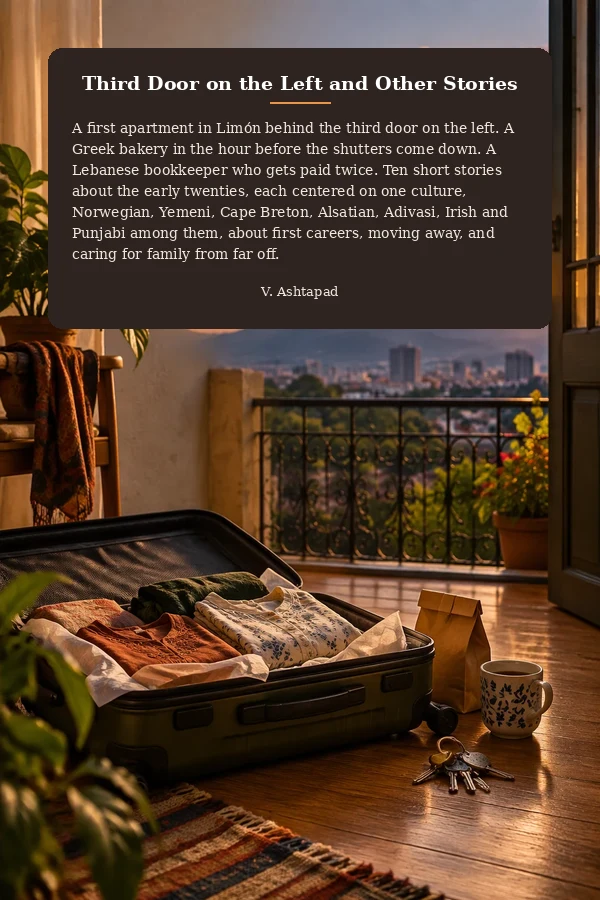
A first apartment in Limón behind the third door on the left. A Greek bakery in the hour before the shutters come down. A Lebanese bookkeeper who gets paid twice. Ten short stories about the early twenties, each centered on one culture, Norwegian, Yemeni, Cape Breton, Alsatian, Adivasi, Irish and Punjabi among them, about first careers, moving away, and caring for family from far off.
Members can react to this book and talk about it in the members' Library.
Ownership
© 2026 CRUNOD LLC. All rights reserved.
This book is owned by CRUNOD LLC. It is free to read on EternalCurrent.Online. No part of it may be copied, reprinted, sold, recorded or adapted, including as audio, film or translation, without written permission from CRUNOD LLC.
© 2026 CRUNOD LLC. All rights reserved.