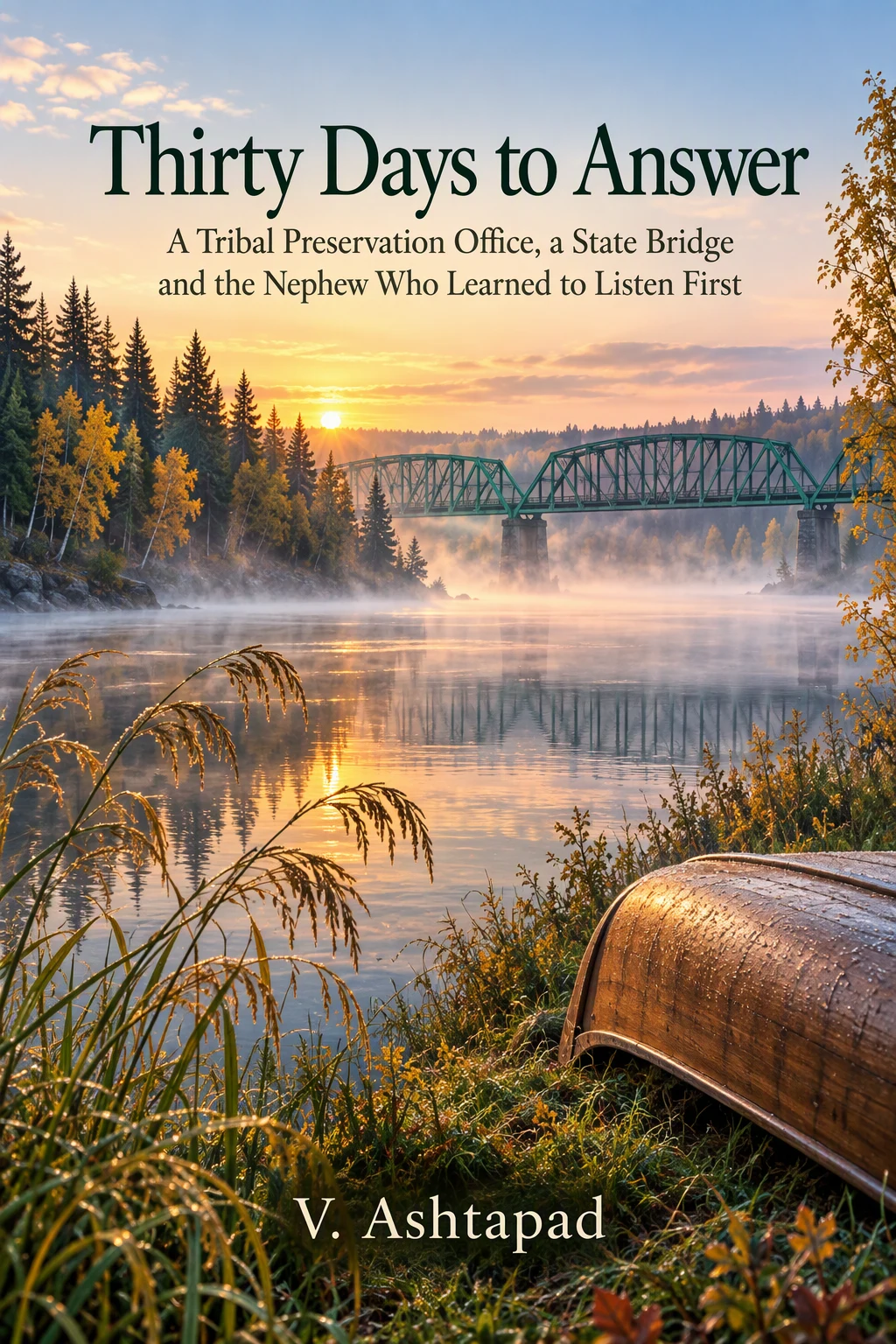
Thirty Days to Answer
A Tribal Preservation Office, a State Bridge and the Nephew Who Learned to Listen First
by V. Ashtapad
Foreword
This is a work of fiction. Tribal Historic Preservation Offices are real, and so is the federal review that gives a Tribe the right to be consulted when a highway or bridge may affect places that matter to it. Wild rice harvesting, nineteenth-century survey plats and the long work of keeping a Nation's records are real too.
The Nation in these pages, its lands, its people, its council and its offices are invented. There is no Cedar Lake Nation, no Little Cedar River bridge, no Birchton, and Bernadette, Corey, Uncle Frank, Ruth Kowalski and everyone else are imagined. No words of any real Nation's language appear in this book; those belong to the Nations themselves.
For the preservation offices that answer every letter, and keep the paper so the next person does not have to sit on the vault floor.
Day 1: The Letter
*Consultation log, Day 1 of 30. Received by mail and by email: State Department of Transportation, County Road 14 widening and new bridge over the Little Cedar River. Request for comment on effects to historic properties. Response due in 30 days.*
The letter came on a Monday in late April, the week the ice went out of Cedar Lake, and Bernadette Lasley read it twice at her desk in the Cultural Preservation Office with her coffee going cold, and then she called her nephew into her office and handed it to him.
"Yours," she said.
Corey Lasley was twenty-four and had been working in the office for nine days. Before that he had been at Michigan Tech for five years, four for a degree in surveying and one more for a certificate in mapping, and before that he had been a skinny kid on the Nation's reservation who fished off the old ore dock and swore he was never coming back. He had come back because his aunt asked him to. She was sixty-four and retiring in September, and the Nation's council had voted to fund a deputy for the Tribal Historic Preservation Office, and Bernadette had told the council she knew someone who could read a survey map better than the state's engineers could.
"Mine?" Corey said. "Auntie, I don't even know where the stapler is."
"Second drawer. The letter's yours. Read it out loud."
He read it out loud. The state was going to widen County Road 14 from two lanes to four for six miles between the highway and the town of Birchton, and replace the old steel truss bridge over the Little Cedar River with a new concrete one. The road ran along the edge of the Nation's lands, partly on them under an old easement, and crossed the river a quarter mile below the place where the Little Cedar ran into the lake. The letter said the state had identified "no known historic properties" in the project area. It said the Nation had thirty days to comment.
When he finished, Corey looked up.
"No known historic properties," he said. "That's the old village. Below the bridge. Uncle Frank used to take us there. The ricing camp, the burial ground on the hill, the—"
"Yes."
"They're going to put four lanes through it."
"They're going to propose to," Bernadette said. "That's what this is. A proposal. And this"—she tapped the desk—"is the office that answers it. You have thirty days. I'll be here for every one of them. But it's yours."
Corey stood up. He was already angry, she could see it, the way his father used to get angry, a heat that started at the back of the neck. "We should call the council. We should call a lawyer. We should get people out there, put up signs, call the paper in Duluth—"
"Sit down," Bernadette said.
He sat down.
"How long have I had this job?"
"I don't know. Since I was a kid."
"Twenty-two years," she said. "And in twenty-two years, how many times do you think I've gotten a letter that says 'no known historic properties' about a place that's full of our grandparents?"
He didn't answer.
"About four hundred," she said. "And how many times do you think yelling worked?"
"Some?"
"Twice. And both times we won the fight and lost the next ten letters, because the people on the other end stopped calling us first and started calling their lawyers." She leaned back. "I'm going to teach you something this month that they didn't teach you at Tech. And it's going to make you crazy, because you're like your dad, and your dad never once listened to anybody he was mad at. But it's the most important thing this office does."
"What?"
"Listen," she said. "First. Before anything. You listen to everybody. The state. The engineer. The county. The farmers whose land is on the other side of the road. The elders. The kids who fish off that bridge. You listen until you can say back to each one what they want and why they want it, so well that they'd nod. And then you answer."
"And if what they want is to put a road through our cemetery?"
"Then you'll know exactly why they want it," Bernadette said, "and that's how you'll move it."
---
The Cultural Preservation Office was two rooms and a records vault in the back of the Nation's administration building, a low brick building from 1974 with a flagpole out front, a picture window full of geraniums, and a parking lot where elders sat in their trucks in the mornings and drank coffee and talked before the clinic opened. The office had a long table, three desks, a wall of filing cabinets older than Corey, a map table with a light box, and the vault, which was a fireproof room with a steel door that had once been the bank's, when the Nation ran a credit union in the building in the eighties.
The vault held the Nation's paper. Allotment records from the 1890s. Treaty copies. Survey plats. Letters to and from agents and senators. Ledger books. Photographs in archival sleeves. Recordings on reel-to-reel and cassette and minidisc and now hard drives, of elders who were long gone, speaking about places and people and what happened there. Bernadette had spent the last eight years, nights and weekends mostly, scanning all of it into the office's records system, where every page had a number, a date, and a note about who could see it.
"Some things are for everybody," she told Corey that first afternoon, showing him on the screen. "Some things are for the office only. Some things are for one family, or for the elders' circle. You don't decide that. The Nation decides it. The council passed the protocols in 2019, the speakers' circle wrote the part about recordings. When you open a file, the system tells you what the rule is, and you follow it."
"And if I need something that's restricted for this consultation?"
"Then you ask the person the rule names. And they decide." She opened a map. "This is what we show the state."
It was a map of the Nation's lands with the County Road 14 corridor drawn in red. Along the river below the bridge was a soft green circle, shaded, with a label: *Area of cultural significance. Contact the Nation's THPO.*
"That's it?" Corey said. "A circle?"
"That's what the state sees. That's what anybody outside the office sees." She clicked. The circle opened into twelve points, each with a name and a number. The village site. The ricing camp. The burial hill. A spring. A trail. A place where the old people said a certain thing had happened that they did not talk about. "This is what we see. And some of these"—she pointed to three—"only Uncle Frank and two others see. Not even me."
"So how do we tell the state their road goes through the burial hill if we can't show them the burial hill?"
"That," Bernadette said, "is the whole job."
Day 3: The Engineer
*Consultation log, Day 3. Called State DOT district office. Spoke with project engineer R. Kowalski. Requested site meeting. Scheduled Day 8.*
The state's project engineer was a woman named Ruth Kowalski, and when Corey called her she picked up on the second ring and said, "Kowalski, County 14," in a voice like she'd been expecting a complaint.
He had written down what he was going to say. His aunt had made him. *Introduce yourself. Say you received the letter. Ask her to tell you about the project. Then shut up.*
He introduced himself. He said he had received the letter. He said, "Can you tell me about the project?"
There was a pause on the line, like she'd been ready for something else.
"What do you want to know?"
"Whatever you think is important," Corey said, and then, remembering, shut up.
Ruth Kowalski talked for eleven minutes. Corey took notes. County 14 had the third-highest crash rate of any two-lane road in the district. In the last ten years there had been forty-one crashes and four deaths, two of them teenagers, one of them a school bus that went into the ditch in an ice storm with nobody seriously hurt by what Ruth called pure dumb luck. The old truss bridge was rated structurally deficient; the state had put a weight limit on it in 2021 and the school buses and the logging trucks and the propane delivery trucks now had to go around, eleven miles out of their way. The county had been asking for the widening for fifteen years. The money had finally come through, federal and state, and it had a deadline: if the project wasn't under contract by next spring, the money went to another district.
"And the alignment," Corey said, when she paused. "The route. Why there? Why below the bridge?"
"The new bridge needs to be longer and lower than the old one, for the floodplain," Ruth said. "If we build it in the same spot we have to close the road for two years while we do it, and there's no detour that doesn't add thirty miles. If we build it a little downstream, we can keep the old bridge open while we build the new one, and then take the old one out." She paused. "The downstream alignment is the only one that keeps the school buses running."
Corey looked at his notes. He was angry again; he could feel it. The school buses. The teenagers. The money. Every reason was a good reason, and every one of them led straight through the old village.
"Okay," he said. "Can I say back what I heard? To make sure I got it?"
Another pause. "Go ahead."
"The road is dangerous and people have died on it. The bridge is failing and the trucks and buses have to go eleven miles around. The county's waited fifteen years. The money expires next spring. And you put the new bridge downstream so you don't have to shut the road down for two years and send the buses thirty miles around."
"That's—yeah. That's it."
"Okay," Corey said. "Thank you. I'd like to come out and walk it with you. On the ground. Next week."
"I can do that," Ruth said, and Corey heard something in her voice he hadn't expected, which was surprise. "Most of the time when the Nations call me it's a lawyer."
"My aunt says lawyers come later."
"Your aunt's Bernadette Lasley?"
"Yes."
"I've heard about her," Ruth said. "From the guys who were here before me."
"Good or bad?"
Ruth laughed, a short bark. "Both. Mostly they said she'd make you walk."
---
When he told Bernadette, she just nodded.
"Now you know what she needs," she said. "School buses. Safety. A deadline. Write it down, all of it, in the consultation file. Exactly how she said it."
"It doesn't change anything. Her bridge still goes through the village."
"It changes everything," Bernadette said. "Before, you thought she wanted to bulldoze our grandparents. Now you know she wants a school bus not to go in a ditch. You and her want the same thing for that bus. Start there."
Day 5: Uncle Frank
*Consultation log, Day 5. Interview with elder F. Martineau regarding Little Cedar village area. Recorded with consent. Restricted: elders' circle, THPO.*
Frank Martineau was eighty-seven and lived alone in a small green house on the lake road with a woodstove, a recliner, a dog named Patch, and a view of the water that he said he wouldn't trade for the whole state of Minnesota. He was not actually Corey's uncle; he was his grandmother's cousin, but every kid on the reservation called him Uncle Frank, and he called every kid "boss."
"Boss," he said, when Corey came in with Bernadette and a recorder. "You come to ask me about the bridge."
"How'd you know?"
"Ruthie Kowalski's surveyors been out there a week in orange vests. Patch barked at them every morning." He lowered himself into the recliner. "Sit. Coffee's on the stove. Bernie, you know where the cups are."
Bernadette poured. Corey set up the recorder on the TV tray and asked, the way she'd taught him, whether Uncle Frank was willing to be recorded, and who could listen.
"Elders' circle," Frank said. "And you two. And when I'm gone, my granddaughter Shawna, she decides after that."
Corey typed it into the tablet. The system asked him to confirm the rule and Frank's name and the date. He did. Then he asked Frank to tell him about the village.
Frank talked for two hours.
He talked about the summers when he was a boy in the 1940s, when families still came down to the river mouth in late August for the ricing, and set up their tents on the flat ground below the hill, and the men poled the canoes through the rice beds while the women knocked the grain into the bottoms with cedar sticks. He talked about the smell of rice parching in the big iron kettles, and the dancing on the hard-packed ground, and the dogs, and his grandmother singing while she winnowed rice in a birchbark tray, tossing it up so the wind took the hulls. He talked about the hill. The old people were buried on the hill, he said, and had been for longer than anybody knew, and you didn't go up there unless you had business, and you didn't take anything off it, not a stone, not a stick.
"Where on the hill?" Corey asked carefully. "Where exactly?"
Frank looked at him a long time. "Why?"
"Because the state's bridge comes in right at the bottom of it. Maybe through the side. I need to know how close."
Frank looked at Bernadette. Bernadette didn't say anything. She looked back at him and waited.
"I'll show you," Frank said finally. "Not tell you. Show you. You and Bernie. Nobody else. And what I show you stays with the circle."
"Okay," Corey said.
"And then you tell that Ruthie Kowalski something," Frank said. "Not where. Just enough."
"How much is enough?"
Frank leaned back and scratched Patch behind the ears. "That's the trick, boss. You figure that out, you'll be as good as your auntie."
---
On the drive back, Corey said, "He didn't trust me."
"He trusted you fine," Bernadette said. "He just didn't know you yet. Those are different."
"How do I get him to know me?"
"Keep coming back. Bring him firewood. Fix his porch step, it's been loose since March. Listen to the stories he tells twice." She looked out at the lake, gray-blue and choppy, a few early boats out. "Your dad never came back. That's what Frank's measuring. Whether you're going to stay."
Corey drove for a while without saying anything.
"I don't know if I'm staying," he said.
"I know," Bernadette said. "That's why I gave you the letter."
Day 8: The Walk
*Consultation log, Day 8. Site visit, County Road 14 corridor and Little Cedar River crossing, with R. Kowalski (DOT), two DOT surveyors, county engineer T. Lindqvist, and THPO staff. Field notes and photos attached. Some photos restricted.*
The morning of the walk was cold and bright, with frost on the ditch grass and a mist rising off the river like breath. Ruth Kowalski turned out to be a short, wiry woman in her fifties with a gray braid down her back, rubber boots, and a state-issue jacket with the sleeves pushed up. She had brought two surveyors, young men with tablets and a GPS rod, and the county engineer, a big quiet Swede named Tom Lindqvist who had grown up on a dairy farm on the other side of County 14.
Corey had brought Bernadette, a thermos of coffee, a box of frybread from the café by the casino, and the office's field tablet, which had the Nation's map loaded with the twelve points—and the three restricted ones hidden, even from him, until Uncle Frank showed him.
He offered the frybread first. The surveyors took two each. Tom Lindqvist took one and said, "My mom used to buy this at the powwow every August. She said it was the best thing in the county."
"It is," Corey said.
They walked the corridor from the north end. Ruth showed them the survey stakes, the pink flags where the new lanes would go, the drainage, the curve where the school bus had gone into the ditch. She showed them the old truss bridge, rusted and humming in the wind, with a sign that said WEIGHT LIMIT 10 TONS and a fresh dent in the railing where somebody had misjudged it. Then she led them downstream along the bank, through the brush, to a line of orange stakes coming down off the road grade and across the flat ground toward the water.
"New bridge comes in here," she said.
Corey stood on the flat ground. Under his boots, under the frost and the dead grass, was the ricing camp. He could see it the way Uncle Frank had told it—the tents, the kettles, the dancing. Fifty yards behind him rose the hill, low and round, covered in young birch and old oak.
He opened the field tablet and recorded a visit: date, time, who was there, the weather, the condition of the site. He photographed the stakes. He noted that the new alignment crossed the edge of the area of cultural significance. He marked the photos of the hill as restricted. The tablet saved everything to the office's file, stamped with the place and the time, and he knew that years from now someone in the office could pull it up and see exactly what the ground looked like on this April morning before anything changed.
Then he did what his aunt had told him to do. He asked Ruth to show him what she couldn't change.
She looked at him funny. "What do you mean?"
"Your design. What's fixed? What would you have to start over on if it moved?"
Ruth thought. "The bridge length is fixed by the floodplain. The clearance is fixed by the high-water mark. The north approach is fixed because of the wetland there"—she pointed—"which the Army Corps would never let us touch. The south approach…" She paused. "The south approach could swing. A little. If we went with a tighter curve on the south end. It would cost more. And the design speed would come down to forty-five from fifty-five."
"How much more?"
"Eight hundred thousand, maybe. A million. More concrete, more retaining wall."
"How far could it swing?"
"West? Toward the old bridge?" She looked at the ground, at the river, at the stakes. "Two hundred feet. Maybe two-fifty. Not more. Then we're back on top of the old bridge and we lose the detour."
Corey looked at the hill. He didn't know yet where Uncle Frank's grandparents were. He didn't know if two hundred feet was enough. But he wrote it down, exactly as she'd said it, and he said it back to her, and she nodded.
"Why are you asking me all this?" she said. "Your aunt's guys before me just told us no."
Bernadette had been quiet the whole walk. Now she spoke.
"Because my nephew's going to be doing this job for forty years," she said. "And so are you, probably. And this river's going to need another bridge someday. I'd like the two of you to be able to call each other."
Ruth looked at her for a long moment. Then she looked at Corey.
"I'll run the numbers on a western swing," she said. "No promises."
"No promises," Corey said. "I'll find out if two hundred feet is enough."
Day 11: The Hill
*Consultation log, Day 11. Field visit with elder F. Martineau and THPO B. Lasley. Restricted. Elders' circle only.*
Corey cannot write here what Uncle Frank showed him on the hill. That's the rule, and it's a good rule, and he would not break it if he could.
He can write that it was early morning, and that Frank walked up with a stick and Patch and would not let anybody help him, and that it took forty minutes to go a hundred and fifty yards. He can write that Frank stopped at certain trees and put his hand on them, and that he talked quietly in the language, which Corey understood only a little of, because his father had never spoken it at home and his grandmother had died when he was seven. He can write that Frank showed them the edges—the lower edge especially, where the ground began to slope toward the flat—and that Bernadette marked each point on the tablet as Frank stood on it, and that the tablet asked her who could see each point, and she typed in Frank's answer: *the circle*.
He can write that when they came down, Frank sat on a log at the bottom of the hill and was quiet for a long time, and that Corey sat next to him, and that after a while Frank said, "You understand now why it's not a circle on a map."
"Yes."
"Is two hundred feet enough?"
Corey looked at the tablet. The lowest of Frank's points was a hundred and ten feet from the eastern edge of the state's new alignment. If the road swung two hundred feet west, the nearest edge of the new fill would be three hundred and ten feet from it.
"I think so," he said. "But the ricing camp would still be under the road. Part of it."
Frank nodded slowly. "The ricing camp," he said. "That's the living part. The hill, that's the old people. You don't move the old people. The living part—" He shrugged. "My grandmother used to say the camp moved every year anyway, a little this way, a little that way, depending on the water. She said a camp is wherever the families put their tents."
"So it's okay?"
"I didn't say that." Frank looked at him. "I said it's different. You have to ask the families. The ones who still rice. Ask them what they need."
Day 14: The Families
*Consultation log, Day 14. Community meeting, administration building. 37 attendees. Notes attached. Recording: open to Nation members.*
They held the meeting in the community room, with coffee and a sheet cake from the grocery in Birchton that said WELCOME in blue frosting because it was left over from somebody's retirement party. Thirty-seven people came, which Bernadette said was a record for anything that wasn't a funeral or a per-capita payment.
Corey had made a map. Not the restricted one—a public one, with the old road, the new road, the river, the green circle, and the state's two alignments drawn side by side, the original and the western swing. He had printed it big and taped it to the wall, and he had put it on the Nation's community page the night before so people could look at it at home.
He stood in front of it with his hands sweating and said what his aunt told him to say.
"I'm not here to tell you what to think. I'm here to hear what you need. The state wants to build a road and a bridge, and here's why"—and he told them, exactly how Ruth had told him: the crashes, the dead kids, the school bus, the weight limit, the trucks going eleven miles around, the money that expires. "And here's where they want to build it." He pointed. "And here's where we might be able to move it." He pointed again. "If we move it, it stays away from the hill. But it still goes across part of the flat. The ricing camp. I need to know what that means to you."
Then he sat down and shut up.
For a while nobody said anything. Then Darlene Bressette stood up, a heavy woman in her sixties with reading glasses on her head, who had run the Nation's food program for thirty years.
"My boy was in that bus," she said. "In the ditch. In 2019. He was nine. He still won't ride a bus. I drive him to the vo-tech in Hibbing every day, forty minutes each way." She looked at the map. "I want that road fixed. I'm sorry. I do."
"Okay," Corey said, and wrote it down.
A young man stood up. Jace Morrin, twenty-two, who Corey had played basketball with in high school. "We still rice there," he said. "Me and my uncles. Every year. It's the best bed on the lake. If they put a bridge over the flat, how do we get the canoes in?"
"Okay," Corey said, and wrote it down. "Where do you put in now?"
"Right where the stakes are."
An old woman in the back, Agnes Thunder, ninety, who Corey had been scared of since he was six, raised her hand without standing up.
"The camp moves," she said. "Every year. My mother said so. It doesn't matter where the tents go. What matters is the families come. What matters is the kids learn to knock rice. If the kids can get to the rice, I don't care where the bridge goes, as long as it stays off the hill."
People talked for two hours. Corey wrote it all down. He said back what he heard, each time, and twice somebody said, "No, that's not what I meant," and told him again, and he said it back again until they nodded. At one point Darlene and Jace got into it, Darlene saying the road was about her son's life and Jace saying the rice was about the Nation's life, and their voices went up, and the room got tight.
Corey didn't know what to do. He looked at his aunt. She looked back at him and didn't move.
So he stood up. And he said, "Darlene, can I try to say what Jace is saying? And then, Jace, can I try to say what Darlene is saying?"
They both looked at him.
"Jace is saying if we lose the way to the rice bed, the kids stop going, and then in twenty years nobody knows how to rice, and then it doesn't matter whose name is on the land. Is that right?"
Jace nodded slowly.
"And Darlene is saying her son almost died on that road, and four people did die, and she's tired of waiting fifteen years for somebody to fix it, and she doesn't want to wait another fifteen because we couldn't agree. Is that right?"
Darlene nodded. She was crying a little, and she wiped her eyes with the back of her hand.
"Okay," Corey said. "Then I think you both want the same thing. You want the kids to be safe and you want the kids to keep going to the rice. Both. What if we asked the state for both?"
The room was quiet.
"Like what?" Jace said.
Corey looked at the map. He thought about Ruth saying *a little*, and *more concrete*, and *no promises*. He thought about the bridge being longer and lower. Longer and lower.
"Like a canoe landing," he said. "Under the bridge. Built into it. A way down to the water that the families own. So the bridge isn't in the way of the rice. It's the way to it."
Day 18: The Numbers
*Consultation log, Day 18. Call with R. Kowalski. Western alignment feasible at estimated added cost $940,000. Discussed canoe access below new structure. DOT to review.*
Ruth called back with the numbers on a Friday afternoon. The western swing worked. It cost nine hundred and forty thousand dollars more. It dropped the design speed on the south curve to forty-five, which the county engineer was fine with, because forty-five was what everybody drove on that curve anyway. It kept the old bridge open during construction.
"The problem," she said, "is the nine-forty. I have to justify it."
"What do you need?"
"Something on paper from the Nation that says the original alignment has an adverse effect on a property eligible for the National Register, and the western one avoids it. With enough detail that my boss can't argue with it. And enough that the federal reviewers sign off."
Corey thought about the hill. About the circle. About the three points that only the elders' circle could see.
"I can give you that the original alignment comes within the boundary of a burial area the Nation considers sacred, and that the western alignment stays outside it with a buffer," he said. "I can give you the boundary of the area as a polygon. I can't give you what's inside it."
"That's enough," Ruth said. "That's exactly enough. Federal reviewers know that's how it works. They won't ask for more."
"And the canoe landing?"
Ruth was quiet for a second. "Tell me about the canoe landing."
He told her. Agnes Thunder. Jace and his uncles. The rice bed. The kids.
"Huh," Ruth said. "We have to build a maintenance access down to the water anyway, for bridge inspections. I could make it a little wider. Put in some steps. A gravel landing. It's not even in the nine-forty, really, it's a design change."
"Could it say whose it is? A sign?"
"I can put up whatever sign the Nation wants."
Corey sat back in his chair. Through the window he could see the parking lot, the elders in their trucks with the windows down because it was warm, finally, May, and the lake behind them sparkling.
"Ruth," he said. "Can I say back what I think just happened?"
"Go ahead."
"You're going to swing the road two hundred feet west to stay off the burial ground, and you're going to justify it with a boundary the Nation gives you without telling you what's inside. And you're going to build the families a canoe landing under the bridge, with a sign."
"If my boss signs the nine-forty, yes."
"And if he doesn't?"
"Then I'll come out and walk it with him," Ruth said. "Like your aunt made me."
Day 22: The Vault
*Consultation log, Day 22. Records search, THPO vault. Located 1893 survey plat and allotment record showing "Indian village and burying ground" at Little Cedar outlet. Scanned. Attached to consultation file.*
Corey found the plat by accident, looking for something else.
He had been in the vault all afternoon going through the old survey files for the Little Cedar townships, because Ruth's federal reviewers had asked whether there was any historical documentation of the burial area besides the Nation's word. Bernadette had said, "There's always more paper. Go look." So he looked.
The plat was in a folder marked *Misc. Allotments, T62N R16W*, misfiled between two land-sale records from 1911. It was a big sheet of linen-backed paper, brown at the edges, drawn in ink by a government surveyor in 1893, showing the township in a grid of square-mile sections, with the lake and the river and the old trails drawn in. At the mouth of the Little Cedar, in the surveyor's neat slanted hand, were the words: *Indian village and burying ground*. And a little hill drawn with hachure marks. And a dotted line around it.
The dotted line was almost exactly where Uncle Frank had walked.
Corey sat on the vault floor with the plat across his knees for a long time. Then he took it out to the light table and scanned it at the highest resolution the office scanner allowed, and attached it to the parcel record for the Little Cedar outlet, and to the consultation file, with a note: *1893 GLO survey plat. Surveyor recorded village and burying ground at outlet. Boundary matches elders' account (restricted). Public: yes.*
Then he brought it to his aunt.
Bernadette looked at it a long time. "I've never seen this," she said quietly. "Twenty-two years. I've never seen this."
"It was misfiled."
"Of course it was." She touched the edge of the linen. "Somebody before me found it, maybe. Didn't know what it was. Or knew and didn't have anywhere to put it." She looked up at him. "That's why I scanned everything, you know. All those nights. Not because I thought I'd find this. Because I didn't want the next person to have to sit on the vault floor to find it."
"I sat on the vault floor anyway."
"Yes," she said. "But now you're the last one who has to."
---
He drove out to Uncle Frank's that evening with a printout of the plat and a bundle of cedar shakes in the back of his truck. He fixed the loose porch step first. It took an hour. Patch supervised.
Then he showed Frank the plat.
Frank put on his glasses and held the paper close to the lamp and looked at it for a long time. He traced the dotted line with his finger.
"Huh," he said. "White man drew it right."
"He drew it right."
"Hundred and thirty years ago." Frank handed it back. "And they still sent you a letter that said no known historic properties."
"Yeah."
"Well, now they know." Frank leaned back in his recliner. "You fixed my step."
"Auntie said it was loose."
"It's been loose since March." Frank looked at him. "You staying, boss?"
Corey looked out the window at the lake, gold in the last light. A loon called somewhere out on the water, that long falling call that his grandmother used to say was the lake talking to itself.
"I'm thinking about it," he said.
"Good," said Frank. "Think about it here."
Day 26: The Council
*Consultation log, Day 26. Presented to Tribal Council. Council voted 7-0 to authorize THPO response to DOT. Resolution and draft letter attached.*
The council met in the chambers on the second floor of the administration building, a long room with a big table, the Nation's flag, a framed copy of the 1854 treaty, and a window unit air conditioner that rattled. Seven council members, the chairwoman at the head, the secretary with her laptop, and Corey at the end of the table with the consultation file open in front of him and his aunt in the chair behind him, not at the table, on purpose.
He walked them through it. The letter. The state's reasons. The walk. The two alignments. The families' meeting. The canoe landing. The plat. He showed them the public map and the polygon he proposed to send the state, the boundary with no details inside. He showed them the draft letter from the Nation to the state: the original alignment would have an adverse effect on a property of religious and cultural significance to the Nation; the western alignment avoids the burial area with a buffer of more than three hundred feet; the Nation requests the western alignment, a Nation monitor on site during all ground disturbance within a quarter mile of the outlet, a canoe landing below the new bridge for the Nation's ricing families, and a sign.
"What kind of sign?" asked Councilman Pete Dufault, who was seventy and had been on the council since 1988 and asked that about everything.
"Two names," Corey said. "On the bridge. The state's name, Little Cedar River. And ours. The speakers' circle would write ours. In the language. And the name of the place, the camp. So people driving over it know where they are."
The chairwoman, Lorraine Gauthier, looked at him over her reading glasses.
"Did the state agree to that?"
"Ruth Kowalski said she'd put up whatever sign the Nation wants."
"Ruth said that?"
"Yes."
Lorraine smiled a little. "Your aunt's been trying to get a name on a state sign for twenty years."
"I know," Corey said. "She told me."
Lorraine looked past him at Bernadette, who was sitting with her hands folded and her face doing nothing at all.
"Bernie," Lorraine said. "Anything to add?"
"No," Bernadette said. "It's his."
They voted seven to nothing. Pete Dufault asked to see the plat afterward and held it for a long time, and then said, "My great-grandfather's in that hill," and handed it back, and walked out without saying anything else. The secretary typed the resolution and filed it with the consultation, and the system dated it and linked it to the letter and the plat and the site visits and the families' meeting notes and Uncle Frank's restricted recording, so that anyone who opened the file, years from now, would see all of it in one place: who said what, when, and why the road went where it went.
Day 30: The Answer
*Consultation log, Day 30. THPO response sent to DOT by email and certified mail. Copy to county engineer. Consultation remains open pending DOT reply.*
Corey sent the letter at 9:14 on a Wednesday morning, day thirty, with his aunt standing behind his chair. He read it one more time on the screen, all four pages. He attached the polygon, the plat, the resolution, and the public summary of the families' meeting. He clicked send. Then he printed a copy, signed it, and walked it down to the post office in Birchton himself, because Bernadette said a letter that mattered should also be paper.
The postmaster, Arlene, who was Tom Lindqvist's sister-in-law, weighed it and stamped it and said, "This about the bridge?"
"Yes."
"Tom says you walked it with them. With the state."
"We did."
"Tom says it was the first time in twenty years anybody from the state asked him what the county actually needed instead of telling him." Arlene slid the receipt across the counter. "He says your aunt trained you right."
"She did."
"He also says your frybread was better than the casino's," Arlene said. "He wants to know where you got it."
"The casino."
Arlene laughed.
---
Ruth Kowalski called three weeks later, in June, with the windows of the office open and the smell of cut grass coming in, and the elders out front in their trucks with the radios on.
"My boss signed the nine-forty," she said. "Western alignment. Monitor on site. Canoe landing. The sign." She paused. "Federal reviewers signed off yesterday. They said your file was the best documented they'd seen from a Tribe this year. They wanted to know what system you use."
"Records," Corey said. "We keep records."
"Well, keep keeping them," Ruth said. "The old truss bridge is going to need to come out in four years, after the new one's open. There'll be another letter."
"I'll be here."
There was a pause.
"Will you?" Ruth said. "Your aunt's retiring. People said you might go back to the Cities."
Corey looked out the window. Across the parking lot, Uncle Frank's truck was parked in its usual spot, the window down, Patch's head hanging out. Frank raised two fingers off the steering wheel at him, the way the old men did.
"I'll be here," Corey said.
---
Bernadette's retirement party was in September, in the community room, with a sheet cake that said HAPPY RETIREMENT BERNIE in green frosting and three hundred people and a drum group from the high school. The chairwoman gave a speech. Pete Dufault gave a longer speech. Ruth Kowalski came, in a dress, with Tom Lindqvist and his wife, and stood in the back, and when Bernadette saw her she crossed the whole room and hugged her, and Ruth went red.
Corey gave a short speech, because his aunt had told him that people who give long speeches at retirement parties are only thinking about themselves.
"My aunt taught me one thing this year," he said. "Listen first. To everybody. Until you can say back what they want so well they'd nod. Then answer." He looked at her in the front row in the blue dress she'd bought for it, with her hands folded and her face doing nothing at all. "I thought it was about the state. It wasn't. It was about Darlene. And Jace. And Uncle Frank. And me. She listened to me for nine days before she handed me that letter. She knew I'd be angry. She knew I'd want to fight. She let me want it, and she didn't say a word. She just waited for me to figure out there was a better way."
He paused.
"Auntie, I heard you."
Bernadette didn't move. But Corey saw her press her lips together, hard, and look down at her hands, and he knew.
---
The new bridge opened the following October, a long low span of pale concrete over the Little Cedar, two hundred and forty feet west of where the state first drew it. Under the south end, a gravel path and twelve wide steps went down to a landing on the water, where the ricing families could slide their canoes in among the rice beds. A Nation monitor had walked every foot of the ground disturbance and found nothing that needed stopping, and logged every day of it, with photos, in the office's file.
At each end of the bridge was a green sign. The top line said LITTLE CEDAR RIVER. The second line, in the same size letters, was the river's name in the language, written by the speakers' circle and checked three times. And under the canoe landing, on a cedar post, a smaller sign the families had made themselves, with the name of the camp.
Uncle Frank came to the opening, in a wheelchair now, with Patch on his lap and Shawna pushing. He made Shawna wheel him to the middle of the bridge and stop, and he looked downstream at the hill, low and round under its birch and oak, untouched, and upstream at the old truss bridge, rusting and humming, waiting its turn, and then down at the landing, where Jace Morrin and his uncles were loading two canoes for the late rice with three kids in life jackets jumping up and down on the steps.
"Boss," he said to Corey. "Come here."
Corey came.
"You did all right."
"Auntie did it."
"Your auntie gave you a letter," Frank said. "You did the rest. I watched." He looked at the sign. "That's my grandmother's word. For this place. On the state's sign. A hundred and thirty years they had it on that map and never once put our word on anything."
"Now they did."
"Now they did," Frank said. He was quiet for a while. A loon called from out on the lake. Then he said, "You're going to get another letter about that old bridge."
"Ruth says four years."
"Good," said Frank. "Take a kid with you when you walk it."
About this book
The letter from the state says no known historic properties. Corey Lasley knows better. The new four-lane bridge over the Little Cedar River runs straight across the old ricing camp below the hill where his Nation's grandparents are buried.
Corey is twenty-four, nine days into his job as deputy preservation officer, and ready to fight. His aunt Bernadette, retiring after twenty-two years running the office, hands him the letter and one rule: listen first. To the state's engineer and her school buses. To the mother whose son was in the bus that went into the ditch. To the young man who still rices off the flat. To Uncle Frank, eighty-seven, who will show Corey the hill but never tell him.
He has thirty days to answer.
A story about a Nation's office doing its work well, and about how listening, done properly, can move a road.
Members can react to this book and talk about it in the members' Library.