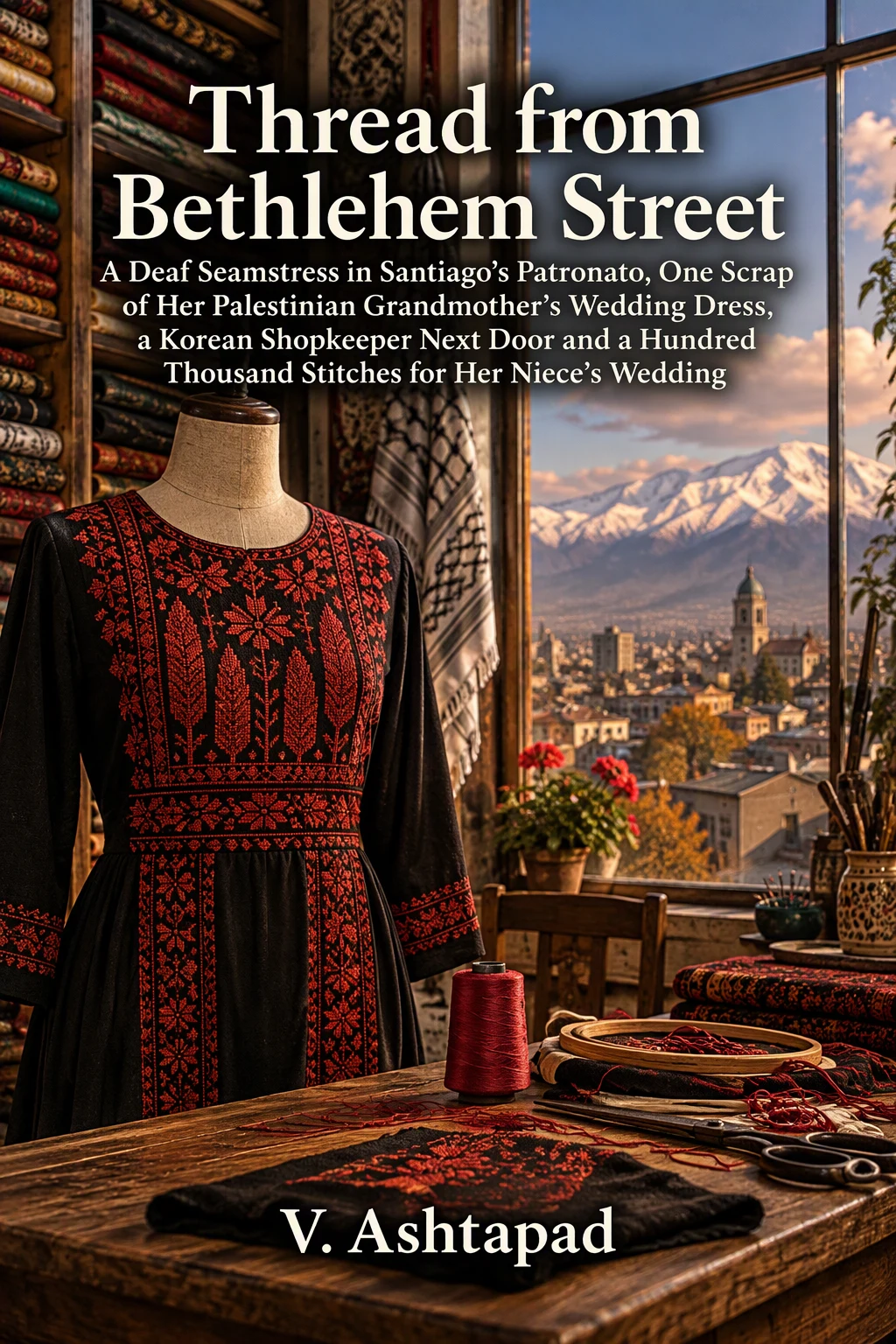
Thread from Bethlehem Street
A Deaf Seamstress in Santiago's Patronato, One Scrap of Her Palestinian Grandmother's Wedding Dress, a Korean Shopkeeper Next Door and a Hundred Thousand Stitches for Her Niece's Wedding
by V. Ashtapad
Foreword
This is a work of fiction. The Palestinian community of Chile, the barrio of Patronato in Santiago, Palestinian tatreez embroidery and its village patterns, Chilean Sign Language, the Korean and Peruvian shopkeepers of Patronato, Mapuche weaving and Fiestas Patrias are real. The Massú family, the shops, the museum and every named person in the story are invented.
For the women who sewed the map of home onto their own dresses.
The Cypress
I feel the shutter before I see it.
Every morning at a quarter to eight, Señor Seo next door rolls up the metal shutter of his fabric shop, and the whole wall between our shops shivers like the skin of a drum. The tremble comes up through the concrete floor and into the soles of my feet and into the wooden leg of my cutting table, where my hand is resting, and I know without turning my head that it is a quarter to eight and Señor Seo is open and the day in Patronato has begun.
I have been deaf since I was three. Meningitis, in the winter of 1977, in a clinic in Recoleta with a broken heater. My mother told me later that I screamed for two days and then went quiet, and she thought the quiet meant I was getting better. It meant the opposite. When the fever went down, the world had been switched off. Not the light. The sound. I was three years old, and from that week on I lived in a world where doors closed without slamming and dogs barked without barking and my grandmother sang to me with her lips moving and nothing coming out.
My mother took me to the school for deaf children on Calle Santa Rosa when I was four. It was an old building with high ceilings and a courtyard with a lemon tree, and the teachers were strict women in grey smocks who did not believe in signing. They believed in speaking. They held our small hands against their throats so we could feel the buzz of the words, and then held our hands against our own throats and made us copy, over and over, ma, ma, pa, pa, until we said them right, or what they thought was right, which I could never tell.
At recess, in the courtyard under the lemon tree, the older children signed. Secretly, with small hands, behind their backs. A language the teachers didn't know. I learned it there, at four and five, the way other children learn to curse: in corners, quickly, in delight. Later I learned that it was a real language, with a name, Chilean Sign Language, and that thousands of people used it, and that it had been forbidden in schools for decades. At four, I only knew it was the first thing anyone had given me since the sound went away.
At home there was only my grandmother. She didn't know Chilean Sign Language. So we made our own. Hands and faces and a few Arabic words she shaped slowly with her mouth so I could see them. It was a language for two. When she died, half of it died with her.
So I learned to feel the world instead. And to watch it.
I am fifty-two years old now. My name is Lamis Massú. I am a seamstress. I have a shop four meters wide and nine meters deep on Calle Antonia López de Bello, in the barrio of Patronato in Santiago de Chile, where for a hundred years the shops have sold cloth, and the people who sell it have changed every generation, and the cloth has not.
---
Patronato in the morning, if you can hear it, is supposed to be very loud. My niece Yasna tells me. She says it is the loudest place in Santiago. Shopkeepers shouting prices in Spanish and Korean and Arabic and the Spanish of Lima. Buses grinding on Recoleta. Music from every doorway, cumbia and K-pop and reggaetón fighting each other in the street like cats. Men pushing hand carts piled with bolts of fabric, shouting for people to move. Women bargaining. Children crying. The whistle of the man who sells sopaipillas, the fried pumpkin bread, from a cart with an oil drum on it.
I don't hear any of that. What I see is this:
The colors. Patronato is a street of colors. Bolts of cloth stacked in every doorway up to the ceiling, red and gold and lime green and leopard and wedding white. Mannequins on the sidewalk in quinceañera dresses so big they block half the pavement, pink tulle exploding like cotton candy. Tablecloths hanging from awnings, lace and plastic and embroidered linen, moving in the wind like flags. Neon signs in three alphabets. The steam from Señora Rosario's pot of Peruvian chicken soup on the corner, rising in the cold morning in a white column. The orange of the sopaipillas, shining with oil, piled in a basket. The grey of the Andes behind all of it, enormous, at the end of every street, still wearing their winter snow in June.
And I see the people. I watch mouths. I can read lips in Spanish very well, in Arabic a little, in Korean not at all, though I can read Señor Seo's face perfectly, which is more useful. I watch hands. I watch how people stand. I know when a customer is going to buy before she knows. I know when a man is lying about the price of a zipper. I know when somebody is sad, because sad people stand in doorways a beat too long, as if waiting to be invited, even into a shop.
At noon the street changes color again. The shopkeepers pull plastic sheets over the cloth on the sidewalk against the dust, and the light comes through them blue and green and yellow, so that walking down Antonia López de Bello at lunchtime is like walking through the inside of a jar of boiled sweets. The Korean women from the wholesale shops eat on stools in their doorways from steel lunchboxes. The Peruvian men on the hand carts sit in the shade of the carts and eat chicken and rice from foam boxes and watch the girls go by. I eat at my cutting table, a sandwich of cheese and tomato, and watch them all.
My grandmother, Sitti Jamileh, used to say I saw too much. In Arabic, with her hands, in the small private signs we made up together when I was a child: *Eyes like a hawk. Eyes like an owl. Too many eyes.* And she would tap my forehead with one finger and laugh without sound.
---
My shop is not much. A cutting table of old oak that came with the lease, scarred with forty years of other people's scissors. Two sewing machines, a Singer from 1974 that belonged to my mother and a Japanese industrial machine I bought used from a Korean tailor who went back to Busan. A rack of finished work in plastic covers, each with a paper tag and a name. A mannequin with no head, whom Yasna named Doña Inés when she was nine, and who wears whatever I'm working on. A mirror with a crack in one corner. A kettle. A space heater that I turn on only when my fingers stop bending.
I earn what a seamstress earns. Hems for three thousand pesos, a quinceañera alteration for forty thousand, a suit taken in for twenty-five. Enough for the rent on the shop and the rent on the apartment and the metro and my tea and, once a year, a trip to the sea at Cartagena in February, alone, with a book. I don't need more. My cousins in Las Condes think I am poor. I think they are busy. We are both a little right.
---
Today, at nine-fifteen, a woman stands in my doorway a beat too long.
It's Yasna. My niece. My sister Mariam's girl. Twenty-eight years old, a pharmacist at the big clinic in Providencia, very smart, very pretty, very busy, with her hair pulled back so tight it lifts her eyebrows. She doesn't come to Patronato much anymore. She says it's too crowded. She says the parking is impossible. She says a lot of things, and I watch her mouth say them, and I watch her hands not say them.
She comes in. She kisses my cheek, the right one, once, the Chilean way. She smells of the clinic, a clean, chemical smell, and under it something softer, perfume, gardenia. Then she steps back so I can see her face, because she knows. Everybody in my family knows. If you want to talk to Lamis, you stand in the light and face her.
"Tía," she says. Her mouth is slow and careful, too careful, the way people talk to me when they are nervous. "I'm getting married."
I put down my scissors.
"In October," she says. "His name is Tomás. He's an engineer. You'll love him. He's from Temuco. His family is from Germany a long time ago and Mapuche on his mother's side. He's very quiet. You'll like that he's quiet." She laughs, and I see the laugh go up into her eyes and stop.
I sign, slowly, so she can follow. Yasna's sign language is not good. She learned some as a child, then stopped. *Congratulations. Happy. Very happy.*
She signs back, clumsy: *Thank you.* Then she says out loud, "Tía, I want to ask you something."
She opens her handbag. It is a good handbag. Leather. Italian, maybe. From the mall in Las Condes. She takes out a plastic bag, the kind from the supermarket, folded very small. She puts it on my cutting table and unfolds it, carefully, with her pharmacist's fingers.
Inside is a piece of cloth.
Black. Very old. Cotton gone soft as skin. About the size of my two hands side by side. And on it, worked in red thread, faded to the color of old brick, and in places to almost nothing, a pattern. A tree. Thin and tall and pointed, like a flame. And beside it, half of another tree, cut off at the edge, where someone took scissors to it a long time ago.
I know this cloth.
I have not seen it in forty-three years. But I know it the way you know your own hand in the dark.
It is a piece of my grandmother's dress.
---
I have to sit down. Yasna sees. She takes my arm and helps me onto the stool behind the table. Her mouth is moving fast now, too fast, and I can't follow, and I put up my hand, and she stops.
Slowly. She breathes. Slowly, she says:
"I found it in Mamá's things. After she died." My sister Mariam died last year, in August. Cancer. It was quick and then it was slow and then it was over. "It was in a box with her papers. Wrapped in that bag. With a note." She takes out a folded paper. It's in my sister's writing. Spanish. Three words.
*For Yasna's wedding.*
That's all.
"Tía," says Yasna. "What is it?"
I look at the cypress tree on the black cloth. Thin and pointed, like a flame. My grandmother's cypress. The tree from the hills above her village, near Bethlehem, in Palestine, where she was born in 1919 and which she left in 1938 on a ship to Valparaíso with her husband and a trunk and nothing else, and to which she never went back. The tree she embroidered on the front panel of the wedding dress she wore at eighteen, and which she sewed onto my mother's dress, and which she would have sewn onto Mariam's, and mine, if I had ever married, and onto Yasna's, if she had lived.
I take my pencil and my notebook. I always have them. I write in Spanish, in capital letters, the way I always write for people who can't sign:
IT IS A CYPRESS. YOUR GREAT-GRANDMOTHER'S. FROM HER WEDDING DRESS. THE REST IS GONE.
Yasna reads it. Her face does something complicated.
Then she says, very slowly, so I can see every shape of every word:
"Can you make it again?"
© 2026 CRUNOD LLC. All rights reserved.
The Eight-Pointed Star
I don't answer her for a week.
My cousins think I'm strange for staying in Patronato. They are the grandchildren of the ones who left. Doctors in Las Condes. A senator's chief of staff. A man who owns three shopping malls in the south. They live in houses with gates and gardens and swimming pools on the slopes of the mountains where the air is cleaner, and they come to Patronato twice a year, at Christmas, to buy cheap tablecloths and look nostalgic. When they see me in my shop, they say, Lamis, why don't you move, we'll help you, you could have a nice place in Vitacura. I write on my notepad: I LIKE IT HERE. They read it and look at each other.
They don't understand. In Las Condes, people talk behind their hands, in cars, on phones, at dinner tables lit by candles where you can't see anyone's mouth. In Patronato, everything happens in the open, in the doorways, in bright light, with hands. It is the only place in Santiago where everybody talks the way I do. With their whole body. Because half of them don't speak each other's language either.
I go to work. I hem trousers for the Korean tailors who send me their overflow. I take in a quinceañera dress for a Peruvian girl from Lo Valledor whose mother brings me soup in a plastic container every time she comes for a fitting. I repair the lining of a fur coat for an old lady from Vitacura who arrives in a car with a driver and tells me, in very slow, very loud Spanish, as if I were a child and also far away, that the coat belonged to her mother. I nod. I take her money. I fix the lining. I don't tell her I could have read her lips if she had just talked normally. It's not worth it.
At night, I go home to my apartment on the eighth floor of a building on Avenida Recoleta, two rooms with a balcony and a view of the cemetery, the big general cemetery of Santiago, a city of white tombs and cypress trees. Real ones. Tall, dark green, pointed like flames. I sit on the balcony in my coat with a cup of tea, mint tea with sugar, the way my grandmother made it, and I look at them.
And I think about the cloth.
---
My grandmother's dress was called a thob. A long dress, ankle length, of black cotton, with long sleeves and a wide skirt. And on the front, a big square panel over the chest, and down the sides of the skirt, long panels, and on the sleeves, more, all covered in embroidery. Cross-stitch, in red thread, very small, very fine. Thousands of tiny x's, each one the same size as a grain of rice, making patterns.
The embroidery has a name. Tatreez. My grandmother taught me the word with her hands, a sign we invented together: two fingers crossing, back and forth, like a stitch.
Every village in Palestine had its own patterns, she told me. You could look at a woman's dress across the market and know where she came from. This village, the cypress. That village, the moon. Another, the eight-pointed star, like a flower with points. The patterns had names. The cypress. The star of Bethlehem. The old man's teeth, a zigzag. The chicken's feet. The tent of the pasha. The orange blossom. The road to Egypt. Each one meant something. Each one was a little piece of the world she came from, sewn onto her body so she could carry it.
When she came to Chile, in 1938, she brought the dress in her trunk. She wore it at the Palestinian club in Santiago for dances, for weddings, for the big parties when the community got together, which was often. In those days Patronato was full of Palestinian shops. Our families sold cloth. That's what Palestinians did in Chile, mostly. Came on ships, a hundred years ago, from the hill towns around Bethlehem and Jerusalem, with almost nothing, and started selling cloth door to door, from a suitcase, in the countryside. Then from a cart. Then from a shop in Patronato. Then from a bigger shop. Then a factory. Then their children went to university and became doctors and lawyers and senators and owned banks and the families moved to Las Condes and left Patronato to the Koreans who came in the 1980s and the Peruvians who came in the 1990s and to me, who stayed.
My grandmother wore the dress until she was very old. And then, one day in 1981, when I was seven, something happened, and the dress was gone.
I don't know what happened. I was seven and deaf, and in my family, when something bad happened, the adults stood in the kitchen with their backs to me, so I couldn't see their mouths.
I remember my grandmother crying. Without sound, of course, always without sound for me, but crying so hard her shoulders shook. I remember my mother standing over her. I remember scissors on the kitchen table. I remember black cloth on the floor, cut into pieces.
And then I remember nothing. A blank, like a page someone tore out.
The next year my grandmother died. And nobody ever spoke about the dress again.
---
On the seventh night, I call my sister's husband, Yasna's father. Not call. Video call. I sign; he doesn't understand much. I type. He types back. Hernán is a good man, a dentist, slow, gentle, with big hands. He was married to my sister for thirty years.
I type: WHAT HAPPENED TO SITTI'S DRESS?
He takes a long time to answer. I watch him on the screen in his kitchen in Ñuñoa, his reading glasses on his nose, the little dog in his lap.
He types: Mariam told me once. Your mother cut it up.
WHY?
Another long time.
Your father was sick. Remember? The year before he died. There was no money. Your mother sold pieces of the dress. To collectors. Americans and Europeans who came to Santiago looking for old Palestinian embroidery. They paid a lot. Each panel separately. She cut it up and sold it piece by piece to pay for his hospital. Your grandmother found out when it was done.
Hernán types more. He types the way he works on teeth, slowly and thoroughly, leaving nothing out.
*It was 1981. Your father's kidneys. The public hospital had a waiting list of eight months for dialysis. The private clinic in Providencia wanted cash. Your mother sold the car first, then her gold, then the good furniture. Then a man came to Patronato from the United States, a dealer, who bought old embroidery for museums and collectors. Somebody at the club told him about Jamileh's dress. He offered more for it than your father earned in a year.*
*Your grandmother said no. Your mother didn't ask her again. She waited until Jamileh went to the market one Saturday, and she took the dress out of the trunk, and she cut it on the kitchen table, panel by panel, so the man could sell the pieces separately and pay more. Mariam came home from school and saw her doing it.*
*Your father lived one more year because of that money. Mariam told me she never knew whether to be grateful or not. I don't think your mother knew either.*
I read it all twice.
My mother died in 2004. I was thirty. We never once spoke about the dress. She sewed every day of her life after that, alterations, like me, and she never once embroidered anything. Not a flower on a handkerchief. Not an initial on a pillowcase. I thought she didn't know how. I understand now that she knew exactly how, and couldn't.
I sit with that.
The cemetery is dark beyond the balcony. The cypresses are black against the city glow. Somewhere below me on Avenida Recoleta, I see a bus go by with its windows lit, people inside with their heads leaning on the glass.
Hernán types again: Mariam kept one piece. She stole it from your mother's sewing box. She was eleven. She kept it her whole life.
The cypress.
She hid it for forty-three years. In a supermarket bag. In a box. And then, at the end, she wrote three words on a piece of paper and left it for her daughter.
*For Yasna's wedding.*
I turn off the phone. I sit on the balcony until my tea is cold and the mint has sunk to the bottom of the cup like seaweed.
Then I go inside and get out my notebook and a pencil and a ruler, and I start to draw an eight-pointed star.
© 2026 CRUNOD LLC. All rights reserved.
Old Man's Teeth
The problem is, I don't remember the dress.
I was seven when it was cut up. Before that, I saw it maybe three or four times a year, on my grandmother at parties, a black shape moving across a crowded room with a flash of red over the heart. I remember the color. I remember how it moved, how the skirt swung when she danced the dabke, the line dance, stamping. I remember lying on her bed as a little girl with my face pressed against it while she was wearing it, feeling the bumps of the stitches against my cheek, thousands of them, like braille, like a map I could read with my skin.
But the patterns themselves? Which ones, where? I don't know.
I have the cypress. Half of another cypress. That's all.
So I start looking.
---
There is a museum in Santiago, small, on the second floor of a building owned by one of the old Palestinian families, a community center. They have a little collection of thobs. Glass cases. Dresses from Bethlehem, from Ramallah, from Hebron, from Gaza. I go on a Tuesday. I take the metro, the red line and the green line, standing pressed between strangers, feeling the train through my feet, the shudder of every stop.
The museum is closed. A sign on the door, which I read: Open Thursdays and Saturdays, 3 to 6 p.m. Or by appointment.
In between, I go to the National Library on Alameda, the big grey building with the columns, and sit at a long wooden table under green lamps with every book they have on Palestinian embroidery, which is three. Two are in English, which I read slowly. One is in Arabic, with photographs, which I read with my eyes and not my head. A librarian in a cardigan brings them to me on a cart and hovers, worried I'll damage them, until she sees how I turn the pages, by the corner, with one finger, the way my grandmother turned the pages of her photograph album. Then she leaves me alone.
By closing time I have filled eleven pages of my notebook with drawings of borders and stars. My hand aches. My eyes ache. I walk out onto Alameda into the evening rush, buses and horns and students and the smell of roasting peanuts from a cart, and I feel, for the first time in weeks, that I am looking for something that wants to be found.
I go back on Thursday.
The woman at the desk is about seventy, small, with very black dyed hair and gold earrings and a cardigan with a brooch shaped like an olive branch. She looks up and starts talking, fast, smiling, and I touch my ear and shake my head and take out my notebook.
I AM DEAF. I READ LIPS IF YOU SPEAK SLOWLY. I WANT TO SEE THE DRESSES.
Some people get nervous when I do this. They start talking louder, or they stop talking and use their hands in ways that mean nothing, or they look for someone else to talk to me. This woman doesn't. She takes the pencil out of my hand, gently, and writes under my words, in a very elegant old-fashioned handwriting:
Of course, my dear. My name is Nawal. Come.
She shows me the cases. There are eleven dresses. Black, blue, white, some with red embroidery, some with many colors, some with silver thread and coins sewn on, from the brides of the rich villages. I stand in front of each one for a long time. I take photographs with my phone. Nawal waits behind me patiently, her hands folded.
The dresses are beautiful in a way I wasn't ready for. In the photographs in books they look flat, like costumes. Behind the glass, close, they are heavy and alive. You can see where a woman's elbow wore the sleeve thin. You can see where the hem was let down for a growing girl, the old fold line still pale in the black cotton. You can see a place on the chest of a blue dress from Hebron where someone mended a tear with a different red, slightly off, a careful patch that does not quite match, and I stand in front of it for a long time and think about the woman who did that, who could not find the right thread and mended it anyway, because the dress had to be worn to something on Saturday.
Nawal reads my face. She writes: *They were not made for museums. They were made to work in.*
At the sixth case, I stop.
It's a black dress. Red embroidery. A big square panel on the chest. And on the panel: cypress trees. A row of them, thin and pointed, like flames. And between them, eight-pointed stars. And along the bottom of the panel, a zigzag border, like teeth.
I take out the piece of black cloth from my bag, from the supermarket bag, and hold it up next to the glass.
Nawal makes a sound. I see it in her throat.
She writes: Where did you get that?
I write: MY GRANDMOTHER'S. FROM HER VILLAGE NEAR BETHLEHEM. 1938.
Nawal looks at the cloth for a long time. Then she writes, more slowly:
That dress in the case comes from the same village. Those are the same cypress trees. That zigzag is the old man's teeth. It's a border pattern. Every dress from that village had it on the chest panel. Your grandmother's would too.
She looks at me.
Then she writes:
Who was your grandmother?
I write: JAMILEH MASSÚ. BORN 1919. DIED 1982.
Nawal stops writing. She looks at me. Her lips move. I see her say, very slowly, in Arabic, the old way, the way my grandmother said it: *Jamileh.* And then a word I know, because my grandmother signed it to me a thousand times when I was small: *habibti.* Darling.
Nawal takes my hand. Her fingers are cold and her rings are cold and she holds on very hard.
She writes, with her other hand, without letting go:
I was at her wedding. No, at her daughter's. Your mother's. 1965. I was nine. Your grandmother danced in that dress. Everyone said it was the most beautiful dress in Santiago.
She lets go of my hand. Her eyes are wet.
She writes:
I have photographs.
© 2026 CRUNOD LLC. All rights reserved.
The Key
Yasna wants to see where Sitti Jamileh landed. So on a Sunday in July, she drives us to Valparaíso.
An hour and a half west, through the tunnels under the coastal mountains, through the Casablanca valley where the vineyards are bare in winter, rows of black sticks on the hills, and then down, down, the road twisting, until suddenly the whole Pacific is spread out in front of us, grey and enormous, and the city is falling down the hills into it.
Valparaíso is not like Santiago. Santiago is flat and grey and orderly and faces the mountains. Valparaíso is steep and wild and painted every color there is, and faces the sea. The houses are stacked up forty-two hills, one on top of the other, clinging, made of corrugated iron painted pink and turquoise and yellow and lime, with stairs instead of streets and old wooden funiculars that crawl up the cliffs like beetles. Every wall has a mural. Dogs sleep on every step. The wind off the water smells of salt and diesel and frying fish.
Yasna parks near the port, by the old customs house, a big white building with columns. We walk to the pier. The cranes are unloading a container ship from China. Fishing boats bob below, blue and red, with pelicans sitting on the rails.
Yasna turns to face me, so I can see her mouth.
"Here?" she says.
I nod. Here. Or near here. In 1938, my grandmother came down a gangplank onto this pier, nineteen years old, with a trunk and a husband she had known for two months. She told me about it with her hands, once, when I was small. The sign she made: a ship rocking, then a hand going down a slope, then her two hands pressed flat over her eyes. Then the sign for cold.
She said it was so cold. She had never been so cold. She had expected South America to be hot, like Africa, like the pictures. And it was July, the dead of winter here, and the wind came off the sea like a knife, and she stood on this pier in a thin dress and a shawl and cried.
---
There is a small archive in the old customs house. Ship arrivals, passenger lists, immigration cards, all of it on old paper in big leather books, and some of it on microfilm. Yasna asks the woman at the desk. The woman asks for names and dates. Yasna writes: Jamileh and Elías Massú, July or August 1938, from Haifa.
The woman goes away for forty minutes. Yasna and I sit on a wooden bench and don't talk. She's on her phone. I watch the pigeons on the windowsill outside, puffed up against the wind.
When the woman comes back, she has a photocopy.
An immigration card. Yellowed. Typed, with handwriting. ELÍAS MASSÚ, 26, MERCHANT, PALESTINE (BRITISH MANDATE). And under it, on the same card, smaller: JAMILEH, WIFE, 19. Under NATIONALITY someone had typed TURK, then crossed it out and written PALESTINIAN in pen, then crossed that out too and written ARAB. Under RELIGION, a blank. Under PROFESSION for Jamileh, nothing. Not housewife. Not seamstress. Nothing.
And in the corner, a photograph. Small, square, stamped with an official seal half over her face.
My grandmother at nineteen.
I have never seen her young. I knew her at sixty, broad and strong, with grey hair under a white veil. This is a girl. Thin face. Enormous dark eyes. Her hair covered with a dark scarf. Her mouth pressed tight. And at the bottom of the photograph, at the edge, just where the picture cuts off: the top of her chest. The black dress. And a row of tiny red crosses.
The old man's teeth.
She wore it to come off the ship.
Yasna sees it at the same time I do. She puts her finger on it. She looks at me. Her mouth opens and nothing comes out, and she is crying, my careful niece with her hair pulled tight, in the old customs house in Valparaíso, with the woman at the desk pretending not to see.
I take her hand. I put it on the bench between us, flat, and knock under it. Boom, boom, ba-boom.
She laughs, through it. She wipes her face with her wrist.
She says, slowly, so I can read it: "Mamá never brought me here. She never told me any of this. Why didn't she tell me?"
I take out my notebook. I write:
BECAUSE SHE WAS ASHAMED OF THE SCISSORS. AND BECAUSE NOBODY TOLD HER EITHER.
Yasna reads it twice.
Then she says: "I'm going to tell my kids. Everything. Whether they want it or not."
I write: GOOD. START WITH THE COLD.
---
On the way back to the car, we climb one of the hills. Cerro Alegre. Up a long staircase painted like piano keys, past a house with a mural of a giant blue whale, past a café where a man is playing an accordion I can't hear but can see, his fingers on the buttons, his eyes closed. At the top, there's a lookout, a little iron railing over the cliff, with the whole bay below, the port and the cranes and the ships and the grey sea going out to the edge of the world.
Yasna buys us two cups of mote con huesillo from a man with a cart, the Chilean summer drink, peach juice with dried peaches and boiled wheat, which no one drinks in winter except tourists and people who have just found their great-grandmother's face on a piece of yellow paper. It's sweet and cold and the wheat is chewy at the bottom. We drink it leaning on the railing in the wind.
I think about my grandmother on that pier, so cold, crying in her black dress with the old man's teeth over her heart.
And then, a week later, a month, a year, putting on the same dress to go dancing at the club in Santiago, so that every Palestinian in the room would see across the floor where she came from.
Yasna touches my arm. I look at her. She signs, badly, two words she has been practicing:
*Thank you. Tía.*
© 2026 CRUNOD LLC. All rights reserved.
The Chicken's Feet
Nawal's building has a doorman in a grey uniform who looks at me, and at my shoes, and at the supermarket bag in my hand, and decides I must be the cleaning woman. He points me toward the service entrance. I show him my notebook: I AM VISITING SEÑORA NAWAL HADDAD. 11B. He reads it twice and turns red and calls upstairs and holds the main elevator for me himself, and doesn't look at me the whole way up.
It's not the first time. In Providencia, in Las Condes, in Vitacura, a woman alone with a plastic bag and a deaf woman's way of looking at everyone's mouth is a cleaning woman until proven otherwise. My cousins don't believe me when I tell them this. They have never been mistaken for anyone.
Nawal laughs when I write it down for her at the door. She takes the pencil and writes underneath: *He did it to me too, in 1994, the first week I lived here. I told him I was the cleaning woman. I let him carry my groceries for a year before I told him.* Then she writes: *Come in. The coffee is ready. Leave your shoes on. My floors are not that nice.*
Nawal's photographs live in a shoebox in a cupboard in her apartment in Providencia, eleven floors up, with a view of the river. The Mapocho, brown and fast with snowmelt from the mountains, rushing past under the bridges.
We sit at her dining table. She makes Arabic coffee in a small brass pot with a long handle, boiling it three times, letting it rise and fall, adding cardamom, and serves it in tiny cups with no handles, and puts a plate of ma'amoul on the table, little semolina cookies stuffed with dates and walnuts, shaped in wooden molds so they have patterns on top. Flowers and stars. Tatreez in pastry.
The photographs are black and white, with scalloped edges, from the 1950s and 1960s. Weddings, mostly. Parties at the Palestinian club. Young men in suits with slicked hair. Young women in big dresses with tight waists. And older women, in the back, in thobs.
Nawal finds it in the third envelope.
A wedding. My mother's. 1965. My mother at twenty, in a white Western wedding dress, very fashionable, with a little veil, standing next to my father, who is very thin and very serious in a black suit. Behind them, a crowd of relatives. And in the middle of the crowd, a woman of forty-six, strong and broad, with her head covered by a white veil embroidered at the edges, and her arms around my mother's shoulders, and her chest covered by a square of embroidery so detailed that even in a small black-and-white photograph, sixty years old, I can see the shapes.
Cypress trees. Stars. Old man's teeth along the bottom.
And something else. Along the sides of the panel. A pattern I don't recognize. Little lines, three together, splaying out from a point, again and again, like the footprints of a bird walking in mud.
I point.
Nawal smiles. She writes: The chicken's feet. Every girl learned it first. It's the easiest. It means a woman who works. Who walks back and forth and back and forth all day feeding everybody.
I look at my grandmother in the photograph, her arms around my mother, her chest covered with chicken's feet.
Nawal writes: Do you want to take it? I can make a copy.
I shake my head. I take out my phone. I photograph it, and then I zoom, and then I photograph the zoom, and then I photograph Nawal's hand holding the photograph, because I want to remember that too. The rings. The olive branch brooch.
Then Nawal does something nobody has done for me in a long time.
She gets up and goes to a drawer and comes back with a small cloth bundle. She unwraps it on the table between the coffee cups. Embroidery hoops, wooden, three sizes. Needles stuck in a pincushion shaped like a tomato. A little pair of scissors shaped like a stork. And thread. Red silk thread, on cardboard cards, a dozen shades from crimson to rust.
She writes:
My mother's. She stopped sewing when her eyes went. She wanted someone to have them who would use them.
She pushes them across the table to me.
She writes:
Make the dress, Lamis. Make it for the girl.
---
That night, on my balcony, with the cemetery cypresses black against the city, I sit with the hoop on my knee and the black cloth stretched in it and the needle and the red thread, and I practice chicken's feet.
My grandmother taught me. I remember now. I remember it with my hands, not my head. I was five. She sat me on her lap and put the hoop on my knees and put her big hands over my small ones and moved them. In, out. In, out. Count four threads of the cloth across, four threads up. Make one half of the x. Come back. Make the other half. Every x the same size. Every x pointing the same way, the top stitch always going from bottom left to top right, never the other way, because, she signed, *if your stitches don't all lie the same way, the light breaks on them. The dress looks tired.*
I didn't remember that until my fingers did it tonight, on the balcony, at eleven o'clock, with the city lights and the cold.
Chicken's feet. Three lines from a point. Again. Again. A woman who walks back and forth all day.
By two in the morning, I have a row of them. Not perfect. But every stitch lies the same way.
The light doesn't break.
© 2026 CRUNOD LLC. All rights reserved.
The Moon
I tell Señor Seo about the dress.
Not tell. Show. I bring the cypress cloth and Nawal's photograph on my phone and my first practice piece of chicken's feet into his shop in the morning, when he's unrolling a bolt of red satin onto his long table.
Señor Seo is sixty-four. He came from Korea in 1986, from a city called Daegu, with his wife and two small sons and a debt to a cousin. They sold clothes from a blanket on the sidewalk on Avenida Independencia. Then from a stall. Then this shop, which used to belong to a Palestinian man named Abu Samir, who sold it to Señor Seo in 1991 and moved to Las Condes. Señor Seo's sons are a doctor and an architect. His wife died four years ago. He still opens the shop at a quarter to eight every morning, and he still rolls up the shutter so hard the wall shakes, and I have never told him that I know exactly what time it is because of him, and I never will.
I knew his wife better than I know him. Señora Kang. She was small and quick and wore her hair in a short permanent wave, and she did the accounts for the shop on a calculator with big rubber buttons, and every afternoon at four she came over to my shop with two cups of barley tea on a tray, one for her and one for me, and sat on my stool while I worked, and we watched the street together. She never tried to talk to me. She pointed. A woman in a terrible hat. A dog stealing a sopaipilla. A young couple fighting in a doorway. We laughed without sound, both of us. For fourteen years.
When she died, Señor Seo closed the shop for a week. The first time in his life. The shutter stayed down, and the wall didn't shake, and every morning that week I woke up at a quarter to eight and lay in my bed on Recoleta and felt the silence of it.
On the eighth day it shook again. I went next door. He was at his long table, measuring, with his eyes red. I didn't say anything; I can't. I made barley tea on my kettle, two cups, on a tray, and brought it over, and put one in front of him, and sat on his stool, and pointed at a man in the street in a terrible hat.
He laughed. It was the first time. Then he put his head down on the red satin and cried, and I sat on his stool and drank my tea and watched the street, the way his wife did.
He doesn't speak Spanish well. I don't speak at all. But we have worked next to each other for twenty-two years, and we have a way. Pointing, drawing, nodding, faces. He is very good at faces. Better than most hearing people.
He looks at the photograph for a long time. He looks at the cypress. He looks at my chicken's feet.
Then he goes to the back of his shop and comes back with something.
It's a pillowcase. Old, white cotton, a little yellowed. And on it, embroidered in blue thread, a circle. Not a full circle, a crescent, like the moon two days after new. And under it, small, a pattern of tiny rectangles, like windows, like a little house.
He points at it. He points at himself. He makes the sign for old, a hand curving down over his back, a bent person. He makes the sign for woman, his hand touching his cheek, which is not real sign language but is the sign he uses for his wife and his mother and all women. He mimes sewing.
His mother. In Korea. She embroidered.
Then he points at my cypress. He points at his moon. He puts his two hands together, side by side, fingers flat, like two pages of a book.
Same.
I nod. Same.
He picks up the cypress cloth and turns it over. On the back, you can see the underside of the stitches, the little ladders of thread where my grandmother moved from one x to the next. Very neat. Almost as neat as the front.
He points at it and makes a face of great approval, the face he makes when a customer pays in cash without bargaining. And then he turns over his mother's pillowcase. On the back, the threads are messy, tangled, knotted.
He makes a face of great shame. Then he laughs. Without sound, for me. But I see it. His whole body shakes with it.
He goes back to the counter and writes something on the back of a receipt, slowly, in Spanish, with spelling mistakes:
*My mother say: the back is for the person who sews. The front is for the world.*
I take the pencil and write under it:
*MY GRANDMOTHER SAID: THE BACK IS FOR GOD.* Then I cross out God, because she never said God, I'm not sure where that came from, and I write: *THE BACK IS FOR THE ONE WHO WEARS IT. SO IT DOESN'T SCRATCH.*
Señor Seo reads it. He nods slowly, very seriously.
Then he cuts me two meters of black cotton from a bolt in the corner of his shop, the good cotton, Egyptian, tight weave, perfect for cross-stitch. He wraps it in paper. He hands it to me.
I reach for my purse.
He shakes his head. He puts his hand over his heart. He points at the moon on his mother's pillowcase. He points at the cypress.
Then he goes back to his red satin, and starts measuring.
© 2026 CRUNOD LLC. All rights reserved.
The Feather
In August, Tomás invites me south.
His grandmother wants to meet me, he signs, carefully. *She wants to see the stitching. She says weaving and stitching are cousins.* He fingerspells *C-O-U-S-I-N-S* and laughs at himself.
So on a Friday night, I take the overnight bus from the terminal on Alameda, nine hours south, lying back in a seat that reclines almost flat, with a blanket and a little pillow and a man in the next seat who snores so hard I can feel it through the armrest. The bus shudders through the dark. I watch the lights of the towns go by: Rancagua, Talca, Chillán, Los Ángeles. Then nothing. Then rain on the window, beginning around four in the morning and never stopping.
I get off at Temuco at seven, into a grey dawn, into rain so fine it is almost mist, and cold, wet cold, a cold that comes up from the ground through your shoes. Tomás is waiting under an umbrella. He drives me an hour into the country, past fields of green so bright it hurts after Santiago's brown winter, past pine plantations in straight dark rows, past old oak forests dripping with moss, past little wooden houses with smoke coming out of tin chimneys, past a herd of cows standing miserable in a pasture with their backs to the rain.
His grandmother's house is at the end of a mud road, on a rise above a river. Wooden, painted green long ago, with a porch and a woodstove and a big loom standing upright in the main room, taller than me, with a half-finished blanket stretched on it in black and white and red.
Her name is Doña Rosa Huenchumilla. She is eighty-four. She is very small, smaller than Nawal, with a wide brown face and black braids wrapped in a dark cloth, and silver earrings as big as saucers, flat discs that swing when she moves. She doesn't speak much Spanish, Tomás says. Mapudungun is her language. And she doesn't speak at all to me, of course, because I can't hear. So for a long time, we just look at each other.
Then she reaches out and takes my hands. She turns them over. She looks at my fingertips, the calluses from the needle, the little scars from the stork scissors. She runs her thumb over the calluses.
Then she holds up her own hands. Her fingertips are hard as horn, cracked, flattened from sixty years of pressing wool through warp threads.
She puts her palms against mine. Fingertip to fingertip. Callus to callus.
She doesn't sign *same*. She doesn't need to.
---
I stay two days. It rains the whole time. I learn more on that porch than in a year of books.
She shows me the loom. How she warps it, winding the wool around the beams in a figure eight, the long threads that hold everything. How she weaves the patterns into it, not by sewing on top like tatreez, but by picking up some threads and not others, so the pattern lives inside the cloth from the beginning. Tomás translates when she speaks, and fingerspells when he can't sign, and sometimes just gives up and writes in my notebook.
She says: *The warp is your ancestors. The weft is you. The pattern is what happens when they cross.*
She shows me the luktuel, the kneeling figure, the stepped one. She shows me another, a pattern like a feather, or a leaf, or an arrow, depending on how you look. Tomás says the word for it but I can't catch the spelling. She says it's for the women of her lof, her family's community. You see it on a poncho, you know which river someone comes from.
I take out my hoop. I show her the cypress. The old man's teeth. The road to Egypt. I explain, through Tomás, that you can see a dress across a market in Palestine and know which village. She nods and nods and nods, as if I am telling her something she has known her whole life, which I am.
On the second evening, we sit by the woodstove. She has made a big pot of cazuela, chicken and pumpkin and potato and corn, in a broth so hot it steams up my glasses. And bread from the oven, round loaves called catuto. And a sour drink called muday, made from fermented wheat, in a wooden cup. Outside, the rain drums on the tin roof. I can feel it through the floor, a soft steady roar.
She says something long. Tomás doesn't translate right away. He looks at his grandmother. Then at me.
He writes: *She says when she was a girl, the schoolteachers made them speak Spanish. If they spoke Mapudungun, they got hit on the hand with a ruler. She says she stopped speaking it at school. She kept it at home. In the loom. She says the patterns are the words they couldn't hit.*
I look at the old woman in the firelight with her silver discs. She is looking at me. Waiting.
I take the notebook. I write, and Tomás reads it to her:
*At my school, they held our hands on their throats so we would speak. We signed in secret, behind our backs, under the lemon tree. My grandmother and I had a language only for us. When she died, I kept it in the needle.*
Tomás reads it in Mapudungun, slowly. Doña Rosa listens. Then she gets up, very slowly, and goes to a chest in the corner, and comes back with something folded.
A small square of weaving. Black and white. A feather pattern.
She puts it in my hands. She speaks. Tomás signs, with difficulty, his face working:
*For the dress. Somewhere nobody sees. On the back.*
© 2026 CRUNOD LLC. All rights reserved.
The Tent of the Pasha
By August I have the chest panel planned.
I draw it on graph paper, every square a stitch. It takes me eleven nights. I work from Nawal's photograph, zoomed in until the pixels are as big as the squares on my paper, and from the dress in the museum case, and from the cypress, which I lay on top of the graph paper and count, thread by thread, stitch by stitch, with a magnifying glass.
The panel will be thirty centimeters square. In the middle, a big eight-pointed star. Around it, four cypress trees, one in each direction, like a compass. Between the cypresses, smaller stars. Along the bottom, old man's teeth. Up the sides, chicken's feet. And at the top, a pattern I found in a book that Nawal lent me, a book from a university in the United States with photographs of hundreds of thobs: a pattern called the tent of the pasha, like a little pointed roof with a flag on top, which Nawal says the women from that village put on the chest panel for weddings, because the bride is going into her new house.
I know what my cousins would say. Pay someone. There are women in the West Bank, in Jordan, in cooperatives, who embroider thobs for weddings, who could make the whole dress in two months for a price that my cousins would not notice. Yasna could have one shipped by October. It would be beautiful. It would be correct.
It would not be ours.
My grandmother made her own. Every woman in her village made her own, starting at fourteen, a little every night for years, so that by the wedding the dress already held her whole girlhood. My mother couldn't make hers; my grandmother made it for her, and my mother wore a white one anyway, and kept the thob in the trunk. Mariam never had one. Yasna will have this one. Made by a deaf aunt in Patronato who hasn't touched a cross-stitch since she was six.
That's the dress. Not the one in the museum. This one.
Twenty-one thousand stitches. I count them. Twenty-one thousand, four hundred and eight.
If I sew two hundred stitches an hour, which is fast, that's a hundred and seven hours. Just for the chest. Then the sleeves. Then the side panels of the skirt. Then the hem.
The wedding is October nineteenth.
I start.
---
I sew at night, on the balcony, until it gets too cold, and then inside, at my kitchen table, under a lamp with a magnifying glass on an arm that Señor Seo found for me in a shop on Calle San Pablo that sells things for watchmakers. I sew on Sundays. I sew at the shop between customers. I sew on the metro, standing up, the hoop pressed against my chest, until a man asks me what I'm making and I show him my notebook and write WEDDING DRESS FOR MY NIECE and he gives me his seat.
And as I sew, I remember.
That's the strange thing. Every pattern brings something back. The chicken's feet bring back my grandmother's lap. The cypresses bring back the trees in the cemetery, but also something older, a photograph she kept by her bed of her village, a hill with a stone house and terraces of olive trees and, on the ridge, a row of cypresses like flames. The old man's teeth bring back my grandfather, who died when I was two, before I went deaf, and whom I do not remember at all except in one dream I have had my whole life, of a man with no teeth laughing over me while somebody sings.
And the star. The star brings back a night.
I was six. A wedding at the Palestinian club. Hundreds of people. The music so loud, they told me later, that the windows rattled. And I couldn't hear any of it. I was sitting under a table in my party dress, by myself, watching the feet. Hundreds of feet dancing the dabke, stamping, kicking, the whole floor vibrating under me like a heart.
And my grandmother came. She got down on her knees, at sixty-three, in her black dress, and crawled under the table with me. And she took my hand and pressed it flat on the floor. And she signed, with her other hand, *Feel.* And I felt. The whole floor. Hundreds of feet. The rhythm coming up through the wood into my palm. Boom, boom, ba-boom. Boom, boom, ba-boom.
And she signed, *That's the music. You hear it with your hand.*
And then she pulled me out from under the table and into the line. And I danced. Holding her hand on one side and some stranger's hand on the other. Stamping. Kicking. Feeling the rhythm come up through the floor and through her hand into mine.
She was wearing the dress. The star was right in front of my face, over her heart.
I sew it at midnight on a Wednesday in August. When I finish the last stitch of the last point, I put down the hoop and I put my hand flat on the kitchen table, and I sit there for a long time, waiting to feel something.
Nothing. Just the hum of the refrigerator, through the floor.
That's okay. That's all right.
I pick up the hoop again.
© 2026 CRUNOD LLC. All rights reserved.
Orange Blossom
In September, Yasna comes to the shop with Tomás.
He is tall, very tall, he has to duck under my awning, with light brown hair and a beard and the soft hands of an engineer who works with computers. He wears a grey sweater. When he comes in, he looks around the shop, at the bolts of cloth and the mannequins and the photographs I've pinned to the wall of my grandmother and my mother and Mariam, and then he looks at me.
And he signs. In Chilean Sign Language. Slowly, carefully, with mistakes, but real signs.
*Hello. My name is Tomás. Happy to meet you. Yasna has told me about you.*
I stare at him.
Yasna laughs. I see her laugh. She says something to him. He signs again, slower:
*I've been taking classes. Three months. Online. Every night. I'm not good yet.*
He holds up a small paper bag. Inside is a bar of something wrapped in waxed paper, dark and rough, stamped with a little picture of a woman with braids. Merkén, he fingerspells, then gives up and writes it: smoked chili ground with coriander seed and salt, the Mapuche spice, from his grandmother's neighbor. He says his grandmother sent it. He says she said: *A woman who sews needs something hot in her soup.*
I sign back, very slowly: *You are good.*
He blushes. He has the kind of skin that blushes all the way up into his hair.
And I think: Mariam, you would have loved this one.
---
They stay for an hour. I make tea. Tomás asks questions with his hands and when he doesn't know a sign he spells the word with his fingers, letter by letter, so slowly that Yasna gets impatient and translates, and I wave at her to stop. Let him spell. Let him try.
He tells me about his grandmother. His mother's mother. In a community near Temuco, in the south, in the forest, where it rains nine months of the year. She was Mapuche. She wove. Ponchos and blankets on a big wooden loom, standing up, in black and white and red, with patterns.
He takes out his phone and shows me. A poncho, black, with a stepped pattern down the edges in white, like little stairs.
He fingerspells: *L-U-K-U-T-U-E-L.* And then he signs, with difficulty: *Means: kneeling person. Respect.*
I look at the stepped pattern. Then I take out my graph paper and show him the old man's teeth. Then the chicken's feet.
He looks at them for a long time. Then he holds his phone up next to my graph paper. His grandmother's steps. My grandmother's zigzag. Side by side.
He signs, slowly, the same thing Señor Seo signed: two flat hands, side by side. *Same.*
---
Before they go, Yasna asks me to show her a stitch. Just one. She sits on my stool with the hoop on her knee and I stand behind her and put my hands over hers, the way my grandmother put hers over mine, and we make one x together. Then another. Her hands are cold and stiff and very careful, a pharmacist's hands, used to counting pills. She makes the second half of the x go the wrong way. I turn the cloth over and show her the back. She frowns. She takes it out. She does it again.
The third one lies the right way.
She looks up at me. Her face is open, the way it hasn't been since she was a child. Not pulled tight. Open.
Tomás takes a photograph. Later Yasna puts it in the family archive. Two women and a hoop, under the bare bulb of my shop, with orange blossom on the black cloth between their hands, the first three stitches of a pattern that would end up on the hem.
When they leave, Yasna stays behind for a minute, in the doorway, a beat too long.
She says, slowly, facing the light: "Tía. The dress. You don't have to. I know it's a lot. I know how many stitches. Tomás looked it up. It's crazy. I can wear a normal dress. White. From a shop. Nobody will care."
I take her hand. I put it flat on my cutting table.
She looks at me, confused.
I take my own hand and I knock on the table, under her palm. Boom, boom, ba-boom. Boom, boom, ba-boom. The dabke.
She feels it. I watch her face change. I watch her remember something, maybe, a party, a floor, a little girl.
I sign, with my free hand, the sign my grandmother made for me under the table. *Feel. That's the music.*
Yasna's eyes fill up. She doesn't know the sign. But she understands.
Then I write in my notebook, and turn it so she can read:
I WILL CARE.
© 2026 CRUNOD LLC. All rights reserved.
The Road to Egypt
The sleeves are harder than the chest.
The panels are long and thin, running from the shoulder to the wrist, and the patterns have to repeat perfectly, every star the same distance from the next, all the way down. One mistake and the whole row wanders off, like a road that takes a wrong turn.
That's what the pattern is called, in fact. The one I'm using for the sleeves. Nawal found it in the book. A long winding line, like a river, like a path, with small diamonds along it. The road to Egypt. Nawal says the women named it for the old caravan road. I think about my grandmother on the ship in 1938, forty days from Haifa to Valparaíso, through the Suez Canal and around the bottom of Africa. Her own road, going the wrong way, away from everything.
I make a mistake on the left sleeve, in the third week of September. I count wrong. Sixteen threads instead of fifteen. And I don't notice for two hundred stitches, and when I notice, the road has wandered a whole stitch to the right, and the diamonds don't line up.
I take it out. Two hundred stitches. With the little stork scissors, one by one, very carefully, so I don't cut the cloth.
It takes three hours. I cry the whole time.
Not about the stitches. I don't know about what. About Mariam, maybe, who kept a piece of black cloth in a supermarket bag for forty-three years and never once showed it to me, her deaf little sister, who sewed for a living right there in Patronato, who could have told her what it was. About my mother, who cut up her mother's dress to pay for her husband's hospital and then never forgave herself and never spoke of it. About my grandmother, crying in the kitchen with her shoulders shaking, while I stood behind the adults' backs and couldn't see their mouths.
About me, at seven, deaf, standing in a doorway too long.
Nobody turned around.
---
On the last day of September, Señor Seo knocks on the wall between our shops.
He's never done that. In twenty-two years.
I feel it in my hand on the table. Three knocks. Then nothing.
I go next door. He's standing by his long table. On the table is a bolt of cloth, black, the good Egyptian cotton, and next to it, a small cardboard box.
He opens the box. Inside, there are coins. Old coins, silver, with holes punched in them. Dozens of them.
I look at him.
He takes out his phone. He has a photograph. An old woman in a black dress at a market in Bethlehem, a photograph from a book or a website, with a row of silver coins sewn across her forehead on a band, and more coins hanging along the edges of her veil.
He points at the coins in the box. He points at the photograph. He makes the sign for old woman again.
I don't understand.
He writes on a receipt:
*Abu Samir. Old owner of my shop. 1991. When he move, he leave this box in the back. Under the floor. I find it last week. I fix the floor. I think, maybe these are for you.*
I pick up a coin. It's heavy. Old. Ottoman, maybe, or British from the Mandate. The hole is worn smooth from a thread that held it for a long time.
He writes:
*He was Palestine. You are Palestine. Dress for wedding need coins. My mother say.*
I look at him for a long time. Señor Seo, from Daegu, sixty-four years old, with his tape measure around his neck and his shutter that shakes the wall every morning.
I sign: *Thank you.* The real sign, the one in Chilean Sign Language, fingers from the chin out, like you're sending something.
He doesn't know it. But he copies it. Clumsy. Fingers from the chin out.
*Thank you.*
© 2026 CRUNOD LLC. All rights reserved.
The Wheat Ear
The eighteenth of September comes in the middle of the sleeves.
Fiestas Patrias. The independence holidays. In Chile, the whole country stops for three days, sometimes a week. Everybody goes to the fondas, big temporary fairgrounds in the parks with wooden stalls and straw on the ground and flags everywhere, red and white and blue, and grills smoking with meat, and huge clay pots of chicha, the sweet young wine from the south, and the cueca. The national dance. A man and a woman circling each other with white handkerchiefs, stamping, turning, the man like a rooster and the woman like a hen who is not interested, until at the end she is.
Patronato closes. Even Señor Seo closes. He puts a Chilean flag in his window, a big one, the way every shopkeeper does, the way the law says you should, and goes to his son's house in Ñuñoa to eat empanadas.
I stay in the shop with the sleeves.
But on the eighteenth, in the afternoon, Señora Rosario from the soup cart knocks on my glass. She is in a huaso hat, the flat-brimmed cowboy hat, and a red poncho, and she has a plate of empanadas de pino covered with a napkin. Beef and onion and egg and an olive and raisins, the Chilean way, in a pastry crust so hot the napkin is steaming. And a little plastic cup of chicha.
She comes in without asking. She puts the plate down on my cutting table, next to the sleeve. She looks at the road to Egypt winding down it. She says something I don't catch, so she says it again, slower, facing the window:
"You're not going to the fonda, mija?"
I shake my head. I point at the sleeve.
She looks at it a long time. Señora Rosario is from Puno, in Peru, on Lake Titicaca. She came to Santiago in 1998. She has stood on that corner selling chicken soup in every weather for twenty-six years. She has told me, in mime and in very slow Spanish, about her mother's polleras, the big layered skirts the women wear in Puno, embroidered at the hem, a different color for every fiesta.
She puts her finger on the road to Egypt. She traces it, slowly, down the sleeve. Then she says, slowly, so I can see:
"My mother's skirts had a road too. Around the bottom. She said it was the road back to the lake."
Then she takes an empanada and puts it in my hand.
"Eat," she says. "Then sew. In that order."
---
That night, the fonda in the park by the river is so loud, Yasna tells me later, that you can hear it on the eighth floor in Recoleta with the windows closed. I don't hear it. But I feel it. The whole building vibrating, very faintly, with bass from a speaker a kilometer away. Cumbia. Then cueca. Then more cumbia.
I sit on the balcony with the sleeve, in two sweaters, eating Señora Rosario's last empanada, and I sew to the rhythm through the floor.
At midnight, the fireworks start over the cemetery. Huge, gold and red and white, over the cypresses. I can't hear them. I see them. Every burst lights up the white tombs and the black trees for one second, like a photograph, and then darkness, and then another.
And in each flash, for one second, I see my needle and my thread and my road.
Red light. Black cloth. A road going home that never gets there.
I sew a wheat ear into the corner of the sleeve, where it meets the cuff. Not a Palestinian pattern. Not from any book. A wheat ear, like the ones they stamp on the Chilean pesos, like the ones in the fields my grandmother passed on the train from Valparaíso to Santiago in 1938, looking out the window at a country she didn't know, so cold, crying.
Small. Seven stitches. Nobody will see it unless they turn the cuff.
Yasna sees it at the fitting. She doesn't ask. She just touches it with one finger and looks at me and nods.
© 2026 CRUNOD LLC. All rights reserved.
The Star of Bethlehem
On October fifteenth, four days before the wedding, at two in the morning, I put the last stitch in the hem.
Outside, Patronato is asleep. It's the only time it ever is. The shutters are all down, grey and dented and painted with graffiti and the names of the shops in three alphabets. The mannequins have been dragged inside. A street sweeper goes by with his cart, slowly, and stops under the streetlight at the corner to light a cigarette, and the smoke goes straight up in the still cold air. Across the street, in the doorway of the Peruvian restaurant, two cats sit side by side and watch my lit window as if it were television.
Up on San Cristóbal hill, the big white statue on the summit is lit from below, floating over the dark city. Beyond it, very faint, the snow on the Andes catches some light from somewhere, the moon or the city itself, and shows grey-white against the black.
I have lived in this neighborhood my whole life. I have never seen it at two in the morning from inside my own lit shop with a finished wedding dress in the window. I sit on my stool and look out, and the street sweeper looks in, and he stands there under the streetlight for a long time with his cigarette, looking at the dress through the glass.
Then he raises his hand to me. Just raises it, the way you would to a neighbor across a field. And goes on with his broom.
Then I hang the dress on the mannequin in the middle of my shop, under the lights, and sit down on my stool, and look at it.
Black cotton. Ankle length. Long sleeves. And on the chest, a square of red so dense it glows: the star in the center, the four cypresses pointing out like a compass, the tent of the pasha on top, the old man's teeth below, the chicken's feet up the sides. Down the sleeves, the road to Egypt winds to the wrists, with diamonds like little houses along the way. Down the sides of the skirt, more cypresses, a whole row of them, a forest, a ridge. Along the hem, orange blossoms, tiny, scattered, like something thrown.
And on the front of the chest panel, at the very bottom, in the middle of the old man's teeth, a square of old black cloth, faded, soft as skin, with a cypress and half a cypress on it, sewn invisibly into the new.
My grandmother's piece. Mariam's piece. In the middle of everything.
And across the forehead band, the coins from Abu Samir's box, sewn on a strip of black velvet, eleven of them, silver, shining under the lights.
Twenty-one thousand stitches on the chest. Thirty-six thousand on the sleeves. Forty-four thousand on the skirt. I counted. I'm the kind of person who counts. Over a hundred thousand.
Every one lying the same way. Bottom left to top right.
The light doesn't break.
---
Before I lie down, I do one more thing.
I turn the dress inside out on the mannequin. Carefully. Sleeve by sleeve. I want to see the back.
Under the shop lights, the inside of the chest panel is a map of four months. You can see where I started, in July, the stitches on the back still a little loose, a little uneven, the ladders of thread between the x's too long, wandering. You can see August, tighter. You can see the night of the star, where I went back over a section three times and the back is thick as felt. You can see the week I cried over the road to Egypt, where the threads double back on themselves, and the places I took out show as tiny holes in the cloth, almost invisible, like the marks a bird's feet leave in sand.
And in one corner, at the bottom, where nobody will ever see it unless they turn the dress inside out the way I just did, I've sewn Doña Rosa's square of weaving. Black and white. A feather. The back is for the one who wears it. And for the ones who came before.
I turn the dress right side out again. I button it. I smooth the skirt.
Then I lie down on the fabric and sleep for the first time in four days.
I don't go home. I sleep on the floor of the shop, on a pile of fabric, under the dress.
And at a quarter to eight in the morning, the wall shakes.
I open my eyes. Señor Seo's shutter. The day in Patronato has begun.
Then the wall shakes again. Three knocks.
I get up and go to the door.
Señor Seo is standing on the sidewalk outside my shop. And next to him, Señora Rosario from the soup cart on the corner, in her apron. And the Peruvian girl from Lo Valledor and her mother, the quinceañera girl, with a plastic container. And two of the Korean tailors from Calle Rio de Janeiro. And Nawal, in a coat and her olive brooch, who must have taken a taxi from Providencia at seven in the morning. And a man I don't know, old, with a cane.
They all look at me. Then they look past me. At the dress on the mannequin.
Señora Rosario puts her hand over her mouth.
The old man with the cane steps forward. He is maybe eighty-five. Very thin. Dark suit, very old, very clean. He looks at the dress for a long, long time.
Then he looks at me, and speaks, slowly, facing the light, because Nawal must have told him. His lips are thin and old and hard to read, but I get it.
"I am Samir," he says. "Abu Samir's son. The coins were my grandmother's. My father hid them under the floor when he sold the shop. He said, 'Someday someone will need them.'"
He looks at the dress again.
"Someday was today," he says.
© 2026 CRUNOD LLC. All rights reserved.
The Dabke
In the morning, I dress Yasna myself, in her father's house in Ñuñoa, in the bedroom that used to be my sister's sewing room. Yasna stands in her slip in front of the long mirror with her hair already done and her face already made up and her hands shaking. I lift the dress over her head. It falls down around her like a black curtain. I button the side, fifteen tiny buttons I covered myself in black silk. I tie the belt, a long sash of red silk Nawal brought from her own wedding. I pin the coin band across her forehead and adjust it until the eleven coins hang straight.
Then I turn her to the mirror.
She looks at herself for a long time. She touches the chest panel. She finds the cypress, her mother's piece, at the bottom in the middle of the old man's teeth. She puts her hand flat over it.
She turns her face to me, so I can see.
"Did Mamá ever wear it?" she says. "The real one. Sitti's. Before the scissors."
I don't know. I shake my head. I write: I THINK ONCE. AT A PARTY. WHEN SHE WAS SMALL. SITTI LET HER TRY IT ON. IT DRAGGED ON THE FLOOR.
Yasna smiles. Her chin is shaking.
"Then she wore it," she says. "That counts."
Then her father knocks, and it's time, and she doesn't cry, because her makeup, and I don't cry, because I've been crying for four months and I have nothing left. I hand her the bouquet. Orange blossoms, real ones, from a florist in Vitacura who had to send away to the north for them.
The wedding is at a hall in Ñuñoa. Not the Palestinian club. Tomás's family is from Temuco, German and Mapuche, and Yasna's father is half Palestinian and half Spanish and no religion, and Yasna is everything, and nobody wanted a fight, so they rented a big hall with tall windows and a wooden floor.
I sit at a table near the front. Nawal is next to me, in silver. Señor Seo is on my other side, in a suit I have never seen, with his hair combed flat, and two of his granddaughters, teenagers, who keep taking photographs of everything. Tomás's grandmother from Temuco is at the next table, very small and very old, in a black poncho with the white stepped pattern on the edge, the kneeling person, respect, and she keeps looking at me and nodding.
Yasna comes in on her father's arm.
She is wearing the dress.
I can't describe what happens in the room. I can't hear it. But I see it. I see three hundred people turn at once. I see mouths open. I see an old woman at the back stand up. I see Nawal put her hand flat on her chest over her brooch. I see Señor Seo's granddaughters stop taking pictures and just look. I see Tomás at the front, by the judge, very tall, put both hands over his face and his shoulders shake.
I see Yasna walking toward him in a hundred thousand stitches, black and red, with eleven silver coins across her forehead catching the light from the tall windows, and on her chest, in the middle of everything, a cypress and half a cypress that her mother kept in a supermarket bag for forty-three years.
She looks at me as she passes. She doesn't stop. She can't stop. But she lifts one hand off her father's arm and signs, very quickly, very small, the only sign I ever taught her when she was a child that she never forgot:
*Feel.*
---
After the ceremony, after the dinner, after the speeches I can't hear and the toasts I can see, the music starts.
I know it starts because the floor starts. The wooden floor of the hall in Ñuñoa, under my feet, under my chair, under the table where my hand is resting, begins to beat.
Boom, boom, ba-boom. Boom, boom, ba-boom.
The dabke.
The line forms. Yasna's cousins, the Palestinian side. Then Tomás's cousins, who don't know the steps, laughing, stumbling. Then Señor Seo's granddaughters, who have never seen it, pulled in by somebody's aunt. Then Tomás, so tall, holding Yasna's hand, stamping in the wrong places.
And then Yasna breaks out of the line.
She comes across the floor to my table. In the dress. With the coins swinging on her forehead.
She gets down on her knees. In a hundred thousand stitches. On the wooden floor. In front of everyone.
And she takes my hand and presses it flat against the floor.
The rhythm comes up through the wood into my palm. Hundreds of feet. Boom, boom, ba-boom.
She signs, with her other hand, slowly, perfectly, a sign I never taught her. A sign she must have learned from a video, or from Tomás, or from somewhere I'll never know:
*That's the music. You hear it with your hand.*
And then she pulls me up. Out of my chair. Into the line.
I dance.
Holding my niece's hand on one side and Señor Seo's on the other. He has no idea what he's doing. Neither does Tomás's grandmother from Temuco, who has joined the line in her poncho, holding Nawal's hand, stamping with great determination in exactly the wrong rhythm.
The floor shakes. The rhythm comes up through my feet and through Yasna's hand into mine. Boom, boom, ba-boom.
---
Much later, when the hall is almost empty and the waiters are stacking chairs, Hernán finds me by the window.
He's had wine. His face is red and soft. He sits down next to me, heavily, the way big gentle men sit, and pulls his phone out of his jacket and types for a long time with one finger. Then he turns the screen to me.
*Mariam would have danced all night. She always said you were the brave one. Deaf, alone, in Patronato, with your scissors, not asking anybody for anything. She said, Lamis is the only one of us who stayed where Sitti put us. I think she was jealous. I think that's why she never showed you the cypress. Because then you would have known she kept something too, and she wanted to be the one who didn't need to.*
I read it twice.
Then I take his phone and type under it, slowly:
*She was the brave one. She was eleven and she stole from our mother's sewing box and she kept it forty-three years and never told. I could never keep a secret that long. Everybody can read my face.*
He reads it. He laughs, a big wet laugh, and wipes his eyes with the back of his hand, and then he puts his big hand on my head the way you put your hand on the head of a child, and leaves it there for a moment, and gets up and goes to find his coat.
And right in front of my face, as she turns, on her chest, over her heart, the star.
© 2026 CRUNOD LLC. All rights reserved.
The Back of the Cloth
The dress is in my shop now. On the mannequin, in the window, under a sheet of plastic. Yasna wanted it there. She said, "Tía, it should be where people can see it." She said, "It's not mine. It's Patronato's."
People stop. All day long. Korean grandmothers. Peruvian schoolgirls. Palestinian ladies from Las Condes who haven't been to Patronato in thirty years, who come because they heard, who stand on the sidewalk in their good coats and cry. Students from the university with notebooks. A man from a museum in Ramallah, who came to Chile for a conference, who stood in my doorway for an hour and then took out his phone and asked, through Nawal, if he could photograph every single pattern.
I let him. Of course. That's what it's for.
Some of the people who stop come in. Some of them ask me to teach them. Young women, mostly. A few young men. Palestinian, Chilean, Peruvian, Korean. One Haitian girl who works at the bakery on Avenida Recoleta and who says her grandmother embroidered in Port-au-Prince.
The Haitian girl's name is Widlene. She is nineteen and bakes bread from four in the morning until noon and comes to my table with flour still in the creases of her knuckles. She sews faster than anyone. She sews the way her grandmother taught her, in Port-au-Prince, a different stitch, a satin stitch, flat and shining, for flowers on the collars of school uniforms. I teach her the cross-stitch. She teaches me the satin. Neither of us can talk to the other; her Spanish is new and my Kreyòl is nothing. We talk with the needle.
Señor Seo's granddaughter Ji-woo comes on alternate Saturdays. She is fifteen and wants to be a fashion designer and thinks tatreez is, she tells Yasna, extremely aesthetic. She photographs everything for her account. She has eleven thousand followers. Last month a girl in Seoul saw her photographs of the chicken's feet and wrote to ask how to make them. Ji-woo answered in Korean, with a video of my hands.
So my hands are in Seoul now. My grandmother's pattern, from a hill near Bethlehem, by way of a ship to Valparaíso, by way of my hands in Patronato, by way of a Korean-Chilean girl's phone, to a girl in Seoul I will never meet, sewing it on her bedroom floor.
Sitti would have laughed without sound and tapped my forehead. Too many eyes.
So now, on Saturday afternoons, after I close, there are eight of us around my cutting table, with hoops on our knees and red thread and black cloth from Señor Seo's shop. I can't hear them talk. They talk anyway, Yasna tells me, the whole time, loud, laughing, in four languages. I watch their hands. I correct their stitches by touching their fingers. When someone's stitches go the wrong way, I turn the cloth over and show them the back.
The back is for the one who wears it. So it doesn't scratch.
---
In November, a letter comes for me at the shop. Real paper. With a stamp from Jordan. From a woman in Amman named Hanan, who writes in Arabic and in English and has had someone in Santiago translate it into Spanish for me, three versions in one envelope, pinned together.
She saw the photographs of the dress. The man from the museum in Ramallah shared them. She says she is from the same village as my grandmother. Her family left in 1948, ten years after mine, not by ship but walking, across the hills to Jordan. She says her grandmother, too, had a dress with cypresses and old man's teeth, and that it was lost in the walking, left behind in a house that is no longer there.
She says when she saw my photographs, she recognized the cypress before she read the caption. She says her mother, who is ninety-one, wept and said: that's ours.
At the end she writes: *We are cousins, probably. Everyone from that village is cousins, probably. When the stitches lie the same way, the families do too.*
I put the letter in the archive. In the box for stories. Under my grandmother's name.
Then I sent Hanan a square of black cloth, twenty centimeters, with one cypress on it. My stitches.
She sent back, two months later, a square with one cypress on it. Hers.
They lie the same way.
There's a family archive now. Yasna made it. Tomás helped. It has everything. Photographs of the dress, front and back. Nawal's old wedding photographs, scanned. The pages from the museum book. My graph paper, all eleven nights of it. A video of the dabke at the wedding, which I watch with my hand on the speaker of my phone so I can feel the beat.
And it has a family tree, with my grandmother's name at the top, Jamileh Massú, born 1919 in a village near Bethlehem, died 1982 in Santiago de Chile. And beside her name, a little picture of a cypress.
Yasna put in a box at the bottom for stories. Anyone in the family can add one. Most of the stories are short. Cousins in Germany and Honduras and Miami writing that they remember Sitti Jamileh's ma'amoul, or her terrible driving, or the way she slapped the table when she laughed.
I also added a voice. Not mine. I have one, but I don't use it in front of people; it comes out wrong, the nuns' ma, ma, pa, pa, and I don't like the faces people make. Nawal's. On a Thursday afternoon at the museum, I asked her to read the names of the patterns out loud, in Arabic, one by one, into Yasna's phone, so there would be a sound to go with the pictures in the archive. The cypress. The star. The old man's teeth. The chicken's feet. The tent of the pasha. The orange blossom. The road to Egypt.
I watched her mouth while she did it. I can read some Arabic. I know the shapes my grandmother made. Nawal's mouth made them the same way. I sat across from her and felt my chest go tight, because it was the first time in forty-four years I had seen those words in a mouth that wasn't my grandmother's.
Yasna says Nawal's voice is low and a little hoarse, like a cello with a cold. I'll take her word. I put my fingers on the phone's speaker when I play it, and I feel it buzz, and I watch the names go by on the screen, and that's enough.
I added one last week. I typed it slowly, on my phone, on the balcony, with the cemetery cypresses in front of me and the mint tea going cold.
I wrote:
*When I was six, at a wedding, I sat under a table because I couldn't hear the music. My grandmother crawled under the table in her dress and put my hand on the floor and taught me to hear it. She never told anyone. I never told anyone. Now I'm telling.*
Then I wrote:
*Every stitch lies the same way. Bottom left to top right. So the light doesn't break.*
Then I put down the phone and picked up my hoop.
On the black cloth stretched in it, there's a new pattern. Not from any village. Not from any book. I made it up. Two cypresses, side by side, and between them a crescent moon, and under the moon, a little row of steps going up.
He knocks every morning now, three times, before the shutter. He started after the wedding. I never asked him to. I think he understood, without either of us saying anything, that the shutter was how I knew the time, and that the knock is how I know it's him.
Señor Seo saw it this morning, when he came to knock on the wall. He studied it a long while. Then he pointed: his mother's moon. Tomás's grandmother's steps. My grandmother's trees.
He put his two hands together, side by side, flat, like two pages of a book.
*Same.*
I shook my head. I put my hands together, then I turned them and laced the fingers, tight, the way you hold someone's hand in the line of a dance.
*Together.*
He nodded. He went next door. The shutter went up.
A quarter to eight. The wall shook.
The day in Patronato began.
© 2026 CRUNOD LLC. All rights reserved.
If this book stayed with you
Presente, Miss Inés
Roll Call Beneath the Andes
Another Santiago story, and another woman who keeps a community's memory in her hands.
About this book
Lamis Massú has been deaf since she was three. She knows it is a quarter to eight each morning because the shopkeeper next door rolls up his metal shutter and the wall between their shops shivers like a drum. For twenty-two years she has sewn hems and quinceañera dresses in a narrow shop on a street of cloth in Santiago.
Then her niece, a pharmacist with her hair pulled tight, unfolds a supermarket bag on the cutting table. Inside is a scrap of black cotton with a red cypress tree, cut from their Palestinian grandmother's wedding dress forty-three years ago. On a note, three words from her dead mother: For Yasna's wedding.
The wedding is in October. The dress is gone. Nobody will say why.
A museum keeper with an olive-branch brooch and a shoebox of photographs. A Korean shopkeeper who finds a box of silver coins under his floor. A Mapuche weaver in the rain near Temuco. A port archive in Valparaíso. One hundred thousand stitches, every one lying the same way.
Can a dress be made again from memory, a scrap and a photograph?
Members can react to this book and talk about it in the members' Library.
Ownership
© 2026 CRUNOD LLC. All rights reserved.
This book is owned by CRUNOD LLC. It is free to read on EternalCurrent.Online. No part of it may be copied, reprinted, sold, recorded or adapted, including as audio, film or translation, without written permission from CRUNOD LLC.
© 2026 CRUNOD LLC. All rights reserved.