
Today's Rate
Thirty-seven years of home leave from a Kuwait exchange window, counted in Tulu
by V. Ashtapad
Foreword
This is a novel. Sadananda Salian, his family, the village of Kodanje, the Al Naseem Exchange and every person in these pages are invented. Real places, among them Udupi, Kaup, Mulki, Mangaluru, Kuwait City, Salmiya, Bengaluru and Toronto, are used fictionally, and the exchange rates at the head of each chapter are approximate, given as a clerk might remember them.
Tulu is the language of the coast between Udupi and Kasaragod, spoken by a few million people at home and in the Gulf, Mumbai, Bengaluru and far beyond. A handful of its words appear here, written in English letters. Yakshagana, the night-long theater of that coast, appears as the art of its performers and audiences; the Tulu story of Koti and Chennaya is told here as a story.
For everyone who ever stood in a salary-day line to send a month home.
Matunga
*1988. Leave: thirty-five days. One Kuwaiti dinar, about forty-six rupees.*
For thirty-six years I stood behind glass and told strangers what their money was worth that morning. I begin with the rate because I cannot help it. When I think of any summer of my life, the number comes to me before the faces do, the way a tune comes before its words. Forty-six rupees to the dinar in April 1988. It was a good number then. It felt like a door someone had left open.
I was twenty-four and I had been in Kuwait for eleven months. I worked at the third window of the Al Naseem Exchange on a lane off Mubarakiya, where the gold shops ran out and the cloth shops began. My job was to take a laborer's dinars through a slot at the bottom of the glass, count them twice, write the name of his mother or his wife on a form in capital letters, and hand him a pink slip that said his family in Kerala or Andhra or Tamil Nadu or Karnataka would have so many rupees within the week. On salary days the line went out of the door and along the shaded side of the lane, men in blue overalls and men in white shirts with pens in the pocket, each of them holding his slip of paper with the address written by someone more educated than himself. I counted in Tulu under my breath. Onji, raddu, mūji, nāl. My manager, Mr. Bader, a Kuwaiti boy younger than me who had studied in Cairo and wore his dishdasha very white, asked once what I was muttering. I told him I was counting in my mother's language so I would not count in my own favor. He laughed so hard he had to sit down on a carton of receipt books.
My own money went home on the first of each month through my own window. I filled the form myself. Beneficiary: Kalyani Salian. Village: Kodanje, post Kaup, Udupi taluk. Relationship: mother. I always looked at the rate board before I wrote the amount, though it made no difference to how many dinars I sent, only to how many rupees would arrive. The board was a black felt rectangle with white plastic numbers you pushed into grooves. Every morning at seven-thirty Mr. Bader's cousin phoned from the head office with the day's figures, and I climbed a stool and changed them by hand. Indian rupee, Pakistani rupee, Sri Lankan rupee, Philippine peso, Egyptian pound. I had a callus on my right thumb from those little white numbers. It is still there.
That April I was given leave, my first. Thirty-five days, unpaid after the twenty-first. I flew Kuwait Airways to Bombay with two suitcases tied with nylon rope and my name painted on each in white enamel by a Malayali man in Abbasiya who did nothing else all day. The airport in Bombay smelled of floor cleaner and sweat and something burned, and the heat was a wet heat, completely different from the dry oven I had left. My shirt stuck to the plastic seat of the taxi. I remember thinking that Kuwait had dried me out like a fish on a rack and Bombay was putting the water back.
I went to Matunga first, because my sister was there.
Vanaja had married two years earlier into a family that ran a lunch home near the station, one of the Udupi places that feed half of Bombay before the trains have finished screaming. Her husband, Raghu, was a heavy, gentle man who never sat down. The lunch home was a long room with a mirror along one wall and marble-topped tables that the boys wiped with a wet rag the second a customer stood up. There was a framed photograph of Raghu's grandfather over the cash counter, garlanded with plastic flowers, and under it a steel bowl of fennel and sugar crystals. Raghu put me at the corner table and brought me a plate himself, which embarrassed the boys. Rice, rasam the color of brick, a vegetable with grated coconut, curd. He watched me eat the way a man watches a field he has planted.
"You are thin," Vanaja said, sitting across from me in a green cotton sari, her hair still wet from her bath. "What do they give you there?"
"Bread," I said. "Big flat bread from the Iranian bakery. It comes out of the oven so hot you have to throw it from hand to hand. And chicken from tins. And dal I make myself, very badly."
"You cannot make dal?"
"I can make dal. I cannot make it taste like anything."
She laughed and then she stopped laughing, because she had seen my hands. Eleven months of counting other people's money had left my fingertips gray at the edges, the ink of a thousand banknotes worked into the creases. She took one of my hands across the marble and turned it over and looked at the palm, and I took it back, because the boys were watching.
That night I slept on a mat in the storeroom behind the kitchen among sacks of rice and tins of ghee, and at four in the morning the cooks began grinding the batter for the day. The wet grinder was the size of a small well. Its stone went round and round with a sound like a slow river over gravel, and the smell of soaked rice and urad came through the curtain. I lay there and knew exactly where I was. I had grown up with that sound, though at home it had been my mother on her knees at the stone in the courtyard, pushing the roller with both hands.
The bus to Udupi left from near Dadar in the afternoon. It took twenty-two hours. There was no railway down the coast yet; that came ten years later, when I was too used to the bus to love the train. We climbed through the Ghats in the dark, the driver singing film songs to himself to stay awake, the conductor asleep across the front seat with his ticket bag clutched against his belly like a child. At dawn we came down toward the sea and the air changed. I will try to say it exactly. In Kuwait the air in April already smelled of dust and diesel and the hot rubber of car tires. Here, at the bottom of the hills, it smelled of cashew blossom and wet earth and, faintly, under everything, of fish drying somewhere along the shore. My chest opened like a bag someone had untied.
From Udupi I took a private bus to Kaup, and from Kaup I walked.
Our house stood a little back from the road among coconut and areca palms, on land that sloped toward a paddy field and then, beyond a line of casuarinas, toward the sea. You could hear the sea from the courtyard on a quiet night but not see it. The house was laterite. Anyone from our coast knows that stone, but I have had to explain it to people in Toronto, so I will explain it here. It is cut from the ground itself in red blocks the size of a large shoebox, soft enough when fresh to shape with a pick, hard once it has met the air. It is full of small holes like a sponge. In summer it holds the cool of the night until midday. In the monsoon it turns dark red, nearly maroon, and grows a fur of green moss in the shaded corners, and the whole house smells of wet stone. Our roof was the red clay tiles they make in the factories along the Netravati, the ones every house on the coast wears like a hat. My father had re-laid half of them himself the year before he died, and you could still see where his rows ran slightly crooked.
My mother was in the courtyard washing rice. She looked up and did not drop anything, did not run. She stood and wiped her hands on the end of her sari and said in Tulu, "You came by the morning bus? I thought you would come by the evening one." That was all. Then she went inside and I heard her break kindling.
By the time I had washed at the well she had made neer dosa.
People who did not grow up with neer dosa think it is a pancake. It is not a pancake. The batter is rice and water and salt and nothing else, ground so fine and thinned so far that it runs off the ladle like milk. My mother poured it onto the hot iron pan in a spiral from the edge inward, the way her mother did, and it hissed and set into a white lace so thin you could read a newspaper through it. She did not flip it. She folded it in quarters with her fingers, quick, before it cooled, and dropped it onto the steel plate in front of me, and poured the next one. With it there was a little coconut chutney and a little of the fish curry from the night before, which is better on the second day than the first. I ate eleven of them. She counted. She told me the number years later.
My younger brother, Dinakar, came back from the areca garden at noon with a bandage on his foot and an opinion about everything. He was seventeen and had grown four inches. He wanted to know how many dinars a policeman made, whether it was true they had snow in the desert, whether I had seen a camel on the motorway. I told him I had seen a camel in the back of a pickup truck on the motorway, sitting down like a passenger, and he did not believe me.
I have since put the house on the map my daughter keeps for the family, with a photograph of it as it was before we added the rooms. You can touch the red dot and a note opens that says, in her words, where my father's crooked tiles were. It is a small thing to have done. But when I look at that dot from a phone in a flat in Bengaluru, I can feel the laterite cool on the back of my legs.
It was the yakshagana season, the last weeks before the rains come and the troupes put away their crowns. A touring company was playing in a field near Mulki, about fourteen kilometers south, on the last Saturday of my leave, and Dinakar wanted to go, and my mother wanted me to go, though she said she did not care either way. I understood why only later. Her cousin's family was from Mulki, and her cousin had a daughter.
We went on Dinakar's bicycle, him pedaling and me on the carrier with my feet held out, then by bus. The field had been cleared of stubble and roped off, and at one end the stage was a square of earth under a canopy of bamboo poles and cloth, with four posts at the corners wrapped in banana stems and a single row of tube lights strung above. Behind it, in a palm-leaf shed, was the chowki, the green room, where the actors were painting their faces by the light of kerosene lamps. I went to look in. I always went to look in. My father had played maddale for a touring company for nineteen years before his heart gave out, and as a small boy I had slept in a dozen of these sheds on a pile of costume bags, waking to see grown men gluing on mustaches.
The show began after ten. The bhagavata sat at the back of the stage with his cymbals and sang the story in a high, grieving voice, and the chende came in under him with that sound that is like nothing else in the world, a tight, hard rattle of two sticks on a drum pitched so high it makes your ribs ring. The maddale answered, lower, rounder, played with the fingers and the heel of the hand, and I could see my father in the boy who played it, though they looked nothing alike.
I do not remember the story that night. I remember that around one in the morning the comic came on, the hasyagara, with his face painted in a mess of white and black and a broken umbrella, and did a long piece about a man who cannot make his wife understand that he has lost his job, and the crowd on the mats laughed until children woke up. And I remember that in the third row of the women's side, a girl in a yellow-and-black checked handloom sari laughed louder than anyone, a laugh like a bucket going down a well, completely without shame, and her mother slapped her knee, and she laughed harder.
"That one," Dinakar said, chewing peanuts. "That is Yamuna. Appe's cousin's daughter. She is the one Appe wants."
I was outraged. I told him it was nobody's business, that I had no plans, that I had a room in Abbasiya with three other men and a window unit that dripped on my blanket, and what kind of life was that to offer anyone. He shrugged and offered me peanuts.
At four in the morning the warrior came on, the big one with the crown taller than a man's forearm, the kirita, all wood and mirror chips and gold foil, and the shoulder pieces like spread wings. He spun in place on one heel so fast the bells on his ankles became a single sound. The tube lights hummed. The sky over the palms began to go the color of ash. When it was over and the actors came out of the chowki with their makeup half wiped, looking ordinary and exhausted, I stood up and found her standing near the rope where the buses would come, holding a small steel tiffin that her mother had packed.
"You are the one in the Gulf," she said.
"I am the one in the Gulf."
"Is it true you count money all day?"
"Other people's," I said.
She thought about this. "Then you must know what everything is worth," she said, and she did not mean it kindly or unkindly. She meant it as a question she would ask me again later. She was right. She asked it for thirty-six years.
I flew back to Kuwait eleven days after that. On the bus north I held my mother's packet of rice wafers on my knees for twenty-two hours so they would not break, and they broke anyway, and in Abbasiya I ate the pieces one by one over a month, crushing them into my bad dal, and that was how I learned to make it taste like something.
The Notebook
*1990. No leave was granted. Eighteen months at home, the first ninety-four days without work. For a season, the dinar fetched nothing.*
I married Yamuna in May 1989, on my second leave, under a pandal in her father's yard in Mulki with the rain clouds already stacked over the sea. I will not describe the wedding, because every wedding on our coast is the same wedding: the heat, the jasmine, the uncle who argues with the cook, the photographer who makes everyone stand still for too long. Ours had one difference. During the long wait for the photographer's flash to recharge, Yamuna laughed at something Dinakar whispered, her well-bucket laugh, and her father turned around and glared, and she laughed harder, and the photograph that came out of that moment is the only one in which we both look like ourselves. It is in the family archive now, at the top of the branch where our names were added. The others are all stiff.
I went back to Kuwait in June and she stayed with my mother in Kodanje, as wives did. In the year that followed I sent the first of every month through my own window, and once in December an extra two hundred dinars for the roof, and I wrote her letters on blue aerogramme sheets that folded into their own envelopes. Her replies came six weeks behind. I learned to read them out of order, the way you learn to eat around a bone.
Then it was August 1990, and what happened is history now and does not need me.
I will say only this much. We were nine days in the flat in Abbasiya before we understood we would have to leave on our own. The exchange was shut on the second day, the shutters down and padlocked, and Mr. Bader came to our building in a borrowed car and gave each of us an envelope with two months' salary in dinars and told us to go while the roads were open. He was very pale. He did not take a single one of his own possessions. I have thought about him every year since, and I learned in 1992 that he was alive, and I was happier at that than about many things in my own family. We drove north and then west in a pickup belonging to a Tamil plumber we did not know, eight of us in the back, through a desert that I will not describe either. There was a camp near Amman where we waited eleven days. There was a flight. The envelopes of dinars were worth almost nothing by then; nobody would exchange them. I still have mine, unopened. It is in a drawer in Bengaluru, and once a year my son asks if he can frame it and I say no.
I came home to Kodanje on the twenty-first of September with a cloth bag and the clothes I had worn for a month. It was the tail of the monsoon. The paddy was high and green, and the laterite of our house had gone dark as old blood with the rain, and moss had grown along the base of the walls in a velvet stripe a hand's width tall. The courtyard was full of puddles that reflected the coconut fronds. My mother had heard on the radio that the men were coming back and had been walking to the Kaup bus stand every afternoon for a week. That afternoon she had not gone, because the rain was too heavy, and so it was Yamuna who saw me first, from the veranda, coming up between the palms.
She was six months pregnant. I had known this from a letter. Knowing it from a letter and seeing it from the gate are two different knowledges.
She did not run either. In my family nobody ran. She stood up from the bench with her hand under her belly, and she said, "Your sandals are gone," and I looked down and they were, I had lost them somewhere on the last bus, and I had walked from Kaup barefoot in the mud without noticing.
For the first ninety-four days I was a man at home with no job, which on our coast in 1990 was a man who did not exist.
It was Yamuna who started the notebook. I want to set this down clearly, because my children believe it was me, since I am the one who talks about money. It was not me. The second week I was home she went to the stationery shop in Kaup and bought a long ruled notebook with a cardboard cover the color of turmeric, the kind shopkeepers use for credit, and she drew a line down the middle of each page with a ruler and a ballpoint. On the left she wrote what came in. On the right she wrote what went out. At the top of the first page she wrote the date, and under it, on the left side, she wrote: *Nothing.*
"You are making me look bad," I said.
"I am making us look at it," she said.
That was the autumn our house learned to live on almost nothing. The paddy came in at the end of October and we kept most of it instead of selling. Dinakar, who was nineteen and had left school, climbed our own palms and the neighbors' palms for coconuts and areca at a few rupees a tree. My mother stopped buying fish from the woman who came by with the basket on her head and started trading for it instead, a measure of rice for a few mackerel, a coconut for a handful of prawns. And she and Yamuna began making rotti to sell.
I must explain rotti, because in Toronto they think it is the same as the Caribbean roti, and in Bengaluru they think it is akki rotti, and it is neither. On our coast, rotti is a wafer of rice. You grind boiled rice and raw rice together into a batter, spread it on a hot pan in a circle so thin it is nearly transparent, let it dry there into a brittle white disc, then peel it off and dry it again in the sun until it is as crisp as a sheet of glass. It keeps for months in a tin. You break it over a bowl of kori gassi, the chicken curry with coconut milk, and the curry softens it, and that is kori rotti, the dish every one of us cooks first when we get home, or asks to have cooked. My mother made the best rotti in Kodanje. She had always made a few tins a year for the family and for neighbors who asked. That autumn she and Yamuna made them every afternoon the rain held off, on two pans over two hearths in the back kitchen, the smoke going up through the tiles, the finished wafers laid out on woven mats of screwpine on the courtyard floor and on the warm tiles of the low roof over the cowshed.
I was given the job of turning them. I sat on the edge of the roof with my legs hanging and turned each disc with my fingertips so both sides got the sun, and if a cloud came I gathered them in a hurry into the big bamboo basket and ran. I was very bad at this at first. I broke many. The broken ones Yamuna sold separately, cheaper, to the tea shop at the Kaup junction, which used them as a snack with tea, and she recorded these sales in the notebook under a separate heading: *Broken (S.).* The S. was me.
By November there were shops in Kaup and one in Udupi taking twenty packets a week. Yamuna made the packets herself out of old newspaper folded and stuck with rice paste, and later out of clear plastic sealed with the edge of a hot iron, and she wrote on each one in blue ink: *Kalyani's Rotti, Kodanje.* My mother pretended to be annoyed at having her name on it. She checked the shelf at the Udupi shop every time she went to market to see if the packets had been moved forward.
In the evenings, when the lamps were lit, Yamuna sat with the notebook on her knee and totaled the day. I watched her do it. She added in her head and then checked on paper, moving her lips, and I realized she was counting in Tulu, as I did at my window. Onji, raddu, mūji. I did not say anything. I have never told her that I noticed. I suppose she will read it here.
"What do we keep?" I asked her once, toward the end of November, when the left side of the page was not nothing anymore but was still much shorter than the right. I meant: if it gets worse, what do we not sell. There was my mother's gold, which was not much. There was Yamuna's wedding gold. There was the land.
She did not answer for a while. She was writing. Then she said, "We keep the house. We keep the rotti pans. We keep the paddy field, because it feeds us. We keep the way your mother talks." She looked up. "The rest is just money. Money goes and comes. You should know. You count it."
I have thought about that list for thirty-six years. It changed over time; I will show how. But I want to point out that the first time anyone in our family made it, it was a pregnant woman in a turmeric-colored notebook in a laterite house in the monsoon, and she put a language on it.
Pavithra was born on the ninth of December in a small nursing home in Udupi with a cracked blue floor and a fan that ticked. She came at night. She was long and very dark and very angry, and the nurse, who was from Brahmavar and spoke Tulu with a northern lilt, said, "This one will argue." My mother took her first, as was proper, and looked at her for a long time, and then said to her in Tulu, very quietly, the way you tell a secret, "I am your Ajji." That was the first word anyone said to my daughter. I tell Anvi this now. She likes to say it back to me: the first thing her mother ever heard was a grandmother introducing herself in a language nobody in Toronto can speak.
In the spring of 1991 the news came that some of the exchange houses would reopen, and that men would be called back as the airport came back. It took longer than the radio said. I went back to Kuwait in March 1992; by then I had worked fourteen months as an assistant clerk in a cashew factory office in Mulki, weighing sacks and writing chits, and Yamuna's rotti had paid for more of our rice than my chits did. The dinar came back too, and was stronger than before.
On the morning I left, Yamuna gave me the notebook to hold while she tied Pavithra into a cloth on her hip. I opened it at random. Under a date in October 1991 the left side said: *Rotti, Udupi shop, 40 packets. Rotti, Kaup tea shop, broken, 2 bags. Dinakar, coconuts, Shetty's palms.* And the right side said: *Rice for grinding. Kerosene. Pavithra's medicine.* And at the bottom, in smaller letters, beside nothing on either side, she had written: *Sada told the story of the camel in the truck again. His mother laughed.*
"Why is that in the accounts?" I said.
"Because it happened," said my wife, and took the notebook back, and put it in the tin trunk with her saris, where it stayed until it was full and she started the next one.
Chowki
*1993. Leave: forty days, April into May. One dinar, about a hundred and three rupees.*
The rate had doubled while I was away, which is the strangest thing that has ever happened to my wages. I earned the same dinars at the same third window, and each one now bought twice the rice in Kodanje. The rupee had fallen and the dinar had come back from the dead, and between them they had lifted my family a full step up a ladder none of us could see. Mr. Bader, who had returned with a thinner face and a habit of checking the door, said to me that winter, "Sadananda, you are now a rich man by accident." I said I would like to be one on purpose one day. He wrote the phrase on a receipt pad and pinned it above the safe, where it stayed until the branch moved.
I had also joined a troupe.
There were by then perhaps two thousand of us from the Tulu coast in Kuwait, and most of the men were alone, and alone men in a hot city at night either sleep or find something to do with their hands. A plumbing contractor from Bantwal named Vasudeva Rao, whom everyone called Vasu-anna, had begun gathering a few of us on Thursday nights in the back room of a tailoring shop in Farwaniya to sing yakshagana. He was the bhagavata. He had a voice that should not have come out of such a short, wide man, a voice like a thin bright wire pulled across a valley. A lab technician from the Amiri hospital, Ramesh Amin, played the chende, very loud, on a drum he had carried over in his luggage wrapped in four lungis. A cook from a hotel in Salmiya played the maddale, badly, until he learned I was my father's son and handed it to me with obvious relief.
I did not want to play maddale. I could, a little; my father had put my hands on it when I was six. But it was his instrument. When I sat behind it in that tailoring shop among the bolts of polyester suiting and the dressmaker's dummies with their headless shoulders, I felt him sitting there instead, and I could not keep the rhythm because I kept listening for his.
"Then stand up," said Vasu-anna, who missed nothing. "You have the face for it. Can you do the women?"
The female roles in yakshagana are played by men. Stree vesha, it is called, the woman's costume. As a boy in my father's company I had watched the great ones of that time from the edge of the stage, how they walked, how they held the end of the sari between two fingers, how they turned their heads not from the neck but from somewhere in the spine. One of them, a thin, bald, silent man from our own village named Kodanje Narayana, had once taken pity on me when I was nine and had shown me the woman's walk for three evenings behind the chowki: heel, then the side of the foot, then the toes, the knee never quite straight, the weight always a little forward as if listening for someone at a door. I had practiced it in our courtyard until my mother asked what was wrong with my legs.
So in Farwaniya, in a tailoring shop, I tried it again at twenty-eight with a towel tied around my waist for a sari and a tea strainer for a nose ring, and the cook from Salmiya laughed so much he fell into a dummy, and Vasu-anna did not laugh at all. He watched me walk the length of the shop and back, and then he said, "Who taught you that?"
I told him.
"Is he alive?"
"He was in 1988."
"Then on your leave," said Vasu-anna, "you will go and get the rest of it."
That was how I came to spend most of the leave of 1993 not with my wife and my two-year-old daughter, but in a dark room at the edge of the village with a seventy-one-year-old man who had never married and had a cataract in one eye, and whose house smelled of camphor and old coconut oil and the dust of costumes kept in tin trunks for forty years.
Yamuna was furious for exactly one day. She told me so later.
"You came home to learn to be a woman," she said, on the first evening, in the kitchen, with her back to me, pouring neer dosa batter. "There is a woman right here. Learn from her."
"He is old," I said. "When he goes, it goes."
She poured one more and folded it and did not say anything. I sat on the low stool and waited. Pavithra was asleep on a mat in the next room with her arms thrown up over her head, which she did then and still does, my son-in-law tells me. The batter hissed on the iron. The lamp was kerosene; we would not have electricity in the back kitchen until 1996. The smell was rice and smoke and the fish curry she had made with the little mackerel the basket woman brought, bangude, cooked in a red paste of dried chilies and tamarind with no coconut at all, sharp enough to bring water to your eyes before the first mouthful. Pulimunchi, it is called, sour and hot. It was my mother's recipe and Yamuna had changed it. She roasted the chilies a moment longer, so the paste went almost black at the edges. I have eaten pulimunchi in Kuwait and Bombay and Bengaluru and once, very badly, in a restaurant in Mississauga, and hers is the only one that tastes of smoke.
"Then go and get it," she said finally, with her back still to me. "But you are taking the child."
So I took the child. Most afternoons of that leave, I walked to Narayana's house through the cashew groves with Pavithra on my shoulders. It was the hot end of April and the cashew fruit had come, yellow and red, hanging below their gray nuts like lamps, and the whole grove stank sweetly of the fallen ones fermenting in the dry leaves. Pavithra pointed at each one and said *dada?*, which is "what?" in Tulu, and I told her, every time, and she asked again. She had decided that this was the game.
Narayana lived alone in two rooms of laterite so old the blocks had rounded at the corners like river stones. He did not have a mirror. He had sold it, he said, when he stopped performing, because a man who has painted his face every night for forty years should not have to see it without the paint. He sat on a mat with his back to the wall and his legs straight out in front of him, and he made me walk.
He corrected everything. He corrected my wrists, which were too stiff, and my eyes, which looked at the floor. He corrected the way I held the imaginary end of the sari. He made me walk with a brass water pot on my head until I stopped dropping it, and then made me walk with Pavithra's wooden doll on my head, which was harder, because it was lighter and would not sit. Pavithra laughed every time it fell. She learned to clap when I got to the end of the room without dropping it, two small flat claps, very serious, like a judge.
"The woman in this art is not a woman," Narayana said to me on the fourth day. His voice was high and dry; he had sung the women's lines himself for decades. "Do not try to be your wife. Do not try to be your mother. You will look like a fool. The woman here is a way of moving through grief. Every woman in these stories has lost something, or is about to. You walk like someone who knows the floor might go."
I thought about Abbasiya, the nine days in the flat, the desert in the back of the pickup. I did not say anything about it. He looked at me with his one good eye and nodded, as if I had.
On the last Saturday of my leave a company came to play near Padubidri, and Narayana, who had not been to a performance in four years, put on a clean white mundu and a shirt that had been ironed so long ago the creases had yellowed, and came with me. We sat in the chowki. Nobody stopped him; three of the actors touched his feet when they saw him. I sat on a costume trunk beside him with Pavithra asleep on my lap and watched them paint.
You must imagine the shed. Palm-leaf walls with gaps between the fronds through which the stage lights came in stripes. Low wooden stools. A hanging lamp and, on every surface, little dishes and tins and coconut shells holding the colors: a deep yellow ground for the base, red, black from soot mixed with oil, white from a paste of rice. The men sat in their vests and undershirts with towels around their necks, looking into hand mirrors propped against the trunks, drawing lines out from the corners of their eyes toward their temples with a thin stick, and they were talking the whole time about bus fares and their children's exams and a land dispute in Karkala. The man who would play the queen had his mustache shaved off that afternoon and kept touching his lip. When he was done, they wrapped him in a long sari of red-and-gold cotton, tied it and pinned it in the old way with the pleats at the front, and fixed a great bun of false hair to the back of his head, and stuck into it a crescent of fresh jasmine and a single long blade of yellow screwpine flower, the kedige, whose smell is so strong it seems to have a color. Then they put on the ornaments, which are not gold, which are carved wood covered with gold foil and set with mirror chips and beads of red glass, and which are heavy, and he stood up, and he was somebody else.
Narayana watched him walk to the curtain. "Too much hip," he said to me, very quietly. "Sees the audience. Never see the audience."
Pavithra woke up then and saw the queen and was not frightened. She pointed. "*Dada?*"
I told her the Tulu word for queen. She tried it, badly. Narayana laughed for the first time in my presence, a sound like dry leaves, and said to her in Tulu, "Your father will be one of those. In the desert. Can you believe it?"
She looked at me, and at the queen, and back at me, and decided she could.
I went back to Kuwait with a packet of rotti, a jar of my mother's pickle, and a notebook of my own in which I had written, as best I could, everything Narayana said. It is not elegant writing. It says things like *heel then side then toe, weight forward like listening at door* and *eyes not on the floor, the floor knows where it is.* Years later the Tulu association in Kuwait, which by then kept an archive in a filing cabinet and later on a computer in a back office, asked to copy my notebook into their collection of teaching material, and the committee argued for two evenings about whether it should be open to every member or only to the troupe. I sat in on one of those meetings. In the end they decided the steps were for anyone who asked, but the remarks about particular actors, which were rude, were for the committee only. Narayana would have approved. He believed in technique for everyone and opinions for no one.
He died in 1995. I was not home. Dinakar wrote to say the house had been closed and the trunks taken by a nephew to Karkala. My mother, who had never thought much of a man who spent his life pretending to be a woman, walked to the cremation ground anyway, and stood at the back, and told Dinakar afterward that someone ought to have brought jasmine, and that she had.
Red Stone
*1996. Leave: forty-five days, January into February. One dinar, about a hundred and eighteen rupees.*
Every Gulf man on our coast builds rooms. It is the thing we are known for, and laughed at for, and it is true. You can drive the old highway from Udupi down to Mangaluru and read the years of the Gulf in the houses: a laterite core from someone's grandfather, then a concrete upper floor painted pistachio green from the eighties, then a portico with Greek pillars from the nineties, then a tinted-glass balcony from the two-thousands. Each layer is a remittance. Each layer is a man who stood in the heat of somewhere else for two or three years so that his mother would not have to carry water upstairs.
I did not want pillars. I wanted two rooms of laterite on the north side of the house, built the old way, one for my mother, who slept in the front room near the door like a watchman and had done so since my father died, and one for Yamuna and the children, so that my wife could close a door. That was the whole plan. I wrote it to Dinakar on an aerogramme in 1995 and he wrote back: *Laterite costs more now than concrete. Everyone will think you are mad.* And then, on the next line: *I have found a quarry.*
The quarry was beyond the paddy fields on a low rise of scrub, a square pit in the red earth with stepped sides, like an open-air staircase going down into the color of a clay pot. When I arrived in January the sky over it was the hard, pale blue of the dry season and the ground was so bright it hurt. Six men worked there. They cut the stone out of the floor of the pit with long-handled picks whose blades were shaped like a narrow hoe, scoring a grid of grooves into the ground, then levering each block free from below. The sound was a dull, regular chock, chock that you could hear from our courtyard if the wind was right. The blocks came up soft and damp and smelled of iron and wet earth, almost the smell of blood, and the men squared them off with short adzes and stacked them in rows to dry, and they hardened in the air day by day, from the outside in.
I went every morning. I could not stop going. Yamuna said I watched the quarry the way other men watched cricket.
The headman of the cutters was a man named Thukaram, very old, very short, with forearms like coir rope. He let me try. I took the pick and swung it into the ground where he pointed and it bounced off and nearly took my shin, and all six of them laughed, not unkindly. Thukaram took it back and showed me: you do not swing at the stone, you let the weight of the pick fall into the groove that is already there, and you deepen it, and you wait. "The stone is already a block," he said in Tulu. "You are only finding where it ends."
I wrote that down in the notebook where I kept Narayana's steps. It seemed to belong with them.
Dinakar had hired a mason from Shirva, a quick, cheerful man named Wilfred who whistled through a gap in his teeth and laid laterite in a mortar of lime and sand so neatly you could hardly see the joints. He was Catholic, as many of the best masons on our coast are, and he and my mother argued every day about the proper height of a window, in Tulu, which they shared, and neither of them ever won. My mother wanted the windows small, as in the old part of the house, for coolness. Wilfred wanted them large, for light, because, he said, this was not 1950 and people did not want to live in a cave. In the end the windows were exactly in between, and both of them pretended this had been their idea.
Mornings at the house that January were all dust and voices. The cutters' blocks arrived on a bullock cart and later on a tractor trailer. The children of the neighbors came to watch. Nithin, who was eleven months old and enormous, sat in a cloth swing hung from a beam of the veranda and screamed with joy every time a block was dropped onto the pile. Pavithra, five, appointed herself the supervisor. She carried a small notebook of her mother's that had run out of pages and a pencil stub, and she walked along the rising walls behind Wilfred and made marks. Wilfred asked her what she was writing. She said, "How many stones." He asked her how many. She said, in English, because she had started at the English-medium school in Kaup that June, "Forty-eight hundred," which was a number she had heard on the radio, and Wilfred bowed to her and said she should be in charge of the Shirva cooperative bank.
It was also the leave in which I understood what the money looked like from the other side of the glass.
At my window in Kuwait, a man's remittance was a form, a stack of notes, a rate, a pink slip. I had processed many thousands of them. I knew the handwriting of half the regulars and what day of the month they came in. A Malayali carpenter who always sent on the third and always to the same post office in Thrissur; a Tamil driver who sent his entire salary minus twelve dinars and lived on bread and sugar; a Goan cook who sent to three different women, his mother, his wife and his sister, in exactly equal parts, and once confessed to me through the glass that he could not bear for any one of them to say he loved another more. I knew the shape of a remittance. I did not know what it did when it arrived.
In Kodanje that January I saw what it did. It bought lime and sand and paid Wilfred on Saturdays. It became a tractor trailer of blocks. It became Thukaram's wages and the wages of the five men who worked under him, and those men had their own mothers. It became a door frame of jackwood from a timber merchant in Udupi, which my brother bargained for over three days and two cups of tea apiece. It became forty bundles of clay tiles from the old factory at the river mouth, each tile stamped on the underside with the factory's mark and the year, which I liked. It became a new electric line run from the pole on the road to the back kitchen, so that for the first time in its life our back kitchen had a light that did not smell.
I watched my wife pay all of this. She paid it out of the turmeric notebook's successor, a green one, in which the left side now said *From Kuwait* in a single line on the fifth of every month, and under that *Rotti* in many lines, because the rotti business had grown. By 1996 she had a neighbor girl, Sharada, working with her three afternoons a week, and a third pan, and a regular order from a shop in Mangaluru that Dinakar delivered on his scooter on Fridays with the packets in a cardboard carton tied to the back with rubber straps cut from an inner tube.
"You make more than I do," I said to her one night. We were lying on a mat in the front room because the new rooms did not have a roof yet. The children were asleep against my mother, who was snoring lightly, like a small engine far away.
"I do not," she said. "But I make it here."
I did not understand what she meant for a long time. I think now she meant: your money comes from far away and goes out to far away, to Wilfred and to Thukaram and to the factory, and nobody in Kodanje ever sees you earn it; but when a shopkeeper in Mangaluru opens a carton of rotti, he sees my hands. I think she meant that money you can be seen earning is a different kind of money. In our family she has always been the one who could see the difference between two things that looked the same.
On the last Sunday of my leave Wilfred and his boys laid the roof. Dinakar had borrowed a ladder from the Shetty house and another from the toddy man, and they lifted the tiles up hand to hand, a line of six men passing the curved red tiles one after another from the stack to the top of the wall, where Wilfred set each one on the battens with a little shake to seat it. The tiles clinked against each other as they were passed, a sound like a cart of plates going slowly over a bump, over and over, all afternoon. The new rafters were pale and smelled of resin. By sunset the room was covered and the light inside was suddenly red-brown and dim, like the inside of a clay jar, and my mother walked in and stood in the center of it and looked up at the underside of the tiles, at the long straight rows Wilfred had laid, and then went outside and looked at the old part of the roof, at my father's crooked ones.
"Leave those," she said to Dinakar. "When they break, replace them one at a time. Do not straighten them."
He has done exactly that for thirty years. My brother is not a sentimental man. He grows areca and drives a tempo and argues on the phone about the price of copra. But there is a photograph that he posts to our family's shared space every monsoon, from the same spot in the courtyard, of the old roof in the rain, and if you set them side by side, one year after another, you can watch the crooked rows survive tile by tile, the new ones a brighter red, the old ones nearly black. Pavithra in Toronto puts them side by side. She says it is the slowest film ever made.
I flew back to Kuwait on the fifteenth of February. That spring Mr. Bader promoted me to senior teller and gave me the first window instead of the third, the one nearest the door, where the regulars came first. On my first morning there I changed the plastic numbers on the rate board and stepped down off the stool and looked at it and saw, not a rate, but a quarry and a row of tiles and Sharada's third pan. I was a different kind of clerk after that. I counted slower. The line complained. Mr. Bader told me to hurry up. I told him I was finding where the block ends, and he looked at me as if I had a fever, and went back into his office, and wrote it on a receipt pad, and pinned it up beside the other one.
Ambade
*1999. Leave: thirty days, the end of April. One dinar, about a hundred and forty-two rupees.*
That year I came home by the new railway. It had opened down the coast the year before, and every Gulf man I knew had an opinion about it. Some said it would ruin the buses. Some said it would bring the Bombay people down in such numbers that Udupi would turn into Dadar. Vasu-anna, who distrusted anything built after 1970, said it would collapse into the sea at the first heavy monsoon and that he personally would wait. I flew to Bombay and took it anyway, the overnight train, and I have never regretted anything less.
The line runs along the foot of the hills where the hills come down to the coast, and it goes through them rather than around. There are tunnels so long that the carriage goes black and the noise of the wheels changes to a closed roar, and then you burst out over a river on a bridge so high you can see fishing canoes like seeds far below on brown water, and then the next tunnel. In the dawn the windows were full of green, the laterite cuttings on either side of the track glowing the orange of a cut papaya where they had sliced the hills open, and the wet air coming in smelled of crushed leaves. At a station in the Konkan a boy got on selling cashew fruit in a basket and slices of raw mango sprinkled with salt and chili, and I bought both, and ate them standing in the doorway with the wind in my face, and felt like a student.
I arrived in Udupi at noon. Dinakar met me on his scooter. He was married now, to a quiet, sharp-tongued girl from Hiriyadka named Prema who kept chickens, and he had put on weight and grown a mustache, and he no longer wanted to know whether I had seen camels. He wanted to know the price of land in Kuwait, which I did not know, and whether a Gulf contract for a driver could be found for his wife's cousin, which I did.
At home it was rotti season, and the house was full of it.
In 1999 Yamuna was selling three hundred packets a week. She had two neighbor women now, Sharada and an older widow named Gulabi, and four pans on a long brick hearth Dinakar had built under a lean-to roof of corrugated sheets on the south side of the courtyard, where the smoke could get out. The work began before dawn with the grinding, which was done now on an electric wet grinder with a granite drum that rumbled in the back kitchen like a small, contented animal. At eight the women lit the hearth. Each of them sat on a low plank in front of her pan with a bowl of batter and a cloth, and dipped her fingers into the batter and spread it across the hot clay in a single long stroke, round and round, thinner than the skin on boiled milk, so that it turned from white to translucent while you watched. When the edges began to lift, they peeled it off with their fingertips, quick, and laid it on a flat basket. All morning there was the steady small crackle of drying batter and the women's voices going over everybody else's business.
The baskets were carried up a ladder to the flat concrete roof over the new rooms, which Wilfred had built at my mother's grudging permission precisely for this purpose, and there the wafers were laid out on long mats of woven screwpine in the April sun to finish. By noon the roof was white with them, rows and rows, like a field of something unearthly. When a breeze came off the sea they lifted at the edges and made a faint dry rustle, as if they wanted to go. At one o'clock they were turned. At four they were gathered in. Pavithra and Nithin did the turning now, for five rupees a day each, which Yamuna recorded faithfully on the right side of the notebook.
I was happy to be demoted to their assistant.
For my homecoming, Prema killed one of her country chickens, and Yamuna made kori gassi. I have eaten it on three continents and I will describe hers. She roasts coriander seed, cumin, a little fenugreek, peppercorns and a great many of the long, wrinkled red Byadgi chilies in a dry pan until the kitchen fills with a smoke that makes everyone cough and go outside, and then she grinds them with coconut and tamarind and a little garlic into a thick, brick-colored paste. The chicken goes in with onions fried in coconut oil and the paste, and simmers, and at the end she pours in the thin coconut milk, then the thick, and lets it come just to the edge of boiling and no further. The sauce should be loose, almost a soup, and glossy with the oil rising to the surface in orange beads. Then you take the rotti, which is brittle and dry as eggshell, and you break it with your hands over a plate, into pieces the size of a playing card, and ladle the gassi over, and wait a minute until the edges soften but the middle still crunches. That is the minute that matters. Nithin, who was four, could not wait it. He shoveled in the dry wafers and the hot curry together and burned his tongue and cried and asked for more.
The other thing that happened that leave was the ambade.
There was an old ambade tree at the corner of our compound, a hog plum, with gray bark and pinnate leaves that let through a broken light. My grandmother had planted it, or so my mother said; my mother said that about every tree she was fond of. Every April the tree hung with clusters of small, hard, green fruit like olives that had lost their nerve, so sour when raw that a bite turned your whole face inside out. Nobody ate them raw except Dinakar, who did it to frighten children. The tender ones were for pickle. Every year in the last week of April my mother picked them, and salted them in a big glazed jar, and made the pickle that went with every meal we ate for the next twelve months. She had made it every year of my life.
That year she sat Pavithra down and taught her.
I watched from the veranda, from my bench in the shade, the morning I had come back from the quarry where Thukaram's son now worked. Pavithra was eight and a half, long-legged, in a school skirt she refused to change out of because it had pockets. My mother sat on the floor of the back veranda beside a steel basin of washed green ambade and a pile of salt, and talked to her in Tulu, as she talked to everyone. "Pick the small ones. No. Small. Small. Feel. That one is hard? Good. That one is soft. Throw it to the hens."
And Pavithra answered her in English.
Not rudely. She was not a rude child. She simply answered in English, or in the school Kannada she shared with her friends, because that was the language her day had happened in. "This one, Ajji? This is small?" My mother understood perhaps one word in five of her English and pretended to understand none of the Kannada, though she understood all of it. They went on for twenty minutes like that, a grandmother talking Tulu and a granddaughter answering English, both of them perfectly patient, sorting a basin of hog plums between them.
Then my mother stopped. She put a hard green ambade into Pavithra's palm and closed the child's fingers around it with her own hand. She did not say "speak Tulu." She said, in Tulu, "What is this called?"
"Ambade," said Pavithra.
"And this?" My mother touched the salt.
"Salt."
"In our words."
Pavithra thought. Her mouth moved. She did not know. My mother waited. A crow walked along the edge of the veranda roof and looked down at them sideways. Then my mother told her the word, and Pavithra said it, and my mother told her the word for the jar, and for the stone they would crush the mustard on, and for the chili, and Pavithra said them back, one by one, mispronouncing the soft *l* in the middle of one of them in a way that made my mother laugh into her own shoulder.
It went on for the rest of the morning. By noon the jar was layered with salted ambade and set in the sun with a cloth tied over the mouth, and my daughter had eleven new words that she had not had at breakfast. Yamuna, passing with a basket of rotti for the roof, looked at the two of them and at me and said nothing, which in Yamuna means a great deal.
The pickle does not finish for weeks. The fruit sits in salt and gives out its water. Then the brine is boiled with mustard and chili powder and a pinch of asafoetida and a little turmeric, and cooled, and poured back over the fruit. In the end the ambade go soft and olive-brown and the brine turns into something like a dark, sour, fiery jam, and the taste is not like mango pickle or lime pickle or anything else in the world. It is sour first and bitter second and then it is hot, and then it leaves the back of your throat tasting faintly of resin, of the gray bark of the tree. I could find no ambade pickle in Kuwait in thirty-six years except what came out of my own suitcase. Once a Bunt family in Mangaf served me some from a shop in Mangaluru and I could not eat it for politeness. It tasted like a photograph of the real thing.
My mother could not write. She had been to school until she was nine and then stopped to look after her brothers. So that evening, under the new electric light in the back kitchen, Yamuna sat down with an exercise book of Nithin's and wrote out the pickle as my mother dictated it, in Kannada script but in Tulu words, which is the way we have written our language for a hundred years when we wrote it at all. *Small ones. Hard ones. Salt the height of two fingers above. Leave until the fruit sweats.* My mother would not give quantities. She said there were no quantities; there was the jar, and the tree, and the year. Yamuna wrote that down too.
That page is on our recipe shelf now, in the family's private space, photographed by Pavithra in 2014 on a visit home when the exercise book was already brown at the edges, the blue ink faded to gray. Beside the photograph she typed it in Tulu and in English, with a note in her own hand at the bottom: *Ajji gave no quantities. Ask Appe.* Appe is mother, in Tulu. Pavithra's mother is Yamuna. And Yamuna, when asked, still says: two fingers of salt above the fruit. Leave it until it sweats.
I left at the end of May, as the first squalls came in over the sea and the women hurried the last rotti off the roof under a sky the color of slate. In my suitcase there was a jar of the year before's ambade, sealed with a disc of plastic and a rubber band and three layers of newspaper, wrapped in my second-best shirt. In Kuwait, in our flat in Abbasiya, the four of us ate it with every meal for two months. Gopi, the driver from Moodbidri who slept in the bed nearest the window unit, said it was the first thing in that city that tasted like it had grown in the ground.
Talamaddale
*2002. Leave: twenty-eight days, the middle of June. One dinar, about a hundred and fifty-nine rupees.*
I came home in the monsoon on purpose that year, for the first time since my wedding. Yamuna had written, in a letter that was otherwise about school fees and the price of rice flour, a single sentence I could not stop rereading: *The children do not know what you look like when it rains.*
So I took my leave in June, against the advice of every man in our building, and flew to Bombay and then, because the airport at Bajpe now had a flight that connected, to Mangaluru, on a small propeller plane that came in over the hills toward the airport through cloud so thick I saw nothing at all until the wheels hit. The airstrip there is on top of a plateau, a table of laterite with the ground falling away on every side, and the pilots who fly into it are said to be the best in the country, or the most frightened. When I stepped out onto the stairs the rain hit me in the face like a bucket. It was warm. It smelled of the whole coast at once: wet red earth, the green of the paddy, the sea somewhere off to the west, diesel from the airport trucks, and something rotting sweetly in the ditches. I stood at the top of the stairs with my eyes shut until the air hostess asked me to please move.
There are two seasons on our coast that matter, and they are opposites. In the dry months the yakshagana companies tour, the fishing boats go out every night, the rotti dries on the roofs, and everyone is outside. In the monsoon the sea is closed. From the first of June the government bans the trawlers from going out for two months, so the fish can breed and so the men will not drown, and the boats at Malpe lie tied up hull to hull along the harbor wall like cattle in a shed, rocking in the brown swell, their flags limp, their crews sitting under tarpaulins playing cards. The surf on the beaches is the color of strong tea and the height of a house. The paddy fields fill. The frogs begin at dusk and do not stop until dawn, a sound so loud and so many-voiced that the first night home I could not sleep for it, and lay listening, and realized I had not heard silence in Kuwait in fifteen years either, only the window units, which are a kind of silence made of noise.
Our house in the rain was a different house. The old roof leaked in three places, as it always had, and under each leak my mother had set a vessel, a brass pot, an aluminum basin and a steel tumbler, and each one rang a different note as the drops came in. Nithin, who was seven, had named them. The brass one was the bhagavata. The aluminum one was the chende. The tumbler, which went *tink*, was the comic. He lay on his stomach on the floor of the front room on a rainy afternoon and conducted them with a pencil.
The laterite walls had gone the color of dark liver and were furred with moss on their north faces, and the courtyard had turned into a shallow red pond that Dinakar crossed by a path of flat stones he had laid when we were boys. In the new rooms the clay tiles held perfectly. Wilfred had done good work. In the old rooms the plaster bloomed with damp in maps that changed every year, and my mother would stand and read them like the sky. "That one is Bombay," she would say, pointing at a stain above the door. "There is Vanaja's lunch home."
We ate dried fish. That was what monsoon tasted like when I was a boy, and that was what it tasted like still. With the boats tied up, the fresh-fish women did not come, and the house lived on what had been salted and dried in the hot months: anchovies the size of a fingernail, flat silver ribbons of ladyfish, and the big, stiff, salty slabs of shark that smelled so strong when you soaked them that the cat came from three houses away. Yamuna fried the small ones crisp in coconut oil with chili and turmeric, and they crunched like the rotti. She made a dry fish chutney, roasted and pounded with coconut and tamarind and raw onion, that we ate with boiled red rice, and I ate it so many times that month that Pavithra asked if they did not have fish in Kuwait. I told her they had fish in Kuwait. I told her they did not have *this* fish, which had been dried by her grandmother on the roof in April in the same sun as the rotti, and which tasted of April.
Pavithra was eleven and a half and had opinions. She had won a district elocution prize, in English, on the subject of the importance of trees. She was planning, she informed me on the second evening, to become either an astronaut or a lawyer, and she wanted to know which paid better, since she supposed I would know, being a man who counted money. I told her lawyers. She said that settled it, and asked if there were women astronauts in Kuwait. Then she asked if she could go to school there, with me.
I said no. I said it too quickly. She looked at me with her mother's face and asked why not.
I could have told her about the flat in Abbasiya, where four men slept in one room and cooked on a two-burner gas ring in the corridor. I could have told her about August 1990. I told her instead that the school she was in was good, and that her mother needed her, and that her grandmother needed her more, and that I would be home in a year or two for good. I said that last thing every leave. I believed it each time. I wish I had a rupee for every time a man in my line at the window said it to me through the glass about himself; I would have retired in 1995.
The thing that broke that month open for my son, and in a way for me, was the talamaddale.
Talamaddale is what the yakshagana people do in the monsoon, when the stage is too wet and the crowns are packed away. It has no costumes, no makeup and no dancing. The artists sit on a mat in a row in their ordinary clothes, the bhagavata with his cymbals and the maddale player at one end, and the bhagavata sings a verse of the story, and then the actors argue it. They argue in prose. They make it up. Each one takes a character and speaks for him, extempore, for as long as he can hold the crowd, and the best of them can argue for twenty minutes without repeating a thought, quoting proverbs, making jokes, setting traps for the man beside them, so that the old story becomes a debate between living men about justice and duty and whether a younger brother must always obey. In our parts, most talamaddale is in Kannada. But there were a few groups even then that did it in Tulu, and one of them was meeting on a Sunday afternoon in a school hall near Katapadi.
I took Nithin on the bus. He carried an umbrella too big for him, black, with a hooked cane handle, that kept catching the wind and lifting him a few inches up onto his toes. The school hall had a tin roof and the rain on it was so loud that the performers had to wait for the bursts to pass before they could be heard, and the audience, perhaps sixty people on mats and plastic chairs, mostly old men and a few old women with towels over their heads, sat patiently through each downpour, chewing betel and fanning themselves, as if the rain were part of the program.
The story was the old one of the twin brothers Koti and Chennaya, the Tulu heroes, the sons of a poor woman, who would not bow to a wicked minister and paid for it. I knew it the way you know your own village. Every Tulu child knows it. But I had never heard it argued.
The man who spoke for the minister was a retired schoolteacher from Shirva with a voice like gravel in a tin, and he was so good at being wicked that the audience hissed him with delight. He argued that a kingdom needs order, that order needs men who obey, that two proud boys from nowhere cannot be allowed to make their own rules or every farmer in the land will want to. Then the young man who spoke for Koti answered him, in Tulu so plain and so fast it was like hearing someone pour rice, that a kingdom which needs its poor to bow so low they cannot see the sky is not worth keeping in order. And the old ladies with towels on their heads clapped, and the rain came down on the tin, and my son, seven years old, holding the cane handle of his umbrella in both fists, sat up on his knees on the mat with his mouth open.
He had not known Tulu could do that.
I understood it on the bus home. He knew Tulu as the language of his grandmother's kitchen and his uncle's complaints and the names of his grandmother's leaky pots. He had not known it could argue with a king. At school, every serious word was English, every playground word was Kannada. Tulu was the house. And here were grown men in a school hall arguing in it about justice, and making a crowd laugh, and making it angry, and winning.
"Can they say anything in it?" he asked me, on the bus, in Tulu.
"Anything," I said.
"Can they say *astronaut*?"
I did not know. I said probably someone would make up a word if they needed one. He thought about this all the way to Kaup.
That night my mother sat him on her lap in the front room among the ringing pots and asked him riddles. Our riddles are short and nasty and mostly about household objects. *I have one leg and a hat, and when it rains I am the only one who goes out.* That is an umbrella. *Four brothers run and never catch each other.* That is the cart wheels. Nithin could not get any of them and was furious, and my mother loved him for being furious, and kept going. I sat on the bench by the door and listened, and did something I had never done before, which was to take the tape recorder I had brought from Kuwait as a gift for Dinakar out of its box, and put in a blank cassette, and press the two buttons together. I did it because I wanted to play the riddles to Vasu-anna. I did not think about it otherwise.
That cassette is digitized now. Nithin did it, in 2019, from a player he found at a scrap shop in Shivajinagar. Each riddle is on its own on our word list, with my mother's voice to press and hear, and the answer underneath in Tulu and English, and a note in Nithin's typing: *Ajji, monsoon 2002, the leaky night.* You can hear the brass pot behind her. The bhagavata, Nithin calls it, still.
I went back to Kuwait at the end of the month in a downpour that closed the Kaup junction for an hour. Yamuna packed my suitcase. In among my shirts she put a tin of fried anchovies and a small packet of rotti and, folded flat, a page from the latest green notebook, torn out along the ruled margin. On the left it said: *From Kuwait, June.* On the right it said: *School fees, Pavithra. School fees, Nithin. Umbrella for N., black, big.* And at the bottom, in the space where she put the things that did not add up, she had written: *N. wants to know the Tulu for astronaut. Find out.*
I asked everyone in the troupe. Nobody knew. Vasu-anna said there wasn't one, and it was a scandal, and he would make one up himself by Thursday. He never did. But it was the first time I heard him say that our language was short of anything.
Window One
*2005. No leave taken. They came to me, for thirty-one days in July. One dinar, about a hundred and fifty rupees.*
By 2005 I was the supervisor of the Salmiya branch of the Al Naseem Exchange, with six windows under me and a salary high enough that the ministry would let me bring my family on a visit visa. I had wanted to do it for years. Yamuna had not. She said the children's school, she said my mother, she said the rotti orders. In the end it was my mother who sent them. She said, in Tulu, at the end of a Friday phone call that cost more fils a minute than I liked to think about, "Let them see where the money comes from. Otherwise they will think it grows on the ambade tree."
So in the first week of July, in the worst heat of the year, my wife and my two children came out of the arrivals hall at Kuwait airport into a wind like the breath of an open oven, and stopped dead on the pavement, all three of them, as if they had walked into a glass wall.
"This is the air?" said Nithin, who was ten.
"This is the air," I said.
He licked his lips and said they tasted of salt, which they did, because the shamal was blowing and the whole city was full of fine dust from somewhere in Iraq, and the sky was not blue but a pale, glaring khaki, and the sun was a white coin you could look at directly through the haze. It was forty-nine degrees. The car I had borrowed from Mr. Bader, who now ran the head office and sent me his cousin's old white sedans, had been in the airport parking lot for one hour, and when I opened the doors the steering wheel was too hot to hold. I drove with a towel over it. Yamuna sat in the back with both children, with the end of her sari pulled over her mouth, and looked out at the motorway without saying anything for twenty minutes: at the flyovers, the glass towers, the white palaces of the ministries, the advertising boards in Arabic and English, the long low lines of the warehouses at Shuwaikh, the Pakistani drivers in their trucks with their arms hanging out of the windows into the heat as if testing it.
"Where are the trees?" she said finally.
I showed her the trees. There were trees in Kuwait, planted along the roads by the government, irrigated with black hoses, each one with a ring of wet sand at its foot. Conocarpus, mostly, and a few date palms, gray with dust. She looked at them for a while and said they looked like they were in hospital.
We stayed in a family flat in Salmiya that belonged to Vasu-anna, whose wife and daughters had gone home to Bantwal for the summer as the families of everyone who could afford it did. It was on the fourth floor of a building with a broken lift, two bedrooms and a hall, with marble floors that stayed cool if you lay on them and windows sealed with tinfoil against the sun. Every room had an air conditioner fixed into a hole in the wall, and they roared all day and all night, and at three in the morning when they cycled off for a moment, the silence was so complete that Nithin woke up in fright. Yamuna lay awake the first night listening to them, and in the morning she said to me, "You have lived inside this sound for eighteen years?" I said yes. She did not say anything. But she took my face in both her hands for a moment in the little kitchen, in front of the children, which in our family is the same as a public announcement.
The children loved Kuwait for about four days. They loved the malls, which were cold enough to need a sweater and had escalators that went up four floors around a fountain. They loved the shawarma from the Lebanese place on the corner, and the laban in cartons so cold it hurt their teeth, and the bread. I took them in the early morning, before the sun had come up over the buildings, to the Iranian bakery near my old flat in Abbasiya, a hole in a wall with a clay oven like a well in the floor, where a man with forearms covered in burn scars slapped the stretched dough against the inside of the oven and pulled it out a minute later with an iron hook, blistered and spotted with black, the size of a small table. The children ran back to the car with it, passing it from hand to hand because it was so hot, and tore it apart on the back seat. Nithin said it was the best thing in Kuwait. Pavithra, who was fourteen and already embarrassed by everything, said it was "quite nice."
Then the heat broke them. You could not go outside after nine in the morning. The sea at Salmiya, which I took them to see one evening after the sun had gone down, was as warm as bathwater and smelled faintly of oil and very strongly of nothing, a flat milky gray sea without waves or fishermen, and Nithin walked into it up to his knees and walked straight out again and said, in a voice of real grief, "It's not a sea." Pavithra said that was a stupid thing to say, it was obviously a sea, the Persian Gulf, it was on the map. Then she stood at the edge of it for a long time, looking at the lights of the oil towers far down the coast, with her arms folded.
On the second Thursday Yamuna came to the branch.
I had not told her to. She came with Nithin on the bus from Salmiya, in the late afternoon, when the line was longest because the labor camp buses came in after the shift. Thursday was the end of the week then; the weekend was Thursday and Friday until 2007. The branch was one long room with a bank of six windows along one wall behind thick glass, each with its slot and its microphone grille, and a bench along the opposite wall where the men waited, and above my window, Window One, the electronic board that had replaced the plastic numbers, glowing red: INDIAN RUPEE 150.12. The room smelled of men who had worked twelve hours in the sun and of the floral disinfectant the cleaning boy sprayed every hour to cover it, and the air conditioning was turned up so high that the men in their sweat-soaked overalls shivered.
Yamuna did not come to the side door. She did not tell the guard who she was. She stood in my line.
I did not see her for twenty minutes. I was counting. When I looked up she was three men back, between a Bangladeshi cleaner and a Keralite welder, in a cotton sari of green and black checks, the Udupi handloom she wore at home, with her bag under her arm and Nithin hanging on her pallu, and she was looking at the rate board, and she was moving her lips.
When she got to the glass she slid a form under it. She had filled it out herself in the waiting area. Beneficiary: Kalyani Salian. Village: Kodanje. Relationship: mother-in-law. Amount: ten dinars. She had brought the notes from home, rupees changed at the airport, I learned later, out of the rotti account.
I counted them. Onji, raddu, mūji. I counted them twice. I wrote out the slip. My hands were not quite steady. The welder behind her was leaning forward to see what was taking so long. I slid the pink slip back through the slot and she took it and looked at it, at the rate printed on it, and folded it, and put it in her blouse.
"Now I know," she said, through the grille. "Next."
And she took Nithin's hand and walked out of the branch into the heat, and the welder stepped up and slid his form under the glass, and I counted his money, and I do not remember a single thing about him.
The troupe performed that month, on the last Friday of July, in the auditorium of an Indian school in Kuwait City, which the association hired every summer for a single night. By then we had costumes shipped from a maker in Udupi, real ones, a full set of kirita and shoulder wings and the wooden ornaments covered in gold foil and mirror chips, packed in two steel trunks. Vasu-anna sang. Ramesh played chende so loud the school principal sent a note. I played the queen.
Our chowki was a classroom on the ground floor. We pushed the desks against the walls and set up the mirrors on them, and the colors in their tins and coconut shells along the blackboard ledge, under a chart of the parts of a flower. I sat at a desk meant for a twelve-year-old with my knees up near my chin and drew the black lines out from my eyes to my temples, the way Narayana had taught me, using the end of a matchstick. I was forty-one. My hair was going at the front, which the false bun would cover. I had shaved my mustache that afternoon in the flat in Salmiya and Nithin had watched the whole thing from the bathroom door with horror, as if I were taking off my face.
Pavithra did not want to come in. She stood at the classroom door in a salwar kameez her mother had made her wear, with her arms folded, looking anywhere but at me. Some of the other actors' children were running between the desks, and she was too old for that and too young for anything else.
Then Ramesh's daughter, who was sixteen and from a school in Fahaheel and spoke Tulu with a Kuwaiti accent, which is to say with the *r* curled the wrong way, came up to her and said, "Your father is the queen? He's the best one. Come, I'll show you how they do the hair."
My daughter came in.
She watched them pin the bun to my head and stick the jasmine in, which had come that morning by air from Mangaluru in a damp cardboard box and smelled, in that air-conditioned classroom, so strongly of home that two of the men stopped painting to breathe it. She watched them wind the sari and pin the pleats. She watched me stand up from the child's desk with the ornaments on, heavy at my ears and my neck and my wrists. And then she watched me walk, heel and side and toe, the weight forward, the length of the classroom to the door, past the chart of the parts of a flower, and when I got to the door and turned back to her she had unfolded her arms.
I was not good that night. I was adequate. I dropped a line. The jasmine fell out of my bun in the second hour and a boy in the front row picked it up and put it in his pocket. But after the show, in the classroom, as I sat at the desk wiping the yellow off my face with coconut oil and a rag, my daughter came and sat at the desk beside mine, too small for her, and said, in Tulu, which she had not spoken to me unprompted in two years, "Who taught you to walk like that?"
I told her about Narayana. I told her about the doll on my head, and about her, at two, clapping two small flat claps when I got to the end of the room.
"I don't remember," she said.
"You don't have to," I said. "I do."
She looked at the rag in my hand, yellow and black. "Can I try?"
I gave her the matchstick.
There is a photograph from that night in the archive the Tulu association keeps; the committee sent me a copy in 2021 and asked if I wanted it in the open collection or the family one. I said family. It is a schoolroom with a chart of a flower, and a man in half a queen's face sitting at a child's desk, and a fourteen-year-old girl in a borrowed salwar leaning toward him in concentration, drawing a black line from the corner of his eye out toward his temple, crooked as a new tile.
The Front Room
*2008. Leave: thirty-eight days, April. One dinar, about a hundred and forty-nine rupees.*
My mother died in December 2007, on a Tuesday, in the afternoon, sitting on the back veranda with a basin of rice in her lap that she had been picking stones out of. Prema found her. She said my mother looked as if she had stopped to listen to something on the road. She was seventy-one.
I came on emergency leave and was home in thirty hours by way of Dubai, on one of the new direct flights to Mangaluru that every Gulf man had been praying for since the eighties, and I was still too late for anything but the end of it. I will not describe the days that followed. Our customs for the dead are long and particular and belong to the family, and I have never been able to tell which parts of them I keep because I believe them and which because she would have expected it. I flew back after thirteen days. I worked through the winter. In April I came home again on my regular leave, and that is the leave I want to write about, because it was the first one of my life in which there was nobody in the house who spoke only Tulu.
I had not thought of it like that until I stepped into the front room.
For twenty-three years, since my father's death, my mother had slept in the front room by the door, on a mat she rolled up every morning and leaned against the wall, with her tin of betel and her small brass lamp beside her pillow. The new room Wilfred had built for her in 1996 she had used for storing rotti tins and her better saris and, at the end, for the visitors who came to see her when her knees got bad. She would not sleep in it. She said that from the front room she could hear who came up the path and who went to the well and whether the hens were being stolen. It was where she spoke to everyone. Every person who came to our house for twenty-three years had to talk to her first, in Tulu, because she did not answer in anything else, and so every person who came to our house, the postman from Kaup, Wilfred, the fish woman, the electricity man, Pavithra's English teacher, the Kannada-speaking clerk from the cooperative society who came about the loan, had spoken Tulu on our threshold, whether they liked it or not.
The front room was empty when I came in. Someone had swept it. The mat was gone. The wall where it had leaned for twenty-three years had a pale stripe on the whitewash, the height of a rolled mat, and above it a nail where the brass lamp had hung.
I put my suitcase down and sat on the floor in the place where she had slept, with my back against the pale stripe, and I stayed there until Yamuna came to find me.
"Get up," she said. "Your daughter has made the pickle."
The ambade tree had fruited as if nothing had happened, which is what trees do. Pavithra was seventeen and had finished her pre-university exams in March. She was waiting for her engineering entrance results and was so restless with waiting that she had cleaned the whole house twice and repainted the courtyard gate, and in the second week of April, without asking anyone, she had climbed the tree with a hook on a bamboo pole and brought down a basin of the tender green fruit and salted them in my mother's jar.
She had done it alone. Yamuna had wanted to help and had been forbidden. She had done it from memory and from the exercise-book page Yamuna had written out in 1999, which she had found in a biscuit tin in the back kitchen, and she had done it slightly wrong. She had used too much salt. Two fingers above the fruit, my mother had said, but Pavithra had long fingers.
The jar sat on the back veranda with a cloth over it, in the place where my mother had always put it, and Pavithra lifted the cloth for me with the air of someone showing an exam result she was not sure of. The fruit had sweated well. The brine was clear and very sharp. I put a finger in and tasted it, and it was nearly right, and it was much too salty, and it was the best thing I had tasted since December.
"It's wrong," she said.
"It's yours," I said. "Leave it."
That pickle was too salty for a year. We ate it anyway. Dinakar's children complained. Dinakar said it was good for the blood pressure because nobody could eat enough of it to matter. Yamuna took a nail from the kitchen shelf and scratched *2008, P., too salty, keep* into the glaze on the jar's shoulder, and the words stayed there long after the pickle was finished and the jar refilled, and there are now eighteen lines scratched around that shoulder, one for each year, in four different hands, winding round the jar like the thread of a screw. It is a ridiculous object. You have to turn it in both arms to read it. Matthieu, my son-in-law, photographed it in 2015 and pinned it to our family's map on the dot that marks the house, and wrote in the note, in English, *Most important document in the family. Do not lose*, and nobody has corrected him.
But I want to tell about the language, because that is the thing my mother's death did that I had not expected, and that is what this book, if it is anything, is about.
In the first week of that April I noticed that at dinner the children spoke to each other in Kannada. Not to us; to each other. Nithin, who was thirteen, and Pavithra, and Dinakar's two, Karthik and the little one, Deeksha. Across the plates, over the neer dosa, in the language of their school and their friends and the television, while the adults talked Tulu among themselves. They had always done this a little. But my mother had always been at the table, at the end, on her low stool, and when she was at the table the children spoke to her, and she did not answer them in anything but Tulu, and so dinner had been in Tulu whether anyone planned it or not. Now she was not there. And the table had quietly turned, the way a boat at its mooring turns when the tide does.
I said nothing for three nights. On the fourth night Yamuna, who had noticed long before me, put down the ladle and said, in Tulu, to the whole table, "From tonight. At this table. Our language."
The children looked at her. Karthik, who was eight and bold, said in Kannada, "Why?"
"Because Ajji is not here to make you," Yamuna said, "so I am."
Pavithra laughed out loud. Then she stopped, because she saw her mother was not joking. Nithin said, carefully, in Tulu, "What if we don't know the word?"
"Then you ask," said Yamuna. "And someone at this table will know it. And if nobody knows it, you say it in English, and we write it down, and we find it."
That is how the list started. It was a page at the back of the green notebook, the one that was then the current account book, the one with the remittances and the rotti and the school fees. At the back, upside down, Yamuna began writing the words the children asked for at dinner. Not the easy ones. The ones nobody at the table knew, or the ones only Dinakar knew and pronounced differently from me, so that there was a fight. *Engineering entrance. Results. Hostel. Meanwhile. Unfortunately.* The word for the iron hook you pull the ambade down with. The word for the smell of rain on hot laterite, which, it turned out, nobody knew if there was one, so Dinakar made one up, and Nithin wrote it down with a question mark.
The list is long now. It is on our word list in the family's private space, the one with my mother's riddles on it. Two hundred and nine words, last time I looked, each with whoever's voice at the table said it first. Some have Yamuna's voice. Some have mine. *Meanwhile* has Karthik's, at eight, sulking. The word for the smell of rain on laterite still has Dinakar's question mark next to it in the typed version, because Nithin, who typed it, is honest.
There was one more thing that leave. My mother's rotti pan.
She had used, for forty years, a pan of thick clay, wide as a winnowing tray, black with seasoning, with a hairline crack across one side that she had refused to let anyone replace. Yamuna's business ran on iron pans and a newer clay set Dinakar had bought in Moodbidri. But my mother made her own family's rotti on her own pan, a few dozen a week, on the old hearth in the back kitchen, and she said the crack made them better. After she died Yamuna had wrapped the pan in an old sari and put it in the rotti store room and said she would not use it, in case it broke.
On the last evening of my leave I found her in the back kitchen with the sari unwrapped and the pan on the old hearth, and the fire lit.
"You said you would not use it," I said.
"I said I would not use it in case it broke," said my wife. "Then I thought, your father's tiles. Your mother said, when they break, replace them one at a time." She poured the batter. "So. When it breaks, it breaks."
It hissed. She spread it, round and round, with her fingers, thin as skin. The crack showed as a faint darker line through the white as it dried. She peeled it off and held it up to the electric bulb, and there it was, a hairline across the translucent wafer, my mother's crack, printed into the rotti like a watermark.
She gave it to me. I did not eat it. I took it to Kuwait in a plastic box padded with cotton wool, and it sat on the shelf over my bed in Salmiya for two years, until it broke in the summer heat on its own one afternoon while I was at work, and I came home and found it in pieces, and I ate the pieces with kori gassi I made myself, which by then tasted like something.
The pan is still in use. The crack is longer.
Silk Board
*2012. Leave: thirty days, late July into August. One dinar, about a hundred and ninety-seven rupees.*
That leave I did not go home first. I flew to Bengaluru, because my daughter was leaving the country and I wanted to be the one who took her to the airport, since I had been taken to so few myself.
Bengaluru in July is not the coast. It is a plateau city, three thousand feet up, and in the monsoon it does not pour, it drizzles, a fine cool gray rain that hangs in the air rather than falling, and the light comes through it soft and green from the rain trees that arch over the old roads. I had not been there since 1987, when I came for a day to stand in a line at the passport office and saw nothing but the line. In 2012 the city had become something else. The new airport was an hour from anywhere. The road in from it went through a forest of half-built glass towers, each with a name like a racehorse, and then into traffic so thick that our taxi took forty minutes to cross a single junction near a place called Silk Board, where six roads met under a flyover in a slow, steaming knot of buses, trucks, autorickshaws, cars and motorbikes with whole families on them, all honking at once in a sound like a field of geese being pursued. The taxi driver, a Tamil boy, turned off his engine and read a newspaper. "Silk Board," he said, as if that explained it, and I suppose it did.
Pavithra had graduated in May in mechanical engineering, near the top of her class, from a college off Bannerghatta Road, and had then announced over a Friday phone call that she did not intend to be an engineer. She intended to be an actuary. She explained what this was. I said it sounded like my job with more mathematics. She said that was exactly what it was, and that I should be proud, and then she told me she had been admitted for a master's degree in actuarial science at a university in Canada called Waterloo, with a scholarship that paid two-thirds, and that she was leaving on the eighth of August.
Yamuna was already in Bengaluru when I arrived, staying with Pavithra in the paying-guest house in Koramangala where she had lived since second year: a narrow three-story house painted pink, run by a widow from Mysuru who cooked ragi balls on Wednesdays and enforced a curfew of nine-thirty so strictly that the girls called her the Commissioner. There were eleven girls in seven rooms, from Kerala and Bihar and Assam and Andhra, and on the landing outside the bathroom there was a whiteboard on which they wrote the order for the hot water in the morning, in English. I was not allowed upstairs. I sat in the front room with the Commissioner, who served me filter coffee in a steel tumbler set in a steel bowl, poured from a height to froth it, and told me in Kannada exactly how many times my daughter had come home after curfew in four years, which was eleven, and why each time, which was always the library.
The coffee in Bengaluru is the best thing about it. On our coast we drink tea, mostly, strong and sweet, but here every small eatery made coffee from a cloth filter brewed so thick you could stand a spoon in the decoction, and boiled milk, and sugar, and it came in that tumbler-and-bowl so hot you had to pour it back and forth between the two to cool it, a ribbon of brown foam arcing from one to the other. The eateries themselves were Udupi places, or called themselves that: small, bright, crowded rooms with steel counters and no chairs, where you stood and ate idli and vada and masala dosa off a plate on a high ledge, among clerks and students and auto drivers, and the cashier sat on a raised platform with a framed photograph above his head of some founder from a village near ours, garlanded in plastic jasmine. In the one near Pavithra's paying-guest house the man at the grinder was from Brahmavar. I heard him swearing in Tulu at the batter and nearly wept into my coffee.
My daughter in Bengaluru was a person I did not entirely know. She walked fast. She crossed roads by holding up one flat hand at the traffic, like a policeman, and the traffic, astonishingly, slowed. She had short hair, which Yamuna had not told me about, and wore jeans and a long cotton kurta and a backpack, and spoke English with her friends in a quick, flat, joking voice that had very little of the coast in it, and Kannada with the auto drivers, and Hindi with the Bihari girls in her house. And with us, in the house, in the narrow front room under the Commissioner's eye, she spoke Tulu.
She had kept it. I did not know until that week how deliberately.
"There's a Tulu group in the college," she told me, on the second evening, at a small Mangalorean restaurant in a basement in Koramangala that she had found and that served, under a ceiling fan with one bent blade, a bangude pulimunchi so nearly right I made her ask the cook where he was from. "Twelve of us. We meet on Sundays at the bus stand canteen. You only speak Tulu, and if you use an English word, you pay one rupee into a tin."
"How much is in the tin?"
"Four thousand, two hundred rupees," she said. "Mostly from me."
There was a thing she wanted to do before she left, and it was the family tree.
She had built it on her laptop, on a website that let you add people one branch at a time and invite only the relatives you chose. She had been doing it for a year, in the evenings, after the library, she said, in the paying-guest house with headphones on so the Commissioner would think she was studying. She had my father and my mother. She had Dinakar's branch and Vanaja's, Raghu and the lunch-home children in Matunga. She had Yamuna's side back three generations, from Yamuna's mother, who had a memory like a ledger. On my side she stopped at my grandfather.
"Who were your father's brothers?" she said, turning the screen to me across the table in the basement restaurant.
I did not know.
That is not quite true. I knew there had been two. One had gone to Bombay before I was born and was not spoken of. One had died young of something. I did not know their names. My father had not talked about them, and my mother had known them only as the brothers-in-law who did not come.
"Ask Dinakar," I said.
"I did. He knows less than you."
"Then I don't know."
She looked at the screen for a while. There were two empty boxes under my grandfather's name, connected to him by thin gray lines, with question marks where the names should be.
"Leave them," she said. "Someone will know."
Then she told me something I had forgotten, if I had ever known it, about our own families, which she had learned from her grandmother on Yamuna's side and from a book in the college library. In the old way on our coast, among many families like ours, a child belonged to the mother's clan, the bali, not the father's. In some families land went down through the women too, and a man's heir could be his sister's son rather than his own. That part was fading long before I was born and is mostly gone now. But the bali, in many families, still passes from mother to child.
"So I'm Yamuna's bali," Pavithra said. "Not yours. In the old way."
"In the old way," I said.
"And Ajji was yours. You're Ajji's bali." She clicked something on the laptop, and a small mark appeared beside my mother's name, and beside mine, and a different mark beside Yamuna's and hers and Nithin's. "There. Both. The website doesn't have a box for it. I made a note."
I looked at it. My daughter had sorted her whole family in two colors along a line I had forgotten we had. She had sorted me with my mother and herself with hers, and I minded and did not mind, and I was proud of her and lost, all at once.
"What does the father get?" I said.
"In the old way? Nothing much," said my daughter cheerfully. "He goes to the Gulf and sends money." Then she saw my face, and closed the laptop, and said, "Amme. I'm joking."
Amme is father, in Tulu. It is the word that confuses everyone. In Kannada and Malayalam and Tamil, amma is mother. In ours, appe is mother and amme is father. My son-in-law, when he learned this some years later, laughed for a full minute at a kitchen table in Toronto and then said it was the single most useful thing anyone had ever told him about our family, and I still do not know what he meant.
On the eighth of August, at three in the morning, Yamuna and I took her to the airport in a taxi. Silk Board was empty at that hour, a vast dim concrete junction under orange lamps with a single bus parked in it and a dog asleep on the median. Pavithra had two suitcases, each weighed on the Commissioner's bathroom scale to twenty-three kilos exactly, and a backpack, and a cloth bag of food that she had been warned the Canadian border would confiscate and that she intended to declare and argue for. Rotti, sealed in plastic. A jar of the 2011 pickle, which was not too salty. A packet of Byadgi chilies.
At the departure gate she took my hand, the right one, and turned it over and looked at the thumb, at the callus from the rate board, which was still there even though the board had been electronic for fourteen years.
"You'll have to tell me the rate," she said. "When I send money home. You'll have to tell me if it's a good day."
"You won't send money home," I said. "You'll have rent. You'll have fees."
"Amme," she said, very patiently, the way her mother says my name when I have said something foolish. "Everybody sends money home."
Then she went through the glass doors and the security man checked her passport and she did not look back, because in my family we do not, and Yamuna and I stood in the departure hall for a long time watching the doors, and then went out into the drizzle to find a taxi. On the way back, at Silk Board, at four in the morning, there was a single tea seller who had set up his stove under the flyover, and we stopped, and drank tea standing in the road, out of glasses, the steam going up into the orange light, and Yamuna said, in Tulu, "We have one in Kuwait and one in Canada now."
"And one in Udupi," I said. Nithin was in his last year of pre-university in Udupi, staying with a cousin.
"Not for long," said my wife.
She was right. In two years he was in Bengaluru. In ten years it was the three countries this book is about. But it was that morning, at Silk Board, standing in the road with the tea, that I first understood we would never again be in one place, any of us, for longer than a leave.
Maple
*2015. Leave: thirty-three days, December. One dinar, about two hundred and nineteen rupees.*
My son-in-law arrived in Kodanje with a can of maple syrup in his hand luggage and a Tulu phrasebook he had made himself.
His name is Matthieu Gagnon. He was then thirty, a tall, thin, fair man from Sherbrooke in Quebec, with red-brown hair that stood up at the back no matter what he did to it and very large feet that our doorways had not been built for. He plans bus routes for the city of Toronto. He met my daughter at a lecture on the mathematics of waiting, she told us, which I did not believe until he explained it to me: how long people will stand at a stop before they give up, how many buses you need so that they do not. I told him I had spent thirty years watching men decide how long they would stand in my line before they went to the exchange across the road. He took out a small notebook and asked how long. I said, on a Thursday, nine minutes. He wrote it down.
His phrasebook was a little spiral-bound thing in which he had written, in his own system of spelling, which used a great many hyphens, about two hundred words and sentences Pavithra had taught him over Sunday dinners in their apartment in Toronto. *En-cha ul-lar* for how are you, said to elders. *Bal-e* for come. *Enk gott-ij-ji*, I don't know. *Appe*, mother. *Amme*, father, with an exclamation mark and a note: *(!!! not mother)*. He had also, on the last page, written *Sorry, I am too tall*, which was very useful.
The wedding was on the fourteenth of December in a hall in Udupi, and I will say only a little about it, as I did about my own. There was the heat, which in December on our coast is gentle, a dry blue heat with a breeze off the sea and the paddy cut to stubble and gold. There was jasmine, many kilos, the Udupi kind, the buds strung so tightly on threads that the strings were as thick as a wrist, and the hall smelled of it so strongly that Matthieu's mother, Danielle, a retired schoolteacher with a gray braid and a laugh like a sudden bark, had to go outside twice. There was the cook's argument with my brother. There were three hundred people. The ceremonies were short, at Pavithra's insistence and her mother's quiet agreement, and I will leave them to the family. What I want to write about is the night before, and the morning after.
The night before, a yakshagana company was playing at a field near Katapadi, a famous one, on its winter tour. Dinakar thought Matthieu should see it. Yamuna thought Matthieu should sleep, since he would have to sit cross-legged for two hours the next day in a silk dhoti he did not know how to tie. Matthieu said, in his careful hyphenated Tulu, *Yaan bar-pe*, I will come, and so I took him.
We went in Dinakar's tempo, Matthieu folded into the front seat with his knees against the dashboard. The field was lit by tube lights on bamboo poles and crowded with families on mats, and the vendors were out at the edges with their carts of groundnuts roasted in sand, and sugarcane juice, and spiced puffed rice in paper cones, and the cotton-candy man with his pink cloud on a stick, and the sweet black tea in glasses. The air smelled of groundnut smoke and the kerosene of the vendors' lamps. People stared at Matthieu. Children followed him. He bought every child who followed him a cone of puffed rice until his money ran out and I had to lend him some, which I recorded in my head for Yamuna's notebook.
I took him to the chowki, of course. I could not help it. The company knew me a little by then; a few of the older ones had heard of the Kuwait troupe and our queen, and one of them, the comic, a very short, very round man with a voice like a broken trumpet who had played the hasyagara for that company for twenty-five years, looked at Matthieu sitting on a costume trunk with his enormous knees up and his notebook out, and laughed out loud, and asked me in Tulu if the white man would like to be painted.
I asked Matthieu. He said, "Is it allowed?"
The comic said that in his chowki anything was allowed that made people happy, and sat my son-in-law down on a stool in front of a hand mirror propped on a trunk, and, with a stick and his fingers and a coconut shell of white paste and a tin of soot mixed with oil, painted him. Not as a hero or a king. As a servant, a little comic attendant, the kind who runs on behind the comic with the umbrella. White over the whole face, then black lines in a fierce mustache that went up nearly to his ears, and black brows like two fat caterpillars, and a big round red dot on the end of his nose. The actors stopped their own painting to watch. A man playing a demon king, half his face done in red and black with white dots of rice paste down his jaw, laughed so hard he smeared his own cheek and had to start again. Matthieu sat very still with his eyes shut and let it happen. When he opened them and saw himself, he said, in English, "Oh, my mother is going to die," and then in Tulu, from his phrasebook, *Enk gott-ij-ji*, I don't know, which made the comic laugh so hard he had to sit down.
He did not go on stage. The comic offered. I said no, the bride's mother would kill us both. But he sat in the chowki in his paint until two in the morning, watching the crowns go on, writing in his notebook, and the actors coming offstage sweating spoke to him in Tulu and he answered them in hyphens, and somewhere around one o'clock he asked the comic how long it took to learn to do the walk, and the comic said, "Twenty years. Or one night, if you don't mind doing it badly."
There is a photograph of him from that night. Dinakar took it on his phone, by the light of a hanging bulb: a tall white man in a white kurta in a palm-leaf shed, sitting on a steel trunk with a fierce black painted mustache and a red nose, looking extremely serious and writing in a spiral notebook. Pavithra posted it to the page she had made for the wedding, where people who could not come could leave wishes. Vasu-anna left one from Kuwait, in Tulu, typed in Kannada letters by his daughter: *This one will do. He sat in the chowki.* Matthieu's colleagues in Toronto left wishes in English and French. One of them asked what the paint meant. Matthieu wrote back underneath: *It means I am family now, or it means I am a clown. I am told both are true.*
He washed it off before the wedding, mostly. There was still black in the creases by his ears in the photographs.
And the morning after.
On the morning after the wedding, in Kodanje, Yamuna made neer dosa for the new couple and his mother, as you do. I sat on the back veranda and watched her pour the batter, the thin white spiral from the edge in, and fold each one in quarters with her fingers, quick, and drop it onto the plates. Matthieu ate them politely with coconut chutney. Danielle ate them with real pleasure, and with the fish curry, and asked for the recipe, and was told: rice, water, salt. She did not believe it. Then Matthieu, with the slightly frightened look of a man who has been planning something for a long time, went to his room and came back with the can.
It was a metal can, square, painted with a picture of a red farmhouse in snow, and inside was dark amber syrup from the trees on his uncle's land near Sherbrooke, which they had boiled down themselves in a shack in March. He explained this in English and in hyphens. He said that in his family, on the first morning after a wedding, there was always maple syrup. He said he did not know what it would go with. He said he hoped it would not be rude.
Yamuna looked at the can. Then she looked at the neer dosa. Then she took a folded one off the plate, and opened it out, white and lacy, and held it flat on her palm, and nodded at him.
He poured. A thin dark stream of syrup into the lace. It ran into all the holes. She folded it back up, and ate it standing, at the hearth, with her eyes shut.
Nobody said anything.
"Again," said my wife.
That combination is now in the family's recipe collection under the name Pavithra gave it, which is a joke I will not translate, with a photograph of the can and a photograph of Yamuna's hand holding the opened dosa, and a short note from Matthieu in English and Tulu about the sugar shack. Nithin added underneath, typed, the next year: *Tried with jaggery syrup instead. Not the same. The trees are different.* Nobody on our coast thinks it is a real dish. Everyone in our family has made it.
I went back to Kuwait on the second of January. On the plane I sat beside a young Bunt boy from Karkala on his first contract, a hotel cook, who had a suitcase of pickles and was terrified. He asked me what Kuwait was like. I told him about the heat and the bread and the line at the window on Thursdays and the sea that is not a sea, and then, because he asked me what to keep, how not to lose himself there, I told him about the troupe in the tailoring shop in Farwaniya, and gave him Vasu-anna's number.
He joined. He plays the maddale now. He is better than I was.
Humber Bay
*2017. Leave: thirty days, June, spent in Toronto. One dinar, about two hundred and thirteen rupees. One Canadian dollar, about forty-nine.*
For the first time in twenty-nine years I took my leave and did not go home. I went to my granddaughter.
Anvi had been born the previous September in a hospital in the west of Toronto, at night, long and very dark and very angry, like her mother, and I had seen her only on a screen, on Friday evenings in Salmiya, propped up in a bouncing chair with her fists going like a drummer's. Yamuna had flown out for three months after the birth and come back thin and exhausted and full of opinions about Canadian winter. Now in June it was my turn, and Yamuna's second, and we flew together, Kuwait to London to Toronto, twenty hours, with two suitcases each, one of them almost entirely rotti.
I want to describe Toronto as I first saw it, because I saw it wrong, and I think the wrongness is worth keeping.
I thought it was empty. That was my first impression, from the car on the highway in from the airport, with Matthieu driving and Pavithra in the front seat turned all the way around to look at us: wide gray roads with almost nobody walking on them, low brown buildings set far apart in green lawns that nobody seemed to use, enormous parking lots, enormous sky. After Kuwait and Bengaluru and even Udupi it looked like a city that had been evacuated and was waiting for its people to come back. Then we came down toward the lake, and the towers began, and there were people, but they were all walking quickly and alone, with white wires in their ears, and nobody shouted.
They lived on the twenty-second floor of a tower in Etobicoke, beside the lake, in an apartment with two bedrooms and a wall of glass. From the balcony you could see Lake Ontario, which is a lake but goes to the horizon like a sea, and the downtown towers to the east standing in a bunch like men waiting for a bus, and on clear evenings, very far off, a thin line that Matthieu said was the far shore. The water was a color I had never seen water be, a cold, clear, greenish blue, like a bottle held to the light. There were no fishing boats. There were white sailboats with nobody fishing in them and, below the tower, a long path along the shore where people ran and cycled and walked their dogs at all hours, in the long June light, which did not end until after nine at night.
On the second morning I went down at six and walked along that path for an hour. It was cold. In June. I wore Matthieu's sweatshirt, which came to my knees. The air smelled of cut grass and lake water, which smells of nothing much, a little of wet stone, and once of a goose, which was huge and walked directly at me without fear, and hissed. The light came flat across the water from the east, very pale. I sat on a bench and took my phone out and, from habit, checked the dinar rate against the rupee, and then for the first time in my life the Canadian dollar against the rupee, and I sat there and looked at the second number for a long time and thought: my granddaughter is a citizen of this number.
The apartment was full of three languages and a baby.
Pavithra and Matthieu had decided, before Anvi was born, at a kitchen table, with charts, being who they are, that she would grow up with Tulu from her mother, French from her father, and English from everyone else. They had read the research. Pavithra showed me the papers. I did not read them, but I believed them, because I had seen the opposite at my own dinner table in 2008. So in that apartment Pavithra spoke to Anvi only in Tulu, and Matthieu only in a soft, rapid French I could not follow, and the two of them spoke to each other in English, and to us in a mixture, and the baby looked from face to face with enormous eyes, trying to work out which of us was the one in charge.
Yamuna took one look at the arrangement and joined it. In that apartment she would speak only Tulu to everyone, including Matthieu, who smiled at her with total incomprehension and answered in hyphens.
On the third day she found the fish.
Pavithra had warned us that there was no bangude in Toronto. There was, it turned out. Matthieu drove us to a Chinese supermarket in a plaza near the highway, a hangar of a place with a fish counter thirty feet long, where tanks of live crabs climbed over each other and men in rubber boots hosed down beds of crushed ice, and on one of the beds, in a gleaming row of striped blue-green backs, were mackerel. Atlantic mackerel, the sign said. Larger than ours, fatter, with the same stripes. Yamuna stood in front of them for a long time. Then she pressed one with her thumb behind the gill, the way the basket woman in Kodanje had always done, and looked at its eye, and turned to the man in rubber boots and said, in Tulu, "Six."
He looked at her. She held up six fingers. He gave her six.
That night in the narrow galley kitchen of a twenty-second-floor apartment, with the extractor fan on high and the balcony door open and Matthieu fanning the smoke alarm with a cookbook, she roasted the Byadgi chilies she had brought in her suitcase until the whole floor coughed, and ground them with the tamarind in a small electric grinder that screamed, and made pulimunchi with Canadian mackerel. It was nearly right. The fish was oilier, richer than ours, and the sauce clung to it differently. Pavithra ate it with her eyes shut. Matthieu ate it and wept, from the chili, and said through his tears that it was magnificent. Anvi, in her high chair, was given a single flake of rice with a ghost of the gravy on it, and made a face of such outrage that we all laughed until the neighbors knocked.
We had kori rotti on the Saturday. Yamuna made the gassi from a Canadian chicken that she complained was too soft, from a supermarket where it came in a plastic tray without its head, and the rotti came out of the suitcase, in packets with her own label on them, *Kalyani's Rotti, Kodanje*, which had crossed three oceans without breaking because she had packed each one inside a hollowed-out pillow. Pavithra had invited people: a couple from Brampton she knew from a Tulu association there, both nurses, with two teenage sons who spoke Tulu with a flat Canadian accent; a colleague of Matthieu's from Montreal; a Somali neighbor from the floor below who had brought a tray of sweet rice. We broke the rotti over our plates. The sound of it was the same as in Kodanje, a dry crack like ice. The minute of waiting was the same. The Brampton boys knew to wait. Matthieu's colleague did not, and burned his tongue, and was told by Yamuna, in Tulu, exactly what Nithin had been told at four years old, and understood it perfectly, though he spoke not a word.
I have put that evening on the map, too. Not the apartment; a pin on the lake path below it, where I sat on the bench on the second morning and checked the rate. Matthieu took a picture of me there on the last day, in his sweatshirt, holding Anvi on my knee, with the cold blue water behind us. In the note, Pavithra wrote: *Amme's bench. He checks the rate here. Some things you can't stop.*
The thing I remember most from that month is the song.
Anvi did not sleep well. None of my children had, and neither had I, my mother said. In Toronto, at night, the baby would wake at two and at four, and Pavithra and Matthieu, who both worked, were gray with it. So Yamuna took the night watches. She would lift the baby out of the cot and walk her up and down the living room in the dark, past the wall of glass, with the city lit up below and the lake black beyond it, and she sang to her.
It was not a song I knew. I asked her about it afterward. She said it was one my mother had sung to Pavithra, and that she had half forgotten it and had made up the half she forgot. It went, roughly, in English, which flattens it:
*Sleep, small fish, the boats are tied,*
*the rain has closed the sea.*
*Your father counts on the other side,*
*your mother counts with me.*
*Sleep, the rotti's on the roof,*
*the wind won't take it far.*
*Every coin he sends is proof*
*of how far off we are.*
I do not know which lines were my mother's and which were Yamuna's. Yamuna does not either, now. Pavithra recorded her singing it one night in that apartment, on her phone, without telling her, Yamuna's voice low and a little hoarse, the traffic of the Gardiner Expressway faint behind it. It is in our family's archive with a typed transcript in Tulu and English. Under the transcript Pavithra wrote: *Lines 1-4 Ajji's, probably. Lines 5-8 Appe's, probably. Line 7 is a joke about Amme. Do not tell him.*
I did not need to be told. I knew which line was about me. I stood in the bedroom doorway in the dark that night and listened to my wife walk my granddaughter up and down in front of the glass and sing her a song that said, in our language, that the money I had sent for twenty-nine years was proof of how far away I had been, and the baby went quiet against her shoulder, and Yamuna did not see me, or pretended not to.
On our last morning, at the airport, Anvi grabbed my thumb in her fist, the right one, the callus, and would not let go, and Pavithra had to unfold her fingers one at a time. In the departure hall there was a counter of one of the big money-transfer companies, and at it a woman in hospital scrubs was sending money to Manila, and I stood and watched her fill out the form, and watched the clerk count, and I could not tell you why. Yamuna took my arm and walked me to the gate.
Final Exit
*2024. No leave. A final exit stamp, the twenty-ninth of June. One dinar, about two hundred and seventy-two rupees.*
I skip seven years here, and I should say why. They were years of leaves like the ones I have already described, two in Kodanje and one more in Toronto and one in Bengaluru for Nithin's wedding to Shwetha, a calm, exact girl from Mysuru who designs kitchen tiles and who speaks no Tulu, and who has sat at our dinner table under Yamuna's rule with her phone open to our word list, pressing my mother's voice and repeating the riddles under her breath, until she knows more of them than her husband. And then the two years with no leave at all, when the airports shut.
I will say this much about 2020. In March of that year the branch in Salmiya stayed open, because money had to keep going home, and for three months I stood at Window One in a mask and gloves behind a sheet of plastic taped over the glass, and watched the line change. The men came in to send their last salaries. Then they came in to send what they had saved, all of it, because they had lost their jobs and were going on the evacuation flights and did not trust themselves to carry cash. Then some of them came in to receive money, from home, from their mothers, for food, which in thirty-two years I had never seen. I paid it out through the slot. I counted it in Tulu. A Mangaluru boy who had worked in a restaurant in Fahaheel and had been sent money by his mother in Ullal for the rent stood at the glass with the notes in his hand and could not move until the man behind him put a hand on his back and steered him out. I went home that night and did not eat.
That was the year Gopi, who had slept in the bed by the window unit in Abbasiya in 1999 and had driven trucks in Kuwait for thirty-one years, left on one of the flights. He had not seen his wife in four years. He sent me a photograph from his house in Moodbidri afterward, of himself sitting on his own veranda in a lungi with a plate of neer dosa in front of him, looking completely bewildered.
By 2021 the rules had changed for men like me. Foreign workers over sixty without a university degree would find their permits hard to renew. For a while it was said they could not renew at all; then that they could, for a yearly fee and an insurance policy that cost more than a clerk could keep paying. The details shifted more than once, and every version came to much the same thing for a man like me. I had a diploma in commerce from a college in Udupi from 1984. It did not count. I would be sixty in March 2024. Mr. Bader, who was fifty-eight himself now and gray and heavy and had three grandchildren, argued with the head office for two years about who would carry the cost of keeping me, and lost, and called me into his office in January 2024 and told me so, and then said, "Sadananda, I am sorry," and then said, with great effort, as if it hurt his mouth, "*Encha ullar*," which he had learned from me in 1988 and had never said since.
So there was no leave in 2024. There was the last day.
I asked to work it at a window. Supervisors do not usually; we sit at the back and approve large transfers and deal with complaints. But I asked, and the boy who would take my place, a Keralite named Shibu who counted faster than I ever had, gave me Window One, the one by the door, and sat beside me on a stool to watch, as if I were the trainee. It was a Thursday at the end of June, salary week, and the line went out of the door and along the shaded side of the building into the heat, men in blue overalls and men in white shirts with pens in the pocket, each holding his form. The board above me said INDIAN RUPEE 272.40. I counted. Onji, raddu, mūji, nāl. I counted every note twice. Shibu said nothing. The line did not complain. I think the regulars knew.
A Sri Lankan cleaner who had sent money through my window every month for fourteen years, to his daughter in Kandy, put his form under the glass and with it a small paper bag, and when I opened the bag there were two dates in it and a folded piece of paper on which someone had written for him, in English, *Thank you sir for my daughter's school.* A Malayali welder sent his whole salary and then put his face to the grille and said, in Tulu, very badly, a sentence he had obviously been practicing, which was *Go well, elder brother*, and walked out before I could answer.
At six o'clock, Mr. Bader came from head office with a cardboard box.
In the box were the old white plastic numbers from the felt rate board of the branch on the lane off Mubarakiya, the one I had climbed a stool to change every morning from 1987 to 1998. He had kept them. He did not say why. There were perhaps two hundred, loose, yellowed, some cracked, and he had picked out two and put them on top, a four and a six, the rate in the month of my first leave.
"For your house," he said.
I did not know what to say. I said, "You kept these for twenty-six years?"
"Somebody had to know what everything was worth," said Mr. Bader, and shook my hand, and went back to his car.
The troupe had its farewell for me the next night, a Friday, in the school auditorium we had used every summer since 2003. Vasu-anna had gone home to Bantwal in 2019 and died there in the second wave. A younger man sang now, a pharmacist from Puttur with a lovely voice and not enough patience. Ramesh, who was sixty-one himself and leaving in September, played chende. The boy from Karkala I had met on the plane in 2016 played maddale, and played it better than my father, which I had told him and which he did not believe.
I played the queen. I had not planned to. I had said I would sit in the audience. Then at six in the evening, in the classroom we used for the chowki, under a new chart of the parts of a cell, someone put a matchstick in my hand, and I sat down at a desk for a twelve-year-old, and drew the lines out from my eyes to my temples, and my hand was not as steady as it had been, and the line went crooked, and I left it.
I will not describe the performance. It is in the Tulu association's archive, the whole night, filmed from the back of the hall on a phone and shared with the members; I have watched perhaps a quarter of it and that was enough. I will say only that in the second hour I walked the length of the stage, heel and side and toe, the weight forward, as if listening at a door, and I did not look at the audience. Never see the audience. I did not see Shibu, who had come. I did not see Ramesh's daughter, who had flown in from Dubai with her own daughter. I saw a palm-leaf shed in Padubidri in 1993 and an old man with one good eye saying *too much hip*.
When it was over, in the classroom, wiping the yellow off with coconut oil, I took out the notebook in which I had written down Narayana's teaching in 1993 and gave it to the boy from Karkala. The association already had a copy, the committee had copied it years ago. But this was the one with the coconut oil on its pages and the yakshagana paint on the cover in thumbprints and, on the last page, in the handwriting of a two-year-old, a long scrawl in red pencil that Pavithra had put there in Narayana's front room while I was walking with a doll on my head.
"What do I do with it?" the boy said.
"Wear it out," I said.
I left Kuwait on the twenty-ninth of June, a Saturday, in the heat, at noon. Shibu drove me to the airport in a branch car. On the motorway we passed the long low warehouses at Shuwaikh and the conocarpus trees in their rings of wet sand, still in hospital, and the glare off the glass towers, and the khaki sky. I had lived there for thirty-seven years, longer than I had lived anywhere, longer than I had lived in Kodanje. I had a residence card, a bank account, a drawer in a desk at the Salmiya branch with my own name on a label inside. At the airport the immigration officer, a young Kuwaiti woman in a black abaya with a pen behind her ear, looked at my passport for a long time, at the thirty-seven years of stamps, at the residence visas glued on page after page like layers of laterite, and then took her stamp and pressed it down: *Final Exit.* Then, which they do not do, she looked up at me and said in English, "Welcome home."
I said, "I am leaving home."
She did not understand, and I did not explain.
I flew to Mangaluru by way of Dubai. It was the monsoon. We came down toward the airport on the plateau through cloud so thick and gray that the plane shook, and then suddenly the hills were there, green, so green after the desert that the color seemed wrong, too bright, as if someone had turned it up, with laterite cuttings like red wounds along the new roads and the rivers swollen and brown, and the wheels hit the tabletop, and the reverse thrust roared, and the rain came in sideways across the tarmac as I came down the stairs.
Yamuna was at the arrivals hall, alone. Dinakar was in the parking lot with the tempo, because he did not like crowds. She did not run. In my family nobody runs. She stood there in her green and black handloom sari with an umbrella, the old black one with the cane handle, Nithin's, and she said, "You came on the morning flight? I thought you would come on the evening one."
That was what my mother said to me in 1988. I do not know if Yamuna knew. I did not ask. That night, in Kodanje, with the frogs going in the paddy and the brass pot ringing under the leak, I took my mat into the front room and slept by the door.
Counter Two
*2026. No leave needed. One Canadian dollar, about sixty-four rupees. The dinar is no longer my business, and I check it anyway.*
On the wall of the front room, above the nail where my mother's brass lamp used to hang, there are now two white plastic numbers, a four and a six, glued to a strip of teak that Dinakar planed for them. Visitors think it is the house number. The postman thinks it is the house number. Nobody corrects them. Below the strip, on the pale stripe where my mother's mat leaned for twenty-three years, I lean mine.
The rest of the numbers, the two hundred loose ones from Mr. Bader's cardboard box, live in a biscuit tin on the veranda of the government primary school in Kodanje, where on Saturday mornings from seven to nine I teach eleven children to walk.
That is how I put it to Yamuna when I started, in the October after I came home, and she laughed her well-bucket laugh and said, "You came home to teach children what they already know how to do." But they do not. They know how to run, and slouch, and drag their feet in flip-flops, and stand with all their weight on one hip looking at a phone. They do not know how to walk like a queen who knows the floor might go. Nor like a king, nor like a comic with a broken umbrella, nor like a demon who has just been told his brother is dead. In yakshagana every kind of person has a walk, and every walk is a sentence, and I teach the walks one at a time, and while they walk I make them count their steps aloud in Tulu, onji, raddu, mūji, nāl, ain, because most of them, it turned out, could not count to ten in our language, and I would not have known if I had not asked.
The plastic numbers are for that. On the first Saturday I tipped the tin out onto the school veranda and the children fell on them like crows on rice. I hold up a number and they shout it in Tulu, and then in Kannada, and then in English, and the first one to shout it in all three keeps the number until the end of class. A girl named Chaitra, nine, the granddaughter of Thukaram the stone-cutter, has kept the seven for five weeks running and will not give it back.
The children are not all ours, in the old sense. Two are from a Kannada-speaking family from Haveri whose father drives a bus to Manipal. One is the son of a Bihari mason who builds the new concrete houses along the highway. One is Deeksha's daughter, my brother's granddaughter, four years old, who comes only to hold the cymbals and bang them at the wrong moment. I teach them all the same walk, in the same language. The Bihari boy, Raju, is the best. He has an instinct for the weight forward. When he walks the queen he tilts his head from somewhere in his spine, as if he heard a door, and the other children go quiet.
In the school office, a narrow laterite room with a ceiling fan and a steel cupboard, the headmistress keeps the class register, and since last year she also keeps, on the school's computer, a folder of the children's work that the parents can see and nobody else: drawings, a few minutes of each child's walk filmed on her phone, the words they have learned. She asked me whether the films of the children should go into the open collection the district education office is building. I said ask the parents. She did. Two said yes. The rest said family only. The Bihari mason said yes, and then came to the school on a Saturday to watch his son walk, and stood at the gate in his cement-gray clothes with his arms folded, and did not say anything, and came again the next week.
On the fifth of every month, money arrives for me from Toronto.
I did not want it. I said so, on the phone, in the voice I used at Window One for men who asked for a better rate than the board. I had my savings. I had the gratuity from Al Naseem, which Mr. Bader had made sure was paid in full and early. I had the paddy and the coconuts and a share of Dinakar's tempo, and Yamuna's rotti, which now goes to eleven shops and a man in Mangaluru who ships it to Dubai in cartons. We did not need money from our daughter.
"Amme," said Pavithra, "everybody sends money home."
So it comes. And on the third month I asked her to change one thing. I asked her not to send it to the bank but to send it for cash collection, to a counter in Udupi, so that I could go and pick it up.
She understood immediately. That is the kind of person my daughter is. She said, "You want to stand in the line."
I wanted to stand in the line.
The counter is in a building near the Udupi bus stand, on the first floor, above a sari shop and below a coaching class for the bank exams. You go up a narrow stair that smells of jasmine from the flower women at the bottom and of photocopier toner from the coaching class at the top. Inside, it is one long room with a bank of four windows along one wall behind thick glass, each with its slot and its microphone grille, and a bench along the other wall, and above the windows an electronic board in red: US DOLLAR, UAE DIRHAM, SAUDI RIYAL, KUWAITI DINAR, CANADIAN DOLLAR. On the fifth of the month the bench is full. Gulf wives in bright nylon saris with handbags clutched on their laps. A few old men like me, in white shirts with pens in the pocket. Students from Manipal collecting money from parents in Muscat. A Mogaveera fisherman's widow from Malpe whose son is a cook on a cruise ship and who comes every month with her grandson to translate the form, which is in English.
The air conditioning is turned up too high. The floor is speckled granite. The cleaning boy sprays a floral disinfectant every hour. It is the same room. It is every room I worked in for thirty-seven years, turned around, and I am on the wrong side of it.
I sit on the bench and wait my turn and fill out the form. Beneficiary: me. Sender: Pavithra Gagnon Salian, Toronto. Relationship: daughter. I check the board. I always check the board, though it makes no difference to the dollars she sends, only to the rupees I will get. When my number is called I go to the glass. It is Counter Two. There is a girl at Counter Two who is perhaps twenty-three, with a plait down her back and a steel pen in her hand, and she takes my form and my identity card through the slot, and checks them on her screen, and counts out my money.
And she counts in Tulu.
Under her breath, moving her lips, not looking up. Onji, raddu, mūji, nāl. The whole stack, twice. I heard it the first month and could not believe it. I heard it again the second month and the third. I have never said anything to her. I stand at the glass on the wrong side and listen to a stranger count my daughter's money in my mother's language so she will not count in her own favor, and then she slides it through the slot with the slip, and says, "Next," in Kannada, and I take it and go.
The first time, I did not know what to do with myself afterward. I went down the stairs past the flower women and stood at the bus stand with a fold of notes in my shirt pocket and thought: I have never received anything in my life. I have only sent. I sent for thirty-seven years. My wife received. My mother received. The quarry and the tiles and the jackwood door frame and the school fees received. And now I stood at the Udupi bus stand on the wrong side of a remittance and did not know what a man is supposed to do with money that someone far away has worked for so that he does not have to.
I bought jasmine. I did not know what else to do. Two arm-lengths of the Udupi kind, the buds strung so tight they were as thick as a wrist, wrapped in a leaf and tied with a strand of banana fiber. I bought bangude at the market, six, pressed behind the gill. And I went to a brass shop near the car street and bought, for the class, eleven pairs of small ankle bells on leather pads, the kind the children of the companies wear when they first learn, so that when they walked the queen on the school veranda you would hear whether the weight was forward.
That was the first month. In the second month I bought them a chende, a cheap one, for practice. In the third I bought Chaitra a small bag for her seven. In the fourth I sent most of it back to Toronto by the same counter, because Anvi needed new skates, and Pavithra was so angry she did not speak to me for a week except in Tulu, which is a punishment I am happy to receive.
Anvi is ten. On Friday mornings, which are Thursday evenings in Toronto, she comes on the screen after skating practice, still in a yellow rain jacket with her hair in two plaits, and speaks to me in Tulu. Not perfect Tulu. Toronto Tulu, which is a dialect of its own now, with the *r* flattened the Canadian way and French words in it where Tulu is short, and the odd English verb that she conjugates as if it were ours. *Ajjer, encha ullar?* she says, and then she argues with me. She argues about everything. She argued last week that ten is old enough to stay up until ten, which is a perfectly logical number, and when I said that in Kodanje children go to bed when the frogs start, she said there were no frogs on the twenty-second floor, so the rule did not apply, and I had no answer. Matthieu, behind her, taking off his boots, said in hyphens, *Enk gott-ij-ji*, I don't know, which is his answer to everything we say about his daughter. Pavithra, behind him, said in English that it was a school night and the discussion was over.
Anvi had won. I could see it on her face. She had argued an elder down in our language on a Thursday night on the other side of the earth, and her mother had had to switch to English to stop her.
I thought of the school hall near Katapadi in the monsoon of 2002, and the rain on the tin roof, and the young man speaking for Koti, so plain and so fast it was like hearing someone pour rice, and my son on his knees on the mat with his mouth open, asking whether Tulu could say anything. It can. It can say *ten is a perfectly logical number*. It can say *there are no frogs on the twenty-second floor*.
Nithin, in Bengaluru, has designed new labels for Yamuna's rotti packets. Shwetha did the lettering. It says *Kalyani's Rotti, Kodanje* in English, and underneath in Kannada letters, and underneath that, small, in the old Tulu script that almost nobody can read anymore and that a group in Mangaluru has been teaching again, online and in a hall near the university, on Sunday afternoons. Pavithra goes to the online class from Toronto at one in the morning. Anvi has learned to write her own name in it and has written it on the inside of her skates.
I have been asked, by the Tulu association in Kuwait, who wanted it for their collection, what our family has kept. They meant it kindly; they were making a booklet for the members who are going home. I did not know how to answer them in a sentence, which is why I have written all this instead. But last night I tried.
Yamuna was at the table in the back kitchen with the current notebook, the thirty-first, adding up the month. The rotti on the left. The household on the right. She adds in her head and then checks on paper, moving her lips. I sat down across from her and took the notebook out of her hands, which she has never let anyone do, and turned to the page for June, and on the left side, in the column where for thirty-six years she had written *From Kuwait* on the fifth of every month in a single line, I wrote, in my own handwriting, for the first time: *From Toronto. Counter Two. Sixty-four. Received.*
Then I turned to the space at the bottom where she puts the things that do not add up, and I wrote the list. I wrote it the way she wrote it in 1990, on a turmeric-colored page in a monsoon, when she was six months pregnant and I had come home barefoot. *We keep the house. We keep the pans. We keep the paddy, because it feeds us. We keep the way Appe talked.* And under it I added what I had learned since. *We keep the crooked tiles, one at a time. We keep the pickle too salty if that is how it came. We keep the walk. We keep the count.*
Yamuna took the notebook back and read it. She read it twice. Then she took her pen and, without a word, crossed out *Sixty-four* on the left side and wrote above it, small and exact, *63.8*, because that was the rate on the fifth, and I had rounded it up, and in this house nobody rounds in their own favor.
About this book
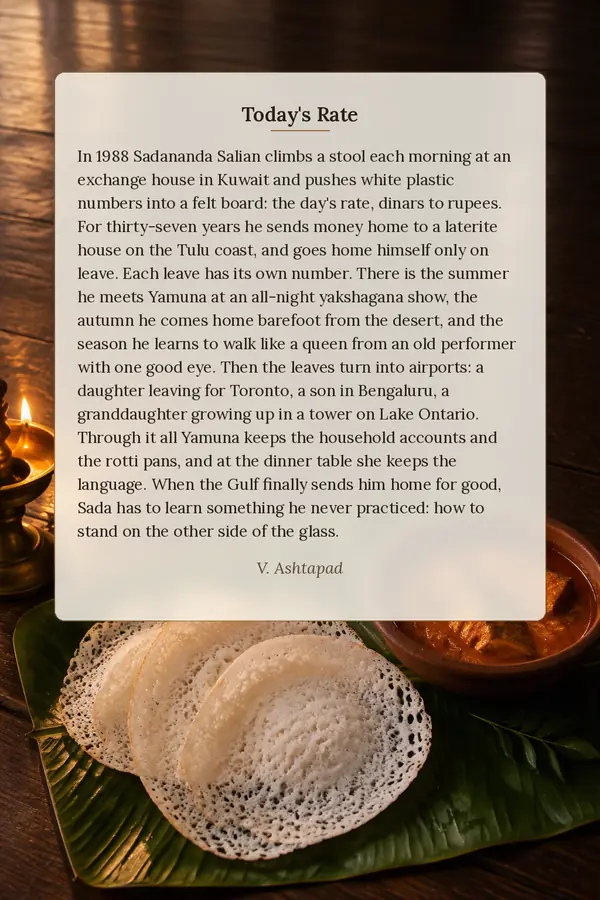
In 1988 Sadananda Salian climbs a stool each morning at an exchange house in Kuwait and pushes white plastic numbers into a felt board: the day's rate, dinars to rupees. For thirty-seven years he sends money home to a laterite house on the Tulu coast, and goes home himself only on leave. Each leave has its own number. There is the summer he meets Yamuna at an all-night yakshagana show, the autumn he comes home barefoot from the desert, and the season he learns to walk like a queen from an old performer with one good eye. Then the leaves turn into airports: a daughter leaving for Toronto, a son in Bengaluru, a granddaughter growing up in a tower on Lake Ontario. Through it all Yamuna keeps the household accounts and the rotti pans, and at the dinner table she keeps the language. When the Gulf finally sends him home for good, Sada has to learn something he never practiced: how to stand on the other side of the glass.
Members can react to this book and talk about it in the members' Library.