
Two Bows
A Brooklyn Boy, a Bedsheet Sail and the Easter Regatta on Bequia
by V. Ashtapad
Foreword
This is a work of fiction. Bequia's two-bow boats are real, built on the beaches by eye, and so is the Easter Regatta and the hurricane of 1955. Friendship Bay's boat under the sea-grape tree, its builders and its family are invented.
For everyone who ever slept on a sheet that went to sea.
The Keel on the Sand
The boat was lying on its side on the beach at Friendship Bay like a fish somebody had cleaned and forgotten, and Jaden Hazell, sixteen, from Flatbush, Brooklyn, stood in front of it in his sneakers with his phone in his hand and could not think of one thing to say.
It was not a boat. Not yet. It was a backbone. A long curved spine of dark wood, twenty-two feet from end to end, lying on blocks in the sand under a sea-grape tree, with two tall pointed posts rising from either end of it like the horns of a crescent moon, and between them, curving up out of the spine on both sides, ribs. Pale ribs of wood, thin and bent, a dozen of them, in a row, like the ribs of something enormous that had died on the beach and been picked clean by the wind.
There were no planks. No sides. No mast. No seats. Through the ribs Jaden could see straight through to the sea beyond, turquoise and jade and a blue so deep it was almost purple, going out to the line of the horizon under a sky without one cloud in it. Pelicans were diving in the bay. A man in a small wooden boat was rowing past, very slowly, standing up, facing forward, pushing on the oars. Somewhere behind the sea-grape tree, a goat complained.
"This is it?" said Jaden.
"This is it," said his mother.
---
His mother was standing beside him on the sand in her work shoes, which she had not changed out of since the airport, with her hands on her hips. Her name was Claudette Hazell. She was forty-four. She had been born in a wooden house fifty yards up the hill from where they were standing, and she had left at eighteen for Brooklyn and a nursing degree and had come back, in twenty-six years, exactly four times, and every time, she said, the island got smaller and the boats got bigger.
"Your uncle Lennox started it in January," she said. "He laid the keel on his seventieth birthday. He's built eleven of these. Every one by eye. No plans. No drawings. He looks at a tree, and he sees the boat that's in it, and he cuts it out." She looked at the ribs. "He was going to race it at Easter. In the regatta. Like his father. Like his grandfather. He said this would be the best one. The last one."
"And then the heart thing."
"And then the heart thing," said his mother.
---
The heart thing had happened in March. Uncle Lennox had been on the beach under the sea-grape tree, alone, at six in the morning, bending a rib over a fire to make it curve, when something in his chest had closed like a fist. A fisherman rowing past had seen him fall. They had brought him to the hospital in Kingstown on the big island of St. Vincent, nine miles across the water, on the morning ferry, on a stretcher on the car deck between a truck full of plantains and a pickup full of goats. He had had surgery. Four bypasses. He had been home since May.
The doctors said no lifting. No bending. No sawing. No standing in the sun. No boats.
"No boats," Uncle Lennox had told Jaden's mother, on the phone, in June, at two in the morning, Brooklyn time. "Claudette. They say no boats. What am I, then? A man who sits on his veranda and watches other people's boats?" His voice had gone very quiet. "The ribs are drying out. The ribs are going to crack."
And Jaden's mother, who was a nurse, and knew exactly what four bypasses meant at seventy, had sat at the kitchen table in their apartment on Rogers Avenue at two in the morning, and looked at her son, who had come in to get a glass of water and was standing in the doorway in his shorts and a Brooklyn basketball T-shirt, and said, "How would you like to go to Bequia for the summer?"
---
Jaden had not wanted to go to Bequia for the summer.
He wanted to stay in Brooklyn and work at his friend Marcus's cousin's phone repair shop on Church Avenue, where they were going to pay him fourteen dollars an hour to replace cracked screens and charging ports. He wanted to play basketball at the courts in Wingate Park at night under the lights. He wanted to sleep until noon. He had been to Bequia once, when he was six, and all he remembered was a lot of sand and a lot of old people and a cousin who had pushed him off a jetty.
He told his mother so. He told her in the kitchen at two in the morning, and at breakfast, and on the phone from Marcus's cousin's shop, and on the A train to the airport with his bag between his knees, and she said, "Mm-hm," every time, in the voice she used on patients who said they did not need the shot.
The plane to St. Vincent was full of people going home. He could tell. They were dressed for the airport in Brooklyn and talking for the island, louder and louder the farther south they flew, and when the wheels came down in Kingstown in a hot white glare, the whole plane clapped. His mother clapped. He looked at her.
"You'll see," she said.
The ferry to Bequia left from the jetty in Kingstown at four. It was a big old steel boat, painted white and blue, with a car deck open at the stern and a passenger deck above with plastic benches, and it smelled of diesel and fish and fried chicken from a woman selling it out of a cooler by the stairs. Jaden stood at the rail. Nine miles of water. It did not look like nine miles. It looked like you could swim it, if you were stupid, which he was not. The island sat on the sea ahead of them, long and low and green, with the sun going down behind it and the hills going purple, and the water between was a color he had only ever seen on a phone screen and assumed was fake.
Halfway across, the channel opened up to the east, to the Atlantic, and the ferry began to roll. Long slow rolls, side to side, so that the benches slid and the woman with the cooler put her hand on the lid of it without looking. A little boy was sick over the side. Two old men in straw hats went on playing dominoes on an upturned crate as if nothing at all were happening, slapping the tiles down hard on every roll, and laughing.
His mother stood beside him at the rail. She had stopped talking. He looked at her and saw that she was holding the rail with both hands and looking at the island the way he had once seen her look at a monitor in the hospital, when he was eight and had come to visit her at work and had been put in a chair in the corner of a room where a man was very sick: steady, without blinking, as if she were afraid it might change if she looked away.
"Mom?"
"I'm fine," said Claudette Hazell. "It's just closer than I remember."
They came into Admiralty Bay in the last light, past the yachts riding at anchor and the fishing boats tied up at the jetty and the old schooner with her sails furled, and the whole of Port Elizabeth came up around them, white and pink and green houses climbing the hills, and music coming out of a bar on the waterfront, and somebody on the jetty shouting his mother's name, *Claudette! Claudette Hazell!*, a woman in a church hat who had known her when she was nine, and his mother laughed and waved and wiped her face with the back of her hand all in the same movement, and Jaden understood that he was not going to get out of this.
---
"I don't know anything about boats," he said, on the beach, to his mother.
"No," said his mother. "But you know how to fix things. You fixed my phone. You fixed the toaster. You fixed Mrs. Bastien's hearing aid with a paper clip." She looked at him. "And your uncle Lennox needs hands."
"He has hands."
"He has hands that aren't allowed to do anything," said Claudette Hazell. "That's worse than no hands. Trust me. I'm a nurse."
She turned around and walked up the beach toward the hill, toward the wooden house, in her work shoes, through the soft white sand, leaving him standing in front of the ribs of a boat with the pelicans diving and the goat complaining and his phone, he noticed, showing no signal at all.
© 2026 CRUNOD LLC. All rights reserved.
The Veranda
Uncle Lennox was on the veranda.
It was a wooden veranda along the front of a wooden house painted the green of a lime, with white trim and red shutters and a tin roof gone the color of rust, set on stone pillars on the side of the hill above Friendship Bay, so high that from the veranda you could see the whole curve of the bay below, white sand and coconut palms and the sea-grape tree with the boat under it, and beyond, across a mile of water, the next island, low and green, and beyond that another, and another, going away south in a chain into the haze, green on blue on green, like stepping stones for a giant.
He was sitting in a wooden chair with a cushion on it and his feet up on a stool and a cane leaning against the railing, and he was not happy about any of it.
He was seventy. He was a big man, or had been, with enormous shoulders and arms like a stevedore's and hands as hard and dark as the keel of his boat, and he had gone thin since March, so that his old shirt hung on him like a sail with no wind. His hair was white and cut very short. His face was the face of a man who had been out in the sun every day for seventy years and had been told he could not go out in it anymore.
He looked at Jaden coming up the steps.
"So," he said. "Claudette's boy."
"Yes, sir."
"Last time I saw you, you were six and Kemuel pushed you off the jetty at Paget Farm."
"I remember."
"You came up spitting like a cat." Uncle Lennox almost smiled. "I said to your mother, that boy has a temper. Good. A man with no temper builds a boat with no backbone." He looked Jaden up and down. "You're tall."
"Six one."
"Your grandfather was six four. You'll get there." Uncle Lennox looked out over the bay, at the boat under the sea-grape tree. "You've seen it."
"Yes, sir."
"What did you see?"
Jaden thought about it. He thought about saying *a boat*, which was what his uncle wanted him to say, and *it's beautiful*, which his mother would have wanted him to say. He thought about the ribs, pale and thin, curving up out of the spine like the bones of something dead.
"I saw that it's not finished," he said.
Uncle Lennox looked at him for a long time.
Then he laughed. A big laugh, deep, from the bottom of his chest, and then he coughed, and put his hand over his chest where the scar was, under his shirt, and Jaden's mother came out of the house fast with a glass of water.
"I'm fine," said Uncle Lennox. "I'm fine, Claudette." He drank the water. He looked at Jaden again. "That's right," he said. "That's the first thing anybody has said to me since March that was right. It's not finished." He put the glass down on the railing. "So. Tomorrow. Six o'clock. Before the sun. We start."
"We?"
"You," said Uncle Lennox. "And them."
---
That night he could not sleep.
The room at the back of the green house had a single bed with a white cotton sheet and a ceiling fan that turned so slowly he could count the blades, and a window with no glass, only wooden louvers, through which came the sound of the tree frogs, which was like nothing he had ever heard, and the smell of the yard, which was like nothing he had ever smelled, flowers and woodsmoke and something rotting sweetly on the ground under a tree. His phone said *No Service*. He held it up to the louvers. *No Service*. He held it up to the ceiling. He lay down and put it on his chest and listened to it not ringing.
Through the wall he could hear his great-uncle breathing. It was a slow heavy sound, with a catch in it, like someone dragging a box across a floor and stopping, and dragging it again. Every few minutes the catch was longer. Every time, Jaden held his own breath until the dragging started again.
At midnight he got up and went out to the kitchen for water and found his mother sitting on the back step in the dark in her nightdress with her knees up, looking at the yard.
He sat down beside her. The step was still warm from the day.
"He sounds bad," said Jaden.
"He sounds like a seventy-year-old man three months out from a quadruple bypass," said his mother. "Which is what he is. He sounds better than I thought he would." She was quiet. "He's scared. He won't say so. Men his age on this island don't say so. They just sit on the veranda and get angry at the sea."
"Were you scared? When you left? At eighteen?"
His mother laughed, softly, in the dark.
"I was terrified," she said. "I had never been on a plane. I had never been farther than Kingstown. I had one suitcase and a coat my aunt in Brooklyn mailed me that was two sizes too big, and I wore it on the plane, in August, because I didn't know what else to do with it." She looked at the yard, at the black shapes of the trees against the stars. "Uncle Lennox took me to the ferry. In his boat. Not the big ferry. His own boat, the one before this one, across the channel to Kingstown at five in the morning, in the dark, with the spray coming over. He didn't say one word the whole way. And on the jetty in Kingstown he put twenty dollars in my hand, Eastern Caribbean, which was a lot of money for him then, and said, *Don't come back until you're a nurse.* And then he got back in his boat and went home."
"And you didn't."
"I didn't come back for six years," said Claudette Hazell. "And when I did, I was a nurse. And he met me at the jetty, in the same boat, and looked at me in my uniform, because I wore it on the plane on purpose, and he said, *Good,* and that was all." She put her arm around her son's shoulders, which she had not done since he was twelve, and he let her. "He's going to be hard on you. He's going to be impossible. That's how he loves people. Don't take it personally."
"How am I supposed to take it?"
"Take it like a man who's being given something," said his mother. "Because you are."
---
*Them* came up the hill at six the next morning, in the gray light before the sun, three old men, slowly, one behind the other, on the path from the beach.
The first was very thin and very black and very bent, with a white beard and a straw hat with a hole in the top of it and a cutlass in a leather sheath on his hip, and he walked with a stick that was a piece of driftwood. His name was Mister Oswald, and he was eighty-four, and he had built boats on that beach since 1957.
The second was short and round and bald and light brown, with gold-rimmed glasses and a gold tooth and a T-shirt that said ST. VINCENT AND THE GRENADINES CRICKET 1998, and he carried a canvas bag that clanked. His name was Mister Ruel. He was seventy-seven. He had been a ship's carpenter on cargo boats in the Caribbean and the Atlantic for forty years and had come home to Bequia in 2009 to die, he said, and had not got around to it yet.
The third was the youngest, sixty-eight, tall and silent and very dark, with gray dreadlocks tied up in a knitted cap in red, gold and green, and he carried nothing at all, and said nothing at all, and Jaden would learn that this was how he always was. His name was Brother Elvin. He had sailed in the Easter regatta every year for fifty years. He had won it eleven times. He made sails.
They came up onto the veranda and stood in a row in front of Uncle Lennox's chair, three old men in the gray light, and looked at Jaden.
"This is him?" said Mister Oswald.
"This is him," said Uncle Lennox.
Mister Oswald looked at Jaden's sneakers. He looked at Jaden's phone. He looked at Jaden's hands, which were long and thin and had never held anything heavier than a basketball and a soldering iron.
"Lord help us," said Mister Oswald.
© 2026 CRUNOD LLC. All rights reserved.
Ribs
The first thing they taught him was the ribs, because the ribs were drying out.
They were made of white cedar, Mister Oswald said, cut from a tree on the hill above Paget Farm in January by Uncle Lennox himself, with a chainsaw and a cutlass and his own two hands, before the heart thing. You cut a rib from a branch that was already curved, if you could find one. If you could not, you cut it straight and steamed it, or heated it over a fire, and bent it, slowly, around a form, and tied it there, and let it cool, and it kept the curve.
But a rib that had been bent and then left in the sun for four months was a rib that wanted to go back. It was drying. It was shrinking. It was, Mister Oswald said, *thinking about cracking*.
"So we wet them," said Mister Ruel.
They wet them. Every morning at six, before the sun came over the hill, for a week, Jaden carried buckets of seawater up the beach from the bay and poured them over the ribs, slowly, one rib at a time, while Mister Oswald watched from a plastic chair in the shade of the sea-grape tree and told him he was pouring it wrong. Then they wrapped the ribs in burlap sacks, old ones from a feed store in Port Elizabeth that said CHICKEN SCRATCH on them in faded red, and wet the sacks, and the ribs sat in their wet sacks in the shade of the sea-grape tree like patients in bandages, and drank.
"Wood is alive," said Mister Oswald, from his chair. "Even after you cut it. Especially after you cut it. It remembers being a tree. It wants water. It wants to move. You don't fight it. You give it what it wants until it forgets what it wants, and then it does what you want."
Jaden poured seawater over a rib.
"That sounds like my mother," he said.
Mister Oswald laughed so hard he nearly fell out of the plastic chair.
---
On the fourth morning, when Jaden pulled the wet sack off the ninth rib on the right side, it had a crack in it.
It was not a big crack. A line, thin as a hair, running a few inches along the outside of the curve, where the wood had been stretched the most. He would not have seen it if the sun had not just come over the hill and lit it from the side. He looked at it for a long time. Then he called Mister Ruel, who came and took off his gold-rimmed glasses and put them on again and bent down and looked at it with his nose an inch from the wood, and said a word Jaden's mother would not have approved of.
"Can you fix it?" said Jaden. "Glue it? Clamp it?"
"You can't glue a rib," said Mister Ruel. "A rib has to bend every time she goes over a wave. Ten thousand times a race. Glue doesn't bend. Glue gives up." He straightened, slowly, with one hand on his back. "We make a new one."
They made a new one that afternoon.
Mister Ruel sent Kofi running up the hill for a length of white cedar, a straight piece, one Uncle Lennox had set aside in January under the house for exactly this. They split it with a wedge and a mallet and shaved it down with a drawknife to the thickness of the old one, about as thick as two of Jaden's fingers, and then they built a fire on the sand in a ring of stones and let it burn down to coals, and over the coals they laid a sheet of old tin roofing, and on the tin they poured seawater, and it hissed and boiled and steamed in a white cloud, and Mister Ruel laid the cedar in the steam and covered it with a wet sack.
"Now we wait," he said, and sat down on a bucket.
They waited an hour. Mister Ruel told Jaden about a ship he had worked on in 1979, a Norwegian cargo boat in a storm off the Azores, with a cracked frame in the bow that he had fixed, he said, with a piece of a bunk bed and a great deal of prayer, which was not the method he recommended. Mister Oswald slept in his plastic chair under the sea-grape tree with his hat over his face. The pelicans dove. The steam rose.
Then Mister Ruel pulled on a pair of thick leather gloves, and took the cedar out of the steam, and it was soft. Jaden could see it. It sagged a little in Mister Ruel's hands like a piece of warm licorice.
"Quick," said Mister Ruel. "Now. Before it remembers."
They bent it around the form, a curved piece of hardwood nailed to two posts in the sand, the same form Uncle Lennox had bent the first ribs on in January. Mister Ruel held one end and Jaden pulled the other, slowly, with his whole weight, gloves on, the hot wood creaking and steaming under his hands, around and down, until it lay against the form, and they tied it there with rope, and Jaden stood back with his hands stinging through the gloves and his heart going fast.
"How long does it stay?"
"Overnight," said Mister Ruel. "Then it forgets it was ever straight."
Jaden looked up the hill. On the veranda of the green house, far above them, a figure in a chair was holding something up to its face, and the sun caught it, two small flashes, like two coins.
"He's watching," said Jaden.
"He's always watching," said Mister Ruel. "He thinks we don't know."
---
It was the hardest work Jaden had ever done, and he had once carried a refrigerator up four flights of stairs on Rogers Avenue with his cousin Andre because the landlord said the elevator was "temporarily retired."
The sun came over the hill at seven and by eight it was on the beach like a hand pressing down. The sand burned through his sneakers. Then he took off his sneakers, because Mister Ruel said a man could not work on a boat in shoes, he had to feel the ground, and the sand burned his feet instead. The sweat ran into his eyes. The buckets of seawater were heavy, and the bay was a long way down the beach, and by the end of the first week his arms ached and his back ached and his hands had blisters on top of blisters, and the old men laughed at him every day and he did not care, because at eleven o'clock every morning Uncle Lennox's neighbor, Miss Velma, came down the hill from her house with a basket.
In the basket there was food. Every day different. Bakes, fried golden rounds of dough, puffed and split open with a knife and stuffed with saltfish cooked down with onion and tomato and hot pepper. Fried jackfish, whole, crisp, with the head on, and a roasted breadfruit, charred black on the outside from the coals and split open to show the inside, white and soft and sweet as a potato, which Miss Velma said was the national dish and if he didn't like it he could go back to Brooklyn. Callaloo soup, thick and green with dasheen leaves and okra and coconut milk and crab. Coconut tarts. Guava cheese. A bottle of sorrel, dark red and sweet and full of ginger, which she made from the flowers of a plant in her yard and which Jaden drank so much of that she started bringing two bottles.
They ate in the shade of the sea-grape tree, on overturned buckets, the four of them, the three old men and the boy, with the ribs of the boat drinking in their wet sacks behind them and the bay blazing in front of them and the pelicans diving, and the old men talked.
They talked about boats. Every boat. Every boat that had ever been built on that beach, by whom, from which tree, and how she sailed, and who sailed her, and how many regattas she won, and how she ended, whether she sank or burned or was sold to a man in Martinique or was still, after sixty years, rotting quietly in somebody's yard in Paget Farm under a tarp. They talked about wood, and wind, and the old days, and people Jaden did not know, who were all, it turned out, his relatives.
"Your great-grandfather," said Mister Ruel, "built the *Sister Enid* in 1931. On this beach. Right where that boat is."
"Who was Sister Enid?"
"His sister," said Mister Ruel. "Enid. She went to Trinidad and became a schoolteacher and never came back. He named a boat for her so she would always be on the water." He took a bite of breadfruit. "The *Sister Enid* won the regatta seven times. She was the fastest two-bow boat in the Grenadines for twenty years. Then she went down in Hurricane Janet in 1955. In Admiralty Bay. Tied to the jetty."
"Your uncle's boat," said Mister Oswald, from the plastic chair, "is the *Sister Enid*."
Jaden looked at him.
"The new one," said Mister Oswald. "Under the tree. That's what he's going to call her. Same lines. Same size. He's been carrying the shape of her in his head since he was a boy. His father showed him. On the sand. With a stick." He looked at the ribs in their wet sacks. "She's not a new boat. She's the old boat. Coming back."
© 2026 CRUNOD LLC. All rights reserved.
Planks
The planks took six weeks.
You do not buy planks for a Bequia boat. You make them. From a tree. Uncle Lennox had chosen the tree in January, before the heart thing, a big cedar on the hill above Paget Farm on land that belonged to a cousin, and had marked it with a cross in white paint and a date, and when the doctors said no boats it had stood there on the hill, waiting, with its white cross.
They cut it down on the first Monday in July.
Mister Oswald did it, with a chainsaw that was older than Jaden, while Mister Ruel and Brother Elvin and three cousins Jaden had never met held ropes to make it fall the right way, and Jaden stood back with Uncle Lennox, who had come up the hill in a cousin's pickup against his doctor's orders and his niece's, and sat in the passenger seat with the door open and his cane across his knees and watched.
The tree went over with a long slow crack and a sound like the whole hill sighing, and when it hit the ground the leaves went up in a green cloud and the birds went up out of the trees all around in a cloud of their own, and then there was silence, and the smell came. Cedar. Sharp and sweet and clean and dark, like the inside of a closet in an old house, like pencils, like a church. It filled the whole hillside.
Uncle Lennox closed his eyes.
"There," he said. "There she is."
---
They cut the planks with a chainsaw and an old two-man pit saw that Mister Ruel brought in his clanking canvas bag, and then they shaped them with an adze.
An adze is like an ax turned sideways. The blade is set crosswise to the handle, like a hoe, and you stand over the plank with your feet planted wide on either side of it and swing the adze down and toward you, between your own feet, and it bites into the wood and takes off a long thin curl, and you swing again, and again, walking slowly backward down the plank, and the curls fly up around your ankles like pale wood shavings in a carpenter's shop, which is what they are. If you miss, Mister Oswald said, cheerfully, you take off your own toe.
Mister Oswald could adze a plank smooth as glass in an afternoon. He had been doing it since 1957. He did it slowly, without stopping, the adze rising and falling in a rhythm like a heartbeat, his bent old back straight for once, his white beard full of shavings.
Jaden could not adze. Jaden took off great uneven chunks. Jaden hit a knot and bounced the adze back nearly into his own face. Jaden, on the third day, missed, and the blade came down an inch from his left big toe and buried itself in the sand.
There was a silence under the sea-grape tree.
Then Mister Oswald took the adze out of the sand and handed it back to him.
"Now you know," he said. "Now you'll be careful. A man who never misses never learns where his toes are."
---
His mother went home in the middle of July.
She had stayed as long as the hospital would let her, and two days longer, and on the last morning she came down the hill to the beach at six, in her work shoes again, with her bag over her shoulder, to say goodbye to the boat. That was how she put it. *I'm going down to say goodbye to the boat.* Jaden was holding a plank for Mister Ruel. He put it down.
She walked all the way around the hull, slowly, with her hand on it. It was half planked by then, the bottom strakes on, pale and new against the ribs, so that it looked less like a skeleton and more like something that had begun to grow skin. She stopped at the bow and put her palm flat against the stem post, the tall pointed post at the front, where Uncle Lennox had cut a small notch with his knife in January, on his birthday, to mark the day the keel was laid.
"My grandfather used to let me sleep in the bottom of his boat," she said. "In the afternoons. On the sand. Under the tree. Right here. With the sail over me like a tent." She looked at Mister Oswald, in his chair. "You used to shout at me to get out."
"You never got out," said Mister Oswald.
"I never got out," said Claudette Hazell.
She walked with Jaden to the end of the beach where the path went up to the road and the taxi was waiting, an old minivan with a cracked windshield and a driver who had been at school with her. At the bottom of the path she stopped and turned around and looked at him.
"Six weeks," she said. "Then I'll see you at JFK."
"I know."
"Do what they tell you. Drink water. Wear the hat." She reached up and fixed the collar of his T-shirt, which did not need fixing. "Call me. Stand on the toilet if you have to."
"How do you know about the toilet?"
"Everybody in this family knows about the toilet," said his mother. "I stood on that toilet in 2015 to call the hospital about my shifts."
Then she hugged him, hard, in the sand, with her bag banging against his back, and got into the minivan, and did not look back, and he understood, watching it go up the hill in a cloud of white dust, that she was not looking back for the same reason Uncle Lennox had not said one word on the boat to Kingstown twenty-six years before.
When he came back to the boat Mister Ruel handed him the plank without a word, and he held it, and Mister Ruel's hammer started again, tap-tap-tap.
---
By the end of July he could adze a plank. Not well. Not like Mister Oswald. But he could stand over it with his feet planted and swing the adze down between them in a rhythm, and take off a long thin curl, and walk backward, and take off another, and at the end the plank was smooth, or smooth enough, and Mister Oswald ran his hand along it and grunted, which meant good.
Then the planking. You bend each plank around the ribs, starting at the bottom, at the keel, and working up, plank by plank, each one overlapping the one below it a little, and you fasten each one to every rib with copper nails, and inside, behind the rib, you clinch the nail over a little copper washer with a hammer, so it holds. Hundreds of nails. Thousands. Mister Ruel did the clinching, inside the hull, crouched in the bottom of the boat in the shade with his gold-rimmed glasses on the end of his nose and his hammer going tap-tap-tap, tap-tap-tap, all day, like a woodpecker. Jaden held the planks.
Uncle Lennox watched from the veranda.
He watched every day, from six in the morning until the sun went down, with a pair of old binoculars from the war, a war, Jaden was never sure which. He could see the whole beach from the veranda, every plank, every nail. And when something was wrong, he sent a message. By phone, at first, to Mister Ruel. Then, when Mister Ruel stopped answering his phone, by a small boy from the house next door, who came running down the hill at intervals with a piece of paper in his fist, and stopped in front of whoever the message was for, and read it out at the top of his voice.
"*Mister Oswald*," shouted the small boy, whose name was Kofi, and who was nine, "*the seventh plank on the left side is too proud at the bow. Take it down half an inch or the boat will go sideways in a reach.*"
Mister Oswald looked at the seventh plank on the left side. He took out his tape. He measured. He took it down half an inch.
"How can he see that?" said Jaden. "From up there?"
"He can't see it," said Mister Oswald. "He knows it."
© 2026 CRUNOD LLC. All rights reserved.
The Story Under the Veranda
In the evenings, when the sun went down over the next island in a blaze of orange and pink and gold that made the whole sea look like it was on fire, and the beach went dark, and the boat stood under the sea-grape tree with her new planks shining in the last light, Jaden went up the hill and sat on the veranda with his uncle.
He did not mean to, the first time. He meant to go to his room in the back of the house and lie on the bed under the fan and try to get a signal on his phone, which worked only, it turned out, if you stood on the toilet and held it out the bathroom window toward St. Vincent. But Uncle Lennox was on the veranda in the dark, alone, in his chair, with his feet up and the binoculars in his lap and a glass of something with ice in it that he was not supposed to have, and Jaden came out of the house to tell him goodnight, and his uncle said, "Sit," and so he sat.
They did not talk, at first. They sat in the dark and listened to the island. It was louder at night than in the day. The tree frogs started at sunset, thousands of them, in every tree and bush on the hillside, a high sweet piping whistle, *ko-kee, ko-kee*, so loud and so many that it was like sitting inside a bell. The waves came up the beach below, slow and soft. Somewhere down the hill, a radio was playing soca. Somewhere farther, a string band was practicing in a yard: a fiddle and a banjo and a guitar and a bass made from a washtub and a broomstick and a piece of rope, playing an old tune, a quadrille, the music of the old dances, and the sound came up the hill in the dark on the warm wind, scratchy and sweet and a little out of tune.
"That's Brother Elvin's cousin," said Uncle Lennox, after a long time. "On the fiddle. He's terrible." He listened. "His father was the best fiddler on the island. In 1960. At the regatta, at the end, at night, on the beach at Admiralty Bay, there'd be four, five string bands, all playing at once, and everybody dancing. The boats lit up in the harbor. Everybody's grandmother on the jetty in a white dress. Rum. Goat water."
"Goat water?"
"Goat stew. Thick. With dumplings. Everybody's grandmother makes it different and everybody's grandmother says hers is right." Uncle Lennox drank his drink. "My mother made it with breadfruit. She said dumplings were for people from St. Vincent who didn't know any better."
Jaden laughed.
They listened to the string band for a while. It stopped in the middle of a tune, the way string bands do when somebody's string breaks, and started again on a different one.
"What do you fix?" said Uncle Lennox. "In Brooklyn. Your mother says you fix things."
"Phones, mostly. Screens. Charging ports. Sometimes speakers." Jaden shrugged in the dark. "Whatever's broken."
His uncle reached down beside his chair and lifted something onto his knees. It was a radio. An old one, bigger than a shoebox, in a case of dark wood with a cloth front and two round knobs, one of them missing.
"My father bought this in Kingstown in 1961," said Uncle Lennox. "It played the cricket every summer of my life. Then in March, the same week as the heart thing, it stopped." He held it out. "Everybody says, Lennox, buy a new one. They cost twenty dollars. I said, I'm not buying a new one. I'm not buying a new anything."
Jaden took it. It was heavy. He turned it over and found the screws in the back with his fingers in the dark.
It took him an hour. He took the back off right there on the veranda under the lamp, with the tiny screwdriver he always carried on his key ring, and found inside a world of glass tubes and copper wire and small brown parts like beads, everything furred with sixty years of dust and salt, and one wire, near the speaker, where the solder had cracked and come away. He had no soldering iron. He heated a nail on the gas ring in the kitchen and held it with a pair of Miss Velma's tongs and melted the old solder back onto the wire, very carefully, while his uncle watched from the chair without saying anything at all.
When he put the back on and turned the knob, there was a hum, and a crackle, and then, very faintly, a man's voice from the big island across the water, reading the fishing forecast.
Uncle Lennox closed his eyes.
"There," he said, the way he had said it on the hill when the cedar came down. "There he is."
They did not change the station. They sat on the veranda and listened to the wind speed and the wave height for every channel in the Grenadines, read out slowly in a warm deep voice, as if it were music, and when it was over his uncle said, "Again tomorrow," and Jaden knew he did not mean the radio.
---
On the second night, his uncle told him about the *Sister Enid*.
The first one. The one his great-grandfather built in 1931. How she had been the fastest two-bow boat in the Grenadines for twenty years. How his grandfather sailed her to Grenada and back in a day, which nobody believed. How she had a sail made of flour sacks, at first, stitched together by his great-grandmother on the veranda of this house by lamplight, because nobody could afford canvas, and then later a sail made of bedsheets, white cotton bedsheets from a shop in Kingstown, which was faster, because it was lighter, and because, his great-grandmother said, it had been slept in by good people.
"Bedsheets," said Jaden.
"Bedsheets," said his uncle. "Everybody did it. In those days. A sail is a sail. Wind doesn't care what it's made from." He looked out at the dark bay, where the boat stood under the tree. "Brother Elvin's going to make hers from bedsheets. I asked him. Like the old one."
"Is that allowed? In the regatta?"
Uncle Lennox laughed.
"Boy," he said. "In the regatta, the only rule is you have to finish."
---
On the third night, he told Jaden about Hurricane Janet.
It came on the twenty-second of September, 1955. Uncle Lennox was not born yet. His father was nineteen. It came out of the east in the night, with no warning, because there was no radio on Bequia then, no television, no telephone, only the sky going green and the birds going quiet and the old women saying something was coming. And it came. Wind like nothing anyone had ever felt. The sea came up over the beach and into the houses. Roofs went. Trees went. The *Sister Enid* was tied to the jetty in Admiralty Bay, where his grandfather had put her for safety, and the jetty went, and she went with it, and in the morning there was nothing in the harbor but broken wood and a single white bedsheet, torn, caught in the branches of a sea-grape tree on the shore.
"My father kept it," said Uncle Lennox. "The sheet. Folded up. In a drawer. Seventy years." He looked at Jaden in the dark. "It's in the house. In the drawer by my bed. When Brother Elvin makes the new sail, I'm going to give it to him. To sew in. A piece of it. In the corner."
He was quiet for a long time, in the dark, with the tree frogs going.
"That's the only reason I started her," he said. "At seventy. With my heart already going. I knew. I'm a nurse's uncle. I knew." He put his hand on his chest. "I wanted to put that sheet back on the water. Before I go. That's all. That's the whole thing."
Jaden did not say anything. He did not know what to say. He sat on the veranda beside his uncle in the dark, with the string band playing down the hill and the waves coming up the beach and the boat under the sea-grape tree, and after a while he took out his phone, and turned on the recorder, and held it out in the dark between them.
"Tell it again," he said. "From the beginning. For my mom. And for me."
© 2026 CRUNOD LLC. All rights reserved.
Caulking
When the last plank was on, at the beginning of August, the boat leaked.
Jaden had not known it would. He had thought that when every plank was bent and fastened and clinched, tight against the ribs and tight against each other, the boat would be finished, or at least closed, like a box. Then Mister Ruel stood inside the hull at noon on the first Saturday in August and told him to walk around the outside, slowly, and look, and he saw the light.
It came through the seams. Lines of it. Thin bright lines of sun between the planks, where one plank met the next, all along the hull, from the keel to the top, so that from outside, with Mister Ruel standing in the shadow within, the boat looked like a lantern made of wood.
"You see?" said Mister Ruel's voice, from inside. "She's a basket. Right now she's the best basket on Bequia. Now we make her a boat."
---
They made her a boat with cotton.
Mister Ruel had it in his clanking canvas bag, which, it turned out, held a great many things besides the thermos: a roll of raw cotton, gray-white, loose and soft, like the stuffing of an old pillow, and a set of caulking irons, which were like blunt chisels of every width with flat ends worn smooth, and a mallet with a head of dark wood bound in iron rings. He showed Jaden how to twist a strand of the cotton between his palms into a loose rope, and lay it along a seam, and set the iron on it, and tap the iron with the mallet, so that the cotton went into the seam, a little, and then tap again, and again, working along the seam a hand's width at a time, until the cotton was packed down hard into the crack between the planks, and the light was gone.
The mallet made a sound when you got it right. Mister Ruel made him listen for it. A dead thud meant the cotton was too loose. A sharp crack meant the iron had hit wood and you were splitting the plank. But a clean ringing note, a *tock* like a woodblock in a band, meant the cotton was going home, and every caulker on the island, Mister Ruel said, could tell from a hundred yards away whether the man working on a boat knew what he was doing, just from the sound of his mallet.
"In the old days," he said, "you'd walk down this beach in the morning and hear six, seven boats being caulked at once. Every one a different note. Like a steel band tuning up." He tapped. *Tock.* "You could tell who was working on which boat with your eyes shut."
Jaden's mallet went *thud* for two days, and *crack* once, which made Mister Oswald sit up in his chair and say, "Hey," in a voice that made the pelicans look up. On the third day it went *tock*.
Mister Ruel stopped his own mallet and listened.
"Again," he said.
*Tock.*
"That's it," said Mister Ruel, and went back to work, and did not say anything else about it, and Jaden caulked for the rest of the afternoon in the shade inside the hull with the sound of his own mallet ringing in his ears and could not stop grinning.
---
Over the cotton went the seam compound, a thick dark paste that Mister Ruel heated in a can over a little fire and laid into every seam with a putty knife, smooth and level with the planks. It smelled like tar and pine and burning, and it got on everything, Jaden's hands, his arms, his shorts, his one good T-shirt, and in his hair, where Miss Velma had to work it out at lunch with a rag soaked in coconut oil, scolding him the whole time.
Kofi helped. Kofi helped with everything now. He had appointed himself, at the top of his voice, the boat's official messenger and also its inspector, and he went around the hull every afternoon with his face an inch from the planks, the way he had seen Mister Ruel do it, and found places they had missed, and shouted about them. He was usually right. Mister Ruel said he would make a good caulker one day, if he could learn to do it quietly. Kofi said he would never learn to do anything quietly, and everyone agreed that this was true.
At night, standing on the toilet with his phone out the bathroom window, Jaden posted the sound of his own mallet, eleven seconds of it, *tock, tock, tock*, with no explanation. In the morning there was a note under it from his mother, written at four, on her break: *That's a caulker.*
---
At the end of the second week of August they filled her with water.
Not the sea. Not yet. They filled her on the sand, under the tree, with buckets, the way Jaden had wet the ribs in June: buckets of seawater carried up from the bay and poured into the hull until she was a third full, like a bathtub, with the water lying green and clear in her bottom over the keel.
She leaked. Of course she leaked. Jaden walked around the outside and saw it, thin dark lines on the white sand under the hull where the water was seeping out through the seams, and his heart sank into his bare feet.
"Good," said Mister Ruel.
"*Good?*"
"Wood is alive," said Mister Oswald, from his chair. "I told you. It wants water. She's been dry in the sun for seven months. Now she's drinking." He pointed with his driftwood stick. "Every plank is going to swell. A little. Just a little. And every seam is going to close up tight on the cotton like a fist. Two days. Three. You'll see."
They kept her full. They topped her up every morning. And every morning there were fewer dark lines in the sand under the hull, and thinner ones, and on the fourth morning Jaden walked around her twice, slowly, bent double, looking, and found the sand under her dry.
He stood up. He put his hand flat on the hull. It was cool and damp and it felt, he would have sworn, a little fuller under his palm than it had the week before, the way a basketball feels when you've put air in it.
"She's tight," he said.
Mister Oswald grunted, which meant good.
That night on the veranda, when Jaden told his uncle, Uncle Lennox did not say anything for a long time. Then he said, "I know," and lifted the old binoculars a little off his lap, to show how.
---
Then the paint.
White for the hull, three coats, laid on with brushes by everybody who came down to the beach that week, which was a great many people, so that by the end the boat had been painted by Miss Velma and Kofi and Kofi's mother and two cousins and the teacher from the primary school in Paget Farm and a tourist from a yacht who had wandered over to ask what they were doing and been handed a brush. The red stripe along the top plank, Mister Oswald did himself, sitting on an upturned bucket, with a brush and a steady hand and his tongue between his teeth, in one long pass on each side from bow to bow without lifting the brush, which everybody watched in silence, and which, when he finished, made the tourist from the yacht applaud.
And the name, last. Mister Ruel lettered it on both bows with his hair-fine brush on the last Sunday in August, alone, early in the morning, before anyone came, and Jaden, coming down the path at six, found him sitting back on his heels in the sand looking at it.
*SISTER ENID II*
"I knew her," said Mister Ruel, without turning around. "The first one. I was a small boy. I sat in her once, on this beach. Your uncle's grandfather lifted me in." He wiped the brush on a rag. "I didn't think I'd see that name on the water again. Not in my life."
He stood up, slowly, with a hand on the gunwale, and went to put the kettle on.
© 2026 CRUNOD LLC. All rights reserved.
The Mast
The mast came from the hill, the way everything did.
Brother Elvin came for Jaden at five in the morning on the second Tuesday in August, in the dark, and stood at the bottom of the steps of the green house without knocking, and waited. Jaden only knew he was there because Uncle Lennox, who did not sleep much, called through the wall, "Elvin's here," and then, "Take water," and then, "Do what he tells you," and Jaden pulled on his shorts and his sneakers, because he had learned that the hill was not the beach, and went out.
Brother Elvin was standing in the yard in the gray light with a cutlass on his hip and a coil of rope over his shoulder and a small handsaw in a canvas sheath. He looked at Jaden's sneakers. He nodded once. He turned and walked up the hill.
Jaden followed.
---
They walked for an hour. Up the path behind the house and over the top of the ridge and down the other side, through scrub and cactus and long dry grass, then up again, into the trees, where the air was cooler and smelled green, and the ground was soft with leaves, and small brown lizards ran away from their feet. Brother Elvin did not stop and did not speak and did not look back. He walked the way he did everything, without hurry and without wasting anything, and Jaden, who could run the length of a basketball court eleven times without stopping, found himself breathing hard behind a man of sixty-eight who was not breathing hard at all.
At the top of the second hill, where the trees opened out and you could see the sea on both sides of the island at once, east and west, Brother Elvin stopped.
There was a stand of young trees there, close together, competing for the light, so that every one of them had grown up tall and thin and straight without wasting time on branches. Brother Elvin walked among them slowly, looking up. He put his hand on one, and then another. He sighted along a third with one eye shut, the way Jaden had seen old men at the pool hall on Church Avenue sight along a cue. He shook his head. He moved on.
It took him half an hour. He chose a tree about as thick as Jaden's leg at the bottom and as thick as his wrist at the top, a long way up, and straight, straighter than anything Jaden had ever seen grow, straight as a flagpole. Brother Elvin put his hand flat on it. Then he took Jaden's hand, without asking, and put it flat on the bark beside his own.
Jaden did not know what he was supposed to feel. He stood there with his palm on the tree and his breath coming back to him and the wind moving in the leaves high above, and after a while he felt it: the tree moving. Very slightly. Under his hand. Swaying in the wind at the top, a long way up, so that the motion came all the way down the trunk into his palm as a slow, steady pulse, like a big animal breathing.
He looked at Brother Elvin. Brother Elvin was looking at him, and for the first time since June there was something in his face that might have been a smile.
He took his hand away from the tree and handed Jaden the saw.
---
They cut it low, close to the ground, Jaden on his knees with the saw and Brother Elvin holding the rope he had thrown over a branch to guide the fall. When it went, it went the way Brother Elvin had meant it to, straight down the slope into the clearing, with a long rushing sigh of leaves, and lay there in the grass, longer than Jaden had thought, longer than the boat.
Brother Elvin trimmed it with the cutlass. Every small branch, every twig, with short quick strokes that left the trunk smooth. He measured it with his eye, and then with his arms, spread wide, so many times, and marked it with the point of the cutlass, and Jaden sawed it there. Then Brother Elvin tied the rope to the thick end and put the rope over his shoulder and looked at Jaden and pointed at the thin end.
They carried it home like that, the two of them, one at each end, an hour back over two hills, through the trees and the scrub and the cactus, in the rising heat. Jaden's shoulder went raw. His sneakers filled with dirt. Halfway down the last hill his foot went out from under him on loose stones and he sat down hard, and the mast came down across his lap, and Brother Elvin stopped and waited, holding his end, not helping, not hurrying, until Jaden got up again on his own.
They came down the path to Friendship Bay at ten in the morning with the mast between them, and Mister Oswald looked up from his chair under the sea-grape tree, and looked at the mast, and looked at Jaden's face, which was streaked with sweat and dirt and had a long scratch across it from a thorn, and said, "Well. Now he's been up the hill."
---
They peeled it and dried it and shaped it over the next ten days, slowly, with a drawknife and a plane and a rasp, until it was round and smooth and pale gold and tapered from the bottom to the top in a line so true that when Jaden sighted along it with one eye shut, the way Brother Elvin did, he could not see one bend in it anywhere.
Brother Elvin taught him without speaking. He would take Jaden's hands and put them on the drawknife where they belonged, and push them through one stroke, and let go. He would run his own palm down the mast and stop at a place where it was not quite round and tap it twice with one finger. He would hold up a hand, flat, when Jaden was going too fast, and Jaden would slow down. By the end of the first week Jaden found that he understood him. Not the way you understand words. The way you understand a point guard you have played with for a whole season, who never calls the play out loud because he does not need to, because you are both already watching the same thing.
On the last day they stepped the mast. Brother Elvin and Mister Ruel lifted the foot of it into the square socket that had been cut for it in a block of hard wood fastened to the keel, low in the bottom of the boat, and Jaden and two cousins pulled it upright with ropes from the beach, slowly, the long gold pole rising out of the hull against the blue sky, until it stood straight up in the boat and Mister Ruel wedged it tight where it passed through the thwart.
Uncle Lennox, on the veranda, put down his binoculars.
That evening, when Jaden came up the hill with the scratch on his face and his shoulder raw and his hands blistered in new places, his uncle looked at him for a long time from his chair.
"Elvin took you up the hill," he said.
"Yes, sir."
"He took me up that hill in 1972. I was seventeen. He was fourteen. His father sent him to show me the trees." Uncle Lennox looked out at the bay, at the mast standing up in the boat under the sea-grape tree, gold in the last light. "He didn't say one word to me the whole way, either."
© 2026 CRUNOD LLC. All rights reserved.
The Sail
Brother Elvin made the sail in August, on the veranda, in the evenings, out of fourteen white bedsheets.
They came from everywhere. That was the thing Jaden would remember. His uncle had told Brother Elvin he wanted bedsheets, like the old *Sister Enid*. And Brother Elvin, who never said anything, had said nothing, and gone down the hill. And two days later, the bedsheets started coming.
Miss Velma brought one, from her own bed, washed and ironed and folded into a square. Mister Ruel's wife brought one. Mister Oswald's granddaughter brought two, from the guesthouse she ran in Port Elizabeth. The woman who sold fish on the jetty brought one. Kofi's mother brought one, a child's sheet, with faded cartoon fish on it, which Kofi had slept on until he was seven and which he insisted, at the top of his voice, should go in the sail. The teacher from the primary school in Paget Farm brought one. A man from the dive shop. A cousin from Canouan, the next island south, who came over on the ferry with a sheet in a plastic bag. A woman from Mustique.
And one in the mail, from Brooklyn. Overnight delivery, expensive, from Jaden's mother, who had gone home to Flatbush in July for her shifts at the hospital on Clarkson Avenue and who had, apparently, been listening to the recordings Jaden posted every night on the family's page, standing on the toilet with his phone out the bathroom window toward St. Vincent. It was one of her own bedsheets. Blue. From the bed in the apartment on Rogers Avenue. With a note pinned to it in her nurse's handwriting: *For the corner. I slept on this one the night you were born. — C.*
Brother Elvin held it up on the veranda in the last light and looked at it for a long time.
Then he looked at Uncle Lennox.
"Blue," said Brother Elvin. It was the first word Jaden had heard him say in two months.
"Blue's fine," said Uncle Lennox. "Wind doesn't care."
---
The argument about Kofi's sheet lasted three days.
It was not an argument about whether the sheet would go in the sail. Brother Elvin had decided that the moment he saw it, and nobody ever argued with a decision of Brother Elvin's, because there was nothing to argue with; he simply did it. It was an argument about where. Kofi wanted the cartoon fish at the top, where everyone at the regatta would see them. Miss Velma said that a racing sail with cartoon fish at the top was a disgrace to the island and she would not be seen on the jetty under it. Mister Ruel said the fish should go at the bottom, out of the way, near the boom. Mister Oswald said that in 1962 a boat from Union Island had raced with a sail made partly from a tablecloth with a pattern of roses on it and had won, and that nobody had laughed, or at least nobody had laughed after she won.
Kofi made his case at the top of his voice on the veranda every evening. He said the fish were lucky. He said he had slept on them every night until he was seven and had never once drowned. He said that if the boat ever turned over, the fish would know what to do.
Brother Elvin listened to all of it, sitting cross-legged on the veranda floor with the panels of bedsheet laid out around him, pinning seams, and did not look up once.
On the fourth evening, without a word, he cut Kofi's sheet into a long strip and sewed it straight across the middle of the sail, from the luff to the leech, so the fish would swim across the whole width of it at the height of a man's eyes. Not the top. Not the bottom. The middle, where the sail was widest and worked hardest and was seen by everybody.
Kofi looked at it and went completely silent for the first time in Jaden's experience.
Then he said, quietly, for him, "That's where fish go. In the middle of the water."
Miss Velma threw up her hands and went home. But she came back the next evening with a plate of coconut tarts, and she did not mention the fish again, and on the day of the launch, Jaden noticed, she stood on the beach exactly where she could see them best.
---
He sewed it on the veranda with a palm and needle, the way sailmakers did before there were machines: a heavy curved needle and waxed thread and a leather strap around his hand with a thimble of iron set in the palm, so he could push the needle through four layers of cotton with the heel of his hand. He cut the sheets into panels with a pair of scissors that had been his father's and laid them out on the veranda floor and pinned them and sewed them together, seam by seam, in long overlapping strips, in the evenings, under a lamp, with the tree frogs going and the string band down the hill.
Jaden held the seams. It was the only job Brother Elvin would let him do. He held them straight while Brother Elvin pushed the needle through and pulled the waxed thread tight, and held them straight again, and again, hundreds of times, thousands, until his arms ached the way they had ached from the buckets of seawater in June, and his mind went quiet the way it went quiet at three in the morning on the basketball courts in Wingate Park when it was only him and the hoop and the sound of the ball.
The sail grew. White and white and white and white, a patchwork of every white bedsheet on Bequia and two islands beyond, every one a little different, cream and ivory and bright and faded, with a strip of faded cartoon fish running through the middle of it, and at the top, in the corner, at the peak, where the wind would hit first, a triangle of blue.
And in the other corner, at the bottom, near the boom, where Brother Elvin sewed it last, on the last night of August, with Uncle Lennox watching from his chair and not saying anything at all: a small square of old white cotton, yellowed, torn at the edges, from a drawer beside a bed, that had hung in the branches of a sea-grape tree on the morning of the twenty-third of September, 1955.
© 2026 CRUNOD LLC. All rights reserved.
Launch
They launched her on the last day of August.
There is no ramp for a Bequia boat. There is no crane. There is the beach, and the sea, and everybody you know.
They came down to Friendship Bay at four in the afternoon, when the heat was going out of the day, and Jaden could not believe how many of them there were. Fifty. Eighty. More. The whole of Paget Farm. Half of Port Elizabeth. Old men in straw hats and old women in church dresses and children in school uniforms, because it was the day before school started, and fishermen still in their rubber boots, and two policemen, and a cousin from Canouan, and three tourists from a yacht in the harbor who did not know what was happening but came anyway, with cameras. Miss Velma brought a cooler of sorrel and a pot of goat water, with breadfruit, not dumplings. Brother Elvin's cousin brought his terrible fiddle, and his string band: a banjo, a guitar, and a bass made from a washtub and a broomstick and a piece of rope.
The boat was on rollers. Logs of wood, laid on the sand in a row from the sea-grape tree down to the water's edge, and the boat on top of them, upright now, finished, painted: white hull, with a stripe of red along the top plank, and the two tall pointed posts at either end, bow and stern, both the same, because a two-bow boat can go either way, sharp as a crescent moon. On both bows, in black letters, hand-painted by Mister Ruel with a brush so small it was almost a single hair: *SISTER ENID II*.
Before anybody pushed, Mister Oswald walked around her.
He did it slowly, with his driftwood stick, all the way around, bow to bow, with the crowd going quiet as he passed. Every few feet he stopped and rapped on the hull with his knuckles, *knock, knock*, and put his head close and listened, the way Jaden's mother listened to a chest. He did it at the keel. He did it at the turn of the bilge. He did it at the seventh plank on the left side, where Kofi had brought the message, and grunted. When he came back around to the front he put his hand flat on the stem post, on the little notch Uncle Lennox had cut in January, and kept it there for a long moment.
"What are you listening for?" Jaden asked him, very quietly.
"Hollow," said Mister Oswald. "A good boat sounds like a drum. A bad one sounds like a door." He took his hand off the bow. "She's a drum."
Then he looked at Jaden, up and down, the way he had on the veranda in June, at his bare feet with their calluses now as hard as Mister Oswald's own, at his hands with the blisters gone to leather, at the long pale scar across his cheek from the thorn on the hill.
"Lord help us," said Mister Oswald, and this time he was grinning.
Uncle Lennox came down the hill. Against his doctor's orders. Against his niece's, by phone from Brooklyn. Against Miss Velma's, Mister Ruel's, Mister Oswald's and Kofi's, at the top of his voice. He came down slowly, with his cane, on Jaden's arm, all the way down the path from the green house to the beach, and they put him in a plastic chair in the shade of the sea-grape tree, with his feet in the sand and his binoculars around his neck, though he did not need them, she was right there.
He looked at her for a long time.
"Well," he said. "Push."
---
Everybody pushed. Eighty people, on both sides of the boat, hands on the hull, on the gunwales, on the bows, and a fisherman at the front, walking backward, pulling up the rollers from behind the boat as she rolled off them and running them around to the front and laying them down again in the sand, so the boat rolled over them, one log after another, down the beach toward the sea. And everybody sang.
Jaden did not know the song. It was old. A boat song, a launching song, the kind of song men had sung on that beach for two hundred years to keep time while they pushed, with a leader who sang a line and everybody answering, and the string band playing behind it, the fiddle squealing, the washtub bass going *thump, thump*, and the children running alongside, shrieking. He did not know the words. He knew the rhythm by the third line. *Push* on the beat. *Push* on the beat. The hull warm and smooth under his palms. The sand hot under his bare feet. The sea getting closer.
The bows went into the water. The first wave came up and lifted them, and the whole crowd shouted. The second wave came up under the hull, and the boat moved, by herself, for the first time, lifted off the last roller by the sea. The third wave took her.
She floated.
She sat on the water of Friendship Bay in the late gold light, white and red, with her two sharp bows, rocking gently, alive, and the crowd on the beach went completely silent.
Then Uncle Lennox, in his plastic chair under the sea-grape tree, said something nobody heard. And then he put his face in his hands.
© 2026 CRUNOD LLC. All rights reserved.
Brooklyn
He went home on the third of September, because school started, and because his mother said if he did not come home she would come and get him.
He did not want to go home. That was the strange thing. He had not wanted to come, and now he did not want to go. He stood on the jetty at Port Elizabeth in the early morning waiting for the ferry to St. Vincent, with his bag at his feet and his sneakers on for the first time in two months, which felt like wearing boxes, and looked across Admiralty Bay at the boats in the harbor, the yachts and the fishing boats and the old schooner that took tourists out to the Tobago Cays, and thought: *She's not here.* *She's on the other side of the island. In Friendship Bay. On a mooring. Waiting.*
Uncle Lennox had not come to the jetty. He could not. He had overdone it, at the launch, the doctor said; he was in bed for a week. But Mister Oswald came, on his driftwood stick, and Mister Ruel, with his clanking bag, which turned out to have nothing in it but a thermos of sorrel for Jaden and a bag of coconut tarts. And Brother Elvin came, and stood at the end of the jetty, silent, in his red, gold and green cap, and when the ferry horn blew, he put out his hand.
Jaden shook it.
"Easter," said Brother Elvin.
It was the second word Jaden had heard him say.
---
Brooklyn in September was loud and gray and hot and smelled like garbage and car exhaust and the jerk chicken from the place on Flatbush Avenue, and Jaden had never noticed any of it before. He went back to school. He went back to the courts in Wingate Park. He went back to Marcus's cousin's phone repair shop on Church Avenue, two days a week after school, fourteen dollars an hour, cracked screens and charging ports. He was good at it. He had always been good at it. But now, when he held a phone open on the bench under the magnifying lamp and laid in a new ribbon cable with tweezers, very gently, so that it fit, so that it held, he thought about planks. About clinching a copper nail over a washer inside a hull with a hammer, tap-tap-tap. About Mister Oswald saying, *wood is alive*.
---
In October, on a Sunday, he bought a block of pine at the lumberyard on Atlantic Avenue.
He did not tell anyone what it was for. He carried it home on the bus in a plastic bag and put it on the desk in his room, a plain rectangular block a foot and a half long, and looked at it for a week. Then he took out his phone and found a photograph he had taken in August from the veranda, looking down at the beach, at the boat under the sea-grape tree with her new paint shining, and he took a pencil and drew the side of her on the block. The sheer of her, the long curve of the top plank, low in the middle and rising at both ends to the two sharp bows. He had drawn it so many times in his head that it came out almost right the first time.
He carved it with the tools he had. A utility knife. A set of tiny screwdrivers from the shop. A file. A piece of sandpaper wrapped around the end of a broken ruler. Mister Oswald had shown him, once, in July, how the old builders made a half model before they built a boat: half a hull, carved from a block, flat on one side so you could hang it on a wall, so the builder could see the shape before he cut a single tree. Uncle Lennox had never made one. He did not need to. Jaden did.
It took him until December. He carved at night, after homework, after the shop, with the radiator knocking and the subway rumbling under Rogers Avenue and the recordings playing quietly on his phone beside him. Mister Oswald's voice. Mister Ruel's. The tree frogs. He carved and stopped and held the block up to the lamp and looked along it with one eye shut, the way Brother Elvin did, and carved again. He cut himself twice. He split the stern once, along the grain, and glued it, and remembered what Mister Ruel had said about glue, and decided that a half model on a wall did not have to go over any waves.
On Christmas morning he gave it to his mother. Half a white two-bow boat, with a red stripe along the top plank and two sharp bows, mounted on a board, with *SISTER ENID II* lettered on the bow in the smallest letters he could make, with the finest brush from the shop.
His mother held it in her lap at the kitchen table for a long time.
Then she got up and took down the calendar from the wall by the refrigerator, the free one from the pharmacy, and hung the boat on the nail instead, and stood back and looked at it.
"Call your uncle," she said.
He called. It was eleven in the morning in Brooklyn and noon on Bequia, and Uncle Lennox answered on the second ring, as if he had been holding the phone, and Jaden heard the tree frogs behind him, and the sea, and a radio playing a Christmas song in a yard down the hill, and his heart did something in his chest that he did not expect.
"Merry Christmas, Uncle Lennox."
"Claudette's boy," said Uncle Lennox. "Dwayne took her out yesterday. Round the point to Paget Farm and back. Wind from the east, fifteen knots. He says she points higher than anything on the island." He coughed, and it was not as bad as it had been in June. "He says she's dry as a church inside. Not a cup of water in her bilge. Tell Ruel's caulker that."
"I'm Ruel's caulker."
"I know who you are," said Uncle Lennox. "That's why I'm telling you."
---
In February his English teacher, Ms. Okafor, asked the class to write about a time they had learned something outside school.
Jaden wrote about the adze. He wrote about standing over a plank with his feet planted wide on either side of it and swinging the blade down toward himself, between his own feet, and missing, on the third day, by an inch. He wrote about Mister Oswald pulling the adze out of the sand and handing it back to him without a word of blame. He wrote that he had been scared of the adze for the rest of that week and then, slowly, stopped being scared of it, and that he thought this was what Mister Oswald had meant, that being careful and being scared were not the same thing, and you could only learn the first one by getting through the second.
It was four pages. He had never written four pages about anything.
Ms. Okafor gave it back to him a week later with a grade at the top that he looked at twice, and under the grade, in green ink, a note: *My grandfather built boats in Calabar. I never asked him how. Thank you for this.*
He showed it to his mother. She read it at the kitchen table under the half model of the *Sister Enid II* on the nail, and then she read it again, and then she said, "Ask her if she wants to hear the recordings," and he did, and Ms. Okafor did, and at lunch one day in March she sat in her empty classroom with his phone and a pair of earbuds and listened to Mister Oswald talk about trees for twenty minutes with her eyes closed, and at the end she took the earbuds out and said, "He sounds like my grandfather," and Jaden said, "Everybody says that," which was true.
At night, on the family's page, he listened to the recordings.
He had made forty-one of them. On the veranda, in the dark, with the tree frogs going. Uncle Lennox telling the story of the *Sister Enid*, the first one, from the beginning, again and again, a little different every time. Mister Oswald on the boats he had built since 1957, every one, from which tree. Mister Ruel on forty years at sea, every port. Miss Velma on how to make sorrel and why hers was the only correct way. Kofi, at the top of his voice, explaining the cartoon fish. And the launch. Three minutes and twelve seconds of eighty people singing an old boat song on a beach, out of time, with a terrible fiddle, and then silence, and then the sound of a wave, and then an old man saying something too soft to hear.
His mother listened too. He knew because she left notes on the page under each one, at two and three and four in the morning, on her breaks at the hospital on Clarkson Avenue. *I remember this one.* *I remember Miss Velma's mother.* *That's my grandfather's sail he's talking about.* And once, under the launch, at four thirty in the morning: *I haven't been home for Easter in twenty-six years.*
© 2026 CRUNOD LLC. All rights reserved.
Easter
They went home for Easter.
Both of them. Jaden and his mother. She traded six shifts and took four days of vacation she had been saving for nine years, and they flew to St. Vincent on the Wednesday before Easter and took the ferry across the nine miles of water on the Thursday, with the sea running high and white-capped in the channel, the ferry rolling, and every passenger on it going to Bequia for the regatta: Vincentians from Kingstown and from New York and Toronto and London, families with coolers, men with sail bags, children with flags, and a string band on the top deck playing so loud they could hear it from the shore.
The regatta was everywhere. Admiralty Bay was so full of boats you could have walked across it. Yachts from everywhere, big and white and gleaming, and fishing boats painted every color, and cargo boats, and, drawn up on the beach in front of Port Elizabeth in a long row, their bows on the sand, the two-bow boats. The local boats. The Bequia boats, built on the beaches of Bequia and Paget Farm and Friendship Bay and Canouan and Union Island by men like Uncle Lennox, by eye, from trees on the hills. Thirty of them. White and red and blue and yellow and green, every one painted differently, every one with two sharp bows like a crescent moon.
*Sister Enid II* was at the end of the row. White and red. With her bedsheet sail furled on her boom.
Uncle Lennox was sitting beside her on the sand in a plastic chair under a big umbrella that Miss Velma had brought, in a clean white shirt, with his cane across his knees and his binoculars around his neck. He had lost more weight. He looked older. But when he saw Jaden coming down the beach, his whole face changed.
"Claudette's boy," he said. "You're taller."
"Six two."
"You'll get there." He looked at Jaden's mother, behind him, standing very still on the sand in a sundress, looking at the boat. "Claudette," he said softly. "You came."
"I came," said his niece, and knelt down in the sand beside his chair, and put her head on his shoulder, and did not say anything else.
---
They practiced on Thursday and Friday, in the channel off Port Elizabeth, in a wind that came in from the east hard enough to put white tops on every wave.
Jaden had thought that being ballast meant sitting still. It did not. It meant moving all the time, fast, at exactly the right moment, from one side of the boat to the other, every time the boat changed direction, scrambling under the boom as it swung across, low, with his head down, and hooking his feet under the strap on the new high side and throwing himself back out over the water before the wind could push the boat over. Dwayne showed him the first time, and Ashton the second, and on the third time he went under the boom too slowly and it caught him on the back of the head with a thump that he felt in his teeth, and Dwayne and Ashton laughed so hard that Ashton let go of the jib.
Brother Elvin did not laugh. He did not shout. He held up one hand, flat, from the tiller, the way he had on the beach in August when Jaden was going too fast with the drawknife, and then he turned the hand over, palm up, and lifted it, slowly. Jaden understood. *Slow. Then up. Then out.* He did it again, and again, all Thursday afternoon, until his legs shook and his stomach muscles burned and his hands were raw from the rope, and on the eleventh time across he did it without thinking, under and over and out, the way his hands had found the *tock* of the mallet, and Brother Elvin, at the tiller, nodded once.
On Friday they went over.
It was Ashton's fault and also nobody's fault: a gust came down off the hill above Port Elizabeth like a hand slapping a table, and the boat leaned and leaned, and Jaden threw himself out as far as he could go, and it was not far enough. The gunwale went under. The sea came in over the side, warm and green and enormous, and the sail lay down flat on the water, and Jaden found himself floating in the channel with his feet still tangled in the strap and a mouthful of salt and the whole patchwork of bedsheets spread out on the sea beside him like laundry somebody had left out in the rain.
He came up spitting. He looked for Brother Elvin.
Brother Elvin was already standing on the keel. He had climbed over the high side as the boat went down, the way a man steps off a curb, and he was standing on the dark wet wood of the keel with his hands on the gunwale and his dreadlocks dripping, leaning back, and he looked down at Jaden in the water and pointed, without a word, at the place beside him.
Jaden swam to it. He climbed up. They leaned back together, the two of them, with Dwayne and Ashton hanging on the far side, and slowly, with the water pouring out of her, the mast came up out of the sea, and the bedsheet sail came up streaming, and the boat came upright under them, swamped to the thwarts, and floated.
From the beach, faint across the water, came a sound. Jaden looked. On the sand in front of Port Elizabeth, under the big umbrella, a figure in a white shirt in a plastic chair had a pair of binoculars up and did not lower them. Beside him a woman in a sundress had both hands over her mouth.
They bailed her out with buckets in twenty minutes. Brother Elvin took the tiller again. As they came about for the beach, Jaden caught him looking at the bottom corner of the sail, near the boom, where the two old squares were, the yellowed one and the blue one, both of them soaked dark, and running with seawater.
Brother Elvin reached out and touched the yellowed one, once, with two fingers. Then he looked at Jaden, and Jaden understood that too. *It has been in the sea before. It knows the way back.*
---
The race was on Saturday.
Six boats in their class, the two-bow boats under twenty-two feet. Six crews of four or five. *Sister Enid II* had four: Brother Elvin at the tiller, because he had won eleven times and because Uncle Lennox said if anybody else touched the tiller of his boat he would come back from the dead and haunt them. Mister Ruel's grandson Dwayne, twenty, a fisherman, on the mainsheet. Kofi's older brother Ashton, eighteen, on the jib. And in the middle of the boat, on the windward side, where you hang out over the water with your feet under a strap and your whole body leaning back over the sea to keep the boat from tipping over in the wind: ballast. The heaviest person they could find who knew nothing and would do what he was told.
"You," Brother Elvin had said to Jaden, on Thursday, on the beach. It was the third word.
They started at nine in the morning, from the beach. That was the Bequia way. Not from the water, from the sand. All six boats on the beach in a row, bows to the sea, sails up and flapping, crews standing beside them with their hands on the gunwales, and the whole of Port Elizabeth on the shore behind them and on the jetty and in the boats in the harbor, thousands of people, shouting, and the string bands playing, and somewhere, a conch shell blowing, long and low. And then the gun.
They pushed.
Jaden pushed. Running. Through the shallow water. The boat lifting under his hands. Then Brother Elvin shouted and he jumped, the way they had practiced on Thursday and Friday, up and over the gunwale and into the boat, and the sail filled with a crack like a gunshot, the patchwork sail, fourteen white bedsheets and one blue, and the boat leaned over and took off.
---
He would never be able to describe it. He tried, later, on the family's page, and in a school essay, and to Marcus on the courts in Wingate Park, and he never could.
The speed. That was the first thing. Not fast like a car. Fast like falling. The boat leaning over so far that the side of it was in the sea, the water rushing past the gunwale a foot from his face, white and blue and green, so close he could have put his hand in it, and the spray coming over the bow in sheets, warm, salt, in his eyes, in his mouth, and the sound, the sound of the hull cutting through the water, a hiss and a rush and a deep hollow drumming under him like a heartbeat.
The wind. Coming across the channel from the east, from the open Atlantic, steady and hard and warm, the trade wind that had pushed every boat across this sea for five hundred years, filling the bedsheet sail so tight it was hard as a drum, and Brother Elvin at the tiller with his dreadlocks streaming out of his cap and his face perfectly calm, reading the water, reading the sail, reading the other boats, the way Mister Oswald had read a tree.
And Jaden, on the windward side, with his feet under the strap and his whole body hanging out over the sea, leaning back, the sky above him, blue, enormous, with the bedsheet sail like a white wall going up into it and the blue triangle at the peak and, in the bottom corner, near the boom, near his head, a small square of old yellowed cotton that had been in a drawer for seventy years.
"*Out!*" shouted Brother Elvin, and Jaden leaned out farther, and the boat came up a little, and went faster.
---
They did not win.
They came second. By a boat length. To a blue boat from Union Island crewed by four brothers who had been sailing together since they were children and who were, everybody agreed, impossible to beat. The blue boat crossed the line in front of the beach at Port Elizabeth at eleven forty-one, and *Sister Enid II* crossed it eleven seconds later, and the whole beach roared, for both, the same.
Jaden did not care. He hung over the side of the boat in the bay with the sail coming down around him and the spray still running off his face and the sun on his back and his heart going like a drum, and he looked at the beach.
He could see him. Under the big umbrella. In the plastic chair. In the clean white shirt. With the binoculars to his eyes.
Then Uncle Lennox lowered the binoculars. And he stood up.
He stood up out of the plastic chair, on the sand, with his cane, without help, for the first time since the launch. Miss Velma was on one side of him and Jaden's mother on the other and neither of them touched him. He stood on the beach at Port Elizabeth in front of thousands of people, seventy-one years old with four bypasses, and lifted his cane in the air over his head, and held it there.
The whole beach saw it. The whole beach went quiet, for one second. Then louder than before.
© 2026 CRUNOD LLC. All rights reserved.
The Corner of the Sail
That night, on the beach at Admiralty Bay, there were string bands.
Five of them. All playing at once, in different places along the sand, quadrilles and old reels and calypso and one, near the jetty, playing soca so loud the boats in the harbor shook. The yachts were lit up. The two-bow boats were drawn up on the sand in their row, sails furled, bows to the sea, and people sat on them and leaned on them and danced between them. Everybody's grandmother was on the jetty, in a white dress. There was goat water. Miss Velma's, with breadfruit. And Mister Ruel's wife's, with dumplings, which Miss Velma would not touch.
Jaden sat on the bow of *Sister Enid II* in the dark with a plate of goat water on his knees and his phone in his hand, recording. The string bands. The waves. The voices. Uncle Lennox, beside him, in his plastic chair, with his cane, telling Kofi, who was ten now and had grown two inches, the story of the first *Sister Enid*, from the beginning, again.
His mother was dancing. He had never seen his mother dance. She was dancing a quadrille in the sand in her sundress with Mister Oswald, eighty-five, who held her hand very formally and bowed at the end of every figure, and she was laughing so hard she could barely stand up.
When Kofi had run off to dance, Uncle Lennox leaned forward in his plastic chair, slowly, and put the tip of his cane in the sand at his feet.
"Watch," he said.
He drew. A long low curve, in the sand, in the light from the jetty, rising at both ends. Then, under it, another curve, deeper, for the keel. Then the two posts, bow and bow, rising sharp. He did it slowly, with his whole arm, the cane steady in his big thin hand, and when he was done there was a boat lying in the sand between his feet and the bow of *Sister Enid II*, the size of a dinner plate, every line of her.
"My father drew her for me like that," he said. "On this beach. When I was eight. Every evening for a month. Until I could draw her myself with my eyes shut." He looked at the drawing. "I've been carrying her around in here ever since." He tapped his head. "Sixty years and more. She doesn't weigh anything. That's the thing nobody tells you. You think it will be heavy, carrying a boat in your head your whole life. It's not. It's the lightest thing you'll ever carry."
He held out the cane.
Jaden took it. He looked at the boat in the sand. Then, below it, beside his uncle's, slowly, with the cane, he drew her too. The long low curve. The deep keel. The two sharp bows. It was not as good. One bow was higher than the other. But it was her.
Uncle Lennox looked at it for a long time.
"The left bow is proud," he said. "Take it down half an inch or she'll go sideways in a reach."
Jaden laughed. He smoothed out the left bow with the side of his foot and drew it again, lower, and it was right.
"Good," said Uncle Lennox, and took back his cane, and sat back in his chair, and closed his eyes, and listened to the string bands.
Brother Elvin came and sat down beside him on the bow.
He did not say anything for a long time. Then he reached up and unfurled the corner of the sail, the bottom corner, near the boom, and held it out flat in the light from the jetty, so Jaden could see.
The square of old yellowed cotton from 1955 was there, sewn in, where Brother Elvin had put it in August.
Beside it, there was a new square. Small. Blue. With white letters on it, stitched by hand with a palm and needle and waxed thread, crooked, very carefully, by a man who had never sewn letters before.
*J. H. 2026*
Jaden stared at it.
"When did you—" he said.
Brother Elvin let go of the sail. He looked out at the harbor, at the lights on the water, at the boats.
"Next year," he said. "You steer."
It was the most words Jaden had ever heard him say.
---
On the family's page, that night, at two in the morning, standing on the toilet in the green house on the hill above Friendship Bay with his phone out the bathroom window toward St. Vincent, he posted the last recording. Three minutes and forty seconds. The string bands. The waves. His mother laughing. An old man telling a story to a boy of ten, from the beginning, again.
Under it he wrote:
*Easter Regatta. Second place. 11 seconds. Uncle Lennox stood up.*
And under that, after a long time, because he did not know how else to say it:
*She's not a new boat. She's the old boat. Coming back.*
© 2026 CRUNOD LLC. All rights reserved.
About this book
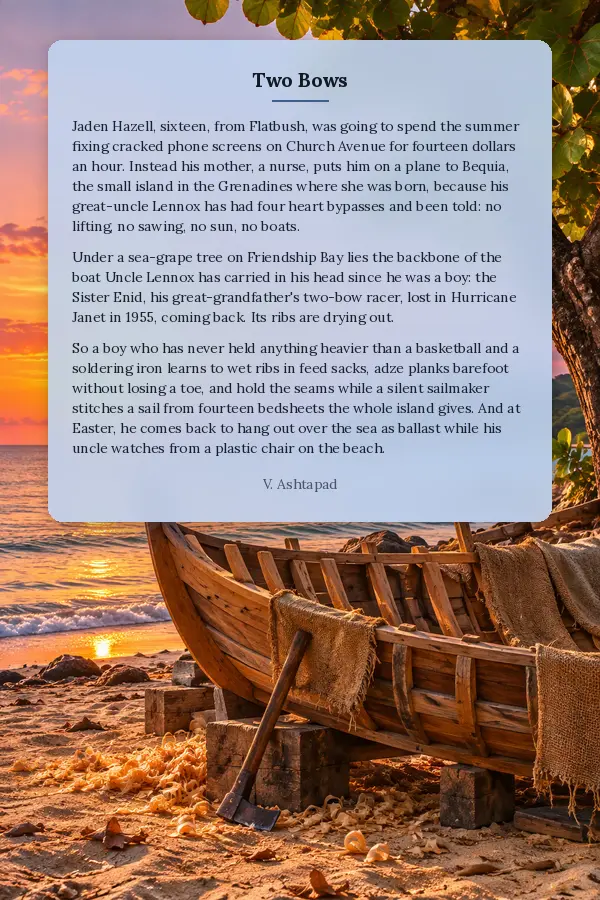
Jaden Hazell, sixteen, from Flatbush, was going to spend the summer fixing cracked phone screens on Church Avenue for fourteen dollars an hour. Instead his mother, a nurse, puts him on a plane to Bequia, the small island in the Grenadines where she was born, because his great-uncle Lennox has had four heart bypasses and been told: no lifting, no sawing, no sun, no boats.
Under a sea-grape tree on Friendship Bay lies the backbone of the boat Uncle Lennox has carried in his head since he was a boy: the Sister Enid, his great-grandfather's two-bow racer, lost in Hurricane Janet in 1955, coming back. Its ribs are drying out.
So a boy who has never held anything heavier than a basketball and a soldering iron learns to wet ribs in feed sacks, adze planks barefoot without losing a toe, and hold the seams while a silent sailmaker stitches a sail from fourteen bedsheets the whole island gives. And at Easter, he comes back to hang out over the sea as ballast while his uncle watches from a plastic chair on the beach.
Members can react to this book and talk about it in the members' Library.
Ownership
© 2026 CRUNOD LLC. All rights reserved.
This book is owned by CRUNOD LLC. It is free to read on EternalCurrent.Online. No part of it may be copied, reprinted, sold, recorded or adapted, including as audio, film or translation, without written permission from CRUNOD LLC.
© 2026 CRUNOD LLC. All rights reserved.