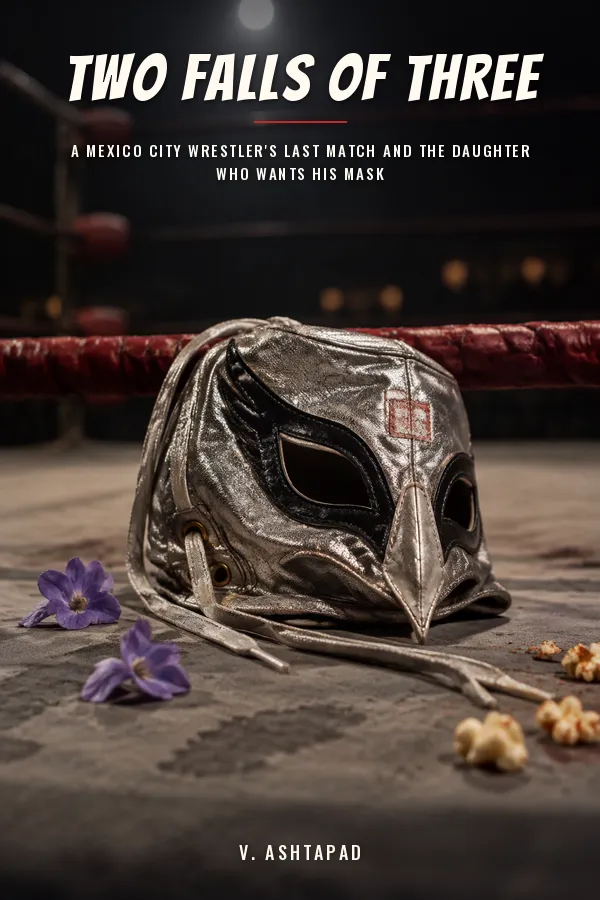
Two Falls of Three
A Mexico City Wrestler's Last Match and the Daughter Who Wants His Mask
by V. Ashtapad
Foreword
This is a work of fiction. Every character in it is invented, as are their families, their ring names, their matches and their quarrels.
Some of the places are real. Mexico City is real, and so are Colonia Doctores, Colonia Obrera, the streets called Doctor Lucio, Doctor Vértiz and Doctor Río de la Loza, the metro stations at Doctores and Obrera, the transfer tunnel at Pantitlán, the Sonora market, and the hillside neighborhoods of Ecatepec, Nezahualcóyotl, Texcoco and Chalco. The jacarandas that turn the city purple every March are real too.
Arena Juárez Norte is invented, and so are the bus garage it was built in, the promoter who runs it, the party hall, the costume shop, the mask-maker's workshop, the gym above the tire shop and the university clinic. The matches are invented, and so are the moves that have names. Anyone who has spent a Sunday night in a Mexico City arena will recognize the popcorn.
For the people who sew the masks, build the rings and keep the seats, and for everyone who has ever cheered for somebody they could not see.
Insurance
For twenty-five years my mother has told the women at her domino table that her son sells insurance.
It is not a complete lie. Every Sunday night at Arena Juárez Norte I insure that a man in a black vest with gold buttons will be punished for his crimes against decency, and that the children in the cheap seats will go home hoarse. The policy has been in force since 2001, and the premiums are paid in my knees.
That Sunday in February I lost by disqualification, which is the way a técnico loses when the people who plan these things want everybody to come back next week angry. El Notario hit me with his rubber stamp while Don Polo was looking at the ceiling, and then he pressed the stamp on my chest, and then he held up his arms while the arena called him every name a grandmother knows. The stamp is painted foam over plywood. It does not hurt. The ink is red, and it never comes off with soap.
"Hold still," Chucho said in the dressing room, scrubbing at me with a rag that smelled of turpentine. "You're squirming like a bride."
"You stamped me twice. The second one was personal."
"The second one was artistic. The first one was crooked." He leaned back to look. Chucho Benítez is El Notario, the most hated lawyer in Mexico City, though he never finished secondary school and signs his name with a little drawing of a cat because he likes it better than his signature. He wrestles bald, with a mustache thick enough to sweep a step with, because in 2011 he lost his mask to me in a bet match. That is the rule: you lose the bet, you lose the mask or the hair. Chucho shaved the hair anyway. He said if the city had to see his face, it might as well see all of it.
The dressing room at Arena Juárez Norte is under the north seats, so when the last match of the night is still going you hear the crowd as a weather system over your head, thumping and rolling, with bits of plaster floating down into the light. The walls are green tile to the shoulder and then a yellow paint that has given up. There are two showers. The first two men in get hot water. Everybody else gets a lesson in humility. That night the hot water went to two kids from the opening match who had been bounced off the ropes for fifteen minutes and deserved it, and I sat on the bench in my mask and my tights and my old silver boots with the right one taped at the ankle, and I held a bag of ice from the popcorn stand against my left knee.
The ice smelled faintly of butter and chile, like everything near the popcorn stand.
Don Polo, our referee, who is seventy and has knees like two bags of walnuts, sat across from me cracking peanuts and dropping the shells into his own shirt pocket, a system only he understands.
"You were slow off the second rope," he said.
"I'm forty-six."
"You were never on a rope in your life, Polo."
He offered me a peanut. "Galván wants you."
"Galván always wants me. Galván wants everyone. Galván would want the pope if the pope drew a crowd on Sundays."
"He said now."
I took the ice off my knee and looked at it. The knee is a big, round, unconvincing object that used to be a joint. I pulled my track pants on over the tights and a sweatshirt over my chest with the red stamp still faint on it like a sunburn, and I went up the back stairs with the mask still on, because you do not walk the halls of an arena with your face out. Not in front of the vendors, not in front of the cousin of somebody who will sell a photo to the gossip pages. My face has been to more dentists than arenas.
Beto Galván's office is above the ticket windows, and it smells of cigarettes he says he quit and a pine air freshener he bought to prove it. A fan on the filing cabinet turns its head back and forth like an aunt who disapproves of everyone. The walls are posters, thirty years of Sundays in red and yellow ink, and somewhere in the middle my first main event, against a rudo called Tarántula who later opened a car wash in Iztapalapa and is very happy.
"Lalito." Galván has called me that since we both had hair. "Sit. You looked tired out there."
"I was tired out there." I sat on the plastic chair that wobbles. "Beto, I have news, and you have to hear all of it before you start doing math."
He put down his pen, which meant he was doing math already.
"I'm retiring," I said. "Six weeks. The last Sunday in March. One more match here, the last one, and at the end of it I take the mask off. Myself. In the ring. And I say my name into the microphone, and then I go home and sleep for a month."
The fan turned its head toward me, then away.
Galván did not speak right away, which for him is a medical event. He looked at the window with the crack shaped like Sonora. Then he picked up the pen again.
"Six weeks is nothing," he said. "I need eight. Ten."
"Six."
"Lalo. The face of El Halcón de Plata. Nobody has seen it in twenty-five years, not the papers, not the girls who threw underwear at you in 2004."
"One girl. One time. It was a sock."
"It was underwear in my memory, and my memory sells tickets." He was writing numbers now, and they were climbing. "We can do something big with this. We can do a whole season. A farewell tour. Toluca, Puebla, Pachuca, a night in Monterrey —"
"I'm doing here. Juárez Norte. Where my father set up the ring."
Everybody in that building knows about my father, who built and set up the ring at Juárez Norte every Sunday from the night it opened until the night his back said no. Galván softened, or did the thing with his face that is meant to look like softening.
"Here," he said. "Fine. Here. The last Sunday in March. I'll need you for the press. I'll need you for posters. I'll need —"
"You'll need me in the ring and that's all."
"Lalito." He smiled. A promoter's smile is a hallway with no chairs in it. You walk down it and you are in a room you did not choose. "Leave it to me."
I should have heard the danger in that. I was thinking about my knee and about a shower that would be cold by now. I said thank you, and he said thank you, and the fan said no, no, no, with its whole head, which turned out to be the only sensible opinion in the room.
---
Out the alley door, I took the mask off.
I always do it in the same place, behind the dumpster where the arena throws the empty kegs and the broken folding chairs, under a light that has been out since I don't know when. I unlace it in the back, the long silver laces that Don Fermín threads through brass eyelets, and I pull it forward over my face, and the cold air finds my cheeks like water. My face always feels too big for a minute. It feels like walking out of a movie theater into the afternoon. I fold it in quarters, the way Rocío taught me so the silver does not crack along the brow, and slide it into the inside pocket of my bag. Then I put on a cap from a hardware store in Tlalpan and I am nobody.
That is the strange gift of it. Ten thousand people that year had screamed my name. I walked out into Colonia Doctores past the stall that sells knockoff Halcón masks for eighty pesos, and the woman behind it, who has known me in my cap for fifteen years, said, "Buenas, Lalo," as if I were a man who fixes refrigerators. She has never asked. She sells my face to children and has no idea she is waving at it.
Doctores at eleven on a Sunday night is shutters and grease. The street I walk is auto parts: radiators stacked in windows, rims on hooks, a tire shop with a painted tire smiling, the smell of rubber and old oil soaked so deep into the concrete that rain only brings it up stronger. The hospital is a few blocks over, and ambulances go by with their sirens off and their lights on, which is a particular kind of quiet. A taco stand at the corner still had its spit of pork turning under the bulb, the pineapple on top going brown, and the man slicing it whistled at me because I owe him for last Tuesday.
Halfway home there is a jacaranda over the corner of a small school, and that night I noticed it had started. Only a few branches, at the top, where the streetlight catches them. A purple that looks almost blue at night. In two weeks the whole city would turn that color, the sidewalks sticky with fallen flowers, the cars wearing them on their windshields like bad decisions. I stood under it longer than I needed to. I had just told a man I was finished, and the city was starting something.
---
We live above Rocío's shop. The sign over the door says LENTEJUELAS ROCÍO in silver letters she glued on herself, one sequin at a time, the summer Itzel was born, with only small losses since in the R. The shop sells and rents costumes. School plays, carnival, a set of Aztec warriors for a dance troupe in Coyoacán, quinceañera dresses that can stop traffic, and once, for a man whose name we never said aloud, a full-body chicken. And capes. Rocío has sewn every cape I have ever worn into a ring.
The light was on in the back. I came up through the shop rather than the side stairs, past the mannequins in their tulle and the wall of hats, and found her at the long table under the lamp with a pink bodice laid out like a patient. She was gluing sequins on one at a time with a toothpick and a dot of glue, her reading glasses low on her nose, the radio playing low, a cumbia station that talks too much between songs.
"You lost," she said without looking up.
"How do you know?"
"You came in through the shop. When you win you take the stairs two at a time and you wake the Hernández dog." She lifted a sequin, set it, pressed it with the flat of the toothpick. "Show me your chest."
I lifted my sweatshirt. She looked over her glasses.
"He stamped you twice."
"The second one was artistic."
"Tell Chucho I'm billing him for the shirt." She went back to the bodice. "What else."
Twenty-three years of marriage. She can hear a thing in how I stand.
I sat on the stool across from her. Between us lay a tape measure in a curl like a sleeping snake and a cup of coffee gone cold with a skin on it. I picked up one of the silver sequins and turned it in the lamplight. It threw a small light onto her cheek.
"I told Galván I'm finished," I said. "Six weeks. The last Sunday in March. I'm taking the mask off in the ring."
The toothpick stopped.
She took off the glasses, folded them, and studied me until I wanted to check whether my fly was open.
"You told Galván before you told me."
"I told Galván because I knew he'd say yes. I'm telling you because I knew you'd say something else."
"What would I say?"
"I don't know. That's why I was scared to tell you."
She laughed through her nose. "Lalo. I've been waiting for you to say that for five years. I've watched you go down those stairs like an old man since your second knee." She put the glasses back on. She picked up the toothpick. "I'm not saying anything else. I'm saying good. I'm saying about time. I'm saying I want a new cape for it, a real one, I already have the fabric."
"You already have the fabric?"
"Since October." She pointed with her chin to a shelf where a bolt of something heavy and silver was wrapped in plastic. "I'm not a fool."
I felt my chest let go of something I had been holding since the dressing room. Then I said what I always say when relief arrives too fast, which is the wrong thing.
"Where's Itzel? I want to tell her."
Rocío set a sequin. Then another one. "She's asleep."
"Her light's off?"
"She has an exam. Anatomy." She did not look up. "Tell her tomorrow. Tell your mother tomorrow. Go to bed. Put your leg up on the pillow, not under it, you always put it under it."
I went down the hall past Itzel's door. It was closed. There was no light under it. Her sneakers were not on the mat where she always kicks them off, but her white training bag, the one with the broken zipper, was not on its hook either, and I remember thinking nothing of it at all, the way you think nothing of a cloud.
In the bedroom I lay with my knee up on the pillow the way I was told, and the ice from the popcorn stand melting in its bag on the floor,. Through the window came a motorcycle, a dog, a man singing the end of a song he did not know the beginning of. I thought about my mother at her domino table, and what she would say tomorrow when I told her that, after twenty-five years, her son was finally getting out of insurance.
Five in the Morning
The knee woke me at a quarter to five, as it does when it has an opinion.
It is not pain exactly. It is a kind of hum, as though a refrigerator were running inside the joint, and the only cure I have found is to move. Lying there makes it worse. So I got up without waking Rocío, put on yesterday's track pants and a jacket, and went out by the side stairs into a city that had not yet decided what kind of day it would be.
Doctores before dawn is gray and damp. The sky over the rooftops is the color of a dirty sink, and the air is cold enough that you see your breath for the first two blocks and then forget to look. The tire shop men were not open yet. A bakery on the next corner had its back door propped with a sack of flour, and the smell of the first bread rolled out into the street, sweet and yeasty, and a boy in an apron was loading a tray onto the back of a bicycle.
My gym is two streets over, on the second floor above a tire repair shop owned by a man called Chava, who has been my landlord for nineteen years and has never once fixed the stairs. The sign says GIMNASIO RAMÍREZ in red on a white board, and under it, smaller, in Itzel's handwriting from when she was twelve: LUCHA, BOX, ACONDICIONAMIENTO, and a drawing of a bird that is supposed to be a falcon and looks like a chicken who has received bad news. I have never painted over it.
I teach the children's class there on weekday afternoons and Saturday mornings. Twenty-two kids who come in bouncing like popcorn and leave like wet laundry. In the mornings, nobody. That is the whole point of a gym at five in the morning: it is the one hour of the day it belongs to me.
I was on the third step when I heard the ring.
You cannot mistake it. A wrestling ring is boards over a steel frame, a layer of foam, a canvas pulled tight over everything, and when a body lands on it flat, the right way, spread out to take the shock, it makes a sound like a big drum hit with a mattress. Boom. Then the ropes singing. Then whoever is counting.
Boom.
"Again, and don't look at the floor. The floor doesn't need you."
That voice. I would know it at the bottom of a well. Chucho.
I went up the rest of the stairs on the outside edges where they do not creak. The door at the top has a window with wire in the glass. The lights were on inside, only the back row of fluorescents, the ones over the ring, so the room was half shadow, and in the light the ring stood like a stage.
There was a woman on the top rope.
She was in a white mask and black training shorts and a gray shirt with the sleeves cut off, and she was standing on the top rope in the corner with one foot and then two, balanced there like a person waiting for a bus, perfectly calm. Chucho was below her in the center of the ring in his sweatpants and a towel around his neck, his bald head shining under the tubes like a light bulb that had grown a mustache.
"Whenever you want," he said. "I'm not getting younger."
She jumped.
I have seen a thousand people come off a top rope. I have done it myself more times than I can count and I can tell you, in the air, almost everybody looks like what they are, which is a person falling. She did not. She went up first, a little, the way a swimmer does off a block, and then she turned once in the air backward, all the way around, slow, so slow it looked like the room had thickened, and she came down flat across Chucho's chest in exactly the right shape, arms out, and the ring said boom, and Chucho said "Ay, my mother," and lay there.
I knew the move. It is called the Silver Fall, and I invented it in 2003 in a lot behind a cement factory in Tultitlán with a mattress and three cousins, and I have never taught it to anyone.
She sat up. She leaned over Chucho and patted his cheek, the way you pat a horse.
"Better?"
"Better. Your feet were apart again."
"My feet were together."
"Your feet were like a man who's been told his wife is coming home early."
She laughed, and she bent to retie her boot, and that was when I knew. Not from the move, not even from the laugh. From the knot. She tied her laces the way Rocío ties them, a double knot with the loops tucked under so they will not catch on the ropes, a knot Rocío invented for my boots in 2001 and taught to exactly one other person in the world, who was eight and sitting on the counter of the costume shop swinging her feet.
I opened the door.
There is a thing that happens to a room when the wrong person walks into it. The air goes stiff. Chucho turned his head on the canvas and saw me, and his face ran through several expressions very fast and landed on a man caught eating the cake before the party.
"Lalo," he said, still lying flat. "Good morning. What a surprise. You know my niece, from Querétaro —"
"Shut up, Chucho."
The woman in the white mask had gone very still with her hand on her boot. Then she stood up. She walked to the ropes. She did not take the mask off, not at first. She looked at me through the eyeholes, and I could see her eyes, which are her grandmother's eyes, dark and a little too far apart, which give her the look of always being about to argue.
"Hi, Papá," said my daughter.
---
I would like to tell you that I handled it with wisdom.
What I did was stand in the doorway of my own gym in my track pants with my knee humming and say, "Since when?" three times, louder each time, like a man trying to start a motorcycle.
"Since two years," said Itzel.
"Two years."
"Two years in March."
"In my gym."
"In your gym at five in the morning. Tuesdays, Thursdays, Saturdays when you have the kids at ten. Mondays when you go to your knee doctor." She climbed through the ropes and dropped to the floor and took off the mask. Her hair came out in a wet black rope and her face was red and shining, and she was smiling a little, which made it worse. "You never come on Monday. Why did you come on Monday?"
"My knee."
"Your knee." She looked at it, professionally. She is in her fourth year of physical therapy at the university and has opinions about my knee. "Are you icing it?"
"Don't change the subject."
"I'm not changing the subject. The subject is your knee and my wrestling. Those are both the subject."
Chucho had sat up by then and was wiping his head with the towel with great care, as if it were the most important task of his life. I turned on him.
"You. You, of all people. My compadre. You held her when she was two days old —"
"— you taught her my move."
"I taught her a move like your move. Your move, her feet are apart."
"Her feet were together!" said Itzel.
"They were like a man who —"
"Enough with the man!" I said. My voice hit the rafters and fell back on me sounding stupid. Below us in the street a car alarm started, as though in agreement.
There was a silence then that was not peaceful. I looked around the gym because I could not look at either of them. The mats with their patches of silver tape. The mirror with the crack that runs corner to corner like a highway. The punching bag that leaks sand. And on the wall over the bench, the board of photographs that has been there since we opened: every class of children since the first one, rows of skinny kids in borrowed masks making fists at the camera. Last year Itzel had scanned them all and sent them around to the old students, and one by one they had written back with their names and where they were now, a mechanic in Querétaro, a nurse, a bus driver, and she had put the labels under each face. I had thought it was a sweet thing she did on a holiday. I had not wondered why she was in the gym on a holiday.
"How many matches," I said.
She glanced at Chucho.
"Don't look at him. Look at me."
"Thirty-one."
"Thirty-one."
"Thirty-four, if you count the ones in the rain in Chalco, which I don't." She pulled at the mask in her hands, turning it inside out and back. It was a beautiful mask. Even in my anger I saw that. White, with a long gray shape across the brow like a wing, or a neck, and two thin black lines from the eyes back to the laces. "La Garza," she said. "In the State of Mexico, mostly. Ecatepec, Nezahualcóyotl, Texcoco. Basketball courts, a bullring once, a parking lot in Chimalhuacán."
"A heron," I said. "My daughter is a heron."
"Herons are very aggressive birds," said Chucho. "People don't know that."
"Chucho, if you speak again I will put you through that mirror and we'll have two cracks."
He raised both hands and went back to his head.
Itzel took a breath. I saw her do it, a breath all the way down, the way you do on the apron before you go in. And then she said the thing she had been waiting two years to say, and I could tell by how smoothly it came out that she had said it to herself on the metro a hundred times.
"Mamá told me last night. That you're taking it off. In March." She held up the white mask between us, and then she lowered it. "Don't. Don't take it off, Papá. Give it to me."
The car alarm in the street stopped. In the quiet I could hear the fluorescent tubes buzzing, and someone downstairs rolling up the steel shutter of the tire shop, a long rattling roar.
"Give you what?"
"The mask. Halcón. Don't kill him. Give him to me. I'll wear it. I'm ready, you saw me, you just saw me —"
"I saw you come off a rope."
"You saw me do your move better than you."
"Her feet were apart," said Chucho, very quietly, to his towel.
I did not answer her. I should admit that. I did not say no with a reason. I did not say no with love. I said nothing at all, because what I felt was so big and so mixed — pride and fear and something like being robbed in the street by someone you would have given your wallet to — that if I had opened my mouth, all of it would have come out at once, and none of it in order.
So I turned around and went down the stairs, and this time I did not walk on the edges. Every step creaked. I hope she heard every one.
---
The street had changed in fifteen minutes. The sky had gone from dirty sink to a thin washed blue at the edges, and the cold was lifting off the asphalt. Chava had his shutter up and was sitting on an upturned bucket in front of a stack of tires with his first coffee and a sweet roll, and he saluted me with the roll.
"Early, Lalo."
"Did you know?"
"Know what?"
"That my daughter's been up there at five in the morning for two years."
He chewed and looked up at my window.
"I thought you knew," he said. "She waves."
I walked, with nowhere to go, down to the corner where the metro entrance was opening its gates and the first wave of people was going down the stairs, nurses for the hospital in their white shoes and sweaters, a man with a ladder, two girls in school uniforms sharing one pair of earphones, a woman with a bucket of flowers on her head. A tamale man was setting up at the top of the steps, his bicycle speaker already announcing his wares in that flat recorded voice every tamale man in the city uses, and I stood in the steam of his pot and felt very old.
Itzel was right about one thing. I had seen her. It was not even a question of whether she was good. I had seen her turn in the air in my own gym like someone who had been born up there.
When I got home, Rocío was in the kitchen in her robe making coffee in the clay pot. The window over the sink was full of that new blue. She did not turn around.
"You went to the gym," she said.
"You knew."
She put the cinnamon stick into the pot and watched it.
"Rocío. You knew."
"I didn't make her mask, if that's what you're asking," she said. "Fermín made her mask."
"Fermín."
"He wouldn't make her a copy of yours. He made her her own." She turned around then, finally, holding a cup out to me, and her face was not guilty at all. She looked like a woman who had carried a secret for two years and was glad to set it down on the counter. "Sit down. Drink this. Your knee is swollen, I can see it through the pants."
"Who else knows?" I said. "The tire man knows. Chucho knows. Fermín knows. Who else?"
She looked at the clock over the stove, which is always nine minutes fast.
"Your mother," she said, "but she thinks you know, so be gentle."
Row Three, Seat Seven
My mother lives on the fourth floor of a building on Doctor Lucio with no elevator and a stairwell that smells of floor wax, fried onions and whatever the woman on the second floor is boiling for her cats. She has lived there since 1976. She says she will leave when they carry her down, and then she says that if they drop her on the third-floor landing she will haunt the building, so they had better not drop her.
She is seventy-four, and she plays dominoes every Monday afternoon with the same three neighbors at a folding table by the window, and she wins more than half the time, which in dominoes is a scandal.
I went up after lunch. The stairs took my knee seriously. When I reached the fourth floor the door was already open, because she had heard me on the second, and the clack of tiles came out into the hall along with the voice of the parakeet, Tarzán, who says only one word, which is my father's name, and says it whenever anyone knocks.
"Lalo," said Tarzán.
"Lalo," said my mother, without looking up from her tiles. "Sit. Don't talk. Remedios is thinking."
Doña Remedios was thinking. She is eighty and wears a cardigan over a cardigan in all weather and thinks about dominoes the way generals think about rivers. Across from her sat Doña Licha, a widow with hair dyed the red of a fire truck, and next to her Don Arnulfo, who cheats, everybody knows, by tapping his tiles with his wedding ring in a code nobody has cracked because there is nobody to send it to. The table was covered in a cloth with oranges printed on it. There was a plate of sweet bread and a pot of coffee, and the afternoon sun came in low and lit the dust floating over the tiles.
Through the window you can see the back of the hospital, the water tanks on the rooftops, a line of laundry, and if the air is clean, which it was that day for once, a piece of the volcano, gray and white, standing way out past the city like someone at a party who arrived early and is waiting by the door with his coat on.
Remedios played a double five. Everybody groaned.
"Lalo," said Licha, turning to me. "You're the insurance one, aren't you? Coco's boy?"
"That's me."
"My nephew has a little van. He does deliveries. What would something like that cost? For a van. Just roughly."
My mother placed a tile with a delicate click. She did not look at me. "He does life insurance, Licha. Not vans."
"Oh. Life." Licha considered me with new respect. "That's sadder."
"It has its moments," I said.
I sat in the armchair with the crocheted cover and waited. On the wall over the sideboard there are the photographs, as there are in every mother's apartment in this city: my first day of school, which I will not describe; my father in his ring crew shirt holding a hammer and a bottle of soda, laughing at whoever held the camera; my wedding, in which Rocío looks like a queen and I look like a man who has been told to stand still; Itzel at three, in a tiny silver cape. And in the middle of them all, framed in plain black wood, the poster from my first main event at Juárez Norte, with my masked face in silver ink. My mother has kept it in the center of her wall for twenty years, among the family pictures, and when people ask her who that is, she says, "Some wrestler. My husband built the ring. They gave it to us."
They played out the hand. My mother won it, of course, with a double six she had been hiding since the beginning like a gun in a boot. Then, as she does every Monday at four, she announced that her son needed her for something private, and the three of them collected their sweaters and their purses and their opinions and went off down the stairs, Licha still asking whether life insurance covered vans if a person died in them.
My mother closed the door. Tarzán said my father's name once more, to be sure, and then tucked his head in.
"So," she said, pouring me coffee. "You're quitting."
"Who told you?"
"Rocío told me last night. Did you think she wouldn't?" She pushed the plate of bread at me. "Eat. You look like a man who's been crying in a tire shop."
"I didn't cry. I talked to Chava."
"It's the same face." She sat down across from me, in Remedios's chair, still warm. Her hands are short and brown with knuckles like walnuts, and she folded them on the oranges. "Tell me."
So I told her. Galván, the last Sunday in March, the mask coming off in the ring, my name in the microphone. My mother listened the way she has always listened, without moving her face, which as a boy I found terrifying and as a man I find more terrifying. When I finished, she didn't speak right away. She looked over my head at the wall of photographs.
"Twenty-five years," she said.
"Twenty-five in June."
"Row three. Seat seven." She tapped the table once with a knuckle. "Every Sunday since that first one. You know how many I've missed?"
"Four."
"Three. My gallbladder, your cousin Neto's wedding, and the Sunday it flooded. The fourth one you're counting I sat in row five because a fat man had my seat. I was there. It was terrible."
Row three, seat seven is on the aisle, close enough to see the sweat come off a man when he is slammed into the corner, far enough that it does not land on you. My father picked it on the night the arena opened in 1979, when she sold tickets in the window and he set up the ring, and he said that was the seat a person who knew what they were looking at would choose. After he stopped working, she kept going. After he died, she kept going. She takes a thermos of cinnamon coffee and a cushion she embroidered with a hawk that looks nothing like a falcon, and she sits there with her purse in her lap, and she never cheers for me. Never. She cheers for whoever is losing to me, because, she says, somebody has to, and also because if she cheered for the Halcón people would ask questions.
"I've never seen your face in that building," she said. "Not once. Not in the ring, not in the hallways, not after. Your father used to bring you to the ring when you were a little thing, you used to run on the canvas before the doors opened, and I would watch you from the ticket window. Then you put that thing on at twenty-one and that was the end of your face in there."
"Mamá."
"I'm not complaining. I'm telling you. I want to see it." She picked up a domino from the box, a blank-three, and turned it in her fingers. "So take it off. Good. I'll be in my seat. I'm going to wear the blue dress. Licha's going to do my hair."
"Licha's going to dye it red."
"Over my dead body," she said, and then, because she is my mother and enjoys it, "which is the only way you'll collect on my policy."
I laughed despite myself. Something came loose in my chest, a little.
Then she put down the domino.
"And Itzel?"
I drank my coffee. It was too sweet. She makes it with a full cone of brown sugar in the pot and has done so for fifty years and calls it a little.
"You knew," I said.
"Of course I knew. Who do you think washes her mask? Your wife puts it in the machine with the towels. You don't put a mask in the machine. You wash it in the sink with cold water and the soap for babies, and you dry it on a cup so it keeps its shape. She brings it to me on Wednesdays."
"Every Wednesday."
"Every Wednesday for two years. We have a coffee. She tells me who she beat." My mother smiled, a small hard smile, the one she uses when she has won a hand. "She beat a big woman in Texcoco called La Mole. You should have heard her. She did it with your move."
"She does it with her feet apart."
"She does it with her feet together. Don't lie to your mother. I saw it in Nezahualcóyotl in November. Licha and I took the bus."
I put the cup down very carefully on the oranges, the way you put down something you are afraid you will throw.
"You went to Neza. On a bus. To a basketball court."
"It was a very nice court. They had a man selling corn." She shrugged. "I went to see what she does. I've seen what you do for twenty-five years. I wanted to see what she does."
"And?"
My mother was quiet. She looked down at her phone, which was on the table next to the plate, face down, and she turned it over and woke it and held it out to me. It was open to the family tree, the private one Rocío started years ago that only family can open, where every relative is supposed to add the names they know. My mother's cousin Delfina in Tlaxcala adds to it constantly, babies and in-laws and people nobody has ever met, and my mother complains about this every Monday.
"Look," she said. "Delfina added three more. Three. Who are these people? Who is Brayan? Nobody in this family is called Brayan."
"Mamá. Itzel."
"I'm getting to Itzel. Look here." She scrolled down with one thick finger to the branch that is ours. My father's name. Hers. Mine, Eduardo Ramírez Ortiz, and beside it, in a small line, because someone had added it: El Halcón de Plata, 2001. And under me, Itzel's name, and beside it, in that same small line, something new. La Garza, 2024.
"Who put that there?"
"I did," said my mother. "She asked me. It's my side of the tree. I put it where it belongs."
I sat there holding my mother's phone.
You have to understand what that line meant. For twenty-five years nobody in this family has written Halcón next to my name. Not in letters, not on birthday cards, not in the family tree. That was the rule. My face was mine and the mask was the Halcón's and nobody crossed the wires. And my mother, the queen of the rule, the woman who calls me an insurance agent to three neighbors every Monday of her life, had sat down with my daughter and typed it into the family record like it was a date of birth.
"She's good, Lalo," my mother said. "She's better than you were. I don't say this to hurt you. I say it because you were good, and she's better."
"She's twenty-two."
"You were twenty-one."
"I was a man."
"You were a boy with a mustache like a caterpillar who fell off a ladder at his own wedding." She took the phone back. "And she's a woman. That's what you mean. Say it."
"That's not what I mean."
"Then what do you mean?"
What I meant was my knees. Both of them. The left one twice. My shoulder that pops in the cold. The two vertebrae in my neck that are closer together than the factory intended. The hospital in Puebla in 2009 with the tube in my nose. The way Rocío sat on a plastic chair in that hallway for nine hours. That is what I meant, and I could not say any of it, because I knew exactly what my mother would answer, which was that I had known all those things when I put the mask on, and so had she, and she had sat in row three anyway.
"I mean," I said, "it's mine to give or not."
My mother studied me without blinking. Then she stood, collected the cups, and took them to the little kitchen. I heard the water run.
"It's yours to take off," she said from the sink, with her back to me. "Whether it's yours to give, I don't know. Your father didn't build that ring for one person to fall in." The water stopped. "Go home. Your knee's swollen. And tell Galván I want my seat. Not row five."
---
I walked home the long way, down Doctor Vértiz and across, so I would not have to pass the gym. The afternoon had warmed up hard the way it does in February, a dry dusty heat with no wind, and the sidewalks smelled of hot cement and the sour water from the flower stands. The jacarandas along the avenue had come further along since Sunday. Not full yet. Each tree had a few clouds of purple at the ends of its branches, as though somebody had started to paint them and gone for lunch. A street sweeper in an orange vest swept a few fallen blossoms into a heap with his twig broom, looked at them, and left them there. It made me like him.
At a corner a boy of about nine was wearing one of the knockoff Halcón masks from the stall, too big, the silver gone the color of a gum wrapper, with the eyeholes sliding down to his cheeks so he had to hold his head up to see. He was fighting a lamppost. The lamppost was winning.
I stood and watched him for a while. He had no idea I was watching, or who I was, or that the mask on his face was a copy of a copy of a thing that a man in a workshop two colonias away had cut and sewn by hand for my head when I was twenty-one. He came off the curb in a little jump and landed in the gutter and raised both arms.
His feet were apart, and he was very happy.
The Press Conference
Galván held the press conference on Thursday in the Salón Las Palomas, a party hall on Doctor Río de la Loza that rents by the hour for graduation lunches, retirement parties and divorces that want to be celebrated. It has a dance floor of brown tiles, a disco ball with a third of its mirrors missing, and plastic chairs dressed in white covers with lavender bows, left over from somebody's wedding. Galván had not removed the bows. He said they gave the event class.
Up front stood a long table beneath a banner with my masked face on one end and Chucho's bald one on the other, and between us, in yellow letters, the words THE LAST FLIGHT, which Galván had paid a printer in the Obrera to make overnight and which the printer had misspelled once and then corrected with a strip of tape. Bottles of water stood at each place. A microphone with a cable taped to the floor. Behind the table, for reasons nobody explained, an inflatable palm tree.
I wore my good gray suit and the mask. That is how it is done. A man in a business suit with a silver bird for a face, and nobody laughs, because in this city we are used to it. My tie was the one Rocío picked. She said it made me look honest, which on the Halcón is a challenge, because the mask has no mouth.
Chucho came in El Notario's full press costume: black three-piece suit, a gold watch chain, a briefcase, his bald head oiled until it reflected the disco ball, and under his arm the famous stamp. He sat at the far end and opened the briefcase with great ceremony and took out a stamp pad and a single sheet of paper, and he stamped the paper, and he held it up to the room. It said nothing. It was a red square. The room loved it.
"Who is here?" I said to Galván under my breath.
"Everybody," he said.
Everybody was eleven people. Don Pepe Torres, who has written for the same wrestling magazine since before I was born and carries a tape recorder the size of a brick, which he places on the table in front of whoever is talking like an offering. A young man from a sports radio show with headphones around his neck and the energy of a person who has had four coffees. Two girls who film everything on their phones for a fan channel and who wore homemade Halcón shirts, which touched me. A photographer with a real camera and a cough. Three of Galván's cousins. The woman who sells the knockoff masks outside the arena, who brought her stock in a bag in case anyone wanted one. And at the back, by the door, in a gray hooded sweatshirt and sunglasses, my daughter.
She had not told me she was coming. I saw her the moment I sat down. She saw me see her, and she lifted her chin a little, and then she looked at the ceiling as though she had come for the disco ball.
Galván tapped the microphone. It shrieked. Everybody winced. He tapped it again, to be sure.
"Friends of the press," he said. "Friends of the noble sport. Friends."
He talked for twelve minutes. I know because I counted the turns of the disco ball, which had a motor that clicked. He talked about the night I first wore the mask in 2001, which he described as a night of thunder, though I remember drizzle and a broken toilet. He talked about the Halcón's victories, his titles, his famous feud with Tarántula, the bet match in 2011 when the Halcón took El Notario's mask in front of a full house and El Notario had to say his name into the microphone, Jesús Benítez Cruz, from Colonia Guerrero, and the people threw cups.
At this Chucho rose, bowed, and sat down again, to boos from three cousins.
"And now," said Galván. "Now, the Halcón has decided to fly away."
The radio boy said "No!" with feeling. The girls with the phones made sad faces into their phones.
"On the last Sunday of March," Galván said, "El Halcón de Plata will wrestle his final match at Arena Juárez Norte. Twenty-five years. Six weeks from now. The last flight."
I leaned in to the microphone. This was my part. I had practiced it with Rocío in the kitchen. Thank you to the people, to my family, to the arena where my father built the ring. That at the end of my last match I would take off the mask myself, before all of them, and that the face they had wondered about for twenty-five years would turn out to be a disappointment, because it is a very ordinary face that has been punched a lot. That was the joke. Rocío said the joke was good.
I opened my mouth.
"But," said Galván into his microphone, louder, before I could get to mine.
I closed my mouth.
"But," said Galván, "a debt remains."
Chucho turned his head toward Galván very slowly. Under the table, I put my foot on his. He did not know either. I could feel it through his shoe.
"In 2011," said Galván, rising to his feet, "El Notario lost his mask. He has lived with that shame. He has wrestled with his naked face before the people of this city for fifteen years. And he has always said — he has always said, friends — that before the Halcón retired, he would have his revenge."
Chucho has never said this. Chucho has said many things over the years, most of them about his digestion.
"And so," said Galván, "the last match of El Halcón de Plata will be — a bet match!" He slapped the table. The water bottles jumped. "The mask of the Halcón — against the hair of El Notario!"
The radio boy shouted. Don Pepe's tape recorder clicked off, because the tape had run out, and he swore at it in a whisper. The girls with phones turned their cameras from Galván to Chucho and back. The woman who sells the masks said, quite clearly, "What hair?"
Everyone turned to look at Chucho.
Chucho put one hand on top of his head. He rubbed it. It squeaked, faintly, against the oil.
"Six weeks," Galván said grandly. "El Notario has sworn that from this day he will not touch a razor. He will grow it, friends. He will grow it for the people. And on the last Sunday of March, either the Halcón's mask comes off — or El Notario's hair comes off."
"Beto," I said, not into the microphone. "Beto. What are you doing."
"Selling," he said, not into the microphone either, smiling at the cameras.
I want to describe exactly what happened next, because I am not proud of it and I am also very proud of it.
There are things a técnico cannot do in front of the press. He cannot say "I didn't agree to this." He cannot say "this is a business and I am a man of forty-six with two bad knees." He cannot say "I wanted to take it off myself, in peace, for my mother." The Halcón has no mouth. The Halcón does not argue with promoters. The Halcón accepts every challenge and flies.
So I stood up. I took the microphone from Galván. And I said, in my Halcón voice, which is a half-tone deeper than my own and with more air in it, "I accept."
The radio boy screamed.
And Chucho, who had been a professional for twenty-seven years and who knows a cue when he hears one even if he wants to kill the man who gave it, rose to his full height, picked up his stamp, walked the length of the table, and stamped me on the forehead.
Then it was chaos. The good kind. Galván's cousins pulled us apart. The photographer stood on a chair wrapped in its lavender bow and the chair collapsed under him. Chucho tipped the inflatable palm tree onto Don Pepe, who kept recording with his dead machine out of habit. I threw a bottle of water, gently, at nobody. The woman with the knockoff masks sold three in four minutes. One of the girls with the phones fell off her seat laughing and kept filming from the floor, and that video, I learned later, went around every wrestling group chat in the city by midnight, and her channel got more followers that night than in its whole life.
When I looked to the back of the room, Itzel was gone.
---
Galván's car was parked behind the party hall in a space reserved for the bride. He was leaning on it, smoking a cigarette he says he does not smoke, when Chucho and I found him.
"You absolute son of a —" Chucho began.
"Your mother is a lovely woman, don't involve her."
"I'm bald, Beto! I've been bald since the Olympics!"
"You're bald by choice. You shave it. I've seen the razor in your bag." Galván flicked ash. "In six weeks you'll have enough for a little crown. People will love it. The Notario, growing his hair like a convict. Every Sunday we show it. Every Sunday it's longer. Every Sunday the people think, he might lose it again. It's a calendar, Chucho. It's a calendar people can see on your head."
"It's a crime," said Chucho.
"It's a stipulation."
I had taken off my jacket. Even in the shade it was hot, a dry late-February heat that comes off the asphalt and gets inside your clothes. I could feel the red ink of the stamp drying on the forehead of my mask. I would have to ask Fermín how to get it off silver lamé without killing it. I had a feeling the answer was: you don't.
"Beto," I said. "I came to your office. I sat in your chair that wobbles. I told you what I wanted. I take it off myself. Nobody takes it. I take it."
"And you can."
"Not if he wins."
"So win." He shrugged. "You're the técnico. The técnico wins the farewell, he unmasks anyway as a gift, the Notario gets his head shaved, everybody cries, I sell beer. What's the problem?"
"The problem is that's not your decision."
"Everything that happens in my building is my decision. Including who wins." He smiled at me then, kindly almost, which was worse. "Lalito. Nobody pays to watch a man take off his hat. They pay to watch somebody try to take it from him. You know that. You've known it since you were twenty-one. You took his mask." He pointed at Chucho with the cigarette. "Did he give it to you as a gift? Did he?"
"I hated you that night," said Chucho to me, reasonably.
"I know. You threw a chair."
"I didn't throw it at you. I threw it near you."
Galván dropped his cigarette and stood on it with his good shoe. "You want out of the contract?"
"What contract?" I said. "I signed a contract in 2001 on the back of a poster in your old office with a pen that didn't work. You wrote the rest in later."
"And it's still valid." He opened his car door. "Read the bottom. The arena reserves the right of stipulation for title and farewell matches. You initialed it."
"I was twenty-one. I would have initialed a napkin."
"You did initial a napkin. It's in the file." He got in. He rolled down the window. "Train. Both of you. Chucho, use the ointment. And Lalo, tell your daughter that if she wants to watch from the back of my press conferences she can buy a ticket like everybody else."
He drove off. The space reserved for the bride sat empty with a lavender bow lying in it.
---
Chucho and I sat on the curb behind the party hall. It is a habit. We have been sitting on curbs together since we were seventeen and both of us got thrown out of the same tryout in Naucalpan for being too skinny.
Behind the hall there was a cart selling mango with chile and lime under a striped umbrella, and two pigeons fighting over a tortilla. Chucho bought two mangoes on sticks without asking and handed me one. The chile powder was the red kind that stains your fingers. The fruit was cold and so sweet it hurt my teeth.
"I didn't know," he said.
"I know. I could feel it through your shoe."
"I'm going to look like a peach. Six weeks. You know how it grows on me? It doesn't grow up. It grows in a circle. Like a ring around a drain." He rubbed his scalp. "Lety's going to buy me an ointment. She's been waiting fifteen years to buy me an ointment."
I laughed. I couldn't help it. He laughed too. We sat there on the curb with chile on our fingers and laughed like two idiots, and a woman walking past with a shopping bag crossed the street to avoid us.
Then he stopped.
"She was there," he said. "Itzel. At the back."
"I saw."
"You know what she was thinking."
I did know. I had known since I saw her chin go up. If the Halcón wins, the mask doesn't get taken. If the mask doesn't get taken, the Halcón can choose what to do with it. Take it off, or hand it on. Galván had just given her six weeks and a reason.
"She's going to come to you," I said. "To train. For this. To help me win."
"She already texted me." Chucho held up his phone, and on its cracked screen there was a message from my daughter, sent eleven minutes earlier, which said only: 5am tomorrow. Bring him.
"She means you," he said.
"I know who she means."
He ate the last piece of mango and threw the stick in the gutter and looked at me with his bald head shining, a man who had just been told he had to grow a crown for money.
"So," he said. "Are we going?"
Don Fermín's Machine
We did not go at five. I want that on the record, since this is my record. Chucho knocked on my side door at a quarter to five on Friday, and I heard him, and I lay in bed with my knee up on the pillow the right way and pretended to be a man in a deep sleep, and after a while he went away, and at five past five I heard him say through the street window, "You're a child, Lalo," in a voice loud enough for the Hernández dog, who agreed.
At nine I went to see Fermín instead, because the press-conference mask had a red stamp on its forehead and because when I do not know what to do, I go to the one man in the city who has had his hands on my head more often than my barber.
Don Fermín Olvera has his workshop on the ground floor of an old house in the Obrera, a few streets from the Doctores, behind a green door that has a bicycle bell bolted to it instead of a knocker. You ring the bicycle bell. It sounds like a child arriving. The house was once grand, with iron balconies, and is now shared by a printer of wedding invitations, a man who repairs accordions, and Fermín, who has had the two front rooms since 1981.
The first thing you notice is the masks. They hang from strings across the ceiling like chiles drying, dozens of them, red and gold and black and green, some finished, some only half-sewn, some just the inner shells of foam with no face yet, turning a little in the air when the door opens. You walk in under them. They watch you. It is a feeling I have never gotten used to in twenty-five years, a room full of people's faces with nobody inside.
The second thing is the smell. Machine oil, the sweet chemical bite of contact cement, hot vinyl, a little cigarette, a little coffee, and under everything the dry old smell of the building itself, plaster and wood and the accordions next door.
The third thing is the sound of the machine.
Fermín's sewing machine is older than I am. It is black iron with gold flowers painted on its body, flaking now, and it was built to be run by a foot on a treadle, and some years ago a nephew of his attached a little electric motor to it with a rubber belt so Fermín would stop complaining about his ankles. Now it runs on electricity and the treadle still moves under the table by itself, rocking back and forth, like a ghost pedaling. When it sews it makes a sound like a train far away, chuck-chuck-chuck, and when it stops, the whole room seems to lean in.
It was sewing when I came in. Not Fermín. Abril.
Abril is Fermín's grand-niece, nineteen, with short hair dyed a green that changes depending on the week, and one earphone always in, never two, so she can hear you and the music at once. She has been in the workshop for three years. She sews faster than Fermín and worse than Fermín, he says, and every month a little less worse. She was feeding a long strip of gold vinyl under the needle with both hands flat, her eyes narrow, her mouth slightly open, and she did not look up.
"Tío," she called over her shoulder. "The Halcón's here and he's got something on his face."
Fermín came out of the back room with a cup of coffee in one hand and a pair of scissors in the other, his glasses hanging from a cord on his chest. He is sixty-eight and very thin, with the long careful fingers of a pianist and the knuckles of a mechanic, and he looked at me over the glasses and then put them on to look again.
"Ay," he said. "The stamp."
"The stamp."
"I told Chucho to change that ink. I told him in 2015. I told him it's not a stamp ink, it's a printer's ink, it's for printing the menus for weddings, he gets it from Doña Matilde upstairs." He held out his hand. "Give it here. Sit."
I took the press mask out of my bag and gave it to him. He carried it to the window, where the morning came in white and strong through the old glass, and he turned it in the light, and he made a small sound with his tongue, the sound a doctor makes when he looks at an x-ray of somebody he likes.
"Alcohol kills the silver," he said. "Water does nothing. Soap does nothing." He set down his coffee, opened a drawer, and took out a bottle of baby oil and a bag of cotton swabs. "We'll see."
He worked on it for twenty minutes. I sat on the stool by the cutting table, under the masks, and watched. He went at the red in tiny circles, patient as a man cleaning a wound on a cat. The red came up a little at a time onto the white cotton. Abril sewed. The radio by her machine played old boleros at a low volume, and the machine went chuck-chuck-chuck, and on the other side of the wall the accordion man tested a single note, again and again, wheezing up and down.
In the end there was a pink shadow left over the brow of the mask, in the shape of a square.
"That's as far as it goes," Fermín said. "Leave it."
"It looks like a bruise."
"Good. It was in a fight." He set the mask on a wooden head on the shelf to dry. "A mask that's been in a fight should look like it. You want a clean one, I'll make you a clean one. You'll look like a man going to his own wedding."
---
Along the back wall of the workshop, from floor to ceiling, hang the patterns.
They are cut from cardboard, the brown kind from boxes, each one a flat shape like a peeled orange: the pieces of a mask laid open, the brow and the cheeks and the long back panel where the laces go. Each one has a name written on it in pencil in Fermín's small slanting hand, and a date. There must be four hundred of them. Every head he has ever measured. Some belong to famous men, some to men who wrestled one match in a schoolyard in Ixtapaluca and went home to drive a taxi forever. Fermín never takes one down.
He went to the corner where mine are. There is a whole column of them. HALCÓN, 2001. HALCÓN, 2003. HALCÓN, 2006, 2009, 2011, all the way to last year, and he took down the first and the last and held them up side by side.
"Look," he said.
The first was smaller. Not by much. A finger's width at the temples, a little less at the jaw.
"Your head grew," he said.
"Heads don't grow."
"Yours did. From twenty-one to twenty-eight it grew. Then it stopped. Then in 2015 it got smaller again, a little, here." He touched the cardboard over the cheekbone. "That was the year your father died. You lost weight in your face. I had to take it in."
I had not known that. I had worn the mask that year and never noticed it was different.
"I'm going to make the last one," Fermín said. "For the Sunday. I've already got the fabric. I've had it since October."
"Everyone's had fabric since October."
"Rocío told me in October." He shrugged. "She told me before she told you, probably. Women in this city know things in October that men find out in March."
"Your wife," Fermín said, putting the patterns back, "came here last year with her phone and her notebook and she photographed every one of your masks. Every one. She has them all, she found the old ones in your closet and in your mother's sideboard and one in a box at Chucho's house, who knows why Chucho has one —"
"He stole it in 2008."
"— and she made me sit there and tell her what each one was. What fabric, where I got it, which match you wore it in, whether you won. The gold one with the black eyes from the year of the championship. The blue one you only wore once because the dye ran in the rain at Pachuca. She wrote it all down. She has my name beside every one. She said it was so the family would know who made them." He gave a small dry laugh. "Twenty-six masks. She has a list. I've never had my name on a list in my life, except the tax people."
I thought about that list. I had seen Rocío sitting on our bed one night last year with the masks spread around her like a game of cards, her phone in one hand, writing in a notebook with the other. I had said, "Don't throw out the blue one," and she had said, "Go to sleep."
---
Fermín disappeared into the back and returned with a box.
It was a shoebox, old, for men's work boots, and inside it, folded in tissue paper the way Rocío folds my masks, there was another pattern, and a mask.
The mask was white. A long gray shape swept across the brow and down toward the left eye like the neck of a bird bending to drink. Two thin black lines ran from the outer corners of the eyes back to the laces. The fabric was not lamé or vinyl. It was a matte white lycra that took the light softly, like an egg.
"The first one," said Fermín. "Of hers."
I did not touch it.
"She came to me two years ago," he said. "In March. She sat right where you're sitting. She asked me to make her a copy of yours. Exactly. Silver, black eyes, the beak on the forehead, everything. She had the money. She'd saved it from that job at the clinic."
"And you said?"
"I said no." He folded the tissue back over the white mask without hurry. "I told her a copy of her father's mask isn't a mask, it's a costume. Your mother can buy her a costume at the stall outside the arena for eighty pesos. I told her to go away and come back when she wanted a mask of her own."
"And she came back."
"In a week. With a drawing on the back of her anatomy homework. A heron." He tapped the lid of the box. "She'd been to Xochimilco with her friends, she said, and she saw one standing in the water at the edge of a canal, very still, and then it struck so fast she didn't see it move. She said that's what she wanted. To stand still and then move faster than anybody could see." Fermín put the box on the cutting table between us. "I made her that one. I've made her three more since. She pays every time. She never asks for a discount. You always ask for a discount."
"I'm a loyal customer."
"You're a cheap customer." He peered at me above the glasses. "What do you want me to say, Lalo?"
I didn't know. That was the truth. I had come in with a stamp on my forehead and I wanted, I think, for the man who had made all twenty-six of my faces to tell me what to do with the last one.
"In other families," I said, "the son gets it."
"In other families." He nodded. "I've made the sons' masks. I've made them for the sons and the grandsons. Junior. The Second. Little This and Little That. Some of them were good. Some of them wore their father's face like a wet coat and you could see from the cheap seats it didn't fit." He lit a cigarette, finally, at the window, and blew the smoke out through the gap in the old frame. "I won't tell you what to do with your mask. It's not my mask. I only make them."
"You make them."
"I make the outside." He pointed the cigarette at the masks hanging from the ceiling, all those faces turning slightly in the draft from the door. "The inside, somebody else has to bring."
The machine had stopped. I noticed only then. Abril had both her hands on the gold vinyl, flat and still, and she was listening, though she was pretending not to, with the one earphone in.
Fermín put out the cigarette on the sill.
"Come," he said. "I need to measure you for Sunday."
He made me sit on the stool under the window. He took the cloth tape from around his neck, the yellow one, soft from fifty years, and he wrapped it around my head over the brow, and he read it, and he wrote it on a used envelope with a pencil he licked first. Then over the crown. Then from the bridge of the nose back to the nape. His fingers were cool and dry and smelled of baby oil and tobacco. Nobody touches your head like that except a mask-maker and your mother, and my mother stopped when I was nine.
"You've lost a little," he said. "Here. Around the temples."
"Is that good or bad?"
"It means you've been worrying." He took the tape off. "Abril, write it down. Halcón. The last one."
Abril wrote it in the book by her machine. Then she raised her eyes to me, the first time all morning, her green hair falling over her eyes.
"Her head's a fifty-six," she said. "Itzel's. Same as yours was in 2001." She went back to her sewing. "In case anybody was wondering."
The machine started again, chuck-chuck-chuck, the treadle rocking by itself under the table, and the masks turned on their strings over my head, and the accordion man on the other side of the wall finally found the note he was looking for and held it.
Sequins by the Kilo
On Saturday afternoons Rocío's shop is a hospital for emergencies nobody else would understand.
At two o'clock, when I came down from teaching the children's class with my shirt soaked and a seven-year-old's handprint in chalk on my back, there were five customers in a space built for three. A mother whose son had been cast as a sheep in the school play on Monday and who had only learned this at noon, from another mother. A young man from the dance troupe in Coyoacán with a headdress of pheasant feathers that had been sat on. Two sisters returning a pair of angel wings in a condition I would call frankly suspicious. And at the back by the mirror, standing on the little wooden box Rocío uses for fittings, a quinceañera named Daniela in half of a dress, with her aunt sitting on the only chair, holding a photograph in a plastic sleeve as though it were a passport.
The shop smells, on Saturdays, of steam from the iron, hot glue, the vanilla spray Rocío puts on the rented costumes after they come back, and the human sweat of panic. Sequins get everywhere. They come in by the kilo, in plastic sacks from a wholesaler in the Centro, and no matter how carefully she works, they escape. You find them in the sugar bowl. In your socks. In the crease of your elbow at night. I once found a pink one in my ear during a match in Toluca.
"Lalo," Rocío said without turning around, a row of pins between her lips. "Sheep."
That meant I was in charge of the sheep. I went to the back shelf and found the box of cotton batting and a white hooded sweatshirt in the boy's size and two felt ears, and I took the far end of the long table with the hot glue gun, and I made a sheep. I have made many sheep. Before Christmas I can make a sheep in eleven minutes. The mother watched me with enormous gratitude and also some suspicion, because I was still wearing my training shirt that said GIMNASIO RAMÍREZ and had a chicken on it that is supposed to be a falcon.
"You're the husband?"
"I'm the husband."
"You're very good at sheep."
"It's all I'm good at," I said, and Rocío laughed around her pins.
The aunt at the back was the one in charge. She was in her sixties, round and fierce, in a red cardigan with a brooch shaped like a parrot, and the photograph in the plastic sleeve was of her own mother on her own fifteenth birthday, in Oaxaca, in 1958, in a white dress with long sleeves of a lace I have never seen anywhere else, a pattern of small leaves climbing on top of each other. They had found the dress itself in a trunk. It was yellowed and the moths had been at it, but the lace on the sleeves had survived, and Rocío was making it into Daniela's dress: the old lace on the new sleeves, the rest new around it, so the girl could wear her great-grandmother's arms.
Before she cut anything, Rocío had scanned the photograph with her phone and the old lace with it, close up, so they could match the pattern for the bodice, and she had sent the scans to the aunt, who had sent them to every cousin, and the cousins had written back with the names of every person in the photograph, the girl in the white dress, her mother behind her in a dark shawl, a little brother in short pants squinting, a man at the edge who was either an uncle or a neighbor, and two cousins argued about it for three days. The aunt reported all of this to us with great satisfaction. She had printed the labels and taped them to the back of the sleeve.
"The uncle," she said. "It's my uncle Toño. My cousin Martha says it's the neighbor because he's standing too close to the cake, but my uncle Toño always stood too close to the cake."
"Then it's Toño," said Rocío, and stuck a pin.
---
Itzel came in at a quarter past three.
I heard the bell over the door and knew it was her by the way she let it close, gently, holding it with her hand so it would not slam, a thing she has done since she was tall enough to reach. She was in jeans and a university sweatshirt with her hair up in a knot, carrying her backpack and a paper bag of sweet bread from the corner, which is what she brings when she wants a conversation to go well.
She stopped when she saw me holding a half-made sheep.
"Hi."
"Hi."
We had not spoken since the gym. Four days. At home we had passed each other in the hall like people in an office who once had an argument about the microwave. She had eaten breakfast at a different hour. I had gone to bed early with my knee. Rocío had walked between us like a waiter between two tables who are not speaking.
Itzel put the bread on the table. She took out a shell-topped one, broke it in half, and gave the half to the mother of the sheep, who accepted it like a woman who has walked into the middle of something.
"Mamá," Itzel said, "did he tell you about the press conference?"
"Everybody told me about the press conference. Chucho's wife called me. Licha called me. The girls with the phone sent me the video." Rocío took the last pin out of her mouth. "Daniela, turn. Slowly."
Daniela turned on the box, a quarter-turn, very carefully, as though she were on a ledge.
"So you know it's a bet match," Itzel said.
"I know."
"So you know if he wins, the mask stays his. He can do whatever he wants with it." She turned to me. "You can do whatever you want with it."
"I know what I can do."
"Then do it."
"I'm doing a sheep."
The mother of the sheep made a small noise into her sweet bread.
Itzel sat on the edge of the long table. She picked up one of the felt sheep ears and turned it over in her fingers. She has her mother's hands, long and quick, always holding something.
"Papá," she said. "I'm not asking you to like it. I'm asking you to say why."
"I said why."
"You said nothing. You walked down the stairs very loud."
There was a short silence in the shop in which you could hear the iron hiss on its stand and the young man from the dance troupe very quietly separating the pheasant feathers.
"You want why?" I said. I put down the glue gun. I held up my hand and counted on my fingers, because if I had not, I think I would have shouted. "Left knee. Twice. Right knee, once, the meniscus, Puebla, 2009, you were five, you don't remember, you stayed with your grandmother for two weeks. Shoulder, both, it pops when it rains, you've heard it. Two discs in my neck. A broken nose three times, the third time they had to set it with a pencil. A collarbone. Four fingers. Concussions, I stopped counting, your mother counted, ask your mother."
"Seven," said Rocío, fitting a sleeve.
"Seven," I said. "That's why."
Itzel did not look away from me. She put down the sheep's ear.
"Right wrist," she said. "Chalco. Last year, in the rain."
I stared at her.
"You told me you fell off a bicycle."
"I fell off a ladder. The ring was on a basketball court and the ring post was loose and the rope came off in my hand. I landed on the wrist. I had a cast for five weeks." She held the wrist up and turned it. There is a thin white line on it I had noticed for a year without once asking about. "Left ankle, sprained, three times. A rib, cracked, Texcoco, a woman called La Mole who weighs more than you. My nose once. One concussion, mild. I went to the clinic and they gave me a paper and I read the paper and I followed the paper." She put her hand down. "I know what it costs, Papá. I study what it costs. I could draw you a diagram of your own meniscus. That's not why you're saying no."
"Daniela, don't move," said Rocío.
"I'm not moving," said Daniela, who was frozen on the box like a statue in a park, her eyes going back and forth between us as if watching a ball game.
The aunt in the red cardigan cleared her throat.
"Excuse me," she said. "Is he the Halcón?"
Everything in the shop stopped. The iron hissed. The young man dropped a feather.
My wife, without looking up from the sleeve, said: "He sells insurance."
"Ah," said the aunt. "Of course." She looked at me for a moment longer, at my shirt, at the chicken on it that is supposed to be a falcon, at my knee in its wrap. Then she nodded to herself and said, very politely, "My husband had the same knee. He was a baker," and returned her attention to the photograph.
---
The sheep left at four with its mother, delighted. The two sisters were billed for the wings. The dance troupe headdress was declared survivable and scheduled for Tuesday. The aunt paid her deposit in cash from an envelope with a rubber band around it and said she would come back with Daniela on the twentieth, and on her way out she stopped by me, put her hand on my arm, and said quietly, "In my family the good sewing machine went to whoever could use it. Not the oldest. Whoever could use it. There was a fight for ten years. Now nobody remembers." And she went out, and the bell rang behind her.
Then it was the three of us and the steam and the sequins.
Rocío came to the long table. She took off her glasses, folded them, and sat across from me, in front of the jar of silver sequins, with Itzel at the end between us.
"I'll say one thing," she said, "and then I'm going to finish this sleeve, because the girl's party is in three weeks and I don't care who wins your fight."
"Say it."
"I have sewn thirty-one capes for the Halcón. Thirty-one. Your mother has sat in that seat for twenty-five years with a cushion she embroidered herself. Fermín has made twenty-six masks. Your father built the ring. Chucho has taken a thousand of your falls. Even Chava downstairs, who never fixed the stairs, has kept that sign up for nineteen years when he could have charged you more." She looked at me straight. "So when you say it's yours to give, Lalo, I just want to say. A little bit of it is mine. And a little bit is your mother's. And a little bit is hers." She nodded at Itzel. "I'm not saying who gets it. I'm saying it's not only you who decides."
She put her glasses back on. She took the sleeve with the old lace and went back to her table under the lamp and began to stitch.
Itzel and I stayed at our end of the table. There were sequins between us on the wood, silver and pink, and she pushed them into a little pile with her finger.
"You know why I want it?" she said, quietly now.
"Tell me."
"Because when you take it off, it's just your face." She kept pushing the sequins. "Your face is ours already. Me and Mamá and Abuela. We've had your face my whole life. At breakfast. When you're asleep on the couch with your mouth open. We don't need the city to see it." She looked up. "But the mask is the only thing of ours the whole city knows. Kids wear it. The lady outside the arena sells it. The tire men talk about it. When I was little, I'd see a boy on the metro in your mask and think, that's my family's. And nobody knew. And it was like a secret I was carrying for everybody." She took a breath. "You're going to take it off and fold it in a drawer, and in ten years it'll just be a thing in a drawer. And I don't want it to be a thing in a drawer."
I did not answer right away. I picked up one of the silver sequins and held it on the end of my finger, a little circle of light, the same kind Rocío glued on the sign over the door the summer this girl was born.
"Come on Monday," Itzel said. "Five o'clock. Chucho will be there. Let me show you what I'd do with it. And if you still say no after that, you can say no with a reason."
"And if I say no with a reason?"
"Then I'll hate you for maybe a year," she said, "and then I'll get over it, because I'm very mature."
At her table under the lamp, Rocío laughed without looking up.
"Five," I said. "But I'm not coming up the stairs on the edges anymore."
"I know," said my daughter. "I always heard you anyway."
Chucho's Hair
By the second Monday Chucho's head had begun to look like a peach that had been left near a barber.
It was not hair, exactly. It was a gray-black fuzz in the shape of a horseshoe, thick around the ears and the back, thin as a rumor on top, and every morning he arrived at the gym and took off his cap and asked us to tell him the truth, and every morning we told him, and every morning he put the cap back on.
"Lety says it's coming in."
"It's coming in around," said Itzel.
"Around is still in."
He smelled, those weeks, like a stable on a cold morning. Lety had bought him an ointment from a woman in the Sonora market who also sells cures for jealousy and bad luck at cards, and it was green and thick and smelled of rosemary and camphor and something underneath that Chucho swore was eucalyptus and that I am fairly certain was horse liniment. He rubbed it in every night and slept in a shower cap. Lety took a photograph of him in the shower cap every night for the family group chat, so that, she said, the grandchildren would one day know what their grandfather had suffered for art.
"It's in the timeline," Chucho told me, with dignity. "She put it in the timeline."
Lety keeps the family timeline. She has done it for years, since their daughter married and moved to Querétaro: every apartment they ever lived in, from his mother's two rooms in the Guerrero to the place in Neza with the leaking roof to the one in the Doctores they have now, with a photo of each building and the years, and the births and the weddings and the night in 2011 when he lost the mask, with a photograph of his bare face in the ring, bleeding a little from the eyebrow, his mother in the second row with her hands raised. The grandchildren in Querétaro add to it on weekends. Now, under this year, there was an entry that said: Grandpa grows hair. With a picture of the shower cap.
---
At five in the morning, in the gym, my daughter was in charge.
I want to describe how it went, because I had come up the stairs that first Monday ready to be shown something, and to be impressed against my will, and then to say no with a reason. I had my reasons folded in my pocket like a list for the market. I was not ready for what she actually did, which was to put me on the mat and take my leg in her two hands and bend it.
"Tell me when."
"When what?"
"When it hurts."
"It always hurts."
"Then tell me when it changes."
She bent my left knee slowly toward my chest. Her hands were warm and very sure. Her face was not my daughter's face. It was the face she must use at the clinic, calm, a little bored, the face of someone who has done this a thousand times to people who complain. The fluorescent tubes buzzed. Out the window the sky was still black, and the streetlight on the corner made an orange smear on the wired glass.
"There."
"There," she agreed, and let it go a little, and held it, and wrote something on a pad of paper on the mat beside her. "Okay. Other one."
For forty minutes she did this. Both knees, both hips, the shoulders, the neck, she put her fingers on the back of my skull and asked me to look at the ceiling, at the floor, at the window. Chucho sat on the apron of the ring in his shower cap with a thermos of coffee and watched with great interest, offering commentary nobody had asked for.
"His left shoulder's always been lazy."
"I know," said Itzel. "I can feel it."
"He cheats on the left. Has since 1997."
"I can feel that too."
When she was done she sat back on her heels and studied her pad of paper. Then she looked at me.
"You can't do the Silver Fall," she said.
I sat up. "I do the Silver Fall every Sunday."
"You do something that looks like the Silver Fall from row twenty. From row three, Abuela says it looks like a man falling off a roof." She held up the pad. On it she had drawn, in blue pen, a little stick figure of a man, with arrows. "When you rotate, you open the left knee to finish the turn. Every time. That's where the meniscus goes. One more bad landing and you'll walk out of Juárez Norte on a stretcher, mask or no mask, and Galván will sell tickets to that too."
"So what do I do? Stand there and wave?"
"No." She turned the page. There was another drawing. "You do three things. Three things that don't use the left knee and that the people know are yours." She counted them on her fingers, the way I had counted my injuries at her in the shop, and I saw that she had done it on purpose. "The headscissors off the second rope, because you go out on the right leg. The arm drag, the one where you hold the rope, because that's your shoulder and your shoulder's fine on the right. And the dive through the ropes to the floor. Not the full one. The low one. Chucho catches you."
"I always catch him," said Chucho.
"You dropped him in 2017," said Itzel.
"That was a misunderstanding."
"It was on video."
I looked at her drawings. I looked at my daughter, with her hair in a knot and a pen behind her ear and my knee mapped out in blue ink like a city with all its broken streets marked. I had come up the stairs ready for her to show me she could wrestle. I had not expected her to show me how I could.
"You've been planning this," I said.
"Since Thursday." She shrugged. "It's my thesis. Load management in aging athletes. You're my case study. I asked my professor. She said it was very original."
"You put me in your thesis?"
"Anonymously. You're Subject H." She stood up and put out her hand to pull me off the mat. "Get in the ring. Chucho, take off the cap, it's distracting."
---
We trained for two hours. She ran it the way I run the children's class, which is to say she yelled, but with love and a stopwatch. She had Chucho and me go through the three things over and over until the moves were so smooth they felt like walking. She had us work out the shape of a match the way a man works out a route across the city, where to slow, where to turn, where the traffic is. She never once got in the ring herself. She stood outside on the floor with her arms folded and watched us like a hawk, which, considering her bird, was the wrong bird.
At seven-thirty the sun came up over the water tanks on the roof across the street and lit the dirty glass gold and then white, and the tire shop opened below us with its long roar of shutters, and Itzel looked at her watch and said, "I have class," and picked up her backpack and was gone down the stairs before either of us could say anything.
Chucho and I stood in the ring breathing.
"Well," he said.
"Don't."
"I didn't say anything."
"You said well."
"Well is not anything. Well is the beginning of a sentence." He climbed out through the ropes and dropped to the floor with a grunt and picked up his cap and looked at it and did not put it on. "Come. I'm buying."
---
There is a man who parks his bicycle at the corner of our street every morning at seven with a big basket on the back wrapped in blue plastic and cloth, and in the basket, in layers, steaming, are tacos. The small soft kind that sweat in the basket all morning, potato and chicharrón and beans and green mole, and he sells them five for thirty pesos with a little bag of pickled chiles and carrot. You eat them standing up, bent forward so the oil doesn't get your shirt. They are the best thing in the Doctores and I will fight anybody who says otherwise.
We bought ten. We stood by the wall of the tire shop and ate them out of the paper with our fingers, and the oil ran down to our wrists, and Chava came out with a stool and his coffee and sat beside us without a word, as if he had bought a ticket.
"Two years," I said finally.
Chucho finished a taco. He wiped his fingers on his sweatpants.
"Two years in March," he agreed.
"You could've told me."
"Could I?"
"You're my compadre. You've been my friend since we were seventeen and we got thrown out of that tryout in Naucalpan together. I took your mask. You took four of my teeth. You stood next to me at my wedding. You could have told me."
"And you would have said what?"
I did not answer.
"You would have said no," Chucho said. He said it gently, but he said it. "You would have said no from the top of the stairs, very loud. And then she would have gone to somebody else. Some idiot in Neza with a ring made of pallets and a nephew who teaches the moonsault off a chair. You know who's out there. You know what they teach. She was going to do it anyway, Lalo. She'd already done two matches in a parking lot in Chimalhuacán with a mask her friend sewed out of a pillowcase before she ever came to me. You know that? A pillowcase. With a heron drawn on it in marker."
I hadn't known.
"So she came to me," Chucho said, "because I'm the only one who would teach her the right way, and who wouldn't tell you. And I said yes, because I'm the only one who would teach her the right way." He picked up another taco. "You're welcome."
"I'm not saying thank you."
"I know. I'm saying it for you. It saves time."
We ate. A woman went by pushing a cart of oranges with a little juicer bolted to the front. A bus stopped at the corner and let out a crowd of nurses going to the hospital, and they flowed past us in their white shoes like a river around two rocks. One of them looked at Chucho's head, at the green ointment shining in the horseshoe, and looked away fast.
"You know what the best night of my career was?" Chucho said.
"The night you beat Tarántula in Pachuca with a chair."
"No. The night I lost the mask to you." He said it plainly. "I hated you. I threw a chair. My mother cried in the second row, Lety cried, I cried a little in the shower after, the cold one. But you know what? I went out the next Sunday with my face and the people hated me so much more. With the mask nobody really believed I was a lawyer. A lawyer in a mask? Who's that? But a bald man with a mustache and a briefcase and a stamp, they've all met that man. He's taken their apartment. He's lost their papers. With my face, I was finally him." He shrugged. "I made more money in the next three years than in the ten before. I bought the place in the Doctores. My daughter went to university. Lety put the night in the timeline under good things, not bad things. She asked me where to put it and I said good."
"You're saying I should lose."
"I'm not saying anything. I'm eating." He chewed. "I'm saying a mask is a strange thing. It's not always the thing you think it is. When you have it, you think it's your face. When you lose it, you find out it was just a hat. A very good hat."
"Fermín would kill you for saying that."
"Fermín would agree with me and then kill me." He finished his taco. He balled up the paper and threw it into the bucket by Chava's door and missed and got up and picked it up and threw it in properly, because Chava was watching.
Then he sat down again and looked at me.
"She's not doing it to help you win, you know," he said.
"I know."
"She's doing it to win."
"I know."
"So what now?"
The sun had come all the way down the face of the building now and was warm on our shins. Chava finished his coffee and tapped the cup on his knee. Up the street I could see the first jacaranda on the block in full flower now, almost overnight, a cloud of purple held up over the parked cars like a thing that had come loose from the sky.
"I'm going to go home," I said, "and ice my knee, the right way, with it up on the pillow. And then I'm going to go back up those stairs on Wednesday at five."
Chucho nodded. He put his cap on, finally, over the green ointment and the horseshoe of fuzz.
"Bring tacos," he said. "She never eats before."
A Basketball Court in Ecatepec
My mother lied to me on the third Saturday. She said she was going to her cousin Delfina's in Tlaxcala for the night. My mother has not slept a night at Delfina's since 1994, when Delfina served her a mole with raisins in it, and she still talks about the raisins at Christmas. So when she told me, on the phone, with great casualness, that she would be at Delfina's on Saturday and not to call, I hung up and called Licha.
"Is she going to Ecatepec?"
"Who?" said Licha.
"My mother."
"To where?"
"Licha, you're a terrible liar. You dyed your hair the color of a fire alarm so people would look at it instead of your face."
There was a pause.
"The court on Avenida Central behind the school," said Licha. "Eight o'clock. Don't tell her I told you. Bring a cushion, the chairs are terrible."
---
I went in my cap and a pair of sunglasses I bought from a man on the metro for fifty pesos. They were too big and made me look like a fly, which was the point. Nobody in that city has seen my face, but I had a feeling my mother had seen it at breakfast.
The metro on a Saturday evening is a different animal from the metro on a weekday. On a weekday it is work, everybody pressed together in silence, staring at their phones or at nothing. On Saturday it is a party nobody planned. Families with children asleep on their shoulders. Teenagers in pairs holding hands and pretending not to. A man in a cowboy hat with a speaker on his back like a backpack, walking the length of the car playing ranchera songs at a volume that rattled the windows and selling discs of them out of a shoebox for ten pesos. A woman selling gum and candied peanuts from a tray. A blind man with a guitar who sang so beautifully in the Pantitlán transfer tunnel that I stopped to listen and gave him twenty pesos and was nearly run over by a family of eight.
At the end of the line I took a combi, one of those white minibuses with the sliding door that the driver opens and closes from his seat with a string. It was full. I stood bent over with my head against the ceiling and my knee complaining, and a woman with a bag of oranges on her lap looked up at me with pity and moved the oranges so I could put my hand on the seat back. The driver had a nest of football scarves and a tiny jersey hanging from his mirror and drove like a man trying to escape his past.
Ecatepec climbs. It goes up the side of the hills north of the city in rows of houses that nobody finished, gray cinderblock with rebar sticking up from the roofs where somebody plans someday to add a second floor, water tanks painted black, laundry blowing on every line. In the evening the wind comes down off the hills full of dust that gets into your teeth. The sun was going down behind the city to the south and the whole valley was a haze of brown and orange, the color of a clay pot, and the lights were coming on below in long lines like strings of beads somebody had dropped.
I heard the court before I saw it. A speaker playing cumbia, too loud, the bass coming through the walls of the houses. A man on a microphone shouting something about the next match. The particular screams of children who have been allowed to stay up late.
The basketball court was behind a primary school, fenced with chain-link, and somebody had brought in a ring. A real ring, rented, the boards old and the canvas gray and patched with tape, the ropes wrapped in faded red. Four poles at the corners of the court held up strings of lights, bare bulbs, and the bulbs swung a little in the wind, so all the shadows on the canvas swung too. Plastic chairs, maybe two hundred, in rows on three sides. On the fourth side, the basketball hoop, and under it the entrance where the wrestlers came out, through a curtain made from a blue tarp hung over a rope.
There was a family selling corn in cups at the gate, the kernels boiled in a big pot with epazote and served with mayonnaise and cheese and chile and lime, and the smell of it was the smell of every Saturday of my childhood. There was a woman selling beer in plastic cups with salt on the rim. Kids were running between the rows with knockoff masks on, the cheap ones, Halcón and Notario and a dozen others, fighting each other with balloons.
I paid sixty pesos and took a chair in the last row, under the hoop, near the tarp.
My mother was in the front row.
Of course she was. In the front row on the aisle, with Licha beside her, both of them on cushions, my mother's purse in her lap, her thermos at her feet. She was wearing the brown coat she wears to the bank. She did not look around. She sat the way she sits at Juárez Norte, very straight, as if the ring had been placed there for her to inspect.
I pulled the cap lower.
---
La Garza was third on the card.
They announced her and the court made a sound I had not expected. Not polite applause for a girl in the middle of the show. A real noise, high and loud, mostly from the young women and the kids in the rows near the front, and from a group of teenagers on the left side with a homemade sign of a heron drawn in white paint on a bedsheet. The curtain moved, and she came out from under the basketball hoop not three meters from my chair.
She walked right past me. I could have touched her sleeve.
She was in the white mask with the long gray neck across the brow, and a white top, and gray tights with a black stripe, and white boots tied with her mother's knot. She did not run out. She did not wave. She walked slowly down the aisle between the chairs with her arms loose and her head a little forward, the way a heron walks in shallow water, each step placed. The kids reached for her and she did not reach back. She climbed the steps and stepped through the ropes and stood in her corner, perfectly still, and looked at the opposite corner, and waited.
Her opponent was a rudo called La Coyota, a big woman of about forty in black and orange with a mask cut to show her mouth, which she used to insult the front row. The front row, including my mother, insulted her back. My mother has a remarkable vocabulary for a woman who plays dominoes with widows.
I am not going to tell you the match blow by blow. I don't think that way about matches anymore. When you have been in the ring for twenty-five years you stop seeing the moves and start seeing the people, how they breathe, where they are afraid, when they are not listening. So I will tell you what I saw.
I saw that she was good. Better than good. That she was quick in a way that made La Coyota look slow, and La Coyota was not slow. That she could stand absolutely still in the middle of the ring while the other woman circled and shouted and slapped the canvas, and then move, and the move happened before you saw it start. It was exactly what she had told Fermín she wanted. The heron in the canal.
I saw that her feet were together. Chucho was lying.
And I saw the thing nobody had told her.
She never looked at the people.
Not once, in the first fall, did she turn her head to the chairs. She looked at La Coyota. She looked at the ropes. She looked at the referee, a tired man in a striped shirt two sizes too big. She did the most beautiful arm drag I have seen in a basketball court in my life, and the kids screamed, and she did not look at the kids. She went straight back to the work. As if the people were weather. As if they were not part of it.
La Coyota knew it. La Coyota had been in the ring for twenty years, and she knew it the way you know when a dog is not watching you. In the second fall she started working the crowd against Itzel. She pointed at her and shouted to the front rows, she's stuck-up, she thinks she's better than you, look at her, she won't even look at you, and the people, who had been with Itzel, began, a little, to drift. You could feel it. Some of the teenagers laughed. A man behind me said, "She's cold, that one," to his wife. La Coyota took the second fall with a splash from the second rope and stood on Itzel's back and bowed to the people, and they booed her, but some of them were laughing as they booed.
Itzel got up. She walked to her corner. She stood with her hands on the top rope and her back to the court, breathing.
And I almost stood up. I almost walked down the aisle in my fly sunglasses and leaned over the apron and said, look at them, mija. Turn around and look at them. They came here on a Saturday night and paid sixty pesos and they want you to look at them.
I didn't. I sat on my plastic chair with my knee aching and my hands sweating on my pants and I watched my daughter lean on the ropes.
Then — and I do not know if anyone said it to her, if she heard it from somewhere, if she just knew — she turned around.
She did not wave or shout. She did not pump her fists like a técnico in a movie. She just turned, slowly, and looked out at the court. At the left side with the bedsheet. At the front row, where her grandmother was sitting very straight on a cushion. At the back, under the hoop, where a man in a cap and stupid sunglasses was sitting very still. I don't know if she saw me. I don't think she did. She looked at all of it, a long look, maybe five seconds, and then she nodded, once, very small, as if she had agreed to something.
The court went quiet. Then the teenagers with the bedsheet started to chant her name, the heron, and the kids picked it up, and my mother picked it up, and in the third fall La Coyota came at her and Itzel stood still in the center of the ring with the whole court behind her, and struck.
It took about four seconds. It was a move I had never seen. A kind of sweep and a turn and she had La Coyota folded up in a cradle with both shoulders down, and the tired referee in the big shirt counted three, and the court came apart.
---
Afterward there was a line of kids at the tarp waiting for her. I didn't stay.
I went out through the gate past the corn family, who were packing up their pot, and a boy of maybe twelve stopped me and held up a silver mask from a plastic bag. A Halcón. The cheap kind, with the eyeholes cut crooked.
"Eighty," he said. "For your son."
"I don't have a son."
"For your nephew, then."
I bought it. I don't know why. I held it in my hand in the cold wind off the hills, a flimsy silver thing that smelled of plastic and factory glue. Behind me two men were leaving the court with their beers, and one said to the other, "She's better than the Halcón, that one," and the other said, "The Halcón's old, güey, he's practically a grandfather," and they laughed and went off into the dark.
My mother was waiting at the combi stop.
She was sitting on the bench under the streetlight in her bank coat with Licha beside her and the cushion on her lap, and she watched me come along the sidewalk with my fly glasses and my knockoff mask, and her face did not change at all.
"You're late," she said. "The corn man's gone."
"You knew I was there."
"You sat under the basketball hoop. Licha saw you from the bathroom line." She moved her purse so I could sit. "Those glasses are a disgrace. Take them off. It's night."
I took them off. I sat down beside her. The wind was cold now, coming down the hill, and she pulled her coat tighter, and Licha produced from her enormous purse three tamales wrapped in a cloth, still warm, and handed them around without a word.
"You saw it," my mother said.
"I saw it."
"She doesn't look at them."
"She did, at the end."
"At the end," my mother agreed. "Because somebody in the front row told her to." She unwrapped her tamale. "I've been telling her that for two years on Wednesdays. She says she wants to concentrate. I told her, your father concentrates on the people. That's his whole trick. He's not that good. He just looks at them like he means it."
"Thank you, Mamá."
"You're welcome." She took a bite. "Somebody should teach her that properly," she said, with her mouth full. "Somebody who isn't seventy-four and sitting on a cushion."
Posters Under the Jacarandas
The posters went up on the fourth Tuesday, overnight, the way posters always go up in this city, by two young men with a bucket of flour paste and a broom.
I know the young men. They are brothers, Kevin and Jonathan, and they have pasted posters for Galván since they were fourteen. They carry the bucket between them on a broomstick through the Doctores and the Obrera and the Buenos Aires and halfway to the Centro, and wherever there is a wall that is not somebody's front door, they slap the paste on with the broom in big wet strokes and lay the poster over it and broom it flat, and in the morning the city wakes up and there you are. They are paid by the hundred. They are very fast. They once pasted a poster over a man sleeping against a wall in the Buenos Aires and he did not wake up until noon.
So on Tuesday morning when I walked to the gym at five, I was everywhere.
On the wall of the tire shop. On the side of the bakery. On the shutters of a pharmacy, on a lamppost wrapped around and around, on the metal fence of a lot full of wrecked taxis. Three times on the same bus stop. My masked face in silver ink with the beak on the forehead and the black eyes, and across from it Chucho's bald head with the mustache, and between us, in yellow, THE LAST FLIGHT, and under that, smaller, MASK AGAINST HAIR, and under that, smallest of all, the date and Arena Juárez Norte and the price of tickets, which Galván had raised.
Someone, by Wednesday, had drawn hair on Chucho with a marker. Not just on one poster. On most of them. Long hair, braids, an afro, a ponytail, one with a little bow. Chucho said it was a campaign against him. Lety said it was the best thing that had happened to his face in fifteen years.
And the jacarandas had come. All at once, the way they do. That week the whole city went purple over our heads. Every street with a tree had a ceiling of flowers, and every breath of wind brought them down, so that the sidewalks were carpeted with them, a purple so bright it seemed to hum, and they stuck to your shoes and got crushed and went brown and sticky and smelled faintly sweet, like old honey. They stuck to the posters too. Where the paste was still wet the blossoms landed and stayed, so that by Thursday every Halcón on every wall in the Doctores had purple flowers stuck to him, on his beak, his eyes, his silver brow, as if he had walked through a wedding.
I walked past myself forty times a day. Nobody looked at me. A woman at the bus stop stood with her back against my face for ten minutes eating a torta and then threw the paper away and left. A boy on a bicycle slowed in front of one poster and studied it a good while, then rode on past me without a glance. It was the strangest thing in my life up to then. The whole neighborhood wallpapered with my face, and my face walking under it, invisible, with jacaranda flowers in my hair.
---
The market was Galván's idea.
On Tuesdays there is a street market that runs for six blocks along a street off Doctor Vértiz, one of those markets that appear before dawn and vanish after dark: pink and blue tarps tied overhead between the lampposts so that the whole street becomes a long tunnel of colored shade, and under them the stalls, tomatoes in pyramids, chiles in baskets by the dozen kinds, mountains of limes, plastic buckets of every color, socks, underwear on hangers, rows of pirated movies, fried pork skin in sheets as big as tablecloths, a man sharpening knives on a wheel driven by his bicycle. It smells of cilantro and frying oil and overripe mango and the rubber of the tarps heating in the sun.
Galván wanted a fight there. A staged one. The Halcón shopping for his mother, in the mask, with a basket. El Notario appearing from behind the chiles with his briefcase and his stamp. A chase through the stalls. The girls with the phones filming it all.
"It's beneath us," Chucho said.
"Everything's beneath you," said Galván. "You're on the floor half the time."
So on Tuesday at eleven I walked into the market in my mask and a track suit with a woven basket over my arm and began, very seriously, to choose tomatoes.
The thing about a man in a wrestling mask choosing tomatoes is that nobody in Mexico City thinks it is strange. The tomato woman did not even blink. She asked me how many kilos. I said one. She asked whether they were for a salsa or for a soup. I said soup. She chose me ones with a little give in them and said they would be sweeter, and she was right.
Then El Notario came out from behind a mountain of dried chiles with his briefcase and stamped the tomato woman's scale.
I will say this for Chucho. He commits. He came at me through the market like a lawyer who has not been paid. I ran. He chased. We went under the tarps between the socks and the buckets, past the knife-sharpener, who held up his knife like a sword and shouted encouragement to both of us, and through the pork skins, which I regret. I threw a lime at him. He stamped a hanging bra. People were laughing, shouting, ducking out of the way, holding up their phones. The girls from the fan channel ran backward ahead of us filming. Kids followed in a pack. Somewhere behind us someone started a chant, Halcón, Halcón, and somebody else, a man with a bag of onions, started a counter-chant for the Notario, which was booed so hard he stopped.
And then a grandmother hit Chucho with a bag of chayotes.
She was small and very old, in a gray apron, with a bag over her arm of maybe six of those spiny green squash, and as Chucho came past her stall she swung it in a flat circle and caught him square in the belly. He folded. The market roared. She looked down at him on the ground among the onions and said, loud enough for six blocks of market, "You leave that boy alone, he's shopping for his mother."
Chucho lay on his back on the asphalt under the pink tarp, looking up at her. Then he did the thing that makes me love him, which is that he stayed down. He let her have it. He moaned like a dying man and the market cheered and the grandmother went back to her stall and sold three kilos of chayotes in the next five minutes to people who wanted to shake her hand.
A little boy started crying because the Notario had fallen near him. Chucho sat up, saw him, and bought him a balloon in the shape of a fish from the balloon man without breaking character, scowling the whole time, and handed it to the boy and said, "Tell nobody," and the boy stopped crying at once.
The video was everywhere by the evening. In it you can see me in the background, in my mask, with my basket, laughing so hard I am holding on to a lamppost.
---
Itzel came to Galván's office on Thursday. She asked me to come with her. She did not ask me to speak.
It was hot in the office, the fan turning its head back and forth like a disappointed aunt, the window with the crack like Sonora open to the street noise. Galván looked at her across the desk with his promoter's eyes and I could see him working out how many tickets she was.
"La Garza," he said. "The heron from Ecatepec. I've heard. I've seen the videos." He looked at me. "Does she know what she's asking?"
"Ask her," I said. "She's sitting right there."
Galván turned back to her. "You want a match."
"I want a match on your card. Before the last Sunday. Women's match. Anybody you want."
He leaned back. The chair creaked. "And if I announce you as his daughter? The Heir of the Halcón? The Little Falcon? Lalo's girl comes home to Juárez Norte on the eve of his farewell?" He was already writing it in the air with his hand. "Do you know how many seats that is?"
"No," said Itzel.
"Several hundred."
"No," said Itzel. "I mean no. I'm La Garza. I'm not anybody's daughter in there." She sat very straight in the wobbling chair. "If you put his name next to mine on a poster, I'll go back to Ecatepec. They know me there."
Galván studied her. Then he turned to me, and I turned to the poster of Tarántula on the wall, which was the most neutral place in the room.
"She's your daughter," Galván said.
"I know," I said.
He laughed, finally, a short real laugh, and picked up his pen. "Third on the card. The Sunday after next. Against La Coyota, since you already beat her once in a basketball court and she wants it back, she's been calling me." He wrote. "Under your own name. Nobody's daughter. If the people want to guess, I can't stop them guessing."
"They can guess," said Itzel.
---
On her way out she stopped in front of the wall of posters. Thirty years of Sundays in red and yellow ink. She took out her phone.
"Can I?" she said to Galván.
"Photograph whatever you want. It's free advertising."
So she did. One by one, each poster, standing back to get it straight. And Don Polo, who had come up the stairs with his peanuts to complain about his schedule, stood next to her and began, without being asked, to tell her who everybody was. That one's Tarántula, he has a car wash now. That one is the Professor, he died in 2008, he was a real professor, chemistry, at a high school in Tacuba, his students never knew. That one's Rayo Pérez, he went to Japan and married a Japanese woman and they have a restaurant. That's your — that's the Halcón, his first. That's me, look, in the corner, with hair. And she typed the names under each photograph as he said them, and the years, and where they were now if he knew. They did nineteen posters before Galván threw them out for the noise.
"For the family," she told me on the stairs. "Abuelo's in some of them. Setting up the ring. Polo knows."
---
On Saturday I taught the children's class. Twenty-two kids, bouncing. At the end, I put Itzel in the ring alone.
"Stand in the middle," I said.
She stood in the middle. The kids sat on the mats around the ring in a half-circle, sweaty, cross-legged, curious, eating the oranges I bring them, the peels going everywhere.
"Now look at them."
"I'm looking."
"No. You're seeing them. Look at them. One at a time. Like you're going to remember their names."
She looked at me as if I were very stupid. Then she looked at the first kid, a girl of nine called Fernanda with a missing front tooth. She looked at her. Fernanda giggled. Itzel moved to the next one, Brandon, who is eleven and thinks he is a rudo. He scowled. She held it. He stopped scowling. He grinned. She moved on. One by one, around the half-circle, twenty-two kids, and each one, when she reached them, sat up a little straighter, the way you do when the person in the ring is looking at you, only you, as if you were the reason.
By the end they were all silent. You could hear the tire shop downstairs. An orange peel fell off somebody's knee.
"Okay," Itzel said, very quietly, to me, without moving her eyes from the last kid. "Okay. I get it."
"It's the whole trick," I said. "Your grandmother says I'm not that good. I just do that."
"Abuela says that to everyone."
"She's right to."
She climbed out through the ropes. On the way past me she put her hand on my shoulder, the right one, the one that works, for a second, and then she went to help Fernanda find her other shoe.
Third on the Card
Arena Juárez Norte holds two thousand two hundred people if nobody is fat and the fire inspector is a cousin. It was built in 1979 on the site of a bus garage, and it still has the bus garage's bones: a long steel roof in shallow arches like the ribs of a whale, painted green once and now the color of a pond, with rows of lights hanging from it on chains. The seats climb steeply on all four sides, so steep that from the top rows you look straight down into the ring as into a well, and the people up there lean forward with their elbows on their knees and shout down like men shouting into a well. Under the north seats are the dressing rooms. Under the south seats is the popcorn.
You smell the popcorn first. From the street, a block away, before you see the sign. Butter and chile and lime and burning sugar, and under that beer, and under that sweat, and under that the menthol rub everybody in the dressing room puts on their shoulders, so the hallways smell like a cold ward in a hospital where everybody is having a party.
On a Sunday night the sound in there is like nothing else. The drums of the fan sections, the porras, in the upper rows, big plastic drums and a trumpet that is always slightly out of tune. Children screaming the names of their favorites. Men screaming the mothers of the rudos. Vendors walking the aisles with trays on their heads calling beer, popcorn, peanuts, sodas, masks. The announcer, Tavo, in his sequined jacket that Rocío made in 2012 and repairs twice a year, booming into the microphone so the steel roof hums with it. And under everything, every time anyone hits the canvas, the deep boom of the ring.
My father's ring. It is not the original boards anymore. Those were replaced over the years, plank by plank, like the teeth of an old man. But it is his frame. His steel, which he welded himself in a lot in Iztacalco in 1979 from the frame of a broken bus. Every Sunday for twenty-eight years he set it up and broke it down, until the ring crew could do it without him, and then he would come and sit with my mother and watch them do it, and tell them what they were doing wrong.
---
Itzel was third on the card. I was in the main event, a tag match with a young técnico called Relámpago against El Notario and his new partner, a big rudo called El Contador, the Accountant, whom Galván had invented that week to go with the lawyer, so he could have a gang of professionals. El Contador was a nice boy from Tláhuac who had never so much as balanced a checkbook. He wore a green visor and carried a calculator the size of a pizza box, and that was his whole idea.
So I was in the dressing room at nine, in my mask and tights, my knees wrapped the way Itzel showed me, when they announced the third match.
I went to the curtain.
The curtain at Juárez Norte is a heavy red velvet thing, torn at the bottom and mended with silver tape, that hangs across the top of the ramp between the dressing-room hallway and the arena. Behind it is a little space where the wrestlers wait for their music, under a single yellow bulb, with a wooden stool nobody sits on and a fire extinguisher that I do not believe works. You can stand behind it and look through the gap at the edge and see the whole arena, the ring under its white lights, the steep wall of faces going up into the dark.
I stood there. A ring crew boy came up and saw me and went away again.
La Coyota went out first, to her music, a heavy song with a lot of guitars, and the arena booed her lovingly. She stood on the second rope and spat into the third row. I saw my mother, in row three, seat seven, in her blue dress, with her cushion and her thermos. She was not spat on. She has never been spat on. I believe the rudos have an agreement.
Then Tavo raised his arm, and the lights dropped, and the music changed.
I did not know her music. I had not asked. It was something I had never heard, a slow thing at first, low drums, and then over it, high, a sound like water running over stones. Very quiet for an entrance. The arena was puzzled by it. The noise dropped. People looked at each other. Even the porras stopped.
And then she came through the curtain.
She came past me. She did not look at me. Her eyes were on the ring. She was in a new mask, white, matte, with the long gray neck sweeping across the brow, and a white cape I had never seen, not shiny, not sequined, a heavy pale cloth that fell straight from her shoulders to the backs of her knees and moved like water when she walked. Rocío's work. I knew it from the hem. My wife hems capes so they won't catch on the ropes, an extra fold, and I have worn that fold for twenty-five years.
She walked down the ramp slowly. Heron-slow. Every step placed. And halfway to the ring, she stopped.
She turned her head, and she looked at them.
She did it the way she had done it in the gym with the kids. One section at a time. The left side, where her university friends had hung their bedsheet with the heron on it from the balcony rail. The south, the popcorn side, the families. The top rows, the porras with their drums. The front. Row three. She looked at all of them for a long time, the whole arena, as if she were going to remember their names, and the arena, which had been talking and laughing and buying beer, went quiet. Two thousand people. I could hear the popcorn machine.
Then she nodded, once, small. Agreed.
And the arena came up off its seats.
It was not a chant at first. It was a sound like a wave coming in, all of them, from every side, for a girl in a white mask they had never seen before in their lives except in videos from basketball courts. And then the girls with the bedsheet started her name and the porras picked it up on the drums, and it went around the steel roof and back, and she walked the rest of the way to the ring in it, not hurrying, and climbed the steps, and stepped through the ropes, and took off the cape and handed it to the ring crew boy as if she had been doing it for twenty years.
I stood behind the curtain with my hand on the velvet. My hand was wet.
---
I won't tell it fall by fall. I've said why.
I will tell you that La Coyota had come for revenge and wrestled like a woman who had been thinking about Ecatepec for three weeks. That she worked the crowd against Itzel again, the same way, she's stuck-up, she won't look at you, and that it didn't work this time, because Itzel had looked at them, and they remembered. That my daughter was faster than I have ever been in my life. That in the middle of the second fall La Coyota caught her with a splash in the corner, and the boom of my father's ring went up through the floor and into the soles of my feet behind the curtain, and I made a sound that made the ring crew boy look at me.
And I will tell you that my mother, in row three, seat seven, who has cheered for every person who was losing to the Halcón for twenty-five years because somebody has to, was cheering for La Coyota. Not loudly. Into her cushion. "Go, fat one, go," she was saying, I could see her lips. And then, when Itzel slipped out of the corner and turned it around, very quietly, with her face turned away so no one would see, "Go, mija."
I never told her I saw. I'm telling now.
Itzel won the third fall with the heron's strike. The same sweep and turn I had seen in Ecatepec, so fast the people in the high rows missed it and saw only La Coyota folded up with both shoulders on the canvas and Don Polo slapping the count, one, two, three. She did not do the Silver Fall. She never once used my move all night. I had been ready, behind the curtain, for her to do it. To say something with it. And she didn't. She did only her own things, and the arena was hers by the end of it in a way I have seen maybe four times in twenty-five years.
When she stood up, somebody in the high rows shouted "Halconcita!" and a few people laughed, and a few more picked it up, Halconcita, little falcon, and it went along one row and started to grow, and in the ring my daughter turned to that section and held up one hand, palm out, and shook her head. No. Slowly. The people laughed and stopped. And someone else shouted, "Garza!" and the arena took that instead.
---
She came back through the curtain with sweat running off the edge of her mask and her chest going up and down. The ring crew boy handed her the cape. She saw me. She stopped.
There was only the yellow bulb and the stool and the fire extinguisher and the noise of the arena coming through the velvet.
"You were watching," she said.
"You looked at them."
"You told me to."
"Your grandmother told you to. For two years. On Wednesdays."
She laughed, out of breath, a short laugh, and pulled the mask up off her chin to breathe. Her face under it was red and wet and furious with joy.
"Now you've seen me," she said. "In here. In his ring. Now say it."
I had thought I would. Standing behind that curtain with my hand on the velvet I had thought, I'm going to say yes. I'm going to say it's yours. And then she was standing in front of me, so close I could smell the menthol on her shoulders, and I opened my mouth, and what came out instead was the truth, which I had not said to anyone, not to Rocío, not to Fermín, not to myself.
"I want to be the only one," I said.
She looked at me.
"That's it," I said. "That's the reason. Not the knees. Not your wrist. I've been telling everybody it's the knees. It's not. I made the Halcón. In my father's ring. With Fermín and your mother and twenty-five years. And if you put it on, every Sunday from now on I'm going to be sitting in row three like my mother, watching somebody else be him. Better than me. And I'm going to be in the seat where nobody can see my face, and I'm going to hate it, and I'm going to be proud, and I don't know how to be both. So I want him to stop with me. Because I'm selfish." I stopped. "That's the reason."
The arena roared through the curtain at something in the fourth match. The bulb swung a little on its wire.
My daughter stood there in her white cape with her mask half off and kept her eyes on me. I could not read her face.
"Okay," she said finally.
"Okay?"
"Okay. At least that's a reason." She pulled the mask down again over her chin. "I'm going to go shower before the hot water's gone. Good luck in the main event. Don't do the Silver Fall."
She went down the hallway. I watched her go, past the green tile and the yellow paint, the white cape moving like water behind her, the heron walking away.
---
I did not do the Silver Fall. I did the three things she had drawn on her pad. The headscissors off the second rope, out on the right leg. The arm drag holding the rope. The low dive to the floor, and Chucho caught me, and El Contador hit me with the calculator, and Relámpago pinned the Accountant, and we won, and my knee held, and two thousand people chanted the Halcón's name, and Chucho, lying on the floor outside the ring with the stamp beside him and the horseshoe of new hair shining with ointment under the lights, said to me very quietly, "Did you tell her?"
"I told her something."
"Was it the right thing?"
"It was the true thing."
He thought about it, lying there.
"That's not always the same," he said. Then he got up and stamped the referee.
At home that night, Rocío was at the long table under the lamp. She had her notebook open and her phone, and on the table in front of her was the white mask Itzel had worn, drying on an upturned cup the way my mother taught. She was photographing it from the front and the side.
"Fermín," she said, writing. "White lycra, matte. Gray neck, appliqué. Her fifth mask." She wrote the date. "Juárez Norte. First match there. Won." She looked up at me over her glasses. "What did you say to her?"
"The truth."
"About time," said my wife, and went back to her list.
Subject H
On Tuesday morning I became a case study.
The university's physical therapy clinic is on the second floor of a long concrete building in the south of the city, past a garden of rubber trees and a fountain that has no water in it but is full of students sitting on its edge with their lunches. Inside, it smells of rubbing alcohol, floor cleaner and the warm rubber of the exercise mats. The walls are hung with posters of the human body with its skin off, all red muscles and white tendons, people stripped to their engines and looking very calm about it. There are padded tables in rows, curtains on rails between them, parallel bars, a set of wooden stairs that go up four steps and down four steps and lead nowhere, and a radio on a windowsill playing a pop station very quietly.
Itzel had told her professor that Subject H was a forty-six-year-old male amateur athlete with a long history of knee trauma. That was true. She had not told her what sport, and the professor, a small brisk woman called Doctora Nava with gray hair cut very short and reading glasses on a beaded chain, did not ask.
"Amateur?" she said, looking at my knee on the table.
"Very amateur," I said.
"You have the knees of a man who has been jumping off buildings."
"Sometimes stairs."
She put me on a padded table in the middle of the room and called the students over, six of them, in navy blue scrubs, with clipboards, and she said, "Okay, assessment, range of motion, both knees, compare," and they gathered around me like pigeons around a man with bread.
Itzel stood at the back. She did not look at me. She wore blue scrubs, a hairnet and her university badge on a cord, and she had the clinic face on, and she wrote on her clipboard, and she let the others do it. It was her thesis. She was being correct.
The students took turns. They had a big plastic protractor, a goniometer, Itzel told me later, and they laid it along the outside of my leg and bent the knee and read the angle and wrote it down. They pressed with their thumbs on the inside of the joint and asked if it hurt. They had me stand on one leg with my eyes closed, which I did very badly, swaying like a palm tree, while a girl with braces stood next to me with her arms out in case I went over.
And one of them, a tall skinny boy with a mustache he was trying very hard to grow, had a Halcón keychain on his clipboard.
I saw it at once. A little silver rubber mask, the beak and the black eyes, swinging from the clip. The cheap kind, from the stall outside the arena.
He saw me looking.
"You like lucha?" he said, bending my right knee.
"A little."
"I go every Sunday. Juárez Norte. Since I was a kid. My dad took me." He pressed his thumb into the side of my knee. Hard. "Does that hurt?"
"Yes."
"Sorry." He wrote it down. "You know the Halcón's retiring? This Sunday. Mask against hair. I've got tickets. Row eighteen. My dad and me and my uncle." He shook his head, bending my knee the other way. "Twenty-five years. Nobody knows his face. My uncle thinks he's a dentist. My dad says he's definitely a cop."
"Interesting," I said.
"You know what I think?" He leaned in. Behind him I could see Itzel at the back, with her clipboard over the lower half of her face. Her shoulders were shaking. "I think his knees are like yours, sir. Seriously. A guy like that, twenty-five years? I bet when he takes off the mask he's like eighty. I bet he's got knees like a bag of nuts." He finished with my knee and laid it down gently on the table. "No offense."
"None taken."
"Okay," said Doctora Nava, "now the left," and the boy with the keychain went to the left knee and bent it and I said "Ah" at exactly the place I always say it, and he said, "There, right?" and I said, "There," and he wrote it down, very proud.
When it was done, Doctora Nava looked at the numbers on all six clipboards and then at me over her beaded glasses.
"Mr. — H," she said. "I would recommend you stop whatever amateur sport it is that you're doing."
"Sunday," I said. "I stop Sunday."
"Good. And between now and Sunday, don't do whatever it is that does this." She tapped the inside of my left knee with her pen. "Ramírez, write up the protocol."
Itzel, at the back, said "Yes, Doctora," in a voice that was almost entirely under control.
On the way out, in the garden with the dry fountain, she laughed until she had to sit down on the fountain's rim among the other students' lunches, and I sat beside her, and the rubber trees moved overhead in the warm wind, and I laughed too.
"A dentist," she said.
"A cop."
"Eighty," she said, wiping her eyes. "With knees like a bag of nuts."
"He's right about the knees."
She looked at me sideways, and something passed between us that was not the argument. I don't know what to call it. It was the thing that used to pass between us when she was six and I took her on the metro on Sundays to the arena and lifted her up onto the empty ring before the doors opened and let her run on my father's canvas, and she would stop in the middle and look up at the steel ribs of the roof and laugh because the ring made her footsteps boom.
---
On Wednesday she went to my mother's, as she does, with her mask in a plastic bag to wash. I went too. I said I was bringing bread. I was bringing bread. I was also, I admit, following.
They were at the folding table by the window when I came in, but not playing dominoes. My mother was in her chair with her hands folded on the oranges. Itzel was across from her with her phone propped against the sugar bowl, recording. The washed mask was drying on an upturned cup on the windowsill in the afternoon sun. Tarzán the parakeet said my father's name when I knocked, and my mother said, "Shh, Tarzán, we're working," and Itzel looked up and put a finger to her lips, and pointed me to the armchair in the hall.
"Abuela said I can record her," she said quietly. "For the family. About Abuelo and the ring. She said yes."
"I said yes if she puts my name right," my mother said. "Socorro Ortiz de Ramírez. Not Coco. Coco is for the dominoes."
"Socorro Ortiz de Ramírez," Itzel repeated. "Ticket seller. Arena Juárez Norte. 1979."
"Good," said my mother. "Not the wife. The ticket seller. I had a job."
So I sat in the armchair in the hall with the bag of bread on my knee, and I listened to my mother tell my daughter about my father.
I had heard most of it. Not all.
She told about the bus garage. How in 1979 a man called Galván, Beto's father, bought an old garage on the edge of the Doctores where they used to fix the city buses, and decided it would make an arena. How he hired a young welder from Iztacalco with big arms and a laugh you could hear across a street to build him a ring, and the welder, who had never seen a wrestling match in his life, went to the arenas downtown for three Sundays and sat in the front row with a notebook drawing the corners and the posts and the turnbuckles. How he built the frame out of the chassis of a bus that had been sitting in the back of the garage since 1971, cutting it apart with a torch at night under one bulb. How he came home every night with burns on his forearms like small coins.
"He smelled of metal," my mother said. "For six weeks. Hot metal and that blue smoke. I would wash his shirts and the smell would not come out. I said to him, you're going to smell like a bus forever. He said good, buses go places."
She told about opening night. How it rained, a big summer storm in July, and the roof, which was the garage roof, leaked in four places, one of them directly over the ring, and how my father climbed up onto the roof in the rain during the second match with a sheet of plastic and a hammer and nailed it over the hole while two thousand people shouted at him from below, cheering, because they thought it was part of the show. "They thought he was a wrestler," she said. "A wrestler who fixes roofs. They wanted his name. Galván's father had to come out with a microphone and explain he was the carpenter."
Itzel laughed. I heard it on the recording later; you can hear the parakeet too, saying my father's name in the background, as if in agreement.
And then my mother told the thing I had not heard.
"In 1983," she said, "one Sunday, a wrestler didn't come. A boy called Ciclón, from Puebla, his bus broke down. Old Galván was going to cancel the match. The other boy was already in the ring. And your grandfather said, I'll do it."
The armchair creaked under me. My mother did not look toward the hall.
"He put on a mask," she said. "A black one, plain, from the box in the back that old Galván kept for emergencies. They called him El Desconocido. The Unknown. He'd never been in a match in his life. He'd only built the place." She almost smiled. "He lasted four minutes. The other boy took it easy on him, because everybody in the back knew. He did one thing from the second rope, very badly, and landed on his own head, and the boy pinned him, and that was it. He came back through the curtain and took off the black mask and put it back in the box and came up to the ticket window and stood there with his face all red and sweating and said to me, Socorro, that was the best four minutes of my life and I am never doing it again."
"Did anyone know?" said Itzel.
"Old Galván. The other boy. Me." My mother looked at the mask drying on the cup in the window. "Your father didn't know. Lalo. He was three. He was asleep in a laundry basket behind the ticket window."
I sat in the hall with the bread.
"Was Abuelo scared?" Itzel asked. "When Papá started? When he put on the Halcón?"
"Scared," said my mother. "Mija. He watched every match your father did for fourteen years from behind the ring crew's curtain. Not from a seat. He would not sit. He stood back there with his hammer in his hand, the whole match, every Sunday, like he could fix your father if he broke." She stopped. "And when your father won the first title, in 2004, he came up to my window afterward, same as that night in 1983, and his face was all red again, and he said, Socorro, I'm going to be sick. And I said, why? And he said, because he's better than I'll ever be at anything and I made the ring he does it in, and I don't know whether to be proud or jealous, so I'm going to be sick." She unfolded her hands. "And then he was sick. In the trash can by the window. And then he went and had a beer with Fermín."
Tarzán shifted on his perch. In the hall I held the bread against my knee.
"That's enough," my mother said. "Stop the phone. I want to see what I look like. If I look like a frog, we do it again."
Itzel stopped it. She turned the phone around. My mother looked at herself and said, "I look like a frog," and then, "but a clear one, you can hear everything, leave it," and Itzel said she would put it in the family's private album with my mother's full name and the date and "ticket seller, Arena Juárez Norte, 1979 to 2009," and my mother said, "Put 2009, I retired in 2009, but I never left."
Then she raised her voice, still without looking toward the hall.
"Lalo. Bring the bread in. Don't sit out there in the dark like a burglar. I've known you were there since the parakeet."
The Last Mask
Fermín called on Thursday morning and said, "Come at four. Bring her."
"Bring who?"
"Don't be stupid, Lalo. I'm an old man, I don't have time for you to be stupid." And he hung up.
So at four on Thursday Itzel and I rang the bicycle bell on the green door in the Obrera, and the bell made its sound like a child arriving, and Abril opened the door with her green hair and one earphone in, and the masks turned on their strings over our heads as we came in under them.
It was hot. It was the hottest day of that spring so far, the dry dead heat of late March that comes before the rains, when the air does not move and the sky over the city goes white instead of blue, and every dog lies in the shade of a parked car with its tongue on the pavement. The old house held the heat in its walls. Fermín had a fan going on the floor, an old metal one with a cage, aimed at the cutting table so the patterns would not curl, and it pushed the hot air around and made the hanging masks swing and twist like a crowd turning its heads.
The workshop smelled of glue and oil and hot vinyl, and of the coffee on the hot plate in the corner, which Fermín drinks in any weather because, he says, the body must be told who is in charge.
He was at the machine. That was the first surprise. In twenty-five years I have only seen Fermín sew my masks twice, because by the time I arrive to be fitted the sewing is done, and he is only adjusting. But that day he was at the old black machine with the gold flowers, and the treadle was rocking under the table by itself, and he was bent over a piece of silver with his glasses on and his tongue between his teeth, and he did not look up when we came in.
"Sit," he said. "Both. I'm finishing."
We sat on the two stools by the cutting table. Abril went back to her own machine, a newer one, white plastic, and began to sew something red. The two machines ran together, the old one deep and slow, chuck-chuck-chuck, the new one fast and high like a sewing machine in a hurry, and the sound of the two of them together filled the room. On the other side of the wall the accordion man was not testing notes today. He was playing. A whole song, slowly, something old, with mistakes in it that he went back and fixed.
Itzel sat very straight on her stool. She had come straight from the clinic and was still in her blue scrubs with the badge on its cord. She was looking up at the masks. I watched her find her own among them. There were two of hers hanging there, a white one with the gray neck, half finished, and a second one in a darker gray that I had never seen, and I saw her see them and look away fast, as if she had caught them undressing.
The machine stopped.
The room leaned in, the way it does.
Fermín lifted the presser foot, cut the thread with a little pair of scissors he wears on a string around his neck, turned the piece of silver inside out, and pulled it over the wooden head on the table.
---
It was the Halcón.
I don't know what I expected. That it would look like a farewell somehow, a mask with black ribbons, a mask that knew it was the last. It didn't. It looked like the Halcón. Silver lamé, the oldest pattern, the 2001 pattern, the one with the beak drawn long and sharp on the forehead and the black eye patches swept back like wings toward the temples, the same as the poster on my mother's wall. The silver threw the light from the window all over the room in little pieces. It was the most beautiful mask he had ever made me, and it was exactly the same as the first.
"The first pattern," I said.
"The first pattern. With your new numbers." He turned the wooden head slowly with one finger so it looked at each of us. "You started in this face. You can finish in it."
Then he turned the head all the way around, so we could see the back.
The back panel of a mask, where the laces run, is usually the same fabric as the front. That is how he has always made mine. But this one was not silver at the back. It was white. Matte white lycra, soft, the kind that takes the light like an egg. Running down the center of it, between the two rows of brass eyelets, was a thin gray line, curving, like the neck of a bird bending to drink.
Itzel made a small sound.
"I had some left over," said Fermín. "From hers." He did not look at either of us. He was rethreading the old machine. "It's stronger than the lamé at the back. The lamé tears at the eyelets. This doesn't. You'll be glad of it Sunday if Chucho pulls on the laces, which he will, because he has no imagination."
"Fermín," I said.
"It's a practical decision." He licked the end of the thread. "Try it on."
I took it off the wooden head. It was warm from the machine. I pulled it over my face and Fermín came around behind me and began to lace it, his old cool fingers working the silver laces through the eyelets, tight, then tighter, the way he has laced me two hundred times. I looked out at the room through the eyeholes. Everything smaller, the way it always is. A world seen through two windows. The masks on their strings. Abril at her machine, not sewing, watching. My daughter on her stool in her blue scrubs with her fingers pressed to her lips.
"Abril," said Fermín. "The mirror."
Abril brought the tall mirror on its wheels from the corner, the one with the flaking silver at the edges, and set it in front of me.
The Halcón looked back at me. Twenty-one and forty-six at once.
Behind me, over my shoulder in the mirror, I could see the white back of my own head, and the gray line running down it.
"Fits," said Fermín.
---
Then he did the other thing. I should have seen it coming. Abril had warned me a month before.
"Itzel," he said. "Sit there. Under the window."
She looked at me. Then she got up and sat on the stool under the window where I sit, where I have sat since 2001, and Fermín took the soft yellow tape from around his neck and wrapped it around her head over the brow.
"Your mother asked me," he said. "For the record. In case."
"In case what?"
"In case nothing. For the record." He read the tape and said the number aloud, and Abril wrote it in the book by her machine. He went over the crown. Then from the bridge of her nose back to the nape of her neck, his fingers moving her hair aside very gently, the way you move a curtain. "Fifty-six," he said. "Same as he was."
"I told you," said Abril, to me.
I stood in the middle of the workshop in my last mask, laced, and watched an old man measure my daughter's head in the hot white light from the window. I won't try to name what I felt, because I didn't know then and I'm not sure now. I will tell you that I did not stop him. I will tell you that I stood there and watched, and that my knee did not hurt for the whole time, which it always does when I stand.
---
We walked to the metro. It was half past five and the heat had not broken, and the streets of the Obrera were full of people coming home, with the jacaranda flowers deep on every sidewalk, crushed into a purple paste by a thousand shoes. The sky was white. The shop shutters were coming down one by one with their long rattling roars, and in the doorways women sat on chairs fanning themselves with folded newspapers.
I had the mask in my bag, folded in quarters in tissue. Itzel walked beside me. For two blocks she watched the sidewalk and I watched her.
The Obrera station was full. Evening rush in that city is not something you take part in. It is something that takes part in you. We went down the stairs into the heat of the station, which is hotter than the street, a deep, still heat that smells of hot iron and bodies and the sweet fried dough from a stall at the top of the stairs, and the train came in with its wind and its screech and the doors opened and the people inside came out and the people outside went in at the same moment, a kind of collision that somehow works, and we were carried in by it and pressed against a pole near the door.
One stop. Three minutes. Her face was very close to mine. A man's elbow was in my back. A woman with a cake box held it over her head in both hands like a trophy. A boy of maybe ten was squeezed against the window with a cheap Halcón mask shoved up onto his forehead, eating a bag of chips and looking at nothing.
"You saw the back," Itzel said, low, so only I could hear.
"I saw."
"I didn't ask him to do that."
"I know you didn't. Fermín doesn't do what anyone asks."
"Galván called me this morning," she said. "April. The first Sunday after yours. A contract, every other week. Under my own name." She almost smiled. "He said the people liked being looked at."
The train swayed. We swayed with it. Her shoulder against mine.
"Papá," she said. "Can I tell you something, and you don't answer?"
"I'll try."
"If you gave it to me, I don't know when I'd wear it." She was looking past me at the boy with the mask on his head. "Maybe not for years. Maybe never. I'm La Garza. I want to be La Garza. I don't want to be you in it. I couldn't be, anyway." She took a breath. "I just didn't want it to end up in a drawer. I wanted it to be somewhere it could still go out. Like a car you keep in the garage but you put gas in it." She stopped. "That's all. Don't answer."
I didn't answer. The train came into Doctores and the doors opened and the people poured out and we were poured with them, up the stairs, into the white heat, into the purple street, and the boy with the mask on his head went running past us up the stairs two at a time.
---
That night Rocío finished the cape.
I came down at eleven and she was at the long table under the lamp with it spread in front of her, and she did not tell me to go away, so I sat.
From the outside it was silver. Heavy silver, the fabric she'd had wrapped in plastic since October, with a stand-up collar and the extra fold at the hem so it would not catch the ropes. But she had turned it over to finish the lining, and the lining was not one fabric. It was many. It was pieces. Squares and strips of cloth sewn together edge to edge like a quilt, every one different: gold lamé and blue satin and red velvet and black vinyl and a white with silver stars and a green so bright it hurt.
"The other capes," I said.
"All thirty-one." She was sewing the last strip down along the collar, a narrow band of a dull gold. "One piece from each. I kept the scraps. I always keep the scraps." She tied the knot and bit the thread. "This one's from the first. 2001. You remember? You couldn't pay. You paid in installments for four months. Fifty pesos every Saturday. You stood in my mother's shop like a lamppost while I pinned it on you and I stuck you in the arm and you said 'thank you.'"
"I said thank you because I was in love with you."
"You said thank you because you were an idiot." She turned the cape so the lining was up and smoothed it flat with both hands, all those pieces, twenty-five years of Sundays, lying under her palms. "There's a list," she said. "With which piece is from which cape. For the family. With Fermín's masks."
"I know about the list."
"I know you know." She reached for her phone, on the table among the sequins, and woke it and turned it toward me. "And this."
It was the invitation for Sunday. The private page she had made for the family, the one only the people she invited could open. A photo of the arena at the top, from outside, at night, with the sign lit. The time. Row three, where my mother would be, and the rows behind her that Galván had held for us. And where everyone was to meet afterward, at the shop, LENTEJUELAS ROCÍO, for food. Underneath, the replies. My cousins from Tlaxcala, fourteen of them, coming on a rented bus. Chucho's daughter from Querétaro with the grandchildren. Fermín and Abril. Chava from the tire shop. Licha and Remedios and Don Arnulfo. And Delfina, my mother's cousin, at the bottom, asking whether she could bring a mole.
"Tell her no raisins," I said.
"I already did," said my wife. "In capital letters."
The Finish
Here is a thing people outside the business always want to know, and people inside it never say out loud, so I will say it once and then we will not discuss it again, like a relative's divorce.
Somebody decides who wins.
Not the referee. Not the crowd. Not, believe me, the wrestlers, who if they were allowed to decide would all win every night and nobody would ever go home. A match is like a song that two men have agreed to sing together without writing it down. They know how it starts. They know roughly the middle. And they know how it ends, because somebody, a few days before, in a small room that smells of cigarettes, has told them how it ends. That is called the finish. Everything else, the falls, the dives, the blood, the rage, the stamps on the chest, is real in the way a dance is real. You can still break your neck dancing. Ask my knee.
On Friday afternoon, in Galván's office above the ticket windows, we met to decide the finish.
There were four of us. Galván behind his desk with his pen. Don Polo in the corner on a folding chair with his peanuts, because he would be the referee and needed to know when to count three and when to be looking at the ceiling. Chucho, in a cap, with the horseshoe of hair under it now long enough that you could see it was gray at the temples, which he had not expected and which had upset him. And me, on the plastic chair that wobbles.
The fan turned its head from one of us to the other, slowly, like a judge.
"So," said Galván. He folded his hands. "Let's talk about Sunday."
He had a speech ready. I could see it in him, the way you can see a sneeze coming. He was going to explain to me why the Notario should win. Why the mask should be taken, not given. How the people would weep, how the photographs of the Notario holding up the silver mask would be on every wrestling page in the country, how the Notario would then have a farewell tour of his own with my mask on a pole, and how in a year or two, when the Notario retired, they could do it all again. He had numbers. He had them written down on a yellow pad face down on the desk so I would not see them before he was ready.
"Notario wins," I said.
Galván stopped with his mouth open.
"Two falls to one," I said. "I take the first. He takes the second, with the stamp, Polo's looking at the ceiling. Third fall, clean. He pins me. I lose the mask."
The room was very still. Don Polo had stopped cracking peanuts. Chucho turned his head toward me under his cap.
"You're agreeing," said Galván.
"I'm agreeing."
"Lalo." He studied me as though I had a fever. "Three weeks ago in a parking lot you told me nobody takes it. You take it. You were going to sue me. You were going to go to Monterrey."
"I was never going to go to Monterrey."
"You said the word."
"I'm agreeing," I said again. "He wins the mask. Fair. In the ring. And the rule is, the loser takes it off himself, in the center, and says his name. Right? That's the rule. That's always been the rule."
"That's the rule," said Don Polo from the corner.
"So I take it off myself," I said. "In the ring. In front of my mother. And I say my name. And that's what I wanted." I shrugged. "You get your mask taken. I get to take it off. Everybody gets what they want."
Galván stared at me with his promoter's eyes, looking for the trick, and he didn't find it, because there wasn't one, not one that he could see. Then he picked up the yellow pad and turned it over and crossed something out and wrote something else and turned it back over.
"Fine," he said. "Good. Notario wins, two to one." He looked at Polo. "Polo, ceiling on the second fall. Count slow on the third. Slow, like you're tired. Make them think he might kick out."
"I am tired," said Don Polo. "I'm seventy."
"Then it'll be very convincing." He pointed the pen at Chucho. "And you. Ten Sundays on the road after this, with his mask on a pole. Toluca, Puebla, Pachuca, a night in Monterrey. Main event money, every night."
Chucho said it back, slowly, like a man tasting a sauce. "Main event money."
"The roof," said Galván, who knows everybody's roof.
---
It was Chucho who said no.
Galván had gone down to shout at the ticket windows about something, and Polo had gone to the bathroom, which with Polo is a journey, and Chucho and I were alone in the office with the fan.
"I don't want it," he said.
"Don't want what?"
"Don't be stupid. Your mask. I don't want to take your mask." He pulled off his cap and threw it on Galván's desk, and the horseshoe of gray-black hair stood up all around his head like a man who has seen a ghost. "I lost mine to you. That was fair. It was the right ending. I was ready. You're not ready."
"I'm ready."
"You've been ready to take it off. You've never been ready to have it taken." He sat on the edge of the desk. He looked at me with the face he had at seventeen in the tryout in Naucalpan when they told us we were too skinny and to go home, the face that said we're not going home. "I'll talk to Beto. We'll switch it. You win. You shave my head, the people cheer, then you unmask anyway as a gift. Like you wanted. Everybody cries. I don't care. I've been bald fifteen years, I'll be bald again. Lety will be relieved, she hates the ointment."
"And the tour?"
"The roof's leaked since 2019. It can leak one more year." He did not look at me when he said it.
"No."
"Lalo —"
"Chucho." I leaned forward on the wobbling chair. "If I win, the mask is mine. And then I have to decide. On Sunday. In front of two thousand people and my mother and my daughter. Whether I give it to her or fold it in a drawer." I stopped. "And I can't. I've tried for six weeks. I can't decide it. Every time I think I'm going to say yes, I open my mouth and something else comes out."
He looked at me.
"But if you win it," I said, "it isn't mine anymore. It's yours. That's the rule. The winner keeps the mask." I held his eyes. "And you can do whatever you want with it."
Chucho did not move for a long moment. The fan turned its head to him, and away.
"Anything?" he said.
"Anything you want."
"I could put it on my shelf. Next to my trophies. Next to the stamp."
"You could."
"I could give it to Lety to put in the timeline."
"Anything you want, Chucho."
He sat there on the edge of Galván's desk with his terrible hair standing up, and I watched him understand. It went across his face slowly, like a cloud moving across a hill, and then it settled, and he looked down at his hands, and then he looked up at me, and his eyes were wet, which in twenty-nine years I have seen only twice, once at his daughter's wedding and once when Tarántula fell on his foot.
"You're a coward," he said.
"I know."
"You're the biggest coward in Mexico City."
"I know."
"You're making me do it."
"I'm not making you do anything," I said. "It's your mask on Sunday. Not mine."
He laughed. It came out of him wet and surprised. He picked up his cap and pulled it down over the hair, hard, with both hands.
"Don't tell her," he said.
"I wasn't going to."
"Don't tell Rocío either. She'll tell your mother. Your mother will tell Licha. Licha will tell the whole Doctores before the ring's up."
"I'm not telling anybody."
"Good." He stood. He put his hand out, and I took it, and he held on a little too long. "Twenty-nine years," he said. "Since Naucalpan. And you still can't make up your own mind about anything."
"That's why I have you," I said.
Polo came back from the bathroom then with his peanuts and looked at the two of us and said, "What did I miss?" and Chucho said, "Nothing, he's an idiot," and Polo said, "I know that, I meant on the schedule."
---
They set the ring up on Saturday night.
The ring crew comes in at ten after the building is empty, and they put it together from the pieces stacked against the back wall: the steel frame first, the corner posts, the long beams, then the boards laid across, then the foam, then the canvas pulled tight and laced underneath, then the ropes and the turnbuckles and the padding. It takes four men two hours. My father could do it with three in an hour and a half. They tell me that. Every time.
I went. I did not tell anyone. I said I was going to the gym to stretch.
The arena empty at night is a different building. The steel ribs of the roof are lost up in the dark, and only the work lights are on, three of them on stands around the floor, so the ring stands in a little pool of white and everything else is shadow. The seats go up into black on all four sides. It is so quiet you can hear the roof tick as it cools and a pigeon walking somewhere on a beam. It smells of floor cleaner and old beer and canvas, and very faintly, always, of popcorn, as if the walls have learned it.
The night watchman, Don Isidro, who has been the night watchman since my father's time and who must be close to eighty and sleeps most of the night in a chair by the boiler, let me in through the alley door and looked at me and said, "Your father used to do this too. The night before a big one. Come and stand around and get in the way."
"I'm not going to get in the way."
"That's what he said."
The ring crew were four young men from the neighborhood, one of them Chava's nephew. They knew me. They did not say anything. They just moved over and made room, and the oldest one handed me a wrench.
So I helped them put up my father's ring.
I carried one end of the long beams with Chava's nephew. I held the corner posts while they bolted them. I laid boards. They are new boards, mostly, pale pine that smells of the lumberyard. The steel is his. The frame of a bus that sat in the back of this building since 1971 and that he cut apart at night with a torch and burns on his arms like coins. I put my hand flat on the cold steel of the beam where it joins the corner post, a weld so smooth and fat and even you could tell it from across the room, the weld of a man who did one thing very well and was proud of it. I had touched it a thousand times. I had never put my hand on it on purpose.
We pulled the canvas tight. You do it with your whole bodies, four men on four sides, leaning back, hauling on the laces underneath. It goes from loose to drum-tight in a few pulls, and you can feel it tighten in your arms, and when it's done you climb up and walk across it and it booms under your feet.
I climbed up. I walked across it. It boomed.
The crew went out for a cigarette in the alley. Don Isidro had gone back to his chair by the boiler. I was alone in the ring in the white pool of the work lights with the dark seats going up on every side.
I went to the corner where the Halcón comes out. I put my hands on the top rope. I looked out at row three, seat seven, on the aisle. Empty, in the dark. Tomorrow my mother would be sitting there in her blue dress with Licha's version of her hair, and she would watch a man in a black vest pull my face off and hold it over his head.
I had agreed to it. I said the word to myself in the dark, agreed, and it sat in my mouth like a stone from the beans.
My phone buzzed in my pocket.
It was Itzel. A message. Are you asleep?
I read it three times.
No, I wrote. I'm at the arena. Helping put up the ring.
The dots that mean somebody is writing came and went three times. Then: Is it straight?
I looked along the top rope from my corner to the far corner, the way my father taught me when I was a boy, with one eye closed, sighting down it like a rifle. It was straight.
It's straight, I wrote.
Good, she wrote. Go to sleep, Subject H. And then, a moment later: Feet together tomorrow.
I put the phone in my pocket. I stood in my father's ring a little longer, with the canvas tight under my feet and the steel cold in the corner post under my hand. Then I climbed down and turned off the work lights one by one, and the ring went out last, and I went out the alley door past Don Isidro asleep by the boiler with his mouth open, and walked home under the jacarandas through the empty Doctores at one in the morning, with the purple flowers coming down in the dark onto the posters with my face on them, and not one person in the whole street to see it.
Two Falls of Three
On the last Sunday of March I woke at six without the knee, which had never once let me sleep past five in six weeks and chose that morning, out of politeness, to keep quiet.
The light in the bedroom was gray and soft. Outside, the city was doing its Sunday, which starts later than its other days: a man washing a car in the street with a bucket, the slap of a wet rag on a hood; the Hernández dog announcing a cat; somewhere a radio with a football match from somewhere far away, a commentator shouting at nothing. Rocío was already up. I could smell coffee and cinnamon from the kitchen, and the warm smell of the iron, because she was pressing the cape one more time though it did not need it.
I lay there for a while with my hands on my chest. My face felt like a face. I touched it. Nose, broken three times. Eyebrows. The scar under the chin from Pachuca in 2006. Tomorrow two thousand people would know this face. Tonight it was still mine.
My mother called at eight.
"Licha did my hair," she said.
"How is it?"
There was a pause.
"It's very nice," my mother said. "It has a little — warmth."
"Mamá. Is it red?"
"It's not red. It's a brown that has visited red. You'll see." Another pause. "Lalo. Eat something. Not tacos. Something with a plate."
---
The arena was sold out by noon. Galván told me this himself, on the phone, in the voice of a man in love. By five the street in front was full of people without tickets, standing along the sidewalk under the jacarandas with their phones, hoping for someone to sell, and the woman with the knockoff masks had sold out of Halcóns by four and was selling Notarios at a discount with a marker so people could draw hair on them. The fourteen cousins from Tlaxcala arrived on a rented bus at six and parked it across two spaces in the alley, and my cousin Neto got out first and asked loudly which wrestler was Lalo.
I went in through the alley door in my cap at seven with my bag over my shoulder. Don Isidro was awake for once and saluted me.
The dressing room had never been so full. Every wrestler on the card was there, and some who weren't, old men who had wrestled at Juárez Norte twenty and thirty years ago and had come to see the end, sitting on the benches in their good shirts with their bellies and their bad hips, telling each other lies about 1991. Tarántula came. He brought a cake from his wife. He hugged me and said, "You were never that good, you know," and I said, "I know," and he said, "Neither was I, look at me, I wash cars," and laughed and laughed. The showers ran hot for once; somebody had fixed the boiler, and nobody would say who.
Fermín laced me.
He came in at eight with Abril, carrying the mask in a shoebox, and the room went quiet for him the way it does for a doctor. He took the mask out of its tissue and I put it on and sat on the bench, and he stood behind me and threaded the silver laces through the brass eyelets in the white back panel, pulling each one, tight, then tighter, his cool fingers on the back of my skull. Then he tied it off and tucked the ends in and put both hands on my shoulders for a second.
"Fits," he said.
That was all. He went out to his seat.
Chucho was at the far end of the room getting ready with El Contador, who was so nervous he had put his green visor on backward. Chucho was in the full Notario: black tights, the black vest with the gold buttons, the watch chain, the stamp. And the hair. Six weeks of it. A thick gray-black ring of it all the way around his head, standing up a little, shining with Lety's ointment, with the top of his scalp bald and bright in the middle of it like a lake in a forest. He looked like a very angry monk. He looked magnificent.
He caught my eye in the mirror. He did not wink. He did not nod. He looked at me in the mirror the way he has looked at me before every match we have ever had together, which is to say like a man who is about to try very hard to hurt you and also make sure you go home.
---
Itzel came into the dressing room at nine, which is not allowed. Nobody stopped her.
She was in the white mask with the gray neck, and her white cape, and her gray tights, and her boots tied with the double knot. She had asked me on Friday if she could be in my corner. A second, they call it: the one who stands at ringside, who holds the cape, who shouts. I had said yes before she finished asking.
She knelt on the floor in front of me and checked the tape on my knees. Both. Her clinic hands, sure and quick. She pressed her thumb into the inside of the left one, at the place, and I said "There," and she said "I know," and smoothed the tape down.
"Three things," she said.
"Three things."
"Not the Silver Fall."
I didn't answer.
She looked up at me through the eyeholes of her mask, and I looked down at her through the eyeholes of mine, and for a second it was the two of us in two windows looking at each other across a space nobody else could see.
"Papá," she said.
"Mija," I said. "Go hold my cape."
---
I am not going to tell it fall by fall. I've said why. But I'll tell you what it was like.
It was like being inside a drum.
When the lights dropped and my music started, the old music, the one from 2001 with the guitar that sounds like wind, the noise of that building came down on me through the curtain like weather. Two thousand two hundred people and some extra the fire inspector didn't count. The porras in the high rows with their drums and their bad trumpet. Children. The steel ribs of the roof humming. And when I came through the red velvet curtain and up onto the ramp in my silver mask and Rocío's cape, with the thirty-one capes sewn into its lining against my back, the sound changed into something I had never heard before in twenty-five years. It was not a cheer. It was lower. It was the sound two thousand people make when they are trying not to cry and are not succeeding.
Inside a mask, sound is different. It's muffled at the ears and loud at the mouth, so you hear your own breath very close, huge, like a man breathing in a closet, and the crowd far away, as if through a wall. You see through two holes. Everything at the edges is gone. You see what is in front of you and only that.
What was in front of me, at the bottom of the ramp, was my daughter in a white mask holding out her hands for my cape.
What was in front of me, past her, in row three, seat seven, was my mother, in her blue dress, with her hair a brown that had visited red, sitting very straight with her purse in her lap. She was not crying. She was inspecting me, the way she inspects a ring.
I gave Itzel the cape. I stepped through the ropes into my father's ring. The canvas boomed under my boots.
---
The first fall was mine. I did the three things. The headscissors off the second rope, going out on the right leg, and Chucho flew across the ring like a coat thrown on a bed. The arm drag, holding the rope. And the low dive through the ropes to the floor, and he caught me, he always catches me, and we went down together on the concrete among the front-row feet, and a woman in the second row poured her beer on Chucho's head, on his new hair, and the ointment and the beer ran down his face together. Then back in the ring, a cradle, Don Polo's slap on the canvas, one, two, three, and the building came apart.
At the bottom of the steps Itzel was shouting something. I couldn't hear it through the mask. I saw her mouth.
The second fall was Chucho's. As planned. He had the stamp. Don Polo looked at the ceiling with great concentration, as if a pigeon had said something interesting, and the stamp came down on my back, and on my chest, and on my forehead, the red ink on the new silver, and I thought of Fermín wincing in his seat. The crowd screamed at Polo. Polo looked at the ceiling. Chucho pinned me with one foot on my chest and his arms raised, and Polo looked down, as if surprised to find us there, and counted three.
One fall each. The people on their feet.
I lay on the canvas in the center of the ring for a moment longer than I needed to. Looking up at the steel ribs of the roof, the old bus-garage roof, the lights hanging on their chains, all of it swimming a little through the eyeholes. My breath huge in the mask. The canvas warm under my back from all of us. The ring my father built, booming every time anyone moved.
I knew how the third fall ended. I had agreed to it in Galván's office on Friday, and shaken Chucho's hand on it, and said it to myself in the dark of the empty arena. Everything up to it was mine to sing.
So I got up, and I went to the corner.
My corner. The one where the Halcón comes out. I climbed. Second rope. The crowd understood before I reached the top, the way an audience knows a song from its first two notes, and the noise went up and up and turned into a single word, and the word was the name of the move.
At the bottom of the steps Itzel had both hands on the apron and was shaking her head. No. No. Papá. No.
I stood on the top rope and thought about my feet. Together. Like a man who has been told his wife is coming home early.
I jumped.
Up first, a little, like a swimmer. Then the turn, backward, all the way around, and for one long second, upside down over Juárez Norte, I saw the whole arena wheel below me, the seats and the lights and the steel and my mother in row three, standing now, both hands on the rail. Then the canvas came up, and I opened my arms, and landed flat across Chucho's chest in exactly the right shape, and the ring boomed, and my left knee did nothing at all.
Don Polo slid in. One. Two.
And Chucho got his shoulder up, exactly as we had agreed, a good desperate kick-out with Polo's hand in the air, and the roof rang with it. Then he was rolling me into the cradle, his arms locked around my leg and my neck, his new hair in my face smelling of beer and rosemary and horse liniment, my shoulders going down onto my father's canvas.
Polo got on his belly beside us. Slow, like he was tired.
One.
Through the edge of the eyehole I could see the top of a white mask at the apron, and two hands flat on the canvas. In a few seconds a man in a black vest would stand up with my face in his fist. My mother would watch him do it. And then Chucho would walk down those steps and hand it to my daughter, and it would be hers, and every Sunday after I would sit somewhere in the dark and watch it go out without me.
I had said all that was fine. I had said it in an office with a fan.
My body said something else. It did not ask me. Twenty-five years in a ring teaches your hips things your head never agreed to. I bridged on my neck, the two vertebrae closer together than the factory intended, and turned my weight over his arm, and the cradle came open, and then it was Chucho's shoulders on the canvas and my whole chest across his, my forearm over his throat, my knee in the gray-black ring of his hair.
"Lalo," he said, into my ear. Very quietly. Not the Notario. Chucho. "What are you doing."
I did not answer him.
He could have thrown me. He is heavier than I am and he was fresh enough. But if he fought me then, in the center of the ring with two thousand people a meter from his face, everybody in the building would see two men really fighting, and the thing we had both spent our lives building, the song with no words written down, would be broken for all of them at once. He would not do that. Not even to me. I knew he would not. That is what I was counting on, and I knew it while I did it.
He lay still.
Don Polo looked into my eyeholes from the canvas. He had been counting three in that ring since before I was born, and he knew what had been agreed, and he knew what he was looking at. His hand stayed in the air for a long time.
Then he counted what he saw.
Two.
Three.
The bell.
Polo got up slowly, on his walnut knees, and took my wrist, and lifted my arm, and did not look at me. Under me Chucho turned his head to the side and looked at the bottom rope. At the apron my daughter's two hands were gone.
The Alley Door
The arena did not know what it was.
Two thousand people had come to see a mask come off. It was on the posters under the jacaranda flowers, it was in the videos from the market, it was in every group chat in the Doctores. And the bell had rung and the mask was still on, and the man in the black vest was lying on his back, and the sound that came out of that building was not a cheer. It was a sort of long confused roar, the sound of a city that has been handed the wrong change and is counting it again. Then the cheer came, from the high rows first, because the high rows love the Halcón and do not read the posters closely. The porras found their drums. A cup of beer came out of the dark and burst on the apron.
The rule is the rule. Tavo came through the ropes in his sequined jacket with the microphone, and two ring crew boys brought the folding chair and the clippers on a long orange cord, and Chucho got up off the canvas and sat in the chair in the center of my father's ring without being told.
Tavo held the clippers out to me. The winner cuts.
I took them. They were warm from somebody's hand and they buzzed in mine like a trapped bee.
"Do it properly," Chucho said, looking straight ahead at the north seats. "Not like a butcher. You owe me that."
So I shaved him. Six weeks of it. The gray-black ring that Lety had rubbed with green ointment every night, that he had slept with in a shower cap, that strangers had drawn braids on with markers all over the Doctores. It came off in soft heavy pieces onto his shoulders and onto the canvas and stuck there in the spilled beer. The people booed him for it, as they are supposed to, and laughed, as they are supposed to, and the girls with the phones filmed it from the front row. Chucho sat perfectly still. He did not play to them. In twenty-nine years I had never seen him sit in a ring and not play to them.
When it was done he stood up and brushed his own shoulders off with two flat hands and walked to the ropes and climbed out and went up the ramp alone. He did not look back. The curtain swung behind him.
Then the arena began to chant for my face.
It was not a word. It was a rhythm, clapping, building, the rhythm every arena in this city knows, the one that means take it off. Tavo held the microphone toward me. The plan was still possible. I could reach back for Fermín's knot right now and pull the mask forward and say my name, and nobody up in the high seats would know the difference.
I put my hands up behind my head. I found the knot.
And I could not do it. Not with his hair on the canvas at my feet. Not with my face bought at that price. Whatever I showed them now would be the face of a man who had won a match he agreed to lose, and my mother would be looking at it.
I took my hands down.
I climbed out of the ring. I walked past the bottom of the steps where Itzel had been standing. She was not there. My cape was folded on the steps, neatly, the lining in, the thirty-one capes turned to the dark. I left it. I walked up the ramp in the mask with the chant breaking up behind me into boos, the first boos the Halcón had ever had in that building, and at the turn of the ramp I could see row three.
My mother was still standing, with both hands on the rail. She looked at the mask. Only the mask, the silver, the red stamp on the brow. Her eyes stayed on it like it was a closed door she had knocked on for twenty-five years.
Then she sat down. She did not take out her thermos.
---
Galván came down to the dressing room himself. He did not shout. That was how I knew. He stood in the doorway in his good shirt with the old men on the benches going quiet one by one, Tarántula with a knife in his hand over the cake he had brought, and he spoke to me very calmly, like a man reading an electric bill.
"You don't come into this building again," he said. "Not through that door. Not through the alley. Not in a seat. Not to stand around on a Saturday night and get in the crew's way."
"My father built that ring."
"Your father built it for my father. My father paid him. I have the receipt." He did not raise his voice. "Thirty years I've known you, Lalito. You never once took a finish that wasn't yours. Tonight you took one in front of my whole building."
"Beto —"
"And the heron is off my cards. April is canceled. I don't put a Ramírez in my ring to see what she does with my finish." He looked at the bench at the end where Chucho sat with a towel over his bare head. "And the road is off. Nobody pays to see a lawyer with no hair carry nothing around Toluca." He turned to go and turned back. "Polo counted what he saw. Don't blame Polo."
He went. The fan in his office upstairs would be turning its head at nobody.
Chucho took the towel off. His scalp was raw red in patches where I had gone over it twice. He put on his cap. He packed his bag, the stamp on top, the gold watch chain in a sock, and he went past me to the door and stopped there with his back to me.
"I had the roof priced," he said. "The man was coming Tuesday."
"Chucho."
"Don't." He went out.
I sat on the bench in my mask and waited for my daughter. She came to the doorway, which is not allowed, and nobody stopped her. She had taken off her own mask. Her face was dry. That was the worst of it. I had expected her face wet.
"Chucho told me in the hall," she said. "What he was going to do with it."
"I know."
"He was going to walk down the steps and give it to me. In front of Abuela." She did not come in. "You set that up. And then you took it back on the canvas. With your hips. You didn't even tell yourself first."
"No."
"Galván just called me. On my phone, in the hall, while Chucho was talking. April is gone."
"I know. I'm sorry, mija."
"Don't call me that tonight," said my daughter, and went to find her grandmother.
---
I went out the alley door. Don Isidro was asleep again by the boiler and did not see me go, which was a mercy for both of us.
Behind the dumpster, under the light that has been out since I don't know when, among the kegs and the broken folding chairs, I reached back for the knot. It came loose the second time I pulled. I drew the mask forward over my face, and the cold air found my cheeks like water, the way it always has. My face felt too big. It always does. A rat looked at it from under a keg and was not impressed.
That was the unmasking. One rat and the kegs.
I folded the mask in quarters, the way Rocío taught me, so the silver would not crack along the brow, and put it in the inside pocket of my bag, and put on the hardware-store cap, and walked home under the jacarandas past the poster on the bakery wall with my face on it and somebody's marker hair on Chucho.
The shop was dark. The private page Rocío had made for the family had a new line at the top, under the photo of the arena with its sign lit: No party tonight. Thank you for coming. Underneath, the replies had stopped. Delfina's mole was in our refrigerator in a pot with a lid.
Rocío was at the long table under the lamp. She had her notebook open to the list, the one with every mask and every cape and the name of who made each.
"Your mother sat in her seat until they swept," she said. "Licha had to take her arm."
I took the mask out of my bag and set it on the table between us. She looked at it a long time over her glasses. Then she wrote: Halcón, the last. Fermín Olvera. White back panel from La Garza. Juárez Norte. Won. Her pen stopped there. In the column where she writes who wore it after, she wrote nothing.
"Put it away," she said. "I can't look at it on my table."
So I put it in the drawer. The top drawer of the dresser in our bedroom, with my socks and the warranty for the refrigerator. A thing in a drawer. Itzel had said the words to me in this same shop six weeks before, pushing sequins into a pile with one finger.
---
Itzel debuted on the third Friday of April in a dance hall in Nezahualcóyotl called Los Faroles, which runs lucha on Fridays and cumbia on Saturdays and smells on both nights of floor wax and fried pork and the cheap perfume of a thousand weddings. The promoter there is a woman called Doña Pina who had seen the videos from the basketball court and did not care whose daughter she was. The ring was rented. The lights were colored bulbs strung across the ceiling between paper lanterns, red and green and yellow, so that everybody in the hall looked faintly like a traffic signal.
I was not on the page she made for it. Rocío was. My mother was. Chucho was, I found out later. Rocío forwarded it to me without a word, and I bought a ticket at the door for sixty pesos like anybody.
I sat at the back by the bar, under a lantern. La Garza came out to the water music and stopped halfway to the ring and looked at them, section by section, the way she had learned. When her eyes came to the back by the bar they did not stop. They went straight across me to the next section and stayed there. I had taught her that. Look at them like you mean it. She meant it.
She won in eleven minutes with the heron's strike. Chucho was in the second row with a cap pulled down over his scalp, and he stood up and shouted until he coughed. My mother sat beside him on her cushion and cheered for the girl who lost.
Afterward, at the door, Itzel came past me with her bag over her shoulder and her mask in her hand.
"You paid?" she said.
"Sixty pesos."
"Good," she said, and kept walking, out into the warm night where Chucho was holding the door of a rideshare for my mother.
---
On Sunday I walked my mother to Juárez Norte. Down Doctor Lucio, past the auto parts and the tire shop with the smiling tire, with her thermos in my hand and her cushion with the hawk on it under my arm. The jacarandas were finishing. The flowers on the sidewalk had gone brown and sticky and smelled like old honey, and the first rain of the season had come in the night and left the street steaming in the late sun.
At the front doors the young man at the ticket window looked at me and then down at a paper taped beside his glass.
"Not you, Lalo," he said. "Sorry. It's Beto."
"I know."
My mother took the thermos and the cushion from me. She did not say anything kind. She looked at my face, the one she had waited twenty-five years to see in there and now could see any day she wanted, in her kitchen, at her domino table, on the sidewalk. Then she went in alone, the way she has gone in for forty-seven years, with her purse in front of her, to row three, seat seven.
I stood in the street. The popcorn came out of the vents, butter and chile and burning sugar. The drums started up in the high rows. And when the first match began I could hear it through the wall, through the brick and the old garage steel and the traffic going by, every time someone landed flat and right: my father's ring, booming, and me on the outside of it with my hands in my pockets, listening for my mother's voice cheering for whoever was losing.
About this book
For twenty-five years, Lalo Ramírez has been El Halcón de Plata, the silver-masked hero of Arena Juárez Norte, and for twenty-five years his mother has told her domino partners that he sells insurance. Now his knees are finished, and Lalo has a plan: one last match, the last Sunday in March, and at the end he will take off the mask himself and say his name to the people.
Then he climbs the stairs to his own gym at five in the morning and finds his daughter on the top rope.
Itzel is twenty-two, a physical therapy student, and for two years she has been wrestling in secret as La Garza, the heron. She does his signature move better than he does. And she wants his mask. Not folded in a drawer.
Over six weeks of jacaranda season, Lalo faces a promoter who turns his farewell into a mask-against-hair bet match, a rudo best friend forced to grow back the hair he lost fifteen years ago, a mask-maker who has measured every head in the city, a wife who has sewn thirty-one capes, and a mother who has sat in row three, seat seven since 2001 without once seeing her son's face in the ring.
Two Falls of Three is a warm, funny novel about the things a family makes together, and who gets to keep them.
The bell rings at nine. Sit close to the ring.
Members can react to this book and talk about it in the members' Library.