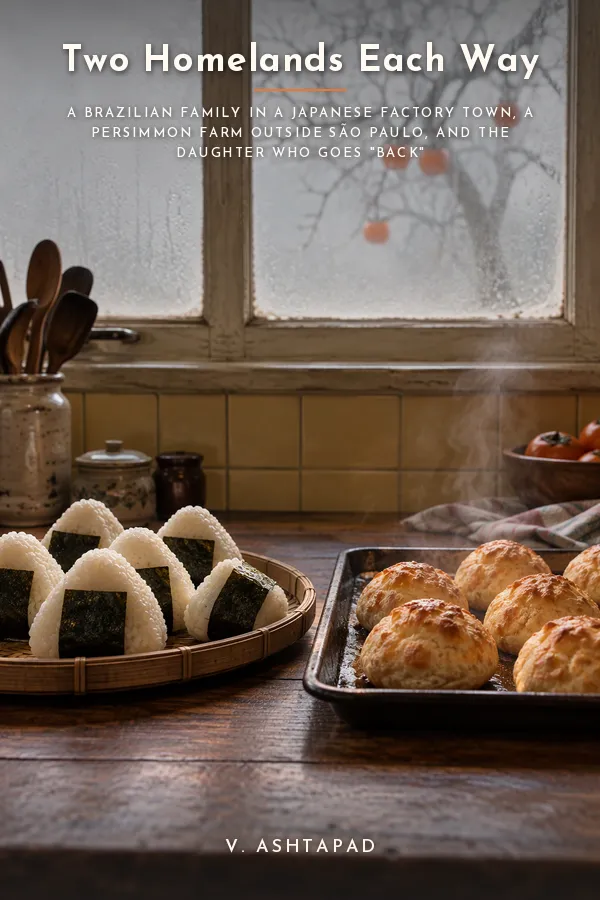
Two Homelands Each Way
A Brazilian Family in a Japanese Factory Town, a Persimmon Farm Outside São Paulo, and the Daughter Who Goes "Back"
by V. Ashtapad
Foreword
This is a work of fiction. Oizumi, in Gunma Prefecture, is real, and so are its Brazilian shops and the large Brazilian community that has lived and worked there for more than thirty years, along with nearby Ōta and Tatebayashi, the Tone River and its floodplain, and Mount Akagi with its crater lake. In Brazil, São Paulo, Guarulhos, the Marginal, the Ceagesp produce market, the Mercado Municipal, Mooca, Butantã, Bom Retiro and Mogi das Cruzes are real places used fictionally. Everything else is invented: the Nakamura Silva family and everyone around them, the brake plant and its lines, the warehouse, the Green Parrot restaurant, the Sparrows and the Herons and their league, Dona Rosângela's supermarket, Fábio's bakery, the enka club, the university admission route, and the persimmon slope behind Haruko's house. Portuguese and Japanese words are kept to a few single ones, like mãe, obachan, onigiri and pão de queijo.
For every family that has packed the same rice cooker for two different countries.
Saturday Beans
The bell for the end of the day shift at the brake plant was not a bell at all. It was a recorded chime, three rising notes and one falling one, piped through every speaker on the floor at three-fifteen, and after twenty-two years Lúcia Nakamura could feel it coming in her shoulders a full minute before it played. When it played, the whine of the grinders dropped in pitch, the conveyor slowed, and forty people pulled off their cotton gloves at the same time, a sound like a flock of small birds lifting from a field.
It was the last Saturday of August, an overtime Saturday, and the heat inside the plant had the thickness of soup. Lúcia walked the line one more time with her clipboard, because she always did, and touched the last caliper housing of the shift with two fingers on its way to the rack. It was still warm from the machining.
"Thirty-one hundred and eight," said Mrs. Fujita at the inspection table without looking up. She was sixty-one and had been checking bores with a gauge since before Lúcia arrived in the country. "Two rejects. Both from the morning. Both because Douglas was thinking about lunch."
"I was thinking about the heat," said Douglas from the deburring station. He was twenty-three, from Londrina by way of a small town in Mie, and he had the build of a boy who had grown taller than his own plans. "Lunch is something different. Lunch is a feeling."
"Rejects are a feeling too," said Mrs. Fujita, in Japanese, and Douglas laughed, because she had said it slowly enough that he could follow.
Lúcia signed the count sheet. She thanked Mylene, who had covered a gap at the press after lunch without being asked, and Mylene waved it away with a towel she had tucked into the collar of her coverall. In the locker room mirror she was forty-seven, hair pinned flat by eight hours under a cap, with her mother's chin.
Outside, the cicadas hit her like a wall of static.
---
They were in every tree along the plant road, even the one sad cherry by the guardhouse, the noise rising and falling in waves. When she opened her car the air that came out smelled of hot plastic and a pine air freshener that had long since stopped smelling like pine.
She drove past the rice fields, green and humming with heat, past a field of konnyaku with its mottled stalks and umbrella leaves, and waited at the crossing for the little two-car local train. To the north, behind the factory roofs and the haze, Mount Akagi lay long and blue across the sky. She had lived in Gunma for twenty-nine years, and she still looked for the mountain every time she drove home.
Dona Rosângela's supermarket was in a low building between a tire shop and a laundromat, with a green and yellow awning that the sun had faded to mint and cream. Inside it was cold and smelled of dried beef and coffee and the sweet, faintly chemical smell of the soap aisle. A television on a shelf above the register was showing a Brazilian afternoon variety program with the volume low.
"Lúcia, my love," said Dona Rosângela from behind the counter. She was sixty, from Goiânia, with reading glasses on a beaded chain. "You look cooked."
"Overtime."
Lúcia took a basket. She knew this store the way she knew the line: the dried beans on the left, black and carioca and the little red ones nobody bought, then the bags of farofa mix, then the feijoada kits with the salted pork and the sausage packed in plastic, then the cassava flour, the guava paste in red blocks, the cans of guaraná soda stacked into a pyramid that Dona Rosângela rebuilt every Monday. She took black beans, bay leaves, collard greens cut into ribbons, oranges, cassava flour. She stood in front of the cheese bread mix for a moment and did not take it, because her mother would know. Her mother always knew, from eleven thousand miles away, when anybody in the family used a mix.
"Kenji came in Thursday," said Dona Rosângela as she rang things up. "He bought six cans of guaraná and a bag of the little sweets shaped like corn. He said they were for the futsal kids, but he ate two at the register."
"He eats everything at the register."
"He told me Bia has big news."
Lúcia looked up. "What news?"
Dona Rosângela's face did something complicated, the face of a woman realizing she had walked into a room just as a vase fell. "He didn't say. He said it was news. Forget I said anything. I'm an old woman. I hear things wrong."
---
The apartment was four floors up in a public housing block on the north side of the city, one of nine identical cream-colored buildings with green railings arranged around a playground and a strip of parking. There was no elevator. On the stairs she passed somebody's curry, somebody's grilled fish, and a radio on the third floor playing a slow country song about a broken-down truck. At the fourth floor landing, over the cicadas, came the hiss of a ball being pumped.
Kenji was sitting on the living room floor with his back to the sofa and a heavy little futsal ball between his knees, pumping it up with a hand pump and squeezing it and pumping again, with the concentration of a man tuning a piano. Two more balls waited beside him, and a bag of orange practice vests that smelled of grass and children. He was fifty, broad and soft in the middle, with a gray streak running back from his left temple that Bia said made him look like a badger. He had already started the beans: onion, garlic, the smoke of the sausage, bay. The little fan on the counter turned its head back and forth like an anxious bird.
"You started," she said.
"I started at noon. They've been going two hours." He put the ball down and got up with a grunt that he pretended was a song. "Your mother would say three hours. Your mother would say I should have started yesterday."
"My mother would say you used the wrong pot."
She kissed his cheek. He smelled of the warehouse, cardboard and diesel and the cold, flat smell of the big refrigerated bay, under the onions. He drove a forklift for a company that supplied the car plants. They had joked about it when they met: he brought the pieces, she made them fit. On Sundays he ran the charcoal pit at the Green Parrot, the Brazilian restaurant on the main road.
"Dona Rosângela said Bia has news," Lúcia said.
Kenji turned to the stove so quickly that he nearly knocked the lid off the pot.
"Kenji."
"She talks too much. She's a talker. It's a supermarket, not a newspaper."
"Paulo Kenji Silva."
When she used his whole name in her mother's tone he always laughed, and he laughed now, but he did not turn around. He stirred the beans. "She wants to tell you herself. At dinner. I promised her. I put my hand on the rice cooker and promised."
"That isn't a real promise."
"In this house it's the most serious promise there is."
---
Bia came home at six from her part-time job at the bakery near the station, where she put cream into the centers of buns for four hours on Saturdays and came back smelling of sugar and hot oil. She was seventeen, in her last year of high school, small and quick, with a silver stud in one ear she had not mentioned for three weeks. She said hello in Japanese at the door. She always said hello in Japanese at the door, as though she were entering a room in a story she had to translate.
"There's feijoada," said Kenji, in Portuguese.
"I smelled it from the parking lot. The Kobayashis smelled it from the parking lot. Mr. Ogawa is probably writing a letter." She dropped her bag, washed her hands, and stood in front of the fan with her eyes closed. "It's thirty-six degrees. Who eats beans in thirty-six degrees?"
"Brazilians," said Kenji. "Brazilians eat beans in any degrees. My grandmother ate feijoada on the hottest day in the history of Santo André. She sweated into it. It was delicious."
"That's disgusting, Dad."
"It's history."
They ate at the low table in the living room with the window open and the fan pointed at their feet, because there was nowhere else for a fan to go. Black beans glossy and thick, the sausage and the salted pork pulled into soft pieces, white rice from the cooker, collard greens fried quickly in garlic until they were bright, a plate of sliced oranges, a bowl of cassava flour toasted with butter and onion that Kenji called the gravel. Mr. Ogawa next door had a quiz show on, and every right answer rang like a small silver bell. Outside, the cicadas were changing shifts too, the evening ones starting up thinner and more musical, like a wet finger around the rim of a glass.
Bia ate a whole plate before she said anything. Lúcia watched her and knew, the way she knew when a press was about to jam, that something was coming. Bia's left knee was jigging under the table. She kept picking up an orange slice and putting it down.
"I have to tell you something," Bia said finally, in Japanese.
"Say it in Portuguese," said Kenji. "Your grandmother says you should practice."
Bia gave him a look that would have stripped paint. Then she switched, and her Portuguese came out the way it always did, correct but careful, like someone walking across a floor they had been told was newly waxed. "I'm going to apply to university in São Paulo. For next year. There's a special admission for Brazilians who finished school abroad. I need my transcripts translated and an essay and an interview. The interview is in March. I already looked at everything. I already made a folder."
The quiz show bell went off next door.
"In São Paulo," said Lúcia.
"Architecture. At the university in Butantã. Or the other one, if I don't get in. But I'll get in." Bia's chin went up; it was Lúcia's chin, it was Haruko's chin. "I'm going to live with Obachan. In Mogi. It's an hour on the train. I already asked her."
"You asked your grandmother before you asked me?"
"She said yes in four seconds. I counted."
Kenji was sitting very still, his chopsticks resting across his bowl, and his face was doing something that Lúcia did not like at all. It was shining. He looked like a man who had just heard a band start up two streets away.
"No," said Lúcia.
"Mom."
"No. You don't know São Paulo. You've been there twice. You were six and you were twelve and you cried both times on the plane."
"I was six."
"You can't write Portuguese. Not properly. You'll write the essay and they'll read it and they'll think a child wrote it."
That landed, and Lúcia saw it land, and was sorry, and was not sorry enough to stop. Bia's face closed like a shutter. Kenji said, "Lúcia," very quietly, and put his hand flat on the table.
"I'll learn," said Bia. "I'll practice. Dad will help me."
"Dad," said Lúcia, "writes Portuguese like a football commentator. Everything is a goal and nothing has commas."
"That's true," said Kenji. "That's very true. But I can still help."
Bia stood up. She took her bowl to the sink and rinsed it and put it upside down on the rack, very correctly, the way she had been taught in elementary school, and she did not slam anything, which was worse. She went into her room, which was a little six-mat room with a sliding door, and slid the door shut. Through it, in a minute, came music from her phone: one of the old Brazilian records Kenji had put on her phone years ago, a man's voice and a guitar, so soft it was almost breathing.
Lúcia began to clear the table. Kenji did not help. He sat with the empty orange plate in front of him, turning a peel between his fingers until it gave up its smell, sharp and bright in the hot room.
"You knew," she said.
"Since Thursday."
"And you were happy."
He did not answer right away. Next door, the quiz show ended and something with laughter began.
"I was happy for her," he said. "She knows what she wants. At seventeen. I didn't know what I wanted at seventeen. I wanted a motorbike."
She ran the water hot. She scrubbed the bean pot, which needed soaking and would not get it, because she was angry and wanted to scrub something. Twenty-nine years ago she had been eighteen and standing in the departure hall at Guarulhos with a suitcase, a jacket she would not need for seven months, and an envelope from the agency with an address in Gunma prefecture written in letters she could read and words she could not understand. Her mother had stood at the barrier holding the strap of her purse and had not cried until the last second, and then she had cried like weather.
She did not tell Kenji any of this. He knew it anyway. He had been on a plane two years after her, from the same airport, with his own envelope.
When the pot was clean she dried it and hung it on its hook, and the window over the sink held the last of the evening: the sky over the next building gone a deep, bruised orange, the color of the inside of a persimmon, and a single small bat flicking back and forth over the playground. The evening cicadas went on with their wet-glass song. Somewhere down in the parking lot a car door shut, and a woman laughed in Portuguese, and a man answered her in Japanese, and neither of them seemed to notice the difference.
Forklift Weather
The typhoon was still a day south of the coast when the warehouse started to feel it. Kenji felt it first in the big roll-up doors on the loading side, which did not rattle so much as breathe, bowing in and out on their tracks as the gusts came across the flat plain from the mountains. The air had turned heavy and sweet and yellowish, and the sky over the truck yard was moving fast in layers, low gray rags of cloud racing under a higher, slower ceiling the color of wet cement.
"They want everything for Monday out by six," said Mr. Sakai, the floor lead, coming down the aisle with his tablet clutched to his chest like a shield. He was a narrow, tidy man of fifty-five who wore his company cap perfectly straight and had once, at a year-end party, sung an enka ballad so mournful that two drivers had to go outside. "If the expressway closes tomorrow, nothing moves. So everything moves today."
"Everything moves today," Kenji agreed, and spun the forklift around in its own length, which he liked to do when Mr. Sakai was watching, because Mr. Sakai always pretended not to be impressed.
He had driven forklifts for twenty-two years, in three warehouses, through an agency at first and then on a direct contract that got renewed every spring with a little ceremony of paper. He knew the truck the way his father had known his old taxi in Santo André: by the sound, by the small complaints. This one pulled a little to the left when the forks were high. The seat had a crack in the vinyl that pinched him if he leaned back too fast. He loved it anyway. He liked sliding the forks under a pallet so cleanly that the wood did not even creak. He liked stacking boxes of brake pads and wiring harnesses four high in the racks, square and true, and knowing that somewhere a woman like Lúcia was waiting for them.
By two o'clock the rain had arrived, not steady but in fistfuls, thrown against the high windows and then gone again. The forklift beeped its reversing beep. The radio on Mr. Sakai's desk, which was supposed to be off, was murmuring a weather report with a cartoon chime between items. Between pallets Kenji talked to the load the way he talked to his futsal kids on Tuesday nights: easy, easy, there you go, look at you.
At the three o'clock break, Claudinho told him.
They were sitting on upturned crates under the overhang by the smokers' corner, though neither of them smoked anymore. Claudinho was fifty-six, from a town in Paraná with a name that sounded like a sneeze, and he had worked in Japan since 1991, longer than anyone Kenji knew. He had a long, sad face, a laugh like a goose, and a wife named Neide who made the best coxinha in Gunma prefecture and sold them out of a cooler at the children's futsal games.
"We're going back," Claudinho said. "For good. December."
Kenji put down his tea. The can was warm from the machine and he had been rolling it between his palms. "Going back where?"
"Home. Where else? Neide's sister found us a little house in Maringá. Two bedrooms, a yard, a mango tree that drops fruit on the neighbor's car. We've been saving for thirty years. The kids are grown. Both of them are here, they're staying, they have Japanese wives, they don't need us." He laughed his goose laugh, a little thin. "My grandson speaks to me in Japanese and I answer in Portuguese, and we understand each other perfectly, and neither of us knows how."
"Thirty years," said Kenji.
"Thirty-four." The rain gusted under the overhang and spattered their boots. Out on the yard, a driver was strapping a blue tarp down over a flatbed, and it kept trying to leave him, filling with air like a sail. "You should think about it, Kenji. You're not young. Your back isn't young. What are you waiting for?"
Kenji did not say anything. He watched the tarp. He thought, as he had thought perhaps once a week for the last ten years and perhaps once a day since Thursday, about the street in Santo André where he grew up: the steep hill, the corner bar with plastic chairs where his father played dominoes, the man who sold sugarcane juice from a cart and fed the long stalks into a green steel press that squealed. The smell of the bakery at five in the morning. His mother on the back step in a housecoat, shelling peas into her lap.
His mother was eleven years gone now, and his father before her, and the bakery had become a phone shop. He knew that. He knew that the street he thought about was not there anymore in the way he thought about it. But his brother Fábio was there, with his bakery in Mooca, three tables inside and two on the sidewalk, and every few months Fábio sent him a photograph of something: a new sign, a plate of pastel, a tray of pão de queijo fresh from the oven, with the same message underneath. There's a stool here with your name on it.
"I'm waiting for Lúcia," Kenji said finally.
Claudinho nodded slowly, the way men nod at a forecast. "Lúcia is a supervisor."
"Lúcia is a supervisor."
"Neide always says Lúcia is more Japanese than the Japanese."
"Don't say that to her."
"I would never say that to her," said Claudinho. "I'm afraid of her. Everybody is afraid of her. It's why her line has the best numbers in the plant."
The break bell went, a short buzz. They crushed their cans and dropped them into the recycling, aluminum in the aluminum, and went back to work. The rain had settled now into a long gray hiss.
---
The Oizumi Sparrows practiced on Tuesday and Friday nights in the gym of an elementary school on the east side of town, which the futsal league rented from the town for a fee so small it was almost a joke. The gym had a varnished wooden floor painted with lines for three sports at once, a stage at one end with heavy maroon curtains, and high windows covered with wire mesh. When twenty children chased one heavy little ball across it at full speed, shrieking in two languages, the windows hummed in their frames and the basketball hoops quivered.
Kenji was the coach, which meant he stood on the sideline with a whistle and a clipboard he never wrote on and decided who went on and who came off and when everyone stopped to drink water. The Sparrows were nine and ten years old. About half of them were Brazilian kids from the housing blocks, the sons and daughters of men and women from the parts plants and the food factories, and half were Japanese kids from the same streets, and by now Kenji could not have said which half was louder. A round boy named Rafael who played as though the ball had insulted his mother. Twin brothers, Sota and Yuto, who passed only to each other. A girl named Hina, tall and solemn, who had joined in spring, played in goal, and dove at shots with her eyes closed.
Tonight the rain was hammering the roof so hard the children had to shout over it. Half the parents had kept their kids home. Neide had come anyway with her cooler and was selling coxinha at the side of the stage for two hundred yen each, golden and teardrop-shaped, the crust crackling, the chicken inside soft with cream cheese. The gym smelled of floor varnish, wet umbrellas, rubber soles, and frying.
"Two touches," said Kenji, and blew the whistle. "Two touches and pass. Rafael. Two. Not eleven."
They played small games, three against three, across the width of the court, the ball smacking off the wooden wall and the children skidding after it on their knees. Kenji walked the sideline. He told Rafael to look up, and Rafael looked up, astonished, as though the rest of the team had just appeared. He told the twins that there were other people on the team who also liked the ball, and the twins considered this information with deep suspicion. He crouched beside Hina's goal and rolled her a ball and then another, low and fast to her left side, where she was weak, until she stopped closing her eyes and caught one clean against her chest and grinned, which she almost never did.
This was the part he could not explain to Lúcia, or to Claudinho, or to himself. He did not feel Brazilian here. Brazil was the game, yes, the way he had played it on a concrete court behind the bakery in Santo André until it was too dark to see the ball, but these children were not Brazil, they were a gym in Oizumi on a typhoon night. He did not feel Japanese either. He felt like a man standing in the doorway between two rooms, holding the door open with his foot so that the noise could go both ways.
At the end they played one full game, five against five, and Rafael passed, once, to Hina, who had come out of her goal for no reason anyone could see, and Hina, to her own horror, scored. The whole gym screamed. Neide screamed. Kenji blew three long blasts on the whistle that meant nothing at all.
At the end, sweating, his shirt stuck to his back, he saw Bia standing in the doorway with two umbrellas.
---
"You walked here in this?"
"It's not that bad yet. It's sideways, mostly." She handed him the bigger umbrella, a clear plastic one from the convenience store with a bent rib. Her jeans were soaked to the knee and her sneakers squeaked on the varnish. "Mom's asleep. She has the early shift. I said I'd bring you an umbrella because you always forget."
"I didn't forget. I left it in the car on purpose. To be closer to nature."
"The car is at home, Dad."
Neide gave Bia the last coxinha for free and squeezed her cheek and said she was getting so pretty and so tall, which was not true, Bia had been the same height since she was fourteen, but Bia said thank you in the polite voice she used for Brazilian aunties, a voice that Kenji privately called the airport voice. Then they went out into the parking lot and the wind grabbed both umbrellas at once.
They walked home the long way, along the canal, because the short way went past a construction site with loose sheeting that slapped in the wind like a slammed door. The canal was full and fast and brown. The streetlights were haloed with rain. A convenience store glowed on the corner like an aquarium, and a delivery scooter went by with its rider wrapped in a poncho that flapped behind him.
"Dad," Bia said, when they had walked for ten minutes without talking. "Are you on my side?"
"I'm on your side," he said. "I'm on your mother's side. I'm on the side of everybody in this family. I'm like a building. I have many sides."
"Be serious."
He was quiet for a while. The rain eased and then came back. Above them a train went over a bridge, a local, lit up yellow, nearly empty, and its sound came down to them through the rain softened into something like a long held note.
"Your mother is scared," he said. "Not of São Paulo. Of you leaving the way she left. She was eighteen. She didn't know anybody. She worked on a line where nobody would tell her the word for the thing she was holding, so she just called it 'this' for six months. She cried every night in a dormitory with five other girls who were also crying. And her mother sent her letters every week, and every letter said, come home, come home, the persimmons are ripe, the persimmons are falling, come home. And she didn't."
Bia was listening hard. He could feel it.
"I'm going to help you," he said. "With the papers. With the essay. My commas are terrible but I know a man in Isesaki who used to teach Portuguese at a school in Recife, and he owes me a favor because I fixed his car's radio in 2015 with a paper clip."
"You did not."
"It was a very good paper clip."
She laughed, finally, and leaned against his arm, and the umbrella tipped and dumped a cup of rainwater down his neck. He yelped. She laughed harder. They were nearly home: the nine cream buildings, the green railings, the playground with its swings tied up for the storm. Most of the windows were dark. On the fourth floor, in their apartment, the kitchen light was on.
He did not say the other thing. He did not say that when she had made her announcement at the table on Saturday, a door had opened in him so wide that he could feel the wind through it, and on the other side of the door was a stool in a bakery in Mooca with his name on it. He did not say that if she went, the apartment in Oizumi would be too big and too quiet for two people who had come here for a few years to make some money and stayed twenty-nine. He did not say that Claudinho was going back in December and he had been jealous, sitting on that crate in the rain, as jealous as a child.
He held the door of the building for her, and they climbed the four flights in their wet shoes, squeaking, and he whistled the three short notes he used to call the Sparrows in from the court, very softly, and Bia hissed at him to stop, people were sleeping, and he stopped, and whistled them once more, softer, and went inside.
Two Accents
On the morning of the culture festival, Class 3-B's café smelled of instant coffee, burned sugar, and the lemon floor polish the custodian had used on the second-floor corridor the night before. The classroom desks had been pushed together and covered with checked tablecloths from the hundred-yen shop. Paper chains hung from the light fixtures. Somebody had drawn a cat in a waiter's apron on the blackboard in eleven colors of chalk, and somebody else had added a mustache, and the class president had erased the mustache with a look of pain.
Bia was on waffles. This meant standing at a hot plate by the window in a borrowed apron with a cartoon bear on it, pouring batter into a press shaped like a fish, and flipping the fish when the timer on her phone buzzed. The fish came out brown and crisp, with red bean paste or custard inside, and the smell of them drifted out into the corridor and pulled people in. Outside the window, the October sky over the school field was a hard clean blue, and the brass band was practicing in the courtyard below, the same eight bars of a march over and over, the tuba always one note behind.
"Your parents are coming at eleven?" asked Saki, who was on drinks. Saki had been Bia's best friend since the fourth grade. She was tall and round-faced and calm in a way that made teachers trust her and made Bia want to tell her everything.
"Eleven-thirty. Mom's working the morning. Dad's bringing her."
"Is your dad going to wear the shirt?"
Bia closed her eyes. The shirt was a yellow football jersey, the national team, twenty years old and thin as tissue at the shoulders, with a green collar and a number on the back that had belonged to a player Kenji still talked about as though he had been a personal friend. Kenji wore it to every school event Bia had ever attended. He had worn it to her elementary school sports day, where he had cheered so loudly during the relay that a teacher had come over to ask if he was all right. He had worn it to her middle school graduation, under a suit jacket, where the green collar had stuck out like a frog peeking from a pond.
"He's going to wear the shirt," said Bia.
---
He wore the shirt.
He came up the stairs at eleven-forty with Lúcia beside him, and Bia heard him before she saw him, because he was saying hello to every student he passed. He said it in Japanese, loudly and warmly, with his Portuguese vowels sticking out of it like elbows, so that it sounded like a Brazilian uncle greeting the whole bakery. Two first-year girls giggled behind their hands. A boy from the soccer club, who knew him, called back, "Mr. Silva! Brazil!" and Kenji pointed at the boy with both hands and shouted, "Brazil!" and the boy laughed, and Bia stared at the fish press and thought about how long it would take her to walk to São Paulo.
Lúcia came in behind him. She was still in the clothes she wore under her coverall, neat gray trousers and a white blouse, with her work bag over one shoulder and her face set in the expression she used for meetings: pleasant, alert, ready to be disappointed. She said hello to the homeroom teacher in perfect, formal, slightly too careful Japanese. The teacher answered in kind. They bowed to each other. It went fine.
Then the mother of Ayaka Mori, who was at the next table with her husband, turned around and said, in the bright voice people use for compliments that are not compliments, "Oh, your Japanese is so good! How long have you been in Japan?"
Lúcia smiled. "Twenty-nine years."
"Twenty-nine! You'd never know," said Mrs. Mori, who had obviously known from the first syllable.
Bia's face went hot. She flipped a fish too early and it tore, and custard leaked onto the hot plate and hissed and burned, and a curl of black smoke went up and set off nothing, thankfully, because the class president had already checked the detectors twice. She scraped the plate. She did not look at her mother. She could feel Lúcia not looking at her either.
What made it worse was that Bia knew exactly what Mrs. Mori had heard. It was not a mistake. Her mother never made mistakes. It was the music under the words. Japanese came out of Lúcia's mouth correct and polished, but it moved differently, the stress falling a fraction late, the vowels a little too round and open, as though each word had been allowed to breathe in a warmer room before it was let out. Bia could hear it the way she could hear a radio playing two rooms away. She had always heard it. In elementary school she had sometimes pretended her mother was an aunt.
And the thing that made it worse than worse was that two weeks earlier, on the video call with her grandmother, Haruko had laughed at Bia's Portuguese. Not unkindly. Haruko was never unkind; she was simply accurate, like a scale. "You sound like a television announcer from Lisbon who learned Portuguese from a Japanese textbook," Haruko had said. "Very correct. Very polite. Like a girl wearing her school uniform to the beach."
So that was how it was. In Oizumi her parents had accents. In São Paulo she would have an accent. Nobody in her whole family, as far as she could tell, had ever spoken anything the right way in the right place.
"I'll take two," said Kenji, arriving at the hot plate. "Custard. And one bean for your mother. She likes beans. She married me, after all."
"Dad."
"What? It's a joke. It's a pun. In Portuguese. It's very complicated, I'll explain it to you later."
Saki, at the drinks table, was laughing so hard into the iced tea that she had to put the pitcher down.
---
On Sunday afternoon Bia sat on the floor of her room with her laptop on her knees and the essay open on the screen and the window cracked for air. The day had turned soft and gray, warm for October. A woman in the next building was beating a futon on her balcony rail with a plastic paddle, slow regular thwacks, and the sound bounced between the buildings. The kitchen smelled of rice and soy sauce and the green onions Lúcia was chopping for lunch.
The essay was supposed to be one thousand words, in Portuguese, on the topic of why she wished to study architecture in Brazil. She had written it four times. Each time she read it back it seemed to be written by someone else, a stiff, careful girl who said things like "I have always been interested in the relationship between space and community." She had sent the fourth version to Mr. Galvão, the retired teacher in Isesaki who owed her father a favor for a paper clip.
His answer had come back that morning, the whole essay marked in red, with a note at the bottom.
"Your grammar is very good," he had written. "Your spelling is better than mine. But this essay is like a uniform. It fits. It is clean. Nobody inside it is breathing. Who are you? Why do you really want to go? Write me that, and I will fix the commas."
Bia read the note three times, and then lay down flat on the floor, and looked at the ceiling. There was a water stain up there shaped like Australia, or like a lamb chop, depending on her mood.
Why did she really want to go?
Because she had been born here, and had gone to Japanese school from the first day, and had a Japanese best friend and a Japanese part-time job and a Japanese sense of exactly how long to bow to a teacher, and still at least once a month someone said, "Your Japanese is so good." Because on the form at the city office there was a line for nationality, and hers said Brazil, and she had seen Brazil twice. Because when she was twelve and they visited, her cousins in Mogi had called her "the little Japanese" all week, fondly, and she had laughed and then cried in the bathroom. Because her mother would not go, and her father wanted to and could not, and somebody had to. Because she wanted to stand in a city where nobody knew which thing she was supposed to be and find out.
She sat up and opened a new file and started typing very fast, without stopping, in Portuguese full of mistakes.
---
At four she called her grandmother.
Haruko answered on the second ring, as she always did, with her face too close to the screen and a wooden spoon in her other hand. It was four in the morning in Mogi das Cruzes, and Haruko had been awake for an hour. She said old people did not need sleep, they needed coffee and something to complain about. Behind her, Bia could see the kitchen of the house in Mogi: the yellow tiles, the calendar from the feed store, the gas stove with its six burners, one of which only worked if you hit it, and a window still black with night.
"Bia! Look at you. You cut your hair? No. You put something in your ear. Show me." Bia turned her head. "Hm," said Haruko. "It's small. It's fine. Your mother has seen it?"
"Not yet."
"Good. Let me be first. I'm always last for everything in this family. Last to hear about the wedding. Last to hear when you were born, because the phone line was broken in the whole of the Mogi district for two days because a truck hit a pole." Haruko put down the spoon and settled into a chair. She was seventy-four, small and solid, with short gray hair she trimmed herself with the kitchen scissors, and wire glasses she had owned since 1990. "So. The essay."
"I'm starting again."
"Good. The last one was terrible."
"You didn't read the last one."
"I didn't have to. I heard you describe it."
Bia laughed. Then, because it was four in the morning there and nobody else was awake, and because her grandmother was the only person in the family who never seemed to be afraid of anything, she said, "Obachan, I'm doing the family tree. The one we all share. I put in your parents. I put in Grandpa Shigeo. I don't know how to write Great-grandma's name in kanji."
On the screen, Haruko's face changed a little, softened around the eyes.
"Fumiko," she said. "Fumi, like letters, ko like child. Write it in katakana. That's how the ship wrote it, when we came. My father's name in katakana, my mother's name in katakana, mine in katakana. Three years old. They wrote our names in the shape for foreign words, because we were going to be foreign." She shrugged. "Then in Brazil they wrote them in Portuguese letters and spelled them wrong. Nakamura with two m's. Fumiko with a k and an h. We were wrong everywhere."
"So which one do I put?"
"Put all of them," said Haruko. "That's what the space is for, isn't it? So nobody has to choose."
Bia stayed on the call while her grandmother made coffee, watching her measure it into the cloth filter, pour the water from a kettle in a thin, patient stream, and blow on her cup. Then she said goodbye and opened the tree again and sat with it on her lap for a long time.
It was a simple thing, the family's tree: a private shared space only the family could see, where each relative could add a name, a photograph, a date. Cousin Larissa in Tokyo had added her own parents and a picture of her nursing school graduation. Uncle Marcos in Mogi had added nothing but had written, under Haruko's name, "the boss." Bia had built most of the rest herself, over two weekends, and now she scrolled back up to the top and began to do what her grandmother said. Under her great-grandmother's name she typed the katakana, and then the Portuguese spelling the ship's agent had given her, wrong letters and all, and then the kanji her grandmother had dictated, letters and child. Three ways of saying one woman. She did the same for her great-grandfather. She did it for Haruko. Then she scrolled down to her own name, Beatriz Yumi Nakamura Silva, which had always looked to her like a train with too many cars, and typed it in Japanese beneath, and sat looking at the two lines one above the other until her mother called her for lunch.
The Line
The announcement came on the first cold Monday of November, in the meeting room on the second floor of the brake plant, the one with the long gray table and the window that looked down onto the roof of the paint shop. Someone had turned the heater on for the first time that season, and it gave off the scorched-dust smell that all heaters give off the first time, a smell like a hot iron left on a shirt. There were eight line supervisors around the table and the plant manager, Mr. Kitamura, at the end, with a stack of printed slides he did not really need because he had been saying the same thing in other rooms all morning.
"Line Four and Line Six will become one line," he said. "From the first of March. One new cell, more automation at the grinding stage, two shifts instead of three on that product. Some people will move to Tatebayashi. Some will move to nights. Some contracts will not be renewed at the end of the fiscal year." He looked around the table. He was a decent man, Lúcia thought, a quiet engineer from Gifu who had come up through quality control and who still walked the floor once a day in safety shoes. He looked tired. "I am sorry. Our customer has changed their order. There is nothing to be done about the order. There is something to be done about how we treat people. I need your help with that."
Lúcia wrote it all down. She wrote down the numbers, the dates, the word "automation" twice and underlined it once. She asked when they would know about the supervisor position for the merged line, and Mr. Kitamura said January, and the supervisor of Line Six, a thick-necked man named Imai who had been at the plant one year longer than her, looked at her across the table with an expression she could not quite read. Not hostile. Measuring.
When the meeting ended she went down the stairs and onto the floor, and the noise rose up around her like water, the presses and the grinders and the conveyor and somebody's radio playing a pop song too quietly to hear the words. She stood at the end of her line for a minute. Mrs. Fujita at inspection, gauge in hand, reading glasses down her nose. Douglas at deburring, nodding his head to a song only he could hear. Mylene at the press, her hair tied up in a blue scarf, feeding blanks in the steady rhythm of someone who could do it asleep and never would. Mr. Hattori, fifty-eight, at the grinder, the oldest man on the line, who had spent thirty years making parts for cars he could not afford and drove a small white truck with a dent in the door that he had never fixed, because he said the dent had character.
Twelve people on her line. On the merged line there would be room for perhaps fourteen out of twenty-three.
---
When Lúcia had arrived in Gunma in 1997, she had been eighteen and had known exactly three words of Japanese: thank you, sorry, and the word for water, which she had learned from her grandfather and pronounced so badly that the first time she said it to a waitress she was brought a dish of pickles. The agency put her in a dormitory with five other girls from São Paulo and Paraná, two bunk beds and a futon, a single hot plate, a shower down the hall. Every morning a van took them to a plant that made seat frames. Nobody on the line spoke Portuguese. The foreman showed her what to do with his hands and said a word, and she did it, and he said the word again, and she nodded as though she understood. For six months she called every tool and part on that line "this." This one goes here. Give me this. This is broken.
The girl who finally taught her the names of things was a Japanese woman of thirty-two who worked inspection at the end of the line. She was impatient and funny and had very short hair, and in the break room, with a ballpoint pen on the back of a napkin, she drew the gauge and wrote its name in katakana, and then pointed at the drawing and at the gauge and at Lúcia's mouth until Lúcia said it right. Then she drew the next thing. Then the next. By Christmas Lúcia had a stack of napkins in a plastic bag in her locker, and by the spring she could ask for anything on the line without pointing.
The woman was Mrs. Fujita. Seven years later, when the seat frame plant closed and Lúcia was hired at the brake plant, Mrs. Fujita had moved there too, three years before her, and had looked up from the inspection table on Lúcia's first day and said, without any change in her expression, "Oh, it's you. Do you still call everything 'this'?"
Lúcia had never told her that she still had the napkins. Some of them, anyway. Eleven, soft as cloth now, in a plastic sleeve in a drawer at home with her passport and the car papers.
---
On Sunday Kenji wanted to drive up Mount Akagi.
It was one of those November days that the Gunma plain does better than anywhere: the sky scrubbed blue by the dry wind, the air sharp enough to hurt the inside of the nose, the light so clear that the mountain stood up behind the town like a cardboard cutout, every ridge and gully distinct, and far off to the west the other ranges stacked one behind another, each a paler blue. Bia stayed home to work on her essay. She said she needed the apartment quiet, which meant she needed her parents out of it.
They drove north across the plain, past the stubble of the rice fields and the konnyaku fields already dug, the earth turned over dark and lumpy where the big corms had come out, past persimmon trees in farmyards hung with fruit nobody had bothered to pick, and then up, onto the mountain road, switchback after switchback through the cedars and then the larches, which had turned. The whole upper slope was gold. The needles came down on the road in the wind like a fine yellow rain and collected in the gutters and stuck to the windshield. Kenji drove with his left arm out the window, catching the cold air. The radio was on a station that played old Japanese pop and enka in the afternoon, and a woman's voice was singing a long slow song about a harbor and a ship that did not come, her voice bending on the long notes like a reed in wind. Kenji hummed along. He knew all the enka songs. He had learned them from Mr. Sakai at the warehouse and from the radio and, he claimed, from his own Japanese grandmother in Santo André, who had sung them while hanging out the laundry, although Lúcia suspected he had invented this grandmother's singing to win arguments.
At the top, the road came out into the old crater, a wide bowl of grass gone brown and silver, ringed by peaks, with the lake lying in the middle of it, gray-blue and wrinkled by the wind. They parked by the shore and walked along the low stone wall at the water's edge. Rental rowboats were pulled up on the gravel for the winter, upside down, in a row, like sleeping animals. A few fishermen stood along the shore with long rods and folding stools and thermoses, in padded jackets, their breath showing. A hawk hung over the far slope without moving its wings. A truck parked by the road was selling roasted sweet potatoes from a stone oven, and the smell of them, sweet and burnt and earthy, followed them along the wall.
Kenji bought two. They sat on the stones, out of the wind, and peeled them with their fingers. The insides were gold and steaming and soft as custard.
"Claudinho's leaving in December," Kenji said.
"I know. Neide told me. She's giving away her pots."
"She gave me one. The big one. For the beans."
"You have a big one for the beans."
"Now I have two big ones for the beans." He bit his potato and burned his mouth and breathed out through his teeth. "They bought a house. In Maringá. It has a mango tree."
Lúcia waited. She knew what was coming. She had known since the night of the feijoada, when she had seen his face across the table shine like a lamp somebody had switched on.
"We could do that," he said. "Not now. Not right away. But we could. When Bia goes. Fábio has the bakery. I could help him. You could do anything. You're a supervisor, you could run a factory floor in São Paulo, in Mogi, there are Japanese companies there, they'd hire you in a minute. We'd be near your mother. We'd be near my brother. We could have a yard. You always say you want a yard."
"I say I want a yard here."
"There are no yards here. There are balconies with futons on them."
She looked out at the water. A single rowboat was crossing the lake toward them against the wind, one old man pulling hard at the oars, the bow lifting and slapping down, and a second old man sitting in the stern with his arms folded as though nothing at all was happening.
"Kenji," she said. "When I go to São Paulo, what do they call me?"
He didn't answer.
"They call me the Japanese. At my mother's house, my cousins call me the Japanese. At the market the man selling fruit asks where I'm from, and I say here, I was born here, I grew up three streets away, and he says, no, but where are you really from. My Portuguese is old. I say words nobody says anymore. My nieces laugh at me. They laugh at how I bow to the man at the bakery without thinking." She put the potato down on its paper. "Here, I am the Brazilian. Fine. I know what that is. I've been the Brazilian for twenty-nine years. I'm good at it. I'm a supervisor. People at the plant know my name. Mrs. Fujita calls me 'you' in a tone of voice that means she likes me. I built this. You built it too. And you want me to go back and be eighteen again in a city where I'm a stranger with the right passport."
"You wouldn't be eighteen."
"I'd be the Japanese girl who came back," she said. "It's the same."
The wind came around the end of the wall and lifted the paper from her potato and took it out over the water, white and turning, and a gull went after it and then gave up, disgusted. Kenji watched it go. He looked, she thought, exactly like Bia when Bia was trying not to cry: the jaw set, the eyes very busy with something in the distance.
"And I'm the Brazilian here," he said. "I'm always going to be the Brazilian here. The guy at the grill. Mr. Sakai likes me. He still talks to me slowly, after twenty-two years. Like I'm a horse he's trying not to startle."
"Mr. Sakai talks to everybody slowly."
"Not like that." He picked a strip of potato skin off his knee. "I'm not saying tomorrow, Lúcia. I'm just saying. I want to go home before I'm too old to carry anything."
"This is home," said Lúcia.
She meant it. She also heard, under the wind and the water and the hard work of that old man at the oars, how it sounded spoken aloud: like something she was holding down with both hands so it would not blow away.
They drove back down as the sun went behind the western ranges, the larches going from gold to brown in the mirror and the lights of the plain coming on below them, and they did not argue, and they did not talk about it, and when they got home Bia had left a note on the table that said she had finished the essay and gone to Saki's and there was rice in the cooker. Lúcia read it twice, as though there might be more on the back. She went into the bedroom and opened the drawer with the passports and took out the plastic sleeve with the napkins, and looked at the first one: the gauge in blue ballpoint, a little smeared, and under it in Mrs. Fujita's crisp small hand, the name of the thing.
The Trains That Do Not Stop
The trains that did not stop at Tatebayashi were the ones Kenji liked best.
He and Bia stood on the cold open-air boarding level at a quarter past nine on a gray Saturday in December, their breath showing, holding paper cups of vending-machine corn soup that had been too hot to drink and were now too cold. They had come in from Oizumi on the little two-car local, which rocked and squealed through the flat fields like a cart, and now they were waiting for the train to Tokyo. The air smelled faintly of brake dust and the lemony disinfectant the station staff used on the benches. Painted lines on the concrete showed where each car's doors would open. A man in a navy uniform and white gloves walked the length of the boarding level, checking something nobody else could see.
Then a chime, and a voice announcing that a limited express would pass through, and would passengers please stand behind the yellow line. Kenji put his hand on Bia's shoulder, not to hold her back, just to have it there.
It came out of the north with its horn going, cream and orange, six cars long, much faster than anything had a right to be in a town this size, and the wind of it hit them flat in the chest and lifted Bia's hair straight up off her forehead. For a second the whole station shook. The windows went by in a blur of seat backs and newspapers and one small child with both palms flat on the glass, and then it was gone toward Tokyo and the air was settling around them and somewhere farther along a little boy was shouting with joy.
"Every time," said Kenji. "Every time, I think, where are they all going in such a hurry?"
"Tokyo, Dad."
"Tokyo," he said, as though it were the name of a very good goalkeeper, and Bia rolled her eyes and finished her soup.
Their own train came ten minutes later, slower, polite, and stopped exactly where the painted lines said it would. They found seats on the right side and settled in with their coats on their knees. The train pulled out so smoothly that Kenji did not notice until the station was sliding away. The plain went past in a long low gray sweep: factory roofs, warehouses, the tangle of wires over the tracks, rice fields flat and pale with stubble, a farmer burning straw in a heap so that the smoke went sideways, and then the Tone River, enormous, the train running out over it on a long iron bridge for what felt like a full minute, the water wide and slow and pewter-colored, with gray reed beds along both banks and a single heron standing in the shallows like a folded umbrella.
Four days earlier Kenji had driven Claudinho and Neide to the airport bus in the dark, with their two big suitcases and a cardboard box wrapped in so much tape it shone. Neide had cried from the parking lot to the bus door. Claudinho had not cried at all. He had shaken Kenji's hand very formally, like a man closing a sale, and then, with one foot on the bus step, turned around and said, "There's a mango tree. I'll send you a picture of the mango tree," as though it were a threat. The picture had come that morning: a tree, a wall, a red car with a yellow splat on the hood.
---
Larissa lived in a one-room apartment near a subway stop in Kita-Senju, on the northeast edge of Tokyo, on the second floor of a building with outdoor stairs and a laundromat on the ground floor that made the stairwell smell of hot clean cotton. She was twenty-four, the daughter of Lúcia's cousin Cristina, and she had come to Japan at five and gone back to Brazil at sixteen and come to Japan again at eighteen, which made her, she said, a table tennis ball with a nursing certificate. She worked at a care home for the elderly, mostly nights, and she had the dry, quick humor of someone who changed bedsheets at three in the morning and sang to old women who did not know where they were. She opened the door in a sweatshirt and fuzzy socks, with a towel wound around her hair and a wooden spatula in her hand.
"You're early," she said. "The Silvas are never early. You've ruined my whole idea of the family."
"The train was early," said Kenji. "I was on time. The train was simply in a hurry."
"Come in, come in. Bia, look at you. You've got a thing in your ear. Did your mother see?"
"Not yet."
"Coward," said Larissa approvingly. "Shoes off, shoes off. I'm making yakisoba."
She made it the São Paulo way, the way the street-fair stands made it, which was nothing like the Japanese way: a huge flat pan on a single gas burner, beef and chicken in strips, then cabbage and carrots and broccoli and green pepper and big chunks of onion, then the thick noodles, and then the sauce, which was dark and sweet and glossy with cornstarch and soy, so much of it that the whole thing was more like a stew than a fried noodle. In Japan people looked at it in horror. In Brazil it was the food of every Saturday market from the north zone to the south. The apartment filled with steam and the smell of soy and sugar and frying onion. The window fogged over. Kenji, who had not eaten yakisoba like this since he was twenty, stood at Larissa's elbow and watched the sauce bubble and felt something like homesickness and something like hunger, and could not tell which was which.
They ate sitting on cushions around a folding table. Larissa's room was small and bright and full of plants on every surface, and a string of fairy lights ran along the curtain rail, and on the wall there was a framed poster of a beach in Bahia that she said she had bought at a shop in Ueno for eight hundred yen and that she had never been to.
"So," said Larissa to Bia, with her mouth full. "São Paulo."
"São Paulo."
"Your mother hates it."
"My mother hates it."
"Your father loves it."
"My father," said Bia, "is sitting right here."
Kenji raised his chopsticks in salute and went on eating.
Larissa told them what it had been like, at sixteen, to go back. She had been in a school in Londrina. She had spoken Portuguese like a five-year-old because she had stopped learning it at five, and the other kids had mocked her every time she opened her mouth. They called her the little Japanese. They asked her if she ate with sticks at home, and she said yes, and they laughed, and she did not understand why. She had failed history because she did not know any of the dates everyone else had learned in primary school. She cried in the bathroom at least twice a week for six months.
"And then," said Larissa, "it was the best two years of my life."
Bia looked up.
"I mean it. I made friends. Real ones. I had a boyfriend who sold coconuts at the bus station, he was terrible, I loved him. I went to the beach for the first time. I danced at a party until four in the morning and walked home with my shoes in my hand and nobody stared at me because everybody else had their shoes in their hands too." Larissa pointed her chopsticks at Bia. "It's going to be awful. And then it's going to be great. And then you'll come back here to visit your parents and you'll feel like a foreigner here too. That's the deal. Pick which insult you like better. You're going to get both anyway."
"Then why did you come back?"
Larissa shrugged. "Money, at first. My mother was here. Then I got the job at the home, and there's an old man there, Mr. Tanabe, ninety-one, and every night he asks me to sing him the song about the red dragonflies, and I sing it badly, and he corrects me, and then he falls asleep. And I thought, well. Somebody has to sing it badly to him."
She got up and pulled a box from the top of her closet and sat down with it on her knees. Inside were old photo albums with plastic pages gone yellow and brittle.
"I've been scanning these," she said. "My mother's albums. She comes over on her days off and sits there and tells me who everybody is, and I type it in under each picture. Otherwise nobody will know in fifty years. Look." She opened one of the albums and turned it toward Bia. "That's your mother."
Kenji leaned over. He knew the picture at once, though he had not seen it in twenty years. Five girls on two bunk beds in a cramped room with a hot plate on a shelf, all of them eighteen or nineteen, in sweatsuits, with their hair wet from the shower down the hall. They were making faces at the camera. The one on the top bunk, on the left, was holding up a bowl of instant noodles like a trophy and laughing so hard her eyes had closed. She had very thick bangs. She looked like a different person and exactly like herself.
"Mom has bangs," said Bia, in a strange flat voice.
"Your mother had bangs for three years," said Kenji. "She cut them herself. She was very proud. I met her in the second year of the bangs."
"My mother's the one in the middle," said Larissa. "That's the dormitory in Ōta. They all came in the same month. My mother says Lúcia cried every single night until March and then one night she stopped and started teaching the others the words she'd learned. She had napkins. My mother says she had a bag of napkins with drawings on them."
Bia was very quiet. Kenji watched her look at the girl with the noodles, and he thought he knew what she was thinking, because he was thinking it too: that the girl in the photograph was only one year older than Bia was now.
Larissa sent the scan to the family's shared space while they watched, so that it appeared under Lúcia's name in the tree, and under it she typed what her mother had said: the dormitory in Ōta, March 1998, the five girls' names. Bia asked her to add one more thing, and Larissa looked at her and then typed it. The bangs were self-cut. She was very proud.
---
On the way home it was dark by five. The train was warm and half empty. A businessman across the aisle was asleep with his mouth open and his tie loosened, and a family of four was eating boxed dinners out of their laps, the smell of grilled salmon and pickled plum drifting back. Outside the window, the towns went by as clusters of light, then nothing, then a long line of light that was a highway, then the black width of the Tone River under the iron bridge, and the moon breaking up on its surface into silver pieces.
"Dad," said Bia. "Can I ask you something?"
"Anything. Except the meaning of life. I don't know that one. I'll tell you when I find out."
"Do you want to go back?"
He had known, sitting on the cushion in Larissa's room watching his daughter look at that picture, that she was going to ask. He had thought about lying. He had thought about making a joke. He looked at the black river going by, and the lights, and his own face reflected in the window over them, the badger streak, the soft jaw, the eyes that looked more and more like his father's every year.
"Yes," he said.
Bia nodded slowly.
"Since you said you were going?"
"Before that. Since a long time. Since your grandmother died." He meant his own mother, and Bia knew it. "But since you said it, more. Like you opened a window."
"Does Mom know?"
"I told her on the mountain."
"What did she say?"
"She said this is home." He put his hand flat on the cold window and then took it away, leaving a print that faded as he watched. "And she's right. And I'm right. That's the problem with being married. Sometimes you're both right and you still have to decide what to have for dinner."
Bia laughed, a small surprised laugh, and let her head drop onto his shoulder, and stayed there until Tatebayashi.
Mochi
The wind came down from the mountains on the second of January and emptied the sky.
It was the dry winter wind off the mountains that the old people in Gunma talked about as though it were a difficult relative: it arrived every year after the turn of the year, it blew for weeks, it cracked lips and knuckles and the wooden window frames, it rattled the bicycles in their racks and sent plastic bags flying up past the fourth-floor railings like startled birds. It made the air so clear that from the playground of the housing complex Bia could see Mount Akagi standing sharp and blue to the north, and behind it the snow on the higher peaks, a thin white line under a sky so blue it looked lacquered. Her lips had split on the first day. She had a stick of balm in every pocket.
On the morning of the third, the residents' association made mochi in the community hall.
The hall was a low concrete building at the edge of the complex, beside the bicycle sheds, with a kitchen at one end and folding tables at the other and a notice board covered with flyers about garbage days in four languages. Somebody had propped the double doors open for the steam, and the wind came in instead, sharp and cold, and pushed the steam around the room in white rags. The smell of steamed sweet rice filled everything: a clean, milky, slightly grassy smell, like the inside of a rice cooker multiplied by fifty.
Mr. Ogawa was in charge. He was eighty, a widower, the oldest resident of Building Six, and for the first five years after the Nakamura Silvas moved in next door he had communicated with them mostly through notes taped to their door. The notes were polite and precise. They concerned the hours at which a ball might reasonably be bounced in a stairwell, the correct day for burnable garbage, and, once, the smell of beans on a Saturday evening, which he described as "considerable." Then one winter Kenji had carried Mr. Ogawa's new heater up four flights of stairs without being asked, and Lúcia had taken him a bowl of the considerable beans, and Mr. Ogawa had eaten them and returned the bowl washed, with a single mandarin orange in it, and since then he had been, as Kenji put it, their grumpy grandpa.
"The Brazilian," said Mr. Ogawa, when Kenji came in. "Good. You have arms."
The mortar was a huge wooden bowl, cut from a single section of trunk, darkened and smoothed by decades of use, sitting on a straw mat on the concrete floor. The mallet was a heavy wooden head on a long handle. One person swung the mallet down onto the steamed rice; the other person, crouched beside the mortar with wet hands, turned and folded the rice between strokes, fast, before the mallet came down again. It required trust, Mr. Ogawa said, and timing, and in his opinion most young people had neither.
He crouched by the mortar with a bowl of water. Kenji took the mallet, hefted it, and gave a few practice swings that made two of the grandmothers at the tables gasp.
"Slow," said Mr. Ogawa. "Down. I turn. Down. I turn. Like a clock."
"Like a clock," said Kenji.
Down went the mallet, thump, into the sticky white mass of rice. Mr. Ogawa's hands flashed in and folded it. Down, thump. Fold. The sound was deep and wooden and satisfying, and the rice began to lose its grains and turn smooth and stretchy and shiny, like dough, like taffy. Down. Fold. Down. Fold.
Then Kenji began to count.
Bia, who was at the tables with Saki and three of the grandmothers, rolling the finished mochi into balls and dusting them in potato starch, heard it start and closed her eyes. When she opened them, her father was counting the strokes out loud in Portuguese, the way he counted laps for the Sparrows on Tuesday nights, um, dois, três, with a little bark on each number. Rafael from the futsal team, who had come with his grandmother, took up the count from the next table. Then the twins took it up in Japanese, louder, on purpose, so that the numbers went back and forth across the hall in two languages, each side trying to drown the other out. Mr. Ogawa's hands, dipping in and out, kept time with whichever side was winning. The grandmothers started to laugh. A little girl began to count in no language at all, entirely off the beat, with total commitment.
"Brazilian," said Mr. Ogawa sternly, not stopping. "What is this?"
"Counting practice," said Kenji. "My team can't count past four. It's why they lose corner kicks."
"A mortar is not a corner kick."
"In Brazil everything is a corner kick," said Kenji. "That's why everybody is late."
Mr. Ogawa made a sound that Bia had never heard him make before. It took her a second to understand that he was laughing. It came out of him rusty and short, like a gate that had not been opened all winter, and he kept turning the rice through it, his hands white with starch and wet to the wrist, and the mallet came down, thump and count, thump and count, until the rice in the mortar was one smooth gleaming moon.
---
The mochi went into bowls of hot sweet red bean soup, and into a clear broth with greens, and onto plates with soy sauce and toasted seaweed, and into the coat pockets of the grandmothers, wrapped in plastic for later. Bia ate three pieces in red bean soup at the long folding table with Saki, both of them with their coats still on, their cheeks red from the wind, the soup steaming into their faces. Mochi was a strange thing to eat: it did not so much get chewed as wrestled. It stretched and stretched and then gave up all at once, warm and plain and faintly sweet. Lúcia, across the table, ate hers in small careful pieces, the way she had been warned to by her grandfather when she was a girl in Mogi, where the Japanese families had made mochi at the turn of the year too, on a farm, in a mortar that her great-grandfather had carved from Brazilian wood.
"Is it the same?" Bia asked her. "As in Brazil?"
Lúcia considered the question with the seriousness she gave everything. "The rice is different," she said. "Our rice there was a little harder. And it was summer. Thirty-two degrees. We made mochi in shorts. My grandfather pounded and my grandmother turned and she yelled at him in a dialect from Kumamoto that I couldn't understand, and he yelled back, and we kids stole pieces before they were finished and burned our mouths."
"You never told me that."
"You never asked me that." Lúcia blew on her soup. "Also there was a dog. The dog stole more than we did."
---
The application deadline was the fifth.
Bia had rewritten the essay seven times. Mr. Galvão in Isesaki had marked up the sixth one in red and written, at the bottom, "Now someone is breathing. Fix the commas I marked and send it." She had fixed the commas. Then she had sat in front of it all evening on the fourth and not sent it, because there was one thing she had not done.
The essay was about the word "this."
It was about a girl of eighteen who arrived in a factory town where nobody would tell her the names of things, and who called everything on the line "this" for six months, until a woman at inspection drew the tools on napkins and taught her their names. It was about how that girl became Bia's mother, a supervisor who now knew the name of every part in the plant and still called her daughter's room "this mess." It was about how Bia had been born knowing all the Japanese names and none of the Portuguese ones, so that in her grandmother's kitchen in Mogi she pointed and said "this" and "this," and how she wanted to study buildings in the city where her mother was born, because a building is the first thing you name when you arrive somewhere, and she wanted to know what she would call things when she got there. It was not very long. It had, Mr. Galvão said, only nine mistakes now, which for a girl writing her first real essay in Portuguese was respectable.
She had gotten the story of the napkins from Larissa's mother, by way of Larissa. She had never seen them. She did not know if her mother still had them. She did not know if her mother would want them in an essay that a stranger in São Paulo would read.
At ten she knocked on the frame of her parents' bedroom door. Kenji was asleep already, on his back, snoring with a long whistle on the in-breath. Lúcia was sitting up under the reading lamp with her glasses on and a report from work on her knees, covered in her neat numbers.
"Mom," said Bia, in Portuguese. "I need to ask you something."
She explained. She did it badly, in a rush, half in Portuguese and half in Japanese, and her mother listened without interrupting, the reading glasses pushed up into her hair. When Bia finished there was a long quiet, and Kenji whistled in his sleep, and outside the wind threw something light and plastic against the window and carried it away.
Lúcia got up. She went to the small chest of drawers by the window and opened the top drawer and took out a plastic sleeve, and sat back down on the bed, and held it out to Bia.
The napkins were soft as old cotton, folded and refolded, some of them torn at the creases. There were eleven. Blue ballpoint drawings: a gauge, a wrench, a caliper, a box of gloves, a thing Bia didn't recognize at all. Under each one, in small crisp handwriting, the Japanese word. And beneath that, on some of them, in a younger and rounder hand that Bia knew at once because it was her mother's handwriting on every birthday card she had ever gotten, the Portuguese word, spelled out in pencil, faint, like a translation whispered to oneself.
"You kept them," said Bia.
"I keep things," said Lúcia. "It's not a secret."
Bia turned them over one by one. On the back of the last napkin, in the round young pencil, there was a single line, half rubbed away. She could make out only "Mãe" and a date in March.
"Write it," said Lúcia. "Your essay. I don't mind." She took her glasses out of her hair and put them back on and looked down at her report, and her voice was perfectly steady. "Only spell 'gauge' right. In Portuguese. It's not how it sounds. Your father spells it wrong every time."
---
Bia sent it at eleven forty. The confirmation came back in four seconds, which made her think of her grandmother.
At midnight, which was one in the afternoon in Mogi, Haruko called.
"I hear you sent it," she said. She was in her garden, by the look of it. Behind her the light was hard and white and summery, and the leaves of the persimmon trees were thick and green and glossy, and there was a sound of somebody's radio far off, a cheerful voice talking very fast. Haruko had a straw hat on. "Your father told me. He sends me messages at strange hours. He doesn't sleep, that man. Listen. I have decided something."
"What?"
"March. My birthday. Seventy-five." Haruko pointed the phone at herself so that her face filled the screen, the wire glasses, the chin. "I want all of you here. In my house. Not on a screen, not in a photograph. Your mother, your father, you. I want to make you pão de queijo with my own hands and watch you eat it. I've already told your uncle Marcos. He's buying a mattress."
"Mom has the factory thing. The merger."
"Your mother," said Haruko, "has had a factory thing for twenty-nine years. Tell her I said March. Tell her I said seventy-five. Tell her I said a mattress has been purchased." She took the phone away from her face again and showed Bia the persimmon trees, row after row, the small hard green fruit just starting on the branches, each one the size of a walnut. "By March these will be orange," said Haruko. "You've never seen them orange. Not once. It's ridiculous."
Two Kinds of Tired
There was a list, and Lúcia had to make it.
It was not called a list. In the meetings it was called a staffing proposal for the integrated cell, and it lived in a spreadsheet on the shared drive with a password, and it had columns for skills matrix scores and attendance and certifications and preferred shift, and a column at the far right, narrow and gray, labeled "disposition." Lúcia and Imai from Line Six were meant to fill it in together. Twenty-three names. Fourteen places on the new line, four places at the Tatebayashi plant, two on nights in the casting shop. That left three.
They met in the small office behind the tool crib, a room the size of a closet, with a window onto the floor and a heater under the desk that made their shins hot and the rest of them cold. This was the second week of February. Outside, a fine dry snow was falling on the parking lot, which happened on the plain perhaps twice a winter, and nobody on the floor had stopped talking about it all morning. The flakes were tiny and hard and did not settle. They blew across the asphalt like sand.
"Douglas is agency," said Imai. He had a stub of pencil behind one ear and a can of hot coffee he had not opened. "His contract is up in March. The agency will place him somewhere."
"He's the best deburring hand I have."
"He's twenty-three. He'll find another line." Imai said it without cruelty, as a fact about weather. "My two agency people are the same. That's three. The proposal is finished."
Lúcia looked at the spreadsheet. She looked at the narrow gray column. She thought about Douglas at the deburring station, nodding his head to his secret songs, and about the first week he had come to the line, two years ago, when he had held a file the wrong way and she had shown him with her hands and said the word, and he had said "this?" and she had laughed out loud, startling everybody, and he had never known why.
"Give me until tomorrow," she said.
---
Mr. Hattori came to find her that afternoon at the grinder. He waited until the cell had finished its cycle and the coolant had stopped spraying, and then he took off his safety glasses and wiped them on his shirt, and put them back on, and said, without preamble, "I'll take the early retirement."
The company had offered it, quietly, to everyone over fifty-five: a lump sum, a small pension top-up, a ceremony in the canteen with a cake. Nobody on Lúcia's line had taken it. She had assumed nobody would.
"You don't have to," she said.
"I know I don't have to. I'm fifty-eight. My knees are seventy. My wife wants to grow tomatoes." He looked at the grinder, at the gleaming bore of the last part in the fixture, with an expression she could only call fond. "I've been making these for thirty years. Before this plant, the one in Ōta. Before that, my father's shop. I have made, I think, more brake parts than any man in Gunma who is not a robot." He touched the side of the machine, very lightly, as you might touch the shoulder of an old dog. "Let the boy stay. Douglas. He has good hands. He doesn't know it yet. He thinks he's just waiting for his real life to start somewhere. Somebody should tell him this is it."
Lúcia could not, for a moment, find any words in either of her languages.
"I'll train him on the grinder," said Mr. Hattori. "Two weeks. That's enough, he's quick. Then I'll go and grow tomatoes and you'll all forget me."
"We won't."
"You will," he said comfortably. "That's how it is with good machines. Nobody thinks about them until they stop."
---
The next morning she went to Imai with the change, and Imai read it and said nothing and initialed it. Then he looked up at her, with the measuring expression from November, and said, "Kitamura wants to see you. Ten o'clock."
The plant manager's office had a window that looked out over the whole floor, and he stood at it with his hands behind his back when she came in, watching Line Four run.
"You'll supervise the integrated cell," Mr. Kitamura said, without turning around. "Both shifts report to you. Imai goes to Tatebayashi as assistant manager. It's closer to his house; he's pleased. It's a promotion for you, a real one. There is a salary step. There will be more meetings, which you will hate." He turned. "I'm told you are the person on this floor who knows the name of everything."
"Who told you that?"
"Mrs. Fujita," said Mr. Kitamura. "In those words. She said, 'Nakamura knows the name of everything, and she won't let anybody else get away with calling it something else.' I took it as a recommendation."
Lúcia said thank you. She bowed. She said she would need a week of leave in March for her mother's seventy-fifth birthday in Brazil, and she said it fast, as though it were a small item at the end of an agenda. Mr. Kitamura looked at the calendar on his wall, with the March launch circled in red, and was quiet long enough for her to hear the floor below them through the glass. Then he said, "One week. Not a day more. Bring us something sweet."
She went back to the floor. She did not call Kenji. She told herself she would tell him that evening, at dinner, when Bia was there, and that there would be cake. Then she told herself she would tell him on the weekend. Then she was standing at the end of her line watching Mr. Hattori show Douglas how to read the sound of the grinder, the two of them leaning in toward the machine with their heads almost touching, the young one nodding, the old one making a small shape in the air with his hand, and she understood that she was not going to tell him for a while, and she understood why, and she did not like it.
If she told Kenji, it would be real. If it was real, it was a reason to stay. And Kenji would hear it as a reason, which it was, and also as a wall, which it was too.
---
On Friday she bought her mother's presents on the way home. Green tea from a shop near the station that had sold tea for four generations, the leaves dark and needle-thin, packed in a silver bag inside a paper canister. Two cotton wrapping cloths printed with blue waves. A box of the little fruit jellies made from konnyaku that were the Gunma souvenir every visitor bought and every local pretended to be above, which Haruko had once eaten an entire box of in one evening while watching a soap opera and then denied.
The woman at the tea shop wrapped the canister in paper with crisp folded corners and asked whether it was a gift. Lúcia said it was for her mother, in Brazil. The woman said, "Ah, Brazil," with the warm puzzled face people made, as though Brazil were a cousin they had heard about at a wedding, and added a small free packet of roasted tea to the bag. "For the journey," she said. "It's very far."
"Twenty-six hours," said Lúcia.
"Twenty-six!" said the woman, with real horror, and added a second packet.
---
That Saturday was the Green Parrot's winter churrasco night.
It was held every year at the restaurant on the main road, a long low building with a red tin roof and a parking lot full of minivans, the night the children's futsal league gave out its trophies. The owners took the tables out of the back room and pushed the rest against the walls, and the whole Brazilian side of Oizumi came, and a good part of the Japanese side too, because word had gone around years ago that the meat was worth it. Dona Rosângela had been selling party things for weeks: plastic flower garlands, cans of guaraná in a special edition with a parrot on them, bags of the little corn-shaped candies Kenji loved. By eight the place was packed and hot and loud. It smelled of charcoal and beer and fried pastel and perfume and the coats of two hundred people who had not taken them off yet because outside it was two degrees and the wind off the mountains was cutting.
Lúcia had worked until four. She had stood all day, walked the line forty times, sat through two meetings and redone a shift schedule because the night shift casting supervisor had switched two names. Her feet ached in a specific way, a dull bone ache in the heels and a hot one across the ball. She wanted a bath and a bowl of rice with a raw egg and soy sauce and to sleep for eleven hours. Instead she was standing at the side of a crowded room in a sequined top Bia had lent her, which did not fit, holding a plastic cup of sweet wine.
Then the first skewers came out.
They came from the back, through the swinging door from the yard where the long brick charcoal pit was, carried high by the young waiters in green aprons: beef rump with its thick white cap of fat crackling, sausages split and blistered, chicken hearts in rows, whole pineapples crusted with cinnamon sugar and turning gold. And behind them, in the doorway, in a white apron gone gray with smoke, with a pair of long tongs in one hand and his face red from three hours over the coals, Kenji. He had started the fire at three. He had salted the meat with coarse salt by the handful and threaded every skewer himself, and he stood in the doorway now with the heat of the pit behind him and watched the first plates fill the way Lúcia watched the first parts of a shift come off the line: with his whole attention, and a small private frown, until the first man bit and closed his eyes.
Then the trophies. The league president, a Japanese father with a microphone that kept squealing, called the teams up one by one, and the children went up in their orange vests and their good shoes and bowed and held their little gold cups over their heads. The Sparrows had finished fourth of six. Rafael got a trophy for most goals, and most yellow cards, which the president read out with great seriousness. The twins got one together. And then Hina, the tall solemn goalkeeper, was called up for best goalkeeper in the league, and walked to the front with her face perfectly still, and took the cup, and turned around and looked straight across the room at Kenji in the kitchen doorway, and he raised both arms with the tongs in one of them and roared, and the whole room roared with him.
Lúcia had seen this a hundred times. She had seen it when they were twenty-three and the churrasco was eight Brazilians and a grill made from half a steel barrel in somebody's yard behind the housing blocks. She knew it the way she knew the end-of-shift chime, in her shoulders, before it arrived.
Kenji found her in the crowd. He did not come over. He just pointed at her with the tongs, the way he had pointed at the boy in the corridor at Bia's school, and grinned, his face shining with sweat and pleasure, the gray streak plastered to his forehead.
And she was tired, she thought, there were two kinds of tired, and she had both of them at once. There was the factory kind, which was in the feet and the back and the eyes, and which had a list in it, and a narrow gray column, and an old man's hand on a machine. And there was this kind, which was in the chest, which was the tiredness of standing in a hot room in a borrowed sequined top watching your husband be the happiest man in it, and knowing that this happiness was half of what he wanted to take back across the world, and the other half was the part she could not give him.
She put down the sweet wine. She went to the kitchen doorway. Somebody put a plastic flower garland over her head on the way. Kenji held out a skewer, and she took the first slice off it with her fingers, hot and salty and pink in the middle, the fat gone crisp at the edge, and burned her mouth, and he laughed at her, and behind him the coals glowed in the long pit, and the windows of the Green Parrot fogged white from the inside, and outside in the cold the fine dry snow kept falling and blowing away before it could become anything at all.
She told him nothing that night. In bed he fell asleep in about four seconds, smelling of charcoal and salt, with ash in his eyebrows. She lay awake beside him and listened to him whistle on the in-breath, and to the wind working at the window frame, and thought about the gray column, and about Mr. Hattori's tomatoes, and about her mother's persimmon trees, which Haruko said would be orange by March.
Guarulhos in the Rain
São Paulo began, as it always had for Kenji, with the smell.
It reached him in the jet bridge at Guarulhos at six in the morning, through the gap between the bridge and the door of the plane: wet asphalt, jet fuel, warm rain, and under all of it something green and rotten-sweet that he had never been able to name, the smell of a huge city built on top of a jungle that had not entirely agreed to it. He stopped walking. A man behind him with a rolling bag bumped his heel and said sorry in Portuguese, the real sorry, the quick careless one, and Kenji almost turned around to thank him for it.
"Dad," said Bia, behind him. "You're blocking the whole plane."
"I'm smelling."
"Smell while walking."
They had been traveling for twenty-eight hours. Two flights, a long gray layover in a glass airport in the desert where everything cost too much and the carpet was the color of sand, four movies, three meals in foil trays, and one long argument across Bia's sleeping head about whether Lúcia should have packed the tea in the checked bag. Lúcia had been right, as it turned out: the checked bag arrived on the carousel with one corner crushed and the smell of green tea leaking from it so strongly that a sniffer dog in a green vest came over to investigate, sat down beside it with an air of great seriousness, and was led away by its handler, who looked at the three of them with a mixture of suspicion and pity.
"It's tea," said Lúcia, in her careful old Portuguese.
"I know, ma'am," said the handler. "He likes tea. He's from Minas."
Kenji laughed until he had to grab the trolley.
---
Fábio was waiting outside the arrivals door in a striped polo shirt and sunglasses, although it was raining, holding a piece of cardboard on which he had written, in thick black marker, THE JAPANESE.
"I'm going to kill you," said Kenji.
"Welcome home, little brother!" Fábio was two years older and a head shorter and had their father's barrel chest and their mother's laugh, which tilted upward at the finish as if asking something. He grabbed Kenji around the neck and kissed both cheeks and slapped his back so hard that Kenji coughed. Then he kissed Lúcia's hand like a man in an old movie, and picked Bia up off her feet, which she had not allowed anyone to do since she was nine, and set her down again, stepped back to look at her, and said, "You're tiny! You're a doll! What do they feed you over there, air?"
"Rice," said Bia, red-faced.
"Rice!" Fábio was delighted. "We'll fix that."
His car was a small silver hatchback with a dented rear door and a dashboard covered with stickers of the Corinthians crest, and it smelled of cigarettes he swore he had quit and a vanilla air freshener shaped like a tree. They wedged the suitcases into the back and Bia into the middle of them and pulled out into the rain.
The drizzle in São Paulo was not like Gunma rain. It did not fall so much as hang. It was a fine gray mist that hung in the air over the highway and turned the headlights into soft smears and beaded on every surface without ever seeming to land, and through it the city came up around them all at once: the concrete overpasses stacked on overpasses, the river beside the Marginal brown and sluggish and wide, the towers going up the hills on all sides until the haze swallowed them, the walls covered in tall black-and-white lettering that ran around corners and up the sides of buildings like vines. The traffic was immediate and total. Motorcycle couriers threaded between the lanes in a continuous stream, a hand's width from the mirrors, their horns going like geese. A man walked between the stopped cars selling bags of peanuts and phone chargers and a single enormous stuffed tiger. A bus beside them was so full that people's faces were pressed to the fogged windows, and someone had drawn a heart in the fog and someone else had drawn a smaller heart inside it.
"Two hours to Mogi in this," said Fábio cheerfully. "We'll stop for breakfast. You're not going straight to your mother-in-law's on an empty stomach, Lúcia, she'll say I starved you."
"She'll say that anyway," said Lúcia.
"She'll say that anyway," Fábio agreed. "But at least it won't be true."
---
"First the Ceagesp," Fábio said. "I need cheese and fruit for the bakery, and there is no point going to the Ceagesp after seven. After seven it's for tourists and fools."
They went west on the Marginal with the river beside them. Somewhere off to the left was the exit for Liberdade, and Bia twisted around in the back seat to look for the red lanterns and saw only a wet overpass and a billboard for a dentist.
The produce market sat beside the river in a sprawl of enormous old sheds with curved concrete roofs, each as long as a train station, and by a quarter to seven it was already most of the way through its day. Trucks were backed up to every loading bay, from Minas and Paraná and Bahia and places Kenji had never heard of, their tarps beaded with drizzle. Men pushed hand trucks stacked six crates high through the lanes at a run, shouting for people to get out of the way and not waiting to see if they did. Under the high roofs the light was gray and dim and the cold damp air smelled of crushed fruit and diesel and wet cardboard and, near the banana sheds, something sweet and heavy like the inside of a closed car in summer. There were mountains of everything. Papayas by the ton. Pineapples stacked in pyramids. Crates of passion fruit, wrinkled and purple. Persimmons, glossy and orange, in shallow wooden boxes, which made Lúcia stop and look at them with her mouth set. Pallets of cabbages. Sacks of onions. Whole avenues of green bananas hanging in bunches from hooks like the ribs of some huge animal.
Kenji walked through it with his head turning back and forth like a boy at a fair. He knew how to move pallets. He had never seen pallets move like this, with no forklift, by shouting.
Fábio bought his cheese from a Minas family's stall, white rounds stacked on wooden shelves under a hanging bulb. He argued about the price for a full four minutes, with enormous pleasure on both sides, and then paid the first price the man had said. The man's mother, a small old woman in a knitted cap, sitting on a crate at the back of the stall with a thermos, looked at Kenji for a long moment and asked him where they had come from, and he told her, Oizumi, Gunma, Japan, and she said oh, my grandson is in Toyohashi in a factory, and they talked about the factories in Japan for five minutes as though they were neighboring towns in the interior.
Then she said, pleasantly, pouring him a little cup of coffee from her thermos, "And are you Japanese, or Brazilian?"
He heard the question as if from a long way off. Nobody had asked it of him in Japan. In Japan they did not need to ask.
"Both," he said. "Neither. Brazilian. I'm from Santo André."
"Ah," said the old woman, who had a Japanese face and a São Paulo voice, and smiled at him with sympathy. "Then you're from here. Welcome back."
---
Fábio's bakery was in Mooca, on a street of old brick row houses and long-closed textile mills with their tall chimneys and their windows bricked up, between a shoe-repair stall and a tiny hardware shop. It had three tables inside and two on the sidewalk, a glass counter full of French rolls and coxinha and pastel and sugared doughnuts split and filled with yellow cream, a television in the corner showing the morning football highlights, and a ceiling fan that seemed to consider each rotation before committing to it. At seven in the morning the whole street smelled of its ovens. Fábio's wife, Rosa, was behind the counter, and his sons, Gui and Davi, seventeen and fifteen, were sitting at a sidewalk table pretending not to wait for the cousin from Japan.
They looked at Bia with enormous curiosity and total cool. Bia looked at them the same way. Within ten minutes Davi was showing her a video on his phone and Gui was teaching her a hand-clap game that all the kids in the neighborhood apparently knew and that Bia picked up in two tries, which impressed him visibly.
"And this," said Fábio, steering Kenji by the shoulder toward the back of the shop, "is yours."
It was a stool. An ordinary bar stool with a red vinyl seat, at the end of the counter, next to the wall. Painted on the wall above it, in white paint, carefully, with a ruler, was the word KENJI.
Kenji stared at it.
"I told you," said Fábio. "There's a stool with your name on it. You thought I was being poetic. I'm never poetic. I'm a man who sells bread."
Kenji sat down. The stool was exactly the right height. The counter was cool under his forearms. Rosa put a little glass of coffee in front of him without being asked and a pastel on a paper napkin, thin and blistered and crackling, hot enough to burn, the dough tasting of the fryer and the filling of cheese and oregano. The television shouted about a goal. The ceiling fan thought about its next rotation. A man came in out of the drizzle and nodded at Fábio and said, "The usual," and Fábio said, "The usual," and gave him something without looking.
He was home. He was sitting on a stool with his name on the wall, in his brother's bakery, in the city where he was born, and the coffee was right and the pastel was right and the light coming in through the open front was the right gray, the São Paulo gray, soft and dirty and kind.
Then Gui came in from the sidewalk and asked his uncle a question, something about the football in Japan, and Kenji answered with a word for "cool" that he and Fábio had used when they were boys, and Gui burst out laughing so hard he sat down on the step, and Davi came running in to find out what was funny, and Gui told him, and Davi laughed too, and both of them kept saying the word to each other in a high, wobbling voice like an old man on a radio program from 1993.
"Nobody says that," said Gui, wiping his eyes. "Uncle. Nobody has said that since before I was born."
"I say it," said Kenji.
"You," said Davi, with deep love and no mercy, "are a museum."
Fábio was laughing too, behind the counter, slapping it with his palm. Lúcia, at a table by the door with Rosa, was trying very hard not to, and failing. Bia had her face in her hands. Kenji sat on his stool with his name over it and laughed along, because what else could he do. He laughed and he finished his pastel and he thought, under the laughter, very clearly: I don't know how much anything costs here. I don't know the new coins. I don't know what the kids say. I know the smell of this city in my body, and the city has gone on without me for twenty-seven years, and it does not know my smell at all.
They drove to Mogi in the afternoon, an hour and a half in the creeping traffic, the drizzle thickening to rain and then thinning again. The city kept going for a long time and then quite suddenly stopped, and there were hills, green and steep and wooded, and small farms, and greenhouses with plastic roofs beaded with water, and roadside stands selling bananas by the bunch and orange cassava root and heaps of something round and orange that Kenji could not make out through the rain until they pulled into Haruko's road.
The persimmon trees stood in rows on the slope behind the house, thirty or forty of them, their leaves gone yellow and red at the edges, and the fruit hanging all over them, hundreds and hundreds, glossy and orange as lamps. In the gray of the late afternoon they seemed to give off their own light. The rain dripped from them. The headlights swept over them as Fábio turned in at the gate, and the whole hillside lit up orange for a second, and in the back seat, between the suitcases, Bia said something in Japanese, very softly, that Kenji did not catch, and did not ask her to repeat.
Persimmons
In Haruko's house, there was one bathroom and four people, and by the second morning the schedule had become a matter of national importance.
Haruko got up at four, because she always got up at four, and had the bathroom to herself until four-thirty, which nobody contested. Lúcia got up at five-fifteen, because her body was still on the day shift in Oizumi, although her body was also confused about which day it was, and went in with her toothbrush and her face set like a supervisor on a Monday. Kenji got up whenever Lúcia's alarm stopped, groaned, rolled over, and fell asleep again with a long whistle on the in-breath that came through the thin wall of the spare room and down the hallway and into the kitchen, where Haruko listened to it over her coffee and said, "That man sounds like a kettle that has lost hope."
Bia slept on a new mattress on the floor of what had once been her mother's room, and woke every morning at a different hour with no idea where she was.
The house was long and low and old, built by Bia's great-grandfather in the 1960s out of brick and dark wood, with a red tile roof that had grown green moss in its seams, and a deep veranda all the way along the front where Haruko kept her plants in old cooking-oil cans painted blue. It smelled of woodsmoke and floor wax and something sweet and fermenting from the shed out back, where the persimmons were stored. The floors were cool red tile. Every door stuck in the rain. In the living room there was a glass cabinet with a set of good teacups, a stuffed toucan made of felt, a framed photograph of Grandpa Shigeo in a straw hat on a tractor, and a small wooden shelf with a single orange persimmon on it, for no reason that anyone would explain.
And behind the house, up the slope, the trees.
On the second afternoon Haruko took Bia up the hill to pick. The rain had stopped. The clouds had lifted off the hills and the sun came out low and warm through the rows, and the sun fell through the leaves in pieces, red and yellow and green, and lay on the wet grass under the trees like scraps of colored paper. The air smelled of rain and earth and fruit beginning to turn. Insects hummed. From somewhere down the valley came the sound of a radio and a dog that would not stop barking at it.
"These are the sweet ones," said Haruko, at the first row. She handed Bia a pair of clippers with red handles. "Cut the stem, leave a little piece, like a hat. Never pull. If you pull, the fruit cries."
"The fruit cries?"
"It bruises. Same thing." Haruko reached up and cut one in a single neat snip and held it out on her palm. It was squat and square-shouldered, bright orange, so glossy it looked lacquered. "This kind you can eat hard, like an apple. The other kind, on the far rows, you have to wait until it's so soft it's almost rotten, or it will turn your mouth inside out. My father planted both. He said one was for people who are patient and one was for people who are not."
"Which one are you?"
"Neither," said Haruko. "I'm the one who plants them."
They picked for an hour, filling shallow plastic crates and carrying them down to the shed between them, one handle each. Haruko was five days short of seventy-five and moved through the rows faster than Bia did, ducking under branches, talking all the time. She talked about the trees, which ones were old and which ones she had grafted herself, which ones her husband had loved and which ones had never produced anything worth eating in forty years and which she kept anyway out of spite. She talked about the neighbor, who grew strawberries in greenhouses and had a son who wanted to marry a girl from Curitiba. She talked about the price of persimmons, which was terrible, and the price of fertilizer, which was worse. She did not ask Bia about the interview. Bia was grateful.
At the end of the last row, Haruko stopped, and cut one more fruit, and turned it in her hand.
"My father planted the first ones in 1962," she said. "He had a cutting from a man in Suzano, who had a cutting from a man on the boat. All the way from Japan in a tin of wet sawdust. That's what the man said, anyway. Maybe he lied." She shrugged. "These are the grandchildren of a tree in Wakayama that nobody here has ever seen."
She gave the persimmon to Bia. It was warm from the sun and heavy for its size and smelled faintly of honey and pumpkin.
"Eat it," said Haruko. "You've never had one off the tree. It's ridiculous."
Bia bit into it. It was crisp and cold inside and very sweet, sweeter than she expected, with a flavor like apricot and brown sugar and something floral, and the juice ran down her wrist. Haruko watched her chew with an expression of fierce satisfaction, as though she had personally invented fruit.
---
On Sunday morning they all went to the street market in the center of Mogi, because Kenji said nobody could understand Brazil who had not eaten a pastel at a street market at nine in the morning, and Haruko said nobody could understand Brazil, period, but she would come for the oranges.
The market ran four blocks down a closed street under striped canvas awnings, blue and yellow and orange, and the noise of it hit Bia before she had turned the corner. Men shouting prices. Women shouting back. A radio playing a fast accordion song from somewhere in the northeast. Trucks backing up with their beepers going. And the colors: mountains of oranges and tangerines and papayas split open to show their black seeds, pineapples stacked like cannonballs, green bunches of cilantro and collards, crates of okra, piles of persimmons from someone else's hill, cheeses in rounds, sacks of beans, cages of chickens that eyed her with contempt. Water ran in the gutters from the fish stalls. The smell was fruit and fish and diesel and frying.
The pastel stall was at the far end, a long counter under a red awning with a line of people six deep in front of it, and behind the counter three men in white aprons and a vat of oil so big Bia could have sat in it. One man rolled the dough out in a long thin sheet, another spooned in the fillings, cheese, ground beef, heart of palm, and folded and crimped them into long flat rectangles with a fork, and the third dropped them into the oil, where they puffed up instantly into blistered golden pillows and hissed like waves pulling back over stones. Next to the stall a man was feeding sugarcane stalks into a green steel press that squealed and spat, and the juice ran out pale green and frothy into plastic cups.
When Bia got to the front of the line, the man at the oil looked at her and said, cheerfully, "And what does the little Japanese girl want?"
She told him. Cheese, and heart of palm, and a sugarcane juice with lemon. She said it in Portuguese, carefully, the waxed-floor Portuguese.
The man's eyebrows went up. "Look at that! Your Portuguese is so good! Where did you learn?"
For a moment Bia stood there with the heat of the oil on her face and the noise of the market in her ears and could not answer. She thought of Mrs. Mori at the culture festival, in her bright voice. She thought of her mother's small polite smile. Twenty-nine years. You'd never know.
Then she thought of the essay, and of the napkins, and of what she wanted.
"From my mother," she said. "She was born here. Three streets that way."
The man looked at her for a second longer, the long fork in his hand, the oil hissing. Then he laughed, not at her, and gave her the pastel and a second one, with cheese, for free. "Then welcome home, kid," he said. "Next time ask for the beef. The beef is the best."
She carried her pastel back down the street through the crowd, breaking off a corner of the crust, burning her fingers, and found her mother and her grandmother at the orange stall arguing about something with the orange man, both of them in the same posture, arms folded, heads tilted at the same angle. They looked like the same woman at two different ages. Kenji was standing a little behind them holding all the bags, eating a pastel in three bites, with powdered sugar from something else on his shirt.
---
The interview was on Monday, at the university in Butantã. Lúcia went with her.
They took the commuter train from Mogi in the early morning, in the gray, the carriage packed with people going to work, the windows fogged, the train swaying along through endless backyards and walls and laundry lines and then into the city. Bia stood holding the bar with her folder pressed against her chest. Her mother stood next to her, small and straight, holding the same bar. Neither of them spoke much. Once, when the train lurched, Lúcia put her hand flat on Bia's back to steady her and then left it there for a stop and a half.
The professor was a woman in her fifties with gray curls and enormous earrings, in an office full of models of buildings made of balsa wood and cardboard. She had read the essay. She asked Bia questions for twenty minutes, quickly, in the Portuguese of a person who talked fast all day, and Bia understood most of it and asked her to repeat one question twice, and the professor did, without impatience. At the end she said, "What will you call your first building?" and Bia did not understand the joke at first, and then did, and laughed, and said "This," and the professor laughed too, a big laugh that made her earrings swing.
Afterward Lúcia took her downtown to the Mercado Municipal, because, she said, she had not been inside it since she was seventeen and wanted to see if it was still standing. It was. The great hall rose over them on its iron columns, with tall stained-glass windows at either end showing farmers and cattle and coffee bushes in reds and greens and golds, so that the light inside came down colored onto the stalls. It was loud and crowded and smelled of salt cod and cured ham and ripe mango and coffee. Fruit sellers held out slices of strange fruit on the points of their paring tools for anyone to taste. Lúcia bought them each a mortadella sandwich at a counter on the upper level, which came as a soft roll with what looked like half a kilo of thin pink slices folded into it, steaming, and Bia stared at it and said, in Japanese, that nobody could eat this, and her mother picked hers up with both hands and ate the whole thing without a word, looking out over the rail at the colored light on the crowd below, and Bia understood that she was watching her mother be seventeen.
That night Haruko taught her pão de queijo.
She did it in the yellow kitchen, at the long table, with the six-burner stove going and the window black and open and moths batting at the screen. Sour cassava starch in a big tin bowl. Milk and oil and salt brought to a boil and poured over the starch all at once, so that it hissed and clumped, and then stirred with a wooden spoon until it was smooth and shiny and stiff. Eggs beaten in one at a time. Then the cheese, grated from a firm white round from Minas, so much of it that Bia thought it was a mistake.
"It's not a mistake," said Haruko, before she could say anything. "Your mother always thinks it's a mistake. Every time."
Lúcia, sitting at the far end with a glass of beer, made a face exactly like Bia's.
Then they oiled their hands, Haruko and Bia, and rolled the dough into balls no bigger than a walnut, the size of a small persimmon. Haruko's hands were fast and dry and spotted and rolled each ball perfectly round in three quick turns. Bia's balls were lumpy. Haruko fixed two of them without comment and left the rest. They went into the oven on a blackened tray, and the smell of hot cheese filled the kitchen and something like toast, and twenty minutes later they came out puffed and golden and cracked on top, and Kenji came in from the veranda like a dog hearing a can opener.
"Who made the ugly ones?" he said.
"Me," said Bia.
"Good," he said, and took the ugliest one, and ate it whole, and burned his mouth, and said it was the best one.
Seventy-Five
On the morning of her seventy-fifth birthday, Haruko Nakamura put on her good blouse, the cream silk one with the small blue flowers that she had worn to Lúcia's wedding and to Shigeo's seventieth and to nothing in between, and sat down on the veranda in the cane chair with her hands clasped on her knees, and said to her granddaughter, "All right. Record me. But only the parts I say."
Bia had asked her the night before. She had asked carefully, the way Lúcia had taught her to ask anyone for anything: whether Obachan would like to tell some stories for the family, in her own voice, so that the cousins could hear them, and Larissa in Tokyo, and the children who were not born yet. That it would be kept in the family's private space and nowhere else. That Obachan could say stop at any time, and could listen to it afterward and take out anything she didn't like.
Haruko had thought about it for the length of a cup of coffee. Then she had said, "I'll wear the silk."
"It's only your voice, Obachan. Nobody sees you."
"I'll know," said Haruko.
So now Bia sat on the tiled step below her with her phone held up on a little folding stand, and Lúcia stood in the kitchen doorway with a dish towel over her shoulder, not quite listening, and the morning came up warm and damp over the persimmon slope. The light was soft and gray-gold through a thin overcast. A pair of green parakeets were screaming in the avocado tree at the corner of the yard. Down in the valley, somebody was cutting grass with a machine that whined like a mosquito the size of a dog.
Haruko talked for forty minutes. She talked about the farm, and about Shigeo, whom she had married at twenty-two because, she said, he was the only boy in the Japanese association who could dance and also fix a pump. She talked about the year the frost killed the coffee all over the state, and about how Lúcia, as a little girl, had sold persimmons from a card table at the road and charged the Brazilian neighbors double and the Japanese neighbors triple, because she said the Japanese neighbors could afford it. She told the story of Marcos falling out of the biggest tree at seven and breaking his arm and walking home holding it and not crying until he saw his mother, and then crying so loud that the neighbor came running with a broom because she thought somebody was stealing her pig.
She did not tell the story of the ship. Twice Bia started to ask, and twice Haruko lifted one finger off her lap, a tiny movement, and Bia stopped.
"Another time," said Haruko. "That one I'll do myself. When I'm ready. I don't want to do it in a blouse."
---
The lunch was small, because Haruko said she was too old for parties and too young to be celebrated like a monument. It was only family: Marcos and his wife Sônia and their two girls, who were twelve and nine and had attached themselves to Bia like burrs; Fábio and Rosa, who had driven out from the city with a cake in a box on Rosa's knees the whole way; and the four of them from Oizumi. They ate on the veranda at a long table made of two tables pushed together, with a plastic cloth printed with lemons. There was rice, of course, and black beans, and a roast chicken that Sônia had made, and Haruko's own cucumber pickles, and a dish of stewed pumpkin with soy and sugar the way Haruko's mother had made it, and a mountain of pão de queijo, and the green tea from the shop by the station in a big pot, which Haruko poured herself, with great ceremony, into the good cups from the glass cabinet.
"This is the tea from that shop," Haruko said, inhaling over her cup. "I can tell. The good one by the station. Your father bought me this tea the one time I visited, Bia, and I said it was too expensive, and he bought it anyway, and I took it home and made it last two years."
"You never told me that," said Lúcia.
"You never asked me that," said Haruko, and Bia, down the table, made a noise that could have been a laugh.
They gave her the presents. The wrapping cloths with the blue waves, which she held up to the light and approved of. The konnyaku jellies, which she put in her lap and did not share. A framed print of the scanned photograph from Larissa, the five girls on the bunk beds with their wet hair and the bowl of noodles, which Haruko studied in silence. Then she said, "Look at those bangs," and everybody laughed, and Lúcia went red.
Rosa's cake was a São Paulo bakery cake, three layers, filled with caramel milk jam and covered in a whipped cream that was already sliding in the humidity. They sang. The two little girls sang loudest and fastest, as children do, racing to the end. Kenji whistled through his fingers like a man at a football match. Haruko blew out the candles, both of them, a seven and a five, in one breath, and then sat back and looked around the table at all of them, the whole family on the veranda in the warm gray noon, the persimmons glowing on the hill behind them, and said, "Well. That's enough of that," and cut the cake herself.
---
The quarrel happened in the kitchen, afterward, over the dishes. Lúcia would go over it for months afterward: how it came out of nothing, out of a dish towel, out of a pot.
She was washing and Haruko was drying, because Haruko did not trust anyone else to dry the good cups. Over the sink the window stood open, and through it came the voices of the others on the veranda and the sound of Kenji and Fábio arguing about football with the full joyful bitterness of brothers. Sônia's girls were teaching Bia the hand-clap game. Their voices went up and up.
"She's good at it," said Haruko. "The game. Look. Two tries."
"She's good at everything she decides to be good at," said Lúcia, scrubbing a pot.
"Like her mother."
Lúcia didn't answer.
"You're angry with her," said Haruko. It was not a question. "For going."
"I'm not angry."
"You're scrubbing that pot like it owes you money."
Lúcia put the pot down in the water. "She's seventeen, Mãe. She doesn't know anything. She thinks she's going to come here and be Brazilian, and she's going to come here and be the little Japanese girl at the pastel stall for the rest of her life. She's going to call me crying every night. And I won't be able to do anything. I'll be eleven thousand miles away."
"Yes," said Haruko. "You will."
Something in her mother's voice made Lúcia look up.
Haruko was holding one of the good cups in the towel, turning it slowly, not drying it, just turning. Her face was perfectly composed. Her eyes were wet behind the wire glasses.
"You did this to me," Haruko said. "You know that? At eighteen. You stood in that airport with your little suitcase and your jacket you didn't need, and you walked through the door, and you didn't look back. I watched to see if you'd look back. You didn't. And then you called me crying every night. Every night, for six months, from a phone box outside a dormitory in Ōta, with coins. And I couldn't do anything. I was eleven thousand miles away."
"You wrote me to come home," said Lúcia. Her own voice sounded strange to her, very young. "Every letter. Come home, the persimmons are ripe. Come home, the persimmons are falling."
"I did."
"And I didn't come."
"And you didn't come." Haruko put the cup down on the counter, very carefully, as though it might break from being looked at. "And I was so proud of you I couldn't stand it. And I never wrote that. Not once. I wrote come home, come home, because I was your mother and I wanted you home. And every time you didn't, I went out to the trees and I thought, she's doing it, my girl is doing it, she's not coming back, good." She picked up the towel again. "I should have written that. I didn't. I'm writing it now. It's late, but it's my birthday. I can do what I like."
Lúcia stood at the sink with her wet hands hanging at her sides. Out on the veranda, the clapping game reached its end, and all three girls shrieked at once.
"Don't do what I did," said Haruko. "That's all. Write her the other thing. Write her the true one."
---
In the evening, when Marcos's family had gone home and Fábio and Rosa had driven back to the city with the empty cake box and the dishes were done and Bia was asleep on her mattress with the two little girls' drawings tucked under her pillow, Kenji asked Lúcia to walk up the hill with him.
The rain had gone and the sky had cleared, and it was the first clear night they had seen in Brazil, and the stars came out over the persimmon slope thick and close and warm, not the hard cold stars of a Gunma winter, but something softer, like sugar spilled on dark cloth. The fruit hung in the dark all around them, round and heavy, faintly glowing. Frogs were going in the ditch by the road with a sound like someone running a stick along a fence. The air smelled of wet grass and ripe fruit and the woodsmoke from Haruko's chimney.
They stopped at the top row. Below them the lights of the house. Beyond that the lights of Mogi strung along the valley, and beyond that, faint orange in the sky to the west, the glow of São Paulo, enormous, like a fire somebody had banked for the night.
"I want to stay," Kenji said.
She had known he would say it. She had not known he would say it here, tonight, with the frogs.
"Not stay now. I'm not crazy. I'll go back with you next week. I'll work the year. But next year, when Bia's here. I want us to come. Fábio says the bakery can use me. He wants a grill out back on Saturdays. Your mother needs somebody for the trees. Marcos wants to sell the top field, did you know that? She told me. He wants to sell it for houses, and she'll let him because she's tired, and in ten years there won't be any persimmons here at all. I could do it. I could learn it. I want to grow old here, Lúcia, where I'm the guy from Santo André and not the guy at the grill." His voice cracked on the last word. "I want to be home."
She stood very still. The frogs went on.
"They gave me the integrated cell," she said. "The new line. Both shifts. In February."
It took him a second. She watched it take him. In the starlight his face went through surprise and then pleasure, real pleasure, for her, and then something else, slower, that closed it.
"February," he said.
"Yes."
"It's March."
"I know what month it is, Kenji."
"You didn't tell me. For a month. You were going to sit on that plane with me and let me say all this and you'd already—" He stopped. He turned away and looked down the hill at the house, at the kitchen window, where Haruko had left a light on for them. "You'd already decided."
"I hadn't decided anything. I was offered a job. I said yes to a job."
"It's the same."
"It is not the same," she said, and heard her voice go up, and did not stop it. "I have worked twenty-nine years to be offered that job. Twenty-nine years. I started out calling everything 'this.' And now the plant manager says I'm the one who knows the name of everything. I wanted to tell you. I wanted you to be happy for me. And I knew you couldn't be. Because the minute I said it, you'd hear it as one more reason not to come here."
"Is it?"
She didn't answer. That was the answer. He heard it.
He walked back down the hill without her. She stayed in the top row for a long time, alone, with the frogs and the fruit and the orange glow in the west, and when she finally went down to the house, she found him asleep in the hammock on the veranda, under an old blanket of Shigeo's, with his shoes still on.
Return Freight
The cherry trees along the irrigation canal came out the week they got back, all at once, as though somebody had flipped a switch while the Nakamura Silvas were in the air. Kenji walked under them on his way to the warehouse in the mornings, in the cool, with the petals coming down around him in the wind off the river, pale pink and almost weightless, collecting in drifts along the curb and in the folds of parked cars' windshield wipers and on the brown surface of the canal, where they moved together in slow rafts. Old men sat on blue tarps under the trees with flasks and lunch boxes. Students took photographs of each other making the peace sign. The whole city smelled faintly of petals and wet asphalt and grilling squid from the stalls that set up by the bridges.
It was the most beautiful week of the Oizumi year, and Kenji and Lúcia were not talking.
Not in the dramatic way. They talked about everything. About who would buy rice, and whether the gas bill was right, and what time Lúcia's shift ended now that the integrated cell was running and she was at the plant until seven every night, sometimes eight. They said good morning and good night. Kenji made the beans on Saturday. Lúcia ate them and said they were good. They were perfectly polite, like two people sharing a table on a train, and Bia went from one to the other with her eyes and said nothing and spent most of her evenings at Saki's.
The university had said results would come in May. Bia checked her messages the way Kenji checked the clock at the end of a close game: constantly, sideways, pretending not to. She had started her last year of high school in a new homeroom with a new teacher who asked the class, on the first day, to write down their plans after graduation, and she had written São Paulo and then crossed it out and then written it again, and handed in the paper with the crossing-out still on it. At dinner she told funny stories about the teacher in a bright voice and watched her parents not look at each other, and then she washed her bowl very correctly and slid her door shut.
It was worse than shouting. Kenji knew how to shout. He had grown up in a house in Santo André where shouting was a form of conversation and a slammed door was a kind of comma. He did not know how to do this. He did not know how to be careful with Lúcia.
---
"You look like a man whose fish got away," said Mr. Sakai at the Wednesday break.
They were standing under the overhang by the loading bays. Claudinho's crate was still there, upturned, and nobody had taken his place on it. The yard was full of sun and blowing petals from the one cherry by the gate.
"I'm fine," said Kenji.
"You have been fine for two weeks. Every day more fine." Mr. Sakai opened his can of coffee, precisely, with a little crack. "Silva. I need a favor. For May."
Every year in the first week of May, during the long holidays, the towns along the river held a children's futsal tournament on the outdoor courts below the Tone embankment, eight courts laid out in a row on the floodplain, with tents and food stalls and the river going by wide and brown behind the chain-link. Teams came from Oizumi and Ōta and Tatebayashi and the farm towns across the river. Kenji had brought the Sparrows every year for six years. They had never got past the first afternoon.
"My grandson plays for the Ōta Herons," said Mr. Sakai. "You know the Herons."
"I know the Herons. They beat us nine to one in October. Their coach looked at me the whole second half like I was a stain on his shirt."
"That's Kubo. He looks at everyone like that. He's seventy. He taught math for forty years." Mr. Sakai drank. "This year the Herons have seven children, and you have seven children, and the tournament needs ten for the under-elevens. So the league says: one team. His seven, your seven, one bench, two coaches." He looked at Kenji sidelong. "I'm the assistant. Practice is Sundays on the river courts. It's very windy and very boring and you'll hate it. Also there's beer."
"Does he know about me?"
"He knows," said Mr. Sakai. "He said, 'The Brazilian with the hands in the air?' I said yes. He said, 'Hm.' From Kubo, that's practically a hug."
---
The river courts lay on the broad flat floodplain below the Tone embankment, where the river ran wide and slow between banks of gray reeds and the wind came down off the mountains across the whole plain with nothing to stop it. From the courts you could see Mount Akagi long and blue to the north, with a last streak of snow in the gullies near the top, and the cherry trees along the top of the embankment, pink and shedding, their petals blowing down onto the courts in gusts. The asphalt was painted green with white lines and had cracks with dandelions growing in them. The wind took every high ball and did something to it.
There were fourteen children that first Sunday, seven in the Sparrows' orange vests and seven in the Herons' blue, standing in two separate clumps at opposite ends of the court like two flocks of birds that had landed in the same field by mistake. Rafael was already arguing with a Heron about whose ball it was. Hina stood in the goal with her gloves on, solemn. Mr. Sakai's grandson Kota, small and quick, with glasses held on by an elastic strap, was juggling a ball on his knee and pretending not to watch the Brazilians.
Mr. Kubo stood at the center line with a clipboard he actually wrote on. He was a full head shorter than Kenji and twice as wide, and his face was the color and texture of a walnut, and he spoke only in short commands. He looked at Kenji's orange vests, and at Kenji, and blew his whistle once.
"Lines," he said. "Passing. Two touches."
"That's what I say," said Kenji. "Two touches."
"Then we agree." Mr. Kubo did not smile. "Lines."
They ran drills. Mr. Kubo's drills were precise and endless and done in silence: pass, move, receive, pass, in tight triangles, until the ball went around like a clock. The Herons did them perfectly. The Sparrows did them loudly. By the third drill the two clumps had begun, without anyone deciding it, to mix, because Rafael could not stand to stand next to only his own team, and the twins wanted to show the Herons they could pass to someone besides each other, and Kota, it turned out, was very curious about Rafael's opinions.
Then they played a short game, blue vests against orange, and in the fourth minute Rafael scored, a hard low shot that skidded under a Heron's foot and went in off the post, and did what the Sparrows always did when they scored.
They danced.
It was not much of a dance. Kenji had made it up years ago, in the elementary school gym, to stop the Sparrows from crying when they lost, and somehow it had become what they did when they won instead: a little shuffle to the corner, a hop, both arms out like wings, a turn, a bow to the goalkeeper. Every one of the orange vests did it, wherever they were on the court, including Hina in her goal, very seriously, with her gloves held out. Kenji did it on the sideline without thinking. His body did it. He had done it three hundred times.
Mr. Kubo whirled around with his hand up and blew his whistle and shouted, "Who is dancing?"
Every child on the court pointed at Kenji.
Mr. Kubo marched along the sideline toward him and stopped in front of him and looked up at him.
"You," he said. "The Brazilian."
"Yes, sir."
"You're dancing."
"I'm sorry, sir. It's a habit. My body likes it. And the kids. When they score they have to put it somewhere."
Mr. Kubo stared at him for a long, long time. Behind him, the cherry petals blew across the court. All fourteen children were watching, with total attention, the way children watch two adults who might be about to fight.
"Fine," said Mr. Kubo finally, which was apparently all he was going to say, and went back to the center line, and blew the whistle. Eleven minutes later Kota scored, a neat little chip over the orange goalkeeper's head, and stood frozen for a second, and then looked at Rafael, and Rafael flung both arms out like wings, and Kota did the shuffle, the hop, the turn, the bow, badly, with his glasses bouncing on their strap. And all the blue vests did it too. And at the center line Mr. Kubo, with his clipboard, did it as well, very slightly, a stiff old man's version, the shoulders only, but unmistakable. Mr. Sakai, at Kenji's side, made a sound into his collar that might have been a cough.
---
They drank beer afterward on the grass of the embankment slope, sitting on coolers and folded tarps, while the children ran up and down the bank in the long gold light and the river went by below, catching it. Kenji's palms were raw. Late in the practice he had gone down on the asphalt to show Hina how to dive low to her left side, at fifty years old, in front of everybody, and had taken the skin off both hands and one elbow, and Hina had looked down at him with deep concern and said, in Japanese, "Coach, that is not how," and the Herons had laughed for a full minute.
"You'll heal by May," said Mr. Sakai. "My wife says I have the hands of a turtle. Every man in this league has the hands of a turtle."
"How long have you been in the league?"
"Thirty years. Coaching, refereeing, carrying the cones." Mr. Sakai looked at the river. "You know I'm not from here."
Kenji turned. "You're not?"
"I grew up in Osaka. My grandfather was from Ōta. My father left at eighteen for the factories in Osaka and never came back. When I was thirty, I came back here for this job. I didn't know anybody. I had an Osaka accent. The old men in this league laughed at me for five years. They called me 'the Osaka boy' until I was forty-five." He drank. "Kubo still calls me that sometimes. When he's angry."
"You never told me that."
"Nobody asks the floor lead anything." Mr. Sakai shrugged. "I know what it looks like, Silva. You think everybody here is from here. Nobody is from anywhere. They just stay long enough that people stop asking." He pointed his can at the river, at the far bank, at the long blue line of the mountain. "My grandfather played in the first season of this league, in 1958, on a dirt field where the courts are now. He's in the league's book, his name, the team, the year. My name is under his. I came back to it. It took me thirty years to come back, but I did. That's what it is. You don't arrive somewhere. You keep arriving until it notices."
---
Lúcia was home when he got back, for once, at the kitchen table with her work laptop, her reading glasses, and a cup of tea gone cold. The window was open on the April evening. From the playground came children's voices and the creak of the swings, and the cherry petals from the tree by the bicycle shed had blown all the way up to the fourth floor and lay in a small drift on the windowsill.
She looked up when he came in. She saw his hands.
"What happened?"
"Futsal," he said.
She looked at him for a moment as though he had said he had joined the circus. Then she saw the elbow, and got up without a word and went to the bathroom and came back with the first aid box, and sat him down at the table, and took his hands one at a time, palm up, under the light. Her fingers were cool and quick. She cleaned the scrapes with a cotton pad and something that stung, and he hissed, and she did not apologize. She spread ointment on each palm with her fingertip. She wrapped them in gauze, neatly, firmly, the way she did everything, folding the ends under and pressing them flat.
She did not ask him anything else. He did not tell her anything else. But she held his left hand a little longer than she needed to, after the gauze was done, turned up between her two hands on the table, as though she were reading something in it, and he let her.
The River Courts
The floodplain below the Tone embankment was the only place in Oizumi where Bia had ever felt small in a way she liked.
It ran along the river for kilometers, flat and green and enormous, between the high grassy wall of the embankment on one side and the wide brown river on the other, with gray reed beds along the water and herons standing in them and, beyond the far bank, more plain, more fields, and on the skyline to the north the long blue shape of Mount Akagi, its gullies still streaked white at the very top. On most days there was nobody down there but a few dog walkers, a man flying a radio-controlled plane, and old women picking wild greens along the ditches. On the fourth of May, the middle of the long holidays, there were, according to the league president's microphone, eleven hundred people and forty-two teams.
Bia came with Saki on their bicycles, along the top of the embankment, with the wind in their faces the whole way. When they stopped at the top of the steps and looked down, the wind hit them like a door slamming in reverse, full of dust and cut grass and the noise of whistles.
Eight courts lay in a row on the floodplain, green asphalt with white lines, fenced with chain-link, and on every one of them a game was going: small children in vests of every color chasing one heavy ball in a swarm, coaches shouting from the sidelines, parents shouting from the folding chairs behind them, referees in black with whistles going like birds. Between the courts were blue tents for shade, and coolers, and strollers, and grandfathers asleep under sun hats. Along the bottom of the embankment ran a line of food stalls, white canvas awnings snapping in the wind: grilled corn brushed with soy sauce, yakisoba the Japanese way on a black griddle, shaved ice in syrups the colors of traffic lights, and at the end, under a green awning with a parrot painted on it, the Green Parrot's tent, where two of the young waiters were turning skewers over a long charcoal tray and the smoke blew sideways across three courts and made half the referees hungry.
Neide was there with her cooler of coxinha. She had come back from Maringá in April for her grandson's birthday and had stayed, she said, for this. Claudinho had sent a photograph of the mango tree with a sign on it saying good luck, which nobody could read because he had taken it in the dark.
"Where's your dad?" yelled Saki.
"Somewhere with orange and blue."
It took them twenty minutes to find him. They walked the line of courts with their hands up to shield their eyes from the dust, past a team in red from across the river whose goalkeeper was crying, past a team in green from Tatebayashi who had brought their own chant and their own tent and their own grandmother with a megaphone, past the shaved ice, where Saki bought two without stopping. Then, at Court Seven, near the river, Bia saw them: ten children in a mix of orange vests and blue vests, with BOTH written on their backs in marker in two alphabets because nobody had been able to agree on a name, and on the sideline, a head taller than the old man beside him, in an orange vest pulled over his shirt so tight across the shoulders that it looked about to split, her father.
He was not shouting. That was the first thing she noticed. She had watched him coach the Sparrows for years, from the gym doorway, from the stairs, and he always shouted, the whole time, a stream of Portuguese and Japanese and noises that were neither. Today he stood with his arms crossed, weight back on his heels, next to Mr. Kubo, and when he said something to the children it was short, and when Mr. Kubo said something it was short, and sometimes they said the same short thing at the same time, in two languages, and the children did it.
It was the semifinal. Bia only knew that because Kota's mother told her. The combined team had won three games that morning, which was three more than the Sparrows had ever won on this floodplain in their lives.
They lost the semifinal, five to four, to the green team from Tatebayashi, in the last minute.
Bia saw the last goal go in. It came from a long, lucky, wind-bent shot that dipped over everybody and bounced once and went under Hina's arm, and Hina sat down in the goal with her gloves in her lap and stared at the ball in the net as if it had betrayed her personally. The green team's grandmother screamed into her megaphone. The referee blew three times. The orange and blue children stood where they were on the court, all of them, very still, the way children do when they have just found out that something they wanted is not going to happen.
And then Kenji and Mr. Kubo walked onto the court together.
Mr. Kubo went to the blue vests and her father went to the orange ones, and then they both stopped, and looked at each other, and changed, so that the old man was crouched in front of Rafael and her father was crouched in front of Kota, and Bia could not hear what either of them was saying. Then her father went to the goal and squatted down next to Hina and said something, and Hina shook her head, and he said something else, and pointed at her left side, the side she was weak on, the side he had gone down on in April and skinned both hands, and said one more thing, and Hina, slowly, against her will, laughed.
Then Mr. Kubo blew his whistle, once, and shouted, and all ten children lined up across the center of the court and did the dance. The shuffle, the hop, the arms out like wings, the turn, the bow to the goalkeeper. They had lost. They did it anyway. They bowed to Hina, who stood up in her goal and bowed back, and then they turned around and bowed to the green team, who were baffled, and the green team, after a moment of confusion, bowed back, and the parents on the folding chairs began to clap, and the green team's grandmother lowered her megaphone.
And on the sideline, Mr. Kubo did it too. All of it. The shuffle, the hop, the arms, the bow, a seventy-year-old retired math teacher in a windbreaker on a floodplain in front of eleven hundred people, stiffly, with total seriousness. Then he turned around to Bia's father and hit him on the chest with his fist, hard, the way men did when their hands had run out of ideas, and her father laughed and hit him back, gently, on the shoulder, and Mr. Sakai, behind them, picked up the cones.
Bia stood by the chain-link with the wind in her hair and the grilled-corn smoke in her nose and watched her father.
She had always known him as the Brazilian. She had seen him at school in the yellow shirt, too loud, the vowels sticking out of his Japanese like elbows. She had seen him come alive in the gym with the Sparrows, and at the Green Parrot's charcoal pit with the tongs in his hand, and in Fábio's bakery on the stool with his name over it, and she had thought that those were the places he belonged, the pit and the stool, and that Oizumi was just where he happened to be standing in between.
But this was not that. This was a man on a floodplain where he had brought her on his shoulders when she was three to watch other people's children play, standing on a sideline with an old Japanese man who had looked at him in October as if he were a stain, and the old man was pounding his chest. This was a man who belonged to a place so completely that he did not know it yet.
Her phone buzzed in her pocket.
She almost didn't take it out. Then she did, cupping it against the wind and the glare, and looked at the screen, and the screen said, in Portuguese, the name of the university, and below that a line that began with a word she had to read three times, because the screen was dusty and because she did not believe it.
Saki was looking at her. "What?"
Bia showed her. Saki could not read Portuguese. She did not need to.
---
Her father saw them coming. He left the bench, which a coach was not supposed to do with children still on the court, Mr. Sakai told her later, and came through the gate in the chain-link with his skinned hands out in front of him, and Bia ran too, and they met on the grass between Court Seven and the river and he picked her up off her feet, which she had not allowed anyone to do since she was nine and which she had now allowed twice in two months, and spun her around in the wind and the dust and the noise of eight games and forty whistles.
"You got in?"
"I got in."
"You got in!" He put her down and held her at arm's length the way Fábio had at the airport. His eyes were wet. It might have been the wind. "Architecture! In São Paulo! My daughter the architect!" He turned to the ten children behind the fence, all of whom were watching with great interest, and shouted in Japanese, so that the vowels stuck out everywhere and nobody cared, "My daughter got into university! In Brazil!"
The children cheered. Rafael cheered in Portuguese. Mr. Kubo, at the gate, raised one fist without changing his expression. Somebody's grandmother aimed a megaphone at her and cheered into it.
"Call your mother," said her father. "Call her now."
---
Her mother was not at the river. The plant was running a special shift over the holiday to finish the integrated cell's first big order, and Lúcia had volunteered to supervise it, as she always volunteered for everything. She was due to pick Bia up at six in the gravel lot at the top of the embankment.
Bia did not call. She wanted to see her mother's face.
She waited at the top of the embankment in the long gold evening light, with her bicycle against the rail and the river going pink below her, and the courts emptying one by one, the nets being taken down, the tents folded, the cones stacked into towers and carried off. The wind had dropped. Mount Akagi had gone from blue to violet. The air smelled of cut grass and grilled corn and the last of the Green Parrot's charcoal. Saki had gone home. Kenji was still down on the floodplain with both teams' families, who were all going on to the Green Parrot, where he had promised to run the pit for everybody, orange and blue and the green team too if they wanted to come, which, it turned out, they did. He was, he said, going to be the first man in the history of Gunma to lose a semifinal and grill for the winners on the same day, and he was going to tell everyone about it until they died.
Her mother's car pulled in at six-ten. Bia put her bicycle in the back and got in. The car smelled of the factory, metal and coolant and the warm plastic of the dashboard, and her mother was in her gray work trousers with her hair still flat from the cap.
"How was it?" said Lúcia. "Did your father break anything?"
"They lost," said Bia. "In the semifinal. And then they danced."
"Of course they did."
Bia held out the phone.
Her mother took it. She read it. She read it again, the way Bia had read it at the fence, as though the letters might be moving. Then she put the phone down very carefully in her lap and put both hands on the steering wheel and looked out through the windshield at the embankment, at the people walking up the steps from the floodplain with their folding chairs, at the river going from pink to gray.
Her face did not move. But tears were running down it, steadily, one after another, down past her mother's chin, which was Haruko's chin, which was Bia's, and dripping off onto the collar of her white work blouse, and she did not wipe them away.
"Mom," said Bia.
"I'm fine."
"You're crying."
"I know I'm crying. I can feel it. I'm not stupid." Lúcia laughed, a wet, astonished laugh, and finally dragged the back of her wrist across her face, which smelled of coolant. "Give me a minute. I'm writing something."
She took her own phone out of her bag. She opened the family's private space, the one with the tree and the photographs and the timeline Bia had started in the winter, the one with the long line of their moves back and forth across the world: São Paulo to Ōta, 1997. Santo André to Oizumi, 1999. Ōta to Oizumi, 2004. Tokyo, Londrina, Tokyo again, for Larissa. Bia watched her mother scroll to the bottom of the line, to an empty space next to her own name, and type, slowly, with one finger, in Portuguese: Beatriz Yumi, accepted to the university in São Paulo, May 4. And then, after a long pause, a second line, under it.
Bia could see it from the passenger seat. She did not read it out loud. She did not need to. It said that her mother was so proud of her she could not stand it.
Lúcia put the phone away and started the car.
"Your grandmother," she said, pulling out of the lot onto the embankment road, toward the town, toward the Green Parrot and the smoke and her husband with his skinned hands at the pit, "is going to be impossible."
The Room That Looks at the Trees
In June the fog came up out of the valley in the mornings and sat on the persimmon slope like a cat on a warm roof, and Haruko Nakamura, seventy-five and three months, went out into it at five o'clock in her late husband's old wool jacket to look at her trees.
They were bare now, or nearly. The harvest had been over for a month. The last of the leaves hung on in rags of red and brown and came down when the wind moved, and lay in wet heaps in the rows, and the branches stood up out of the fog black and twisted and bare as old hands. A few fruit she had left on the highest branches on purpose, for the birds, and the birds had found them: green parakeets in the mornings, screaming, and a pair of thrushes that came in the late afternoon and ate in total silence. The air was cold, eight degrees, cold for Mogi, with the wet bite that got into the knees. The grass soaked her shoes. Her breath came out white.
She walked the rows the way she did every morning, checking. A branch split by the weight of fruit in April that needed binding. A graft from three years ago that had taken. The old tree at the end of the second row that had not produced anything worth eating since 1984 and that she kept alive out of spite, because Shigeo had said she should cut it down, and Shigeo had been dead nine years, and the tree was still here.
At the top of the slope she stopped and looked out over the top field.
Four thousand square meters. Eleven rows of trees, the oldest on the property, planted by her father in 1962 from the cuttings he had carried from the man in Suzano, who had carried them from the man on the boat. Below it, through the fog, the roof of her house, and the smoke from her chimney, and the light in the kitchen she had left on. Beyond that, nothing, gray, the whole valley drowned. But she knew what was there. The road. The new houses going up along it, block after block, little houses with walls and gates and satellite dishes, built on what had been the Watanabes' tomato fields and the Okadas' chicken farm and the big orchard where the Itos had grown grapes until the old man died and the sons sold everything in a single afternoon to a man in a very clean car.
Her son Marcos wanted to sell the top field to the same man.
---
"It's a good price, Mãe," Marcos said at lunch on Sunday. He had brought chicken from the roast-chicken place in town, in a foil bag, and Sônia had brought a salad, and the girls had brought nothing but noise, which Haruko preferred. "It's the best price anybody's going to give you. Next year the city will change the zoning again and it'll be worth half."
"Then I'll sell it next year for half," said Haruko.
"Mãe."
"I'm seventy-five. I'm not stupid. I know what a good price is." She tore a piece of chicken off the bone. "I also know what a tree is."
Marcos put down his fork. He was forty-four, solid and tired, a manager at a trucking company, with his father's thinning hair and his father's habit of rubbing his forehead when he was about to say something he had been rehearsing. He rubbed his forehead.
"Who's going to look after them? When you can't. You're seventy-five. I can't do it, I work in Guarulhos, I leave at six. Sônia can't do it. The girls are children." He spread his hands. "Lúcia is in Japan. Lúcia is always going to be in Japan. Kenji was talking big in March, but he went back, didn't he? They all go back."
"Bia is coming."
"Bia is seventeen and going to university to study buildings, not persimmons."
"Bia," said Haruko, "can grow up and decide what she likes. That's what children do. I didn't plant these trees, you know. My father planted them. I didn't want them. I wanted to go to the city and be a typist and wear stockings. I wanted to marry a man with a car." She looked at her son with great fondness and no pity at all. "Instead I married your father, who had a tractor, and I stayed, and I learned the trees, and now I'm the one who knows them. Nobody knows what they're going to love. You don't get to decide that for Bia. You don't even get to decide it for yourself."
"So that's a no."
"That's a no."
Sônia, at the end of the table, very quietly lifted her glass of guaraná an inch off the cloth in Haruko's direction, and put it down again before her husband could see.
---
On Tuesday afternoons the enka club met in the hall of the Japanese association in the center of Mogi, a long low building with a wooden floor and a tin roof that roared in the rain. There were eleven members. Nine were women over seventy. There was a karaoke machine older than some of their grandchildren, with a screen that showed the same set of videos for every song: a lake, a mountain, a woman in a long silk robe looking out at a harbor, a train going into a tunnel. There was green tea and rice crackers and, when it was somebody's birthday, a cake from the Japanese bakery with too much whipped cream.
The two men were Mr. Ueda, who was ninety and came mostly to sleep, and Akira Tanabe, who was seventy-eight and had a voice like a gate in a high wind and the confidence of an opera singer.
Akira sang first, as always. He sang a long slow ballad about a man leaving his hometown on a winter train, a song every one of them had known since girlhood, and he sang it with his eyes shut and one hand pressed to his chest and the other held out toward an imaginary horizon, and he was flat for the entire thing, every note, consistently, with great dedication, so that by the end it had become almost a different song. When he finished, the women applauded warmly. Mrs. Ishikawa, beside Haruko, murmured, "It gets worse every week. It's a miracle."
Then it was Haruko's turn. She chose a song about a woman waiting at a harbor for a ship. It was a sad song, and she was not a sad person, and she sang it anyway, because it was the song she had sung to Lúcia when Lúcia was small and could not sleep, rocking her on this very veranda in the heat while the frogs went in the ditch. Her voice was not what it had been. It was thinner and it shook on the long notes. But she knew where every turn of the melody went, every place where the voice was supposed to break a little and then recover, the way a boat drops into the trough of a wave and comes up, and she sang it all the way through with her eyes open, looking out the window of the association hall at the drizzle on the street.
Afterward Akira brought her a cup of tea and three tangerines from his tree, as he did every week, and sat down beside her without asking, as he did every week.
"That was very beautiful," he said.
"It was too slow."
"It was exactly the right speed." He peeled a tangerine for her, carefully, in one long spiral, which he could do because he had repaired watches for fifty years and had the steadiest hands in Mogi. "Your granddaughter is coming?"
"In August."
"To stay with you."
"To stay with me."
"Good," said Akira. He put the peeled tangerine in her hand. "A house should have a young person making noise in it. Otherwise it starts listening to you, and that's unbearable."
She did not tell him that she had cleaned out Lúcia's old room for Bia the week before, and found in the back of the wardrobe a shoebox of Lúcia's high school things, and had sat on the bed for an hour with a photograph of Lúcia at sixteen in a school play, dressed as a tree. She did not tell him that she had cried a little. He knew anyway. He looked at her with his kind, flat-singing face, and ate a section of tangerine, and said nothing at all, which was the best thing about him.
---
She recorded the story of the ship on a Thursday, alone, at four in the morning.
She did it in the kitchen, in her housecoat, the faded blue one with the coffee stain on the pocket, because it was not a story for a silk blouse. It was a story for a kitchen at four in the morning with the window black and the gas hissing under the kettle. She set Bia's little folding stand on the table, the way Bia had shown her on the video call, and leaned her phone against it, and pressed the red circle, and watched the numbers counting up the seconds of nothing.
Then she began.
She said her name. Nakamura Haruko, Haruko Nakamura. She said it both ways, Japanese order and Brazilian order, because both were true and she was not going to choose at her age. She said she was born in 1951 in a village in Wakayama that she did not remember, near the sea, and that in 1954 her father, who had a farm too small to feed anybody, signed papers to go to Brazil.
She said she remembered three things from the ship.
The first was an orange. A sailor gave it to her, on the deck, on a hot day, somewhere in the middle of the ocean. She remembered its weight in her two hands. She remembered that it was the brightest thing she had ever seen, brighter than the sun, and that she had no idea how to open it, and that the sailor laughed and opened it for her with his thumbs, and the smell burst out and filled the whole world.
The second was her mother, Fumiko, standing at the rail at night, looking back the way they had come, for a long time, with her hair coming loose in the wind. Haruko did not say any more about that than that. She stopped the recording. She sat with her hands around her coffee. Then she started again and said it once more, the same words, and added: She was twenty-four. She never went back. Not once. Not even to visit. She said she didn't want to see what she'd left, in case it hadn't waited for her.
The third was the tin. Her father's tin, on the floor of their cabin, a square tin that had once held crackers, full of wet sawdust that her mother had complained about every day of the forty-four days, because it took up space and smelled. And the morning they came into the port at Santos, in the heat and the noise and the shouting, with the green mountains coming straight down to the sea, and her father picked her up and held her at the rail and then took the lid off the tin to show her: little green shoots coming up out of the sawdust, five of them, alive.
They were not persimmons, she said. Her father had always told the story as though they were persimmons. They were plums. All five of them died the first year on the coffee farm, because it was too hot. Her father got the persimmon cuttings years later, in Suzano, from a man who said he had brought them on a ship. Maybe he had. Maybe he lied too. She laughed, a little, into the phone. Everybody in this family has a story about a tin, she said. Mine is that the tin was wrong and we planted the trees anyway.
She talked for twenty-two minutes. When she was finished she stopped the recording and played it back, all of it, with her coffee going cold, and her own voice coming out of the little phone sounding old and odd and very like her mother's.
At the part about Fumiko at the rail, she put her finger on the screen to cut it out.
She held it there.
Then she took her finger away, and left it in, and named the recording in both alphabets, the way Bia had done the tree, her name in katakana and in Portuguese letters, and the year, and added it to the family's space under her mother's name, so that the first thing anyone would see when they opened Fumiko's page was her daughter's voice, at four in the morning, telling the truth.
---
In the evening she went into Lúcia's old room, which was Bia's room now, and moved the desk.
It had always been against the inside wall, where Lúcia had wanted it when she was fourteen, facing a poster of a singer with a lot of hair. Haruko dragged it across the red tiles, scraping, stopping to rest twice, until it was under the window. Then she stood back.
From the desk, now, you could see the whole slope. The bare trees in their rows going up the hill. The top field. The last orange fruit on the highest branches, left for the birds. In August it would be cold and dry and the trees would be sleeping. In September they would start to wake. In October the leaves would come. By March, if Bia was still here, if she was sitting at this desk drawing her buildings, she would look up and the whole hill would be glowing.
Haruko sat down in the chair and looked at it for a while, until the light went and the thrushes came, and ate in silence, and went.
Rainy Season
The rain came in the second week of June and did not leave for forty days.
It was not a storm. It was a condition. A warm gray endless drizzle that sometimes thickened into a downpour and sometimes thinned into a mist so fine it seemed to rise out of the ground rather than fall, and that never, for more than an hour at a time, stopped. Everything in the apartment went soft. The straw mats in Bia's room swelled and smelled of wet grass. The laundry hung from the rail in the living room for three days and came down still damp and smelling faintly of mushrooms. A gray bloom of mold appeared on the bathroom ceiling in the shape, Bia said, of São Paulo state, and Lúcia attacked it every Sunday with a spray bottle and a look of personal grievance. Along the canal, the hydrangeas came out in huge heavy heads of blue and violet, dripping, and the snails came out with them, and the frogs in the rice fields by the warehouse sang all night with a sound like a thousand tiny wooden clappers.
In the middle of this, they packed.
The suitcase lived open on the floor of the living room for five weeks, like a mouth that would not close. Lúcia put things in it. Bia took things out. Kenji, when neither of them was looking, put things back in.
"She does not need a rice cooker," said Bia, holding up the box. "Obachan has a rice cooker. Obachan has two rice cookers. One of them is older than Mom."
"Your grandmother's rice cookers," said Lúcia, "are Brazilian rice cookers. They make the rice Brazilian."
"Rice doesn't have a nationality, Mom."
"Rice," said Lúcia, with total certainty, "has the nationality of the pot."
The rice cooker stayed. So did the six packets of dried seaweed for onigiri, the small jar of pickled plums from Mr. Ogawa, which he had brought to the door wrapped in newspaper and handed over without a word, and a cotton wrapping cloth with blue waves that matched the ones they had given Haruko. Bia took out the winter coat, because it was going to be August, and Kenji put it back, because August in São Paulo was winter, and Bia took it out again, and Lúcia put it back and stood on the lid.
Kenji's own contribution went in on a Thursday night when everyone was asleep. He folded it small and tucked it into the inside pocket of the suitcase, under the passport sleeve, where Bia would not find it until she was unpacking in Mogi: the yellow football shirt, twenty years old, thin as tissue at the shoulders, with the green collar.
---
At the brake plant, Lúcia told him over dinner one night in July, the integrated cell had hit its target for the third week running. Douglas was on the grinder now. He had taken to it. Mr. Hattori had come back for a visit on his first day off from retirement, ostensibly to bring the line a bag of tomatoes, but actually, Lúcia said, to stand behind Douglas for forty minutes listening to the grinder with his head tilted, and then to say, "Fine," and leave. Douglas had gone home and called his mother in Londrina and told her he had a real job now. He had not meant that his old one was fake. He had meant something about the grinder. Lúcia said she knew what he meant.
"And the tomatoes?" said Kenji.
"Terrible," said Lúcia. "Small and sour. He was so proud."
She laughed when she said it. It was the first time in weeks he had heard her laugh at the dinner table, the real laugh, the one that went up at the end and surprised her, and he looked up from his bowl and found her looking at him, and neither of them looked away.
---
The rain stopped on the twenty-first of July, at about four in the afternoon. It did not taper off. It simply ended, as though a tap had been shut, and the clouds broke and slid away east, and the sun came out low and hard and gold over the wet city, and every surface steamed. And at four-fifteen, from the pine trees by the bicycle sheds, the first cicada of the summer started up, one alone, rasping, tentative, like an engine that has been sitting all winter; and then another; and by evening the whole complex was roaring with them, the same wall of static Lúcia had walked into on the last Saturday of August, eleven months before.
On Sunday they drove out to the river.
They went alone. Bia was at Saki's, saying goodbye, which she had been doing for a week at a rate of one friend per day, coming home red-eyed and cheerful every evening. A thunderstorm had come over the mountains at three, the way they did now every summer afternoon in Gunma, black and sudden, the sky going green-gray over Akagi and the first drops as big as coins, and then a quarter of an hour of rain so hard that the gutters of the housing blocks overflowed and the thunder rolled around the plain like furniture being moved in an upstairs room. By five it was gone east, and they drove the embankment road with the windows down, because the air after the storm was clean and cool and smelled of wet asphalt and cut grass, and the radio was playing enka, a woman's voice bending on the long notes, and Kenji did not hum along, and Lúcia, after a while, did.
They parked at the top of the embankment above the river courts and walked down onto the slope. The floodplain was steaming. The courts were empty, puddled, shining. Down at the water, a few men were fishing from the gravel with long rods and folding stools, and a group of teenage boys was kicking a ball against the bridge pier and shouting. Below the bend, a smaller, clearer stream came in from the north and met the Tone, and for a long way downstream you could see the two waters running side by side in the same bed, the clear one and the brown one, the line between them wavering and never quite disappearing. Mount Akagi stood up over all of it, washed and sharp, with the last of the storm clouds tearing off its top in rags, and the evening sun coming in low under them, gold.
They sat on the wet grass of the slope, on Kenji's jacket, above the court where the semifinal had been lost.
"I want to say something," said Lúcia, "and I want you to let me get to the end."
"I'm a forklift driver. I'm very patient."
"You're not patient at all."
"I'm patient with pallets."
She almost laughed. She looked out at the water.
"I'm not going to Brazil," she said. "Not now. Not in a year. I have the cell. I worked for it. I'm going to keep it until I'm sixty, and then I'm going to retire with a pension and a cake in the canteen and Mrs. Fujita is going to say something rude about me in my speech. That's thirteen years." She held up a hand before he could speak. "And I'm not going to be the person who keeps you here. I watched you in the gym and I watched you on that sideline and I don't think you know it, Kenji, but you're from here too. You are. You're the guy at the grill and the guy who made Kubo dance. Mr. Kubo pounded you on the chest. I saw the photograph. Mr. Sakai sent it to me."
"Mr. Sakai sent you a photograph?"
"Mr. Sakai sends me a lot of things. Let me get to the end." She took a breath. "So this is what I want. Every March, we go. Both of us. For a month. For the persimmons. I already asked Kitamura and he made a face like a man swallowing a fish, but he said yes, because the cell is running and because I said I would bring him something sweet every year forever. You help my mother with the trees. You sit on your stool at Fábio's. You get mocked by your nephews. Every year. And we pay Marcos's neighbor's boy to prune the top field in the winter, so it's still there. So nobody sells it. So when we're sixty, and we sit down and decide again, there's still something to decide."
She stopped. The boys were shouting at the bridge pier. A heron went over, very low, with something silver in its beak.
"That's the end," she said.
Kenji sat with it. He looked at the two waters running side by side down the river, clear and brown, the line between them moving and never quite disappearing. He thought about the stool. He thought about ten children bowing to a goalkeeper and an old math teacher doing the shuffle. He thought about Claudinho's mango tree and the yellow splat on the neighbor's car. He thought, with a clarity that surprised him, that he had been wrong about the doorway: he was not standing in the door between two rooms, holding it open with his foot. The two rooms were the house. There was no door. There had never been a door. There was only him, going back and forth, and the smoke and the noise going with him.
"One month is not enough," he said.
"It's what there is."
"Six weeks."
"Kenji."
"Five weeks," he said. "Five weeks, and I run a grill behind Fábio's bakery every Saturday, and the whole street eats."
She studied him. Then she reached for her phone, found the family's space, and scrolled down the long timeline of their moves, to the bottom, past Bia's line from May, past her own second line under it that she had never mentioned and he had read a hundred times. She typed, with one finger, slowly: Oizumi to Mogi das Cruzes, every March. She showed it to him.
"Five weeks," he said again.
She deleted "every March" and typed "every March, five weeks, with the grill." Her mouth was doing something it was trying not to do.
He put his arm around her. She let him. They sat on the slope until the sun went down behind them and the river went pink and the fishermen packed up their stools and the teenage boys walked off along the gravel for the last time, muddy and arguing, and the cicadas started up in the pines along the road, roaring, roaring, as though the summer had never been gone.
---
They took Bia to the airport at Narita on the last Saturday of July.
They did not make a fuss. It was only the three of them. Larissa had wanted to come and had a night shift. Saki had come to the apartment at six in the morning and cried in the parking lot and given Bia a bag of the fish-shaped waffles from the culture festival, which she had made herself, slightly burnt. Mr. Ogawa had stood at his door in his undershirt and nodded once. Kenji drove. Lúcia sat in the back with Bia. Nobody turned the radio on.
At the departure hall, it was cold and bright and smelled of floor cleaner. Lúcia stood very straight. She checked Bia's passport twice and her boarding pass three times and the zipper on her backpack once. Then she put her hands on Bia's shoulders and said something to her in Portuguese, very quietly, that Kenji did not try to hear. Bia nodded. Lúcia let her go.
Kenji hugged her last. She smelled of the soap from their bathroom, and of the bakery, from the last shift she had worked on Friday, and under that of something that was only Bia, that had been only Bia since the day she was born in a hospital in Ōta in the middle of a typhoon.
"Don't forget to wear the coat," he said. "It's winter there."
"I know, Dad."
"And eat. Your grandmother will make you eat. Let her."
"I know."
She went through the gate. They watched her go down the corridor toward security with her backpack, small and quick, the silver stud in her ear catching the light. At the turn she stopped.
She looked back.
She stood there for a second in the cold bright corridor with people flowing around her, and looked back at them, and raised one hand, and then she turned and went around the corner and was gone.
Lúcia made a sound beside him, very small. He took her hand. It was cold. They stood in the departure hall a while longer, among the people coming and going with their suitcases and their goodbyes, and then they walked back out to the car together in the July heat, into the noise of the cicadas in the parking lot trees, and drove home.
On the expressway north, past Tatebayashi, the plain opened out and Mount Akagi came up ahead of them in the haze, long and blue, the way it always did on the way home. Kenji began to talk through next Saturday's skewers out loud, how much rump, how much salt, whether the Herons' parents would come, whether Kubo ate chicken hearts. Lúcia, in the passenger seat, listened to him do it, and did not tell him to stop.
Two Doughs
In August the fog in Mogi das Cruzes came right up to the kitchen window and pressed its face against the glass.
Bia woke into it at a quarter to five on the second Saturday, in the room that looked at the trees, and for a moment did not know which country she was in. The light was gray and thick and without direction. The window was a blank white square. There was no sound of cicadas, no sound of the little local train at the crossing, no sound of Mr. Ogawa's television through the wall; only a rooster somewhere down the valley, very far off, sounding like it was complaining about the fog personally, and nearer, from the kitchen, the hiss of the gas under the kettle and her grandmother's slippers on the red tiles.
She lay under three blankets and listened. Then she got up, because it was cold, nine degrees, colder in the house than out of it the way old brick houses are, and put on the thick socks Lúcia had packed and Bia had taken out and Kenji had put back, and the winter coat that had gone through the same argument, and over the top of everything, because it was the warmest thing she had and because she had decided not to think about why, a yellow football shirt that was twenty years old and thin as tissue at the shoulders.
She had found it on the second night, unpacking, in the inside pocket of the suitcase, folded small under the passport sleeve. She had sat on the floor with it in her lap for a long time. She had not told her father that she had found it. She had sent him a photograph of a persimmon tree instead, and he had sent back a photograph of a pot of beans, and they had understood each other perfectly.
---
"You look like a canary," said Haruko, when she came into the kitchen.
"It's warm."
"It's your father's."
"It's warm," said Bia again, and Haruko looked at her over the wire glasses for a moment and then turned back to the stove and said nothing, which from Haruko was a speech.
The kitchen was the warmest room in the house. The oven had been going since four, and the six-burner stove had two burners lit, one under the kettle and one, for no reason except heat, under nothing. The yellow tiles sweated. The window had fogged on the inside as well as out, so that the white of the morning came through it twice. On the long table, Haruko had laid things out in two groups, the way she always did, like two armies that had agreed to share a field.
On the left: the rice cooker that had come all the way from Oizumi in a suitcase, with its little green light showing that it was keeping warm. A bowl of cold water. A dish of coarse salt. The jar of pickled plums from Mr. Ogawa, its lid already off. A stack of dried seaweed sheets in their cellophane, from Dona Rosângela's supermarket, which imported them from a factory in Japan for the Brazilians in Oizumi, which was now, Haruko had pointed out with great satisfaction, sending them back to Brazil.
On the right: the big tin bowl. The tin of sour cassava starch. A pan of milk and oil and salt on the cold edge of the stove, waiting. Eggs in a blue bowl. A round of firm white cheese from Minas on a board, already half grated, the shreds piled up in a soft heap.
"Your mother," said Haruko, "used to take both. In the same lunch box. Every day, to school." She tied her apron. "The Japanese girls at school laughed at the cheese bread. The Brazilian girls laughed at the rice balls. She came home crying. I said, then I'll stop making one. Which one do you want me to stop? And she thought about it all evening and said neither. She said, I'll just eat faster."
"She never told me that."
"Did you ask her?"
Bia did not answer, and Haruko smiled a little at the stove.
---
They started with the rice, because the rice was ready.
Haruko made the first one to show her, although she had shown her once before, on the video call, when Bia was nine, and Lúcia had shown her a hundred times, at the table in Oizumi, too fast to follow. Wet the hands in the cold water. A pinch of salt rubbed into the palms. A handful of hot rice, so hot it made Bia gasp and nearly drop it, and Haruko said, "Yes, it's hot, that's how you know it's rice," and did not slow down. A hollow pressed into the middle with the thumb. Half a pickled plum pressed into the hollow, wrinkled and dark red and so sour that the smell of it alone made the inside of Bia's cheeks pull tight. Then the rice closed over it, and the hands came together, cupped, pressing, turning, three times, four, firm but not hard, until it was a triangle with soft corners. Then the seaweed, wrapped around the base like a collar.
Bia's first one fell apart.
"Too gentle," said Haruko. "You're holding it like it's a bird. It's not a bird. It's lunch."
Her second one held. It was lopsided, more of a hill than a triangle, but it held, and when she put it down on the tray next to Haruko's, it sat there looking like a younger, less organized relative.
"Good," said Haruko. "Ugly, but good. Your mother's first ones were ugly too. Your father will eat it."
"Dad's not here."
"Then I'll take a photograph and he'll eat it with his eyes."
They made twelve. The rice from the Oizumi cooker was, Haruko announced after tasting a grain, too soft, much too soft, Japanese rice from a Japanese pot, it had no backbone, and she would continue to use it every day until she was a hundred because her daughter had carried it across the world in a suitcase and she was not going to waste a thing like that. The kitchen filled with the smell of hot rice and salt and the sharp clean sourness of the plums and the faint sea smell of the seaweed, and outside the window the fog went on pressing against the glass, white, and somewhere in it the rooster gave up.
---
Then the cheese bread.
Haruko lit the burner under the pan of milk and oil. While it came up, she asked Bia about the first week. It was the first time she had asked. Bia had been going in on the commuter train every morning at six, before light, ninety minutes to Butantã, the carriage so full that she rode with her face in strangers' coats, the windows running with condensation, and coming home after dark, and falling asleep at the table over her rice, and Haruko had let her.
What Bia did not tell her was what she did on the train. On the third morning, wedged by the door with the drizzle streaking the glass and the city coming up gray around her, the long queues of cars on the avenues below with their headlights on at seven in the morning, the motorcycle couriers threading between them, a bus stopped dead with its windows fogged and a heart drawn in the fog, she had put in her earphones and opened the family's space and found her great-grandmother's page. Fumiko, in katakana, in Portuguese letters, in letters and child. And under it, her grandmother's voice at four in the morning, telling about an orange, and a woman at a rail, and a tin of sawdust that held the wrong trees. Bia had listened to all twenty-two minutes between Mogi and the river. Then she had listened to the part about the rail again, twice, with her forehead against the cold window, while the train went over the brown water and a man beside her ate a bag of popcorn with great concentration and pretended not to see her face.
So Bia told her. She told her about the studio, a huge concrete room with skylights and long tables and models of buildings on every surface, smelling of glue and balsa wood and cigarettes somebody was not supposed to be smoking on the roof. About the professor with the earrings, who had recognized her on the first day and said, "Ah, 'This,'" and laughed, so that now half the class called her This, which she did not mind as much as she had expected. About the girl at the next table, Talita, whose father was from Bahia and whose mother was from a Korean family in Bom Retiro, who had looked at Bia on the first day and said, "Let me guess, everybody here calls you the Japanese," and Bia had said yes, and Talita had said, "Everybody here calls me the Korean. I've never been to Korea. My mother's never been to Korea. My grandmother left when she was two." And they had gone to lunch together and eaten pastel at a cart outside the gate and decided to be enemies of everyone.
"Good," said Haruko. "An enemy of everyone is the best kind of friend."
The milk boiled. Haruko took it off and poured it over the starch in the tin bowl all at once, and it hissed and seized and clumped, the starch going from white powder to gray lumps to something sticky and glossy under the wooden spoon. Bia held the bowl. Haruko stirred, hard, her whole arm going, the spoon knocking against the tin with a sound like a slow bell. Then the eggs, one at a time, beaten in until each one vanished. Then the cheese, all of it.
"It's too much," said Bia.
"It's not a mistake," said Haruko and Bia's mother, at the same time, in Bia's head.
They oiled their hands. They stood side by side at the right end of the long table and rolled the dough into balls, Haruko's perfectly round in three quick turns, Bia's lumpy and then less lumpy, and set them in rows on the blackened tray. The dough was warm and soft and smelled of cheese and something faintly sour, like yogurt, like rain. It stuck to Bia's fingers. Haruko showed her again, without speaking, by doing it slowly, once: the oil, the press, the turn.
On the other end of the table the onigiri sat on their tray in their seaweed collars, twelve of them, one hill among the triangles.
"Both," said Haruko, looking at the two trays. "She wanted both. Every day. She was stubborn." She picked up one of Bia's lumpy balls of dough and fixed it, and then, after a moment, put it down unfixed, and left it. "She still is. That's why she's still there. That's why you're here."
The tray went into the oven. Haruko shut the door with her hip and turned the timer and sat down heavily at the head of the table, took off her glasses, and pinched the top of her nose. Bia filled the kettle again. Outside, the fog had begun to thin; it was going from white to pale gray to something with shapes in it, and through the window she could make out the first row of persimmon trees coming up out of it, bare and black and twisted, and on the branch nearest the house, something she had not seen before: tiny buds, pale green, folded tight as fists, all along the wood.
"Obachan," she said. "The trees."
Haruko put her glasses back on and looked.
"Yes," she said. "They're early. They always think they're early. They're never early. They're exactly on time."
The kitchen began to smell of the oven: hot cheese, toasting starch, a brown smell, a bakery smell, coming up through the sour plum and the rice and the seaweed and the coffee, all of it together in the steamed-up yellow room. Bia stood at the window with the kettle in her hand and the yellow shirt over her coat and watched the trees come out of the fog one row at a time, up the slope, all the way to the top field, which was still there.
About this book
Bia Nakamura Silva is seventeen, born in Gunma, fluent in Japanese, and tired of hearing that her Japanese is so good. Her parents came from São Paulo in the 1990s to work a few years in the factories around Oizumi and stayed twenty-nine. Now Bia has decided to go the other way: to study architecture in São Paulo and live with her grandmother among the persimmon trees in Mogi das Cruzes.
Her father Kenji, forklift driver, grill master at the Brazilian restaurant and coach of a children's futsal team, is thrilled, because he has wanted to go home for ten years. Her mother Lúcia, a line supervisor, says no. She knows what leaving at eighteen costs, and in Brazil she will only ever be "the Japanese." Then the plant merges two lines, a promotion arrives at the worst moment, and Dona Haruko, seventy-five and impossible, summons them all to one house for her birthday.
Over one year of cicadas, typhoon rain and the dry winter wind off Mount Akagi, mochi pounding and charcoal smoke, the Ceagesp at dawn, a pastel stall, a recorded story about an orange on a ship, and a lost semifinal on the Tone River courts, a family that is foreign in both of its countries works out where home is.
Two Homelands Each Way is funny, warm and a little sore. Wet your hands, take the rice while it is hot, and begin.
Members can react to this book and talk about it in the members' Library.