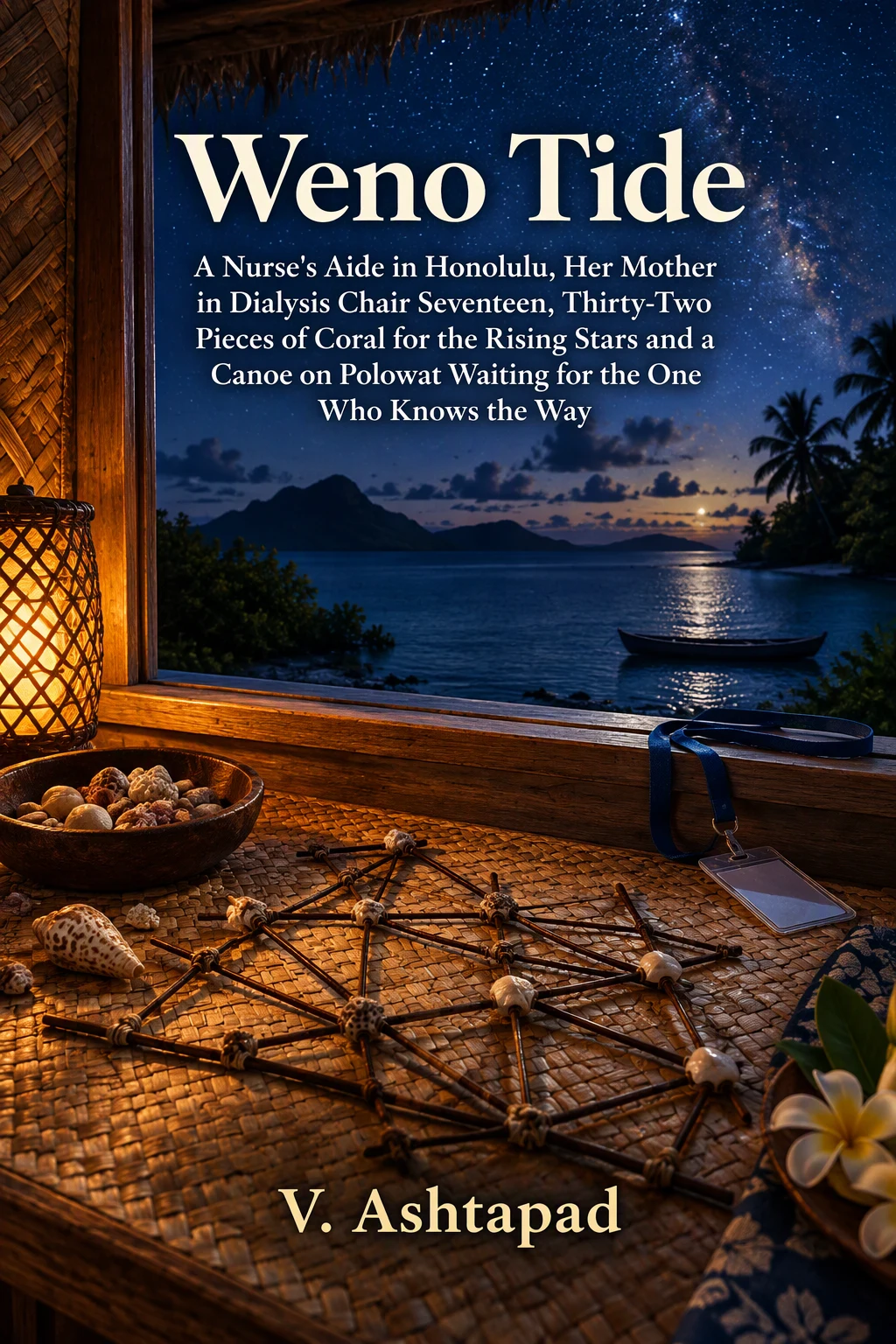
Weno Tide
A Nurse's Aide in Honolulu, Her Mother in Dialysis Chair Seventeen, Thirty-Two Pieces of Coral for the Rising Stars and a Canoe on Polowat Waiting for the One Who Knows the Way
by V. Ashtapad
Foreword
This is a work of fiction. Chuuk State and its islands, including Weno, Polowat, Pollap and Tamatam, the star-compass and swell-reading navigation of the western Caroline Islands, the sailing-canoe voyages between the central Carolines and Saipan and the Carolinian community of Saipan, the February 1944 attack on the Japanese fleet in Chuuk Lagoon, the Compact of Free Association, the 1996 loss and 2020 restoration of Medicaid for Compact migrants, the United Airlines Island Hopper and the Micronesian community of Kalihi in Honolulu are real. The family, the care home, the clinic, the canoe and every named person in the story are invented. No words of the Chuukese or Hawaiian languages are used beyond place names.
For the ones who learned the sky on a floor.
The Cooler
The cooler came on a Thursday, on the late flight from Guam.
It was a blue Igloo, the big one, fifty-four quarts, wrapped all the way around in silver duct tape and then in a fishing net so the airline men could lift it. On the lid, in black marker, Auntie Merly had written our name and our apartment number and the phone number of my dad, and under that, in smaller letters, FROZEN FISH PLEASE HURRY. Somebody at the airport had drawn a smiley face next to PLEASE.
My dad and I went to pick it up. My dad drives a 2006 Corolla with a bumper held on by zip ties. We drove out on the Nimitz with the windows down because the air conditioning only works when you're going over forty, and at night on the Nimitz you can never go over forty for long. Container trucks. The smell of the harbor. The airport lights orange in front of us.
At baggage claim there were six other families waiting for coolers. You can tell. We stand a certain way. We know each other a little, or we know each other's aunties. A woman I went to Farrington with was there with her baby. She said, "From Weno?" I said yes. She said, "Ours too. My mom sent breadfruit." I said, "Mine probably too." We laughed. We watched the belt.
When the coolers come out they come out together, at the end, after the suitcases, like the old people getting off a bus last. Blue, white, red. Taped. Netted. Names on top. Everyone moves at once.
My dad lifted ours. He said, "Heavy. She sent everything."
She did.
---
At home, on the kitchen floor, we cut the tape with my dad's box cutter. Mom sat on the kitchen chair with her feet up on a bucket because her ankles were swollen. Grandpa sat on the couch and watched, because he likes to see what comes. Rino came out of the bedroom with his headphones around his neck.
Inside: reef fish, frozen hard, in plastic bags, with the eyes looking up. Two whole tuna, small ones. Pounded breadfruit wrapped in leaves and then in plastic, sour and soft. A bag of the small hard bananas. A bag of dried fish for Grandpa. Three packs of the cigarettes Grandpa is not supposed to have. A shirt for Rino with a basketball team from Weno on it. A skirt for me, long, yellow, with white flowers sewn on the hem by hand. A letter.
Under everything, wrapped in a towel, a plastic coffee can.
My mom saw it and looked at my grandpa. My grandpa didn't say anything. He held out his hands. My dad gave it to him. He put it on his knees and did not open it.
"What is it?" Rino asked.
"Later," said my grandpa.
---
I should explain who is who.
My name is Merisa. I am twenty-nine. I was born on Weno, in Chuuk, in the hospital there, which is a low building near the lagoon with a blue roof. My mother who gave birth to me is Auntie Merly. She is my mom's cousin. She was nineteen and already had a baby, and my mom was twenty-six and had none, and had been trying for years. So when I was born, I went to my mom. That was decided before I was born, between the women, and the men agreed, and that was all. I was carried from Auntie Merly's arms to my mom's arms in the hospital with the blue roof.
People who are not from the islands sometimes ask me about this like it's a sad story. It isn't one. It's just how I came to my family. My mom is my mom. My grandpa is my grandpa. Auntie Merly is my auntie, who sends me skirts. I have always known. Everybody knows. On Weno there are many of us.
Four years after me, my mom had Rino. She says I brought him. That a house with a child brings another. That's what the old women told her. I think it was just luck. But I let her say it.
We came to Honolulu when I was eleven. My mom first, then my dad, then me and Rino with my mom's sister, then, much later, in 2015, my grandpa. Everybody came for something. My mom came for work and for my dad's job. My grandpa came because his heart is not good and there is no heart doctor on Weno who can do what they do here. I came because I was eleven and they brought me.
Now there are six of us in a three-bedroom on the eleventh floor of a building in Kalihi. My mom and dad in one room. My grandpa in one room. Rino and my uncle Kintaro in one room, when Uncle Kintaro is here and not on Maui working. Me on the couch, which pulls out.
I don't mind the couch. From the couch I can see the window. From the window I can see the harbor and the container cranes and, on a clear night, a little piece of sky between two other buildings.
---
The letter was from Auntie Merly. My mom read it out loud.
The power on Weno was off two days last week. The road by the airport is worse; a taxi lost a wheel in a hole. A cousin's son got married. A cousin's husband died. The fish were good this month. My grandfather's brother on Polowat is sick. The young men on Polowat are building a canoe, a big one, the first big one in many years, and they are asking about the old men who still know. Merly's daughter passed her nursing exam in Pohnpei. Everyone says hello. Eat the breadfruit first before it goes too sour.
My mom stopped reading there and looked at Grandpa again.
He was holding the coffee can.
"They're building a canoe," he said.
"I heard," said my mom.
"On Polowat."
"I heard, Papa."
He nodded. He opened the can. He looked inside for a long time. Then he closed it, and stood up, slowly, with one hand on the arm of the couch, and went into his room, and shut the door.
---
That night my mom couldn't eat the breadfruit. She's not allowed. Breadfruit is high in potassium, and her kidneys don't work, and potassium builds up in her blood between dialysis days and can stop her heart. The dietitian at the clinic gave her a list. Breadfruit is on the bad side. So are the bananas. So is the dried fish, because of the salt. Most of the cooler is on the bad side.
She sat at the table and watched us eat it. Rino and my dad and me. Grandpa didn't come out.
"Is it good?" she said.
"It's sour," I said.
"Good," she said. "Sour is right. Merly made it right."
She ate white rice and a piece of the tuna, boiled, no salt. She held a piece of breadfruit in her fingers for a while and smelled it. Then she put it on my plate.
I ate it. It was sour and soft and it tasted like the house on Weno with the tin roof, the rain on the tin, my auntie's hands.
After dinner my mom went to bed early because tomorrow was Friday and Friday is a dialysis day. My dad went to work, nights, security at Ala Moana. Rino put his headphones back on. I washed the dishes.
Grandpa's door stayed shut. Under it there was a line of light.
© 2026 CRUNOD LLC. All rights reserved.
The Name Badge
My badge says MERISA S., CNA. It has my picture from three years ago, when my hair was shorter. It hangs on a green lanyard with a little plastic clip shaped like a heart that a resident gave me.
I work at a care home on a side street off School Street, in a two-story house with a ramp in front and plumeria trees by the gate. Five residents. That's the license. The owner is a Filipino nurse named Mrs. Abad who has three of these houses. She doesn't live in this one. Her sister-in-law, Ate Jessa, lives downstairs and runs it. I work the day shift, seven to seven, four days a week, and some nights when somebody calls out.
Seventeen dollars an hour. No overtime because Mrs. Abad pays the extra days under a different arrangement. I don't argue. Most of the aides in Kalihi are Filipino or Chuukese or Marshallese. We know the arrangement.
---
Here is the day.
Six-forty, I get off the bus at the corner by the gas station. Six-fifty, I come in through the kitchen, and Ate Jessa is already making the rice. Seven, report: who slept, who didn't, who fell, who's constipated, whose daughter called. Then the waking.
Mrs. Kagawa first. She is ninety-one and was a schoolteacher in Waipahu for forty years. She has dementia. Some mornings she thinks I'm a student who is late. "Sit down," she says. "You've missed the spelling." Some mornings she thinks I'm her sister, who died in 1960. Some mornings she knows I'm Merisa. Those are not always the best mornings. When she knows she's in a care home, she cries.
I help her up. I help her to the bathroom. I wash her. I put on her clothes, the blue blouse she likes, the elastic pants. I comb her hair, which is white and thin and still curls a little at the front. I put on her lipstick, which her daughter brings, pink, from a drugstore. She presses her lips together on a tissue. Every morning. Ninety-one years. The tissue.
Then Mr. Brenneman. He is eighty-eight. He was in the Navy, and then on merchant ships for thirty years, freighters, tankers, all over the Pacific. He had a stroke. His left side doesn't work well. He is very tall and heavy and it takes two of us. He apologizes every time. "Sorry about the cargo," he says. Every time.
Then Mrs. Dela Cruz, then Mr. Kaneshiro, then Mrs. Fong. Then breakfast. Then pills. Then the morning.
---
The thing nobody tells you about this work is that it is mostly the same small things, again and again, and the small things are the whole thing. Lifting. Washing. Turning. Wiping. Feeding with a spoon. Cutting fingernails. Listening to the same story about the same bus in 1952. Saying yes, I know, I know.
I'm good at it. I'm not saying that to brag. My hands are strong from carrying water when I was little, on Weno, before we had a pump. I don't mind bodies. I don't mind the smells. I learned from my grandpa that you watch a long time before you do anything. You watch how a person breathes before you move them. You watch the face. Most aides talk too much when they're scared. I don't talk.
Ate Jessa says the residents like me because I'm quiet. "You're like the furniture," she says, "but helpful." It's a compliment, from her.
---
I wanted to be a nurse. An RN. I still want to.
I took the prerequisites at the community college on Dillingham for two years. Anatomy. Chemistry. English 100. I got B's and one A. Then my mom's kidneys went. She started dialysis three days a week, Monday, Wednesday, Friday, four hours each time, in the morning. My dad works nights and sleeps in the day. Rino was in school. Somebody had to take her and bring her back. She can't drive after. She's too weak, and dizzy, and sometimes she throws up.
I switched my work days. I stopped school. I said one semester. That was four years ago.
On Monday, Wednesday and Friday, I take her at five-forty in the morning, on the bus, two buses, to the clinic. I sit with her the first hour. Then I take the bus to work and come in at ten. Mrs. Abad lets me. I make up the hours on Saturdays. My cousin picks Mom up at ten-thirty with her car. If my cousin can't, I leave work at ten-fifteen and go and come back. Mrs. Abad lets me. Up to a point.
---
Mr. Brenneman asked me once where I was from.
I said Chuuk.
He said, "Truk." That was the old name, the one the Navy used.
I said, "Chuuk. Now."
He said, "Chuuk. Sorry." Then he said, "I sailed through the lagoon in 1967. On a tanker. We anchored off Dublon. The water was so clear you could see the wrecks. The Japanese fleet. Masts sticking up out of the water."
I said, "My grandpa was a little boy when they sank."
He looked at me. "Was he there?"
"On Polowat. Far away. He saw the planes go over. Hundreds. He thought the sky was falling."
Mr. Brenneman didn't say anything for a while. Then he said, "We sank sixty ships in two days. I wasn't there. I was eight years old in Ohio. But I read about it."
"He doesn't talk about it much," I said.
"No," said Mr. Brenneman. "They don't."
I didn't know if he meant the people from the islands or the people from the war. Maybe he meant old men.
---
In the afternoon, when the residents nap, I sit at the kitchen table with Ate Jessa and we eat lunch. Rice. Whatever she made. Today chicken adobo. She asks about my mom. I tell her. She tells me about her son in the Philippines who is studying engineering, about the money she sends, about her husband who is on a ship somewhere near Korea.
She asked me today, "Your grandpa, he's the one who sails?"
"He used to."
"With the stars?"
"With the stars, the swells, the birds. No compass."
She shook her head. "My lolo was a fisherman in Batangas. He knew the weather by the color of the clouds over the mountain. Nobody learned it. Now my cousins look at their phones."
"Yes," I said.
"Did you learn it? From your grandpa?"
I didn't answer right away. I ate my adobo.
"Some," I said.
It was a lie in the size of it. I learned more than some. I learned almost everything he could teach a girl, which was almost everything, because there was no one else. But you don't say that at a kitchen table in Kalihi. You don't say it anywhere.
© 2026 CRUNOD LLC. All rights reserved.
The Coral Pieces
The coffee can held thirty-two pieces of coral.
White, some gray, one with a little pink. Each about the size of the last joint of my thumb. Smoothed by the sea and then by hands. In the bottom of the can, a piece of pandanus mat, folded small, old, the color of tea.
Grandpa opened it on Saturday morning, on the living room floor, after my dad came home from work and went to sleep, after my mom had her coffee, after Rino went to basketball. He moved the coffee table against the wall. He unfolded the mat. He sat on the floor, which is hard for him, with his bad knee out straight. He said, "Merisa. Sit."
I sat.
I had seen these before. He had a set when I was small, on Weno, in a different can. Those were lost in a typhoon. These were new. Not new. Auntie Merly said in a second letter that they belonged to my grandpa's teacher, who died on Polowat in 2009, and that the teacher's family had kept them for my grandpa, and when they heard about the canoe, they sent them to Weno, and Merly put them in the cooler under the fish.
He laid them in a circle. One by one. He did not need to think. Each one went in its place, and each place had a name, and each name was a star, where it rises out of the sea and where it sets back into it.
I am not going to write the names. Not in our language. Not here. That's his to say. But in English I can say it like this.
At the top of the circle, north, the North Star. At the bottom, south, the Southern Cross standing up. On the east side, from top to bottom, the places where the stars come up out of the water: the Big Dipper's rising, then Vega, then the Pleiades, then the star in the eagle's shoulder, which is Altair, right in the east, then Orion's belt, then Antares, the red one, the scorpion's heart, and more, down to the Cross. On the west side, the same stars, setting. Thirty-two places. The whole sky laid flat on a mat on the floor of an apartment in Kalihi.
"Where does Altair come up?" he asked me.
I touched the stone in the east.
"Where does it go down?"
I touched the stone in the west.
"Weno to Polowat," he said. "What do you sail on?"
I thought. I used to know this without thinking. I hadn't thought about it in years.
"Toward the setting of the Pleiades," I said. "In the night. And when the Pleiades are too high, the next star that sets in the same place."
He didn't say yes. He didn't say no. He moved one stone a little, a quarter of a finger, and looked at me.
---
I should tell you how I learned this.
On Polowat, and on the other islands in the west of Chuuk, navigation is passed from a navigator to his son, or to his sister's son, or to a boy chosen from the family. It is not for girls. It was not for girls when my grandpa learned it from his teacher in the 1950s, sitting on a mat like this one in the canoe house, with the coral in a circle. It is men's knowledge. You learn it in the canoe house, which girls don't go into.
My grandpa had two daughters. My mom and my auntie. No sons. My mom's cousin's sons were already learning from their own family. My grandpa's sister's son died at sea in 1984, in a motorboat, not a canoe, the engine stopped and they drifted and were not found.
So when I was six, and seven, and eight, on Weno, my grandpa started laying out stones on the floor of our house, in the evening, and calling me to sit. My mom said nothing. My grandmother, who was still alive then, said a lot. She said it wasn't right. She said people would talk. My grandpa said people already talk.
He didn't teach me everything. He taught me the stars. He taught me the swells: how there are three big ones from three directions, and how you feel them through the hull, through your body, lying down in the canoe, how one comes under the canoe and lifts you and you can tell which one by the angle and the time between. He taught me the birds: which ones fly out to sea in the morning and back to land at night, and how far each kind goes. He taught me the way the islands move: that you sit still in your canoe and the island you left moves back behind you under a different star, and the island you're going to moves toward you, and when the island you can't see on the side moves from one star to the next, you know how far you've come. I didn't understand that one until I was twelve. Then one night I did, all at once, and I got up from the mat and walked around the room because I couldn't sit.
What he didn't teach me were some of the chants. And the things that are said only in the canoe house. He said those I could learn later. "If there's a later," he said.
Then we came to Honolulu. And there was no canoe, and no mat, and no later.
---
On the floor in Kalihi he asked me questions for an hour. Weno to Tamatam. Polowat to Pollap. Polowat to Saipan, which is the long one, the one he made four times as a young man, the one where you have to find a tiny reef island halfway and if you miss it you go on into open water with nothing.
Some I knew. Some I had forgotten and he waited, and some came back while he waited. Some I didn't know at all, because he had never taught me, and he taught me then, on the floor, while the air conditioner dripped into a bucket by the window.
When he was done, he picked up the stones one by one and put them back in the can in an order. He folded the mat. He put the mat in the can. He gave the can to me.
"I'm not keeping that," I said.
"You're keeping it," he said.
"It's your teacher's."
"He's dead. I'm old. You're the one."
"I'm a nurse's aide in Kalihi."
He laughed. It hurt his chest; he put his hand there. "So? I was a boy on Polowat who couldn't swim well. Everybody starts somewhere stupid."
He tried to stand. I helped him. He leaned on me. He is not heavy anymore. He used to be. His arms used to be like the trunks of breadfruit trees. Now I can hold him up with one hand under his elbow.
"They're building a canoe," he said, standing in the living room, looking at the window. "On Polowat."
"I know, Grandpa."
"They need someone who knows the way to Saipan. Nobody alive on Polowat has sailed to Saipan the old way except me and one other, and the other one is sick."
"I know."
"I'm eighty-four," he said. "My heart is like an old engine."
"I know."
He looked at me. "You keep saying you know."
I didn't say anything to that.
I put the can in my backpack. That's where it lives now. In my backpack, next to my badge and my lunch and my scrubs. I carry it to work. I carry it on the bus. I don't know why. I could leave it in the apartment. I don't.
© 2026 CRUNOD LLC. All rights reserved.
The Dialysis Chair
The clinic is on Dillingham, past the car dealerships, in a building that used to be a bank. It still has the bank's shape. Low. Wide glass in front with blinds. A parking lot. Inside, it's one big room with twenty-four chairs in two rows, and a machine next to each chair, and a TV high on the wall at each end.
My mom's chair is number seventeen. Near the window. She likes it because she can see the parking lot and the street and the buses going by. Some people like the chairs in the middle so they can see both TVs. My mom says she doesn't need TV. She has the buses.
The chair is big and blue and leans back, like a dentist's chair. It has a little table that swings across. A blanket, because the room is cold. It's always cold. The machines like it cold.
---
Five-forty on Monday morning, we leave the apartment. It's dark. The elevator smells like someone's dinner. Downstairs, the security man waves. We walk to the bus stop on the corner. My mom walks slowly. She has a bag with her blanket from home, her water bottle with the lines on it so she knows exactly how much she's drunk, her phone, a sweater, crackers she's allowed, and her book of word puzzles. I carry the bag.
The first bus is usually on time. The second bus is usually not. We stand at the stop on Dillingham in the dark with the trucks going by, my mom leaning on the bench because she won't sit; if she sits she won't want to get up.
Six-thirty, we're there. The nurse, Aaron, says, "Morning, Kinuko. Morning, Merisa." He weighs her. Her weight tells them how much fluid she's carrying since Friday, because her kidneys can't get rid of it. Today it's three point one kilos. That's a lot. Aaron raises his eyebrows. My mom says, "It was a weekend." He says, "I know. The cooler came, huh." Everyone knows about the coolers.
She sits in seventeen. Aaron cleans her arm. In her left forearm there's the fistula, where a surgeon joined a vein and an artery so the vein got big and strong enough for the needles. It hums. If you put your fingers on it you can feel it buzz, like a cat purring under the skin. When I was first learning about it I put my fingers on it every day to feel it. My mom let me. Now I just look at it.
Two needles. Big ones. My mom looks out the window when they go in. She's had it done more than six hundred times and she still looks out the window.
Then the machine starts. Her blood goes out through a tube, into the machine, through the filter, and back in through the other tube. You can see it. Dark red, moving. All her blood goes around and around through the machine many times in four hours. That's what her kidneys are supposed to do for free, quietly, every minute of her life, and now a machine does it in a cold room on Dillingham three times a week, and the government pays for it, because in 2020 the Congress put us back on Medicaid.
---
I want to say this part clearly because people get it wrong.
People from Chuuk, and Pohnpei, and Yap, and Kosrae, and the Marshalls, and Palau, can live and work in the United States without a visa. That's because of the Compact of Free Association. The United States made an agreement with our countries in 1986. The U.S. gets to use our ocean and our land for its military and nobody else can. We get to come here to live and work. That's the deal. The Marshalls got it because of the bomb tests there. We got it because of where we are on the map.
So we came. Many of us. For hospitals, school, work.
In 1996, the Congress changed the welfare law and we lost Medicaid. For twenty-four years. In Hawai'i the state made its own plan, then cut it, then there were lawsuits. I was a child; I don't remember the details. I remember my mom's friend, Auntie Rosalie, who had dialysis, crying in our kitchen because the plan wouldn't pay anymore. I remember the people on the radio saying we were a burden. I remember a man at the bus stop telling my mom to go back where she came from, and my mom saying, in English, very politely, "We would, but your Navy is still there."
In December of 2020, Medicaid came back for us. My mom started dialysis in 2021. That's why she has chair seventeen and not a ticket to Weno to die.
I don't say that to be dramatic. That's what happened to Auntie Rosalie. She went back to Weno in 2011. There was no dialysis there then that she could get. She died in four months.
---
I sit with my mom the first hour. I'm not supposed to. Visitors aren't really allowed on the floor. But Aaron lets me, if I sit on the stool by the window and don't get in the way.
We don't talk much. She does her word puzzles. I watch the machine. Sometimes I watch the other people. Mr. Lealaiauloto in eighteen, who is Samoan and was a longshoreman and tells jokes to the nurses that make them shake their heads. The young woman in nine who is Marshallese and is twenty-six and has been on dialysis since she was twenty-two. The old Filipino man in twenty-three who sleeps the whole time with his mouth open. A lot of us in this room are from the Pacific. Diabetes. Our bodies weren't made for rice and spam and soda. Our bodies were made for fish and breadfruit and taro and paddling. Then the Americans came and the ships brought rice and cans, and we liked them, and they were cheaper than fishing. And here we are, in chairs, in a row.
My mom said today, not looking up from her puzzle, "Papa wants to go home."
"I know."
"To Polowat. Not Weno. Polowat."
"I know."
She filled in a word. "His heart won't make it. The doctor said. The field trip ship, five days, sleeping on the deck. No doctor on Polowat. If something happens."
"I know, Mom."
She put down her pencil. She looked out the window. A bus went by. Not ours.
"He wants you to go with him."
I didn't say I know. I didn't know that. I mean, I knew it, but no one had said it.
"He told you?"
"He didn't have to tell me. I'm his daughter."
The machine beeped. Aaron came and pressed something. Her pressure was dropping. That happens when they take off a lot of fluid. He tilted the chair back. My mom closed her eyes.
"I can't go," I said. "Who would bring you here?"
She opened her eyes. She gave me the look she saves for when I'm being younger than I am.
"Merisa," she said. "I came here on two buses before you could walk."
That's not true. She came here first when I was eleven. But I knew what she meant.
At seven-forty I left to get the next bus to work. When I looked back through the glass she was asleep in chair seventeen with her blanket from home over her knees and her blood going around and around through the machine, and outside the buses went by in the gray light, one after another, and none of them were going where she wanted to go.
© 2026 CRUNOD LLC. All rights reserved.
The Bus Pass
My bus pass is a plastic card, blue and white, with a chip. I load it at the 7-Eleven on the corner. Monthly, seventy dollars. For my mom it's less, because of the disability. Her card has her picture and the word DISABILITY under it, and she covers the word with her thumb when she holds it to the reader.
I spend about three hours a day on the bus. I've added it up. Monday, Wednesday and Friday it's more.
You learn the buses here like you learn the swells. You learn which ones come in sets and which come alone. You learn that the 2 runs often but is slow and full of people with bags. You learn that the express on Dillingham skips stops and saves fifteen minutes, but if you miss it you've lost thirty. You learn which drivers wait when they see you running and which drivers look at you running and close the doors. You learn where to stand.
---
Here is something about the bus that I don't usually say.
On the bus, in Honolulu, people know what I am before I say anything. It's the skirt, sometimes, if I'm wearing one, the long flowered one. It's the way my mom and I talk to each other in our language, quietly, at the back. It's our faces, maybe, though people from the outside think we all look the same: Filipino, Samoan, Hawaiian, Chuukese, Marshallese, all one brown. People from here don't think that. People from here can tell.
And for a long time in Honolulu, "Micronesian" was a bad word. It still is, for some people. It meant: on welfare, loud, drunk, dirty, too many in one apartment, taking the beds at Queen's. There were jokes. Comedians did jokes about us on the radio. Kids at Farrington did jokes about us in the hallways. "Micronesian" was the joke itself. You didn't need to finish it.
When I was twelve, a girl in the hallway pulled the skirt Auntie Merly sent me and said, "Why you dress like a grandma?" Other girls laughed. I didn't say anything. The next day I wore jeans. I wore jeans until I was twenty-two.
When I was fifteen, a man on the bus told my mom to move her bag off the seat, and when she did, he said, "You people take up so much room." There was room. There were empty seats. My mom said nothing. She looked out the window. When we got off she said to me, in our language, "He was afraid of something. It wasn't us."
My mom always says that. It wasn't us. She says it like a fact about the weather.
---
It's better now. A little. There are more of us at the community college. There are Chuukese nurses at Queen's. There's a Chuukese councilwoman somewhere, I think on the Big Island. There are Facebook pages. My cousin's daughter does videos about our food and has fifty thousand followers and Americans comment that they want to try pounded breadfruit, and my cousin's daughter says, "Then come to Weno, the flights are terrible."
But on the bus, I still sit a certain way. Small. Bag on my knees. I don't talk loud. I don't eat. I don't take the seat by the door unless I'm sure.
---
Today, on the bus home from work, an old man got on at Liliha. White, with a cane and a bucket hat, in a T-shirt from a fishing tournament. The bus was full. I stood up. He sat in my seat.
He looked at me. At my badge. He said, "You're a nurse?"
"Aide," I said.
He said, "Where you from?"
I almost said Kalihi. That's what I say. Then I don't know why, I said, "Chuuk."
He nodded. He said, "Truk Lagoon. I dove there. 1979. The wrecks."
"Yes," I said.
"Most beautiful place I ever saw," he said. "The Fujikawa Maru. The coral growing on everything. The fish. The sake bottles still on the shelves in the galley. The light coming down through the water in long bars, like through a high window." He stopped. "You ever dive it?"
"No," I said. "My grandpa fished over them."
"Lucky man," he said.
I didn't say anything. I was holding the bar. The bus went down King Street, past the fire station, past the Longs, past the bakery with the line out the door for malasadas. It was raining a little. The windows were steamed. I thought about my grandpa as a boy on Polowat, two hundred kilometers from the lagoon, seeing the planes go over, so many the sky went dark, and hearing later that the whole fleet was sunk, and the Japanese soldiers on the islands starving after, and the people on the islands starving with them, because the soldiers took the breadfruit and the fish. He's told me that much. Not more.
The old man got off at Dillingham. He said, "Take care of your grandpa." I said I would.
---
At home I wrote that down in my notebook, the whole thing, on the couch, under the window. I have a notebook now. I didn't have one before. I started it when the coffee can came. I write down what my grandpa teaches me, in English, so I don't write the names, and I write down things that happen. Small things. The old man on the bus. Mrs. Kagawa's tissue. My mom covering the word on her card with her thumb.
I don't know why. My grandpa says the stars don't need writing down. They come up in the same place every night for a thousand years. You need to write down the things that only happen once.
© 2026 CRUNOD LLC. All rights reserved.
The Handline
On Sundays, if my grandpa is strong enough, we go fishing.
Not real fishing. Not like on Polowat, where he went out at night in a canoe with a torch and came back with a canoe full. Here we go to the end of the pier at Kewalo Basin, or the rocks at Sand Island, with two handlines and a bucket and a bag of frozen shrimp from the Times supermarket.
A handline is the oldest thing. A spool of thick fishing line wound around a block of wood, or around a plastic bottle, or, in my grandpa's case, around an old coconut shell he brought from Weno, with a groove carved in it. A hook. A small weight. No rod. You hold the line between your fingers. You feel everything.
My grandpa throws the line in a way I've never seen anyone else do. Overhand, slow, letting the line run off the coconut in loops. It goes out farther than you'd think a sick old man could throw. Then he sits on his bucket and holds the line over one finger and closes his eyes.
"Why do you close your eyes?" I asked him once, when I was twelve, on the rocks.
"So I can see," he said.
---
This Sunday was gray. Rain in the morning, then clouds sitting on the mountains behind the city like a lid. We took the bus to Ala Moana and walked to Kewalo. My grandpa walks slowly now. We stopped three times. At the pier there were other old men already, Filipino and Japanese and one Hawaiian man with a big cooler and a radio playing a ball game. They nodded at my grandpa. They know him. He doesn't speak English well, but he doesn't need to. They're fishermen. They talk with their chins.
I put the shrimp on his hook because his fingers shake now. He threw. Long. The line ran out in loops off the coconut.
We sat. The water in the harbor was green and slow. Boats going out, the sunset cruise boats, the fishing charters, a canoe club paddling past in a six-man outrigger, all young people in matching shirts, the coach yelling numbers.
My grandpa watched the canoe go by for a long time.
"Too many people," he said.
"It's a race canoe," I said.
"I know what it is," he said. "Six people. All paddling. Nobody looking."
---
Then he did something he hasn't done in years. He gave me his line.
"Hold it," he said. "On this finger. Close your eyes."
I held it. I closed my eyes.
"What do you feel?"
I felt the line, wet, between my fingers. I felt it move. A little pull, then nothing, then a little pull.
"The water," I said.
"What water?"
I tried. "It's moving. Out. Then in."
"Why?"
"The tide's going out. And there's a swell coming in through the harbor mouth."
"Which swell?"
I didn't know. I opened my eyes.
"Close your eyes," he said.
I closed them. I felt. There was a long, slow pull, and then a shorter one on top of it, every few seconds. Two things. One long, one short.
"Two," I said. "One long, from far. One short, from close. The long one is from the south. From the bottom of the world. It's summer down there. The short one is the wind, from the east, the trades, bending around Diamond Head."
He didn't say anything. I opened my eyes. He was looking at me with no expression at all, which is how he looks when he's pleased.
"On a canoe," he said, "you feel it here." He put his hand on his stomach. "And here." His back. "Lying down. In the night. With no stars because of clouds. You feel three swells, four. You know each one like your brothers' footsteps. You know where they come from. Then you know where you are."
"I know, Grandpa."
"You know here." He touched my head. "Not here." My stomach. "You've never been in a canoe at night."
That's true. I haven't. I was eleven when we left Weno. I'd been in canoes, small ones, in the lagoon, in the day. Never a sailing canoe on the open sea. Never at night. Never out of sight of land.
He knows that. He's always known that. Everything he's taught me, he's taught me on a floor.
---
We caught nothing for an hour. Then my grandpa's line, which I was still holding, jumped. I pulled. He said, "Slow. Slow. Let it run." I let it run. Then I pulled again, hand over hand, the line cutting into my fingers, and a fish came up out of the green water, flashing silver, about as long as my forearm.
The Hawaiian man with the radio said a word from down the pier, the name for that fish in his language, and gave me a thumbs up.
That's a word I won't write. It's theirs. In English it's a young jack. In our language we have another word for it. I won't write that either.
My grandpa unhooked it with his shaking fingers and put it in the bucket. He looked happy. Then he coughed for a long time and I gave him water and we sat until he was all right.
On the bus home he fell asleep against the window with the bucket between his feet. The fish moved once in the bucket and then didn't. I watched the city go by. Ala Moana. The overpass. The harbor. The cranes.
I had a feeling I couldn't name. Like I'd been given something and something had been taken in the same moment. My fingers still had the line marks across them, red. They stayed until Tuesday.
© 2026 CRUNOD LLC. All rights reserved.
The Phone
My phone is an iPhone 11 with a cracked corner and a case with a picture of a turtle on it that Rino gave me for my birthday because he said I'm slow like a turtle. Rino is seventeen and thinks he's funny.
The phone has two thousand four hundred pictures. Most are of my mom's lab results, which I photograph to keep track, and of the residents' charts, which I'm not supposed to do, and of food. Some are of my family.
Since the coffee can came, the phone also has recordings of my grandpa.
---
It was Rino's idea. Not the recording. The place to put them.
I had started recording on the phone, just the voice memo, when my grandpa and I sat on the floor with the stones. He didn't like it. He said the stars aren't for a phone. I said it's just for me, so I don't forget. He said if you need a phone to remember you didn't learn it. I said I have a lot of things to remember, Grandpa, I have five residents and a mother with no kidneys. He made a face. But he let me.
Then I had twenty recordings and my phone was full and I didn't know where to put them.
I couldn't put them on the internet. Not anywhere public. This knowledge isn't public. It belongs to our family and our island. My grandpa would rather throw the stones in the ocean than have some stranger in California listen to him. There have been people, researchers, who came to Polowat and to Satawal and recorded things and put them in books and archives and the families never saw them again. My grandpa talks about one of them. He doesn't say the name. He says "the man with the yellow notebook." He says it the way my mom says "the man on the bus."
Rino said, "Use the family thing."
"What family thing?"
He showed me. Our cousin in Kansas City, Auntie Merly's oldest son, had started one of those apps where a family can keep pictures and recordings together, private, only for the people you invite. He'd put up old photos from Weno, scanned. Our great-grandmother. The house before the typhoon. A wedding in 1988 with everyone in matching dresses. He'd started a family tree with everyone's names and which island and who adopted who. I was on it already. *Merisa, born Weno 1996, daughter of Kinuko, carried from Merly.* I didn't even know.
"Only family can see it," Rino said. "You choose who. You can make a folder only you and Grandpa can open. Locked."
I looked at him. "How do you know this?"
He shrugged. "I'm not stupid. I just act stupid."
---
So I made a folder. I asked Grandpa what to call it. He thought for a long time. Then he said a word in our language that means, more or less, the inside of the canoe house. The place where men sit and learn and others don't go.
I said, "Grandpa, I'm a girl."
He said, "You're inside."
So that's the name. Only two people can open it. Me and him. He can't use the phone, so really it's only me. But his name is on it.
There are thirty-one recordings in it now. Each one has a date and a short caption I write in English. *Weno to Tamatam, the stars in order.* *The three swells, how to feel the north one when the wind is wrong.* *The birds that sleep on the water.* *What to do if you miss Pikelot.* *The story of the canoe that turned back.* When he's tired, the captions say that too. *Grandpa tired today, stopped at 14 minutes.* *Coughing.*
Some of the recordings are not lessons. Some are just him talking. About his teacher. About the canoe house on Polowat, how it smelled of breadfruit sap and smoke and dried pandanus. About the time he sailed to Saipan in 1974 with six other men and they were the first canoe from Polowat to reach Saipan in a hundred years, and the Carolinian people on Saipan came down to the beach and cried. About my grandmother, who was angry when he taught me, and then not angry, and then, at the end, before she died, told him, "Teach her the rest. Don't be a coward."
He laughed when he told that one. In the recording you can hear him laugh. Then cough. Then laugh.
---
I also made a different folder, for everybody. Open to the whole family. I put in the photos of the coffee can, the stones, the mat. I put in a recording of my grandpa singing a short song he sings when he's cooking, not a navigation song, just a song, about a bird that steals fish. I put in a picture of my mom in chair seventeen, smiling, holding up her puzzle book, because she wanted the cousins to see she's all right.
The cousins answered. In Kansas City, in Guam, in Oregon, in Weno, in Arkansas, where a lot of us work at the chicken plants. Little hearts. Comments. Auntie Merly wrote, *He looks old. Feed him.* My cousin in Oregon wrote, *Is that the same coffee can from Uncle's teacher?* and then, *I remember those stones. I used to play with them. I got hit for it.*
Somebody posted a word of the day in our language, every day, a different one. I think it was the cousin in Kansas City. He has a lot of time. One day it was the word for the rising of a star. I put my hand over the screen when I saw it. I don't know why. Nobody else would know that's anything. It's just a word.
---
One night I listened to all thirty-one recordings in a row, on the couch, with earphones, while everyone slept. It took five hours. When I finished it was almost five in the morning and the sky between the two buildings was gray and I had to take my mom to dialysis in forty minutes.
I wasn't tired. I felt like I'd been somewhere. Like I'd sailed somewhere in the dark and come back.
I made my mom's coffee. I packed her bag. She came out of the bedroom in her sweater and looked at me.
"You didn't sleep," she said.
"No."
"You were listening to him."
"Yes."
She took her coffee. She drank some. She looked at me over the cup.
"He's been waiting for you to do that for eighteen years," she said.
© 2026 CRUNOD LLC. All rights reserved.
The Sextant
Mr. Brenneman has a sextant.
It's in a wooden box, dark, with brass corners, on the top shelf of his closet at the care home. His son brought it from the house when they sold the house. His son lives in Arizona and calls every Sunday. The box has a little brass plate on it that says the name of a company in Glasgow and the year 1951.
I found out about it because Mrs. Kagawa took it.
She wanders. Not often, but sometimes, at night, if she wakes up confused, she walks around the house opening doors. She thinks she's at school. She's looking for her classroom. That night she went into Mr. Brenneman's room, which is next to hers, and he was asleep, and she opened his closet, and took the box, and carried it back to her room, and put it under her bed. In the morning when I came in Ate Jessa said, "Mr. Brenneman's thing is missing and he's very upset," and I said, "Check under Mrs. Kagawa's bed," and it was there.
Mrs. Kagawa said, "That's the globe for the geography lesson."
I said, "It's Mr. Brenneman's, Mrs. Kagawa. I'll take it back."
She said, "Tell him to bring it on time next week." She was very serious.
---
I brought it back to Mr. Brenneman. He was sitting up in his bed, red in the face, his good hand shaking. When he saw the box he reached for it with both hands, the good one and the bad one, and the bad one didn't reach.
I put it on his lap.
He opened it. Inside, on blue velvet, the sextant. Brass and black. A little telescope, mirrors, an arc with numbers engraved on it, a swinging arm. It was beautiful. I'd seen pictures. I'd never seen one.
"It's all right," he said. "It's all right. She didn't hurt it."
"She thought it was a globe."
He laughed. Then he looked at me. "You know what this is?"
"For the stars," I said. "For the angle."
He was surprised. "That's right. You measure the angle between a star and the horizon. Or the sun at noon. Then you look it up in the tables. The almanac. Then you do the math, and you know where you are. Within a mile or two. Three if the sea's rough."
"I know."
"How do you know?"
I didn't answer.
He looked at me for a while. He has blue eyes, very light, like water in a white bucket. "Your grandpa," he said. "The one on Polowat. He was a navigator."
"Yes."
"The old way."
"Yes."
He nodded slowly. "I met some of them. 1960s. On a ship. We stopped at Satawal. Or somewhere near. A canoe came out to us. Three men. They'd sailed from somewhere, I don't know. Days. No instruments. Nothing. They wanted cigarettes and fishhooks. Our captain asked them through a teacher who spoke English how they knew where they were, and one of the old men laughed and pointed at the sky and then at the water and then at his stomach."
I laughed. I didn't mean to.
"What?" he said.
"My grandpa does that," I said. "The stomach."
---
After that, Mr. Brenneman wanted to meet my grandpa.
I said no at first. My grandpa doesn't like Americans who want to know things. Too many have wanted to know things and then gone. And my grandpa doesn't speak English much. And Mr. Brenneman can't leave the care home easily, and my grandpa can't walk far.
But Mr. Brenneman asked every day. He asked like a child. "Did you ask him yet?" "What did he say?" "Tell him I'm not a scientist. Tell him I was just a second mate on a tanker."
I asked my grandpa. I told him about the sextant. About Mrs. Kagawa. About the canoe that came out from Satawal for cigarettes.
My grandpa thought about it for two days. Then he said, "The tall man with the brass thing. Bring me."
---
So on a Saturday, which I don't usually work, I brought my grandpa on the bus to the care home. Ate Jessa let us use the back porch. I wheeled Mr. Brenneman out in his chair. My grandpa sat on the bench. They looked at each other.
Two old men. One very tall and pale and heavy, in a chair, with one side not working. One small and brown and thin, with a bad heart and a bad knee, on a bench. Both wearing flowered shirts from the Goodwill. Same kind.
I translated.
Mr. Brenneman showed my grandpa the sextant. He couldn't hold it up with one hand, so he explained it and my grandpa held it. My grandpa looked through the little telescope at the sun, which you shouldn't do, and Mr. Brenneman shouted, and my grandpa jumped, and they both laughed.
My grandpa showed Mr. Brenneman the coffee can. He laid out the stones on the porch floor, all thirty-two, in a circle, and I told Mr. Brenneman in English what each place was. Not the names. The stars. Vega rising. Altair setting. The Cross upright.
Mr. Brenneman looked at the circle on the floor for a long time. He said, "That's a compass rose."
"Yes," I said.
"It's a compass rose made of the sky."
"Yes."
"We had it on a card," he said. "Printed. In the binnacle. Thirty-two points. North, north by east, north-northeast. We had to memorize them as cadets. Boxing the compass, it was called." He started saying them, under his breath, fast: "North, north by east, north-northeast, northeast by north, northeast..." He got to east and stopped and coughed.
My grandpa said something. I translated. "He says there are thirty-two in his too."
Mr. Brenneman looked at my grandpa. My grandpa looked at Mr. Brenneman.
"Well, I'll be damned," Mr. Brenneman said.
I didn't translate that. I didn't need to.
---
They sat on the porch two hours. Ate Jessa brought them coffee and crackers. They talked through me about the sea. About squalls. About the color of water over a reef at night. About seasickness, which they both admitted to, and laughed at. About the stars that are wrong in the south in winter. About the year 1974, when my grandpa was sailing to Saipan with no instruments and Mr. Brenneman was on a tanker off Guam with radar and a sextant and a radio, and they were, it turned out, maybe two hundred miles apart in the same week.
"We should have waved," said Mr. Brenneman.
My grandpa laughed. He understood that one without me.
When it was time to go, Mr. Brenneman said, "Merisa. Tell him something for me."
"What?"
"Tell him my way is gone too. Nobody uses these anymore. Nobody. The kids on ships now, it's all GPS. Satellites. A screen. They don't look up. If the screen goes, they're lost." He touched the sextant in its box on his lap. "Tell him I'm the last of something too. Tell him he's not alone in that."
I told my grandpa.
My grandpa looked at the sextant. Then at Mr. Brenneman. Then he said something short.
"What did he say?" Mr. Brenneman asked.
"He said you're not the last. He said you just haven't found who to give it to."
Mr. Brenneman didn't say anything. He looked at me. Then at the box. Then at me.
I took my grandpa home on the bus.
© 2026 CRUNOD LLC. All rights reserved.
The Skirt
The yellow skirt from the cooler hung on a hanger on the back of the bathroom door for three weeks. I looked at it every morning when I brushed my teeth.
It's long, to the ankles. Cotton, thin, the kind that dries in an hour. Yellow like the inside of a ripe papaya. On the hem, a band of white flowers, sewn by hand, by Auntie Merly, with a needle, at night, under the bulb in her kitchen on Weno when the power was on and by a kerosene lamp when it wasn't. I could see the stitches. Small and even. Some a little bigger, where she was tired.
On Weno, women wear skirts like this every day. Long, flowered, with a loose blouse or a T-shirt. In Honolulu, the older women still do. You see them on the bus, at the Longs, at the swap meet at the stadium. Grandmothers in long skirts and rubber slippers, carrying babies on their hips and big bags of rice.
The young women mostly don't. Like me. Jeans. Scrubs. Leggings.
---
There was a first birthday party on a Saturday at the community center at the park up Kalihi Valley. A first birthday is a big thing for us, like it is for the Filipinos and the Hawaiians and the Samoans. My cousin's grandson. Maybe two hundred people. Rented tables. Rented chairs. Pans of food the size of car doors: rice, chicken, ramen salad, pounded breadfruit that people brought in coolers, fish, a whole pig that the men had been cooking since the night before in a pit in somebody's yard in Waianae. A cake in the shape of a turtle. A DJ with a speaker playing island songs and then American songs and then island songs.
My mom wanted to go. She'd had dialysis Friday. She felt all right. My dad drove. Grandpa came. Rino came because there would be food.
I wore the yellow skirt.
I didn't decide to. I mean, I didn't think about it. I came out of the bathroom in it. My mom looked at me from the couch and didn't say anything. My grandpa looked at me and didn't say anything either. Rino said, "Whoa," and then, "It's nice," and then went back to his phone.
My dad said, "Merly will want a picture."
---
At the party I sat with the women, at the long tables near the kitchen. That's where the women sit. The men sit outside under the trees with the pig and the coolers of beer. The young people stand by the DJ. The babies go from lap to lap.
It was loud. Everybody talking in our language, and some English, and some Japanese words that the old people still use from the Japanese time, and laughing. Somebody's auntie was telling a story about her husband falling off a ladder and everybody was crying laughing. Kids running under the tables. A smell of pig fat and coconut and rice and perfume and the sweat of two hundred people in a room with one air conditioner.
An old woman sat down next to me. I didn't know her. She was maybe eighty, very small, with white hair pulled back tight and a skirt like mine but blue. She looked at my skirt. She touched the hem with two fingers. She looked at the stitches.
"Merly," she said.
"Yes," I said. "My auntie."
"Your mother," she said.
"My auntie," I said. "She carried me. Kinuko is my mom."
She nodded. That was right. That's how we say it. She said, "You're Sachuo's."
"Yes."
"The girl he taught."
I didn't say anything.
She said, "Everybody knows. On Weno, on Polowat. Since you were small. 'Sachuo is teaching a girl.' The men talked."
"I know," I said.
"Some of them were angry."
"I know."
She looked at me for a long time. She had the eyes old women have, that see through you like water. Then she said, "My father was a navigator too. On Pollap. He had four daughters and no sons. He taught none of us. Not one word. When he died it went with him. All of it." She tapped the table. "Into the ground. Like that."
I didn't know what to say.
"Your grandfather is a stubborn man," she said. "Good." She patted my hand, got up, and went to get more pig.
---
Later, outside, under the trees, an old man said something about my grandpa.
I was taking a plate of food to my dad. The men were sitting on coolers and folding chairs. My grandpa was there, in the middle, with a paper plate on his knee. A man I knew a little, from Weno, from my mom's side, a big man, a second cousin, maybe sixty — was talking loudly. He'd been drinking. He said, in our language, so everyone could hear, "Sachuo, they're building a canoe on Polowat and they'll want you. But you have nobody. You wasted it on a girl."
Nobody said anything. Some of the men looked at the ground. Some looked at me.
My grandpa ate a piece of pig. He chewed. He swallowed. He said, not loudly, "What did you waste yours on?"
The big man's face went dark.
My grandpa said, "Your father was a navigator. On Weno, the small kind, lagoon only, but a navigator. Did he teach you?"
The man didn't answer.
"You were in Guam," my grandpa said. "Drinking. Like now."
The man stood up. He said something I won't write. He walked away to his car.
My grandpa ate another piece of pig.
I gave my dad his plate. My hands were shaking. My dad took the plate and held my wrist for a second, which he never does, and then let go.
---
When I went back inside, the DJ was playing an old song, an island love song from the seventies that everybody knows, and the women were getting up to dance. In the old way: in a line, slowly, the hands moving, the hips moving, the skirts moving. The small old woman with the blue skirt was at the front.
She saw me in the doorway. She waved me in with her hand.
I don't dance. I haven't danced since I was eleven.
I danced. In Auntie Merly's yellow skirt, in the community center at the park up Kalihi Valley, between my mom's cousin and the old woman from Pollap, with the white flowers on the hem moving around my ankles. I didn't know the steps at first and then I did. Your body remembers. Like the swells.
My mom was watching from the table. She couldn't dance; she was too tired. She was smiling. She took a picture on her phone and that night put it in the family space, where Auntie Merly would see it in the morning on Weno. Under it she wrote: *She's wearing it.*
Auntie Merly answered at four in the morning, our time. A row of hearts. Then: *It's too long. I'll make the next one shorter.*
© 2026 CRUNOD LLC. All rights reserved.
The Photograph
There's one photograph of my grandpa as a young man.
Black and white. Small, the size of a playing card, with a white border and wavy edges. It's in a plastic sleeve in my grandpa's wallet, behind his ID and his Medicaid card and a picture of my grandmother. It's soft from being carried. One corner is gone.
In it, a sailing canoe is pulled up on a beach. You can see the hull, long and narrow, with the outrigger on one side and the platform on the other side. The mast is down, lying along the hull, with the sail wrapped around it. Seven men are standing in front. Thin, very dark from the sun, in loincloths and T-shirts. Behind them, palm trees. In front of them, in the sand, people from the town, a crowd, kids, a man in a white shirt with a camera around his neck.
My grandpa is third from the left. He's thirty-four. He has a lot of hair. He's not smiling. Nobody is smiling, except one of the kids in front.
On the back, in pencil, someone wrote: *Saipan, May 1974*.
---
He let me take it out of the wallet and photograph it with my phone. I put it in the family folder. Under it, I wrote what he told me while I held the phone.
They sailed from Polowat. Seven men. One navigator, my grandpa's teacher, and my grandpa as the second, learning. Six hundred miles of open water, more or less, to Saipan, in the Marianas. Nobody from Polowat had done it in that canoe in maybe a hundred years. The old men said it could be done. The young men weren't sure. The government people on Weno said they were crazy.
Eight days. Four of them without seeing the sun because of clouds. They steered by the swells. Halfway, they had to find a small reef island with nobody on it, just birds, to check their position. My grandpa's teacher found it at night by the smell of the birds and the sound of the surf. They slept on the beach there one night and caught turtles. Then on to Saipan.
When they got to Saipan, the people who came down to the beach were Carolinian, people whose great-great-grandparents had sailed there from our islands two hundred years before and stayed. They spoke a language close to ours. They had forgotten that canoes could come from the south. They cried. They brought food. They held a feast. A man in a white shirt took pictures for a newspaper.
"The one in the white shirt," my grandpa said, "is the one with the yellow notebook."
---
He told me about 1944 the same night. I hadn't asked. He just started.
He was four, he thinks. Maybe five. On Polowat. The Japanese had soldiers on the island then. They had built an airstrip. They made the men work. They took the breadfruit, the fish, the taro, for the soldiers. People were hungry.
Then one day in February the planes came over. From the east. So many the sky was dark. The sound was like nothing he'd heard before or since, like the whole sea was roaring in the air. They flew west toward the lagoon. Toward Weno and Dublon and the ships. Two days later, men came in a canoe from the lagoon and said the Japanese ships were all at the bottom.
After that the American planes came to Polowat too, to bomb the airstrip. People hid in holes in the ground. My grandpa remembers the holes. Sand falling on his face. His mother's hand over his mouth.
Then the soldiers had no ships to bring food. And there was nothing to eat. For more than a year. The soldiers were starving and the people were starving.
"What did you eat?" I asked.
"Whatever was left," he said. "Pandanus. Roots. Small fish from the reef at night. A soldier gave me a rice ball once. A young one. He was crying. I don't know why. I ate the rice ball."
That was all. He stopped there. He's never said more. I didn't ask more.
I wrote it under the photograph: *1944. Polowat. Planes. Holes in the sand. A rice ball.* And nothing else. The caption is short because the story is short. Some stories are short because there's more than there's room for.
---
My mom saw the photograph in the folder the next morning, at the clinic, in chair seventeen. She held her phone close and didn't scroll for a long time.
"I've never seen this," she said.
"It's in his wallet."
"I know it's in his wallet. I've never seen it. He never showed me."
"He showed me."
"Yes," she said. "He shows you."
She didn't say it angry. She said it like a person reading a sign.
"Mom," I said. "Are you —"
"No," she said. "I'm not. I'm glad. I was never going to be the one. I can't sit on the floor for two hours. I couldn't even when I was young. I get bored. I'd rather do the puzzles." She held up her puzzle book. "This is my canoe."
I laughed. She laughed. The machine beeped. Aaron came over.
When he was gone, she said, quietly, "But I would like to see him sail once. Just once. I never saw him sail. I was born on Weno. By then he was already sailing less. Then he stopped."
"Why did he stop?"
"My mother made him," she said. "After his sister's son died at sea. In the motorboat. She said, enough. You have daughters. Come home."
I didn't know that.
"He came home," my mom said. "He fished in the lagoon. He taught you on the floor. He never went out on the big water again." She looked out the window, at the buses. "He did it for her. She's dead fourteen years now. He still listens to her."
---
That week, the transplant clinic called my mom. She'd been on the list for kidney transplant for three years. They said they needed to do new tests. Heart, blood, a lot of things. They said her numbers had changed. They didn't say the list was over. They said "re-evaluate." She went. They did the tests. They said they'd call.
My mom said, "That means no."
I said, "It means re-evaluate."
She said, "Merisa. You work in a care home. You know what 're-evaluate' means."
I didn't say anything. She was right. I know what it means.
That night she put a picture of her own in the family folder. Her at twenty, on Weno, on the dock, in a long red skirt, laughing at someone off the side. I'd never seen it either. Under it she wrote: *Me before kidneys.*
The cousins put so many hearts the phone crashed.
© 2026 CRUNOD LLC. All rights reserved.
The Rice Pot
Our rice pot is a Zojirushi rice cooker, the ten-cup one, white, with a flower pattern on the side, older than Rino. It's on all the time. The little orange light means warm. In our house, if the rice pot is empty, something is wrong.
On a Tuesday night in March the rice pot was empty and my mom was on the kitchen floor.
---
I'd come home from work at seven-forty. My dad had already gone. Rino was at basketball practice. Grandpa was in his room with the door closed. The kitchen light was on. My mom was on the floor between the stove and the table, on her side, awake, her eyes open, very still.
"I'm all right," she said. "I'm all right. I just. My legs."
Her legs weren't working. She was weak, all over, and her heart, when I took her pulse with my fingers on her wrist, was slow and strange. Too slow. Then a skip. Then slow.
I know what that is. I've seen it on the charts at work. Potassium.
"Did you eat something?" I said. I was already dialing.
She didn't answer.
On the table there was a plate. On the plate, the leaves from Auntie Merly's last pounded breadfruit. Empty. And the skin of two of the small bananas.
---
The ambulance came in nine minutes. Two men and a woman. They put her on the monitor in the kitchen and the woman looked at me and said, "You did good calling. Her potassium's going to be through the roof. Is she on dialysis?" I said yes. Monday, Wednesday, Friday. Tuesday was the long gap, after Monday. They gave her something in the vein right there on our kitchen floor, and the monitor changed, and they took her to Queen's.
My grandpa came out of his room when he heard them. He stood in the hallway in his T-shirt and shorts. He saw my mom on the stretcher. He said her name. She said, "Papa, I'm fine, go back to bed." He didn't go back to bed. He stood in the hallway the whole time. When they took her to the elevator he followed, and I had to hold his arm and say, Grandpa, I'll go, you stay, Rino's coming, and he stood at the elevator after the doors closed.
I rode in the ambulance. I texted my dad. I texted Rino. I texted my cousin. Then I didn't text anymore because my hands were shaking.
---
At Queen's they did emergency dialysis. Four hours. I sat in the plastic chair in the emergency room, in the hallway, because the room was full. At midnight my dad came from Ala Moana, still in his security uniform, his radio still on his belt. At one, Rino came with Uncle Kintaro, who was home from Maui, and they sat with me on the floor of the hallway.
At three in the morning a doctor came out. Young. Tired. Asian, maybe Korean. She said my mom was stable. Her potassium was coming down. She would stay two days. Then she said, "Does she understand her diet?"
My dad said, "She understands."
The doctor said, "Then why —"
My dad said, "Because it's from home."
The doctor looked at him. She was tired. I could see her deciding whether to say more. She didn't. She nodded and went.
---
Later, in the room, at six in the morning, with the light coming gray through the blinds and the Waikiki hotels in the distance pink and gold, my mom was awake. Her color was better. She was embarrassed. She wouldn't look at us.
"I'm sorry," she said.
"Mom."
"I know it was stupid."
"Mom."
"It was the last one. Merly's last breadfruit. It was going to go bad. I was going to throw it away. I held it over the trash. Then I sat down and ate it." She closed her eyes. "I wanted to taste home one time. Just one time with nobody watching."
My dad held her hand. He's not a man who says things. He held her hand.
Rino was standing by the window. He's tall now, taller than my dad. He was looking out at the city. He said, without turning around, "Next time call me. I'll watch you eat it. Then you're not alone and then I'll call the ambulance."
My mom laughed and then cried. Rino didn't turn around.
---
After that, things changed in the house. Not big things. Small.
My dad switched to day shift for a month, which cost him the night differential, three dollars an hour, so that he could take my mom on Monday and Wednesday. Rino got his driver's license, finally, after failing the road test twice, and borrowed my cousin's car on Fridays. Uncle Kintaro stayed on Oahu and worked at a hotel laundry in Waikiki instead of on Maui, so there was one more person in the house. My cousin in Kansas City sent money for a home blood pressure machine and a new scale. The dietitian at the clinic, a Japanese lady with glasses, sat with my mom and me and wrote a new list. Some breadfruit, a small piece, boiled twice to take out some potassium, on dialysis days only, right before. It's not the same. My mom says it tastes like breadfruit that went to America. But it's something.
And the cousins in the family space started a new folder. Food we can eat. Recipes. Low potassium. Low salt. Fish boiled with ginger. Rice with a little coconut, just a little. Somebody's auntie in Arkansas who also has diabetes posted a video of how to do the double-boiled breadfruit. Somebody in Guam posted their dialysis schedule and said, Who else? Eleven people answered. Eleven people in our family, cousins, uncles, aunties, on dialysis or close, in Honolulu, Guam, Kansas City, Arkansas, Oregon. I didn't know it was that many. Nobody had said.
---
My grandpa didn't go to the hospital. He doesn't do hospitals. He stayed home with the rice cooker.
When we brought my mom home on Thursday, the rice cooker was full. The orange light was on. Next to it, on the counter, in a plastic container, boiled fish with ginger, no salt, cut small.
My grandpa can't cook. My grandmother cooked. My mom cooks. I cook. Grandpa has never cooked a fish in his life that I know of.
He was on the couch, watching the window. He didn't look at us when we came in.
My mom went to the counter. She opened the container. She took a piece of fish with her fingers. She ate it.
"Papa," she said. "It needs salt."
"It can't have salt," he said, to the window.
"I know," she said. "It's very good."
He nodded.
Later, when everyone was asleep, he called me into his room. He was sitting on the bed. The coffee can was on his knees. He'd taken it out of my backpack.
"I'm going home," he said. "To Polowat. Before the canoe sails. They called."
"Grandpa."
"Kintaro will take me. As far as Weno. Then the ship."
"The doctor said —"
"The doctor said, the doctor said." He waved his hand. "The doctor is twenty-eight. I'm eighty-four. When I was twenty-eight I knew everything too."
I sat down on the floor. He looked down at me.
"Your mother almost died on the kitchen floor," he said, "for one piece of breadfruit. For the taste of home. You understand? I'm not going to die on a floor in Kalihi. I'm going to die where my teacher died. Maybe not soon. Maybe soon. But there."
I didn't say anything.
"And you," he said. "You're coming to the canoe. Not now. When they sail. They need the one who knows the way to Saipan. That's me. I can't sail. My heart. So it's the one I taught."
"They won't take a girl."
"They'll take who knows the way." He put the coffee can in my lap. "Or they'll get lost. Their choice."
© 2026 CRUNOD LLC. All rights reserved.
The Canoe Model
The city cut down the mango tree by the parking lot in April. It was old and leaning toward the cars, and a branch had fallen on a pickup truck in a storm. Two men with a chainsaw and a truck came on a Tuesday and in one afternoon it was a pile of logs and a stump and a smell of sap.
My grandpa watched from the window. When the men left, he went down in the elevator with his cane and stood by the pile. He chose a piece about as long as my arm, straight, and carried it back up in the elevator under his arm like a baby. It took him twenty minutes to get it to the eleventh floor. He wouldn't let me carry it.
"What's it for?" I said.
"A canoe," he said.
---
He worked on it every day for three weeks. In the parking lot, sitting on an upside-down bucket in the shade of the stump, with a newspaper under his feet for the chips. He had a knife, an old adze head he'd brought from Weno in his suitcase in 2015 that he'd never used here, and a piece of sandpaper my dad bought at the hardware store on Dillingham.
People stopped to watch. Kids from the building. The Filipino uncle from the eighth floor who fixes cars in the parking lot on weekends. The security man. A Marshallese grandmother who sat on the curb and watched for an hour every afternoon and never said anything. Once, a young Hawaiian man with tattoos on his arms, who lived in the next building, stood and watched for a long time and then said to me, "He's good." I said, "He used to make the real ones." The young man said, "I paddle. Canoe club. Can I come watch him again?" I said, "He doesn't talk English much." The young man said, "That's okay. I don't talk much either."
He came every day after that. He'd sit on the curb next to the Marshallese grandmother. Neither of them talked. My grandpa didn't seem to mind them.
---
He taught me the parts as he carved. In English, which he does badly, and in our language, which I won't write.
The hull: long and thin and deep, with both ends the same, so the canoe can sail in either direction. You don't turn around. You carry the sail to the other end and the back becomes the front. That's the thing people from outside never understand. There is no front. There's only where you're going.
The outrigger float, on one side, always toward the wind. The platform on the other side, where you keep the food and the water and the people who aren't working. The mast, which leans. The sail, a triangle. The steering paddle, big, in the hands of the strongest man.
And the navigator sits where? I asked.
"Where he can see everything," my grandpa said. "And where he can feel everything." He pointed with his knife to a place near the middle, a little back. "Here. Close to the water. Lying down sometimes."
"Sleeping?"
"Never sleeping. Lying down to feel the swells. For days. A navigator sleeps maybe three hours in a day. A little at a time. Like a bird on the water."
"How do you stay awake?"
"You're afraid," he said. "Fear is very good for staying awake." He laughed. "And betel nut. Some men. And the others watch for you. You tell them what to watch for. You tell the steerer the star. You say, keep it there, on the mast, until it's too high. Then wake me."
---
The model, when it was done, was beautiful. The hull, the float, the little crosspieces lashed with fishing line. A mast made from a chopstick. A sail from a piece of an old white T-shirt of Rino's. He painted the hull with red and black, the old colors, with a can of paint from the eighth-floor uncle. It sat on the coffee table, and then on the kitchen counter next to the rice cooker, and then on the shelf above the TV.
He gave it to my mom.
"For you," he said. "So you see me sail one time."
My mom held it in her lap. She was on the couch with her feet up. It was a Wednesday, after dialysis. She was gray and tired. She held the canoe very carefully, with both hands, like the coffee can.
"It's going the wrong way," she said.
He looked at it. "What wrong way? There's no wrong way. Both ends are the same."
"It's pointed at the kitchen," she said. "It should point at the window."
He turned it around on her lap. Now it pointed at the window, at the harbor, at the cranes and the piece of sky between the buildings.
"Better," she said.
---
He left on a Tuesday night at the end of April.
The Island Hopper leaves Honolulu at seven in the morning, but you have to be at the airport at four-thirty because of the coolers. Everybody brings coolers on that flight. The airline has rules. Weight. Tape. Labels. My dad and Uncle Kintaro packed three. Rice, twenty-five pounds. Cases of corned beef and tuna and Vienna sausages. Diapers for a cousin's baby. Batteries. A solar lamp. Sugar. Coffee. Medicine for my grandpa's heart, three months, in a ziplock bag with his name in marker. Clothes. Flip-flops for everyone on Polowat whose foot size my mom could remember. A blood pressure machine. A box of fishhooks.
The coolers going the other way. Full of America.
We all went. My dad drove the Corolla with Grandpa and Uncle Kintaro and two coolers. Rino drove my cousin's car with my mom and me and the third cooler. At three-forty in the morning we were on the Nimitz with the windows down and the container trucks and the orange lights.
At the airport, at the check-in, there were maybe thirty families. Coolers everywhere. Grandmothers in skirts. Babies asleep on shoulders. Young men in basketball shorts. Everybody talking in our language and Marshallese and Pohnpeian. The airline people in their uniforms, tired, measuring tape, weighing. A woman ahead of us had to open her cooler and take out four cans because it was overweight, and she gave the cans to my mom, because my mom was standing there, and my mom said thank you, and put them in her bag.
My grandpa sat on a bench in the middle of all of it with his cane between his knees. He looked happy. I don't think I'd seen him look like that in Honolulu. Ever.
---
At the security line, he said goodbye.
To my dad, a handshake. To Rino, his hand on Rino's head, which Rino had to bend down for. To my mom, a long time, their foreheads together, my mom holding his shirt in her fist. They said things in our language I won't write. Then he let go.
To me, he said, "Keep the can in the backpack."
I said, "I will."
He said, "Practice. Every night. On the roof. You can see enough from the roof."
"I will."
"Don't record me anymore. You know it all now. What you don't know, you'll learn on the water."
"Grandpa —"
"On the water," he said.
Then he went through security with Uncle Kintaro holding his arm, and his cane, and his flowered shirt, and his heart pills in his pocket. At the end of the line he turned and lifted his cane. Then he was gone.
My mom held the four cans of tuna the stranger gave her in her bag the whole way home. She didn't say anything. At home she put them on the shelf next to the canoe.
© 2026 CRUNOD LLC. All rights reserved.
The Ticket
The ticket is on my phone. It's not paper. Nobody has paper tickets anymore. But I printed it at the library on King Street, the itinerary, one page, so I could hold it. It's folded in four in the front pocket of my backpack, next to the coffee can.
HNL to MAJ to KWA to KSA to PNI to TKK. Honolulu, Majuro, Kwajalein, Kosrae, Pohnpei, Chuuk. Thirteen hours of flying, with five stops, and at each stop the plane lands on a strip of coral with water on both sides and people get off and people get on and you can't leave the plane. Then Weno. Then the field trip ship to Polowat, which leaves when it leaves.
The cousins paid for it. Not one cousin. Many. The one in Kansas City started it, in the family space, a page that said: *For Merisa to go to the canoe.* He didn't say more than that. People put in twenty dollars, fifty dollars, a hundred. Auntie Merly put in thirty, which on Weno is a lot. Ate Jessa put in fifty, which surprised me, and she said, "My lolo would want." The eleven people on dialysis each put in ten dollars. My mom put in twenty-five from her disability check and didn't tell me. I saw it on the page. *Kinuko, 25.* Under it she wrote: *For the one who knows the way.*
It's for a Tuesday. Nine days from now.
---
Here is what has happened since my grandpa left. I'll write it down in order, clearly, because I don't know what happens next, and I want the order to be right.
He arrived on Weno. He stayed two weeks with Auntie Merly while they waited for the ship. He was tired. His ankles swelled. Auntie Merly took him to the hospital with the blue roof and they gave him a different pill. Then the ship came and he went to Polowat with Uncle Kintaro. Five days on the deck. He arrived. He called us from a cousin's phone on Polowat, which works sometimes, when the cousin climbs on the water tank.
The canoe is finished. Launched. They put it in the water in June with all the old men and all the young men and all the women singing. The cousin sent a video, two minutes long, that took four days to upload. In the video you can see the canoe on the water, red and black, like the model. You can see the young men on it, nine of them. You can see the beach full of people. You can see, if you look, a small old man on a plastic chair in the shade, with a cane, very still. That's him.
The other navigator, the sick one, died in July.
So now there is only my grandpa. And he can't sail.
---
They argued on Polowat for a month. About me.
I know because my grandpa told me, on the phone, from the water tank, with the wind blowing so loud I could only hear half. And Uncle Kintaro told me more. And a cousin on Polowat sent messages.
Some of the old men said no. A woman can't be the navigator. It's never been done. The canoe house is for men. The knowledge is for men. If a woman sails as navigator, the ancestors will not be happy, the canoe will be unlucky, people will laugh at Polowat from Weno to Saipan.
My grandpa said, then don't sail. Then the canoe sits on the beach. Then the young men learn nothing and in twenty years there is no one at all and Polowat can be laughed at for that instead.
Some of the young men said yes. They said, we watched the video of her dancing at the first birthday, she's not soft. They said, she's Sachuo's. That's the thing that matters. Not boy or girl. Whose.
The island's chief listened to everyone for a month. Then he said: she can come. She can sit with the navigator's place. She can tell the steerer the stars. But she cannot go into the canoe house. She'll sleep in a family house. The chants that are said only in the canoe house will be said by an old man on shore before they leave, not by her. And on the voyage, the young man they've chosen to be the next navigator, my grandpa's sister's grandson, will sit next to her, and learn from her, and when they get back he'll go into the canoe house and she won't.
My grandpa told me this on the phone. Then he said, "It's not everything. It's something."
I said, "Is it enough?"
He said, "It's a canoe. It's never enough. You go anyway."
---
The voyage is to Saipan. Like 1974. Fifty-two years. In the season when the winds are right. They'll leave from Polowat when the young men say the canoe is ready and the old men say the stars are right and my grandpa says the swells are right. Maybe in three weeks after I arrive. Maybe two months.
Eight days on the open water. If everything goes well. Four if the wind is very good. Twelve if it isn't.
I have never been out of sight of land.
---
Mr. Brenneman died in August.
He died in the morning, in his bed at the care home, while Mrs. Kagawa was in the next room telling Ate Jessa that the geography test was postponed. I was the one who found him. I closed his eyes. I washed him. I put on his clean shirt, the flowered one. I combed his hair. Then I sat with him for a while before I called his son.
His son came from Arizona two days later. He was tall like his father, bald, with the same light eyes. He cleaned out the room. He took the photos and the clothes and the Navy certificate in the frame. He left the sextant in its box on the bed.
"Dad wanted you to have this," he said to me. "He told me on the phone, last month. He said, 'Give the brass thing to the girl who's going to sail.' I didn't know what he meant." He looked at me. "You're going to sail?"
"Maybe," I said.
"Do you know how to use a sextant?"
"No," I said.
He laughed. It was his father's laugh. "Neither do I. He tried to teach me. I wasn't interested. I was fifteen." He pushed the box toward me. "Maybe you'll find someone."
There was a note inside the lid, on a piece of the care home notepaper, in big shaky letters, written with the good hand. *For the one who goes. You won't need it. Take it anyway. In case the stars are cloudy and you want a second opinion. W.B.*
The sextant is in the apartment, on the shelf next to the canoe model and the four cans of tuna. I don't know if I'll take it. It's heavy. The plane has weight limits. My grandpa would laugh at it. My grandpa would also, I think, want to hold it one more time.
---
Other things, so the list is clear.
The letter from the community college came the same week as the ticket. The nursing program. I applied in January, without telling anyone, my last chance before my prerequisites expire. I got in. The program starts in August. If I'm on a canoe between Polowat and Saipan in August, I'm not in the program. They said I can defer one time. One semester. The form is on the kitchen table. I haven't signed it.
Mrs. Abad says my job will be there for three months. After three months she can't promise. She says it nicely. She means it.
My mom's transplant clinic called. They took her off the active list. Her heart, they said. Not strong enough for the surgery now. Maybe later if things improve. My mom said, "That means no." This time I didn't argue.
Rino will take her to dialysis on Mondays and Fridays, in my cousin's car, before school. My dad will take Wednesdays. Uncle Kintaro is still on Polowat with Grandpa. If something happens, if the car breaks, if Rino oversleeps, there's the bus. Two buses. She knows the way.
She says go.
She says it every day, when I bring her coffee, when I sit on the stool in chair seventeen. "Go." Like that. One word. She doesn't say it like a mother sending a child somewhere. She says it like a navigator telling the steerer the star.
---
Tonight I went up to the roof.
You're not supposed to. There's a door with a sign. But the lock is broken and everybody knows, and on hot nights people go up to sleep or smoke or look at the city. Tonight nobody was there. Just me, and the water tanks, and the hum of the air conditioner units, and the wind.
I laid the coral pieces in a circle on the concrete. Thirty-two. North at the top. The Cross at the bottom. I didn't need the light from my phone. I know where each one goes.
Then I lay down on my back next to the circle and looked up.
The sky over Honolulu is not the sky over Polowat. Too much light from the city, the harbor, the cars on the freeway, the hotels in Waikiki. You can only see the brightest stars. But you can see enough. My grandpa was right about that.
Altair was coming up in the east, over the mountains. Right where the stone says. Vega above it, higher. Antares going down in the southwest, red, low, over the airport. Planes taking off, blinking, heading west. To Guam. To Manila. To Tokyo. One of them, on Tuesday, at seven in the morning, maybe to Majuro, and Kwajalein, and Kosrae, and Pohnpei, and Weno.
I lay still. I could feel the building. Eleven stories of concrete, and it moves, a little, in the wind. Not like a canoe. But something. A long slow movement, and over it a shorter one. Two things.
I closed my eyes. So I could see.
I don't know if I'm going. I want to say I'm going. I have the ticket in my backpack folded in four. I have the stones. I have the form from the college on the kitchen table, not signed. I have a mother in chair seventeen who says go. I have a grandfather on a plastic chair on a beach on Polowat who is waiting, and whose heart is an old engine, and who may not be there in two months whether I go or not.
My grandpa says on a canoe there is no front. There's only where you're going.
I lay on the roof until Altair was high enough that I would have had to tell the steerer, too high now, take the next one. Then I picked up the stones, one by one, in order, and put them back in the can, and folded the mat, and went down the stairs to the eleventh floor, where the orange light on the rice cooker was on, and the canoe on the shelf was pointed at the window.
Tuesday is in nine days.
© 2026 CRUNOD LLC. All rights reserved.
If this book stayed with you
Where the Island Is
A Voyaging Canoe from Auckland to Port Moresby, an Old Navigator Losing His Sight and Four Baskets for Four Landfalls
Another Pacific voyaging story in which an old navigator hands the stars and swells to someone the old rules would not have chosen.
About this book
Merisa is twenty-nine, a nurse's aide at a five-bed care home off School Street in Kalihi. Three mornings a week she takes her mother on two buses to dialysis chair seventeen. She sleeps on the pull-out couch on the eleventh floor, under a window with a piece of sky between two buildings.
She came to her family the island way: carried at birth from her auntie's arms to her mother's. And when she was six, her grandfather, a navigator from Polowat with no sons, began laying out pieces of coral on the floor in a circle and calling her to sit.
Then a cooler arrives from Weno. Under the frozen fish is a coffee can holding his dead teacher's stones. On Polowat the young men are building the first big sailing canoe in years. The last man who knows the old way to Saipan is eighty-four, with a heart like an old engine.
Told in thirteen objects, from a bus pass to a brass sextant. What does the one who knows the way owe to the ones who stay?
Members can react to this book and talk about it in the members' Library.
Ownership
© 2026 CRUNOD LLC. All rights reserved.
This book is owned by CRUNOD LLC. It is free to read on EternalCurrent.Online. No part of it may be copied, reprinted, sold, recorded or adapted, including as audio, film or translation, without written permission from CRUNOD LLC.
© 2026 CRUNOD LLC. All rights reserved.