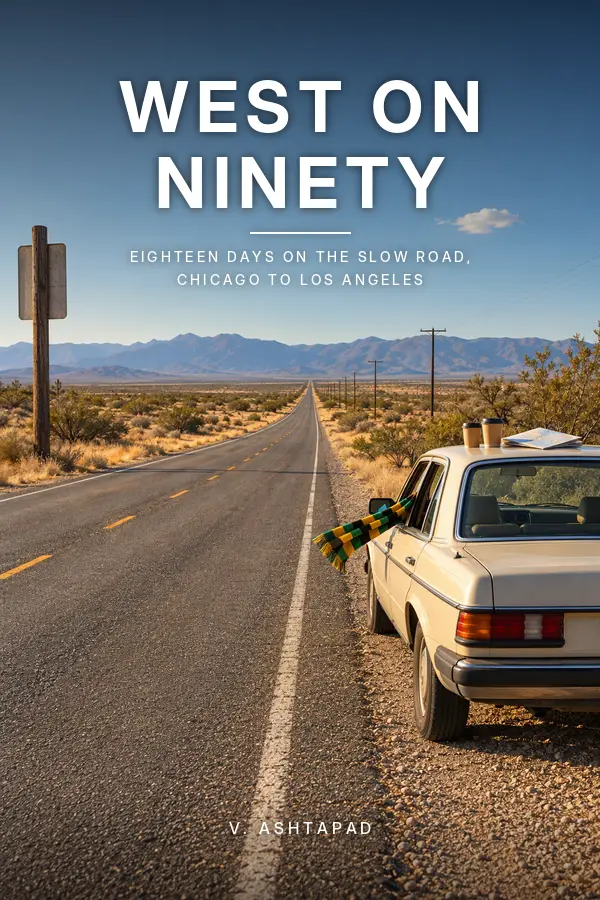
West on Ninety
Eighteen Days on the Slow Road, Chicago to Los Angeles
by V. Ashtapad
Foreword
This is a novel. Its characters, their families and the businesses they visit are invented, and any resemblance to real people is coincidence. The highways, rivers, towns and skies are real, but they are used here as fiction uses places: freely, with a road atlas open and a little invention at every stop.
Korean and Jamaican words appear the way they appear in the mouths of the women who speak them, lightly and without apology. Most explain themselves in the scene around them; a few are left for the reader to feel rather than translate.
For every mother whose story was waiting in the passenger seat.
The Third Dryer from the Window
In Albany Park the sky came in slots. It showed itself in the gap between two three-flats, in the strip above an alley where the power lines ran like a staff of music with no notes on it. On the longest day of the year Han Mi-sook stood on the Kedzie platform at ten past seven in the morning and looked up at one of those slots, between a dentist's sign and a water tower, and thought that it was a very small allowance for the solstice.
Jenny stood beside her with a backpack, a sketchbook under one arm, and ink on three knuckles of her left hand. She had drawn the water tower twice.
"Dad's literally at the gate," Jenny said. "He texted a picture of his coffee."
"Then I'll see the coffee."
They rode the train, and the other train, and at O'Hare Steven Yim was standing exactly where he had said he would stand, under the departures board, in a quarter-zip the color of oatmeal. He had flown in the night before so he could fly back with her. He hugged Jenny, then made the small adjusting motion toward Mi-sook that he always made, as if she were a bracket he was not sure how to fit. He looked at her hat, a canvas bucket hat she wore to the beach and also, apparently, to airports. "You're really driving it. Your dad's car."
"Claudette is driving it. I'm sitting in it."
"To Torrance."
"That's where it lives."
Jenny hugged her hard and fast, the way she did when she did not want to be seen doing it, and whispered, "Be weird, Eomma," and was gone through security with her father, her left hand lifting once above the crowd, inked.
* * *
Cleon Whyte was forty minutes late and double-parked on Christiana Avenue with his hazards going, which was, Claudette said, the most honest thing about him: he always let you know he was in the wrong place.
She stood on the steps of her building with her arms folded and watched him get out of the rental car. He had flown up from Atlanta to collect their daughter and had found time to get his beard lined. He was wearing sunglasses on top of his head and another pair hooked into his shirt.
"Two pair," Claudette said. "In case one of them leave you."
"Morning, Dette."
"Morning done. Yuh miss it."
Jada came down the steps behind her with a duffel, a borrowed laptop in a padded sleeve, and Cleon held his arms out and Jada walked into them, and he held on. He held on through a car honking behind him and the man from the second floor coming out with his recycling. Claudette watched her daughter's face over her ex-husband's shoulder go from patient to amused to mortified.
"Cleon," Claudette said. "Yuh blocking the street."
"I'm hugging my child."
"Yuh can hug her in Georgia. Georgia have plenty room."
When they had gone, Jada waving from the passenger window and Cleon tapping the horn twice in a little rhythm that he had used at the end of every wedding set for twenty years, Claudette stood on the sidewalk with her arms still folded. Over Christiana Avenue the sky was a slot the width of a parking space.
* * *
The car was cream. It was a 1984 Mercedes-Benz 300D with a turbodiesel engine, two hundred and eleven thousand miles, and blue cloth seats that had split along their seams and been mended by somebody's patient hand with blue thread that did not match. Mi-sook's father had bought it used in 1991 and called it Baekgu, which meant White Dog, which was what people in his village used to call a white dog.
"Him look like a dog," Claudette said now, standing at the curb on Lawrence while Mi-sook loaded the trunk. "Him have a dog face. Look at the headlamp them."
Mi-sook was packing the cooler like a puzzle she had solved in advance. Jars of yeolmu kimchi, the young summer radishes with their greens still on them, bright and sour and floating in a pink brine she had started on Wednesday. Ice packs at the corners, barley tea in a jug. On top, wrapped in a dish towel, a sleeve of water crackers and a block of orange cheese that Claudette had brought down in a grocery bag and set on the hood as if it were a contribution to a potluck.
"Is not a trip without crackers and cheese," Claudette said. "Mummy would send mi to school with it. Every single day of mi life."
"Were you happy about that?"
"No. But mi is happy now."
The last thing to go in was the box. It was made of plywood, the size of a small suitcase, dark at the corners where hands had held it. Claudette's father had built it in Kingston before she was born; he had been a joiner, and you could see it in the corners, where the wood locked into itself without a nail. Claudette had carried it home from Kingston in May on her lap. Inside were her mother's calendar pages and her mother's tapes and one bottle that Claudette had not explained.
She lowered it into the trunk with both hands. Mi-sook moved the cooler three inches to the left to make room, without being asked. Claudette shut the trunk, and the vacuum locks on all four doors went down by themselves with a sound like somebody setting down four heavy glasses.
"Him nervous," Claudette said.
Mi-sook took out her phone and photographed the car at the curb, cream against the dark window of the dry cleaner, the date in the corner of the screen. Then she did a thing she had been thinking about doing for a week: she made a private place for the trip, a family space nobody could find who had not been asked, and she invited exactly four people. Claudette. Jenny. Jada. Her brother Ken in Torrance. She put the photograph in it first.
Claudette's phone buzzed in her pocket. She read it, and looked at Mi-sook, and looked away quickly, as if she had been handed something hot.
"Only four?"
"That's who's coming."
* * *
Claudette had invited herself in May. Three days after she came back from Kingston, she had walked into Mi-sook's office on Lawrence Avenue, where tax season was over and the only client was a ficus, and said, "Jenny tell Jada you driving your father car to California." And before Mi-sook could explain that she had planned to ship it on a truck: "I'm coming. I will drive. You will read the map. Mi need to be somewhere that is not mi apartment."
So now Claudette drove. She drove with the seat all the way back and her elbow out the window and her left hand at the bottom of the wheel, and the diesel under the hood made a steady clatter that she named, before they had passed Midway, the sewing machine. Mi-sook sat with a paper road atlas on her knees, folded open to Illinois, a yellow highlighter in her hand, her sun sleeves pulled down to her knuckles.
They went south and the city peeled back from them. Brick, then siding, then warehouses, then fields. Somewhere past the last outlet mall the sky came down off its shelves. It had been stacked in slots all morning, and now, all at once, it was one thing, a whole pale blue sheet from one side of the windshield to the other, over corn that stood in rows to the edge of everything. Mi-sook found herself sitting up straighter. Claudette whistled through her teeth.
"Look how much," she said.
At the city limit sign for Kankakee, white on green, Claudette slapped the steering wheel with her palm.
"New rule," she said. "Every day, one story. A story you never tell nobody. Not your mother, not your husband, not your hairdresser."
"I cut my own hair."
"Mi can tell. So is easy for you. You start at one town sign, and you talk till the next one. And the one who listen cyaan say nothing. Not a word. Only drive."
"You're the one driving."
"So you go first." Claudette grinned at the road. "Mi make the rule. Mi cyaan go first. Is like a teacher who answer her own question."
Mi-sook looked at the atlas. US 45 ran south out of Kankakee in a thin red line, touching small towns like beads on an abacus. Then the green sign came up on the right, CHEBANSE, and she capped the highlighter.
* * *
"Two years ago in February our washer broke. Steven said he would call someone. He said it every evening for nine days. On the tenth day I took two baskets to the Bright Spin on Lawrence, because I was not going to wear the same underwear for a month while my husband thought about calling someone.
"It was a Tuesday night. It was snowing a little, the dry kind that blows sideways. There were six people in there and the television was on with no sound, a cooking show, a man stuffing a chicken with another chicken. I put my things in the washers by the door and sat in the orange chair by the window, and there was a tall woman at the folding table.
"She had a basket of men's shirts. Dress shirts, white and pale blue. I watched her because she folded like a store. Sleeve, sleeve, fold, fold, collar up. Then she stopped, and she unfolded the shirt, and she folded it again exactly the same. And then she did it again. I counted. One shirt she folded four times.
"I thought, that is a woman who is thinking about something else.
"And then she reached into her pocket and took out a ring. A wedding ring, with a stone. She held it up to the light from the window, the light was bad, it was February. And she walked over to the dryer, the third dryer from the window, the one with the tape on the door, and she pulled out the lint trap and dropped the ring into it. Into the lint. Just dropped it. I heard it.
"Then she stood there. Maybe a whole minute. Her face did not do anything.
"Then she put her fingers in and fished it back out, and she blew the lint off it, and she put it back in her pocket, and she went back to the shirts and folded the next one only once.
"I went home with my clothes still damp. Steven was on the couch watching the same cooking show, I think, or another one. And I stood in the doorway with my baskets and I said, I want a divorce. Just like that. He said, Is this about the washer. I said no. It wasn't. It was about a woman I didn't know dropping her ring into the lint and then deciding to take it back out. Because I understood that I would never drop mine. I would just keep folding.
"Three weeks later I was in an apartment with no washer, and I went back to the Bright Spin, and a dryer ate four of my quarters, and I hit it, and a tall woman next to me hit it in the same place, harder, and it gave us both our money back. She said, You have to show it who is the adult. That was you.
"I never told you I'd seen you before. I never told anyone why. So. That's it. You were the reason. You don't have to do anything about it."
* * *
The sign for Clifton came up white on green, and Claudette, who was not allowed to speak, did not. She did not speak at Clifton. She did not speak through Ashkum or Gilman or the long stretch where the sky turned the color of the inside of a shell. She drove with both hands on the wheel, which she had not done all day. Mi-sook ate three crackers with cheese and watched the side of her friend's face, which was doing something complicated that it did not usually have to do.
They came into Effingham after eight, with the sun still up behind them because it was the longest day and it refused to leave. The motel had a sign shaped like a key and an ice machine on the second-floor walkway that ground like gravel in a mixer. Claudette carried the box up. Neither of them suggested leaving it in the car.
Mi-sook was filling the ice bucket when Claudette came out onto the walkway and stood beside her with her hands on the rail. Below them the parking lot was going violet. Baekgu sat by the stairs with its dog face pointed at the road.
"Mi-sook."
"You can talk now. We're past Clifton by a hundred miles."
"Mi never put no ring in no lint trap."
The ice machine ground. Mi-sook held the bucket under it.
"I saw you."
"Yuh see mi. Yuh never see mi ring." Claudette turned around and put her back to the rail. "Mi did take off mine in January. Mi throw it in a drawer. Was Odette ring. Cleon sister. Her washer mash up the same week, and she send mi with Barrington shirts, and she say fold them proper or she will hear about it, and she take off her ring to do dishes and leave it in Barrington pocket. And mi find it, and mi was standing there with another woman ring and another woman husband shirt, and mi think, Lawd, look at mi life. And mi put it in the lint trap. To see what it feel like."
"And what did it feel like?"
"Like it wasn't mine." Claudette shrugged. "So mi take it out and give it back to Odette. She and Barrington still married. Happy, happy. Them go on cruise."
Mi-sook looked down at the ice. She looked at the violet parking lot and the dog-faced car and the sky, which was finally, very slowly, getting ready to close.
"So I got divorced over the wrong woman," she said.
Claudette put her head back and laughed from the bottom of her chest, so loud that a light came on in the room below.
"Best mistake you ever make."
Nine Nights, One Laugh
The sky came down to meet them south of Effingham. On Saturday it had been a sheet pulled tight over the corn; on Sunday morning it was a wet gray mattress somebody had dragged across Illinois, sagging in the middle, so low over the soybean fields that the grain elevators looked as if they were holding it up. Baekgu's dash clock said 9:04. It was 9:00. Mi-sook had explained this twice, once in Chicago and once at breakfast, and Claudette had decided it was a philosophy.
"Baekgu time," she said, tapping the clock. "Him always four minutes ahead. Him know where we going before we know."
"He was like that when my father had him. My father set every clock in the house four minutes fast so he would never be late to open the shop."
"So your father invent Baekgu time."
"My father invented being early. The car just kept doing it."
Claudette drove with a cup of motel coffee between her knees. On the dash, where Mi-sook had told her not to put anything, sat a small black microcassette recorder with a scuffed silver face, two new batteries in it from the gas station by the interstate. She had pressed play at the pump. She had pressed it again at the edge of town. Nothing. Not a hum, not a hiss. She kept glancing at it the way you glance at a dog who will not come.
"It might be the belt inside," Mi-sook said. "Those little machines have a rubber belt. It dries out."
"Yuh know microcassette?"
"I know everything that has a belt."
US 45 ran south through towns that seemed to have been set down by a careful hand and then forgotten. A water tower, a feed store, a café with its name painted on the window in letters that had been red once. Flowers in coffee cans on a porch. A man in a lawn chair at the end of a driveway, watching the road as if he had paid for it. Then the land began to lift a little and fold. There were hills, real ones, wooded and steep at the sides, and the road began to curve to fit them. The signs started to say things that did not belong in Illinois.
"Karnak," Claudette read off a green sign. "Thebes. Lawd. Mi in Egypt."
"Little Egypt. My atlas says." Mi-sook ran her finger along the page. "There's a Cairo at the bottom. We sleep there."
"And who name it?"
"Someone who had never been to Egypt, I assume."
"Mi have a student like that. Him write an essay on the pyramids. Him say they were built for storage." Claudette laughed. "Him wasn't wrong, exactly."
* * *
After lunch they turned off onto Illinois 37, which went south through the hills like a thread through cloth. The trees closed over it in places so that the low sky disappeared altogether and came back in pieces, gray between the leaves. At a gravel pull-off past a sign for Goreville, Claudette stopped the car and put it in park and turned to Mi-sook.
"Today a fi mi," she said. "Mi have to tell one."
"You can tell it. Drive and tell it."
"Rule say the one who listen drive. The listener cyaan talk. Only drive."
"I don't drive on highways."
Claudette pointed out the windshield at the road, which was two lanes wide and empty except for a turtle crossing it with great seriousness, and a hawk sitting on a fence post as if waiting to see what they decided.
"This is not a highway. This is a driveway with a number."
Mi-sook looked at the turtle. She looked at the hawk. She got out and walked around the front of the car, and Claudette walked around the back, and they passed each other at the trunk without speaking, like guards changing. Mi-sook moved the seat forward eleven notches. She adjusted both mirrors. She put her hands at ten and two and looked at the speedometer as if it might bite.
She pulled out at nineteen miles an hour. The turtle had made it to the far side. The hawk lifted off the post and flew alongside them for a while, keeping pace without effort, then lost interest.
They came back past the Goreville sign. Claudette put her hand flat on the dash, next to the dead recorder, and began.
* * *
"In May we have the nine-night for Mummy. Yuh know what that is? When somebody dead, for nine nights the house is open. Everybody come. Family come, neighbor come, people from the market she sell in when she was a girl, old boys from the school where she cook thirty years. Big men now, gray in the head, some of them, and they still call her Miss Lettie and still afraid of her. Yolande cook. Everybody cook. Mannish water in a pot so big two man have to lift it. Fried fish, bammy, white rum in the little glass. The men them slam dominoes on a table in the yard, so loud the dogs down the road start bark. You tell stories about the person. You sing the old songs. You stay up. It go on and on, and on the ninth night it finish, and everybody go home, and the house is just a house again.
"So the last night. Is late. The yard is full. Is hot, and the June-plum tree is dropping fruit on people head, and nobody move, because Mummy love that tree. And the men decide them going to sing. One of my uncles start a song Mummy used to sing when she wash. *Carry me down to the waterside, the boat gone long time, the boat gone long time.* And him start it too high. Much too high. And the other men come in under him, trying to find him, and they cyaan find him, and every man is in a different key, and they are singing with their whole chest, eyes close, sweat running, like it is the most beautiful thing.
"And mi laugh.
"Mi didn't mean to. It come up out of mi like a sneeze. And mi put mi hand over mi mouth and it come out through mi fingers. And mi aunt look at mi. And one of mi brothers look at mi from across the yard with him face like a closed shop. And the men keep singing, louder, higher, the boat gone long time, and mi cyaan stop. Mi laughing so hard mi cyaan breathe. Mi bend over. People think mi crying. Some lady from the market come and pat mi back. And mi think, if she see mi face she will know.
"Yolande come and take mi arm. Yolande is the oldest girl, she was the one who live with Mummy, who wash her and feed her at the end. She walk mi out of the light, all the way to the back, under the June-plum tree, and she stand there with mi while mi laugh. She don't say nothing. She just hold mi elbow. And after a long time it stop.
"And she say, You finish? And mi say yes. And she say, Mummy would laugh too. That song never had a key.
"But I didn't cry. That is the thing. That was the night I was supposed to cry, everybody cry, and I laugh. And I have not cried since. Not at the airport. Not when I unpack the box. Mummy used to say, Tek kin teet kibba heart bun. Use your teeth to cover a burning heart. Show the teeth, so nobody see. I think she mean a smile. I don't think she mean a laugh that won't stop.
"And the tapes. Thirty-one tapes, Mi-sook. Her voice. I send her that recorder in 2009 and she talk into it for sixteen years. And it don't work, and I don't have nothing to play them on. And I am glad. Lawd, don't look at me so. I am glad it don't work."
* * *
The sign for Cypress came up on the right, white and small. Mi-sook, who was not allowed to speak, drove past it at thirty-one miles an hour, which was the fastest she had gone. She kept driving. She did not pull over and hand back the keys. The hills began to flatten and the trees thinned and the sky came back all at once, low and swollen, the color of a bruise healing. She drove all the way down into the flat bottomland, past fields that had been under water often enough that the farmhouses stood on mounds, past a sign for Mounds, which made neither of them laugh.
At the Cairo city limit she pulled onto the shoulder and put it in park and got out and walked around the back, and Claudette walked around the front, and they passed at the hood.
"Thirty-one," Claudette said, when she was behind the wheel again. "Yuh went thirty-one."
"I'm aware."
* * *
Dorothea Biggs's bait shop stood on stilts at the end of a gravel road with the levee on one side and a stand of cottonwoods on the other, and it sold, according to its hand-painted sign, MINNOWS NIGHTCRAWLERS SANDWICHES ICE. Inside it smelled of river water and mustard. Dorothea was in her seventies, small and brown and quick, with reading glasses pushed up into gray hair and a fly swatter she held like a conductor's baton.
"Ham or bologna," she said, before they had shut the screen door.
"What is the difference?" Mi-sook asked.
"About forty cents and your self-respect."
They had ham. Dorothea made the sandwiches on white bread with yellow mustard and a slab of tomato from the bucket on the counter, and while she made them she looked out the window at the sky.
"Rain before seven, clear by eleven," she said. "It didn't rain before seven. So that's no help. When the cows lie down, it's coming. I haven't seen a cow since Tuesday." She wrapped the sandwiches in wax paper and folded the ends under like envelopes. "Sky's sitting on that river like a hen on eggs. It'll hold till dark. After dark I don't make promises."
"You are a weather lady," Claudette said.
"I'm a bait lady. Weather's just what I look at while I wait."
She told them where to walk. At the very end of the land, past the old fort and a concrete platform, there was a point where the Ohio came in from the east and the Mississippi came down from the north, and Dorothea said you could see the two of them not getting along.
They stood there with their sandwiches. It was exactly as she said. The Ohio came in green, a deep bottle green, wide and slow. The Mississippi came down brown, a strong milky brown like coffee with too much in it. Where they met there was a seam on the water, a long wavering line, green on one side and brown on the other, running together for a long way before the brown won and swallowed it. Driftwood turned slowly in the seam. A barge pushed upriver, enormous and quiet, nine flat hulls lashed together, and the seam closed behind it as if nothing had happened.
"They don't mix," Claudette said.
"They do eventually. Look, down there. It's all brown."
"Eventually." Claudette took a bite of her sandwich and chewed for a while. "Mummy used to say, when two river meet, the bigger one keep the name."
"Is that a real saying?"
"Mi just make it up. But she would say it."
The sky hung over the confluence so low it seemed to rest on the far bank. It pressed down on the water, on the barge, on the two of them in their hats. Mi-sook found that she did not mind it. Claudette kept looking up as if checking for a crack.
* * *
The motel in Cairo had eleven rooms, a sign with half its letters lit, and a woman at the desk who gave them a key on a plastic diamond and told them the ice machine was "spiritual," meaning it worked when it chose. The rain came after dark, exactly as promised, loud on the tin awning over the walkway.
Claudette sat cross-legged on her bed with the plywood box open beside her. Mi-sook sat on the other bed with a pen and the motel notepad, because Claudette had asked her to write, and because Mi-sook wrote in a clean small hand that could be read by anybody.
One by one Claudette took the little tapes out of the box. They were no bigger than matchbooks, each in its own clear case, each with a white label, and on every label the date in her mother's slanting blue ballpoint, the sevens crossed the way they taught in Kingston, the months spelled out. Some had a word or two after the date. Claudette read only the dates. Mi-sook wrote them down. Then Claudette laid the tapes out on the bedspread in order, the oldest at the pillow, the newest near her knee, and Mi-sook numbered the list from one to thirty-one so they could be kept that way, and photographed the page, and put the photograph in the family's private space under the date, so the order would not live only on a motel notepad.
Thirty-one small cases on a brown bedspread. The rain on the awning. The recorder on the nightstand, its silver face dull in the lamp.
Mi-sook put the pen down.
"What if you play them," she said, "and she says something you don't want?"
Claudette looked at the tapes. She picked up the oldest one and turned it over, and put it down again, exactly where it had been, square to the others.
The rain went on.
Why I Don't Take the Freeway
The bridge out of Cairo was a long green trestle over the Ohio, narrow enough that when a truck came the other way Claudette pulled her elbow in off the windowsill and said "Excuse," as if the truck could hear. The river underneath was the morning's color, pewter with a skin of mist. On the far side a sign welcomed them to Kentucky, and a second sign, smaller and closer, said WICKLIFFE, and Mi-sook, who had been sitting very straight since the bridge began, took off her bucket hat.
"Mine," she said. "Today."
"Already? We just eat breakfast."
"I'm not waiting for a better sign. Bardwell is next. It's short."
Claudette pressed her lips together, turned an imaginary key at the corner of her mouth, and dropped it out the window.
* * *
"In 1993 I was seventeen and my father taught me to drive. In this car. He'd had it two years and he still washed it on Sundays with a bucket and a chamois he kept in a plastic bag so it wouldn't dry out. He was a quiet man. He fixed shoes. He fixed shoes all day with my mother beside him at the other bench, and he could put a heel on a woman's pump in four minutes, and he never wasted a word on anything that wasn't broken.
"He taught me in the parking lot of the shoe repair shop on Sundays, and then on the side streets, and then on Torrance Boulevard, and then he said we would do the freeway. The 405. He said it in Korean, the way he'd say we were out of glue. We'd get on at Crenshaw and get off at the next exit and that would be all.
"I remember the on-ramp curved. I remember the sound the tires made on the grooves. I remember he said, Now faster, and I pressed the pedal, and this car doesn't go faster, not really, it thinks about it. And the lane was ending, and there were cars coming in the mirror, a truck, a lot of cars, all of them going so fast, and none of them were going to let me in. And I just stopped. Not the car. Me. I stopped. My hands stopped. My foot stayed exactly where it was. I couldn't turn my head. I could see the lane ending and I thought, very calmly, this is where I die, in my father's car, in my school sweatshirt.
"And my father didn't say anything. He reached over and put his hand on top of my hand on the wheel. His hand was rough, he had calluses from the awl. And he steered. From the passenger seat. He steered us into the lane, into a space I hadn't seen, and he kept his hand there, and he steered us all the way to the next exit, and down the ramp, and onto the street, and he said, Stop here. And I stopped.
"Then he got out and walked around and I slid over. And he drove us to a hot dog stand by the bowling alley on Hawthorne and bought me a hot dog with everything on it, and a root beer, and we sat on the bench, and he ate his and I ate mine. And he wiped his hands and said, Let's go home. And that was all.
"He never talked about it. Not that night. Not ever. My mother never knew, I think. He never asked me to try again. He just drove me where I needed to go, and when I didn't need him I took the bus, and when I went to Chicago I took the train, and I've lived in Chicago thirty-one years on side streets.
"I used to think he was being kind. Maybe he was. But nobody said anything, so it never got any smaller. It just set. Like the stuff he used to fill a cracked heel. You pour it and you wait and then it's harder than the shoe.
"When I married Steven he drove the freeways. When I had Jenny I drove her to school on side streets and it took twenty minutes longer and she thought it was a scenic route. I've never told anyone why. Not Steven. Not Jenny. I just said I don't like freeways, like a person who doesn't like cilantro.
"That's why I'm in the passenger seat. That's why we're on this road and not that one. It's not because I love small towns."
* * *
The Bardwell sign came up fast, much faster than either of them expected, and Claudette let out the breath she had been holding through the last part and said the first thing that came into her head, which was, "Him hand was rough?"
"From the awl."
"Mummy hand was rough too. From the scrubbing brush. She would hold mi face with it." Claudette touched her own jaw. "Like sandpaper with love in it."
"That's not a saying."
"Is now."
* * *
Kentucky went by in a hurry, as though it had somewhere else to be: Arlington, Clinton, a sign for a Friday fish fry that Claudette read aloud twice, and then Fulton, where the road leaned over the state line into Tennessee so casually that a hardware store seemed to be in one state and its parking lot in the other. Tennessee was rolling and green and very hot. The sky was lifting off them now, by inches. It had been a mattress in Illinois; in Tennessee it was a sheet on a line, high in the middle, sagging at the edges, with cotton-ball clouds pinned along it.
At Covington, Mi-sook unfolded the Memphis inset of the atlas like a surgeon with a chart. There was a red line that went around the city and a red line that went through it, and she chose through.
"Mi-sook. The ring road faster."
"You're driving. I'm navigating. I navigate us through Memphis."
So they went through Memphis on surface streets, past barbecue smoke and shuttered storefronts and a man selling peaches out of the trunk of an old sedan, and a beauty supply with a hand-lettered sign that said WE HAVE YOUR COLOR, which Claudette took personally, and a long stretch of warehouses, and then a sign said US 61 SOUTH and the city simply let go of them.
Then the Delta.
Mi-sook had read about it and had not understood. The land went flat, not prairie flat, not lake flat, but a flatness so complete it seemed to have been ironed, black earth in long straight rows that ran out past seeing, cotton knee-high and glossy, soybeans, rice in shallow silver squares, and a line of trees so far away it was only a darker pencil mark at the very bottom of the world. And above it, the sky. Not slots, not a sheet. A ceiling. The whole thing, one side to the other, every inch of it present at once, blue at the top going to white at the edges, clouds standing on it in towers, and hawks hung from it on invisible wires. A crop duster went over them so low that the cream hood flashed yellow from its belly.
Claudette pulled over on the shoulder for no reason except to look up. She got out and stood beside the car with her hand on the roof.
"Mummy say when she was a girl in Kingston the sky was small because of the mountain," she said. "The Blue Mountain behind everything. You never see the whole sky. Mi forget that. Mi forget mi grow up under a mountain."
Mi-sook got out too. She did not look up. She looked across. It was the first time she could remember seeing the horizon in every direction at once, and it made her want to hold on to something, so she held on to the door.
"How are you going to drive in Los Angeles?" Claudette said. "When this is done. You going to take the bus to Torrance with Baekgu on a leash?"
"Cheon ri gildo han georeumbuteo," Mi-sook said.
"Translate."
"A journey of a thousand li begins with one step. A li is a distance. It's less than a mile."
"So a thousand li is how far?"
"Not as far as you'd think. That's the point."
* * *
Grady Huckaby's stand was a plywood shed painted barn red on the side of the road a little south of a crossroads that did not seem to have a name, with a hand-lettered sign that said HOT TAMALES and, under it in smaller letters, THEY ARE. Smoke and steam came out of a stovepipe in the roof. A picnic table sat under a pecan tree. Grady sat behind a screened window on a stool, a long, bony, freckled man of seventy-four in a white undershirt and a cap that said nothing on it, and in front of him on a two-burner propane stove, four big coffee cans steamed, each one full to the top with tamales standing up in a red broth like cigars in a humidor.
"Dozen's twelve dollars," he said. "Half a dozen's seven, because I don't like halves."
Mi-sook looked at the coffee cans. She looked at the broth, which was the deep rust of chili and something else, cumin, and lard, and smoke. She went back to the car and opened the cooler and came back with a quart jar of yeolmu kimchi, the radish greens pressed against the glass.
"I'll trade you," she said.
Grady looked at the jar for a long time. He took it from her and held it up to the light coming through the screen. He unscrewed the lid and smelled it and his eyebrows went up into his cap.
"What's that, now?"
"Radish kimchi. Young radish. It's a summer one. My mother's way."
"Is it hot?"
"It's sour first. Then it's a little hot."
"Little hot." Grady snorted. He fished a radish out with two fingers and ate it, stem and all, and chewed, and his face did a series of things like weather crossing a field. "Huh," he said. "Huh. That's alive."
"It is alive. It's fermented."
"I meant it talks back."
He gave them a dozen tamales, wrapped in their husks and bundled in threes with string, in a paper sack already going translucent with grease. They sat at the picnic table under the pecan and ate them with their fingers. The tamales were smaller than Mi-sook had expected, and softer, the cornmeal almost melting, the meat inside dark and peppery, and the broth ran down their wrists. Claudette ate four in a row, then fanned her mouth with a paper napkin.
"Them all right," she said, which from Claudette was a sonnet. "But them not hot."
Grady came out from the stand and stood over them with his arms folded. "Not hot."
"Is good. Is not hot. Mi from Jamaica. Mi grow up on Scotch bonnet. A Scotch bonnet would eat that tamale for breakfast and still want toast."
"Ma'am, I have watched a grown man from Arkansas cry at that picnic table."
"Then him should go back to Arkansas."
"There's no such thing as too hot, I'll give you that. There's only too soon."
"There's no such thing as too hot," Claudette agreed. "There's only people who complain."
They argued about it for twenty minutes. It was the most pleasant argument Mi-sook had ever witnessed. The sun went down behind the ironed fields and the whole ceiling of the sky went orange, then rose, then a deep clear violet, and the first star came out over the pecan, and still they argued, Grady about a habanero he had grown in a tire in 1988, Claudette about a pepper sauce her mother made that could take the paint off a door.
At nine o'clock, which was seven in Torrance, Mi-sook's phone rang.
It was Ken. He sounded the way he always sounded in the evenings, a decent man at the end of a long day holding the phone up for somebody else. "She's good tonight," he said. "Florence did her hair. Here. Eomma, it's Mi-sook."
Then her mother's voice, high and bright, in Korean, too close to the phone. Where are you? Where is your father's car?
"I'm in it, Eomma. I'm bringing it."
Where is it?
"I'm bringing it to you. We're in Mississippi."
A pause. Then, as if someone had opened a door onto another room: When I was a girl in Mokpo we kept the crocks on the roof. My mother's crocks. The soy sauce, the doenjang, the gochujang. All in a row on the roof. In the winter there was snow on the lids. I had to climb up the ladder with a bowl and she held the bottom of the ladder. You could see the harbor. The boats. I could see the boats from the roof.
"I didn't know that," Mi-sook said.
The lids were cold. My hands were cold.
"Eomma. What else could you see?"
But her mother had gone back to the other room. Where is your father's car?
When Ken came back on, Mi-sook said goodnight and sat for a minute with the phone in her lap. Then she took out the small notebook she kept in her shirt pocket for receipts and wrote, in Korean and then in English, *June 23, 2025. Eomma: crocks on the roof in Mokpo. Snow on the lids. Her mother held the ladder. She could see the boats.* She photographed the page and put it in the family's private space, next to the picture of Baekgu at the curb.
Claudette had stopped arguing. Grady had gone back into the stand. After a while he came out again with something in his hand and set it on the far end of the picnic table.
It was her kimchi jar, washed, and filled to the brim with a dark red sauce that caught the light from the stand like a stained-glass window.
"Chili sauce," he said. "Mine. Don't put it on your eggs till you've thought about it."
"You already paid," Mi-sook said. "The tamales."
Grady pushed the jar across the boards until it touched her hand, and kept his finger on the lid until she took it.
"Trade's a trade," he said.
The Doctor I Never Became
The jar of Grady's chili sauce rode in the cup holder between them all morning, wedged with a rolled towel so it would not tip, glowing in the sun like a brake light. Neither of them had opened it. Claudette had looked at it at breakfast in Leland, over eggs, and put her fork down, and said, "Not yet," with the air of a woman postponing a duel.
South of Rolling Fork the Delta began to end. It did not end all at once. The rows got shorter, the trees got closer, and then the land started to buckle, and they were climbing, and the road was cut through high walls of yellow loess soft as cake, with roots hanging out of it and kudzu draped over the top like a tablecloth on a table too small. Vicksburg came up on its hills, old brick and steep streets and a river view that went by too fast to look at. Claudette wanted to stop. Mi-sook wanted to keep going. They compromised on a gas station with a diesel pump, where Claudette bought a bag of boiled peanuts and ate them with an expression of profound suspicion.
"Them wet," she said. "Peanut is not supposed to be wet."
"You bought them."
"Mi buy them for science."
Below Vicksburg, at a sign for Port Gibson, she pulled into the gravel lot of a feed store that was closed on a Tuesday and turned the engine off. The sewing machine stopped. The heat came in through the open windows at once, thick, with a green smell of cut grass and something sweet and rotten under it, magnolia gone over.
"Mi," she said.
Mi-sook did not argue this time. They changed seats without a word, the second time in three days, and it already had the shape of a habit. Mi-sook did the seat and the mirrors. She found that her hands knew where ten and two were already, as if they had been waiting there since Sunday.
She pulled out at twenty-four. The sign for Port Gibson went by. Claudette looked out her window, at a long white fence and a horse standing behind it in the shade, perfectly still, and began.
* * *
"I come to Chicago to be a doctor.
"Everybody know it. Everybody in Vineyard Town. Mummy tell the whole market, the whole school kitchen, the man who sell her fish, the man who fix the roof. Mi last pickney going to America to be a doctor. When I get the scholarship she cook for three days. She make a cake so big they had to cut it on the verandah. I was eighteen. I never see snow. I land at O'Hare in August with one suitcase and a winter coat she buy from a jumble sale that was made for a man.
"And I do good. Chemistry, biology, all of it. Organic chemistry, people cry, I don't cry, I love it. I love the little rings, the way everything hold on to everything. And second year they give me a job tutoring the freshmen, the ones failing. Four dollars an hour in a basement room with no window. And I find out that I love that more. More than anything. A boy from the South Side who think he is stupid, and then one day he see it, the whole molecule, and his face. His face, Mi-sook. Like somebody turn on a light in a house.
"So halfway through I switch. To teaching. Chemistry education. I tell the dean, I tell my advisor, I tell everybody.
"I don't tell Mummy.
"I graduate and I start to teach, and I tell her I am in medical school. For three years. Three years, I lie to my mother on the telephone every Saturday. I make up classes. I make up a professor. I make up a dead body we are cutting, and I give him a name, I call him Mr. Pettigrew, and every week I tell her what we learn from Mr. Pettigrew. His liver. His heart. She ask after him like he is a neighbor. How Mr. Pettigrew? She send mi a white coat. She sew mi name on it in red thread, by hand, every letter, Claudette Reid, so the other doctors would know whose it was.
"I wear that coat to teach. I still wear it. The children think is a joke. Is not a joke.
"In the third year I cyaan take it no more and I write her a letter. A real letter, airmail, blue paper. I tell her everything. I tell her I am a teacher and I am good at it and I am sorry. I post it and I don't sleep for two weeks.
"And she call on the Saturday like every Saturday. And she say, Mi get yuh letter. And I wait. And she say, Yam gone up again. Is a crime. And she talk about yam for ten minutes and then she say, Walk good, and she hang up.
"She never mention it again. Not one time in twenty-two years. She never say the word doctor and she never say the word teacher. She just stop asking about Mr. Pettigrew.
"And now I have thirty-one tapes. And what I am afraid of, what I am really afraid of, is not that she was angry. If she was angry I could hold that. I am afraid I will put in one of those tapes and she will say, laughing, to Yolande, or to nobody, Mi know from the first week. Mi know from the first Saturday that pickney a lie. And she let me. For three years she let me tell her about Mr. Pettigrew liver. And she ask after him. Every week she ask after him, knowing.
"I don't know what I would do with that. I don't know if that is love or if that is something else."
* * *
The sign for Fayette came up white on green. Claudette stopped speaking a quarter mile before it and sat with her hands in her lap, looking at the road. Mi-sook drove past it at thirty-eight. She drove through Fayette, past a courthouse and a dollar store and a man asleep in a lawn chair under a pecan, and out the other side. She drove another ten miles, which was not required by the rule, and then another five, and Claudette did not ask her to stop, and she did not stop.
At last, at a flat place with a fruit stand that was closed, she pulled over. She did not get out. She sat with her hands on the wheel.
"Mr. Pettigrew," she said.
"Mm."
"What did he die of?"
Claudette turned and looked at her, and something in her face let go, and she laughed, a short surprised bark of a laugh.
"Mi never decide."
"You lied to your mother for three years about a corpse and you never gave him a cause of death."
"Mi was a teacher, not a writer."
* * *
Natchez sat on top of its bluff like a cake on a stand. Up top it was white columns and live oaks and iron balconies and the kind of houses that had their names on signs out front, but the laundromat was below the bluff, on the narrow street at the bottom, where the land fell away to the river in one long slope of grass and the old brick buildings leaned against each other as if they had been drinking. Pauline Spurlock's laundromat had a green awning and a window with a hand-painted sign that said WASH DRY FOLD TALK, and in the window a cat lay on top of a stack of folded towels like a paperweight.
Pauline was in her sixties, tall and heavy and slow-moving, with silver hair in a braid down her back and reading glasses on a beaded chain, and she sat behind a counter with a box fan aimed at her face and a paperback face down on her knee.
"The left four are good," she said. "The right four are moody. Number six eats quarters."
"Mi know a dryer like that," Claudette said.
"Every laundromat has one. It's like an old house having a ghost."
They washed everything they had worn since Chicago. The machines were old and loud and smelled of hot lint and the river, and the floor vibrated under their feet. While the dryers turned, Pauline brought them sweet tea in jelly glasses so cold the outsides fogged, and asked where they were from, and where they were going, and why, and nodded at each answer as if it were exactly what she had expected.
When the dryers stopped, Mi-sook went to the one with Claudette's things in it, and Claudette went to the one with Mi-sook's, and neither of them noticed until they were both standing at the long folding table, each with a basket of the other's clothes. Mi-sook was folding Claudette's T-shirts in thirds, the way she folded her own, sleeves in, collar up. Claudette was rolling Mi-sook's sun sleeves into tight little cylinders and lining them up like cigars.
Pauline watched them over her glasses.
"Only two kinds of people fold each other's laundry without asking," she said. "Sisters and the long married."
"Neither," Mi-sook said.
"Uh huh." Pauline turned a page. "That's what my sister said."
Claudette put a hand on dryer number six, the moody one, and hit it, once, in the upper left corner, and three quarters dropped into the coin return. She held them up.
"Yuh have to show it who is the adult."
* * *
They watched the sunset from the top of the bluff, from a bench under a live oak whose roots had broken the sidewalk into plates. The river was enormous here. It went by below them wide and brown and unhurried, turning in a long bend, and across it Louisiana lay perfectly flat, green and endless, and the sky over it did not go up so much as out, sideways, as if someone had pulled it at both ends. Two bridges crossed the river to the south. The clouds lay along the horizon in long thin bars, pink and gold and then the red of a cut melon, and the river took all of it and carried it away to the Gulf.
Claudette had brought the box up from the car. She opened it on her knees. The calendar pages were stacked inside in bundles, each bundle tied with butcher's string, each one a year. On the front of each page was a picture, a beach or a waterfall or a parrot or a cane field, the name of the hardware store printed underneath in red. On the back, in her mother's hand, one recipe.
She found 1983 and untied it and turned the pages to July. On the front, Dunn's River Falls, a long white staircase of water with tourists in a chain holding hands on it, everyone's skin gone orange with age.
"Escovitch fish," she said, and turned it over, and read aloud. "Two snapper, clean good. Lime and salt, rub it in, leave it while yuh sweep. Fry hot, hot, till the tail curl and crack like biscuit. Then the pickle. White vinegar, one cup. Onion slice thin like paper. Carrot cut in matchstick. Scotch bonnet, one, two if is a Friday. Pimento seed, ten, crack them. Boil it one minute and pour it hot on the fish. Then leave it. Don't touch it. Is better tomorrow. Everything good is better tomorrow."
Mi-sook held out her hand, and Claudette gave her the page. Mi-sook turned it to the light and photographed the back, then the front, then laid it on her knee.
"You should do all of them," she said. "Both sides. In order. Month and year."
"Is nearly six hundred page."
"Then it's nearly six hundred photographs. I photograph receipts for a living."
So they did July 1983, and then they did the rest of 1983, Mi-sook holding the phone and Claudette turning the pages, one month after another, front and back, while the sky went from red to violet to the color of a plum, and the river went black, and the lights came on across it in Louisiana.
When it was too dark to see, Claudette tied the string back around 1983 and laid it back in the box with the other years. Her hand stopped on the little recorder. She took it out and held it, turned it over, took one of the tapes from its place in the line, the oldest, the one at the head of the list, and slid it in and closed the lid.
She pressed play.
Click.
A small dry hiss, like a breath through teeth.
Nothing.
Leaving Money
St. Francisville had moss. It hung from the live oaks over the road in long gray beards, so much of it that the morning light came through green and broken, as if they were driving along the bottom of a pond. Claudette slowed to twenty-five without being asked and put her head out the window to look up into it.
"Is like the tree them getting old," she said. "Look. Them have hair like Mummy brother."
"It's a plant. It doesn't hurt the tree."
"Mummy brother hair never hurt him neither. Only him wife."
Below St. Francisville the hills gave out and the air got heavier, and by Baton Rouge it had weight, a wet hand laid on the back of the neck. Mi-sook navigated them through the city on surface streets, past a capitol tower that stood up over everything like a raised finger, past refinery stacks burning off gas in pale flames you could barely see in daylight, past a drive-through daiquiri stand that Claudette pointed at for half a mile without speaking, then south along the river through cane country, flat and green and steaming, until a small sign said LA 70 and the land began, very slowly, to turn into water.
It was not sudden. First the ditches were full. Then the fields had standing pools in them with egrets in the pools. Then the trees changed, and there were cypress, the trunks wide at the bottom like the skirts of women sitting on the ground, their knees poking up out of black water all around them. The water was covered in duckweed, a skin of green so bright and even that it looked like a lawn you could walk on, and here and there a heron stood in it to show you could not. The sky came down to meet all of it. It was not the Delta's ceiling, not anything as high as a ceiling. It was a lid. A low wet gray lid set on a pot of green, with steam leaking out at the edges.
Mi-sook rolled her window down and the air came in like a towel out of a dryer that had not finished.
"Lawd," Claudette said, and argued with it: "No, Lawd, mi nuh mean it as a complaint. Is only humid."
At a sign for Pierre Part, Mi-sook took off her hat and set it on her knee, crown down, the way she set down a bowl.
"Mine."
* * *
"I have a piano. An old upright I bought from an estate sale in Lincoln Square in 1999 because I'd played as a girl and I thought I would again. I didn't. Jenny played for a while. Then she didn't. It's in my apartment now, against the wall by the window. It's out of tune. The middle C sticks.
"The bench lifts up. Inside it's supposed to be for sheet music.
"In 2013 I put an envelope in it. A plain white envelope, number ten, the kind I buy by the box of five hundred for the office. I wrote 2013 on the front in pencil. In it I put two hundred dollars in twenties. My own money. From my own pay. After taxes. I'm not an animal.
"I put in more that year when I could. Forty dollars. Sixty. A hundred after a good week in March. At the end of the year I counted it and wrote the total on the back, and I sealed it, and I started a new one. 2014. 2015. Every year. I never missed a year. I never took any out. Eleven envelopes, standing up in a row in the bench like files in a drawer. The last one is 2023, because that was the year I left.
"Nothing happened in 2013. That's what I want to say. There wasn't a fight. There wasn't another woman. Steven was Steven. He is a good orthodontist and a polite man, and on our anniversary that year he gave me a label maker, a very good one, because he thought I would like it. And I did like it. That was the problem. I stood in the kitchen holding a label maker that I liked and I thought, I am going to be fifty and seventy and ninety in this kitchen, liking things.
"So I started the envelopes. I called it my leaving money. Not out loud. In my head. Not money to leave with, exactly. Money that proved I could. Every year I counted it and I knew I could, and then I put it back, and I didn't.
"When we divorced I declared it. On the form. Line nine. Other assets, cash on hand. Eleven thousand four hundred dollars. Steven signed the form without reading past page two. He said, You take whatever you need. He meant it.
"And I didn't spend it. Not on the apartment, not on the lawyer. I kept it in the bench. I didn't know what it was for anymore. I was already gone. You can't leave twice.
"Then in May you walked into my office and said you were coming, and I went home and opened the bench, and I took all eleven envelopes out and stacked them on the kitchen table and I knew what it was for.
"So that's what's in the glove box. That's what paid for the motel in Effingham. That's the diesel. That's Dorothea's ham sandwiches and Pauline's quarters and the tamales that we didn't pay for. I've been paying for this trip since 2013, forty dollars at a time. I just didn't know it was this trip.
"I've never told anyone. Not Steven, not Jenny. Not my mother. My mother would say I should have bought gold."
* * *
The sign for Belle River came up out of the cypress, white on green, with a crow on top of it, and Claudette drove past it in silence and then let out a sound that was half a laugh and half a groan.
"The tax lady," she said. "The tax lady have a undeclared bench."
"Declared. Line nine."
"Undeclared to the bench."
"The bench knew."
Claudette was laughing, shaking her head, wiping her eye with the back of her wrist. "Eleven years. Forty dollar. Mi have a student who save his lunch money for a whole year to buy a snake, and mi think *that* was discipline—"
There was a sound under the hood like a deck of cards being shuffled by a giant, and then a slap, and then a smell of burning rubber, and the sewing machine changed its tune. They were on the long approach to a bridge over a wide brown bayou, the concrete rising ahead of them, and Claudette got the car onto the narrow shoulder just before the rise and stopped, and a red light came on in the dash, and steam began to drift up from the seam of the hood.
They got out. Mi-sook opened the hood and stood back from it. A black rubber belt hung from the front of the engine in two pieces, one of them still smoking faintly, like a snake that had been in an argument.
"Well," Claudette said. "Now you spending the leaving money."
* * *
Bertie Thibault came forty minutes later in a tow truck with a rusted boom and a bumper sticker that said I BRAKE FOR NOBODY, and he was in his forties, sunburned and soft-spoken and missing the top of one finger, with a cap that said a boat's name on it and a toothpick he moved from one side of his mouth to the other when he was thinking. He looked at the belt and moved the toothpick.
"Three hundred D," he said. "My uncle had one. Ran it on fryer oil from his restaurant till the day it caught fire. Not because of the oil." He moved the toothpick back. "Nobody's got this belt in a parish. I got something might do."
He towed them down off the bridge approach and along a shell road to a shrimp dock on a bayou where a dozen boats were tied up, nets hoisted on their outriggers like the wings of tired birds, and the air smelled of salt and diesel and boiled crab and something rotting cheerfully in a bucket. Pelicans stood on the pilings. A radio somewhere played an accordion song very fast. Bertie went into a tin shed full of engine parts and came out with an old gray generator housing, rusted at the corners, stenciled 1974, and took a belt off it with a screwdriver and held it up next to the broken one.
"Close," he said. "Close is a lot of what I do."
It took him two hours. Part of that was the belt, which needed a bracket adjusted, and part of that was lunch, which arrived in a cardboard flat carried by a woman in rubber boots who turned out to be his cousin. Five pounds of boiled shrimp, still steaming, red and gold and crusted with spice, dumped onto a picnic table covered in newspaper, with ears of corn and new potatoes and whole heads of garlic gone soft in the boil.
"Pinch the head, pull the tail," the cousin said. "Suck the head if you're from here."
Claudette sucked the head. The cousin looked at her with deep respect.
Mi-sook went to the cooler and came back with a quart jar, and in the jar a pale brown powder, and a second jar of cold water. She poured water onto the powder and screwed the lid down tight and shook it, hard, both hands, for a full minute, like a bartender with something to prove. The powder was misutgaru, roasted grains ground fine, barley and brown rice and black beans and sesame, and when she unscrewed the lid it smelled like toast and a field after rain.
She poured some into a paper cup for Claudette.
Claudette drank it. Her face fell slowly, the way a building falls in a film.
"Mi-sook. This is porridge water."
"It's misutgaru. My mother made it for us in the summer. It's cooling."
"It taste like somebody drink a bowl of cereal and give mi the leftover."
"Then don't drink it."
Claudette drank the rest of the cup. She looked into the empty cup for a while. She held it out.
"Gimme a likkle more."
* * *
The belt held. Bertie started the car and listened to it for a full minute with his head cocked like a doctor at a chest, and then he nodded and closed the hood. Mi-sook stood Baekgu against the shrimp boats with its hood still up, before he closed it, and photographed it there, cream against the blue and white hulls, the nets hung up behind, a pelican on a piling in the corner of the frame, the date in the corner. She put it in the family's private space.
Within the hour, Jenny had written under it from Seattle: *baekgu has entered his shrimp era.*
Mi-sook showed Claudette. Claudette read it twice and laughed so hard that the pelican left.
Bertie would not take money for the belt. He took eighty dollars for the tow, in twenties out of an envelope that said 2017 on the front in pencil, and Mi-sook gave him a jar of yeolmu kimchi for the belt, one jar for one thing, and he held it up to the light the way Grady had, and unscrewed it and smelled it, and moved his toothpick.
"My grandmother made something like that out of mirliton," he said. "Bout smelled the same. You'd open the jar and the cat'd leave the house."
At nine o'clock, which was seven in Torrance, the phone rang, and Mi-sook walked to the end of the dock to take it, and stood with her back to them in the last gray light, her hat in her free hand. Ken. Then her mother. Claudette could not hear the words, only the shape of them, Mi-sook's voice going high and soft the way it only went for Korean. At the end of the call Mi-sook said something very quietly and stood for a while looking at the water after the screen had gone dark. When she came back she did not take out the notebook. Claudette did not ask.
It was full dark when they left the dock. There was no moon at all, and the lid of the sky had come down so close and black that the headlights made a tunnel and nothing more. The belt sang a slightly different note than the old one. They came off the shell road and onto the pavement and through the lights of Morgan City, gas stations and a shipyard lit up like a stadium, cranes over the water, and at the junction, under a streetlight swarming with moths, a sign stood up in the headlights, white with a black shield.
Claudette slowed the car and read it aloud, every word, the way she read the date on a test.
"US 90. West."
Mi-sook let out a breath.
"Finally," she said.
The Duppy at Gully Bank
West of Morgan City the lid came off. Mi-sook felt it go before she saw it, a lightening at the top of her head, like taking off a hat she had forgotten she was wearing. The swamp fell back, and the road ran straight through sugarcane taller than the car, green walls on both sides rattling in a hot wind, and above the cane the sky opened and filled up with clouds. Not storm clouds. Great white heaps of them, piled one on top of another, flat on the bottom and bulging at the top, so bright in the sun they hurt.
"Look at that," Claudette said. "Like somebody tek all the sheet off the line and pile them up to fold."
"You'd fold them."
"Mi would fold them in thirds. Like you."
Baekgu's new belt sang its slightly higher note. Through Franklin there were white houses set back under oaks and a bakery that sold, according to its sign, KING CAKE ALL YEAR, which Claudette declared a public service. At New Iberia the oaks got serious. They met over the main street in a long dim tunnel, their branches heavy and low and sweeping down nearly to the sidewalk and then back up, as if they had been interrupted in the middle of a bow, and the light under them was green and gold and full of floating seed. Claudette drove through at fifteen miles an hour. A man on a riding mower in a front yard raised a hand to them, slowly, the way you would greet a parade.
"Mi-sook. Mi could live here."
"You said that in St. Francisville."
"Mi could live there too. Mi have a big heart and a small salary."
* * *
The boudin shop was a cinderblock building painted the yellow of a school bus on the far side of Lafayette, with a gravel lot full of pickup trucks at eleven in the morning and a hand-lettered sign in the window that said BOUDIN CRACKLIN HOGSHEAD CHEESE NO CHECKS. Inside it was one long glass counter and three old men on stools at a shelf along the wall, eating with their fingers off squares of butcher paper. A woman behind the counter with forearms like a baker's lifted links out of a steamer with tongs.
Claudette ordered a pound of boudin and a bag of cracklin. Mi-sook ordered a half pound of the red boudin, because the sign said it was made with blood and she had a theory.
They ate standing at the shelf beside the old men. The boudin came in a casing so tender you did not cut it, you squeezed it, and the filling came out into your mouth hot and soft and peppery, pork and rice and green onion and liver, so rich that Claudette closed her eyes and leaned on the wall. She reached for one of the bottles of hot sauce lined up on the shelf, thin red vinegar sauce with a picture of a pepper on the label, and shook it over her boudin, and her cracklin, and her fingers, and, when Mi-sook was not looking, a corner of Mi-sook's red boudin.
"Is not pepper sauce," she said. "Is vinegar with ambition. But it try hard."
Mi-sook was eating the red boudin very slowly, the way she read a client's return.
"This is sundae," she said.
One of the old men looked over at her. He wore a feed-store cap and a hearing aid the color of a peanut.
"Ma'am?"
"In Korea we have sundae. Blood sausage. Pork, rice or noodles, blood, in a casing. You buy it at the market and eat it with your fingers, standing up, at a counter. The old men argue about which stand is best." She pointed with the boudin at the three of them, with dignity. "This is sundae."
"It's boudin."
"It's sundae that came to Louisiana and forgot its mother's name."
The old man looked at her for a long moment. He looked at the red boudin. He looked at his friends.
"Well," he said finally. "Hers is better than Theriot's, anyhow."
"Hers is better than Theriot's," the second old man agreed, and the third one nodded, and Mi-sook ate the rest of her boudin with the air of a woman who had won an audit.
They sat on the tailgate of somebody's truck afterward, in the shade of the building, with the cracklin bag between them. Claudette licked salt off her thumb.
"Mummy have a Anansi story about this," she said. "About winning a argument yuh have no business winning. Yuh want it?"
"Is it long?"
"Anansi is never long. Anansi is a spider. Him don't have time."
She sat up straight, and her voice changed. It went lower and drier and came more from the back of her throat, with a rasp on the ends of the words, and Mi-sook realized she was hearing, not Claudette, but Claudette's mother.
"Well. One time Anansi want to court a girl, a pretty girl, and Bredda Tiger want to court her too. And Anansi go tell the girl, Tiger? Tiger is mi father old riding horse. Mi ride him every Sunday. Tiger hear, and Tiger vex, and Tiger go to Anansi house to beat him. And Anansi lie down in the bed and groan, oh, oh, mi sick, mi cyaan walk. Tiger say, Yuh coming with me to tell that girl yuh lie. Anansi say, mi would come, Bredda Tiger, but mi too sick to walk. Unless yuh carry mi. So Tiger carry him. On him back. And Anansi say, mi might fall, put a little saddle. And Tiger put a saddle. Anansi say, mi might slip, put a little bridle. And Tiger put a bridle. And when them reach the girl yard Anansi tek out a switch and lick Tiger on him backside and ride him three time round the yard, and call out, See? What mi tell yuh? Mi father old riding horse!" Claudette slapped the tailgate. "Jack Mandora, mi nuh choose none."
"What's the last part?"
"That's how yuh end an Anansi story. It mean, don't blame me. Mi only telling it."
Mi-sook laughed, the short dry laugh she did not give away often, and photographed the empty boudin paper on the tailgate, with the cracklin bag and two bottles of hot sauce and the yellow wall behind. Claudette sent her mother's Anansi story to Jada in a voice message, in her mother's voice, from the beginning, to the slap on the tailgate.
Jada wrote back from Atlanta before they had left the lot. *granny did that EXACT voice. when u find her duppy stories on the tapes put them all together, ok? one heading. i want them in one place*
* * *
Lafayette fell behind, and the land went flat and wet and silver. Rice country. The fields were flooded and divided by low levees into squares that held the sky like trays, so that the white heaped clouds were above them and below them both, and egrets walked through the reflection as if wading through weather. There were crawfish traps stacked at the field edges, and grain dryers, and a water tower in Crowley painted with a giant grain of rice.
At a crossroads before Welsh, under a sign advertising a rice festival that had already happened, Claudette pulled onto the shoulder.
"Mi."
Mi-sook got out without a word. As they changed sides Claudette touched the trunk lid once with two fingers, where the box was, the way you touch a shoulder.
Mi-sook pulled out at twenty-nine. The sign for Welsh came up and went past. Claudette put her bare feet up on the dash, which Mi-sook allowed, today, without comment, and began.
* * *
"When I was twelve I see a duppy at the gully bank.
"Well. That's what I tell them. The whole school. Yuh know a gully? In Kingston is a big concrete drain that run through the town, for when the rain come down from the mountain. Dry most of the year, and then one afternoon is a river that will carry off a car. And we had to walk past the gully bank to go home, and the old people say, don't walk there after six. Duppy walk there. Duppy like water and dark.
"I was a mawga little girl. Last of seven, long foot, big teeth, nobody look twice. And one Monday morning I come to school and I tell my friend Jacinth, quiet, I see a duppy at the gully bank. And by lunch the whole form know. And by Wednesday the whole school.
"I tell them she was a tall woman in a white dress with a white head-tie, standing by the gully in the evening. She ask me what time it was. And I tell her, and she say thank you, and when she turn to go, I see her feet never touch the ground. Every Monday I give them another piece. She was at the bus stop. She was counting something. Mummy always say a duppy have to count anything you throw down in front of it, rice, sand, before it can follow you, so I tell them she was counting rice somebody throw for her, and she stop counting to look at me, and she know my name. She call me by my name.
"Lunchtime they would wait for me. Big girls, fifth form girls, who never speak to me before. They would sit round me under the almond tree and I would tell them, and I would make my voice go low, like Mummy, and slow down at the bad part, like Mummy. Even a teacher come and stand by the tree once and pretend she was not listening.
"It go on the whole term. I was a star. Mawga Claudette with the teeth.
"I never see nothing. Not one thing. I make every word of it up from Mummy stories, the ones she tell us on the verandah in a blackout with the lamp going. The counting. The feet. The head-tie, that was my aunt. I take her stories and I put myself in them.
"And at the end of the term somebody tell somebody who tell Mummy, because Mummy know everybody in Kingston, and she call me in the kitchen. And I think, Lawd, I dead now. And she say, Yuh tell the whole school yuh see a duppy at gully bank? And I say yes, Mummy. And she look at me with her face very still. And she say, Yuh tell it good?
"And I say, yes, Mummy. Very good.
"And she nod. And she say, Then is yours now. That is Anansi business. Yuh tell it so good it turn true. Just don't tell it after dark, in case she hear you tek her name. And she give me a piece of bread and send me out.
"That's all. I never tell nobody it was a lie. Not Jacinth. Not Cleon. Not Jada. I been telling it at Halloween in my classroom for twenty years with the lights off. Students graduate and come back and ask for the duppy story. Grown people with children. I give it to them. Is mine."
* * *
The sign for Iowa came up out of the rice, white on green, and Claudette took her feet off the dash.
"Iowa," she said. "Iowa? Mi-sook. We drive six day to reach Iowa?"
"It's Louisiana's Iowa. You can't talk yet. The rule is to the sign."
"We pass the sign."
"We're passing it now. Now we've passed it."
They changed seats in the parking lot of a gas station in Iowa, Louisiana, in front of a rack of firewood and a hand-lettered sign for live bait, and Claudette drove the rest of the way to Lake Charles, where the old road folded into the interstate and there was nothing to do but stay on it. Mi-sook sat very still in the passenger seat as the lanes multiplied. She held the atlas closed on her knees with both hands. Claudette, without comment, stayed in the right lane behind a truck carrying chickens and went fifty-five.
The bridge over the Sabine rose up high and long, the river below it brown and wide and lined with dark trees, a few boats, a long green swamp going off in both directions, and the white clouds stacked up over all of it like a laundry that would never be done. On the far side a sign said WELCOME TO TEXAS, enormous, with a star.
Mi-sook watched it go by. She looked down at the atlas and then sideways at Claudette, whose face in the late sun was perfectly satisfied, as if she had personally built the bridge.
"The duppy," Mi-sook said. "The girl with the teeth. The white head-tie. Mr. Pettigrew's liver."
"Mm."
"So everything you tell me is a lie."
Claudette smiled at the road.
"Only the good parts."
The Doenjang I Threw Away
Beaumont let them go at eight in the morning by Baekgu time, which was 7:56 by everyone else's. The sky over the motel lot was the color of weak tea, and the air was already thick enough to lean on. Claudette stood at the open trunk with her hands on her hips and counted things that did not need counting: the cooler, the atlas, the plywood box with her father's dovetails at the corners, her own suitcase, which had been closed by sitting on it.
"You're doing inventory," Mi-sook said from the passenger door. She had her bucket hat pulled down to her eyebrows and her sun sleeves on, though the sun had not yet decided to come out.
"Mi a check."
"You checked last night. You checked at the boudin place. Nothing in that trunk has moved since Morgan City except the cooler, and the cooler only moves when I move it."
"Then why yuh watching mi check?"
"Because it's my car and you're touching it lovingly. It makes me nervous."
Claudette shut the trunk with two hands, the way Mi-sook had taught her, so the latch caught without a slam. The vacuum locks thunked down on their own, all four, as if Baekgu had an opinion about the conversation.
"See," Claudette said. "Him agree with me."
They went west on 90 with the windows half down because the air-conditioning, when asked, delivered a smell of wet pennies and very little else. East Texas came at them flat and green and wet: rice stubble, a heron standing in a ditch like a folded umbrella, billboards for injury lawyers and boiled peanuts, then long stretches of nothing taller than a fence post. The sky had come down since Louisiana. It hung low and white and close, like a ceiling that needed paint. Mi-sook found she could breathe under it. Claudette kept leaning forward over the wheel to look up, as though somebody had told her there was more.
At the sign for Devers, population a number Mi-sook did not have time to read, Claudette lifted one finger off the wheel.
"You," she said. "Today a fi you."
"I told one already. The bench."
"That was Wednesday. Today is Friday. Rule is every day." Claudette pointed with her chin. "Next sign is Liberty. Mi look it up. Ten mile. You have ten mile, and mi cyaan talk. Mi can only drive."
"You can always only drive."
"Mi can only drive *quietly*. From the sign."
Mi-sook took her hat off, which Claudette had learned meant something, and held it in her lap with both hands on the brim.
* * *
"The summer I was twenty my parents went back to Korea for the first time. Three weeks. They had been in this country twenty-four years and they had never gone back once, not for weddings, not for anything, because the shop did not close. My father had a sign made, a real sign, painted, that said CLOSED FOR FAMILY. He was very proud of the sign. He took a picture of it.
"So I house-sat. I came home from Chicago and I watered the tomatoes and I slept in my old room and I ate ramen standing at the sink, which my mother would have hated, which was the point.
"On the back patio, by the hose, there was a crock. An onggi, brown, glazed, about this high, with a lid like an upside-down bowl. Everybody's mother had one. Ours was older than my brother. My mother had made the doenjang in it in 1990, from soybeans she boiled in the garage on a camp burner because she said the smell would ruin the curtains. Every sunny morning for six years she went out in her slippers and took the lid off so the sun could reach it, and every afternoon before the fog came in she put it back. If it rained she ran. I have seen my mother run maybe four times in my life. Two of them were for that crock.
"I didn't know any of this. I mean I knew it the way you know the refrigerator hums. I didn't know it.
"On the second week I lifted the lid to see. There was a white bloom across the top, like mold on bread. The smell came up at me. It was very strong and very dark, like a basement, like a wet dog that had also been eating cheese. I was twenty. I was taking organic chemistry. I knew what spoiled looked like.
"I scraped it out. All of it. Into a black trash bag, and I tied the bag, and I put it in the can in the alley, and then because I was a good daughter I washed the crock. With dish soap. With the yellow sponge. I rinsed it three times. I left it upside down in the sun to dry and I felt helpful.
"You are not allowed to put soap in an onggi. The clay breathes. It drinks. I know that now.
"When they came home my mother walked through the house and touched things, the way she does, the counter, the rice cooker, the photo of her mother. Then she went out on the patio. I watched through the kitchen window. She lifted the lid. She looked inside for a long time. She put her hand flat on the bottom of the crock, inside, like you'd put your hand on a child's forehead.
"Then she put the lid back on and came inside and asked if I had eaten.
"That was all. She never said one word. Not that day, not that year. My father didn't either, which means she told him not to.
"The next spring she bought a forty-pound bag of soybeans. She boiled them in the garage and mashed them and made the blocks, the meju, and tied them with rice straw and hung them from the rafters next to my father's fishing rods. All winter the garage smelled like feet. When it was time she salted the brine and filled the crock and started again from nothing. She let me stir once. I think it was a test. I don't know if I passed.
"Fifteen years later in a grocery store on Lawrence Avenue I saw a little jar of doenjang, aged five years, imported, forty-two dollars. I stood in the aisle and did the math, because that's what I do. Six years. Two thousand mornings with the lid. Two runs in the rain. And the white bloom was supposed to be there. It was the paste protecting itself.
"I threw away six years of my mother's mornings and washed the crock with soap and she asked me if I had eaten.
"*Eomma*, I never said I was sorry. My Korean wasn't good enough and then it was too late to be the first thing I said about it. That batch she started over is the one in Ken's garage now. It's twenty-eight years old. She still asks him if the sun is out."
* * *
The Liberty sign went by, green and ordinary, and Claudette did not say anything for another quarter mile, which was not part of the rule and which Mi-sook noticed.
"Soap," Claudette finally said.
"I know."
"Dish soap. Inna di crock."
"I said I know."
"Mi teach chemistry twenty-five years. Mi have a pickney once try fi clean a sourdough starter wid bleach because him think it look sick. Mi fail him on the lab." Claudette shook her head slowly at the road. "Then mi give him a B for honesty."
"Am I getting a B?"
"You getting a lunch," Claudette said, and turned into a gas station in Dayton that had a hand-lettered sign promising brisket, and diesel, in that order.
* * *
Uncle Cleve's house in Pasadena sat on a street of low brick ranches with carports, two blocks from a drainage ditch and four miles from the ship channel, and you could tell which house was his from the end of the block because it was the only one with nine cars parked on the lawn.
He came down the drive before Baekgu had finished shuddering off, a short, wide man of eighty-one in a pressed guayabera and house slippers, arms out, already talking.
"Look at her. Look at Lettie last one. Lawd, yuh tall like yuh fadda." He reached up to hold Claudette's face in both hands, and she bent for him like a lamp being adjusted, and Mi-sook, watching from beside the car, saw something go across Claudette's face and leave again before it could be named.
Then Cleve turned. "An' dis is di Korean lady."
"Mi-sook," Mi-sook said.
"Mi-sook." He said it carefully, both halves, the way a man tests a step. "Yuh hungry?"
"We had brisket in Dayton."
"Dat a no," Cleve said, to Claudette, as if translating, and took Mi-sook by the elbow.
The backyard was a country. There was a chain-link fence with a bougainvillea eating one whole side of it, a blue tarp strung up for shade, three generations of folding chairs, and children: on the swing set, under the card table, on a cousin's shoulders, in a plastic pool that had a lizard in it and a toddler who was furious about the lizard. A speaker on a windowsill played an old ska record at a volume meant for a larger yard. Aunt Nedra, seventy-seven and from Montego Bay, sat in the one good lawn chair in a straw hat with a red ribbon, directing traffic with a wooden spoon.
"Siddung," she said to Mi-sook, and someone put a plate in her hands.
That was the first time she was fed: fried sprats, small and silver and crisp enough to eat whole, bones and all, with a squeeze of lime and a pepper vinegar that made her ears ring. The second time was stew peas with spinners, red beans gone soft and deep with salt beef and thyme, and the little flour dumplings rolled between the palms into twists, which a granddaughter of about nine showed her how to make at the kitchen counter while lecturing her on the correct thickness. The third time was a bowl of the same stew peas because, Nedra explained, the first bowl had been "fi taste." The fourth time Mi-sook did not remember agreeing to.
At the card table four men slammed dominoes down hard enough to make the table jump, and every slam came with a word, and the words were not all polite. Claudette got pulled in at once. She played like she taught, loud and with her elbows, and when she put down the double-six she stood up to do it. Cleve, across from her, hissed his teeth and laughed and said, "Lettie. A Lettie dat."
Mi-sook sat beside Aunt Nedra under the tarp. The sky above Pasadena was going the color of a peach left on a dashboard. Out past the rooflines the refineries along the channel had begun to show their flares, tall orange flags of fire that wavered on top of towers, and the haze took the light and spread it across the whole low ceiling, so that the night never got all the way dark. It was a sky with a lamp left on in the next room.
"Claudette say yuh mother is in California," Nedra said.
"Torrance."
"She cook?"
"She used to. Now she supervises."
Nedra laughed, one big bark. "Mi madda in Montego Bay keep a vinegar inna one big jar under di sink. Cane vinegar. It have a mother inna it, yuh know? A slippery ting, float on top like a jellyfish. Every Sunday she feed it."
"What do you feed vinegar?"
"Di rum dat lef' over."
"There's rum left over?"
"Not plenty," Nedra admitted. "Dat why she watch it so close."
Mi-sook told her about the crock, not the whole story, only the shape of it: a thing you kept alive by opening and closing it, that you fed with sun. Nedra listened and nodded and said "Mm" in three different keys, and at the end she said, "So both a dem keep a mother."
"Yes."
"An' we jus' eat off it."
"Yes," Mi-sook said, and found she wanted to laugh, and did.
* * *
Late, when the children had been carried to cars and the speaker had been unplugged and the dominoes put back in their tin, Cleve stood at his own stove in an undershirt making fried dumplings for nobody in particular. There were four people left in the kitchen and he was making enough for twelve.
"Uncle," Claudette said, "who yuh cooking for?"
"Ship rule," Cleve said. "Thirty-one year in di galley. Yuh nuh know who a go walk in at three in di morning wet an' hungry. Engine man, deck boy, captain. So yuh cook fi who come." He flipped a dumpling with his fingers. "Cook fi who come. Dat di whole a it."
"Who taught you?"
"Lettie." He did not have to think. "Mi was nine. She was nineteen an' she have no patience. She put mi stand up pon a kerosene pan fi reach di Dutch pot an' she slap mi hand every time mi mash di flour too hard. 'Yuh nuh a beat it, Cleveland, yuh a coax it.'"
Claudette had her phone out. Mi-sook watched her open the family tree, Lettie at the root and seven children under her and not one line yet that meant *taught*. Claudette drew the first, slowly, from Lettie to Cleveland, and typed *dumplings, Vineyard Town, 1953, on a kerosene pan*, and saved it, and put the phone face down on the counter as if it might say something back.
Cleve was watching her. He wiped his hands on a towel and went into the next room without a word, and they heard a drawer open, and close, and he came back holding something small and black in his palm.
It was a microcassette. The same make as the thirty-one in the plywood box, the same yellowed label, the same narrow capital letters in blue ballpoint: *CLEVELAND. 2018.*
"Lettie sen' mi a tape too," he said. "Never had nothing fi play it on."
The Call I Didn't Answer
Uncle Cleve would not let them take Baekgu to Telephone Road.
"Dem sell yuh car back to yuh by four o'clock," he said at breakfast, which was fried dumplings again, and ackee he had been saving in the freezer for a visitor worth it, and coffee so strong Mi-sook could feel it in her back teeth. "We tek di truck."
The truck was a long-bed pickup the color of old mustard with a bench seat patched in two kinds of vinyl. Three of them fit across it if Mi-sook sat in the middle with her knees angled toward Claudette and her elbows tucked in like a folded chair. Cleve drove with one wrist draped over the top of the wheel and the other hand on the gearshift, and he drove the way he cooked, for whoever came: he waved in every car that wanted in, every bicycle, a man pushing a shopping cart full of copper pipe, and a dog.
By ten the heat was already standing up off the asphalt in sheets. Telephone Road went south in a long, straight seam of strip malls and taquerias and tire shops with their stacked tires painted white at the edges, and over all of it the sky was a high, bleached, punishing blue, the kind that does not look like weather, only like distance. The air coming in the window smelled of fry oil and hot rubber and, once, unaccountably, of cut pineapple.
"Pawnshop," Cleve announced, and pulled in.
The first one sold guns and guitars and nothing that made noise smaller than a trumpet. The man behind the counter looked at the microcassette in Claudette's palm the way you'd look at a pill somebody found in a parking lot.
The second had a whole wall of answering machines, beige and gray, stacked like loaves, every one of them for the bigger tape. Claudette went down the wall pressing eject buttons anyway, one after another, until Mi-sook took her by the wrist.
The third had a portable stereo from the eighties with a cassette door, and Claudette held the microcassette up to the slot and said, "If yuh push it in sideways—"
"You'll break it," said Mi-sook.
"Mi a chemistry teacher, mi know about force."
"That's what worries me."
They came out of the third pawnshop into a different city. In the twenty minutes they'd been inside, the sky had pulled a slate-gray sheet across itself from the south, low and fast and bruised green at the edges, and the wind had come up hard enough to roll an empty cooler across the parking lot. The light went strange and yellow. A bird the size of a fist went by sideways.
"Lawd," said Claudette. "Who order dat?"
"Gulf," said Cleve, comfortably. "Every afternoon from June. She come, she cry, she gone."
The fourth pawnshop was in a cinder-block building between a shoe repair and a place that sold only quinceañera dresses, and the first fat drops were starting to crack against the pavement as they ran for the door. Inside it was cool and dim and smelled of machine oil and old carpet. An old woman with reading glasses on a beaded chain heard the word "microcassette" and lifted one finger, went into the back, and came out with a box.
It was still sealed. A small black recorder and player, the twin of the dead one in the plywood box, in a cardboard sleeve faded at one corner by a window it had sat in for years. The price sticker said $39.99 from a drugstore chain that had not existed since Claudette was in her twenties. The woman behind the counter took eighteen dollars for it, and two double-A batteries from her own desk drawer, and would not take money for the batteries.
"Somebody waited a long time for you," she said to the box, not to Claudette, and handed it over.
* * *
The rain came all at once on the drive back, as if the sky had decided rather than started. It hammered on the cab roof so loud they had to lean together to hear each other. The wipers on the old truck flung water left and right and the world beyond the windshield came and went in blurs of red brake light. Cleve slowed to fifteen miles an hour and then to ten. The ditches along Telephone Road filled and ran brown. A boy on a bicycle went by with a trash bag over his head, standing on the pedals, laughing.
Claudette held the box in her lap with both hands. Through the rain a small green sign slid up on the right: CITY OF SOUTH HOUSTON.
"Uncle," she said. "Yuh know di rule?"
"Mi hear about it," Cleve said. "Last night. From her." He tipped his head at Mi-sook.
"Next sign is Pasadena. Two mile. In dis rain, maybe all day." Claudette did not look at either of them. "You drive. Nobody talk."
Cleve took his wrist off the top of the wheel and put both hands on it.
* * *
"Di night before Mummy dead, she call me.
"Saturday. May seventeen. Nine o'clock in Chicago, an' nine in Kingston too, dat time a year. Late fi her. She go to bed with di radio, she nuh call nobody after eight because she say decent people don't telephone in di night unless somebody dead or born.
"I was on di other line wid Cleon. It was di last of di papers. Two years after di divorce and still one more paper, always one more paper, like di man have a printer inna him chest. Dis one was about di retirement account, and which a we was to sign which page in front of which notary, and then him start pon di big speaker, di good one fi him weddings, whether it was his or mine because mi did buy it wid di tax refund. We was going round an' round. Mi was standing in di kitchen with one hand on di stove, not on, jus' holding it, like if mi let go mi would fly up.
"An' di phone beep. An' mi look. An' it say Kingston.
"Not Mummy. Mi never put her name in di phone. Mi know di number by heart from 1996, from before cellphone. It jus' say Kingston, Jamaica, an' di number, an' mi know.
"An' mi think, she want to know if Jada eat. She want to tell mi Yolande vex her. She want to tell mi di June-plum bearing. She call me every Saturday an' every Saturday is one of dese three things, sometimes all three. Mi think, mi will call her in di morning. Mi will call her early an' she will scold mi for calling during her tea.
"An' Cleon still talking about di speaker. An' mi let it ring.
"Mi watch it ring. Mi count. It ring six times an' den it stop an' di screen go back to Cleon's face, which is a picture from 2011 when him did look happy, because mi never change it. Mummy never leave message. She say talking to a machine is rude to di machine.
"Mi finish wid Cleon. Twenty more minutes. Mi get di speaker. Mi don't even want di speaker. It still in a closet in Chicago. Mi never plug it in once.
"An' at six in di morning Yolande call. An' mi know from di first ring, because Yolande never call, Yolande text. An' she say, *Claudie*. Jus' dat. Den she say Mummy gone in her sleep wid di window open to di tree.
"Mi don't know what she wanted. Dat is di whole thing. Mi don't know if she know. If she feel something in her chest an' want to hear mi voice. Or if it was jus' Saturday an' she want to tell mi di June-plum bearing. Mi don't know an' mi will never know an' mi was talking about a *speaker*.
"Yolande ask mi at di nine-night if Mummy call mi dat night. She call everybody, Yolande say. She call Neville in Toronto, he talk to her ten minutes about hockey. She call Miss Ivy next door. She call Cleve, maybe."
Cleve's hands moved on the wheel.
"An' mi say no. Mi tell my sister no. Mi tell her Mummy never call me.
"Dat's di story. Dat's di whole story. Mi let my madda ring six times because a man want a speaker."
* * *
The PASADENA sign came up out of the rain like something surfacing, and Cleve pulled the truck onto the shoulder beneath it and put it in park and let the rain pound the roof.
He did not say anything. He was not supposed to, and he was a man who had spent thirty-one years in a ship's galley taking orders from the weather. He reached across Mi-sook and put his broad hand on top of Claudette's two hands, on top of the box, and left it there.
Mi-sook, wedged between them, had her own hands in her lap. After a while she unfolded one and laid it on top of Cleve's. Nobody remarked on it. The rule did not allow remarks, and none of them would have known what to say.
"She call mi," Cleve said at last, quietly. "Dat night. Mi never pick up either. Mi was asleep inna di chair wid di TV." He breathed out. "Mi neva tell nobody dat."
"From the sign?" said Mi-sook.
"From di sign," said Cleve.
The rain stopped as if a tap had been turned. In five minutes the sun was out and the whole of Telephone Road was steaming, the asphalt sending up a white breath that smelled of tar and wet dust and crushed leaves, and the sky over Pasadena had been rinsed to a pale, clean, ordinary blue with towers of cloud walking away north toward the city.
* * *
They did it at Cleve's kitchen table. Aunt Nedra cleared the dominoes off it with the side of her arm and put down a plate of gizzada she had made that morning, because, she said, she had a feeling, which was what she said about everything. The little coconut tarts sat with their pinched crusts around them like crowns, brown sugar shining in the grated coconut, the smell of nutmeg and ginger rising off them still warm.
Claudette slit the box with a butter knife. She put in the batteries. She took the plywood box out of her bag and opened the lid and ran her finger down the row of tapes in their numbered order until she found the first one: *JUNE 2009*, in her mother's capitals, in blue.
"Yours first?" she said to Cleve.
"Yours first." He set his own tape on the windowsill above the sink, on its edge, against the glass. "Mine wait seven year. It can wait. Mi will play mine by miself, later. Yuh don't need hear mi cry."
Claudette put her phone beside the player and set it to record so that the tape would be kept twice, once in plastic and once wherever her phone kept things, and she typed the label before she pressed anything: *Tape 1. June 2009. Vineyard Town.* Then she pressed play.
There was hiss, and the sound of a kitchen, a pot lid, a radio somewhere far off, a rooster disagreeing with the time. Then a cough. Then the voice.
"Dis ting on? Yolande, dis ting on? Mi cyaan see no light. Oh. It have a light. Good."
Claudette put her hand over her mouth.
Lettie talked about gizzada first, because, she said, Claudette never did learn the crust. Grate di coconut fresh, nuh buy it inna bag. Brown sugar, nutmeg, likkle ginger, cook it down till it stick to di spoon. Pinch di pastry all round wid yuh finger an' thumb, like yuh a pinch a pickney cheek, gentle, not like yuh vex. She said one tart is never enough and twenty is too much and a woman who can't tell the difference should not be trusted with coconut. She said every mickle mek a muckle, and laughed, and said she meant money and she meant gizzada and she meant children, all three. She wandered off into a cousin who went to England in the fifties and rang the bell on the buses in Birmingham for twenty years, and came back with a bad chest and a good coat, and never stopped talking about the fog. She came back to the coconut.
Nedra was eating a gizzada with her eyes closed. Cleve sat with his arms folded and his chin on his chest. Mi-sook watched Claudette, whose face was doing nothing at all, carefully.
Claudette's phone buzzed on the table with a message from Atlanta. She had sent Jada the first minute while the tape was still playing; Jada had already cut it, labeled it, and sent back a clip of her own: her daughter's dry, unhurried voice, careful as a girl stepping from stone to stone across a creek. *Every mickle mek a muckle. Did I say it right? Tell Granny I said it right.*
The tape hissed. The rooster went again. Then Lettie's voice came closer, as if she had leaned right down to the little machine on her kitchen table in Vineyard Town, sixteen years ago and a long way south and east of where they sat, and was looking straight at the person she knew would one day be listening.
"Claudette, if yuh a listen, yuh too busy. Go siddung."
The Contest I Threw
Aunt Nedra loaded them like a ship. A foil tray of stew peas, still warm, wrapped in two towels. A bag of fried dumplings. A jar of pepper vinegar with a sprat floating in it for luck, which Mi-sook did not ask about. Mi-sook gave back a quart of yeolmu kimchi from the bottom of the cooler, the young radish greens still bright, and Nedra unscrewed the lid in the driveway, smelled it, and pronounced it "serious," which from her was a medal.
Uncle Cleve stood at Baekgu's window with his hand on the roof as if he were holding the car still.
"Yuh play it yet?" Claudette asked him. "Your tape?"
"Las' night." He patted the roof twice. "She tell mi mi owe her two pound from 1962. Mi going pay it." He stepped back. "Walk good."
West of Houston the city let go of them in stages, warehouses and then car lots and then a last outlet mall like a dropped crate, and then the land opened and went soft and rolling and green. The sky lifted with it. By Sealy it was high and hot and blue, hard blue, a blue with the shine polished off it, and there was exactly one cloud in it, a fat white one far off to the north that did not move all morning, as if it had been nailed there for scale.
"Look at dat," Claudette said. "One cloud. Like a sample."
"It's the only one they could afford."
Columbus had a courthouse square and live oaks with their limbs propped up on crutches. After it came barns, real ones, red and some white and one painted all over with a faded advertisement for a chewing tobacco that no longer existed, and the fields had round hay bales sitting in them like spools a giant had left out. Weimar. Schulenburg, where a sausage smokehouse perfumed a full mile of road, which Mi-sook marked in the atlas with a small check because she marked everything. Baekgu's diesel ran under it all, the sewing-machine clatter, steady and pleased with itself.
At Flatonia Mi-sook said, "Left here," and Claudette said, "Yuh sure?" and Mi-sook, who was always sure, said, "Yes," and was wrong.
The farm road was narrow and freshly tarred and shone like licorice. It ran between pastures where cows stood in the shade of single trees in tight committees, and then past a field of something low and green with striped melons lying in it as thick as stones.
Mi-sook turned the atlas sideways. Then upside down.
"Mi-sook."
"It's fine."
"Mi-sook, di sun is on di wrong side a di car."
"The sun," Mi-sook said, "is wherever it wants to be." She shut the atlas on her finger and looked out the windshield, and the back of her neck had gone pink under the bucket hat, and she took the hat off.
Claudette saw the hat come off and closed her mouth. They were well past the Flatonia limit sign by now, but she had not said anything since it, and she let the rule have it anyway.
* * *
"When I was eleven I went to Korean school on Saturdays. Everybody did. A junior-high cafeteria in Torrance, folding tables, a chalkboard on wheels, fluorescent lights that ticked. We learned writing and history and very bad calligraphy and songs. Every June there was a singing contest, and the parents came, and the winner got a trophy that was a gold plastic girl holding a gold plastic microphone, and her name was read out at the end of the year in front of everyone's grandmothers.
"I was going to win. This isn't me being vain. I had a voice then. I could hold a note longer than anyone in the school, including the teachers, and I knew it, and my teacher knew it, and she had already told my mother, which was a mistake, because my mother started ironing my dress in May.
"My best friend was Park Eun-ju. She sat next to me for three years and shared her shrimp crackers and taught me how to do a cat's cradle into a star. She had a good voice, not like mine. Thinner. Sweeter. And her grandmother had come from Korea that spring for the first time, to stay six weeks, and was going to be there in the second row, and Eun-ju had told me at recess, with her face very serious, that her grandmother was the reason her mother had a voice at all, and she wanted her grandmother to see her win before she flew home. She didn't ask me for anything. She just told me.
"We both sang 'Doraji.' Everybody sang 'Doraji.' Eun-ju went fourth. She was good. Her grandmother cried, and wiped her face with a handkerchief and folded the handkerchief into a perfect square, and I watched her do that.
"I went seventh. I stood up in my ironed dress and I sang the first verse, and it was the best I had ever sung it, and I could feel the teacher at the piano lean in. And then I sang the second verse. Except it wasn't the second verse. I sang the third verse instead, the one we hadn't practiced. On purpose. I sang it perfectly, all the way through, every note, wrong.
"The judges looked at each other. It was obvious to everyone. It was also impossible to explain, because you can't make a mistake that well.
"Eun-ju won. She got the gold girl with the microphone. Her grandmother hugged me afterward, too, because I was the friend, and she smelled like pear soap and mothballs.
"My mother didn't say anything on the drive home. My father drove. At a red light on Western Avenue my mother turned all the way around in her seat, which she never did, and looked at me, and said in Korean, *I know what you did.* That's all. Then she turned back around. I never knew if she was angry or proud. I still don't. I've had thirty-eight years to decide and I've decided both, many times.
"I never sang in front of anybody again. Not at my wedding. Not at Jenny's birthdays. I mouth it. I've been mouthing 'Happy Birthday' for thirty-eight years. People think I'm shy.
"Eun-ju is an endodontist in Irvine now. She sends a New Year's card every year with her kids in matching sweaters. She doesn't know. It wasn't a gift if she knows."
* * *
The sign came up out of the melons, white with green letters, slightly crooked on its post, with a hand-painted board wired underneath it.
VERBENA. POP. 611.
WATERMELON JUBILEE TODAY. ALL WELCOME. NO DOGS ON THE MIDWAY.
"That," Mi-sook said finally, "is not in the atlas."
Claudette was already turning in.
* * *
Verbena, Texas, had one main street, one stoplight that only blinked, a feed store, a café with its blinds down for the day, and six hundred people, every one of whom appeared to be at the Jubilee. The midway was three rows of tents in a pecan grove behind the volunteer fire department, and the whole grove smelled of cut melon, sweet and green and a little like a cucumber that had been to college, along with frying oil and cut grass and the hot-metal smell of a fire truck parked in the sun with its doors open for children to climb into.
A girl of seventeen in a green satin sash rode by on a hay wagon pulled by a tractor, waving from the elbow. MELON QUEEN, the sash said. Behind her, an older girl, MELON QUEEN 2024, looked as if she had not entirely let it go.
Under a tarp a fiddle contest was in its third hour. A boy of about ten was playing a breakdown so fast his bow hair had come loose and was flying around his head like a cobweb in a wind, while an old man in the front row kept time with his cane and muttered "Go on, go on, go on."
The seed-spitting was in a roped lane chalked off in feet. Claudette signed up before Mi-sook could stop her.
"You've never done this."
"Mi grow up on a island. Wi spit seed from di womb."
"That's not a fact."
"It's a cultural fact."
Wynona Tibbs was eighty and five feet tall and wore a straw hat with a plastic watermelon slice pinned to the band. She had been Verbena seed-spitting champion every year since 1971 except 1988, which nobody discussed. She shook Claudette's hand at the line, looked up at her, considered her height and the reach of her neck, and said, "Well, aren't you a long drink of water," in a tone that meant war.
Claudette went first. She bit, chewed, set her feet, rocked back like a pitcher, and fired a seed down the lane with a sound like a cork leaving a bottle. It landed at thirty-four feet, six inches. The crowd made a noise.
Wynona Tibbs did not rock back. She stood perfectly still, pursed her lips, and put a seed thirty-four feet, seven inches, and then turned and walked away without looking to see where it landed, because she knew.
"One inch," Claudette said, for the next hour, to anyone. "One. Inch."
"She's been training since before you had teeth," said a man in a seed-company cap.
"Mi been training since 1978!"
The volunteer fire department booth sold funnel cakes, and at three o'clock the funnel-cake man went off to judge the pie table and left his fryer hot. Claudette had been looking at that fryer the way she looked at a Bunsen burner. She found the cornmeal in a bin under the counter, left from Saturday's fish fry. She found flour and sugar and baking powder and a carton of milk in the cooler. She did not ask anyone. Within ten minutes she had a bowl going, the dough sticky and gold, rolled between her palms into long fat fingers, and they hit the oil with a hiss and came up puffed and brown and crackling, sweet inside, with a crust you could hear.
"What're those?" said a fireman in a T-shirt and suspenders.
"Festival," said Claudette.
"I know it's the festival, ma'am, I mean what are *those*."
By four there was a line. The fire department took a dollar apiece and put it in the boot. Mi-sook stood at the end of the counter and handed out napkins and found, to her surprise, that she was happy. Under the pecans the light came down green and broken. The one cloud had moved, finally, a little east.
It was the man in the seed-company cap, as far as anyone could reconstruct later. He had heard Mi-sook humming over the napkins. He had a clipboard. He had a pen. He was the open-mic coordinator and the open mic was short three acts, and when the name was read out from the hay-bale stage at six o'clock (*Mrs. Me Sook, from Chicago!*) the fire department booth turned and looked at her as one.
"No," said Mi-sook.
Claudette wiped her hands on a fire department apron. "Who sign yuh up?"
"I didn't. I don't. You know I don't."
"Mi know." Claudette's voice had gone quiet. "Mi hear di story. One verse. Just di right one."
Mi-sook walked to the stage like a woman walking into the sea in her clothes. The microphone stood on a stand wrapped in duct tape. Sixty people sat on hay bales and folding chairs and the tailgates of trucks with paper plates of melon on their knees, waiting politely for whatever Chicago had sent them.
She took off her hat. She held it against her stomach with both hands. She opened her mouth and nothing came out, and then something did.
*Arirang, arirang, arariyo.*
Her voice was lower than it had been at eleven, rougher at the top, and enormous. It went out over the pecan grove and the fire truck and the melon fields like water finding a level. She sang the first verse, and the second, and the third, all of them she knew, in the right order, and the old man with the cane stopped muttering, and a baby stopped crying to look.
The watermelon farmers of Verbena began, kindly, to clap along. They clapped on one and three. Arirang is in three. Nobody cared. Mi-sook sang over the clapping and around it and finished with her eyes shut.
There was a silence, then the noise a small town makes when it has decided to love you.
Claudette was already on the stage. She took the microphone off the stand without asking anybody, because she had never asked anybody, and threw back her head and gave them "Hill and Gully Rider" in a voice an exact half step off the key, with total confidence and both arms up. *Hill an' gully rider, hill an' gully.* The farmers clapped wrong to that one too.
She had filmed Mi-sook's song on her phone, held high, every second. She sent it to Atlanta from the stage. Before the fire department had finished putting out the folding chairs for the fiddle finals, her phone buzzed.
*IMO!!!*
Then, a minute later: *Put it in the family stuff. I'm putting it in. Under me. I'm saying I found it.*
Mi-sook read it over Claudette's arm, and went quiet, and put her hat back on, and kept it there.
* * *
They drove out after dark, west toward Seguin on a road the atlas finally admitted to, with Wynona Tibbs's thirty-four feet seven inches written on a napkin in Claudette's pocket for future reference and a jar of watermelon-rind pickle on the back seat that the fire department had traded them for the last of the festival. The windows were down. The air smelled of cut hay and hot tar cooling. The single cloud was long gone and the sky had gone a deep, clean, dark blue with one planet in it, low in the west.
Claudette did not ask. She drove.
After a mile, from the passenger seat, without turning her head, Mi-sook sang the last line into the dark.
*Simnido motgaseo balbyeong nanda.*
Go Home, Mummy
San Antonio did not want to let them go, and then it did, all at once, the way a party ends when somebody turns on the kitchen light. One minute there were overpasses stacked four high and a billboard for a personal-injury lawyer in a cowboy hat, and the next there was a feed store, a field of sunflowers with their faces turned the wrong way, and a white sky.
Not a cloudy sky. A white one. The heat had bleached the blue out of it by nine in the morning, and it sat over the land like the inside of an oven light, giving nothing back, not one shadow worth the name. By ten the dash thermometer Mi-sook had taped above the radio read ninety-eight. Baekgu's air-conditioning breathed its wet-penny breath at them and gave up. They drove with the windows all the way down and the hot wind coming in like a hair dryer held too close.
"Jada say yuh should drink water," Claudette said, reading her phone at a stoplight. "She say, 'Tell Imo to drink water, she won't do it if you tell her, so tell her I said it.'"
Mi-sook, who had been Imo since six o'clock the evening before, drank water.
Castroville came up white. Old limestone houses with steep roofs, pitched for a snow that had never once come, and little walled gardens, and a bakery that smelled of butter from the road. Claudette slowed for the speed limit and read the sign aloud before she knew she was going to.
"Castroville."
Then she pulled onto the shoulder under the sign and sat with both hands on the wheel at ten and two, like a student driver, her jaw set in a way Mi-sook had seen once before, in a laundromat, over a dryer that ate quarters.
"Hondo," Claudette said. "Next sign. Mi look at di map. Two lane all di way." She got out and came around the hood and opened Mi-sook's door. "You drive. Yuh cyaan talk."
Mi-sook moved across to the driver's seat, set the mirror, put her water bottle in the door pocket, and pulled out onto 90 at forty-five miles an hour with both hands on the wheel.
* * *
"When Jada born, Mummy come to Chicago. March 2009. First time she ever fly anywhere but Kingston to Miami for a cousin wedding. Seventy-four years old an' she come off di plane at O'Hare inna wool coat she borrow from Yolande, an' a hat wid a feather, an' a suitcase full a food she carry fi me, a yam an' a bag a pimento, an' di yam crack inna di plane. She was vex about di yam for six weeks.
"Six weeks she was to stay. She move in. Cleon an' me have a two-bedroom on Kedzie wid a radiator dat knock like a man wid a hammer, an' Mummy sleep on di pull-out in di front room, an' from di first morning she take over.
"She bathe di baby inna di kitchen sink. Mi have a bath, a likkle plastic one wid a duck on it, mi buy it special, she put it in di closet. She say sink is warmer. She sing to Jada di whole time, old songs, songs mi forget mi know. She cook for Cleon, three time a day, an' Cleon never eat so good in his life. She teach him cornmeal porridge. Cleon! Who cyaan boil egg. She stand him at di stove an' mek him stir, stir, stir, nuh stop, add di nutmeg, likkle more, likkle condensed milk, taste it, nuh, taste it *properly*, yuh want di baby madda fi have lumps? An' him do it. Every morning. Him bring it to mi in bed. Mi neva tell him mi did hate it, because she was watching.
"An' every time mi pick up Jada, Mummy was there. Holding up di head. Fixing di blanket. 'Nuh so, Claudette. So.' Every time mi feed her. Every time she cry. Mummy reach before me. Mummy know before me. Mi was thirty years old, mi have a master's degree, mi teach two hundred teenagers how not to blow up a lab, an' in my own house mi couldn't hold my own pickney right.
"Day thirty-two. Mi count. Mi did have a calendar on di fridge an' mi was crossing off di days like a prisoner. Day thirty-two, Jada crying at four in di morning, an' mi get up, an' Mummy already have her. Already walking her up an' down by di window, singing. An' mi stand in di door in my nightgown, an' mi say it.
"'Go home, Mummy.'
"Not loud. Mi never shout. Just tired. Just like dat.
"She stop walking. She stop singing. She give mi di baby, careful, careful, di head. An' she go back to di pull-out an' lie down wid her face to di wall.
"Next morning she call di airline from di kitchen phone. She change di ticket. A week early. She tell Cleon is because Yolande need her. Yolande never need nobody. Cleon drive her to O'Hare. Mi stay home wid di baby, because mi say di baby have a cold. Di baby never have a cold.
"She never say nothing about it. Not one time. Not on di phone, not in sixteen years a Saturday calls, not when mi go down wid Jada for Christmas. An' mi neva say nothing either. It just sit between us like a chair nobody sit in.
"Dat June mi send her di recorder. Inna padded envelope wid six tapes an' a note dat say, *Tell mi di old stories, Mummy, so Jada will know them.* Dat's what di note say. What it mean was sorry. Mi know dat now. Mi don't know if she know.
"Mi think about it every time mi hold di baby. Mi still think about it, an' di baby is sixteen an' taller than me."
* * *
HONDO, said the sign, and a mile past it Mi-sook pulled onto the shoulder and sat with the engine clattering and her hands still on the wheel.
She waited. Then she turned the key, and the sewing machine stopped, and in the silence they could hear grasshoppers ticking in the dry grass and a truck a long way off and the dash clock, four minutes fast, humming.
"She knew," Mi-sook said.
"How yuh know dat?"
"Because she recorded thirty-one tapes."
Claudette put her forehead on the dashboard. She did not cry. She stayed like that for a long time, and then she sat up, and got out, and walked around the hood, and Mi-sook slid back across to her own side without a word, and Claudette pulled back onto 90.
* * *
West of Sabinal the live oaks gave out, as if they'd been told to wait in the car, and the mesquite took over: low, gray, crooked, with feathery leaves that made no shade at all. The land went from green to the color of a lion. The sky stayed white and got whiter. At a quarter past one the thermometer said a hundred and four and Baekgu's temperature needle, which had been sitting politely in the middle since Chicago, began to climb.
"Claudette."
"Mi see it."
It climbed past three-quarters. There was a smell, sweet and hot, like syrup on a stove. Then a sound under the hood like a kettle with opinions, and a cloud of white steam came out from the edges of the cream hood and blew back over the windshield, and Claudette said "Lawd, Lawd, Lawd," and steered onto the shoulder three miles short of Brackettville with the wipers going for no reason.
The upper radiator hose had split along its length like a ripe pod. Green coolant was dripping onto the gravel and sizzling where it hit.
The man who came was Rufus Treviño. He had been called by a woman in a passing pickup who did not stop, only slowed, looked at them, and waved her phone out the window. He arrived twenty minutes later in a wrecker older than Baekgu, painted maroon, with TREVIÑO RADIATOR & AC hand-lettered on the door. He was in his sixties, with a gray mustache and forearms like hams and a towel around his neck, and he bent over the engine for one second and said, "Hose."
"We know it's di hose," said Claudette.
"Then you know more than most," said Rufus, and hooked them up.
His shop was a cinder-block building with two bays and a swamp cooler roaring on the roof, and in the second bay, on a workbench between a vise and a can of brake cleaner, sat a turntable with a stack of records leaning against it. He put one on before he touched the car. A bolero, old and scratchy, a man's voice and a guitar that sounded like it was walking somewhere slowly in the heat.
*Te dejé la luna en la ventana,*
*y tú cerraste la persiana.*
"I left you the moon in the window," Rufus translated, without being asked, from under the hood. "And you closed the blinds. My father's. He played it every day of his life. Drove my mother crazy."
There was a galvanized washtub in the shade of the bay door full of ice and glass bottles of soda: orange, grape, a pink one that tasted of bubble gum and regret. Rufus waved at it. "Help yourself. It's a long wait. I got to get the hose from Del Rio."
"How long?"
"Two hours. Maybe three. Guy's slow."
Mi-sook had already noticed the desk. It was in a corner behind a counter and it was not a desk so much as a place where paper had come to die. Invoices, receipts, carbon copies, a calendar from a parts supplier still on February, a coffee can of pens. She stood looking at it with the expression Claudette had seen on her face in front of a bad parallel park.
"Mr. Treviño," Mi-sook said. "When did you last do your quarterly?"
Rufus came out from under Baekgu's hood and looked at her for a long moment.
"Define last," he said.
She did his books. For two and a half hours, in a radiator shop outside Brackettville, at a hundred and four degrees, with a swamp cooler blowing on the back of her neck and a cold grape soda sweating a ring onto a folded invoice, Mi-sook Han sorted three months of a man's life into envelopes by category, labeled them in her small square capitals, found four hundred and twelve dollars he did not know he was owed, and found a quarterly payment he had not made, and wrote him a list.
Rufus read the list twice. He put on a different record. He did not argue.
Claudette sat on an upturned bucket in the shade of the bay door with the plywood box open on her knees. She went through the calendar pages one by one, the way she had in Natchez, the fronts with their faded pictures (a waterfall, a hummingbird, a woman with a basket of mangoes) and the backs with her mother's handwriting, a recipe a month, forty-nine years of them. She was looking for something. She did not say what.
There. March 2009. A picture on the front of a cruise ship in Ocho Rios, very blue. On the back, in Lettie's capitals, slightly shakier than the earlier pages:
CORNMEAL PORRIDGE. FI DI BABY MADDA.
Fine cornmeal, cold water first so it nuh lump. Then di hot. Stir. Nuh stop. Salt likkle. Nutmeg. Vanilla. Condensed milk to taste. TASTE IT.
Underneath, smaller, as if added later: *Cleon do it good.*
Claudette laughed out loud, one hard bark, and Rufus looked up from the bench.
"My mother's recipe," Claudette said. "She teach my ex-husband to cook. Is di only thing him ever learn properly."
"My mother made sweet potato in the coals like that," Rufus said, nodding at the box, though he could not have read the page from there. "Fire on top, fire on the bottom."
"Pone," said Claudette, delighted. "Jamaica, wi call it pone. Mummy bake it inna Dutch pot wid coals underneath an' a zinc lid wid coals on top. An' she say, what it is? Hell a top, hell a bottom, an' hallelujah in di middle."
Rufus put back his head and roared. "That's it. That's it exactly. My mother would've loved her."
Claudette took the March 2009 page out of its place in the stack, very carefully, by its edges, and moved it to the front, ahead of January 1971, ahead of everything. She photographed it, front and back, and sent it to Jada with no message at all. She closed the box.
The hose came from Del Rio at ten past four in the back of a pickup driven by a boy of about nineteen who was eating a raspa, and Rufus had it on in fifteen minutes, clamps tight, coolant topped off, his hands moving the way Uncle Cleve's had moved over the dumplings, without needing to look. He would not take money for the labor. He took money for the hose, and the jar of yeolmu kimchi that Mi-sook pressed on him, and he read the list one more time and folded it into his shirt pocket over his heart.
Then he dropped Baekgu's hood. It came down with a bang that rang off the cinder block and made the record skip.
"Go," said Rufus.
They went.
What We Didn't Say About the Men
Rufus had told them not to drive the Pecos country in a July afternoon with a new hose and an old car, and for once Claudette did what she was told. They spent the white middle of the day in a motel room in Del Rio with the curtains shut and the window unit roaring, Mi-sook asleep on top of the covers with her hat over her face like a man on a porch, Claudette sitting cross-legged on the other bed with headphones on and the little player in her lap, listening to Tape 4 with her eyes closed and her lips moving.
At five they went. West of town the land broke open and there was water where there should not have been water: Amistad, a long reach of reservoir lying in the limestone, blue the way a gas flame is blue, a color that looked picked off a paint card. The bridge carried them over it low and long.
"Pull over," said Mi-sook. "I want to look."
They stood at the guardrail in the heat. The light was going gold and sideways. The sky had come back from white to blue, and it was bigger here than anywhere yet, pegged down at the far edges of the country like a tent with no pole. Mi-sook stood under it with her shoulders slightly hunched.
"Yuh ducking," Claudette said.
"I'm not."
"Yuh ducking like a low door."
"There's a lot of it," Mi-sook said, which was as far as she would go.
Past Comstock, which was a gas station and a sky, the road ran straight toward the sun across a plateau of scrub and stone. At the Comstock limit sign Claudette lifted one finger off the wheel and Mi-sook, who had been waiting for it, took off her hat.
* * *
"January of 2023 I took Jenny to Torrance for the new year. Steven stayed in Chicago, he had patients. That was true. It was also true that he didn't want to come, and I didn't want him to come, and nobody had said it yet.
"My mother was having a good week. You don't know when they'll come. Florence says it's like weather, you just put the laundry out when the sun's there. My mother was making dumplings at the table. Her hands knew where everything was. She knew Jenny. She knew me. She called me by my own name the whole afternoon. She told my brother his haircut made him look like a prisoner. She took the clip out of my hair and redid it her way, tight, and said with it down I looked like a widow. That is what a good day sounds like.
"I was folding dumplings next to her. We weren't talking about anything. And she put down the one she was folding and looked at me. Really looked, the way she used to look at a shoe somebody brought in, to see what was actually wrong with it.
"And she said, in Korean, *Wae chamgo sara?* Why do you put up with it? Why do you stay?
"I said I didn't know what she meant.
"She said, *Naneun chamgo sarasseo. Neoneun haji ma.* I stayed. I put up with it. Don't you.
"Then she picked up the dumpling and finished folding it and asked Jenny if she wanted to learn the pleat, and the good week went on, and by dinner she'd asked my brother three times when his father was coming home from the shop.
"I've never told anyone. Not Ken. Not my therapist, and I paid her. I didn't write it down. I don't write down things I can't file.
"Because I don't know what she meant. Maybe she meant Steven. Maybe she could see it on me, the way she could see a heel that was going to go. Or maybe she meant my father. Maybe she was telling me about her own marriage, more than forty years of it, in the shop and in the car and at the table, and it came out of her that one afternoon because the door was open, and she was telling me *her* story and not mine. My father was a good man. He was also a man who never said anything. I don't know what she put up with. I don't know if she was telling me she was sorry she stayed or telling me she stayed so I wouldn't have to.
"I can't ask her. I've tried. She looks at me like I've asked her about somebody else's mother.
"A few weeks after that I was at the Bright Spin, and I watched a tall woman fold a man's shirt four times, and I went home and said it out loud to Steven. My mother said it in January. You did it a few weeks later. So it took two women. It always does, apparently."
* * *
She stopped talking a full minute before the Langtry sign, and Claudette honored the minute and the sign both.
The Pecos high bridge had come and gone during the story: the canyon opening under them with no warning, a long drop to a thin green river at the bottom between walls of pale stone, the car suddenly very small in a very large air. Now the dusk was coming down purple behind them, and ahead the sun had gone and left the sky lit from underneath, orange at the rim and then green, actually green, then a deep blue that was going black overhead with the first stars pricking through.
"From the sign," said Claudette at last.
"From the sign."
"Write it down."
"I said I don't write—"
"Write it down, Mi-sook."
Mi-sook took the small receipt notebook out of her shirt pocket, the one with her mother's Mokpo crocks on an early page in her square careful hand, and wrote by the dash light: *January 2023, Torrance, making dumplings. Eomma said: Why do you stay? I stayed. Don't.* She wrote it once in Korean and once in English and dated it, and then she sat with the notebook open on her knee and didn't close it until Sanderson.
* * *
The Night Owl Café was open till two, which in Sanderson, Texas, was the same as being open forever. It sat at the west end of town in a low stucco building with a neon owl on the roof that blinked one eye, and a gravel lot, and so much light coming off it that the sky above the roof simply ended. You could see stars to the east, over the dark town. Over the café there was only the hum of the sign and the moths going around it like a slow storm.
Inside there were six booths in red vinyl, eight stools, a jukebox against the far wall, and the pie case. The pie case was lit from inside, blue-white and glowing, like an aquarium in a dark room, and in it, on glass shelves, the pies sat like specimens: lemon, pecan, a cherry with a lattice, and the coconut cream, tall and pale with its meringue browned in peaks.
Earlene was about seventy, with a beehive of silver hair held in a net and reading glasses pushed up into it, and she wrote down their order without a pad.
"Chicken-fried steak," she said. "Both of you. Don't argue, it's what's good."
It came the size of a hubcap, crusted and golden and buried under cream gravy peppered black, with mashed potatoes and green beans cooked with bacon until they had surrendered. Claudette ate in silence for four full minutes, which Mi-sook had not seen her do before.
The jukebox had one working song. Earlene said so, unprompted, setting down coffee. "It's got a hundred and twenty songs in it and one of them plays. Been that way since '09. Put in a quarter, press anything you like, you get the same one." A trucker in the corner booth put in a quarter to prove it, pressed something, and a woman with a voice like a dry creek bed sang:
*Leave the porch light on for the long way home,*
*I ain't lost, I'm just slow.*
"Every night," said Earlene, with deep satisfaction. "I'd miss it."
She refilled the coffee three times. The third time she stayed, a hip against the booth, looking from one of them to the other. "You two aren't sisters."
"No," said Mi-sook.
"Divorced, both of you. I can tell. You eat like the dishes are yours now." She tapped the table with a pen. "I had three. Husbands. The second one was a good man and I left him anyway, and that's the one people never understand. The bad ones are easy. Bad ones you just go."
"Cockroach nuh business inna fowl fight," Claudette said, very pleasantly.
Earlene looked at Mi-sook.
"It means she's going to tell you everything," Mi-sook said. "But not yet."
Earlene laughed and went to get the pie.
It was the coconut cream, two slices, cold and silky under the meringue with toasted coconut crackling on top. Mi-sook ate hers with her fork turned upside down, the way her father had, and said, "In Korea there's a saying. *Baekjijangdo matdeulmyeon natda.* Even a sheet of paper is lighter if two people lift it."
"A sheet a paper don't weigh nothing."
"That's the point. Even that."
Claudette put her fork down. She looked at the window, where the neon owl's light lay pink across the gravel and Baekgu's cream flank. Then she looked at the clock above the pie case, which said a quarter past twelve.
"Mi owe one," she said. "But di rule is sign to sign."
"It's not your day."
"Rule never say one per car." She was already sliding out of the booth. "Earlene, keep di pie."
* * *
Sanderson was a mile and a half long from end to end. Claudette drove them out past the last streetlight at the west edge, turned around in the dark by the green SANDERSON limit sign, and stopped beside it with the engine clattering and the high beams pointed back down the empty main street toward the faraway glow of the café. Then she got out and held the driver's door open.
"Is a town street," she said. "No freeway. You drive."
Mi-sook drove east, slowly. Twenty miles an hour. Past the dark houses. Past the café with its owl. On toward the sign at the other end of town.
* * *
"Mi fall out a love wid Cleon first. Not him. Me.
"Everybody think it was him. Him late, him charming, him play di wedding till three an' come home smelling a other people cake. Everybody have a story. Is a easy story an' mi let dem tell it. But it was me, an' it was year three, di winter Jada turn two.
"Nothing happen. Dat's di ting. Him never do nothing. We was in di kitchen on Kedzie an' him was telling mi about a wedding, how di bride fadda cry at di cake, an' him was doing di voice, an' it was funny, it was always funny, an' mi look at him an' mi feel… nothing. Like a radio when di station go. Just a hiss. An' mi think, oh. Oh, dat's gone.
"Mi tell nobody. Mi go to work. Mi teach di periodic table to tenth grade an' mi blow up a likkle hydrogen balloon every Tuesday fi mek dem scream, an' mi come home an' mi cook, an' mi wait fi it come back. People say it come back. Mi read it inna magazine at di dentist. It nuh come back. Mi wait two year, an' den mi stop waiting, an' den mi just live beside it. Like a cabinet door dat don't close. Yuh learn fi push it wid yuh hip when yuh pass.
"Mi stay eleven more year.
"Fi Jada. Dat's di true part. She love her daddy an' him love her an' him is a good fadda, late to everything but good. An' fi Mummy. Dat's di part mi never say. Because when mi tell Mummy mi was marrying Cleon, she don't like him, she say him too sweet-mout, an' mi did fight her an' marry him anyway. An' at di wedding she hug mi an' say inna mi ear, 'Well. Yuh mek yuh bed.' An' mi hear di rest, 'yuh lie in it,' even though she never say it.
"So mi lie in it. Eleven year. Because if mi get up, she right. Mi was forty-four years old an' mi was still trying to win a argument wid my madda from my wedding day.
"Nobody was di villain. Dat's di hard part. If somebody was di villain yuh could tell it. Yuh could put it on a tape. Him neva hit mi, him neva cheat as far as mi know, him neva stop being funny. Mi just stop laughing, an' mi stay, an' him know, an' him stay too. Him bring mi tea when mi have flu. Him still call on mi birthday an' sing, terrible. Two good people being polite inna one bed for eleven year. An' Mummy see it. Every Christmas in Kingston she watch us at her table an' she nuh say a word, an' mi know she see.
"An' Mummy gone now. An' mi never get to tell her she was right. An' mi never get to tell her she was wrong, too, because him gave mi Jada, an' Jada is di best thing.
"Mi was going to tell her. Mi think maybe dat was di Saturday."
* * *
They passed the east sign. Mi-sook turned around in a ranch gate and drove them back to the café at twenty miles an hour without a word, and parked under the owl, and they went in and finished their pie, and Earlene for once said nothing at all.
At one o'clock Claudette's phone lit up on the table. The screen said *Cleon*, over a picture from 2011.
She looked at it for two rings. Then she picked it up.
"Dette. Hey. Sorry, sorry, I know it's late. Where's Jada's charger? The long one. She says you packed it."
"Cleon. Mi deh a Texas."
"Doing what?"
"Living," said Claudette.
The Name I Was Supposed to Have
Earlene sent them off at nine in the morning with two slices of coconut cream in a clamshell box and the opinion that they both needed more sleep and fewer men, which was not, Mi-sook pointed out, a problem they were currently having.
"Fewer men on the phone," Earlene said, looking at Claudette. "One in the morning."
"Him find di charger," said Claudette. "It was in Jada bag. It was always in Jada bag."
Earlene received the jar of yeolmu kimchi Mi-sook gave her as though it were a corsage, held it up to the window to see the light through the red, and put it in the pie case, on the top shelf, beside the lemon.
West of Sanderson the country lifted. It climbed so gradually that you felt it only in your ears and in Baekgu's engine note, the sewing machine dropping half a tone as it worked. The scrub thinned. The hills came up on either side, bare and tawny and folded like a blanket kicked to the end of a bed, and beyond them more hills, blue, then fainter blue, then a line that might have been mountain or might have been weather. Marathon was a few streets and an old hotel with a porch and a single dog asleep in the middle of a side street, so confident in its position that a pickup went around it.
Alpine had a college on a hill and murals on its brick walls and a coffee place where a young man with a mustache like a push broom sold Claudette an iced coffee the size of a vase. Then they were out on the grasslands.
Mi-sook had not been ready for the grasslands. Nobody had told her. The land west of Alpine flattened out into a high plain of yellow grass, waist-high and blond and moving all the way to the mountains like the coat of some enormous animal breathing in its sleep, and above it was the sky.
It was the bowl at last. Not a lid, not a ceiling, not a slot between buildings. A whole blue bowl turned over the world with its rim resting on the far mountains at every point of the compass, so high and so clean that the clouds in it, small and white and flat-bottomed, all sat on the same invisible shelf, like plates. You could see weather happening forty miles away, a gray brush of rain hanging under one cloud and never reaching the ground. You could see the shadow of a cloud slide across the grass like a hand across a table.
Mi-sook hunched. She did not mean to. Her shoulders went up and her chin went down and she put a hand on top of her bucket hat as if the sky might lift it off.
"Yuh ducking again."
"There's no top," said Mi-sook. "Where's the top?"
"No top," said Claudette happily. "Dis di top."
A herd of pronghorn stood a hundred yards off the road, tan and white, perfectly still, watching Baekgu go by with their large dark eyes. One of them turned its head to follow the car. Claudette slowed down to twenty and took a picture out the window without looking at her phone, and Mi-sook, who would have objected, didn't, and later that picture, with the time and the place on it, would be the one Jenny drew first.
* * *
Marfa was low adobe and wide streets and wind. They ate early, at a picnic table outside a trailer that sold fried chicken and green chile, while a sock that someone had tied to a fence post stood straight out in the breeze like a finger pointing at the mountains. Then they turned north on the state road up toward Fort Davis, and the grass gave way to oaks and juniper and then rock, red and broken, the road winding up into the Davis Mountains as the sun went down behind them.
At the Marfa city limit sign, going out, Mi-sook took off her hat and put it in her lap.
"Next one is Fort Davis," she said. "Twenty miles. I counted."
Claudette drove.
* * *
"You don't name a baby yourself in my family. Not in my parents' generation. My father's mother had the right to choose, and she had a man in Mokpo who did names, an old man who looked at the hour you were born and the characters and the balance of everything, and he sent a list in a letter, and she chose from it. By the time the letter came I was three weeks old in Torrance and my mother had been calling me something else.
"She wanted Byeol. Star. It isn't really a name, not then. It's a word. It's what you'd call a dog or a song. My father's mother said so, in a second letter. So I was Mi-sook. It's a good name. It's on all my envelopes.
"But my mother kept the other one. In private. When it was only us. When my father was at the shop and Ken was at school and she was ironing or cooking or bathing me in the kitchen. *Byeol-ah.* With the little call on the end, the way you call someone who's in the next room. *Byeol-ah, come eat. Byeol-ah, your socks.* It was hers. It wasn't on any paper.
"There was a song, too. I don't know where it came from. I think she made it up. *Byeora, byeora, babeun sote itda.* Little star, little star, the rice is in the pot. That was the whole song. Just that, over and over, in a kind of up-and-down that wasn't really a tune. It meant: don't worry, come home, there's food. She hummed it more than she sang it.
"When I was five I started kindergarten, and the teacher said 'Mi-sook Han' and wrote it on a gold star sticker on my cubby, which I thought was very funny. And when I came home my mother said *Byeol-ah, did you eat*, and I put my hands on my hips and I told her, in English, that that was not my name. My name was Mi-sook. It was on my cubby.
"I was very exact even then.
"She stopped. That was all it took. She never called me that again. And I forgot. I want you to understand that I truly forgot. Forty-four years. If you'd asked me a month ago what my mother called me when I was small I'd have said Mi-sook, because that was what was on the paperwork.
"Last week, on the shrimp dock in Morgan City. The evening call. You saw me walk to the end. Ken held the phone up and my mother was in a good mood and very confused, she thought it was morning, she thought I was late for something. And she said, in exactly that voice, the next-room voice, *Byeol-ah, bap meogeosseo?* Star, did you eat?
"And all of it came back. All at once. The ironing board. The steam. The smell of the starch. Her hand on my head. The song. Standing at the end of that dock with the boats knocking I could hear the song.
"I said, *Ne, Eomma.* Yes. I ate.
"I didn't correct her. I wasn't exact. She was right. It was my name. I just took it off for forty-four years because of a sticker."
* * *
The Fort Davis sign came up at the edge of the trees in the last of the light. Claudette pulled onto the shoulder, and turned off the engine, and for a while the only sound was the dash clock humming four minutes ahead of the world.
"Byeol-ah," said Claudette, very carefully.
Mi-sook laughed, a small surprised sound in her nose. "Your accent is terrible."
"Mi know." Claudette started the car again. "Mi will practice."
* * *
Dell Garza's ranch was twelve miles beyond Fort Davis up a gravel road that climbed through juniper and oak and boulders the size of houses, and her house was low and stone with a tin roof and a dome on a shed out back that looked, in the dusk, like a giant had left a mixing bowl upside down in the yard. Dell was in her sixties, small and brown and sunburned, with her gray hair cut short as a boy's and a headlamp already strapped on over it with a red lens. She had taught seventh-grade science in Alpine for thirty-one years.
"Thirty-one," said Claudette, offended. "Mi only have twenty-five."
"You'll catch up," said Dell. "Hand me that."
That was a horse blanket, folded, gray and red, smelling of horse and cedar. There were six other people for the star night: a couple from Odessa with two silent boys, and two retired sisters from San Angelo who had brought folding chairs and a thermos of hot chocolate in July. Dell fed everyone pinto beans and flour tortillas warmed on a burner and a pan of cornbread, and the second-to-last jar of yeolmu kimchi went around the picnic table and came back empty, and one of the Odessa boys asked for the recipe in a whisper.
At nine Mi-sook walked up the hill behind the house where Dell said there was one bar, and made the call to Torrance. Ken held the phone. Her mother was tired and the evening had been hard, Ken said, Florence had stayed late. Her mother looked at the screen, at Mi-sook's face lit by the phone in the dark, and asked where her father's car was.
"I'm bringing it, Eomma," said Mi-sook. "It's here. I'm bringing it."
Her mother nodded, satisfied, and began to hum, and Ken said she'd hummed like that all afternoon, the same little up-and-down, and Mi-sook stood on the hill in the dark with the phone pressed to her ear and did not say what it was.
Dell had built the telescope herself. She had ground the mirror in her garage over one winter, she said, by hand, eight hours a day, a disk of glass on another disk of glass with grit between them, around and around, until it was a curve so exact you could have measured a hair against it. The tube was a cardboard concrete form painted black, standing on a plywood box. It was taller than Claudette.
The moon was half, sinking in the west over the ridge, very bright, cut cleanly down the middle as if with a knife. Dell pointed the telescope at it and let them look one at a time. Claudette went last. She bent to the eyepiece and saw the line between light and dark, and along it the craters, every one throwing a long black shadow, and mountains catching light while the land below them was still in night, the way the peaks above Kingston caught the sun in the morning when the streets were still blue.
She straightened up. She did not say anything. Mi-sook, who had been waiting for the noise, noticed the silence first.
Near midnight the moon went down behind the ridge. Dell turned off her red headlamp. Everyone sat on the ground or on blankets or in the San Angelo sisters' folding chairs, and their eyes got used to it, and the sky came out.
It came out the way a crowd comes into a hall, a few at first and then all at once and then more behind them than you could believe the room could hold. Stars on stars, stars behind stars, bright ones and faint ones and a dust of ones too small to be single, and across the whole of it, from one rim of the mountains to the other, the Milky Way: not a line, not a stripe, but a long torn cloud of light, thick in the south, with dark lanes running through it like rivers seen from a plane. It was so bright it made a faint gray shadow of Mi-sook's hand on the blanket.
Claudette lay down flat on her back and did not speak.
She had been twelve years old, in a school library in Kingston, when she saw a photograph in a book about deserts: a night sky over sand, pouring with stars. She had said to herself, out loud, in the library, *Mi a go see dat.* She had told no one. She had been thirty-five years on her way to it.
After a long time she said, so quietly that only Mi-sook heard it, "Mummy did call it di big dark." She was looking straight up. "When di power go in Vineyard Town an' all a we sit out pon di step. 'Look, pickney. Look at di big dark.' Mi did think she mean it was empty."
"It isn't," said Mi-sook.
"No."
Mi-sook took out her phone and turned the screen down to its faintest and pressed record. She held it close to her mouth. In a low voice, so as not to disturb the San Angelo sisters, she told the story of her name again, the short way this time, the old man in Mokpo, the cubby, the sticker, the phone call, the song. She hummed the song at the end, once. Then she saved it in the place where she kept her mother's memories, next to the roof crocks of Mokpo and the doenjang and *I stayed, don't*, and typed under it, *For Jenny, so you know*, and turned the phone over on the blanket so its light went out.
One by one the others folded their chairs and went in. Dell's red lamp bobbed away down the hill.
The two women stayed where they were, flat on the horse blanket in the cold, side by side, shoulders touching. Above them the big dark went all the way down to every mountain. Below them, at the foot of the slope, the only pale thing in the whole black country was Baekgu's cream hood, holding a little of the starlight, waiting.
The Year I Talked Proper
They came down out of the Davis Mountains with the horse blanket still smelling of horse and both of them still smelling of the blanket. Dell Garza had sent them off with a thermos of coffee, and by Valentine the coffee was a rumor.
Valentine was a post office, a few houses with their backs to the wind, a water tank, and a railroad that ran beside the highway as if it had been told to keep an eye on it. The sky did something Mi-sook had not seen it do before. It bleached. All night it had been black and crowded, and now it was being wiped clean, blue draining off the top of it until what was left over the flats was nearly white, a sheet stretched so tight and high that it hummed.
"It's taking the color back," Mi-sook said.
"It lend it to us last night," said Claudette. "Now it want it back with interest."
Claudette drove with one hand out the window, flattening against the wind and lifting. She had not said much since the ranch. Some of last night's silence was still in the car, riding in the back seat with Lettie's box.
Baekgu's clock said 9:46. It was 9:42. Baekgu time.
* * *
Highway 90 did not end with any ceremony. It came into Van Horn past a motel with a rooster painted on its sign, a tire shop, and then it ran up against the interstate and simply stopped being itself. There was a green shield and, under it, a small square plaque with one word on it.
END.
Claudette pulled onto the shoulder and turned the engine off.
"Eight hundred and fifty-one miles," Mi-sook said, looking at the receipts envelope marked FUEL. "From the junction in Morgan City. Give or take the wrong turn in Verbena."
They took the photograph the way they had taken all the others, Baekgu in the middle, cream and patient, the sign above his hood. Mi-sook set the timer and ran. Claudette put her arm around her and lifted her slightly off the ground, which was not in the plan, and the camera caught Mi-sook's bucket hat in the air above both of them like a bird that had changed its mind. That evening Mi-sook put it on the route map, the last photograph on the long line of Ninety: July 3, and the mileage.
"There's no other road for seventy miles," Mi-sook said. "It has to be the interstate." Her voice went flat. "You drive."
"I was always going to drive this part, Han Mi-sook. Breathe."
Mi-sook breathed. For seventy miles she sat very straight and read the atlas like a contract with a clause hidden in it, while Claudette held Baekgu at sixty in the right lane and let the trucks go by. At the Fort Hancock exit Claudette took the ramp, and Mi-sook's shoulders came down an inch.
Texas 20 was a two-lane road along the river, and all at once there was water. Not the river, which hid behind levees and saltcedar, but water let loose from ditches into the pecan orchards so that each tree stood up to its ankles in a brown, still mirror. The orchards went by in long dim aisles. Under the canopy the light was green and cool and full of the smell of wet mud and something faintly sweet, like a cellar. Between the orchards ran cotton, low and very green, under the bare white sky.
"Somebody spending water here like money," said Claudette.
"Somebody has a schedule," said Mi-sook. "It goes field by field. They take turns."
At the Tornillo sign, Claudette pulled over beside a ditch gate and got out.
"What?"
"My turn," Claudette said, and came around to the passenger side and stood there until Mi-sook understood and slid across. It was a two-lane road, and the rule was the rule: the one who talks does not drive, the one who drives does not talk. Mi-sook put the car in drive, hands at ten and two as if the wheel might get away. Claudette folded herself into the passenger seat, pushed it all the way back, put her feet on the dash, took them down when Mi-sook looked at them, and began.
* * *
"Nineteen. Second year at the university. January, and cold like I never know cold could be personal.
"In the dorm the girls them would come to my door. 'Say something Jamaican.' Like I was a radio. Like they could turn me on and turn me off. And I would say it, because I was nineteen and I wanted friends, and they would laugh and say it back wrong and I would laugh too. And in the lab a professor, organic chemistry, a nice man, mind you, a kind man, he say to me one day, very gentle, that I would go further if people could understand me the first time.
"The first time. I never forget that.
"So I went to the drugstore on the corner and I bought a little tape recorder. And every night for one hour I read the newspaper into it. The weather. The sports. And I play it back and I write down every sound that is wrong. 'Dis' must be 'this.' 'Dat' must be 'that.' 'Tree' is a thing that grow, three is a number, and the tongue must go between the teeth like you biting it to punish it. I flatten out the vowels. I put a pencil between my teeth to practice.
"By March nobody come to my door to ask me to say something Jamaican. By April a boy in my lab ask me where I was from and I say, 'Here,' and he believe me. And I was so proud. Lawd, I was proud. I walk around that campus like I win a prize.
"Saturdays my mother call. It cost money, those calls, so she call short and she call exact, seven o'clock her time. And that Saturday the phone ring, and I pick it up, and I say, in my new voice, my good clean newspaper voice, 'Hello, this is Claudette.'
"And nothing.
"Nothing on the line. Just the sea noise them old calls used to have, like the ocean was in the wire.
"And then my mother say, 'Who dis?'
"Not vex. Not joking. She really did not know. Her own last pickney, and she did not know me. And then she say, 'Mi ring di wrong number?'
"And I laugh and say, 'Mummy, a me, a me,' all quick in the old voice, but it was too late. Mi hear her hear it. You understand? I hear her hear it.
"She never say one word about it. Not that day, not ever. She just start to talk a little slower to me after. A little careful. Like she was the one who had to make herself understood. Like she was the foreigner now.
"And I never go back. That is the part. I could have go back. Every Saturday I could have pick up that phone and talk to her in the voice she give me. But then I was a teacher, and a wife, and the proper voice was the one that pay the rent, and somehow it get so I could not find the door back into the other one. Twenty-seven years I talk to my mother like a woman reading the news.
"And now I have thirty-one tapes, and on every one of them she talking in the old voice. Plain. Broad. Like she leave it out for me on purpose. Like when you leave a plate on the stove for somebody who coming home late."
* * *
The Fabens sign came up out of the cotton, white letters on green. Mi-sook drove past it, let a quarter mile go by out of respect, and pulled onto the gravel beside a ditch where the water was running fast and brown and loud.
"Say something," Claudette said. "You allowed now."
"Your proper voice," Mi-sook said, "is not that proper."
Claudette looked at her.
"You say 'aks' when you're tired. You say 'Lawd' to the photocopier. You never got all the way out, Claudette. You only think you did."
Claudette laughed then, a laugh that started low and went up and came back down wet. She put her hat over her face. Mi-sook watched the water in the ditch and did not look at her, because that was polite, and because she was not sure what her own face was doing.
* * *
Mrs. Paek's grocery sat in a strip off Airway Boulevard under a sign that said PAEK MARKET in English and a great deal more in Korean. Inside, it was cold enough to keep lettuce, and it smelled exactly, instantly, like every Korean grocery Mi-sook had ever walked into with her mother: sesame oil, dried anchovy, the sour breath of the kimchi refrigerator, and under it all a floor mopped twice a day.
Mrs. Paek was seventy-nine and the height of the counter. She wore a quilted vest in July, a visor, and an expression that took them both in, head to foot, and found them wanting in several departments.
"Hat," she said to Mi-sook, in Korean. "Why do you wear a fisherman's hat? You look like you are going to dig clams."
"It's for the sun," Mi-sook said, in Korean.
"A woman your age should have a proper hat with a brim." She turned to Claudette, looked up a long way, and said in English, "You. Stand straight. You are tall, so stand tall. Why do you stand like a question?"
Claudette straightened as if a hand had gone up her spine. "Yes, ma'am."
"Did you eat?"
"We had cookies."
"Cookies," said Mrs. Paek, to the ceiling.
They had come for young radish, and she had it, a crate of yeolmu fresh from a farm in the valley, the roots slim as fingers and the leaves still standing up stiff with water. Mrs. Paek brought napa and a small jar of saeujeot, the tiny shrimp pink and glassy in their brine, and when Mi-sook described how she meant to make the kimchi, Mrs. Paek put the jar down and folded her arms.
"No," she said. "Too much sugar. And you don't salt long enough. I can see it in your face. You are a hurry person."
"I'm a tax preparer."
"Same thing."
It was Claudette who took out the pawnshop player. The player lived in her bag now, with the tape from June of 2011 already in it. She pressed play. Lettie's voice came out of the little speaker, broad and clear, scolding someone off tape for putting the yam in before the water boiled. "Yuh nyam yet? No? Den how yuh fi know what it need? Taste it, nuh! Yuh tongue a di bes' spoon inna di house an yuh nah use it!"
Mrs. Paek listened with her head tilted. She did not understand every word, and she understood all of it. When the tape said "Taste it, nuh!" she slapped the counter and laughed, "Yes! Yes! Exactly!" When Lettie told the unseen cook he had no more sense than a goat in a Sunday hat, Mrs. Paek nodded hard, as if a colleague had finally been allowed to speak at a meeting.
"Your mother?" she asked Claudette.
"My mother. She passed in May."
Mrs. Paek looked at her for a moment. Then she went to the shelf and took down a bag of roasted seaweed and put it with the radishes, and when Claudette reached for her wallet, Mrs. Paek slapped her hand. Not hard. Exactly as hard as needed.
"Did you eat?" she said again, softer.
"Yuh nyam yet," Claudette said, in the voice from the tape.
"Same," said Mrs. Paek.
* * *
The motel was the Paloma Court, eight rooms around a gravel yard with a palo verde in the middle, and room six had a kitchenette: two burners, a small refrigerator that shuddered when it started, and a stainless-steel sink deep enough to wash a dog in. They washed the radishes in it instead. Mi-sook showed Claudette how to scrub the dirt from the little roots with her thumb, how to cut them in lengths, how to sprinkle the coarse salt over the leaves without crushing them, how to turn them gently once and then leave them alone.
"How long?"
"Mrs. Paek said longer than I think."
"How long do you think?"
"Thirty minutes."
"So an hour," said Claudette, and sat down on the bed to wait.
While the radishes wilted, she took out her phone, held it close to her mouth the way her mother had held the old recorder, close enough to fog it, and began to say Lettie's sayings back. Not in the newspaper voice. In the first one, rough and broad. "One one coco full basket." "Every mickle mek a muckle." "Tek kin teet kibba heart bun." She stumbled on the second and said it again. The third came out of her whole. She labeled each one with the date and the place, El Paso, and sent them to Jada, who wrote back four minutes later, by Baekgu time, a single line: "who is this lady and what did she do with my mother."
Claudette read it aloud and laughed until she had to lie flat.
At seven Pacific, Ken held the phone up in Torrance, and their mother told Mi-sook, quick and sure, not to stir young radish too much or it would taste green. Then she asked twice whether Mi-sook had eaten. Mi-sook said yes both times, just as gladly, and wrote the advice down.
The kimchi went into two jars with the chili paste and the garlic and the saeujeot and a little less sugar than Mi-sook would have used. They washed the sink. Claudette found the receipt from Paek Market in the bottom of the bag. On the back, in pencil, in Mrs. Paek's square English capitals, was a note she must have written while they were arguing about napa. Claudette taped it to the little refrigerator door, and they both stood and read it, the refrigerator shuddering on, the radish leaves going quietly dark in their jars.
SALT.
WAIT.
TASTE.
DO NOT RUSH.
CALL YOUR MOTHER.
My Father's Fuel Log
The plaza at Mesilla had been swept before anyone was awake to see it done. Adobe walls the color of bread crust stood around it on four sides, their corners worn round by a few hundred years of shoulders, and somebody had already hung red, white and blue bunting from the bandstand, where it lifted and fell in the small morning wind like something breathing. Strings of dried red chiles from last fall hung beside doorways, gone dark as old brick. A man was hosing the sidewalk outside a shop that sold carved spoons. The water steamed on the stones.
"This place is old," said Claudette, with approval. "Old like Spanish Town. Old like it don't need you to like it."
They ate breakfast burritos at a table in the shade, and Mi-sook did a thing Claudette noticed and did not mention. She had brought the fuel log from the glove box. It sat on the table beside her coffee, a green clothbound ledger the size of a paperback, its corners soft and pale where a thumb had opened it for twenty-four years. She did not open it. She put her hand flat on it, the way some people put a hand on a dog to keep it from getting up.
The sky over the Organ Mountains was wide and hard and very clean, and far to the south, over Mexico, a few thunderheads were stacking themselves up like folded towels, too far off to matter, white on top and bruised along the bottom.
"Fourth of July," Claudette said. "Independence Day. You know what we should do?"
"Drive to Lordsburg."
"Besides that."
"Drive to Lordsburg carefully."
* * *
New Mexico 185 went north out of Las Cruces along the river, and the river here was a real river, brown and moving, with cottonwoods leaning over it so thick and tall that the road went in and out of their shade, dark, bright, dark. Light came through the leaves in coins. On the other side of the road were pecan orchards again, and alfalfa so green it looked wet, and every so often an adobe house with a satellite dish on its roof and a horse standing in the yard with the patience of a mailbox.
At the Doña Ana sign, Mi-sook picked up the fuel log from her lap.
"From the sign," she said.
Claudette's hands tightened on the wheel. She nodded once and looked straight ahead.
* * *
"My father died in 2015. You know that. What you don't know is the glove box.
"My cousin drove the car to Chicago that summer because my mother couldn't look at it in the driveway. He handed me the keys and a bag of oranges from my mother's tree and took a cab to the airport. I put the car in the garage behind my building. I sat in it for a while. It smelled like my father. Not cologne. He didn't wear cologne. It smelled like shoe leather and camphor rub and the vinegar he used to clean his glasses.
"I opened the glove box looking for the registration, because I am who I am, and this was in it. I knew what it was. I'd seen him write in it my whole life. At every gas station he would fill the tank, and then he would sit in the driver's seat with the door open and one foot on the ground and write in this book with a pencil he kept behind the sun visor, and nobody was allowed to talk to him until he was done. It took two minutes. It felt like a ceremony at a bank.
"I opened it to page one. April 1991. The date, the odometer, the gallons, the price. His numbers are very small and very straight. He made his sevens with a line through them, the European way, because a customer at the shop once told him it was more correct. And beside the numbers, in Korean, a few words. 'Bought car. Wife says too old. She is right.'
"That's all. Five words. I read them in my garage in Chicago and I closed the book and put it back in the glove box and shut the glove box and locked the car.
"I want to tell you I didn't know why. But I'm a tax preparer. I know exactly why people don't open envelopes.
"My father never said anything. You understand. Not unkind. Just nothing. He said 'eat' and 'drive carefully' and 'did you pay the electric.' When I graduated he shook my hand. When I got married he fixed the heel on my shoe in the back of the hall with a tool he'd brought in his jacket, because he'd noticed it was loose, and that was what he gave me. I stood there in one shoe while he hammered.
"And I knew, from page one, that the book was going to have words in it. Twenty-four years of little words beside the numbers. All the things. And if I read them, then I would have read them, and that would be all of him there was. There would be no more of my father that I hadn't heard yet.
"So I didn't. For ten years. I prepare other people's taxes. I go through strangers' receipts every day, their gas and their lunches and their medical bills, and I put them in order and I don't feel anything. And I couldn't read one page of my father's gas.
"Every time my mother asks where his car is, she's asking in Korean, and she means it like he might still be out in it. And every time, I think about the glove box.
"That's the story. It's not a big story. A woman didn't read a book."
* * *
The Radium Springs sign was small and rusted along one edge. Claudette drove past it and kept quiet anyway, which was not required, for nearly a mile. Then she said, "Your father fix your shoe at your wedding?"
"In the coat room."
"While you standing in one shoe."
"While I stood there in one shoe and the photographer waited."
"Lawd," said Claudette. "Him love you bad."
Mi-sook looked out the window at the cottonwoods for a while. "That's what my mother said."
* * *
Hatch was chile, and the chile was green and not yet ready. Field after field ran down to the river in rows so straight they hurt to look at, the plants knee-high and dense and glossy, and in front of every shop in town stood a roaster, a big wire drum on a stand with a gas burner under it, idle and cold, waiting for August like a carnival ride in winter. Painted chiles grinned from shop walls. A wooden sign promised ROASTING SOON. The whole town smelled faintly green, a raw, grassy pepper smell that made Claudette sniff like a hound.
"When them roast, what it smell like?"
"I don't know. I've never been here."
"We have to come back."
"We'll see," said Mi-sook, which they both knew meant yes.
New Mexico 26 cut southwest across nothing, across creosote and yucca and dry grass, straight as a ruler for forty miles, and the thunderheads stayed far to the south, growing taller and doing nothing, as if they were thinking about it. At Deming, Claudette took the interstate west, because there was no other road, and Mi-sook held the atlas and did not breathe strangely, and Claudette noticed that too.
* * *
The Desert Lark Motel stood at the west end of Lordsburg's main street, twelve rooms in a low L of white stucco with turquoise doors and, on a pole, a neon lark that had lost the neon in one wing so that it flew forever in a small circle. The office smelled of floor wax and coffee. Behind the desk sat a large mild man in a pressed short-sleeved shirt, and the name on the registration card he slid across was Arlis Huckaby.
Mi-sook read it twice.
"Huckaby," she said.
"That's right."
"Is there a Grady Huckaby? In Mississippi? Hot tamales?"
Arlis considered this seriously. "No, ma'am. Not that I know of. There's a Huckaby sells insurance in Silver City. No relation."
"No relation," said Claudette, delighted, as if he had told her a secret. "You sure?"
"Pretty sure."
Bonita Huckaby came out from the back with a spatula in her hand and a flag pin on her blouse, and informed them that there would be burgers at seven and fireworks at dark, and that the fireworks were Arlis's department and she took no responsibility. The burgers were her department. They were green chile cheeseburgers cooked on a grill made from half an oil drum in the parking lot: thick patties, roasted Hatch chile from last year's freezer bags, slick and smoky and hot enough to make the eyes run, and a slice of yellow cheese melting over the edge like a blanket off a bed. Claudette ate two. Mi-sook ate one and the half that Claudette left. A family from Tulsa in room four brought a watermelon. A trucker in room nine played a harmonica, badly and with feeling, a tune nobody recognized, possibly not even the trucker.
At seven Pacific, eight in Lordsburg, Ken held up the phone. Their mother was in a good mood and asked, in Korean, whether Mi-sook's father was driving. Mi-sook said no, she was traveling with a friend. "Good," said her mother. "He drives too slow." Then she said that in Mokpo, on some holiday she could not name, they watched fireworks from the hill over the harbor and the smoke came in over the roofs. Mi-sook had never heard it before. She wrote it down exactly as it was said.
Full dark came quickly. Arlis set the fireworks up on an upturned crate in the middle of the parking lot with the care of a man laying out surgical tools. The guests sat in a row of plastic chairs along the walkway. The neon lark buzzed in its circle. The sky over Lordsburg was enormous and black and still warm, and to the south, very far away, the thunderheads were lit from inside every few seconds by lightning too distant to hear, flickering pink and violet, a storm talking to itself in another county.
The first rocket went up with a thin shriek and broke into green.
Mi-sook opened the log.
She read by the porch light and then by the fireworks, and when a gold one burst she could see the page clear as noon, and when it faded she waited for the next. Claudette did not ask her to read aloud. She did it anyway, in a low voice, translating as she went, the way she read figures back to a client, without inflection, which made it worse.
"'June 1992. Mi-sook's recital. Wife angry, bought pears.'" A red chrysanthemum opened and fell. "She was angry because he was late. He was late because he went to buy pears. She liked the big Korean pears, the ones in the paper nets. So he bought pears so she'd stop being angry that he was late because he went to buy pears."
"That's a man," said Claudette.
"'January 1993. Shop flooded. Still drove her to school.' That's me. Her is me." A whistling one went up and didn't break, and somebody from Tulsa booed it kindly. "'September 1993. Mi-sook on freeway. Scared. Hot dog. Say nothing.'"
She stopped.
Claudette turned her head and looked at her.
"He wrote it down," Mi-sook said. "He wrote it down so he wouldn't have to say it."
She turned pages. The fireworks went on overhead, Arlis lighting each fuse with a long barbecue lighter and stepping back smartly, like a man who had met fireworks before. "'August 1994. Mi-sook to Chicago. Airport. Drove home the long way.' 'March 1998. Min-gyu's wedding. Wife sang in the car all the way home. Off key.'" She laughed, one short sound. "'May 2003. Wife's birthday. Drove to the ocean. She said the car is too old. She is right.'" Twelve years of the same joke, kept like a receipt. The pages went on, the numbers small and straight, sevens crossed, and the words got fewer as the years went on and then, near the end, a little more frequent again. The last entry was in February 2015. The mileage, the gallons. Beside them: "Full tank. Good car. Twenty-four years."
Mi-sook closed the book and held it in both hands.
"Wanti wanti cyaan get it," Claudette said quietly, "an getti getti nuh want it."
"What does that mean?"
"Who want it can't get it. Who get it don't want it." She nodded at the ledger. "You had it ten years in the glove box. All the words you wanted. You just never want them yet."
Arlis lit the finale, which was three rockets at once and a fountain that threw silver sparks across the asphalt, and the family from Tulsa cheered, and the trucker played a long chord on his harmonica that might have been the national anthem or might have been a sneeze. Bonita said, "Well, that's that," and began to collect paper plates.
Later, in room seven, Mi-sook sat on the bed with the lamp on and photographed every page of the log, front and back, in order, one after another, the flash going off like small private fireworks. She added her father's notes to the family timeline one by one, under their own dates, in his words first and her English second, so that Jenny would be able to read them in both. Recital, 1992. Pears. The flood. The freeway, the hot dog, the saying nothing. Chicago, the long way home. It took her until past midnight. Claudette fell asleep in the other bed with her hat on.
She woke once, much later, and found the lamp still on and Mi-sook standing between the beds with the ledger closed under one arm and her other hand held out, palm up, steady as a tray.
Claudette looked at the hand for a long moment. Then she reached for Baekgu's keys on the nightstand and laid them in it.
Mi-sook closed her fingers. "Tomorrow I drive."
The Island Girl Who Can't Swim
Claudette drove the fifteen interstate miles from Lordsburg to Road Forks, which Mi-sook ruled did not count. At the truck stop at the exit, between a stack of retread tires and a sign advertising jerky in eleven flavors, they filled Baekgu from the one diesel pump that wasn't reserved for semis, and Mi-sook entered the gallons in the green ledger with her father's pencil from behind the visor, on the first clean line after February 2015. Her sevens, she noticed, had a line through them. They always had.
Then she got in on the driver's side, moved the seat up its usual eleven notches, moved the mirrors, moved the seat back one notch, adjusted her bucket hat, and put both hands on the wheel.
"Today you are the captain," said Claudette, in the passenger seat with her feet already on the dash. "I am cargo."
"Feet."
The feet came down.
* * *
New Mexico 80 ran south out of Road Forks down a valley so wide that the mountains on either side of it looked like rumors of mountains, blue and folded and very far away. The road was empty. There was grass, there was yucca standing up in it like men waiting for a bus that had been canceled years ago, there were fences and a windmill and a single pronghorn that lifted its head, considered Baekgu, and decided against it. Mi-sook drove at fifty-two miles an hour, exactly, and did not take her eyes off the road to look at any of it, so Claudette described it for her.
"Big yellow nothing to the left. Big yellow nothing to the right. One cow, looking vex."
"I can see the cow."
"Then why you ask?"
"I didn't ask."
Rodeo was a few blocks of low buildings with a general store, a café with a hitching rail outside that somebody had actually tied a horse to, and two art galleries, one of which had a rusted iron jackrabbit eight feet tall in its yard. The air smelled of dust and hot creosote and someone's breakfast bacon. Past Rodeo they turned off toward Portal, because Dell Garza had told them they must, and the road climbed toward the Chiricahuas, and the mountains stopped being rumors.
The cliffs at Portal came up out of the oaks the color of a cut peach, orange and rose and rust, stacked in great broken pillars and walls with green in every crack. The canyon closed around the road. For the first time since the Davis Mountains, the sky was not a bowl but pieces: a blue slot here between two towers, a blue triangle there over a ridge, a blue ribbon overhead that followed them up the creek like a river in the air. Sycamores leaned white-armed over the water.
Mi-sook pulled over at a turnout and turned off the engine and sat. She looked up through the windshield at the cut-up sky for a long time.
"Better?" said Claudette.
"I don't like too much," said Mi-sook. "Last night was too much. This is the right amount."
* * *
Baekgu began to stumble just south of Rodeo, on the way back from the canyon.
It began politely, a hitch in the sewing-machine clatter, as if the needle had caught on a seam. Then it hitched again, and the car surged and sagged, surged and sagged, and when Mi-sook pressed the accelerator the engine answered from farther and farther away. A black puff came out of the tailpipe and hung in the air behind them.
"Don't stop," said Claudette.
"I wasn't going to stop."
"Good. Don't."
At twenty-five miles an hour Baekgu would go. Above twenty-five he coughed and shook like a wet dog. So they went at twenty-five, across the state line into Arizona, where the road became Arizona 80 and nothing else changed, down through the long dry grass and over a low pass and out into the broad valley toward Douglas, with the hazard lights ticking. Pickups passed them with a wave. A rancher in a white truck slowed beside them, leaned out, and called, "You good?" and Mi-sook, who had not taken her eyes off the road in two hours, said, "We are good," in a voice so calm and level that he nodded and drove on.
Claudette looked at her. Mi-sook was small behind the big wheel, sun sleeves to her knuckles, bucket hat square on her head, chin up, holding the car at exactly twenty-five, steering it around every pothole as if each were a personal insult.
"Likkle but tallawah," Claudette said.
"What does that mean?"
"Small but strong. My mother used to say it about a pepper." She considered. "Or about me, when I was little. Now I say it about you."
Douglas came up slowly, as everything did at twenty-five: a smelter town with its smelter gone, wide streets laid out for more people than had stayed, a grand old hotel, palms, a park with a bandstand, a sky the color of a sheet drying on a line. They needed a mechanic, and the one garage open on a Saturday said they didn't touch diesel. The man there called someone and came back and said Adela Barela in Bisbee would wait for them.
"Twenty-five miles," said Mi-sook.
"An hour."
"An hour," said Mi-sook, and pulled back onto the road. At the edge of town, where the Douglas sign stood with its back to them, Claudette cleared her throat.
"Since we have the time," she said.
* * *
"You know I'm from an island.
"Everybody know that. It's the first thing people know about me. 'Oh, Jamaica! You must love the beach.' And I say yes. I say, oh, yes, the water so warm, and I let them picture me in it. Like a mermaid with a lab coat.
"I can't swim. Not a stroke. Not a dog paddle. I can't float. I go in a pool past my waist and something in my chest close like a fist.
"How that happen? Seven children. Sundays my brothers them would go to the sea with my father, and my sisters went with them, and I was the last one, the baby, too small, so I stay home with Mummy and pick peas. And then one year I was big enough, and everybody just assume I know. Seven pickney, how you going to notice which one never learn? And by the time I understand that I didn't, I was ten, and you cannot be ten and go in the shallow end with the four-year-olds while your brother laugh. Not me. Not with my mouth. So I learn to sit on the sand and look like I was choosing to sit on the sand.
"School trip to Dunn's River Falls. Everybody climbing up the falls holding hands in a chain. I tell the teacher I have a cramp. A cramp! At twelve! I sit on a rock for three hours and hold everybody's shoes.
"Chicago, I live twenty-nine years by a lake so big you can't see across it. I go in to my knees. I tell people Lake Michigan too cold for a Jamaican, and they laugh, and that's true, it is too cold, but that is not the reason.
"My honeymoon. Negril. Seven Mile Beach, water clear like gin. Cleon in that water every morning with a snorkel, calling me, 'Come, Dette, come see the fish!' And I tell him I have an ear infection. Six days. Six days of ear infection, under an umbrella, reading a book about the periodic table. That man still believe I have bad ears.
"And Jada. That's the one. When she was eight she take swim lessons at the park district pool, and she ask me, 'Mummy, can you do the butterfly?' And I say, 'Back home we just swim, we nuh have name fi it.' And she believe me. She tell her friends. 'My mother grew up swimming in the Caribbean Sea.' I hear her say it at a birthday party. I sit by the pool in my good sandals and smile, and I never put one toe in, and she think it's because I don't want to get my hair wet.
"I'm a chemistry teacher. I can tell you the density of seawater to three decimal places. I can tell you why a human body float. I teach it every year with an egg and a jar of salt water, and the children scream when the egg come up. And still I will sink like a stone.
"My mother knew. Of course she knew. She never once say it in front of anybody. When the family went to the beach she would say, 'Claudette, come help mi wid di food,' and that was my job, every time, the food. I thought I was hiding it. She was hiding it for me.
"Forty-seven years old. Nobody ever teach me. And I never let nobody try."
* * *
The road had climbed while she talked, up off the valley floor toward the Mule Mountains, past the old smelter flats, the hills going red and gray and close, the sky cut back into slots. When the Bisbee sign came up on the shoulder, Mi-sook drove past it without a word and kept the car at twenty-five down the long curve into town.
Bisbee was built up the sides of a canyon as if it had been poured there and set: houses stacked on houses, painted turquoise and mustard and pink and lavender and white, joined by staircases that went up the hills in every direction, hundreds of steps, with laundry on the landings and cats on the rails. Off to one side the ground fell away into an enormous terraced pit, the old copper mine, its benches rust and violet and gray, as if a giant had taken one bite out of the mountain and then lost his appetite.
Adela Barela's garage sat at the bottom of one of those staircases, a stone building with two bays and, across the whole of its long side wall, a mural: the town itself, painted in loving detail, every staircase and every colored house, a miner with a lamp, a woman hanging laundry, a dog asleep on a step, and above all of it a sky done in bands of orange and gold. Adela came out wiping her hands. She was in her fifties, broad, gray braid down her back, paint on one forearm and grease on the other.
"The three-hundred," she said. "You fueled at Road Forks?"
"How did you know?"
"Because I know." She lifted the hood. "Somebody's tank there had water in it. Water sinks under diesel, you see? It sits in the bottom of the tank, and right at the line between the water and the fuel, things grow. Little living things, bacteria, fungus. They eat the fuel and make a black slime. Then you fill up, the pump stirs it, and the slime goes straight to your filter and"—she made a fist—"your engine is breathing through a sock."
She drew it for them on the back of an invoice with a carpenter's pencil: tank, water layer, slime, filter, pump. She labeled the parts. She drew arrows.
"Oh, she good," Claudette whispered to Mi-sook. "She teach like me. Look at that diagram."
Adela changed the filter and drained the separator into a coffee can, and showed them what came out, dark and stringy at the bottom. Then she worked the little primer pump on the side of the engine until the bubbles were gone, and when she turned the key Baekgu caught at once, and clattered, and the needle ran smooth again.
"Stay off that pump," Adela said, and charged them for the filter and an hour, and when Mi-sook asked whether there was a motel nearby, Adela pointed up the staircase. Her sister ran six rooms around a little courtyard up there, with a pool.
"A pool," said Mi-sook, and looked at Claudette.
* * *
At dawn the air in Bisbee was cool, almost cold, smelling of wet stone and somebody's coffee and the junipers on the hill. The pool was small and turquoise, set in old brick, with a single palm leaning over it and steam lifting off the water where the night's warmth was leaving. The sky was a pale strip between the canyon walls, pink at one edge.
Claudette stood at the shallow end in a borrowed swimsuit with a T-shirt over it. Mi-sook, already in the water to her shoulders, bucket hat on her head because she had forgotten to take it off and then refused to, set the phone on the ledge, set the timer, and came back to stand beside her. The photo caught them both: Claudette rigid as a lamppost, Mi-sook up to her chin, the palm, the steam, the pink. Mi-sook posted it to the family space with the date.
Jada answered within a minute.
"MUM???"
"She is going to put that in her documentary," Claudette said.
"Lie back."
"I'm not ready."
"You'll never be ready. Lie back. I have your head."
Claudette lay back. She lay back with every muscle in her body clenched, and Mi-sook's small hands were under her shoulders and her head, and the water came up cold around her ears, and the sky between the canyon walls was right there above her, the right amount, and for three seconds, four, five, she floated. She was floating. She opened her mouth to say so.
"I'm going to let go," said Mi-sook.
"Don't you dare—"
Mi-sook let go. Claudette's body understood this at once and folded in the middle like a dropped deck chair. Her arms flew out. One hand found the nearest solid thing in the world, which was Mi-sook's bucket hat, and held on to it with the full grip of a woman who has been preparing for this moment for forty years. The hat came off. Mi-sook came with it. They both went under in a great slap of turquoise water, and came up together, coughing and shrieking, Claudette standing on the bottom in four feet of water, which she had forgotten she could do, still clutching the hat over her head like a trophy, laughing so hard she went under again.
The Daughter I Almost Let Go
The bucket hat rode out of Bisbee on Baekgu's dashboard, drying in the sun, upside down, like a bowl set out for an animal that had not yet come home. Every few miles Mi-sook reached over and turned it a quarter turn so it would dry evenly, and every time she did, Claudette started laughing again.
"Stop."
"I'm not doing nothing."
"You're thinking about it."
"I'm thinking about the face you make when you come up out of the water. Like a cat in a bath. Like a cat who did her taxes and find out she owe."
Mi-sook drove. She drove up through Mule Pass and down the other side, past the long tailings and the scrub oak, and out onto the high grassland where the road ran straight for miles under a sky that was, for once, doing something. Clouds were building over the mountains to the south and east, not the polite distant thunderheads of Lordsburg but big ones, close ones, swelling upward with a kind of slow muscle, their tops brilliant white and their undersides going the color of a plum. The light changed under them. The grass, which had been the color of toast, turned briefly gold, then green, then a strange bright yellow, as if lit from below.
"Monsoon," said Mi-sook. "Adela said it would come today or tomorrow. First one of the year."
"How she know?"
"She said her knees."
Tombstone sat on its hill, dressed for tourists, wooden sidewalks and a stagecoach and a man in a long coat and a dusty hat at the edge of town handing out flyers to nobody. Claudette pressed her face to the window and Mi-sook did not slow down.
"We could stop."
"We could. We won't."
Past Tombstone, on a long gentle grade with the San Pedro valley opening below them, Mi-sook pulled onto the shoulder and put Baekgu in park.
"You drive," she said.
Claudette looked at her.
"I'm going to talk," said Mi-sook, "and I can't do both."
* * *
They switched. Mi-sook buckled herself into the passenger seat and put the dry, stiff hat on her head and took it off again and held it in her lap. The St. David sign came up a mile on, small and white against the cottonwoods along the river, and as it passed her window she began.
* * *
"Last October Jenny asked if she could live with her father.
"It was a Tuesday. She was doing homework at the kitchen table, and I was making dinner, kimchi stew, and she said it to the back of my head. I think she planned that. She is smart. She said her father and his wife had a room for her. She said there's a school in Seattle with a real art program, with a printmaking studio. She said it all very fast, the way people tell me about income they forgot to report.
"I turned off the burner. I turned around. And I said, 'If that's what you want, you should go.'
"I said it the way a good mother says it. Calm. Reasonable. I said her father loved her. I said it was a good school. I said we'd work out the holidays. I think I said the word 'logistics.' She looked at me like I'd handed her something she didn't order. Then she said okay and went to her room.
"I finished the stew. I put it in containers. I put the containers in the refrigerator. I said I was going to the grocery store for rice, and I drove to the big grocery on Pulaski, side streets the whole way, and parked at the far end of the lot under a light that was buzzing, and I sat there.
"I cried for an hour. I timed it. I didn't mean to time it, but the clock was right there on the dash, and I watched it go. Fifty-eight minutes, by Baekgu's clock, which is the only clock I own that I know is wrong. I cried so hard a man pushing carts knocked on the window to ask if I was okay, and I said yes, thank you, I'm fine, and he believed me, because I sound like I'm fine. It's a talent. Then I went in and bought rice we didn't need, a twenty-pound bag, and a frozen bag of dumplings, and I carried them to the car, and I sat another ten minutes with the dumplings thawing on the passenger seat.
"I didn't tell her. I didn't tell anyone. I didn't tell Steven what it did to me. I didn't tell you. You came over that Saturday, remember, with Jada, and the four of us made dumplings from that frozen bag, and I didn't say a word.
"I thought: this is what you do. You let them go when they ask. My mother let me go to Chicago at eighteen and never once asked me to come back, and I thought that was the strongest thing a person could do.
"Two weeks later Jenny came into my office at the storefront on a Saturday, which she never does, and sat in the client chair, the one with the bad wheel, and said she was staying. I asked why. She said, 'Because Jada's here, and Auntie C. And because you'd eat cereal for dinner.' That's all she said. And she went to draw in the back room while I finished a client's estimated taxes, and I got all the numbers wrong and had to do them over.
"She doesn't know how close it was. She doesn't know I'd already looked up the flights. She doesn't know about the parking lot. Nobody knows. I said yes. I would have let her go. I was ready to be very reasonable about it for the rest of my life."
* * *
Claudette did not speak. She was not allowed to speak, and she would not have, and in any case the sky spoke first.
The storm reached them a mile short of Benson. It did not arrive; it fell. One moment the road ahead was gold and strange under the purple belly of the cloud, and the next a wall of gray stood across it, and then they were inside the wall and the rain hit Baekgu's roof with a sound like a sack of gravel emptied onto a tin table, all at once and then without stopping. The wipers threw water and the water came back. The road vanished. Claudette could see the white edge line and nothing else. Lightning went off so close that she felt it in her teeth, and the thunder came on top of it with no gap at all, a huge flat crack like a door slammed in the sky.
She bit down hard on the "Lawd" that rose in her throat. The rule was the rule. The next sign was the Benson sign, and it was somewhere ahead in all that water.
There was an overpass, a dark concrete shape looming up out of the rain, and Claudette steered for it with both hands and her whole body leaning forward and pulled onto the wide gravel shoulder underneath it and stopped. Overhead the drumming stopped dead. On either side of them, beyond the edges of the concrete, it came down in sheets so solid they looked like hanging cloth, roaring. Water poured off the edges of the overpass in a long clear curtain. Under the bridge it was dim and dry and loud, and smelled of wet concrete and pigeons and, suddenly, overpoweringly, of something else.
Mi-sook rolled her window down an inch. The smell came in like a guest.
It was the creosote. Every bush in the desert had been dry for months, and the first rain had hit them all at once, and they were giving off a smell that Claudette, a chemistry teacher, could have explained and did not want to: sharp and resinous and green, like turpentine and fresh-cut grass and a struck match and the inside of a cedar box, all at once, rising up out of the whole wet valley. It was the smell of a place being let off a long, long wait.
Under the bridge, in the dim, with the rain roaring on both sides, Mi-sook said one thing more.
"So that's it," she said. "I almost let her go. And she chose to stay. And I've never said thank you, because if I said thank you, she'd know."
Claudette looked at the windshield. The rain sheeted down past the end of the hood. She kept her mouth shut. They had not reached the sign.
It was twenty minutes before the rain thinned enough to drive. When it did, Claudette pulled out from under the overpass into a world rinsed and dripping and steaming, the asphalt black and shining, water running brown in every ditch, the clouds already breaking up overhead into great torn pieces with blue between them. The Benson sign stood a quarter mile on. As they passed it, Claudette said, "You know what you are?"
"What?"
"Wonsoong-ee doe namu ess-uh torr-uh-jin-dah."
Mi-sook turned slowly in her seat. "What did you just say to me?"
"Even monkeys fall from trees. Jada taught me. She look it up for me last night."
"You said 'Even a monkey drives a tree.' Possibly 'a monkey is a tree.'"
"Same thing," said Claudette. "You fall out the tree, Han Mi-sook. You the most careful woman I ever met, and you fall. And then your pickney catch you. That's not a failure. That's what them for."
* * *
The stand was in a parking lot on the south side of Tucson, a white cart under a red awning with a grill, a cooler, and a hand-painted sign. The woman working it had been rained on and did not care. Steam rose off the asphalt all around them in slow, sunlit ribbons, and the air was thick with wet creosote and mesquite smoke and frying bacon.
The hot dogs were wrapped in bacon and grilled until the bacon crackled, then laid in soft split rolls and buried under pinto beans, chopped tomato, raw and grilled onion, a stripe of mustard, a lace of mayonnaise, and a green salsa that made Claudette stand very still for a moment and then say, "Oh, yes. Oh, yes, yes." A roasted yellow chile came on the side, blistered and glossy.
Mi-sook took one bite and her hot dog collapsed, beans going one way and roll going the other, and landed on the asphalt with a sound like a wet sneaker.
They both looked at it.
"Wonsoong-ee," said Claudette gently.
"Don't."
Mi-sook's phone rang while she was eating the second one, standing up, bent forward from the waist to keep the beans off her shirt. It was Jenny. Mi-sook put her on speaker and held the phone out between them on her palm.
"Mom. Auntie C. Are you in the storm? It says on the news Tucson had a storm."
"We were under a bridge," said Mi-sook.
"Was it scary?"
"It was loud," said Claudette. "Your mother talked the whole way through it."
"She did?"
There was a man's voice in the background, and then he came closer to the phone. "Hi, Mi-sook. Claudette. It's Steven. I just wanted to say: the washes flood out there after these storms, so if water's running across the road, don't try it. Wait it out. I'm sure you know." He paused. "Jenny's been at the dining table every night with her pens. She's very proud of you both. Okay. I'll let you go." And he was gone, decently, before anyone had to think of what to say back.
"Did you see the new ones?" Jenny said. "I put them in last night. Check."
Mi-sook wiped her fingers on a napkin, then another napkin, then her sun sleeve, and opened the family space. Jenny's sketches were there in a row, each one under the dated photograph it came from, each one small and inky and left-handed, the lines leaning slightly as if into a wind. The END sign at Van Horn, with the bucket hat in the air above it. The neon lark at Lordsburg flying its crooked circle, and under it, in Jenny's tiny capitals: NO RELATION. Mrs. Paek's receipt on a refrigerator door. And Bisbee: the staircases, the colored houses stacked up the canyon, and Baekgu at the bottom of it all, very small, cream, with a tiny figure in a bucket hat behind the wheel.
Mi-sook looked at it and could not say anything. She held the phone out to Claudette.
Claudette took it, wiped her glasses on her shirt, and read Jenny's note under the Bisbee sketch aloud, in her best and loudest chemistry-teacher voice, for the whole steaming parking lot to hear.
"Mom drove. Mark it down."
The Bottle in the Box
West of Gila Bend the old road left the interstate as if it had remembered an errand. It ran north through cotton and alfalfa, past a feed store and a shuttered café and a dog asleep in the exact middle of a side street, and then it dropped toward the Gila River and the bridge.
The Gillespie Dam bridge was a long run of steel trusses, painted a faded silver-green, high and narrow and older than anyone alive, carrying the road across a riverbed that was mostly sand and salt cedar and a few braided channels of brown water glinting in the morning. Upstream lay the broken dam, a long concrete sill with a great gap torn out of the middle of it, the water slipping through the gap in a thin bright tongue. Claudette drove onto the bridge at fifteen miles an hour. The trusses went by overhead in a steady rhythm, light and shade, light and shade, like a film running too slowly through a projector.
"Who build this?"
"Nineteen twenty-seven," said Mi-sook, from the atlas. "It says it carried the old highway to San Diego."
"So people like us."
"People in worse cars."
"Nobody in a worse car than Baekgu," said Claudette fondly, and Baekgu, as if he had heard, thunked all four of his door locks down at once on the far end of the bridge, which he did whenever he felt like it.
* * *
They came into Yuma at lunchtime with the heat at a hundred and nine and the sky gone white again, the hard pale white of the desert at noon, which seemed less like a sky than like the inside of a lampshade. Then the date groves. They stood in grids along the river flats, thousands of palms planted in exact rows, their trunks rough and gray and their crowns heavy, and under each crown the fruit hung in great bunches tied up in paper bags against the birds, so that every tree looked as if it were holding its own shopping. Between the rows the ground had been flooded. The shade under there was dark and cool and smelled of mud and sugar.
At a farm stand among the palms they bought a box of Medjools, soft and wrinkled and nearly black, the size of a thumb, so sweet they tasted faintly of caramel and coffee. They ate them sitting on Baekgu's rear bumper with the trunk open behind them and Lettie's plywood box between them on the floor of the trunk. Claudette lifted the lid. The calendar pages were in their stack, in order now by month and year, and she knew where to find the one she wanted without looking.
October 1977. On the front, a painting of a doctor bird, the long-tailed hummingbird, emerald and black, with its two streamer feathers trailing behind it like ribbons off a kite. On the back, in Lettie's young hand, round and quick, the pencil gone silver with age:
*Pepper Sauce. 12 Scotch bonnet, the yellow & red. Wash, take off stem, leave seed if yuh brave. 1 carrot fi sweet. 1 onion. 6 clove garlic. Pimento, 10 grain, crush. Salt. Vinegar to cover. Blend. Boil 5 min ONLY. Bottle hot. Wait one week. Do not touch yuh eye.*
"'Do not touch yuh eye,'" Mi-sook read aloud. "Underlined twice."
"She learn that the hard way. Everybody in Jamaica learn that the hard way."
Next to the stack of pages, wedged in a corner of the box with a folded dish towel around it, was the bottle. It was a small clear rum flask with a cork, the sauce inside a deep orange flecked with red, and on it a paper label, slightly crooked, written in ballpoint in a hand that was Lettie's but old now, shaky and large: *Fi di Korean lady madda.*
Mi-sook looked at it. Claudette looked at Mi-sook looking at it. Neither of them said anything, and Claudette shut the lid.
* * *
They crossed the Colorado into California on a long bridge over water that was, after the Gila, astonishingly blue and wide, and at the inspection station a young man in a ball cap asked whether they had any fruit and Claudette said, "Only dates," and he said dates were fine, and she said, "Thank you, darling," and he blushed.
Then the dunes.
They rose out of the flats west of the river without any warning, as if the desert had been hiding them under a sheet: hills of sand, real sand, pale gold and rippled and immense, a hundred feet high, curving away in long ridges with knife-sharp crests and shadows lying in the troughs like water. Wind took the tops off them in thin streams. The sky above was so white it had almost no color left, and the sand under it was so bright that Mi-sook put on her sunglasses over her regular glasses.
Off an exit with no town, at the end of a short road, they found what was left of the plank road. It was a fenced-off stretch of old timbers bolted together in sections, gray and splintered and twisted by a century of heat, lying on the sand like the spine of some long animal. People had once laid it down across the dunes plank by plank so that cars could cross. When the wind shifted the sand, crews dragged the sections back into place with horses.
"One one coco," said Claudette, "full basket."
"One plank at a time," said Mi-sook. "That's what that means?"
"That's exactly what that means."
Claudette took a photograph of Baekgu beside the old timbers, the dunes rising behind, and posted it to the map. When she opened it, she stopped. The line of their route ran across the screen without a break now, from Albany Park down through Illinois and the Delta and the Gulf, across the long middle of Texas, over New Mexico and Arizona to here, every dated photo a small square along it like a stitch in a seam. And there were other pins, ones she had not put there: one in Seattle, at a dining table, a photograph of a bottle of ink and a row of pens; one in Atlanta, a photograph of a borrowed laptop open to a sound file, the waveform of Lettie's voice rising and falling across the screen in green.
"The girls put themselves on the map," she said.
Mi-sook leaned over to see. "Of course they did."
* * *
North of the interstate the Imperial Valley was green and enormous and smelled, in turns, of onions, cut hay, cattle, and hot irrigation water. They passed Brawley in the late afternoon, under a sky that had begun to soften at the edges, the white going faintly pink. At Calipatria, Claudette stopped at the town sign. It said, under the name, that the town was the lowest-elevation city in the Western Hemisphere, and past it a tall flagpole stood beside the road, so tall that the flag at its top, a sign said, flew at sea level.
"So we under the sea now," said Claudette.
"A hundred and eighty-four feet," said Mi-sook.
Claudette got out and walked around to the passenger side. Mi-sook slid across without being asked. When she had the car moving and both hands on the wheel, Claudette spoke.
* * *
"April. A Saturday. My mother call me, which she still do, ninety years old, seven o'clock her time, short and exact. And we talk about Yolande's knees and the June-plum tree and some boy at the school who used to steal her cornmeal pudding fifty years ago and now him a big man with a car dealership and she still want her pudding back.
"And then she say, 'How yuh frien'? Di one wid di madda.'
"I didn't know I tell her about you. I must have. I must have tell her about the laundry, and Jenny, and your mother in California who forgetting. Somewhere in all them Saturday calls I must have tell her, because she know everything. She know your mother hum. She know your mother used to work in a shoe shop. She know your mother sometimes call you by your auntie's name.
"And she say, 'Mi a go mek har a bottle.'
"I say, 'Mummy, you can't post pepper sauce to California, them will stop it.' And she say, 'Mi nuh business wid dem. Mi a mek it.' And I say all right, Mummy, because you say all right to a woman of ninety, and I forget it.
"Then she died. And after the nine-night Yolande give me the box Daddy built, and I open it in her kitchen, and there is the bottle on top of the calendar pages with the dish towel round it, and the label in that shaky hand. Yolande say Mummy made it in April, sitting down, Yolande cutting the pepper because Mummy's hands were bad. Mummy stand over her the whole time telling her she cutting it wrong.
"I carry that bottle from Kingston to Chicago in my hand luggage, and them X-ray it, and a woman in a uniform look at the screen a long time and then look at me and let it go. I carry it from Chicago to here. Two thousand seven hundred miles. You see it. Maybe you read the label, maybe you too polite.
"And I don't want to give it.
"Not because I want it. Lawd knows I have pepper sauce. Because I'm ashamed. Because I keep thinking: what is it? What it mean, a dead woman's pepper sauce, to a woman who might not know who is handing it to her? I stand in your mother's kitchen and I hold it out, and she look at me, and she don't know me, and she don't know my mother, and she don't know why some tall Jamaican stranger giving her a bottle of hot sauce with writing on it she can't read. And she say thank you to be polite. Or she get frighten. Or she ask you who I am, three times. And I have to stand there.
"And my mother make it sitting down with her bad hands. For somebody she never meet. When I couldn't even pick up the phone to her.
"That's the bottle in the box. I been driving it across the country like it's going to explode."
* * *
The Niland sign was a low board beside the tracks. Mi-sook drove past it and kept going, out of the little town and onto the long empty road along the east shore, and did not say anything until she had pulled off on a gravel turnout above the water and turned off the engine.
The Salton Sea lay below them, flat and silver and perfectly still, so still it looked solid, a sheet of hammered metal laid down between the desert and the mountains. The sun was going down behind the far ridge, and the whole sky was turning: white to gold to a deep apricot pink that poured down onto the water so that the sea and the sky were briefly the same color, and the line between them disappeared. Pelicans flew low across it in a line, not moving their wings. The air smelled of salt and sulfur and baked mud. It was the strangest place they had been, and the most beautiful, and neither of them could have said why.
"My mother," said Mi-sook, "has never refused food in her life."
That was all she said about it. Claudette laughed, a short, wet laugh, and wiped her face with the heel of her hand.
Mi-sook's phone rang. It was eight minutes past eight; the evening call was an hour late, and Ken was never late.
"Sorry," said Ken. He sounded out of breath. "Sorry. We were busy. She's good, Mi-sook. She's really good. She's been good since lunch. She knew Florence's whole name. She sang with her for an hour. She asked where Jenny was and then she remembered Jenny was coming. She hasn't been this clear since—I don't know. Since before." He stopped. "Eunice says these stretches don't last. Eunice says come now."
Mi-sook looked at the atlas on her lap. She looked at Claudette.
"We'll come tonight," she said.
* * *
In Mecca, in the dark, a date stand with one bulb still burning sold them two date shakes in paper cups, thick and cold and tasting of brown sugar and milk and the groves, so thick that the straws stood up in them. They drank them leaning on Baekgu with their elbows on his roof, warm from the day, the sky overhead finally black and starry and soft.
Then they drove north through the last orchards toward Indio, Mi-sook at the wheel. Claudette watched the green interstate signs come up out of the dark ahead of them, white letters glowing in the headlights. The on-ramp curved off to the right. She waited for Mi-sook to slow, to pull over, to say, "You drive."
Mi-sook did not slow. She put on the turn signal. She took the curve of the ramp at a steady thirty, and then forty, and at the top she checked her mirror and looked over her shoulder and pressed the accelerator down, and the sewing machine clattered up into its high, steady song, and Baekgu went onto Interstate 10 in the dark, among the red taillights, heading west.
Claudette did not say a word.
The Day My Mother Cried on the Plane
Ken's message came in at a quarter to midnight, at the bottom of the pass: *She's asleep. Mornings are her best. Come at first light.* Mi-sook took the next exit and they slept sitting up in Baekgu at a truck stop, the seats tipped back, Claudette's knees against the glove box, the truck engines idling around them all night like large animals breathing.
When Mi-sook opened her eyes the windmills were there.
They covered the whole pass, thousands of them, white and tall and slender, standing in ranks along the valley floor and up every ridge and over the tops of the hills out of sight, all turning in the same slow wind, not quite together, like a crowd of people waving goodbye at slightly different speeds. Behind them the sky was the pale clean pink of the inside of a shell. The air coming in the cracked window smelled of sage.
"Claudette."
Claudette woke, saw them, and said nothing for a long moment. "Lawd," she said finally, softly, the way other people say thank you.
Mi-sook drove them down out of the pass on the freeway in the right lane at fifty-five, both hands on the wheel, and at Pomona she got off.
"You did it last night," said Claudette.
"I did it once," said Mi-sook. "I don't have to prove it twice."
So they crossed the basin on surface streets, block by block, through one town after another without a gap between them: taco stands opening their shutters, a man watering his lawn in a bathrobe, strip malls with signs in six alphabets, and palms, everywhere palms, impossibly tall and thin, their heads tufted against a sky that was soft and low and bright, a hazed lid lit from behind, the morning sun coming through it like light through rice paper. It was a small sky. It did not frighten anybody. Mi-sook, who had grown up under it, rolled her window all the way down.
* * *
The house in Torrance was pink stucco gone pale with years, with a lemon tree in the front yard heavy with fruit and a cement path cracked by its roots. Mi-sook parked Baekgu in the driveway, in the place where he had stood for twenty-four years, and turned off the engine.
Florence opened the door before they knocked. She was small and quick, in scrubs printed with cats, and she hugged Mi-sook hard and looked up at Claudette and said, "You are the friend with the songs. She will like you. Come, come, she had her hair done."
Song Chun-ja sat at the kitchen table in a lavender blouse, her hair set in soft gray waves that Florence had pinned that morning. She was humming. She looked up when Mi-sook came in, and her face opened, and she said, clearly, gladly, in Korean, "Byeol-ah. You're late."
Mi-sook stood still in the doorway. Claudette, behind her, put one hand flat on her back.
"I'm here, Eomma," Mi-sook said. "Traffic."
Her mother looked past her, up, a long way up, and said in Korean, with great interest, "Who is the tall one?"
"My friend. Claudette."
"The tall one," Chun-ja repeated, satisfied, and decided, it seemed, that this was the name, and patted the chair beside her.
Within the hour Ken's car pulled in behind Baekgu and the girls came up the path from the airport with their bags, Jenny with ink on her knuckles, Jada with headphones around her neck and a microphone already in her hand. Jada hugged her mother so long that Claudette had to say, "I need to breathe, pickney," and then Jada hugged Mi-sook and said, "Imo," and Mi-sook went quiet in the good way. Jenny went straight to the kitchen and knelt by her grandmother's chair, and Chun-ja put both hands on her face and said, "Ye-jin-ah," and then, "You got tall. Did you eat?" And then, a minute later, "Did you eat?"
"I ate, Halmeoni," Jenny said both times.
"Where is your father's car?" Chun-ja asked Mi-sook.
"Outside, Eomma. In the driveway."
Her mother nodded. Ten minutes later she asked again, and Mi-sook told her again, just as gladly.
* * *
They made kimchi at the kitchen table because Chun-ja's hands wanted something to do. Ken had bought six heads of napa the night before; Eunice had left a note on the refrigerator listing exactly where the salt, the gochugaru, the fish sauce and the big steel bowls were kept, and a second note below it that said, *Thank you. Back at 6. E.* Florence tied an apron on Chun-ja, and Chun-ja tied one on Claudette without being asked, reaching up, and patted it flat.
Her hands were sure. Whatever had gone out of her, it had not gone out of them. She split the cabbages lengthwise with a single press of the knife and pulled them open with her thumbs, and she salted between the leaves the way Mi-sook had seen her do it every autumn of her childhood, lifting each leaf, a pinch at the white root end, less at the green, quick and even, like dealing cards. Florence sang while they worked, "Doraji, doraji, baek doraji," the old bellflower song, in a Korean that had a Tagalog lilt at the corners, and Chun-ja sang along with every word, while Claudette salted badly beside her and was corrected, in Korean, with a slap on the wrist that Mrs. Paek would have approved.
Mi-sook brought out one of the jars from El Paso. The young radish had gone soft and sour and bright in the five days since Mrs. Paek's, the leaves dark, the brine fizzing faintly when she opened the lid. Her mother took a piece with her fingers and ate it slowly.
"Good," she said. "Who taught you?"
"You did, Eomma."
Chun-ja considered this, chewing. "Yes," she said. "I did."
* * *
Claudette had brought the bottle in from the car in its dish towel and set it on the counter by the rice cooker, and twice she had picked it up and put it down again. Jada saw. Jada, who missed nothing, came and stood beside her mother and said nothing at all, which was its own kind of push.
Claudette unwrapped it. She crossed the kitchen and sat in the chair beside Chun-ja and held it out in both hands.
"From my mother," she said. "For you."
Chun-ja took it and turned it in the light. She looked at the shaky ballpoint on the label for a long time. Mi-sook, at the sink, said quietly in Korean, "It says, 'For the Korean lady's mother.' Her mother made it. In Jamaica."
"For me?"
"For you."
Chun-ja pulled the cork with her teeth, which made Ken say "Eomma" in a pained voice, tipped a drop onto her fingertip, and put it in her mouth.
There was a pause in which the whole kitchen waited.
"Aigo, maewo!" said Chun-ja, and her eyes went wide and watered, and she began to laugh. She laughed with her hand over her mouth and then without it, a high delighted laugh that went on and on, rocking, until Florence had to steady her chair and she sat back, flushed, fanning her face with the other hand, still laughing. Then she reached over and took Claudette's hand and patted it, hard, three times, and said something in Korean.
"She says your mother has good hands," said Mi-sook. "She says strong hands. She can tell."
Claudette tried to say thank you and found that she couldn't. It came up out of her chest the way the laugh had come up out of her at the nine-night under the June-plum tree, except it was the other thing now, finally, and it would not stop. She cried at the kitchen table in Torrance with her face in her hands, and Chun-ja, who did not know her, kept patting her hand and humming, and Jada put her arms around her from behind, and nobody told her to stop.
* * *
At dinner there was the new kimchi, too fresh, and the El Paso kimchi, just right, and rice, and Eunice home at six with fried chicken because she knew her family, and Lettie's gizzada, which Jada had made in the afternoon from the calendar page for April 1988, coconut and brown sugar and nutmeg in little pastry shells pinched around the rim like the edge of a pie crust done by a nervous person. And Lettie's pepper sauce on everything. On the chicken. On the rice.
Jenny drew on a paper plate, between bites, a green rectangle with white letters: KITCHEN. POP. 8. She propped it against the rice cooker. Jada saw it and held up her microphone, and Claudette, wiping her eyes, said, "From the sign," without meaning to, and Mi-sook laid her phone on the table beside her mother's plate and pressed record.
"Eomma. The day you left Mokpo. Tell them."
Chun-ja looked at the phone and then at all of them, and then at nothing, at something farther off. She spoke in Korean, and the kitchen, which did not all have Korean, understood it anyway.
* * *
"The bus left from the station by the harbor. Early. It was cold, and the boats were coming in with their lights still on. My mother got up before me. I heard her on the roof in the dark, lifting the lid of the crock. I thought she was checking the kimchi. She checked it every morning. She came down and washed her hands and her hands still smelled of salt and pepper when she did my hair.
"She came with me to the bus. She didn't say anything on the way. She was a woman who didn't say anything. She walked a little in front of me, the way she walked to market, fast, with her elbows out.
"At the bus she took my hand and opened it and put something in it and closed my fingers. Like this. She pressed so hard it hurt. Kimchi. A fistful of kimchi wrapped up in a cabbage leaf, still cold from the crock on the roof. She said, 'Eat it when you're hungry over there.' That's all. Then the bus went.
"I held it to Seoul. I held it all night in my cousin's house, and I didn't sleep, and I didn't eat it. I held it on the airplane. The whole way, in my lap, in my handkerchief, with my hand around it. The airplane was so big. The seats were blue. A lady next to me with yellow hair kept smiling at me and I kept smiling back. I didn't know any English then. Only 'thank you.'
"Over the ocean I got hungry. Everything was dark outside, and the engines were loud, and I was hungry. So I opened the handkerchief. And the smell came out. My mother's kimchi. It filled the whole row. The yellow-haired lady looked at me. I thought she would be angry. She just smiled again.
"I ate it. It was a little warm by then. It was the best kimchi I ever ate.
"And I cried. I cried so much. My nose was running. I couldn't stop. I was thirty-three years old, a married woman, crying in an airplane with kimchi on my fingers. And a stewardess came, very pretty, with a blue hat, and she didn't say anything. She brought me water. In a little cup, with ice in it. I never had ice in water before. I held it on my face.
"I kept the cabbage leaf. In the handkerchief. When I got to Los Angeles it was dry, like paper. I kept it in a drawer for a long time.
"I never told your father I cried. He came to the airport in a borrowed shirt. He was so thin. He said, 'Did you eat?' and I said, 'Yes.' I never told him. He would have worried.
"My mother is making kimchi now, I think. It's the season."
* * *
Nobody said anything for a while. Then Florence began to hum, and it was "Arirang," and Chun-ja picked it up at once in her high, sure voice, and Mi-sook joined her, and Ken, and Eunice, and then the girls, who knew it from the video from Verbena, and Claudette, who knew it from the drive out of Verbena in the dark, the whole kitchen singing the old words over the dirty plates: *Arirang, arirang, arariyo, arirang gogaereul neomeoganda.*
That night Mi-sook put her mother's plane story in the family records beside the roof crocks and the harbor fireworks and the other leaving-Korea memories, dated July 8, in Torrance. The girls added their photographs of the day: the napa in the steel bowls, the paper-plate sign, Chun-ja's face with the pepper sauce in it, Claudette's arm around Jada at the table. And Jenny opened the family tree and drew new lines between the two families. Lettie taught Claudette pepper sauce. Chun-ja taught Mi-sook kimchi. Mi-sook taught Claudette kimchi, in a motel sink in El Paso. Claudette taught Mi-sook festival dumplings, at a fire department booth in Verbena. And from all four of them, a line down to Jenny, and a line down to Jada.
Mi-sook and Jenny would stay until August. Claudette and Jada would fly home on Thursday. The car would stay where it belonged.
* * *
At dusk, with the evening coming on soft and gold over the rooftops and her mother's attention beginning to drift the way it did at the end of the day, Mi-sook took Chun-ja out to the driveway in her cardigan and opened Baekgu's passenger door. She drove her once around the block, slowly, on the side streets, past the neighbors' roses and the lemon tree, and back into the driveway, and turned off the engine.
Her mother got out by herself, holding the door frame. She stood beside the car in the last of the light and looked at it. She put her small hand flat on the cream hood, the way she used to test a shoe heel for give, and patted it twice.
"Your father's car," she said in Korean. "You brought it."
Under her hand, the engine ticked as it cooled.
About this book
Han Mi-sook is a Chicago tax preparer who keeps her receipts in labeled envelopes and has not driven on a freeway since she was seventeen. Claudette Reid is a chemistry teacher who sings off key with total confidence and has not cried since her mother died. Their daughters made them friends; a laundromat dryer that ate quarters did the rest.
On the longest day of the year, the two women set out in a cream 1984 diesel sedan that belonged to Mi-sook's father, bound for Torrance, where her mother keeps asking where her husband's car has gone. In the trunk rides a plywood box from Kingston: forty-nine years of recipes written on the backs of calendar pages, thirty-one microcassettes nobody can play, and one bottle of pepper sauce labeled for a woman Claudette's mother never met.
Claudette makes a rule. Every day, one story the teller has never told anyone, from one town limit sign to the next, while the listener drives and keeps quiet. Down through the Mississippi Delta and west along the old Gulf and border highway, past a tamale stand, a shrimp dock, a watermelon jubilee and a café open till two, the stories add up.
Warm, funny and full of food and song, this is a novel about friendship that turns into family, about listening while there is still time, and about two mothers who find out how much sky they were allowed all along.
Members can react to this book and talk about it in the members' Library.