
What Goes in the Sea Bag and Other Stories
Ten short stories from ten cultures, for readers in their twenties
by V. Ashtapad
Foreword
This is a book of fiction. Each of the ten stories stands on its own and centers on a single culture, and each was written in its own voice. The foods, customs, places and histories in these pages are real and described as faithfully as a story allows. Every named character, family, household and business is invented.
The Last Journey North, as Recounted by the Sedan
*A Iranian story*
I should begin by introducing myself, since the young man who bought me yesterday has not yet thought to ask.
I am a white sedan, assembled in a factory west of Tehran in the spring of 1997, one of a great many identical sisters who were, for a generation, the most ordinary sight on every road in Iran. In those years there was not a family in the country without an uncle who owned one of us, cursed us, repaired us on the kerb with a length of wire and a borrowed spanner, and loved us without admitting it. I am now parked in a narrow courtyard in the Narmak district, beside a pomegranate tree and a stack of plastic crates, with my bonnet raised so that my new owner, a serious boy of nineteen named Arash, may inspect my engine with a torch held between his teeth.
He is a good boy. He has already found the leak in my radiator hose and patched it with tape and patience. I believe we shall get along.
But before I belong entirely to him, I wish to set down, in the only manner available to a car, the account of my last journey with the family who kept me for twenty-six years. I wish to set it down because it was a very fine journey, and because a car, like a person, should be permitted to remember the best of what it has carried.
* * *
The journey began on a Thursday morning in late September, at a quarter past five, when Taraneh Sadeghi came down the stairs of her parents' building carrying a thermos of tea and a paper bag of sangak bread still warm from the bakery on the corner, and her father, Mr. Faramarz Sadeghi, followed her with a small suitcase and the expression of a man who had not slept.
I had known Taraneh since she was two days old. I had carried her home from the hospital in the arms of her mother, through traffic so thick that her father had sworn at every taxi in the city and then apologised to the infant for his language. I had carried her to her first day of school with her braids so tight that she complained of a headache. I had carried her, at seventeen, on the morning of her university entrance examination, during which she had been sick into a plastic bag in my back seat and then gone in and scored in the top two per cent of the country. And I had been the car in which her father taught her to drive, in the empty car park behind the stadium on Friday mornings, my gearbox suffering a great deal in the process.
She was now twenty-four. She was a civil engineer. In nine days she would fly to Hamburg, where a firm that built bridges had offered her a position, and she did not know when she would come home.
Her father had decided that before she went she must see her grandmother in Gilan. And he had decided, against the advice of everyone in the family, that they would go in me.
"The bus is faster," said his wife, from the balcony, in her dressing gown.
"The bus," said Mr. Sadeghi, "is not ours."
* * *
We left the city by the Karaj motorway while the sky was still the colour of weak tea, the mountains of the Alborz standing up ahead of us dark and very large, and at Karaj we turned north onto the old Chalus road, which every Tehrani knows and few foreigners can imagine: a narrow ribbon cut into the walls of a gorge, climbing for two hours through tunnels and switchbacks, along the edge of a river so green and so fast that it seems to be in a hurry to reach the sea before you do.
Taraneh drove. Her father had insisted. He sat in my passenger seat with the thermos between his knees and his hand on the dashboard, as if he could steady me through the curves by touch, which, I will admit, he very nearly could.
It was a bright morning. I want to be precise about that, because brightness is a thing I am well placed to measure, having glass on four sides. The sun came over the ridges at about seven and struck the river, and suddenly the whole gorge was lit up silver and green and gold, and the poplars along the water were turning yellow at the edges, and Taraneh said, "Baba, look," and her father said, "I have seen it four hundred times," and then looked anyway, for a long time, without speaking.
At Gachsar, below the tunnel, we stopped at a roadside stall where a man in a woollen cap was roasting corn on a charcoal grill and dipping it in a bucket of salted water. They ate it standing beside me, steam rising from their hands into the cold mountain air. A boy of perhaps six from another family came to look at me and asked his mother why the old car was still allowed on the road. His mother hushed him. Mr. Sadeghi only laughed and patted my roof.
"She is allowed," he told the boy, "because she has never once let me down on this road."
This was not entirely true. In 2009 my fan belt had snapped just outside the Kandovan tunnel. I did not contradict him. He was holding the corn.
* * *
The Kandovan tunnel, which is very long and very dark and very old, is where the conversation I most wish to record took place.
It is the custom of Iranian fathers, I have observed, to say important things only in places where no one can look at them directly. In the dark of the tunnel, with my headlights making two weak yellow pools on the wet concrete and the sound of my engine roaring back off the walls, Mr. Sadeghi said:
"Your grandfather drove this road in 1958. In a truck with no doors. He was taking apples to Tehran to sell. When he came out of this tunnel the first time, he said, it was like being born again."
"You've told me," said Taraneh.
"He went to Tehran for apples," her father continued, as if she had not spoken, "and he never came back to live in Gilan. He always said he would. He kept the land. He sent money for the rice. But he stayed in the city because the city was where the work was. And every summer he drove home and every summer he said, *next year I'll stay*."
There was a silence, which in a tunnel is not really silence but a long roar.
"I'm not your grandfather, Baba."
"No. You are going much further than Tehran."
"I'll come back."
"I know." He was quiet. Then he said, "I only want you to know that it's permitted. To go. Your grandfather felt guilty for fifty years. I don't want you to carry that in your suitcase. It weighs too much. They will charge you extra at the airport."
Taraneh laughed, and then she did not laugh, and then we came out of the tunnel into the light on the northern side of the mountains, where the air changes completely, becoming wet and green and soft, and the forests begin, beech and hornbeam and wild fig, and there were clouds below us filling the valleys like milk poured into bowls.
"Like being born again," said Taraneh, very quietly. Her father did not reply. He did not need to.
* * *
We came down to the Caspian at Chalus and turned west along the coast, through towns where the houses have red tin roofs and wide wooden verandahs, and the road is lined with fruit stalls selling figs and fresh hazelnuts and the small sour pomegranates of the north, which Taraneh's father bought by the kilo and broke open with his thumbs, I am sorry to report, over my upholstery.
Then the rice country of Gilan, which I had carried this family through every summer for a quarter of a century and which never fails to astonish me. Flat green paddies running all the way to the foot of the mountains, the rice harvested by now and standing in sheaves to dry. Herons in the water. Women in bright headscarves and rubber boots. Wooden storehouses on stilts. Tea plantations climbing the hillsides near Lahijan in neat clipped rows like the pleats of a skirt. The smell of wet earth and woodsmoke and, faintly, of the sea.
At Fuman they stopped and bought three boxes of kolucheh, the round biscuits stuffed with walnut and sugar that the grandmother had loved since she was a girl, and the woman at the bakery, upon learning that Taraneh was going to Germany, gave her a fourth box for free, and told her to marry a German who could cook.
* * *
The grandmother, whose name was Mrs. Golandam Sadeghi and who was ninety-one, lived in the old house among the rice fields outside a village near Masal, with a nephew's family who looked after her. She was waiting on the verandah, wrapped in a flowered chador, as if she had been waiting there since 1958.
I could not go inside the house, of course. I remained in the yard under a walnut tree, with chickens investigating my tyres. But the windows of the house were open, and a car hears a great deal.
I heard the grandmother weep, and then scold her son for letting the girl go so far, and then scold him again for the pomegranate on his shirt. I heard the nephew's children asking Taraneh questions about Germany that she could not answer. I heard the rice cooking, with that particular faint crackle of tahdig forming at the bottom of the pot. I heard someone set up a telephone on the dinner cloth so that Taraneh's mother in Tehran and an uncle in Vancouver and a cousin in Melbourne could all join them, their faces in small rectangles, all talking at once, the grandmother shouting at the phone as though it were deaf.
And very late, when the house had gone quiet, I heard the grandmother say to Taraneh, in the soft Gilaki of the north that her father understood and Taraneh only half did:
"Go and build your bridges. But build one back to here."
* * *
We drove home on the Saturday. Taraneh drove the whole way again. Her father slept through the mountains, his head against my window, his mouth slightly open, the thermos rolling on the floor.
Nine days later she flew to Hamburg. I did not see her go. I was parked outside the building.
Mr. Sadeghi sold me in the spring. He did it with great reluctance and only because my gearbox had become, as he put it, *a philosopher*: it had begun to question every decision. He sold me to young Arash for a sum so small that both of them were embarrassed by it, and he gave Arash a list of instructions, written in his careful hand, regarding my temperament, which I consider a great kindness.
On the bottom of the list he wrote: *She knows the Chalus road. Take her north sometimes.*
I do not know whether Arash will. I do not know whether Taraneh, in Hamburg, ever thinks of the corn at Gachsar, or the pomegranates, or the long roar of the Kandovan tunnel, or the moment the light came back.
But I remember. I have set it down. That is what I am able to do.
Arash has closed my bonnet now. He is wiping his hands on a rag and looking at me in the way that young men look at old cars, which is to say with more hope than evidence.
"All right, khanum," he says to me. "Let's see what you can do."
I intend to show him.
© 2026 CRUNOD LLC. All rights reserved.
Minutes of a Friendship, Kept Irregularly
*A Iu Mien story*
**Journal of Meuy Saephan — Monday, 26 January 2026, Sacramento**
I have been assigned, for the spring term of my teaching credential, to a seventh-grade social studies classroom at Larchmont Middle School. I wish to record that I did not request Larchmont. The placement office assigns these things by an algorithm, and the algorithm has a sense of humor.
I attended Larchmont from 2013 to 2016. The building has not changed. The hallway outside Room 14 still smells of floor wax and microwaved burritos. The drinking fountain by the library still runs warm for the first ten seconds. I stood in front of it this morning with my lanyard and my new shoes and felt, for an instant, twelve years old and in the wrong place.
My supervising teacher, Mr. Okonjo, is kind and tired. He has asked me to design a three-week unit on immigrant and refugee communities in our region. He said, "You're Mien, right? Maybe you could bring someone in."
I said that I would consider it.
I know exactly whom he means, though he does not.
* * *
**Diary of Meuy Saephan, age 12 — Tuesday, 3 September 2013**
My mother says I must write in English every day so my English will be better than hers. I will write it properly.
Today was the first day of seventh grade. I did not know anyone. At lunch I sat at the end of a table and ate the sticky rice my grandmother packed in a plastic box, and a girl sat down across from me, very loudly, and said, "Is that sticky rice? Are you Mien?"
I said I was. She said she was too, and her name was Kae Saelee, and her family went to the community center on the same Sundays as mine, and she had seen me there, and why had I never said hello.
I said I did not know.
She said, "Well, now you know," and took some of my rice without asking.
I did not object. I am recording this because it seems important.
* * *
**Journal — Thursday, 29 January 2026**
I have not spoken to Kae Saelee in one year and ten months.
I will set down the facts, because I find that when I do not set down facts I begin to set down excuses.
In the spring of 2024 we were both students at Sacramento State. Kae was studying to be a teacher, as I was. We had planned it since we were thirteen. Her mother had a stroke in March of that year. Kae left school to care for her and to keep her family's nail salon open with her brother. In April, at a birthday dinner for my cousin, Kae said she did not think she would be going back. I said, with a glass of something in my hand and no thought in my head, "So you're just giving up on it."
She looked at me for a long moment, put down her chopsticks, and left the restaurant. She has not answered my messages since. I have not sent one in more than a year.
That is the whole record. It does not improve with rereading.
* * *
**Diary, age 12 — Saturday, 15 February 2014**
Mien New Year. We went to the hall on Franklin Boulevard. My grandmother dressed me herself in the morning, which took one hour and forty minutes. The black jacket with the red wool ruff around the neck, very itchy. The embroidered trousers my grandmother made over three winters, with the cross-stitched patterns her own grandmother taught her in Laos. The black turban wound around my head so tightly I could feel my heartbeat in my ears. The silver.
Kae was there in the same clothes. We stood next to each other and the grandmothers took many photographs and argued about whose embroidery was finer. My grandmother won, but Kae's grandmother did not accept the result.
Later, while the elders were talking in Mienh at the long tables and the boys were throwing a football in the parking lot, Kae and I sat on the steps and made a pact. We would both become teachers. We would teach at Larchmont. We would make sure every Mien kid there knew where we came from: the mountains in Laos, the camp in Thailand where our parents were children, the long flight to California. We would not let anyone say "Mien? Is that like Hmong?" without giving them a proper explanation.
Kae said we should spit on our hands and shake. I said that was unhygienic. We shook without spitting.
* * *
**Journal — Monday, 2 February 2026**
Mr. Okonjo asked again about a guest speaker. I told him I had someone in mind.
I did not tell him that, as far as I know, she believes I think less of her, or that for nearly two years I have thought less of myself.
I learned through my aunt, who learns everything, that Kae now runs the after-school program at the Mien community center three afternoons a week. Homework help. Language lessons for small children. Embroidery on Saturdays with the grandmothers. Her mother is home now and doing better, walking with a frame. The salon is managed by her brother.
So she did not give up on it. She only took it somewhere I was not looking.
I have drafted a message to her four times this evening. Each draft begins with an apology and becomes, by the third sentence, an explanation. I have deleted all four.
* * *
**Diary, age 13 — Wednesday, 21 May 2014**
Today in social studies Mr. Petrakis showed a slide that said "Laotian refugees" and listed Lao and Hmong and did not list Mien. Kae raised her hand and said, "You forgot us." He said, "I'm sorry?" She said, "Iu Mien. We're a different people. Different language. Different clothes. We came too."
He said he would look into it.
After class I told Kae I could never have done that. She said, "You could. You just think about it too long. You have to say it before you think."
I said that thinking was important.
She said, "Thinking is important after."
I am still considering whether she is right.
* * *
**Journal — Saturday, 7 February 2026**
I went to the community center without sending a message. It seemed more honest to arrive in person than to arrive as a paragraph.
The building smells as I remember: ginger, chicken broth, the dusty-sweet smell of folding tables. At the back, eight grandmothers were sitting in a half circle on plastic chairs with embroidery in their laps, their needles going in and out of black cloth, their glasses low on their noses, talking in Mienh about somebody's grandson who had married a girl from Fresno against everyone's advice. In the middle of them, on a low stool, was Kae, holding a small boy's hands and guiding a needle through a piece of practice cloth.
She looked up. She did not stop guiding the needle.
I said, "Hello."
She said, "Sit down. You're blocking Fou's light."
I sat down.
* * *
**Journal — Saturday, 7 February 2026, later**
I will set down what was said as accurately as I can.
When the grandmothers went for tea, I said that I owed her an apology. I said I had been thoughtless at the dinner and cruel without meaning to be, and that I had known it the moment I said it and had been too proud to say so.
She did not answer at once. She folded the practice cloth into a small square and put it on her knee.
Then she said, "You know what you actually said?"
I said, "That you were giving up."
She said, "No. You said *just*. 'So you're *just* giving up.' Like the thing I was doing was small. Like taking care of my mom was the small thing and school was the big thing."
I began to answer. She raised one hand, not unkindly. I stopped.
She said, "I'm not done."
She told me then about the first six months. Lifting her mother from the bed to the chair. Learning the medications in English and explaining them to her father in Mienh. Opening the salon at nine and closing it at seven and doing the accounts at midnight. How she sat in the car outside the hospital once for an hour because she could not make herself go in, and how she thought of me, finishing my coursework, and felt a kind of anger she did not like having.
I did not interrupt. I want to record that I did not interrupt once. I listened the way my grandmother listens to the elders at New Year, with her hands still in her lap and her eyes on the speaker's face, not on the next thing she intends to say.
When Kae finished, she said, "Okay. Now you can talk."
I found that I had less to say than I had prepared. I said, "You were right. Thinking is important after."
She laughed. It was the first time I had heard her laugh in nearly two years. It was the same laugh.
* * *
**Diary, age 14 — Thursday, 9 June 2016**
Eighth-grade promotion. Kae and I sat together. When they read her name she stood on her chair and the vice principal asked her to get down. When they read mine I walked to the stage very carefully because of my shoes.
Afterwards our grandmothers stood together in the parking lot and both cried, and then argued about who had cried first.
Kae wrote in my yearbook: *Remember the pact. Larchmont. Room 14. No spitting required.*
* * *
**Journal — Wednesday, 18 February 2026**
Kae has agreed to come to Room 14 as a guest speaker for the refugee communities unit. She has prepared a talk on the Mien journey from the highlands of Laos through the camps at Nan and Chiang Kham to Sacramento and Oakland and Portland, and she is bringing three grandmothers, a box of embroidery, a pot of sticky rice, and a laminated map she made herself with string showing the route.
She asked me how many students. I said thirty-two. She said she would bring forty pieces of practice cloth, because "seventh graders lose things."
She also asked whether, when the time came, Mr. Petrakis's old slide might be shown, so that she could correct it in front of witnesses. I said I would ask Mr. Okonjo. Mr. Okonjo said, "Absolutely."
Her one condition was that I take part fully in the presentation. I agreed before I fully understood the condition. Thinking is important after.
* * *
**Journal — Friday, 6 March 2026**
The presentation was today. I record, for the benefit of history, the following:
Thirty-two seventh graders learned how to say hello in Mienh, and several of them said it to me in the hallway afterwards with tremendous confidence and incorrect tones.
One boy named Rafael asked a grandmother how long her embroidered trousers took to make. She said three winters. He said, "Like, three *years*?" She said, through Kae, that she was a fast worker.
Mr. Petrakis's old slide was shown. Kae corrected it. The class applauded. Mr. Okonjo applauded also.
I fulfilled Kae's one condition. I stood at the front of Room 14 for the full fifty-two minutes in my grandmother's New Year clothes: the black jacket, the embroidered trousers, the turban wound until I could feel my heartbeat in my ears, and the red wool ruff, which is precisely as itchy at twenty-four as it was at twelve.
Kae has taken, by my count, thirty-one photographs. She has sent every one of them to my grandmother, and my grandmother has sent every one of them to Kae's grandmother, with the message, in Mienh, that the embroidery speaks for itself.
© 2026 CRUNOD LLC. All rights reserved.
Turi Chooses
*A Sicilian story*
**9:47 p.m. The old lava, above Nicolosi**
Okay, so here's the situation, and it's not great.
Tindara Russotto, twenty-three, junior something-or-other at a design studio in Milan that makes apps for banks, is standing in the dark on the side of a volcano in a pair of white sneakers that are absolutely never going to be white again. Her phone's at nine percent. Its little flashlight is lighting up about two meters of black rock in front of her, sharp and crumbly and full of holes, like somebody froze a pot of boiling tar and then smashed it with a hammer. Which is, more or less, what happened here in 1983.
"Turi!" she yells. "*Turi! Unni sì?*"
Where are you. In dialect. Because that's what Nonna would yell, and the dog speaks Nonna.
Nothing. Wind. Way off down the slope, the lights of Catania spread out to the sea like somebody spilled a bag of gold sugar. Up above, the volcano is doing its usual thing, a faint red glow at the top, a long smudge of smoke drifting east, the whole mountain kind of breathing.
Behind her, a second flashlight bobbing. Her cousin Santo, nineteen, who drove them up here in his dad's tiny old hatchback with one headlight out, swearing the whole way. He's got his hoodie up and a bag of dried sausage he brought "for bait," which, honestly, fair.
"He's gone, Tindà," he says. "He's a hunting dog. There's rabbits up here. He's off living his best life."
"He's thirteen."
"So he's living his *last* best life."
"*Santo.*"
"Sorry. Sorry."
She sweeps the light across the rocks. Scrubby broom bushes. A dead fig tree. Somebody's lost plastic bottle. And then, between two big black boulders, a pair of eyes. Amber. Shining.
Her heart does a thing.
It's Turi. Cirneco dell'Etna, the old Sicilian breed, slim as a greyhound, rust-red, with those massive pointy ears that make him look like an Egyptian statue that got bored and wandered off. He's lying in a gap in the lava, very still, front paws crossed, looking at her like she's the one who's late.
Next to him, a rabbit hole. Next to the hole, absolutely nothing, because the rabbit is clearly long gone and has probably told all its friends.
"Turi." She crouches. Her voice cracks. "Turi, *amunì*. Come on."
He doesn't move. For one horrible second she thinks he's hurt. She edges in, cuts her palm on the rock, doesn't care, gets her hand on his head. He's warm. He's breathing. He's fine. He just looks at her, and then he sighs, this big theatrical sigh, the exact same sigh Nonna does when the TV news comes on, and he gets up, stretches, and walks over and leans his entire skinny body against her legs.
Santo shines his torch on them. "Mizzica," he says softly. "He waited for you."
"He didn't wait. He got lost."
"Tindà. He's a Cirneco. On Etna. He's never been lost in his life."
She doesn't say anything. She just sits down on the cold rock with the dog against her, the sneakers ruined, the phone dying, the volcano breathing, and she doesn't get up for a really long time.
* * *
**5:20 p.m. Nonna's house, Via Sant'Euplio, Catania**
The van is double-parked, hazards on, and the guy behind it on his scooter has been leaning on his horn for a full minute, which in Catania counts as polite.
Here's where everything is. Nonna Concetta's furniture is half on the sidewalk. The dark wood wardrobe with the mirror that's gone cloudy. The kitchen table with the one short leg propped up on a folded matchbook since, like, the seventies. Boxes of plates, boxes of jars, boxes of photos in frames with that old-lady gold trim. Nonna herself is at Tindara's mum's flat across the city already, in the spare room, because she fell in February and her hip's done and the stairs here are four floors with no lift, and that's that.
And the dog. The problem is the dog.
"I can't have him," says Tindara's mum, Pina, for the fourth time. She's standing in the doorway with her arms crossed and her sunglasses on her head. "The building doesn't allow. You know the building doesn't allow."
"So we sneak him."
"Sneak him? He howls when the church bells go. You want to sneak a dog who sings?"
Uncle Nino comes up the stairs sweating, with a lamp. "My friend Alfio in Bronte, he hunts. He'll take him. Good home. Lots of rabbits."
"He's *thirteen*, Zio."
"So he'll enjoy them while he can."
"Why does everyone keep saying that?!"
And then, okay, things got loud. Not dramatic loud. Sicilian loud, which is like, everyone talking at once at full volume about something that matters, with hand gestures. Pina said Tindara could take him to Milan if she cared so much. Tindara said she lives in a studio flat the size of a parking space with a landlady who once complained that her *plants* were too loud. Nino said dogs are dogs, they don't care where they are. Pina said that was the stupidest thing she'd ever heard, which, for once, Tindara agreed with. Santo, carrying a box, said nothing, because he's the only smart one in the family.
And nobody was looking at the door.
Turi had been lying in the hall all afternoon on his old blanket, watching the furniture leave. When the wardrobe went out, he stood up. When Nonna's armchair went out, the brown velvet one with the dent in it shaped exactly like her, he followed it down all four flights, slowly, one step at a time, the way he does stairs now, and then, when the movers put it in the van, he looked at it for a second like he was saying goodbye, and then he just. Left.
Down the street, round the corner toward Via Etnea, gone.
By the time anyone noticed, he'd been missing an hour.
"He'll go home," said Nino.
"This *is* home," said Tindara.
And then she went quiet, because she'd realized something, and Santo looked at her and said, "Where do you think," and she said, "Where Nonno used to take him," and he said, "That's twenty kilometers up a volcano," and she said, "Get your keys."
* * *
**10:30 a.m. Catania Fontanarossa airport**
The plane from Milan lands bumpy because of the wind off the mountain, and when Tindara gets off it's like walking into a hair dryer. October and still twenty-six degrees. The light's so bright it hurts. Up in the north, she's been in a gray fog for three weeks, wearing a puffer jacket, eating tiny overpriced salads at her desk. Here the sky is blue enough to be rude about it.
She gets an arancino from the bar inside arrivals before she even gets her bag, because she's not an animal. The pointy kind, the Catania kind, with ragù and peas inside, the rice outside fried gold and crunchy, so hot she burns her tongue. She stands there eating it with her eyes closed and for about thirty seconds she forgets about everything. Moving Nonna. The flat. Her job, where her boss calls her "our little Sicilian" in meetings like it's a cute fact. The dog.
Her phone buzzes. Mum. *You landed? Santo's outside. Don't let him drive too fast.*
Santo drives extremely fast.
Out the car window: the mountain. It's everywhere, you can't not see it, filling half the sky with its long brown sides and a little white plume coming off the top. Nonna used to say it was the only neighbor she ever trusted, because at least you always knew what kind of mood it was in. On the dashboard, a plastic Saint Agatha, with a bobble-head footballer stuck on next to her. On the radio, some guy shouting about the price of tomatoes.
"So," says Santo. "Who's getting the dog?"
"Don't," says Tindara. "I literally just got here."
* * *
**One week earlier. A video call, Milan to Catania**
Tindara is on her bed, laptop on her knees, rain on the window. Nonna's face fills the screen, way too close, mostly forehead and one eye, because Nonna holds the tablet like it's a mirror.
"*Picciridda!* Can you see me?"
"I can see your eyebrow, Nonna."
"Good, good." The picture swings around. The kitchen. The table with the matchbook leg. A pot on the stove. And on the floor, his ears up, Turi, staring straight into the camera like he knows exactly who's on the other side.
"He knows it's you," says Nonna. "Talìa. Look at him."
"Nonna, about Turi. When you move. Mum says—"
"I know what your mother says." Nonna's face comes back, closer now, both eyes, very serious. "Listen to me. Your grandfather got him as a puppy from a man in Linguaglossa. Thirteen years ago. Every Sunday, your grandfather took him up the mountain, to the old lava, and let him run. And when your grandfather died, Turi went up there by himself. Three days. Everyone said he's lost, he's lost. I said, he's not lost. He's looking for somebody." She shrugs, the full Sicilian shrug, shoulders, eyebrows, hands, the whole thing. "Then he came home. And he chose me." Her voice goes thin on *me*, just for a second, and then it's Nonna's voice again.
"Nonna. What are you saying."
"I'm saying it's not my decision. It's not your mother's. It's not Nino's, God help us." She smiles, all her teeth that are still hers. "Turi chooses. He always chooses. You'll see."
On the screen, the dog yawns, a long squeaky yawn, and lies down with his nose on his paws.
Outside Tindara's window, the rain keeps coming down on Milan, gray on gray on gray. She closes the laptop. She opens it again. She looks up flights.
© 2026 CRUNOD LLC. All rights reserved.
What Goes in the Sea Bag
*A Mangalorean story*
**1. Two sets of whites, ironed by someone else.**
You meant to iron them yourself. You are twenty-three, a sub-lieutenant in the Indian Navy, a graduate of the academy at Ezhimala, and you can strip and clean a rifle with your eyes closed. You can iron.
But your mother got to them first.
"You're doing the collar wrong," she says, standing in the doorway of your old room in Kulshekar with the iron already in her hand, its cord trailing back to the plug behind the showcase where the good plates live.
"Mummy, they taught us at the academy."
"They taught you. Who taught them?" She spreads the shirt on the dining table, on a folded bedsheet, and sprinkles water from a steel tumbler with her fingers. "Your father, thirty years he wore a uniform, never once did he iron his own collar. Never once did it look bad."
"Daddy was in the Army. It's different."
"Collars are collars," she says, and the iron hisses.
You let her. It is the last morning.
* * *
**2. A tin of kuswar, wrapped in a plastic bag, wrapped in another plastic bag.**
Kuswar is what your family makes at Christmas. Kidyo, the little curled sweets shaped on the back of a comb. Kulkuls. Nevryo with coconut and jaggery inside. Rose cookies fried on the iron mold that came with your grandmother from her mother's house in Udupi. It is not Christmas. It is the middle of June. Granny made them anyway.
"For the other boys on the ship," she says from her chair on the veranda. The chair is cane, the cane is splitting, and she will not let anyone replace it. "So they know where you're from."
"Granny, there's three hundred people on that ship."
"Then share small."
"They'll finish it in one night."
"Good," she says. "Then they'll ask you for more, and you'll have to write and tell me, and I'll know you're alive."
* * *
**3. One kilo of bafat powder, sealed in a jar with a rubber ring.**
Your mother's own mix. Byadgi chillies from the Central Market, dried on the terrace until they rattle. Coriander, cumin, peppercorns, turmeric, a little cinnamon. Roasted in the iron kadai until the whole house sneezes. Ground at the mill on the corner, where the man knows her order without asking.
"There's a galley on the ship," you say. "There are cooks."
"Those cooks are from Delhi," she says. "What do they know about pork bafat?"
"I'm not going to be cooking."
"You'll make friends with the cook." She screws the lid tighter, then tighter again, then wraps tape around it. "You'll give him this. You'll tell him: pork, onions, vinegar, a little tamarind. Not too much. Cook it the day before. It's better the next day."
"Mummy—"
"Everything is better the next day," she says. "Except leaving."
* * *
**4. A photograph in a plastic sleeve.**
Your father in 1999, a captain in the Madras Regiment, standing outside a bunker somewhere in Kargil. Thin, sunburnt, unsmiling. Snow on the ridgeline behind him. He never talked about it. When you asked, he said, "It was cold," and then he went into the garden and stood among the hibiscus for a long time.
He died four years ago. A heart thing. Fast. You were in your second year at the academy. You came home for six days. The house was full of people. Someone made sannas, the little steamed rice cakes fluffy with toddy, and you ate them standing up in the kitchen because you couldn't sit still, and you have not been able to eat a sanna since without your throat closing.
You find the photo in the steel cupboard, in the tin box where he kept his medals.
"Take the medals too," your mother says.
"They're his."
"He would want them at sea," she says. "He always wanted to see the sea properly. Not just from the beach at Panambur."
"He was in the Army."
"So?" she says. "Army men can't dream?"
You take the photograph. You leave the medals. You don't know why. Something about the box being empty.
* * *
**5. Mosquito repellent. The coil kind.**
"They have air conditioning on a ship, Mummy."
"Take it."
"There are no mosquitoes in the middle of the Bay of Bengal."
"You don't know that," she says. "You haven't been."
You take it.
* * *
**6. A wristwatch that belonged to your grandfather, in a small velvet pouch.**
Hand-wound, made in Bangalore, the steel band stretched loose by forty years of a thin wrist. It loses four minutes a day. You have a watch. The Navy gave you a watch. But Granny presses this one into your palm on the veranda, her fingers bent like ginger roots, and you can't hand it back.
"I'm not asking you to wear it," she says. "I'm asking you to carry it. Those are different."
"What's the difference?"
"Wearing is for you," she says. "Carrying is for me. Wind it on Sundays. Then you'll remember to call."
* * *
**7. A list of Konkani words, handwritten on the back of a calendar page.**
The calendar is from the bakery near the Bejai market, the one with the paper-wrapped bread and the Mangalore buns that taste like sweet bananas and frying. Last year's April, a picture of a temple car on the front. On the back, in your cousin Shalet's round handwriting, thirty words.
Mog. Love.
Udok. Water.
Dorya. Sea.
Ghor. Home.
Jevlai? Have you eaten?
Voita. I'm going.
Dev borem korum. Thank you. Literally, God do you good. Everyone says it. Nobody thinks about the God part.
"Why?" you ask her. She is nineteen, studying nursing in Kankanady, and she has a nose ring your mother pretends not to see.
"Because you talk to Aunty in English now," says Shalet. "Since the academy. You think nobody notices. Everyone notices."
"It's habit."
"So break it," she says. "Call her every Sunday. Say one word. That's all. One word."
"Which one?"
"Whichever one you mean," she says.
* * *
**8. A packet of mango pickle, which will leak.**
You know it will leak. Everyone knows. The packet is a reused plastic bag tied with a rubber band, and the oil is already darkening the knot.
"I'll put it in a bottle," you say.
"No bottle," says your mother. "Bottles break. Plastic only cracks."
"That's not better."
"It's different," she says. "A broken bottle, you lose everything. A cracked bag, you lose a little. You can still eat what's left."
You wrap it in three more bags and a towel. Later, in Visakhapatnam, the towel will be orange for the rest of its life.
* * *
**9. A phone number for a man named Wilfred Saldanha.**
"Who's this?"
"Your father's friend's brother-in-law's son," says your mother, as if this is a normal sentence. "He's a petty officer. On a different ship. Same base. He'll show you where to buy fish."
"I don't need to buy fish. They feed us."
"Everybody needs to buy fish," she says. "Eventually."
* * *
**10. Nothing. A space.**
There is a space in the sea bag. Down at the bottom, where the bag goes narrow. About the size of two cupped hands.
You don't fill it. You can't think what to put.
* * *
The rain starts at four. It comes in sideways off the Arabian Sea, the first hard rain of the monsoon, and in seconds the courtyard is a red river. The laterite runs. The Mangalore tiles on the roof go dark, then shine, then roar. The coconut palms bend and slap. The whole house smells of wet earth and frying onions, because your mother has decided you must eat before the train.
You eat. Kori rotti, crisp rice wafers drowned in chicken curry. Neer dosa, thin as cloth. Bangude, the mackerel, rubbed with red masala and fried hard. You eat too much. You don't care.
Granny is on her veranda chair. The rain is so loud you have to lean in.
"When your grandfather left for the Gulf," she says, "1974, he took a tin trunk. Green. With his name painted on the side in white. And when he came back eleven years later, the trunk came back with him, and inside, you know what was in it?"
"What?"
"Nothing," she says. "He'd given everything away. Clothes, food, a radio. All of it, to the men in the camp. He came home with an empty trunk and a beard." She laughs, a dry small sound like a seed pod shaking. "I was so angry."
"Why are you telling me this?"
"Because the trunk is under my bed," she says. "Still empty. I never put anything in it." She looks at you. "Some things are for carrying back."
* * *
At the station, the Chennai train is late. Of course it is. Your mother holds your face in both hands like she is checking it for ripeness. Shalet takes a photo. Granny did not come. She said her knees. You know it was not her knees.
"Call Sunday," says your mother.
"I will."
"Say something in Konkani."
"I will."
"Don't—" She stops. Her eyes are bright. She is your mother, so she is angry instead. "Don't let the pickle leak on your whites."
"It's already leaking."
"Then wash it," she says. "Cold water. Not hot. Hot sets the stain."
The train comes in. You get on. You stand in the door as it pulls out, and the rain blows into your face, and your mother gets smaller on the platform, and she doesn't wave. She just stands there, her sari wet to the knee, holding her own elbows.
* * *
**11. What you'll put in the space.**
Three weeks later, in a bunk on a frigate off the coast of Andhra, you take out the sea bag and look at the space at the bottom.
You still don't know what goes there.
It's Sunday. Your phone has two bars. Your mother's number is on the screen.
You think about the thirty words on the back of the calendar.
You think about which one you mean.
You press call.
It rings.
© 2026 CRUNOD LLC. All rights reserved.
Enough
*A Slovak story*
Saturday. 7:40 a.m. Dublin.
I wake up to rain. This is not news.
Tonight is Dish Night. My idea. Four flatmates, four countries, one kitchen. Once a month. Somebody cooks their home food. Everybody else eats it and says nice things.
Joaquín did empanadas in September. Aoife did a coddle in October and apologized the whole time. Priya did a thali in November with eleven small bowls and we had to sit on the floor.
December is me.
I said, at the time, very confident: bryndzové halušky. Potato dumplings with sheep cheese and bacon. The national dish of Slovakia. Very simple. Very famous.
I have never made it alone.
* * *
8:15. Tea. List.
Potatoes. Flour. Salt. Bryndza. Slanina, which is smoked bacon fat. Chives. Kefir, to drink with it.
I look at the list.
The problem is the second-to-last thing on the list is not available in Ireland.
Not the chives. The bryndza.
* * *
9:00. The Polish shop on Moore Street.
The man knows me. I buy poppy seed rolls there.
"Bryndza?" he says. "Slovak? No. Tuesday, maybe."
Dish Night is not on Tuesday.
He goes in the back. He comes out with a small white tub. Polish bryndza, from Podhale, which is just across the mountains from where my babka lives. "Not Slovak," he says. "Neighbors."
I buy two. Neighbors is better than nothing.
* * *
9:40. Bacon. Irish bacon is wrong. It is too much meat. Slanina is mostly fat. You fry it until it is little crisp cubes and the kitchen smells like a farmhouse in January.
I buy pork belly from the butcher on Capel Street. I ask him to cut it in cubes. He asks why. I explain. He listens to the whole thing.
"So it's a fry," he says.
"It's a fry," I say.
He gives me extra.
* * *
10:30. Home. Wet. Joaquín is in the kitchen in his dressing gown making coffee.
"Big day," he says.
"Huge," I say.
He looks at the pork belly. He looks at the potatoes. Three kilos.
"Who's coming?"
"Just us."
"Okay," he says. He doesn't ask. He's from Argentina. He understands quantity.
* * *
10:45. Recipe.
I don't have one. That's the second problem.
There is no recipe. There is my babka in Oravská Lesná, a village in the north, near the Polish border, where it snows from November to April and the cows are inside and the houses are wood. There is Babka at her table, and Babka's eyebrows.
I call my mother first. She is in Žilina. She answers on the third ring, in the car.
"Halušky?" she says. "Call Babka."
"You don't know?"
"I know. But I make it wrong. She'll tell you I make it wrong. Save time. Call Babka."
* * *
11:00. Babka.
Babka does not do phones. Babka does the family thing my cousin Tomáš set up on her tablet, with the big buttons, so we can all see her on Sundays. She keeps it on the shelf above the stove, next to the salt and a picture of my grandfather with a moustache like a broom.
I press the button. Ringing.
Her face. Very close. Then the salt. Then her face again.
"Darinka!"
"Babka. I need halušky."
She is quiet. Then she smiles like I have finally said something sensible.
"Show me the potatoes."
I show her the potatoes.
"Too clean," she says. "Irish potatoes?"
"Yes."
"Hm."
* * *
11:20. Grating.
You grate the potatoes raw. On the small side of the grater. Not the big side. Babka is clear about this.
I grate.
It is a lot of potatoes.
The grated potato goes grey fast. Babka says that's fine. "Grey is fine. It's food, not a wedding."
My knuckles are bleeding a little by kilo two. Babka says that's also fine. "Everybody gives a little blood to halušky."
Aoife comes in to make toast, sees the blood and the grey potato and the phone propped against the kettle with an old woman shouting instructions in Slovak, and leaves without the toast.
* * *
11:55. Flour.
"How much?" I say.
"Enough."
"Babka. Grams."
"Darinka. Enough." She says it like it is a unit.
"How do I know enough?"
"When it's enough."
I put in flour. She looks through the screen. She makes a face.
I put in more. She makes a smaller face.
I put in more.
"Stop," she says. "Now salt."
"How much?"
She doesn't even answer. She just looks at me.
I put in salt. Enough.
* * *
12:15. The dough is supposed to be sticky. Heavy. It should fall off a spoon slowly, like it is thinking about it.
Mine falls off the spoon slowly. Like it is thinking about it.
Babka nods. One nod.
I almost cry. That's how hungry I am.
* * *
12:30. The sieve.
At home there is a special tool. A haluškár. A metal board with holes and a scraper that slides across. You put the dough on it, hold it over boiling water, and scrape. The little dumplings drop in. Each one is a different shape. That's the point.
I don't have one.
Babka says use a colander. Push the dough through the holes with a spoon. "Your great-grandmother used a knife and a wooden board. She cut them one by one. Two hundred. Every Sunday. You have a colander. Don't complain."
I don't complain.
* * *
12:45. Big pot. Salted water. Boiling.
The dough goes through the colander into the water. Some of it. The rest sticks to the colander. I push harder. More goes through. Steam everywhere. The window is white.
The dumplings sink. Then they float.
"When they float," Babka says, "count to thirty. Then out."
I count to thirty. Out.
I do this twelve times.
* * *
1:30. The slanina.
Fat in the pan, low heat. Slow. Babka says if it's fast it's angry. The cubes go clear, then gold, then brown and crisp. The flat smells like her house now. Smoke and pork and something like wet wool from my jumper drying on the radiator.
Joaquín comes back. He stands in the doorway and breathes in.
"Okay," he says. "Okay, okay."
* * *
2:00. Assembly. Practice batch.
Hot halušky in a bowl. Cheese stirred in while it's hot, so it melts into everything and goes creamy. Slanina on top, with some of the fat. Chives.
Babka says, "Show me."
I hold the bowl up to the screen.
She leans in. She looks for a long time.
"Taste," she says.
I taste.
It's good. It's not hers. The cheese is different, sharper, saltier. The potatoes are wrong. The dumplings are too big because of the colander. It tastes like halušky that went to a different school.
"Well?" she says.
"It's not yours."
She laughs. A big laugh. She coughs a bit. Then she says, "No. It's yours."
* * *
2:15. She tells me something.
She learned from her mother-in-law. Not her mother. Her own mother died when she was nine. Her mother-in-law was strict. Very strict. Said she made it wrong. For eleven years.
"Eleven years," Babka says.
"What changed?"
"She died. Then I made it right."
She says this flat. Then she smiles.
"So don't wait for me to die," she says. "It's right now."
I don't know what to say to that. I tell her she is horrible. She agrees.
* * *
3:00. I sleep. On the couch. With flour on my face. Joaquín puts a blanket on me. I know this because I wake up with it and there's a note on it in his handwriting that says *don't burn the house.*
* * *
5:10. A message from my mother.
*Did she say I make it wrong?*
*She didn't mention you,* I write.
*That means yes,* she writes.
Then a photo. Her own kitchen in Žilina. A pot. Steam. A haluškár, the real kind, dented, on the counter beside it.
*Solidarity,* she writes. *I'm making it wrong too.*
I put the phone face down. I put it face up again. I look at the dented haluškár for a long time. It used to be Babka's. I remember it on the nail by her stove.
* * *
6:00. Real batch.
I do it again. Faster now. My hands know. The knuckles still hurt.
Priya helps grate. She uses the small side without asking. Aoife fries the slanina. She says it's just a fry, really, isn't it. I say yes. She looks relieved.
Joaquín sets the table. Four plates. Four glasses of kefir that nobody but me wants.
* * *
7:30. Dish Night.
The kitchen is too hot. Windows white with steam. Rain outside, still, always.
I put the big bowl in the middle.
I explain. Potato, cheese, pork. Mountains, sheep, snow. Babka, colander, blood.
They eat.
Nobody says anything for a while. That's a good sign. It's how my family eats too.
Then Priya says, "This is like a hug from someone who doesn't like hugging."
That is exactly right. I tell her so.
Aoife has thirds.
Joaquín drinks the kefir. He makes a face. He drinks it again.
* * *
8:45. The phone rings on the counter. Babka.
I didn't call her. She called me. She never does that.
I prop the phone against the kettle. She is in her kitchen. Dark outside her window. Snow in the light.
"Well?" she says.
I turn the phone so she can see the table. The empty bowl. The four of them, red-faced, full.
Joaquín waves. Priya waves. Aoife says "hiya" and then, carefully, "ďakujem," which she must have looked up while I was asleep.
Babka laughs so hard she has to put the tablet down. We look at her ceiling for a while.
When she picks it back up, she says, "Christmas. You come. I show you with a real haluškár. And I teach you the pirohy. The ones with the bryndza inside."
"I have work."
"You have work in January also."
"Flights are expensive."
"Halušky is cheap."
I look at the empty bowl.
There's still a bit of the Polish cheese in the second tub. Not enough for a full batch. Maybe enough for something.
"Babka," I say. "How much flour for pirohy?"
She smiles.
I know what she's going to say.
© 2026 CRUNOD LLC. All rights reserved.
Strudel Over Potatoes
*A Volga German story*
**OMA AMALIA**
The screen is black.
Black like a stove plate. I press the round thing. Nothing. I press it longer, the way the girl said, like you would press the dough to see if it is ready, and then there is a little white light, like a match struck far away, and then the black again. Gott. I put it face down on the tablecloth. A thing that does nothing should at least lie down.
Outside the window, the wind off the river, the long grass bending, the eucalyptus in the yard knocking its branches on the tin roof of the shed. Afternoon. Mate cocido in the cup, gone cold. I am eighty-eight years old and I was born in this village, Valle María, in Entre Ríos, in a house with a bread oven in the yard, and my mother was born here, and her grandmother came here on a ship from the Volga, and before that her people went to the Volga from Hessen, and in all those years and all those miles nobody needed a little black glass to talk to their family. You went to the kitchen. Your family was in the kitchen.
Now my family is in Buenos Aires. In Córdoba. One in Germany, a cousin's boy, in Frankfurt, where the people speak a German I do not understand and they do not understand mine.
So. The black glass.
* * *
**ALDANA**
I sent it on a Tuesday. A tablet, secondhand, from a guy at work who upgraded, with a big case in bright yellow so she can't lose it in the sofa, and I put one app on the front screen, just one, big, the family one, so she can see the pictures my cousins post, and talk to us, and
and record.
That's the real reason. I didn't say that to her.
I'm twenty-four. I live in a room in Almagro with a window that looks at a wall. I work in a lab at the university, cell cultures, small glass dishes, everything sterile and labelled and nothing smells of anything. On Sundays I call her on the landline and she tells me what she made for lunch, and I write it down after, in a notebook, because nobody has ever written down how Oma makes anything. Not my mother. Not my aunts. They say she doesn't measure. They say it's in her hands.
Hands don't last. I didn't say that to her either.
* * *
**OMA AMALIA**
On Thursday it lights up by itself. It plays a little music. Like a bird that has swallowed a bell.
There is a face in it. Aldana. My Aldana, the youngest of my Elsa's girls, with her hair pulled back and that small line between her eyebrows she has had since she was a baby, the line that means she is thinking too much.
"Oma. Oma, you have to touch the green."
"What green?"
"The green circle. Touch it."
I touch it. Her face gets bigger. I see the wall behind her. A poor wall. No pictures.
"You see me?" I say.
"I see the lampshade, Oma. Turn it around."
I turn it around. "Now?"
"Now I see the stove."
"Good," I say. "That is the important part."
* * *
**ALDANA**
She talks to the stove for ten minutes before I can get her to turn the screen back.
But the stove. God. Her stove. I hadn't seen it in two years, since the funeral of Tío Ernesto, and there it was: the old white enamel, the chip on the left door shaped like a rabbit, the pot of water always half full on the back ring, the dishtowel hanging from the handle with the blue cross-stitch, the corner of the table with the oilcloth printed with lemons. I could smell it. I couldn't smell it. I could.
"Oma," I said. "Will you show me Strudel?"
Not the Viennese kind with apples. Ours. Volga German Strudel. Dough rolled out thin as paper and then rolled up like a carpet and cut in pieces and laid on top of potatoes and onions and a little meat in the big pot, with the lid on, so the dough steams over the potatoes while the potatoes fry underneath in the fat, and the bottom of the pot gets brown and crisp and everybody fights for the brown.
She looked at me through the screen. Long look. The line between my eyebrows came from her.
"You want to learn?"
"I want to learn."
"Through the glass?"
"Through the glass."
"Hm," said Oma, which in our family can mean anything from *yes* to *I'm going to bury you in the yard*.
* * *
**OMA AMALIA**
Saturday. Flour on the table. Flour on the black glass also, a little. She says that is all right, she says it wipes.
Eggs from the hens. Mine. Warm. Milk. Salt. A little fat. You don't measure. You put the flour on the table like a hill and you make a hole in the top like a volcano and you put the eggs in the hole, and then
"Oma. Oma, how much flour."
"The dough tells you."
"And what does it say?"
"Ach. It says, more, Amalia. Or it says, stop."
She is quiet. In the glass her face does a thing, a pinch, and I think, ah, she is like her mother, Elsa never had patience either. Then she says, very soft, "Oma, please. I want to write it down. For later."
For later.
I know what *later* means. I am not a fool. I buried a husband and two brothers and a son. I know what the young mean when they say *later* in that soft voice.
I put my two hands in the flour. I hold it up to the glass.
"This much," I say. "Two hands. Like this. Look at my hands. Look how I hold them. Not flat. Like a bowl. Two of these. And then, when you make the volcano, you put in one more half a hand, from the side, if the dough is sticky. You will feel it. Now look."
* * *
**ALDANA**
Two hands. Like a bowl.
I wrote it down. I wrote down *two cupped hands, Oma's hands, approx. 280 grams?* and then I crossed out the grams, because I would be making this with my hands, not hers, and my hands are smaller.
She did it all with me. Through the glass. I stood in the tiny kitchen we share in the apartment, which is a hallway with a stove in it, with my phone propped against the sugar jar, and she stood in hers, eighty-eight years old in a cardigan and a flowered apron, with the yellow tablet propped against the bread tin, and we made Strudel at the same time, almost five hundred kilometres apart.
Her dough was smooth and shining in four minutes.
Mine took twenty and looked like a disaster in a rainstorm.
"More flour," she said. "From the side. No. The side. You don't know what side is? Ach, Kind."
She said things in our dialect the whole time, the old German from the Volga that nobody in Germany speaks anymore, half of it I don't understand and the other half I understand only with my stomach. *Kind.* Child. *Ach Gott.* *Des is gut.* *Nee, nee, nee.*
I recorded all of it. Three hours. I didn't tell her the button was on.
* * *
**OMA AMALIA**
While the Strudel steams, there is nothing to do.
That is the thing nobody tells you about this food. You cannot lift the lid. If you lift the lid, the dough falls. Forty minutes. You must sit. You must wait. It is the only food I know that asks you to sit down.
So I sat. And the girl sat, in her hallway, in the glass. And because there was nothing else to do, she asked me questions.
When did you learn this.
Who taught you.
What did your mother sing.
And I told her. The winters in the old house, when my mother made Strudel every Saturday and the windows ran with water inside. My father with the accordion after supper, the songs from the Volga that their grandparents brought on the ship, songs about a river none of us had ever seen. *Schön ist die Jugend.* My grandmother, who never learned more than ten words of Spanish in her whole life and did not need to, because the whole village spoke German until the war, and after the war we spoke it quieter. The drying of the noodles on clean sheets on the beds. The pig, every winter, and the sausage. My wedding, where we danced on the dirt in front of the church until the lamps ran out.
I sang her a little. Only a little. My voice is like a gate now.
Then the forty minutes were done, and I lifted the lid, and the steam came up white and covered the black glass, and I couldn't see her, and she laughed, and I could hear her laughing inside the fog.
* * *
**ALDANA**
Mine fell.
Of course mine fell. I lifted the lid at thirty-one minutes because I'm a scientist and I wanted to check, and it sank, and she saw it through the screen and put her hand over her eyes.
But the bottom. The bottom was brown. Crisp. The potatoes stuck in a golden crust to the pot, and I scraped it out with a spoon, and I ate it standing up in the hallway, and it tasted exactly like being nine years old in her kitchen in July with the flies at the screen door and Tío Ernesto pretending to steal my plate.
I cried a little. I'm not going to lie about it.
I put the recording in the family album that night, three hours of it, with a title: *Oma — Strudel — what the dough says.* By morning my aunt in Córdoba had watched it twice, and my cousin's boy in Frankfurt had asked what the song was, and my mother had sent me a message at 2 a.m. that just said *I never asked her. Thank you.*
* * *
**OMA AMALIA**
Now it is Thursday again.
The black glass is on the table, face up. I have learned the green. I have learned the round button. I have learned, from Aldana's cousin's little boy, who showed me on the call on Sunday, that if you touch the face with the little star, you can put things on your head.
Ears. Glasses. A crown.
The screen is black, and then it lights, and the bird swallows the bell, and there is Aldana, in her hallway, with the poor wall behind her.
"Oma? Oma, can you hear me? Why are you —"
I am a cat.
I have cat ears and cat whiskers and a pink cat nose, and when I open my mouth a little tongue comes out, and I cannot make it stop.
"Oma. Oma, how did you —"
"Leave it," I say. "It is the first time in sixty years I look like my sister Lydia."
© 2026 CRUNOD LLC. All rights reserved.
Item 4471: One Drum, Large, Answering
*A Afro-Uruguayan story*
It is 5:07 in the afternoon on the first Thursday of February, and we are four people in the Municipal Office of Found Objects, second floor, Calle Sarandí, Ciudad Vieja, Montevideo, and the air conditioner has been broken since Christmas.
We are Gastón, who is twenty-four and wants to be a lawyer and is studying for it under the counter. We are Lucía, who is twenty-two and does the database and has a fan clipped to her monitor that only blows on her left ear. We are Fabricio, twenty-six, who has worked here the longest, almost three years, and who therefore knows where the umbrellas are. And we are Ondina Pereyra, twenty-three, who started on Monday, and who has not yet been told about the umbrellas, because we are kind.
The umbrellas are in Room C. There are four thousand of them. Nobody has ever come back for an umbrella. It is a known fact of the city that umbrellas, once lost, do not wish to be found.
The room smells the way it always smells in summer. Old paper, warm dust, the yerba from Fabricio's mate, which he has been refilling from the same thermos since nine this morning so the water has gone from green and bitter to something like pond. Through the open windows comes the port, salt and diesel and fish scales, and from somewhere below, the sweet burnt smell of the bakery on the corner frying the last tortas fritas of the day.
On the long counter between us and the public there is a drum.
* * *
It arrived at 4:52. Two city workers in orange vests carried it up the stairs between them, sweating, and set it down on the counter with a sound like a door being closed by somebody tall. They said it was found on the rambla, at Playa Ramírez, standing up by itself in the sand at dawn, facing the water. They said nobody was near it. They said a dog had been sitting next to it, and the dog would not leave, and they had to bribe the dog with half a chorizo. They filled out Form 9 (Object of Unusual Size) and left.
It is a tall drum, about the height of a child of seven, shaped like a barrel that has thought about becoming a vase and changed its mind halfway. The wood is dark and oiled. Painted around its middle are stripes, red and black and white, faded where hands have rested. The head is cowhide, pale, stretched tight, with a brown shadow worn into the center like a thumbprint on a window.
"It's a piano," says Ondina.
Gastón looks up from his civil code. "It's a drum."
"It's a piano drum," says Ondina. "For candombe. There are three kinds of drum. The chico is small and high, it keeps the time. The repique is in the middle, it talks, it calls. The piano is the big one. It's the floor. It's what everybody else stands on."
We look at her. She has said more in this minute than in four days.
* * *
We are supposed to catalogue it. That is the job. Lucía types. *Item 4471. Drum. Large.* Her fingers stop.
"Color?"
"Wood," says Fabricio.
"Condition?"
"Lonely," says Ondina, and then looks embarrassed, and Lucía types it in anyway, because the system accepts it, because nobody has ever tried it before.
5:14. The heat sits on us like a cat. A fly goes around the light. Down on the street, a bus brakes with a long sigh, and in the pause after the sigh, very far off, from the south, from the direction of Barrio Sur, comes a sound.
*Tum. Tum-tum. Tum.*
It is so faint it might be our hearts.
The drum on the counter hums.
We all hear it. That is the thing. It is not loud. It is the kind of hum a glass makes when someone in another room sings the right note. It comes up through the counter into our elbows.
"It's the first night of the Llamadas," says Ondina, very quietly. "They're warming up. On Isla de Flores."
* * *
5:19. The door opens and a woman comes in.
She is small and old and wears a white dress with a red sash and white canvas shoes, and her hair is wrapped in a white cloth, and she is carrying an umbrella, which we all notice, because we work here. She is very Black and very upright and she walks to the counter as if the counter had been waiting for her specifically since the colonial period.
"Buenas tardes," she says. "I've come for my drum."
Fabricio, who knows the procedures, slides Form 14 across to her. Form 14 is Claim of Ownership. It is two pages. It asks for a description of the object, the date and place of loss, any distinguishing marks, two forms of identification, and, for reasons no one alive can explain, the name of the claimant's primary school.
The woman looks at Form 14 the way you might look at a moth.
"Señora," says Fabricio, "I'm afraid we can't release the item without—"
"It was on the rambla," she says. "At Ramírez. Facing the water. A yellow dog was with it."
We look at each other. Gastón writes this down on the back of his civil code.
"Distinguishing marks?" says Lucía, typing.
"Inside," the woman says. "Under the head. Burned into the wood. The letters *A.P.* and a year. 1952."
"We can't remove the head to check," says Fabricio. "That would be damaging an item in municipal custody."
The woman looks at Ondina. Ondina has not stopped looking at the drum.
"You don't have to remove it," the woman says. "Play it. It'll tell you."
* * *
5:26. This is not in the procedures. We want to be very clear. There is no form for playing a found object. Fabricio checks. He opens the big binder, the one with the cracked green spine, and goes through the index with his finger, and the closest thing is Form 31 (Operation of Found Vehicle for Purposes of Identification), and a drum is not a vehicle, though Gastón argues briefly that in a certain legal sense everything that carries something is.
"The head's slack," says Ondina. "It's the humidity. From the beach. It'll sound like a wet sack."
"Then tune it," says the woman.
"Here?"
"Where else?"
And this is the part we will have trouble explaining later, at the inquiry, though there is no inquiry, because nobody ever finds out.
Ondina takes the metal wastepaper basket from under Gastón's desk. She empties it onto the floor: candy wrappers, a broken pencil, a lottery ticket, three pages of failed notes on contract law. She takes yesterday's newspaper off Lucía's desk and crumples it into the basket. She asks if anyone has a lighter. Fabricio, who quit smoking in October, has a lighter.
She lights the newspaper.
The flame goes up orange and quick, and the room fills with the smell of burning ink and a little bit of Gastón's notes, and Ondina tips the big drum on its side and holds the cowhide head over the fire, not too close, turning it slowly, the way you would turn bread over coals. The hide begins to tighten. You can see it. The brown thumbprint in the center goes taut and shining. It smells like warm leather and smoke and something older, like a closed room in a very old house when someone finally opens the window.
"This is what they do," the woman says to us, to the four of us, as if we are slow students, which in this subject we are. "On the corner, before the Llamadas. Little fires in the street. Every drum in the cuerda, the whole line of drummers, gets warmed. You tune with fire. You always tune with fire."
The smoke alarm on the ceiling does not go off. It has not worked since 2019. There is a form for that too.
* * *
5:34. Ondina sets the drum back up. She puts it between her knees on Fabricio's chair, which he gives her without being asked. She holds a stick in her right hand that the woman took out of her own umbrella, unscrewing the top, the umbrella apparently being a case for one drumstick, which tells us we were wrong about her and umbrellas.
Ondina puts her left palm flat on the head. She strikes once with the stick.
*BOM.*
The windows hum. The fly falls out of the air and lands on the database. The fan on Lucía's monitor stops and then, mysteriously, starts again, blowing on both her ears.
She strikes again, then her palm, then the stick on the wooden side, *tak*, and then a pattern, slow and heavy, a pattern that is the floor of a house, and from the south, out over the roofs of Ciudad Vieja, past the port, from Barrio Sur, comes an answer. Faint. Then less faint. A repique, calling. A chico, keeping time. Then many drums, hundreds, coming up the streets.
They are answering her. We are sure of it. We will be sure of it for the rest of our lives.
* * *
5:41. Ondina stops. Her face is wet, and not from the heat.
"That was my grandfather," she says. "A.P. Amadeo Pereyra. He played piano for the comparsa in Mediomundo. In the conventillo on Calle Cuareim, the big old tenement house. Before they knocked it down. My grandmother said his drum was lost when the family had to move. In '78. With the bulldozers. She said it was lost."
The woman in white nods.
"Lost," she says. "Not gone. I've had it almost fifty years. He gave it to me to keep the night before the trucks came. He said, *keep it until a Pereyra needs it.* Then your family went to the other side of the city, to Cerro, and I didn't know where to find you. And then last week my nephew's daughter, who works in Personnel, says, *there's a new girl at Found Objects, Pereyra, from Cerro, and she hums at her desk.*"
We look at Ondina. She does hum at her desk. We had not mentioned it, because we are kind.
"So I put it on the beach," says the woman. "Facing the water. And I asked the dog to wait."
* * *
5:48. Fabricio slides Form 14 back across the counter. His hand is shaking a little. He says, "Señora, I'm sorry, I still need you to fill this out."
The woman picks up the pen. She writes slowly, carefully. We watch her fill in every line.
Under *Name of Claimant*, she writes *Ondina Pereyra.*
Under *Primary School*, she writes, *Mediomundo. The street. The drums.*
Under *Signature*, she signs her own name, which is Rosaura, and then she hands the pen to Ondina, and Ondina signs too.
Lucía types it in. The system accepts it.
5:52. The sound from the south is very loud now. The parade will not start until dark, but nobody in Barrio Sur waits for dark. On the corners along Isla de Flores the little fires are lit and the comparsas are gathering, the flags and the stars and the moons on poles, the dancers, the old men in top hats with canes, a thousand drums, and the whole city leaning out of its windows to listen.
Ondina stands up. She puts the strap over her shoulder. The drum sits against her hip like it has been there all along.
"We close at six," Fabricio says, uselessly.
"Then come," says Doña Rosaura.
And at 5:54, which is six minutes early, which is a violation of Article 12 of the municipal employment code, we turn off the lights in the Office of Found Objects, all four of us, and lock the door behind us, and walk down the stairs into the heat after a woman with a drum, and we do not go back for our umbrellas.
© 2026 CRUNOD LLC. All rights reserved.
Forty-Seven Steps
*A Parsi story*
**1. Steps between the gate and Mamaiji's door, counted at age nine**
Forty-seven.
You counted them from the bottom, from your chair, in the stone stairwell of Rustom Mansion that smells of phenyl and old rain and somebody's fried bombil, with your mother's hand on your shoulder and your cousin Kaizad, fifteen and furious about it, bending to lift you. Four steps to the landing. Then twelve, a turn, eleven, a turn, twenty. Forty-seven, with a brass plate at the top that says in curly letters: *R. B. Engineer. Please Ring.*
You were carried up those stairs on Navroz, on birthdays, on the day after Pappa's funeral, and every time somebody's knees cracked or somebody's breath went short and somebody said "Arre, she's getting heavy, Dilnu," and laughed, and you laughed too, because what else.
The last time was when you were fourteen. Kaizad had a bad back by then. You told everyone you were too old for Navroz at Mamaiji's anyway. You stayed downstairs in the colony garden in your chair under the gulmohur, and they brought you a plate. Ravo. Sev with sweet curd. A little steel bowl of falooda with the rose syrup sinking.
You haven't been up since.
* * *
**2. Things in Mamaiji's flat, remembered from below**
The swing in the drawing room, teak, on chains, that creaks on the forward stroke and not the back.
The cupboard with the glass front: twelve china cups painted with roses, never used. Your great-grandfather's photograph in a black cap, looking like he disapproved of photographs.
A wall clock that is eleven minutes fast. Always has been. "So I am never late," Mamaiji says, and is always late.
The smell of the kitchen at Navroz. Ghee and cardamom and fried onions going brown and the fish in its banana-leaf parcels with the green coconut chutney.
The window. From the window you can see the whole colony: the round garden, the carved gateway of the agiary off to one side, the old bungalows with the Gothic arches, the boys playing cricket in the lane with a tennis ball wrapped in tape.
You know the view from the window only because Mamaiji used to describe it to you, down the phone, from upstairs, while you sat in the garden below and looked up at her.
"There is a boy hitting a six," she would say. "Now he has broken Mrs. Wadia's flowerpot. Now Mrs. Wadia is coming out."
And you'd watch Mrs. Wadia come out, from below, and you'd both laugh, at the same moment, three floors apart.
* * *
**3. Things people have said to you, a partial list**
"So brave."
"You're so pretty, it's such a pity."
"Can she understand?" (to your mother, while looking at you.)
"Have you tried yoga?"
"God gives the hardest tests to his favorite children." (Mrs. Wadia. You were eleven. You asked her what grade she thought you'd get. She did not find this funny.)
"Architecture? Arre, but how will you go on sites?"
"Architecture? Wonderful. You'll understand access."
"Architecture? But the drawing board is so high."
"Architecture," said Mamaiji, on the phone, from upstairs. "Good. Then you can build me a better staircase."
* * *
**4. Your body, briefly, because people always ask**
Spina bifida. Born with it. Walked a bit with calipers until you were seven. Chair since then. Strong arms. Strong opinions. A long scar down your back you can't see but your mother checks when you're feverish, the way some mothers check foreheads.
You swim. You drive a hand-controlled car that is mostly rust and prayer. You have been drunk exactly twice and both times sang Gujarati wedding songs very loudly on Marine Drive.
You are twenty-five. You have a degree with distinction, a job at a small firm in Fort that does heritage restoration, and a boss named Mr. Bhathena who calls you "the young lady" and lets you do the drawings he can't, because his hands shake.
You are not a lesson. You are not a test. You're a junior architect with a bad parking spot.
* * *
**5. Drawings, in order**
i. The lift shaft. Steel frame, glass panels, bolted to the back wall of Rustom Mansion where the old servants' stair used to be, before it was bricked up in 1974.
ii. The plan view. A landing on every floor that cuts through the store-room window of each flat. Mamaiji's store-room is where she keeps her pickle jars and her late husband's old uniform from the railway. She has agreed to move both.
iii. The elevation. The lift tower painted the same pale yellow as the building, with the same white trim, the same Gothic arch on the top, so from the garden it looks like it was always there, like the building grew it.
iv. The structural calculations, which Mr. Bhathena checked twice and said, "The young lady is irritatingly correct."
v. The cost. Which is the drawing nobody wanted to look at.
* * *
**6. The residents' meeting, as minuted and as it was**
As minuted: *Item 4. Proposal for external lift (Ms. D. Daruwalla). Discussion. Deferred.*
As it was:
The colony hall on a Sunday morning. Ceiling fans turning slow. A long table with a green cloth and a plate of khari biscuits nobody touches. Sixteen residents of Rustom Mansion, average age seventy-two, in starched white shirts and sweater vests and one pair of very bright pink spectacles.
You present. You've practiced. You show the drawings on a laptop propped on two telephone directories.
Mr. Kapadia says it will ruin the look of the building.
You show him drawing iii. He says it will still ruin the look of the building.
Mrs. Wadia says, "Who is going to pay? I am not paying. My flat is on the ground floor. I don't need a lift."
Mr. Mistry, second floor, eighty-four, who uses a walking stick with a silver duck's head, says, "I need a lift."
Mrs. Wadia says, "Then you pay."
Mr. Mistry says, "I am paying for your boundary wall since 1991."
Somebody says the Trust won't allow it. Somebody says the Trust will allow it if it's in yellow. Somebody's phone goes off and it's a ringtone of a dog barking. A woman starts crying, it turns out about something else, her daughter in Toronto.
Deferred.
You wheel yourself out into the garden and sit under the gulmohur and do not cry, because you are twenty-five and a professional and also there are crows watching.
* * *
**7. What you do after**
You go to every flat in Rustom Mansion. One by one. Sixteen flats. You can't get up to most of them, so you call from the bottom of the stairs, and they come down, or they don't, and then you call again.
You sit with Mr. Kapadia in the garden and let him talk about his wife, who died in 2019, and who loved the building exactly as it was. You listen for an hour and twenty minutes. At the end he says, "She'd have liked the arch. On top. She liked arches."
You eat four meals of dhansak in eight days. The brown rice with caramelized onion, the lentils thick with meat and pumpkin and brinjal, the kachumber on the side sharp with vinegar. You gain one kilo and the support of the second and fourth floors.
You find out that Mrs. Wadia's sister lives in Bandra and hasn't visited her in three years because of her knees. You ask Mrs. Wadia how she would feel if her sister could come.
Mrs. Wadia says, "Hmph."
The next day Mrs. Wadia sends down a tiffin of lagan nu custard with a note that says *Not a bribe*.
* * *
**8. Things that happened while you waited for the second vote**
The monsoon came, and the garden flooded ankle-deep, and the boys played cricket in it anyway.
Mamaiji had a small stroke. Small, the doctor said, the way people say a fire is small. Her left hand doesn't do what she tells it now. She can't do the stairs any more either. So now she's the one who's stuck.
For two weeks she would not come to the phone.
Then one night it rang, and it was her, and after that you talked every night, her upstairs, you down.
"Is it yellow?" she asked.
"It'll be yellow."
"Same yellow?"
"Exactly the same yellow."
"Good," she said. "I don't want to go up and down in a mango."
* * *
**9. The vote**
Eleven for. Three against. Two abstain, one of them because she was in Udvada for the weekend.
Mrs. Wadia votes for.
She tells everybody she voted against.
* * *
**10. Navroz, this year, an inventory**
A tower. Pale yellow. White trim. A Gothic arch on top. Bolted to the back of Rustom Mansion as if the building grew it.
A brass plate by the lift button on the ground floor that Mr. Bhathena insisted on, against your wishes: *Designed by D. Daruwalla, 2026.* You told him it was vain. He said, "Young lady, at my age you learn to be vain on behalf of others."
A morning in March. The air still cool. Crows. Bells from somewhere. Every doorstep in the colony freshly washed and chalked, the white chalk patterns pressed through tin stencils, fish and flowers and little lamps. Garlands of marigold and mango leaves strung over every door. Somebody's radio playing an old Parsi theatre song. Boys in new shirts. Old men in their black caps, smoking on the bench by the garden in defiance of everyone.
The lift doors opening on the third floor with a small soft *ding*, the sound of something becoming possible.
A landing you've never seen. Mamaiji's corridor. Rose-patterned tiles you'd heard about, cracked in three places.
A brass plate. *R. B. Engineer. Please Ring.*
A chalk fish on the doorstep. Two fish. Facing each other. Your mother tells you later that Mamaiji made Kaizad's daughter draw them at six in the morning, holding her bad hand in her good one, directing every line.
The door opening before you ring.
Mamaiji, in her best white sari with the lace border, her hair in a thin gray bun, in a wheelchair, which she hates, which she has named "the Inspector."
Her face.
The eleven-minutes-fast clock. The swing. The rose cups, out of the cupboard for the first time in your life, set on a tray with sev and sweet curd, waiting.
"You're late," she says.
"Your clock's fast."
"So I'm never late," she says, and holds out her good hand.
* * *
**11. The view from the window**
You wheel yourselves to it, side by side, the Inspector and your old rust-colored chair, knees almost touching.
The round garden. The agiary gate. The Gothic arches. The cricket in the lane.
A boy hits a six. It goes over the wall and lands in Mrs. Wadia's flowerpots. Mrs. Wadia comes out.
This time she looks up.
She sees you both at the window. And she raises her hand, and waves, very fast, as if she's embarrassed to be caught doing it.
You wave back. Mamaiji waves back.
Then you both laugh, at the same moment, on the same floor.
© 2026 CRUNOD LLC. All rights reserved.
Application No. 0417
*A Afro-Peruvian story*
*Adoption interview, transcribed from the coordinator's recording with the applicant's consent. A small volunteer dog rescue in Barranco, Lima. Thursday, late afternoon, in the office at the back of the shelter: a desk, two chairs, a window onto the yard. Present: the coordinator, Señora Inés Valdivia, 61, and the applicant, Arlette Cartagena Soto, 24. The dog under discussion, a female Peruvian Hairless of roughly eleven years, recorded in the shelter's register as "the old calata," is lying on a folded blanket beneath the desk. Translated from Spanish.*
* * *
**COORDINATOR:** I will begin, if you permit, with the questions on the form, and then we may speak more freely. Your full name.
**APPLICANT:** Arlette Cartagena Soto.
**COORDINATOR:** Your age and your occupation.
**APPLICANT:** Twenty-four. I am an assistant in the accounts department of a shipping company in Callao. I reconcile invoices. It is less interesting than it sounds, and it does not sound interesting.
**COORDINATOR:** *(laughs)* Your place of residence.
**APPLICANT:** I rent a room in Surquillo, on the third floor of a house that belongs to a widow who keeps canaries. Eleven canaries. I mention this because you will ask whether the household has other animals, and I would not want to be accused of concealing birds.
**COORDINATOR:** Noted. And where are you from, originally? Your accent is not limeño.
**APPLICANT:** No, señora. I am from El Carmen. In the province of Chincha, two hundred kilometers south.
**COORDINATOR:** Ah. El Carmen. Then you know music.
**APPLICANT:** Everyone in El Carmen knows music. It is not a talent there. It is a symptom.
* * *
**COORDINATOR:** The form asks why you wish to adopt an animal. Most people write: for company. Or: for my children. You wrote only one line. You wrote, "Because of my grandmother's feet." I confess that this is why I asked you to come in person.
**APPLICANT:** Yes. I thought it might be.
**COORDINATOR:** Will you explain?
**APPLICANT:** I will try. Forgive me if I go the long way. In my family nobody arrives at a point directly. We go around it, the way you go around a plaza at night during the fiesta, slowly, greeting everyone, until you find yourself, without quite intending it, at the door you wanted.
**COORDINATOR:** I have time.
* * *
**APPLICANT:** My grandmother is called Eulogia. She is eighty-seven. She lives in the house where I was raised, at the edge of El Carmen, where the last street turns into cotton fields and vineyards. It is an adobe house, painted blue once, a long time ago. Now it is the color that blue becomes when the sun has argued with it for forty years. Pale. Almost white. In the mornings the walls are cool to touch, and in the afternoons they give the heat back, slowly, the way a stone does when you lift it from the fire.
When I was a child, she had a dog like this one.
**COORDINATOR:** A calato.
**APPLICANT:** A calato. Hairless. Grey skin, a little spotted, warm as bread. He smelled of dust and sun, and after the rare rain, faintly of wet clay. She called him Don Ciriaco, as though he were an old man from the village, and he behaved like one. He sat in the doorway in the evenings watching people pass. He disapproved of bicycles. He would accept a piece of camote from your plate but only if you offered it with respect.
And every night he slept across her feet.
* * *
**COORDINATOR:** There is a belief about that.
**APPLICANT:** There is. You know it?
**COORDINATOR:** My mother believed it. That the warmth of the hairless dog draws out pain. Rheumatism, asthma, the cold in the bones.
**APPLICANT:** My grandmother believed it absolutely. She had worked thirty years in the fields, picking cotton, then grapes in the harvest, standing in the irrigation ditches up to her shins in the cold water that comes down from the mountains. Her feet were ruined. Swollen at the ankle. The toes bent like roots. She would say, Don Ciriaco takes the pain out and keeps it in his own body, because he is a dog and dogs are generous, and then in the morning he shakes it out into the yard.
I used to watch him in the mornings. He did shake himself in the yard. Every morning. I was perhaps six years old, and I believed I could see the pain falling off him into the dust, like water.
**COORDINATOR:** And did it help? Her feet.
**APPLICANT:** I am an accounts assistant, señora. I deal in what can be proven. I cannot prove that it helped. I can only tell you that she walked to the market every morning until she was seventy-nine, and that the year Don Ciriaco died, she stopped.
* * *
**COORDINATOR:** *(pause)* Go on.
**APPLICANT:** I came to Lima at nineteen. For the institute, and then for work. My mother had died when I was small, so it was my grandmother who raised me, and it was my grandmother who decided I should go. She said: in El Carmen you will be a beautiful girl who dances. In Lima you will be a person who decides things. Go and decide things.
So I went. I take the bus home once a month, on a Friday night, four hours down the Panamericana in the dark, past the desert and the chicken farms and the lights of the beach towns. I bring her what she asks for, which is always the same: bread from a particular bakery in Miraflores, which she claims is the only bread in Peru worth the name, and a newspaper, which she does not read but uses to light the stove.
She cooks for me. Always. Even now. Carapulcra, with the dried potato that has to soak all night. Sopa seca, the noodles red with achiote and basil. Frejol colado, the sweet black-bean paste with clove and sesame, that we eat at Christmas, that she makes anyway in July because I am there. The kitchen fills with smoke from the wood stove, and the smell of toasted peanuts and cumin, and the radio plays old valses and festejos, and the neighbors' children come to the door to see if there is any for them, and there is, always, somehow, there is.
**COORDINATOR:** That sounds like a good house.
**APPLICANT:** It is a very good house. It is also a house in which an eighty-seven-year-old woman now spends most of the day sitting in one chair by the door, with her feet in a plastic basin of warm water and salt, because they hurt too much to stand.
* * *
**COORDINATOR:** I understand now, I think. You wish to bring this dog to her.
**APPLICANT:** That was my first thought. Yes.
**COORDINATOR:** It is a kind thought.
**APPLICANT:** It is a foolish one, possibly. I have thought about it on the bus for three months. Who will feed the dog when my grandmother cannot rise from the chair? The neighbors? My aunt, who visits on Sundays and has diabetes and four grandchildren of her own? Who will take the dog to the veterinarian in Chincha, which is a combi ride away? An old dog, with an old woman, alone, in a house at the end of a road. It is perhaps not a home for an animal. It is perhaps a second patient.
**COORDINATOR:** These are good questions. They are the questions I would have asked you.
**APPLICANT:** I know. That is why I asked them first.
* * *
**COORDINATOR:** May I tell you something about this dog?
**APPLICANT:** Please.
**COORDINATOR:** She was found eight months ago, tied to the fence of a closed school in Chorrillos. No collar. No name. Her teeth are poor. Her eyes are clouding; she sees shapes, light and dark, nothing more. She has a heart murmur. The veterinarian says she may have two years, she may have five, she may have one. Twenty-three families have walked past her kennel since she came. Twenty-three. They want the puppies. They want the ones that run to the bars.
This one does not run to the bars. She lies on her blanket and waits for people to come to her.
**APPLICANT:** Like Don Ciriaco.
**COORDINATOR:** Like Don Ciriaco, perhaps.
* * *
*(The recording here captures a long silence; a sound of the dog shifting; from the yard, other dogs barking briefly and stopping; the distant sea. The garúa, the grey coastal drizzle, has begun, and can be heard faintly on the corrugated roof of the kennels.)*
* * *
**APPLICANT:** May I tell you what I have not told anyone?
**COORDINATOR:** If you wish.
**APPLICANT:** My company has offered me a promotion. Senior assistant. A proper salary. It would mean that I could pay for a woman to come to the house in El Carmen every day, to help my grandmother. I could pay for the good doctor in Chincha. I could buy a better chair.
It would also mean that I would stay in Lima. Permanently. That I would go home once a month, as I do now, for one night and one day, and watch her, each time, a little smaller.
The other choice is that I go home. That I leave the company and go back to El Carmen and find some work there, in the bodega or the municipal office or teaching the children the cajón for the tourists who come at Christmas for the dancing. That I sit by the door with her in the evenings, as Don Ciriaco did. That I let her feet rest in my lap instead.
My grandmother says this would be a waste of everything she sent me to Lima to become.
**COORDINATOR:** And what do you say?
**APPLICANT:** I say I am an accounts assistant. I reconcile what is owed with what is paid. And I have been doing this sum for three months, señora, and I cannot make it balance.
* * *
**COORDINATOR:** *(pause)* You know that I cannot decide this for you.
**APPLICANT:** I know.
**COORDINATOR:** I can only decide about the dog.
**APPLICANT:** Yes.
**COORDINATOR:** Then let me ask you one more question that is not on the form. If you take her. This old calata, who cannot see. Where will she sleep tonight?
**APPLICANT:** *(long pause)* On my bed, in Surquillo. On my feet. They are not ruined. They are only tired from standing in a combi for an hour. But she will not know the difference. Dogs are generous.
**COORDINATOR:** And next month?
**APPLICANT:** Next month I will take her on the bus. Down the Panamericana in the dark. And I will put her across my grandmother's feet, and I will watch them both. And in the morning I will see whether the dog shakes herself out in the yard.
**COORDINATOR:** And after that?
**APPLICANT:** After that, señora, I do not know. That is the true answer. You may write it on the form.
* * *
*(The coordinator is heard writing for some time. The dog under the desk lifts her head, apparently in the direction of the applicant's voice, and the applicant is heard to say softly, "Hola, abuela," and then to laugh at herself. The dog stands, with difficulty, and moves out from under the desk.)*
* * *
**COORDINATOR:** She has come out.
**APPLICANT:** Is that unusual?
**COORDINATOR:** In eight months I have not seen her leave that blanket for anyone except the volunteer who brings the food.
**APPLICANT:** She is lying on my feet.
**COORDINATOR:** I see that.
**APPLICANT:** She is very warm.
**COORDINATOR:** They are. It is the absence of fur. The heat has nowhere to hide.
*(pause)*
**APPLICANT:** What do I need to sign?
**COORDINATOR:** Nothing yet. The committee meets on Monday. They will read what I write. They will ask whether a young woman in a rented room with eleven canaries, who does not know which city she will live in, should be given an old blind dog with a weak heart.
**APPLICANT:** And what will you write?
*(The coordinator is heard to set down her pen.)*
**COORDINATOR:** Tell me her name first. What you would call her. Then I will know what to write.
*(Recording ends.)*
© 2026 CRUNOD LLC. All rights reserved.
Two Pestles, Taking Turns
*A Sri Lankan story*
*Audio file, 1 hour 14 minutes. Transcribed by the interviewer. Recorded in the back kitchen of a house in Peradeniya, near Kandy, in the April rains, three days before Avurudu. Interviewer: Tharushi Wickramasinghe, 25, a junior doctor visiting from Melbourne. Speaking: her grandmother, Sumanawathie Wickramasinghe, 83, called Aachchi. Background: rain on the tin roof, a pressure cooker, crows, a radio playing old film songs very low. Untidy. Left untidy on purpose.*
* * *
**[00:00:04] T:** Aachchi. It's on.
**[00:00:06] A:** On.
**[00:00:07] T:** You asked me to. Remember? Last night. You said, before it goes.
**[00:00:12] A:** Before what goes.
**[00:00:14] T:** You tell me.
**[00:00:16] A:** *(laughs)* Clever. You were always clever. Since small. Sitting under the jak tree reading the newspaper upside down and telling your grandfather the news. Wrong news. Very confidently wrong. He loved it.
* * *
**[00:01:30] T:** Can we start with Avurudu? What it was like when you were small.
**[00:01:35] A:** April.
**[00:01:36] T:** Yes.
**[00:01:38] A:** It's always April. Every year. That's the one thing you can count on in this country, the date of New Year and the rain stopping just in time, as though somebody up there signs a paper. The koel bird. You know the koel? You hear it now? Outside, by the well. That sound, up and up and up, like a question that gets more and more worried. When the koel starts, Avurudu is coming. My mother would hear it and stand up from whatever she was doing, stand straight up in the middle of the floor, with the broom, with the rice, and say, *Ah. Now we are late.*
**[00:02:22] T:** Late for what?
**[00:02:24] A:** For everything. Cleaning. Whitewash on the walls. New clothes. Oil cakes. Every year late. Every year finished on time. Somehow.
* * *
**[00:04:10] T:** Tell me about the kavum.
**[00:04:12] A:** Ah.
**[00:04:15] A:** The kavum.
**[00:04:19] A:** You want to make?
**[00:04:20] T:** I want you to tell me. So I have it. So it's — written somewhere. Said somewhere. Amma doesn't make them anymore, she buys from the shop near the Peradeniya junction, and they're —
**[00:04:30] A:** Rubber.
**[00:04:31] T:** I wasn't going to say rubber.
**[00:04:32] A:** I am saying rubber. Shop kavum is rubber. Put one on the road, the bus will bounce.
* * *
**[00:05:50] A:** Rice flour. Red rice. Not white. You soak it, you dry it on a mat in the sun, on the roof, and you keep the crows off with a stick and a lot of shouting. Then you pound. In the wangediya — the big wooden mortar, the one by the back door, that your grandfather's father made from a single piece of jak wood, so heavy that four men carried it here when we moved and one of them said he would never carry it again even for his own funeral. Two women pound. One pestle up while the other comes down. Thud. Thud. Like a heart, two hearts, taking turns. And you sing. To keep the time. If you lose the time you hit each other's pestle and the whole street hears and laughs at you.
**[00:06:40] T:** What did you sing?
**[00:06:44] A:** *(long pause)*
**[00:06:58] A:** I don't —
**[00:07:01] A:** It went —
**[00:07:09] T:** It's okay.
**[00:07:10] A:** It's not okay. It was right here. It was right here a moment ago. Like a coin in a pocket. I put my hand in and the pocket is —
**[00:07:18] T:** We can come back to it.
**[00:07:20] A:** Yes. Come back. It will come back. It's shy. Things are shy now. They come when you're not looking at them.
* * *
**[00:09:35] T:** What else goes in? After the flour.
**[00:09:38] A:** Kithul treacle. From the palm. Dark. Darker than tea. You warm it till it goes thick, and it smells — burnt sugar and smoke and something under it, like the forest after rain, because that's where it comes from, from a tree in the forest. Then the flour, a little, a little, a little, with the hand. Always the hand. A spoon cannot know when it's right. It goes heavy. Then it goes soft. Then it goes — *(a sound, like clicking her tongue)* — like that. Like a baby's ear lobe. That's how my mother told me. *When it feels like the ear of a baby, Suma, stop.*
**[00:10:31] T:** That's beautiful.
**[00:10:32] A:** That's a measurement.
* * *
**[00:13:02] T:** Aachchi, you're crying.
**[00:13:04] A:** Onions.
**[00:13:05] T:** There are no onions.
**[00:13:07] A:** Somebody's onions. Next door. Mrs. Ratnayake. She's always cutting onions. Sixty years cutting onions. *(laughs, wet)*
**[00:13:20] T:** Mrs. Ratnayake moved to Colombo in 2009, Aachchi.
**[00:13:25] A:** Did she.
**[00:13:27] T:** Yes.
**[00:13:30] A:** Well. Her onions stayed.
* * *
**[00:16:00] T:** Can I ask you about Seeya?
**[00:16:03] A:** Your grandfather.
**[00:16:04] T:** How you met.
**[00:16:07] A:** On a train.
**[00:16:08] T:** I didn't know that.
**[00:16:10] A:** Nobody knows that. I told everybody it was at a wedding, because a wedding is respectable. It was a train. The train up from Colombo, through the tunnels, the windows open, the smoke coming in black, and all the hills turning green outside, green on green on green, the paddy terraces going down the valleys in steps like a staircase for giants, the rubber trees in their rows with the little cups tied on, and the air getting cooler and cooler with every tunnel, so by Kadugannawa you have to put on your cardigan. He was sitting across. He had a mango. A whole mango. No knife. He was trying to eat it with dignity. Impossible. It was going down his wrists, into his shirt cuffs. I gave him my handkerchief. He kept it. Fifty-one years. In his drawer. With the bills.
**[00:17:14] T:** With the bills?
**[00:17:15] A:** He said that was where he kept the important papers.
* * *
**[00:20:44] A:** Who are you recording this for?
**[00:20:47] T:** For me. For the family. Amma. Chuti Nanda in London. Lahiru in Dubai. They said, please, record her, we'll put it with the old photos, so all of us can listen. The ones from your wedding. The one of you at the school with the girls in the white uniforms.
**[00:21:02] A:** I was the teacher.
**[00:21:03] T:** You were the teacher.
**[00:21:05] A:** Thirty-four years. Grade four. Sinhala and arithmetic. I could tell you every girl's name in that photo once. Every single one. And which ones had nits.
**[00:21:14] T:** *(laughing)* Aachchi.
**[00:21:16] A:** It's important. A teacher should know.
* * *
**[00:24:30] A:** Nirmala.
**[00:24:32] T:** Aachchi?
**[00:24:33] A:** Nirmala, did you put the rice on? The water in the pot will go dry.
**[00:24:38] T:** *(pause)* There's no rice on, Aachchi.
**[00:24:40] A:** You always forget the rice.
**[00:24:44] T:** *(long pause; the pressure cooker hisses; a crow)*
*[Interviewer's note: Nirmala is my mother's name.]*
**[00:25:01] T:** I'll check the rice.
**[00:25:03] A:** Good girl.
* * *
**[00:27:40]** *(the pressure cooker's whistle; nobody moves to turn it off for some time)*
**[00:28:15] T:** I'm still here.
**[00:28:16] A:** I know you're still here. Why would you not be here.
**[00:28:20] T:** No reason.
**[00:28:24] A:** You have your grandfather's ears.
**[00:28:26] T:** Everybody says that.
**[00:28:27] A:** Everybody is right. Big, like a jak leaf. Good for listening.
* * *
**[00:31:10] T:** Can I tell you something?
**[00:31:12] A:** Tell.
**[00:31:15] T:** In Melbourne. At the hospital. There's an old man on my ward. Ninety-one. From Matara, originally. He doesn't know where he is most days. Thinks it's 1974. Thinks I'm his sister. And I let him. I let him call me by her name. Is that — I keep thinking, is that wrong? Is it lying?
**[00:31:40] A:** *(long pause)*
**[00:31:48] A:** What does he talk about. When you are his sister.
**[00:31:51] T:** Their house. A dog they had. Fishing with their father. The boats going out at night with the lamps on.
**[00:31:58] A:** Then you are not lying. You are holding the lamp.
**[00:32:05] T:** *(no response on tape)*
**[00:32:14] A:** Turn this thing off for a moment. You'll waste the battery with crying.
**[00:32:18] T:** It doesn't have a battery like that.
**[00:32:20] A:** Everything has a battery like that.
* * *
**[00:40:00]** *(eight minutes of rain, the radio, chopping)*
* * *
**[00:48:21] A:** Come. Come here. Give me your hands.
**[00:48:24] T:** What for?
**[00:48:25] A:** Kavum. You want it, you make it. I will tell you with your hands, not with that machine. The machine can listen. Fine. Let it listen. Put the flour. No — more. More. There. Now the treacle. It's warm? Feel it. Put your hand. Not that hand. The other one.
**[00:48:52] T:** It's sticky —
**[00:48:53] A:** Of course it's sticky, it's a tree. Now. Turn it. Fold it. Like a — like the — *(clicking)* — no, keep going. You stop too soon. You stop too soon with everything. Your mother is the same.
**[00:49:15] T:** Am I doing it right?
**[00:49:17] A:** Feel it. Tell me.
**[00:49:24] T:** Heavy.
**[00:49:25] A:** Keep going.
**[00:49:48] T:** Softer.
**[00:49:50] A:** Keep going.
**[00:50:30] T:** *(quietly)* Oh.
**[00:50:31] A:** Yes?
**[00:50:34] T:** It feels like — it's —
**[00:50:36] A:** Say it.
**[00:50:39] T:** It feels like the ear of a baby.
**[00:50:41] A:** Then stop.
* * *
**[00:52:10]** *(a sound, very low, tuneless at first, then a rhythm)*
**[00:52:18] A:** *Thud. Thud.* That's it. That's how it went. The song. Hear? Not words. I thought it was words. It's just the pestles. *Ho, ho, ho, ho.* Two women. One up, one down. You keep the time with your breath. I was looking for words. There were never any words.
**[00:52:40] T:** Sing it again.
**[00:52:42] A:** *(sings, the same four sounds, slowly, over and over)*
**[00:53:30] T:** *(joining, unsure, then less unsure)*
* * *
**[01:10:15] A:** What is your name again, child?
**[01:10:19] T:** Tharushi.
**[01:10:21] A:** Tharushi. Good name. Who chose?
**[01:10:23] T:** You did.
**[01:10:25] A:** Did I.
**[01:10:26] T:** Yes.
**[01:10:29] A:** Then I chose well.
**[01:10:33]** *(the oil, starting to spit in the pan; the koel, by the well, asking its question again; the rain, stopped)*
**[01:10:40] A:** Put the first one in. Slowly. Let it go in by itself. Don't push. It knows what to do.
**[01:10:52] T:** Like this?
**[01:10:54] A:** Like that.
**[01:11:00]** *(silence; frying; someone laughing; end of useful audio)*
*[Interviewer's note: Recording continues for three more minutes. Mostly frying. I've left it in.]*
© 2026 CRUNOD LLC. All rights reserved.
About this book
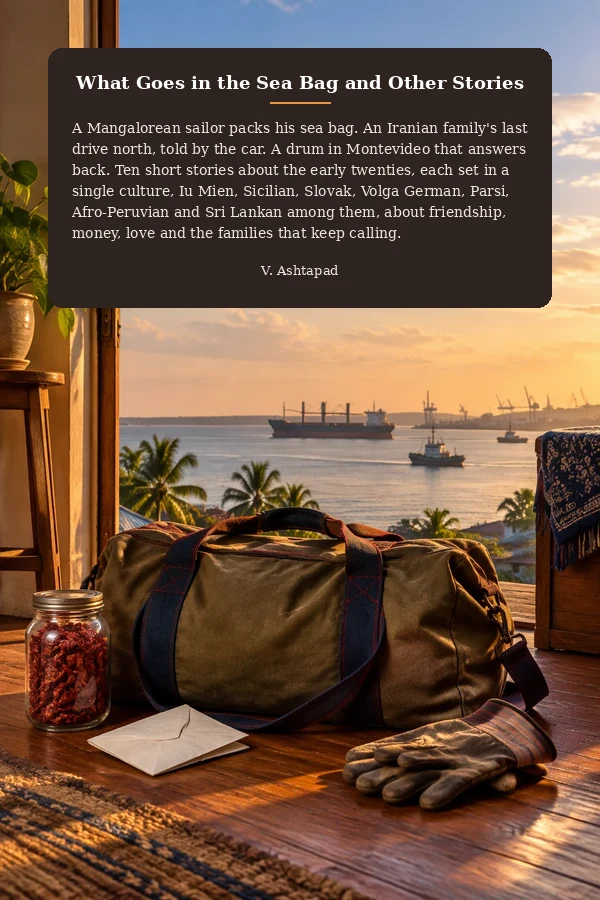
A Mangalorean sailor packs his sea bag. An Iranian family's last drive north, told by the car. A drum in Montevideo that answers back. Ten short stories about the early twenties, each set in a single culture, Iu Mien, Sicilian, Slovak, Volga German, Parsi, Afro-Peruvian and Sri Lankan among them, about friendship, money, love and the families that keep calling.
Members can react to this book and talk about it in the members' Library.
Ownership
© 2026 CRUNOD LLC. All rights reserved.
This book is owned by CRUNOD LLC. It is free to read on EternalCurrent.Online. No part of it may be copied, reprinted, sold, recorded or adapted, including as audio, film or translation, without written permission from CRUNOD LLC.
© 2026 CRUNOD LLC. All rights reserved.