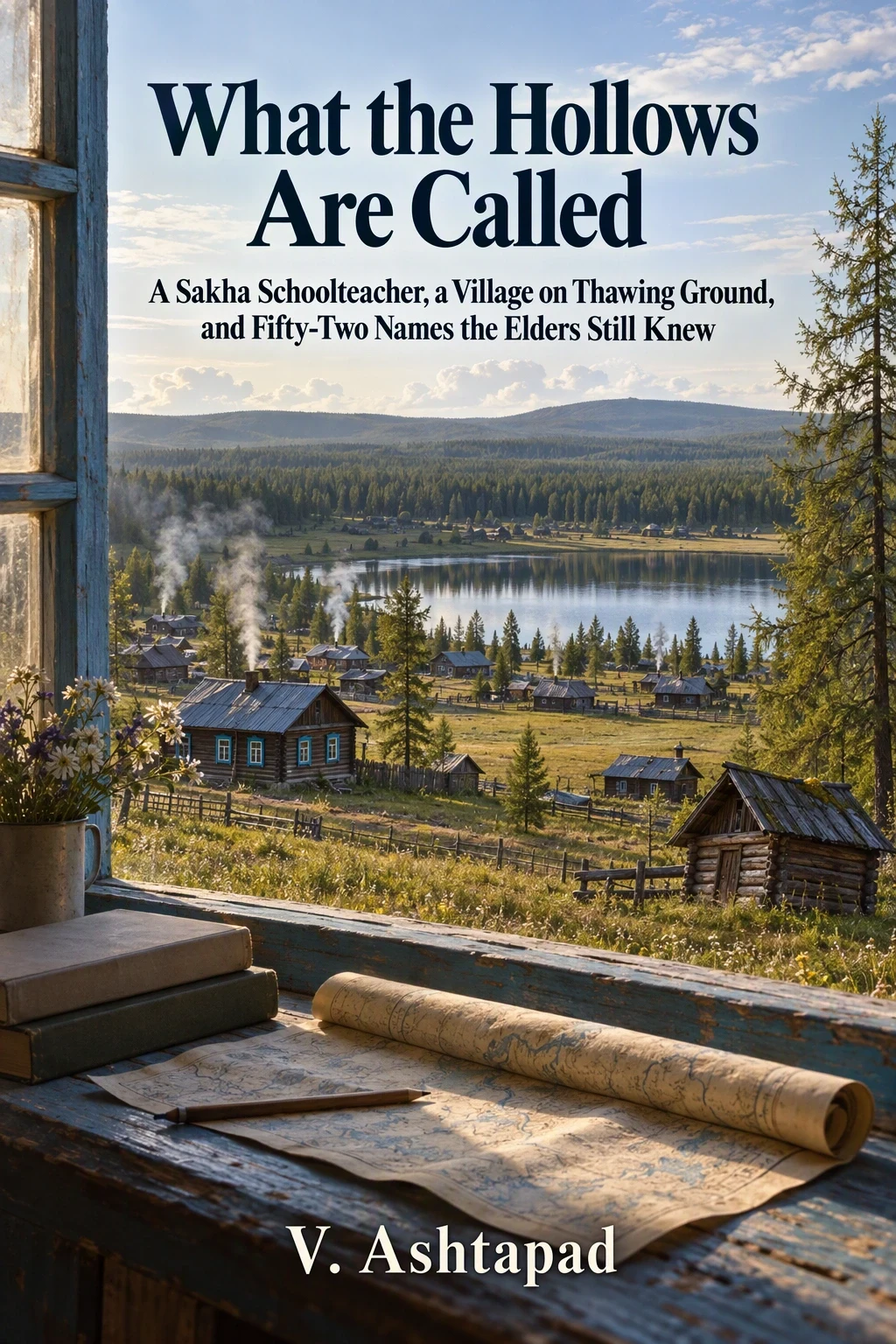
What the Hollows Are Called
A Sakha Schoolteacher, a Village on Thawing Ground, and Fifty-Two Names the Elders Still Knew
by V. Ashtapad
Foreword
This is a work of fiction. The alaas landscape of central Yakutia, permafrost thaw and thermokarst, winter ice-cutting for drinking water, the khomus, kumys, stroganina, salamat and kuerchekh are real. The village, its school, its lakes and hollows and their names, the permafrost institute's visitor and every named person in the story are invented.
For the teacher who asked the old people what the places were called, and wrote it down.
Ulakhan Alaas: The Big Hollow
The village is in a hollow. Everything here is in a hollow. That is the first thing I tell the sixth class every September, standing at the window with the map rolled up under my arm: look out. What do you see?
They see what they always see. The road, the school fence, the larches, the houses with their blue window frames, the smoke going straight up in the still air. They do not see the hollow, because they are in it. You cannot see a bowl from the bottom of the bowl.
So I unroll the map and show them. Our village sits in a round, flat-bottomed basin about two kilometers across, with low wooded slopes on every side and a lake at the north end. The grass grows thick on the floor. The forest grows on the rim. This is an alaas, I tell them, the way your grandparents would say it. The Russian geographers borrowed our word. You will find it in their textbooks.
Then I tell them how an alaas is made, which is the part I always liked as a girl. Under the forest there is ice. Not ice like on the lake. Ice in the ground, in great wedges and lenses, from the time of the mammoths, tens of thousands of years old. Once, long ago, the forest burned, or the climate warmed, and the ice under it began to melt. The ground sank where the ice had been. Water collected in the sinking place and became a lake. The lake grew, slowly, over thousands of years. Then it drained, or dried, and the lake floor became meadow, and the people came with their horses and their cows and made hay on it, and built their houses around its edge. That is an alaas. A meadow that was once ice, then water, then grass.
Every year one of them asks the question I asked my own teacher. Is it still melting?
For twenty years of teaching the answer was: no, children. It happened long ago. Now the ground is frozen. Our ancestors chose these places because they are stable and good.
This year I did not say that. This year, the first week of September, a boy named Erchim put up his hand and said, "My grandmother says our banya is falling into the ground." And everyone laughed, because a bathhouse falling into the ground sounds like a joke, and then a girl named Aitalina said, "Ours too. The corner. My father put a jack under it." And then three more hands went up.
I put down the map.
---
My name is Sardaana Nikolaevna. I am thirty-eight. I teach geography and, on Thursdays, Sakha language and literature to the older classes, because the other language teacher retired to her daughter's in Yakutsk and they have not found anyone. The village school has one hundred and twelve pupils from the first class to the eleventh. Our building is brick, two stories, painted yellow in 1987 and not since. The heating comes from the boiler house across the road, which burns coal delivered on the winter road in February.
I was born here. I went to the university in Yakutsk and studied geography, and I married a man from this village, Erel, whom I had known since the first class, who drove a grader for the district roads and kept nine horses in the forest because his father had kept horses, and his grandfather. We came back to live in his mother's house at the south end of the alaas, by the road. My son Aiaal was born there. Erel died three winters ago, of his heart, in January, at forty. He was clearing snow on the road to the next village and he stopped the grader and laid his head on the wheel. The man who found him said the engine was still running and the cab was warm.
I tell you this so you know who is speaking. I am not a scientist. I am a widow who teaches children what the land is called. I did not set out to do anything important. I set out, that September, to answer a boy's question about a bathhouse.
© 2026 CRUNOD LLC. All rights reserved.
Kyra Küöl: The Little Lake
Erchim's grandmother is named Tuyaara Petrovna. She is eighty-two. She lives at the east side of the alaas in a log house with a tin roof, beside the ruins of the old collective farm barn, where she worked as a milkmaid from the age of fifteen until the farm closed in the nineties. She has eleven grandchildren. She has a television that is always on, with the sound off, and a small black dog named Khatys who sits on the stove.
I went to see her the second week of September, after school, with Erchim. It was the season of the first frost. The birches on the rim of the alaas had turned yellow all at once, as they do here, in three days, and the light in the afternoon was thin and gold and came in low through the larches so that every trunk had a long shadow lying across the grass. The hay was in. The stacks stood around the meadow in their fences, round and brown, like a ring of old men in hats.
The bathhouse was behind her house. It was a small log building, half the size of a room, with a stovepipe. The far corner had sunk. Not a little. The whole corner had dropped perhaps forty centimeters, so the building leaned like a drunk against a fence, and the door would not close, and there was a gap between the bottom log and the ground on the high side where you could put your arm in.
"Three summers," said Tuyaara Petrovna. "First a crack in the floor. Then the door. Then this." She tapped the low corner with her stick. "My husband built this banya in 1968. It stood straight for fifty years."
I crouched and looked under the high side. The ground under the bathhouse was wet. In September, when everything should be drying and stiffening for winter, it was wet and dark and soft as porridge, and it smelled of old leaves and something sour underneath. I put my hand in it. It was cold, but not frozen.
"There is a little lake coming," said Tuyaara Petrovna.
I looked at her.
"Here," she said, and drew a circle on the ground with her stick, around the bathhouse and the woodpile and half her potato garden. "When I was a girl, before this house, before my husband, there was a little lake here. Kyra küöl. Very little. The cows drank from it. Then it went dry, and there was grass. And now," she tapped the ground, "it is coming back."
"How do you know it was here?"
She looked at me with a kind of pity, as if I had asked her how she knew it was September.
"My mother told me," she said. "And her mother told her. The old people always said, a lake goes and a lake comes. They said, do not build where a lake has been. My husband did not listen. He was from Churapcha." She said the name of the district as if it explained everything.
---
That evening I sat at my kitchen table with the school's topographic map from 1984 and a pencil and looked for Kyra Küöl. It was not there. The map showed the alaas, the big lake at the north end, the road, the collective farm buildings. East of the farm, where Tuyaara's house now stood, there was nothing. Meadow.
I looked at the old Soviet survey map, from 1952, that hung in the school corridor in a frame, the one we take down every year to show the seventh class how the village has grown. There was nothing there either. But in the margin, in small pencil handwriting, someone had written a column of names. They were Sakha names, written in Russian letters, and beside each one a number, and the numbers matched small circled numbers on the map. Twelve names. I had walked past that map perhaps five thousand times and never once read the margin.
Number seven was in the place where Tuyaara Petrovna's house now stood. Beside it, in pencil: Kyra Küöl.
My mother-in-law, Varvara, came in from the other room and found me sitting with the frame off the wall on the kitchen table at eleven at night.
"You will go blind," she said.
"Look," I said. "Someone wrote the names."
She looked. She is seventy-four. She put on her glasses. She read down the column, moving her lips. Then she put her finger on number three and said, "Ah. That one. That is Ataakh."
"What is Ataakh?"
"The hollow with the forked lake. Like a fork." She held up two fingers. "Up past the old hayfield on the north road. My father used to make hay there. It went dry when I was small. Now it is all willows." She lowered her chin and regarded me above the rims. "Who wrote this?"
"I don't know."
"Somebody who was listening," she said, and went back to bed.
© 2026 CRUNOD LLC. All rights reserved.
Ataakh: The Forked Hollow
Here is what I knew about permafrost in September, as a geography teacher with a university degree: it is ground that stays frozen for at least two years in a row. In central Yakutia it is very deep, hundreds of meters. The top meter or two, the active layer, thaws in summer and freezes again in winter. Below that, the ground stays frozen all year. In some places, in the old sediments, there is a great deal of ice, more ice than soil. Those places are called yedoma. Our village sits on yedoma. Most of central Yakutia does.
Here is what I learned in October, when I wrote a letter to the permafrost institute in Yakutsk and asked them to send someone, and they sent a young woman named Kyunney Vasilyeva on the bus with a drill, a laptop, and a box of thermometers on cables:
The active layer is getting deeper. Each warm summer it reaches a little farther down, and when it reaches the ice, the ice melts, and the ground above it sinks. Not evenly. The old ice wedges melt first, so the ground sinks along their lines, in a pattern like a honeycomb or a waffle, with mounds left standing in between. In the forest you can see it in the trees, which lean in all directions, like drunk men. The Russian word is "drunken forest." In the hayfields you can see it in the mounds, which the old people call bylar. In the village you see it in the bathhouses.
"And then?" I asked her.
We were standing in Ataakh, the forked hollow, which my mother-in-law remembered as a lake and which was now a thicket of willow and birch, knee-deep in snow, with a strange humped floor. Kyunney had drilled a hole and dropped one of her thermometers into it on a cable. She was twenty-nine, from a village in Megino-Kangalassky district, with a round face and her hair in a long braid under a fox hat, and she had a way of looking at the ground as if it were a patient she was very fond of.
"And then the water collects in the low places," she said, "and makes new ponds. Water is warmer than ice. So the ponds melt the ice under them faster. So they get deeper. So they grow." She shrugged. "This is how your alaas was made, a long time ago. It is happening again. Faster."
"Will it make a new alaas?"
"In a few thousand years." She smiled. "Maybe. If no one is in a hurry."
"And the village?"
She looked at her thermometer cable a while before she answered. "Some houses will be fine. Some houses are on bad ground. It depends what is under them. That is why I want to drill under the houses. And the school." She looked back up the hill toward the village, where the smoke from forty chimneys stood up in the cold air like fence posts. "And it would help," she said, "to know where the old lakes were. The ones that are gone. Because a place that was a lake before is a place where the ground has already moved once. It may move again."
I took the photograph of the 1952 map out of my pocket and showed her the margin.
She read it. Then she looked at me with her round face very still, and said, "Who else knows these?"
© 2026 CRUNOD LLC. All rights reserved.
Ot Kholbuka: The Hay Crossing
Nobody else knew all twelve. That was the answer, in the end. Nobody alive knew all twelve names on the 1952 map. But everybody over seventy knew some of them, and several knew names that were not on the map at all.
I made it the sixth class's project for the winter. I did not call it a project. I said: each of you has a grandmother or a grandfather or an old neighbor. Ask them what the hollows and lakes and streams around the village are called. Ask them what each name means and why it has that name. Ask them what was there when they were young. Write it down. Or, better, record them, so we have their voices. Bring it back.
Eleven children went home that Friday with the instruction. Nine came back on Monday with something. One, a boy named Kirill whose family had moved from Yakutsk two years before, came back with nothing, because his grandparents lived in Yakutsk and did not know anything about our village. I sent him with Erchim to Tuyaara Petrovna. One, a girl named Saina, came back with a recording forty minutes long of her great-grandfather talking about a horse he had owned in 1961, which mentioned no place names whatsoever but which the class listened to all the way through, twice, because it was very funny.
Erchim came back with a list of six names from his grandmother, each with a story. Aitalina came back with four. And Aiaal, my son, came back with his grandmother, Varvara, who came into the classroom on Monday morning in her good coat and sat down at the front and said, "I am told there are questions."
---
The names were the easy part. The hard part was knowing where they were.
An old person does not say: the lake at sixty-two degrees north, one hundred and thirty degrees east. An old person says: past the hay crossing, where the road used to bend before they straightened it, on the left side going toward Ulakhan, where my uncle's mare drowned. And you must know where the hay crossing is, and where the road used to bend, and which uncle, and which mare.
So we needed someone who had walked all of it. That was Nyurgun Egorovich.
He is seventy-nine. He was a horse herder for the collective farm and then for himself, and for fifty years he rode the forest and the hayfields around the village in every season. He lives alone now in a small house at the west end of the alaas with an old gray stallion that he no longer rides, and a cat, and a khomus, a jaw harp, that he plays in the evenings on his step when the weather is warm. You can hear it all down the road, that twanging, buzzing sound like a mosquito singing. My husband used to say that Nyurgun's khomus was the sound of summer in this village.
I went to him with Erchim and Kirill and Aiaal on a Saturday in late October. The snow had come. It came in the second week of October, as it does, and stayed, as it does, and the cold had settled down over the alaas like a lid on a pot, minus twenty-five in the morning and minus fifteen at noon. The children wore their fur hats with the flaps down and their faces wrapped to the eyes. Nyurgun Egorovich met us at his gate in a quilted coat and felt boots and no hat at all.
"Show me," he said.
I unrolled the 1952 map on his kitchen table, which was covered in an oilcloth printed with red strawberries. He did not look at the margin. He looked at the map itself, a long time, bent over it with his hands flat on the table on either side, the way a man looks at a horse he is thinking of buying.
Then he put one finger on it, on the road west of the village, at a place where nothing was marked.
"Ot kholbuka," he said. "The hay crossing. In winter we crossed the river here with the hay sledges, on the ice, from the fields on the other side. Every family. Fifty sledges in a day. The horses knew the way in the dark." He moved his finger. "From here, you go north. There is a hollow here," and he tapped a blank place, "called Kyys Alaas. The girl's hollow. Because a girl got lost there in a blizzard, before the war, and they found her alive in the morning, under a haystack, with a calf. And here, past it, Senokosilka."
The children looked at each other.
"Senokosilka?" said Kirill. "That's Russian. That's a mowing machine."
"It is a mowing machine," said Nyurgun Egorovich. "A big one. Red. In 1974 the farm sent it out to cut the hollow and it went into a wet place and sank to the axles and they never got it out. It is still there. You can see it in summer. A bear lives under it." He shrugged. "So the hollow is called Senokosilka. What else would you call it?"
The children laughed. Aiaal laughed so hard he had to sit down on the floor.
"Before the mower," I said. "What was it called before?"
Nyurgun Egorovich frowned. He looked out the window at the snow for so long that I thought he had not heard.
"My father called it something else," he said finally. "I don't remember." He tapped the table, once, twice. "That is bad. I should remember."
---
We recorded him that afternoon for three hours. I held the telephone. The children held the map. Every time he named a place, Erchim put a small round sticker on it and wrote a number, and I wrote the number and the name in my notebook, and Kirill typed it into the laptop the school had lent us. By the end of the afternoon there were thirty-one stickers on the map. Twelve were the names in the 1952 margin. Nineteen were new.
When we got back to the school on Monday, Kirill showed the class how to put each place on the computer map, the real one, with the satellite pictures, and attach to it the recording of whoever had named it, and a photograph. Then he showed them something else: you could ask the map to remind you, every month, to go and look at a place again, and take a new photograph from the same spot, so that over time you could see if it was changing.
"Like checking on a sick person," said Saina.
"Like checking on a horse in the forest," said Erchim, whose family keeps horses.
Thirty-one places. Eleven children. Every month, each child would go to three places and take a picture from the marked spot and write down what they saw. Water, ice, mounds, trees leaning, a new crack. The map would remember the rest.
I did not tell them it was science. I told them it was visiting.
© 2026 CRUNOD LLC. All rights reserved.
Muus Küöl: The Ice Lake
In December we cut ice.
I should explain this for anyone who has not lived in a Sakha village. Most of the year, our water comes from a truck that fills the tank in each yard from the big lake. But in winter the truck cannot run every day, and the old people say the lake water is not good enough for tea anyway, because it tastes of the pipes. So in December, when the ice on Ulakhan Küöl, the big lake at the north end of the alaas, is a meter thick, every family goes out with saws and cuts blocks of ice and hauls them home and stacks them in the yard. All winter you bring one block in at a time and put it in a tub by the stove and let it melt. That is your drinking water. Tea made from melted lake ice tastes, my mother-in-law says, like the inside of a clean cup.
Erel always cut our ice. He had a long two-man saw that had been his father's, and he would go out with his brother, and they would come back at dark with the sledge piled high with blue-white blocks the size of suitcases, steaming in the cold, and stack them against the north wall of the shed where the sun never reached. Aiaal would walk along the top of the stack like a little goat.
Three Decembers I had paid a neighbor to cut our ice. This December, Aiaal said he wanted to do it.
He is eleven. He is small for his age and very serious, with his father's way of standing with his feet apart. He said, "I can saw. Ivan's father taught me on the fence." I said the ice is not the fence. He said, "I know, Mama. The ice is easier. The fence has nails."
So we went out on the last Saturday before the school holiday, Aiaal and me and Varvara, who would not stay home, and our dog Khara, who is black and stupid and loves the snow, and Nyurgun Egorovich, who came along without being asked because he said the boy needed someone who knew what he was doing. It was minus forty-four. At that temperature the air does not move. Your breath comes out and hangs in front of your face in a little cloud and freezes and falls as a tinkling dust. Sound carries for kilometers. We could hear a dog barking in the next village, and someone splitting wood, and a truck's engine coughing to life somewhere on the road, and then our own runners creaking on the snow.
Ulakhan Küöl was white and flat and enormous, with the sun just lifting over the larches on the far side, red as a coal, and all across it the dark rectangles where other families had already cut, like doors in the snow. Nyurgun Egorovich walked out onto the ice and stamped on it, and listened, and walked a little farther, and stamped again.
"Here," he said.
Aiaal swept the snow off with a broom. The ice underneath was black and clear, so clear that you could see down into it, see the white streaks of bubbles caught in it, frozen as they rose, like strings of pearls, and below that, darkness. Khara put her nose to it and barked at her reflection.
They cut. Nyurgun Egorovich on one end of the saw and Aiaal on the other, pulling and pushing, slow, the blade going down into the ice with a sound like someone tearing cloth. Varvara sat on the sledge wrapped in a blanket with a thermos of tea and shouted encouragement. I stood and watched my son. I will say it plainly. I watched him and saw his father, and could not see clearly for a while, and the tears froze on my lashes so that every time I blinked my eyes stuck shut.
They cut eighteen blocks. It took four hours. Aiaal did not complain once. When the last block was on the sledge he stood on top of it with his arms up, like the little goat he used to be, and Nyurgun Egorovich said, "Good. Now you know how. Next year you can teach someone."
---
On the way home, at the edge of the lake, Nyurgun Egorovich stopped the horse and looked back across the ice.
"This used to be bigger," he said.
"The lake?"
"The lake. When I was a boy, the shore was there." He pointed with his chin at a line of birches perhaps two hundred meters behind us, on dry ground, in the snow. "We cut ice there. My father and me. Now it is land."
"So the lake is drying?" I said. "Not growing?"
"This one is drying," he said. "Others are growing. Kyra Küöl is coming back under Tuyaara's banya. Ataakh went dry and now it is wet again. This one," he looked at Ulakhan, "this one is going somewhere. I don't know where." He clicked to the horse and we went on. "The land is moving," he said, after a while, as if to himself. "Everything is moving at once. Like when you open the gate and all the horses come out."
That night I wrote it down in my notebook, under Ulakhan Küöl: *The shore was two hundred meters north in the 1950s, per Nyurgun Egorovich. He says, "This one is going somewhere."*
And under it, because I could not help it: *Aiaal cut eighteen blocks.*
© 2026 CRUNOD LLC. All rights reserved.
Baakhylai Alaas: The Hollow That Was Renamed Twice
The coldest week came in the middle of January, as it does. Minus fifty-two on the thermometer outside the school door. At minus fifty the primary classes stay home, by rule, and at minus fifty-five everyone does. We were in between. Half the classroom was empty and the other half sat in their coats.
That week Aitalina brought in her grandmother's story about Baakhylai Alaas.
It is a hollow south of the village, past the boiler house and the old fuel depot, a small round meadow with a pond at one side that freezes to the bottom every winter. On the 1952 map it is number nine, and in the margin, in that same pencil hand, it is called Baakhylai. On the 1984 map it is not named at all, but there is a little rectangle and the words Field No. 4. On the district land map we got from the administration, which is from 2011, it is called Sovkhoznoye, after the state farm. And on the sign by the road, which the young people put up for the summer festival three years ago, painted on a board, it says Baakhylai again.
"So which is it?" said Kirill, who likes things to be one thing.
"Listen," said Aitalina, and pressed play.
Her grandmother's voice came out of the telephone, slow and deep, a smoker's voice: Baakhylai was a man. Not a famous man. A man from our village, long ago, before the revolution, before anyone's grandparents. He had a lot of cows and one daughter. He made his summer camp in this hollow, every year, with a balagan, a summer house of logs and clay, and his daughter milked the cows and made butter and kuerchekh, whipped cream with berries. And one summer a man came from the next district and married the daughter and took her away. And Baakhylai was so sad that he stayed in the hollow all winter, alone, in his summer house, which you do not do, because the summer house is not made for the cold. And in the spring they found him alive and very thin, sitting by the pond with his cows, and he said he had been waiting for her to come back. So the hollow is called Baakhylai. For a man who waited.
"Did she come back?" said Saina.
The grandmother's voice, on the recording: *Every summer. With her children. To milk the cows.*
---
Then Aitalina played the second part. Her grandmother explained that in the 1930s, when the collective farm came, all the hollows were given numbers. Field No. 1, Field No. 2. The hayfields were measured and the numbers painted on boards. Then, later, the state farm called them by other names, Russian ones, after the farm or after the brigade that worked them. The old people went on using the old names among themselves. The young people learned the numbers at school and the old names at home. "We had two maps," said the grandmother. "One on paper and one in the mouth."
I did not want this to become a lesson about the past. That was not what the children were doing, and not what I was doing. I said only: a place can have more than one name, because more than one kind of person has looked at it. The farm saw a field. Baakhylai saw a place to wait. Both are true. Write down both.
So we did. On the computer map, under number nine, Kirill typed: *Baakhylai Alaas (Sakha, for the man who waited). Field No. 4 (collective farm, 1930s). Sovkhoznoye (state farm, from 2011 land map).* And beside each name, where it came from and who told us.
Then Erchim said, "What will it be called next?"
Everyone looked at him.
"If it turns into a lake," he said. "Like Tuyaara's banya. If the pond grows. What will it be called then?"
Nobody had an answer. I wrote the question on the board and left it there for the rest of the winter.
© 2026 CRUNOD LLC. All rights reserved.
Kuerchekh: The Tea for the Old People
At the end of January the children decided to invite the elders to the school.
It was Saina's idea, and her reasoning was practical: it was too cold to go to everyone's house, and the old people liked to argue, and they argued best in a group. So on the last Saturday of January the sixth class pushed the desks against the walls of the classroom and covered two of them with the white tablecloths from the school canteen, and their mothers brought food, and at two o'clock in the afternoon, at minus forty-one, fourteen people between the ages of seventy and ninety-one came in out of the cold in their furs and felt boots and stood in the doorway stamping and steaming, and the children took their coats.
I want to tell you what was on the table, because it matters. In a Sakha house you do not talk to old people without feeding them.
There was stroganina: frozen fish, whitefish from the river, shaved in long thin curls with a sharp knife so that it comes off like wood shavings, pink and white, and you eat it at once, still frozen, dipped in salt and pepper, before it melts in your fingers. There was salamat, the porridge of flour fried in butter until it is brown and smells like toasted bread, thick and heavy as clay, with a pool of melted butter in the middle. There was frozen horse liver, sliced. There were oladyi, the little fried pancakes, in a heap, with sour cream and jam made from lingonberries and from the small black currants that grow by the streams. There was a big bowl of kuerchekh, cream whipped with a wooden whisk until it stands up stiff, with crushed strawberries folded in, from the freezer, picked last July. There was tea, very strong, from a samovar that the director had brought from his own house, and the children carried the cups to each person with both hands.
The old people ate first and talked after. That is the rule.
---
When they had eaten, Kirill set up the laptop at the front, connected to the projector, and put the map on the wall, the computer one with the thirty-one stickers turned into thirty-one glowing dots, and Saina stood beside it with a pointer, and Erchim read the names out one by one. After each name he stopped, and said: who knows this place?
That was the mistake. Or the success. I am still not sure which.
Because at the first name, Ot Kholbuka, the hay crossing, three old men put up their hands at once, and each had a different story about where exactly the crossing had been. One said it was at the bend. One said it was below the bend, where the river was shallow. One said the crossing moved every year, depending on where the ice was strongest, and the other two were both wrong and both right. They argued for twenty minutes. Their voices rose. One of them, a very small man named Semyon Afanasyevich who was ninety-one and had been a schoolteacher himself, banged his tea glass on the table so hard that the tea jumped out.
The children watched this with enormous delight. It was, Erchim said later, better than television.
I let it go on. Then I stood up and said: wait. All three of you have walked that crossing more times than anyone else alive. Tell the children each one, separately. Slowly. Where you crossed, and when, and with whose horse. And we will write all three.
They looked at me. Then they looked at each other. And then, very slowly, Semyon Afanasyevich, the angriest, said, "I crossed below the bend. In 1948. With my uncle's gray mare. Because the ice above the bend had cracked in December and my uncle said never trust ice that has cracked once." And then the second man said, "I crossed at the bend. In 1960. Because by 1960 the river had moved, and the shallow place was at the bend." And the third said, "You see? It moved. I told you."
And then all three of them laughed.
---
We recorded for three hours. Fourteen old people. They corrected each other, they interrupted each other, they told stories that had nothing to do with any place, about weddings and wolves and a schoolteacher in 1952 who used to hit the boys with a ruler. Semyon Afanasyevich, when he heard about the 1952 map, said, "That was me. I was the schoolteacher. Not the ruler. The map." And everyone turned to look at him.
"I wrote the names in the margin," he said. "In 1953. The surveyors came from Yakutsk and made the map and gave the school a copy, and there were no names on it, only numbers. And I thought, this is wrong. So I went to the old people, like you, and I asked them, and I wrote down what they said. Twelve names. Then I was sent to another district and I forgot."
Nobody spoke.
"I forgot," he said again, "for seventy years. And you found it." He looked at the children, all in a row against the wall, with their mouths open. "Good," he said. "Good. Now do it better than me. I only got twelve."
© 2026 CRUNOD LLC. All rights reserved.
Senokosilka: The Mower
In February Kyunney came back from Yakutsk with two men and a drill on a sledge, and they drilled under the school.
The school is on bad ground. I knew it as soon as I saw her face when the first core came up. The drill brought up a cylinder of earth as long as my arm, gray and brown and frozen solid, and then, below that, a cylinder of pure ice. Clear ice, with a few dark threads of root in it. Then more ice. Then more. Kyunney measured it, and wrote, and measured again, and when she was done she said that the northwest corner of the school, the corner with the gym, was built on the edge of an ice wedge, and the active layer was already only forty centimeters above it.
"What does that mean?" said the school director, who is a careful man named Pavel Innokentyevich and who had come out in his good coat to watch.
"It means you have some years," said Kyunney. "Not many. You should put the corner on piles. Steel. Deep. Below the ice. And make sure the snow is cleared away from the walls in spring, so the melt does not run under. And make sure the heat from the building does not go into the ground." She looked at him. "This is what we tell everyone."
The director said he would write to the district. I knew what that meant. Kyunney knew what that meant too. But she wrote it all down for him on a sheet of paper in very clear handwriting, with numbers, and signed it, and he folded it and put it in his good coat, and we all went inside to drink tea.
---
That afternoon, because she had an hour before the bus, Kyunney asked to see Senokosilka.
It was the first fine day after the cold. Minus twenty-eight and a blue sky with no wind, and the sun up for eight hours now instead of five, and the snow so bright it hurt. Nyurgun Egorovich drove us on his sledge with his old gray stallion, Kyunney and me and Aiaal and Erchim, out along the north road past the hay crossing, past Kyys Alaas where the girl had slept with the calf, to a small hollow ringed with crooked larches.
In the middle of it, half buried in snow, was the mower. It was bigger than I expected. The red paint had gone almost brown, flaking, and the long cutting bar stuck out one side like the arm of a scarecrow. The wheels were sunk to the axles, as Nyurgun Egorovich had said, and the seat was gone. It leaned a little to one side. Around it the snow lay in odd humps and hollows, lumpy, like a quilt thrown over sleeping animals.
"Bylar," said Nyurgun Egorovich, pointing at the humps.
"Thermokarst mounds," said Kyunney, at the same time.
They looked at each other. Then Kyunney laughed. "Same thing," she said.
"Is the bear there?" said Erchim.
Nyurgun Egorovich looked at the mower with great seriousness. "Asleep," he said. "Don't wake him."
The boys backed away at once. Kyunney did not. She walked slowly around the edge of the hollow, looking at the ground, stopping, crouching, brushing the snow away with her mitten. At one point she lay down flat on her stomach in the snow and put her ear to it, and Aiaal looked at me in alarm, and I shook my head, and he looked at her again with great respect.
When she came back she said, "This hollow is sinking. Not like the school. Faster. In ten years maybe it will be a pond." She looked at the mower. "Your machine will be in a lake."
Nyurgun Egorovich stood beside his horse with his hands in his sleeves.
"I remember now," he said. "What my father called it. Before the mower."
We all waited.
"Küöl Ologo," he said. "The bed of the lake. Because when he was a boy the old people said there had been a lake here once, long before, and it had dried up, and it would come back." He looked at the humped snow. "They knew. They knew, and we put a machine in it."
He said nothing else. We drove home. Kyunney caught her bus. That night, on the computer map, under Senokosilka, Kirill added the old name, and the recording of Nyurgun Egorovich saying it, with the wind and the horse's breath in the background. I listened to it four times before I went to sleep.
© 2026 CRUNOD LLC. All rights reserved.
Kyys Küöl: Varvara's Lake
My mother-in-law had not told us her own names yet. She had told the class the names she had learned from other people. In March she told me hers.
It was evening. The light was coming back fast now, as it does in March, a few minutes more every day, so that at six o'clock there was still a blue glow over the larches on the west rim and the snow on the alaas floor was the color of milk. We were in the kitchen. The block of ice was melting in the tub by the stove with a sound like a clock. I was marking the eighth class's tests on river systems. Aiaal was asleep. Varvara was mending the lining of his winter coat with a needle held very close to her eyes.
"There is a lake that is not on your map," she said, without looking up.
"Which?"
"A small one. In the forest, east, past the old cattle barns, past where the road to the next village used to go. You have to walk. It is called Kyys Küöl. The girl's lake. Not the girl in the blizzard. A different girl."
"Who?"
She bit off the thread. "Me."
I put down my pen.
"When I was fourteen," she said, "I went with the other girls to the summer camp to milk the cows. The farm had a camp in the forest, east. Long gone now. Every day after milking I walked to that lake to wash. It was very small and very round and the water was so clear you could see the bottom, all little stones. Nobody else went there. It was my lake. I told the other girls it was haunted so they would not come." She smiled at the coat. "One day I was there, washing my hair, and a boy came out of the trees on a horse, looking for a lost cow. And I screamed and threw a stone at him. And he fell off the horse." She threaded the needle again. "That was Erel's father."
I had heard many stories about Erel's father. I had never heard this one.
"After that," she said, "the other girls called it Kyys Küöl. Because I had thrown the stone. Kyys, girl. They said, Varvara has a lake now. Varvara hits boys with stones at her lake." She laughed a little. "Erel knew. His father told him. When Erel was small he used to ask me to take him to my lake, and I took him once, when he was seven, and he swam in it and came out blue with cold and said it was the best lake in Yakutia." She stopped. "I have not been there since."
We were quiet for a while. The ice ticked in the tub.
"Is it still there?" I said.
"I don't know," said Varvara. "I am afraid to go and look."
---
In April, when the snow was going rotten and gray and the forest floor was a mess of slush and dark water, Aiaal and I walked east to find it. Varvara drew the way on a sheet of paper. Past the old barns. Past the three dead larches. Down a little slope where there used to be a path. Khara came with us and got wet to the shoulders in the first ten minutes and was happy.
We found the place where she said it would be. It was not a small round lake with a stony bottom anymore. It was larger, much larger, a sheet of gray, half-melted ice with black water at the edges, spread out among the birches. Some of the birches stood in the water up to their knees, leaning. The shore had come up into the forest. The round lake had become a wide, shapeless pond, still growing.
Aiaal stood at the edge with his boots in the water and looked at it.
"It's bigger," he said.
"Yes."
"Is that bad?"
I thought about how to answer. "It's what's happening," I said. "Everywhere. Some lakes are drying up and some are growing."
He thought about it. Then he took out his telephone and took a picture, from the place where the path came down, the way the class did every month at their places. Then he said, "Can I put it on the map? Grandmother's lake? Even if it's different now?"
"Yes."
"Can I put the story? About the stone?"
"Ask her."
That evening he asked her. She was quiet. Then she said, "Show me the picture."
He showed her. She looked at it a long time, holding the telephone very close to her eyes. Then she gave it back and said, "Yes. Put the story. And put that it was small when I was young. And put that your father swam in it. So whoever comes later knows what it was."
© 2026 CRUNOD LLC. All rights reserved.
Bylar: The Mounds
Not everyone in the village wanted the map.
I should say that, because otherwise it will sound as if the whole village gathered around the children and the old people and sang. It was not like that. In April, when the class put the map up in the corridor by the canteen, with the pins and the photographs and the recordings you could play by touching the screen, a parent came to see me after school.
His name was Pyotr, Kirill's father. He works for the district administration, in the office in the district center that handles land and buildings, and he moved his family to the village from Yakutsk two years before, because his wife's mother was here and needed help. He is a reasonable man, a tidy man, with a short beard and glasses, who always wore a tie to parents' meetings when no one else did.
He stood in front of the map in the corridor and looked at it a long time. Then he said, "Sardaana Nikolaevna, may I speak to you."
We went into my classroom. He did not sit down.
"I understand what the children are doing," he said. "It is very good for them. History, language. All of that. I am not against it." He took off his glasses and cleaned them. "But I want to ask you to be careful."
"Careful how?"
"This map," he said, "shows which places are sinking. Which places used to be lakes. Which places are on bad ground." He put his glasses back on. "My house is on the map. I am number thirty-eight. You have a picture every month of the crack in my yard. Every person who walks into the canteen can see that my house is on bad ground."
I had not thought of it that way. I said so.
"Some people in this village have their whole life in their house," he said. "Their children's future. If they want to sell, someday, to move to the city, what will a buyer say? Or the bank? If there is a map in the school corridor that says, this house is sinking." He shook his head. "I am not saying hide it. I am saying, think who can see it."
---
I want to tell you that I argued with him. I wanted to. I wanted to say: the ground does not care who can see it. The ground is sinking whether there is a map or not. A buyer who does not know is a buyer who is being cheated.
I did not say those things. Not because they were wrong. Because I had been a teacher for twenty years, and I knew that when a parent comes to you with a fear, the fear is the thing you must answer, not the argument.
So I asked him to sit down. He sat. I asked him what he was most afraid of. He thought about it, and then he told me. Not the bank. Not the buyer. His wife's mother, who was eighty and lived with them, and who had been born in the house, and who did not know yet about the crack in the yard, because he had not told her, because she would be frightened, and he did not want her to see it in a picture on a wall at the school when she came to watch Kirill's concert.
I listened. Then I asked him what he would do, if it were his map.
He said, "I would keep the crack pictures for the families. Each family sees its own. The school sees the lakes and the hollows. The names. The stories. Not every crack in every yard."
I said that seemed right to me.
It was not hard to do. Kirill showed me how, the same evening, with his father standing behind him at the laptop, looking a little embarrassed. The places in the forest and the meadows, the lakes, the hollows, the glade, those stayed open for the school and the village to see. The pictures of yards and houses, each family could see their own, and Kyunney at the institute could see them all, for the science, and no one else. It took Kirill twenty minutes. At the end he turned around and said to his father, "You could have just asked me," and Pyotr laughed for the first time.
Before he left he said, "Sardaana Nikolaevna. The crack. In my yard. Is it bad?"
"I don't know," I said. "Ask Kyunney. She will tell you the truth."
"That is what I am afraid of," he said, and put on his hat, and went out into the April slush.
© 2026 CRUNOD LLC. All rights reserved.
Sylgy Kyrdala: The Horses' Glade
Our horses live in the forest all winter. People who are not from here do not believe this. They think a horse must be in a barn at minus fifty. But the Yakutian horse is small and round and covered in hair as thick as a dog's, and it digs through the snow with its hooves to find last summer's grass, and it does not want a barn. It wants to be left alone. In spring you go and find it.
Erel's nine horses had become seven since he died. One mare was old and did not come back from the forest the first winter. One gelding Uybaan, Erel's younger brother, sold to pay for the stone. The other seven Uybaan watched for me. He lives in the next village with his wife and four children and drives a fuel truck, and he does not have time for his brother's horses, and he watches them anyway.
In the last week of April he telephoned and said: they are in the glade. The mares have foaled. Bring the boy.
The glade is called Sylgy Kyrdala, the horses' glade, and it is on our map as number seventeen, and nobody had to tell us its name because everyone knows it. It is a long clearing in the larches north of the village, on a south-facing slope, where the snow melts first in spring and the first grass comes up green as paint. The horses go there every year in April as if someone had rung a bell.
We drove out in Uybaan's truck with the windows open. The snow was nearly gone. The alaas floor was a sheet of brown water with the dry grass sticking up through it, and the ditches beside the road roared. The air smelled of mud and thawing manure and the sharp sap of the larches, which were just beginning to show the first faint green fuzz on their branches, like a shadow of color. Ducks were coming in. You could hear them overhead all day, the whistling of their wings.
The horses were at the top of the glade. Seven, and four foals, small and wobbly and very fluffy, standing close against their mothers' flanks and staring at us with their huge dark eyes. The stallion, a big dun named Kustuk, lifted his head and looked at the truck and did not move.
Aiaal got out and walked toward them slowly, with his hand out flat, the way his father taught him when he was four, and stopped at the distance his father taught him to stop, and stood. The mares watched. Kustuk watched. After a while one of the foals, a gray one, came three steps toward him on its stiff legs, and stopped, and stretched out its neck, and sniffed the air in front of his fingers. Then it ran back to its mother as if it had done something tremendously brave.
Uybaan stood beside me with his arms folded on the hood of the truck.
"He looks like Erel," he said.
"Everyone says so."
"No. Like Erel at that age. Exactly. The way he stands." He was quiet. Then he said, "You know Erel wanted to name a foal after you once. When you were married. A filly. He wanted to call her Sardaana. I told him you would kill him." He laughed. "He called her Saydy instead. You remember Saydy."
"The black one," I said. "She bit everyone."
"She bit everyone except Erel."
We watched the boy and the foal. Then Uybaan said, "Are you writing down the glade? In the school thing?"
"Everyone knows the glade."
"Write it down anyway," he said. "Everyone knows it now. Write down that the horses come here in April. Write down that the stallion's name is Kustuk and the boy's father kept horses here and his father before him. Write down that the snow goes first on this slope." He looked at me. "In twenty years, who knows if the snow will still go first here. Who knows if there will be horses."
So I did. That night I wrote it all down under number seventeen, and Aiaal put in a picture of the gray foal stretching out its neck toward his hand. Under the picture he wrote: *She is not named yet.*
© 2026 CRUNOD LLC. All rights reserved.
Tuora Küöl: The Lake Across
The lake drained on the night of the twentieth of May.
Tuora Küöl is, was, a long narrow lake on the north road, about four kilometers from the village, beyond the horses' glade. Tuora means across. It was the lake across the road. On the 1952 map it is number two. In my mother-in-law's childhood it was full of carp and little crucian fish, and in summer the boys swam in it and in winter the men fished through holes in the ice. In my childhood it was smaller, with a wide muddy shore, and nobody swam in it anymore because of the leeches. In Aiaal's class it was on the map, with a picture taken by Saina every month from the culvert where the road crosses the stream that comes out of its north end.
In April Saina's picture showed the lake gray with rotten ice and the stream full and brown. In May, on the eighteenth, it showed the ice gone and the water high, higher than it had been in March, right up into the willows.
On the morning of the twenty-first, Saina's father drove into the village at seven o'clock and stopped his truck in front of the school, and came into my classroom in his work clothes with his face strange, and said, "The lake is gone."
---
We went out there, the whole class, in the school bus, with the director, who came because he could not think of a reason not to.
The lake was gone. Where yesterday there had been a sheet of water two kilometers long there was a long, wet, gray-brown bowl of mud, gleaming in the sun, with a thin stream winding down the middle of it and a few pools of water left in the deepest places, where hundreds of small fish were flopping and gasping and silver in the light, and gulls had come from somewhere, dozens of them, screaming and diving. The smell was overwhelming. Mud and rot and fish and something old and sulfurous, from deep down.
At the north end, where the stream had come out under the culvert, there was no culvert anymore. There was a ravine. It was perhaps ten meters wide and four meters deep, with raw walls of black earth and gray ice, cut through the ground as if with a giant knife, and down at the bottom the water was still running, fast and brown, and chunks of earth were falling into it from the walls with soft thumps. The road ended at one side of the ravine and started again at the other. In between was air.
Kyunney explained it later, on the telephone. The stream had been cutting down into the ground at the lake's outlet for years, a little each spring, melting the ice under it. This spring the lake was very high, from the snow. The water pushed on the outlet. The outlet cut into an ice wedge. The ice wedge melted. Once the water was running through ice instead of earth, it cut faster and faster, and the faster it cut, the faster the lake drained, until the whole lake went out through the gap in a single night.
"It happens," she said. "It is happening more. All over the north. We have pictures from satellites of lakes that are there in one picture and gone in the next."
"It was there yesterday," I said.
"I know," said Kyunney.
---
The children did not say very much. They walked along the edge of the mud bowl in their rubber boots and looked at the fish dying in the pools, and some of the girls wanted to put the fish into buckets and carry them to the stream, and we let them. The director rolled up his trousers and helped. A gull came and took a fish out of Aitalina's bucket and she screamed at it, a long furious scream, and then started laughing, and then started crying, and I held her.
Saina stood at the place where the culvert had been, where she had taken her picture every month since November. She had her telephone out. She took the picture again, from the same place, as she was supposed to. Then she showed me the two pictures side by side: the eighteenth of May, a lake. The twenty-first of May, a ravine and a bowl of mud.
"What do I write?" she said.
"Write what you see."
She wrote, standing in the road, typing with her thumbs: *Tuora Küöl drained in one night. There is a ravine where the culvert was. There are fish.* Then she stopped and looked at me. "Do we take it off the map?"
I had not thought of that. Do you take a lake off the map when it is gone?
"No," I said. "We keep it. We write when it went."
Nyurgun Egorovich came out in the afternoon on his old stallion, slowly, the four kilometers from the village. He sat on the horse at the edge of the ravine and looked down into it for a long time without speaking. Then he looked out at the bowl of mud where the gulls were still screaming.
"My father fished here," he said. "Every winter. I fished here. My sons fished here, when they were small, before they went to the city." He turned the horse's head. "Tell the children to write that down. That people fished here for a hundred years. Otherwise they will think it was always mud."
© 2026 CRUNOD LLC. All rights reserved.
Doroobo Küöl: The Lake That Answers
Tuyaara Petrovna left for Yakutsk in June, to live with her daughter in a flat on the fifth floor of a building with an elevator that does not always work. She had decided in the winter, after the banya. Her house was not sinking, not yet, but her potato garden was going soft at one end and her knees were bad, and her daughter had been asking for ten years. She told me in May, at the school gate, waiting for Erchim. She said it the way you say it is going to rain.
"Before I go," she said, "I want to show you one more lake. One nobody has told you."
We went on a Saturday, the old woman and Erchim and Aiaal and me, in a neighbor's car with the seats covered in dog hair, out past the hay crossing and east along a track through the forest that I did not know existed. The larches were fully green now, soft and feathery, that brilliant new green that lasts only two weeks, and the mosquitoes had come out, clouds of them, so that we all wore nets over our faces like beekeepers. The car stopped where the track ended. We walked the last part, slowly, at Tuyaara Petrovna's pace, with her leaning on Erchim's shoulder on one side and her stick on the other.
It was a small lake, round, in a deep bowl in the forest, with steep wooded sides going up all around it like the walls of a cup. The water was dark and perfectly still, with the sky in it.
"Now," said Tuyaara Petrovna. "Shout."
The boys looked at her.
"Shout," she said. "Anything. Say hello."
Erchim cupped his hands and shouted across the water: "Dorooboo!"
And the lake shouted back. *Dorooboo. Dorooboo. Oboo.* Three times, fainter each time, from three different directions, as the sound went around the bowl and came back off the walls.
Both boys froze. Then Aiaal shouted, "Who are you?" and the lake said *Who are you, are you, you*, and they both burst out laughing and began to shout everything they could think of, their names, the names of their friends, a rude word that Erchim's grandmother pretended not to hear, the names of all the cars they knew. The lake answered all of it.
Tuyaara Petrovna sat down on a fallen tree with her net pushed up and her face in the sun and smiled.
"Doroobo Küöl," she said. "The hello lake. My grandmother brought me here when I was five and made me shout. I brought my children. I brought Erchim's father." She looked at Erchim, who was shouting his own name over and over, delighted. "Nobody else comes. It is too far now that the young people have cars. They only go where the road goes."
"Is it changing?" I asked her. "Like the others?"
She looked at the lake. "I don't know. I have not been here in twenty years." She was quiet. "It looks the same. Maybe the forest is more crooked." She shrugged. "Maybe it is the same, and I am the one who is changed."
Before we left she made me record her. Not about the lake. She said everyone could see the lake. She wanted to record the way to get there, every turn, every tree, the place where the track forks and you take the left one, the burned stump, the three-trunk birch, the hollow where you leave the car. She said it slowly, step by step, and I held the telephone, and Erchim held her arm.
At the end she said, into the telephone, very clearly: "Erchim, when you are old, bring your grandchildren here. Make them shout."
Erchim kept silent. He stood by the dark water with his mosquito net pushed up and his face red, and nodded.
© 2026 CRUNOD LLC. All rights reserved.
Sayylyk: The Summer Place
The summer festival is at the end of June, when the nights are white and the sun only dips behind the larches for an hour and comes back. The whole village goes out to the meadow by Ulakhan Küöl, where the young people have built a ring of birch posts hung with white and green ribbons, and there are tents and smoke and horse races and wrestling and long tables with food. It is the beginning of summer and the beginning of the year. People come back from Yakutsk for it, and from the districts, and from as far as Novosibirsk and Moscow, the ones who left.
For the festival this year the sixth class made a board.
It was Kirill's idea. He said: everyone will be there, all the old people, all the ones who left. It is the only time all of them are in one place. If we put the map up, they will tell us the names we don't have.
So we made a board. Two sheets of plywood from the school workshop, painted white, with the 1952 map printed very large in the middle, and around it, in the children's handwriting, every name we had collected. Forty-four by June. Each with its number and its meaning and who had told us. Kyra Küöl, the little lake, by Tuyaara Petrovna. Ataakh, the forked hollow, by Varvara Semyonovna. Senokosilka, the mower, and under it, Küöl Ologo, the bed of the lake, by Nyurgun Egorovich. Baakhylai, for the man who waited. Kyys Küöl, the girl's lake, for my mother-in-law and her stone. Sylgy Kyrdala, the horses' glade. Doroobo Küöl, the hello lake. Tuora Küöl, the lake across, with a black line drawn through the water and the words *drained 20-21 May* written beside it in Saina's careful hand.
At the bottom of the board, in big letters, Erchim wrote: *DO YOU KNOW A NAME WE DON'T? TELL US. WRITE IT HERE.* And he tied a pen to the board with a piece of string.
---
We put it up beside the kumys tent, because Kirill said everyone goes to the kumys tent eventually. He was right.
Kumys is fermented mare's milk. The old women make it in big wooden tubs and serve it in carved wooden goblets called choron, and it is sour and fizzy and slightly alcoholic, and the young people pretend not to like it and drink it anyway. By eleven in the morning the line at the kumys tent was thirty people long, and every one of them stood in front of our board while they waited.
I sat on a bench beside it with my notebook. The children took turns standing guard with the pen.
The first person to write on the board was a man of about sixty I did not know, in a good suit, with a gold watch, who had come from Moscow. He stood in front of the map for a while with his goblet. Then he took the pen and wrote, near the old fuel depot, very small: *Atyyr Ürekh, the stallion's stream. My grandfather's horses watered there. M.K., born here 1965.* Then he turned to me and said, "I have not thought about that stream in forty years," and went back to the line.
By the afternoon there were twenty-three new names on the board. Some were names we had, written slightly differently, which started arguments. Some were names of places that were not hollows or lakes at all, but a particular tree, a particular rock, the place where the school bus used to get stuck every spring. Some were funny. Someone had written next to the boiler house: *The Place Where Grisha Fell Asleep, 1989*. Someone else, a woman of about eighty in a silk headscarf, stood in front of the board and cried, quietly, holding Saina's hand, and when Saina asked her what was wrong she said that one of the hollows on the map was where her brother had made hay the summer before he went to the war, and he did not come back, and she had not heard anyone say its name since 1945.
She told Saina the name. Saina wrote it down.
---
At the end of the day, when the horse races were over and the wrestling was over and the young men had danced the osuokhai, the great circle dance, around the birch posts for two hours with their arms linked, singing the lines one after the other in that rising, rolling way that you can hear across the whole alaas, Nyurgun Egorovich came to the board.
He had his khomus in his pocket. He had been playing it at the tables all afternoon. He looked at the board until the stove ticked, the way he had looked at the map in October, with his hands flat on either side, as if he were buying a horse.
Then he took the pen and, beside Senokosilka, under the name he had remembered, Küöl Ologo, he wrote a third line: *It will be a lake again. Let it.*
He gave the pen back to Erchim and went away into the white night, playing his khomus as he walked, that buzzing, singing sound, the sound my husband called summer.
© 2026 CRUNOD LLC. All rights reserved.
Atyyr Ürekh: The Stallion's Stream
The man from Moscow, M.K., born here 1965, did not go back to Moscow right away after the festival. He stayed a week in his cousin's house. On the fourth day he came to find me at the school, where I was packing up my classroom for the summer, and asked whether I would walk with him to the stallion's stream.
His name was Mikhail Kononovich. He was an engineer, he said, for a company that builds pipelines, and he had left the village at seventeen to study in Yakutsk and then in Moscow and had come back four times in forty-three years, each time for a funeral. This was the first time he had come for the festival. His cousin had made him.
We walked out past the boiler house and the old fuel depot, in the long gold evening light, with the mosquitoes, to where he said the stream was. It took him a while to find it. The fuel depot had grown. A fence went where a path used to go. We had to walk around.
The stream was there. It was smaller than he remembered, he said, a thin brown trickle in a deep gully, but it was there, and where it came out of the forest there was a little flat place of grass and willows where, he said, his grandfather's horses used to come down to drink in the evening, a whole herd, thirty or forty, with the stallion at the front, and he and his cousins used to hide in the willows to watch them.
"That is why Atyyr Ürekh," he said. "The stallion's stream. Because the stallion always came first. He would stand in the water and look around, very proud, and only when he decided it was safe would the mares come down." He smiled. "My grandfather said the stallion was the only one in the village who was never in a hurry."
He stood looking at the trickle in the gully.
"I build pipelines," he said. "Across the permafrost. In the north. You know what we do? We put the pipe up on legs, above the ground, so the heat from the oil does not melt the ice. We put the legs on piles. We put cooling fins on the piles so the ground stays frozen. All the engineering is about one thing. Keeping the ground the way it was." He laughed. "And here I come home and the ground is moving anyway."
"Yes."
"Your children are doing the other thing," he said. "Not keeping the ground. Keeping what it was."
I said I had not thought of it like that.
"I have," he said. "All week. My cousin showed me the map. The recordings. The old schoolteacher." He looked at me. "Can I add to it? From Moscow? If I remember more?"
I told him how. He took out his telephone, standing there by the stream, and did it at once. A photograph of the trickle in the gully. A recording, his voice, telling the story of the stallion who was never in a hurry. A note: *Smaller than in 1975. Gully deeper. Fuel depot fence now crosses the old path.*
Then he said, "My grandfather's name was Kuprian. Put that the horses were his."
I said he could put it himself, and he did.
Afterward we walked back along the edge of the alaas in the long gold light, past the fuel depot and the boiler house, with the mosquitoes, not saying much. At my gate he stopped and looked across the hollow at the village, the forty chimneys, the blue window frames, the school with its sinking corner, the haystacks standing round and brown in their fences.
"When I was a boy," he said, "I thought this was the whole world. Then I went away and found out it was very small." He put on his hat. "Now I think I was right the first time."
He went back to Moscow two days later. Every month since, a new photograph has come from him, attached to the stallion's stream on the map. Not of the stream. He cannot see the stream from Moscow. Of things he has remembered. His grandfather's bridle, which he found in a box in his flat. A drawing of the willows, done from memory, not very good. A recording of himself trying to sing a song his grandmother sang at haymaking, which he could not finish, and left in anyway.
© 2026 CRUNOD LLC. All rights reserved.
Khatyng Ürekh: Birch Stream
July is haymaking. Everything else stops.
Every family in the village has a hayfield, or a share of one, on the floor of the alaas or in one of the smaller hollows around it. In July they go out with mowers and rakes and, the older ones, with long scythes, and cut the grass and turn it to dry and stack it into the round stacks that will feed the cows all winter. If the hay is good, the winter is good. If the hay is bad, you sell a cow in October. That is how it has always been.
This July, three families could not cut their fields.
Not because of rain. The weather was dry. Because the fields were wet. The floor of Khatyng Ürekh, the birch stream hollow, east of the village, where the Gavrilievs and the Ivanovs and Saina's family had made hay for three generations, had gone soft and boggy across nearly half its width. The grass grew there, lush and green and taller than ever, but you could not drive a mower onto it. The mower sank. One of the Ivanov boys tried with a tractor and had to be pulled out by another tractor. The old men walked out onto it with their scythes and sank to their shins and came back.
"It was dry last year," said Saina's father. "Last year I cut all of it."
Kyunney drove out from Yakutsk in the institute's car in the third week of July, because I wrote to her, and walked the field with Saina's father and the old Ivanov, both of them in rubber boots, while the rest of us stood at the edge and swatted horseflies.
"It is the same as the others," she said when she came back. "The ice is melting under it. The ground is sinking. The water has nowhere to go."
"Will it come back?" said old Ivanov. "Next year? If it is dry?"
Kyunney looked at the field. I watched her decide how to say it.
"I don't think so," she said. "Not to hay. I think in a few years it will be a pond. Then maybe a lake."
Old Ivanov was quiet. Then he said, "My father made hay here when he was a boy. He used to say this was the best grass in the district. Sweet. The cows came running for it in winter." He looked at the green, wet field, rippling in the wind, with the birches along the stream at the far side. "Now it is going to be a lake."
"Yes."
"And then in a thousand years, a hayfield again."
"Maybe," said Kyunney. "If no one is in a hurry."
He laughed, a short laugh, without much in it. Then he said, "Write it down, teacher. In your school thing. Write that this was the best grass in the district. So when it is a lake the children don't think it was always a lake."
---
That evening I sat on our step with the notebook and the white night all around, the sky over the west rim pale yellow at eleven o'clock, the mosquitoes humming, Khara asleep against my feet. Aiaal was inside with his grandmother, watching a film. I could hear them laughing.
I thought about Nyurgun Egorovich's line on the board. *It will be a lake again. Let it.* I thought about old Ivanov. Write it down so the children don't think it was always a lake.
I had started this, in September, to answer a boy's question about a bathhouse. I had thought I was collecting names, the way you collect old photographs, to keep them before they were lost. That was part of it. But that summer I understood it differently. We were not only keeping the old names. We were keeping the record of what each place had been, so that when it became something else, people would know. A lake that was a meadow that was a lake. A hayfield that will be a lake. A culvert that is a ravine. The land was moving, as Nyurgun Egorovich said, all at once, like horses through an open gate. We could not close the gate. We could only count the horses as they went out, and write down their names.
© 2026 CRUNOD LLC. All rights reserved.
Khomus: The Jaw Harp
In August, before the new pond came, Nyurgun Egorovich taught my son to play the khomus.
It was not planned. Nothing that summer was planned. Aiaal had been going to the old man's house every few days since the spring, ever since the ice cutting, to help with the gray stallion, who was too old to be ridden but needed his feet trimmed and his water carried and, Nyurgun Egorovich said, somebody young to complain to. I did not ask what they talked about. I knew Aiaal needed a man to talk to who was not his uncle, who was always tired, and not his grandmother, who was always worried, and not his mother, who was always his mother.
One evening in the first week of August he came home late, after ten, with the sky still light over the west rim, and walked into the kitchen with something in his fist and a look on his face I had not seen since before his father died.
He opened his hand. It was a khomus. A small one, of steel, the length of his palm, shaped like a narrow horseshoe with a thin steel tongue running down the middle and bent up at the end into a little hook.
"He gave it to me," said Aiaal. "It was his when he was my age. His father made it."
Varvara, at the stove, turned around.
"Show me," she said.
He put it to his mouth. You hold the frame against your front teeth, lightly, with your lips parted, and you pluck the tongue with your finger, and the steel vibrates, and your mouth is the box that makes the sound. You change the shape of your mouth and your breath and your throat to change the note. That is how Erel explained it to me once, when we were seventeen and he was trying to impress me and failing.
Aiaal plucked it. It made a sound like a mosquito with a cold. He plucked it again. Worse. He went red.
"He says it takes a year," said Aiaal. "Before it sounds like anything."
"It took your father three," said Varvara. "He practiced behind the khoton so nobody would hear. The cows hated it." She turned back to the stove. "Go behind the khoton."
He went. We could hear him for an hour, out behind the cow barn in the white night, buzzing and twanging and stopping and starting. Khara howled along for the first ten minutes and then gave up and lay down.
---
The next week I went with him to Nyurgun Egorovich's house, because I wanted to thank the old man, and because I wanted to see.
He was on his step, as he always was in the evenings, with his own khomus, and the gray stallion standing in the yard with his head over the gate, and the cat on the fence. He did not get up. He nodded at me and pointed with his chin at the second step, and Aiaal sat down beside him, and took out his own khomus, and the old man said, "Again. From the beginning."
I stood by the gate and watched.
Nyurgun Egorovich played a phrase. Slow. Four or five notes, with that buzzing hum underneath, rising and falling. Aiaal tried it. It came out a mess. The old man played it again, slower. Aiaal tried again. A little less of a mess. Again. Again. The old man never said anything was wrong. He only played it again.
After half an hour he stopped and said, "Now listen."
He played something else. Not a lesson. A piece. It started slow and low, a hum like wind in the larches, and then it changed, and there was a rhythm in it, quick and light, like hooves on hard ground, a horse trotting, and then faster, galloping, and you could hear, I swear, you could hear the horse breathing, the quick sharp breaths through the nose, in the way he pulled the air in and out over the steel. And then it slowed, and slowed, and stopped, and there was a sound like the horse blowing out its breath at the end of a run, a long soft flutter, and the old man took the khomus away from his teeth.
The gray stallion at the gate lifted his head and blew out his breath through his nose, a long soft flutter, exactly the same.
Aiaal stared at the horse. Then at the old man.
"He always does that," said Nyurgun Egorovich. "He thinks it's another horse."
---
On the way home, walking along the edge of the alaas in the low gold light, with the hay stacks standing round and brown in their fences and the mosquitoes humming, Aiaal said, "Mama. Can I record him?"
"Nyurgun Egorovich?"
"Playing. Like we did with the names. He says there are things he plays that nobody else knows. He made them up when he was herding. One for each place. He says there's one for Senokosilka. And one for the hay crossing. And one for the horses' glade." He was walking very fast. "He says nobody ever asked him to play them for anyone. He just played them for the horses."
I stopped walking.
"One for each place?"
"That's what he says. He says when he was riding all day in the forest he got bored, so he made up a tune for every place he went, so he'd know where he was even with his eyes closed. Like a map. But in music." Aiaal looked at me. "Can we put them on the map? On the places? So when you look at Senokosilka you can hear the name, and the story, and his tune?"
I could not answer him for a moment. I thought of Erel, behind the khoton, at seventeen, practicing so nobody would hear.
"Ask him," I said.
© 2026 CRUNOD LLC. All rights reserved.
Kyys Küöl Again
My mother-in-law went back to her lake on the twentieth of August.
Aiaal had asked her in April, after we found it grown and shapeless among the birches. She had said no. In May she said no. In June, after the festival, after the old woman in the silk headscarf cried at the board over her brother's hollow, Varvara said: maybe. In August she said: Saturday.
We went in Uybaan's truck as far as the old cattle barns, and then walked. It was not far. A kilometer. But Varvara is seventy-four and has bad hips, and the ground east of the barns has gone lumpy and soft with the mounds, and the old path she remembered had disappeared under willow. Aiaal went first with a stick, beating the willows aside. I walked beside her with her arm through mine. Uybaan walked behind with a folding chair, because he said his mother would want to sit, and she said she would not, and he brought it anyway.
The lake was bigger than in April. In April the edges had been ice. Now it was all water, wide and brown and still, spreading in among the birches, with the dead trees standing in it, gray and leaning, and the living ones at the edge with their roots in the water and their leaves already beginning to turn at the tips, as they do in late August, the first flecks of yellow. Dragonflies. A pair of ducks at the far side. The smell of wet earth and leaves.
Varvara stood at the edge and looked at it.
For a long time she gave no answer. Uybaan unfolded the chair beside her. She did not sit.
"It was small," she said finally. "Round. Like a plate. You could throw a stone across it. I did throw a stone across it." She almost laughed. "At his father."
"I know, Mama," said Uybaan.
"The water was so clear. All little stones at the bottom." She looked down at the water by her feet, which was brown and cloudy, with leaves in it. "Now you can't see the bottom."
"No," I said.
She was quiet again. Then she said, "Erel swam here. When he was seven. Right there." She pointed at a place in the water, among the drowned trees, far from where the shore was now. "That was the shore. He went in from there. He came out blue and said it was the best lake in Yakutia."
Aiaal had come back to stand beside her. He said nothing. He took her hand.
"It is not the same lake," said Varvara.
"No," said Aiaal.
"But it's the same name," she said, as if she had just understood something. "It's still Kyys Küöl. Even though it's different. The name stays, even when the lake changes." She looked at Aiaal. "That's what you children are doing, with your map. Keeping the name when the lake changes."
"Yes, Grandmother."
She sat down in the chair.
---
We stayed an hour. Varvara sat in the chair and looked at the water. Uybaan lay on his back in the grass with his hat over his face, and I thought he was asleep, and then saw that his shoulders were shaking, and left him alone. Aiaal walked along the new shore, slowly, looking at the drowned trees, and at one point he took out his khomus and tried to play, very quietly, the phrase Nyurgun Egorovich had been teaching him, and it came out wrong, and he stopped.
"Again," said Varvara, from the chair, without turning around. "From the beginning."
He played it again. A little less wrong.
"Again."
He played it again. And again. And on the fifth time it came out, not right, but close, four or five notes rising and falling over the hum, and drifting out over the brown water among the dead birches, and the ducks at the far side lifted their heads.
Varvara closed her eyes.
"Your father played that," she said. "Behind the khoton. When he was learning. That one. I heard it every night for three years."
Aiaal lowered the khomus.
"I didn't know," he said.
"Nyurgun taught it to him too," said Varvara. "Fifty years ago, Nyurgun taught it to Erel's father. And then to Erel. And now to you." She opened her eyes and looked at the lake. "It's the tune for this place. Did he tell you? For Kyys Küöl. He made it up the summer I threw the stone. He was here that day. Looking for the same cow. He saw everything." She laughed, finally, out loud, a real laugh. "He told me last month. Seventy years, and he never said."
We put it on the map that night. Not the tune; Nyurgun Egorovich had not agreed yet, he said he would think about it, he said his playing was for horses. But Aiaal's recording, from the edge of the water, the five tries, wrong and wrong and less wrong and nearly, and his grandmother's voice saying *again*, and then: *Your father played that.*
Under Kyys Küöl, Varvara's lake, Kirill added a line: *Small and round in 1966. Wide now. Same name.*
© 2026 CRUNOD LLC. All rights reserved.
Ottookh Küöl: The Lake Where the Hay Was
In August a pond appeared in the low corner of Khatyng Ürekh. Not a bog. A pond. Open water, perhaps thirty meters across, dark and still, with the tall grass standing in it at the edges and a pair of ducks already on it, as if they had been waiting.
The sixth class, who were now the seventh class, though school had not started yet, went out on a Saturday to see it. Saina had been taking her monthly picture of the field since the haymaking and she wanted to show them. Kirill brought the school laptop. Erchim brought, for some reason, his grandmother's stick, which she had left behind when she went to Yakutsk. He said she would want it to see.
We stood at the edge of the new pond in the grass. The water was very clear. You could see the grass stems going down into it, still green, drowned, standing up from the old field floor. Saina's father's last hay stacks stood on the dry side, round and brown, perhaps fifty meters away.
"It needs a name," said Aitalina.
Everyone looked at me. I said, "It's not my lake. It's yours. You found it."
They argued for an hour. I will not tell you all the names they considered, because some of them were rude, and one was the name of a footballer. Kirill wanted to call it Lake Number Forty-Five, because it would be number forty-five on the map, and that was logical. Saina wanted to call it after her grandfather, who had made hay in this field. Erchim wanted to call it after his grandmother, who was not here to see it, and who had been the first to tell us that a lake goes and a lake comes.
In the end it was Aiaal who said it. He was standing a little apart, with Khara, looking at the drowned grass under the water.
"Ottookh Küöl," he said. "The lake with hay in it. The lake where the hay was."
No one spoke for a moment. Then Saina said, "Yes," and Erchim said, "Yes," and Kirill, who likes things to be logical, said, "That's what it is. It's a lake where there was hay." And so that was its name.
Kirill put it on the map. Number forty-five. Ottookh Küöl, the lake where the hay was. Named August, by the seventh class. Below that, he wrote: *Before: Khatyng Ürekh hayfield, the best grass in the district, per old Ivanov. Cut by the Gavriliev, Ivanov and Popov families for three generations.* And he attached Saina's pictures, one for every month since July, from the same spot, so that you could see the green grass, and then the wet grass, and then the water.
Then Erchim took his grandmother's stick and walked out a little way into the shallow edge of the pond, up to the tops of his boots, and stood it upright in the mud, so that it stuck up out of the water among the drowned grass.
"So she can see," he said.
---
That is where I will stop. Not because it is finished. It is not finished. The school is still not on piles. Kyunney writes that the district has put it on a list. Tuyaara Petrovna's banya has sunk another twenty centimeters and Erchim's father has taken it apart log by log to build again on higher ground, and the little lake is filling in where it stood. Ulakhan Küöl is a meter lower than last year. The mower at Senokosilka has water around its wheels. Varvara's lake is still growing. Doroobo Küöl, the hello lake, Erchim and Aiaal went back to in September. They shouted. It answered.
There are fifty-two names on our map now. Every one has a voice attached, and a picture from every month since we began, and the date of whatever has happened to it. The school uses it in geography. The administration asked for a copy. A woman from Moscow wrote to ask whether her village could do the same, and Kirill wrote back and explained how.
My son is twelve. He goes to the horses' glade every April with his uncle. The gray foal who stretched out her neck toward his hand is a yearling now, and she has a name, which Aiaal chose and which I will not tell you, because it embarrasses me.
I am still a widow who teaches children what the land is called. I know a little more now about what that means. A name is not only what a place is called. It is what someone saw there, and what happened there, and who was there when it happened. When the place changes, the name keeps that. When the name is lost, the place is lost twice.
The ground is moving under the whole alaas. We will move with it. We will write it down as we go.
© 2026 CRUNOD LLC. All rights reserved.
If this book stayed with you
Aanaa and the Ice Sheet
A Nuuk Girl of Seventeen, One Summer at an Ice-Core Camp, and Sixty Years of Her Grandmother's Morning Wind
Another northern family whose oldest notebook turns out to be the science.
About this book
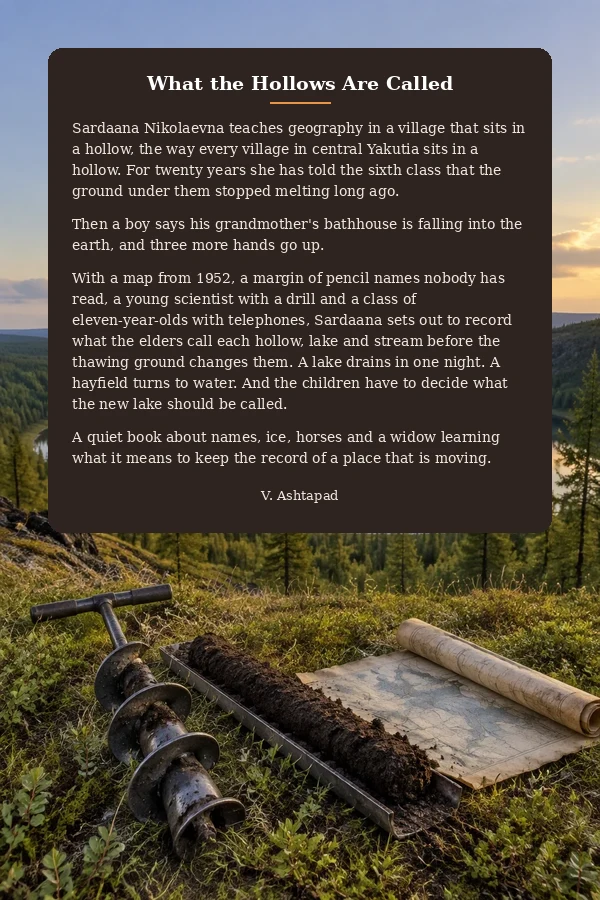
Sardaana Nikolaevna teaches geography in a village that sits in a hollow, the way every village in central Yakutia sits in a hollow. For twenty years she has told the sixth class that the ground under them stopped melting long ago.
Then a boy says his grandmother's bathhouse is falling into the earth, and three more hands go up.
With a map from 1952, a margin of pencil names nobody has read, a young scientist with a drill and a class of eleven-year-olds with telephones, Sardaana sets out to record what the elders call each hollow, lake and stream before the thawing ground changes them. A lake drains in one night. A hayfield turns to water. And the children have to decide what the new lake should be called.
A quiet book about names, ice, horses and a widow learning what it means to keep the record of a place that is moving.
Members can react to this book and talk about it in the members' Library.
Ownership
© 2026 CRUNOD LLC. All rights reserved.
This book is owned by CRUNOD LLC. It is free to read on EternalCurrent.Online. No part of it may be copied, reprinted, sold, recorded or adapted, including as audio, film or translation, without written permission from CRUNOD LLC.
© 2026 CRUNOD LLC. All rights reserved.