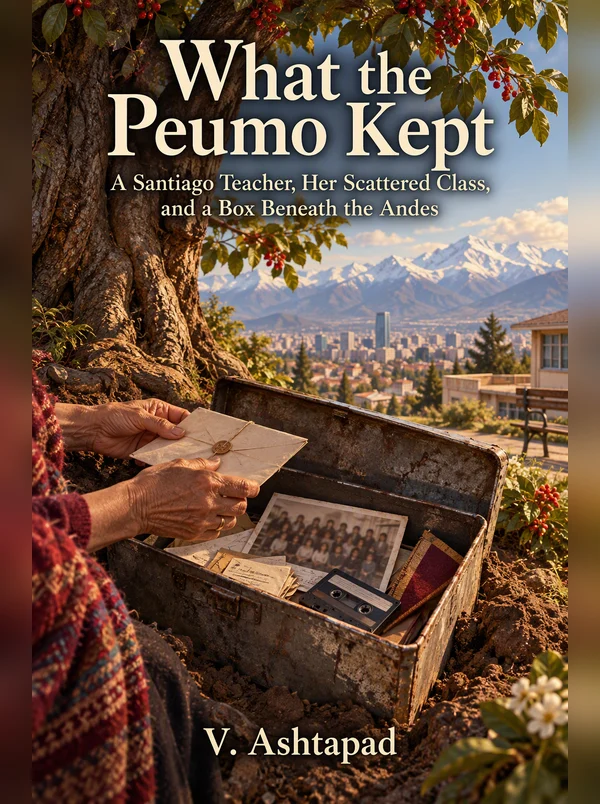
What the Peumo Kept
A Santiago Teacher, Her Scattered Class, and a Box Beneath the Andes
by V. Ashtapad
Foreword
This is a story about the people who leave and the people who stay, and about the old idea that a place can travel with you if somebody remembers to pack it. It is told by Inés Saldías, a retired Spanish teacher in Santiago, who spent thirty-seven years at a school at the foot of the Andes where children arrived from every corner of the world and left again before anyone was ready. When the time capsule her daughter's class buried in 2000 comes due, she sets out to find all thirty-one of them, and to find out whether anything they carried away was kept. The school, its families and its students are invented. The mountains, the empanadas, the September fondas, the palafitos of Castro and the night of February 2010 are not.
For the ones who arrived crying at the gate in August, and for the ones who stayed behind to wave them off in June.
Chapter 1: Sobremesa
*sobremesa (f.): the time spent at the table after a meal is finished, when nobody gets up. In my house, the most important part of lunch.*
For thirty-seven years I corrected other people's Spanish, so you will forgive me if I begin with a definition. It is an old habit. My grandchildren tell me that nobody begins a story with a dictionary. I tell them that nobody asked them, and then I feed them, and that settles it.
My name is Inés Saldías Vidal. I was born in Valparaíso in 1950, in a house on Cerro Concepción that leaned against its neighbor the way tired people lean on a bus. I have lived in Santiago since I was twenty-two, in Ñuñoa since I was twenty-nine, and in this particular house, with its long narrow patio and its parrón of grapes that never ripen properly, since 1981. From 1978 until 2015 I taught Spanish language and Chilean literature at the Colegio Internacional Quebrada Azul, the school at the top of the long road, where the city runs out of streets and the mountains begin without asking permission.
That is where most of this story lives. Some of it lives here in Ñuñoa, at my table. Some of it lives in Perth and Calgary and Houston and Madrid, in places I have visited only through a lit screen that leans on the fruit bowl at the end of my table. And one small piece of it lived for twenty-five years in a steel box under the ground, which is the piece that started everything, though we did not know that yet on the Sunday in early September when the letter came.
---
It was not really a letter. Nothing is, anymore. It was a message from Paz Riquelme, class of 2000, who is now an architect in Valparaíso and who signs everything she writes with a small drawing of a staircase. I read it at the table after lunch, during the sobremesa, which on Sundays I keep even when I eat alone. A woman who stops doing sobremesa because her husband has died is a woman who has decided to die a little herself, and I had decided no such thing.
*Querida Miss Inés,* Paz wrote, because the students at Quebrada Azul never called us profesora the way Chilean children do. The foreign families taught their children to say Miss, and the Chilean children copied them, and so for thirty-seven years I was Miss Inés, as if I were a governess in a novel. *The twenty-five years are up. The class is coming home in January for the reunion. We are going to open the capsule. You were there when we buried it and we want you there when we dig it up. Please say yes. Also, can you remember what was in it? Nobody can. Nacho thinks there was a cassette. Travis thinks there was a rock. I think there was a letter from you. Besos, P.*
I put the phone face down on the tablecloth and looked out at the patio. The lemon tree was carrying more fruit than it could hold, as it always does at the end of winter, and the light on the back wall had that thin September brightness, the first light of the year that feels like it might warm you if you stood in it long enough. Beyond the wall, beyond the roofs and the cables and the jacarandas not yet in flower, I could not see the cordillera, but I knew exactly how it looked on such a day: snow almost to the foothills, very white, very close, the way it is only after rain has rinsed the city.
I remembered the capsule perfectly. That was the trouble. I remembered the morning in June 2000, cold and bright, the class standing in a ragged half-circle under the big peumo tree beside the lower field, the girls in their parkas and the boys pretending they did not feel the cold. I remembered the box: gray steel, a rubber seal, two clasps. I remembered dropping my own envelope inside last of all, after everyone else, and Carolina, my daughter, who was in that class, watching me do it with an expression I have never forgotten. It was the look of a girl who has realized for the first time that her mother has a private life.
What I did not remember was what I had written. I have been trying for twenty-five years.
---
At four in the afternoon the computer in the dining room began to chime, and I went to it the way I go to the kettle, without thinking. Sunday afternoons in my house belong to the call.
My son Rodrigo set it up years ago, before his father died, and he set it up thoroughly, because Rodrigo is an engineer and cannot do anything halfway. When I sit down, three times of day wait across the top of the screen, one for each house: Santiago, Calgary, Perth. Today they said four in the afternoon for me, early afternoon for Rodrigo, and the dead small hours of Monday for Carolina, which meant that Carolina would not be joining us, and that if she did join us something was wrong.
Rodrigo appeared first, in the kitchen of his house in Calgary, with a window behind him full of a sky so blue it looked painted. He had his father's forehead and my mouth and a beard that I have never approved of.
"Hola, mamá."
"Hola, mijo. You look tired."
"I'm not tired. It's the light."
"It's not the light."
Then my granddaughter Sofía leaned into the frame from somewhere off to the side. She is sixteen, tall like her mother's people, with Rodrigo's dark eyebrows and an expression of permanent mild amusement that she got from no one in this family. She speaks a Spanish that is better than she thinks and worse than she pretends.
"Hola, Lita."
They have called me Lita since Sofía was two and could not manage abuelita. I have never corrected it. Some mistakes a teacher keeps.
"Hola, mi amor. ¿Cómo estás?"
"Bien. Good. I'm good." She glanced at her father. "Is it true you buried a box at the school?"
So the news had already crossed two continents before I had finished my tea. This is how it is now. A thing is said in Valparaíso and is known in Calgary before it is known in the next room.
"I did not bury it," I said. "Don Lucho buried it. I supervised."
"Who's Don Lucho?"
I sat back. There are questions that open doors in an old woman, and this was one of them. "Don Lucho," I said, "was the most important person at that school for forty years, and nobody ever wrote his name on anything. He kept the gardens. He fixed the bell. He knew where every pipe ran and every rabbit lived. He died in 2021. If you want to know about that school, you start with him."
Sofía tilted her head. "Can I write that down?"
"Write what down?"
"What you just said. For a project. We have to do a heritage thing this year, like, a family history thing. I was going to do Mom's side because there's a guy who came over from Scotland on a boat, but—" She shrugged, and the shrug said a great many things about Scottish men on boats.
Rodrigo was watching me with an expression I could not quite read. Then I could. He was hoping.
"You can do better than write it down," I said. "You can come and hear it."
---
After we hung up, I stayed at the table. The light had moved off the back wall and onto the floor, where it lay in a long yellow rectangle with the shadow of the parrón across it like handwriting. Somewhere down the street a neighbor was practicing cueca on an accordion, badly, as somebody always does in the first weeks of September.
I took out the notebook I keep in the drawer of the sideboard, a green one with squared pages, the kind I bought by the dozen for thirty-seven years and still buy out of loyalty. At the top of a clean page I wrote: *What was in the capsule.* Under that I wrote numbers, one to ten, and then sat with the pen above the paper for a long time.
1. A cassette. (Nacho is right. Somebody recorded the class singing. I think it was "Gracias a la vida," which they massacred, and then something in English that I did not know.)
2. A rock. (Travis Kimbrough carried it all the way from the Atacama in his backpack on the trip in 1999. Grayish, with a pink stripe. I told him it would wear a hole in his bag. It did.)
3. Photographs. Polaroids. Somebody had a Polaroid camera that year and took pictures of everyone, too bright, everyone with red eyes.
4. Letters to themselves. Each one sealed.
5. A recipe card. Señora Herminia's sopaipillas, from the kitchen. I am almost sure of this.
6. A list of predictions. Divya Raman made everyone write down where they would be in twenty-five years.
7. A newspaper from that week.
8. A friendship bracelet, or several. The girls made them in the colors of every flag in the class. There were a lot of flags.
9. Something of Mati's.
10. My letter.
I looked at number nine for a long time, and then I closed the notebook and went to stand in the patio under the lemon tree until the accordion down the street stopped trying.
---
That night I wrote back to Paz. I told her yes. I told her I would come in January and that I would bring a list. I told her I was proud of her, which teachers are not supposed to say after a certain point, and which I have stopped caring about.
Then, because I could not sleep, I opened the family page Carolina set up for us three years ago, the private one. There are perhaps forty of us on it now, cousins from Valparaíso, Rodrigo's in-laws in Edmonton, Jaime's nephew in Concepción who posts nothing but photographs of fish. I scrolled back through it in the dark, past the birthday cakes and the first days of school, past a video of Ben in Calgary scoring a goal in ice hockey that I have watched eleven times and still do not understand.
Near the bottom, from three years ago, there was a photograph Jaime's sister had posted, an old one: the class of 2000 on graduation day, on the steps of the main building at Quebrada Azul, with the mountain behind them so huge and so close it looked like a backdrop painted onto canvas. Thirty-one young faces. Mine at the end of the second row, in a gray suit I had bought for the occasion and never wore again.
Under the photograph, in the comments, Carolina had written only: *Mamá, who are all these people?*
And under that, I had written: *Your class, hija.*
And under that, Carolina had written: *I know, I meant—who ARE they. Now.*
I had not answered. I did not know then. That was the question, in the end, that the whole year turned out to be about.
Chapter 2: The Road Up
*quebrada (f.): a ravine, a gully cut by water. Also, in older Chilean speech, a break, a failure; "ir a la quebrada," to go bust. Our school was named for the first meaning and survived the second more than once.*
The road to the Colegio Internacional Quebrada Azul begins as an avenue like any other, with pharmacies and car washes and women selling sopaipillas from shopping carts at the traffic lights, and then it begins to climb. The buildings fall away. The gardens get larger and the walls get higher, and then the walls give up, too, and there is only the road, the dry brown hillside with its espino trees and its quillay and its boldo, and, filling the windshield, the mountain.
People who have not lived in Santiago think of the Andes as a range, a line on a map, something in the distance. From Quebrada Azul they are not in the distance. They are a wall that begins at the end of the football field. In winter, on the mornings after a storm, the light off the snow is so strong that the children squint through first period as if they had all been out late. In summer the mountain goes the color of a lion and the air shakes above the tennis courts.
I drove up that road for the first time in March 1978, in a borrowed Fiat 600 that overheated on the last bend, and I arrived at my interview with steam coming out of the front of the car and a run in my stocking that I had tried to stop with nail polish. I was twenty-seven. I had two years of teaching at a liceo in Quinta Normal behind me, fifty-two children in a room built for thirty, and I had answered a newspaper advertisement because the salary was nearly double and because my husband, Jaime Ferrer, had told me that if I did not try for it I would spend the rest of my life wondering.
The headmaster then was Dr. Howard Merriman, a stooped Vermonter in cardigans who pronounced my name "Eye-ness" until the day he retired. He asked me what I thought foreign children needed to learn about Chile. I said that they needed to learn that it was not a backdrop. I got the job, I believe, for that sentence.
---
The school had been founded in 1958 by a handful of foreign families and a few Chilean ones who wanted their children educated in English without sending them away. It began in a rented house in Providencia and moved up the hill in 1966, when one of the founding families, who owned a great deal of that hillside and had no use for most of it, sold them twelve hectares on terms nobody has ever explained to me the same way twice. The name came from the ravine that cuts the property on its north side, where a thin stream runs down from the mountain all year, even in the driest Februaries. The water is very cold and in certain light it looks blue. That is all. There is no legend. The children invented a new one every year, and I let them.
When I arrived there were perhaps four hundred students. Half were Chilean. The other half came from everywhere the world had sent a father, and in those years it was nearly always the father: mining engineers from Canada, bankers from London, a Swedish ambassador's three red-haired sons, two Brazilian brothers whose father did something with copper futures that nobody could explain. By the time I retired there was hardly a country left that had not, at some point, sat in my classroom and struggled with the subjunctive.
They came and they went. That was the rhythm of the place. A child would arrive in August speaking no Spanish, crying at the gate, and by November would be shouting at the other children in perfect Santiago slang, saying *cachai* at the end of every sentence and *po* after every yes and no, and then in June the father's posting would end and the child would be gone, to Jakarta or Johannesburg or Denver, and for a few weeks there would be a hole in the class the shape of that child, and then the hole would close. The Chilean children learned to make friends fast and to let them go without making a scene. It was the weather of the place, like the smog in winter and the earthquakes, and they grew up in it.
---
I was thinking of all this on the last Tuesday of September, the week after the fondas, when I drove up the road again, for the first time in a long while, in my small white Suzuki that does not overheat. Paz had arranged a meeting with the current head of school and the facilities manager to plan the dig. The city was hungover and pleased with itself, and the jacarandas on the lower avenues had just begun, with that violet that does not look like a real color.
The school has changed. Of course it has. There is a new science building of glass that looks as if it had landed from somewhere else. The dirt car park where Jaime used to wait for me with the radio on the football is paved and has a barrier and a man in a booth. But the main building is the same, low and white with a red-tiled roof and a long colonnade facing the mountain, and the lower field is the same, and at the edge of the lower field, where the ground begins to fall toward the ravine, the peumo tree is the same.
I went there before I went to the meeting. I could not help it.
A peumo is a native tree, an evergreen, with leathery dark leaves that smell, when you crush them, of something between bay and lemon peel. It grows slowly and lives a long time. This one was already old when the school arrived. Its trunk divides low down into three, so that it looks like a hand coming up out of the ground, and its shade is so dense that grass does not grow under it, only a carpet of dry leaves and the little red fruits that the children used to throw at each other until somebody cried.
I stood under it and I looked at the ground. There is a small stone set into the earth at the foot of the middle trunk, a flat river stone about the size of a dinner plate, with *2000* scratched into it. Don Lucho put it there the day we buried the box. He said that otherwise in twenty-five years we would all stand around arguing, and he was right, because when Paz and the head of school came down ten minutes later with the facilities manager, a young man with a tablet, he was saying that according to the plan the capsule should be four meters to the south.
"It's here," I said, and pointed at the stone.
The young man looked at the stone and at his tablet. "The plan says—"
"Who drew the plan?"
He did not know. I did. Dr. Merriman's successor, a South African named Graham Hendry, drew it in 2003 from memory, three years after the event, without asking anybody. I said so. Paz laughed, the head of school, a quiet Canadian woman named Marianne Dubois who had been at the school only two years, looked at me with the expression of a person recalculating, and the young man put his tablet under his arm.
"Don Lucho put the stone there," I said. "Don Lucho did not make mistakes about the ground."
---
In Marianne's office, under the same tall window that had kept Dr. Merriman humble, we settled it. The dig would be on the morning of Saturday, the seventeenth of January, at ten o'clock. It would be summer and the school would be closed, which was good, because there would be no children to keep away from the hole, and bad, because there would be no shade except under the tree itself and the class of 2000 was no longer of an age to stand for an hour in the January sun without complaining. Paz would arrange chairs and a tent. The school would provide water and coffee. The alumni office had already begun writing to everyone, but the alumni office's list was, Marianne admitted, "aspirational." Of the thirty-one graduates, it had working addresses for nineteen.
"We'll find the others," Paz said.
"How?"
Paz looked at me. "Miss Inés will find them."
I opened my mouth to say that I was a seventy-four-year-old widow with arthritis in both thumbs who could barely make my telephone stop showing me advertisements for shoes. Then I closed it again. Because it was true, in a way. I had found them before. Every year for thirty-seven years I had stood in front of children from twenty countries who did not believe that a Chilean poem written in 1924 could have anything to say to them, and I had found them. One at a time. If I had a gift, that was it, and it had never once been in the job description.
"Give me the list," I said.
---
On my way out I asked if I could walk down to the ravine. Marianne said of course, and Paz came with me, carrying her sunglasses in her hand instead of wearing them, the way her mother used to.
The path goes past the end of the lower field and down a set of steps cut into the slope, railway sleepers held in place with iron stakes. Don Lucho built those steps in 1984, the year a girl from the Netherlands broke her ankle on the old dirt path, and they are still there, a little sunk, a little mossy at the edges. At the bottom there is the stream, and a flat place among the rocks where the children used to sit in the hot months with their feet in the water, and the sound of the water, which is louder than you expect.
I sat on a rock and Paz sat beside me. Above us the hillside rose in steps of brown and gray-green, and above that the first snow, and above that a sky with nothing in it at all.
"Do you remember what you wrote?" Paz asked. "In the capsule?"
"No."
"Truly?"
"Truly. I have tried. I remember sitting down to write it, at the kitchen table, the night before. I remember Jaime asking me what I was doing and me telling him it was none of his business. I remember Carolina going past the door and looking in. And then nothing. I remember sealing the envelope. I remember dropping it into the box. Everything in between is gone."
"Maybe you wrote something you didn't want to remember."
I looked at her. Paz had always been sharp. When she was fifteen she wrote an essay on Neruda's *Residencia en la tierra* that I still have, somewhere, in a box, because it was the first time a student had told me something about a poem that I had not known.
"Maybe," I said.
She held up her phone. "Can I do something? Can I record you? Just talking. About him. Don Lucho. The steps, the stone, the plan. Everybody's going to ask about him in January, and half of them were too busy being seventeen to notice he existed. I want to put it with the rest."
"With the rest of what?"
"With the class's things. We've started a space, a private one, for everyone from the year, so we can put up the old photos and whatever people want to share before January. I want the first voice in it to be about him."
I thought about this. In front of us, the stream went on doing what it had done for ten thousand years.
"Bueno," I said. "But not here. I'll get sentimental. Do it at my house. With tea."
She put the phone away. We sat a little longer. A pair of tiuques went over, quarreling. Then we climbed Don Lucho's steps one at a time, carefully, Paz in front of me, the old sleepers giving a little under our feet, and drove down the long road back into the city, the mountain in the mirror the whole way.
Chapter 3: The Man Who Knew Where the Pipes Ran
*maestro (m.): a teacher. In Chile, also any man who works with his hands and knows his trade: the plumber, the bricklayer, the one who fixes your roof. "Oiga, maestro." It is the same word. I have always thought that was correct.*
Paz came on a Thursday evening in early October with a small black microphone that clipped to the edge of the table and a bag of marraquetas still warm from the bakery on Irarrázaval. I had made tea, real tea, in the pot, and set out butter and the jam my cousin Elba makes in Quilpué from the little sour plums that grow behind her house, and avocado mashed with salt and lemon, because once without palta is not once.
For the foreigners reading this, who are perhaps the grandchildren I am thinking of: once is what we call the meal at the end of the afternoon, between six and eight, which is not exactly tea and not exactly dinner. Bread, always, with butter and avocado and cheese, and tea. The name, they say, comes from the English workers in the nitrate fields of the north, who would slip away at eleven to drink aguardiente and called it "las once" because "aguardiente" has eleven letters. I have counted. It does. Not one child I taught it to ever forgot it, which is the only test of a story in a classroom.
We sat at the dining table with the pot between us and the microphone pointed at me like a small accusing finger. Paz pressed something on her phone.
"Whenever you're ready, Miss."
I was not ready. I began anyway.
---
His name was Luis Arancibia Lagos, and he was born in 1943 in a house of adobe and tile on a fundo outside San Vicente de Tagua Tagua, in the Colchagua valley, where his father worked the vines. He told me once that the thing he remembered best about his childhood was the sound of the irrigation water arriving in the canals at night, the hush and gurgle coming down the rows in the dark, and his father walking beside it with a lantern. He said that was when he learned that water is the whole of everything. You can do any work you like on a piece of ground, but if you do not know where the water goes, you know nothing.
He came to Santiago at twenty to work construction, and in 1967 he was hired by the school as a laborer when they were finishing the new buildings on the hill. They kept him on because he had laid half the pipes. He stayed until 2008, forty-one years, and in all that time I do not believe he missed a day except for the births of his children and his own heart operation in 1999.
He married Herminia Huerta in 1969. She was from Talca and she came to the school in 1972 to work in the kitchen, and by 1980 she was running it. If you were a child at Quebrada Azul between 1972 and 2010, you ate Señora Herminia's food. You ate her porotos granados in summer and her charquicán on cold Thursdays, and on the first rainy day of every winter you ate sopaipillas pasadas, the little round fried breads of squash and flour soaked in hot chancaca syrup with orange peel and cinnamon, because that is what Chileans eat when it rains, and Herminia did not believe a school was a school if it did not observe the rain.
---
"Tell about the bell," Paz said.
"Which bell?"
"There was a bell. My mom told me. Something about Don Lucho and the bell in '85."
So I told about the bell. The school had an old bronze bell on a frame by the colonnade, which Dr. Merriman had bought from a salvage yard in Valparaíso and which was rung by hand for the beginning and end of the day. On the night of the third of March 1985, at about seven in the evening, there was a great earthquake, the big one centered off the coast near San Antonio and Algarrobo, and in Santiago it shook for nearly a minute and a half. The school was empty because it was a Sunday and classes had not begun. But Don Lucho lived then in the small house at the bottom of the property, beside the gate, which went with the job, and when the shaking stopped he walked up the hill in the dark with a flashlight to check the buildings. And the bell, he said, was ringing. Not swinging. Ringing, by itself, a deep long hum that came out of the frame, because the frame had twisted and the bell was touching the iron and the whole mountain was still trembling very slightly in the aftershocks. He stood there for a long time listening. In the morning he straightened the frame with a car jack and a length of pipe, and the bell never rang wrong again.
He told me that story in 1990, at a retirement party, after two glasses of pipeño. He said it was the most frightened he had ever been, and the most beautiful thing he had ever heard, as if the mountain had been trying to tell him something and he did not speak the language.
Paz was quiet for a moment. The tea in my cup had gone cold.
"The kids didn't know any of this," she said. "We just knew he fixed things and he'd yell at you if you walked on the newly planted grass."
"He did not yell. He raised his voice in a carrying manner."
She laughed. "Okay. And the capsule? Why him? Why did he do the burying?"
"Because I asked him," I said. "And because he had buried something there before."
She looked up.
---
This is the part I have never told anyone, and I am telling it now because Don Lucho is dead and Herminia is dead and their eldest son Patricio gave me his permission over the telephone last week, and because I think it belongs in this.
In 1979, Lucho and Herminia's second child, a little boy called Andrés, was born too early and lived for six days. They lived then in the small house by the gate. It was winter. The ground at the cemetery was arranged and paid for, and the boy was buried there as he should have been. But Herminia had knitted him a small blanket, white with a blue edge, during the months she was expecting him, and it had not been finished in time, and she could not bear to keep it and could not bear to throw it away. Lucho took it, wrapped in a plastic bag inside a biscuit tin, and buried it in the night under the peumo tree, because, he said, it was the oldest living thing he knew, and it would keep it.
He told me this in 2000, when I asked him to dig the hole for the capsule. He did not say no. He said: "Under the peumo, Señora Inés? Not on the north side." And when I asked him why not, he told me. Then he dug our hole on the south side of the middle trunk, and put the flat stone over it, and went home.
Paz had gone very still across the table from me, both palms pressed to the cloth. I did not look at her. I looked at the window, where it had grown dark, and where the reflection of the two of us sat at the table, an old woman and a middle-aged one with a pot of tea between them, under a lamp.
"Patricio says," I said, "that his father would want people to know there was a little boy. That's all. That the tree is keeping two things."
"I'll put it in exactly like that," Paz said quietly.
---
Afterward, when she had turned off the little microphone and we had eaten the last of the marraquetas, Paz took out her laptop and showed me the space she had made for the class.
It was a single page, private, with the old graduation photograph at the top, the one with the mountain painted behind everyone, and beneath it a list of the class, thirty-one names, each with a small circle beside it. Nineteen circles were filled in with photographs, recent ones, people I recognized and did not recognize at the same time, the way you recognize a song played in a different key. Eleven were still gray, and one had something else. Next to each name there was a place, where we knew it. Houston. Toronto. Madrid. Singapore. London. Perth, beside Carolina's name, with a photograph of her squinting into a white Australian sun, a sun so strong it looked as though someone had turned up the brightness on the whole picture. And on the side of the page there was a globe, slowly turning, with small lights where the nineteen were scattered. A cluster around Santiago and Valparaíso. A single light somewhere in the far north of Norway that I could not account for at all.
"That's Kristoffer," Paz said. "Halvorsen. He's a ship's engineer. He keeps an icebreaker running in Tromsø."
"Kristoffer," I said. "He could not pronounce *ferrocarril*. He used to say it like a car falling down stairs."
"He'd love that you remember."
I pointed at the gray circles. "And these?"
She read them out. Some names I knew well and some I had to close my eyes for. A boy from South Africa who had stayed only that last year. Two girls from the Korean families who had left for Seoul right after graduation. Ignacio Fuentes, Nacho, whom Paz insisted was in Madrid but who had not answered anything. A girl called Lorena Saavedra who had married young and moved to the south. And at the bottom, Matías Ossandón.
Paz had not put a gray circle beside him. She had put a small white flower.
"I didn't know what else to do," she said. "Is that all right?"
I looked at it for a long time.
"His mother is alive," I said finally. "Gloria. She lives in Talca, now, with his sister. I have her number. I'll ask her what she wants. It's her decision, not ours."
Paz nodded. "And the others?"
I took the green notebook from the drawer of the sideboard, the one with the list of what was in the capsule, and turned to a clean page. "Write them down for me," I said. "All of them. Every name, the way they wrote it in my class register, and what you know. I'll start tomorrow."
"How?"
"The way I always did," I said. "One at a time."
When she had gone, I washed the cups and stood for a while at the kitchen window. On the other side of the patio wall my neighbor's dog was barking at something only it could hear. I thought of Lucho walking up the hill in the dark in 1985 with his flashlight, toward a bell that was ringing by itself, and of how frightened and how happy he had been, and of how many years he had carried that in silence before he told it to a Spanish teacher at a party, because she was the one who happened to be standing there.
A great deal of what we know about one another arrives that way. By accident, after the second glass, to whoever happens to be listening. I thought: it would be better if it did not have to.
Chapter 4: The Fremantle Doctor
*pino (m.): a pine tree. Also, in Chile only, the filling of an empanada: minced or chopped beef cooked down with a great deal of onion, cumin, paprika, and chili, finished with a slice of hard-boiled egg, a black olive, and a raisin or two. Nobody agrees on the raisins. I put them in.*
My daughter Carolina left Chile on the second of September 2005, on a night flight to Madrid with a connection to London, carrying two suitcases and a scholarship for a master's in finance. She was twenty-three. I drove her to the airport in Pudahuel in the gray early morning, with the smog lying over the city like a lid on a pot, and at the security gate she hugged me hard, the way she had not hugged me since she was eleven, and said into my shoulder, "Don't make that face, Mamá, it's only a year."
It has been twenty years.
London became a job, the job became a promotion, the promotion became a transfer to a mining finance group with offices in Perth, and in Perth she met Dylan Moore, a big, sunburned metallurgist from Kalgoorlie who laughs at his own jokes before he has finished telling them, and whom I liked from the first grainy call in 2014, when he said "Mucho gusto, Señora Inés" in an accent like a cattle call. They married in 2015 at a winery in the Swan Valley in a heat that melted the cake. Their daughter, Isla Inés Moore Ferrer, was born in 2016. She is nine. She calls me Lita, because her cousins do, and that is nearly the only Spanish word she uses without being asked.
I am not complaining. My daughter went where her life took her. I raised her to be able to. A woman who teaches other people's children for thirty-seven years that the world is large and they belong in it cannot be surprised when her own child believes her.
But I will say this. When Paz showed me the globe in the class's space, with the little light in Perth beside Carolina's name, I looked at that light for a long time, and I thought: it is very far from the other lights. Further than Tromsø, almost. Alone at the bottom edge of the Indian Ocean, with nothing to the west of it until Africa.
---
The Sunday after Paz recorded me, the clocks at the top of the screen said that it was six in the evening in Santiago and five in the morning in Perth, and Carolina called.
She was in her kitchen, in the dark, with only the light over the stove on. She was wearing a gray running shirt and her hair was tied back and she looked, in that strange low light, exactly like her father did when he got up early to drive to the fish market in San Antonio, which he did every Saturday for thirty years, for no reason except that he liked to.
"You're up early," I said.
"I'm going for a run before it gets hot. It's going to be thirty-four."
"In October?"
"It's Perth, Mamá."
We talked about the heat, and about Dylan's knee, and about Isla's swimming carnival. Behind her, through the window over the sink, the sky was going from black to a deep blue over the outline of the big untidy peppermint tree that drops its leaves on their pool. She told me once that in summer the sea breeze comes in off the ocean at about two every afternoon, cold and strong, so regular you can set your watch by it. They call it the Fremantle Doctor. I have always liked that. A wind that comes every afternoon to cure the heat.
"Paz said you're finding everyone," Carolina said.
"I'm trying."
"Are you okay doing that?"
"Why would I not be okay?"
She was quiet for a second. Then: "Mamá, it's a lot of people. And some of them are—you know. Mati."
"I know about Mati."
"I know you know. I'm saying." She pulled at the edge of her shirt. "Are you going to be all right."
I have known my daughter for forty-three years and I know when she is asking one question and meaning another. She was asking whether I was going to be all right. She was meaning: are you going to do it again. Are you going to take thirty-one children who are not yours and make them yours, and leave me standing at the edge of it.
It is not a fair thing to mean. It is not an unfair thing either.
"I will be all right," I said. "Are you coming in January?"
"I'm trying. Dylan can't. But I'm going to try and bring Isla."
"Bring Isla."
"She doesn't really speak Spanish, Mamá."
"Then she'll learn some."
Carolina laughed, a small tired laugh. Behind her a door opened, and there were bare feet on tile, and a small voice in that flat sweet Australian English in which every word seems to be put down gently on a table.
"Mum? Is that Lita?"
And then there was Isla, in pajamas with sharks on them, with her hair in a nest on one side, climbing onto a stool and pushing her face very close to the screen so that all I could see was one enormous blue eye.
"Hola, Lita."
"Hola, mi amor. What are you doing up?"
"I heard you."
"Did I wake you?"
"No, I was already awake. I was thinking." She sat back so I could see all of her. "Lita, Mum says you know how to make the meat pie things."
"Empanadas."
"Em-pa-na-das," she said carefully. "Mum makes them but she says hers are wrong."
Carolina rolled her eyes. "I didn't say they were wrong. I said they're not like yours."
"That is the same thing," I said. "Isla, would you like to learn to make real ones? I'll teach you. Right now, if you like. Not now, now. You get a pen."
---
That is how, at a quarter past six on a Sunday evening in Ñuñoa and a quarter past five on a Monday morning in Perth, I came to dictate my mother's recipe for empanadas de pino to a nine-year-old in shark pajamas, while my daughter made coffee in the half-dark behind her and pretended not to listen.
I have the recipe in my head. I have never written it down. My mother, Eugenia Vidal, made it every eighteenth of September and for every birthday and every time someone came to visit from Valparaíso, and she never wrote it down either. She learned it from her mother, who was from Limache and who apparently put in so much cumin that the neighbors complained. I learned it standing beside her at the stove, at seven, chopping onions with tears running down my face.
So I told it the way she told it. You make the pino the night before. That is the first thing and the most important. Pino made on the day is a sad, wet thing. You use an equal weight of onion to meat, or more, and you chop the onion small, small, small. You cook the onion slowly in fat until it is soft and gold, and only then do you add the meat. Paprika, the sweet kind. Cumin, a spoonful, not a shovel. Salt. A little ají de color. A little hot water or broth. You cook it until it is not wet and not dry, and you leave it overnight to think about what it has done.
"Overnight?" said Isla, scandalized.
"Overnight."
The next day you make the dough, flour and fat and warm salted water and a little milk, and you rest it. You roll it, you cut it into rounds the size of a saucer. On each one, a spoonful of pino, a slice of egg, one olive with the stone in, because otherwise it is not Chilean, one or two raisins. You fold it over and fold the edges in, so that it has a square back and a round front, like a little envelope. You paint it with egg yolk. You bake it hot.
"Why does the olive have the stone in?"
"So that you are careful," I said. "So that you eat slowly and pay attention. And so that you have something to spit at your brother."
"I don't have a brother."
"Then you spit at your cousin Ben."
Isla laughed so hard she nearly fell off the stool, and Carolina, behind her, laughed too, a real laugh this time, and put a hand on her daughter's back to steady her.
---
After they had gone, Carolina posted something to the family page. I did not see it until later, when I was in bed with the light on and the window open to the night. Through the window came the smell of the neighbor's jasmine and the faint rumble of the night buses on Irarrázaval, which is the sound I go to sleep to the way other people sleep to the sea.
What she had posted was a recipe. My recipe. My mother's recipe. Typed out neatly, with quantities that she must have worked out herself, because I never gave quantities, under the heading *Lita's Empanadas de Pino (do not argue about the raisins)*. At the bottom she had added a note: *As dictated to Isla, 5:15 a.m. Perth time. Abuela Eugenia's original.*
There were already four comments. My cousin Elba in Quilpué had written that her mother used to put in a little sugar, and that was the real way. My sister-in-law Marta in Viña had written, in capitals: *LA ABUELA EUGENIA PONÍA ORÉGANO.* And Rodrigo, from Calgary, had written: *Making these with the kids on Saturday. Will report.*
I lay there with the phone on my chest and the jasmine coming through the window.
And then, because I could not help myself, I opened the other list, the one Carolina had started at the same time as the recipe page, years ago, and that nobody had added to in a long time. It was a list of family words: the words we use in our house that do not mean what the dictionary says. *Chanchito* for a piggy bank and also for a child who eats too much cake. *Al tiro*, right away, which in my mother's mouth meant within the hour and in Jaime's meant never. *Guatita*, little belly. *Cuchepo*, which is what my father called anyone he thought was lazy and which I have never heard anyone outside our family use. There were nineteen words. The last one had been added in 2021. I added a twentieth.
*Doctor (Fremantle),* I wrote. *A cold wind that comes every afternoon to cure the heat. Used in Perth. Also, now, in Ñuñoa: anything that arrives at the same hour every week and makes things better.*
I thought about it, and then I added: *For example: Sunday calls.*
Then I turned off the light. A bus went by again, and the jasmine was very strong, and on the other side of the world my granddaughter was eating breakfast in a hot kitchen with a list of instructions in her mother's handwriting stuck to the refrigerator, under a magnet shaped like a kangaroo, waiting for Saturday.
Chapter 5: Eleven Gray Circles
*ubicar (v.): to locate. In Chile, also to know who someone is. "¿Ubicas a la Paz Riquelme?" Do you know Paz Riquelme, can you place her. To place a person is to know them. I have always thought the two meanings should never have been separated.*
In the register for the class of 2000, which I still have, in a gray cardboard folder tied with a ribbon that was once red, each student has one line. Surname, given names, date of birth, nationality, and a column headed *Observaciones* in which I was supposed to note anything the next teacher should know. Most of the lines in that column are empty. A few say things like *needs glasses, refuses to wear them* or *left-handed, do not move to window seat*. Beside Travis Kimbrough's name I wrote, in September 1998, *Will argue. Let him. He is usually half right.* Beside Paz Riquelme's: *Reads ahead.* Beside my own daughter's name I wrote nothing at all, because it seemed improper to write observations about your own child in an official register, and I have regretted that small blank for twenty-seven years.
I spread the folder out on the dining table on a Monday morning in the middle of October, with the green notebook beside it and the laptop open and a cup of coffee going cold, and I began.
Eleven gray circles, and one white flower.
---
The first two were easy, and I will not pretend otherwise. Hye-jin Park and Seo-yeon Kim, the girls from the two Korean families, had stayed close to each other after leaving Chile, as people do who have been foreign together, and when I found one of them, through a university alumni page in Seoul, she answered within a day and said she would bring the other. Hye-jin is a pediatrician now; Seo-yeon designs packaging and has three sons. Hye-jin sent a photograph of the two of them at a restaurant in Seoul, holding up a plate of something deep-fried, with a caption in careful Spanish: *Sopaipillas coreanas. No son iguales. Extrañamos la lluvia de la señora Herminia.* We miss Señora Herminia's rain. I read that sentence many times. Twenty-five years, and they still remembered that it was the rain they missed, and not the bread.
The third was Daniel Mokoena, the South African boy who had come for the last year only, whose father had been something at the embassy. He had left no trace in any directory I could find, and I had almost given him up when Kristoffer, from his icebreaker in Tromsø, sent Paz a message to say that Daniel had been best man at his wedding. Daniel lives in Cape Town. He runs a small company that builds boats. He answered with a voice message, recorded, he said, on a beach, and behind his voice I could hear wind and gulls and the long slow crash of an ocean I had never seen. He said he still had the friendship bracelet. He said he would come.
I added a light to the globe for him myself, at the very bottom of Africa. Paz showed me how: you touch the name and then the place, and draw a line from where they were to where they are, and the line arches over the curve of the world like a thrown stone. Daniel's line went from Santiago to Pretoria, then Durban, then Cape Town, with one great arc behind it across the whole South Atlantic, back to us.
---
The others were harder.
Lorena Saavedra I knew had married at nineteen, a man from Puerto Montt who worked in the salmon farms, and had moved south with him, and after that nothing. Her mother, whom I tracked down through the parent association's old Christmas card list, had died in 2017. Her father had remarried and moved to Argentina. The number I had for the father rang and rang in a house somewhere in Mendoza and no one picked up.
Andrew Lim, whose family had been Singaporean, had a perfectly current address, according to Divya Raman, who was also in Singapore and saw him perhaps once a year at somebody's wedding. Andrew simply did not want to come. He wrote to me, very politely, to say so. He said he had been happy in Chile, and that he had been unhappy leaving it, and that he did not want to go back and find that it had been ordinary. I did not argue. I wrote back that he would always be welcome, and that I remembered he was the only boy in thirty-seven years who had asked to read *Pedro Páramo* a second time. He wrote back one line: *I have read it eleven times now.*
The Errázuriz cousins, Cristóbal and Felipe, answered in a single message calling the whole thing *medio cursi*, a bit soppy, and then confirmed for two adults and five children.
Valentina Rojas, who had been the best runner in the school and who left for a university in Texas on an athletic scholarship, I found through her coach's obituary. She was mentioned in it, as the athlete he had been proudest of. She lives in Austin now and coaches high school track, and when I wrote to her she called me within the hour, on the telephone, a real call, and cried, and I cried, and we did not say very much except each other's names.
That left four gray circles and one white flower. Nacho Fuentes. Lorena. Two boys whose families had been American and who had gone back to the United States and dissolved into it, the way Americans can. And Mati.
---
Divya Raman was born in Chennai and came to Quebrada Azul at nine, when her father was posted to Santiago by an Indian engineering firm that was building a copper concentrator in the north. She was small and fierce, with a plait so long she could sit on it. By the end of her first year she spoke a Spanish so fast and so Chilean that the other children called her *la Divi* and forgot she had come from anywhere else. In 2000 she made everyone write predictions for the capsule and would not let anyone leave the room until they had.
She lives in Singapore now, on the twenty-third floor, and works for a bank on something to do with risk. When we spoke, on a call she arranged with Paz, it was ten at night for her and she was sitting on her balcony with the lights of the city all around her and a warm rain coming down so heavy behind her that it looked like a curtain of beads. I could hear it. It sounded like applause.
"Miss Inés," she said. "You haven't aged at all."
"That is a lie and you know it."
"It's a kind lie. You taught us those were allowed."
We talked about the people we had found and the ones we had not. Paz had the class page open on her screen and was sharing it so we could all see the globe, slowly turning, with its scattering of lights and its thin arcing lines, and the last gray circles at the bottom of the list.
"Can I suggest something?" Divya said.
"You will anyway."
She smiled. "There's a directory. Inside the space. Paz set it up but nobody's filling it in. Everyone's just putting photos up. What if we asked everyone to fill in the directory properly, not just where they are, but who they're still in touch with. Not to share their details, just names. Who do you still talk to. Even once a year. Because I bet you anything somebody in this class still has a line to Lorena, or to the Hartwell boys, or to Nacho. We just don't know who."
Paz was nodding.
"It's a risk map," Divya said. "Sorry. Occupational hazard. It's just—each of us is a little node. You're trying to find the missing ones by yourself, Miss, from the top down. But they're not lost from the top. They're lost from the side. Somebody's still holding the end of the string."
I thought about it. I thought about Kristoffer and Daniel, and the best man at a wedding in Tromsø whom I had not known was a best man.
"Bueno," I said. "Do it."
---
It took three days. Paz sent a message to everyone, asking each person to fill in the private directory with two things: where they lived, and the names of anyone from the class or the school they were still in touch with. Not addresses, not numbers. Just names. Who do you still talk to.
The answers came in slowly at first and then all at once, and it was like watching a net being drawn in from the dark. Felipe Errázuriz turned out to have played football every Wednesday for six years with one of the American boys, Josh Hartwell, at a pitch in Las Condes, because Josh had come back to Chile after college to work for a wine exporter and never left. Josh's brother Cody was a firefighter in Oregon. Two gray circles filled in on the same afternoon.
Seo-yeon, in Seoul, remembered that Lorena had sent her a Christmas card in 2011 from a town called Castro, on the island of Chiloé, with a photograph of a row of houses on stilts painted in yellow and red and green, standing over the water at high tide. She still had it. On the back, in Lorena's round handwriting, was an address in Castro.
And beside Ignacio Fuentes's name, when the directory filled in, there was one thread. Only one. It came from someone I had not expected.
It came from Carolina.
---
I called her that Sunday, at the hour the clocks agreed on. She was on the back step of her house in Perth, early Monday morning there, and the light was coming up pink and gold over the tops of the peppermint trees, and somewhere off to the left I could hear a bird making a sound like someone laughing in a cupboard. She told me it was a kookaburra. She said she had stopped hearing them years ago and only noticed them now when she was on the phone with someone from somewhere else.
"You talk to Nacho," I said.
She did not pretend not to understand. "Not often. Once a year. On the twenty-seventh of February."
I was quiet.
"He writes to me," she said. "Every year since 2010. Just one line. Sometimes it's just the date. I write back. That's all, Mamá. That's all it is."
"Why you?"
She looked away from the screen, out at her garden. "Because I was the one who called him that morning. Remember? You couldn't get through to anyone. The lines were all down in Chile. But I was in London, and I could call his mobile in Constitución from London, for some reason, I don't know how it worked. And he picked up." She stopped. "He was sitting on a hill above the town. He'd been sitting there for three hours. He didn't know where Mati was yet. I was the first person he talked to."
I had not known this. Fifteen years, and I had not known this. I had been in my own house in Ñuñoa that night with the plaster coming off the ceiling and Jaime holding a flashlight and the telephone dead in my hand, and my daughter had been in London talking a boy down off a hill in the dark, and she had never told me.
"Will you ask him?" I said finally. "About January?"
"I don't know if he'll come."
"Ask him anyway."
She nodded. Behind her, the kookaburra laughed again, and a second one joined it, and then a third, until it sounded as if the whole garden were in on a joke.
"Mamá," Carolina said. "Can I tell you something about Mati?"
"Of course."
"No. I mean, not now. When I come. I want to tell it in person. In the kitchen. Is that okay?"
I said yes. Of course I said yes. And when she had gone I sat for a long time in front of the dark screen with the register still open beside me on the table, at the page for the class of 2000, and I looked at the line for Matías Ossandón Pérez, born the fourth of April 1982, Chilean, and at the column for observations, where in September 1998 I had written, in my own hand, in blue ink: *Sings. Encourage.*
I put my finger on it. Then I closed the folder and tied the ribbon, and got up to call Gloria in Talca, which I had been putting off for a week.
Chapter 6: The River Mouth
*réplica (f.): a replica, a copy. In Chile, also an aftershock. After a big earthquake the réplicas go on for months, each one a little smaller, each one making you stand in a doorway with your heart going. The ground repeating itself, less sure each time.*
I took the bus to Talca on the last Wednesday of October, from the terminal at Alameda, because Gloria Pérez had said on the telephone that she did not want to do this on a screen, and because I have always thought there are things you must travel for, or they do not count.
The bus goes south on the Panamericana through the long middle valley, and in late spring that valley is the most beautiful place in Chile, though nobody who lives there would admit it. The coast range low and blue on the right, the Andes on the left, still white, leaning over the road. And between them, for three hours, a green that does not stop: vineyards in new leaf in rows as straight as ruled lines, orchards of cherry and apple and walnut, poplars standing in lines along the irrigation ditches like people waiting for a bus that will never come. Near Molina I saw a man on a horse, in a chupalla and a short striped manta, riding along the shoulder of the highway as if the highway were the one that did not belong.
I was thinking about Lucho on that bus, about the sound of water coming down the canals in the dark in Colchagua, which was not far off to the west. And I was thinking about the other night, the one we do not need to name in Chile because everyone already knows which one you mean.
---
On the twenty-seventh of February 2010, at thirty-four minutes past three in the morning, the earth broke open off the coast of the Maule region and Chile shook for nearly three minutes.
I was asleep in Ñuñoa. Jaime was asleep beside me. I woke up because the bed was moving across the floor, and my first clear thought was that someone was pushing it. Then the noise arrived. A roar, low and enormous, coming up out of the ground and out of the walls at the same time, and over it every glass and plate in the house shattering in the kitchen, and the dogs of the whole neighborhood howling. The plaster came off the ceiling in a sheet. Jaime got the flashlight he had kept by the bed for thirty-five years for exactly this, and we stood in the doorway while the house rocked like a boat.
When it stopped, it was dark everywhere. The electricity was gone. The telephone was dead. I sat on the stairs in my nightgown with the dead telephone in my lap and thought: Rodrigo is in Calgary, he is safe. Carolina is in London, she is safe. And then, because I was a teacher, I began to go through the others. All the hundreds of them. Who was where. Who was on the coast for the summer, as half of Santiago is in February. And I could not reach a single one.
The dawn came up gray and dusty. The aftershocks went on all day. On the radio, which Jaime got working with batteries, there was nothing at first and then there was too much, and slowly, over the morning, a word began to come out of the south: the sea. The sea had come in after the shaking. Constitución. Dichato. Pelluhue. Talcahuano. Names of summer towns, holiday towns, places with fried fish and rented cabins and children's buckets left on the porch.
It was four days before I learned that Mati Ossandón had been at Constitución, at the mouth of the Maule, camping for the end of summer with Nacho Fuentes and two friends from his music school. That Nacho had run uphill with the others, in the dark, as the old people told them to, and that Mati had run uphill too, and then had turned around. That there had been a family below them with small children, and the father had been carrying one and the mother could not carry the other two. That Mati had gone back down.
They found him eleven days later. I went to the funeral in Talca. I stood at the back. I did not speak to Gloria then; there were too many people, and I did not feel I had the right.
---
Gloria lives with her daughter Daniela on the eastern side of Talca, in a low house of pale yellow plaster with a green iron gate and a patio full of geraniums growing out of old paint tins. Daniela met me at the bus terminal in a small red car and drove me through the center, past the square with its tall old trees and the cathedral, rebuilt in plain concrete after another earthquake in 1928, and the long streets of low adobe houses with their walls still cracked and patched where the 2010 quake had split them. Talca lost a great deal that night.
"People here don't really talk about it," she said. "Not that it's a secret. Just, everyone has the same story, so what is there to say?"
Gloria was waiting in the kitchen. She is a small, wide woman with short white hair, in an apron printed with lemons. She took both my hands and looked at me for a long time.
"You're the teacher who wrote in the margins," she said.
I had not expected that.
"He brought home his report," she said. "The year he was sixteen. He showed me what you had written in the margin of the essay, about the poem. *You hear the music in this. Write the music down.* He put it on the refrigerator. It stayed there until we moved."
We sat at the table. Daniela made tea. There was a plate of calzones rotos, the little twisted fried pastries whose name means "torn underpants," which I never once explained to a foreign student with a straight face. There was also a shoebox. Gloria rested her palm on the lid and kept it there, the way you keep a hand on a dog that might bolt.
"Paz wrote to me," she said. "About the page. About a flower beside his name. And you want to know what I want."
"Yes."
She opened the shoebox.
---
What was inside were cassettes. Perhaps twenty of them, in clear plastic cases, labeled in a teenager's ballpoint capitals. *MATI DEMO 1.* *MATI DEMO 2 (MEJOR).* *ENSAYO CON NACHO 98.* *CANCIONES PARA LA CHICA DEL 4B (NO ESCUCHAR MAMÁ).* Under them, two small digital recorders, two old phones, and a brown notebook full of lyrics and chords.
"He recorded everything," Gloria said. "Everything. Himself singing in the bathroom because he liked the echo. His grandfather telling stories about the fundo. His students at the music school in Talca, the little ones, banging on drums. His father snoring, once, as a joke. He used to say a voice is the first thing you forget about somebody and the last thing you should."
She lifted one of the phones. "Daniela has been putting them on the computer. Slowly. A few each week. She says there are maybe forty hours."
Daniela, at the stove, nodded without turning around. "Some of them are just hiss. Some of them you can't hear anything. But some of them—"
She stopped.
"I don't want a page with a flower," Gloria said. "I mean, the flower is fine. That girl meant well, Paz. But I don't want a page that just says he's gone. I want a page where you can hear him. Where his class can go and hear him being sixteen and stupid. Singing to the girl in 4B. Telling a joke. And where the little ones he taught, who are big now, can go and hear him counting them in. One, two, three. Can that be done?"
"Yes," I said. "It can be done."
"And I want to decide what goes on it. Me and Daniela. Not the school. Not a committee. Us."
"Yes."
She looked at me a long time, and then she nodded, as if something had been signed.
---
That afternoon Daniela and I sat at the kitchen table with her laptop and the shoebox, and we made the beginnings of it. A memorial page, inside the class's private space, that only the class and the family could see, with a photograph of Mati at the top that Gloria chose. Not his graduation picture but one of him at nineteen, on a beach somewhere, with a guitar across his knees and his mouth open mid-laugh and his eyes nearly shut. Under it, the dates. Under that, the recordings Daniela had already saved, one by one, each with a short title Gloria dictated.
*Mati, 16, singing in the bathroom.* *Mati and Nacho, rehearsal, 1998 (they argue for two minutes first).* *Mati's grandfather, Don Hernán, telling about the flood of 1953, recorded by Mati.* *The music school, Talca, 2009: the little ones play "Los Pollitos."*
We listened to some of them. The bathroom one first, because Gloria wanted to. It was hissy and full of echo, and a boy's voice not quite finished breaking was singing a Los Prisioneros song with the words wrong, and halfway through he stopped and said, very clearly, "Mamá, ya sé que estás escuchando," Mom, I know you're listening, and then laughed, and went on.
Gloria put her hand over her mouth. Daniela turned it off. Nobody said anything for a while. Outside in the patio a bird was hopping among the geranium tins, a zorzal, brown, with its speckled chest, picking at the wet soil.
"One more," Gloria said finally. "The little ones."
So Daniela played the music school. And there was a room full of children, six years old perhaps, and a din of drums and tambourines, and a man's voice, deeper now, laughing, saying, "¡Ya, ya, ya, chiquillos! Silencio. Silencio. Escuchen." And the din stopping. And the voice, very gently: "Uno, dos, tres—" and all the children singing at once, out of tune, as loud as they could, and the man's voice under them, holding the tune steady, the way you hold a child's bicycle by the back of the seat until the child does not need you.
---
I took the last bus back to Santiago. Daniela drove me to the terminal. The sun was going down behind the coast range as we left the city, and for an hour the whole valley went the color of apricots, the vineyards and the orchards and the poplars all lit from the side, every leaf separate, and then the light went blue and the mountains on the left turned pink at the very top for a few minutes and then gray, and then there was only the highway and the lights of the trucks.
Before I left, Gloria had given me one of the cassettes. Not to keep, she said, to bring back. To bring to the school in January. It was labeled, in Mati's capitals, *PARA LA CÁPSULA (COPIA)*.
"He made two," she said. "One went in the box. This is the copy. He didn't want to forget what he'd said."
"What did he say?"
"I don't know," Gloria said. "I've never listened to it." She looked at me. "I'll listen to it with them. In January. Under the tree."
I held the cassette in my lap the whole way to Santiago, in its clear plastic case, in both hands, the way you would hold a small bird.
Chapter 7: Chinook
*zapateo (m.): the stamping of the feet in a dance. In the cueca, the part where the man drums his heels on the floor to show the woman he means it. Rodrigo's father could not zapatear to save his life. I married him anyway.*
My son left Chile later than his sister and with less fuss. He was class of 1997 at Quebrada Azul, three years ahead of Carolina, a long-boned serious boy who took apart the family radio at nine and put it back together with two pieces left over that he still keeps in a jar. He studied mining engineering and went north to a copper mine in the Atacama, at four thousand meters, and came home every two weeks sunburned on one side of his face. In 2008 a Canadian company that had partnered on the mine offered him a job in Calgary. Jaime was hurt for a week. Then he bought a book about Alberta and would talk about nothing but Lake Louise.
Rodrigo married Megan Fraser in 2009, a nurse from Edmonton with red-gold hair and a laugh like a door banging, whose great-great-grandfather came from the Isle of Skye on a boat. They have two children: Sofía, sixteen, and Ben, twelve, who plays ice hockey and speaks Spanish only when he wants something from me, which is often enough that his Spanish is surprisingly good.
---
In early November Sofía called me by herself for the first time.
It was a Tuesday, a school night for her, and on the screen she was sitting on her bed with a notebook on her knees and her hair wet from the shower. Behind her, through the window, it was already dark at five in the afternoon, and there was snow on the roof of the house across the street, and the streetlight made the snow look orange.
"Lita, okay, so the project," she said. "The heritage thing. I talked to my teacher and she says I can do it on you. On, like, Chile. If I do actual interviews. Recorded. Is that okay?"
"Recorded?"
"Like Paz did. Dad told me." She held up her phone. "You just talk and I record and then I put it with the family stuff so it's saved. And then I write the essay from it."
"What do you want me to talk about?"
She looked down at the notebook. I could see she had written questions. A whole page of them.
"Okay, don't laugh. The first one is: what was September like. When you were a kid. Because Dad says September is, like, the whole year in Chile and I don't really get it."
So I told her about September.
---
I told her that Chile's national day is the eighteenth of September and that it is not one day, it is a week, or two, or as long as the country can get away with. That the whole month smells of smoke from the grills and of the first blossom, because it is spring. That every park has a fonda, a ramshackle village of stalls roofed with eucalyptus branches and strung with paper flags, with a dance floor of packed earth and a band of guitars and harp, and terremoto to drink, pipeño wine with pineapple ice cream, called "earthquake" because after the second one you cannot stand up. That even people who never dance, dance.
"What's cueca, exactly? I know it's a dance."
"It's a courtship," I said. "A man and a woman, each with a handkerchief. He chases. She escapes. She is never caught. The music goes round and round, and they go round and round each other, and at the end they meet in the middle and that is all. Nobody is caught. Nobody wins."
"That's kind of romantic."
"It is extremely romantic. That is why the old people do it best."
She wrote something down. Then she said, a little too casually, "Could you show me?"
I looked at her. "Show you? From here?"
"Yeah. Like, on camera. I could do it here."
So I got up from the dining table. I moved the chairs back. I went to the sideboard and took out a white handkerchief from the second drawer, where I keep the good linen, and I found on the computer a recording of a cueca, an old one by Los Huasos Quincheros that Jaime liked, and I propped the laptop on a stack of books so that the camera could see me from the knees up, and I put the music on.
And I danced. Seventy-five years old in December, with two bad thumbs and a knee that clicks, in my dining room in Ñuñoa, in my slippers, with my handkerchief turning above my head. I showed her how you hold it loosely by one corner and circle it, and how you turn your shoulder to the other person as if you are not interested, which is the whole point, because you are.
In Calgary, on the other side of the screen, my granddaughter had got off her bed and found something white, a sock, I think, and was turning in a circle with it over her head, laughing, with her wet hair flying. And behind her the door opened, and Rodrigo looked in, and stopped. And he watched us. His mother in Santiago and his daughter in Calgary, dancing a cueca with a handkerchief and a sock, ten thousand kilometers apart, in time to the same harp.
When the song ended Sofía collapsed on the bed. Rodrigo was still in the doorway.
"Papá," Sofía said, "did you know Lita could do that?"
"I knew," he said. His voice was strange. "I haven't seen it since Papá died."
---
That was the first of the recordings. There were six more before the reunion, every Tuesday, until Sofía's project was due in the middle of December. She would send me the questions a day before so I could think, which I did not need, but which she insisted on because her teacher had told her it was polite.
I told her about my parents' house on Cerro Concepción, painted the green of a parrot, and about the autumn of 1960, when I was nine, and the great earthquake in Valdivia, the biggest ever measured anywhere, and how in Valparaíso we felt it only as a long sway, like being on a ship, but my mother's cousins in the south lost everything and came north to live with us for six months, eleven people in a house built for four. I told her my mother said those six months were the happiest of her life, because the house was never quiet.
I told her about the summers. About January in the lake district, when I was twelve, when my uncle borrowed a truck and drove the whole family south, two days on the old road, to camp on the shore of Lago Llanquihue under the volcano Osorno, a cone so perfect it looks like a child's drawing. About the water so cold it hurt your teeth, and the German bakeries in Frutillar with their kuchen of raspberries and murta, and the light at half past ten at night, still blue. About the smell of the wood smoke and the sound of the lake on the stones.
"That sounds like here," Sofía said. "Like the Rockies. The lakes and the mountains."
"It is like there," I said. "I went to Banff with your grandfather when you were a baby. He stood at Lake Louise and he cried. He said it was Llanquihue with better roads."
She laughed. I could hear Rodrigo laugh too, in the background, somewhere, where he was pretending to wash dishes.
---
The last Tuesday before her project was due, Sofía did not have a list of questions. She had a single one.
It was the middle of December. That afternoon, she told me, the chinook had come over the Rockies, the warm winter wind that can lift the temperature twenty degrees in an hour, and the snow on the roofs was dripping, and above the western horizon lay the chinook arch, a band of clear blue sky under a wall of cloud, as if someone had lifted the lid of the sky.
"Lita," she said. "Last question. Why did you let them go?"
"Who?"
"Dad. And Aunt Caro. You let them go. You didn't—Mom says Grandma Fraser cried for a year when Uncle Iain went to Toronto. Like, she made it into a thing. You didn't. Why not?"
I did not answer right away. On the screen she was waiting, with her pen. She was holding it the way I hold mine, by the very end, which nobody taught her.
"Because I spent thirty-seven years," I said, "teaching children whose fathers had been sent to Chile to tell them that the world would be all right. That they could leave a place and still keep it. That they could go somewhere new and nobody would take away the place they came from. I said that every September to every child who cried at the gate. I said it to Kristoffer. I said it to Divya. I said it to your aunt's best friend from Korea." I stopped. "If I had made a scene when my own children went, I would have been a liar."
She wrote that down.
"Did it work?" she said. "For the kids? The keeping it?"
"I don't know," I said. "I'll find out in January."
She looked at me a long time, with Rodrigo's eyebrows, and Megan's nose, and something in her face that was neither of theirs and that I had seen only in photographs of my own mother at that age.
"We're coming," she said. "Dad got the tickets. All four of us. Ben's going to miss two weeks of hockey and he's so mad."
I had not known. I put my hand over my mouth.
"Don't cry, Lita," she said. "You'll mess up the recording."
So I didn't. Not then. Behind her the chinook arch was going pink at the edges as the sun went down behind the Rockies, and in the corner of the screen her little clock and mine sat side by side, eight at night in Santiago, four in the afternoon in Calgary, and between them, for the first time I could remember, they seemed to me not very far apart at all.
Chapter 8: Minga
*minga (f.): in Chiloé, a gathering of neighbors to do together a work that one family cannot do alone. A harvest, a roof, a potato field. Sometimes a whole house, dragged across the land by oxen or floated across the water on barrels to a new place, while everyone pulls and nobody is paid, and afterward there is food. The owner of the house provides the food. That is the only rule.*
Lorena Saavedra did not answer my message, or Seo-yeon's, or the letter I sent to the address on the back of the Christmas card. Paz found a page for a guesthouse in Castro with Lorena's name under it and wrote to that too. Nothing. In the second week of November I looked at the gray circle beside her name for the hundredth time and decided I would go.
Carolina said I was mad. Rodrigo said I was magnificent and also mad. Paz offered to come with me, and I said no, because Paz had three children and a building permit due, and because if Lorena was hiding, she was hiding from her class.
So I flew to Puerto Montt on a Thursday morning, alone, with a small suitcase and a waterproof jacket that Rodrigo had sent me from Calgary two winters ago and that I had never once worn, because Santiago does not have that kind of rain. Chiloé does.
---
From the air, coming in over Puerto Montt, the south of Chile looks like a country that has been cut into pieces with scissors and then left out in the rain. Green so deep it looks black in the shadows, the sea coming in among the hills in long fingers. And behind all of it, white, standing up out of the clouds, the volcanoes: Osorno, the perfect cone I had camped beneath as a girl, and Calbuco beside it, broken-topped and dark.
The bus to Castro goes down to the channel at Pargua and drives straight onto a ferry, and the ferry crosses the Canal de Chacao in half an hour, a gray, fast water full of currents, and I stood at the rail the whole time in Rodrigo's jacket with the wind trying to take my hair off, and watched a pod of small gray dolphins, toninas, running alongside the bow, curving up and down through the water as if they were stitching the two shores together.
Then the island. Chiloé is not like the rest of Chile and has never pretended to be. The bus went south for two hours along a road that rose and fell over low green hills, past potato fields and fences of split wood gone silver with age, past houses covered in wooden shingles cut in a dozen different patterns, scalloped, pointed, diamond, round, painted yellow and blue and oxblood red, past churches made entirely of wood with tall square towers, standing alone in the fields like ships run aground. The sky changed every ten minutes, rain, then sun, then a rainbow lying flat across a bay full of mussel buoys. The air smelled of salt and wet wood and stove smoke.
I had a map open on my telephone, the one Paz had shown me how to use, and I traced the journey as I went, the way she had taught me to trace the class's. Santiago to Puerto Montt to Pargua to Chacao to Ancud to Castro. I had meant to do it for Lorena. I found that I was drawing my own.
---
Castro is built on a hill above a fjord, and at the bottom of the hill, along the water's edge, are the palafitos: rows of narrow wooden houses standing on tall stilts over the tide, painted every color there is, with their front doors on the street side and their back porches hanging over the water. At low tide the stilts stand up out of the mud like the legs of wading birds. At high tide the sea comes right in under the floors and the houses seem to float.
The guesthouse was the fifth house in a row of them on the Gamboa side, a tall one, painted the deep yellow of an egg yolk, with a blue door and a hand-painted sign: *Hospedaje Las Toninas.*
I knocked.
The woman who opened the door was in her forties, with gray coming in at her temples and a wool sweater with the sleeves pushed up to the elbows and flour on her hands. She looked at me. She looked at me for a long time. Then she said, quite calmly, "Ay, no. Miss Inés."
And then she began to laugh, and then she began to cry, and then she wiped her face with the back of a floury wrist and left a white streak across her cheek, and stood aside to let me in.
---
We sat in the kitchen at the back of the house, the one that hung over the water. There was a big black wood-burning stove in the corner, the kind that heats the house and cooks the food and dries the socks all at once, and a long table covered in an oilcloth printed with cherries, and a window looking straight out over the fjord. The tide was coming in. I could see it moving under the floor between the gaps of the boards. Across the water, on the other shore, a field of yellow gorse ran down to the sea, and above it a little wooden church with a red roof.
Lorena made tea. She put out bread, fresh, still warm, and a plate of milcaos, the flat potato cakes of Chiloé made from raw grated potato and cooked potato mashed together, fried in lard until the edges are crisp and lacy, and a dish of butter, and honey.
"I got your letter," she said. "And Seo-yeon's. And Paz's. I read them all."
"I know."
"I didn't answer because—" She stopped. She turned her teacup around on the oilcloth. "You know what it's like. Everybody in that class was going to be something. Divya with her clipboard. Paz with her buildings. Travis was going to run an oil company. Kristoffer was going to sail around the world. And I married a boy from Puerto Montt the year after we left school and moved to an island and he left me after nine years with two kids and a mortgage on a house on stilts." She laughed, not happily. "What am I going to put on the page, Miss? *Lorena Saavedra, Castro, still here.*"
I let that sit for a moment. Outside the window a cormorant landed on one of the posts of the next house and spread its wings to dry, black and ragged, like a coat hung on a hook.
"What did you write," I said, "in the capsule? For your prediction?"
She thought about it. "I don't remember."
"I do," I said. "Divya made a copy of every prediction and gave it to me to keep in case the box flooded. I have it in my folder at home. Do you want to know?"
She looked at me warily.
"You wrote: *I will live somewhere near the sea, in a house I like, and people will come to it.*"
Lorena did not say anything. She looked around the kitchen. The black stove. The kettle. The window and the water under the floor. Down the corridor, the guest rooms, and through the ceiling the sound of somebody's feet, a couple from Germany, she told me later, cyclists, who had been there three days and wanted to stay a week.
"Ay," she said finally, very quietly. "That's not fair."
---
I stayed three nights. On the second day Lorena's son Benjamín, home from his studies in Puerto Montt, drove the two of us in an old white pickup out to the south of the island, beyond Chonchi, to his grandmother's family's land at the end of a dirt road above a bay. They were making a curanto there for his great-uncle's eightieth birthday, and Lorena said I had to see one done properly, at least once, before I died.
A curanto is made in a hole in the ground. I had eaten the pot version in restaurants in Santiago and thought I understood it. I did not. The men dug the hole in the morning, in a field above the sea, and lined it with big round stones, and lit a fire on the stones and kept it burning for two hours until the stones were so hot that the air above them shook. Then they swept away the embers and threw onto the stones, very fast, clams and mussels and the huge ones called choros zapatos, shoe mussels, then smoked pork and chicken and longaniza, then potatoes and milcaos and chapaleles, the potato dumplings, and over all of it great leaves of nalca, the wild rhubarb with leaves the size of umbrellas, and over the leaves wet sacks and turf, until the whole thing was a smoking green mound in a field. Then everyone stood around it for an hour while the steam leaked out of the turf, smelling of sea and smoke and earth.
When they opened it, the shells had all sprung and the potatoes were soft and the whole of it was salty and sweet and smoky in a way I cannot describe and have not stopped thinking about. We ate at long tables made of planks on trestles, in the wind, with the bay below us gone silver in the afternoon light and a fishing boat chugging home across it, painted blue and red, with a dog standing in the bow.
The great-uncle, Don Segundo, sat at the head of the table in a black wool cap. He told me, shouting, that he had helped pull eleven houses in his life. Mingas. Eleven houses, dragged across fields by sixty oxen, or floated across the channel on empty barrels, with the whole village pulling on ropes from the boats.
"Why move a house?" I shouted back.
"Because the family was moving," he said, as if that were obvious. "You don't leave your house just because you are leaving your place. You take it with you. But you can't take it alone. So everybody comes." He pointed a mussel shell at me. "And then the family feeds everybody. That's the payment. Nobody takes money for a minga. You eat."
---
On my last night, after the German cyclists had gone to bed, Lorena and I sat in the kitchen with the stove ticking and a bottle of licor de oro, the yellow milk liqueur of the island, between us. The tide was full and the water was right under us, and every now and then a wave slapped the stilts and the whole house gave a very small shudder, like a horse twitching its skin.
I showed her the class page on my telephone. The globe with its lights. The lines arcing up over the curve of the world. Daniel's line from Cape Town, Kristoffer's from Tromsø, Hye-jin's from Seoul. The directory with all its threads. Mati's page, with his photograph and the recordings, and Gloria's small dedication at the top.
Lorena looked at it for a long time. She scrolled slowly. She stopped on Mati's page and put her hand over her mouth.
"I didn't know," she said. "I mean, I knew. I didn't know about the recordings."
"Gloria wanted it."
"He sang at my wedding," Lorena said. "Did you know that? He came all the way down here. He was nineteen. He sang a Violeta Parra song and he got the second verse wrong and he didn't care. He just stood there in the rain and sang it wrong at the top of his lungs."
She took her own phone out. She scrolled for a while. Then she held it out to me. A shaky video from 2001, gray with rain: a young man with a guitar in the doorway of a wooden church, singing.
"Can I put this on his page?" she said. "Would his mother let me?"
"Ask her."
She sent the message right then, at midnight, from her kitchen over the water.
And then, while she was waiting for an answer, she opened the class page again, and touched the gray circle beside her own name. It asked for a photograph. She took one, there and then, with the phone held out at arm's length: herself at the kitchen table, with the oilcloth printed with cherries, and the black stove behind her, and the window behind that full of dark water and the reflected light of the kitchen. Not smiling exactly. Looking at the camera as if it had asked her a question and she had decided, after all, to answer it.
Then she touched the globe and put a light on Castro. And then she drew her line, the way I had shown her: Santiago to Puerto Montt, Puerto Montt to Pargua, across the water to Chacao, down the island to Castro. A short line, compared to the others. Barely a scratch on the curve of the world.
"It's not very far," she said.
"It's exactly as far as you went," I said. "That's all a line is."
Under her name, in the space for a few words about herself, she typed: *Castro. A house by the sea. People come.* Then she looked at it for a moment and added one more line.
*Coming in January.*
Chapter 9: Cola de Mono
*cola de mono (f.): literally "monkey's tail." A Christmas drink of milk, coffee, cloves, cinnamon, sugar and aguardiente, served cold, because Christmas in Chile falls in the first week of summer. Nobody knows where the name comes from.*
I turned seventy-five on the eleventh of December. I had asked for nothing, which in my family is understood to mean that something will be done behind my back, and it was.
At eight in the morning Paz sent me a link with no explanation except a drawing of a staircase. I opened it at the kitchen table with my coffee. It was a page made for the day, with a photograph of me at the top that I did not know existed: thirty years younger, at the blackboard, chalk in my hand, turned halfway toward the class with my mouth open, plainly in the middle of telling someone to sit down. Below it there were videos. Dozens of them. Small squares, each with a face.
I watched them all, one after another, while the coffee went cold and the sun moved across the patio and the doves on the wall made their stupid, comfortable noise.
Hye-jin and Seo-yeon, together in Seoul, at night, singing "Cumpleaños feliz" in a Spanish so careful it broke my heart. Daniel on his beach in Cape Town, holding up the friendship bracelet, faded to the color of weak tea. Kristoffer on the deck of his icebreaker in the blue twilight of the Arctic midday, in a fur hat, the sea behind him white with broken ice, saying *ferrocarril* perfectly and then bowing. Josh Hartwell at the football pitch in Las Condes with Felipe and Cristóbal, the three of them shouting "¡Feliz cumpleaños, Miss!" so loudly the sound broke up.
Then Ana Lucía Bravo, who had been the quietest girl in the class and now ran a restaurant in Toronto, in her kitchen, with snow falling past a high window, holding up a tray of sopaipillas. *Miss,* she said, *I make these every time it snows. My customers think it's a Canadian thing now. I let them.*
Then Henry Ashworth in London, a banker's son who had arrived in the eighth grade with a stammer and a fear of everything, and who was now, apparently, a barrister. He stood on Waterloo Bridge in a gray drizzle, the river behind him the color of pewter, and said, slowly, with no stammer at all: *You made me read aloud every single day. I hated you for a year. Thank you.*
Then Travis.
---
Travis Kimbrough was a geologist's son from Midland, Texas, who arrived at Quebrada Azul at eleven with a cowboy hat he refused to take off indoors, and who argued with me about everything for six years. That the subjunctive was unnecessary. That Neruda was overrated. That the Atacama was more interesting than any poem. He was usually half right, as I had written. On the school trip to the north in 1999 he walked off alone at dusk in the Valle de la Luna, into those ridges of salt and clay that look like the surface of another planet, and came back an hour later, after we had all been shouting his name into the wind, with the gray rock with the pink stripe in his hand and no apology.
He was not a geologist. He had become one for ten years and then given it up. In the video he was standing in front of a long low building in a suburb of Houston, in a heat I could feel through the screen, the sky white, the light flattening everything. A sign behind him said, in English and Spanish, that this was a center for newly arrived families.
*Miss Inés,* he said. *I run this place now. We teach English to grown-ups. Most of them speak Spanish. I'm the only one on staff who can conjugate the subjunctive, so I guess you won.* He grinned, and he was eleven years old again for a second. *I'm bringing the rock's brother. You'll see.*
---
The last video was only a few seconds long. There was no face. There was a window, a tall one, open onto a narrow street of cream-colored buildings with iron balconies, in a light so clean and dry I knew it must be Madrid. On the sill there was a coffee cup. And a man's voice, off camera, low and hoarse, saying only:
*Feliz cumpleaños, Miss. Voy.*
Happy birthday. I'm coming.
I watched it nine times. Then I called Carolina, though it was late evening in Perth, and when she answered, alarmed, I said, "He's coming," and she said, "I know, Mamá. He wrote to me first. He wanted to be sure you wanted him," and I said, "Of course I want him, how could he think—" and she said, "Mamá. Go back to your coffee. I'm going to bed."
---
Christmas came. In Chile it is the hottest, laziest season, a holiday spent in short sleeves with the windows open, the city emptying toward the coast, the shops playing songs about snow to people in sandals. I made pan de pascua, the dense dark Christmas cake full of candied fruit and walnuts and soaked in something stronger than it needs, from my mother's recipe, and put the recipe up on the family page under the empanadas, where my cousin Elba immediately argued with it.
I made cola de mono in a big glass jug and kept it in the refrigerator, and on Christmas Eve, alone at my table with the jug and a glass, I had the call with all of them. Rodrigo's family in Calgary, in sweaters, beside a tree with real snow outside. Carolina's in Perth, in the morning already, all three in swimsuits beside the pool, with Dylan in a Santa hat, sweating. Me in the middle, in Ñuñoa, in a cotton dress, with the evening coming in warm through the window and somewhere down the street a family singing badly over a barbecue.
"Two weeks, Lita," Isla said, holding up two fingers, and then, carefully, "dos semanas."
"Dos semanas," I said. "Bien dicho."
Ben, in Calgary, in a hockey jersey, said that he had heard it was thirty degrees in Santiago in January, and was that real, and when I said yes he lay down on the floor of his living room and said that he would die. Sofía said she had got an A on her project. Then she said she had put it on the family page, and that I was not allowed to read it until after the reunion.
"Why not?"
"Because you'll cry at the end and then you'll be weird when we get there."
So I did not read it. I have been many things in my life but I have never been a woman who disobeys her granddaughter in writing.
When they had all gone, I sat with my glass of cola de mono and the long blue evening coming down over the patio, and I thought about the man's voice from Madrid saying *voy*, one word, and how long it must have taken him to say it.
Chapter 10: Pastel de Choclo
*choclo (m.): fresh corn, the big soft-kerneled kind. A word the Spanish took from Quechua and never gave back. In January the trucks come up from the fields of the central valley piled with it, and the vendors stand on the corners with their sacks, and for a month the whole country smells of it.*
They came on the ninth of January, all six of them on two flights that landed four hours apart, and for the first time in many years every bed in my house had someone in it, and Ben was on a mattress in the study, and the house was never quiet. My mother would have been happy.
The heat had arrived the week before. Santiago in January is a bright white bowl with the mountains around its edge going violet in the late afternoon and the cerros scorched the color of toast. The city empties in the afternoons and fills again at nine at night, when the families come out into the plazas with ice creams and dogs. Ben, who had promised to die, did not die. He discovered mote con huesillo, the cold summer drink of husked wheat and dried peaches stewed in their own sweet brown syrup, sold from carts in every park, and drank three a day, and made the vendor at Plaza Ñuñoa laugh by calling it "peach soup" in a Spanish that got better every day he wanted something.
Isla attached herself to me from the first hour. She followed me from room to room. She stood beside me in the kitchen on a chair, the way I had stood beside my own mother, and asked the name of every single thing. *Cuchillo. Cebolla. Olla. Sartén.* She wrote them in a notebook with a koala on the cover. By the end of the first week she had forty-one words. She wanted to put them on the family list with the others. I told her that our family words were the ones that did not mean what the dictionary said. She thought about that for a whole afternoon and came back with *chanchito*, which she had heard me call Ben, and which she had decided meant "boy who drinks too much peach soup."
I let it stand.
---
It was on the fourth day, a Tuesday, that Carolina and I made pastel de choclo.
I had sent everyone else to the coast with Rodrigo for the day, to Isla Negra and then to Algarrobo to see the sea, so that the house was empty and the kitchen was ours. It was hot even in the morning. The window over the sink was open and the parrón threw a green shade over half the patio, and a hummingbird, a picaflor, was working its way along the bougainvillea on the wall, so fast it seemed to be in two places at once.
Pastel de choclo is the most Chilean thing I know how to cook. It is a pie of sorts, made in a deep clay dish, a paila: at the bottom, pino, the same as for empanadas; then pieces of chicken; then olives and egg; and over all of it a thick blanket of fresh corn, grated and cooked down with milk and basil and a little butter until it is like a pudding, spread over the top and sprinkled with sugar and baked until the sugar goes brown and crackles. Salty underneath and sweet on top.
We grated the corn by hand, standing side by side at the counter, Carolina at the big bowl and I at the small one, the milky sweet smell rising off the cobs, the kernels splashing onto our forearms. She had not grated corn since she was a girl. She did it badly. I did not correct her.
"I said I'd tell you about Mati," she said, without looking up.
"You don't have to."
"I know." She kept grating. "In 1999, in the winter, Mati and I were together. For about four months. Nobody knew. Not you, not Papá, not anybody in the class except Nacho. We kept it secret because—I don't know why. Because we were seventeen and it felt better secret. Because you were my mother and his teacher."
I put the cob down.
"It ended in the spring. It ended fine. It just ended. He was going to music school in Talca and I was going to the Católica and we were seventeen. We were friends again by graduation. Real friends." She stopped grating and looked at the window, at the hummingbird. "But he wrote something for the capsule about it. He told me. A song. He said it was the best thing he'd ever written and he was putting it in the box so that it would be safe, and so that he couldn't change it. He said we'd listen to it together in twenty-five years and laugh."
The hummingbird went away over the wall.
"That's the cassette, Mamá," Carolina said. "The copy Gloria gave you. I think that's what's on it. And I don't know if I can listen to it with forty people under a tree."
I wiped my hands on my apron. I thought for a long time before I said anything, because it was the most important thing she had asked me since she was twenty-three at the airport, telling me not to make a face.
"Then we ask Gloria," I said. "It's hers first. Then yours. Then nobody's business. If you want to hear it alone, you hear it alone. If you want me there, I'm there. If you want to hear it under the tree, you'll have forty people around you who loved him, and his mother holding your hand." I picked up my corn again. "But you don't decide that today. Today you grate corn. Badly."
She laughed. She wiped her eyes with her wrist and left a smear of corn milk on her cheek, the way Lorena had left flour on hers. And we finished the pastel, and I let her spread the corn on top and sprinkle the sugar, and it went into the oven, and the kitchen filled with that smell, the sweet browned corn and the basil, that has meant summer to me for seventy-five years.
---
That evening, after the others came back sunburned and full of sand and we had eaten the whole paila to the bottom, Sofía brought her laptop to the table.
"Lita. For the project. I need help with the tree."
She had made a family tree. I had known she was doing it, but I had not seen it. It began with her and Ben at the bottom and went up, branch by branch. On the left side, the Frasers of Edmonton, going back five generations to a crofter who had sailed from Skye in 1883. On the right side, us. Rodrigo and Carolina. Jaime and me. Jaime's parents from Concepción. My parents, Eugenia Vidal and Arturo Saldías, of Cerro Concepción in Valparaíso. And above them, a few names I had given her on the Tuesday calls: my grandmother from Limache who used too much cumin. My father's father, who had come down to the port from a nitrate town in the north when the nitrate ran out. And then nothing. A row of empty boxes.
"I don't know who goes there," Sofía said. "Do you?"
I looked at the empty boxes. Above my grandfather from the nitrate town, nobody. Above my grandmother from Limache, nobody.
"No," I said. "I never asked. And now everyone who knew is gone."
Sofía was quiet. Then she said, "Okay. Then, who do we know that knows? Like, who's the oldest person still around?"
And at the end of the table, my sister-in-law Marta, Jaime's sister, who had come from Viña for the dinner and who had been sitting in silence with a glass of wine and her reading glasses on her head, put the glass down.
"Elba," she said. "Your cousin Elba in Quilpué has a box. Your aunt's box. Letters and photographs from the north. Nobody has ever opened it. It's been on top of her wardrobe since 1987."
---
So on Thursday we went to Valparaíso. All of us, in two cars, along the highway through the Casablanca valley, past the white wineries and the dry gold hills, and down into that city that falls into the sea.
I took them first to Cerro Concepción. The ascensor still runs, the little wooden car hauled up the cliff on a cable, and Ben and Isla rode it four times. At the top I walked them between houses of corrugated iron painted turquoise and saffron and shell pink, and the whole bay spread out below, blue, full of ships waiting to come in, and the cranes of the port like great patient birds. I found the house. It is a guesthouse now, painted yellow. The woman who runs it let us stand in the doorway of what had been my bedroom, which looked straight down a hundred meters of air to the harbor. My father used to say that from that window he could see what the sea would do two days later.
"You grew up here?" Ben said, staring. "Like, here? This was your house?"
"This was my house."
He went to the window and stood there a long time with his forehead on the glass. He did not say anything. He did not need to.
Then we went to Quilpué, to Elba's, and Elba took down the box.
It was a hatbox, round, covered in faded green paper, tied with string. Inside there were letters, dozens of them, in a slanting brown hand, from a town called María Elena in the Atacama, and photographs mounted on card: a woman in a long black dress standing in front of a wooden house in a landscape of absolutely nothing, gray flat desert to the horizon, with the sky enormous over it; a man in a hat beside a mule; three children on a step. On the back of the photograph of the woman someone had written in pencil: *Mamá Clorinda, Oficina María Elena, 1929.*
Sofía photographed every one of them, carefully, on Elba's dining table, under the window, with the light falling across them. That night she added a name to an empty box above my grandfather. *Clorinda.* Only that, so far. One name, and a place, and a year, and a woman standing in a desert.
"It's a start," she said.
"It is more than I had this morning," I said.
Chapter 11: Under the Peumo
*cachai (interj.): from "cachar," to catch, to get it. "Do you get it?" Said at the end of a sentence by every Chilean under fifty and every foreign child after three months in Santiago. I spent thirty-seven years trying to stop them saying it in class. On the seventeenth of January I heard it forty times in an hour and did not mind once.*
The seventeenth of January was clear and very hot, and by nine in the morning the road up to Quebrada Azul was lined with cars parked half in the dry grass, and the dust they raised hung gold in the air above the espinos.
Paz had put a white tent beside the peumo and set out forty folding chairs, and nobody sat in them. They stood. They stood in clumps and broke apart and re-formed, shrieking and embracing, holding each other at arm's length and saying *no puede ser* and *you look exactly the same* and *you look completely different*, which were both lies and both true. Their children ran across the lower field in a pack after a ball Ben had found in the shed, not needing a common language. Above all of it, the mountain. In January the cordillera stands up bare and enormous, purple and rust and gray, with the last white only on the highest peaks.
I sat. Paz made me. She put me in a chair under the edge of the tent with a bottle of water and Isla on one side and Gloria on the other, and the people came to me, one at a time, the way they used to come to my desk after class. Divya, tiny and sharp in a linen dress, holding her clipboard, because of course she had brought a clipboard. Kristoffer, enormous and red-bearded and burnt already, who picked me up off the chair. Valentina, who just held on. Hye-jin and Seo-yeon, arm in arm, who bowed and then laughed at themselves for bowing and then hugged me. Lorena, who had come up from Castro on the night bus with Benjamín and a cooler bag full of smoked mussels. Daniel, who had flown thirty hours, who showed me the bracelet on his wrist. Henry, in a panama hat, saying my name with no stammer. Ana Lucía, who had brought sopaipillas in a cardboard box, still warm, fried that morning in Paz's sister's kitchen. Cody Hartwell, the firefighter, who told me I had once given him a zero on an essay about his dog.
Travis came last, sweating in the heat, in a Houston Astros cap. He put something in my hand. It was a rock, gray with a pink stripe, almost exactly like the one in the box.
"Same place," he said. "Valle de la Luna. I went back in 2019. I looked for an hour. It's the brother."
---
Nacho came at a quarter to ten.
I saw Carolina see him before I did. She was standing by the tent with Rodrigo, and she went very still, and then she went across the field toward the car park, walking, not running, and a man got out of a small rented car and stood there in the dust beside it.
He was thin and gray at the temples and wore a white shirt with the sleeves rolled. He had a guitar case. He and my daughter stood a meter apart for a long moment and then she put her arms around him and he put his head down on her shoulder, and they stood like that, by the car, while the dust settled and the cicadas sang in the dry grass, and nobody on the field looked away and nobody went toward them either.
When they came to the tent, he knelt down in front of Gloria and took her hands. He did not say anything. She put her hand on his head, on the gray hair, the way you would put your hand on a child's.
"You came," she said.
"Sí, tía."
---
At ten o'clock Patricio Arancibia, Don Lucho's eldest son, stepped forward with his father's shovel.
He is fifty-five now, broad and quiet, a building contractor in Maipú, with his father's hands. The facilities manager, the young man with the tablet, stood beside him with a second shovel and the expression of someone who has been told very firmly by a Spanish teacher to say nothing.
Before he began, Patricio turned to the crowd. Paz had asked him whether he wanted to say anything and he had said no. But he turned anyway and looked at all of us, and then at the tree.
"My father planted nothing here," he said. "This tree was here before him. But he kept it. He watered it for forty-one years in the dry months. And he asked it to keep some things for him." He looked down at the stone with *2000* scratched in it. "On the north side, my little brother's blanket. My brother Andrés, who lived six days. On this side, yours. I'm going to dig yours up now. The other one stays."
Then he lifted the flat stone and set it carefully to one side, and began.
The ground under a peumo is dark and soft with fifty years of fallen leaves, and it smelled, as the shovel went in, of that bay-and-lemon smell, and of cool earth. Nobody spoke. The children had stopped their game and come back across the field and were standing at the front, their parents' hands on their shoulders. The cicadas went on. Seventy centimeters down, the shovel hit something with a sound like a knock on a door.
---
The box was intact. Don Lucho's box always would be. Gray steel, the rubber seal hard and cracked but whole, the two clasps rusted shut so that Patricio had to work them loose with the point of a screwdriver. He set it on the folding table under the tent and stepped back, and the class came forward in a ring around it, and Paz looked at me.
"Miss," she said. "You."
I stood up. My knee clicked. I went to the table and opened the box.
The smell came first: old paper, old plastic, the ghost of a perfume one of the girls had sprayed on her letter. Then the things, one at a time, and I took each one out and held it up and said what it was, the way you call the register on the first day of school, and the class answered.
The cassette, in a plastic bag. *GRADUACIÓN 2000 — LA CLASE CANTA.* Nacho groaned. Everyone laughed.
The rock. Gray, with a pink stripe. Travis held up its brother beside it and they were the same, two pieces of the Atacama twenty-five years apart, and he did not say anything at all, which for Travis was the most moving thing he could have done.
The Polaroids, a stack of them, faded toward orange and green, everyone with red eyes, everyone impossibly young. They went around the circle hand to hand and people screamed at themselves. Paz and Carolina with their arms around each other's necks under this same tree, squinting. Mati with a guitar, mid-laugh.
The friendship bracelets, eleven of them, tied together in a bundle, every flag of the class in faded thread.
A recipe card in a plastic sleeve, in a strong round hand: *Sopaipillas pasadas — Herminia Huerta de Arancibia — para los días de lluvia.* Patricio took it from me and looked at it a long time, and gave it back, and said that his mother had never written a recipe down in her life except this once.
Divya's predictions, thirty-one slips in an envelope, which she took from me to read aloud over lunch.
The letters, each sealed, each with a name. I called each name and each person came forward and took their own; Andrew Lim's I set aside to post to Singapore. Some opened theirs right there, and some put theirs away in a pocket or a bag to open later, alone. Daniel read his and laughed out loud. Lorena read hers and sat down suddenly on one of the folding chairs. Kristoffer read his and handed it to his wife, who read it and kissed him.
There were two letters left in the box. One said, in teenaged capitals, *MATI.* With a cassette taped to it. The other said, in my own handwriting, which I knew at once and did not know at all, as if I were seeing a photograph of myself from behind: *Inés.*
---
I gave Gloria her son's letter and the cassette. She held them in her lap for a while. Then she looked across at Carolina, and at Nacho beside her with his guitar case, and something passed between the three of them that I was not part of and did not need to be.
"Not here," Gloria said, to me, quietly. "Not with everyone. In the car. The three of us. And then, if Carolina says yes, everyone."
So they went. They walked across the lower field together, Gloria in the middle with an arm through each of theirs, toward the car park, where Daniela had borrowed an old car with a cassette player, for exactly this. The rest of us stayed under the peumo and passed the Polaroids around again, and pretended not to watch the car sitting in the sun with its windows down and three people inside it not moving.
They were gone twenty-five minutes. When they came back, Carolina's face was swollen and she was smiling. She came straight to me and sat down on the ground beside my chair and put her head against my knee, the way she had at five.
"It's a stupid song, Mamá," she said. "It's so stupid. It rhymes *corazón* with *estación*. Twice." And she laughed, and wiped her face. "He sings the second verse wrong. On his own recording. He couldn't even get it right when he wrote it."
Then she looked up at Gloria.
"Everyone," she said. "Yes. Everyone should hear him."
So Nacho took his guitar out of the case. He tuned it, sitting on a folding chair under the tree, with the whole class around him on the dry leaves and the mountain behind. And Daniela held up her phone with the recording she had made of the tape in the car, a boy's voice at seventeen, hissy, a little out of tune, singing a stupid song that rhymed *corazón* with *estación*, and after the first verse Nacho began to play along with it, very softly, under the boy's voice, holding the tune steady. And on the second verse, when the boy on the tape got it wrong, Nacho got it wrong with him, deliberately, word for word.
And then the whole class was singing, men and women in their forties from eleven countries, most of whom had never heard the song before, picking it up by the second chorus the way children pick up a game, wrong words and all. Isla, beside me, sang the only word she could catch, which was *corazón*, every time it came round, loudly, a beat late.
Gloria sat in the middle of it with her son's letter in her lap and her eyes closed. She was not crying. She was listening the way you listen to rain on a roof.
---
I did not open my letter under the tree. I put it in my handbag. I took it home.
That afternoon there was lunch at Paz's sister's house in La Reina, a long table under an old avocado tree, with pastel de choclo and Lorena's smoked mussels and a lamb that Josh's brother-in-law had been roasting al palo since dawn, spread on a cross over the coals, the Patagonian way. Divya read the predictions aloud. Travis had predicted he would run an oil company. Valentina had predicted Olympic gold. Henry had predicted, in his tiny careful handwriting, *I will be able to say my own name out loud to a room of strangers.* When Divya read that one, nobody shouted. Henry stood up, and said his name, and sat down, and the table went wild.
Daniel recorded all of it on his phone, and that night, in the class's private space, under the photograph of the thirty-one of them on the steps with the mountain behind, there appeared a new album: the dig, the box, the Polaroids, the song. And at the top of the page Paz put a new photograph to replace the old one. It was the class under the peumo, that morning, all of them, with their families at the edges, and Gloria in the middle, and Patricio with his father's shovel, and me in my chair with Isla on my lap. And behind us all, filling the whole top of the frame, the bare purple mountain in the hot January light.
Nobody had to ask who everyone was.
Chapter 12: The Letter
*quedarse (v.): to stay. Also to keep: "me quedo con este," I'll keep this one. In Chilean Spanish, the same verb for remaining in a place and holding on to a thing. I did not notice this until I was seventy-five.*
I opened it on the last night, the night before they all left.
It was very late. The house was asleep, every bed full and Ben on his mattress in the study with one arm flung over his face. I sat at the dining table under the one lamp, in the same chair as on the Sunday in September, with the window open and the warm night coming in, and the neighbor's jasmine, and the buses going by on Irarrázaval, and I slit the envelope with a butter knife.
There was one page. My handwriting at forty-nine, firmer than now, in blue ink.
---
*Inés,*
*Tomorrow they will bury this, and you will stand under Lucho's tree in your good winter coat and watch your daughter put her letter in the box, and you will feel what you are feeling now, sitting at the kitchen table at half past eleven at night while Jaime pretends to read the paper in the next room.*
*So I am writing it down, because in twenty-five years you will not remember it, and you should.*
*You are afraid. You have spent twenty-two years teaching other people's children to leave. You have stood at the gate every August and told them that a place can be kept, that it goes with you, that they can carry Chile in a pocket to Johannesburg or Seoul or Denver and take it out when they need it. You have said it so many times that you believed it. And now it is your own daughter in that class, and she is going to leave, you can see it in her already, she is looking past the mountain the way the foreign children do, and you are afraid that you were lying. That nothing is kept. That they go and the hole closes and that is all.*
*So here is what I want you to do, Inés, in twenty-five years. If you are still alive. If you can still see.*
*Find out.*
*Find every one of them. Not to bring them back. You cannot bring anyone back. Find out if they kept it. Ask them. Ask them what they took with them. Ask them what they remember. Write it down, because you know nothing stays unless someone writes it down, you have known that since your mother would not write the empanada recipe and you had to stand at the stove for ten years to learn it.*
*And if they kept it, then you were not lying, and you can let her go.*
*And if they did not keep it, then you go and give it back to them. One at a time. It is the only thing you are good at.*
*Don't be sentimental about this. Just do it.*
*Inés. 15 de junio de 2000.*
*P.S. Tell Lucho thank you. Properly. You never do.*
---
I sat with it a long time.
The postscript was the hardest. I had not told him. I had meant to, at his retirement in 2008, and I had made a speech at the party, a good one, with jokes, and he had laughed in the right places and shaken my hand. But I had not told him properly. And he had died in 2021, in the winter, during the time when nobody could go to funerals, and I had sent Herminia's children a card.
So I did what was left. I took out my telephone and I opened the class's space, and the page I had made with Paz in October, the one with my voice on it, talking about Lucho at my table over tea: the irrigation water arriving in the dark, the bell ringing by itself, the blanket under the north side of the tree. And I pressed the small red circle that records, as Paz had shown me, and I spoke into it, quietly, so as not to wake the house.
I said: *Don Lucho. It's Inés. I'm at my table in Ñuñoa. It's January 2026. We dug up the box today and everything was dry, because you made it. Patricio dug. He used your shovel. Everyone came, almost. I'm sorry it took me twenty-five years to say this and that you aren't here to hear it. Thank you. For the steps and the stone and the bell. For keeping the tree. For keeping all of us. Gracias, maestro.*
Then I saved it, under his name, where his children and his grandchildren and anyone from the school who had ever walked on his grass could hear it.
---
They left in the morning, in two waves, as they had come.
Rodrigo's family went first, to the early flight for Toronto and then Calgary. At the door Ben hugged me without being asked, and said, in a Spanish with no mistakes at all, "Gracias por todo, Lita. Vuelvo," I'll come back, and then turned red and ran to the car. Sofía stood in the hall with her backpack and held my hands.
"You can read it now," she said. "My project. I put it up last night."
"I'll read it this afternoon."
"You'll cry."
"I will cry in private like a decent Chilean."
Rodrigo held me for a long time and said nothing at all, which is how his father said goodbye too.
Carolina and Isla were on the afternoon flight to Sydney and on to Perth. We had the morning. We made sopaipillas, the three of us, because it was not raining, which Isla thought was against the rules, and I told her that rules are for the days when nothing important is happening. She fried the first one. It was the shape of Tasmania and she ate it with chancaca syrup running to her elbows.
Before they left, Isla sat at the dining table with the laptop and opened the family list of words, and added one, typing with two fingers with her tongue between her teeth. She would not let me see until it was done. Then she turned the screen around.
*Sobremesa,* she had written. *When you stay at the table after you finish eating, and nobody gets up, and you talk. Lita says it's the most important part of lunch. In our house it's going to be the most important part of dinner, because Dad gets home late.*
I looked at it. Under the word, in the place where the list shows who added it, it said: *Isla Inés Moore Ferrer, Perth, age 9.*
"Is that a family word?" she said anxiously. "Does it mean something the dictionary doesn't?"
"Yes," I said. "Now it does."
---
At the airport Carolina held me at the gate the way she had in 2005, hard, with her face in my shoulder.
"Don't make that face, Mamá," she said.
"I am not making a face."
"You are. You're making the face from 2005."
"Then I am entitled to it. I've earned it twice."
She laughed, and stepped back, and held my shoulders. She looked older than I was used to, and younger, both. "I read your letter," she said. "You left it on the table last night. I'm sorry. I couldn't help it."
I did not say anything.
"I was looking," she said. "In 2000. When you put it in the box. I was looking at you, and I thought, she's writing to someone she's never told me about. And I was so jealous." She shook her head. "It was you. You were writing to you."
"I was writing to whoever came back," I said. "It turned out to be both of us."
Then she went through the gate with Isla's hand in hers, and Isla turned around at the last moment and shouted, across the whole of the departures hall, "¡Chao, Lita! ¡Sobremesa!" and a family of tourists from Brazil beside me laughed, and so did I.
---
I drove home alone, in the white Suzuki, along the Costanera beside the brown rushing Mapocho, with the cerros around the city gone violet in the late afternoon and the mountain standing up behind everything, as it always has, as it will after all of us.
The house was very quiet. The beds were stripped. In the study there was a hockey sock under the mattress that Ben will ask about in a week. On the refrigerator Isla had left a magnet shaped like a kangaroo holding a piece of paper that said, in her round careful printing, *CUCHILLO CEBOLLA OLLA SARTÉN SOBREMESA*.
I made tea. I sat at the table. I opened Sofía's project and read it, all of it, from her first question about September to her last one about why I let them go, and at the end, as she had promised, I cried, in private, like a decent Chilean.
Then I sat for a while longer, after the tea was finished, at the table, with nothing in front of me and nowhere to go. Across the top of the screen the three hours went on disagreeing. Santiago, early evening. Calgary, the plane somewhere over the north of the continent. Perth, already tomorrow morning. They do not mind disagreeing. They have had a great deal of practice.
On the globe in the class's space, someone, I do not know who, had drawn one more line: from Madrid, a single arc, up over the curve of the world and down again, to a small light on the coast of Chile at the mouth of the river Maule, and under it, a few words. *Voy en marzo. Para quedarme un rato.* I'm going in March. To stay a while.
Outside, the light was on the back wall, long and gold, with the shadow of the parrón across it like handwriting. The lemon tree had finished with its fruit and was in flower again, out of season, as it sometimes does in January for no reason anyone can explain. Down the street a neighbor was playing a guitar, badly, as somebody always does on summer evenings.
I stayed at the table. Nobody got up.
About this book
In June 2000, a graduating class at a Santiago international school buried a steel box under an old peumo tree at the foot of the Andes. Their Spanish teacher dropped in a sealed letter of her own and, for twenty-five years, could not remember a word of it. Now Inés Saldías is seventy-five, widowed, and still keeping sobremesa at her table in Ñuñoa. Her daughter is in Perth, her son in Calgary, her grandchildren speak a Spanish that comes and goes. The class has scattered from Cape Town to Tromsø, and some of its members do not want to be found. One of them is never coming home. Over one Chilean spring and summer, Inés takes buses, ferries and long video calls across time zones to gather the class back: its recipes, its songs, its lost and its living. It is a story about teachers and the children they never stop counting, and about what a family keeps when it goes far away.
Members can react to this book and talk about it in the members' Library.