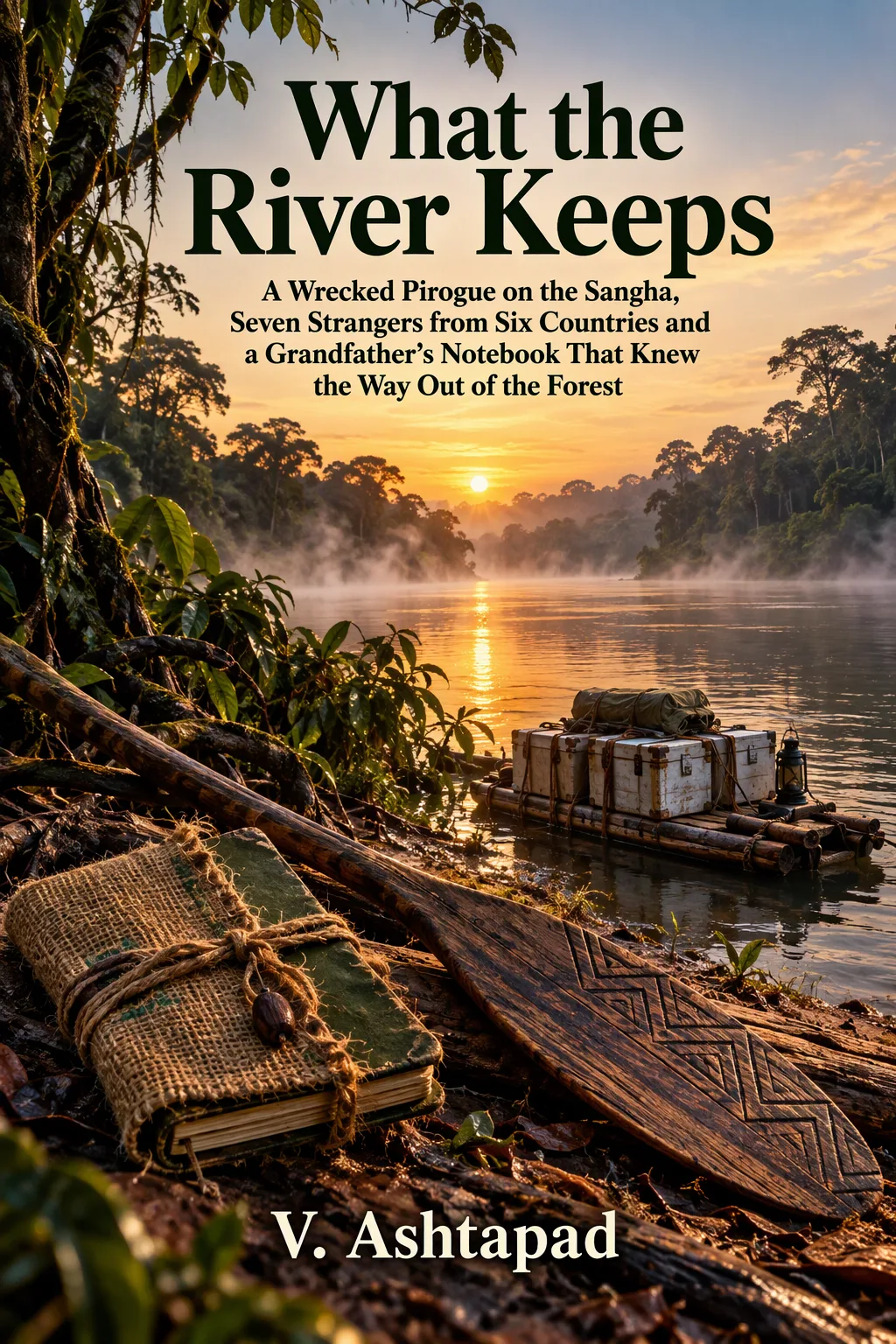
What the River Keeps
A Wrecked Pirogue on the Sangha, Seven Strangers from Six Countries and a Grandfather's Notebook That Knew the Way Out of the Forest
by V. Ashtapad
Foreword
This is a work of fiction. The Sangha River runs through the rainforests of the Central African Republic, Cameroon and the Republic of the Congo, and its long river pirogues, forest elephant clearings and smoked-fish camps are real, as are the everyday cooking, music and craft of those countries and of Gabon, Equatorial Guinea and São Tomé and Príncipe that this story draws on. The Bonne Patience, the Água Verde cooperative, the camp at Ebolo and everyone in this book are invented.
For everyone who kept a fire lit for someone still on the water.
The Tin Box
*Abel's notebook, Nola, August 1961. The river here is the color of coffee with too much milk in it. The men say it is high this year. I have been on it for three years and I still cannot tell high from low by looking. Old Kossi says I will know it when I can hear it. I asked him what it sounds like. He said, like a woman who has stopped arguing.*
---
The beans were talking on the fourth day, the way they always did.
Filomena Ceita lifted the banana leaves from the second box and put her face down into the heat. Vinegar first, sharp enough to make her eyes run, and under it the fruit smell, ripe and brown, and under that something she had never found a word for in Portuguese or in Forro or in the bit of French she had from school. Her grandfather used to call it the smell of the beans deciding. On the fourth day in the wooden boxes at the Água Verde cooperative, high in the hills above Trindade, the cocoa beans decided what kind of chocolate they wanted to be, and a fermentation supervisor's job was to listen and turn them at the right hour.
She pushed her arm in to the elbow. Forty-six degrees, by the feel. She did not need the thermometer and used it anyway, because the young ones were watching.
"Turn this one now," she told Dário, who was nineteen and had arms like a heron. "Box three after lunch. Box four can wait until tomorrow."
"How do you know?"
"I know because I am thirty-eight and you are nineteen."
He grinned and picked up the wooden shovel. She went out under the breadfruit trees with her hands sticky and brown, and stood looking down the green slope toward the sea, which you could see from Água Verde on a clear morning, a flat silver plate past the roofs of the town. Her mobile was buzzing in her apron pocket. It would be her mother. It was always her mother at ten.
"Mena," said Dona Celeste. "Your uncle has found the box."
---
The box had been under her grandfather's bed for as long as anyone could remember, and for a year and a half since his death nobody had wanted to look at it.
Abel Ceita had died in March of the year before, at eighty-six, in the house in Trindade with its green shutters and its yard of chickens, on a hot afternoon, in his chair, while the radio played a morning program repeated in the afternoon for people who had missed it. He had been a cocoa farmer for fifty-eight years. Before that, for nine years, he had been something else, and that something else was the family joke.
"Papa's river," her uncle Alcino said, setting the tin box on the kitchen table. Alcino was sixty-six and had their grandfather's ears and none of his patience. "Here it is. The great river. Every crocodile in Africa, every storm, every wreck. I heard them all forty times. When I was ten I believed he had wrestled a hippopotamus."
"He never said he wrestled a hippopotamus," said Dona Celeste.
"He implied it."
Mena opened the lid. It was a biscuit tin, painted once with roses that had gone to brown, and it smelled of camphor and old paper. Inside were three photographs, a pocketknife with a horn handle, a folded map so worn it was soft as cloth, a small brass key that opened nothing anyone knew of, and a notebook.
The notebook was the size of her hand, bound in green canvas, swollen with damp at one corner. On the first page, in a neat schoolboy script, her grandfather had written his name and, under it, *Mechanic's notes. Bonne Espérance, and after.*
"The boat," said Celeste softly. "The Bonne Espérance. He talked about it as if it were a woman."
Mena turned the pages. They were full of him at twenty-two, twenty-five, twenty-seven, in pencil and later in blue ink: engine parts with their sizes, prices of fuel at different landings, the names of men, and drawings. A tree with a white trunk at a bend. A rock shaped, he had written beside it, like an elephant's back with the elephant gone. A hill with two tops like a camel, except that he had crossed out *camel* and written *like two old women whispering*. Distances in hours. Arrows. Warnings underlined twice. *Keep left at the three sisters or you will be swimming.*
"It's a map," she said. "It's the whole river."
"It's a young man showing off," said Alcino. But he had leaned in to look, and his voice had gone quiet.
The photographs were of a long wooden boat, crowded with people and sacks and a bicycle tied on the roof of a tin cabin; of a group of young men squinting into the sun, one of them unmistakably her grandfather, laughing, in a vest with an oily rag over his shoulder; and of a little girl standing on a sandbank with her hands behind her back, too far from the camera to have a face.
"Who is she?" Mena said.
Nobody knew.
---
She read the notebook that night in her own small house below the cooperative, with the window open and the frogs going and the smell of the drying racks coming down the hill. She read it again on Sunday after lunch at her mother's, with a plate of calulu going cold beside her, the smoked fish and the bitter leaves and the palm oil, because she could not put it down.
The stories she had heard all her life were in there, but they were different on the page. In the stories her grandfather was brave and funny and always won. In the notebook he was frightened half the time, and homesick, and he got things wrong and wrote them down so that he would not get them wrong again. *Today I put the wrong oil in the gearbox. Kossi did not shout. That was worse.* *Rain for four days. I dream of my mother's fish stew and wake up eating my blanket.* *A man at the Ndoki landing sold me a chicken that was older than he was.*
And near the end, in October 1966, there was a long entry in a different hand, shaky, as if written on a knee in bad light, about a night when the Bonne Espérance struck a tree in the water and went over, and nine days afterward, and a fisherman's house, and a girl who sang. Then a page torn out. Then, in steady ink again, one line: *I am going home. The river taught me to wait. That is enough to carry.*
"He never told that one," Celeste said when Mena showed her. Her mother sat for a long time with the notebook open on her knees. "Not once. All those stories, and never that one."
"Maybe because it was true."
Her mother looked up at her. Celeste was sixty-three and had worked in the post office for thirty years and was not a woman who went anywhere. She had been to Lisbon once, for an aunt's funeral, and had talked about the cold for a decade.
"You're going," she said. It was not a question.
"I have leave owed. Three weeks. The harvest is quiet until December."
"You've never been further than Libreville."
"Then it's time."
"It is the far side of Africa, Mena."
"It's the middle of it," said Mena. "And he went at nineteen with nothing but a bag."
Her mother closed the notebook and held it a moment with both hands.
"Wrap it in plastic," she said. "And then wrap that in something. And then bring it back."
---
Uncle Alcino drove her to the airport in his pickup on a Thursday morning, through the town, past the market women setting out their bananas and safou and their bowls of tiny red peppers, past the blue boats pulled up on the beach and the boys playing football barefoot on the sand. He did not speak until they were nearly there.
"He told me once," he said, "that the river saved his life and then sent him home. I thought he meant something grand. A dream. A sign." He changed gear. "He was not a man for signs."
"No."
"Find out what he meant."
She had the notebook in a sealed plastic bag, inside a second sealed plastic bag, inside a cocoa sack she had cut and stitched into a pouch on her own sewing machine, with a cord to go around her neck. In her other bag she had two shirts, a pair of trousers, a rain jacket her mother had bought at the market and that already smelled of rubber, a tin of sardines, a lighter, a flashlight, a headscarf, a packet of malaria tablets, and a bar of the cooperative's dark chocolate, seventy percent, wrapped in brown paper, because she had never gone anywhere without one.
At the curb Alcino got out and hugged her, which he had not done since she was a girl.
"Leve-leve," he said into her hair. Slowly, slowly, the island word for everything.
"Leve-leve," she said.
It took her three flights, two nights in hotels that smelled of insecticide, and a long day on a red road in the back of a shared car with four strangers and a crate of chickens, to reach the river.
© 2026 CRUNOD LLC. All rights reserved.
Nola Landing
*Abel's notebook, Nola, January 1962. Loaded: 40 sacks of coffee, 11 of salt, 2 sewing machines, 1 bed in pieces, 6 passengers, 1 goat that is not on the list. Kossi says every boat on this river carries one passenger that is not on the list. Sometimes it is a goat. Sometimes it is a fever. Sometimes it is a woman's grief, and that is the heaviest.*
---
The boat was called the Bonne Patience, and the first thing its owner said to Mena was that it was not related to any other boat.
"Every time a stranger reads my name they ask me if I am the cousin of some Bonne Espérance or Bonne Chance or Bonne Année," said Samuel Mbarga, wiping his hands on a rag. "I am the cousin of nobody. I named her for my wife's mother, who was patient with me for twenty years and then died, and that is all."
He was a broad man of forty-seven with a shaved head and a gap between his front teeth that made his laugh come out like a whistle. He had come up from Moloundou, on the Cameroonian side, ten days before with a load of cooking oil and enamel basins, and now he was going back downriver to Ouesso with whatever the town of Nola wanted to send south. He stood on the landing in rubber sandals and a football shirt so old that the team's colors had faded to the colors of different teams.
"My grandfather worked on a Bonne Espérance," said Mena, in her careful French. "In the sixties. As a mechanic."
Samuel looked at her properly then. "From where?"
"São Tomé."
"An islander. On this river." He shook his head, delighted. "Then he was a brave man or a crazy one."
"My uncle says crazy."
"Uncles always say crazy. My nephew's uncle says it about my nephew every day." He turned and bellowed toward the boat. "Kévin! Is that rope tied, or is it only thinking about being tied?"
A thin boy of sixteen in a cap and long shorts looked up from the bow and made a face that could have meant either.
---
The Bonne Patience was a long planked pirogue, eighteen meters from nose to stern, painted blue with a yellow stripe and patched with tin where the planks had been kicked by logs. Halfway along, a roof of corrugated metal on poles made a shaded cabin over two benches. At the back, on a heavy wooden transom, sat a forty-horsepower outboard engine that Samuel patted every time he passed it, the way other men pat a dog.
Mena sat on her bag on the landing and watched the town load it.
The landing at Nola was a slope of red mud and gray sand, cut into steps by thousands of feet. Women came down it with basins on their heads. Men came down it rolling drums of fuel. A boy came down it with a bicycle on his shoulders, and another boy behind him with the bicycle's front wheel. Sacks of cassava flour went into the bow, and a crate of bottled soda, and twenty bars of yellow soap tied with string, and a refrigerator still in its cardboard with the word FRAGILE written on it in three languages and footprints on all four sides.
Above it all the river went by, wide and brown and quiet, carrying whole islands of grass, and once a branch with a bird still sitting on it, riding along as if it had paid for its ticket.
*Like a woman who has stopped arguing,* Mena thought. She still could not hear it.
"You are on my basket."
She jumped up. The woman behind her was small and round and seventy if she was a day, in a wrapper printed with green birds and a headscarf to match, and she had a basket the size of a bathtub balanced on her head without seeming to notice it.
"Sorry, madame."
"Bara," said the woman, which Mena would learn was hello in Sango, and also a great many other things depending on how you said it. "Sit there. No. There. Not on the fish."
The basket held smoked fish, dozens of them, curled and golden-black, packed in layers between leaves. It smelled of woodsmoke and the sea Mena had left behind, though this fish had never seen a sea in its life.
"Odette Zanga," said the woman, holding out a hand that was dry and strong. "I sell fish and coffee in the big market at Bangui, by the river. Everybody knows me. If you are ever in Bangui, ask for Mama Odette, and if anyone tells you my prices are high, they are lying, and also they are right."
Mena laughed, and introduced herself.
"Ceita," Odette repeated. "That is not a name from here."
"From São Tomé. The islands."
"I have never seen the sea," said Odette. "I was born on this river, at a village three hours below this landing, and I have lived on one river or another all my life. My father was a fisherman. My grandson, he is an electrician now, in the sawmill at Ouesso, and his wife has had a baby girl. Three months old. My first great-grandchild. I am going to see her before she is old enough to be frightened of me."
"Why would she be frightened of you?"
"Everyone is frightened of me," said Odette, satisfied, and lowered the basket to the ground at last.
---
There were six passengers in the end, not counting Kévin, who was crew, and not counting the goat, which belonged to nobody and got on anyway.
There was a young man in a pressed white shirt and creased gray trousers and leather shoes so polished they gave back the sky, who carried a small hard-sided case and a guitar in a canvas cover. He bowed slightly when he introduced himself, a little joke against himself.
"Ange-Michel Loubaki. Brazzaville. Bacongo, to be exact, which means I am the best-dressed man on any boat I board." He was twenty-six, with a thin mustache he was clearly proud of. "I am a pharmacist's assistant. I am going to Ouesso to work at the new clinic. They told me to bring medicines and bring patience. I brought medicines."
"And the shoes?" said Samuel, looking at them with real pain.
"The shoes are for arriving."
There was a woman of about thirty with her hair cut close and a hard yellow plastic case of equipment she would not let anyone else touch. She wore field trousers with many pockets and a faded green shirt, and she watched the forest on the far bank the way other people watched television.
"Pauline Moussavou," she said. "From Libreville. I study forest elephants, or more exactly I study their voices. I have been at a research camp up the Sangha for six months recording them. Most of what they say we cannot hear. It is too low."
"Then how do you know they are saying it?" said Ange-Michel.
"The same way you know a drum is playing when you feel it in your stomach. They have voices that go through the ground."
"And what do they say?"
She thought about it, seriously. "Mostly, where is everybody. And, I'm here."
"That is also what my mother says on the telephone," said Ange-Michel.
And there was a tall, stooped, gray-bearded man of sixty-one with forearms like rope and the calm of someone who had spent his life around tools. He spoke Spanish to Mena when he heard her Portuguese, slowly, and she answered him, and they found they could understand each other if both of them took their time, the way two people on opposite banks can talk across a quiet river.
"Tomás Esono Nsue. From Bata. Equatorial Guinea." He touched the flat parcel under his arm, wrapped in a towel and tied with twine. "I build boats. My daughter Remedios teaches at a secondary school in Ouesso, and on Saturday she is marrying a Congolese man who measures trees for a living. I have only met him on a telephone screen. He seems polite. We will see." He raised the parcel slightly. "This is for her. I made it."
"What is it?"
"A boat," he said, as if there could be no other answer.
---
They left Nola at six on Monday morning, in a white mist that lay on the river like a sheet on a bed.
Samuel pulled the cord and the engine coughed twice and caught, and he laughed his whistling laugh and patted it. Kévin pushed off from the bow with a long pole. The landing slid away, the women with their basins, the boys, the red steps, and the mist closed behind them, and for a while there was nothing but the engine and the brown water hissing under the planks and, very high above, a flock of gray parrots crossing the river, whistling to one another, red tails bright in the first light.
Mena took the notebook out of its pouch and turned to the first page with a drawing on it. *Nola. The landing has 31 steps. The big kapok on the left bank below the town has a hole in it like a doorway.*
She looked back. The landing had more than thirty-one steps now; the town had grown down the bank. But on the left side, as they rounded the first bend, there was an enormous tree, gray-trunked, buttressed like the walls of a fort, and in its side, at the height of a man, a dark opening like a door.
She held up the notebook so that Samuel, at the tiller, could see the drawing and then the tree.
He looked from one to the other for a long time.
"Your grandfather," he said, "drew well."
© 2026 CRUNOD LLC. All rights reserved.
The Long Reach
*Abel's notebook, below Nola, March 1963. Long reach, five hours, no landing. Forest both sides, very tall. Kossi says the trees here are so old they remember when the river ran the other way. I asked him if the river ever ran the other way. He said, ask the trees.*
---
By noon on Monday the mist was gone and the sun stood on the water, and the river had become the only road in the world.
There was nothing on either side but forest. Mena had grown up on an island that was mostly forest, steep and green, with the sea at the bottom of every path, and she had thought she knew what trees were. She had not known. These rose out of the water's edge in a wall so high and so thick that the light seemed to go into it and not come back. Trunks gray and white and red-brown, some straight as masts, some leaning out over the current with their roots clawing at the bank. Lianas hanging in loops and ropes. Palms in the gaps. Here and there a tree in flower, all its top gone yellow or crimson, so that it looked from below like a fire someone had lit in the canopy and forgotten.
"This is the Cameroon bank," said Samuel from the tiller, nodding to the right, "and that one, after the next long bend, is the Congo, and back there behind us the Central African Republic. The river does not care. Fish do not carry papers."
"Where do you sleep tonight?" asked Tomás.
"A landing I know. A village of fishermen. They will give us a roof if we bring them salt and gossip."
"I have plenty of gossip," said Odette.
Kévin sat in the bow with a pole across his knees, watching the water ahead. That was his job, Samuel explained to Mena: to read the river for the things you could not see. Sandbars. Rocks. Above all, trees. The Sangha carried whole trunks down from the forest when it was high, and most of them floated where you could see them, but some were waterlogged and rode just under the surface, invisible, heavy as iron.
"How does he see them?"
"You look for where the water is wrong," Kévin said without turning around. It was the first thing he had said to her. "A line where there shouldn't be a line. A place that boils a little. Like the river has something in its throat."
"His father taught him," said Samuel, quieter. "My brother Joseph. The best eyes on the river." He did not say anything more, and Mena did not ask.
---
The engine roared, and over it, from somewhere in the cabin, came music.
It was a small radio, battery-powered, tied to a pole with wire, and from it came guitars playing lines that ran over and under each other, quick and bright, and a bass that walked about like a man who owned the place, and a voice singing in Duala about, Samuel said, a woman who had borrowed money and a bicycle and was not bringing back either.
"Makossa," he said, as if he were introducing a member of his family. "The music of Cameroon. The only music."
"Excuse me," said Ange-Michel. He had found the only dry seat under the roof and was sitting on it with one leg crossed over the other to keep his trousers from the bilge. "You are on a river that leads to Brazzaville, and you have the nerve to say that."
"I said what I said."
"Rumba," said Ange-Michel, pressing a hand to his heart, "is the mother of every guitar on this continent. Makossa is a nephew who comes to Sunday lunch and eats all the meat."
Samuel whistled with laughter. Pauline, who was sitting on her yellow case at the edge of the shade, rolled her eyes at Mena.
"And now," she said, "they will talk about football for four hours."
They talked about football for three and a half. Odette sat through it peeling a pile of peanuts into her lap and flicking the shells over the side, and every so often she corrected one of the men on a score from a game played before either of them was born.
Tomás did not join in. He spent most of the day moving slowly along the boat, as far as it was possible to move along a boat crammed with sacks and soap and a refrigerator, looking at it. He ran his hands along the gunwales. He pressed the patches with his thumb. He leaned over to look at the waterline. Once he lay down on his back on the sacks and looked up at the underside of the roof as if he were reading a ceiling.
"Is she all right?" Mena asked him in Spanish.
"She is a good boat," said Tomás. "Old. Patched by a man who loves her and cannot afford to give her new planks." He sat up. "The wood is limba, mostly. Some ayous at the back. Somebody built her well, thirty years ago. She will float when she is full of water, which is the most you can ask."
"Is that likely?"
"On a river? Always."
---
They passed a pirogue going upriver, a small dugout with a single man standing and paddling, and he and Samuel called greetings across the water that went on long after either of them could have heard the answers. They passed a fishing camp on an island, smoke racks of sticks with fish laid on them, children running down to the edge to wave. They passed a place where the forest had been cut back from the bank in a raw brown square and a great stack of logs waited for a barge. They passed a sandbank where something long and gray was lying in the sun, and Ange-Michel stood up very fast and sat down again very fast.
"Only a log," said Kévin.
"I knew that."
"It was a crocodile," said Odette to Mena, quite pleased, "but there is no reason to tell him."
Late in the afternoon a troop of monkeys crossed above them where the trees nearly met over a side channel, leaping from one side to the other through the high branches, black and white, with long tails and long white capes of hair that streamed behind them as they flew. Pauline told them the name. Mena forgot it at once and remembered forever the sight of it.
She read the notebook to them that evening at the landing, under the eaves of a fisherman's house, after a supper of fish grilled in leaves and cassava from Odette's basket, with a lamp hissing and moths banging against it and the river talking to itself in the dark below. She read in French, translating as she went, stumbling. They listened in the way of people with nothing else to listen to and also in the way of people who were interested. She read them the chicken older than the man who sold it, and Odette laughed until she coughed. She read them the trees that remembered when the river ran the other way, and Pauline said, "Your grandfather would have made a good scientist. He asked the right people."
"He grew cocoa," said Mena. "For fifty-eight years."
"Then he was a scientist," said Pauline. "Just a slow one."
When she had finished, Samuel held out his hand for the notebook. He turned the pages carefully with his oily fingers, frowning at the drawings, and once he grunted and put his finger on one.
"This one I know," he said. "The rock like an elephant's back. It is still there, below the next long island. Tomorrow afternoon we will pass it." He turned another page. "This one I do not know. Two old women whispering." He looked at the hill drawn on the paper, the two tops with a dip between them. "My grandfather spoke of a hill like that, on our side, the Cameroon side, inland a little from a white sand landing where the forest people used to bring honey down to trade. But I have never seen it. You cannot see it from the river now. The trees grew too tall."
He handed the notebook back.
"We will be in Ouesso Wednesday night," he said. "If the river and the engine agree. Sleep."
---
On Tuesday the sky built itself into towers.
It began in the morning as a whiteness in the west, like steam over a pot, and by midday it had climbed into great gray-bottomed clouds piled one on another, and by the middle of the afternoon the light on the water had turned the color of brass. There was no wind. The forest stood absolutely still. The birds had stopped.
Kévin sat up straighter in the bow. Samuel turned the radio off.
They passed the rock like an elephant's back at four o'clock, a long smooth hump of gray stone lying in the water off the right bank, and Mena held up the notebook and Samuel nodded, and neither of them smiled, because the first wind had arrived at the same moment, cold and smelling of iron, and the whole wall of forest on the right bank leaned toward them and showed the pale undersides of its leaves.
"How far to the next landing?" said Tomás.
"Two hours."
Tomás looked at the sky. He did not say anything. He began, quietly, to tie his wedding parcel to his own body with the twine.
© 2026 CRUNOD LLC. All rights reserved.
The Drowned Tree
*Abel's notebook, October 1966. I write this nine days after. My hand is not good yet. The Bonne Espérance struck a tree under the water at night in a storm below the long island. We did not see it. Nobody could have seen it. I keep writing that, so I will believe it.*
---
The rain came across the river like a wall being pushed.
Mena saw it before she heard it, a gray curtain hanging from the clouds to the water, moving toward them out of the west, and the river under it gone white and hissing. Then the sound reached them, a roar that rose over the engine and swallowed it, and then the rain itself, so hard and so cold that it hurt. In a breath the far bank vanished. In another, the near one. There was nothing in the world but water falling into water and the boat in the middle of it.
"Get down," Samuel shouted. "Under the roof. Everybody. Kévin, eyes!"
They crowded under the tin roof, which roared like a drum being played by a hundred hands. Odette sat on her basket with her wrapper pulled over her head. Ange-Michel clutched his medicine case to his chest and his guitar between his knees. Pauline had her arms locked around the yellow case. Tomás sat with his back to a pole and his parcel strapped to him and his eyes on Samuel. Mena pressed her hand flat against the pouch at her throat and felt the notebook through three layers and thought, absurdly, of her mother saying *wrap it in plastic*.
The wind swung the boat. Samuel fought it back. He was steering toward where the right bank had been, slowly, feeling for it, and Mena understood that he was trying to get them out of the main current into slower water near the trees, where they could tie up and wait. Kévin knelt in the bow with the rain streaming off his cap, staring ahead into the white roar, one arm raised, ready to signal.
It grew dark. It had been dark for some time, she realized; the storm had swallowed the evening. Samuel switched on a lamp hung from the roof, and its light went out about three meters into the rain and stopped there as if it had hit a wall.
"Channel," Samuel shouted to Tomás. "Side channel. There's an island here. If I can get behind it—"
The boat turned. The noise of the rain changed; there were trees close by now, somewhere, she could hear the rain on leaves. The water under them felt different, quicker, ropier. Kévin was shouting something, his arm moving, left, left—
Then the river stopped the boat.
There was no other way to say it afterward. It was not like hitting a rock. It was as if the whole long boat had run into a hand that had come up out of the water and taken hold of her and would not let go. The bow rose. There was a terrible grinding under them, wood on wood, and the sound of planks giving. The engine screamed, freed of the water, and Samuel killed it. Sacks slid. The refrigerator in its cardboard went over the side with a slow dignity, like an old man leaving a party. Odette was thrown against Mena and Mena against the pole.
And then the river, which had been holding the boat, began to turn her over.
---
What Mena remembered afterward came in pieces, and the pieces did not fit together in any order she could trust.
She remembered Samuel's voice, very calm suddenly, saying the same thing again and again: "Hold the boat. Hold the boat. She floats. Hold the boat." She remembered cold water closing over her head and coming up into the rain, and her hands finding the gunwale of the Bonne Patience, which was on its side now, low and black in the water, and holding it. She remembered the current pulling at her legs as if it had a grudge. She remembered Tomás beside her, his gray beard plastered to his chest, holding the gunwale with one hand and Pauline's case with the other, and Pauline holding Tomás.
She remembered Kévin's voice somewhere ahead, high and frightened, shouting "Mama Odette! Mama Odette!" and then Odette's voice, very cross, shouting back, "I am here, I am not dead, stop shouting!" and Kévin appearing out of the dark with one arm around the old woman, swimming, kicking, his cap gone, bringing her along the boat hand over hand.
She remembered that the boat was moving, sideways, along the edge of trees, branches scraping across it, and that Samuel was shouting for them to grab the branches, grab anything, and that she grabbed a branch and it held, and then another, and that her feet found mud, deep soft mud and roots under it, and that she was standing in water to her chest at the edge of the forest with the rain pouring down and her hands full of leaves.
She remembered counting. Out loud, in Portuguese, without meaning to. "Um. Dois. Três." Pauline answering, "Here." Tomás, "Here." Odette, held up by Kévin, "Here, here." Ange-Michel, somewhere in the dark, coughing, "Here. My shoes are gone. Here."
"Samuel," said Kévin. "Uncle? Uncle!"
The boat was still moving away from them along the trees, and Samuel was still on it.
---
Tomás went back for him. Mena would remember that too, though she did not see most of it: the tall old man letting go of the branches and going back out into the dark water along the line of the boat, hand over hand, and then a long time in which there was nothing but rain and the sound of the river and Kévin saying "Uncle" over and over in a voice that was no longer a shout.
Then splashing, and Tomás's voice, flat with effort, and Samuel's, saying something that was mostly a groan. They came along the trees together, slowly, Tomás holding Samuel under the arms, Samuel's face gray in the last of the lamplight that somehow was still burning on the boat out there, swinging, going away.
"His leg," said Tomás. "Caught between the hull and a trunk when she rolled. Help me. Gently. Gently."
They got him to the mud and the roots and up against a tree. Kévin knelt beside him. Samuel's face was wet with rain and something else, and he was breathing hard through his teeth, and still, somehow, he managed to put a hand on his nephew's head.
"Not your fault," he said. "The tree was under the water. Nobody could have seen it."
They watched the lamp on the Bonne Patience go away into the dark, swinging, smaller, a yellow spark among the trees and the rain, and then around some bend they could not see, and then gone.
---
They spent the night in the forest at the water's edge, standing and then crouching and then sitting on the roots of a single great tree with their backs against its trunk, because there was nowhere else to go and nothing to see.
The rain went on for hours. It eased, and came back, and eased. They did not speak much. Odette shook with cold and Mena and Pauline sat on either side of her and put their arms around her, and after a while the old woman's shaking slowed and she began, very softly, to hum, a tune that went up and down like a paddle going in and out of water. Ange-Michel, in his ruined white shirt and his socks, held Samuel's hand on one side and Kévin held it on the other. Samuel did not complain once. Several times he made a joke so bad that it could only have been on purpose, and once, when the rain was at its hardest, he said, "Well. At least the goat is fine," and Pauline laughed so suddenly that she nearly fell off the root.
The goat was in fact fine. It had come ashore somewhere in the dark and in the early hours it found them, and stood among them, steaming, as if it had arranged the whole thing.
Mena sat with her hand on the pouch at her throat. Under three layers of plastic and cocoa sacking, the notebook was dry. She could feel the corners. *We did not see it. Nobody could have seen it. I keep writing that, so I will believe it.*
Some time before dawn the rain stopped altogether, and in the silence after it, for the first time, she heard the river. It went past them in the dark, a long, low, endless sound, and she understood at last what old Kossi had meant. It did not sound angry. It sounded like something that had made up its mind.
© 2026 CRUNOD LLC. All rights reserved.
The Sandbank
*Abel's notebook, October 1966. First morning. We had: Kossi's knife, my knife, a pot, a coil of rope, half a sack of salt gone to stone, and nine men. Nobody had fire. Kossi says fire is the first thing and water the second and hope the third, but you cannot cook hope.*
---
Day came slowly, gray and dripping, and showed them where they were.
The great tree they had sheltered under stood at the edge of a strip of sand and mud perhaps forty meters long and ten wide, a little higher than the water, pressed between the river on one side and the forest on the other. In front of them a channel of brown water ran fast, fifty meters wide, and on the far side of it was an island thick with trees, which hid the main river completely. Behind them the forest began, and it did not begin on dry ground. The trees stood in water. Black water, still, with leaves floating on it, stretching back between the trunks as far as they could see.
"Flooded forest," said Pauline. "In high water half of this country stands in the river."
"Which country?" said Ange-Michel.
Samuel, propped against the tree with his face gray and his lips pressed together, lifted his chin toward the forest. "Cameroon," he said. "We were on the right of the channel. That is the Cameroon bank. The island hides the main river. Anyone looking for us will look out there." He closed his eyes. "Nobody will look in here."
Nobody answered him. Then Tomás, who had been standing at the edge of the water looking up and down the channel, turned round and clapped his big hands together once, loudly, so that a bird flew up out of the trees.
"Good," he said in his slow French. "Now we know where we are. Now we count what we have."
---
They counted on a piece of tarpaulin that Kévin found tangled in the roots downstream, blue plastic, torn at one corner, part of the cover that had kept the rain off the soap.
They counted everything.
Pauline's yellow case had come through closed and dry. In it, packed in gray foam, were two sound recorders, four microphones, two pairs of headphones, a box of spare batteries, a headlamp, a roll of silver waterproof tape, a folded emergency blanket that crackled when you touched it, a notebook and three pencils, and three energy bars in shiny wrappers that everyone looked at for a long time.
Ange-Michel's medicine case had leaked at one hinge, but most of it was in sealed packets. Bandages. Gauze. A bottle of antiseptic. Painkillers. Malaria tablets for treatment, not just prevention, which he said were worth more than gold out here. Oral rehydration salts. A strip of water purification tablets, forty-eight of them. Scissors, tweezers, a thermometer, and a roll of tape that was not as good as Pauline's. His phone was in a plastic bag in his trouser pocket. It turned on. It showed a photograph of a smiling elderly woman in a wide yellow hat, which he explained quickly was his grandmother, and in the corner, where the signal should be, there was nothing at all.
"Keep it off," said Pauline. "The battery is a light. It is not a telephone anymore."
Tomás had his parcel, still tied to his chest, still wrapped in its towel, now soaked. He had his carpenter's knife, short and heavy, in a leather sheath on his belt, and twenty meters of twine wound around his waist under his shirt, which he said a boatbuilder always carried, the way a tailor carries a tape measure.
Kévin had his machete in its sheath, and a plastic lighter in a twist of plastic bag in his shirt pocket, wet. Samuel had another lighter, in a better bag, and a fishing line wound on a stick with six hooks stuck into the wood, and a rag.
Odette untied the knot at the corner of her wrapper and laid out what was in it with great ceremony: a fold of banknotes, wet; a twist of paper containing salt, mostly dissolved; four dried red peppers; and a small screw-top tin that had once held face cream and now held, she said, the most important thing a woman can carry on a journey.
"What?" said Ange-Michel.
Odette opened it. It was full of needles and thread.
Mena had less than any of them. Her bag had gone with the boat. In the pockets of her trousers she found her grandfather's horn-handled pocketknife, which she had brought on a whim, and her flashlight, full of water. In the pocket of her rain jacket she found the brown paper package of the cooperative's chocolate, seventy percent, soft at the edges, intact. And at her throat, under the cocoa sacking and the two plastic bags, there was the notebook.
In the roots and the mud along the strip they found the rest: Samuel's aluminum cooking pot, dented, its lid gone; a yellow plastic jerrycan, empty, which had held fuel and smelled of it; two bars of yellow soap still tied together with string; a single rubber sandal that fit nobody; and, wedged under a root at the downstream end, half a sack of cassava flour, split, soaked through, already beginning to sour.
And the goat.
"So," said Tomás, sitting back on his heels and looking at it all. "Seven people. One goat. One pot. Some medicine. Two knives and a machete, one of them very small. Two lighters, wet. Twenty meters of string. Some needles. Soap." He looked at Odette. "And the most important thing."
"Laugh," said Odette. "When your trousers split, you will come to me."
---
Fire was the first thing.
Everything in the forest was wet. The sticks were wet, the leaves were wet, the dead wood was wet all the way through and soft as bread. Kévin opened his lighter and blew on it and shook it and dried it against his skin and tried it fifty times, and it sparked and would not catch, and Samuel's lighter caught on the twentieth try and burned for a few seconds at a time and then died, and the twigs they held over it hissed and smoked and refused.
Pauline and Odette went into the edge of the trees together, wading knee-deep. They came back a long half hour later with Pauline holding a lump of something in a leaf, pale and crumbly and sticky, the size of two fists.
"From a big tree back there," Pauline said. "It bleeds this when it is cut or broken. It is resin. We call the tree aiélé in Gabon. People used to use the resin for torches."
"In my village we used it to light the fire when the wood was wet," said Odette. "My father always kept some in a leaf under the roof. Like this." She took the lump from Pauline and broke off a piece with her fingers and pressed it among the smallest twigs, and held out her hand to Samuel for his lighter.
The resin caught on the third spark. It burned with a bright, smoky, hissing flame, and it smelled, strangely, like the resin Mena's grandmother used to burn in a clay dish on the veranda in Trindade to keep the mosquitoes off, and it went on burning while the wet twigs over it steamed and blackened and at last, unwillingly, caught.
Nobody cheered. They just leaned closer, all seven of them, around a fire the size of a cooking plate, and held out their hands, and Mena saw that Samuel was crying a little and pretending it was the smoke.
---
Water was the second thing. There was water everywhere, and none of it could be drunk.
Ange-Michel was very firm about this, suddenly older than twenty-six. "Not from the river. Not from the forest. Boil it, or a tablet, and we have forty-eight tablets and seven people. So boil it, and keep the tablets for when we cannot."
They boiled it in the dented pot, a pot at a time, and let it cool, and filled the jerrycan, which after three rinsings with river water and a scrub with the yellow soap and Tomás's knife handle had begun to smell more of soap than of fuel. The water tasted of smoke and soap and river. It was the best water Mena had ever drunk.
While the pot boiled Ange-Michel turned to Samuel's leg.
He did it well. Mena watched him and saw his hands go steady and his voice go quiet, the way her own did at the fermentation boxes when she put her arm into the heat. He cut the trouser leg open with the scissors and looked at the ankle, which was swollen and dark, and felt it gently with his fingertips while Samuel stared at the sky and said a great many things about Ange-Michel's mother.
"Broken," said Ange-Michel. "Closed. That is the good news. The skin is not open. It is not out of place, I think, or not much. I cannot set it better than it is. I can only keep it still." He looked up at Tomás. "I need two pieces of wood. Straight. This long. Not rotten."
Tomás went into the edge of the forest and came back with two pieces of wood straight as rulers, and stripped the bark from them with his knife and smoothed them with the blade, which took him less time than it took the water to boil. They padded Samuel's leg with Ange-Michel's gauze and Odette's spare headscarf and bound the splints with strips of the blue tarpaulin and Pauline's silver tape. Ange-Michel gave him two painkillers and wrote the time on the back of his hand with Pauline's pencil.
"Every six hours," he said. "Not more. We have twenty."
Samuel looked at his leg, splinted and taped in silver and blue, and then at Ange-Michel, whose white shirt was now brown and whose fine creased trousers were torn at both knees.
"You," he said, "are going to be a very great doctor."
"I am a pharmacist's assistant."
"Then you are going to be a very great pharmacist's assistant."
---
They waited all that first day. It was the right thing to do; everybody agreed. Samuel said the search would begin as soon as the Bonne Patience failed to arrive at the next landing, and that men on the river knew how to look. They kept the fire high and smoky with green leaves, and Pauline spread the crackling emergency blanket silver side out on a branch above the water where it caught the light. They boiled water. They made a paste of the soured cassava flour in the pot, stirring it with a stick into something thick and gray and faintly sharp that Odette said was not gozo and should not be called gozo in her presence, but was food.
Twice they heard engines out on the main river beyond the island. Each time they all stood and shouted and Kévin beat on the empty jerrycan with a stick, and Tomás waved his towel on a pole, and each time the sound went by, steady, unhurried, and faded downstream.
At sunset, when the trees across the channel turned black and the water turned to copper and the frogs began, Mena unwrapped the chocolate.
She broke it into squares with her grandfather's knife, carefully, on the lid of Pauline's case. There were twenty-four squares. She gave three to each of them and kept three for herself, and that left three, which after some argument went to Samuel for his leg.
They ate the chocolate one square at a time, slowly. It was dark and bitter and tasted of the hills above Trindade, of drying racks and fermenting boxes, of the sea. Kévin closed his eyes. Ange-Michel said something softly about his grandmother. Odette held a square on her tongue for a long time and then said, "This is what your island tastes like?"
"Yes."
"Then it is a good island," said Odette, and put her second square back in its paper for tomorrow.
© 2026 CRUNOD LLC. All rights reserved.
The Rising Water
*Abel's notebook, October 1966. Second day. The water came up in the night a hand's width and then another. Kossi says we cannot stay. The river is not finished with this island. He says that when a river wants a place back, you give it.*
---
Mena woke because her feet were wet.
She had slept on the blue tarpaulin with her back against Odette's back and Pauline's head on her shoulder, near the fire, on what had been at sunset the highest part of the sand strip. Now the edge of the river was lapping at the tarpaulin's corner. In the gray light she could see the line where the water had been the evening before, a ridge of leaves and foam and twigs, and it was two meters behind them, under water.
Tomás was already up, standing by the great tree with a stick in his hand. He had pushed it into the mud at the waterline at midnight, he said, and again at three, and again at five, and he showed her the three marks he had cut into the stick with his knife.
"Two fingers an hour," he said in Spanish. "Since midnight."
"Will it stop?"
"Ask the rain upriver." He threw the stick into the channel and watched it go. "At this speed, by tomorrow night we are standing in it. By the day after, swimming."
---
They argued about it all morning.
They did it around the fire, which Kévin had kept alive through the night with resin and patience, feeding it as if it were a small animal. The argument went around and around like a dog lying down, and it was the kind of argument nobody could win, because everybody was right.
"We stay," said Samuel. "You stay with the wreck. That is the first rule of the river. The search looks for the wreck, the wreck is near the people. You go walking into the forest, nobody ever sees you again."
"There is no wreck," said Pauline. "The wreck is gone. It is ten kilometers downstream on the far side of an island, or sunk."
"Then they will look for us near where they find it."
"Which is not here."
"We could build something," said Ange-Michel. "A raft. Float down to a village."
"With what?" said Tomás. "With wet trees? With twenty meters of string?" He shook his head. "I can build you a raft. Not here. Not from this. Everything here is soft and full of water. A raft from this wood sinks with seven people on it before it reaches the main river. And then there is the channel. It runs fast, toward the main river, and in the main river there are trees under the water." He looked at Kévin and then away. "We know about the trees."
Kévin had not said anything all morning. He sat a little apart, on a root, with his machete across his knees, staring at the channel. When his uncle said his name he did not look up.
"Kévin."
"I was watching," the boy said. "I was watching the whole time. I didn't see it."
"Nobody could have seen it," said Samuel. "I told you."
"My father would have seen it."
There was a silence by the fire then, the kind that has weight in it, and the river filled it.
Samuel said, very quietly, "Your father hit a tree in the water at the mouth of the Ngoko when he was nineteen and sank a boat that belonged to our father, with forty sacks of cocoa in it. Your grandfather did not speak to him for a month. Did he ever tell you that?"
Kévin looked up.
"No," said Samuel. "Of course he didn't. And he would not want me to tell you now. But he is not here, so I am telling you." He shifted against the tree and grimaced. "Everybody who works on this river long enough hits a tree, Kévin. The ones who say they never did are lying or they have not been on it long enough."
The boy looked at his uncle for a long moment. Then he looked down at his hands. But his shoulders, which had been up around his ears since the night of the storm, came down a little.
---
It was Mena who ended the argument, and she did not mean to.
She had taken the notebook out of its pouch to read, because she could not think of anything else to do with her hands and because the argument had made her feel very far from home. She turned to the long, shaky entry from October 1966 and read it again, slowly, with her finger on the lines. The Bonne Espérance. A storm. A tree under the water, below the long island. Rising water.
Below the long island.
She turned back, a page at a time, to the drawing of the rock like an elephant's back. *Two and a half hours below the elephant rock, a long island on the left, keep to the main river, the side channel on the right is fast and full of trees.*
She looked up at the island across the channel. It was long. It stretched up and down the river as far as they could see.
"Samuel," she said. "When did we pass the elephant rock?"
"Four o'clock. A little after."
"And when did we hit the tree?"
He thought. "Half past six. Seven. Why?"
She turned the notebook round and held it out to him, open at the drawing, and then turned to the entry from 1966 and held that out too, and she watched his face as he read it. He read it twice. Then he looked up at the island and across at the forest and down at the water around his splinted foot, and he gave a long low whistle through the gap in his teeth.
"Here," he said. "Your grandfather. Sixty years ago. Here."
"Or close," said Mena. "Close enough."
Pauline had come to read over Samuel's shoulder. Tomás came. Odette came, slowly, wiping her hands on her wrapper. Ange-Michel came with the pot. Even Kévin came and crouched at the edge of the group, and in the end all seven of them were bent over the little green notebook in the gray morning light, with the river coming up behind them, reading what a twenty-seven-year-old mechanic from São Tomé had written about the second morning after his boat went down.
*The water came up in the night a hand's width and then another. Kossi says we cannot stay. When a river wants a place back, you give it. He says there is high ground inland toward the setting sun, and a hill with two heads that his own father spoke of, and beyond it, back toward the river, a sand landing where the forest people come down to trade honey. He says if we find the hill we find the river again. Tomorrow we go.*
"What happened to them?" Ange-Michel said. "After."
Mena turned the pages. The entry went on. Days. Short entries, some only a line. A road made by elephants. A clearing. A fever. The hill. And then the sand, and a fisherman's house, and a girl who sang, and the page torn out.
"They got out," she said. "All of them. Nine days."
"Nine days," said Tomás. He looked at the parcel tied to his chest. Today was Thursday. His daughter was getting married on Saturday.
Nobody said that. Everybody thought it.
"Then we go," said Samuel. He said it the way he had said *makossa* on the first day, a fact that admitted no discussion. "My grandfather spoke of that hill. Now your grandfather's crew walked to it. That is two grandfathers. I have never in my life argued with two grandfathers."
---
Tomás built the stretcher that afternoon.
He made it from two long, straight poles he found at the forest's edge, testing a dozen trees before he chose, pressing his thumb into the bark, knocking the trunks with his knuckles and listening, cutting them with Kévin's machete in long clean strokes. Between the poles he lashed short crosspieces with the twine, knot after knot, his old hands moving so quickly that Kévin, watching, kept asking him to slow down.
"This knot," Tomás said, and did it again, slowly, "my father taught me when I was seven, on the beach at Bata, tying the frames of a cayuco. A canoe. You make it like this. Over, under, round, through. It gets tighter the more you pull on it. Like family."
Kévin tried. It came apart.
"Again," said Tomás.
Kévin tried again. It held.
"Again," said Tomás, and this time he smiled.
Over the crosspieces they laid the blue tarpaulin, folded double, and tied it down. They tried it with Samuel on it, four of them lifting, Tomás and Kévin at the head, Ange-Michel and Pauline at the foot, while Mena walked beside and Odette walked in front and gave orders. Samuel lay on it with his arms folded and his splinted leg sticking out and said he felt like a chief.
"A chief who weighs ninety kilos," said Ange-Michel through his teeth.
"Eighty-five."
"Ninety. I am a pharmacist's assistant. I have weighed many people."
The water came up another hand's width while they worked. By evening the fire was on an island of its own. They moved it twice. At dark they made a platform of branches against the trunk of the great tree to keep the coals off the wet, and sat close together around it with the black water at their feet on two sides and the river talking in front of them, and nobody slept much.
Late in the night Mena heard Odette humming again, the same tune as before, the one that went up and down like a paddle. She lay listening to it in the dark with the notebook against her chest. It was a strange thing, but she thought she had heard it somewhere before. She could not think where.
© 2026 CRUNOD LLC. All rights reserved.
The Elephant Road
*Abel's notebook, October 1966. Third day. Water to the waist for three hours, then to the knee, then the ground came up under us like a floor. Kossi found a road. Not made by men. He says the elephants have been making it for longer than there have been men to walk on it. It goes where we are going. Kossi says elephants also want to get out of the water.*
---
They left the great tree at first light on Friday, and the forest took them in.
The first hours were the worst of Mena's life, and afterward she could remember almost nothing about them except the water. It was black, and warm, and it came to her waist and then her chest, and under it the ground was a mess of roots and soft mud and fallen branches that rolled under her feet. Every step had to be felt for. Every step was a question. Ahead of her Pauline went first with Kévin's machete, cutting where she had to, testing the bottom with a pole. Behind her came the stretcher, carried at shoulder height now, with Samuel on it holding Pauline's yellow case on his chest and Tomás's wedding parcel on top of it, while Tomás and Kévin and Ange-Michel and, in turns, Mena herself waded beneath with the poles on their shoulders. Odette came last, holding her wrapper up to her ribs with one hand and the goat's rope with the other, though the goat was swimming and did not need it, and talking without stopping.
"This is nothing," she was saying. "When I was a girl the water came into our house every year, up to the bed. We put the chickens on the roof. My mother cooked on a box. You think this is water. This is a bath."
"Mama Odette," said Ange-Michel, gasping under the stretcher pole, "with great respect, please stop."
"I will stop when we arrive."
They did not arrive anywhere for three hours. The light under the trees was green and dim, and the trunks went up out of the water into it like the legs of animals so tall you could not see their bodies. There were roots like walls. There were palms with spines on their stems as long as fingers, which Pauline warned them about in a sharp voice the first time Ange-Michel put out a hand to steady himself. Things moved in the water that nobody looked at closely. Once something large went away from them through the trees with a crash and a splash, and they all stood frozen, and Samuel said from the stretcher, in a whisper, "Pig," and nobody believed him and nobody asked.
Then the water was at their waists. Then their thighs. Then, between one step and the next, Mena felt the ground under her feet change from mud to something firmer, and rise, and rise, and she was walking in water to her knees, and then to her shins, and then on wet black earth among the roots, and she stood still and looked down at her own feet and started, without any warning at all, to laugh.
---
The road was Pauline's discovery, though she said the elephants deserved the credit.
They had been climbing slowly for an hour through forest that was dry underfoot at last, if nothing in that forest could be called dry. The trees were different here, Mena noticed, taller, farther apart, with great flanged roots that ran out across the ground like the walls of rooms. The air was heavy and smelled of earth and rot and something sweet she could not name. They were making slow work of it. Every few meters a fallen branch or a tangle of lianas blocked the way and Pauline or Kévin had to cut through, and the stretcher had to be lifted over, and Samuel apologized each time, very politely, as if he were a parcel that had been badly addressed.
Then Pauline stopped and held up her hand.
In front of them, running across their path from left to right, was a corridor through the forest. It was about two meters wide and perfectly clear, the ground packed smooth and hard, the undergrowth on either side pushed back and broken at the height of a tall man's shoulders. It curved gently away into the green in both directions. The earth of it was pocked with round prints, some old and filled with water, some new, big as dinner plates.
"Elephants," said Pauline. She knelt beside one of the prints and laid her hand in it, gently, as if it might still be warm. "Forest elephants walk the same roads for generations. Mothers teach daughters. These roads go between the places they need: water, fruit trees, clearings where the earth is salty. Some of them are hundreds of years old." She looked up at them, and her face, Mena thought, had changed completely; she looked like a girl. "They are the best engineers in this forest. They always find the high ground and the easy crossing."
"Which way?" said Tomás.
Pauline looked at the light falling through the canopy, and at her wrist, where there was no longer a watch, and at the road. Then she pointed right, west, a little south.
"Toward the setting sun," said Mena, and touched the notebook.
They turned onto the elephant road. After the swamp it felt like a paved street. They could walk two abreast. The stretcher could be carried without lifting it over anything. Even the goat seemed relieved, and trotted ahead, and had to be called back.
---
They walked all that day on the road, stopping often, changing places under the stretcher poles.
In the afternoon they were stung by bees, tiny ones, not much bigger than flies, that came in clouds and did not sting at all but crawled on every inch of bare skin, into their ears and noses and the corners of their eyes, after the salt of their sweat. Ange-Michel nearly wept. Odette said they were harmless and let them crawl all over her face and went on talking through them. In the afternoon too they found the leeches, which nobody had felt, small and black and fat on their ankles and calves, and Ange-Michel took them off with the tweezers from his case and his face twisted into an expression that made Samuel laugh so hard the stretcher shook.
"A pharmacist," Samuel wheezed, "who cannot look at a little blood."
"I can look at blood. I cannot look at things that are drinking blood."
"In Bacongo do you not have mosquitoes?"
"In Bacongo," said Ange-Michel, pulling a leech off Kévin's leg and flicking it away into the leaves with a shudder of his whole body, "the mosquitoes at least have manners."
But he did it. He did all of them, kneeling in the road with the tweezers, one leg after another, and dabbed every little wound with antiseptic, swearing gently in Lingala the whole time, and the second time they stopped he did it again without being asked.
---
In the late afternoon, where the road crossed a small stream running clear over sand, Odette stopped and put down the goat's rope and went off into the trees without a word.
She came back with her arms full of leaves. They were long and glossy, dark green, pointed at the tip, from a climbing vine that grew all over the trees by the stream.
"Koko," she said, holding them up. "We eat this in Bangui with everything. You cut it very, very fine, like hair, and cook it with peanut paste and smoked fish. Without the fish today. Without the peanut paste. But still."
Samuel sat up on the stretcher. "That is okok," he said. "In Cameroon we call it okok. Or eru, in the west. My wife makes it with waterleaf and palm oil and crayfish until the whole house smells of it."
"In Gabon it is nkumu," said Pauline. "My mother cuts it so fine you can see the light through the pile."
"Koko," said Odette firmly.
"Okok."
"Nkumu."
"It is a leaf," said Tomás, "and I am hungry, and you can argue while it cooks."
They made camp by the stream. Pauline found a place among the roots of an enormous tree where the flanges made three walls, and they hung the crackling emergency blanket over two of them for a roof and Tomás built a frame of sticks for the rest and they roofed it with big leaves, overlapping, like tiles. Kévin and Mena found dead wood that was not too wet under the roots and Odette lit it with the last of the resin from the first day. Ange-Michel boiled water. Odette sat with the leaves on her knees and Tomás's knife in her hand and cut the koko, which was also okok and also nkumu, into threads as fine as the threads in her needle tin, so quickly and evenly that Mena stopped what she was doing to watch.
"My mother cut it like that," said Pauline quietly beside her. "Exactly like that. Without looking."
"Where is your mother?"
"In Libreville. In a house with a mango tree and a radio that is never off." Pauline smiled. "She will be listening to the news now. She will have heard about a boat."
They boiled the leaves with Odette's last two peppers and some of the soured cassava paste and the salt that remained in her twist of paper. It was green and bitter and peppery and filled the stomach, and they ate it with their fingers from the pot in turns, and the goat ate the stems.
That night Pauline set up one of her recorders on a root outside the shelter, with a microphone in a gray furry cover pointing out into the dark, and put on her headphones and listened to the forest. Mena lay beside her and could hear it without headphones. Frogs, a hundred kinds. Insects like wires being tightened and released. Something far off calling, a long rising whoop and then a silence. Drips. And under it all, so low she was not sure whether she was hearing it or feeling it in the ground through her back, a long soft rumbling, like distant thunder in a dream.
Pauline took off one side of her headphones and turned her head and looked at Mena in the light of the coals, and she was smiling.
"They are near," she said. "They are talking. Can you feel it?"
"What are they saying?"
Pauline listened.
"I'm here," she said. "Where is everybody? I'm here."
© 2026 CRUNOD LLC. All rights reserved.
The Fisherman's Girl
*Abel's notebook, October 1966. Fourth day, I think. I have lost count once already. Kossi sings while he walks so that the animals hear us coming and go away. He knows only one song and it is very long. Nobody minds.*
---
The rumbling went on half the night, and somewhere near the middle of it Odette asked Mena to read.
They were all awake. It was impossible to sleep with the elephants talking through the ground and the frogs screaming and Samuel's leg throbbing so hard he said he could hear it. Ange-Michel had given him another two painkillers and written the time on his own hand this time, because Samuel's was covered. Kévin was feeding the fire. Tomás sat with his back against the root and his parcel in his lap, untied for the first time since the storm, still wrapped in its towel, his big hands resting on it.
"Read us your grandfather," Odette said. "The part where they find the river."
So Mena took out the notebook and found the place by the light of Pauline's headlamp, which Pauline held for her, and began to read in French, translating as she went.
*Eighth day. We came down from the hill in the morning through the big trees and found the sand. It is as Kossi's father said. A white beach on the river, very bright, with the forest behind it and the hill above. There were people. A fisherman and his wife and their children, from a village below Nola, fishing here for the season. They have built two shelters of palm and a rack for smoking. When they saw us come out of the trees, nine men like ghosts, the woman screamed and the children ran into the water. Then the fisherman came forward with his spear and looked at us and put down the spear and said, in Sango, "Bara," and then in French, "Sit down before you fall down."*
Odette had gone very still.
*His name is Raphaël. He has given us fish and gozo and a roof. Kossi cannot stop thanking him. I have the fever again and lie in the shelter and watch the river. His girl is ten or eleven, very thin, with a gap in her teeth and a voice too big for her. Every morning before light she goes down to the water and sings to it. Her mother says she has done this every morning since her father's boat was late in a storm last year. She sings so the river will bring him home. I asked her what the song says. She said it says, "Come back, the fire is lit, the fish is on the rack, come back." She sang it for me twice, slowly, and I have written it on the next page in my own spelling, so I will have it when I am old.*
Mena turned the page.
"The next page is gone," she said. "Torn out. It was always torn out. I thought—"
She looked up.
Odette was sitting with her hands pressed flat over her mouth. Above them her eyes were wide open and full and shining in the light of the headlamp, and she was looking at Mena as if Mena had come up out of the river with a fish in her teeth.
"What is your grandfather's name?" she said through her fingers. "His first name."
"Abel."
Odette took her hands away from her mouth.
"Raphaël Zanga," she said. "From Bilolo, three hours below Nola. He was a fisherman. He had a gap in his teeth, and so do I." She smiled to show it, and her smile shook. "My father."
---
Nobody spoke. The fire hissed. Out in the dark the elephants rumbled on, unaware.
"Mama Odette," said Ange-Michel finally, in a whisper. "You are telling us—"
"I am telling you that I was eleven years old," said Odette. She was speaking slowly and very carefully, the way people speak when they are afraid the words will break if they are handled roughly. "Eleven, that October. I had just had my birthday. My father took us down the river every year when the water began to fall, to the white sand below the hill, to fish. The year before, his boat was late coming back from Ouesso. Four days late, in a storm. My mother cried every night. So I went down to the water every morning, and I sang the song my grandmother sang when the men were out, and on the fourth morning he came home." She shrugged, a small helpless lift of her round shoulders. "So I thought the river had listened. So after that, every morning, I sang. Just in case."
"And then nine men came out of the trees," said Pauline softly.
"Nine men like ghosts. My mother screamed. I ran into the river up to here." Odette touched her chest. "And my father put down his spear."
She looked at Mena.
"There was one, very young, from the islands. Thin. Yellow with fever. He lay in our shelter for two days shaking, and my mother made him soup, and when the fever went down he sat up and talked to me in a French even worse than mine and called me *menina*. I didn't know what it meant. I thought it was my new name. He had a green notebook." Her voice cracked at last, and she put her hand on Mena's knee. "He drew me. He asked me to stand on the sand and he drew me. I was too shy to look at the drawing."
Mena thought of the photograph in the tin box, the little girl on the sandbank, hands behind her back, too far away to have a face.
"He had a camera too," she said. "A little one. It must have been his friend's. There is a photograph. A girl on the sand."
Odette laughed, wet and astonished. "I remember the camera! The fat one, the one they called Kossi, he had it in a tin. He took one picture of all of us and then the tin fell in the river." She wiped her eyes with the heel of her hand. "And he wrote my song. Your grandfather. He wrote it on a paper and tore it out of his book and gave it to me, because I said I wanted it, and I could not read. My father kept it for me in a tin. I have it still. In Bangui, in my house, in the tin with my mother's earrings." She looked around at them all, the fire and the leaves and the faces. "Sixty years. I never knew what was written on it. I never asked anyone to read it to me. I thought, it is mine, it does not need to be read."
---
Mena could not speak. She held the notebook open on her knees at the torn edge where the page had been.
"Sing it," said Samuel from the stretcher. His voice was rough. "Mama Odette. If you can. Sing it."
So Odette sang.
She sang in Sango, sitting on a root in the Cameroonian forest in the middle of the night with the elephants talking in the dark. Her voice was not the voice of a ten-year-old. It was cracked in places and low, and it had the market in it, and the river, and seventy-one years. But it was too big for her still. It filled the little shelter of roots and leaves and went out into the trees. It went up and down like a paddle going in and out of water.
And Mena knew it.
She knew it so suddenly and so completely that she gasped out loud. It was the tune. The tune her grandfather hummed in the cocoa rows when he was pruning, when he was splitting pods, when he was walking down the hill to the town with his hands behind his back; the tune he hummed to her when she was small and had a fever and would not sleep; the tune that she had heard all her life without ever once asking him what it was, because it was just Grandfather's tune, the way the breadfruit tree was just the breadfruit tree.
*Come back, the fire is lit, the fish is on the rack, come back.*
She was crying. She had not cried at his funeral, not properly. She had been too busy, organizing the food and the chairs, and her mother had needed her. She cried now, with her face in her hands, and Odette stopped singing and pulled her in against her shoulder and held her there, rocking a little, the way you rock a child.
"He hummed it," Mena said into the old woman's shoulder. "All my life. He hummed it every day. I never asked him what it was."
"Then he remembered," said Odette, and her own voice was shaking. "Sixty years, and he remembered. So he was a good man. I knew it. Even with his terrible French."
Across the fire, Mena saw Tomás bow his head over the parcel in his lap. Kévin had his arms around his knees and his face hidden in them. Pauline had turned off the headlamp, quietly, to give them the dark. Ange-Michel was openly weeping and not hiding it at all.
And Samuel lay on his stretcher with his splinted leg and his gap-toothed face turned up to the leaf roof, and said, to nobody in particular, very softly, "Two grandfathers. I said two grandfathers. I was wrong. It is three."
---
Later, when the others slept, Mena lay awake with the notebook against her chest and listened to Odette breathing beside her, and thought about her uncle Alcino in the pickup saying *Find out what he meant.*
*The river saved his life and then sent him home.*
She had thought she would find it at the end of the river, in Ouesso, at some landing. She had not thought it would find her, in the middle of the forest, in the voice of an old woman who sold smoked fish at Bangui market and who was afraid of nothing except, it seemed, the sight of her own face in a drawing.
Near dawn the elephants went quiet. Somewhere far off a bird began to call, three falling notes, again and again. Odette stirred, and sat up, and without waking anybody went out of the shelter and down the few steps to the stream, and stood at its edge in the first gray light with her wrapper pulled around her shoulders.
Then, very quietly, so as not to wake them, she sang to it.
© 2026 CRUNOD LLC. All rights reserved.
The Wedding Day
*Abel's notebook, October 1966. Fifth day. Kossi's feet are bad. Mine are worse. Pedro from Pointe-Noire had his twenty-first birthday today and we gave him the last of the salt. He said it was the finest present of his life. I think he meant it.*
---
On Saturday, Tomás Esono Nsue walked in silence all morning, and everyone let him.
The elephant road climbed and fell and climbed again through forest that never ended. The light came down in shafts, green and gold, and where it touched the ground small blue butterflies rose and settled. Twice they heard gorillas, or Pauline said they were gorillas, a sound like someone beating fast on a hollow box, far off among the trees, and once a deep, irritated grunt very close by that made them all stop and stand still while Pauline listened with her head on one side and then waved them on, whispering, "He is telling us we are rude. We are."
Tomás carried the front of the stretcher every turn he was allowed and some he was not. He walked with his head down and the wedding parcel retied to his back. When Mena walked beside him he spoke to her in Spanish, now and then, about the trees—that one was okoumé, see the pinkish bark, he had built twenty boats from okoumé; that one was an iroko, too heavy for a canoe, good for a house—and nothing else.
At noon by the sun they stopped to rest in a place where the road crossed an open ridge and the trees stood back, and a breeze came from somewhere, and you could see the sky.
"In Ouesso," said Tomás to nobody, "they are at the town hall now."
He sat down on a fallen trunk and untied the parcel from his back and laid it on his knees.
---
It was Odette who decided.
She looked at Tomás on his log, and then at the rest of them, and then she stood up and put her hands on her hips.
"Good," she said. "So we will have a wedding."
"Mama Odette," said Tomás, "please."
"No. Listen to me. Your daughter is getting married today. You are her father. You are not there. That is very bad, but it is not your fault, it is the tree's fault. So you will have the wedding here, and then when you see her you can tell her that you were at her wedding after all, in the forest, with seven guests and a goat. How many fathers can say that?" She looked round. "Ange-Michel. You will sing."
"I have no guitar."
"Then you will sing louder."
"Samuel. You will make a speech. You are good at talking, we all know it."
"I am lying down."
"Then you will make a speech lying down. Pauline. Kévin. Find flowers."
They found flowers. It turned out not to be hard. At the edge of the ridge a climbing plant hung over the trees with long sprays of small pink-white blossoms that smelled of honey, and Kévin climbed up and cut a whole armful with the machete, and Pauline found a red flower like a torch growing out of the ground among the roots, and Mena found three orange ones on a fallen branch. Odette wove them into a ring with Tomás's twine and hung it on the log beside him.
"Now," she said. "Show us the present."
---
Tomás untied the twine and unfolded the wet towel, slowly, layer by layer.
Inside was a canoe.
It was as long as Mena's forearm, carved from a single piece of pale golden wood, and it was perfect. It had the long low lines of the dugouts she had seen pulled up on the beaches of Bata on television, a raised prow like a lifted chin, and along each side, inside, sat a row of tiny paddlers, twelve of them, carved from a darker wood, each one different. One had a hat. One was turned round to talk to the one behind. One was clearly asleep. At the stern a slightly larger figure stood with a long steering paddle, gray beard and all.
Kévin made a small noise.
"My father's design," said Tomás. "His racing cayuco. The real one was twelve meters. Twelve paddlers and a steersman. In Bata when I was a boy there were races on the bay every year, the fishermen against the boatbuilders, and my father's boat won seven years in a row, and then he got too old to steer and the fishermen won and we never forgave them." He turned it a little in his big hands so that the light ran along the hull. "This is the steersman. That is my father. These are his paddlers. My uncles, my cousins, the neighbors." He touched the sleeping one. "That one is my uncle Florentino. He did sleep. Even in races." He touched one near the front, smaller than the others, a boy with his paddle raised too high. "That is me. Twelve years old. They let me paddle in the last race he won."
"It is for Remedios," said Pauline softly.
"She used to sit in my workshop when she was small and watch me carve. Every boat I built, she asked me who was in it." He shook his head. "I said, nobody, it is a boat for selling. She said, but who is in it. So for her wedding I put in everybody."
He looked up at them all, his face working.
"I carried it through a river and a swamp," he said. "It is not even scratched. It is okoumé, very light. It floats. That is the first thing a boat must do."
---
So they had a wedding on the ridge in the Cameroonian forest, at noon on Saturday, a long way upriver from the town hall in Ouesso where Remedios Esono was standing at that very moment, or near it, in a dress her father had seen only in a photograph.
Samuel made his speech lying on his stretcher. It was very long and very bad and very funny. He said marriage was like a boat: you patch it, you bail it, you curse it, you love it, and you never, never let a mechanic from another family touch the engine. He said that he had been married twenty-two years to his wife Hortense and every morning she still looked at him as if she was surprised he was there, and he had never found out whether this was a good thing. He said that he had known Tomás for five days and that if his own daughter ever married, he would want a man like Tomás's son-in-law, whom he had never met, but who had the very great good fortune to be marrying the daughter of a man who would walk through a swamp for her. Then he cried a little and said it was the painkillers.
Ange-Michel sang. He sang a rumba, an old one his grandmother loved, he said, about a man waiting for a woman by the river in Brazzaville, and he sang it standing on the log with his torn white shirt and his bare feet and the flower ring hanging behind him, and without the guitar he did the guitar part with his voice too, the high quick lines running over and under the song, and Kévin beat time on the empty jerrycan, and Samuel, who believed that makossa was the only music, nodded along with his eyes closed.
Then Odette pulled Tomás up off the log and made him dance.
"I do not dance," said Tomás.
"Everybody dances at his daughter's wedding."
"My wife dances. Pilar. She is from Malabo, on Bioko, and the people there have a dance, the balélé, she has danced it since she was five. At festivals she dances it with a whole line of women and drums and rattles on their ankles and she is beautiful, and I stand at the side and hold the bags."
"Today you are not holding any bags," said Odette.
So he danced. Badly, stiffly, his long arms not knowing where to go, with a small round woman of seventy-one in a wrapper printed with green birds turning under his arm and scolding him, while Ange-Michel sang and Kévin drummed and the goat, alarmed, retreated into the trees. And after a while Tomás stopped being stiff, and his feet found the rhythm, and he laughed out loud, a big surprised laugh that went off across the forest, and he did not stop dancing until the song did.
---
For the wedding cake they shared the first of Pauline's energy bars, cut into eight pieces with Mena's grandfather's knife, one for each of them and a crumb for the goat.
It tasted of dried apricot and something chemical and they all agreed it was the best cake they had ever eaten. Tomás held his piece for a long time before he ate it.
"In Bata," he said, "at a wedding, my wife makes a soup. Pepesoup, we call it. Fish, very hot, peppers and ginger and leaves, and you eat it after the dancing, at two in the morning, when you are tired, and it brings you back to life. And plantains, and rice, and malamba to drink, which is made from sugar cane and which you should never, never drink as much of as you want to." He smiled. "She will be cooking now, I think. In Ouesso. She will have flown in. Pilar always cooks when she is frightened."
"She will be frightened," said Mena.
"She has been married to a boatbuilder for thirty-four years. She is always a little frightened." He put the energy bar in his mouth at last and chewed it slowly. "It is good for her," he said, and wrapped the canoe back in its towel.
That afternoon, walking down off the ridge into the deep trees again, he talked. He talked about Bata, about the long seafront where the whole town walked in the evening when the heat broke, about the smell of his workshop, okoumé shavings and varnish and the sea, about the rhythm of an adze on a log, about his daughter at six years old asking who was in the boat. He talked in Spanish to Mena and in French to the others and in a mixture of both to the goat. He did not stop talking until dark.
© 2026 CRUNOD LLC. All rights reserved.
The Ants
*Abel's notebook, October 1966. Sixth day. In the night the ants came through our camp, a river of them, and we stood in the dark and let them pass. Kossi says never fight a thing that is bigger than you and also smaller than you. I do not understand this but I wrote it down.*
---
Mena woke in the dark with fire on her legs.
She did not know what it was. She knew only that she was standing, that she had come up out of sleep onto her feet without passing through any of the places in between, and that her ankles and shins were burning in a hundred small places at once, and that around her the others were shouting.
"Ants!" Pauline was crying. "Up! Everybody up! Out, out, this way, follow my voice!"
The headlamp came on. In its white circle the ground was moving. It was a living carpet, dark red-brown, flowing in a column as wide as a man's hand out of the leaves and over the roots and straight through the middle of their shelter, and around the edges of the column the ants had spread out in a thin, seething fan across the ground, over the tarpaulin, over the pot, over Samuel's stretcher.
"Samuel," said Tomás. "Lift. Lift him. Now."
They lifted him, four of them, stumbling, tearing at their own legs with their free hands. Ange-Michel was gasping. Kévin had Odette by the arm and was hustling her out of the circle of light into the dark, and Odette, for the first time since Mena had met her, was not talking. They carried the stretcher twenty meters down the elephant road and set it down and stood in a line in the dark, slapping and brushing and picking at one another, pulling the ants off by feel, each tiny body clamped on with its jaws.
"Driver ants," said Pauline, breathing hard. "They go through. They do not stay. Wait. Don't fight them. Wait."
They waited. In the beam of the headlamp, which Pauline kept trained on the shelter they had left, they watched the column pour on and on through the roots, endless, purposeful, a red-brown river in the dark that rustled very faintly as it went, like rain on a roof heard from another room. It went through the shelter and over the fire's last coals and up one side of the great tree and down the other and on into the forest. It took nearly two hours.
Samuel lay on his stretcher on the road and watched it with his arms folded.
"Mama Odette," he said after a while. "You said you were afraid of nothing."
"I said everybody was afraid of me," said Odette. "I did not say ants were everybody."
---
When the last of the column had gone, they went back to the shelter and found it exactly as they had left it, except that every crumb of cassava paste was gone from the pot, every scrap of fish skin from the leaves, and every insect, every spider and beetle and cricket that had lived in the roots of the great tree, had been carried away.
"Cleaned," said Tomás, looking into the pot. "Better than I could do it."
They could not sleep after that. They sat by the fire, which Kévin coaxed back to life, and Ange-Michel went around with his headlamp and his antiseptic and dealt with everyone's legs, and they talked, the way people talk when they have been frightened, quickly and about nothing, until the gray came into the trees.
It was Sunday. It was their fifth day in the forest. They had eaten nothing since the wedding cake but koko leaves and a little cassava, and now the cassava was gone. Samuel's leg had begun to smell, very faintly, of something none of them mentioned, and Ange-Michel changed the dressing and did not like what he saw and said nothing, and Samuel watched his face and said nothing either.
"I will get water," said Kévin. "The stream. While you wake up."
He took the pot and the jerrycan and went off down the slope toward the sound of running water.
He did not come back.
---
At first nobody worried. The stream was close, a hundred meters, perhaps less; they could hear it. Then it had been half an hour, and Samuel lifted his head off the stretcher and called "Kévin!" in a big voice, the river voice, and there was no answer, and Mena felt the skin on her arms prickle.
Tomás went down to the stream. He came back alone.
"The pot is there," he said. "On a rock. The jerrycan is there. Full. He is not."
They called. They all called, together and in turns, standing at the stream's edge with the forest around them, green and enormous and absolutely uncaring, swallowing their voices. Kévin. Kévin. Kévin. Pauline found prints in the mud by the water, a boy's bare feet, going downstream, then up the far bank, then gone into the leaves.
"He followed something," she said. "An animal. Or he saw fruit. Or he went to relieve himself and turned the wrong way coming back. It happens to everyone once. In the forest you go ten meters off the road, you turn round, and every direction is the same."
"He knows the forest," said Samuel. His voice was steady and his hands were not. "He grew up at Moloundou. He went into the forest with his father every day."
"He grew up on the river," said Odette quietly. "That is not the same."
Samuel turned his face away.
---
They searched in pairs, never out of earshot, while Odette stayed with Samuel and the stretcher. Mena went with Pauline. They went downstream along the water, calling, and up the far bank, calling, and in a widening loop through the trees, Pauline breaking stems and turning leaves over as they went so they could find their own way back. Nothing answered. A hornbill went over with a noise like someone shaking out a wet sheet. Monkeys scolded them from high up. The forest went on and on.
They came back to the stretcher at what Pauline thought was noon. Tomás and Ange-Michel were already there, Ange-Michel scratched to the elbows, Tomás gray.
Samuel was sitting up on the stretcher. He had his hands clasped together very tightly between his knees.
"His father was my younger brother," he said, when they had sat down. He said it to the ground. "Joseph. Two years ago he got sick, very quickly, in the rains, and we took him downriver to the hospital at Ouesso in my boat, and he did not get there. He died in the boat. Kévin was with us. He was fourteen." Samuel's jaw moved. "After that Kévin did not speak for three months. Not one word. His mother sent him to me in the end because she said he only ever looked at the river, so he might as well be on it."
"Samuel," said Mena.
"I promised his mother I would bring him back from every trip." He looked up at last, and his eyes were wet and furious. "Every trip. I promised."
---
It was Pauline who thought of it.
She had been sitting with her yellow case open on her knees, staring into the foam at her recorders, and suddenly she looked up.
"Sound," she said. "In the forest, a shout goes a little way and then the leaves eat it. High sounds die fast. But a low sound goes far. And a song—a song with a pattern goes farther than a shout, because the ear catches the shape of it even when it cannot hear the words." She looked at Odette. "Mama Odette. Your father's song. Your voice. It carried across the river every morning when you were a girl. Sing it. Loud. As loud as you can. And keep singing."
Odette looked at her. Then she stood up, small and round, in the middle of the elephant road, and put back her head and sang.
She sang her grandmother's song, the song for the men on the water. *Come back, the fire is lit, the fish is on the rack, come back.* She sang it as she must have sung it at eleven on the white sand, the voice too big for the body, the market voice, the river voice. It went out into the trees. It rose and fell, rose and fell, and Pauline, her headphones on, held a microphone up high and turned slowly in a circle, listening for anything coming back.
Odette sang it ten times. Twenty. Her voice cracked and she sang through the crack. Ange-Michel brought her boiled water from the jerrycan and she took a mouthful and kept singing.
On the twenty-third time, Pauline went rigid. She pulled one side of her headphones away from her ear and pointed, south and west, off the road, into the green.
"There," she said. "Something. A voice. Keep going, Mama Odette, keep going—"
Odette kept going. And this time they all heard it, thin and high, far off through the trees: a shout. Then another. Then, unmistakably, a voice trying to sing the tune back, getting it wrong, a boy's voice that broke halfway up and kept going anyway.
Tomás was already moving, and Mena with him, and Pauline after them with the microphone held out in front of her like a lamp, following the voice, while behind them on the road Odette sang and sang and sang.
They found him in a stand of tall palms a few hundred meters off, standing on a fallen trunk with his arms wrapped around himself, scratched and muddy and crying and singing all at once. He had seen a duiker, he said, a little red antelope, by the stream, and he had thought, food, meat for Uncle, and he had followed it, only a little way, and then he had turned round and the stream was gone.
Tomás picked him up off the log as if he weighed nothing, which by then he nearly did, and carried him back to the road on his hip like a little boy.
Samuel did not say anything when they brought Kévin to him. He just put out both his arms, and the boy went into them, and the two of them held on to each other on the stretcher, and Samuel put his face into his nephew's hair, and his shoulders shook.
Odette, still standing in the road, stopped singing at last. She sat down where she was, on the packed earth of the elephant road, and put her hands over her face.
"My throat," she said. "My throat is finished. Somebody else will have to sing for the next sixty years."
© 2026 CRUNOD LLC. All rights reserved.
The Clearing
*Abel's notebook, October 1966. Seventh day. A clearing in the forest, open to the sky, with water in it and the ground all trampled. Elephants, more than forty. We lay in the trees until the afternoon and watched. Kossi said, look well, Abel, you will not see this again. I looked. I am still looking.*
---
They heard the clearing before they saw it: a great open murmur ahead of them in the forest, a sound of water and wind and something else, a deep, contented grumbling, like a crowd at a market heard from a hill.
Pauline stopped them with her hand, and when she turned round her face was shining.
"A bai," she said. "A clearing. The elephants come to it for the minerals in the water and the mud. Quietly now. Quietly. Leave the stretcher here. Come and look, and do not, whatever happens, stand up."
They crept the last fifty meters on their hands and knees through ferns and roots, Tomás and Kévin coming last with Samuel's arms over their shoulders, Samuel hopping on his good leg and swearing under his breath, until the trees thinned in front of them, and they lay flat behind a fallen trunk at the forest's edge, and looked out.
Mena had never seen anything like it. She would never see anything like it again.
The forest simply opened. A wide flat space, perhaps the size of four football pitches, lay in front of them under the open sky, a great oval of pale gray mud and shallow water and patches of short green grass, cut by little streams that shone in the sun. All around it the wall of forest rose up dark and high, so that it was like looking into an enormous room with no roof.
And in the room were the elephants.
There were dozens of them. They were not the elephants of television, not the great gray giants of open plains; they were smaller, darker, their ears rounded, their tusks long and thin and pointing almost straight down, and they were stained the color of the mud they stood in, gray and orange and black. They stood in groups. They stood alone. They knelt in the shallow water and pushed their trunks deep into holes in the mud and drank with long slow sucking sounds that carried across the clearing. Little ones stayed close against their mothers' legs. A young male, half grown, was splashing in a stream and spraying himself and looking around now and then to see if anyone was impressed. Two old females stood side by side with their trunks resting on each other's backs.
Among them, at the far end, a group of forest buffalo grazed, small and red-brown. White-and-green birds stalked about between the elephants' feet. Overhead, a flock of gray parrots wheeled and landed in a dead tree at the edge and set up a whistling and shrieking that went on and on.
"Forty-one," said Pauline in a whisper. "Forty-two. That one has a broken tusk. I know her. No—I don't know her. I know her sister, at the camp, upriver. She has the same ears."
Nobody else said anything. Mena lay with her chin on the bark and the notebook against her chest and thought: *Kossi said, look well.*
She looked well.
---
They lay at the edge of the bai for most of that day, because there was nothing else to do. The elephant road they had been following went straight across the clearing; it was the only way. You did not walk among forty elephants with a man on a stretcher. You waited until they decided to leave.
Pauline did not mind. She set up both her recorders on the fallen trunk, one pointed at the clearing and one at the forest behind them, and she lay with her headphones on and her eyes half closed and a smile on her face, and every now and then she wrote something in her notebook with one of her three pencils.
"Is it what you study?" Mena asked her, whispering, in the afternoon. "This?"
"This is what I study. This is what I came for." Pauline took off the headphones and held one side to Mena's ear. "Listen."
Mena listened. Under the trumpets and the splashing and the parrots there was something she could hardly hear and could feel in her teeth, a long rumble going out from somewhere in the middle of the clearing, and then, a moment later, an answer from the far side, and then another from the forest beyond.
"That is a mother," whispered Pauline, "calling her family in. The answers are from her daughters, who are coming. They are still a kilometer away. Two. They can hear each other through the ground for farther than that."
"How do you know it's the mother?"
"Because she is the one everybody is moving toward." Pauline smiled. "It is like my grandmother's kitchen at Lambaréné on Sunday. She says nothing. She does not need to. Everybody comes."
---
They whispered all afternoon, lying on their stomachs behind the trunk.
Pauline talked about her grandmother, who had lived all her life in a house on stilts above the Ogooué River at Lambaréné and who had taught her, at five years old, to sit on the veranda in the evening with her eyes shut and name every sound she heard. "A canoe. A woman calling her son. A frog, the small green kind. A pot lid. A bird I did not know. She made me name them all. If I said I did not know, she said, then listen until you do." Pauline's mouth twisted. "I did not know what I would become. She did. She said, this one listens too hard, she will never be a doctor or a lawyer, she will spend her life on a veranda with her eyes shut."
"Is she still alive?"
"She is ninety-one. She still asks me, every time I call, what I heard this week."
Pauline talked about her mother's house in Libreville, the mango tree in the yard, the radio on the windowsill that was never off, the smell on Sundays of nyembwe, chicken cooked slowly in the thick orange sauce made from palm nuts, with the oil rising red to the top of the pot. "You eat it with rice or with cassava sticks, the long ones wrapped in leaves. My mother pounds the palm nuts herself in a mortar in the yard because she says the paste from the market is lazy. She is sixty-two and she has arms like a wrestler." She was quiet a moment. "And atanga. In the season. The little purple fruit, you warm them on the coals until they go soft, and you eat them with bread or with cassava. They taste a little like butter and a little like lemon. Every child in Gabon has burned their fingers on atanga. It is how you know you have grown up there."
"In São Tomé we call them safou," said Mena. "My grandfather roasted them in the ashes after the cocoa fire."
"Then your grandfather was a sensible man."
Ange-Michel, lying on Mena's other side with his chin on his scratched arms, groaned. "Please. Please stop talking about food."
"You started it," said Samuel from behind them, "on the second day. With your grandmother's saka-saka."
"I did not start it. My stomach started it. I merely translated."
Odette, lying on her back with her wrapper folded under her head, had gone to sleep in the middle of the conversation with her mouth open, and Kévin had put a leaf over her face to keep off the bees, and nobody had the heart to wake her.
---
The elephants left in the late afternoon, all of them, as if a bell had rung.
The old mother lifted her head out of the water and stood for a moment with her trunk raised, smelling the air, and then she turned and walked, unhurried, toward the forest on the far side of the clearing, and one by one and in groups the others followed her. The little ones trotted to keep up. The young male stopped splashing and looked around and saw that everybody was leaving and hurried after them, ears flapping. The buffalo had already gone. In twenty minutes the clearing was empty except for the birds, and the trampled mud shone in the low sun, and the deep rumbling went away into the trees and grew faint and was gone.
"Now," said Pauline. "Now we go. Quickly, while the light is good."
They crossed the bai on the elephant road. It was easy walking, flat and open, and the mud was firm along the path where the elephants had packed it hard. They filled the jerrycan at a spring at the clearing's edge where clear water bubbled up through gray sand and tasted, even after boiling, faintly of iron and salt. They passed holes in the mud as deep as Mena's arm where the elephants had been drinking.
And at the far side, where the road went back into the forest, Pauline stopped under a huge tree and went down on her knees and began to laugh and to gather things off the ground into her shirt.
They were fruits, hundreds of them, fallen from the tree above. They were the size of small mangoes, green and yellow, and they smelled sweet and sharp, and many of them had been trodden on or half eaten by elephants.
"Wild mango," Pauline said. "We call it odika, or the tree is andok, among the Fang. The elephants love it. Taste. Taste."
Mena bit into one. It was stringy and sour and sweet and full of juice, and it ran down her chin, and it was the first real food she had eaten since the night of the storm, and she sat down on the ground under the tree with the fruit in both hands and could not stop eating it.
"And keep the seeds," said Pauline, filling Tomás's arms. "Keep all the seeds. Inside the stones there is a kernel. In Gabon we dry them and grind them and make a paste, like a chocolate. Odika. We put it in sauces. It is very rich. Mena will like it."
"A chocolate from the forest," said Mena, with her mouth full. "Show me how."
"Tonight," said Pauline. "Tonight, I will show you everything my mother taught me."
They camped that night a kilometer into the forest beyond the bai, with their shirts full of fruit and their fingers sticky. In the morning, when Mena climbed onto a fallen trunk to look back toward the clearing, she could see, through a gap in the trees, low on the western horizon over the forest, a dark shape against the dawn sky. A hill with two tops, and a dip between them, like two old women whispering.
© 2026 CRUNOD LLC. All rights reserved.
Two Old Women Whispering
*Abel's notebook, October 1966. Seventh day, evening. We reached the hill. Kossi and I climbed. From the top you see the river again, very wide, very bright, and the forest on both sides going on forever. Kossi wept. I did not, I had no water left in me for it. Below, to the south, a white mark on the bank. Kossi says it is the sand.*
---
Pauline cracked the odika stones that morning on a flat rock with the back of Tomás's knife, one by one, and Mena sat beside her and picked out the kernels.
They were pale and oily and flat, like big almonds, and there were a great many of them. Pauline had shown her the night before, by the fire, how you dried them on a hot stone and then roasted them a little in the pot until they gave off a smell like toasting nuts with a bitterness under it, and how you ground them with a smooth stone on a flat one until they turned to a dark brown paste that held together in a block when it cooled.
"My mother makes it in a cake as big as a brick," said Pauline. "She wraps it in leaves and keeps it in the kitchen and cuts a slice off for the sauce. With smoked fish. With chicken. When I was little I used to steal pieces and eat them raw, and she always knew, because my teeth were brown."
Mena tasted the paste from the end of her finger. It was rich and dark and bitter, with a strange smoky depth and a little fat on the tongue, and it was not chocolate, but she could see why Pauline had thought of it.
"At the cooperative," she said, "we would roast this. A little. Not too much. And we would see what it wanted to be."
"Everything wants to be something," said Pauline, "if you listen."
Mena laughed. "That is what my grandfather said about the beans."
"Then he was right about two things," said Pauline, "the safou and the beans," and she wrapped the block of paste in a leaf and gave it to Odette to carry, because Odette's knot in her wrapper had become, over the days, the group's pantry.
---
The hill was farther than it looked. It always is.
They walked toward it all morning on a smaller road, an elephant road gone faint, branching and rejoining, and they kept losing it and finding it, and each time they found it Pauline knelt and read the prints and pointed and they went on. The ground rose. The trees changed again; there were fewer palms, more great straight trunks, the undergrowth thinned, the air grew a little less heavy. The forest floor was littered with the husks of fruits the size of footballs, and seed pods as long as Mena's arm, twisted like ribbons, and once a whole fallen tree, so enormous that they had to walk along it for five minutes before they could find a way round its roots.
At noon they came to the foot of the hill, and there they stopped.
"I cannot carry him up that," said Ange-Michel, looking at the slope. It went up through the trees steep and rocky and tangled. "None of us can."
"Then don't," said Samuel. He was gray in the face, and had been all morning, and his voice had lost some of its whistle. "Go up. Look. Come down and tell me what you saw. I am a riverman. I will be very happy to hear that there is a river."
So it was settled. Tomás and Odette and Kévin would stay at the foot with Samuel and the goat and make a fire. Pauline would climb, because she could read the ground, and Ange-Michel, because he was young and would not hear of anything else, and Mena, because she had the notebook.
"Go," said Odette, and patted Mena's cheek. "Look for the sand. Look for the smoke from my father's fire."
"Mama Odette—"
"I know, I know." The old woman smiled. "Look anyway."
---
The climb took two hours. They went up on hands and feet through rocks and roots and lianas, pulling themselves up by trunks and grass, slipping in the red earth, stopping often. Mena's head had begun to ache in the morning, a dull pressure behind the eyes, and by halfway up it had grown into a throbbing that matched her heart, and she said nothing about it, because she thought it was the sun and the climb and hunger. Pauline went ahead and Ange-Michel came behind, and every now and then he put a hand under her elbow, and she let him.
Near the top the trees gave way to rock, gray and smooth and warm, patched with moss and small tough plants with leaves like leather. They came up over the last lip of it onto the summit of the southern head of the hill, the nearer of the two old women, on their hands and knees, and stood up.
And there was the world.
The forest lay below them in every direction, a green sea, endless, rolling, bubbled with the crowns of trees, the light moving on it as clouds went over. Mists hung in the valleys. Far off to the west, so far it was blue, there was another line of hills. And to the east, to their left as they faced south, a long wide band of silver lay across the green, shining in the sun, curving out of the north and away into the south.
The river.
Mena stood on the rock with her hand over her mouth and the notebook in the other hand, and she thought: *Kossi wept. I did not, I had no water left in me for it.* She had no water left in her either. She stood with her eyes burning.
"There," said Pauline, pointing. "There. Look."
South and east, where the river came closest to the foot of the hill's long southern slope, there was a mark on the bank. A small bright pale crescent, almost white, between the green of the forest and the silver of the water, just as the notebook said.
"The sand," said Ange-Michel. His voice cracked. "The sand. It's real."
Mena opened the notebook on the warm rock and found the drawing. The hill with two heads. The river. A little crescent, shaded. An arrow. *From the south head, walk to where the sun rises at midday,* her grandfather had written, which made no sense until she realized he meant southeast, *and keep the stream on your right. Half a day.*
"Half a day," she said aloud.
They looked for smoke. All three of them, without saying it. They stood on the hilltop and searched the green around the white crescent for a thread of gray, a fisherman's fire, a camp. There was nothing. There was only the forest and the river and the sand, and above it, far up, a single eagle turning slowly on the wind.
"It was sixty years ago," said Pauline gently.
"I know."
"We will be there tomorrow. And then we will think."
Mena nodded. She sat down on the rock rather suddenly, because her knees had gone soft. The sun was very hot on her head. And yet she was cold. She looked at her hands and saw that they were shaking.
Ange-Michel crouched in front of her and put the back of his fingers against her forehead.
"Mena," he said, quite calmly. "How long have you had the headache?"
---
They came down the hill slowly, much more slowly than they had gone up, with Mena between them, and by the time they reached the foot of it in the late afternoon she was shaking so hard her teeth knocked together and she could not feel her feet.
She remembered very little of it. She remembered Pauline's hands, very strong, under her arms on the steep rocks. She remembered Ange-Michel's voice saying her name over and over, like a man calling a dog home. She remembered the fire at the bottom, and Odette coming toward her across the clearing in her wrapper printed with green birds, and the look on Odette's face, which was the look of a market woman who has just been told the price of something and does not intend to pay it.
"Fever," said Ange-Michel. "Malaria, I think. I am almost sure. She was taking the prevention tablets, but they were in the bag, in the boat."
"Since the wreck," said Mena. Her own voice sounded far away. "I haven't taken them since the wreck."
"Then the mosquitoes on the first night." He was already on his knees beside his case, opening it, his hands quick. "It is all right. I have the treatment. Three days. It is the right medicine. It works." He looked up at Tomás and then at Samuel and then back at his case, and said it again, more quietly, as if to himself: "It works."
They laid her on the blue tarpaulin beside the fire, next to Samuel's stretcher. Odette sat down beside her and took her head into her lap. Ange-Michel gave her the first tablets with boiled water from the jerrycan, holding up her head, and wrote the time on his own wrist with Pauline's pencil.
"The river," Mena said. Her lips were very dry. "Tell Samuel. Tell him about the river."
"I heard," said Samuel from his stretcher, beside her. He reached over, and found her hand on the tarpaulin, and held it. His hand was hot, too. "I heard it all. Silver, the boy says. Wide. Shining." He squeezed her fingers. "You found it for me. Now rest. We have time. The river is not going anywhere. Rivers never do."
© 2026 CRUNOD LLC. All rights reserved.
The Fever
*Abel's notebook, October 1966. I have had the fever two times now. The first time I thought I would die and was afraid. The second time I knew I would not and was bored. Kossi says that is how you know a man has become a riverman. He has stopped being interesting to himself.*
---
In the fever Mena was back on the island, in the cocoa rows above Trindade, in the green half dark under the shade trees, and her grandfather was pruning.
He was not old. He was not young either; he was the age he had been when she was small, sixty or so, in his straw hat and his vest with his machete in one hand and a pod in the other, and he was humming. She was walking behind him. She was six and she was thirty-eight at the same time, the way you can be in dreams. The pods hung from the trunks, red and yellow and purple, all the way up, like lanterns. The ground was soft with leaves. Far below, through the trees, the sea.
"Grandfather," she said. "What is that song?"
He did not turn round. He reached up and cut a pod and it fell into his hand.
"It is for the fire," he said, and she understood in the dream that this was a perfectly good answer.
"I'm in the forest. Your forest. On the river."
"I know." He put the pod in the basket on his back. "Did you wrap the book in plastic?"
"Three times."
"Good girl." He went on along the row. "The river is not cruel. You must not think it is cruel. It is only busy. It has a great deal to carry."
"I'm frightened."
"Of course you are frightened. You are not a fool." He stopped and turned round at last, and he had Odette's gap-toothed smile, which was impossible, and also his own. "Wait, menina. Just wait. The river taught me that."
"Wait for what?"
But he had turned back to the trees, humming, and the rows went on and on into the green, and the dream folded itself up and went away, and she was lying on a blue tarpaulin in the dark with her head in Odette's lap and someone's voice speaking very quietly nearby.
---
It was Ange-Michel. He was talking to Tomás. They were sitting at the fire with their backs to her, and the fire was low, and they did not know she was awake.
"I have one course of antibiotics," Ange-Michel was saying. "One. Seven days. I brought it for myself. In case of the clinic, you know, in case I cut myself on something. I am giving it to Samuel now, tonight. The leg is infected. Not badly yet. But it will be bad if I do not, and even if I do, if we do not get him to a hospital—" He stopped. "And Mena. The fever is high. The treatment is right. I know it is right. But if she does not respond, if it is the other kind—"
"Then you will do the next thing," said Tomás.
"There is no next thing. That is the whole case. There, on the tarpaulin. That is everything." His voice shook. "I am twenty-six. I am a pharmacist's assistant. I count tablets into little bags in a shop in Bacongo and tell old men to take them after food. I have never in my life been the one who decides."
Tomás was quiet for a moment. Then he said, in his slow French:
"In my father's racing cayuco there were twelve paddlers and one steersman. When I was twelve years old, in the last race he won, halfway across the bay at Bata, my father's back went. Just went, like a rope breaking. He could not stand. He sat down in the stern with his face white, and he gave me the steering paddle." Tomás laughed softly. "Me. The smallest. Because I was nearest. I had never steered anything in my life except a toy in a puddle."
"What did you do?"
"I steered. Badly. I nearly put us onto the sand twice. My uncle Florentino woke up and shouted at me the whole way. And we won." Tomás picked up a stick and pushed it into the fire. "Not because I was good. Because I was the one holding the paddle, and the others paddled, and nobody let go. That is all a steersman is. He is the one holding the paddle while everybody else paddles." He looked sideways at the young man. "You are holding the paddle, Ange-Michel. We are paddling. Nobody is letting go."
Ange-Michel put his face in his hands.
"My grandmother," he said through his fingers, after a while, "would have known what to do."
"Tell me about your grandmother."
---
So he told him, and Mena, lying in the dark with her eyes half closed and her body burning, listened.
His grandmother, Mâ Thérèse, had sold leaves in the market in Bacongo for fifty years. Medicine leaves, cooking leaves, bark, roots, little bundles of this and that tied with raffia, laid out on a cloth on a table under an umbrella with a hole in it. People came to her from all over Brazzaville. She did not trust pharmacies. When Ange-Michel went to work in one, at nineteen, she did not speak to him for a week and then came to the shop in her best wrapper and stood in front of the counter and asked him, very loudly, to recommend something for her knees, and listened to his answer, and said, "Hm," and bought it.
"She made saka-saka every Sunday," he said. "Cassava leaves. She pounded them herself in a big wooden mortar in the yard, hours, until they were soft as cloth, and then cooked them with palm oil and onion and smoked fish, for hours more, and the whole street could smell it. We ate it with chikwangue, the cassava bread in leaves, and fish from the river, and afterward my grandfather put a record on, rumba, the old ones from when he was young, and danced with her on the veranda. Every Sunday. Even when he was eighty and his knees were finished. He was a sapeur, my grandfather. You know what that is? The men in Bacongo who wear the finest clothes. Not for money. For dignity. For joy. He had a pink suit, a lilac tie, shoes from somewhere far away that he polished every night. He said a man who is well dressed cannot be defeated, because he has already won one thing that day."
He looked down at his own clothes in the firelight: the white shirt torn and brown, the trousers ripped at both knees, his bare feet cut and swollen.
"I lost the shoes," he said. "On the first night. They were his. He left them to me."
Tomás said nothing.
"And the guitar. It was his too. He taught me on it." Ange-Michel laughed, very unsteadily. "So I have come to the middle of the forest and lost everything my grandfather gave me, and my grandmother would say, hm, that is what comes of working in a pharmacy."
"No," said a voice from the tarpaulin. It was Odette's. She had been awake all along, with Mena's head in her lap, and she sounded very cross. "No. She would not say that. She would say: my grandson is the only one in the forest who knew what to put in his bag. She would say: my grandson took the leeches off seven people with tweezers. She would say: my grandson is keeping two people alive with a box the size of a loaf. And she would go to the market the next day and tell everybody, very loudly, at a price."
Ange-Michel turned round. In the low firelight his face was wet.
"Mama Odette," he said. "You are always listening."
"I am a market woman," said Odette. "It is the whole job."
---
The fever broke a little before dawn. Not all the way; Ange-Michel said it would come back in the afternoon, perhaps, and they should not be surprised; but enough. Mena woke into a gray light, drenched in sweat, weak as a wet leaf, with her head still in Odette's lap and the old woman asleep sitting up above her, snoring softly, one hand still resting on Mena's hair.
Samuel was awake on the stretcher beside her, watching the fire.
"You talked," he said. "In the night. In your island language. To your grandfather, I think."
"He told me to wait."
"Good advice." Samuel shifted his leg and winced. "My grandfather told me the same thing about the river when I was a boy. He said the young men always want to race the river and the old men always let the river carry them, and the old men always arrive." He looked at her. "I am not sure he was right. He was always late for everything."
Mena laughed. It hurt.
Across the fire, Ange-Michel was asleep at last, curled on his side on the bare ground with his face toward the medicine case, one arm over it, as if someone might come in the night and take it. Tomás sat beside him, wide awake, keeping the fire, the wrapped canoe on his knees. When he saw that Mena was awake he smiled at her over the coals and put a finger to his lips.
"Let him sleep," he said in Spanish. "He steered all night."
© 2026 CRUNOD LLC. All rights reserved.
The White Sand
*Abel's notebook, October 1966. Eighth day, at the sand. Before we left the fisherman's camp I cut my letters into the big tree at the top of the beach, the one with red bark, an A and a C, deep, with Kossi's knife, so that I will know this place if I ever come back. Kossi laughed at me. He said a man who writes his name on a tree is a man who plans to forget.*
---
They walked the last half day with the stream on their right, as the notebook said, and Mena walked most of it herself.
She had not expected to. She had woken weak and light-headed and certain she would have to be carried, and had said so, and Tomás had looked at the stretcher with Samuel on it and then at her and said, in Spanish, "We have one stretcher. Choose." So she walked. Odette walked on one side of her and Kévin on the other, and when her legs went soft they held her up, and when the ground went down steeply they went down it sideways, the three of them together, like a crab.
The stream grew as they went. It began as a trickle over stones and became a brook and then a small clear river of its own, the color of strong tea, running over pale sand between banks of ferns. The trees grew taller and closer. The air grew damper. And then, around midday, Mena smelled it before she saw it: a wide, flat, muddy, fresh smell, a smell of open water and distance, coming through the trees.
Kévin smelled it too. He lifted his head like a dog and broke into a run.
"Kévin!" shouted Samuel.
"Uncle," Kévin's voice came back, high and cracking through the trees. "Uncle, Uncle, Uncle—"
---
The sand was exactly as Abel Ceita had drawn it.
It lay at the edge of the forest in a long pale crescent, a hundred meters from end to end, so white in the sun after the green dark of the trees that it hurt to look at. At its back the forest stood up like a wall. At its front the river went by, the main river, the Sangha, wide and brown and shining, carrying its islands of grass and its broken branches, so broad that the far bank was a low blue line of trees, so quiet you could hear the water whispering along the sand.
They came out of the trees one by one and stood on it.
Kévin was already at the water, up to his knees, his arms out, laughing. Tomás and Ange-Michel and Pauline set the stretcher down at the top of the beach in the shade, and Samuel pushed himself up on his elbows and looked at the river, and for a long time he did not say anything at all. Then he lay back on the stretcher and covered his eyes with his arm.
Odette let go of Mena's elbow and walked slowly down the sand on her own, in her wrapper printed with green birds, until she reached the edge of the water. She stood there looking up and down the beach.
"There," she said, without turning round. She pointed to a place near the downstream end where the sand rose a little toward the trees. "That is where my father built the first shelter. And there, the smoking rack. And there," she turned and pointed at the water, "is where I stood. Every morning. Here."
She took two steps forward into the river, until the brown water was around her ankles, and stood there, small and straight, looking out at it.
Nobody went to her. They left her alone. After a while she came back up the beach, wiping her face with the end of her wrapper, and sat down heavily next to Samuel's stretcher in the shade.
"No smoke," she said. "No fishermen. Nobody." She sniffed. "Of course not. Sixty years. What did I think? That my father would come out of the trees with fish?"
"Yes," said Samuel from under his arm.
"Yes," said Odette. "That is what I thought."
---
It was Mena who found the tree.
She did not go looking for it. She was too tired; she had sat down in the shade near Odette and closed her eyes, and when she opened them again she was looking up, without meaning to, at the trunk of the tree directly above her, at the top of the beach where the sand met the forest. It was a great tree, wide as a doorway at the base, and its bark was red. Dark red-brown, rough and peeling in long strips, like the bark of no other tree around it.
She stood up. Her legs shook. She put her hand on the trunk and began to walk around it, slowly, her palm moving over the bark.
On the river side, at about the height of her own shoulder, she found it.
It did not look like letters. Sixty years of a tree's growing had pulled it wide and twisted it, thickened its edges into raised lips of bark, stretched it upward and outward. It was a scar, as long as her hand, the shape of something that had once been sharp and was now soft. But when she stood back, and tilted her head, and looked at it the way her grandfather had taught her to look at a fermentation box, the way you look at a thing for what it is going to be and not for what it is, she saw them. An A, its point blurred and spread. A C, opened out like an arm.
She stood in front of the tree with both her hands flat on the bark on either side of the letters, and her forehead pressed to it, and she did not cry. She had cried on the night of the song. This was something else. She stood there and breathed the sour green smell of the bark and felt the tree, alive, under her hands, and thought: *A man who writes his name on a tree is a man who plans to forget.* And thought: *He did not forget. He hummed it every day.*
When she turned round, they were all there, standing behind her on the sand, even Samuel, propped up between Tomás and Kévin on his good leg. They were looking at the letters.
"Abel Ceita," said Odette softly. "Your terrible French."
Kévin reached out, slowly, and put one finger in the groove of the A and traced it, the whole shape, the way you would trace a letter in a schoolbook, and then the C.
"It's still here," he said wonderingly. "He's still here."
---
They made camp under the red tree. There was firewood on the beach, dry, bleached driftwood piled up by the high water, and for the first time in a week they had a fire that did not hiss. There were fish in the shallows; Samuel sat up on his stretcher and baited his six hooks with odika pulp and gave the line to Kévin, and by the evening there were three fish, silver and flat, the length of a hand, grilling on sticks over the coals, and the smell of them made Ange-Michel sit down on the sand and put his head between his knees.
And while the fish cooked, Tomás walked.
He walked up and down the beach and into the edge of the forest and back again, slowly, looking. He did what he had done on the boat on the first day: he pressed his thumb into trunks, he knocked on them with his knuckles and listened, he pulled at vines. Twice he came back with something and laid it on the sand by the fire: a long stem from a palm, light and stiff and tough, and a coil of a thin brown climbing cane that he had pulled down from the trees in a single piece longer than the beach was wide.
"Raffia," he said, touching the palm stem. He bent it. It hardly bent. "Very light. Very strong. In Bata we make chairs from this, and roofs, and the old men make fish traps. There is a swamp of them behind the beach. Hundreds." He touched the cane. "And this, rattan. Better than rope. When it is wet it is soft, and you tie it, and when it dries it tightens like iron." He turned and looked at the river for a long time. "And there are umbrella trees at the edge, the soft white wood that floats like cork. Young ones. Thin. I can cut them with the machete."
"Tomás," said Pauline.
He turned back to them, and his long face in the firelight was the face of a man who has been asked a question he has been waiting all his life to answer.
"A raft," he said. "Here, I can build you a raft. Not a good one. Not a beautiful one. My father would be ashamed. But it will float with seven people on it, and it will go down the river, and it will not fall apart." He looked at Mena. "Read me what your grandfather says about the river below this place."
Mena turned the pages. Her hands were steady now.
*From the sand at the red tree, one half day by pirogue downstream, keeping always to the left bank after the first long bend, to the three sisters, three rocks in the water. Keep left at the sisters or you will be swimming. Below the sisters, fishing camps on the left bank, Congo side, every season. Raphaël says the fishermen of Ebolo are always there.*
"The left bank," said Samuel. He had pushed himself up on his elbows again. "The Congo side. We cross the river."
"We cross the river," said Tomás, "on a raft I have not built yet, past three rocks we have not seen yet, to some fishermen who were there sixty years ago." He shrugged. "In Bata we say every boat is a question. You find the answer when you are in the middle."
"How long?" said Pauline. "To build it."
Tomás looked at the sky. He looked at his hands. He looked at Kévin, and at Ange-Michel, and at the swamp of raffia palms behind the beach, black against the last of the light.
"If everybody works," he said, "tomorrow."
© 2026 CRUNOD LLC. All rights reserved.
The Raft
*Abel's notebook, Ouesso, December 1962. Kossi says a man should know how to make three things with his hands: a fire, a meal and something that floats. Everything else, he says, you can buy or borrow or do without. I can make one of the three. I am working on the second.*
---
Tomás woke them before light on Thursday by beating on the jerrycan with a stick.
"Up," he said. "Everybody. The river is not waiting, and neither am I."
He had already been up for an hour. He had cleared a space on the sand below the red tree and laid out on it, in the order he wanted them, the tools of the day: Kévin's machete, his own knife, Mena's grandfather's horn-handled pocketknife, a smooth stone for sharpening, and the remains of the twine. He had drawn in the sand with a stick, very neatly, what he meant to build, and he walked them through it as if they were apprentices in his yard at Bata, which, by the end of the day, they were.
"Eight floats," he said, pointing with the stick. "Umbrella tree, young trunks, this thick, four meters long. Very light wood. Kévin and I cut. We put them side by side, here, and lash them together at three places, like this, and this, and this." His stick moved. "On top, crosswise, raffia stems, close together, a floor. Pauline and Ange-Michel cut the raffia. Mena and Odette strip the rattan and keep it wet, because wet rattan is soft and dry rattan is a stick. On top of the floor, in the middle, a platform, higher, for Samuel and the stuff we cannot let get wet." He looked at Pauline. "Your case. Mena's book. My boat. Under the platform we tie the jerrycan, empty, for more float. At the back, a long oar for steering. Paddles, two, three, as many as we can make."
"And who makes the paddles?" said Samuel from his stretcher, a little plaintively.
Tomás turned and looked at him.
"You," he said, and threw him a long, flat, bleached piece of driftwood that had been lying at the top of the beach, and Mena's grandfather's pocketknife after it.
Samuel caught them both. He looked at the plank, and then at the knife, and then at Tomás, and for the first time in two days the gap-toothed grin came back to his face and his whistle came back into his voice.
"Finally," he said, "somebody in this forest recognizes my talents."
---
It was the hardest day's work Mena had ever done, harder than the worst week of the cocoa harvest, harder than the walk through the flooded forest, and she would remember it all her life as one of the happiest.
The raffia swamp behind the beach was black water and mud to the knee and great palms that rose out of it with their fronds as long as the boat had been, and the stems of the old fronds had to be cut at the base and dragged out through the mud one by one and stripped of their leaves. Pauline did the cutting. She had learned to use a machete at her grandmother's house at Lambaréné, she said, and she used it as if it were part of her arm, quick and clean. Ange-Michel did the dragging, the stems over his shoulder, in his ruined trousers, singing rumba under his breath to keep time and slapping at the mosquitoes.
Mena and Odette sat at the edge of the water with the rattan. It had to be split. Tomás showed them how, with the small knife, a cut at the end and then the fingers working it apart, down the whole length of the cane, into long, thin, shining strips. Then the strips went into the river to soak. Odette's fingers were faster than Mena's. Odette's fingers were faster than anyone's.
"In my village," she said, "we made fish traps. Every woman. Baskets. Mats. I made my first fish trap at seven. My mother threw it in the river because it was so bad. Then I made another one. She threw that one too. The third one she kept." She split another strip with a single smooth pull. "I used it until I was eighteen."
"What happened at eighteen?"
"I married a tailor and moved to Bangui." Odette smiled. "That is why I carry needles. He was a good man. He made my wedding dress himself. He used to say I talked so much that he had to sew faster to keep up. He has been gone eleven years." She was quiet for a moment. "In Bangui, in the market, we sit together, the women, all day. We sell, we argue, we talk about everybody. At noon somebody makes coffee on a little stove, very strong, and we pass it around in one cup. If you sit there one day you know everything that is happening in the city. If you sit there forty years, like me, you know everything that is going to happen."
"What is going to happen?"
"We are going to get out of this forest," said Odette, "and I am going to hold my great-granddaughter, and then I am going to sit in the market and tell this story to everybody, at a price."
---
Tomás and Kévin cut the umbrella trees. They were young ones, at the edge of the forest where the light came in, with pale smooth trunks and huge leaves like spread hands, and the wood was so soft and white that the machete went into it as if into bread. Tomás chose each one, tapping, listening. Kévin cut. Then they carried them down to the sand together, one at each end, and laid them side by side in the shallows where Tomás had marked the place.
Mena watched them from the rattan. The old man and the boy. Tomás was talking almost all the time, quietly, about the wood and the water and the way a log wants to lie, and Kévin was listening as he had not listened to anyone, she thought, since the storm. When it came to the lashing, Tomás showed him the knot again, the one his father had taught him on the beach at Bata. Over, under, round, through. Kévin's hands had learned it now. He tied it in the wet rattan at every crossing, three places on every float, and pulled it tight, and Tomás came behind him and checked every one and said nothing, and then said nothing again, and then, at the twelfth knot, put his hand on the boy's shoulder and left it there.
"My father," Kévin said, without looking up from the knot, "built boats too. Little ones. For fishing. He was going to teach me."
"Then I am teaching you for him," said Tomás. "And when you have a son, you will teach him, and tell him who taught you, and who taught me. That is how a knot gets old."
---
All day long, at the top of the beach in the shade of the red tree, Samuel carved paddles and talked.
He talked about Moloundou, the town on the Cameroon side of the Ngoko River, upstream from where the Ngoko meets the Sangha at Ouesso, where he had been born and his father before him; about the long wooden boats pulled up on the beach there, and the market, and the sawmill; about his wife Hortense, who had a stall selling cooked food by the landing, and who made, he said, the finest ndolé between Yaoundé and the sea.
"You don't know ndolé?" He was outraged. "Bitterleaf. Washed and washed and washed until the bitterness is only a memory, and then cooked with ground peanuts and crayfish and shrimp and beef, if you are rich, and a little smoked fish, and oil, and it is green and thick and rich, and you eat it with plantains, the ripe ones fried or the green ones boiled. On Sunday after football. Every Sunday of my life." He shaved a long curl off the paddle blade. "And koki. You know koki? Black-eyed peas, peeled, ground with red palm oil and peppers, wrapped in banana leaves and steamed until they are like a cake. Hortense makes koki on Saturdays. The whole street knows. The children wait at the door."
"Stop," moaned Ange-Michel from the raffia swamp.
"In Cameroon," said Samuel to Mena, ignoring him, "when you greet somebody, you do not just say hello. You ask after his wife, his children, his mother, his work, his health, his house, and he asks after yours, and it takes ten minutes, and if you are in a hurry you are rude. My wife and I have been married twenty-two years and she still asks me every morning how my night was, and I tell her, and then she tells me how my night really was."
He held up the first paddle. It was long and narrow-bladed, a little crooked, but smooth, and the handle fit the hand.
"There," he said. "Not beautiful. But my father would let me use it. Two more."
---
They finished at dusk.
It sat in the shallows below the red tree, nudging gently at the sand, and it was not beautiful. Tomás was right. It was a long, rough, pale thing, four meters by three, eight white trunks lashed side by side with shining rattan, a floor of raffia stems across them, and in the middle a platform built up on crossed poles to the height of a man's knee, with the blue tarpaulin tied over it. At the back a steering oar of raffia with a blade of driftwood. Under the platform, the yellow jerrycan, tied in with twine. On the platform, three paddles, all a little crooked.
They stood on the beach in the last light and looked at it.
"Now we test," said Tomás. "Everybody on."
They climbed on, one by one, the goat last, bleating. It sank a little. It sank a little more. Then it stopped sinking, and sat there in the water, steady, the river lapping a hand's width below the raffia floor, holding them all.
Tomás stood at the steering oar and looked down at it, at his feet, at the white trunks and the knots, and said nothing for a long moment. Then he bent down and patted the raffia, twice, the way Samuel had patted his engine on the first morning on the river at Nola.
"Good," he said quietly. "Good boat."
"It needs a name," said Pauline.
Everybody looked at Samuel. It had been his boat that sank. Samuel, sitting on the platform with his splinted leg stretched out in front of him and the paddles across his knees, looked at Kévin.
"You name it," he said.
The boy stood on the raffia floor with his hands at his sides and looked at the river for a while.
"Joseph," he said.
Samuel nodded slowly. He did not say anything. He reached out and took his nephew's hand and held it, and they sat there together on the raft named Joseph, on the edge of the great river, with the fire on the beach behind them and the first stars coming out over the far bank, while the water talked quietly along the white trunks.
© 2026 CRUNOD LLC. All rights reserved.
The Three Sisters
*Abel's notebook, March 1964. Keep left at the three sisters or you will be swimming. I have written this before. I write it again because today the new pilot kept right, and we were nearly swimming, and Kossi said nothing to him for the rest of the day, which on this river is the worst thing that can happen to a man.*
---
They pushed off from the white sand at first light on Friday, the tenth day, and the river took the raft named Joseph as if it had been waiting for it.
There was no shove, no struggle. Tomás and Kévin waded the raft out to the edge of the slow water with Ange-Michel and Pauline pushing behind, and then they all scrambled aboard, and for a moment the raft hung there, turning gently in an eddy, the beach and the red tree swinging slowly past. Then the current found it. Mena felt it through the raffia floor under her knees, a long smooth pull, steady and certain, like a hand taking her by the wrist. The beach began to slide away. The red tree grew smaller. Odette, sitting on the platform beside Samuel with the goat between her knees, lifted her hand and held it up toward the sand until it was out of sight behind the curve of the trees.
Then there was only the river.
From the raft it was a different river than from the boat. On the Bonne Patience they had sat high, with the engine roaring and the bow cutting the water. Now they sat almost in it. It was a hand's width below them, brown and quick and alive, swirling in small whirlpools that opened and closed beside the floats, carrying leaves and sticks and long rafts of grass alongside them at exactly their own speed, so that they seemed to have company. The forest on the right bank went by, near and enormous. The far bank, the Congo bank, was a long low line of trees, impossibly distant.
"We cross," said Tomás from the steering oar. "Slowly. We let the river carry us down and we paddle across, a little at a time, all morning. Paddlers. Left side."
Pauline and Ange-Michel and Mena took the three crooked paddles and knelt on the left edge of the raft and paddled. It felt like nothing. The paddles bit the water and the raft did not seem to move, except down, always down, with the river. But when Mena looked up after an hour, the right bank was farther away than it had been, and the left bank was a little nearer, and she could see individual trees on it.
"Good," said Tomás. "Again."
---
Kévin knelt at the front of the raft with no paddle, watching the water.
Nobody had told him to. He had simply gone there when they boarded, to the front edge of the white floats, and knelt down with his hands on his knees and his eyes on the river ahead, the way he had knelt in the bow of the Bonne Patience on the night of the storm. He did not move for a long time.
"Kévin," said Samuel from the platform, gently. "You do not have to."
"Yes, I do," said Kévin.
The morning went on. The sun climbed. They drank the last of the boiled water from the jerrycan's spout, untied it and tied it back. They ate cold fish from the night before and the last of Pauline's energy bars, cut eight ways. Samuel lay on the platform with his eyes half closed and his hand in Odette's. Mena's fever had not come back since the afternoon before; she felt hollow and light and clear, as if the river had rinsed her.
They passed through the long bend her grandfather had written of, and the river widened again, and in the middle of it a long island of trees rose up, and Tomás steered them to its left, toward the Congo bank, and they were close now, close enough to see birds in the trees, close enough to hear a monkey calling.
It was then that Kévin lifted his arm.
He did not shout. He lifted his right arm straight up, the signal, and then pointed with it, ahead and a little to the left, and said in a voice that was perfectly calm, "Tree. There. Under the water. Right of the line of foam. Go right. Right."
Mena looked. She could see nothing. The river ahead was brown and smooth and shining in the sun, the same as everywhere.
And then she saw it. A place where the water was wrong. Not a ripple exactly. A long, low, smooth hump in the surface, where the river bulged slightly, as if it had something in its throat, with a faint seam of boiling just below it. She would never have seen it. Nobody would.
"Right," said Tomás, leaning on the oar. "Paddlers, right side. Hard."
They scrambled across and paddled hard. The raft swung, slowly, heavily, a long pale thing turning in the current, and the hump in the water came nearer and slid past on their left, so close that Mena, looking down over the floats, saw it go by under them: a dark shape, long as the raft, a trunk with its branches still on it, lying just below the surface in the brown water like a sleeping animal. A branch scraped along the underside of the last float. Then it was behind them.
Kévin had not moved. He was still kneeling at the front with his arm raised, looking ahead.
Samuel had pushed himself up onto his elbow on the platform. He was staring at the place where the tree had been, and then at his nephew's back.
"Kévin," he said.
The boy did not turn round.
"I saw it," he said. His voice shook only a little. "Uncle. I saw it."
"Yes," said Samuel. "Your father would have seen it. And you saw it." He lay back down on the platform, and put his arm over his eyes, and his chest heaved once, and Mena looked away.
---
They heard the three sisters before they saw them.
It began as a low hiss somewhere ahead, under the sound of the river, and grew into a rushing, a long continuous roar of water over stone, and the river around them began to move faster. The surface grew ridged and quick. The whirlpools beside the floats opened wider and spun harder. The raft began to rock.
"Read it again," said Tomás. "Mena. The book. Exactly."
Mena already had it out of its pouch and open on her knees, inside its plastic bag. *Three rocks in the water, close together, the biggest in the middle. The main water goes right of them and is very fast and full of rocks below. Left of them is a channel close to the Congo bank, narrow, slow, safe if you stay in the middle. Keep left at the sisters or you will be swimming.*
"Left," she said. "Close to the bank. The middle of the channel."
"There," said Pauline.
Ahead of them, where the river bent, three dark rocks stood up out of the water in a row, gray-black and smooth, the middle one the size of a house, the two on either side smaller, all three with white water piling against their upstream faces and pouring past. To the right of them the river was a long slope of white, roaring, terrible. To their left, between the last rock and the trees of the Congo bank, was a gap. Narrow. Dark. Smooth.
"Left," said Tomás. "Paddlers left. Everything you have. Everything."
They paddled. Mena had never paddled so hard in her life. Pauline beside her was grunting with every stroke. Ange-Michel was paddling with his eyes closed. Kévin had snatched up the third paddle from the platform and was paddling at the front. Odette had wrapped her arms around Samuel and the goat both. The raft swung, slowly, so slowly, the current pulling them right, always right, toward the white water, and the three rocks came nearer, and the roar grew until it filled Mena's ears and her chest and there was nothing else in the world.
And Tomás stood at the steering oar with his feet planted wide on the raffia and his gray beard streaming, leaning his whole long body against the oar, talking to the raft in Spanish, low and steady, the way he must have talked to every boat he ever built. *Come on. Come on, my girl. Come on.*
The raft came round.
It came round slowly and then all at once, and the nose of it pointed into the gap between the last rock and the Congo bank, and the current that had been pulling them toward the white water let go of them as if it had lost interest, and they slid into the channel. Black water, smooth, quick. Trees overhead, close enough to touch. The rock on their right went by, so near that Mena could have put out her paddle and touched its wet black face, streaming with spray. The roar was on their right now, and behind them, and then it was fading.
They came out of the bottom of the channel into a wide slow eddy below the rocks, and turned gently round in it, once, twice, like a leaf in a basin, and stopped.
Nobody spoke. They sat on the raft, all seven of them and the goat, soaked with spray, breathing hard, their paddles across their knees, turning slowly in the quiet water below the three sisters, with the roar behind them and the sun on their faces.
Then Ange-Michel began to laugh, helplessly, and couldn't stop, and then they were all laughing, even Samuel, even Tomás, who sat down suddenly on the raffia floor beside the steering oar with his long legs stuck out in front of him and laughed until he had to wipe his eyes.
"Keep left," he said. "Keep left, the man says. Sixty years ago. Keep left or you will be swimming." He shook his head. "Your grandfather, Mena. I would have liked to buy that man a drink."
It was Odette who stopped laughing first. She was sitting up very straight on the platform, with her head lifted, her nose in the air.
"Smoke," she said.
They all smelled it then. Woodsmoke. And fish. On the air, coming down the river, from around the next bend on the Congo bank: the rich, dark, unmistakable smell of fish being smoked over a slow fire.
© 2026 CRUNOD LLC. All rights reserved.
Ebolo
*Abel's notebook, October 1966. Ninth day. Raphaël brought us down in his pirogue, two trips, past the sisters, to the camps at Ebolo. A big woman there gave us fish and would not take money and shouted at us for being thin. Kossi says every camp on this river has one woman like that, and that is why the river has not yet killed everyone.*
---
The camp sat on a long, low bank of gray sand and grass on the Congo side, below a stand of tall trees, and the first thing they saw of it as the raft named Joseph came round the bend was the smoke racks.
There were six of them, long frames of poles and sticks built over slow fires along the top of the bank, and on every one of them fish were laid out in rows, split and flattened and curled, dark gold and black, hundreds of fish, with the blue smoke rising through them and drifting out over the water. Behind the racks were three shelters roofed with palm, and pirogues pulled up on the sand, and nets spread over poles to dry, and a dog, and chickens, and a cooking fire with a big black pot on three stones.
A woman was standing by the pot with a long wooden spoon in her hand, staring at them.
She was tall and broad and perhaps fifty-five, in a faded orange wrapper with her sleeves pushed up past her elbows, and she stood there watching the raft come down the river toward her camp, with seven ragged people on it and a man lying on a platform and a goat, for perhaps five seconds without moving. Then she put the spoon down on the stones very carefully, as if it might break, and turned toward the shelters, and shouted a name in a voice that went across the river and back.
"Blaise! Thierry! Come! Come now! The river has brought people!"
---
Her name was Germaine Ibara. Her family had fished from this bank, she said, every season since her grandmother's time; they came down from their village in the high-water months and set their nets and smoked their catch and took it to Ouesso to sell, and in her whole life the river had brought her many things, logs and dead fish and a refrigerator once, still in its box, but it had never brought her people.
"A refrigerator?" said Samuel faintly from the stretcher, which her sons had carried up the bank.
"Four days ago. Floating. In a box with FRAGILE written on it." Germaine looked down at him, her hands on her hips. "Yours?"
"I was carrying it."
"Well, it's mine now," said Germaine. "It's in the shelter. It doesn't work, of course. There is nothing here to plug it into. I keep my salt in it."
Then she looked at all of them, properly, one at a time, standing there on her sand in their rags with their scratched arms and their swollen feet and their hollow faces, and her own face changed, and she said nothing more about the refrigerator.
She put them in the shade of the biggest shelter. She sent her younger son Thierry running to the top of the bank to a great old mango tree, which he climbed, high, to a fork in the branches where, she said, if you held the telephone up and turned it toward the south and held your breath, sometimes there was a signal from the tower at the sawmill. She sent her elder son Blaise to the pirogues to check the fuel. And she fed them.
---
She fed them fish. Smoked fish from the racks, broken into pieces and warmed in a sauce of palm nuts, thick and red-orange, in the big black pot; and fresh fish, caught that morning, grilled over the coals in leaves; and long, dense, sour, chewy rolls of cassava bread wrapped in leaves and tied with string, which she said was chikwangue and Ange-Michel said was chikwangue and kissed. She fed them bananas from a bunch hanging in the shelter. She made them sweet tea in a kettle and stood over them while they drank it.
"Slowly," she kept saying. "Slowly, slowly, or you will be sick, and then I will have to clean it."
Mena ate slowly. She sat on a mat in the shade with a bowl of fish in palm sauce on her knees, the oil rising red to the surface of it, and ate it with her fingers and a piece of chikwangue, and the taste of it was so rich and so deep and so much that she had to stop after every few mouthfuls and close her eyes.
Odette sat beside her, eating with great dignity, very slowly, as if at a feast in her honor. Every so often she said something to Germaine about the fish, how it had been split, the wood used for the smoking, the salt, and Germaine answered her, sharply, and after ten minutes the two of them were arguing happily about the right way to smoke catfish, and after twenty they were old friends.
"Bangui?" said Germaine. "Which market?"
"The big one. By the river. Forty years. Mama Odette."
"Mama Odette who shouts at the young men who sell dried fish from Mbaïki?"
"They put sand in it," said Odette. "To make it heavy."
"They do," said Germaine. "Everyone knows they do." She looked at Odette with respect. "My aunt buys from you. She says you are the most expensive woman on the Ubangi."
"Tell her," said Odette, with her mouth full, "that I am also the best."
---
Thierry came back from the mango tree in the late afternoon at a run, with the telephone held over his head.
"Signal!" he shouted. "For two minutes! I talked to the sawmill. I talked to the police at Ouesso. They know! They know about the boat! They have been looking for ten days!"
They crowded round him. He was twenty-four, with a wide face and his mother's voice, and he was so excited he could barely get the words out in order.
"They found the boat," he said. "The blue one. Upside down, on a sandbank below the long island, the day after the storm. Empty. They looked everywhere on the main river. Boats from Ouesso, boats from the sawmills, fishermen. Five days. Then they stopped looking on the river and started looking on the banks. Then the rains came again and they stopped." He looked at Samuel. "Your wife is in Ouesso. She came from Moloundou. She has been at the landing every day."
Samuel shut his eyes.
"And there is a wedding," said Thierry to Tomás, "that did not happen. The bride said she would not get married without her father. The man at the town hall said there would be no other date for a month. She said then she would wait a month. She has been saying it every day to the police." He grinned. "They told me to tell you she is very angry with you for being late."
Tomás sat down on the sand where he was. He did not seem to notice he had done it. He sat there with the wrapped canoe in his lap and his long face working, and then he laughed, and then he put his face in his hands.
"Remedios," he said. "Of course. Of course she did."
"And the old mama," Thierry turned to Odette, "your grandson, Fulbert, the electrician at the sawmill. He has been coming to the police every evening. With a baby."
Odette did not say anything. She put her bowl down very carefully on the mat beside her. She folded her hands in her lap. She sat looking out at the river, quite still, her round face calm, for a long moment. Then two tears ran down her cheeks one after the other, and she let them, and did not wipe them away.
"Bénie," she said. "The baby's name is Bénie."
---
Blaise said the river was too dangerous at night after the rains. There were logs everywhere. They would go at first light, in the camp's big pirogue, with its engine; it was a long morning's run to Ouesso. He would take them himself.
So they spent the night at Ebolo, on mats in Germaine's shelter, under a mosquito net Germaine produced from somewhere and hung over them like a tent, with the fires of the smoke racks glowing red along the bank outside and the river going by in the dark.
Mena lay awake for a long time. She lay on her back with the notebook on her chest, listening. She could hear Samuel breathing, and Kévin, who had fallen asleep with his head against his uncle's good leg. She could hear Pauline, who had put on her headphones out of habit and gone to sleep in them. She could hear Ange-Michel murmuring in his sleep and Tomás not sleeping at all. She could hear Odette and Germaine still talking in low voices by the cooking fire outside, two old river women, about fish and grandchildren and the price of salt.
And under it all, the river.
It went past the camp in the dark, long and low and endless, and Mena listened to it, and for the first time she thought she understood it a little. Old Kossi had said, like a woman who has stopped arguing. But that was not quite it either. It sounded like something that was carrying a great deal, and did not complain, and knew exactly where it was going.
She turned to the last written page of the notebook and read her grandfather's one steady line by the glow from the fires.
*I am going home. The river taught me to wait. That is enough to carry.*
She closed it, and held it, and slept.
© 2026 CRUNOD LLC. All rights reserved.
Ouesso
*Abel's notebook, Ouesso, October 1966. Tenth day. Ouesso. The company man asked me where the boat was. I said at the bottom of the Sangha below the long island, with the engine I spent four years learning. He wrote it down. Then he asked me if I wanted my wages. I said yes. Then I went out and sat on the landing all afternoon and watched the river and could not stop shaking.*
---
They saw the crowd on the landing from a kilometer away.
Blaise had brought them down the river all morning in the camp's long pirogue, the engine steady, the river wide and brown and busy again, with other boats on it now, dugouts and long pirogues like theirs and once a barge stacked high with logs, and every boat they passed slowed and stared and called out, because the news had gone down the river ahead of them faster than any engine. By the time the first roofs of Ouesso came into view on the bank, the low town under its trees with the tower of the sawmill beyond, there were people on the landing. Dozens. Then, as they came closer, more than that.
"Oh," said Ange-Michel faintly, sitting up very straight. "Oh, no. I have no shoes."
"You have no shoes, I have no leg, Mama Odette has no voice," said Samuel from his place in the bottom of the boat, propped against Kévin. "Nobody will be looking at your feet."
He was wrong, as it turned out. Afterward, when Mena tried to remember the landing at Ouesso, she remembered it as a great noise and a great many arms, and the smell of the town, diesel and frying plantains and wet earth, and the steps up from the water crowded with people; and she remembered that at the top of the steps, ahead of everyone, there was a tall young woman in a yellow dress who was not looking at anyone's feet at all, because she was running.
---
Remedios Esono came down the landing steps two at a time and into the river up to her knees in her yellow dress and took hold of the side of the pirogue before it had even touched the sand, and her father stood up in the boat, swaying, and put his long arms around her across the gunwale, and the two of them held on to each other in the water while the boat rocked and Blaise shouted at everyone to sit down.
Behind Remedios came her mother. Pilar Nsue was small and round-faced, with gray in her hair and a white cloth tied over it, and she did not run. She walked down the steps with great dignity and stood at the edge of the water with her hands clasped in front of her and looked at her husband over their daughter's shoulder.
"You are late," she said in Spanish.
"I was in a forest," said Tomás.
"I know where you were." She looked at him a little longer. "You have lost weight."
"I have lost a great deal."
"Not the present," said Pilar. It was not quite a question.
Tomás reached down without letting go of his daughter and untied the wet towel from around his chest, and held it out to his wife, and she took it from him and held it against her own chest with both hands, still wrapped, and only then, at last, did her face break.
---
Hortense Mbarga was a large woman with a voice like her husband's and a headwrap the color of a ripe mango, and when they lifted Samuel out of the pirogue on his stretcher she said a great many things to him, very fast, in her own language and in French, all of which seemed to be about how foolish he was, and how she had told him that boat was too old, and how she had not slept for ten days. She said them while holding his face in both her hands and kissing it between sentences. Then she turned and took Kévin by the shoulders and looked at him, up and down, and pulled him into her arms and held him there so long that Mena thought he might not be able to breathe.
"He saw the tree," said Samuel from the stretcher. "Hortense. Tell his mother. He saw the tree in the water and he saved us all."
Hortense looked at the boy, then at her husband, and back.
"He saw it," said Samuel. "Like his father."
Hortense did not say anything. She just held on to Kévin harder.
---
Fulbert Zanga was waiting at the top of the steps with a baby in his arms.
He was a slim, serious young man of twenty-nine in the blue work shirt of the sawmill, and he did not come down the steps; he stood very still at the top with the baby held against his shoulder in a pink cloth, and waited, because his grandmother had always told him that a man should let his elders come to him. And Odette climbed the steps of the landing at Ouesso slowly, one at a time, in her ruined wrapper printed with green birds, with her headscarf gone and her feet bare and cut, and her back as straight as a pole, until she reached him.
He held out the baby.
Odette took her. She did it the way she did everything, with her whole attention, as if she were weighing her. The baby was three and a half months old and very fat and very solemn, and she looked up at her great-grandmother with enormous dark eyes, and Odette looked back.
The baby did not cry.
"Well," said Odette at last, in a voice that was hardly more than a whisper, because there was hardly any voice left. "You are not frightened of me. Good. Somebody in this family has sense."
Then she sat down on the top step of the landing with Bénie in her lap, and put her face down against the baby's head, and stayed like that for a long time, and Fulbert crouched beside her with his hand on her back, and nobody on the crowded landing at Ouesso tried to move her.
---
Pauline's colleagues from the research camp had driven down to Ouesso four days earlier, when the search began to go badly, and had been sleeping in a guesthouse by the river. There were three of them, two Congolese and a young Cameroonian, and they surrounded Pauline on the landing and all talked at once, and Pauline stood among them holding her yellow case against her chest and answered none of their questions, and finally said, "Forty-two elephants. At a bai nobody has recorded. I have six hours of them," and the young Cameroonian sat down on the steps and put his head in his hands.
The director of the clinic, a tired, kind woman with reading glasses on a cord around her neck, found Ange-Michel. She looked at him, at his torn shirt and his bare feet and the medicine case in his arms, and said, "You are Loubaki. We were expecting you on Wednesday."
"I was delayed," said Ange-Michel.
"So I hear." She held out her hand for the case, and he gave it to her, and she opened it right there on the landing and looked inside, at the empty strips and the used packets and the little that was left, for a long time. Then she closed it. "Your patients, I understand, are both alive."
"For now."
"Then you have started work," said the director, "a week early. Come. We will find you some shoes."
---
They took Samuel and Mena to the hospital that afternoon, in the back of a sawmill truck, with Hortense riding beside the stretcher and Kévin beside her.
The hospital was a long low building painted pale green, with a veranda where families sat and cooked on little stoves, and a doctor with a gray beard who looked at Samuel's leg, and then at Ange-Michel's splint, and then at Ange-Michel's notes written on the back of Samuel's hand and his own wrist and Pauline's notebook, and said a number of things about the infection and the bone, quietly, to Hortense, and then said to Samuel, "Someone did a very good job with very little. You will keep the leg. You will walk. Not this month."
Mena they kept for a night, to be sure of the fever. She did not mind. She lay on a narrow bed by an open window with a mosquito net over it and the sound of the town coming in, radios and motorbikes and children and someone pounding cassava in a mortar, and the notebook on the blanket by her hand.
In the evening a nurse brought her a telephone.
It took a long time to connect. There was a hiss, and a click, and a long silence in which she could hear the sea, or thought she could. Then her mother's voice, very small and very far away.
"Mena?"
"Mãe. It's me. I'm all right. I'm in a hospital, but I'm all right. I'm in Ouesso."
There was a sound at the other end that she had never heard her mother make.
"We heard about the boat," said Celeste. "They said on the radio. A boat on a river in the Congo. They said there was a woman from São Tomé on it. Your uncle drove to the airport. He did not know why. He just went and sat there." A pause. A breath. "Mena. The book. Is the book—"
"Wrapped in plastic," said Mena. "Three times. And then in something."
Her mother began to laugh and cry at once, and Mena lay in the narrow bed by the window in Ouesso, holding the telephone with both hands, and listened to her.
"Mãe," she said, when her mother could hear her again. "Tell Uncle Alcino. Tell him I found out what Grandfather meant."
© 2026 CRUNOD LLC. All rights reserved.
The Second Wedding
*Abel's notebook, Ouesso, June 1963. Wedding of Pedro's sister at the landing. Three days. Kossi danced with every woman in the town and then slept for a day on the coffee sacks. I danced with one. She trod on my foot and laughed and I have been thinking about it for a week.*
---
The man at the town hall in Ouesso, it turned out, was a reasonable man after all.
He had said there would be no other date for a month. He had said it to Remedios Esono every morning for nine days, across his desk, while she sat in the chair in front of him in her school clothes with her arms folded and told him that she would not be married without her father. He had said it with sympathy, and then with patience, and then with a kind of hunted look. And on the Monday after the boat came down the river with the seven of them in it, he came to the hospital himself, in a jacket and tie, to look at the man with the broken leg and the woman with the fever, and to shake hands with the old boatbuilder from Bata, and on his way out he said to Remedios, in the corridor, rather stiffly, that there had been a cancellation on Saturday at ten.
"There was no cancellation," Remedios told Mena afterward. "He made one. My colleague at the school is his sister-in-law. She told me. He went home and told his wife the whole story, the forest and the song and the raft, and his wife said, if you do not marry that girl to her husband this Saturday, you are sleeping at the sawmill."
So on Saturday at ten, in a hot room with a ceiling fan and a flag and a long table covered in a green cloth, Remedios Esono Nsue, twenty-nine, teacher of mathematics, married Gildas Okemba, thirty-two, timber surveyor, while her father stood beside her in a borrowed suit that was too short in the arms and her mother cried into a white handkerchief, and in the second row, in chairs that had been brought in specially, sat six people the bride and groom had never met before that week, in clothes that had all been borrowed from somebody, holding their breath.
---
Gildas was a quiet, serious, careful man with round glasses, and Mena liked him at once. He had spent the ten days of the search, she learned, going out on the river every morning with the police boats and the fishermen, and every evening he had gone to the hospital with his notebook and his maps, the timber company's maps, which showed every stream and hill in the forest on both banks, and sat with the police and worked out where seven people might walk if they were sensible.
"I marked the hill," he told Mena, at the party afterward. He showed her on a map, unfolded on the table among the dishes. "The two heads. I marked it on the second day. I said, if they go inland, they will go to the high ground, and this is the highest ground. I said to the police, look at the sand below it. They said, there is nothing at that sand, nobody has fished there for twenty years." He shook his head. "They were right, and I was right, and it did not help anyone."
"It helps now," said Mena.
"How?"
"It means that you think the way my grandfather thought," she said. "And the way Tomás thinks. So she has married the right man."
Gildas went pink behind his glasses and folded up the map very carefully.
---
The party was in the yard of Remedios's house behind the school, under a mango tree hung with strings of colored lights, and it went on until the next morning, and everybody from the river came.
Hortense brought ndolé, an enormous pot of it, green and thick, with the smell of bitterleaf and peanuts and crayfish rising off it and filling the yard, and a basket of koki in their banana leaves, steamed into dense red-orange cakes, and fried ripe plantains in a heap like gold coins. Germaine came up the river from Ebolo with Blaise and Thierry and a basket of smoked fish on her head, and sat down next to Odette under the tree, and the two of them did not stop talking for nine hours. Fulbert's wife brought saka-saka, which she had pounded in the yard of their house all Friday afternoon, and Ange-Michel took one mouthful and closed his eyes and had to go and stand by himself at the end of the garden for a while.
Pilar Nsue made pepesoup. She made it in a borrowed pot over a fire in the corner of the yard, fish and peppers and ginger and leaves, and she would not let anyone touch it or taste it until two in the morning, when the dancing had worn everybody out, and then she ladled it into bowls and handed it out one by one, and it was so hot with pepper that Kévin's eyes streamed and Samuel shouted for water, and it was, everybody agreed, exactly what Tomás had said it would be. It brought you back to life.
Pauline brought odika. She had ground the kernels she had carried out of the forest in her shirt, and pressed the paste into a block, and she gave it to Pilar wrapped in a leaf, and Pilar unwrapped it and smelled it and looked at Pauline with new respect and put a slice of it into the soup.
---
Samuel sat in a wheelchair from the hospital, with his leg in a plaster cast stretched out in front of him and Hortense beside him and Kévin behind, and made another speech. It was longer than the first one and worse. He said that he had now been to the same wedding twice, once in a forest and once in a garden, and that he preferred the garden because there were chairs. He said that the Bonne Patience had been a good boat and was gone, and that a friend from Bata had promised to draw him the lines for a better one, and that he would build it at Moloundou with his nephew, and call it the Bonne Patience Two, and that it would not be related to any other boat. He said that his nephew had seen a tree in the water that nobody could have seen. Then he stopped, and cleared his throat, and said it was the painkillers again, and Hortense patted his hand.
Ange-Michel played. Someone had found him a guitar, an old one with a crack in the body mended with tape, and he wore borrowed shoes from the clinic director's husband, a size too big, black, polished until they shone. He played rumba, the old songs, his grandfather's songs, the lines running over and under each other, and the guests danced in the yard under the colored lights, and when he played the one about the man waiting by the river for a woman, the one he had sung on the ridge in the forest, Tomás came and stood beside him with his hand on his shoulder and did not dance at all.
Then the band from the town took over, with drums and a bass and two more guitars, and Pilar Nsue tied a cloth around her hips and called out to the women, and the women of Ouesso who had never seen it before watched while a small, round, gray-haired grandmother from Malabo danced the balélé alone in the middle of the yard, her feet quick and her shoulders proud and her face lifted, the way she had danced it since she was five. And then Remedios joined her, in her wedding dress. And then, after a while, Odette, stiff, laughing, bare feet on the swept earth, with Germaine behind her. And then everyone.
Tomás did not stand at the side and hold the bags. Mena saw him. He danced with his wife.
---
At three in the morning, when the pepesoup was gone and the band was packing up and the colored lights had begun to fail one by one, Tomás gave his daughter the present.
He had not shown it to her yet. He had kept it wrapped in its towel all week, at the guesthouse, under his bed. Now he unwrapped it at the table under the mango tree and set it in front of her, among the empty bowls, the long golden canoe with its twelve paddlers and its steersman.
Remedios looked at it for a long time without touching it.
"Who is in it?" she said at last, very quietly.
So he told her. Her grandfather at the steering oar. Her great-uncles, her cousins, the neighbors. Florentino, asleep. A boy of twelve with his paddle raised too high.
"And it was in the river," said Remedios. "In the storm. And the forest. All that way."
"All that way."
"It's not even scratched," she said, turning it gently in her hands, and then, looking closer, she frowned. "There's something new. Here. At the front. Papa, who is this?"
Mena leaned in to look. At the very front of the canoe, in the prow, where there had been nothing before, a tiny new figure had been carved and fixed in place, of the same dark wood as the paddlers, kneeling, with one arm raised straight up.
"I did him this week," said Tomás. "At the guesthouse. With Mena's grandfather's knife." He touched the little kneeling figure with his fingertip. "That is Kévin. He is the one who watches the water."
Across the table, Kévin, who was half asleep against his uncle's wheelchair, sat up very straight and stared at it, and then at Tomás, and his mouth opened, and nothing came out.
"A boat must have someone at the front," said Tomás, "who sees the tree."
---
The goat, by a unanimous vote taken at the hospital on Tuesday, had been given to the bride and groom as the wedding gift of the forest guests. It was tied under the mango tree with a ribbon around its neck. It had eaten a large part of the decorations and was now asleep.
"What will you call it?" Pauline asked Remedios.
Remedios looked at the goat, and at her father, and at the six strangers who were no longer strangers, sitting together at the long table under the failing lights.
"Patience," she said.
© 2026 CRUNOD LLC. All rights reserved.
Bata
*Abel's notebook, Brazzaville, February 1961. Kossi says I draw boats like a man who has never seen one. I said, then teach me. He said, first you must look at a hundred. So I am looking. Number thirty-one, at the beach, a fishing boat from the coast with a high nose. The man who built it was sitting in the shade, and he told me the nose is high so the boat can see over the waves.*
---
In December, when the dry wind came down off the hills and the sea at Bata turned flat and blue and the light in the mornings was the color of pale honey, Tomás Esono Nsue went back to work.
His yard was on the beach at the north end of the town, where it had been since his father's time, a long shed with a roof of corrugated metal and open sides, and in front of it a stretch of sand where the boats were built and the fishing canoes came in. The shed smelled the way it always had: of okoumé shavings, sweet and dusty, and varnish, and tar, and the sea. There were three canoes on trestles in different stages of being born, and a pile of planks stacked to season under a tarpaulin, and on the back wall, on nails, his father's adzes and his own, oiled and in a row.
He had an apprentice, a boy of seventeen called Andrés who swept up and fetched and carried and was beginning, very slowly, to learn. On the first morning back Tomás came into the shed at six as he always did and found Andrés already there, waiting, and the floor swept, and the kettle on, and he was so touched by this that he had to go out and look at the sea for a while.
"Is it true, master," said Andrés when he came back in, "that you built a boat in the forest out of palm leaves?"
"Out of raffia," said Tomás. "And umbrella trees, and rattan. Not palm leaves. Who told you palm leaves?"
"Everybody. They say you built it in an hour and it carried twenty people over a waterfall."
"It took a whole day. It carried seven people and a goat. And they were rocks, not a waterfall." Tomás picked up his adze from the wall and weighed it in his hand. "But it was a good boat. Get the plank."
---
He spent the mornings that month on the canoes on the trestles, which were overdue, and the afternoons at the long table at the back of the shed, under the window, drawing.
He drew the Bonne Patience Two. He drew her on big sheets of brown paper weighed down at the corners with stones, in pencil, the lines of her hull from the side and from above and in section, as his father had taught him, with every measurement written in. He drew her eighteen meters long, like the first one, but narrower in the bow and with more lift at the nose, so that she would ride over a log rather than into it, and with a stronger transom for the engine, and a place in the bow, raised a little and with a rail, where a boy could kneel and watch the water.
When he had finished each sheet he photographed it with his telephone, holding it carefully over the paper while Andrés held the corners down, and sent it to Moloundou.
Samuel called him in the evenings. Sometimes Kévin did. The connection was terrible and the calls were short and full of shouting.
"The nose," said Samuel. "Tomás. The nose is too high. She will look like a goose."
"She will look like a boat that can see over a log."
"My father's boats had low noses."
"Your father's boats," said Tomás, "are at the bottom of the river."
There was a long hiss on the line, and then the whistling laugh.
"Kévin says it is beautiful," said Samuel. "Kévin says he will build the nose exactly the way you drew it, and if I do not like it I can go and sit in somebody else's boat. Kévin says a lot of things now. I do not know where he learned it. Hortense says it was from you."
"How is the leg?"
"The plaster comes off in January. Then I will walk like a duck for a month, the doctor says, and then like a man. Hortense has made a list of everything I am not allowed to do. It is a long list. Boats are at the top." A pause. "We have bought the planks. Limba. Kévin chose them. He knocked on every one and listened, like you, and the timber man thought he was crazy."
"Good," said Tomás, and found he had to put the telephone down on the table for a moment and look out of the window at the sea.
---
In the evenings, when the heat broke, he walked on the seafront with Pilar, the way the whole town did.
It was a long wide promenade along the bay, with palm trees and benches and a low wall over the sand, and at that hour it was full of people: couples walking slowly arm in arm, old men on the benches arguing, children on bicycles, young men showing off, women selling grilled fish and plantains and cold drinks from coolers. The sea was pink and gold with the sunset, and out on it the fishing canoes were coming in, their outboards puttering, their nets heaped in the bottoms.
Pilar walked with her arm through his. She had been quiet since Ouesso, quieter than usual, and he had let her be.
"Remedios called," she said. "This morning, while you were at the yard."
"How is she?"
"She is happy. Gildas has built a pen for the goat. The goat has eaten the pen." Pilar smiled. "She says she has put the canoe on a shelf in the front room, where everyone who comes in can see it, and that every visitor asks her who is in it, and she tells them, every one, and it takes a long time." She was quiet a moment. "She says she tells them about the boy at the front most of all."
They walked on. A woman by the wall was selling malamba from a big plastic bottle, cold, in small cups, and Tomás stopped and bought two, and they stood by the wall and drank it, sweet and sharp and faintly fizzy, tasting of cane.
"Tomás," said Pilar. She did not look at him. She looked at the sea. "When they said on the radio that the boat was found, and it was empty, and they had not found anyone, I went down to the beach in front of your yard, every evening, and stood in the water."
He turned his head.
"Like the girl," Pilar said. "The one in the story. The old woman. Like her. I did not sing. I cannot sing. But I stood there. I did not tell anybody." She finished her malamba. "So. Now you know."
He did not say anything. He put his arm around her, there at the wall over the sand, with the whole town walking past in the pink light, and she let him, which in thirty-four years she had not often done in public.
---
In the last week of the year a parcel came for him from Libreville.
Inside it, wrapped in a cloth printed with blue fish, there was a small black box no bigger than a matchbox with a cord coiled around it, and a note in a neat, small hand.
*For Tomás. It plugs into your telephone. It has on it everything I recorded from the night of the wreck to the night at Ebolo. The forest, the elephants, the rain. Mama Odette's song. Ange-Michel's rumba at the wedding on the ridge. Samuel's speech, both of them. And at the end, the three sisters: the roar, and then your voice talking to the raft. I did not know I had the recorder running. I listened to it last week and had to stop. Play it for Andrés when he is ready. P.*
He played it that night at the long table in the back of the shed, with the doors open to the dark beach and the sound of the sea coming in, with Pilar beside him and Andrés, who had come back after supper because he had heard there was something to hear, sitting on an upturned crate.
He listened to all of it. It took a long time. Frogs and rain and the deep sound of elephants that Andrés said he could feel in his chest. An old woman singing in a language Pilar did not know, the voice cracked and huge. A young man singing rumba with no guitar. A Cameroonian making a terrible speech that made Pilar laugh out loud. And at the very end, under a great roaring of white water, a man's voice, low and steady, in Spanish.
*Come on. Come on, my girl. Come on.*
Pilar reached over and took his hand on the table.
Andrés looked up from his crate. He was frowning.
"Master," he said. "Who were you talking to?"
"The raft," said Tomás.
"Did it listen?"
Tomás thought about it, honestly, for a long moment.
"Every boat listens," he said. "That is the first thing I will teach you. Get some sleep. Tomorrow you begin to carve."
© 2026 CRUNOD LLC. All rights reserved.
Libreville
*Abel's notebook, Ouesso, May 1965. A woman on the boat today, going home to the coast, a long way. She said the sea there is so big you cannot hear the other side. I told her about my island. She said, then you also know what it is to listen for something that is not coming. I did not understand her. I wrote it down so that one day I would.*
---
In Libreville it was the season of atanga, and Pauline's mother had a bowl of them on the kitchen table every morning, purple-black and shining, and every morning Pauline burned her fingers on one.
"Thirty-three years old," said Agnès Moussavou, not looking up from the mortar. "A doctor of elephants. And she still does not wait for the atanga to cool."
"I am not a doctor yet."
"You will be. They have said so on the radio."
They had said so on the radio. It had been on the radio for weeks, first the news of the boat on the Sangha and the search and then the news of the seven who walked out of the forest, and then, later, smaller, on a science program that Agnès listened to on Thursday evenings, the news that a young Gabonese biologist had come out of the forest with recordings of forty-two forest elephants at a clearing that no one had ever recorded before. Agnès had telephoned everyone she knew. She had telephoned some people twice.
She was sixty-two and broad in the shoulder, with her hair in a short gray crop, and she was pounding palm nuts in the big wooden mortar on the back step of the house, the pestle rising and falling, a sound Pauline had heard every Sunday morning of her life. The yard had a mango tree in it, and a line of washing, and a radio on the windowsill playing music from the coast, and the smell from the kitchen behind them of chicken browning in a pot.
"You could buy the paste," said Pauline. "At the market. Everybody does."
"The paste from the market is lazy." Agnès lifted the pestle and brought it down. "It does not know where it came from. This paste, I know every nut. I know the woman I bought them from. I know her tree." She looked up at last. "You of all people should understand that. You who listen to elephants."
Pauline did understand that. She sat on the step beside her mother with the bowl of atanga on her knees and ate them one after another, warm and buttery and sour, and watched the pestle fall, and did not say anything, and for the first time since the forest she felt that she was entirely back in her own body.
---
She worked at the kitchen table in the afternoons, with her laptop and her headphones and the yellow case open beside her.
There were thirty-one hours of recordings. She had been through them all once and now she was going through them again, slowly, cutting and labeling, sending the elephant calls to her colleagues at the camp and to her professor in another country, who had written her a long, excited, slightly incoherent email about the clearing and the forty-two elephants and something called a contact call structure that he had never seen so clearly. She was writing a paper. She would write several papers. She would, her professor said, have to go back.
"Go back?" Agnès had said, when Pauline told her. "To that forest? After that?"
"Not the same way."
"There is no other way. It is a forest."
"With a boat," said Pauline. "With a radio. With a satellite telephone and spare batteries and three people who know the way. And with Gildas Okemba's maps. He has offered to come."
Agnès had looked at her across the kitchen for a long time.
"Your grandmother," she said finally, "would say: of course she is going back. She spent her whole life on a veranda listening for things nobody else could hear. Did you think she would stop because the river turned her boat over?" She sighed. "Call your grandmother."
---
Pauline called her grandmother every Sunday. The line to Lambaréné was not good, and her grandmother was ninety-one and a little deaf, and the calls were mostly shouting, but they were never short.
"What did you hear this week?" her grandmother said, the moment she answered. It was the first thing she always said.
So Pauline told her. Not about the forest; she had told her about the forest already, all of it, in a call that had taken two hours and that her grandmother had listened to without interrupting once. This week she told her about the recordings. She told her that on the night of the wreck, under the tree, in the rain, she had not known her recorder was running, and that when she listened back she could hear the river, and Odette's humming, and Samuel's terrible joke about the goat, and her own laugh, and that she had not recognized her own laugh. She told her that she had made a copy of everything, for each of them, on little black drives no bigger than a matchbox, and sent them by post to Moloundou and Bata and Bangui and Brazzaville and Ouesso and São Tomé.
"All the way to the island," said her grandmother.
"To Mena. She has the notebook. I thought—she should have the sound too. Her grandfather wrote it down. I recorded it. Sixty years apart, the same river." Pauline hesitated. "Grandmother. There is a part I want you to hear."
"Then play it."
So Pauline held her telephone up to the laptop's speaker, and played it: the morning at the stream after the night of the song, Odette at the water's edge in the gray light, very quietly, singing so as not to wake them. Pauline had left the recorder on the root all night. She had not known it had caught this. Odette's voice, low and cracked, and the stream, and three falling notes from a bird somewhere, again and again, and the forest waking up around it.
On the other end of the line, in the house on stilts above the Ogooué, there was a long silence.
"Grandmother?"
"That bird," said her grandmother. "The one with three notes. Do you know its name?"
Pauline laughed, and her eyes stung. "No."
"Then listen," said her grandmother, "until you do."
---
The professor had asked her what she wanted to call the clearing in the paper. A new bai, he said, needed a name. They usually took the name of the nearest village, or of a stream, or of whoever had found it.
She did not want to call it after herself. She had not found it; the elephants had found it, and the road had taken her there, and Abel Ceita had seen it first, sixty years before, and written it down. She did not want to call it after Abel, either, though she had thought about it. It did not feel like his to name.
So she wrote to Gildas, who had the timber company's maps, and asked him if anybody had ever had a name for that place. He wrote back a week later. He had asked the old men at the sawmill, and one of them, a retired tracker from a village on the Cameroon side, had known it. The name was in the tracker's own language. Gildas did not try to spell it. He wrote that it meant, as near as the old man could put it in French, *the place where the mothers call*.
Pauline sat at the kitchen table and read the email three times. Then she put on her headphones and played the recording from the bai, the long low rumble going out from the old mother in the middle of the clearing, and the answers coming back from the forest, one after another, from a kilometer away, two kilometers, from farther than anyone could hear.
*Where is everybody. I'm here.*
She wrote it into the paper that afternoon, in the old man's language, as Gildas had heard it, with the meaning beside it in English. She gave his name as the source. Then she went out to the back step, where her mother was scraping the last of the palm nut paste out of the mortar into the pot, and sat down beside her.
"The nyembwe is nearly ready," said Agnès. "Wash your hands. Your aunt is coming, and your cousins, and your father is bringing bread."
"Mama."
"What?"
"When they said on the radio that the boat was found empty," said Pauline. "What did you do?"
Agnès stopped scraping. She looked at the mortar for a moment. Then she went on.
"I turned the radio up," she said. "So I would hear it first. Whatever it was. I sat at that table for five days with the radio at the loudest it would go, and the whole street heard it, and nobody complained." She put down the spoon. "And then on the sixth day I turned it off, because I could not bear it. And on the tenth day your father came running down the street shouting, because he had heard it on the radio in his taxi, and I had not, because I had turned it off." She snorted. "So much for listening."
Pauline put her arm around her mother's broad shoulders and leaned her head against her, and they sat like that on the back step in the warm afternoon with the smell of the nyembwe rising from the kitchen and the radio on the windowsill playing music from the coast, and neither of them said anything at all, and for once the silence was not a thing that either of them needed to fill.
© 2026 CRUNOD LLC. All rights reserved.
The Last Page
*Abel's notebook, the last written page, undated. I am going home. The river taught me to wait. That is enough to carry.*
---
In April, in the middle of the harvest, when the pods hung red and yellow from every trunk on the slopes above Trindade and the drying racks at Água Verde were full and the whole hill smelled of vinegar and fruit, Odette Zanga came to São Tomé to see the sea.
She came with Ange-Michel, because she had announced that she was not crossing half of Africa in an airplane without a pharmacist, and he had taken a week of his leave from the clinic at Ouesso to bring her. They came on two flights by way of Libreville, where Pauline met them at the airport between planes with a basket of atanga and a bag of her mother's odika and an hour of talk. Ange-Michel wore a pale gray suit he had saved for three months to buy, and new shoes, brown, polished until they shone. Odette wore a new wrapper printed with green birds. She had had it made, she told Mena at the airport, exactly like the old one. "The old one," she said, "is in a frame in my grandson's house. It has been through a great deal."
Mena drove them down from the airport in her uncle Alcino's pickup, with Alcino himself beside her because he would not be left out, along the coast road through the town. Odette sat at the window in the back and did not speak once. She looked at the sea. It was on their left the whole way, wide and blue and glittering under the morning sun, with the waves breaking white on the black rocks and running up the beaches in long lace edges, and the fishing boats out on it, painted blue and red, and the far horizon, flat and endless, where it met the sky.
At the beach below Trindade, where the boats were pulled up on the sand and the children played football, Mena stopped the pickup without being asked, and Odette got out.
She walked down the sand very slowly, past the boats and the nets and the staring children, with her sandals in her hand. Ange-Michel walked a little behind her. She went down to the edge of the water and stood there, where the waves ran up and around her feet and pulled back, and ran up again, and she looked out at the sea for a long time.
Then she bent down, carefully, and put her fingers in the water, and tasted them.
"Salt," she said. She turned round to Mena with her face full of astonishment. "It's true. All of it is salt. Every bit of it. Who has this much salt?"
"The sea," said Mena.
"Then the sea is very rich," said Odette, "and I would like to know its prices."
---
Celeste had made calulu. She had been making it since six in the morning, in the big pot in the yard of the house with the green shutters, smoked fish and dried fish and bitter leaves and okra and palm oil, the thick dark stew of the island, and when they came up the path from the road she was standing in the doorway in her best dress with a wooden spoon in her hand, and she looked at Odette, and Odette looked at her, and for a moment neither of them moved.
"You are the girl," said Celeste. "On the sand. In the photograph."
"I am the girl," said Odette. "And you are his daughter. You have his ears."
"Everyone says that." Celeste put down the spoon on the step. "I am sorry. I have no idea what to say. I have been thinking for six months what I would say and I have no idea."
"Then say, sit down before you fall down," said Odette, "because that is what my father said to your father, and I have been on two airplanes."
So Celeste laughed, and said it, and they sat down.
---
They ate under the breadfruit tree in the yard, at a long table borrowed from the neighbors: Celeste and Alcino and Mena, and Alcino's wife and their sons, and Odette and Ange-Michel, and Dário from the cooperative, who had invited himself, and four neighbors who had not been invited at all. They ate the calulu with rice and with plantains and with the dense white cassava flour the island called by its own name, and they ate grilled fish from the beach, and breadfruit roasted in the coals, and Pauline's odika, which Celeste sliced into the sauce and tasted and went quiet over and then asked for the recipe. Alcino poured palm wine. Ange-Michel, who had brought his guitar, the cracked one from the wedding, which the band in Ouesso had given him, played rumba under the tree, and Alcino, who had not danced in twenty years, danced with his wife.
On the table, in the middle, among the dishes, stood two things that had come by post.
One was a photograph, in a frame, sent from Moloundou: a long new pirogue on a beach, painted blue with a yellow stripe, with a nose a little higher than most, and a Cameroonian man standing beside it with a stick in one hand and his other arm around a tall boy of seventeen, both of them grinning. On the side of the boat, in white letters, BONNE PATIENCE II. And in the bow, on a raised place with a rail, there was a small seat.
The other was a raft.
Tomás had carved it in the evenings at the long table in his shed at Bata, from okoumé, and sent it wrapped in a cloth printed with fishing boats, with a note in Spanish that said only, *For the cooperative, for the shelf, so the visitors will ask.* It was the length of a forearm. Eight white floats lashed with fine cord. A floor of thin dark stems. A platform in the middle. A steering oar. And on it, carved small and in the dark wood, seven figures: a man lying on the platform with his leg stretched out, an old woman with her arms around him, three kneeling with paddles, a tall bearded figure standing at the oar, and at the very front a boy, kneeling, one arm raised straight up.
And a goat.
---
In the evening, when the neighbors had gone home and the table had been cleared and the frogs had begun, Odette took a small tin out of her bag.
It had once held biscuits, from a factory in Bangui long since closed, and it was rusty at the corners and dented on one side. She opened it at the table under the breadfruit tree with Mena on one side of her and Celeste on the other and Alcino and Ange-Michel standing behind, and the lamp hissing above them. Inside, on a bed of faded cloth, there was a pair of old gold earrings, and a small folded square of paper, gone soft and brown and spotted, folded and folded again, very small.
"My father put it in here," said Odette. "When I was eleven. I have never opened it. I could not read, and then I could read, and I still did not open it. I thought: it is mine. It does not need to be read." She looked at Mena. "But it was his too. So now we open it."
She lifted it out with two fingers and laid it on the table, and Mena, very slowly, unfolded it.
It was a page from the notebook. You could see it at once: the same paper, the same faint lines, the torn edge that would match. On one side, in Abel Ceita's neat young hand, in pencil, there were words. They were in Sango, written the way a São Toméan boy of twenty-seven would spell sounds he had never seen written, all wrong, and Odette leaned over them and read them out slowly, her lips moving, and began to laugh, because they were wrong and because they were right. It was the song. Every word of it. *Come back, the fire is lit, the fish is on the rack, come back.*
And below the song, in Portuguese, smaller, one line, which Mena read aloud and translated, and her voice went on the last word.
*For the girl who sings to the river, so she will know that somebody was listening.*
Then Mena turned the page over.
On the back, in pencil, there was a drawing. A long pale crescent of sand, and behind it trees, and in front of it water, and at the edge of the water a thin girl of eleven standing with her hands behind her back, in a wrapper, barefoot, with her chin up and her mouth a little open as if she were about to sing. And she had a face. He had drawn it carefully, much more carefully than the trees or the sand: a round face, big eyes, a gap between the front teeth.
Odette looked at it for a long time.
"Oh," she said, in a very small voice. "Oh. That is what I looked like."
Nobody else said anything. Celeste had her hand over her mouth. Behind them Alcino turned away and looked out at the dark yard, and Mena heard him clear his throat, twice, and then give up.
Odette put out one finger and touched the face on the paper, very lightly.
"I was too shy to look," she said. "Sixty years. And look at her. She is not shy at all."
---
That night, after the others had gone to bed, Mena sat alone at the table under the breadfruit tree with the notebook open in front of her and the lamp turned low.
She had fitted the page back into its place. It went in exactly, the torn edge to the torn edge. She had not glued it. She had only laid it there, between the long shaky entry from October 1966 and the last steady line, where it belonged, and the notebook was whole again for the first time in sixty years.
After the last line there were still eleven blank pages. She had counted them on the plane home from Ouesso in October. She had not written on them. She had not known what she would write.
She took the pencil out of the pouch at her throat, the cocoa sacking pouch she had sewn on her own machine, that had come through the storm and the swamp and the fever and the three sisters. It was one of Pauline's three pencils. Pauline had given it to her at the landing at Ouesso and told her she would need it.
She sharpened it with her grandfather's knife. Then she turned to the first blank page and wrote the date, and the place, and underneath, in Portuguese, in her own hand, which was not neat and had never been, she began.
*Água Verde, April. The beans are talking. Box two is ready to turn. A woman from Bangui stood in the sea today and tasted it and asked its prices. I have been to Grandfather's river and come home. The river is not cruel. It is only busy. It has a great deal to carry. I know what he meant now. He meant that you wait, and you listen, and you keep the fire lit, and someone comes out of the trees.*
She stopped, and looked at it, and then she wrote one more line beneath it, because it was true, and because he would have wanted it written down.
*We were nine days in the forest, and we came out seven, and a goat, and nobody let go.*
Up the hill, in the dark, at the cooperative, the beans in their wooden boxes went on deciding what they wanted to be. Down the hill, the sea went on breathing on the sand. And in the room behind her, where Mena had made up the spare bed with her grandmother's best sheets, an old woman from the river turned over in her sleep and, very softly, without waking, hummed.
© 2026 CRUNOD LLC. All rights reserved.
About this book
Filomena Ceita turns cocoa beans for a living in the hills of São Tomé. When her grandfather dies, she finds the green canvas notebook he kept as a young river mechanic in the 1960s, full of drawings of rocks and bends and a hill like two old women whispering. Her family calls his river stories exaggerations. Mena wants to see the river for herself.
At Nola she boards the Bonne Patience, a long blue pirogue bound for Ouesso, with a joking Cameroonian pilot and his watchful nephew, a fish trader from Bangui who fears nothing, a Brazzaville pharmacist's assistant in polished shoes, a Gabonese scientist who records the voices of forest elephants, and a boatbuilder from Bata carrying a wedding present for his daughter. On the second evening a storm comes down the Sangha, and a tree hidden under the water stops the boat.
Now seven strangers and a goat stand at the edge of a flooded forest with one pot, two lighters, a little medicine and the river rising. The only map they have is sixty years old. And the old woman from Bangui keeps humming a tune that Mena is sure she has heard somewhere before.
Members can react to this book and talk about it in the members' Library.
Ownership
© 2026 CRUNOD LLC. All rights reserved.
This book is owned by CRUNOD LLC. It is free to read on EternalCurrent.Online. No part of it may be copied, reprinted, sold, recorded or adapted, including as audio, film or translation, without written permission from CRUNOD LLC.
© 2026 CRUNOD LLC. All rights reserved.