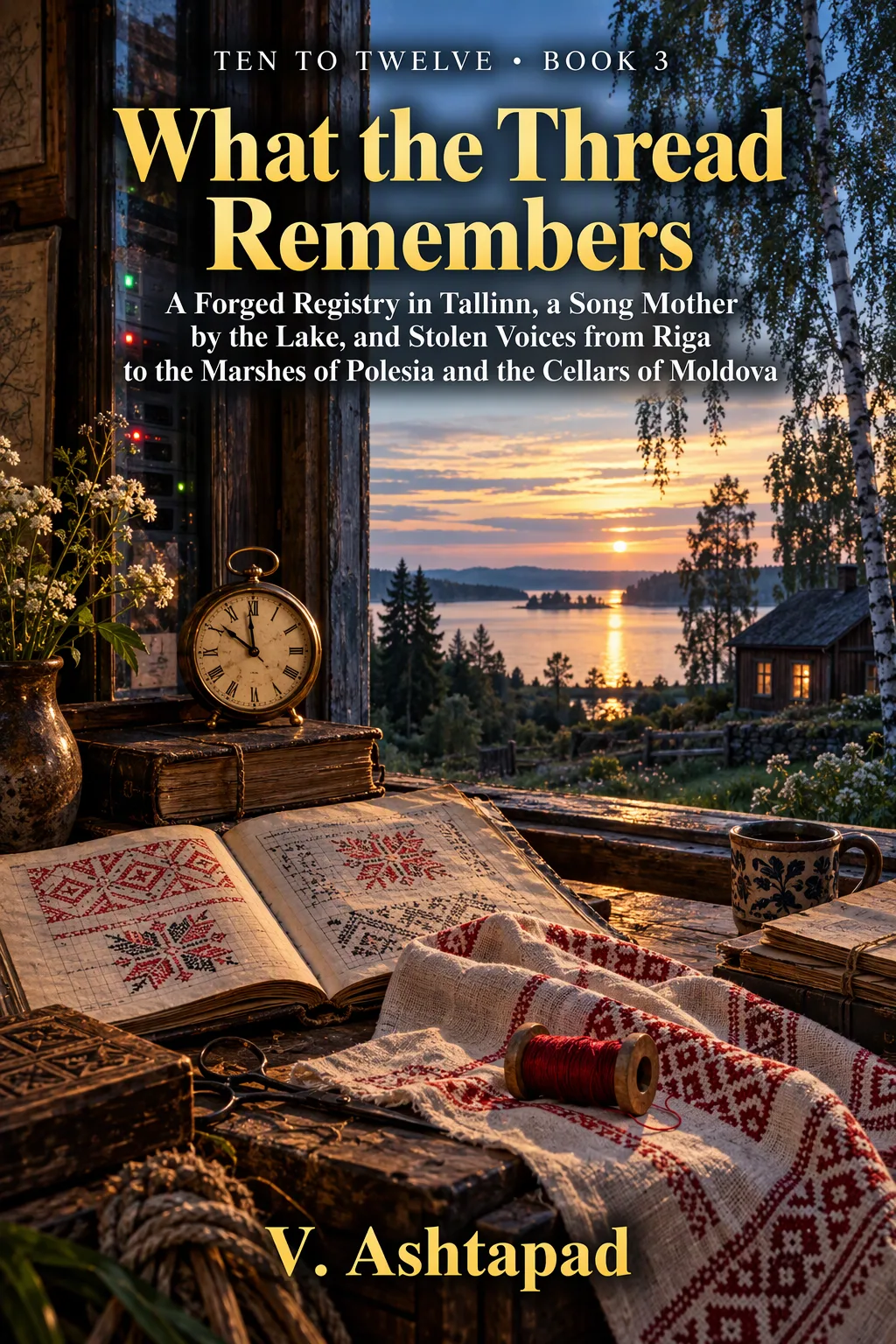
What the Thread Remembers
A Forged Registry in Tallinn, a Song Mother by the Lake, and Stolen Voices from Riga to the Marshes of Polesia and the Cellars of Moldova
by V. Ashtapad
Foreword
This is a work of fiction, the third book of the Ten to Twelve series. The white nights of Tallinn, the art-nouveau streets of Riga, the Seto song tradition of southeastern Estonia, the embroidered towels of the Polesian marshes and the underground wine cellars of Moldova are all real and living. Farol da Ponta Velha, the Family of Songs choir, the House of the Red Thread, every person and business in these pages, and the network that hunts them, are invented.
For the ones who sign their work, so the hand is not lost when the woman is.
The Red Thread
The storks woke Hanna Kavaliova before the alarm did.
They lived on a cartwheel on top of a pole at the end of her garden, as their great-grandparents had, and on summer nights they clattered their bills like two old men arguing over dominoes. At a quarter past three on a Thursday morning in early summer, they began clattering in a way she had never heard: hard, fast, all at once, and then silence. She lay in the dark of her bedroom above the museum and listened to the silence, and that was worse.
She was sixty-nine. She had lived in the village of Zarechcha in Polesia for all of those years except four at the textile college in the city, and she knew every sound the place made. The frogs in the ditch. The Pina River slapping its reeds a kilometer off. The neighbor's dog, Hrom, who barked at the moon and at nothing else. Hrom was not barking.
She put on her late husband's coat over her nightgown and went down the stairs in her socks.
The museum was two rooms and a corridor of a log house her grandmother had bought in the year the village sewing circle was founded. Above the door, in letters her husband had cut with a jigsaw, it said HOUSE OF THE RED THREAD. Inside, the walls were hung with linen towels, long and narrow, the length of a grown woman's arm span, each one embroidered at the ends in red: rhombuses with little hooked arms, eight-pointed stars, rows of figures holding hands, a tree that branched and branched until it became a lattice. The towels were the ones visitors photographed. They were not the treasure.
The treasure was in a pine cabinet in the back room: twelve pattern books, hand-drawn on squared paper, begun by her grandmother Ulyana in a schoolroom in the spring of 1924 and kept up by three generations of the women of Zarechcha until the last entry, in Hanna's mother's hand, in 1987. Every pattern in the village was in them. Every pattern was signed with the name of the woman who first worked it and the family it was made for: the Shulha wedding towel, the Lysiuk christening cloth, the mourning border for old Fiodar who drowned in the spring flood of 1931. If you wanted to know who your great-grandmother had been in Zarechcha, you did not go to the record office. You came to Hanna's cabinet, and she found you in red thread.
The cabinet door stood open.
She did not scream. She thought afterward that she ought to have. Instead she stood in her socks on the cold boards and counted the empty shelf with her eyes, the way her mother had taught her to count stitches, out loud and slowly, so that you could not lie to yourself.
"One," she said. "Two." She went on to twelve. Then she said it again.
The window over the cabinet had been lifted out of its frame. Not broken; lifted, the putty cut neatly with a blade, the glass laid on the grass outside without a crack. Whoever had done it had done such things before. The night air came in through the square hole smelling of cut hay and the river.
On the floor by the cabinet was a small thing that glinted when she bent with the flashlight. She picked it up between two fingers. It was a piece of sealing wax, dark red, half the size of her thumbnail, broken off something larger. On its face, pressed into it with a tiny brass die, was the face of a clock. There were no numbers. There were two hands. One stood almost upright. The other pointed a little to the left of it, at the place where the ten would be if the clock had a ten.
Ten minutes before midnight.
She stood holding it for a long time while the storks shifted on their wheel.
---
The police came at eight, a young sergeant with a sunburned neck who wrote everything down in a notebook with great care and very little hope. He asked whether the books were insured. Hanna said they were worth nothing to anyone who was not from Zarechcha. He asked, then, why anyone would take them. She had no answer, and he wrote that down too.
Her nephew Pavel came at nine, from the town, in his good shoes, and walked around the back room with his hands in his pockets saying that it was terrible, that it was a sign, that perhaps now she would see sense about the building. A man from the city wanted to make a guesthouse of it for the bird-watchers who came every spring for the floodplain. Pavel had told her twice. He told her a third time, more gently, because she was his aunt and she had gone gray in the face.
"Go home, Pavel," she said, and he did.
At noon her neighbor Valentina came over the fence with a jar of cold kvass and a plate of potato pancakes under a cloth, and sat with her at the kitchen table without talking, which was the kindest thing anyone did all day. Valentina was seventy-four and watched birds for the university, logging the storks and the cranes in a school exercise book. She kept a camera on a strap around her neck the way other women kept their reading glasses.
"There was a woman," Valentina said at last. "Two weeks ago. You remember."
Hanna remembered. A woman in a gray linen suit, about forty, with good Russian and better manners, who said she was a researcher for a restitution consultancy and was compiling a register of village textile archives so that they could be protected. She had photographed every book, page by page, with a little camera on a stand. She had signed the guestbook in a neat upright hand. She had left a card with a telephone number that began with the code for Riga. She had bought a towel from the shop shelf for four times its price and refused the change.
"I took her picture," said Valentina. "By the stork pole. I take everyone's picture."
"Why?"
"For the birds," Valentina said, as if this was obvious. "To show the scale."
---
That evening Hanna did something she had never done in sixty-nine years. She wrote to a stranger for help.
She did not know the stranger. She knew only that her old teacher from the textile college, a folklorist in Minsk who was now very old and very deaf, had once told her that if anything ever happened to the cabinet there was a way to ask. A post box in Lisbon. A letter with no return address required. "They do not charge," the folklorist had said. "They do not ask why. They only come."
Hanna wrote on squared paper, because that was what she had. She described the window and the cabinet and the twelve empty places. She drew, very small and very exactly, the clock face on the wax, with its two hands at ten to twelve. Then, because she was the daughter of her mother and the granddaughter of Ulyana and could not help it, she drew a border of hooked rhombuses all around the edge of the page, in red pencil, the old pattern for a door that is meant to stay open.
She sealed it and walked it to the post office in the morning, past the stork pole, where the two birds stood on their wheel and watched her go.
© 2026 CRUNOD LLC. All rights reserved.
Ten to Twelve
The lamp in the old lighthouse at Farol da Ponta Velha had not turned since the year the Portuguese navy put up an automatic beacon on the next headland, but the gallery around it still caught the light, and at eleven-forty on a clear morning the Atlantic below was the blue of a gas flame.
Kadri Tamm came up the iron stairs two at a time with a laptop under her arm and a mug of coffee in her other hand and did not spill either. She was thirty-one, small, with hair cut short enough that she did not have to think about it, and she was humming. She was always humming when she was thinking about something else. Today it was a song her grandmother had sung at the national song festival every five years for sixty years, a long, slow song about a homeland and a sea. Kadri did not know she was doing it until Miriam Adler looked at her over the top of her reading glasses.
"That's a sad one," said Miriam.
"It's not sad. It's patient."
"Ah," said Miriam. "Patience. I've heard of it."
Miriam was fifty-eight, an archivist and conservator from Haifa, gray-haired and unhurried, with her glasses on a beaded cord around her neck and a pencil behind her ear. She led the team, though she would have said she only chaired it. She was sitting at the long map table in the lamp gallery with two envelopes in front of her, both opened, both lying on their backs with the drawn clock showing on the folded notes.
The Patron always signed like that. A small clock, drawn by hand in black ink, its hands at ten to twelve. No name, no address. The notes were typed on an old machine with a slightly high letter e, and they never said more than they had to. They did not tell the team what to do. They forwarded requests for help and paid for whatever came after.
Two envelopes meant two calls. Calls always came in pairs. Nobody at Control could explain that, and Kadri, who could explain most things given enough log files, had stopped trying.
---
The stand-up was at eleven-fifty. It was always at eleven-fifty. It had started as a joke about the Patron's clock and had become the one fixed thing in a life where nothing else was: twelve people, wherever they were, on the cape or on a screen, for ten minutes before noon.
They came up the stairs in ones and twos. Tomás Benítez, the pilot, forty-six, from the cattle country of northern Uruguay, carrying his gourd of mate with the silver straw in it like a man carrying a lantern. Dr. Kagiso Molefe, the emergency physician from Botswana, who moved quietly for a big man and always took the chair nearest the door, in case someone needed him. Farida Nazarova, the linguist from Dushanbe, in a dark green scarf, with a dictionary under her arm that she did not need and carried anyway, the way some people carry a rosary. Rahim Al-Balushi, the forensic accountant from Sur in Oman, in a pressed shirt, with his ledger, a real paper ledger bound in blue cloth, because he said that a spreadsheet could be changed without leaving a mark and a ledger could not. Luka Petrović, the restorer from Belgrade, sixty-two and rumpled, with paint under his fingernails and his reading glasses pushed up into his white hair where he would later spend ten minutes looking for them. Karma Dorji, the mountain guide from Bhutan, who came up the stairs without making a sound on the iron and leaned in the doorway. Valeria Ortiz, the youngest of the adults, twenty-six, from Asunción, filming the stairs as she climbed them until Miriam looked at her and she lowered the phone.
Captain Marie-Claire Hoareau came in last, as she always did, from the cottage kitchen, wiping her hands on a dish towel. She was fifty-two and from Praslin in the Seychelles, and her ship, the Albatross, was in a yard at Peniche having her propeller shaft seen to, which put her in a bad temper she was hiding under a big laugh.
The two youngest came last of all: Kai Benally-Ríos, seventeen, tall and restless, raised between his Diné father's family near Gallup and his mother's in Panama City, with a drone case on his back that he took everywhere like other boys took headphones; and Tara Dorji, sixteen, Karma's daughter, small and composed, with a pencil behind her ear in exact imitation of Miriam that nobody had yet had the heart to mention.
"Homework," said Kadri, without looking up.
"Done," said Tara.
"Mostly done," said Kai.
"Mostly is a word for soup," said Marie-Claire, and sat.
It was eleven-fifty by the brass ship's clock on the wall. Miriam unfolded the first note.
---
The first was from Polesia, in the south of Belarus. Miriam read it in Hanna Kavaliova's careful Russian, then in English for the table: the cabinet, the window, the twelve pattern books, the village women's names in red thread. Then she turned it around and laid it in the middle of the table, and they all leaned in to look at the drawing in the corner.
The clock face on the wax.
Nobody said "again". Nobody needed to. They had seen the same small seal pressed into red wax on a stolen folder in the business with the letters in Haifa, and after that, in the Gulf this spring, Rahim had followed money that moved like water around anything that tried to stop it. They did not know whose seal it was. They knew only that the people behind it sold things that should not be sold to people who should not own them, and that their auctions always closed at the same minute.
"She drew a border," said Tara.
Everyone looked at her. She went pink but did not look away.
"Around the page. Those are hooked rhombuses. It's an old door pattern. I saw it in a book on Baltic and Slavic weaving at the library in Darjeeling." She hesitated. "I think she was saying something. Not just decorating."
"What was she saying?" asked Miriam.
"That she's not closing the door," said Tara. "Even now."
Farida put her hand flat on the note, very lightly. "She wrote to strangers," she said. "In a village like that, that is not a small thing."
---
Miriam opened the second envelope. Inside the Patron's note was a letter in Estonian, forwarded by a folklorist in Tartu, and Miriam passed it across the table without reading it.
"Kadri," she said. "This one is yours."
Kadri read it. Then she read it again. Her face did not change, which was how the people who knew her could tell that something had happened.
"It's from Setomaa," she said. "The southeast corner of Estonia. By the big lake. A woman named Maali Lepasoo, eighty-two. She's a song mother. A lead singer of leelo. That's the Seto song, the old kind, where one woman sings a line and the chorus answers and holds it." She stopped. "Her family's farm has been sold. She didn't sell it. Two weeks ago a letter came from a holding company in Tallinn saying they were the registered owners and would take possession in eleven days. She went to the registry. The registry says the farm belongs to them, transferred by notarial deed with her power of attorney. She never signed one. And the population register says she doesn't live there. Says she moved to a care home in Võru two months ago. She has never been in a care home in her life." Kadri put the letter down. "She's been erased. On paper, she doesn't exist where she lives."
"And the farm?" said Rahim.
"Last Saturday, two men came with the deed and a court bailiff's letter, and took the contents of the granary. A chest of song notebooks her mother wrote over forty years. Her family's silver. The bailiff's letter was real. The deed was real. The registry entry was real." Kadri looked up. "Everything is real. That's what's wrong with it."
"How do you forge a real registry?" said Tomás.
"You don't," said Kadri. "You make a second one."
---
They argued it out at the kitchen table, as they always did, over Marie-Claire's lunch of grilled fish, rice and a salad of green papaya that she said was what passed for a sulk in Praslin. The cottage kitchen was long and low with blue tiles and a table that had been a ship's chart table once, scarred with dividers. The window looked down the cape at the lighthouse.
Kadri wanted to go. That was not in question. Estonia was her country. She spoke the language, she knew the registry systems, and, she said bluntly, she knew how the people who built those systems thought, because she had been taught by one of them.
"Who runs Control?" said Rahim.
"You and Marie-Claire," said Kadri. "And Kai, when he's not doing physics."
"I do physics," said Kai.
"You do drones and call it physics."
"Ah," said Marie-Claire, delighted. "So I am to be stuck on land with a ledger and a broken propeller and a boy." She raised her glass of water to Rahim. "We will have rules."
"You always have rules," said Tomás.
"On my ship," said Marie-Claire. "Here I will have more."
They split it the usual way, by who was needed where. Unit A to Estonia and onward wherever the Seto case led: Kadri, Miriam, Valeria, Karma, and Tara, because Tara went where her father went and because, Kadri said, she wanted Tara's eyes on the registry logs. Unit B to Belarus: Farida, who spoke Russian and could read the women's names in the pattern books; Luka, who knew what an old book looked like to someone who wanted to sell it; Kagiso, because the letter from Hanna had been written by a woman who had not slept; and Tomás, who would fly both units and stay with B.
"And Kai," said Luka.
Kai looked up.
"I need someone to carry my bag," said Luka, "and to tell me what is on the other side of a hill without walking up it. I am sixty-two. I do not walk up hills."
"He can't go into anything dangerous," said Miriam.
"He will be with me," said Luka. "I am the least dangerous man alive."
"You were in prison," said Rahim mildly.
"For painting," said Luka. "Very well. Nobody died."
Kai looked at Tomás, who had known him since he was a baby in Gallup and his father had brought the Uruguayan pilot home from a crop-dusting job to eat mutton stew. Tomás shrugged and sucked his mate straw. "He's with me," Tomás said. "And with Luka. And he'll do his physics."
"Drones," said Kadri.
"Physics," said Kai.
---
Valeria brought it up over coffee, which was where she brought up all the things she knew Miriam would not like. She wanted to film Maali Lepasoo. Not for anything public; for the record. An eighty-two-year-old woman who had been erased by a machine, singing the songs the machine could not erase.
"No," said Miriam.
"You haven't heard what I—"
"I have heard. I heard it in Haifa. A woman who has just been robbed does not need a lens in her face. She needs a cup of tea and somebody who speaks her language."
"Kadri speaks her language."
"Then Kadri can make the tea."
Valeria put her phone face down on the table, which for her was an act of great restraint. "You think filming is taking," she said. "Sometimes it's the only proof anybody has that a thing happened."
"Sometimes," said Miriam. "And sometimes it's the second robbery." She took off her reading glasses and let them hang on their cord. "Ask her. If she says yes, film. If she says nothing, that means no."
"And if she sings?"
Miriam thought about it.
"If she sings," she said, "ask again."
---
At four, Kadri went down the cape to the sauna.
She had built it herself, in her first autumn at Control, from a kit of spruce staves and iron bands that had arrived on a truck from Tallinn: a barrel on its side, big enough for four people sitting close, with a wood stove at one end and a door with a small round window at the other. It stood on the rocks above a little inlet where the sea came in cold even in August. The others used it out of politeness. Kadri used it the way other people used prayer.
She sat on the top bench in the dry heat with her eyes shut and thought about a second registry. A clone. A server that looked like the state's own and answered questions as if it were, but answered them with what someone wanted the answer to be. She thought about how you would build such a thing, and where, and who would know how.
There were not many people in Estonia who would know how. She had a list in her head. It was short. One name on it she did not want to think about.
She threw a ladle of water on the stones and the steam hit her like a hand.
When she came out, Tara was sitting on the rocks outside with her knees pulled up, waiting with a towel.
"My father says you won't sleep tonight," said Tara.
"Your father says very little and is right about all of it," said Kadri. She took the towel. "Bring your laptop on the plane. I want to teach you to read a log."
"A ship's log?"
"A machine's log. It's the same thing. Every machine keeps a diary of what it did and when. Most people never read them." Kadri wrapped the towel around her shoulders and looked out at the Atlantic going gold. "The machine always tells the truth. It's the people who lie about what it said."
© 2026 CRUNOD LLC. All rights reserved.
White Night
They left at six the next morning, Friday, in Tomás's twin-engine plane with its high wings and its stubborn, honest engines, and with one fuel stop in the north of Germany where Tomás bought everyone pastries and complained about the price of coffee in a language that was mostly gestures. Kadri sat in the copilot's seat with her laptop on her knees and did not speak for three hours. Behind her, Tara slept against her father's shoulder, and Valeria filmed clouds, and Miriam read.
They came in over the Gulf of Finland at nine in the evening, and it was still broad day.
Kadri had forgotten. You always forgot, when you lived away. In early summer the sun in Tallinn set at a quarter to eleven and the sky never properly went dark, only a long blue dusk that ran into dawn at half past three, and the whole city stayed awake for it as if afraid to miss something. Below the wing the Old Town came up out of the trees in its red roofs and towers and green copper spires, the walls standing up around it like a crown somebody had set down and forgotten to pick up. Beyond it the harbor, the white ferries to Helsinki, the long gray arm of the breakwater. And past that the low wooden houses of Kalamaja, the fisherman's quarter, where she had grown up.
"It looks like a toy," said Valeria, filming.
"It's not a toy," said Kadri. "It's been knocked down and set on fire and built up again more times than you've had birthdays. Turn that thing off. You'll get the propeller in the shot."
---
They stayed that night in a guesthouse in Kalamaja that a cousin of a friend of Kadri's owned, two floors of a yellow wooden house on a street of yellow and green and pale blue wooden houses, with a wooden staircase on the outside and rhubarb growing against the fence. The owner left a key under a flowerpot and a note saying there was black bread and butter on the table and sprats in the cupboard. There was also a jar of kama, the roasted grain flour Estonians stirred into buttermilk, which Kadri ate at the counter with a spoon, standing, like a teenager.
"What is it?" said Tara, peering.
"Barley, rye, oats and peas, roasted and ground. You put it in sour milk with a little sugar. It's what we ate on hikes. What my grandmother ate when she was a girl. It tastes like," Kadri thought, "like a field after harvest."
Tara tried it. Her face did several things.
"It tastes like a field," she agreed politely.
Karma tried it and asked for more, and Kadri liked him for the rest of her life.
Miriam was at the table with the folklorist's letter and a map of Estonia, tracing the long road south to Võru and the lake. Valeria had her laptop open beside the bread, pulling up whatever she could find in public about the holding company: Rannavälja Holding, registered in Tallinn eighteen months before at an address that turned out to be a block of shared offices near the airport. One director, a Latvian national, sixty-one, who sat on the boards of forty-three other companies. A man who signed papers for a living.
"A dummy," said Valeria.
"A hat stand," said Kadri. "You hang your coat on him."
---
At ten, with the sun still up over the harbor, Kadri said she was going for a walk and that nobody was to come with her.
She walked through Kalamaja the way she had walked it at fifteen, sixteen, seventeen, hands in her jacket pockets, past the old prison by the sea with its brick walls and its weeds, past the market with its stalls closed for the night, past the courtyard where she had learned to ride a bicycle and where, at twelve, she had dismantled the bicycle to see how the gears worked and had not been able to put it back together. Her grandmother had paid a neighbor to rebuild it and had not been angry. "You have to take things apart," Linda Tamm had said, "or you'll never know what's inside. But next time, make a drawing first."
She turned up a street she had not walked in five years and stopped at a gate.
It was a gray house with white window frames, older than most on the street, with a garden full of lupins gone wild and a bicycle chained to the fence. A light was on in the downstairs room, though it was not needed. Through the window she could see the edge of a desk, a lamp, three monitors, and an old man's head bent over a keyboard. His hair was white and stood up at the back where he had run his hand through it. She had seen him do that ten thousand times.
Aare Kask, seventy-one. Thirty years keeping the servers of the state, in rooms nobody visited, through every change of system and every rebuild. Her teacher. The man the judge had given her to when she was seventeen.
She knocked.
---
He did not seem surprised to see her. That was the first thing she noticed, and she filed it away the way she filed everything. He opened the door in a cardigan with the elbows gone and looked at her for a long moment over his glasses, and then he said, "You've cut your hair shorter," and stood aside to let her in.
The house smelled the way it always had, of coffee and warm electronics and the dog, though the dog had been dead for three years. He made coffee in a dented aluminum pot on the stove. He put out a plate of rye biscuits. They sat at his kitchen table, which was covered in printouts, and he moved them into a pile without looking at them, and she noticed that too.
"You're here for work," he said.
"I'm here for Setomaa," said Kadri. She told him. She told it the way he had taught her to report anything: what was observed, when, by whom, and only then what it might mean. The letter. The deed. The registry. The population register. The farm that had been sold without being sold and the woman who had moved without moving.
He listened with his hands around his cup. When she finished he said nothing for some time. Outside, a gull walked along the garden fence.
"A notary would check the registry before certifying," he said finally. "Through the notaries' own channel. If the registry showed a valid power of attorney on file, they would certify. They're not detectives."
"So someone made the registry show one."
"Someone made something show one." He turned his cup a quarter turn on the table. "That isn't the same as changing the registry. The registry is kept by the court. It's watched. It has three copies in two cities and an audit trail that I wrote the first version of in a room with no windows. Nobody changes it quietly."
"Then they made a second one," said Kadri. "A mirror. A clone. Something that answers the notary's terminal with the answer they want. And then, once the deed is certified on the strength of a lie, the deed goes into the real registry through the front door, because it's a real deed from a real notary."
"That would be clever," said Aare.
"It would need someone who knew how the notaries' channel talks to the registry. Exactly how. The handshake. The certificates. The timing."
"It would."
"Who knows that, Aare?"
He looked at her. His eyes were pale blue and very tired and she had never once in fourteen years seen him look away from a question. He looked away now, at the window and the gull.
"More people than you would think," he said. "Fewer than you'd like."
"Give me names."
"I'm retired, Kadri."
"You're running three monitors at ten at night."
"I'm an old man who can't sleep in the white nights. Nobody can sleep in the white nights." He stood and took her cup, though it was not empty, and rinsed it at the sink with his back to her. "Go south. See your singer. Look at what the notary saw. Then come back and tell me what you find, and I'll tell you what I think." He turned the tap off. "That's the way I taught you. Observe first."
"You taught me that when you're asked a straight question, you give a straight answer."
"Did I?" He dried his hands on a towel. "Then I was a better teacher than I am a man. Go on. It's late, even if it doesn't look it."
---
She walked back to the guesthouse at a quarter to midnight. The sky over the harbor was the color of a mussel shell, pale blue and lilac and gray, and the ferries were lit up like birthday cakes, and somewhere down by the water a group of students was singing badly and happily in four parts. A man went past on a bicycle with a bunch of lupins in his basket. It was the time of year when Tallinn forgot to go to bed.
On the stairs of the guesthouse she checked her phone. Ten to midnight. She noticed that, too, and did not like it.
Miriam was still up, sitting on the outside staircase in her cardigan with a cup of tea, looking at the sky.
"Well?" said Miriam.
"My teacher lied to me," said Kadri. "Not about anything in particular. Just generally. With his back."
Miriam moved over on the step to make room. Kadri sat.
"My grandmother used to say," said Miriam, "that when a good man lies, it's always to protect something. The trick is to work out what."
"And when a bad man lies?"
"Oh," said Miriam. "Then it's just to protect himself. Much easier. You can go to sleep."
Kadri did not go to sleep. She sat on the steps with Miriam until the sky turned from lilac to the first thin yellow of dawn, at half past three, and the gulls started up over the harbor, and then she went in and opened her laptop and began, very carefully and without touching anything, to look at the notaries' channel from the outside.
© 2026 CRUNOD LLC. All rights reserved.
The Song Mother
The road south ran for three and a half hours through forest. Spruce and birch and pine, then bog, then more forest, with now and then a field of rapeseed so yellow it hurt to look at and a farmhouse set back among lilacs with a wooden sauna by its pond. Karma drove, because he said that driving was the only rest he could get with four women in the car and he intended to take it. Every so often he slowed for a stork walking along the verge with the air of a minister inspecting a road.
Past Võru the land changed. The hills grew rounder and closer together, and the farms smaller and older, with gray log barns and fences of split rails. The road signs began to carry two names. They were in Setomaa.
"Seto country," said Kadri, to Tara in the back. "They're a people within the people. Their own language, close to Estonian, close to Võro. Their own songs. Their own silver. Their own way of being stubborn, which is saying something in this country."
"How many?"
"A few thousand here. More in Tartu and Tallinn. The young ones go to the cities and come back for the summers." She paused. "Maali's grandson works in Tartu. Siim. Thirty-four. He's the one who found out first. He saw it on a screen at work."
"What does he do?"
"He's a technician at a notary's office."
In the front, Karma's hands did not move on the wheel, but Kadri saw his eyes go to the mirror and meet Miriam's, and she knew they were all thinking the same thing.
---
The Lepasoo farm stood on a rise above a long, shallow valley, with the lake a silver line far off to the east. A gray log house with a red-painted door. A granary on stone legs, with its door now padlocked by a lock that was new and shiny and not theirs. A barn. An orchard of old apple trees, the fruit still green and small. And down by a pond fringed with reeds, a low black building with a turf roof and no chimney that Kadri recognized with a jolt in her chest: a smoke sauna, the old kind, where the smoke from the stove fills the room and is let out through a hatch before you go in, and the walls are black with a hundred years of soot, and the heat is soft and deep and smells of tar and birch.
A woman was standing in the doorway of the house, waiting for them. She had been standing there, Kadri learned later, since the morning.
Maali Lepasoo was small and straight-backed, with a face as brown and creased as a walnut and very bright gray eyes. She wore a long red-and-white woven skirt, a white linen blouse with red embroidery at the sleeves, and over it, on her breast, a round silver brooch the size of a saucer, worked with lines and dots and little raised bosses.
"They took the silver," she said, before anyone could greet her. She touched the brooch. "This one I was wearing. The rest they took. My mother's, my grandmother's. The chain with the coins. They took the notebooks." She looked at Kadri. "You are the one from the letter?"
"Kadri Tamm. From Tallinn."
Maali looked her up and down. "Tallinn," she said, in the tone in which a woman in Bumthang might say Kathmandu, or a woman in Praslin might say Paris. Then she held out her hand. "You will eat," she said. "Then you will tell me how a machine can say I am not here when I am standing in my own door."
---
They ate in the kitchen at a long scrubbed table under a window full of geraniums. Black bread, still warm, with a crust like bark. Butter. Smoked fish from the lake. Boiled new potatoes with dill. A soft fresh cheese, pale yellow, studded with caraway seeds, that Maali called sõir and made herself from her neighbor's milk, pressing it in a cloth under a stone. There was a jug of birch-sap drink, faintly sweet, and later a pot of coffee and a plate of small pastries filled with curd.
Siim arrived halfway through the meal, in a car with Tartu plates, a tall thin man with an anxious face and a laptop bag he held against his chest like a shield. He kissed his grandmother's cheek and shook hands with everyone too quickly and then sat at the end of the table and did not eat.
Kadri watched him. She did not like what she saw, and she did not know yet what it was.
"Tell me what you saw," she said. "On the screen. Exactly."
He told her. Just over two weeks before, on a Wednesday, he had been at work at the notary's office in Tartu, running a routine update on the terminals. He had idly typed in his grandmother's address, as he sometimes did, to see the old farm come up on the map. It came up. The owner was not his grandmother.
"I thought it was a mistake," he said. "I thought, somebody's typed the wrong number. I rang the registry. They said there was a deed. Certified at an office in Tallinn the Thursday before. With a power of attorney from Maali Lepasoo, registered in the spring. I said that's impossible. They said, it's in the system."
"And the population register?"
He swallowed. "I checked that too. That night. From home." He looked at his grandmother. "It says you moved, Vanaema. Two months ago. To the care home in Võru."
Maali said something short in Seto that Kadri did not catch and did not ask to have translated.
"Siim," said Kadri, "when you checked from home, did it say the same thing it said at work?"
He blinked. "Yes. I think so. I didn't..." He stopped. "Why?"
"Because if somebody's built a second registry, it doesn't need to fool everyone. Only the people who matter. The notaries. The bailiffs." She held out her hand. "Show me. Now. From your laptop and from my phone. Same address."
He opened the laptop. He typed. Kadri typed on her phone. They set them side by side on the table between the bread and the cheese, and everybody leaned in.
On Kadri's phone, using the public registry, the Lepasoo farm was owned by Rannavälja Holding. On Siim's laptop, logged into the notary office's channel from home through his work connection, the Lepasoo farm was owned by Rannavälja Holding.
They matched.
"So it's real," said Siim. He sounded almost relieved, and then appalled at his relief.
"So it's real now," said Kadri. "The deed's gone through. Both places agree because the lie is in both places." She looked at the screens a long time. "What I need to see is what the notary's terminal saw back then. Before the lie was in the real registry. When it was only in the second one."
"How would you see that?"
"Logs," said Kadri, and in the corner Tara took the pencil from behind her ear.
---
After the meal Maali walked them to the granary. She did not have a key to it now; the new padlock belonged to the holding company. But she showed them, through a crack in the boards, the empty space at the back where the chest had stood. She showed them the hooks on the wall where the silver had hung on its chains for festival days. She told them about the notebooks.
"My mother wrote them," she said. "Anne Lepasoo. She was born in 1920. She could not read music. Nobody here could. But she had a hand like a scribe, and she wrote the words. Every song she knew, and every song her mother knew, and the songs the other women sang at weddings and at the hay and at the lake when the men were out on the ice. Forty years. Eleven notebooks. She wrote which village each song came from. She wrote who sang it first, if anyone remembered. She wrote the jokes the women made between the verses." Maali's mouth moved. "Some of the jokes are very bad."
"The words only?" said Miriam.
"The words. The melodies we carry." She tapped her chest above the silver. "But the words change if nobody writes them. A young woman learns a song from an old one, and she gets one line wrong, and then her daughter learns it wrong, and in a hundred years it is a different song. My mother knew that. She wrote them so they would stay."
Valeria was standing a little back, her phone in her pocket, not touching it. Miriam saw her not touching it.
"There were also the discs," said Maali.
"Discs?"
"Not here. In Riga." She waved east and south, vaguely, toward Latvia. "In 1936 a man came from Riga with a machine in a box. A choir master. Ozols. He went from farm to farm and had the women sing into a horn, and the machine cut the song into a metal disc. My grandmother Ode sang for him. Thirty songs, in one afternoon, sitting where you are standing. He took the discs back to Riga, to his choir's house. My mother went there once, in 1974, and they played her one. She wrote down every word." Maali looked at the empty granary. "She wrote that the disc was like hearing her mother through a wall."
Miriam and Kadri looked at each other.
"Are the discs still in Riga?" said Miriam carefully.
"Where else would they be?" said Maali. "They belong to the choir. We have the words. They have the voice. Between us, we have the song."
---
That night Kadri sat on the bench outside the smoke sauna with her laptop on her knees, in the long blue light, and Tara sat beside her. Mosquitoes sang. Across the valley someone was mowing a hay meadow by hand, very late, a scythe going swish, swish, swish, and a dog barking at the swish.
"Riga," said Tara.
"Riga," said Kadri. She had already sent the message to Miriam's phone, though Miriam was ten meters away in the house: check the choir house. "If someone wants the notebooks, they want the discs. Words and voice together. A collector would pay for the pair ten times what he'd pay for either."
"So they've taken the discs too?"
"Or they're going to." Kadri rubbed her eyes. "Miriam goes to Riga tomorrow with Valeria. Your father stays here. You and I go to Tartu, to the notary's office, and we read the logs."
"Siim's office?"
"Siim's office."
Tara was quiet. Then she said, in her careful English, "You don't trust him."
"I don't trust anyone with a login who looks that frightened," said Kadri. "It doesn't mean he's bad. It means he knows something he hasn't said."
"Like your teacher."
Kadri looked at her sharply.
"Miriam told my father," said Tara, unrepentant. "My father tells me things. He just tells them very slowly."
Up at the house, a door opened, and Maali came down the path toward the pond in the half-light with a shawl around her shoulders. She did not look at them. She went to the edge of the water and stood looking at the reeds. Then, very quietly, she began to sing.
It was a single line, sung in a voice that was old and cracked and astonishingly strong underneath, rising at the end like a question. She sang it, and stopped, and waited, the way a song mother waits for the chorus to come in and take the line from her and hold it.
There was no chorus. The other women of her family were in Tartu and Tallinn and the cemetery. The notebooks were gone. The discs were in Riga, if they were anywhere.
Maali sang the line again, and waited again, into the silence over the pond.
Tara stood up. Kadri caught her sleeve, then let it go.
Tara walked down to the water and stood a little behind the old woman, and when Maali sang the line a third time, Tara, who had heard it exactly twice and forgot nothing she heard, sang it back. Not well. Her voice was thin and her vowels were all Himalayan. But she had every sound in its place.
Maali turned and looked at her for a long time.
Then she sang the next line, and waited, and Tara answered it.
From the doorway of the house, where she had come out to see what the singing was, Valeria lifted her phone out of her pocket, looked at it, and put it back.
© 2026 CRUNOD LLC. All rights reserved.
Polesia
Tomás landed Unit B at Brest on Saturday morning, where the paperwork took longer than the flight, and Farida did most of it in Russian with a smile that Luka said could open a bank vault and close it again behind you. By noon they were in a hired minibus with a cracked windshield, driving east along a straight road through country so flat that Tomás kept leaning forward to look at it, the way a man from the sea leans forward to look at the mountains.
"There's nothing," he said, delighted. "Look. Nothing, all the way to the sky."
"There is everything," said Farida, who had grown up between the high Pamirs and a city ringed by mountains and found flatness restful. "You just have to get down low."
It was Polesia: the great marsh country of the south, the floodplain of the Pripyat and its rivers, where every spring the water spread out across the meadows for kilometers and the villages stood on their little rises like islands. By now the water had gone back to the channels and left everything green. Hay meadows, wet woods of alder and birch, long ditches full of yellow irises. Fields of flax in flower, a blue so pale it was almost gray, moving in the wind like a lake. And storks everywhere: on poles, on chimneys, on the tops of old water towers, standing in the meadows stalking frogs with the deliberation of tax inspectors.
Kai had his face against the window. "How many are there?"
"More than people, in some villages," said Farida. "It's said a stork on your roof means the house is lucky."
"Hanna has a stork on her roof," said Kagiso.
"Hanna has two," said Luka. "And look what happened. So much for luck."
---
Hanna Kavaliova met them at the gate of the House of the Red Thread, in a blue cotton dress and a white headscarf, and shook hands with each of them very formally, as if they had come to sit an examination. Then she saw Kai, who was taller than any of them and was looking at her stork pole with his mouth open, and something in her face softened.
"You are the grandson?" she said to Farida, in Russian.
"He is nobody's grandson here," said Farida. "He is an apprentice. He is learning."
"Good," said Hanna. "Then he can learn to carry chairs."
They sat in her kitchen. She had cooked, though she had not slept properly for three days: a great pan of potato pancakes, grated and fried crisp at the edges, which she called draniki, and a clay pot of something dark and rich that turned out to be pork stewed in sour cream with onions, into which you were supposed to dip rolled-up thin pancakes with your fingers. There was black bread and pickled cucumbers and a bowl of sour cream so thick the spoon stood up. There was a jug of kvass, cold from the cellar.
Tomás ate four pancakes before anyone else had finished one and asked for the recipe. Hanna told him that there was no recipe; there were potatoes and there was a grater and there was a grandmother, and if he lacked any one of the three he would fail.
Kagiso watched her while she talked. He watched how she held her left arm a little close to her side, and how once, when she stood to fetch the kvass, she put her hand flat on the table and waited a moment before going on. He said nothing. Later, when the others had gone to look at the cabinet, he stayed in the kitchen and dried the plates, and when she came back he said in his slow, careful English, which Farida translated, "Does it hurt when you climb the stairs?"
Hanna looked at him for a long time.
"Only since Thursday," she said.
"Will you let me listen?"
She sat. He took the stethoscope out of his bag and warmed the end of it in his palm, the way his grandfather had warmed his hands before touching a calf, and listened to her heart for a full minute with his eyes closed. Then he took her pulse and asked her what she ate, and whether she smoked, and whether her mother had had trouble with her heart. Her mother had. So had Ulyana. The women of Zarechcha lived to ninety and their hearts complained the whole way.
"It is angina," he said. "Pain from the heart muscle when it is tired and frightened. It is not today's danger. But it is a warning." He wrote her a note for the doctor in Pinsk and told her what to take in the meantime and what to do if the pain did not stop, and he said all of it twice, through Farida, and made her say it back.
"You talk like a schoolteacher," said Hanna.
"My wife is a schoolteacher," said Kagiso. "She says I am the worst student she ever had. I listen to everyone except her."
Hanna laughed, the first time in three days. It made her cough, and then laugh again.
---
Luka spent an hour in the back room with the empty cabinet, a jeweler's loupe and a flashlight, and nobody disturbed him.
When he came out he had cobwebs in his white hair and a look on his face that Farida had learned to watch for. He sat down heavily at the kitchen table.
"They knew," he said.
"Knew what?"
"What to take. Look." He held up his fingers. "There are forty towels on the walls of the front room. Some of them are old. One of them is a wedding towel from 1910 that a museum in the capital would give a great deal for. They did not touch them. They went past them in the dark. They went straight to the back room and the cabinet and took twelve books, and only twelve, and not the box of loose sheets on the bottom shelf, which is newer work. They knew which twelve."
"The researcher," said Farida.
"The researcher." Luka turned to Hanna. "She photographed every page?"
"Every page. With a little stand. She said it was so that if anything happened, there would be a record." Hanna's mouth tightened. "She said that."
"It was a record," said Luka. "It was a catalog. Every page, lit evenly, a ruler in the shot for scale, yes?"
"Yes."
"That is not how you protect a book," said Luka. "That is how you sell one. You photograph the lot so the buyer can see what he's bidding on, and then you come back for the lot." He rubbed his face. "I know because I used to do it. When I was a young man in Belgrade with no money and very good hands, people came to me with photographs of a thing and said, make me another one of these. The photographs always looked like that."
Hanna stared at him.
"I was in prison for it," said Luka. "Three years. I'm better now. Mostly."
Hanna considered this. Then she pushed the plate of pancakes toward him. "Eat," she said. "You are too thin for a criminal."
---
Valentina came over the fence at four with her exercise book and her camera.
She was a small, fierce woman in rubber boots with binoculars on one strap and the camera on another, and she had kept a bird log for the university for twenty-two years. She sat at the table and opened the book to the night of the theft. In a tiny, upright hand she had written: 03:05. Storks at Kavaliova pole disturbed. Both up. Calling. Then silent. Vehicle on dike road, no lights. Gray, high roof. Tire noise on gravel. Not local.
"I wake at three," she said. "For the nightjars. I heard the storks. I looked from my window. There was a van on the dike road where nobody drives at night. No lights. It went toward the main road."
"Did you see the plate?"
"No. But I know the shape of the plate." She tapped the page. "My son drives a truck. Long distance, to the south. I see plates from everywhere in his photographs. This was a Moldovan plate. The shape, the little flag at the side. I would put money on it, if I had money."
Farida translated. Luka and Tomás looked at each other.
"Moldova is a long way to come for twelve books," said Tomás.
"Not if you are coming anyway," said Luka.
Valentina opened her camera and scrolled back, her lips moving as she counted the days, and turned the little screen around. A woman stood by the stork pole in the bright afternoon of a Wednesday two weeks before: forty or so, slim, dark hair pinned up, a gray linen suit, a leather bag over one shoulder, smiling at someone off to the side. Above her on the cartwheel one of the storks was looking down at her with what seemed, in the photograph, like profound suspicion.
"For the scale," said Valentina, satisfied.
The guestbook in the museum hallway, when they looked, had the name in a neat upright hand: Dr. Laura Vint. And a business card was still tucked in the back of it, cream-colored, good paper. Baltic Sound Conservation. Archive registers and restitution. An address on a street in Riga. A telephone number.
Farida photographed both and sent them to Control and to Miriam, who was at that moment, though none of them knew it yet, in a train on her way to Riga.
---
Kai flew the drone at dusk.
He had asked Luka first, and Luka had asked Hanna, and Hanna had said she did not see why not as long as it did not frighten the storks. So Kai walked a hundred meters away from the pole, out along the dike road where the van had gone, and launched it from a patch of gravel, and sent it up and along the road in the long golden light while Luka stood beside him looking at the little screen with his glasses on the end of his nose.
"What are you looking for?" said Luka.
"Where it stopped." Kai's thumbs moved on the controls. "A heavy van on a gravel dike, after rain. It sinks a little where it stands. If it waited somewhere for them, there'll be a mark."
"How do you know about rain?"
"Valentina's log. She writes the weather. It rained on Tuesday." Kai tipped the camera down. On the screen the dike road unrolled, pale gravel between two ditches, with the flax field blue on one side and a hay meadow on the other. "My grandfather taught me. Not about vans. About sheep. If you want to know where the sheep went, you don't look at the sheep. You look at where the ground is different."
The drone hung over a widening in the road two hundred meters from the main road, where there was a culvert and a place to pass. Kai brought it lower. In the gravel were two deep, parallel ruts, and beside them, very clearly, a dark patch where something had leaked.
"Oil," said Kai.
"Or diesel," said Luka. He was quiet for a moment, watching the boy's hands. "When I was your age, my teacher at the academy told me that to see a painting properly, you don't look at the picture. You look at the edges. Where the paint stops. Where the brush got tired." He nodded at the screen. "You're doing the same thing."
"With a drone."
"With a drone," Luka agreed. "Bring it back. I want to go and smell that patch."
"Smell it?"
"A forger's nose," said Luka, tapping it. "Very underrated."
---
That night, when the others had gone to bed in Hanna's spare rooms and on camp beds in the museum's front room under the forty towels, Farida sat up in the kitchen with the guestbook and the business card and a cup of tea, and Hanna sat across from her.
"Your nephew," said Farida. "Pavel. He wants you to sell the building."
Hanna's face closed. "He thinks it is too much for me. He is not wrong. He is just not right."
"Who is the buyer?"
"A man from Minsk. He watches birds. He wants a guesthouse for people who come to see the cranes in spring. He has been here three times. He is very polite. He brings me chocolates I cannot eat."
Farida had already spent an hour on her phone, in Russian, with three different offices. The man from Minsk was a retired engineer with a bird-watching club and a small inheritance. He had bought two other houses in two other villages and turned them into guesthouses and kept the stork poles. He had no connection to Riga or to Moldova or to anybody in a gray linen suit.
"He is just a man who likes birds," said Farida.
Hanna looked down at her hands.
"I know," she said. "I knew it. I wanted it to be him. Then it would be simple. Pavel would be foolish and the man would be a crook and I could shout at both of them." She turned her cup in its saucer. "Instead I have strangers in my house and a doctor telling me my heart is tired. And somewhere, the women of my village are in a box."
Farida reached across the table and put her hand over Hanna's. It was not something she did easily. She had spent ten years interpreting for aid groups in places where people had lost everything, and she had learned early that the hand on the hand could be a lie. She did it now because it was not one.
"We will find them," she said.
"You don't know that."
"No," Farida agreed. "But I am a negotiator. Sometimes I have to say the thing first, so it can come true afterward."
© 2026 CRUNOD LLC. All rights reserved.
The Choice a Judge Gave
Everyone on the team knew the short version of Kadri's story, because she told it herself, flatly, the first week, the way you show a scar so that nobody has to wonder about it. At seventeen she had gotten into a government computer she had no right to be in. She had been caught. A judge had given her a choice that had changed her life. She did not, as a rule, tell the long version. On the drive to Tartu, to a girl of sixteen who reminded her of no one so much as herself at that age, she told it.
She told it because of Liis.
Liis Kuusk had sat beside her in mathematics for four years at the school on the edge of Kalamaja: a tall, quiet girl with a stammer, the best in their year at anything that could be written on paper and the worst at anything that had to be said aloud. In the spring of their final year the examination results came out, and Liis's mathematics score was so high that the board set it aside. They wrote her mother a letter saying the result was improbable for a girl with her record in oral work, that it would be withheld while they looked into it, and that the university place would, in the meantime, go to someone else. Liis did not cry. She went quiet, and stopped coming to school.
"She hadn't done anything," Kadri said, watching the forest go by. "She was just better at writing than at talking, and somebody decided that was impossible. Because they'd never had to be her." Her hands were still on her knees. "I was so angry I couldn't see. And I was the kind of angry that knew how to use a keyboard."
---
She lived with her grandmother then. Her parents had separated when she was nine, and by agreement and then by habit she had been left with Linda Tamm in two rooms above a shoemaker's shop, with a tiled stove, a window full of geraniums, and a view of the sea between two roofs. Linda had sewn at the clothing factory for forty years and sung in the great national song festival choir every five years since she was a girl, standing under the arch in a choir of thousands. She sang at home all the time without knowing she did it, old songs about the sea and the birches, the kind everyone in the country carried. Kadri had learned them the way you learn the sound of a clock in a room.
"A song is a kind of memory," Linda used to say, cutting a pattern with her big black shears. "You don't keep it in your own head. You keep it in a room with other people. On that stage I can forget a line and it doesn't matter. The woman on my left has it. The one behind me has the next one. Nobody knows the whole song alone. We only know it together."
Kadri, at fifteen, said that sounded inefficient.
"It is," said Linda, pleased. "That's what makes it last."
---
"I found out they were wrong about Liis," Kadri told Tara. "That her paper had been marked fairly and then flagged by someone who had a reason of her own. And instead of taking it to a teacher, a lawyer, a newspaper, anyone, I did it the loud way. The teenage way. I left my fingerprints all over the proof, as good as signing my name, because I wanted them to know that a schoolgirl had seen them." She shook her head. "I wanted to be caught, I think. I wanted the fight."
She got it. The board did not care, at first, about what she had found; they cared that a minor had been somewhere she should not have been. There were two policemen at the shoemaker's door on a Tuesday morning and Linda made them take off their shoes. There were months of it, interviews and forms and a lawyer the state provided who smelled of cigarettes and told her to say as little as possible. And there was the thing she had not thought about at all, because at seventeen you never do: that it would cost her grandmother. Linda sat in every waiting room with her handbag on her knees and never once said the thing Kadri was braced for, which was that she had been a fool.
"The night before the hearing I finally asked her," Kadri said. "Why she wasn't angry. She said, 'You took something apart to see what was inside. You've done that since you were small. The bicycle. The radio. Me, sometimes.' And then she said, 'But you forgot the second half. You always forget the second half.'"
"The second half?" said Tara.
"When I was twelve I took apart a bicycle to see how the gears worked and couldn't put it back. She paid a neighbor to rebuild it and she wasn't angry then either. She just said, next time, make a drawing first, so you can find your way home. That's the second half. Taking a thing apart is easy. Putting it back so it works, so it serves somebody, that's the whole job. I'd pulled the lid off a rotten thing and left it open and walked away proud. I hadn't fixed anything. Liis still had no result. I'd just made a mess and a point."
---
The judge was a woman near retirement with a gray bob and half-glasses, and she read the whole file, which not everyone did. She read what Kadri had found as carefully as what Kadri had done. At the hearing she said two things Kadri had carried for fourteen years.
The first was to the examination board, and it was cold: that a system which could be opened by a child in four evenings was not a secure system but a locked door in a cardboard wall, and that the fault for that did not belong to the child. She ordered Liis Kuusk's result reviewed by an outside panel. It was. It stood. Liis went to the university that autumn and was, the last Kadri had heard, a professor of mathematics in Sweden who still could not order a coffee without rehearsing it.
The second thing the judge said was to Kadri.
"She said I had two futures in front of me and I was going to pick one in that room, that morning, whether I meant to or not. In one of them I was a person who found the rot in things and tore it open to be admired for finding it, and that person, she said, usually ended badly, and took other people with her. In the other I was a person who found the rot and quietly made the thing sound again, and that person was rare, and the world could never get enough of her, and almost nobody would ever know her name." Kadri looked out at the trees. "Then she said she wasn't going to send a clever seventeen-year-old to prison to make the board feel better, and she handed me to the one man she trusted to teach me the difference."
"Your teacher," said Tara. "Aare."
"Aare Kask. He kept the state's servers for thirty years. The judge gave me to him the way you'd give a wild dog to the one person who isn't afraid of it. Two years. Supervised. I swept floors in the server rooms and carried cable and was not allowed to touch a keyboard for the first six months, which nearly killed me. And every day he said the same thing. 'Observe first. Then you may act.' And, 'When you find the hole, your job is not to shout about it. Your job is to close it, and to close it so well that the next person never knows it was there.'" She was quiet a moment. "He made me into someone useful. I owe him the whole of what I am."
Tara said, carefully, "And now you think he's lying to you."
"Now I think," said Kadri, "that somewhere out there, someone learned exactly the same lesson I did, from a teacher just as good, and decided to use it the other way. To find the holes and sell them. And I am very much afraid that it is someone Aare knows. Because the thing about a cardboard wall with a locked door," she said, "is that the person who built the real wall behind it is the only one who knows where the gaps are."
The sign for Tartu came up out of the forest. Kadri wound down the window and let the smell of the pines in, resin and warm earth, the smell of the country she had made herself for.
"Make a drawing first," she said, mostly to herself. "So you can find your way home."
© 2026 CRUNOD LLC. All rights reserved.
The Notary's Logs
The notary's office in Tartu was on the first floor of a pale yellow building near the river, above a bookshop, with tall windows and a view of the great domed university across the water. Siim met them at the street door, still holding his laptop bag against his chest, and took them up a stair that smelled of floor wax and old paper.
The notary himself, Jaan Tammik, was away until Monday; it was his junior, a brisk young woman named Triin, who had agreed to let a security specialist look at the terminal, because Siim had asked her and because the whole office had been sick about the Lepasoo matter since it came to light. "We certified it," she said, unlocking the room where the client terminal stood. "On a Thursday, three weeks ago. Mr. Tammik signed it. Everything checked. The power of attorney was on file in the registry, valid, with her digital signature. We looked. We always look." She hugged her own elbows. "And now you tell me the old woman never signed anything and has never been near a care home, and I keep thinking, what did we certify? What did my hands do?"
"Your hands did what the screen told them," said Kadri. "That's what I'm here to prove. Sit down. Don't touch anything. Tell me the story of that morning, in order."
---
She did not touch the registry. She wanted that understood, and she said it aloud twice, for the record Tara was keeping in a notebook: I am reading, not writing; I am looking at what the office's own terminal saved, nothing more. What she read was the office's own record of its own day. Every machine kept a diary of what it had done and when, and this one had kept its diary faithfully for years, and nobody had ever read it, because until last week there had been no reason to.
She had Tara beside her with a fresh notebook, and she taught as she went, in a low voice, because teaching was how she thought.
"A log is just a list of what happened and the exact second it happened," she said. "Like Valentina's bird book. Three-oh-five, storks up. The machine writes one every time it asks the registry a question and every time the registry answers. We're going to read the morning of that Thursday. We're looking for the question the office asked about Maali Lepasoo, and the answer it got, and, most of all, where the answer came from."
"How do you know where an answer comes from?" said Tara.
"Every answer comes with a return address. Like a letter. The office asks the registry a question, and the registry's answer has the registry's address on it, so the office knows it's really the registry talking and not someone pretending." Kadri scrolled slowly, her lips moving as she read the timestamps. "That's the whole trick of the thing, if there is a trick. If I wanted to lie to this office, I wouldn't change the registry. I'd just send a letter with the registry's return address forged on the envelope, and make sure it arrived before the real one."
Tara wrote that down, word for word.
They found that Thursday morning. At 09:14 the office had asked the registry to confirm the power of attorney for the Lepasoo deed. At 09:14 and some seconds, an answer had come back: valid, on file, signed. The deed had been certified at 09:21. It was all there, exactly as Triin had described it, exactly as it should be.
"So it's clean," said Tara.
"Read the return address on the answer," said Kadri, and turned the screen a little toward her. "Slowly. Out loud."
Tara read the long string of numbers and letters out loud, slowly, in her careful English, the way Kadri had taught her on the plane. Halfway through she stopped.
"That's not the same," she said.
"Not the same as what?"
Tara flipped back three pages in her own notebook, to where she had copied down, that morning, from a public page, the registry's real address, because Kadri had told her to write down everything that looked boring. She laid the notebook beside the screen. The two long strings ran alongside each other. They matched for most of their length. Near the end, where the real one said one thing, the answer that Thursday morning said another, by two characters.
"It's almost the same," said Tara. "It's almost exactly the same. Like somebody copied it and got two letters wrong on purpose so it would still look right."
Kadri sat back. For a moment she said nothing at all, and Triin and Siim, who had not followed any of it, looked between her and the screen.
"They didn't forge the registry," Kadri said at last, quietly. "They stood a copy next to it, close enough that a busy office at nine in the morning would never look twice, and they made sure the office's question went to the copy instead of to the real one. Just that morning. Just for that one answer. Then they took the copy down and let the real deed go through the front door." She looked at the two strings, the true one and the near-true one. "It's beautiful, actually. It's the work of someone very good. And it was running from inside the country."
"How do you know inside?" said Triin.
"Because the copy answered in the time it takes to cross a room, not the time it takes to cross a border," said Kadri. "I'll want to be sure. But I already know." She was thinking of a gray house with lupins gone wild and three monitors on at ten at night, and she pushed the thought away because she was not ready to look at it. "Tara. Write the exact time the copy answered. We'll need it."
Siim was standing by the window with his back to the room, very still. Kadri watched him in the reflection in the glass.
"Siim," she said. "You checked your grandmother's address from home, the night of that Wednesday. From your own machine, on your own connection, logged into this office's channel. And it told you she'd moved and the farm was sold. Yes?"
"Yes," he said, to the window.
"The copy was taken down after that Thursday. The real registry had the lie in it by then, through the front door. So by the Wednesday, everyone saw the same thing, because it was all real by then." She kept her voice gentle. "But you said you checked it that same night, the night you first saw it at work, that Wednesday. You rang the registry that afternoon. You already knew. So why did you check it again from home, so carefully, late, and remember exactly that it matched?"
The office was quiet. Down in the street a tram went by with a long ringing note.
"Because someone asked me to," Siim said. His voice was very small. "To make sure it looked right from outside. They said it was a test. They said they were checking the office's own security, that it was authorized, that Mr. Tammik knew." He turned around. His face was gray. "They paid me. Not much. For a login once a month and to answer a question now and then about how the channel worked. I thought it was nothing. I thought it was like, like checking a lock is strong." He looked at his grandmother's grandson's hands, which were shaking. "I didn't know it was her. I didn't know it was Vanaema's farm until I saw it on the screen. I swear it on my mother. I didn't know."
Kadri looked at him for a long moment.
"Who paid you?" she said.
"A woman. By message only. She called herself Vint." He swallowed. "Laura Vint."
Tara, very quietly, wrote the name down, under the name Farida had sent from a village in Belarus two days before, where it sat in the same notebook, in the same hand.
© 2026 CRUNOD LLC. All rights reserved.
The Smoke Sauna
They came back to the Lepasoo farm from Tartu late, with the near-true address and Siim's confession written down in Tara's notebook and a weight on all of them that the long bright evening did nothing to lift, and Maali Lepasoo took one look at the three of them getting out of the car and said, "You have been in an office all day arguing with a machine. Go down to the sauna. I lit it this morning. It will be ready now. You cannot think clearly with a day like that still on your skin."
It was not a request. Kadri had learned, in two days, that very little Maali said was a request.
The smoke sauna stood down by the pond with its turf roof and no chimney, and Maali walked them down to it in the gold light and showed them how it was done, because Tara had never seen one and Kadri, a city Estonian, had only ever used the clean modern kind with a proper flue. This was older. The stove was a great heap of rounded stones over a firebox, and the smoke of the morning's fire had filled the room and blackened the walls and the ceiling to a deep soft black that smelled of tar and birch and a hundred years of other fires, and then the smoke had been let out through a hatch in the wall and the door left open to air, so that what remained was heat, deep and soft and clean, held in the stones and the black wood.
"The black is not dirt," said Maali, running a hand along the sooted wall. "The black is what keeps it sweet. A new sauna, a clean one, it takes years to earn a smell like this. My grandfather built this one. The smoke of every fire since has stayed in the wood. When I sit here I am sitting inside every winter my family ever warmed itself through." She handed Tara a bundle of birch twigs, bound at the stem, the leaves soft and whole. "This is a whisk. You soak it, you let it warm, and then you beat yourself gently with it, the back, the shoulders, the legs. It sounds like a strange thing to a girl from the mountains. It is the best thing in the world. It drives the blood to the skin and the tiredness out of it. Go. I am too old to take the heat the way you young ones can. I will sit outside and watch the water and be a nuisance."
---
Inside, in the black heat, with the small light from the one little window and the smell of birch rising off the warmed whisks, Kadri sat on the high bench and felt the day come off her, and for a while nobody spoke, which in a sauna is not a silence but a kind of company.
Then Tara said, "You're going to have to tell Miriam about Aare. All of it. Before you go to him again."
"I know."
"You don't want to."
"No." Kadri ladled a little water onto the stones, and the steam rose soft and enormous and folded over them, and they both bent their heads under it and breathed through their mouths until it passed. "Because the moment I say it out loud at the table, it's real. Right now it's still a thing that might not be. My teacher, the man who made me, taught the man who built the thing that stole an old woman's farm, and has been lying to me to protect him. The second I say that to Miriam, I can't un-know it, and neither can she, and it goes in the record, and it's true forever." She wiped her face. "You'll learn this. The worst part of our work isn't the danger. It's the moment a thing you suspect becomes a thing you've said. You can carry a suspicion lightly. A fact sits on you."
"My father says the same about tracks," said Tara. "He says a print in the snow is only a maybe until you kneel down and read it, and once you've read it you have to follow it, even if it goes somewhere you don't want to go. He says that's the whole discipline. Not the reading. The following, after you'd rather stop."
Kadri looked at the girl through the steam. "Your father says a great many wise things for a man who speaks about four words a day."
"He saves them up," said Tara, and beat her own shoulder experimentally with the birch whisk and gave a small yelp of surprise and then, a moment later, a sound of pure animal contentment, and Kadri laughed for the first time in two days.
---
They cooled off by running down the three steps into the pond, which was cold even in summer, cold enough to drive the breath out of you, and came up gasping into the warm evening with their hearts banging, and climbed back into the heat, and did it again, because that was the whole rhythm of the thing, hot and cold and hot, and Maali sat on the bench by the water in her shawl and watched them and laughed at them and told them they were soft, both of them, a city woman and a mountain girl, soft as curd.
It was between the second heat and the third, sitting on the step wrapped in a sheet with the pond steaming faintly in front of her and the light not fading, that Kadri looked at her watch out of old habit and saw that it was ten to midnight.
"Ten to twelve," she said aloud, and something in her went still.
"What of it?" said Maali.
"Nothing. A joke the team has. We stand up every day at ten to twelve. And the people we're chasing, everything they steal, they sell it at ten to twelve at night. And now here I am in your sauna at ten to twelve and I noticed." She shook her head. "Miriam says the minute isn't magic. She's right. It's just a habit somebody can't break, and we've started seeing it everywhere because we're looking. The mind finds the thing it's told to find."
"My mother," said Maali, after a while, "wrote the songs down so they would not change. And do you know what she found, writing them? That the song is never where you think it is. You go looking for the melody and you find it is the words that matter. You go looking for the words and you find it is the woman's breath between them, the little catch, the place she waits. The thing is never the thing. It is always a little to the side of where you are looking." She pulled her shawl tighter. "Your minute at ten to twelve. It is not the time that matters. It is that they cannot stop doing it. A man who always does a thing at the same moment has told you something about himself he did not mean to tell. He has told you he is afraid. Only frightened people keep such strict habits. The brave are untidy." She stood, slowly, with the consultation of every joint, the way Aare stood. "Go and have your third heat. Then eat. I made sõir and there is smoked fish and the bread is two days old, which is when it is best. And tomorrow you will say the hard true thing to your Miriam, and follow the track into the place you don't want to go, like the mountain girl's father says. That is the work. The rest is only steam."
Kadri sat a moment longer on the step in the enormous light, ten to twelve on a white night at the edge of a lake at the edge of her own country, and thought that she had come a very long way from a girl who took a thing apart to be admired for it, and that she still had some distance to go, and that a smoke sauna and an eighty-two-year-old song mother and a sixteen-year-old who got the vowels wrong were, improbably, the people helping her go it.
Then she had her third heat, and ran down into the cold black water under a sky that would not go dark, and came up new.
© 2026 CRUNOD LLC. All rights reserved.
The Choir House
Miriam Adler took the morning train to Riga, four and a half hours south through the same forests and bogs, with Valeria across the table filming the birch trunks until they blurred and then sleeping with her head against the window like a child. Miriam did not sleep on trains. She sat with her reading glasses on their cord and a notebook open and watched the country change from Estonian to Latvian without any sign she could see: the same storks, the same hay, the same wooden houses, the same long light. Only the station names changed their vowels.
Riga, when it came, was a city of a different scale from Tallinn, grander and more worn, with a river as wide as a lake running through it and bridges flung across. They came out of the great vaulted station into a square and Miriam stopped to get her bearings, and Valeria, awake now, turned slowly on her heel with the phone up.
"Look at the buildings," Valeria said.
They were worth looking at. Whole streets of them, five and six stories, their faces crowded with stone women and lions and masks and sunflowers and faces that screamed or slept, every window framed, every doorway a mouth. "Art nouveau," said Miriam. "A hundred years ago this was one of the richest cities on the Baltic, and they built like it. Timber money, and the port." She tipped her head back at a facade where two huge stone faces gazed out over the street with blank, calm eyes. "They built memory into the walls. Then they forgot who the faces were."
They crossed the old town on foot, past a square with a blackened spire and a market in it, past the vast domed market halls down by the river that had been built as airship hangars and now sold eels and rye bread and buckets of chanterelles, past a flower market where women stood behind banks of peonies and lupins and great sheaves of oak leaves tied with string.
"Why the oak leaves?" said Valeria.
"Midsummer's coming," said Miriam. "The shortest night of the year, a week or so from now. They wear wreaths of oak and flowers and light fires and stay up till dawn and eat a cheese with caraway in it and don't go to work for two days. Half the country drives to the other half." She bought a small round of the cheese from a stall, pale yellow, dotted with seeds, and broke it and gave half to Valeria. "Here. It's the taste of their summer. You should know what you're protecting. You can't guard a thing you've never tasted."
---
The choir house stood on a quiet street behind the old town, a tall narrow building of dark red brick with a carved door and, above it, in iron letters green with age, the name of the choir: DAINU SAIME. The Family of Songs. It had been founded, a plaque said, in 1873, the year of the first great song festival, and it had sung through everything since.
The man who met them was the choir's archivist, Edgars Liepa, seventy-six, in a cardigan and a bow tie, with a ring of keys as big as his fist and a way of walking that suggested every joint had been consulted and had reluctantly agreed. He had been expecting them; the folklorist in Tartu had telephoned ahead. He shook Miriam's hand in both of his.
"An archivist," he said, when she told him what she did. "Then you will understand why I have not slept."
He took them up to the archive on the top floor, under the roof, a long room smelling of paper and beeswax and dust, lined floor to ceiling with shelves of bound part-books and boxes of programs going back to the first festival. At the end of the room, in a glass-fronted cabinet with a lock, were the discs.
They sat on edge in slotted wooden racks, like plates in a drainer: flat metal discs, dull silver, each in a paper sleeve with a handwritten label. There were hundreds of them.
"Ozols," said Miriam quietly.
"You know the name?"
"A woman in Setomaa told me. A choir master who went from farm to farm in 1936 with a recording machine in a box."
"Jūlijs Ozols," said Edgars, and his old face lit for a moment. "Our choir master, before the first war and after it. A fanatic. He believed the song was dying, that the young were learning it from printed books and losing the turns, the ornaments, the little slides between the notes that cannot be written. So he took a machine and went out to the farms, here and across the border into Estonia, into the Seto country, into the Russian villages, and he had the old women sing, and he cut their voices into these discs. Three hundred and forty of them. The oldest recorded voices of our song that exist." He touched the glass. "A girl who sang for him at sixteen in 1936 would be over a hundred now. They are all gone. Only this is left. The voice itself. Not the notes. The voice."
"And something has happened to them," said Miriam.
Edgars sat down slowly on a wooden chair.
"Six weeks ago," he said, "a woman came. From a conservation company. Very correct. She said that discs of this age are fragile, that the metal corrodes, that she could digitize them, make a copy of the sound, for nothing, as a service, so that if the discs are ever lost the voices are not." His hands moved in his lap. "I let her. God forgive me, I thought I was being wise. She brought a machine and played each disc once, gently, and recorded the sound into a computer. It took her four days. She made us a copy and took a copy, she said, for the register. She gave me a card."
"Baltic Sound Conservation," said Miriam. It was not a question.
"You know her."
"We're beginning to."
"The discs are all here," said Edgars. "Count them. Three hundred and forty. She took nothing. She only listened." He looked up, and his eyes were wet. "So why am I afraid? Nothing is gone."
"Because the voice is gone," said Miriam gently. "The thing on the discs, the only thing anyone ever wanted, is the sound. And now she has the sound, and you have the metal. She took the song and left you the plate."
---
Valeria had wandered to the far end of the room while they talked, to a small desk where the choir kept its own catalog: a computer, an old one, and beside it a logbook in which, it turned out, the choir's volunteer secretary wrote down, in a tidy hand, everyone who used the machine. She came back now with the logbook open.
"Mr. Liepa," she said. "Who is Rolands?"
Edgars looked. "Our secretary's nephew. He fixes the computer when it breaks. A good boy. Studies in Tallinn."
"He was here the week after the sound woman," said Valeria. "Three evenings. The book says, 'R., catalog repair.'"
"The catalog was slow," said Edgars. "He made it faster."
Miriam and Valeria looked at each other.
"Mr. Liepa," said Miriam, "your catalog. It lists every disc, yes? What it is, who sang it, which farm, which village, which family?"
"Of course. Ozols wrote it all on the labels. We typed it in, years ago."
"So the labels say only 'Lepasoo farm, three songs,'" said Miriam slowly, "but the catalog says who the Lepasoos were, and that the song came to Setomaa from a village now on the other side of a border, and that the woman who sang it was the great-grandmother of a song mother still alive today." She was already moving toward the little desk. "The discs are the voice. But the catalog is the map. You need both, or the voice is just an old woman singing and nobody knows whose grandmother she was. The sound woman took the voice. And then a good boy who studies in Tallinn came and spent three evenings with the map."
"He only made it faster," said Edgars, but his voice had gone thin.
"Let me look," said Miriam. "May I? I won't change anything. I only want to read what the machine remembers of those three evenings."
© 2026 CRUNOD LLC. All rights reserved.
What the Fast Catalog Remembered
Kadri came to Riga that evening, driving down from Tartu with Tara asleep in the back, because Miriam's message had been short and Kadri did not like short messages from Miriam. She found them in the choir house, in the archive under the roof, with the old secretary's computer open and Edgars Liepa making tea nobody wanted on a hotplate in the corner.
"Show me," Kadri said, and Miriam stood aside.
It did not take long. Kadri read the machine's own diary of itself the way she had read the notary's, only this one was older and simpler and had been kept, she said, by someone careless, which in her trade was a gift. The boy Rolands had done what he was paid to do, which was make the catalog faster, and he had done it honestly, as far as it went; the catalog was faster. But to make it faster he had copied the whole of it out to another machine to work on it, and the machine kept a note of where he had sent the copy, the long return address of it, and Kadri read the address and went very still.
"Tara," she said. "Bring me your notebook. The notary pages."
Tara brought it. Kadri laid it beside the screen. The long string where the catalog copy had been sent, that spring evening in a choir house in Riga, matched the long string that had answered a notary's terminal in Tartu on that Thursday morning, the near-true address with its two wrong characters, for most of its length.
They were not the same machine. But they lived, Kadri said, in the same house. The same small building somewhere, the same rack, the same quiet room, answering to the same hand. One pretended to be the land registry when a notary asked. One received the map of three hundred Baltic voices when a good boy pressed send. They sat side by side.
"That's the server," said Kadri. "That's the whole thing. One room. The registry clone that erased Maali's farm and the hidden cache where the stolen catalogs land, in the same place, run by the same people. The Seto case and the choir case aren't two cases. They never were. It's one server, and somebody feeding it from a dozen villages at once."
"Where?" said Miriam.
"Here. In the country, close. I can see how far an answer traveled by how long it took, and it never traveled far." Kadri sat back and pushed both hands through her short hair. "I can find the room. Give me a day. But Miriam." She looked up. "I need to tell you something I haven't said, because I wasn't sure, and now I'm sure, and I don't want to be."
"Say it."
"The way the clone is built. The handshake, the near-true address, the trick of standing a copy next to the real thing for exactly one answer and then taking it down. That's not a style anyone teaches. That's a signature. I've seen it before. It's an old design, from fifteen, twenty years ago, a mirror system the state built and then retired because it was too dangerous to keep running. The man who designed it taught it to exactly two people before they shut it down." She stopped. "One of them was me. He showed me, as a warning. 'This is the cleverest bad idea I ever had,' he said. 'Never build it.'"
"And the other?"
"I don't know," said Kadri. "I never knew there was another until tonight, when I saw his handiwork. But Aare knew. Aare taught both of us. And when I asked him, three nights ago, who in this country could build a second registry, he looked out the window and said, 'More than you'd think. Fewer than you'd like.' And lied to me with his back."
Miriam took off her glasses and let them hang.
"Your grandmother's rule," she said. "A good man lies to protect something."
"Or someone," said Kadri. "I think he knows exactly who built this. I think he taught him. And I think he's been protecting the memory of a student he's ashamed of, the way you'd protect any child who went wrong." She stood up. "I have to go back to Tallinn and ask him straight. Tonight."
"Not tonight," said Miriam. "You've driven all day. And he'll still be awake at three; you told me yourself nobody sleeps in the white nights. Sleep first. Observe first." She almost smiled. "Isn't that his own rule?"
Kadri looked at her, and some of the tightness went out of her shoulders.
"He's going to be so angry that I worked it out," she said, "and so proud, and he won't be able to choose between them. That's the worst thing about teaching someone. They grow up and catch you."
---
Down in the street, while Kadri and Miriam talked, Valeria sat on the choir-house steps in the blue not-dark with Edgars Liepa, who could not go home to an empty flat with this in his chest. She had not filmed him. She had asked, and he had said no, not his face, and she had put the phone away. But she had asked, also, whether he would tell her about the discs, just tell her, for her own understanding, and he had, for an hour, and she had listened with her whole body the way Miriam had taught her by not teaching her, by simply refusing to let her film a frightened woman in a village a year ago until she learned the difference.
"When this is over," Valeria said carefully, "and the voices are safe, and the discs are safe, and the thieves are caught, there will be a day when the choir wants the world to know these recordings exist. Not to sell them. To celebrate them. An old woman from 1936 singing a wedding song. When that day comes, if you want it, I would be honored to film it. Properly. With your blessing. Not before."
Edgars looked at her for a long moment in the pale light.
"You are very young to understand the difference," he said.
"I didn't," said Valeria. "Somebody taught me. The hard way. She's upstairs." She tucked her knees up. "I used to think filming a thing was the same as saving it. Now I think it's only saving it if the person in the frame is still the owner of their own face when you're done. The sound woman filmed your discs too, in a way. She called it saving them. She meant stealing them." She looked up at the lit window under the roof. "I'd like to be the other kind."
Above them, a stork flew over the old town toward the river, late and unhurried, its legs trailing, on its way to wherever storks went in the white nights, and somewhere a church clock that nobody believed in anymore struck a quarter to midnight over the rooftops.
© 2026 CRUNOD LLC. All rights reserved.
Cricova Deep
Unit B followed the van.
It had left a Moldovan plate in a bird-watcher's memory and a patch of diesel on a dike road, and Rahim Al-Balushi, who followed money the way Karma followed tracks, had turned both into a direction. The holding that owned the gray van belonged to a transport firm in a town south of Chișinău, and the transport firm had, three times in two years, been paid by an account that Rahim did not like the smell of, an account in a small country far away that paid a great many small transport firms in a great many small countries for a great many small jobs. He could not yet see the top of it. He could see that it existed, and that it reached from a free-zone shipping agent he had met once before, in the Gulf, in the spring, into a flat country of storks and flax.
"It's the same hand," he told them, on the phone from Control, where he was running Unit B's half from the map table with Marie-Claire and Kai's drone footage and a ledger open in front of him. "I can't prove the top of it yet. But the money that paid for the van came through the same door as the money I was chasing in the Gulf. The same people are paying for both. The pattern books from Belarus and the deed in Estonia and the discs in Riga are all being paid for out of one purse."
So Farida and Luka and Tomás drove south into Moldova, leaving Kagiso with Hanna, whose heart he did not want to leave for another long day; and they came down out of the flat marsh country into a land of low green hills, vineyards running up every slope in long combed rows, villages of white houses with blue-painted gates and grapevines trained over every yard to make a roof of leaves, and old men sitting under them in the heat.
Moldova, Farida said, was a country built on wine the way the Gulf was built on oil, and underground, she said, it kept its treasure. She took them to see it: a village where the whole community's records had been kept, for a century, not in a town hall but in a chamber cut into the limestone, deep in one of the great cellars where the wine was aged, because the stone kept everything at one cool temperature, paper and bottles alike, year round.
They drove into the hillside. That was the thing Luka could not get over: you drove a car, on a road, into the earth, down a sloping tunnel into a city of stone galleries kilometers long, cool and dim, lined on both sides with bottles sleeping in the rock, the streets of it named after the grapes. It was fifty meters down. The air was still and smelled of damp stone and old oak.
"I have been in some strange buildings," said Luka, looking up at the rough ceiling with its veins of white. "Never in a mountain."
She fed them first, because in this country as in every country they had been in that week, the record keeper fed the strangers before she trusted them, and watched how they ate to learn who they were. Up out of the cellar, in her kitchen under a grapevine, she gave them mămăligă, a steaming mound of cornmeal cooked thick and turned out of the pot and cut with a thread of cotton drawn through it, because a knife, she said, was an insult to it; and with it a soft white brined cheese and sour cream and a dish of pork and a jar of her own peppers put up in autumn. Tomás ate the cornmeal and said it was polenta and Farida said it was mămăligă and Ecaterina said they were both right and both wrong, that it was neither, that it was itself, the way every village thinks its own daily bread is the only real one and all the others are foreign imitations of it. An old man at the end of the table, Ecaterina's brother, sang a little as the meal wound down, not for anyone, just under his breath, a long slow winding tune with no clear end to it, a doina, the kind of song, Farida said quietly, that a shepherd sings to himself on a hillside with nobody to hear, a song that is mostly longing and has learned to be comfortable that way.
The village's record keeper was that broad, grave woman, Ecaterina, in her sixties, the schoolteacher's widow, who kept the births and the deaths and the marriages and the land shares of four generations in ledgers bound in oilcloth. She had met the sound woman too. Of course she had. The researcher from the restitution company had come in the spring, had admired the ledgers, had photographed them page by page "for the register," and had gone away. And then, a few weeks ago, the village had tried to settle a vineyard among three cousins who had quarreled over a dead uncle's rows, and had gone to the town registry for the paper, and the paper the town registry held no longer matched Ecaterina's ledger. In the town's record, the uncle's vineyard had been sold, two years before he died, to a company nobody had heard of.
"My ledger is right," said Ecaterina. She laid her brown hand flat on the oilcloth cover, the way Maali Lepasoo had touched her silver brooch, the way Hanna had counted the empty shelf. "I wrote it. His mother wrote it before me, and her mother before her. The town's paper is a lie wearing the town's stamp. But the town believes its own stamp. Not my hand."
Farida translated, and Luka listened, and when she finished he said, very quietly, "It's the same everywhere. They don't take the thing. They take the paper that says who the thing belongs to. Then they take the thing, and the paper agrees with them. And the only proof left is an old woman's handwriting in a cellar, and who believes an old woman's handwriting against a government stamp?"
"We do," said Farida.
"We're nobody," said Luka.
"Then we had better be very good at it," said Farida.
---
Tomás, who did not do well underground and had said so twice, went back up to the light to wait by the car at the tunnel mouth, where a vineyard dog had adopted him on sight and now lay across his boots. He sat on a stone with his mate gourd and looked out over the combed green hills and the white villages and the storks turning high up on the warm air, and he thought about his daughter, Sofía, fourteen, in Montevideo, whom he called every night on this trip at the same hour because the time difference happened to make it easy, and about how one day someone would come for the small things that proved who she was, her grandmother's name on a paper, a photograph, a drum her great-grandfather made, and whether there would be anyone to stand in the cellar and say, this old hand is true and your stamp is a lie.
The dog sighed against his boots.
"Yes," Tomás told it. "That's about the size of it."
His phone buzzed. It was Kai, at Control, the boy's voice fast and excited and trying to sound calm, the way Tomás himself had sounded at seventeen reporting a storm he was secretly thrilled by.
"Tomás. Rahim wants everyone. He found the auction."
"The what?"
"The sale. The place they sell the things. It's online, invitation only, you can't get in without a code. But Kadri got a piece of the way in from the Riga server, and Rahim found the listings, and Tomás." Kai took a breath. "The Lepasoo discs are in it. The choir voices. The Belarus pattern books. The Moldova ledgers, photographs of them, as lots. All of it. In one sale. It closes in four days. It closes at ten to midnight."
Tomás stood up so fast the dog yelped.
"Ten to midnight," he said.
"Everything they take," said Kai, "closes at ten to midnight. Twenty-three fifty. Every lot. Rahim says it's like a signature. He says they can't help themselves." A pause. "Kadri says the stand-up's at eleven-fifty our time and she wants everyone on it. All twelve. She says that's a coincidence and she doesn't believe in them anymore."
Tomás looked at his watch. It was a quarter to noon. He started down into the dark of the cellar to fetch the others, calling as he went, his voice rolling away down the galleries of sleeping bottles, and the storks turned over the hills above him in the bright, enormous, northern light.
© 2026 CRUNOD LLC. All rights reserved.
The Wrong Men
For two days, in Belarus, they chased the wrong men, and Farida said afterward that it had been necessary, that you could not find the true thief without first clearing the ground of all the people who merely looked like thieves, the way you could not weed a garden by guessing which green thing was the carrot.
The first wrong man was Pavel, Hanna's nephew in his good shoes.
It fit so well. Pavel wanted the building sold. Pavel had a buyer. Pavel had been in and out of the museum all his life and knew where the cabinet stood and which window had the bad latch, and on the night of the theft Pavel had not been at home; his wife said he had driven to the town for a part for his car and not come back until morning. Valeria, who did not like Pavel and said so, built the case against him over a single evening at Hanna's kitchen table with a cold logic that impressed even Rahim on the phone from Control, and Luka listened and nodded and said it was very good, and then said, as he said about forgeries, that a thing which fit too well was the thing to distrust.
"When I made a fake," said Luka, "the ones that fooled everyone were the ones with a small wrongness left in, a stain, a tear, a thing that looked like an accident. The perfect ones nobody believed. If this is Pavel, it is a perfect fake. He wants the building, so he robs the thing inside it, which makes the building worth less and makes his aunt cling to it harder? No. A greedy man is not a stupid man. Greed is at least logical. This is not a greedy man's crime. This is somebody else's crime that happens to land on a greedy man's doorstep."
Farida ran it down anyway, because you ran everything down. Pavel's part for his car was real; the mechanic in the town remembered him, remembered him complaining about the price, remembered that he had waited two hours for a man to open the shop and had sat in the square eating sunflower seeds and being a nuisance. Pavel was, it turned out, exactly the small, grasping, harmless man he appeared to be, and the discovery left Hanna oddly tender toward him, the way you forgive a dog for being a dog.
"He is a fool," she told Farida, "but he is my sister's son, and he was eating sunflower seeds in the square while they carried off my mother's work, which means he is only a fool, and I can live with a fool."
The second wrong man was the birdwatcher from Minsk, and he was cleared the same way, by being too obviously what he was: a retired engineer with an inheritance and a love of cranes, who had bought two village houses and kept the stork poles on both, and who, when Farida finally telephoned him directly, was so delighted to talk to someone about the floodplain and the spring migration that she could not get off the line for forty minutes and learned a great deal about storks and nothing whatever about crime.
"He is the most innocent man in Europe," she reported to the kitchen. "He wept about a crane that broke its wing in the spring. Nobody who weeps about a crane steals an old woman's pattern books in the night."
"People are complicated," said Valeria.
"People are complicated," Farida agreed. "But they are not that complicated. A man has a center of gravity. His is cranes. I have interviewed men for ten years in places where lying was how you stayed alive, and you learn to feel the center of gravity, the thing a person tilts toward when they forget to perform. His is cranes. Pavel's is money and comfort. Neither of them tilts toward a window latch cut with a blade and a seal of red wax with a clock on it." She tapped the business card on the table, Baltic Sound Conservation, the neat upright hand. "This woman's center of gravity is somewhere I cannot feel yet. That frightens me more than either of them. A person you cannot feel is a person who has learned to have no center at all, or to hide it very deep. Those are the dangerous ones. The ones who are nobody until they need to be somebody, and then put the somebody away in a drawer and are nobody again."
---
The third wrong man was in Moldova, and he was Farida's own mistake, and she owned it to the team that night on the phone because owning your mistakes out loud, Miriam had taught them all, was the only thing that stopped them from growing teeth.
In the village above the cellar, there was a cousin in the vineyard quarrel, a man named Grigore, who had stood to gain from the forged sale, whose uncle's rows would have gone to the company that was really, everyone assumed, a front for Grigore himself. Ecaterina half believed it. The whole village half believed it, because Grigore was disliked, because he had married away and come back with city manners, because he was the obvious one. Farida, tired, two countries deep, almost believed it too.
And then she sat with Grigore for an hour under the leaf-roof of his yard, and he poured her a glass of his own wine, pale and sharp, and he talked about the uncle who had died, and his voice when he spoke of the man was the voice of a boy who had loved an old farmer and been loved back, and he said the thing that turned it: "I did not even want the rows. I wanted the walnut tree. The one at the top, that he planted the year I was born. I would have given the rows to the cousins for the tree. But now a company I never heard of owns the whole of it, tree and rows, and I am the one they blame, because I am the one nobody likes." He drank. "You come from far away. You tell me. Why would I forge a paper to steal a thing, and then stand in the square where everyone can see me, and let them all think I did it? A thief hides. I am standing in the light being hated. That is not a thief. That is only an unpleasant man who misses his uncle."
Farida went back to Ecaterina and said, "It is not Grigore. Grigore wants a walnut tree. I was wrong to even wonder."
Ecaterina looked at her for a long moment and then nodded slowly. "I was wrong for two years," she said. "I let the village hate him because it was easier than being afraid of something we could not see. You have given me back a cousin. That is worth more than the rows." She put her brown hand on the oilcloth ledger. "Write it down," she said. "Even that. Especially that. Who we blamed and were wrong. A record that only keeps the flattering things is a lie wearing the truth's clothes."
It was, Farida thought, the whole of the case in one village woman's sentence. The thieves had understood something the honest people kept forgetting: that the easiest thing to steal is not an object. It is trust. You take a village's trust in its own records, its own faces, its own cousins, and the objects fall into your hands afterward like ripe fruit, because a people that no longer believes its own ledger will believe anyone's.
"They don't steal the carpet," she said that night to the team, to all of them on the phone, and they could hear in her voice that she had found the center of the thing. "They steal the floor the carpet stands on. They make a village doubt its own hand, its own silver, its own cousin. The object is the last thing they take, and the smallest. The first thing they take is the belief, and that is why it feels like the whole world has tilted, because it has. An old woman who cannot prove she owns her own farm is standing on nothing. That is what we are really putting back. Not the chest. The floor."
© 2026 CRUNOD LLC. All rights reserved.
The Pattern Is a Name
Luka and Farida spent a morning in the House of the Red Thread with Hanna, before they drove south to Moldova, learning the thing they most needed to understand, which was not how the twelve books had been stolen but why those twelve and no others.
Hanna took them along the walls of the front room, where the forty towels hung, long and narrow, each embroidered at the ends in red. She did not photograph them. She touched them, lightly, the way you touch the shoulder of someone asleep, and she named them.
"This is the Shulha wedding towel. The bride stood on it. The rhombus with the little hooks, see, this is the plowed field, and the hooks are the seed. You work a plowed field into a wedding towel so the marriage will be fruitful. This one, the eight-pointed star, that is the morning star, for a christening, for a new life waking. This row of little figures holding hands, these are the ancestors, standing in a line, holding the family up. And this border, here, the one that goes all around with the open gate in it," she showed them the small break in the pattern, the deliberate gap, "that is the door left open, the sign for a house that will take you in. I drew it around my letter to you. I did not know if you would understand it."
"Tara understood it," said Farida. "The youngest of us. She saw it in a photograph and said you were telling us you had not closed the door."
Hanna's eyes filled, and she turned away to the next towel so that they would not see, which they pretended not to.
"Every pattern is a word," she said, when she had command of herself. "Together they are a language. A woman could not always read and write, in the old days, here. But she could read a towel across a room, and she knew whose wedding it had been at, and whose field it blessed, and which family's dead stood in the line of little figures. The pattern books are the dictionary of that language. Without them, in two generations, the towels are only pretty. With them, they are a record. This family married that family in 1911. This woman buried her son in the spring flood. It is all here, in red thread, signed." She lifted the hem of the Shulha towel and showed them, worked small into the corner, a set of initials and a date. "My grandmother made us sign. So the hand is not lost when the woman is. That is why the books matter. The towels are the words. The books say who spoke them."
Luka listened with his restorer's stillness, and when she finished he said, quietly, "So a thief who takes the books takes the dictionary and leaves the language. The towels on this wall become pretty cloth. Nobody can read them anymore. The family that owned the Shulha towel becomes nobody, because the only thing that said who they were is in a box in a container going out on a tide."
"Yes," said Hanna.
"And the buyer," said Luka. "The one at the end of it, who pays. He does not even want to read them. He will never learn to. He wants to own the fact that nobody else can read them either. That is the sickness of the people we chase. They do not collect beauty. Anyone can collect beauty. They collect the key to a lock, so that the people on the other side of the door can never open it again, and they can feel, in the dark of their collection, that they alone hold the key to another people's name." He rubbed his face with both hands. "I made keys like that once. For money. I told myself I was only copying a thing, that no one was hurt by a copy. I did not understand, until I was old, that a perfect copy of a key is still a key, and that somewhere a door I had never seen was being opened with it."
---
Kai had come in from the garden where he had been, at Hanna's instruction, carrying chairs, and had stopped in the doorway to listen, and now he said, "But you make the opposite now. You unmake the fakes. That's a key too. You find the forged one and you put the real one back."
Luka looked at the boy for a moment.
"That is a generous way to balance a ledger," he said. "Rahim would not accept it. Rahim would say the debit stands and the credit stands and you do not get to subtract one from the other, you carry both." He almost smiled. "But you are young, and the young are allowed to believe in subtraction. Come here. I want to show you something, and then I want you to carry more chairs, because Hanna is right, you are too tall to waste on listening."
He had Kai sit at the kitchen table and he laid out, side by side, a page from one of the recovered pattern books and the researcher's photograph of the same page, which Valentina had found, printed, tucked in the guestbook where the woman in gray had left a spare by accident, or perhaps on purpose, the way careful people sometimes leave one careless thing to seem human.
"Look at both," said Luka. "The real page and her photograph of it. What is the difference?"
Kai looked for a long time. "The photo's sharper," he said. "Flatter. Even light. A ruler at the edge."
"Yes. And what does that tell you?"
"That she lit it to be copied. Not to be remembered. You don't put a ruler next to something you love." Kai looked up. "You put a ruler next to something you're going to sell, so the buyer knows how big it is."
"There it is," said Luka softly. "The eye of the thing. A photograph made with love looks different from a photograph made to sell, and once you have seen the difference you cannot unsee it, and it will serve you your whole life, in this work and out of it. The woman in gray photographed a hundred villages' treasures with a ruler in the frame. Every one of those photographs is a confession. She just never thought anyone would read them as one." He stacked the pages. "Now. Chairs. And then we drive to a country where they keep their records in a mountain, and you will see that the thieves there did exactly the same thing with exactly the same ruler, because clever people, in the end, are only clever once. After that they just repeat themselves, and that is how the patient catch them."
Kai carried the chairs. But he kept, folded in his jacket, the photograph with the ruler in it, and that night, and many nights after, he took it out and looked at it, and taught himself the difference between the two kinds of seeing, until it was his.
---
Farida stayed a while longer with Hanna in the front room after the men had gone out, and the two women talked the way women talk when the men have left the room, which is to say about the things that actually run the world.
"It was always ours, this," said Hanna, meaning the thread, the towels, the books. "The men plowed the field that is worked into the rhombus, yes, and good for them, it is hard work. But the record of who we were, that was kept by the women, in thread, because thread was what we were given to work with. We were not given the pen. So we made the thread into a pen." She smoothed a towel with the flat of her hand. "A man's name is on the land deed. A woman's name is on the christening cloth. When the thieves came, they were clever enough to know that the deed is only half of it. They took the cloth-dictionary too. They understood that to erase a family you must take both the father's paper and the mother's thread, or the family can still be read off whichever you left." She looked at Farida. "That frightened me more than anything. That they understood us that well. A thief who only wanted gold I could despise. This one studied us. This one knew that the women's record was worth stealing. That is almost a kind of respect, and it is the worst thing about them."
Farida thought of her own mother, in the high Pamir, who could not embroider and did not need to, who kept the record the mountain way, in the memory, in the long sung genealogies that a woman recited at a gathering so that everyone would know again who belonged to whom. Different thread, same pen. The women of the mountains wrote their dictionary on the air, and it lasted exactly as long as there was a woman left who had learned it, and not one day longer.
"My mother keeps it in her head," Farida said. "Yours kept it in thread. Maali's mother kept it in ink and the choir kept it in metal. Every people finds a way to write down who they are with whatever they are allowed to hold. And every people is one careless generation, or one clever thief, from losing it." She stood, and took Hanna's hand, the old hand with the needle-calluses, in both of hers. "We will put the thread back in the drawer. But you must teach it, Hanna. To someone. Soon. A dictionary nobody can read is just a box, however safe the box. The thread remembers the hand, you said. Make sure there is always a hand."
"I have a great-niece," said Hanna, slowly, as if the thought had been waiting for permission. "Pavel's daughter. She is nine. She is not interested." She considered. "But nine-year-olds are never interested. I was not interested at nine. My grandmother made me sit anyway, with a needle, and be bored, and now I am sixty-nine and it is the whole of what I am. Perhaps boredom is how it is passed. Perhaps that is the secret nobody tells you. You sit the child down and bore her with it until it is in her hands before she knows, and one day she is old and grateful and cannot remember learning it." She almost smiled. "I will bore Pavel's daughter. It is the most useful thing that branch of the family has ever offered me."
© 2026 CRUNOD LLC. All rights reserved.
Control Holds
At Control, on the cape in Portugal, the two who were left behind ran the whole of it, and the two youngest learned that holding the center while other people have the adventure is its own kind of courage, and the hardest kind to be thanked for.
Marie-Claire had made rules, as she had promised, and the rules were these: the stand-up at eleven-fifty, no exceptions; the map table kept clear and current so that anyone coming up the iron stairs could see at a glance where every member was and what every thread had reached; homework before field work, for the youths, enforced; and nobody, she said, nobody ran a case tired, because a tired crew made the mistake that a careful enemy was waiting for. She ran Control the way she ran the Albatross, which was to say completely, with a big laugh and an iron hand, and Rahim, who had spent his life among people who mistook softness for weakness and hardness for strength and were wrong about both, was glad of her every hour.
Kai chafed. That was expected; Miriam had warned them he would. He was seventeen and his unit was in the field and he was on a cape with a captain and an accountant and his cousin-who-was-not-his-cousin, doing his schoolwork at a chart table that had crossed oceans, and he said, more than once, that he could be useful out there.
"You are useful here," said Rahim, without looking up from his blue ledger. "You flew the drone over the free zone. You will fly it again. The container is yours to map. That is not nothing. That is the thing that will put a judge's hand on a chain." He turned a page. "And in between, you will learn, because the day you stop learning is the day you become one of the men I chase. They all stopped learning at your age. They decided they already knew. Do your mathematics."
"I'm good at mathematics," said Kai.
"Then it will take you no time," said Rahim, "and you can get back to feeling sorry for yourself, which is the one thing you are not good at and should practice less."
Tara, on the screen from Setomaa most evenings, did her homework beside Kadri when Kadri could make her, and Kadri made her, because Kadri had her own history with a clever teenager who thought the rules were for other people, and had promised herself she would be, for this girl, the thing Linda Tamm and a tired judge and Aare Kask had been for her: the people who would not let her skip the boring part. "You can read a face across a room and a script you've seen once and a pattern you've seen never," Kadri told her. "You still have to do the mathematics, because one day the thing you need will be hidden in the mathematics, and a gift won't find it, only work will." And Tara, who was stubborn and funny and knew when she was beaten, did the mathematics, and complained, and did it.
---
The argument came, as it always did, over filming, and it came over the screen, which made it worse, because you cannot storm out of a screen.
Valeria, in Riga, wanted to film the choir archive, the discs in their racks, the old archivist's hands, and she had asked Miriam and Miriam had said no, not yet, not his face, not the frightened hands, and Valeria had brought it to the whole table on the evening stand-up because she thought the whole table would side with her, and she was wrong, and it stung.
"It's the only proof," Valeria said. "When this is over, when it's in a court, a film of what was almost lost is worth more than any of Rahim's spreadsheets. People don't weep over a spreadsheet. They weep over an old man's hands on a disc."
"They do," said Miriam. "And a court does not run on weeping, it runs on Rahim's spreadsheets, which is why we are lucky to have them and not you. But that is not the real argument, and you know it." Her voice, on the screen, was quiet. "The real argument is that the man has not said yes. You want to film his hands because they would be beautiful in the frame. He has not offered you his hands. In Haifa, a year ago, you filmed a woman who had just been robbed, without asking, because she was beautiful in the frame, and she saw it later and she felt robbed a second time, by you, by us, and I will carry her face for the rest of my life because I did not stop you in time. I am stopping you now."
The screen was quiet. On it, the faces of a dozen people in four countries waited.
"That's not fair," said Valeria, but her voice had changed.
"It is entirely fair," said Marie-Claire, from Control, gently, because she had rules about this too. "On my ship, nobody films the crew without the crew's word. Not because the film would be a lie. Because a person who can be filmed without their word is a person who is not quite a person on that ship, they are a thing on it, a view, a shot. And the moment one of us is a thing, we are all things, and then we are no better than the people who put an old woman in a container." She let that sit. "You are the best eye we have, Valeria. That is exactly why you are the one who must learn this. A blind man with a camera does no harm. You can see. Seeing is the whole danger."
It was Tara, on the screen from Setomaa, small and composed, who said the thing that ended it, because she had been there at the pond when Valeria did not reach for the phone, and had understood what it cost.
"Edgars will say yes," Tara said. "One day. When it's safe and it's a celebration and not a wound. And then your film will be a gift and not a theft, and it will be better, because he'll be looking at the camera instead of away from it, and a man looking at you is worth ten men caught not looking. Maali told me. She said the thief photographs you looking away, because a stolen face always looks away. The given face looks at you. Wait for the given face. It's a better shot anyway."
Valeria was quiet for a long moment.
"When did the sixteen-year-old get wise?" she said at last, and there was a wet laugh in it, and the argument was over, resolved the way their arguments were always resolved, not by anyone winning but by everyone listening until the right thing had been said by whoever happened to be the one to say it.
Miriam, on the screen, took off her reading glasses and let them hang, and said nothing, which was how Miriam taught, and up on the cape at Control the brass ship's clock ticked toward the hour, and Rahim closed his blue ledger on another day of threads that were, slowly, patiently, becoming a single rope.
---
Marie-Claire cooked for the three of them that night, because Control ran better, she said, on a hot meal than on a cold worry, and she cooked the food of home, which for a woman of Praslin meant fish. She had bought a whole one off a boat at Peniche that morning when she went to check on the Albatross, and she made it the island way, a curry gone gold with turmeric and softened with coconut, with rice and a sharp chutney of green mango and chili that made Kai's eyes stream and that he ate anyway, twice, out of pride.
"My father was a fisherman," she told them, over the pot. "He went out and did not come back, when I was twelve. The sea took him. And do you know what I did? I did not hate the sea. I learned it. Every current, every mood, every rule it keeps. Because the sea is not cruel; the sea is only indifferent, and an indifferent thing can be learned, and a thing you have learned cannot take you by surprise twice." She served the fish. "That is why I have rules on my ship and rules at this table. Not because I am hard. Because I lost someone to carelessness dressed up as bad luck, and I decided a long time ago that no one on my watch would be lost that way. Rules are love, children. Badly dressed love, but love. Eat."
Kai ate, and did his mathematics after, under the swinging lamp of the lamp gallery with the black Atlantic under him, and when he was stuck he carried the problem down to the kitchen, and Rahim, who was devastating with numbers of every kind, put down his ledger and worked it through with him, slowly, the way Aare had once worked through a thing with a wild girl in a room with no windows, and neither of them knew they were part of the same long chain of patient people handing patience down, but Marie-Claire, washing the pot, knew, and smiled, and said nothing, because that was how she taught too.
© 2026 CRUNOD LLC. All rights reserved.
Ten to Twelve, All Twelve
They held the stand-up at eleven-fifty, all twelve of them, on screens strung between four cities and a cape in Portugal.
Rahim ran it from the map table at Control with Marie-Claire beside him and Kai at a second screen and the brass ship's clock behind them. In Tallinn, Kadri sat in the yellow guesthouse kitchen with a cup of cooling coffee. In Riga, Miriam and Valeria shared a phone propped against a jar of lupins; Edgars Liepa sat a little back, included, because Miriam had said an archivist who had not slept deserved to be in the room. In Setomaa, Karma sat in Maali Lepasoo's kitchen under the geraniums, and Tara beside him, and Maali herself in the corner, listening to a language she did not speak, understanding every face. In a limestone cellar fifty meters under a Moldovan hill, Farida and Luka and Tomás crouched around a phone that had one bar of signal borrowed from a cable the wine company had run down for its own machines, Ecaterina standing behind them with her arms folded.
"It's ten to twelve," said Rahim, "so we begin. Short, please. The sale closes Thursday night. We have four days."
He laid it out, because he was the one who could see the whole shape of it, the money being the thread that ran through every room. "One network. One server, in or near Riga, that Kadri has found. On that server, two things live side by side. A false land registry, that pretended to be the real one for exactly as long as it took to steal a farm in Setomaa, and that could do the same to the Moldovan vineyard and to any other paper anyone wants. And a storehouse of stolen catalogs, the maps of a dozen village treasures, including the choir's list of three hundred voices. The physical things they could carry, they carried: the Lepasoo notebooks and silver, the Belarus pattern books. Those went in a van to a place we must find. The things they could not carry, the discs, the voices, they copied and left the metal behind. And all of it, the objects they took and the objects they only photographed, is being sold in one invitation-only auction that closes Thursday at ten to midnight."
"Why ten to midnight?" said Tara. It was the first time she had spoken on a full stand-up, and she went pink, but she asked it. "Every lot. Why that minute?"
"Vanity," said Rahim. "And habit. Somebody at the top of this built it that way years ago and everyone under him copied it without asking why, the way you copy a spelling. A signature they can't stop writing. It's the only careless thing in the whole clean machine, and it's going to hang them."
"Ten to twelve," said Tomás, from the bottom of his cellar, his voice coming up thin and delighted. "We stand up at ten to twelve. They close at ten to twelve. The train we missed in Haifa left at ten to twelve. I am starting to take this personally."
"Don't," said Miriam. "The minute isn't magic. It's just a man's pride, repeated until it's a habit, until it's a trap. Which is the whole of this case, when you think about it. They built something clever and then they did it the same way too many times, and that's how you catch clever people. Not by being cleverer. By being patient while they repeat themselves." She looked around the little gallery of faces on the screen. "So. Four days. What has to be true by Thursday night?"
Kadri answered. "Three things. One: we find the room, the actual room, the server. Two: we find the warehouse where the van put the physical things, so that when the clock runs out there's something real to give back and not just a canceled sale. Three, and this is the one that saves Maali's farm and Ecaterina's vineyard and not just the objects, we catch the false registry answering a question with its own mouth, with a witness and the law in the room, so that a court can see with its own eyes that the registry that sold the farm was a fake. A canceled auction saves the discs. Only catching the clone in the act saves the land."
"And how do we do that third thing?" said Kagiso, from Hanna's kitchen in Belarus.
"We make it answer," said Kadri. "We ask it a question we already know the true answer to, in front of a notary and a court officer, and we let everyone watch it lie." She turned her coffee cup on the table. "But to do that cleanly, by the law, so it holds up and nobody can say we forced it, I need to understand exactly how it was built. And there's only one person left alive who can tell me that." She did not say the name. Everyone who needed to know it already did. "I'm going to see him this afternoon."
"Take Tara," said Miriam.
Kadri looked up at the camera.
"He frightens people a little," said Miriam. "Old men who keep secrets do. You won't frighten, because you'll be angry and you'll push. A sixteen-year-old with a notebook who asks a question and then actually waits for the answer, him he'll talk to. He'll want to teach her. Men like that always do. It's the one thing stronger in them than the secret."
In Maali's kitchen in Setomaa, Tara and her father looked at each other.
"Go," said Karma, which for Karma was a speech.
"It's eleven-fifty-nine," said Rahim, looking at the brass clock. "We've run a minute over. We never used to run over."
"We're growing," said Marie-Claire. "Twelve people. It takes longer." She said it lightly, but Miriam caught it, the old joke that was not entirely a joke, the arithmetic the Patron had set them without ever saying so. Ten, and then two, and the two learning to be counted. She filed it away with the other things she filed and did not say, and closed the stand-up, and across four cities and a cape and a cellar fifty meters down, eleven screens went dark, and Tara Dorji picked up her notebook and went to meet a man who had taught a thief.
© 2026 CRUNOD LLC. All rights reserved.
The First Student
Aare Kask opened the door in the same cardigan with the gone elbows, and when he saw that Kadri had a girl with her, something in his face moved and settled.
"You brought a student," he said.
"Tara Dorji," said Kadri. "She reads faces and scripts and patterns and forgets nothing. She's learning to read logs. She caught the two wrong letters in the notary's address before I did."
Aare looked at Tara over his glasses for a long moment.
"Did she," he said, and stood aside. "Then she had better come in. Wipe your feet. The coffee's old but there's more."
They sat at the kitchen table, the printouts pushed into their pile. Aare made coffee in the dented pot and put out the rye biscuits and the dog's empty water bowl got moved, as it always got moved, to make room, and nobody mentioned the dog. Kadri waited until he sat down. Then she put it in front of him, plainly, the way he had taught her: observed, dated, sourced.
"The clone is built on your mirror design," she said. "The retired one. The near-true address, the copy stood up for one answer and taken down. You taught it to exactly two people as a warning and told us both never to build it. I'm one. I need the name of the other."
Aare turned his cup a quarter turn on the table.
"You'll have worked it out already," he said. "Or most of it. You wouldn't come to me for a name. You'd come to me to be told you were right. You were always like that. You'd solve the whole thing and then need someone older to say yes."
"Then say yes."
He was quiet for a while. Outside, the gull walked the fence. Tara sat with her notebook open and her pencil down, not writing, because she had understood, the way she understood rooms, that writing would close him.
"His name was Toomas Veski," said Aare at last. "Before you. Ten years before you. The best I ever had. Better than you, Kadri, and you can live with that, you're grown now. Quick like a fish. He saw the whole of a system the first time he looked at it, the way you see the whole of a face. I taught him the mirror design the same way I taught you, in a room with no windows, as the cleverest bad idea I ever had, so that he would know the shape of the enemy and never be the enemy." He stopped. "And then the state had no money, and his wife was sick, and the job I'd promised him didn't come, and a man offered him a great deal of money to do a small clean thing that hurt no one, or so it looked. And he took it. And then another small thing. And by the time I understood, he was gone, out of the country, working for people I couldn't name because I didn't know their names, only the shape of what they wanted built."
"When?"
"Twelve years ago. I never heard from him again." Aare's hands were still around the cup. "Until three weeks ago, when a farm in Setomaa was stolen with my own design, and I knew his hand on it the moment I read the newspaper, the way you'd know your own child's handwriting on a wall. The near-true address. The copy stood up for one answer. Mine. His. And I sat here for three weeks not knowing what to do, because he was my failure, Kadri. Not yours. Mine. I built the bad idea and I taught it to a desperate man and I let him walk out of my hands. You caught me lying with my back because I couldn't decide whether I was protecting him or myself." He looked up, and his pale eyes were wet, and he did not wipe them. "I think it was myself. I think I didn't want you to know that the thing eating this country alive came out of my own classroom. Out of the same two hours I gave you. I made the warning and I made the weapon out of the same words, and I only ever knew which one landed by who the student turned out to be."
The kitchen was very quiet.
Tara spoke. She had not meant to; it came out of her the way the Seto line had come out of her at the pond, because the silence was waiting for a voice and hers was the one in the room.
"My father is a teacher," she said. "Not of this. Of the mountains. Tracking, rope, where the snow will go. He taught a man once who used it to rob people on the high passes. He told me. He said the shame of it never quite left him." She turned her pencil in her fingers, Miriam's gesture, Kadri's gesture, a gesture passed down a line of people who taught. "He said the only cure he ever found was to teach more people, and better, and to be in the room longer, so that when one went wrong there were ten who hadn't. He said you can't stop making weapons out of your words. You can only make sure there are more of the other kind. More keys than picks." She looked at Aare. "You made Kadri. You made two. One went the wrong way and one is in your kitchen trying to catch him. That's not a failure. That's just teaching. It's always both. You said so yourself. You only know which one landed by who the student turns out to be."
Aare Kask looked at the sixteen-year-old girl for a long time.
Then he stood up, slowly, with the consultation of every joint, and went to the three monitors in the next room, and sat down, and said over his shoulder, in a different voice, a working voice, the voice Kadri had learned everything she knew in:
"Then let's catch him. Both of you, come here. If Toomas built it the way I taught him, there's a thing he can't change, a thing underneath, that I made and he never knew I made, because a teacher always keeps one key the student never sees. Observe first. Sit down. I'll show you where the bad idea has its heart, and then you'll know how to make it speak in front of your notary. And after that," he said, "I'm going to help you, officially, with my name on it, in the daylight, because I'm too old to lie with my back again. It hurts the neck."
© 2026 CRUNOD LLC. All rights reserved.
The Room
Kadri found the room with Aare's key and Karma's eyes and Kai's drone, and none of it, in the end, was done in the dark.
Aare's key was not a thing you could hold. It was a mark he had hidden in the mirror design fifteen years before, a small deliberate flaw, a crooked stitch he had sewn into the pattern so that any copy made from his design would carry it, like a watermark in paper, and would answer, if you knew exactly how to ask, with one particular wrong note that no honest machine would ever make. Kadri asked, from the daylight, from her own laptop at the guesthouse table with Aare on the phone and a lawyer the Patron had quietly engaged listening on the line so that everything was done by the book; and the server answered with Aare's crooked stitch, and told them, by how long it took and which cables it leaned on, which building it lived in.
It was a low gray office block near the Riga freight port, among forwarding agents and customs brokers and the long sheds of the free zone, a building with a brass plate by the door that said, in three languages, Baltic Sound Conservation — Archive Register. The thieves had hidden the server behind the same polite lie they used on every doorstep. A conservation company. A register. A service.
Karma went to look at it, because Karma could stand across a street for three hours and tell you who came and went, how they moved, which were nervous and which were bored, which door was the one that mattered. He came back and told them: four people worked there, in and out at regular hours like any office; a courier van in the mornings; a woman of about forty, dark hair pinned up, gray linen, who came at noon and left at six and walked like someone who was never once in her life unsure of a thing.
"Laura Vint," said Miriam, when Karma described her. "The sound woman. The researcher. The register."
"One face for every room," said Luka, who had driven up from Moldova with Farida and Tomás, the three of them arriving in Riga on the Wednesday, with the whole team now gathered in the northern city a day before the sale. "She photographed the pattern books in Belarus and the ledgers in Moldova and the discs in Riga, and she was the same woman each time, and nobody thought twice, because who is afraid of a polite woman with a camera who says she is saving things?"
Kai flew the drone over the free zone at dusk, high and legal, mapping the sheds and the yards and the one yard behind the gray building where a container stood with its doors chained, and he and Karma between them worked out, from the tire marks and the diesel and the way the ground sank, that the container had been loaded recently and not yet shipped. Rahim, following the money, found the booking: the container was due to leave the port on Friday morning, the day after the auction closed, bound by sea for a transshipment hub far to the south, the same free-zone door his money kept running through. Whatever was in it was meant to go out the morning after it was sold.
"The warehouse isn't a warehouse," said Rahim. "It's that container. They don't store the things. They keep them moving. The van from Belarus, the chest from Setomaa, it all came here, into that box, and the box ships the morning after the sale, so that by the time anyone's deed is questioned, the thing itself is at sea under a false manifest and gone." He closed his ledger. "It's elegant. Everything they do is elegant. I almost admire it. Then I remember the old woman's silver on the hooks."
They argued it out that night, the Wednesday, in a rented flat high under an art-nouveau roof in Riga with two stone faces gazing out over the street, the whole team in one room for the first time in a week, with Marie-Claire and the youths on the screen from Control. Outside, the summer light would not go down; it was not yet midsummer, but the city was already laying in for it, oak leaves and lupins in the florists' buckets, and the white nights ran dusk into dawn with no dark between.
"Thursday night," said Kadri. "The sale closes at ten to midnight. Here's what has to happen at once, in three places, at that minute."
She drew it on a sheet of paper, because Aare had taught her to make a drawing first, so you could find your way home. Three boxes, joined by lines. In the first box she wrote the courthouse: the register, caught lying to a question whose true answer the room already held, in front of a judge, so a farm could come home and a vineyard with it. In the second she wrote the quay: the container, opened on Latvian soil before the Friday tide could lift it into nobody's law, with Kai's weight for the reason and Rahim's months of numbers behind it. In the third she wrote the sale itself: not to be robbed back, which would make them thieves and the night worthless, but spoiled, every lot made undeliverable the instant it fell, and the one watcher among the watchers found and named while she sat still at ten to twelve, too proud of a finished night to look up.
"Three places, one minute," said Miriam, studying the drawing. "If any one of the three fails, what happens to the other two?"
"If the courthouse fails, the farm stays sold and the objects we save go back to a woman who doesn't legally own her own door," said Kadri. "If the quay fails, we unmask them and lose the chest to the sea. If the sale catch fails, the Vint woman is in a taxi to an airport before the ink's dry and we have her tools but not her hand." She looked up. "They have to hold together. That's why it has to be all of us. Ten of us, and the two learning, each in one place, each holding one line, nobody carrying the whole of it alone. It's the only way it works. It's the only way it ever works."
"Like a song," said Tara, on the screen from Setomaa.
"Like a song," Kadri agreed, and for a moment she heard her grandmother, on a great stage under an arch, in a choir of twenty thousand, forgetting a line that did not matter because the woman on her left had it. "Exactly like a song. Everybody holds their line. Nobody knows the whole of it alone. And it only sounds like anything at all if we all come in on the same beat." She tapped the paper. "Ten to twelve. We come in at ten to twelve."
© 2026 CRUNOD LLC. All rights reserved.
Across the Street
Karma watched the gray building for three days, and on the third day it almost slipped through all their hands, and the only thing that saved it was that a man in Bhutan had taught his son to watch a thing long enough to learn its ordinary before he tried to catch its strange.
Karma took the first morning simply to learn the street. He stood, and sat, and moved, in the patient way he had, a man who could spend a day on a ridge waiting for a single animal to show itself and not be bored, because to Karma waiting was not nothing, waiting was the work. He learned the rhythm of the free zone: the forwarding agents who opened at seven and the customs brokers who opened at eight, the coffee cart that came at half past nine, the four people who worked behind the brass plate of Baltic Sound Conservation and came and went at regular hours like any office, the courier van in the mornings, the woman in gray who arrived at noon and left at six.
He learned the ordinary so well that on the third afternoon, when the strange happened, he felt it before he saw it, the way you feel a change in a mountain before the weather turns.
It was small. A second van, not the usual courier, backed into the yard behind the building at four in the afternoon, which was wrong; the loading happened in the mornings. Two men he had not seen before went in and out with hand trucks, which was wrong; the four regulars never carried anything heavier than a laptop bag. And the woman in gray, who always left at six, did not leave at six. She stood in the doorway at a quarter past, watching the men load, with her arms folded, and she looked, Karma thought, like a woman supervising a move.
He called Kadri.
"They're loading the container," he said. "Not the morning routine. A different van, different men, and the Vint woman standing over it. They're bringing the shipment forward."
Kadri was in the courthouse flat with her laptop and went very still. "If the container sails before the sale, there's nothing to seize. If it sails before we catch the server in the act, the farm never comes home. They're not supposed to move until Friday. Why would they move early?"
"Because they feel us," said Karma simply. "Animals move when they feel the hunter, even when they can't see him. We've been close for three days. A good one feels it. She's a good one."
It was Rahim, on the phone from Control, who understood the mechanism, because Rahim understood how careful people got careless. "She can't change the sale," he said. "The sale closes Thursday at ten to midnight; that's fixed, that's the house rule, she has no authority to move it and she knows better than to try, because moving the one fixed thing is how you tell the whole network something's wrong. But the container, that she controls. She's nervous, I think, not because she's felt us, she's too careful to have a reason, but because a sale this big always makes her tighten the small screws. She's bringing the goods forward, loading now, so the box is chained and sealed and staged at the port tonight, well ahead of the Friday tide. Ready to sail the instant the sale closes." He paused. "That's the clock we're really racing, Kadri. The vessel sails Friday at a quarter past six in the morning, on the tide. The sale closes Thursday at ten to midnight. That leaves one window: the box must be opened and seized on Thursday night, after the sale falls and before the tide lifts. Six hours. If we miss it, the chest and the silver and the pattern books go out under a false manifest and down into somebody's collection, and they never come up again."
---
"Then Thursday night it is," said Marie-Claire, from the screen at Control. She had spent her life reading tide tables the way Miriam read a document, and she said it flatly, as a fact of the sea. "The box is Latvian soil on the quay and nobody's law on the water. We open it on the land or we lose it. What makes the customs service open it that night, Rahim, and not shrug and wave it onto the ship?"
"That's the thing I've been building for two days," said Rahim, "and I have most of it. The money, the manifest that lies about the cargo's value, the pattern that ties this box to a dozen stolen archives. It's enough for a daytime inspection with notice. On a holiday night, with half the service at a bonfire, I'd like one more reason, the kind a tired night inspector acts on without a committee."
It was Kai who found it, at Control, from the map table, with three days of drone footage open in front of him and his habit of looking at the edges and not the thing.
"The weight," he said. "Rahim, you read me the manifest. Reproduction textiles and audio equipment, no commercial value. I've been mapping that container for three days. It's heavy. Look." He put the footage up for all of them, the container on its trailer, the way it sat, the way the trailer's springs were pressed flat. "Reproduction cloth weighs nothing. Audio equipment is light. A box of paper and cloth and a few old discs doesn't sit on its springs like that. It's loaded like it's full of metal, the silver, the iron chest. The real weight doesn't match the declared weight. And a declared weight that doesn't match the trailer is a customs flag on its own, isn't it? Not a heritage reason. Just a plain lie about what the box weighs. They'd open a box that's heavier than its own paper on any night, at any port."
There was a silence on the line, and then Rahim laughed, softly, the laugh of a man who has watched an apprentice find the one door he had walked past.
"They would," he said. "That alone, and they'd need neither my spreadsheet nor anyone's heritage. A declared weight that doesn't match the trailer is the oldest flag at any port in the world; smugglers have been caught by it for a thousand years. The boy's right. For Thursday night we don't need the clever reason. We need the old, stupid, reliable one, sitting underneath the clever one, ready. The box is heavier than the lie." He was already reaching for a pen. "Kai, send me the footage, the way the trailer sits, and the declared weight off the manifest. When the sale falls Thursday and the box is staged at the quay, that's what puts a night inspector's hand on the chain."
"She keeps looking at her watch," said Karma, from across the street, watching the woman in gray supervise the loading. "All afternoon. Every few minutes."
"She would," said Miriam quietly, from the courthouse. "She's a woman who lives by a clock. That's the thing about people who make a habit of a particular minute, they can't stop watching the time. It's the one tell a careful person can never put away." She looked at Kadri. "Everything in this case comes back to a clock. Hers says load now, sail Friday. Ours says take it on the quay on Thursday night, in the six hours she thinks are hers. Three days he's watched that street," she nodded at the screen where Karma stood, "and a boy who maps the ground found the box was heavier than its own story. That's the plan now. Let her stage it. Let her feel safe. Thursday night we open it on the land."
"My father hunted that way," said Karma. "You don't chase the animal to the cliff. You stand where it was going to go anyway, and you wait, and you are patient, and it comes to you." He almost smiled. "Kai found the weight. That is a very old kind of seeing in a very young boy. His grandfather did well."
© 2026 CRUNOD LLC. All rights reserved.
The Night Before
They had a day to wait, the Thursday, and Marie-Claire said on the screen from Control that a team which went into a long night's work hungry was a team that deserved what it got, and ordered them to eat properly first, and to let Farida cook, because Farida never offered and should be made to.
So Farida cooked, in the rented flat under the stone faces, grumbling the whole time that she was a linguist and not a kitchen, which was how they all knew she was pleased. She made the food of her mother's mountains, the high Pamir country where the Tajik of Dushanbe gave way to something older: a plov of rice and yellow carrots and lamb and whole heads of garlic cooked down soft in a heavy pot until the kitchen smelled of cumin and sweet onion, and flat bread stamped in the middle with a nail-studded stamp she carried in her bag wrapped in a cloth, the way Rahim carried his ledger and Tomás his gourd, a small hard thing from home that weighed nothing and meant everything.
"My mother stamps the bread so it won't rise in the middle," Farida said, pressing the wooden stamp into the dough, "and so that every loaf carries the same mark, so you know whose hands made it. In the mountains a woman's bread stamp is like a signature. You could tell a family by its bread." She laid the loaves on the hot stone of the oven. "It is the opposite of what we are chasing. They steal the stamp and keep the bread. We are trying to give the bread back to the stamp."
Tomás, who had flown all of them and was tired in the particular way of a man who is responsible for other people's weight in the air, sat at the table drinking mate and teaching Kai to drink it, which meant watching Kai make a face.
"It's bitter," said Kai.
"It's supposed to be bitter," said Tomás. "The first cup is the worst. My grandfather called it the lazy man's cup. You give the first bitter one to the person you don't like, and then it gets better for everyone after." He refilled the gourd from the thermos and passed it back. "Life is like that too. Somebody has to drink the first cup. Tonight that's Kadri. She drinks the bitter one. The rest of us get the sweet, because she went first."
"What's my cup?" said Kai.
"You carry the thermos," said Tomás. "And you watch, and you learn, and in a few years somebody hands you the gourd and says, you go first now. That's the whole thing. That's growing up. One day you're the one who drinks the bitter cup so the others don't have to."
Across the room Luka was tuning his gusle, the one-stringed fiddle he played badly and loudly and with enormous joy, and nobody had the heart to stop him, so he played a Serbian tune that wandered and complained and resolved, and Farida's plov steamed, and the light outside did not fade, and for an hour, the evening before the sale, the team that took no money and had no name sat together in a borrowed room over a stolen city's worth of trouble and was, briefly, a family having dinner.
Miriam watched them from the end of the table with her glasses on their cord. She was thinking about the two youngest, Kai with the thermos and Tara away south in Setomaa with her father, and about the arithmetic nobody said out loud. Ten of them had been doing this for years. The two had come a year ago, and tonight, for the first time, each of them had a real task of their own in a real night, small and watched and bounded, but their own. Ten, becoming twelve. She did not know whether the Patron, whoever the Patron was, had planned it that way or only named it. She had stopped needing to know.
"Eat," said Farida, setting down the pot. "Tomorrow we give the bread back to the stamp. Tonight we are only people."
---
In Setomaa, Tara spent the waiting day with Maali Lepasoo, because her task that night was at Control, on the screen, and the screen did not need her until dark, and Karma had driven to Tartu to be near the notary's office for the morning after. So Tara sat in the old woman's kitchen and learned to make sõir, pressing the warm curd into a cloth, folding it, weighting it with the smooth stone Maali kept for the purpose, a stone from the lake worn round, the same stone her mother had used, and her mother's mother.
"You have a good memory," said Maali, watching her hands. It was not quite a question. Word had reached her, through Kadri, of what the girl could do.
"I remember things I see," said Tara. "Faces. Letters. Patterns. My father says it's like my eyes are greedy."
"Sing me the line again," said Maali.
Tara sang it, the line from the pond, the one she had heard twice and given back. Her vowels were still all wrong, Himalayan vowels in a Seto song, but every sound was in its place.
Maali listened with her head on one side. Then she said, "The notebooks my mother wrote. If they are gone for good. If your friends fail tonight." She said it steadily, an old woman who had buried a husband and a daughter and did not flinch from the shape of a loss. "The words would be gone. I am the last who has them all. I am eighty-two. When I go, the words go, and only the melody is left, and a melody with no words is a road with no houses on it." She looked at the girl. "How many could you hold? If I sang them to you. All of them. How many would stay?"
Tara put down the cloth with the curd in it.
"All of them," she said. "If you sang them slowly. And wrote nothing down to tempt me to be lazy." She swallowed. "But I would rather hold the notebooks in my hands and give them back to you, so you don't have to pour your mother into a stranger just in case. That's what we're trying to do. Hold the notebooks. Not become them."
Maali Lepasoo looked at the Himalayan girl in her Seto kitchen for a long moment, and then she did a thing she had not done since the van came. She laughed, short and surprised, and reached across and put her brown hand on the back of the girl's head, the way you would steady a calf, or bless a grandchild.
"Then hold them," she said. "And if you fail, come back, and I will pour. But do not fail. I am too old to teach a whole language of songs to a child who gets the vowels wrong." And she laughed again, and showed Tara how to tie the cloth.
© 2026 CRUNOD LLC. All rights reserved.
Ten to Midnight (The Register)
The night of the sale came, and it did not get dark, because no midsummer night in Riga does, and at ten o'clock in the evening the team went to its three places, and Kadri drank the bitter cup.
Her place was a conference room on the second floor of a courthouse annex in Riga, lent for the night by a judge who had been persuaded, with the Patron's quiet lawyer at her elbow and Aare Kask's thirty years of service on the paper, that something was about to happen that the law would want to see while it was happening and not after. In the room were the judge; a notary, the same brisk young Triin driven down from Tartu because she had certified the Lepasoo deed and had a right, she said, to watch it be unmade; a court officer; two Latvian police who kept looking at their watches and then at Kadri; Aare, on a chair by the window, very upright; and Miriam, who had come because Kadri had asked her to, and who sat at the back and said nothing and was the most useful person in the room by being there.
Kadri did not touch the thieves' server. That mattered, and she said it aloud for the record, and Aare said it after her, and the court officer wrote it down. She did only one thing, in the daylight that would not end, in front of all of them: she asked the false registry a question she already knew the true answer to, the way you ask a liar the one thing you can check, and she let the whole room watch the answer come back wrong.
The question was the ownership of the Lepasoo farm. The true registry, the real one, the court's own, which the judge had opened on her own screen beside Kadri's, now said what it had said since the deed went through the front door in May: owner, Rannavälja Holding. Kadri put the same question to the thieves' server, the one behind the brass plate by the freight port, the one with Aare's crooked stitch sewn into its heart, and asked it to prove it was the real registry, the way a notary's terminal would ask, the way it had been asked that Thursday morning four weeks before.
And the server, because it had been built to answer that question with whatever its masters wanted, and because it did not know that the man who designed its ancestor was sitting by the window, answered. It said it was the registry. It gave the near-true address with the two wrong letters. And then, when Kadri asked it, as Aare had taught her in his kitchen, the one small question underneath that no honest machine could answer and no copy of Aare's design could refuse, it gave Aare's crooked stitch, the wrong note that proved beyond argument that it was not the state's registry but a copy made from a retired design, standing in the state's place, lying in the state's name.
The judge watched the two screens side by side, the true and the false, for a long time.
"Say it plainly," she said, "for the record, so a court that was not in this room can understand it."
"The deed that sold the Lepasoo farm was certified on the strength of a power of attorney that this machine said was on file," said Kadri. "This machine is not the registry. It is a copy, pretending to be the registry, built from a design the state retired fifteen years ago because it was too dangerous to keep. On that one Thursday morning it stood in the registry's place for one answer, long enough for a notary to certify a deed in good faith, and then it stepped back into the dark. The farm was never sold by anyone with the right to sell it. The old woman never signed. The machine signed for her, in a stolen voice." She turned from the screen. "That is what this room has just watched it do again, live, to a question whose true answer we all already knew."
Triin the notary had gone white. "I certified it," she said. "My hands."
It was Aare who answered her, from his chair by the window, before Kadri could. He had not spoken in an hour. He spoke now in the dry, exact voice of a man who had kept the state's machines for thirty years and had come, at seventy-one, out of a room with no windows and into a courtroom to say a thing with his name on it.
"I designed the thing that fooled you," he said. "Not this copy of it. The original, fifteen years ago, for the state, as a tool to test our own defenses, and then I had it retired because it was too dangerous to keep alive. A student of mine learned it and sold it. You could not have caught it. It was built by the two best people I ever taught, one of whom spent twelve years making it better and the other of whom is sitting next to you tonight unmaking it. A notary is not supposed to be able to stand against the work of the people who build the registry itself. That is not your failure. That is mine, and I am here to say so on the record, so that when you go home tonight you do not lie awake blaming your own hands." He looked at the young woman steadily. "Your hands are clean. Mine are the ones the court should look at. I have waited twelve years to say that out loud, and it is a relief, and I recommend it."
Triin looked at the old man, and some of the white went out of her face, and she nodded, once, and could not speak.
"Your hands did what the registry told them," said Kadri, more gently now, "and it was not the registry. That is the whole of your fault, and it is none of it, and the court will say so." She looked at the judge. "The deed is built on a lie that this room has seen with its own eyes. Can the farm go home?"
The judge was already writing. "The farm goes home," she said. "Tonight I freeze it. In the morning, with this on the record and the notary's testimony and his," she nodded at Aare, "it will be set aside, and the population register corrected, and the old woman will exist again where she lives." She put down her pen. "It is eleven o'clock. You said something closes at a quarter to midnight. Go and see to it. I have what I need. The law will be awake all night; nobody sleeps through a white night anyway. Send me the woman with the camera when you have her."
Kadri stood. Her hands were shaking a little, the aftermath of the bitter cup, and Miriam came up beside her and put a hand briefly on her shoulder and said, low, so only she heard, "Your grandmother would have sung all the way home."
"My grandmother would have told me I made a drawing first," said Kadri, "and then found my way home. Come on. Forty minutes. Let's go and close their sale before they do."
© 2026 CRUNOD LLC. All rights reserved.
Ten to Midnight (The Container)
The container had been staged at the freight quay since the afternoon, chained and sealed and ready for the Friday tide, and the law reached it at twenty past eleven, and the only trouble came from a courier van and a man who should have been home in bed and was not.
Rahim had done the quiet work that made the loud work possible. He had taken his ledger and his spreadsheet and his patient, devastating arithmetic to the port authority and the customs service two days before, and had shown them, number by number, that a container booked to leave their port on Friday morning under a manifest that said "reproduction textiles and audio equipment, no commercial value" was in fact the mouth of a pipe that had been swallowing the heritage of small countries for years, and that the morning it sailed would be the morning it became impossible to ever get back. He had not asked them to believe him. He had asked them to open the box and look, which was their right and their job, and he had made it so easy and so documented that saying no would have been the strange thing.
So at twenty past eleven, with the sky the color of a pale plum and the whole free zone deserted at that hour, the night inspector reading Kai's one page about a box that sat on its springs like metal and declared itself as cloth, the customs officers cut the chain on the container doors, with Rahim and Karma and Luka and two police standing by, and Tomás up on the cab of a parked truck with a flashlight he did not need, and they opened it.
It was not full. That was the thing Luka noticed first, with his restorer's eye: it was carefully, expensively half full, each thing crated and labeled and padded, the way you pack what you value, not the way you pack what you steal. A long flat crate stenciled with a lot number. A chest, old, iron-bound, that Karma photographed and sent to Setomaa before anyone touched it, and that Maali Lepasoo, on a screen in her kitchen four hours' drive away, identified in one breath: her mother's chest, the notebooks, the silver on its hooks laid in sawdust. Boxes of pattern books from a village in Belarus, each page of each book slipped into a clear sleeve, catalogued, ready to show a buyer. Photographs, mounted, of a Moldovan ledger in a cellar. And smaller things, from villages whose names none of them knew yet, whose Hannas and Maalis and Ecaterinas were lying awake somewhere not yet understanding what they had lost.
"It's a shop," said Luka quietly, standing in the mouth of the box. "It's not a thief's hole. It's a showroom on wheels. They were going to sell it all tonight and ship it tomorrow and the buyers would never know it was stolen because it came with paper." He crouched by the iron chest and did not open it. "In my old life I made things like the paper. I made a thing look like it had always belonged to the man holding it. I was good at it." He looked up at Karma. "This is what it's for, in the end. All that cleverness. For a half-full box going out on a Friday tide."
The trouble came then: a courier van turned in at the yard gate, late, a man coming to add one more crate before the morning sail, and he saw the open container and the police and the flashlights and he put the van in reverse. Karma was already moving. He did not run at the van; Karma never ran at anything. He ran to the gate, which the van had to pass through, and he was a tracker and a rescue man who had spent his life knowing where a thing would be before it got there, and he was simply standing in the one place the van had to slow, with his hand up, calm, in the pale light, so that the driver had the choice of stopping or committing a much worse crime than the one he was already committing, and the driver, who was a courier and not a brave man, stopped.
"Easy," said Karma, in English, which the man understood, to the window. "Nobody wants to spend a summer night in a cell. Switch off the engine. There you are."
They took the courier's phone, with his hands shaking and the law watching, and in it, Rahim found what Kadri needed for the last place: the thread that ran from the yard to the sale, the way the night's lots were being watched as they closed, the names and numbers of who stood where. Rahim read it and his courtly face went still.
"She's not here," he said. "The Vint woman. She's not at the building and she's not at the yard. She's running the sale herself, tonight, from somewhere else. From a screen." He looked at his watch. "It's half past eleven. The sale closes in twenty minutes. Kadri has to be told where to look."
"Tell her," said Tomás, from the top of the truck, his flashlight making a small useless pool in the enormous light. "Tell her now. It's almost ten to twelve."
© 2026 CRUNOD LLC. All rights reserved.
Ten to Midnight (The Sale)
At Control, fifteen hundred kilometers away on a cape on the Atlantic coast of Portugal, it was two hours earlier and fully dark, and the lighthouse stood over a black sea, and in the lamp gallery the brass ship's clock said ten to ten, and in Riga it said ten to twelve, and Kai Benally-Ríos sat at the map table beside an empty chair and did the one thing that was his.
The sale closed at twenty-three fifty, Riga time. Every lot. All at once, the way they always did, because a man at the top of it years ago had a habit he could not break and everyone under him copied it like a spelling. For an hour the team had watched the lots sit in the invitation-only dark, behind a door with a code, and they could see them now only because Kadri, from the daylight courthouse where she had just sent a farm home, had found the seam Aare showed her and handed Kai a narrow, lawful window to watch through: not to touch, not to change, only to see, with the lawyer on the line saying at every step, you may look, you may not reach.
Kai's task was to watch the lots and to be the team's eyes on the sale as it closed, and to keep the running record, the log, the diary of the night, so that whatever the law needed in the morning would be written down in order by someone who forgot nothing. Kadri had given it to him the way Tomás gave him the thermos: a real job, watched, bounded, his.
"Lot by lot," Kadri's voice came, from Riga, tight and fast. "Read them to me as they stand. I have the judge's officer here and the lawyer's listening. We're not going to reach in and steal them back; that would make us thieves and make it all worthless in a court. We're going to do something better. Marie-Claire?"
"Here," said the captain, from the kitchen below, on the screen, with the youths. She had run Control all week with a ledger and a broken propeller and a boy, as she had said she would, and she had made rules, and the rules were about to matter. "We've got the port authority's statement, the judge's freeze order, and the customs seizure, all three, time-stamped, in the last half hour. Every object in that sale is now either seized evidence or frozen by a court or both. Rahim?"
"The buyers," said Rahim, on the line from the yard. "A sale is only a sale if someone can deliver what's sold. We can't stop the clock at twenty-three fifty; it's their clock, let them have it. But we can make sure that when it strikes, every lot that falls is a lot that cannot be delivered, because the thing itself is in a sealed container under customs guard and the paper behind it is a court-frozen lie. Let them sell a box they can't ship. Let the buyers pay for air."
"And the woman running it?" said Kai, not looking up from his record. "Vint. Rahim said she's on a screen somewhere, watching the lots close herself."
"That's the last thing," said Kadri. "And it's yours to catch, Kai, because you're the one watching the sale. She's in it, right now, watching her lots. Everyone who watches leaves a mark; you taught me that, you and your grandfather, look where the ground is different, not at the sheep. Watch the lots for the one watcher who isn't a buyer. The one who sees everything and bids on nothing. Find her, and read me where she's watching from, and the law in this room will be at her door before the clock strikes."
Kai Benally-Ríos, seventeen, between two grandfathers and two countries, sat forward in the dark lamp gallery with the black Atlantic under him and did the thing he was made for, which was not drones and was not physics but was the thing underneath both: reading a landscape for the one place that did not fit. He watched the invitation-only dark the way he watched a hillside, not the lots, not the bids, but the edges, where the attention stopped, where one quiet watcher sat seeing all of it and touching none of it, and he found her, the way you find the place a van sank into wet gravel, by the shape of the ground around the thing itself.
"There," he said. "Marie-Claire, Kadri, there. One watcher, in all the lots, in none of the bids. Reading the room like it's hers. That's her." He read the mark, carefully, out loud, slowly, the way Kadri had taught Tara and Tara had taught him, every character in its place. "She's close to you, Kadri. She's in the city. She's watching her own last sale from a flat with the white-night sky going lilac outside the window, I'd bet anything."
In Riga, the judge's officer was already on the phone, and the two police who had kept looking at their watches were out the door and down the stairs, and Kadri was reading Kai's mark to them off her own screen, and the brass clock in the courthouse said six minutes to twelve.
"Hold the record, Kai," said Kadri. "Every lot as it falls. Don't stop writing. This is the part they always get wrong. They close at ten to twelve because they can't help it, and tonight it means we know to the minute when every one of them is sitting still, watching, in one place, proud of a sale they've already lost." Her voice caught, just once. "Four minutes. Marie-Claire, Rahim, Miriam, everyone. Four minutes. Then it's over, and it's all air, and the voices go home."
In the lamp gallery, Kai wrote. Below him in the kitchen, Marie-Claire sat with her ledger closed at last and watched the boy work and did not say a word, because the boy did not need her to, which was the whole of what she had learned that week. And far to the north, in a flat under two stone faces, a polite woman in gray who had never once in her life been unsure of a thing watched her last lots tick toward twenty-three fifty, and did not hear, over a late reveler singing in the street below, the two cars pull up in the long white-night light.
© 2026 CRUNOD LLC. All rights reserved.
The Clock Strikes
At twenty-three forty-nine and some seconds, in a flat high under a Riga roof with the white-night sky gone the lilac of a mussel shell over the river outside her window, Laura Vint watched her last lot climb toward its close, and was, for the first time anyone had ever seen, entirely sure of the wrong thing.
She was sure the night had gone well. The lots were strong. The buyers were the right buyers, the kind who paid and asked no questions and told no one. The container was packed and chained and booked for the morning tide. The farm in Setomaa was sold, the vineyard in Moldova was sold, the voices of three hundred Baltic grandmothers were about to go to a man who collected such things the way other men collected stamps, and in the morning the whole of it would be at sea, and she would fly to the next city and the next polite doorstep with her camera and her card, Dr. Laura Vint, conservation, register, service, the woman nobody is afraid of.
At twenty-three fifty exactly, every lot closed at once, the way they always did, because that was how it was done, that was the house style, that was the minute, and Laura Vint allowed herself the small cool pleasure of a thing completed on time.
And then there was a knock at the door that was not a neighbor coming back from a bonfire.
It was, she thought afterward, in the long months of lawyers that followed, the minute itself that did it. If the lots had closed at any ordinary hour, at the end of a business day, scattered across an afternoon, no one would ever have known that at that precise second she was sitting still, watching, in one place, proud. But they closed at ten to midnight, all together, because a man she had never met had a habit he could not break, years ago and far away, and so the whole network held its breath at the same instant every time it stole, and a seventeen-year-old boy on a cape in Portugal had only to find the one watcher who bid on nothing in the one minute she could not look away.
She had built a thing that was elegant in every part but one, and the one was vanity, and the vanity was a clock.
They took her quietly. It was past midnight on a white-night street, a last reveler singing somewhere below and the sky refusing to go dark, and the two officers were almost apologetic, and she went with the particular dignity of a person who has decided that saying nothing is the last thing she still controls. On her screen, behind her, the sale sat closed and complete, every lot sold, every buyer charged, a perfect night's work, worth, on paper, a great deal of money.
She said one thing, on the stairs, to no one in particular, in the correct Russian that had opened a hundred village doors. "You understand this changes nothing," she said. "I am a clerk. I filed papers. There are a hundred of me." And she was right, and they all knew it, and it was the truest thing she had said in six weeks of lies, and it was also, Miriam thought later, reading the transcript, the first time the woman had sounded like a person and not a drawer with a face. Somewhere above her was a man who had built the whole clever machine and taught it to a desperate student twelve years ago and vanished; somewhere above him, higher, a hand nobody had seen, that liked documents from small places and closed its sales at a particular minute out of a vanity nobody had yet traced to its source. Laura Vint was a rung, and she knew it, and she took the small cold comfort of knowing it with her down the stairs. The rung above her was for another night, and the one above that for a night further off than any of them yet guessed.
It was all air. Every object in it was in a sealed container under customs guard, or frozen by a court, or both. The buyers had paid for boxes that could not ship and papers that were lies a judge had already seen through. Somewhere, in the places such buyers lived, men who collected the proof of who other people were discovered that they had bought nothing at all, and could complain to no one, because to complain was to say aloud what they had tried to buy.
That was the quiet genius of the way the team had chosen to do it, and it was Miriam's idea, argued out weeks before at the kitchen table at Control: not to stop the sale, but to let it run and win and close, perfect and complete, and to make it worthless in the same breath. A canceled auction would have taught the network only that this one had been found, and they would have moved the next one, and the one after, into deeper dark. A completed auction whose every lot turned to air taught the buyers something far more useful to the world: that the merchandise could not be trusted, that a thing bought from these people might at any moment be seized out from under you, that the respectable front with the brass plate and the correct woman in gray was not safe to deal with after all. You did not kill a market like this by stopping one sale. You killed it by poisoning the trust it ran on, buyer by buyer, until the collectors grew nervous and the collectors were the whole point. It would take years. It had begun tonight. Rahim had a word for it, from his old life chasing fraud: you do not chase the money, you spoil the confidence, because money is only confidence wearing a coat.
In the lamp gallery at Control, Kai Benally-Ríos finished the last line of his record, the diary of the night written down in order by someone who forgot nothing, and only then did he sit back, and only then did he let out the breath he had been holding, and only then did he realize his hands had been shaking the whole time, the way Kadri's had in the courthouse, the way Tomás had said they would.
"That's the bitter cup," said Marie-Claire's voice, from the kitchen below, gentle, a captain to her crew. "You drank it well, boy. Write the time, close the book, and come and eat. It's done."
Kai looked at the brass ship's clock on the wall. In Portugal it said ten to ten. In Riga it said six minutes past midnight. He wrote the time, and closed the book, and found that he was grinning in the dark like a fool.
© 2026 CRUNOD LLC. All rights reserved.
The Farm Comes Home
The morning after the sale, two days before the holding company's men were due to take possession, the deed that had sold the Lepasoo farm was set aside by a judge in Riga who had watched the registry lie with her own eyes, and the population register was corrected, and Maali Lepasoo, who had never for one moment stopped existing, existed again in the eyes of the state in the place where she had always lived.
Kadri drove the news south herself, through the forests and the bogs, in the bright washed morning with the whole country hungover and happy and nobody at work. She would not send it by message. Some things, Aare had taught her, you deliver in person, standing up, so the person can see your face and know it is true. She brought Tara, who had come up from the farm to Tartu and back again, and she brought Aare Kask, who had not left Tallinn in three years and who sat in the front seat the whole way with his hands on his knees looking at the country he had spent his life quietly keeping safe, and who said, somewhere past Võru, in a low voice, "I had forgotten it was this green. You forget, in a room with no windows."
The silver came home two days later, and the chest, and the eleven notebooks, released from the sealed container by the customs service once each had been photographed and recorded as the evidence it was, and carried the last kilometer up the rise to the gray house by Karma and Tomás, who set the iron-bound chest down on the kitchen table under the geraniums where it had always stood, and stepped back.
Maali Lepasoo opened it herself. She lifted out the silver first, her mother's and her grandmother's, the chains with the coins, the brooches, and laid each piece on the table and named it, and hung the festival pieces back on their hooks in the granary where they belonged. Then she lifted out the notebooks, eleven of them, bound in oilcloth gone soft with handling, and opened the top one, and read a line to herself, moving her lips, and closed it, and sat down rather suddenly in her chair.
"My mother's hand," she said. "I was afraid I would never see it again. I was starting to learn it by heart, in case."
She turned the pages slowly, and read them bits of it, because she could not help it, because a thing kept forty years and nearly lost wants to be spoken the moment it is safe. A wedding song from the next valley, with a joke in the margin in her mother's hand about the groom's ears. A song for the haymaking, with a note that old Hilda sang the third verse wrong every year and would not be corrected and that the wrong way had become, over time, simply the way, so that now the right way sounded wrong. A lament, with no note beside it at all, only a date, the spring her mother's brother drowned in the lake, and Maali read the date and did not read the song, and closed the book on it, and nobody asked her to open it again.
"She wrote the jokes," said Tara softly, from the doorway. "You told us. The jokes the women made between the verses."
"She wrote everything," said Maali. "That is the difference between my mother and a machine. A machine would have written down the notes. My mother wrote down which old woman sang the third verse wrong for fifty years, and that we loved her for it, and that the wrong way won in the end. No one steals that to sell it. They do not even know it is there. They photograph the page and they see a song. They do not see Hilda." She looked up at Tara. "I was going to pour them all into you. All of it. A whole language of songs into a child who gets the vowels wrong, because that was better than losing them." She put her brown hand flat on the top notebook, the way she had touched the silver brooch the first day. "You said, hold the notebooks, don't become them. You were right. A song should live in more than one head, but it should not have to live in only one child's head because everyone else's has been stolen." She was quiet. "Thank you for giving me back the right to be the keeper of my own mother. It is a small thing and it is everything."
A few evenings later, when midsummer came and in Setomaa as everywhere the fires were lit and the people came out into the long light, Maali Lepasoo did what a song mother does. She stood by the pond where she had sung alone into the silence a week before, and she sang the line, the one Tara had heard twice and given back, and she waited.
And this time the chorus came in.
Not a great chorus. Four women from the next farms, who had heard the Lepasoo silver was home and had walked over in their festival skirts; and Siim, who had driven from Tartu, and who had sat with his grandmother the night before and told her everything, the login and the money and the woman who called herself Vint, and had wept, and had been forgiven, because Maali Lepasoo had decided a long time ago that a grandson who was foolish and ashamed was still a grandson, and that the song needed his voice more than she needed his punishment; and Kadri, who knew the shape of a chorus from twenty thousand voices under an arch in Tallinn and could hold a drone line though she could not sing a tune; and Tara, who sang the lead line back to Maali when Maali gave it to her, her vowels all wrong, every sound in its place, and the women of the next farms taking it up and holding it so that the girl did not have to carry it alone.
Nobody knew the whole song alone. They knew it together. That was what made it last.
Valeria stood at the edge of the firelight with her phone in her pocket, and did not take it out, and found that she was crying, which annoyed her, and that she did not reach for the phone to fix it, which surprised her, and she understood, standing there, that Miriam had been right about the second robbery a year ago and right about it still, and that the not-filming was the film, was the thing she would carry, the one night she had been wholly in the room instead of behind the glass. In the morning she would ask Maali whether, one day, when the words were safe and the keeper said the word, she might come back and make something true. Tonight she only listened, and held, as best she could, a line in a language she did not speak, with everyone else.
© 2026 CRUNOD LLC. All rights reserved.
The Walnut Tree
In Moldova, the forged sale of the uncle's vineyard was undone the same week as the Lepasoo deed, because it had been made the same way, by the same near-true copy standing for one answer in front of a trusting clerk, and a thing built once can be unbuilt once the court has seen how the trick is done.
Farida drove back down from the north to tell them herself, because some things you deliver in person, standing up, and because she had unfinished business in the village that had nothing to do with any ledger.
Ecaterina met her in the stone chamber fifty meters under the hill, where the air was cool and still and smelled of damp limestone and old oak, and Farida told her the town registry had been corrected, the company's claim set aside, the vineyard restored to the family, tree and rows, and Ecaterina put her brown hand flat on the oilcloth ledger and was silent for a while.
"Two years," she said. "Two years the town's paper said a lie and my hand said the truth and the town believed its paper. And now a court in another country shows how the lie was made, and in a week it is gone." She looked up. "Tell me honestly. If your people had not come. If the old woman in Estonia had not written her letter. Would it ever have been undone?"
Farida did not lie to her. It was the one thing she had learned not to do, in ten years of interpreting for people who had lost everything: never buy their calm with a false hope.
"No," she said. "It would have stood. The company would have sold it on, to someone far away, and in twenty years no one would remember it had ever been your uncle's. That is why they do it this way. Not with violence. With patience and paper. A stolen thing can be returned. A thing that has been quietly, legally sold three times over, with a stamp at every step, becomes impossible to follow, and that is their whole art. They were not stealing your vineyard. They were laundering it, washing it through enough honest hands that it would come out the other side looking clean. We caught it in the first wash. Most never are."
Ecaterina took that the way she took everything, steadily, a woman who kept the record and did not flinch from what the record said.
"Then write that down too," she said. "In my ledger. Not the vineyard. That it was nearly lost and how, and who washed it, and who caught the washing. So that the next keeper, when I am gone, knows the shape of the danger. A ledger that only holds births and deaths and who married whom is a sweet thing and a useless one. A ledger must also hold the times someone tried to steal the people in it. That is new. My mother never had to write such a thing. The world has grown a new kind of thief and the record must grow to hold him." She uncapped her pen, an old one, and wrote, in her plain hand, by the light of a bulb hung in a mountain, the account of the washing of the uncle's vineyard, dating it, signing it.
---
Grigore was at the top of the vineyard when Farida climbed up to find him, standing under a walnut tree that threw a wide cool shade over the last rows, a broad tree in full leaf with small green nuts just setting.
"It is undone," Farida told him. "The whole of it. The rows are the family's again, to settle among the cousins however you settle such things. And the tree."
Grigore put his hand on the trunk of the walnut tree the way Ecaterina had put hers on the ledger and Maali on her silver and Hanna on her shelf, and Farida understood that it was all the same gesture, the hand laid flat on the thing that proves you are who you say you are, the land or the record or the silver or the tree your uncle planted the year you were born.
"They never knew about the tree," said Grigore. "In all their paper. They bought rows and a plot number. They did not know that the thing worth having here is a walnut tree an old man planted for a boy, and that the boy would have given up every row to keep it. That is the one thing their paper cannot hold. Where the worth really is." He looked at her. "The village thought it was me. For two years. You told them it was not."
"I was wrong to even wonder," said Farida. "I told them that too."
"You came from far away to a village that is not yours, to give a disliked man back his good name and a dead man's tree to the boy he planted it for." Grigore shook his head slowly. "Why? You take no money. I asked in the village. Nobody knows who pays you. Why do you do it?"
Farida looked up into the walnut leaves, moving a little in the warm air off the hills, and thought about how to answer, and gave him the true answer, which she did not often do.
"Because my mother is from the high mountains," she said, "where people kept everything in their heads, the names and the lands and the lines of who belonged to whom, because paper rots in the snow and burns in the raids and the only safe place was a person's memory, and the memory died when the person died, and so much was lost that way, so much, whole valleys of names gone because the one old woman who held them was not asked in time." She lowered her eyes to his. "I spent my life speaking other people's words for them, carrying meaning across a table from a language to a language. This is the same work, only now I carry it across time. From the old hand to the new one. So that a boy still has his uncle's tree, and the name of who planted it does not die in a company's filing cabinet in a country he will never see. That is all. It is not complicated. It is only rare, because it pays nothing, and most people, reasonably, want to be paid." She smiled. "I am not reasonable. None of us are. That is the whole qualification for the work."
Grigore considered this, under his tree, in his restored vineyard, and then he did the thing that the people they helped always, eventually, did: he tried to give her something. A bottle of his own wine, pale and sharp. She took it, because she had learned, also over ten years, that refusing a gift is its own small robbery, that a man who has just been given back his name needs to give something back or the scales never balance, and she carried it down the hill and shared it that night with Luka and Tomás under the leaf-roof of a yard in a country none of them was from, and it was, Tomás said, not as good as a Uruguayan wine, and then he drank three glasses of it, which was his way of saying it was very good indeed.
They sat late under the vine, the three of them, in the warm Moldovan dark that did go dark, unlike the north, with the first stars coming out over the hills and a dog barking somewhere down the valley and the smell of the earth cooling. Luka got out the gusle he carried everywhere and played it, badly, a Serbian tune that none of them knew and that he said he was not sure he knew either, and Tomás drank his mate alongside the wine, which he said was the only civilized way to end a day, bitter and sweet at once, and Farida sat between them and did not translate anything for anyone, which was, she thought, the rarest rest her particular life allowed her.
"Three countries this week," said Tomás, looking at the stars. "A marsh, a mountain full of wine, and a lake in the far north where the sun won't set. And in every one of them, the same thing. An old person with a true thing in their hands and a stranger with a camera who wanted to take it." He passed the gourd to Luka, who refused it, as he always did, preferring his wine. "You ever think about how many of them there are? The old people with the true things. And how few of us."
"Every night," said Farida.
"And it doesn't stop you sleeping?"
"It is what lets me sleep," said Farida. "If there were many of us, I would think the work was being done, and I could rest, and I would rest too much. Because there are few of us, I know the work is only barely being done, here and there, one marsh and one mountain and one lake at a time, and that is a reason to get up in the morning, not a reason to despair. Despair is for people who think they were supposed to save everyone. We were never going to save everyone. We were going to save Hanna, and Maali, and Ecaterina, and Grigore's uncle's tree. That is a finite list and we finished it this week, and tomorrow there will be another finite list, and we will finish that one too." She took the wine from Tomás and drank. "My mother told me, in the mountains, you do not clear the whole field in a day. You clear the row in front of you. Then the next row. A field is only ever rows. Grief is for the field. Work is for the row."
Luka played on, badly, happily, under the stars, and the dog barked, and the vine rustled, and three people who took no money and had no name sat in a borrowed yard at the end of a long week and were, for an hour, simply at peace, which is the one thing nobody can ever steal and give to a collector, because it does not survive being owned.
© 2026 CRUNOD LLC. All rights reserved.
The Cabinet in Zarechcha
In Belarus, the pattern books came back to the House of the Red Thread on a hot afternoon the next week, and Hanna Kavaliova put them away in the pine cabinet herself, one by one, counting out loud and slowly the way her mother had taught her to count stitches, so that she could not lie to herself: "One. Two." All the way to twelve. And then again, because twelve was a number she no longer trusted, until she had done it three times and the shelf was full and her grandmother's work and her mother's work and her own work were home.
Kagiso had made her go to the doctor in Pinsk first, and had driven her himself, and had sat in the waiting room reading a Belarusian magazine he could not understand and been satisfied only when the doctor confirmed what he had already heard in her chest and gave her the pills he had told her she would need. "Angina," the doctor said, and Kagiso nodded, and Hanna looked between them and said, "I have two doctors now, one who speaks and one who listens, and between them perhaps I will live," and Kagiso laughed his quiet laugh and said that was exactly how his wife described their marriage.
Kai spent his last morning in Zarechcha with Luka and Hanna at the kitchen table, and Luka, who could not help teaching any more than he could help playing the gusle badly, showed the boy the thing he had learned in a workshop in Belgrade and then in a prison library and then in thirty years of putting right what younger men like him had put wrong: how to tell a true old thing from a clever new one. He had Kai hold a pattern book, an old one, and a sheet of the newer loose work, and close his eyes, and feel the difference in the paper, the weight, the way the old squared paper had soaked up forty years of a kitchen's damp and the new had not.
"The eye can be fooled," said Luka. "I spent my youth fooling it. The hand is harder. The nose, hardest of all. When you are my age and they bring you a thing and say it is old and precious, close your eyes and hold it and smell it before you look, because the first thing you see is what they want you to see, and the first thing you feel is what is actually there." He put his own gnarled hand over the boy's on the old book. "You read land with your eyes and your drone. Good. Learn to read made things with your hands. A country is kept in both. The land and the things the hands made on it. Lose either and you've lost the people."
Hanna, listening, said, "You talk like my grandmother. She said the thread remembers the hand that pulled it. That is why we sign the patterns. So the hand is not lost when the woman is."
"Your grandmother and I would have understood each other," said Luka.
"My grandmother," said Hanna, "would have fed you and then counted the spoons. I know your kind." But she pushed the pancakes toward him, and he ate, and outside on the cartwheel the two storks clattered their bills in the heat like two old men arguing over dominoes, and Kai sat between an old forger and an old embroiderer and held a true thing in his hands with his eyes shut, learning, which was the whole of what he was there to do.
Before they left, Hanna did a thing she had not done for any visitor in years. She took Kai and Farida and Kagiso into the front room, where the forty towels hung, and she read it to them, the whole wall, as her grandmother had read it to her: whose wedding each had blessed, whose field, whose dead stood in the line of little red figures holding hands. She could do it again, now, because the dictionary was home. For six days, between the theft and the return, the towels on that wall had been only pretty cloth, their meaning locked in a box in a container, and she had not been able to read her own family's wall. Now she could, and she did, for an hour, naming the dead, and Kai understood, watching her, the thing Luka had been trying to teach him with the pattern books and the ruler: that the objects were never the point. The point was that a woman could stand in a room and know who her people had been, and say their names, and that this was a thing that could be stolen, quietly, with a camera and a van, and that it could also, sometimes, if people were patient and came from far away and took no money, be given back.
"You will remember this wall," Hanna told him. It was not a question. "You have the kind of eyes that keep things. Good. Keep it. One day you will be old and someone will say the things are only things, only cloth, only paper, why make such a fuss. And you will remember an old woman in a marsh reading her grandmother off a wall, and you will know why."
Outside, on the cartwheel, the two storks clattered their bills in the heat, and had no idea they were lucky.
Pavel came by to say that perhaps the museum could stay after all, that the man from Minsk would build his bird-watchers a guesthouse in the old schoolhouse instead, and that he was sorry, and Hanna let him be sorry for exactly as long as it took to be gracious and not one minute more, and then set him to carrying chairs, which was, Kai noted, what she set everyone to who did not quite know what else to do with their hands.
© 2026 CRUNOD LLC. All rights reserved.
The Family of Songs
In Riga, the discs were safe, because they had never left; and now the catalog was safe too, the map that told whose grandmother each voice had been, recovered from the thieves' half-full showroom and returned to the choir house under the red brick roof. And the copy the sound woman had made, the voices lifted from the metal, was taken back out of the dark where she had hidden it to sell, and given to the only people it had ever belonged to, the ones who still sang.
Edgars Liepa, who had not slept for six weeks, slept. And then he did a thing he had been afraid to do since the spring: he had the oldest disc played, the oldest of all, a woman from a border village singing in 1936, and he sat in the archive under the roof with the choir's young conductor and three of the oldest singers and listened to a voice that had been cut into metal when his own mother was a baby, a voice singing a wedding song with all the little turns and slides between the notes that cannot be written and that Jūlijs Ozols had gone out to the farms with a machine in a box to save.
Miriam and Valeria sat in on it, invited, and Miriam, who had spent her life among the records of the dead, found that her eyes were not dry either.
"He was right, your Ozols," she said to Edgars afterward. "The notes were never the thing. The voice was the thing. He saw it a hundred years before the people who stole it did. They knew it was valuable. He knew it was alive. That's the whole difference between us and them, in the end. They collect the proof that a people existed. We keep the people singing."
Edgars told her, over the terrible hotplate tea, about the first great festival, in 1873, when the choirs had come to the city on foot and by cart from every corner of the country, thousands of singers, to stand together and sing in their own language the songs their grandmothers had sung, at a time when a great many powerful people would have preferred they sing in some other language or not at all. "It was not a concert," he said. "It was a people counting itself. Standing up in one place and singing so that it could hear how many of it there were. We have done it every few years since, through everything, every occupation, every bad decade. They could stop the newspapers and the parliament. They could never quite stop the singing, because the singing was in too many throats at once. You cannot arrest a song that twenty thousand people know by heart. You can only arrest the ones who wrote it down, and by then it is already in the throats, and the throats go home and teach the children." He turned his cup. "That is what your sound woman never understood. She thought if she took the oldest voice, she took the song. But the song was never on the disc. The disc was only a photograph of the song. The song is in the Family of Songs, upstairs, rehearsing on a Tuesday, badly, with a conductor losing his temper. You cannot steal that. You can only join it."
It was still the midsummer season, the days of oak wreaths and fires, and the choir, the Family of Songs, founded in 1873 the year of the first great festival and singing through everything since, was to sing that evening in a park by the river, as it had every midsummer anyone could remember. Edgars asked them to come. And so Miriam and Valeria stood in a crowd of thousands in the long light with oak leaves in their hair because a woman at the gate had pressed wreaths on them and would not take no, and watched a choir of hundreds sing the old songs in parts, one voice starting a line and the whole mass taking it up and holding it, and in the middle of it the young conductor stopped them and spoke to the crowd, and said that the voices of the grandmothers who first sang these songs had almost been lost that spring, and had been brought home, and that tonight they sang for the women on the discs, who sang still, through metal, through a hundred years, through everything.
And then the choir sang, and Valeria did not film it, though every other phone in the park was up and glowing, a field of small lights in the dusk, because this was the day the people wanted the world to know, this was the celebration and not the wound, and she had asked Edgars that morning whether she might, one day, properly, with the choir's blessing, and he had said yes, one day, and she found that one day was enough, and that standing in the crowd with oak leaves in her hair and no glass between her and the song was the thing she had come all this way to learn.
Miriam watched her, and said nothing, which was how Miriam taught.
© 2026 CRUNOD LLC. All rights reserved.
What Aare Kept
Kadri went back to Tallinn before the team flew home, alone, in the evening, and walked through Kalamaja past the old prison and the closed market and the courtyard where she had taken a bicycle apart at twelve.
She stopped, on the way, at the house where she had grown up, the two rooms above the shoemaker's shop. The shoemaker was gone; it was a coffee place now, with young people at little tables in the window where her grandmother's sewing machine had stood, and a plant in the window where the pelargoniums had been. She did not go in. She stood across the street in the long light and looked up at the window and let it hurt for exactly as long as it took, which was a skill Miriam had taught her without meaning to, and then she walked on. Linda Tamm had been dead four years. Kadri had sung at the grave, alone, which was the wrong way to sing the songs and the only way left to her, and had understood, standing there, that she had spent her whole life learning to do alone the one thing her grandmother had spent her whole life doing together, and that this was the shape of her particular grief and she would not get a different one.
Then she went to the gray house with the lupins gone wild, and knocked.
Aare Kask opened the door in the same cardigan, and this time he was not surprised, and this time there was nothing behind his back.
They sat at the kitchen table. He made the old coffee. The dog's empty bowl stayed where it was, and this time, because something had been set down between them that could not be picked up again, Kadri said, "You never got another dog."
"No," said Aare. "I keep the bowl because I can't decide whether it's grief or hope. A man my age should know the difference. I find I don't." He turned his cup. "You caught him, then. Not Toomas himself. He's somewhere I can't reach and nor can your law, working for people whose names I still don't know. But you caught his hand on this one, and you unbuilt it in front of a judge, with my crooked stitch to prove it, and a farm went home. That's more than I managed in twelve years of knowing and saying nothing."
"You said something in the end," said Kadri. "In the daylight. With your name on it."
"Because a girl who gets the vowels wrong told me that teaching is always both," said Aare. "That you make the key and the pick out of the same words and you only know which one landed by who the student turns out to be. She's right, your Tara. I'd been grieving one student for twelve years and forgetting I'd made the other one, and the other one was sitting in my kitchen catching the first." He looked at Kadri over his glasses. "I kept one key the student never saw. That saved you tonight. When you teach her, Kadri, and the boy, keep one key they never see. Not to catch them. They won't go wrong. To catch whatever they build, if the world ever bends it the way it bent Toomas. A teacher who gives away everything has nothing left to put it right with."
"Is that grief or hope?" said Kadri.
"Yes," said Aare, and for the first time in fourteen years, he laughed, the dry small laugh she had waited half her life to earn, and poured her more of the terrible coffee, and they sat in the white night that would not go dark, the old man who kept the state's servers in a room with no windows and the woman he had made out of a wild girl a judge handed him, and did not say anything else for a long while, because there was nothing that needed saying, and that was the best thing of all.
© 2026 CRUNOD LLC. All rights reserved.
The Grounds
On her last morning in Tallinn, before the plane took them all home to the cape, Kadri took Tara and Kai to the song festival grounds, because, she said, there was one more thing they should see, and because she did not want to leave her own city with only courthouses and server rooms in her eyes.
They drove out along the coast, past the harbor and the long gray breakwater, to the great curved shell of the stage that stood open to the sky above a slope of grass that ran down toward the sea. It was empty, a Tuesday in early summer, a few joggers on the paths, a man walking a dog, the gulls. But Kadri stood at the top of the slope and looked down at the empty stage and the empty grass, and the two young ones saw her face change into something they had not seen on it, a softness she kept locked away behind the blunt and the exact.
"Every five years," she said, "this fills up. The stage holds more than twenty thousand singers. Choirs from every town, children and old people and everyone between, in the costumes of their regions, and they stand up there in their thousands and sing the old songs, and down here on the grass there are a hundred thousand more, and they sing too, so that there is no audience, really, there is only the song, a hundred and twenty thousand people singing the same words at the same time, out to the sea." She was quiet. "My grandmother sang on that stage thirteen times. From sixteen to her last year. I came every time and stood on this grass. I was small. I couldn't always see her. But I knew she was up there, somewhere in the thousands, and that if she forgot a line it didn't matter, because the woman beside her had it, and the man behind her had the next one, and the whole thing held together without any one person carrying it."
"That's what you told Miriam," said Tara. "About the plan. Everybody holds their line."
"I got it from here," said Kadri. "I got everything from here, I think, and I didn't know it until this week. I spent my whole life believing I was a person who worked alone. The clever one. The one who takes the thing apart. And I come back and I stand on this grass and I understand that the thing I love most in the world, the thing underneath all of it, is twenty thousand people holding one song together so that no single voice has to carry it and no single voice can be silenced." She shook her head. "The people we chase believe the opposite. They believe a thing is only safe when one person owns it, locks it away, holds the only key. A song in a vault. A name in a collection. And they're wrong, and this grass is why they're wrong. The song isn't safe in a vault. It's safe in a hundred thousand throats. The only thing that's ever kept anything safe is that too many people know it for it to be stolen."
---
Kai had his drone case on his back, as always, and he looked at the empty stage and the slope and the sea, and Kadri watched him measuring it with his eyes, the way he measured everything, for the shot.
"You want to fly it," she said.
"Not now," said Kai. "There's no one here. There's nothing to see." He surprised himself saying it, and surprised her. "An empty stage isn't the thing. The thing is when it's full. I'd want to film it full, from up high, so you could see how many of them there were. One voice from the ground, that's just a person singing. All of them from up there, that's..." He searched for it.
"That's a people counting itself," said Kadri quietly. "That's what the old man in Riga called it. A people standing up in one place to hear how many of it there are."
"Yeah," said Kai. "That. I'd wait for that. An empty stage, I'd leave the drone in the bag."
Kadri looked at the boy who had arrived a year ago all restlessness and reach, who had wanted to fly into every scene and film every moment, and who was standing now on a slope of grass choosing to leave the drone in the bag because the shot was not ready, and she thought that this, more than the weight of a container or the two wrong letters in an address, was the real work of the thing they did, the slow turning of a quick boy into a patient one, of ten into twelve.
"Luka would be proud of you," she said. "Leaving the drone in the bag. That's his whole lesson. Wait for the given face, not the stolen one. Wait for the stage to be full."
"Tara said that," said Kai. "Maali said it to Tara and Tara said it to Valeria and now I'm saying it. It's going around."
"That's how it's supposed to work," said Kadri. "That's exactly how it's supposed to work. Somebody says a true thing and it goes around, from an old woman at a lake to a girl who gets the vowels wrong to a filmmaker who's learning not to film to a boy with a drone, and in forty years one of you says it to someone who isn't born yet, and nobody remembers it started with a song mother in a kitchen in Setomaa, and it doesn't matter, because the thing is in too many throats by then to be lost." She turned to go. "Come on. Tomás is waiting and he hates being early more than he hates being late. We're going home."
They walked back up the path toward the car, the three of them, the woman who had made herself out of her grandmother's songs and a judge's second chance, and the two who were still being made, and behind them the great empty stage stood open to the sea, waiting, as it had waited through everything, for the next time the people would come and fill it and count themselves and sing.
© 2026 CRUNOD LLC. All rights reserved.
Ten, to Twelve
They came home to the cape two weeks after the sale, all of them, and the Albatross came home too, her propeller shaft mended, standing out white against the blue off the headland as Marie-Claire brought her in, and the lighthouse that had not turned in forty years stood over the Atlantic in the evening light, and at eleven-fifty the next morning they held the stand-up, all twelve, in the lamp gallery, in person, which did not happen often.
There was a note on the map table. A single sheet, typed on an old machine with a slightly high letter e, signed with a small clock drawn by hand in black ink, its hands at ten to twelve. The Patron never said much. This note said less than usual. It thanked them, which the Patron did not often do. It said that the voices were home and the farm was home and the thread was home, and that was all that had ever been asked. And at the bottom, below the little clock, a single line: Two more have written. One where the sea is warm and the carpets are old. One where the horses are famous. When you are ready.
"The sea is warm and the carpets are old," read Rahim aloud, and smiled, and did not say more, because the Patron never gave a country and the team had learned not to guess out loud.
"The horses are famous," said Tomás, who loved horses, perking up. "I vote we start there."
"We start where the people need us first," said Miriam, "which we'll argue out at this table like we always do, over lunch, which Kagiso is cooking, which means we'll be arguing for hours." She took off her reading glasses and let them hang on their cord and looked around at the eleven faces, and at the empty twelfth place that was not empty anymore, because Kai was in it, writing the night down, and Tara beside him, holding a line nobody could carry alone.
"Why is the stand-up at ten to twelve?" said Tara, who had asked almost nothing all series and had earned the right to ask now.
"Because the Patron's clock says so," said Kadri.
"Because the thieves close at ten to twelve and we like to remind ourselves we're two minutes faster," said Tomás.
"Because there are ten of us," said Miriam, "and it's two minutes to the hour, and the Patron has a sense of humor nobody's ever caught in the act." She looked at the two youngest. "Ten. And then two more. Ten, to twelve." She said it lightly, the way the bible of the thing said it should be said, never explained twice the same way, a little clearer each time and never quite spelled out. "Ask me again in a few years. The answer grows."
"That's not an answer," said Kai.
"No," Miriam agreed. "It's a song. You don't get the whole of it alone. You get your line, and you hold it, and you wait for the chorus, and one day you look up and you're the one starting it." She put her glasses back on. "It's eleven-fifty-one. We're a minute over. We're always a minute over now. Kagiso, feed us. Tomorrow we'll see who needs us, where the sea is warm or where the horses run, and we'll go, and we'll give the bread back to the stamp, and the thread back to the hand, and the voice back to the ones who still sing."
Down in the long kitchen with the blue tiles and the chart-table that had been a ship's once, Kagiso Molefe put a pot on the stove, a slow stew of beef and cornmeal from the cattle country near Serowe where his grandfather had taught him to listen before acting, and the smell of it came up the iron stairs, and the team argued, and the clock ticked toward noon, and far out on the Atlantic the Albatross swung at her mooring, pointing, the way a moored ship always does, toward wherever the next tide would take her.
© 2026 CRUNOD LLC. All rights reserved.
About this book
In a marsh village in Belarus, an old woman wakes to find twelve generations of embroidery pattern books gone from a cabinet, and a single broken bead of red sealing wax on the floor stamped with a clock face set at ten to midnight. On the same morning, in the far southeast of Estonia, a Seto song mother learns that a machine has sold her family's farm, erased her from the register of the living, and carried off her mother's songbooks in the night.
The team that answers both calls has no name and takes no money. It works from a decommissioned lighthouse on the Atlantic coast of Portugal, and it is run by Kadri Tamm, a blunt Estonian who once took a government computer apart to prove a point and was handed, by a tired judge, to the one teacher who could make her useful. Now the theft of a whole people's records leads straight back toward a design only two people were ever taught, and one of them is the man who made her.
Two cases, four countries, one hidden server, and an invitation-only auction whose every lot falls at ten to midnight. To bring the voices home, the team will have to catch a lie in the act, and Kadri will have to knock on a door she has been avoiding for fourteen years.
Members can react to this book and talk about it in the members' Library.
Ownership
© 2026 CRUNOD LLC. All rights reserved.
This book is owned by CRUNOD LLC. It is free to read on EternalCurrent.Online. No part of it may be copied, reprinted, sold, recorded or adapted, including as audio, film or translation, without written permission from CRUNOD LLC.
© 2026 CRUNOD LLC. All rights reserved.