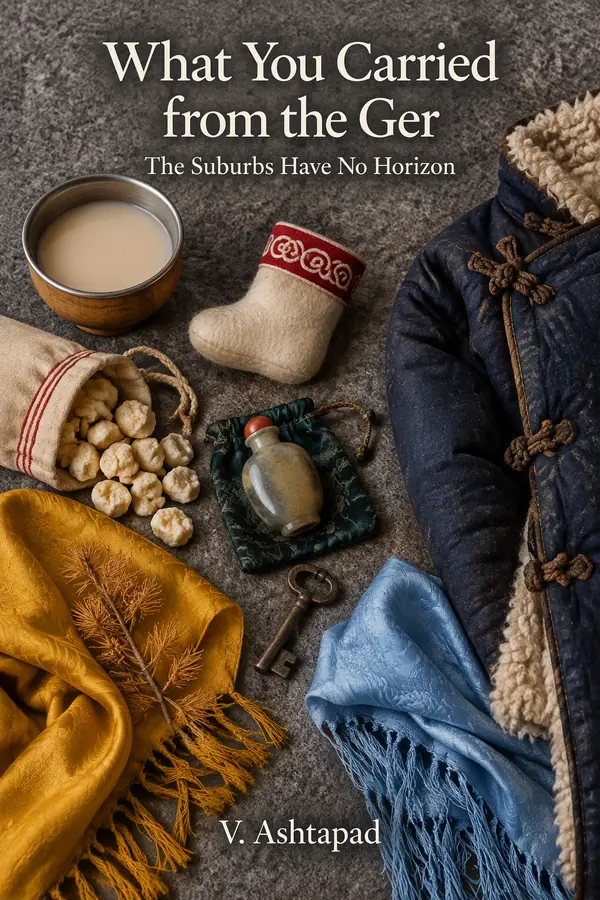
What You Carried from the Ger
The Suburbs Have No Horizon
by V. Ashtapad
Foreword
This is a novel, told from beginning to end to a woman called you. Oyun, her grandmother, her son and every other person in it are invented, as are their valley, their herd and their family. Arlington, Columbia Pike, Ulaanbaatar, Arkhangai, the Tamir river and the other real places named here are used fictionally.
Mongolian words appear lightly and in their common forms. The customs shown, from felt-making and the five snouts to the greetings of Tsagaan Sar, are drawn as one family lives them, not as a rule for every Mongolian home. The long songs and the fiddle tunes are described rather than quoted; they belong to the people who sing them.
For the ones who kept the stove going three times a night, and the ones who learned the words late.
The Wall Felt
You cut the twine with the kitchen scissors, because your grandmother tied it with the knot herders use for hobbling a horse and you have forgotten how to undo it. The roll is the size of a sleeping child. It came off the luggage belt at Dulles last night wrapped in a feed sack, between a cardboard box sealed with packing tape and a duffel that smelled of the inside of a bus. You carried it to the car against your chest, and the cold in the parking garage was the wet, mineral cold of Virginia in late November, the kind that finds the gap between your collar and your neck and stays there.
Now, in the morning, on the living room carpet of a two-bedroom apartment off Columbia Pike, you unroll it, and the smell comes up at you before the shape does.
Sheep. Smoke. The faint sourness of milk that has been boiled a thousand times in the same room. Something under all of that, sharper, which you finally recognize as the larch resin that clung to the poles of the summer ger when you were small, and which got into everything, your hair, the wool, the bread.
It is a piece of the outer wall. You know it before Emee says so. The edges are cut clean with a knife, but the face of it is gray and soft and pilled, darkened at one corner where the stove pipe ran close to the roof, and along one side you can see the faint ladder of marks where the lattice of the wall pressed into it, year after year, from the inside.
"We put up new felt in the autumn," your grandmother says from the couch. She has not taken off her coat. She has been in your apartment for eleven hours and she has not taken off her coat. "Ganbold's wife wanted to throw the old one on the dung pile. I said, cut me a piece. Oyun lives in a box. She will want a piece of a real wall."
You want to say that it is not a box, that it has a balcony and a dishwasher and a parking space with a number painted on it. Instead you kneel and put your palms flat on the felt, the way you used to put them on the ground outside the door in the morning to see if the frost had come.
It is warm. Not warm from the heating vent, which ticks and breathes beside the window and dries the air until your lips split, but warm the way felt is always warm, as if it has kept a little of every body that has ever slept against it and is letting it go slowly.
---
You were six when you first helped make felt. It was the end of summer at the camp on the Tamir, when the grass had gone the color of a lion and the wind had started to come down off the larch hills in the late afternoon with an edge on it. The adults had sheared the sheep weeks before. The wool lay in heaps on a canvas, and your grandfather and your uncle Dorj beat it with long willow switches until it rose up loose and light, a cloud that got into your nose and made you sneeze.
Then the women spread the old felt on the grass. Emee called it the mother. You remember that, because you thought it was a joke, and it was not. The new wool went on top of the mother in thin even layers, and your grandmother sprinkled it with water from a pail, flicking her fingers, and then the whole thing was rolled up tight around a pole and wrapped in wet hide and tied.
And then a horse dragged it.
That was the part you had waited all summer for. Your uncle rode, and the roll bumped along behind his gelding on two long ropes, out across the flat ground by the river and back, out and back, while the children ran beside it shrieking and the dogs ran beside the children. Every so often they stopped and unrolled it and the women knelt and pressed it and sprinkled it and rolled it again. By evening the loose wool had become cloth. Nobody had woven it. Nobody had sewn it. It had simply been pressed and soaked and dragged until the fibers gave up being separate.
You did not think about it then. You were six and the horse was the interesting part. You think about it now, kneeling on a beige carpet that the leasing office has asked tenants not to put furniture with sharp feet on, because it is the first thing you have understood about your grandmother since she got off the plane.
She is not here to visit. She is here to be pressed against something until it holds.
---
Your son comes out of his room in the dinosaur pajamas he is too old for and too attached to. He is seven. He has a gap where a front tooth used to be and a way of standing in a doorway with one foot on top of the other, like a heron, while he decides whether to come in.
"What is that," he says, in English.
"Esgii," Emee says. Felt.
He looks at you. You know the look. It means: translate, please, but also, please do not make me speak.
"It's from Emee's house," you tell him. "From the wall."
"Houses don't have soft walls."
"Hers does."
Temuulen comes closer and crouches and touches the stained corner with one finger. He smells his finger. He makes a face that he then, out of politeness, turns into a different face. Emee watches him with an expression you cannot read, and then she says, in Mongolian, slowly, as if to a foal, that his great-grandfather once slept with his back against that very piece for forty winters and never caught a cold.
You translate. Temuulen thinks about it.
"What's a winter," he says, "in Mongolia?"
It is a good question. You do not know how to answer it for him. You know what a winter is in Arlington: a gray damp that comes and goes, a week of hard freeze, school closing for two inches of snow, the salt trucks grinding up the Pike at four in the morning and the slush at the bus stop that soaks through sneakers. You know what a winter was in the ger district of Ulaanbaatar, where your parents still live in a wooden house with a fenced yard and a coal stove: the smoke so thick some January mornings that the sun came up brown, the smell of it in your school uniform, the way you walked to the bus with your scarf wound up over your nose and your eyes stinging.
And you know what a winter is at the winter camp, in the fold of a south-facing hill above the river, the snow blue at dawn and the cold so dry and so absolute that it does not feel cold at first, only strange, as if the air has turned to glass and you are walking inside it. The breath freezing on the dogs' whiskers. The animals pressed together in the shelter, steaming. Your grandfather going out before light to break the ice on the water hole with an iron bar.
"Cold," you say finally. "Really cold. Colder than the inside of the freezer."
Temuulen looks at the refrigerator in the kitchen with new respect.
---
Emee takes off her coat in the afternoon, which you count as a victory. Under it she is wearing a cardigan you sent her three years ago from a store in Pentagon City, buttoned to the throat, and under that, you are certain, at least two other layers. She sits very straight. She looks out of the sliding door to the balcony at the parking lot and the row of identical townhouses beyond it and the one bare maple that the landscaping company keeps cutting into the shape of a lollipop.
"Where is the horizon," she says.
You laugh, and then you see she is not joking. She is asking where the edge of the world has gone. In Arkhangai the land rolls away in every direction until it meets the sky, green and gold and green again, and you can see weather coming for an hour before it arrives. Here, the world stops at the next building.
"It's behind the townhouses," you say. "Keep going past the Pike and the highway and there's the river and then Washington."
"Your river has a highway on it?"
"Next to it."
She makes a small noise in her throat that she used to make when a sheep did something stupid.
You had known she would not like it. Your mother warned you on the phone from Ulaanbaatar: She will complain about everything. Let her. She is eighty-one, her son is gone, the herd is too big for Ganbold alone, and she has never slept a night under a roof that was not round. You had cleaned the apartment for three days. You had bought a firm mattress for the second bedroom and moved Temuulen in with you and Bilguun. You had found a store in Annandale that sells mutton by the half carcass and filled the freezer.
What you had not expected was this: that she would make you feel the size of the rooms. That with her sitting there in her coat and then her cardigan, the walls would draw in, and the ceiling would lower, and you would notice for the first time how square everything is. The rooms. The windows. Nothing curves. Nothing is round, except the clock.
---
Bilguun comes home at six with the cold on his jacket. He services heating systems for a company in Falls Church, and in late November his days are long: furnaces that will not light, heat pumps iced over, old women in Fairfax who keep him talking in their basements because he is polite and listens. He knows more about how Americans keep warm than anyone you have met. He says they do it mostly by forgetting the outside exists.
He bends to Emee on the couch and greets her properly, and she holds his forearms and sniffs his cheek, and you see her decide, in the space of that greeting, that he will do. Then he sees the felt.
He does not say anything. He crouches, the way your son did, and runs his thumb along the marks where the lattice pressed. He grew up in Khövsgöl, farther north, in a family that moved to the city when he was nine. You know he has not touched a ger wall in twenty years.
"Where do we put it," he says to you, in Mongolian, quietly.
You had been wondering the same thing. It is too big for a wall hanging and too stained for a rug and too precious for a closet. You stand there, the two of you, over a piece of your grandmother's home that has crossed eleven time zones in a feed sack, and you cannot think of a single place in your apartment where it belongs.
Emee solves it. After dinner, after the mutton and the noodles and the milk tea that she makes herself, scorning the tea bags in your cupboard, she gets up and picks up the felt and carries it into the second bedroom and lays it along the side of the mattress that faces the outer wall, folding the extra under, so that when she lies down her back will be against it.
"There," she says. "Now the cold has to get through the old man first."
---
Later, after Temuulen is asleep between you and Bilguun with his knees in your kidneys, you lie awake listening to the building. The refrigerator hum. The heating vent ticking. The air is so dry from the heat that your sinuses ache, and still under it, somehow, there is the old damp of Virginia, the damp that will become, in July, a hot wet towel over the whole city.
Through the wall you hear your grandmother turn over. You hear her say something, low, not to you.
You pick up your phone and open the family page your cousin Narangerel set up last spring, the private one, where relatives have been added one at a time as somebody remembers to invite them, so that the tree on the front of it is lopsided, heavy with your mother's side and nearly bare on your father's. Under your grandmother's name there is a photograph of her at a summer camp, squinting into the sun, her hand up to shade her eyes. Under your uncle Dorj's name there is the same photograph everybody uses, the one of him on his dun horse with the long pole across his saddle, and the dates.
You add a new photo. You took it this afternoon, when nobody was looking: the corner of the felt, the stove stain, the ladder of lattice marks, laid on your beige carpet. You do not write a caption. You do not know what you would write. You tag it to your grandfather's name, and to the camp on the Tamir, and then you put the phone face down on the nightstand and close your eyes.
In the morning, you will find that she has been up since five, and that the windows in the second bedroom are open two inches, letting in a cold that is only forty degrees and wet, a cold that beads on the inside of the glass. On the Tamir, at that hour, it will be twenty-five below and still, and so dry that the frost on the door of the ger will be a fine white fur you could blow away with one breath.
The Place of Honor
It comes out of the cardboard box on the third day, wrapped in a dish towel, inside a wool sock, inside a plastic bag from a pharmacy in Tsetserleg. Your grandmother unwraps each layer at the kitchen counter as if she is undressing a newborn in a cold room, quickly, one layer at a time, never leaving it bare for longer than she has to.
The bowl is small, wide and shallow, the size of two cupped hands. The inside is wood, a dark burl polished by use until the grain has gone glassy. The outside is a sleeve of silver, hammered thin, with a band of linked knots around the rim and a foot ring stamped with clouds. The silver has gone soft gray with handling. In two places the edge has been pushed in, and someone has tapped it almost straight again.
You know this bowl. You know it the way you know your own fingernails. It sat on the low chest at the back of the ger, on the honored side, on a folded square of blue cloth, and it came down only for guests. On the first morning of Tsagaan Sar it was filled with milk tea for your grandfather. In summer, at Naadam, it was filled with airag, foaming and sour, and handed from one man to another with the right hand while the left hand touched the right elbow. When you were nine you drank from it once without permission and your grandmother caught you and said nothing at all, which was worse than anything she could have said.
"You brought this on the plane," you say.
"In my bag. Under my feet."
"Emee, what if they'd taken it at security?"
She gives you the look she gives to weather forecasts. Then she fills the kettle.
---
Every morning since she arrived, your grandmother has made milk tea in the big pot she found at the back of your cupboard, the one you use for boiling corn twice a summer. She does not measure. She breaks off a piece of the brick tea she brought, wrapped in newspaper, and drops it into boiling water, and lets it go dark. Then milk, a lot of it, and salt, a pinch that looks to you like too much and is exactly enough. Then the part you had forgotten: she takes a ladle and lifts the tea high and pours it back into the pot, over and over, twenty times, thirty, until it is pale and frothed and the kitchen smells of it, of salt and milk and something like toasted grain.
The first ladle she pours into a cup and carries out to the balcony. You watched her do it the first morning, through the glass, and did not understand at first. She stood at the railing in her cardigan and house slippers, in the raw gray air, and dipped her fingers in the cup and flicked a few drops out, to the sky, toward the parking lot and the lollipop maple and the cars. Then she came back in, shivering slightly, and set the cup on the counter.
"For the land," she said, when you asked.
"Which land? That's the leasing office."
"It's land," she said. "Underneath."
Today, with the bowl unwrapped, she pours the first tea into it instead of the cup. She does not take it outside. She holds it out to you, with her right hand, her left hand under her right elbow.
You take it the same way. You did not have to think. Your hands remembered.
The silver is hot where the tea has warmed it and cool where it has not, and the wood inside is smooth as a pebble from the river. The tea is salty and rich and too hot, and you drink it standing up in your kitchen in Arlington in your uniform shirt, with your tower badge clipped to your pocket and your car keys in your other hand, and you feel the steam go up into your face and the warmth go down into your chest and settle under your breastbone, and for one second the kitchen is round.
"Now go," your grandmother says. "Your airplanes are waiting."
---
You work in the control tower at Dulles, five shifts a week on a rotating schedule, days mostly since Temuulen started school, and it is forty minutes in the car each way when the Toll Road is kind. You have done it for six years. You are good at it. You are good at the part where twelve airplanes are talking to you at once and you hold all of them in your head together, the way your grandmother holds a whole herd in hers, each one with its speed and its height and where it wants to go, and good at the part where something is about to go wrong and you see it before it does and say three calm words into the microphone and it doesn't.
The air in the tower cab is dry too. Drier than the apartment, drier than anything in Virginia except the inside of a car in January with the heat on high. The glass runs all the way around you, slanted outward against the glare, and on a clear day you can see the Blue Ridge forty miles west, a long low line at the edge of everything. It is the only room in Virginia with a horizon. You have not told your grandmother that. You keep lip balm in three pockets. You drink water you do not want.
On Thursday the ceiling comes down at noon and stays. That is the word you use at work, ceiling: the height of the bottom of the cloud. Eight hundred feet, then six hundred broken, then overcast, and the airplanes come down out of it one after another on the instrument approach with their landing lights on in the middle of the day, appearing out of the gray at the last moment like animals walking out of fog.
Your grandmother said it that morning, at the balcony door with her tea, looking up at the same cloud lying flat over the parking garage. She had not seen a sky in three days, she said, and how was anyone supposed to know what the weather was going to do without the sky.
"That's not sky," she said. "That's a lid."
You laughed then. Now, in the cab, with six hundred feet overcast on the board and a regional jet coming out of the bottom of it on short final, you put down the binoculars and stand a moment with your hand on the counter, because she was exactly right, and because in six years of saying ceiling into a microphone you have never once thought of it that way.
---
When you come home there is a man in your kitchen.
He is sitting at the table with his coat still on, holding your grandmother's silver bowl in both hands, with the expression of someone who has been handed a live bird. He is your downstairs neighbor, Mr. Hollis, retired, a widower, who rakes the leaves in front of the building even though the landscaping company does it on Tuesdays. You have spoken to him perhaps fifteen times in four years, mostly about packages.
"Oyun," he says, standing up so fast that tea slops onto his hand. "Your grandmother. She. I was in the hallway."
Emee says, in Mongolian, that she saw the old man outside in the cold carrying a bag of leaves and he looked lonely, so she waved him in.
"She waved," Mr. Hollis says. "I didn't know what she wanted. I thought maybe something was wrong. And then she sat me down and gave me this." He looks into the bowl. "It's salty."
"It's supposed to be."
"I figured. I didn't want to be rude." He lowers his voice, as if Emee might understand. "Is it a big deal? The bowl? It feels like a big deal."
You think about how to answer. Your grandmother is watching both of you, standing very straight by the stove, her hands folded.
"It means she thinks you're a guest," you tell him. "Not a stranger. A guest."
He looks at the bowl again, differently. Then he drinks the rest of the tea, all of it, though you can see it is too salty for him and too milky and still hot, and he hands the bowl back to your grandmother with both hands, carefully, the way he might hand back a baby. She takes it with her right hand. She nods once.
After he leaves, you rinse the bowl and dry it and give it back to her, and she wraps it in the dish towel and sets it, not in the cupboard, but on top of the refrigerator, on a folded blue pillowcase she has taken from your linen closet without asking. It is the highest flat place in the kitchen. It is, you realize, the honored place, as near as this apartment has one.
---
"He has a dog," Emee says at dinner. "On a rope."
"A leash."
"Every time I see him, the dog is on a rope. Every person here who has a dog has it on a rope." She shakes her head. "A dog should guard the door. It should go where it wants. A dog on a rope is a sad dog."
"There are cars, Emee. They'd get hit."
"Then there are too many cars."
Temuulen, who has been pushing a piece of mutton around his plate for ten minutes, says in English that his friend Rory has a dog that sleeps in his bed.
You translate this. Your grandmother puts down her spoon.
It is the beginning of a list that you will keep, privately, in a note on your phone, over the next weeks, of the things your grandmother refuses to like. You start it that night after the dishes. Dogs on ropes. Lawns, which she calls grass that nobody eats. The supermarket, which is too bright and too cold and smells of nothing. Bread, which she says is sweet. The highway, which never sleeps. The fact that people in the parking lot do not greet each other. The bathroom fan. The way the sun goes down behind the buildings at four-thirty so you never see it touch the ground.
You do not write down the bowl on the refrigerator. You do not write down the man downstairs drinking the whole thing so as not to be rude.
---
On Saturday you set up your old tablet for her. The screen is fine, the battery holds half a day, and it has been sitting in a drawer since Bilguun's work gave him a new one. You charge it and wipe it down and open the family page and sign her in.
You give her the setting that lets her look at everything and change nothing. You do this not because you think she will break something, but because you remember your mother, two years ago, trying to show a photo to a cousin and erasing a whole album of your uncle's wedding by pressing the wrong place for too long. It took Narangerel a week to find copies.
Emee holds the tablet at arm's length, then close to her nose, then at arm's length again. You show her how to slide her finger. You show her the tree with its lopsided branches, and her own name, and the photo of her with her hand up against the sun.
She does not look at herself. She slides past it, slowly, until she finds your uncle on his dun horse with the long pole across the saddle. She stops there. She looks at him a while, the way the woman from Övörkhangai looked at the gray sky that was not sky.
Then she slides again, and finds the photo you added on her first night: the corner of the old felt on your carpet, with the stove stain and the lattice marks.
"Who put this here," she says.
"I did."
She turns the tablet so that it faces the second bedroom, where the felt is folded along the mattress, as if she is checking that it is still there. Then she turns it back.
"Now it's in two places," she says.
Outside the balcony door the afternoon has gone the color of dishwater, and a thin rain is coming sideways across the parking lot, not falling so much as drifting, the kind of rain that makes no sound at all. At the winter camp, Ganbold wrote this morning, the sky has been clear for four days and the snow squeaks underfoot, and at night the stars come all the way down to the hills.
The Men's Side
The first time your grandmother walks into the supermarket in Annandale, she is wearing her winter deel, and every head in the produce section turns.
It is not a costume. You want to explain that to the young man stacking avocados, who stares at her with his mouth slightly open, and to the woman with the twins in the cart, who smiles too widely. It is a coat. It is the coat. Dark green wool, quilted, lined with sheepskin, cut long and wide so that it reaches her ankles and fastens high on the right shoulder with five round knotted buttons. The sleeves come down past her fingertips and end in curved cuffs that fold back, shaped like the hoof of a horse. Around her waist, wound three times and tucked, is a sash of orange silk, faded almost to apricot. She has her felt-lined boots on under it and a fox-fur hat on top. She looks like she has ridden in from somewhere a great distance away, which she has.
She walks straight past the avocados to the meat counter, where she stands for a long time looking at the pale wrapped trays of chicken breast and the cuts of beef with the fat trimmed off.
"Where is the rest of the animal," she says.
---
You have not worn a deel since your wedding. You had one made for it in Ulaanbaatar, blue silk with silver thread, and it hangs in a garment bag at the back of your closet with a sachet of cedar shavings that has long since stopped smelling of anything. Bilguun wore his at the Mongolian community picnic two summers ago, in a park in Fairfax, in ninety-degree heat and air so wet it felt like breathing through a washcloth, and came home with the silk stuck to his back.
But that is silk. That is a deel for photographs. What your grandmother wears is the other kind, the kind that is a house you can walk around in.
Your grandfather explained it to you once, when you were eight, on the ride to the winter camp. You were sitting in front of him on the saddle, inside his deel, actually inside it, with the front flap pulled around you and the sash holding you both, so that only your face stuck out of the opening at his chest. The wind was coming hard from the northwest, a dry wind with ice in it that you could hear before you felt, hissing across the snow crust. You were warm. You remember being amazed at how warm you were.
"In the day it's a coat," he said, over your head. "At night it's a blanket. If you're caught out, you lie down in the lee of your horse and pull it over your head and it's a tent. In summer you open the sleeves and it's a fan." He tapped the hollow above the sash where the cloth bloused out over his belly. "And this is the pocket. Everything goes in here."
Everything did. You remember the inventory of your grandfather's deel as you remember the rooms of a house. A tobacco pouch. A snuff bottle in a little silk bag. A flint and steel he never used and never left behind. His silver bowl, when he was going visiting. A lump of dried curd for the road. A folded scrap of blue cloth. Once, astonishingly, a newborn lamb, which he carried home inside the front of his deel in a spring snowstorm, its head poking out beside his chin.
---
The deel your grandmother brought for you is his.
She takes it out of the cardboard box the night after the supermarket, when Temuulen is in the bath. It is folded small and wrapped in a cotton sheet. When she shakes it out, it fills the living room. Blue-black wool, almost the color of the sky above the steppe at the hour before dark, worn shiny at the elbows and along the edge where the right hand rested on the reins. The lining is lambskin, gone gray and flattened. The sash is with it, folded separately, a long band of heavy silk the yellow-brown of dry grass, frayed at both ends.
You have not seen it since the summer he died. That was a long time ago. You were nineteen, in your second year at the aviation school in Ulaanbaatar. He died at the summer camp in his sleep, in July, with the door of the ger open and the river loud below. When you arrived, two days later, his deel was hanging on the lattice on the men's side, by his bed, and you remember thinking that it looked like it was waiting for him to come back from checking the horses.
"I thought it went to Dorj," you say.
"It did." Your grandmother smooths the collar flat with her palm. "Then it came back."
She does not say more and you do not ask. Your uncle Dorj has been gone for three winters. You know how he died, out with the horses in a ground blizzard in February, his horse coming home alone. You know they found him the next morning in the lee of a rock outcrop, with his deel pulled over his head the way his father had taught him. You know he had done everything right. You know that sometimes the cold does not care.
You hold the deel against yourself. It comes to your shins. It smells of sheep and old tobacco and woodsmoke and, faintly, unmistakably, of a man you have not smelled in ten years.
---
Temuulen comes out of the bathroom with a towel on his head like a hood, and stops.
"Whose is that?"
"Your great-grandfather's. Emee's husband."
He comes closer. He reaches out and touches the curved cuff. "Why is it shaped like that?"
You don't know. You ask your grandmother, and she tells you, and you translate: so that in the cold you can let the cuff down over the back of your hand and still hold the reins. So that your fingers stay warm. So that you never have to take off the coat to do anything.
"Like mittens," Temuulen says, "attached."
"Like mittens attached."
Your grandmother is looking at him with the face you cannot read. Then she stands up and takes the deel from your arms and holds it open, the way you would hold a coat for a guest.
He looks at you.
"Go on," you say.
He puts his arms in. It swallows him. The hem pools on the carpet around his feet in a dark lake, and the sleeves hang a foot past his hands, and the shoulders slide off his shoulders. Your grandmother tuts and kneels, slowly, her knees cracking, and begins to fold. She turns the cuffs back once, twice, three times. She gathers the extra length of the skirt up and blouses it over the place where the sash will go. Then she picks up the sash.
You watch her wind it. She holds one end against his belly and walks the silk around him, around and around, pulling it snug each time, and he turns slowly in the middle of the living room like a spool, giggling, then not giggling, because she is very serious about it, and you can see him decide to be serious too. Three times around. Four. She tucks the end. She steps back.
He stands there with his towel still on his head, in a coat that would fit a grown man, belted with a dead man's sash, and the deel has bloused out above the silk into a great soft pouch at his chest.
"That's the pocket," you tell him. "Everything goes in there."
He puts his hand in, cautiously, as if something might be inside it already.
---
You are not sure afterward what makes you do it. Maybe the smell of the wool. Maybe the way your grandmother's hands moved, so sure, folding a garment she has folded ten thousand times for two men who are both gone. That night, after Temuulen is asleep in his towel and his pajamas and the memory of the deel, you sit beside your grandmother on the couch with your phone and ask her if she will tell you about it.
"About what?"
"Övöö's deel. Where it came from. Who made it."
She looks at the phone in your hand. You have explained to her, in the last week, what recording is, and what the family page does with it, how it keeps the sound and then a cousin or you can sit down and type out every word underneath, so that someone who cannot hear well, or who does not understand all the words, can read along. She has listened to the recording Narangerel's husband made last year of his own father, an old wrestler, telling how he won a bout at a provincial Naadam in 1968 by letting the other man think he was tired.
"He talks too long," your grandmother had said. And then, after a pause, "But it sounds like him."
Now she straightens her cardigan. She clears her throat. She looks past you at the black glass of the balcony door, where the parking lot lights are reflected, and she begins.
She tells you that the wool was from their own sheep, from the spring of the year they married, and that her mother-in-law spun it and a woman in the next valley wove it. She tells you that the lining was from six lambs born dead in a late frost and that nothing was wasted. She tells you that your grandfather wore it every winter for thirty-one years, and that it was patched at the left elbow where a horse bit him, and she reaches over to the folded deel on the arm of the couch and shows you the patch, a neat square of slightly darker wool you had not noticed. She tells you that the sash was a gift from her own father on the day she left her family's ger to go to his, and that her father had bought the silk from a trader who came up from the south with a truck, and that it was the first truck she had ever seen.
She talks for twenty-two minutes. You do not interrupt. When she is done she says, "Enough," and gets up and goes to bed.
You type it out the next evening after your shift, sitting at the kitchen table with your earbuds in, stopping and starting, rewinding to catch a word. It takes two hours. Some words you do not know, old words for parts of a saddle or a kind of weave, and you leave them as she said them and put a small mark beside them for your mother to look at. When you are finished you read the whole thing back on the screen, under the gray line of the sound, and you realize that it is the longest your grandmother has ever spoken to you without stopping in your life.
---
In the morning she is up before you, as always, the window cracked open, the tea pot already going. Through the kitchen doorway you can see the deel and the sash, folded and stacked on top of the felt along her mattress.
Temuulen pads out in his pajamas and stands in the doorway with one foot on the other.
"Can I wear it to school?" he says. "For show and tell?"
You open your mouth to say no. It is too big, it is too old, it is not a toy. Your grandmother, who does not speak English, who cannot possibly have understood, turns from the stove with the ladle in her hand and says, in Mongolian, "Only if you wear the sash right."
You stare at her. She shrugs and turns back to the pot.
"She says yes," you tell him. "If you let her tie it." He is already holding his arms out from his sides, ready to be wound, and your grandmother sets down the ladle and wipes her hands on her cardigan and goes to get the sash.
The Hearth
There is only one of them. You do not know how you missed it in the box, but it turns up in the second week of December when your grandmother is looking for her sewing kit: a single child's boot, white felt gone the color of weak tea, with a toe that turns up at the end like the prow of a little boat and a cuff of red cloth stitched around the top. It would fit a four-year-old. It is stiff with age and holds its shape on its own, standing on the kitchen table as if someone has just stepped out of it.
"This is mine," you say.
"Yes."
"Where's the other one?"
Your grandmother threads a needle against the light from the window, squinting. "You lost it," she says. "In the river. You were showing your cousin how a boot floats."
You do not remember this at all, and then, all at once, you do. The edge of the Tamir in late spring, the ice gone out but the water still so cold it made your ankles ache through the felt. Ganbold, who was five, daring you. The boot spinning away downstream, white on gray, bobbing, and you on the bank in one boot and one wool sock, wailing, and your uncle Dorj riding along the bank after it for half a kilometer and giving up, and carrying you home on his saddle with your bare foot tucked into his deel.
"You kept the one that didn't float away," you say.
"It was a good boot," your grandmother says. "There was nothing wrong with it."
---
In Arlington, winter does not arrive. It visits. A week of cold, clear days when the sky goes a hard pale blue and the puddles in the parking lot skin over at night and crack under your shoes in the morning, and then the air turns soft again and wet and the temperature climbs into the fifties and everyone in the tower complains of colds. Your grandmother distrusts all of it. She stands at the sliding door each morning with her tea and reads the sky the way she used to read it from the doorway of the ger, and each morning she comes to the same conclusion, which she announces to the kitchen.
"This is not winter. This is a sick autumn."
At the winter camp, winter came all at once, like a door closing. One night in late October or early November the wind would swing into the northwest and keep coming, and in the morning the river would be quiet at the edges, then quiet in the middle, and the snow would come and stay. After that, the world was white and blue and very still, and the cold was a fact, like the hill behind the camp. You did not fight it. You arranged your life around it.
You remember the order of those days the way you remember a song. Your grandmother rising in the dark to feed the stove, three times a night, every night, all winter, so that the felt walls never let the cold all the way in. The dried dung stacked by the door in a crust-gray wall, so dry and light you could carry an armful of it as a child, and the sweetish smell of it burning that no one who has not smelled it will ever understand. The water bucket by the door with a skin of ice on it in the morning even inside the ger, if the stove went low. Your felt boots set on the warm ground by the stove at night, upside down on two sticks, so that they would be dry by morning. The squeak of the snow under them when you went out to the shelter where the animals stood together, the sheep and goats packed so close you could walk across their backs, their breath going up in one cloud.
The cold there was dry. You understand that only now, in a place where it is wet. At forty below, the air at the winter camp had no water left in it to hold. It burned your nostrils and frosted your eyelashes, but it did not seep. It did not soak into your clothes and hang there. You could stand in it in a good deel, in felt boots, and be warm all through, while the air outside you was cold enough to kill. Here, at thirty-five degrees in the parking lot with a fine drizzle in the air, you are colder in your down jacket than you ever were there. The damp gets into the seams. Your grandmother says it gets into the bones, and every morning she rubs her knees and then burns a pinch of dried juniper from home on a saucer by the window, so that the second bedroom smells of arts smoke, sharp and clean, like the inside of the ger on the first morning at a new camp, and she does not complain about that, only about the sky.
---
The snow comes on the nineteenth of December, a Saturday, at about two in the afternoon.
You are on the couch with your feet up after a week of shifts, half asleep. Bilguun is at work on an emergency call, a boiler in a school basement in Clarendon. Temuulen is building a fort out of couch cushions. Your grandmother is at the sliding door, as she so often is, with her hands folded behind her back.
"Oyun," she says.
You open your eyes. Outside the glass, the air has filled with white. Not the thin gray sleet that sometimes comes in February, but real snow, big flakes, falling slowly and straight down out of a sky the color of a sheep's belly. Already the cars in the lot are powdered. Already the lollipop maple has a white edge along every branch.
Your grandmother has her deel on before you are off the couch. She has her boots on, the big felt-lined ones, and her fox hat. She is out the door and down the stairs, and when you get to the balcony and look down, she is standing in the middle of the strip of grass between the parking lot and the townhouses, in the falling snow, with her face turned up.
Temuulen comes out onto the balcony in his socks. "What's she doing?"
You do not know how to say it in English. You say, "She's saying hello."
---
You get him into his snow boots, which are synthetic and lined with something that is not felt and have a cartoon character on the side he has started to find embarrassing. You get him into his jacket. And then, without quite deciding to, you pick up the old white felt boot from the kitchen table and carry it down with you.
The snow is wet. Of course it is. It is Virginia snow, heavy and clinging, and it packs under your sneakers instead of squeaking. But it is falling thick now, and the world has gone quiet in the way it only goes quiet under snow, the traffic on the Pike muffled to a hush, the townhouses softened, the parking lot lights coming on early, one by one, in the gray afternoon.
Your grandmother is crouched at the edge of the grass, looking at something.
"Come here," she says to Temuulen, in Mongolian, and he understands that much and goes. She points.
There are tracks in the new snow. Small ones, close together, in pairs. She puts her own finger beside one, to show the size. Then she points to where they go: along the edge of the hedge, under the bushes by the dumpster, out again.
"Rabbit," she says. And then she says the Mongolian word for it, tuulai, slowly, and waits.
Temuulen looks at the tracks. He looks at her. He looks at you.
"Say it," you tell him.
"Tuulai," he says, so quietly you barely hear it.
Your grandmother nods. She stands up, knees cracking, and walks along the line of the hedge, slowly, bent over, reading the ground. She finds a set of prints that are bigger, rounder, with no claws showing, and she says cat, and then the Mongolian, muur. She finds a set with claws and a long stride and says dog, nokhoi, and then shakes her head and says something about the rope, which you do not translate. She finds a line of tiny forked marks and says bird. Then she stops and stands up very straight and looks around at the snow and the cars and the lights, and you see her face change.
"At home," she says to you, "by now Ganbold would be riding out to see what came in the night. Wolf. Fox. If a wolf came close to the shelter. You read the snow every morning. It tells you what visited."
You remember. You remember your uncle teaching Ganbold and you, the two of you on the same horse, leaning down. A wolf walks in its own tracks, he said. The back foot goes into the hole the front foot made. A fox drags its tail.
---
You hold out the felt boot to Temuulen.
He takes it, confused. It is tiny in his hands, much too small for him now. He turns it over. He looks at the upturned toe, the red cuff.
"Whose?"
"Mine. When I was four."
He looks at you as if you have told him you used to be a horse.
"Emee kept it," you say. "I lost the other one in a river."
He holds the boot up to your grandmother. She takes it from him and holds it a moment, and then she bends down and sets it in the snow, upright, at the end of the rabbit's tracks, as if the rabbit has walked up to it and stopped. It stands there in the falling white, very small, very old, with its prow pointing at the hedge.
"Take a picture," she says to you.
You take a picture.
---
That night, Ganbold calls.
He calls on video, which he does every few days now that your grandmother is here, propping his phone on something in the winter ger so that you see him from below, his face lit orange by the stove door. Behind him, through the open door of the ger, you can see blue snow and black sky. It is morning there, early, before light. He has just come in from the shelter.
He and your grandmother talk for a long time about the animals. You half listen while you do the dishes. Then something in his voice makes you turn off the water.
The snow came early this year, he is saying. In November. Deep. Then a warm day, two days, and it melted on top, and then the cold came back hard, and now there is a crust on top of the snow like a sheet of glass. The sheep cannot paw through it to the grass underneath. The horses can, a little, if they stamp. He has hay. Not enough hay. Nobody has enough hay. Everybody in the valley is talking about it.
Your grandmother does not say the word. Neither does he. You know the word. Every Mongolian knows the word. It is what they call a winter that kills animals, a winter where the snow is too deep or the crust too hard or the cold too long, and the herds cannot reach the grass, and they starve standing up.
"It's still December," your grandmother says. "Spring is far."
"I know, Emee."
When he has gone, she stays on the couch with the tablet in her lap. You sit beside her. On the screen is the map your cousins started on the family page last summer, a map of the valley with pins on it: the summer camp on the Tamir, with an old photo of the ger and a note in Narangerel's careful typing about the year the river flooded; the winter camp on its south-facing slope, with a photo Ganbold posted in October of the new shelter roof he built; the well; the place where your great-grandparents' ger used to stand.
Your grandmother touches the pin for the winter camp, and the photo of the shelter roof comes up, new boards and old ones, the hill behind it brown and bare, before the snow. She does not move on from it. On the windowsill behind her, drying on two chopsticks, upside down, the way she taught you, is one small white felt boot.
The Two Pillars
Your grandmother's phone has a crack across the screen that runs from the upper left corner to the lower right, with a small starburst at one end where it struck the iron edge of the stove. She dropped it two winters ago reaching for the kettle. Ganbold offered to buy her a new one in Tsetserleg. She said this one still works, and it does, and so every face she has looked at since then has had a line through it, as if the person were standing on the far side of a frozen river.
In January, the faces stop. What comes through the crack instead are animals.
---
You learn to tell the time in Arkhangai by what your grandmother is doing in Arlington. When she is at the stove at five in the morning with the window cracked and the ladle going, it is seven in the evening there, and Ganbold has come in from the shelter for the last time and is sitting by his own stove, and he sends the day's photographs. When she is on the couch after dinner with the phone held close to her face, it is morning there, and he has gone out with the first light to count.
He does not call much now. Calling costs time, and battery, and the solar panel on the roof of the winter ger is under snow half the days. He sends pictures and short messages, a few words. Your grandmother reads them aloud to no one, in a voice like a ledger.
Fourteen sheep this morning. Three goats. One of the young yaks.
Then she sets the phone face down on her knee and looks at the balcony door.
You look at the pictures later, when she is asleep, on your own phone, where Ganbold also sends them. You do not look at them in front of her. You are a controller. You are trained to look straight at the thing that is going wrong and keep your voice level. But this is different. This is the wide white slope above the winter camp that you sledded down as a child, and the gray lumps on it are not rocks. This is the shelter your grandfather built and Ganbold re-roofed in October, and in the photograph the animals inside it are lying down in rows, and you know from the way they are lying that most of them will not get up. This is a goat with her front legs folded under her and her head up and her eyes open, standing in the corner of the frame as if she has wandered into the photo by accident, so thin that her hip bones lift the hide like tent poles.
The snow in the photographs is blinding. The sky is a perfect hard blue. Everything is very beautiful. That is the worst part.
---
In the tower, you are short with a trainee who wants to put two airplanes closer together on final than you like. You are right, and he listens, and the spacing holds, but afterward in the break room you realize you raised your voice, which you do not do on the radio and do not do off it. You sit with a cup of water that you do not drink. The heating in the cab is running too hot again, and the air has that baked, stale smell, and through the glass the sky over the runways is gray, damp, unbothered.
You think: it is forty below there. You think: the wind has been blowing for six days. Ganbold told you on the last call, his voice gone thin, that the wind never stopped, it came down the valley from the northwest day and night and drove the snow along the ground in a white river at knee height, so that when you walked out to the shelter you could see the hill above you clear against the sky and your own legs disappearing into moving white below. The wind found every gap in the shelter boards. It found every gap in the ger. He and his wife and their two girls slept in their deels on the floor beside the stove with the felt walls breathing in and out around them.
You think of the old felt folded along your grandmother's mattress in the next room, with its ladder of lattice marks. You think of the new felt she put up in the autumn. You hope it was thick enough.
---
The family argues in a group message, the way families do now.
Your mother writes from Ulaanbaatar, long messages, carefully punctuated, the way she writes on the blackboard for her fourth-graders. Sell the rest, she says. Sell them now, while they can still walk to a buyer. Ganbold is thirty years old with two daughters, he should come to the city, there is work in construction, there is a school for the girls. My brother died out there. How many more of us does the land need.
Ganbold's wife, Uyanga, writes short replies with no punctuation at all. Where would we live. A ger in the ger district with the smoke. My girls coughing all winter. No.
Your father writes nothing, which is how he writes.
A cousin in Seoul, whom you have not seen since you were twelve, writes that she can send money for hay. Another cousin in Darkhan says hay is three times what it was in November and there is none left in the soum center anyway, the trucks are not getting through.
Narangerel writes that she is adding Uyanga's side of the family to the family page, her parents and her grandmother, because someone asked about them, and would Uyanga please check the spellings.
You write and delete four messages. You do not know what you think. You know that you have a salary in dollars and an apartment with a dishwasher and a son who has never smelled burning dung. You know that the money you could send would buy hay at three times its price for perhaps two weeks. You send it anyway. You tell no one in the group except Ganbold, privately, and he sends back one word, which is thank you, and then, a minute later, a photograph of a young horse standing in the lee of the shelter with snow caked along its back, alive.
---
Your grandmother stops eating properly in the second week of January.
She does not refuse food. She takes what you give her. But she cuts the mutton smaller and smaller and moves it around the plate and eats the noodles and leaves the meat, and she, who has never in your life left meat, says she is not hungry. She drinks tea. She drinks a great deal of tea. In the mornings she stands at the sliding door longer and longer, and you notice, because catching small changes before they become large ones is what you do for a living, that her ankles are a little swollen in the evenings and that when she stands up from the couch she puts a hand on the arm and waits a moment before she walks.
You take her blood pressure on a Sunday morning with the cuff you keep in the hall closet. She lets you do it without comment, holding her arm out, looking at the wall.
It is high. Not dangerous. High.
"You need to eat," you tell her. "And sleep. You're up every two hours."
"I'm up feeding the stove."
"There's no stove, Emee."
She looks at you. Then she looks at the heating vent beside the window, ticking, and you understand that she knows that perfectly well, and that she gets up anyway, at the hours when the stove would need feeding, because her body has done it for sixty years and does not know how to stop. Because somewhere eleven time zones away, Uyanga is getting up at those same hours, and Ganbold, and there are two little girls asleep in their deels on the floor of a ger in a wind that has not stopped for six days.
You take the cuff off her arm and roll it up. You do not say anything else.
---
Temuulen notices before Bilguun does. Children always do.
He comes into the kitchen one evening while you are washing up and stands in the doorway on one foot.
"Is Emee sad?" he asks, in English.
You dry your hands. You think about how much to say. He is seven. He knows that there are sheep and goats and horses at Emee's house, because you have shown him pictures, and he knows that there are a lot of them, because he once asked how many and you said hundreds and he thought you were joking.
"There's a bad winter at home," you tell him. "Very cold. Too much snow. The animals can't find anything to eat."
"Can't they eat the snow?"
"The grass is under the snow. And there's ice on top. They can't get to it."
He thinks about this. You can see him picturing it, the animals pawing at a sheet of ice.
"Are they dying?"
"Some of them."
"How many?"
You tell him the truth, because it is what you do. Ganbold counted this morning. Of three hundred and twelve sheep and goats in the autumn, there are a hundred and forty left. Of forty-one horses, thirty-four. Of the yaks, nine of fifteen.
Temuulen does the arithmetic slowly, moving his lips. He is good at numbers. When he gets to the end of it he looks up at you and his face is very still.
Then he goes into the living room, where your grandmother is on the couch with her cracked phone in her lap, and climbs up beside her, which he has not done before, and sits there. He does not say anything. He does not know enough Mongolian to say anything, and she does not know any English. He just sits there next to her, with his knees pulled up, looking at the black screen of the television.
After a while your grandmother turns her phone over and holds it so he can see. It is the last photograph Ganbold sent. The young horse in the lee of the shelter, with snow on its back. The crack runs across it diagonally, right through the horse's shoulder.
"Mori," she says. Horse.
"Mori," Temuulen says.
She nods. She swipes back to the one before it, and you tense, because you know what the one before it is. But she has stopped at a different one, an older one, from the autumn, before the snow: the herd on the brown hillside above the winter camp, spread out grazing in low sun, with Ganbold on his horse at the edge of the frame, his long pole upright beside him.
She starts to count them. Out loud. In Mongolian. Her finger moving across the cracked glass from one animal to the next, neg, khoyor, gurav, one, two, three, and Temuulen watches her finger and after a while begins, under his breath, to count along with her in English, so that you stand in the doorway and hear the two of them counting together, side by side, in two languages, the herd that was, like the two painted posts in the middle of a ger that hold the crown up between them and that nobody is allowed to walk between. They do not get to the end. There are too many. But they keep going for a long time.
The Door
It is the one thing your grandmother could not bring, and so it is the thing you think about most.
It leans against the outside of the winter ger in the photograph Ganbold sends on the last day of January, propped by the door beside the shovel and the iron bar for breaking ice: a pole of birch, straight and pale, twice as long as a man is tall, with a loop of rawhide fixed to the narrow end by a cord that runs back along its length. The wind has drifted snow halfway up it. In the photograph the pole slants across the felt wall of the ger like the hand of a clock.
It was your uncle's. Before that, it was your grandfather's, though the pole itself has been replaced at least twice, because birch cracks, and only the loop and the cord and the carved grip at the thick end are old. It is called an urga. There is no word for it in English that does not make it sound like something from a cowboy film, and it is not that. A lasso is thrown. An urga is held. You ride up alongside the horse you want, at a gallop, and reach out with the pole and drop the loop over its head and lean back in the saddle, and the horse, if you have done it right, comes round in a wide arc and stops, and stands, trembling, while you walk your own horse up along the pole hand over hand.
You have seen it done a hundred times. You have never done it. Girls in your family were not stopped from it; you were simply never good enough on a horse at a gallop to try, and then you were in the city, and then you were in aviation school, and then you were here.
Your uncle did it the way other men walk.
---
"What's that stick?" Temuulen says.
He is looking at the family page on your grandmother's tablet, the photo everyone uses for your uncle, the one of him on the dun horse with the long pole across his saddle. He has looked at it before. This is the first time he has asked.
You tell him. You find a video for him, an old one somebody posted years ago, of men in deels catching horses in a wide valley, the poles flashing, the horses wheeling, the dust going up. He watches it twice. Then he looks at the picture of his great-uncle again.
"He could do that?"
"Better than anyone in the valley."
"Better than Ganbold?"
You think about Ganbold, who is good, who is careful, who is thirty and tired and has been out every morning this month in a wind that does not stop, counting what is left.
"Ganbold learned from him," you say. "So, almost."
---
Your uncle Dorj was not a talker. He was the younger of your grandmother's two children, ten years younger than your mother, and he stayed with the herd when she went to the city, and he never seemed to want anything else. He was long and thin and walked with a hitch from a fall he took at nineteen. He laughed silently, with his shoulders. When he did talk, it was usually to horses.
You remember, from the summer you were eleven, a colt that would not be caught. It was a three-year-old, a gray, half wild, that had spent its life running with the herd on the far side of the river and had never had a hand on it. Your grandfather said it was time. Your uncle rode out after it on his best horse, a sorrel with a white blaze, the urga upright beside him like a mast.
You and Ganbold watched from the top of the bank. You remember the heat, the dry yellow summer heat of the steppe, which is nothing like summer here: no weight to it, no wet, just sun pressing straight down out of a huge white-blue sky and the grass crackling and the smell of crushed wormwood rising wherever the horses stepped. You remember the wind, a hot wind out of the southwest, that dried the sweat on your face before you could feel it. You remember the herd breaking and running and the gray colt splitting away from it, head high, and your uncle angling across the flat after it, low over his horse's neck, and the pole coming down.
He missed. The colt jinked, and the loop slid off its neck, and it was away. Your uncle circled back, unhurried, and lined up again.
He missed four times. The fifth time, the loop dropped clean and he sat back and the colt came round, fighting, and then stopped, sides heaving, nostrils wide, staring at him.
And then your uncle did something you have never forgotten. He did not walk his horse up the pole right away. He sat there, holding it, and he sang. Not a song, exactly. A low sound in his throat, a hum with another sound riding on top of it, a whistle almost, high and thin, like wind across the mouth of a bottle. It went on and on. You were too far away to hear it properly, but you could hear enough. The colt stood. Its ears went forward. Its sides slowed.
"What is he doing?" you asked Ganbold.
Ganbold, who was twelve and knew everything, said, "Talking to it."
Later you learned what it was called, the singing that makes two sounds at once. You learned that there were men in Ulaanbaatar who did it in concert halls in silk deels, and men in other countries who had learned it from recordings. You have heard it many times since. But you have never heard it as you heard it then, in a hot wind across a yellow flat by the Tamir, from a thin man on a sorrel horse, holding a frightened colt at the end of a birch pole.
---
On the first of February, Narangerel makes a page for him.
It has been three years. The family does not mark anniversaries of death with any great ceremony; it is not that kind of family. But your cousin, who lives in Ulaanbaatar and works in a bank and is the one who keeps everybody's birthdays straight, writes in the group message that she has made a remembrance page for Dorj-akh, inside the family space, where only the family can see it, and that anyone who wants to can leave something there.
You open it on your phone in the break room below the tower cab at the end of a shift. At the top is the photo of him on the dun horse with the pole. Under it, Narangerel has written his name and his dates and one line: He knew every horse in the valley by its walk.
Under that, people have started to write.
Ganbold has written: I took the gray mare out to the rock this morning. She remembers the way.
There is a photo with it. A rock outcrop on a white slope, black stone with snow in its cracks, the sky behind it an empty blue, and in the foreground the gray mare's ears and the edge of Ganbold's glove on the reins. That is all. You know what rock it is. You know he rode an hour out and an hour back in that cold, with what is left of the herd waiting, to stand there a few minutes and take a picture for people on the other side of the world.
Your cousin in Seoul has written: I remember he let me ride the sorrel when I was seven and told my mother I fell off by myself.
Your mother has written, in her blackboard sentences: My little brother. I was supposed to look after him. He looked after all of us instead.
Uyanga has written: The girls ask about him every night.
The cousin in Darkhan has written a short verse, four lines, of the kind people in your family make up for weddings and send-offs, about a horse that comes home alone across the snow and the wind that keeps its rider's song. It is not very good. It makes you put your face in your hands in the break room until a controller coming on for the midnight shift asks if you are all right.
---
That evening, you sit with your grandmother and show her the page.
She reads every word, slowly, holding the tablet close. She looks for a long time at Ganbold's photograph of the rock. She does not cry. You have never seen your grandmother cry and you do not expect to now. When she reaches the end, she hands the tablet back to you.
"Write something for me," she says.
"What do you want to say?"
She thinks. Temuulen is on the floor at her feet, building something out of plastic bricks, not listening, or seeming not to.
"Write," your grandmother says, "that his father's pole is still by the door. That Ganbold uses it. That the loop is the same loop."
You type it. You read it back to her. She nods.
"And write," she says, "that he sang badly."
You look at her.
"He did," she says. "Everyone said he sang to horses. He sang to horses because people would not listen. The horses had no choice." And for the first time since she arrived in Arlington, your grandmother laughs, a short dry bark of a laugh, and covers her mouth with her hand, and her eyes are wet but it is from laughing, and you type it exactly as she said it and put her name under it.
---
Two days later you come home to find that your curtain rod is missing.
It is the telescoping rod from the window in Temuulen's room, which he has not slept in since November. The curtain is folded on the bed. The rod is in the living room, extended to its full length, with one of Bilguun's work bootlaces tied to the end in a loop, and your son is holding it upright beside him, standing on the couch cushions, which he has arranged in a line on the carpet, one behind the other, like a horse.
Bilguun is on his hands and knees by the balcony door, with a dish towel tucked into the back of his collar for a mane.
"I'm the gray colt," he tells you, with dignity. "Apparently I'm very wild."
Your grandmother is in the armchair with her tea. She says, in Mongolian, to Temuulen, without any hurry: Lower. Lean. Not yet. Now.
He swings. The bootlace loop bounces off the top of Bilguun's head.
"Again," your grandmother says.
He swings again. And again. On the fifth try, the loop drops over Bilguun's head and settles around his neck, and Temuulen shrieks and leans back on the couch cushions as hard as he can, and Bilguun, who weighs two hundred pounds, comes slowly round in a wide arc on his knees across the living room carpet and stops, and stands, and looks at his son with enormous wild eyes.
And Temuulen, standing on his cushion horse with the curtain rod in both fists, opens his mouth and makes a sound. It is a low hum, from the back of his throat, wobbling. There is nothing riding on top of it. It is not anything. It is a seven-year-old boy humming at his father on the floor of an apartment in Arlington, Virginia, because his great-grandmother told him, in a language he barely speaks, that this is what you do when you have caught a horse.
Your grandmother does not laugh this time. She watches him the whole time he hums, very still, her lips moving slightly, as if she is counting how long he can hold the note.
The Roof Poles
The bundle is the size of a loaf of bread and heavier than it looks, wrapped in a flour sack from the soum cooperative and tied around three times with a cord of braided black horsehair. It has traveled in the bottom of your grandmother's cardboard carton since November, under the deel and the bowl and the felt boot, and she has not untied it once. You did not know it existed. You thought you knew everything that came down from the chest at the back of the ger on winter evenings when you were small, and you find out, on a Sunday in February, that you did not.
She unties it after the remembrance page, when the sky over Arlington is the flat white of a sheet hung out to dry and the parking lot is wet and the heating vent is ticking, and you understand without being told that she is opening it because of the page, because she has seen her son in two places now and wants the rest of them in two places too.
---
Inside the flour sack are scarves. Khadags, dozens of them, folded long and thin like letters, packed tight against each other the way roof poles lie in a cart when a family moves camp. Most are blue, every blue there is: the deep blue of a new one, the pale blue of the horizon, a blue gone so gray with years that it is nearly the color of ash. A few are white. One is yellow. They smell of dust and wool and the inside of the chest, a dry sweetish smell you had forgotten until it came up out of the sack at you, and under that, very faintly, of smoke.
Every one of them has a knot in it. Some have one, tied in a corner. Some have two or three. A few have a twist of colored thread caught in the knot, or a single strand of horsehair, or something you cannot identify, small and hard, tied in so tightly it has become part of the silk.
And in the middle of them, wrapped in its own square of sacking, something heavy. Your grandmother lifts it out last and sets it on the table with a small iron sound.
It is the head of a branding iron. A shape like a stirrup, rounded at the bottom, open at the top, with a short straight bar laid across the open end, black with old fire, the rod it was welded to cut off a hand's length below the head and the cut end filed smooth.
"Övöö's first one," your grandmother says. "Dorj had a new one made in Tsetserleg when the rod cracked. He cut this one off and kept it. Then I kept it."
---
She lays the scarves out on the kitchen table the way she lays out dumplings on a tray, filling the space, edge to edge, and you see that there is an order to them after all. Not years. People.
"Each one is somebody," she says. "When they give it to you, or you give it to them, you tie a knot, so you know. Everybody does it a little differently. My mother did it this way. So I do."
"Who's this?" you say, and pick up one of the palest, a blue gone almost white, with one knot and a short length of dark twisted cord caught in it.
Your grandmother takes it from you and turns it over in her fingers, and her mouth sets in a way you know.
"Me," she says. "The soum Naadam. Nineteen sixty-one. The archery." She touches the cord in the knot. "That's from my bowstring. It broke the week after. I kept a piece."
"You shot?"
"Second." She smooths the silk flat with her palm. "They give you a scarf with the prize. The prize was a brick of tea. The judge was the winner's uncle."
---
You had not known she shot. You do not know why you had not known. In Mongolia the three sports of Naadam are for men, the wrestling and the horse racing and the archery, except that the archery has never been only for men, and girls and women have always shot, and the horse racing has always been ridden by children, girls among them, so that really only the wrestling belongs to men alone. You have seen women archers at every Naadam you have ever been to, in Ulaanbaatar and in Tsetserleg, in silk deels with their hair pinned up, drawing those long recurved bows and sending the blunt arrows out across the grass at a low wall of little leather cylinders, and the judges standing beside the targets lifting their arms and singing out a long call, almost a song, each time one is hit.
It had simply never occurred to you that your grandmother had been one of them. That she had been sixteen, with a bow, on a summer day in the wind.
"Why did you stop?"
She shrugs. "I married. Then your mother. Then the herd." She sets the scarf at the top of the table, above the others. "The bow went to my sister. Her granddaughter shoots now. In Tsetserleg. She's good."
You did not know that either.
---
You spend the afternoon at the kitchen table, the two of you. Temuulen comes and goes. Bilguun makes khuushuur for lunch, the fried mutton pastries, half-moons crimped at the edge, and the kitchen fills with the smell of hot fat and onion, and your grandmother eats two without being asked, which you note.
She tells you who each scarf is, one at a time, and after the first dozen you understand that you should be keeping this, and you get your phone and start photographing each one laid flat against the table in the window light, with its knot turned toward the camera, and recording her voice as she talks about it, so that later, when you or Narangerel type it out under the sound, you will know which words go with which knot.
Here is the deep blue one, three knots, that her father put across her forearms the morning she left her family's ger to go to her husband's. Three knots, she says, because it was three days' ride, and he wanted her to count them. Here is a white one, small, knotted once around a lock of fine dark hair, from her youngest brother's first haircut, when he was three; he died the next winter of a fever, in the winter of the big snow, and this is all there is of him. She holds that one a long time and does not say anything else about it. Here is a long blue one with five knots, your grandfather's, from the provincial Naadam the year he wrestled into the fifth round, skinny as a fence post, and lost to a man twice his size and came home prouder of the loss than other men are of winning. Here is the yellow one, from the spring shearing of the old collective, the year she had more work-day points than anyone in the brigade. That was the time, your grandmother says flatly, when the herds were all counted together and the points were written in a book. She does not say anything else about those years, and you do not ask.
Here is one knotted around a tuft of coarse black hair. Yak hair. Your uncle Dorj's, from his first haircut, at two, the morning he was set on top of a yak for the first time and gripped its hair in both fists and howled, either from terror or joy, nobody ever decided which, and wouldn't let go, so that his father had to cut the tuft he was holding to get him down.
Temuulen, passing through, stops at that one.
"Is that the horse guy?"
"That's him. When he was a baby."
He looks at the knot of yak hair for a long moment. Then he takes the scarf, carefully, by the ends, the way you have shown him, and carries it into the living room to look at by himself.
---
Here is the one for your mother, at seven, the morning she was put on the truck to the boarding school in the soum center with a satchel almost as big as she was. Here is one for your own father, from the day he came to ask for your mother, which your grandmother says was a very bad day for the weather and a good day for everything else.
And here, near the bottom, a new one, still bright, with a single knot tied tight and small, and a strand of red thread caught in it.
You do not recognize it. Your grandmother looks at you as if you are being slow.
"You gave me that," she says. "At the winter camp. The morning you went to America. You put it on my arms and you cried and you said you would come back every summer."
You did not come back every summer. You came back twice in eight years. You remember the morning now, the cold, Ganbold holding the horses, your grandmother's forearms under yours. You do not remember the red thread. She does. She says it came off the cuff of your coat when she tied the knot, and she left it in.
---
There is the iron.
Temuulen comes back for it, because it is the only heavy thing on the table and he is seven. He picks it up with both hands and turns it over and fits his fingers into the curve of the stirrup.
"Is it a horseshoe?"
You tell him. Every family's horses carry a mark on their left haunch, burned in with a hot iron in the autumn of their first year, so that anyone who sees the horse, anywhere in the valley, knows whose it is. You tell him that if a horse goes missing, people send word: a horse with the stirrup and the bar, on the Tamir. Everyone knows.
"Does it hurt them?"
Your grandmother answers before you can translate, because she understood the word hurt; it is one of the English words she has picked up from him. "For a minute," she says. "Then they belong to someone for the rest of their life." She holds out her hand, and he gives her the iron, and she sets it back in the middle of the scarves, in the center of the table, where it was.
You see what she has made, then. The scarves lying out from the iron in every direction, long and thin, like the roof poles of a ger lying out from the crown ring, all of them leaning in toward the same small black shape.
"Each one alone falls down," your grandmother says, as if you had said it out loud. "Together they hold the roof."
---
When the light starts to go, you sit back and look at what you have: forty-one scarves on your phone, each with her voice attached, some a sentence long and some ten minutes, and among them people nobody in the family has spoken of in sixty years, her parents, her sisters, the little brother with his lock of hair.
You open the map. You pin each scarf to the place it was given, as near as your grandmother can tell you. The soum Naadam ground, a flat beside a river bend a long morning's ride east of the summer camp: there goes the pale one with the bowstring. Her father's ger, in a fold of a hill on the far side of the river: there go the three knots. The boarding school. The shearing pens of the old collective. The winter camp, where you put the scarf with the red thread, on the same pin as the photograph Ganbold posted in October of the shelter roof, so that when you tap it now there are two things side by side, the bright new silk with your own knot in it and the boards of the shelter with the hill brown behind.
Your grandmother keeps the map open on the tablet until the screen dims.
"It's all in one valley," she says.
"Almost all."
"A whole life in one valley." She sounds surprised. Then she looks up, past you, at the square window and the square building opposite and the thin white sky. "And now some of it here."
---
You mention the scarves at the Mongolian community office the following Wednesday, when you go to ask about booking the community room for Tsagaan Sar.
The office is two rooms on the second floor of a building on the Pike, above a tax preparer and a bakery that sells Ethiopian bread, with a sign in Mongolian script and Cyrillic on the door. Narantsetseg-egch runs it. She is sixty, retired from a government ministry in Ulaanbaatar, and has been in Arlington for twenty-two years, and she knows every Mongolian family between here and Baltimore, who is married to whom, whose children are in which school, whose grandmother is visiting. She already knew about yours. She already knew about the dzud.
"Tsagaan Sar is late this year," she says, checking a calendar on the wall. "The room is free that Saturday. How many?"
"I don't know. Thirty? Forty?"
"Forty," says Narantsetseg-egch, writing it down. "It will be sixty. It is always sixty."
When you tell her about the scarves, she stops writing. She takes you into the second room, which is full of filing cabinets and a scanner and a long table, and shows you what the office has been doing for the past six years: collecting. Photos and letters and recordings from the families here, from the ones who came in the nineties and the ones who came last month, kept on the office's own computer and backed up somewhere she does not explain, sorted by family and year.
"We decide what's public," she says. "Some for the newsletter. Some for the school. Some only for the family. The family says." She looks at you over her glasses. "The knots. Nobody here does the knots anymore. The young ones don't know what they are. If she would let us record her telling some of them."
You ask your grandmother that night.
She thinks about it for a full day. Then on Thursday morning, at the kitchen table, she lays the scarves out again and sorts them, without explanation, into two piles. Her father's three knots go in the left pile. So does your grandfather's five, and the little brother's lock of hair, and Dorj's tuft of yak, and the bright one with your red thread. The yellow shearing scarf goes in the right pile, and your mother's boarding-school scarf, and a dozen others for neighbors and in-laws and a trader who came up from the south with a truck.
She holds the pale one with the bowstring for a long time, over the middle of the table, between the two.
Then she puts it on the right.
"The judge was the winner's uncle," she says. "People should know." She slides the pile across the table toward you with the flat of her hand, the way she would push a bowl toward a guest, and goes back to her tea.
---
That night Ganbold sends the weather, the way he does now, a single line with no greeting. Thirty-eight below at the winter camp at dawn, and still. No wind for the first time in nine days. The sky so clear he could see the larch hills thirty kilometers north, every tree on the ridge line, as if somebody had drawn them with a pen.
In Arlington it is forty-one degrees and raining, a fine gray rain that does not fall so much as hang, and the parking lot lights are each wearing a ring of it, and you cannot see past the second row of townhouses. You stand at the balcony door and read his line twice, and you think that it is the same night, the same hour, the same sky over both of you, and that you could not see his hills from here if you climbed onto the roof.
The Crown Ring
It arrives in a soft case of padded blue nylon, carried up your stairs by an old man in a flat cap who stops on every landing to breathe.
His name is Luvsan. Narantsetseg-egch sent him. He is eighty-four, three years older than your grandmother, a retired veterinarian who came to Virginia nine years ago to live with his son's family in Falls Church, and on Saturday mornings he teaches fiddle to the children at the Mongolian school that meets in a rented elementary school cafeteria off the Pike. He has eleven students. The fiddle in the blue case is one of the school's small ones, for beginners, and it is on loan to you until Tsagaan Sar, because Narantsetseg-egch told him there was a grandmother from Arkhangai in your apartment who used to play, and he said, in that case, she will need something to complain about.
He stands in your doorway in his coat, getting his breath, and looks past you at your grandmother, who has risen from the couch and is standing very straight.
"Which soum?" he says.
She tells him.
He tells her his.
It is the next valley over. Two days' ride, in the old days. They look at each other, two old people in an apartment doorway in Arlington, and you watch them work it out, the way people from the countryside always do, through cousins and in-laws and who married whose sister, until they arrive at a man they both knew, a horse trainer famous across three soums for his racehorses, who was your grandmother's mother's cousin and who once, Luvsan says, sold his father a horse with a bad hoof and swore on his own mother that it was sound.
"He did that to everyone," your grandmother says.
"I know," says Luvsan. "That's why I remember him." And he comes in and takes off his cap.
---
The fiddle comes out of its case like a sleeping animal lifted out of a nest.
It is smaller than the ones you remember, about the length of your arm, a trapezoid box of pale wood with a long neck rising out of it, and at the top of the neck, carved and painted, the head of a horse. The head is simple, a little crude: two ears pricked forward, a dark mane painted down the back of the neck, the eyes two dots. Below it, two tuning pegs stick out sideways like the horse's ears turned to listen. Two strings run down the neck to a bridge on the face of the box. The bow is a curved stick strung loosely with a hank of hair, pale and coarse.
"Nylon strings," Luvsan says, apologetic. "For the children. Horsehair breaks if they pull too hard. The bow is real."
Your grandmother does not take it at once. She holds out her hands to it and then stops, and rubs her palms together, and blows on them, as if they are cold, though the apartment is seventy-two degrees and dry as a cracker. Then she takes it.
She sits on the edge of the couch with the box between her knees and the neck against her left shoulder, the horse's head looking out past her ear. She takes the bow in her right hand from underneath, her fingers threaded into the loose hair to tension it. She does not look at the instrument. She looks at the balcony door.
She draws the bow once across both strings.
The sound fills the apartment. You have forgotten how big it is. It comes out low and grainy and wide, two notes at once, a fourth apart, buzzing against each other, and it does not sound like any instrument you know; it sounds like a voice, like an animal breathing, like wind across an open plain heard from inside a ger. The windowpanes hum faintly. In the kitchen, a spoon in a glass rattles. At home the sound would have gone straight up through the crown ring at the top of the ger and out into the sky. Here it has nowhere to go, and fills the room to the corners.
Your grandmother lifts the bow and frowns.
"It's flat," she says.
Luvsan beams. "I told Narantsetseg you would say that."
---
She plays for an hour that first afternoon, while Luvsan sits in the armchair with a bowl of milk tea and nods along, and Temuulen sits on the floor with his back against the couch with his mouth slightly open.
She plays the way she cooks, without hesitation and without show. Her fingers on the strings do not press down the way a violinist's would; they touch the strings from the side, with the backs of the fingernails, stopping them in midair. Her bow arm moves in long, even strokes, slow as a herd crossing a river. You recognize some of the tunes. There is one that is a horse at a walk, then a trot, then a gallop, the bow going faster and faster and the rhythm breaking into a rocking three-beat, and then suddenly she flicks the bow and the fiddle whinnies, a high wild sliding sound, so exactly like a horse that Temuulen laughs out loud and claps his hand over his mouth. There is one that is slower, a long tune that rises and falls and rises and seems to have no end, that your grandmother says is a song a mother camel sings, and you remember the story she told you about it when you were small: a camel who would not nurse her calf, and a herder who played to her until she wept and let it drink.
"Is that true?" Temuulen asks, when you translate. "Camels cry?"
"Ask her."
He looks at your grandmother. He takes a breath. "Emee," he says, and then, in Mongolian, in a careful little voice, a word you did not know he knew. "Ünen?" True?
Your grandmother stops playing. She looks down at him on the floor.
"Ünen," she says.
---
Luvsan sings, before he goes.
He does not stand up. He stays in the armchair with his cap in his lap and his hands folded on it, and he closes his eyes and lifts his chin, and he begins a long song.
You have heard long songs all your life, at weddings and at Naadam and on the radio in your father's bus in the mornings in Ulaanbaatar. You have never been able to describe them to anyone who has not heard one. It is a single voice, and the words are very few, and each syllable is stretched out across a whole breath, rising and falling, swelling, thinning almost to nothing, then turning in the throat into a sudden quick flicker of ornament before it opens out again, so that one line of the song can take a minute to sing. It is the shape of the land, people say. It is a voice that has to reach across a valley to the next ger.
Luvsan's voice is old. It cracks on the high notes and he lets it crack. The song is about a horse, a gray horse, as far as you can tell, and a place by a river, and a long way to ride. That is all you can make out. The rest is the shape of the sound itself, going up and up into the dry heated air of your living room, filling it the way the fiddle did, pressing out against the square walls.
Your grandmother picks up the fiddle while he is still singing and comes in under him, very soft, on the low string, following the line of the melody a half step behind his voice, and they go on like that together, the two of them, the old veterinarian and the old herder from the next valley, until the song is done.
Nobody speaks for a while afterward. Then Luvsan opens his eyes.
"That's from our valley," he says. "Not yours."
"It's from ours," your grandmother says. "Your valley stole it."
---
That night, after Luvsan has gone home in his son's car and the fiddle is back in its blue case on top of the refrigerator beside the silver bowl, you ask your grandmother if you can record her playing.
You have been recording her for weeks now, telling about the deel, about the scarves. But this is different. You want to sit her down in good light, with the phone on a stack of books, and ask her to play each tune she knows, one at a time, and say its name before she plays it, and tell where she learned it and who taught it to her and what it is about. You want it all on the family page, each tune with its own recording and its own little page of typed words underneath, so that someone like Temuulen, someday, can find the camel song and press play and read along with what his great-grandmother said about it.
You explain this. She listens with her head on one side.
"Every tune?"
"Every one you remember."
"That's a lot of tunes."
"We have till you go home."
She looks at the fiddle case on top of the refrigerator. You can see her thinking. Then she shakes her head.
"Not every tune," she says. "Only the ones I know properly. If I play one wrong, someone will learn it wrong. Then it's wrong forever."
So that is how you do it. Over the next three weeks, in the evenings, she plays perhaps one tune a night, sometimes two. Some nights none, because her hands are stiff or she is tired or she cannot get the song to come right in her head and refuses to record it until it does. She says each tune's name. She says who taught it to her: her father, mostly, and an aunt, and once a man who came through on a truck in the sixties and stayed a week. She says what each one is about, a horse or a river or a mountain or a camel. Then she plays it, eyes on the balcony door, and you sit very still with the phone, and the heating vent ticks, and the sound fills up the room.
And every evening, after the recording, she hands the fiddle to Temuulen.
He holds it wrong at first. She fixes his fingers. The bow skids and screeches across the strings and he winces and so does Bilguun in the kitchen. She fixes his bow hand. She does not say good or bad. She says: again.
---
After a week of this, he can draw the bow across the low string and make it sound, almost, like a note. One note, low and wavering, held for the length of a breath.
He looks up at her. She nods once.
He tries the high string. It squeals. He tries again. It wobbles, steadies, holds for a second, two seconds, three, a thin bright sound, faint as wind through a crack in a door.
"Hah," says your grandmother, and takes the fiddle back, and lays it in its case.
You type that into the transcript too, under that night's recording, after the camel song. Then you sit a while with the phone in your lap. Outside, the first warm night of the year has come up from the south out of nowhere, sixty degrees in February, the air soft and smelling of wet bark, and somebody in the townhouses has opened a window. On the Tamir, Ganbold writes, it snowed again at dusk, lightly, a dry snow that the wind lifts off the crust and carries along the ground like smoke, and the horses stand with their tails to it.
The Roof Felt
The bag is cotton, gathered at the neck with a drawstring, and it rattles when you shake it, like a bag of river stones. Inside are perhaps two hundred pieces of dried curd, each the size of the top joint of your thumb, pale cream and gray, some cut into neat rectangles and some pressed through a carved wooden mold so that a small flower or a knot is raised on one face. They are so hard you could drive a nail with one.
Your grandmother made them last summer at the camp on the Tamir. You know exactly how, because you made them with her every summer as a child: milk from the evening milking set aside and left to sour, then boiled slowly in the big pot until it separates and the curd rises thick and the whey goes thin and yellow-green, then the curd scooped out into a cloth and hung from the roof poles of the ger to drip, then pressed under a flat stone overnight, then cut. Then the drying. The pieces laid out on a board or a square of old felt on the roof of the ger, in the sun and the wind, for days and days, until every bit of water was gone and the curd had turned to something closer to bone than food.
The wind does most of the work, your grandmother used to say. The sun only helps.
On the steppe in July the wind is hot and the air is so dry it pulls the water out of everything. Laundry dries in an hour. Your lips crack. The aaruul on the roof hardens a little more every afternoon, and the birds come and try it and give up. Here, in Virginia, you think, you could leave it on the balcony for a month in summer and it would grow a fur of mold.
---
Temuulen takes six pieces to school on the third Tuesday in February.
It was his idea, which astonishes you. His teacher has asked the class to bring something from their family to share, a food or a thing or a story, as part of a unit on where people come from. Last week a girl brought baklava her grandmother made. A boy brought a flag. Rory brought a photograph of his great-grandfather in an army uniform. Temuulen came home and stood in the kitchen doorway on one foot and said, in English, that he wanted to bring the hard cheese.
"It's not cheese, exactly."
"It's hard cheese."
"Okay. It's hard cheese."
Your grandmother, when you translate, picks out six pieces herself. She chooses them carefully, turning each one in the light from the window, discarding ones with a crack or a chip. Five plain rectangles and one with the knot pressed into it. She wraps them in a paper napkin and puts the napkin in a sandwich bag and puts the sandwich bag in the front pocket of his backpack, and zips it, and then unzips it and checks it, and zips it again.
"Tell them," she says to him, in Mongolian, and you translate, "not to bite. You don't bite it. You hold it in your cheek and wait."
"How long?"
"Until it's ready."
He looks at you. "How long is that?"
"About an hour," you say. "Sometimes more."
He is quiet for the rest of breakfast, thinking about this.
---
He comes home with all six pieces gone and a report delivered at length at the dinner table, in English, which you translate in fragments for your grandmother while she eats her noodles and pretends not to care.
Two kids bit it anyway and said it hurt their teeth. One girl licked hers and said it tasted like yogurt that was angry. Rory held his in his cheek for the whole of math and said at the end that it was the best thing he had ever eaten, though Temuulen suspects he only said it because they are friends. The teacher tried one and was very polite. A boy named Diego, whose family is from Bolivia, said his grandmother in the mountains makes something like it from sheep's milk and they keep it all winter, and the teacher pulled up a map, and they found Bolivia and Mongolia and saw that they were nearly on opposite sides of the world, and that both of them were high and cold and dry.
"And then," Temuulen says, "I told them about the dzud."
You stop translating. "You did?"
"Ms. DeSantis asked why Emee was here. I said because it's really cold at her house and the animals are dying and she's sad. And everyone asked how many and I told them." He takes a bite of mutton, chews. "Rory said we should send them hay. I said it's too far. He said we could send it on a plane."
Your grandmother looks at you, waiting.
You tell her. All of it. The boy from Bolivia, the map, the hay on a plane.
She puts her spoon down. She looks at Temuulen, and keeps looking, and then she reaches across the table and puts one of the remaining pieces of aaruul from the bag, the one with the flower on it, beside his plate.
---
The family meets on Sunday, by video, to decide about the herd.
It is the first time all of you have been on the same call. Your mother and father in their wooden house in the ger district, the camera too close, the coal stove ticking behind them and the window behind that gray-brown with smoke. Ganbold and Uyanga in the winter ger, sitting side by side on the bed with the two girls between them, the stove door open to give them light, the felt wall pale behind their heads. Narangerel in her apartment in a new block on the east side of Ulaanbaatar, with a framed print of a racehorse on the wall. The cousin from Darkhan, briefly, from his car. And you and Bilguun and your grandmother on the couch in Arlington, with Temuulen on the floor pretending to build something and listening to every word.
The numbers are worse. Ninety-one sheep and goats left. Thirty-one horses. Seven yaks. The wind has stopped at last, but the cold has not, and the hay is gone, and the crust on the snow is as hard as ever. A buyer from the soum center has come by on a motorbike and offered a price for the sheep and goats that are still standing, to slaughter for meat before they die and are worth nothing. It is not a good price. It is a price.
Your mother says what she has said for a month. Sell. Sell everything, the horses too. Come to the city. There is no shame in it. Half the valley is doing it.
Ganbold says nothing for a long time.
Uyanga says, again, that she will not raise her girls in the smoke.
Your father, unexpectedly, says something. He says he drove a bus in the city for thirty-one years and he never once looked forward to going to work. He says it quietly, to the camera, and then looks away, and your mother looks at him as if he has spoken in a foreign language.
Then everyone looks at your grandmother.
She is sitting very straight on the couch, in her cardigan, with her hands folded in her lap. She has been listening the whole time without moving.
"Sell the goats," she says. "The ones that won't last. Keep the ewes that are carrying. Keep the horses. Keep the yaks." She looks at Ganbold on the screen, through the faint grain of the bad connection. "Don't decide the rest now. Nobody decides anything in February. Decide in the spring, when you can see the grass."
"Eej," your mother says.
"In the spring," your grandmother says again. And then, to Ganbold, gently, in a voice you have not heard her use with anyone but Temuulen: "Your father would have waited for the grass."
Ganbold nods slowly. Beside him, one of the little girls has fallen asleep against Uyanga's arm.
---
Afterward, in the kitchen, you start planning the food for Tsagaan Sar, because it is three weeks away and Narantsetseg-egch has already told four families that you are doing it and the number is no longer forty.
You take out the notebook your mother gave you when you left for America. It is a school exercise book with a green cover, the pages ruled in faint blue, and in it she wrote down in her careful blackboard hand every dish she thought you might want to make: buuz and khuushuur and tsuivan noodles and the milk-rice your grandmother makes on the first morning of the new year. The pages are spotted with grease. Some of the ink has run where something spilled.
You have meant for two years to put it on the family page. You do it now, at the kitchen table, page by page: you photograph each handwritten page against the table in good light, and then you type the recipe out underneath it, and you add a photograph of the dish when you have one, the buuz you made last Tsagaan Sar on a tray, the khuushuur Bilguun made the day of the scarves. You leave your mother's notes in the margins exactly as she wrote them, because they are the best part: Don't let Oyun's father add garlic. More fat than you think. Ask Emee about the onions, I never get it right.
Your grandmother reads over your shoulder as you work. When you reach the page for buuz, she makes the noise she makes at weather forecasts.
"Your mother measures," she says.
"Somebody has to."
"How many?" she asks. "For Narantsetseg's sixty."
You do the arithmetic. Sixty people. A Tsagaan Sar table. Twenty buuz each, at least, if they are hungry, and they will be hungry, and some families will take a dozen home. "Fifteen hundred. Maybe two thousand."
Your grandmother does not blink. She has made two thousand buuz for a Tsagaan Sar in the winter camp, with four other women, in two days, when you were small, and you were allowed to fold the crooked ones that went to the dogs.
"Then we need forty hands," she says, "and the mutton from the place in Annandale, and a lot of onions. And somebody to make the cake." She means the ul boov, the tall stacked pastries pressed with patterns and piled in layers, with sweets and sugar cubes and aaruul set on top. "Do they make the cake here?"
"There's a woman in Falls Church who makes them."
"Is she good?"
"I don't know."
Your grandmother picks up the cotton bag of aaruul from the counter and weighs it in her hand, rattling it, listening to what is left.
"Then we'll find out," she says, "and I'll bring enough of these for the top." She ties the drawstring tight and sets the bag on top of the refrigerator, beside the silver bowl and the blue fiddle case, where it will wait three weeks for the new year.
The Girth Ropes
This one is not from your grandmother's box. It is Bilguun's, and it has been in the hall closet in a shoebox for four years, under the vacuum cleaner attachments and a bag of extension cords, and you had nearly forgotten it existed until he takes it down one evening at the end of February and sets it on the coffee table without a word.
The board is a square of plywood with the squares burned into it, not painted, so that the dark ones are a scorched brown and the light ones the bare color of the wood. The pieces live in a cloth bag with a drawstring. When Bilguun tips them out, they fall onto the board with a dry clatter like hooves.
They are animals. They are all animals, or nearly. Each one is carved from a soft pale wood, no taller than a thumb, and some are stained dark and some are left plain. Where you expect a castle there is a cart, a little two-wheeled cart drawn by an ox with its head down. Where you expect a bishop there is a camel, two-humped, kneeling. The knights are horses, of course, but not the arched chess-set horses of the West; these are steppe horses, short and thick-necked, with their heads up and their manes standing stiff. The king is a man in a deel and a pointed hat, seated cross-legged. Beside him, where the queen would be, there is a lion, or something like a lion, with a curled mane and a snarl. The pawns are puppies, eight of them on each side, small round dogs sitting on their haunches with their ears pricked.
"My father made these," Bilguun says, to your grandmother.
She picks up one of the camels and looks at it closely, turning it in the lamplight. Then she looks at him.
"Khövsgöl," she says. "Which year did you come to the city?"
---
You know the answer. You have known it since the first year you were together. But you have heard him tell it perhaps twice, and both times late at night, and both times briefly, the way people tell things that are not finished.
He was nine. It was the third bad winter in a row. His family had a herd near a lake in the north, under mountains, a cold place even in summer, where the larches grew right down to the shore. The first bad winter they lost a third. The second, half of what was left. The third winter there was almost nothing to lose, and in the spring his father sold the horses that had lived through it and the ger and put the family and the stove and the chess set in the back of a truck and drove them south to Ulaanbaatar, where they lived for six years in a ger in the ger district, at the edge of the city, on a hillside of fenced plots and dirt roads, while his father worked construction and his mother sold vegetables at a market.
"He carved these the last winter," Bilguun says. "There was nothing to do. The animals were dead. He sat by the stove and carved."
Your grandmother is still holding the camel.
"He made the whole herd," she says.
Bilguun looks at the pieces on the board as if he has never thought of it that way. Then he nods.
---
Your grandmother teaches Temuulen the five snouts with the chess pieces.
She does not do it on purpose, or not at first. Temuulen asks Bilguun to teach him the game, and Bilguun starts, and gets as far as how the cart moves before your grandmother leans over from the armchair and picks up a horse and a camel and a puppy and sets them in a row on the edge of the coffee table, and begins to talk.
"Tavan khoshuu mal," she says. The five snouts. The five animals with muzzles that a herding family keeps.
She holds up the horse. "Mori." And then, because a horse is never only one horse, "Aduu. The horses, all together. The herd."
She holds up the camel. "Temee."
She picks up the ox that pulls the cart and taps it. "Üher. Cows, yaks, all of that." And then, because the yak is special, and because the yak is the animal of your valley in Arkhangai, where the hills are high and cold enough, she says the word for yak too, sarlag, and holds up her hands at the sides of her head for the horns.
Temuulen laughs.
There are no sheep or goats in the chess set. Your grandmother looks at the board, considering. Then she picks up two puppies.
"This one is a sheep," she says. "Honi. And this one is a goat. Yamaa." She holds up the sheep-puppy. "The sheep is the most important one. She gives the wool for the felt, the meat for the buuz, the milk, the fat. Everything." She holds up the goat-puppy. "The goat gives cashmere. The goat is clever and makes trouble."
Temuulen takes the goat-puppy from her and looks at it critically. "It's a dog."
"Today it's a goat."
---
Then she teaches him the part you had forgotten, and the part you will think about for weeks afterward.
She sorts the five animals into two groups on the table. On the left she sets the horse and the sheep-puppy. On the right, the camel and the ox and the goat-puppy.
"These two," she says, touching the horse and the sheep, "have warm snouts. These three," touching the others, "have cold snouts."
Temuulen looks at the carved wooden noses. "They're the same."
You translate for him, and then you try to explain, because you remember now, you remember your grandfather explaining it to you by the stove. Your family sorted the herd that way, warm and cold, and you were never sure whether it said more about the animals or about the people who kept them. Your grandfather told you the warm-snouted ones were the ones a family thinks of first. It is not a rule written anywhere. It is just how the old people in your valley talked about their animals.
"So which ones die in a dzud?" Temuulen asks.
You did not expect that. You look at your grandmother.
She answers before you can translate, because she understood the last word. "All of them," she says. "The small ones first, mostly. The horses last. A horse will paw through the snow when the others can't. A yak will break the ice." She touches the carved ox. "Cold snout, warm snout, it doesn't matter to the winter. The winter doesn't care."
Temuulen studies the five pieces on the table. Then he moves the horse over to stand beside the ox and the camel, and moves the goat-puppy over to stand beside the sheep-puppy, so that they are mixed together, warm and cold, in one line.
"Now they can keep each other warm," he says.
---
You make a word list that night, after he is asleep.
It is a simple thing, a page on the family space where you can type a word and then record someone saying it, so that a little speaker button sits beside each word and whoever opens the page can tap it and hear the voice. Narangerel's husband made one last year for the names of wrestling holds, with his father's voice on each one. You make one for the five snouts.
Your grandmother sits beside you on the couch with the phone held up in front of her face like a mirror, uncomfortable, and says each word when you point to it. Mori. Aduu. Temee. Üher. Sarlag. Honi. Yamaa. She says them in her ordinary voice, quickly, the way she would say them calling across the camp to Ganbold. You make her say each one twice. Then, unprompted, she says the names of the colors of horses, because there are dozens and she says Temuulen will need them: the dun, the sorrel, the gray, the bay, the black, the one with the white face. You type as fast as you can. You get eleven of them before she gets tired and says enough.
In the morning, before school, you show Temuulen how to use it. He taps the button beside honi, and your grandmother's voice comes out of the phone, small and sharp and certain, and he jumps.
Then he taps it again. And again. And then he goes down the whole list, tapping each one, listening to her say the name of each animal, while across the kitchen, at the stove, with the ladle in her hand, your grandmother stands perfectly still with her back to him and listens to herself.
---
Bilguun plays a game with her that weekend.
You did not know she played. She sits across the coffee table from him in the armchair, in her cardigan, and moves her pieces without hesitation and without comment, and Bilguun, who is good, who played every winter of his childhood by the stove and in the ger district afterward with his father, frowns more and more as the game goes on. The lion moves in a way you do not quite follow. The camels slide across the board. The puppies advance one at a time.
At one point, Bilguun takes one of her horses with his cart. She looks at the board. Then she looks at him.
"Ganbold," she says, out of nowhere. "Talk to him."
Bilguun looks up.
"He wants to sell," your grandmother says. "He won't say so. Uyanga doesn't want to, and his mother-in-law doesn't, and his aunt does, and he doesn't know who to listen to. You were nine. You know what it's like when the animals die and the family goes to the city." She moves a puppy forward one square. "Tell him what it was like. Not what to do. What it was like."
Bilguun sits back. He says nothing for a while.
"It was cold," he says at last. "In the ger district. Colder than the countryside. Isn't that strange? We had a stove and walls and the city around us, and I was colder there than I ever was at the lake." He looks down at the board, at the little carved herd. "Because there was no reason to go out. Nothing needed us."
Your grandmother nods. She moves her lion.
"Tell him that," she says. "Checkmate."
Later, when you ask her why she pushed him, she says that a ger stands because of the ropes around the outside, the girths pulled tight over the felt, and that a family is the same, and that Bilguun has been standing outside this one with his hands in his pockets for long enough.
He calls Ganbold that night. You do not listen, not on purpose. But the apartment is small, and he is in the bedroom with the door half open, and you can hear his voice, low, going on for a long time, and every now and then a pause, and then his voice again, and once, near the end, a short laugh that is almost not a laugh.
When he comes out he does not say what Ganbold decided. He sits down on the couch beside your grandmother and picks up one of the carved horses from the board and holds it, turning it in his fingers, the way she held the camel when he first tipped the pieces out.
The Threshold
It lives in a pouch of faded green silk with a drawstring of braided cord, and when your grandmother takes it out on the morning before Tsagaan Sar and puts it in your palm, it is warm from her deel.
It is small enough to close your hand around. A flattened stone bottle, gray-green agate with a band of milky white running through it like a cloud across a hill, polished so smooth it seems wet. The stopper is a bead of red coral set in a little cap of silver, and from the underside of the stopper hangs a tiny spoon, no bigger than a grain of rice, on a stem of bone. When you lift the stopper, the smell comes out: tobacco, old and dry and sharp, with something under it like cloves.
It was your grandfather's. He carried it in the pocket of his deel above the sash every day of his adult life. Every time a man came to the ger, or he went to someone else's, they took out their bottles and exchanged them, each holding his out in the right hand, the left hand under the right forearm, and each took the other's and lifted it to his nose, or tapped a little onto the back of his hand, and handed it back. You saw it a thousand times as a child without ever thinking about it. It was how men said hello. It was how they said: you are welcome here, and I am welcome here, and the world is in order.
"I thought this went to Dorj too," you say.
"It did," your grandmother says. "Then it came back." And then, before you can hand it to Bilguun, "No. It's yours. You're the one doing this."
You have never offered a snuff bottle in your life. You do not know if women do it in Arlington. You know that in the countryside they do, old women especially, and that your grandmother has her own bottle, plainer, in the pocket of her deel. You close your hand around your grandfather's and feel the stone warm against your fingers and do not say anything.
---
The buuz are folded the day before, in the community room, by a great many more than forty hands.
The room is in a county building six blocks from your apartment, a long low space with a linoleum floor and fluorescent lights and a wall of windows that look out onto a playground. It is the first days of March. The air outside is raw and wet, a gray thirty-eight degrees, the kind of Virginia cold that sits on you like a damp coat, and when people come in from it they stamp and blow on their hands and say it is colder than Ulaanbaatar, which is not true, and everyone agrees with them anyway.
By ten in the morning there are folding tables pushed end to end down the middle of the room and every one of them is covered. Mounds of dough under damp towels. Plastic tubs of minced mutton and beef mixed with onion and fat and salt and a little garlic, against your mother's advice, because Bilguun insisted. Rolling pins, wine bottles, a length of broomstick sanded smooth that a man from Baltimore brought. Trays lined with plastic wrap, filling up row by row with finished buuz, each one round and pleated at the top into a little crown with a hole at the center like the roof ring of a ger.
You count the hands at one point and give up. There are the women from the office, Narantsetseg-egch at the head of the table directing like a general. There are the women from the Saturday school and their visiting mothers. There are teenagers who were born here, who speak Mongolian badly and fold beautifully, faster than anyone, because they have done it every year of their lives. There is Luvsan in his flat cap, rolling wrappers with a wine bottle, slowly, perfectly. There is a young man named Ankhbayar who has come straight from his delivery shift, still in uniform, sleeves rolled. There is Mr. Hollis.
You did not invite Mr. Hollis. Your grandmother did, by the method she uses for everything, which was to see him in the hallway and wave. He sits at the end of a table between two grandmothers who speak no English, with his sleeves pushed up and a smear of flour on his glasses, folding buuz badly. They keep taking his buuz out of his hands and showing him again. He keeps nodding and trying again. By noon his are not much worse than yours.
Your grandmother does not fold. She walks. She goes up and down the long tables with her hands behind her back in her winter deel, looking at everyone's work, and every so often she stops behind someone and reaches over their shoulder and takes a buuz and pinches it once, twice, and puts it back, and moves on without a word. Nobody objects.
Temuulen folds four buuz all morning. The first three fall open. The fourth holds. He carries it the length of the room on the flat of his hand to show your grandmother, and she inspects it, turning it in the light, and then sets it on a tray by itself in the center of the table where everyone can see.
By three o'clock there are two thousand two hundred and sixty buuz, frozen on trays in the community room's freezer and the freezers of nine apartments. The windows have fogged from the inside from the heat of all those bodies and the steam of the test batch, and you can no longer see the playground, only a soft gray glow, and the whole room smells of raw onion and sheep fat and flour, a smell so exactly like the inside of the winter ger the week before the new year that you have to go out into the parking lot for a minute and stand in the wet cold and breathe.
---
On the first morning of the new year, you dress in your wedding deel.
It is too formal, a deel for photographs. But it is the only one you have, and when you take it out of the garment bag and shake it, the cedar sachet falls out onto the floor, and your grandmother picks it up and smells it and says it is nothing, and sends Bilguun to the car for a bag of dried larch needles she brought in November and you did not know about. She tucks a pinch into the pocket of the deel above your sash.
Bilguun wears his. Temuulen wears your grandfather's, folded and tucked and belted by your grandmother with the grass-colored sash, four times around. He walks carefully, as if the deel might break.
The community room is transformed. The long tables have become low ones, more or less, by the removal of folding chairs and the addition of cushions on the floor. Down the center there are platters. Mounds of buuz, steaming. Bowls of salad, of pickled cabbage, of rice with raisins. Bottles of vodka and of milk. A boiled whole back of sheep from a farm in the Shenandoah Valley, the fat tail laid on top in a thick white saddle. And at the head of the room, on a table of its own, the ul boov from the woman in Falls Church: the oblong pastries stacked crosswise in layers, each one stamped with patterns, the whole tower rising a foot and a half off the platter, and on top of it, arranged in careful rows, sugar cubes and hard candies and your grandmother's aaruul.
She stands in front of it for a long time with her hands behind her back.
"She's good," she says at last, of the woman from Falls Church.
---
The greetings take all morning.
You have done this every year of your life, but you have never done it like this, in a long line in a county community room, with sixty people, then seventy, then eighty, as more families come in out of the cold, stamping. The eldest stand at the head of the room: your grandmother, Luvsan, a very old woman from Uvs in a wheelchair, three others. Everyone else comes to them in order of age, the oldest first, down to the children. At the door of the community room someone has laid a strip of masking tape across the linoleum, and the old people step over it with care and the children are told not to stand on it, because at home it would be the threshold of the ger, and nobody treads on a threshold.
You know what to do. Your arms know. You stand in front of an elder and hold out your arms, forearms up, palms up, and the elder lays their forearms on top of yours, and you lift a little, supporting them, and lean in, and they touch their cheek to each of yours and breathe in, lightly, as if smelling your hair. If you have a khadag, the long blue silk greeting scarf, you hold it draped over your forearms so that it lies between you. Then you say the words. Have you passed the winter well. Are you in good health. Are your animals fat.
When you come to your grandmother, she holds your forearms a little longer than the others. She smells your cheek. She asks if your animals are fat. You say yes. Then she lets go, and you step back, and you take your grandfather's snuff bottle out of the pocket of your deel.
You hold it out to her in your right hand, your left hand under your right forearm. You feel your hand shake slightly. You make it stop.
Your grandmother takes it. She does not look at the bottle; she looks at you. She lifts the stopper, raises the bottle to her nose, breathes in. Then she replaces the stopper and hands it back the same way, and takes out her own bottle, the plain one, and offers it. You take it. You lift it. The smell is the same, tobacco and old cloves, and also, somehow, the inside of the felt.
Behind you there is a pause in the line, and you realize that people are watching.
---
After the food, which goes on for two hours, there is singing.
Luvsan sings first. He stands this time, at the head of the room, in a brown silk deel with his cap in his hands, and he sings the long song about the gray horse and the river, the one from his valley, or yours, and the room goes so quiet that you can hear the heating system cycling on in the ceiling. His voice goes up into the fluorescent lights and cracks and recovers and goes on, and you watch the faces. The old woman from Uvs has her eyes closed. Mr. Hollis, sitting cross-legged on a cushion with considerable difficulty, has his mouth slightly open, the way your son's was on the first afternoon of the fiddle.
Then Ankhbayar sings, still in his delivery uniform with a deel thrown over it. He sings the other way, the way your uncle sang to the gray colt: a low drone in the throat, and then on top of it, impossibly, a second sound, a high whistling line of melody floating over the drone like wind over the steppe, so clear that a small child near the front turns round to see where the whistle is coming from. It is much better than your uncle's. You think your grandmother would say so. You look at her and she is listening with her head tilted, unsmiling, and you think: she is hearing him anyway. She is hearing the badly sung version, by the river, in the heat.
Then Narantsetseg-egch stands and says that there is one more, and looks at you.
You had not known she would do this. You look at your grandmother. Your grandmother is looking at Temuulen.
He gets up from his cushion in his great-grandfather's deel and walks to the front of the room, where Luvsan has set a folding chair and leaned the small fiddle from the blue case against it. He sits. The deel pools around his feet. He takes the fiddle between his knees the way your grandmother showed him, the neck against his left shoulder, the horse's head looking out past his ear, and he takes the bow from underneath with his fingers in the hair, and he looks at no one at all.
He draws the bow across the low string. It sounds, a low, unsteady note, wide and grainy, held for the length of a breath. He lifts the bow. He moves it to the high string. It squeaks, steadies, holds, thin and bright, for one second, two seconds, three.
Then he stops, and lowers the bow, and sits there.
That is all. Two notes. In the silence afterward you can hear the heating system cycle off, and the hum of the freezer behind the wall, and then the room breaks open, and eighty people are clapping, and the old woman from Uvs is calling something from her wheelchair, and Luvsan has his cap over his heart, and your son is looking at the floor with his ears gone red.
Your grandmother does not clap. She stands up from her cushion and walks to the front of the room and holds out her arms to him, forearms up, palms up, the way a younger person greets an elder. The wrong way round. He looks at her arms, confused, and then he understands, and he gets up off the folding chair and lays his small forearms on top of hers, and she lifts them, a little, and bends, and smells his hair.
The Smoke Flap
The scarf is the length of your arm span and the width of your hand, a blue so pale it is almost the color of the sky at the horizon on a clear winter morning on the steppe, the blue that is nearly white. It is woven of thin silk with a pattern in the weave that you can only see when the light comes across it at a low angle: clouds, and an endless knot, and at each end a fringe of loose threads.
Your grandmother brought six of them in November, folded flat in tissue paper in the bottom of her cardboard box. She used three at Tsagaan Sar. Now there are three left, laid on the kitchen table on the tissue paper on the last Sunday in March, and she is looking at them the way she looked at the knotted scarves from the flour sack, deciding.
"One for Narantsetseg," she says. "One for the old man."
She means Luvsan. You wait for her to say who the third is for, but she doesn't. She folds two of them back into the tissue and leaves the third out on the table, and goes to the stove.
---
The spring comes to Virginia the way the winter did, in visits. A week of warmth in the middle of March that pulls the buds out on the cherry trees along the river and on the lollipop maple in the parking lot, a haze of green so faint you see it only out of the corner of your eye. Then a hard frost that browns half of them. Then rain, soft and steady, and the smell of wet mulch and cut grass coming up from the landscaped strips around the building, and the air so heavy with water that your grandmother's hair, which has been dry and staticky all winter, begins to curl at her temples for the first time in your memory.
She does not like it. She stands at the open sliding door with her tea and breathes in the thick air and makes her weather-forecast noise.
"It's like living in a pot of soup," she says.
But she stands there anyway, every morning, and you notice that she stands there longer than she used to, and that she has stopped saying anything about the horizon.
At home, Ganbold writes, the snow is going. Not all at once; the crust is breaking up on the south slopes first, in patches, and underneath it the old grass is there, brown and flattened, and the animals that are left are out on it every day from first light, heads down. There is mud everywhere. The river is still frozen in the middle but open at the edges, black water, loud. The first lambs have come. Fourteen of them. Two did not live. Twelve did. He has rolled back the smoke flap on the crown of the ger for the first time since October, he writes, and in the middle of the day the light comes straight down onto the stove.
He sends a photograph. A lamb on wobbling legs on a patch of brown grass, steam rising faintly off its wet wool in the cold air, and behind it the hill above the winter camp, patched white and brown, and the long pale line of the urga leaning against the ger.
Your grandmother holds it close on her cracked phone, the line of the crack running under the lamb's feet.
"Twelve," she says.
---
The decision, in the end, is not a decision. It is several, made over several weeks, by several people, the way decisions in your family are always made.
Ganbold sold the goats that would not have lasted, in February, at the bad price. He has kept the ewes, and their twelve lambs, and the twenty-nine horses that came through, and the seven yaks. He will not take the herd back to anything like what it was; not this year, maybe not ever. He has talked with two other families in the valley who lost as much as he did, and the three of them are going to put their animals together on the summer pasture and share the work. Uyanga is going to Tsetserleg two days a week from June to work at a shop that sells felt goods, slippers and bags and little felt animals for the tourists who come to see the lakes; the money is not much, but it is money in the winter, when there is none. Their older girl will start school in the soum center in September.
They are not leaving. Not this year.
Your mother has said, in a long message, carefully punctuated, that she still thinks they are wrong. She has also said that she is sending money for hay for next winter, and that she wants it bought in August, when it is cheap, not in January, when it is gold.
Bilguun has not said what he told Ganbold on the phone. You have not asked.
---
In the last week of March, you sit down with your grandmother at the kitchen table with your phone and a pad of paper, and she gives you the family.
You had asked her for it weeks ago and she had put you off. Now she brings it up herself, one evening after dinner, as if it has been waiting its turn the way the knotted scarves did. She says that a person should know seven generations back, the names of seven fathers on the father's side, and that she knows them, and that your mother does not, and that Ganbold knows four, and that it is time.
She closes her eyes to say them.
You record it. You write it down as she goes, in Cyrillic, on the pad of paper, because you do not want to trust only the phone. She says the name of her husband's father, and his father, and his father, back and back, seven men, and for each one she says something: where he camped, how many horses, what he was known for. One was a famous wrestler. One was known for having a terrible temper and very good camels. One died young and his wife raised the children alone and was remembered longer than he was. Then she does the same for her own side, her father and his fathers, and then, unprompted, her mother's side, which is not the custom, and which she says she is doing anyway because her mother's people were better at remembering than her father's.
It takes an hour and a half. When she is finished, you have forty-three names on four pages of the pad and a recording that you will spend three evenings typing, and at the top of the first page, written small, a man whose name is all that is left of him, the first of seven.
---
Then she draws the brands.
She does it the next evening, by tearing a clean sheet off the pad and holding out her hand for the pen, and then, instead of drawing, setting your grandfather's old iron head face down on the paper and tracing around it, slowly, with great care, the way you have seen her pinch a buuz. The stirrup, rounded at the bottom. The bar across the open end. Your grandfather burned it into every foal in the autumn of its first year. Your uncle did it after him with the new iron from Tsetserleg. Ganbold does it now.
"That one you know," she says. "These you don't."
Then she draws two more, smaller, beside it, freehand: the brand of her own father's family, which is a circle with a dot in it, and the brand of the family Uyanga comes from, a shape like two crossed sticks.
You photograph the page. You pin the brand to the map of the valley, at the winter camp and at the summer camp both, and write under it in her words: The stirrup and the bar. Burned on the left haunch in autumn. If you see it, the horse is ours. You pin her father's circle to the place where his ger stood, which she shows you with her finger on the tablet, a fold in a hill on the other side of the river. You pin Uyanga's crossed sticks to a valley a day's ride north, and send Uyanga a message asking whether you have it right, and an hour later she writes back that you do, and that her own grandmother would like to see the map, and could you add her.
---
You offer, four days before she flies, to have a book made for her to take home: the recordings typed out, the knotted scarves and what she said about each one, the tree with its seven generations, the list of horse colors, the tunes, printed and bound in plain dark blue cloth.
She thinks about it while she finishes her tea.
"A book sits on the chest," she says. "Ganbold's girls will put it on the chest and dust it and nobody will open it." She taps the cracked phone on the table. "It's in here. And in there." She nods toward the second bedroom, where Temuulen is lying across her bed with the tablet, tapping the speaker button beside honi over and over, so that her own voice comes through the open door saying sheep, sheep, sheep. "That's enough places."
Then she gets up and takes down the last blue khadag from where it has been lying on its tissue paper on top of the refrigerator, beside the silver bowl and the fiddle case, and she unfolds it, and ties one knot in its corner, tight and small, the way her mother did, and lays it over her forearms, and holds them out to you.
You do not understand at first. Then you do. You hold out your own arms, forearms up, beneath hers, and she lays the silk across them, and lifts her forearms away, and leaves the khadag lying across yours, pale blue against your skin.
"For the boy," she says. "When he goes back. When he's old enough to go back by himself. He takes this and gives it to whoever is there."
---
On the last morning, before you all drive her to Dulles, you give her a key.
You had a copy made on the Pike at the hardware store, a plain brass key on a plain steel ring. You put it on the table beside her bowl of tea. She looks at it.
"What's that?"
"To the apartment," you say. "So you can come back. Whenever you want. You don't have to call first."
Your grandmother looks at the key. Then she laughs, the short dry bark.
"A ger has no lock," she says. "Who locks a door?"
And she pushes the key back across the table to you with one finger, and finishes her tea, and stands up and goes to put on her deel.
You leave the key on the table. You do not pick it up again. All four of you drive to Dulles together, and there is the long slow line at the counter, and the cardboard box, lighter now, going away on the belt, and the place at security where you can go no farther, and your grandmother walking on alone in her deel without looking back, which is her way. When the three of you come home that night, in the warm wet dark, and turn on the kitchen light, the key is gone. In the place where it lay there is a small plain snuff bottle of brown stone, her own, the one she offered you on the first morning of the new year, and you stand in the kitchen in your coat looking at it, and it is a full minute before you understand that she has made an exchange.
The Lattice
In July, Arlington is a mouth.
You step out of the building at seven in the morning and the air closes over you, warm and wet and heavy, already eighty-four degrees, the sky a white glare with no sun visible in it anywhere. The cicadas are going in the oaks behind the townhouses with a sound like a power line. The asphalt in the parking lot is soft at the edges. By the time you have carried the second suitcase to the car your shirt is stuck to your back and there is sweat running down behind your knees, and your son, who was born in this, is standing by the car door in shorts with his backpack on, complaining that it is cold in the airport.
"How do you know it's cold in the airport? We're not there yet."
"It's always cold in the airport," Temuulen says. "They make it cold on purpose."
He is right, of course. It is the American answer to summer, to blow cold air into every closed room until people wear sweaters in July. Bilguun has spent the last two months on rooftops in this heat, servicing air conditioners. He says Americans keep cool the way they keep warm, by forgetting the outside exists.
He is not coming. He could not get the time off. He stands in the parking lot in his work clothes and kisses you both, and then crouches in front of Temuulen and checks the zipper on the front pocket of his backpack, where, wrapped in tissue paper inside a plastic sandwich bag, there is a folded length of pale blue silk.
"You know what that's for?" Bilguun says.
"It's for when I'm old enough to go by myself."
"That's right. So don't give it to anybody this time."
"I know."
"Good." Bilguun stands up. He looks at you over the roof of the car. "Tell him," he says, and does not say which him, and you know he means Ganbold, and you nod.
---
The first breath is the thing.
You have been traveling for thirty hours. Two planes, by way of Seoul, a night at your parents' house in the ger district, which in summer smells of dust and dry grass and somebody's motorcycle instead of coal, and then eight hours west in a minivan driven by a cousin of Uyanga's, on a paved road and then a less paved road and then no road at all, two tracks through the grass. By the time the van stops on a rise above the Tamir in the late afternoon, you are stiff and sore and half asleep, and Temuulen is asleep entirely, his head against the window.
You open the door and step out.
The air is dry. That is all. It is dry and it is warm, but it is a light warmth, nothing like the weight you left behind, and the wind is coming steadily out of the west across the whole width of the valley and through your hair and your clothes and over your face, and it takes the sweat off you before it can form, and it smells of grass and wormwood and horse and, very faintly, from somewhere below, woodsmoke. You can feel your lips start to dry. You can feel your skin tighten. You stand there with your eyes closed and your hand on the hot metal of the van roof and you breathe it, again, again, the way your grandmother stood on the strip of grass in the snow in December with her face turned up.
When you open your eyes, the valley is there, all of it at once. The long green swell of the land rolling away to the larch hills in the north, dark on their shaded slopes. The river below, wide and shallow and braided, flashing in the low sun. And on the flat beside it, where it has always been, the white round of the summer ger, the smoke going up from its stovepipe at a slant in the wind, and the horses on their picket line, and the yaks lying in the grass with their legs folded under them like cats, and a figure in a dark deel standing at the door, very straight, with one hand up to shade her eyes.
---
Your grandmother greets your son first.
She does it properly. She stands in front of the door of the ger, which faces south as nearly every ger door does, and he walks up to her through the grass, still half asleep, in his shorts and his backpack and his synthetic sneakers with the cartoon character on them that he has stopped noticing, and he stops in front of her and holds out his arms, forearms up, palms up, the right way round this time, the young to the old. She lays her forearms on his. He lifts them, a little. She bends and smells his hair.
"Amar baina uu," she says. Are you well.
And your son, who answers you in English, who has answered you in English for seven years, looks up at his great-grandmother in the doorway of a felt house on the Tamir and says, in Mongolian, carefully, "Amar baina. Ta sain baina uu?" I'm well. Are you?
She does not say anything for a moment. Then she straightens up and looks at you over his head.
"His accent is terrible," she says.
---
Inside the ger it is cool and dim and round.
You had forgotten how round. You stand just inside the door, to the left, where a guest stands, and look up. The lattice wall circles you, chest-high, crisscrossed red wood holding up the felt. From the top of the lattice the roof poles rise in a ring, dozens of them, painted orange and blue, all leaning inward to the round wooden crown at the center where the smoke hole opens to the sky. Light falls through it in a single slanting column onto the floor, and in the column dust turns slowly, and the stove sits beneath it, iron, ticking. The felt walls breathe faintly in and out with the wind.
And there on the lattice, to the right of the door, near the top, hanging from a loop of red cord tied to a crossing of the wood, is a plain brass key on a plain steel ring.
You stand there and look at it. It turns very slowly on its cord, catching the light from the smoke hole, gold, then dark, then gold.
Your grandmother comes in behind you and sees where you are looking.
"Where else would I put it," she says. "It's by the door."
"A ger has no lock," you say.
"No," she agrees. "But your box does." She reaches out and stops the key turning with one finger, the way she pinched shut a buuz that was about to fall open. "So I know where your door is. That's all. When the wind's bad I look at it and I think, there's a door over there too, with my granddaughter behind it, and the boy, and the man who fixes the heat." She lets go. "And the old one with the dog on the rope."
"Mr. Hollis."
"Him."
---
You stay nine days.
You sleep on the right side of the ger, the women's side, on a low bed with your grandmother's felt beneath you, a new piece, white and thick, made last autumn when the old one was cut. Temuulen sleeps beside you with his knees in your kidneys. Ganbold's two girls sleep across from you, and every morning the elder one, who is eight, wakes your son by putting a piece of aaruul in his ear.
You help with the milking. You help with the curd. You stand on a stool and lay the cut pieces out on a square of old felt on the roof of the ger to dry in the sun and the hot dry wind, and you think of your apartment, of the damp, of the fur of mold that would grow on them in a week on your balcony, and you laugh out loud on the roof of the ger, alone, and your grandmother calls up from below to ask what is so funny, and you cannot explain.
You talk to Ganbold. You tell him what Bilguun asked you to tell him, which is nothing more than that Bilguun is glad. Ganbold nods and does not say anything. Then he takes you out on horseback, the two of you, the way it used to be, an hour north across the valley to the rock outcrop on its slope, black stone in green grass now, with a lark going up from beside it. You sit your horses side by side in the wind and look at it.
"I come every month," he says. "Narangerel makes me take a picture."
You know. You have seen them all. One every month on the page, the rock in snow, the rock in mud, the rock with the first green coming up around it. Under each one, the cousins leave something. A line. A memory. A word. Your mother wrote under the April one, which was the first with green, that she had dreamed of her brother riding the sorrel with the white blaze and he was singing, badly.
---
The soum Naadam is on the sixth day, on the flat beside the river bend a long morning's ride east, the same place your grandmother stood at sixteen with a bow drawn.
You ride there. Temuulen rides in front of Ganbold on the saddle, inside his deel, with the front flap pulled round him and the sash holding them both, only his face sticking out of the opening at Ganbold's chest. Your son asked for it and Ganbold laughed silently, with his shoulders, the way his father did, and opened his deel.
There is wrestling, on the grass, the big men in their open jackets circling with their arms spread like eagles, and you think of your grandfather, skinny as a fence post, and the five knots in his scarf. There is the horse race, the long one, the children riding, some barely older than your son, coming in across the steppe out of a cloud of dust after the long gallop, small figures bent low over the necks of their horses, the crowd pressing forward, and one of them is a girl in a red shirt with her hair streaming, and she comes in third, and your son screams for her until he is hoarse.
And there is the archery. The women shoot from a line on the grass, a row of them in silk deels with their hair pinned up, drawing the long curved bows, and the judges stand beside the low wall of little leather targets far out across the flat and lift their arms and sing out their long call each time one is hit. Your grandmother stands at the edge of the crowd with her hands behind her back and watches one archer in particular, a young woman of about twenty in a deep red deel, who draws and holds and looses with a set mouth you know.
"My sister's granddaughter," your grandmother says. "The one with my bow."
The young woman wins. Not second. First. The judges' call goes up and up across the flat.
Your grandmother does not clap. She says, to no one, "That judge is nobody's uncle," and turns away, and you see her face as she turns, and you take a photograph of the young archer with the bow for Narantsetseg-egch, who asked for one, for the office, and for the family page, where you will pin it to the map at this river bend beside the pale scarf from 1961 with a piece of broken bowstring in its knot.
---
The small fiddle has ridden all the way from Arlington in its blue case, tied on behind Ganbold's saddle with a strap. Luvsan said at the airport that the boy could keep it through the summer, and then said through the summer and maybe the autumn, and then said he would see.
Your son asks for it when the archery is over. Not for the crowd. He carries the case to the edge of the flat, where the grass runs down to the river and a few horses stand hobbled with their heads low, and your grandmother follows him without being asked, and so does the young archer in the red deel with the bow over her shoulder, curious, and so do you.
He sits on the case. He takes the fiddle between his knees, the neck against his left shoulder, the horse's head looking out past his ear toward the water. He takes the bow from underneath with his fingers in the hair. He has been practicing since March in his bedroom in Arlington with the door closed and the air conditioner going, and he has not let anyone hear.
He draws the bow across the low string. A note. He moves to the high string. A second. And then a third, and a fourth, which are the first four notes of the camel tune, crooked and halting and thin, the wrong length, the bow skidding, but the right notes, in the right order, going out over the river on the wind.
One of the hobbled horses lifts its head.
Your grandmother does not say good. She does not say anything. She stands with her hands behind her back in her dark deel with the young archer beside her, and the two of them watch the boy on the blue case the way people on the steppe watch weather coming up a valley, as something to be read and waited for.
---
The wind on the Tamir that afternoon comes out of the west, steady, warm and dry, carrying the dust of the horse race and the smell of crushed wormwood and woodsmoke from the cook fires along the flat. It takes the sweat off your face before you can feel it. The sky is so big and so blue that the white clouds at its edges seem to be standing on the hills.
In Arlington, Bilguun writes that evening, it is ninety-seven degrees, and a thunderstorm came up the Potomac at four o'clock and knocked the power out along half the Pike, and the air afterward is so thick he can feel it in his chest, and the parking lot is steaming like a pot. He has the windows open anyway. He says the apartment smells of rain on hot asphalt, and that it is too quiet.
You read it standing in the grass by the river with the wind going through your hair, and you hold the phone out so your grandmother can read it too, and she reads it, and then she looks west, past the river and the larch hills, the way she looked out of the balcony door all winter toward a horizon that was not there, and is.
About this book
Oyun is an air-traffic controller in the tower at Dulles, twenty-nine, raised between her grandparents' ger on the Tamir and a coal-smoked house in Ulaanbaatar. Her seven-year-old son answers her in English. Then her grandmother arrives for one long winter, carrying a roll of felt cut from the wall of her home, a silver drinking bowl and a flour sack of knotted blue scarves, and announces that the suburbs have no horizon. Back in Arkhangai a killing winter is emptying the family's herd, and a cousin must decide whether to sell what is left. Told in the second person, in thirteen chapters named for the parts of a ger, this is a novel about cold and warmth, a grandmother who refuses to like anything and teaches a boy the names of the five snouts anyway, a Lunar New Year folded together by many hands in a county community room, and four crooked notes of a camel tune played at a summer Naadam on the banks of the Tamir.
Members can react to this book and talk about it in the members' Library.