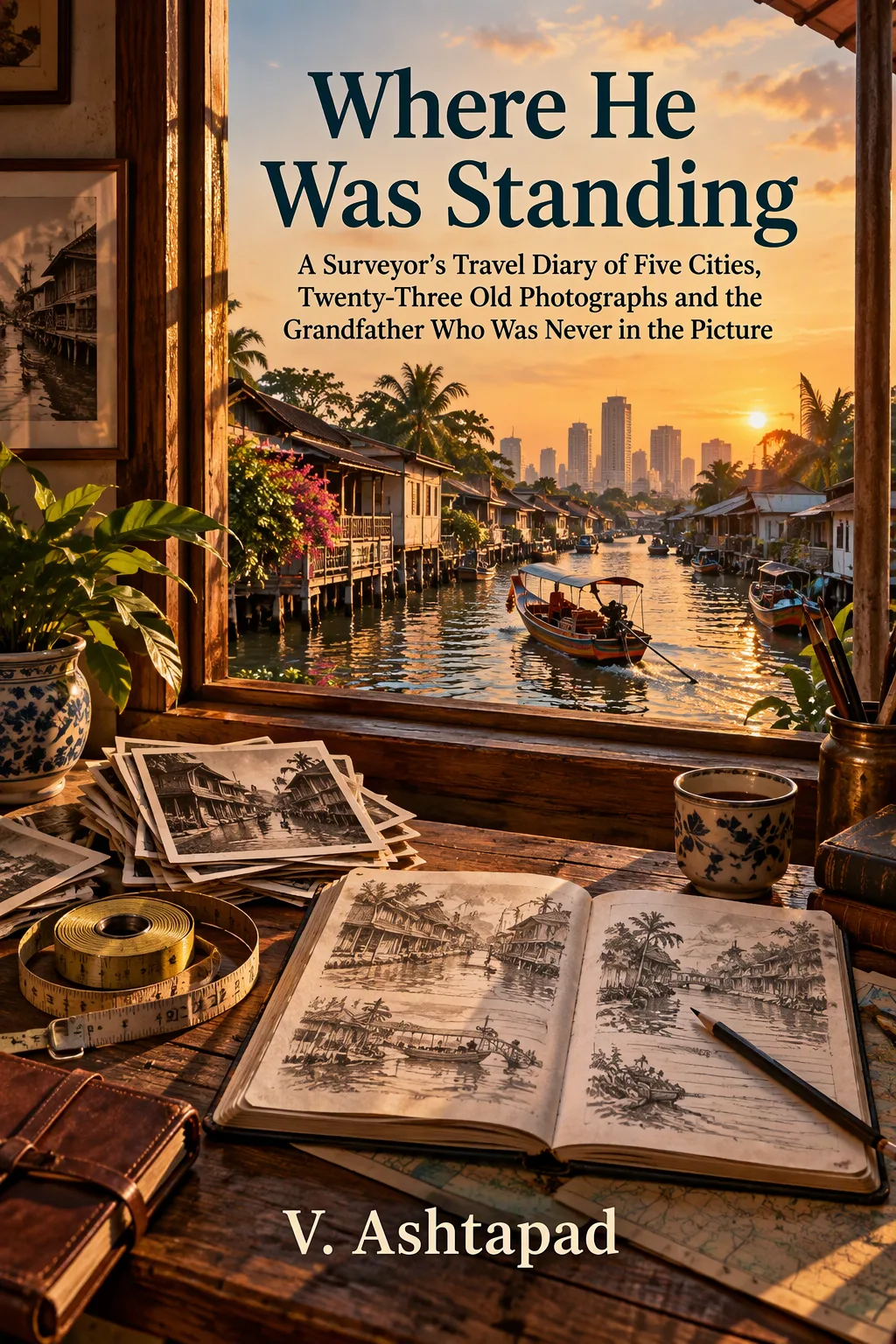
Where He Was Standing
A Surveyor's Travel Diary of Five Cities, Twenty-Three Old Photographs and the Grandfather Who Was Never in the Picture
by V. Ashtapad
Foreword
This is a work of fiction. The boat noodles and jasmine garlands of Bangkok's Thonburi canals, the tea shops and thanaka stalls of downtown Yangon, the milkfish shops and New Year customs of Tainan, the hawker centers and void decks of Singapore and the water village of Bandar Seri Begawan are real. Joanne Koh and her family, the Srisuk noodle shop, Morning Star Tea, the Lin milkfish shop, Tanjong Survey Partners and everyone else in this book are invented.
For everyone who promised to send the photograph, and for everyone still waiting for it.
Singapore, January 3 to 6
**Saturday, January 3.** Toa Payoh. Ah Ma's flat, ninth floor. Thirty-one degrees, humid, rain at four.
I am starting this notebook because Papa says a person who finds a dead man's diary should keep one of her own, so that the next person who finds a tin on top of a wardrobe has less work to do.
Here is what happened.
Ah Ma is moving out of the flat she has lived in since 1976. She is eighty-five, and she has decided, after four years of everyone asking her politely and then less politely, that she will go and live with my parents in Bedok. She has decided this as if it were her own idea. We are all agreeing that it was her own idea.
So today was clearing day. Papa took the kitchen, because he is the only one allowed to touch her pots. Mama took the bedroom cupboards. I took the high places, because I am the tallest woman in the family and because I own a stepladder, which no one else does, which tells you something about who in this family measures things for a living.
I am a land surveyor. I have been one for eleven years. I work for Tanjong Survey Partners on the eighth floor of a building near Tanjong Pagar, and I spend most of my days on reclaimed land at the western end of the island, standing on sand that was seabed when I was in primary school, telling engineers where things are to within three millimeters. I like my work. I like knowing where things are.
On top of Ah Ma's wardrobe, behind a rolled-up mat and a fan with no blades, there was a biscuit tin. Square, rusted at the corners, the lid printed with a picture of a woman in a garden whose face had worn off. It was heavy for its size. When I lifted it down, something inside slid from one end to the other with a sound like a deck of cards.
"Ah Ma," I said. "What's this?"
She was sitting on a plastic stool in the doorway of her bedroom, supervising, which is what she calls watching us do things wrong. She looked at the tin and her mouth went small.
"Your Ah Kong's," she said. "Leave it."
"Leave it where? We're leaving the flat."
"Leave it in the box for Bedok."
But I had already opened it.
---
Inventory, because that is how my mind works and I am not going to pretend otherwise.
One school exercise book, blue cover, thirty-six pages, the cover soft as cloth. Every page filled in Ah Kong's handwriting, small Chinese characters in pencil, dates in the margin in numbers I can read: from January 1961 to March 1963.
Twenty-three photographic prints, black and white, each about the size of a postcard, each in its own thin paper sleeve gone yellow. On the back of each, in the same pencil, a few characters and a place.
Seven say Bangkok. Six say Rangoon. Six say Tainan. Four say Brunei Town.
There are no photographs of Singapore in the tin. There are no photographs of Ah Kong.
I sat on top of the stepladder with the tin on my knees and looked at the first print for a long time. A girl in a wide straw hat, standing in a long flat boat, holding a ladle the size of a tennis racket, laughing at whoever was behind the camera. Behind her, water, a wooden house on stilts, a tree hanging over everything.
Behind the camera was my grandfather, aged twenty-six.
"Who is she?" I said.
"How would I know?" said Ah Ma. "Before my time."
"What are they for?"
Ah Ma looked at the window. Rain was coming across the estate from the direction of the expressway, a gray wall of it, and the laundry poles on the next block were rattling.
"He took the pictures on his travels," she said. "He promised everyone he would send them a copy. He printed them when he came home. Then he never sent them." She shrugged, a large, slow shrug, the one she uses for my father's driving and the government. "He always said next year."
---
**Sunday, January 4.** Bedok. My parents' flat. Hot, then hotter.
Ah Ma's things are in forty-one cardboard boxes in my parents' spare room and in the corridor and, in the case of the rice cooker, on the shoe rack. She has spent the day opening boxes to check that we packed them correctly and then leaving them open.
Papa and I went downstairs to the hawker center at five to get dinner and escape. He brought the exercise book in a plastic bag. My father is sixty-one and retired two years ago from thirty-four years as an engineer on the harbor ferries. He is a quiet man who speaks mostly to machines. He went to a Chinese-medium school in the seventies and reads his father's handwriting the way I read a site plan, without having to think.
We got a table near the drinks stall and put a packet of tissues on the chair beside us to hold it, and I went and got two plates of chicken rice and a kopi for him and a lime juice for me, and when I came back he had the book open and his reading glasses on and he was not moving.
"What?" I said.
"He writes like he talks," Papa said. "I can hear him."
He read me the first entry. I am copying it here as he said it to me, in English, slowly, with his finger on the line.
Ah Kong, Singapore, January 14, 1961: *The ship goes tomorrow at six. I have the camera, forty rolls of film, two shirts, a tin of biscuits from Mother and nineteen dollars. Mother says I am a fool. Father says nothing, which is worse. I am going to photograph the faces of the ports, the way the old studio photographers did for the rich men, but for the people who have no money for studios. I will pay for my food with pictures. Everybody wants to be remembered.*
Papa took off his glasses and wiped them on his shirt, which only makes them worse.
"Did you know he did this?" I said.
"I knew he traveled before he married. He never talked about it." Papa put the glasses back on. "He never talked about anything. He talked about cameras."
That is true. I remember Ah Kong's shop in Chinatown, the narrow one on Merbau Street with the glass counter full of lenses and the back room that smelled of vinegar and something sharper, and the way he would hold my chin and turn my face toward the window and say *there*, and take a picture of me. I remember him in his chair in the flat in Toa Payoh in the last years, holding his old folding camera in his lap like a cat. He died in September 2019, at eighty-five. I was twenty-nine. I don't think I ever asked him a single question about himself.
"Read me another one," I said.
Papa read me eleven. The chicken rice went cold. The uncle at the drinks stall came and wiped our table around the book.
---
**Monday, January 5.** Tanjong Pagar. The office. Air-conditioning set to arctic.
At work all day I kept seeing the girl in the hat.
I did something I have never done, which is close the survey software on my computer at three in the afternoon and look at a photograph instead. I scanned all twenty-three prints last night on Papa's old flatbed scanner, front and back, at the highest resolution it would do, and I have them on my screen now, and I keep zooming in.
What I notice, because I can't help it, is that every one of them is a location. Not just a face. Ah Kong never photographed anyone against a blank wall. There is always something behind them: a water tower, a shop sign, a bridge, the corner of a roofline, a tree with a particular lean. If I wanted to, I could find where he was standing. I could find it the way I find a benchmark on an old plan, by working backward from what is fixed.
At four, Farida called me into her office. Farida Osman is my director. She is fifty-four and wears reading glasses on a beaded chain and has the gift of saying hard things kindly in very few words.
"Tuas Phase Five," she said. "Survey lead. Starts in late April. It's yours if you want it."
It is the largest piece of new land the firm has ever been given. It is the job I have wanted for six years.
"Can I tell you on Thursday?" I said.
Farida looked at me over the glasses. "You've been looking at old photographs all afternoon," she said. "The whole floor can see your screen."
So I told her. The tin, the book, the twenty-three prints, the girl in the hat. I didn't plan to. I told her I had nineteen days of leave saved and that I wanted more, and that I didn't know why.
Farida was quiet. Then she said, "My grandfather came from Johor in a boat. No one ever wrote down a single thing he said." She took off her glasses. "Take six weeks unpaid on top of your leave. Come back in March. Give me your answer on Phase Five when you're back."
I said thank you about four times. She waved me out.
---
**Tuesday, January 6.** Bedok. Evening. A storm that never quite came.
I told the family at dinner that I was going.
Mama said, "Going where?"
"Bangkok. Yangon. Tainan. Brunei. I want to find the people in the photographs. Or their families. I want to give them the prints."
Mama is Eurasian, a de Souza from Katong, and her family has been in Singapore for five generations and has never felt the slightest need to go anywhere else. She put down her spoon and looked at me the way she looked at me when I was nine and announced I was going to walk to Johor.
"Alone?"
"I'm thirty-six."
"That is not an answer, Joanne."
Papa said nothing, but he took the exercise book out of his shirt pocket, where he has apparently been keeping it all day, and put it on the table next to my plate.
Ah Ma was eating fish with her fingers and pretending not to listen.
"Ah Ma," I said. "Tainan. On the back of the Tainan prints, there's a name. Lin. Was that your family?"
She went on eating.
"Ah Ma."
"I was born in Tainan," she said, to the fish. "Everybody knows that."
"Is your family still there?"
"How would I know? I left in 1963." She picked a bone out of her mouth and laid it on the edge of her plate with great care. "You go to Tainan, you eat milkfish. There is a shop on the old canal street, the best milkfish in Tainan, probably closed now. You eat milkfish, you see the old fort, you come home. You don't go knocking on anybody's door."
"Why not?"
She gave me the look. Eighty-five years of the look. The look that has quieted bus drivers, government officers and at least one school principal.
"Because I said," said Ah Ma.
Nobody at the table believed for one second that this was the end of it.
© 2026 CRUNOD LLC. All rights reserved.
Singapore, January 7 to 10
**Wednesday, January 7.** Bedok. Night. Papa's study, which is a desk in the corner of the spare room, which is now Ah Ma's room, which means Papa no longer has a study.
Papa and I have spent two evenings with the book, and I have a route.
Ah Kong sailed from Singapore on January 15, 1961, on a coastal cargo ship that also carried passengers in a deck class he describes as *a shelf above the pigs*. He reached Bangkok in late January and stayed until early May. He reached Rangoon in the middle of May and stayed until the end of September. Then the book goes thin for a month, a few lines about ships and bad food and a typhoon he watched from a harbor wall in Hong Kong, and then, in November 1961, Tainan.
He stayed in Tainan five months. The entries from Tainan are different. The handwriting is the same, but there is more of it, and it is about one person.
"Who?" I said, when Papa got to that part and stopped reading and started smiling.
"Your Ah Ma," he said. "He calls her the girl at the fish stall. For three weeks he doesn't know her name."
He came home to Singapore in April 1962. He went to Brunei Town in February 1963 for a job photographing the opening of a new school building, and was there about six weeks. The last entry in the book is dated March 20, 1963. It is three lines long and it stops halfway through a sentence.
"What does it say?"
Papa read it twice to himself before he read it to me.
Ah Kong, Brunei Town, March 20, 1963: *The fever is gone. I can stand. Jaafar's mother says I can go on Friday's boat. Before I go I have to tell*
That's all.
"Tell who what?" I said.
"I don't know." Papa closed the book. "He married your Ah Ma in June. I was born the next April. That's all I know."
---
**Thursday, January 8.** Office, then the old studio, then home.
I told Farida I would see her in March. She shook my hand, which she has never done, and said, "Bring me back a good story and a decision."
After work I took the train to Chinatown and walked to Merbau Street. The shop was sold in 2015, four years before Ah Kong died. It is now a place that sells bubble tea and small, expensive cakes. I stood across the street and looked at it and tried to remember the counter of lenses and the vinegar smell, and couldn't, and then could, suddenly, because a man came out of the shop next door holding a tray of roast duck and the light came off the duck fat on the glass in exactly the way it used to come off the lenses.
I photographed the shopfront with my phone, from across the street, with the street sign in the frame. Habit. Somebody will want to know where I was standing.
---
**Friday, January 9.** Bedok. Packing.
Things in my backpack:
Twenty-three prints, each in a new acid-free sleeve from a craft shop in Bras Basah, all twenty-three in a flat document wallet, the wallet in a waterproof bag, the bag in the inside pocket where I can feel it against my back.
My own small camera, my phone, a printed set of the scans in case anyone wants to keep a copy and I have to give away the original. A pocket notebook (this one). A good pen and two bad ones.
My survey compass, which I am not supposed to need, and which I am taking anyway.
Mama's contribution: three packets of dried mango, a bottle of medicated oil, a small first aid kit, two packets of instant noodles, a scarf "for the air-conditioning on planes," and a list of her friends' daughters in Bangkok, none of whom I have met.
Papa's contribution: he has bought a cheap mobile hotspot and taught himself to send voice messages, so that every night he can read me the next page of the exercise book (he is keeping the book; I have the scans on my phone) and send it. He did a test this afternoon, in the spare room, with the door closed. The message lasted forty seconds. Thirty of them were him asking whether it was recording.
---
**Saturday, January 10.** Changi. A departure gate. 10:20 p.m.
Ah Ma came to the airport. Nobody asked her to. She sat in the front seat of Papa's car with her handbag on her knees and said nothing on the expressway except that Papa was driving too slowly, which he was not.
At the departure hall she gave me two things.
The first was a little plastic bag of the pineapple tarts she makes at New Year, made early, because she says I will not be home for New Year and that is my own fault.
The second was an envelope. Pale blue, the old airmail kind with the striped edges, which I didn't know they still made. Sealed. Nothing written on the front except an address in Chinese characters and the word, in English, in her careful capital letters, *TAINAN*.
"If you happen to walk past this house," she said, "put it in the letterbox."
"Whose house is it?"
"If you happen to walk past. Don't go looking for it."
"Ah Ma."
"Don't knock," she said. "Put it in the letterbox. Walk away. Eat your milkfish."
She held my face then, the way Ah Kong used to, turning my chin a little toward the light from the big windows, and looked at me for a long time. Then she let go and told Papa it was time to go home because the parking was expensive.
They are gone. The board says boarding in twenty minutes. I have the envelope in the wallet with the prints. It is very thin. It has something stiff in it, a card or a photograph.
I am not going to open it. I am writing that down so that I can't pretend later I didn't decide.
© 2026 CRUNOD LLC. All rights reserved.
Bangkok, January 11 to 14
**Sunday, January 11.** Bangkok. A guesthouse in a lane off Phra Sumen Road, with a mango tree in the courtyard and a dog that sleeps in the shoe rack. Thirty-three degrees by ten in the morning.
I arrived after midnight. The taxi driver played country songs the whole way from the airport, slow ones, with a woman's voice that seemed to be crying and laughing at the same time, and he sang along to all of them. When I got out, he asked me where I was from, and I said Singapore, and he said, "Ah! Clean!" and laughed for a block.
The guesthouse belongs to a woman called Khun Daeng, who is sixty-three and has run it for thirty years and who greeted me this morning by pressing her palms together under her chin and bowing her head over them. The wai. I have seen it all my life on television and done it twice at Thai restaurants in Singapore, badly. I tried it back. She laughed, not unkindly, and took my hands and moved them.
"For me," she said, putting my thumbs at my chin, "this. I am older. For the monks, higher. For the little boy who brings the ice, you don't have to. You smile."
Then she gave me a plate of rice porridge with ginger and pork and an egg cracked into it and stood over me until I finished it.
---
Ah Kong's first Bangkok entry, read to me by Papa last night. He sent it at 11:40 his time, forgetting that Bangkok is an hour behind, and I listened to it at 10:40 mine in the taxi with the country songs.
Ah Kong, Bangkok, January 29, 1961: *A city on water. Everything moves by boat. The vegetable sellers, the noodle sellers, the children going to school. I have taken a room across the river in Thonburi above a man who repairs boat engines. The noise starts at five. I have not slept but I have taken eleven photographs.*
Thonburi is the side of the river across from the old city. It is where the canals were. Most of Bangkok's canals were filled and paved over long ago to make roads, Khun Daeng tells me, and it was the same in many places on this side as well, but on the Thonburi side some of the old ones are still there, with houses on stilts along them and longtail boats going up and down.
I spread the seven Bangkok prints on the bed under the ceiling fan.
The girl in the hat on the noodle boat. The back of the print says *Srisuk family boat. Ploy. Behind the sawmill, by the big tamarind.*
An old woman with a wide red-toothed smile, sitting on a wooden landing with her feet in the water.
Three boys jumping off a bridge.
A man in an undershirt holding up a fish as long as his arm.
A family on the steps of a house on stilts: father, mother, four children, a baby in a cloth hammock.
Two women on a boat loaded with flowers.
And a wide view: the canal, a curve of houses, a tall wooden water tower on four legs, a roofline with the steep, layered, upswept eaves of a temple, and that tamarind again, leaning over the water.
I put the wide view on top. That is my base plan.
---
**Monday, January 12.** Thonburi. Across the river by the river boat, then on foot. Nine hours. Twenty-two thousand steps. Sweat in places I didn't know I had.
The river boat is wonderful. It goes up and down the Chao Phraya like a bus, stopping at piers, and a man on the back blows a whistle in a code that tells the driver when to come in and when to pull out: short, short, long. I stood at the back the whole way and watched the city go past, gold roofs and concrete and cranes and laundry, and the water the color of milky tea, carrying clumps of water hyacinth downstream faster than we were going up.
Ah Kong's notes say the boat-engine man's place was *near the second canal mouth past the big temple, on the left going in*. That is not a survey description. It is a description by a man who wanted to find his way back to his bed after dark.
I went to the canal mouth I thought it must be. I walked in along the bank, on a concrete walkway that runs beside the houses. Women were washing clothes in plastic tubs. A cat was asleep in a basket of chilies. A longtail boat went by with its long-shafted engine roaring and its propeller throwing up a white rooster tail of spray, and a man in a straw hat steering it with one hand and eating with the other.
None of it was the photograph.
I went in at the next canal. Not the photograph.
At three in the afternoon, sitting on the steps of a closed shophouse with a bag of iced coffee so sweet it made my teeth hurt, I took out the wide print and did what I should have done at nine in the morning.
The shadow of the water tower falls toward the camera and a little to the right. The tamarind's shadow lies across the water the same way. Ah Kong's entries in late January and February say he worked in the mornings, before the heat. So the sun was in the east, behind the tower, which means Ah Kong was standing roughly west of the tower, looking east, across the canal. The temple roofline is on the right of the frame, so the temple was south and east of him.
The canal in the photograph runs almost straight east to west.
None of the canals I walked today does that. They all run more or less north to south from the river.
"So the canal in the picture," I said to the cat, which had come to sit beside me, "isn't there anymore."
The cat agreed.
---
**Tuesday, January 13.** Guesthouse courtyard. Morning, under the mango tree.
Khun Daeng looked at the wide print for a long time this morning and then got out her reading glasses and looked again.
"This is gone," she said. "Many canals on that side, when I was small, they filled. Some in the sixties, some later. They make a road on top. Now the road has the same name as the canal, sometimes. Sometimes not." She tapped the temple roofline with a fingernail. "But this is still there. Temples don't go anywhere."
"How do I find which temple?"
She laughed. "There are hundreds."
"How many with a wooden water tower to the west?"
She looked at me with her eyebrows up. "The water tower is gone too, for sure."
"Then how many," I said, "with a tamarind tree that's maybe a hundred years old, to the west, on a road that runs east to west and used to be a canal?"
Khun Daeng took off her glasses. She called something into the kitchen. A man came out, drying his hands. He was in his fifties, very brown, with arms like a dockworker's and a faded cap on his head. He was introduced to me as Lek, her cousin's husband's brother, who drives a longtail boat for tourists up and down the Thonburi canals and knows, she said, every stick of wood on that side of the river.
Lek looked at the print. He looked at it for so long that Khun Daeng went back into the kitchen and came out again with tea.
Then he said something to her in Thai, and she said to me, "He says his grandfather sold ice from a boat. He says his grandfather always talked about a big tamarind where the ice boats used to tie up in the hot season because it gave the best shade on that side. He says he will take you tomorrow. He says you pay for the fuel only, because he wants to see too."
---
**Wednesday, January 14.** Thonburi canals by longtail boat. Seven hours. Sunburn on the left side of my face only.
I cannot write well about today because my hand is still shaking a little from the engine.
A longtail boat is a long, narrow wooden boat, painted bright colors, with a car engine mounted on a pivot at the back and a propeller on the end of a shaft as long as a man. The driver stands and swings the whole engine to steer. It is loud. It is the loudest thing I have ever sat in front of. It goes very fast and then very slowly, and when it goes slowly you can hear everything: radios in kitchens, a woman calling a child, a rooster, the slap of water on wooden steps, someone frying garlic.
Lek took me up one canal and down another, and at every bend he would cut the engine, and the boat would drift, and he would hold up the wide print against the view and shake his head. He talked the whole time in Thai, mostly to himself, and sometimes in English to me, a word or two: "Old house." "New house." "My uncle." "Very bad road."
At one o'clock he tied up at a little floating platform and bought us two bowls of noodles from a woman cooking on a boat. She had a charcoal stove and two big pots and a whole shelf of bowls and jars and bundles of greens, all in a boat no wider than my desk at work, and she served us without stepping onto land, handing the bowls across the gap. The noodles were thin and the broth was dark, rich, almost sweet, with a spice I couldn't name, and the bowls were tiny, the size of a teacup. Lek ate six. I ate four and was beaten.
"Boat noodle," said Lek, and pointed at the bowls, and at the woman, and at the picture of the girl in the hat with her ladle.
"Yes," I said. "Same."
"Same," he agreed. Then he looked at the print of the girl for a long time, and asked the noodle woman something, and she answered and pointed back the way we had come, and they argued, cheerfully, for some minutes.
On the way home, as the light went orange on the river and the temple roofs caught it one after another down the bank, Lek finally explained, in his ten words of English and my zero words of Thai and a lot of pointing at the print.
There used to be many noodle boats on the canals. When the canals were filled, many of the noodle families moved onto land and opened shops on the new roads, and kept the name. The noodle woman knows of a family that came off the water and opened a shop on a road that used to be a canal. She does not know their name. She knows the road. She says there is a big tamarind at one end of it.
Lek will take me on Saturday. He has a tour tomorrow and Friday. He wants to come. He says he wants to see if the tamarind is the one his grandfather tied his ice boat to.
Papa's message tonight was Ah Kong's entry for February 3, 1961, which ends: *The girl on the noodle boat laughs at me every time I try to say the name of anything. I have decided to take her photograph as revenge.*
© 2026 CRUNOD LLC. All rights reserved.
Bangkok, January 15 to 18
**Thursday, January 15.** Banglamphu. A day of doing nothing on purpose.
I was going to spend today in a university library looking at old maps of the Thonburi canals, and I got as far as the gate and turned around and went to the market instead. I am on leave. Farida would tell me to.
The market is two lanes from the guesthouse. I bought: a bag of pork skewers, grilled, sweet and salty, with a little bag of sticky rice tied with a rubber band; a green papaya salad, made in front of me, the woman pounding chilies and garlic and long beans and shredded papaya in a tall clay mortar with a wooden pestle, then asking me with her eyebrows how many chilies, then putting in two more than I asked for; a coconut, opened with three strokes of a cleaver; a bag of something orange and fried that turned out to be banana.
I am not going to be able to eat like this in Singapore. Singapore food is wonderful but it is on a plate. This is food that goes everywhere with you, tied up in little bags.
---
**Friday, January 16.** Guesthouse. Rain in the night, the first in weeks, Khun Daeng says.
A day of planning. I sat under the mango tree with the wide print and my laptop and the satellite map and walked, on the screen, every road on the Thonburi side that runs east to west within a kilometer of a temple. There are a lot. I made a list of eleven candidates by road shape and temple position. Then I looked at the angle of the temple roof in the print, the number of tiers of eaves, and the visible part of the decorated gable end, and threw out seven.
Four roads left. Lek's noodle-woman road is one of them.
I called Papa this evening on video. He was sitting in Ah Ma's room, on the end of her bed, because it is the only room in the flat with a door that closes, and she was asleep behind him, snoring like a small outboard motor.
"Did you find her?" he said.
"Tomorrow, maybe."
He nodded. He had the book open. "There's something here I didn't read you," he said. "February 20, 1961. I skipped it."
"Why?"
He looked embarrassed. He turned the book so I could see the page, which is ridiculous, because I can't read it. Then he read it.
Ah Kong, Bangkok, February 20, 1961: *Fever two days. The Srisuk mother sent noodles to my room with Ploy every morning and evening. Ploy says I look like a boiled chicken. I told her when I am rich and have a studio I will print her portrait as big as a door. She says I will forget. I have written her family's name on the back so I will not forget.*
"He didn't forget," I said.
"He didn't send it either," said Papa.
---
**Saturday, January 17.** Thonburi. By longtail, then on foot. 6:10 a.m. to whenever.
Lek picked me up at the pier below the guesthouse lane at six, grinning, with two bags of iced coffee hanging from the engine and a radio playing the crying-laughing songs.
We went in at a canal mouth I had not tried. We went up it for twenty minutes. Then Lek tied up at a set of concrete steps where an old man was fishing, and said, "Walk," and we walked.
The road is called by the name of the canal it used to be. It is two lanes wide, with a narrow sidewalk on each side, motorbikes parked all along it, a fresh market at one end in the mornings, and shophouses, two and three stories, the old wooden ones mixed in with concrete ones. It runs east to west. It is a little over six hundred meters long, by my count of paces (eight hundred and twelve paces; my pace is seventy-five centimeters).
At the west end, behind a school wall, there is a tamarind tree as tall as a four-story building, leaning hard to the south, over the road, over where the water used to be. Its roots have pushed up the sidewalk in a wave. Someone has tied a long colored ribbon around the trunk.
Lek put his hand flat against the bark. He said nothing at all. Then he took a photograph of it with his phone, and another, and a third, and sent them to someone, and his phone started ringing almost at once, and he walked away down the road shouting cheerfully into it.
I stood where Ah Kong would have stood, roughly, and held up the wide print.
The water tower is gone. There is a phone mast in its place, more or less, a little to the north. But the temple roofline, beyond the shophouses, is exactly where it should be. Three tiers. The same upswept curl at the corners, like the tips of a flame.
I stood there for a while.
---
At 10:40, after walking the road twice, after asking in the pharmacy and the hardware shop and the shop that sells school uniforms and being shown politely to the door of each, I found it. Or Lek found it, because he had stopped to ask an old woman selling fried bananas and she had pointed with her tongs.
Halfway along the road, on the north side, a narrow shophouse with a steel shutter rolled up and a dozen low tables and stools on the sidewalk. A sign in Thai, red letters, with a painting of a boat on it. And on a shelf above the cooking station, in a glass frame, an old wooden ladle the size of a tennis racket.
A young woman was working the station. Late twenties, hair pulled back hard, a wristwatch with a big face, moving very fast: noodles into the basket, the basket into the boiling water, out, shake, into the bowl, broth, meat, a pinch of this, a spoon of that, the bowl onto the tray, the next one already going. She did not look up. She had the face of someone who had been awake since four.
Lek ordered for us. We sat. The bowls came, tiny, dark broth, the same as the noodle boat on Wednesday, and something else in it, something bright. We ate eight bowls between us before I had worked up the nerve.
When she came to collect the bowls I said, in English, "Excuse me. Is this the Srisuk family?"
She stopped. She looked at me properly for the first time. She looked at Lek. She said something short to him in Thai.
"She asks," said Lek, "who wants to know."
I took out the print of the girl in the hat and put it on the table, in its sleeve.
The young woman looked at it. She looked at it for a long time, with her stack of bowls on her hip, and the noise of the road went on around us, motorbikes and the radio and a man selling brooms from a cart, calling out in a long singing voice.
Then she said, in English, quite clearly, "Where did you get this?"
"My grandfather took it," I said. "In 1961."
"That's my grandmother," said the young woman. She put down the bowls. She sat down on the stool across from me without asking, which I think surprised her as much as it did me. "That's Yai. That's her ladle." She pointed up at the shelf, at the frame. "We still have it."
---
**Sunday, January 18.** Guesthouse. Late. I cannot sleep.
Her name is Pim. Pimchanok Wongsa. Srisuk was her grandmother's family name, and it is still the name on the sign. She is twenty-nine. She works night shifts as a nurse at a hospital on the Thonburi side, four nights a week, and in the mornings, when she gets off, she goes to the shop and works the noodle station until two in the afternoon so her mother can rest, and then she sleeps for five hours, and then she goes back to the hospital. She has been doing this for three years, since her father died. The shop is her mother's, and before that it was her grandmother's. She said all of this flatly, as information, the way I would give someone a coordinate.
Yesterday she would not let me see her grandmother.
"She's eighty-two," Pim said. "She's not well in the hot season. She doesn't like surprises. I don't know you." All of which is fair.
She asked to keep the print for a day. I let her. It is the first of the twenty-three to leave my hands.
This afternoon, at four, Khun Daeng came to my room and knocked and said there was a phone call for me at the desk, on the guesthouse phone, which I didn't know anyone still used.
It was Pim. She spoke quickly, as if she had decided to call and wanted to finish before she changed her mind.
"I showed her the photograph," she said. "She held it for one hour. She didn't say anything. Then she said, 'The boiled chicken.'"
I laughed out loud at the desk. Khun Daeng looked up from her accounts.
"She wants to meet you," said Pim. "Tuesday morning. At her house. Not the shop. I'll come for you." Then she said, in a different voice, "She asked if the photographer was still alive. I said I didn't know."
"He died six years ago," I said.
Pim said nothing for a moment. Then, "I'll tell her. Tuesday, seven o'clock." And she rang off.
Papa sent no entry tonight. He sent a voice message of eleven seconds, which said: "Your Ah Ma wants to know if you are eating. I told her yes. Are you eating?"
© 2026 CRUNOD LLC. All rights reserved.
Bangkok, January 19 to 22
**Monday, January 19.** Thonburi, the tamarind road. Overcast, which in Bangkok means thirty-one instead of thirty-four.
A day of waiting, so I went back to the road and measured it properly.
I have no instruments with me except the compass, my phone and my feet, but you can do a great deal with those. I paced the road end to end on both sidewalks. I took bearings on the temple roofline from five points. I photographed every building that looked older than about fifty years and noted its position. I sat on the school wall under the tamarind and drew the road in my notebook, and then, on the same page, in pencil, I drew the canal as it would have been, using Ah Kong's wide print: the water, the line of stilt houses on the north bank, the tower, the landing where the old woman with the red smile sat with her feet in the water.
When I laid one drawing on the other, the noodle shop is standing almost exactly where the house in the photograph stood. Six or eight meters north, perhaps, back from where the bank was. As if the house had simply stepped back out of the water when the water left, and stayed.
The old woman selling fried bananas watched me do all this from her cart. When I was finished she came over with a paper bag of bananas and gave it to me and wouldn't take money. Then she pointed at my notebook and at the road and said a long sentence in Thai that ended in a question.
I didn't understand a word. I showed her my drawing of the canal.
She looked at it. She traced the line of the old water with one finger, very gently, the way you would trace a scar on someone's arm. Then she nodded, three times, and went back to her cart.
---
Lek's message, in the evening, sent through Khun Daeng, who wrote it out for me in English on the back of a guesthouse receipt:
*His grandfather's father planted the tamarind. His grandfather tied the ice boat there every hot season from when he was a boy until the canal was filled. Lek did not know the tree was still alive. He is very happy. He says thank you for the tree.*
I didn't do anything for the tree. I've decided to accept the thanks anyway.
---
**Tuesday, January 20.** Thonburi. Yai Ploy's house. All morning, most of the afternoon.
Pim came for me at a quarter to seven, on a motorbike, in her hospital clothes, with a second helmet hanging from her elbow. She had just finished a twelve-hour shift.
"You don't have to," I said.
"I know," she said. "Get on."
We went through lanes so narrow I could have touched both walls, then out along a road, then over a little concrete bridge, and she stopped beside a canal. Not a road that used to be a canal: a canal, real water, green and slow, with houses along both banks on wooden stilts, and potted plants on every landing, and a heron standing on a post looking at its own reflection.
"When they filled the old canal in 1971," Pim said, taking off her helmet, "my great-grandfather took the house to pieces. Every board. They numbered them with chalk. They carried them here and built it again." She pointed at a dark wooden house on stilts, with a deep veranda and a steep roof and orchids hanging in coconut husks from the eaves. "Yai was twenty-seven. She carried boards for three weeks. She says that's why her back is bad."
I looked at the house for a long time.
"Is it the house in the photograph?" I said. "The family on the steps?"
Pim shook her head. "That's the neighbors. The Boonma family. Yai will tell you. Come."
---
Yai Ploy was sitting on a mat on the veranda with her legs folded to one side and a big flat basket in front of her full of white jasmine buds. She had a long steel needle, as long as a knitting needle, and a coil of white thread, and she was threading the buds onto the needle one by one, very fast, without looking, the way my mother types.
She is small. Her hair is white and cut short. Her face is more lined than any face I have seen, and her eyes are the same as the girl in the hat. I knew it from the gate.
I did the wai, as low as I could get my head over my thumbs. She did one back, a small one, without putting down the needle, which made Pim laugh.
Pim translated everything. I am writing it down as close as I can.
Yai Ploy looked at me for a long time. Then she said, "You have his ears."
I didn't know that. I had never thought about Ah Kong's ears.
"They stuck out," said Yai Ploy, "like the handles on a cooking pot. I told him. He said in his country it meant good luck. I said in my country it meant the wind would take him away."
She went on threading jasmine.
"He came on the boat of the engine man, the man upstairs. He came to buy noodles. Every morning. He could not say anything. Not one word. He pointed. He tried to say the name of the noodle, he said it so badly my mother laughed until she had to sit down in the boat. Then he would eat the chili and cry. Real tears. Every morning. Then the next morning, he came again."
"He wrote that you laughed at him," I said. "He wrote that he took your photograph as revenge."
Pim translated that. Yai Ploy put down the needle for the first time.
"Revenge," she said, in English, slowly. She seemed to like the word. She said it again. Then she laughed, and it was the laugh in the photograph, and I had to look away at the heron for a minute.
---
She told us a great deal, over four hours. I can't write it all. Some of what she said:
That her family had cooked noodles on that boat for three generations before her. That in the hot season they tied up under the tamarind because it was the coolest place on the canal, and the ice boats tied up there too, and the children swam off the landing in the afternoons. That she had learned to row before she could read. That the boat was sold for wood in 1972, the year after they moved the house, because there was no water left to row on; that the ladle was the only thing her mother kept.
That Ah Kong, when he got the fever in February, lay on a mat in the engine man's upstairs room for two days, gray and sweating and talking to himself in Chinese, and her mother sent her across with noodles in a covered pot twice a day, and she sat on the stairs and watched him eat and told him he looked like a boiled chicken.
"How did he understand you?" I asked.
"I did this," said Yai Ploy, and she made a face: eyes rolled up, mouth hanging, tongue out a little, her head flopped sideways. A boiled chicken. Pim put her hand over her eyes. "He understood."
That he had promised to send the photograph as big as a door.
"I waited," she said. "Every time the postman came on his bicycle, for a year, two years. Then I married. Then I forgot. Then I didn't forget." She picked up the needle again. "Then last week Pim comes home and gives me a picture of myself at seventeen. Sixty-five years late. Not as big as a door."
"I'm sorry," I said.
She looked at me. She said something to Pim, sharply, and Pim said, "She says don't be sorry. She says you came. She says that's more than he did."
Then she added something else, and Pim hesitated, and translated it anyway.
"She says it's better this way. She says if it had come in 1962 she would have put it in a drawer. Now she is going to put it on the wall."
---
**Wednesday, January 21.** Yai Ploy's veranda again. Jasmine all day.
I asked if she would teach me to make a garland and she said yes on the condition that I stopped writing in my notebook while I did it. So this entry is written at night, from memory.
You need jasmine buds picked before they open, early in the morning, kept cool and damp under a cloth. You need red rose petals, or small marigolds, or the little purple flowers whose name I didn't catch, for the bands of color. You need the long needle and the white thread. You thread the buds onto the needle one at a time, through the base, all facing the same way, packed tight, so that they make a solid white rope. Then you slide them off the needle onto the thread. Then more. Then the colored band. Then more jasmine. At the bottom, a tassel, and at the top, a loop.
My first one had gaps in it like missing teeth. Yai Ploy took it from me and looked at it and gave it to the dog.
My second one was better. She looked at it and said something that made Pim laugh into her coffee.
"She says it looks like it was made by a surveyor."
"Is that good?"
"She says it's very straight and no one would want to smell it."
My third one she kept. She hung it from a nail on the veranda post, next to the print of herself at seventeen, which is in a frame already. Pim bought the frame yesterday on the way home from the hospital, at a shop near the pier that also sells padlocks.
Pim's mother came in the afternoon. Her name is Noi. She is fifty-six and runs the shop, and she looks at me with frank suspicion and gave me a plate of mango and sticky rice with coconut cream poured over it, salted, sweet, the rice still warm, and watched me eat every grain. I think that is how she says she is grateful. I think it might be how this whole family says everything.
---
**Thursday, January 22.** Guesthouse. A long call with Papa.
I told him about the house that was carried in pieces to the other canal. I told him about the numbers in chalk.
There was a long gap on the line. I thought it had cut out.
Then he said, "We did that."
"Did what?"
"When they cleared the kampong. In 1976. Your Ah Kong and I. We took the doors off our house. The good doors, the carved ones that came from his father. We carried them on a lorry to Toa Payoh. They wouldn't fit in the flat. He kept them for twenty years in the storeroom of the studio, wrapped in newspaper." He stopped. "Then he sold them to a man who made furniture. I was so angry. I didn't speak to him for a month."
I didn't know any of this. I didn't know we had lived in a kampong. I knew, in the way you know facts on a form, that Papa grew up "in a house" before the flat, but I had always pictured, I don't know, a terrace house, a shophouse.
"Where was it?"
"You've been there," he said. "You survey it. It's under the expressway. Near the old river mouth."
I have stood on that spot. I have surveyed that interchange for a road-widening project. I stood on it four years ago with a total station and a reflector pole and a cup of coffee, and I didn't know.
I didn't say anything to Papa for a while, and he didn't say anything to me, and the line hissed, and then he said, "Your Ah Ma is shouting. I have to go," and went.
Tonight's entry from the book, read before he hung up:
Ah Kong, Bangkok, April 30, 1961: *Tomorrow the ship for Rangoon. I gave the Srisuk mother a print of the boat and she cried. I did not give Ploy hers. I want to print it bigger. I have told her I will send it. She says I won't. I have wrapped her portrait with the others to take home and print properly. She is right, I think. But I will try.*
© 2026 CRUNOD LLC. All rights reserved.
Bangkok, January 23 to 25
**Friday, January 23.** The tamarind road and the canal and everywhere in between.
The remaining Bangkok prints.
Yai Ploy went through all six with me this morning, holding each one close, then far, then close.
The old woman on the landing with the red smile is her own grandmother. Dead since 1968. Yai Ploy kissed her finger and touched it to the old woman's face in the print, and put it on the pile for her own wall.
The three boys jumping off the bridge: the one in the middle, with his knees up, is her brother Chai, who died in 2010. The one on the left is a cousin who moved to the northeast. The one on the right she couldn't name.
The man with the fish is Uncle Boon, the engine man, Ah Kong's landlord. His grandson, she says, still repairs engines, on the next canal, in a shed with a sign that says only *ENGINE* in English. Uncle Boon's fish was caught under the tamarind and was, she says, the biggest fish ever pulled out of that canal, and he talked about it for the rest of his life, and he would have given anything to have this picture.
The family on the steps of the stilt house is the Boonma family, her neighbors then, and her neighbors now, three houses down on this canal; they moved here too, in 1971. The baby in the cloth hammock is now a man of sixty-five who sells insurance and comes on weekends to see his mother.
The two women on the flower boat she didn't know. She thought perhaps they came from upriver, from the gardens, to sell flowers to the temples and the garland makers. She said Pim should take that one to the flower market. Somebody will know them.
So today we delivered.
Uncle Boon's grandson, at the shed that says *ENGINE*, is a thin man of about forty with grease to the elbows. He wiped his hands for a long time on a rag before he would touch the print. Then he held it in both hands and went into the house without a word, and came back with his mother, who is seventy-something, and his mother looked at the print and began to cry and laugh at the same time and to call out to the neighbors, and in ten minutes there were eleven people around me, and all of them wanted to tell me about the fish.
At the Boonma house, the old mother of the family is ninety-one. She is the woman on the steps in the print, holding the baby's hammock rope. She is blind now. Her son, the insurance man, happened to be there, because it was Friday, and he described the photograph to her very slowly, his mouth close to her ear, and she listened with her hand over her heart, and at one point she said a word, and he stopped and laughed and said to me, in good English, "She says to tell you your grandfather was too thin and should have eaten more."
Everyone seems to remember he was too thin.
---
**Saturday, January 24.** Yai Ploy's house. An evening I will remember for the rest of my life.
The word got out. I don't know how. Noi says it was the fried-banana woman. Pim says it was Uncle Boon's grandson's mother, who has a voice like a ship's horn.
By six o'clock this evening there were about forty people on the landings and verandas around Yai Ploy's house and the two on either side. Someone strung a line of colored bulbs between two posts. Someone brought a big aluminum pot of green curry and someone else brought a sticky rice basket the size of a drum. Noi brought noodles, the boat noodles, cooked in the shop and carried over in a cart, and served them in the small bowls, and people stacked the empty bowls in towers on the edge of the landing to show how many they had eaten, which I learned is how you do it, and which turned into a contest among the teenage boys that Uncle Boon's grandson won with twenty-two.
Someone put on music, the crying-laughing country songs I heard in the taxi on the first night. Pim told me their name in Thai and then put it into English for me: songs of the country people. Every one of them is about leaving home or wanting to go back.
The prints went around. Not the originals, which Yai Ploy had already claimed or given away; the copies I had printed at a shop near the guesthouse, enough for everyone. People held them up to the bulbs and argued about who was who. An old man sat beside me for half an hour and told me in slow Thai, which Pim mostly didn't bother to translate, about a girl he had been in love with who was standing at the edge of one of the photographs, half cut off by the frame. All you can see of her is an arm and the side of her face.
"He says he married her," said Pim at last. "He says she died two years ago. He says he has no picture of her before she was forty."
I gave him the copy. He put it inside his shirt and kept his hand over it for the rest of the evening.
---
Later, when people were leaving, Pim and I sat on the edge of the landing with our feet over the water. The heron was back on its post. There were frogs going in the dark somewhere, a sound like someone running a stick along a fence, over and over.
"Can I tell you something?" Pim said.
"Of course."
"I'm so tired," she said. "I'm so tired, all the time. My father died and my mother can't do the shop alone and the hospital needs me and Yai needs me and I can't do any of it properly. I think about closing the shop every single day. I was going to tell my mother this year. At the new year." She was looking at the water, not at me. "Then you came with the picture of Yai with the ladle."
"I'm sorry," I said.
"Stop being sorry. You're always sorry. She told you." Pim shook her head. "No. I mean. I don't know what I mean. I mean the shop is the boat. I didn't know that until this week. When the water went, they didn't stop. They carried the house. They kept the ladle. They made the shop." She wiped her face with the back of her wrist. "I don't know if I can close it now. I don't know if I can keep it either."
I didn't have anything to tell her. I told her about Farida, and Tuas Phase Five, and standing on new land made out of sand pumped up from the sea floor, and how I have wanted that job for six years and am not sure, now, that I want it. I told her about Papa's carved doors and the kampong under the expressway, which I have stood on with a reflector pole. I told her that my whole working life is about knowing exactly where things are, and that I have just found out I didn't know where my own family was standing forty years ago.
Pim listened. Then she said, "Maybe you have to carry it in pieces."
"Carry what?"
"I don't know," she said. "Whatever you have."
---
**Sunday, January 25.** Guesthouse, then the airport. Fourteen days in Bangkok.
Yai Ploy gave me a garland this morning, a small one, jasmine and rose, for Ah Ma.
"Tell her," she said, through Pim, "that the girl on the noodle boat says he was a fool, and too thin, and he couldn't say one word right, and he paid for his noodles every day with his own money, even when he had none. Tell her he was kind."
I said I would tell her.
Then she said something more, and Pim didn't translate it, and I asked, and Pim said, "She says you should come back. She says next time she'll teach you to row."
The flower-boat print is still with Pim. She is going to take it to the flower market on her day off. The bridge print, with the boy on the right whom no one could name, is with the Boonma family, who think a cousin in Nonthaburi may know. The other five Bangkok originals are where they belong.
So two of the seven Bangkok prints are still looking for their people, and five have found them. I have decided that is the right way to count.
Khun Daeng did a wai to me at the gate this morning, a proper one, thumbs to her chin, and I did one back, with my thumbs at my nose, for an older woman, the way she taught me. She laughed and fixed my hands one last time.
Lek drove me to the airport in his cousin's car, with the country songs on, singing. At the departures curb he got out and gave me a bag of tamarind candy, sour and sweet and rolled in sugar and chili.
"From the tree," he said.
It is not from the tree. It is from a shop. I know it is from a shop, because it has a printed label. I am going to keep one of them anyway, in the pocket of this notebook, for as long as it lasts.
© 2026 CRUNOD LLC. All rights reserved.
Yangon, January 26 to 29
**Monday, January 26.** Yangon. Downtown. A guesthouse on a numbered street between the river and the old market. Thirty-two degrees, dry, the sky white with dust.
Ah Kong, Rangoon, May 17, 1961: *Off the ship at eleven. The heat is a hand on the back of the neck. The city is laid out in a grid like a schoolbook, numbered streets running north from the river, and I will never get lost here, which is good, because I have no money. Forty-one dollars and eleven rolls of film. Tomorrow I look for work.*
Yangon is laid out in a grid. Ah Kong was right. The streets downtown run north from the Yangon River in a long ladder of numbers, Fifteenth Street, Sixteenth, Seventeenth, and the big roads cross them east to west. It is the easiest city to survey I have ever seen. I could have walked it with my eyes closed, except that the sidewalks are full of things to fall over: cracked paving, tea-shop stools, a man selling sunglasses from a board, a woman cooking quail eggs in a pan with round holes in it, a line of motorbike taxis, a cat, a monk walking very slowly with his umbrella, a stack of a hundred plastic chairs.
The buildings along the big roads are old, four and five stories, colonial, gone soft and black at the edges from the rain, with trees growing out of some of them. Above everything, on the hill to the north, there is a gold spire that catches the light from every street. I can take a bearing on it from anywhere downtown. It is the best benchmark I have ever seen.
The guesthouse is run by a young couple who greet me each time I come in with a little tilt of the head and a smile and tell me to sit down, and bring me a glass of plain green tea, which, I have learned, is on every table in every tea shop in the city, free, in a big thermos, and you drink as much of it as you like.
---
**Tuesday, January 27.** Breakfast at a stall at the corner of my street, then the river, then the tea shops. Four tea shops. Eleven cups of tea. I am vibrating.
Breakfast first, because it was the best thing that happened before ten. The stall at the corner is a woman with a cart and three plastic tables, and she makes one thing, which is mohinga: a soup of rice noodles in a thick, golden fish broth, cooked with lemongrass and banana stem and something that makes it a little thick and nutty, topped with crisp fried fritters of split peas and a boiled egg and coriander and lime, and a spoonful of chili if you nod. I nodded. I ate two bowls. A man at the next table, in a checked longyi and a white shirt, reading a newspaper, watched me eat the second bowl and gave me a thumbs-up without lowering the paper.
The longyi: a tube of cloth, worn by both men and women, men tying it with a twist and a knot at the front of the waist, women folding it over at the side. Everyone wears it. The men who wear trousers look underdressed.
The women and the children, and some of the men, have pale yellow paste on their cheeks, painted in patches or stripes or, on one little girl at the next stall, in the shape of a leaf. It is thanaka, the guesthouse woman tells me, made from grinding the bark of a tree with water on a flat stone. It keeps the skin cool, and it smells, when you are close, of sandalwood and something green.
---
The Rangoon prints.
A tea shop, wide open to the street, men on low stools at low tables, a big kettle steaming, and behind the counter a heavy man with a moustache and a towel over his shoulder, and beside him a girl of about fourteen with thanaka on her cheeks and a tray in her hands. On the back: *Tin Aung tea shop, the corner near the jetty road. U Tin Aung and his daughter. Ten years of the shop.*
A row of tailors at sewing machines under an awning.
A boatman standing in a long wooden ferry on the river.
Two boys playing a game with a woven ball, kicking it in the air.
A woman grinding thanaka on a stone.
A man asleep in a trishaw.
Ah Kong, Rangoon, May 25, 1961: *U Tin Aung has given me work. I take photographs of his customers and he gives me tea and rice and a mat in the back room. The tea here is very strong and very sweet and they make it twenty ways. U Tin Aung says I am the first Chinese photographer ever to be paid in tea. I believe him.*
I went to the river. The jetty road is easy: there are only so many roads that run to the jetties. I walked the corners. I found four tea shops on corners near the jetty road. I sat in each of them and drank tea and held up the print and compared the angles of the building fronts, the cornices, the pillars.
At the fourth one, at a corner where a numbered street meets the road that runs along the river, I sat down on a stool that was about the height of my ankle, and looked up, and saw above the shop, in the plaster of the building, a curved stone cornice with a little half-moon window in it. The same cornice is in the top corner of the print, just visible over the awning.
The sign over the shop said something in Burmese script, all circles and loops. And under it, in faded English: *MORNING STAR TEA. SINCE 1951.*
---
**Wednesday, January 28.** Morning Star Tea. Most of the day. I am becoming a regular.
Tea in a Yangon tea shop: you sit on the little stool, at the little table. A boy comes. You tell him how you want your tea, and there are, Ah Kong was right, twenty ways, but they come down to strong or weak, sweet or less sweet, and whether you want it with the thick sweet milk from a tin or the fresh milk or both. You get, with it, the thermos of plain green tea, free, and a plate of whatever is on the counter, little pastries, fried dough sticks, steamed buns, and you pay only for what you eat. When you want the boy, you call to him, or you make a little kissing sound with your lips, which everyone does and which I cannot bring myself to do.
The boy at Morning Star is not a boy. He is nineteen, and his name is Kyaw Kyaw, and he is an apprentice tea-maker, which turns out to be a real job with years of learning in it. I watched him make tea this morning for two hours. He boils the tea leaves in a big pot, a dark tea, almost black, and strains it through a long cloth sock into a kettle. Then he pours the tea from the kettle into a cup with milk in it from a great height, his arm raised as high as his head, a long brown rope of tea falling into the cup without splashing, and then back into another cup, and back, until it has a layer of foam on top.
At eleven he let me try. I got tea on my shoes, my notebook, the counter and a customer, who was very gracious about it.
At noon, a man came out from the back room and stood behind the counter with his arms folded and watched me try again. He was about thirty, slim, in a dark green longyi and a gray shirt, with a pen behind his ear and the face of somebody who does the accounts. He watched me spill tea for some minutes. Then he said, in careful English, "You are from the tourist office?"
"No," I said. "Singapore."
"You are writing about tea shops?"
"No." I put down the kettle. "I'm looking for the family of U Tin Aung."
He didn't move. "Why?"
I showed him the print.
---
**Thursday, January 29.** Morning Star Tea. Then the guesthouse.
His name is Zaw Min Htet. He is thirty-one. He owns Morning Star Tea, which his great-grandfather founded in 1951. His great-grandfather was U Tin Aung.
He said all this yesterday, very quietly, looking at the print, and then he said he had a meeting, and he went into the back room and shut the door, and did not come out again while I was there. Kyaw Kyaw brought me a free plate of steamed buns, which I think was an apology.
Today, when I came in at nine, Zaw was waiting for me at a table by the door with two cups of tea already poured.
"I'm sorry," he said. "Yesterday I was rude."
"You weren't."
"I didn't know what to say." He turned the cup around on the saucer. "My great-grandfather, I never saw a picture of him. My grandmother has one. A small one, very bad, from his identity card. Nobody else has a picture. Then you walk in with this." He shook his head. "I didn't sleep."
He explained something to me then that I didn't know, and that explains why I was having so much trouble. In Myanmar people don't have family names. Not the way we do. Each person has their own name, chosen at birth, and the honorific in front of it, U for a grown man, Daw for a grown woman, Ko for a young man, Ma for a young woman, changes as they grow older. Zaw Min Htet is not related to Tin Aung by name at all. His mother is not related to her father by name. There is no family name to look up, no surname on a door or a register, only a person, and the people who know who belongs to whom.
"So you would never have found us," he said, "except by the shop."
"Except by the cornice," I said, and pointed out the half-moon window to him in the print and then in the building over our heads. He had worked under it for eight years and never noticed it.
"My grandmother is the girl," he said, putting his finger on the print, on the girl with the tray and the thanaka. "Daw Khin May. She is seventy-eight. She ran this shop for forty years. She will want to see you very much." He stopped. "But she is in Mandalay. At my uncle's house. She comes back on Tuesday."
Tuesday is a long way away. I said I would wait.
"Good," said Zaw. Then he smiled, which I hadn't seen him do, and it changed his face completely. "Until then, you can learn to make tea properly. Kyaw Kyaw says you are the worst student he has ever had."
© 2026 CRUNOD LLC. All rights reserved.
Yangon, January 30 to February 2
**Friday, January 30.** Morning Star Tea, the tailors' street, the river. Tea on my shoes again.
Tea lesson number three. I have got the height of the pour to my chin. Kyaw Kyaw says when I get it above my head I can have a job.
The print of the tailors: Zaw looked at it and said there is still a street of tailors three blocks east, all men at treadle machines under awnings, but not the same men. I walked there this afternoon. The awnings are blue plastic now, not canvas. The machines are the same, iron and black and gold, with the pedal underneath, and the noise of thirty of them going at once is a sound like rain on a tin roof. I showed the print to an old tailor at the end of the row. He was mending a white shirt for a schoolboy who stood beside him in his undershirt, waiting. He put down the shirt and looked at the print and smiled and tapped the face of one of the young men at the machines in the photograph and then tapped his own chest.
He is eighty-one. In the photograph he was sixteen, an apprentice, with oiled hair and a pencil behind his ear.
He did not want the print. He wanted me to take his picture now, in the same place, at the same machine, which is, he says, the very same machine. So I did. I am going to have it printed tomorrow and bring it back with the old one, and he can have both, and see what sixty-five years at a sewing machine looks like.
---
**Saturday, January 31.** The circle train. Three hours. Every one of them wonderful.
Zaw's sister Thida took me on the circle train today. She is twenty-seven and keeps a stall in the big covered market where she sells thanaka: the logs of bark, cut to length, stacked like firewood, and the flat round grinding stones, and little pots of paste already ground for people in a hurry. She has it on her own cheeks in two neat squares. Before we left this morning she sat me on a stool in the tea shop and ground some fresh, the bark rubbed in circles on the wet stone until a pale paste came up, and painted it on my cheeks with her fingertips, two squares.
"Now you are less of a tourist," she said.
"How much less?"
She looked at me critically. "Ten percent."
The circle train goes around the city in a loop, through the suburbs and out into the edges, where it is green, and back, and it takes about three hours, and it is cheap, and people use it to get to work and to market and to visit their families. The carriages are open, with wooden benches along the sides and doors that stay open the whole way. Women got on at every station with baskets on their heads, of greens, of fruit, of flowers, of dried fish, of rice, and the floor of the carriage turned into a market as we went along. A girl sold boiled corn. A man sold little packets of quail eggs. Someone was selling small birds in a wicker cage, and someone was selling a hen, alive, which sat in its owner's lap and looked at me with one eye the entire way.
Out past the edges of the city, the train went through paddy fields and watercress beds and little villages with houses on stilts, and boys swimming in a pond, and a herd of goats on the line that the driver honked at for a full minute.
Thida talked the whole way, in quick, cheerful English that she learned, she said, from customers and the radio.
"My grandmother," she said, "is going to cry. You know this?"
"I thought she might."
"She doesn't cry," said Thida. "She is famous for not crying. When my grandfather died she didn't cry. When the shop roof fell in, in 1998, she didn't cry. When I said I wanted to sell thanaka and not go to the university, she didn't cry. She just didn't speak to me for one month." Thida laughed. "But she will cry for this. I know her. She has the identity card picture of her father in a little frame next to her bed. It's the size of a postage stamp. It's terrible. He looks like a criminal."
The hen, at this, made a remark. Thida laughed so hard she had to hold onto the bench.
---
**Sunday, February 1.** The street outside Morning Star. Chinlone.
Two of the Rangoon prints are boys playing a game with a woven ball. On Sundays, Zaw says, the young men still play in the side street by the shop, in the late afternoon, when the heat goes off.
The game is chinlone. The ball is woven from strips of rattan, hollow, about the size of a big grapefruit, light and springy. Five or six players stand in a circle and keep the ball in the air with their feet, knees, heads, shoulders, anything but the hands, and the point is not to beat anyone but to keep it up as long as possible and as beautifully as possible. There are kicks behind the back, with the sole of the foot, with the heel. One man today, a big man in his fifties with a belly, did a kick from behind his own back, over his shoulder, that made everyone on the street shout.
I was invited in. I lasted four touches. The ball went off my knee into a bowl of noodles on a table outside the tea shop, and the man eating the noodles picked it out, wiped it on his longyi, and kicked it back into the circle without getting up.
Zaw played. I hadn't thought he would. He took off his sandals and stood in the circle in his bare feet and became a completely different person, loose and light, laughing, dancing almost, keeping the ball up with little touches of his instep, passing it off to a boy of twelve so the boy could show off.
Afterward, sitting on the curb with a bottle of water, he said, "My great-grandfather played. Every Sunday, my grandmother says. In this street. When he was too old, he sat on a stool and shouted at everybody." He nodded at the print. "Maybe that is him. With his back to the camera. Maybe that is why your grandfather took it."
I looked. There is a heavy figure, very blurred, at the edge of the frame, on a stool, with one arm raised.
"Yes," said Zaw softly. "I think so. Look at the arm."
---
**Monday, February 2.** Guesthouse. A night with no power.
The power went off at nine and the street went dark, and then lit up again in candles and little battery lamps and the glow of phones, and the whole city seemed to sit down at once on its front steps.
I sat on the guesthouse step with the young couple who run it and their small son, who is four, and we listened to someone on the next street playing a guitar and singing. It was a slow song with a lot of repetition. The guesthouse woman told me it was about a man who goes to work in another country and keeps a picture of his mother in his shirt pocket.
It seems that in every city in this part of the world, the songs are about leaving.
Papa's message tonight, read by flashlight on my phone:
Ah Kong, Rangoon, July 12, 1961: *U Tin Aung's daughter Khin May wants to learn the camera. Her father says girls don't need to know. She comes to the back room anyway, when he is at the market, and asks me what every part is called. Today I showed her how to load film in the dark, by feel, with her hands inside a black bag. She learned it in half an hour. It took me a month. She will be better at this than I am.*
Tomorrow she comes back from Mandalay.
© 2026 CRUNOD LLC. All rights reserved.
Yangon, February 3 to 6
**Tuesday, February 3.** Morning Star Tea. The back room.
Daw Khin May arrived at two in the afternoon, by car from the bus station, with two of her grandsons carrying her bags and Thida holding her arm, and walked into the tea shop as if she had never been away, and greeted every customer by name, and inspected the tea Kyaw Kyaw was making and told him it was too weak, and then turned around and looked at me.
She is tall for her age, and very straight, in a deep red longyi and a white blouse, with her hair pulled back in a bun and a single flower tucked into it, and thanaka on her cheeks in two pale circles. She has a long face and a direct, unsmiling stare, and I understood in two seconds why Thida says she never cries.
"You are the photographer's granddaughter," she said, in English.
"Yes," I said. "Koh Teck Seng."
"I know his name," she said. "I know it very well." She looked at me a little longer. "Come in the back."
---
The back room of Morning Star Tea is a storeroom: sacks of tea leaves, tins of condensed milk in their cardboard boxes, a refrigerator, a desk with Zaw's accounts, a mat on the floor, and, high on one wall, a window with bars, through which, I realized after a moment, you can see the half-moon window in the cornice of the building across the side street.
"He slept here," said Daw Khin May, pointing at the floor. "On a mat. Four months. He had nothing. When he came, he had one shirt that was clean and one shirt that was not clean, and he washed them in turn in the bucket in the yard."
She sat down on the only chair. I sat on a sack of tea. Zaw and Thida stood in the door. Kyaw Kyaw, I saw, had stopped making tea and was standing behind them, holding a kettle.
I took out the print of the tea shop and gave it to her.
She held it a long time.
Then she put it face down on her knee and covered it with her hand and looked at the wall over my head and did not cry. She did not cry for a long time. Her mouth worked. Her hand pressed down on the back of the print. Thida, in the doorway, made a small sound.
"My father," said Daw Khin May at last. "He wore that towel every day. Every day for forty years. My mother used to boil it." She lifted her hand and turned the print over again and looked at it. "Look how young he is."
Then she cried. She cried for perhaps a minute, very quietly, without moving her face at all, the tears just running out of her eyes and down over the thanaka, and Thida came in and knelt by the chair and put her arms around her, and Daw Khin May said something to her sharply and let her stay anyway.
---
**Wednesday, February 4.** Morning Star Tea. Daw Khin May talks.
She talked to me all morning, in the back room, in English, which she learned at school and kept up, she says, by reading every English newspaper the tea shop's customers left behind for fifty years.
She told me Ah Kong came into the shop on his second day in Rangoon with his camera and asked for work in a mixture of English and Malay and hand signs, and her father, who had no use for a photographer, gave him a free cup of tea because he looked so thin, and then another, and by the end of the afternoon had agreed that the young man could photograph the customers in exchange for food.
"It was the tenth year of the shop," she said. "My father wanted something special. So your grandfather took a photograph of every regular customer. Every one. Sitting at their table with their tea. He made prints in the back room, in the dark, with the window covered, with the chemicals in bowls. The whole shop smelled like vinegar for four months." She smiled, the first time. "My mother hated him."
"And you?"
"I was fourteen," she said. "I thought he was the most interesting thing that ever happened."
She told me he taught her to load film in the dark, as he wrote. She told me he let her take three photographs with his camera. One of her mother at the stove. One of the street. One of him.
I stopped breathing.
"Of him?"
"Of him. Sitting on the mat in this room. With his shirt off because it was so hot." She looked at me. "I don't have it. He took the film with him. He said he would send the prints. He never sent the prints." She shook her head. "He sent one letter, in 1962. From Singapore. He said he was getting married. He said the prints were coming."
Ah Kong, it seems, was the kind of man who sends a letter to say a parcel is coming, and then never sends the parcel.
I went through the whole tin of prints in my head, the twenty-three, every one. There is no picture of a woman at a stove. There is no picture of a young man without a shirt on a mat. He must have kept those negatives somewhere else, or lost them, or never printed them.
"I'm sorry," I said. "It isn't here."
She shrugged. It was very like Ah Ma's shrug. "I knew what he looked like," she said. "I didn't need it."
---
**Thursday, February 5.** The tea shop, the street, the river, with Daw Khin May on my arm.
She wanted to walk me around her street the way it was. So we walked, very slowly, from the tea shop to the jetty road and back, and she showed me where everything had been in 1961.
Here was a shop that sold bicycles. Here was a man who mended umbrellas. Here was a Chinese family who sold coffins, and their daughter was her best friend at school. Here was a cinema, now a phone shop. Here was the place where the trishaw men slept in the afternoons, the man in the print among them, whose name she did not know, but she knew his snore, she said: you could hear it from the shop.
I drew it all in my notebook as she spoke: the street as it is now in pen, the street as it was in pencil, the shops and the people layered on top of each other. She watched me draw and corrected me twice. When we got back to Morning Star, she took the notebook and looked at the drawing for a long time and asked me to make her a copy.
"Nobody ever drew my street," she said.
"It's not very good."
"It's the only one," she said.
At the river, she stood at the top of the jetty steps and looked out at the ferries going back and forth, long wooden boats with outboard engines and people standing shoulder to shoulder on them, bicycles and baskets and children.
She looked at the print of the boatman, and then at the river, and said, "That is the ferry to Dala. Every morning, every night. My father's cousin drove one. Maybe that is him. Maybe not." She handed the print back to me. "Give it to the ferry. Somebody on the ferry will know."
So I did. I took the ferry across the river and back, and on the far side I gave the print to the man selling tickets, and he looked at it and called over another man, and another, and in the end it went to an old man sitting on a bench by the landing who looked at it and said, in Burmese, something that the ticket seller told me meant: "That's my father's boat."
I don't know if it's true. It doesn't matter if it's true. He held it as if it were.
---
**Friday, February 6.** Morning Star Tea. Laphet.
The tea-leaf salad. Daw Khin May made it herself today, in the shop's kitchen, standing over a big steel bowl, and would not let anyone help.
You take the leaves of tea that have been fermented, soft and green and sour and a little bitter, and mix them with shredded cabbage and tomato and garlic and chili and lime, and then, at the end, a handful of crunchy things: fried beans, fried peanuts, toasted sesame, fried garlic, dried shrimp. You mix it all with your hand. You eat it with rice, or alone, or after a meal, with green tea, to wake up.
It was sour and bright and salty and so crunchy it made a noise in my head. I ate three plates. Kyaw Kyaw, who has the appetite of a nineteen-year-old who works with his hands, ate five.
Daw Khin May watched me eat. Then she said, "Your grandmother. What is she like?"
I thought about it. "She is eighty-five," I said. "She's very stubborn. She tells everyone what to do. She says she never wanted to know anything about his travels." I hesitated. "I think that's not true."
Daw Khin May nodded slowly. She put a pinch of fried garlic onto my plate, as if I hadn't had enough.
"Tell her," she said, "that he talked about her."
I put down my spoon. "He met her later. In Taiwan. After he left here."
"No," said Daw Khin May. "He didn't mean her. He didn't know her yet." She looked at me with the long direct stare. "He said one night, sitting on the mat in the back, when I asked him what he wanted, that he wanted to find a place to stand. He said he had been looking at the world through a camera so long he didn't know where he was. He said he wanted to find a person who would tell him where he was standing. Then he could stop." She shrugged. "Then later he wrote that he was getting married. So I think he found her. That's what I mean. Tell her he talked about her before he knew her."
I wrote that down tonight exactly as she said it. I am not going to change one word.
© 2026 CRUNOD LLC. All rights reserved.
Yangon, February 7 to 9
**Saturday, February 7.** The covered market, then the tailors, then Morning Star. My last full day.
Thida's stall is in the big old covered market, in a long aisle of stalls selling thanaka and cosmetics and hair ribbons, under a high roof with skylights so dusty they turn the light the color of weak tea. Her stall is a plank counter with the bark logs stacked behind it in rows, the fat ones at the bottom and the thin ones at the top, priced by thickness and by the region the tree grew in, which, she tells me, matters as much as where coffee comes from. Some bark is sweeter. Some is cooler. Some is for old women and some is for brides.
I showed her the print of the woman grinding thanaka on a stone.
Thida took it and turned it toward the skylight. Then she leaned out of her stall and called down the aisle, and a woman came from three stalls away, sixty or so, with her hair in a scarf, wiping her hands, and they looked at it together and both began to talk at once.
"It's her grandmother," said Thida, pointing at the woman. "Look. The same stone." She pointed at the counter of the other woman's stall, where, under a glass weight, there was a round flat grinding stone, gray and worn into a shallow bowl in the center. "Her family has been selling here for four generations. That stone was her grandmother's. She still uses it to show people how."
The woman held the print against her chest and said something to me with great seriousness.
"She says," Thida said, "that her grandmother's stone has ground bark for ninety years, and now she knows what her grandmother's hands looked like on it."
---
The old tailor at the end of the row got his two pictures this afternoon: himself at sixteen at his machine, and himself at eighty-one at the same machine, printed at a shop on a numbered street that does passport photographs and wedding enlargements. He laid them side by side on the plate of the sewing machine and looked from one to the other for a while. Then he took a pair of scissors from his drawer and very carefully trimmed a little white edge off the new one so that the two were exactly the same size.
That is what a tailor does.
---
At Morning Star, at closing time, Zaw and Daw Khin May decided what to do with the shop's prints. The print of the shop with U Tin Aung and Khin May at fourteen is going on the wall behind the counter, where everyone can see it, in a frame that Zaw bought this morning with money from the till and then made a careful note about in the accounts. The man asleep in the trishaw, whom nobody can name, is going next to it.
"Somebody will come in," said Daw Khin May, "and drink their tea, and look up, and say, That's my grandfather. You'll see. In a tea shop, everybody eventually comes in."
The chinlone print, with the blurred man on the stool with his arm in the air, she has taken home to put beside the terrible identity card picture by her bed. She says it's the best picture of her father ever taken, because you can't see his face, and so he could be shouting at anyone, which he did.
---
**Sunday, February 8.** The river at dusk. Zaw.
Zaw walked me to the river this evening. The heat had gone out of the day and the sky over the far bank was orange and then pink and then a deep, soft violet that I have no word for, and the ferries had their lamps lit, and the water was full of their lights going back and forth.
"This year is the seventy-fifth year of the shop," he said. "Since 1951. Your grandfather came for the tenth year. We are going to have a celebration in October. My grandmother wants it. All the old customers, all the families." He was looking at the water, not at me. "She asked me to ask you. If you would come. And take the photograph."
"Of the shop?"
"Of everybody. Every regular, at their table, with their tea. The way he did." He glanced at me. "She says it has to be someone from his family. She says it's unfinished business."
I said yes before he had finished the sentence, and then I felt my face get hot under the last of Thida's thanaka, and I was glad it was getting dark.
Zaw smiled at the river. "Good," he said. "Kyaw Kyaw says by October you can probably pour tea at the height of your shoulder."
"That's very optimistic of him."
"He is nineteen," said Zaw. "Everything is optimistic." Then he said, a little more quietly, "I'm glad you came, Joanne. Not only for the pictures."
I'm writing that down because I want to remember exactly how he said it, and the ferry lamps, and the little sound the water made against the jetty steps, and how I didn't say anything at all, and how that was all right.
---
**Monday, February 9.** The airport. Then a long day of planes.
Daw Khin May came to the tea shop at six to see me off, which nobody asked her to do either. The old women in my life all seem to arrive at departures uninvited.
She gave me a small log of thanaka bark, wrapped in newspaper, and a little flat grinding stone, about the size of a saucer, in a cloth bag. They weigh nearly a kilo together and I am going to carry them across three countries.
"For your grandmother," she said. "Tell her it's for her face. Tell her a woman of eighty-five has to take care of her skin." Then, without a change of expression: "Tell her she is lucky. Tell her I said so."
Kyaw Kyaw poured my last cup of tea from the height of his head, a long brown rope of it, and the whole shop clapped, which I don't think he expected, and he went bright red and hid in the back. Thida hugged me and painted one last square of thanaka on my left cheek, "for the plane," and I have kept it on all day, through two airports, and a woman at a transfer desk in Bangkok smiled at it.
Papa's message, waiting on my phone when I landed:
Ah Kong, Rangoon, September 28, 1961: *Tomorrow the ship. U Tin Aung gave me a jar of the tea leaves pickled for salad, which will make all of Hong Kong smell. Khin May would not say goodbye. She stayed in the back room. When I went in to get my bag she had put a bowl of rice on my mat with an egg on top. I left the camera instructions in English for her, written out, all the parts and their names. I said I would send her the photographs. I will. I have looked at the map. From Singapore to Rangoon the post takes three weeks.*
Three weeks. It took sixty-four years and five months.
I am going to keep telling myself that it got here.
© 2026 CRUNOD LLC. All rights reserved.
Tainan, February 10 to 12
**Tuesday, February 10.** Tainan. An old house turned guesthouse in a lane near the old canal, with a courtyard, a tree full of small yellow birds and a cat called Pudding. Nineteen degrees. I have put on a sweater for the first time in three years.
Ah Kong, Tainan, November 22, 1961: *A city of old walls and small lanes, and food everywhere, all day, all night. The people get up before the sun to eat beef soup. I have a room above a shop that sells paper goods and I have taken nothing yet because the light is too beautiful and I don't know where to start.*
I came in by the fast train from Taipei this afternoon, and a bus, and walked the last part from the bus stop with my backpack. The streets are narrow and full of scooters, hundreds of scooters, parked in rows along every sidewalk, ridden in swarms at every light, with whole families on them, a parent and two children and a dog and a bag of shopping. The buildings are low, two and three stories, many of them old, with shop fronts open to the street. There are temples on every other corner, small and red and gold, with smoke curling out, and I am going to say nothing more about them, because I don't understand them and Ah Ma would tell me not to pretend.
The guesthouse is run by a woman in her sixties named Mrs. Huang, who asked me where I was from and when I said Singapore, said, "Ah, the hot place," and gave me an extra blanket. She is right. I am the only person in the house wearing two sweaters.
---
**Wednesday, February 11.** Tainan. Dawn. Then everywhere.
I woke up at five because the birds in the courtyard tree started, and because Ah Kong said people here get up before the sun to eat beef soup, and I wanted to see if it was still true.
It is still true. At a quarter past five, in a lane two minutes from the guesthouse, there was a shop with its shutter up and a line of eleven people outside it, in the dark, in jackets, and inside, under a bare bulb, a man was slicing raw beef so thin you could see the light through it and laying it in bowls, and a woman was ladling boiling broth over the raw slices from a great steel pot, and the beef was cooking in front of you, going from red to pink in the bowl as she set it down. A bowl of rice with a little minced meat sauce on the side. A saucer of ginger shreds and soy. I sat on a stool against the wall with my bowl, next to a man in a business suit and a woman in a market apron and a boy in a school uniform with a backpack bigger than he was, and nobody talked, and everybody ate, and the steam went up into the light.
I have never eaten a better breakfast. I am including the mohinga.
---
The address on Ah Ma's envelope.
I have been carrying it for a month, through two countries, without looking at it properly, because I said I wouldn't go looking for the house. Today I looked at it.
Mrs. Huang read it for me. She said, "That's on the old canal street. Ten minutes. Why?"
I said, "My grandmother asked me to deliver a letter. If I happened to walk past."
Mrs. Huang looked at me over her glasses for a long moment, and I had the strongest feeling that every grandmother in Asia belongs to the same organization.
"Then you'd better happen to walk past," she said.
---
So I happened to walk past.
The old canal street runs along a narrow strip of water between stone banks, with trees leaning over it, and old houses backing onto it, and a walking path along the top where old men sit on benches with birdcages. The address is a narrow two-story building in a row of narrow two-story buildings, with the shop open on the ground floor and the family, I suppose, living above.
The shop sells milkfish.
There is a big steel pot of soup at the front, steaming, and a counter with a glass case full of fish pieces, belly and head and skin and fishballs, and a sign in red over the door, and five little tables inside, all full. A woman of about fifty was serving, very fast, small and round and quick, with an apron and an elastic band holding back her hair. A man of about the same age was at the back, at a long wooden board, cleaning fish, with a knife going in and out so quickly I couldn't follow it.
It is the shop Ah Ma told me about at dinner in January. The best milkfish in Tainan, probably closed now. It is not closed.
I stood across the street and looked at it for, I'm ashamed to say, nineteen minutes, by my watch.
Then I did what Ah Ma told me to do. I didn't knock. I went in, and sat down at the one free stool, and ordered milkfish belly soup and a bowl of rice with braised pork, by pointing, and ate them.
The soup was clear and sweet and peppery, with ginger and a little celery, and the belly was so soft and fatty it fell apart under the spoon. The woman looked at me once, the way you look at someone who isn't from the neighborhood, and then didn't look again.
I didn't put the envelope in the box. I don't know why. I went back to the guesthouse and sat in the courtyard with Pudding the cat and looked at the Tainan prints.
---
**Thursday, February 12.** The guesthouse courtyard, the prints, Papa.
The six Tainan prints:
A fish stall in a covered market, a counter with milkfish laid out in rows, silver, and behind it a man of about fifty with a cigarette behind his ear and a cleaver in his hand. The back says *Lin family stall.*
A canal with small flat boats on it, and the backs of the houses, and a woman leaning out of a window hanging up laundry.
A boy of about seventeen on a heavy black bicycle, one foot on the ground, grinning, a basket of fish on the back.
A street corner with a hand-puppet theater, a small carved wooden stage, painted, and a crowd of children in front of it.
The old walls of a fort, red brick, overgrown with banyan roots.
And a young woman at the fish stall, aged about twenty-one, with her sleeves rolled up, holding a milkfish in one hand and a knife in the other, not smiling. Looking straight at the camera with an expression that says, as clearly as words: *Are you going to buy something or not?*
The back of that one says, in Ah Kong's pencil, two characters. Papa read them to me in January. They are Ah Ma's name. Su-hua.
I showed it to Ah Ma in Singapore, the day after I found the tin. She looked at it for about two seconds and said, "Terrible picture. My hair was a mess," and gave it back and went to watch television. She hasn't asked about it since.
---
Papa read me four Tainan entries tonight on the phone. I am copying the important parts.
Ah Kong, Tainan, December 2, 1961: *The girl at the fish stall will not let me take her picture. Every day I buy one milkfish from her. I have no kitchen. I give the fish to the woman downstairs who sells paper goods and she cooks it for her family. The girl at the fish stall thinks I am a madman. She is right.*
Ah Kong, Tainan, December 21, 1961: *Today her brother told me her name. Su-hua. He is seventeen and rides the bicycle with the fish to the restaurants. I gave him a photograph of himself on the bicycle, and in return he told me her name, and that she is twenty-one, and that their father will break my camera if I keep coming. I am going to keep coming.*
Ah Kong, Tainan, January 19, 1962: *Su-hua let me take her photograph. One. She did not smile. She said she will smile when I have a shop and a house and a reason to stay in one place. I asked her father. He said no. He said a man who walks around the world with a camera is a man who will walk away. He is not wrong about the walking. He is wrong about the other part.*
Ah Kong, Tainan, April 9, 1962: *Tomorrow the ship. I have told her I will come back with a shop and a house. Her father would not shake my hand. Her brother came to the jetty on the bicycle and gave me a fish wrapped in newspaper for the voyage. Su-hua did not come. I understand. If she came she would have to say something, and she does not say things she cannot promise.*
Papa was quiet on the line after that one.
"Did you know any of this?" I said.
"No," said Papa. "Nothing." I heard him breathe. "She never said anything. Your Ah Ma never said one word about her father, or her brother, or Tainan. Only that she was born there, and the milkfish was better than ours."
"Papa," I said. "The brother. On the bicycle. He was seventeen in 1961."
"So he'd be eighty-one," said Papa. "If."
Neither of us said the rest.
© 2026 CRUNOD LLC. All rights reserved.
Tainan, February 13 to 15
**Friday, February 13.** The milkfish shop, breakfast. Then the morning market. Then the milkfish shop again.
I went back to the milkfish shop at seven for breakfast. Milkfish belly congee this time: the same fish, in rice porridge, with fried shallots and pepper and a little oyster in it, which I didn't expect, and a bowl of shredded bamboo shoots on the side.
The woman serving looked at me twice today.
The second time, she came over and stood by my table with her order pad and said something to me in Mandarin, a question. I don't speak Mandarin well. I speak the kind of Mandarin you learn in a Singapore school and use only to apologize for not speaking it. I said so, in Mandarin, badly.
Then she said something else, in the other language, the language of the street here, which is Taiwanese, which is Hokkien, which is the language Ah Ma speaks to my father at home when she doesn't want me to understand, and which I understand about half of.
She was asking if I was from Singapore.
I answered in Hokkien. I said yes. I said I was on holiday. I said the congee was very good. And I said, without thinking, the word for "very good" that Ah Ma uses, which is not the word my Singapore Hokkien friends use, which is an old word, an odd one, a word that I have only ever heard from her.
The woman stopped writing on her pad.
She looked at me. She opened her mouth and closed it.
Then a man at the next table called for more rice and she went, and she didn't come back to my table, and when I paid at the counter she took my money without a word and gave me my change and looked at my face the whole time, as if she were trying to read something written on it in small print.
---
The man at the back cleaning fish is her husband. His name, I learned this afternoon from the woman at the fruit stall next door, is Mr. Chen, and he also repairs scooters in the alley behind the shop on Sunday afternoons. The woman serving is Mrs. Lin. She kept her own family name when she married, the fruit woman says, as women here do. The shop is her family's shop. Her father opened it.
Her father's name, said the fruit woman, is Lin Cheng-hsiung. He is eighty-one. He sits upstairs in the window most of the day and watches the canal. He used to ride a bicycle all over the city delivering fish, and his legs are bad now from it, and he doesn't come down much.
I bought four tangerines, very slowly, and didn't let one roll into the canal, which I consider an achievement.
---
At four o'clock in the afternoon I went back to the shop for a bowl of fish skin soup I didn't want. There was a young man behind the counter now, late twenties, in a gray sweatshirt with a university crest on it, doing the accounts on a calculator. He looked up when I came in and said, in English, "You're the woman from Singapore."
"I'm very obvious, I think."
"My mother says you've been here three times." He looked me over with frank curiosity. "She says you speak Hokkien like her aunt."
I said nothing.
"I'm Chia-hao," he said. "Chen Chia-hao. I'm home for the new year. I work in Kaohsiung. I'm a civil engineer, so if you want to talk about soil compaction, I'm your man. Nobody else in this family will listen." He put down the calculator. "Why are you here? Really?"
"For the milkfish," I said.
He laughed out loud. "Okay," he said. "Okay. Keep your secrets. Sit down. I'll get you the soup."
We talked for an hour about soil. I am not exaggerating. He works on flood walls along a river in the south, and I work on reclaimed land, and it turns out we have read the same three textbooks and hate the same chapter in one of them. He laughed when I told him what my firm does at Tuas. He said, "So you make land," and I said, "Not exactly, I tell people where the land is once someone else has made it," and he said, "That's worse. That's like being the person who names the baby."
---
**Saturday, February 14.** The old canal street. 11:50 p.m.
I put the envelope in the box.
There is a letterbox in the steel shutter of the milkfish shop, a slot with a little hinged flap, at about waist height. The shop was closed. The street was quiet. The upstairs window was dark. A cat watched me from the wall by the canal.
I stood there with the envelope in my hand for a long time, the old pale blue airmail envelope with the striped edges and Ah Ma's careful capital letters on the front. I thought about opening it. I thought about it seriously. Then I pushed it through the slot and heard it land on the floor inside, with a small dry sound, and the flap swung shut.
Then I did what Ah Ma said and walked away, quickly, and didn't look back, and I am in bed now in two sweaters and I can't sleep, and I have written this page three times.
---
**Sunday, February 15.** The guesthouse courtyard. 7:40 a.m. Then the whole day.
At 7:40 this morning Mrs. Huang knocked on my door and said, in the flat voice of a woman who has been running a guesthouse for thirty years and has seen everything, "There are people here for you."
In the courtyard, under the tree with the yellow birds, there were three people. Mrs. Lin from the milkfish shop, in a clean blouse instead of her apron, holding the pale blue envelope. Chia-hao, holding his grandfather's elbow. And between them, leaning on a cane, a small old man in a brown jacket and a flat cap, with very thick glasses and a face I had seen before. I had seen it at seventeen, on a bicycle, grinning, with one foot on the ground.
Nobody said anything. Pudding the cat walked between us and sat down and began to wash.
Then the old man let go of Chia-hao's arm and took two steps toward me, quite steadily, and took off his cap and looked at me very closely through his thick glasses.
He said one thing, in Taiwanese. It was a question, and I understood it perfectly.
He said: "Is she well?"
I said, "Yes. Yes, she's well. She's very well. She tells everybody what to do."
He made a sound I can't describe. Then Mrs. Lin, Shu-fen, was crying, and Chia-hao was standing there with his mouth open, and Mrs. Huang came out of the kitchen with a tray of tea as if she had known this was going to happen all along, and the old man sat down on the bench under the tree and held out his hand to me, and I sat down beside him, and he held my hand and looked at my face, and I cried, and I don't care who knows it.
---
The envelope.
Shu-fen let me read it, later, at the shop, after they had closed it for the day, which Chia-hao says they have not done on a Sunday since 1994.
There was a photograph inside. A recent one, a print from a photo shop: Ah Ma, at eighty-five, on the bench at the void deck downstairs from my parents' flat, in her good blouse, looking at the camera with the same expression as the girl at the fish stall. *Are you going to buy something or not?*
And there was a note, on a card, in her handwriting, in Chinese characters, which Chia-hao read out to me in English:
*Ah Hsiung. If you are reading this, my granddaughter has put this in your door. Her name is Joanne. She is a surveyor, which means she measures things and is never satisfied. She will have eaten in your shop three times before she does what I tell her, because she is stubborn like our mother and obeys me only half. Look at her chin. It is our mother's chin. Feed her. I am alive. I am in Singapore. I am sorry. Su-hua.*
"Three times," I said.
"Four," said Shu-fen, through Chia-hao, wiping her eyes with a dish towel. "You came four times. Twice on Friday."
"Then she was wrong," I said.
The old man laughed, a creaky laugh, the first I had heard from him. He said something to Chia-hao and Chia-hao grinned.
"He says she was never wrong in her life," said Chia-hao. "He says she always counted the way she wanted to." Then he stopped grinning. "He says he has been waiting for this letter since 1979."
---
They have asked me to come to New Year's Eve dinner tomorrow night.
I said I would be honored.
Uncle Hsiung, as I am to call him now, said something I didn't catch, and Shu-fen covered her mouth and Chia-hao put his hand on his grandfather's shoulder.
"What did he say?" I asked.
"He said," said Chia-hao slowly, "that tomorrow night there will be someone from her side of the family at the table. For the first time in sixty-three years."
© 2026 CRUNOD LLC. All rights reserved.
Tainan, February 16 to 17
**Monday, February 16.** New Year's Eve. The milkfish shop, upstairs. Then everything.
The shop was closed today and will be closed for five days. Shu-fen says this is the only time in the year it closes on purpose.
I arrived at ten this morning to help and was given a job immediately, which in this family I think is the same as being welcomed.
The job was cleaning. Everything, top to bottom, the whole house, because the old year's dust has to go out before the new year comes in, and you mustn't sweep on New Year's Day, Shu-fen says, or you sweep the good luck out the door. I cleaned the upstairs windows overlooking the canal. Uncle Hsiung sat in his chair by the window while I did it and supervised, which is apparently what the elders in both branches of this family do. He pointed out every streak.
Then Mr. Chen and Chia-hao pasted the new red papers on either side of the front door, long strips of red with black and gold characters, and a square one, upside down, over the middle, and Chia-hao explained a pun to me about the upside-down character that I understood about forty percent of and laughed at anyway.
Then Shu-fen and her younger sister, who arrived from Taichung at noon with her husband and two teenage sons, and I went to the market for the last things, and it was so crowded we moved through it like one animal. We bought a whole fish, which has to be on the table and must not be finished, so there is some left for the year to come. We bought long green leafy vegetables, which you must eat without cutting, for long life. We bought a chicken, whole, with its head. We bought tangerines with the leaves on. We bought radish cake, already made, and sweet sticky rice cake, already made, because Shu-fen says only a madwoman makes her own in a week like this, and she has a fish shop.
---
The dinner.
There were fourteen of us at a big round table in the upstairs room, with a hot pot in the middle on a gas ring, bubbling, and all around it the plates: the whole steamed fish with ginger and scallions, the chicken cut into pieces, a plate of braised pork belly, shiny and dark, a plate of the long greens, a plate of fried milkfish belly, because Shu-fen said this table without milkfish would be like a house without a door, and plates of dumplings and radish cake and sliced sausage and pickled things.
Uncle Hsiung sat at the head, if a round table has a head. I was put next to him, on his right. Chia-hao was on my other side, translating the parts I lost, which were many, because fourteen people eating and talking at once in Taiwanese is a weather system.
Before we ate, Uncle Hsiung asked me to bring out the prints.
I had all six Tainan prints with me in the wallet. I laid them on the clean cloth in front of him, away from the hot pot, and he took off his glasses and put them on again, and picked them up one by one.
His father at the fish stall with the cigarette behind his ear. He looked at that one for a long time and said nothing at all and passed it to Shu-fen, who passed it around the table, and every hand that held it held it very carefully.
Himself on the bicycle. He laughed at it and held it up to his grandsons and said something that made everyone shout with laughter.
"What did he say?" I asked Chia-hao.
"He said look how handsome he was, and look what happened to him," said Chia-hao. "He said it's a lesson for us."
The canal. The fort. The puppet stage with the children. He named three of the children in the crowd, in a row, as if he were reading them off a list. Two are still alive. One lives four doors down.
Then Su-hua at the fish stall with the fish and the knife.
He held that one for a long time.
He said, in Taiwanese, softly, so that only I and Chia-hao could hear: "She always had that face."
---
At nine o'clock, with the hot pot still bubbling and the tangerines going round, I called Ah Ma.
Singapore and Tainan are in the same time zone. I hadn't thought about it until tonight. All this time, she has been on the same clock.
Papa answered, on video, at the dinner table in Bedok, with Mama and Mama's sister and two cousins all crowding in behind him. They had been waiting. I told them in January that I wouldn't be home for New Year. I didn't tell them where I would be tonight. I only messaged Papa, at six o'clock, and said: be at the table at nine with Ah Ma, have the phone ready.
"Where's Ah Ma?" I said.
Papa turned the phone. Ah Ma was in her chair at the end of the table in her red New Year blouse, with her hands in her lap.
I turned my phone around, and held it up, so she could see the round table, the hot pot, the red papers on the wall, the window over the canal, and her brother.
Uncle Hsiung leaned forward. Chia-hao held the phone for him because his hands were shaking.
Ah Ma, in Singapore, leaned forward too.
They looked at each other for a long time, the length of the island and the sea between them, on a phone screen the size of a playing card.
Then Ah Ma said, in Taiwanese, sharply: "You've gone bald."
And Uncle Hsiung said, "You've gone old."
And then they were both laughing, and then they were both crying, and then they were talking, fast, both at once, in the old language, the language of the canal street, and I understood perhaps a third of it, and Chia-hao understood all of it and was crying too, and so was Shu-fen, and so was her sister, and so was Mr. Chen, who I had not seen smile once in a week, and so, behind Ah Ma on the screen, was my father.
I'm not going to write down what they said. Some of it was about their mother. Some of it was about their father, who died in 1988, and whose funeral Ah Ma didn't come to, because she didn't know until months later, because the letters had stopped and she had moved twice and he didn't know where to write. Some of it was just names, names I didn't know, people from the street, going back and forth between them like a ball being kept in the air. Some of it was about the fish.
They talked for an hour and twenty minutes. Then Ah Ma said she was tired and her granddaughter's phone would be out of battery and it was too expensive, which it is not, it's free, and she would talk to him tomorrow, and he said, "Tomorrow, then," and she said, "Tomorrow," and the screen went to her ceiling for a second while Papa fumbled the phone, and then it ended.
Uncle Hsiung sat back in his chair and took off his glasses and pressed his fingers into his eyes.
Then he said, to the table, "Who finished the fish?"
Nobody had finished the fish.
---
We stayed up past midnight, as you do, to see the old year out. At midnight the whole city went off. Firecrackers from every lane, every rooftop, every doorway, a roar like surf, and the sky over the canal full of red and gold and smoke, and the smell of it coming in at the window, sharp and sweet. Chia-hao and his cousins went down to the street to set off their own. I stood at the upstairs window with Uncle Hsiung and watched them. His hand was on the windowsill next to mine.
He said something to me in Taiwanese that I understood all of. He said: "She was always the brave one. I stayed."
I said, "You kept the shop."
"Somebody had to stay," said Uncle Hsiung, "so she would have somewhere to come back to."
---
**Tuesday, February 17.** New Year's Day. Upstairs over the shop, late afternoon.
On the first morning of the year, everyone got up late and put on new clothes, and the children came to the old people and said the new year greeting and were given red envelopes with money inside.
I was given a red envelope.
I protested. I am thirty-six. I have a job. I own a stepladder.
"You're not married," said Shu-fen, through Chia-hao, with perfect calm. "Unmarried people get red envelopes. That's the rule. Every year until you marry."
"She's going to get them till she's ninety," said Chia-hao. Shu-fen hit him with a tangerine.
Uncle Hsiung gave me mine himself, with both hands, the way you give something important. Inside there was a crisp new note, and a second, older one, folded very small, a Taiwan banknote of a kind I had never seen, faded and soft.
"From 1962," Chia-hao said, looking at it. "Where did he get that?"
Uncle Hsiung said something.
"He says it's the change from the fish he gave your grandfather at the jetty," said Chia-hao slowly. "Your grandfather insisted on paying for it. Grandfather says he kept the money because he thought one day he would have to give it back."
I have it in the back pocket of this notebook, with Lek's tamarind sweet.
I am going to give it to Ah Ma.
© 2026 CRUNOD LLC. All rights reserved.
Tainan, February 18 to 21
**Wednesday, February 18.** The second day of the new year. The milkfish shop, upstairs.
On the second day of the new year, Chia-hao explained to me this morning, married daughters go home. They spend New Year's Eve and the first day with their husband's family, and then on the second day they come back to their own parents' house with their husbands and their children, and they bring gifts, and they eat together. Shu-fen's sister had stayed overnight with us because Taichung is far, but she went out this morning and came back in at the front door, formally, with her husband and her sons, carrying a basket of fruit and a box of cakes, and her father met her at the top of the stairs.
It is a public kind of homecoming. Everyone on the street does it. The lanes were full of families with baskets, going home.
Uncle Hsiung was very quiet all morning.
At noon, when the food was on the table, he asked Chia-hao to set one more place. A bowl, chopsticks, a cup. He put it on his left.
"For whom?" I said, though I knew.
"Su-hua never came home on the second day," Uncle Hsiung said, and Chia-hao translated in a low voice. "Not once. Sixty-three years. Every second day, our mother used to set a place, until she died. Then I stopped. I thought it was foolish." He looked at the empty bowl. "This year I thought I would try it again."
He looked at me.
"You're her granddaughter," he said. "You can sit there. For today."
So I moved over and sat at Ah Ma's place, on her brother's left, at the table above the shop where she was a girl, and Uncle Hsiung put food into my bowl himself: the best piece of the fish, from just behind the head, and the fattest piece of the pork, and a dumpling, and more fish, until the bowl was a hill, and he said, "Eat. You're too thin," which apparently is what everyone in Asia has been saying about my family since 1961.
I called Ah Ma afterward and told her.
She didn't say anything for a while. Then she said, "Did he give you the piece behind the head?"
"Yes."
"Good," said Ah Ma. "That's the right piece." And she hung up before I could hear her voice go.
---
**Thursday, February 19.** Anping. With Chia-hao. Wind off the sea, cold and full of salt.
Chia-hao took me to Anping today, the old port district at the edge of the city, on his scooter, with me on the back holding onto the rack and my backpack and my life. We went to see the fort in the Tainan print.
The walls are still there: the old red brick, the banyan roots growing over and through them as thick as a man's leg, holding the bricks in their fingers. I stood at the place where Ah Kong must have stood and held up the print, and it was almost the same, the same section of wall, the same root, only the root is twice as thick now and has broken through the top.
Then Chia-hao showed me something I didn't know.
"This was the coast," he said, standing at the foot of the old wall. "When they built this, the sea came right up here. Ships anchored there." He pointed across what is now a road, and a car park, and a block of apartments, and a school, and a long flat stretch of fish ponds and parks going on and on into the haze. "The lagoon silted up. Over a few hundred years. The river brought the sand down and it filled in and the sea moved away. The sea's over a kilometer that way now."
"So the land made itself," I said.
"The land made itself," he agreed. "Slowly. No pumps. No dredgers. No surveyors." He grinned at me. "Then people came and lived on it, and in three generations they thought it had always been there. My grandfather thinks the coast is where it is now because it's where it was when he was a boy."
I stood in the wind and thought about Tuas, about the sand being pumped up in great arcs from the barges, the new ground spreading out over the sea a few hundred meters a year, and the engineers and the surveyors and the trucks, and the flat white emptiness of it, and how I have always thought of it as land without anyone on it. Land without a past. Land that doesn't belong to anybody yet.
"It's the same thing," I said. "Only faster."
"Everything in Singapore is faster," said Chia-hao. "That's what my mother says. She says that's why your grandmother left. She wanted to go somewhere fast."
---
We ate oyster omelets at a stall by the old street: eggs and small fresh oysters and greens, fried together on a flat iron with a starchy batter that goes crisp at the edges and soft in the middle, with a sweet red sauce poured over. Then shrimp rolls. Then a bowl of something sweet and cold, shaved ice with beans and taro, even though it was cold, because Chia-hao said you can't come to Anping and not.
On the scooter going home, at a red light, he said over his shoulder, "Are you going to take the Tuas job?"
I had told him about it on Friday, in the middle of the hour about soil.
"I don't know," I said.
"Why not?"
"Because I don't know if I want to spend the next five years making land for people I'll never meet."
The light changed. He drove on. At the next light, he said, "That's what every man who ever dug a canal in this city did. Or built a wall. Or opened a fish shop." He shrugged, and the scooter wobbled. "Somebody always has to be first on the new land. Then everybody else comes and lives there."
---
**Friday, February 20.** Upstairs, by the window over the canal. Uncle Hsiung.
He told me today, with Chia-hao translating, why the letters stopped.
He told it simply and without much expression, looking out at the canal, as if he were describing a flood that had happened to the street a long time ago and there was nothing anyone could have done.
Their father said no to Ah Kong in 1962. He said no again at the end of 1962, by letter, when Ah Kong wrote from Singapore to say he had a shop now, on Merbau Street, and was asking a second time. Their father said no because he was afraid, Uncle Hsiung said. Afraid she would go somewhere he couldn't see her. He had already lost a son, an older brother, Uncle Hsiung's and Ah Ma's, who went to sea as a young man and didn't come back.
Ah Ma went anyway. In May 1963 she packed one suitcase and took the ship to Singapore. She was twenty-two. She left a letter on the table for her father.
"I drove her to the jetty," said Uncle Hsiung. "On the bicycle. With her suitcase on the back where the fish went. Nobody knew. I told our father I had been at the market."
Their father didn't speak her name for nine years.
Uncle Hsiung wrote to her, though, every few months, from 1963 until 1979, to the address in Singapore, and she wrote back, less often. Then in 1979 one of his letters came back unopened, marked *Not Known at This Address*, and he didn't know what to do, and he was busy, and he had the shop and three small children, and their father was ill, and then their father died, in 1988, and he had no way to tell her.
"Every year I thought I would find her," he said. "Every year I thought, next year."
I told him about the tin on top of the wardrobe. I told him what Ah Ma said, standing in the doorway of her bedroom in Toa Payoh, about Ah Kong and his twenty-three prints.
*He always said next year.*
Uncle Hsiung laughed, a short, sad laugh. "Then they deserved each other," he said.
---
**Saturday, February 21.** The milkfish shop kitchen. Four a.m.
Shu-fen said that if I was going to be a member of this family I had to know how to take the bones out of a milkfish.
The milkfish has a great many bones. More than any fish I know. Fine ones, forked ones, hundreds of them, in rows along the flesh, and the skill of the milkfish shops of this city is to take every single bone out by hand so that the customer never has to think about them. Shu-fen has been doing it since she was eleven.
At four this morning, in the kitchen behind the shop, under a strong white light, with the radio on low, playing old Taiwanese songs, she put a fish in front of me and a pair of tweezers and a little sharp knife, and showed me.
You split the fish. You find the lines where the bones run. You go in with the tweezers, one at a time, following the line of each bone into the flesh with the tip, and you pull, steady, at the angle of the bone, so it comes out whole and doesn't break.
Shu-fen did one fish in four minutes.
I did one fish in an hour and ten.
She checked it with her fingertips, running them very slowly along every line of the flesh, and found three bones I had missed. She pulled them out. Then she patted my hand and said something to me in Taiwanese.
I understood it. She said: "Your Ah Ma could do one in three minutes. She was the fastest on the street."
I didn't know that. There are so many things about Ah Ma I didn't know that I am starting to think I never knew her at all, and that the woman in the flat in Toa Payoh with her television and her plastic stool and her look was only the part of her that came on the ship.
© 2026 CRUNOD LLC. All rights reserved.
Tainan, February 22 to 24
**Sunday, February 22.** The neighborhood, on foot, with Uncle Hsiung and his cane, very slowly. Clear, cold, blue.
Uncle Hsiung wanted to show me the street as it was when Ah Ma lived on it. He wanted, I think, to give me what Daw Khin May gave me in Yangon. I had told him about the drawing. He asked me to bring my notebook.
He can walk about two hundred meters before he has to sit down. So we did it in stages, from bench to bench along the canal, with Chia-hao behind us pushing the folding wheelchair that Uncle Hsiung refuses to sit in and that Shu-fen refuses to let us leave without.
Here, he said, was the paper goods shop where Ah Kong had his room upstairs. It's now a shop that sells phone covers. The woman who owned it cooked Ah Kong's fish for her family every night for three months and they all got very tired of milkfish.
Here was the covered market where the Lin family had their stall, before Uncle Hsiung's father opened the shop. It burned down in 1968 and was rebuilt in concrete.
Here was a small canal that ran behind the street into the bigger one, where the women washed and the boys swam; it was covered over in the seventies and is now a lane with a drain under it. He tapped the cover of the drain with his cane. "The water's still down there," he said. "Under us. It still goes to the same place. They just put a lid on it."
Here was the corner where the hand-puppet man set up his little painted stage on Sunday afternoons, the corner in the print. He did the voices himself, Uncle Hsiung said, all of them, the hero and the villain and the old woman and the general, with his hands inside the puppets behind the stage, and the children screamed.
"Su-hua always sat at the front," he said, and pointed with his cane at a spot on the pavement in front of a shop that now sells bubble tea. "Right there. Every Sunday. Even when she was twenty and too old for it. She said she was looking after me. She wasn't. She liked the general."
I drew it all in my notebook in two layers, pen and pencil, the way I did in Yangon. The street now and the street then. Uncle Hsiung watched me do it and corrected me, like Daw Khin May, twice. He said I had put the market too far from the canal. He was right; I measured it afterward by paces.
---
In the evening Shu-fen asked to see my Yangon drawing and my Bangkok drawing, and I showed them to her, and she looked at them a long time, side by side, with the Tainan one, three streets in three countries in pen and pencil, one on top of the other.
She said something to Chia-hao, and he translated.
"She says your grandfather made pictures of the people," he said, "and you make pictures of where they stood."
---
**Monday, February 23.** Upstairs. A call to Singapore. A decision.
Uncle Hsiung and Ah Ma have talked on the phone every day since New Year's Eve. Every evening at nine, the same time as the first call. Chia-hao sets it up on his phone and holds it, and they talk for an hour, and Ah Ma says it's too expensive, and Uncle Hsiung says he doesn't care, and they talk for another twenty minutes.
Tonight, near the end, Uncle Hsiung said to her, in Taiwanese: "Come home."
There was a silence on the line, a long one.
Then Ah Ma said something I didn't catch, and Uncle Hsiung said something back, and Ah Ma said something else, and then Uncle Hsiung laughed and handed the phone to me.
"What did she say?" I asked Chia-hao, as I took it.
"She said she's eighty-five and her knees are bad," said Chia-hao. "Grandfather said his knees are worse. She said she has to think about it. He said she's had sixty-three years to think about it."
I put the phone to my ear. "Ah Ma?"
"Joanne," said Ah Ma, in English. Her voice was very small. "Is it still the same? The street?"
I looked out the window at the canal, at the trees leaning over it, the benches, the old men with their birdcages, the lamps coming on, the steam rising from a shop on the corner.
"No," I said. "Not the same. The market's concrete. The small canal is under the road. The paper shop sells phone covers. The puppet corner's a bubble tea shop."
There was a silence.
"But the water still goes to the same place," I said. "Uncle Hsiung says so. They just put a lid on it."
Ah Ma didn't say anything. Then she said, in Taiwanese, very quietly, the word for "all right," the old word, the one I used in the shop that first Friday that made Shu-fen stop writing on her pad.
Then she said, "Bring me back some milkfish. Not the frozen. Get Shu-fen to wrap it properly." And hung up.
Chia-hao was looking at me. So was Uncle Hsiung. So was Shu-fen, from the kitchen door.
"She said all right," I told them.
"All right to what?" said Chia-hao.
"I don't know," I said. "But she said it."
---
**Tuesday, February 24.** The fast train north. A window seat. Rice fields, then hills, then cloud.
The Tainan prints are where they belong.
The fish stall with Uncle Hsiung's father is going on the wall of the shop, over the soup pot, where the customers can see it. The bicycle print is going upstairs by Uncle Hsiung's chair. The canal print and the puppet stage, with the children in the crowd, are going around the neighborhood to the two still alive and the families of the others, and Chia-hao has promised to make copies for anyone who wants one, at a shop near the station, and send me the bill, which I know he won't. The fort print he asked to keep for himself. He's an engineer. He's going to measure the banyan root.
The print of Su-hua at the fish stall, aged twenty-one, with her knife and her face, Uncle Hsiung held for a long time this morning, at the top of the stairs, before I left. Then he gave it back to me.
"Take it home to her," he said. "She should have it. Tell her I'll get my own. She can come and bring it."
Shu-fen wrapped the milkfish in four layers of newspaper and a plastic bag and an insulated bag and an ice pack and another plastic bag and wrote *FRESH FISH* on the outside in English in marker, and told me which officials at Changi to show it to if they asked, and which ones to avoid.
Chia-hao drove me to the station on his scooter with my backpack between his knees.
At the station entrance, he said, "Next time you come, I'll show you my flood wall."
"Next time I come," I said, "I'm bringing Ah Ma."
He looked at me for a long time. Then he smiled, his grandfather's grin, the one on the bicycle.
"Then I'd better finish the wall," he said.
© 2026 CRUNOD LLC. All rights reserved.
Singapore, February 25 to March 8
**Wednesday, February 25.** Bedok. My parents' flat. Thirty-two degrees. I have taken off both sweaters and may never put them on again.
Ah Ma was waiting at the door of the flat when I came out of the lift. Not inside. At the door, on her plastic stool, in the corridor, with her handbag on her knees, as if she had somewhere to go.
"You're late," she said.
"The plane was on time."
"You were in Tainan nine days longer than you said." She looked at the insulated bag in my hand. "Is that the fish?"
"Yes."
"Did Shu-fen wrap it?"
"Four layers."
"Hm," said Ah Ma, and stood up, and took the bag from me, and went inside without another word, and I heard her in the kitchen unwrapping all four layers to check.
---
In the evening, after dinner, which was the milkfish, fried, the way Ah Ma likes it, and which she ate without speaking, picking each piece off the bone with her fingers although there were no bones, because Shu-fen had taken them all out, I gave her the things.
The garland from Yai Ploy, in a plastic bag. It has dried completely in a month. The jasmine has gone the color of old paper and the roses are almost black. But when I opened the bag, the smell came up, faint but still there, sweet, and Ah Ma put her face down close to it and stayed like that for a while.
"The girl on the noodle boat says," I told her, "that he was a fool, and too thin, and he couldn't say one word right, and he paid for his noodles every day with his own money, even when he had none. She says to tell you he was kind."
Ah Ma said nothing. She hung the dried garland on the knob of her bedroom door.
The thanaka log and the grinding stone from Daw Khin May. I explained what they were for. Ah Ma looked at the stone with deep suspicion. I told her what Daw Khin May said: that a woman of eighty-five has to take care of her skin, and that she was lucky.
"Lucky," said Ah Ma. "Why lucky?"
I told her what Daw Khin May told me in the tea shop over the laphet. About the mat in the back room, and Ah Kong at twenty-seven saying he wanted to find a person who would tell him where he was standing. Before he ever went to Tainan. Before he knew her.
Ah Ma sat very still on the edge of her bed for a long time. Then she put the grinding stone on her bedside table, next to her glasses and her pills, and the thanaka log beside it.
Then I gave her the soft old banknote from 1962 that Uncle Hsiung put in my red envelope. The change from the fish at the jetty.
She held it in her palm. She knew what it was before I said anything. I could see it in her face.
"That boy," she said. "That stupid boy."
And then, last, the print of herself at the fish stall at twenty-one, with her knife and her face.
"I already saw it," she said. "In January."
"Uncle Hsiung says you should have it. He says he'll get his own. He says you can come and bring it."
Ah Ma held the print and looked at it for much longer than two seconds this time.
"My hair was a mess," she said finally. But she didn't give it back.
---
**Thursday, February 26.** Bedok. The void deck downstairs, under the block, at the stone table, in the evening, with the old men playing chess at the next table.
Ah Ma asked me to come downstairs with her after dinner. She doesn't usually go down after dark; she says the void deck is for old men and young lovers and she is neither. We sat at a stone table. The fans in the ceiling turned. A boy went by on a scooter, the kind you kick. The chess men argued about a move.
"You put the letter in the box," she said.
"You tricked me."
"I didn't trick you. I told you not to knock." She sniffed. "You went four times."
"You said three."
"I was being kind," said Ah Ma.
We sat for a while. Then she told me about leaving.
She told it the way Uncle Hsiung told it, plainly, as if it were something that had happened to the street. The suitcase. The letter on the table. Her brother on the bicycle, riding her to the harbor with her suitcase tied on the back where the fish went. The ship, which smelled of diesel and copra and was full of men going to work in Malaya. Six days at sea. Ah Kong waiting on the wharf at Singapore in a shirt so white she could see it from the rail, and a borrowed tie, holding a bunch of flowers that had wilted in the heat.
"He was so thin," said Ah Ma. "Like a stick in a shirt."
Everyone, everywhere, says it.
"Hsiung says you were the brave one," I said.
Ah Ma shook her head, slowly.
"I left," she said. "Leaving is easy. You just go. Hsiung stayed. He stayed with our father for twenty-five years after I went, and our father never said my name to him. He kept the shop. He kept the house. He kept the street. He wrote to me for sixteen years." She was looking at the chess men. "Staying is harder. Nobody gives you a garland for staying."
---
**Saturday, February 28.** The expressway. A footpath beside a slip road, near the old river mouth, 7:00 a.m. Papa and me.
I went to the national archives on Thursday afternoon and found what I was looking for in two hours, because I know how to look for it, because looking for old plans is half of what I do.
A survey sheet from 1969. Hand-drawn, inked, on stiff paper, scanned in. The kampong is on it. Every house, every path, every well. The houses are drawn as little rectangles, and some of them have the owner's name written in, in a draftsman's careful capitals.
One of them says KOH.
Papa and I took the sheet this morning, printed at full scale on six pieces of paper taped together, to the footpath by the slip road where the expressway curves over the old river mouth. I have stood here before, with a total station, four years ago. I know the coordinates of the expressway columns to the millimeter. It took me eleven minutes, with the printed sheet and my phone and the compass, to fix the 1969 survey to the present ground.
Then I walked Papa to the spot.
It is under the expressway. Not under a column; between two columns, on a strip of grass with a drain beside it and a sign about not parking. The traffic goes over our heads with a sound like the sea. Under it, it's almost quiet. There is a frangipani tree someone planted, or that planted itself, near where the back of the house would have been.
"Here," I said. "The front door was here. The well was there, where the drain is. The kitchen was out the back, toward the tree."
Papa stood where the front door was.
He didn't say anything for a long time. Cars went over. A bus. A truck with a load of gravel.
"The carved doors," he said at last. "They were here." He held up his hands, palms out, as if he were pressing them against something. "Two of them. My grandfather's. Birds and flowers. I used to trace the birds with my finger when I was small. I was twelve when we moved."
"Do you know where they are? The man who made furniture?"
"No." He let his hands fall. "Probably a table now. In somebody's house. Somebody eating breakfast on my grandfather's birds."
We stood there for a while.
Then Papa said, "Your Ah Kong took the doors off the hinges himself. He wouldn't let me help. He was crying. I'd never seen him cry before. I didn't know grown men did." He looked up at the underside of the expressway. "I was so angry at him later, for selling them. I never asked him why."
"Why do you think?"
Papa thought about it a long time.
"Because they didn't fit anywhere," he said. "He kept them for twenty years and they didn't fit anywhere. He couldn't stand it."
I took a photograph of Papa standing at the place where the door was, with the column behind him and the frangipani and the drain and the sign about parking. I made sure the column number was in the frame.
Somebody will want to know where he was standing.
---
**Monday, March 2.** Tuas. The new land. Back at work.
My first day back. Farida sent me straight to site.
Tuas Phase Five is not land yet. It is sand. It is a great flat expanse of pale gray-gold sand, pumped up from the sea floor by dredgers and laid down layer on layer behind a long wall of rock, and it goes out to the horizon, and there is nothing on it, not one tree, not one building, only the survey markers and the trucks and the wind, and at the far edge, where it stops, the sea, flat and green and full of ships at anchor.
I've stood on new land like this a hundred times. Today I stood on it and thought about Anping. About Chia-hao at the foot of the old fort wall, pointing across the road and the car park and the school and the fish ponds at where the sea used to be. *The land made itself. Then people came, and in three generations they thought it had always been there.*
I thought about the Thonburi canal that is a road now, and the house that stepped back out of the water when the water left. I thought about the small canal in Tainan with a lid on it, and the water still running under the street to the same place. I thought about Papa, standing with his palms out against a door that is a table somewhere.
I took a sample of the sand in my hand. It was warm and fine and full of tiny pieces of shell. Sea floor, a few months ago. Under fifty meters of water. Then pumped up and laid down here.
In thirty years, there will be someone living on this. Some child will grow up on it and think it was always here. Some old man will sit on a bench on it and argue about chess.
Farida asked me this afternoon for my answer on Phase Five.
"After Brunei," I said.
She looked at me over the beaded chain.
"You're going to Brunei."
"In April. After the holiday. I have one more country."
Farida sighed. "Mid-April," she said. "The job starts on the twenty-seventh. I need you by the seventeenth or I give it to Marcus."
Marcus is very good. Marcus would be fine. I said I'd tell her by the seventeenth.
---
**Sunday, March 8.** Bedok. Ah Ma's room.
A week of normal life. Work. Train. Dinner. Ah Ma on the phone to Tainan at nine every night, the door half-closed, talking Taiwanese in a voice I have never heard her use, quick and light and young.
Messages from everywhere.
From Pim, in Bangkok: a photograph of the two women from the flower-boat print, aged about twenty in 1961, now in their eighties, two sisters, sitting side by side on a bench at the flower market in the early morning, holding the print between them, surrounded by baskets of marigolds. *Found them,* Pim wrote. *The flower market knew. They cried. Yai says hello. Yai says when are you coming to row.* And then, a separate message, an hour later: *I told my mother I am not closing the shop. I am cutting my hospital nights to two. We are hiring a boy. I don't know if it will work.*
From Zaw, in Yangon: a photograph of the wall behind the counter at Morning Star Tea, with the framed print of U Tin Aung and the girl with the tray, and next to it, the man asleep in the trishaw. And under it, a third frame, newly hung: my pen-and-pencil drawing of the street, Daw Khin May's copy. *She made me hang it,* he wrote. *Customers keep asking who drew it. She tells them the photographer's granddaughter. She says it like she is very proud of somebody.*
From Chia-hao, in Tainan, a single photograph: the banyan root on the fort wall, with a measuring tape held across it. *Circumference has gone from about 1.1 m (my estimate from your grandfather's print) to 2.3 m in 64 years. I have no idea what to do with this information. Grandfather says hello and "Is she coming?"*
I showed all of them to Ah Ma.
She looked at each one slowly. The two old sisters with the flower-boat print. The tea shop wall. The banyan root with the tape across it.
Then she got up and went to the boxes in the corner, the forty-one boxes from Toa Payoh, half of which are still not unpacked, and dug in one of them for a long time, and came back with a tin.
A smaller tin than Ah Kong's. A round one, the kind tea comes in, the paint almost gone.
"I wasn't going to show anybody," said Ah Ma. "Not you. Not your father. Nobody." She put it in my lap. "But you've been everywhere else. You might as well."
© 2026 CRUNOD LLC. All rights reserved.
Singapore, March 9 to April 4
**Monday, March 9.** Bedok. Ah Ma's tin.
Inventory.
Twenty-two letters, on thin blue airmail paper, folded, in their envelopes, tied in a bundle with a red string. Every one in Ah Kong's handwriting. Every one addressed to Miss Lin Su-hua, at the house on the old canal street in Tainan. Postmarked Singapore, from April 1962 to January 1963. Postmarked Brunei Town, from February to March 1963. Then three more, postmarked Singapore again, from late March and April 1963.
One strip of negatives, six frames, curled, in a glassine sleeve. Marked, on the sleeve, in his pencil, *Rangoon. K.M.'s.*
One pressed flower, brown, very flat, of no kind I recognize.
I sat on the end of Ah Ma's bed and held the strip of negatives up to the light from the window.
Six frames. The first three are tea shop customers at their tables, ordinary portraits, the kind he took for U Tin Aung's tenth year. The fourth, in negative, is a woman at a stove, her back half turned, a pot steaming in front of her. The fifth is a street, a wide street with shop fronts and an awning and a trishaw parked by the curb. The sixth is nothing. Not quite nothing: a dark smear with a sort of glow at one edge, as if light had got into the camera.
"K.M.," I said. "Khin May. These are hers. These are the three she took."
Ah Ma nodded. "He told me. A girl in a tea shop. He let her take three. She opened the back of the camera at the end to see if it was finished. She was fourteen. She spoiled the last one." Ah Ma tapped the dark sixth frame with her fingernail. "That's him. That's where he was. He said it was the only picture anybody ever took of him, and it's a cloud."
---
**Wednesday, March 11.** Bedok. The letters. Papa reading.
Ah Ma wouldn't read them aloud. She asked Papa to. She sat on the bed with her hands folded and her eyes shut, and Papa sat on her chair with his reading glasses on, and I sat on the floor, and he read us the letters, one each evening, starting from the first, in English, slowly, with his finger on the lines.
I am not going to copy them all here. They are hers.
But the Brunei letters.
Ah Kong went to Brunei Town in February 1963 to photograph the opening of a new school building, a big job, the biggest he'd had, for good money. He stayed in a rented room in the water village across the river, in a house on stilts, with a family: a widow and her son, Jaafar, who was twenty-one and drove a boat that took people back and forth across the river to the town. He writes that the whole village is built on the water, on posts, the houses linked by long wooden walkways, and that children learn to paddle before they learn to walk, and that at night you can hear the river under the floor.
In early March he got fever again. Badly. The same fever, he thinks, from Bangkok. He was in bed for nearly three weeks in the widow's house, and she nursed him, and Jaafar fetched the doctor from town in his boat, twice, in the rain, and sat with him in the evenings and laughed at his Malay.
The letter of March 18, 1963, which he wrote from bed:
*Jaafar asked to use the camera today. I showed him how. He took a photograph of me sitting on the walkway outside the house, in the sun, because his mother made me go outside, and I was laughing because he was holding the camera upside down. It is the first time anyone has taken my photograph since the girl in Rangoon spoiled hers. I will print it in Singapore and send it to him. He says a man should have a picture of the photographer. I said why. He said so that you know he was somewhere.*
And then the letter of March 21, 1963. The day after the half-finished line in the exercise book.
Papa read it twice. The first time to himself. The second time to us.
*Su-hua. The fever has gone and I can stand. I go on Friday's boat. Before I go I have to tell you something, and I tried to write it in my notebook last night and could not finish the sentence, so I am writing it here instead, which is the place it should go. I am not going to ask your father a third time. I am going to ask you. I have the shop. I have a room above it. I have enough money now, from the school, to pay for your passage. I have no house and no garden and no reason to stay in one place except one. If you come, I will stop walking around the world. If you don't come, I will understand, and I will send you the photograph of yourself at the fish stall every year until you do. Teck Seng.*
Papa put the letter down.
Ah Ma, on the bed, had her eyes open now, and was looking at the window.
"I went," she said. "In May."
"You never told me," said Papa. His voice wasn't steady. "Sixty-one years, Ma. You never told me any of this."
"You never asked," said Ah Ma. Then, more gently: "Nobody ever asks their mother anything until it's too late. I never asked mine."
---
**Thursday, March 12.** Bedok. The last of the letters.
The three letters from Singapore in late March and April 1963, after he came back from Brunei and before she arrived. Mostly about the shop, the room, the passage, the ship she should take, the money he was sending. Practical letters. A man getting ready.
But in the second one, April 8, 1963, there is a line at the bottom, a sort of postscript, that Papa read and then stopped and read again.
*I have printed Jaafar's photograph of me and posted it to him in Brunei Town. It is the first print I have ever actually posted to anyone, of all the hundreds I have promised. It is of myself, which is foolish. But it was his photograph. A photographer has to give a man his own picture.*
"It went," I said. "It actually went. He posted one."
"To a house on stilts over a river," said Papa, "sixty-three years ago."
"Houses on stilts last."
"Not that long," said Papa.
"The Srisuk house lasted," I said. "They carried it."
Ah Ma, on the bed, said nothing at all. But she was smiling a little, which I have not seen her do in years. Not at us. At the window.
---
**Wednesday, March 18.** Bedok. A printing shop near the station. Then home.
I took the Rangoon negatives to a printing shop that still has a darkroom, a small one on the second floor of an old building, run by a man in his seventies who knew Ah Kong. He knew the shop on Merbau Street. He came over and looked at the negatives and said, "Teck Seng's. I'd know his framing anywhere. Always the background. Always where they were standing."
He made me prints. Proper ones, from the negatives, on fiber paper, in the darkroom, the old way.
Khin May's mother at the stove, her back half turned, a pot steaming, her hair coming loose from its bun in the heat, one hand on her hip.
The street, the wide street with the awning and the trishaw at the curb. I know the street. I drew it in pen and pencil in my notebook. That is the bicycle shop. That is the man who mended umbrellas, on his stool. That is, just at the edge of the frame, the corner of the coffin shop where Khin May's best friend lived.
And the sixth frame, the cloud with a glow at the edge. He printed it anyway, the old man. He said, "You want it. Trust me. You want it."
He was right. When it came out of the tray, there was a shape in the glow. Very faint. The edge of a shoulder. An arm. A thin arm, propped on a knee.
I sent all three to Zaw by courier this afternoon, in a stiff envelope, with a letter for Daw Khin May. In the letter I wrote: *Your three photographs, sixty-four years late. The third one is a cloud. But he is in it. Look at the arm.*
---
**Saturday, April 4.** Bedok. Packing again.
The holiday is over, though Farida says the open houses will go on for weeks yet; her family had theirs last weekend, and she brought me a container of her mother's beef rendang to the office on Wednesday and stood over me while I ate it, which is now, apparently, how every woman I meet in every country expresses approval of me.
Zaw's message came this morning. A video. Daw Khin May at a table in the back room of Morning Star, in her red longyi, holding up my print of her mother at the stove, and saying nothing. Then holding up the print of the street. Then the cloud.
She held the cloud a long time. She tilted it toward the window, the barred window that looks at the half-moon window in the cornice across the side street.
Then she said to the camera, to me, in English: "I see the arm."
That was the whole video. Nineteen seconds.
On Monday, Brunei. Four prints left. And one I'm looking for that isn't in my wallet.
Ah Ma, at dinner tonight, said nothing about it until I was clearing the plates. Then she said, without looking up, "If you find it."
"If I find it," I said.
"Bring it home," said Ah Ma. "Don't let anyone keep it."
© 2026 CRUNOD LLC. All rights reserved.
Bandar Seri Begawan, April 6 to 8
**Monday, April 6.** Bandar Seri Begawan. A guesthouse on the town side of the river. Thirty-two degrees and rain at three, warm rain, falling straight down.
Ah Kong, Brunei Town, February 11, 1963: *The town is small and quiet and green and very clean, and across the river from it there is a whole other town standing in the water. Houses on posts, hundreds, thousands, all joined by walkways, with schools and shops and everything, and people go back and forth across the river in small boats all day long. I have taken a room over there. The boatman who brought me is called Jaafar. He laughed at my Malay all the way across.*
It is still there.
I stood on the riverbank this afternoon and looked across the water at it. The river is wide and brown and slow, with green hills behind, and across it, on the far side and spreading up and down the bank as far as I can see, the water village: houses on stilts, painted every color, blue and green and pink and white and yellow, with tin roofs, standing out over the river on posts, linked to each other by long wooden walkways and bridges, the walkways themselves on posts, so that the whole village is a kind of floating grid, a city of boardwalks, with the water underneath. Schools. Shops. Little gardens in pots on the landings. Laundry. Satellite dishes. Children on the walkways, running.
Between the town side and the village, the water taxis go back and forth all day: small, fast wooden boats with outboard engines, painted, with a man at the back steering and room for six or eight people on the benches. The drivers wait at the jetty steps and wave at you as you come down. You step in. You go.
My driver this afternoon was a man of about forty called Yusof, in a cap and a bright shirt, who asked me where I was going and when I said I didn't know, said, "Good! Then I'll show you everything," and did, for an hour, for a price we agreed on with great politeness on both sides, up the river and down it and in and out among the stilts.
---
The four Brunei prints:
A young man standing in a narrow wooden boat with a paddle, grinning at the camera, very wide in the shoulders, in a singlet, with the river and the stilt houses behind him. On the back: *Jaafar.*
A woman of about fifty sitting on the landing of a stilt house with a big round tray in her lap, wrapping something in leaves. On the back: *Jaafar's mother, making the rice in leaves.*
The house itself, from the water: a wooden house on posts, with a deep veranda and a pitched roof and a walkway running out from it, and a number painted on one post.
A line of children sitting on a walkway with their legs over the water, eating something from paper.
---
**Tuesday, April 7.** The water village. On foot, on the walkways. All day.
You can walk all over the water village. The walkways are mostly concrete now on the main routes and wood on the smaller ones, with railings or without, and they go everywhere, branching and turning, so that it's like walking in a city whose streets are all piers. Under your feet, through the cracks between the planks, you can see the river.
People were kind. People said hello. An old man on a landing asked me where I was from, and when I said Singapore, he shook my hand and then touched his own hand to his chest, softly, which I've seen everyone do here after a handshake, and which I've started doing back, and which feels, I'm not sure why, like a small promise.
I tried to find the house in the print by the walkway pattern and the line of the hills behind. It's harder than Bangkok. The hills are the same, but the houses have changed more, been rebuilt, extended, painted, and the walkways have moved. I spent five hours on it and I'm not sure I'm any closer.
At four I found a little gallery, in a building on stilts on the main walkway, a community place with photographs of the water village on the walls and old boats and brass pots and woven mats in cases. A young woman was at the desk, marking a stack of school exercise books with a red pen.
I showed her the prints.
She put down her pen.
---
**Wednesday, April 8.** The water village. Huda's mother's house. Ambuyat.
Her name is Nurul Huda. Huda. She's thirty-three and teaches at a primary school on the town side and volunteers at the gallery on Tuesday and Thursday afternoons, marking homework between visitors. She looked at the four prints for a long time yesterday. Then she asked if she could take a photograph of each with her phone. Then she asked me to come to her mother's house for dinner tonight.
"I think I know the boat," was all she said. "I'm not sure. I need to ask my mother."
Her mother is Rosnah. She is fifty-eight and makes kuih to sell, small sweet cakes, steamed and baked and fried, layered and rolled and wrapped, in every color, which she sells from her landing in the mornings to people going past on the walkway and in boats. Her kitchen is at the back of the house, over the water, with a window that opens onto the river, and the whole house smells of coconut and pandan and palm sugar.
For dinner she made ambuyat.
Ambuyat is the starch of the sago palm, mixed with boiling water until it turns into a thick, clear, sticky paste, like glue, glossy, almost silver. It comes to the table in a big bowl. You eat it with a candas, a bamboo fork with two long prongs joined at the top. You twirl the prongs in the ambuyat until you have a ball of it wound round them, and then you dip it in the sauce, which is sour and sharp, made from a fruit whose name I wrote down as binjai, and then you put it in your mouth and you don't chew. You swallow. It goes straight down. It tastes of almost nothing on its own; it's all in the sauce and in the side dishes, fried fish, and greens, and a sambal so hot I had to put down my candas and drink a whole glass of water.
The trick is in the twirling. Huda's nephew, who is seven, can do it in one movement. I got ambuyat on my hand, my wrist, my sleeve, and somehow on my knee, and Rosnah laughed so much she had to sit back from the table.
"Like that," said Huda, showing me again. "You go around. You lift. You go around again. Don't fight it. It wants to come."
---
After dinner, Rosnah looked at the prints.
She looked at the young man in the boat for a long time. Then she looked at the woman wrapping rice in leaves. Then she looked at Huda, and said something in Malay, quickly, and Huda answered, and Rosnah got up and went into the back of the house and came back with a framed photograph from a shelf, and put it on the table beside the print.
The framed photograph is new. In color. It shows an old man, very broad in the shoulders, in a white cap, sitting on a landing with a half-finished model boat in his lap and a carving knife in his hand, grinning.
Same grin. Same shoulders. Sixty-three years apart.
"My father," said Rosnah, in English, slowly. "Jaafar. Huda's grandfather." She put her finger on the print of the woman wrapping the rice. "And this is his mother. My grandmother. I never had a picture of her. Never. Not one."
© 2026 CRUNOD LLC. All rights reserved.
Bandar Seri Begawan, April 9 to 11
**Thursday, April 9.** The water village. Rosnah's landing. Kuih at six in the morning.
I couldn't sleep, so I came across on the first water taxi at a quarter to six, with Yusof, who had been waiting at the jetty steps since five and was delighted to see me. He says nobody goes across at that hour except schoolteachers and people who sell cakes, and he wanted to know which I was.
"Neither," I said. "I'm the granddaughter of a photographer."
He thought about that all the way across. Then, as I was stepping out, he said, "That's a good job too."
Rosnah was on her landing already with the kuih laid out on trays under a net. I sat with her and helped, which means I sat and watched and was given things to eat. Little rolls of green pandan crepe filled with grated coconut cooked in palm sugar. Layered cakes, in stripes of green and white and pink, soft and springy, that you peel apart one layer at a time. Sticky rice wrapped in a leaf and steamed in a long thin parcel tied with string, which is the thing in the print, the thing Jaafar's mother was making, and which Rosnah says her grandmother taught her to make on the very same landing.
"Not the same landing," she corrected herself. "The house burned. In 1981. Half the walkway. We built it again. Same place, same posts in the river. New boards."
"Like the Srisuk house," I said.
She didn't know what that was, so I told her, about the house in Thonburi taken to pieces and carried to the other canal and put back together, with chalk numbers on every board.
Rosnah listened. Then she said, "Here we didn't have to carry it. The water stayed. The house came back on the same water." She shrugged. "That's the difference between your friend and us."
People came by on the walkway and bought kuih and looked at me and asked Rosnah who I was, and she told them, and by seven o'clock half the walkway knew.
---
**Friday, April 10.** The water village. Waiting.
Huda came after school to say that her grandfather has agreed to see me tomorrow.
"He's at my uncle's, in the next village up the river," she said. "He goes there every week to work on a boat with my uncle. He doesn't have a phone. He doesn't like phones. My uncle told him last night." She hesitated. "He didn't say anything for a long time. Then he said, 'The Chinese one with the fever.'"
I laughed so hard, out of nothing, out of relief, that Huda had to wait for me to stop.
"Everybody remembers him being sick," I said. "Or thin. Or both."
"My grandfather said one more thing." Huda looked at me carefully, as if she were deciding how to put it. "He said, 'Tell her I still have it.'"
---
I am sitting on the guesthouse balcony on the town side of the river, at eleven at night, looking across at the water village, where the lights of the houses are reflected in the river in long trembling lines, and I cannot write anything else tonight.
He still has it.
---
**Saturday, April 11.** The water village. Jaafar's landing. The whole of the afternoon.
He was sitting on a plastic chair on the landing of his son's house, a house at the end of a long wooden walkway, past the last of the concrete, with the river all around it on three sides. He was carving.
He is eighty-four. He is enormously broad still, in the shoulders and the hands, though thin in the legs, and he wore a white cap and a checked sarong and a shirt with the sleeves rolled up. In his lap was a model boat, about as long as my forearm, a long, narrow, elegant boat with a curved prow, and he was shaving the hull with a small knife in long, patient curls that fell over his knees and onto the boards and through the cracks into the river.
When Huda and I came along the walkway, he put down the knife and the boat and looked at me, and didn't get up, and didn't smile.
I shook his hand. I put my hand to my chest after.
He watched me do it and then, very slowly, the grin came. The one in the print. The one in the color photograph on Rosnah's shelf.
"Teck Seng," he said. Then, in English, in a deep careful voice: "You have the ears."
That's three countries now that have told me about Ah Kong's ears.
---
Huda translated. I'm putting down what I can.
He remembers Ah Kong getting out of his boat on the first day, February 1963, holding the camera over his head because he was afraid it would get wet, and slipping on the landing, and nearly going in, and Jaafar catching him by the belt.
He remembers him saying everything in Malay wrong. Every word. Asking for water and getting directions to the post office. Asking the price of fish and somehow asking Jaafar's mother how old she was. He remembers his mother hitting Ah Kong with a dishcloth for that, and then laughing for a week.
He remembers the fever. The rain. Taking the boat across to the town in the dark, twice, to fetch the doctor, the rain so hard he could barely see the other bank, and the doctor holding an umbrella over his bag the whole way so his medicines wouldn't get wet and not over himself.
He remembers sitting with Ah Kong in the evenings, on the floor of the room, while Ah Kong talked. About a girl in Taiwan with a face that said *buy something or go away*. About a shop in Singapore. About how he was tired of walking and wanted to stop.
"He said he wanted a place to stand," said Jaafar. "I told him: in a water village nobody stands. Everybody stands on a post. Everybody stands on something somebody else put in the river." He picked up the model boat again, and the knife. "He liked that. He wrote it down."
---
Then he told me about the photograph.
His mother made Ah Kong go outside, the first afternoon he could get up. She sat him on the walkway in the sun with his legs over the water to dry him out, Jaafar said, like a fish. Jaafar asked if he could hold the camera. Ah Kong showed him how. Jaafar held it upside down. Ah Kong laughed so much he nearly fell in the river, and Jaafar, who didn't know he was holding it upside down, pressed the button.
"He sent it," said Jaafar. "From Singapore. In an envelope. With a letter in very bad Malay." He laughed. "My mother kept the letter. I kept the picture."
He put the boat down on the boards, and the knife beside it, and got up, slowly, with his hand on Huda's shoulder. He went into the house. We heard him moving about in there for a long time, opening and closing things.
When he came back, he was holding a flat wooden box, about the size of a book, with a sliding lid, smooth and dark from handling. He sat down. He put it on his knees.
"My tool box," he said. "My father's chisels were in here. When I stopped building big boats, I put the chisels in a drawer and I put this in." He slid back the lid.
© 2026 CRUNOD LLC. All rights reserved.
Bandar Seri Begawan, April 12 to 14
**Sunday, April 12.** The guesthouse balcony. Early. I have been up since four.
I'm going to try to write down what it looks like, because I want to have written it down the first day, before I have looked at it so often that I can't see it anymore.
It's a print about the size of a postcard, black and white, on the same paper as the twenty-three in the tin. One corner is stained brown where water got to it once, long ago, and dried. The edges are soft. There are fingerprints on the back, old ones. On the back, in Ah Kong's pencil, in Chinese, two words that Huda can't read and that I can, just, because they're simple: *for Jaafar.*
On the front:
A young man, thin, in a white undershirt and dark trousers rolled to the knee, sitting on the edge of a wooden walkway with his bare legs hanging over the water. Behind him, the wall of a stilt house, wooden planks, a window with a cloth curtain, a pair of sandals on the walkway. His hands are on the boards on either side of him, and he's leaning back on them, and his head is thrown back, and he is laughing so hard his eyes are almost closed. His hair is sticking up at the back where he's been lying on it for three weeks. His ears stick out exactly the way Yai Ploy said they did.
The picture is a little tilted, because it was taken upside down by a man who didn't know he was holding it upside down, and then printed the right way up by a man who did.
He is twenty-eight.
He looks like Papa. He looks like Papa when Papa used to laugh, when I was small, before he got quiet. And Ah Ma, I think, will say he looks like me.
---
**Sunday, April 12, later.** Jaafar's landing.
I tried to give it back.
I sat on the landing beside him yesterday afternoon, holding it, for I don't know how long, and then I held it out to him, and he wouldn't take it.
"You keep it," said Jaafar.
"It's yours. He sent it to you. It says *for Jaafar*."
"I looked at him for sixty-three years," said Jaafar. "Every time I opened the box." He pushed my hand back toward me gently with one big finger. "Your grandmother. Does she have a picture of him young?"
"No. None. He was always behind the camera."
"Then it's her turn," said Jaafar.
So I gave him what I had. All four prints. Himself in the boat at twenty-one, in his singlet, grinning. His mother on the landing wrapping rice in leaves, the only picture of her that anyone in the family has ever seen. The house, the old one, the one that burned, with the number on the post. And the children on the walkway with their legs over the water, eating from paper.
He looked at the children's print a long time. He put his thumb on one of the children, a little girl at the end of the row.
"My sister," he said. "She lives in Kuala Belait now. She is seventy-seven. She will scream."
And then he picked up the print of his mother again, and held it, and didn't say anything, and Huda put her arm around his shoulders and her face against his cap, and I looked out at the river and let them be.
---
This morning Huda and I went into the town and found a photo shop near the market that does copies, and I had the photograph of Ah Kong copied, the best copy they could make, and framed, in a plain dark wooden frame, the same size as the print. I took it back across the river on Yusof's boat, holding it on my knees the whole way.
I gave the copy to Jaafar. He held it. He looked at it a long time.
"Same," he said, in English.
"Not quite," I said.
"Same," he said firmly. And he put it on the shelf in his son's house, next to the box with the sliding lid.
---
**Monday, April 13.** The river. Mangroves. Dusk.
Huda and Yusof took me up the river this evening in Yusof's boat, after Huda's school finished, into the mangroves, to see the long-nosed monkeys.
We went up a side channel, slowly, with the engine low, the mangroves closing in on both sides, their roots standing up out of the water in arches, and the light going gold and then pink through the leaves. Yusof cut the engine and we drifted. And there, in the trees, were the monkeys: big, red-brown, with pale arms and legs, and the males with the huge, soft, drooping noses that hang down over their mouths, and great round bellies, sitting in the branches eating leaves, looking down at us with an expression of tremendous dignity.
Huda laughed at my face. Yusof said that every visitor makes that face, and that the monkeys make it back.
On the way home, in the dark, with the lights of the water village coming on ahead of us and the sound of the engine and the warm wind, Huda said, "Can I ask you something?"
"Yes."
"Why did you do all this? All these countries. For some old photographs."
I thought about it for a long time. Long enough that Yusof turned around to see if I'd fallen asleep.
"Because I didn't know where I was standing," I said. "My family. Any of it. I measure land for a living. I know where everything in Singapore is to three millimeters. And I didn't know that my father grew up in a kampong under an expressway. I didn't know my grandmother ran away on a ship with her brother's bicycle. I didn't know my grandfather wanted to stop walking. I thought if I took these back to where they belonged, I'd find out where I belonged."
"Did you?"
"I found out where other people belong," I said. "I think it's the same thing. I think that's how you find out."
Huda thought about that. Then she said, "My grandfather says everybody here stands on a post somebody else put in the river."
"He told me."
"He says it to everyone," said Huda. "He says it to my students. He says it at weddings." She smiled in the dark. "But I think he's right."
---
We had nasi katok for dinner on the town side, at a little shop by the jetty: a mound of rice, a piece of fried chicken, and a spoonful of sambal, wrapped in paper, for almost nothing. Huda says every student in the country has lived on it at one time or another. We ate it sitting on the jetty steps with our feet over the water, the way the children in the print ate theirs.
Afterward I sat on the balcony and wrote Farida a message.
*Yes,* I wrote. *I'll take Phase Five. I'll be back on the sixteenth. I've been standing on posts other people put in the river for three months. It's time I put one in.*
She wrote back eleven minutes later. *I have no idea what that means. Welcome back.*
---
**Tuesday, April 14.** Jaafar's landing, then the airport.
I went to say goodbye.
Jaafar was carving again, on his plastic chair on the landing, the model boat in his lap. He had finished the hull since Saturday. It is beautiful: smooth and narrow and dark, the prow curving up like the neck of a heron.
When I sat down beside him, he held it out to me.
"For your father," he said. "Huda says he works on boats."
"He did. Ferries. Thirty-four years."
"Then he'll know if it's good."
I took it. It weighs almost nothing. It is perfectly balanced; I could feel it in my palms. On the bottom of the hull he has carved, very small, in letters I can read, the date, *1963*, and next to it, *2026*.
I didn't know what to say. I put my hand on my chest.
He did the same.
Then he said, through Huda, the last thing.
"Your grandfather said, the night before he left, that he had to tell somebody something. He couldn't say what. He was writing and writing, and tearing the pages out, and starting again. I asked him who. He said a girl in Taiwan." Jaafar looked at me. "Did he tell her?"
"Yes," I said. "He told her. On blue paper. She went."
Jaafar nodded, slowly, as if this were news he had been waiting sixty-three years to hear, and was satisfied with.
"Good," he said. "He was too thin to wait."
© 2026 CRUNOD LLC. All rights reserved.
Singapore and Tainan, April 15 to May 3
**Wednesday, April 15.** Bedok. Night.
I gave it to her after dinner.
I'd thought for three days about how I would do it. I thought I would wait until Papa and Mama were there, so they would see. I thought I would say something first. I had a whole thing ready about the water village and the fever and the camera upside down.
In the end she came to the door of my old room while I was unpacking, and stood there, and said, "Well?"
So I took it out of the wallet and gave it to her. Just that.
Ah Ma looked at it.
She took it to the window, the way he would have, and turned it to the light from the street, and looked at it there. She looked at it for a long time. Her face didn't move at all.
Then she sat down on the edge of my bed, and held it on her knees, and put her hand flat over it, the way Daw Khin May put her hand over her father's photograph in the back room in Yangon.
"He was so thin," said Ah Ma.
"Everybody says that."
"Everybody's right." She lifted her hand and looked again. "Look at his hair. Look at it sticking up. I told him a hundred times." Then her voice went. "Look at him laughing."
I sat down next to her. I didn't say anything. She leaned against me, very slightly, which she has never done, and we sat on my bed and looked at him laughing on a walkway over a river in Brunei in 1963, the week before he wrote to her.
After a long time, she said, "He looks like you."
"Papa says I look like you."
"You look like both," said Ah Ma. "That's how it works. Didn't they teach you anything at that university?"
---
**Friday, April 17.** Tanjong Pagar. The office.
Signed the Phase Five papers. Farida shook my hand again. Twice in one year.
"So," she said. "Did you find out where everything is?"
"No," I said. "I found out where some of it was."
"Good," said Farida. "That's the job." Then she took off her glasses and let them hang on their beaded chain. "My grandfather from Johor, in the boat," she said. "I went to the archive on Tuesday. After your message. I found the boat. The name, in a harbor register from 1931." She shook her head. "I don't know what to do with it."
"Go and stand where it came in," I said.
---
**Sunday, April 26.** Bedok. Papa and the boat.
Papa has had Jaafar's model boat for ten days. He hasn't put it down. He took it to the void deck and showed it to the chess men. He took it to his old ferry depot to show a man he used to work with. He sits at the dinner table and turns it in his hands and runs his thumb along the keel and makes small noises of approval.
Tonight he said, "He used a single piece. For the hull. No joins."
"Is that good?"
"That's how you know he's a boatbuilder," said Papa. "Anyone can join. A boatbuilder knows where the grain wants to go."
Then, still turning it in his hands, not looking at me, he said, "I want to go and find the doors."
"Ah Kong's carved doors?"
"I found the man's family. The one who made the furniture. His son still has the business, in Johor." He set the boat down very carefully on the table. "They might be a table. They might be gone. I want to go and look. Will you come?"
I said yes before he had finished asking.
---
**Saturday, May 2.** Tainan. The milkfish shop on the old canal street. Evening.
Ah Ma flew today. For the first time since 1963 she has crossed the sea.
She complained about everything. The seat. The food. The man in front of her who leaned back. The air-conditioning, for which she wore Mama's plane scarf. Papa sat next to her, holding her handbag on his knees and the photograph of Ah Kong laughing in his shirt pocket, because she asked him to carry it so it wouldn't be crushed in the bag. I sat across the aisle and watched her face when the plane came down through the cloud over the south of the island and she saw the coast, the long flat coast, the fish ponds, the river, the city.
She didn't say anything. Her hand on the armrest closed and stayed closed.
Chia-hao met us at the station with his father's car, borrowed for the day, and drove so carefully that Ah Ma told him in Taiwanese that he drove like her son, and Papa, in the front seat, laughed out loud.
When we turned into the old canal street, Ah Ma said, "Stop."
Chia-hao stopped.
She got out by herself. She wouldn't let anyone help. She stood on the walking path by the canal, with her cane, small, in her good blouse, and looked at it. The water. The trees. The benches. The old men with their birdcages. The houses backing onto the canal. The shop, with its steam rising from the soup pot at the front, and the red sign, and the print of her father with the cigarette behind his ear hanging over the pot.
Uncle Hsiung was standing in the door.
He had come down the stairs by himself. He had his cane in one hand and the other on the doorframe, and he was wearing a jacket and a tie, which Shu-fen says he has not worn since Chia-hao's graduation, and he was not moving.
Neither of them moved for a long time.
Then Ah Ma walked along the canal to the shop, slowly, and stopped in front of him, and looked up at him, and said, in Taiwanese, "You've gone bald."
"You said that already," said Uncle Hsiung. "On the phone."
"It's worse in person," said Ah Ma.
And then she put her hand on his arm, and he put his hand on hers, and they stood there in the doorway of the shop where they were children, and nobody in the street said anything, and Shu-fen in the kitchen door had both hands over her mouth, and Mr. Chen had stopped cleaning fish, and the soup pot steamed between them.
---
**Sunday, May 3.** Tainan. The milkfish shop kitchen, 5:00 a.m. Then the canal. Then the end of this notebook.
At five this morning Ah Ma came down to the kitchen in an apron that Shu-fen lent her, and rolled up her sleeves, and asked for a fish.
Shu-fen put a milkfish on the board in front of her, and a pair of tweezers, and a little sharp knife, and stepped back.
Ah Ma split the fish. She found the lines. She went in with the tweezers, one bone at a time, at the angle of the bone, steady, without looking up, her old hands moving in a way I have never seen them move, quick and sure and young, as if they had been waiting sixty-three years in the flat in Toa Payoh for this exact fish.
Chia-hao timed it on his phone.
Four minutes and fifty seconds.
"Slow," said Ah Ma, disgusted, putting down the tweezers.
Shu-fen ran her fingertips along every line of the flesh. Very slowly. Then she looked up at her aunt.
"Not one bone," she said.
Uncle Hsiung, in his chair in the kitchen doorway, laughed his creaky laugh until he had to take off his glasses.
---
At noon we went out to the walking path by the canal, all of us, for a photograph.
Uncle Hsiung and Ah Ma on the bench in the middle. Papa behind Ah Ma with his hand on her shoulder and the model boat, which he brought to show Uncle Hsiung and Mr. Chen, under his other arm. Shu-fen and Mr. Chen and Shu-fen's sister and her husband and the two boys from Taichung, who came down for the day. The print of Ah Kong laughing on the walkway, held in Ah Ma's lap, facing out. Behind us, the canal and the trees and the steam from the shop, and the water going under the street to the same place.
I had my camera. I set it up on the wall across the path, the way I would set up an instrument. I framed it the way Ah Kong would have framed it, with the background in, so that anyone, in sixty years, would be able to find exactly where we were standing.
Then I went to stand behind the camera, the way he always did.
"No," said Ah Ma.
Everyone looked at her.
"No," said Ah Ma again. "Not you. Him." She pointed her cane at Chia-hao. "You. Take it. Joanne, come here. Sit."
"There's no room."
"Make room," said Ah Ma to Uncle Hsiung, and he moved, and there was room, between them on the bench, just enough. I sat.
Chia-hao went to the camera. He looked through it. He moved it a little, very slightly, to the left, and I opened my mouth to tell him to put it back where it was, because I had it level, because I had the background right.
"I know where you're standing," said Chia-hao. "Sit still."
So I sat still, on a bench by the old canal in Tainan, between my grandmother and her brother, with my father's hand on my shoulder now as well as hers and his father laughing in my grandmother's lap, and I was in the picture.
That's where I was standing. I want somebody to know.
---
This notebook has three pages left. I'm going to leave them empty. Papa says the next person who finds a tin on top of a wardrobe should have somewhere to start.
© 2026 CRUNOD LLC. All rights reserved.
About this book
Joanne Koh is thirty-six, a land surveyor who spends her days on new ground pumped up from the sea at the western end of Singapore, and she likes knowing exactly where things are. Then, clearing her grandmother's flat, she lifts a rusted biscuit tin down from the top of a wardrobe: her late grandfather's travel notebook from 1961 to 1963, and twenty-three photographs he took of strangers in Bangkok, Rangoon, Tainan and Brunei Town and promised to send them. He never sent a single one.
With unpaid leave, a survey compass and her quiet father reading the old notebook to her every night by voice message, Joanne goes to hand-deliver them. She finds a canal that has become a road, a tea shop under a half-moon window, a noodle-boat girl who is now eighty-two and still remembers the thin young man who cried at her chili. And she carries a sealed blue envelope from her grandmother, with strict orders: put it in the letterbox on the old canal street in Tainan, walk away, and do not knock.
But every family she finds remembers her grandfather, and none of them has a picture of him. Somewhere at the end of the road, in a village built on water, someone may.
Members can react to this book and talk about it in the members' Library.
Ownership
© 2026 CRUNOD LLC. All rights reserved.
This book is owned by CRUNOD LLC. It is free to read on EternalCurrent.Online. No part of it may be copied, reprinted, sold, recorded or adapted, including as audio, film or translation, without written permission from CRUNOD LLC.
© 2026 CRUNOD LLC. All rights reserved.