
Where the Stones Stay
Storyboards in Palau, Stone Money on Yap, a Phosphate Ledger on Nauru and a Navigator's Stars over Kiribati
by V. Ashtapad
Foreword
This is a work of fiction, and Book Eleven of the Ten to Twelve series. Palau, the Federated States of Micronesia, Nauru and Kiribati are real places, and Palauan storyboard carving, the stone money of Yap, the noddy nets of Nauru and the star paths of I-Kiribati navigators are real traditions. The people, organizations, museums, businesses and the network in this book are invented.
For the ones who keep the record, and the ones who know when not to.
Ten to Midnight in Airai
Delilah Ngiraiwet knew the board was wrong before she knew why.
It was Sunday night, and the workshop at the edge of the mangroves in Airai was hot the way it was always hot after rain, the air thick enough to lean on. The generator was off. She worked by the light of a single bulb on a cord and the green glow of the frogs' chorus coming in through the louvers, which was not a light at all, only a sound so loud it felt like one. On the long bench in front of her lay the first board, the breadfruit board, the one her grandfather had carved in 1961 when he was a boy of thirteen with a borrowed chisel and a teacher who hit his knuckles with a length of mangrove root every time he cut against the grain.
She had taken it down from the loft to oil it. The carving school started in two weeks, eight students from the high school and two retired policemen who had decided late in life that they wanted to learn, and Dee wanted the first boards on the wall when they walked in, so they would see where everything began. Twelve first boards. The pattern boards. Every storyboard the Ngiraiwet workshop had sold to a hotel shop or a visiting minister or a cruise passenger in sixty years had started as a tracing from one of the twelve.
She ran the cloth along the breadfruit tree. The story was the one every child in Palau knew: the old woman on Ngibtal who had a breadfruit tree with a hollow branch, and every time the waves came in, fish came up through the branch and fell at her feet, and her jealous neighbors cut the tree down and the sea came pouring through the stump and drowned the island. Her grandfather had carved the waves as long scalloped bands across the bottom, the fish leaping, the old woman with her hands up, half in gratitude and half in alarm. The figures had faces you could read across a room.
The cloth caught on nothing.
That was the first thing. For as long as she could remember, there had been a place in the lowest wave, near the right edge, where the grain lifted in a tiny ridge and caught a cloth or a fingertip. Her grandfather said it was where his teacher's mangrove root had arrived a second too late. She had felt it at six, at twelve, at twenty-nine. She felt for it now with her thumb and it was there, a ridge exactly where it should be, but the cloth slid across it.
She bent and put her nose to the wood.
Old dort smelled like dust and pepper and something sweetish underneath, the smell of every cupboard in her grandmother's house. This smelled of wax. Under the wax, faintly, it smelled of new sawdust.
Dee sat back on her stool. The frogs went on. Somewhere out on the channel an outboard idled, a low cough and mutter, and she paid it no attention, because boats went up and down the mangrove channel at all hours with fishermen and boys and men who should have been home.
She turned the board over.
On the back, near the top, was a scratch. D.N., and a crooked star. She had made it herself when she was eight, with a nail, and been sent to sit under the house for an hour. The letters were there. The star was there, crooked in exactly the way she remembered.
But the edges of the scratch were sharp. Twenty-one years of hands and oil and humidity had rounded her old letters soft as a pebble. These had been cut last month.
Someone had copied the board. Someone had copied the ridge in the wave, and the oil stains on the left edge, and a little girl's punishment. And then they had hung the copy in the loft and taken the board her grandfather carved at thirteen.
She got up so fast the stool went over. She climbed the ladder to the loft with her phone's flashlight in her teeth and took the boards down one at a time, the canoe-race board and the board of the giant Uab whose body became the islands, the board of the first money, the board of the clam and the turtle. She smelled each one. She ran her thumb along each one. By the fifth she was crying, which made her angry, because crying made it hard to smell.
All eleven boards in the loft were copies. Good ones. Very, very good ones.
The twelfth first board, the oldest, was not in the loft at all. It was in Koror at the cultural center's exhibition until Wednesday. She had never in her life been so glad of a bureaucrat's loan form.
She stood in the middle of the workshop with the false boards around her feet and listened to the outboard on the channel. It had stopped muttering. It was close.
Dee switched off the bulb.
Through the louvers she could see the water, flat and black under the mangrove roots, and a small aluminum boat drifted on it, no running lights, perhaps forty meters out. A man sat in the stern. He held something up toward the sky at arm's length, a phone with a fat stub of antenna, its screen lit, and the light showed an orange case and a heavy jaw and nothing else. He was not talking to anyone she could see. He was holding the phone up to the stars as if offering it to them.
"Complete," he said. His voice came across the water clear and flat. "Eleven of twelve. Yes. The twelfth is on loan. Wednesday."
A pause.
"Understood."
He lowered the phone and the screen went dark, and in the last of its light Dee saw the time on her own phone, which she was holding so tightly the case creaked. It was ten minutes to midnight.
The outboard coughed and caught, and the boat slid away down the channel toward the open lagoon and was gone into the dark between the islands, leaving only a wake that slapped the mangrove roots a few times and then stopped.
She did not call the police first. Later she was ashamed of that, and later still she was not. She called her grandfather, who was seventy-eight and asleep in the back room of her aunt's house in Koror, and when he finally answered she said, "Grandpa. The first boards," and could not say anything else, and he said, "I'm coming," and she said, "No, it's midnight, you can't drive," and he said, "Then you come here and tell me," and she did.
She drove across the bridge from Babeldaob to Koror at a quarter past twelve with the windows down and the eleven false boards in the back of the pickup under a tarp, because she would not leave them for the man on the water to come back for, even though they were worthless, even though they were lies. The bridge lights went by overhead. The lagoon was black on both sides.
Her grandfather was waiting on the step in his undershirt with his reading glasses pushed up on his forehead. He did not say anything when she pulled back the tarp. He picked up the breadfruit board, turned it over, looked at the scratch, and put his thumb on it the way she had.
"Somebody worked hard," he said.
"Grandpa."
"I'm saying. Look at this. He cut your star crooked. You know how hard it is, to cut something crooked on purpose, the same crooked as a child? I couldn't do it." He set the board down very carefully, as if it were the real one. "Who did this, Dee?"
"I don't know."
"Who had the key?"
She thought of the American, the carving student, who had lived in the workshop's back room for three months and gone home in September with a duffel bag and a sunburn and a list of thanks as long as his arm. She thought of her cousin Kenji, who owed money on a boat engine and sold copies of their boards to the hotel shops on the side and thought nobody knew. She thought of the man in the stern with the phone held up to the sky.
"I don't know," she said again.
In the morning, before she went to the police, before she told her aunt, she wrote a message to a woman she had met once at a museum workshop in Guam, a conservator who had given her a card and said, if anything ever happens to your boards, write to me, I know people who help with this sort of thing, people who do not charge. Dee had kept the card in her wallet behind her driver's license for two years without knowing why.
She wrote: Someone has replaced eleven of our grandfather's first boards with copies. The twelfth is on loan until Wednesday. They know about it. They said so.
She did not mention the time on her phone. It did not seem important then.
© 2026 CRUNOD LLC. All rights reserved.
Ten to Twelve at Ponta Velha
The note was on the kitchen table when Kadri Tamm came down at six, as the notes always were, though nobody ever saw who brought them, and she read it standing in the doorway of the keeper's cottage with the wind off the Atlantic trying to take it out of her hand.
Two families, a long way apart, in the middle of the ocean. They have asked. Below the line of type was a small drawn clock, hands at ten to twelve. Clipped behind it were two printed messages: one from a carver's granddaughter in Palau, one from a grandmother on Nauru.
Kadri took the note up the spiral stairs to the lamp gallery, where the map room was, and pinned it beside the big Pacific chart. Then she went down to the oil store, where the server racks hummed under their fans, and started the call.
At ten to twelve, Control time, the long kitchen table at Farol da Ponta Velha had three people sitting at it and nine on the screen at its end. The lighthouse kitchen smelled of coffee and of the sardines Rahim Al-Balushi had grilled the night before and had not quite aired out. Rahim sat at Kadri's left with his ledger open, a fat bound book of graph paper he carried everywhere in a world of screens, and a small brass pot of cardamom coffee at his elbow that he had made in the Omani way, bitter and fragrant, and that nobody else was allowed to touch. On Kadri's right, in a sweatshirt, sat a large and very patient cat that belonged to the lighthouse and to no one.
"Eleven fifty," Kadri said. "We begin."
She did not say good morning. On the screen, most of the faces were in the dark. It was ten to ten at night in Guam, where half the team had been resting since the business in Melanesia, and the same in Brisbane.
"Good evening, Kadri," said Dr. Miriam Adler from Brisbane, dryly, her reading glasses on their cord around her neck. She was fifty-eight and had led the team since the beginning, and she had the face of a woman who had read every word of a thousand difficult documents and believed perhaps a third of them. "Who has asked?"
Kadri put the two messages up. "Case one. Palau. A carving workshop in Airai. Eleven storyboards swapped for copies, the originals gone. The family's oldest board is on loan in Koror until Wednesday, and the granddaughter overheard a man on a boat say they know it. Case two. Nauru. A grandmother, Mrs. Eiwaida Amwano, seventy-six. Her father was a clerk at the phosphate works for twenty-two years and kept a family book: land portions, genealogies, photographs, pay records. Six weeks ago a scanning contractor offered to digitize it free and took it away. He has not come back."
"How do you lose someone on Nauru?" said Tomás Benítez from Guam. He was forty-six, the team's pilot, sunburned across the nose, and he was drinking mate from a gourd through a silver straw even on a video call. "It's twenty-one square kilometers. You could walk around it before lunch."
"Nineteen kilometers of ring road," said Kadri. "And the contractor left on the island-hopper the next day."
"Then the book left with him."
"Possibly."
Luka Petrović leaned into the Guam frame. He was sixty-two, rumpled, and had once forged so well that it had cost him three years in a Belgrade prison in the nineties, and now he looked at copies for a living, the way a reformed pickpocket might teach police to watch hands. "Eleven copies at once," he said. "That is not a hobby. That is a workshop."
"We have seen a workshop before," said Rahim, and Luka smiled without much pleasure and said, "We have."
"Two cases," said Miriam. "One in the far west, one in the middle. Rahim?"
Rahim turned a page in the ledger. "The Nauru contractor called himself the Pacific Memory Trust. Registered eight months ago in Port Vila. One director, a nominee. The registered office is a lawyer's mailbox." He looked up. "The Trust has applied for a grant from a heritage foundation in Singapore, whose largest donor is a consultancy you know."
Nobody said the name. They did not need to. Halden Sorel Associates, provenance and restitution, Geneva and Singapore, a firm with beautiful letterhead that had turned up at the edges of their work for months, never quite inside it.
"Then they are connected," Valeria Ortiz said from Guam. She was twenty-six, from Asunción, and had a phone propped on a water glass so it filmed the screen, the screen, and her; she had been asked many times not to do that and did it anyway, quietly, the way a person keeps humming after being asked to stop. "Palau and Nauru. Same people."
"Maybe," said Miriam.
"Maybe is a big word for two thefts in Micronesia in the same season by people with the same letterhead."
"Maybe is the right word until we have something better than letterhead."
Valeria opened her mouth, and closed it, and Kadri noted, as she noted most things, that it was the third time that week Valeria had done that.
"Units," said Miriam. "Tomás flies the Guam group to Koror tomorrow. Valeria, Luka, Karma, Farida, Tara. Palau and wherever it leads. Kagiso and I fly to Nauru from Brisbane. Marie-Claire, where is the Albatross?"
Capt. Marie-Claire Hoareau was in her own frame, on the bridge of her ship in a lagoon in the Marshalls, with a mug in her hand and the radar glowing green behind her. She was fifty-two, from Praslin in the Seychelles, and she had a laugh that could fill a hold. She did not laugh now. "Majuro. Fresh water and fuel. Two days to Tarawa, three to Nauru, if the weather holds, and it will, because I tell it to."
"Then you and Kai stay with the ship and come toward us."
Kai Benally-Ríos, seventeen, put his face into the Albatross frame beside the captain's shoulder. His hair needed cutting and he had a drone controller hanging around his neck like a medal. "I can be useful in Nauru."
"You can be useful on the ship," said Marie-Claire, "doing your physics."
"I did my physics."
"Then do it again, better."
Kadri stifled a smile. In the Guam frame, Tara Dorji, who was sixteen and would be seventeen on Saturday, made a face at Kai through two screens, and Kai made one back. They behaved like siblings and rivals and occasionally like a pair of cats, and everyone at the table had learned to let them.
Tara's father, Karma Dorji, sat behind her, quiet as usual, with his arms folded. He was thirty-five, a mountain guide from Bumthang, and he did not talk on calls if he could help it. When he did, it was worth hearing.
"The granddaughter said a man on a boat said Wednesday," Karma said. "That is the day the twelfth board comes home."
"Yes."
"Then we should be there on Tuesday."
"Tomás?"
"I'll have the plane fueled by six," said Tomás. "Weather's fine. A little squall line north of Yap, but we'll go around it, like a gentleman."
Farida Nazarova, who had been silent, looked up from a notebook in which she had already begun a page of Palauan words copied from a dictionary she had found in a Guam library. She was thirty-nine, from Dushanbe, and spoke seven languages, none of them Palauan. "The granddaughter wrote her message in English and there is a word in it she used twice. Copies. Not fakes. Not forgeries. Copies." She glanced at Luka. "I think she is being careful. I think she thinks someone she knows made them."
"Good," said Miriam. "Ask her gently."
"I always ask gently."
"You always ask gently in seven languages," said Tomás, "and in each one it sounds like a court summons."
Farida gave him a look that, in any of her languages, would have closed a border.
Kadri glanced at the clock in the corner of the screen. The stand-up never ran long. That was one of her rules, and she had few rules, and enforced them all.
"One more thing," she said. She put up a second image: a page from Mrs. Amwano's message. "The grandmother on Nauru says the scanning man came to her door on a Wednesday. Six weeks ago. She remembers because the island-hopper was late and the whole ring road was full of people going to meet it." Kadri paused. "He said he had a quota of family archives to collect across Micronesia. Palau, Yap, Nauru, Kiribati. He showed her a list."
"Did she keep the list?"
"No. But her grandson photographed his business card." Kadri put that up too. Pacific Memory Trust. Preserving Island Memory. And under it, small, a printed drawing: a clock face, hands at ten to twelve.
The kitchen was quiet except for the wind against the windows and the cat, who had begun to purr.
"Well," said Miriam at last, very softly, and in Brisbane she took off her reading glasses and put them on again. "That is better than letterhead."
---
After the call Kadri sat alone at the table with the cat and her cooling coffee. Rahim had gone up to the map room to begin drawing money onto the Pacific chart in his small careful hand.
She studied the business card. The clock was the same clock they had seen on a wax seal at the very beginning, a little crude, almost charming, the kind of thing a person draws on a napkin. It was the auction's mark. Lots in the Quiet Auction always closed at ten to midnight.
It occurred to her, idly, the way such things did, that eleven fifty in Portugal in winter was twenty-three fifty on Nauru. Every day at her stand-up, while she said "We begin," somewhere on the far side of the world a lot was closing.
She did not like coincidences. She hummed under her breath, an old song her grandmother had sung in a choir of thirty thousand, and opened a new file, and named it, with Estonian economy, Pacific.
© 2026 CRUNOD LLC. All rights reserved.
Koror
The plane came in low over the Rock Islands at ten on Tuesday morning, and Tara Dorji, who had seen a great many places from the air in the last year, forgot for a full minute to be bored.
The islands were green domes rising out of water so blue it looked lit from beneath. Hundreds of them. Each was undercut at the waterline, eaten away by the sea into a mushroom shape, so they seemed to float, and between them ran channels of milky turquoise over white sand, and dark blue holes where the reef dropped away. Tara pressed her face to the window and tried to memorize them, which was what her mind did with things whether she wanted it to or not. Faces, scripts, patterns, the order of the green domes against the blue. In ten years she would be able to draw them.
"Like someone spilled a jar of broccoli in a swimming pool," said Tomás over the headset, banking the twin-engine plane gently so they could all see.
"That is a terrible description," said Luka.
"It is an accurate description."
"It is both," said Farida from the back, "which is worse."
They landed at the airport on Babeldaob and drove across the long bridge into Koror in a rented van with a cracked windshield and an air conditioner that produced a smell rather than a temperature. Koror was a small town spread over several islands joined by causeways, its main road lined with dive shops and little groceries and a government building or two and stalls selling betel nut wrapped in pepper leaf. Men and women stood chatting in the shade with red-stained teeth and paused to watch the van go by. Chickens crossed the road with the confidence of citizens.
Delilah Ngiraiwet met them at her aunt's house, a two-story concrete house painted pale green, with a garden of hibiscus and a taro patch at the back where the ground was wet and black. She was twenty-nine, compact, with her hair tied up in a knot and sawdust on her forearms. She shook hands with each of them seriously and said, "Alii," which was how Palauans said hello, and then, "Thank you for coming. I don't know who you are."
"That's the idea, mostly," said Tomás.
Dee looked at him, then at the others. "Who sent you?"
"Someone who forwards letters," said Farida. "It is a long story and not an interesting one. We do not charge. We do not take anything. We find what is taken and bring it home if we can, and if we cannot, we tell you why."
Dee thought about it. "My grandfather wants to see you."
---
Ruben Ngiraiwet sat on the back porch in a plastic chair with a towel over his shoulders against the sun, and in front of him on a tarp lay the eleven false boards. He was seventy-eight, lean and brown and creased, with very large hands. One of the knuckles had been broken and set crooked a long time ago.
He looked at each of them in turn and nodded, a short sharp nod, as if confirming an inventory, and then he looked at Luka.
"You're the one who knows copies."
Luka did not ask how he knew. He crouched by the tarp, his knees cracking. "I made a great many of them, once. Paintings, mostly. I went to prison for it."
"Were you good?"
"Very."
"Then look," said Ruben, and Luka looked.
He took a long time. Tara, who had been told to sit on the porch steps and be invisible, watched him the way she had once watched a monk mix pigment back home in Bumthang: as though there were nothing in the world but the thing in front of him. Luka ran his fingers along the edges. He sniffed the wood. He took a small loupe from his shirt pocket and studied the corners where the chisel had turned. He tipped one board toward the light and then away.
"These were carved from photographs," he said at last. "Very good photographs, from all sides, under raking light. Probably a hundred of each. He had the boards in front of him, I think, for a short time, to check, but mostly he worked from pictures. You can tell because there are places where the photo lied." He touched the edge of a canoe. "Here. A shadow. In your board, this is a shadow. In his, it is a cut. He thought it was a line because the picture showed a line."
"He," said Ruben.
"One hand. A young hand. Strong, very patient. Not Palauan, I think." Luka hesitated. "He holds the chisel like someone taught in a school. Somewhere cold. The cuts are very even. Your cuts are not even." He looked up. "That is a compliment."
"I know it is."
"He was trained to make things beautiful. You were trained to make them true. It is a different hand."
Ruben was quiet. Then he said, "We had a student. An American. Wes. He lived in the workshop three months. He was the best student I ever had." He spread his big crooked-knuckled hands on his knees. "He cried when he left. He hugged me. He said I was like a grandfather."
"Maybe he meant it," Luka said gently. "People can mean things and still do them."
"Did he do it?"
"I don't know yet. But his hand did."
Dee, standing in the doorway, made a small sound and went back into the house.
---
In the afternoon Valeria filmed.
She had asked Ruben if she could, and he had shrugged and said that half of Palau had filmed him already for the tourism people and the other half for the newspaper, so what was one more. She set up in the workshop at Airai, which smelled of sawdust and mangrove mud and the bitter green of the cut pepper leaves Ruben's sister had left on the bench. She filmed the wall where the first boards had hung. She filmed the loft and the ladder and the lock on the door, a padlock a child could open with a hairpin. She filmed Ruben's hands.
Then Dee came back from Koror with the twelfth board.
The cultural center had let it go a day early when Dee explained, the director standing in the doorway with her arms crossed and her eyes wet. The board came wrapped in a woven mat and two old towels, and when Dee unwrapped it on the workbench, Ruben stood up from his chair and went to it like a man going to meet someone at an airport.
It was the oldest of the first boards. Ruben's teacher had carved it, old Ngirmekur, in 1958. It was darker than the others and heavier, and its story was the one the boards always told last: the men from Yap who sailed to Palau long ago to quarry great discs of stone in the caves of the Rock Islands and carried them home on rafts behind their canoes, stone money, rai, each disc worth what the dangers of its journey had been worth. In Ngirmekur's carving, the quarrymen bent over the stone with their tools, and the canoe strained at its towline, and a wave stood up high and curled over a raft with a great wheel of stone on it, and two men on the raft looked up at the wave with exactly the expression Tara's father wore when he looked at a slope he did not trust.
The lower left corner of the board had been cracked through once and was held with a peg of bamboo, worn smooth.
"I did that," Ruben said, touching the peg. "In 1979. A typhoon blew the workshop roof off and the beam came down on it. My teacher was still alive. He came and looked and said, fix it so everyone can see you fixed it. So I used bamboo. Wood would have hidden it. He said, a crack is part of the story now."
Valeria's camera was on his hand, on the peg, on his face. She zoomed in on the bamboo until it filled the frame. It was the best shot she had taken in a month, she would think later. She would think about it for a long time.
"Where will you keep it?" asked Farida.
Ruben looked at Dee. Dee looked at the loft, and the hairpin lock, and shook her head.
"In my room," said Ruben. "Under my bed. In my wife's cedar chest. It still smells of her soap. Nobody goes in there."
Valeria filmed him carrying it to the van wrapped in the mat, and filmed the van, and that night in her room at the guesthouse she sat on the bed with her laptop and watched it all through twice. The footage went where her footage always went, up into the private folder on a server somewhere that kept everything safe. She liked knowing it was safe. She had lost footage once, years ago, and the loss had felt like a death.
Before she slept she rewound to the bamboo peg and looked at it for a long while. Fix it so everyone can see you fixed it.
She did not know why that sentence made her think of her grandmother. She was too tired to work it out.
© 2026 CRUNOD LLC. All rights reserved.
Topside
From the window of the island-hopper, Nauru looked like a green ring around a gray scar.
Miriam Adler had read about it on the flight, in the careful way she read everything, with a pencil: a raised coral island in the middle of the Pacific, once covered in a forest and a thick layer of phosphate made over unimaginable time by seabirds, mined for most of the twentieth century until the center of the island was a field of bare gray coral pinnacles, some of them taller than a man, where the phosphate had been dug out from between them. Topside, people called it. The people lived around the edge, on the narrow green belt between the pinnacles and the sea.
Reading about it was one thing. Seeing it, as the plane banked over the reef, was another. The green ring was thin. The gray was enormous. She thought of the inside of a hollowed-out tooth and was ashamed of the thought, and then not, because it was what the island looked like, and pretending it did not would help no one.
Beside her, Dr. Kagiso Molefe looked out the same window and kept his thoughts to himself. He was forty-four, an emergency physician from Botswana who had grown up at a cattle post near Serowe, and he had the stillness of a man who had sat with many frightened families in many tents. Miriam had come to depend on that stillness more than she said.
"My grandfather would have had a word for it," he said finally. "When the land is used up by people who leave. I don't remember it." He frowned. "I should remember it."
"You'll remember it in the middle of the night."
"That is when I remember everything."
The runway ran almost the whole width of the narrow coastal strip, and the ring road crossed it, so that when the plane landed they could see cars and motorbikes stopped at a barrier like a train crossing, waiting for them to finish. Half the island seemed to have come to meet the plane. Families stood under the shade of the terminal roof with garlands of frangipani and bags of fish and children on shoulders. Someone had a ukulele.
Jarrod Amwano found them easily, because they were the only two people who looked like they did not know where they were. He was thirty-one, broad and quick-smiling, in a fisheries department polo shirt, and he took Miriam's bag before she could object and said, "Granny Ei says you're late, but she says that to the plane every week."
---
Mrs. Eiwaida Amwano lived in the district of Anabar on the northeast side of the island, in a low house with a corrugated roof and a front room full of photographs, at the end of a sandy track that ran off the ring road between a breadfruit tree and a small store that sold rice and tinned fish and cold drinks and, according to Jarrod, the best fried chicken in the Pacific, which he would prove to them later.
She was small and very upright and wore a flowered dress and a pair of men's sandals, and she looked at Miriam the way Miriam looked at a document.
"You're older than I expected," she said.
"I'm fifty-eight."
"Good. The young ones talk too fast." Granny Ei turned to Kagiso. "And you are the doctor."
"I am."
"My knee is bad."
"I will look at it."
"Later. First, my father's book." She sat down in a plastic chair under the photographs and folded her hands. "Jarrod, get them a drink."
The book, she said, was not a book. It was three ledgers bound in black cloth and an album of photographs, and they had been kept in a tin trunk with a sheet of plastic over them in the back room of this house for fifty years. Her father, Timothy Deiye, had worked as a clerk and interpreter at the phosphate works from 1946 to 1968. He had kept the company's records by day and his own by night. In his own ledgers he wrote down who owned which portion of land on Topside: every portion, every family, every inheritance, every argument, the dates of each, the names of the old landmarks that had been dug away.
"The company had maps," she said. "Our families have memory. But the company maps were made by men who didn't know our names, and memory dies when people die. My father wrote down both and checked one against the other. People came to him from all over the island. Who owns the portion by the old pandanus? Whose is the land under the third cantilever? He knew. He wrote it down."
"And the royalties," said Miriam, carefully.
Granny Ei gave her a look. "Yes. And the royalties. Who was paid, and when, and how much, and who wasn't. You understand why people want to know."
"I understand why someone might want to own it."
"Then you understand more than the young man with the scanner." She was quiet a moment. "He was very polite. He wore a white shirt. He had a list of families across Micronesia whose papers he was saving. He said the sea was rising and the damp was coming and in ten years all of this would be mold. He said his trust would scan it all and send me back the book in a new box with silica packets and a hard drive with everything on it, and my great-grandchildren could see my father's handwriting on a screen in Brisbane or Auckland or wherever they ended up."
"That is not a bad offer," Miriam said.
"No. That's the problem. It was a good offer." Granny Ei looked at the photographs on the wall. Men in shorts and wide hats in front of a mountain of white phosphate, women in a line holding net poles at the edge of the pinnacles, a boy grinning on the steel stairs of a cantilever. "I said yes. Jarrod said, Granny, wait, ask the council. I said I'm seventy-six, I don't have time to wait for the council."
"You couldn't have known," said Kagiso.
"I could have," said Granny Ei. "I just didn't want to."
---
In the late afternoon Jarrod drove them up onto Topside.
The road climbed through a gap in the old coral cliff and the green fell away behind them, and then they were in the pinnacles. They rose on every side, gray and pocked, some no taller than a child and some three or four meters, with narrow channels of dust between them where the phosphate had been. In places, shrubs and vines had come back and were working their way up between the stones. In others there was nothing at all, only the gray and the heat and the glare. Old haul roads ran off through it at angles. A rusting piece of machinery stood on its own in a clearing like an animal that had died standing up.
"My great-grandfather owned that," said Jarrod, pointing at nothing, at a patch of pinnacles indistinguishable from the rest. "Portion four hundred and something. My granny knows the number. The book knows the number." He drove on. "There's a lot of land up here and a lot of families with a claim and a lot of money that was paid and is gone and a lot of money that might come if they ever fix this, if they ever bring the soil back and plant it. People fight about it. Even in families." He was quiet. "Especially in families."
"Your family?" asked Miriam.
He sighed. "My uncle Bernard. Granny's son. He says the land by the old water tank should have come to him, not his sister, my mum. He hasn't spoken to Granny in four years. When the book went missing, the first thing people said was Bernard."
"Did he take it?"
"I don't think so. But he was very happy it was gone." Jarrod looked at her sideways. "If the book is gone, nobody can prove the land was my mum's. It's his word against her memory."
Miriam wrote Bernard in her small notebook and drew a box around it, and then, after a moment, drew a question mark beside the box.
They stopped at the edge of a clearing where the pinnacles gave way to a flat of hard-packed gray, and Jarrod got out and pointed east, to where the long arms of the old cantilevers stood out over the reef on the far side of the island like the necks of enormous birds. A ship lay out beyond them on a mooring, a big bulk carrier with a red hull, waiting to load.
"They still ship it," he said. "Less than before. But they still ship it." He kicked at the gray dust. "This is us, you know. This stuff. Every ton that went out was a piece of somebody's grandfather's land."
Kagiso crouched and picked up a fragment of the coral rock and turned it in his long fingers. The wind came over the pinnacles hot and dry. Far off, a frigatebird hung in the air over the reef without moving its wings.
"The land is crying," he said suddenly, under his breath, and then, because Miriam was looking at him, "That is the phrase. My grandfather said it in Setswana when a borehole failed. I remembered it."
"In the daytime," said Miriam.
"In the daytime." He set the rock down exactly where he had found it. "It must be serious."
© 2026 CRUNOD LLC. All rights reserved.
Itauguá
Valeria Ortiz had learned to look at a pattern from the wrong side before she had learned to read.
Her grandmother, Rosalía Aquino, lived in Itauguá, a town east of Asunción where the women had made ñandutí lace for so long that there was a festival for it every July and a museum and a man on a bicycle who sold lace doilies to the tourist buses out of a basket on his handlebars. Ñandutí meant spider web in Guaraní, and the lace looked like one: wheels of fine thread worked on a frame, each wheel a pattern with a name, the wheels joined into larger pieces like the cells of a honeycomb.
Abuela Rosalía had a frame on her porch and a chair beside it and a radio that played polka paraguaya and harp music from the moment she woke until the moment she slept, and when Valeria was five and her mother worked double shifts at a pharmacy in Asunción, Valeria went to Itauguá on the bus with a backpack and lived on the porch.
"Sit," her grandmother said, the first morning, in Guaraní, and Valeria sat.
The first lesson was not about making lace. It was about seeing it. Abuela put a finished wheel in Valeria's hand and turned it over so she was looking at the back, the knots and crossings and the short ends of thread, ugly and tangled.
"What is it?"
"A mess."
"Look again."
Valeria looked. After a long time, longer than any five-year-old wants to look at anything, she saw that the tangle was not random. The knots made a ring. The crossings made spokes. The short ends sat in the same place on every spoke, like the beat of a song.
"It's the flower," she said. "The flower from the front. Backwards."
"The back always tells you how it was made," said her grandmother. "The front only tells you what they wanted you to see."
---
The patterns had names. The patterns had stories. Abuela did not write any of them down, because she had never learned to write well, and because, she said, the women who taught her had not written them down either, and they had kept them three hundred years. The cow's eye. The orange flower. The footprint of the bird. The little pumpkin seed. The rain that comes sideways. Each wheel was a thing someone had seen, Abuela said, and wanted to keep.
By the time she was nine, Valeria could make the cow's eye and the pumpkin seed, badly. By the time she was eleven she could name every pattern in the town museum, front or back, faster than the guide, which made the guide cross and her grandmother delighted. By the time she was thirteen she had a phone, an old one with a cracked screen that her mother's cousin had given her, and she began filming.
She filmed her grandmother's hands working the frame, the needle going in and out, the thread pulled tight with a little flick of the wrist that Valeria could never get right. She filmed the women at the festival. She filmed the man on the bicycle. She filmed the harp player who came to her grandmother's house on Sundays and drank tereré with her on the porch, the cold mate passed around in a cow-horn cup with crushed mint and lemon verbena that Abuela pounded in a wooden mortar, the ice clinking. She filmed the rain on the tin roof. She filmed everything, because she had seen how her grandmother's friends died, one after another, and took their patterns with them.
"Why do you need the phone?" her grandmother asked once. "You remember."
"I won't always remember."
Abuela Rosalía thought about that. "No," she said at last. "Nobody does."
She let Valeria film. She let her film everything except one thing.
There was a pattern that Abuela worked only when she was alone. Valeria found out about it at fourteen by accident, coming back early from the bus stop, and saw through the window her grandmother on the porch with a wheel on the frame that Valeria had never seen, small and dense and very fine. When she came up the steps, her grandmother put a cloth over it.
"What is that one?"
"Mine."
"Can I see?"
"No."
"Can I film it? So it doesn't get lost?"
Abuela looked at her, and for the first time in Valeria's memory the look was not soft. "Some things are made to be lost," she said. "Some things are only for the one who makes them and the one they're made for. You film everything else. Not this."
Valeria was fourteen and furious. She did not understand. She went inside and sulked and filmed the cat.
When her grandmother died, three years later, they found the little wheel tucked into the pocket of the dress she was wearing. It had been finished. It had Valeria's initials worked into the center so small you had to know they were there to see them. It was a pattern nobody in Itauguá had a name for.
Valeria kept it in a plastic sleeve in her passport wallet. She had never filmed it. She had never photographed it. She had never been sure, in the nine years since, whether that was obedience or cowardice.
---
Don Celso Riquelme was the second teacher.
He had been a news photographer in Asunción for forty years, and when Valeria met him he was seventy-one and retired and spent his mornings at a café near the Panteón with a newspaper he read only to criticize the photographs. She was eighteen, in her first year of a communications degree she would not finish, and she had posted a video of a fire in a market that had been shared a hundred thousand times. Don Celso had seen it. He found her number from the university and asked her to coffee.
She thought he would praise her. He took out a pen and drew on a napkin.
"You filmed the fire," he said. "Very good. Very fast. You were there. Then you wrote the caption: 'Market fire started by gas stall.' How do you know it was the gas stall?"
"Everyone said."
"Who is everyone?"
She did not know.
"It was an electrical fault," he said. "In the meat section. The gas stall woman lost her business for a month because a hundred thousand people believed you. She is my wife's cousin." He pushed the napkin across. On it he had drawn a rectangle, a frame. "The camera tells you what. Only what. You are responsible for the why, and the why is always outside the frame. Go and find it before you speak."
She was mortified. She went back to the market the next day and found the gas stall woman and apologized, and filmed nothing. Then she spent three weeks finding the electrician's report and the fire marshal and the man who had wired the meat section, and posted a correction that was shared four hundred times.
"Better," said Don Celso, when she showed him.
"Four hundred."
"Four hundred people who now know the truth is better than a hundred thousand who know a lie. You will never be popular this way. You will be useful. Choose."
She chose. He taught her for three years: how to read the shadows in a photograph to find the time of day; how to match a skyline to a map; how to find who had posted a video first and where they had been standing; how to look at the back of a picture, the way her grandmother had taught her to look at the back of the lace. The metadata. The crossings. The knots.
"Everything leaves a pattern," Don Celso said. "Especially people who think they don't."
He died the winter she turned twenty-one, at his café table, with a newspaper open to a photograph he had circled in red for being out of focus. At his funeral his widow handed Valeria the napkin with the rectangle on it. He had kept it in his wallet.
She had kept it too. It was in the same plastic sleeve as her grandmother's wheel. Two things she had never put in front of a lens.
What she would do with them, and what they meant together, she had not yet worked out. She was only twenty-six. She thought there was time.
© 2026 CRUNOD LLC. All rights reserved.
The Carver's Eye
On Wednesday morning Ruben Ngiraiwet taught Tara Dorji to read a storyboard, and by noon she had taught him something back, and neither of them would admit which lesson was harder.
They sat in the workshop at Airai with the louvers open to the mangroves and the copies laid out on the long bench. Dee had brought coffee in a thermos and a bag of sweet doughnuts from a bakery by the bridge, and Luka had eaten four of them while pretending to examine the doughnuts as well.
"From the left," said Ruben. He put one big finger on the canoe-race board. "Like the sea comes in. The story starts where the wave starts. Then it goes where the wave goes."
"Like reading English," said Tara.
"Like reading the tide. English came later." He moved his finger. "Here they are getting ready. The men with the paddles, the women with the food. Here they are racing. Here, look, this one is losing, look at his face. He's going to blame his paddle. And here at the end, the feast."
"Why is that man bigger?"
"Because he's the chief."
"And that one is bigger, but he's not doing anything."
"That one is the one who told the story to my teacher." Ruben grinned. "He paid for the board in fish. My teacher made him big."
Tara laughed. She had not laughed much since they arrived. She had spent most of Tuesday on the porch steps being invisible, and invisibility at sixteen was exhausting.
Ruben showed her how to find the carver in the carving. A storyboard was not signed, not on the front, but every carver had habits: the shape of an eye, the number of scallops in a wave, the way the fingers of a hand were cut. "My teacher made eyes like seeds," Ruben said. "Long, pointed. Mine are round. My grandson's are round too, but he cuts them too deep, so the people look surprised." He pointed at the copy of the canoe board. "This one, the American's, they're round, like mine. He studied mine. But look at the waves."
Tara looked. "Eleven scallops."
"Mine have ten. Sometimes nine. Never eleven." He was quiet. "He was correcting me. He thought I'd miscounted. He made it neat."
"He made it wrong," said Tara.
"He made it neat," Ruben repeated. "That's the worst kind of wrong."
---
Dee had a catalog from an exhibition in Guam in 1994, a slim book with black-and-white photographs of all twelve first boards, each shot flat on under a studio light. Tara had looked at it once, the night before, for perhaps twenty minutes.
At eleven o'clock she asked for paper.
Dee gave her the back of an old price list and a carpenter's pencil. Tara bent over the bench and began to draw the breadfruit board, not the copy in front of her, but the original, the one in the catalog, which was in Dee's bag in the house and which Tara did not open. She drew the old woman, the leaping fish, the scalloped waves. She did it fast and badly in the way of someone who could not draw well but could see perfectly, the lines wobbly and the proportions certain.
Then she put a small cross on her drawing, and another, and another.
"Here," she said, "the original has a knot in the wood. It shows in the photo as a dark spot by the woman's foot. The copy has no knot. Here, the third fish has a chip out of its tail. The copy has the chip, but it's on the other side of the tail. Because the photo was taken from the other side, I think, and he turned it in his head." She frowned. "And here, the wave is broken. On the real one there's a crack. A little one. He fixed it."
Ruben was staring at her.
"You saw the catalog last night," he said.
"For about twenty minutes."
"And you remember the knot."
"I remember everything I look at," said Tara, a little apologetically. "I can't help it. My father says it's a gift. My mother says it's a reason I should clean my room more carefully, because I know exactly where everything is and still don't put it away."
"You're a copyist," said Ruben slowly. "Like him."
"No." She thought about it. "He makes something again. I just remember it. If I drew a thousand of these, they'd all be bad. But they'd all be right in the same places."
Ruben looked at the drawing and then at the copy and then at Tara, and Tara could see an idea arriving in his face the way her father's face looked when a trail he'd lost suddenly showed up again in the grass.
"You know what I never did," he said. "Sixty years. I never wrote down where my boards were different. The cracks. The knots. Where my teacher's chisel slipped. I just knew. And then the knowing walked out the door in a duffel bag." He tapped the price list. "Can you do this for all of them?"
"From the catalog? Yes. But I'd need the catalog for longer than twenty minutes. And it would be better if you told me the things that aren't in the photos. The things you feel with your thumb. Dee told me about the ridge."
"The ridge," said Ruben, and laughed, a short bark, and wiped his eyes with the back of his wrist, and Tara pretended not to see. "Okay. You draw. I'll tell you. We'll make a book. A book of every mistake."
"A book of how to tell they're yours."
"Same thing," said Ruben.
---
At one o'clock, Ruben's grandnephew Kenji came by.
He was thirty-four, in board shorts and a faded tour-company shirt, and he came in already apologizing, before anyone had said anything. Farida had been waiting for him on the steps since noon, with a cup of Dee's coffee and her notebook of Palauan words, and she rose and greeted him in Palauan, badly, with a phrase she had practiced all morning, and Kenji was so surprised he answered in Palauan and then in English and then sat down on the step beside her without having meant to.
Tara, inside, could not hear what they said, but she watched through the louvers. Farida asked something. Kenji looked at his hands. Farida waited. She waited longer than Tara would have thought possible. Kenji talked, and stopped, and talked again.
Later Farida told them: in August, Wes Calder had paid Kenji three hundred dollars for the loan of the workshop key on four nights when Ruben was at the hospital for his hip. For a portfolio, Wes had said. For the carving school he wanted to apply to in Oregon. He wanted to photograph the first boards by lamplight without bothering Ruben, who was sick, and who might say no, because Ruben said no to things.
"Kenji says he needed the money for the engine on his boat," said Farida. "He knows it was wrong. He did not know what Wes would do. He cried. He wants to tell his uncle himself."
"Do you believe him?" asked Luka.
"I believe he believes it." Farida closed her notebook. "And I believe Wes Calder took four nights of photographs of twelve boards by lamplight, for three hundred dollars, and that someone paid Wes a great deal more than three hundred dollars for the boards he carved from them."
---
The white car came at two.
It pulled off the road and up the track and stopped by the workshop in a soft crunch of coral gravel, and a man got out of the back. He was perhaps fifty-five, tall, with silver hair cut close and a cream linen jacket that had somehow not wrinkled in the heat, and he came up the steps with his hand already out.
"Mr. Ngiraiwet? Adrian Stroud. I'm so sorry to intrude." His accent was hard to place, faintly English, faintly something else, the voice of a man who had lived in airports. He handed Ruben a card. "Halden Sorel Associates. I work with our restitution practice, out of Singapore. I heard through the museum network about your loss. I wanted to come myself, before anything else happens."
Luka, at the end of the bench, put down his doughnut.
Ruben looked at the card and did not take Stroud's hand. "Heard from who?"
"Oh, Koror is a small town," said Stroud easily. "And the museum world is smaller." He smiled at Dee, at Farida, at Tara. He looked last at Valeria, who was on the porch with her camera raised, and his smile widened very slightly. "And you must be the filmmaker."
Valeria lowered the camera an inch.
"Our firm has a program," Stroud went on, turning back to Ruben. "Families who've lost important pieces sometimes find that the fastest way home is through the market. Pieces surface. We know where they surface. We approach, very discreetly, and we negotiate their return. A foundation in Singapore underwrites the cost. There's no fee to the family. None." He spread his hands. "We exist to bring things home."
"Buy them back," said Ruben. "From who?"
"From whoever has them."
"From the thief."
"From whoever has them," said Stroud gently. "Sometimes it's the thief. Often it's a buyer three times removed who had no idea. The world is very complicated, Mr. Ngiraiwet. The only question that matters is whether your teacher's work comes home."
There was a silence in the workshop. Outside, a kingfisher rattled in the mangroves.
"My teacher's work is home," said Ruben. "The board is under my bed. The others, the police will find. Or these people will. Or no one. But I'm not going to pay a man in a white car to buy my own boards from a thief and call it bringing them home."
Stroud's smile did not change at all. "Of course. I understand completely. Keep the card." He laid it on the bench beside the copy of the breadfruit board. "If you change your mind." He looked down at the copy, and his eyes rested there a moment longer than was polite. "Remarkable work, isn't it? Whoever made these. I'd never have known."
"I would," said Luka.
Stroud looked at him for the first time, a long, measuring look. Then he nodded, as one professional to another, and went down the steps.
---
Tara was by the door with two black bags of sawdust and doughnut paper. She had been told to take the trash to the bin by the road an hour ago and had not, and now it seemed like a good time.
She walked down the gravel past the white car. The driver's window was open. A big man sat behind the wheel with the engine running for the air conditioning, his face turned away toward the road, and Tara saw only the side of a heavy jaw and a thick neck and a sunburned ear. In the passenger seat sat a woman of perhaps forty with ash-blond hair pulled back very tight, reading something on a tablet, and she did not look up.
On the dashboard, propped in the angle of the windshield, was a satellite phone in an orange rubber case, its antenna a fat black stub.
On the back of the case, someone had stuck a strip of white label tape, the kind printed from a little handheld machine, and on it in black capitals were eleven characters and a word.
Tara did not slow down. She did not look at it longer than she would have looked at anything. She put the bags in the bin and closed the lid and walked back up the gravel as the white car reversed and turned and went away toward the bridge, and when she got inside she went straight to the bench and took Dee's carpenter's pencil and wrote the eleven characters and the word on the inside of her left arm.
Then she showed it to Luka.
He looked at it for a while. "What is it?"
"It was on the back of the phone. The orange phone. In the car." She swallowed. "Dee said the man on the boat had an orange phone."
Dee had come up behind them. She was very pale.
"It was him," she said. "The driver. I couldn't see his face on the boat. But the jaw. The way he holds his head." She sat down on the stool. "He was in my grandfather's workshop yard. He was sitting there with the engine running."
Luka put his hand over Tara's arm, over the writing, as if to keep it warm.
"Do not wash this," he said. "Not until Kadri has it."
"I've got it anyway."
"I know you've got it. Do not wash it anyway. I want to see Kadri's face." He looked toward the road. "And I'll tell you something else, for free. That man in the jacket has never in his life apologized for anything. He said sorry twice when he walked in. He said it like a man who practiced it in a mirror."
© 2026 CRUNOD LLC. All rights reserved.
Noddies at Dusk
Kagiso Molefe examined Granny Ei's knee on Wednesday morning on her front step, with the photographs looking down at them through the open door and three of her great-grandchildren sitting on the wall watching as if it were television.
"It's old," Granny Ei said.
"It is seventy-six," said Kagiso. "So are you."
"Is that medical?"
"It is the most medical thing I will say today." He pressed gently along the joint, watched her face, bent the leg and straightened it. "You walk on it a great deal."
"There's a lot of island to walk on."
"Nineteen kilometers."
"And all of it uphill when you're seventy-six." She looked down at him. "My father walked all of it. Every portion. He'd go up on Topside with his notebook and his tape measure and the old men, and they'd argue about where a pandanus had been in 1920, and he'd write down what they said and then go back to the company office and look at the company map and write down what that said. Then he'd come home and argue with my mother about why he was late."
Kagiso smiled. He wrapped the knee in a cool cloth and showed one of the great-grandchildren, a solemn girl of about eight, how to wring it out in a bucket of water and wrap it again. "Twice a day," he told her. "Morning and before supper. You are the nurse now."
The girl nodded with enormous seriousness.
"My grandfather used to sit under a tree in the village and listen to people's troubles," Kagiso said to Granny Ei, still crouching. "He was not a chief. He was a man people trusted. He would listen to two people arguing about a cow for an hour and say nothing, and at the end he would ask one question, and they would both go home ashamed." He stood, his knees popping. "I think your father was like him."
"My father would have asked three questions," said Granny Ei. "And then written down all the answers."
---
In the afternoon Miriam and Jarrod went to see Uncle Bernard.
He lived on the western side of the island in a cinderblock house close to the reef, and when they pulled up he was in the yard with the cover off a large outboard engine on a stand, wiping his hands on a rag. He was fifty-eight, heavy, with gray stubble and his mother's upright back, and he looked at his nephew's car the way a man looks at weather coming.
"So," he said. "She sent a lawyer."
"I'm not a lawyer," said Miriam. "I'm an archivist."
"That's worse." But he put down the rag.
He did not invite them in. They stood in the yard by the engine, which was new, still with the maker's stickers on the cowling, and Miriam noticed Jarrod noticing it.
"I didn't take it," said Bernard before anyone asked. "Everybody on this island thinks I took it. My own sister crossed the road last week so she wouldn't have to say hello. I didn't take it."
"I believe you," said Miriam.
He stopped, thrown. "Why?"
"Because if you had it, you'd have read it, and you'd have come to tell your mother what was in it. People who want land want it proven." She waited. "Don't they?"
Bernard looked at her for a long moment. Then he laughed, a short unwilling sound. "Yeah," he said. "Yeah, they do."
"So what do you think is in it?"
He sat down heavily on an upturned crate. "My grandfather wrote down everything. Everything. Who said what about which land, and when, and who was standing there. When my father died, the land by the old water tank went to my sister because my mother said that's what my father wanted. I said, show me. My mother said it's in the book. I said, so show me. She said, you don't need to see it, I'm telling you." He wiped his face with his forearm. "Four years we've been saying that to each other."
"And now no one can see it."
"Now no one can see it." He looked at the engine. "Jarrod's looking at my motor."
Jarrod flushed. "Uncle, I didn't..."
"I got my pension from the port. All at once, because I'm stupid. And I bought a motor. Go ask at the bank. I'm not hiding anything." He looked at Miriam. "You want to find my grandfather's book, lady? Find the man with the scanner. He came here too, you know. Before he went to my mother. He asked me if I knew where the old family records were. I said ask my mother. I sent him to her." He was quiet. "That's what I did. I sent him."
---
On the drive back, Jarrod was silent for three kilometers of ring road.
"I photographed some of it," he said at last. "The book. When I was fifteen. For a school project on the phosphate years. I took maybe twenty pages on my phone, and then Granny caught me and took the phone and said it wasn't a project, it was her father." He gave a short laugh. "I got a B. The teacher said I should have had more pages."
"Do you still have them?"
"They're on some old phone in a drawer. Or they're on the cloud. I don't know." He glanced at her. "Why?"
"Because if they're on the cloud," said Miriam, "they're not in a stolen trunk."
It took him an hour to find them, sitting on the floor of Granny Ei's back room with an old laptop and a password he had forgotten and then remembered, while Granny Ei sat in the doorway and said, every few minutes, "Is that my father?" and Jarrod said, "Not yet, Granny."
Then it was.
The photographs were bad, taken at an angle by a teenager in a hurry, but the handwriting was clear: a neat clerk's copperplate, in English, with words in Nauruan written in a different, quicker hand. Lists of land portions and families. A diagram of a stretch of Topside with numbered stones. A list of payments. A photograph of a wedding pasted into a page.
And then a page that was not about land at all.
It was headed Laborers, Gilbert Islands contract, 1953, and it listed perhaps forty men, with their home islands and their ages and their pay. In the margin, beside some of the names, Timothy Deiye had added small notes in his clerk's hand. This one is a good singer. This one has a bad back, see the doctor. This one owes me two shillings.
Miriam put her finger on one.
Kaitara Tebano, Abaiang, 28. And in the margin: Reads the stars better than the ship's officer. Keeps a book of the sky that he will not show anyone. A good man.
"Gilbert Islands," said Granny Ei from the doorway. "That's Kiribati now. Lots of them came. They worked here. Some married here." She looked at the screen. "My father liked them. He said they knew the sea the way we know the land."
Miriam sat back on her heels.
"The Trust's list," she said. "Palau. Yap. Nauru. Kiribati." She looked at Kagiso, who had come in quietly and was standing behind Granny Ei. "They had this book for six weeks. Long enough to read every page."
"Long enough to make a shopping list," said Kagiso.
She called Control. It was eight in the morning at Ponta Velha and Rahim answered on the first ring, as if he had been sitting by the phone, which he probably had.
"The scanning man," he said, before she could ask. "Dale Ferris. He left Nauru on the island-hopper six weeks ago, as Jarrod said. But not to Brisbane. To Tarawa." A rustle of ledger pages. "He has not left Tarawa since. Not under that name."
"Book us on tomorrow's flight," said Miriam.
---
That evening, because Jarrod said they could not leave Nauru without seeing it, they went up to the edge of Topside at dusk to watch his cousins catch noddies.
It was an old thing, Jarrod said, older than the phosphate, older than anyone's grandfather. The black noddies flew out to sea all day to fish and came home at dusk to roost in the trees and the pinnacles, and the men waited for them on the cliff edge with long-handled nets, and caught them as they came in low over the trees, with a quick sweep, like a man catching a ball over his shoulder. Once there had been a great deal of ceremony and competition about it. Now it was mostly cousins and a cooler and a lot of shouting.
The cousins stood along the edge of the old cliff in a row, five of them, in shorts and singlets, with their nets held low. The sun went down into the sea in a smear of orange. And then the birds came: first a few, then dozens, dark shapes flicking in off the water, fast and low, and the nets went up and around, and someone shouted, and someone laughed, and someone missed and was mocked for it all the way down the line.
"He's been missing since he was ten," Jarrod said, pointing at the one being mocked. "Every year. He says the birds know him."
Miriam stood back from the edge with her arms folded and watched the nets go up against the last light. She thought, for no reason, of her husband Avi, who had been a ship's engineer and had stood on the decks of a hundred freighters at dusk with a cup of tea in one hand. He would have loved this. He would have asked for a net. He would have missed every bird and laughed louder than the cousin.
Nine years. She did not think of him every day now, which had been the worst thing to discover, two years after he died: that she could forget him for a whole afternoon.
Kagiso stood beside her. "Your face," he said quietly.
"My husband."
"Ah."
He did not ask anything else. That was why she had wanted him on this side of the case.
They had coconut fish for supper at Granny Ei's, fish poached in coconut cream with onions and a great deal of white rice, and afterward the fried chicken from the store, which was every bit as good as Jarrod had promised, and Granny Ei told stories about her father until the great-grandchildren fell asleep on the floor. At ten Miriam went outside to call Control, and stood under the breadfruit tree in the dark with the phone to her ear and the surf loud on the reef, and heard Kadri say, without greeting, "Tara saw something. I need to ask you a question about the law."
© 2026 CRUNOD LLC. All rights reserved.
Stone Money
On Thursday morning Tomás flew Valeria, Farida and Karma north to Yap, and as the plane came down out of a sky full of tall white clouds, Valeria filmed the island through the window: low green hills, mangroves, a reef the color of lime juice, and on the shore a scatter of tin roofs among the palms.
Tara stayed in Koror with Luka and Ruben and the catalog. She had protested for exactly as long as her father let her, which was not long.
"Why do I always stay behind?"
"Because Ruben needs you more than Yap does," Karma had said. And then, more quietly: "And because I said so. You are sixteen."
"For two more days."
"For two more days," he had agreed, and had touched her head the way he had when she was small, and she had let him.
---
Colonia was a small, quiet town wrapped around a harbor, and nothing in it hurried. A woman named Maria Ruwepin met them at the little airport in a pickup with a cracked dashboard and a cooler of cold coconuts in the bed. She was forty-four, a schoolteacher, in a blue skirt and a T-shirt with the school's name on it, and she had a teacher's way of counting heads.
"Four," she said. "Rahim said four. Good." She looked at Tomás, who was drinking mate from his gourd. "What is that?"
"Breakfast," said Tomás.
"It looks like a small coconut."
"It's a gourd. From Uruguay. Would you like some?"
Maria looked at the bitter green herb and the silver straw. "No," she said politely. "I'm a teacher. I don't drink things out of other people's straws."
On the drive out of Colonia she told them how it would be. Bugol was a village in Gagil, on the northeast of the island, and it was not a place for tourists. They would walk slowly. They would not step over anything they did not understand. They would ask before every photograph. They would not wander off the stone path. If someone spoke to them, they would answer, and if no one spoke to them, they would not take it personally.
"My uncle is eighty-one," she said. "He's the oldest man in Bugol and he has been keeping the stones' histories since he was thirty. He's proud and he's stubborn and he will try to give you betel nut. Say yes once. After that you can say no."
"What happens if we say no the first time?" asked Tomás.
"Then he'll know you're from far away," said Maria. "And he'll be polite to you, which is worse."
---
The stone path into Bugol ran under the palms from the road to the water, a long raised walkway of flat stones fitted together, worn smooth by centuries of feet. It was cool in the shade. Breadfruit trees and betel palms stood on either side, and chickens, and the green of a taro garden. At the end of the path, near the shore, stood a men's house on a stone platform with a high thatched roof, and in front of it, on a broad open ground of packed earth and stone, leaning against palm trunks and propped upright in rows, were the stones.
Valeria had seen photographs. She had not understood.
They were wheels of pale limestone with a hole bored through the center. Some were small, the width of a car tire. Some were taller than Tomás, and one, near the men's house, was taller than any of them, gray with lichen, leaning back against the trunk of a palm that had grown up around it, so that it was hard to tell which was holding up which. There were perhaps forty in the village stone bank. They did not look like money. They looked like the edge of a very old world.
"They don't move," Maria said. She stood beside Valeria with her arms folded. "When you give one, for a marriage, or to say sorry, or for a big debt, it stays right here. Everybody knows it's yours now. That's the money. Not the stone. The knowing."
"And if everybody forgets?"
Maria looked at her. "That's why my uncle writes it down."
---
Gilbert Tamangin sat on the stone platform of his house in a lava-lava, cross-legged, with a woven basket of betel nut beside him, and he watched them come up the path the way a heron watches water. He was small and very thin, with a white cloud of hair and a red-stained smile and eyes that missed nothing.
Farida greeted him. She had learned the Yapese word for it from Maria in the truck and practiced it six times, and she said it now with her hand on her heart and her head bowed, and Gilbert answered and laughed and patted the platform beside him, and she sat.
He gave Tomás a betel nut. He showed him how: the nut split, a pinch of lime from a little container, the whole thing folded into a pepper leaf and chewed. Tomás chewed. His eyes watered. His face went through several distinct expressions, each more alarmed than the last, and Gilbert watched him with tremendous happiness.
"Good?" he asked.
"It's like," said Tomás, and stopped, and swallowed, and coughed. "It's like my mate, if my mate were angry with me."
Gilbert laughed until he had to wipe his eyes, and after that he liked Tomás very much.
---
He told them about the stones the way Valeria's grandmother had told her about the lace: as though every one were a person he knew.
That big one, by the men's house, was quarried in Palau in the time of his great-great-grandfather and brought back on a raft behind a canoe, and two men died on the journey, so it was worth more than all the others together. That one went to the next village for a marriage in 1923 and came back in 1961 to say sorry for a quarrel about a fishing trap. That small one by the path, the one about the size of a cooking pot lid, belonged to Maria's daughter; it was given when she was born by a family that owed Gilbert's family a debt from a canoe.
"How do you remember all this?" asked Farida.
"I don't," said Gilbert. "I write it down." He grinned. "I'm eighty-one. You think I trust my head?"
The man from the Trust had come in October, he said. A polite young man in a white shirt. He had wanted to take the histories to be scanned. Gilbert had said no.
"Why?"
"Because they're not his to carry." Gilbert shrugged. "Also he walked over the stones on the path like they were stones."
"Can we see them?" asked Valeria. "The histories? And can I film? Just for us. To keep a record."
Farida looked at her quickly. Valeria saw the look and pretended not to.
Gilbert considered. Then he got up, slowly, and went into the house, and they heard him moving inside, and he came back out with a long hooked stick and went back in again, and they heard the stick knock against something in the rafters, and then he came out with a basket.
It was an old pandanus basket, soft as cloth from handling, and inside it, wrapped in plastic bags and a towel, were a ledger with a black cover and three school exercise books, the kind with a times table printed on the back.
"My grandfather's," he said, touching the ledger. "He learned to write at the German school. Then my father, in the Japanese time. Then me." He held up the exercise books. "The new ones are worse paper. I tell my niece, bring me better paper. She brings me these."
"I'm a teacher," said Maria. "That's what we have."
Valeria was filming. She filmed the basket and the old hands unwrapping the towel and the ledger falling open. She filmed Gilbert reading a line aloud, in Yapese and then in English for them, the story of the big stone by the men's house, the two men lost, the names of their families. She filmed him putting the books back in the basket and the basket back in the rafters, reaching up with the hooked stick, the basket sliding home onto its crossbeam above the door to the back room.
"Valeria," said Farida quietly.
"It's private. It's only for us. It goes into our own folder."
"You filmed where it lives."
"So we have a record."
"We have a record of where it lives," said Farida.
Gilbert, watching them, laughed. "Who would come all the way to Bugol for an old basket?" he said. "Even the polite boy in the white shirt didn't want my basket. He wanted the books to take away. Nobody wants a basket."
Valeria turned the camera off. She did not look at Farida.
---
Karma had said almost nothing all afternoon. He had walked the stone path twice, slowly, once in each direction, and stood at the edge of the stone bank looking at the ground, and gone around behind Gilbert's house and looked at the back door, which had no lock at all, and the path that ran from it under the betel palms down toward the road.
"A truck could come down that track," he said to Maria, when they were leaving.
"Trucks don't. It's family land."
"A truck could," said Karma.
They drove back to Colonia at five with the sun going down orange over the harbor and the coconuts in the cooler finished. Maria dropped them at a guesthouse near the water with a long veranda and a sign that said No Betel Nut Spitting On The Railings. Tomás read it aloud twice and was very pleased.
That night Valeria sat on the veranda with her laptop while the others ate and watched the afternoon's footage through, as she always did. Gilbert's red smile. The stones. The basket going up into the rafters. The hooked stick.
The footage went up into the folder. The little progress bar filled, and turned green, and said Synced.
She thought about what Farida had said. Then she thought about the polite boy in the white shirt, who had been to Bugol in October and sat on that same platform and heard the old man say no, and surely seen where the old man went when he went inside for his books. If anyone came for the basket, it would be because of him. Not because of her.
She closed the laptop and went in to eat, and did not think about it again until much later that night, when the call came.
© 2026 CRUNOD LLC. All rights reserved.
The Share Page
At Ponta Velha on Wednesday morning, Kadri Tamm sat in the oil store with the server fans roaring around her and a photograph of a sixteen-year-old's forearm on her screen.
Tara had sent it at five that morning, with an apology for her handwriting. The pencil had smudged a little. It did not matter. Tara had also typed it, twice, and then sent a third message that said only, I'm sure.
Eleven characters and a word. The word was share.
"Rahim," Kadri said.
He came down the iron stairs from the map room with his ledger under his arm and a cup of cardamom coffee in his other hand, and bent to look.
"Some of these handsets come with a service," Kadri said. "For expeditions. Sailors. Families who want to know where their idiot son is on his idiot boat. The phone sends its position every few minutes to a server. The owner can make a page and share it with a code. Anyone with the code can open the page and see where the phone is, and where it has been."
"Anyone."
"Anyone with the code."
"And the man in the white car put the code on the back of the phone."
"With a label machine," said Kadri. "So whoever carries it can give it to whoever needs it. A dispatcher. A boss. Someone who watches the couriers." She tapped the screen. "And it ends in twenty-three fifty. They chose it."
Rahim was quiet for a while. He set his coffee down carefully on the one patch of desk that had no cables on it.
"Is it lawful," he said, "to look?"
"It is a public page. There is no password. It is meant to be seen by whoever has the code." She looked up at him. "It is also not meant to be seen by us. You know the answer is both."
"I know the answer is both," Rahim agreed. "Call Miriam."
---
It was ten at night on Nauru. Miriam answered from somewhere windy, with surf behind her.
Kadri explained. Miriam listened without interrupting, which was one of the things Kadri respected most in her, and then said, "What would you be doing, exactly?"
"Opening a page. Reading it. Writing down what it says."
"Not changing anything."
"There is nothing to change. It is a map."
"Not sending anything."
"No."
Miriam was quiet. Kadri could hear the surf and, faintly, children laughing somewhere, and a radio.
"When I was young," Miriam said, "I watched a man I respected open a sealed letter in an archive because he was sure it would solve a case. It did. And when it came to court, the judge said the letter could not be used, because of how he had opened it. And the man who had burned the archive walked out." A pause. "Look. Don't touch. Write down every time you look, the time and what you saw, in a log Rahim can sign. If we ever need it, I want to be able to show every step to a judge in daylight."
"Understood."
"And Kadri."
"Yes."
"Tell Tara it was well done. Don't make a fuss of it. She'll hate a fuss."
"I never make a fuss," said Kadri, and Miriam laughed, briefly, and hung up.
---
The page opened on a plain map with a red dot.
The dot was in Koror. It sat in a cluster of streets near a harbor on the western side of the town, on a building that the satellite view showed as a long low roof by the water. Below the map, a column of times and coordinates scrolled back seven days. Every ten minutes, a position.
Kadri began her log. Wednesday, 10:24 Control. Page opened. Dot at Koror, harbor district. She typed the time and the coordinates, and Rahim read them over her shoulder and initialed the line in pen in his ledger.
Then she scrolled back.
Sunday night: the dot on the water. A mangrove channel at Airai, near the workshop, at 23:40, 23:50, 00:00. Then moving away across the lagoon at the speed of a small boat. Monday: Koror. Tuesday: Koror, and a stretch of road on Babeldaob, and back. Wednesday afternoon, at 14:00 to 14:20: a dot on a gravel track by the mangroves in Airai, at the Ngiraiwet workshop, exactly where Tara had stood with the bags of trash.
"There," said Kadri.
"There," Rahim agreed, and initialed.
He went back up to the map room and began pinning small red flags into the Pacific chart, one for each place the phone had been, connecting them with fine red thread, while Kadri watched the dot sit in Koror and did not move and hummed, under her breath, a song about a girl walking home along the shore at night, which her grandmother had sung in a choir of thirty thousand voices on a field outside Tallinn when Kadri was six and sitting on her shoulders.
The dot did not move all day.
At ten she went out to the little sauna she had built in the old boathouse below the cliff, a wooden box with a stove she fed with driftwood, and sat in the heat for twenty minutes with her eyes closed and the sea loud against the rocks, and thought about nothing, which was the point. Then she ran down the slipway and into the Atlantic, which in winter was exactly as cold as it had been in every winter for ten thousand years, and came back up shouting.
Rahim watched from the kitchen window with the patience of a man who had three daughters and had stopped being surprised by anything.
"Every day," he said, when she came in steaming.
"Every day," said Kadri. "It is how I think."
---
At eleven fifty the next morning, Thursday, she started the stand-up.
Miriam and Kagiso from a guesthouse on Tarawa, where they had landed that evening, at ten to midnight there, tired, under a bare bulb with a gecko on the wall behind them. Luka and Tara from Koror, eight fifty at night, with Ruben visible in the background asleep in a chair. Marie-Claire and Kai from the bridge of the Albatross, a day out from Tarawa, the sea black behind them. The Yap group from the guesthouse veranda in Colonia, ten to ten at night, with moths around the light.
"We begin," said Kadri.
She told them about the page. She showed the dot in Koror, the history, the workshop yard on Wednesday. Tara, on the screen, went pink and stared at the table, and Kadri said, as instructed, without a fuss, "Well done," and Tara went pinker.
"So now we know where the phone lives," said Tomás. "Can we know where it's going?"
"We know where it is every ten minutes," said Kadri. "If it goes somewhere, we will see it go."
And as she said it, the dot moved.
She saw it in the corner of her eye, on the second screen, and turned, and said, "Wait," which she never said in a stand-up.
The dot had left the harbor. The new position, at 20:50 Palau time, was on the road toward the bridge. Ten minutes later it was on the bridge. Ten minutes after that it was at the airport on Babeldaob, in the corner where the private planes parked.
They watched it together, twelve people on two sides of the world, in silence. The stand-up never ran long. That night it ran fifty minutes.
At 21:30 Palau time, the dot was on the runway. At 21:40 it was over the sea, a little north of east, and the next ping showed it eighty kilometers on.
"That's a plane," said Tomás. "Small. A charter. Three hundred, three hundred twenty an hour."
"Going where?"
Tomás did not need the chart. "On that heading? Yap."
On the veranda in Colonia, Karma was already standing up.
"How long?"
"Ninety minutes. Little more."
Karma looked at Valeria, and at Farida, and then at the dark beyond the veranda railing, where the road ran north and east through the hills toward Gagil and the stone path and an old man asleep under a basket in the rafters.
"Maria," he said. "Call Maria. Tell her we're coming now."
© 2026 CRUNOD LLC. All rights reserved.
The Stone Path at Night
Maria drove them herself, because there was no one else, with her hair still wet from the shower and a flashlight on the seat beside her and her face set like a teacher's who has just heard a crash in the corridor.
The road out of Colonia north toward Gagil ran through hills and mangroves and dark stands of palm, and at night it was very dark. There were no streetlights. Houses showed now and then as a single window. Once a dog ran out barking and chased the pickup for a hundred meters, and once something with green eyes crossed the road ahead and was gone.
Karma sat in the passenger seat with his window down. Farida and Valeria sat in the back with Tomás between them. Valeria had her camera in her lap, the night setting on.
"Don't film my uncle," said Maria, without turning her head.
"I won't."
"Don't film the village at night. People are sleeping."
"I won't."
"Good," said Maria, and then, more gently: "I'm sorry. I'm frightened."
"So am I," said Valeria.
---
They left the pickup at the road, by the head of the stone path, and walked in.
The path was pale under the palms, and the stones were cool through the soles of their shoes. Frogs were calling. Far off, a radio played a song very softly and then stopped. They could smell the sea.
Gilbert's house was dark. Maria went up onto the platform and knocked softly on the doorframe and said something in Yapese, and after a long time a light came on inside, and Gilbert came to the door in a T-shirt with his white hair standing up and said something sharp, and then saw who was behind her and said something sharper.
"He says if we wanted to visit we could have come at a decent hour," said Maria.
"Tell him the man with the orange phone is landing at the airport in twenty minutes," said Karma.
Maria told him. Gilbert stood in the doorway for a moment. Then he turned, without a word, and reached up into the dark above the door to the back room, and they heard his hand find the basket and stop.
"Still here," said Maria.
"Then we stay," said Karma.
---
They kept watch in the dark.
Farida sat inside with Gilbert and Maria, on the mat by the door to the back room, under the basket. Tomás sat on the platform at the front with his back against a post, where he could see the stone path. Karma went around behind the house, to the edge of the betel palms where the family track ran down toward the road, and folded himself into the shadow of a breadfruit tree, and became, as far as anyone could tell, part of it. Valeria sat at the corner of the platform where she could see both the path and the stone bank, the great wheels pale in the starlight, leaning against their palms.
At eleven forty Kadri messaged: Landed. 23:30. Airport, private apron.
At twelve ten: Dot not moving.
At twelve forty: Dot not moving.
At one ten: Still airport. Maybe he sleeps in the plane.
Valeria did not think he was sleeping in the plane. She had spent years watching people who thought they could not be seen. People like that did not sleep when they had come a long way for something.
At one twenty, she heard it.
Not from the path. Not from the track behind the house. From the stone bank: a soft, grinding scrape, stone on stone, and then a squeak like a cart wheel, very faint, and then nothing.
She turned her head slowly. Among the stones, near the path, where the small one that belonged to Maria's daughter had leaned against a low wall, there was a shape. A man, crouching. Then another movement beyond him, on the far side of the stone bank where an overgrown track came in from the shore road. Something low and dark, a vehicle with no lights.
"Karma," she whispered into her phone. "Stone bank."
He was there before she had finished saying it, going past her in the dark without a sound, low and fast, and she saw him for a moment against the pale stones and then lost him. She raised the camera. On the little screen the night came up gray-green and grainy. A big man, very broad, stood upright among the stones with a hand truck, the small rai strapped onto it, tipping it back on its wheels. He turned toward the sound of Karma on the packed earth. Valeria saw the shape of a heavy jaw.
Then the big man ran.
He was fast for his size. He left the hand truck and the stone where they were and went down the overgrown track toward the vehicle, and Karma went after him, and the two shapes went into the dark under the palms and were gone. Valeria heard running, a crash in the undergrowth, a shout that was Karma's voice saying something in Dzongkha that was probably not polite. An engine started. A vehicle without lights went away fast down the track toward the shore road, its tires spitting gravel, and was gone.
Karma came back two minutes later, breathing hard, with a long scratch across one cheek and leaves in his hair.
"The truck was waiting," he said. "With the engine off. I didn't hear it come." He was very angry, the quiet kind of angry. "I didn't hear it."
"The stone," said Valeria. "He left the stone."
They went to it. The small rai lay on its side on the hand truck in the grass, a pale wheel the size of a cooking pot lid, quite safe.
"He left it," said Karma slowly. "A man who comes all the way from Palau in a charter plane at midnight for a stone, and then leaves it the moment I come."
Valeria understood a half second before he did. She was already running.
---
Inside the house, Farida was sitting on the mat where they had left her, with Gilbert beside her. Maria was standing in the doorway to the back room, holding her flashlight, pointing it up.
The beam was on the crossbeam above the door.
There was nothing on the crossbeam.
"We came out," Maria said. Her voice was very small. "When we heard Karma shout. We all came out onto the platform to see. Thirty seconds. Less." She turned the light on the back door, which was open, and on the path under the betel palms, where Karma had been sitting an hour before. "Thirty seconds."
Gilbert did not say anything. He was looking up at the empty beam.
Farida got up and went out the back and down the path with her own phone's light, and came back. "There was someone at the back the whole time," she said. "Waiting for the noise. When we went to the front, they came in the back." She looked at Karma. "You were never meant to catch the man with the stone. You were meant to chase him."
"I know," said Karma.
"Two people."
"Three," said Karma. "One at the stone. One at the back. One in the truck with the engine off." He sat down on the edge of the platform, hard. "I should have known there was a truck. A man doesn't take a stone like that away on a hand truck. I should have known."
Valeria lowered her camera. She had been filming the empty beam. She had not even noticed she was doing it.
At two o'clock, Kadri messaged: Dot moving. Airport to Gagil 01:00-01:30, then back to airport 02:00. Plane started. Going west.
"West," said Tomás. "Back to Koror."
"With the basket," said Farida.
Gilbert spoke then, for the first time. He said one sentence in Yapese, very quietly, to Maria, and Maria put her hand over her mouth.
"What did he say?" asked Valeria.
Maria took her hand away. "He said, I have been keeping them since I was thirty, and I lost them in thirty seconds."
---
In the morning a police officer named Tamag came out from Colonia in a white pickup and took statements on Gilbert's platform, with the neighbors standing at a respectful distance along the stone path, and wrote everything down in a notebook with a ballpoint pen, carefully, the way Gilbert had always written.
He asked about the American.
"What American?" said Valeria.
There was an American, it turned out, a retired dentist named Brent Haskell who had come to Yap three years ago for the diving and stayed for the stone money. He had a website about it. He posted videos. He had asked Gilbert twice to sell him one of the small stones, and Gilbert had said no twice, and the second time Haskell had said that the stones would end up in a museum in Honolulu anyway once the old men were gone, so they might as well end up with someone who loved them. People in Bugol remembered it. People in Bugol remembered everything.
"Where was he last night?" asked Farida.
"I'll find out," said Officer Tamag.
He found out by noon. Brent Haskell had been in a bar on the Colonia waterfront until two in the morning, explaining stone money to three Australian divers who had not asked, and the bartender and all three divers would swear to it, the bartender with feeling.
"So not him," said Tomás.
"Not him," said Officer Tamag. "Just a fool." He closed his notebook and looked at Gilbert, who sat cross-legged on his platform looking out at the stone bank, at the big stone by the men's house leaning on its palm. "Uncle," he said gently, in English, for the visitors' sake. "We'll find them."
Gilbert did not answer. After a long time he reached for his basket of betel nut, and split one, and did not chew it, only held it in his hand.
The neighbors along the stone path had begun, very quietly, to talk among themselves. Valeria could not understand the words. She understood the tone. It was the tone of people beginning to wonder who, now, could prove what was theirs.
© 2026 CRUNOD LLC. All rights reserved.
Mauri
South Tarawa was a thread of land laid on the sea, and Miriam Adler, who had spent her life among documents that people had tried to burn or drown or erase, found that she could not stop looking at how thin it was.
From the guesthouse in Bairiki on Friday morning she could see both sides at once: the lagoon on one hand, wide and pale green and calm, and on the other, across the road and a strip of houses and a seawall of sandbags and coral rubble, the open ocean breaking white on the reef. The islets ran east and west in a long curving chain, joined by causeways, so that the whole of the town was one long road with water at both elbows. In places it was not much wider than a soccer field.
"When I was a girl in Haifa," she said to Kagiso at breakfast, "my grandmother kept a box of letters from her cousins in a town that is now under a reservoir. She read them aloud on Friday nights. I used to imagine the town under the water, with the fish going in and out of the windows." She put down her cup. "I hadn't thought of that in years."
"It is the kind of place that makes you think of things," said Kagiso.
The guesthouse owner brought them more tea and a plate of fried flour cakes and a small dish of thick golden syrup made from the sap of coconut palms, which she said her husband had cut that morning at dawn, climbing up the notched trunks with a knife and a coconut-shell cup the way men did up and down the atoll. The syrup tasted of caramel and smoke. Kagiso ate four cakes and asked for the method, and wrote it down.
"Neo will never make these," he said. "But she will want to know I asked."
---
They found the family by way of the hospital, because Kagiso said that was how you found anyone, anywhere: you went to the place where people were frightened and asked the nurses.
The hospital at Bikenibeu was a long low building in the shade of breadfruit trees, crowded and clean, with families sitting on mats in the corridors with baskets of food for their patients. Kagiso introduced himself at the desk as a physician visiting from Botswana and asked whether he might meet the senior nurses, and within twenty minutes he was in a staff room drinking sweet tea with four of them and talking about rehydration in children and the price of antibiotics and a heat rash he had seen in Gaborone that he could not identify. Miriam sat in a corner and listened to a master at work.
When he asked, at last, whether anyone knew a family named Kaitara from Abaiang, three of the four nurses looked at the fourth.
She was fifty-two, small and brisk, with gray streaks in her hair and a pen behind each ear. Her name was Rereata Kaitara.
"My father," she said. "Why?"
---
Uriam Kaitara lived with his daughter's family in a house of concrete block and thatch at the lagoon edge of Bikenibeu, with a raised sleeping platform of woven pandanus under the eaves and a canoe on the sand outside with its outrigger lashed on with cord. He was eighty-four and sat on the platform in a pair of shorts and nothing else, lean as a strip of dried fish, with his white hair cut very short and a long scar on one shin.
"Mauri," said Miriam, which Rereata had taught her in the car, and the old man looked at her and said it back, and then something else in Kiribati that made Rereata snort.
"He says your accent is like a European missionary's," said Rereata. "He means it nicely. Almost."
Miriam sat on the edge of the platform. Kagiso sat on the sand.
They told him about Nauru, about Granny Ei and her father's book, about the page of laborers and the note in the margin about the man who read the stars better than the ship's officer and kept a book of the sky he showed to no one.
Uriam listened. When they had finished he laughed, a dry wheeze that went on for some time.
"Better than the ship's officer," he said in English. "That's true. The ship's officer was a fool." He shook his head. "My father told me about this clerk. A good man. He wrote my father's pay right. Other clerks didn't."
"The book," said Miriam carefully. "The book of the sky. Do you still have it?"
The old man considered her. His eyes were very dark and very clear and they had the far-focused look of a man who had spent seventy years looking at horizons.
"A man came," he said. "Five weeks ago. A polite one. A white shirt. He said he was saving memories. He asked if my family had papers. I said we have nothing. He came back. He had heard from someone that my father kept a book. I said we have nothing. He came back again. He offered money. A lot of money. Enough to fix the roof and the seawall and send Tibwe to school in Fiji." He gestured at the house, at the canoe. "I said, we have nothing."
"And do you?"
"I'm not going to tell you either," said Uriam.
Miriam sat still. Then, to her own surprise, she smiled.
"Good," she said.
The old man's eyebrows went up.
"We don't need to see it," she said. "We don't want to. It isn't ours. We came to tell you that the man with the white shirt is not saving memories. He is collecting them for people who sell them. He has already taken the clerk's book on Nauru. He is still here, on Tarawa, under another name. He knows your father kept a book. He will try again." She leaned forward. "All we need is for you to keep it. Hide it better. Tell no one where it is, not even us."
Uriam looked at her a long time. Then he looked at Rereata, and said something, and Rereata answered sharply, and he answered back, and for a while father and daughter argued across the platform in rapid Kiribati while Miriam and Kagiso sat very still and looked at the canoe.
At last Uriam turned back.
"My daughter says I'm a stubborn old man and I should have told the police five weeks ago," he said. "I said the police would want to see it. She says, so? I said, so it isn't theirs." He spread his hands. "We'll hide it better. You go and find your white shirt."
---
The Albatross came into the lagoon at Betio at three in the afternoon, white and blunt-bowed and a little rust-streaked at the hawse, with Marie-Claire on the bridge wing in a straw hat and her ship's rules taped inside every door, and Kai Benally-Ríos was over the rail and onto the wharf before the lines were properly fast, and was sent back aboard by the captain, and came down the gangway again correctly, red in the face.
"Rule four," said Marie-Claire, coming after him with her big laugh. "Nobody leaves my ship until my ship is tied to something."
"It was tied."
"It was being tied. There is a difference. Ask the men who fell in the gap."
Kai was seventeen, half Diné and half Panamanian, raised between a house near Gallup with a view of the red mesas and an apartment in Panama City with a view of the ships waiting for the canal, and he had his drone controller around his neck and a backpack with a tablet and a textbook of physics he had now done twice. He had been at sea for nine days. He was restless the way a dog is restless in a car.
"Where's the book?" he said, before hello.
"Hidden," said Miriam. "By its owner. And it will stay hidden, and you will not ask him where."
"I wasn't going to ask him where."
"You were going to ask him where," said Kagiso, "in the most polite possible way, with great charm."
Kai opened his mouth, and shut it, and grinned, and they drove him out to Bikenibeu.
---
He and Uriam took to each other in about four minutes.
It began with the drone. Uriam had seen Kai's controller and asked what it was, and Kai had explained, and the old man had said, "A bird with eyes," and asked to see what the bird saw, and Kai had flown it up over the lagoon for him while Uriam sat on the platform with the tablet in his lap and watched his own house shrink beneath him, and the canoe, and the thread of the islet with the lagoon on one side and the ocean on the other, and the white line of the reef going away east toward the horizon. He did not say anything for a long time.
"I always knew it looked like that," he said at last. "I never saw it."
That evening Kai and the old man lay on their backs on the seawall on the ocean side, with the coral rubble warm from the day under their shoulders and the surf booming fifty meters away on the reef, and looked at the stars.
They did not talk about the book. Uriam talked about the sky in English, slowly, in the plain way that anyone on the atoll might: how the stars came up out of the sea in the east, each one always from the same place on the horizon, all year, and went down into the sea in the west at its own place, so that if you knew where a star rose you knew where east was, and if you knew which star rose where, you knew the whole compass, written on the edge of the world. How a navigator learned the rising places in order, the way a child learned the names of his cousins. How you could not learn it from a book.
"But your father wrote one," said Kai.
"My father wrote one so he wouldn't forget what he learned from his father," said Uriam. "Not so someone could learn from it. You learn from a man. On a canoe. At night. Over years. The book is just for remembering." He was quiet. "The book is for the old man, not the boy."
Kai lay and looked up. The Milky Way was a smear of light from one horizon to the other, so thick it seemed to have texture.
"My grandfather taught me stars too," he said. "In New Mexico. In the desert. He's Diné. Navajo. He told me the names, and some of the stories, but only in winter, because the stories are for winter. When the snakes are sleeping and the thunder is gone." He hesitated. "He said there are things you only say in their season. And to the right person."
Uriam turned his head on the warm coral and looked at him.
"Your grandfather and my father," he said, "would have argued for a week, and then gone fishing together."
"Probably."
"Definitely." The old man looked back up at the sky. "What does your bird see at night?"
"Not much. Heat, with the right camera. I've got one. It sees warm things. People. Engines."
"Not stars."
"No."
"Then it's a fool's bird at night," said Uriam with satisfaction, and Kai laughed so hard that a dog on the next house's platform started barking, and Rereata came out and told them both to come in before the mosquitoes ate them.
---
Later, much later, when Kai was asleep on a mat in the front room and Miriam and Kagiso had gone back to Bairiki, Uriam sat alone on his platform in the dark, as he did most nights, and looked at the horizon.
Tibwe, his grandson, came out and sat beside him. He was nineteen, tall and serious, and had been learning from his grandfather since he was twelve, on the canoe, at night.
"The American boy is all right," Tibwe said.
"He's not American. He's two things." Uriam was quiet. "Like you. Half of you wants to go to school in Fiji and half of you wants to fish."
"Grandpa."
"I'm saying." He reached over and put his old hand on the back of his grandson's neck, the way he had when Tibwe was small. "Tomorrow is your nephew's birthday. A big one. Everybody will come. We'll put the box somewhere new tonight. Just you and me."
They did. It took twenty minutes, in the dark, and nobody saw.
Nobody, Uriam would have said, who could have seen.
© 2026 CRUNOD LLC. All rights reserved.
What Tara Saw
In Koror, while the others were on Yap, Ruben Ngiraiwet taught Tara to cut a wave.
He did it on Friday morning, in the workshop at Airai, with a scrap of mahogany the size of a paperback and a chisel he had owned since 1966, its handle worn into the shape of his grip. He put it in her hand and closed her fingers around it and then moved them, a little, until it sat right.
"Now," he said, "you're going to be bad at this."
"I know."
"Good. Everybody is. That's how you know you're learning and not copying." He showed her the cut: in at an angle, along, out. A single curl of wood came up and fell away. "That's a wave. Now you."
She tried. The chisel skidded. The wood tore. She tried again and it dug in too deep and stuck, and she had to wiggle it out, and Ruben laughed at her, kindly, and she glared at him, and he laughed harder.
"Again."
She tried a dozen times. By the twelfth she had something that might, if you were generous and the light was bad, look like a wave.
"There," said Ruben. "That's yours. Nobody else in the world could make that one. Not even the American."
"Because it's terrible."
"Because it's yours." He took the scrap from her and turned it in the light. "My teacher made me do this for a month before he let me touch a real board. A month of waves. I hated him." He set the scrap on the bench. "Now I'd give everything I have to do one more month."
Tara looked at the little wave for a while.
"Can I keep it?"
"Of course you keep it. You made it." He picked up the catalog and the price-list drawings she had been making since Wednesday, now grown into a thick folder. "And I keep this. The book of mistakes."
There were eleven boards in it now, every one drawn in Tara's wobbly certain hand, with crosses and arrows and notes in two inks: hers in blue, from the catalog photographs, and Ruben's in black, from his thumb and his memory. Knot here. Ridge here. Teacher's chisel slipped here, see the little step. This fish has a crack you can only feel. Dee had made a cover from a folded piece of tapa cloth and written on it in marker: How to Know They Are Ours.
"You know what you've done," said Ruben. "You've made it so nobody has to remember all this but me. If I die tomorrow, Dee knows."
"Don't die tomorrow."
"I'll try. But if I do." He laid his big crooked hand on the folder. "This is the first thing I ever had that could prove the boards were mine. Sixty years. You gave it to me in three days."
Tara did not know what to say. So she picked up the chisel and tried another wave, and this one was worse, and they both laughed.
---
At noon a detective came out from Koror.
Her name was Marcella Rengulbai. She was perhaps forty-five, in a pressed blue shirt with the police patch on the shoulder, and she sat on Dee's porch with a notebook and a glass of iced water and talked first to Ruben, in Palauan, for half an hour, with Dee interrupting, and then to Luka, in English.
"We found your American," she said. "Wes Calder. He's back in Oregon. At his mother's house. I called him at four this morning his time." She did not seem to regret it. "He cried."
"He cries a lot," said Ruben, from his chair.
Detective Rengulbai turned a page. "He says that in July, before he came to Palau, he was contacted by a consultancy that does exhibitions for museums. They wanted display replicas of the Ngiraiwet first boards for a traveling show about Pacific carving. Twelve boards. They would pay him eighteen thousand dollars and his airfare, and they would arrange the permissions with the family." She looked up. "He says he believed they had. He says he asked to meet the family's representative and was told Mr. Ngiraiwet was too ill. He took the photographs in August, with the nephew's key. He carved the copies in a rented room in Koror in September and October. He delivered all twelve to a storage unit near the harbor in late October and was paid, and flew home." She closed the notebook. "He says he signed every board. On the back. W.C. and the date, in pencil, very small, in the corner, because that's what you do with a replica, he says, so nobody is ever confused."
Luka was already on his feet.
The eleven copies were stacked against the workshop wall where Dee had leaned them. Luka took down the breadfruit board and turned it over and laid it face down on the bench and bent over the upper left corner with his loupe. Then the lower left. Then the right.
"Here," he said.
They crowded round. In the lower right corner, a patch of the wood perhaps three centimeters across was very slightly paler than the rest, and very slightly smoother, and when Luka tipped the board under the bulb, the light slid across it differently.
"Sanded," said Luka. "Then oiled, then waxed, then rubbed with dust from the loft to match. Very carefully. Very well." He straightened. "Your American signed his replicas like an honest man. Someone else made them into liars."
Detective Rengulbai wrote that down. "He also gave me a name. His contact at the consultancy. He never met her. Only phone calls, and emails from an address that no longer works." She checked her notebook. "Ilse."
Tara, by the door, went very still.
"No surname?" said Luka.
"Just Ilse. A Northern European accent, he thought. Very precise. Very cold. He said she made him nervous on the phone, like a dentist."
Tara said, "She was in the car."
They all looked at her.
"On Wednesday. When the man in the jacket came. Mr. Stroud. There was a woman in the front seat with a tablet. Blond, pulled back tight. About forty. She had a small scar on her chin, here." Tara touched her own chin. "And a silver ring with a black stone on her right hand. She never looked up. She was reading something with a lot of numbers."
Detective Rengulbai stared at her. "You saw all that walking past a car with a bag of trash?"
"I see everything," said Tara miserably. "It's very inconvenient."
---
In the afternoon Valeria sent stills from Yap.
She had been looking, since Tuesday, at public videos posted from Koror in the last two weeks, the kind of thing tourists put up from dive boats and hotel balconies: a manta ray, a sunset, a family on a pier. She had found the man with the orange phone in the background of one of them on Wednesday night, on a dive-shop pier at the harbor, and she had kept looking. Now she sent eight frames from a video a honeymooning couple had posted on Monday, a slow pan of the boats at the marina at sundown, and in the corner of the fifth frame, small and slightly out of focus, a woman stood on the deck of a gray workboat talking to a man with a heavy jaw.
"Can you see her?" Valeria wrote. "I can't get her face."
Tara studied it, frame by frame.
"It's her," she wrote back. "The scar is too small to see. But it's her. She stands with her weight on her left foot and her right hand in her pocket, like she did in the car with the tablet. And the ring."
"You can see the ring?"
"I can see something on the hand. And the way she stands. It's her."
There was a long pause. Then Valeria wrote: "You are terrifying."
"Thank you."
"I'm going to send this to Kadri and tell her a sixteen-year-old identified a woman by her ankles."
"I'm seventeen tomorrow."
"Then I'll tell her a seventeen-year-old did," wrote Valeria, and added a small drawing of a cake, which was badly done and which Tara saved anyway.
---
That evening, on Kadri's page, the dot sat at the harbor in Koror, where it had come back at half past three that morning from Yap.
Luka sat on Dee's porch with his gusle across his knees, the single-stringed fiddle from home with its carved horse's head, and played it, terribly, while the frogs sang and the geckos clicked and Ruben, in his chair, pretended to be asleep so that he would not have to comment. The song was an old one about a hero and a horse and a river crossing. It went on for a long time. Luka played it badly and with joy, the way he played everything.
"That's very bad," said Ruben at last, without opening his eyes.
"I know."
"I like it."
"I know," said Luka. "Everyone does, secretly. It's the only thing I make that nobody could possibly mistake for anything else."
Ruben opened one eye and looked at him. Then he laughed, and closed it again.
© 2026 CRUNOD LLC. All rights reserved.
Seventeen
Tara Dorji turned seventeen on Saturday on a workshop porch in Airai with mangrove mud on her sandals and a fish on the grill and her father back from Yap with a scratch across one cheek that he refused to discuss.
Tomás had flown them in at nine that morning, Karma and Valeria and Farida, after a Friday of police statements and a long quiet evening on Gilbert's platform that none of them talked about much. Karma had come down the steps of the plane on Babeldaob and walked straight across the apron to Tara and put his arms around her, which in public he almost never did, and held on.
"Seventeen," he said into her hair.
"Not until ten to twelve tonight."
He stepped back and looked at her. "Who told you that?"
"Mum. Years ago. She said I was born at ten to twelve at night in Darjeeling in a thunderstorm, and all the lights in the hospital went out, and the doctor had to hold a flashlight in his teeth."
Karma laughed, a real one, the first anyone had heard from him in days. "The flashlight was mine," he said. "I held it. The doctor was very short. He couldn't see."
---
Dee's family made a party of it, because Palauans, Dee said, would make a party of a parking ticket. By noon there were thirty people at the workshop: aunts and cousins and Kenji with his boat and a crate of cold drinks, three of the high-school students from the carving class, Ruben's sister with a pot of taro cooked in coconut cream, Detective Rengulbai off duty in shorts. Somebody brought tapioca cakes wrapped in leaves. Somebody brought a whole tuna and grilled it in steaks over coconut husks, the smoke going sweet and blue up into the mangroves. A cousin of Dee's offered Tomás fruit-bat soup with a perfectly straight face, and Tomás accepted with a perfectly straight face, and the cousin was so disappointed that he admitted there was none, and they became friends for life.
Valeria commandeered the aunt's kitchen in Koror at eleven and came back across the bridge at one with two enormous baking pans wrapped in towels.
"Sopa paraguaya," she announced, setting them on the bench.
Tomás looked at it. "That's cornbread."
"It's sopa paraguaya."
"Sopa means soup. That is not a soup. That is a cake with onions in it."
"It is a soup," said Valeria with dignity, "that a cook in the nineteenth century made with too much cornmeal for the president's table, and baked it so he wouldn't be shot, and the president loved it, and it has been a soup ever since. In Paraguay we respect history."
"In Uruguay we respect soup."
"In Uruguay you drink hot water through a metal straw in forty-degree heat."
"It's mate. It's civilized."
"Tereré," said Valeria, and produced from her bag, to general astonishment, a cow-horn cup and a thermos of ice water and a bag of yerba with dried mint in it, "is civilized. Cold. With herbs. In the shade. Like a person with sense."
"It's mate for cowards," said Tomás.
"It's mate for people who aren't trying to die of heatstroke on a Palauan porch."
This went on for some time, to the deep enjoyment of everyone present, and ended with Ruben, who had been listening from his chair, holding out his hand for the cow-horn cup, drinking the cold tereré through its straw, considering, and holding out his other hand for Tomás's gourd, drinking the hot mate, considering, and pronouncing, "Both terrible. Have a coconut."
The sopa paraguaya was gone in twenty minutes. Ruben's sister asked for the recipe.
---
They gave her presents on the porch in the late afternoon, when the heat had gone a little soft.
From Farida, a pocket dictionary of French with a ribbon in it marking the page for birthday wishes, and a note: Marie-Claire says your verbs are a disgrace. From Luka, a small ink sketch he had made of her the day before, bent over the book of mistakes with her tongue between her teeth, which she pretended to hate. From Tomás, a pair of aviator sunglasses identical to his own, which she wore at once. From Valeria, a little wheel of ñandutí lace in white thread, the pattern called the bird's footprint, which Valeria had made on the plane to Yap and back, badly, she said, but it was the first one she had finished in three years.
From Dee and Ruben, a storyboard.
It was small, the size of a schoolbook, carved in the last two days in the evenings after Tara had gone to the guesthouse. Ruben had done the figures. Dee had done the waves. It showed a girl sitting on a step with a pencil, and in front of her, a row of boards, and above her head, rising out of her like steam from a pot, the boards again, small and perfect, remembered.
"From the left," said Ruben gruffly. "Like the wave."
Tara read it from the left. She could not say anything at all.
Her father gave her his present last. It was a bow string. A real one, for a traditional Bhutanese bamboo bow, twisted by hand from fibers, waxed, with the loops bound in red thread.
"I made it on Yap," he said. "At night. In the guesthouse. Instead of sleeping." He put it in her hands. "When we go home, your uncle will make the bow. You have been old enough for a real bow for two years. I was waiting." He looked at her. "I don't know what I was waiting for."
"For me to be seventeen."
"Maybe." He looked out at the mangroves. "Or for me to see you sit with Ruben for three days and know what to do with your eyes better than I know what to do with mine."
---
Kai called from Tarawa at five, Palau time, which was eight in the evening on the atoll, in the middle of what sounded like a very large party with drums and singing behind him.
"Happy birthday," he shouted. "I'm at a feast. There's a pig. There are a hundred people. An old man is teaching me to dance like a frigatebird and I'm terrible."
"Of course you're terrible."
"I'm worse than terrible. Marie-Claire is filming. I'll never live it down. Listen." And he sang, very loudly and very badly, the birthday song in English and then in a Spanish version his mother sang, while somewhere behind him a hundred people laughed, and Tara held the phone away from her ear and grinned so hard her face hurt.
Her mother called at seven from Darjeeling, where it was half past three in the afternoon and raining, and they talked for half an hour, and her mother cried a little and told the story of the flashlight again, with different details, and Karma corrected her from the background, and she told him to be quiet, and he was.
Ten minutes before midnight, as her mother had said, as Karma had said, Tara Dorji stood at the edge of the mangroves behind the workshop by herself for a moment and looked up at the stars over Babeldaob and was seventeen.
She thought of nothing in particular. Then she thought of the girl on the storyboard with the boards rising out of her head, and laughed, alone in the dark, and went back to the party.
---
The party was still going at half past twelve. Luka had left at ten with Kenji, who had promised him the best karaoke bar in Koror, and who had sworn, swearing on his boat engine, to bring Luka home by one. Detective Rengulbai had gone home at eleven. Ruben had fallen asleep in his chair at the workshop and been covered with a towel. Most of Dee's family were still there, on the porch and down by the water, with a guitar and a ukulele and a bucket of ice.
It was Dee who went back across the bridge to the aunt's house in Koror at a quarter to one, to fetch more ice.
She called eleven minutes later.
Valeria answered, because Valeria's phone was nearest, on the bench beside the remains of the tuna.
Dee was not crying. Her voice was perfectly flat.
"The back door's open," she said. "The cedar chest is open. Grandpa's room. It's gone."
Valeria stood up very slowly.
"The twelfth board," said Dee. "My grandfather's teacher's board. Under his bed. In my grandmother's chest. Where nobody goes." A small sound. "Where nobody knew."
On Kadri's page, when Valeria looked at it with shaking hands a minute later, the orange phone's dot was at the harbor, where it had been all evening, not moving at all.
© 2026 CRUNOD LLC. All rights reserved.
The First Birthday
The feast for the first birthday of Uriam Kaitara's great-grandson began at four in the afternoon in the family maneaba at Bikenibeu, and by six there were more than a hundred people under its roof, and Kai Benally-Ríos had been made to dance three times.
The maneaba was the meeting house: a great open-sided building with a steep thatched roof that came down almost to the ground at the edges, held up on posts, the inside one wide, shaded floor of woven mats. Everyone had their place in it, Rereata explained, by family and by age, around the edges and toward the middle, and the old men sat where the old men had always sat, and the children ran wherever the children wanted, which was everywhere. The breeze came through under the eaves from the lagoon side and went out the ocean side, and in the deep shade under the thatch it was almost cool.
The birthday boy, a fat solemn baby in a white shirt and a garland of flowers, sat on his mother's lap at the center and regarded the hundred people with deep suspicion.
"First birthdays are big," said Rereata to Miriam. "In the old days, many babies didn't reach one. So when they do, everybody comes. Everybody brings food. Everybody makes a speech." She rolled her eyes. "Everybody makes a very long speech."
The food came in on platters and woven trays: whole fish baked in leaves, and a pig roasted in an earth oven that had been dug at dawn, and breadfruit, and great dense slices of babai, the giant swamp taro the family grew in a pit dug down into the fresh water under the atoll, which took years to grow and which you served, Rereata said, only when you meant it. There was rice, and tinned corned beef cooked with onions, and pandanus fruit, and green coconuts with the tops cut off, and a cake from a bakery in Betio, pink and blue, with a single candle.
Kagiso sat with the old men and listened to them argue about fishing for two hours. He understood perhaps one word in twenty. He said afterward it had been the most relaxing afternoon of his year.
---
The dancing began after the speeches, which were as long as promised.
A group sat together at one end of the maneaba, men and women, and began to sing, clapping, beating time on a wooden box, their voices rising together in a sound that was part chant and part song, full and harmonic and very loud. A young woman stood up in front of them in a grass skirt and a garland and began to dance. She moved her arms out to the side, slowly, fingers spread, and turned her head sharply, side to side, quick as a bird, and stamped, and stood absolutely still, and spread her arms again, and Kai, watching, understood at once that she was a frigatebird, hanging on the wind over the reef, looking down.
He had flown his drone over the maneaba at four, with the family's permission, for ten minutes of the arrivals, and landed it, and put it away. When the dancing started, Marie-Claire had raised her phone to film, and then lowered it and looked at Rereata, and Rereata had nodded, and only then did Marie-Claire film.
"Rule nine," the captain said to Kai under her breath. "Ask first. Always. On the ship and off."
"I asked about the drone."
"I know. I saw. Good."
Then an old woman got up from the circle and came across the mats and took Kai by the wrist and pulled him up, and the hundred people roared, and he had to dance.
He was terrible. He knew it at once. He put his arms out and tried to turn his head like a bird and turned it like a boy watching a tennis match. He stamped at the wrong time. He forgot to stand still. The old woman danced beside him with enormous seriousness, correcting his arms with a slap, and the singers laughed so hard they lost the beat, and the birthday baby, for the first time all day, laughed too.
That was when he called Tara.
---
At ten, when the feast was beginning to thin, Uriam went home.
He was eighty-four, and he had sat on a mat for six hours, and he had made the second-longest speech of the evening, and he was tired. Tibwe walked with him along the lagoon path in the dark, two hundred meters from the maneaba to the house. Kai walked with them, because Uriam had asked him to, and because he wanted to see the stars again.
The house was dark. The canoe was on the sand where it always was.
Uriam stopped at the edge of the platform and stood very still.
"Tibwe," he said.
Tibwe went past him onto the platform with his phone's light. The woven mats were in their places. The sleeping rolls were in their places. In the corner, the old trunk where the family kept its good clothes had been opened, and its lid was up, and the clothes had been lifted out and folded, neatly, very neatly, and laid on the mat beside it.
Under the eaves on the lagoon side, a section of the thatch had been parted, carefully, the way you would part someone's hair.
Tibwe made a sound. He went to the corner post where the thatch met the frame, high up, where the night before he and his grandfather had pushed a flat tin box wrapped in a plastic bag deep into the thatch between two rafters, where you could not see it from the ground or the platform, where nobody could have seen.
He put his hand in. He felt along. He took his hand out.
He did not have to say it.
Uriam sat down on the edge of the platform. He did it slowly, the way old men sit, one hand on the post, lowering himself. He sat for a long time and looked out at the lagoon and did not say anything at all.
Kai stood on the sand. He felt sick. He felt like he had felt the time he had crashed his first drone into a stock pond at his grandfather's, except a thousand times worse, and nothing like it at all.
"How," said Tibwe. His voice cracked. "How. We did it at night. Just us. Nobody saw."
Kai looked up at the thatch, at the neat parting, and then back along the lagoon path toward the maneaba, where the singing was still going on, and then up into the dark sky over the house.
"Last night," he said slowly, "when you hid it. What time?"
"Late. One. Two."
"Was there any noise? A buzzing?"
Tibwe stared at him. Then his face changed.
"A motorbike," he said. "On the road. I thought a motorbike."
Kai thought of his own drone and its camera that saw warm things in the dark. People. Engines. An old man and a boy on a platform in the middle of the night, reaching up into the thatch.
"Not a motorbike," he said.
---
Miriam and Kagiso came from the maneaba within minutes, and Rereata behind them running, and then the police from Betio in a pickup, and the platform filled with lights and voices.
Uriam did not move. He sat on the edge of the platform through all of it, with his hands on his knees.
When the police had gone, after midnight, and Rereata had gone in to put the birthday baby to bed, and the last of the feast had gone home along the lagoon path in twos and threes, talking low, Kai sat beside the old man on the platform because he did not know where else to be.
"I'm sorry," he said.
"For what? You didn't take it."
"They used a drone. Like mine. That's how they saw."
Uriam was quiet for a while.
"A bird with eyes," he said. "I said that. This afternoon." He looked down at his hands. "My father wrote the book so he wouldn't forget. I haven't forgotten. I'm eighty-four and I haven't forgotten one star." He was silent. "But Tibwe hasn't learned yet. Not all of it. Not yet. I was going to teach him the rest of it, slowly, and use the book when my head went, so he'd have it right. My father's hand. My father's words."
"We'll get it back."
The old man turned and looked at him in the dark.
"You're seventeen," he said, not unkindly. "You don't know that."
"No," Kai said. "But I know the people who are going to try."
Out over the ocean, beyond the reef, a single light moved low and slow along the horizon, a ship, going east. Uriam watched it until it was gone.
© 2026 CRUNOD LLC. All rights reserved.
The Chaco
Valeria Ortiz was twenty-two when she learned the difference between a story and a person, and the lesson cost a man his house.
She had been working for two years by then for an independent news site in Asunción run out of the second floor of a print shop by four journalists and a cat, and she had a reputation. She was fast. She was relentless. She could find who had posted a video first and where they had been standing, and she could read a forged document the way her grandmother had read the back of a lace wheel, and she had been on television twice. She was not paid very much. She did not care.
The story came to her in March, which in Paraguay is the end of summer and still hot enough to make the tar soft on the roads. A cattle company that called itself a development group had been buying small farms along the dry country in the Chaco, west of the river: family plots, a few hundred hectares each, held for generations by people who raised goats and a few cows and grew squash in the wet season. The company's offers were low. The families mostly refused. And then, one after another, the families discovered that their titles were not valid, that a prior title existed in the regional land office, older than theirs, in the company's name, and that their land had never been theirs at all.
Valeria drove out in a borrowed car with a broken air conditioner across the long straight roads of the Chaco, where the scrub forest went on flat and gray-green to every horizon and the heat came up off the ground in waves and the only sounds were the cicadas and, sometimes, a truck. She talked to the families. She filmed the old women in their yards with their titles in plastic folders. She filmed the goats.
And she found a man in the land office who knew the prior titles were forgeries.
---
His name was Aurelio Giménez. He was sixty-three, a clerk, with thirty-one years in the same office in the same chair, and a wife and a granddaughter he was raising, and a guitar he played on Sunday afternoons in the patio of his house under a grapevine. He had noticed the prior titles because the stamps were wrong. The office had changed its stamp in 1988; the prior titles were dated 1970s, but the ink of the stamp had the slight blue cast of the newer pad. He had said so to his supervisor. His supervisor had told him to mind his business.
He gave Valeria copies. He did it in his kitchen at night with the shutters closed, the papers spread on the oilcloth under a hanging bulb, his wife in the doorway with her arms crossed.
"You don't show my face," he said. "You don't say my name. You don't say this office. You say a source."
"I promise."
"You don't show my house."
"I promise."
He looked at her, unblinking. "My wife says you'll get us killed."
"I won't," said Valeria. "I'm careful."
She believed it.
---
She was careful. She was careful in all the ways she knew.
She did not show his face. She did not say his name. She filmed his hands, laying out the titles on the oilcloth, pointing to the blue cast of the stamp, because his hands were steady and expressive and the shot was beautiful. She filmed the copies close up. She filmed the kitchen dark, so you could not see much, only the bulb and the oilcloth and the papers and his hands.
She did not think about the calendar on the wall behind him, from a hardware store in the next town, with that store's name and address on it in red, which was in the corner of the frame for nine seconds.
She did not think about the sound, faint under his voice, of a particular rooster that crowed at the wrong time of night, which everyone on his street knew, because it was famous for it.
She did not think about the thumb of his left hand, with its hard pad of callus from forty years of guitar strings, which showed clearly in the close-ups as he pointed.
The video went up on a Tuesday. By Wednesday it had been seen four hundred thousand times. By Thursday the regional land office had been shut and the prior titles frozen, and by the end of the month a judge had thrown them out and the families had their land back. Valeria was on television a third time.
And by Wednesday afternoon, people on Aurelio's street had worked out exactly who the source was. The calendar. The rooster. The thumb. They were proud of him. They told everyone.
He lost his job on Friday.
Three weeks later, on a Sunday, while he and his wife and granddaughter were at a cousin's birthday in the next town, his house burned. Nobody was hurt. The fire marshal said it was an electrical fault. Nobody on the street believed it. Nobody was ever charged.
They moved to Encarnación, in the south, to his wife's sister's.
Valeria went to see him there in June. She stood on the step of a stranger's house with a box of chipa from a bakery in Asunción and her hands shaking, and his wife opened the door, and looked at her, and went back inside, and Aurelio came to the door.
He did not shout. She had wanted him to shout.
"You kept your promise," he said. "You didn't show my face." He looked at the box of chipa in her hands. "I don't want those."
He shut the door.
---
She stopped filming for six months.
She sat in her mother's apartment in Asunción and did not answer the phone and watched the rain. She went to Itauguá and sat on her dead grandmother's porch, which belonged now to a cousin, and looked at the frame where the lace had been made, and did not touch it. She took out the little plastic sleeve with her grandmother's wheel and Don Celso's napkin and looked at them for a very long time.
The camera tells you what, Don Celso had written. The why is outside the frame.
But the danger was outside the frame too, and she had never once looked there. She had looked at the story. She had looked at the stamp and the titles and the beautiful steady hands. She had never looked at the calendar on the wall.
Some things are made to be lost, her grandmother had said. Some things belong only to the hands that make them and the person they are made for.
She had thought it was about lace.
---
Miriam Adler found her in November.
She came to Asunción on a hot Thursday and sent a note to the print shop, and Valeria, who was not answering anyone, answered that one because it was on paper and because the handwriting was beautiful. They met at Don Celso's old café near the Panteón. Miriam was wearing her reading glasses on their cord and drinking iced tea and had a folder in front of her.
"The stamps," Miriam said, after introductions, which were short. "In your video. The blue cast of the newer ink. You saw that."
"The clerk saw it."
"You saw that it mattered. And you found the stamp pad. The actual pad, in the office supply records, ordered in 1988." Miriam opened the folder. It was full of Valeria's own work: screenshots, frames, the stamp enlarged. "I've been an archivist for thirty years. I know three people in the world who would have gone looking for the pad."
"A man lost his house because of that video."
"I know," said Miriam. "I read about him. That's why I'm here."
Valeria stared at her.
"I'm putting together some people," Miriam said. "To find things that are stolen from people who can't find them themselves. Old records. Family papers. The proof of who owns what. I need someone who sees what you see." She took off her glasses. "And I need someone who has already learned, the hardest way there is, that the person in the frame is more important than the frame. Because I didn't learn it fast enough, once, and I lost something that cannot be replaced."
"What?"
"An archive," said Miriam. "And a case. And very nearly my nerve." She put her glasses back on. "The camera is a key, Valeria. It opens doors in both directions. Most people with your talent never notice the second direction. You have. So you can either stop, which would be a waste, or you can come and learn to hold the key properly. With people who will tell you when you're holding it wrong."
"Will you?"
"Constantly," said Miriam. "You'll hate it."
Valeria laughed, for the first time in six months, a startled, ugly sound in the quiet café.
She went. She had been with them ever since. She had learned a great deal.
She had not learned it all. She would find that out on a Sunday morning in Palau, with a cedar chest empty in a dead woman's bedroom and her own footage playing on a screen in front of everyone she loved.
© 2026 CRUNOD LLC. All rights reserved.
The Open Folder
On Sunday morning, Adrian Stroud telephoned Dee Ngiraiwet to say how sorry he was.
He called at ten, while Dee was sitting on her aunt's back step in Koror with Detective Rengulbai's card in one hand and a cup of coffee going cold in the other, watching the forensic officer dust the back door for fingerprints that she already knew would not be there. Ruben was inside, in his room, sitting on his bed beside the open chest. He had been sitting there since one in the morning. He would not come out.
Dee nearly did not answer. Then she did.
"Miss Ngiraiwet." The airport voice, faintly English, faintly something else. "Adrian Stroud. I've just heard. I'm so terribly sorry. Your grandfather must be devastated."
"How did you hear?"
"Oh, Koror is a small town." A soft rueful laugh. "I wanted to call before anything else. Our offer stands. More than stands. I've spoken to Singapore this morning. The foundation will prioritize your family. If the board surfaces, and these things do surface, we'll know, and we'll move at once."
Dee said nothing.
"I know your grandfather is proud," Stroud went on gently. "I respect that. But please tell him from me. I've seen a great many families lose a great many things. The ones who get them back are the ones who let us help." A pause. "It's such a cruel thing, to take it from the cedar chest. From his wife's chest. Of all places."
Dee went very still on the step.
"I'll tell him," she said.
"Thank you. Please do."
She ended the call. She sat with the phone in her hand and stared at it. Then she got up and went inside, past the forensic officer and down the short hall, to the room where Valeria and Luka were sitting with Ruben on the bed, and said, "Valeria. Who knows the board was in a cedar chest?"
Valeria looked up.
"Us," said Dee. "Grandpa. Me. You. Your team." She held up the phone. "And Mr. Stroud."
---
At eleven fifty Control time, which was eight fifty on Sunday night in Koror and ten to midnight on Tarawa, Kadri started the stand-up without saying "We begin."
She said: "I have found something and I am going to show it to everyone at once, because if I show it to one person first, it will be worse."
Everyone was there. Luka, Valeria, Karma, Tara, Farida and Tomás around the table on Dee's aunt's porch in Koror, with Dee behind them. Miriam, Kagiso, Kai and Marie-Claire in the Albatross's mess at Betio, with the hatch open to the lagoon. Rahim at Kadri's elbow with the ledger.
Kadri put a screen up. It was a page of the team's own storage, the private server where their footage went. A folder: Valeria, Pacific. A small symbol next to it, a chain link.
"After Dee told us about the cedar chest," she said, "I asked myself who could know. I made a list. Then I made a list of where the knowing was written down. There was one place. Valeria's footage from Tuesday, in the workshop, where Ruben says he will keep the board in his wife's chest under his bed." She did not look at Valeria. "So I looked at the folder. Not inside it. At it. Who can see it."
"Nobody," said Valeria. "Nobody can see it. It's private."
"It has a link," said Kadri. "A viewing link. Created in the middle of July. It gives anyone who has it permission to see everything in the folder. Everything you put in it before, and everything you have put in it since, and everything you will put in it tomorrow." She put up a second screen. "It was sent to an address. Submissions at Island Voices Documentary Fund."
On the porch in Koror, Valeria's face went gray.
"I applied," she said. Her voice was very small. "In July. Before Melanesia. It was a grant for documentary films about Pacific families. They wanted a sample reel. I made a folder. I sent them the link." She swallowed. "I thought it was only the reel. I didn't know it was the whole..."
"Island Voices Documentary Fund," said Rahim quietly, without looking up from his ledger, "is a program of the Pacific Memory Trust."
Nobody said anything.
Kadri went on, because someone had to, and because she had decided it would be her. "The access log. Views from an address in Singapore and an address in Koror. Tuesday night, eleven forty, the workshop footage, the chest, viewed twice, for a long time. Thursday afternoon, four thirty, the footage from Bugol." She paused. "The basket in the rafters. Viewed six times."
"No," said Valeria.
"Saturday morning, seven twenty, the footage of the party preparations. Who would be at the workshop. Who would be at the house." Kadri's voice was perfectly level. Rahim, beside her, saw her hand on the edge of the table, and saw that it was not level at all. "And this morning at six. The footage you took at one, of the empty chest."
On the porch in Koror, Valeria stood up. She stood up so fast her chair went back, the way Dee's stool had gone over a week before, and she stood with her arms at her sides looking at the screen, and then she turned and walked down the steps into the garden, into the dark, past the taro patch, and stood at the back fence with her back to everyone.
Nobody followed her. Farida half rose, and Karma put a hand on her arm, and she sat.
---
"She should have known," said Miriam.
She said it from the Albatross's mess, very quietly, and it was the voice that her team knew meant she was angrier than they had ever seen her. "A whole folder. A link that never expires. Sent to people she had never met, on the strength of a website. She should have known."
"Miriam," said Kagiso.
"Gilbert's basket. Ruben's board. That old man in Bugol sitting on his platform looking at his empty rafter." Miriam took off her reading glasses and put them on the table. "We tell people we can be trusted. That's all we have. That's the only thing we have that they don't. And she filmed the hiding places and sent them to the thieves."
"Miriam."
"And Uriam," said Miriam. "Was that her too? Was there footage of Uriam?"
"No," said Kai. "That was a drone. Theirs. It wasn't her." He was very pale. "It was just like mine. That's what I keep thinking. If I had been flying mine last night, I'd have seen theirs."
"Miriam," said Kagiso a third time, and this time she stopped.
He did not say anything for a moment. He sat at the mess table with his long hands folded and waited until everyone on both screens was looking at him.
"When I was a boy," he said, "a man in our village lost three cows. He said another man's son had left the gate open. Everyone was angry. They came to my grandfather's tree to have it out. My grandfather let them shout for an hour. Then he asked the boy one question. He asked, who told you to close the gate?" Kagiso paused. "And the boy said, nobody. Nobody ever told me it was my job."
He looked at the screen. At the porch in Koror, at the empty chair.
"Nobody ever told Valeria that a link is a gate," he said. "We should have. Kadri should have. I should have. You should have, Miriam. We all knew she films everything. We all made jokes about it. None of us ever sat down and asked her where it goes."
There was a long silence on the Albatross.
"That doesn't make it not her fault," said Miriam at last.
"No. It makes it not only hers."
Miriam looked at him for a long time. Then she picked up her glasses and put them on again, very slowly, and looked at the screen, and said, in a different voice, "Farida. Will you go to her."
"Yes," said Farida, and went.
---
Valeria was standing at the back fence with her hands on the top rail. Beyond the fence was a neighbor's breadfruit tree and the dark and the sound of the frogs.
Farida came and stood beside her and did not say anything.
"It's the Chaco," Valeria said finally. "It's the Chaco again. The calendar on the wall. I did it again. I was careful in all the ways I know, and I never looked at the gate." She was not crying. Her voice was raw. "Gilbert trusted me. Ruben trusted me. Ruben told me where the board was because I was holding a camera and he thought the camera was safe."
"Yes," said Farida.
"Say something else."
"No," said Farida. "You don't need me to say something else. You need to stand here for a while. Then you need to go back up those steps. Then you need to help us get them back." She turned her head. "That is all there is. My mother says this. When the river takes the house, you don't stand and argue with the river. You go and find where it put the furniture."
Valeria laughed, a cracked sound.
"Your mother is very wise."
"My mother is very annoying," said Farida. "It is the same thing at a certain age."
---
When Valeria came back up the steps, ten minutes later, Kadri was still on the screen. So was everyone else. Nobody had ended the call.
"Kadri," Valeria said, before she sat. "Is the link still open?"
"Yes. I was waiting to close it. I wanted you to be there."
"Don't close it."
Everyone looked at her.
"They don't know we know," said Valeria. Her face was blotched and her voice was steady. "They've been watching that folder for a week. They believe it. They think it's my diary." She looked at the screen, at Miriam, straight at her. "So let them keep watching. Let them see exactly what we want them to see."
On the Albatross, Miriam said nothing for a long moment.
"That," she said at last, "is either a very good idea or a very dangerous one."
"Both," said Valeria. "Like the share page."
"Like the share page," Miriam agreed, and something in her face eased, just slightly. "Kadri. Leave it."
"Leaving it."
"Now," said Miriam. "Where is the phone?"
Kadri put up the map. The red dot had left Koror that afternoon at three, on the scheduled flight to Guam, and was sitting now on the map at Guam's airport, in a cluster of hotel buildings by the terminal.
"The early flight tomorrow out of Guam goes east," said Tomás. "Chuuk, Pohnpei, Kosrae, the Marshalls. The island-hopper."
"He's going east," said Karma. "Toward Nauru."
"With the boards?" said Luka. "With the basket? With the stone? On an airline?" He shook his head. "No. That's a man with a phone. The things went some other way."
"Then where?"
Luka did not answer. He was looking at the dot on the screen with an expression Tara had seen on him only once before, on Tuesday, holding the breadfruit copy to the light.
"It's too clean," he said. "A man who parts thatch like hair and sands a pencil signature off eleven boards. And he leaves a code on the back of his phone. With a label machine." He rubbed his face. "It's too clean. Like eleven scallops on a wave."
Nobody answered him.
On the screen the red dot sat at Guam, at a hotel by the airport, and blinked every ten minutes, patiently, like something waiting to be followed.
© 2026 CRUNOD LLC. All rights reserved.
Rain on Pohnpei
They left Babeldaob at first light on Monday, six of them in a plane built for nine, with the cabin full of bags and water jugs and a ferry tank strapped in where two seats had been, and flew east into the sunrise toward a dot on a map.
Dee had come to the airport to see them off. She stood at the fence in the half-dark with her arms folded and her grandfather's old chisel in her back pocket, for luck, she said, and when Luka climbed aboard last, she called out to him across the apron, "Bring it home," and he raised one hand without turning round, because he did not trust his face.
Ruben had not come. He had not left his room since Saturday night.
---
They refueled on Yap at nine. Tomás did not let anyone off the plane. Valeria sat at the window looking at the low green hills toward Gagil, where an old man was sitting on a platform under an empty rafter, and did not say anything, and Tara, beside her, did not say anything either, and after a while put her shoulder against Valeria's shoulder and left it there.
"You don't have to do that," Valeria said.
"I know."
"I'm all right."
"You're not," said Tara. "That's fine. I wasn't either, on Saturday night. When Dee called. I thought it was because of my party. That if we hadn't all been at the workshop..."
"It wasn't your party."
"I know that now." Tara looked at her. "Kagiso says nobody told you the link was a gate. Nobody told me either. I didn't even know what a link was until last night. I mean, I knew. I didn't know."
Valeria almost smiled. "Nobody knows. That's the problem."
"Then we'll tell people," said Tara, with the certainty of seventeen. "Afterward."
---
From Yap they flew a long way over nothing.
The sea below was a deep, wrinkled blue that went on to every horizon without a mark on it, and Tomás flew at nine thousand feet with the autopilot on and his mate gourd wedged in a cup holder he had made for it himself out of a piece of pipe, and the engines droned, and the sun came round and in through the windows, and one by one they slept, all except Karma, who did not sleep in planes, and Tomás, who was paid not to.
"You're thinking about the truck," said Tomás over the headset after a long while.
"I'm thinking about the truck," Karma agreed.
"You couldn't have heard it. It was there before we came. Engine off. On a track you'd never seen."
"I'd seen the track. I said to Maria, a truck could come down that track." Karma looked out at the endless blue. "When I was nineteen I lost a trekker on the pass above Bumthang. Fog. Two hours. I found him, he was fine, he had sat down on a rock exactly where I had told him to sit if he got lost. But for two hours, I did not know. My father said to me afterward, you saw the fog coming and you went on anyway because you were proud of being fast. He was right." Karma was quiet. "I said a truck could come. Then I sat under a breadfruit tree and watched a door."
"And you'll never do it again."
"I'll do something else wrong," said Karma. "Next time. Something new." He almost smiled. "That's the most anyone gets."
Tomás drank his mate and thought about his daughter in Montevideo, who was fourteen and furious with him for missing her school play, and decided that Karma was right, and that he would call her from Pohnpei, and that he would let her shout.
---
Chuuk came up out of the sea at noon: a great ring of reef forty miles across with high green islands scattered inside it, and the lagoon inside the ring a bright jade, full of the shadows of reefs and, Tomás said, of sunken ships, dozens of them, from a long time ago, which divers came from all over the world to see.
They landed on Weno to refuel. The airport was a single runway with the sea at both ends and a terminal building where a woman at a folding table sold crafts: woven baskets, small carved masks, and a row of long, slender wooden sticks carved at one end into delicate open patterns, each one different.
"Love sticks," said the woman, when Farida asked. "In the old days, a young man carved his own pattern. One for each girl he liked. He'd push it through the thatch wall of her house at night, and she'd feel the pattern and know who it was." She smiled. "If she pulled it in, yes. If she pushed it back, no."
"And if she liked two young men?" asked Farida.
"Then she'd better have very good fingers," said the woman, and Farida laughed, and bought one.
The red dot, Kadri messaged, had landed at Pohnpei at eleven that morning on the island-hopper from Guam, and gone from the airport into Kolonia, the main town, and from Kolonia down to the harbor. And there it had stopped.
---
Pohnpei met them with rain.
It was a high island, the highest they had seen, green from the shore to the peaks, and the peaks were lost in cloud, and the cloud came down to meet them as they landed and opened like a tap. It did not rain on Pohnpei, Farida said later, so much as the sky simply moved down for a while and sat on the ground. Water ran in sheets across the apron and in rivers down the road into Kolonia and in waterfalls off every roof. Everything was wet and green and steaming and smelled of earth and flowers and engine oil.
"It rains here every day," said the man at the car rental, with pride. "Three hundred days a year. Some places on the mountain, more. We are the second wettest place in the world."
"Which is the first?" asked Tomás.
The man shrugged. "Somewhere in India. They cheat."
They drove into Kolonia in the rain with the windshield wipers losing, past the high black wedge of Sokehs Rock across the bay, past houses on stilts and gardens of banana and breadfruit and a store selling fishing line and rice and rubber boots, and found the guesthouse, and stood in its doorway dripping.
The dot was four hundred meters away, at the fishing dock. It had not moved since noon.
"Tonight," said Karma.
"Tomorrow," said Farida. "First light. If he's on a boat, he'll sleep on the boat. And if it is not him on the boat, I want to see whoever it is in daylight, with my hands open."
Karma looked at her. Then he nodded.
---
That evening, because there was nothing else to do and because Farida said a person learned more about a place in one evening of its own habits than in a week of its museums, they went to a sakau market.
It was a roadside shelter on the edge of Kolonia with a corrugated roof that roared under the rain and a long flat basalt stone in the middle of the concrete floor, and four men kneeling around the stone pounding the roots of a pepper plant with smaller stones held in their fists, in rhythm, a deep musical thock thock thock that rang through the shelter like a slow heartbeat. When the root was pulp, they wrapped it in the fibers of a hibiscus bark and twisted, and wrung it, and a thick muddy brown liquid ran out into a coconut shell.
The shell went round. You took it with both hands. You drank. You handed it back.
Tomás drank first and made a face like the betel nut on Yap, only slower, as though the face itself were going numb. "It's like," he said, "drinking a riverbank."
"It's very relaxing," said the man who had handed him the shell.
"My lips are relaxing," said Tomás. "My lips have left."
Farida drank and said nothing at all and gave the shell back with great courtesy, and the man looked at her with approval. Luka drank twice, to be sociable, and became very quiet and very cheerful. Tara was given a bottle of orange soda, by unanimous decision of everyone present including the men pounding the stone. Karma did not drink but sat on the bench at the edge with his arms around his knees and listened to the stone, and Valeria, beside him, did not film.
She had not filmed anything since Sunday. Her camera was in her bag. She was aware of it the whole evening, like a hand on her shoulder.
"You want to," said Karma quietly.
"Yes. The stone. The sound of it. The rain. That man's hands." She did not look at him. "It's the most beautiful thing I've seen all week."
"Then why not?"
"Because I'd have to ask him," said Valeria. "And I'd have to tell him where it would go. And I don't know anymore." She looked down. "I've never not known before."
Karma thought about that.
"My grandmother used to say," he said, "a person who has never been lost doesn't know where they are either. They just think they do."
---
At first light it was still raining.
Karma and Farida walked down to the fishing dock in rain jackets, with Luka and Valeria fifty meters behind, and Tomás and Tara at the guesthouse window with a phone open to the dot. The dock was a long concrete pier with a dozen small boats tied along it, fiberglass skiffs and wooden boats with outboards and one larger longliner with a rusted wheelhouse. Men were already moving among them with fuel cans and coolers and bait.
The dot was on a skiff three from the end: an old white fiberglass boat with a blue stripe and a sixty-horsepower outboard, and a man in a yellow rain jacket sitting in the stern untangling a fishing line with great patience.
He was perhaps fifty-six, heavy, with gray in his beard. When he saw Karma and Farida coming down the dock he did not get up. He watched them come. When they stopped beside his boat he looked up and said, "You're looking for the cooler."
Farida went down on her heels on the wet concrete so her face was level with his.
"Yes," she said. "Good morning. My name is Farida. We're looking for the cooler."
The man looked at her, weighing something. Then he reached forward under the bow seat and pulled out a small blue plastic cooler with a white lid and set it on the deck between them and took off the lid.
Inside, under three frozen ice packs that had mostly melted, nested in a towel, was an orange satellite phone with a fat black stub of antenna and a strip of white label tape on the back, wired to a heavy battery pack.
"A big man," said the fisherman. "Yesterday afternoon. He gave me three hundred dollars. American. He said, keep this cooler on your boat until Friday. Take it fishing with you. Don't open it. On Friday, throw it in the sea out past the reef." He looked at the phone. "I opened it. Of course I opened it. Three hundred dollars for a cooler?" He shook his head. "I thought it was drugs. When I saw it was a phone I thought, well, it's only a phone. My son needs a new school uniform."
"What's your name?" asked Farida.
"Pius. Pius Lorens."
"Pius, did the big man say anything else?"
The fisherman thought. "He made a call. On another phone. A black one, in his pocket. Not this one. He was standing right there by the fuel pump. He said, the dog is on the boat, the dog will bark until Friday." Pius frowned. "I thought he meant me. I was insulted. Then he said, Thursday, twenty-three fifty, as agreed. Then he went away in a taxi to the airport."
"Which flight?"
"The afternoon one. East." Pius shrugged. "Kosrae, the Marshalls. Then who knows." He looked at the cooler. "Is it bad? Did I do something bad?"
"You opened the cooler," said Farida. "That was very good."
Behind her on the dock, Karma had taken out his own phone and was speaking to Kadri, in a low voice, and Valeria, fifty meters away, had sat down on a bollard in the rain with her face in her hands.
"A dog," she said, when Luka reached her. "He left a dog on a boat to bark at us. And we came. Two thousand kilometers. All of us. Like a dog chasing a dog."
"Yes," said Luka, and sat down on the next bollard, in the rain, because there was nowhere dry anyway. "I said it was too clean. I'm sorry to be right." He wiped water from his face. "But listen. A man does not leave a dog to bark unless he very much wants us somewhere else on Thursday at twenty-three fifty. So now we know two things we didn't know yesterday. When. And that it isn't here."
"Then where?"
Luka looked east, toward the rain and the sea and the dark line of cloud on the horizon.
"Where the dog was running to," he said. "Before somebody put it on a boat."
© 2026 CRUNOD LLC. All rights reserved.
Air Waybill
At Ponta Velha it was the middle of Monday night when Dee Ngiraiwet called, and Rahim Al-Balushi, who had been asleep in the armchair in the map room with the ledger on his chest and the Pacific chart glowing above him under its lamp, woke on the second ring.
"Mr. Al-Balushi," she said. "Luka asked me to look at export papers from Koror. Air cargo. Since Friday." Her voice was very tired and very steady. "Detective Rengulbai took me to the cargo office at the airport this morning. They let us look."
"And?"
"There's a consignment. Left Koror on Monday morning, by air freight, to Guam, then Brisbane." She paused. "Then Nauru."
Rahim was out of the chair and at the desk before she had finished.
"Shipper," he said. "What does it say for the shipper?"
"Pacific Memory Trust. Exhibitions Division." She read it slowly. "Contents: twelve replica storyboards, carved, by W. Calder, for exhibition. One replica stone disc, limestone, for exhibition. One box of archival facsimiles, paper. Declared value, four thousand two hundred dollars." Her voice cracked very slightly. "Twelve replicas. By Wes. With his name on them. Declared value four thousand dollars."
"And the boards in your loft have his signature sanded off."
"Yes."
"So the boards in the crate," said Rahim slowly, "are the originals, and the papers say they are the copies, and anyone who opens the crate at any border will see twelve old carvings and a paper that says, these are replicas by an American, here is his name, here is a receipt, and will close the crate again."
"That's what Luka said you'd say," said Dee.
"Luka," said Rahim, "is a very irritating man to work with, because he is always right about forgers." He was writing fast in the ledger. "Who collects it at Nauru?"
"The Trust. Care of a storage address." She read it out. "Arrives Wednesday."
"Dee. Thank you." He paused. "How is your grandfather?"
There was a silence on the line.
"He came out of his room this afternoon," she said finally. "For the first time. He sat in the workshop and took out Tara's book. The one she made. How to Know They Are Ours. He's been sitting there with it all day, reading it. He doesn't say anything. He just turns the pages."
---
Kadri came up the iron stairs at half past three with two cups of coffee and her hair standing up, having heard his voice through the floor, and sat down beside him under the lamp and read the ledger page upside down while he wrote.
"Wednesday," she said. "Nauru."
"Wednesday Nauru. And the man with the dog said Thursday, twenty-three fifty." Rahim tapped his pen on the chart. "And the phosphate book has been on Nauru for six weeks. And the scanning man, Ferris, under a name very like his own, flew from Tarawa to Nauru this morning." He looked at her. "Everything is going to one place."
"For an auction?"
"For a lot," said Rahim. "One lot. Show me."
Kadri hesitated. Then she opened her laptop.
There was a door into the Quiet Auction that she had found long ago, in the business in the Baltics, and kept open since with a great deal of care and no small amount of guilt: not a way to bid or to touch, only a narrow window onto the catalog of lots in preview, the descriptions and closing times, refreshed once a day. She did not use it often. Every time she did, she logged the time and the reason in a file that Miriam could read, and Miriam read it.
She logged it now. Tuesday, 03:41 Control. Preview catalog opened. Reason: to confirm Nauru.
The catalog was plain and elegant, white text on deep blue, and every lot closed at the same minute: 23:50. She scrolled. Manuscripts. A set of photographs. A carved figure. Then she stopped.
Lot 11. Micronesian Constellation.
Rahim read the description aloud, very quietly. "A unique assembled lot from four small Pacific states, documenting the interlocking histories of carving, exchange, labor and navigation across Micronesia. Comprising: the twelve first pattern boards of a Palauan carving lineage, including the master's board of the stone-money quarries, 1958. A ledger and exercise books recording the ownership histories of a village stone bank on Yap, with an associated stone disc. Three ledgers and an album of a phosphate-era clerk of Nauru, recording land portions and laborers. A navigator's handwritten book of the sky, Gilbert Islands, mid-twentieth century, unique." He stopped. "Condition of sale. The lot is offered complete. Completion to be verified by photograph of all items together, transmitted before close. Closing: Thursday, 23:50."
"Nauru time," said Kadri.
"Nauru time." Rahim sat back in the chair. "Which is eleven fifty here."
They looked at each other.
"Every day," said Kadri slowly, "at my stand-up. While I say we begin."
"I know."
"I don't like coincidences."
"No one likes coincidences," said Rahim, "except people who write novels, and the people who plan auctions, who are much the same people." He turned a page in the ledger. "The buyer will be the one you would expect. The one who collects only documents from small states. We have met his money before." He wrote a name in the margin, which was not a name but a code they had given the buyer long ago, and underlined it twice. "He likes sets. He likes his small states to come with their stories attached, so he can tell his guests at dinner how the stone money came from Palau in the old carving and how the navigator worked on Nauru in the old ledger. He pays more for that. Much more."
"So they built him a set."
"So they built him a set," said Rahim. "From a list the scanning man made out of a dead clerk's ledger. Which is why every piece is connected to every other. Not because the world is small. Because they made it so."
---
The money took him until dawn.
He did it the way his uncle in Sur had built a dhow: one plank at a time, each plank fitted to the last, no plank trusted until it held. The Quiet Auction never took payment directly. It took payment through an escrow, a private trust account at a bank, which held the buyer's money until the lot was confirmed complete and delivered, and then released it. The escrow agent changed from sale to sale. But the bank, Rahim had learned over the last year, did not.
He knew that bank. He had worked across a desk from its compliance department for six years when he was a fraud investigator, before the team, before Kadri's lighthouse and Miriam's kitchen table. He had a friend there still. A woman named Shirin who had three sons and a temper and who had once spent four days with him in a windowless room in Muscat tracing a stolen pension fund through nine shell companies, eating dates out of a box and saying nothing for hours at a time.
At six he called her.
"Rahim," she said, at once, without greeting. "I'm walking into a meeting."
"Then walk out of it. How are the boys?"
"At school, like normal people. What do you want?"
He told her. Not all of it. Enough.
She listened. He could hear her getting up, moving, a door closing. "If I freeze an escrow without cause," she said finally, "I lose my job. If I freeze it with cause, I need the cause in writing, from a police force, before the release instruction comes. When is the release?"
"Thursday. Twenty-three fifty, Nauru."
"Which is."
"Fifteen fifty in Dubai. Thursday afternoon."
"So I need a police report from Nauru that says these specific items are stolen, before fifteen fifty on Thursday, sent to me directly, with case numbers. And I need you to tell me which escrow, which I can't ask you for, and you can't give me, so you'll have to find a way to tell me without telling me." She sighed. "Rahim, you always bring me the worst presents."
"I brought you dates once."
"They were terrible dates," said Shirin. "Send me the report. If it comes, I'll freeze it. If it doesn't, I didn't hear this call."
---
When Huda called him at eight, as she did every day at noon her time, from their kitchen in Muscat with the radio on and their youngest daughter arguing in the background about a hair clip, Rahim was asleep again in the armchair, and Kadri answered his phone for him.
"He's sleeping," she said. "He was up all night building a boat."
"A boat?"
"A money boat," said Kadri. "One plank at a time. It's nearly finished. It will float, I think."
Huda laughed. She had a warm low laugh like her husband's. "It always floats," she said. "That's the problem. Then he wants to sail it." A pause. "Tell him his daughter got a ninety-four in chemistry and wants him to know it was not luck."
"I'll tell him."
"And Kadri. Make him eat something that isn't dates."
Kadri went down to the kitchen and made porridge, the way her grandmother had, with a knob of butter melting in the middle, and carried it up the stairs to the map room, and put it down on the desk beside the sleeping man and the chart with its red threads, all of them running now, from every corner of Micronesia, to a single small dot on the equator.
Then she sat down at her own desk and opened the share page, and logged the time, and looked.
The orange phone's dot was on a fishing skiff at Pohnpei, going nowhere, barking.
© 2026 CRUNOD LLC. All rights reserved.
The Navigator's Rules
The Albatross left Betio on Tuesday afternoon with a crew of six, four passengers, a navigator, a navigator's grandson, and a set of ship's rules taped inside every door that Marie-Claire Hoareau made each new person aboard read aloud, standing in the mess, before the lines came in.
Uriam Kaitara read them with great seriousness, at a pace that suggested he was weighing each one.
"Rule one. The captain is always right. Rule two. When the captain is wrong, see rule one." He looked up. "I like this rule."
"Everybody likes rule one," said Marie-Claire, "until the first time."
"Rule three. Nobody goes on deck at night alone. Rule four. Nobody leaves the ship until the ship is tied to something." He glanced at Kai, who reddened. "Rule five. Nobody touches the radio but the watch officer. Rule six. Nobody, ever, puts a banana on this ship." Uriam looked at her over the paper. "Bananas?"
"My father was lost at sea when I was twelve," said Marie-Claire. "He had a banana in his lunch."
There was a pause in the mess.
"I'm not superstitious," said the captain. "I'm careful."
Uriam nodded slowly. He read the rest of the rules in silence, every one, and handed the paper back, and said, "My father had a rule. Never sail the day after you quarrel with your wife." He shrugged. "He was not married very long, my mother said, before he learned it."
"Did your mother have rules?"
"Many," said Uriam. "None of them about canoes."
---
He had insisted on coming. Rereata had argued, and Tibwe had argued, and Miriam had argued, very gently, and in the end Uriam had simply said, "My father's book is on Nauru. My father worked on Nauru. I'm going to Nauru," and walked up the Albatross's gangway with a plastic bag of clothes and a woven mat under his arm, and that was that. Tibwe had followed, because someone had to.
Marie-Claire put him in the cabin nearest the mess and made him promise to obey rule three. He promised with the expression of a man who had been told many rules in his life and had kept most of them out of courtesy.
---
At sunset on the first night he came up to the bridge.
The Albatross ran west by south at ten knots, rolling gently, the long ocean swell coming in on her port quarter, and the sky behind her was going from orange to rose to a deep clean blue, and ahead of her the first stars were coming out low over the sea. The radar swept green. The autopilot clicked. The second mate, a quiet Seychellois named Roland who had sailed with Marie-Claire for eleven years, stood at the chart table with a cup of tea.
Uriam stood at the bridge window for a long time, looking out.
"May I," he said at last, "steer?"
Marie-Claire considered him. She considered the sea and the sky and the radar, and Roland, who raised one eyebrow very slightly.
"Rule ten," she said. "On my ship, the instruments stay on. The radar watches. Roland watches. I watch." She paused. "And for one hour, you steer, and tell me where we are going, and I will tell you if you're right."
"Without the screen?"
"Without the screen," said Marie-Claire. "Roland, turn it to face the wall."
Roland turned the chart plotter to face the wall.
Uriam put his hands on the wheel. He did not look at the compass. He stood with his feet apart on the deck and his weight easy, the way a man stands in a canoe, and he looked out at the stars coming up over the bow, and for a long while he did nothing at all but stand and feel the ship move.
Then he turned the wheel a few degrees to starboard, and held it there.
Kai, who had come up the ladder behind him and was standing very quietly at the back of the bridge, saw the old man's face change. It was a look Kai knew. He had seen it on his grandfather in the desert at night, sitting on the tailgate of the pickup with his hat pushed back, looking at a sky so full that there was no room in it for anything else.
"That star," said Uriam, without turning his head. "The bright one, just coming up. It rises in the same place every night of the year. If I keep it there, just to the left of the bow, like this, for one hour, then I give it to the next one, that one coming up behind it, and so on, all night. A road of stars. We walk along it."
"A road," said Kai.
"A road," said Uriam. "But the road is only the sky. You also need the sea." He shifted his feet. "Feel that?"
Kai felt the deck lift and roll under him. "The swell."
"Which one?"
"There's more than one?"
Uriam laughed, the dry wheeze. "Come here. Lie down."
---
They lay on their backs on the bridge wing, outside, on the steel deck still warm from the day, with their heads toward the bow and their arms at their sides, and Uriam made Kai close his eyes.
"Now," he said. "Don't think. Feel. Through your back. The ship is a canoe. A big stupid canoe, but a canoe."
"Rule one," said Marie-Claire from the doorway.
"A big wise canoe," said Uriam. "Feel."
Kai felt. For a long time he felt nothing but the roll, the long slow lift and fall of the deck. Then, under it, very faintly, he felt something else: a shorter, quicker motion, coming from a different direction, crossing the long one, so that every so often the two met and the deck did a small odd twist, like a step missed on a stair.
"There's another one," he said. "Smaller. From the other side."
"From the north," said Uriam. "Off the trade wind, far away. The big one comes from the east. Every day the same. When you can feel where they cross, you know where you are, even under cloud, even when the stars are gone." He was quiet. "My father could feel four. I can feel three. Tibwe can feel two." A pause. "You can feel two. On your first night. On a big stupid canoe."
"Wise canoe," said Marie-Claire.
"On your first night," said Uriam again, and Kai lay on the warm steel with his eyes closed and the stars on his eyelids and felt the two swells cross under him, and something in his chest went tight and warm, and he did not open his eyes for a long time.
At the end of the hour Marie-Claire turned the chart plotter back around. The Albatross was four degrees off the course Roland had set at sunset.
"Four degrees," said the captain.
"Four degrees toward Nauru," said Uriam. "Roland's course was for the reef. Check it."
Roland checked it. He looked at the captain. He looked at the old man.
"He's right," he said. "There's a current setting us. I hadn't corrected."
Marie-Claire Hoareau stood for a long moment at the chart plotter. Then she threw back her head and laughed her enormous laugh, the one that filled holds, and slapped Uriam on the back so hard he staggered, and said, "Rule one. Amended."
---
In the morning, Kai flew his drone.
He had asked the captain, and the captain had said yes, if he stayed on the stern and Roland watched, and he put the drone up into the bright blue at seven with the sun low behind it and took it to a hundred and twenty meters, straight up over the ship, and pointed its camera down.
Then he brought the tablet to Uriam.
On the screen the sea was a field of ridges, long and low and parallel, marching in from the east in endless ranks, and crossing them at an angle, fainter, finer, another set, from the north, so that where they met they made a pattern like woven pandanus, like the matting on Uriam's own platform, a grid of crossings stretching to the edge of the screen and beyond. And in the middle of it, very small, a white ship, cutting through the weave.
Uriam took the tablet in both hands.
He looked at it without a word. He touched the screen once, gently, where the two swells crossed.
"There," he said finally. "That's the twist. That's what I feel in my back." He looked up at Kai. His eyes were wet. "My father felt that for seventy years. I've felt it for seventy years. We never saw it." He looked back at the screen. "It's woven. The sea is woven. Like a mat."
"Like your mat," said Kai.
"Like my mat." Uriam handed the tablet back very carefully, as though it might break. "Can you send me that picture? For Tibwe? For when I'm teaching him. So I can say, look, this is what you're feeling."
"Of course."
"Not the book," said Uriam. "The book is the book. But this." He shook his head slowly, smiling. "A bird with eyes."
"You said it was a fool's bird at night."
"At night it is," said Uriam. "In the morning it is a teacher. Like most young men."
---
In the evening, Miriam sat in the mess with her laptop and wrote a message, and did not send it, and wrote it again.
Kagiso came and sat across from her with a cup of tea and did not ask.
"I told her she should have known," said Miriam eventually. "In front of everyone."
"Yes."
"I've been thinking about why I was so angry." She took off her glasses and rubbed her eyes. "Fourteen years ago a regional archive I was responsible for burned. I knew who wanted it burned. I knew it. I had a feeling about a man, a developer, who needed certain records gone. I didn't have proof. So I waited for proof, and I was careful, and I did everything properly, and he burned it before I had my proof." She put the glasses on the table. "I was so careful that I was too late. And she was so quick that she was too open. And when I saw what her quickness had cost, I think I was looking at the other half of my own mistake."
Kagiso nodded slowly.
"My grandfather used to say," he said, "that two people who have made opposite mistakes are the best people to sit under the same tree. Because between them they can see the whole field."
"Your grandfather said a great many things."
"He lived a long time," said Kagiso. "And he listened."
Miriam picked up the laptop. She read the message through one more time. Then she closed it.
"I'll call her," she said. "Not write. Call. Tomorrow. From Kosrae, when they're on the ground." She looked out the porthole at the dark sea. "Some things you should say to a person's face. Even if the face is on a screen."
© 2026 CRUNOD LLC. All rights reserved.
Bait
Kosrae was the quietest island Valeria had ever been on, and she arrived there on Tuesday afternoon with the sound of the sakau stone still in her head and a plan forming behind her eyes like weather.
The plane came in low over a high green island ringed with mangroves, its mountains folded and furred with forest, its one road running round the coast between the mangroves and the hills. There was hardly anyone at the airport. There was hardly anyone anywhere. Chickens slept in the road. A man selling tangerines from the back of a pickup outside the terminal gave them a bag for nothing, because, he said, they looked tired, and Kosrae's tangerines were the best in the Pacific, and they should know that before they left. They were green-skinned and sweet and sharp and tasted of sunshine, and Tara ate six in the car.
The guesthouse sat on stilts over the edge of the mangroves with a long veranda facing the water. At dusk, from the veranda, you could see across a narrow channel to the small island of Lelu, where the walls of an ancient city rose out of the forest: great stacked logs of black basalt, the color of old iron, laid crosswise like the timbers of a log cabin built by giants, ten meters high in places, overgrown with ferns and banyan roots, silent. No one knew exactly how they had been raised. The man at the guesthouse said his grandmother said it was done by people who knew how to talk to stones.
Valeria sat on the veranda and looked at the walls across the water and thought about the open folder.
---
"It has to be boring," she said that night, to the five of them around the veranda table under a bare bulb, with Kadri and Rahim on a laptop screen propped against the tangerine bag. "That's the first rule. If it's exciting, they'll know. Real life is boring. People packing. People complaining. People eating."
"I can complain," said Tomás.
"You can complain too much. That's the second rule. Nobody overacts."
"I never overact."
"You overact getting out of a car," said Farida.
Valeria went on. "They've been watching my folder for a week. They know how I film. Long takes. Hands. Faces when people don't know they're being filmed. They know I put everything up every night, all of it, without editing. So that's what we give them. Two days of everything. Without editing." She looked around the table. "And all of it true, except one thing."
"Which thing?" asked Luka.
"Where we're going."
She laid it out. They would film the evening as it was: the guesthouse, the tangerines, the walls of Lelu, Tara doing physics homework under protest. Tomorrow they would film the morning as it was. And woven through it, the things people say when a case has failed: Luka on the phone, saying the boards were halfway to Hong Kong by now on some freighter and they would never see them again. Farida, packing, saying that she had told Miriam two days ago that the trail was cold. Karma, tired, saying he wanted to go home. A video call on the laptop, with Miriam on the Albatross, saying that the ship had a problem with its port engine and was turning south for Suva to put into a yard, and the case would go to the police in four countries, and the team would regroup at Control after Christmas.
"And me?" said Tomás.
"You," said Valeria, "file a flight plan to Guam and complain about it."
"I can't file a false flight plan. It's illegal and I'd lose my license and my daughter would never speak to me again."
"You don't file it. You talk about filing it. On the phone, to Kadri, on the veranda, grumbling. Fuel prices in Guam. The weather. Your back." She looked at him. "You file the real one quietly at the airport. To Nauru. Nobody films that."
Tomás thought about it. "I can grumble about my back," he admitted.
"Everyone knows you can grumble about your back."
"What about me?" said Tara.
"You," said Valeria, "are the most important part." Tara sat up. "You are seventeen and fed up and want to go home, and you say so. Loudly. In the background. Not to the camera. To your father."
"That's not acting," said Tara.
"I know," said Valeria. "That's why it's important."
On the laptop, Kadri said, "And when they watch, I will watch them watching. The log shows every view, every time, every address." She paused. "If they believe it, they will stop watching so closely. If they stop watching, we will know."
"And if they don't believe it?" said Rahim.
Valeria was quiet.
"Then they'll move faster," she said. "And we'll still be on Nauru on Thursday. And they won't know where."
---
At ten, the laptop rang again. It was Miriam, from the Albatross, alone, in the captain's day cabin with a lamp on and the sea black in the porthole behind her.
The others found reasons to leave the veranda. Tara took a very long time to collect her physics book, until her father took her by the elbow.
"Valeria," said Miriam.
"Miriam."
They looked at each other across a thousand kilometers of dark ocean.
"I said you should have known," said Miriam. "In front of everyone. That was wrong."
"It was true."
"It was true and it was wrong. Both." Miriam took off her glasses and held them in her lap. "I'll tell you something I've told very few people. When the archive burned, fourteen years ago, I knew who wanted it burned. I had known for a month. I didn't have proof, and I was too proud of being careful to act without proof. So I waited. And he burned it." She paused. "I've spent fourteen years telling myself I did everything right. And on Sunday, when I saw your footage of that empty chest, I was looking at the opposite mistake to mine. And it made me so angry, I couldn't see that it was the same mistake from the other side. Neither of us looked at the gate."
Valeria could not speak.
"Kagiso says two people who made opposite mistakes should sit under the same tree," said Miriam. "So. I am sitting. Under the tree. On a ship."
"I don't know if I can film anymore," said Valeria. "Not the way I did. I sat in a sakau market last night with the most beautiful thing I'd seen in a week, and I couldn't lift the camera, because I didn't know where it would go. I've never not known."
"Good," said Miriam.
Valeria stared at her.
"Not good that it hurts," said Miriam. "Good that you don't know. That's where it starts. The not knowing. Before, you thought the camera was a bucket. Everything goes in, it's safe, you keep it forever. It isn't a bucket. It's a door. And now you know it's a door, you'll ask, every time, who's on the other side." She put her glasses back on. "That's all I ever learned. It took me forty years."
Valeria reached into her bag. She took out her passport wallet, and from it a small plastic sleeve, and held it up to the laptop's camera without taking anything out of it.
"My grandmother made this," she said. "A pattern nobody has a name for. With my initials in it. She made it for me alone and she told me it should never be filmed. I've never filmed it. And this is a napkin from the man who taught me to look at photographs. He drew a frame on it." She lowered the sleeve. "I've carried one for nine years and the other for five, and I never knew why they were together. I think I know now."
Miriam waited.
"Some things go outside the frame," said Valeria. "Not because they're secret. Not because they're shameful. Because they're somebody's. And the frame isn't."
On the screen, Miriam Adler smiled, a small and very tired smile.
"Then you've caught up with me," she said. "Go and make your boring film."
---
They made it on Wednesday morning, in the soft gray light before the heat.
It was the strangest thing Valeria had ever filmed and the easiest. She did not have to stage anything. She only had to film what was there and let people say the one false thing in the middle of the true ones. Luka at the veranda rail with a tangerine, saying into his phone, to Kadri, that the boards were gone and he was too old for this, which was half true. Farida folding shirts into her bag, saying she had told Miriam the trail was cold, which she had, on Monday, about a different trail. Karma on the steps, rubbing his face, saying he wanted to go home to Bumthang and see his wife, which was entirely true and which he said with such longing that Valeria nearly stopped filming.
Tara in the background, at the table, slamming her physics book shut, saying, "I don't care about the Albatross's engine, I want to go home, I want to see Mum," which was also true, and which she had not planned to say, and which made her father turn and look at her for a long moment and then come and sit beside her and put his arm around her shoulders, and Valeria filmed that, and it was the truest thing in the whole film.
Tomás grumbled about his back. He did not overact. Much.
The video call with Miriam went up with the rest: the captain's day cabin, the lamp, Miriam explaining wearily that the port engine had a cracked something, that Marie-Claire refused to go further than Suva on one engine, that the case would go to the police in four countries.
In the late morning Valeria put it all into the folder, as she always did, without editing. The progress bar filled and turned green.
Then she put the camera away and they drove to the airport, and Tomás filed his real flight plan, quietly, at the desk, while the others loaded the plane. At four they took off over the mangroves and the black walls of Lelu and turned south and a little east, over the wrinkled blue, toward the equator.
At six, somewhere over the empty sea, Kadri messaged.
The folder. Viewed 13:10 Nauru time. Viewed for two hours, all of it, from an address on Nauru.
And under it:
Viewed again at 15:30. Only the call with Miriam. Twice.
And an hour later, as the sun went down off the right wing:
No views since. They have stopped watching.
Valeria read it aloud. Nobody in the plane said anything. Then Tomás, without turning his head from the windshield, held his mate gourd back over his shoulder toward her, and she took it, and drank the hot bitter mate through the silver straw, which in her whole life she had never done, and handed it back.
"Terrible," she said.
"I know," said Tomás. "Welcome to Uruguay."
© 2026 CRUNOD LLC. All rights reserved.
Granny Ei's Map
They came into Nauru after dark on Wednesday, with the island showing below them as a ring of scattered lights around a great black hole, and the runway lit for exactly as long as it took Tomás to land on it.
Sergeant Lorna Itsimaera had arranged it. She was waiting at the far end of the apron in a police pickup with its lights off, a tall woman of perhaps forty-five in a dark uniform, and she shook each of their hands as they came down the steps and said, "Medical charter. That's what the tower wrote down. If anyone asks, you've brought supplies for the hospital." She looked at Tomás. "Have you brought supplies for the hospital?"
"I have two boxes of rehydration salts and a crate of bandages," said Tomás. "Kagiso said you'd ask."
"Good. Then nobody's lying." She opened the pickup door. "Granny Ei's expecting you. She's cooked. She's angry you're late."
"She says that to the plane every week," said Farida.
"She says it to everyone," said Sergeant Itsimaera. "It's how you know she likes you."
---
Granny Ei had cooked. She had cooked as though she were expecting a hundred people, and she stood in the doorway of the house in Anabar in her flowered dress and her men's sandals with the light behind her and looked at the six of them coming up the sandy track from the ring road in the dark, and said, "You're late. Come in. Wash your hands. Where's the doctor?"
"On the ship," said Luka. "Coming tomorrow."
"My knee needs him." She looked at Tara, last up the track, with her bag over her shoulder and her new aviator glasses pushed up on her head. "And you're the one who remembers."
Tara stopped. "How did you know?"
"Jarrod told me. He tells me everything. He thinks I'm deaf." Granny Ei put out one small hard hand and took Tara's chin and turned her face to the light, the way she might have examined a fish at the market. "Good," she said. "You have a face that looks. Come and eat."
There was coconut fish, and rice, and a whole reef fish fried in oil until its skin cracked, and a stew of tinned meat and noodles that Granny Ei said was her father's favorite and nobody else's, and a pot of very sweet tea, and the fried chicken from the store across the track. They ate on the floor of the front room under the photographs of men in wide hats in front of white mountains of phosphate, with the great-grandchildren peering in from the back room, and for an hour nobody talked about the case at all.
---
Uncle Bernard came at nine.
They heard his truck on the ring road and then the track, and the engine stop, and the door, and then nothing, for a long time. Jarrod went out. They heard voices, low. Then Jarrod came back in, and behind him, in the doorway, with his hands at his sides, stood his uncle.
Granny Ei did not get up.
Bernard looked at her. He looked at the room full of strangers and the remains of the food and the photographs on the wall. He looked, for a long moment, at the photograph of the boy grinning on the steel stairs of a cantilever.
"Mum," he said.
"Bernard."
"Four years."
"I can count."
He came in. He did not sit down. He stood in the middle of the floor like a man who had walked a long way and was not sure he had come to the right house.
"The lady," he said. "The archivist. She came to see me. She said she believed me." He looked at the floor. "Nobody's said that in four years. Not you. Not my sister. Nobody." He was quiet. "So I want to tell you something. All of you. Something I saw."
"Sit down," said Granny Ei.
He sat.
---
It had been on the Tuesday of last week, he said, at night. He had gone up on Topside to the old water tank, to the land, the land he had been quarreling about for four years, because he went up there sometimes, at night, to sit, and think about his father. It was a long way in, past the old haul roads, past the rusted machines. Nobody went there.
There had been a van.
A white van, parked behind the old locomotive shed, a long low building of rusted iron from the phosphate days with its roof half gone, where the little trains had been kept that once carried the phosphate from the pinnacles to the cantilevers. The van had its back doors open. There was light inside the shed, a lamp on a stand. And a man, a polite man in a white shirt, was carrying boxes in.
"I went to see," said Bernard. "Because it's my land. Or my sister's. Or whoever's. It's our land." He rubbed his face. "A big man came out of the dark. Very big. He said I should go home. I said it was my land. He said, then go home to your land, and stood there till I went."
"Why didn't you tell anyone?" said Jarrod.
"Who would I tell? Everybody thinks I'm the one who took the book." Bernard looked at his mother. "If I said, I saw a man with boxes at the shed on my land, what would they say? They'd say, Bernard's making up stories to cover himself." He shook his head. "So I said nothing. And then Jarrod said tonight, they're here, the people looking for Granny's book. And I thought. That shed."
Granny Ei had not moved. She sat very upright on her plastic chair with her small hands folded in her lap, looking at her son.
"Your father would have been ashamed of you," she said. "For four years."
Bernard flinched.
"And so would he of me," said Granny Ei. "For four years." She held out one hand. "Come here."
He did not move for a moment. Then he got up off the floor, a heavy man of fifty-eight, and crossed the room, and knelt by his mother's chair, and she put her hand on the back of his neck, the way you would with a boy, and held it there, and neither of them said anything, and in the doorway to the back room one of the great-grandchildren began to cry without knowing why, and was hushed.
Valeria's camera was in her bag at her feet. She did not touch it. She did not even think of touching it until much later, and when she did, she was glad.
---
At midnight, when the great-grandchildren were asleep and Bernard had gone outside to smoke and Jarrod with him, Granny Ei sent Tara to fetch paper.
"The big sheets," she said. "From the cupboard. My great-granddaughter's school paper."
Tara brought it. Granny Ei cleared the floor with one sweep of her sandal and laid a sheet down and knelt beside it, slowly, with a grunt for her knee, and took a pencil.
"My father walked every bit of it," she said. "Every portion. Before the mining. During. After. He took me with him when I was a girl, on his shoulders, then walking, then carrying his tape measure. I know it the way you know your own kitchen in the dark."
She drew.
She drew the coastline first, the ring road, the airport, the cliffs. Then the gap in the cliff where the road climbed up onto Topside. Then the haul roads, one after another, curving and branching through the pinnacles, some of them still used and some of them long gone back to rubble, and she named each one as she drew it, by the name her father had given it, which was not the name on any map: the road to the old pandanus, the road past the second crusher, the road the trains went down. She drew the water tank. She drew the locomotive shed beside it. She drew the place behind the shed where a van could park and not be seen from any road. And she drew a narrow footpath that went from the shed down through a cleft in the old cliff to the shore, near the boat harbor at Aiwo, where the workboats came in.
"The miners used it," she said. "To get down to the harbor at lunch without walking the long way round. My father used it. Nobody uses it now. You'd break your neck in the dark."
Karma was kneeling on the other side of the paper. He had not said a word. He was looking at the footpath, the cleft, the harbor.
"Someone who wanted to get things from the shed to a boat," he said slowly, "without driving through the town."
"Would use that," said Granny Ei. "Yes."
"At night."
"If they didn't mind breaking their neck."
Tara was looking at the map. She was looking at it the way she had looked at the catalog of boards in Koror, and at the forty green domes of the Rock Islands, and at the label on the back of an orange phone: all of it at once, every line.
"I've got it," she said.
Granny Ei looked at her.
"I mean I'll remember it," said Tara. "All of it. Every road. In case the paper gets lost." She flushed. "I'm sorry. It's a thing I do."
Granny Ei regarded her. Then she reached out and patted Tara's knee, once, briskly, the way you would pat a dog that had done something clever.
"My father would have liked you," she said. "He always said paper burns. Now go to bed. All of you. Tomorrow is a long day." She got up off the floor with Karma's hand under her elbow. "And tell the doctor my knee is worse."
"Is it worse?" asked Karma.
"No," said Granny Ei. "But I want him to come."
© 2026 CRUNOD LLC. All rights reserved.
The Pinnacles
On Thursday at noon, Tara Dorji sat on the low wall outside the airport terminal on Nauru with Jarrod Amwano and a bag of hot chips and watched the island-hopper come in from Brisbane.
It was Sergeant Itsimaera's idea. Half the island met the plane every week; two more faces would not be noticed. Jarrod was there, officially, to meet a cousin who was not on the plane. Tara was there because she was the one who remembered.
The barrier came down across the ring road. The cars and motorbikes stopped in a line. The plane came in low over the reef and landed and taxied back, and the barrier went up, and the passengers came across the apron in the white glare toward the families waiting in the shade with frangipani garlands and coolers.
Adrian Stroud was the eleventh off.
He wore the same cream linen jacket, unwrinkled. He had a small wheeled bag and, under his left arm, a flat case perhaps seventy centimeters long and forty high, of black padded fabric with a zipper round three sides and a handle on top, the kind of case a painter might carry a canvas in. He did not put it down when he showed his passport at the little desk. He did not put it down when he shook hands with the woman who was waiting for him by a white van in the car park, a woman of perhaps forty with ash-blond hair pulled very tight and a small scar on her chin. He put it on the back seat himself, and got in after it.
The luggage tag on the handle was red. It had a printed name, too small to read from the wall. But it had a symbol, and the symbol Tara could see: a small round clock face, hands at ten to twelve.
"That's her," Tara said quietly, as the van pulled out onto the ring road. "Ilse. In the car, in Koror. And in the video on the pier." She did not take her eyes off the van. "He didn't put the case down once. Not even for his passport. He held it against himself with his elbow the whole time, like you hold something that matters."
"What's in it?" said Jarrod.
"I don't know," said Tara. "But it's the size of a board."
---
At two, in Granny Ei's front room, Sergeant Itsimaera wrote her report.
She wrote it at Granny Ei's table with Rahim on the laptop from Ponta Velha and Detective Rengulbai on a phone from Koror and Officer Tamag on another from Colonia and a constable from Betio on a third, and Farida beside her checking every name, and it took two hours and was eleven pages long, and at the end of it there was a list. Twelve carved boards, reported stolen, Palau, case number. One ledger and three exercise books and one stone disc, reported stolen, Yap, case number. Three ledgers and an album, reported taken under false pretenses, Nauru, case number. One handwritten book, reported stolen, Kiribati, case number. All believed held on Nauru. All believed to be the subject of an attempted sale.
She signed it. Rahim sent it to Dubai.
Shirin answered in eleven minutes.
Received. Legal says this is cause to hold the release pending inquiry, but only if items are confirmed physically seized before release instruction. Otherwise they say a report is only a report. I need seizure confirmed in writing, case numbers, before 15:50 my time. I'm sorry. That's the best I can do.
"Twenty-three fifty," said Rahim.
"Twenty-three fifty," said the sergeant, and looked at the clock on Granny Ei's wall, which said four, and capped her pen.
---
The Albatross had lain all day thirty miles to the east, below the horizon, rolling in the long swell with her engines idling and her crew on watch, and Miriam had sent one last thing into the folder at nine that morning: a minute of the open sea from the bridge wing, gray and empty, and her own voice saying that they were making six knots south for Suva on one engine and would be there by Tuesday.
At six in the evening Marie-Claire brought her in.
She came under all the lights the law required and no more, from the dark side, from the east, the island ahead of her a low black shape against the last of the sunset with its scatter of lights round the rim. Out to the west of it, off the old cantilevers at Aiwo, the red-hulled bulk carrier Mira Solstice lay at her moorings with her deck lights blazing, loading the last of her cargo, due to sail at midnight. There were always ships waiting off Nauru. One more, lying a mile off with her lights on and her anchor down in the deep water, would look like nothing at all.
On the stern, Kai checked his drone for the fourth time.
The thermal camera was mounted. The batteries were charged, all six. Marie-Claire had given him the stern and Roland and three rules, and he had said them back to her twice.
"Rule one," she said again anyway, at his shoulder. "You fly. You watch. You tell us. You do not go anywhere."
"I know."
"Rule two. When I say land it, you land it."
"I know."
"Rule three." She paused. "You did well with the old man. On the bridge. Lying on the deck. I watched." She turned away before he could answer. "That isn't a rule. Rule three is the same as rule one."
Uriam stood at the rail beside Tibwe, looking at the island where his father had worked for six years in the phosphate, carrying sacks, a long time ago. He had not said anything since sunset.
---
At dusk, on the cliffs above the pinnacles, Jarrod's cousins came out with their nets for the noddies, as they did every evening, and stood in their row along the edge, shouting and laughing, and nobody on the island looked twice at them, and nobody looked twice at the three men who had walked up onto Topside behind them and gone on, into the pinnacles, as the light went.
Karma went first. Bernard came behind him, because it was his land, he said, or his sister's, or whoever's, and he knew it in the dark. Jarrod came behind Bernard because his grandmother had told him to. Valeria came last, with her camera.
Sergeant Itsimaera had asked her to bring it. "You film what happens tonight," the sergeant had said, in Granny Ei's front room, "and you give it to me, all of it, and it goes into my evidence locker and nowhere else. Not your folder. Not anyone's folder. Mine." She had looked at Valeria for a long moment. "Can you do that?"
"Yes," Valeria had said. "That's the first time anyone has asked me that question in the right order."
They went in by Granny Ei's roads, the ones that were not on any map: the road to the old pandanus, the road past the second crusher. The pinnacles rose up around them gray and then black as the light went, taller than a man, some of them, pocked and jagged, close together, with narrow channels of packed dust between them where the phosphate had been dug out. It was like walking through a forest of stone trees with no leaves. It was very quiet. The wind came over the tops of the pinnacles and made a thin, high, whistling sound in the holes in the rock, and below it, very far off, the surf.
They stopped two hundred meters from the water tank, in a hollow between four pinnacles that Bernard said he had played in as a boy, and lay down on the warm dust, and waited.
The locomotive shed was a long black shape against the stars, its roof half gone, its iron walls rusted through in places. There was no light in it. There was no van.
"They'll come," said Bernard, in a whisper.
"They'll come," said Karma.
---
At Granny Ei's house in Anabar, Tomás Benítez was not handling it well.
"I could be up," he said, for the fourth time. "I could have the plane up in twenty minutes. I could circle. I could put a light on them."
"You'd put a light on us," said Tara. "And they'd hear you from the other side of the island. Kadri said."
"Kadri says a lot of things."
"Kadri's usually right."
"That's the worst thing about her," said Tomás, and drank his mate, and walked to the door and back.
Tara sat on the front step with her phone in her hand. On the screen was the feed from Kai's drone, which Kadri was relaying to her and to Sergeant Itsimaera's car and to Ponta Velha: gray and black and white, the island from far above in heat, the warm buildings round the rim glowing, the sea black, the pinnacles a cooling field of gray. Granny Ei sat in her plastic chair in the doorway behind Tara with her hands folded, watching the screen over her shoulder.
"What is that?" said Granny Ei.
"The bird with eyes," said Tara, because that was what Kai had told her the navigator called it. "It sees warm things."
"Is that my house?"
"That's your house." Tara pointed. "That's us. On the step."
Granny Ei leaned forward and peered at the two small pale shapes on the screen.
"My father," she said, "walked every meter of this island with a tape measure. And never once saw it."
---
At ten past ten, the van came.
On the drone feed it was a white rectangle of heat crawling along a haul road from the cliff gap, slowly, without lights, and turning in behind the shed and stopping. Three shapes got out. Two went into the shed. One stayed by the van. A light came on inside the shed, a pale blur on the thermal through the gaps in the iron.
"Three," said Kai over the radio from the Albatross. "One by the van. Two inside."
In the hollow between the pinnacles, Valeria raised her camera and found them in the lens. The light in the shed was a lamp on a stand. A man in a white shirt was opening crates. A woman with her hair pulled tight stood with a tablet. Beyond them, something big moved in the dark at the back of the shed and came forward into the lamplight, and it was the man with the jaw.
They were laying things out on a long table of planks on trestles. Valeria filmed them doing it. She filmed boards, one by one, lifted from a crate and laid side by side. She filmed a pandanus basket set down at the end of the table. She filmed a small pale wheel of stone lifted out of a crate by the big man, grunting, and set upright beside the basket. She filmed three black cloth ledgers and an album. She filmed a flat tin box, opened, and a small worn book lifted out of it.
She filmed the woman with the tablet stepping back to the doorway and raising the tablet and taking a photograph of all of it together.
Twenty-two forty, said the clock in the corner of her screen.
---
"The photo," said Rahim from Ponta Velha, very quietly, in every earpiece. "That's the photo. They have their proof. They won't send it until it's safe. Until it's on the ship."
"Then we stop the ship," said Sergeant Itsimaera.
"You can't stop a ship," said Marie-Claire. "Not one that size. Not legally. You can stop what goes to it."
On the drone feed, the shapes in the shed were moving again. The woman and the man in the white shirt were packing the crates. They were packing them quickly, without care. The big man was not packing. He had gone to the end of the table and taken two things and was putting them into a long dark bag: something flat and heavy, the size of a board, and something small. He slung the bag across his back.
Then he went out of the back of the shed, away from the van, and started walking.
"He's not going to the van," said Kai. "He's going the other way. Toward the cliff."
Tara, on Granny Ei's step, saw it on the screen at the same moment. The big white shape, walking fast through the gray of the pinnacles, the bag on its back, toward the edge of the old cliff, toward the place where Granny Ei's pencil had drawn a narrow line down through a cleft to the sea.
"The footpath," she said into the radio. "Karma, he's taking the miners' path. To the harbor. He's taking two things. The board's shape, and something small." Her voice was very steady. She did not know where the steadiness came from. "The small one's the size of the tin box."
In the hollow, Karma was already up.
"The van," said the sergeant over the radio. "Let the van go. We'll take it at the harbor gate. Karma, stay where..."
But Karma was gone into the pinnacles, low and fast and without a sound, and Valeria, lying on the warm dust with her camera, saw him for a moment against the stars at the top of a ridge, and then lost him, and did not see him again.
"He saw the fog," said Tara, very softly, on the step. Nobody understood her except Tomás, who put his hand on her shoulder and left it there.
© 2026 CRUNOD LLC. All rights reserved.
Twenty-Three Fifty
The miners' path went down through the old cliff in a cleft so narrow that Karma could touch both walls, and so steep that in places it was not a path at all but a series of ledges, and in the dark it was exactly what Granny Ei had said: a place to break your neck.
He went down it fast. He had been going down mountains fast in the dark since he was nine. He went by feel and by the faint gray of the sky at the top of the cleft and by the sound of the man below him, who was big and heavy and in a hurry and did not know the path any better than he did, and who knocked stones loose with every step, so that they rattled and bounced and clicked away down the cleft ahead of him like a trail of bread.
He did not try to catch the man. He had learned on Yap what happened when he chased what he could see. He followed what he could hear.
Below him, at the bottom of the cleft, there was water. He could smell it, and then hear it, the slap of small waves against rock, and then see it, a pale gleam: a little inlet in the reef edge, a gap in the coral cut long ago so the miners' boats could come in, and in the inlet, a dark shape. A workboat. Engine off. Someone sitting in it.
The big man reached the bottom. Karma heard his boots on rock, and his breathing, and the boat rocking as he climbed in, and a low voice: "Go." The engine coughed.
Karma came down the last ledge and onto the rocks at the water's edge as the workboat backed out of the inlet, and for a moment he was close enough to see the man in the stern, the heavy jaw, the bag on his back, and the second man at the wheel, thin, in a white shirt that showed gray in the starlight. Then the boat swung its bow to the sea and the engine roared and it was gone, out through the gap in the reef, without lights, into the black.
Karma stood on the rocks breathing hard.
He did not chase. There was nowhere to chase. He pressed the radio.
"Workboat," he said. "Out of the miners' inlet, below the cleft. No lights. Two men. The big one has the bag. Heading west." He took a breath. "Kai. Find it."
---
On the stern of the Albatross, a mile off, Kai was already turning the drone.
He brought it round over the reef edge in a long curve, low, the thermal camera pointed down, and the black sea slid by on the tablet in his hands, and then, there: a small hot shape, very bright, the engine of a boat, and the two warm figures in it, and behind it on the black a faint pale wake.
"Got it," he said. "Workboat. Heading for the ship. The big one. The Solstice." He swallowed. "Eight hundred meters from her. Doing twenty knots, maybe."
"Roland," said Marie-Claire. "Anchor up."
"Captain..."
"Anchor up. Now."
The Albatross shuddered as the windlass ran. On the bridge, Marie-Claire Hoareau stood with one hand on the engine controls and the other on the radio, and Miriam stood beside her, and Kagiso in the doorway, and nobody said anything, because there was nothing useful to say.
"Mira Solstice, Mira Solstice," said Marie-Claire into the radio, in her clear captain's English. "This is the motor vessel Albatross, one mile east of you. Captain speaking. Do you read?"
A pause. Then a voice, accented, tired. "Albatross, Solstice. Go ahead."
"Captain to captain," said Marie-Claire. "There is an unlit workboat approaching your starboard side at speed from the shore, two men aboard. The Nauru police are seeking those men in connection with stolen property. I am advising you, as one master to another, that you do not want them on your ship."
A longer pause.
"Albatross, Solstice. We have no boat expected."
"Then I advise you to keep your ladder up."
Another pause. Then, very dryly: "Albatross, Solstice. My ladder is up. It is midnight soon. I want to sail, not have a party. Thank you, Captain."
Marie-Claire smiled for the first time all night.
"Solstice, Albatross. Thank you, Captain. Good sailing."
---
At the harbor gate at Aiwo, at eleven fourteen, the white van came down the haul road from Topside without lights and turned toward the boat harbor and found a police pickup across the road and Sergeant Lorna Itsimaera standing in front of it with a flashlight and Farida Nazarova beside her and Luka Petrović behind them with his hands in his pockets.
The van stopped.
Nobody in it moved for a long moment. Then the driver's door opened and Ilse got out, slowly, with her hands where everyone could see them, and her weight on her left foot and her face perfectly calm.
"There's been a mistake," she said. "These are replicas. For an exhibition. I have the papers."
"I'm sure you do," said Farida.
"I'd like to call my employer."
"You'll be able to," said the sergeant. "At the station." She looked past Ilse at the van. "Open the back, please."
Ilse looked at her. Then she shrugged, very slightly, and walked round and opened the doors.
Luka went past her and climbed into the van with his flashlight and his loupe. He opened the first crate. He lifted out a board, and turned it to the light, and turned it over, and ran his thumb along the edge of the lowest wave. He held it to his nose.
"Dust and pepper," he said. "Sweetish underneath." He put it down very gently and picked up the next. And the next. He was very quick. He did not need to be slow. He had a book in his head, drawn by a girl with a pencil, of every place the wood was wrong.
"Eleven," he said at last. He climbed down out of the van. His face, in the flashlight, was wet. "Eleven of the first boards. Real. The basket. The stone. The phosphate ledgers." He looked at Ilse. "The twelfth board is not here. Nor the navigator's book."
Ilse looked back at him without expression.
"The others," said the sergeant into her radio. "We have the van. Seizure confirmed. Eleven boards, Palau. Basket, ledger, exercise books, stone disc, Yap. Three ledgers and album, Nauru." She checked her watch. "Twenty-three nineteen. Rahim. Send it."
"Sending," said Rahim, from the other side of the world.
---
The workboat reached the Mira Solstice's starboard side at eleven twenty-one and found the pilot ladder up and the deck crew lined along the rail looking down at it, and an officer with a megaphone telling it in two languages to go away.
On the Albatross's bridge, they watched on Kai's feed: the little hot boat circling under the big ship's side, slowing, stopping. The two warm figures in it, standing. One of them waving its arms. The officer with the megaphone, unmoving.
Then the boat turned away, and came about, and began to run north along the reef.
"Where's he going?" said Miriam.
"Anywhere," said Marie-Claire. "He's thinking." She pushed the engine controls forward. "Let's give him something to think about."
The Albatross came round and gathered way. She was not fast. She was twenty-four meters of old research vessel with a blunt bow and a hull built to sit still in rough water and take measurements. But she was between the workboat and the open sea, and the workboat was between her and the reef, and Marie-Claire Hoareau had been driving ships into narrow places since she was nineteen.
She switched on the searchlight.
The white beam went out across the black water and found the workboat at once, and held it, and the two men in it threw up their arms against the glare.
"Workboat," said Marie-Claire over the loud-hailer. Her voice went out across the water enormous and calm. "This is the Albatross. Nauru police are on their way. Stop your engine."
On the drone feed, the big man in the stern turned toward the light. He turned back. He reached over his shoulder and pulled the long dark bag off his back, its zipper gaping where he had closed it in a hurry in the shed.
"He's going to throw it," said Kai.
"Get it on the feed," said Miriam. "Get it on the feed, whatever he does."
The big man held the bag out over the side of the workboat at arm's length, in the full white glare of the searchlight, and looked straight up into the beam, toward the bridge he could not see, as if to make sure someone was watching. Then he opened his hand.
The bag fell into the sea.
It went in with a small splash and was gone. Then, a second later, a few meters behind the drifting workboat, something came back up: small, pale, a plastic bag, wrapped tight round something flat, bobbing on the surface in the searchlight, and beginning, slowly, to settle.
"The tin box," said Kai. His voice cracked. "It's floating. The board's gone down but the box is floating. Air in the bag. It won't last."
On the Albatross's foredeck, somebody moved.
Tibwe Kaitara went over the rail before anyone could stop him. He went in a long flat dive off the bow, nineteen years old and raised in a lagoon, and hit the water clean and came up swimming, fast, a dark head in the white path of the searchlight, toward the small pale shape that was beginning to go under.
"Rule three!" shouted Marie-Claire, uselessly. "Rule three! Roland! Ring buoy! Kagiso!"
Kagiso was already on the foredeck with the ring buoy. Uriam was at the rail beside him, holding it with both hands, very still, watching his grandson swim.
Tibwe reached the bag. It was underwater by then, a pale blur a hand's breadth below the surface, sinking. He jackknifed and went under after it. For a long time there was nothing on the searchlight but black water and a circle of ripples.
Uriam did not move. On the drone feed, Kai watched the place on the thermal where the warm shape had gone down, and counted, without knowing he was counting, the way his grandfather had taught him to count between lightning and thunder in the desert.
Fourteen. Fifteen. Sixteen.
Tibwe came up with the bag in one hand.
He came up gasping and shook the water from his face and held the bag up over his head in the white glare, and the whole crew of the Albatross, all six, and Miriam and Kagiso and Marie-Claire and Kai on the stern, shouted at once, and on the rail, Uriam Kaitara said something in Kiribati that nobody but Tibwe could have heard, and Tibwe, in the water, heard it, and laughed with his mouth full of sea.
Kagiso threw the ring buoy. It landed a meter from him. He took it with his free arm and they pulled him in.
---
The police boat came out from Aiwo at eleven thirty-eight with Sergeant Itsimaera standing in the bow, and took the workboat, and the big man in its stern, who did not resist, and the thin man in the white shirt, who wept.
On the Albatross, in the mess, Tibwe sat wrapped in a blanket with seawater running out of his hair, and his grandfather knelt on the deck in front of him, and between them on the mess table lay a plastic bag, and inside it, when Uriam opened it with his old hands, a flat tin box, dented, and inside the box, wrapped in a second bag and a cloth, dry, a small worn book.
Uriam did not open the book. He laid his hand flat on its cover and held it there and closed his eyes.
Miriam stood in the doorway. She did not come in.
At Ponta Velha, at the long kitchen table, Kadri Tamm sat with the auction catalog open on one screen and Shirin's last message on the other.
Release held pending inquiry. Escrow frozen 23:41 Nauru. Tell Rahim the dates were still terrible.
Rahim, beside her, read it and put his face in his hands and laughed.
On the catalog screen, Lot 11, Micronesian Constellation, showed a small timer in its corner, counting down. Kadri watched it. Four minutes. Three. Two. One.
At 23:50 Nauru time, the timer reached zero, and the lot did not close. The word beneath it changed. Withdrawn.
Kadri looked at the clock on the kitchen wall. It said eleven fifty.
She logged the time. Then she looked at Rahim, and at the cat, and at the screens with all their faces on them, the Albatross's mess and Granny Ei's front step and the police pickup at the harbor gate and the hollow in the pinnacles where Valeria still lay with her camera, filming the dark empty shed, and Karma on the rocks at the bottom of the miners' cleft with his radio in his hand.
"We begin," said Kadri.
And then, because no one could hear anything for the shouting, she said it again.
© 2026 CRUNOD LLC. All rights reserved.
What the Board Remembered
Luka Petrović examined the twelfth board at the police station in Yaren at seven o'clock on Friday morning, under a fluorescent tube, on a desk with a cup of very strong coffee at his elbow that he did not touch, and knew in four seconds that it was a lie.
The police divers had brought it up from the reef shelf at first light, in its long dark bag, from nine meters of water off the miners' inlet. It was wet through. It had been wrapped in plastic inside the bag and the plastic had torn and the sea had got in. Sergeant Itsimaera had laid it on the desk on a towel herself, very carefully, as though it were the real one.
"It's not," said Luka.
The sergeant looked at him.
"It's very good," said Luka. "It's the best of them. He spent the most time on this one, I think, because it was the hardest. The wave over the raft. The faces of the men looking up." He turned it gently on the towel. "But look at the peg."
The lower left corner had been cracked through and held with a peg of bamboo, as the real one was. But this bamboo was pale, almost yellow, and its end was cut clean and square. The crack beside it did not go through the board. It stopped halfway, a carved line made to look like a break.
"Ruben's peg is forty-seven years old," said Luka. "It's brown as tea. It's been rubbed by hands every day since 1979. This peg was cut in October." He turned the board over and showed her the corner of the back, with its paler patch of sanded wood. "And here is where the honest American signed it."
Sergeant Itsimaera sat down slowly in the chair across the desk.
"So he threw a copy into the sea," she said.
"He threw what he was given into the sea. In a searchlight, looking up at us. So we'd watch it go." Luka rubbed his eyes. "I think he believed it was real. I think he was told it was real. I think someone wanted it to be at the bottom of the sea, where everyone would mourn it, and nobody would look for it ever again."
"And the real one?"
Luka gazed at the board.
"Ask Tara," he said.
---
Tara was asleep on Granny Ei's front-room floor under a sheet with her aviator glasses still on top of her head when her father woke her at a quarter past seven.
She sat up. She listened. Then she closed her eyes and was very still for perhaps ten seconds, and Karma, kneeling beside her, watched her face and knew that she was not thinking. She was looking. At a wall outside an airport, at noon the day before, at a man in a linen jacket crossing the apron in the white glare.
"Seventy centimeters long," she said, with her eyes shut. "Forty high. Maybe eight deep. Black, padded. Zipper on three sides. A handle. He held it under his left arm the whole time. He didn't put it down to show his passport. He put it on the back seat of the van himself." She opened her eyes. "The red tag. With the clock."
"His flight," said Karma.
"Ten o'clock," said Jarrod, from the doorway. "The island-hopper to Brisbane. It's the only one today."
---
Adrian Stroud was at the check-in desk at nine fifteen, in the cream linen jacket, unwrinkled, with his wheeled bag beside him and the black padded case under his left arm.
He saw Sergeant Itsimaera coming across the terminal floor with two constables and Miriam Adler and Luka Petrović and a seventeen-year-old girl in aviator glasses, and his face did not change at all. He put his passport down on the counter. He smiled.
"Sergeant," he said. "Good morning. Dr. Adler, I presume. And Mr. Petrović. And the young lady from the workshop with the bags of rubbish." He inclined his head to Tara. "What a remarkable team you are."
"Mr. Stroud," said the sergeant. "I'd like to see inside the case."
"Of course." He did not hesitate. He laid it on the counter, unzipped it round three sides, and opened it like a book, and stepped back.
Inside, nested in gray foam cut exactly to its shape, lay a board, dark and heavy, carved with men bent over a great wheel of stone in a cave, and a canoe straining at a towline, and a wave standing up high and curled over a raft, and two men on the raft looking up at the wave. In its lower left corner, holding a crack that went right through the wood, was a peg of bamboo, brown as tea and worn smooth as a river stone.
Luka let out a long, slow sound that was not quite a word. He did not touch it. He did not need to.
Tara took her phone out of her pocket. On it was a photograph of a page, in blue ink and black, from a book with a tapa-cloth cover. She looked at the board, and at the page, and back.
"The third quarryman's elbow," she read aloud. "Teacher's chisel slipped. See the little step." She looked. There it was: a tiny jog in the line of the carved arm, hardly a millimeter, where an old man's chisel had turned a hair too far in 1958. "And the top of the wave. A chip like a fingernail. Ruben says you can feel it with your eyes shut." She did not reach out. She did not have to. It was there.
"That's it," she said. "That's Ngirmekur's board."
Stroud watched her with something that might almost have been admiration.
"I recovered it," he said pleasantly, to the sergeant. "Through our restitution program. As I offered the family twice. I was taking it to Singapore for conservation before returning it to Mr. Ngiraiwet. I have the paperwork." He reached into his jacket and laid an envelope on the counter beside the case. "You'll find it all in order."
"I'm sure I will," said the sergeant. "You can show it to me at the station."
"Am I under arrest?"
"You're going to answer some questions," said Sergeant Itsimaera. "And then we'll see." She closed the case and zipped it, very carefully, round three sides, and handed it to Luka, who took it in both arms as though it were a sleeping child. "Your flight will leave without you, Mr. Stroud. There's another next week."
---
He looked at Miriam as they took him across the terminal, and stopped, and the constables let him, for a moment.
"You've closed one lot, Dr. Adler," he said quietly. "Lots close every night. All over the world. At ten to midnight." He smiled. "The Archivist will find all this very interesting."
"Then the Archivist," said Miriam, "can write to me."
"Oh, I doubt that very much." He glanced past her at Tara, and then, through the terminal doors, at the car park, where Valeria Ortiz stood beside Sergeant Itsimaera's pickup with her camera on its strap round her neck, not raised. "Do give the filmmaker my compliments. Her film this week was very dull. I should have noticed. Nobody's life is that dull." He paused. "She used to be so much more interesting."
"She used to be careless," said Miriam. "Now she's good."
Stroud looked at her for a moment longer. Then the constables moved, and he went with them, unhurried, his linen jacket unwrinkled to the last, out into the white glare.
---
At ten o'clock, the island-hopper to Brisbane left without him. Tara watched it go from the wall outside the terminal with her father beside her and the barrier down across the ring road and the cars and motorbikes waiting in a line, and when it had gone up over the reef and dwindled into the blue, the barrier went up, and the traffic moved, and the island went on.
"You saw the fog," she said.
Karma looked at her.
"Last night. On the cliff. You didn't go after the man you could see. You followed the sound. Valeria told me." She looked at her sandals. "On the plane, you told Tomás about the trekker. In the fog. I wasn't asleep."
Karma was quiet for a long time.
"You weren't asleep," he said at last.
"I'm never asleep when people say important things," said Tara. "It's very inconvenient."
He laughed, and put his arm around her, and they sat on the wall in the sun.
© 2026 CRUNOD LLC. All rights reserved.
Home Waters
Granny Ei's father's book came home on Friday afternoon, in three black cloth ledgers and an album, on the back seat of Sergeant Itsimaera's pickup, wrapped in a police evidence blanket, and the sergeant carried it up the sandy track herself and put it in Granny Ei's hands on the front step.
Granny Ei did not open it for a long time. She sat in her plastic chair with the ledgers on her knees and her small hands flat on the top one, the way Uriam had held his father's book on the Albatross, and looked out at the breadfruit tree.
Then she said, "Bernard."
He was there. He had been there since morning. He came and knelt beside her chair.
"The water tank," she said. "Find it."
He took the second ledger and turned the pages slowly, with his big careful hands, past the lists of portions and families and dates, past the diagrams of numbered stones, and found it. He read it. He read it again. Then he sat back on his heels on the step and began, to everyone's astonishment, to laugh.
"What?" said Jarrod.
Bernard held out the ledger to his mother. She took it and read the page and her mouth tightened, and twitched, and then she was laughing too, a thin high helpless laugh, with tears running down her face.
"What?" said Jarrod again. "What does it say?"
Granny Ei handed him the book.
It was in Timothy Deiye's neat clerk's copperplate. The portion by the old water tank. My son-in-law says it is to go to his daughter, my granddaughter, when he dies. I have told him this is foolish. It is the best portion we have. It is to go to both his children together, the boy and the girl, so that they will have to learn to share it, which neither of them can do. He has agreed. Witnessed this day.
"Both of you," said Jarrod slowly. "Both of you were wrong."
"Four years," said Bernard, wiping his eyes. "Four years, Mum."
"Your grandfather," said Granny Ei, "knew exactly what you'd both be like. Fifty years ahead." She reached over and took her son's hand. "Go and tell your sister. Tell her her grandfather says she can't share. Then bring her here for supper. I'll cook."
---
The Albatross sailed for Tarawa on Saturday with Uriam and Tibwe and the tin box, and with Valeria Ortiz aboard.
Rereata had asked her to come. She had telephoned on Friday night, after she heard, and said, "My father's great-grandson is one. My father is eighty-four. I've been trying for two years to record my father telling the family stories. Not the stars. The other stories. Who we are, where we came from, his mother, the canoe his father built. For the boy, when he's older. On my phone, it's terrible, the wind, the dogs. He won't sit still for me. He might for you."
Valeria had said yes before she could think about it. Then she had thought about it, all night, and still said yes.
She recorded him on the second evening, on the Albatross's foredeck, with the sun going down and Tibwe beside him and Kai sitting cross-legged a little way off. He told the family stories for two hours. He told them in English and in Kiribati. He laughed and wept and argued with his grandson about dates. Valeria filmed it all, close, steady, the old face and the old hands against the evening sea, and when it was done she took the card out of the camera in front of him, and put it in a small waterproof case, and gave it to him.
"For Rereata," she said. "This is the only copy. It goes nowhere else. There's no folder. There's no link. If you want copies, she makes them. It's hers."
Uriam looked at the little case in his hand. "And if it's lost?"
"Then it's lost," said Valeria. "Like everything that's only in one place. That's the choice. I can't make it for you."
He thought about that. Then he nodded slowly and put it in his shirt pocket and buttoned the pocket.
That night, after dark, with the Milky Way smeared from one horizon to the other and the Albatross rolling gently in the two crossing swells, Uriam Kaitara opened his father's book on the foredeck under a red flashlight and began to teach his grandson from it.
Valeria saw them from the bridge wing. The old man and the young one, heads together over the small worn book, the red light, the old finger moving across a page and then pointing up, to the east, where a bright star was just coming up out of the sea.
She reached for her camera, out of thirteen years of habit.
Then she put it down on the bridge-wing rail, and turned, and went inside, and down the ladder to the mess, and made herself a cup of tea, and drank it slowly, and did not go back up until she was sure they had finished.
Kai found her there an hour later.
"You didn't film it," he said.
"No."
"It would have been beautiful."
"It was beautiful," said Valeria. "That's not the same thing as being mine."
He sat down across from her. He was quiet for a while, turning his drone controller in his hands.
"My grandfather says some stories are only for winter," he said. "And only for the right person. I always thought that was about the stories." He looked at her. "I think it's about the person telling them."
"Yes," said Valeria. "I think it is."
---
Tomás picked her up at Tarawa on Monday, with the others already aboard the plane, and they flew west.
At Pohnpei they stopped to refuel in the rain, and Farida went down to the fishing dock and gave Pius Lorens a new fishing reel in a box and a letter from Sergeant Itsimaera thanking him for opening the cooler, and Pius read the letter twice and folded it into his shirt and said his son had a new school uniform now, and it was too big, which was correct, because he would grow.
At Yap they stayed a night.
Maria met them at the airport with the pickup and the cooler of coconuts, and drove them out to Bugol in the late afternoon, and they walked in along the stone path under the palms, slowly, without stepping over anything they did not understand, with Valeria in front carrying the pandanus basket in both arms and Karma behind her carrying the small rai on his shoulder wrapped in a blanket.
Gilbert Tamangin was sitting on his stone platform with his basket of betel nut. He watched them come up the path the way a heron watches water.
Karma set the small stone down beside the low wall by the path, where it had leaned before, and stepped back. Valeria went up onto the platform and knelt and put the basket down in front of the old man.
"I filmed your rafters," she said. "That's how they knew. I'm sorry."
Gilbert looked at her, his red smile gone. Then he opened the basket and unwrapped the towel and the plastic bags and took out the ledger with the black cover, his grandfather's, and the three exercise books with the times tables printed on the back, and turned the pages, and read a line or two, and put them back.
He picked up the long hooked stick that leaned by the door. He held it out to Valeria.
"You put it back," he said.
She stood up. She took the basket and the stick and went into the house, past the door to the back room, and reached up into the dark, and found the crossbeam with the hook, and slid the basket home onto it. Her camera was in her bag on the platform outside. She did not think about it once.
When she came out, Gilbert split a betel nut and folded it with lime into a pepper leaf and handed it to her.
She chewed it. Her eyes watered. Her face went through several distinct expressions.
"Good?" said Gilbert.
"It's like," said Valeria, and stopped, and swallowed. "It's like being forgiven by someone who wants you to remember it."
Gilbert laughed until he had to wipe his eyes.
---
The carving school opened in Airai on the following Saturday, a week late, with eight students from the high school and two retired policemen, and on the workshop wall, oiled and hung in a row in the order they had been carved, were the twelve first boards.
Ngirmekur's board was last. Ruben had hung it himself, standing on a chair against Dee's protests, with the bamboo peg in the lower left corner where everyone could see it. Under the row of boards, on a shelf, in a tapa-cloth cover, lay the book of mistakes, open. Anyone could read it. That was the point, Ruben said. A thief could read it too. Let him. Let him see how much he'd have to get wrong.
Valeria gave Dee a small hard drive in a cloth bag that morning, before the students came. Every frame she had shot in Palau and on Yap and on Nauru, the workshop and the porch and Ruben's hands and the bamboo peg and the boards, all of it. "It's yours," she said. "I've erased mine. All of it. The folder's gone. There's no link. If you want it, it's here. If you don't, throw it in the lagoon."
Dee weighed the little bag in her hand. "Why?"
"Because it's your grandfather," said Valeria. "And I was only holding the camera."
Wes Calder had written a letter. It had come to the workshop on Thursday, four pages, handwritten, from his mother's house in Oregon, and Ruben had read it once and given it to Dee and not said what was in it. But on Saturday, when the students had gone in and sat down on the benches and were looking up at the boards on the wall with their mouths open, Dee saw that her grandfather had put the letter on the shelf beside the book of mistakes, under a stone. And that on the envelope, in his big careful hand, he had written: Next year. Come and learn properly.
Tara stood at the back of the workshop with her father and watched Ruben give the first student a scrap of mahogany the size of a paperback and a chisel and close her fingers around it and move them, a little, until it sat right.
"Now," said Ruben. "You're going to be bad at this."
The girl tried. The chisel skidded. The wood tore.
"Good," said Ruben. "Again. From the left. Like the wave."
© 2026 CRUNOD LLC. All rights reserved.
Ponta Velha
The note was on the kitchen table when Kadri came down at six on the Monday before Christmas, as the notes always were, and she did not read it at once. She put the coffee on first. She fed the cat. She stood at the window and watched the Atlantic come in gray and enormous against the cape, and the lamp in the tower above her turning, even now, even in daylight, because she had never been able to bring herself to switch it off.
Then she read it.
Thank you. Below it, the small drawn clock. And below that, a second line, in the same plain type: Another pair. Warm water. A family whose boat is no longer theirs, and a family whose island is no longer on the map. They have asked.
She pinned it to the board in the map room beside the Pacific chart, where all Rahim's red threads still ran in from every corner of Micronesia to a dot on the equator, and read it twice more, and went back down.
---
At eleven fifty they were all at the long kitchen table, for the first time in two months, all twelve, and the kitchen was too small and too warm and smelled of coffee and cardamom and the chipa Valeria had been baking since nine, round golden rolls of cassava flour and cheese and anise, which she had made in the lighthouse's ancient oven by a recipe that existed only in her head and her grandmother's, and which were already half gone.
"We begin," said Kadri.
Nobody listened. Tomás was arguing with Valeria about whether chipa was bread. Luka was eating his fourth and saying it was a pastry, and that in Serbia they would put more cheese in it. Farida was saying, in French, to Tara, that her verbs were still a disgrace but that her accent had become merely bad, and Marie-Claire was saying that merely bad was the highest praise Farida had ever given anyone, and Tara was answering in French, slowly, and getting the tense wrong on purpose to annoy them both.
Kai was at the end of the table with a tablet showing a field of stars, and Tara leaned over and looked at it for ten seconds and named the order they rose in, east, from a list Uriam had given him on the dock at Betio, and Kai said that was cheating, and Tara said it was remembering, and Kai said that was the same thing, and Tara said, "Ruben says the same thing about mistakes," and neither of them knew what she meant, exactly, but both of them laughed.
Rahim sat at Kadri's left with his ledger, writing very small. Kagiso sat at the far end with his long hands folded around a cup, listening to all of it at once, the way his grandfather had listened under the tree. Miriam sat at the head with her reading glasses on their cord, watching them over the top of them, and said nothing, and did not need to.
"We begin," said Kadri again, louder.
They stopped, eventually.
She told them about the note. She read it aloud. Warm water. A boat. An island no longer on the map. Twelve people at a table looked at each other, and at the window, and at the gray Atlantic, and Kadri saw on every face the same thing she had felt at six that morning reading it: tiredness, and under the tiredness, already, the beginning of a question.
"After Christmas," said Miriam.
"After Christmas," Kadri agreed.
---
There was one more thing, she said. She opened her laptop and turned it so everyone could see. It was the team's private storage, the folder list. There were thirty folders, one for each of them and one for each case. Next to one of them, still, was a small symbol: a chain link.
"I left it open," said Kadri. "Because Valeria asked. Because it was useful." She looked down the table. "It isn't useful anymore."
She turned the laptop toward Valeria.
Valeria looked at it for a long moment. Then she reached out and closed the link herself, with two keystrokes, and the chain symbol went away, and the folder sat in the list like all the others, plain and private and shut.
"There," said Valeria.
"And the rest of us," said Kadri, "will spend this afternoon checking every folder we own for every link we ever made. I have already found four of mine." She glanced at Rahim. "Rahim has found nine."
"They were for my daughters," said Rahim with dignity. "Photographs of a wedding."
"One was for a man in Kuwait you met once on a train."
"He was very interested in dhows."
Tomás laughed so hard he had to put down his mate.
---
Afterward, when the others had scattered, to the sauna and the map room and the long walk along the cliff that Karma and Tara took every day at noon, Valeria sat alone at the kitchen table with a cup of tereré and the last of the chipa.
Miriam came back in for her glasses, which she had left on the table, and found Valeria there, and sat down across from her.
Valeria took out her passport wallet. From it she took the small plastic sleeve. She laid it on the table between them, open, and took out what was inside: a small dense wheel of white lace, very fine, worked with a pattern nobody had a name for, and in its center, so small you had to know they were there to see them, two initials. And a paper napkin, folded soft as cloth, with a rectangle drawn on it in pen.
She did not raise her camera. It was upstairs, in her room, in its case.
Miriam looked at the lace for a long time without touching it.
"Your grandmother," she said.
"Yes."
"It's beautiful."
"It's mine," said Valeria. "That's what it is. That's what she was telling me. Not secret. Not hidden. Just mine. And now I've shown it to you, because I wanted to, and that's mine too." She folded the napkin and laid it on top of the lace. "The frame is only what the camera sees. Everything that matters is a choice about where to stand."
Miriam took off her reading glasses and held them in her lap.
"I've been doing this for forty years," she said. "And I think that's the best sentence anyone has said at this table."
"Kagiso's grandfather probably said it first."
"Kagiso's grandfather," said Miriam, "said everything first."
Valeria laughed. She put the lace and the napkin back in the sleeve, and the sleeve back in the wallet, and the wallet back in her pocket. Outside, the wind came off the Atlantic and the lamp in the tower turned, and down on the rocks below the cliff Kadri came out of the sauna in a cloud of steam and ran shouting into the winter sea.
On the wall above the stove, the old kitchen clock said ten to twelve. It had stopped there, Kadri swore, some time in the spring, and nobody had ever got round to winding it. Nobody, now, was quite sure they wanted to.
© 2026 CRUNOD LLC. All rights reserved.
About this book
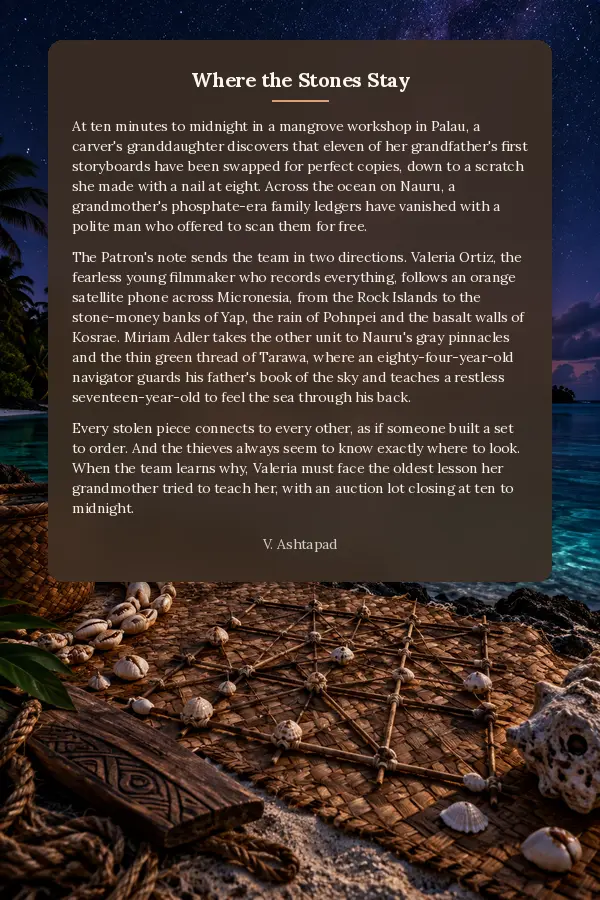
At ten minutes to midnight in a mangrove workshop in Palau, a carver's granddaughter discovers that eleven of her grandfather's first storyboards have been swapped for perfect copies, down to a scratch she made with a nail at eight. Across the ocean on Nauru, a grandmother's phosphate-era family ledgers have vanished with a polite man who offered to scan them for free.
The Patron's note sends the team in two directions. Valeria Ortiz, the fearless young filmmaker who records everything, follows an orange satellite phone across Micronesia, from the Rock Islands to the stone-money banks of Yap, the rain of Pohnpei and the basalt walls of Kosrae. Miriam Adler takes the other unit to Nauru's gray pinnacles and the thin green thread of Tarawa, where an eighty-four-year-old navigator guards his father's book of the sky and teaches a restless seventeen-year-old to feel the sea through his back.
Every stolen piece connects to every other, as if someone built a set to order. And the thieves always seem to know exactly where to look. When the team learns why, Valeria must face the oldest lesson her grandmother tried to teach her, with an auction lot closing at ten to midnight.
Members can react to this book and talk about it in the members' Library.
Ownership
© 2026 CRUNOD LLC. All rights reserved.
This book is owned by CRUNOD LLC. It is free to read on EternalCurrent.Online. No part of it may be copied, reprinted, sold, recorded or adapted, including as audio, film or translation, without written permission from CRUNOD LLC.
© 2026 CRUNOD LLC. All rights reserved.