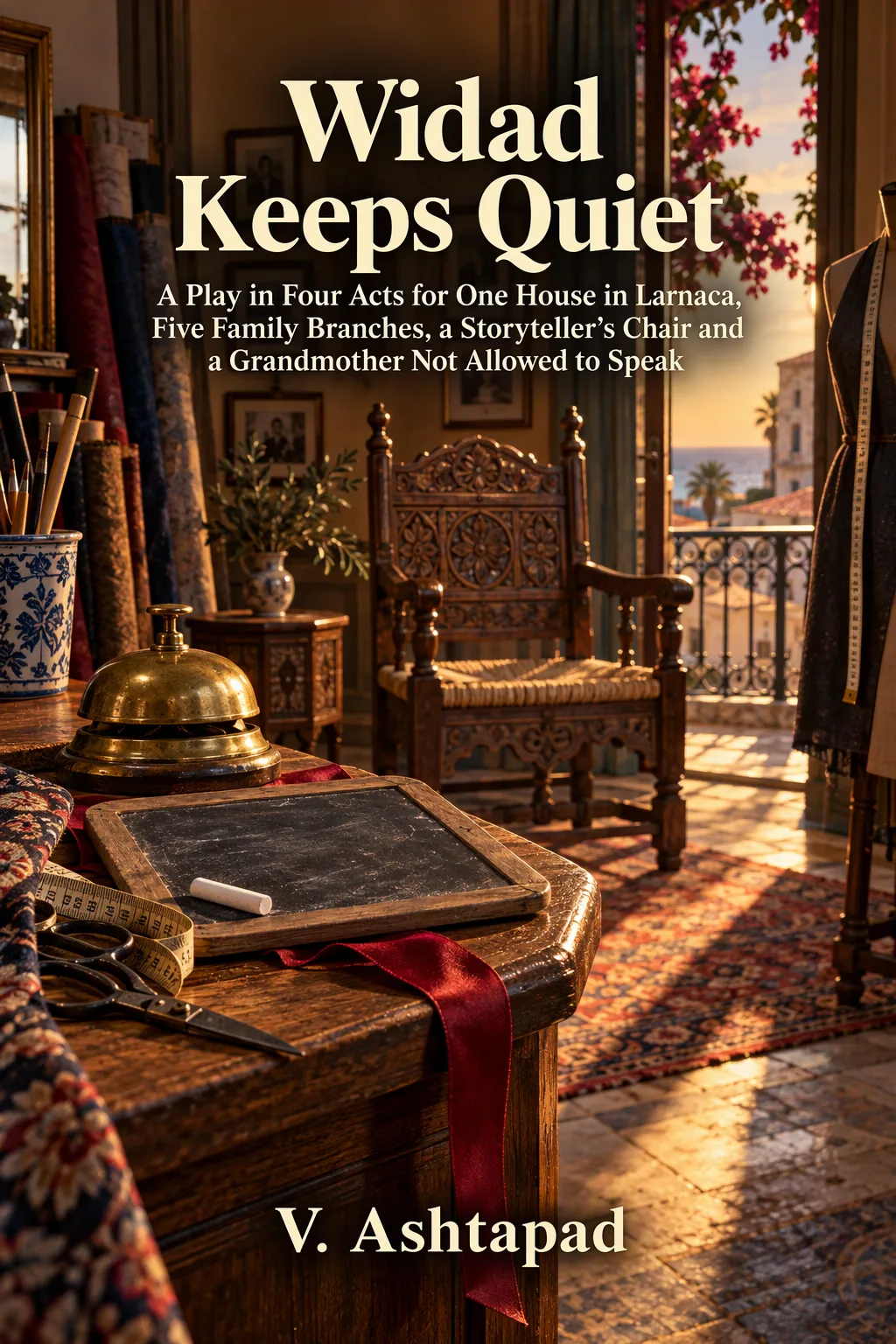
Widad Keeps Quiet
A Play in Four Acts for One House in Larnaca, Five Family Branches, a Storyteller's Chair and a Grandmother Not Allowed to Speak
by V. Ashtapad
Foreword
This is a work of fiction, written as a stage play. Families whose branches run between Baghdad, Salt and Amman, Damascus, Sanaa and Tel Aviv are real, and so are the mansaf of Salt, the kleicha and masgouf of Baghdad, the inlaid woodwork and café storytellers of Damascus, the honey and layered bread of Sanaa, and the beach paddles and Friday salads of Tel Aviv. The house in Larnaca, its shop and everyone in this play are invented.
For everyone who waited for the end of the sentence.
The Persons, the House and the Time
*The persons of the play, in the order they come through the door.*
**WIDAD HADDAD ATTAR**, eighty on Saturday. Born in Baghdad on the seventh of November 1946, the daughter of a bookbinder. A tailor for sixty-five years, forty-one of them in this house. Small, quick, silver hair cut short as a boy's, reading glasses on a cord, a measuring tape around her neck the way other women wear pearls. She talks more than anyone in the family. For the whole of the first three acts she is not allowed to say a word.
**DALIA SALEH**, fifty-two, her daughter. Born in Amman, raised mostly here. Runs the alterations shop on the ground floor since her mother's eyes began to tire. Keeps pins in her mouth when she is thinking. Dry, tired, fierce, and funnier than she lets anyone notice.
**FAHMI SALEH**, fifty-five, Dalia's husband. Born in Sanaa, in a tower house with white trim around its windows. Came to Cyprus at twenty-three to work for an uncle who imported honey and coffee, and now owns the shop. Slow to speak, slower to anger. Carries a jar of honey the way some men carry a pen.
**RAMI HADDAD**, fifty-six, Widad's son. A pharmacist in Amman with two branches and a third in his head. Talks in lists. Loves his mother enormously and from a distance of two hundred and fifty miles, which he regrets more than he says.
**LEEN HADDAD**, twenty-six, Rami's daughter. A conservation architect in Salt, the hill town of yellow stone where her grandfather Karim was born. Keeps the family's private album and family tree, and is the only person who can make the television in this house behave.
**HALA ATTAR**, forty-eight, Widad's stepdaughter. Born in Damascus. Her late father, Samir Attar, was a master of inlaid woodwork who married Widad in 2003 and died in February 2023. Hala teaches the craft in his old workshop in Damascus. Precise, guarded, and kinder than her first sentence.
**YOUSEF SALEH**, twenty-seven, Dalia and Fahmi's son. A dive instructor at Larnaca. Easygoing on the surface, which is where he never spends much time.
**NOA SHAKED**, thirty, from Tel Aviv. A speech and language therapist in a rehabilitation hospital, where she helps people who have had strokes find their words again. Yousef's partner of two and a half years. She has never met the family. She is about to meet all of it at once.
*Heard but not seen:* the doorbell, which plays half a tune and gives up; several telephones; the tiny far-off voice of Tova Shaked, eighty-six, Noa's grandmother in Tel Aviv; the faint voice of Uncle Nizar in Toronto; and, once, the recorded voices of Widad Haddad Attar and of Samir Attar, from seven years ago. *Talked about but never seen:* Mrs. Androulla next door, who knows everything, and Christakis the butcher, who is always about to arrive.
---
*The language.* The family speaks Arabic among themselves, in four accents that tease one another, and English whenever Noa is in the room, and very often both in the same sentence. The play is written in English throughout. A few single words are kept as the family keeps them.
*The names for her.* Rami and Dalia call her Mama. Yousef and Leen call her Teta. Hala calls her Widad, as she always has, and lately, when she forgets herself, Mama. Fahmi calls her Umm Rami, the old courtesy, and makes it sound like a title.
---
*The house.* An old two-story stone house on a narrow street behind the seafront in Larnaca, Cyprus, ten minutes' walk from the salt lake. The set shows the whole ground floor and the roof.
At the front, stage left, is the shop: a tall window onto the street with WIDAD — ALTERATIONS painted in faded gold on the glass, a cutting table, two sewing machines (one electric, one a black treadle machine with gold leaves on it), shelves of thread in every color of the world, and a dressmaker's form. On the form hangs a navy-blue wool coat of an old cut, buttoned to the throat. Nobody touches the coat.
Center is the sala, the family room: a long low sofa, a television too big for the wall, a brass tray table, a sideboard crowded with photographs in frames that do not match. Against the back wall stands a tall wooden chair with a high back and arms, inlaid with stars of pale bone and dark walnut and a little mother-of-pearl that catches the light. This is Samir's chair. The family calls it the storyteller's chair.
Stage right, through an arch, is the kitchen, and beyond it a glass door to a small courtyard with a lemon tree in a whitewashed pot and a lean-to workshop with a sloping tin roof: Samir's bench, his clamps, his bundles of thin wooden rods.
An outside stair climbs from the courtyard to the flat roof, where there are plastic chairs, a low table, potted geraniums, a clothesline, and, on a clear night, a view over the rooftops to the salt lake, gray-silver by day and black by night, where the first flamingos of the season have just arrived.
---
*The time.* Present day. Four days in November, from Thursday afternoon to Sunday morning. Widad turns eighty on Saturday, the seventh.
*Act One:* Thursday, the fifth of November. *Act Two:* Friday, the sixth. *Act Three:* Saturday, the seventh. *Act Four:* Sunday, the eighth.
---
*A note on the slate.* On Thursday morning Widad had a small polyp removed from her vocal folds at a clinic on the far side of town. Her surgeon has ordered seventy-two hours of complete voice rest: no talking, no whispering, no humming, no clearing of the throat. The rest ends at ten o'clock on Sunday morning. Until then she speaks with a child's chalk slate in a wooden frame, which she wears on a ribbon, and with the brass bell from the shop counter. Her slate words are printed here in capital letters, as she writes them. When she needs more room she writes on long strips of brown pattern paper torn from the roll in the shop.
*A note on the bell.* One ring means no. Two rings mean go on. Anyone who has lived in this house for more than a week knows that one ring can mean a dozen other things as well.
© 2026 CRUNOD LLC. All rights reserved.
Act One, Scene One: The Slate
*Thursday, the fifth of November. Late afternoon. Low gold light through the shop window lays the painted letters across the floor of the sala backward.*
*The front door opens. The doorbell, set off by the door, plays half its tune and stops. DALIA comes in first, backward, holding the door with her hip, a hospital bag over one shoulder and a pharmacy bag in her teeth. She takes the bag out of her teeth.*
**DALIA:** Mind the step. Mama. The step.
*WIDAD comes in on FAHMI's arm. She wears a cardigan over a good dress, because she would not leave a clinic looking like a patient. Around her neck hang the measuring tape and, on a red ribbon, the slate. She steps over the step with great dignity, as if it had insulted her.*
**FAHMI:** There. Home. The house was very worried about you, Umm Rami. The lemon tree did not sleep.
*WIDAD writes on the slate, quickly, and turns it round.*
**WIDAD** *(writes)*: TREES SLEEP FINE.
**FAHMI:** Not this one.
*DALIA sets the bags down, goes to the sofa, plumps two cushions, makes a nest, and points at it.*
**DALIA:** Sit.
*WIDAD walks straight past the sofa into the shop, to the cutting table, and puts her hand flat on it, the way some people touch a doorframe when they come home. She looks at the blue coat on the form. She straightens its collar. Then she comes back and sits, not on the sofa, but on the arm of it.*
**DALIA:** That isn't sitting.
**WIDAD** *(writes)*: IT IS SITTING FOR ME.
**FAHMI:** She is sitting, Dalia. Look. Her feet are off the ground.
**DALIA:** You're not helping.
**FAHMI:** I never help. I carry.
*He goes into the kitchen. We hear the tap, the kettle, a cupboard. DALIA takes a folded leaflet out of the hospital bag and opens it out. It is long. It keeps opening.*
**DALIA:** Right. Dr. Kyprianou's rules. I am going to read them to you, and you are going to nod.
*WIDAD rings the bell once, sharply.*
**DALIA:** That's not a nod.
**WIDAD** *(writes)*: I HEARD HIM. I WAS THERE.
**DALIA:** You were there with a tube in your throat and a face like a cross pigeon. *(Reading.)* "Complete voice rest for seventy-two hours following the procedure." Seventy-two hours, Mama. Not one day. Three.
*WIDAD looks at her. She writes, slowly this time.*
**WIDAD** *(writes)*: HE SAID ONE.
**DALIA:** He said one day of no food that scratches. He said three days of no voice. I was standing beside him. You were telling the nurse her hem was uneven.
**WIDAD** *(writes)*: IT WAS.
**DALIA:** *(Reading on.)* "No whispering. Whispering strains the folds more than speech." No humming. No singing along with anything, and that includes the radio, and that includes the old records. No clearing of the throat. No coughing on purpose to make a point. *(She looks up.)* He wrote that one by hand, at the bottom, after he'd met you.
*FAHMI comes in with a tray: a glass of warm water with honey stirred into it, three small glasses of tea, a saucer of cardamom pods.*
**FAHMI:** Honey from the Doʿan valley. Sidr honey. My sister's neighbor's bees. For the throat there is nothing better. My grandmother gave it to every singer in our street, and in our street everybody thought they were a singer.
*WIDAD takes the glass, sips, closes her eyes. She writes.*
**WIDAD** *(writes)*: GOOD BEES.
**FAHMI:** I'll tell them.
**DALIA:** Seventy-two hours from ten o'clock this morning. *(She counts on her fingers.)* Ten o'clock on Sunday. You can talk at ten o'clock on Sunday morning. Gently.
*WIDAD sets the glass down. She does not write anything. She looks at the storyteller's chair against the back wall. Then she writes, and her chalk breaks, and she keeps writing with the stub.*
**WIDAD** *(writes)*: SATURDAY IS MY BIRTHDAY.
**DALIA:** I know when your birthday is.
**WIDAD** *(writes)*: I AM TELLING THE STORY SATURDAY.
*Pause. DALIA folds the leaflet, badly. It refuses to go back into its folds.*
**DALIA:** Then you'll tell it Sunday.
*One ring of the bell.*
**DALIA:** Mama.
*One ring.*
**FAHMI:** *(Gently.)* Which story?
*WIDAD points, without looking, toward the shop, toward the blue coat on the form. Then she wipes the slate with her cardigan cuff, which makes DALIA wince, and writes.*
**WIDAD** *(writes)*: EIGHTY YEARS. ONE STORY. I PROMISED.
**DALIA:** You've been promising since I was nine. "When I'm eighty I'll tell you about the coat." When I was nine, eighty was a country on the far side of the moon. *(She sits down on the sofa, properly, all at once, like a coat sliding off a hook.)* Mama, everyone is coming. Rami lands at seven. Leen is with him. Hala's flight is late, she messaged from the airport, she won't be here before eleven. Yousef is bringing — *(She stops.)*
*WIDAD writes one word, and underlines it twice.*
**WIDAD** *(writes)*: NOA.
**DALIA:** Noa. Who has never met any of us. Whom Yousef has kept in a box for two and a half years like one of your good buttons. Who is going to walk into this house tonight and find all of us at once, and you with a blackboard round your neck.
**FAHMI:** She is a speech therapist. Yousef says. She will understand the blackboard better than any of us.
**DALIA:** She'll understand that we're mad.
**FAHMI:** That she knows already. She's going out with our son.
*WIDAD laughs. It is silent. Her shoulders shake, her eyes water, she puts a hand to her throat as if to hold the laugh in its box, and DALIA is on her feet at once.*
**DALIA:** No! No laughing. Is laughing in the leaflet? *(She unfolds it again.)* It must be in the leaflet.
**FAHMI:** *(Taking the leaflet from her, very gently, and folding it correctly, in its right creases, in one go.)* Laughing with the mouth shut is permitted. I asked him. I asked about laughing, and about crying, and about shouting at football. Laughing, quietly. Crying, quietly. Football, no.
*DALIA stares at him.*
**DALIA:** When did you ask him that?
**FAHMI:** While you were paying.
*DALIA sits again. Slower. She looks at her mother, and for the first time we see how frightened she was this morning, waiting outside the room with the swinging doors.*
**DALIA:** *(Quietly.)* You're all right?
*WIDAD nods. She reaches out and takes the pin cushion that DALIA wears on an elastic band around her wrist, takes out a pin, and puts it in her own mouth, the way DALIA does when she is thinking. DALIA laughs despite herself, and takes it back.*
**DALIA:** Don't. You'll swallow it and then I'll have to explain that to Dr. Kyprianou as well.
*The telephone in DALIA's bag buzzes. She looks at it.*
**DALIA:** Leen. *(Reading.)* "We've landed. Baba has bought the duty-free out of sugared almonds. He says to tell Teta he has brought her a surprise and she must be sitting down." *(She looks up.)* She is sitting down. Sort of.
**WIDAD** *(writes)*: WHAT SURPRISE.
**DALIA:** If I knew, it wouldn't be one.
**WIDAD** *(writes)*: YOU KNOW.
*DALIA does know. She looks at FAHMI. FAHMI becomes very interested in the cardamom pods.*
**DALIA:** I know that he has been reading about flats.
*Pause.*
**WIDAD** *(writes)*: FLATS.
**DALIA:** In Amman. With lifts. Near his pharmacy. He sent me pictures. He wanted me to "prepare the ground." *(She makes a face that is her brother's face exactly.)* I told him the ground is fine. The ground has been fine for forty-one years.
*WIDAD looks around the room. At the sideboard of photographs. At the chair. At the treadle machine with its gold leaves. Then she wipes the slate, very carefully this time, and writes, and holds it up for a long moment before either of them reads it.*
**WIDAD** *(writes)*: NOBODY ASKED ME.
**DALIA:** No. *(Pause.)* Nobody asked me either.
*FAHMI looks from one woman to the other. He sets down his tea.*
**FAHMI:** Well. It is only Thursday.
*Outside the window, a scooter goes by, and the low sun goes behind the house opposite, and the painted gold letters on the floor go out.*
*WIDAD gets up off the arm of the sofa. She crosses to the storyteller's chair and lays her hand on its back, on the inlaid star at the top, the one with the mother-of-pearl center. She stands there.*
**FAHMI:** *(To DALIA, low.)* She is thinking with her hand.
**DALIA:** She's planning. I know that hand.
*WIDAD turns. She writes, rubs it out, writes again. She brings the slate to DALIA and puts it in her lap.*
**WIDAD** *(writes)*: TELL NOBODY THE RULES TILL ALL ARE HERE.
**DALIA:** What rules?
*WIDAD smiles, and walks into the shop, and switches on the lamp over the cutting table, and sits at the treadle machine, and puts her foot on the treadle, and makes it run, empty, with no cloth under the needle — the old soft rattle of it filling the house like rain on a tin roof.*
**DALIA:** *(Calling after her.)* Mama. Mama, what rules?
*The treadle goes on. FAHMI picks up the glass of honey water, crosses, and sets it at WIDAD's elbow in the lamplight, and comes back.*
**FAHMI:** In Sanaa we say — no. I'll say it in a plain way. When an old woman goes quiet, the young ones had better sit down.
**DALIA:** You made that up.
**FAHMI:** This minute. But it will be old by Sunday.
*The treadle rattles. The lights narrow to the lamp over the cutting table, and to WIDAD's foot rocking the iron pedal, and go out.*
© 2026 CRUNOD LLC. All rights reserved.
Act One, Scene Two: The Pharmacist's Suitcase
*Thursday. Half past seven in the evening. The shop is dark; the sala lamps are on. On the brass tray table, a plate of sugared almonds already half gone.*
*The doorbell plays half its tune. Before anyone can reach it, the door opens and RAMI comes in on a wave of cold street air and talking, wheeling two suitcases, a shopping bag in one hand, a coat over his arm. LEEN follows with a backpack, a long cardboard tube, and the face of someone who has been listening to her father since the plane doors closed.*
**RAMI:** Where is she? Where's the patient? Nobody is to fuss. I've told Leen in the car, nobody is to fuss, the procedure is nothing, I read about it, it's a polyp, it's a grain of rice. Mama!
*WIDAD comes out of the kitchen with a tea towel over her shoulder. RAMI lets go of everything he is holding, which is a great deal, and goes to her, and holds her face in his hands, and kisses her forehead, and both cheeks, and her forehead again.*
**RAMI:** Look at you. You look twenty. You look nineteen. Does it hurt? Don't answer. Don't answer! Leen, she's not to answer.
**LEEN:** She wasn't going to, Baba. She's got a blackboard.
*LEEN kisses her grandmother. WIDAD holds her a long moment, then holds her off at arm's length, looks her up and down, and tugs the hem of LEEN's sweater straight with two sharp pulls, the way she has since LEEN was four.*
**LEEN:** Hello, Teta. Yes, I know. It's the way it's knitted.
**WIDAD** *(writes)*: KNITTED WRONG.
**LEEN:** *(Delighted.)* She can still do it! She can still tell me off!
**RAMI:** *(Taking in the slate for the first time.)* What is that? A slate? Dalia, what is this, she's writing on a slate like a schoolchild? We have phones. She can type. Mama, give me your phone, I'll put the big letters on —
*One ring of the bell, from the bell on the tray table that WIDAD has picked up without anyone seeing her do it.*
**DALIA:** *(Coming in from the kitchen, drying her hands.)* That means no.
**RAMI:** Since when does she have a bell?
**DALIA:** Since about four o'clock. Hello, Rami. You smell of airplane.
*They embrace, brother and sister, with a lot of back-slapping and no actual softness, the way they have embraced since they were teenagers, and both seem to know it, and neither of them knows how to change it.*
**RAMI:** I smell of sugared almonds. Your daughter-in-law has, apparently, a sweet tooth, Yousef told me on the phone, so I bought one of every kind. Where are they?
**DALIA:** She isn't my daughter-in-law.
**RAMI:** Not yet.
**DALIA:** Don't you say that in front of her.
**RAMI:** I'm a pharmacist. I say everything in front of everybody. *(He is already unzipping the smaller suitcase on the floor.)* Right. Mama. Sit. I've brought what you need.
*He opens the suitcase. It is full, entirely, of medicines: boxes, bottles, blister packs, throat sprays, lozenges in tins, a humidifier still in its carton, a digital thermometer, a blood pressure cuff. LEEN looks at the ceiling. FAHMI, coming in from the courtyard with an armful of lemons, stops in the archway.*
**FAHMI:** Rami. Welcome. You've opened a branch.
**RAMI:** Fahmi! My brother. *(He embraces him, lemons and all; two lemons roll away under the sofa.)* Throat lozenges, three kinds, no menthol, menthol dries the folds. Saline spray. The humidifier, you must run it in her bedroom at night, Dalia, the air in this town is half salt —
**DALIA:** We know the air in this town. We breathe it.
**RAMI:** — and these are vitamins, these are for her knees, these are for her eyes, these are because I was in the shop and I thought of her —
**WIDAD** *(writes)*: I HAVE PILLS.
**RAMI:** You have Cypriot pills.
**WIDAD** *(writes)*: PILLS ARE PILLS.
**RAMI:** *(Wounded, a hand to his heart.)* You have said many terrible things to me in fifty-six years, Mama.
*WIDAD writes. She takes her time. She shows him.*
**WIDAD** *(writes)*: THANK YOU HABIBI. TOO MANY.
*RAMI reads it. For a second he is not a man with two pharmacies; he is a boy of fifteen whose mother has said, in front of everyone, that he did well.*
**RAMI:** *(Gruffly.)* You'll use the spray.
*WIDAD nods. She takes the saline spray out of the suitcase, puts it in her cardigan pocket, and closes the suitcase lid with her foot.*
**LEEN:** *(To the room.)* He packed that before he packed his shirts. I watched him. He has two shirts.
**RAMI:** I have three.
**LEEN:** One is on you.
*She sets the cardboard tube carefully against the wall and swings off her backpack. From it she takes a paper bag and holds it out to WIDAD.*
**LEEN:** From Umm Fadi's roof. She said to tell you they dried in the October sun and you're not to give any to the Cypriots.
*WIDAD opens the bag. Inside are small hard white balls, like old stones from a riverbed. She smells them. Her face changes completely.*
**FAHMI:** Jameed.
**RAMI:** Salt jameed. The best, from the best roof in Salt. Sheep's milk yogurt, salted, rolled by hand, dried on the roof for a month in the sun. You soak it, you break it, you work it with your hands in warm water till it's like cream, and then there is mansaf, and then there is happiness, and I'm cooking it tomorrow, nobody else is to touch the pot.
**DALIA:** Nobody wants to touch your pot.
**RAMI:** *(To FAHMI.)* Did I bring lamb? I didn't bring lamb. Can you get lamb here on a Friday?
**FAHMI:** In Cyprus you can get lamb on any day of the week. I'll take you to Christakis in the morning. He'll want to know what it's for. He'll want to come.
**RAMI:** Then he'll come.
*WIDAD has taken one ball of jameed out of the bag. She holds it in her palm and turns it slowly, the way a person turns a seashell. LEEN watches her.*
**LEEN:** *(Quietly, to her grandmother alone.)* Jiddo Karim's mother used to dry them on that same roof, Umm Fadi says. Before it was hers. She says when she was a little girl you used to come up the stairs in a blue coat and sit with the old lady and roll them, and you rolled them too small, and the old lady said they were Baghdad-sized.
*WIDAD looks up sharply. Then she nods, slowly, many times, and writes nothing, and puts the ball back in the bag as if it were an egg.*
**RAMI:** *(Not hearing any of this, unzipping the second suitcase.)* And now. Now. The surprise. Leen, where's the folder?
**LEEN:** Baba.
**RAMI:** The blue folder.
**LEEN:** Baba, maybe not tonight.
**RAMI:** Tonight is perfect. Everyone is — well, almost everyone. Dalia's here. Fahmi's here. Mama's here and she can't argue, it's the perfect night.
*He laughs. Nobody else does. LEEN closes her eyes. DALIA, behind him, takes a pin from her wrist cushion and puts it between her teeth. FAHMI sets his lemons down on the sideboard, very carefully, among the photographs, one by one.*
*RAMI finds the folder himself, a blue plastic one with an elastic band, and pulls out a glossy brochure, and opens it on WIDAD's knees.*
**RAMI:** Abdoun. Ten minutes from the first pharmacy, eight from the second. Third floor, with a lift. A lift, Mama. No stairs. A balcony facing west — you'll see the sunset over the hills like in Salt. Underfloor heating for January. A doorman, a nice man, from Irbid, I've met him. And here, look — this room, the second bedroom, I've measured, a cutting table will go here and your machine by the window. The good light. *(He taps the page.)* I've put down a deposit. Only a deposit. It holds it until the New Year.
*Pause. The only sound is the refrigerator in the kitchen, which hums, as it has always hummed, slightly flat.*
*WIDAD looks at the brochure. She turns one page. Turns another. She looks at the picture of the bedroom with the good light, for quite a long time. Then she closes the brochure and lays it on the tray table and puts the bag of jameed on top of it.*
**RAMI:** You don't have to decide now.
*One ring of the bell.*
**RAMI:** I said you don't have to decide —
*One ring.*
**DALIA:** *(Taking the pin out.)* She's not deciding, Rami. She's telling you she's not deciding.
**RAMI:** Did you know about this?
**DALIA:** You sent me eleven photographs of a lift.
**RAMI:** And you said nothing!
**DALIA:** I said "very nice lift."
**RAMI:** That's not nothing, that's encouragement.
**DALIA:** That's what you say when someone shows you a lift!
**FAHMI:** *(Mildly.)* It is a nice lift. I saw the pictures.
*Both of them turn on him.*
**RAMI and DALIA:** Fahmi.
**FAHMI:** I am only saying. As lifts go.
*WIDAD has stood up. She walks to the middle of the room, between her two children, and holds up her slate. It is blank. She holds up the blank slate until they both stop talking and look at it.*
*Then she writes.*
**WIDAD** *(writes)*: NOT TONIGHT. NOBODY. NOT TOMORROW. SATURDAY.
**RAMI:** What's Saturday?
**DALIA:** Her birthday, Rami. You flew here for it.
**RAMI:** I know what Saturday is, I'm asking what's Saturday.
*WIDAD rubs out and writes again.*
**WIDAD** *(writes)*: RULES WHEN ALL ARE HERE.
**RAMI:** Rules for what?
**LEEN:** *(Who has picked up the brochure, and is holding it the way she would hold a crumbling document in an archive, by its edges.)* I think, Baba, she means wait.
*RAMI looks at his daughter. He looks at his mother. He opens his mouth. He shuts it. He picks up a sugared almond and eats it, which in RAMI is what other men do instead of counting to ten.*
**RAMI:** I can wait. I'm very good at waiting. I wait for deliveries every day of my life.
**LEEN:** He's terrible at waiting.
**RAMI:** I'm terrible at waiting.
*WIDAD smiles at him. She takes his hand and pats it, twice, and then, without warning, she licks her thumb and smooths down one of his eyebrows, which is sticking up from the airplane.*
**RAMI:** Mama.
*She smooths the other one.*
**LEEN:** *(Taking out her phone.)* Teta. While we wait. The wall's already started. For the birthday. Look.
*She holds the phone so WIDAD can see. We do not see the screen; we see its blue light on their two faces.*
**LEEN:** That's Uncle Nizar's girls in Toronto. They sang. You can't sing back, so don't. That's a photograph from Umm Fadi of the jameed on the roof. That's Karim — *(To the room.)* My brother says he can't get away from Dubai until December but he's put up a picture of the three of us at the Dead Sea when I was eight and he says Teta still owes him the floating lesson. And that one — *(She stops, and looks more closely.)* Who's that?
*WIDAD looks. She takes the phone out of LEEN's hand, holds it at arm's length, then close, then puts on her reading glasses from their cord. She looks a long time. She hands it to DALIA.*
**DALIA:** *(Reading.)* "Happy birthday, from one grandmother to another. My granddaughter says you are a tailor. So was my mother. I hope we meet. Tova Shaked, Tel Aviv." *(She looks up.)* Noa's grandmother.
**RAMI:** How is Noa's grandmother on our wall?
**LEEN:** Teta sent Noa an invitation. Last week. To the family pages. *(She looks at WIDAD.)* Didn't you?
*WIDAD, very innocently, takes the phone back and looks at the message again.*
**DALIA:** Mama. You invited a girl you've never met into the family album?
**WIDAD** *(writes)*: I MET HER.
**DALIA:** When?
**WIDAD** *(writes)*: ON THE TELEPHONE. TUESDAYS.
*Pause.*
**DALIA:** Tuesdays.
**WIDAD** *(writes)*: SINCE JUNE.
*FAHMI begins, very quietly, to laugh. RAMI looks from his mother to his sister to FAHMI. LEEN looks thrilled.*
**DALIA:** Does Yousef know?
*WIDAD rings the bell twice: go on. Then, seeing that this is not an answer, she rings it once, and shakes her head, and puts her finger to her lips.*
**FAHMI:** *(Wiping his eyes.)* Oh, Umm Rami. Oh, the boy is going to walk in with her tonight like a man carrying a cake he baked himself, and the cake already knows the kitchen.
*WIDAD gives the phone back to LEEN, collects the empty tea glasses onto the tray, and carries them toward the kitchen, upright, unhurried, a woman of almost eighty who has just won a hand of cards.*
*In the archway she turns and writes one more thing, and holds it up to all of them.*
**WIDAD** *(writes)*: NOBODY TELLS YOUSEF.
*She goes out. Pause.*
**RAMI:** *(Sitting down heavily on the sofa, on a lemon.)* Tuesdays.
*He takes the lemon out from under him and looks at it. Lights down.*
© 2026 CRUNOD LLC. All rights reserved.
Act One, Scene Three: The Box from Damascus
*Thursday. A quarter past eleven at night. One lamp in the sala. RAMI is asleep sitting up on the sofa, his reading glasses on his forehead, the blue folder on his chest rising and falling. LEEN, cross-legged on the floor, has unrolled the long paper from her cardboard tube across the tray table and is weighting its corners with tea glasses: it is a measured drawing of a stone house, every block numbered. DALIA is in the shop under the lamp, letting out the seams of a pair of trousers for a customer, pins in her mouth. WIDAD sits beside her at the treadle machine, not sewing, only watching her daughter's hands.*
*FAHMI comes in from the courtyard.*
**FAHMI:** A taxi. At the corner. It's stopped twice. It's a driver who doesn't believe in our street.
**DALIA:** *(Through pins.)* Nobody believes in our street.
*She takes out the pins and stands. WIDAD is already on her feet, going to the door. The doorbell plays half its tune. FAHMI opens the door.*
*HALA stands there with a small wheeled suitcase and, held in both arms against her chest the way you would hold a sleeping child, a parcel wrapped in an old embroidered tablecloth, deep red with white thread. She is in a long dark coat, her hair pinned up, and she is tired in the particular way of someone who has been sitting in airports since dawn.*
**HALA:** I'm sorry. I'm so sorry. The flight —
**FAHMI:** Come in, come in. You are not late. The day is late. It has been late all day.
*HALA steps over the step. She sees WIDAD. She stands quite still. WIDAD holds out her arms, and HALA does not put the parcel down, so WIDAD puts her arms around both of them together, HALA and the parcel, and holds on. HALA closes her eyes.*
**HALA:** *(Into WIDAD's shoulder.)* You've had it done. Dalia told me. Does it hurt?
*WIDAD steps back and lifts the slate.*
**WIDAD** *(writes)*: NO. MY PRIDE HURTS.
**HALA:** *(A breath of a laugh.)* That's never stopped you.
*DALIA comes forward. She and HALA kiss on both cheeks: correct, warm enough, careful. They have done this for twenty-three years. There is affection in it, and there is something held at the edges, the way you hold a tray of full glasses.*
**DALIA:** You must be starving. There's soup.
**HALA:** Only tea. Please. Only tea.
**DALIA:** There's soup.
**HALA:** Then soup. Thank you.
*DALIA goes to the kitchen. RAMI wakes with a jerk; the folder slides to the floor.*
**RAMI:** I'm awake. Who's here? Hala! *(He is on his feet, glasses tumbling, and embraces her too warmly and too fast, the parcel squashed between them.)* Hala, welcome, welcome, how was it, how's Tarek, how are the children, how's the cold in Damascus, is it cold yet?
**HALA:** Tarek is fine. The children are fifteen and thirteen and hate me equally. It's not cold yet. The jasmine on our wall still has flowers on it. *(She reaches into her coat pocket and brings out a small twist of paper and opens it. Inside, three white jasmine flowers, browned at the edges.)* I picked them this morning. For Widad. They didn't travel well.
*WIDAD takes them in her palm, and smells them, and holds them to her chest. She looks at HALA over them. She writes nothing at all.*
**LEEN:** *(Getting up, coming to kiss HALA.)* Auntie Hala. It's Leen. I've cut my hair, that's all. It's still me.
**HALA:** The first time I met you, you were twelve and explaining to my father how to fix his own roof.
**LEEN:** *(Mortified.)* Was I?
**HALA:** He let you. He said, "This one will build something." *(She looks at the drawing on the tray table.)* And you have.
**LEEN:** I'm only measuring. The building's four hundred years older than me. It's a merchant's house in Salt, yellow stone. We take every block down, number it, clean it and put it back exactly where it was. Every block has a number. That's me, I'm the numbers.
**HALA:** *(Looking at the drawing, really looking, with a craftsman's interest.)* That's what he did. With the wood. The pieces always know where they belong. You only have to listen to which way they want to sit.
*FAHMI has taken her suitcase and set it by the stairs, and now he hovers by the parcel she still holds.*
**FAHMI:** Shall I take — ?
**HALA:** No. *(Too quickly; then, softer.)* No, thank you, Fahmi. I'll — I'd like to put it down myself.
*She looks around for a place. Her eyes go to the storyteller's chair, and away. She sets the parcel on the cutting table in the shop, under the lamp, beside the blue coat on its form. She unties the knot of the tablecloth. She folds back the four corners.*
*It is a box, about the size of a large book, made of dark walnut. Its sides are covered with a pattern of tiny geometric stars, pale bone and pale lemonwood and dark ebony, set into the walnut so finely that from a step away it looks like woven cloth. Its corners are banded with mother-of-pearl. The lid is finished at its edges, a border of the same stars running all around it, but the center of the lid is bare wood: a smooth dark rectangle, marked out in pencil, with a circle drawn inside it and nothing set into the circle at all.*
*Everyone has come to look. DALIA stands in the kitchen arch with the soup ladle.*
**HALA:** He started it in the autumn before he died. In this workshop. *(She points through the house toward the courtyard.)* He sent me pictures of every stage. He said, "A box for eighty years needs four years to make." He was very pleased with that. He said it many times. He was not a man who made jokes, so when he made one he liked to get the good of it. *(Pause.)* He finished the sides. He finished the border of the lid. He was going to make the center last. He had drawn it. He hadn't started.
**RAMI:** *(Quietly, which for RAMI is something.)* It's beautiful, Hala.
**HALA:** After the funeral, Widad sent it to me. To keep, until — I don't know until what. It's been on the shelf in his old workshop in Damascus since then. With a cloth on it. I've taught thirty students at that bench since. I've shown them how to cut the rods, how to bundle them, how to slice the pattern. I never once took the cloth off this. *(She touches the bare circle on the lid.)* I didn't want to make his part. I didn't want to do it wrong.
*WIDAD puts her hand flat on the lid beside HALA's hand.*
**HALA:** And then in September I thought — she's going to be eighty. And he made a joke about it. And it's not finished. *(She looks up.)* So I've brought it. I've brought his drawing, and the rods I've cut to match his, and his little saw that I've kept. I want to finish it here. In his workshop. By Saturday night. I don't know if I can. It's two days of work for two people. Three for one.
**FAHMI:** Then it is two people.
**HALA:** Fahmi, you don't —
**FAHMI:** I have good hands for small things. I can open a honeycomb without breaking one cell. And there is a third person, he is a boy who is good at staying still for a long time underwater. He is coming tonight. We will hold things for you. We will not do his part. You will do his part.
*HALA looks at him. She nods. She can't say anything.*
*RAMI has bent close to the box. He picks up the edge of the tablecloth and lets it fall, and straightens, and looks through the archway toward the courtyard, toward the dark workshop, and something comes to his face that he decides not to say. HALA sees it.*
**HALA:** *(Evenly.)* Dalia says you have plans for the house.
*Pause. DALIA, in the kitchen arch, closes her eyes.*
**RAMI:** Not plans. Ideas. For later. Not this weekend.
**HALA:** For the workshop as well?
**RAMI:** Hala —
**HALA:** I'm only asking. I'd like to know if I'm finishing his box at a bench that's going to be — *(She looks for the word.)* — tidied.
**RAMI:** Nothing is going to be tidied. Nobody has decided anything.
**HALA:** No. That's what I thought. *(Pause.)* Nobody ever decides anything. And then one day there's a dumpster outside the door.
*It lands harder than she meant it. She hears it land. RAMI's face goes red, and his mouth opens with three answers in it at once, and before any of them can come out, WIDAD rings the bell.*
*Once. Then once again. Then a third time.*
*Everyone looks at her. WIDAD writes. She shows HALA first, then turns it to RAMI.*
**WIDAD** *(writes)*: HIS BENCH STAYS.
**RAMI:** Mama, I never said —
*WIDAD holds up a finger. She rubs the slate, and writes again, and shows it to all of them.*
**WIDAD** *(writes)*: HIS BENCH. HIS CHAIR. HIS BOX. HER ROOM.
*She points at HALA. Then at the stairs, at the little room off the landing where HALA always sleeps.*
**DALIA:** *(Coming forward with the soup, in a bowl, on a saucer, with a spoon, putting it into HALA's hands.)* She's put a heater in there for you. She tested it this morning before the clinic. At six. She made me stand in the room with my hand out to feel it.
*HALA looks down at the soup. It is lentil, golden, with a slice of lemon floating on it.*
**HALA:** *(Very low.)* My mother made it with the lemon like this.
**DALIA:** I know. Mama told me. Years ago. *(Pause.)* I've always made it like that for you. I just never said.
*HALA looks at DALIA, surprised. DALIA looks at the soup.*
**DALIA:** It's nothing. It's a lemon.
*HALA sits down on the stool by the cutting table, beside the box, and begins to eat the soup, steadily, the way a person eats who has not eaten since an airport at dawn. Nobody says anything. RAMI picks up his blue folder from the floor, looks at it, and puts it — not in his suitcase — but on top of the sideboard, behind the photograph of his father in a suit at his own wedding, where nobody can see it.*
*LEEN, rolling up her drawing, sees him do it.*
*FAHMI's telephone buzzes. He looks at it.*
**FAHMI:** The boy. *(Reading.)* "Landed. Her bag came off first, she says this is a good omen. Fifteen minutes. Is everybody still awake?"
**RAMI:** Tell him nobody in this family has slept since 1970.
**DALIA:** Tell him his grandmother is wearing a blackboard and not to laugh.
**LEEN:** Tell him we've been very good and nobody has mentioned the ring.
**DALIA:** *(Turning.)* What ring?
**LEEN:** *(Instantly.)* No ring. There's no ring. I don't know anything about a ring.
**RAMI:** *(Delighted.)* There's a ring!
**FAHMI:** *(Typing slowly, with one finger.)* I am writing: "Yes."
*WIDAD, by the cutting table, has picked up the corner of the red tablecloth that wrapped the box. She turns it over and looks at the white embroidery along its edge — tiny repeating flowers, worked in chain stitch, in a hand she knows. She traces one with her fingernail.*
**HALA:** *(Seeing.)* It was my mother's. She made it before I was born.
*WIDAD writes.*
**WIDAD** *(writes)*: I KNOW. HE TOLD ME.
**HALA:** What did he tell you?
*WIDAD looks at her. She rubs out the slate and writes for longer this time, small, filling it edge to edge, and hands the slate to HALA, and goes, without waiting to watch her read it, into the sala to straighten cushions that are already straight.*
*HALA reads. Whatever it is, she reads it twice. Then she sets the slate face down on the cutting table, and covers the box again with the red cloth, and puts both her hands flat on top of it, and stays like that.*
*Lights down on the shop, the box under its cloth, the blue coat on the form above it, the slate face down. In the dark, the sound of a car turning into the narrow street, slowly, the way cars do on this street, and its headlights crossing the gold letters on the window.*
© 2026 CRUNOD LLC. All rights reserved.
Act One, Scene Four: The Newcomer
*Thursday. Ten minutes before midnight. The same room; everybody in it now, arranged without seeming to be arranged, the way families arrange themselves when they are waiting for a stranger. RAMI has put on his jacket. DALIA has taken off her apron, then put it back on, then taken it off. HALA has changed into a gray wool dress and sits very upright at the end of the sofa. LEEN is on the floor. FAHMI stands by the door. WIDAD is in the shop, at the cutting table, with her back to the room, and her reading glasses on, pretending to look at a hem.*
*Outside, a car door. Voices in the street, low.*
**YOUSEF** *(off)*: — no, it's this one. With the window. Mind the step, it's a famous step.
*The doorbell plays half its tune. FAHMI opens the door. YOUSEF comes in with a big duffel bag over his shoulder and NOA's wheeled case behind him, and a sunburned nose in November, and NOA comes in after him with a cake box held flat in both hands, and steps carefully over the step, and looks up at seven faces, all turned toward her.*
*NOA is thirty, with dark curly hair tied back hard, a denim jacket, white sneakers, and the stillness of someone who is very nervous and has decided to be calm about it.*
**NOA:** Hi. *(Pause.)* Good evening. I'm — sorry, it's very late.
**FAHMI:** Welcome. Welcome. You are not late. Nothing in this house is ever late, it just arrives when it arrives.
**YOUSEF:** *(Putting the bags down, a hand on NOA's back.)* Everyone, this is Noa. Noa, this is everyone. That's my father. That's my mother. That's my uncle Rami, he's going to talk, it's fine. That's Leen. That's Auntie Hala, from Damascus. And —
*He looks around for his grandmother. WIDAD has not turned around.*
**YOUSEF:** Teta? Teta, she's here.
*WIDAD sets down the hem. She takes off her reading glasses and lets them fall on their cord. She turns. She comes slowly out of the shop into the sala, with the slate on its ribbon, and stops in front of NOA, and looks at her, all of her, head to sneakers, the way she has looked at ten thousand customers. Then she reaches out and turns down one side of NOA's denim collar, which was folded under.*
**NOA:** *(Very softly.)* Hello, Widad.
*WIDAD smiles. It is an enormous smile. She takes NOA's face in her two hands, exactly as RAMI took hers, and kisses her once on each cheek.*
**YOUSEF:** *(Bewildered.)* Widad?
**NOA:** *(Turning to him, guilty.)* I'm sorry. I promised.
**YOUSEF:** You promised what?
*WIDAD writes on the slate and holds it up, not to NOA, but to YOUSEF.*
**WIDAD** *(writes)*: TUESDAYS. SIX O'CLOCK.
**YOUSEF:** What happens Tuesdays at six o'clock?
**NOA:** She rings me.
**YOUSEF:** *Teta* rings you? Since when?
**NOA:** Since June. Since you left your phone here after Leen's cousin's engagement and she — took the number. She rang me the next Tuesday and said, "This is his grandmother. I want to know who you are. Speak slowly, my English is from films." And I spoke slowly. And she rang the week after. *(Pause.)* We talk for twenty minutes. She tells me about the shop. I tell her about my patients, no names. She asked me in July how to say "hem" in Hebrew and she said it back to me and she said it better than my aunt. She made me promise not to tell you, because she said you would get, I'm sorry, "a face like a fish."
*Everyone looks at YOUSEF. YOUSEF has, in fact, a face like a fish.*
**DALIA:** *(To her mother.)* Five months.
**WIDAD** *(writes)*: I WANTED TO KNOW HER MYSELF.
**YOUSEF:** You could have *asked* me.
**WIDAD** *(writes)*: YOU WOULD HAVE TOLD ME WHAT YOU THINK OF HER. I WANTED WHAT SHE THINKS.
*Pause. YOUSEF reads it. He looks at NOA, and something in his face turns over, the way a diver turns at depth to look up at the light.*
**YOUSEF:** *(To NOA, quietly.)* And you never told me. Not once.
**NOA:** You told me she was the most important person in your life. I thought, if she rings me, she gets to decide when you know.
*RAMI, who has been holding himself in like a man holding a door against wind, lets go.*
**RAMI:** Wonderful! Wonderful. Welcome, welcome to the family. Welcome to Cyprus, welcome to Larnaca, welcome to this house. I'm Rami, I'm the eldest, I'm a pharmacist in Amman, two branches, Leen is my daughter, she's an architect, the best. Are you hungry? Have you eaten? Did you eat on the plane? It's forty minutes, they give you nothing, a cracker. Dalia, is there more soup?
**NOA:** I'm fine, really, I —
**RAMI:** Dalia —
**DALIA:** There's soup, Rami, there's always soup. *(To NOA, with her first real warmth.)* Come here. Give me that box before you fold it in half.
*NOA hands her the cake box. DALIA lifts the lid.*
**NOA:** It's from the bakery on our street. Rugelach. Chocolate and cinnamon. My mother said you can't arrive in a house empty-handed and my grandmother said you can't arrive with chocolate only. And this — *(She opens the cross-body bag she wears and takes out a small jar with a checked cloth tied over its lid.)* — this is from my Savta. My grandmother. Apricot jam. She makes it on her balcony every June with the apricots from my uncle's tree. She said to tell you it is for the tailor.
*She gives the jar to WIDAD. WIDAD holds it up to the lamp. The jam glows like a stained-glass window. WIDAD writes.*
**WIDAD** *(writes)*: I READ HER MESSAGE TONIGHT.
**NOA:** She's been waiting all day to hear if you saw it. She's eighty-six. She told me if you didn't write back she was going to get on a boat.
**WIDAD** *(writes)*: TELL HER I CANNOT WRITE BACK. NO VOICE. ONLY CHALK.
**NOA:** I'll tell her. She'll say chalk is plenty. She taught herself to read off a chalkboard on a farm when she was nine.
*NOA has been watching the slate with a different attention now; a professional attention. She looks at WIDAD's throat, at the glass of honey water on the tray, at the saline spray sticking out of the cardigan pocket.*
**NOA:** Can I ask — they told you complete rest? No whispering?
*WIDAD nods.*
**NOA:** Good. That's right. That's what we tell everybody. People think whispering is gentler. It's harder on the folds than a normal voice, everything squeezes. *(To the room.)* Has anybody been whispering to her?
*RAMI, who has been leaning toward his mother saying something in a low private voice, straightens up.*
**RAMI:** No.
**LEEN:** Yes.
**NOA:** *(Kindly.)* It's not the end of the world. But she'll want to answer you in the same way, and she mustn't. If you talk to her, talk to her normally. Out loud. Like she's in the room. *(Pause.)* Because she is.
*Silence. They all look at NOA. NOA goes slightly pink.*
**NOA:** Sorry. That's — that's work. I'll stop.
**FAHMI:** Don't stop. Say more.
**NOA:** *(After a moment.)* The other thing people do, when someone can't speak, is they start finishing that person's sentences. They see her start to write, and they guess the end, and say it, to be helpful. Don't. Wait for her to finish. Even if it takes a long time. Even if you're sure. *(She looks at WIDAD.)* Sometimes the end isn't what you think.
*WIDAD looks at NOA for a long moment. She writes and holds it up only to NOA.*
**WIDAD** *(writes)*: I TOLD YOU. YOU ARE GOOD.
*NOA's face crumples a little, and steadies.*
**DALIA:** *(Briskly, because otherwise she will cry, and she has decided not to until at least Saturday.)* Right. Now everyone's here. *(She turns to her mother.)* Mama. You said. When everyone's here. The rules.
*All of them turn. WIDAD hands the jam to YOUSEF. She walks to the back wall, to the storyteller's chair. She does not sit in it. She stands beside it with one hand on its back. She looks at them all, one at a time, RAMI, DALIA, FAHMI, HALA, LEEN, YOUSEF, NOA, and they find, all of them, that they have stopped moving.*
*She writes. She takes a long time. The chalk squeaks once and RAMI flinches. She has to rub out half of it and start again because it won't fit, and she gestures sharply to DALIA, and DALIA, understanding at once, goes into the shop and tears a long strip of brown pattern paper off the big roll with a sound like a wave breaking. WIDAD takes a pencil from behind her ear, lays the paper on the cutting table, and writes on it, slowly, line by line. Then she holds it up, a strip of brown paper a yard long, written top to bottom in her big careful capitals.*
*FAHMI comes and stands beside her and reads it aloud for the room, because the light is bad, and because he knows she would want it read in a voice.*
**FAHMI:** *(Reading.)* "On Saturday I am eighty. I promised you all the story of my coat. I cannot tell it until Sunday. So on Saturday you will tell me. Each of you, one at a time, sits in Samir's chair and tells me the story of me. What you know. What you think. What you have heard. I will listen. I will not interrupt. *(He looks up at her; she nods, go on.)* Except with the bell. One ring, you have it wrong. Two rings, go on. Nobody else may interrupt. Nobody. Not Rami." *(He looks up.)* She has underlined "not Rami."
**RAMI:** I see that.
**FAHMI:** *(Reading on.)* "Noa too. She has known me five months. She will tell the five months. On Sunday at ten I will tell you what you got wrong. Until Saturday, no flats." *(He turns the paper. There's one more line.)* "No flats" is underlined three times.
*Silence. They look at one another. They look at the chair.*
**LEEN:** *(First, small.)* I think it's brilliant.
**RAMI:** It's mad.
**LEEN:** It's both.
**HALA:** *(Looking at the chair.)* My father's uncle did this. In the old city. In a café by the spice market. He sat up in a chair like that, higher than everyone, and told the old stories to a room of men drinking tea, a little every night, and stopped at the exciting part so they'd come back. And when he got a detail wrong, the old men shouted at him. *(Pause.)* This is the other way round.
**YOUSEF:** *(To NOA, under his breath.)* Welcome to the family.
**NOA:** *(Under hers.)* I have to tell your grandmother the story of your grandmother. In front of your grandmother. On my third day.
**YOUSEF:** Second.
**NOA:** That's not better!
*DALIA is looking at the paper in FAHMI's hands. She takes it from him gently, and reads it again for herself, and then looks at her mother.*
**DALIA:** And what if we get it all wrong?
*WIDAD takes the slate. She writes one word. She shows it to her daughter.*
**WIDAD** *(writes)*: GOOD.
**DALIA:** Good?
*WIDAD nods. She takes the paper back, rolls it up, ties it with a length of white basting thread from her pocket, and props it on the seat of the storyteller's chair, like a guest who has come early and is waiting for the others.*
*Then she claps her hands, once — the old signal, every person in the room has known it all their lives — meaning: bed.*
**RAMI:** It's not even —
*She claps again.*
**RAMI:** *(Giving up, picking up his bags.)* It's midnight. It's actually midnight. She's right, it's actually midnight.
*Bustle: bags, glasses, lights. FAHMI shows NOA where the towels are, explaining the hot water switch, which has an opinion of its own. HALA goes up the stairs with her small case, and stops halfway, and looks back down at the chair with the paper on it. LEEN and RAMI argue in whispers on the landing about who gets the room with the window that rattles.*
**NOA:** *(Calling after them, without thinking.)* Out loud, not whispering! — Sorry. Sorry. That was for her, not for you.
*RAMI and LEEN, on the landing, stop and laugh, out loud.*
*The room empties. WIDAD is last. She turns off the lamps one by one. Last of all she goes into the shop to switch off the lamp over the cutting table, and stops in front of the blue coat on its form, and does what nobody else in the house is allowed to do: she unbuttons the top button, and turns back the edge of the lapel, and looks at the lining underneath, which we cannot see, only the faint glint of many colors of thread in the lamplight.*
*She buttons it again. She switches off the lamp. In the dark, the street window, the gold letters, a faint salt light from the sea.*
*End of Act One.*
© 2026 CRUNOD LLC. All rights reserved.
Act Two, Scene One: Breakfast at Cross Purposes
*Friday, the sixth of November. Ten past seven in the morning. Sea light, very clean, through the courtyard door. The kitchen is now lit and visible through the arch: a small square room with blue tiles to shoulder height, a gas stove with four rings, a window over the sink onto the lemon tree, a calendar from FAHMI's shop on the wall showing a honeycomb.*
*NOA is alone at the stove in leggings and a big sweater, her hair in a knot, a wide frying pan on the flame. She has found onions, peppers, tomatoes, garlic, eggs. She is chopping a cucumber on a board into pieces so small they could go through the eye of a needle. Her phone leans against the tile, and from it, faintly, a woman's voice is talking very fast in Hebrew. NOA answers it in single words, laughing.*
**NOA:** *(To the phone.)* Yes. Yes. Ima. No, I haven't. No. I'm making it now. *(Pause.)* Because I'm awake and nobody else is. Because I want to be useful. *(Pause.)* No, I won't use all her eggs. Ima, I'm thirty. Okay. Okay. Love you. Yes, tell Savta. Bye.
*She ends the call, and looks at the frying pan, and then at the door, and says to nobody:*
**NOA:** I am using all her eggs.
*DALIA appears in the arch in a dressing gown, her hair in a scarf, and stops.*
**DALIA:** Oh.
**NOA:** *(Jumping, knife in hand.)* Good morning. I'm sorry. I couldn't sleep, the hot water was talking to me, and I thought I'd — I didn't know whose pan was whose.
*DALIA comes into the kitchen as if into an unfamiliar country. She looks at the frying pan. She looks at the cucumber on the board.*
**DALIA:** What are you doing to that cucumber?
**NOA:** Salad. My father says if you can see the pieces from across the table you haven't finished. He chops it every Friday. Cucumber, tomato, a little onion, parsley, lemon, oil, salt. Everybody sits outside in my parents' yard at two, after he shuts the bicycle shop, and my Savta comes in a taxi, and my brothers come late with their kids, and we eat for three hours and argue about which beach is best.
**DALIA:** *(Despite herself.)* Which beach is best?
**NOA:** The one at the end of our street, obviously. You can hear the paddles from the road. Everybody has wooden paddles and a little rubber ball and they hit it back and forth all day, *tock*, *tock*, nobody keeps score, nobody wins, they just try not to let it fall. *(She mimes it with the knife; DALIA steps back.)* Sorry. Sorry. Knife.
*DALIA takes the knife out of her hand, quite gently, and lays it on the board. She lifts the lid of the frying pan. Steam. She looks at the red sauce bubbling with the onions and peppers.*
**DALIA:** Where are the eggs going?
**NOA:** In. You make wells with a spoon and crack them in and put the lid on and let them set in the sauce. Shakshuka. Everybody's grandmother makes it a different way and everybody's grandmother is right.
**DALIA:** We do eggs and tomatoes.
**NOA:** I know. Widad told me. She said you make it with a little sumac on top and she never wants to eat it any other way and I'm not to tell you she said that.
*DALIA picks up a teaspoon, dips it in the sauce, tastes, considers.*
**DALIA:** Cumin.
**NOA:** And sweet paprika. And a lot of patience.
**DALIA:** *(Putting down the spoon.)* Add the sumac.
*NOA looks at her. DALIA reaches up into a cupboard without looking, as one does in one's own kitchen in the dark, and takes down a tin, and hands it to her. NOA takes it like a trophy.*
**DALIA:** And not all the eggs. We need six for the cake.
**NOA:** How many are there?
**DALIA:** There were eighteen.
*NOA looks at the eggshells in the sink. She counts them with her eyes. There are fourteen.*
**DALIA:** *(After a pause.)* I'll send Fahmi.
---
*Half past seven. The kitchen is full. FAHMI, dressed, is at the window with the kettle, making tea in a pot and pouring it into small waisted glasses on saucers, each glass a third full of sugar before the tea goes in. DALIA, still in her scarf, is at the counter warming flat bread over the gas flame, turning it with her fingers. On a plate: a thick slab of clotted cream, and beside it a dark syrup in a little bowl. LEEN, in pajamas and a man's sweater, sits on the counter beside the sink eating a cucumber cube by cube. YOUSEF is folding napkins very badly. NOA stands guard over her pan.*
*RAMI comes in through the courtyard door, triumphant, carrying a large parcel wrapped in white paper.*
**RAMI:** Lamb! The shoulder and the leg, both, cut for mansaf, Christakis cut it himself, I watched every stroke. He gave me a speech about Cypriot lamb for twenty minutes and I gave him a speech about Jordanian mansaf for twenty-five and we embraced like brothers and he's coming tonight at eight.
**DALIA:** Of course he is.
**RAMI:** *(Seeing the stove.)* What's this? Is this shakshuka? Who made shakshuka? *(He lifts the lid without asking and leans in.)* Noa made shakshuka? On the first morning? *(To DALIA.)* She's made breakfast on the first morning, in your kitchen, you didn't throw her out?
**DALIA:** There's sumac on it.
**RAMI:** *(Approving, wagging a finger at NOA.)* Ahh. Diplomacy.
**NOA:** It was Widad's idea.
**RAMI:** Everything is Mama's idea. Even the things that are mine are Mama's. *(He sets down the lamb, washes his hands at the sink, around LEEN's knees.)* Where is she?
**FAHMI:** Upstairs. Dressing for breakfast. She does not come to breakfast in a dressing gown. She came down to breakfast in a dressing gown in 1999 the morning Yousef was born and she has never forgiven herself.
**YOUSEF:** I don't remember that.
**FAHMI:** You were busy.
*LEEN, who has been looking at her phone, holds it up.*
**LEEN:** I'm putting the shakshuka on the album. *(She takes a picture of the pan.)* "Day two. Noa has taken the kitchen." *(She types.)* "Noa's mother's recipe, with Auntie Dalia's sumac." There. Uncle Nizar's going to want the recipe by lunchtime, he always does. Noa, can you write it in the recipes later? Just the amounts.
**NOA:** I don't know the amounts. Nobody knows the amounts. You do it until it looks right.
**LEEN:** Then write that. "Until it looks right." That's what half of Teta's recipes say.
*She jumps down off the counter and stands close to the others and lowers her voice, catching herself at once and raising it to a normal speaking level with comic care, which makes NOA laugh.*
**LEEN:** Okay. While she's upstairs. Does anyone actually know what the story of the coat is?
*Pause. Everyone looks at everyone else.*
**RAMI:** I always thought it was about Baghdad. Leaving Baghdad. She never talks about leaving. She talks about the river and the bread and her father's bindery and the Friday book market, and then suddenly it's 1967 and she's in Amman in the snow. There's a gap. I always thought the coat was the gap.
**DALIA:** I used to think there was someone before Baba.
**RAMI:** *(Scandalized.)* Dalia!
**DALIA:** When I was fourteen I thought it. She'd sit at that window with the coat on her knees and look at the street like she was waiting for a particular car. I thought it was a romance. Some tailor's apprentice with a mustache on the far bank of the river.
**FAHMI:** In Sanaa my grandmother hid her gold in the hem of her winter coat. When she died my aunts unpicked every coat in the house. They found a key, two coins and a letter from a cousin about a goat.
**YOUSEF:** So it's money. She's sewn the deeds to something into the lining. We're all secretly rich.
**LEEN:** Or she's selling the house. To Mrs. Androulla's nephew who wants to make it into holiday flats. And the coat's a — metaphor.
**RAMI:** *(Wounded.)* I'd never sell it to Androulla's nephew.
**DALIA:** You'd sell it to a man from Irbid with a lift.
**RAMI:** That's different, that's a doorman.
*HALA has come in quietly through the arch, dressed for work in an apron with many pockets, a pencil behind her ear.*
**HALA:** It's not a romance. I asked my father once. He said he'd asked her too, and she told him, "When I'm eighty."
**RAMI:** Even him?
**HALA:** Even him. He said he married her anyway. He said he'd wait.
*Pause. All of them are quiet a moment.*
**NOA:** *(Turning down the flame.)* Can I say something? You'll think it's strange.
**RAMI:** Everything you've said is strange, and all of it has been true. Go on.
**NOA:** In my work, when somebody loses their words, the family always does this. They stand in the kitchen and guess what the person is going to say. And they guess the most enormous things. Love, money, secrets, illness, regrets. And then the person finds the words and it's — *(She lifts a lid, looks, puts it back.)* — "I want the window open." Or "my left shoe hurts." Or "I'm proud of you." *(She shrugs.)* Small things. Things that were true all the time. Maybe it's just a story about a coat.
*Pause.*
**DALIA:** You don't know my mother.
**NOA:** No. Only Tuesdays.
*From the stairs, a bell rings. Twice: go on. They all turn. WIDAD is standing on the bottom stair, dressed, her hair brushed, earrings in, a brooch at her throat, the slate on its ribbon, a look of tremendous enjoyment on her face. She has been there some time.*
**RAMI:** How long has she been there?
**LEEN:** Since "a tailor's apprentice with a mustache."
*WIDAD writes on the slate and holds it up to DALIA.*
**WIDAD** *(writes)*: NO MUSTACHE.
**DALIA:** *(Covering her face.)* Mama.
*WIDAD rubs it out and writes again, and holds it up to YOUSEF.*
**WIDAD** *(writes)*: NO DEEDS. NO GOLD. SORRY.
**YOUSEF:** I was joking, Teta.
**WIDAD** *(writes)*: I WAS NOT.
*She comes down the last stair into the kitchen and inspects the breakfast: the bread warming over the flame, the clotted cream, the dark syrup. She dips a finger into the bowl of syrup, tastes, and closes her eyes. She looks at DALIA. She writes.*
**WIDAD** *(writes)*: DIBIS. FROM WHERE.
**DALIA:** Hala brought it. From the market in Damascus. The Iraqi man with the cart. The date one.
*WIDAD turns to HALA. HALA shrugs, a little embarrassed.*
**HALA:** You told me once, years ago, that cream and date syrup on hot bread was what your mother gave you on a birthday morning on the roof in Baghdad. I remembered. That's all.
**DALIA:** *(To NOA, low, explaining.)* In Baghdad they have a cream, from buffalo milk, thick as cheese, you can cut it with a knife. You eat it in the morning with date syrup poured over and bread from the oven. This is Cyprus cream. It's not the same. It's as close as we get.
*WIDAD tears a piece of warm bread, spreads the cream on it, pours the dark syrup over, and gives it, not to her children, but to NOA. NOA eats it. Her eyes widen.*
**NOA:** Oh. Oh, that's —
*WIDAD rings the bell twice, delighted.*
**RAMI:** *(Plaintively.)* Is nobody going to give one to me?
*WIDAD gives him the bowl and the bread and lets him do it himself. Then she sits at the head of the little kitchen table and takes up a glass of FAHMI's tea and looks at all of them crowded into her blue-tiled kitchen — her son with his parcel of lamb, her daughter in her scarf, her son-in-law with the teapot, her stepdaughter with the pencil behind her ear, her two grandchildren, and the newcomer at the stove — and writes, and props the slate against the sugar bowl where they can all read it, and begins her breakfast.*
**WIDAD** *(writes)*: GUESS ALL YOU LIKE.
*NOA lifts the lid on the pan. The eggs have set, white and gold in the red, with a dusting of dark sumac. Everyone leans in.*
*Lights down on the full kitchen, and the steam, and the slate against the sugar bowl.*
© 2026 CRUNOD LLC. All rights reserved.
Act Two, Scene Two: The Tree on the Television
*Friday. Ten o'clock in the morning. The sala. LEEN kneels in front of the enormous television with a laptop and a tangle of cables, swearing under her breath at a plug. Through the courtyard door we can see HALA and FAHMI in the workshop lean-to, bent over the bench, and hear, now and then, the small rasp of a fine saw. In the shop, DALIA is pinning a customer's dress onto the form beside the blue coat. RAMI sits on the sofa with WIDAD beside him, a glass of tea in her hand. YOUSEF and NOA sit on the floor with their backs against the sofa, close together.*
**LEEN:** Every time I come, this television has a new opinion about which way round the plug goes. *(It clicks.)* There.
*The television lights up blue, then bright. It fills the back wall with a picture we see only by its light on their faces: a wide family tree, drawn in branches, every name with a small photograph in a circle. LEEN stands back from it like a painter.*
**LEEN:** Right. Teta. You said yesterday, before you lost your voice, that you wanted to see it big. Here it is big.
*WIDAD sets down her tea. She gets up and goes to stand close to the screen, her reading glasses on, a hand raised. She touches the glass with one fingertip, at the very top.*
**LEEN:** *(Following her hand.)* That's the root. Naji the bookbinder and Bahija. Baghdad. I found that photo in the box with the buttons. Teta's father at his bench, with his glue pot and his press. You can see the books stacked on the shelf behind. *(To NOA.)* His bindery was in a lane off the street where they sell books every Friday. Teta says on Friday mornings the whole street was tables of books from one end to the other and her father sat on a stool at the end of the lane with his sleeves rolled up mending the spines of other people's books while they waited and drank tea.
*WIDAD nods. She writes on the slate and holds it up.*
**WIDAD** *(writes)*: HE SMELLED OF GLUE AND ORANGES.
**LEEN:** Oranges?
**WIDAD** *(writes)*: HE ATE THEM AT THE BENCH. PEEL IN ONE PIECE.
**LEEN:** *(Typing on her laptop.)* I'm putting that under his picture. "Glue and oranges. Peel in one piece." *(To the room.)* This is the thing. I've got all the names. I've got nearly all the dates. What I haven't got is any of the *smells*.
*She moves the picture. The tree slides sideways on the screen.*
**LEEN:** And then the branch to Salt. Jiddo Karim. Karim Haddad, engineer. Born in the house with the green door on the steps below the old school. *(To NOA.)* Salt's built on three hills, all in the same yellow stone, the houses go up the slopes in steps, every house looks down on the roof of the house below. The stone goes gold at five o'clock. Everyone in Salt will tell you it's the most beautiful town in the world. It is. I restore it for a living, so I'm allowed to say so.
**RAMI:** Your grandfather said that every day of his life, and he lived in Larnaca for fourteen years.
**LEEN:** And there's Umm Karim. Hind. Jiddo's mother. With the jameed on the roof.
*WIDAD looks at the photograph of the old woman for a long time. She does not write anything.*
**LEEN:** Then Rami, Dalia. Then Mama and Baba, then Karim in Dubai, then me. Then Fahmi, Yousef. And then this branch — Damascus.
*The picture slides. Through the courtyard door, the rasp of the saw stops.*
**LEEN:** *(Calling.)* Auntie Hala! You're on the television!
**HALA** *(off, from the workshop)*: I'm sure I look terrible!
**LEEN:** You look like a film star! *(To the room.)* Samir Attar. Master of inlay. The photo is him at the bench out there, the year I had braces, holding up a strip of the pattern like a fish he'd caught. His first wife, Lamia — Auntie Hala gave me her picture last year. Hala. Tarek. Their two. And then the line across — *(She points.)* — the marriage line, Samir and Teta, 2003. I drew it in gold because Teta said it was a second spring.
*WIDAD nods, slowly. She touches Samir's picture. Then she moves along, deliberately, to the far right edge of the screen, and taps.*
**LEEN:** Sanaa. Uncle Fahmi's branch. His father and mother, and his grandmother Zahra, in the tall house with the white windows, and here, look, Uncle Fahmi's sister Arwa, who sends the coffee. *(Calling.)* Uncle Fahmi! Arwa's on the television!
**FAHMI** *(off)*: Then turn the volume down, she will start talking!
*They laugh. WIDAD taps again, further right, below YOUSEF's picture. There is a new small circle there, joined to his by a line of dots, not a solid line. In it, a photograph of NOA, laughing, on a beach, a wooden paddle in her hand.*
*NOA sees it. She sits up.*
**NOA:** That's me.
**LEEN:** Teta added you. In August. She rang me and made me show her how. She made me promise not to tell Yousef.
**YOUSEF:** *(To the ceiling.)* Does everyone in this family know everything before I do?
**LEEN:** Yes.
**DALIA** *(from the shop, through pins)*: Yes.
*NOA has got up and come close to the screen beside WIDAD. Under her photograph there is a little line of type. She reads it aloud, slowly.*
**NOA:** "Noa Shaked. Tel Aviv. Speech therapist. Talks fast, listens slow." *(She turns to WIDAD.)* You wrote that?
*WIDAD nods.*
**NOA:** And behind me — who's that?
*There is a fainter branch behind NOA's circle: two more small circles and, above them, one more.*
**LEEN:** Teta asked for your parents' names on a Tuesday and I put them in. And your Savta. She's sent a photo since. Her on a tractor, about 1960, on the farm where she grew up, with a plait down to her waist. Teta says the tractor's the best thing on the whole tree.
*NOA looks at the photo of her grandmother on the tractor, ten feet high on the wall of a house in Cyprus. She puts a hand to her mouth.*
**NOA:** She'd die. She'd absolutely die. She'd call everyone she knows.
**WIDAD** *(writes)*: GOOD. TELL HER TO CALL ME TUESDAYS TOO.
*NOA laughs, and wipes her eyes with the cuff of her sweater, and sits down rather suddenly on the floor again. YOUSEF puts an arm around her.*
**LEEN:** And the map. Look. *(She clicks.)* Every place on the tree has a pin. Baghdad. Salt. Amman. Damascus. Sanaa. Larnaca. And now Tel Aviv. *(She zooms out.)* Six pins, look how close together they are. You could drive between most of them in a day, if the roads ran straight.
*Silence a moment. Six bright pins on a blue sea and a brown land, all within a hand's span of each other.*
**RAMI:** *(Who has been very quiet, for him.)* It's beautiful, Leen. It's very well done. *(Pause.)* Which part is the — there was a calendar, wasn't there? You showed me in Amman. Who's coming when. For Mama's birthday, everyone put in their flights.
**LEEN:** *(Hesitating very slightly.)* That's a different page, Baba.
**RAMI:** Show me.
*LEEN clicks. The light on their faces changes: a grid, a calendar, a year's worth of small colored squares.*
**LEEN:** These are the birthday flights. That's us, Thursday. Auntie Hala Thursday night. Noa Thursday night. *(She is already reaching to click away.)* And —
**RAMI:** What are all the green ones?
**LEEN:** Those are just — the visits.
**RAMI:** What visits?
*LEEN looks at DALIA in the shop. DALIA has stopped pinning.*
**LEEN:** Auntie Dalia puts in when she takes Teta to things. Doctors. The eye clinic. The shop's tax office. The bank. Physiotherapy for the knee in the spring. So everyone knows. That was Uncle Nizar's idea, so the cousins abroad could see how she's doing.
*RAMI looks at the screen. We see only the green light on his face, getting greener. A whole year, nearly every week marked.*
**RAMI:** And the blue ones?
**LEEN:** *(Very quietly.)* Those are visits from abroad.
*Pause.*
**RAMI:** There are four blue ones.
**LEEN:** Baba —
**RAMI:** In the whole year, there are four blue ones. *(He counts.)* Three of them are mine.
**DALIA:** *(Coming to the arch of the shop, pins in her hand.)* Nobody's counting, Rami.
**RAMI:** The calendar is counting!
**DALIA:** It's not an exam. It's so Nizar knows what time the eye clinic is.
**RAMI:** And so Nizar knows that the son comes three times a year, and the daughter does everything, and everyone in Toronto can look at the green and the blue and draw their conclusions —
**DALIA:** Nobody in Toronto is drawing anything!
**RAMI:** — and nobody ever *told* me. That she had the physio. That it was every week. You said "a little physio for the knee." You never said every week, for three months. I'd have —
**DALIA:** You'd have what?
**RAMI:** I'd have come!
**DALIA:** From Amman? Every Tuesday? You'd have flown in every Tuesday to sit in a waiting room in Larnaca for forty minutes reading a magazine about yachts?
**RAMI:** I'd have *sent* somebody, I'd have paid for a car, I'd have —
**DALIA:** You do pay. You pay for everything. You've always paid. That's not the — *(She stops herself. She can't stop herself.)* You don't want to *come*, Rami. You want her to *go*. That's what the folder's for. That's what the lift's for. If she's in Amman you can visit her on the way home from the pharmacy. Then you'll have all green squares, and I'll have none, and everyone in Toronto can be very proud of you.
*Silence. It has landed terribly. DALIA knows it. RAMI's face has gone white.*
*WIDAD rings the bell. Once. Neither of them looks at her.*
**RAMI:** *(Low.)* That's not fair.
**DALIA:** None of it's fair.
*WIDAD rings again. Once, hard.*
**RAMI:** I left at eighteen because Baba told me to go to university in Amman, and I went, because he asked me, and then he died, and I was twenty-nine with a baby, and a shop, and a mortgage on the shop —
**DALIA:** I know when he died. I was there. I was here.
*WIDAD rings the bell three times, four. Five. They don't look. They've forgotten the bell entirely; they are fourteen and ten again, in this same room, in a fight that is older than the television. YOUSEF has stood up. FAHMI and HALA have come to the courtyard door, HALA with the little saw still in her hand.*
*WIDAD stops ringing. She picks up LEEN's remote from the tray table. She points it at the television and switches it off.*
*The room goes dim. The green and blue light goes out of everybody's faces. In the sudden quiet, RAMI and DALIA both turn.*
*WIDAD writes on the slate. It takes a long time. It is a slow, careful message, and she does not rub anything out.*
**WIDAD** *(writes)*: I RANG SIX TIMES.
*She holds it up to each of them in turn. RAMI looks at it. DALIA looks at it.*
**DALIA:** *(Barely.)* I didn't hear.
*WIDAD rubs the slate clean and writes again.*
**WIDAD** *(writes)*: I KNOW.
*Then she turns, and finds NOA among the faces, and points at her with the chalk. Then she points at RAMI, and at DALIA, and at the kitchen, and writes one more thing.*
**WIDAD** *(writes)*: NOA. TEACH THEM. I CANNOT TODAY.
**NOA:** *(Alarmed.)* Teach them what?
*WIDAD looks at her. Then she cups a hand around her own ear.*
*Lights down on the dark television, the six of them standing, the seventh with the remote in her hand.*
© 2026 CRUNOD LLC. All rights reserved.
Act Two, Scene Three: Say It Back
*Friday. Twenty minutes later. The kitchen. The breakfast plates have been washed and are drying in a rack by the window. The lemon tree moves outside in a small wind. Three chairs pulled out from the kitchen table, set facing each other in a little triangle, much too close for comfort, as if for an interview nobody wanted.*
*NOA stands by the stove with her arms folded. RAMI and DALIA come in through the arch, separately, not looking at each other, like two cats arriving at the same bowl.*
**NOA:** Sit down, please. *(They hesitate.)* Please. She asked me. I don't want to do this either. I'd rather be on the beach being hit in the face by a little rubber ball.
*RAMI sits. DALIA sits. Their knees are nearly touching. They both move their chairs back an inch. NOA sits in the third chair.*
**NOA:** Okay. I do this at work. Not with brothers and sisters, usually. With a husband and a wife, when one of them has had a stroke and can only get out three words a minute, and the other one is so frightened they keep answering before the three words are finished. It's very simple. It's so simple you'll both think it's stupid.
**RAMI:** I already think it's stupid.
**NOA:** Good. That saves time. *(Pause.)* One of you talks. The other one doesn't answer. Not a word. Not a defense, not a correction, not a fact. When the first one has finished, the second one says back what they heard. In their own words. "What I heard you say is." And then the first one says if that's right. If it's not right, the first one says it again, and the second one tries again. Only when the first one says "Yes, that's it" can the second one say anything of their own. And then you swap.
**DALIA:** And then what?
**NOA:** And then nothing. That's it. You don't have to agree. You don't have to fix it. You only have to prove you heard it.
**RAMI:** That's what you do with stroke patients?
**NOA:** That's what I do with their families. The patients are usually fine. It's the families who've stopped listening.
*RAMI looks at her for a moment. He looks at his sister. He shrugs, a big, injured shrug.*
**RAMI:** Fine. Who goes first?
**NOA:** Dalia.
**RAMI:** Why Dalia?
**NOA:** Because you asked.
*DALIA almost laughs. She takes a pin out of the cushion on her wrist, puts it in her mouth, and takes it out again, and lays it on the table.*
**DALIA:** I don't know what to say.
**NOA:** Say what you said in there. Without the shouting.
*Long pause. DALIA looks out of the window at the lemon tree.*
**DALIA:** I don't mind doing it. That's what nobody understands. I don't mind the clinic, I don't mind the bank, I don't mind sitting in a waiting room with a magazine about yachts. I like it. I like driving her. She sings in the car. She sings the old songs with the windows down and the whole of the coast road hears her. She sings off the note on purpose to make me laugh. *(Pause.)* I'm not a martyr. I don't want a medal. And I don't want a car paid for. I'd just like — once — to be asked. Before somebody puts a deposit on a flat. I've worked in that shop with her since I was thirteen. Half the hems in this town are mine. If she goes to Amman, the shop goes. And then I'm a woman of fifty-two who altered trousers in her mother's front room. *(She stops.)* That's all.
*RAMI opens his mouth.*
**NOA:** *(Quietly.)* Not yet. Is that all, Dalia?
**DALIA:** That's all.
**NOA:** Rami. What did you hear?
**RAMI:** *(Promptly.)* I heard that she's exhausted and she needs help and she's too proud to ask, so what we do is we get someone in three days a week, a nice woman, Filipino, Sri Lankan, I'll pay —
**NOA:** Stop.
**RAMI:** What?
**NOA:** That's not what she said. That's what you're going to do about what you think she said. Again. Just what she said.
*RAMI looks at NOA, affronted. He looks at DALIA. DALIA is watching him, without expression, the way she watches a customer decide whether the hem is right.*
**RAMI:** *(Slower.)* She said — she isn't tired.
**NOA:** Mm.
**RAMI:** She said she likes it. Driving Mama. Mama sings in the car. *(He almost smiles.)* Off the note on purpose. *(Pause.)* She said nobody asked her about the flat.
**NOA:** Dalia?
**DALIA:** *(Not looking away from him.)* And the shop.
**RAMI:** And the shop. That the shop is hers. That she's worked there since she was thirteen. That if Mama goes to Amman, she — *(He stops. Something arrives in his face, slowly, like a delivery van backing into a narrow street.)* — she loses the shop too. And then she's nobody. That's what she's afraid of.
**DALIA:** *(After a moment.)* I didn't say nobody.
**RAMI:** No. You said a woman who altered trousers in her mother's front room. *(Pause.)* I said nobody. That was me.
*Silence.*
**NOA:** Dalia, did he hear you?
**DALIA:** *(Barely.)* Yes. That's it.
**NOA:** Okay. Now Rami.
*RAMI rubs his hands on his knees. He looks at the table. He takes his reading glasses off the top of his head, and folds them, and unfolds them.*
**RAMI:** I'm not good at this.
**NOA:** Nobody's good at this. Go on.
**RAMI:** *(A long pause.)* I was in the pharmacy when Baba died. The first one, the small one, on the corner by the hospital. It was a Tuesday. November. A man had come in for cough syrup for his son, and I was explaining the dose, and the phone went behind the counter, and it was Dalia, and she said Baba's fallen in the kitchen and the ambulance is here, and I said I'm coming, and there wasn't a flight until the next morning. *(Pause.)* I sold the man the cough syrup. I explained the dose. Twice. I don't know why I did that. Then I locked the shop and sat in the car in the parking lot until it was dark. And by the time I got here, it was — he'd gone at four in the afternoon. I was at the counter at four in the afternoon. *(He stops.)* Every time the phone goes in the shop, I think it's Dalia. Every time for twenty-seven years. I just want Mama where I can be there in ten minutes. Where I can be *there*. That's what the lift is. It's not about green squares. It's ten minutes.
*He stops. He has surprised himself. He looks at the table.*
*Pause. DALIA does not speak. NOA waits, and then nods to her, very slightly.*
**DALIA:** *(Slowly.)* What I heard is —
*She stops. She has to start again.*
**DALIA:** What I heard is that you were selling cough syrup when Baba died. And you think it's your fault you weren't here. And every time the phone rings you think it's me ringing to tell you it's Mama. *(Pause.)* And the flat isn't about getting her away from me. It's about being ten minutes away instead of a whole night. So you can't be at the counter at four o'clock again.
*RAMI doesn't answer. He nods. He can't stop nodding.*
**NOA:** *(Gently.)* Is that it, Rami?
**RAMI:** That's it.
*Silence. A long one. Outside the window, the lemon tree; the rasp of HALA's saw in the workshop has started again, very small and patient.*
**DALIA:** *(Very low.)* I never knew you sat in the car.
**RAMI:** I never told anyone.
**DALIA:** I thought you were late because you were sorting out the shop. I was angry with you for a year because I thought you cared about the shop.
**RAMI:** I was angry with you for twenty-seven because you were here.
*They look at each other. Then, unexpectedly, DALIA laughs — a short, shocked laugh, wet at the edges — and RAMI laughs too, helplessly, and wipes his face with the flat of his hand.*
**NOA:** *(Standing up.)* Okay. That's — that's very good. That's better than most people do on the first day. That's better than my parents do.
**RAMI:** *(Still laughing, wiping his eyes.)* Your parents do this?
**NOA:** No. My parents shout. Everybody in my family talks at the same time and the loudest wins, and the loudest is my grandmother, and she's eighty-six and four foot ten. My father once fixed a bicycle chain all the way through an argument about my brother's wedding and never said a word, and at the end my mother said, "You agree with me, then," and he said, "I didn't hear a thing, I was doing the chain." *(She shrugs.)* That's why I went into this job. Somebody in the family had to be quiet.
*DALIA looks at NOA with a new expression altogether.*
**DALIA:** We haven't decided anything.
**NOA:** No.
**DALIA:** About the flat. Or the shop. Or Mama.
**NOA:** No. You weren't supposed to. *(She nods toward the sala, toward the storyteller's chair beyond the arch.)* That's not your decision, is it. That's hers.
*Pause. RAMI and DALIA both turn and look through the arch at the chair with the brown paper rolled on its seat, tied with white thread.*
**RAMI:** *(Slowly.)* Nobody asked her either.
**DALIA:** No.
**RAMI:** I put a deposit on a flat for a woman I didn't ask.
**DALIA:** And I was angry about not being asked about a flat for a woman *I* didn't ask.
**NOA:** And now she can't talk. *(Pause.)* Which is maybe the first time in fifty years either of you has had to wait for her answer.
*She picks up a dish towel from the rail on the stove and begins, very naturally, to dry the plates in the rack, as if the conversation were over, which it is.*
*RAMI stands. He hesitates. Then he holds out his hand to his sister, palm up, the way their father used to hold out his hand to them on the steps in Salt to take them down to the market — not to shake, to hold.*
*DALIA looks at it. She takes it. They stand there a moment, brother and sister, in the blue-tiled kitchen, holding hands like children, slightly embarrassed.*
**RAMI:** *(Gruff.)* I'll take the folder out from behind Baba's photograph.
**DALIA:** I know it's behind Baba's photograph. I saw you.
**RAMI:** Of course you did.
**DALIA:** I dust there. Every morning.
*She lets go of his hand. She takes the pin from the table and puts it back in the cushion on her wrist. At the arch, she stops and turns.*
**DALIA:** Noa.
**NOA:** *(Drying a plate.)* Mm?
**DALIA:** Thank you.
*NOA nods, without looking up, and goes on drying. DALIA goes. RAMI stays a moment longer. He watches NOA set the dried plate on the shelf exactly where it lives, without having to ask.*
**RAMI:** How did you know where that goes?
**NOA:** I watched your mother this morning.
*RAMI considers this. Then he picks up a second towel and begins to dry beside her, badly, and neither of them says anything else.*
*Lights down.*
© 2026 CRUNOD LLC. All rights reserved.
Act Two, Scene Four: The Workshop
*Friday. Two o'clock in the afternoon. The light has turned warm and slanting. The set has opened to show the courtyard fully: the lemon tree in its whitewashed pot, a few fallen lemons on the flagstones, a tap on the wall with a bucket under it, and the lean-to workshop against the back wall, its tin roof ticking in the sun.*
*Samir's bench is a long thick slab of old wood, scarred and dark, worn into a shallow dip in the middle where seventy years of forearms have rested. Above it, on nails, hang small saws, files, a row of clamps like iron question marks. On a shelf, glue pots, jars of tiny pale chips, bundles of long thin wooden rods tied with string. A small electric ring for warming glue. A stool. A second stool.*
*HALA sits at the bench with the box in front of her, the lid off and laid on a folded cloth. Beside it, pinned flat under two stones, is a sheet of yellowed paper: Samir's drawing. FAHMI stands at her shoulder with his sleeves rolled up. YOUSEF sits on an upturned crate, holding a small glue pot in both hands as if it were a bird.*
**HALA:** Warm, not hot. If it boils, it goes brittle, and in ten years the pieces fall out like old teeth. Feel the side of the pot. Like a baby's bath.
**YOUSEF:** I've never given a baby a bath.
**HALA:** Like the sea in October.
**YOUSEF:** *(Feeling the pot.)* Oh. Okay. That I know. That's twenty-four degrees.
**HALA:** Then keep it at twenty-four degrees.
*She picks up one of the long thin bundles from the bench. It is about a foot long and as thick as a finger, triangular in section, made of dozens of fine rods glued together lengthwise. She holds it up so the end faces them.*
**HALA:** Look at the end. Not the side. The end.
*FAHMI and YOUSEF lean in.*
**FAHMI:** A star.
**HALA:** A star. Lemonwood, walnut, the white is bone. Every rod is a color. You glue them in a bundle, so the end grain makes the pattern. Then you glue three bundles together and the star grows into a band. And then — *(She takes a fine saw from its nail, lays the bundle in a little wooden jig, and, with three quick strokes, cuts off a slice as thin as a coin.)* — you slice it. Like bread. And every slice is the same star.
*She holds the slice up to the sun. It is so thin the light comes through the lemonwood gold.*
**YOUSEF:** *(Genuinely amazed.)* That's how? All those boxes in the shops in the old city — they're slices?
**HALA:** Every one. A good bundle gives you two hundred stars. My father used to say the pattern is already inside the wood. You only cut it free. *(She lays the slice down on a cloth.)* He made bundles for the walls of a hotel lobby in this town in 2001. That's why he came here. It was supposed to be four months. He brought a jacket into Widad's shop to have the lining replaced, and she told him his lining was fine, it was his buttons that were wrong, and he came back the next day to argue about the buttons, and the next. *(Pause.)* He stayed twenty-two years.
**FAHMI:** He told me the buttons were perfectly good.
**HALA:** They were. That's why he kept coming back.
*FAHMI laughs. HALA almost smiles. She turns to the drawing pinned under the stones, and touches its edge.*
**HALA:** Now. His part.
*They all look at the drawing. We cannot see it well, but we can see a circle, and inside the circle a long thin line drawn in a loose spiral, like a thread unwinding from the eye of a needle at the center, and along the line, five small stars, and a sixth place, marked only with a dotted outline, empty.*
**HALA:** I've stared at this for three years. I understand everything except why he left the last one empty. The thread is the needle's thread, that's obvious, it's Widad, it's the shop. The five stars I think are the five houses. Baghdad. Salt. Damascus. Sanaa. Here. *(She points at each.)* And then this one. Nothing. Just the dotted line. And underneath, in his writing — *(She turns the paper slightly toward the light.)* — "Leave one place. Someone always comes."
*Pause. YOUSEF looks up from his glue pot.*
**YOUSEF:** When did he draw it?
**HALA:** The autumn of 2022. September, October.
**YOUSEF:** Before I met Noa.
**HALA:** Six months before. *(She looks at him.)* He didn't know anybody was coming. He just knew someone would.
*YOUSEF looks at the dotted circle for a long time.*
**FAHMI:** *(Gently.)* So the sixth star is for the girl.
**HALA:** I don't know. I don't know that he'd want me to decide.
**FAHMI:** He wrote "someone always comes." Somebody has come. That's not deciding. That's reading.
*HALA looks at him. She nods, slowly. She takes up a scrap of mother-of-pearl, a flat oval of pale shell, the inside of it shining pink and green, and holds it against the dotted outline.*
**HALA:** This, then. Shell, for her. Not wood. He'd want something that came out of the sea.
---
*Half past three. The work has gone on. The center circle of the lid now has its fine channel cut, following the spiral line, and HALA has laid the first two stars into their places. YOUSEF is cutting a slice in the jig under her eye, his tongue between his teeth. FAHMI is holding a small clamp ready.*
**FAHMI:** *(Not looking up.)* Your mother says you went to see the old chandlery on Piale Pasha.
*YOUSEF's saw stops.*
**YOUSEF:** Who told her that?
**FAHMI:** Androulla's sister saw you. With Marios. With a man in a suit.
**YOUSEF:** *(Starting to saw again.)* Baba, can we not —
**FAHMI:** I'm only saying what Androulla's sister says.
**YOUSEF:** *(Too quickly.)* Marios and I want to take the lease. For a dive center. Our own. Not working for Stelios anymore. Our own boat, our own air, our own students. The chandlery's right on the water, there's room for the tanks at the back, there's a slip. We've saved for four years. The bank said yes last week.
*FAHMI sets the clamp down very carefully on the bench.*
**FAHMI:** Last week.
**YOUSEF:** I was going to tell you after the birthday.
**FAHMI:** After.
**YOUSEF:** After. Because I knew you'd do exactly this.
**FAHMI:** I haven't done anything.
**YOUSEF:** You've put the clamp down.
*Pause. HALA looks from one to the other and goes on very quietly laying a slice of star into its channel with a pair of tweezers.*
**FAHMI:** The shop is thirty-one years old. My uncle opened it when you could buy a house in this street for what a car costs. I came at twenty-three to work for him behind the counter. I knew three words of Greek. I swept the floor and weighed the coffee and I learned which honey goes with which kind of cough. And when he was old he sold it to me for one pound Cypriot, with a contract written on the back of a coffee sack, because he had no sons. *(Pause.)* I have a son.
**YOUSEF:** You have a son who's a diver.
**FAHMI:** You can dive on Sundays.
**YOUSEF:** I can sell honey on Sundays!
*The words come out much too loud in the small courtyard. A dove on the tin roof takes off with a clatter. YOUSEF looks stricken.*
**HALA:** *(Without raising her voice, without looking up.)* The glue.
*They both look at her.*
**HALA:** The glue's warm, and I've laid six slices, and they need to be pressed down while it sets. Ten minutes, both hands, not moving. Fahmi, your thumbs here and here. Yousef, here and here. *(She places their hands, firmly, on either side of the lid, over the waxed paper that covers the wet stars.)* Press. Evenly. If either of you presses harder than the other, the slices lift on one side, and they'll be crooked forever, and I'll know, and Widad will know, and my father will know, wherever he is. So you'll have to feel what the other one is doing, through the wood. And no talking. My father never let anybody talk while the glue was setting. He said a box hears everything.
*FAHMI and YOUSEF stand at opposite sides of the bench, each with both thumbs pressing on the lid, facing each other across it, very close, and very silent. HALA sits back on her stool, wipes her hands on her apron, and watches them.*
*A long, long pause. Somewhere, a radio. A scooter in the street. The tin roof ticks.*
**HALA:** *(Quietly, to nobody, as if to the box.)* When I was eight he took me to the café where his uncle told stories. My great-uncle Mamdouh. A café in the old city with a vine over the courtyard and tin tables and a fountain in the middle that never worked. Every evening at seven, Uncle Mamdouh climbed up into a tall chair, higher than all the men, with a big old book open on his knee and a stick in his hand. And he read them the old adventures, a little every night. Knights and horses and long journeys. When it got exciting, he'd bang the stick on the arm of the chair and all the men would jump. And when the hero was in the worst possible trouble, he'd close the book. "Tomorrow." And they'd groan and throw sugar lumps at him and come back the next night.
*FAHMI and YOUSEF do not move. They are listening.*
**HALA:** My father sat me on the edge of his chair with a dish of ice cream. The stretchy kind, white, that they pound with big wooden mallets in the shop by the market until it pulls like cloth, and roll in pistachios. I'd eat it so slowly it melted down my wrist. *(Pause.)* And the thing I remember isn't the stories. It's that every man in that café was listening at once. Old men, young men, the waiter. The cups stopped. Nobody's spoon moved. And Uncle Mamdouh would look round at them from up high, over his glasses, like a man counting his sheep. *(Pause.)* My father said once that was the best thing in the world. Not telling. Being listened to like that. He said most people go their whole lives and nobody stops their spoon for them once.
*Pause. FAHMI's eyes have gone to his son's thumbs on the far side of the lid.*
**HALA:** Five more minutes.
*Silence. The two men press. They are not looking at the box anymore. They are looking at each other.*
**FAHMI:** *(At last, very low — and HALA allows it, with a small tilt of her head.)* Thirty-one years, I never asked if you wanted it.
*YOUSEF does not answer at once. He presses.*
**YOUSEF:** No. You didn't.
**FAHMI:** I thought it was a present.
**YOUSEF:** It is a present, Baba. *(Pause.)* It's just not mine.
*FAHMI nods, slowly. His thumbs do not move. Neither do his son's.*
**HALA:** *(Looking at her watch.)* And — off.
*They lift their thumbs. HALA peels back the waxed paper. She bends close to the lid and runs her fingertip very lightly over the six new stars, feeling for any edge that stands up.*
**HALA:** *(After a long time.)* Flat. Perfectly flat. Both sides.
*She straightens. She takes a photograph of the lid with her phone, and types something with her thumb.*
**HALA:** For my students in Damascus. They've been following every step on the family pages since last night. They'll want to know who the new apprentices are. *(She reads aloud as she types.)* "Six stars set by Fahmi and Yousef Saleh, father and son. Pressed evenly." *(She looks up at them.)* I'll add, "Not one word."
*FAHMI looks at his son across the bench. YOUSEF looks back. Neither says anything.*
*From the kitchen door, unseen until now, WIDAD has been watching with a glass of honey water in her hand. She comes down the step into the courtyard and looks at the lid. She bends close, the way HALA did, and runs her fingertip along the spiral, from the needle at the center out through the stars, and stops at the empty dotted place.*
*She looks up at HALA. HALA holds up the oval of mother-of-pearl.*
**HALA:** For whoever came.
*WIDAD looks at the shell a long moment. Then she writes on her slate, and shows HALA, and only HALA.*
**WIDAD** *(writes)*: HE ALWAYS LEFT ROOM.
**HALA:** *(Very quietly.)* I know.
*WIDAD rubs it out. She writes a second time, and turns it to FAHMI and YOUSEF.*
**WIDAD** *(writes)*: GOOD THUMBS.
*Lights down on the courtyard, the four of them around the bench, the lemon tree's shadow lengthening across the flagstones.*
© 2026 CRUNOD LLC. All rights reserved.
Act Two, Scene Five: Mansaf
*Friday. Seven o'clock in the evening. The kitchen, steaming. Every ring of the stove is lit. On the largest a tall pot of lamb simmers. Beside it, a smaller pot, and in it something pale and thick, being stirred. The window over the sink has fogged completely. RAMI, in an apron that says nothing because DALIA's aprons never say anything, stirs the small pot with a long wooden spoon and talks. NOA stands at the counter with a bowl of almonds, splitting them with a small knife.*
**RAMI:** — so you never, never stop stirring the jameed once it's on the heat. Never. If you stop, it splits, and then you have a pot of sour cheese and a Jordanian man weeping in your kitchen. You soak the balls overnight — I soaked them last night in the pantry at one o'clock in the morning, Dalia found me, she thought I was a burglar — and then you break them with your hands and work them in warm water until it's smooth. Smooth like this. *(He lifts the spoon. A thick, white, shining sauce runs off it.)* Smell.
*NOA leans in and smells.*
**NOA:** It's sour. And salty. And — sheep?
**RAMI:** It's Salt. It's the whole town in a pot. It's my grandmother's roof. *(He stirs.)* Then you take the broth from the lamb, and you add it, a ladle at a time, and you stir, and the lamb goes into it at the end to finish. And then the tray. The biggest tray in the house. Thin bread on the bottom, the thinnest, you can see your hand through it. Then rice, yellow, a mountain. Then the lamb on top. Then the almonds and pine nuts, toasted in butter — *(He looks at her bowl.)* — those, yes, split, good — and then the jameed poured over everything, and a bowl more on the side, and everyone stands around it and eats with their right hand. No plates. No forks.
**NOA:** Standing?
**RAMI:** Standing. You roll the rice and the meat into a ball with your fingers, with the sauce, and you flick it into your mouth with your thumb. It takes years. I'll teach you. Leen learned at three. Karim never learned, he uses a spoon, he lives in Dubai, it's not his fault.
*He tastes from the spoon, blows, tastes again, considers like a man judging wine.*
**RAMI:** Salt. More. No. Yes. *(He adds a pinch.)* My father cooked this. In this kitchen. Every year on Mama's birthday, because she'd never had it until she came to Amman and the first time his mother served it she ate so much she had to lie down. He said that's when he knew he'd marry her. A Baghdad girl who could finish a Salt mansaf.
*NOA laughs. She has stopped splitting almonds and is watching him.*
**NOA:** Did he teach you?
**RAMI:** He didn't teach. He let me stand next to him. *(Pause.)* That was the teaching. You stand there for ten years and then one day he hands you the spoon and goes and sits down. *(Pause.)* I was seventeen. The year before I went to Amman. He handed me the spoon and he went and sat in that chair through there and read the paper, and he didn't come and check once. Not once. I've never been so frightened in my life.
**NOA:** Did it split?
**RAMI:** It did not split. *(Proudly.)* It has never split. Thirty-nine years.
*He stirs. The kitchen is quiet except for the simmer and the hiss of the gas.*
**NOA:** Can I ask —
**RAMI:** *(Immediately.)* Yes, of course, anything, what?
**NOA:** *(Smiling.)* That's not asking, Rami, that's agreeing before I've asked.
**RAMI:** *(Wagging the spoon at her.)* You're doing it again. The thing. The listening thing.
**NOA:** I'm not doing anything. I'm splitting almonds.
**RAMI:** You're doing it with your face.
*Pause. He stirs. Then — and it is visibly an effort, like a man reversing a car he has never reversed before — he turns down the flame a little and looks at her.*
**RAMI:** No. You know what. I'll ask. *(Pause.)* Why do you know so much? About people who can't talk. About families in kitchens. You're thirty.
*NOA looks down at the almonds.*
**NOA:** It's my job.
**RAMI:** That's not an answer. That's what I say when the customers ask why I know the side effects.
*Long pause. NOA splits one more almond, very carefully, and sets the halves down side by side.*
**NOA:** My father had a stroke. Two years ago in March. In the bicycle shop, on a Tuesday, at eleven in the morning, fixing a boy's gears. He didn't fall. He just stopped being able to say the word "chain." He stood there holding it and he couldn't say it. The boy's mother called the ambulance. *(Pause.)* I'd already been a speech therapist for six years. I'd done it a hundred times. Families in waiting rooms. And then it was my waiting room, and my mother, and my brothers, all talking at once, all finishing his sentences for him, and I was the worst of them. I couldn't stop. I knew all the rules and I couldn't stop guessing his words because I was so frightened of the silence in between.
*RAMI is very still. The spoon has stopped. Then he remembers, with a jolt, and stirs again.*
**NOA:** It took him eight months to say "chain" again. And a lot of other words. Some still don't come. But he's back in the shop. Slower. He fixes one bicycle in the time he used to fix three. The customers wait. They sit on the bench outside with coffee. *(She shrugs.)* It's the most popular bicycle shop in the south of Tel Aviv now. People come just to sit on the bench and wait for my father.
**RAMI:** *(Quietly.)* And your mother?
**NOA:** My mother learned to wait. It took her longer than it took him to say "chain."
*RAMI turns the flame down to its lowest. He sets the spoon across the pot. He looks at NOA for a long moment.*
**RAMI:** What I heard is — *(He stops, slightly embarrassed.)* Is that how you do it?
**NOA:** *(Surprised, then smiling.)* That's how you do it.
**RAMI:** What I heard is that your father lost the word "chain" in the middle of fixing a chain. And you knew everything about it and it didn't help, because it was him. And now people wait on a bench for him. And you learned the waiting from the inside.
**NOA:** *(After a moment.)* Yes. That's it.
*RAMI nods. He picks up the spoon again.*
**RAMI:** *(Gruffly, stirring.)* My sister's going to be impossible now. She's going to make me do it at every meal.
**NOA:** Good.
---
*Eight o'clock. The sala has been cleared. The brass tray table has been pushed against the wall and in the middle of the floor, on a low stool covered with a cloth, stands an enormous round copper tray: the mansaf. The yellow rice rises in a mountain, the lamb on top, scattered with toasted almonds and pine nuts, the white sauce glossing everything. Steam rises from it. Around it stand all eight of them. WIDAD has been given the place of honor and a little bowl of rice with plenty of sauce and no almonds, which she regards with resignation.*
**RAMI:** Right hand only. Sleeves up. Leen, show her.
*LEEN rolls up her sleeve, reaches into the rice with her fingers, gathers a little rice, a shred of lamb, a spoon of sauce from the side bowl, presses it gently into a ball in her palm, and with a flick of her thumb sends it neatly into her mouth. She grins with her mouth full.*
**NOA:** That's not possible.
**YOUSEF:** I've been trying for twenty years. Look. *(He tries. Rice everywhere.)*
**FAHMI:** He's better underwater.
*NOA tries. Her first ball falls apart. Her second ball reaches her mouth, mostly. Her third reaches her mouth entirely. RAMI cheers as if at a football match. WIDAD rings the bell twice: go on.*
**DALIA:** *(Licking her fingers.)* It's very good, Rami.
**RAMI:** *(Not believing his ears.)* Say that again.
**DALIA:** I won't.
**RAMI:** Mama, did you hear that? Did you hear her?
*WIDAD writes on the slate, with rice-sticky fingers, and holds it up.*
**WIDAD** *(writes)*: I HEARD. SHE SAID IT TO ME TOO IN 1987.
**DALIA:** I said it to *Baba* in 1987.
**WIDAD** *(writes)*: SAME POT.
*RAMI's phone buzzes on the sideboard. LEEN, nearest, looks at it.*
**LEEN:** It's Christakis.
**RAMI:** Where is he? He's missing it!
**LEEN:** *(Reading.)* "So sorry, my daughter's baby is coming, three weeks early, we are at the hospital. I am sending my nephew with halloumi and a bottle. Eat for me. Happy birthday to the tailor." *(She looks up.)* There's a photo of him in the corridor in his butcher's coat looking terrified.
**RAMI:** *(Moved.)* A grandson. On Mama's weekend. *(Raising his clean left hand as though toasting.)* To Christakis's grandson!
**ALL:** To Christakis's grandson!
---
*Later. Nine o'clock. The tray is wreckage. Everyone sits now, sprawled on the sofa, on the floor cushions, on the arm of the sofa. RAMI comes in from the kitchen with a tall brass coffee pot with a long curved spout, and a stack of small handleless cups in his other hand, white china with a gold rim. He goes to WIDAD first, and pours a mouthful of coffee into one cup, and holds it out to her. She takes it, sips, and gives it back. He pours another mouthful for FAHMI, then HALA, then DALIA.*
**NOA:** *(Whispering to YOUSEF.)* It's tiny. Is that all?
**YOUSEF:** Out loud!
**NOA:** *(Out loud.)* Is that all?
**RAMI:** It's not all. I'll keep pouring until you tell me. *(He pours for her: a mouthful, golden-brown, smelling of cardamom.)* Drink.
*She drinks. It is very bitter. She makes a small face. RAMI immediately refills her cup. She drinks. He refills. She drinks. He refills.*
**NOA:** *(Getting worried.)* How do I —
**RAMI:** *(Refilling, delighted.)* How do you what?
**NOA:** How do I make it stop?
*Everyone is watching her now. WIDAD is shaking with silent laughter, a hand at her throat. LEEN reaches over and takes NOA's wrist, holding her cup.*
**LEEN:** Shake it. Like this. *(She takes NOA's hand, cup and all, and gives it two small quick tilts from side to side.)* That means, "Thank you, enough."
**NOA:** *(To RAMI, aghast.)* You'd have kept going?
**RAMI:** Forever. That's the rule. In Salt, a guest who doesn't shake the cup is a guest who wants more coffee. My grandfather once poured eleven cups for an Englishman who thought it was rude to stop.
*NOA shakes her cup with tremendous emphasis. RAMI takes it from her, bowing.*
**RAMI:** You see? You only had to tell me.
**DALIA:** *(Dryly.)* With a cup.
**RAMI:** *(To his sister, turning.)* With a cup. Yes. *(Pause.)* All right. I hear you.
*DALIA looks at her brother. He looks back. Something passes between them that nobody else catches except WIDAD, who catches everything, and NOA, who pretends she didn't.*
*WIDAD sets down her bowl. She looks at the ruined tray, the scattered rice, the faces. She writes. She holds it up to RAMI.*
**WIDAD** *(writes)*: YOUR FATHER WOULD SAY: SALT.
**RAMI:** *(Stricken.)* More salt?
*WIDAD rubs it out, and writes, and holds it up again.*
**WIDAD** *(writes)*: NO. HE WOULD SAY: SALT. THE TOWN. YOU MADE THE TOWN.
*RAMI reads it. He puts the coffee pot down very carefully on the floor. He doesn't say anything at all. LEEN, beside him, leans her head against his shoulder.*
*Lights down.*
© 2026 CRUNOD LLC. All rights reserved.
Act Two, Scene Six: The Roof
*Friday. Half past eleven at night. The roof. Above the house, the set lifts us into the open: a flat roof with a low parapet, a clothesline with three of DALIA's tablecloths pegged to it, white and lifting in the night wind, pots of red geraniums, plastic chairs, a low table. Beyond the parapet, the rooftops of the town step away in the dark, water tanks and satellite dishes and a single palm, and beyond them, a long flat shining sheet under the moon: the salt lake. On its far side, faint pink shapes in a line, standing in the shallows, their heads tucked.*
*FAHMI sits alone in a plastic chair with a small pot and two cups on the table beside him, and a blanket over his knees. He is looking at the lake.*
*YOUSEF comes up the outside stair, quietly, in a hoodie. He stops at the top.*
**YOUSEF:** I thought you'd be up here.
**FAHMI:** Where else? *(He moves the second cup an inch toward the empty chair.)* I made qishr.
**YOUSEF:** At midnight?
**FAHMI:** It has no strength in it. It's only the husks. My grandmother gave it to children. Sit.
*YOUSEF sits. FAHMI pours from the small pot into the cup: a pale golden liquid, steaming. YOUSEF holds it under his nose.*
**YOUSEF:** Ginger.
**FAHMI:** Ginger, and the husk of the coffee cherry, and cinnamon if you are rich, and we were not rich, so ginger. In Sanaa they drink it in the afternoon, in the mafraj. You know the mafraj?
**YOUSEF:** The top room. You've told me.
**FAHMI:** I've told you the word. *(Pause.)* My grandmother's house had six floors. Stone at the bottom, then brick, mud brick, the color of bread crust. And all around every window, white, white gypsum, painted thick in patterns, like icing on a cake for a giant. On the ground floor you kept the animals. Then the grain. Then the kitchen, where she baked. And at the very top, the mafraj. The best room. Windows on every side, low cushions all around the walls, and over each window a half-moon of colored glass set in white plaster. Red, blue, yellow, green. In the afternoon the sun came through the half-moons and laid colors on the floor. You could sit in a patch of red, and move a little, and sit in a patch of blue. *(Pause.)* All the old men came at three. They talked until the light went. Some days they talked about nothing. Some days they settled a quarrel between two families. Nobody ever raised his voice in the mafraj. If you raised your voice you had to go down a floor.
*YOUSEF smiles, despite himself.*
**FAHMI:** This is my mafraj. *(He gestures at the roof, the plastic chairs, the tablecloths on the line.)* It's not much. Your mother's tablecloths instead of colored glass. But it is the top of the house. And nobody raises his voice.
**YOUSEF:** *(Quietly.)* I raised my voice. In the workshop.
**FAHMI:** You did.
**YOUSEF:** I'm sorry, Baba.
**FAHMI:** *(After a while.)* I have been thinking, since the glue. I pressed on one side of that box and you pressed on the other for ten minutes, and I could feel you through the wood. I could feel when you got tired, and pressed less, and then pressed more because you knew I would feel it. *(Pause.)* I have never felt you like that. Not since you were small enough to sit on my feet.
*YOUSEF looks down into his cup.*
**FAHMI:** Tell me about the boat.
**YOUSEF:** *(Startled.)* What?
**FAHMI:** The dive center. With Marios. Tell me. I won't talk. I'll do what Noa does. I'll say it back.
**YOUSEF:** *(After a long pause.)* It's — okay. It's a blue boat. Twelve meters. Marios's cousin is selling it, he's going to Crete. Two engines. Room for twelve divers and their gear. We'd take people out to the wreck every morning at eight. The big ferry that went down in 1980, a mile out, that sits on her side on the sand at forty meters, with the trucks still chained on her decks. It's the best wreck in this part of the sea. People come from everywhere. Germany. Sweden. Japan. They come for one week and they dive her every day, and on the last day they come up and they can't talk, they just sit on the boat and look at the water. *(Pause.)* I want to be the one who takes them. Not for Stelios. For us. Marios does the engines. I do the teaching. We'd teach the local kids for free on Saturdays, the ones whose families can't pay. That's my part. That's what I want. *(Pause.)* That's all.
*FAHMI does not speak for a long moment. He looks at the lake.*
**FAHMI:** What I heard is a blue boat with two engines. A wreck at forty meters with trucks on her decks. People who come up and can't speak. *(Pause.)* And children, on Saturdays, for free, who would never see what you see unless you take them.
**YOUSEF:** *(Barely.)* Yes.
**FAHMI:** *(Nodding slowly.)* My uncle gave honey for free to every child in this street with a cough. Thirty-six years. He never wrote it down. Half of Larnaca's grandparents had his honey on a spoon when they were six. *(Pause.)* That is the same thing.
*YOUSEF turns and looks at his father.*
**FAHMI:** I will keep the shop until my knees tell me to stop. Then Eleni can buy it, she has wanted it for ten years, she thinks I don't know. *(Pause.)* But I want one thing. And this is not a present, this is a request. I want you to come one afternoon a week. Not to work. To learn. Which honey for which cough. How to tell the sidr honey from the cheap one by how it pulls from the spoon. How to roast the coffee in the pan until it cracks like twigs. How my grandmother made the bread with the honey on top. Not so you will keep the shop. So you will know. So that one day, if you have children, and they ask you about Sanaa, you will have something in your hands to show them besides a photograph of a window.
*Pause.*
**YOUSEF:** What I heard is —
**FAHMI:** *(Laughing softly.)* You don't have to do it to me.
**YOUSEF:** I want to. *(Pause.)* What I heard is: keep the knowing, not the shop.
**FAHMI:** *(Very quietly.)* Yes. That's it.
*YOUSEF puts down his cup and reaches out and takes his father's hand, the big rough honey-merchant's hand, and holds it. FAHMI lets him.*
*Footsteps on the outside stair. They let go, not quite fast enough. NOA comes up, wrapped in a blanket from her bed, barefoot, carrying her sneakers.*
**NOA:** Sorry. Am I — I couldn't sleep. The hot water started again. It's like a man practicing the trumpet in a cupboard.
**FAHMI:** *(Rising, offering his chair.)* Come. Come and see. This is the best seat. Look. Over there.
*NOA comes to the parapet. She looks out at the moonlit lake, the pale shapes standing in a line along the far shore.*
**NOA:** Are those —
**FAHMI:** Flamingos. The first of the winter. They came on Tuesday. They come every November from somewhere cold, and stand in the salt water all winter on one leg, and eat the little pink shrimps, and in March they go. My grandmother never saw a flamingo in her life. I wrote to her the first winter I came. I said, "There are pink birds here as tall as a boy." She wrote back and said I was eating too much honey.
*NOA laughs. She sits in FAHMI's chair. FAHMI pours qishr into his own cup, wipes the rim with his thumb, and gives it to her. She holds it with both hands.*
**NOA:** *(To YOUSEF.)* Did you tell him?
**YOUSEF:** *(Too quickly.)* Tell him what?
**NOA:** About the boat.
**YOUSEF:** *(Relieved.)* Oh. Yes. Just now.
**FAHMI:** He told me. I heard him.
**NOA:** *(Looking from one to the other, reading their faces.)* Good. *(Pause.)* He was going to tell you after the birthday. I said that was cowardly.
**FAHMI:** *(Delighted.)* You said that?
**NOA:** I said it on the plane. He went the color of the sea.
*FAHMI laughs aloud. Below them, in the house, a light goes off.*
**FAHMI:** *(Lowering his voice to a normal volume, conspiratorially.)* Do you know what he did, the first time he met you? He came home and told his mother he'd taught a girl from Tel Aviv to breathe.
**NOA:** *(Turning to YOUSEF.)* You told them that?
**YOUSEF:** I didn't say it like *that*.
**FAHMI:** He did. He sat at the kitchen table and said, "Mama, I taught a girl to breathe today." Dalia thought he'd saved someone from drowning.
**NOA:** *(To FAHMI, warmly, a little embarrassed.)* It was my first open-water dive. On the wreck. My friends had booked it and I went along. At twelve meters I looked down and saw the side of that enormous ship lying on the sand, with the light coming down through the water in stripes on the hull, and I forgot how to breathe. I just — couldn't. I was going to bolt for the surface, which is the worst thing you can do. And he swam round in front of me and took both my hands and looked at me through his mask and breathed. Very slowly. In. Out. Bubbles going up. In. Out. He didn't do anything else. He didn't signal. He didn't pull me. He just breathed where I could see him, until I was breathing with him. *(Pause.)* It took about four minutes. It felt like a year. Then he let go of one hand and pointed at the ship, as if to say, "Now look."
*Pause.*
**FAHMI:** *(Quietly, to his son.)* You never told me that part.
**YOUSEF:** It's just what you do. With anyone. It's in the training.
**NOA:** It's not in the training. The training says signal "okay," point up, and ascend slowly together. I've read it since. *(Pause.)* It doesn't say anything about four minutes.
*FAHMI looks at his son a long time. Then he takes the blanket from his own knees, and shakes it out, and lays it over YOUSEF's shoulders, the way you would a child's, though YOUSEF is taller than he is.*
**FAHMI:** In Sanaa, at the end of the evening in the mafraj, when the light was gone, sometimes one of the old men would sing. Very quietly, so the neighbors wouldn't complain. With a little lute with a skin on its face, not like the big oud, smaller, with a voice like a cricket. Songs about the rain on the terraces and the coffee flowers coming white on the hills. About a man going far away and the window that waits for him. *(Pause.)* I can't sing. Ask anyone. But I'll tell you how one goes, if you like. In words.
**NOA:** Please.
*FAHMI looks out at the lake. He speaks, not sings, slowly, the way you would carry a full cup across a room.*
**FAHMI:** It goes — the man on the road looks back at the town, and the town is very small, and the window of his mother's house is the smallest light in it. And he says to the light, keep burning, I am taking your color with me, I will put it in every window I ever make. *(Pause.)* And then there's a part about a donkey. I won't tell you that part.
*NOA laughs, and wipes her eyes, and laughs again.*
*Below, unseen, a door opens onto the courtyard. A soft ringing of a bell, twice, from the foot of the outside stair.*
*All three of them look over the parapet. In the courtyard below, in the moonlight, WIDAD stands in a dressing gown and a cardigan, looking up at them, holding her slate up so that the moon falls on it.*
**YOUSEF:** *(Reading, aloud.)* "Bed. All three. It is past midnight."
**FAHMI:** *(Calling down, softly.)* Coming, Umm Rami.
*WIDAD rubs the slate, and writes again, and holds it up.*
**NOA:** *(Reading.)* "I heard the donkey part. Many years ago." *(She turns to FAHMI.)* She knows the donkey part?
**FAHMI:** *(Mortified, enchanted.)* She knows every part. She knows everything that is ever said on this roof. The drainpipe carries it straight down to her bedroom window.
*In the courtyard WIDAD is laughing silently, a hand to her throat. She rings the bell once — no, not one more word — and goes in.*
*The three on the roof look at each other. Then FAHMI begins collecting the cups. YOUSEF folds the blanket. NOA picks up her sneakers. At the top of the stair, she stops and looks back at the lake, the pale line of birds on the far water, silver all around them.*
**NOA:** Do they sleep standing up?
**YOUSEF:** On one leg. All night.
**NOA:** *(Softly.)* How do they not fall?
**FAHMI:** *(Going down past her.)* They stand close together.
*Lights down on the empty roof, the tablecloths lifting on the line, the far birds standing in the shining water.*
*End of Act Two.*
© 2026 CRUNOD LLC. All rights reserved.
Act Three, Scene One: Kleicha
*Saturday, the seventh of November. Widad's eightieth birthday. Eight o'clock in the morning. The kitchen, and the sala beyond it, are hung with paper: LEEN was up at six with a ladder and a roll of brown pattern paper from the shop, and has cut eighty small paper coats, each the length of a hand, and strung them on white thread across the ceiling from the arch to the window. They turn slightly in the air from the open courtyard door.*
*The kitchen table has been cleared and floured. On it: a large bowl of pale dough under a cloth, a bowl of dark sticky date paste, a jar of ground cardamom, a saucer of beaten egg yolk with a pastry brush, two baking trays. And a small pair of steel tweezers, very old, the kind tailors use to pull out basting threads.*
*WIDAD sits at the head of the table in a new dress — deep green, with a narrow white collar she made herself — and a brooch, and earrings, and the slate on its red ribbon. Around her, everybody, in various states of dress, holding glasses of tea in small waisted glasses. They have just finished singing "Happy Birthday" in English, in Arabic, and, led by NOA, once in Hebrew. WIDAD has her hand pressed hard over her mouth to stop herself from joining in.*
**RAMI:** Eighty! Eighty years! Mama, you're eighty!
**WIDAD** *(writes)*: I KNOW. I WAS THERE.
**FAHMI:** She's been saying that all weekend.
**DALIA:** She's been saying it for fifty years.
*LEEN holds up her phone.*
**LEEN:** Fifty-one messages on the wall since midnight. Uncle Nizar sang again, it's worse than Thursday. Karim's sent a video from his balcony in Dubai holding a cake shaped like a sewing machine. Auntie Hala's students have sent a photograph of all of them at the bench in Damascus holding up a sign that says "Happy Birthday, Grandmother of the Box." *(HALA covers her face.)* And Noa's Savta has sent another one.
**NOA:** Oh no.
**LEEN:** *(Reading.)* "To the tailor on her eightieth birthday. My granddaughter says you cannot speak until Sunday. At eighty, I recommend it. Everyone listens better. Tova." *(She looks up.)* And then a picture of a tractor.
*WIDAD rings the bell twice, delighted, and writes.*
**WIDAD** *(writes)*: I LIKE HER VERY MUCH.
**NOA:** She's going to want that framed.
**LEEN:** I'll screenshot it for her.
*WIDAD claps her hands once. Everybody stops. She points at the dough. She points at the date paste. She points at the tweezers. And then, with the chalk, she points at each person in turn and then at the table: everyone, sit, work.*
**RAMI:** We're all making them?
**WIDAD** *(writes)*: EIGHTY YEARS. EIGHTY KLEICHA. EVERYONE.
---
*Twenty minutes later. Everyone is at the table, flour to the elbows. DALIA demonstrates, briskly, because she has done this every birthday since she was a child: a piece of dough the size of a walnut, flattened in the palm, a spoon of date paste in the middle, the edges drawn up and pinched closed, the ball rolled smooth and then pressed gently into a flat round. Then the tweezers: she pinches the top of the round in small sharp nips, in a ring, so that the top rises in little ridges like the petals of a flower.*
**DALIA:** Like that. Then the egg, then the oven. Not too much date, or it bursts. Not too little or it's sad.
**NOA:** *(Holding up her own attempt, which is lopsided.)* Mine is sad.
**DALIA:** Yours is bursting and sad at the same time. That takes talent.
*FAHMI's are perfect. Nobody is surprised. HALA's are perfect in a different way — precise, symmetrical, the tweezer nips spaced exactly. YOUSEF's are very large. RAMI's are tiny and he is very proud of them.*
**RAMI:** These are Baghdad-sized. Leen told me. Grandmother Hind said so.
*WIDAD looks up sharply at that, and smiles, and writes nothing.*
**LEEN:** *(Wiping her hands on a towel, picking up her laptop from the counter.)* Teta. While we work. I found something last night in the old recordings. From 2019. The year I made everyone record a story for the album at Jiddo Samir's birthday. Do you remember? You did the one about these.
*WIDAD looks at her, wary. She nods.*
**LEEN:** Can I play it?
*WIDAD hesitates. Then rings twice: go on.*
*LEEN sets the laptop on the counter and presses a key. A small sound of a room — glasses, a laugh in the background, a man's voice, SAMIR's, very deep, saying "Quiet, quiet, she's starting" — and then WIDAD's voice, seven years younger, strong, rich, a voice used to filling a shop.*
**WIDAD'S RECORDED VOICE:** Kleicha. Right. My mother, Bahija, made kleicha for every celebration in our house in Baghdad. Every birthday, every wedding, every New Year. She made them in the courtyard on a big round tray, with all the neighbor women, and they gossiped so much that half of them came out with no dates inside. And she put saffron in the dough, a little, so they came out gold, and she said gold was for luck —
*At the table, WIDAD rings the bell. Once. Hard.*
*LEEN pauses the recording. Everyone looks at WIDAD.*
**LEEN:** What?
*WIDAD is shaking her head, staring at the laptop. She writes.*
**WIDAD** *(writes)*: WRONG.
**LEEN:** That's you, Teta. That's *you* saying it.
**WIDAD** *(writes)*: I KNOW. I WAS WRONG.
**DALIA:** Wrong how?
*WIDAD wipes the slate with the flat of her floury hand, leaving a white smear, and writes, slowly, frowning.*
**WIDAD** *(writes)*: NOT SAFFRON. MY MOTHER NEVER. TOO DEAR. IT WAS MY AUNT NAZIHA. SHE HAD MONEY. SHE SHOWED OFF.
*Silence, and then RAMI begins to laugh, and then everybody does.*
**RAMI:** You've been telling us for seven years about the saffron!
**WIDAD** *(writes)*: FORTY YEARS.
**DALIA:** *(Gasping.)* She's been wrong for forty years and she only noticed because she can't talk!
*WIDAD writes, and turns the slate, and her face is not laughing now. It is very surprised, and quite thoughtful.*
**WIDAD** *(writes)*: I NEVER HEARD MYSELF BEFORE.
*The laughter settles. They look at her.*
**NOA:** *(Gently.)* That happens. When you can't talk, you hear more. Even yourself.
*WIDAD looks at NOA. Then she turns to LEEN and makes a small circling gesture with the chalk: play the rest.*
*LEEN presses the key. The recorded voice goes on.*
**WIDAD'S RECORDED VOICE:** — and she pinched the tops with the tweezers from my father's bindery, the ones he used for lifting the gold leaf onto the spines, and when I went to the tailor at fifteen to be apprenticed I took them with me, because they were the only tweezers in the house, and my father had to buy new ones and he grumbled for a year. And I still have them. They're in my button box. I'm not telling anyone where my button box is.
*SAMIR's deep voice, off the recording, laughing: "Everyone knows where your button box is." And WIDAD's recorded voice: "Samir! Quiet!" And then a click, and the recording ends.*
*Long silence in the kitchen. Everyone has stopped working. HALA is quite still, her tweezers in the air.*
**HALA:** *(Very low.)* I haven't heard his voice in three years.
*WIDAD gets up from her chair. She goes round the table to HALA and stands behind her and puts both arms around her shoulders, floury hands and all, and puts her cheek on top of HALA's head. HALA reaches up and holds her wrist.*
*LEEN, at the laptop, has gone pale.*
**LEEN:** I'm sorry, Auntie Hala. I didn't think — I didn't listen to the end before. I should have —
**HALA:** No. *(She wipes her eyes with the back of her hand, leaving a streak of flour.)* No, Leen. Thank you. *(She looks at the laptop.)* Can I have that? To keep?
**LEEN:** It's yours. It's always been on the album. It's in his folder. Under his picture. There are four more of his.
**HALA:** Four?
**LEEN:** He recorded one about the hotel lobby. One about the buttons. One about the café with the storyteller. And one that's just him explaining to me how to fix a dripping tap, for nine minutes.
*HALA laughs, a shaking, wet laugh.*
**HALA:** That's the one I want first.
*WIDAD straightens. She picks up the old steel tweezers from the table, and looks at them in her palm. She holds them out to HALA.*
*HALA looks at them, and at WIDAD.*
**HALA:** These are — your father's?
*WIDAD nods. She closes HALA's fingers over them. Then she writes on the slate and holds it up.*
**WIDAD** *(writes)*: FOR THE SHELL. TONIGHT. HIS PLACE.
*HALA looks at the tweezers in her hand. She understands. The sixth star, the mother-of-pearl oval, the empty place on Samir's drawing: she will set it with these.*
**HALA:** *(Barely.)* Thank you.
*WIDAD goes back to her chair and sits. She picks up a ball of dough. She flattens it, fills it, closes it, presses it, and, having given away her tweezers, pinches the top with her fingernails in a ring of small sharp nips, perfectly, without looking, as she has done since she was six.*
*She looks up. They are all watching her. She writes.*
**WIDAD** *(writes)*: WORK. SIXTY-ONE MORE.
*Everyone goes back to work. LEEN unplugs the laptop. FAHMI begins to brush the first tray with egg yolk.*
**YOUSEF:** *(Low, to NOA, rolling an enormous kleicha.)* Four o'clock.
**NOA:** I know.
**YOUSEF:** Are you ready?
**NOA:** No. Are you?
**YOUSEF:** No.
*WIDAD, without looking up from her dough, writes something on the slate with one hand, and props it against the sugar bowl, where it can be read by the whole table.*
**WIDAD** *(writes)*: FOUR O'CLOCK. RAMI. LEEN. DALIA. HALA. FAHMI. YOUSEF. NOA.
*Everyone reads it. RAMI lets a tiny kleicha fall back onto the floury table.*
**RAMI:** I'm first?
*WIDAD rings the bell twice.*
**RAMI:** Why am I first?
*WIDAD writes, and adds it below the list.*
**WIDAD** *(writes)*: ELDEST. ALSO YOU WILL TALK ANYWAY.
*Laughter. FAHMI slides the first tray into the oven. The kitchen fills, slowly, with the smell of cardamom and butter and dates darkening, and the eighty paper coats turn on their thread above all their heads.*
*Lights down.*
© 2026 CRUNOD LLC. All rights reserved.
Act Three, Scene Two: Rami and Leen in the Chair
*Saturday. Four o'clock in the afternoon. The sala has been rearranged. Samir's storyteller's chair has been brought forward from the back wall and set in the center, facing the audience, on a low wooden platform that FAHMI and YOUSEF made at lunch from two pallets and a rug. It is now a good foot higher than any other seat in the room.*
*In front of it, low, on a footstool, WIDAD sits with the slate on her knees and the brass bell in her right hand. She has put on her reading glasses. Around her in a half-circle, on the sofa, on kitchen chairs and floor cushions: DALIA, FAHMI, HALA, LEEN, YOUSEF, NOA. RAMI stands beside the chair as though it were a dentist's.*
*On the sideboard, the box from Damascus sits under its red cloth. The eighty paper coats turn overhead. The kleicha, golden, are piled on a plate on the tray table, and the smell of cardamom has not left the house.*
**HALA:** *(Standing, because WIDAD has asked her to explain the chair, and HALA has agreed on condition that she can stand.)* When my great-uncle told stories, he sat high so that everyone could see him. And everyone listened, and if he got it wrong, the old men shouted. *(She looks at WIDAD on her footstool.)* Here, the one who knows the story sits low. And she can't shout. She only has the bell.
**WIDAD** *(writes)*: AND THE CHALK.
**HALA:** And the chalk. *(She sits.)* Rami. Go up.
*RAMI climbs onto the platform and lowers himself into Samir's chair. He sits very upright, gripping the arms. He looks down at his mother, two feet below him. It is clearly the first time in his life he has looked down at her from anywhere.*
**RAMI:** This is very strange.
*Two rings: go on.*
**RAMI:** Right. *(He clears his throat. NOA winces professionally, and stops herself.)* Right. The story of Mama. *(Pause.)* Widad, daughter of Naji the bookbinder and Bahija, born in Baghdad on the seventh of November 1946, on a Thursday —
*One ring.*
**RAMI:** It wasn't a Thursday?
**WIDAD** *(writes)*: NOBODY KNOWS. GO ON.
**RAMI:** — on a day of the week that nobody knows, in a house near the river. She grew up by the river. She talks about it all the time — the fish grilled on the bank, the boats, the tea in the little glasses on the café benches in the evening, the men playing backgammon, the smell of the water. At fifteen she was apprenticed to a tailor, Usta Jabbar, on the street of tailors, and she was the only girl, and she was the best, and he said so. *(Two rings.)* At twenty, in the winter of 1966, she left Baghdad and went to Amman to help her mother's cousin, Auntie Fadwa, who had a dress shop near the first circle on Jabal Amman. She arrived in January 1967 in the snow. She'd never seen snow. She was wearing the blue coat.
*He looks at the coat on its form in the shop. Everybody does.*
**RAMI:** And she sewed for Auntie Fadwa for most of a year, and one day a young engineer from Salt came into the shop because he'd torn the sleeve of his good jacket on a nail at a building site —
*One ring.*
**RAMI:** Not the sleeve?
*WIDAD writes. She is very pleased with herself.*
**WIDAD** *(writes)*: TROUSERS. THE SEAT.
*Silence, then a shout of laughter from everyone. RAMI covers his face.*
**RAMI:** Fifty-six years! Fifty-six years Baba told us it was the sleeve!
**WIDAD** *(writes)*: HE WAS A GENTLEMAN.
**DALIA:** *(Crying with laughter.)* The *seat*?
**WIDAD** *(writes)*: HE HAD TO WAIT IN THE BACK ROOM IN A TABLECLOTH.
**RAMI:** *(Through his hands.)* I can't go on. I can't. I'm going to see him in a tablecloth every time I look at the wedding photograph.
*Two rings. Go on.*
**RAMI:** *(Recovering, wiping his eyes.)* Fine. Fine. A young engineer came in with — a damaged garment. And she mended it. And he came back the next week with a jacket that was not torn at all, and asked if she could look at it anyway, and she said the jacket was fine, and he said he knew. *(Two rings, softly.)* They married in 1968, in Salt, at his mother's house with the green door, and Grandmother Hind cooked mansaf for two hundred people, and Mama ate so much she had to lie down. *(Two rings.)* I was born in 1970. Dalia in 1974. We lived in Amman on the hill above the first circle in a flat with a balcony and a lemon tree in a tin, and Mama sewed in the second bedroom, which is why I wanted —
*He stops himself. Everyone notices.*
**RAMI:** — which is why I always think of her in a second bedroom with a machine by the window. *(Pause.)* And in 1985 Baba got the job on the harbor works here, and we came. I was fifteen. I hated it. I hated the heat, I hated not understanding anything anyone said in the street. And Mama opened the shop downstairs in 1987, and painted her name on the window herself, standing on a chair, in gold, and she got the D backward on the first try —
*One ring.*
**WIDAD** *(writes)*: THE N.
**RAMI:** The N. She got the N backward. And then I went back to Amman at eighteen, and I stayed. *(Pause.)* That's the story. That's the — that's what everyone knows.
*Long pause. WIDAD does not ring. She waits. She looks up at him in the high chair, with her hands folded on the slate, and NOA, watching, makes no movement at all.*
*The silence goes on. RAMI shifts. He looks at his sister. He looks at the ceiling, at the paper coats.*
**RAMI:** *(Much quieter.)* There's one other thing. Not the story. Just a thing.
*Two rings, very soft.*
**RAMI:** It was in Amman. I was nine. 1979. In the winter, I think, because the heater was on. I woke up in the night, I don't know why, and the light was on in the second bedroom, and I went to the door. And Mama was at the machine. Not sewing on the machine, sewing by hand, with the lamp. And she had the blue coat on her knees, inside out. And she was crying. Not loudly. She was crying and sewing at the same time and the tears were just going on to the coat. I'd never seen her cry. I stood in the doorway in my pajamas, and she didn't see me, and I went back to bed. *(Pause.)* I never asked her. Forty-seven years. I never asked. I thought — I thought if I asked, she'd have to tell me something terrible. So I didn't. *(He looks down at her.)* I've always thought, since, that she was sad. All the time. Under everything. About leaving Baghdad. About something. And that's why — that's part of why I wanted to — be ten minutes away. In case the sadness came back and nobody was there.
*He stops. He looks at his mother.*
*WIDAD does not ring the bell. For a long moment she does nothing at all. Then she writes, carefully, and holds up the slate to him, high, so he can read it in his chair.*
**WIDAD** *(writes)*: YOU SAW. THANK YOU FOR TELLING ME.
*RAMI reads it. He nods.*
*WIDAD rubs it out and writes again.*
**WIDAD** *(writes)*: NOT SAD. SEWING. SUNDAY I TELL YOU.
**RAMI:** *(Hoarse.)* Okay.
*WIDAD rings twice: go on? RAMI shakes his head.*
**RAMI:** That's all. That's everything I have.
*He climbs down from the chair, much more slowly than he climbed up. He passes his mother on her footstool, and stops, and bends, and kisses the top of her head, and goes and sits on the floor at DALIA's feet, which he has not done since he was fifteen. DALIA puts her hand on his shoulder and leaves it there.*
*WIDAD points the chalk at LEEN.*
**LEEN:** *(Climbing up.)* Okay. I'm the archive. I've got the dates. I'm going to do the bits nobody else does.
*She sits in the chair cross-legged, which no one has ever done in that chair. HALA almost objects, and doesn't.*
**LEEN:** I'm going to do Salt. Because I'm the one who's there now. *(Pause.)* Teta first went to Salt in the spring of 1968, the month before the wedding, to meet Jiddo's mother. Grandmother Hind. Hind was sixty and she'd buried a husband and raised five boys and she didn't like girls from cities, and she especially didn't like girls from Baghdad, because she'd never met one and she'd decided they were all proud. *(One ring. LEEN glances down.)* Was she not?
**WIDAD** *(writes)*: I WAS PROUD. SHE WAS RIGHT.
**LEEN:** *(Grinning.)* Okay. Hind was right. And the first morning, Hind took her up on the roof, where the jameed was drying, a hundred little white balls in rows on cloths in the sun, and gave her a bowl of salted yogurt, and said, "Roll." And Teta rolled. And they came out small. And Hind said they were Baghdad-sized. And Teta said, "In Baghdad we make things the right size for a person to eat," and Hind laughed so hard she had to sit down on the parapet. *(Two rings, delighted.)* Umm Fadi told me that. She was nine. She was on the roof next door. She says it was the first time anyone had made Grandmother Hind laugh since her husband died.
*WIDAD nods. She is no longer smiling. She is listening very hard.*
**LEEN:** And after that, Teta went up the hill every spring. Even after they came to Cyprus. Every April, until Grandmother Hind died in 1990. To roll the jameed on that roof. And the roof is still there. *(She looks down at WIDAD.)* That's the thing I wanted to say. I was there in September, measuring the house below it. And I went up. And the cloths are still there, on the same nails, and Umm Fadi still dries the jameed every spring on the same roof, and there is one row at the end that she still rolls small. She says it's for you. She says she's done it every year since 1990. In case you come.
*Very long pause. WIDAD has put the bell down in her lap. She takes her glasses off and wipes them on the hem of her dress, very slowly, and puts them on again.*
*She writes.*
**WIDAD** *(writes)*: I DID NOT KNOW.
**LEEN:** *(Softly.)* I know. That's why I'm telling you.
*WIDAD looks up at her granddaughter in the high chair for a long moment. Then she rings twice — not go on, now, but something else, softer; and LEEN, understanding, climbs down, and kneels, and WIDAD takes her face in both hands and holds it.*
*Lights narrow onto the two of them, and the empty chair above them.*
© 2026 CRUNOD LLC. All rights reserved.
Act Three, Scene Three: Dalia in the Chair
*Saturday. Twenty past four. The same. LEEN is back on her cushion, her eyes red, holding NOA's hand without seeming to know she is. WIDAD has drunk half a glass of honey water. She points the chalk at DALIA.*
*DALIA gets up. She does not climb into the chair at once. She stands in front of it, looking at it, the way she looks at a dress on the form before she decides where to put the first pin.*
**DALIA:** I don't want to sit up there.
*One ring.*
**DALIA:** Mama, I'll stand. I always stand. I've stood behind that counter for thirty-nine years.
*One ring. Then WIDAD writes.*
**WIDAD** *(writes)*: SIT. FOR ONCE.
*DALIA looks at her. Then she climbs up, and sits, at the very front edge of the seat, as if she might be called away to the door at any moment. She takes a pin out of the cushion on her wrist and holds it between her fingers. She does not put it in her mouth.*
**DALIA:** I'm going to do the shop. Because nobody else knows it. *(Pause.)* The shop opened on a Monday in March 1987. Not a Thursday. A Monday. I know because I was thirteen and I had to miss school, and I was thrilled. She'd painted the window the night before. With the N backward, and then right. We had one machine, the black one with the gold leaves, which came from Amman on a boat in a crate with "FRAGILE" painted on it in three languages. And a cutting table that Baba made out of a door. *(She looks into the shop, at the table.)* That's the door. It still has the hole for the handle, look, under the felt, at the end.
*Two rings.*
**DALIA:** The first customer came at ten past nine. A sailor from a Greek freighter, with his uniform trousers in a paper bag, wanting them taken in by four o'clock because he was going to a dance. And Mama took them in by eleven. And he came back at four and paid and said, "Who taught you to sew like this?" And she said, "A man in Baghdad who never paid me," and he laughed and told every sailor on his ship, and for two years, we had sailors. *(Two rings.)* Then we had brides. Cypriot brides from the villages, with their mothers and their aunts and their grandmothers, five women in this front room at once, all talking, and Mama in the middle on her knees with the pins. Then the English ladies who'd retired here, with their curtains. Then the hotel girls, with their uniforms. Then everybody.
*She stops. She turns the pin in her fingers.*
**DALIA:** And here's the thing nobody knows unless they stood next to her. Half of them didn't come for the sewing. *(Pause.)* They came to talk. They'd stand on the little box in front of the mirror, and Mama would kneel and start pinning the hem, and she'd say, "How is your mother?" And that was it. They'd talk. About their husbands, their mothers-in-law, their sons who didn't ring, their daughters who'd gone to London. About money. About a lump they were frightened of. About a man. And she'd pin, and pin, and say nothing. "Mm." "And then?" "Turn a little." Half an hour for a hem that takes five minutes. And at the end she'd stand up and say one thing. One sentence. And they'd go home and do it.
*Two rings, very quiet.*
**DALIA:** I used to stand at the cutting table pretending to cut and listen. I learned more in that front room than in school. I learned that when somebody says "it's nothing," it's something. I learned that if a woman's crying you give her a pin to hold, not a tissue, because a tissue means "stop crying" and a pin means "you're working, you're fine." *(Pause.)* I learned Mama's rule. "Pin first. Cut later. And the customer is always telling you something other than what she says."
*WIDAD rings twice. Then, unexpectedly, she writes, and holds up the slate.*
**WIDAD** *(writes)*: USTA JABBAR'S RULE. NOT MINE.
**DALIA:** *(Surprised.)* Was it?
**WIDAD** *(writes)*: I STOLE IT. GO ON.
*DALIA almost smiles. She looks down at the pin.*
**DALIA:** I wanted to make wedding dresses. *(Pause.)* That's my — that's not the story of Mama, that's mine, I'm sorry. But it's in the shop, so it's in the story. *(She swallows.)* When I was sixteen I used to draw them. At night, in the back room, on pattern paper, with Baba's engineering pencils. Big drawings. Long sleeves of lace, the backs with fifty buttons, the skirts. I'd seen all those village brides, I knew what they wanted and what they settled for. And one day I showed them to Mama. And she looked at every one, very carefully, for a long time. And then she said, "First learn hems."
*Pause. WIDAD does not ring.*
**DALIA:** So I learned hems. *(Pause.)* Thirty-six years of hems. I'm very, very good at hems. And I never drew another dress, and she never mentioned them again, and I threw the drawings away the next week. And I've never been angry about it. *(She stops.)* No. That's not true. I've been angry about it every single time a bride stands on that box. Every time.
*Silence. The paper coats turn overhead.*
*WIDAD does not ring. She sits very still on her footstool. She is not looking at DALIA. She is looking at the black treadle machine in the shop with its gold leaves.*
*She writes. She shows DALIA. DALIA reads it, and frowns.*
**DALIA:** "Button box." *(She looks at her mother.)* What about it?
*WIDAD writes again.*
**WIDAD** *(writes)*: BUTTON BOX. THE BOTTOM. UNDER THE PAPER.
**DALIA:** *(Not moving.)* Mama.
*WIDAD points the chalk at the shop. Firmly.*
*DALIA climbs down from the chair. She goes into the shop. Everyone in the half-circle turns to watch. She goes to the treadle machine and opens the narrow drawer under its table — everyone in the room, it is clear from their faces, has always known exactly where the button box is — and takes out a large old tin with a picture of a ship on its lid. She opens it. Buttons: thousands, every color, a soft rattling flood. She digs her hand down through them, to the bottom, and finds a sheet of brown paper lining the tin. Under it, flat, folded small, something else.*
*She takes it out. She unfolds it, standing at the cutting table under the lamp. It is a sheaf of pattern paper, many sheets, gone soft and brown at the folds. Drawings in pencil. Dresses. Lace sleeves. Fifty buttons down a back.*
*DALIA stands there with them in her hands and does not move.*
**DALIA:** *(Barely.)* I threw them away.
*WIDAD writes. She does not stand up. She holds the slate up toward the shop, so that DALIA can see it through the doorway.*
**WIDAD** *(writes)*: IN THE BIN BY THE BACK DOOR. A TUESDAY. I TOOK THEM OUT.
**DALIA:** Why didn't you tell me?
*WIDAD rubs the slate and writes for longer. She has to stop and wipe it once and start the end again, smaller.*
**WIDAD** *(writes)*: YOU WERE SIXTEEN. THEY WERE GOOD. I WAS AFRAID YOU WOULD GO. TO LONDON. TO PARIS. AWAY. SO I SAID HEMS.
*Silence. Nobody in the room moves. Even RAMI.*
**DALIA:** *(After a long time, in a voice nobody has heard from her before.)* You said hems so I'd stay?
*WIDAD nods. Then she writes one more thing, and holds it up, and her hand is not quite steady.*
**WIDAD** *(writes)*: I WAS WRONG. I AM SORRY. 36 YEARS.
*DALIA looks at the drawings. She looks at her mother. She opens her mouth to say something and nothing comes, and she puts the drawings down on the cutting table and, very carefully, lays her hands flat on top of them, the way HALA laid hers on the box under the red cloth on Thursday night.*
*NOA, on her cushion, has gone completely still. She does not look at anyone. She is doing what she said: waiting for the end of the sentence.*
*At last DALIA speaks, not to her mother but to the drawings.*
**DALIA:** What I heard is —
*She stops. She looks up, at the room, half laughing and half crying.*
**DALIA:** I'm doing Noa's thing. I can't help it. *(She takes a breath.)* What I heard is that you kept them. In the button box. For thirty-six years. Under everything. And you thought they were good. And you were frightened of being on your own in this house. So you kept me with hems. *(Pause.)* And you're sorry.
*WIDAD nods. She rings the bell, twice, very gently: yes. That's it.*
*DALIA picks up the drawings and holds them against her chest. She comes back into the sala. She does not climb back into the chair. She sits on the edge of the platform at its foot, beside her mother's footstool, close enough that their shoulders touch.*
**DALIA:** I'm still angry.
*WIDAD nods.*
**DALIA:** I'm going to be angry until at least Tuesday.
*WIDAD nods, and writes, and shows her.*
**WIDAD** *(writes)*: GOOD. BE ANGRY AT THE CUTTING TABLE. IT IS USED TO IT.
*DALIA laughs, a short broken laugh, and wipes her eyes with the back of her wrist with the pin cushion on it, and nearly stabs herself.*
**RAMI:** *(From the floor, hoarse.)* I'm next to her and I didn't know any of that.
**DALIA:** You were in Amman.
**RAMI:** *(Not defending himself. Just hearing it.)* I was in Amman.
*He reaches up and takes one of the drawings, very carefully, by its edges, the way LEEN holds things, and looks at it.*
**RAMI:** These are good, Dalia.
**DALIA:** I know they're good. I was sixteen, not stupid.
*Lights narrow onto the three of them at the foot of the chair: mother on her footstool, daughter on the step, son on the floor, and the brown drawings passing from hand to hand.*
© 2026 CRUNOD LLC. All rights reserved.
Act Three, Scene Four: Hala in the Chair
*Saturday. Five o'clock. The light through the courtyard door has gone amber. FAHMI has brought fresh tea; the glasses go round. WIDAD sips honey water. On the sideboard, DALIA's drawings lie spread out beside the box under its red cloth, and LEEN has photographed each one for the album, kneeling on the floor, very carefully, as if they were plans of a building.*
*WIDAD points the chalk at HALA.*
*HALA rises. She smooths her gray dress. She climbs onto the platform and sits in her father's chair, properly, all the way back, her hands on the inlaid arms, and for a second, in the amber light, the resemblance between her and the photograph of SAMIR on the television on Friday is so strong that FAHMI looks away.*
**HALA:** This was his chair in Damascus first. In the workshop. Before he brought it here in 2003 in a container with the bench and four hundred kilos of wood. He made it in 1971 for his uncle Mamdouh, the storyteller, and when Mamdouh died the café gave it back. *(She runs her thumb along the arm, over the stars.)* I used to sit in it when I was small and pretend to tell stories to the shavings on the floor.
*Two rings.*
**HALA:** I'm going to tell the part I'm ashamed of first. Then it's done.
*Pause.*
**HALA:** My mother died in 1995. I was seventeen. My father didn't speak for a year, except about wood. And then in 2001 he came here for four months to make the panels for the hotel, and he rang me every Sunday, and every Sunday the conversation had more of a tailor in it. "There's a woman with a shop who says my buttons are wrong." "The tailor's daughter brought me soup." "The tailor came to see the panels." And in the winter of 2002 he rang and said he was going to marry her, and stay.
*She stops.*
**HALA:** I was twenty-four. I said terrible things. I said he was an old man who'd lost his mind in the sun. I said my mother had been dead seven years and he'd replaced her with a woman who mended sailors' trousers. I didn't come to the wedding. *(Pause.)* I told everybody in Damascus I was ill. I wasn't ill.
*WIDAD does not ring. She listens, her hands folded.*
**HALA:** I came the next autumn. October 2004. Because he asked me nine times. I came for five days and I decided before I got off the plane that I would be polite and nothing else. *(Pause.)* And she let me. That's the thing I want to say. She let me be polite. She didn't try to make me love her. She didn't cook my mother's dishes to win me. She didn't ask me to call her anything. She gave me the little room at the top of the stairs, with a heater she'd bought new and tested in the morning, and lentil soup with a lemon in it the first night, and she asked me about my work, and she listened to the answer, and then she left me alone. For five days. *(Pause.)* On the fifth day I was so annoyed that she hadn't tried to win me that I went and found her in the shop and asked her to teach me to put a zip in a skirt. Which I already knew how to do. *(Two rings, and a small silent laugh from WIDAD.)* And she taught me anyway, very seriously, for an hour, as if I didn't know.
**DALIA:** *(Softly.)* I remember that. I was cutting. You put it in upside down on purpose.
**HALA:** *(Looking at DALIA, surprised.)* You saw?
**DALIA:** We both saw. She said afterwards, "That girl is testing the thread."
*HALA looks down at WIDAD, who nods.*
**HALA:** *(After a moment.)* I came every October after that. Nineteen years. I sat in the workshop with my father and she sat in the shop and the door between them was always open. They talked through the courtyard all day. Him about wood, her about cloth. Two people who worked with their hands, shouting across a lemon tree. *(Pause.)* And in February 2023 he died. Here. In his sleep. Eighty-three. And I came. And at the funeral she didn't cry. Not once. I watched her. She stood at the door and shook every hand in Larnaca and said thank you. I thought — I'm ashamed of this too — I thought, she didn't love him the way my mother did.
*One ring.*
*HALA stops. WIDAD has rung the bell, quietly, but very clearly. She is writing. She writes for a long time, small, and holds up the slate, and HALA has to lean forward out of the chair to read it.*
**HALA:** *(Reading aloud, slowly.)* "I cried in his workshop. Every night. Forty nights. With the door shut. On his bench."
*She looks up from the slate. She looks through the archway, through the kitchen, toward the courtyard and the dark lean-to with the bench.*
**HALA:** I was sleeping thirty feet away.
*WIDAD nods. She rubs the slate and writes again.*
**WIDAD** *(writes)*: YOU HAD YOUR GRIEF. I DID NOT WANT TO PUT MINE ON TOP.
*HALA sits back in the chair. For a long time she does not say anything. Nobody else does.*
**HALA:** *(At last.)* On Thursday night. When I came. I showed you my mother's tablecloth, and you said you knew, he'd told you. And then you wrote a whole slate and gave it to me and went away. *(Pause.)* I want to read it to them. Can I?
*WIDAD hesitates. She looks around the half-circle. Then she rings twice.*
*HALA takes her phone from her pocket.*
**HALA:** I photographed it before I rubbed it out. *(She reads.)* "He told me your mother embroidered this the eleven years she waited for you. Eleven years before you came. He said, Hala will never call you Mama, and you must never ask. I never asked."
*Pause. She lowers the phone.*
**HALA:** Eleven years. I didn't know it was eleven years. I knew she'd waited. I didn't know how long. My father never told me. He told *her*. *(She looks down at WIDAD.)* He told you everything, didn't he.
*WIDAD nods.*
**HALA:** And you never asked. Twenty-three years. You never once asked me to call you anything.
*WIDAD shakes her head.*
**HALA:** *(Very low.)* Last spring. In April. I rang you on a Sunday about the box. Whether I should send it back. And at the end, when I was saying goodbye, I said — *(She stops. Starts again.)* I said, "Goodbye, Mama." By accident. It just came out, the way you'd say it to — the way it comes out. And I heard myself and I was so frightened that I hung up. I just pressed the button. *(Pause.)* And you rang back thirty seconds later and talked to me about buttons for ten minutes, as if nothing had happened. And I thought, she didn't hear. Good. She didn't hear.
*One ring.*
*HALA looks at her. WIDAD writes.*
**WIDAD** *(writes)*: I HEARD.
**HALA:** You heard?
**WIDAD** *(writes)*: I KEPT IT. I DID NOT ASK FOR MORE.
*HALA stares at the slate. Then she bends forward in the high chair and puts her face in her hands, and her shoulders shake, without a sound, the way WIDAD's have shaken all weekend when she laughs. FAHMI half rises. DALIA puts out a hand to stop him, without looking, and he sits.*
*WIDAD gets up from her footstool. She does not climb onto the platform. She stands at its foot, below the chair, and reaches up, and puts her hand on HALA's knee, and leaves it there. She waits. She waits a long time.*
*At last HALA lifts her face.*
**HALA:** I've got it wrong. All of it. The funeral, the zip, the — everything. Ring the bell.
*WIDAD shakes her head. She does not ring. She writes, holding the slate against HALA's knee to write on it, and turns it up.*
**WIDAD** *(writes)*: NOT WRONG. HALF. NOW YOU HAVE BOTH HALVES.
*HALA reads it. She laughs, wetly, and wipes her face with the heels of her hands.*
**HALA:** That's what he'd say about a pattern. You've only seen one half of the star, turn it over.
*She climbs down. At the bottom, she stands in front of WIDAD, and it is a long, hesitant moment, and everyone in the room can see her deciding whether to say it out loud in front of all of them. She doesn't. Instead she takes from her apron pocket the old steel tweezers WIDAD gave her this morning, and holds them up.*
**HALA:** After supper. The shell. You'll watch?
*WIDAD nods.*
**HALA:** And you'll ring the bell if I get it crooked.
*WIDAD writes, and shows her.*
**WIDAD** *(writes)*: YOU WILL NOT. YOU ARE HIS DAUGHTER.
*She rubs it out, and writes one word more, and does not show it to anyone else. She shows it only to HALA. We do not see it. HALA reads it, and nods, and goes back to her chair beside DALIA and sits down very straight, holding the tweezers in her lap, and DALIA, without looking at her, moves the plate of kleicha a little closer to her, and HALA takes one.*
*WIDAD sits again on her footstool. She looks around the half-circle. She points the chalk at FAHMI. Then, after a moment, she moves the chalk a few inches to the side, and points at YOUSEF too.*
**FAHMI:** Together?
*Two rings.*
**YOUSEF:** We're doing it together?
**WIDAD** *(writes)*: YOU PRESS EVENLY. I SAW.
*FAHMI and YOUSEF look at each other. Lights hold on the empty chair, waiting.*
© 2026 CRUNOD LLC. All rights reserved.
Act Three, Scene Five: Fahmi and Yousef in the Chair
*Saturday. Half past five. The chair will not hold two grown men. FAHMI sits in it; YOUSEF sits on the arm, one foot on the platform, the way he sat on his father's knee forty pounds ago. From the kitchen comes the smell of something baking — butter, and something darker and sweeter — and every few minutes FAHMI glances toward it.*
**FAHMI:** It needs twelve more minutes. If I am still talking in twelve minutes, someone must take it out. Dalia. Not Rami.
**RAMI:** Why not Rami?
**FAHMI:** Because you will add salt.
*Laughter. Two rings from WIDAD: go on.*
**FAHMI:** *(Settling.)* I came to Larnaca in September 1994. I was twenty-three. I had one suitcase, one suit, three words of Greek and a letter from my uncle saying, "There is a room above the shop, you will sweep in the mornings." I didn't know one person in this country except him, and he was old and slept in the afternoons. *(Pause.)* My uncle sold honey to the shops. But he also had a list of houses where they bought it directly, and on Saturdays he sent me round the town with a basket of jars, door to door, to the old customers. This street was on the list. This house. *(He looks around.)* This door, with the bell that plays half a song. It played half a song in 1994 too.
**DALIA:** It's never played the whole song. It came like that.
**FAHMI:** The first Saturday, Umm Rami opened the door with pins in her mouth and a tape round her neck and bought one jar. The second Saturday she bought one jar. Every Saturday, one jar, for a year. Fifty-two jars. She always asked me in for tea. She always asked about Sanaa. She asked about my grandmother, about the house, about the windows, about the bees in the wadi, about what we ate. Nobody else in this country had asked me a single question in Arabic that wasn't "how much?" *(Pause.)* And every Saturday her daughter was at the cutting table behind her. And didn't look up. Not once. For a year.
**DALIA:** I looked up.
**FAHMI:** You never looked up.
**DALIA:** I looked up when you were going out of the door. You never looked back.
*FAHMI stares at his wife. The room laughs. WIDAD rings twice, vigorously.*
**FAHMI:** *(Recovering.)* Then in the autumn, a year on, Umm Rami asked me to carry the jars up to the kitchen, because her back was bad. And then could I reach the high shelf. And then could I look at the courtyard tap. And then could I stay for supper, because she'd made too much. *(Pause.)* She'd made too much every Saturday for a year. Her back was never bad.
*One ring.*
**FAHMI:** Her back *was* bad?
**WIDAD** *(writes)*: MY BACK WAS FINE. THE HONEY WAS BAD.
*Pause.*
**FAHMI:** What?
**WIDAD** *(writes)*: YOUR UNCLE'S CHEAP HONEY. FROM THE BACK SHELF. TERRIBLE. LIKE SUGAR WATER.
*FAHMI is speechless. YOUSEF falls off the arm of the chair onto the platform, laughing. HALA has her hand over her mouth.*
**FAHMI:** Fifty-two jars —
**WIDAD** *(writes)*: I GAVE THEM TO ANDROULLA FOR HER CAKES. SHE NEVER KNEW.
**FAHMI:** *(Hand on his heart, deeply wounded, enchanted.)* Then why did you buy them?
*WIDAD looks at him. She looks at DALIA. She writes, and holds it up to him, and does not need to say anything else.*
**WIDAD** *(writes)*: WHY DO YOU THINK.
*FAHMI looks at his wife. DALIA has gone pink to the ears. FAHMI looks back at WIDAD and shakes his head, slowly, many times, in a kind of awe.*
**FAHMI:** Thirty years. Thirty years I have been proud of selling honey to my mother-in-law.
**DALIA:** Thirty-one.
**FAHMI:** *(Recovering his dignity.)* We married in 1997. In this courtyard. My grandmother couldn't come from Sanaa, she was too old for an airplane, she was afraid of the sky. So she sent — this is the part I wanted to tell — she sent a letter, with my cousin, who came for the wedding. And in it was the recipe for bint al-sahn. My grandmother's. The bread with the honey. Which is what's in the oven now. *(He glances, with real anxiety, toward the kitchen.)* Seven more minutes. *(Pause.)* Thin dough, very thin, like paper, a dozen layers, each one brushed with butter, stacked in a round tin, baked until it is gold all through, with black seed on top. And then the honey poured over it hot, the real honey, sidr, from the wadi, so it runs down between all the layers. In Sanaa we eat it in the afternoon, with coffee, before guests. My grandmother made it every Friday of my childhood. I thought I would never eat it again. *(Pause.)* And Umm Rami learned it. From the letter. And made it, the first time, on my birthday in 1998, without telling me. And it was — *(He stops.)* It was my grandmother's. Exactly. In this kitchen, fifteen hundred miles away. I sat at that table and couldn't eat it. I just looked at it.
*Two rings, very soft.*
**FAHMI:** She has made it on my birthday every year since. Twenty-eight years. *(Pause.)* I always thought she wrote to my grandmother and asked for it. I always thought that was the most generous thing anyone ever did for me. A woman from Baghdad writing to a woman in Sanaa she'd never met, to ask how to feed her son-in-law.
*One ring.*
*FAHMI stops. WIDAD is writing.*
**WIDAD** *(writes)*: I DID NOT WRITE FIRST. SHE DID.
**FAHMI:** *(Lost.)* She did?
*WIDAD writes, rubs out, writes smaller.*
**WIDAD** *(writes)*: THE LETTER WAS TO ME. NOT A RECIPE. SHE ASKED: WILL YOU FEED MY BOY. I SAID YES. THEN SHE SENT THE RECIPE.
*FAHMI reads it. He does not say anything for a long time. YOUSEF, on the platform at his feet, looks up at his father's face and, seeing it, stops laughing entirely.*
**FAHMI:** *(Very quietly.)* She asked you to feed me.
*WIDAD nods.*
**FAHMI:** Do you still have it? The letter?
*WIDAD nods again. She points, without hesitation, into the shop. At the blue coat.*
**FAHMI:** In the *coat*?
*Two rings. Then one, firmly: no more. Sunday.*
*FAHMI looks at the coat on its form. He wipes his eyes with his thumb and forefinger, pinching the bridge of his nose, the gesture of a man who does not cry in rooms full of people and is about to.*
**FAHMI:** *(Rising, abruptly.)* The bread. *(He climbs down and goes swiftly into the kitchen. We hear the oven door. A silence. Then his voice, thick.)* It's fine. It's — it's perfect.
*YOUSEF is left alone on the platform, sitting on the step at the foot of the empty chair. He looks at his grandmother. She points the chalk up at the chair. He looks at it. He shakes his head.*
**YOUSEF:** I'll stay down here.
*WIDAD considers. Then she rings twice.*
**YOUSEF:** *(Sitting with his elbows on his knees, looking at the floor.)* Mine's short. It's the sea. *(Pause.)* Every morning in July and August, from when I was four until I was fifteen, Teta took me to the beach at seven o'clock, before the heat. The one below the palm trees, by the old fort. Before the shop opened. She wore a straw hat with a black ribbon and a bathing suit with a skirt, very respectable. And she walked into the sea up to her waist and lay back and floated. Just floated. On her back, with her hat on, and her arms out, for half an hour. *(Pause.)* And I swam round and round her like a little fish, and she told me stories. With her eyes shut, looking at the sky through the straw. Baghdad stories. Salt stories. The flood in the old city when she was small and they took the furniture up on the roof. The tailor who sewed the wrong sleeves on a judge's robe. My grandfather Karim and the tablecloth — *(He looks up, startled.)* Wait. She told me the tablecloth. When I was eight.
**RAMI:** *(Outraged.)* She told *you*?
**WIDAD** *(writes)*: YOU NEVER CAME SWIMMING.
*Laughter. YOUSEF grins and shakes his head.*
**YOUSEF:** I always thought Teta couldn't swim. Because she never did strokes. Never once. She only floated.
*One ring.*
**WIDAD** *(writes)*: I SWIM VERY WELL. I CHOSE TO FLOAT.
**YOUSEF:** Why?
*WIDAD looks at him. She writes slowly.*
**WIDAD** *(writes)*: SO YOU WOULD SWIM AROUND ME. AND LISTEN.
*YOUSEF reads it. He looks at NOA, on her cushion. NOA is looking at him, and her face says: I know where four minutes came from now.*
**YOUSEF:** *(Slowly, working it out as he goes.)* She'd say, "Lie on your back. Stop kicking. Let it hold you." And I'd sink, and splutter, and she'd say, "You're fighting. Breathe slower. Slower." And one day I didn't sink. I was eleven. I lay there next to her with my ears under the water and I could hear my own breathing, very loud, and the sea, and her voice coming through the water all strange and slow, still telling the story. *(Pause.)* That's all I do on the wreck. With the frightened ones. I just do what she did. I float where they can see me and breathe slowly until they do too. *(He looks at his grandmother.)* I never knew I'd learned it from you.
*WIDAD rings twice, very softly. Then she writes.*
**WIDAD** *(writes)*: I NEVER KNEW I TAUGHT IT.
*Pause. FAHMI comes back in from the kitchen with a round tin held in a towel. In it, a tall golden round of layered bread, glistening, honey still running down its sides, scattered with black seed. The smell fills the room. He sets it on the tray table, beside the kleicha, and stands back, and looks at his son on the step.*
**FAHMI:** *(To YOUSEF, low.)* Saturday afternoons. In the shop. You'll learn this too.
**YOUSEF:** *(Standing.)* Teach me now.
**FAHMI:** Now?
**YOUSEF:** Show me how you cut it.
*FAHMI looks at him. Then he hands him the knife.*
*WIDAD watches them over the bread, father guiding son's wrist, the first slice coming away in a dozen gold layers, the honey pulling from the knife in long threads. She turns and points the chalk across the half-circle, at the last cushion, at NOA.*
*NOA puts down her tea glass. Lights down.*
© 2026 CRUNOD LLC. All rights reserved.
Act Three, Scene Six: Noa in the Chair
*Saturday. Six o'clock. Outside, the light is almost gone; LEEN has switched on the lamps and a string of small bulbs around the courtyard door. The bint al-sahn has been cut and half eaten, and every hand in the room is a little sticky. NOA stands in front of the platform.*
**NOA:** I'm not going to sit up there. I've known her five months. You've all known her your whole lives. It doesn't feel right.
*One ring.*
**NOA:** Widad —
*WIDAD writes.*
**WIDAD** *(writes)*: YOU ARE IN THE TREE. SIT.
*NOA looks at the slate. She looks at YOUSEF, who nods. She climbs up and sits in Samir's chair, small in it, her sneakers not quite reaching the platform, her hands in her lap.*
**NOA:** Okay. *(Pause.)* I'll do the Tuesdays first, because those are mine. *(Pause.)* The first time she rang I was on the bus home from the hospital, standing up, holding on, and a voice said, "This is his grandmother," and I nearly fell over. And she asked me questions for twenty minutes. Where I was born. What my father fixes. What my mother teaches. Whether I could cook. *(Two rings.)* And at the end she said, "Next Tuesday. Six o'clock." And hung up. She didn't ask. She told me.
*Laughter.*
**NOA:** After a few weeks she stopped asking about me and started asking about the work. She wanted to know what happens when someone gets their words back. What the first word is. I told her it's almost never the big word. It's not "I love you." It's "cold." Or "spoon." Or somebody's name. Once it was a man who'd been silent for six weeks, and his first word was "Thursday," because Thursday was when his granddaughter came. *(Pause.)* She asked me about that man every week for a month. Whether his granddaughter still came Thursdays. She does.
*WIDAD nods.*
**NOA:** And in August there was a bad Tuesday. I'd had a hard day. A young woman, a patient, who'd been working so hard, for so long, and that day she just — stopped trying. She put down the cards and said, with the words she had, "No more." And I couldn't do anything. *(Pause.)* And at six o'clock the phone rang and it was Widad, and I answered, and I couldn't talk. I just sat on the floor of my flat holding the phone. And she didn't say anything either. Not one word. For ten minutes, I could hear her breathing, and the sound of her machine, very slowly, like she was sewing something without looking. And at the end she said, "I'm here. I'm pinning." And hung up. *(Pause.)* The next week, the young woman came back and picked up the cards again. I don't know why. But I think about those ten minutes all the time.
*Silence. WIDAD's hands are folded on the slate. She does not ring.*
**NOA:** That's the Tuesdays. *(Pause.)* Now I want to do the three days. Because I'm the only one here who's only seen her these three days, and I think I've seen something none of you could see, because you were all inside it.
*Two rings.*
**NOA:** *(Carefully, as if laying down slices of a star.)* I don't think this weekend was about her story. *(She looks down at WIDAD.)* I think she's known for a long time that every one of you had something you'd never said. Rami, the night in the doorway. Dalia, the drawings. Hala, the phone call. Fahmi, the honey. Yousef, the sea. And she knew that if she told her story, the way she always does, you'd all sit and listen to her, and say nothing, and go home. Like every birthday. *(Pause.)* So she made you tell. She made you sit up here, higher than her, where she couldn't interrupt. And she listened. And every one of you said the thing.
*Pause.*
**NOA:** I think she lost her voice on purpose. Not the operation. The timing. I think she booked it for Thursday.
*Silence. Everyone turns to look at WIDAD.*
*WIDAD looks up at NOA in the chair for a long time. Then she rings the bell. Once.*
**NOA:** *(Startled.)* No?
*WIDAD writes.*
**WIDAD** *(writes)*: THURSDAY WAS THE DOCTOR. NOT ME.
**NOA:** *(Laughing, embarrassed.)* Okay. Okay. Not on purpose.
*WIDAD rubs the slate, and writes again, and holds it up, and this time she holds it for a long while so that everyone can read it.*
**WIDAD** *(writes)*: BUT WHEN HE SAID THREE DAYS — I WAS GLAD.
*Silence. DALIA puts her hand to her mouth.*
**DALIA:** You *knew*. On Thursday morning. In the clinic. You heard him say three days.
*WIDAD nods.*
**DALIA:** And you let me read you the leaflet!
**WIDAD** *(writes)*: YOU LIKED READING IT.
*A burst of laughter, half outraged, through the room. NOA, in the chair, laughs with them, and then stops, and waits for it to settle.*
**NOA:** One more thing. Then I'm done. *(Pause.)* In my work, there's a moment, near the end, when the family's learned to wait, and the patient has a few words back, and everybody's so relieved, they start making plans. Where he'll live. Who'll drive her. Which rail goes in which bathroom. And they make all the plans together around the bed, very lovingly. *(Pause.)* And nobody turns to the person in the bed and says, "What do you want?"
*She looks at RAMI. She looks at DALIA. They both look at the floor.*
**NOA:** Nobody's asked her. All weekend. You've told her the story of her life. You haven't asked her what she wants the rest of it to be.
*She climbs down from the chair. She goes into the shop. She takes hold of the end of the big roll of brown pattern paper and tears off a long strip — two yards, three — with that sound like a wave, and brings it back, and lays it out across the floor in front of WIDAD's footstool. She takes the pencil from behind HALA's ear without asking, and gives it to WIDAD.*
**NOA:** Widad. What do you want?
*WIDAD looks at the paper on the floor. She looks at the pencil. She looks at NOA.*
*Then she gets down off her footstool onto her knees — the way she has knelt in front of ten thousand hems — and leans over the paper, and begins to write.*
*Nobody moves. The writing takes a long time. Her pencil is the only sound in the room. Twice she stops and looks into the air and goes on. Once she crosses something out, heavily. Once she laughs, silently, at something she has written. When she has filled most of the strip, she sits back on her heels, and holds out the pencil to nobody in particular, and nods to DALIA.*
*DALIA kneels beside her and reads aloud. She reads slowly. Partway through, her voice changes.*
**DALIA:** *(Reading.)* "What I want. Written by me, Widad, eighty years old today.
"One. I stay in this house while I can thread a needle at the window. With my glasses. Glasses are allowed.
"Two. When I cannot, I choose where I go. I will ask every one of you first. I will listen to every answer. Then I choose. Not Rami. Not Dalia. Me.
"Three. Every April I go to Salt. To Umm Fadi's roof. Rami takes me and stays. One month. Ten minutes from the pharmacy. *(DALIA glances at her brother; he has gone very still.)* Rami, the lift is very nice. Give back the deposit.
"Four. Rami, also: June, two weeks, here. Do the Tuesday physio with me. You will hate the magazines.
"Five. Hala. Every October, his bench. Bring two students. Teach two from Larnaca too. His room is your room.
"Six. Fahmi. Saturday afternoons, the boy, the honey. Yousef. Take the blue boat. Teach the children free on Saturdays like you said on the roof. Yes, I heard. Drainpipe.
"Seven. Leen. The calendar stays. But all the squares the same color. Nobody counts.
"Eight. Noa. Tuesdays at six. Always.
"Nine." *(DALIA stops.)*
**RAMI:** Go on.
**DALIA:** *(Her voice not working properly.)* "Nine. The shop is Dalia's. In her name. From Monday. New letters on the glass. DALIA. ALTERATIONS AND" — *(She stops again.)* — "AND BRIDAL. In gold. N the right way round."
*DALIA puts down the paper. She sits back on her heels. She stares at her mother.*
**DALIA:** No.
*WIDAD rings the bell. Twice: yes.*
**DALIA:** No, Mama. I don't — you can't just *give* it to me. Like a prize. Like a — like a hem I finished nicely. After thirty-six years in a button box. *(She gets to her feet.)* I don't want it handed to me on a piece of paper on your birthday in front of everyone.
*She goes out, fast, through the kitchen, into the courtyard, into the dark. The courtyard door bangs. The string of bulbs swings.*
*Silence. WIDAD, on her knees on the floor, does not try to rise. She looks at the door. Her face is not surprised. It is the face of someone watching a seam that she knows will either hold or not, and can no longer touch.*
*Everyone looks at each other. FAHMI starts to get up. HALA starts to get up. YOUSEF starts to get up.*
*RAMI is already on his feet.*
**RAMI:** I'll go.
*He looks at NOA. NOA does not nod or shake her head. She just looks at him. RAMI goes out into the courtyard.*
*The lights shift. We see the courtyard: the lemon tree, the bulbs, DALIA standing with her back against the workshop wall, her arms wrapped around herself. RAMI comes and stands near her, not too near. Through the door, faintly, the sala, all of them still, listening — they can hear every word, and they know it, and so do the two in the courtyard.*
**RAMI:** I'm not going to say anything. *(Pause.)* I'm going to do the thing. You talk. I'll say it back.
**DALIA:** *(After a long time.)* I don't want it to be a present. I've worked for it. I've worked for it my whole life. If she gives it to me, it's hers, still, it's always hers, I'm just — minding it. The way I've minded it since I was thirteen. And everyone will say how generous. And I'll be the daughter who was given the shop. *(Pause.)* I wanted to *earn* the letters on the glass.
*RAMI waits. He counts, visibly, to something.*
**RAMI:** What I heard is — you don't want it given. You want it known. That it's already yours. That you earned it every day for thirty-nine years, and the paper doesn't make it yours, it just says out loud what was true already.
*DALIA turns her head and looks at him.*
**DALIA:** *(Barely.)* Yes. That's it.
**RAMI:** *(Gently.)* Then go back in and tell her that. Not me. Her. She's on her knees on the floor waiting.
*DALIA looks at him for a long moment. Then she pushes herself off the wall, and goes back in through the kitchen, and RAMI follows a little way behind her.*
*In the sala, WIDAD is still on her knees on the pattern paper. DALIA kneels down facing her.*
**DALIA:** It's already mine. The paper doesn't make it mine. You're just saying it out loud.
*WIDAD nods. She picks up the pencil and, on the edge of the pattern paper, beside "Nine," she writes something small, and turns the paper so DALIA can read it. DALIA reads it out, for the room.*
**DALIA:** "Yes. You earned it. I only paint the letters." *(Pause.)* No. I'll paint them.
*WIDAD rings twice.*
**DALIA:** And I'll get the N right the first time.
*WIDAD shakes with silent laughter and holds out her arms, and DALIA goes into them, and they rock together on their knees on the long brown strip of paper, crumpling item ten, which nobody has read yet.*
**LEEN:** *(Small, from her cushion.)* There's a ten.
*DALIA, still in her mother's arms, reaches round behind her and smooths out the end of the paper and reads it over her mother's shoulder.*
**DALIA:** *(Reading.)* "Ten. Nobody whispers in this house again."
*The room breaks into laughter. NOA laughs hardest of all, and covers her face.*
*WIDAD, releasing her daughter, gets up off her knees with FAHMI's hand under one elbow and RAMI's under the other. She takes her slate and writes on it, and holds it up to all of them.*
**WIDAD** *(writes)*: NOW WE EAT. THE FISH. YOUSEF, THE FIRE.
*Lights down.*
© 2026 CRUNOD LLC. All rights reserved.
Act Three, Scene Seven: Masgouf by Lantern Light
*Saturday. Eight o'clock at night. The courtyard, fully lit now: the string of bulbs around the door, three oil lanterns on the workshop bench, candles in jars along the top of the wall. The lemon tree throws a shadow like a hand across the flagstones. In the middle of the courtyard YOUSEF has built a fire in half an old oil drum on bricks, and it has burned down to a deep orange bed of coals.*
*Around the fire, stuck upright in the ground in a ring of buckets of sand, are tall sharpened sticks, and spread on them, facing the fire, two large fish, split open down the back and flattened out like the covers of a book, the pale flesh shining with oil and gold with turmeric. The smoke rises past the lemon tree into the dark.*
*FAHMI tends them with a long fork. WIDAD sits beside the fire in a garden chair with a blanket over her knees and the slate on her lap. Everyone else is everywhere: carrying plates, slicing onions, setting out a long trestle table made from Samir's spare planks on two sawhorses, covered with one of DALIA's tablecloths.*
**FAHMI:** *(To NOA, who is watching, fascinated.)* Carp. From the reservoir farm in the hills. I drove an hour for them this morning. In Baghdad they catch them in the river and grill them on the bank in the evening, standing round the fire like this, in a circle, all night, the whole city along the water.
**NOA:** Why are they open like that?
**FAHMI:** Ask the bookbinder's daughter.
*NOA looks at WIDAD. WIDAD writes, smiling.*
**WIDAD** *(writes)*: LIKE A BOOK. MY FATHER SAID: THE RIVER READS THEM.
**FAHMI:** You split the back, not the belly, so it opens flat. Salt, turmeric, a little tamarind, oil. Then it stands by the fire and smokes for an hour, slow, not touching the flame. And at the end you lay it skin down on the coals to crisp. And then — *(He kisses his fingers.)* Then bread, and onions, and tomatoes, and the yellow mango pickle that Umm Rami's cousin in Toronto sends in jars wrapped in socks.
**RAMI:** *(Carrying a plate past.)* Uncle Nizar sends pickles in socks?
**DALIA:** He's always sent pickles in socks. Where did you think the socks came from?
**RAMI:** I thought they were *for* us.
*WIDAD writes and holds it up to RAMI.*
**WIDAD** *(writes)*: NIZAR. SUNDAY. ALSO IN THE COAT.
**RAMI:** *(Baffled.)* Uncle Nizar is in the coat?
*Two rings, and one: no more.*
---
*Half past eight. They are seated at the long trestle table under the lemon tree, the fish laid out in the middle on two boards, its skin crisp and blistered, everyone tearing at it with bread. WIDAD has a small plate of the soft white flesh with no bones and no crust, which DALIA has picked over for her twice. The candles flicker along the wall. The neighbor's radio, two houses down, plays something soft.*
**HALA:** *(Standing.)* Before the cake. The box.
*She goes into the workshop and comes back with the box in both hands, set on its folded cloth, and puts it at the head of the table in front of WIDAD, and sets beside it a little glue pot, warm from the ring, and a saucer with a single oval of mother-of-pearl in it, and the old steel tweezers.*
*Everyone puts down their bread.*
*The lid is almost finished now. The border of stars runs round it, and in the center circle the spiral of thread runs out from the needle's eye, and along it, five stars, set and polished, lemonwood and bone and walnut, catching the candlelight. And at the end of the spiral, the sixth place: still a small empty hollow in the dark wood, cut to the shape of the shell.*
**HALA:** *(To the table.)* He drew five houses and left a sixth place. He wrote, "Leave one place. Someone always comes." *(Pause.)* I've decided what it means. I'm not asking anyone.
*She takes up the tweezers. She dips a fine brush in the glue and paints the hollow. She lifts the oval of shell with the tweezers — WIDAD's father's tweezers, which lifted gold leaf onto the spines of books in a lane in Baghdad — and lowers it into the hollow, and it goes in, and fits, exactly, with a tiny click that everyone at the table hears.*
*She lays a scrap of waxed paper over it. She looks up.*
**HALA:** It needs pressing. Ten minutes. Two people. Evenly.
*Nobody moves. Then HALA looks down the table, straight at NOA.*
**HALA:** Noa.
**NOA:** *(Alarmed.)* Me? I'll get it wrong.
**HALA:** You'll get it right. You're the one who knows how to wait. *(She turns to WIDAD.)* And you. Both of you. One thumb each.
*NOA gets up and comes round the table. She kneels beside WIDAD's chair. WIDAD puts her right thumb on one side of the waxed paper. NOA puts hers on the other. They press. They look at each other across the little shining oval under the paper.*
*Silence. Nobody at the table speaks; nobody needs to be told. The fire ticks. The neighbor's radio has stopped. Somewhere far off, over the rooftops, toward the salt lake, a long low honking: the flamingos, settling.*
*They press. The candles burn. Ten minutes is a long time in a play. Let it be long.*
*At last HALA lifts the waxed paper. She bends close, and runs her fingertip over the shell.*
**HALA:** Flat.
*She lifts the box and turns it so the candlelight falls across the whole lid: the needle, the thread, the five wooden stars and the one of shell at the end, pale and shimmering.*
**HALA:** It's finished. *(Pause.)* Four years and a month. He said four years. He was a month out. He was always a month out.
*She opens the lid. Inside, the wood is bare and smooth and smells of walnut. On the underside of the lid, small, in the corner, burned into the wood with a hot point, there is a line of writing. She reads it aloud.*
**HALA:** "For W., at eighty. S." *(Pause.)* And there's room under it.
*She takes a pencil from her apron, and, under her father's line, writes small. She turns it so WIDAD can see. WIDAD reads it. She puts her hand over her mouth.*
**DALIA:** What does it say?
*WIDAD shakes her head. She takes the slate and writes, and holds it up.*
**WIDAD** *(writes)*: IT SAYS WHAT SHE SAID ON THE TELEPHONE IN APRIL.
*HALA closes the lid, and pushes the box across the cloth into WIDAD's hands.*
*WIDAD holds it on her lap. She does not open it again. She looks around the table, at every face in the candlelight, and then she lifts the slate and writes one more thing.*
**WIDAD** *(writes)*: WHAT GOES IN IT. I KNOW. SUNDAY.
---
*Nine o'clock. The fish is gone. The cake — DALIA's, six eggs, almond and orange, eighty candles which have been lit and been blown out by everyone at once except WIDAD, who was forbidden — has been cut. Someone has put on a record: LEEN has carried the old record player out from the sala on its long cable and set it on the workshop bench, and on it an old Baghdad record crackles, a man's voice climbing slow and high over a hammered zither and a little drum, a song that turns back on itself and back again.*
*WIDAD, by the fire, has her eyes closed. Her lips are pressed tight. One hand, holding a stub of chalk, moves in the air in time — conducting, since she may not sing.*
**RAMI:** *(Getting up, pulling a white handkerchief out of his pocket.)* Right. Right. Line. Everyone. Line!
*He grabs DALIA's hand. DALIA grabs HALA's. HALA grabs LEEN's. LEEN grabs YOUSEF's. They are in a line, arms linked shoulder to shoulder, RAMI at the head waving the handkerchief over his head, stamping, the line stepping and stamping after him in a pattern everyone in it except one has known since they could walk.*
**RAMI:** *(Shouting over the music.)* In Salt the leader's the one with the handkerchief! You stamp on four! Noa! Noa, come on, at the end!
*NOA joins the end, holding YOUSEF's hand, and stamps on three, and laughs, and stamps on four. FAHMI dances alone a little apart, in small neat steps with his arms held out at his sides, rocking gently from foot to foot, the way the men danced at the weddings in Sanaa.*
*The record ends. The line collapses, laughing, out of breath.*
**NOA:** *(Gasping.)* Okay. Okay. Now mine. Savta taught me. It's a circle. Everyone holds hands in a circle and goes to the right, and in, and out, and you can't get it wrong, it goes round until it stops. Leen, can you — *(She shows LEEN something on her phone. LEEN finds it and sets it playing on the speaker on the bench: an accordion, a quick bright tune, clapping.)*
*They make a circle around the fire, holding hands: RAMI, DALIA, FAHMI, HALA, LEEN, YOUSEF, NOA. NOA leads: step to the right, cross behind, in to the center with hands raised, out again. They get it wrong. They get it almost right. RAMI turns the wrong way and is spun around by DALIA. On the third time round, the circle opens by itself at one point, and stretches, and when it closes again, WIDAD is in it, up out of her chair, the blanket left behind, holding NOA's hand on one side and YOUSEF's on the other, stepping right, in, out, small careful steps, her face shining in the firelight.*
*The music stops. They stand in the circle, holding hands, breathing hard.*
*YOUSEF does not let go of NOA's hand. He looks at her. He looks at his grandmother on his other side. WIDAD looks back at him. She lets go of his hand, and writes on the slate, and holds it up, only to him.*
**WIDAD** *(writes)*: OUT LOUD.
*YOUSEF swallows. He takes a small box out of his pocket. It is a very ordinary small box. He does not kneel; the flagstones are full of sand from the fire buckets. He just stands in the circle, holding NOA's hand, and holds out the box.*
**YOUSEF:** *(Out loud. Not whispering. Clearly, so that the whole courtyard can hear, and the neighbors, and the drainpipe.)* Noa. Will you marry me?
*NOA looks at him. She looks round the circle at all of them, every face turned to her, every hand still linked. She looks, last, at WIDAD.*
*She doesn't answer at once. She waits, the full length of a breath, as if letting him finish a sentence that is already finished.*
**NOA:** Yes.
*Uproar. RAMI throws the handkerchief into the air and it lands in the lemon tree. FAHMI embraces his son and then NOA and then his son again. DALIA is crying openly, and laughing, and crying. HALA kisses NOA on both cheeks. LEEN has her phone up.*
**LEEN:** I'm putting it on — no. No. *(She lowers the phone.)* Noa, you tell your Savta yourself first. Then I'll put it up.
*NOA laughs and takes out her own phone and turns away to the wall, to the dark, and dials. We hear it ring once. Twice. Then a tiny voice, very far away, speaking very fast. NOA says one word into it. The tiny voice shrieks.*
*WIDAD, in the middle of the courtyard, rings the bell. Twice. Twice again. And again, and again, a long joyful peal, and nobody tells her to stop.*
*Lights down on the courtyard, the fire, the handkerchief white in the lemon tree.*
*End of Act Three.*
© 2026 CRUNOD LLC. All rights reserved.
Act Four, Scene One: Ten O'Clock
*Sunday, the eighth of November. Twenty minutes to ten in the morning. The sala. Rain in the night has washed the street; the shop window is streaked and bright, and the gold letters on the glass throw their backward shadow across the floor again, the other way now, in morning light.*
*The eighty paper coats still hang from the ceiling. Some have come loose at one end and dangle. The storyteller's chair has been put back against the wall on the floor, the platform taken away. The box from Damascus sits on the cutting table in the shop, closed, beside the blue coat on its form.*
*Everybody is in the room. Nobody has been told to be. They have simply come, one by one, since half past eight, with glasses of tea and plates of last night's kleicha, and sat down, and not left. RAMI on the sofa, in yesterday's shirt. DALIA beside him, already dressed for a working day out of habit, and then remembering it is Sunday. HALA in the armchair with her hands folded. FAHMI by the kitchen arch. LEEN on the floor with her back against the sofa and her laptop closed beside her. YOUSEF and NOA on cushions, NOA's left hand in YOUSEF's, a thin ring on it that she keeps looking at as if it might have moved.*
*WIDAD sits at the treadle machine in the shop doorway, half in each room, in the green dress from yesterday with a cardigan over it. The slate on its ribbon is on her lap. The clock on the sideboard — an old brass carriage clock, a wedding present, wound every Sunday — says nineteen minutes to ten.*
**RAMI:** *(Looking at the clock.)* Is that clock right?
**LEEN:** It's two minutes fast. It's been two minutes fast since 1968.
**DALIA:** It's been two minutes fast since Baba knocked it off the van moving here.
*WIDAD rings the bell once.*
**DALIA:** What?
**WIDAD** *(writes)*: RAMI KNOCKED IT OFF. KARIM SAID IT WAS HIM.
*RAMI opens his mouth. Shuts it.*
**RAMI:** *(Quietly.)* He did say it was him.
**WIDAD** *(writes)*: HE WAS A GENTLEMAN.
**FAHMI:** That's the second time this weekend.
*NOA gets up. She stands in the middle of the room, a little awkward, the professional coming out of her like a coat she has put on over pajamas.*
**NOA:** Before ten. Can I say the rules for after? So nobody's surprised.
**RAMI:** We like your rules.
**NOA:** *(To WIDAD.)* When it's time, you start soft. Not a whisper — we said, no whispering, ever. Your normal voice, but gentle. Like talking to someone across a small table. Not across a shop. Not up the stairs. Not down the drainpipe.
*WIDAD smiles.*
**NOA:** Five minutes. Then you stop, and drink water, and rest for five. Then five more. Not more than half an hour today altogether. Tomorrow a little more. By Friday you'll be shouting at the television again.
**WIDAD** *(writes)*: I NEVER SHOUT.
*Everyone in the room says, at the same moment, "You do." WIDAD laughs, silently, with her hand at her throat.*
**NOA:** And if it hurts, or it sounds like gravel, or you feel something catch, you stop. Even in the middle of a word. You write the rest. *(Pause.)* I'll keep the time. I'll tap the table. You can ring the bell at me if you hate it.
*WIDAD writes, and holds it up to NOA.*
**WIDAD** *(writes)*: I WILL HATE IT. TAP ANYWAY.
**NOA:** Deal.
*She sits. Everybody looks at the clock. It says sixteen minutes to ten. Fourteen minutes to ten, really.*
*Silence. It is not a comfortable silence. It is the silence of a family who have talked all weekend and now find themselves in a room together with nothing left to say until something happens.*
**RAMI:** *(Unable to bear it.)* Should I make coffee?
**DALIA, HALA and FAHMI:** No.
*Silence.*
**YOUSEF:** What do you think she'll say first?
**LEEN:** Don't.
**YOUSEF:** I'm only asking.
**LEEN:** Noa said in the kitchen. Everyone guesses the big things. It's always "spoon."
**NOA:** I didn't say always.
**RAMI:** *(Promptly.)* My bet is "Rami."
**DALIA:** Your bet is not "Rami."
**HALA:** *(Quietly.)* My father's first word every morning was "coffee." Before his eyes were open.
**FAHMI:** She'll say something about a hem. Somebody's hem. She'll say, "Leen, your sweater."
*LEEN tugs at her sweater. Everybody laughs a little. Then the silence comes back.*
*The clock ticks. WIDAD sits at the treadle machine in the doorway and looks at them all. She has her slate on her lap, and the chalk in her fingers, and she does not write anything. She just looks at them, one at a time, slowly, the way she looked at them on Thursday night when she wrote the rules.*
*Five minutes to ten. Three minutes. One.*
*The clock on the sideboard strikes ten — two minutes early, a thin silvery double note, ten times.*
*Everyone sits forward.*
*WIDAD does not speak.*
**RAMI:** That's — that's two minutes fast.
*WIDAD nods. She holds up two fingers. They wait. RAMI stares at his watch. LEEN is holding her breath. NOA is not looking at WIDAD at all; she is looking at the floor, giving her room.*
*RAMI's watch beeps, very small. Ten o'clock.*
*WIDAD puts the chalk down on the slate. She takes off the slate by its red ribbon, over her head, and lays it in her lap. She looks at NOA. NOA lifts her head and meets her eyes and nods: now.*
*WIDAD opens her mouth.*
**WIDAD:** *(Softly. Low and rough, a voice no one in the room has heard, as if the old voice has been taken in at the seams.)* Open the window.
*Pause.*
*Then NOA, of all people, bursts out laughing, and puts both hands over her face, and goes on laughing helplessly into them, and YOUSEF looks at her, bewildered, and DALIA looks at her, and then RAMI, slowly, remembers the kitchen on Friday morning — "I want the window open" — and begins to laugh too.*
**RAMI:** She said it. She said it! The window!
**DALIA:** *(Already on her feet, already crossing to the shop window, already crying.)* Which window, Mama?
**WIDAD:** *(Softly.)* That one. It smells of rain. I want to smell it.
*DALIA unlatches the tall shop window and pushes it open. The sound of the street comes in, wet tires, a scooter, a neighbor's radio, the gulls. Cool air. The paper coats on the ceiling stir and turn all together.*
*WIDAD closes her eyes and breathes.*
**WIDAD:** *(Softly.)* Seventy-two hours. I heard everything. *(Pause.)* I want you all to know I heard every word.
*She looks at NOA.*
**WIDAD:** You were right. On Friday. About the first word. *(Pause.)* I thought about it all night. I had a speech. A beautiful speech. And then I wanted the window.
**NOA:** *(Wiping her eyes.)* It's always the window.
**WIDAD:** *(Turning her head toward DALIA at the window.)* Dalia.
*DALIA turns.*
**WIDAD:** The coat. Bring it to me. You may touch it today.
*DALIA stands very still. Then she goes to the dressmaker's form. She has dusted this coat every week for thirty-nine years and never once taken it down. She unbuttons the top button. The second. All six. She lifts it off the shoulders of the form, carefully, as if lifting a sleeping person, and carries it, over both arms, to her mother, and lays it across her knees.*
**NOA:** *(Glancing at the clock, quietly.)* Two minutes.
*WIDAD nods. She does not speak. She opens the coat on her knees, the two fronts falling apart, and turns back the left side, so that the inside faces the room.*
*Everyone leans in.*
*The lining is deep red silk, faded in places almost to pink, worn shiny at the collar. And across it, covering nearly the whole of the inside of the coat, from the hem to the shoulder seam, are small squares of cloth — dozens of them, every color, every kind of cloth, cotton, wool, linen, a scrap of what might be a shirt, a scrap of what might be a curtain — each one hemmed and stitched flat onto the red silk, side by side, like the panes of a window. And on each square, embroidered small, in colored thread, a picture.*
*Nobody speaks. LEEN is on her knees. She points without touching.*
**LEEN:** *(Barely.)* That's a pestle. And a mortar.
*RAMI makes a sound.*
**LEEN:** That's a thimble. *(DALIA's hand goes to her mouth.)* A bee. A fish. A little house, yellow — a house with stone steps. A star, eight points. A chisel. A roof, with — with little white balls on it. *(She looks up at WIDAD.)* Grandmother Hind's roof.
*WIDAD nods.*
**YOUSEF:** *(Pointing.)* That one's a tablecloth.
*WIDAD's shoulders shake. Silent laughter, from habit.*
**WIDAD:** *(Softly.)* Your grandfather.
*RAMI puts his head in his hands and laughs into them until his shoulders shake too.*
**HALA:** *(Very quietly, leaning close, seeing two small white flowers on a square of green.)* Jasmine. Two.
**WIDAD:** *(Softly.)* Your two. The children who hate you equally.
*HALA laughs, and her eyes fill.*
**FAHMI:** *(Pointing near the hem, at a little square with a stitched pocket on it, closed with a tiny button.)* And that?
**WIDAD:** *(Softly.)* Your grandmother's letter. In the pocket. I'll show you.
*She touches, last, the very first square, high under the left shoulder, over where the heart would be. It is not like the others. The thread is older, darker, and the stitches are different — smaller, tighter, a different hand altogether. A round red fruit, split open a little at the top to show its seeds.*
**LEEN:** A pomegranate.
**WIDAD:** *(Softly.)* That one is not mine.
**NOA:** *(Gently, tapping the table twice.)* Time. Five minutes. Water.
*WIDAD nods. She closes her mouth. She takes the glass of honey water DALIA holds out, and drinks, and looks down at the pomegranate on her knee. Nobody moves. Nobody guesses. They wait.*
*Lights hold on the open coat, the red lining, the many small squares, and the one that is not hers.*
© 2026 CRUNOD LLC. All rights reserved.
Act Four, Scene Two: The Blue Coat
*Sunday. A few minutes later. The same. The window is still open; the street sounds come and go. WIDAD has the coat across her knees, open, the red lining up. NOA sits on the floor near her with her phone face up on the tray table, a timer on it. The others have moved closer without noticing, the half-circle drawn in tight, as if around a fire.*
*NOA taps the table once, softly.*
**NOA:** Five minutes.
**WIDAD:** *(Softly, carefully, as if each word were a pin she was placing.)* First. What you got wrong. Quickly, because she'll tap. *(Pause.)* Rami. I was not sad. Dalia. I was wrong, and I am sorry, and I will say it again on Tuesday. Hala. Half. Fahmi. The honey was terrible. Yousef. I can swim. Leen. I did not know about the small row on the roof. Noa. Thursday was the doctor. *(Pause.)* That's all. Everything else you got right.
*Laughter, soft, all round the room.*
**WIDAD:** Now the coat.
*She smooths the red lining with the flat of her hand.*
**WIDAD:** My mother died in the spring of 1963. I was sixteen. Rami, you say I talk about Baghdad all the time. I talk about the river and the bread and my father's lane and the books on Fridays. I never talk about the house after that spring. *(Pause.)* The next year, my father married again. A widow from the next street, with two little boys. Her name was Sabiha. She was thirty, very tall, quiet, with big hands, and she sewed. Not like me. Not for money. She sewed for the house. Curtains, quilts, the boys' shirts. And on everything she made, somewhere small, inside, where you would never see it, she stitched a pomegranate. That was her mark. Her mother's mark, and her grandmother's.
*She touches the old red fruit under the left shoulder.*
**WIDAD:** I hated her. *(Pause.)* I want to say that plainly, on my eightieth birthday, in front of my family. I was seventeen and my mother was a year dead and there was a tall quiet woman in her kitchen, and two little boys in my room, and I hated her. And I did something I have never told anyone. I stopped speaking to her.
*Pause. NOA, very gently, taps the table.*
**NOA:** Time.
*WIDAD stops at once. She closes her mouth. She drinks. Nobody in the room says a word. DALIA's hand has found HALA's on the arm of the sofa, and neither of them has noticed.*
*Five minutes. Let them be long. The street. The gulls. RAMI does not get up to make coffee. At the end, NOA taps once.*
**WIDAD:** *(Softly.)* Two years. I did not speak one word to her for two years. I spoke to my father. I spoke to the boys. I spoke to the neighbors and the baker and Usta Jabbar. If Sabiha asked me something at the table, I answered my father. If she put a plate in front of me, I ate it and said nothing. *(Pause.)* Three days, I have not spoken, and you were all frightened. Two years. She never once complained to my father. She never shouted. She kept putting the plates in front of me.
*Silence.*
**WIDAD:** In the autumn of 1966 Auntie Fadwa wrote from Amman. She needed a girl who could sew. I said I would go. I was twenty. My father said, "Is it because of her?" and I said no, and it was. *(Pause.)* I made this coat at Usta Jabbar's. He gave me the end of a bolt of navy wool from a judge's winter coat, as my wages for the last month, and I cut it myself and sewed it myself in the evenings after the shop, on his machine. It was the best thing I had ever made. But I had no money for a lining. So it had none. I was going to Amman in January in a coat with no lining, and I didn't care, because I was proud.
*She looks at LEEN.*
**WIDAD:** Grandmother Hind was right.
*LEEN laughs, and wipes her eyes.*
**WIDAD:** The night before I left, I folded it on the chair in my room, ready. In the morning it was lined. *(She lays both hands flat on the red silk.)* This. Red silk, warm, every seam finished by hand, the sleeves too. In one night. *(Pause.)* I thought my father had paid Usta Jabbar to do it as a surprise. I put it on. I said goodbye to my father at the door. The little boys were crying. Sabiha was standing behind them in the passage. I said "Goodbye" — to the passage. Not to her. And I went. I wore it in the snow in Amman in January. I wore it to meet Karim's mother. I wore it every winter for thirteen years. I never once thought to look inside.
**NOA:** *(Very gently.)* Time.
*WIDAD stops. She drinks. Her hand on the lining is not quite steady. YOUSEF gets up, quietly, and closes the shop window halfway, because the air has turned cooler, and sits down again. Nobody speaks. FAHMI, by the kitchen arch, has his eyes closed.*
*NOA taps.*
**WIDAD:** *(Softly.)* In November 1979 a letter came to the flat in Amman. From Baghdad. From Nizar.
**RAMI:** *(Before he can stop himself.)* Uncle Nizar?
*WIDAD looks at him. She does not ring. She doesn't need to. RAMI closes his mouth.*
**WIDAD:** The elder of the two little boys. He was twenty-one by then. He wrote to say his mother had died. A short illness. And at the end of the letter, he wrote: "She asked me never to tell you while she was alive, so I have kept it. She lined your coat. The night before you went. She sat up in the kitchen all night with the lamp. It was the silk from her own wedding dress. She said, the girl must not feel she owes me. She said, if she ever looks, she will know."
*Silence. Total.*
**WIDAD:** That night I took the coat out of the cupboard and sat at the machine in the second bedroom with the lamp, and turned it inside out, and unpicked one corner of the lining, here, under the arm. And there, on the inside, where you would never see it — *(she touches the pomegranate)* — this. Thirteen years. I had worn it over my heart for thirteen years and never looked.
*She turns her head and looks at RAMI.*
**WIDAD:** You were in the doorway. In your pajamas with the boats on them. I saw you. I didn't stop because I didn't know how to explain to a boy of nine. *(Pause.)* I wasn't sad, habibi. I was ashamed. And I was sewing.
*RAMI cannot speak. He nods.*
**NOA:** *(Barely.)* Time.
*WIDAD drinks. HALA has got up from the sofa and come to kneel on the floor beside WIDAD's chair, close, not touching. She looks at the pomegranate. She does not look at WIDAD.*
*Five minutes. NOA taps.*
**WIDAD:** *(Softly.)* I sewed it back. And then I took a scrap of Karim's old shirt and I made the first square of my own. The tablecloth. *(Laughter, very soft.)* And I sewed it on beside hers. And then Rami's, and Dalia's. And then Hind's roof. And I made myself a rule. Every person who came into this family, I would make a square. Especially the ones who came from outside. Because I had been the one who came from outside, to Salt, and Hind took me up on the roof the first morning. And I had been the one inside, in Baghdad, when Sabiha came, and I took her nowhere. *(Pause.)* So: Fahmi. The bee. Samir. The chisel. Hala. The star. Her two, the jasmine. Leen's little house. Karim in Dubai, that tall thing, it's meant to be a tower, it's very bad. Uncle Nizar — *(She touches a small square with a jar on it.)* — pickles.
**RAMI:** *(Hoarse.)* He's your brother.
**WIDAD:** He's my brother. I wrote back to him that night. I told him I had looked. We have written every month since. Then telephoned every Sunday, when telephones were cheap. You thought he was my cousin because I never explained. *(Pause.)* He sends the pickles in socks because his mother did.
**HALA:** *(Low, still looking at the lining.)* And you never asked me to call you Mama. Because she never asked you.
**WIDAD:** *(Softly, looking down at her.)* Because she never asked me. And she was right not to. And I never got to tell her she was right.
*HALA puts her forehead down on the arm of WIDAD's chair.*
**WIDAD:** *(To all of them.)* That's the story of the coat. That's all it is. *(She looks at NOA.)* You said on Friday. Small things, true all the time. A woman who sat up all night and didn't want thanks. A girl who didn't look. *(Pause.)* I listened to all of you this weekend because I didn't listen to her for two years. I thought, at eighty, I would tell you this, and you would listen. And then I lost my voice, and you all told me things I never heard in fifty years. *(Pause.)* So you see, it went both ways. I'm sorry it took a doctor.
**NOA:** *(Almost inaudible.)* Time. That's twenty-five minutes. One more short one and that's all.
*WIDAD nods. She drinks. She looks down at the coat. Near YOUSEF's fish, there is a square of pale blue linen, hemmed and stitched onto the silk at its edges like the others. It is blank.*
*She turns to NOA.*
**WIDAD:** *(Softly.)* Dalia. The red thread, and the white, and a needle. The thin one.
*DALIA goes into the shop and comes back with them. WIDAD threads the needle at the first try, holding it up to the window light with her glasses on, which, as everyone notices, is item one. She begins to stitch on the blank blue square. Small, quick, sure.*
**WIDAD:** *(Not looking up, softly.)* I thought about what to make for you. All weekend. An ear, I thought, because you listen. *(Laughter.)* Too strange. Then a telephone, for Tuesdays. Too ugly. *(Pause.)* A shell. You hold it to your ear and you hear the sea, and it's his sea, and it's yours, and you have to keep still to hear it.
*She stitches. Nobody speaks. NOA watches the needle go in and out of the pale blue linen, a small white spiral growing under WIDAD's fingers, with a blush of red at its opening. NOA does not tap the table. She lets the time go over. Nobody minds.*
*WIDAD ties off the thread and bites it — DALIA flinches, from forty years of habit — and holds the coat up so that the newest square shows: a white shell on blue, beside a small silver fish.*
**WIDAD:** *(Softly.)* There.
*She turns the coat right side out. She stands — FAHMI's hand under one elbow, without being asked — and she puts the coat on. It is far too warm for November in Larnaca. She buttons it to the throat, all six buttons. She stands in the middle of the sala, a small silver-haired woman of eighty in a navy wool coat cut in Baghdad in 1966, lined with a stranger's wedding silk.*
*She looks at them all.*
**WIDAD:** *(Softly.)* The box. For the letters. Fahmi's grandmother's letter. Nizar's. And the brown paper — the rules from Thursday, and what I want, from yesterday. The things people say that you don't hear the first time. That's what goes in it.
*She looks at the clock, and at NOA.*
**WIDAD:** *(Softly.)* And now I've used all my words, and I'm not allowed any more until after lunch.
*She picks up the slate from the chair where she left it, and hangs it, by its red ribbon, back around her neck, over the coat. She writes on it. She turns it round.*
**WIDAD** *(writes)*: COFFEE NOW. RAMI MAY MAKE IT.
**RAMI:** *(Leaping up.)* I may make it!
*He goes. Laughter, tears, everyone moving at once. Lights down slowly on the sala, on the open box on the cutting table waiting for its letters, on WIDAD in the blue coat at the center of all of them.*
© 2026 CRUNOD LLC. All rights reserved.
Act Four, Scene Three: Sunday, Two O'Clock
*Sunday. Two o'clock in the afternoon. The paper coats have been taken down from the ceiling and folded into a shoebox, all eighty, by LEEN, who wants them for the album. The sala has its ordinary shape again, but not quite: the storyteller's chair is back against the wall, and on its seat, propped like a guest, sits the box from Damascus, closed, its shell star catching the window light.*
*Everyone is busy, in the way of a family on the last afternoon, all of them in one room and each doing a separate thing.*
*In the shop, DALIA stands at the cutting table with a small pot of gold paint and a fine brush, practicing letters on a long strip of brown paper. A row of N's, all facing the right way. She frowns at the fourth one and paints a fifth.*
*At the tray table, HALA and LEEN are folding papers to go into the box: the strip with Thursday's rules, still tied with its white basting thread; the long strip of what WIDAD wants, smoothed flat, crumpled at the end where item ten was knelt on; a yellowed airmail letter in a thin envelope; a single sheet in a round old-fashioned hand, which FAHMI took out of the little buttoned pocket in the coat lining an hour ago and read three times in the courtyard by himself.*
*FAHMI and YOUSEF are at the kitchen table through the arch, with a jar of honey and two spoons, YOUSEF lifting his spoon slowly out of the jar and watching how the honey pulls.*
**FAHMI:** No. Slower. Watch where the thread breaks. Sidr honey breaks high. The cheap one breaks low, near the jar, like it's tired.
**YOUSEF:** *(Lifting.)* High.
**FAHMI:** High. *(He tastes from his own spoon.)* Your great-grandmother would say you have a good wrist.
*In the courtyard door, RAMI stands with his phone to his ear, talking — out loud, clearly, his free hand going round in circles.*
**RAMI:** — yes. Yes. The deposit. On the third floor, the one with the west balcony. I'd like it back, please. *(Pause.)* No, nothing's wrong with it. It's a very nice lift. *(Pause.)* Because I asked her. *(Pause.)* Yes, I'll hold.
*He holds, and looks across the room at his mother.*
*NOA sits cross-legged on the sofa with her phone on speaker, very low, and from it comes the tiny voice of TOVA, eighty-six, in Tel Aviv, talking fast. NOA answers in single words. She turns the phone toward WIDAD, who sits beside her in the blue coat, now unbuttoned, over the green dress.*
**NOA:** She wants to know when you're coming to Tel Aviv. She says she'll make apricot jam on the balcony in June and you have to come and cut the apricots, because her hands are slow now, and she wants to see what a tailor does with a knife.
*WIDAD smiles. She is permitted a few words after lunch. She leans toward the phone.*
**WIDAD:** *(Softly.)* June. After Rami's two weeks.
*A shriek from the tiny voice. NOA laughs and takes the phone back and says goodbye in single words, and hangs up.*
**NOA:** She's going to tell everyone in the building.
**RAMI:** *(In the doorway, to his phone.)* Yes. Yes, I'm still here. *(Pause.)* Thank you. *(He hangs up. He looks at the phone. He looks at his mother.)* They're giving it back. *(Pause.)* The man from Irbid was very sorry. He said to tell you the lift will miss you.
*WIDAD laughs, silently, by habit, and then, remembering she may, very softly, out loud. It is a small rough sound, like a door that hasn't been opened in a while. Everybody in the room stops what they are doing to hear it.*
*LEEN slides the last paper into the box on the chair and closes the lid. HALA turns the little key. She gives the key to WIDAD.*
*In the shop, DALIA holds up her sixth N to the window light. It is perfect.*
**DALIA:** *(Not turning round.)* Mama. Is that right?
**WIDAD:** *(Softly.)* That's right.
**DALIA:** *(To herself.)* Why wait for Monday.
*The telephone on the sideboard rings — the old house telephone, the one with a cord, which nobody under fifty in this family has ever answered. Everyone looks at it. Then at the carriage clock, which says two minutes past two. Then at WIDAD.*
**LEEN:** *(Quietly.)* I wrote to him last night. On the album. I told him she'd be able to talk today, after lunch. *(Pause.)* He said he'd ring at two.
*WIDAD gets up. She crosses the room in the blue coat, past the chair with the box on it, and lifts the receiver. Everybody in the room stops. Nobody leaves. Nobody pretends not to listen. This is a house where everybody listens now, out loud.*
**WIDAD:** *(Softly, into the telephone.)* Nizar. *(Pause.)* Yes. It's me. It's your sister. *(Pause.)* Yes, I have my voice. A little of it. I'm only allowed a little. *(Pause. She listens. She smiles.)* No. No, I'm not going to tell you about the weekend. They'll tell you. All of them. On Tuesday, Leen will put it all up, every word. *(Pause.)* Today I want you to do something for me. *(She looks across the room at all of them — at RAMI in the courtyard door, at DALIA with her brush, at HALA by the chair, at FAHMI and YOUSEF with their spoons, at LEEN with the shoebox of paper coats, at NOA on the sofa — and then down at the red lining of the coat, where the pomegranate is.)* Tell me about your mother. *(Pause.)* No. Not the short way. The long way. Everything. *(Pause.)* I've got all afternoon.
*She pulls the shop stool over with her foot, and sits down on it by the telephone, in her coat, with the receiver to her ear. She takes the slate from around her neck and lays it on the sideboard, face down. She folds her hands in her lap.*
**WIDAD:** *(Softly.)* Go on. I'm listening.
*From the receiver, very faint, a man's voice far away begins to speak.*
*In the shop, DALIA dips her brush, and turns, at last, to the window, and on the clean glass, below the faded gold WIDAD, begins to paint a D.*
*Lights fade slowly: the old woman on the stool in the blue coat with the telephone to her ear; the family all around her, still, each of them with their hands full, listening to her listen; the box on the storyteller's chair; and the street light through the window, through the letters, old and new.*
*Curtain.*
© 2026 CRUNOD LLC. All rights reserved.
About this book
Widad Haddad Attar has talked her family through sixty-five years of hems, weddings and moves. Born in Baghdad, married into Salt, widowed and remarried in a stone house behind the seafront in Larnaca, she is the knot that holds a blended family together. For decades she has promised that on her eightieth birthday she will tell them the story of the navy-blue coat that hangs in her shop and that nobody may touch.
Two days before the birthday, a small operation on her throat comes with a surgeon's order: seventy-two hours of total silence. Her family arrives anyway. There is a pharmacist son from Amman with a suitcase of medicines and a brochure for a flat with a lift, a daughter who runs the shop and was never asked, a stepdaughter from Damascus carrying her late father's unfinished inlaid box, a Yemeni son-in-law with a jar of honey, two grandchildren, and a speech therapist from Tel Aviv meeting all of them at once.
Armed with a chalk slate and a brass bell, Widad sets one rule. On Saturday each of them must climb into the storyteller's chair and tell her the story of her own life, while she listens and rings when they get it wrong. They have never once had to wait for her answer.
Members can react to this book and talk about it in the members' Library.
Ownership
© 2026 CRUNOD LLC. All rights reserved.
This book is owned by CRUNOD LLC. It is free to read on EternalCurrent.Online. No part of it may be copied, reprinted, sold, recorded or adapted, including as audio, film or translation, without written permission from CRUNOD LLC.
© 2026 CRUNOD LLC. All rights reserved.