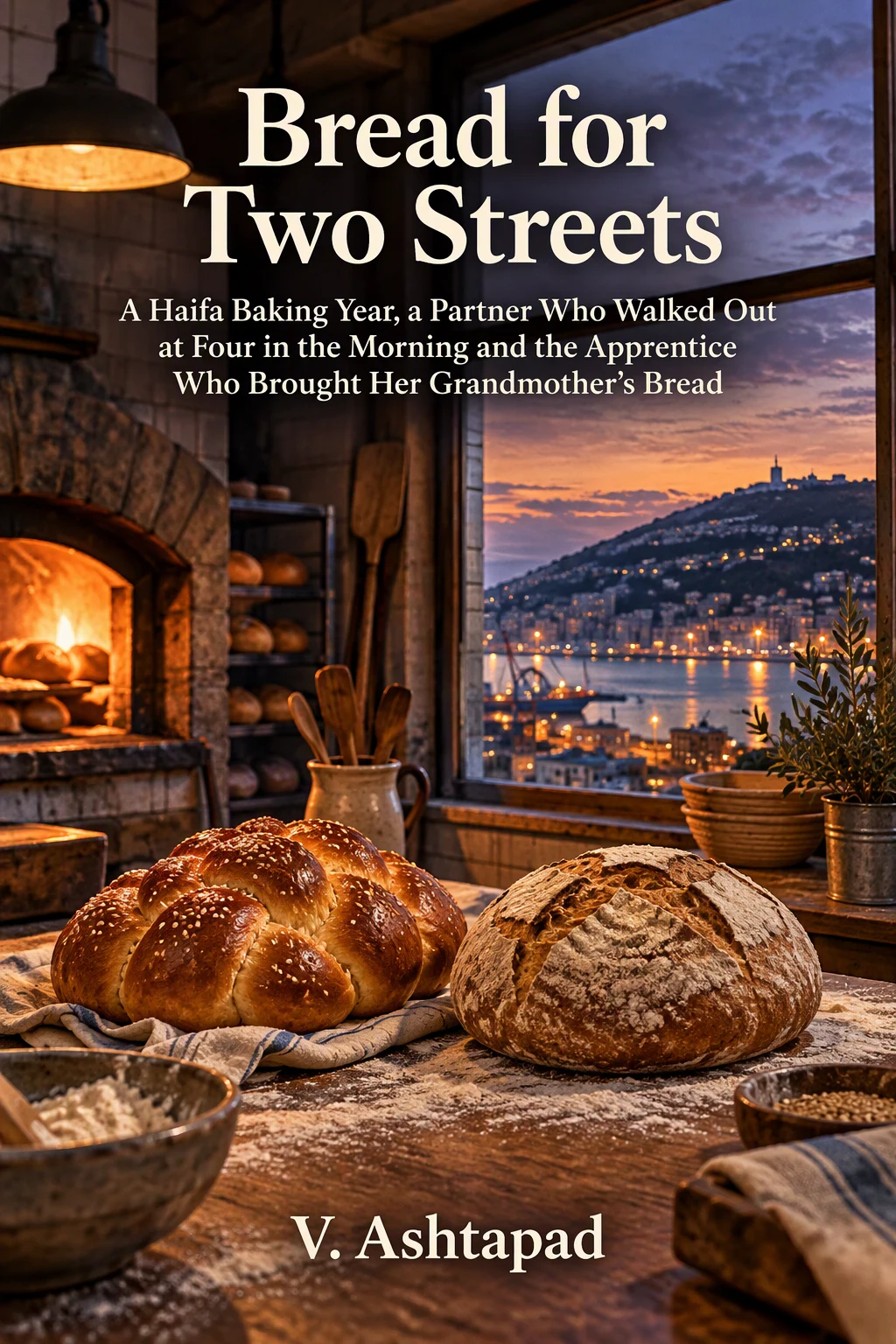
Bread for Two Streets
A Haifa Baking Year, a Partner Who Walked Out at Four in the Morning and the Apprentice Who Brought Her Grandmother's Bread
by V. Ashtapad
Foreword
This is a work of fiction. The breads, holidays and kitchen customs in these pages, from Iraqi laffa and Ethiopian dabo and injera to Romanian rugelach and the Moroccan open-house night of mufleta, are real traditions of Haifa's many families, and Haifa's neighborhoods, stairs and port are real places. The bakeries, families, customers and businesses in the story are invented, and any resemblance to real people is coincidental.
For everyone who has stood beside someone at a hot oven and learned by watching their hands.
Pita, Four in the Morning
The oven was already talking when Ronit Azoulay unlocked the back door. It ticked the way old ovens tick when they have been lit in the dark, a slow metal language of expansion, and the sound followed her down the three tiled steps into the bakery like a cat that wanted to be fed.
Four in the morning in the lower city of Haifa had its own weather. The sea wind came up from the port and pushed through the stair street behind the bakery, carrying salt and diesel and the faint sweetness of the grain silos. Above her, Mount Carmel was a dark shoulder pricked with streetlights that climbed in loops toward the top, and below, the port cranes stood lit in orange like tall patient birds. A ship was coming in. She could hear its horn, low and long, the way she had heard ships come in for most of her fifty-two years.
She tied on her apron, the blue one with the burn on the left pocket, and washed her hands to the elbow. The dough for the pita had been mixed the night before by Motti, as it had been mixed for twenty years, and it waited under damp cloths in the big plastic tubs, risen and domed and sighing a little when she lifted the corners. She pressed one finger into it. The dent came back slowly, the right amount of slowly. She smiled at nobody.
Motti was late. That was not a thing that happened.
Mordechai Shaashua had been her partner since she was thirty-two and he was forty-eight, since the winter they had both been laid off from the industrial bakery near the bay and had stood in the parking lot holding their last envelopes and said, at almost the same time, that they could do this better themselves. He made the pita and the Iraqi breads and the black rye. She made the Friday challah, the bourekas, the cakes, the cookies and anything that needed patience with butter. They had fought exactly four times in twenty years, and every one of those fights had ended with one of them eating something the other had baked and admitting it was good.
At ten past four the back door opened and Motti came in sideways, as he always did, because the door stuck at the bottom and he refused to let her fix it. He was sixty-eight, broad through the chest, with a white mustache he trimmed every Thursday and forearms covered in small pale burn scars like a map of a country only bakers lived in. He had his old canvas bag over his shoulder and he did not put on his apron.
Ronit said good morning, and told him the dough was perfect and that he would be insulted, because she hadn't touched it. Motti said good. He set his bag on the stool by the flour bins. He looked at the oven, then at the tubs, then at the long wooden table where they had shaped about four million breads between them. "Ronit. I'm going to make this batch and then I'm going home."
She asked if he was sick. He said no. He began to take off his watch, which was what he did before he touched dough, and then he stopped and held it in his palm. "I mean I'm going home. Not coming back. Today is the last day."
She laughed, because it was four in the morning and because Motti had a sense of humor so dry it sometimes took her until lunch to notice a joke. He did not laugh back. He put the watch in his shirt pocket and buttoned it closed.
He said he and Tova had talked, for a long time. His knees, the hours. Their grandson was walking now, and he had seen him walk exactly twice, both times on video. He had been thinking about it since the summer. She repeated since the summer, and asked when exactly he had planned to tell her. Now, he said. He was telling her now. She pointed out that it was October. Outside a truck downshifted on the hill, and the first oven ticked as it came up to heat.
"I know what month it is." He rubbed the back of his neck. "If I told you in the summer, you would have talked me out of it. You would have made me a cake. I would have stayed, and in two years I'd be standing here with a new knee and you'd be making me another cake. I'm sorry. I know this is a bad way to do it. It was the only way I could do it."
There were things she could have said and a few of them came up into her mouth. She swallowed them, because the oven was hot and the dough was ready and in forty minutes the first of the construction crews would be at the front window wanting pita for their breakfast, and because she had known this man long enough to know that when he buttoned his watch into his pocket the conversation was over until he unbuttoned it.
"Then we make the batch," she said.
They made the batch. Motti divided the dough with the bench scraper in quick, exact strokes, each piece weighing the same without the scale, and she rounded them on the table, cupping her palm and turning each ball against the wood until the surface went tight and smooth. They rested the rounds under cloth. They rolled them flat with the short pins, the ones whose handles had worn to the shape of their hands. Motti loaded the peel and slid the first eight discs onto the hot stone deck, and they stood shoulder to shoulder and watched the miracle they had watched every morning for two decades, the moment when the flat pale circles began to tremble and then lifted, swelling into pillows as the steam inside them pushed the two faces apart.
Motti said quietly that it never got old. She told him not to leave it, then.
He pulled the pita out with the peel and stacked them in the basket, golden at the edges, the tops dusted with flour like the first light on a roof. He did not answer her.
At five the front window went up and the street came in. The market street ran across the front of the bakery and the stair street ran up beside it, so that the bakery sat on a corner where the city changed its mind, flat commerce on one side and steep climbing life on the other. Men in orange vests from the port took their pita in paper bags. A woman with a small dog bought six and a bag of sesame bread sticks. The fish man from two doors down took his usual twelve and asked Motti about the football, and Motti answered as if it were a regular day, and Ronit made change with fingers that did not feel like her own.
By seven the rush was over. Motti washed the peel and hung it on its hook. He wiped down his half of the table. He took a brown envelope from his bag and set it squarely on the clean wood.
His lawyer had written it all out, he said. His half of the business. She would pay him what she could, when she could, no interest. If she wanted to sell, she could sell and give him his share. If she wanted to keep it, she could keep it. She knew the suppliers better than he did anyway, and the flour man liked her. She said the flour man liked him.
"The flour man is afraid of me. It's different." He looked around the room the way a person looks around a train compartment before stepping off. "The starter for the rye is in the back fridge, the green tub. Feed it. Don't let Eyal tell you to buy a machine."
She said her son lived in Tel Aviv and didn't tell her anything. Motti said good, and put on his cap. At the back door he stopped, his hand on the sticky frame. "Ronit. You were the best partner a stubborn man could have. I mean it."
She told him to stay and be stubborn here, then. He said he couldn't, and pushed the door open with his shoulder. Wind came in, cool, salty, and the ship horn sounded again from the port, two short notes. "Fix the door," he said, and was gone.
She stood a long time in the empty bakery. The oven ticked. The radio, which neither of them had ever turned on before six, was silent on its shelf above the sink. On the wall by the flour bins there was a calendar from the flour company, a photo of wheat in a field that looked nothing like Israel, and next to it the old corkboard covered in twenty years of things: a child's drawing of a loaf with legs, Motti's grandson's birth announcement, a postcard from a customer's trip to Lisbon, a list of the holiday orders from last year in Motti's square capitals.
She took her phone from her apron and opened the family pages her son had set up two winters ago, the private ones where her cousins in Ashdod and her aunt in Montreal posted photos of weddings and new babies. There was a folder there called The Bakery that she had almost forgotten. Eyal had made it the year he was home from the army, had walked around with his phone photographing everything, and had asked Motti to stand by the oven and say a few words. She found the clip. Motti, ten years younger, mustache darker, looking embarrassed in the steam.
"What do you want people to know about pita?" Eyal's voice asked from behind the camera.
"That it's simple," Motti said in the recording. "Flour, water, salt, yeast, heat. And that simple is the hardest thing there is. Can I go back to work now?"
Ronit laughed out loud in the empty room, and then she turned the phone over and pressed both palms against the wood, and for a minute she let herself be fifty-two and alone at seven in the morning with a basket of cooling bread.
Then she got up, because there was challah dough to start for Friday, and the bakery did not care who had left.
© 2026 CRUNOD LLC. All rights reserved.
The Friday Loaf
Friday came the way it always did, all at once.
By Thursday night Ronit had made three batches of challah dough, the rich yellow kind with eggs and a little oil and honey, and she had made them alone, which meant she had made them slowly. The big mixer groaned under the weight. She had to stop twice to scrape it down. At one in the morning she woke on the cot in the back office with flour on her eyelashes and a cramp in her calf and the alarm on her phone shouting at her, and she stumbled out to the table to begin braiding.
Braiding was her pleasure. She had learned it at nine years old from her mother, who had learned it in Bucharest from her own mother and who believed with the full stubbornness of Bucharest that a challah should be six strands, no fewer, and should shine like a polished shoe. Her father's side, who had come from Meknes in Morocco and settled on the slopes of Haifa in a stone house with a fig tree, made their Friday bread round and rough, scented with anise, and her grandmother Mazal had never braided anything in her life except her own long hair. Ronit made both. On the shelves of the bakery on Friday mornings there were tall braided loaves glossy with egg and seeded with poppy and sesame, and there were low round loaves with a crackled crust and a star of anise in the crumb, and her customers chose by family, by mood, by whatever their grandmothers had made.
Six strands. Over two, under one, over two. Her fingers knew it. The dough was soft and cool and smelled faintly of honey. She lined the braids on the trays in rows like sleeping children and brushed them with beaten egg, and the clock over the sink said two-fifteen, and she understood, with a clarity that sat in her stomach like a cold stone, that she could not do the pita this morning. There were not enough hands.
At five the construction men came to the window, smelling of cigarettes and cement dust, and she told them there was no pita today, she was sorry, only challah and bourekas. The oldest of them, a man named Shimon with a gray beard and a bag of tools, wanted to know what had happened, and where Motti was. She said Motti had retired. Shimon stared at her as if she had said the sea had retired, and asked since when. Since Tuesday, she said.
He bought two challahs anyway, the round anise ones, and told her that his wife would be happy because she liked those better than pita, and went away shaking his head. By seven, four more people had asked about Motti. By nine, the whole market street knew. The fish man came to the doorway in his rubber apron and said, "Twenty years, and he didn't tell you?" and she said, "He told me Tuesday," and the fish man said a word about Motti that he would never have said to Motti's face and bought a challah for his mother.
The Friday rush in the lower city was a kind of music. Women came down the stair street with shopping baskets and climbed back up with them full. A boy delivered flowers to the café across the way, bucket after bucket of white and yellow chrysanthemums, and their smell drifted across to the bakery and tangled with the baking. From the market came the shouting of the vegetable sellers, the clatter of crates, a radio playing an old Mizrahi song with a violin that wept and laughed in the same phrase. Ronit sold challah until her arms ached. She sold every round loaf by ten and every braid by eleven-thirty, and when the last woman left with the last loaf under her arm, she sat down on the step behind the counter and looked at the empty racks and did not feel proud. She felt like someone who had swum across a bay and was now being asked to swim back.
She could hire a baker. There were bakers in Haifa, good ones, men and women who had worked for the chains and the hotels and would come for a salary and do the job well. She thought about it all through Shabbat, on her balcony in the evening with the city lights spreading below her down to the dark water. A professional would come in, look at her oven, tell her it was old. Would tell her the mixer was old. Would want to change the pita recipe, because every professional baker in the country believed his own pita was the true pita. Would leave in a year for a better offer.
She did not want a baker. She understood this on Saturday night, when she got up to fill her water glass and stood in her small kitchen and looked at the tin box on the shelf where she kept her grandmother Mazal's recipes, written on the backs of envelopes in French and Hebrew and a shorthand nobody but Ronit could read anymore. She wanted someone who would learn. Someone who would stand next to her the way she had stood next to Motti and next to her mother before him. She wanted to teach.
On Sunday she took a piece of cardboard from a flour sack and wrote on it in black marker: APPRENTICE WANTED. EARLY HOURS. WILL TEACH. She looked at it, then added: MUST LIKE BREAD. She taped it to the inside of the front window, where the morning light would hit it.
For three days nobody came except a teenager who wanted to know if apprentice meant she would be paid to eat, and an older man who had been a baker in Kiev and wanted the job very much until he learned she opened at five. On the fourth day, Wednesday, a young woman came to the window at quarter past five and bought two cheese bourekas, as she had been doing, Ronit realized, for several weeks. She was tall and narrow with a long neck and her hair pulled back under a gray knit cap, and she wore the dark blue fleece of the logistics company that ran warehouses along the port. She paid with coins. She looked at the sign.
She asked if it was real. Ronit said it was cardboard, but yes.
The young woman broke one of her bourekas in half, right there at the window, and looked at the inside. She looked at the layers, the way the dough had separated into thin pale leaves around the salty cheese. Then she pressed the edge of the pastry between her thumb and finger, just slightly, and watched how it gave and how it came back.
Ronit had seen exactly one other person do that with her bourekas. It was Motti, the first week they opened, checking whether she knew what she was doing.
Ronit asked her name. Liya, she said. Liya Admasu. She lived in Kiryat Haim, by the beach, and she nodded north toward the curve of the bay, where the lights of the refinery were going pale in the dawn. She finished her shift at five, and she came here because the bus stop was on the corner.
"And you pinch my bourekas."
Liya colored a little. "My grandmother bakes. Every day, still. She taught me to check the bread before you eat it. She says the bread tells you how the baker was feeling."
Ronit asked how she had been feeling, then. Liya looked at the half boureka in her hand as if it might answer. Tired, she said. But careful.
Ronit took the cardboard sign out of the window, folded it in half and put it under the counter. "Come back tomorrow at four," she said. "In the back, by the stairs. The door sticks. Push with your shoulder."
© 2026 CRUNOD LLC. All rights reserved.
Bourekas and Warm Hands
Liya came at four exactly, which Ronit noted, and pushed the door with her shoulder, which Ronit also noted, and stood on the bottom step blinking at the light as if she had walked into a room full of people she did not know.
"Wash to the elbow," Ronit said. "Apron on the hook. The one without the burn."
There was no apron without a burn. Liya chose the least burned one and tied it twice around her narrow waist. She washed her hands for a long time, carefully, between the fingers, and dried them on the towel, and then she stood by the table with her hands held a little away from her body like a surgeon waiting for gloves.
"You don't have to stand like that," Ronit said. "Bread isn't an operation. Bread is a conversation. You'll see."
They began with bourekas because Ronit believed in beginning with the hardest thing. If a person could learn to laminate dough, could learn to fold butter into flour without letting either one win, then pita would be a holiday and challah a pleasure. She took the block of dough out of the walk-in cooler, the one she had made the night before and rested for twelve hours, and she took out the slab of cold butter she had beaten flat between sheets of paper, and she laid them on the marble slab at the end of the table where it was coolest.
"The whole secret," she said, "is that the butter and the dough have to be the same temperature and the same softness. If the butter is harder, it breaks. If the butter is softer, it disappears into the dough and you end up with bread, not pastry. You want them to be like two people who agree to dance together. Neither one leads too much."
She showed it once, slowly, talking the whole time. The dough rolled into a rectangle. The butter laid on two-thirds of it. The fold like a letter, bottom third up, top third down. A quarter turn. Roll again, firm, even strokes from the center out. Fold again. Rest it in the cooler. While it rested, she mixed the fillings: salty white cheese crumbled with egg and a little parsley, mashed potato with fried onion, spinach wilted and squeezed dry. The smell of the onions frying in oil filled the room, sweet and sharp, and the oven ticked as it climbed to temperature.
Then she gave Liya the second block of dough and the second slab of butter and stepped back.
Liya rolled. She was not clumsy. Her strokes were even, and she turned the dough without being told, and she floured the marble lightly instead of drowning it. But by the second fold, Ronit could see the butter beginning to shine through the surface in greasy streaks, and by the third fold it was oozing at the edges, and the dough had gone soft and slack and sticky under Liya's palms.
"Stop," Ronit said. "Put it in the cooler."
Liya put it in the cooler. When she came back her face was very still in the careful way of someone who is used to being corrected and has learned to receive it without showing anything.
"It's not your fault," Ronit said. "Give me your hands."
Liya hesitated, then held them out. Ronit took them in her own. Liya's hands were long and strong, with calluses at the base of the fingers from lifting boxes at the warehouse, and they were hot. Not feverish. Just warm, the way some people's hands are always warm, the blood running close to the surface.
"You have bread hands," Ronit said. "Not pastry hands. You'd make beautiful challah. Your dough will always rise fast for you. But butter is afraid of you."
Liya said then she couldn't do bourekas.
"I didn't say that." Ronit let go. "Motti had cold hands. He used to say his hands were made for laminating and his heart was made for pita. I have hands in between. My mother had cold hands too. She would make strudel in August with the windows open and the butter never complained." She went to the sink and turned the cold tap on full. "Every five minutes, you put your hands under this. Then you dry them, and you put them flat on the marble for ten seconds. The marble drinks the heat. It's what it's for."
Liya looked at the marble, and at the tap, and then she looked at Ronit for a moment longer than was comfortable.
Ronit asked what. Liya said her grandmother said something like that. Not about butter; about the injera. She said the batter knows if you are angry, so you have to cool down first, and she washes her face before she pours. Ronit said her grandmother sounded like a sensible person. Liya said she was very sensible, and also very stubborn. Ronit said those went together. Ask anyone who knew Motti.
They did it again. Liya rolled for four minutes, then went to the sink and held her hands in the cold water until her knuckles were red, dried them, pressed them on the marble and counted under her breath, then rolled again. It was slower. It was clumsy in a new way. But the butter stayed in its layer. By the sixth fold the dough was smooth and cool and had the faint matte sheen Ronit was looking for, and when she cut a corner with the knife and held it up to the light, they could both see the stripes inside, dozens of them, thin as pages.
"There," Ronit said. "That's a book. Every layer is a page."
They cut the dough into squares and filled them, cheese in triangles, potato in rectangles, spinach in little closed purses, because that was how the lower city told one boureka from another without asking. They brushed them with egg and scattered sesame on the cheese ones and nigella on the potato ones, and slid the trays into the oven. Ten minutes in, the bakery smelled of butter browning, of toasted sesame, a smell like the inside of a warm wooden box.
When Ronit opened the oven door the bourekas had puffed to three times their height, their layers fanned out and crisp at the edges and golden as old coins. Liya leaned over the tray without a word and took one of the cheese triangles from the edge where it had cooled a little, and pressed its corner between her finger and thumb.
"How was the baker feeling?" Ronit asked.
Liya almost smiled. "Cold," she said. "In the hands."
"Good. That's how it should be."
At five, when the window went up, Shimon from the construction crew asked if the new girl had made the bourekas, and Ronit said yes, half of them, and Shimon said, "Which half?" and Ronit said, "You tell me," and he bought one of each and ate them in front of the window with his eyes closed and then said he couldn't tell, which was the best review Liya would get all year.
That afternoon, after Liya had gone home to sleep, Ronit sat at the little desk in the back office with a cup of mint tea and opened the shared recipe collection her cousin Dorit had started for the family, the one with Mazal's anise bread transcribed from the envelopes and her mother's poppy seed roll with a photo of her mother's handwriting beside it. Under the bourekas recipe, which Ronit had typed in herself years ago, she added a line: "For warm hands: cold water every five minutes, palms on the marble, count to ten." Then she sat looking at it, and after a while she added in parentheses: "Learned from Liya's grandmother, by way of the injera."
© 2026 CRUNOD LLC. All rights reserved.
Black Rye for Galina
The rain arrived in November, the first real rain, and the stair street turned into a waterfall.
It came down from Hadar in sheets, rushing over the old stone steps and carrying leaves and bottle caps and pink bougainvillea petals down past the bakery's back door and into the gutter of the market street. The sea below was the color of slate. The port cranes disappeared and reappeared in the gray. Ronit put a towel along the bottom of the back door and Liya, arriving at four with water running off her knit cap, stepped over it and said that the bus from Kiryat Haim had taken forty minutes because the road along the bay was flooded at the turn.
Shaking out her jacket, she said that in her grandmother's village they waited for rain the whole year, and when it came the children ran out and danced. Here everybody put towels on the door. Ronit said they danced on the inside, very quietly. The gutter over the back door was overflowing in a steady rope of water, and the whole bakery smelled of wet wool and hot butter.
The rain brought Galina.
Galina Petrovna Lerner was seventy-nine years old and had lived on the third floor of a building on the market street since 1991, when she had come from Kharkiv with her husband, her daughter and two suitcases, one of which contained nothing but books. She was small and held herself very upright, in a dark green raincoat buttoned to the throat, and every Tuesday for eighteen years she had bought one loaf of Motti's black rye, sliced, wrapped in paper, and had paid for it with exact change counted out of a small leather purse.
She came on a Tuesday, in the rain, at ten past seven, and stood at the window under her umbrella and looked at the shelf where the black rye had always been.
"Where is the bread," she said. It was not quite a question.
Ronit came to the window, wiping her hands, and told her she was sorry, Motti had retired, and she had not made the rye yet. Galina asked why not. Because she was not Motti, Ronit said, more sharply than she meant to.
Galina regarded her. Rain dripped from the edge of her umbrella in a steady curtain between them. "Mordechai was not born knowing how to make this bread," she said. "I taught him."
Ronit stared at her. "You taught him?"
"In 2007. He made it wrong for one year. Like a brick with seeds. I came every Tuesday and told him what was wrong. One day he made it right. Since then I come every Tuesday and tell him nothing." She closed her umbrella with a snap. "May I come in? It is raining on my head."
They sat Galina on the stool by the flour bins, and Liya made her a glass of tea in the Russian way, with a spoon of jam stirred in, because she had worked with women from Ukraine and Russia at the warehouse and knew how they liked it. Galina looked at the glass, then at Liya, and something in her stiff face softened by one degree.
She asked Liya where her family was from. Gondar, Liya said, in Ethiopia. Her grandmother and her mother had come when her mother was a girl, and Liya was born here, in the hospital up the hill.
"And mine from Kharkiv, and his from Baghdad, and hers"—Galina tipped her head at Ronit—"from everywhere. And all of us standing in one room because of a bread." She sipped the tea. "Good. Now. The rye."
The green tub was in the back of the cooler where Motti had left it. Ronit had fed it twice a week since he left, flour and water, without knowing exactly why, the way you water a plant someone has left in your care. She took off the lid. Up came a smell, sour and deep, like wet earth and old apples and something almost like beer.
"Still alive," Galina said approvingly. "He fed it well."
What followed was the strangest morning of baking Ronit could remember. Galina did not get off the stool. She did not touch anything. She gave instructions in a level, slightly accented voice, and when Ronit or Liya did something she disapproved of, she said only, "No," and waited. They mixed the dark rye flour with the starter and warm water and a spoon of molasses. Galina said, "More." They added more molasses. They added the coriander seed, which Galina made Liya toast first in a dry pan until it smelled like oranges, and then crush roughly under a glass. They added caraway, a handful. They added salt. Galina said, "No. Less." They took out a pinch.
The dough was not like any dough Ronit made. It was not elastic. It did not hold a shape. It was heavy, sticky, closer to clay than to bread, and it clung to their hands and the bowl and the spatula, and when Liya tried to knead it Galina said, "No. You do not knead rye. Rye is not wheat. You do not argue with it. You only put it where it needs to go."
They put it in the long tin pans with wet hands. They smoothed the tops with wet spatulas. They let it rise, which it did slowly, sullenly, only a little. Galina drank her tea and told them about the bakery near her apartment in Kharkiv, where she had stood in line on winter mornings as a girl, the snow squeaking under her boots, and the woman at the counter had cut the black bread with a long knife and weighed it on a brass scale and given her the small extra piece, the corner, to eat on the way home.
"Every child in that line got the corner," Galina said. "It was the rule of the bakery. So we would come back."
Liya had taken out her phone. She asked Galina Petrovna if she could record her saying that, about the corner. She kept a little collection of her grandmother's stories, for her brother when he was older, and she would like to have Galina's too, if she didn't mind. Galina looked at the phone suspiciously, and then at Liya, and asked why she wanted an old woman talking about bread. Liya said, simply, that when Galina was gone nobody else would remember that bakery in Kharkiv. And it sounded like a good bakery. The rye in the oven had begun to smell sour and dark, like a cellar after rain.
There was a long pause. The rain drummed on the skylight. Then Galina set down her glass and folded her hands in her lap and said, "All right. Tell me when," and Liya held up the phone, and Galina told the story of the corner again, slower this time, with the snow and the brass scale and the long knife, and at the end she added something she had not said before, which was that the woman at the counter had been named Lyuba, and that she had known every child's name in the line.
The rye baked for an hour and ten minutes at a low heat. It came out of the tins almost black, with a crust that crackled faintly as it cooled and a smell so dense and dark and sweet that the fish man came over from two doors down to ask what was burning. Galina would not let them cut it.
"Tomorrow," she said. "Rye must sleep one night. If you cut it today it will be gum." She stood, buttoned her raincoat to the throat, opened her umbrella. At the door she turned back. "Next Tuesday I will come and tell you what is wrong with it."
Ronit asked how she knew something would be wrong.
"Because it is the first one," Galina said. "Something is always wrong with the first one. That is how you know it is yours."
© 2026 CRUNOD LLC. All rights reserved.
The Round Bread from Gondar
In December the bakery smelled of frying.
It was the season of jelly doughnuts, and for eight days the lower city ate them as if they were medicine. Ronit fried them in the big pot in the back, two hundred a morning, and Liya piped them full of strawberry jam and rolled the tops in powdered sugar until her eyebrows went white. They sold them warm from a tray in the window and the children of the market street pressed their noses to the glass. In the evenings small lights burned in apartment windows up and down the stair street, and the sea wind blew cold, and the oranges came in heaps to the market stalls, bright as lamps.
On the last morning of the doughnuts, Liya arrived at four carrying a bundle wrapped in a white cloth with a woven border of green and gold.
"My grandmother sent this," she said, and lowered it onto the table the way you would lower a sleeping animal. "She says if I'm learning from you, you should learn from her. She says a bakery that only gives and never takes is a bakery that doesn't listen."
Ronit wiped her hands and unfolded the cloth.
Inside was a round loaf, large, almost the size of a car wheel's hub, low and wide with a pale golden crust. The top had been scored before baking in a pattern she did not know, a circle with lines radiating from it like the sun in a child's drawing, and the bottom, when she lifted it, was marked with the faint leaf-shaped impressions of whatever it had been baked on.
"It's called dabo," Liya said. "For celebrations. For when someone comes home, or when someone's born, or for the new year. In Ethiopia it's baked in a clay pot, wrapped in leaves, buried in coals. Here my grandmother uses a heavy pot in the oven with banana leaves from the market man, or cabbage leaves if he's out." She paused. "She made it last night. For you. Because you took me."
Ronit did not quite know what to say to this. She put her nose close to the loaf. It smelled of wheat and something warm and resinous, a spice she half-recognized.
She guessed cardamom. Liya said cardamom, and a little fenugreek, and black seed, and that her grandmother ground them herself, by hand, every time. Ronit asked if she could cut it. Liya said she had to; that was the point. Her grandmother said the oldest person in the room had to cut it. She hesitated. That was Ronit.
"Thank you very much," Ronit said dryly, and took up the bread knife.
The crumb inside was close and soft and faintly yellow, and the spice was in it in small dark flecks. Ronit tore a piece and ate it standing up. It was not sweet, not like challah, but it had a richness that came slowly, and the cardamom bloomed in the back of the throat a full second after swallowing, like a door opening in another room.
And then, because she had been a professional baker for thirty years and because her mind did it without asking her, Ronit thought: it needs more salt. And a little more hydration, the crumb is tight. And the bottom is too dark, the pot was too hot. She opened her mouth.
Liya was watching her. She was standing by the marble slab with her fingers knotted against her apron, her mouth quiet and her eyes anything but.
Ronit closed her mouth.
She took another piece, and this time she ate it slowly, the way Galina drank her tea, and she tried to taste not what she would have done but what Liya's grandmother had done. The tight crumb, she realized, held together. You could tear this bread and pass it from hand to hand around a crowded room and it would not crumble. The low salt let the cardamom and the fenugreek come forward instead of being shouted down. The dark bottom tasted faintly of the leaves, green and smoky, the way a meal cooked over coals tastes of the fire. It was not a bread that had gotten anything wrong. It was a bread that wanted different things than hers did.
"Tell me how she makes it," Ronit said. "Everything. The order she does things in. What her hands do."
Liya let out the air she had been holding. Then she began, and as she talked she began to move, her hands shaping in the air above the table. Her grandmother, whose name was Yeshi, made the spice mix first, always first, toasting the seeds in a small dry pan and grinding them in a stone mortar she had carried from Gondar to Addis Ababa to Haifa. She warmed the water with her wrist, never a thermometer. She made the dough in a wide shallow basin and kneaded it on her knees on the kitchen floor, because the table in the apartment was too high for her, and she sang while she kneaded, a song about a mother at a crossroads expecting her son to come home from the market.
Ronit asked what the words were. Liya said that in English it would be something like the road is long but the bread is warm, over and over. It was for timing. When the song ended three times, the dough was ready. Liya smiled a little. "Once I tried to do it with a timer instead. She told me it would taste like a timer."
Ronit laughed, a real laugh, the first in some days. Then she went to the shelf above the sink where she kept her own grandmother's tin box, which she had brought down from her apartment weeks ago without telling herself why. She opened it. She took out a soft, much-folded envelope, and unfolded it on the table between them, and showed Liya the faded blue writing on the back.
"My grandmother Mazal," she said. "From Meknes. This is her anise bread. Look—she doesn't write amounts. She writes 'flour until it stops sticking.' 'Water warm as a baby's bath.' 'Anise, a good handful, more if your husband is in a bad mood.'"
Liya bent over the envelope. "She writes like my grandmother talks."
"Everybody's grandmother writes like everybody's grandmother talks," Ronit said. "That's how you know they're the real recipes."
They did not bake the dabo that morning. There was no time, with the last of the doughnuts and the regular orders and the bourekas. But at the end of the shift, when the window was down and the floor swept, Ronit wrapped half of the remaining loaf back in its green and gold cloth and handed it to Liya, and the other half she wrapped in paper and set aside.
It was for her mother, she said, who was eighty-one and lived up the hill and would tell her it needed more salt. Liya asked if she would tell her it didn't.
"I'll tell her what your grandmother would tell her," Ronit said. "That it tastes like the person who made it."
That night, at home, Ronit scrolled to the family pages her son kept and opened the map Eyal had made of the places that mattered to them, pinned in colors: the stone house with the fig tree on the slope where her father had grown up, the apartment in the German Colony where her mother had lived as a newlywed, the industrial bakery by the bay where she and Motti had met, the bakery itself on its corner. She studied it until her tea went cold. Then she sent Liya a message asking whether her grandmother would mind if she added a pin for an apartment in Kiryat Haim, a kitchen floor, a stone mortar from Gondar. A few minutes later Liya wrote back. "She says yes. She says you should also add the market man with the banana leaves, because without him there is no bread."
© 2026 CRUNOD LLC. All rights reserved.
Sesame at Dawn
Hanna Khoury had been baking ka'ak in Wadi Nisnas since before Ronit was born, or at least his father had, and his grandfather before that, and he spoke about the three of them as if they were one long baker who happened to have changed faces twice.
His bakery was a ten-minute walk from Ronit's corner, through the market and up a narrow lane where the houses were old stone with arched windows and the walls were painted with murals of fish and lemons and children flying kites. The shop was hardly more than a doorway with an oven behind it, a deep vaulted oven lined with firebrick, and in front of it a wooden counter where the sesame rings lay stacked in towers, each one the size of a dinner plate and crusted thick with seeds.
Ronit had known Hanna for twenty years in the way that bakers in the same city know each other, which is to say that they nodded on the street, sent each other customers when they ran out of something, and once a year at the flour company's end-of-year party sat together and complained about the price of sesame. In January, when the sesame from her usual supplier came in stale and dusty for the second month running, she walked up the lane at five in the morning with Liya beside her to ask him where he got his.
The lane was cold and blue and smelled of woodsmoke. A cat sat on a windowsill washing its face. From Hanna's doorway came a gold light and a smell that stopped Liya in the middle of the street.
Liya asked what that was. Ronit said it was toasted sesame, real toasted sesame, and now she understood why Ronit had come.
Hanna was a short round man of sixty-seven with a gray mustache shaped like a sideways comma and thick glasses that steamed up every time he opened the oven door. He was standing at a long trough of dough when they came in, shaping rings with a quick twist of the wrists, and he did not stop.
He called her Azoulay and said he had heard about Shaashua, and he was sorry. Twenty years and the man leaves like a cat. Ronit agreed, like a cat, and introduced Liya, who was learning with her. Hanna looked at Liya over his steamed glasses and asked learning what. Everything, Liya said. Hanna said that was a good answer. He jerked his chin at a second trough. "Then wash your hands and make rings. I'll tell you about the sesame when you've made twenty."
Liya looked at Ronit. Ronit shrugged. It was his bakery.
The dough was soft and smelled faintly of mahlab, the ground cherry stone that gives ka'ak its whisper of almond, and Hanna showed Liya once how to roll a rope between her palms and loop it and seal the ends with a press of the thumb. Then he showed her how to dip the ring in a shallow tray of sugar water and lay it face down in a deep tray of raw sesame, pressing so the seeds clung in a thick even coat. Then he went back to his own trough and paid her no more attention, except that every few minutes, without looking up, he said "thinner" or "faster" or "good," and once, "your hands are warm, that's good for this, warm hands make the dough relax."
Liya glanced at Ronit with a face that said, that she had pastry hands somewhere after all.
While Liya made rings, Hanna told Ronit about the sesame. He bought it raw from a family importer near the old port, a man whose father had bought from Hanna's father, and he toasted it himself, never pre-toasted, because pre-toasted sesame had been toasted by someone who did not care about you. He showed her the big flat pan he used, black iron, older than both of them. He showed her how to stir with a wooden paddle in slow figure eights so the seeds near the edges did not burn while the seeds in the middle stayed pale. He made her smell it at three minutes and at five and at six and a half, and at six and a half the smell changed, deepened, went from sweet to nutty to something almost like coffee.
"There," he said. "Now. Take it off. Ten seconds more and it's bitter and you've wasted a morning."
Ronit took it off. She stood over the pan breathing it in. She thought of all the bourekas she had covered in dusty, stale, store-bought sesame for twenty years, and felt something between embarrassment and joy.
She asked why he had never told her this.
"You never asked," said Hanna. "Shaashua asked me once, about the oven, in 2009. Never again. Bakers are proud. My father used to say a proud baker eats his own mistakes for breakfast."
Liya finished her twentieth ring and laid it in the tray and stood back. Hanna came over and looked at the rings. He picked one up. He turned it in the light. It was a little uneven, thicker on one side than the other. He set it down and picked up the twentieth, which was nearly perfect.
"You started at one and you ended at twenty," he said. "That's all anyone does." He took a ka'ak from the cooling rack, still warm, and tore it in three and handed a piece to each of them, and they stood together in the narrow doorway in the cold blue lane eating sesame bread while the sun came up somewhere behind the Carmel and the first light touched the tops of the old houses pink.
Before they left, Hanna took them into the little room behind the oven, where there was a desk piled with invoices and a framed photo of a man in a white cap standing beside the same vaulted oven, and next to the photo a small screen propped against the wall, showing pictures that changed every few seconds. Hanna's grandfather at the oven in 1952. His father carrying a tray of ka'ak on his head down the lane. Hanna as a skinny teenager, laughing, covered in flour. A wedding. A grandchild blowing out candles on a first birthday cake. A street festival in the lane with tables stacked high with bread.
"My granddaughter put them all in," Hanna said gruffly. "She goes around asking every old person in the neighborhood for their photos. She writes down who is in them before we forget. The neighborhood council keeps them in the office now, everyone's together, so when you want to see who used to live in which house, you ask her." He shook his head. "Seventeen years old. She knows more about my family than I do."
Ronit asked if the granddaughter would want photos of the bakery on the corner, Motti and her, twenty years of them. Hanna said she wanted everything. That was the problem with her. The sesame was cooling on its tray, and it crackled faintly, like rain starting on a tin roof.
On the walk back down the lane, the paper bag of toasted sesame warm against her side, Liya said, "He didn't have to show you."
Ronit agreed that he didn't. Liya asked why she thought he had.
Ronit considered. The market was waking up around them, metal shutters rattling, a man hosing down the pavement in front of the spice shop so that the water ran red-gold with paprika and turmeric in the gutter. "Because I asked," she said. "And because I came to his door at five in the morning instead of calling. A baker respects someone who shows up when the oven is hot."
© 2026 CRUNOD LLC. All rights reserved.
Laffa, Slapped on the Wall
Motti came back on a Thursday in February, at quarter past four, sideways through the sticking door.
Ronit was at the mixer and did not hear him. Liya, who was at the table dividing pita dough, looked up and saw a broad man with a white mustache and a canvas bag standing on the bottom step, and she knew who he was at once, from the photographs on the corkboard and the stories and the shape of the empty space he had left at the end of the table.
"You must be the apprentice," Motti said. "She hasn't fixed the door."
Ronit turned off the mixer. For a few seconds the only sound was the oven ticking. Then she said, "You're early," as if he had been gone for an afternoon, and he said, "Tova sends cookies," and held out a tin, and she took it, and that was the whole of the reunion, or at least the whole of the part anybody else could see.
He had not come to work. He said so three times. He had come because his grandson had a cold and the daughter-in-law had banned him from the house until it was over, and because Tova had told him that if he sat in front of the television for one more morning she would put him out on the balcony with the laundry. He sat on Galina's stool by the flour bins and drank coffee and watched Liya divide the dough, and he did not say anything, and Ronit could feel him not saying it from across the room.
Finally she told him to say it. He said Liya was cutting too slow. Ronit said she was cutting accurately. He said she was cutting accurately and slow, and in August the dough would overproof while she was being accurate. He set down his coffee. "Here. Give it to me for a minute."
Liya handed him the bench scraper. He stood, and his knees cracked audibly, and he took the scraper in his right hand and laid his left on the dough and began to cut. Chop, chop, chop, the pieces falling away from the mass like slices from a loaf, each one the same size as the last. He did not look at them. He looked at Liya.
"You see? You don't measure with your eyes. You measure with the scraper. The width of the blade. Every cut, one blade. Your hand learns it. After a month you don't think." He gave the scraper back. "Try."
Liya tried. She was faster. She was less accurate. Motti put six of her pieces on the scale and grunted.
"Again."
Ronit went back to the mixer and left them to it. Behind her she heard the scraper on the wood, Motti's low voice, Liya's careful questions. It was like hearing a radio play in a language she used to speak.
When the pita was done and out the window and the first rush over, Motti asked if the taboon still worked.
The taboon was the small domed clay oven in the corner of the yard behind the bakery, under a corrugated tin roof, where he made the Iraqi laffa on Thursdays for the people who wanted it: the big thin flatbreads, soft and blistered and wide as a steering wheel, that could hold a whole meal wrapped inside them. Ronit had not lit it since he left. She did not know how. She had never needed to.
She said the taboon worked; she didn't.
He said then he would show the apprentice, since she was here. A gull landed on the tin roof over the yard and walked its length with a sound like someone tapping a pan with a spoon.
They went out into the yard. It was cold and bright, the sky washed clean by a night of rain, and from the yard you could see down between two buildings to a slice of the port and the sea beyond it, very blue, a container ship sitting on the horizon like a toy. Motti lit the taboon with olive wood and a twist of newspaper and fed it until the inside walls went from black to gray to a pale glowing white. Then he fetched from inside a bowl of soft wet dough and a round stuffed cushion covered in a cloth, the size of a dinner plate, its fabric stained and patched.
"This was my mother's," he said to Liya. "From Baghdad. She brought it in 1951. It's the most important thing in this bakery and she"—he nodded at Ronit—"has never touched it."
Ronit said that was because it was his.
"It's not mine. It's the bakery's." He pulled off a piece of dough, stretched it over his knuckles until it was nearly transparent, flipped it onto the cushion and stretched it more, so that it hung over the edges. Then he bent at the taboon's mouth, reached in with the cushion, and slapped the dough against the inside wall with one confident motion. It stuck. He pulled out the cushion empty.
They watched the dough through the opening. It bubbled and blistered almost at once, brown spots rising on its surface like freckles. After a minute he reached in with a long hooked iron and peeled it off the wall, and it came out soft and floppy and smelling of smoke and wheat, and he tossed it onto a cloth on the bench and tore off a corner for each of them.
"Your turn," he said to Liya.
The first one fell into the coals. The second one stuck but folded over on itself and burned in a lump. The third one, she got her whole arm too close to the opening and jerked back with a yelp, and Motti said "everyone does that once, now you know," and she said "I would have liked to know before," and he laughed, a big surprised bark that Ronit had not heard in four months.
The fourth one stuck. It bubbled. Liya hooked it out herself, and it was misshapen and a little too thick on one side, but it was laffa.
They ate it on the bench in the yard with olive oil and za'atar and a bowl of the pickled mango sauce Motti's mother had made and that Tova still made, which he had brought in a jar in his bag, yellow and sour and full of fenugreek. Liya tasted the sauce and her eyebrows went up.
She said fenugreek; her grandmother put it in the dabo. Motti said fenugreek was in everything if you went back far enough. Baghdad, Gondar, India. Everybody's grandmother had a jar of it.
For a while they sat without talking, the three of them on the bench, chewing, looking at the slice of sea. Then Ronit said, without turning her head, "Why didn't you tell me? Really."
Motti was quiet. A gull came over the wall and landed on the tin roof and looked down at them with one yellow eye.
"Because I was ashamed," he said finally. "Not of leaving. Of being tired. Twenty years I'm the one who's never tired. The construction men, the fish man, they say Motti is made of iron. And then one morning in July I'm lifting the flour sacks and I have to sit down on the floor. I didn't tell Tova for a week." He picked at the edge of the laffa. "If I told you, you would have looked at me differently. Like I was old. I didn't want to see you look at me like that."
"I wouldn't have."
"You would have. You'd have been kind about it. That's worse." He set the bread down. "And there was another thing. You lean on me. For twenty years you lean on me for the pita, for the rye, for the taboon, for yelling at the flour man. And I lean on you for everything else. It worked. But it meant you never learned my half and I never learned yours. If I told you in the summer, you would have found another Motti. I wanted you to have to find something else."
Ronit looked at Liya, who was looking very hard at the gull.
"You could have said all that in July," Ronit said.
"I could have," Motti agreed. "I'm saying it in February. It's a long road from my mouth to my mouth." He stood, knees cracking. "I'm not coming back. But Thursdays, if you want, when the grandson is well, I'll come at four and sit on the stool and complain. For the taboon. Until she can do it without me."
Ronit asked and then what. Then, he said, he would come and sit on the stool and complain about something else.
When he had gone, Liya washed the cushion cloth in cold water and hung it to dry over the back of the bench in the yard, where the winter sun fell on it. Ronit took a photo of it there, the old patched fabric with the sea behind it, and posted it to the bakery folder in the family pages with a line underneath: "Motti's mother's laffa cushion, Baghdad 1951. Used today by Liya." Within the hour her cousin Dorit in Ashdod had written that she remembered Motti's laffa from Eyal's thirteenth birthday party and someone must tell him so, and her aunt in Montreal had sent a heart, and Eyal had written from Tel Aviv: Who is Liya?
She wrote back: Come home on a Thursday and find out.
© 2026 CRUNOD LLC. All rights reserved.
Rugelach on the Hill
Ronit's mother lived at the top of a stair street in Hadar, in a third-floor apartment with a balcony that looked out over the whole bay, and she had lived there since 1974 and intended, she told everyone, to be carried out of it feet first and not one day before.
Miriam Azoulay, born Miriam Grünfeld in Bucharest in 1944, had come to Haifa at fourteen with her parents and a cardboard suitcase and a box of baking tins, and she had married a Moroccan boy from the slope below the German Colony when she was nineteen over the loud objections of absolutely everyone, and she had been right, and she never let anyone forget it. She was eighty-one now. She was small and sharp and wore her white hair in a bun pinned with a tortoiseshell comb, and she had begun, in the past year, to forget things.
Not everything. Not the important things. She remembered every recipe she had ever made and the birthdays of all her grandchildren and the name of the boy who had pulled her braid in the seventh grade. But she forgot whether she had eaten lunch, and she forgot to turn off the kettle, and twice in the fall she had phoned the bakery before dawn to ask why nobody had come to visit, when Ronit had been there the evening before.
Every Sunday after the bakery closed at two, Ronit climbed the stairs to her mother's apartment with a bag of bread and stayed until the evening. In March she brought Liya.
When Ronit suggested it, Liya had asked why; Miriam didn't know her. Ronit said it was because her mother made the best rugelach in Haifa and Ronit had never been able to get it exactly right. And because she liked young people more than she liked Ronit. And because she needed to teach someone, and Ronit had already been taught.
The stairs up to Hadar were long and steep and lined with cats and potted geraniums and old women sitting in doorways, and halfway up Liya stopped to catch her breath and look back down. The whole lower city was spread below them, the market, the roofs, the port with its cranes and stacked containers in red and blue and green like a child's blocks, and beyond that the bay curving north toward Akko, the water flashing in the afternoon light, and very far off, white against the blue, the line of buildings in Kiryat Haim where Liya's family lived.
Liya pointed out her grandmother's building, the tall one by the beach. Ronit said that from up here you could see everybody's grandmother's building. That was what the stairs were for. Below them the port cranes stood against the water, and somebody on a balcony was beating a rug.
Miriam opened the door before they knocked. She looked at Liya up and down, from her knit cap to her sneakers, and then she said, "You're very tall. Come in. Take your shoes off. Ronit, you didn't tell me she was so tall."
Ronit said she had told her Liya was tall. Miriam said she had said tall, not tall like that. Miriam took Liya by the elbow and led her into the kitchen. "Sit. Do you drink coffee? Ronit doesn't let me drink coffee after three, so you'll drink it for me and I'll smell it."
The kitchen was small and yellow and full of light, with a window above the sink that faced the bay, and every surface had been arranged for baking. The flour lived in a tin with a picture of a Romanian castle on the lid. The rolling pin, long and narrow and dark with age, hung on two nails over the counter. There was a jar of walnuts, a jar of apricot jam, a block of good chocolate, a bowl of sugar mixed with cinnamon, and in the refrigerator, Ronit knew without looking, a disk of dough wrapped in waxed paper, made yesterday and resting, because her mother always made the dough the day before, even on days she forgot everything else.
They made the rugelach. That is to say, Miriam made them and Liya helped, and Ronit sat at the little table by the window drinking tea and watching, which was not a thing she had done in that kitchen in forty years. Miriam rolled the dough out in a perfect circle, cold from the refrigerator, made with cream cheese and butter in equal parts and very little sugar. She spread it with jam and scattered walnuts and chocolate and cinnamon sugar over it. She cut it with a long knife into sixteen wedges, like a clock face, and showed Liya how to roll each wedge from the wide edge toward the point, tight but not too tight, so that the filling spiraled inside like the inside of a shell.
"Not too tight," Miriam said. "If it's too tight, the jam has nowhere to go and it runs out in the oven and burns and the whole kitchen smells like a fire. Leave it a little room to breathe. Everything needs a little room to breathe."
Liya said it was like the dabo, and Miriam asked what dabo was.
Liya told her. Miriam listened with her head on one side, her small hands still working, rolling wedge after wedge. When Liya mentioned the cardamom, Miriam stopped.
"Cardamom," she said. "My mother's cousin in Bucharest put cardamom in her poppy seed roll. Everyone said it was crazy. Everyone said she'd been reading too many books about India." She looked at the tray of rolled rugelach, then at Liya. "Do you have any?"
Liya did. She carried a small bag of her grandmother's spice mix in her coat pocket, the way some people carry mints, and she brought it out, and Miriam opened it and smelled it and closed her eyes.
"Put a little in the cinnamon sugar," she said. "Just a little. For the second tray. We'll see who's crazy."
They baked two trays. The first came out the way Miriam's rugelach had come out for sixty years, flaky and tender and glistening with jam, the edges caramelized dark. The second smelled different in the oven, warmer, deeper, and when it came out Ronit took one before it had cooled and burned her tongue and did not care.
Miriam waited. Ronit said it was good. It was very good. It was not hers.
"Of course it's not mine. It's hers." Miriam took one herself and ate it in small, deliberate bites, the way she ate everything. "It's both. It's mine and her grandmother's. That's how recipes go. You think they come down a straight line, mother to daughter to daughter. They don't. They come down a staircase. They go sideways at every landing."
Later, while the rugelach cooled on the rack and the sun went down orange over the Carmel ridge behind them and the lights came on in the port below, Liya asked Miriam if she would tell the story of coming to Haifa at fourteen. Liya held up her phone and asked if she could record it, and Miriam said, "If you like, but I'll talk too much," and then talked for forty minutes, about the ship from Constanța and the boy who was sick over the rail the whole way and the first time she saw Mount Carmel rise out of the morning haze, green and enormous, and decided nothing on earth could be lovelier, and about her mother unpacking the box of baking tins in the immigrant housing before she unpacked a single dress.
"Because," Miriam said, "the dresses could wait. Somebody had to bake something. Or else how would anybody know we'd arrived?"
Ronit had never heard that story. Forty years in that kitchen, and she had never heard about the tins. She sat with her tea gone cold and listened, and did not interrupt once, and when it was over and Liya had put her phone away, Ronit got up and kissed her mother on the top of the head where the tortoiseshell comb held her bun.
Miriam asked what that was for. For the tins, Ronit said. Miriam said she told that story every year. Ronit said no, Ima, she had never told her.
Miriam considered this, a small frown between her white brows. "Then I told it to someone else," she said. "Someone was supposed to hear it. Now someone did."
On the way down the stairs in the dusk, with a tin of the cardamom rugelach for the bakery shelf on Monday, Liya said, "Can I send you the recording? For your family pages. You could put it next to the photos of her."
Ronit said yes. That night she listened to it twice, once on the bus and once at home on the balcony, with the lights of the port and Kiryat Haim spread below her, and then she added it to the family pages under her mother's name, between a photo of Miriam at nineteen in a white dress with a tall Moroccan boy and a photo of Miriam at eighty in her yellow kitchen with flour on her hands.
© 2026 CRUNOD LLC. All rights reserved.
Teff Takes Its Time
The apartment in Kiryat Haim was on the seventh floor of a long white building a block from the beach, and from its narrow balcony you could see the whole bay in the other direction, from the north: the port and its cranes small and far, the city stacked up the green mountain like a crowd climbing a hill to see something, and at the very top, on clear days, the antennas on the Carmel ridge catching the sun.
"So that's what we look like from here," Ronit said, standing on the balcony with her coffee. "I always wondered."
Liya's grandmother Yeshi was seventy-four years old and stood about as high as Liya's shoulder. She wore a long white cotton dress with a woven border of green and red and gold at the hem and a white shawl, thin as gauze, folded over her shoulders, and her hair was covered by a scarf, and on her forehead and her neck were fine blue tattooed lines and small dots, faded, from a village girlhood that she rarely talked about. She did not speak much Hebrew and Ronit spoke no Amharic, so Liya translated, and quickly the three of them settled into a rhythm, Yeshi speaking, Liya turning it into Hebrew, Ronit answering, Liya turning it back, and in the gaps between, their hands doing the real talking.
It was April, just before the spring holiday, and Ronit had come on her day off to learn injera.
Liya had told her it was not hard, it just took time. Ronit had said that everything that was not hard just took time, and that was what hard meant.
The teff flour was in a big plastic tub in the corner of the kitchen, fine and gray-brown, almost the color of cocoa. Yeshi had mixed it with water three days ago, and the batter sat in a wide metal basin under a cloth, and when she lifted the cloth a smell came up that made Ronit step back. It was sour, deeply sour, sharper than Motti's rye starter, with something underneath it like cut grass and something else like the yeast smell of a brewery.
"Three days," Liya said. "Sometimes four, in winter. She can tell by the smell and by the bubbles on top and by a thin layer of water that comes up. When it's ready, she pours that water off."
Yeshi said something and Liya laughed.
Liya said her grandmother said Ronit looked like Liya's brother the first time he smelled it. He was four. He cried.
"I'm not going to cry," Ronit said, and then, because Yeshi was watching her with a face that was very kind and very amused, she added, "probably."
The pan was a broad flat round griddle of clay set over an electric element, a modern version of the clay plate Yeshi's mother had used over a wood fire. Yeshi wiped its surface with a cloth dipped in oil and a little ground seed, and when it was hot she took a pitcher of the batter, thin as cream, and poured it in a spiral from the outer rim of the griddle and moving inward in one continuous unbroken motion, around and around, until the whole surface was covered. Then she set a woven lid over it.
Under the lid, the batter steamed. When Yeshi lifted the lid, the top of the injera had risen into a field of tiny holes, hundreds of them, like a honeycomb, like the surface of a sponge, and the edges had begun to curl away from the pan. She slid a flat woven tray under it and lifted it whole, a perfect gray-brown circle, soft and spongy and slightly glossy, and set it on a cloth to cool.
"The holes are called eyes," Liya said. "A good injera has many eyes. It means the batter fermented right."
Then Yeshi handed the pitcher to Ronit.
Ronit had poured cake batter, pancake batter, crepe batter, the batter for her grandmother's Moroccan semolina pancakes with a thousand holes. She had been pouring things in spirals since before Liya was born. She stood over the griddle and took a breath and began at the outside edge and moved in, and halfway around her hand hesitated, just for a fraction of a second, because the batter was thinner than she expected, and the spiral broke. She went on. She closed the circle. She put on the lid.
When she lifted it, there was a gap in one side of the injera where the spiral had broken, a crescent of bare griddle like a bite taken out of the moon. The eyes were there, but fewer of them.
Yeshi looked at it. She said something. Ronit braced herself.
Liya said her grandmother said that was how her first one looked, when she was seven, and her mother hung it on the wall of the house for a week so everyone could see it. Ronit told them to hang hers on the wall. She deserved it.
It took six tries. The sixth had no gap. It had fewer eyes than Yeshi's, and it was slightly thicker in the center, and Yeshi tore a piece from its edge, folded it around a bit of the red lentil stew that had been simmering on the back burner all morning, thick with berbere and onions and garlic, and ate it and nodded once. She tore another piece and held it out to Ronit, not to her hand but to her mouth, the way you would feed a child.
"It's how we show respect," Liya said quietly. "You feed someone from your hand. Take it."
Ronit took it. The injera was sour and soft and the lentils were so hot with spice that her eyes watered, and Yeshi laughed and patted her arm and said something that did not need translating.
They were eating around a big round tray set on the low living-room table spread with injera and little heaps of stews and greens, when Liya's mother came home.
Almaz Admasu was a nurse at the big hospital up the hill, and she had worked the night shift, and she came in tired and stiff in her blue uniform with her bag over her shoulder. She stopped in the doorway at the sight of Ronit on her floor, and her face did the thing that Liya's face did, going still and careful, and Ronit recognized it at once.
They were polite. Almaz washed and changed and sat with them and ate. She spoke good Hebrew, fast and precise. She asked about the bakery, about the hours, about how many customers. She was perfectly pleasant and she did not smile once, and Ronit understood within ten minutes that she had not been invited to learn injera. She had been brought here to be seen.
When Yeshi had taken the tray to the kitchen and Liya had gone to help her, Almaz said, without preamble, "She was going to study."
"Liya?"
"Accounting. At the university. She had the grades. She was accepted. Then my husband got sick, and the money, and she went to the warehouse instead, for one year, to help. That was three years ago." Almaz folded her hands on her knees. "Now she gets up at three in the morning to go to a bakery. She comes home with burns on her arms. She is happy. I can see that. I'm her mother, I'm not blind. But she is twenty-three years old and she is lifting flour sacks for minimum wage."
The old Ronit, the one who had been about to tell Yeshi her dabo needed salt, would have defended herself. She would have talked about craft and tradition and the dignity of work, and about how a baker was not a lesser thing than an accountant, and about how much Liya had learned. All of that was true. Ronit could feel it rising. She let it rise and let it sit there, and she did not open her mouth.
Instead she looked at Almaz, really looked at her: the tired eyes, the uniform hung over the chair, the photograph on the shelf behind her of a smiling man in a suit with his arm around a much younger Liya in a school uniform. A woman who had worked nights for twenty years so that her daughter would not have to.
"Tell me," Ronit said, "what you want for her. Not what you don't want. What you want."
Almaz blinked. It was not, apparently, the question she had prepared for.
"I want," she said slowly, "for her to have something that's hers. That nobody can take from her. That if somebody gets sick, or a business closes, or a partner walks away"—she raised her eyebrows a fraction, and Ronit felt it land—"she still has it. A degree is that. Nobody can take a degree."
Ronit agreed that nobody could. Somewhere below the window a radio was playing, and the wind off the sea moved the curtain.
"And I want her not to be poor. I was poor. My mother was poor in a way you cannot imagine. I want her not to be."
Ronit nodded. She did not argue. She sat with it. From the kitchen came the sound of water running, and Yeshi's voice singing under her breath, and Liya's laugh.
"I can't give her a degree," Ronit said finally. "I can't promise she won't be poor. Bakeries are not a way to get rich, I won't lie to you. But I hear what you're asking for. Something that's hers. Something that holds. Let me think about it. Not today. I want to think about it properly, the way you'd want me to."
Almaz studied her for a long moment. Then something in her face eased, not much, but a little, the way dough eases when you stop working it and let it rest.
She said Liya had told her that Ronit listened, and she had not believed it, because everyone says they listen.
"I'm learning," said Ronit. "Your mother taught me something about it last December, with a loaf of bread."
Before she left, Yeshi pressed a small jar of the teff batter into her hands, wrapped in a cloth, so that she could start her own at the bakery. Liya showed her a page on her phone, the family tree a cousin in Ashdod kept for the whole Admasu family, from Yeshi's great-grandparents in a village near Gondar down to Liya's little brother Dawit, born in Haifa, with photos where they had them and blank gray circles where they did not. Yeshi's mother's circle was gray. Under it Liya had typed, "Made injera on clay over wood fire. Hung her daughter's first one on the wall for a week."
"I added that this morning," Liya said. "After she told you."
© 2026 CRUNOD LLC. All rights reserved.
Mufleta at Midnight
For a week every spring the bakery closed.
It was the holiday when leavened bread was put away, and for seven days the ovens on the corner went cold and the flour bins were sealed and covered with sheets, and the lower city ate matzah and complained about it with great pleasure. Ronit spent the week cleaning. She scrubbed the deck oven down to the stone and oiled the wooden table and finally, at last, took the back door off its hinges and planed the bottom edge so it would not stick. She hung it again and swung it open and shut, open and shut, and it moved like silk, and she stood there feeling strangely bereft.
On the phone she told Liya he would be furious. Liya said good. Then he would come and complain.
On the last night of the holiday, Ronit opened her apartment to the street.
It was what her father's family had always done, and his father's family in Meknes before that: the Moroccan custom of the night when the holiday ends, when the doors are thrown open and the tables are covered with sweets and flowers and anyone at all may come in, neighbors and strangers, friends and the friends of friends, and the hosts make mufleta until their arms give out. Her father had loved it more than any other night of the year. He had stood at the stove in a white embroidered caftan, his big hands shining with oil, making mufleta for six hours straight while the whole neighborhood ate and sang in his living room. After he died, eleven years ago, Ronit had kept it going. Some years forty people came. Some years a hundred and twenty.
She began preparing at five in the afternoon, as soon as the first star of the evening could be guessed at. The table in her living room was spread with a white lace cloth that had been her grandmother Mazal's, and on it she set bowls of dates and walnuts, little glass dishes of quince jam and orange peel candied in syrup, a plate of marzipan in pastel colors, a pitcher of milk and a bowl of fresh green fava beans in their pods, sprigs of mint, stalks of green wheat, and in the middle a bowl of flour with five gold rings and five eggs set into it, for luck and for plenty, the way her grandmother had always done.
The mufleta dough was the simplest thing in the world, flour and water and a little salt and oil, and she had made a great deal of it, a basin full, divided into balls the size of apricots and set on oiled trays under cloths. The trick was in the stretching. You oiled your hands and the counter and pressed a ball flat and stretched it, gently, gently, from the center outward, until it was thin enough to read a newspaper through, a shimmering pale sheet. You laid it in a hot dry pan. While it cooked you stretched the next one and laid it on top of the first, then flipped the stack, then added another, so that in the pan you built a tower of thin crepes, each one cooking against the last, layer on layer, until you had a stack of ten or twelve that you flipped out onto a plate and peeled apart, steaming, and spread with butter and honey.
Liya arrived at seven with her grandmother on one arm and her mother on the other, and behind them her little brother Dawit, who was twelve and wanted to see if the rumor about the gold rings in the flour was true.
Ronit told him it was true, and not to take any. Dawit said he wasn't going to, though he had been going to.
Yeshi paused on the threshold to take in the table with its flowers and sweets and green wheat and lace, and she said something to Liya, softly, and Liya translated: "She says it looks like the coffee ceremony at home. When everyone comes and there's popcorn and incense and the grass on the floor. She says, every people has a night when the door is open."
Then the door was open, and the people came.
They came up the stairs in twos and fives and tens. The fish man and his mother, who was ninety and had to be carried the last flight. Shimon from the construction crew with his wife and three daughters. Galina in her green raincoat, though it was not raining, carrying a small box of chocolates she said were from Kharkiv and were in fact from the supermarket on the corner. Hanna Khoury and his wife and his granddaughter, the one who wanted everything, who arrived with her phone held up and immediately began asking people if she could take their pictures for the neighborhood collection. Two of the Russian women from Liya's warehouse. A cousin of Motti's. Customers Ronit had known for twenty years and customers she had never seen before, who had heard the music coming down the stairs and simply walked in, because that was the custom.
Motti came at nine. He had Tova on his arm and his grandson on his shoulders, a fat-cheeked boy of two holding a fistful of his grandfather's white hair like reins.
In place of hello, Motti said she had fixed the door. She asked who told him. The fish man, he said, who said it opened so smoothly he thought it was a different bakery. Motti set his grandson down on the floor, where the boy immediately crawled under the table toward the marzipan. "Twenty years I told you to leave it."
"Twenty years you told me to fix it."
"I told you both. You picked the wrong one." But he was smiling under the mustache, and he went straight to the kitchen and took off his watch and buttoned it into his pocket, and without being asked he stood at Ronit's left shoulder and began stretching dough.
By ten o'clock the apartment was so full that people were standing on the balcony and on the landing and halfway down the stairs, eating mufleta from paper napkins. Someone had brought a darbuka drum and someone else an oud, and from the balcony came a song, an old Moroccan song that Ronit's father used to sing, about a girl at a well who counts the hours until moonrise, and half the people in the apartment knew it and the other half clapped. Dawit had found the bowl of fava beans and was eating them raw out of the pods with Hanna's granddaughter, comparing them unfavorably with french fries.
Liya came into the kitchen. She had been carrying plates for two hours and her face shone.
"Teach me," she said.
Ronit stepped aside. Liya oiled her hands. She pressed the dough flat on the oiled counter and began to stretch it, and her warm bread hands, which butter feared, were perfect for this, the dough relaxing at once under her touch, stretching thin and even and nearly transparent without a single tear. She laid it in the pan. She stretched the next.
At Ronit's other shoulder Motti said look at that, she had the hands for it. Ronit said she knew. She had known since the bourekas.
At midnight, in the hour when her father used to take a sprig of green wheat and dip it in milk and touch it to the forehead of every person in the room for luck, Ronit did the same, going from person to person through the crowd with a small bowl and a stalk of wheat. She touched it to Galina's forehead and Galina said "Nonsense," and kept her eyes closed for a long moment afterward. She touched it to Hanna's, and his wife's, and the fish man's mother's. She came to Yeshi, sitting very straight in Ronit's best armchair by the window with a plate of mufleta on her lap and honey on her fingers, and touched the wheat to her forehead, and Yeshi caught her hand and held it and said something.
"She says," said Liya, "may your bread always rise and your door always open."
Ronit's eyes stung. She went on through the room. When she came to Almaz, standing by the bookshelf with a glass of mint tea, she hesitated, and Almaz looked at her and bent her head a little, and Ronit touched the wheat to her forehead.
Ronit told her quietly that she had been thinking about what Almaz had said, about something that was Liya's. Almaz waited. Not tonight, Ronit said. Soon. She wanted it written down properly before she said it out loud.
Almaz nodded. "Good," she said. "Written down is good."
Hanna's granddaughter went around the room near the end of the night, gathering everyone onto the balcony and the steps below it for a photograph, which took twenty minutes and much shouting. In the picture, which she later added to the neighborhood collection with every face she could identify labeled underneath, there are sixty-three people crowded together on a narrow balcony and a flight of stone stairs, and behind them the lights of the port and the bay and Kiryat Haim curving north into the dark, and in the front, in the middle, holding a tray of mufleta between them, a short woman of fifty-two in a flour-dusted blue apron and a tall young woman in a gray knit cap, both laughing at something outside the frame.
© 2026 CRUNOD LLC. All rights reserved.
Anise Bread in the Heat
In August the sharav came, the hot dry wind from the east, and the city lay under it like bread under a cloth.
For four days the sea went flat and white and the air above the port shimmered so that the cranes seemed to waver like reeds. The stair street baked. The cats disappeared. The market sellers hung wet sheets over their stalls and sprayed the vegetables every hour and still the lettuces wilted by noon. At four in the morning, when Ronit unlocked the now-silent back door, the temperature inside the bakery was already thirty-one degrees, and by seven, with the deck oven at full heat and the proofing cabinet humming, it was forty.
Motti had been right about August. Dough overproofed while you looked at it. The pita rose so fast that Liya, cutting with the blade-width rhythm he had drilled into her every Thursday for six months, could just barely keep ahead of it. The butter for the bourekas went soft in the time it took to walk from the cooler to the marble. They gave up on laminated pastry after the second day and made only bread.
It was Ronit's idea to make Mazal's anise bread for the whole week.
"It doesn't mind the heat," she said. "My grandmother made it in Meknes in July. In a wood oven. In a kitchen with no windows. She used to say the bread liked it, it reminded the bread where it came from."
The recipe was on the envelope in the tin box, and Ronit knew it by heart, but she set the envelope on the table anyway and smoothed it flat, and Liya read it out loud while they worked, translating Mazal's French and shorthand Hebrew as best she could with Ronit correcting her. Flour, a mix of white and a little semolina for the color and the bite. Water warm as a baby's bath, which in August meant water straight from the tap. Yeast, a little; salt; a spoon of sugar. Anise seed, a good handful, more if your husband is in a bad mood. Sesame, toasted, for the top. Shape round, flatten with the palm, prick with a fork in a star. Let it rest under a cloth until it breathes. Bake hot.
"Until it breathes," Liya said. "How do you know when it's breathing?"
"You'll see. You put your hand over it, not touching, and you feel it. It gives off a little warmth, like a sleeping animal."
They shaped forty loaves. They pricked each one with a fork in Mazal's star pattern, which was not a star exactly but a sort of flower, eight short lines radiating from a center. They scattered Hanna's sesame, which Ronit now toasted herself every Sunday in a black iron pan she had found at the flea market, over the tops. Liya held her hand over a loaf and frowned and held it there and then her face changed.
She said there, it was warm. Ronit said that was breathing.
The first trays went into the oven at quarter to five, and at five past five the oven made a noise neither of them had ever heard, a sharp metallic crack followed by a long sigh, and the red light on the control panel went out.
Ronit opened the door. The heat was already falling. The loaves sat on the stone deck, half-risen, pale, beginning to sag.
She knew this oven the way she knew her own hands. She had had it serviced every spring for twenty years by the same repairman, a cheerful Bulgarian named Stoyan who had retired to Netanya and now sent his nephew. She called the nephew. The nephew did not answer. She called again. On the third call he picked up, sleepy, and listened to her describe the noise and said, "That's the heating element. The big one. I'll have to order it. Maybe a week. Maybe ten days, in August."
Ronit said she couldn't close for ten days.
"Then buy a new oven," said the nephew reasonably, and Ronit hung up on him and stood in the stifling bakery with forty loaves of her grandmother's bread dying on the table and the window due to go up in fifty-five minutes.
Liya was already moving. She pulled the trays out of the dead oven and carried them, two at a time, out to the yard, where the taboon sat under its tin roof.
Ronit said it would take an hour to light, and it couldn't do loaves like these; it was for flatbread. Liya said then they would be flatbread. Flatter. Ronit's grandmother had baked in a wood oven, she had said, and this was a wood oven. The sun was already on the yard wall, and the cats had gone under the taboon's tin roof for the shade.
There was no time to argue. Ronit lit the taboon with olive wood and newspaper, the way Motti had shown them, while Liya reshaped the loaves, pressing them thinner with her palms, pricking the star again where it had blurred. When the clay walls went pale and glowing, they did not slap the dough on the walls, which would have torn it, but laid the loaves on a flat iron plate that Motti used for his eggplant and slid the plate into the mouth of the oven, three loaves at a time. The heat came out of the opening like a hand pushing against their faces. The smell of anise and toasting sesame and olive wood smoke filled the yard and rose over the wall into the stair street.
It was not Mazal's bread exactly. The loaves were flatter and wider and charred in spots where they touched the iron, and the crumb was more open, and they had a faint smoky taste the deck oven never gave. But when Ronit tore one open, steaming, and the anise rose up out of it, she was a small girl again in a stone house with a fig tree, sitting on a stool in her grandmother's kitchen while Mazal hummed and pulled bread from a black iron pan over a gas flame because the oven in that house had never worked properly either.
"She did this," Ronit said. "My grandmother. I forgot. The oven in the stone house was broken my whole childhood. She made all her bread in a pan on top of the stove."
Liya said then this was the real recipe.
They sold the anise flatbread from the window that morning, three at a time as fast as the taboon would make them, with a hand-lettered sign Liya made on the back of a flour sack that said FROM THE WOOD OVEN TODAY ONLY, and the line went down the market street to the corner and partway up the stair street, because the smell had reached everyone first. Shimon bought six. The fish man bought ten, for his mother and his sisters. Galina, though it was a Wednesday and not her day, came down from the third floor in a sun hat and bought one and stood in the shade of the awning eating it and said nothing at all, which Ronit had learned was the highest praise she gave.
By ten the dough was gone. They were soaked in sweat, both of them, their aprons black with soot, Liya's forearm sporting a new red burn in the shape of the edge of the iron plate. They sat on the bench in the yard with two bottles of water from the fish man's ice chest and did not speak.
Ronit's phone buzzed. A message from Hanna's granddaughter: someone in the lane had seen the line and sent her a photo, and she had added it to the neighborhood collection, and did Ronit want a copy? The picture showed the market street from above, from someone's balcony, the line of people snaking from the bakery window around the corner, and in the bottom of the frame, a thin plume of white smoke rising from behind the bakery wall into the hot white sky.
Ronit showed Liya. Liya looked at it for a long time. "We should keep that," she said. "For the bakery's pages. When people ask what happened the summer the oven broke."
Ronit said people wouldn't ask.
"People always ask," said Liya. "Later. When it's a story. My grandmother says nothing is a story while it's happening. It's only a story when someone asks you to tell it."
© 2026 CRUNOD LLC. All rights reserved.
Night Bread in Wadi Nisnas
The element did not come in a week. It did not come in ten days. On the fourth evening, Ronit walked up the lane to Hanna Khoury's bakery at nine o'clock at night, after he had closed, and knocked on the shutter.
He opened it in a white undershirt, glasses parked high on his forehead, and a newspaper under his arm. He did not seem surprised.
He said the taboon was too small for her bakery. He had seen the line. She couldn't feed the market street three loaves at a time. She agreed she couldn't.
"And my oven is cold from noon until four in the morning. Every day." He shrugged. "My father used to lend this oven at night. To the women in the lane, for their own bread, for weddings, for anything. Before everyone had an oven in the kitchen. So." He stood aside. "Bring your dough at eleven. I'll leave the key under the flowerpot. Be out by three-thirty, I start at four."
"Hanna. I'll pay you."
"You'll pay me in sesame," he said. "When the market man raises the price this winter, you'll go and argue with him for both of us. He's afraid of you since you fixed that door."
For eleven nights, from the end of August into the first days of September, Ronit and Liya made the bakery's bread in Hanna's vaulted oven in the lane.
They mixed the dough in the late afternoon at the corner bakery, in the big mixer that still worked, and let it rise slowly in the cooler. At half past ten they loaded it onto two rolling racks, covered with damp cloths and then with plastic, and pushed the racks through the market, which at that hour was dark and empty and smelled of crushed tomatoes and wet cardboard and jasmine from someone's courtyard. The wheels rattled on the stones. A man smoking on a balcony called down to ask if they were moving house. They pushed the racks up the lane, past the murals of fish and lemons and kite-flying children ghostly in the streetlight, and unlocked Hanna's shutter with the key from under the flowerpot, and lit his oven with his wood, and baked.
Hanna's oven was not like hers. It was deep and vaulted and heated from a fire at one side, so that the back left corner was always hottest and the front right always coolest, and loaves had to be moved during baking, rotated with the long wooden peel, to cook evenly. The first night they burned a whole tray of challah and undercooked a tray of pita. The second night they burned less. By the fifth night Liya had made a map of the oven's floor in chalk on the wall beside it, a rough half circle divided into zones with numbers for how many minutes each kind of bread needed in each zone, and Ronit considered it, hands on her hips.
She said Hanna was going to see that. Liya said she would wipe it off before they left.
"Don't," Ronit said. "Leave it. He'll want to know."
Those nights were the quietest Ronit had ever spent with another person. There was nobody at the window, nobody at the back door, no phone, no radio. There was only the fire crackling, and the scrape of the peel on the brick, and the lane outside silent except for cats and the occasional late car on the street below, and far off, down the hill, the hum of the port working through the night, the cranes lit orange, the ships coming and going under floodlights. They talked in low voices, the way people talk in a house where someone is asleep.
On the seventh night Liya asked Ronit why she had picked her.
"Over the man from Kiev," Liya said. "He had thirty years. I had nothing. I had pinching bourekas."
Ronit turned a tray of rolls with the peel and watched the fire for a while before she answered.
"The man from Kiev was a better baker than you," she said. "That year. He'd have been a better baker than you for five more years, maybe ten. But he'd have come into my bakery and made his bread. Kiev bread. Good bread. And I'd have made mine. And we'd have stood at opposite ends of the table and been polite." She slid the peel out. "You pinched the boureka and then you looked at me. Like you were asking it something, and then asking me. You wanted to know how I was feeling. Nobody in twenty years had asked the bread how I was feeling."
Liya was quiet. Then she said, "My grandmother would like that answer."
"Your grandmother," said Ronit, "is the reason I gave it."
On the ninth night, at about one in the morning, the shutter rattled and they both jumped. It was Hanna, in a cardigan over his undershirt, with a thermos.
"I couldn't sleep," he said. "My wife said, go and see if they've burned my oven down. So." He looked at the chalk map on the wall. He took his glasses down from his forehead and put them on and looked at it longer. He walked up to it and traced the zones with one thick finger.
He asked about the back left. Seven minutes for pita? Liya said six and a half, seven if the fire had just been fed.
"I've been telling my nephew this for ten years," Hanna said. "Back left is hottest. He never listens." He poured three cups of coffee from the thermos, thick and sweet with cardamom, and they drank it standing in front of the oven door with the firelight on their faces. "I'm going to keep this," he said, tapping the wall. "I'm going to have my granddaughter take a picture of it and put it with the photos. With the names of who made it. Your names. So when my nephew is old and his nephew asks why the pita goes in the back left, there's an answer."
On the twelfth day, the element came. Stoyan's nephew installed it in forty minutes and charged her for three hours, and the red light on the control panel came on and the deck oven began to tick again in its old metal language. That night, for the first time in two weeks, Ronit slept in her own bed. She woke at three without an alarm and lay there in the dark, listening to the sea wind in the street, and found to her surprise that she missed the lane.
© 2026 CRUNOD LLC. All rights reserved.
The Loaf with Two Stars
The papers took Ronit three weeks to get right, and she rewrote them four times, and she did not show them to Liya until she had shown them to Liya's mother.
It was a Sunday afternoon in late September, the heat finally broken, a soft wind off the sea and the first clouds of autumn sitting low over the Carmel like folded cloth. Ronit took the bus to Kiryat Haim with a cardboard folder under her arm and a box of the cardamom rugelach, which her mother now insisted on calling "the tall girl's rugelach," and she climbed the seven floors because the elevator was out, and she sat on the floor of the Admasu living room at the low table with Yeshi and Almaz and Liya, and she opened the folder.
"Before I read this," she said, "I want to say what I heard. In April. So you can tell me if I heard it wrong."
Almaz folded her hands. Yeshi, who had the conversation translated in a low murmur by Liya at her ear, leaned forward a little.
"You said you wanted Liya to have something that's hers," Ronit said. "That nobody can take. That holds if somebody gets sick or a business closes or a partner walks away. And you said you didn't want her to be poor. And I think, though you didn't say it, that you didn't want her to give up the thing she was good at in school. The numbers. Because she was good at it, and she chose it, and then life chose something else for her."
Almaz looked at her daughter. Liya looked at the table.
"Yes," Almaz said. "That's right."
Ronit took out the first page. "Motti's half of the bakery. I've been paying him for it, slowly, since February. I'll finish paying in a year and a half. This says that starting in October, Liya pays toward it too, out of her share of the profits, not out of her wages. Her wages stay what they are and go up every six months. When the half is paid, it's hers. Her name goes on the business. Not as an employee. As a partner." She took out the second page. "And this. The university has evening courses in accounting. Two nights a week. The bakery pays. In return, when she finishes, she keeps the books. I've been keeping them on the backs of envelopes for twenty years, like my grandmother, and Motti kept his in his head. It's time somebody kept them properly."
Liya had gone completely still.
"And this," Ronit said, and took out the third page, the one she had rewritten four times. "If the bakery fails, or if I get sick, or if I walk away without warning"—she said it plainly, looking at Almaz—"whatever Liya has paid toward her half comes back to her first, before anything else is paid. Before me. Before the flour man. So what's hers stays hers."
There was a long silence. Yeshi said something to Liya, and Liya answered in a whisper, and Yeshi said it again, more firmly.
"She wants to know," Liya said, her voice not entirely steady, "whether you wrote that last part yourself."
Ronit said she had written it herself. A lawyer had fixed her grammar.
Almaz took the pages and read them. She read them slowly and completely, every line, turning each page over to see if there was anything on the back, the way a nurse reads a chart. When she was done she set them down on the table and squared their edges with her fingertips.
She said there was one change, and Ronit asked her to say it.
"Here, where it says she pays out of her share of profits. Put a limit. A percentage. So in a good year she doesn't give you everything and have nothing to show for her work. Half of her share, no more. The other half she keeps."
Ronit did not hesitate. She took a pen from the folder and wrote it in the margin, in Hebrew, no more than half, and initialed it, and turned the page around for Almaz to see.
"That's better than what I had," she said. "Thank you."
Almaz looked at the margin. Then she looked at Ronit, and for the first time since Ronit had known her, she smiled. It was a small smile and it did not stay long, but it went all the way up to her eyes, and Ronit thought: so that is where Liya gets it.
"Liya," Almaz said, without looking away from Ronit. "What do you want?"
Liya had been holding herself very straight. Now she let her shoulders fall, and she put her hands flat on the low table the way she put them on the marble to cool them, and she said, "I want it. All of it. I want the oven and the numbers. Is that greedy?"
"No," said her mother. "That's what I wanted for you. I didn't know it would look like flour."
Yeshi said something then, a long sentence, and laughed, and patted Ronit's knee. Liya laughed too, wiping her eyes with the heel of her hand.
"She says," Liya said, "now you're family, you have to come to every holiday, and you have to bring the bread, and if it's bad she'll tell you."
"Tell her," said Ronit, "that's the only kind of family I know how to be in."
They made the bread that week. They had been talking about it, on and off, since the night bread in the lane, in the quiet hours between loading and unloading Hanna's oven, the way you talk about a trip you are not sure you will ever take. A bread that was the bakery's. Not Motti's, not Ronit's mother's, not Mazal's or Yeshi's or Hanna's, but something that came out of all of them and belonged to the corner where the market street met the stair street.
It took eleven tries. Liya kept notes, in a notebook and then, when the notebook got floury, in the shared recipe collection on Ronit's family pages, where she now had her own login and had started a section of her own family's recipes beside Ronit's, Yeshi's dabo and the lentil stew and a cardamom coffee, with photographs and short recordings of Yeshi explaining in Amharic while Liya added the English underneath. The bread they settled on was a round low loaf, wide like the dabo, made mostly of wheat flour with a portion of teff that gave the crumb a faint gray-brown color and a deep sour edge, from a little of Yeshi's batter fed and kept alive in a jar beside Motti's rye starter in the back of the cooler. It had anise in it, from Mazal, and cardamom and a little fenugreek, from Yeshi, and the crust was covered in Hanna's toasted sesame. It rested under a cloth until it breathed. It baked hot, with steam, and came out dark and crackling.
On the top, before baking, they scored it twice. First Yeshi's pattern, the sun with its rays. Then, in the center of the sun, Mazal's eight-line flower pricked with a fork. Liya called it the loaf with two stars, and the name stuck before they could think of a better one.
They put it in the window on the first Thursday of October. Motti came at four, as he still did most Thursdays, and sat on his stool by the flour bins with his coffee, and Liya set the first loaf on the table in front of him without a word.
He studied it without touching it. He tipped it up to inspect the bottom. He knocked on it with his knuckle and listened. He pressed the side between his thumb and finger, gently, and watched how it gave and how it came back. Then he tore it open, and the smell came up, anise and cardamom and sour teff and toasted sesame, and he closed his eyes.
"Well?" said Ronit.
Motti opened his eyes. "Something's wrong with it," he said.
Liya's face fell. Ronit waited.
"It's the first one," said Motti. "Something's always wrong with the first one." He tore off another piece. "That's how you know it's yours."
© 2026 CRUNOD LLC. All rights reserved.
Pita, a Year Later
The oven was already talking when Ronit unlocked the back door, which opened smoothly and without complaint.
That was the first surprise. The second was the light. It was four in the morning in the lower city of Haifa in October, the sea wind coming up from the port with its salt and its diesel and the sweet dusty smell of the grain silos, the cranes lit orange below, a ship's horn sounding long and low somewhere out past the breakwater, and the light in the bakery was already on, and the oven was already lit, and the pita dough was already out of the cooler and resting on the long wooden table under its damp cloths.
Liya was at the mixer with her back to the door. She wore the blue apron with the burn on the left pocket, which Ronit had given her in the spring, and her gray knit cap, and her accounting textbook lay open on the stool by the flour bins with a pencil in its spine.
Ronit said she was early. Liya, without turning around, said Ronit was late; it was four-ten. Ronit said she was fifty-three now and allowed to be late. Liya said she had been fifty-three for two days and was not allowed anything yet. Liya switched off the mixer and turned. There was flour on her cheekbone. "The dough's good. I didn't wait for you. I hope you're not insulted."
Ronit went to the table and lifted the corner of a cloth and pressed one finger into the dough. The dent came back slowly, the right amount of slowly.
"I'm very insulted," she said. "It's perfect."
Over the year the bakery had changed in ways that were small and visible and in ways that were not. The corkboard by the flour bins had a new layer: a photo of sixty-three people on a balcony and a flight of stairs, holding mufleta; a postcard from Motti and Tova on a fishing trip in the north; a child's drawing by Motti's grandson that showed, Motti claimed, the taboon, and showed, Liya claimed, a cat; Galina's handwritten note from her first Tuesday after the rye, which read in full: Too much caraway. Otherwise acceptable. G.P.L.; and a printed invoice from the university for one semester of evening accounting, which Liya had pinned there herself, because, she said, it was the most expensive piece of paper she had ever been given and she wanted to look at it.
In the yard, the laffa cushion from Baghdad hung clean on its hook under the tin roof. In the back of the cooler, three tubs lived side by side: Motti's rye starter in green, Yeshi's teff in blue, and a third, in yellow, that Liya had begun from scratch in August with flour from the market and a little honey and the wild yeast that lived in the air of the corner where two streets met, and that she was feeding every day to see what it would become.
And over the front window, as of last Tuesday, there was a new sign. Hanna's granddaughter had painted it, in blue and gold letters on a white board, because she painted the signs for half the lane and because, she said, she wanted a photo of it going up for the neighborhood collection. The old sign, AZOULAY & SHAASHUA, which had hung there for twenty years and faded to the color of sand, Motti had taken home to put in his storeroom, saying only that Tova would want it and that Ronit should not ask him why. The new sign said AZOULAY & ADMASU, and under that, smaller, BREAD FOR TWO STREETS.
They made the batch. Liya divided the dough with the bench scraper in quick exact strokes, one blade width every time, each piece the same without the scale, and Ronit rounded them on the table, cupping her palm and turning each ball against the wood until the surface went tight and smooth. They rested the rounds under cloth. They rolled them flat with the short pins, Liya using Motti's pin now, which had worn to the shape of his hand and was slowly, she said, wearing to the shape of hers. Liya loaded the peel and slid the first eight discs onto the stone deck, and they stood shoulder to shoulder and watched.
The flat pale circles trembled. They lifted. They swelled into pillows as the steam inside them pushed the two faces apart.
"Never gets old," Liya said quietly.
Ronit looked at her. She thought of a man with a white mustache standing in this same spot a year ago with his watch buttoned into his shirt pocket, saying the same words. She thought of her mother on the hill saying recipes come down a staircase and go sideways at every landing. She thought of Yeshi's song, the road is long but the bread is warm, three times through and the dough is ready.
"No," she said. "It doesn't."
Before the window went up, Ronit took out her phone and, without saying anything to Liya, made a short recording for the bakery's pages, the folder her son had started all those years ago with a ten-year-younger Motti embarrassed in the steam. She held the phone up toward the oven, toward the pita rising and Liya bending to pull it out with the peel, golden at the edges, the tops dusted with flour like the first light on a roof.
"What do you want people to know about pita?" Ronit asked from behind the camera.
Liya glanced up, startled, and then grinned and turned back to the oven.
"That it's simple," she said. "And that simple takes two people. Can I go back to work now?"
At five, the window went up, and the street came in.
© 2026 CRUNOD LLC. All rights reserved.
If this book stayed with you
Widad Keeps Quiet
A Play in Four Acts for One House in Larnaca, Five Family Branches, a Storyteller's Chair and a Grandmother Not Allowed to Speak
Another ECO Library story with Israeli roots.
About this book
For twenty years Ronit Azoulay and Motti Shaashua have baked side by side on a corner in Haifa's lower city, where the market street meets a stair street climbing toward Mount Carmel. She makes the braided Friday loaves and the bourekas. He makes the pita, the black rye and the Iraqi laffa. Then, one October morning at four, Motti buttons his watch into his pocket and tells her today is his last day.
Ronit could hire a professional. Instead she tapes a cardboard sign in the window and chooses Liya Admasu, a young warehouse worker from Kiryat Haim who pinches the bourekas before she eats them, the way her Ethiopian grandmother taught her.
One bread at a time, across a single year of rain, frying, spring open houses and a scorching east wind, the two women trade recipes from Meknes, Bucharest, Baghdad, Kharkiv and Gondar, learn the ovens of their neighbors, and discover that listening is a baking skill too.
But the bakery needs more than a good apprentice. It needs a future that Liya's mother can trust, and the August the oven dies, Ronit learns how much of that future she cannot build alone.
Members can react to this book and talk about it in the members' Library.
Ownership
© 2026 CRUNOD LLC. All rights reserved.
This book is owned by CRUNOD LLC. It is free to read on EternalCurrent.Online. No part of it may be copied, reprinted, sold, recorded or adapted, including as audio, film or translation, without written permission from CRUNOD LLC.
© 2026 CRUNOD LLC. All rights reserved.