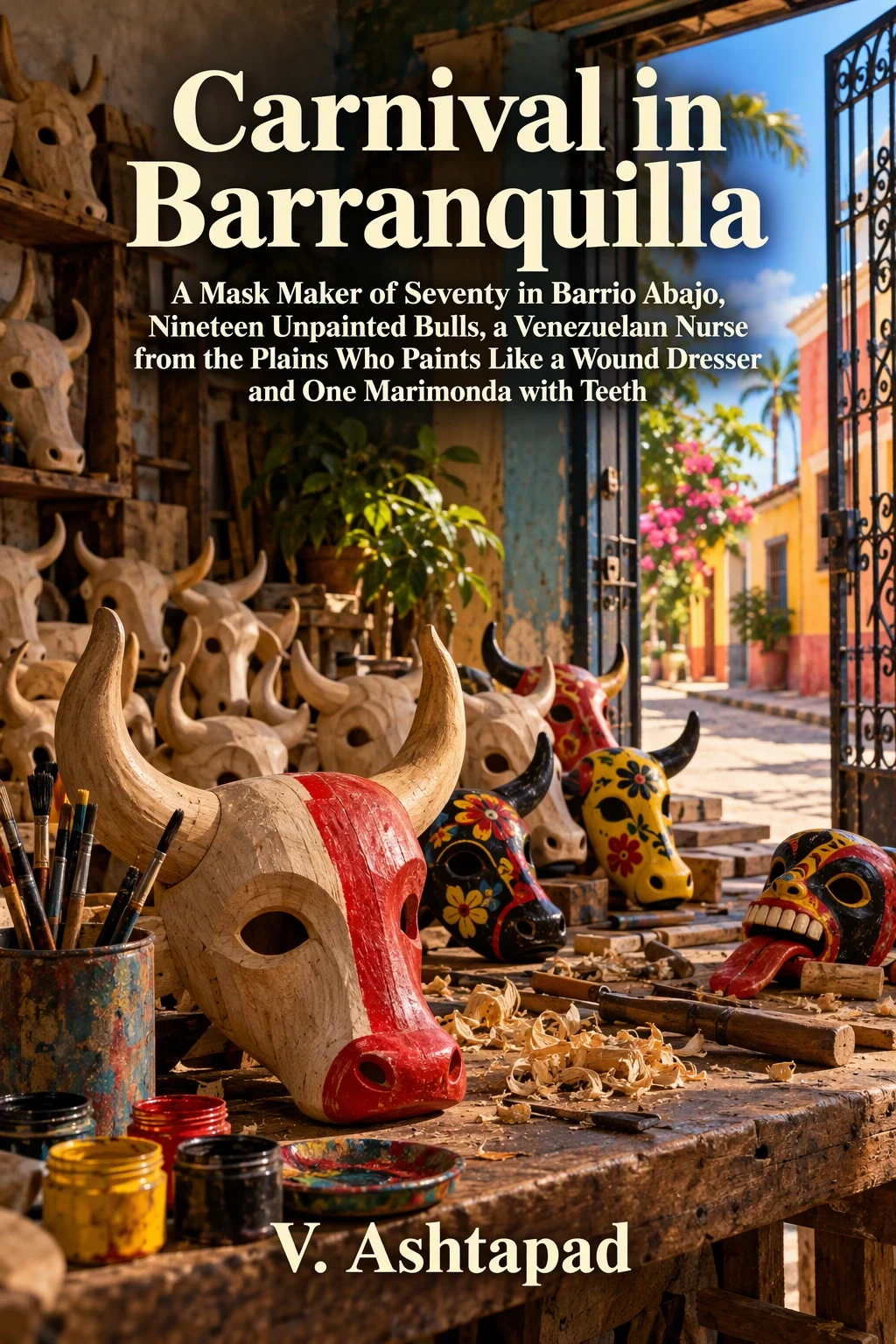
Carnival in Barranquilla
A Mask Maker of Seventy in Barrio Abajo, Nineteen Unpainted Bulls, a Venezuelan Nurse from the Plains Who Paints Like a Wound Dresser and One Marimonda with Teeth
by V. Ashtapad
Foreword
This is a work of fiction. Barrio Abajo and the Barranquilla Carnival, the torito and marimonda masks, the garabato dance, the Battle of Flowers on the Vía 40, Joselito's burial, balso wood, joropo and the cuatro of the Venezuelan plains are real. The Ariza workshop, the dance group, the clinic and every named person in the story are invented.
For the ones who finish what someone else had to set down.
Balso
The balso comes in a truck from the hills above Malambo in the first week of October, the way it has come every October since Eustorgio Ariza was a boy of nine sweeping shavings off the floor of his father's workshop on Calle 41 in Barrio Abajo, and the smell of it when the driver lets down the tailgate in the street at six in the morning, before the heat, is the smell of the whole year turning over: green and sweet and faintly sour, like a cut melon left in the sun, like the inside of a tree that has never been asked for anything until now.
He stands on the curb in his undershirt and his old canvas trousers and his rubber sandals, seventy years old, thin as a fence post, with his white hair standing up from sleep and his reading glasses shoved up into his hair where he will forget them for the rest of the morning, and he watches the driver and the driver's boy pass the logs down one by one, pale gray-brown trunks as thick as a man's thigh and as long as a man is tall, light as cork, so light the boy can carry two at once on his shoulders and grin about it, and he counts them as they go into the front room of the house, where the workshop has been since 1958, and he gets to twenty-two, and he stops the boy, and says, that's enough.
"Twenty-two, Don Eustorgio?" says the driver, who has been bringing the balso for eleven years and knows the number. "Last year you took thirty-five."
"Last year I had Celmira," says Eustorgio.
The driver looks at him for a moment with the next log on his shoulder and then sets it back in the truck without saying anything and comes over and puts his hand on the old man's arm, just for a second, the way men here do, a pressure through the sleeve, and then gets back in his cab and goes on down the street toward the next workshop, and the boy waves from the back on top of the logs, and the sun comes up over the roofs of Barrio Abajo and turns the dust in the street gold.
---
The workshop is the front room of the house, which is the way it is in Barrio Abajo, where the carnival lives all year in the front rooms of a hundred houses on a grid of streets near the river, where the masks are carved and the costumes sewn and the drums stretched and the dances rehearsed behind open doors and windows with iron grilles, so that if you walk down Calle 41 at any hour from October to February you will see through the grilles a man bent over a block of wood, or a woman at a sewing machine with a mountain of sequins, or a boy painting a bull's horns red, or a group of teenagers in the street out front practicing a dance to a drum and a whistle with the neighbors shouting advice from their chairs.
Eustorgio's room has a long table along one wall under the window, scarred and stained by sixty-eight years of knives and paint and glue, and on it his tools in the order his father left them, the gouges and the chisels and the knives with the handles worn to the shape of his father's hand and then of his own, and the rasps and the files and the sandpaper in a coffee can, and a radio that plays vallenato from a station in Valledupar and has not been turned off since the last time Colombia won a football match.
On the walls are the masks.
Bulls. Mostly bulls. The torito, the little bull, which is what the Ariza family has carved for four generations, the face of a bull with flared nostrils and wide eyes and a heavy brow and two great horns curving up, painted black or red or white with patterns around the eyes and the muzzle in yellow and green and blue, with mirrors set into the forehead and ribbons hanging from the horns. Dozens of them. From every year. Some of them his grandfather's, cracked and faded, the paint gone the color of old bone. Some of them his father's. Most of them his. A few of them, the newer ones, from the last ten years, with a different hand in the painting, a looser one, a woman's.
Celmira painted for forty-four years. He carved and she painted. That was the arrangement. He made the face and she gave it a soul. That's what she said. He said she made the bulls look like they'd been to a party they weren't invited to. She said that was the point of carnival.
She died two years ago, in October, a week after the balso came, at the kitchen table, with a paintbrush in her hand.
He has not finished a mask since.
© 2026 CRUNOD LLC. All rights reserved.
Torito
He carves anyway. He has carved every day of his life since he was nine. He doesn't know how to stop.
In the mornings, before the heat, from six until eleven, he sits at the long table under the window with a block of balso and his father's gouges and he carves the face of a bull. He roughs it out with the big gouge first, the shape of the skull, the brow and the muzzle, the long jaw, the place where the horns will go, the wood coming away in long soft curls that fall to the floor around his sandals and pile up there like snow, if there were snow in Barranquilla, which there is not, which he has never seen. Then the smaller gouges for the eyes, the nostrils, the folds of skin over the brow. Then the knife for the details. Then the rasp. Then the sandpaper. A torito takes him three days to carve and when it is done it is as light as a loaf of bread and as smooth as a stone from the river, the pale gray-brown balso showing its grain like the lines on the palm of a hand.
Then he puts it on the shelf with the others, unpainted.
There are nineteen of them now. Nineteen bulls with no color in them, two years of mornings, staring out from the shelf above the long table with their bare wooden eyes.
His nephew Wilfrido, who is fifty and sells insurance in an office in the north of the city near the new malls and lives in an apartment with air conditioning and a doorman, comes every Sunday for lunch and looks at the shelf and shakes his head.
"Tío," he says. "Who's going to paint them?"
"Nobody."
"Then why are you carving them?"
"Because it's October."
Wilfrido sighs. He sits at the kitchen table, the same table, where Celmira died, and eats the sancocho his uncle makes every Sunday, a soup of chicken and plantain and yuca and corn on the cob and potatoes and coriander, the way Celmira made it, more or less, not as well, and he tries again, the way he tries every Sunday.
"There's a man from the Ministry of Culture," he says. "From Bogotá. He came to my office. He wants to buy the old masks. The ones on the wall. Your grandfather's. For a museum. He'll pay well. Very well. Enough for you to fix the roof and buy an air conditioner and live comfortably." He puts down his spoon. "And maybe you could sell the house, Tío. And come live near me. There's a building for older people with a nurse on every floor."
"I don't need a nurse."
"You're seventy."
"I'm a mask maker," says Eustorgio. "A mask maker doesn't need a nurse. He needs somebody to paint."
---
The woman comes in November.
It is a Tuesday afternoon, in the heat, when the street is empty because everyone with any sense is inside lying down under a fan, and Eustorgio is at the long table not carving, just sitting, with a cold coffee and the radio playing a vallenato about a man who lost his accordion in a river and his love in the same week, and somebody knocks on the iron grille of the door.
He looks up.
A woman is standing in the street, in the white glare, with the light behind her so he can't see her face. Medium height, solid, in a nurse's scrub top, pale blue, and jeans and sneakers, a backpack slung on one shoulder, and a boy of about twelve beside her with a basketball under his arm.
"Don Eustorgio Ariza?"
"Who's asking?"
"Mariángel Urbina." She has an accent. Not from the coast. The vowels longer, the s's all there. Venezuelan. From the interior, from the plains. "Doña Hortensia sent me. From the clinic. On Calle 72. I take care of her mother at night." She shifts the backpack. "She says you need someone. To help. She says your wife painted."
Eustorgio looks at her through the grille a good while.
"My wife painted," he says. "Nobody helps."
---
On the first Sunday of November he takes the bus to the cemetery, the Universal, on Calle 53, the way he has every first Sunday since she died.
The bus is full of people going to the same place. Women with flowers wrapped in newspaper. Men in clean shirts. Children dragged by the hand. The bus goes up Carrera 38 through the noise and the heat and the motorbikes and the street vendors selling mango with lime and salt in plastic cups, and the radio on the bus plays a vallenato so loud the windows buzz, and nobody minds.
Her niche is in a wall of niches near the back, under a mango tree that drops its fruit on the path in June so that the whole section smells sweet and rotten. Her name on a marble plaque. Celmira Fontalvo de Ariza. 1957 to 2024. And under it, because he insisted, because the stonecutter said nobody does that and he said I'm paying you, a small carving. A torito. The face of a bull with horns. Painted, by his own hand, the only thing he ever painted before this year, red.
He sits on the bench across the path and looks at it.
He doesn't talk to her. Some people do. The woman two niches down talks to her husband every week, loudly, about the price of rice and the neighbor's dog. Eustorgio doesn't. He sits. For an hour. With his hat on his knees. And then he gets up and takes the bus home.
This Sunday, before he gets up, a girl comes along the path selling flowers from a bucket. Ten, maybe, in a school uniform on a Sunday, with her hair in braids. Venezuelan, from the accent, when she calls out the price.
He buys a bunch of yellow ones. Carnival yellow.
"For your wife?" the girl asks, looking at the niche.
"For my wife."
The girl looks at the little red bull carved under the name.
"She liked bulls?"
"She painted them," says Eustorgio. "For forty-four years."
The girl looks at it a moment longer. Then she pulls one more flower from her bucket, a red one, and holds it out.
"For the bull," she says. "No charge."
He puts both in the little brass holder under the plaque. Yellow and red. On the bus home he finds that his hands are shaking, and he doesn't know why, and then he does.
© 2026 CRUNOD LLC. All rights reserved.
Engrudo
He lets her in anyway, because it is too hot to argue through a door, and because the boy with the basketball has seen the bulls on the wall through the grille and is standing with his mouth open, and because Doña Hortensia's mother is ninety-one and has been his customer since 1971 and it would be rude.
She sits on the stool by the door, the one Celmira used to sit on in the afternoons to drink her coffee and watch the street, and the boy stands in the middle of the room turning around and around looking at the masks on the walls, and Eustorgio sits at his long table and turns his cold coffee cup in his hands and waits for her to explain.
She explains.
She is thirty-eight. She is from Barinas, in the plains of Venezuela, the llanos, where the land is flat as a table for five hundred kilometers and the rivers flood every rainy season until the whole country is a lake with palm trees sticking out of it, and the cattle swim, and the herons stand on the backs of the cattle. She was a nurse there, in the public hospital, for fourteen years. Intensive care. Then the hospital had no medicine, and then it had no gloves, and then it had no electricity three days a week, and then her husband left for Peru to find work and didn't come back, and then she put her son and two suitcases in a bus to the border and came across.
That was four years ago.
In Colombia she is not a nurse. Her papers are in a government office in Bogotá being validated, which has taken three years and may take three more. So she works nights as a caregiver, sitting with old people who are dying, washing them, turning them, giving them their medicines, holding their hands, for a quarter of what a nurse would make. Doña Hortensia's mother is one of them. Tuesdays and Thursdays and Saturdays, ten at night until six in the morning. The other nights, other old people. In the days she sleeps, or tries to, in a rented room in Barrio Rebolo with her son and a fan and a hot plate.
"And you want to work here?" says Eustorgio. "In the day? When do you sleep?"
"I don't sleep much."
"Why masks?"
She doesn't answer right away. She looks at the shelf of nineteen bare wooden bulls above the long table.
"My grandfather made masks," she says finally. "In Barinas. He came to the plains as a young man from a town near Caracas where they make devil masks for a fiesta in June, and he never stopped making them, even out there where nobody wore them. The devils. Big painted faces with horns and teeth. He made them out of paper and paste on molds of clay, and painted them, and he hung them in the house and sold a few to the town fair every year." She turns her hands over in her lap. Nurse's hands, short nails, clean. "He taught me to paint. When I was a girl. I was good. I was better than my brothers." She looks up at him. "I haven't painted since I left. Four years. I've been doing the other thing. The washing and the turning and the medicines and the hands. In the night. I'm good at that too. But I go home at six in the morning and lie on the mattress and close my eyes and I see his masks. The red and the black. The teeth. I want to paint something before I forget how."
Eustorgio says nothing a while. The fan turns overhead. The radio plays. The boy with the basketball has stopped turning in the middle of the room and is standing in front of the oldest torito on the wall, Eustorgio's grandfather's, from 1931, cracked and faded, the color of old bone, and staring into its empty eyes.
"What's your son's name?" says Eustorgio.
"Dairo."
"Dairo," says Eustorgio. "Go to the kitchen. There's a bucket under the sink and a sack of flour in the cupboard. Bring me both."
The boy looks at his mother. She nods. He goes.
"What are you going to do?" says Mariángel.
"Engrudo," says Eustorgio. He gets up. He takes his reading glasses down off his forehead, where they have been since six in the morning, and puts them on. "Paste. Flour and water, cooked, until it's like glue. My wife used it to stiffen the cloth for the ears and the ribbons. You'll make it. If you make it right, I'll let you paint one. One. If you make it wrong, you can go home and sleep."
---
While the paste cools she walks around the workshop, slowly, with her hands behind her back, the way you walk in a museum, or in a hospital ward at night when you don't want to wake anyone.
She stops in front of the bulls on the wall, one at a time. She doesn't touch them. She looks at the carving first, the brow and the nostrils, the place where the horns go in, the way he has seen other carvers look at his father's work. Then she looks at the paint. She looks at the paint for a long time.
She stops at Celmira's first one, from 1988, on the high shelf. Red and yellow and green, the colors bleeding into each other at the edges, the mirrors crooked.
"Your wife painted this one."
"The first one she ever did on her own."
"She wasn't afraid of the color."
"She wasn't afraid of anything," says Eustorgio. "Except her mother. And spiders. And the dentist."
Mariángel almost smiles. She moves on. She stops at his grandfather's, from 1931, faded to bone.
"These lines here," she says. She points, not touching, at the pattern of fine dark lines around the eyes, almost gone. "Like a net. Like veins. My grandfather did that too. On his devils. Around the eyes. He said it was so the mask could see."
Eustorgio looks at the lines. He has looked at that bull every day of his life and never once thought about why his grandfather painted a net around its eyes.
"Who told him that?" he says.
"His grandfather, probably," says Mariángel. "That's how it goes."
© 2026 CRUNOD LLC. All rights reserved.
Marimonda
She makes it right.
He knew she would. You can tell a person who knows paste from the way they stand over a pot. She stands over the pot on his two-ring stove in the kitchen with a wooden spoon, stirring, the flour and water going from milk to cream to something like porridge to something like glue, and she doesn't take her eyes off it, and she doesn't stop stirring, and she turns the heat down at exactly the moment Celmira used to turn it down, when the bubbles start to come up slow and fat like a frog breathing, and she takes it off the fire and lets it cool with a cloth over it.
"My grandfather," she says, "said paste is like a patient. You watch it every second or it dies on you."
Eustorgio doesn't say anything. He gives her a brush.
---
She doesn't paint a torito.
He is going to give her one. The one he carved in September, which is the best of the nineteen, with a heavy brow and nostrils flared like a bull that has just been insulted. He has it in his hands. And then he looks at her standing by the long table with the brush in her hand looking at the shelf, and he sees what she is looking at.
Not the bulls.
The marimonda.
There is one marimonda in the workshop. Only one. It is not on the wall. It is on a hook behind the door, where Celmira hung it, because Celmira made it, not him. He doesn't make marimondas. The Ariza family makes bulls.
The marimonda is not carved. It is cloth. A hood, a big floppy hood of bright patchwork fabric, red and yellow and blue and green, that goes over the whole head, with holes for the eyes ringed in white, and enormous floppy ears, and a nose. The nose is the thing. A long, long nose, a trunk, like an elephant's, made of cloth stuffed with rags and stiffened with engrudo, that hangs down to the waist and swings when you dance. And a mouth, a round O of red felt, always open, always surprised, always laughing. You wear it with a jacket inside out and a tie and trousers too short, and you dance through the streets of carnival swinging your trunk at people and making rude gestures at the police.
It was invented, the old people say, by the poor people of Barrio Abajo a hundred years ago to make fun of the rich men and the politicians, who had long noses because they were always sticking them into other people's business. Nobody owns it. Anybody can make one. The children make them out of old shirts. It is the most Barranquilla thing in Barranquilla.
Celmira made hers in 1988, the year they married. She wore it every carnival for thirty-five years. She danced in it at the Battle of Flowers on the Vía 40 every Saturday before carnival with the Barrio Abajo groups and swung her trunk at the mayor every single year. It hangs behind the door now, the colors faded, the trunk gone limp, the red felt mouth still open.
Mariángel is looking at it.
"Who made that?" she says.
"My wife."
"Can I—"
"No."
She looks at him. He looks at the marimonda.
"That one is hers," he says. "Nobody paints that one. Nobody touches that one."
"I wasn't going to paint it," says Mariángel. "I was going to ask you why it's behind the door."
He doesn't answer. He puts the torito in front of her on the long table, the September one with the insulted nostrils, and the brush, and the pots of paint, Celmira's paints, which have been sitting in a box under the table for two years with their lids on, and some of them have dried and some of them haven't.
"Paint," he says.
She paints.
---
She paints for four hours, through the worst of the heat, with the fan turning and the radio playing and the boy asleep on the floor in the corner on a pile of balso shavings with his basketball for a pillow. Eustorgio sits across the table pretending to carve. He watches her hands.
She doesn't paint it like Celmira. He sees that in the first ten minutes. Celmira painted with long sweeping strokes, fast, loose, laughing, the colors bleeding into each other at the edges so the bull looked like it was moving even standing still. Mariángel paints the way a nurse dresses a wound. Small, precise, careful strokes. Each line exactly where it should be. A black base coat, first, smooth as glass. Then red around the eyes and the nostrils, in sharp clean bands. Then yellow on the brow, a pattern of little triangles like teeth, like flames, like the teeth on her grandfather's devil masks in the plains. Then white dots along the horns, hundreds of them, each one the same size.
When she is done the torito doesn't look like it's been to a party it wasn't invited to.
It looks like it's going to war.
Eustorgio sits looking at it for a long moment with his reading glasses on.
"Well?" says Mariángel. Her face is wet with sweat and there is red paint on her chin.
"It's not my wife's," says Eustorgio.
"No."
"It's not mine."
"No."
He reaches across the table and picks it up and turns it in the light from the window. The black glass shine. The red bands. The yellow teeth. The white dots, each one the same.
"It's a Venezuelan bull," he says.
"Is that bad?"
Eustorgio puts it on the shelf. Not with the nineteen bare ones. Above them. On the high shelf, where his grandfather's 1931 torito sits, and his father's from 1958, and the first one Celmira ever painted, from 1988.
"Thursday," he says. "Two o'clock. Bring the boy. He sleeps well on balso."
---
That evening, after they've gone, he takes the marimonda down off the hook behind the door.
He hasn't touched it in two years. He holds it in both hands. The patchwork has gone soft, and the colors have faded, the red gone pink and the blue gone gray. The trunk hangs limp. The felt mouth is still a round red O, surprised, laughing.
It smells of her. Still. Two years on a hook. Of her sweat and her face powder and the cheap perfume she bought at the market every carnival, the same one, gardenia, because she said the marimonda should smell like a lady even if it looked like an elephant.
He puts it to his face.
He doesn't put it on. He has never put it on. It's hers. He just holds it there, against his face, with his eyes closed, in the empty workshop with the radio off and the street sounds coming in through the grille, and breathes.
Then he hangs it back on the hook.
But not behind the door. He hangs it on a nail on the wall above the long table, beside his grandfather's bull. Where people can see it. Where the girl from Barinas, painting, will look up and see it every time she lifts her brush.
He doesn't know why. He just doesn't want it behind the door anymore.
© 2026 CRUNOD LLC. All rights reserved.
Cuatro
The boy brings the cuatro on the second Thursday.
It is a small guitar, smaller than a guitar, with four nylon strings and a body the color of honey and a crack along the side mended with tape, and the boy carries it in a cloth bag over his shoulder with his basketball under his other arm, and when he comes into the workshop and sees the old man look at the bag, he goes red to the ears.
"It's my grandfather's," he says. "From Barinas. Mamá brought it in the suitcase. It was the only thing she brought that wasn't clothes."
"Do you play it?"
"A little."
"Then play it," says Eustorgio. "Your mother paints. You play. I carve. That's a workshop."
So the boy sits on the pile of balso shavings in the corner where he slept the first day and takes the cuatro out of its bag and tunes it, very carefully, with his ear close to the strings, and begins to play, and Eustorgio, at the long table with his gouge in a block of wood, stops carving.
It is not vallenato. It is not cumbia. It is not anything he has heard on the radio from Valledupar or in the streets of Barrio Abajo in sixty years. It is fast, very fast, the boy's right hand going in a blur across the four strings, a rhythm like hooves, like a horse at a gallop across ground that goes on forever, three beats and then three beats and then two, tripping over itself and catching itself, and it is in a minor key that sounds like distance, like a sky with nothing in it, like a man on a horse singing to cattle at night under stars because there is nobody else to sing to.
Mariángel, at the far end of the table, brush in hand, starts to sing.
She doesn't look up. She keeps painting. She sings under her breath, at first, and then louder, a high hard voice that comes from the back of the throat, that cracks at the top of each line on purpose like the cry of a bird, a song about a river in flood and a man who swam his horse across it to see a girl on the other side and was carried away and the girl waited on the bank for him for forty years. She sings it all the way through, six verses, with the boy galloping underneath on the cuatro, and when she is done she dips her brush in the paint and keeps going as if nothing has happened.
Eustorgio sits there with his gouge in the balso.
"What is that?" he says.
"Joropo," says Mariángel. "From the plains. The llanos. Everybody sings it there. My father sang it to the cows. My mother sang it to me. My grandfather sang it while he painted his devils." She doesn't look up. "It's the only kind of song I know all the words to."
"Is it sad?"
She thinks about it.
"It's not sad," she says. "It's far. Everything in the llanos is far. The next house is far. The next town is far. The river is far, until it isn't, and then it's everywhere. So the songs are far. You sing them loud so somebody far away can hear." She finally looks up at him. "I sing it at night. At the clinic. To Doña Hortensia's mother. When she can't sleep. She doesn't understand half the words. She says it sounds like the radio when she was a girl in the Sinú, in the cattle country, before she came to the city. She says it sounds like home."
---
That night, after they have gone, Eustorgio sits alone in the workshop with the lights off and the street sounds coming in through the grille, the motorbikes and the neighbors on their chairs on the sidewalk and somebody's sound system three houses down playing champeta so loud the iron vibrates, and he thinks about the song.
He has never been to the llanos. He has never been anywhere. He was born in this house in 1956 and has lived in it every day of his life except for one week in 1977 when he went to Cartagena with Celmira before they were married and her mother found out and made them come back. He has never seen a plain that goes on for five hundred kilometers. He has never seen a river that floods until the whole world is water with palm trees sticking out of it.
But he knows a song that is far.
Celmira used to sing in the afternoons, on her stool by the door, with her coffee, watching the street. Old songs. Cumbias from the river towns, from the Magdalena, where her grandmother was from, songs about fishermen and their canoes and the women who waited for them on the bank. He never sang along. He didn't sing. He just carved and listened.
He realizes, sitting in the dark, that it is the first time in two years he has listened to anybody sing in this room.
© 2026 CRUNOD LLC. All rights reserved.
Mirrors
In December the mirrors come.
They come from a glass shop on Calle 30 near the market, small round mirrors the size of a coin, in a cardboard box of five hundred, wrapped in newspaper. Every torito gets mirrors. Three on the forehead, between the horns, in a triangle. One on each cheek. Sometimes a row along the muzzle. When the dancers come down the street in the sun, the mirrors catch the light and throw it into the crowd, little flashes of white going everywhere, so that the bull looks like it is on fire, like it is throwing sparks.
The old people say the mirrors are to blind the devil. Celmira said that was nonsense and they were to blind the girls. Eustorgio's father said they were to show people their own faces, so they'd know who was laughing.
Mariángel sets the mirrors.
She does it the way she does everything, small and precise. She makes a shallow round bed in the balso with the tip of a knife, exactly the depth of the mirror, and puts in a dab of glue, and presses the mirror in with her thumb, and holds it there for a count of thirty, and moves to the next one. Three on the forehead. One on each cheek. Every one exactly level. When she holds the torito up to the window, the light comes off all five mirrors at once in a single flash, like a camera.
"You're good at this," says Eustorgio.
"It's like putting in an IV. You find the place and you go in at the right angle and you hold it still."
"Celmira used to put them in crooked."
Mariángel looks up.
"On purpose," says Eustorgio. "She said if they were all straight, the light only went one way. If they were crooked, it went everywhere." He picks up one of the toritos she painted last week, the black and red one with the yellow teeth, and turns it in his hands. "She said a bull should look at everyone at once."
Mariángel looks at the mask in his hands for a while.
Then she takes the next one off the shelf, a fresh one, painted yesterday, and makes the shallow round beds in the forehead with the tip of her knife. Three. In a triangle. But not level. One tilted a little up, one a little left, one a little down. She puts in the glue. She presses in the mirrors. She holds them for a count of thirty. She holds the mask up to the window.
The light goes everywhere. Three flashes, in three directions, on the walls and the ceiling and the old bulls on the shelves.
"Like that?" she says.
Eustorgio doesn't answer. He is looking at the spots of light on the wall above the long table, trembling a little as her hands move, three white coins of light on the faded paint, on his grandfather's 1931 torito, on his father's, on Celmira's first one from 1988.
"Like that," he says finally.
---
He tells her about Celmira that afternoon.
He doesn't mean to. It is the heat, maybe, and the light from the crooked mirrors, and the boy asleep on the balso shavings with the cuatro on his chest, and the radio playing an old cumbia about a fisherman. He starts talking and doesn't stop.
He tells her that he met Celmira at carnival in 1975, at the Battle of Flowers, when he was nineteen and dancing in his father's torito with the Barrio Abajo group and she was eighteen and dancing in a borrowed marimonda with a group from the next street, and she swung her trunk at him and knocked his bull mask sideways so he couldn't see, and he walked into a lamppost.
He tells her that she came to the workshop the next week to apologize and stayed to watch his father paint and told his father he was doing it wrong. His father was so offended he gave her a brush to prove her wrong. She was right.
He tells her that they married in 1988, after thirteen years, because her mother didn't want her marrying a mask maker from Barrio Abajo, and they waited until her mother died, and they married the week after the funeral, and everybody talked, and they didn't care.
He tells her that they had no children. That they tried for ten years and then stopped trying and filled the house with other people's children instead, every kid on Calle 41 coming through the workshop door to watch and paint and get in the way, and that half the masks in Barrio Abajo now are made by people who learned to hold a brush at Celmira's elbow.
He tells her that she died at the kitchen table, in October, two years ago, a week after the balso came, with a paintbrush in her hand. That she'd gotten up from the long table in the workshop to get more coffee and sat down in the kitchen and had a stroke. That he found her there twenty minutes later, sitting up, her head on the table, the brush still in her fingers with red paint on it.
"Red," he says. "She was painting a torito red. I never finished it. It's in the box under the table. Half red."
Mariángel puts down her knife.
"Can I see it?" she says.
He doesn't move for a while. Then he bends down and pulls the box out from under the long table, the one with the paints, and lifts out the paints, and underneath them, wrapped in a cloth, is a torito. Carved by him. Painted half red by her. The left side red, bright, the brushstrokes long and loose and laughing. The right side bare wood.
The red stops in the middle of the forehead. You can see where the brush lifted off.
Mariángel looks at it a long while. She doesn't touch it.
"In the clinic," she says quietly, "when someone dies, I wash them. I close their eyes. I fold their hands. I comb their hair. I do it for the family, so they don't see them the way they were. But mostly I do it so they're finished. So they don't go out of the world in the middle of something." She looks up at him. "Do you want me to finish it?"
Eustorgio holds the half-red bull in his old hands.
"No," he says. "Not yet. Maybe never."
"Okay."
"But don't throw it away," he says. "If I die. Before carnival. Don't let Wilfrido throw it away."
"I won't," says Mariángel. "I promise."
© 2026 CRUNOD LLC. All rights reserved.
The Man from Bogotá
The man from the Ministry of Culture comes in the second week of December, with Wilfrido.
He is younger than Eustorgio expected, forty maybe, with glasses and a linen shirt and a leather bag over his shoulder and the pale skin of a man from the cold city in the mountains who has not been in the coast heat long enough to stop sweating. His name is Doctor Alarcón. He is a professor of anthropology at the national university and he is putting together an exhibition of the masks of the Barranquilla carnival for a museum in Bogotá, and then for a museum in Madrid, and then, he hopes, for a museum in Washington.
He stands in the middle of the workshop and turns around slowly looking at the masks on the walls, the way the boy Dairo did, and his face does what Dairo's face did.
"Don Eustorgio," he says. "This is extraordinary. Four generations. From the 1930s. I didn't know there were any this old left in private hands."
"They're not in private hands. They're on my wall."
Doctor Alarcón smiles uncertainly. Wilfrido coughs.
Mariángel, at the end of the long table, painting, does not look up.
---
They sit in the kitchen. Wilfrido makes coffee. Doctor Alarcón opens his leather bag and takes out a folder and explains.
He wants the old ones. The grandfather's toritos, from the 1930s and 1940s. The father's, from the 1950s and 1960s. A selection of Eustorgio's. And, if possible, some of the ones painted by Celmira Ariza, which he has seen in photographs and which he says are known among collectors for the way the colors move. He wants to buy them for the national collection. They will be cleaned and restored and properly stored and shown to hundreds of thousands of people. The family will be named. There will be a catalog. There will be a sum of money that he names, and Wilfrido's eyes go very still, and Eustorgio says nothing.
"They're falling apart, Tío," Wilfrido says quietly. "The old ones. Look at them. The paint's coming off. The wood's cracking. In ten years they'll be dust. In the museum they'll last a hundred years."
"In the museum they'll be behind glass."
"Yes. Safe."
"A mask behind glass," says Eustorgio, "is a dead man in a box. It's for dancing. Not for looking at."
Doctor Alarcón looks at him across the kitchen table for a long moment.
"May I ask you something, Don Eustorgio?"
"You're going to."
"When was the last time any of these were danced? The old ones. Your grandfather's."
Eustorgio opens his mouth. Then he closes it.
He tries to think. His grandfather's toritos. The 1931. The 1938. The pair from 1944. When did anyone last put one on and go down Calle 41 in the sun with the drums? His father danced them. In the fifties, the sixties. He himself danced the 1944 pair once, in 1974, the year before he met Celmira, with his cousin. And then they went on the wall. And they have been on the wall ever since.
Fifty-two years.
"They're on the wall," he says slowly, "because they're too old to dance."
"Yes," says Doctor Alarcón gently. "So they're already behind glass. Yours." He cleans his glasses on his linen shirt. "I'm not trying to take them from you. Let me say that plainly. I'm trying to understand what you want for them. If what you want is for them to be danced, then I'm the wrong man, and so is your wall. If what you want is for them to be remembered, then maybe we want the same thing. I'd like to know which."
Nobody says anything. In the workshop, Mariángel has stopped painting. The radio is playing a vallenato.
Through the doorway Eustorgio can see the high shelf. His grandfather's torito from 1931, the paint gone to bone, the net of fine lines around its eyes nearly vanished. His father's beside it. Celmira's first. And above the long table, on its new nail, her marimonda with its round surprised mouth, watching the kitchen as if waiting to hear what he'll say.
"I don't know," says Eustorgio finally. "I've never been asked."
"Then think about it," says Doctor Alarcón. He puts the folder on the table. "Take as long as you like. I'll be at carnival in February. I'll come back."
---
After they've gone, Mariángel comes into the kitchen. She stands in the doorway with paint on her hands.
"Can I say something?" she says.
"You're going to."
She almost smiles. "In the clinic. The families. When someone's dying. Half of them want to keep them alive with every machine there is, no matter what, because they can't let go. And the other half want to let them go right away because it hurts too much to watch." She wipes her hands on a rag. "The ones who do best are the ones who ask the patient. Even if the patient can't talk. They sit down by the bed and they ask, what do you want? And then they listen. To the breathing. The hands. Whatever's there." She looks at the folder on the table. "He asked you what you wanted. Nobody's asked you that in two years, have they? Wilfrido asks you what you're going to do. That's different."
Eustorgio sits at the kitchen table where Celmira died with the folder in front of him.
"What would you do?" he says.
"It's not my wall," says Mariángel. "Ask the masks."
© 2026 CRUNOD LLC. All rights reserved.
Congo
The order comes from Nayibe Polo de la Hoz, who runs the Barrio Abajo dance group that has danced the toritos at the Battle of Flowers since 1962, and who comes to the workshop every December the way the balso comes every October, and plants herself in the doorway, arms crossed, spectacles dangling on a cord, a list in her fist, and tells Eustorgio how many.
"Thirty," she says this year.
"Thirty."
"Thirty toritos and four congos. The congo headdresses. Your father's style. The tall ones." She looks at the shelf of nineteen bare bulls, and at the six painted ones above them, Mariángel's, black and red with yellow teeth and crooked mirrors. "You didn't do any for us last year."
"I didn't do any for anybody last year."
"I know." Nayibe Polo de la Hoz is sixty-four and has buried two husbands and has danced the torito at the Battle of Flowers every year since she was eleven and has never in her life said a soft word to anybody, and she doesn't now. But she unfolds her arms. "We bought them from a factory in Soledad. Plastic. Molded. Painted by machine. The kids danced them. They looked like toys. The old people on the Vía 40 turned their backs." She looks at Mariángel at the end of the table. "Who's that?"
"Mariángel Urbina. From Barinas. She paints."
Nayibe walks over and picks up one of the painted toritos and turns it in the light and looks at the yellow teeth on the brow and the crooked mirrors in the forehead throwing light all over the room.
"This isn't Celmira's," she says.
"No," says Mariángel.
"This isn't yours either, Eustorgio."
"No."
Nayibe looks at it a while longer. Then she puts it back on the shelf, carefully.
"I don't care," she says. "It's not plastic. Thirty and four. By the first week of February. I'll pay you what I paid your father, plus what I paid you three years ago, plus whatever she wants." She looks at Mariángel. "What do you want?"
Mariángel looks at Eustorgio. Eustorgio looks at the shelf.
"I want my son to dance," says Mariángel.
---
The problem is the school.
Dairo goes to the public school on Carrera 46, in the mornings, where there are forty children in a classroom with one fan and a teacher who has been there since 1994 and is tired. Eleven of them are Venezuelan. The other twenty-nine call them venecos. It is not a nice word. It is a word that means you are from over there and you took something from over here, a job, a bed, a seat in a classroom, a place in line at the clinic. It is the word people in Barranquilla use when they want you to know that they know.
Dairo doesn't tell his mother. He tells Eustorgio.
He tells him on a Thursday afternoon in the workshop, sitting on the balso shavings the cuatro across his knees, silent, while his mother is in the kitchen washing brushes. He says the boys in his class say he talks funny. He says they call him veneco in the yard and make the gesture, the one where you rub your fingers together like money. He says a boy named Kevin took his basketball last week and said he could have it back when he went home to his own country. He says he hasn't told his mother because she works all night and comes home at six in the morning and lies on the mattress with her eyes open and he doesn't want her to have one more thing.
Eustorgio, at the long table, puts down his gouge.
He keeps his own counsel. He is seventy years old and has lived his whole life on Calle 41 in Barrio Abajo and he has never once been called a name for where he was from, because he was from here, and here was the place that did the calling.
"Kevin who?" he says finally.
"I don't know. Kevin. He's big. He lives on Calle 44."
"Kevin with the father who drives a taxi? Green and yellow? With the sticker of the football club on the back?"
Dairo looks up. "I think so."
Eustorgio nods slowly.
"His grandfather," he says, "Abel Mercado, danced the torito in my father's group for thirty years. In my grandfather's masks. I carved his last one in 1981. He's dead now. His son, Kevin's father, danced the congo in 1990, in my father's headdress, and then he stopped dancing and started driving a taxi." He picks up his gouge again. "Kevin's great-grandmother," he says, "came here from Bolívar on a boat in 1938 with nothing. She sold fried fish in the market for forty years. My grandfather's sister used to buy from her. People called her a name too. A country name. For people from the river towns. It wasn't a nice name either."
Dairo is quiet.
"Everybody in Barrio Abajo came from somewhere," says Eustorgio. "The river. The islands. The mountains. Syria. Lebanon. Italy. China. The other coast. Everybody. The carnival is all of them. That's why it's ours." He blows the shavings off the bull's brow. "The marimonda was invented by poor people from the river to make fun of the rich men who called them names. That's the whole carnival. Somebody calls you a name and you put on a mask and dance down their street and make them laugh at themselves."
"I can't dance," says Dairo.
"Not yet," says Eustorgio. "Nayibe will teach you. She teaches everybody. She taught Kevin's father. She'll teach Kevin too, if he comes." He puts the gouge down and looks at the boy. "You're going to dance in the Barrio Abajo group at the Battle of Flowers in a torito your mother painted. On the Vía 40. In front of the whole city. And Kevin's father is going to be in the crowd with his taxi parked on the side of the road, because he always is, and he's going to see you."
"Then what?"
"Then we'll see," says Eustorgio. "That's what carnival is. Then we'll see."
© 2026 CRUNOD LLC. All rights reserved.
The Papers
The letter from Bogotá comes in the first week of January.
Mariángel brings it to the workshop at two in the afternoon, after four hours of sleep, and sets it on the long table before him without a word, and goes into the kitchen to make coffee, and he hears the pot bang down on the stove.
He reads it with his reading glasses. It is three pages long, from the ministry that validates foreign professional degrees, and it says, in many words, that the file of Mariángel del Carmen Urbina Sosa, nurse, has been reviewed, and that the documents from the Venezuelan university are incomplete, and that the transcript must be apostilled by the Venezuelan government, and that until it is, the validation cannot proceed, and that she may reapply.
He reads it twice.
He doesn't understand all of it. But he understands enough.
She comes back from the kitchen with two cups of coffee and sets one in front of him and sits on Celmira's stool by the door with the other and looks out at the street.
"The Venezuelan government," she says, to the street, "does not apostille anything. The office that does it in Caracas has been closed for two years. You can pay a man who knows a man and maybe in eighteen months they'll send it. Maybe. For three hundred dollars." She drinks her coffee. "I don't have three hundred dollars. I don't have eighteen months. I have Dairo and a mattress and six old people who are dying."
Eustorgio doesn't say anything.
"There's a woman at the clinic," Mariángel says. "Another caregiver. From Valencia. She's going to Chile. In March. She says in Chile they validate faster. She says there's work. Real work. Nursing. In a hospital in Santiago." She turns the cup in her hands. "She says I should come."
The radio is playing. A woman singing a cumbia about a candle in a window.
"Will you?" says Eustorgio.
She doesn't answer for some time.
"I don't know," she says. "I came here because it was close. Because it's the same language and the same food and the same music, almost. Because I thought maybe one day I'd go back. Barinas is fourteen hours on a bus from here. Santiago is six thousand kilometers." She looks at him. "If I go to Chile, I'm not going back. Ever. Dairo will grow up Chilean. He'll talk like them. He'll forget the joropo."
Eustorgio looks at the letter on the long table. Three pages. Incomplete. Reapply.
He thinks about what he should say. He thinks about Wilfrido, who would say go, Chile is better, there's money. He thinks about Nayibe Polo de la Hoz, who would say stay, we need you, thirty and four by February. He thinks about Doctor Alarcón, who would say what do you want.
He doesn't say any of those things.
He gets up from the long table. He goes to the kitchen. He comes back with a plate. On it are two arepas, the corn cakes, the way Celmira made them, the coastal kind, fried, with a fried egg inside, the arepa de huevo, which you can buy on any corner in Barranquilla and which nobody makes at home anymore because it's too much trouble. He made them this morning at six. He hasn't made them in two years.
He puts the plate on Celmira's stool beside her.
"Eat," he says.
She looks at the plate. At him.
"You made these?"
"I can make things. Not only bulls." He sits back down at the long table. "Eat. Then tell me about the llanos. Not about Chile. Not about the papers. About the place you're from. The river that floods. The herons on the cattle. I've never been anywhere. Tell me."
She looks at him a good while with the plate on her knees.
Then she eats.
And she tells him.
---
She tells him for two hours, while he carves and the fan turns and Dairo, who has come in from school, sits on the balso shavings with the cuatro and plays under her very softly so she won't notice, which she does, and doesn't say anything.
She tells him about the flat land, so flat you can see a rainstorm coming for two hours across it, a gray curtain walking toward you over the grass. About the morichal palms, in groves along the creeks, tall and straight with their fans of leaves at the top like the hats of giants. About the herons, white, standing on the backs of the cattle in the flooded fields. About the capybaras, enormous, like guinea pigs the size of dogs, swimming in the rivers with only their eyes and noses above the water. About the caimans. About the sunsets, red and gold and purple for an hour, the whole sky on fire end to end. About her father, who was a cowboy on a ranch and sang joropo to the cattle at night to keep them calm. About her mother, who still lives in the town in a house with a mango tree, alone, and calls every Sunday, and asks when they are coming home.
About her grandfather's devil masks, hanging in rows in the back room of the house, red and black with teeth, that frightened her when she was little and that she painted when she was older, sitting beside him at his table on the patio under the mango tree in the late afternoon, the light coming through the leaves green and gold on the paper and the paste and the paint.
"It looked like this," she says suddenly, stopping. "The light. On his table. Like the light through your window on the masks. Green and gold." She stops talking.
Eustorgio puts down his gouge.
"Then paint like that," he says. "Here. Now. While you decide. Paint like his table. And when you go to Chile, or when you go back to Barinas, or wherever you go, you'll have made something here. It'll stay. It'll be danced."
"And if I stay?"
"Then you'll keep making it," says Eustorgio. "That's all. Either way it's made."
© 2026 CRUNOD LLC. All rights reserved.
Ribbons
Barrio Abajo at Christmas is a house turned inside out.
Everybody's front room is in the street. The chairs, the tables, the sound systems the size of refrigerators, the old men playing dominoes under the streetlights, the women cooking on charcoal on the sidewalk, the children running between the legs of everybody setting off firecrackers and screaming. Every house has paper stars in the window and lights on the iron grilles, blinking red and green and blue, and every sound system plays a different song at full volume so that walking down Calle 41 at ten at night is like walking through a radio that someone is spinning the dial on.
Eustorgio has not been out in the street at Christmas for two years.
This year Mariángel makes him.
She brings food. Her food. Venezuelan Christmas food, which she makes in his kitchen on the twenty-fourth, all afternoon, with Dairo running to the shops for things she forgot. Hallacas. Which are like tamales but are not tamales, she says, so don't call them tamales, which are corn dough spread thin on a banana leaf and filled with a stew of beef, pork and chicken, with raisins and olives and capers and peppers and onions, and folded into a packet, and tied with string, and boiled. She makes forty. It takes her five hours. She says her mother makes two hundred every year and the whole family sits around the table for two days making them together and fighting.
And pan de jamón. A bread rolled around ham and olives and raisins. And a salad of chicken and potatoes and apples.
He carries a table out to the street in front of the workshop. She puts the food on it. And the street comes.
Nayibe Polo de la Hoz comes. And her grandchildren. And the neighbors from both sides. And the old man from across the street who plays dominoes. And Doña Hortensia, from the clinic, with her mother in a wheelchair, ninety-one, in a Christmas sweater, who points at Mariángel and tells everybody that this is the girl who sings to her at night. And Kevin's father, from Calle 44, in his green and yellow taxi, who pulls up because he sees the crowd, and gets out, and eats three hallacas standing by his cab, and doesn't say anything to anybody, and leaves.
Dairo plays the cuatro on the step of the workshop. Mariángel sings. The joropo about the river and the horse and the girl who waited forty years. The street goes quiet for it. Then somebody's sound system starts up again three houses down and drowns her out and everybody laughs.
---
At midnight, when the firecrackers are at their worst and the sky over Barrio Abajo is full of smoke and the smell of gunpowder and charcoal and fried pastries, Eustorgio goes back into the workshop.
The ribbons are on the long table. A box of them, every color, satin, two meters each, for the toritos. Every bull gets ribbons, tied to the base of each horn, long ones, that fly out behind when you dance. Thirty bulls. Sixty bunches of ribbons. He has been cutting them all week.
He sits down at the table. He takes the half-red torito out of the box under the table, Celmira's last one, and unwraps it, and sets it in front of him.
He picks up a ribbon. Red. He ties it to the left horn, the painted side. Then he picks up another. White. And ties it to the right horn. The bare side.
Then he sits there in the workshop at midnight on Christmas Eve with the firecrackers going off outside and the street full of people and smoke, with the half-red bull in front of him with a red ribbon on one horn and a white one on the other, and he puts his face in his old hands.
Mariángel finds him there.
She doesn't say anything. She doesn't touch him. She sits down on Celmira's stool by the door, with her back to the street, so nobody looking in through the grille will see him, and she waits.
After a long time he lifts his head.
"I'm going to finish it," he says.
"The bull?"
"Not you. Me. I'm going to paint the other side." He wipes his face. "I've never painted. Not once. In sixty years. I carve. She painted. My father carved and my mother painted. That's the way. But she's not here. And I'm not going to let you do it, because it's not yours, it's mine, it's hers." He looks at the bare wood on the right side of the bull's face. "I'm going to paint it. Badly. And when I'm done it'll be finished. And then it'll go on the high shelf. With hers."
Mariángel looks at him a while.
"Do you want me to show you how to hold a brush?" she says.
"No," says Eustorgio. Then: "Yes."
---
On New Year's Eve the street burns the old year.
Every house on Calle 41 makes one. A dummy, life-sized, stuffed with newspaper and sawdust and firecrackers, dressed in somebody's old clothes, a shirt and trousers and a hat, sitting in a chair on the sidewalk with a mask for a face and a bottle in its hand and a sign around its neck saying what the year was. And at midnight, everybody sets theirs on fire. The whole street at once. Thirty bonfires on the sidewalk in a row, crackling and popping, the firecrackers going off inside the dummies so they jump in their chairs like they're dancing, and everybody standing around in the smoke hugging and crying and drinking and saying good riddance.
Eustorgio has never made one. Celmira always did. She dressed it in his old work clothes and gave it one of the broken toritos for a face and wrote on the sign whatever had gone wrong that year: the roof, the price of balso, her knee.
This year Dairo makes it. With Kevin, who has come to the workshop every afternoon since the rain, and sweeps, and asks questions.
They use Eustorgio's old canvas trousers and a shirt with paint on it. For the face, they ask him for a mask. He gives them one of the nineteen bare toritos, the ones he carved without a painter. The worst one. The one from the first October, when his hands were still shaking.
They put it on the dummy. Dairo writes the sign, in careful capital letters. He shows it to his mother before he hangs it. She reads it and doesn't say anything and goes inside.
At midnight Eustorgio reads it, in the light of the bonfire, as the bare wooden bull catches and the firecrackers in the dummy's chest start going off and the whole thing jumps in its chair.
The sign says: THE YEAR NOBODY PAINTED.
It burns. Everybody on the street cheers. The bare bull's face goes black and then orange and then falls into the fire.
He stands there in the smoke with the heat on his face and watches it go, and Mariángel, beside him, takes his arm, the way the driver of the balso truck did in October, a pressure through the sleeve, and doesn't let go until it's ash.
© 2026 CRUNOD LLC. All rights reserved.
Brush
He paints in January, in the mornings, before the heat, with the half-red bull on the long table in front of him and Mariángel standing behind his right shoulder, not touching, telling.
Not that way. Lighter. You're holding it like a gouge. It isn't a gouge. Let it lie in your fingers like a pencil. Like a cigarette. Load it from the side of the pot, not the bottom, so it doesn't drip. Now. One stroke. Don't go back over it. If you go back over it you'll muddy it. One stroke and lift.
He is terrible.
His hands, which can take a block of balso and find a bull's face in it in three days, which can cut a nostril with one push of a gouge so clean it looks like it was breathed into the wood, shake on the brush like an old drunk's on a glass. The red goes on in lumps. It runs. He goes back over it and muddies it. He swears, in words Celmira would have slapped him for, and Mariángel says nothing, and hands him a rag, and he wipes it off, and starts again.
The first morning he paints a strip two fingers wide down the right cheek and it takes two hours and it looks like a wound.
The second morning he wipes it off and paints it again and it looks like a different wound.
The third morning Mariángel says, stop.
He stops.
"You're trying to paint like her," she says. "You can't. Nobody can. Not even me. Her hand went fast and loose and laughing. Yours doesn't. Yours goes slow." She points at the bull's left side, Celmira's side, the long sweeping red strokes, loose and bright. "Don't copy that. Answer it."
"Answer it?"
"Like the joropo. In the llanos. When two singers sing against each other at a party. One sings a verse. The other one answers. Not the same verse. An answer." She folds her arms. "She painted her side. You paint yours. Your way. Slow. And then the bull will have two faces. Hers and yours. And it'll be finished."
He looks at the bull for a long moment.
Then he puts down the red. He picks up the black.
---
He paints the right side of the bull's face black.
Not smooth. Not glass, the way Mariángel paints. Not loose, the way Celmira painted. He paints it the way he carves. In short strokes, each one following the grain of the balso, each one cutting into the wood as if the brush were a gouge, so that the black goes on in little ridges and furrows like the bark of a tree, like a plowed field, like the lines on the palm of an old man's hand.
It takes him nine mornings.
When he is done the bull has two faces. The left side red, bright, the strokes flying out like a dancer's skirt, laughing. The right side black, ridged, slow, like something that has worked in the earth all its life and is tired and is still there.
They meet in the middle of the forehead. Where her brush lifted off two years ago. He didn't paint over the place. He painted up to it. There is a thin line of bare wood between the red and the black, the width of a thread, running from the top of the brow down between the eyes to the muzzle.
Mariángel stands behind him and looks at it a long while.
"You left a line," she says.
"That's where she stopped," says Eustorgio. "I'm not going to pretend she didn't."
He puts in the mirrors himself. Three in the forehead. Crooked. One on the red side and one on the black side and one on the line between.
Then he ties the ribbons. Red on the left horn, black on the right.
Then he puts it on the high shelf. Next to his grandfather's 1931 torito. Next to his father's. Next to Celmira's first one from 1988.
And he goes into the kitchen and sits down at the table where she died, and, two years and three months on, he cries for the first time in front of somebody.
---
Doña Hortensia's mother dies that same week. On a Thursday night. At four in the morning. In her own bed on Calle 72, window open to the street noise, and Mariángel holding her hand, singing the joropo about the river.
Mariángel calls Doña Hortensia, who is asleep in the next room, and Doña Hortensia comes and sits on the other side of the bed and holds her mother's other hand. And then, while Doña Hortensia calls her brothers, Mariángel washes the old woman, and closes her eyes, and folds her hands, and combs her white hair, and puts on her the dress she asked to be buried in, a yellow one, the yellow of the carnival, the dress she danced in at the Battle of Flowers in 1955.
She does it all very carefully. She takes an hour. So that the old woman will go out of the world finished.
Eustorgio goes to the wake. He has known the old woman since 1971. He sold her a torito for her grandson that year and she paid in fish. He stands in the front room on Calle 72 with the coffin on a table and the candles and the neighbors and the coffee and the rum, and he looks at Mariángel in the corner in her nurse's scrubs, which she hasn't had time to change, gray with tiredness, and he thinks that she is the only person in the room besides him who touched the old woman's hands at the end.
Doña Hortensia comes over to Mariángel at midnight and hugs her and doesn't let go for some time.
"You'll find another family," says Doña Hortensia. "I'll call everyone. Everyone I know. You'll never not have work."
"Thank you," says Mariángel.
"Don't go to Chile," says Doña Hortensia. "Everybody says you're going to Chile. Don't. We need you here. Who's going to sing to us?"
© 2026 CRUNOD LLC. All rights reserved.
Garabato
The rehearsals start in January, in the street, in the evenings, when the heat breaks.
Nayibe Polo de la Hoz runs them the way a general runs a war. Forty dancers, from seven years old to seventy, in the street in front of her house on Calle 42, in T-shirts and shorts and sneakers, with the drummers on the curb, three men with drums, a tambora and two smaller ones, and a man with a flute made of cane called a gaita, the Colombian kind, long and black, and a woman with a maraca made from a gourd. The neighbors sit on their chairs on the sidewalk and give advice. The motorbikes go around. The children who are too small to dance run up and down screaming.
They dance the garabato.
It is the dance of the carnival. The old one. The dancers come down the street in two lines, the men in shirts with ruffled collars of red and yellow and green and capes covered in sequins, and the women in long skirts of the same colors, and each man carries a stick, a long one, with a hook at the top wrapped in ribbons. And at the front of the lines comes Death. A dancer in black with a skeleton painted on him, white bones, a skull for a face, with a scythe. He dances through the lines trying to take people. And the dancers fight him off. With the hooked sticks. With their feet. With laughing. Until at the end, every time, Death falls down. And everybody dances over him.
"Life wins," says Nayibe, from the curb, shouting over the drums. "That's the whole dance. Every year. Life wins. Again."
Dairo dances in it.
He is terrible at first. Of course he is. He comes from the llanos, where they dance the joropo, which is all fast feet and stamping, heels and toes like a horse. The garabato is different. It is in the hips and the shoulders, a sway, like the river. He goes stiff. He stamps when he should sway. The other boys laugh.
Kevin laughs the loudest.
Kevin is in the group. Of course he is. He is thirteen and big and has danced the garabato since he was seven because his father danced the congo and his great-grandfather danced the torito. He is the best boy dancer in the group under fifteen. He knows it. He stands at the front of the line and sways like the river and looks back over his shoulder at the stiff Venezuelan boy and grins.
---
On the third Saturday it rains. Not the light rain. The heavy kind, the tropical kind, that comes down out of a clear sky in a single gray sheet for forty minutes and turns the streets into rivers. The rehearsal stops. Everybody runs for the porches.
Dairo and Kevin end up on the same porch.
Eustorgio, across the street in the door of the workshop, sees them. Two boys on a narrow porch under a tin roof with the rain coming down like a waterfall a meter in front of them. Not talking. Kevin with his arms folded. Dairo with the cuatro in its cloth bag, which he carries everywhere.
After ten minutes, Dairo takes the cuatro out.
He tunes it. With his ear close to the strings. Kevin watches him sideways.
And Dairo plays. A joropo. Fast. The galloping one, three beats and three beats and two, the horse across the ground that goes on forever. Under the tin roof. With the rain roaring a meter away.
Kevin doesn't move for a minute. Then his foot starts to move. Just his foot. Tapping. Trying to find the beat. Three and three and two. It's hard. It trips. He loses it. He finds it. He loses it again.
Dairo stops playing.
"You're doing it wrong," he says.
Kevin goes red. "I'm not doing anything."
"Your foot. You're doing it wrong. It's not one-two-three-four. It's one-two-three-one-two-three-one-two." Dairo stands up. He does it. On the porch. A stamp, a stamp, a stamp, a stamp, a stamp, a stamp, a stamp, a stamp. Heels and toes. Like a horse. "Like that. It's how we dance in the llanos. It's called zapateo. With your feet. Not your hips."
Kevin looks at him.
"Show me again," he says.
---
Eustorgio, across the street, watches them for twenty minutes. Two boys stamping on a porch in the rain. The Venezuelan one teaching the Colombian one the joropo. The Colombian one teaching the Venezuelan one the garabato. Kevin swaying his hips, Dairo copying him, stiff, then less stiff. Dairo stamping his heels, Kevin copying him, tripping, then not tripping.
When the rain stops they come down off the porch together.
Nayibe, on her curb, wringing out her skirt, sees them and raises her eyebrows.
"Where did you learn that?" she says to Kevin, who is still stamping.
"Him," says Kevin, and jerks his chin at Dairo.
"And where did you learn to sway like that?" she says to Dairo.
"Him," says Dairo.
Nayibe Polo de la Hoz, who has never said a soft word to anybody, looks at the two boys a good while.
"Front of the line," she says. "Both of you. Next to each other. Saturday. And do the stamping in the garabato when Death comes. Both of you. Nobody's ever done that. It'll scare him."
© 2026 CRUNOD LLC. All rights reserved.
Two Faces
She decides on the last day of January.
She tells him in the workshop at two in the afternoon, sitting on Celmira's stool by the door with her coffee, after four hours of sleep, with paint on her hands. She doesn't make a speech about it. She just says it, to the street, the way she said the thing about the papers.
"I'm not going to Chile."
He doesn't say anything. He's at the long table, setting mirrors in the last of the thirty toritos. He keeps setting them. One. Two. Three. Crooked.
"Doña Hortensia found me two families," she says. "Old people. Good pay. Better than before. A woman from Bogotá whose husband is dying, in a big house in El Prado, who wants someone at night who will sing. And Doña Hortensia's cousin, who has a mother in Puerto Colombia with dementia who only calms down when someone talks about cattle." She drinks her coffee. "And the woman at the clinic from Valencia, who's going to Chile, has a cousin in Caracas who knows a man in the office that does the apostilles. She says she'll ask. She says it might take a year." She turns the cup. "A year. I can wait a year."
He sets the last mirror.
"And Dairo," she says. "Dairo would never forgive me. He's at the front of the line. Next to Kevin. He says if I take him to Chile he'll run away and come back and live in your workshop and sleep on the balso."
Eustorgio holds the last torito up to the window. Thirty. The light from the crooked mirrors goes everywhere, on the walls and the ceiling and the masks on the high shelf.
"He'd be welcome," he says.
"I know."
He puts it on the long table with the others. Thirty bulls in a row, black and red and white, with yellow teeth and crooked mirrors and ribbons on the horns. A herd.
"There's something I want to make," says Mariángel. "Before carnival. For me. Not for Nayibe. Not for the museum. For me. To dance in. Can I use your table?"
"What?"
"A marimonda," she says.
---
She doesn't use Celmira's.
She asks him for the cloth. Not Celmira's marimonda, on the wall above the long table. The scraps. Celmira kept a box of scraps, in the back room, forty years of them, every bit of fabric left over from every costume she ever sewed for the Barrio Abajo groups. Red satin. Yellow cotton. Green velvet. Blue sequins. Purple. Orange. Gold.
Eustorgio gets the box down from the shelf in the back room where it has been for two years. He doesn't open it. He hands it to her.
She sews for six days. At the long table, after the clinic, in the afternoons, with Dairo on the balso playing the cuatro and Eustorgio carving the four congo headdresses for Nayibe, his father's style, the tall ones, pretending not to watch.
She makes the hood out of Celmira's scraps. Patchwork. Forty years of costumes. Every color in Barrio Abajo. She makes the ears big and floppy the way they should be. She makes the round red mouth out of felt, always open, always surprised.
And the eyes. And the nose.
The eyes she rings not in white, the way everyone does, but in red and black, in sharp clean bands, like her grandfather's devil masks in Barinas. And the nose, the trunk, the long one that swings to the waist, she stuffs with rags and stiffens with engrudo and then paints, from the face down to the tip, in the pattern of her grandfather's devils. Black. With yellow teeth in a row down both sides. Like flames. Like a crocodile. Like a caiman in a river in the llanos in flood.
When she puts it on, on the sixth day, standing in the middle of the workshop in a pair of jeans and her scrub top, the trunk swinging to her waist with its yellow teeth, Dairo falls off the balso laughing.
Eustorgio, at the long table, puts down his gouge.
It is a marimonda. It is the most Barranquilla thing in Barranquilla, the mask the poor people of the river invented to laugh at the rich men with long noses. Made out of forty years of a dead woman's scraps from every costume on Calle 41.
And it is a devil from the plains of Venezuela, with teeth, in red and black, that her grandfather painted under a mango tree.
Both. At once. Two faces.
"Well?" says Mariángel, from inside the hood, her voice muffled.
Eustorgio looks at her a while.
"Celmira," he says slowly, "would have swung her trunk at you."
"Is that good?"
"That," says Eustorgio Ariza, "is the highest praise a marimonda can get."
© 2026 CRUNOD LLC. All rights reserved.
The Battle of Flowers
The Battle of Flowers is the Saturday before carnival, on the Vía 40, the long avenue along the river at the north edge of the old city, and it has been since 1903, and there is nothing like it anywhere in the world, and Eustorgio Ariza, who has seen it sixty-seven times, is not going.
He tells Mariángel this on Friday night.
"I'll watch on the television," he says. "Wilfrido has a big one. I'll go to his apartment with the air conditioning. I'm seventy. It's four kilometers in the sun. Thirty-five degrees. A million people."
"You've been every year."
"I went with her." He is at the long table, wrapping the last congo headdress in newspaper for Nayibe to collect in the morning. "Every year. Fifty years. She danced and I walked beside the group carrying the spare masks and the glue, in case a horn fell off. Fifty years. I can't stand on the Vía 40 and watch the Barrio Abajo group go by without her in it."
Mariángel, on Celmira's stool, with her new marimonda in her lap, says nothing for a while.
"Then don't stand," she says. "Walk."
"What?"
"Walk beside the group. Like always. With the spare masks and the glue. In case a horn falls off." She looks at him. "Thirty of your bulls. Dairo in one of them. Me in this." She holds up the marimonda. "Somebody has to carry the glue."
---
He goes.
He doesn't decide to. He wakes at five on Saturday morning in the dark and lies there under the fan listening to the street, which is already awake, the whole of Barrio Abajo awake, the drums starting somewhere toward the river, a sound system three houses down playing the carnival cumbia that every station plays every year, the motorbikes, the shouting. And he gets up. And he puts on his white shirt, the good one, and his straw hat, and he packs the canvas bag that he has packed every carnival for fifty years, with the pot of glue and the spare ribbons and the mirrors and a knife and a roll of tape and two spare horns carved from balso and painted black, and a bottle of water, and a towel. And he goes out the door of the workshop into the street, where Nayibe Polo de la Hoz is standing with her arms folded in a ruffled red and yellow skirt and a headdress of flowers, shouting at forty dancers.
She sees him. She doesn't say anything. She jerks her chin at the side of the group, where the man with the glue always walks.
He goes and stands there.
---
The Vía 40 at noon on the Saturday before carnival is a river of people.
That is the only way to say it. A river. Four kilometers of avenue along the real river, the Magdalena, wide and brown and slow beyond the warehouses and the cranes, and on the avenue, between the bleachers built up on both sides and full to the top, a river of people going one way, dancing. Hundreds of groups. Thousands of dancers. The garabato dancers in their ruffles and capes with their hooked sticks. The congos with their tall headdresses of flowers and mirrors and feathers, stamping. The cumbia dancers, the women in long white skirts with candles, the men in white with red scarves. The marimondas, hundreds of them, children and grandparents and businessmen and grandmothers, swinging their trunks at the crowd. The monocucos in their silk hoods. The men dressed as women and the women dressed as men. The mule drivers. The devils. The floats, enormous, with the carnival queen on top in a dress of feathers waving, and the music from the floats so loud you feel it in your teeth.
And the crowd in the bleachers throwing flour and foam and water and shouting, and selling beer and rum and fried things from coolers, and the sun coming straight down on all of it at thirty-five degrees.
And the smell. Sweat and sunscreen and beer and fried fish and arepas and diesel from the floats and flour and the river.
The Barrio Abajo group comes down the Vía 40 at two in the afternoon. Forty dancers. Thirty toritos.
Eustorgio walks beside them with his canvas bag and his straw hat. He doesn't look at the bleachers. He looks at the bulls.
His bulls. Carved in October and November and December at the long table under the window. And painted by a nurse from the plains of Venezuela, black and red and white with yellow teeth like flames and crooked mirrors in their foreheads. Thirty of them, on thirty dancers, coming down the Vía 40 in the sun in two lines, stamping and swaying, the ribbons flying from the horns, and the light coming off ninety crooked mirrors in ninety directions, so that the whole group looks like it's on fire, like it's throwing sparks, like a herd of bulls running through a forest of flashing glass.
The crowd sees it. He feels it. The noise in the bleachers changes. People stand up. People point. An old man in the front row, eighty, in a straw hat like his, takes off the hat and holds it against his chest.
At the front of the line, side by side, two boys in toritos, stamping. One of them Colombian and one of them Venezuelan. Their heels going on the asphalt like hooves. Three and three and two. Joropo. In the middle of the garabato.
And when Death comes down the line in his black suit with his painted bones and his scythe, the two boys at the front stamp at him so hard, so fast, heels and toes like horses across a plain, that Death stops in the middle of the Vía 40 and stares at them, and the crowd in the bleachers roars, and Death falls down.
Early. Before he's supposed to. In the middle of the avenue. Because two boys stamped at him in a rhythm he didn't know.
Nayibe Polo de la Hoz, at the side of the group in her ruffled skirt, laughs until she has to grab Eustorgio's arm.
---
And behind the bulls, at the end of the group, the marimonda.
One marimonda, in Celmira's forty years of scraps, with red and black rings around the eyes and a trunk with yellow teeth down both sides like a caiman, swinging to the waist. Dancing the garabato. Badly. Mariángel has had three weeks of rehearsal and her hips are from the llanos. She stamps when she should sway. She doesn't care. She swings her trunk at the crowd in the bleachers, at the police on the side of the road, at a man selling beer, at the mayor, who is on a reviewing stand at the halfway point in a white shirt with his family, waving, and she gets close enough to the stand that her trunk with its yellow teeth swings up over the stand's rail and nearly knocks off the mayor's hat.
The crowd screams with laughter.
The mayor laughs too. What else can he do. He takes off his hat and bows to the marimonda with the teeth.
Eustorgio, at the side of the group, walking, with his canvas bag and the glue, stops.
He stands in the middle of the Vía 40 with a river of dancers going past him on both sides and the sun coming straight down and the noise of a million people, and he watches the marimonda swing her trunk at the mayor, and he thinks of a girl of eighteen in a borrowed marimonda in 1975 who swung her trunk at a boy in a torito and knocked his mask sideways so he walked into a lamppost.
He thinks: she would have liked this one.
He thinks: she would have swung her trunk at it.
Then he catches up with the group, because a horn has come loose on Lalo Fontalvo's torito, and he has the glue.
---
Kevin's father is on the side of the road at the end of the Vía 40, where he always is, with his green and yellow taxi parked on the curb with its doors open and its radio playing and a cooler of beer on the hood. He's selling rides home to people who are too tired to walk. He sees the Barrio Abajo group come past at four o'clock.
He sees his son at the front of the line in an Ariza torito, black and red with yellow teeth, stamping like a horse next to a Venezuelan boy.
He doesn't say anything. He watches them go by.
Then he closes the doors of his taxi and puts the cooler on the back seat and walks along beside the group, on the side of the road, the rest of the way, three blocks, until they reach the end of the route, where the dancers take off their masks and fall down on the grass in the shade of the trees by the river and drink water from plastic bags.
He goes to the two boys. Kevin and Dairo. Sitting on the grass with their toritos on their knees, red-faced, soaked with sweat, laughing at something.
He stands over them. A big man in a green and yellow taxi driver's shirt with a sticker of the football club on his chest. Kevin looks up. So does Dairo.
"Where did you learn that?" says Kevin's father. "The feet. When Death came."
Kevin looks at Dairo.
"Him," he says.
Kevin's father looks at the Venezuelan boy for a long moment. Then he takes a bottle of cold water out of his cooler, the good kind, in a bottle, not a bag, and holds it out.
To Dairo.
Dairo takes it.
"My grandfather," says Kevin's father, "danced in an Ariza bull for thirty years. In the old man's grandfather's masks." He looks over at Eustorgio, who is on the grass a little way off, fixing a horn. "That was my grandfather's bull you were wearing. The style. The teeth on the brow, that's new. The rest is the same." He looks back at Dairo. "Good feet," he says. "Next year teach me."
Then he walks back to his taxi.
© 2026 CRUNOD LLC. All rights reserved.
Joselito
Carnival lasts four days. Saturday, Sunday, Monday, Tuesday. Then on Tuesday night they bury Joselito.
Joselito Carnaval is a man who doesn't exist. A drunk. A party animal. The spirit of the carnival. He was born, they say, on Saturday at the Battle of Flowers, and danced for four days without stopping, and drank everything in Barranquilla, and on Tuesday night he dies of it. And the whole city buries him. In every barrio. A coffin carried through the streets with a man inside it, or a doll, or a dummy made of old clothes, and behind it the widows, dozens of them, men and women dressed in black with veils, weeping and wailing and drinking and telling everybody what a terrible husband he was and how much they'll miss him.
Then on Wednesday morning the carnival is over and everybody goes back to work and starts getting ready for next year.
In Barrio Abajo the Joselito procession goes past the workshop on Calle 41 at nine o'clock on Tuesday night.
Eustorgio sits on Celmira's stool in the doorway of the workshop and watches it go by.
The coffin, carried by six men, one of them Kevin's father, with a dummy inside it in a straw hat and a shirt covered in beer stains with a bottle of rum in its hand. The drummers. The widows. Forty widows, the whole Barrio Abajo group, in black dresses over their ruffled costumes, wailing. Nayibe Polo de la Hoz at the front in a veil, screaming that he never fixed the roof. The neighbors on their chairs on the sidewalk throwing flour.
At the back of the widows, a marimonda in a black veil, with her trunk with yellow teeth swinging, wailing louder than anybody.
And two boys in toritos, stamping.
---
Doctor Alarcón comes at ten, after the procession, with Wilfrido.
Eustorgio is still on Celmira's stool. Mariángel is on the step with her marimonda in her lap and the black veil pushed back, drinking a beer. Dairo is asleep inside on the balso with the cuatro on his chest. The street is full of flour and confetti and empty bottles and the smell of fried fish.
Doctor Alarcón stands on the sidewalk in his linen shirt, which has flour on it.
"I saw them," he says. "On Saturday. On the Vía 40. Thirty toritos with mirrors that throw light everywhere and teeth on the brow like flames. I asked who made them. They said Ariza, Barrio Abajo." He looks at Mariángel. "And a woman from Venezuela."
"From Barinas," says Mariángel.
"From Barinas." He looks at Eustorgio. "Have you thought about it? What you want?"
Eustorgio looks at the street. At the flour and the bottles. At the old man across the road putting away his dominoes. At Nayibe's house, with its lights still on, and the drummers on the curb with one last bottle.
"I want them danced," he says. "The old ones. My grandfather's. I want them danced."
Doctor Alarcón waits.
"But they can't be," says Eustorgio. "They're too old. They'd fall apart in the sun on the Vía 40. I know that. I've known it for fifty years. I just didn't want to say it." He takes off his reading glasses, which have been on his forehead all night, and folds them. "So take them. My grandfather's. My father's. Take them to your museum in Bogotá, and Madrid, and Washington, and put them behind your glass, and let people look at them."
Wilfrido, behind Doctor Alarcón, lets out his breath.
"On one condition," says Eustorgio.
"Yes?"
"Every year, before carnival, you send me a photograph. Of each one. In its case. So I know they're all right." He puts the reading glasses in his shirt pocket. "And every year, you write on the card under them, in your museum, not maker unknown. The names. Ariza. Who carved it, who painted it. And the year it was last danced. And the name of the man who danced it."
Doctor Alarcón looks at him for a long moment.
"I can do that," he says.
"And one more."
"Yes?"
Eustorgio stands up off the stool. He goes into the workshop. He comes back with something in his hands. A torito. Two faces. The left side red, loose and laughing. The right side black, ridged, slow, like a plowed field. A thin line of bare wood between them, down the middle of the forehead, where a brush lifted off. Three crooked mirrors. A red ribbon on one horn and a black one on the other.
"Not this one," he says. "This one isn't going anywhere. This one is going to be danced. Next year. By the girl from Barinas. In the front of the line."
Mariángel, on the step, puts down her beer.
"I'm not a torito dancer," she says. "I'm a marimonda."
"Then dance it in the marimonda," says Eustorgio. "Hold it up. On a stick. Above your head. Like a flag." He sets the two-faced bull in her lap, on top of the patchwork marimonda with the yellow teeth. "Celmira danced at the front of the Barrio Abajo group for thirty-five years. Somebody has to be at the front. It might as well be somebody who knows how to finish things."
She doesn't say anything. She sits on the step of the workshop in the flour and confetti with two masks in her lap, a marimonda made of forty years of a dead woman's scraps with the teeth of her grandfather's devils, and a bull with two faces and a line down the middle.
Then she starts to sing. Very quietly. The joropo. About the river in flood and the horse and the girl on the bank who waited forty years.
Inside the workshop, on the balso, Dairo stirs in his sleep. His fingers move on the strings of the cuatro on his chest. Three and three and two.
---
On Wednesday morning, at six, before the heat, Eustorgio Ariza sits at the long table under the window with a block of balso and his father's gouges and begins to carve the first torito for next year.
The radio is on. A vallenato about a man who found his accordion in a river after twenty years and it still played.
At eight, someone knocks on the grille.
He looks up. Mariángel in her scrubs, gray with tiredness, coming off a night shift in a big house in El Prado where a man from Bogotá is dying and his wife wants someone who sings. And Dairo, with his basketball and the cuatro. And behind them, hanging back on the sidewalk with his hands in his pockets, Kevin.
"He wants to learn to carve," says Dairo.
Eustorgio looks at the big boy on the sidewalk a long while. Kevin Mercado. Great-grandson of a woman who sold fried fish in the market for forty years and was called a name for coming from the river.
"Come in," he says. "There's a broom in the kitchen. Shavings into the sack at the door. When you've swept the floor every morning for a year, I'll let you hold a gouge."
Kevin comes in. He finds the broom.
Mariángel sits down on Celmira's stool by the door with her coffee. Dairo sits on the balso with the cuatro. Kevin sweeps.
The balso shavings fall from the long table in long soft curls, green and sweet and faintly sour, like a cut melon left in the sun.
© 2026 CRUNOD LLC. All rights reserved.
If this book stayed with you
Palenque Speaks
A Teacher from San Basilio de Palenque Working as a Classroom Aide in Queens, an Old Woman Upstairs from a Bakery, a Construction Worker with Scars on His Arm, and Fourteen Children Learning the Language Their Grandparents Were Punished For
Another voice from Colombia's Caribbean coast, an hour down the road from Barrio Abajo.
About this book
The balso comes in a truck every October, the way it has since Eustorgio Ariza was nine. This year he takes twenty-two logs instead of thirty-five. Last year he had Celmira.
Since she died at the kitchen table with a paintbrush in her hand, he has carved nineteen bulls and painted none.
Then a woman in a nurse's scrub top knocks on his grille. She is from Barinas, in the plains of Venezuela. Her papers sit in a government office. She sings to dying old women at night. She wants to paint something before she forgets how.
A half-red bull in a box. A man from the ministry who asks what the masks want. A boy with a cuatro and a boy who calls him a name. Thirty bulls by February.
Who gets to dance at the front of the line?
Members can react to this book and talk about it in the members' Library.
Ownership
© 2026 CRUNOD LLC. All rights reserved.
This book is owned by CRUNOD LLC. It is free to read on EternalCurrent.Online. No part of it may be copied, reprinted, sold, recorded or adapted, including as audio, film or translation, without written permission from CRUNOD LLC.
© 2026 CRUNOD LLC. All rights reserved.