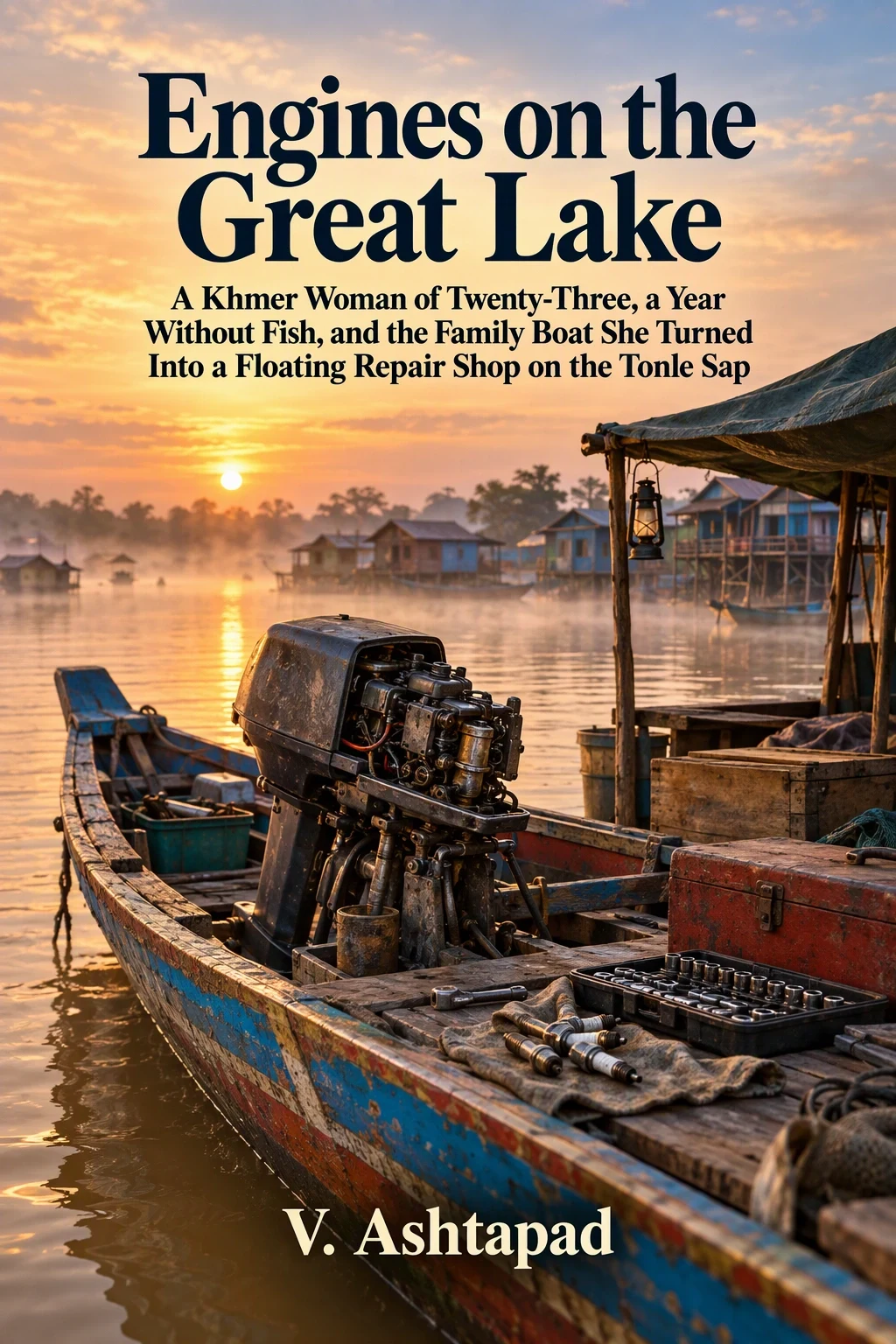
Engines on the Great Lake
A Khmer Woman of Twenty-Three, a Year Without Fish, and the Family Boat She Turned Into a Floating Repair Shop on the Tonle Sap
by V. Ashtapad
Foreword
This is a work of fiction. The Tonle Sap lake and its floating villages near Kampong Luong, the reversal of the Tonle Sap river in the rainy season, prahok, the free cataract clinics, Khmer New Year and the Water Festival are real. The village, the repair boat, its customers and every named person in the story are invented.
For every woman who wrote down her money and found out where she stood.
2 February. Cash: 1,212,000 riel. Debts: none of mine.
I came home on the night bus from Phnom Penh to Pursat and then a tuk-tuk to Krakor and then my father's boat across the water, and the whole way I held my bag on my knees with the money in it, sewn into the lining of a jacket, one million two hundred twelve thousand riel, which is three hundred dollars and a little. Three years in the garment factory on Veng Sreng Boulevard. Seven days a week in the busy months. Sleeves. I sewed sleeves. Right sleeves only. A girl named Dary sewed the left sleeves next to me and we used to say that if we ever met in the street we would only recognize each other from one side.
I am writing this in a school notebook with a blue cover because I want to keep an account of everything. My teacher in grade nine said that a person who writes down her money knows where she stands. I did not write down my money in Phnom Penh. I sent most of it home and spent the rest on rent and rice and a phone and once a pair of shoes that hurt. Now I am home and I am going to write it down.
My father met me at the landing in Kampong Luong at six in the evening. The light was going orange and pink over the water and the lake was so low that the landing was a long way out from where it used to be, a walk of maybe two hundred meters over cracked gray mud that was the lake bottom in the wet season. The boats were pulled up in a crowd at the end of it, painted blue and green and red, with their long engines tipped up out of the water like the tails of scorpions.
He looked thinner. He was wearing the same green shirt he wore when I left. He took my bag and put it in the boat and did not say much, which is how he is, and then he pulled the cord on the engine and it did not start. He pulled it again. Nothing. He took the cover off and looked inside and took out the spark plug and wiped it on his shirt and blew on it and put it back and pulled again, and it coughed and started, and black smoke came out the back, and we went.
"It needs a new plug," I said.
"It needs a new everything," he said.
---
Our house is on the water. I should say this for anyone who reads this and is not from here. The village is not on land. The village is on the lake, a long row of houses built on rafts of bamboo and old oil drums, tied to poles or anchored, so that when the water rises in the rainy season the houses rise with it, and when it falls they fall. In the dry season, now, the lake is shallow, a meter or two, and the houses sit close together. In the wet season the lake grows five times bigger and ten meters deeper and the whole village moves, house by house, towed by boats, to a new place where the water is right. Every house in our village has moved maybe fifty times. My grandmother says she was born in a house that was somewhere near where the fish sauce factory is now, and also near where the school is, and also two kilometers north, depending on which month.
Everything floats. The houses, the school, the shop that sells rice and petrol, the place where you can charge your phone, the karaoke house, the pig pens, the flower gardens in old basins. Children paddle to school in aluminum bowls. My grandmother grows morning glory and basil and chili in a row of old plastic buckets along the edge of our deck, and when I came home she was sitting among them in the dark with a flashlight, cutting leaves, and she looked up and said, "You're fat. Good. Phnom Penh fed you."
I am not fat. I am the same as I was. But my grandmother says it to everyone she loves.
© 2026 CRUNOD LLC. All rights reserved.
4 February. Cash: 1,212,000. Spent: 0.
I counted the fish today.
I did not mean to. I went out with my father in the morning to check his nets. We left at four in the dark. The lake at four in the morning in February is cold, really cold, and there is mist on the water, white, lying flat, so that the boat goes through it like a knife through cotton, and you cannot see the other boats but you can hear them, their engines putt-putting in the mist, and people calling to each other, and once a woman singing. My father has a line of nets set across a channel about three kilometers from the village, gill nets, long walls of fine net that hang down in the water from floats, and every morning he goes along the line and pulls them up one by one and picks out the fish.
There were thirty-one fish. I counted. Thirty-one fish in eleven nets. Most of them were small. Trey riel, the little silver ones that we make prahok from, and a few trey kanchos, the catfish with the whiskers, and two snakeheads, one big. That was all.
"This is a bad day?" I said.
"This is a good day," said my father.
When I was a girl, before I went away, before I went to school even, I used to go out with him to the nets and we would come back with the boat so full of fish that they were sliding over my feet, silver and slapping, and my job was to sit on the bottom of the boat and pick up the ones that jumped out and throw them back in. My father says that in his father's time, in the old days, the fish in the flooded forest were so many that you could hear them, a sound like rain, when they were all moving at once under the water.
Thirty-one.
"Why?" I said.
He shrugged. "Too many nets. Too many people. Not enough flood." He started the engine. It started on the second pull. "The water doesn't come up like it used to. Last year it came late and went early. The year before also. The fish need the forest under the water to have their babies, and if the water doesn't come into the forest, there are no babies." He turned the boat toward home. "And they are building dams up the river in other countries. And it is hotter. And there are new laws about where you can fish. And the big men with the big nets." He shook his head. "I don't know. Everyone says something different. All I know is thirty-one."
When we got home my mother sorted the fish on the deck. The biggest snakehead she sold to a neighbor's wife for eight thousand riel. The small fish she put in a basin to make prahok. The rest was dinner. That was the whole day's income from fishing. Eight thousand riel. Two dollars.
I did not write that in the cash line. It is not my cash. But I wrote it here.
© 2026 CRUNOD LLC. All rights reserved.
7 February. Cash: 1,212,000. Spent: 0. Thinking.
There are, I counted, one hundred and forty-two boats in our village with engines. I know because I paddled around the whole village yesterday in my grandmother's little boat, the one she uses to go to the market, and counted. One hundred and forty-two. Long-tail boats, mostly. A little petrol or diesel engine on a swivel at the back of the boat, with a long steel shaft coming out of it, three meters, with a propeller on the end. You steer by moving the whole engine left and right with the handle, and you tip it up to get the propeller out of the water when it's shallow, which is all the time now, in the dry season. That is why every engine in the village is always breaking. The propellers hit mud and roots and old nets and plastic. The shafts bend. The engines suck in dirty water to cool themselves and the dirty water wrecks the pumps. The spark plugs get wet. The fuel is bad. Everyone's engine is old.
There used to be a man who fixed engines. His name is Ta Hoeun. He is seventy and he lives three houses down from us and he fixed every engine in the village for forty years from his deck, with his tools in a wooden box, and you brought your boat to him and tied it up and waited while he worked. But his eyes went bad two years ago, cataracts, white, and now he cannot see the small parts. He sits on his deck in a hammock with a radio. Now if your engine breaks you must take it, or tow your boat, all the way across to the landing and then to Krakor town, to the workshops there, which is two hours each way, and they charge what they want because you have no choice.
I asked eleven people yesterday, while I was counting, what they did when their engine broke. Nine said Krakor. One said he fixed it himself. One said he didn't, he just paddled now.
Eleven people. Nine said Krakor.
I have one million two hundred twelve thousand riel. My father has a boat. Ta Hoeun has a box of tools and forty years in his head and no eyes.
I am thinking.
© 2026 CRUNOD LLC. All rights reserved.
9 February. Cash: 1,212,000. Spent: 6,000 (coffee and cakes for Ta Hoeun).
I went to see Ta Hoeun today with iced coffee from the shop, the sweet kind with condensed milk in a plastic bag with a straw, and four num kom, the little sticky rice cakes in banana leaf with coconut and palm sugar inside, which my grandmother says are his favorite.
He was in his hammock. The radio was playing an old love song from the sixties. He took the coffee without looking and drank half the bag at once.
"Chanthy," he said. "Your father's girl. The one who went to sew clothes for the foreigners."
"Yes, Ta."
"What do you want?"
I told him. I told him about the one hundred and forty-two boats and the nine people who said Krakor. I told him I wanted to fix engines. I told him I wanted him to teach me.
He laughed so hard he spilled coffee on his shirt.
"A girl," he said. "Fixing engines."
"I sewed sleeves for three years. Fourteen hundred sleeves a day. My hands are fast."
"An engine is not a sleeve."
"No," I said. "A sleeve has more parts."
He stopped laughing. He turned his head toward me, his white eyes looking somewhere over my shoulder.
"Your father knows?"
"Not yet."
He was quiet for a while. The radio sang. Out on the water a boat went past with its engine knocking, a bad sound, a sound like someone hitting a pot with a spoon, and he turned his head toward it the way a dog turns its head toward a whistle.
"Hear that?" he said.
"Yes."
"What is it?"
"I don't know."
"Bearing," he said. "Big end bearing. The connecting rod. It's loose. One more week and it will throw the rod through the side of the block and that man will be paddling." He drank the rest of the coffee. "Come tomorrow at six. Bring the box from under my bed. Bring your father's engine. We'll start with plugs."
© 2026 CRUNOD LLC. All rights reserved.
14 February. Cash: 1,212,000. Spent this week: 21,000 (coffee, cakes, bandages, one plug).
Five days with Ta Hoeun. I have cut my hands nine times. I have burned my wrist on an exhaust pipe. I have learned the names of more things in five days than in three years in the factory.
Spark plug. Plug gap. Points. Carburetor. Float. Jet. Needle. Fuel filter. Fuel line. Pull cord. Recoil spring. Flywheel. Magneto. Piston. Ring. Cylinder head. Head gasket. Connecting rod. Big end. Crankshaft. Water pump. Impeller. Shaft. Bushing. Propeller. Pitch. Ta Hoeun says the names and I write them in the back of this notebook with a little drawing of each one, and he makes me say them back to him, and if I say them wrong he hits my hand lightly with a screwdriver. Not hard. Like a teacher with a ruler.
He cannot see, but he can feel. He sits on a plastic stool on his deck with the engine on a wooden block in front of him and I put the parts in his hands and he turns them in his fingers and says, this one is worn, feel here, on the edge, it should be sharp. Or: this one is fine, this is not your problem, your problem is somewhere else. Or: smell this. And I smell it. Burnt, he says. You smell that? That is the smell of oil that got too hot. Your father has not changed his oil since you went to Phnom Penh.
My father has not changed his oil since I went to Phnom Penh.
He does not know yet what I am doing. He thinks I am helping Ta Hoeun because the old man is lonely. Which is also true. On the first day Ta Hoeun's daughter-in-law came over in her boat and stood on the edge of his deck and watched me with her mouth open, and then went away and came back an hour later with a plate of fried bananas and sat down to watch some more. Now every day there are three or four women sitting at the edge of Ta Hoeun's deck in the afternoon, shelling peanuts and watching me, like it is a television show. Yesterday one of them, Om Sophy, who sells petrol, said, "When you are finished learning, will you look at my engine? It makes a noise like a cough."
I said I would.
I did not write it down yet. It is not cash.
© 2026 CRUNOD LLC. All rights reserved.
16 February. Cash: 1,212,000. Spent: 0. Father knows.
My father knows.
Om Sophy told her husband, who told my father at the petrol shop. My father came home at noon and sat down on the deck and did not eat his rice. My mother looked at me. My grandmother looked at the buckets of morning glory.
"You are fixing engines," said my father.
"Learning. Ta Hoeun is teaching me."
"For what?"
So I told him. The one hundred and forty-two boats. The nine people who said Krakor. My savings. And then I said the last part, which I had not said to anyone, not even to Ta Hoeun. I said: I want to use our boat. The big one. Your boat. To make a shop. A floating shop, with a roof and a bench and the tools, so that I can go to people instead of them coming to me. To the nets in the morning, when the engines fail. To the houses. To the floating school. Anywhere.
My father studied me, his cigarette burning down.
"My boat," he said.
"You go out every day for thirty-one fish."
I should not have said that. I knew it as soon as I said it. My mother made a small sound. My father stood up and walked to the end of the deck and stood with his back to us, looking at the water.
My grandmother said, very quietly, still looking at her morning glory, "Chanthy. Go and get me the big knife."
I went and got her the knife. When I came back my father was gone. He had taken my grandmother's little boat and paddled away.
---
He came back at dark. I was sitting on the deck in the light of the battery lamp writing in this notebook. He tied up the little boat and climbed onto the deck and sat down next to me.
"Your grandfather fished," he said. "His father fished. I have fished since I was nine years old. I don't know anything else."
"I know."
"If you take the boat, what do I do?"
I had thought about this. I had been thinking about it for two weeks. "Drive it," I said. "Pa. I can't drive the big boat and fix engines at the same time. And you know every channel, every net line, every family. You know where everyone is. I don't. I've been gone three years."
He did not answer.
"And the propellers," I said. "Ta Hoeun says straightening a bent propeller shaft takes a strong man and a good eye. I don't have the arms. You do."
He was quiet a long time. The lake was black, with the lights of the other houses on it, little yellow squares, and the reflections of the lights going long and wavy on the water, and the sound of a television somewhere, and frogs.
"Your mother says you were always like this," he said finally. "When you were small. Always counting things."
"I'm writing it down now."
"I see." He looked at the notebook. "What does it say?"
I showed him. The cash line. One million two hundred twelve thousand. He looked at it. I don't think he had known how much I saved. He turned it in his fingers.
"That's a lot of sleeves," he said.
© 2026 CRUNOD LLC. All rights reserved.
20 February. Cash: 1,212,000 → 586,000. Spent: 626,000 (tools and parts, Krakor market).
Today I went to Krakor and spent half my money.
I went with Ta Hoeun, because he would know if they tried to cheat me, and with my father, because he would drive the boat, and with my brother Pheakdey, because he was supposed to be in school and he lied and said it was a holiday and by the time we found out we were halfway across.
Pheakdey is twelve. He is not my blood brother. He is my cousin's son. My cousin Sreyneang went to Thailand to work in a fish factory in Samut Sakhon when Pheakdey was two, with her husband, because there was no money here, and they left him with us, and then they did not come back, and they sent money for a while, and then less, and then they called and said they would stay, and asked my parents if they would keep him as their own. So my parents went to the commune office with papers and adopted him, and he became ours. He calls my mother Mak and my father Pa. He calls me Bong, older sister. His real mother calls him on my mother's phone every month or two, from Thailand, and he talks to her politely like she is an aunt, and afterward he goes and sits at the end of the deck for a while by himself. I don't ask him about it. He will tell me when he wants to.
He is the smartest person in our family. He is also the laziest. He will be either a minister or a pickpocket.
---
The parts market in Krakor is a long row of shops on the main road, open at the front, with everything hanging from the ceiling and piled to the roof. Spark plugs in boxes. Belts. Hoses. Propellers in a stack like dinner plates, all sizes, shining. Engines, new ones, still in their crates, from China, and old ones, rebuilt, from Thailand and Japan, with the paint gone and the numbers scratched off. The smell is oil and rubber and dust and the noodle soup from the cart at the end of the row. It is very loud. Motorbikes go past on the road one meter away, and trucks, and a man selling sugarcane juice from a cart with a machine that grinds the cane, screaming.
Ta Hoeun walked down the row with his hand on my shoulder, and stopped at every shop, and asked for things, and felt them, and told me which ones were good and which ones were rubbish, and then I bargained. I am good at bargaining. Three years in Phnom Penh. You learn.
Here is what I bought. I am writing it all down so I will always know.
Socket set, metric, with ratchet: 85,000.
Two screwdrivers, two spanners, one adjustable spanner, pliers, wire cutters: 52,000.
Spark plug gap tool and spark plug socket: 12,000.
Twenty spark plugs, the common size, in a box: 60,000.
Eight impellers, three sizes: 96,000.
Fuel filters, ten: 30,000.
Fuel line, five meters: 15,000.
Gaskets, assorted, a big bag: 40,000.
Pull cord, ten meters: 8,000.
A secondhand vise: 55,000.
A tarpaulin, blue, four by six meters: 35,000.
Wood and nails for a bench and a roof, from the timber yard: 110,000.
A big plastic toolbox with a lock: 28,000.
Total: 626,000 riel. One hundred fifty-six dollars and fifty cents.
I have five hundred eighty-six thousand left. Ta Hoeun says that is too little to be safe and too much to be scared. My father carried everything to the boat and did not say anything about the cost. Pheakdey ate two bowls of noodle soup and a sugarcane juice and a grilled corn and asked me to write it in the book. I wrote it in the book. Under *spent*. Pheakdey: 9,000.
© 2026 CRUNOD LLC. All rights reserved.
26 February. Cash: 586,000. Earned: 0. Building.
We built the shop.
It took five days. My father and Pheakdey and I, and on the third day two of my father's friends who heard and came over with their own hammers. We took my father's big boat, which is eleven meters long and painted blue on the outside and green on the inside, with a white stripe, and built a roof over the back half of it with bamboo poles and the wood from Krakor and the blue tarpaulin, so that you can stand under it in the rain or the sun. Under the roof we built a workbench across the boat, one meter high, with the vise bolted to one end. We put hooks under the roof to hang things. We built a shelf along the side for the parts, with a lip so things don't roll off when the boat moves. We put the toolbox under the bench, chained to it, because Ta Hoeun says the first thing that happens to a mechanic is someone steals her tools.
The engine is in the front, where it always was. My father's engine. Ta Hoeun and I took it apart and cleaned it and changed the oil and put in a new plug and a new impeller and a new fuel filter, and now it starts on the first pull, every time, and does not smoke. My father pulled it eleven times in a row the first day just to watch it start. On the eleventh time he laughed.
On the side of the boat, under the white stripe, Pheakdey painted a sign. He did it himself, without asking, with a can of red paint from somewhere, and when I saw it I wanted to be angry because he had not asked, and then I read it and could not be.
It says, in big crooked Khmer letters: CHANTHY'S BOAT HOSPITAL. And under it, smaller: WE COME TO YOU.
© 2026 CRUNOD LLC. All rights reserved.
1 March. Cash: 586,000 → 598,000. Earned: 12,000. First customers.
The first customer was Om Sophy, who sells petrol. Her engine coughed. The fuel filter was full of black dirt, like coffee grounds. I changed it. Five minutes. I charged her 6,000, which is the price of the filter plus 2,000 for my work. She paid me in cash and then gave me a bag of sweet potatoes as well, which I did not write down.
The second customer was a man I did not know from the other end of the village, who flagged us down as we went past. His plug was wet. I dried it and regapped it. I charged him 2,000. He tried to pay me in fish. I said cash. He said he had no cash. I looked at my father. My father looked at the fish, which were three good snakeheads. I took the fish. I wrote it down: *Earned: 3 snakeheads (approx. 15,000).* Then I crossed it out, because fish are not cash, and wrote it again on a new page at the back that I am calling *Other.*
The third customer did not pay me at all. It was Ta Hoeun's grandson, who brought his engine over and said his grandfather said I would do it for free because I was his student. I asked Ta Hoeun. Ta Hoeun laughed in his hammock and said, "Charge him double, he is my grandson, he can afford it." I charged him 4,000. He paid.
At the end of the day I had earned twelve thousand riel. Three dollars. Less than a day in the factory.
But it is mine. And I came home and my grandmother looked at my black hands and said, "You smell like a motorbike," and gave me the biggest piece of fish.
© 2026 CRUNOD LLC. All rights reserved.
12 March. Cash: 598,000 → 731,000. Earned this fortnight: 158,000. Spent: 25,000 (parts). Owed to me: 47,000.
Two weeks. I am writing it all down.
Customers: thirty-eight. Plugs: fourteen. Filters: nine. Impellers: five. Fuel lines: four. Pull cords: three. Carburetor cleaned: two. A propeller shaft straightened by my father: one, for a man from Chhnok Tru who came all the way across because he heard. Things I could not fix: three. Two needed a new part I don't have. One needed a new engine. I told the man the truth. He said thank you for telling him the truth, the workshop in Krakor had told him it could be fixed for 200,000 and it had broken again a week later.
Owed to me: forty-seven thousand riel, by seven people. This is the problem. In the factory nobody owed me anything. The factory paid on the tenth and the twenty-fifth. Here, everyone is my neighbor, and my neighbors have no money because there are no fish, so they say, I'll pay you Saturday, I'll pay you when I sell my catch, I'll pay you when my son sends money from Thailand. And I write it down, and they mean it, and some of them pay and some of them do not.
Ta Hoeun says: you must decide what kind of shop you are. A shop that gives credit to everyone is not a shop. It is a charity. You will close in three months. A shop that gives credit to no one is a shop nobody comes to. You will close in three months.
"So what do I do?"
"You decide," he said, "who you trust. And you write it down. And when someone does not pay, you go to their house and you sit on their deck and you talk to their wife."
"Their wife?"
"The wife holds the money," said Ta Hoeun, "in every house on this lake. Have you not noticed? You were born here."
I had noticed. I just had not thought of it as business.
---
So today I went to see the wife of Ta Phal, who owes me eleven thousand for an impeller since the first of March.
I did not ask for the money. Ta Hoeun said not to ask for the money. He said, take something. So I took a bag of the dried shrimp my mother makes, and sat on Yeay Phal's deck, and she gave me tea, and we talked about her daughter in Phnom Penh who works in a hotel and about the price of rice and about how the lake was this year and how it was when she was a girl. She said when she was a girl there was so much fish in the flood season that they used to make prahok in big clay jars, twenty jars, thirty, and give it away to relatives in the hills because they couldn't eat it all, and the whole village smelled of it for a month, that strong salty smell, and her mother used to say it was the smell of being rich.
I wrote that down later. Not in the money part. In the back.
When I was getting back in my boat she went inside and came out with eleven thousand riel folded small and put it in my hand and said, "He forgot. Men forget." And I said thank you, Yeay, and she said, "Come again for tea. Not for money. For tea."
© 2026 CRUNOD LLC. All rights reserved.
25 March. Cash: 731,000 → 612,000. Spent: 260,000 (solar panel, charger, batteries). Earned: 141,000.
Today I did something Ta Hoeun said was stupid.
I spent two hundred sixty thousand riel on a secondhand solar panel and a charge controller and four old car batteries.
Here is why. In our village, most houses have no electricity from a wire. There is no wire. There is the lake. So everyone uses car batteries. You buy a battery, and you use it for your lights at night and your television and your phone and your fan, and when it is flat you take it to the battery man, who charges it from his diesel generator for 2,000 or 3,000 riel, and you take it home. The battery man in our village is a man named Ta Vong, whose generator is very old and very loud and breaks every week, and who closes when he is drunk, which is often.
Every day, when I go round the village in the shop, someone asks me: can you charge my battery? Can you charge my phone?
So now I can. The panel is on the roof of the shop, on top of the tarpaulin, tied down with wire. It charges two batteries at a time all day while I am working, and in the evening, when I come home, the charged ones go to the customers and I bring their flat ones back. My mother runs it. She keeps a list on a piece of cardboard tied to the post at the end of our deck. Name, battery, date, paid or not paid. She is very strict. Stricter than me. Yeay Phal tried to take her battery home without paying the first day and my mother said, "Yeay. Men forget. Women don't. Two thousand." And Yeay Phal laughed so hard she sat down on the deck.
Ta Hoeun said: you are an engine mechanic, not a battery shop. You should do one thing well. I said, Ta, I sewed right sleeves for three years. I am finished doing one thing.
© 2026 CRUNOD LLC. All rights reserved.
6 April. Cash: 612,000 → 803,000. Earned: 191,000. New Year coming.
It is getting very hot. The lake is at its lowest. The mud flats around the landing are so wide now that it takes twenty minutes to walk from the end of the water to the road, and the edge of the water stinks of rotting weed and fish, and the sun at noon is so strong that the deck boards are too hot to stand on with bare feet. Everyone sleeps in the afternoon in hammocks under the roofs with the fans going on their batteries, which is good for my mother's business.
The engines are breaking more because the water is shallow. Every day a propeller hits the bottom. My father has straightened eleven shafts this month. He has a way of doing it with a block of wood and a heavy hammer, laying the shaft across two blocks and tapping it, tapping it, sighting along it with one eye closed, tapping again. Men come and watch him do it. They bring their sons. He has started to talk while he does it, telling the boys what he is looking for, which he never did when he was fishing. When he was fishing he hardly talked at all.
Yesterday, a man from Krakor came to see me. Not a customer. A man with a shop. He is called Bong Vuthy and he has one of the big workshops at the end of the parts market and he came across in a fast boat with a new engine and sat on the edge of my shop and smoked a cigarette and looked at everything.
"You're the girl," he said.
"I'm Chanthy."
"You're taking my customers."
I said nothing. I had known this would happen. Ta Hoeun had told me.
"The people from this village used to come to me," he said. "Every week. Now they don't."
"They come to me because I come to them," I said. "You make them come two hours."
He looked at me until the engine noise faded. Then he laughed and threw his cigarette in the lake.
"You'll be out of business by the rainy season," he said. "When the water comes up the engines don't hit the bottom anymore. Nobody needs a propeller fixed. Nobody needs you." He got up. "Then you'll come and work for me."
He went back to his fast boat and left. My father watched him go.
"Is that true?" he said. "About the rainy season?"
I didn't know. I wrote it down. *Rainy season: fewer propellers. Check.*
© 2026 CRUNOD LLC. All rights reserved.
15 April. Cash: 803,000 → 691,000. Spent: 112,000 (New Year). Earned: 0. Shop closed three days.
Khmer New Year. Choul Chnam Thmey. Three days of no work. The whole village stopped.
I have not had New Year at home in three years. In the factory we got three days off and everyone went home to their provinces and the buses were so full that people sat on the roofs, and I stayed in my room in Phnom Penh because a bus ticket was 40,000 and I was saving. So this year I spent money. I am writing it down because I want to remember that I chose to.
New clothes for Pheakdey, who grew four centimeters since January: 35,000. A new shirt for my father, blue, to replace the green one: 22,000. Material for my mother and my grandmother, cotton with flowers, for my mother to sew: 30,000. Flour and coconut and palm sugar and sticky rice and banana leaves for the cakes: 25,000.
My grandmother made num ansom, the big cylinder cakes of sticky rice wrapped in banana leaf with mung beans and pork fat in the middle, tied with bamboo strips and boiled for six hours in a big pot on the deck so that the whole house smelled of steam and leaves. My mother and I made num kom and num akor, the little steamed cakes, white and pink. The neighbors' children came across in their little bowls, paddling with their hands, to sprinkle water on us, which is what you do at New Year, for luck, and to cool down, and Pheakdey and his friends ambushed them with a bucket and then the whole deck was a war.
In the afternoon on the second day there were games on the long deck by the floating school. The boys played bos chhoung, the throwing game, where two lines of boys and girls face each other and throw a knotted scarf back and forth, and if you catch it you are allowed to throw it at the person you like, and everyone knows what it means, and pretends not to. The old people played a game with tamarind seeds on a board. There was a tug of war between the north end of the village and the south end, which the south end won because they had the fat man who sells ice.
On the third night, my grandmother told riddles. This is a thing she has always done at New Year, since I was a girl, when the family sits on the deck after dark with the lamp on and the frogs singing. She asks, and you have to answer, and if you can't answer she laughs at you.
"What has a mouth but never eats, and a tail but never wags?"
"A boat," said Pheakdey.
"A boat. Too easy. Children's riddle. What is it that the more you take from it, the bigger it gets?"
Nobody knew.
"A hole," said my grandmother, and laughed so hard she started coughing. "Chanthy, you went to Phnom Penh and you don't know a hole."
I took out my phone and started recording. My grandmother stopped laughing. "What are you doing?"
"Recording you, Yeay. So we have the riddles."
"Who will listen to an old woman's riddles?"
"Pheakdey's children," I said.
She looked at Pheakdey, who was lying on his stomach on the deck with his chin on his hands. She looked at him for some minutes.
Then she said, "What is it that walks on water and is never wet?" And the recording got the rest of the night, an hour and twenty minutes, all her riddles, and the frogs, and my father laughing in the dark, and my mother saying the answers too early, and Pheakdey getting almost all of them wrong. Later I put it on the page my cousin in Phnom Penh made for our family, the private one where we keep the photos from the weddings and the old picture of my grandfather with his net, and I wrote: *Yeay's riddles. New Year.*
The answer to the last one was a shadow.
© 2026 CRUNOD LLC. All rights reserved.
2 May. Cash: 691,000 → 842,000. Earned: 151,000. Ta Hoeun's eyes.
There is a free eye clinic in Pursat town this month, run by doctors who come from Phnom Penh for two weeks with their machines, and they fix cataracts. You go in blind and you come out the next day with a patch, and when they take the patch off you can see. Om Sophy's mother went last year. She says the first thing she saw was her own hand and she cried because it was so old.
Ta Hoeun did not want to go. He said he was too old. He said his eyes had done their work. He said he did not want strangers cutting his face.
So I sat on his deck and did not argue. I asked him what he was afraid of. He said, nothing. I waited. He said, the money. I said it is free. He said, then it is no good. I waited. He said, the bus. I said my father will take him in the boat to the landing and I will go with him on the bus. He was quiet. Then he said, very quietly, "What if I see, and everything is different. The lake. The village. Everything I remember. What if it is all different and I don't know where anything is anymore."
I had not thought of that.
"Then I'll show you," I said.
He went. The doctors did his right eye on the twenty-eighth of April and kept him one night. I slept on the floor beside his bed. On the morning of the twenty-ninth a young woman doctor with a ponytail took off the patch, and he sat on the edge of the bed with his hands on his knees and blinked, and blinked, and then he turned his head and looked at me.
"Chanthy," he said. "You're very dirty."
I had come straight from the shop. I had grease to my elbows.
He laughed. He laughed so much the doctor had to tell him to stop or he would hurt his eye.
---
When we got home he did not go to his hammock. He went straight to my shop, which was tied up at our deck, and climbed in, slowly, holding the roof poles, and stood under the blue tarpaulin and looked at everything. The bench. The vise. The shelf of parts with the lip. The plugs in their boxes. The impellers hanging on hooks. My notebook on the bench, open. He picked up the notebook and held it far away from his face and squinted at it.
"You wrote everything," he said.
"Yes."
"Even the fish."
"Even the fish."
He turned the pages. He stopped at the page in the back with the drawings of the parts and the names. He looked at my drawing of a carburetor for a while.
"The float is wrong," he said. "It goes the other way."
I took the pencil and fixed it.
"Better," he said. Then he put the notebook down and looked out from under the tarpaulin at the lake, at the village, at the rows of floating houses with their washing hung out and their flower buckets and their dogs, at the boats going by with their long tails, at the far shore, which was green, and the sky, which was white with heat.
"It's the same," he said, surprised. "It's all the same."
"Except there are fewer fish," I said.
"Except there are fewer fish," he agreed. He sat down on my bench. "I'll come in the mornings," he said. "Not every day. When you need an old man to listen to an engine."
© 2026 CRUNOD LLC. All rights reserved.
20 May. Cash: 842,000 → 903,000. Earned: 108,000. Spent: 47,000. Problem.
Bong Vuthy has a boat now.
He did what I did. He took one of his boats and put a roof on it and a bench and he sends it out from Krakor every morning with two of his mechanics, young men in blue overalls, and they come to our village and go round with a loudspeaker playing music and shouting, ENGINE REPAIR, BEST PRICES, NEW PARTS FROM THAILAND. They charge 1,500 for a plug. I charge 2,000. They charge 20,000 for an impeller. I charge 22,000.
In one week my customers went from sixty to thirty-four.
I sat in the shop on the evening of the nineteenth and looked at this notebook until the engine noise faded. My father sat beside me and smoked and did not say anything.
"He is cheaper," I said.
"Yes."
"He has two mechanics. I have one."
"You have two," said my father. "You have me."
"You don't fix engines."
"I fix propellers," he said. "Does Vuthy's boat fix propellers?"
I thought about it. Bong Vuthy's boat had a bench and a vise. It did not have a man who could straighten a shaft with a block of wood and a hammer and one eye closed.
"And," said my father, "when do they come?"
"At nine. After their breakfast in Krakor and the trip across."
"When do the engines break?"
I did not answer. I knew. The engines break at four in the morning, at the nets, in the dark, in the mist, when the fishermen pull the cord and the engine does not start, and they are three kilometers from home with the catch in the bottom of the boat and the sun coming up and the fish going soft.
"They break," said my father, "when Vuthy is asleep."
---
So now we go out at four.
My father drives. I sit on the bench with a flashlight in my teeth. We go out along the net lines in the mist, very slowly, with the engine quiet, and we listen. When we hear a man pulling a cord, pulling and pulling, and swearing, we go toward the sound. I do the plug, the filter, the fuel line, whatever it is, by flashlight, in his boat or in mine. My father holds the two boats together with his hand on the gunwale. When it starts, the man goes home with his fish before the sun, and he pays me when he sells them at the landing, and I do not have to go to his wife.
I have also started something else. Ta Hoeun's idea. Every customer, I write down the engine. What kind, how old, what I did, when. In a list, at the back of the book, by the customer's name. So when Om Sophy's engine coughs again I can look and see that I changed her filter on the first of March and the twentieth of April, and I can say, Om, your fuel is dirty, where are you buying it, and she can say, from my own shop, and we can both laugh, and then I can tell her to clean her own tank.
Bong Vuthy's boys do not know whose engine is whose. They do not know anybody's name.
By the end of the month my customers were back to fifty-one. I lowered my plug price to 1,500 anyway. Ta Hoeun said: never let a man say he is cheaper than you on the small things. Beat him on the small things. Make your money on the things only you can do.
© 2026 CRUNOD LLC. All rights reserved.
5 June. Cash: 903,000. Spent: 0. My mother's prahok.
No work today. My mother said I needed one day where I did not smell like a motorbike, so she made me help her with the prahok instead, and now I smell like fish paste, which my grandmother says is much better for finding a husband.
I want to write down how it is done, because my mother has never written it down, and her mother never wrote it down, and I asked her today whether anyone had, and she laughed at me.
Prahok is the fish paste that every Khmer family eats. In the cities they buy it in jars at the market. On the lake we make our own, every year, in the dry season, when the little fish come out of the flooded forest with the falling water and the nets are full of them, the trey riel, the little silver ones no longer than your finger. That is the prahok season, January and February. This year my mother got only enough for half the jars she usually makes, and some of it was from the market at the landing, which she says is cheating.
But today was not the making. Today was the checking.
My mother keeps the prahok in clay jars at the back of the house, under a sheet of tin to keep the sun off, eight jars this year instead of sixteen. Today she opened every one and looked and smelled and stirred it with a long wooden paddle and decided whether it was ready. The smell when she lifts the lid is so strong that the dogs on the next deck sat up and the neighbor's little girl started crying. It is a smell like the bottom of the lake and old cheese and the sea, though I have never seen the sea, only in pictures, and it gets into your hair and your clothes and stays for two days.
Here is how my mother makes it, which I am writing down while she tells me, sitting on the step in the shade.
You take the little fish the same day they are caught. You cut off the heads and pull out the insides with your thumb. You wash them in a basket in the lake, and then you put them in a big bag of rice sacking and stand on it, with your feet, for an hour, to squeeze out the water. My mother says when she was a girl all the girls of the village did this together in a row on the bank, standing on the sacks and singing, and the boys came to watch. Then you put the fish in a big basin with salt, a lot of salt, more salt than you think, and mix it with your hands until your hands burn. Then you put it in the sun for a day, on a mat, covered with a cloth. Then into the jars. Then you wait. A month for young prahok, soft and pink. Six months for old prahok, dark and strong. A year, or two, or three, for the best, which is almost black and so strong that a spoonful will flavor a whole pot of soup for twelve people.
My mother's oldest jar is from the year I went to Phnom Penh. Three years. She has never opened it. She says she is saving it for my wedding.
I said I'm not getting married.
She said then it will be for Pheakdey's wedding, and it will be six years old, and the whole village will faint.
---
When we were done she made samlor prahok for dinner, the soup, with green eggplants and pork and lemongrass and a big spoonful from a young jar, and fresh vegetables from my grandmother's buckets, the morning glory and the basil and the little bitter leaves whose name I don't know in any language except my grandmother's. My father came in from the nets at dark and ate three bowls without speaking. Then he sat back and said, "That's the taste."
I asked him what he meant.
He said that when he was young, before I was born, he went to work on a road crew in the north, in the hills, for two years, and they ate rice and dried fish and whatever they could find, and one day his mother sent him a little jar of prahok in a parcel, wrapped in plastic and banana leaves, which took three weeks to arrive, and he opened it in the workers' camp, and the other men all shouted at him because of the smell, and he did not care. He ate it with his rice for a month, a little every day, until the jar was empty. He said it tasted like home.
I had never heard this. I have known my father twenty-three years.
I wrote it in the back of the book. Then I asked him if I could record it, and he said, record what, and I said, the prahok story, and he said, it's not a story, it's just a jar, and I said, Pa, please, and he told it again into my phone, shorter, the second time, and gruffer, but the same.
© 2026 CRUNOD LLC. All rights reserved.
10 June. Cash: 903,000. Spent: 0. The first big rain.
The first big rain came today. Not the afternoon showers of May. The real one.
It came across the lake from the southwest at about three o'clock, a black wall of cloud so low it touched the water, with white underneath it where the rain was already falling, and the wind ahead of it so strong it flattened the morning glory in my grandmother's buckets and blew the washing off every line in the village. We were out at the far end of the net lines in the shop with a customer's engine on the bench. My father saw it coming before I did. He said one word, which I will not write here, and started our engine, and we ran for home with the customer's boat tied behind us, bouncing, and the customer sitting in it holding on with both hands.
We did not make it. The rain caught us halfway. It came down so hard I could not see the front of my own boat. It came sideways under the tarpaulin and soaked everything, the bench, the parts, the notebook, which I put inside my shirt. It hammered on the blue tarp roof so loudly that my father and I could not hear each other shouting. The lake went white. Every raindrop hit the water and jumped up again, so that the whole surface of the lake was jumping, as if it were boiling.
My father turned the boat into the wind and held it there, and we waited. Twenty minutes. Thirty. The customer in the boat behind us bailed with a plastic bowl the whole time and laughed like a madman.
Then it stopped. All at once, the way it does here. The cloud went over and the sun came out behind it, low and gold, and the whole lake was steaming, a white mist rising off it everywhere, and the air smelled of wet wood and mud and something green and new that I had not smelled since I came home in February.
My father sat back on the bench, soaked, with water running off his hair, and looked at the steaming lake.
"Now it starts," he said.
He meant the flood. The water rising. The forest filling. The fish. He said it the way you would say it about a person you love who has been away a long time and has just walked in the door. I wrote it down, on a wet page, in smudged pencil, in the back of the book: *10 June. First big rain. Pa says, now it starts.*
The notebook dried by evening, in the sun on the deck, with a stone on each page. Some of the pencil has run. You can still read it.
© 2026 CRUNOD LLC. All rights reserved.
18 June. Cash: 903,000 → 1,096,000. Earned: 241,000. Spent: 48,000. The water is coming.
The rains started at the end of May. Not every day, at first. Big gray clouds coming up from the south in the afternoons, building and building into towers, and then wind, and then rain so hard you cannot see the next house, rain that bounces off the lake in a white fog, for one hour, and then sun again and steam coming off the decks.
And now the river has turned.
I should explain. I didn't understand this until I was in grade six, and my teacher drew it on the board. The Tonle Sap lake is connected to the Mekong River by the Tonle Sap river, which runs from the lake down past Phnom Penh. In the dry season, the lake drains into the Mekong through the river. But in the rainy season, the Mekong fills up with rain and snow from the mountains far away, in China and Laos, so much water that it pushes back up the Tonle Sap river, and the river turns around and flows backward, uphill, into the lake. The lake fills up. It gets five times bigger. It floods the forest all around its edges, the trees standing in the water up to their necks, and that is where the fish have their babies.
It is the only river in the world that does this. My teacher said so. I was very proud of it when I was eleven, as if I had done it myself.
This year, my father says, it turned two weeks late. Last year three weeks late. When he was a boy, he says, you could set your calendar by it.
---
When the water rises, the village moves.
Every house has to go. The water is coming up a few centimeters a day now, and the houses have to move farther out, or farther in, to where the depth is right, not too deep for the anchors, not too shallow for the floats. And the whole village goes together, more or less, over two or three weeks, house by house, towed by boats. Ropes are tied from the house to the boat. The boat pulls. The house follows slowly behind, on its bamboo and its oil drums, with the family sitting on the deck, and the dog, and the chickens in their cage, and the television, and the flower buckets.
This year there are not enough boats with good engines to tow all the houses. Too many engines are old. Too many families sold their boats when the fish stopped.
So for three weeks, my shop was a tugboat.
I am writing this down because it is the most money I have ever made. Twenty-two houses towed. Thirty thousand riel for a small house, fifty for a big one, eighty for the floating school, which the commune paid for and which took my father and two other boats and four hours. My father drove and I tied the ropes and Pheakdey sat on the roof of the house we were towing and shouted when we were about to hit something.
Bong Vuthy's boat does not tow. It is too small and its engine is too weak and his boys do not know the channels.
On the last night, when the floating school was anchored in its new place and the children had come out on the deck to cheer, my father turned off the engine and we sat in the shop in the dark and drank sugarcane juice from a plastic bag and listened to the frogs.
"Vuthy said nobody would need you in the rainy season," said my father.
"Vuthy was wrong."
"Vuthy is from Krakor," said my father, as if that explained it, and it did.
© 2026 CRUNOD LLC. All rights reserved.
4 July. Cash: 1,096,000 → 1,151,000. Earned: 79,000. Spent: 24,000. Pheakdey.
Pheakdey's mother called from Thailand on Sunday.
My mother's phone rang at noon and my mother looked at it and said, "Pheakdey. It's your Ming." Ming is aunt. That is what he calls her. My mother says it gently every time, and every time he goes still for one second before he takes the phone.
He went to the end of the deck, as always, and sat with his back to us and his feet in the water, talking. I could not hear. I was in the shop doing a carburetor. But it went on longer than usual. Twenty minutes. Thirty. When he came back he gave my mother the phone and went into the house and lay down in his hammock and pulled the edge of it over his face.
My mother told me later. His mother has a new job in Thailand, in a bigger factory, with more money, and an apartment, and she wants him to come. She can get him papers. He could go to school there. He could learn Thai. In a year he could work.
"What did he say?" I asked.
"He said he would think."
---
I did not ask him. I kept quiet for three days. Then on the third day, at four in the morning, when I was getting into the shop to go out to the nets, he was already in it, sitting on the bench in the dark in his school shirt with his arms around his knees.
"Can I come?" he said.
"You have school at seven."
"I'll be back at six."
My father looked at me. I nodded. We went.
It was the first time he had come at four. He sat on the bench beside me in the mist while my father drove, and he held the flashlight for me when we found a man with a wet plug, and he watched me change it, and he asked what everything was, and I told him. Plug. Gap. Lead. Then we found a man whose propeller had hit a log and bent, and my father held the boats together while I took the shaft off, and Pheakdey watched my father lay it across the two blocks and tap it, and sight along it with one eye closed, and tap again.
"Can I try?" he said.
My father gave him the hammer.
He was terrible. He hit it too hard. My father took the hammer back and showed him, and gave it to him again, and he was less terrible. By the third time he was sighting along it with one eye closed, exactly like my father, the same frown.
We were back at six. He went to school.
That night he sat down next to me on the deck where I was writing in this book and said, without looking at me, "If I go to Thailand, who will hold the flashlight?"
"I'll find someone."
"You won't find someone as good."
"No," I said. "I won't."
He was quiet. Then he said, "I told Ming I'm going to stay until I finish school. Then I'll think. I told her she can come here and visit. She said maybe at New Year." He looked at the book. "Write it down."
"Write what down?"
"That I'm staying," he said. "So it's in the book."
So I wrote it down. Here. *Pheakdey is staying. 4 July.*
© 2026 CRUNOD LLC. All rights reserved.
22 July. Cash: 1,151,000 → 1,098,000. Earned: 64,000. Spent: 117,000. A bad week.
I am writing the bad weeks too. Ta Hoeun says a book with only good weeks is a lie.
On Monday the solar panel blew off the roof of the shop in a storm. The wire I tied it down with was not enough. The wind came across the lake in the afternoon from the southwest, a black wall of it, so fast that we did not have time to get home, and my father turned the boat into the wind and held it there while the rain came sideways under the tarpaulin and soaked everything, and the panel lifted off the roof like a kite and flew, and landed in the lake, upside down, and sank. My father dived for it. He found it. He came up with it on the third dive, holding it over his head, with water pouring off it and his eyes red. It does not work anymore. Eighty thousand riel for a new secondhand one in Krakor.
On Wednesday I fixed an engine for a man from Chhnok Tru, a new impeller and a carburetor clean, thirty-one thousand, and he said he would pay me Saturday, and on Saturday he did not come. I asked around. Nobody knew him. I had written down his name. I had not written down his house. That was my fault.
On Friday my mother was sick, with fever, and the battery side closed for two days, and four customers went to Ta Vong, and two of them did not come back.
And all week, the water rose slowly and the fish did not come.
---
That is the thing I did not understand in February, when I was counting. I thought: the fish are gone, so the fishermen need something else. So I will be the something else. And that is true. But when there are no fish, there is no money, and when there is no money, nobody can pay the something else either. My shop lives on the same water as the nets. If the lake is poor, my shop is poor.
I said this to Ta Hoeun on Saturday. He was in his hammock, with his new eye, which he uses now to look at everything, the clouds, the dogs, the women going past in their boats. He said, "Yes."
"So what do I do?"
"What does a fisherman do when there are no fish?"
"Goes farther."
"Yes," said Ta Hoeun. "Or?"
"Fishes for something else."
"Yes."
I thought about it all evening. Then I wrote, on a new page, a list. Things people on the lake need that have nothing to do with fish.
Batteries charged. Phones charged. Houses towed. School boat fixed. Petrol, maybe, cheaper than Om Sophy, but then Om Sophy would be angry. Ice. Water filters, the clay ones, for drinking water. Pumps for the floating pig pens. Fixing the karaoke house's generator, which is always broken. Fixing the floating clinic's generator, which is the commune's problem but nobody fixes it. Boats for the foreigners who come on tours from Siem Reap to see the floating village and take pictures.
I underlined the clinic. I underlined the tours.
© 2026 CRUNOD LLC. All rights reserved.
9 August. Cash: 1,098,000. Spent: 0. The forest.
A day off. The first in six weeks. My grandmother asked me to take her into the forest.
Not the forest on land. The flooded forest. In August, when the lake is high, the forest at the edge of the lake is under water, two or three meters, so the trees stand in the lake with only their tops out, and you can take a small boat in between them, through the branches, in the green light. My grandmother used to go every August when she was young, she said, with her mother, to collect things. Snails. Water plants. Certain mushrooms that grow on the dead wood at the waterline. Fish, of course, which you could catch with a basket. She has not gone for years. Her knees.
So I took her in her own little boat, paddling, because the engine would be too loud. She sat in the front on a cushion with her straw hat on and directed me like a general. Left. Left. Not that left. Under the big tree. Mind the ants. There are ants in the flooded forest that live in the branches above the water, red ants that fall into the boat when you touch the leaves and bite, and my grandmother slapped them off her arms without stopping talking.
It was very quiet in there. Green and quiet and full of light coming down through the leaves in pieces, moving on the water. The water was brown and still. Birds I didn't know, small blue ones, and a big gray heron standing on a branch that did not move when we went past. Under the boat, in the water, you could see fish moving. Small ones. A lot. And bubbles coming up from the mud.
"When I was a girl," said my grandmother, "you could put your hand in the water here and a fish would swim into it."
"Are there fewer now?"
"Fewer," she said. "But not none. Look." She pointed. A flash of silver near a root. Another. "The babies come here. To be safe. They hide in the trees until they are big enough, and then they go out to the lake." She trailed her hand in the water. "If there is no forest, there are no babies. If there is no flood, there is no forest under the water. My father knew that. He told the men who wanted to cut the trees for charcoal, when I was small, he said, you cut these trees, you are cutting your children's dinner."
I took out my phone.
"Recording again," said my grandmother.
"Yes, Yeay."
"Who will listen?"
"Pheakdey. And his children. And his Ming in Thailand. She listens to your riddles on her breaks."
My grandmother was quiet for a moment. Then she said, "Then I will tell her the names of the fish. So she does not forget."
And she did. Floating in the green light between the trees, with her hand in the water, she told me the names of every fish she knew from the lake. Not the market names. The old names, the lake names, some of which I had never heard. Which ones come in the flood, which ones in the dry season, which ones you make prahok from, which ones you dry, which ones you never eat, which ones are lucky. Which ones she had not seen for twenty years. There were thirty-four. I counted. Some of them she described so I could find them later, the color, the shape of the fin, the whiskers. Some of them she only said the name of and then was quiet for a while.
At the end she said, "Write down that your great-grandfather said the trees are the children's dinner. Write it in your book."
"It's a money book, Yeay."
"It's a book," said my grandmother. "Write it."
So I wrote it. Here. On the cash page, where it doesn't belong.
*The trees are the children's dinner.*
© 2026 CRUNOD LLC. All rights reserved.
22 August. Cash: 1,098,000 → 1,372,000. Earned: 391,000. Spent: 117,000. The clinic.
The floating clinic has a generator for its refrigerator, where it keeps the vaccines for the children, and its lights, and a fan for the room where women have babies. The generator was always broken. Everyone knew this. The nurse, whose name is Neary and who is thirty and from Battambang, had written to the commune office six times. The commune office had sent someone once, who looked at it and said it needed a part from Phnom Penh, and went away.
I went to see Neary on the first of August. I asked if I could look at it.
She looked at me. She looked at my hands. She said, "You're the boat hospital."
"Yes."
"Do you fix generators?"
"I fix engines," I said. "A generator is an engine that doesn't go anywhere."
It was the carburetor. Of course it was the carburetor. The float was stuck, and the jet was blocked with old varnish, from fuel that had been left in it for months. It did not need a part from Phnom Penh. It needed someone to take it apart and clean it, which took me two hours on the floor of the clinic with Neary watching and two little boys watching and a mother with a baby on her hip watching, and when I pulled the cord and it started, the baby cried and the mother laughed.
I charged Neary nothing. Ta Hoeun said I was a fool. I said, Ta, the vaccines are for the children. He said, the vaccines are the commune's problem. You charge the commune. So Neary wrote a letter to the commune office saying that I had repaired the generator and attached my bill, forty thousand riel, and she said it would take three months to be paid, if ever, and I said fine, I would write it down under *owed*.
It took nine days. The commune chief came to my shop himself in his boat, a big slow man in a white shirt, with forty thousand riel in an envelope. He also asked if I would look after the generator every month. Clean it, check it, change the oil. Thirty thousand a month. On contract. With a paper.
I have a paper. With a stamp. It is in a plastic bag at the back of this book.
---
The tours I am not sure about yet. They come from Siem Reap in big boats with fifteen or twenty foreigners in them, white people and Korean people and Chinese people with cameras and hats, and they go slowly through the village and take pictures of everything: the houses, the children paddling to school in their bowls, the pigs in their floating pens, my grandmother cutting morning glory. Sometimes they stop at a big floating restaurant at the edge of the village that a company from Siem Reap owns, and eat, and buy bracelets. Their boats break too. Their engines are big and new and they break anyway, because the boat drivers do not know the shallow places in the dry season.
In August three tour boats broke near our village and I fixed all three. The drivers paid well. One of the foreigners, a tall old woman with a gray braid and a big camera, took a picture of me working, with my flashlight in my teeth, and showed me the picture on the back of the camera and said something in English I did not understand. The boat driver translated. She said I looked like her grandmother, who fixed tractors on a farm.
I had no words. I said thank you. I wrote it in the back of the book.
© 2026 CRUNOD LLC. All rights reserved.
28 September. Cash: 1,372,000 → 1,289,000. Earned: 211,000. Spent: 294,000. The ancestors.
The ancestors' festival came at the end of September. Fifteen days when families cook for the ancestors and remember them and visit their relatives, and on the last day everyone goes home to their own village if they can. The roads to the provinces fill with motorbikes carrying whole families and the buses have people on the roofs again. On our lake, people come back from Phnom Penh, from Siem Reap, from Thailand. The village fills up.
I spent a lot. I am writing it down because I chose to. Food for the festival, rice and pork and fish and fruit and the cakes: 98,000. A new pair of school shoes for Pheakdey: 26,000. A visit to Pursat to my mother's sister: 40,000. And 130,000 for something I did not plan.
My cousin Sreyneang came. Pheakdey's mother. From Thailand. With her husband.
She came on the last day. She arrived at the landing on a motorbike taxi from the bus and called my mother's phone, and my father went to get her in the shop because it was the fastest boat, and Pheakdey went with him. He did not want to go. My mother told him to. He sat in the front of the shop beside my father with his hands between his knees and did not say anything the whole way across.
I was not there. I was on the deck with my grandmother, cooking. So I did not see them meet. My father told me later. He said she got out of the motorbike taxi with a big bag, a woman of about thirty-five, thin, in jeans and a pink shirt, with short hair, very tired, and Pheakdey got out of the boat and stood on the mud and looked at her. And she looked at him. She had not seen him since he was two. She had only seen pictures on my mother's phone.
My father said she said his name and then she couldn't say anything else. And Pheakdey stood very straight and put his hands together in front of his face and bowed his head to her, the way you greet an elder, politely, like she was an aunt. And she started to cry. And Pheakdey did not know what to do, so he picked up her bag, which was almost as big as him, and carried it to the boat.
---
She stayed four days. She slept in the house with my mother and grandmother. She cooked with us. She made a Thai curry with fish and coconut and lemongrass that was very spicy, much spicier than we make, and Pheakdey ate it and sweated and said it was good, and drank three glasses of water. She watched him all the time. She watched him go to school. She watched him go out with me at four in the morning to the nets. She watched him straighten a propeller shaft with my father, with one eye closed.
On the third evening she sat beside me on the end of the deck, where Pheakdey sits after her phone calls, with our feet in the water.
"He's happy here," she said.
"Yes."
"He calls your mother Mak."
"Yes."
She was quiet a long time. The sun was going down orange and huge over the flooded forest at the edge of the lake, and the water was flat and gold, and a line of white egrets was flying low over it, going home.
"When I left him I thought it would be one year," she said. "Then I thought two. Then there was no money to come back. Then there was money but I had a job. Then I thought, he doesn't remember me. Then I thought, it's better for him if I don't come back and make him sad." She looked at the water. "I asked your mother to take him. It was the right thing. I know it was. But every month when I call him I think, I am a stranger to my son."
I didn't know what to say. I thought about Ta Hoeun asking what he was afraid of, and waiting. So I waited.
"I want him to know me," she said. "Not as his mother. I know it's too late. As something. As Ming."
"He knows you as Ming," I said. "He talks about you. He told me you can make a fish curry that makes people cry. He told me you sent him the blue backpack when he was eight. He still has it." I looked at her. "He keeps your pictures. On my mother's phone. He showed me once. He looks at them when he thinks nobody sees."
She put her fingers to her lips.
---
I spent 130,000 on the last day for something Pheakdey asked me for. He came to me the night before she left and asked me, very formally, standing in front of me on the deck with his hands behind his back, whether I would take his Ming to Krakor in the shop to catch the bus, instead of my father taking her to the landing for the motorbike taxi, so that she could see the whole village and the lake and the forest on the way. And whether I would let him buy her lunch in Krakor, at the noodle shop at the end of the parts market, with his own money, which he did not have, so could he borrow it. And whether I would buy her a bus ticket all the way to the border, which was 80,000, because she had come on a cheaper bus with three changes, and he did not want her to go back the hard way.
So I did. I wrote it down. *Lent to Pheakdey: 130,000. For his Ming.*
He has paid back 12,000 so far, from the money the fishermen give him for holding the flashlight. He brings it to me every Friday in a plastic bag, and I write it in the book, and he checks that I wrote it.
© 2026 CRUNOD LLC. All rights reserved.
10 October. Cash: 1,289,000. Spent: 0. Earned: nothing in cash. Ta Hoeun's second eye.
Ta Hoeun had his left eye done this week. The eye doctors came back to Pursat for the second time this year and he did not argue. He said one eye was enough to see that he needed the other one.
This time Pheakdey went with him instead of me. It was a school holiday, and Pheakdey asked, and Ta Hoeun said yes before I could say anything, and they went on the bus together, an old man and a boy, with a bag of rice cakes and a bottle of water and a plastic bag of the old man's medicines, and I stood at the landing and watched the bus go and felt strange, the way you feel when someone else does a thing you thought was yours.
They came back on the third day. Ta Hoeun had a patch on his left eye and his right eye wide open, looking at everything. Pheakdey was carrying all the bags. When they got off my father's boat onto our deck, Ta Hoeun stood for a while looking at the lake, high and brown and wide now, with the flooded forest in the distance and the floating houses on it in their new places from the summer, and he said, "It moved."
"The village moves every year, Ta."
"I know," he said. "I mean I saw it move. With this eye." He pointed at his right eye. "In May I saw it in one place. Now it is somewhere else. For forty years I only heard it move."
---
That afternoon, with his patch still on, he made Pheakdey take apart an engine.
Not a customer's engine. An old one. A two-stroke outboard from the 1990s that had been sitting rusting under his house raft for six years, which nobody wanted, which he said had been his best engine once. Pheakdey and my father lifted it up onto the deck and set it on a wooden block, and Ta Hoeun sat on his plastic stool in front of it, the way he used to sit with me in February, and Pheakdey sat on the deck with the toolbox, and Ta Hoeun said, "Plug."
Pheakdey took out the plug.
"What do you see?"
"It's black."
"Black how? Dry black or wet black?"
Pheakdey looked. "Wet. Oily."
"So?"
Pheakdey thought. I watched him think. I was sitting on the edge of my shop, tied up beside the deck, with the notebook on my knees, doing the week's accounts, and I stopped writing and watched him.
"Too much oil in the fuel," said Pheakdey slowly. "Or the rings are worn. Or it's running too rich."
Ta Hoeun turned his one eye toward me.
"Who taught him that?"
"I don't know," I said. "Not me."
"You did," said Pheakdey, not looking up. "In July. At the nets. When the man with the blue boat had the black plug. You said it to Pa. I was holding the flashlight."
I had said it to my father. I remembered. I had not known Pheakdey was listening. I had thought he was half asleep.
Ta Hoeun laughed so hard his patch came loose.
---
They worked on the old engine for four days. Every afternoon after the boy came home. Ta Hoeun said the names, Pheakdey said them back, Ta Hoeun hit his hand with the screwdriver when he got them wrong, very lightly, the same as me. I drew the parts in the back of my notebook for him, the same drawings I had done in February, with the float the right way round this time. On the fourth day, when the patch came off and Ta Hoeun could see with both eyes for the first time in four years, the first thing he looked at with both of them was Pheakdey pulling the cord on the rebuilt engine.
It started on the third pull. Blue smoke, then white, then clear. It ran rough for a minute and then smoothed out and ran, putt-putt-putt, on the block on the deck, shaking the boards, with the propeller spinning in the air.
Pheakdey stood up and stared at it.
Ta Hoeun stared at it too. With both eyes. Then he looked at the boy and then at me and then out at the lake, and he said, "Well. Now there are three of us."
"Three what?"
"Three people on this lake who can listen to an engine," he said, and went back to his hammock.
I am writing it in the cash book because it should be somewhere. *Earned this week: nothing. Pheakdey can rebuild a two-stroke. Ta Hoeun can see.*
Ta Hoeun gave Pheakdey the engine. He said a mechanic needs one engine of his own to practice on that nobody will shout at him about. Pheakdey has put it on the end of my grandmother's little boat, and on Sunday mornings he takes her to the market in it, very slowly, with her sitting in the front on her cushion in her straw hat, telling him he is going too fast.
© 2026 CRUNOD LLC. All rights reserved.
20 October. Cash: 1,289,000 → 1,544,000. Earned: 302,000. Spent: 47,000. My father's nets.
The lake is at its highest. It came up later than it should have, my father says, and not as high as when he was a boy, but higher than last year. The flooded forest at the edge of the lake is full now, the trees standing in water up to their branches, so that you can take a boat between them, in the green shade, with the leaves brushing the roof of the shop, and the water underneath is brown and still and full of small fish moving.
My father went back to his nets.
He did not tell me. He just went. On the first of October I woke up at four to go out to the nets and he was not there, and the shop was tied up at the deck, and my grandmother's little boat was gone. He came back at seven with the little boat low in the water and the bottom of it covered in fish. Not a lot. Not like when I was a girl. But fish. Silver ones and spotted ones and two big snakeheads and a catfish as long as my arm, all slapping and flipping in the bottom of the boat in the morning sun, and my father sitting in the stern with his paddle across his knees and an expression on his face that I had not seen since I came home in February.
"Seventy-four," he said.
"You counted."
"You taught me," he said.
---
So now I don't know what he is.
In the mornings, at four, he goes to the nets in the little boat. At seven he comes back and gives the fish to my mother to sell. At eight he gets in the shop with me and drives and straightens propellers and talks to the men at the nets, who have started calling him Ta Propeller, which he pretends to hate. In the afternoons he sleeps. He is fifty-one and he is doing two jobs, and he is happier than he has been since I can remember.
I asked him, last week, sitting on the deck in the evening, whether he wanted to go back to fishing only. Now that the fish are back.
He said, "Are they back?"
I said, seventy-four.
He said, "Seventy-four is not back. Seventy-four is a good flood. Next year might be a bad flood. Next year might be thirty-one again." He smoked. "Your grandfather never thought about next year. There was always fish. I think about it every day."
"So?"
"So I'll fish when there are fish," he said, "and I'll drive the boat hospital when there aren't." He looked at me. "If the boss lets me."
I said the boss would think about it.
© 2026 CRUNOD LLC. All rights reserved.
3 November. Cash: 1,544,000 → 1,498,000. Spent: 46,000 (Water Festival). The boat races.
The Water Festival is at the beginning of November, at the full moon, when the river turns around again and starts to run out of the lake back toward the Mekong. In Phnom Penh there are boat races on the river in front of the palace, long thin boats with fifty or sixty men paddling, from every province, and a million people come to watch, and at night there are boats covered in lights floating down the river. When I was in the factory I went once. I stood on the riverbank so squeezed in the crowd that my feet did not touch the ground, and watched the boats go by, and shouted for Pursat.
Here, we have our own race. Smaller. The floating villages along this side of the lake each send a boat, and they race across the open water from the school deck to a flag on a pole, one kilometer, and the whole village comes out in their boats to watch, so many boats that you can almost walk across them.
Our village's boat is called the Golden Snakehead and it is thirty meters long and painted red and gold, and it has twenty-four paddlers and a man at the front who dances and shouts to keep the rhythm, and a man at the back who steers. It is very old. It lives in a shed on stilts at the edge of the flooded forest and comes out once a year.
Two weeks ago, the man who steers, who is Om Sophy's husband, came to my shop and asked whether I could help with the boat. Not the engine. It has no engine. The hull. It had a crack, he said, along the bottom, and it leaked, and every year they patched it with tar, and every year the tar came off in the race.
I said I fix engines.
"You fix everything," he said. "The clinic. The school. Ta Hoeun says you fixed his eyes."
"The doctors fixed his eyes."
"Ta Hoeun says you made him go," said Om Sophy's husband, which was true.
So I looked at it, with my father and Ta Hoeun, who came out in his hammock, which my father strung up for him between two posts of the boat shed so he could supervise. We did not use tar. Ta Hoeun said the old men used to use a resin from a tree in the forest, mixed with something, but he could not remember what. So I used what I knew from the shop: a two-part epoxy from Krakor, the kind they use for fixing fiberglass boats, and a strip of fiberglass cloth, laid along the crack on the inside, three layers. It took two days to cure. My father said it looked like a scar on a buffalo.
The Golden Snakehead came second. The boat from Chhnok Tru won. They always win. They have the young men from the fish sauce factory, who are very strong.
But it did not leak. Om Sophy's husband came to the shop after the race, soaking wet, his shirt off, and stood on the edge of my deck and said, "Dry. Completely dry. For the first time since my wife died." And he gave me a bag of oranges and a bottle of rice wine, and I gave the rice wine to my father, and the oranges to my grandmother.
I wrote it down in *Other*. *Golden Snakehead: dry.*
© 2026 CRUNOD LLC. All rights reserved.
30 November. Cash: 1,498,000 → 1,673,000. Earned: 221,000. Spent: 46,000. Owed to me: 61,000. Owed by me: 0.
It is the end of the year, almost. The lake is going down again. The river has turned. The houses will start to move back the other way in a few weeks. The fish are going out with the water, back to the river, and my father's nets are getting thinner every morning, sixty, fifty, forty. In February it will be thirty-one again, or less. Or more. Nobody knows.
I have been home ten months.
I have in cash one million six hundred seventy-three thousand riel. That is more than I came home with, after I spent half of what I came home with on tools. I have a boat with a roof and a bench and a vise and a new solar panel tied down with four wires instead of one. I have a contract with a stamp for the clinic generator. I have a list of two hundred and twelve engines, with their owners' names and their houses and what I did to them and when. I have seven customers who owe me money and one, the man from Chhnok Tru, who I am never going to see again. I have a brother who holds the flashlight and a father who straightens propellers and a mother who runs a battery business on a piece of cardboard and a grandmother whose riddles are on my cousin's family page, where Pheakdey's Ming listens to them in Thailand, she told my mother, on her breaks.
I do not have a boat for Chhnok Tru.
---
Here is the problem. I have written it on its own page.
Chhnok Tru is the next floating village to the south, an hour across the water. They have two hundred boats and no mechanic. Every week three or four of them come all the way to us, which takes them an hour each way, the same as going to Krakor. If I had a second boat there, with a second mechanic, I could have twice the customers.
But I don't have a second mechanic. I would have to teach one. That takes months. And a second boat costs money. A used one with a good hull, two million riel, maybe. With a roof and tools and parts, three million. I have one million six hundred.
A woman came from a microfinance company last week. They lend money to people in the village for boats and nets and shops, and they come every month to collect. She said they would lend me two million at their rate, to pay back over two years. She said I was a good risk because I keep a book.
I wrote down the numbers. I wrote down what I would pay each month. I wrote down how many customers I would need in Chhnok Tru to pay it. I wrote down what would happen if the fish were bad next year, and the people in Chhnok Tru had no money, and could not pay me, and I could not pay the woman. I wrote down what happened to Ta Phal's brother, who borrowed for a new engine three years ago and sold his house raft to pay it back and now lives on his son's deck.
Ta Hoeun says: wait one year. See what the lake does. Teach someone first.
My father says: whatever you decide.
My mother says: don't borrow. Never borrow. Your grandfather borrowed once and we were paying it for ten years.
My grandmother says: what is it that the more you take from it, the bigger it gets?
I said, Yeay, I know, a hole.
She said, good, and went back to her morning glory.
Pheakdey says: teach me. I'll be thirteen in January. In two years I'll be fifteen. In two years, I can be the mechanic at Chhnok Tru, and you won't have to pay me, because I'm your brother.
I said, you'll be in school in two years.
He said, then I'll do it after school.
I said, what about Thailand?
He said, Thailand has mechanics. Chhnok Tru doesn't.
---
I have not decided.
I am writing that down too. Ta Hoeun says a book that only has decisions in it is a lie, the same as a book with only good weeks.
Tomorrow at four my father and I will go out to the nets in the mist. There will be someone pulling a cord, and pulling it, and swearing, and we will go toward the sound. I will put the flashlight in my teeth. Pheakdey will be asleep, because it's a school day, and he will be angry that we didn't wake him.
At the end of the day I will write down what we earned.
That is what I know how to do.
The rest I will write when I know it.
© 2026 CRUNOD LLC. All rights reserved.
If this book stayed with you
The Jester's Button Tin
Book Three of the Secret Benefactor Series
A Cambodian family story, and a jester, on the other side of the world.
About this book
Chanthy comes home from three years sewing right sleeves in a Phnom Penh factory with three hundred dollars sewn into a jacket. Her father's nets bring up thirty-one fish in a morning. The village's only mechanic has gone blind. And there are one hundred and forty-two boats on the water with tired engines.
So she buys a socket set, borrows a blind man's knowledge, and turns her father's boat into a floating repair shop that goes to the nets at four in the morning.
Written as her own business notebook, every entry headed by the cash line, this is a year of plugs and impellers, a rival from town, a solar panel lost in a storm, a brother who might move to Thailand, a grandmother's riddles, and a lake that rises late.
A book about building something small on water that keeps changing, and about writing down the bad weeks too.
Members can react to this book and talk about it in the members' Library.
Ownership
© 2026 CRUNOD LLC. All rights reserved.
This book is owned by CRUNOD LLC. It is free to read on EternalCurrent.Online. No part of it may be copied, reprinted, sold, recorded or adapted, including as audio, film or translation, without written permission from CRUNOD LLC.
© 2026 CRUNOD LLC. All rights reserved.