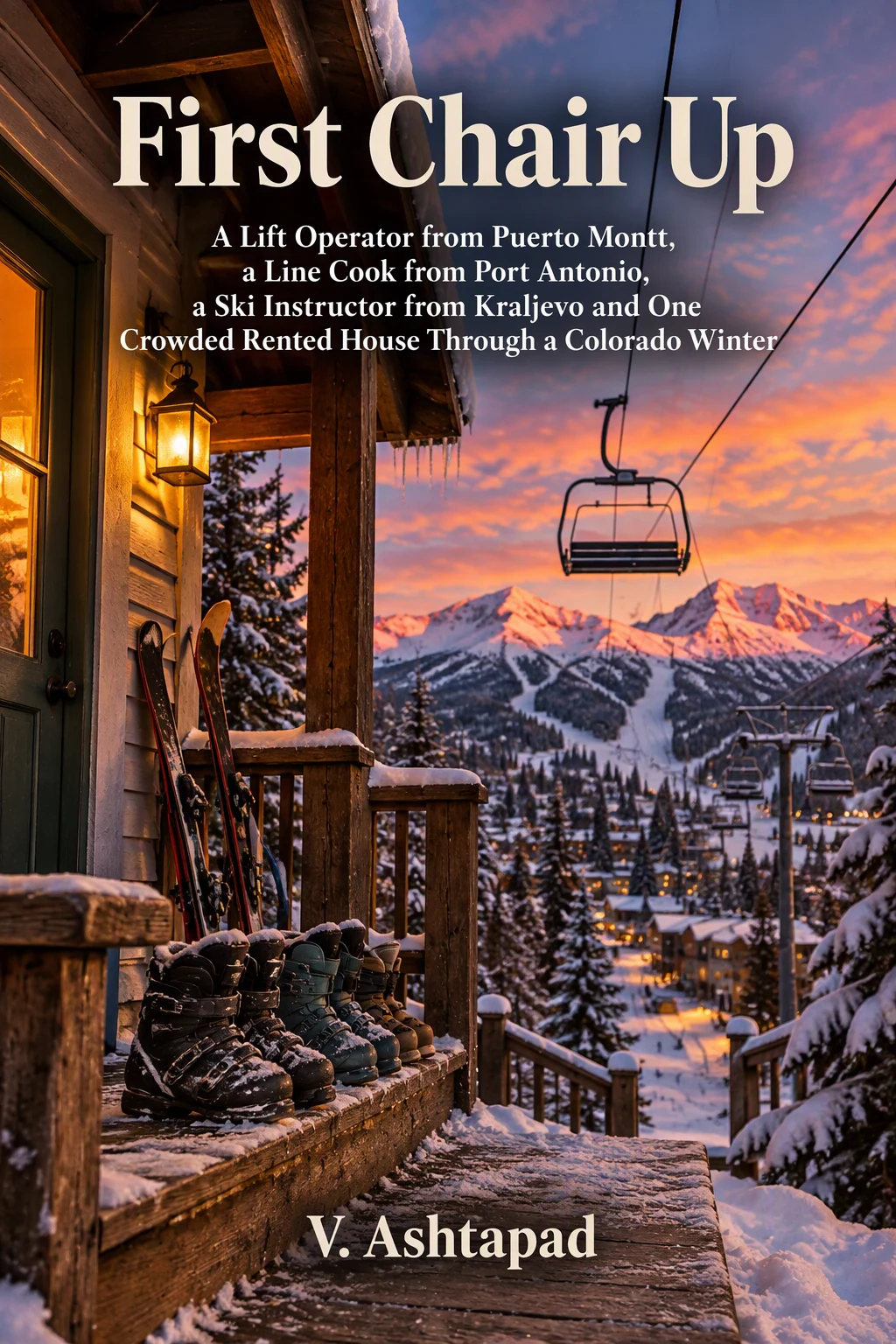
First Chair Up
A Lift Operator from Puerto Montt, a Line Cook from Port Antonio, a Ski Instructor from Kraljevo and One Crowded Rented House Through a Colorado Winter
by V. Ashtapad
Foreword
This is a work of fiction. The foods, music, holidays and customs of Chile, Jamaica and Serbia described here are real public traditions, as are the ordinary workings of a ski mountain. The town of Garnet Basin, Garnet Peak and its lifts and lodge, the historical society, the employers and program offices, and every person in the story are invented.
For everyone who has ever worked a season far from home and found a table there.
Seven Beds on Larkspur Street
The bus from Denver left me at the bottom of Garnet Basin at ten at night. The first thing I learned about Colorado was that the cold here has no water in it. In Puerto Montt the cold comes in off the Reloncaví Sound already wet. It gets into your sleeves and your socks and the seams of your jacket. You live inside it like a fish lives inside the sea. This cold was different. It was clean and thin, and it went straight for the inside of my nose. I stood under the one streetlight at the depot with my two suitcases, my backpack and the paper folder with my documents. I breathed it. It hurt. I laughed out loud at nobody.
My name is Catalina Vergara Oyarzún. I am twenty-four. I finished my degree in tourism administration in July. In November I came to work a winter in the mountains of a country where I had never put my feet. I had a job on the lifts at Garnet Peak. I had a training plan with my supervisor's name on it, a stamp in my passport, and an address the recruiter sent me four days before I flew. Four days before. The first address was a staff building near the base of the mountain. Then its heating plant had a problem that would take until February to fix. The company scrambled. I got an email that said only: *New housing assignment. 411 Larkspur Street. Shared house. Key under the boot.*
I walked there with my suitcases bumping behind me on the ice. The town was eight streets long and five wide. The old part had steep roofs and gingerbread trim in colors I would not have chosen for a mountain: mustard, plum, a green like a cut lime. Snow was piled higher than my waist on both sides of every sidewalk. Above it all the mountain sat black against the stars, its runs cut into the forest like pale ribbons. Up on its shoulder I could see the red lights of a groomer crawling back and forth.
The house at 411 was the plum one. It had a porch that leaned a little to the left and a rubber boot on the top step, a man's boot, enormous, and under it there was no key. I lifted it twice. I looked inside it. I was standing there with the boot in my hand when the door opened and a tall man with very short hair looked at me and said, "You are number five."
"Five of what?"
"Of six. One is still coming." He took the boot from me and set it back on the step, toe pointing the same way. "The key is inside now. Everyone is inside. Come in, you are letting out the warm."
That was Dejan. I did not know yet that he was from Serbia. Or that he had measured every room in the house with a tape measure brought from home. Or that the measurements were already on a piece of cardboard taped to the refrigerator. I only knew his voice sounded like instructions read off the side of a box. Behind him the house was bright and loud and smelled of onions frying.
There were seven beds in that house and six people. I say it clearly because later, when people asked what it was like, I always got the numbers wrong and made it more dramatic. The house was built in 1891 for a mine foreman and his family. It had two bedrooms upstairs with slanted ceilings. It had one bedroom downstairs that had been a dining room. At the back was a sunporch someone had closed in with plywood and insulated with what looked like pink cotton candy behind plastic. The company had rented every room and filled them with warehouse beds. Metal ones, with thin mattresses that sound like paper when you sit.
The big upstairs room had three beds. Dejan had one. A boy from Ohio named Owen had another. He was so young and so thin that I took him for somebody's little brother, visiting. The third bed belonged to Lachlan, from Tasmania, who worked nights on the snowmaking crew. That first evening he was asleep with a pillow over his face in spite of everything. The small upstairs room had two beds. One was mine. The other belonged to nobody yet, and stayed empty all season, and became the place for laundry that needed folding. The old dining room had one bed and one Jamaican man, Kemar Lindsay. He was at the stove when I came in, holding a wooden spoon over his shoulder like a flag.
"Puerto Montt," he said. "The recruiter told us. Chile. Way down at the bottom."
"Not the bottom," I said. "There is a lot more Chile under Puerto Montt. Chiloé, Aysén, Magallanes. Puerto Montt is where the bottom begins."
"Where the bottom begins," he said, and laughed, and turned back to his pan. "All right. You hungry, Where the Bottom Begins?"
I had eaten a packet of crackers on the bus. I said yes.
The sixth bed, on the sunporch, was for a woman from Michigan named Deb. She was coming in December. In the end she never came. Some time in the first week she took a job in Utah instead, and nobody told us. Her bed sat out there under the plywood windows with the pink insulation shining through. We called it Deb's bed out of politeness. Then Lachlan started sleeping there in the daytime, because it was the darkest place in the house.
So we were five, really, and then later we were five and Ruth, and that is the right number for this story.
That first night Kemar made rice and red beans with a little coconut milk. It was what he could find at the market on Main Street before it closed. He cooked it in the one big pot the house had. It was dented on one side, and the handle spun loose if you lifted it wrong. Owen sat at the table with his chin on his hands and watched every move Kemar made, the way a dog watches a sandwich. Dejan stood by the refrigerator and explained his cardboard to me. He had drawn the house and each room. Inside each room he had written the square footage. Next to that, the name of the person sleeping there.
"Why?" I said.
"So that when we talk about money, nobody is confused." He tapped the cardboard. "The rent comes out of our pay. Everyone pays the same. But the room downstairs has one person and the room upstairs has three. You see the problem."
"Kemar has more space."
"Kemar has more space," he agreed. "But Kemar also has the room next to the kitchen and the door that does not close and the furnace pipe that goes bang at three in the morning. So I think it is fair. I am only writing it so nobody thinks about it alone in the dark and becomes angry."
I looked at him for a long moment. I had come to this country ready for many things, and I had not been ready for a man who wrote down the fairness of a house in pencil before anyone could fight about it.
"You are an engineer," I said.
"Ski instructor." He shrugged. "My father is an engineer. It is in the blood like a disease."
The kitchen was too small for five people, and we were five people in it. The counter was the length of my arm. The stove had four burners and three worked. The sink sat under a window so frosted at the edges it looked like lace. The table had a top of blue tiles, some cracked. It wobbled until Dejan put a folded bus schedule under one leg. Every time someone opened the refrigerator, someone else had to step back into the doorway. Every time Kemar turned from the stove with the pot, he said "Hot behind." I learned later that cooks say it in restaurant kitchens. I started saying it too, at the top of the chairlift, to myself, when a chair came around too fast.
We ate standing up, mostly, or sitting on the counter, or in Owen's case cross-legged on the floor, propped against the oven door because it was warm. The beans were soft and sweet from the coconut and there was something underneath that I could not name, a deep green taste like a forest.
"Thyme," Kemar said, when I asked. "Fresh thyme and one scallion and a pimento berry, which you call allspice. And patience. My grandmother would say this is not real rice and peas because the peas are from a can and the coconut is from a can and the cook is from a can, coming straight off a plane. But it will hold you up."
"Where is your grandmother?"
"Port Antonio. Portland parish, on the north coast. Where it rains so much the breadfruit trees grow mold on the north side."
"Then she would like Puerto Montt," I said. "It rains there so much that people stop carrying umbrellas, because it is pointless. You just get wet and then you have once and you get dry."
"You have what?"
"Once." I said it the Chilean way, *ohn-seh*, and then I had to explain. "It means eleven. It is what we call tea in the evening. Bread, avocado, cheese, ham, sometimes a cake. Everybody stops and sits at the table around six or seven, even though the name says eleven. Nobody knows why it is called eleven. Some people say it is because of the old men who used to drink a little brandy in the afternoon and called it eleven so their wives would not understand."
Dejan, who had been eating his beans with great concentration, put down his spoon. "Eleven letters," he said. "*Aguardiente*. The brandy. A-G-U-A-R-D-I-E-N-T-E. Eleven."
"Yes! That is the story."
"It is a good story," he said, and picked up his spoon again. "It is probably not true. But it is good."
Owen said, from the floor, "In Ohio we just call it dinner."
That was the first time all five of us laughed at once. I remember the sound of it in that small kitchen with the lace window. Then Lachlan's voice from upstairs, muffled by his pillow: "Some of us are working tonight." A minute later, his feet on the stairs. His face in the doorway, puffy with sleep. "Is there any of that left."
There was. Kemar had made too much on purpose. He told me later that he always made too much the first night in a new place, because the first night you do not yet know who will be hungry.
After we ate I went up to the small room and sat on my bed with my laptop on my knees. In Puerto Montt it was almost two in the morning. My mother had said she would wait up, and she had. Her face came on the screen gray-blue. She was at our kitchen table on the hill above the port, the window behind her black and spotted with rain. I could hear the rain. I could hear our old refrigerator at home, the one that hums a note between two notes.
"Show me," she said, and I turned the laptop around and showed her the slanted ceiling and the empty bed across from mine and the little window with the mountain in it.
"There are five of us," I said. "A Jamaican, a Serbian, an American boy and an Australian who sleeps all day. The Jamaican cooks."
"Then you will eat," said my mother, who had been worried for three months that I would not eat.
Before she hung up she told me my aunt Pilar had put the photographs from my going-away lunch on the family pages. We keep them for all the cousins, scattered between Puerto Montt and Santiago and Mendoza, and one uncle in Melbourne. My aunt labels every photo with everyone's full name, both surnames, the date and the place. She says in fifty years nobody will remember who the tall one in the back was. I opened them after we said goodnight. There I was at the long table at my grandmother's house in Angelmó. The curanto steamed in its big pot in the middle: the clams and mussels open, the pork and chicken and sausage, the potato bread called milcao. My grandmother stood in her gray cardigan with her hand on my shoulder. Underneath, my aunt had written: *Catalina's despedida before the north. Mamá Chela, Catalina, the whole noisy table. Rain, of course.*
I scrolled back to it three times. Then I closed the laptop and lay down on the paper mattress and listened to the house. The furnace pipe in Kemar's room went bang. Lachlan's boots went down the stairs and out into the cold for his night shift. Somebody, Dejan probably, brushed his teeth like a machine. Owen was talking quietly on his phone. "It's fine, Mom, it's really fine, there's a guy who cooks."
Outside, far up, I heard a sound I did not know yet. A deep breathing hum, steady, like a ship's engine heard from shore. In the morning I would learn it was the snow guns on the upper mountain. Lachlan's guns. They blew water into the cold air so it fell back as snow on the runs we would open in two weeks. That night I only knew it sounded like the sea. I fell asleep to it as if I were home.
© 2026 CRUNOD LLC. All rights reserved.
Hot Behind
The lodge at the middle of Garnet Peak is called Ptarmigan, after a bird that turns white in winter so the hawks cannot find it. I had to look that up. I am Kemar Lindsay, twenty-seven, from Port Antonio in the parish of Portland. Before this winter the only white thing I ever saw fall from the sky was ash from a cane fire inland. It drifted over the road in Saint Thomas when I was small, riding behind my uncle on his motorbike.
You go up to Ptarmigan by gondola in the morning before the guests. The cabins are small glass boxes that hold eight. At six-forty they are full of kitchen staff and ticket checkers and ski school and a few patrollers in red jackets with white crosses. Everybody holds coffee in a paper cup. Nobody talks. The cabin swings out of the base station and lifts. The town drops away, all those colored roofs with snow on them like icing on small cakes. Then there is only forest. Black spruce, snow on every branch, the cable humming over the towers. The cabin rocks each time it passes a tower wheel. *Ka-tunk*. *Ka-tunk*. The first day I held the rail with both hands. By the third day I slept against the window with my cup between my knees like everybody else.
The kitchen at Ptarmigan feeds about two thousand people on a busy day. There is a cafeteria line, a grill station, a pizza oven, a soup station, and a small sit-down room in the back with a fireplace and tablecloths for the people who pay for that. The chef is Bev Ostrander. She has cooked on this mountain for twenty-two years and has forearms like a dockworker. On the first day of training week she stood us new ones in a row in the walk-in cooler, the only place quiet enough to talk. Our breath came out in clouds. She told us three things.
"One. At altitude water boils at about a hundred and ninety-four degrees, not two hundred and twelve. Your pasta takes longer, your beans take forever, and your cakes fall if you look at them wrong. Two. Everybody up here is hungry and cold and in a hurry. Nobody cares how pretty it is. They care that it's hot. Three. Nobody walks behind anybody without saying so. You say hot behind, sharp behind, behind. I've seen a man take a pan of fryer oil down his leg because somebody bumped him. Not on my line."
Then she asked each of us our names and where we had cooked. I said Port Antonio, four years in a hotel kitchen in Ocho Rios, and two summers at a clam shack on Cape Cod. She nodded slowly.
"You can do jerk?"
"Chef," I said, "I was born doing jerk."
"We'll see," she said, which I respected. Nobody should believe a cook about his own food.
She put me on grill. Grill at Ptarmigan is burgers, chicken sandwiches, something called a bison chili dog, and breakfast burritos until ten-thirty. Every morning on the flat top, ten pounds of onions and peppers sweat down slow and go into a steam pan for the day. I liked it. I liked the tickets rattling out of the printer and the way the line talked. Bev called the orders. The pizza man answered "Heard." The soup girl answered "Heard, Chef." I said "Yes, Chef" for two days. Then Bev told me to say heard like everybody else or she'd think I was making fun of her.
The best part of the day was the window. From the grill, past the hood, a long window ran over the dish pit. Out of it was the whole valley, all the way to a line of peaks in the west. The dishwasher told me they were the Needle Range. In the morning they were blue. In the afternoon they went white and too bright to look at. Around four-thirty, when we cleaned down, the light came in low from the side. The peaks went pink, then orange, then a deep rose, almost red. The snow glowed like there was a fire inside the rock.
"Alpenglow," said the dishwasher. It was Owen, from my own house. Bev had hired him the same week. The company put him in the dish pit because he had never worked in a kitchen and said so. He was nineteen. By the second afternoon his hands were red and puckered from the water. "My grandpa had a picture of it in his den. In Toledo. A calendar picture. He never saw it for real."
"You will tell him you saw it."
"He passed away last spring." Owen picked up a tray of hotel pans and slid it into the machine, and the machine roared and steamed. Over the noise he said, "That's kind of why I'm here, honestly."
I did not ask more right then. In a kitchen you learn that a person will tell you what they want while their hands are busy. Stop and look at them with your sorry face and they close up. So I said, "Then you see it for him," and went back to my onions. Owen nodded and kept loading the machine. The rose went off the mountains. They went gray, then blue-black.
On the Saturday at the end of training week I made jerk chicken in the house.
It is not easy to make jerk chicken in Colorado in November. Jerk is a fire food. At Boston Bay, twenty minutes from my grandmother's house, the jerk men cook over pits of pimento wood. The green branches lie across like a grate. Sheets of zinc go over the top to hold the smoke in. The smoke is sweet and peppery, and the chicken and pork take all afternoon. The smell comes out over the road so that cars pull over without meaning to. I had no pimento wood. I had no pit. I had a small charcoal grill. Ruth, who owns our house and lives in the cabin behind it, said we could use it on the back porch. We had to shovel out a space and not set the porch on fire.
What I did have, I had carried in my suitcase: a jar of my auntie Merle's wet jerk paste, double-bagged and rolled inside a sweater; a small bag of pimento berries, the whole dried ones, that I would soak and throw on the coals; and in my phone, my grandmother's voice.
My cousin Shernette in Kingston started recording our grandmother two years ago, after Mama Pearl had a fall. Shernette keeps the family tree. Every Lindsay and every Campbell, back to a woman called Daisy who sold fish in Port Antonio market in the 1920s. She decided the tree needed voices, not only names. So on Sundays she sat with Mama Pearl on the verandah and asked her things and recorded them. She asked first, every time. Mama Pearl would say "Go on, go on, put it in your box," and then talk. Her recipes are in there. Not written. She does not cook from writing. Talked. You hear the chickens in the yard and the rain on the zinc roof. You hear Mama Pearl tell you how much scotch bonnet is too much, which is never a number.
So on Saturday, with the snow coming down gentle and fat outside the kitchen window, I put the chicken in a big bowl, leg quarters I bought on sale at the market, and I put my phone on the counter against the backsplash and let my grandmother talk.
"Scallion. Plenty scallion, the whole bunch, cut it up rough. Thyme from the yard, strip it off the stalk. The pepper, now. You want to taste it but you don't want it to fight you. Pimento, you crush it with the bottle. Little brown sugar. Little soy, some people use it, I use it. Lime, wash the chicken with it first. Then you rub it in. You don't pour it on, you rub it in like you mean it. Nobody's chicken was ever good from pouring."
Catalina came into the kitchen in her thick socks while this was going on and stood very still in the doorway listening.
"Who is that?"
"My grandmother. In Port Antonio. This is from last year."
"She is telling you how to make it?"
"She is telling me how to make it. I know how to make it. But I like to have her tell me."
Catalina sat down at the tile table with her chin in her hands. She did not ask me to stop the recording or turn it down. She listened all the way through. Past the chicken, to the part about a man Mama Pearl knew in 1961. He sold jerk pork from a wheelbarrow. Once he chased a goat the length of West Street because it ate his hat. Catalina laughed at the goat in the right place. That surprised me. Mama Pearl talks fast and deep country. Even people from Kingston miss half of it.
"My abuela talks like this," she said. "Not the words. The way. She tells you the recipe for curanto and somehow in the middle of it there is a story about her brother falling off a boat into the harbor at Angelmó in his Sunday clothes."
"Did he drown?"
"No. He was famous for it for sixty years. He is still famous for it. He is ninety."
I rubbed the chicken. The paste was dark green and brown. The smell rose off it, scallion and pepper and allspice. My eyes watered. Catalina's eyes watered from across the room. She said, "Kemar, please," and laughed, and wiped them. Owen came down to see what was happening, turned straight around and went back up, coughing. Dejan came down after him and sniffed the air like a dog. "Good," he said. He opened a window two inches. It was nine degrees outside.
That afternoon I cooked the chicken on the little grill on the back porch, in a hole dug in the snow down to the boards. The pimento berries hissed on the coals. Ruth stood at the window of her cabin across the yard with a mug in her hand, watching. The snow came down and melted when it hit the lid. The smoke went up through it gray and sweet. I won't tell you it was Boston Bay. It was not. But it was jerk chicken, and close enough. When I put the first pan on the tile table, Lachlan came in from Deb's bed with his hair standing up and his eyes half shut. He picked up a leg with his fingers and ate it standing there without a word. He put down the bone. "Mate," he said. That was all. That was enough.
The speaker came out that night. It was Owen's, a little round thing the size of a grapefruit, and he put it on top of the refrigerator and asked whose music should go first. There was a short silence while everybody thought about whether this was going to be a problem. In a house of five strangers, music can become a war faster than dishes.
"It's your speaker," Catalina said to Owen.
"Yeah, but it's everybody's kitchen."
Dejan, who had put his tape measure away somewhere but not his manner, said, "Then we take turns. One song each, around the table, and the cook goes first because the cook has earned it."
So I went first. I put on an old rocksteady tune my grandfather played on Sunday afternoons, the bass walking slow and the singer high and sweet over the top. Catalina got up and danced with the dish towel. Owen turned red and laughed and would not dance. Lachlan danced, badly, with a chicken bone. Then Catalina played a Chilean cumbia with a guitar like rain on a tin roof. Owen, shy, played a country song about a man driving home on a two-lane road at night. Nobody laughed at it. Dejan asked him to play it again. Then Dejan played a brass band, trumpets so fast and loud they sounded like a wedding falling down a staircase. He said it was from a festival in a village called Guča. Every summer the whole country goes to listen to trumpets for three days, and nobody sleeps.
Lachlan played something with a didgeridoo and an electric guitar and then fell asleep at the table.
And that was the rule after that, every night somebody cooked: the cook goes first, then around the table. It was never written on Dejan's cardboard. It did not need to be.
© 2026 CRUNOD LLC. All rights reserved.
Opening Day
I count things. I always have. When I was small my mother sent me to the market in Kraljevo for peppers. I came home and told her how many peppers I bought. I also told her how many stalls had peppers, which had the long red ones and which the fat ones, and what the old woman by the bridge charged compared to the man with the truck. My mother called me her little inspector. My father said I would be a statistician or a criminal. He was relieved when I became a ski instructor, which he considers a little of both.
So I will tell you about opening day at Garnet Peak in numbers, because that is how I remember it.
Opening day was the twenty-eighth of November. In the eleven days before it the mountain got fifty-one inches of natural snow. The old patrollers said it was the best start in nine years. Before that, Lachlan's crew made snow on four runs for twenty-two nights, so the base was hard and white and good. Five lifts opened out of fourteen. At eight-thirty the gondola line was about six hundred people, by my estimate. It ran from the maze at the base station across the plaza and around the corner of the rental shop. Every person in it was happy.
I like lift lines the way some people like train stations. People in a lift line stand still with nothing to do, in a costume, holding a long awkward thing, about to go up into the air. So they talk. On opening day I stood near the maze in my blue instructor jacket, waiting for my first group. In ten minutes I heard a lot. A man told his son he had skied here in 1979, when the lift was a single wooden chair. A woman explained to her friend the exact difference between her old boots and her new ones. Two teenage boys argued about which of two runs was steeper. A grandmother on the phone said, "We are in the line, we are in the line, I will call you from the top." A small girl asked her father, very seriously, whether the gondola ever just falls off.
"No," he said.
"Has it ever?"
"Not this one."
"What about other ones?"
I liked her right away and hoped she was in my group. She was not. My group was four adults from Texas who had never stood on skis. Two brothers and their wives, in new jackets of four different colors. I took them to the beginner area at the base. It has a moving carpet like at the airport, carrying you up a gentle slope about the length of a soccer field. For two and a half hours I taught them to make a wedge with their skis, which in English is called a pizza. Then to turn. Then to stop.
In Serbia we learned on Kopaonik, the big mountain in the south. From Kraljevo it is two hours by car if the roads are clear and four if they are not. In January they are not. Every winter my father drove us there in a car with a cracked heater. My mother, my sister Jovana and me, skis on the roof. In the trunk was a box of food, because my mother did not trust the food on the mountain. Always bread, a round of white cheese, cold roast pork, pickled peppers, hard-boiled eggs and a jar of ajvar. Always ajvar. We stopped at the top of a pass and ate in the car with the engine running and the windows fogged. Ajvar thick on bread, cheese crumbled on top. Every single time my father said, "This is the best restaurant in the Balkans." Every single time my mother said, "Then leave a tip."
Ajvar, if you do not know it, is red peppers and a little eggplant. You roast them, peel them, and cook them down slowly with oil and garlic and salt until thick and sweet and smoky. Every family makes it in September and October, when the peppers are cheap and red in every market. The whole street smells of it. In our neighborhood every yard had a wood stove outside, or a metal plate over a fire. The men roasted peppers on it by the hundreds and turned them with their fingers. The women sat on low stools and peeled off the black skins with their thumbs. It takes a whole weekend. Your hands are red to the wrist for three days. At the end you have forty jars in the cellar and you feel like a rich man.
I had brought two jars in my suitcase, wrapped in socks. My mother had packed them. "In case," she said, and did not say in case of what.
At eleven the Texans were turning well enough for the small chairlift, the Marmot. It is a double chair, very slow, very old. I took them up one couple at a time. On the chair with the older brother, our skis dangling over the beginner trail, he asked where I came from. I told him. "Serbia, huh," he said. It was the way Americans say countries they could not find on a map. Friendly, not bad. Then he said, "Is it pretty?"
Nobody had ever asked me that. People ask about history books, or they ask about tennis, or basketball. Nobody asks if it is pretty.
"Yes," I said. I thought about it while the chair went over a tower and rattled. "In October, the hills around Kraljevo are all yellow and red with the leaves, and the river Ibar is green, and in every yard there is smoke from people roasting peppers. And on Kopaonik in the winter the forest is so thick with snow that the trees look like people standing in white coats. Yes. It is very pretty."
"Huh," he said. "I'd like to see that."
I did not think he ever would. But I was glad he had asked, and I thought about it the rest of the day.
At three-forty the lower lifts stopped loading and we sent our last groups home. I rode the gondola up to Ptarmigan to find Kemar and Owen, who had promised to save me soup. On the way up I looked down at the runs. From above, on opening day, a ski area looks like a kicked anthill. Thousands of small colored shapes move down the white lines in the trees. In every one is someone who has waited all year for this day.
At Ptarmigan the kitchen had served, Kemar told me, two thousand one hundred and forty covers, which is a word they use for people who ate. Owen had washed, by his own estimate, every dish ever made in Colorado. He was sitting on an overturned milk crate behind the dish pit with his hands hanging between his knees. Kemar had a bowl of green chili soup waiting for me under a plate to keep it warm.
"How was your pizza people?"
"They learned to stop," I said. "That is all you need on the first day. Everything else is decoration."
We rode down in the last gondola with the patrol, who sweep the mountain at the end of the day so no one is left on it. One of them was a woman of about sixty who skied with a dog. A big yellow dog in a red vest. He sat in the cabin with his chin on her knee and his eyes closed. When I asked, she said his name was Biscuit. He was trained to find people buried in avalanches. He had found two in his career, both alive. Owen had been nearly asleep. He opened his eyes and stared at the dog with total admiration for the rest of the ride.
When we got home Ruth was on her porch.
Ruth Haldane owns 411 Larkspur and the small cabin behind it. In 1891 the cabin was the carriage house. Now it has one room, a woodstove, more books than walls, and a window that looks straight up the valley at the mountain. She is seventy-four. She was on ski patrol at Garnet Peak for thirty-two years. She started in 1974, one of only two women on the patrol, and stopped in 2006, when her knees told her to. Her husband Hal was a patroller too. He died four years before we came. She told me that the first evening, on the porch, with no change in her voice. Then she told me the elevation of the summit, the year the first chairlift was built and the name of the man who built it. As if those facts were the same kind of fact as Hal.
I understood that. I also put facts next to each other when I do not want one of them to be too heavy alone.
On opening day she sat on her porch in a down coat and a wool hat, a blanket on her lap and a steaming cup in her hands. She was watching the last light leave the summit. Through the window of her cabin I could see her desk covered in folders, a small lamp on, and a big map of the mountain on the wall with dozens of colored pins in it.
"Good day?" she said.
"Fifty-one inches," I said. "Five lifts. Four Texans who can stop."
"That's a good day." She lifted her cup a little toward the mountain. "First chair of the season, Hal used to say, is like the first day of school and the last day of school at the same time. Everybody wants to be there and nobody knows where they're going."
I asked her about the map. She said it was for the historical society. The Garnet Basin Historical Society has an office in the old assay building on Second Street. Two rooms, a woodstove, a typewriter nobody uses and a computer everybody uses. Ruth is its president and also, she said, its janitor. For five years she had been recording the old-timers of the town. The miners' children, the first lift operators, the women who ran the boarding houses. The families who came from Mexico and Norway and Italy to work the mines and stayed. Each one on a recorder, in their kitchen, after she asked if they minded. Each recording went into the society's records with a photograph and a pin on the map. The pin showed where the person had lived, or worked, or fallen in love, or broken a leg.
"Most of them are gone now," she said. "But they're on the map. Anyone in town can pull them up and hear them. The schoolkids do a project every spring."
I thought of my mother's map. My mother left Serbia only once, to Greece, on a bus. Now she keeps a map of where her children are. She started it when Jovana moved to Vienna. Jovana is a pin in Vienna. I am a pin in Colorado. My mother's sister's son is a pin in Toronto. Every pin has photos attached, and my mother looks at it in the evening the way some people watch the news. Before I left she added a pin for Kopaonik, though nobody lives there. It has a photograph of the four of us in the car eating ajvar with the windows fogged. When I asked why, she said, "Because that is a place that matters."
I did not tell Ruth all that. I said only, "My mother has a map like that." And Ruth looked at me for a moment over her cup and said, "Then she knows what she's doing," and we watched the summit go from pink to gray.
That night I opened one of my two jars of ajvar. I had not meant to open one yet. I meant to save them for a bad day, which was what my mother meant by in case. But it was the best opening day in nine years. Maybe good days also need ajvar, so you remember them. I spread it on bread for everyone at the tile table, with feta from the market, because there was no white Serbian cheese in Garnet Basin. Kemar ate three pieces and asked for the recipe. Catalina said it tasted like a summer evening with smoke in it. Owen said, "That's like the best ketchup I ever had." I forgave him. He was nineteen and had washed every dish in Colorado.
The second jar I put on the top shelf of the cupboard, behind the rice. In case.
© 2026 CRUNOD LLC. All rights reserved.
The Night of the Pot
I'm Owen Pike. I'm nineteen and from Toledo, Ohio. I want to get this down right. Technically I started the fight, though I didn't mean to. I was also there the whole time it got fixed, and I still think about how.
It was the second week of December. Ten lifts were open and the town was full. Nobody tells you this about ski towns. In November it's all workers. Everybody in the grocery store has a name tag on a lanyard and a sunburn around their goggles. In December the guests come. Main Street fills with people in fur-lined boots carrying shopping bags. The restaurants have a two-hour wait. You can't park anywhere. The gondola line is so long Catalina said it looked like a snake that ate a parade. Every one of those people goes up to Ptarmigan at some point and eats a bison chili dog off a plate I then have to wash.
I was tired. Everybody was. Kemar worked ten hours a day on grill and then came home and cooked for the house. He said he couldn't stand to watch us eat cereal for dinner. Catalina was on the Bristlecone chair, the big high-speed quad that goes from the base almost to the summit ridge. It started at seven-fifteen, so she was up at five-thirty and in bed by nine. At eight-fifty every night she was on the phone with her mom in Chile, in the little upstairs room, door open because the latch was broken. Dejan was teaching kids now, the seven-to-ten group, and came home every day looking like he'd been through a car wash. Lachlan was on nights. He got home at seven in the morning as we were leaving. He slept on the sunporch until three. Then he got up and made toast and stood in the kitchen in his long underwear eating it, staring out the window like a guy in a painting.
The problem was the pot. The one big pot, dented, with the loose handle. It was the only one big enough to cook for five. Kemar cooked in it, we ate out of it, and then it sat in the sink. And sat. I wash dishes all day. Ten hours of hotel pans and sheet trays and bus tubs of coffee mugs. When I got home, another dish was the last thing I wanted to see. So I didn't wash it. Dejan didn't, because he said he'd washed it Tuesday. Catalina didn't, because she was on the phone. Lachlan didn't, because he was asleep. When he woke up, the pot was crusted solid with three-day-old rice and beans. He'd soak it and go to work. When he came home it was still there, soaking, with a gray skin on the water.
On the Thursday, Kemar came home with a bag of groceries and a whole pork shoulder he was going to cook that night, and he stood at the sink looking at the pot. He didn't say anything for long enough that I noticed from the table. Then he said, very calm, "Whose turn was this?"
And I said, and this is the part I'm not proud of, "I mean, technically it's your pot."
I meant it as a joke. Sort of. I was so tired I couldn't feel my face.
Kemar put the bag down on the counter. Then he took his coat off, and hung it on its hook, and walked into his room and pushed the door shut behind him. It doesn't close all the way, that door. It sticks about an inch open. So it was this weird half-closed door with the light on inside and Kemar not coming out.
Dejan, who'd been at the table with me, looked at me like I'd stepped on a dog.
"What?" I said.
"It is not his pot," Dejan said. "It came with the house."
"I know. I was kidding."
"He has cooked every night for three weeks. For us. And we did not ask him to."
"I didn't ask him to."
"That," Dejan said, "is exactly the problem."
Catalina came downstairs then because she'd heard the door. She had her phone in her hand with her mom still on it, and she said something in Spanish into the phone and hung up, and she looked at the sink, and the pot, and Kemar's half-closed door, and me, and Dejan, and she put it together in about two seconds. Lachlan came in from the sunporch in his long underwear and said "What'd I miss," and nobody answered him.
I figured somebody was going to yell. In my house growing up, when something like this happened, somebody would yell and somebody would slam a door, and then two days later my dad would fix something in the house that wasn't broken, and that was how you knew it was over. I sort of braced for it.
Catalina didn't yell. She went over to Kemar's door and knocked on the door frame, not the door, and said, "Kemar. Can you come out? I think we need to talk, all of us, and I think you should be the first to talk."
After a minute he came out. He sat at the tile table. We all sat at the tile table, which wobbled, and Dejan fixed it with the bus schedule again without looking. Catalina didn't sit. She leaned on the counter by the stove.
"Kemar," she said. "What is it like for you? Not the pot. All of it."
I thought he was going to say it was fine. People say it's fine. I say it's fine to my mom like six times a week.
He looked at his hands for a while. The backs were scarred with little white burns, the way all cooks' hands are, I was learning. Then he said, "At home, when I was a boy, my grandmother cooked for twelve every Sunday. Aunties, uncles, cousins, neighbors, anybody passing. After the food, the girls cleared and the boys washed up. The men went out to the verandah. My grandmother sat in her chair and somebody brought her tea. She did not move from that chair until the kitchen was clean. Not one finger. That was her payment. She cooked, then she sat." He shrugged. "I don't need anybody to bring me tea. But I come home and cook because I love it, because I want this house to eat. Then I'm at the sink at ten o'clock washing a pot that's been there three days. And I think, nobody in this house sees me. That's all. It's a small thing. It's a pot."
Catalina didn't jump in. She waited. Then she said, "So it is not the work. It is that nobody sat you down in the chair after."
"Yes." He looked up. "Yes. That is it exactly."
Then she turned to me. I thought she was going to tell me off, and honestly I deserved it, but instead she said, "Owen. What is it like for you?"
So I told them. The dish pit. The machine so loud I hear it in my sleep. My knuckles cracking and bleeding a little, and the tape I put on them. How by the time I get home I hate the sight of a dish so much I could cry, and how I know that's stupid. I told them I said the thing about the pot because I was so tired. I said I was sorry. I said it to Kemar, and he nodded.
Then she asked Dejan. He said he grew up in a house where everything ran on a schedule, because his father was an engineer. He hated it as a kid. Now he couldn't live without it. When things weren't written down he felt like he was falling off a chair. He knew the cardboard on the fridge made him look crazy. It was how he kept from worrying.
Then she asked Lachlan. He said he was sorry he never did dishes, but most of the time he didn't know what day it was. He lived upside down from the rest of us. The worst part of nights wasn't the cold or the dark. It was coming home and hearing us all laughing at dinner while he tried to sleep. Like living in a house with a party every night he wasn't invited to.
Nobody had known that. I'd thought Lachlan didn't care about anything except snow guns.
And then Dejan, which I didn't expect, said, "Catalina. You did not say."
And she laughed a little and said, "Me? I am on the phone too much. I know. My mother calls because she is alone now in the house since my father works in the north in the mines and comes home one week in four. She waits all day to hear my voice. So I talk to her with the door open because the door is broken, and I know you all hear me speaking Spanish at nine o'clock every night and you are too polite to say."
"I like it," Kemar said. "Honestly. It sounds like the radio at home."
"I like it too," Lachlan said. "Can't understand a word. Puts me right to sleep, actually, when I'm napping before shift."
What I remember is that the whole time, Catalina didn't fix anything. She never said "okay, here's what we'll do." She just said back what the person said, in her own words, short, to check she had it right. "So it is not the noise. It is that you feel outside the party." "So you need it written, or it lives in your head at night." Every time, the person kind of nodded and their shoulders came down an inch. I watched it happen five times in a row. I'd never seen anybody do that. My dad starts fixing before you finish the sentence.
When we were done, the fix kind of made itself. Everybody had already said what they needed. Whoever cooks doesn't wash. That was the first rule, and it was for Kemar. The pot gets washed the night it's used. No soaking. Dishes go by a wheel Dejan made from a paper plate and a brass fastener he found in a drawer. Five slices, our names on them, turned every night. It's written down, so nobody has to remember. I get Sundays off the wheel because I wash six days a week already. Nobody argued. On Lachlan's nights off we eat whenever he wants, even four in the afternoon, so he's at the party. Catalina's calls are fine. And Dejan would fix the latch on her door. He did, that same night, with a butter knife and a piece of soda can.
And whoever cooks, after dinner, sits in the chair. We only have one real chair in the house, an old green armchair by the front window with the stuffing coming out of one arm. That's the cook's chair now. Somebody brings the cook something to drink. It was Catalina's idea and when she said it Kemar laughed until he had to lay his head down on the tiles.
That night Kemar cooked the pork shoulder in the oven with garlic and orange and a ton of black pepper, slow, and I washed the dented pot first, before he started, scrubbing that gray skin off with steel wool until my taped-up knuckles stung. When I handed it to him clean, he held it up to the light like he was checking a diamond.
After dinner Kemar sat in the green chair. Dejan, whose turn it was on the paper plate, washed everything. Catalina brought Kemar a cup of tea with milk and sugar, the way he likes it. She'd learned by asking. She curtsied when she gave it to him, as a joke. He said "Thank you, my child," in an old lady's voice. We laughed so hard Lachlan almost missed his bus. He'd stayed up past when he usually sleeps before shift.
Later, up in our room, I lay on my paper mattress and looked at the pictures my mom had put up of my grandpa on our family's private pages. She'd added a few every week since the funeral. Grandpa at the tool-and-die shop in 1974, sleeves rolled up. Grandpa holding me as a baby at Maumee Bay. Grandpa in his den, the mountain calendar with the pink peaks on the wall behind him. Under every photo my mom writes who and when and where, and sometimes a line he used to say. Under the den picture: *Dad's den, Christmas 2016. "One of these years, I'm going to see a real mountain."* He left me four thousand dollars in his will. The note said *Go see something*. I used part of it for the bus and the boots.
Under that picture, for the first time, I typed something. I wrote: *Saw it, Grandpa. It's pink every night around 4:30. They call it alpenglow. I'm washing dishes at the top of a mountain and there's a Jamaican guy who cooks and a Serbian guy who fixes everything and a Chilean girl who makes people talk to each other.* Then I deleted the last part because it sounded weird. Then I typed it back in.
The next week, Ruth came over from her cabin with a clipboard. The historical society has an open house every year the Saturday before Christmas, in the old assay building, with cider and cookies and the old photographs on the walls and recordings of the old-timers playing on a laptop in the corner. She needed volunteers to pour cider, hang coats and tell people where the bathroom was. She had the shifts on a roster on her phone, which she showed us, every two hours with blanks for names.
All five of us signed up. Lachlan took the first shift because he'd be coming off nights and wouldn't be able to sleep anyway. I had never once volunteered for anything that wasn't required for school.
© 2026 CRUNOD LLC. All rights reserved.
Bristlecone at Seven
The first chair of the day goes up empty. People do not know this. They think the first chair belongs to the most eager skier in the line, the man who has been standing at the gate since six-thirty stamping his boots. But before him, before the public, the lift runs for almost an hour with nobody on it, or with only us.
I get to the bottom terminal of the Bristlecone chair at six-fifty, in the dark. The snow under the lights is blue. At that hour the hairs inside my nose freeze together when I breathe in, a small crackle. My eyelashes go stiff. Our lift shack is a hut the size of a bathroom, with big windows on three sides. Inside: a control panel with red and green buttons and a key, a heater that smells of burned dust, a radio, a shovel, a broom, and a coffee maker someone stole from a hotel in 2009. My morning partner is Arturo from Durango, Mexico. He has worked this lift for eleven seasons. He calls me Puerto Montt, like Kemar does. He says Catalina is too long to shout over the wind.
First we shovel. The wind moves snow in the night. The loading ramp, where the chairs come around the big wheel and scoop up the skiers, has to be smooth and level. We shovel it, rake it, and stamp it with our boots. Then maintenance starts the lift. You hear it before you see it, the big motor in the drive house groaning up to speed. The haul rope begins to move. The chairs that hung still all night start to swing forward out of the lights, one after another, empty, their seats glittering with frost.
Then the mountain manager sends the first chairs up with the patrol. Six or eight patrollers in red jackets with packs and shovels. They ride up to check the runs and set the ropes. On storm days they throw small charges into the high snowfields so they slide on purpose, while nobody is there, instead of later, on somebody. On those mornings we hear the booms from far up. Dull, like doors slamming in a big house. The patrollers say the snow is "talking."
And then, at about seven-twenty, Arturo and I ride.
We have to. Someone must ride to the top before the public to check every tower and every chair and to make sure the top station is ready. So we take turns, and on my turn I step into the loading area and the chair comes around behind me and hits me gently behind the knees, and I sit, and pull down the bar, and the chair lifts me up into the dark.
I want to describe this well because it is the thing I will remember from this winter when I am old.
You go up through the black trees. The cable sings over each tower. The cold comes into your face. Below, the run is white and untouched where the groomers combed it in the night, lines like corduroy. Above, the sky goes from black to navy to a clear green at the edge, and the stars go out one at a time. Halfway up, the chair clears the trees. The valley opens on your left. The town is far below with its streetlights still on, breakfast smoke over the chimneys. Then the sun hits the very top of the Needle Range to the west. Not the valley. Not you. Only the highest points, far away. They catch fire. Pink, then gold. The rest of the world is still blue and asleep. You hang in the air over it on a chair, alone, your breath freezing on your scarf. You are the only person who sees.
At the top I check the station and the unload ramp and talk to the operator there, a quiet boy from Vermont, and then I ride down. Riding down on the chair is strange. You are facing the valley the whole way. On a clear morning, I can see the tiny figure of Kemar's gondola cabins rising to Ptarmigan to my right like beads on a string.
At eight-thirty the public comes. And then for eight hours I listen.
That is the real work of a lift operator. You stand at loading and watch every chair. You help the children on. You slow the lift for the old people and the nervous ones. You smile. You say "Have a good one" three thousand times a day. In between, you stand beside a line of three hundred people with nothing to do but talk. All day the line talks to you and to itself. You hear everything.
What I heard that December: A man proposed to a woman in the singles line, the line for people skiing alone who want to fill a seat. He said it was how they met. She said yes, and the whole maze cheered. Two grandmothers from Denver compared their knee replacements in great detail. A ten-year-old boy told his sister the lift ran on a very large hamster. A family from Brazil was so happy to hear Spanish that they spoke Portuguese at me for five minutes. I understood most of it. They gave me a chocolate. A man on his phone negotiated to buy a building. A woman cried quietly behind her goggles while her friend held her arm. I did not hear why. I said "Have a good one" to her, gently. She said "Thank you, honey." That was all.
Arturo says after eleven seasons he could write a book about the line. He says the line is like the confession box at church: people tell it things because they think nobody is listening. He also says a good liftie listens to everything and remembers nothing, and that he is a bad liftie because he remembers everything.
On the coldest days, when it is below zero, the line is quiet. Everyone stands hunched with their face masks up and only their eyes showing. Those days I sing to myself. I sing the songs my grandmother sang in her kitchen in Angelmó, old songs from Chiloé about the boats and the rain and a girl who waits on the shore. I sing them very softly in Spanish behind my scarf, and nobody hears.
Chilean Christmas is in summer. I had never had a cold Christmas. At home on the twenty-fourth it is warm, and light until ten at night. We eat late, after dark. A cold dinner, usually, chicken and salads. There is pan de pascua, a spiced bread full of candied fruit and nuts, heavy as a brick. There is cola de mono, coffee and milk and spices and aguardiente, served cold. At midnight we open presents. My father, when he is home from the mines, falls asleep on the couch at eleven-thirty every year. Every year we wake him to watch us open them.
This year he was home. My mother told me on the phone, very happily: "He is home for Christmas, the company gave him the week." She had already made the pan de pascua, three loaves, and the cola de mono was in bottles in the refrigerator. She had already set the table on the patio under the grapevine. She told me all this and then she was quiet.
"You will be very far away," she said.
"I will be on Bristlecone," I said. "I am working the twenty-fourth and the twenty-fifth. It is the busiest days of the year."
Before I left Puerto Montt I recorded my grandmother. My aunt Pilar asked me to, for the family pages, because I had a good microphone from my university projects. In October I sat with Mamá Chela in her kitchen in Angelmó. The fish market was below the window. The gulls screamed. The boats to Isla Tenglo knocked against the dock. I asked if she minded the microphone. "For whom?" she said. "For the cousins who have not been born yet," I said. She laughed. "Then I had better say something good."
She told me how to make pastel de choclo the way her mother made it. Then she told me about the Christmas of 1960. The great earthquake had broken the city in May. All the families on her street lived in half-houses with tarps for roofs. At Christmas her mother made pastel de choclo anyway, eight of them, in a borrowed oven. She carried them up and down the street to every house. Every family got one, even the ones who had lost everything. "That is what Christmas is," my grandmother said on the recording. The gulls screamed behind her. "It is the pie going down the street."
On the twenty-second of December I listened to that recording again on my break in the lift shack, with the heater ticking and the coffee pot from 2009 gurgling, and Arturo listening too, though he pretended to read the newspaper.
"What is it?" he said when it ended.
"My grandmother telling me what to do for Christmas."
"And what did she tell you?"
"To make a pie and carry it down the street."
He put down the newspaper and looked at me over his glasses. "So?"
"So I will need corn," I said. "A lot of corn. In December. In Colorado."
The historical society open house was that Saturday. I worked my volunteer shift from two to four. I poured hot cider from a big steel urn into paper cups for people stamping in from the cold. I hung their wet coats on a rack by the woodstove. The old assay building smelled of woodsmoke and cinnamon and wet wool. Photographs of the old town hung on every wall. Miners in a row at a tunnel mouth in 1903, their faces black. A boarding house with laundry off every porch. The first wooden single chair going up in 1946, men in flannel on ladders. And Ruth in 1976, in a red patrol jacket and enormous sunglasses, hair to her waist, grinning, holding a toboggan.
In the corner a laptop played the old-timers' recordings through a speaker, one after another, each with a photograph on the screen. People stood in front of it with their cider and listened. An old Italian man on his father's bakery on Second Street. The woman who ran the boarding house, on the winter of 1952, when snow reached the second-floor windows and the miners went in and out through them. Lorenzo Sáenz, a lift mechanic from 1961 to 1998, laughing about the day the old wooden chair stopped with the governor of the state on it.
Ruth stood beside me at the cider urn and watched people listening.
"See that couple?" she said. A man and a woman in their forties stood in front of the laptop with a small boy between them. The screen showed a white-haired woman in an apron. "That's Marta Lindqvist. She ran the bakery on Main for forty years. Died in 2021. That's her grandson and his family. They drove up from Pueblo today just to hear her."
The boy was standing very still, holding his father's hand, listening to his great-grandmother talk about how she made cardamom bread on Saturday mornings at four o'clock with the radio on.
I thought of Mamá Chela and the pie going down the street, and I filled another cup of cider, and I decided.
© 2026 CRUNOD LLC. All rights reserved.
The Pie Going Down the Street
Catalina came to me with the plan on the twenty-second of December at eleven o'clock at night, standing at the door of my room that does not close, and I said yes before she finished, because a cook can always tell when another person has a dish in them that has to come out.
"Eight pies," she said. "Pastel de choclo. One for us, one for Ruth, and six for the street. For the lift crew house on Columbine Street where Arturo lives, for the patrol shack, for the dish crew at Ptarmigan, for the snowmakers, for the Peruvian girls in the motel on the highway who work housekeeping and have no kitchen, for the bus drivers. My grandmother's mother made eight pies in 1960 after the earthquake and carried them down the street."
"Eight pies is a lot of corn."
"I know."
"Where you are going to bake eight pies? Our oven fits one pan, and the door falls off if you look at it hard."
She looked at me. "Ptarmigan."
So the next morning in the walk-in, with our breath smoking, I asked Bev. I told her about the grandmother in the recording and the pie going down the street and the half-houses with tarps, and Bev listened all the way through with her arms crossed, and when I finished she said, "Christmas Eve we close at three-thirty. Ovens are cold by five. You can have them from five to eight. Anybody burns my kitchen, I bury them in the snowpack."
"Yes, Chef."
"Heard," she said. "Say heard."
Corn was the problem. In Chile, pastel de choclo needs fresh sweet corn. You grind it with basil and a little milk and butter into a thick sweet paste. You spread it over the filling and bake it until the top goes brown and crackly. A little sugar on top caramelizes. In December in Colorado the only sweet corn is frozen. Catalina stood over the frozen bags at the market on Main Street, turning one in her hands like it had insulted her mother.
"My grandmother will never know," I said.
"My grandmother knows everything," she said. "She will know from Chile."
But she bought it. Twelve bags. Owen had a car, a very old one he drove from Toledo with a rope holding the trunk shut. He drove forty minutes down the valley to the big grocery store. Ground beef, onions, chicken thighs, black olives, four dozen eggs, two big bunches of basil. He came back with the trunk full. The car smelled of basil the rest of the winter.
On the twenty-third we made the filling. This was the pino, Catalina said. Beef and onions cooked down with cumin, paprika and a little oregano until soft and dark. You make double what seems sensible, because it is the heart of the pie. We cooked it in the dented pot in three batches. The house smelled so strongly of onions and cumin that Ruth came across the yard in her slippers to see. She stayed two hours at the tile table, boiling and peeling eggs. She said she had not done that many since the patrol's Easter breakfast in 1988. Dejan poached the chicken. Lachlan was off that night. He pitted the olives that did not come pitted, cross-legged on the front-room rug in his long underwear with a bowl between his knees.
Catalina chose the music all night, because she was the cook. She played music from the south of Chile, the island music of Chiloé. Accordions and guitars and voices singing about the sea and the rain and the boats. Some of it you could not stand still for. Ruth knew none of it and loved all of it. Once I looked up from the stove and saw her, seventy-four years old, tapping her slipper under the table and peeling an egg in time.
On Christmas Eve we did it. At five o'clock Catalina, Owen, Dejan and I rode the gondola up to Ptarmigan with bags and boxes on our laps. The eight foil pans, stacked. The bowls of filling wrapped in towels. The corn paste in two big lidded buckets. Owen had blended it in the house with a borrowed blender until the motor smelled hot. The gondola was empty except for us. Outside, the sky was the deep blue after sunset, with one star. The Needle Range was going rose. The cabin swung and creaked. Catalina sat with a bucket of corn between her knees and her face against the glass.
"At home it is still light," she said. "It is nine o'clock in the evening there in the summer. My mother is setting the table under the grapevine. My father is pretending he will not fall asleep."
Ptarmigan was dark and empty and enormous. All those tables with the chairs turned up on them. The kitchen was clean and silent with the hoods off, and the steel counters shone, and it was strange to be there with no tickets and no line. I turned on the convection ovens and they ticked as they heated. Catalina tied on an apron of Bev's that said CHEF on it and laughed at herself.
We assembled them on the long steel prep table, an assembly line, eight pans in a row like a kitchen in a restaurant, because that is what it was for three hours. In each pan: a layer of pino, dark and steaming. Pieces of chicken laid in. Hard-boiled eggs cut in half lengthwise, face up, white and yellow. A black olive or two, which Catalina said every Chilean grandmother argues about, how many olives. A few raisins, which every Chilean grandmother also argues about. Then the corn on top, thick, spread with the back of a spoon, smoothed out to the edges. Then a sprinkle of sugar.
Before they went in the oven, Catalina stood at the head of the steel table and played her grandmother on her phone. I did not understand the words. I understood the voice. An old woman, fast and practical, gulls behind her. In the middle Catalina laughed and translated. "She says the corn is the blanket and the pie is a sleeping child. You must tuck it in to the edges or it will be cold in the night."
We tucked them in all the way to the edges.
They baked fifty minutes at three hundred seventy-five, because of the altitude. The tops went gold, then brown and crackly where the sugar caught. The smell filled that dark lodge. Sweet corn and basil and browned sugar, and the deep onion of the pino under it. Owen sat on the steel counter swinging his legs. Bev would have killed him. Dejan cleaned as we went, every bowl and spoon, unasked. I told him he was off the wheel tonight. "This is not the wheel," he said. "This is a kitchen. In a kitchen you clean."
At eight we rode down with the pies wrapped in towels on our knees, warm through the foil, the cabin steaming up so that we could not see out the windows. At the bottom Owen had left his sled, a kid's plastic sled he had bought at the hardware store for six dollars, and we stacked the pies in it, and Owen pulled it, and we walked.
It was snowing. Not hard. Big flakes came down slow through the streetlights. The town was quiet on Christmas Eve. The shops were closed. A few restaurant windows were warm. Houses had lights along the eaves. We walked down Main and up Columbine and knocked on the door of the lift crew house. Arturo opened it in a reindeer sweater. Behind him eleven people crammed into a house meant for four were watching a movie on a laptop. Catalina handed him the pie. He stood there holding it with his mouth open.
"Puerto Montt," he said. "What did you do?"
"My grandmother told me to," she said, and wished him a merry Christmas in Spanish.
We went to the patrol shack at the base, where the night crew was on. Two patrollers came to the door. One was the woman with the dog. Biscuit smelled the pie through the foil, sat down very politely, and drooled. We went to the motel on the highway where the Peruvian girls who clean the condos live four to a room with a hot plate. They screamed. One of them hugged Catalina and cried. In Spanish she said her own grandmother in Arequipa made something like this, and she had not eaten it in two years. Catalina cried. They talked fast in Spanish in the doorway while the rest of us stood in the snow holding the sled rope. We took one to the bus barn for the shuttle drivers. We took one to the snowmakers' shed. Lachlan was supposed to be off but was there anyway. It was Christmas, he said, and he didn't want the lads alone on the guns. We took one to the dish crew, partying in the basement of the employee building with a bucket of ice and a speaker.
The last two we brought home. One for us and one for Ruth.
Ruth was on her porch. Of course she was. In her down coat, in the snow, with the light on behind her and her cup in her hands. She had been watching for us. When Catalina came up the steps and handed her the last pie, warm in its towel, Ruth cradled it against her coat like a baby and was quiet at first. Then she said, "Hal and I used to do Christmas Eve on the patrol. Every year. Twenty-eight years. We'd take a thermos of cocoa up the gondola and sit at the top terminal and watch the town lights. I haven't done anything on Christmas Eve in four years." She looked at all of us standing on her steps in the snow. "You'd better come in. I'm not eating this whole thing by myself."
So we ate pastel de choclo in Ruth's cabin on Christmas Eve. The five of us, Ruth, and eventually Lachlan, in at eleven, covered in snow from the guns. The cabin was very small. Not enough chairs. Owen sat on the woodbox. Dejan sat on the floor against the bookshelf. Catalina and Ruth had the two chairs. I had the end of the bed. The woodstove ticked and glowed. On the wall, the big map with its colored pins. On the desk, Ruth's folders. Above the desk, a photograph of a bearded man in a red patrol jacket with his arm around a young Ruth, both squinting in the sun on top of the mountain.
The pie was very good. The corn was not fresh. Catalina said so. She said her grandmother would make a face. But the top was brown and crackly with sugar. Under it the corn was sweet and soft. Under that the pino was dark and rich with cumin. You cut down through the layers and found egg and olive and chicken, like finding things in a drawer. Ruth ate two pieces and asked for the recipe. "I will send you my grandmother," Catalina said. Ruth understood exactly.
I had brought down my sorrel. My auntie Merle mailed me the dried flowers from Kingston in a padded envelope. It took eleven days. I steeped them two days with ginger, cloves, a little orange peel and sugar. It came out deep red, like a garnet. Ruth said that was a good color to drink in a town called Garnet Basin. We drank it from her mismatched cups. At midnight, four in the morning in Puerto Montt, Catalina's phone rang. Her mother, father and aunt Pilar were all at the table under the grapevine, in morning light, very loud. Catalina turned the phone around and showed them all of us, crowded into the little cabin with the pie. Her father had been woken for the presents and was now wide awake. He leaned close to the screen and asked something in Spanish.
"He wants to know who made the pie," Catalina said.
"Tell him the grandmother," I said.
She told him. Her father laughed and raised his glass of cola de mono at the screen. All of us raised our cups of sorrel back at him. A man in a kitchen in Chile and six people in a cabin in Colorado, toasting each other through a telephone over a pie, at four in the morning and midnight, in summer and in snow.
That is what Christmas is, Mama Pearl would say. Different words, same thing.
© 2026 CRUNOD LLC. All rights reserved.
Thirty-One Degrees of Flexion
The knee went on the fourth of January at ten-fifty in the morning, on a run called Easy Street, which is a joke the mountain makes at my expense every time I think about it.
I had six children in my group that day. Seven to ten years old, level three. That means they can turn both ways and stop, and they think they can do everything else. A storm had dropped fourteen inches in the night. The snow beside the groomed runs was deep and heavy. One boy, Theo, in a helmet shaped like a shark, decided to go into the trees. Not because he was bad. Because the snow there was deep and soft and beautiful and he was eight. I saw him turn off the run toward a big spruce. I knew what was under it. I know what is under every big tree after a storm. A tree well: a hole in the snow around the trunk, where the branches keep the snow from packing. Sometimes six feet deep. A small boy who falls in head first cannot get out.
So I went. I did not think. I cut across the slope into the heavy snow on the side of the run, fast, and my downhill ski hit something under the surface, a buried branch or a ridge of old snow, and stopped, and my body did not.
I heard it. That is the part people do not believe. There is a sound, a pop, deep in the knee, like a cork from a bottle heard through a wall.
I reached Theo anyway. I do not remember how. He was on the edge of the tree well, sitting in the snow, laughing, perfectly fine. He had stopped himself. I lay next to him in the snow with my leg bent wrong and the pain coming up through my body like water filling a bottle, and I said to him, very calmly, I am told, "Theo. Please wave your poles over your head at the other children and tell them not to move."
He did. He was very good about it. The other five stood on the run like little statues in their bright jackets while a passing skier called patrol. In eleven minutes, by my count, a patroller came with a toboggan. It was the woman with the dog. Her name is Gwen. Biscuit was not with her that day. I regretted it. I would have liked to be found by Biscuit. Gwen checked my leg and my pulse. She asked my name, the date and which mountain we were on, to see if I had hit my head. I told her all three, and the elevation of the summit. She laughed and said I was fine upstairs.
She splinted my leg and strapped me into the toboggan, a long orange boat, blankets over me, face up to the sky. She skied me down Easy Street, slow and steady, the handles in her hands. From inside I watched the tops of the spruces go by against a sky very blue after the storm. Above me the chairlift passed, people on it looking down. I thought: this is how it looks from the toboggan. I have seen a hundred toboggans go by. I have never seen the sky from one.
The doctor in the clinic at the base said it was the anterior cruciate ligament. The doctor in the hospital down the valley, after the scan, said yes, completely torn, and some damage to the meniscus as well, and he could operate in nine days when the swelling came down. Six to nine months before I could ski again. The season was finished.
I am not someone who cries. I want to be clear. I did not cry at the clinic or the hospital. I did not cry in Owen's car on the way home, my leg across the back seat in a brace, the rope on the trunk creaking. I cried at the house at eleven at night, alone in the kitchen. In front of the paper plate on the refrigerator with our five names on it. I saw my name and thought, I will not be able to stand at the sink.
That was the stupid thing. Not the season. Not the money. Not the long flight home with a broken leg that I was going to have to explain to my mother. The paper plate.
Kemar found me there. His door is next to the kitchen and does not close, and he heard. He did not turn on the light. He made me tea in the dark, his way, strong, with milk and too much sugar. He sat across from me at the tile table with his own cup. He said nothing about my knee. He told me about his cousin who fell out of a mango tree at twelve and broke both arms. His little sister had to feed him for six weeks, and he never let her forget it. She is a nurse in Montego Bay now and says it started her career. That was all. Then he went back to bed. In the morning there was a second cup on the table next to my crutches.
The ski school manager came to the house on the sixth. His name is Doug. He sat on the edge of the green armchair and told me what I already knew: no instructing, no skiing, but there was a job at the rental shop counter at the base, sitting down, fitting boots and adjusting bindings and taking people's credit cards, for the rest of the season. Fewer hours. Less pay. He was sorry. He said it three times.
I said yes. What else would I say.
When he left, I took a pencil and sat at the tile table and worked out the money. The rent was the same for everyone, taken from our pay. With fewer hours at the rental shop, after rent and food, I would have about forty dollars a week left. My flight home was already paid. My mother would want to send money and I would not let her. Forty dollars a week was enough to live. It was not enough to do anything else.
I was still at the table with the pencil when the others came home. Lachlan was first, because it was his night off. He studied my paper upside down, the way snowmakers look at the weather.
"That's your rent?"
"That is my rent."
"Right." He took the pencil out of my hand. He crossed out the line. He wrote underneath, in very bad handwriting, *Rent: split 4 ways till April*, and he handed the pencil back to me. "Sorted."
"No," I said.
"Mate, it's not up to you."
"It is entirely up to me. It is my rent."
Lachlan sat down. He is not a man who sits down to talk. He is a man who says three words and goes to sleep. But he sat, and he said, "Listen. When I was sixteen my dad's boat sank. Fishing boat, out of Stanley, up the north coast of Tasmania. Nobody hurt, but that was it, the boat was the whole business. And for a year the whole town fed us. Didn't ask. Somebody's fish on the step. Somebody's mom dropping off a casserole. A bloke from the pub paid our power bill and never told us, we only found out after he died. My dad hated it at first. Proud, you know. Same as you. And then my mom said to him, she said, if it was them, you'd be first on the step. So shut up and eat the casserole."
He stood up. "That's all I've got. Shut up and eat the casserole."
When Catalina and Kemar and Owen came home, Lachlan had already told them. Nobody discussed it. Nobody asked me. That was the part I could not forgive and the part I am most grateful for. If they had asked, I would have said no for my pride. They knew it, so they did not ask. Owen had already moved my bed. That is, he moved himself. He carried his own mattress up the narrow stairs to the small room with Catalina's laundry bed. He brought the laundry bed down to Deb's porch for Lachlan. He took Lachlan's daytime bed off the porch and put it in the front room by the green chair for me, so I would not have to climb stairs on crutches. He did all this in forty minutes while I sat at the table with my pencil. He was a little out of breath.
"You'll be closer to the bathroom," he said, red in the face.
On the seventh of January it was Christmas at home. Serbian Christmas is on the seventh because we use the old calendar for it. My mother called at seven in the morning my time, three in the afternoon in Kraljevo. She had cooked for two days. Behind her I could see the table. The white cloth. The roast pork. The round bread with a coin baked inside. The sarma, cabbage rolls, in a big clay dish. My father in his good sweater, pretending not to cry because his son was not there. My sister Jovana, home from Vienna for it, holding up a glass. I had not told them about the knee. I would tell them after the holiday.
"Why are you lying down?" said my mother, after nine seconds.
So I told them on Christmas. My mother pressed her fingers to her lips. My father leaned in close to the screen and asked me in great detail what the surgeon had said, the name of the operation, the type of graft, whether they would use the patellar tendon or the hamstring, and I answered him, and I could see him writing it down. My father is an engineer. When something is wrong he must understand the mechanism or he cannot breathe.
Then Jovana said, "Who are those people?"
Because behind me on the screen, in the front room, the others had come in quietly and were standing there. Catalina in her lift jacket ready to leave for Bristlecone. Kemar with a cup of tea, the second cup, for me. Owen with my crutches. Lachlan, half asleep, eating toast.
"These are the people I live with," I said.
My mother studied them through the screen. Then she said, in English, slowly, because she has very little English: "Thank you. For my son."
Kemar said, "He is welcome, Mother. He fixes the door."
After we hung up I lay on my borrowed bed in the front room and opened the family pages. My mother had already put up a photograph. It was not of me. It was of all of them, from the screen, standing behind me in the front room, slightly blurred: a Chilean girl in a red jacket, a Jamaican man with a teacup, an American boy with crutches, an Australian with toast. Underneath, my mother had written, in Serbian, with her careful labels: *Dejan's house in America. Christmas. The people who are helping him.* She had put their names. She had spelled Lachlan wrong. She had added a new pin on her map, on a street called Larkspur, in a town she will never see.
The surgery was on the thirteenth. The physical therapist, a cheerful woman with a ponytail, measured my knee with a plastic protractor the first day afterward and said, "Thirty-one degrees of flexion. Good start." I asked how much I needed. She said a hundred and thirty-five, eventually, for skiing. I wrote it on the cardboard on the refrigerator next to the square footage of the rooms. *31/135*. Every week after that I crossed it out and wrote the new number.
The second jar of ajvar stayed on the top shelf behind the rice. A torn ligament, I decided, was not yet a bad enough day.
© 2026 CRUNOD LLC. All rights reserved.
From the Carriage House
I'm Ruth Haldane, and the young people asked me to put a piece in, so here it is, though I warned them I talk like a patrol report.
I've rented the big house on Larkspur since 2007. That was the year after I came off the patrol, and the year Hal and I moved into the carriage house out back to live on the rent. In nineteen winters I've had schoolteachers in it, a family of five from Minnesota, and a string of liftie crews. One memorable winter, a rock band from Fort Collins. They paid in cash and left a drum kit in the basement that's still there. When the company called in November about six seasonal workers, I said yes for the money. I don't pretend otherwise. The carriage house roof was going to cost me eleven thousand dollars.
I did not expect to have anything to do with them. In my experience you say hello on the porch and you fix the furnace when they call and you collect the damage deposit in April. That's renting.
What I want to put down is what I saw from my window, because a person who has spent thirty-two years on a mountain watching for trouble does not stop watching just because her knees have quit.
In the third week of November I saw a boy dig down to my porch boards to make jerk chicken. He stood out there in nine degrees in a cotton hoodie, turning the chicken with tongs, talking to it. I saw the girl from Chile come home every day at four-fifteen, face red from the wind. Every day she stopped at the foot of the porch steps and turned to look at the mountain before she went in, as if checking it was still there. I saw the Serbian measure my porch rail with a tape measure. I saw the Australian sleep in daylight on the sunporch with a towel over the window. I saw the Ohio boy sit on the back steps in the cold and cry once, early, in November, with his phone in his hand. Then he wiped his face and went in and laughed at something one of them said.
I saw the night of the pot through the kitchen window. I couldn't hear a word. I saw five people at a table and one standing. One at a time the people at the table talked, and the girl standing listened. She didn't interrupt anybody, not once, for most of an hour. I taught patrol rookies for twenty years and never could teach that. You ski up to somebody hurt, and the rookie wants to do something. Splint, radio, fix. Half the time the first thing is to get down in the snow at their level, ask what hurts, then shut up and hear it. The person who's hurt knows things you don't. What happened. Whether it's their first time hurt or their fifth. Whether what scares them is the leg or the bill or the boss or their mother. Fix before you've heard that and you fix the wrong thing.
Hal was the best at it I ever saw. He'd kneel down in the snow next to some kid with a broken wrist and say, "Okay. Tell me about your day so far," and the kid would tell him, and by the time the kid was done talking Hal knew everything he needed and the kid had stopped shaking.
The Chilean girl had that. Where she got it, I couldn't have told you, so I asked her once, and she said her grandmother in the fish market at Angelmó taught her, by making her sit at the stall on Saturdays from the time she was six and listen to the customers. "Every person who buys a fish is telling you something else," her grandmother told her. "The man who buys two hake is cooking for a woman. The woman who asks what is cheapest has a husband out of work. Listen to the fish they ask for and you will know their week."
That was in January, when I started driving the Serbian down the valley to physical therapy. Twice a week, forty minutes each way, in my old truck with the plow mount. I offered because the Ohio boy's car has a rope holding the trunk shut, and I didn't trust it on the pass. I thought it would be a chore. It wasn't. That boy, Dejan, talks the whole way. He tells me numbers. The degrees of his knee, which he writes on the cardboard on the refrigerator. The pounds of peppers his mother roasts each fall. The runs at Kopaonik, and how many are black. I told him how many people Hal and I pulled off the mountain in thirty-two years. About four thousand two hundred, near as I can figure. He asked how I figured it. I said I kept every incident report in boxes in the carriage house. He was so happy I thought he'd unbuckle his seat belt.
On one of those drives he asked me if the historical society wanted stories from people who were only here one winter.
I hadn't thought about it. The recordings I've done are all old-timers. People who were born here or came to work the mines or the first lifts and stayed fifty years. I said that.
He said, "But this town was always full of people who were here for one winter. The miners who came and left. The lift workers. Every winter there are two thousand of us, from forty countries. In a hundred years, someone will want to know who we were."
I thought about that the rest of the drive. I thought about it that night. The next day I went over to the big house and knocked on the kitchen door. I asked each of them to sit down with me and my recorder for half an hour. Where they came from. What this winter was like. I told them they could say no. I told them they could listen after and take out anything they didn't want kept. The recording would go into the society's records with a photograph and a pin on the map at 411 Larkspur, where they lived. Anybody in town could hear it.
All five said yes. The Australian said, "Do I have to be awake?"
I recorded the Jamaican boy first, at the tile table, the kitchen smelling of thyme and garlic. He talked about Port Antonio. The rain. The Rio Grande, where tourists raft on bamboo. His grandmother's Sunday table for twelve. His auntie's jerk paste in his suitcase. He played me a little of his grandmother's voice on his phone. I asked to include a few seconds of it on our recording, so she'd be in Garnet Basin too. He thought awhile. He'd have to ask her first, he said, and let me know.
He called her that night. I know because the next morning he came across the yard before work and knocked on my door and said, grinning, "She says yes, but she wants to know if the people in Colorado will understand her," and I said, "Tell her it doesn't matter, they'll understand enough."
I recorded the Chilean girl last, on my own porch, at four-thirty in the afternoon, a blanket on each of us. She wanted the mountain in the recording. You can't record a mountain. But you can record the town at four-thirty. The snowplows, the bus brakes, somebody's dog, the far hum of the snow guns starting for the night. At the end of her half hour she stopped talking and we just recorded that, for about a minute. The alpenglow was on the peaks. I could see her lips moving slightly. Afterward I asked what she'd been doing.
"Counting the chairs," she said. "On Bristlecone. You can see them from here. They are still running, empty, back to the barn. Sixty-two chairs. I know every one."
Hal would have liked that girl. He'd have liked all of them. I set those five recordings on the map at 411 Larkspur that night, a new pin, blue, the only one on the map for people who came for one winter. Then I sat there looking at it a while with the stove ticking, thinking about how it's not only the ones who stay who make a place.
© 2026 CRUNOD LLC. All rights reserved.
Rain on the Zinc
The call came at four-twelve in the morning on the ninth of February. I know the time because Dejan, who was sleeping in the front room on his borrowed bed, heard my phone through my door that does not close and wrote it down, because that is what he does when he is frightened for somebody: he writes down the time.
It was Shernette. Mama Pearl had a stroke at dinner. She was at the hospital in Port Antonio. She was alive. She could not speak properly and her right hand would not close. The doctors said the next days would tell.
I sat on the edge of my bed in the dark holding the phone after Shernette hung up, and I could not make my legs stand. The furnace pipe went bang. Outside the window the snow was blue under the streetlight and absolutely still.
Dejan came to the door on his crutches. He stayed outside the room, in the doorway, and said, "Kemar. Tell me what happened," and then he leaned on the frame and waited.
I told him. I could hear myself telling it badly, out of order, the hospital first and then the dinner and then the hand. He did not correct the order. When I finished he said, "So you need to go home."
"I can't go home. It's February. It's the busiest month. I'm on a work visa for this employer, I'm on grill six days, Bev has nobody to cover grill, if I walk out in February she will find somebody else and that will be my job. And the flight is nine hundred dollars."
"So you need to go home," Dejan said again, exactly the same, "and you are afraid of three things. The job. The visa. The money."
I looked at him. "Yes."
"Okay," he said. "Those are three problems. Problems can be solved. Your grandmother is not a problem. She is your grandmother. Go and pack. We will do the problems."
I want to say that I argued, but I didn't. I sat there, and he went away clicking on his crutches, and I heard him in the kitchen on the stairs, calling up softly, and then feet on the floor overhead, and then voices in the kitchen, low, at four-thirty in the morning, four people talking all at once and then one at a time.
By six o'clock, when I came out of my room with my bag half packed and my face washed, there was a piece of cardboard on the tile table. A new one. Dejan's handwriting at the top, and then all of their writing.
*Grill — Owen. He knows the station. (Owen: I KNOW THE STATION)*
*Dish — Catalina Sundays + Wednesdays after Bristlecone. Lachlan 3-5 p.m. weekdays before guns. Ask Bev if a dish temp can cover the rest.*
*Prep — Dejan can sit and cut onions. Ask Bev.*
*Flight — fund. See jar.*
There was a jar. The big glass pickle jar, washed out, with money in it. Catalina's tips from the lift, mostly ones and fives. Arturo's tips too, I found out later; she called him at five in the morning. Lachlan's emergency fifty from his boot. Owen's grandfather's money, four hundred dollars in twenties. I tried to give it back. Owen would not take it. Red in the face, he said, "He said go see something. Port Antonio is something." On top, folded small, a twenty with Dejan's pencil on it: *From the rental shop, forty*. Half his week.
"I can't take this," I said.
"Shut up and eat the casserole," said Lachlan, from the doorway of the sunporch, half asleep, and went back to bed.
Bev came in early. She always comes in at six. I went up on the first gondola with Owen and we stood in the walk-in with our breath smoking and I told her. I told her about Mama Pearl and the hand. Then I showed her the cardboard, which Owen had brought folded in his coat pocket.
Bev read the whole thing. She read it twice. She looked at Owen over the top of it for a long, long time, a skinny boy from Ohio with tape on his knuckles who had been in her dish pit since November.
"You know the station?"
"Chef, I've watched him for three months. I know the station. I know where the tongs live. I know the burritos come off at ten-thirty and the chili gets stirred every twenty minutes and the onions go down at seven-fifteen and the bison dogs go on the back left of the flat top because it's hotter. I know he wipes the board every time between tickets. I know he says 'heard' and not 'yes Chef' because you yelled at him."
Bev looked at me. I nodded.
"Two weeks," she said to Owen. "You screw up my grill, you're back in dish and he finds out when he gets home." To me she said, "Go see your grandmother." And then, because she is Bev, "I'll write the letter for your paperwork tonight. Employer leave, return date, all of it. Bring me your forms."
I had them. My papers for coming back were in order. I had read every line of them in November, sitting on the bus up from Denver, the way you check a knot. But I had never thought I would have to use them. Bev wrote the letter that night on the lodge printer and signed it in blue ink and put it in an envelope and handed it to me, and on the envelope she had written *Kemar Lindsay. Grill. Coming back.*
I flew out of Denver on the tenth at six in the morning. Ruth drove me down the pass in the dark in her truck, plow mount on the front, two and a half hours. She talked the whole way about nothing. The year the gondola cable froze. A moose that sat in the patrol shack doorway a whole afternoon in 1983. She knew I did not want to talk and did not want silence. At the terminal she held my sleeve a second. "Tell her about the town," she said. That was all.
Port Antonio in February is green and wet and warm. I came out of the Kingston airport in my winter coat into air so thick and soft it was like walking into a towel from the dryer. And the smell. Diesel and rain and flowers and something frying at a stand by the road. My uncle drove me over the mountains in his van with the windows down. The road twisted through the Blue Mountains, down to Annotto Bay and east along the coast. Past fishing canoes resting on the sand. Past breadfruit trees and little shops painted in colors. The sea on my left the whole way, green going to deep blue, the rain coming and going across it in curtains.
Mama Pearl was in the hospital for four more days and then they let her come home. I sat with her every day in the ward, a long room with a ceiling fan turning slowly and a window open to the hills, and I held her right hand, the one that would not close, and I talked. The doctor said talking helps. The words go into the part of the brain that is still working and they help it build a road around the part that is not.
So I told her about the town. I told her everything. The snow, which she has never seen. The gondola, the ka-tunk over the towers. Bev in the walk-in. The bison dogs on the back left of the flat top. The pastel de choclo on Christmas Eve, the pie going down the street on a six-dollar sled. Ruth on her porch. Dejan's cardboard. The night of the pot, and the green chair, and the cup of tea Catalina brings me with a curtsy. I told her about the jerk chicken in the snow-hole on the back porch, and how I let her voice tell me the recipe, and how Catalina listened to the whole thing and laughed at the goat in the right place.
Her eyes were on my face the whole time. She could not say much. Her mouth pulled on one side. But on the third day, when I told her about the goat, the left side of her mouth went up, and she squeezed my hand with her good hand, and she said, slow, each word a separate trip: "Wheel. Barrow."
"Yes, Mama. The wheelbarrow man. The goat ate his hat."
"West. Street."
"West Street."
My cousin Shernette cried in the hallway. She said the doctor had been worried about her memory. I said I wasn't worried. I had heard that story a hundred times. It was not a memory, it was a road, and she would find her way home on it.
When she came home to the house on the hill above the harbor, the family came. Aunties, uncles, cousins, neighbors, children running in the yard. On Sunday my auntie Merle cooked ackee and saltfish with fried dumplings, boiled green bananas and yam, callaloo on the side. We sat Mama Pearl in her chair on the verandah. For once in her life she did not cook Sunday for twelve. She sat. I brought her tea. Then I did what Catalina does. I curtsied. My whole family stared. Then Mama Pearl laughed, a real laugh, half her face. Everybody laughed. The rain came down on the zinc roof so loud you had to shout.
Shernette played the recording for her that Sunday on the verandah. Not the old one. The new one from Colorado, that Ruth made. A few seconds of Mama Pearl's own voice, then mine, talking about Port Antonio to a woman in a cold kitchen seven thousand miles away. Mama Pearl listened with her eyes closed. At the part where Ruth asks what I miss most and I say "My grandmother's verandah when it rains," she opened her eyes. She found my face. She lifted her good hand and pointed at the roof, where the rain was.
Then she said, quite clearly, the best thing anyone said to me all winter: "Go. Back. Your people."
I didn't know which people she meant. Here or there. I asked her. She looked at me like I was a fool and patted my hand and closed her eyes again.
Twelve days after I left, I flew back. In my suitcase: three cans of ackee wrapped in a towel. A bottle of auntie Merle's pepper sauce. A bag of pimento wood chips my uncle split for me from the tree in the yard. And a photograph Shernette printed and framed, of Mama Pearl in her chair on the verandah, the rain behind her, her good hand raised.
© 2026 CRUNOD LLC. All rights reserved.
Back Left of the Flat Top
My first day on grill I burned forty-one breakfast burritos.
Not all at once. Over about two hours. Bev counted. She didn't say anything. She just stood at the end of the line with her arms crossed and every time I scraped a black one into the trash she'd say "Forty," or "Forty-one," like a basketball announcer. The flat top at Ptarmigan has hot spots. I knew that from watching Kemar. Knowing it from watching and knowing it with a spatula in your hand while there are thirty tickets hanging over your head and the printer won't stop chattering are two completely different things.
Kemar left me notes. He wrote them the night before he flew, on index cards, in block capitals, and I taped them up under the hood with blue painter's tape. BACK LEFT IS HOTTEST — DOGS ONLY. BURRITOS CENTER, FLIP AT THE SMELL NOT THE CLOCK. ONIONS LOW, DON'T RUSH THEM, THEY KNOW WHAT THEY'RE DOING. WIPE THE BOARD. SAY HEARD. And one at the bottom, smaller: YOU GOT THIS, OHIO.
By the second day I was down to six burned burritos. By Friday it was one, and Bev said "One," and then, after a long pause, "That one wasn't your fault, the tortilla was bad," which was the nicest thing she'd ever said to anybody in my presence.
Dejan came up every morning on the first gondola, crutches across his lap. Bev said yes to a stool. She set him at the end of the prep table by the window with a cutting board and a forty-pound sack of onions. He sat with his bad leg on a milk crate and diced onions for three hours before his shift at the rental shop. He diced them perfectly. I mean perfectly. Every piece the same size. The pizza guy started calling him the Machine. At seven-ten every morning he handed me a hotel pan. "Two thousand four hundred pieces, approximately." I put them on the flat top at seven-fifteen, low, and didn't rush them.
Catalina came in Sundays and Wednesdays after she got off Bristlecone at four. Still in her lift jacket, cheeks wind-burned, she put on the big rubber apron and gloves and took over my old machine in the dish pit. She'd already been on her feet in the cold nine hours. She never complained. She sang. Old songs, in Spanish, over the roar of the machine. Bev had a dish temp for the other days, Russ, sixty, who had worked every kitchen in the valley. On the second Wednesday he started singing back in Spanish. He'd cooked ten years in Tucson and knew half the words. By the end of the second week they were doing harmonies in the dish pit while I worked the line with my index cards.
Lachlan did the three-to-five dish shift on weekdays, which meant he came up the mountain before his night on the guns, washed for two hours, rode down, and went straight to the snowmaking shed. He slept about five hours a day those two weeks. He never said a word about it. One afternoon I looked back from the grill and saw him standing at the dish machine asleep on his feet with his hands still moving, loading racks.
Presidents' Day weekend was the worst. That's the second busiest weekend of the year, after Christmas, and everybody from Denver comes up. On the Saturday we did two thousand six hundred covers, which Bev said was the most since 2019. The line at the cafeteria went out the door and onto the deck. The tickets came out of the printer so fast they curled onto the floor. I had chicken sandwiches and bison dogs and burgers and green chili cheese fries and somebody ordered a breakfast burrito at two in the afternoon, which is not allowed, and Bev said "Make it," and I made it.
At about one-fifteen, at the worst of it, I reached across for a basket of fries and felt somebody behind me. I heard myself say "Behind." The person said "Heard." It was Bev. Bev, on my line, pulling tickets. Not taking over. Just pulling tickets and calling them so I could keep my eyes on the flat top. "Two dogs, one bird, three burgers, one no cheese. Heard? Two dogs back left." She did that forty minutes, until it calmed down. Then she wiped her hands on her towel and went back to the end of the line without a word. I almost cried into the chili.
That night I sat in the green chair. Dejan cooked, sort of. He's not a cook. Pasta, a jar of tomato sauce, cheese grated over it with his usual precision. Then he wasn't allowed to wash, because he'd cooked, and he was very upset. So Catalina washed. He sat at the tile table telling her how to stack the drying rack more efficiently. She told him to be quiet three different ways. Lachlan brought me tea with milk and sugar. He did the curtsy. It was terrible. He looked like a crane falling over.
I put up a picture on our family pages that night, for my mom and my aunts. Catalina had taken it at the grill on Thursday with her phone: me in my white jacket in front of the flat top with my tongs in one hand and Kemar's index cards taped up behind my head. I wrote under it, *Owen on grill, Ptarmigan Lodge, Garnet Peak, Colorado. February. Covering for my friend Kemar whose grandma is sick in Jamaica.* My mom commented in about four minutes. She wrote, *Your grandpa would say keep your station clean like a machine shop. So proud of you honey.* And my Uncle Ray, who never comments on anything, wrote: *Dad's calendar is in my garage still. Want me to mail it to you?*
I wrote back, *No, keep it. I've got the real one.*
Kemar came home on the twenty-first. We didn't know exactly when, because the flights kept changing. So it was just a regular Saturday night at the end of my second week, and I was trying to cook for the house for the first time. I was making something my mom makes. Ground beef and noodles and a can of soup. Dejan called it "very honest food." The speaker was playing Owen's choice, which was me, which was country. The door opened. It was Kemar, with his suitcase and the cold coming off him, standing in the doorway in his winter coat, looking at me at his stove.
Nobody moved for a second. Then Catalina screamed and threw a dish towel at him.
He came in and hung his coat on the hook. He set his suitcase on the floor and unzipped it right there in the kitchen. He took out three cans of ackee wrapped in a towel. A bottle of pepper sauce. A bag of wood chips that smelled like the inside of a spice cabinet. A framed photo of a very old woman in a chair on a porch in the rain, her hand raised. He put the photo on the windowsill over the sink, where the frost makes the lace.
"She's at home," he said. "She's talking. Slow. But talking." Then he looked at my pan of beef and noodles and soup, and looked at me, and said, very seriously, "Ohio. What is this?"
"It's from my mom."
He took a spoon from the drawer and tasted it. He thought about it with his eyes half closed, the way he does. Then he took his auntie's pepper sauce out of the towel, opened it, and put exactly three drops into my pan, and stirred it, and tasted it again.
"Now it's from both our mothers," he said.
The next morning Bev put Kemar back on grill and asked me if I wanted to go back to dish or stay on the line as his second, running the fryer and the soup and backing him up. I said line. She wrote it on the schedule in pen.
© 2026 CRUNOD LLC. All rights reserved.
Paper Season
In the first week of March, I almost lost the end of the season because of one piece of paper.
I should explain the paper, but only a little. It is boring, and the boring part is the point. My program, the one that let me come and work and train on the lifts, has a sponsor. An office in another state that keeps track of all of us. Every person has a training plan. Halfway through, the plan needs an evaluation, a form signed by your supervisor saying you are learning what the plan says. The sponsor sends a reminder. Then another. If the evaluation is late, your record is flagged. A flagged record can mean your program ends early. You go home on their date instead of yours.
My deadline was Friday, the sixth of March, at five in the afternoon, in the time zone of the sponsor's office, which is two hours ahead of Colorado.
I had done my part in February. The self-evaluation, the hours, the list of skills: loading and unloading, emergency stops, evacuation drills, guest service, ramp maintenance, radio procedure. I had sent it to my supervisor, a man named Hollis Kerr who manages the lift operations for the whole lower mountain, and Hollis had said he would sign it that week.
Then, on the twenty-sixth of February, Hollis's wife had their baby five weeks early. The hospital was in Grand Junction, three hours away. Hollis went with her and did not come back. He did not answer his email. He did not answer his phone. His phone was in a drawer in a neonatal ward. His whole heart was in a small plastic box with a tiny person in it.
I did not know that yet. I only knew that on Monday the second of March, the sponsor's third reminder came, red at the top, and Hollis's line on my form was still empty.
I did not tell anyone at first. I did my shifts on Bristlecone. I shoveled the ramp in the dark, rode the first chair, watched the sun hit the Needle Range, said "Have a good one" three thousand times. I called Hollis four times and left four messages. Each was more polite than the last, because I was more afraid. On Tuesday night I sat on my bed with my laptop and read the sponsor's rules again, every line. No line said what happens if your supervisor has a baby.
Dejan found out because of the door. He had fixed the latch in December, but that night I had left it open, and he was coming up the stairs very slowly on his crutches to get something from the big room, which he did once a day as an exercise, counting the steps. He stopped on the fourth step because he heard me. I was not crying. I was making the sound you make when you are trying not to.
"Catalina. Tell me what happened."
So I did, from the doorway, and he sat down on the fourth step with his bad leg straight out in front of him and let me get through all of it without a single question, and then he said, "May I read the form?"
He read it on the step, my laptop on his good knee, for twenty minutes. He read the sponsor's rules too. He read the part about the training plan and the part about supervisors and the small part, at the bottom of the third page, in a font so tiny it looked like dust, that said: *If the designated supervisor is unavailable, an alternate supervisor at the host organization may complete the evaluation with prior notice to the sponsor.*
"Here," he said, and put his finger on the screen. "You need a different supervisor, and you need to call them and tell them first."
"Who? Arturo is not a supervisor. He is just old."
"The person above Hollis."
That was the mountain operations director, a woman named Carol Brandt, who I had met exactly once, on the first day of training, when she stood at the front of a room of a hundred and forty new employees and talked about safety for an hour. I did not think she would know my name.
By Wednesday morning Ruth knew. Dejan told her on the drive to physical therapy. On Wednesday afternoon Ruth called Carol Brandt. Ruth had trained Carol on the patrol in 1994, when Carol was a nineteen-year-old rookie who could not tie a splint. When I came off Bristlecone at four-fifteen there was a message from Carol Brandt's office. She could see me at seven-thirty Thursday morning, before the lifts opened. Bring the training plan.
That left the call to the sponsor. The prior notice. It had to be me. It had to be during their office hours, and their office hours were the same as my shift, and I could not leave the lift.
Arturo solved that. On Thursday at eleven in the morning, one in the afternoon at the sponsor's office, he walked into the lift shack. He took my radio off my belt and clipped it to his own. "You have fifteen minutes," he said. "Use the phone in here, it is warmer. I have the ramp." He went out and took my position at loading. The boy from Vermont came down from the top to take Arturo's. The chairs went around. I sat in the shack with the heater ticking and the 2009 coffee pot gurgling. I called a woman in an office two thousand miles away. In my best English I explained that my supervisor had had a baby.
She was very kind. She said this happens more than I would think. She said babies are the most common reason. She asked me to spell Carol Brandt's name and to email her a note confirming the call, and she gave me a reference number, which I wrote in ballpoint across my knuckles because I could not find paper.
Carol Brandt signed my evaluation at seven-thirty-five on Thursday morning in her office in the operations building, with a cup of coffee and a pair of reading glasses pushed low. She read every line. At the line about evacuation drills she looked up and said, "Ruth says you made her a pie," and I said yes, and she said, "She made me evacuate a chair forty times in one afternoon in 1994," and signed it.
That was Thursday. I still needed to send everything together, the evaluation, the alternate supervisor form, the note about the call, and on Thursday evening the internet in the house went out. Of course it did. A storm came in, eighteen inches overnight, the kind of wet heavy March snow the patrollers call "mashed potatoes," and somewhere down the valley a tree fell on a line. The whole street was dark on the screens. The phones had one bar if you stood in the front window.
On Friday at eleven-thirty Colorado time, one-thirty at the sponsor, I was on Bristlecone in the storm. The snow was so thick I could not see the third tower. Lachlan had just come off a night on the guns. He put my laptop in a plastic bag in his backpack and rode the bus to the employee building at the base, where the internet worked. He sat in the break room in his snowmaking coat, covered in ice, and waited. At my lunch, twelve-forty, I ran there through the snow in my lift boots. Lachlan had the laptop open and connected and warm. He sat in front of it like a dog guarding a door. "Go," he said. I went. Evaluation, form, note, reference number, read off my knuckles, a little smudged now. I pressed send at twelve-fifty-two Colorado time. Two-fifty-two at the sponsor. Two hours and eight minutes early.
The confirmation came back at one-thirty, while I was back on Bristlecone in the snow, scraping a chair that came around with a crust of ice on the seat. I read it on my phone in the shack. *Mid-program evaluation received. Record complete.*
That night the power came back. The internet came back. And I made once.
I had wanted to make it for months. The real one, the way my mother makes it, with a cloth on the table and everyone sitting down at once. I told them about it the first night and never did it. There was always work. Kemar always cooked. We ate standing at the counter. So that Friday I borrowed one of Ruth's tablecloths, white with blue flowers at the edges. It hid the cracked tiles. I made tea in Ruth's big brown teapot. I bought marraqueta at the bakery on Main Street. It was not marraqueta, it was a French roll, but close enough if you squinted. I put out avocado mashed with salt and lemon. Cheese, ham, butter. A jar of manjar a Chilean girl at the motel gave me at Christmas, a thick caramel of milk and sugar cooked for hours. And a lemon cake I made in our bad oven, the door held shut by Owen's knee.
And completos. Once is light, but this was a celebration, and a Chilean celebration needs completos. Kemar brought home buns and a dozen long hot dogs from Ptarmigan that Bev said were going out of date anyway. I made them like the little soda fountain down the hill from my grandmother's house. Hot dog in the bun. Chopped tomato. A thick layer of mashed avocado. Mayonnaise on top, so much that you cannot eat it with dignity. That is the point. My uncle says if you can eat a completo without mayonnaise on your face, you did not make it right.
Everyone had mayonnaise on their face. Dejan ate his with a knife and fork, which is a crime. He did not care. Owen ate three. Lachlan was awake, for once, at a dinner at a normal hour. He sat at the far end, hair flat from his helmet. I put the first completo in front of him. He studied it. "That's a hot dog in a fancy dress," he said. He ate it in four bites and asked for another.
Ruth came. Of course. In her slippers across the yard through the new snow. She sat at the tablecloth that was hers and poured tea from the teapot that was hers and said it was the first time anyone had set a table in this house properly since the rock band in 2011, who had done it once, for a birthday, with candles stuck in beer bottles.
And Kemar sat in the green chair after, because he was the one who brought the hot dogs. He said that counted as cooking. I brought him his tea and curtsied. He said, "Thank you, my child," in the old-lady voice, and then, in his own voice, "Your grandmother would be proud of this table."
I took a photograph of it before we ate, the whole table under the flowered cloth, and everyone's hands reaching, and the lace of frost on the window over the sink behind them with Mama Pearl's photograph on the sill. I sent it to my aunt Pilar for the family pages. She labeled it the next morning in her careful way, with everyone's names, and the date, and the place, and underneath she wrote: *Catalina's once in Colorado. A table in the snow.*
My mother wrote a comment under it. Just one line. She wrote, *She learned it at our table and now she sets it at theirs.*
© 2026 CRUNOD LLC. All rights reserved.
Ninety-Eight Degrees
On the nineteenth of March my knee bent to ninety-eight degrees and I learned to make burek, and those two things are connected, though I did not plan it.
The physical therapist measured the knee in the morning with her plastic protractor. Ninety-eight. I wrote it on the cardboard: *98/135*. Under it the other numbers, each crossed out with one line, so you could still read them. 31. 44. 52. 60. 71. 79. 85. 90. 94. I liked looking at the column. It was a staircase.
That afternoon, at the rental shop, I fitted boots for a family from Kansas, six of them, and adjusted their bindings, and the smallest one, a girl of five, asked me why I had a big black thing on my leg. I told her I had hurt my knee saving a boy with a shark on his head from a hole under a tree. She considered this and then said, "Did the shark help?" and I said no, the shark was useless, and she was satisfied.
When I came home Ruth's truck was in the driveway but Ruth was not on her porch. That was the first time since November that she had not been on her porch at four-thirty. The light in her cabin was on. The curtains were closed.
Kemar was in the kitchen. He was watching the carriage house through the window too.
"Something is wrong," I said.
"It's the nineteenth."
"So?"
He told me. Ruth had told him in February, on one of the drives down the valley, and asked him not to make a fuss. Hal had died on the nineteenth of March, four years before. Of his heart, very fast, on a Tuesday, shoveling the walk outside the carriage house.
We stood at the window. The snow on the yard between the house and the cabin was gray in the late light, with our footprints going back and forth across it, Kemar's to the grill and mine and Owen's and Catalina's to Ruth's door, and Ruth's own small prints coming over to our kitchen. A whole winter of footprints in one yard.
"What do we do?" I said.
Kemar thought about it. Then he said, "What does your family do?"
What my family does is feed you. When someone dies in Kraljevo, the women of the family arrive with food before the body is cold. They keep arriving for forty days. On anniversaries they bring it again. There is always burek. My grandmother, Baba Desanka, made burek for every death on our street for sixty years. She stretched the dough on the kitchen table over a cloth until it was thin as a curtain, so thin newsprint would show through. She filled it with meat and onions or with cheese. She rolled it into a long snake and coiled it in the round pan. She baked it golden and crackling and carried it down the street in a towel. You eat it hot, with yogurt to drink. It is the food of the morning, of the bakery at six before school, of standing at a counter with grease coming through the paper. And it is the food of the bad days.
I had never made burek. In our house, burek was something my grandmother made, and later something you bought from the bakery. I am not a cook. But Jovana had recorded Baba Desanka two summers ago, in her kitchen, making it. My sister did it on her phone, propped against the sugar jar, and she asked Baba first, and Baba said, "Why? Everyone knows how," and Jovana said, "Not everyone, Baba, not your grandson," and Baba laughed and said, "That one, he will measure it," and started.
So I played it. On the counter, against the backsplash, where Kemar plays Mama Pearl. My grandmother's voice in our kitchen in Colorado, in Serbian, with the radio playing behind her in her kitchen in Kraljevo and a neighbor's rooster, and Kemar listening without understanding a word, watching me translate.
"Flour, water, salt, a little oil," I said. "She does not say how much. She says, until it feels like an earlobe."
Kemar touched his earlobe. "Okay."
"Rest it. Then on the table with a cloth. Oil it. Stretch it with the backs of your hands, from the middle, walking around the table."
We did not have a big enough table. The tile table was too small, and too cracked, and wobbled. So Kemar took the flowered tablecloth Catalina had borrowed from Ruth for her once, which Ruth had told her to keep for the winter, and we pushed the tile table against the counter to make it longer, and laid the cloth over both, and floured it. And I stood with my crutch under one arm and my bad leg straight, and Kemar stood on the other side, and we stretched the dough.
It tore. Of course it tore. The first one tore in four places and Kemar said a word that his grandmother would not approve of. The second one tore in two places. The third one, because it was the third, and because I watched my grandmother's hands on the little screen, the backs of her knuckles lifting the dough and pulling it outward, gently, walking around the table, the third one did not tear. It spread out over the flowered cloth thinner and thinner until we could see the blue flowers through it. Kemar held one edge in the air to the light from the window and it glowed.
"Your grandmother is a genius," Kemar said.
"She says it is not difficult. She says she did it with a baby on her hip."
"I believe her."
We filled it with meat. Ground beef with onion, black pepper and salt, cooked in the dented pot while the dough rested, following her voice. We sprinkled it in lines across the dough. Then we lifted the cloth to roll it. That is the trick. You do not touch the dough. You lift the cloth and the dough rolls itself, over and over, into a long thin snake. You coil the snake in the round pan, brush it with oil, and bake it hot.
We had no round pan. We used a cast-iron skillet of Ruth's that had been in our cupboard since 1891 or so.
The whole time we did this, Owen and Catalina and Lachlan came home one by one, and stopped at the kitchen door, and saw what was happening, and did not ask. Catalina understood first. She went to the cupboard and took down the second jar of ajvar from behind the rice and held it up to me with a question in her face, and I nodded.
When it came out it was golden, crackling, the coil of it brown at every ridge. It smelled exactly like the bakery on the corner of my street in Kraljevo at six in the morning in February when I was nine years old. I did not expect that. I had to go and stand by the window for a minute.
Kemar wrapped it in a towel. Catalina put the ajvar in a bowl. Owen found the plain yogurt in the refrigerator and poured it into a jug. Lachlan carried the jug. And I went across the yard on my crutch with the five of them, through the gray snow in our winter of footprints, and knocked on Ruth's door.
She opened it. Her eyes were red. She was in her down coat inside her own cabin, as if she had been getting ready to go out on the porch and then could not. She looked at the five of us and the skillet in the towel.
"I told Kemar not to make a fuss," she said.
"It's not a fuss," Kemar said. "It's burek. It's from his grandmother."
"Where I come from," I said, "on the bad days, someone brings burek. That is all. You do not have to talk. You can eat it and we will go."
Ruth kept her eyes on mine without answering. Then she stepped back and held the door open.
We did not go. She did not talk much, and we did not ask her to. She sat in her chair by the stove and ate a piece of burek with ajvar on the side and drank yogurt from a mug, which she said was the strangest thing she had ever done and also, she thought, correct. We sat on the floor and the woodbox and the end of the bed. Catalina asked her one question, very quietly: "What was he like on a day like today? A March day, with new snow?"
And Ruth talked for an hour. About Hal on March days. About how March was his favorite month because the sun was strong and the snow was deep and the crowds were gone and the patrol could ski the whole mountain at the end of the day. About the year he skied the Ptarmigan Bowl in a blizzard to bring a lost boy down on his back. About his bad jokes. About the way he sang in the truck. About the last thing he said to her, which was "I'll get the walk," which was not interesting, and which she had thought about every day for four years.
When she finished it was nearly five o'clock. Through the cabin window the Needle Range was beginning to color. Ruth looked at it and said, "We used to go up for that. The two of us. Last gondola, ride to the top and sit at the top terminal and watch it go. I haven't been up since."
Kemar looked at Catalina. Catalina looked at Lachlan. Lachlan had his phone out already.
Gwen, the patroller with the dog, was on the last sweep that evening. Lachlan knew because the snowmakers and the patrol share a radio channel. He called her. He said, "Ruth Haldane wants a last ride up," and Gwen said something I could not hear, and Lachlan said, "Ten minutes," and hung up.
So we drove Ruth to the base in her own truck, fast, plow mount on the front. Gwen held the last gondola at the base station, Biscuit sitting in the doorway. The six of us rode up with Gwen and the dog. Past Ptarmigan, where the cabins stop for the lodge and then go on, up the second section to the summit terminal. The cabin swung. The cable hummed. Ka-tunk over every tower. Ruth sat by the window with Biscuit's head on her knee. At the top Gwen opened the terminal door. We went out onto the deck at the edge of the mountain, eleven thousand three hundred feet, into the cold, and stood at the rail.
I will tell you what it looked like, in numbers, because I tried that night to think of words and the numbers were better.
Two hundred miles of peaks, the Needle Range in front and the high ranges behind it, one after another, going away into the distance like waves. The sun gone already, just below the horizon, so that the sky over the range was a clear pale green, going to blue overhead. And every peak, every one of the hundreds of them, glowing. Rose. Coral. A deep red at the very top of the highest. The snow on them lit from the inside. Below them the valleys already dark, already blue, the town of Garnet Basin a scatter of yellow lights in a black bowl. Eleven minutes. That is how long it lasted. From the first pink to the last red going off the very top of the highest summit.
Nobody spoke for those eleven minutes except Ruth. At the very end, when only the last summit was still lit, she said quietly, to nobody, or to Hal, "There it goes."
Then it was gray, and the stars came out, and Gwen said, "Okay, folks," and we rode the last gondola down in the dark with the dog asleep across Ruth's feet.
That night on the cardboard under *98/135* I wrote, very small: *11 minutes*.
© 2026 CRUNOD LLC. All rights reserved.
Last Chair
On the morning of closing day I made ackee and saltfish for the house, and I did it at five in the morning, because I wanted everybody to eat it before the mountain took them.
Ackee is the national fruit of Jamaica. It grows on a tree in red pods that split open on their own when ripe. Inside are three soft yellow pieces, each with a shiny black seed on top like an eye. You only eat them when the pod opens itself. Force it and you'll be sick. My grandmother says that is the first lesson of ackee and of most people. You boil the yellow flesh gently. It goes soft and buttery and looks like scrambled eggs. Every foreigner says so. It tastes like nothing else, rich and mild and a little nutty. You cook it with saltfish, dried salted cod you soak overnight, boil and flake. Onions, tomatoes, scallion, thyme. A whole scotch bonnet, uncut, so it gives the flavor without the fire. A little black pepper. That's it. You don't stir hard or the ackee breaks. You fold it. Like tucking it in, Catalina said, watching me. Yes, I said. Exactly like that. Like your grandmother's corn.
I had soaked the saltfish since the night before in the dented pot. I had two of the three cans of ackee left, because the third one I had cooked in March for Ruth, who said it was the best thing she'd eaten since 1979. I fried dumplings in the skillet that Ruth said had been in the house since the mine foreman's wife, flour and a little salt and water kneaded and pinched into rounds and fried golden. I boiled green bananas. I had no breadfruit, but you can't have everything at nine thousand feet.
And I played Mama Pearl on the counter. Not a recipe. Just her talking on her verandah from one of Shernette's Sundays, about nothing, the rain, a neighbor's new hat, the price of yam. Her voice before the stroke. Shernette had sent me a new one too, last week, Mama Pearl now, slower, with longer spaces between her words, telling Shernette that she had walked to the gate by herself. I played that one after.
The house came down the stairs one at a time to the smell. Owen first. Then Lachlan, who had worked his last night on the guns two weeks before, when snowmaking ended, and was sleeping at night now like a normal person and was very confused by it. Then Dejan, without his crutch, walking down the stairs carefully, one step at a time, holding the rail, but walking. Then Catalina in her lift jacket, already zipped, already in her boots.
They ate it at the tile table under the lace of frost, which was thin now, in April, mostly melted, only at the corners of the glass. They ate it with their fingers, the dumplings torn open and the ackee scooped up into them. Dejan said it was like an omelet that had traveled the world. Owen ate it with hot sauce, which you don't need, and I let him. Catalina closed her eyes on the first bite.
Then we went up the mountain for the last time.
Closing day at Garnet Peak is the second Sunday of April, and it is a party. The whole town is on the mountain. People ski in costume. A man in a banana suit. A woman in a wedding dress. A family of five dressed as the five Great Lakes. College boys in swim trunks, ski boots and sunscreen. By April the snow is soft and heavy and wet in the afternoon, like porridge. The sun is hot. Everybody is sunburned below the goggles. At the base, by the beginner area where Dejan taught his Texans in November, they dig a long pond in the snow and fill it with meltwater. In the afternoon people ski down as fast as they can and try to skim across. Most don't make it. They sink in the middle in front of a thousand people and climb out screaming and soaked. Everyone cheers.
I was on grill until two. Bev let us all go at two. That was her closing day gift. She stood in front of the walk-in at one-fifty-five with her arms crossed like on the first day of training, and she said she had three things to tell us.
"One. That was a good season. Two thousand six hundred on Presidents' Saturday and nobody took fryer oil down the leg." She looked at me. "Two. Kemar Lindsay, I want you back next winter as my sous chef, if you want it, and I'll do your paperwork in August so it's in before anybody's in a hurry." She looked at Owen. "Three. Pike, you're on the line next year if you want it. Not dish. Line."
Owen turned the color of a scotch bonnet.
I said yes. I said it before she finished, and she said "Heard," and that was it, and she went into her office and shut the door. Russ the dish man told us later she always cries on closing day in her office and everybody pretends they don't know.
Then I went down to the base to find my people.
The lift line on closing day sounds different. Same people, same kind of talk, but slower. Everybody is in a hurry in December. In April nobody is. I stood in the Bristlecone line with my skis. I had learned to use them in January on my days off, badly, with Dejan shouting from the side of the trail, his crutch held up like a baton. I listened. A man told his wife this was his thirty-first closing day here. A woman said she'd moved from Chicago in September and didn't know how she ever lived anywhere flat. A boy and a girl held hands. They had clearly met this winter and were clearly going back to different states tomorrow, and were not talking about it. A grandmother on the phone said, "We are in the line, we are in the line, I will call you from the top." I wondered if she was the same grandmother Dejan heard on opening day. I decided she was.
At the front of the line Catalina was at the loading area in her red jacket with her face sunburned brown, helping a little boy in a dinosaur costume onto a chair. Arturo was next to her. When I came through the gate, she saw me and grinned, and said, "Kemar! Last chair for the cook," and slowed the lift just a little, as a joke, the way she does for the grandmothers.
The chair came around and took me behind the knees, and I sat. I rode up alone over the soft wet snow. Sun on my face. The music from the base thin and far away. The cable singing over the towers. Below me the whole mountain full of people in costume going down the last runs. I thought: this is the last time I ride up this mountain this year. Maybe next year will be the same. Maybe not. That's how seasons are. You can't stop them. You can only ride them.
At the top I met them all. Dejan had taken the gondola and walked out onto the snow by the terminal in his boots. No skis. Standing on the mountain for the first time since January, knee in the brace, face up to the sun. Owen came up the next chair. Lachlan came up in a cape that said SNOW GUNS FOREVER in marker, made from a tarp by somebody on his crew. Catalina came up at three-thirty on the last chair of the season. Arturo gave it to her. The two of them rode up together as Arturo shut down the bottom station behind them, waving to the crew below. By tradition the lift operators ride the last chair.
Then Ruth. She came up the gondola with Gwen and Biscuit, wearing her old red patrol jacket from 1976. It still fit. White cross on the back. She hadn't told anybody she was coming. She walked out onto the deck of the top terminal in her snow boots. The whole patrol up there turned and saw her and started clapping, all of them. Gwen took off her own helmet and put it on Ruth's head, crooked. Ruth laughed until she had to grab the rail.
We stood there together on top of the mountain, six of us and the dog, while the lifts stopped one by one below us. You could hear them stop. The hum went quiet, tower by tower, chair by chair, across the whole mountain, until there was only wind and the shouts from the pond skim far down at the base.
Then I skied down, badly. Catalina skied down, beautifully. Owen fell four times. Lachlan rode a snowboard in a cape. Dejan and Ruth rode the gondola down with the patrol, and Ruth said later that Dejan counted the towers out loud the whole way, all twenty-two of them, and she counted with him.
© 2026 CRUNOD LLC. All rights reserved.
The Back of the Cardboard
We had four days after closing to clean the house and leave it, and on the first of those days Dejan took the cardboard off the refrigerator.
He did it in the morning while we were drinking coffee. He peeled off the tape very carefully at each corner and held it up to the window. All the way down one side, in his pencil, the square footage of every room and the name of every person sleeping in it, with arrows where we had moved: Owen's arrow going upstairs to the small room, Lachlan's arrow going to Deb's bed, Dejan's own arrow going down to the front room by the green chair. And down the other side, the column of numbers. 31, 44, 52, all the way to 128, the last one, from the day before closing. And at the bottom, very small, *11 minutes*.
"I will take this home," he said. "My father will want to see the numbers."
"Wait," said Owen, and took it from him gently, and turned it over.
The back was empty. Brown cardboard, a little water-stained from the sink. Owen got a marker from the drawer, the same drawer where Dejan had found the brass fastener for the paper plate, and he drew on the back of the cardboard, badly, a map of the world. It was a terrible map. South America looked like a carrot. Australia was a potato. Europe was mostly a scribble. But you could tell what it was.
"Okay," he said. "Everybody put where they're going to be."
So we did, one at a time, around the table, the cook first, though there was no cook that morning, so Kemar, because he was always the cook.
Kemar drew a dot on a bean-shaped island in the Caribbean that Owen had drawn much too big and wrote *Port Antonio — April to October. Mama Pearl's 90th, September 14.* Then he drew a line back up to the middle of the United States and wrote *Garnet Basin — November. Sous chef. (Bev.)*
Owen drew a dot in Ohio and wrote *Toledo — summer. Community college, culinary, 2 classes.* That was news. He had not told us. He turned red. Then he drew a line to Garnet Basin too and wrote *Line. Not dish.*
Lachlan drew a dot on the bottom of the potato that was Australia and wrote *Tassie. Fixing Dad's new boat.* That was news too. His father had a boat again, his first since the one that sank, a small one, and Lachlan was going home to help him rebuild the engine. He wrote under it, *Maybe back. Probably back. Guns need me.*
Dejan drew a dot in the scribble of Europe and wrote, very neatly, the only neat thing on the map, *Kraljevo. Physical therapy. Peppers in September (ajvar, 40 jars).* And under that: *Kopaonik, January, if knee is 135.*
Then they all looked at me.
I had known since March that I would not be back in November. My program was one season. Next year I had a job waiting at a hotel on the lake in Puerto Varas, an hour from home, in tourism, the thing I studied. I had wanted it for years. It was a good job. I had told them, but we had not talked about it, the way you do not talk about the last day of a trip until it is the last day.
I took the marker. I drew a dot at the bottom of Owen's carrot, a little way up from the very bottom, and I wrote *Puerto Montt*. And then, because I had been thinking about it for a week, I wrote under it: *August, next year. Winter in Chile. Volcán Osorno has a ski area one and a half hours from my grandmother's house. Curanto in Angelmó, first Sunday. Everyone.*
Nobody said anything for a second. Then Lachlan said, "That's winter? In August?"
"The bottom of the world is upside down," I said. "You of all people should know this. You are from the bottom of the world."
"Yeah, but I never thought about it."
Dejan was already doing arithmetic with one finger on the tiles. "Sixteen months," he said. "My knee will be one hundred and thirty-five by then. I will ski the volcano."
Kemar said, "Mama Pearl's birthday is September. So if I fly from Kingston to Santiago in August, then home." He thought about it. "That is a lot of money."
"Jar," said Owen.
So we started a jar. The same pickle jar. On the first day it had nineteen dollars and forty cents in it, from all our pockets, and a Serbian coin of Dejan's, and a Jamaican coin of Kemar's, and a Chilean coin of mine with a condor on it. Owen said he would keep it in Toledo and add to it. He said he would set up a list, a shared list, where everyone could put in what they had, and nobody could see who put in what, only the total. Dejan said that was the only fair way, and wrote it down.
Then we cleaned the house. All of it. Four days. Every corner of 411 Larkspur dirty since 1891. Dejan could stand now. He washed the walls. Kemar scrubbed the oven with the door that falls off until it was gray instead of black. Lachlan took the towel off the sunporch window. Light came in on Deb's bed for the first time all winter. Under it we found four socks, a fork, and a library book due in December. Owen and I carried the green chair out to the porch and beat it with a broom until clouds came out. Then we carried it back and put it exactly where it had been.
On the last night we did the recipes.
It was Ruth's idea, sort of. On the second evening she stood in the kitchen looking at the bare refrigerator where the cardboard had been. "I'd like to keep the food," she said. She did not mean the leftovers. She meant the recipes. The historical society keeps a shared collection of recipes from the town's families, back to the mining years. Marta Lindqvist's cardamom bread. The Italian bakery's Easter bread. Lorenzo Sáenz's mother's tamales. Each labeled with who it came from and where, a photograph if there is one, sometimes the voice. Ruth asked if she could put ours in.
So on the last night we sat around the tile table, all six of us, and we wrote them down. It took four hours. It was the hardest thing we did all winter, because none of our grandmothers cook from writing.
Kemar wrote Mama Pearl's jerk chicken, and next to every measurement he wrote (*She would never say a number.*), and for the scotch bonnet he wrote *Until you can taste it but it does not fight you.* He wrote ackee and saltfish and wrote the first lesson of ackee at the top. He wrote his auntie Merle's sorrel.
I wrote Mamá Chela's pastel de choclo, and I wrote at the top, *The corn is the blanket. Tuck it in to the edges.* And I wrote about the eight pies in 1960, and the half-houses with tarps, and the pie going down the street on a six-dollar sled. I wrote completos, and at the bottom I wrote my uncle's rule about the mayonnaise.
Dejan wrote Baba Desanka's burek and, of course, measured it. He had measured it in March while we made it, without telling us. Four hundred and fifty grams of flour, two hundred and seventy milliliters of water. Then underneath he wrote, *Or until it feels like an earlobe. She is right and I am also right.* He wrote his mother's ajvar with the number of peppers and the number of jars and the number of days your hands stay red.
Owen wrote his mom's beef and noodles with a can of soup, and at the bottom, *Plus three drops of Merle's pepper sauce (Kemar).* He wrote, *This is very honest food (Dejan).*
Lachlan wrote toast. He wrote it very seriously. Bread, butter, a toaster, stand at the window. Then he thought about it and crossed it out and wrote instead his mother's fish pie from Stanley, which he had never mentioned once all winter, flathead and potatoes and a white sauce with a little nutmeg, and at the bottom he wrote *What Mom dropped off on the step when the Brennans' boat went down. And ours.*
Ruth wrote Hal's cocoa, the cocoa they took up the gondola on Christmas Eve for twenty-eight years. Milk and cocoa and sugar and a pinch of salt and, she wrote, *One cinnamon stick, which Hal stole from the patrol Christmas party in 1979 and replaced every year with a new one, until he had a drawer of them.*
Ruth took them all across the yard that night, with photographs. The pastel de choclo pans on the steel table at Ptarmigan. The jerk chicken in the snow-hole. The burek glowing on the flowered cloth. Owen at the grill under his index cards. Catalina's once under the frosted window. She put them in the collection with our names and our grandmothers' names, and the place each recipe came from, and the place it was cooked this winter: 411 Larkspur Street, Garnet Basin, Colorado. With Kemar's permission and Shernette's and Mama Pearl's, she added the few seconds of Mama Pearl's voice. With Dejan's, a minute of Baba Desanka's hands stretching dough. With mine, Mamá Chela and the gulls.
We left over two days. Dejan first. Ruth drove him to Denver in the truck. At the door he shook everyone's hand very formally. Then he hugged each of us, which he had never done. When he hugged me he said, "Thank you for the fourth step." I knew he meant the stairs, the night of the paper, when he sat on the fourth step and read the dust at the bottom of the page. He took the cardboard rolled under his arm. The map on the back. The numbers on the front.
Lachlan left on the bus the same afternoon, in his cape.
Kemar left the next morning. He stood in the kitchen with his bag on his shoulder and looked at the dented pot, clean, on the stove. He picked it up and spun the handle, the loose one, and laughed, and put it down. "Next year," he said, "I'm bringing a pot." He looked at me. "August. Angelmó. First Sunday."
"First Sunday."
"I'm bringing my own pimento wood."
"You cannot bring wood into Chile," I said. "They will take it at the airport."
"Then I will bring the berries in my sweater," he said, and hugged me so hard my feet came off the floor.
Owen drove me to the bus at the bottom of town last, in his car with the rope on the trunk. His own road home was long, and he was leaving after me. Ruth came out on the porch as we went down the steps, in her down coat, with her cup. The snow between the house and the carriage house was mostly gone, gray and soft. The footprints were gone. Brown grass was coming through. The porch boards where Kemar dug his snow-hole in November were wet and dark in the sun.
"Puerto Montt," Ruth said, the way Arturo says it, the way Kemar says it. "Send me your grandmother."
"I will."
At the bus depot, under the one streetlight where I first breathed the thin clean cold in November, Owen lifted out my two suitcases. He untied the rope and tied it again. "So, August," he said. "August," I said. "Okay," he said. He hugged me awkwardly, like a nineteen-year-old. Then he went back to his car fast so I would not see his face.
The bus pulled out at four-twenty in the afternoon. I sat on the left, by the window, because I knew the road. It goes down the valley along the river and then turns. For about one minute before the turn you can see the whole mountain over the roofs of the town. The runs cut into the forest like pale ribbons. The gondola line. The summit terminal. The long line of Bristlecone, sixty-two chairs, stopped now, hanging still on the cable for the summer.
The light was going. As the bus came to the turn, the peaks behind the town began to color, the Needle Range to the west and the summit of Garnet Peak above it, pink first and then the deep rose, the snow lit from inside.
I put my hand on the cold window. I did not count. I watched it until the road turned and the mountain went behind the trees, and then I opened the family pages on my phone and found the picture from my going-away lunch in October, the long table in Angelmó with the curanto in the middle and Mamá Chela's hand on my shoulder. Under it my aunt's label: *Catalina's despedida before the north.*
I wrote one line under it, for the cousins who have not been born yet.
*Back in August. Bringing five more for the table.*
© 2026 CRUNOD LLC. All rights reserved.
If this book stayed with you
The Morning Tune
A Serbian Roma Brass Band in Chicago, a Trumpeter Named Leader Over His Older Cousin, a Dented Flugelhorn from Guča and One Wedding Season Learned by Ear
Another ECO Library story with Serbian roots.
About this book
When the staff building fails before opening day, five seasonal workers in their twenties are packed into one leaning plum-colored house on Larkspur Street: Catalina, a lift operator from rainy Puerto Montt; Kemar, a line cook from Port Antonio carrying his auntie's jerk paste in a sweater; Dejan, a ski instructor from Kraljevo who measures every room before anyone can argue about it; Owen, a nineteen-year-old dishwasher from Toledo; and Lachlan, a Tasmanian snowmaker who sleeps all day.
There is one dented pot, one green armchair, one wobbly tile table and a speaker on top of the refrigerator. There are completos and pastel de choclo, jerk chicken grilled in a hole dug in the snow, ajvar saved behind the rice for a bad day, and a widowed former ski patroller in the carriage house who sees more from her porch than anyone guesses.
Then the winter starts taking its toll. A torn knee. A call at four in the morning from Jamaica. A single unsigned form and a deadline that could end a season early. Each time, the house has to work out what the person in trouble actually needs.
From the first empty chair at dawn to the last one in April, told in five voices, this is a story about covering each other's shifts, listening before fixing, and the people a winter makes into family. But a season always ends, and the house on Larkspur Street will not stay full forever.
Members can react to this book and talk about it in the members' Library.
Ownership
© 2026 CRUNOD LLC. All rights reserved.
This book is owned by CRUNOD LLC. It is free to read on EternalCurrent.Online. No part of it may be copied, reprinted, sold, recorded or adapted, including as audio, film or translation, without written permission from CRUNOD LLC.
© 2026 CRUNOD LLC. All rights reserved.