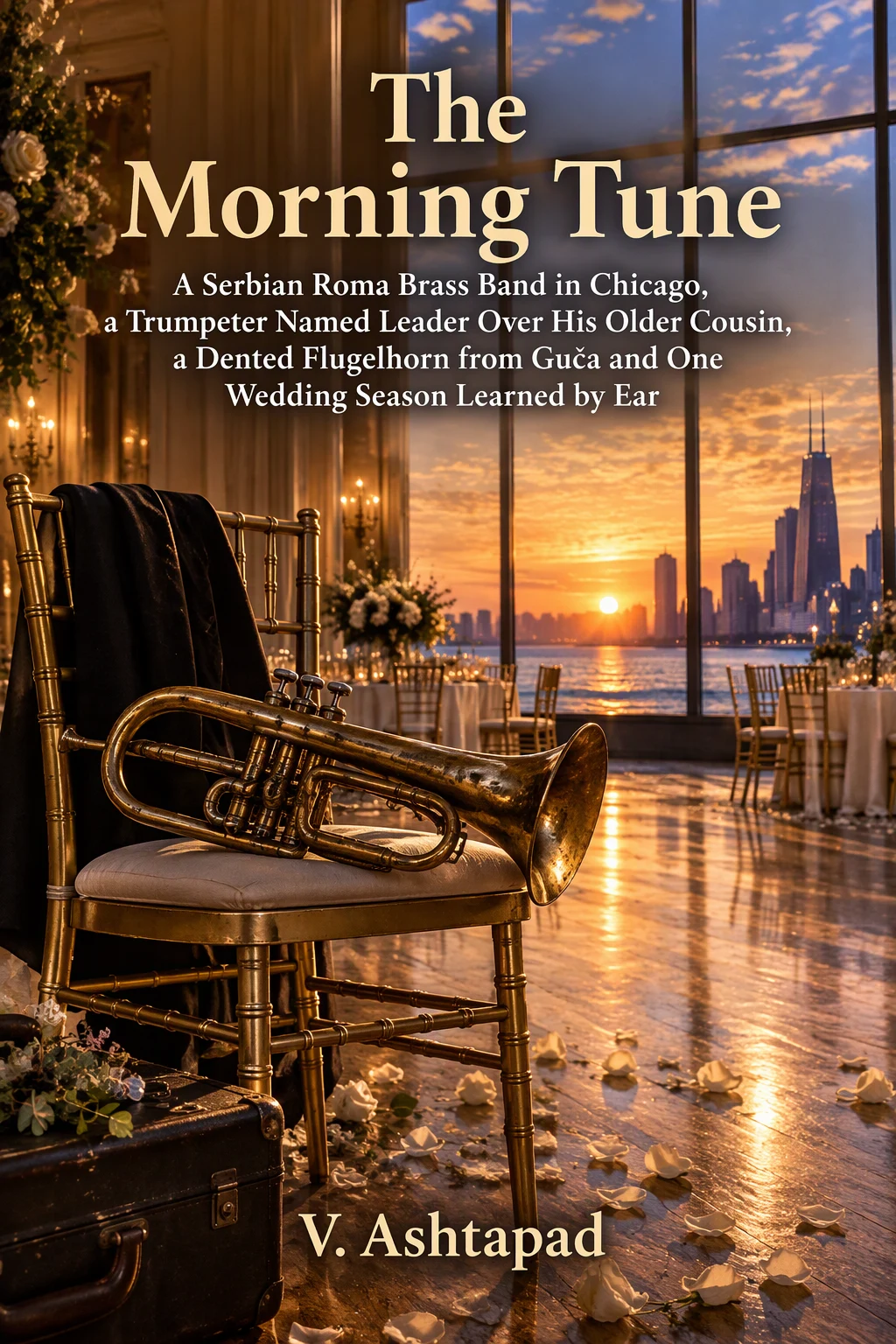
The Morning Tune
A Serbian Roma Brass Band in Chicago, a Trumpeter Named Leader Over His Older Cousin, a Dented Flugelhorn from Guča and One Wedding Season Learned by Ear
by V. Ashtapad
Foreword
This is a work of fiction. Serbian Roma brass music, the Dragačevo Trumpet Festival in Guča, kolo and čoček dances, sarma made from soured cabbage, and the old practice of teaching tunes by ear are real traditions carried by real families. The Ilija Demirović Brass Orchestra, its members, the couples, the halls and the businesses in this story are invented.
For every musician who learned the tune by standing close and listening.
The Kostić Wedding, Late May
The Kostić wedding ran long because the groom's grandmother would not sit down.
She was eighty-six and wore a dress the green of a pool table, and every time the band finished a kolo she planted herself where the parquet ended, her purse hooked over her wrist, and lifted one finger at Uncle Steva, which meant one more. Steva would bow to her from behind his trumpet, a small bow, from the neck, the bow of a man who had been taking requests from grandmothers since before most of the people in the room were born. Then he would turn to the band and say the name of a tune under his breath, and they would go again.
Bojan Demirović stood second from the left in the front line, between his uncle and his cousin Milan, and played until his lips felt like two pieces of warm rubber. The Banquet Hall on Lawrence had low ceilings and a mirrored column in the middle of the dance floor, and the sound of seven horns and two drums came back off the mirrors and the tiled ceiling and the sheet cake on its rolling cart, so that the whole room hummed even in the gaps between tunes. Selim's big drum, the tapan, sat on its strap against his belly like a second stomach. Each stroke of the heavy beater came up through the soles of Bojan's shoes.
It was a good room for a wedding and a bad room for a trumpet. Bojan had learned to play into the center of it, toward the dancers, and not up toward the ceiling, which swallowed the high notes and gave back only a smear.
At ten past one the grandmother sat down at last. She sat because her grandson, the groom, picked her up, gently, in front of everyone, and carried her to her chair while she slapped at his shoulder and laughed. The whole hall cheered. Goran blew a low comic slide on the tuba, the kind of joke that only works if you can play, and the grandmother pointed at him and shook her head, delighted.
Steva lowered his trumpet and looked at the band. Bojan would think about that look later, on the street, in the kitchen, and for weeks after. It was not tired, though Steva was seventy-two and his face had gone gray at the mouth an hour ago. It was the look of a man counting heads in a boat.
"Last one," Steva said. "The march."
They played the old march out, the one Deda Ilija had brought from Vranje, the one every Demirović child learned to hum before they could hold a horn. It was not written down anywhere, and it never had been. It lived in the hands and mouths of the people standing on that low stage, and in the handful of old cassettes that Milan's daughter Jelena had turned into sound files the winter before and put on the family's private pages, each one labeled with a year and a city and the names of whoever could be heard on it.
When it was over, the guests stood and clapped and some of them pressed folded bills into the bell of Goran's tuba, an old wedding habit that Steva had never encouraged and never refused. The groom's father came up and shook every hand in the front line, one by one, and when he reached Steva he held on.
"Next year," he said, "my daughter."
"Next year," Steva said, which was not quite yes.
---
They loaded out through the kitchen, which was the rule at the Banquet Hall on Lawrence; the manager did not want cases going through the lobby while guests were still collecting their coats. The kitchen smelled of bleach and lamb fat and the sweet, burned sugar of the bottom of a baklava tray. Two of the line cooks were sitting on overturned buckets by the back door with their aprons off, and one of them held the door open with his foot while the band filed out with their horns in their arms.
Out in the alley it was cool. It had rained while they played and the asphalt was black and shining, and beyond the parking lot the sky over the lake was not yet light but had begun to think about it. Bojan carried his trumpet case and Tamara's tenor horn case, because Tamara was twenty and had played four hours of her first full wedding and her hands were shaking. She walked beside him hugging herself.
"You did it," he said.
"I missed the change in the second čoček. Twice."
"Everybody missed the change in the second čoček. Your father missed it."
"My father never misses anything."
Rade, her father, was already at the van with the doors open. Milan was there too, as he always was, standing at the back bumper with a clipboard he had carried since before clipboards were embarrassing, checking each case off as it went in. Milan was forty-seven, thirteen years older than Bojan, broad through the shoulders and narrow through the hips, with a mustache he had grown at nineteen and never once considered shaving. He held the grandfather's flugelhorn in its soft case against his chest. He never put it in the van with the rest. It rode on the passenger seat, belted in, like a person.
The flugelhorn had a thumbprint-sized dent pressed into the bell, on the left side, a little below the rim. Deda Ilija had put it there in 1979, the summer he played at the trumpet festival in Guča, when the truck carrying the band's instruments hit a pothole on the road out of town and the case flew open. He would not have the dent hammered out, because he said the horn had earned it. When he died, he left the flugelhorn to Milan, the oldest grandson, and nobody in the family had ever questioned that, because Milan had the best ears of any of them and had since he was a boy.
Steva did not get in the van. He stood next to it, hands buried in his coat until the cases were in and the doors were shut and everyone had drifted back toward him, the way people do when a man stands still in a parking lot long enough.
"So," Steva said. "I want to tell you something while we are all together, before somebody goes home and hears it from his wife."
Goran laughed. No one else did.
"I am done after tonight," Steva said. "My doctor says my heart is fine, which is a lie, and my lip says my lip is finished, which is the truth. You heard it. In the last march I was playing the notes around the notes. So I am done. I will come to weddings and I will eat and I will tell you what you did wrong. But I am not playing."
Beside him, Bojan felt Tamara go still.
"The band needs a leader," Steva went on. He was not looking at anyone in particular. He was looking at the van, at the faded letters on the side panel that said *Ilija Demirović Brass Orchestra* and under it, smaller, a phone number that had been Steva's house line for thirty years. "I thought about this all winter. I talked to my sister. I talked to nobody else, because if I talked to anybody else, it would be a committee, and a band is not a committee."
He took a hand out of his coat and rested it on Bojan's shoulder.
"Bojan," he said. "It's Bojan."
There was a sound in the parking lot then, and it took Bojan a long time afterward to figure out what it had been. It was the lake wind, which had been coming down the alley all along, lifting the edge of a plastic bag caught in the fence. It had always been there. He only heard it now because no one was breathing.
Bojan looked at Milan, and Milan was looking at his father.
"Okay," Milan said.
That was the whole of it. He said it the way he said it when a bride's mother asked if they could play one more slow song for the photographer, the way he said it when the manager of a hall told them load-in had moved to the side door. Okay. A word for logistics. He took the van keys out of his jacket pocket and held them out, not to his father, but to Bojan, and when Bojan did not move, Milan reached over and dropped them into the open mouth of Bojan's trumpet case, which he was still holding by its handle.
Then Milan walked to the passenger side of the van, opened the door, unbuckled the flugelhorn, and lifted it out. He tucked the soft case under one arm.
"Milan," Steva said.
"I'm going to walk," Milan said. "It's nice out."
He lived eleven blocks away, and it was not nice out. It was forty-eight degrees and wet and the wind off the lake had teeth in it, the kind of late-May wind that Chicago keeps in reserve for people who have already put away their winter coats. Milan walked down the alley toward the street with the flugelhorn under his arm, and he did not hurry, and he did not look back, and when he turned the corner the band stood there with the van between them and the light coming up gray over the rooftops to the east.
"Well," Goran said finally. "Somebody has to drive."
---
So Bojan drove. He dropped Selim and Vlada at Selim's place in Albany Park, then Goran, then Rade and Tamara and Rade's nephew Dule, who had slept through the entire announcement in the back seat with his baritone horn across his knees and woke only to ask if they had stopped for food. Steva rode in the front passenger seat, where the flugelhorn usually was, and said nothing until the very end, when Bojan pulled up in front of his uncle's two-flat on a street lined with linden trees.
"You're angry with me," Steva said.
"I'm not angry."
"You're angry, and you think you're angry for Milan. That's good. That's the first thing a leader should be. Angry for somebody else."
"He's your son."
"I know who my son is." Steva opened his door, then didn't get out. The dome light lit him from above and made the lines in his face look carved. "Milan is the best musician in this family since my father. He can hear a wrong note in a tuba line from across a parking lot. He knows every tune. He keeps the books. He drives the van. If I gave him the band, he would lead it exactly like I did, and he would be good, and in ten years it would be a band that plays exactly like it played in 1995."
"There's nothing wrong with how it played in 1995."
"No," Steva agreed. "Nothing at all. And in 2035 there will be nobody left who wants to hear it." He got out of the van, slowly, one leg and then the other, and stood holding the door. "You teach children. Tamara came to the band because of you. Half the young people at weddings know your name. You listen to the new music and you don't make a face. That's not why I chose you, either. Not all of it."
"Then why?"
Steva thought about it. A bus went by on the cross street, lit up and empty.
"Because you don't know how to do it yet," he said. "And you know that you don't. Milan thinks he knows. Go home. Kiss your wife. You have the Jovanović wedding in two weeks and the van needs an oil change."
He shut the van door. Bojan watched him climb the front steps, holding the railing with both hands, and let himself in.
For a while Bojan sat in the van with the engine running. The sky was pale now over the lake, a thin washed blue, and the first birds had started up in the lindens. On the passenger seat beside him was the indentation where Steva had sat, and under it, he knew, the older, deeper indentation where the flugelhorn had ridden every weekend for nine years. He reached over and pressed his hand flat on the seat, as if he could feel the difference.
Then he drove home, slowly, down Western and across on Foster, with the windows cracked and the wet streets hissing under the tires, and the van keys swinging from the ignition with the brass bottle opener that Deda Ilija had put on the ring forty years before.
© 2026 CRUNOD LLC. All rights reserved.
The Jovanović Wedding, Early June
Bojan's mistake at the Jovanović wedding was that he tried to be Steva.
He did not know he was doing it. He thought he was being organized. He spent the two weeks before the wedding building a set list, the first one the band had ever had on paper, typed and printed in a large font and slipped into plastic sleeves so it would not get beer on it, and he handed out copies in Rade's garage at the one rehearsal they managed, the Thursday before.
> **ILIJA DEMIROVIĆ BRASS ORCHESTRA**
> **Jovanović Wedding, Elmwood Park, Saturday**
> *Page 1 of 2*
>
> **SET 1** (start 7:00 sharp)
> 1. Walking tune (bride and groom entrance), key of D, tempo 112, solo: none
> 2. Kolo, Šumadija, key of G, tempo 138, solo: Bojan
> 3. Čoček (slow), key of A minor, tempo 96, solo: Rade
> 4. Kolo, Vranje, key of D, tempo 144, solo: Milan
> ...
>
> **BREAK: toasts** (approx. 8:10; wait for best man)
>
> **SET 2**
> ...
>
> **BREAK: dinner** (band eats in kitchen hallway)
>
> *Tempos as Steva takes them. Keys as written. Soloist steps forward on the second time through.*
Goran read his copy, creased it twice, and tucked it behind his cigarettes without comment, though he had quit smoking in 2009. Rade held his at arm's length because he had forgotten his glasses. Tamara said thank you. Selim taped his to the shell of the tapan with electrical tape.
Milan read the whole thing, both pages, front and back. Then he set it face down on the workbench next to the coffee can full of drill bits and said, "Fine."
He had come to rehearsal, which was something; Bojan had not been sure he would. In the two weeks since the Kostić wedding, Milan had answered three texts with a single word each, and had not come to Sunday lunch at Steva's, which he had not missed in anyone's memory except the week his daughter was born. But on Thursday he walked into the garage at seven exactly, nodded to everyone, opened the soft case, and took out the flugelhorn with the dent in it, and he played every tune Bojan called. He played every one of them correctly.
That was the problem. Bojan heard it at rehearsal and did not want to believe it, and then he heard it at the wedding and could not stop hearing it.
---
The Jovanović wedding was in Elmwood Park, at a hall that used to be a bowling alley and still had the long narrow shape of one, with the stage at the far end where the pins had been. The Jovanovićs were Macedonian on the bride's side and Serbian on the groom's, which meant two sets of grandmothers with opinions about which tunes were whose. The tables had white cloths and centerpieces of cream roses in mason jars, and a long buffet ran down one wall under heat lamps: roast pork with its skin crackling, stuffed peppers swimming in red sauce, a tray of grilled sausages, a white bean dish baked in a clay pot until the top had gone brown and crusted, bowls of shopska salad with cheese grated over it like snow. Someone's uncle had brought homemade plum brandy in unlabeled bottles, and the bottles went around the tables in a slow orbit all night.
The band played the list. Bojan called each tune from the list, counted it off, played the head, and pointed to whoever was supposed to solo. They played tight. They played it at the tempos he had written, which were the tempos Steva had always taken. When the bride came in they played the tune on the list, and when it was time for the toasts they stopped.
And Milan played exactly what was asked of him and nothing more.
Bojan had played next to his cousin for sixteen years and had never noticed until that night how much more Milan usually did. Milan was the one who heard when the dancers were tiring and leaned into the downbeat a little harder to carry them. Milan was the one who caught Goran's eye when the tuba line got lazy and tapped his foot twice, and Goran fixed it. Milan was the one who answered a phrase from the trumpets with a quiet line on the flugelhorn underneath, a warm round low line that made the melody sound like it was standing on something. Milan was the one who, when an old man stood up at the edge of the floor and lifted his arms, would lean over to Steva and say the name of the tune that old man's village danced to, and Steva would call it, and the old man would weep.
None of that happened in Elmwood Park. Milan stood in the front line and played the flugelhorn part, and it was flawless, and it was flat as a tabletop. When the dancers tired, they tired. When Goran's line got lazy, it stayed lazy. When an old man stood up at the edge of the floor and lifted his arms, during the second hour, Milan looked at the set list taped to Selim's drum and played the next tune on it.
The old man stood there a minute with his arms up, then put them down and went back to his table.
Bojan saw it and felt it in his stomach. He thought about stopping the band. He thought about turning to Milan right there on the stage and saying, what was it, what does he want, and he knew Milan would tell him, because Milan would never let a guest go without the tune if someone asked him straight. But to ask would be to admit that the set list had been the wrong idea. In front of the band, on the first night. So he did not ask. He played the next tune on the list, and the old man sat with his back to the stage and drank his brandy and watched his grandchildren dance to something that was not his.
---
During dinner, the band ate in the kitchen hallway on folding chairs, plates on their knees. The caterer had saved them the end of the pork and a pan of the peppers. Tamara sat beside Bojan and ate like someone who had not eaten since breakfast, which she had not.
"It sounds good," she said, between bites. "Right? It sounds really clean."
"It sounds clean," Bojan said.
Goran, across the hallway, put his fork down. "It sounds like a band playing in a bank," he said. He said it kindly, the way Goran said everything. He was fifty-eight and had played tuba with the Demirović band for forty years, since he was a skinny teenager from a family of Serbian truck drivers who had heard Steva at a wedding in Hammond and followed the band out to the parking lot asking if they needed a bass. "It's good. Nobody's going to complain. It just sounds like a bank."
"It's the same tunes we always play."
"Sure." Goran picked up a sausage with his fingers. "Same tunes, same keys, same tempos. And nobody's talking to anybody." He tipped his head down the hallway toward the back door, where Milan sat alone on an overturned milk crate, eating with his plate on his palm, looking at nothing. "You know what your uncle used to say? A band is a conversation. Every tune, somebody asks a question and somebody answers. Tonight it's like we all got handed a script for a play."
Bojan looked down at his plate. The peppers were very good, stuffed with rice and pork and paprika, and the sauce had a sweetness to it from grated carrot, which meant the cook was from somewhere near Skopje, or had learned from someone who was.
"I'm not saying it to be mean," Goran said.
"I know."
"Your uncle made mistakes too, you know. First few years. People forget."
"What kind of mistakes?"
Goran chewed, thinking. "He used to play too loud," he said. "He was so scared somebody would say the band was weak that he played everything at the top of his lungs. Your Deda took him out behind a hall in Gary one night and I don't know what he said, but when they came back in, your uncle played the whole second half like he was singing a baby to sleep. People danced better. They danced like they could hear themselves." He cleaned his fingers with a paper napkin. "Everybody's first year is about what they're scared of."
---
After dinner, during the second set, the bride's grandmother asked for a tune.
She asked the old way. She approached the low stage during a break between songs, small and sturdy in a navy dress and a gold brooch shaped like a bunch of grapes, and she did not ask Bojan, though he was the one standing in the leader's place where Steva used to stand. She went straight to Milan, at the end of the front line, and put her hand on his sleeve, and said something in Macedonian that Bojan did not catch.
Milan glanced down at her and then at the set list, and then, for the first time all night, he looked at Bojan.
Bojan understood that it was a question. It was not a hostile question, or a sarcastic one. It was the simplest question in the world: are we going to play what she wants, or are we going to play what is on the paper? And the answer should have been easy, because there had never been a bride's grandmother in thirty years of Demirović weddings who did not get her tune. Steva would have called it before she finished asking.
And Bojan hesitated. He did not know why, then, and when he understood later he was ashamed of it. He hesitated because he did not know the tune she wanted. He had not caught the name. And if he said yes, Milan would have to lead it, and the band would follow Milan, and everybody in the hall would see who the band followed.
He hesitated for maybe three seconds, which was long enough. Milan turned back to the grandmother and leaned down and said something gentle to her in her own language, and patted her hand, and she nodded and went back to her table. Then Milan straightened and lifted the flugelhorn and waited for the next tune on the list.
Bojan called it, and they played it.
At the end of the night, in the parking lot, he caught Milan at the back of the van while the others were loading.
"What did she want?"
Milan ticked a case off on his clipboard. "An old song from Ohrid. A slow one. Her husband used to sing it."
"We know it?"
"I know it." He checked off another case. "You'd have picked it up by the second verse. Everyone would have." He tucked the pen behind his ear and looked at Bojan, and his face was not angry. It was patient, and the patience was worse. "It's your list," he said. "You made it. I played it. Isn't that what you wanted?"
He went around to the passenger side and buckled the flugelhorn into the seat, and then, because the van was going his way, he climbed into the back next to Dule and closed his eyes.
Bojan drove everyone home, and it was after three when he got to his own apartment. His wife, Vesna, had left the light on over the stove and a note on the counter, on the back of a pharmacy receipt:
> *B —*
> *Sarma in the fridge from your mother.*
> *DON'T eat it cold.*
> *Luka asleep by 9. Love, V.*
He ate it cold, standing at the counter in his good black shirt, the cabbage leaf sour and tender, the rice and meat inside still faintly smoky from the bacon his mother always laid in the bottom of the pot. Then he took the set list out of his jacket pocket and read it under the stove light, both pages, front and back, the way Milan had.
Every tune on it was a good tune, and every tempo was right. It was a perfectly accurate record of a band that nobody in it had been allowed to play in.
He put it in the recycling bin, under the newspaper, where Vesna would not ask about it. Then he picked up his phone and opened the family's pages, where Jelena had already posted six photographs from Elmwood Park, each one labeled with the hall and the date and the names of everyone in the frame. In the last one, the old man stood beside the dancers with his arms raised and the band behind him, playing something else. Bojan looked at it until his eyes stung, then turned off the stove light.
© 2026 CRUNOD LLC. All rights reserved.
The Asanović Wedding, Mid-June
On Sunday Bojan went to lunch at his uncle's, because that was what Sunday was for, and because he had nowhere else to put the thing sitting in his chest.
Steva's two-flat had belonged to the family since 1986. Steva lived on the first floor and rented the second to a nurse from Manila who brought him soup when he coughed. The front room still had the brown velvet couch that Aunt Zorica had picked out before she got sick, and the glass cabinet full of trophies and framed photographs and the small brass plaque from Guča, 1979, that said *Third Prize, Orchestras*, in Cyrillic and Latin letters both. Over the television hung a photograph of Deda Ilija in a white shirt rolled to the elbows, standing in a field in front of a striped festival tent with the flugelhorn raised, his cheeks puffed out like two loaves of bread.
Bojan's mother, Ljilja, had got there first. She was in the kitchen with her sleeves up, and the whole apartment smelled of sour cabbage and smoked pork and the paprika she toasted in lard before she stirred it into anything. She had brought the sarma from her own stove in the big enamel pot with the chipped blue lid, the one that had come from Vranje in a suitcase wrapped in towels, and she was reheating it slowly, the way she said you must, because sarma cooked fast was just cabbage with an opinion.
"He didn't come," she said before Bojan could ask.
"I know."
"Dragana came by Friday with Jelena. She said he's fine. She said he's working." His mother lifted the lid and peered in at the rolls packed tight in their red broth, each one wrapped like a small fat parcel. "She said he took on more hours at the shop."
Milan's day job was at an auto body shop on Pulaski, where he had worked for twenty years and was now the one who looked at a crushed door and said what it would cost. He was good at it for the same reason he was good at the flugelhorn: he could tell from a touch whether metal would come back.
"Did she say anything else?"
His mother set the lid down. "She said ask him yourself."
---
After lunch Steva and Bojan sat in the front room, the television dark, and two small cups of coffee, thick and sweet, the grounds settling in the bottom like silt. Steva had his feet up on a footstool. His color was better than at the Kostić wedding. Not playing agreed with him, and that seemed to annoy him.
Bojan told him about Elmwood Park. He told him about the set list and the old man with his arms raised and the grandmother from Ohrid. He told him about the three seconds.
Steva listened with his eyes half shut. When Bojan finished, Steva sipped his coffee and set the cup down very carefully on its saucer.
"Why did you make the list?"
"So everybody would know what we were doing. So it would be organized."
"Did anybody not know what we were doing? Before?"
Bojan did not answer.
"You made the list," Steva said, "so that you would know. So you would not stand up there and have somebody ask for a tune you didn't recognize. That's all right. You were scared. Everybody is scared. But you made a list for yourself and gave it to seven other people and made them carry it."
"So what do I do?"
"What did my father do?"
"I don't know. I was a kid."
"No," Steva said. "You were not a kid. You were eleven when he died. You sat in his kitchen every summer from the time you could walk. You know what he did." He reached for the remote control on the arm of the couch and then didn't pick it up, as though he'd just remembered that the television was off on purpose. "Go and listen. Jelena put all the old tapes where everybody can get at them. Go listen to how he led a band. Then tell me."
---
He listened that night, at the kitchen table, with his phone leaning on the sugar bowl and Vesna asleep down the hall and his son Luka asleep in the room across from hers.
Jelena had done careful work. The band's section of the family's private pages opened with a note she had written two winters back, when she was home from college:
> **The Band: Recordings and Photographs**
> *Started by Jelena, winter break. Family only. Please don't share outside.*
>
> What's here so far: 41 cassettes from Grandpa Steva's closet. One reel-to-reel from the cousin in Indiana (thank you to the repair shop in Skokie for bringing it back). Band photos from weddings going back to 1973, tagged with who's in them and where.
>
> Under each recording I've put whatever I could find out. If you know more, tell me and I'll add it.
>
> **Tape 07.** Hammond, IN, 1981. Popović wedding. Deda leading. Steva, Jovan, Goran.
> **Tape 12.** Gary, Indiana, maybe 1983. Deda leading. Someone's dog barks at 14:20.
> **Tape 19.** Chicago, 1985. Recorder on edge of stage, 90 min. Lots of Deda talking.
> ...
Bojan put on his earphones and started from the oldest one.
The sound was thin and warbling, the tape stretched in places, so that the pitch sagged and recovered like a tired swimmer. Under the music there was the roar of a room: glasses, laughter, a child crying and being hushed, a man shouting a name. And over it, cutting through it, the band.
He had heard these tapes before. Everyone in the family had, in pieces, at funerals and christenings and the long Sunday afternoons when Steva got sentimental. But he had always listened to the trumpet, to Deda's sound, that bright, edged, slightly crying tone that people still talked about at weddings, the tone that had taken third place at Guča against bands from all over Serbia. He had listened for the notes.
Tonight he made himself listen for something else: the spaces.
There it was. Between tunes, under the noise of the room, there was talking. Not announcing; Deda never used a microphone if he could help it. Just talking, close and low, the leader turning to the band. Most of it was too faint to catch. But at minute eleven on a tape labeled Hammond, 1981, Popović wedding, someone near the recorder had moved closer to the stage, and Bojan heard his grandfather's voice clear as anything, rough and amused, say in Serbian: "Who's that by the door? The tall one. Somebody go ask him where his people are from."
A pause, and laughter. A second voice, which Bojan realized after a moment was Steva's, a young Steva, maybe thirty: "He says Leskovac."
"Leskovac," Deda said. "All right. Jovan knows Leskovac. Where's—ah. Here. We'll do that one. The one with the turn in it." And the band went into a tune Bojan had never heard, a fast one in an odd lopsided meter, and somewhere on the tape, far from the recorder, a man let out a whoop that cracked in the middle like a boy's.
Bojan took his earphones off. The kitchen was very quiet, except for the refrigerator humming.
He thought: my grandfather did not know every tune either. He asked. He asked the room, and the room told him, and then he asked the band who knew it, and the band told him. And then he played it as if he had been born knowing it.
He went back and listened to the same eleven seconds four more times. Then he went to the list of recordings and found the one that had the most of Deda's voice in it, a long tape from 1985 where the recorder must have been sitting on the edge of the stage, and he listened to the whole thing, all ninety minutes, until the kitchen window over the sink turned from black to a thin navy.
---
The Asanović wedding was a Roma family wedding, cousins of cousins, people the Demirović band had been playing for since the seventies. The groom's family had come from Niš by way of Vienna and Toronto, and the bride's from Kraljevo by way of Indianapolis, and the wedding was at a rented hall in Cicero with a dance floor big enough for three kola at once. The guests were dressed to outdo each other in a friendly way: the young women in sequined dresses in emerald and ruby and gold, the young men in narrow suits, the grandmothers in silk scarves and their best earrings, the grandfathers in jackets they had worn to every wedding since 1990. Babies were passed from lap to lap. On the long head table stood a three-tier cake and, beside it, a round loaf of decorated bread the size of a tire, braided and scored and glazed, with little dough birds pinched along its rim.
Bojan made no list.
He did something else instead. On the Tuesday before, he had called each member of the band, one by one, Goran and Selim and Vlada and Rade and Dule and Tamara, and asked each of them the same question: what is a tune you love that we haven't played in a long time? Tell me why. He did not write anything down while they talked, though he wanted to. He just listened. Afterward, on the back of a lesson-plan sheet from school, he wrote:
> *Tuesday calls. "A tune you love we haven't played in a long time."*
>
> *Goran: slow tune his dad used to whistle fixing the truck.*
> *Selim: čoček his aunt danced at her own wedding, 1994. Arms over her head, slow and proud. Whole room clapping on the off-beat.*
> *Vlada: doesn't care, "as long as it's fast."*
> *Rade: long story, wedding in Detroit. Nothing to do with any tune. Everything to do with a chicken.*
> *Tamara: (long silence) the march. Deda's march, the one we end with. Wants to play it "without feeling like I'm going to die."*
> *Milan: ?*
Then he called Milan.
Milan answered on the fifth ring. There was noise behind him, a radio and a compressor running.
"I'm at work."
"I'll be quick. What's a tune you love that we haven't played in a long time?"
Silence, and then the compressor shut off. Bojan could hear Milan breathing, and a man in the background shouting something about a fender.
"Why?"
"Because I want to know."
"You want to put it on a list."
"I don't have a list."
Another pause. Then Milan said, "The Asanovićs. The groom's grandfather. He's from a village outside Niš. When I was a kid, Deda played a tune for him at his own wedding. Some tune from his village. It's on one of the tapes." He said the name of the tune. Bojan had never heard it. "The old man's still alive. He's ninety-one. He'll be there."
"Do you know it?"
"I know it."
"Will you play it?"
"If the leader calls it," Milan said, and hung up.
---
At the Asanović wedding, Bojan called it.
He called it in the second hour, after the first big round of kolo, when the floor was full and hot and the grandmothers had begun to fan themselves with their programs. He had found the old man at the beginning of the night, a tiny figure in a wheelchair at the head table's far corner, dressed in a brown suit and a striped tie with a gold pin, sharp-eyed, holding a small glass of brandy he did not drink. Bojan had gone over to him before the band started and crouched down beside his chair and introduced himself and said his grandfather's name. The old man had taken his hand in both of his, which were dry and very light, and held it, and said, "Ilija. Ilija played at my wedding. He played my village's song."
So in the second hour Bojan turned to the band and said the name of the tune, and saw Goran and Rade glance at each other, because neither of them knew it. Then he turned to Milan.
"You lead it," he said.
Milan held his eyes, and nothing moved in his face. But he lifted the flugelhorn, and he took one step forward, out of the line, and he played the opening phrase alone.
It was an old and plain melody. It had a sway to it, a little hitch on the second beat like someone stepping over a stone in a path. Milan played it twice through, slowly, the dented flugelhorn as dark and warm as a voice, and by the second time Goran had found the bass under it and Rade the harmony, and Bojan came in on the third time through with the trumpet line an octave up, and by the fourth time the whole band had it, as if they had always had it, because this was how the Demirović band had always learned tunes. One person played and everybody else listened, and then everybody played.
At the end of the head table, the old man in the wheelchair put his brandy down. His great-grandson knelt beside him and lifted his arm, and the old man raised his other arm by himself, slowly, shaking, both hands open over his head, the way men from his village had raised their arms at weddings for as long as anybody could remember.
People on the dance floor turned around to look. The circle of the kolo slowed and opened, and two of the grandsons went to the wheelchair and rolled it gently to the edge of the floor, and the dancers formed around it, and the old man sat in the middle with his arms up and his eyes closed and his lips moving, singing words nobody else could hear.
When it was over Milan stepped back into the line without looking at Bojan. But he did not look away, either, and when Bojan called the next tune—one of Selim's aunt's čočeks, slow and proud, the off-beat clapping starting up along the tables before the second bar—Milan answered the trumpet phrase with a low line underneath, the round dark line that made the melody sound like it was standing on something.
It lasted for just that one tune. After that he went back to playing exactly what was called. But Bojan heard it, and Goran heard it, and when Bojan glanced over at the tuba, Goran was grinning around his mouthpiece like a man who had just found money in a coat.
© 2026 CRUNOD LLC. All rights reserved.
The Lakefront Wedding, Late June
The bride wanted the lakefront.
Her name was Hannah Weiss and she was a pediatric dentist, and the groom was Nikola Babić, whose mother had grown up two streets from Bojan's mother in Vranje, and the bride had looked at a dozen halls and said no to every one. She wanted the reception at a park pavilion on the lakefront, the long open stone one with the arched windows and no glass in them, and she wanted the band to march the guests from the ceremony on the grass to the pavilion, a quarter mile along the water, the way her new mother-in-law said they did in the villages. Nikola's mother had cried when she heard. Hannah's mother had cried for a different reason and then come around.
Bojan liked Hannah right away. She had come to Rade's garage for a rehearsal in May with a notebook and asked good questions, real questions, about which tunes were for walking and which were for dancing and why the drummer hit the big drum on one side with a beater and on the other side with a thin stick. She wrote down the answers. She had asked if there was anything about the music she should know so that she didn't do something rude by accident. Steva, who had still been leader then, had liked her so much he gave her the thin stick from his own collection, the one Deda had cut from a willow branch, and told her to keep it on her mantel.
Now Steva was not leading, and the wind was coming off Lake Michigan at twenty-two miles an hour.
---
It was the kind of late-June afternoon that the city did not seem to deserve, clear and blue, the water a deep green near the shore and bright blue past the breakwater, sailboats leaning far over out by the harbor. And under all the blue, the wind. It came hard and steady out of the northeast, straight across a hundred miles of open water, smelling of cold and weed and something metallic, and it lifted the women's hair and snapped the white tablecloths on the pavilion tables and pushed the folding chairs on the lawn an inch at a time across the grass.
The ceremony was short, and Bojan was grateful. The band stood off to one side with their horns held against their chests to keep them warm. Then the officiant pronounced the couple married, and Nikola kissed Hannah, and the guests stood up and cheered, and Bojan lifted his trumpet and turned to the band and counted off the walking tune, and Tamara's music flew away.
It went up all at once, three sheets of paper that she had clipped to a little lyre on her tenor horn, because she was still learning the walking tunes and Steva had always let her use music for the parade. The clip snapped open in a gust. The pages lifted and flipped once, white against the blue, and sailed off over the guests' heads toward the water. Several of the guests reached for them. One of them, a small boy in a bow tie, nearly caught one and fell over instead.
Tamara froze, her face going white and then red. The band had already started. Selim was walking, the big drum booming, and Goran was walking, and the guests were beginning to follow, and Tamara stood still with her horn half raised and her mouth open and no idea in the world what came next.
Bojan saw it from the head of the line. He was walking backward, the way the leader walks, facing the band so he could see them and they could see him. He saw Tamara's face. He saw the pages go. And he saw, at the end of the front line, his cousin Milan see it too.
It happened fast. Milan did not stop walking or playing. He drifted; there was no better word for it. He let himself fall back from the front line, step by step, playing all the while, until he was walking beside Tamara at the edge of the second row. He leaned his head toward hers. He did not say anything. He played the tenor horn part on the flugelhorn, quietly, a few inches from her ear. He played it in her range so she could hear exactly which notes they were. Then, after a phrase, he played it again and nodded at her.
Tamara came in, weak at first and a little late, then right with him. Milan played it with her twice through. Then he dropped out, still walking beside her, and let her play it alone, and when she wavered at the turn, he came back in for just two notes and dropped out again, like a hand under the back of a child learning to swim.
By the time they reached the pavilion, a quarter mile along the lake with the wind in their faces and the guests strung out behind them laughing and clapping and holding on to their hats, Tamara was playing the walking tune without any help at all.
Milan drifted forward again into the front line and took his place at the end. He did not look at Bojan. But Bojan had seen, and he would remember it all summer: Milan did not teach Tamara the tune. He did not stop and tell her what to do. He walked beside her and let her hear it until her hands knew it.
That was how Deda had taught all of them. Bojan remembered it now, standing on the pavilion steps as the guests came in out of the wind. Deda Ilija, in his kitchen in Chicago in the long summer afternoons, sitting in a chair by the open window with his trumpet in his lap and a grandchild standing in front of him with a borrowed horn. Deda playing a phrase. Then waiting. Then playing it again. Then waiting. Never a word. Never a page. Listen, he would say finally, if you begged him for help. Just listen. It's all in there.
Bojan had spent twelve years teaching music to children in a public school in Logan Square, with sheet music and method books and a whiteboard where he wrote out note names. He was good at that. His students placed in the citywide band festival every spring. And he had not once, in twelve years, taught anyone the way his grandfather had taught him.
---
The pavilion was all stone and wind. The arched windows on the lake side had no glass, and the wind came through them in long cold breaths that made the candles on the tables gutter and the sheer white curtains the decorators had hung billow in and out like the pavilion was breathing. Caterers in black aprons had set up a long table of food at the back: platters of grilled chicken and lamb, a salad of tomatoes and cucumber and feta that Hannah's grandmother had insisted on making herself, warm bread, smoked fish on rye toasts from the bride's side, and from the groom's side, a pot of sarma the size of a washtub that Nikola's mother and three aunts had made in shifts over two days. The sarma sat on a camp stove at the far end of the buffet under its lid, sending up little curls of red-gold steam every time someone lifted the lid to look.
The band set up in the corner farthest from the windows, and the wind found them anyway.
They played the first set short and loud while the guests ate. The candles went out and the caterers relit them and they went out again. Nikola's mother came over during the band's first break with four plates of sarma balanced on her arms and handed them out, and when she got to Bojan she held his face in her hand like he was ten years old and said, "Your mother's sarma is better. Don't tell her I said so."
He ate standing up in the lee of a stone pillar, looking out through the arched windows at the lake. The water had gone darker and the whitecaps had come up. Out past the breakwater a freighter was passing, very slow, long and low and rust-red, heading north.
Milan was standing three pillars down, eating from his own plate, looking at the same freighter.
Bojan walked over without planning to. His feet just went.
"Thank you," he said. "With Tamara."
Milan's eyes stayed on the freighter. "She did it herself."
"She did it because you were there."
"She did it because she can play." Milan took a bite of sarma, chewed, swallowed. "She's been listening to those tapes Jelena put up. Every night, Rade says. She learned the march off of them, did you know that? Nobody taught her. She just sat in her room with her headphones and played along until she had it." He wiped his mouth with a paper napkin. The wind took the napkin out of his hand and it went skittering across the stone floor and out the door. Neither of them chased it. "She doesn't need paper. She thinks she does because nobody ever told her she didn't."
"I put her on paper," Bojan said. "Last year. When she joined. I gave her the walking tunes written out."
"I know."
"I didn't even think about it."
Milan finally looked at him. It was a long, assessing look, the look he gave a crumpled fender. Then he looked back at the water.
"That's the thing about teaching," he said. "You do what got done to you. Or you do the opposite. You don't think about it either way."
He finished his sarma and walked back to the band corner, and Bojan stayed by the pillar with the wind on his cheeks and the empty plate in his hand, and watched the freighter until it was a smudge on the edge of the water.
---
They played until the pavilion closed at eleven, and the last hour was the best of the night. The wind dropped after dark, the way it sometimes does on the lake, all at once, the way a dog stops barking, and the candles stood up straight and the curtains hung still and the sound of the band, which had been fighting the wind all evening, suddenly filled the stone room like water filling a cup. People danced kolo in a ring that went all the way around the pavilion, in and out between the pillars, Hannah's relatives and Nikola's relatives with their hands linked, the dentists and the cousins from Vranje and the neighbor kids who had wandered in from the beach. Hannah danced at the head of the line with Steva's willow stick in her hand, waving it like a flag.
Steva sat at a table near the band with a glass of wine in front of him, watching, not drinking. Once, during the march at the very end, Bojan saw him close his eyes.
At the end of the night, while the band was packing up, Nikola's mother came over holding up her phone and wanted to know if Steva would let her record saying something for her family's pages. A few words about the wedding, she said. About Ilija, about the old days in Vranje, about what it meant to have the Demirović band play for her son. For her grandchildren, someday. Steva agreed with a wave of his hand, the way he agreed to everything when he had been asked politely, and she held the phone up and asked him first whether the family could keep it and pass it around, and he said yes, of course, and then he talked for six minutes, slowly, in Serbian and then in English, about the trumpet festival in Guča in 1979, and the dent in the flugelhorn, and the night his father had first played the march on American soil, at a wedding in Gary, Indiana, in a hall above a hardware store, with the windows open and the steel mills glowing orange on the horizon.
Milan stood by the van and listened to the whole thing. When his father finished, he looked down at the flugelhorn in its soft case under his arm and rubbed his thumb over the place on the canvas where the dent was underneath.
Then he buckled it into the passenger seat and got in behind it.
© 2026 CRUNOD LLC. All rights reserved.
The Second Wedding of Vera Lukić, Mid-July
Vera Lukić was sixty-eight and had buried a husband, and she was marrying a retired bus driver named Đorđe whom she had met at a funeral, and she wanted Bojan's mother's sarma at the reception or she was not getting married at all.
"She really said that?" Bojan asked.
"She said it on the telephone," his mother said. "Twice. Then she said it again at the bakery in front of Mrs. Kovač so I would have a witness."
So on the Thursday before the wedding, Bojan stood in his mother's kitchen in a borrowed apron with his sleeves rolled to the elbow, rinsing sour cabbage leaves in a colander, because his mother had said she needed four extra hands and Vesna was working a double at the hospital and Luka was six and could only be trusted with the rice.
The other pair of hands belonged to Dragana, Milan's wife.
He had not expected her to come. She had come in the back door at nine in the morning with her hair wrapped in a cotton scarf and two grocery bags of ground pork and smoked ribs and a jar of her own paprika from her own mother's village, and she had kissed Ljilja on both cheeks and kissed Luka on the top of his head and nodded at Bojan as though they had seen each other yesterday, and gone straight to the stove.
Now the three of them worked at the long table under the window while Luka sat at the end on a stack of phone books, solemnly measuring rice into a bowl with a coffee cup.
The cabbage had come out of the barrel in Ljilja's basement that morning. She put up three heads every November in a blue plastic barrel with salt water and a few peppercorns and a heel of rye bread, and it sat in the cold under the stairs all winter souring slowly into something pale and limp and tangy that she used all year. Bojan's job was to separate the leaves without tearing them, rinse each one under cold water to take down the salt, and lay them on a dish towel to drain. Then Dragana pared away the hard spine at the base of every leaf with a paring knife so it would roll, and handed it to Ljilja, who spooned the filling into the center—the pork and the rice and grated onion and paprika and black pepper, mixed in a big steel bowl with her bare hands until it was the color of a brick—and folded the sides in and rolled it up tight in one smooth motion and set it seam-side down in the pot.
"Not so tight," she told Dragana, who had started rolling too. "The rice has to have room. If you roll it tight, it bursts."
"My mother rolls them tight."
"Your mother is from Šumadija," said Ljilja, as if that explained everything, and Dragana laughed and rolled the next one looser.
Jelena had set up her phone on the windowsill earlier that week and recorded Ljilja making a small batch, start to finish, narrating in her own words, with Ljilja's permission and many complaints about the lighting. Bojan had seen it on the family's pages, under the recipes, between Aunt Zorica's walnut roll and somebody's grandmother's stuffed peppers:
> **Baba Ljilja's sarma, the real way. July.** (video, 38 min)
> *Do not ask her for measurements, she will not give them.*
>
> **17 comments**
> *Dragana:* She uses smoked ribs. I use smoked hock. Both correct, one more correct.
> *Goran:* Hock.
> *Cousin in Indiana:* Bacon in the bottom of the pot or it isn't sarma.
> *Ljilja (typed by Jelena):* Bacon AND ribs. Nobody asked Indiana.
> *Rade:* Can we get the walnut roll filmed next
> ...
Half of the comments were arguments about smoked meat.
---
They worked two hours. The pot filled layer by layer. Between layers Ljilja laid strips of smoked rib and a few bay leaves and a scattering of whole peppercorns, and when it was almost full she tucked a few torn cabbage leaves over the top like a blanket. Then she poured in water and a little tomato and set a heavy plate on top to keep the rolls from floating, and put the pot on the back burner at the lowest flame.
"Four hours," she said. "Then it sits until tomorrow. Then it cooks again. Sarma is always better the second day. Like an argument."
She went down to the basement to see about the second barrel, and Luka went with her because the basement had a cat, and Bojan and Dragana were alone in the kitchen with the steam beginning to rise off the pot and the windows starting to fog.
Dragana washed the steel bowl in the sink and Bojan dried it, and for a while neither of them talked.
"He's not angry at you," Dragana said finally.
"He seems angry at me."
"He seems angry at everybody. That's not the same thing." She rinsed the bowl and handed it to him. Her hands were red from the hot water. "Do you know why he didn't go to Guča?"
Bojan stopped drying the bowl.
"In 2001," she said. "You were, what, nine?"
"Nine."
"Then you don't remember. Steva was going to take the band. Not the whole band—just him and Milan and Goran, and a few musicians from Vranje who were going to meet them there. Your Deda was too old by then to make the trip. Steva wanted to play at Guča one more time, for him, and bring him back the sound of it. And he wanted Milan to compete in the young trumpeters' contest. Milan was twenty-two. He'd been practicing for it for two years. Every night, in our first apartment on Kedzie, in the bathroom with the door shut so the neighbors wouldn't complain. I used to sit on the edge of the tub and listen." She smiled a little. "That's how he asked me to marry him. In the bathroom. After he played the whole contest program for me without a mistake."
"I didn't know that."
"Nobody knows that. Don't tell him I said." She dried her hands. "That spring, Zorica got sick. Steva's wife. Milan's mother. You remember that."
"I remember."
"They found it in April. Steva wanted to cancel Guča. Milan said no. He said, Dad, you go, you go and play for Deda, I'll stay with Mom. And Steva said no, you go, you're the one who's been practicing, I'll stay. And they went back and forth like that for a month. Like two goats on a bridge. Finally Milan just canceled the plane tickets without telling anybody. All of them. His and his father's and Goran's. He said if the band couldn't go together it wasn't going." She looked out the window. "Steva was so angry. He didn't talk to Milan for two weeks. And then, in August, while the festival was going on over there, Zorica had a very bad week, and both of them were here. Both of them were at the hospital. And Milan sat with his mother every night and played the march for her on Deda's flugelhorn, very quietly, with a towel stuffed in the bell, so the nurses wouldn't hear. And the nurses heard anyway and came and stood in the door."
She stopped, and Bojan put the steel bowl down on the counter.
"She died in October," Dragana said. "Steva never went back to Guča. Milan never went at all. And Steva never once thanked him. Not for that, not for the books, not for driving the van for twenty years, not for knowing every tune in every village so Steva never had to ask anybody anything. It's not how Steva is. You know how he is. He thinks if you say thank you, you're saying goodbye."
"And then he gave the band to me."
"And then he gave the band to you." She hung the dish towel over the oven handle and smoothed it flat. "In a parking lot. Without asking him. Without talking to him first. That's what Milan can't get past. Not you. That his father didn't ask him." She looked at Bojan. "You understand? If Steva had come to him and said, I'm thinking of Bojan, what do you think—Milan would have said yes. He'd have said, Bojan's good, Bojan's good with the kids, let him do it. He would have said yes."
Bojan stood at the counter in his mother's apron with the smell of the sarma filling the kitchen around them, the sour and the smoke and the paprika, and thought about the parking lot behind the Banquet Hall on Lawrence. He thought about the keys dropping into his trumpet case. He thought about the word okay.
"Why tell me?" he asked.
Dragana shrugged. "Because you asked him what tune he loved," she said. "He told me about that. On the phone, at the shop. Nobody's asked him that in twenty years." She picked up her purse from the chair. "Tell your mother I'll be back tomorrow to help with the second cook. And tell her my mother rolls them tight for a reason."
---
The Lukić wedding was on Saturday at the community hall on the Northwest Side that the old Serbian families had built in 1962, a long low brick building with a parquet dance floor that had been refinished so many times it had gone the color of honey. On the walls hung framed photographs of folk dance troupes going back sixty years, children in embroidered vests and red sashes, and a big hand-painted map of the old country with the villages of the founding families marked in gold paint. Next to the map someone had recently added a flat screen that cycled through photographs: a wedding in 1971, a dance recital, the hall's own groundbreaking with men in fedoras holding shovels. The hall's office kept its member records and families' stories now in one place, and on that screen ran a small selection, chosen fresh for each event. Tonight it was weddings. Under every photograph, a line in white letters gave names and a year.
Vera wore pale blue, with a little hat and a net. Đorđe wore a gray suit and looked dazed with happiness. They had sixty guests, most of them over sixty themselves, widows and widowers and old friends from the bus barn and the bakery and the folk dance troupe that Vera had danced with in the seventies. The sarma sat on the buffet in Ljilja's blue-lidded pot, the second cook done that morning, and the guests went at it like it was the last pot in the world.
Bojan called the tunes, with no list. He had made something else, which he kept in his head: he had asked Vera, three weeks ago, to tell him about her first wedding and her second, and he had sat in her kitchen for an hour and listened. She had told him about the tune her first husband had asked for when they danced their first dance in 1979, a slow sad tune from Kosovo that she could not hear now without crying. She did not want it tonight. She had told him about the tune Đorđe had hummed to her at the funeral where they met, under his breath, in the parking lot afterward, because nothing else had come to him: an old silly fast tune about a girl and a horse, the kind of tune that children sang. That one she did want, for the first dance.
"It's not a wedding song," she had said, laughing at herself. "It's a song for school buses. That's why. He drove a school bus for thirty-two years. He used to sing it to the children when they were rowdy."
So that was the first dance. Bojan had taught it to them on Thursday night after the sarma, in Rade's garage, the old way: he played it, and they listened, and then they played it with him until it was in their hands. He had been nervous. It was a silly tune, short and bouncy, and he had worried it would sound foolish on brass. But when Vera and Đorđe came onto the honey-colored floor and the band started it, slow at first and then faster, Đorđe stopped dead in the middle of the floor and put his hand on his chest. Then he laughed out loud, and took Vera by both hands and spun her once, carefully, the way a man of seventy spins a woman of sixty-eight, and every bus driver in the room stood up and started to sing.
Bojan looked down the front line while they played. Goran was laughing too hard to hold the bass steady. Tamara was grinning around her mouthpiece. And Milan, at the end of the line, had his eyes closed. He was playing the low answering line under the melody again, the warm one, the one he had stopped playing in June. It went on all the way through the first dance and the second dance and into the kolo after.
At the break Milan came over to where Bojan stood at the buffet, filling a plate.
"Who taught you that tune?" he asked.
"Vera did. She sang it for me."
"In her kitchen."
"In her kitchen."
Milan gave a slow nod. He took a plate and served himself three rolls of sarma from the blue-lidded pot, and cut one open with the side of his fork, and looked at the inside, the rice swollen and tender, the meat pink-brown, the cabbage leaf gone almost translucent.
"My wife rolled some of these," he said.
"Some, yes."
"You can tell," Milan said. "They're tight." And he almost smiled. It was not much, only a twitch at the corner of the mustache. But Bojan saw it, and he stood there with his plate and didn't say anything, because Dragana had told him not to, and because it seemed to him that a thing like that was easy to scare off by looking at it directly.
© 2026 CRUNOD LLC. All rights reserved.
The Rivera-Ajdinović Wedding, Late July
The valve stuck in the third tune.
Bojan heard it before he saw anything. A note came out of the end of the line a hair late and clotted, like something pushed through a narrow pipe, and then the next note didn't come at all. He turned his head. Milan had the flugelhorn lowered and was working the second valve up and down with his thumb and two fingers, frowning, while the rest of the band went on without him. The valve went down and came up slowly, and then it went down and stayed.
They were at a big hall in Humboldt Park that night, one with a vaulted ceiling hung with paper flowers in every color and a dance floor packed so tight the dancers moved like one animal. The bride was Daniela Rivera, whose grandparents had come from Puerto Rico in the fifties, and the groom was Adam Ajdinović, a Serbian Roma kid Bojan had taught in middle school, who had played trombone badly and drums well and now worked as a paramedic. Adam had asked for the Demirović band. Daniela's family had asked for a plena group from their neighborhood social club, six men and two women with hand drums and a guitar and a güiro. The two bands were splitting the night: an hour each, trading off, and at the end, as Daniela had requested in a tone that did not invite discussion, one tune together.
All week Bojan had been dreading that tune.
Now the flugelhorn was broken, and the plena band was watching from their table with polite interest, and Milan was standing at the end of the line with his face going slowly red.
"Keep going," Bojan told the band over his shoulder, and stepped back to Milan. "What is it?"
"Second valve. It's been sticky since June. The heat." Milan pushed it again. It came up halfway and stopped. "It's the spring. Or the guide. I don't know."
"You have the trumpet in the van?"
"I'm not playing the trumpet."
"Milan—"
"I'm not playing the trumpet." He said it low and flat. "Not at Adam's wedding. Adam's grandfather danced to this horn."
Bojan studied his cousin's face, and then the flugelhorn, at the dent in the bell catching the light from the paper flowers, and he understood that this was not about a valve.
"Okay," he said. "Sit out the set. We'll cover the part. I'll find somebody."
---
He found somebody in the plena band, though he had not meant to. He had gone to their table at the break to ask if anyone knew a repair shop open on a Saturday night, which was a ridiculous question, and the oldest man at the table, a lean gray-haired man in a guayabera named Don Wilfredo who played the big frame drum, looked at the flugelhorn in Milan's hands and said, "Let me see."
Milan did not want to give it to him; Bojan could see that. But Don Wilfredo held his hand out and waited, and his hand was steady and scarred and patient, and after a moment Milan handed the flugelhorn over.
Don Wilfredo turned it in the light, touched the dent with one fingertip, and raised his eyebrows. He unscrewed the second valve cap and drew the valve out carefully and turned it in the light from three sides. Then he took a little tin out of his shirt pocket, the kind of tin that once held throat lozenges, and opened it, and inside were a few tiny screwdrivers and a small bottle of oil and a folded square of chamois.
"I fixed horns for thirty years," he said. "In a shop on Division. Saxophones mostly. Trumpets. Everybody's trumpets." He wiped the valve with the chamois. He looked at the spring. "The spring is fine. The guide is fine. You have dirt. And the valve is a little bit out of round, here, see? Very old horn. You play it a lot."
"Every weekend," Milan said. "Forty years. My grandfather, then me."
Don Wilfredo nodded as though that was the correct answer. He oiled the valve and slid it back in and worked it with his thumb, slowly, a dozen times, listening to it, his head tilted. Then he screwed the cap back on and handed the flugelhorn back to Milan.
"For tonight, it's okay," he said. "Next week, bring it to my house. I'll do it right. But I won't touch the dent." He tapped the bell lightly with one knuckle. "A dent like that, somebody put it there for a reason."
Milan looked at him. "My grandfather. In Guča. The truck."
"Guča," Don Wilfredo said, and his face lit. "The trumpet festival. I saw a film about it, many years ago. All those horns in the street, all night." He shook his head in wonder. "In Puerto Rico we have the same thing with drums, the plena in the street at Christmas, everybody playing until the sun comes up. You want to know a secret? It's the same music. Not the notes. The reason."
Milan held the flugelhorn against his chest and worked the second valve. It went down and came up clean.
"Thank you," he said. He said it to Don Wilfredo, but he was looking at Bojan.
---
The last tune was the trouble. Daniela wanted both bands to play one song together, and Bojan had no idea how to do that. All week he had been trying to think of a tune. A Serbian tune the plena band could learn, a plena tune the brass could learn, something in between. He had stayed up late two nights in a row listening to plena recordings, trying to find something that would sit right on a trumpet. He had written out three possible arrangements and torn up two of them.
The third one was in his pocket. It was a Serbian kolo tune, a common one, which he had rewritten with a part for hand drums. It was a good arrangement, and it would work. He had been planning to hand it to Don Wilfredo at the last break and explain.
He did not hand it over. Instead, when the plena band finished their second set and came off the floor sweating and laughing, Bojan went over to their table and pulled up a chair and asked Don Wilfredo what he thought they should play together.
Don Wilfredo studied him for a while. He looked like he had sat across from plenty of bandleaders in his time.
"You want my opinion," he said.
"I want your opinion."
"Okay." Don Wilfredo leaned back. "Your music, what's it for? At a wedding. What does it do?"
Bojan thought about it. "It makes people dance in a circle. Everybody holds hands. Old people, children. Everybody's in it."
"Plena is for walking," Don Wilfredo said. "In the street. You go house to house. Everybody follows. You sing about what happened in the neighborhood that week, somebody's husband, somebody's dog, the mayor. It's the newspaper." He grinned. "So. You have a circle, we have a street. What happens when the street comes into the circle?"
Bojan didn't know, and said so.
"I don't know either," Don Wilfredo said. "Let's find out." He stood up and called to his band in Spanish, and they groaned and laughed and picked up their drums, and he took Bojan by the elbow and walked him out to the middle of the dance floor, where the couple and their guests were milling around waiting for the next thing. "We start," he said. "You listen. When you hear where you go, you go."
So the plena band began. The drums came in first, the big panderos and the small one that cut high and fast over them, a rolling, conversational rhythm that seemed to lean forward, always forward, like someone walking up a hill. The guitar came in. One of the women began to sing in Spanish, a verse about the bride and how she had made the groom wait three years, and the plena band's whole table shouted back the chorus, and Daniela's relatives began to clap along.
Bojan stood at the center of the floor and listened.
He listened a long time, through a whole verse and a whole chorus. He could feel his band behind him waiting, and he did not turn around. He listened to where the drums put the weight. He listened to the space in the chorus, the half-measure where the singers took a breath. He listened for a hole.
And behind him he heard Milan find it first.
It was the low line again. Milan's warm dark answering line, the one that made melodies stand on something. Milan played it under the plena chorus, just two bars, just a handful of notes, sliding into that breath in the chorus where the singers paused. It fit like a hand into a glove. Don Wilfredo's head came up and he laughed out loud and pointed his drumstick at Milan.
Bojan turned around. Milan was looking at him, the flugelhorn at his lips, and his eyebrows were up. It was the same question he had asked with his eyes in Elmwood Park, at the Jovanović wedding, when the grandmother from Ohrid had come to the stage. Are we going to do this?
This time Bojan did not hesitate. He nodded. He lifted his trumpet and came in on Milan's line, an octave higher, and Goran came in under both of them on the tuba, and then the whole brass section was in, playing the answering phrase at every breath in the chorus. The singers began to leave the breath open on purpose for them. The plena players were laughing and shouting. Selim came in on the tapan, the heavy Serbian beat sitting under the panderos like a floor under a dance, and then the bride's grandmother grabbed the groom's grandmother and they started a circle, and the circle began to walk.
It went on for eleven minutes. The singers made up verses about the wedding and the band and the broken flugelhorn, and the brass answered every one. When it ended, it ended in a big ragged roar, everybody hitting the last note at once out of pure joy, nobody quite together, and the whole hall stood up.
Afterward, in the parking lot, Don Wilfredo shook every hand in the Demirović band. When he got to Milan, he kept hold of the hand and spoke low, close to Milan's ear, and Milan nodded. Before he left, Don Wilfredo told Bojan that his niece kept the social club's records, every member's name and the stories the old ones told, and the roster for who played which house on which night of the Christmas parrandas. He was going to have her put the Demirović band on it, he said, for the second Saturday in December, if they would come. Bojan said they would come.
"What did he say?" Bojan asked later, at the van.
Milan buckled the flugelhorn into the passenger seat. He worked the second valve with his thumb one more time, just to feel it run clean.
"He said I play like a man who's been listening his whole life," he said. "He said it like it was a compliment."
"It was a compliment."
"I know." Milan shut the door. "I just never heard anybody say it out loud." He paused, his hand on the van door. "Your arrangement," he said. "The one in your pocket. Was it any good?"
"It was fine."
"Fine." Milan nodded slowly. "Tonight was better than fine."
He got into the back of the van and Bojan drove everyone home through the summer night with the windows down, and the city smelled of hot asphalt and lilac and somebody's barbecue, and at the red light on Western, Goran started to hum the plena chorus from the back seat, and one by one everybody in the van joined in, and Bojan sang too, badly, in a language he didn't speak, all the way home.
© 2026 CRUNOD LLC. All rights reserved.
The Novak Wedding, the First Week of August
At nine forty on a Saturday night in the second day of a heat wave, the power went out at the Grand Terrace in Berwyn, and two hundred and forty people found themselves sitting in the dark.
It was not completely dark. The emergency lights came on over the exits, two red glows at either end of the long room, and the candles on the tables went on burning. But the music stopped, because the band had been playing with microphones that night for the first time all summer—the hall was enormous, with a ceiling that swallowed sound, and the bride's father had insisted—and the microphones went dead in the middle of a kolo, and so did the air conditioning, and within two minutes the room was as hot as the inside of a car.
The dancers stood still on the floor, holding hands and looking around. Somebody laughed, and a child started to cry. The bride, a nervous young woman named Ivana Novak who had been crying on and off since the ceremony, put her face in her hands.
Bojan stood on the stage in the red half-light, not knowing what to do. He was thinking about the microphones. He was thinking about the hall manager, who would be on the phone with the power company, and about whether they should take a break, and about how long two hundred and forty people could sit in a room that was ninety degrees and climbing before somebody fainted.
Next to him, Milan lowered the flugelhorn from his lips. He looked out at the room, at the dancers still standing in their broken circle, at the bride with her face in her hands. Then he looked at Bojan.
"Outside," Milan said.
"What?"
"The parking lot. It's cooler. We take them outside." He was already stepping down off the stage. "We don't need the microphones. We never needed them."
Then he lifted the flugelhorn and began to play the march.
Not the closing march, not Deda's march. A walking tune, the one they had played along the lakefront in June, the one Tamara had learned with Milan at her ear. He played it alone, walking slowly across the dance floor toward the double doors at the back of the hall, and the dented flugelhorn filled the whole dark room without any help at all. The sound came off the walls and the ceiling and the wooden floor, warm and round and loud. It was louder than the speakers had been. Bojan had forgotten, after an hour of microphones, how loud his cousin could play.
The dancers turned toward the sound and followed it.
For one long second Bojan stood on the stage and watched Milan go. He felt the old reflex in his chest, the one he had felt in Elmwood Park: the leader leads, the leader goes first. Then he let the reflex go. He picked up his trumpet and stepped down after his cousin, and he played the trumpet line behind him, not beside him, a step back and to the left. He turned and nodded to the band. Goran heaved the tuba up onto his shoulder. Selim hitched the tapan strap and began to walk, the big drum booming. Rade and Dule and Tamara came after, and Vlada with the snare, and then the whole band was walking across the dark hall behind Milan in a line, and the dancers were following them, hands still linked, the broken circle unwinding into a long chain that snaked out of the room after the music.
Milan led them through the double doors and down the hallway and out the front entrance into the night.
The parking lot was not cool; it was eighty-four degrees. But there was air, moving air, a little breeze from the west that smelled of cut grass and hot tar and the fried dough from a carnival three blocks over, and after the hall it felt like a lake. The streetlights were out up and down the block. The sky overhead was a deep, hazy, starless orange. Milan walked out into the middle of the lot between the parked cars and stopped and turned, and the band came up around him in a ring, and the guests came out after them and spread out across the asphalt in the dark, and when the last of them was outside, Milan lowered the flugelhorn and looked at Bojan again.
"Your call," he said.
So Bojan called a kolo. The big one, the one every Serbian at every wedding in Chicago knows. They played it in the dark parking lot under the dead streetlights with no microphones, and the guests formed a circle around the band that went all the way around the lot, between the cars, two hundred and forty people holding hands, the old men in their shirtsleeves with their ties loosened and the young women with their shoes in their hands dancing barefoot on the warm asphalt. Somebody turned on the headlights of a minivan so the dancers could see their feet. Then somebody else did, and somebody else, and soon there were a dozen cars with their headlights on pointed at the circle, and the band played in the middle of all those crossing beams of light like actors on a stage.
Ivana Novak danced at the head of the line in her white dress with the hem gone gray from the parking lot, laughing so hard she couldn't keep the step.
They played for an hour and ten minutes in the parking lot. Then the power came back on, and the streetlights blinked awake one after another down the block, and the guests cheered and went back inside to the air conditioning and the cake. In the morning the hall's office sent the photographs to the wedding party, the ones the photographer had taken by headlight, with names under each:
> **From:** Events Office, Grand Terrace
> **To:** Novak wedding party
> **Subject:** Your photos (and our apologies about the power)
>
> Dear Novak family,
>
> We are so sorry about last night's outage. ComEd tells us it was the whole grid on our side of Berwyn. Our photographer kept shooting by headlight, and we think some of these are the best pictures we have ever sent out.
>
> **IMG_2217:** Band in a ring in the parking lot, guests dancing around them, headlights across the frame. *Front, flugelhorn: Milan Demirović. One step behind, trumpet: Bojan Demirović.*
> **IMG_2218:** Bride Ivana Novak at head of the line, barefoot.
> ...
>
> With our apologies and our thanks for your patience,
> The Grand Terrace
In that best one, a little blurred, Milan was in front with the flugelhorn raised and Bojan was one step behind him and to the left, playing, his eyes on his cousin.
Bojan's mother printed it and put it on her refrigerator.
© 2026 CRUNOD LLC. All rights reserved.
The Garden Wedding in Niles, Mid-August
In the middle of August, the week of the festival in Guča, Steva always got quiet.
Bojan had known it his whole life without understanding it. Every year, around the fifteenth, his uncle stopped answering the phone for a few days. He sat in his front room with the shades half drawn and watched videos of the festival that cousins sent from Serbia, the narrow streets of the little town in the hills packed shoulder to shoulder with people, brass bands on every corner, roast pigs and lambs turning on spits outside every tavern, the competition stage with its bright banners and the judges at their long table. He would watch the young trumpeters play and frown and shake his head and say, to nobody, too fast, too fast, he's showing off, and then in the next minute he would close his eyes and nod.
This year Bojan went over on the fourteenth with a bag of peaches to sit with him.
They watched for an hour, hardly talking. On the screen, a band from the south was playing in the street at night, eleven men in white shirts and black vests, sweat running down their faces, and a crowd dancing around them so tightly packed that it seemed to move as one body. Steva watched the lead trumpeter for a long time.
"He's from Vladičin Han," Steva said. "I knew his grandfather."
"Was he at Guča? In '79?"
"Everybody was at Guča in '79." Steva reached for a peach and turned it in his hand without eating it. "Do you know what Guča was like? Not on a screen. In your body."
"Tell me."
Steva let the screen run a while. Then he said:
"It's in the hills. Western Serbia. Green. A little town, you could walk it in ten minutes. And for three days in August, it is the loudest place in the world. Every band in the country comes. Hundreds of them. They play in the street, in the taverns, in the fields, all day, all night. Nobody sleeps. You walk down a street and there's a band on your left playing one tune and a band on your right playing another tune, and you're in the middle and the two tunes are fighting in your chest. And everywhere, smoke from the spits, and the smell of meat and onions and beer, and people dancing on the tables."
He set the peach down.
"We drove up from Vranje in a truck. My father and me and seven others. I was twenty-five. We'd never been in the competition before. Nobody expected anything. We were just a band from the south who played weddings. And my father walked up on that stage in front of the judges and ten thousand people in that field and he played like he was standing in somebody's kitchen. Like he was playing for one person." Steva shook his head slowly. "Third prize. We got third prize. Against bands that had been winning for twenty years. On the way home, the truck hit a hole in the road and the case flew open and the horn hit the side of the truck bed. You know the dent."
"I know the dent."
"He just laughed. He held it up to the sun and laughed." Steva smiled at the screen. "And the next morning, at dawn, in a field outside Kraljevo where we stopped to sleep, he got up before anybody and walked out into the grass with that horn and played a tune I'd never heard. Something new. He made it up right there, with the sun coming up over the hills and the mist on the grass and all of us lying in the back of the truck pretending to sleep so we wouldn't disturb him. When he finished, he came back to the truck and said, 'That one's for the dent.'"
"The morning tune," Bojan said. He had heard it. Everybody had. Deda had played it at the end of every family gathering for twenty-four years. There was a recording of it on Jelena's pages, the last one, from a christening in 2002, a year before he died.
"The morning tune." Steva nodded. "It has two parts. The first part, everybody knows. You know it. You play it every Christmas. The second part—" He stopped.
"There's a second part to it?"
"There's a second part. He only played it twice that I know of. Once in the field outside Kraljevo. Once in his kitchen, the summer Milan turned sixteen, for Milan alone. Milan was sixteen. My father sat him down and played it for him over and over, a whole afternoon, until Milan had it. I was in the next room. I heard it through the wall." Steva picked up the peach again and bit into it finally, and juice ran down into his gray stubble and he wiped it away with the back of his hand. "I never learned it. He didn't play it for me. He played it for Milan. I was too old, maybe. Or he knew something. I don't know."
"The recording from '94—"
"Only the first part. He never played the second part in front of a microphone. He said it was for the band, not for the tape." Steva looked at Bojan. "Milan's the only one living who has it. And he doesn't play it. Not since his mother died."
---
The garden wedding in Niles was three days later. The groom, Petar Stanković, was a young structural engineer who had been to Guča twice with his college friends and come back both times hoarse and sunburned and in love with it. He wanted his wedding to feel like Guča. His bride, Sara, wanted her wedding to feel like a wedding. They had compromised on her grandmother's enormous backyard in Niles, with a white tent and string lights and a lamb turning on a spit over a charcoal pit at the bottom of the garden, tended by two of Petar's uncles in undershirts who had lit the fire before sunrise and spent the day basting the lamb and drinking beer in roughly equal measure ever since.
When the band came through the side gate, the smell was the first thing Bojan noticed. Lamb fat dripping onto coals, rosemary, garlic, smoke. It was the smell of his uncle's story. It was the smell of a field outside Kraljevo, the morning after Guča. Bojan had never once been to Serbia. His parents had left in 1991 when his mother was pregnant with him. But standing in that backyard in Niles with the smoke in his face, he had a strange feeling that he remembered it.
Before the band started, he found Milan behind the garage, warming up quietly with the bell of the flugelhorn pointed at the siding.
"Can I ask you something?"
Milan finished his phrase. "You're the leader. Ask."
"The morning tune. The second part."
Milan lowered his horn. For a moment his face went very still, the way it had in the parking lot in May.
"Who told you?"
"Your father."
Milan looked at the garage wall. A bee was crawling on the siding, slowly, near the gutter. He watched it.
"I'm not playing it," he said. "If that's what you're asking."
"I'm not asking you to play it."
"Then what are you asking?"
Bojan thought about it, because it was a fair question. He had come back here to ask Milan to teach it to the band, to Tamara, to all of them. He had thought it through in the van on the way over: if Milan was the only one who had it, then the band could lose it, and that was not something a leader should allow. He had even planned his words. He had built the argument the way he'd built the set list in June, carefully, with all the reasons in order.
Now, standing behind the garage with the smoke from the spit drifting over the fence and his cousin's face closed like a door, he could hear that the argument was about what Bojan wanted. Not about what Milan wanted. Not about what Deda had wanted, either, who had played it twice in his life and both times for one person.
"I guess I'm asking why," Bojan said.
Milan said nothing, and the bee flew off.
"He played it for me in his kitchen," Milan said finally. "The whole afternoon. Over and over. And when I had it, when I could play it back to him without missing anything, he said: 'Now it's yours. You'll know when to give it to somebody.' That's all he said. You'll know when." Milan turned the flugelhorn over in his hands. "I played it for my mother. At the hospital. I thought that was when. I thought that's what he meant. And then she died anyway." He shrugged, a small hard shrug. "So I don't know when. I haven't known for twenty-five years."
Bojan stood still. He did not say that maybe now was the time, though he wanted to. He did not say that the band needed it, or ask what would happen if something happened to Milan. All of that was true, and none of it was his to say.
"Okay," he said, instead.
Milan looked at him sharply. It was the word Milan had used in the parking lot in May, and they both heard it.
"Okay," Bojan said again. "It's yours. He gave it to you. I'm not going to ask again."
He went back around the garage to where the band was setting up under the tent, and did not look back to see Milan's face.
---
They played the garden wedding until the neighbors called the police, which was eleven thirty, and then the police officer turned out to be a cousin of the bride's, and he took off his hat and danced one kolo and asked them politely to keep it to two more tunes. The lamb was carved at ten, brown and crackling outside and pink at the bone, and the uncles carried it up the garden on a door laid across two sawhorses and set it on the buffet table to a round of applause. There was bread torn by hand and a salad of roasted red peppers slick with oil and sliced garlic, and a crock of soft white cheese whipped with hot pepper, and the bride's grandmother's own pickled green tomatoes in a jar as big as a fire extinguisher. The string lights swayed in the warm wind. Moths circled the bulbs.
Petar Stanković got his Guča after all. Near the end, he climbed onto a picnic table in his shirtsleeves with a beer in one hand and danced alone, arms over his head, while the band played below him as fast as they could, Vlada whipping the snare, Goran thumping the tuba so hard the bell shook. His friends from college stood around the table and roared. His bride watched from beside a tent pole with her arms crossed, smiling despite herself.
Bojan played and watched it all, and in the gaps between tunes he thought about a kitchen, and a sixteen-year-old boy, and an old man saying you'll know when.
At the end of the night, Bojan called the march, Deda's march, the one every wedding ended with. And then, without thinking about it, he called the first part of the morning tune after it. They played it every Christmas. Everybody had it. It was a slow, wide, rising tune that sounded like someone opening a window, and they played it under the string lights in the warm dark with the coals from the spit pit glowing red at the bottom of the garden.
At the end of the first part, where the tune came to rest and the band always stopped, Bojan stopped, and everyone stopped except Milan.
Milan played one note past the end. One note. A low, held, dark note on the flugelhorn that hung over the garden for three or four seconds, the beginning of something, a door opening onto another room. Then he took the horn from his lips.
Nobody in the band said anything. Goran looked at Bojan. Tamara looked at her father. Steva, sitting at a table near the tent's back flap, a plate of lamb in front of him, had gone completely still.
Milan put the flugelhorn into its soft case and zipped it.
"Sorry," he said, to no one. "Lost my place."
© 2026 CRUNOD LLC. All rights reserved.
The Ilić Wedding, September, and the Walk Up Halsted
The Ilić wedding was the season's longest night. It was at a hall on South Halsted that had been a union hall for the stockyard workers once and still had the union's carved seal over the door, a ring of wheat and hammers worn smooth by ninety years of weather. Inside, it had been redone with mirrored walls and chandeliers and a dance floor that lit up from underneath in colors. The Ilićs were a big family, Roma from Kragujevac by way of Milwaukee, five brothers, their wives, and a crowd of children and grandchildren, and they danced as if the floor would be taken from them at sunrise. The band began at seven. At three in the morning, the groom's father was still sending up folded bills and requests.
They finished at ten past four. The band loaded out into a warm, damp darkness that smelled of the river and diesel and the bakery two doors down, which had already started its ovens. And when Bojan turned the key in the van, the engine coughed once, thickly, and then made no sound at all.
They stood around the open hood for twenty minutes, all eight of them, in the light of Vlada's phone. Goran said it was the alternator. Rade said it was the battery. Dule said it was probably fine and could they get food. Milan said nothing. He studied the engine without hurrying, and touched a few things, and finally said, "Starter," in the voice he used at the body shop, and everyone stopped arguing.
Bojan called a tow, and the company said ninety minutes, maybe two hours.
"Go home," Bojan told the band. "Goran, can you take everybody? I'll wait."
"I'll wait with you," Milan said.
Bojan looked over at him. Milan was leaning against the side of the van with his arms crossed, the flugelhorn case at his feet. He did not look like a man who was offering a kindness. He looked like a man stating a fact about the weather.
"It's your father's van," Milan said. "Mine too. I'm not leaving it on Halsted."
---
Goran took the others home in his old station wagon, the instruments stacked in the back like cordwood. The van sat in the lot under a single orange light, and the tow truck did not come.
At five, Milan said, "There's a place up the street that opens at five. Coffee. If it's still there."
"The tow—"
"The tow will call." Milan picked up the flugelhorn case. "Lock it. Come on."
So the two of them walked. North on Halsted, the two of them, Bojan with his trumpet case and Milan with the soft case under his arm, up the long straight street toward the city in the gray light before dawn.
Bojan would keep that walk always, though mostly in pieces. The sidewalk wet from a sprinkler somewhere, and their footsteps sounding loud on it. A man hosing down the front of a taqueria, who lifted the hose politely to let them pass. A bus going by with three sleeping passengers, its windows yellow. The sky over the lake to the east going from black to charcoal to pewter to a pale washed rose, and the tops of the downtown buildings to the north catching it first, lit up pink while the street below was still blue. The smell of bread from the bakery and then, a block later, the smell of the river, green and heavy. The first birds in a scrubby tree by a parking garage. A dented newspaper box. A woman in scrubs waiting at a bus stop, holding a coffee in both hands, who looked at their instrument cases and smiled.
For six blocks they did not talk. Then, at a red light, with no cars coming in either direction, Milan said:
"I'm not angry that he picked you."
Bojan waited. The light changed, and neither of them moved.
"I want you to know that," Milan said. "Because I know what it's looked like. All summer. I know what I've been like. Dragana told me. Goran told me, too, in that way he has where he doesn't actually say anything. You're a good leader. You're better at it than I'd be. You talk to people. You go sit in old ladies' kitchens and listen to them talk about their dead husbands. I'd never do that. I'd just play the tune." He shifted the case under his arm. "You're right for it. My father's right about that."
The light changed again, and they crossed.
"It's that he didn't ask me," Milan said, on the other side. His voice was very level. "That's all. Twenty-five years I've done the books. Driven the van. Known the tunes. Learned every village and every family so he never had to ask anybody anything. And he stood in a parking lot and put his hand on your shoulder and didn't ask me. Didn't tell me first. I found out at the same time as Dule, and Dule was asleep."
Bojan kept quiet. He had thought, many times that summer, about what he would say if Milan ever said this to him. He had a dozen answers. It wasn't my choice. I didn't ask for it. I'd have told you if I'd known. All of them true. All of them about Bojan.
He said none of them. He walked beside his cousin up Halsted in the dawn and listened.
"When my mother was sick," Milan went on, "I canceled Guča. Did Dragana tell you that? I bet she told you. I canceled the tickets without asking him. He didn't talk to me for two weeks. And I thought—when he finally talked to me again, I thought, okay. Now he knows what it feels like when somebody decides for you." He laughed, short and without much in it. "And then twenty-five years later he does it right back. In a parking lot. Maybe he thought we were even."
They passed an old brick school with its doors closed and a little garden out front, roses gone to hips. A cat sat on the steps and watched them.
"I don't want the band," Milan said. "That's the stupid thing. I don't. I like being on the end. I like playing the line underneath. I like knowing where everybody is without anybody looking at me. If he'd asked me, I'd have told him Bojan. I'd have said, give it to Bojan." He stopped walking. They were standing in front of a shuttered hardware store, and the first direct sunlight had just come over the rooftops to the east and was lying in a long gold bar across the street. "I just wanted him to ask."
Bojan stood in the gold light, looking at his cousin. Milan's eyes were red, from the hour or from something else. His mustache was damp. He was forty-seven years old and holding his grandfather's flugelhorn under his arm like a child holds a stuffed animal.
"Did you ever tell him that?" Bojan said. "That you just wanted him to ask?"
"No."
"Why not?"
Milan looked back at him. Then he looked down at the soft case under his arm.
"Because then I'd be asking," he said. "Wouldn't I."
---
The coffee place was still there after all. It was a narrow storefront with a counter and five stools and a griddle in the back, and an old woman behind the counter in a hairnet who poured two cups without asking what they wanted and pushed a plate of sweet rolls at them, still warm, dusted with sugar. They sat at the counter with their cases on the floor between their feet. The windows faced east, and the sun came in flat and gold across the counter and made the sugar on the rolls sparkle.
They drank their coffee, and after a while Bojan said:
"Can I ask you something?"
"You keep asking me things."
"Can I?"
Milan sighed. "Go ahead."
"Jelena's wedding. October." Bojan turned his coffee cup slowly on the counter. "Who do you want to lead it?"
Milan set down his roll.
"I mean it," Bojan said. "It's your daughter. You're the father of the bride. You should be dancing. You shouldn't be working. But if you want to lead it, if you want to stand up front and call every tune, it's yours. I'll play second. I'll carry the cases. I'll drive the van, if we have a van." He glanced at the window. "I'm asking. What do you want?"
Milan was quiet for a long time. The old woman behind the counter refilled their cups without being asked and went back to the griddle.
"Jelena asked me something last month," Milan said finally. "She's been doing the family's pages, you know that. All the tapes, the photographs. She did the family tree, too, she's been doing it for years, all the way back to Vranje, to my great-grandfather. She just put Stefan in it. Her fiancé. With a little line connecting them and a little note that says October." He smiled, a small private smile. "She asked me to record something. For the pages. A story. Anything I wanted. She's been asking everybody. Your mother did one, about the cabbage barrel. Goran did one about the first time he heard my grandfather play. She asked me, and I said no."
"Why not?"
"I didn't know what I'd say." Milan picked up his coffee. "I don't talk. I play. I'm the one on the end." He drank. "But I've been thinking about it. All summer. Since you called me at the shop and asked me what tune I loved."
He put down the cup.
"I want you to lead it," he said. "Jelena's wedding. I want you to lead the band. I want to dance with my daughter. And I want—" He stopped. He looked at the flugelhorn case on the floor, and then out the window at the street, where the sun was all the way up now and the city was coming awake, a delivery truck backing up, a man in a suit hurrying past with a phone at his ear.
"And what?" Bojan said.
"I'll tell you later," Milan said. "Not yet. I'm not sure yet." His phone buzzed on the counter. He read the screen. "Tow truck. Ten minutes."
He stood and left a ten-dollar bill under his cup for a four-dollar breakfast, and picked up the flugelhorn case, and tucked it under his arm. At the door he stopped and turned around.
"Thank you," he said. "For asking."
Then he went out into the morning, and Bojan sat at the counter with the sun in his eyes and the sugar on his fingers, and finished his coffee slowly before he followed.
© 2026 CRUNOD LLC. All rights reserved.
The Marković Wedding, Late September
Steva wanted to play a single tune.
He said so on the phone the Wednesday before, in the offhand way he said things he had been thinking about for weeks. The Marković wedding was the granddaughter of Jovan Marković, who had driven the truck from Vranje to Guča in 1979, the truck with the pothole and the flying case, and who was now eighty-four and living with his daughter in Lombard. Steva had been at Jovan's wedding, and at Jovan's daughter's wedding, and he was going to be at this one, and he wanted to play one tune for his friend.
"One," he said. "The kolo from our village. The one Jovan danced at his own wedding. Just the first part. You and Milan take the rest."
"Your lip—"
"My lip can manage one tune. Don't tell me about my lip."
So Bojan put Steva's old trumpet in the van, the silver one with the worn valves, and on Saturday night at the hall in Lombard, a bright new place with high windows and a garden in back and a long table of cakes from a Serbian bakery in Westmont, he called the kolo from Steva's village in the second hour and turned and held out his hand.
Steva stood up from his table, and the hall saw him and went quiet. Most of the people there knew who he was; he had played at their parents' weddings, their christenings, their grandfathers' funerals. Jovan Marković, very small and bent in a wheelchair at the head table with his granddaughter's hand on his shoulder, lifted his head.
Steva walked to the stage and took the silver trumpet from Bojan. He stood in the leader's place in the front line, between Bojan and Milan, where he had stood for forty years, and lifted the horn and played the opening phrase of the kolo.
It was not good. Bojan heard it at once, and so did everyone in the band. The first two notes came out thin and wavering, the tone frayed at the edges like an old rope. The third note cracked. Steva stopped, lowered the horn, wet his lips, lifted it again, and tried the phrase from the top. It cracked in the same place.
The hall had gone very still. On the dance floor, the guests who had come up for the kolo stood waiting with their hands half joined.
Bojan saw his uncle's face. He saw Steva understand. It went across his face like a cloud's shadow across a field, from one side to the other, and then it was gone, and Steva's face was just his face again, stern and gray and composed. He began to lower the trumpet.
And Milan, on his left, lifted the flugelhorn and played the phrase.
He played it softly, not loud, not as a solo. He played it in Steva's range, in Steva's phrasing, with the little lift on the third note that Steva had always given it, the lift Deda had given it before him. He played it the way he had played the tenor horn part for Tamara on the lakefront in June: close, quiet, an offer.
Bojan came in on the other side. Trumpet, same phrase, same phrasing, a little brighter, filling in the top that the flugelhorn couldn't reach. The two of them together, on either side of Steva, made the sound of one trumpet. They made the sound of Steva's trumpet at fifty, at forty, the sound everyone in that hall had danced to at a hundred weddings.
Steva stood between them with the silver trumpet halfway down and did not move.
Then he lifted it again. He didn't play. He held it at his lips with the valves under his fingers and fingered the notes as the two of them played them, silently, his eyes closed, the way a man mouths the words of a song he can no longer sing. And Milan and Bojan played the opening of the kolo through once with Steva between them fingering it, and then the band came in behind them, Goran and Selim and Rade and all of them, and the dancers on the floor linked hands and began to move.
They played it through two times. At the end of the second time, Steva lowered the silver trumpet, and turned to Milan, and cupped his son's neck with one hand and kept it there, and said something into his ear that Bojan could not hear. Milan nodded. His eyes were closed.
Then Steva handed the silver trumpet back to Bojan and walked down off the stage to the head table, where Jovan Marković was weeping openly in his wheelchair, and sat down beside his old friend, and the two of them held hands like boys and watched the kolo.
---
They loaded out around midnight. Lombard was quieter than the city, and the parking lot backed onto a forest preserve, and the night air smelled of fallen leaves and wet earth and the first cold of fall. The trees had started to turn. Under the parking lot lights, a maple at the edge of the lot was half red already.
Steva had gone home early with Ljilja, who had come to the wedding to see him play and to bring a jar of her pickled peppers to Jovan's daughter. Milan stood at the back of the van with his clipboard, checking off cases, and when the last one was in, he set the clipboard on the bumper and stood looking at it for a while.
"What did he say?" Bojan asked. "Your father, on the stage."
Milan picked up the clipboard and put it down again.
"He said, I should have asked you," Milan said. "In the parking lot. In May. He said I should have asked you first. And then he said thank you." He looked off at the maple tree. "Forty-seven years. I've never heard him say it. Not to me."
Bojan said nothing. He thought about what Dragana had said in the kitchen in July: he thinks if you say thank you, you're saying goodbye.
"It's not goodbye," he said finally.
"No," Milan said. "I don't think so either." He picked up the clipboard and tucked it under his arm with the flugelhorn case. "Is Rade's garage free tomorrow?"
"I think so. How come?"
Milan opened the passenger door and buckled the flugelhorn in. He stood with his hand on the door, looking at the dented horn in its soft case on the seat.
"Because I think I know when," he said.
---
The next afternoon, Sunday, the whole band came to Rade's garage. Milan had called each of them himself, which nobody could remember him doing before. The garage door was rolled up and the September sun came in across the concrete floor, and the band sat in a half circle on folding chairs and paint buckets and an old car seat Rade had dragged in from the alley years ago. Tamara sat closest, and Dule, for once, was awake.
Milan stood in the middle with the flugelhorn and explained nothing. He did not say this is Deda's tune or this is the second part or I've never played this for anyone since my mother. They all knew it already. He just lifted the horn and played the first part of the morning tune, the part everybody knew, and when he came to the place where the tune always stopped, he did not stop. He played on into the second part.
It was very different from the first. The first part rose, like someone opening a window. The second part went down and out, into a low long winding melody that seemed to travel, that turned corners and went up little hills and came down again, that had a hitch in it like a cart going over a rut in a road. It was neither sad nor happy. It sounded like someone walking a long way home in the early morning, tired and alone, but not lonely, because he knew exactly where he was going.
Milan played it through once and stopped, then played it again, slowly, and waited.
Tamara picked up her tenor horn first. She played the first four notes back to him, uncertain. Milan nodded and played them again, and she played them again, and then he went on to the next four, and she followed.
It took three hours, and nobody wrote anything down. Milan played and waited, played and waited, the way Deda had in his kitchen with the window open. Goran found the bass line by the second hour. Rade and Dule found the harmony. Selim and Vlada sat with their drums silent in their laps, listening, nodding, tapping the rhythm on their knees. Bojan came in last, deliberately. He wanted to hear it from everyone else first.
By six o'clock the light coming in the garage door had gone long and orange, and the band played the whole morning tune through, both parts, all of them together, for the first time.
When they were done, Milan lowered the flugelhorn.
"Now it's yours," he said, to all of them. "All of you." He put the horn in its soft case and zipped it up and looked around the half circle, at each of them, one at a time. "Somebody has to know when. It shouldn't be one person."
Then he went out to his car and drove home for dinner, and the rest of them sat in Rade's garage in the orange light for a long time afterward, not talking, the tune still ringing somewhere in the concrete walls.
© 2026 CRUNOD LLC. All rights reserved.
Jelena's Wedding, October
Jelena Demirović married Stefan Ristić on the third Saturday in October, at the Banquet Hall on Lawrence, the same low-ceilinged hall with the mirrored column where the season had started. She had chosen it because her grandfather had played his last wedding there, and because, she said, it had the best acoustics on the North Side if you stood in the right place and pointed your horn at the dancers instead of the ceiling. Her father had told her so when she was nine.
Stefan was a sound engineer who recorded bands for a living, a quiet, tall Roma kid from a family in Chicago by way of Prizren and Belgrade. He had met Jelena two years ago when she brought the reel-to-reel from Indiana to the repair shop in Skokie where he worked, and he had stayed up three nights straight bringing it back to life for her, and he had never once asked her for money. The whole family liked him. Goran said he had good ears and terrible taste in shoes.
The morning of the wedding was cold and bright, with a hard wind off the lake that rattled the windows of Steva's two-flat and sent leaves skittering down the street. The women of the family gathered at Steva's to dress the bride, as they had for three generations. Ljilja and Dragana and Jelena's aunts, cousins, friends from college, the second-floor tenant from Manila, all of them crowded into the front room under Deda's photograph with garment bags and hair spray and a portable steamer and a box of pastries. Jelena's dress was ivory, simple, with long sleeves and a high neck, and over it, for the first part of the day only, she wore a short vest of red velvet embroidered with gold thread that had belonged to her great-grandmother in Vranje and had come across the ocean folded in the bottom of Ljilja's suitcase in 1991, wrapped around the blue-lidded pot.
The men waited in the kitchen, out of the way. Steva sat at the table with his coffee. Milan stood at the window in his suit, looking out at the street, not drinking anything. Bojan stood beside him.
"You're shaking," Bojan said.
"I am not shaking."
"You're shaking a little."
Milan held out his hand and looked at it. It was shaking a little.
"That's the cold," he said.
---
The band played the procession from the house, the old way, because Jelena had asked for it and Bojan had made sure. When the bride came out of Steva's front door onto the porch in her ivory dress and her great-grandmother's red vest, between her mother and her grandmother Ljilja, the band was waiting on the sidewalk below in their good black clothes with their horns up, and Bojan counted off the walking tune, and they played her down the steps and along the street, past the linden trees going yellow, past the neighbors who had come out onto their porches with their coffee to watch.
Milan walked beside his daughter and did not play. He had his arm through hers and his other hand over her hand on his arm, and he was looking straight ahead, and Bojan, walking backward at the head of the band, could see his cousin's face clearly the whole way down the block. It was the most open Bojan had ever seen it.
The flugelhorn was in its soft case in the van, belted into the passenger seat. Milan had not taken it out all morning.
---
At the hall, after the ceremony and the toasts and the first plates of food, Jelena stood up from the head table and asked for quiet.
She had a small speaker in her hand, the kind you carry to a picnic, and a phone. She explained, standing there in her ivory dress with the red vest off now and the hall lights bright on her face, that for two years she had been gathering the family's recordings. That some of the people on them were gone. That she had asked their families before she ever shared a word of it, and the families had said yes. And that tonight, with her father's permission and her grandfather's, she wanted to play one of them.
She touched the screen.
It was the tape from 1985, the one where the recorder had been sitting on the edge of the stage. Bojan had listened to it all the way through in his kitchen in June, until the window over the sink went blue. Out of the little speaker, into the low-ceilinged room, came the roar of a wedding forty years gone: glasses, laughter, a child, a man shouting a name. And then, close, rough, and amused, the voice of Ilija Demirović.
"All right," the voice said, in Serbian. "Who's dancing? Everybody up. Everybody. You too, Zorica, I see you hiding."
There was a laugh on the tape, a woman's laugh, bright and embarrassed. At the head table, Steva put his hand over his eyes.
"Steva," said the voice on the tape. "Give me the kolo from home. The one with the turn in it. Milan—where's Milan? Somebody put Milan on my knee so he can see."
A small voice on the tape, a boy of six, said something nobody could make out. The room on the tape laughed again. And then the band started, the Demirović band of 1985, thin and warbling on the old tape, Deda's trumpet bright and edged over the top of it.
Jelena let it play a minute. Then she stopped it and put the speaker down on the table and looked at her father.
Milan was already on his feet. He walked to the stage, where the band was waiting, and where the flugelhorn was waiting, too. Bojan had brought it in from the van himself and set it on a folding chair beside Milan's music stand. Milan picked it up and looked at the dent for a moment. Then he turned and looked at Bojan, and his eyebrows went up. The question.
Bojan nodded. He called the kolo from home, the one with the turn in it, and counted it off, and the whole band came in at once.
And Jelena's wedding filled with dancers. The ring formed in the middle of the floor and grew outward, linked hands and stamping feet, Jelena at the head of the line with Stefan's hand in hers, and behind them Dragana and Ljilja and all the aunts and cousins and the bride's college friends and the groom's family from Prizren and Belgrade and the second-floor tenant from Manila, who had never danced a kolo in her life and was being steered through it by Goran's wife. The circle went around the mirrored column and around again. Steva sat at the edge of the floor with Jovan Marković beside him in his wheelchair, both of them clapping on the off-beat.
Bojan played and watched the band, and he could hear every one of them. He could hear Tamara, solid now on the tenor horn, not a single note behind. He could hear Goran pushing the bass, and Selim on the tapan, the heavy beater going right through the floor, and Rade and Dule on the harmony, and Vlada on the snare. And under all of it, he could hear his cousin. The low line. The warm, dark, answering line that made the melody sound like it was standing on something. Milan was playing it with his eyes open, watching his daughter dance.
At the end of the first set, Milan put the flugelhorn down and went out onto the floor and danced with Jelena, a slow tune the band played for them, just the two of them in the center of the floor while everyone watched. He danced badly, never having been a dancer. He kept looking down at his feet. Jelena laughed at him and held him up, and at the end she put her arms around his neck and her face on his shoulder, and the band held the last chord as long as they could.
---
The wedding went on until four. It was the kind of night the Demirović band would talk about for years, the kind people at other weddings would ask about. Requests came from every table. Old men stood up with their arms raised. A grandmother from Belgrade asked for a tune that Bojan did not know, and he did not hesitate this time; he turned to Milan, and Milan named it, and Milan played the first phrase, and the band had it by the third time through.
The sarma ran out at midnight, though Ljilja had brought two pots. She said she had never once before misjudged a wedding.
At four, the hall manager flicked the lights twice. Bojan called the march, Deda's march, the one every wedding ended with, and the guests sang along with it, the words most of them knew, a verse about a road and a house and the people waiting in it. When it was over, the guests clapped and began to gather their coats, the way they always did.
But Bojan did not put down his trumpet. He looked over at Milan.
Milan nodded. He walked to the double doors of the hall and pushed them open.
The band followed him out. Through the lobby and out the front door and into the street, and the bride and groom came after them, and the guests who were still there came after them too, sixty or seventy people, the old and the young, in their good clothes and their coats thrown over their shoulders. Milan led them east down Lawrence, under the dark trees, past the closed shops and the shuttered bakery and the bus shelter with its light flickering, toward the lake.
It was six blocks, and nobody played. They just walked, in a loose crowd, talking quietly, the instrument cases knocking against people's legs. The wind came at them from the lake, cold and steady, smelling of water and stone and the end of the year, and Jelena pulled Stefan's jacket around her shoulders over the ivory dress. Steva walked between Ljilja and Dragana with his arms through theirs. Somebody pushed Jovan Marković's wheelchair. Bojan walked at the back, with Tamara, carrying her case and his own, the way he had in May.
They came out onto the lakefront path in the last of the dark. The water was black and loud, the waves breaking on the rocks of the revetment and throwing up spray that caught the light from the streetlamps behind them. The wind had teeth. Far out on the horizon, past the water, the sky had turned from black to the first deep blue, and along the very edge of the world there was a thin line of pale gray.
The band stood in a row on the rocks at the water's edge, facing east. The guests gathered behind them on the path. Nobody said anything. Milan took the flugelhorn out of its soft case and cradled it in both hands, his eyes on the dent, and then he looked down the row at the band, at each of them, one at a time, and last of all at Bojan.
Bojan understood. He stepped forward out of the line and counted it off, quietly, just loud enough for the band to hear over the wind and the waves.
And they played the morning tune.
They played the first part, the part everybody knew, that rose like someone opening a window. Behind them on the path, Bojan heard Steva let out a sound that was not quite a word. And then, where the tune had always stopped for twenty-five years, the band did not stop. They went on together into the second part, the low long winding road of it, all eight of them, Goran and Selim and Vlada and Rade and Dule and Tamara and Bojan and Milan, and the flugelhorn with the dent in it in the middle of them all, dark and warm and steady as a voice.
While they played, the sun came up. It came up out of Lake Michigan the way it does in October, sudden and red, throwing a long burning path across the black water straight at the rocks where they stood. It lit their faces. It lit the brass. It lit the dent in the bell of Deda Ilija's flugelhorn and made it shine like a small gold coin.
Behind them, Jelena stood with her husband's jacket around her shoulders and her phone raised, recording, and she did not say a word.
When the tune was over, the band lowered their horns. The waves went on breaking on the rocks. The wind went on. A gull came in low over the water and turned and went back out again.
Milan was the first to move. He put the flugelhorn into its soft case and zipped it shut and stood holding it against his chest. Then he turned to Bojan, there on the rocks in the red light with the whole family on the path behind them, and held it out.
"Not to keep," Milan said. "Just to carry. Back to the van."
Bojan took it, and it was heavier than he had expected. It was always heavier than you expected.
They walked back up Lawrence together, the band and the family and the bride and the groom, in the cold bright morning, with the wind at their backs pushing them home.
© 2026 CRUNOD LLC. All rights reserved.
If this book stayed with you
The Swallow in the Gold
A Stolen Herbal in Belgrade, a Chain of Lanterns on the Bay of Kotor, the Net Places of Lake Ohrid and a Forged Deed in the Valley of Roses
Another ECO Library story with Serbian roots.
About this book
For forty years the Ilija Demirović Brass Orchestra has played the weddings of Chicago, from low-ceilinged banquet halls to lakefront pavilions, with tunes that were never written down. Then, in a wet parking lot at dawn, the old leader puts down his trumpet for good and names his nephew Bojan to lead the band.
Not his son. Not Milan, the cousin with the best ears in the family, who keeps the books, drives the van and carries their grandfather's dented flugelhorn like a living thing. Milan says one word, drops the keys in Bojan's trumpet case, and walks home.
Bojan is thirty-four, a schoolteacher, a good trumpeter, and he has a full season of weddings ahead: a Macedonian grandmother asking for a song he does not know, a widow who wants a school-bus tune for her first dance, a power failure, a wind off Lake Michigan that steals the sheet music. Each wedding asks him the same question his grandfather used to answer without a word.
And somewhere behind the first half of the family's best-loved tune is a second half that only one living person can play, and has refused to for twenty-five years.
Members can react to this book and talk about it in the members' Library.
Ownership
© 2026 CRUNOD LLC. All rights reserved.
This book is owned by CRUNOD LLC. It is free to read on EternalCurrent.Online. No part of it may be copied, reprinted, sold, recorded or adapted, including as audio, film or translation, without written permission from CRUNOD LLC.
© 2026 CRUNOD LLC. All rights reserved.