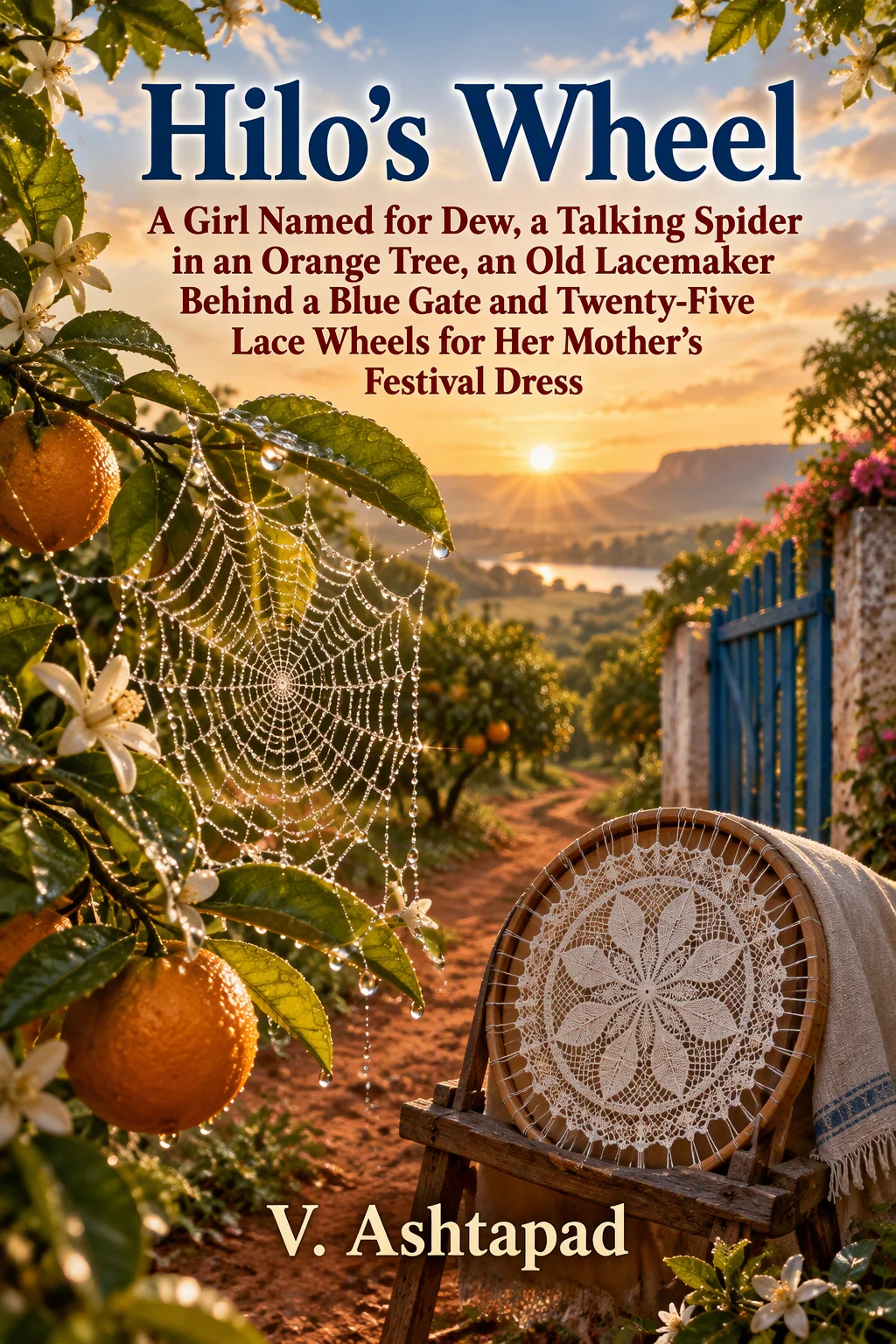
Hilo's Wheel
A Girl Named for Dew, a Talking Spider in an Orange Tree, an Old Lacemaker Behind a Blue Gate and Twenty-Five Lace Wheels for Her Mother's Festival Dress
by V. Ashtapad
Foreword
This is a work of fiction. Ñandutí lace, the town of Itauguá and its lace festival, chipa baked in clay ovens, tereré, the Paraguayan harp and the bottle dance are real traditions of Paraguay. The talking spider, the lacemakers' association, the families on the lane and every named person in the story are invented.
For every child who was told to sit still, and finally did.
The Girl Named for Dew
Come closer, all of you, and put your feet up off that cold tile. No, Benja, not on your sister. On the stool. There. Now pass the gourd around once so everyone's mouth is wet, because this is a long story and I will not stop in the middle to wait for anyone's tereré.
Perla, are you holding that thing up to my mouth again? Your little recorder with the red light? Fine. Hold it still, my love, and do not wave it around like a fly swatter, or your cousins in the city will hear nothing but my bracelets. They asked for this story, so they will get it, every thread.
Once, in Itauguá, when the orange trees along the road were younger and the red earth was just as red as it is today, there lived a girl named Rocío.
Rocío means dew. Her mother chose the name because the girl was born at dawn in the cold month, when every blade of grass in the yard wore a tiny bead of water on its tip, and every fence wire sparkled, and the whole world looked as if someone had sewn glass beads onto it in the night.
"She came with the dew," her mother said, "so she will be called for it."
That was a very fine name for a baby. It was a less fine name for the girl she grew into, because dew is quiet and patient and sits still on a leaf until the sun lifts it away. Rocío was not quiet. Rocío was not patient. Rocío did not sit still on anything, not on a leaf, not on a bench, not even on her own bed, where she bounced so hard in the mornings that the slats complained in three different voices.
When she was eight years old, she could run from her front gate to the bakery on the corner in the time it took her father to tune one string of his harp. She could climb the big orange tree behind the house faster than any boy on the lane. She could eat four pieces of chipa while her little brother Nico was still blowing on his first one.
"Slow down, slow down," her mother said, a hundred times a day.
"I am slow," Rocío said. "This is my slow."
Now, you must understand something about Itauguá, or the rest of this story will be a bowl of soup with no spoon. Itauguá was a town of lace. Not just any lace. Ñandutí.
The word means spider web. You know that, Benja, don't make that face, I am telling the cousins. Ñandutí is made in round wheels, each one like a little sun or a little flower or, yes, a little web. The lacemakers stretch white cloth on a wooden frame. They draw a circle. Across the circle they lay long threads, to and fro, to and fro, until the circle looks like a wagon wheel with too many spokes. Then, with a needle and their patient fingers, they knot and weave among those spokes until patterns bloom there. Stars. Flowers. Little stepping paths. When the wheel is finished, they cut away the cloth beneath, and the lace stands up on its own, light as breath.
In Rocío's time, nearly every house on her lane had a frame leaning in a corner or set up on a table by a window. Grandmothers worked on the porches in the afternoons. Aunts worked at night by the lamp. Along the main road, the women hung their lace on lines and boards for travelers to see, and the wheels turned slowly in the breeze, white and pink and blue and green, so that driving through town was like driving through a garden that had been ironed flat.
Rocío's mother, Celsa, did not make lace. She sewed. She sewed shirts and school skirts and wedding dresses and the little white collars the children wore for photographs. Her sewing machine ran on a foot pedal, and it clattered like hail dancing on the shed. Rocío loved that sound. She did not love the other thing her mother said whenever Rocío touched the bright scraps in the basket.
"Not yet. When you're older. When you can sit."
Rocío's father, Tomás, played the harp. Not a small harp, either, but the tall Paraguayan harp, curved like a swan's neck, taller than Rocío herself, with thirty-six strings. He played at weddings and birthdays and at the bakery on Saturday nights, and during the week he fixed bicycles in a shed behind the house, which paid more and sang less.
And there was Nico, who was five and believed that every animal in the world wanted to be his friend. He was mostly right, except for the rooster, who believed nothing of the kind.
So. A house with a mother who sewed, a father who played, a little brother who talked to goats, and a girl who ran everywhere. Behind the house, the big orange tree. Beyond it, the field, red earth between green rows. And on the far side of the lane, behind a blue gate that stuck, the house of the oldest lacemaker in all of Itauguá, a woman named Doña Ermelinda, whom every child on the lane was a little bit afraid of.
Remember her. She is going to matter.
That year, the Lace Festival was coming. It came every year in the cold month, when the oranges were heavy and sweet and the mornings were so chilly that you could see your words float out of your mouth. Every house hung its best lace. The plaza filled with stalls and music. There was chipa still warm from the clay ovens, and sopa paraguaya in great golden pans, and the harps and guitars played until the stars came out, and then they played some more.
And on the last night, the women danced. Rocío's mother was going to dance that year with a bottle balanced on her head, the way her own mother had, turning and stepping and bending without the bottle ever so much as trembling.
"I will wear the white dress," Celsa said one evening at the table. "The old one."
"The one with the torn collar?" Rocío asked.
Her mother touched her own throat as if she could feel the tear there. "I can mend it."
"You could put lace on it," Rocío said. "Ñandutí. All around the neck and the sleeves. Then you would be the most beautiful one in the plaza."
Her mother laughed, but it was a small laugh, the kind that has a sigh tucked inside it. "Lace for a whole collar costs as much as a bicycle, my heart. And the good lacemakers are busy with orders until the festival is over. I will mend it. It will be fine."
Rocío looked at her mother's tired eyes, and at her father, who was looking at his plate, and she did not say anything else.
But she thought about it all night.
And in the morning, she went out to the orange tree.
© 2026 CRUNOD LLC. All rights reserved.
The Web in the Orange Tree
It was very early. The rooster had not even begun his complaining. Rocío could not sleep because her thoughts kept running laps, so she pulled her sweater over her nightgown, pushed her feet into her sandals, and slipped out the back door.
The yard was gray and blue. The air smelled of wet earth and woodsmoke from somebody's kitchen far off, and of oranges, always oranges, that sweet, sharp smell that gets into your hair and stays. Her breath made little clouds. The grass was soaked, and every blade bent under its bead of water.
Dew. Her dew.
She went to the orange tree because it was her tree, and because, when you can't sleep, it helps to climb something. But she did not climb. She stopped with one hand on the trunk and her mouth open.
Between two low branches, just at the height of her eyes, hung a web.
Now, Rocío had seen a thousand spiderwebs. There were webs in the corners of the shed, gray and dusty, full of old moths. There were webs in the fence, plain and quick. There were webs on the bathroom window that her mother swept away with a broom, scolding.
This was not one of those.
This web was round, perfectly round, round as a plate. And it was covered in dew, every strand strung with tiny beads of water, so that it shone even in the gray light as if somebody had lit it from inside. But it was the pattern that stopped her.
There were the spokes, yes, going out from the middle the way spokes do. But between the spokes, the spider had not simply spun circles. She had spun shapes. Near the center, a small star. Around the star, a ring of petals, each petal pointing a slightly different way, as if a wind were turning them. And around the petals, a band of tiny triangles linked tip to tip, like children holding hands in a circle game. And at the outer edge, little loops, scallops, each one cupping a single bead of dew like a hand holding a pearl.
It was lace. It was ñandutí. It was the most beautiful ñandutí wheel Rocío had ever seen, and she had seen hundreds, because she walked past the lace boards on the main road every single day of her life.
And she had never seen this pattern. Not once. Not on any board, not on any porch, not on any collar.
She leaned closer. Her nose was nearly touching it.
"Careful," said a voice. "You breathe like a bull."
Rocío jumped so high her sandal flew off.
At the very center of the web, on the little star, sat a spider. She was not a big spider, nor a small one. She was the color of a dry orange leaf, with pale bands on her legs like the cuffs of a fancy shirt, and eight shining eyes, two of them larger than the rest, which were fixed on Rocío with great seriousness.
"Did you," Rocío said, and stopped. "Did you talk?"
"I did," said the spider. "And I would thank you to stand back one step. One more. There. Your breath is very warm, and my dew is very cold, and they do not like each other."
Rocío stepped back. She stood on one foot, because her other foot had no sandal and the grass was freezing. She stared.
Now, children, I know what you are thinking. Benja is thinking, spiders don't talk. Perla is thinking, why is Abuela telling a baby story? I am going to tell you what Rocío's own grandmother told her, long before this morning: the world is full of things that talk. Most people just never stand still long enough to hear them. Perla says she will put a little drawing of that spider beside this recording when she adds it to our family pages, so you cousins can count her legs.
Rocío, as you know, never stood still. But that morning she was too surprised to move. And so she heard.
"Are you a magic spider?" she asked.
"I am a spider," said the spider. "Is that not enough?"
"But you can talk."
"I talk at dawn," the spider said, "when the dew is on my threads. When the dew goes, I go quiet. That is how it is with my family and always has been. Tell me, girl. What do you see?"
"Your web," said Rocío. "It's like lace. It's like ñandutí. But it's a pattern nobody knows."
"How do you know nobody knows it?"
"Because I know every pattern on the road."
The spider moved one leg, the way a person taps a finger when they are thinking. "Do you? Or do you know every pattern you have run past?"
Rocío opened her mouth. She closed it.
"Well," the spider said, more kindly. "You are right about one thing. Nobody in this town knows it. Not anymore. Once, long before your grandmother's grandmother, a woman here knew it. She learned it from one of my family. She made it into lace. And then she grew old, and she did not teach it to anyone, because she was always too busy, or the girls were always too quick, and when she was gone, the pattern was gone with her. Out of the hands of people. Back into the threads of spiders."
"That's sad," said Rocío.
"Yes," said the spider. "It is a little sad."
The light was changing. The gray was going gold. Far off, the rooster cleared his throat.
"Why are you showing it to me?" Rocío asked.
"I spin it once a year," said the spider, "in this cold month, in the days before your festival. I spin it every morning of those days, and every morning the sun drinks it away. And every year I wait to see if anyone will stop and look. Most years, nobody does. This year, a girl in a nightgown stopped. So."
"So what?"
"So," said the spider, "do you want to learn it?"
© 2026 CRUNOD LLC. All rights reserved.
What the Spider Said
Rocío did not even think. That is the kind of girl she was.
"Yes!" she said. "Yes, yes, yes. Teach me right now."
The spider made a small sound, a dry, clicking sound. Rocío would learn later that it was the way spiders laugh.
"Right now," the spider said, "the sun is coming. Look."
It was true. The first long finger of sunlight had come over the field and was reaching across the red earth toward the orange tree. Where it touched the grass, the dew began to shine, and then to vanish, bead by bead.
"Wait," Rocío said. "Wait, wait, how do I start? Tell me quick."
"Nothing about this is quick," said the spider. "That is the first thing. Here is the second. I am a spider. I spin with my body. You are a girl. You will have to spin with a needle and thread, and I cannot teach you the needle. For that, you need a person whose hands remember."
"Whose hands remember what?"
"Everything," said the spider. "Go and find the one in this town whose hands remember the most. Ask her to teach you. Then come to me each dawn, and I will show you what she does not know. Between us, maybe, you will carry it back into the hands of people."
"Who is it? Whose hands?"
But the sunlight touched the web.
Oh, my loves, if you could have seen it. The beads of dew lit up all at once, a hundred tiny suns, and the whole pattern blazed, the star and the petals and the triangles holding hands and the little scallops holding their pearls. For one breath, it was the brightest thing in the world.
And then the dew began to rise off it like smoke off a cup of coffee, and the web was just a web, thin and pale and nearly invisible, and the spider was just a spider, sitting very still in the middle, saying nothing at all.
"Señora?" Rocío whispered. "Señora Spider?"
Nothing.
She waited. She waited what felt like an hour, which was probably the time it takes to sing one verse of a song. The rooster crowed for real now, rude and loud. The kitchen light came on in her house. Her mother's voice called, "Rocío? Where is that girl?"
Rocío picked up her sandal. She looked at the web one more time. Without the dew, she could barely see the pattern. She squinted and tilted her head and saw the star, maybe, and a few petals, and then it was lost again in the leaves.
"Tomorrow," she told the spider. "I'll be here tomorrow."
The spider did not answer, of course. But one leg lifted, just a little, and lowered.
Rocío ran inside, because running was what she did.
At breakfast, she could hardly eat, which for Rocío was nearly a miracle. Her mother put out the cocido, the sweet burnt-sugar tea with milk, and a plate of yesterday's chipa, warmed on the stove so the cheese inside went soft again. Nico was telling the cat about a dream he'd had where the goat across the road could fly. Her father was rubbing grease off his knuckles with a rag.
"Papá," Rocío said. "Who is the best lacemaker in Itauguá?"
Her father looked surprised. "The best? That's a dangerous question. Ask ten women and you'll get ten answers, and nine of them will be their own name."
"Who has the hands that remember the most?"
He set down the rag. He and Celsa looked at each other.
"Well," her mother said slowly, "if you mean the oldest hands, that would be Doña Ermelinda. Across the lane. She was making lace before anyone else in this town was born."
Rocío's stomach did a small flip, like a fish in a bucket.
Doña Ermelinda. Behind the blue gate that stuck. Doña Ermelinda, who sat on her porch every afternoon in a black shawl and did not wave back. Doña Ermelinda, who had once told Rocío, when Rocío was six and ran through her yard chasing a chicken, that if she did that again, the chicken would be the one chasing her. Rocío had never been quite sure what that meant, and she had never been brave enough to find out.
"Why do you ask?" said her mother.
Rocío looked at her plate. She wanted to tell. She wanted to tell so much that the words were climbing up her throat like ants up a sugar bowl. A spider! A talking spider! A pattern nobody knows! And I'm going to make it into lace for your dress, Mamá, so you can dance in the plaza and everyone will—
But she stopped. Because if she told, her mother would say, "Not yet. When you're older. When you can sit." And the spider had said nothing about this was quick, and the festival was only six weeks away.
So for once in her life, Rocío held something in.
"No reason," she said. "Just wondering."
Her father raised an eyebrow. Her mother raised two. But Nico chose that moment to tip his whole cup of cocido into the cat's dish, because he said the cat looked cold, and the question was swept away in the mopping up.
Perla, put the recorder down for a moment and pour me a little more tereré. Thank you. Mm. Your mother put mint in this. Good. She wrote that into our family recipe collection, mint and lemon verbena, as if I had not taught it to her.
Now. You might think the next part is where Rocío marches straight to the blue gate. She did. But first, she went and did something foolish. All of you, I want you to listen closely to this part, because you will do foolish things too, and it helps to know that everyone does.
© 2026 CRUNOD LLC. All rights reserved.
Nobody Knows This One
After school, Rocío took a stick and went to the main road.
It was the busiest hour. The buses honked. A man was selling oranges off the back of a cart, calling out a price that went down every time someone walked past without stopping. And all along the road, the lace hung on its boards and lines, the round wheels turning in the breeze.
Rocío found a smooth patch of red dirt by the edge of the road. She knelt down. With the end of her stick, she drew a circle. In the circle she drew spokes. Then, from memory, she drew the pattern: the little star in the middle, the turning petals, the triangles holding hands, the scallops around the edge.
It came out crooked. The petals looked more like beans. The triangles looked like a fence that had been in a storm. But it was close enough, she thought. You could tell what it was supposed to be.
Then she went up and down the road, asking.
The first lacemaker she asked was Tía Odilia, who wasn't really her aunt, but everybody called her Tía because she had a laugh you could hear three houses away. Your uncle in Asunción, who keeps our family tree up to date, tells me Tía Odilia is on it after all, two branches over, by marriage. Tía Odilia sold ñandutí in all the colors of a fruit stall, and she was working a pink wheel on a frame in her lap.
"Tía, come look. Do you know this pattern?"
Tía Odilia heaved herself up and came to look at the dirt. She bent over. She bent over farther. She put on her glasses.
"Hm," she said. "Is that a bean?"
"It's a petal."
"Ah. And this?"
"Triangles. Holding hands."
"Holding hands." Tía Odilia straightened up with a groan. "No, my heart, I don't know it. But it's a good idea. Maybe you'll invent it."
"I didn't invent it, a sp—" Rocío caught herself. "Somebody showed me."
"Then ask somebody," Tía Odilia said, and laughed her three-houses laugh, and went back to her chair.
The second lacemaker was Señora Blanca, who made only white lace, very fine, and sold it to people from the capital in little boxes. She frowned at the drawing until her eyebrows met.
"The center is the little star," she said. "Everyone knows the little star. But the rest, no. Those petals aren't any flower I know. Where did you see this?"
"In a dream," Rocío lied, and felt bad about it at once, like biting a green orange.
Señora Blanca sniffed. "Dreams don't sell."
The third was a girl only a few years older than Rocío, named Graciela, who was helping her grandmother at the stall. Graciela looked at the drawing and said, "It's pretty. My grandma will know." And she called her grandmother, who came and looked and said, "I don't know it. Go ask Ermelinda. She knows the old ones."
The fourth said, "Ask Ermelinda."
The fifth said, "Ask Ermelinda, but bring something sweet, and don't talk too much."
The sixth was an old man selling sugarcane juice, who did not make lace at all but liked to have opinions. He looked at the drawing and said, "That's a wagon wheel that got run over by another wagon wheel."
By this time a small crowd had gathered around the patch of red dirt. Two boys from Rocío's school. A woman waiting for the bus. A dog. Everyone was giving the pattern names.
"The Broken Fence."
"The Bean Flower."
"The Little Star Who Lost Her Mother."
"The Dog's Breakfast," said the sugarcane man, because the dog had begun to sniff at it.
Rocío's cheeks burned. "It's not like that," she said. "It's beautiful. I just can't draw it right."
"Then go and learn," said a voice from the back.
Everyone turned.
It was Rocío's father, with a bicycle tire over one shoulder, on his way back from buying a part. He was not laughing. He looked at the drawing, and then at his daughter, and then he put out his hand.
"Come. Your mother needs help with supper."
Rocío took his hand. They walked home together, the tire bumping on his shoulder. For a while, he said nothing. Then, as they turned onto their lane, he said, "You know, when I was a boy, I wanted to play the harp at the festival when I was nine years old. Nine! I had been playing for maybe two months. I could play one song, and not very well."
"Did they let you?"
"They let me," he said. "I played my one song in front of the whole plaza. And I made so many mistakes that a man in the front row took off his hat and put it over his face."
Rocío giggled in spite of herself.
"I wanted to go hide under the stage forever," her father said. "But afterward, the old harpist who played at every festival back then, Don Lucio, came to find me. And he said, 'Boy, the fault was not in your fingers. The fault was that you wanted to be finished before you had started.'"
They had reached their gate. Across the lane stood the blue gate. Doña Ermelinda was on her porch, black shawl, frame on her lap, not looking up.
"So what did you do?" Rocío asked.
"I started," said her father. "That's all. I started, and I kept starting every day, for about twenty years."
He went inside. Rocío stayed at the gate, looking across the lane.
Doña Ermelinda's needle went in, out, in, out. The light was going orange. A thin line of smoke rose from her kitchen behind her.
Rocío did not go over that night. She was too tired and her cheeks were still hot. But before she went to bed, she did one smart thing. She found a pencil and the back of an old calendar page, and she sat on the floor of her room, and she tried to draw the pattern again, slowly this time. Very slowly. So slowly that it hurt.
It still came out crooked. But it came out a little less crooked than the dirt.
She folded the page into four and slid it under her pillow.
And at dawn, she was at the orange tree again.
© 2026 CRUNOD LLC. All rights reserved.
Doña Ermelinda's Gate
The spider was there. The web was there, shining, every bead of dew in its place. And the spider said, before Rocío could even open her mouth, "Well? Did you find her?"
"I found out who she is," said Rocío. "I didn't go yet."
"Why not?"
"Because she's scary."
The spider considered this. "So am I, to most people," she said. "You came anyway."
"That's different. You're small."
"Size has nothing to do with it," said the spider. "Now, look closely. Not at the whole web. Just at this. The center."
She lifted one leg and touched the little star at the heart of the web. "See how the threads go around? Count them."
Rocío counted. Her lips moved. "Five. Five points."
"Five points. Each point goes under one spoke and over the next. Under and over. Under and over. That is all for today."
"That's all? That's nothing!"
"That's all you can hold," said the spider. "If I gave you more, you would spill it on the way home. Go and find the woman. Tell her about the five points. See what she says."
And then the sun came, and the dew rose, and the spider went quiet, and Rocío was left standing in the cold grass with five points in her head and nowhere to put them.
That afternoon, after school, Rocío stood in front of the blue gate.
She had brought something sweet, because the fifth lacemaker had told her to. It was a piece of dulce de leche wrapped in a corn husk, which she had bought at the corner with her own coins and had not eaten even a little bit, though she had thought about it every step of the way across the lane, which was not very many steps.
She pushed the gate. It stuck. She pushed harder. It stuck harder. She put her shoulder to it, and it flew open with a squawk, and Rocío stumbled into the yard and nearly landed on a goat.
The goat was white with one brown ear. It looked at her with its strange sideways eyes and went on chewing something that might have been a sock.
"That's Pirulí," said a voice from the porch. "She bites girls who come through the gate like a cannonball."
Doña Ermelinda had not looked up. Her needle dipped and rose over the frame on her lap. She was very old. Her face was brown and creased like a walnut, and her white hair was knotted at the back of her head so hard that it seemed to be holding her eyebrows up. Her shawl was black. Her hands were the strangest thing about her, knobbed at every knuckle, bent like the roots of a tree, and yet the needle in them moved so steadily, so evenly, that it looked as if it were moving by itself.
"Good afternoon, Doña Ermelinda," said Rocío, as politely as she knew how.
"Good afternoon, Celsa's girl."
"My name is Rocío."
"I know your name. I was there when your mother named you. You came on a cold morning. The grass was white." In, out, went the needle. "What do you want?"
Rocío came up the steps. She held out the corn husk. "This is for you."
Doña Ermelinda glanced at it. "Put it on the table."
Rocío put it on the table. There was a gourd there, and a thermos of cold water with lemon grass floating in it, and a silver straw. There was also a small radio that was not on, and a cat that was asleep, and a plate with the crumbs of something.
"I want you to teach me to make ñandutí," Rocío said.
The needle stopped.
For the first time, Doña Ermelinda looked up. Her eyes were dark and clouded at the edges, and they looked at Rocío the way you might look at a cloud to decide whether it will rain.
"No," she said.
And the needle started again.
Rocío had expected many things. She had expected Doña Ermelinda to laugh, or to scold, or to tell her she was too young. She had not expected a single word, like a door closing.
"Why not?" she said.
"Because I don't teach anymore. Because my hands hurt. Because girls these days want to learn everything by next Tuesday. Because you came through my gate like a bull through a fence. Shall I go on?"
"But I have to learn," said Rocío. "Somebody showed me a pattern. A pattern nobody in town knows. Everybody says only you would know it."
Doña Ermelinda's needle did not stop this time, but it slowed. "Everybody says that about everything. I am old. They think old means I know everything. I don't. What pattern?"
Rocío took the folded paper from her pocket. She unfolded it and held it out.
Doña Ermelinda did not take it. She leaned forward and looked at it without touching it, the way you look at a bug you are not sure about. She looked for a long time. The cat woke up, stretched, and went back to sleep.
"Where did you see this?"
Rocío thought about lying again. She thought about the green-orange feeling. She thought about the spider saying, size has nothing to do with it.
"In my orange tree," she said. "In a spiderweb. At dawn. With the dew on it."
She waited for Doña Ermelinda to laugh.
Doña Ermelinda did not laugh. She sat back. She put the needle down on the frame, very carefully, and folded her bent hands in her lap.
"Sit," she said.
Rocío looked around. There was a second chair, a low one with a woven seat. She sat.
"Not like that. You're sitting like you plan to leave. Sit like you plan to stay."
Rocío shifted. She put both feet flat on the floor. She put her hands on her knees.
"Better," said Doña Ermelinda. "Now. Don't talk."
"But—"
"What did I say?"
Rocío shut her mouth.
And then nothing happened. For a long time. Doña Ermelinda picked up her needle and went back to her frame. In, out. In, out. The cat slept. The goat chewed its sock. A bus went by on the main road, honking. A neighbor's radio played a polka. The light moved across the porch floor, slowly, one tile, then another.
Rocío's foot began to itch. Then her nose. Then a place on her back she couldn't reach. She wanted to ask what they were doing. She wanted to ask when they would start. She wanted to run home and come back tomorrow. Her whole body felt like a bottle of soda somebody had shaken.
But she did not talk.
At last, when the shadows of the porch posts had grown long and the sky had gone pink as a guava, Doña Ermelinda put her frame aside.
"Tomorrow," she said, "come again. Come through the gate like a person, not like a cannonball. Bring nothing. Sit. Don't talk."
"That's it?" said Rocío, before she could stop herself. "That's the lesson?"
"That was the lesson," said Doña Ermelinda. "You failed the last part just now. But you passed most of it. Go home. Your mother is calling."
She was. Rocío could hear her from across the lane.
Rocío got up. Her legs were stiff. She went down the steps, and she went to the gate, and this time she opened it slowly, with two hands, so it only squeaked a little.
Pirulí the goat watched her go and did not bite.
© 2026 CRUNOD LLC. All rights reserved.
The Frame and the Thread
For five days, Rocío sat.
Every morning, she went to the orange tree, and the spider showed her one small thing. The way the spokes were laid, not all at once, but in pairs, one and then its opposite, so the web would not pull crooked. The way the petals began, each one with a loop and a twist. The way the threads went under and over, under and over.
"I can't remember all this," Rocío said on the third morning.
"You don't have to remember it here," said the spider, tapping the side of her own head, if a spider can be said to have a side of a head. "You have to remember it here." And she tapped one of her legs. "In the part of you that does the work."
"I don't have legs like you."
"You have fingers. Fingers are only shorter legs that forgot how to walk."
Every afternoon, she went through the blue gate like a person, and sat in the low chair, and did not talk.
By the second day, her foot only itched a little. By the third day, she noticed things. She noticed that Doña Ermelinda pulled each thread to exactly the same tightness, never more, never less, and that she touched the spokes before she stitched them, like a person touching the shoulder of a friend before they speak. She noticed that the old woman hummed, so softly you could barely hear it, and that the hum changed when the pattern changed. She noticed that Pirulí the goat always lay down at the same time, just when the sun reached the bottom step, and that the cat always moved from the table to Doña Ermelinda's feet when the radio next door began to play.
By the fourth day, Rocío realized she was not bored. She was listening. To the needle, which made a tiny pull and hiss each time it went through. To the thread, which whispered against the spokes. To the old woman's breathing, which slowed when the work was hard and quickened when it was easy.
On the fifth day, Doña Ermelinda spoke.
"Get the small frame. Behind the door."
Rocío jumped up so fast she knocked the chair over. She picked it up. She went behind the door, slowly, and found a small wooden frame, square, its corners worn smooth by many hands. There was a piece of white cotton cloth already stretched across it, held tight with tacks.
"That was my first frame," said Doña Ermelinda. "My grandmother made it from the wood of a broken chair. Be careful with it. It's older than your father."
Rocío held it as if it were made of eggshells.
"Now. The pencil. The plate."
On the table was a pencil and a small tin plate. Doña Ermelinda showed her how to set the plate face down on the cloth and draw around it, a perfect circle. Then how to make tiny marks around the edge, evenly spaced, the way you might mark the hours on a clock, but many more of them.
"How many?"
"For your first wheel? Thirty-two. Count."
Rocío counted. She marked. She counted again and found she'd made thirty-one, so she rubbed one out and did them all again.
Then the thread. Doña Ermelinda gave her a needle, long and fine, and a spool of white cotton thread so thin that it nearly disappeared against the cloth.
"Now the spokes. From this mark, across, to the one opposite. Then back. Then the next. Then its opposite. Pull until it is tight like the string of a harp. Not tighter. Not looser."
Rocío threaded the needle. That took four tries, because her hands were shaking. She made the first stitch at the edge of the circle. She pulled the thread across to the opposite mark. She made the second stitch.
"Tighter," said Doña Ermelinda.
Rocío pulled. The thread snapped.
"Not that tight."
Rocío tied it and tried again. The thread sagged.
"Tighter."
She pulled. It was right. She could feel it was right. It hummed, almost, when she touched it, like the lowest string on her father's harp.
She went on. Mark to mark, across and back. It took forever. By the tenth spoke, she was hurrying, and the thread caught on itself and made a knot like a little gray pea. By the twelfth spoke, she had made three knots and the circle looked like a spider had been in a fight.
She wanted to throw the frame across the porch.
She did not. Because it was older than her father.
Instead, she said, very quietly, "It's tangled."
"I can see it's tangled."
"It's all wrong."
"Not all of it. Eleven spokes are good. One is wrong. Take that one out."
"But then I have to do it again."
Doña Ermelinda looked at her. "Yes."
Rocío took the wrong spoke out. It took a long time, picking the knot loose with the tip of the needle. Then she did it again. Then she did the next one, slowly. And the next.
"Thread talks," said Doña Ermelinda after a while. "Did you know that? When you pull too hard, it tells you. When you hurry, it tells you. It tells you before it breaks. You only have to listen."
"What does it say?"
"It says, 'Hey, you. Slow down.'" And for the very first time, Doña Ermelinda smiled. It was a quick smile, there and gone, like a fish turning in a stream.
By the time the shadows were long, Rocío had laid all thirty-two spokes. Sixteen threads crossing the circle, meeting in the middle. It was a little lopsided. One spoke was slightly looser than the others, and you could see it if you looked. But it was a wheel.
"Good," said Doña Ermelinda.
Just that. Good. Rocío carried that word home with her across the lane as carefully as she had carried the old frame. That night, she lay in bed and felt the shape of the needle in her fingers, still there, the way your feet still feel the waves after you come out of a river.
Perla says I should tell you that she has a picture of that frame. It's true. When Doña Ermelinda's great-grandson cleaned out her house many years later, he took a photograph of the little frame and sent it to me, and Perla put it on our family pages where the relatives keep their pictures, with a note: Doña Ermelinda's first frame, made from a chair. Some of you have probably scrolled right past it. Next time, stop and look.
© 2026 CRUNOD LLC. All rights reserved.
Chipa on Fridays
On Fridays, Rocío's mother baked chipa.
This was not a small thing. This was a whole-house thing. On Thursday night, Celsa set out the bags of starch and the hard yellow cheese and the anise seeds in their little paper twist. On Friday morning, before the sun was up, she lit the clay oven in the yard, the tatakua, which looked like a giant's beehive made of mud, and fed it sticks until it was so hot you could feel it on your face from across the yard.
Then she mixed. Starch, cheese, eggs, lard, milk, the anise seeds, a pinch of salt. Her hands went into the bowl to the wrist and squeezed and folded and squeezed until the dough was smooth and heavy and smelled like warm cheese and licorice. Then she rolled the dough into rings, little horseshoes, little loaves, and set them on a tin sheet, and Rocío's job was to carry the sheet to the oven, very carefully, and hand it to her mother, who slid it into the hot mouth of the tatakua with a long wooden paddle.
The smell, my children. You know the smell. If you've ever walked past a bus stop where a woman is selling chipa from a basket under a white cloth, you know a little bit of it. But a whole yard full of it, at dawn, in the cold, with smoke going up and the sky turning pink and the oranges hanging in the trees like little lamps? That smell could wake a sleeping saint.
That Friday, Rocío was up earlier than ever, because she had already been to the orange tree.
"You're dripping," said her mother. "Why is your sweater all wet?"
"I was looking at the dew."
"You're always looking at the dew. One day you'll turn into dew." Her mother handed her a bowl of anise seeds. "Pick out the little sticks."
So Rocío picked out the little sticks. And while she picked, she watched her mother's hands. Before, she had only seen her mother working. Now, after a week on Doña Ermelinda's porch, she saw other things. She saw how her mother pressed each ring of dough with her thumb in exactly the same place. She saw how she tested the oven by holding her palm in front of the mouth and counting, under her breath, the way Doña Ermelinda counted spokes. She saw how her mother hummed too, very softly, an old song about a river.
"Mamá," Rocío said. "Who taught you to make chipa?"
"Your grandmother. Who else?"
"Did she make you sit still and not talk?"
Celsa laughed. "She made me pick sticks out of anise seeds for a whole year before she let me touch the dough."
"A whole year?"
"A whole year. I cried about it. I said, 'Mamá, I know how, I've watched you a thousand times.' And she said, 'Watching with your eyes is not the same as watching with your hands.'"
Rocío thought about that while the first sheet of chipa baked. The smoke curled up. The orange trees dripped. Nico came out in his pajamas with the cat on his shoulder and asked if the oven was a house for a dragon.
When the chipa came out, golden and puffed and shining with grease, Celsa set one aside on a plate.
"Take this to your father. He's in the shed." And then, after a moment, "And take two to Doña Ermelinda. She likes them hot."
"How do you know?"
"Everybody knows. She has liked them hot for seventy years."
So Rocío took the chipa. She went to the shed first, where her father was bent over a bicycle with a wrench, and he took the chipa in his greasy fingers and ate it in three bites and said, "Ah, now the day can start."
Then she crossed the lane with two hot chipa wrapped in a napkin, opened the blue gate with two hands, and climbed the porch steps.
Doña Ermelinda was not on the porch yet. It was too early. But the door stood ajar, breathing out a smell of woodsmoke and coffee.
"Doña Ermelinda? My mother sent chipa."
A voice came from inside. "Hot?"
"Hot."
"Bring it."
Rocío had never been inside the house. It was dark and cool and smelled of old wood and lemon grass. And everywhere, everywhere, there was lace.
There was lace on the table. There was lace on the back of every chair. There were lace wheels pinned to the walls, dozens and dozens of them, some yellowed with age, some bright white, some in colors that had faded to the softest pinks and blues. There was a lace curtain at the window, and the early light came through it and fell on the floor in a pattern of tiny stars.
Doña Ermelinda was sitting at the table in a sweater with her feet in slippers, and in front of her, on the table, was a dress.
It was white. It was very old. It had a high collar and long sleeves and a full skirt, and every edge of it, the collar, the cuffs, the hem, was trimmed with ñandutí so fine that it looked like frost.
"Oh," said Rocío.
"My mother's," said Doña Ermelinda, taking a chipa and breaking it open so the steam came out. "She danced in it. When I was your age, I hid under the table to watch her get ready. She would put on the dress, and then she would put on her earrings, and then she would put a bottle on her head and walk around the room three times, and if the bottle fell, she would start over."
"Did it fall?"
"Never once. Not one time in all my life."
Rocío touched the hem of the dress. Very lightly. One finger. The lace was stiff and cool, and when she looked closely she could see the spokes, and the patterns between them, little stars and little flowers.
"My mother is going to dance," she said. "At the festival. With a bottle."
"I know. I saw her practicing in your yard last week. She's good. She has her grandmother's neck."
"Her dress is old," said Rocío. "The collar is torn. She says she'll mend it."
Doña Ermelinda chewed her chipa. She looked at Rocío with her cloudy dark eyes for a long moment.
"Ah," she said. "So that's it."
"That's what?"
"That's why a girl who can't sit still has been sitting still on my porch for a week." She took a sip of coffee. "You want to make lace for your mother's dress. From your spider's pattern. Before the festival."
Rocío's face went hot. She nodded.
"That is six weeks," said Doña Ermelinda.
"Five," said Rocío. "And two days."
"Five weeks and two days. For a girl who laid her first spokes on Tuesday." The old woman put down her cup. "Do you know how long it takes me to make a collar? An old woman who has been doing this since before your grandmother was born?"
Rocío shook her head.
"Three weeks. If my hands don't hurt. And my hands always hurt."
Rocío looked at the floor, at the stars of light from the curtain.
"So you're saying no."
"I'm saying," said Doña Ermelinda, "eat your own chipa before it gets cold. You brought two. One was for you. Your mother isn't a fool."
Rocío looked at the napkin. There was one chipa left. She hadn't even noticed. She picked it up and took a bite, and it was hot and chewy and full of cheese, and for a moment she forgot about everything else.
"I'm not saying no," said Doña Ermelinda quietly. "I'm saying it will be hard. Harder than anything you've done. Harder than climbing your orange tree, or running to the bakery, or sitting on my porch. You'll want to quit every day. Some days you'll cry. Some days I'll be mean to you, because I'm old and my hands hurt and I don't like to repeat myself. Do you understand?"
Rocío swallowed her chipa. "Yes."
"Then this afternoon, come early. We'll start the star."
© 2026 CRUNOD LLC. All rights reserved.
The Spider Teaches at Dawn
The next morning, Rocío told the spider everything.
She told her about the frame from the broken chair, and the thirty-two spokes, and the knot like a gray pea. She told her about the lace on the walls and the old dress. She told her that Doña Ermelinda had said it would be hard.
The spider listened. Her two big eyes and her six small ones held very still. When Rocío finished, the spider said, "She is right."
"I know she's right. That's what's terrible."
"Why is it terrible?"
"Because I want to be finished already."
The spider made her dry clicking laugh. "Do you know how long it took me to learn to spin this web?"
"How long?"
"I don't know," said the spider. "I've forgotten. I've been doing it so long that I can't remember not knowing. That is what happens when you learn something all the way down. It stops being something you know and becomes something you are." She tapped the little star. "Today. The star. You know the five points?"
"Under one spoke, over the next."
"Good. But here is what the old woman may not tell you, because it is so deep in her hands that she has forgotten it is there. When you go around the first time, the star is weak. It wobbles. When you go around the second time, close to the first, it holds. When you go around the third time, it sings. Three times around. Always three."
"Why three?"
"Because two is not enough and four is too many. Some things just are."
Rocío said it over to herself. Three times around. Always three.
"Now," said the spider. "Look at the petals."
"You said one thing a day."
"Today you can hold two. You've grown." She touched one of the turning petals. "See how each petal leans? The first one leans a little. The second leans a little more. By the time you come all the way around, the last petal is leaning so far it almost touches the first one, and the whole ring looks like it is turning. That is the secret of this pattern. That is what nobody remembers. The petals are not the same. Each one is a little different from the one before."
Rocío stared at the petals. She had seen that they were turning, but she had not seen why. Now she counted. There were eight of them. And each one leaned a tiny bit farther, like the hands of a clock moving around.
"How do I make them lean?"
"You will skip one more thread each time," said the spider. "The first petal, you pass over one spoke. The second petal, you pass over one, and then the tip goes over a half more. The third, a little more again. Your old woman will show you how to make a petal. I am showing you how to make them turn."
The sun was coming. Rocío could feel it on the back of her neck.
"Wait," she said. "Why do you care? About people having this pattern? You're a spider. You could just keep it."
The spider was quiet for a moment. The dew on her threads was starting to shimmer.
"A long time ago," she said, "my many-times-grandmother spun this web in a tree not far from here. A woman found it and learned it. The woman made lace, and the lace was beautiful, and people came from far away to see it. And the woman's daughter wore it, and danced in it. And my grandmother sat in the tree and watched, and she said it was the best day of her life. To see her pattern on a dancing woman, turning in the light. To see it carried somewhere she could never go." The spider shifted. "We spiders only spin for ourselves. For catching. For living. When people take our patterns, they make them into something we never could. So you see, it is not only a gift to you. It is a gift to us."
The sun touched the web. The dew blazed.
"Go," said the spider, the last word before she went quiet. "Three times around."
That afternoon, Rocío sat on Doña Ermelinda's porch with the little frame on her lap. The thirty-two spokes she'd laid were there, a little lopsided. The old woman had threaded a fresh needle for her.
"The star," said Doña Ermelinda. "At the center, where the spokes cross, you'll go around. Under one, over the next. You know this?"
"Yes. Under and over. And three times around."
Doña Ermelinda's eyebrows went up, which was hard, because her hair was pulling them so high already.
"Who told you three times?"
"The spider."
Doña Ermelinda was quiet. Then she said, "My grandmother used to say that. Three times around. I'd forgotten she said it." She looked at Rocío with an expression Rocío could not read. "Go on, then."
So Rocío began.
Under one spoke. Over the next. Under. Over. It was harder than it sounded. The needle had to slip between the threads without catching, and the spokes were so close together at the center that she kept going under two by mistake. Twice she had to back up. Once she pulled too hard and the whole center puckered like a mouth eating a lemon.
"Thread talks," said Doña Ermelinda.
"I'm listening!"
"Listen louder."
Rocío slowed down. She slowed down so much that she was barely moving. And she found that if she touched each spoke before she went under it, the way Doña Ermelinda did, the way you touch the shoulder of a friend, she didn't miss.
Around once. The star wobbled, just as the spider had said.
Around twice. It held.
Around three times. Rocío pulled the thread tight, and the little star at the center of her wheel came together, five small points, and when she touched it with her fingertip, it felt solid, and it felt right, and she thought, if it could make a sound, it would be singing.
She looked up. Doña Ermelinda was not looking at the star. She was looking at Rocío.
"Good," said the old woman. "Very good."
Two goods in two days. Rocío thought she might float across the lane.
But that night, she lay awake again, thinking about the petals. Eight petals, each leaning a little more than the one before. And five weeks. And her mother's torn collar. And for the first time, she understood what she had promised herself. It was not one wheel. A collar would need many wheels. Sleeves, cuffs. How many?
She got out of bed and turned on the little lamp and found her pencil and drew her mother's dress on the back of her school spelling list. Around the collar, she drew wheels. She counted. Seven. On each cuff, three. That was thirteen. And it would be beautiful to have some at the hem, too. Maybe twelve more.
Twenty-five wheels.
She had made one star.
Rocío turned off the lamp. She lay in the dark and listened to her own heart going much too fast.
© 2026 CRUNOD LLC. All rights reserved.
Knots and Cross Words
Now I'm going to tell you about the worst day. You knew there would be one. There always is.
It was the second week. Rocío had finished her first wheel, the whole thing, star and petals and triangles and scallops. It had taken her eight days. The petals did not turn as smoothly as the spider's. Two of them leaned the wrong way, so instead of turning, the ring seemed to stumble, like a dancer who had missed a step. But it was a wheel. Doña Ermelinda had helped her cut away the cloth underneath, snip by tiny snip with a pair of scissors shaped like a stork, and the lace had stood up by itself, light and white. Rocío had held it up to the sun and nearly cried.
Then she had started the second wheel.
And then the third.
The third was where it went wrong. She was tired. She was behind. She had been counting the days on her fingers at night and they kept coming out the same. Twenty-five wheels. Twenty-two days left. Even if she did one wheel every single day, which she could not, she would not have enough.
So she hurried.
She laid the spokes of the third wheel in one afternoon, much faster than the first. She made the star in one round instead of three, because, she told herself, nobody would look that closely at the middle. She started on the petals before Doña Ermelinda had even come out onto the porch.
When Doña Ermelinda came out, she sat down in her chair, put on her glasses, and looked at the frame in Rocío's lap.
She looked for a long time.
"Take it out," she said.
"What?"
"The star. It's only once around. Take it out and do it again. And three of these spokes are loose. You can see they're loose. Take them out."
"But they're fine! You can hardly tell!"
"I can tell."
"You can hardly see!"
Oh, my children. Perla, you can turn that thing off for this part if you want, it is not a nice thing to hear. No, keep recording. Your cousins should hear it. It's part of the story.
Rocío said it. The words jumped out of her like frogs out of a bucket and she couldn't catch them.
Doña Ermelinda did not move. Her face did not change. She only took off her glasses, slowly, folded the arms shut and tucked them into her sweater.
"That's true," she said quietly. "I can hardly see. I can see well enough to know a wheel that will fall apart in the first wash."
"It won't fall apart!"
"It will. A star made once around will pull loose the first time it gets wet. The petals will fall in. The scallops will go flat. Your mother will dance one dance in it, and then it will be rags."
"You don't know that!"
"I have been doing this for seventy years," said Doña Ermelinda. "I know that."
Rocío stood up. The frame fell off her lap and landed on the porch floor with a clatter. Pirulí the goat jumped up and bleated. The cat ran under the table.
"I don't have seventy years!" Rocío shouted. "I have twenty-two days! I can't do it your way! Your way is too slow! You're too slow, and the spider's too slow, and everything is too slow, and I'm never going to finish, and my mother's going to wear a mended collar in front of the whole town, and it's your fault!"
It wasn't, of course. It wasn't anyone's fault. But when you are eight and tired and frightened, it helps to have somebody to blame, and the person nearest is usually the one who gets it.
Doña Ermelinda looked at her for a long, long moment.
"Pick up my frame," she said.
Rocío looked down. The little frame from the broken chair lay on its side on the porch boards. One of its corners had come loose. The cloth was pulled crooked. The spokes she'd laid had snapped in three places.
All the anger went out of Rocío at once, like water out of a cracked jar.
She picked up the frame. Her hands were shaking. She held it out.
Doña Ermelinda took it. She turned it over in her bent fingers. She touched the loose corner.
"Go home," she said.
"I'm sorry, I didn't mean—"
"Go home, Rocío."
It was the first time Doña Ermelinda had ever called her by her name instead of Celsa's girl. And it was the worst sound Rocío had ever heard.
She went home. She did not run. She walked very slowly across the lane, and she opened her own gate, and she went around the back of the house to the orange tree, and she climbed up into it as high as she could go, and she sat in the crook of two branches where nobody could see her, and she cried until the oranges around her were blurry.
That evening, her father came out and stood under the tree.
"Rocío," he said. "Supper."
"Not hungry."
"Your mother made sopa paraguaya."
Rocío loved sopa paraguaya. It is not a soup at all, as you know, but a kind of cornbread, golden and heavy and full of cheese and onion, and the edges go crispy in the pan. Her mother made it only for special days.
"Why?" Rocío asked. "Why did she make it?"
Her father was quiet. "Because Doña Ermelinda came over this afternoon," he said, "and talked to her for an hour on the porch."
Rocío's heart stopped. "What did she say?"
"She told your mother what you've been doing. All of it. The spider and the lace and the dress." He paused. "Well. She didn't say spider. She said 'a pattern the girl found.' But your mother and I can put two and two together. We've seen you out in this tree every morning."
Rocío put her face in her hands. "Is Mamá angry?"
"Come down and find out."
© 2026 CRUNOD LLC. All rights reserved.
The Harp Under the Orange Tree
Her mother was not angry.
That was almost worse. Rocío came in with red eyes and leaves in her hair, and her mother was at the stove, and she turned around and looked at her daughter, and then she opened her arms, and Rocío walked into them and smelled onion and cheese and the soap her mother used on her hands.
"You silly girl," said Celsa into her hair. "You silly, silly, sweet girl."
"I wanted it to be a surprise."
"It is a surprise. I'm very surprised." Her mother held her back and looked at her. "You've been doing this for two weeks? Sitting on that porch? You? My Rocío, who can't sit through grace?"
Rocío nodded.
"And you shouted at Doña Ermelinda."
Rocío nodded again, smaller.
Her mother sighed. She sat down at the table and pulled Rocío onto the bench beside her. Nico was already there, with sopa paraguaya on his chin, telling the cat that he would save it the crispy corner.
"Doña Ermelinda told me something today," said Celsa. "She said, 'Your girl has good hands. Better than mine were at her age. But she has a head like a wild horse, and a wild horse can't pull a cart.'"
"What does that mean?"
"I think it means she's not finished with you." Her mother put a square of sopa paraguaya on Rocío's plate, a corner piece, with the crispy edges. "She also said that I'm not to look at the lace. Not once. Not until the festival. She made me promise."
"You'll pretend you don't know?"
"I'll pretend so well," said her mother, "that I'll forget I know. Now eat."
Rocío ate. It was the best sopa paraguaya she had ever tasted, and also the saddest, because she kept thinking about the little frame with its broken corner.
After supper, her father took his harp out to the yard.
He did this sometimes on warm evenings, but this was not a warm evening. It was cold, and the stars were out sharp and bright, and the orange tree was a dark shape against them. He set the harp down on the hard earth beneath the tree, leaned it against his shoulder, and began to tune it.
Rocío came out with a blanket around her shoulders and sat on the back step.
"Come here," said her father. "Sit by me."
She sat on an overturned bucket beside him. He plucked one string. It was low and loose and wobbled like a bad tooth. He turned the little peg at the top. Plucked again. Turned. Plucked.
"Do you know how many strings there are?" he asked.
"Thirty-six."
"Thirty-six. And every one has to be right. Not almost right. Right. If one is wrong, the whole harp sounds wrong, even if the other thirty-five are perfect." He plucked again, and this time the note rang clear and true, and seemed to hang in the cold air. "Do you know how long it takes me to tune it?"
"A long time."
"A long time. Every time. Even after thirty years. Some people think a harpist just sits down and plays. But half of playing is this." Pluck. Turn. Pluck. "Waiting. Listening. Getting it right before you begin."
Rocío pulled the blanket tighter. "Did Doña Ermelinda tell you to say this?"
Her father laughed. "No. Your mother did." He plucked another string. "But it's true anyway."
He finished tuning. Then he played.
He played an old polka first, quick and bright, his fingers running up and down the strings like rain. Then he played something slower. It was a song Rocío had never heard, a little sad, a little sweet, with a melody that went around and around and came back to itself, like a path in a garden.
"What's that one?"
"It doesn't have a name that I know. Don Lucio taught it to me when I was small. He said his teacher played it for him. Nobody knows who made it up."
"Is it written down somewhere?"
"No. It's in my fingers." He stopped playing and held out his hands, his rough mechanic's hands with grease still in the creases. "And now it's in your ears. Your cousin Luz recorded me playing it last year at the bakery, so it's on the family pages too, next to the picture of your grandfather's harp. But a recording is a recording. It's not the same as hands."
Rocío looked at her father's hands, and then at the harp. In the starlight, the thirty-six strings were silver lines, all running from the curved neck down to the soundboard, straight and tight and close together.
"It's like spokes," she said slowly. "The strings are like spokes."
Her father tilted his head at the harp, like a man meeting an old friend in a new hat. "Huh," he said. "I suppose it is."
"And when you play, it's like going under and over. You touch one, then the next."
"Yes."
"And you have to touch them just right. Not too hard, not too soft."
"That's right." He played one string, softly, then the one beside it. "Too hard and it buzzes. Too soft and it doesn't speak."
"Thread talks," said Rocío. "Doña Ermelinda says. It tells you before it breaks."
Her father smiled. He played the round, nameless song again, slower this time, and Rocío leaned against his arm and listened. She listened to how each note was its own note, and also part of the song. How he never rushed, even in the fast parts. How the song went around and came back, and each time it came back, it was a little different, like the petals leaning, each one a little more.
When he finished, the yard was very quiet. Far away, a dog barked. The orange tree dripped.
"Papá," said Rocío. "I said something terrible to her. I said she was too slow. I said she couldn't see."
"Was it true?"
Rocío thought. "Her eyes are cloudy. But that's not what I meant. I meant—" She stopped. "I meant I was scared. And I wanted it to be her fault."
"Ah," said her father. He put the harp down gently on its side. "That's a very old feeling. Older than lace. Older than harps." He put his arm around her. "What are you going to do?"
"Say sorry?"
"That's a start. But sorry is only words. Doña Ermelinda has heard a lot of words in seventy years." He was quiet. "When I made the man put his hat over his face, I said sorry to Don Lucio for embarrassing him. Do you know what he said?"
"What?"
"He said, 'Don't tell me you're sorry. Come back tomorrow and tune my harp for me.' So I did. I went every day for a month and tuned his harp. I hated it at first. By the end, my fingers could do it in the dark. And that's when I learned to play." Her father stood up and lifted the harp onto his shoulder. "Sorry with your hands, Rocío. Not just your mouth. Come on. It's cold."
© 2026 CRUNOD LLC. All rights reserved.
Sorry With Your Hands
At dawn, Rocío did not go to the orange tree.
It was the first morning in two weeks she had not gone. She felt the spider waiting behind her, the web full of dew, and she almost turned back. But she had something to do first.
She crossed the lane in the gray light. The blue gate was cold and wet under her hands. She opened it slowly. Pirulí the goat was asleep in the yard, curled like a dog, and did not wake.
Doña Ermelinda's porch was empty. The chair was there, and the table with the gourd, and the small radio. And on the table, on a folded cloth, lay the little frame from the broken chair, its corner still loose, its cloth still crooked.
Rocío had brought things. A small hammer from her father's shed. Some tiny nails. A pot of wood glue that her mother used for the sewing machine table. She did not know exactly how to fix a frame, but she had watched her father fix a thousand things in the shed, and she thought: watching with your eyes is not the same as watching with your hands. But it was all she had.
She knelt on the porch. She pulled the tacks from the cloth, very carefully, and lined them up on the boards like tiny soldiers so she wouldn't lose any. She took the cloth off, folded it. She looked at the loose corner. The joint had cracked where the two pieces of wood met, but it hadn't broken all the way through. She put glue in the crack, a thin line, the way she'd seen her father do. She pressed the pieces together and held them. And held them. And held them.
Her hands got tired. Her knees got cold on the boards. She held on.
She counted under her breath, the way Doña Ermelinda counted spokes, the way her mother counted in front of the oven. When she got to five hundred, she let go a little, and the joint stayed. She took one of the tiny nails and tapped it in at the corner, very gently, once, twice, three times. Three times around.
Then she stretched the cloth back over the frame and tacked it, slowly, pulling it tight like the string of a harp. Not tighter. Not looser.
When she looked up, Doña Ermelinda was standing in the doorway in her slippers and sweater, holding a cup of coffee.
Rocío did not know how long she'd been there.
"I'm sorry," Rocío said. "I'm sorry I said you were slow. And I'm sorry I said you couldn't see. That was mean. I was scared, and I was being a wild horse."
Doña Ermelinda came out onto the porch. She set her coffee on the table. She picked up the little frame and looked at the corner. She ran her bent thumb over the joint, the nail, the edge of the cloth.
"Who taught you to do this?"
"Nobody. I watched my papá."
"Watching with your eyes," said Doña Ermelinda.
"Is not the same as watching with your hands. I know." Rocío stood up. Her knees cracked. "But I tried with my hands."
Doña Ermelinda sat down in her chair. For a while, only the goat spoke, and it said nothing useful. The sun was coming up now, and it lit the lace curtain in the window behind her so the stars fell across her shoulders.
"Sit down," she said at last. "Not in that chair. Here. Next to me."
Rocío pulled the low chair close. She sat like she planned to stay.
"I'm going to tell you something," said Doña Ermelinda. "I was not a good girl either. When I was your age, my grandmother tried to teach me, and I was so impatient that I tore up her best wheel because I couldn't make mine look like it. Tore it in half. A wheel she'd worked on for a week."
Rocío stared. "What did she do?"
"She made me sew it back together. It took me a month. Every stitch. And when I was finished, it was ugly, with a seam right down the middle, and she hung it on the wall where everyone could see it." Doña Ermelinda pointed through the doorway. "It's still there. The third one from the window. With the line through it."
Rocío looked. She could see it, just, through the doorway. A yellowed wheel, old and stiff, with a thin crooked seam running across it like a scar.
"She said, 'Now you'll never forget,'" said Doña Ermelinda. "And I never did."
She picked up her coffee and drank. Then she set it down.
"You were right about one thing yesterday," she said. "I am slow. My hands are slow now. They hurt every morning and every night, and some days I can't close them all the way. My eyes are going. In a few years, I won't be able to make lace at all." She looked at her hands in her lap, folded together like roots. "And you were right about something else, though you didn't say it. My way may be too slow for you. For this. For your mother's dress in twenty-one days."
"Twenty-one," said Rocío.
"So listen. Here is what I think. You can't do it my way, not all of it. And I can't do it your way. But maybe there is a third way." She turned to Rocío. "You have young hands and young eyes. I have old hands and an old head full of everything I've ever learned. Your spider has the pattern. What if we put those together?"
Rocío did not understand. "How?"
"You do the work. All of it. Every stitch. That's how it must be, because it's your gift to your mother. But I sit beside you and watch every stitch, and I tell you when the thread is talking, before you have to fix a mistake. I can't do the work anymore. But I can still see a mistake coming, even with these eyes. I can still hear it."
"You'd do that? Every day?"
"Every day," said Doña Ermelinda. "But here is the bargain. I won't make you go at my speed. And you won't skip the three times around. Not ever. Not once. Not even when you're tired. Some things you can hurry. Some things you can't. I'll tell you which is which, and you'll believe me."
Rocío thought about it. She thought about the wild horse and the cart.
"Okay," she said. "I'll believe you."
"Good. Then go to your spider. She'll be wondering where you are." Doña Ermelinda picked up the little frame. "This was well mended. My grandmother would have liked you. She liked girls who fixed what they broke."
Rocío ran across the lane. She ran around the house. She skidded to a stop in front of the orange tree.
The sun was already up. The dew was already gone. The web was just a web, thin and pale, and the spider sat still in the middle of it, saying nothing.
"I'm sorry," Rocío whispered. "I had to go say sorry to someone else first."
And though the spider couldn't speak without the dew, she lifted one leg. Just a little. And lowered it.
© 2026 CRUNOD LLC. All rights reserved.
The Wheel That Wouldn't Close
So they worked.
Every afternoon, Rocío sat beside Doña Ermelinda on the porch with the frame on her lap. And every afternoon, the old woman watched, and listened, and spoke.
"That spoke is going to be loose."
"Your thread is twisting. Let the needle hang and spin until it stops."
"Slow down here. These petals need you."
"You can hurry now. The triangles are easy. Go, go."
And Rocío found that it was true. Some things you could hurry. The triangles, holding hands around the ring, went quickly once you knew the trick of them. The scallops at the edge went quickly too. But the star in the middle always had to go three times around, and the petals, the turning petals, had to be done so slowly that sometimes Rocío could hear her own heart beating in between stitches.
Every morning, at dawn, she went to the spider, and the spider showed her what Doña Ermelinda did not know.
"The fourth petal. You have it leaning too far. Look at mine."
"Your scallops are too deep. Mine are shallow, like a cupped hand, not a bowl."
"Here, where the petals meet the triangles. Do you see this little twist? That is what holds the whole thing together. Without it, the petals will float loose."
Rocío would carry each thing across the lane in her head like a cup of water she was trying not to spill. And when she showed Doña Ermelinda, the old woman would look, and frown, and look again.
"I've never seen that twist," she said one afternoon. "In seventy years. Never." She touched it with her fingertip. "But it works. Look. It locks the petal. It's clever." She shook her head. "Your spider knows things."
"She says you know things too. She says you have things in your hands that she doesn't."
"Hah," said Doña Ermelinda. But she looked pleased.
Now, by this time, the lane had begun to notice.
You can't sit on a porch every afternoon in Itauguá without people noticing. Tía Odilia came by with a bag of mandarins and stayed for an hour, peering over Rocío's shoulder. Señora Blanca walked past three days in a row, very slowly, pretending to look at her shoes. Graciela came with her grandmother, and her grandmother sat with Doña Ermelinda and they talked about people who had died fifty years ago as if they had seen them yesterday.
And everyone brought something. Mandarins. A bag of mbeju, the crispy flat starch cakes. A thermos of ice water with fresh mint and lemon verbena for tereré. A jar of honey. Somebody's grandson came and fixed the sticky blue gate, so that it opened with only a sigh.
"Don't they have their own lace to make?" Rocío whispered.
"They do," said Doña Ermelinda. "But they also want to see the pattern. Nobody's seen a new old pattern in this town in my whole life."
On the twelfth afternoon, Rocío ran into a problem.
It was the seventh wheel. The first six were finished and cut and lay in a flat box lined with tissue paper on Doña Ermelinda's table. The seventh was going well. The star, three times around. The petals, turning. The triangles, holding hands. And then she came to the scallops at the edge, and they would not close.
She went around. She came back to where she'd started. And there was a gap. One scallop was missing, or there was one too many, she couldn't tell which. The edge didn't meet itself. There was a little hole, like a missing tooth.
She took it out and tried again. Same thing.
She counted the spokes. Thirty-two. She counted the scallops. Eleven, and a half.
"It won't close," she said. "Why won't it close?"
Doña Ermelinda put on her glasses and looked. She looked for a long time.
"I don't know," she said.
Rocío had never heard her say that before.
"You don't know?"
"I don't know." The old woman sat back. "It should close. You've done it right. I've watched every stitch. It's your spider's pattern. Ask your spider."
So the next morning, Rocío asked the spider.
The spider was slower than usual. It was very cold that morning, the coldest yet, with a thin white frost on the grass and on the roof of the shed, and the dew on her web was half frozen, little beads of ice instead of water. She moved stiffly.
"Thirty-two spokes," said the spider. "How many do I have?"
Rocío counted. She counted twice. "Thirty-three."
"Thirty-three," said the spider. "The scallops need an odd number of spokes. Thirty-two is an old woman's number, a good number for the old patterns. But this is a spider's pattern. It needs one more."
"Thirty-three," Rocío said. "One more."
"One more," said the spider. "There is always one more than you think. Remember that, too."
So Rocío went back to the porch and told Doña Ermelinda.
The old woman laughed. It was the first time Rocío had heard her really laugh, a dry, crackling laugh like twigs in a fire. "Thirty-three! Of course. Of course. All my life, thirty-two. My grandmother, thirty-two. Her grandmother, thirty-two. And a spider in a tree says thirty-three." She wiped her eyes. "That's why it was lost. Nobody would think of it. Thirty-three is a strange number for lace."
"Is it wrong?"
"No, child. It isn't wrong. It's just new to me. Or old. Older than I am." She shook her head. "Mark your circle again. Thirty-three. It's harder to space. I'll show you."
And she did. She showed Rocío how to divide a circle into thirty-three parts, which is not easy, because thirty-three is a stubborn number that doesn't like to be cut in half. You have to go around and mark and check and adjust, the way you'd move chairs around a table until everyone fits.
It took the whole afternoon. But at the end of it, there were thirty-three marks around the circle. And when Rocío laid the spokes, and made the star, three times around, and the turning petals, and the triangles holding hands, and the scallops, the edge came around and met itself perfectly, like a snake catching its tail.
That night, your great-uncle Nico, who was five years old then, wanted to know why everyone at the table was laughing about the number thirty-three. And nobody could explain it to him, so he decided it was the goat's age, and went around for a week telling everyone that Pirulí was thirty-three years old.
She was four.
© 2026 CRUNOD LLC. All rights reserved.
Nico and the Goat
I have to tell you about Nico and the goat, because if I don't, Benja will tell it, and he'll tell it wrong.
It was the fifteenth day of working. Rocío had finished nine wheels with thirty-three spokes, and the six old ones with thirty-two, which Doña Ermelinda said they could use for the sleeves, where the scallops didn't have to close around anything. Nine and six makes fifteen. Ten more to go, and ten days left.
It was going to be very close.
Rocío had started working at home too, at night, after supper, by the lamp in the kitchen. Doña Ermelinda had lent her a second frame, a bigger one, and Rocío worked on the parts she could hurry, the triangles and scallops, while the old woman wasn't watching. Then in the afternoons, she brought the frame to the porch, and Doña Ermelinda would check every stitch and say, "Good," or "Take that out," and Rocío would do what she said, because she had promised.
Her mother kept her promise too. Every evening, when Rocío set up her frame at the kitchen table, Celsa would put a scarf over her own eyes like a blindfold and say, "I'm not looking, I'm not looking," and go and sew in the other room with the scarf still on, until Rocío's father pointed out that she was going to sew her fingers to a pillowcase.
"Then don't let me see it," Celsa said, and went to the bedroom and shut the door.
Anyway. The goat.
Nico had decided that Pirulí was his best friend. This was because Pirulí had once eaten a sandwich out of his hand without biting him, which Nico considered a great honor. So every afternoon, while Rocío worked on the porch, Nico sat in the yard and told Pirulí about his day, and Pirulí chewed things and listened.
That afternoon, Rocío finished the sixteenth wheel. She cut it from the cloth with the stork scissors, and Doña Ermelinda raised it toward the sky, tipped it this way and that, and said, "Good." Rocío laid it on the table to rest beside the box, and went inside to wash her hands, because they were sticky from the mandarins Tía Odilia had brought.
When she came out, the wheel was gone.
"Where is it?"
Doña Ermelinda, who had been resting her eyes, opened them. "Where's what?"
"My wheel! The new one! I put it right here!"
They looked on the table. Under the table. In the box. On the floor. The cat was asleep in the box, and Rocío lifted the cat, and the cat was annoyed, but the wheel was not under her.
Then they heard Nico in the yard.
"Pirulí, no! Pirulí! That's not food! That's Rocío's! Spit it out!"
Rocío ran down the steps. Pirulí the goat stood by the water trough with a look of great satisfaction on her face, and from the corner of her mouth, something white was sticking out. Something round. Something with a tiny star in the middle.
"No!" shrieked Rocío.
Pirulí chewed.
Nico threw himself on the goat. He wrapped both arms around her neck. "Spit it out! Spit it out! I'll give you my sandwich tomorrow! I'll give you all my sandwiches!"
Pirulí considered this. She chewed once more, thoughtfully. Then she opened her mouth, and the wheel fell out onto the red earth.
Rocío snatched it up. It was wet. It was a little bit squashed. There was a goat tooth mark on one scallop, and a smear of red dirt across the petals.
But it was whole. Every spoke. Every petal. Every triangle holding hands. The star at the center, three times around, had held perfectly.
Doña Ermelinda had come down the steps, slowly, holding the railing. She took the wheel from Rocío and studied both sides of it. She touched the center.
"Three times around," she said. "You see? If you'd done it once around, like you wanted to on the bad day, that goat would have pulled it to pieces. It held. Even in a goat's mouth, it held."
Rocío started to laugh. She couldn't stop. She laughed until her legs gave out and she landed on the steps, and Nico laughed too, though he didn't know why, and even Doña Ermelinda laughed her twig-fire laugh, and Pirulí gazed at the three of them, chewing, plainly convinced that people were the oddest animals on the lane.
"We'll wash it," said Doña Ermelinda, when they'd stopped. "It'll come clean. Lace is stronger than it looks. So are girls." She looked at Nico. "And boys who rescue lace from goats."
Nico stood up very straight. "I'm going to be a lace rescuer when I grow up."
"There's no such thing."
"There will be," said Nico.
And that, my loves, is the true story of how your great-uncle Nico saved the sixteenth wheel. When your cousin Tito made the little map of the lane on our family pages, with pins for the houses that matter, he put one pin in Doña Ermelinda's yard and labeled it, Where Nico Saved the Lace. You can find it there. It is right next to the orange tree.
© 2026 CRUNOD LLC. All rights reserved.
The Spider Grows Slow
The mornings got colder.
By the third week, there was frost on the grass every dawn, and Rocío's breath came out in long white clouds, and the web in the orange tree was strung not with dew but with tiny beads of ice. They glittered like sugar. The pattern was sharper than ever, every line drawn in white.
But the spider was slow.
She moved stiffly from thread to thread. Sometimes she didn't move at all, just sat on the little star at the center, her legs pulled in close.
"Are you sick?" Rocío asked one morning.
"I'm old," said the spider. "Spiders don't live as long as people, you know. One summer. One winter. Sometimes two. I have been spinning this web every morning for many days now, and every night I eat it up and spin it again. It takes something out of you."
Rocío had not known that. "You eat your web?"
"Of course. Where do you think the thread comes from? It's all one thread, going around and around. I spin it, I eat it, I spin it again." The spider shifted. "Like your old woman's lace. Like your father's songs. Like your mother's bread. It all comes from somewhere and goes back to somewhere."
"Are you going to—" Rocío stopped. She didn't want to say it.
"Not yet," said the spider. "Not until the festival. I want to see it. I want to see my pattern dancing. That's what I'm waiting for."
"You'll see it," Rocío said. "I promise. I'll make my mother dance right under this tree."
The spider clicked. "That would be nice. But I would rather see it in the plaza. With the music. My many-times-grandmother saw it in the plaza."
"How? It's far. You're a spider."
"There are ways," said the spider. "Now listen. I have one more thing to show you, and then I'll have shown you everything. Are you ready?"
Rocío leaned close. Not too close. Not with her bull's breath.
"Look at the very edge," said the spider. "Past the scallops. Do you see?"
Rocío looked. At first she saw nothing. Then she saw it. At the outermost edge of the web, so fine it was almost invisible, there was one more thread. It went all the way around, outside everything else, and every place it touched a scallop, it made a tiny loop. Thirty-three tiny loops.
"That's the binding thread," said the spider. "It's what lets you join one wheel to the next. Without it, your wheels are just wheels. With it, they can hold hands with each other, the way the little triangles hold hands inside. That's how you'll make your collar. Not twenty-five separate wheels sewn onto cloth. Twenty-five wheels holding hands."
Rocío's mouth fell open. She had been planning to sew each wheel onto her mother's dress separately, one by one, like buttons. She had not thought of joining them.
"Will it be stronger?"
"Much stronger. And it will move. When your mother turns, the whole collar will turn with her, like water."
The sun was coming. The frost was beginning to steam.
"That's everything," said the spider. "That's all I know. Now it's in your fingers."
"Will you still be here tomorrow?"
"I'll be here," said the spider. "But I won't have anything new to show you. You can come and look anyway. I'd like that."
The sun touched the web. The ice beads flashed, one great flash, every bead at once, like a bell ringing in light.
And the spider went quiet.
That afternoon, Rocío showed Doña Ermelinda the binding thread. She showed her on a scrap of cloth with two small practice wheels, the way the little loops at the edge of one wheel caught the loops at the edge of the next.
Doña Ermelinda was quiet for a very long time.
"My grandmother had a word for that," she said finally. "She called it the hand-holding. She said her grandmother did it. I never knew what she meant. I thought it was just a thing old women say." She put her fingertip on the place where the two wheels met. "This is it. This is what she meant. All these years."
Her voice was strange. Rocío looked up and saw that the old woman's cloudy eyes were wet.
"Are you all right, Doña Ermelinda?"
"I'm fine. I'm an old fool." She dabbed her eyes with a fold of black shawl. "It's just that I've carried that word around my whole life, and I never knew what it belonged to. And now I know. That's all. It's like finding the key to a box you thought was empty."
She sat up straighter.
"Now listen. Once we've finished, there is one thing I'll ask of you. My great-grandson Rubén keeps the records for the Lacemakers' Association, the patterns and the names of who knows them, so they don't get lost the way this one got lost. He has a whole office full of our old notebooks and he's been putting it all in one place, every pattern with a photo and the name of the woman who made it. I want him to put this one there. With your name. And mine. And the spider's, if she has one."
"She doesn't have one."
"Then you'll have to give her one," said Doña Ermelinda. "Somebody should."
© 2026 CRUNOD LLC. All rights reserved.
Twenty-Five Wheels Holding Hands
The last week went by like a bus that doesn't stop at your corner.
Rocío made wheels in the afternoons on the porch and wheels at night by the kitchen lamp. She made wheels on Saturday from breakfast to supper, with tereré beside her in the gourd and Doña Ermelinda dozing and waking and saying, "Slow, there," or "Go, go," without even opening her eyes all the way. Her fingertips grew little hard places where the needle pressed. Her neck got stiff. Once she fell asleep at the kitchen table with her cheek on the frame, and woke up with the pattern of the spokes printed on her face in tiny red lines, and Nico laughed so hard that milk came out of his nose.
Nineteen wheels. Twenty-one. Twenty-three.
On the second-to-last night, she finished the twenty-fifth.
She raised it to the lamp. It was the best one yet. The petals turned smoothly all the way around, each one leaning just a little more than the one before, so that if you looked at it long enough, it really did seem to move. The triangles held hands. The scallops cupped their little emptiness like palms. And around the very edge ran the binding thread with its thirty-three tiny loops, waiting.
"That one," said her father, who was across the table oiling a bicycle chain on a sheet of newspaper, "looks like it could fly away."
"Don't say that. Nico will tell the goat."
The next afternoon came the hand-holding. Doña Ermelinda laid all twenty-five wheels on a clean white sheet on her table, and together they moved them around like pieces of a puzzle. Seven for the collar, in a curve. Three for each cuff. Twelve for the hem, in a long chain.
"The goat one goes in the middle of the collar," said Doña Ermelinda.
"The goat one? It has a tooth mark!"
"It's the strongest. It's been tested. And the tooth mark is on the back now, after you washed it. Nobody will see. But you'll know. Your mother will know." The old woman tapped the wheel. "In the middle. Where everyone looks."
Rocío put it in the middle.
Then she joined them. Loop to loop, wheel to wheel, with the finest thread and the smallest needle, the way the spider had shown her. Doña Ermelinda watched every stitch. It took all afternoon and half the evening, and Tía Odilia came by with a lamp and a pot of mate cocido and stayed to hold the lamp, and Graciela came and held the other side of the sheet, and Señora Blanca walked past four times and finally came up the steps and stood behind Rocío's chair without a word, watching, her arms folded.
When the last loop was joined, Señora Blanca unfolded her arms.
"Hm," she said. "Thirty-three spokes."
"How did you know?"
"I counted." She looked at the collar for a long moment. "It's good, Celsa's girl. Better than good." And she went down the steps and home, and that was the most anyone in Itauguá had ever heard Señora Blanca say about another woman's lace.
Then the starch. You must starch ñandutí or it goes limp like wet lettuce. Doña Ermelinda had her own way, an old way, a pot of water with a little starch stirred in, warmed on the stove until it was cloudy like the morning sky. They dipped the collar and the cuffs and the hem, gently, gently, and laid them flat on a board covered with a clean cloth, and pinned them out with a hundred pins, one in every scallop, so they would dry in their right shape.
"Now," said Doña Ermelinda. "We wait."
"How long?"
"Until they're dry."
"How long is that?"
The old woman looked at her. Rocío closed her mouth.
"Overnight," said Doña Ermelinda, and for the second time in their whole friendship, she smiled. "Go home. Sleep. Tomorrow we sew it on."
But how could they sew it on, if her mother wasn't to see?
That had been worrying Rocío for days. And here, my loves, her mother turned out to be cleverer than everyone. Because the next morning, Celsa came out of her bedroom with her old white dress folded over her arm, the collar mended with tiny careful stitches, and handed it to Rocío without a word. Then she tied her scarf over her eyes, felt her way to the front door, and called out, "Tomás! Take me to my sister's in the next town! I'm not coming back until tonight!"
And she went. Rocío's father drove her in the borrowed truck, the scarf still tied over her eyes until they were past the end of the lane, so she wouldn't even glimpse the blue gate.
So Rocío and Doña Ermelinda sewed the lace onto the old white dress in one long day. Rocío sewed. Doña Ermelinda watched. The collar went around the neckline, the seven wheels curving like a necklace. The cuffs went on the sleeves. The twelve-wheel chain went around the hem, so that when the skirt swung, it would swing in lace.
They hung the dress on a hanger from the porch beam. And the late sun came through it, and through the lace, and threw a pattern of stars and turning petals onto the porch boards, onto the sleeping goat, onto the cat, onto the two of them sitting side by side.
The porch was quiet except for the goat breathing. Neither of them needed words.
© 2026 CRUNOD LLC. All rights reserved.
The Lace Festival
The festival, my loves. Oh, the festival.
You've been to the festival. All of you. But you've been to the festival now, with the big stage and the loudspeakers and the people selling sunglasses and phone covers next to the lace. I want you to see the festival then. Close your eyes. Benja, close them. Both.
The plaza was strung with lights, little yellow bulbs on wires from tree to tree, and between the bulbs hung lace. Every lacemaker in Itauguá had brought her best. Wheels as big as dinner plates and wheels as small as coins. White and red and blue and green and gold. Tablecloths, shawls, collars, bookmarks, lace fans, lace butterflies on wire. When the evening breeze blew, all of it moved at once, and the whole plaza seemed to breathe.
There were stalls with chipa, piles of it, golden rings and little loaves, and the smell of it mixed with the smell of meat on the grills and the smell of the oranges in the trees and the smoke from the clay ovens. There was sopa paraguaya cut into squares on paper. There was mbeju, crisp at the edges. There was cocido in tin cups for the cold, and for the dancers there was tereré, ice water with herbs poured over the yerba in a gourd, passed from hand to hand.
These days the festival committee sends around a roster of who minds which stall, and your aunt always signs up for chipa. Back then, nobody signed anything. They just came.
And there was music. On the stage under the big lapacho tree, three harps, four guitars, an accordion, and a man with a voice like warm honey. One of the harps was Rocío's father's. He wore his best white shirt and a red scarf at his neck, and he had tuned for an hour beforehand, every string, until each one was right.
Rocío stood at the edge of the plaza with Nico's hand in hers and Doña Ermelinda on her other side. The old woman was wearing her black shawl, as always, but underneath it, for the first time anyone could remember, a white blouse with a ñandutí collar, very old, very fine, gone the color of cream.
"My mother's," she said, when Rocío stared. "I thought it might like to come out."
And on Rocío's shoulder, hidden under the curl of her hair, rode the spider.
Oh yes. I didn't tell you that. That morning at dawn, Rocío had gone to the orange tree for the last time before the festival, and the spider had said only one thing: "Take me." And she had crawled onto Rocío's finger, and from her finger to her sleeve, and from her sleeve to her shoulder, and there she sat, very still, all day long. Rocío had walked so carefully that her mother said she looked like she was carrying eggs on her head.
"Can you see?" Rocío whispered now.
The spider could not answer, of course. There was no dew. But Rocío felt one leg lift against her neck. And lower.
Then the music changed. The harps rippled. The guitars began a galopa, quick and swinging. And the dancers came out.
There were eight of them, in white dresses with wide skirts and red sashes and flowers in their hair. Each one had a bottle on her head, balanced upright, and one by one they came into the open space in the middle of the plaza and began to dance. They stepped and turned. They swayed. They bent their knees low, lower, until their skirts spread out on the ground like flowers opening, and the bottles on their heads never trembled.
And the fifth dancer was Celsa.
Rocío heard the plaza go quiet, a ripple of quiet spreading outward from the dancers, the way water goes still around a stone. People were looking. People were pointing. People were leaning to one another and whispering.
Because the fifth dancer's dress was trimmed with lace that nobody had ever seen.
The seven wheels at her throat caught the yellow lights. The petals turned. When she spun, the twelve wheels at her hem spun too, holding hands, flowing like water, just as the spider had said, and the whole thing moved with her as if it were part of her. As if it had grown there.
Tía Odilia let out a little cry. Graciela's grandmother pressed her fingers to her lips. Señora Blanca, at the front of the crowd, stood with folded arms and lifted chin, and nodded once, slowly, to no one.
Celsa danced. Her neck was long and straight, like her grandmother's. The bottle on her head stood still as a candle. She turned, and turned, and bent so low her skirt lay on the ground in a white circle with the lace around its edge, and for a moment, from where Rocío stood, her mother looked exactly like a ñandutí wheel. A star in the middle, and everything turning around it.
Rocío did not realize she was crying until Doña Ermelinda gave her the corner of her shawl.
"There," said the old woman softly. "There it is. Look at it go."
And on Rocío's shoulder, the spider was so still, so completely still, that Rocío was afraid for a moment that she had gone. Then she felt the smallest movement. Not a leg lifting. Something more like a shiver, the kind you have when you hear a song you haven't heard in a long, long time.
When the dance ended, the plaza roared. People clapped and stamped and whistled. The dancers took the bottles off their heads and bowed. And Celsa, without even catching her breath, walked straight through the crowd to the edge of the plaza where her daughter stood.
She knelt down in her lace-trimmed dress on the red earth, right there in front of everyone.
"You made this," she said.
"Doña Ermelinda helped."
"I watched," said Doña Ermelinda. "That's all. She made it. Every stitch."
Celsa touched the wheel in the middle of her collar. The goat one. Her fingers found the tooth mark on the back, and she frowned in confusion, and Nico shouted, "That's where Pirulí ate it! I saved it! I'm a lace rescuer!" and the people around them laughed, and Celsa laughed too, through her tears, and pulled both her children into her arms, lace and all.
© 2026 CRUNOD LLC. All rights reserved.
The Name of the Wheel
Of course, after that, everyone wanted to know the name of the pattern.
Tía Odilia asked. Señora Blanca asked, with her arms folded. A woman from the capital asked, a woman with a notebook who said she wrote about lace for a newspaper. Graciela asked. Graciela's grandmother asked. The man who sold sugarcane juice asked, and then answered himself, "The Dog's Breakfast," and Tía Odilia hit him with her fan.
"It doesn't have a name," said Rocío. "Not yet."
"Then name it," said Doña Ermelinda. "It's yours. You carried it back."
Rocío thought. She thought about the thirty-three spokes, and the star three times around, and the petals that each leaned a little more than the one before. She thought about the hand-holding. She thought about the goat, and her father tuning thirty-six strings, and her mother picking sticks out of anise seeds for a whole year. She thought about a spider in an orange tree who had waited every winter of her short life for somebody to stop and look.
"I don't know yet," she said. "Can I tell you tomorrow?"
"Tomorrow," said Doña Ermelinda. "Good. Some things you can't hurry."
The music went on until the stars were high and sharp. Rocío fell asleep on a bench under the lapacho tree with Nico's head in her lap and the spider on her shoulder. Her father carried her home. She woke up a little when he laid her on her bed, and she felt for the spider in her hair, and the spider was there, and she slept again.
At dawn, she woke and the spider was not in her hair.
Rocío sat up so fast her head spun. She looked on her pillow. On her blanket. On the floor. She ran to the window. She ran to the orange tree, barefoot, in the frost, and the web was there between the two low branches, but it was old and torn and empty, with no dew on it at all.
"Where are you?" she called. "Señora? Where are you?"
And from the shed behind the house, very faintly, a voice said, "In here, girl. Mind the cold."
Rocío pushed open the shed door. Her father's harp stood there in the gray light, leaning against the wall in its corner where he'd put it the night before. And between two of its strings, the low strings, the long ones near the bottom, there was a web. A small one. A new one. Round as a coin, strung with dew from the cold that had come in through the cracks in the walls.
It was not the pattern. It was just a plain web. A few spokes. A few rings. Like any web in any corner.
The spider sat in the middle of it.
"I couldn't make the whole thing," she said. Her voice was very small now, smaller than Rocío had ever heard it. "I don't have enough thread left. But I wanted to be on the harp. I wanted to hear the strings."
Rocío knelt in front of the harp. Not too close. Not with her bull's breath.
"Did you see it?" she whispered. "Last night? Did you see my mother dance?"
"I saw it." The spider's two big eyes caught the light. "It was better than my many-times-grandmother said. It moved like water. It turned. It went somewhere I could never go." She was quiet for a moment. "Thank you."
"You don't have to thank me. You taught me."
"You stopped. You looked. You listened. You sat still, which I know was very hard for you. You were patient with an old woman, and you said sorry with your hands. I can only teach someone who does all that. You did all of it." The spider's leg moved, just a little. "Now you have to do the next part."
"What's the next part?"
"Teach it," said the spider. "To someone else. Not right away. Not this year. But someday, a girl will come through your gate like a cannonball, and you will tell her to sit down and not talk. And she will hate it. And then she won't."
Rocío laughed. Her eyes were stinging.
"Everyone's asking me what it's called," she said. "The pattern. Doña Ermelinda says I should name it. And she says you should have a name too."
"Spiders don't have names."
"You should. You're the one who kept it."
The spider thought about this. The light was coming in through the cracks in the shed wall now, long gold lines across the dirt floor, and the dew on her small web was beginning to shine.
"Then you choose," she said. "I'd like that. A name from a person."
Rocío looked at the spider in the middle of her plain little web between the harp strings. The spokes and the strings, side by side. And she knew.
"Your name is Hilo," she said. "Because you're the thread. And the pattern is Hilo's Wheel. Because you kept it all that time, when nobody was looking."
The spider sat very still.
"Hilo," she said. "Hilo's Wheel. Yes." And then, so softly Rocío almost didn't hear it, the last thing she ever said. "Three times around, Rocío. Always three."
The sun came through the crack in the wall. It touched the web. The dew blazed up, a hundred tiny suns, all at once.
And when it faded, the spider was still sitting there in the middle of her web on the harp strings. But she did not move again. Not a leg. Not a shiver. She had gone quiet the way the dew goes quiet, all at once, in the sun.
Rocío sat with her a long time. Then she went and got her father, and he came and looked, and kept quiet, and left the harp in its corner for a week. He played it in its corner, softly, the low strings only, very carefully around the web. He played the round song with no name. When the week was over, the web was gone, the way webs go, and the harp went back to the bakery on Saturday nights.
Rubén at the Lacemakers' Association put the pattern in the records, with a photograph of the collar and the names: Rocío, who made it. Ermelinda, who watched. Hilo, who kept it. It's still there. You can look it up with your cousins. Thirty-three spokes.
Now. Perla, put that recorder down a minute and come here.
You want to know how I know all this? Every word of it, down to what the spider said in the shed? Of course you do. You've known all along, haven't you, Perla. Benja, you're making that face again.
That girl was me.
I was Rocío. I am Rocío. I have been dew for seventy-four years now, and I still can't sit still for very long, as your mothers will tell you. But I can sit still long enough to make a star go three times around.
And here it is. Look. In this box, under the tissue paper. My mother's white dress, with Hilo's Wheel at the throat and the cuffs and the hem. It's yellow now, like Doña Ermelinda's mother's dress was yellow when I first saw it on her table. The middle wheel of the collar has a tooth mark on the back. Turn it over. There. Feel it. That's Pirulí.
My mother danced in it every year until she was too old to dance, and then my daughters danced in it, your mother last of all, Perla. And next year, I think, if your neck is long enough and the bottle stays up, it will be you.
But first.
First you're going to come out to my porch tomorrow afternoon. You're going to come through the gate like a person and not like a cannonball. You're going to sit in the low chair. You're going to sit like you plan to stay.
And you're not going to talk.
You'll hate it. I know. And then you won't.
Out in the orange tree behind this house, the same tree, older now, there are still webs in the cold month. Plain ones, mostly. Spokes and rings. I go out every morning and look anyway. Most years, nobody's there.
But you never know. One of these winters, some small someone may be waiting in the dew for a girl who will stop and look.
Pass me the gourd. My mouth is dry. That's the end.
© 2026 CRUNOD LLC. All rights reserved.
If this book stayed with you
The Round Letter
Letters and Messages Between Buenos Aires, Montevideo, Asunción, Caracas and Quito, and the Packet That Waited Fifty-Nine Years on a Shelf
Another ECO Library story with Paraguayan roots.
About this book
In Itauguá, the town of lace, eight-year-old Rocío can run to the bakery and back before her father tunes one harp string. She has never sat still for anything.
Then one cold dawn, in the orange tree behind her house, she finds a spiderweb strung with dew in a pattern no lacemaker in town has ever seen. And the spider in the middle of it speaks.
The pattern was lost long ago. To bring it back, Rocío must cross the lane to the oldest lacemaker of all, a stern woman behind a blue gate whose first lesson is to sit down and not talk. The festival is six weeks away, her mother's dress has a torn collar, and every wheel takes longer than the last.
Can a girl named for dew learn to be as patient as dew, before the sun comes up on the last day?
Members can react to this book and talk about it in the members' Library.
Ownership
© 2026 CRUNOD LLC. All rights reserved.
This book is owned by CRUNOD LLC. It is free to read on EternalCurrent.Online. No part of it may be copied, reprinted, sold, recorded or adapted, including as audio, film or translation, without written permission from CRUNOD LLC.
© 2026 CRUNOD LLC. All rights reserved.