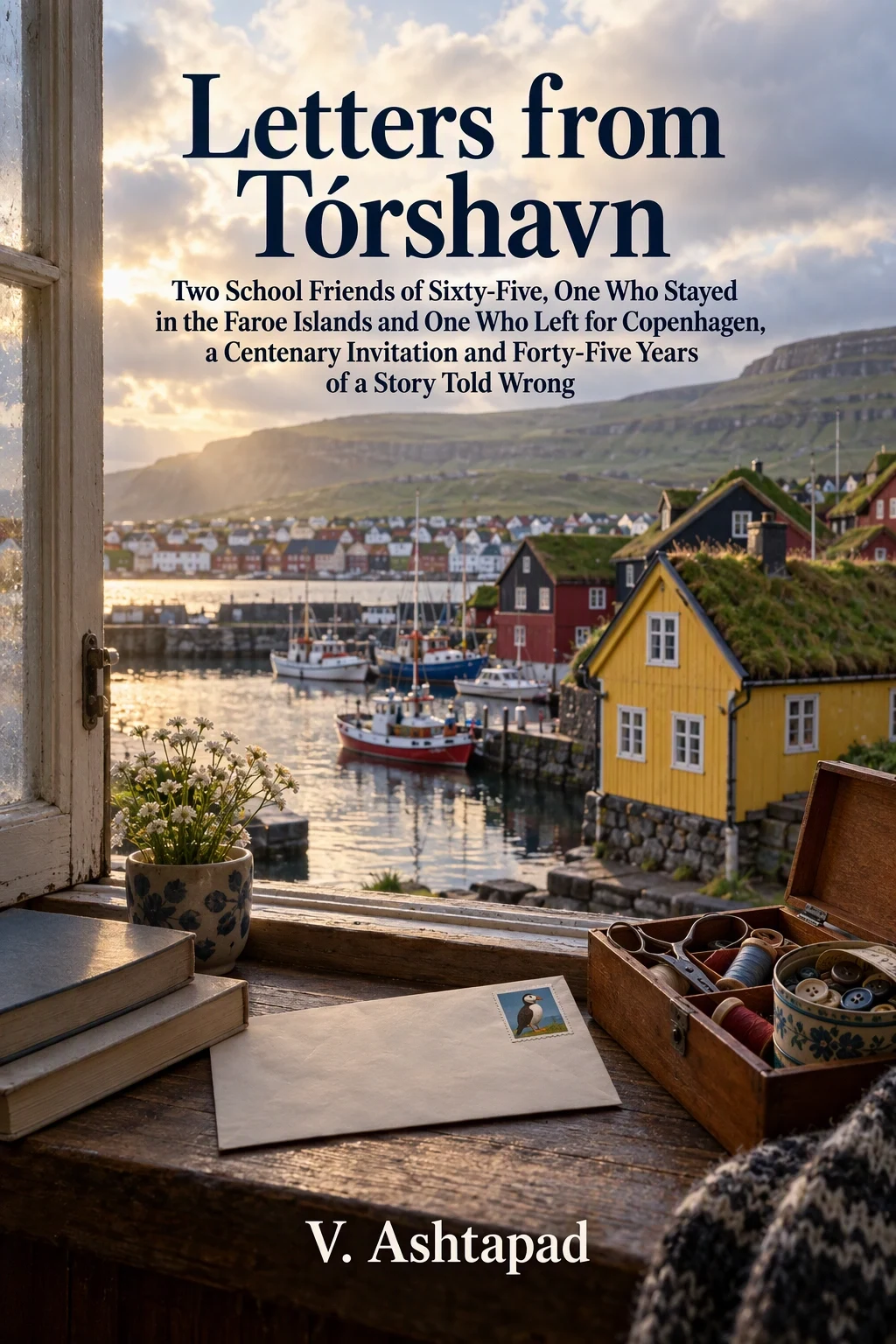
Letters from Tórshavn
Two School Friends of Sixty-Five, One Who Stayed in the Faroe Islands and One Who Left for Copenhagen, a Centenary Invitation and Forty-Five Years of a Story Told Wrong
by V. Ashtapad
Foreword
This is a work of fiction. Tórshavn and the Faroe Islands, the Faroese chain dance and its long ballads, Ólavsøka, skerpikjøt and the drying shed, the sea tunnels and the ferry from Hirtshals are real. The West School and its centenary, the Joensen and Poulsen families, the clock shop, the care home and every named person in the story are invented.
For every friend who put down her end of the sofa first.
The Invitation
*Tórshavn, January 9, 2026*
Dear Turið,
You will not know the handwriting. I am sorry to make you turn the envelope over and look for a name on the back before you open it, which is what I always do myself, so that I can decide whether to open it standing up or sitting down. Sit down. It is only Lína. Ólavina Joensen that was Ólavina Hansen, from the yellow house below the school, the one with the crooked gutter that my father swore every autumn he would fix and never fixed and which, you will be glad to hear, nobody has fixed since.
I am writing because the school is a hundred years old in June and they have put me on the committee, which is what happens when you are a widow of sixty-four with a car and no excuse. There is to be a whole week of it. The children will sing, the old teachers who are still breathing will make speeches, and on the Saturday evening there is to be a dance in the gymnasium, the old gymnasium with the ropes, where you broke your wrist in 1974 trying to climb to the ceiling to prove to Sámal Dalsgaard that girls could. They want every class back. Every single one, from the beginning, which means the beginning is mostly dead and we are what is left of the middle.
Our class was twenty-two. I have found nineteen. Four are in the churchyard, two are in Denmark, one is in Norway on an oil rig still at sixty-five, which I did not believe until his wife sent me a photograph of him in an orange suit, and one is in Canada, for reasons nobody has explained, raising goats. The rest of us are here, more or less, getting fat on cake. You are the twentieth. The two I can't find are Ásla Midjord, who I think married a man from Iceland, and Pól, who you know about, because I know you know, because everyone knows.
I got your address from your cousin Birita in Klaksvík. She did not want to give it to me. She said you might not want to hear from me. I said I knew that, and she gave it to me anyway, because Birita has never been able to keep anything to herself in her life, which you also know.
So there it is. The invitation is enclosed. It is printed on very good paper with a picture of the school on the front, done by a girl in the ninth grade who has talent, and a list of the events on the back. The committee wanted to send it out on the computer, with the photographs and the old class lists and everything, and they have, there is a whole private page for each class now where people can put up their pictures from the old days and their names under them so the younger ones know who is who. I have put up mine. You are in six of them. But I said some of us old ones would want it on paper, in an envelope, that we could hold and leave on the kitchen table and look at for a week before we decided anything. So they printed a hundred and forty copies. This is one.
I don't expect you to come. I want you to know you are asked. That's all. That is the whole of this letter.
The weather is what you would expect. It has rained for eleven days and the twelfth looks no better. The sheep are on the hill above the school as if they own it, which, considering how long they have been there and how long the school has, I suppose they do.
Lína
---
*Copenhagen, January 22, 2026*
Dear Lína,
I opened it standing up. I didn't recognize the handwriting and I didn't turn it over, because the stamp was Faroese, a puffin on a cliff, and I have not had a letter with a Faroese stamp on it in eleven years, since my mother died and my cousin stopped writing to me about the price of lamb. So I opened it in the hall of my building with my coat still on and my shopping at my feet and I read it standing there under the light that switches itself off after two minutes. It switched off twice. I had to wave my arm to bring it back. My neighbor across the hall, a young man who does something with sound for films, opened his door the second time to see who was flapping in the dark. I must have looked like a crow.
Then I sat down.
I don't know where to start, so I will start with the gutter. I remember the gutter. I remember your father on a ladder in October 1973 with a hammer in his fist and nails bristling from his lips, saying a word I was not allowed to say, and your mother standing at the bottom holding the ladder and laughing so hard she had to let go. He fell into the fuchsia. We all ran. He was fine. He said the fuchsia broke his fall and he would never trim it again, and he didn't, and by the time we left school it was taller than the house.
Is the fuchsia still there?
I have been in Copenhagen forty-five years. I came over in August 1981 to do my nursing training at a hospital that has since been knocked down and replaced by a bigger one, and I worked in the bigger one until I retired three years ago, mostly on a cardiac ward, mostly nights. I married a Dane in 1986, a quiet man called Mogens who repairs clocks, and I have a stepdaughter, Elsebeth, who is fifty and lives in Aarhus and calls me on Sundays out of what I think is a combination of love and duty, in proportions I have never tried to measure. I have no children of my own. I have an apartment on the fourth floor in Nørrebro with a balcony that overhangs a courtyard where a chestnut tree grows. I have a bicycle. I am sixty-five.
Mogens is not well. I will tell you about that another time, or I won't.
I have not been back since my mother's funeral. Before that, I came back perhaps five times in thirty years. Each time I stayed with my mother in Hoyvík and I did not go into town, because I did not want to meet anyone on the street. I'm sure you know this already. I'm sure Birita has told everyone everything, every time.
I will think about June. I am not saying yes. I am not saying no. I am saying I am sitting at my kitchen table with your letter in front of me and the invitation with the girl's drawing of the school on it, and I am looking at it, the way you said. I will look at it for a week.
I'm writing to you in Danish. I'm sorry. I started in Faroese and it looked so wrong on the paper, so full of mistakes, that I tore it up. I can still speak it. I can still dream in it. But I have not written it since 1990, and my hand has forgotten where all the letters go. If you write back, will you write in Faroese? I will read it slowly.
Turið
P.S. You did not say anything about yourself. Only the committee and the weather and the sheep. That is very like you. You did the same thing in school when the teacher asked us to write about our families. You wrote two pages about your father's boat.
© 2026 CRUNOD LLC. All rights reserved.
The Fuchsia
*Tórshavn, February 5, 2026*
Dear Turið,
The fuchsia is still there. It is a monster. It has eaten the side of the house up to the gutter, which is perhaps the gutter's revenge, and in August it is so full of red flowers that people stop on the road to photograph it. Tourists, mostly. We have a great many tourists now. They come off the cruise ships in their bright jackets and stand on the quay looking at the turf roofs on Tinganes as if they expect a troll to come out of one. I don't mind them. They buy sweaters. My daughter-in-law knits for a shop on Niels Finsens gøta and has never been so busy.
I am writing in Faroese, as you asked. I will write slowly so you can read slowly. If there is a word you don't know, circle it and send it back and I will tell you. Like school. You used to circle the words in my compositions that were spelled wrong and give them back to me. I hated you for it. Then I got a good mark in the exam and I didn't hate you anymore. Then I hated you again for other reasons. You know that too.
All right. Myself.
I married Jógvan in September 1981, three weeks after you left. You know that because you were supposed to be there. We were married thirty-nine years. He fished for twenty of them and then worked for the harbor authority, tying up the big ships, and then he retired and sat in the kitchen and drove me crazy for four years, and then he had a stroke on the stairs of the supermarket in 2020 and died in the ambulance on the way to the hospital. I was not with him. I was at the hairdresser. I have not been to the hairdresser since. I cut it myself now. It looks terrible and I don't care.
We had three children. Two boys and a girl. The boys are here, one in Tórshavn with the knitting wife and one in Runavík with a fish farm. The girl is in Oslo. She is a lawyer. She is very clever and she calls me on Sundays out of what I think is a combination of love and duty, in proportions I have also never tried to measure. You see, we are not so different.
I have five grandchildren. The oldest is Rói, who is sixteen and taller than his father and wants nothing in the world except to leave. He wants to go to Copenhagen, like you. Or Oslo, like his aunt. Or anywhere with more than one cinema. He says the islands are a cage made of fog. He says it to me at dinner every Sunday, and I say yes, a cage made of fog, very poetic, eat your potatoes. He is very angry with everything. He is a good boy.
I sing. I joined the dance club ten years ago, after Jógvan stopped being able to go out much, and I go every Thursday to the hall in the old town and we dance the chain dance and sing the ballads, the long ones, the ones with a hundred verses about Sigurd and the dragon and the Norwegian kings. I know eight of them by heart now. Not the whole hundred verses. Enough. There is a man in the club who knows twenty-two and lets everyone know it.
That is me. Sixty-four, widow, bad haircut, five grandchildren, eight ballads. A yellow house with a gutter that does not work.
Now you. Mogens. Tell me or don't. I won't ask again.
Lína
---
*Copenhagen, February 20, 2026*
Dear Lína,
I circled four words. They're on the back of this page. Two of them I knew once and forgot and when I saw your answer I said them out loud in my kitchen, and it was like finding a coin in the pocket of an old coat. The other two I think are new. I think the language has been busy while I was away.
Mogens has dementia.
There, I've written it. In Danish first, on a piece of scrap paper, and then in Faroese, and the Faroese word is worse, somehow, harder. He was diagnosed four years ago. It went slowly at first and then not slowly. Since October he has lived in a care home in Frederiksberg, twenty minutes on my bicycle, where they are kind to him and he does not know where he is. I go every day at two. I sit with him for two hours. Some days he knows me. Most days he thinks I am a nurse, which, in fairness, I was, for forty years, so perhaps he is not as confused as they think.
He repaired clocks his whole life. He had a little shop on a side street near the lakes, very narrow, very dark, full of ticking. When I first met him I went in to have my mother's watch fixed, the one she gave me when I left for nursing school, and I could not hear what he was saying over the sound of two hundred clocks all going at once. He said working there was like being inside a heart. I married him for that sentence. I have told no one that in forty years, not even Elsebeth.
Now he sits in a chair by the window in the care home and holds a small brass clock that I brought from the shop, an old carriage clock with its glass gone. He takes it apart. He puts it back together. He takes it apart. He doesn't know my name some days, but he knows where every screw goes in that clock.
So that is Mogens.
You said you won't ask again. Thank you.
Now a question of my own, and you don't have to answer either.
Why did you write to me? Really. I know about the committee. I know about the twenty-two and the nineteen. But Birita told you I might not want to hear from you, and she was right, I didn't, I have spent forty-five years arranging my life so I would not have to hear from you or anyone on that hill. And you wrote anyway. On paper. With a puffin.
I keep the letters on the kitchen table under the salt cellar. I read them at breakfast.
Turið
The circled words: (1) the word for the drying shed. I know it, I knew it, I couldn't find it. (2) the word you used for the kind of rain. (3) the new word for the tunnel under the sea. (4) the word for the wool shop. Is it a new word, or did I forget?
© 2026 CRUNOD LLC. All rights reserved.
The Drying Shed
*Tórshavn, March 6, 2026*
Dear Turið,
(1) It is hjallur. The drying shed. The one with the slatted walls where the wind goes through and the mutton hangs for the winter and the fish. My father's was behind the house, below the fuchsia. You used to hide in it during hide and seek because nobody else would go in, because of the smell, and you would come out smelling of skerpikjøt and your mother would scrub you with the hard soap. You knew this word when you were six. It has been waiting for you.
(2) The kind of rain is the kind that hangs in place like a curtain and lets you be the one who moves. We have five or six words for rain. That is the one for this week.
(3) The tunnel under the sea is new. There are three now. You can drive from Tórshavn to Eysturoy under the fjord in a tunnel with a roundabout in the middle of it, under the sea, lit blue and green with sculptures of people holding hands around the pillar. I am not making this up. Rói says it is the only interesting thing that has ever happened here. He goes round the roundabout three times with his friends when his father lends him the car, which his father does not know.
(4) The wool shop. That is new, a little. There is an old word for a place where wool is sold and a new word that the young people use, which is closer to the Danish. I used the new one. I should have used the old. I'll use the old from now on.
Now. Why I wrote.
I have been trying to answer this for two weeks. Four times now I've begun this letter. The first time I said it was the committee. That is a lie, though it is also true. The second time I said it was Jógvan, that since he died I have been going through all the drawers and finding things, and I found your bridesmaid's dress. Which is true. It was in a box in the attic with my wedding dress, the pale blue one my mother made for you on the sewing machine in the front room, with the buttons down the back that you made her move twice because you said they pinched. It is still in the tissue paper. You never wore it. Why I kept it, I can't say.
The third time I wrote about Pól, and I tore that one up.
This is the fourth time. So here is the truth, as near as I can get to it.
I am sixty-four. Jógvan is dead. My mother is dead. My father is dead. Most of the people I was angry with are dead, and the anger died with them, which surprised me. I thought anger was a thing you carried. It turns out it is a thing that is carried by both people, like a sofa, and when one person puts down their end, the sofa falls. There was nobody left holding the other end. Except you.
So I thought, either she has put her end down already, in Copenhagen, years ago, and I am the only fool still standing here holding a sofa in the rain. Or she hasn't. And either way I want to know.
That's why.
I'm sorry about Mogens. I am sorry about the care home and the clock with no glass. I would like to hear about the shop with two hundred clocks. Tell me more about it when you want.
The fuchsia sends its regards.
Lína
P.S. Rói found your name in one of the old photographs on the class page, and asked who you were, because you are the only one who wasn't tagged. I tagged you. He asked why you left. I said it was a long story. He said he has time. He does not have time. He has an exam in mathematics on Tuesday.
---
*Copenhagen, March 19, 2026*
Dear Lína,
I put my end down in 1994. I'll tell you how, in another letter. Not this one.
This one I want to write about the clocks.
The shop was on a side street off Nørre Farimagsgade, in the bottom of an old building, three steps down from the pavement. It was eleven meters long and two and a half meters wide. I measured it once, during a slow afternoon, because Mogens said it was three meters and I said it was not. It was two and a half. He never forgave me. The window had a display of watches on velvet that he changed every season, and a sign painted on the glass by his grandfather in gold letters that said the family name and a date, 1911.
Inside, it was clocks from floor to ceiling. Longcase clocks along the back wall like soldiers. Wall clocks in rows, regulators and cuckoo clocks and an enormous station clock from a railway in Jutland that had been closed since the 1960s. Mantel clocks on the shelves. Carriage clocks in a glass case. Alarm clocks in a box under the counter that people had brought in and never come back for, some of them since the 1950s, which Mogens kept and oiled every year in case the owners returned.
They were never all set to the same time. People think a clock shop would be all one time. It isn't. Each clock is waiting to be fixed or waiting to be collected, and each one is running at its own speed, a little fast, a little slow. So on the hour you would get not one chime but a long tumbling run of them over five minutes, bongs and cuckoos and little silver bells, like a choir that can't agree on when to start. Mogens said it was the sound of a hundred people all being right in their own way.
I used to go there after night shift. At seven in the morning, when he was opening up. I'd come off the cardiac ward where all night long the monitors had been beeping and the machines had been counting heartbeats, and the shop would be full of ticking, and I'd sit on the stool behind the counter and drink his terrible coffee and fall asleep with my head on the glass. He said I snored in time with the regulator.
He closed the shop in 2019 when his hands started to shake. The building sold it to a company that makes expensive coffee. They kept the sign painted on the glass, the gold letters and 1911. I walked past once and saw young people drinking coffee under the sign with our name on it and I sat on a bench across the street until my legs agreed to carry me.
When he went into the care home I brought one clock. The carriage clock without its glass. It was the first one he ever fixed, at fourteen, as an apprentice to his father. He holds it every day. He takes it apart and puts it back together. Some days that's the only thing that happens.
I have been recording him. The care home said I could, for the family. When he talks about the clocks he is clear, very clear, it's the only time. I ask him about a particular clock, a station clock, a cuckoo, and he tells me how it works, how you regulate it, what goes wrong. I put the recordings on a private page for Elsebeth so that she can hear her father being himself. She listens on the train to Aarhus. She says she cries every time and listens again anyway.
Yesterday he told me about the escapement in the carriage clock for twenty minutes. At the end he looked at me and said, "You're the one with the red hair. From the islands." I haven't had red hair since 2011. I said yes. He said, "Your accent goes when you're tired. Like now." And then he went back to the clock.
Why am I telling you all this? Because you asked.
Turið
P.S. Good luck to Rói with his mathematics. Tell him the one who wasn't tagged was very bad at mathematics too and became a nurse anyway. Tell him there are cinemas everywhere and none of them are worth leaving your grandmother for. Actually, don't tell him that. I left mine.
© 2026 CRUNOD LLC. All rights reserved.
Pól
*Tórshavn, April 2, 2026*
Dear Turið,
I have to write about Pól. I tore up the third letter and I have been carrying it around in my head ever since like grit under a heel, and Rói said to me on Sunday, Amma, you're limping, and I wasn't limping, it was the stone. So here it is.
You know he drowned. You know it was February 1983, on the trawler that went down off the east coast of Iceland in the storm, and that they found four of the eleven and he was not one of them. You know there was no coffin. You know there was a service at the hall with his photograph on a table and the whole hill came and stood in the wind outside because the hall wasn't big enough. My mother stood at the door and took every hand. Two hundred and forty hands. I counted afterward from the guest book.
You weren't there.
I looked for you. Every face that came through that door, I looked for you. I knew you weren't coming. Your mother had told my mother on the phone that you had written to say you couldn't, that you were working, that you had no money for the flight. I knew. I looked anyway.
I hated you for that a good while. Longer than anything else. Longer than the wedding. The wedding I could have forgiven by Christmas, I think, if you'd come home at Christmas. But you didn't come home at Christmas, and then Pól was gone, and then you didn't come home for that either, and I decided you were a person who had decided we were not worth coming home for. Any of us. Him, me, the hill. That you thought you were better than the islands.
Those were his words. Better than the islands. He said them in my kitchen the night after you told him no.
I never told you I knew he asked. He told me. He came into the kitchen on the last night of Ólavsøka in 1981, still in his dance clothes, the red waistcoat and the buckles, and folded himself onto the table with his head in his arms. I made him coffee. I was nineteen and getting married in seven weeks and I thought I knew everything about love, and I sat across from my little brother who was twenty and had asked the girl he'd loved since he was twelve to stay, and she'd said no, she was going to Copenhagen, she'd been accepted, she had to go. And he lifted his head and said, "She thinks she's better than the islands."
I agreed with him. I said, "She always did."
That's the stone. That's the part I've been carrying.
I don't know what you'll say to this. You may not write back. I'll understand. But it's written now, and I can't take it back, and I won't, because if I'm going to ask you to put down your end of the sofa I have to put down mine first, and this is what was in my end. A girl of nineteen, at her kitchen table, telling her brother something cruel because she was angry and because it was easier than saying the true thing, which was that I would miss you terribly.
Lína
---
*Copenhagen, April 14, 2026*
Dear Lína,
I have read your letter perhaps thirty times. I have kept it in my coat pocket and taken it out on the bicycle at red lights. Mogens's nurse asked me what I was reading and I said a letter from home, and she said, oh, you're from the islands, I thought so from your accent, and I didn't correct her about the word home.
You asked me to put down my end. I am going to try. But I'm going to do it the way I was trained, which is slowly, one thing at a time, and I am going to ask you to read it the way I read your letter, which is all the way to the end before you decide anything. Can you do that? You never could, in school. You always read the last page of a book first. I know you're doing it now. Stop. Go back to the top.
All right.
He asked me on the last night of Ólavsøka. That much you know. Not what I said. I didn't say no. Not at first. I said, come with me. I said, they need men in the hospitals too, porters, drivers, you can train for anything in Copenhagen, we can both go, there's a room in the nurses' housing for married couples. I'd found out. I'd written and asked. I had the letter in my bag that night, the one from the housing office, I'd been carrying it for a week waiting for the right moment.
He laughed. Not unkindly. He said he was a fisherman, like his father, like his grandfather, and he was not going to push trolleys around a hospital in a city where you couldn't see the sea. He said the islands were in him like the bones. He said, you stay. You can be a nurse here. There's a hospital here.
There was. I'd applied. They didn't take me. They took two girls that year, both daughters of doctors. I didn't tell anyone that. Not my mother, not you. I was too ashamed. Copenhagen took me and Tórshavn didn't and I couldn't say it out loud, so I said instead that I wanted to go. That I'd always wanted to go.
So we sat on the wall by the harbor at two in the morning with the boats and the dancing still going in the square behind us, and he said stay, and I said come, and neither of us would move. And at the end he said, "You think you're better than the islands," and I said, "Maybe I do," because I was twenty and he'd hurt me and it was easier than saying the true thing.
So. You see. He didn't say it first in your kitchen. He said it first to me, on the wall. And I agreed. And then he went to your kitchen and you agreed. And it took the three of us to make a sentence that none of us believed.
Now the funeral.
I wrote. I wrote to your mother. Two weeks after, when I heard. I couldn't afford the flight, that was true; I was on a student wage and I was sending money home because my father's back had gone. And my ward sister wouldn't let me off nights, that was also true. But that wasn't why I didn't come. I didn't come because I couldn't stand in that hall in front of his photograph with everyone on the hill knowing I had said no. I was a coward. So I wrote to your mother instead. Four pages. I said everything. About the wall and the letter from the housing office and the hospital in Tórshavn that didn't take me. I asked her to tell you. I said I couldn't write to you myself because I didn't know how.
She never answered.
I thought it was her answer. That she'd read it and decided I wasn't worth replying to. And then you didn't write either, and I thought, she's told Lína, and Lína agrees, and that's that.
I've kept a copy. I'll send it if you want.
Now you can read the last page.
Turið
© 2026 CRUNOD LLC. All rights reserved.
1994
*Tórshavn, April 27, 2026*
Dear Turið,
I read it to the end. I made myself. I didn't look at the last page first, although I wanted to so much that I put my hand over it.
My mother never told me.
I have spent a week going through her things. You'd think after twelve years there would be nothing left to go through, but my mother was a woman who kept everything in boxes inside boxes, and when she died we put all the boxes in the attic, in the same corner as the wedding dress and your bridesmaid's dress, and nobody has opened them since. I opened them. All of them. Rói helped me carry them down. He thought I'd gone mad. I let him think so.
It was in her sewing box. The old one, the wooden one with the drawers, that sat by her machine in the front room for fifty years. In the bottom drawer, under the paper patterns and a tin of buttons. Four pages, in your handwriting, folded twice, the envelope addressed to her with a Danish stamp.
She'd opened it. She'd read it. You could tell, because it had been folded and unfolded so often it had gone soft as cloth, and there were marks on it, little brown marks, like tea spilled, or like she'd read it with wet eyes. She kept it in her sewing box for forty-three years. She never gave it to me. She never told me it came.
I don't know why. I've been sitting with that for a week. I think she was protecting someone. I think she didn't know who. Maybe me, because I'd just married and was pregnant with my first and she thought it would upset me. Maybe Pól's memory, because the letter says he said a cruel thing and she couldn't bear for anyone to know he'd said it. Maybe you, because she thought if I knew you'd asked him to come, I would hate you less and then miss you more. Maybe she just couldn't decide, and every year she didn't decide, it got harder.
I've read it now. I sat on the attic stairs and read it, with Rói standing below me holding a box, and when I finished he said, Amma, are you all right, and I shook my head, and he put the box down and sat on the stairs beside me. Sixteen. Taller than his father. He didn't say anything. He just sat there. I thought, he will leave for Copenhagen and never come back, and I will be glad he went, and it will break my heart.
So now I know. We both said the cruel thing. He said it, and you said it, and I said it, and my mother kept the true thing in a drawer under a tin of buttons. Four people. One sentence.
You said you put your end down in 1994. Tell me how. Please.
Lína
---
*Copenhagen, May 6, 2026*
Dear Lína,
It was a Thursday in November 1994, on the cardiac ward, on nights.
They brought in a man from the islands. A fisherman from Suðuroy, seventy-one, a big man with hands like shovels, who had come over on the ferry to visit his daughter in Odense and collapsed on the station steps. His daughter had come with him in the ambulance. He was very bad. Everyone knew. The doctor told the daughter he would not see morning, and she went out to the corridor to telephone her brothers in Suðuroy, and she was out there a long time, crying into the pay phone, and I was alone with him.
He was awake. He couldn't speak much. He kept moving his lips and I bent down to listen and it was Faroese. Not words. A tune. Under his breath. And I knew it. It was the ballad about the Norwegian king and the giant's daughter, the one we used to dance to at Ólavsøka, the one Pól always started because he had the loudest voice.
So I sang it to him.
I hadn't sung in Faroese since 1981. I didn't think I remembered the words. I did. They came up out of me like water. I perched on his bed with the monitor beeping and the corridor lights buzzing and I sang the ballad to him in a whisper, all of it, every verse I knew, and when I ran out I started again from the beginning. He held my hand. His was huge and rough and very cold. Halfway through the second time he started to sing with me, very faintly, just the refrain, and then he stopped.
His daughter came back and found me sitting there holding his hand and singing to a dead man.
She didn't say anything. She took the chair across the bed and took his other hand. And then she sang too. And we finished it, the two of us, the whole ballad, in the dark, on the fourth floor of a Copenhagen hospital, with the night porter standing in the doorway with his trolley, not moving.
After that I went home and sat in my kitchen and cried for six hours. Mogens came home from the shop at noon and found me and didn't ask anything, he just made his terrible coffee and sat with me. And I thought: I have been angry for thirteen years at a hill. At a whole hill. At a hospital that didn't take me and a boy who wouldn't come and a mother who never wrote back and a friend who never wrote at all. And none of them are here. And I have been carrying all of it by myself in a city where nobody knows any of their names.
So I put it down. That day. I said to myself, out loud, in the kitchen, I'm putting it down. And I did. I thought you'd put yours down too, years before. I thought you'd forgotten.
I didn't come back because I didn't know if there was anyone there who wanted me to. That's all. Not anger. Not pride. Just not knowing, and not being brave enough to find out.
You found out for me. With a puffin.
Turið
P.S. Mogens had a bad week. He didn't know me at all on Tuesday or Wednesday. On Thursday he looked up from the clock and said, "You smell like the sea." I hadn't been anywhere near the sea. I'd been reading your letters on the bicycle.
© 2026 CRUNOD LLC. All rights reserved.
The Language
*Tórshavn, May 9, 2026*
Dear Turið,
No circles this time. I looked. I held your last letter up to the window and looked for the little rings around the words and there weren't any. You wrote two whole pages in Faroese and spelled everything right except one word, the word for ward, the hospital kind, which you spelled the Danish way with a Faroese ending, and which I've decided is a new word and you've invented it and it should go in the dictionary.
I've been thinking about the language since you asked me to write in it. I never thought about it before. It was just what came out of my mouth. You don't think about the air.
But when I was little my grandmother used to tell me that when she was a girl the schools taught in Danish. All of it. The arithmetic, the history, the songs. She said the teachers were Danes, mostly, or islanders who'd trained in Copenhagen and came back talking like the radio, and if you spoke Faroese in the classroom they'd rap your knuckles with a ruler. She spoke Faroese at home and in the field and on the boat with her father and in the chain dance on Saturday night, and Danish on the school bench from eight until two, and she said it was like living in a house with two kitchens and only being allowed to cook in the cold one.
She said the ballads kept it alive. Not the school. Not the newspaper, not the parliament. The ballads. Because you can't dance the chain dance in Danish. The verses don't fit. You need the old words for the rhythm and the old rhythm for the steps, and so on every Saturday night in every village hall the whole language got sung through, all the long words and the old words and the words nobody used anymore, a hundred verses at a time, by everyone at once, stamping.
I didn't believe her when I was nine. I thought she was being romantic. Old women are romantic about the strangest things. Now I'm an old woman and I think she was right.
I'm telling you this because of the way you said you tore up your first letter. Because it looked so wrong on the paper. I don't think it looked wrong. I think it looked like a cold kitchen that's been shut up a long time and needs a fire lit. That's all. You've lit it now. Look, two pages.
Rói says the young ones are writing it more than ever. On their phones, to each other, in a kind of Faroese with no accents and English in the middle. My daughter in Oslo is horrified. I'm not. My grandmother had Danish in the middle of hers. Every generation has something in the middle. As long as the middle doesn't eat the outside, it's fine.
Lína
---
*Copenhagen, May 16, 2026*
Dear Lína,
I'm keeping the word. Mogens's nurses use it now. I said it to one of them without thinking, the Faroese-Danish word for ward, and she laughed and said it sounded like a word from a children's book, and then the next day I heard her use it to another nurse. So it's in Frederiksberg now. A small Faroese word, loose in Denmark, getting around.
I want to tell you something I've never told anyone.
When I came to Copenhagen in 1981 I was the only islander in my class of forty. The others were from Jutland, Funen, Zealand, a girl from Bornholm. On the first day a teacher asked me to read a paragraph aloud from the textbook and I did, in my best Danish, and the class laughed. Not cruelly. They just laughed, the way you'd laugh at a parrot that could talk. The teacher said, "Well, we'll soon get that accent out of you," and smiled, as if she was promising me a present.
I spent two years getting it out. I practiced at night in my room in the nurses' housing with a cassette recorder, reading the newspaper aloud, playing it back, reading it again. I practiced vowels in the bath. By my third year nobody laughed. By my fifth year people asked where in Copenhagen I'd grown up. I was proud of that. I was so proud.
And somewhere in those years I stopped writing to my mother in Faroese. I wrote in Danish, because it was easier, because my hand was used to it, because the Faroese looked like a child's handwriting next to it. She wrote back in Faroese for twenty years. I wrote in Danish. Not once did she mention it.
After she died I found my letters in her dresser. Every one. Hundreds. Tied with string, by year. And on every single one, in the margins, in pencil, she'd written the Faroese words for my Danish ones. Every letter. Translated. For herself, I suppose. Or for me, in case I ever came looking.
I sat on her bed in Hoyvík with the letters on my knees and couldn't breathe.
So when you said circle the words and send them back, like school, I nearly didn't write at all. Because my mother had done it for twenty years without asking and I'd never once looked.
Mogens's accent never changed. He was from a village on Funen and spoke like a farmer his whole life, even in the shop, even to the rich customers from Østerbro with their grandfathers' gold watches. He said a clock doesn't care how you say the word for spring, it only cares if you wind it.
He hasn't spoken in Danish for two weeks. Only the names of clock parts. Escapement. Pallet. Balance. Those words are the last ones left. They're the ones he used every day. I think that's what language is. The words you use every day until they're the last ones.
I'm going to use Faroese every day now. At least in my head. At least to you.
Turið
© 2026 CRUNOD LLC. All rights reserved.
Rói Writes
*Tórshavn, May 12, 2026*
Dear Turið,
My name is Rói Joensen and I am the grandson of Ólavina Joensen, your friend. I hope it's okay that I'm writing. Amma doesn't know. I got your address from the envelope she keeps under the bowl on the kitchen windowsill, where she keeps your letters, which she thinks nobody knows about, but everybody knows about, because she reads them at breakfast and cries into her porridge and then says it's the steam.
I passed my math exam. Amma said you said you were bad at math too. I'm not bad at math. I'm just bored by it. There's a difference.
I'm writing because I want to ask you something and I can't ask anyone here, because everyone here will say the same thing, which is that I should stay, or they'll say I should go, but either way they'll say it like they've known the answer since before I was born. You're the only person I know who actually left. Who really left, not like my aunt in Oslo who comes home every Christmas and summer and posts pictures of the hills like she misses them. You left and didn't come back for forty-five years.
So my question is: was it worth it?
I want to be a sound engineer. For films. I record things. I have a recorder my uncle gave me and I go around recording things, the sea and the ferry horns and the sheep and the rain on the roof of my grandmother's drying shed. I record the dance club on Thursdays. I record my grandmother singing when she doesn't know I'm there. I put them on our family's private page, the sound files, and I put little descriptions under them so people know what they're hearing. Amma, ballad about the king's daughter, kitchen, 7:40 a.m., rain. Things like that. My aunt in Oslo listens to them. She says they're the only reason she can sleep.
There's a school in Copenhagen for film sound. I want to go there. It's very hard to get into. I'm going to apply next year.
Amma says the islands are in us like the bones. That's what her brother said. Pól. My great-uncle. She told me about him on the stairs. She told me what he said to you and what you said to him.
I don't want to be somebody who says the cruel thing because it's easier. But I also don't want to stay somewhere just because leaving would hurt somebody. Is that a cruel thing too?
Please don't tell Amma I wrote.
Rói
P.S. I recorded the fuchsia. You can't really record a plant. But I recorded the bees in it in August last year, and the gutter dripping, and you can hear my grandmother in the background telling my grandfather's photograph that the gutter is still broken. I'll send it if you like. A private page just for you. You don't need to do anything, just click it.
---
*Copenhagen, May 21, 2026*
Dear Rói,
I won't tell her. But you should. Not today. Soon.
Thank you for your letter. It's the best letter I've had in years, and I've had some very good ones lately.
I'm going to try to answer your question properly, because you asked it properly. The answer is yes. And no. And both of those are true, and you won't like that, because you're sixteen and I remember being sixteen and wanting someone to just tell me. So here is what I know, and the deciding is yours.
Yes, it was worth it. I trained in a city that wanted me when the city at home didn't. I worked forty years on a cardiac ward and I was good at it, very good, and I held the hands of a great many people at the worst moments of their lives and some of them lived because I was there. I married a man who made a shop that sounded like a heart. I rode a bicycle everywhere for forty-five years and I'm strong as a horse. I learned a whole other language well enough to argue in it, which is the only real test. I would not give any of that back.
No, it was not worth it, the way I did it. Because I didn't just leave. I left and then I hid. I made the leaving into a wall. I didn't come home when your great-uncle drowned, and I didn't come home when my father was ill, and when I did come home I stayed in my mother's house with the curtains closed and didn't go into town in case I met your grandmother on the street. That part wasn't worth it. That part cost me forty-five years of a friend.
So here's what I think. Go. Apply to the school. If they take you, go, and be very good, and record everything. But don't make it a wall. Come home at Christmas and in summer, like your aunt. Post the pictures of the hills and let people say you miss them. You will miss them. That's not weakness. That's the bones.
And when you leave, say the true thing, not the cruel thing. Say: I'm going because I have to, and I'll miss you terribly, and I'll come back. Even if you're not sure. Especially then.
Send me the fuchsia.
Turið
P.S. I'm told the school you want is very good. I know someone who did the sound for three films there. He lives across the hall from me. He once saw me flapping my arms in the dark reading your grandmother's first letter. I'll ask him what they look for.
© 2026 CRUNOD LLC. All rights reserved.
A Parcel
*Tórshavn, May 25, 2026*
Dear Turið,
You'll receive a parcel at the same time as this letter or a day after, depending on the post, which has opinions of its own. Don't open it in the hall. Take it upstairs. It smells.
Inside you'll find:
One leg of skerpikjøt from my son in Runavík, who keeps sheep on the hill above the fish farm and hangs them in his own drying shed. It has been hanging since October. It is exactly right. Slice it very thin with your sharpest knife and eat it on rye bread with butter, and if Mogens can have it, give him a little, a sliver, on his tongue. The nurse in me says it's too salty. The rest of me says some things are worth it.
One pair of socks I knitted. Gray, with the pattern from my mother's side. The pattern is called something I won't tell you, because I want you to circle it and send it back. They'll be too big. Wear them over your other socks.
One jar of rhubarb jam from my daughter-in-law, who heard about you and insisted.
One small packet of dried dulse that my granddaughter, who is eight, picked off the rocks at Kirkjubøur and dried on the radiator and wrapped in tissue for you. She asked who you were. I said a friend from school. She said, how old? I said sixty-five. She looked at me with great pity and said, Amma, you have very old friends.
And one envelope with a piece of paper with an address on it.
The address is a private page. Rói made it. He said you'd know what it was. He says he made it for you at your request, which surprised me, and when I asked him when you'd requested it he went red and left the room. So I'll leave it to you two. I haven't listened. He says it's the fuchsia and the dance club and other things and I'm not allowed until you've heard them first.
I want to tell you something about the dance.
You haven't danced the chain dance since 1981. I know because nobody saw you dance it after. Do you remember how it goes? I didn't, when I joined the club. I had to learn again. My feet remembered before my head did. Two steps left, one step right, around and around the hall, everybody's arms linked, everybody holding everybody, and the caller singing the verse and all of us coming in on the refrain, stamping. The circle goes round and round and gets slowly bigger as more people join, and nobody leads it, and nobody can stop it, it just goes, until the ballad's finished. Sometimes an hour. My first night back I thought I'd collapse. By the end I was flying.
There's something about it I never understood when we were young. When we were young we danced it to show off. To see who was in the circle beside whom. You and Pól always ended up beside each other, which everyone noticed, and I was beside Jógvan, which everyone noticed, and we thought the dance was about that.
It isn't about that. It's about the fact that you can't do it alone. There's no chain dance for one. It doesn't work with two. You need at least eight or ten, and the more you have the better it goes. You need the old ones who know the verses and the young ones who have the breath. You need the people you're angry with to be holding your arm on one side and someone you've never met holding it on the other. And you all have to go the same way at the same speed or it falls apart.
I think that's why we kept it, all those years when the Danes ran everything and the language was supposed to be dying. We kept it because it's something you can't do unless you're all together. A ballad with a hundred verses, sung by a whole room.
Come and dance it. In June. At the school. They're doing a chain dance in the gymnasium on the Saturday. The man who knows twenty-two ballads is going to call it. It will go on far too long. You'll hate it and love it.
Lína
---
*Copenhagen, June 1, 2026*
Dear Lína,
I opened it in the hall. Of course I did. The young man across the hall came out to see what the smell was. I gave him a slice. He said it was the most extraordinary thing he had ever tasted and asked if it was legal. I said it was legal in the islands. He went back inside looking thoughtful.
I took a sliver to Mogens. I put it on his tongue. He closed his eyes and held it there a while without chewing, and then he said, "Salt," and opened his eyes, and for about four minutes he knew exactly who I was. He asked about my mother. He asked if I'd had my watch fixed. He asked if the islands were still there. I said yes, all of them. He said good, he'd like to go back, the last time was so nice. We went once, in 1988, for a week, and it rained the whole time and he got food poisoning from a shrimp. He remembers it as the best holiday of his life.
Then he went back to the clock.
I'm wearing the socks now, over my other socks. They're perfect. The pattern I'll circle on the back.
I listened to the page. All of it. I sat on my balcony with the chestnut tree in the courtyard and headphones that the young man across the hall lent me and listened for two hours.
The fuchsia. The bees, a sound like a distant machine. The gutter. You, in the background, talking to Jógvan's photograph. "You said you'd fix it, you said every October, now look." Your voice exactly the same as at sixteen.
The dance club, Thursday night, the man with twenty-two ballads calling the verses and forty people stamping on a wooden floor and coming in on the refrain like a wave hitting a wall.
The sea at the harbor. The ferry horn. Rain on the slats of a drying shed.
And one I didn't expect. Your kitchen, early, the radio on low. You singing. Alone. The ballad about the Norwegian king and the giant's daughter. The one I sang in the hospital in 1994.
I had to take the headphones off.
Your grandson labeled it: Amma, kitchen, 7:40 a.m., rain.
I've booked the ferry.
Turið
P.S. The pattern. I didn't need to circle it. I remembered. It's the one my grandmother knitted too. It's called the sheep's track. My hand found it on the sock before my head did.
© 2026 CRUNOD LLC. All rights reserved.
The Hard Letter
*Tórshavn, June 4, 2026*
Dear Turið,
You've booked the ferry. Rói ran into the kitchen with his phone saying, Amma, she's coming, she wrote it on the page, and I was cutting potatoes and I cut my thumb. Not badly. There was a lot of blood. He thought I'd fainted. I sat down on the floor with a dish towel around my hand and laughed until my daughter-in-law came running from next door.
So. You're coming. On the ferry from Hirtshals, through the night, into the harbor on the Thursday morning. I'll be at the quay. I'll be the one with the bad haircut and the bandaged thumb.
Before you come I want to write the hard letter. I have been writing easy ones. About the fuchsia and the dance and the socks. They're true but they're easy. There's one more thing I owe you and I want to give it to you before you're standing in my kitchen, because I know myself, and if you're standing in my kitchen I'll make coffee and talk about the weather and never say it.
I didn't write to you. For forty-five years. Not once.
You've told me you thought I'd read your letter and agreed with my mother's silence. I hadn't. But that doesn't change the fact that I didn't write. Even before Pól. Even when you'd just left and I was angry about the wedding. I could have written. I could have said, how dare you, or I miss you, or the dress is beautiful and you should be in it. Any of those. Instead I decided that since you'd left, the next move was yours. I sat on this hill for forty-five years waiting for you to make the next move, as if friendship were a game of chess.
When you didn't come to the funeral, I told everyone it was because you thought you were better than us. I told Birita. I told the girls from our class. I told Jógvan. I told my children, when they were old enough to ask who the girl in the old photographs was. I made you into a story about a girl who left and didn't care. It was a good story. People liked it. It was easy to tell, and it was mine.
And all that time you were on a ward at night holding the hands of strangers and singing ballads to dying fishermen.
I don't know how to be sorry enough for that. I'm not going to try. I'm going to say I'm sorry once, here, clearly, and then I'm going to try to do the other thing instead, which is to listen. I've been very bad at it my whole life. Jógvan used to say I listened like a cat, only long enough to decide whether to pounce. But I've been listening to you for five months now, in these letters, and something has happened to me. I've started to hear things I didn't hear before. Rói, for instance. On the stairs, when he sat beside me and said nothing. I heard that. I'd never have heard it in January.
So. That's the hard letter. I'm sorry I made you into a story. I'm going to stop telling it.
Lína
---
*Copenhagen, June 9, 2026*
Dear Lína,
I'm not going to tell you it's all right. You'd know I was lying, and you'd be insulted, and you'd be right.
I'm going to tell you what I heard instead.
I heard a woman who is very brave. Braver than me. I put my end of the sofa down in a kitchen in Copenhagen where nobody on the hill could see it. You put yours down on paper and sent it across the sea to the person you'd dropped it on. There's a difference.
I heard a woman who has been carrying her mother's silence as well as her own. That's two ends of the sofa, and she's been carrying both. And now the third person's letter has turned up in a sewing box and she's carrying that too.
I heard a woman who is going to be at the quay at seven on a Thursday morning with a bandaged thumb, and who will make coffee and talk about the weather. That's fine. I'd like that. We have time for the hard things. We have the rest of our lives, which isn't as long as it used to be, but it's longer than a ferry crossing.
And I heard something you didn't say, which is that you've been lonely. Since Jógvan. Since before Jógvan, maybe. In a house full of grandchildren and a hill full of people who know your name. I know that kind. I have it in a city of a million people. You can be very lonely in a crowd that knows you, if it only knows the story you've told it.
You told them a story about me. I told myself a story about all of you. Let's both stop.
Here's my news, and then I'll stop writing and pack.
Mogens died on Saturday morning.
It was very quiet. I was there. They called me at five and I rode over in the gray light along the lakes with nobody on the paths but a man walking a dog. He was awake when I came in. He had the clock in his hands. He didn't know me, but he was calm, and he let me hold his other hand, and at about seven he said, very clearly, "It's running slow." I looked at the clock. It wasn't running at all, it hadn't run for years, there's no mainspring in it. I said, yes, I'll fix it. He said, "Good." And that was the last thing.
The funeral is Thursday. Elsebeth is coming from Aarhus. We'll scatter his ashes on the water at the lakes, near the shop, which is what he wanted.
I've moved the ferry by a week. I'll come for the second Thursday. I'll still be in time for the dance on Saturday.
Don't send flowers. Send me the recording of the dance club again. The one where everyone comes in on the refrain like a wave hitting a wall. I'd like to play it at the lakes after.
Turið
© 2026 CRUNOD LLC. All rights reserved.
The Lakes
*Tórshavn, June 12, 2026*
Dear Turið,
I'm not going to say anything about Mogens except that I'm sorry and that I wish I'd met him. I'd have liked a man who said a clock shop was like living inside a heart. Jógvan said our kitchen was like living inside an engine room. It was less romantic but also true.
Rói sent you the recording. He sent it the hour your letter came, and then he came into the kitchen and said, "Amma, I want to do something for her," and I said, what, and he said he'd think about it. He's been in the dance hall every evening since. I don't know what he's doing. The man with twenty-two ballads has been there too. They're plotting. I'm not allowed to ask.
I'm writing this on the bench outside the school.
It's half past nine in the evening and the sun is still well up in the west, the way it is in June, the light that never quite turns into night. The school is behind me with its new windows and its old roof and the banner they've hung over the door for the centenary, a hundred years in big red letters. Below me the whole town goes down to the harbor in roofs, turf ones and tin ones and the new apartment blocks by the quay with their glass balconies, and the harbor full of little boats, and the big blue ferry tied up at the far end, and across the water Nólsoy like a whale asleep. The sheep are on the hill above the school exactly where they were in 1974. A blackbird is singing in somebody's garden. Someone is mowing a lawn, at half past nine at night, because it's light and because we can.
I can see my yellow house from here. The fuchsia is starting. A few red flowers so far. By August it will eat the gutter whole.
I've been sitting here an hour. I came up after the committee meeting. We've finished everything. The programs are printed, the chairs are counted, the old teachers who are still breathing have written their speeches and promised to keep them under ten minutes, which they won't. The nineteen of our class who are coming have all confirmed. Twenty with you. Twenty-one, if you count Pól, which I'm going to, privately.
I found Ásla Midjord, by the way. She did marry a man from Iceland. She's a grandmother in Akureyri. She's coming too. She remembered you. She said, "Turið, the one who broke her wrist on the ropes." That's how you're remembered here, by the way. Not the girl who left. The girl who broke her wrist trying to prove a point to Sámal Dalsgaard. I think that's better.
Sámal is coming. He's bald now and has a pacemaker. I told him you're coming and he went pale. Then he laughed and said, "Tell her she still owes me a krone." I asked him what for. He said she bet him a krone she could reach the ceiling. She didn't reach the ceiling. She broke her wrist.
So you owe Sámal Dalsgaard a krone, with forty-nine years of interest.
Come on the second Thursday. I'll be at the quay at seven.
Lína
P.S. My mother's sewing box is on my kitchen table now. I've put your letter back in it, in the bottom drawer, under the paper patterns and the tin of buttons, where she kept it. Not to hide it. Because that's where it lives now. I thought you'd want to see it when you come. I thought we could open the drawer together.
---
*Aarhus, June 14, 2026*
Dear Mrs. Joensen,
You don't know me. My name is Elsebeth Lund. I'm Mogens's daughter, Turið's stepdaughter. She gave me your address after the funeral when I asked who had been sending her parcels that made her whole stairwell smell of the sea.
I'm writing because I don't know who else to tell this to, and because I think you might be the only person who would understand it.
My mother left when I was four. I don't remember her much. My father raised me alone in the flat above the clock shop until I was thirteen, when he married Turið. I hated her. I was thirteen; I'd have hated anyone. She was tall and quiet and had a strange accent that went stranger when she was tired, and she worked nights and slept in the day, so the flat had to be silent from eight until three, which for a thirteen-year-old is a kind of prison.
She never tried to be my mother. I've only understood that recently. She never once told me what to do or asked me to call her anything. She left a plate of food for me in the oven every night before her shift, with a note. Every night for five years. The notes were in Danish, very correct Danish, with little drawings in the corner. A puffin, sometimes. A sheep. A boat. I thought they were childish. I threw most of them away.
I kept a few. I found them last week in a box when I was sorting Dad's things. One of them, from 1990, I think, says: There's fish soup. Don't let it boil. Your father says the clock in the window is fast; if you see him, tell him I said it isn't, his watch is slow. And in the corner a drawing of a little yellow house with a crooked gutter and a bush beside it bigger than the house.
I never knew what that drawing was. I asked her at the funeral. She told me.
At the lakes, after we scattered his ashes, she took a little speaker out of her bag and played a recording of people singing in a language I didn't understand, forty people or more, stamping on a wooden floor. It lasted a good quarter of an hour. The ducks came over to see. A man jogging stopped and stood there with his hands on his knees. She stood on the path with the box empty in her hands and her eyes shut, and when it was over she said, "That's my home," and I realized I had never once in thirty-seven years asked her where home was.
I don't know if she'll come back to Copenhagen, after June. Part of me is afraid she won't. I'd understand. She has very little here now, without him. A flat and a bicycle and me, and I've never been much.
If she stays on the islands, will you write to me sometimes? To tell me how she is? She won't tell me herself. She doesn't like to be a bother. She thinks she's always been a bother. She's never been a bother. I want someone to tell her that.
Elsebeth Lund
---
*Tórshavn, June 16, 2026*
Dear Elsebeth,
I'll write. Of course I'll write. On paper, with puffins.
But I'll tell you now, so you can stop being afraid: she's coming back. I know because she's booked the ferry home as well as the ferry here, and because she asked me last week whether skerpikjøt keeps on the train to Aarhus. That's a woman who's planning to visit her stepdaughter.
I'll also tell you something else, and you can do with it what you like.
You've been much. You've been very much. In her letters to me she has written your name more times than any other except your father's. Elsebeth called. Elsebeth sent a photograph. Elsebeth listens to her father's recordings on the train and cries and listens again anyway. That's how she writes about you. As if it is the most natural thing in the world that you call every Sunday, and as if it is also a miracle.
She kept the notes too. Did you know? Copies. She used to write them twice, once for you and once for a notebook, because she said if she was going to talk to a girl who didn't want to be talked to, she wanted a record of what she'd said. She showed me the notebook in a letter, photographs of the pages. Five years of fish soup and puffins. On the last page, from the morning you left home at eighteen, she wrote: She'll be fine. She has his hands.
Come to the islands sometime. Come with her. There's a spare room in a yellow house. The gutter's broken. Nobody minds.
Ólavina Joensen
© 2026 CRUNOD LLC. All rights reserved.
Three Postcards from the Ferry
*On board, North Sea, June 17, 2026, 11 p.m.*
Lína,
A postcard, because I can't sleep and the shop on deck six sells postcards with puffins on them. Same puffin as your stamp. I think it's the only puffin in the islands. It must be very tired.
We left Hirtshals at four. The ferry is enormous. It has a cinema, which I'll tell Rói about, and a swimming pool that nobody is swimming in, and a restaurant with a buffet where a great many Danish families on holiday are eating as if they will never eat again. I had soup. I'm in a cabin with two bunks and a porthole. I'm sitting by the porthole. It's still light.
I've got Mogens's clock in my bag. I don't know why I brought it.
T.
---
*On board, June 18, 2026, 4 a.m.*
Lína,
I went up on deck at three. Nobody else there but a crewman smoking at the rail. The sea is gray and enormous and so is the sky and you can't tell where one stops. Everything is silver. The wind is cold. There are birds following the boat, fulmars, I think, the stiff-winged ones that glide on the air coming off the waves and never seem to flap at all. I watched them for an hour.
I'd forgotten the light. Forty-five years in Copenhagen, and Copenhagen has good light, soft, a painter's light, they say. This is not that. This is light that comes from everywhere at once and has no source. It makes everything look like it's about to happen.
I think I'm afraid.
T.
---
*On board, approaching Suðuroy, June 18, 2026, 7:30 p.m.*
Lína,
We've been passing islands for an hour. The southernmost first. Cliffs rising sheer from the water with the green on top like a cloth laid over a table, and the sheep on the green, and the waterfalls coming off the edge and blowing back up into the air in the wind before they reach the water. A village in a bay with a red-roofed school and a white church and a harbor wall. People on the deck are photographing everything. A Danish child said to his mother, "Is anybody allowed to live here?" She said yes, people live here. He said, "How do they get out?"
I've been standing at the rail crying for twenty minutes and nobody's noticed because it's raining. The curtain kind, that hangs and lets you be the one who moves.
We arrive in Tórshavn at eleven tonight. I've moved my guesthouse booking to a room on the hill. Your daughter-in-law found it for me. I won't see you until the morning. I wanted the first time to be in the morning.
Seven o'clock. The quay. I'll be the one with the clock.
T.
---
*Left at the guesthouse on the hill, June 18, 2026, 10 p.m.*
Turið,
The woman who runs this place is my daughter-in-law's aunt, so don't say anything in the hall you wouldn't want the whole hill to know by breakfast. I'm leaving this with her for you to find on your pillow. She's promised not to read it. She'll read it.
I've put a few things in the room. A thermos of tea, because the kettle in that room has been broken since 2019. Two slices of rhubarb cake. A hot water bottle, which you'll think is ridiculous in June until about two in the morning. And on the windowsill the photograph from the class page that Rói tagged you in, printed out and put in a frame, because I thought you should wake up to something you recognize.
It's the one from the spring of 1975. The whole class on the school steps, the boys in front squinting and the girls behind with our arms folded. You're third from the left at the back with your wrist in plaster. I'm beside you. If you look carefully you'll see I've got my hand on your shoulder, the one without the cast. I don't remember doing it. The photograph remembers.
I won't come up tonight. You said the morning. I'll wait for the morning.
But I wanted you to know, when you got off that boat and walked up the hill in the light that has no source, that someone was waiting at the top. That's all. Somebody always should be.
Seven o'clock. The quay. I'll be the one with the thumb.
Lína
P.S. If you can't sleep, open the window. You'll hear the harbor and the sheep and a man who walks his dog past the guesthouse at midnight singing. Nobody knows who he is. He's been doing it for years. It's very bad singing. You'll love it.
© 2026 CRUNOD LLC. All rights reserved.
To Elsebeth
*Tórshavn, June 19, 2026*
Dear Elsebeth,
I promised I'd write and I'm writing, by hand, which you'll complain about because my handwriting has always been impossible, but your father always said a letter written by hand is a clock you can wind and a message on a screen is a clock that runs on batteries. I never knew what he meant. I think I do now.
I arrived last night at eleven. It was light. You'll have seen the photographs; I asked the young man across the hall to show me how to put them on the private page your father's recordings are on, so you can find them in the same place. I hope that's all right. I thought he'd like that, his clocks and my islands on the same page.
This morning I went down to the quay at quarter to seven.
The town was still asleep. The harbor smelled of diesel and seaweed and fish and the bakery on the corner just opening, a smell of cardamom and burnt sugar. Gulls on every post. A man hosing down the deck of a fishing boat. The turf roofs on the old government buildings on the point, green, with daisies growing on them. And at the end of the quay by the bollards, a woman in a blue raincoat with her hair cut very badly, standing perfectly still with a bandage on her thumb.
I didn't know her. Elsebeth, I want to tell you that honestly. For a second, I didn't know her. She was sixty-four. In my head she was nineteen.
Then she turned around and saw me, and I knew her.
We didn't hug. We aren't huggers, either of us. We stood on the quay a meter apart and looked at each other and she said, "You've gotten old," and I said, "You cut your own hair," and she said, "It looks terrible," and I said, "Yes," and then we both laughed so hard that the man hosing the fishing boat turned his hose off to look.
She took me to her house. The yellow house. I wrote to you about it, the gutter and the fuchsia. Both still there. She made coffee in the kitchen I used to sit in when I was nine, and it's the same kitchen, Elsebeth, the very same, the same table, a new oilcloth but the same table, the same window over the sink looking down to the harbor, and on the windowsill under a bowl all my letters, every one, in a stack.
And on the table, her mother's sewing box.
She didn't say anything. She just put it in front of me and pulled out the bottom drawer and there under the paper patterns and the tin of buttons was my letter. Four pages. From 1983. Soft as cloth. I hadn't seen it in forty-three years. I knew every word.
We sat there with the drawer open and didn't touch it. Then she said, "Do you want to read it?" and I said no. And she said, "Neither do I." And she closed the drawer. And that was that. It's in the drawer. That's where it lives.
We talked about the weather for an hour after that. Your father would have loved it.
Tomorrow is the dance. Her grandson has been plotting something with a man who knows twenty-two ballads. I'm told I'm not allowed to ask.
I'm wearing the socks she knitted. Over my other socks.
I miss your father. I'm glad I came.
Turið
---
*Tórshavn, June 19, 2026*
Dear Ragna,
You'll ring on Sunday and I'll tell you all this then, but I'm writing anyway because you're a lawyer and you like things in writing.
She came. She's here. She's sleeping at the guesthouse on the hill and she's coming back for supper at six and your brother is bringing the fish and I have no idea what we will talk about.
When she walked onto the quay this morning I didn't know her. Ragna, I want to tell you that honestly. For a second I thought she was a tourist. A tall woman with short white hair and a good coat and a bag over her shoulder, walking very straight the way nurses walk. In my head she was twenty and had red hair to her waist.
Then she saw me and she stopped walking, and her face did a thing I remembered. A sort of folding. Like a paper boat. She used to do it in school when she was trying not to cry in front of the teacher. And I knew her.
I showed her the sewing box. I opened the drawer. Neither of us wanted to read the letter. I closed it again. That was the right thing. I don't know how I know but I know.
Rói met her at noon. He came in from school and stood in the kitchen doorway looking at her like she was a famous person and then he said, very formally, "Thank you for writing back to me," and she said, "Thank you for writing first," and I said, "What?" and they both looked at me as if I'd walked in on something. Which I had. He'd written to her. In May. Without telling me. He's been writing to her all along.
I'm not cross. I wanted to be cross and I couldn't find it anywhere.
Your father would have liked her. He thought she was a snob in 1981. He'd have changed his mind. He changed his mind about everything eventually, it just took him thirty years.
Ring on Sunday. I'll tell you about the dance.
Mamma
© 2026 CRUNOD LLC. All rights reserved.
Rói's Report
*Tórshavn, June 21, 2026*
Dear Aunt Ragna,
Amma says you want a full report and that she's too tired to write it and that I'm the one who did it anyway so I should explain. So here's the report.
The centenary dance was in the old gymnasium last night. The one with the ropes. They took most of the ropes down years ago but there's still one, near the back wall, hanging from the ceiling with a knot at the bottom, and somebody had put a sign on it saying PLEASE DO NOT CLIMB, which made a bald man with a pacemaker laugh so hard he had to sit down.
There were about two hundred people. All the classes. The oldest person there was ninety-six and had been in the fourth class ever, in 1930. The youngest was a baby in a sling. There was cake on a long table, and coffee, and somebody's grandfather brought a crate of beer that the committee pretended not to see.
The speeches went on too long. Everybody knew they would.
Then the chain dance.
Here's what I did, and Gunnar did it with me (that's the man with twenty-two ballads; he says to say it's twenty-three now). We did it with the ballad of the Norwegian king and the giant's daughter, the one Amma sings in the kitchen, the one Turið sang in the hospital. But we added verses. Real ones, in the old meter, the way the ballads were always made, people adding verses for things that happened. Gunnar wrote most of them because he knows how. I gave him the stories. They were about our class. Amma's class. The nineteen and the twenty and the twenty-one. About a girl who broke her wrist on the ropes. About a fisherman who went down off Iceland and was never found and danced at the front of every circle at Ólavsøka. About a man in Copenhagen who fixed clocks and said his shop was like living inside a heart. About a girl who knitted socks with the sheep's track on them for someone she hadn't spoken to in forty-five years.
Gunnar didn't name anybody. You don't, in the ballads. You just say "a girl from the yellow house" or "a man from the clockmaker's." Everybody knew anyway.
I recorded it. I've put it on the family page. Amma, ballad, gymnasium, 9:15 p.m., everyone.
Here's what happened. Gunnar started calling. People linked arms. The circle started, two steps left one step right, and it was all the old people at first, the committee and the teachers and a few of the class, and then it got bigger. I was in it. Amma was in it. Turið was standing at the edge by the cake table and wouldn't come.
Then Gunnar got to the verse about the girl who broke her wrist on the ropes. And everyone in the circle laughed and looked at her. And the bald man with the pacemaker, Sámal, came out of the circle and walked across the floor to her and held out his hand, and in his hand there was a coin. A krone. And he said, "You can pay me back by dancing."
And she took the coin and put it in her pocket and took his arm.
So then they were both in. And the circle went round and it got bigger and bigger until it was the whole gymnasium, two hundred people, the ninety-six-year-old in a chair at the side stamping his stick on the floor, the baby in the sling being bounced, everybody singing the refrain. When Gunnar got to the verse about the fisherman who went down off Iceland, it got quiet, just stamping, and Amma and Turið were next to each other in the circle, arms linked, and they both had their eyes shut. And then Gunnar did the verse about the clockmaker, and Turið's face did the thing Amma says it does, the paper boat thing, and Amma held on to her arm very tight, and they kept dancing.
It went on for an hour and twenty minutes. I've never been so tired in my life.
At the end Turið came up to me and said, "Rói, that was a very cruel thing to do to an old woman," and then she hugged me. Amma says she isn't a hugger. She is now.
I've decided to apply to the school in Copenhagen. I told Amma this morning at breakfast. I said the true thing, not the cruel thing. I said I'm going because I have to and I'll miss her terribly and I'll come back. She cried into her porridge and said it was the steam.
Turið says she'll introduce me to the man across the hall. She says I can stay with her while I visit the school. She says her apartment is too quiet now and could use a sound engineer.
That's the report.
Rói
P.S. Amma says I have to add that Turið wore the dress. The pale blue one with the buttons down the back. Amma's daughter-in-law let it out at the seams. It still pinched. She wore it anyway.
© 2026 CRUNOD LLC. All rights reserved.
The Sewing Box
*On board, North Sea, June 26, 2026*
Dear Lína,
I'm on the ferry going the other way. I'm in the same cabin, I think, or one exactly like it. Same porthole. I'm writing on the little table that folds down from the wall, with my coffee sliding back and forth on it as the boat rolls, and Mogens's clock on the bunk beside me, and the puffin postcards in my bag, because I bought twelve more.
I'm not going to write about the dance. Rói wrote the report. He's better at it. I'm going to write about the last morning, because you won't remember it the way I do and I want it written down somewhere outside my head.
You made coffee. We sat at the table. The sewing box was there. You said, "Before you go," and I thought you were going to open the drawer again, and I didn't want you to. But you didn't open the drawer. You opened the top. The lid. The part with the needles and the thread, which I'd never seen inside, because your mother never let anyone touch it.
There was a spool in the corner, a little wooden spool wound with red thread. Very old. Faded almost to pink. And you said, "This is from the waistcoat." Pól's red waistcoat. The one he danced in. Your mother had sewn it for him when he was sixteen, and when he outgrew it she let it out, and when he was gone she kept the thread.
And you took the spool out and put it in my hand.
I didn't say anything because I couldn't, and you didn't say anything because you're you. You just closed my fingers around it with your bad-haircut, bandaged-thumb hand and went to the sink and started washing cups that were already clean.
I have it in my coat pocket. I've had my hand on it for the whole crossing.
Here is my plan for it, and you're going to think it's sentimental, and you're right.
When I get home I'm going to take Mogens's clock to a man I know in Vesterbro who used to work with Mogens and who still repairs clocks in a room at the back of his apartment. I'm going to ask him to put a mainspring in it. And new glass. I'm going to ask him to make it run. Mogens said it was running slow. I said I'd fix it. I'm going to keep that promise.
And then I'm going to wind Pól's red thread around the key.
It's a small clock. It'll sit on the kitchen table, under the salt cellar, where your letters were. It'll run a little fast or a little slow, the way all clocks do. And I'll wind it every Sunday with the red key. And it'll be the sound of two people being right in their own way.
There. You can roll your eyes.
I'll be back for Ólavsøka. I've booked it already. Your daughter-in-law says the spare room in the yellow house has a bed in it that nobody's slept in since your mother died and that it would be good for it.
Turið
---
*Copenhagen, June 28, 2026*
Lína,
A second letter, two days after the first, because I'm home now and there's something I need to tell you that I couldn't write on the ferry.
The flat was very quiet when I came in. I'd been gone eleven days. The plants were dead, all but one. There was a pile of post on the mat with three bills and a card from the care home staff and, at the bottom, a postcard with a puffin on it. From you. Sent the morning I left. You must have posted it on your way back from the quay.
It said: You forgot the hot water bottle. I'm keeping it. Come back for it.
I stood in my hall with my coat on and my bag at my feet and the light that switches itself off after two minutes, and I read it, and the light went off, and I didn't wave my arm. I stood in the dark for a while.
Then I opened my door and went across the hall and knocked on the young man's door, the one who does sound for films. It was ten at night. He opened it in his socks with a bowl of noodles in his hand.
I said, "There's a boy in the islands who wants to come to your school. He records sheep and rain and his grandmother singing. He's very good. I need you to help him."
He considered me, noodles steaming. Then he said, "Do you want to come in? I've got more noodles."
So I went in. And I played him Rói's recording of the dance in the gymnasium, the whole hour and twenty minutes, on his good speakers, with his noodles going cold. And at the end he sat back and said, "Who mixed this?"
I said, "A sixteen-year-old with a recorder his uncle gave him."
He said, "Tell him to apply. Tell him I'll write the letter."
So tell him. Tell him the true thing.
T.
© 2026 CRUNOD LLC. All rights reserved.
Ólavsøka
*Tórshavn, July 31, 2026*
Dear Turið,
You left this morning on the early ferry and I'm writing to you before you've even reached Suðuroy, which is ridiculous, because you'll be home before this letter is. That doesn't matter. I like that it'll be waiting for you. On your mat in Nørrebro, with a puffin on it, among the bills.
I want to write down Ólavsøka the way you wrote down the last morning in June. So it's somewhere outside my head.
The rowing races in the harbor on the first day, the long boats with their crews heaving, the crowd on the quay shouting for the villages. Rói rowing for Tórshavn in the youth race and losing by a boat's length and coming out of the water red as a lobster and furious. Your face when you saw him lose. Like a grandmother's.
The parade on the twenty-ninth. Everybody in national dress, the women in their embroidered shawls and silver buckles and the men in their knee breeches and the red and blue waistcoats. You'd borrowed a shawl from my daughter-in-law and you kept tugging at it and saying you looked like a tourist in a costume and I kept telling you you looked like a Faroese woman of sixty-five who had been away a long time and come back, which is a different thing.
The square in front of the parliament at midnight. The crowd. The singing. Every year at midnight on the last night the whole town gathers to sing and then the dancing begins and goes until the sky starts to lighten, which in July is about three hours later. I've been every year of my life except the year Jógvan died. I've never been with you. Not since 1981. Not since the wall by the harbor where Pól asked and you said come and he said stay.
We walked past the wall at one in the morning. You stopped. I stopped. Neither of us said anything. There were teenagers sitting on it, the way you two sat, a girl and a boy, his arm around her, both of them in their dance clothes, eating hot dogs and laughing about something on her phone. You watched them a while. Then you said, "Good," and walked on. I didn't ask what was good. I've been learning not to ask.
Then the dance. The square. A thousand people, more. Gunnar calling, with a microphone this year because the committee decided he'd earned it. The ballad of the king and the giant's daughter, with the new verses, because word got around from the centenary and now everyone wants them. The girl who broke her wrist on the ropes. The fisherman off Iceland. The clockmaker. The knitter.
And a new verse, one I didn't know about, that Rói and Gunnar wrote without telling either of us. About two women from the hill who didn't speak for forty-five years and then wrote each other letters with puffins on them, and sat at a kitchen table with a sewing box between them, and closed the drawer together.
You squeezed my arm so hard I have a bruise. I'm looking at it now. It's the shape of four fingers.
So here's my news. I'm going to Copenhagen in October. With Rói, when he goes for his interview at the school. He's asked me to come. He says it's because he needs someone to carry the skerpikjøt. I think it's because he's frightened. I'll stay with you. I'll sleep in the room your stepdaughter sleeps in when she visits, if that's all right with her. I'll sit on your balcony and look at the chestnut tree in the courtyard. I'll meet the man across the hall who does sound for films and who stood in the dark watching you flap your arms like a crow.
And I'll hear the clock.
I want to hear it. I want to sit at your kitchen table with the red thread on the key and hear it running a little fast or a little slow, being right in its own way.
The fuchsia is enormous. It's eaten the gutter. The gutter has stopped dripping because there's nowhere left for the water to go but through the leaves. Jógvan would be furious. I've told his photograph. He just keeps squinting.
Write soon. On paper.
Lína
P.S. You left the coin on the windowsill. Sámal's krone. Under the bowl, on top of your letters. I'm not sending it back. You can pay me back by dancing.
P.P.S. Rói says to tell you the man across your hall wrote the letter. It came this morning, on paper, with a Danish stamp. Rói read it standing up in the kitchen with his boots still on and then sat down on the floor. For a minute he said nothing at all. Then he said, "Amma, I think I'm going." And I said, "I know." And he said, "I'll come back." And I said, "I know that too." And then I made him eat his potatoes.
I've been thinking about what you said in your first letter, the one you opened standing up in the hall. That you'd spent forty-five years arranging your life so you wouldn't have to hear from anyone on this hill. I've been thinking that I spent forty-five years arranging mine so that I wouldn't have to say anything to anyone who'd left it. We were both very good at arranging. Neither of us arranged for a sixteen-year-old with a recorder.
The dance club is learning the new verses. Gunnar is unbearable about it. On Thursday a girl of fourteen asked him who the two women from the hill were, and he said, "Nobody. Everybody. That's how ballads work." She didn't believe him. She looked straight at me across the circle. I looked at the ceiling.
Come in October. Bring the clock. I want to hear it run.
© 2026 CRUNOD LLC. All rights reserved.
If this book stayed with you
The Courier's Weather
A Vellum Leaf in the Westfjords, a Carrier's Notebook in the Valleys of Andorra and a Pilot Who Reads the Sky
Another book that sails north through the Faroes, by air this time, in very bad weather.
About this book
In January a letter with a puffin stamp lands in a Copenhagen hallway. It is from Lína, the girl from the yellow house with the broken gutter, inviting Turið to their school's hundredth birthday.
Turið has not been home in eleven years. She has not spoken to Lína in forty-five.
A bridesmaid's dress never worn. A brother who drowned off Iceland. A clockmaker who says his shop is like living inside a heart. A sixteen-year-old with a recorder who wants to leave the islands. And a letter from 1983 folded in the bottom of a sewing box, under a tin of buttons.
Can two women who each told a story about the other finally hear what really happened?
Members can react to this book and talk about it in the members' Library.
Ownership
© 2026 CRUNOD LLC. All rights reserved.
This book is owned by CRUNOD LLC. It is free to read on EternalCurrent.Online. No part of it may be copied, reprinted, sold, recorded or adapted, including as audio, film or translation, without written permission from CRUNOD LLC.
© 2026 CRUNOD LLC. All rights reserved.