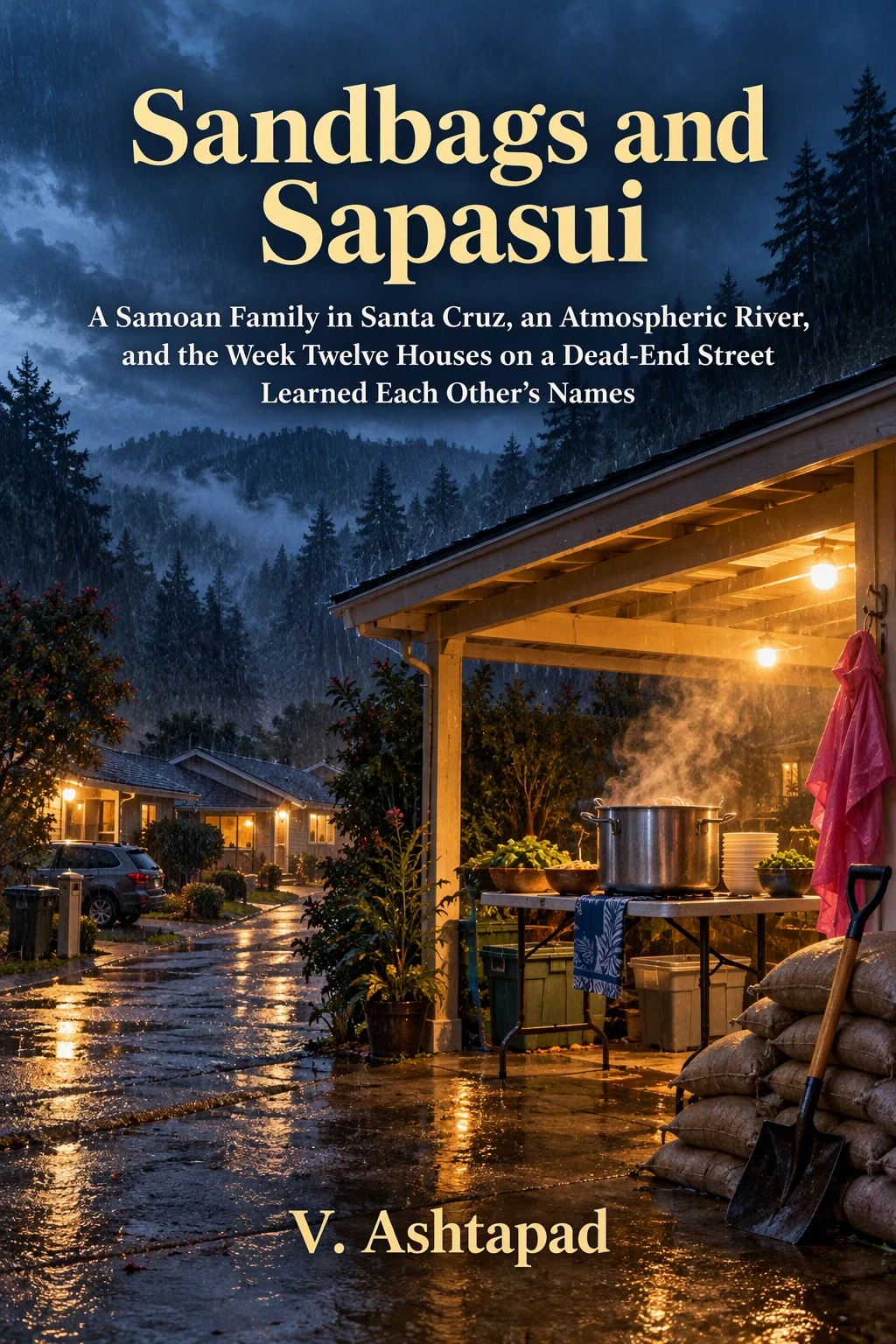
Sandbags and Sapasui
A Samoan Family in Santa Cruz, an Atmospheric River, and the Week Twelve Houses on a Dead-End Street Learned Each Other's Names
by V. Ashtapad
Foreword
This is a work of fiction. Santa Cruz, the San Lorenzo River and its levee, the Lower Ocean neighborhood, the city's sandbag stations and the winter atmospheric-river storms of the Central Coast are real. Kinsey Court, its twelve households, the storm in this story and every named person in it are invented.
For the neighbor you have waved at for years and never met. Knock.
8 Kinsey Court: Toaga, Tuesday, River at Six Feet
I have lived on Kinsey Court for eleven years and until last Tuesday I knew the names of exactly two of my neighbors, and one of those was a dog.
That is not something a Samoan woman says out loud. My mother would come up out of the ground in Carson and slap the back of my head for it. In Apia, in the village my father came from, you know every family on the road by the second day, and by the third day you know which aunty is not speaking to which aunty and why. Here, I knew the dog. His name is Chulo. He belongs to the old Mexican lady at number 2, and he barks at the garbage truck like it owes him money.
The other name I knew was Gus, because his name is painted on the side of his truck. GUS LY, PUMPS AND SMALL ENGINES, and a phone number. He lives at number 11, at the dead end where the court bumps up against the levee and the bike path. He is the only one of us who can see the river from his kitchen.
Kinsey Court is twelve houses off Lower Ocean, a short street that runs toward the San Lorenzo and stops. Six on one side, six on the other, little stucco boxes from the fifties painted the colors people paint things when they have given up arguing with the landlord: beige, other beige, a green that used to be mint. Ours is number 8, the one with the blue tarp over the carport and the breadfruit tree that will not give fruit no matter how much my husband talks to it. It is not a breadfruit tree. It is a fig. Sefa knows. He talks to it anyway.
I work nights at a care home in Capitola. I am a certified nursing assistant, which means I lift people, turn people, wash people, and sing to the ones who cannot sleep. Seven at night to seven in the morning, four nights a week. When I come home the street is empty because everybody else has gone to work, and when I wake up at two in the afternoon it is empty because everybody else is still at work. For eleven years I have lived on Kinsey Court the way you live in a hotel. Wave at the cars. Take in the packages that get left on the wrong step. That is it.
So. Tuesday.
The rain had been coming since Saturday, the kind they now call an atmospheric river on the television, as if giving it a long name makes it more polite. My son Pita, who is fourteen and knows everything, said it is a river in the sky, Mom, it comes straight from near Hawai'i, it is literally carrying the ocean over here. I said, then it can carry it back. He said it doesn't work like that. I said a lot of things don't work like that and I still say them.
Sefa works for the county, on the road crew. When it rains like this he does not come home. He sleeps in the truck or in the yard office up in Scotts Valley and they send him wherever a tree has come down or a hillside has decided to sit in the road. Saturday night he left with his big orange jacket and two cans of pisupo and a bag of my mother's recipe panipopo, and he kissed me on the forehead and said, "Watch the river." That is a thing a man says when he cannot watch it himself.
Tuesday afternoon I woke up at two to a sound I did not know. A hum, and under it a slapping. I went to the window and it was Gus, at number 11, in a yellow raincoat with the hood off, dragging a hose the size of my leg from his truck down the side of his house. The slapping was the rain on his truck bed. The hum was a pump.
My daughter Mele was home. She is nineteen, at the community college up in Aptos, studying to be a dental hygienist, and her classes had been canceled because the road over the hill was closed. She was at the kitchen table eating cereal out of the box with her phone propped against the milk.
"The river's at six feet," she said, not looking up. "They're saying it could go to twelve by Thursday night. They're saying people near the levee should get ready."
"Get ready how?"
She looked at me then, over the box. "Mom. We're near the levee."
I knew that. I knew it the way you know the ocean is salty. It is not something you think about.
"There's sandbags," she said. "The city has sandbag places. You have to fill them yourself. There's one at the beach, at the lot by the boardwalk, and one over by the fire station." She scrolled. "You bring your own shovel."
We have one shovel. It belongs to the fig tree.
---
This is the part where my mother would say: and what did you do, Toaga? Did you go and knock on doors like a person raised properly, or did you sit in your house like a palagi?
I sat in my house like a palagi for one more hour. I made Pita do his homework. I made a pot of rice because when I am nervous I make rice. I watched Gus out the window. He was walking back and forth from his truck to the levee path, and once he stopped and stood very still, looking over the top of the bank at the water, with his hands in his raincoat pockets, and then he came back and moved the pump hose two feet to the left.
At four o'clock a woman I had never spoken to came up our walk in a bright pink rain poncho and knocked. She was maybe thirty, with wet blond hair stuck to her forehead and glasses that had fogged completely white, so she looked like a cartoon of a person who has seen a ghost.
"Hi," she said. "Sorry. I'm Wren. Number 5. Across from you? We're, um. There's three of us in that house. We're grad students. At the university." She pulled off her glasses and rubbed them on the poncho, which only made them worse. "Do you have a truck? Gus says the sandbag lot at the beach still has sand but they're running out of bags and someone needs to go get them before they're gone, and he can't leave his pump, and our car is a hatchback and it's, it's very small, it's like a shoe."
"We have a truck," I said. "My husband has the truck."
"Oh," she said.
"We have a van," said Pita, behind me. He had come to the door in his socks. "We have the big van, Mom. Uncle's van."
He was right. My husband's cousin Fa'alogo was staying with us. He had come up from Carson in November to look for work and had not found any yet, and his van was parked in front of our house with a cracked windshield and a sticker on the back that said MY OTHER CAR IS A CANOE. Fa'alogo was asleep on our couch, because Fa'alogo is always asleep on our couch between eleven and five, for reasons he says are medical.
I looked at Wren in her pink poncho with her white glasses. I looked at Pita in his socks.
"Go wake your uncle," I said.
---
I want to tell you about Uncle Fa'alogo so you understand what kind of help came out of our house first.
He is fifty-eight. He is very big, in the way that some of our men are big, which is not fat exactly but wide, like a door that has been made for a church hall. He was a rugby player in his youth in Western Samoa, as it was called then, and later a security guard in Los Angeles for twenty-six years, at a parking structure. He says that he has seen everything a man can see in a parking structure, and that most of it you do not want to see. He laughs at his own jokes before he reaches the end, so you never actually hear the end. He is generous. He is lazy. He can lift a refrigerator by himself and has done so, at our house, to look for a coin.
When Pita woke him and told him the river was coming and a palagi girl needed a van to go get sandbags, he sat up on the couch with his hair flat on one side and said, "Sandbags?" Like he had been waiting all his life for someone to say that word.
"Bags," said Wren from the doorway. "Just the bags. Gus says there's sand here. Or there will be. There's a city truck coming? Maybe? To the corner?"
Fa'alogo stood up. He was wearing a lavalava and a T-shirt from a car wash in Gardena. He looked at Wren, at her shoe-sized car parked across the street, at the rain.
"How many?" he said.
"Bags?"
"Bags. How many."
Wren looked at her phone. "Gus says a hundred and fifty. For the end of the court. At least."
Fa'alogo nodded slowly, as if a hundred and fifty was a respectable number, a number a man could work with. Then he went to the bedroom and put on trousers, and came back out with his car keys and my mother's old umbrella, the one with the broken spoke, and he said to me in Samoan, "Make soup."
"What soup?"
"Any soup. The kind for working." And then in English, to Wren, very formal, the way he used to talk to people whose cars he could not find: "Miss. You will ride in front."
---
That was how it began. Not with me knocking on doors like a woman raised properly. With my husband's lazy cousin and a girl in a pink poncho, driving to the beach in a van with a canoe sticker, and me in my kitchen at four-thirty in the afternoon with no idea what soup is for working.
I made sapasui. It is not soup. It is the glass noodles with the beef and the soy sauce and the ginger, the chop suey our grandmothers learned from the Chinese families in Apia and made into ours. It was what I had. I had four packets of the noodles in the cupboard and three pounds of chuck in the freezer that I had been saving for Sunday, and I had the rice already cooked. I put the biggest pot we own on the stove, the one we bring to funerals.
Out the window Gus had stopped moving the hose. He was standing on the levee path with his hood up now, looking down the court at our van pulling away, and I saw him lift one hand. Not a wave, exactly. More like a man counting.
© 2026 CRUNOD LLC. All rights reserved.
2 Kinsey Court: Dolores, Tuesday Night, River at Seven and a Half
My mother used to say the San Lorenzo was a dog that slept on the porch for years at a time, and then one night it would remember it was a wolf.
I am eighty-one years old. I was born in a house on Riverside Avenue that is no longer there, and I have lived at number 2 Kinsey Court since 1979, when my husband Rudy and I bought it with the money from his back pay and my cannery savings, and I have outlived Rudy, two refrigerators, and the woman at number 3 who used to steal my lemons. I am not afraid of the river. I am respectful of the river. There is a difference, and young people do not know it, because nobody has told them.
Nobody had asked me anything in a long time, either. That was the other thing about Tuesday.
At six-thirty, when it was already dark, a boy knocked on my door. Chulo went crazy, the way he does, like the boy had come to take the furniture. I opened the door with the chain on. A Samoan boy, tall, skinny, maybe fourteen, with a hoodie pulled tight around his face so only his nose and his eyebrows showed. He was holding a plastic container with a lid, the kind you get takeout in, and it was steaming.
"Hi," he said. "Um. My mom says this is for you. It's sapasui. It's noodles. With beef." He held it out. Then he pulled it back a little. "Do you eat beef?"
"I eat everything," I said. "I'm eighty-one."
He nodded like that made sense. He held it out again. I took the chain off.
"Also," he said, "my mom says do you have someone to help you if the water comes. Because the river's at seven and a half and they're saying twelve. And you're on the low side."
The low side. Number 2 is at the corner by Lower Ocean, the first house you come to, and it sits about a foot lower than the others, because of the way the street was graded when they built it. Rudy always said if it ever floods on Kinsey Court it floods at our house first, and then he would laugh, because we had been there twenty years and it had never flooded at all. Then in 1982 it came within one block. Then in 1995 it came into the garage. I have pictures. I have a picture of Rudy standing in the garage in his rubber boots with water up to the second rung of the ladder, holding a can of beer up like the Statue of Liberty.
"What's your name?" I said to the boy.
"Pita. Fa'atonu. We're at number 8."
"The blue tarp."
"Yeah." He looked embarrassed. "My dad's going to fix it."
"Your dad has been going to fix it since 2019," I said, and he laughed, surprised, a real laugh, and I thought: there. That's the first time anybody on this street has laughed with me in about four years.
---
I let him in. I don't know why. Chulo stopped barking as soon as Pita crouched down and held out his hand flat, the way you're supposed to, and then the stupid dog was lying on his back on my rug with his legs in the air while the boy scratched his belly. Traitor.
I ate the sapasui at my kitchen table. It was very good, salty and full of ginger, the noodles slippery, the kind of food that sits in your stomach like a hot water bottle. Pita sat across from me and looked at the photographs on my wall the way children look at things in a museum, without touching, with their hands in their pockets.
"Is that you?" He pointed to the one of me at the cannery in 1963, in the hairnet, with the other girls, holding up the cans.
"That's me. Third from left. We canned artichokes and Brussels sprouts. Down on Front Street, when it was all canneries. Before all that." I meant the whole town now, the coffee places and the people with dogs in strollers. "You know what we used to call ourselves? The Sprout Girls. We had a softball team."
"Were you good?"
"I was terrible. I was the best at yelling."
He laughed again. Then he pointed to the one of Rudy in the garage. "Is that a flood?"
"Ninety-five. In the garage. It came up to here," I held my hand at my knee, "and it stayed two days, and then it went down and left mud like chocolate pudding, and we were shoveling that mud till Easter. My husband thought it was funny. He thought everything was funny."
Pita looked at the photograph for a while. Then he said, "Can I take a picture of that? Of the picture?"
"What for?"
"My sister says the city wants people to send pictures of old floods. To show where the water came. So they know." He shrugged. "And Gus at the end would want to see it. He's figuring out where to put the sandbags. He says the water always goes where it went before."
"Gus," I said. "The pump man."
"Yeah. He's at the end. He's kind of intense."
I had seen Gus. Everybody has seen Gus. He drives that truck with his name on it and he has an American flag on a pole and a pot of chrysanthemums on his step and he washes his truck every Saturday whether it needs it or not. In nine years I think we had said "morning" maybe a hundred times. I knew he was Vietnamese, from the way his wife used to talk on the phone in her garden before she passed. I knew his wife's name was Hanh because it was on the card at her service, which I went to, and stood in the back, and did not speak to anyone, because I didn't know anyone, and then I came home.
You can live next to people for nine years and go to their funeral and not know them. That is what this country does to you, if you let it.
"Take the picture," I said. "Take all of them. Take the one of the 1955 water too. My mother's. It's in the album in the hall closet."
---
He took the pictures. He took them with his telephone, holding it very carefully over each one, moving the lamp so it didn't shine. I told him who everyone was. My mother, Consuelo, who came from Michoacán in 1946 and worked in the apple dryers in Watsonville. My aunt Lupe. The house on Riverside, in 1955, with the water to the windowsills and my uncle in a rowboat in what had been the front yard. My mother never talked about that flood much. She would only say that the river took the front steps and a goat and the piano, and that she was sorry about the piano.
"A goat?" Pita said.
"Somebody's goat. Not ours. It floated by. My uncle tried to get it into the boat. It bit him."
He wrote that down. He actually wrote it down, on his phone, typing with his thumbs: *goat bit uncle 1955*. I said, why are you writing that, and he said, because it's funny, and because nobody else knows it. And then he said, my mom has this thing, for our family, where we put the old pictures and write who everybody is and you can record people talking about them. My grandma did a whole one about her village before she passed. You could do one. About the canneries. And the goat.
"Who would want to listen to an old woman talk about a goat?"
He looked at me like I was stupid. "Me," he said.
---
At eight o'clock he left with my two good shovels and Rudy's old wheelbarrow, which has a flat tire, and a promise that somebody would come back at ten to check on me. At eight-fifteen the girl from number 5 came by in a pink rain poncho and introduced herself as Wren and asked whether I took any medications that had to stay cold, in case the power went out. I said insulin. She wrote it on her arm with a marker. Her arm. Like a cattle brand.
"I'm making a list," she said. "Gus wants to know who's on the street. Like who needs what. We didn't, um. We didn't really know."
"Nobody knows," I said.
"Yeah," she said. She stood in my doorway with the rain coming down behind her in sheets, lit orange by the streetlight, and the gutter running like a creek. "That's kind of weird, right? That nobody knows?"
"It's very weird," I said. "Come in, you're getting my floor wet. You want some sapasui? A boy brought me a whole bucket."
© 2026 CRUNOD LLC. All rights reserved.
11 Kinsey Court: Gus, Wednesday, Before Dawn, River at Nine
I have been awake since three. At my age that is not a problem, it is a schedule.
The pump is a three-inch trash pump, gasoline, which I bought used in 2011 from a vineyard in Corralitos and rebuilt with my own two hands. I have it set at the low point behind my house where the yard drains toward the levee path, and the discharge hose goes up and over the bank into the bike path gutter, which drains to the river. When the river is low, everything drains. When the river is high, the storm drains back up, because the gate valves at the outfalls close to keep the river from coming up through the pipes, and then the rain has nowhere to go. So the street fills up from the rain, not from the river. People do not understand this. They think the danger is only the river coming over the top. The danger is first the rain, with nowhere to go.
My father fixed outboard motors in Rạch Giá. I fixed engines in a machine shop in San Jose for thirty-one years and then I fixed pumps for farmers until my knees told me to stop. Water and engines I understand. People I understand less.
At four-ten in the morning somebody knocked on my door, and it was the big Samoan man from number 8, the cousin, with the grad student girl and a boy and a wheelbarrow full of sandbags, wet and gray in the streetlight like loaves of bread.
"Gus," said the big man. He held out his hand, which was wide as a dinner plate. "Fa'alogo. We met at the van. A hundred and forty bags. We filled them at the beach. There was a guy there with a shovel, a surfer guy, he helped. We had to wait in line for the sand. They ran out of bags at two, but we already had." He said this all very seriously, like a soldier reporting.
I looked past him. On the sidewalk in front of my house, in the rain, was a wall of sandbags as high as my waist, stacked crooked.
"You stacked them wrong," I said.
The girl's face fell. The boy looked at his shoes. The big man looked at the bags and then at me, and then he surprised me. He laughed. A huge laugh, a laugh that started in his stomach and kept going, the kind of laugh that does not care who is sleeping.
"Of course we stacked them wrong!" he said. "We are a security guard, a student of sand crabs and a boy! Show us how!"
So I showed them. Flat, not on end. Overlap like bricks, so the joints don't line up. Fold the open end under, and the bag goes tail-down toward the water. Tamp each one with your foot. Two rows wide at the bottom. A plastic sheet underneath and on the water side if you have it. You are not building a wall. You are building a little dam that leaks slowly instead of fast. That is all a sandbag can do. Slow is the whole idea.
We restacked them in the dark. At five the man from number 4 came out in a bathrobe and a fishing hat to see what the noise was, and stood there with his coffee, and then went back inside, and came out three minutes later in boots and gloves. At five-thirty his husband came out too. I had not known they were married. I had thought they were brothers.
© 2026 CRUNOD LLC. All rights reserved.
4 Kinsey Court: Marty, Wednesday Morning, River at Nine and a Quarter
For the record, Ken has never once in thirty-four years looked like my brother, and I would like Gus to put on his glasses.
Ken was a pharmacist for thirty-eight years at the place on Mission Street, and I taught wood shop at the high school until they stopped having wood shop, and then I taught something called Design and Fabrication, which was wood shop with a projector. We bought number 4 in 1998 from a woman who was moving to Reno to be near her grandchildren and who left us a cat, a lawnmower and a framed photograph of Elvis that is still in the downstairs bathroom because neither of us has the heart.
We are not unfriendly people. Write that down too. We had people over all the time, in the old days, friends from the theater group, friends of Ken's from the pharmacy, my old students when they came back from college. Just none of them lived on Kinsey Court. You get into the habit of thinking your life is somewhere else, across town, and your street is where you park.
So at five-thirty in the morning, in the rain, I came out and found Gus Ly lecturing a Samoan man the size of a vending machine about the correct orientation of a sandbag, and the girl from number 5 holding a flashlight in her teeth, and a teenager falling asleep standing up against the fence like a horse. And I thought: well. This is happening.
"You," Gus said to me, pointing. "You have a garage."
"I have a garage."
"Empty?"
"Define empty."
He tipped his head and peered at me above his glasses. Gus is maybe five foot five, and seventy-something, with a face like a walnut and hands like the inside of an engine, and he has the eyes of a man who has stood in a lot of lines and been told no by a lot of offices and has decided he is not going to be told no by water.
"Can you put a table in it," he said. "For filling bags. Out of the rain. The city will dump sand at the corner at eight. A truck. The girl called."
"I called," said Wren around the flashlight.
"I can put three tables in it," I said, because I am a shop teacher, and a shop teacher never has fewer than three tables.
---
By eight o'clock we had a production line. I am proud of this. I have run a production line for thirty sophomores with power saws and no fingers were lost, and I can run one for eleven adults and a pile of sand.
The city truck came at seven-fifty and dumped what Gus estimated as eight cubic yards of wet brown sand in the street at the corner of Kinsey and Lower Ocean, right in front of Dolores's house, so that it looked like the beach had come up the road to visit. The driver gave us four hundred empty bags in bundles and a sheet of instructions and drove off to the next street. Ken, who had come out in his good rain jacket and his old pharmacy fleece underneath, read the instructions out loud like they were the side effects on a bottle.
"Fill bags one half to two thirds full. Do not overfill. Overfilled bags do not seal against each other."
"Exactly," said Gus.
"Wear gloves. Lift with your legs."
"Exactly."
"Sandbags are heavy. Each filled bag weighs between thirty-five and forty pounds."
"Ha," said Fa'alogo, and picked up two.
We had shovelers at the pile: Fa'alogo, the teenager whose name was Pita, and a surfer kid from number 3 named Rhys, who had come out barefoot, in the rain, in January, and who had to be sent back for shoes. We had fillers in my garage: me, Wren and the other two students from number 5, a tall quiet boy named Teo who studied soil and a girl named Joanie who studied, as far as I could tell, the feelings of eelgrass. We had a runner with the wheelbarrow, which was Ken, because Ken has a bad shoulder and I wouldn't let him lift. We had Gus at the end of the court, placing. Nobody else was allowed to place. Gus placed.
And at nine-fifteen, when we had been going for an hour and a half and my back had started to send me telegrams, the woman from number 8 came home from work.
I knew her the way I knew everyone: a car pulling in, a woman in scrubs with a big tote bag and her hair up, walking from the car to the door with her head down like someone who has been awake all night, which she had. She got out of the car and stood in the middle of Kinsey Court, in the rain, in her purple scrubs, and looked at it. At the beach in the street. At my garage full of strangers and tables and bags. At her own cousin in a lavalava and rubber boots, shoveling. At her son, asleep standing up. At Gus.
She stood there long enough that I braced for her to be angry. Then she put her tote bag down on the hood of her car and said, very loud, to the whole street, "Who has eaten?"
Nobody had eaten.
© 2026 CRUNOD LLC. All rights reserved.
8 Kinsey Court: Pita, Wednesday Afternoon, River at Ten and a Half
Okay so here's the thing nobody tells you about a flood. It's mostly waiting. You'd think it would be exciting the whole time and it is exciting for like twenty minutes and then it's just standing around in wet socks checking the gauge on your phone every two minutes like that's going to make it change. Which it doesn't. Mele says I'm a gauge addict. Mele checks it more than me. She just doesn't say the number out loud.
School was canceled. Everything was canceled. The road over the hill was closed and the road to Felton was closed because of a slide, which is where my dad was, and he called my mom at lunch and said he was okay, he was wet, the trees were coming down like dominoes, and was the river okay, and she said it's at ten. And he said, in Samoan, something I didn't catch, and she laughed for the first time since she got home, and she said, "Ia, I'll tell him," and she didn't tell anybody anything, so I don't know what he said. Probably about the fig tree.
My mom fed everybody. That's what happened after she got home. She made everybody come into our carport, under the tarp, which my dad has been going to fix since 2019, which apparently the old lady at number 2 knows about, which I don't know how, and she put the funeral pot back on the stove and made more sapasui, and then she made a huge pot of rice, and then she sent Uncle to the store for more chicken and made a pot of chicken soup with ginger and the long noodles, and then she sent me to every house on the street with a container.
Every house. All twelve. Even 12, which is a vacation rental with nobody in it, where I just left the container on the step, which my mom said was fine, because maybe whoever comes next will be hungry. Even 9, where the old man lives who yells at kids to get off his lawn, which isn't even a lawn, it's gravel. Even 6, where the lady with the piano lives, who I have literally never seen in my life, I didn't know if she was a real person or just a sound.
She's a real person. Her name is Nell. She's like sixty-five and she has really short white hair and she wears men's sweaters, and she opened the door and I said "Hi, my mom made soup, the river's at ten," and she looked at me for a really long time and then she said "Thank you," and closed the door, and I was like, okay, rude. But then fifteen minutes later she came out with a box of granola bars and two flashlights and a whole case of bottled water, and she walked down to my mom's carport and put them on the table without saying anything, and then she went over to Gus and asked what she could do, and Gus said, "Can you lift?" and she said, "No," and he said, "Can you write?" and she said, "Yes, very well," and he gave her the list.
The list was Wren's list. Wren had been writing on her arm, which is gross, and Gus made her copy it onto the garage door at number 11 with a big marker, because Gus's garage door is white. So now it was like a big chart. House number, names, how many people, any pets, any medical stuff, phone number, car or no car. Nell took it over. Nell has the neatest handwriting I have ever seen in my life. It looks like a font.
It looked like this, sort of, by three o'clock:
1. (empty lot, used to be a house)
2. Dolores Ibarra, 81, + Chulo (dog). Insulin, refrigerated. No car. LOW SIDE.
3. Rhys and Kayla, + baby on the way (Kayla 7 months). Car.
4. Marty and Ken. Ken: shoulder. Garage = sandbag station.
5. Wren, Teo, Joanie (students). Small car.
6. Nell Rasmussen. Piano. No pets.
7. Jasmine Carter + Malik (2) + DeShawn (at work, fire dept, Watsonville).
8. Fa'atonu: Toaga, Sefa (at work, county roads), Mele, Pita, Fa'alogo (cousin). Van. Kitchen.
9. Hal Brenner. Oxygen concentrator. NEEDS POWER.
10. Ramírez: Inés, Javier, Daniela (6), Beto (3). One car.
11. Gus Ly. Pump. Generator.
12. Rental. Nobody.
When Nell wrote "Kitchen" next to our house I felt kind of proud. Like we were a business.
---
I did my thing with Dolores in the afternoon. I mean, I didn't call it my thing, I just went back over because she asked me to check on her at ten last night and I did, and then she asked if I would come back in the afternoon to "do the recording," and Her meaning didn't land right away and then I remembered I told her about my mom's family page.
What it is, is, my mom has this private page for our family. Just for us. Not like a social media thing, like nobody can see it unless you invite them. My grandma recorded a whole bunch of stuff on it before she passed, about her village in Savai'i, about coming to Carson, about the time she met the governor, which I think she made up. You can put in old pictures and tag who everybody is and how they're related and listen to people tell the story. It's actually kind of cool. I didn't think it was cool when I was twelve. I think it's cool now, I guess, because Grandma's voice is on it and she's not.
So Dolores wanted to do one. About the river. I said it's for my family, I don't know if you can be on it, and she said, well, ask your mother, and I asked my mom and my mom said of course, make her a space, she's family now, she had my sapasui. Which is my mom's logic for everything. You ate my food, you're family. The mailman is probably family.
So we sat at Dolores's kitchen table, with Chulo on my feet, and I held the phone and she talked. For like forty-five minutes. About her mom coming from Michoacán. About the apple dryers. About the canneries and the Sprout Girls softball team and how she was the best at yelling. About the 1955 flood and the piano and the goat. About 1982 and 1995 and her husband Rudy holding up the beer can. And then she started talking about how the river used to be, before the levee was so high, when you could walk right down to it, and there were willows, and her mother used to take her down there to pick watercress, and you could see steelhead, the big fish, coming up in winter, flashing silver in the riffles.
"Are there still fish?" I asked.
"Ask the girl with the crabs," she said. "She'll know."
Then she said something I've been thinking about since. She said, "You know what's funny, mijo? I was more scared of the river when I was your age than I am now. Now I'm only scared of being alone in my house when it comes."
I stopped the recording after that because I didn't know what to say, and she looked at me and said, "Did you get that last part?" and I said yes, and she said, "Good. Leave it in."
© 2026 CRUNOD LLC. All rights reserved.
5 Kinsey Court: Wren, Wednesday Night, River at Eleven Point Four
I study mole crabs, which is the real name for sand crabs, Emerita analoga, the little gray egg-shaped ones that bury themselves in the swash zone and come up when the wave goes back. I count them on transects at four beaches between here and Davenport, and I measure them, and I look at how their numbers change with temperature and with storms. I've spent three years thinking about what a big storm does to a sandy beach. I have a lot of graphs.
None of the graphs prepared me for standing in the middle of Kinsey Court at nine-fifteen at night, holding a marker, while the county sent an evacuation warning to every phone on the street at the same time, so that twelve houses buzzed and chimed and honked in a weird electronic chord, and Malik Carter, who is two, said "Uh oh" from inside his mother's raincoat, perfectly, like a tiny news anchor.
A warning is not an order. I knew that. I'd read the page. A warning means: get ready to go, go now if you need extra time, if you have someone who can't move fast. An order means go. It was a warning for everything within a few blocks of the levee on our side, and we were within a few blocks of the levee on our side. We were within about forty feet of the levee, if you were Gus.
"Okay," I said, to nobody, to the rain. "Okay. Okay."
"Okay what," said Toaga, beside me. She had a ladle. She seemed to always have a ladle now. She had been awake since two in the afternoon on Tuesday with a nap of about three hours on the couch at number 8 between batches of soup, and she looked completely, totally calm, which was frankly alarming.
"Extra time," I said. "Dolores. Hal. Kayla's seven months. The kids at number 10. Malik."
"Dolores comes to my house," Toaga said. "My house is high. She sleeps in Mele's bed. Mele sleeps on the floor. Fa'alogo sleeps where he sleeps."
"The couch."
"The couch. The couch is his kingdom." She said this without smiling, and then she smiled, and I laughed, which I didn't expect to do.
We went house to house. That was the night we really went house to house, me with my list and my flashlight and Toaga with her ladle, which she did not put down, I think on purpose, like a scepter.
At number 3, Rhys and Kayla were packing a bag. Kayla was sitting on the couch with her feet up on a laundry basket and her hands on her stomach, and Rhys was running around throwing things into a duffel: a phone charger, a box of crackers, a surfboard leash, which he looked at and put back. "We're going to her mom's in Scotts Valley," he said. "If the road's open. Is the road open?" Toaga said, "Which road?" and he said, "Any road," and she put down the ladle for the first time and sat next to Kayla and put her hand flat on Kayla's stomach without asking, which you are not supposed to do, and Kayla did not seem to mind at all. Toaga said something in Samoan, very quiet. Then she said in English, "This one is strong. Stay here tonight. Go in the morning if the road is open in daylight. You do not drive a pregnant woman on Highway 17 at night in an atmospheric river." She said "atmospheric river" like it was a person she disliked.
They stayed. They went to number 8, to Toaga's, which by midnight had become a kind of hostel, because she was right, it sits higher than any other house on the street, about two feet higher than Dolores's, on account of a little rise in the ground that I would never have noticed if I hadn't been standing on it with a flashlight.
At number 9, Hal Brenner opened the door before we knocked. He is a thin, sharp old man with a mustache like a scrub brush and a clear tube under his nose that runs to a machine humming in the living room, and he said, "I'm not leaving."
"Nobody's asking you to leave," I said. "It's a warning."
"I'm not leaving when it's an order either."
"Okay," I said. "But what happens to your oxygen machine if the power goes out?"
He looked at me as if I had insulted his mother. Then he looked at the machine. Then he looked at the street, where the rain was hitting so hard it bounced, and the gutters had joined in the middle, and the water was the color of coffee with milk and running fast toward the dead end, toward Gus's house, where the pump was going and going.
"I have tanks," he said. "Two tanks. Six hours each." A pause. "Eight hours, if I'm sitting still."
"And then?"
He said nothing.
"Gus has a generator," Toaga said. "Big one. He has it ready. If the power goes, he runs a cord. Gus already said."
"Ly said that?"
"Gus said, 'The old soldier at nine needs power, I will give him power.'" She said it exactly in Gus's voice, flat and certain, and I could see Hal take it in. The thing is, Gus had said that. I was there. He said it at about four in the afternoon, standing at the garage door, reading Nell's list, with his finger on the word OXYGEN, and then he went into his garage and came out with a hundred-foot extension cord, the heavy orange kind, and coiled it on his front step like a sleeping snake, ready.
Hal said, "I was in the Mekong Delta in 1969."
"Gus is from the Mekong Delta," said Toaga. "Rạch Giá."
"I know where Rạch Giá is," said Hal, and his voice did something strange. "I know exactly where it is." And he closed the door, gently, and we stood on his gravel in the rain, and Toaga picked up her ladle and said, "Next."
---
At eleven-fifty the power went out.
It went the way it always goes, a flicker and a buzz and a soft thump, and then the whole street was black, and the rain was suddenly louder, because the refrigerators and the heaters and the TVs had all stopped, and there was nothing left but water. Then, at the end of the street, a cough and a roar. Gus's generator.
I watched from Toaga's carport, from the plastic chair she'd put me in with a bowl of soup. A flashlight bobbed out of number 11, and the orange cord unrolled behind it like a fuse in a cartoon, across Gus's yard and across the gravel to number 9, and up to Hal's door. The door opened. The cord went in.
Thirty seconds later a light came on in Hal's window. One lamp.
Nobody on the street said anything. But I heard, from the dark, from the porch at number 4, Marty's voice, very quietly: "Well, I'll be damned."
© 2026 CRUNOD LLC. All rights reserved.
8 Kinsey Court: Toaga, Thursday, River at Twelve
I called off work. I have called off work four times in eleven years. Once for my mother's funeral. Once when Pita was born. Once when Mele broke her arm on the trampoline at the youth center. And Thursday.
My supervisor, Rosalind, said, "Toaga, we are already short three." And I said, "Rosalind, I am running a village." And she was quiet on the phone for a moment, and then she said, "Okay. Okay. Stay safe, honey," which is what she says to the residents when they are going in for surgery.
Running a village. I said that without thinking. But after I said it I could not stop thinking about it.
In Samoa there is something we call tautua. It means service. It means the work you do for the family and the village, for the chief, for the old people, the work that is your place. My father used to say that a man who has no tautua has no road to walk on. You serve, and in serving you have a place. You are a person because of the people you serve. My father served his matai, his chief, by working his plantation, by bringing him fish, by standing behind him at meetings with his mouth shut. Later, in Carson, he served by driving the old people to their appointments and by fixing everybody's gutters for free. When he died the line at his funeral went out the door and around the block.
I thought I had left that in Carson. I thought here, in Santa Cruz, with my night shifts, I had only my family and my residents. I did not think there was a village to serve. I thought there were only houses.
There was a village. I just had not met it.
---
By Thursday morning the river was at twelve and the street was water. Not from the river. Gus was right. From the rain, with nowhere to go. The storm drains had backed up when the river rose, and the water stood in Kinsey Court from curb to curb, brown and slow and full of leaves, maybe eight inches at Dolores's end and five at ours and three at Gus's, where the pump was still sucking it out over the bank and spitting it into the bike path gutter with a sound like a man drinking soup through his teeth.
The sandbags held. That was the thing. The low wall at the mouth of the court, where it meets Lower Ocean, held back the street water coming from the bigger street, which was deeper. And the double row along the side of Dolores's house kept the water out of her garage and out of her door. Water came up to the second row. It did not come over.
Dolores sat in my living room in my good chair with her feet up and Chulo on her lap and watched it from the window, like a queen watching a parade.
"Rudy would have loved this," she said. "He would have been out there with a beer."
"Uncle is out there with a beer," said Mele, from the floor.
He was. It was nine in the morning and Fa'alogo was standing in eight inches of water in front of number 2 in his rubber boots and his car wash T-shirt, holding a can of beer up to the sky, posing, while Pita took his picture. He had seen Dolores's picture of her husband. He was making a new one.
"Tell him to come in, he'll catch pneumonia," said Dolores, delighted.
"He has never been sick in his life," I said. "It is his gift. He sleeps all afternoon and he is never sick."
---
At noon the woman from number 10 came to my carport with her two little ones, the girl in a yellow raincoat and the boy on her hip, and stood at the edge of the tarp, not coming in.
I knew her face. I had seen her many times, coming home from work, the way she must have seen me, in my scrubs. She cleans houses, I think. Her husband works in a restaurant kitchen downtown. On weekends I would hear music from their yard, the kind with violins and a big guitar that is not mariachi but something older, and the children talking to their grandmother on the phone in a language that was not Spanish.
"Señora," she said. "Thank you for the food." She held out my container, washed, with a plastic bag of tortillas on top of it. Thick ones, handmade, still warm, wrapped in a cloth.
"Come in," I said. "Sit. It is dry here. Sort of."
She came in. She sat on the bench Marty had brought over from his garage. The children stared at me. The girl, Daniela, looked at my hair, which I had let down because I was tired, and which goes all the way down my back, and said something to her mother in that language. Her mother laughed and covered her mouth.
"She says you look like a princess in a story," said Inés. "A water princess."
"What is that language?" I asked. "That you speak with her?"
"Mixteco," she said. "From Oaxaca. From the mountains. My mother does not speak Spanish well. Only Mixteco. So I speak to my children in Mixteco so they can speak to their grandmother." She shrugged. "In school they speak English. At home Mixteco. Spanish only for buying things."
I sat down next to her. I said, "In my house it is the opposite. My children speak English. Their grandmother spoke Samoan. Now their grandmother is gone and they speak a little. They speak kitchen Samoan. They know 'eat' and 'come here' and 'be quiet' and the bad words. That is all."
Inés looked at me. Then she said, carefully, "It is not too late. They can still learn."
"From who?"
"From you," she said, as if it were obvious, and I could not answer her, because it was.
© 2026 CRUNOD LLC. All rights reserved.
8 Kinsey Court: Mele, Thursday Night, River at Twelve Point Six
My mom thinks I don't see anything because I'm always on my phone. My mom is wrong. My phone is how I see things.
Thursday night I was watching four things at once. The river gauge at the Water Street bridge, which went to twelve point six at nine-forty and stopped, just stopped, and sat there for an hour like it was thinking. The county alert page, which had us at warning and the neighborhood on the other side of the river at order. The weather radar, which had a long green and yellow ribbon lying across the bay like a scarf, with a red knot in the middle of it right over the mountains. And my dad's location, which my mom doesn't know I can see, because he shared it with me after his truck slid off the road near Boulder Creek two winters ago and he didn't want my mom to worry, and he wanted somebody to know where he was. He was at the county yard in Felton. He hadn't moved in three hours. That meant he was either asleep or stuck. My dad doesn't sleep in storms.
I texted him. *u ok*
Nothing for twenty minutes. Then: *ok. tree on the yard. truck ok. how is the river.*
*12.6 and holding. street flooded from rain. sandbags holding. dolores is here. mom is running the whole street. uncle drank a beer in the flood for a photo.*
Another long wait. Then: *of course he did.* And then: *ur mom running the street?*
*like a chief,* I typed. Then I erased it, because it felt weird, and then I typed it again and sent it.
He sent back one thing. A picture, blurry, from the yard light, of a big fir tree lying across the gravel next to his truck, which was fine, and in the corner of the picture his hand, giving a thumbs up, and under it he wrote, *tell her I said she was born for it.*
I didn't tell her. Not yet. I was saving it.
At two-ten in the morning the pump stopped.
I know the time because I was awake on the floor of my own room in my sleeping bag, because Dolores was in my bed, snoring like a leaf blower, and Chulo was on my feet, and I was reading the gauge again, and then I noticed I could hear the rain. Just the rain. Not the rain and the pump. The pump had been going so long that I'd stopped hearing it, the way you tune out a refrigerator, and then it stopped and the silence was so loud I sat up.
I went to the front window. At the end of the street there was a flashlight, swinging. Then another one. Then I heard Gus say something sharp in Vietnamese that I am pretty sure was not "oh dear."
I put on my mom's rain boots, which are too big for me, and went out.
The water in the street was higher. Not a lot. But I could see it on the bottom of the stop sign at the corner, which it hadn't been on at midnight. With the pump off, the rain was filling the low end by Gus's house, and the low end was the end with the oxygen machine on a cord.
Gus was kneeling beside the pump in his yellow raincoat with the hood back and his white hair plastered flat, and the engine cover was off, and he had a flashlight in his mouth and both hands inside. Uncle Fa'alogo was standing over him in his lavalava, no shirt, barefoot, in the rain, holding the other flashlight. He must have heard it from the couch. The couch is right by the window.
"Fuel?" I said.
Gus took the flashlight out of his mouth. "Not fuel. Fuel is full. I filled at midnight." He put it back. Then he took it out again. "It is the impeller. Something went in. A stick. Plastic. Something. It is jammed."
"Do you have another one?"
"Impeller? No. Who has another impeller at two in the morning? Nobody has another impeller." He went back in with his hands. "I must take it out. Clean it. Put it back. It is fifteen minutes if my hands work."
His hands were trembling. I could see it in the flashlight. Not a lot. Just enough. He was seventy-four, he'd been awake since three in the morning on Wednesday, and it was forty-five degrees.
"Uncle," I said, "can you do it?"
Fa'alogo looked at me like I had asked him to fly. "Me? I am a security guard."
"You fixed the van."
"I put duct tape on the van."
"Gus can tell you what to do."
Gus looked up at Fa'alogo. Fa'alogo looked down at Gus. It was like watching two dogs from different streets meeting at a corner. Then Gus took the flashlight out of his mouth and held it out to me, and said to Fa'alogo, "Kneel."
Fa'alogo knelt. In the mud. In his lavalava.
"Four bolts," said Gus. "Here, here, here, here. Socket. Twelve millimeter. Turn left. No. Your left. The other left."
"There is only one left," said Fa'alogo.
"Then turn it," said Gus.
I held the light. Gus talked. Uncle turned. His hands were huge and slow and steady, and every time Gus said "No," he said "Sorry, sorry, sorry," very fast, like a little boy, and Gus said "Don't be sorry, be left," which made me laugh so hard I nearly dropped the flashlight, and then Fa'alogo started laughing, the big laugh, the one that doesn't care, and then, I swear, Gus laughed. A short laugh, like a cough. But it was a laugh.
"Why is this funny?" Gus said, still laughing. "It is two in the morning. The pump is broken. There is an old soldier on a cord."
"Because we are a security guard and a pump man and a girl in her mother's boots," said Fa'alogo, "and we are going to win."
The impeller came out with a piece of black plastic wrapped around it like a ribbon. A bag. Somebody's grocery bag, washed down the gutter from who knows where. Gus unwound it and held it up in the light, and shook his head, and said, "This. This is what will drown us. Not the river. A bag."
They put it back together. Four bolts. Gus pulled the cord. Nothing. He pulled it again. A cough. A third time. The engine caught, and roared, and the hose jumped like a snake, and water started spitting over the bank again, and Fa'alogo sat back in the mud on his heels and raised both fists in the air and yelled something in Samoan at the sky that I will not translate because my mother might read this.
Down the street, Hal Brenner's window was still lit.
© 2026 CRUNOD LLC. All rights reserved.
4 Kinsey Court: Ken, Friday, River at Eight
My husband has asked me to contribute. He says I am the only person on the street who can describe the mud accurately, because I spent thirty-eight years describing things accurately to people who did not want to hear it.
The river crested at twelve point six on Thursday night and stayed there until about four in the morning, and then it began to go down, slowly, a few inches an hour. By Friday noon it was at eight feet. The rain stopped at seven-forty Friday morning. I wrote the time down. It stopped the way a party stops, not all at once, a few drops and then fewer, and then a gray stillness, and then, at about nine, sun. Real sun. Thin and white, coming in under the clouds from the east, lighting up the wet street so that it looked like a sheet of hammered tin.
The water in Kinsey Court went down with the river, because once the river was low enough, the gates on the storm drain outfalls opened again and the street could drain. It went down over about four hours, and it left behind what the water always leaves behind, which is mud. Dolores's husband was right. It looks like chocolate pudding. It does not smell like chocolate pudding.
It was about two inches deep at the low end in front of Dolores's, less as you went up. On the sidewalks. In the gutters. On the bottom row of every sandbag. It was not in anyone's house. That is what I want to be accurate about. It was not in anyone's house. Not one house on Kinsey Court took water inside. The two garages at the low end, Dolores's and the Ramírez family's, took about an inch each at the very front, along the door, which Marty says is "basically a spill." Dolores's 1995 photograph shows water to the second rung of a ladder. This time it reached the bottom of the first sandbag.
I'm a pharmacist. I like numbers. Those are the numbers.
---
I spent Friday morning doing what I'm good at, which is counting pills. Nell's list on Gus's garage door had a column for medical, and by Friday it had grown a second column, because once people saw the first column they remembered things. Hal's oxygen, which had held on Gus's cord all night, with the generator refueled twice, once by Gus and once by Rhys from number 3, who it turns out is a lifeguard in summer and can carry five gallons of gasoline at a run. Dolores's insulin, which had stayed in Toaga's refrigerator until the power went out, and then in a cooler of ice that Teo from number 5 drove to the gas station at the top of Ocean Street to buy, at midnight, in the shoe car, the only time I have ever seen that boy express an emotion, which was joy at finding ice. Inés's mother's blood pressure medicine, which turned out to be running low, because her mother had come up from Oaxaca on a visa visit in December and her prescription was from a pharmacy in Tlaxiaco and had run out. Kayla's prenatal vitamins. Malik's inhaler.
I sat at Toaga's carport table with a notebook and went through all of it with each family. Not as a pharmacist, I'm retired. As a neighbor who used to be a pharmacist, which, I discovered, people find reassuring in a different way. They tell you things. Inés told me her mother had not seen a doctor in this country and was afraid to. Hal told me, very quietly, that he hadn't refilled his heart medication in two weeks because the drive to the clinic made him tired. Dolores told me that the insulin was the old kind because the new kind cost too much.
I wrote it all down. I called people. I'm good at calling people. By three o'clock Inés's mother had an appointment at a community clinic on Monday with a doctor who spoke Mixteco through an interpreter, which I did not know existed, and Hal's refill was waiting at the pharmacy on Soquel, and Marty was going to drive him, and Hal, after a long argument about how he could drive himself, said fine.
That's the part nobody tells you about a flood, either. The flood is the water. Afterward is the list.
© 2026 CRUNOD LLC. All rights reserved.
9 Kinsey Court: Hal, Friday Night
I'm only doing this because the kid asked, and because Ly told me to, and I find I'm in the habit of doing what Ly tells me to now, which is a hell of a thing.
Here's what I want to say. I was at a fire base outside Rạch Giá in 1969. I was nineteen. I was there eleven months. I don't talk about it much. I don't talk about anything much, which is why I've lived on this street for twenty-two years and the only person who knew my name was the mailman.
Friday night after the water went down, Ly came to my door with his cord coiled over his shoulder and said, "Power is back. You do not need the cord now." And I said, "Thank you." And he said, "You are welcome." And then neither of us said anything, standing on my gravel, and I thought, well, that's it, back to normal.
And then he said, "You were at Rạch Giá."
I said, "Yes."
He said, "I was eight. My father fixed the boats at the market. Outboard motors. I helped him. I handed him the tools."
I said, "There was a market on the canal. With the boats. We used to go there to buy fruit."
He said, "Yes."
That was all. We stood there. Then he said, "My wife made very good chè. With the beans and the coconut. Since she died I do not make it. Maybe I will make it next week. You will come and eat it."
I said yes. I don't know why I said yes. I don't like beans.
© 2026 CRUNOD LLC. All rights reserved.
10 Kinsey Court: Inés, Friday Afternoon, River at Seven
My mother says that in our village, in the Mixteca, when the rain comes too hard the whole hill moves. Not the river. The hill. It slides down like a blanket off a bed, and takes the corn with it, and sometimes a road, and once, when she was a girl, the school. So she is not afraid of rivers, my mother. She is afraid of mountains. When she came here in December and I showed her the river behind the street, brown and lazy in its banks, she laughed and said, this? This is a ditch.
On Thursday she was not laughing. She stood at our window with Beto on her hip and watched the water fill the street, and she said in Mixteco, the ditch has grown up.
I clean houses. Six houses a week, in Aptos and in the hills above Soquel, big houses with glass walls that look at the ocean and kitchens where nobody cooks. My husband Javier is a line cook at a restaurant downtown on Pacific, where the customers eat small plates of food with flowers on them. We have lived at number 10 for four years. We pay a lot for it. I know the people at the big houses better than I knew anyone on this street. I know which ones keep the good chocolate in the freezer and which ones are getting divorced. I did not know the name of the old soldier next door at number 9 until Wednesday.
Friday, when the water went down, the mud was in our garage. One inch, Ken said. A spill. He was very kind about it, but he has never seen my garage. In my garage is everything we brought from the old apartment in Watsonville and everything my mother brought from Oaxaca in two suitcases and a bag tied with string. The bag was on the floor.
I opened the garage door at two o'clock on Friday and stood there and did not know what to do. The mud was on the cardboard boxes, a brown line all the way around, like a bathtub ring. It was on the bottom of Javier's bicycle and the children's shoes. It was on the bag tied with string.
In the bag were my mother's things. Not clothes. Things. A huipil, the long white embroidered blouse, that her own mother wove on the backstrap loom, with red and purple birds and diamonds on the chest. A clay pot, a small one, black, from the potters in the next village. A bundle of letters, my father's, from when he worked in the fields in Sinaloa and wrote to her every week. A photograph of the school before the hill took it. And a little notebook where my mother had written, in pencil, in Spanish because there is no one way to write Mixteco that everyone agrees on, the names of the plants on our hill and what they are for.
The bag was soaked along its base.
---
I did not cry. I want to say that. I cried later, at night, a little, but not then. Then I went next door to number 8 and asked Toaga what to do, because by then that is what everyone on Kinsey Court did. You do not know what to do, you go to number 8.
Toaga was not there. She was asleep, finally, for the first time in what Mele said was thirty-one hours. But the student was there, Wren, the girl with the arm, eating soup on the bench, and when I told her about the bag she put down her bowl and said, "Paper? Wet paper? Okay. Okay. Don't let it dry in a pile. That's the main thing. Don't let it dry stuck together." And she ran across the street to her house and came back with a box of paper towels and a roll of something that looked like baking paper and a fan, and then she ran back again for a second fan.
"How do you know this?" I asked her.
"My mom's a librarian in Fresno," she said. "They had a pipe burst in the archive once. She made me help. I was twelve. I've never been so bored in my life." She was already kneeling on the clean part of my garage floor, laying out the paper towels. "Okay. Show me."
We took everything out of the bag, one by one, and laid it on the towels. The huipil was only wet at the hem. Wren said wash it in cold water, gently, by hand, and dry it flat, and do not put it in the dryer whatever you do. My mother washed it herself that night in the kitchen sink, her old hands in the water, talking to it in Mixteco the whole time like it was a child that had fallen in a puddle. The clay pot was fine. Clay has seen worse. The photograph of the school was wet on one corner, and Wren said not to try to separate it from the cardboard frame but to let it dry face up, alone, out of the sun.
The letters were the bad part. Twelve letters, folded, in their envelopes, and the bottom inch of all of them was wet and brown.
Wren showed me how. You open each one very slowly, a little at a time, and if it sticks you stop. You put a paper towel between each page. You put them in rows on the floor under the fans, not too close, not too fast. You change the paper towels every hour. You do not iron them. No hair dryer, ever. You are patient.
"It's like the sandbags," Wren said, kneeling over the letters. "Slow is the whole idea."
---
My mother's notebook of plants was dry. It had been at the top of the bag, wrapped in a plastic bag of its own, because my mother wraps everything in plastic bags. She came out to the garage while we were working on the letters and sat on an upside-down bucket and watched, with Beto asleep on her lap, and after a while she asked me who the yellow-haired girl was, and I told her, and she said, she has good hands. And then she said, tell her what the notebook is.
So I told Wren. The names of the plants on our hill. What they cure. Which one is for a stomachache, which one is for a fever, which one you put in the beans. The words in Mixteco and in Spanish. My mother learned them from her grandmother, who learned them from hers, and nobody had ever written them down until my mother did, here, in Watsonville, the first winter, because she was afraid she would forget.
Wren was quiet. Then she said, "Has anyone made a copy?"
Nobody had made a copy.
"Can I?" she said. "Not to keep. For you. Just photos. Every page. So if anything ever happens to it there's a copy somewhere safe." She looked at my mother. "Would she mind?"
I asked my mother. My mother looked at Wren for a long time, the way she looks at a pot of beans to see if they're done. Then she said, in Mixteco, yes. And then she said, in Spanish, very slowly, so Wren could understand, "Para los nietos." For the grandchildren.
So Wren photographed every page, forty-one pages, with her phone, on a clean towel, in the light from the open garage door, and my mother turned the pages for her. And that night Pita from number 8 showed me how to put them in a private place, a family page like the one his mother has, where you can put photographs and write who people are and record someone telling the stories, and only the people you choose can see it.
On Sunday after the big lunch my mother sat in Toaga's carport with Pita's phone in her hand and recorded herself saying the name of every plant in the notebook, in Mixteco, one by one, slowly, with Daniela holding the notebook open and turning the pages. Forty-one pages. It took her an hour and a half. When she was done she gave Pita back his phone and said to me, now they are safe.
The letters dried. All twelve. The bottom inch of each is brown and wrinkled, like a coastline on a map. You can still read every word.
My wife was at the stove. She was wearing her scrubs top and a lavalava and my county rain jacket, which is too big for her, and her hair was down, all the way down, which I have not seen in the daytime since maybe our wedding. An old Mexican lady I didn't know was sitting in a lawn chair beside her, peeling carrots into a bucket and giving orders. A white man with a fishing hat was building something out of plywood on the driveway. A pregnant girl was asleep on our couch. Our couch. Fa'alogo's couch. Fa'alogo was nowhere. Then I saw him, at the end of the street, at the old Vietnamese man's house, the pump man, both of them bent over an engine on the ground, arguing.
Toaga saw me. She put down the ladle. She did not run to me, because she is not a running woman, she is a woman who stands still and makes you come to her. So I came to her. I was very dirty. I had been sleeping in a truck. I smelled like a chainsaw.
"You are late," she said.
"There was a tree."
"There were a lot of trees."
"There were a lot of trees," I said.
She put her hand on my chest, flat, the way she does with the residents to feel if they are breathing right. Then she said in Samoan, quietly, "Welcome home to the village," and I did not understand what she meant. I thought she was joking. Then I looked around at all these people in my carport, eating out of our bowls, and I understood that she was not joking at all.
---
I am a quiet man. My wife says I talk to the fig tree more than I talk to people. This is true. The fig tree does not argue.
But Saturday afternoon, after I had a shower and ate two bowls of soup standing up, I went out and walked the street, which I have lived on for eleven years, and I met everybody. Everybody. The pharmacist and the shop teacher at number 4, Ken and Marty, who are married, which I also did not know. The students at number 5, who study sand and grass and crabs, which is apparently a job. The piano lady at number 6, who shook my hand very firmly and said, "Your wife is a remarkable organizer," in a voice like a school principal. The young mother at number 7, Jasmine, whose husband was still in Watsonville at the fire station, and her little boy who said "uh oh" every time anything happened. The old soldier at number 9, who had a tube in his nose and looked at me like a man who has decided to stop being afraid of something, and does not yet know what to do with his hands. The family at number 10, the mother and father both home for once, and the little girl who told me my wife was a water princess. Dolores. Chulo. Gus.
Gus was the last. He came out from his garage wiping his hands on a rag and looked at me, and I looked at him, and I said, "Thank you for the pump," and he said, "Your cousin is a terrible mechanic and a good man," and I said, "Yes, that is correct," and he nodded like we had signed a contract.
Then he said, "Your carport tarp is bad. Very bad. It will fail in the next storm."
"I know."
"The shop teacher is building you a roof."
I turned around. Marty was on our driveway with his plywood and a level and a box of screws, and he waved at me with a drill.
© 2026 CRUNOD LLC. All rights reserved.
8 Kinsey Court: Sefa, Saturday, River at Five
I came home Saturday at noon after five days, and I could not find my own house.
I mean, I found it. It was where I left it. Blue tarp, carport, fig tree. But it had people all over it. There was a long table in the carport made of two doors on sawhorses, with a plastic tablecloth, and the funeral pot on a camp stove at one end, and somebody's coffee urn at the other, and on the fence a sign in very neat handwriting: KINSEY COURT KITCHEN. ALL WELCOME. PLEASE RETURN CONTAINERS. And under it, in Pita's handwriting, much worse: SAPASUI FRIDAY. CHÈ NEXT WEEK (GUS).
© 2026 CRUNOD LLC. All rights reserved.
6 Kinsey Court: Nell, Saturday Evening
I am not a joiner. I have spent forty years teaching piano to other people's children, and I have found that the arrangement suits me: they come in, they play, they leave. I like the leaving. I like my house quiet. I moved to the end of a dead-end street to make sure it stayed that way.
I will tell you what I did on Saturday evening, and you may make of it what you like.
At about six, when the soup was gone and the light was going down purple over the levee and the gulls were coming back up the river from the beach, crying, the way they do after a storm, the little girl from number 10, Daniela, came to my door with her mother and asked, through her mother, whether it was true that I had a piano.
I said it was true.
She asked, through her mother, whether she could see it.
I have had perhaps three hundred students in my life. I have never once had one come to my door and ask to see the piano. They are brought. They are delivered. They do not ask.
I let them in. It is an upright, forty years old, walnut, with a cigarette burn on the lid from a previous owner and a slightly sticky D above middle C that I have never had fixed because I am used to it. Daniela stood in front of it with her hands behind her back the way children stand in front of animals at the zoo. Her mother said something to her in their language, and she reached out one finger and pressed the sticky D, and it stuck, and she laughed.
"Do you know any songs?" I said, and her mother translated.
Daniela said something. Her mother said, "She says she knows a song her grandmother sings. From the village."
"Can she sing it?"
She could. She sang it standing in my living room in her yellow raincoat, in Mixteco, in a small flat clear voice, a song with a little rocking rhythm, three beats, and a tune that went up and stayed up and came back down like a bird landing. I don't know what it was about. Her mother didn't translate. I didn't ask. I sat down at the piano and on the second time through I found the key, which was G, and on the third time I found the chords, which were simple, three of them, and I played under her very quietly, the way you play under a soloist, and she looked at me with her mouth open and stopped singing.
"Go on," I said. "Go on, it's yours."
She went on.
I left my door open. I didn't mean to. It was warm, for once, after the rain. And people heard, the way people hear things on a street when the doors are open, and by the fourth time through there were people on my front walk. Inés's mother, the grandmother, holding the little boy. Toaga, still in her lavalava. Dolores in her lawn chair, carried over by the big cousin like a sedan chair. Gus, with his rag. Hal, with his tube, standing at the edge of my yard as if it were a border he was not sure he had papers to cross. The grandmother began to sing with Daniela, in a deeper, rougher voice, with words the girl hadn't known, and the girl looked up at her grandmother and then joined in again on the parts she knew, and I played.
When it was over nobody knew what to do. Then Fa'alogo started clapping, the big slow clap of a man at a rugby match, and then everyone was clapping, and the grandmother put her hand over her heart.
Then Toaga stepped up to my door and said, "Now it is our turn," and she turned around to the walk and called, "Mele! Pita!" and her children came up, looking mortified, the way teenagers look when their parents are about to embarrass them in public, which she then did.
She made them sing. A Samoan song. Something they'd learned from their grandmother, the dead one, at family gatherings. They did not know all the words. Their mother did. She sang the parts they didn't know, and they came in strong on the chorus, Pita's voice cracking, Mele rolling her eyes and singing anyway, perfectly in tune, and Fa'alogo in the back booming the low part. I found the key. I am good at finding keys. It's the one thing I am good at.
And so it went. I am not a joiner. I sat at my piano for two hours and twenty minutes on Saturday night with my front door open, playing for people I had been waving at for nine years. Gus sang a Vietnamese song his wife used to sing in the garden, very badly, his voice like a rusty hinge, and Hal stood at the edge of the yard with his eyes closed. Marty and Ken sang a song from a musical, a duet, and it was clear they had sung it many times before, in a kitchen, to each other. Wren and the students sang something about a river that I believe they made up on the spot. Dolores did not sing. Dolores yelled, at intervals, "Louder!" because she said that was always her position on the team.
© 2026 CRUNOD LLC. All rights reserved.
7 Kinsey Court: Jasmine, Sunday Morning, River at Four and a Half
DeShawn got home at six a.m. Sunday, after five days at the Watsonville station, where the Pajaro had been doing the scary thing and everybody on that side had been on edge all week. He walked in the front door and set his bag down and stood in our living room in his station T-shirt, swaying, and Malik ran at him yelling "Daddy uh oh," which is his whole vocabulary right now, and DeShawn picked him up and held him and didn't say anything, and I let him.
Later, when he'd slept four hours and eaten, he asked what happened here. I told him. The sandbags, the pump, the cord, the kitchen. I told him about the list on Gus's garage door, with all our names. I told him about the singing.
He went quiet. Then he said, "You know what we say? At the station? We say the first twenty minutes, it's just the neighbors. Before we get there. Doesn't matter how fast we drive. The first twenty minutes, it's whoever's next door." He rubbed his face. "I always kind of thought that was a sad thing to say. Like, nobody's coming yet."
"And now?"
He looked out our front window, at the street, where Toaga's son was dragging the long door-table back into place for lunch, and Gus was going down the sandbag wall with a clipboard counting which ones could be reused.
"Now I think it's the whole thing," he said.
© 2026 CRUNOD LLC. All rights reserved.
Kinsey Court: Toaga, Sunday, River at Four
In Samoa, Sunday lunch is to'ona'i. It is the big meal of the week, after the morning, when the whole family sits down together and the young people serve the old people first, and nobody eats until the oldest has eaten, and the food is the food that took all night. Pork from the umu, the earth oven. Palusami, the taro leaves folded around coconut cream and baked until the cream goes thick and sweet. Oka, the raw fish in lime and coconut. Taro. Breadfruit, if you have it, which I do not, because I have a fig.
I have not made a real to'ona'i since my mother died. It is too much food for four people. It is a meal for a village.
So on Sunday I made one.
We could not dig an umu in the street, Gus said, because of the gas line. So Marty and Pita built a fire pit in Marty's backyard out of the cinder blocks from his old raised bed, and Fa'alogo got up at four in the morning, which is a thing I did not know he was capable of, and lit it, and heated the stones, and wrapped a pork shoulder in banana leaves from the Asian market on Soquel and buried it in the stones and covered it with wet sacks and dirt, the way his father taught him in Faleasi'u. It was not a true umu. It was an umu that had immigrated. But when he opened it at noon the steam came up out of the sacks, white and sweet and smelling of smoke and leaves, and Ken, who had been watching all morning in his fishing hat with his arms folded like a skeptic, said, "Oh my," and sat down.
I made palusami with the taro leaves Inés found for me at the Mexican market, which she said were the same leaves her mother cooks, and they were. I made oka with rockfish that Rhys caught off the wharf Saturday evening when the water calmed. I made a pot of rice, because always. Dolores made a pot of beans, pinto beans with a ham hock, the way her mother made them, and she sat in my carport and shouted instructions at Mele about the onions. Inés made tortillas on a griddle on the camp stove, very fast, slapping them flat between her palms, and her mother made a salsa with chiles she toasted in the pan until the whole street coughed. Nell brought a store-bought cake and apologized for it, and nobody cared. Jasmine brought macaroni and cheese, baked, with the crust on top, and DeShawn carried it like it was a sleeping child. The students brought a salad of things none of us recognized, which they said came from a farm stand in Davenport. Hal brought a bag of ice. Gus brought nothing, because Gus said he was saving himself for the chè next Sunday, and that if anyone else made chè before then he would be very insulted.
We put the doors together on sawhorses down the middle of Kinsey Court, from my house to Gus's, three doors long, with Marty's tablecloths and a sheet from my closet and, at the end, a plastic shower curtain with fish on it, from number 5. Thirty-two chairs. Some of them were buckets.
---
Before we ate, I did something my mother would have done.
I rose at the head of the table, by my house, and I said that in my family, in the old way, when we eat together, the oldest eat first and the young people serve them. I said that I did not know if that was the way on this street. But I said that on this street, this week, the young people had served everyone. The students. My children. Rhys and Kayla. The little ones carrying containers. And now it was the old people's turn to be served.
I said: Dolores. Hal. Gus. Inés's mother, whose name is Doña Paula. Marty, who is seventy-one, he told me, though he says sixty-five. Ken. Nell.
Then I sent Pita and Mele and Daniela and Rhys and the students down the table with the plates, and they served the old people first. Pork, palusami, oka, beans, tortillas, macaroni and cheese, the strange salad. Dolores said, "This is the best day of my life since 1978," and Hal said, "What happened in 1978?" and she said, "None of your business, soldier," and everyone laughed, and Hal turned pink under his mustache.
Then I said one more thing. I said that my father used to say a man with no service has no road to walk on. I said I had been walking on this street for eleven years without a road. I said I was sorry.
No one spoke. Then Gus said, from the far end, in his flat voice, "We were all walking without a road. Now there is a road. Sit down, your food is cold."
So I sat down.
---
After lunch, Mele gave me her phone and showed me something.
It was the page. Not our family page. A new one. She and Pita and Wren had made it Saturday night, after the singing, for the street. It was private, she said, the same way ours is. Only the twelve houses. Well, eleven. Number 12 is still a rental. Number 1 is still a lot.
On it was Nell's list from Gus's garage door, copied out, with everybody's names and how many people and who needs what if the power goes, and the phone numbers, and who has a car and who has a generator and who has a truck. There was a map of the street with a little dot at the low point behind Gus's house where the pump goes, and a dot at the corner where the city drops the sand, and a dot at Hal's for the cord. Gus had asked for a reminder to check the low point every time the river went over eight feet, and the page would send one to him and to Fa'alogo, who had, apparently, been promoted to assistant.
And there were the pictures. Dolores's 1955 picture, of the house on Riverside with the water to the windowsills. Her husband in 1995 with his beer. Fa'alogo this week, in the same pose, in front of her house, eight inches deep, beer to the sky. And under it, a recording. Dolores's voice, forty-five minutes of it. I pressed play and heard her say, small and crackly out of the phone, "...and the goat bit my uncle. On the hand. He had the scar until he died. He used to show it at parties."
"She said she wanted the whole street to be able to hear it," Mele said. "Not just us."
"Who else is on there?"
"Hal said he would think about it." She took the phone back and scrolled. "Gus put up a picture of his wife in the garden. With the chrysanthemums. He kept quiet about it. He just put it up."
I looked down the street. Gus was sitting at the end of the table with Hal on one side of him and Fa'alogo on the other, all three of them with their legs stretched out and their hands folded on their stomachs, like three old dogs in the sun.
© 2026 CRUNOD LLC. All rights reserved.
Kinsey Court: Dolores, Sunday Evening, River at Three and a Half
I want to have the last word. I'm the oldest. Toaga said so.
When I was a little girl my mother used to say that the river was a dog that sleeps on the porch for years and then one night remembers it is a wolf. I told the boy that. He wrote it down. I don't know why he writes everything down. Maybe because nobody wrote anything down for my mother, and now she's just a few photographs in an album in the hall closet, and the album smells like mildew.
Here is what I want to say. I'm not going to say it well. I was never good at saying things. I was good at yelling.
I was more scared of the river when I was a girl than I am now. Now I'm only scared of one thing, which is being alone in my house when it comes. I said that to the boy on the recording. Then I listened to it Sunday afternoon on the girl's phone, my own voice, saying it, and I thought, well, Dolores, that's not true anymore. You weren't alone. You were in the Samoan lady's good chair with your feet up, and a girl was sleeping on her own floor so you could have her bed, and a big man was holding up a beer in the flood for a picture because he wanted to make you laugh.
The river will come again. It always does. Next year or the year after. Maybe higher. The students say the storms are getting stronger and wetter, and that the ocean is coming up at the mouth, a little every year, and pushing back on the river, so it has nowhere to go. The boy who studies the soil said it in a very polite way, like he was apologizing for it, like it was his fault.
I said, mijo, it's not your fault. It's nobody on this street's fault. And there's nothing to do about the ocean from Kinsey Court. But there's something to do about the rest.
That's the thing nobody understands until they're old. You can't do anything about the big things. The river, the ocean, the storms coming in off the water from Hawai'i, the government, the price of insulin. You can do something about who's next door. You can know their names. You can know who's on oxygen and who's got a baby coming and who doesn't speak English and who has a pump and a long orange cord. You can eat their soup. That's all. That's all there is, really. It sounds small. It isn't small.
---
The boy wants me to tell you how it ended, so here.
On Monday, Marty finished the carport roof at number 8, real plywood and real shingles, and Toaga's husband Sefa held the ladder and talked to the fig tree the whole time. On Monday, Ken drove Inés's mother to the clinic, and the interpreter spoke Mixteco, and the old lady cried, a little, because it was the first time anyone in this country had asked her where it hurt in her own language. On Monday, the Fa'atonu girl went back to school up the hill, and the students went back to their crabs. Hal went to the pharmacy with Marty. Rhys and Kayla went to Scotts Valley to her mother's and came back on Tuesday with a crib, which Fa'alogo carried in, and nobody asked him to, he just appeared and carried it, like a big Samoan stork.
On Tuesday afternoon, Toaga came to my door with her two children and said she had a favor to ask. She said Inés had told her it was not too late. She said her children had only kitchen Samoan. She said she wanted to teach them more, and she wanted to start with something small, and could she use my kitchen on Tuesday afternoons for a cooking class, because my kitchen is closer to the ground than hers and she says food tastes better closer to the ground. I said what kind of nonsense is that. She said it's Samoan nonsense. I said fine.
So now on Tuesdays at three o'clock, there are two Samoan teenagers and a woman with hair to her knees in my kitchen, making panipopo, the coconut buns, and talking only in Samoan, and when the children say something in English she hits them on the arm with a wooden spoon, gently, and says the Samoan word, and they say it back. Daniela from number 10 comes too. She learns the Samoan words and teaches them the Mixteco words for the same thing and I teach them all the Spanish, and Chulo eats anything that falls, and at four o'clock the whole house smells like coconut and yeast and the windows fog up.
I've lived here since 1979. I've never been so crowded. I've never once been so glad about it.
The river is at three and a half feet tonight, the boy says. Low and brown and quiet, a dog on the porch.
Let it sleep. We're ready when it wakes up.
© 2026 CRUNOD LLC. All rights reserved.
If this book stayed with you
Kitchen Samoan
A Year of Speaking for the Family, Māngere to Savai'i
Another Samoan family learning to speak for one another, a long way from Santa Cruz.
About this book
Toaga Fa'atonu has lived on Kinsey Court for eleven years and knows the names of exactly two neighbors, and one of them is a dog. She works nights at a care home. Her husband is out with the county road crew in every storm. Her husband's cousin sleeps on the couch.
Then the San Lorenzo climbs toward twelve feet, the storm drains back up, and a grad student in a pink poncho knocks on the door asking for a truck.
By Sunday the Fa'atonu carport is the street's kitchen, a retired pump man and a former security guard are fixing an impeller at two in the morning, an eighty-one-year-old widow is recording the story of the goat that bit her uncle in 1955, and twelve households who never spoke are sitting down to to'ona'i in the middle of the road.
A flood story told house by house, about soup, sandbags and the first twenty minutes, when it is only the neighbors.
Members can react to this book and talk about it in the members' Library.
Ownership
© 2026 CRUNOD LLC. All rights reserved.
This book is owned by CRUNOD LLC. It is free to read on EternalCurrent.Online. No part of it may be copied, reprinted, sold, recorded or adapted, including as audio, film or translation, without written permission from CRUNOD LLC.
© 2026 CRUNOD LLC. All rights reserved.