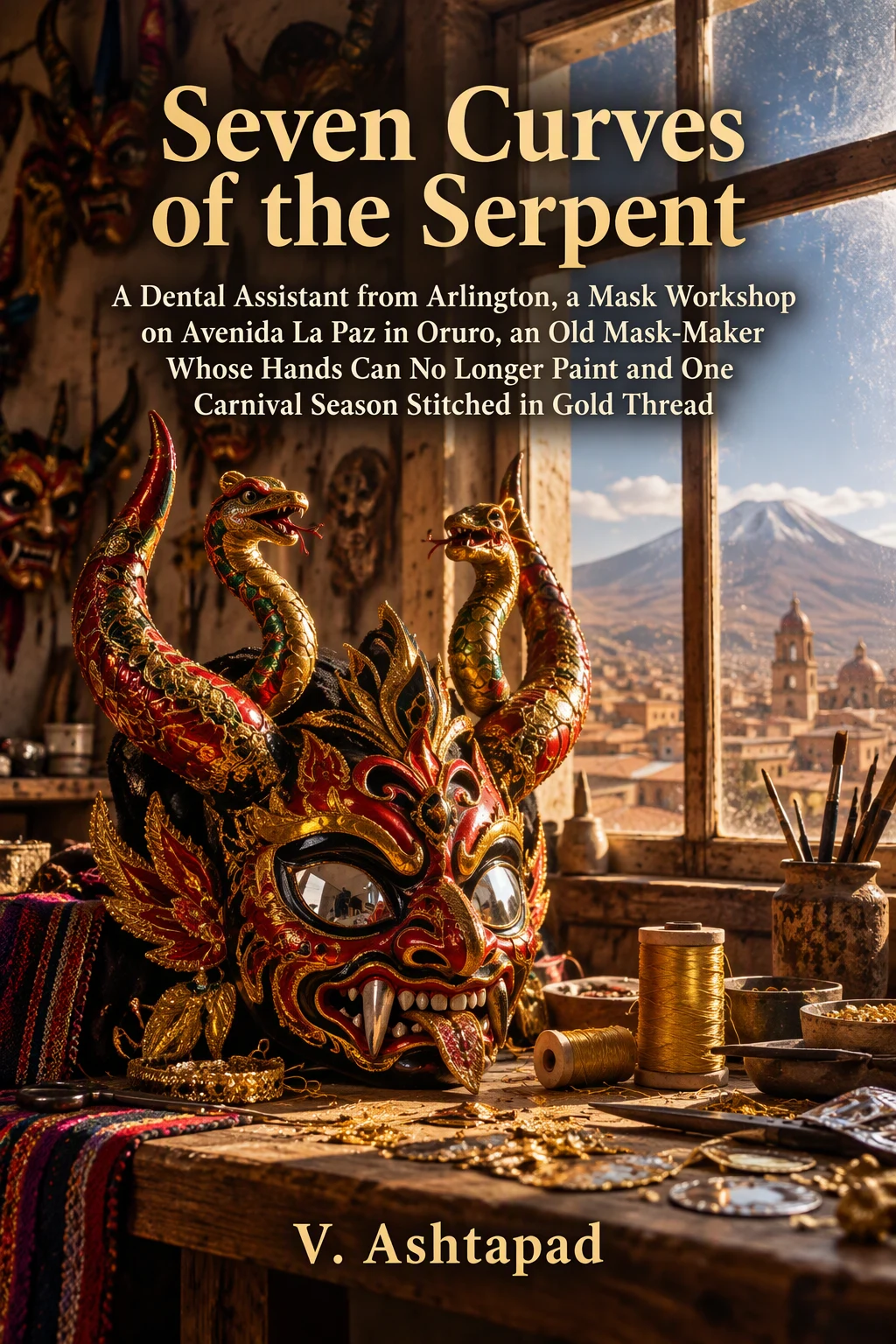
Seven Curves of the Serpent
A Dental Assistant from Arlington, a Mask Workshop on Avenida La Paz in Oruro, an Old Mask-Maker Whose Hands Can No Longer Paint and One Carnival Season Stitched in Gold Thread
by V. Ashtapad
Foreword
This is a work of fiction. The Diablada, the Carnival of Oruro and its Entrada, the mask and embroidery workshops of Avenida La Paz, the legend of Wari and the plagues, and the salteñas, api and brass bands of Bolivia are real public traditions. The Choque workshop, the fraternities, the Columbia Pike parade and every person in this story are invented.
For every maker who taught a stranger the knot.
The Mask
The horn came off on the third pass of the parking lot, and I heard it before I felt it go.
It was a Thursday in October, the first cold night of the year, and we were rehearsing where we always rehearse: the back lot of a closed furniture store off Columbia Pike, between a dumpster painted forest green and a row of shopping carts that nobody ever came to collect. The sodium lights made everyone's skin orange. The band had set up near the loading dock, eleven men and one woman with brass so old that the lacquer had worn off in the shape of their hands, and when they started the first march, the sound went up off the asphalt and bounced back from the brick wall of the bank across the street, so the music arrived twice, a little late the second time, like an echo from a mountain.
I was wearing my China Supay mask for the first time since the summer. A China Supay is a she-devil. She dances in front of the devils in short boots and a short skirt and a mask with a small crown of horns, and her job, as Ramiro explained it to me when I was nine and terrified, is to tempt and to tease and to never, ever fall behind the music. My mask had belonged to a woman named Doña Teófila who had danced in it in Oruro for twenty years before she moved to Virginia and danced in it here for ten more. When her knees went, she gave it to me. I was sixteen. She held it out with both hands and said, "Do not let anyone put it on a shelf."
So I had not. It lived in a hatbox on top of my closet, wrapped in a bath towel, and it came down for every practice and every parade. It was heavy, almost four pounds, made of plaster and cloth and tin, with two glass eyes painted green, a nose that curled like a seashell, a mouth full of white teeth, and little round mirrors set into the cheeks so that when the light hit them, the people watching saw themselves inside the devil's face for half a second before I turned away.
On the third pass, as I spun at the corner by the shopping carts, the left horn snapped at its base and dropped onto the asphalt with a sound like a cup breaking. I kept dancing, because you keep dancing. I finished the phrase, finished the turn, and then I stopped and went back for it.
It had broken clean. Inside, where it had been attached, I could see the old wire armature, rusted brown, and a wad of newspaper so yellow I could read part of a date. It was a Bolivian newspaper from 1981.
Ramiro came over with his fists pushed into his jacket. He is the guide of our fraternity, which means he leads, which means he worries. He is sixty-one and was a bus mechanic for thirty years, and he still looks at everything as if he is listening for a strange noise in an engine.
He held out his hand for it, and I gave him the horn. He turned it in the orange light while the band behind us drifted into the next march without us, and a shopping cart rolled a foot in the wind and stopped. Hilario, he said, would have fixed this in an hour.
Nobody answered that, because Don Hilario Vargas had died in April, at eighty-three, in his chair in the garage behind his house in Falls Church where for twenty-six years he had repaired every mask, cape and breastplate our group owned. He had come from Oruro in 1998 with a suitcase of tools and two masks wrapped in a blanket, and he had kept us dancing. He had a radio that only played one station, a coffee can full of glass eyes sorted by color, and a temper that lasted about four minutes. When he was buried, eight of our devils danced in front of the funeral home in full costume, and his granddaughter cried so hard that she had to sit down on the curb.
After he died, his son sold the house. The tools went to a cousin in Houston who did not dance. The coffee can of eyes went, I think, into the trash.
Joaquín had come up behind Ramiro and offered glue. He dances the lead devil, Lucifer, and he is twenty-seven, and he thinks most problems can be solved by a hardware store. Ramiro told him this was not a glue problem.
He was right, and the rest of the night proved it. Once we started looking, we could not stop. Doña Celia, who keeps the costumes in her basement in Arlington and knows every piece by its smell, opened the plastic bins in the back of her van and pulled things out under the lights. The capes were losing their sequins in long bald patches like a dog with mange. On Joaquín's cape, the gold thread of the dragon had come loose and hung in loops. Two of the breastplates had cracked across the middle where the tin met the cloth. The skirts of the devils, which are made of hanging plates that ring when you move, were missing plates on every row, so the sound was patchy, like a band with three players out sick. One mask had lost an eye. One mask had been sat on, at some point, by someone who had never confessed.
Doña Celia folded a cape over her arm and said they were old, that they had come from Hilario and some had come to Hilario from Oruro, that some of them were older than me. I said most of them were. She said most of them were older than my mother. The cape smelled of her basement, mothballs and damp concrete, and a sequin fell off it onto the asphalt while she talked.
We stood around the van. The band had stopped, and without it the lot was only the hum of the sodium lights and traffic on the Pike. The tuba player, a mild man named Efraín who works nights at a hotel near the airport, was eating a granola bar, and the wrapper crackled in the cold.
Ramiro said, "The parade is in March."
The parade is our parade. For nineteen years, on the second Sunday of March, the Bolivian fraternities of Northern Virginia have danced a carnival entrance down a mile of Columbia Pike, from the corner by the old movie theater to the park near the community center, with the streets closed and the police waving and the families on folding chairs along the curb since eight in the morning. It is not Oruro. It is a mile and not four kilometers, and there are maybe six thousand people watching instead of hundreds of thousands. But it is ours, and for one morning a year, Columbia Pike sounds like the altiplano.
Joaquín said we could order new ones from a factory that shipped. Ramiro asked him from who, and Joaquín named a city in Peru, a factory. Ramiro looked at him with something that was not anger, more like the patience a mechanic has for a customer who has put the wrong oil in his car.
Those people make masks for visitors, Ramiro said. Light. Plastic. Good from far away. They do not ring, they do not last, and they are not ours. Joaquín asked who, then.
Ramiro took out his phone. He scrolled and scrolled. The orange light made his face look tired.
"Hilario had a teacher," he said. "Or the son of his teacher. In Oruro. On Avenida La Paz, where all the workshops are. Choque. Wilfredo Choque. Hilario said he was the last one who still builds the old way, from the plaster up, with the wire, the cloth, everything, the way Hilario learned it. He said the others buy the horns ready-made now. He said if anything ever happened to him, we should go to Choque."
Doña Celia said go. Joaquín said call. Ramiro said Hilario had always told him the man did not answer the phone.
I was still holding my horn. The newspaper in it was crumbling a little at the edge, and I could see a few words of a story about tin prices. I thought of Doña Teófila holding the mask out to me with both hands. I thought of the hatbox and the towel. I thought, for no reason I could explain, of my grandmother's kitchen in Oruro, which I had seen exactly twice, when I was seven and when I was twelve, and of how cold the floor had been in the morning and how the windows had been full of mountains.
"I'll go," I said.
They all looked at me.
I told them I had a passport, and family there, my Tía Beni with her pharmacy two streets from the market, and that I spoke Spanish better than Joaquín. Doña Celia said everybody spoke Spanish better than Joaquín. Ramiro reminded me that I had a job.
I did. I was a dental assistant at a practice in Ballston, four floors above a juice bar, in a building with a view of the parking garage. I had been there three years. I was good at it. I could hand Dr. Lund the right instrument before he asked for it, I could calm a crying seven-year-old by explaining that the suction tube was a tiny vacuum cleaner for teeth, and I could pour a plaster model of somebody's lower jaw so clean that the lab technician once called to compliment me.
I said I would ask.
That night, at home, I unpacked the mask onto the kitchen table. My mother was still awake, sitting under the light with her reading glasses on, going through a stack of receipts from her Sunday salteña orders. She makes salteñas every Saturday night and sells them on Sunday mornings to people who text her by Wednesday, and on a good week she sells three hundred. Her hands smelled like cumin and the pale yellow oil she uses for the dough.
My mother asked what had happened to her, meaning the mask. She has always called it her. I told her the horn had broken.
My mother picked up the horn and looked inside it, the way Ramiro had. She read the date on the newspaper and was quiet.
"That was the year your grandmother came down from the mine to sell in the market," she said finally. "That paper. Somebody bought bread in that paper."
"I want to go to Oruro," I said. "To get the costumes made. All of them. By Hilario's teacher's son."
My mother put the horn down very gently. The kitchen still smelled of cumin and fried onion from her dinner, and the refrigerator ticked. She repeated the word want, as if she were weighing it, and then she went down her list: my job, the money. I said I would ask for leave. I said the fraternity had been saving for the costumes. She said that was for the costumes and not for my ticket, and I said I had savings.
She took her glasses off and rubbed the bridge of her nose. On the refrigerator behind her was a photograph of my grandmother in her bowler hat and her wide skirt, standing in front of a stall full of oranges. Under the photograph, in my mother's handwriting on a strip of masking tape, it said MAMÁ ADELA, MERCADO FERMÍN LÓPEZ, 1985. My cousin Fabiola had scanned that picture and put it on the family pages the year before, with the same label, and my uncles in Cochabamba and my cousins in São Paulo had all left notes under it, and somebody in Spain had added that the stall was the third one from the corner. I had read those notes on my phone on the train.
My mother reminded me that I had been twelve the last time and had gotten sick from the altitude and thrown up on Tía Beni's shoes. I told her I was twenty-four now. The altitude, she said, did not care.
But she did not say no. She put the horn inside the mask, in the hollow behind the face, so the two would stay together, and she wrapped the whole thing back in its towel. Then she went to the cabinet and took out the tin of coca tea her sister sends her every Christmas and set it beside my keys.
© 2026 CRUNOD LLC. All rights reserved.
The Horns
Dr. Lund gave me ten weeks. Unpaid, but with a promise.
I asked him on a Monday, between a crown prep and a cleaning, while we were both washing our hands at the little sink in the hallway. I had planned a speech. I had practiced it on the train. Instead I just said, "I need to go to Bolivia for ten weeks to get devil costumes made for a parade," and he turned off the water and looked at me.
He is a careful man. He is from Minnesota and has very clean fingernails and keeps a framed photo of a lake in every operatory. He has never, as far as I know, danced in public.
He repeated the words devil costumes, with the water still dripping off his wrists. I explained the Diablada, the dance from Oruro, my parents' city, and the man who had fixed our costumes and died, and the one man left down there who made them right. The suction in the next room whined and stopped.
He dried his hands. He kept drying them well past dry.
"My grandfather made fishing lures," he said. "Wooden ones. He painted them by hand. Nobody in my family learned how. We have about forty of them in a box at my mom's place and nobody knows how to make another." He dropped the paper towel in the bin. "Talk to Grace about the schedule. Ten weeks. Come back."
Grace, the office manager, sighed at me for an entire afternoon and then found a temp from an agency in Rosslyn. She also made me promise to bring her a mask. Not a real one, she said. A little one. For her desk.
The fraternity voted on a Wednesday night in Doña Celia's basement, which smells of mothballs and dryer sheets and the particular dusty sweetness of old sequins. There were twenty-two of us there, and the vote was twenty to two, and the two were Joaquín and his cousin, who wanted to order from Peru and save the money for a party. Joaquín shook my hand afterward anyway and told me to bring him back a mask that would scare children, scare them a lot, so they would remember him.
The list was long. Ramiro wrote it out by hand on a yellow legal pad, and then Doña Celia typed it up, and then Ramiro printed four copies and put one in a plastic sleeve. Eight devil masks. Two China Supay masks, mine and one for Lizeth, the other China, who is nineteen and dances like her shoes are on fire. One mask for the Archangel, which is not a devil mask at all but a calm silver face, very still. Eight capes. Eight breastplates. Eight skirts of plates. Repairs to whatever could be saved. The fraternity had saved money for six years, from raffles, from a stand at the county fair, from selling api and pastries in the parking lot after rehearsal in the winter, from an anonymous donation that everybody knew was from Efraín the tuba player, who has no family here and never says much. It was not enough for everything new. It was enough, Ramiro thought, for most of it, if Choque would give us a fair price.
Ramiro warned me that Choque would try to charge me gringo prices because I would sound like a gringa. I said I did not. Doña Celia said that to them I would, and told me not to be insulted, though she knew I would be.
I flew out on the twenty-seventh of December, the day after my mother's Christmas tamales ran out. My father drove me to Dulles at four in the morning in his work van, which smells of refrigerant and the pine air freshener he hangs from the mirror. He is an air-conditioning technician, and he believes in very few things, but one of them is getting to the airport three hours early. He did not say much on the drive. He played the radio low. At the curb he took my big suitcase out of the back, the one with the mask in it wrapped in its towel and a second towel and a sweater, and he set it on the sidewalk and put both hands on the handle as if he were going to hand it to me formally.
"Your grandfather worked in the San José mine," he said. "My father. You know this."
I said I knew. The terminal doors slid open and shut behind us, letting out warm air and the smell of coffee. Forty years under that hill, he said, and in Oruro I would see the hill from everywhere, and I was to look at it for him. And eat. Tía Beni would try to feed me every hour, and I was to let her, because I was too thin for that altitude.
The flights took nineteen hours, through Miami and then through Santa Cruz, where the air in the airport was thick and wet and smelled of jet fuel and fried yuca, and then up to El Alto, the airport above La Paz, where I stepped out into air so thin and bright it felt like stepping into cold water. I was dizzy before I reached the baggage claim. My heart was going fast for no reason. My fingers tingled. My cousin Fabiola was waiting for me past the doors with a sign that said NOEMÍ ARCE COLQUE in pink marker and, underneath, smaller, DO NOT RUN.
She hugged me and told me that here I would walk slow, like an old lady, like a turtle.
Fabiola is two years older than me and studies accounting in La Paz and has my mother's exact laugh, which was strange to hear coming from someone else. She had brought a thermos of coca tea and a plastic bag of crackers, and she made me sip and chew on the bus all the way south across the altiplano.
I had forgotten the altiplano, or I had never really seen it at seven or twelve. It is the flattest place I have ever been and also the highest. The road runs straight for hours across brown grass and pale dirt, and on either side, far away, so far away they look painted on the sky, are mountains with snow on them. The sky is a dark blue that does not happen in Virginia. Every now and then we passed a mud-brick house with a tin roof, or a woman in a wide skirt walking with a bundle on her back, or a herd of llamas with red tassels in their ears, and once, near a small town, a boy on a bicycle with a tuba strapped to his back, pedaling hard into the wind.
Fabiola said he was going to practice. Everybody was practicing now, five weeks to Carnival.
It took four hours. By the time the bus came down the long slope into Oruro, the sun was low, and the city spread out under it like a pile of brown and white boxes, with the hills behind it, bare and folded, and on one of those hills, very large, a white statue of a woman with her arms open. On the other side of the city, a flat silver shine that Fabiola said was the lake, Uru Uru, where flamingos stand in the shallow water. And everywhere, the hill my grandfather worked under. My father was right. You could see it from everywhere. It was smaller than I had imagined and darker, with the old mine buildings at its foot.
I pointed and said my grandfather. Fabiola looked at the hill and nodded as if I had said something ordinary. Tío Teodoro's father, yes, the San José, she said, and her grandfather too for a while, before the market. The bus downshifted and the brakes hissed, and dust from the road came in through the gap in the window.
My Tía Beni lives above her pharmacy, which is a narrow shop with a glass counter and a hand-painted sign, on a street that slopes up toward the mine. The building is three stories of red brick, unfinished on top, with rebar poking up from the roof, waiting for a fourth floor that will happen when somebody has money. She was standing in the door when we arrived, a short round woman wearing a gray cardigan, two long braids down her back, and she grabbed my face with both hands and said, "You look like your mother when she was stupid and young," and then she made me sit down and set soup down for me before I had taken my coat off.
It was a lamb broth with potatoes and rice and a few leaves of mint floating on top, and it was the first thing that had stayed down since the airport. I ate it all. She gave me another. In the kitchen behind her, a radio was playing a brass band march, and a cat with one white ear was asleep on top of the refrigerator. It was cold in the room, much colder than any room in Virginia, and Tía Beni handed me a pair of thick wool socks without asking.
Tomorrow, she said, I would rest, and the day after I would go see Choque. When I asked how she knew about Choque, she said my mother had called her four times. She sat across from me with her arms crossed while the cat on the refrigerator opened one eye. Everybody knew Choque. His father, Don Eusebio, had made the masks for half the fraternities in this city when she was a girl, the big ones, the ones that won. Now Wilfredo did it, and his wife Elsa did the capes, on Avenida La Paz near the corner with the yellow pharmacy, which was not her pharmacy and charged too much.
I said Ramiro had told me he did not answer the phone. He did not answer the phone, said Tía Beni, because he was busy. Five weeks to Carnival. That whole avenue did not sleep.
I did not rest the next day. I tried. I lay on the bed in the little room on the second floor that had been my mother's room when she was a girl, under three wool blankets, and listened to the city. There were brass bands everywhere. Not one band, but many, in different directions, practicing different marches at the same time, so the sound came over the rooftops in waves that crossed each other and sometimes, for a few seconds, fell into the same rhythm before drifting apart again. There were dogs. There was a man in the street selling gas canisters, banging a wrench against one of them in a steady clang. There was a woman calling out that she had hot api, api, api, with pastries.
In the afternoon I unwrapped the mask and propped it on the windowsill, the hill behind it. The broken horn I held in my lap. I took a picture of the two of them, the mask and the hill, and sent it to my mother. She wrote back one word: *ella*. Her. And a minute later: Eat something.
© 2026 CRUNOD LLC. All rights reserved.
The Eyes
Avenida La Paz is a long, straight street, and for its whole length, on both sides, the ground floors of the houses are workshops.
I walked there on the morning of the twenty-ninth with Fabiola, very slowly, like a turtle. We went past the market first, where Tía Beni sent us for bread, and the smell of the market almost stopped me in the street: oranges and wet cilantro and raw meat and wood smoke and the sharp green smell of coca leaves sold in big plastic sacks, and, under everything, the fried sweetness of the pastries the women make in big pans of oil, puffed and hollow and dusted with powdered sugar. We bought two and ate them walking. They shattered when you bit them. Powdered sugar got all over my black coat, and Fabiola laughed at me and did not help.
On the avenue, every door was open. Inside, people bent over tables under bare bulbs. In one shop, a man was painting the scales on a plaster dragon, one scale at a time, with a brush that had maybe three hairs on it. In another, two women were sewing sequins onto a cape spread across a table so big that they had to climb onto chairs to reach the middle. There were shops full of boots with tall heels and silver spurs, shops full of hats, shops with racks of wide pleated skirts in pink and turquoise and gold for the morenada dancers, shops where masks hung from the ceiling on hooks, hundreds of them, so that when you looked up you saw a sky of devils, bears, condors, old men with long noses, black-faced kings with silver tears. The masks swayed a little in the draft from the street. Their mirror eyes turned and caught the light and threw it around the room.
Fabiola leaned in and said, low, that some of these were made in a factory. You could tell by the horns. She was right. In some shops, every horn curled exactly the same way, like they had been poured from one mold. Every toad on every forehead had the same face.
The Choque workshop was the narrowest one on the block. It had a green metal door rolled halfway up, so you had to duck under it, and a sign painted directly on the wall above it, so faded I could only read TALLER and, under that, a little picture of a horned face with real round mirrors glued in for eyes. Two of the mirrors were missing. Inside, it was dark after the bright street, and it smelled like wet plaster, glue, turpentine, and something cooking somewhere in the back, onions and meat.
A girl of about twelve was sitting on an upside-down bucket just inside the door, gluing mirrors onto a small round frame with a toothpick and a jar of white glue. She had her hair pulled back so tight it lifted her eyebrows. She looked at me, looked at my coat with powdered sugar on it, looked at Fabiola, and said, without stopping her work, "Papi, gringas."
"I'm not a gringa," I said in Spanish.
"You sound like a gringa," said the girl.
From the back of the room, a man laughed. He came out from behind a curtain made of an old blanket, rubbing his palms on a rag. About fifty, short and thick through the shoulders, with a round face, a gray mustache, and plaster dust in the creases of his knuckles and in his eyebrows and along his forearms, so that he looked like he had been lightly snowed on. He wore a sweater with holes at both elbows and a knitted vest over it and a baseball cap with no logo, white with dust.
He told the girl, whose name was Jhenny, to mind her manners. She said I did sound like one. Everybody sounds like something, he said, and turned to me. A radio in the back was playing a march, and a pot lid rattled. He was not taking orders for Carnival, he said. It was too late, and he had more than he could finish now. I could try three doors down, where they had masks ready.
"I'm not here for this Carnival," I said. "I'm from Virginia. From the Diablada in Arlington. Hilario Vargas made our costumes. He died in April."
He stopped wiping his hands.
I had the broken horn in my bag. I had the whole mask in my bag, actually, wrapped in its towel, because I had not wanted to leave it at Tía Beni's. I took it out and unwrapped it on the corner of his worktable, between a pot of brushes and a block of wood with nails sticking out of it, and I set the horn down beside it.
Wilfredo Choque did not touch it at first. He leaned over it with his hands behind his back. He looked at the teeth and the nose and the mirrors in the cheeks. He looked at the place where the horn had broken off. He leaned closer and looked into the green glass eyes for a long time.
Then he said, without turning around, "Papá."
The blanket curtain moved. An old man came out, very slowly, leaning on a cane, his free hand trailing along the wall. He was tiny, smaller than Tía Beni, in a brown wool poncho and a knitted hat with earflaps, and his face was brown and so lined it looked like the bark of a tree. His eyes were milky at the edges. He walked to the table and Wilfredo took his elbow without either of them seeming to notice, and the old man bent until his face was almost touching the mask.
"Teófila Mendoza," he said.
I felt the hair on my arms stand up. Out on the street a truck went by and the masks on their hooks swayed and knocked softly together. I said he knew her.
"I made this," he said. He put out one finger, the nail thick and yellow, and touched the edge of the left eye. "I made this face. Nineteen seventy-nine. For Teófila Mendoza, who danced with the Fraternity of the Miners. She had a mouth on her. She told me the first one I made was too sweet. She said, I am a devil, Don Eusebio, not your girlfriend. So I made her this one." He traced the curl of the nose. "This is not sweet."
I told him she had given it to me at sixteen and had told me not to put it on a shelf.
Don Eusebio straightened up a little and looked at me, really looked, his milky eyes going over my face as if it were also something he might have made.
He asked if she was alive. I told him she lived in Maryland with her daughter, and she was ninety-one, and she did not dance.
"She doesn't dance," he said, as if that were the saddest news he had heard in years. Then he laughed, a dry small laugh like paper. "Neither do I."
Wilfredo had finally picked up the horn. He lifted it toward the bulb and peered inside at the rusted wire and the old newspaper.
"Papá's wire," he said. "His knot. Look." He showed me where the wire had been twisted around itself in a tight spiral, three turns and then a hook. "He always does it like this. Hilario learned it from him. I learned it from him. If you see this knot in a mask, you know where it came from."
I asked if he could fix it. Of course he could, Wilfredo said. Twenty minutes. That was not why I had come nineteen hours.
So I told him. I took out the list in its plastic sleeve and laid it on the table. Eight devil masks. Two China Supay. One Archangel. Eight capes, eight breastplates, eight skirts. The repairs. The parade in March. The money the fraternity had saved for six years, and the number, which I said out loud and which sounded smaller in that room than it had in Doña Celia's basement.
Wilfredo read the list twice. Jhenny had gotten off her bucket and was reading it over his elbow. Don Eusebio had lowered himself into a wooden chair by the wall and was looking at Teófila's mask on the table, not at the list.
"No," Wilfredo said.
I started to say he had not heard the rest, and he said he did not need to. "Look around you." He waved at the shop. On every shelf, on every hook, there were masks in pieces: faces without horns, horns without faces, plaster molds stacked like dinner plates, strips of cloth soaking in buckets. "These are for the Fraternity of the Bolívar Avenue, these are for the Morenos of the Mercado, these are for three groups from La Paz who come down every year. I have commitments for February that I will not finish unless I stop sleeping, which I will do. My wife has nine capes on her table. My son is supposed to help me and instead he plays the trumpet all day with a band of delinquents. After Carnival, maybe. After Carnival, in March, April, I could start. You would have them by August."
I said the parade was in March.
"Then you have a problem," he said, not unkindly. "I am sorry for Hilario. He was a good man. He sent us money when my mother was sick. I am sorry. But I am one man with two hands and a father with no hands left."
"I still have hands," said Don Eusebio from his chair. "They shake. They are still hands."
Wilfredo did not answer him.
I stood there. I could hear a band somewhere outside, repeating the same eight bars, the trumpets a little sharp. Fabiola was looking at me, waiting for me to say thank you and leave, which is what you do. I knew it was what you do. My mother would have done it. My mother would have said, thank you, Don Wilfredo, and walked out and found a factory mask three doors down and never mentioned it again.
I looked at the table. At the knot of wire. At the old man's finger, which was still resting on his knee pointing slightly at the mask, as if it had forgotten to come back.
"What if I helped," I said.
Wilfredo laughed. Jhenny laughed too, behind her hand.
He asked if I could sew. A little, I said. Buttons. He asked if I could sculpt, and I said no, but that I poured plaster every day. I made molds.
That stopped him. "Molds of what?"
"Teeth. I'm a dental assistant. I take impressions of people's mouths and I pour the stone into them and make models. Upper and lower. I pour them so there are no bubbles. I'm good at it. The lab says I'm the best in the building."
Wilfredo looked at my hands. I looked at them too. They were very clean, with short nails, because they have to be.
"Teeth," said Don Eusebio. He was smiling now, all the way, and he had four teeth of his own, two on top and two on the bottom, not touching. "The girl makes teeth."
I corrected him: the models of teeth. Every devil needs teeth, Don Eusebio told his son.
Wilfredo did not say yes. He picked up the broken horn again and turned it over. He picked up the list. He put it down. Out on the street, the band finally got through the eight bars and went on to the next part, and you could hear them all relax into it.
"Come back tomorrow," he said. "Seven o'clock. In old clothes. I will give you plaster and we will see what your hands do. If they are no good, I fix your horn for free and you go home."
I asked what happened if they were good. Then, said Wilfredo Choque, I was going to be very tired.
© 2026 CRUNOD LLC. All rights reserved.
The Toads and the Serpents
My hands were no good at first. Not on the first day, and not on the second.
It is one thing to pour dental stone into an impression tray. You mix the powder and water to the exact ratio, you spatulate it for exactly so many seconds, you set the tray on the vibrator so the bubbles come up, and you pour it in from one side, slowly, letting it flow around each tooth. It is clean. It is quick. It is the same every time.
Mask plaster in the Choque workshop was not the same every time. Wilfredo mixed it in a cut-down plastic drum with his bare forearm, judging it by how it slid off his skin. The molds were old, some of them older than Wilfredo, made of plaster themselves, cracked and wired back together, rubbed with soap and oil so the new plaster would come away. You did not pour into them. You laid strips of cloth soaked in plaster into them, layer after layer, pressing each layer down with your thumbs into every curve of the cheek and the brow, and you had to do it fast before it set, and you had to do it evenly, or the face would be heavy on one cheek and weak on the other and would crack the first time somebody spun at a corner by the shopping carts.
On the first morning my layers were too thick. On the second they were too thin. My thumbs were raw by noon. The plaster dried white in the creases of my fingers and made them stiff, and I could not stop thinking about Dr. Lund's gloves, the purple nitrile ones in the box by the sink, and how I had never once in three years touched anything without them.
Jhenny watched me from her bucket and offered commentary.
Too fast, she said. Too slow. I had missed the ear. When I told her devils don't have ears, she said this one did, and called to her father that I had missed the ear. Behind her the street went by in bright squares through the half-raised door: a woman with a basket of bread, a dog, a boy with a snare drum on a strap.
But on the third day something in my hands understood, and I laid the cloth in a mold for a China Supay face, the cheeks and the narrow chin, four layers, and pressed it and smoothed it and set it aside, and when Wilfredo pulled it out of the mold the next morning, he tilted it toward the doorway light, turned it twice, and set it on the shelf with the others without saying anything at all. Jhenny told me later that this meant it was good. When it was bad, she said, he said something.
That was the day Don Eusebio started telling me about the toads.
He sat every morning in his wooden chair by the wall, with a blanket over his knees and a thermos of coca tea at his feet, and he watched everything. Wilfredo said he had stopped working with his hands two years ago, when the shaking got too bad to paint and he ruined the eye of a condor for a group from Cochabamba. Since then he came down from the room upstairs every morning at eight and sat in the chair and watched until lunch, and sometimes he told Jhenny to fix something, and sometimes he told Wilfredo, and Wilfredo always did, without arguing, even when he had already fixed it.
He did not explain things the way Dr. Lund explains things, step by step, with a diagram. He explained by telling a story and then pointing.
That morning he asked if I knew why there were toads on the masks. I was trimming the rough edges off a dry face with a little saw, and the dust was getting in my nose and drying my throat, and I guessed decoration. He made the paper laugh and repeated the word to Jhenny, who rolled her eyes for him.
"A long time ago," said Don Eusebio, "before the Spanish, before the mines, there were people here who lived by the lake. The Uru. Fishermen. Quiet people. There was a giant who lived in the mountains, Wari, and he was angry with the people because they had stopped respecting him. So he sent plagues to destroy the town. From the south, a huge serpent. From the north, a toad as big as a house. From the east, a lizard. From the west, ants. They were coming to eat the people." He pointed with his chin at a mask on the shelf above me, a big devil face with a curling snake climbing up between the horns and a fat toad sitting on its forehead and two lizards along the cheekbones. "And a young woman came, a princess, and she fought them. She turned them to stone. The serpent, you can still see it on the road to the south, there is a hill shaped like a snake with its head cut off. The toad is a rock on the road north. The lizard too. The ants turned into sand dunes. You can walk on them."
I said that the masks showed the plagues, then. No, said Don Eusebio, they showed that we won. "The devil wears his defeats on his head. That is what a crown is, sometimes. That is what my grandfather said."
I looked at the toad on the mask. Its mouth was open, red inside, and its eyes were two little round mirrors, so it was watching me back.
I told him he said it like a story for children, but that he meant it. He shrugged under his poncho, and the wool smelled of woodsmoke.
"Everybody in Oruro knows that story," he said. "But not everybody knows that you should put the toad slightly to the left, not in the center, because the toad came from the north and the north is on your left when you face the lake from the town. Not everybody knows that the serpent should have seven curves, not five or six. These factory people, three doors down, they make five curves, because it's cheaper. Five curves is a worm."
I asked if it was true about the seven curves. "It is true in this shop," he said. "My father did seven. I did seven. Wilfredo does seven. That's how it becomes true."
That night, at Tía Beni's, I could not sleep. The plaster dust was still in my sinuses and my hands throbbed. I lay under the three blankets and listened to the bands, which never stopped completely, and thought about seven curves. I got up and got my phone and sat on the cold floor by the window and opened a blank note and typed out everything Don Eusebio had said that day, as close as I could remember, in Spanish, and then in English underneath. The toad on the left. The serpent with seven curves. The lizards on the cheekbones, one on each side, heads pointing down. The plague of ants as the little dots of silver paint along the edge of the brow, which I had seen Wilfredo do with the back of a match and had thought were just decoration.
In the morning I asked Don Eusebio if I could record him.
I asked carefully, because I had seen him look at Jhenny's phone the way some old people look at a dog they don't know. I explained that it would just be his voice. That it would go to my family's private pages, where only my family could see it, and to Ramiro and Doña Celia in Virginia, so that when the masks arrived, the people who wore them would know why the toad was on the left. That I would not post it anywhere else. That if he said no, I would just keep writing in my notes.
He thought about it for longer than I expected.
He asked whether Teófila would hear it. I said I could play it for her if he wanted. Then yes, he said, but he wanted to say hello to her first, before the toads.
So the first thing on the recording, before anything about Wari or plagues or seven curves, is Don Eusebio Choque, eighty-four, in his chair by the wall in the cold workshop on Avenida La Paz, with a band practicing somewhere in the street behind him, saying: "Teófila. It's Eusebio. You were right. The first one was too sweet."
© 2026 CRUNOD LLC. All rights reserved.
The Breastplate
The breastplate of a devil is called the pechera, and I had never thought about it, which I am ashamed of now.
In Virginia, it was just the thing you strapped on over your chest before the cape went on. Some were tin and some were cloth stiffened with glue and covered in sequins and mirrors, and they had a face on them, usually, a smaller devil or a snake, and they had loops at the back for the straps. Doña Celia always complained about the straps. I had danced next to them for fifteen years and never once looked closely.
In the Choque workshop, the breastplates were Elsa's.
Elsa Choque was Wilfredo's wife, and for my first week I had barely seen her, because she worked in the room behind the blanket curtain and came out only to cook, to yell at Jhenny about homework, or to stand in the doorway, arms crossed, and watch me pour plaster in a way that made me pour it worse. She was tall for Oruro, almost as tall as me, and thin, with long fingers and a narrow face and her hair in a single braid down her back that she tucked into the collar of her sweater so it would not get in the glue. She was quiet in a way that was not shy. She spoke when it was useful.
On the eighth morning, Wilfredo told me to go back and help Elsa. She needed hands for the pecheras, he said, his were full, and Brayan was useless.
Brayan, the useless son, was nineteen and I had met him exactly twice: once on the stairs, carrying a trumpet case and a plastic bag of bread, where he nodded at me and kept going, and once at lunch, where he ate two bowls of soup in silence with headphones on and then left. Jhenny said he was in a band called the Royal Imperial Brass of Oruro, which played for a morenada fraternity from the market, and that they practiced every night in an empty lot near the train station until the neighbors threw water on them.
The back room was warmer than the front, because there was a kerosene heater going in the corner and the window faced the sun. It was also more crowded. There were two long tables pushed together, and on them, spread out, were three capes in various stages, a heap of breastplates, a sewing machine so old it had a foot treadle and gold flowers painted on its black body, and boxes. Boxes of sequins sorted by color, in plastic jars that had once held mayonnaise. Boxes of glass beads. Spools of thread on nails hammered into the wall, gold and silver and red, catching the sun. Coils of something I did not have a word for yet, a kind of thread that was really a tiny tube of twisted metal, gold, thin as a hair, cut into short pieces and kept in a dish like spilled rice.
Elsa pointed at a stool, and I sat. The heater ticked and gave off a thin smell of kerosene. She put a breastplate in front of me. It was a base of tin, cut into a shape like a shield, with the edges rolled over so they would not cut, and it was covered with stiff black velvet. Drawn on the velvet in white chalk, very lightly, was the outline of a face: a devil with wide nostrils and a beard of flames, and around it, a border of curls.
This one was for the Fraternity of the Bolívar, she said. Gold on black: gold on the face, red on the flames, silver on the border. The outline came first. I was to watch.
She threaded a needle with a double strand of gold, knotted it, and brought it up through the velvet from the back, right on the chalk line. Then she picked up one of the tiny gold tubes from the dish with the tip of the needle, slid it down the thread until it lay against the velvet, and put the needle back down through the cloth at the end of it. One tube. Then another, right next to it, overlapping a hair. Then another. The tubes lay on the line like a row of tiny bright soldiers. In ten minutes she had done the curve of one nostril.
Bullion, she said. Canutillo. It was how you made lines that caught the light; sequins were for filling and this was for drawing. I said it was like drawing with gold, and she agreed without smiling and told me to do the other nostril.
I did the other nostril. It took me forty minutes. Three times the tubes rolled off the needle and fell into the velvet and I had to pick them out with tweezers. Once I put the needle through my thumb, and a bright bead of blood came up, and Elsa handed me a scrap of cloth without looking up from her own work.
She told me not to bleed on the velvet. Black hid it, but the Bolívar people would know. They always knew.
The other nostril, when I was done, was lumpy. The tubes did not lie flat. There were gaps. Elsa looked at it for one second and then, with the tip of a little pair of scissors, cut the thread and pulled out every tube, one by one, and dropped them back in the dish.
She said again, and I did it again. It took thirty minutes. She pulled it out again.
The third time, she left it.
We worked all afternoon without talking much. The radio in the corner played a station that seemed to have nothing but brass band music and, every hour, a man reading the names of people who had lost documents in the bus station. The heater ticked. Through the wall I could hear Wilfredo and Jhenny arguing in the front room about whether one of the condor masks looked angry enough. Don Eusebio had gone upstairs to sleep.
Around four, Elsa put down her needle and rubbed her eyes with the heels of her hands.
Then she asked why I had really come.
I told her about the horn breaking in the parking lot. About Hilario and the coffee can of eyes. About Doña Teófila. She listened with her hands in her lap. She did not nod or make little sounds. She just listened, the whole time, with her eyes on my face.
When I was done she said that was why the group had sent me. She had asked why I came.
I started to give the same answer again and stopped.
The real answer was harder. The real answer was that I had grown up in Arlington, in a two-bedroom apartment four stories above Columbia Pike, with a view of a gas station and a Korean church and a Salvadoran bakery. That I spoke Spanish at home and English everywhere else and could not write a paragraph in Spanish without mistakes. That when people at school asked where I was from, I said Virginia, and when they asked where I was really from, I said Bolivia, and when they asked what Bolivia was like, I said I didn't know, I'd been there twice. That I had been dancing the Diablada since I was nine and I could do every step in my sleep, but I did not know about the toad on the left, or the seven curves, or what a pechera was called, or that the gold lines on Joaquín's cape were made of a thousand tiny tubes each sewn down by hand. That I had danced in front of this whole world my whole life, the way you can live in front of a mountain for years and never once climb it.
I said some of this. Not all of it. My Spanish ran out in places, and I said those places in English, and Elsa understood more English than she let on.
When I finished, she picked up her needle again.
"My mother was from a village near Lake Poopó," she said. "She spoke Aymara. She talked to me in Aymara when I was little, and then when I went to school in the city, the other children laughed at me, so I stopped. I told her to speak to me only in Spanish. She did. She was very hurt but she did it. Now I am fifty-one and I can understand when somebody speaks Aymara in the market, but I cannot answer. My mother is gone. When I hear it, I hear her. And I cannot say anything back."
She pushed the needle up through the velvet.
Learning late was still learning, she said. I was to do the flames, red, sequins first and then the outline.
I called my mother that night. Nine in the evening in Oruro and seven in Arlington, and she was in the kitchen, radio going, and I could hear the pot of filling on the stove, the hiss of it. Saturday night. Salteña night.
"Mami, did Abuela speak Aymara?"
The line went quiet.
Some, my mother said. Quechua more. Her mother had been from near Potosí. When I asked if she had spoken it to her, my mother said only when she was small, and then she went to school. There was another silence, and the scrape of the spoon in the pot, and the radio low under it. She asked why. I said I just wanted to know. She said I did not call her from Bolivia to ask things I could ask at home, and I said I had never asked her at home.
The line stayed quiet except for the spoon, and I listened to her cook. Then she said, "Your cousin Fabiola has a recording. On the family pages. Of Mamá Adela singing, the year before she died. Somebody recorded it at a birthday. It's in Quechua. I never listened to it. I couldn't."
I asked if I could listen to it. It was there, my mother said. It was mine too.
I found it after we hung up. It was under a photo of my grandmother at a long table with a cake in front of her and a crowd of people I half recognized around her, in a dark room with a bare bulb. The recording was two minutes long. You could hear forks on plates and children and somebody laughing, and then my grandmother's voice, thin and high, singing a song I did not understand a word of. I played it three times with the phone against my ear under the blankets. Then I fell asleep with the gold tubes still under my fingernails.
© 2026 CRUNOD LLC. All rights reserved.
The Cape
By the middle of January I could do the math, and the math was bad.
Wilfredo had finished his February commitments the way he said he would, by not sleeping. Some nights I left at eight and came back at seven and he was still at the same table in the same sweater, with the same cold cup of tea beside him and a new row of faces on the shelf. Elsa had finished six of her nine capes for the Bolívar people. Jhenny had glued so many mirrors that she said she saw circles when she closed her eyes. And in the spaces between all that, in the corners of the shop and the ends of the long tables, our order had begun: four devil faces out of their molds and trimmed, two of them with their horns wired on in Don Eusebio's knot, my horn mended and drying, one breastplate with a face outlined in gold that I had done myself, slowly, twice over, until Elsa stopped pulling it out.
It was not enough. I sat on Tía Beni's floor one night with a notebook and counted hours. Eight capes, at Elsa's speed, would take her until May. At my speed, until the next century.
I called Ramiro. He was at Doña Celia's, and he put me on the speaker, and I could hear the whole basement on the other end, the dryer going, somebody's baby, the television upstairs. I told them what I had. I told them what I could not have.
Ramiro asked what I wanted to do.
I had thought he would decide. That is what a guide does. I had called expecting him to decide, and here he was, asking me.
"I think the masks have to be new," I said. "All of them. The old ones are cracking and nobody here or there can patch plaster that old forever. Wilfredo can do the masks by March if I keep helping. The breastplates too, Elsa says, if they are simpler than the Bolívar ones. But the capes we fix. We send the old capes down, all of them, the ones that can be saved, and Elsa and I rebuild them. New dragons where the dragons are gone. New lining. Same capes."
The speaker went quiet. Somebody turned off the dryer.
Doña Celia said only: Hilario's capes. I said yes, his and the ones that had come to him, fixed by the people who had taught him, and that I thought he would like that better than new. Somebody asked how we would send them. I had already asked: Fabiola's boyfriend's uncle drove cargo between Miami and Santa Cruz, ten days.
They voted while I was on the phone. I heard them do it: Ramiro asking, people saying yes, Joaquín saying, "Does mine still get a new dragon," and Doña Celia saying, "Yours gets whatever it gets." It passed. Doña Celia said she would pack the capes in the morning, in the big plastic bins, with the inventory list she keeps for every piece on the fraternity's pages: who wore it, which year it was repaired, what was wrong with it, a photograph from the front and from the back. She had started that list after Hilario died, she said, because she realized that everything about our costumes had lived in his head and in his garage, and she did not want that to happen again.
Eleven days later, five bins arrived at the Choque workshop in the back of a pickup truck, and Elsa opened them one by one on the long tables in the back room and stayed silent through all of them.
The capes of the Diablada are the biggest thing a devil wears. They hang from the shoulders down past the knees, and they are stiff, so they stand away from the body and swing when you spin, and they are covered from edge to edge with embroidery: dragons, snakes, flames, suns, the face of some other devil, all in sequins and bullion and glass beads and little mirrors, so heavy that the strongest dancers feel it in their backs by the end of the route. Our capes were black and red and green velvet, faded at the folds. Most of the dragons were missing scales. On one, the dragon had lost its head entirely, and there was just a shape of bare velvet where the head had been, a little darker than the cloth around it because the sun had not touched it in years.
Elsa ran her fingers over that shape.
She asked who had made this one. I checked Doña Celia's list on my phone: it had come from Oruro with Hilario in 1998, unknown maker. Not unknown, said Elsa. She turned the cape over and pulled back a corner of the lining, which was a thin red cotton held on with big loose stitches, and underneath, on the back of the velvet, in pencil so faint I had to hold it near the window, was a name and a date. *Felicidad Mamani, 1974.*
Her husband's aunt, Elsa said. Eusebio's sister. She had taught her, and she had died when Jhenny was a baby. Elsa let the lining fall back.
We started with that one.
Restoring a cape, it turned out, was harder than making one. You could not just sew new sequins over the bald patches, because the new sequins were brighter and would look like patches. You had to take off all the old ones in a whole section, save the good ones in a jar, mix them with new ones dulled a little by rubbing them between your palms with a pinch of ash, and then put them back on in rows, each one overlapping the one before like the scales of a fish, which is what they were supposed to look like. Each sequin was held by one stitch through its hole and one tiny bead on top. A dragon's body, Elsa told me, was about four thousand sequins. I did not believe her and then I counted a row and multiplied and she was right.
For the missing head, we needed a drawing. Elsa did not want to invent one. It was Felicidad's dragon, she said, and it should have Felicidad's head. She called down to the front room, and Wilfredo carried Don Eusebio's chair to the back, and Don Eusebio sat beside the table with his blanket over his knees and looked at the headless dragon for a long time.
Finally he said that she had made the eyes too big, she always had, like a fish, and their mother used to say Felicidad's dragons were all babies.
Then he told Elsa where the horns went, how the jaw opened, which way the tongue curled, and Elsa drew it in chalk on the bare velvet, and erased it, and drew it again, while he corrected her. I sat across from them doing scales and listened. It took all morning. When it was done, the dragon had a head, with eyes too big, like a baby.
Somewhere in that week, I got an idea, and it was not a good one, or not at first.
I had been thinking about the parade route on Columbia Pike. The gas station, the bakery, the old theater with the marquee. The way the band's sound came back off the bank. I thought it would be beautiful if one of the capes had something of Virginia on it. A cherry blossom, maybe, from the trees by the river in April. A little outline of the Potomac. Something to say: this is a Diablada from Oruro, and it lives here now. I did a sketch in my notebook of a dragon with a cherry branch in its claws and showed it to Elsa at lunch, over bowls of a thick soup with peanut and noodles that she had made in the corner on a two-burner stove.
She looked at it while she ate. She did not say anything.
Don Eusebio, who was sitting by the heater, asked to see it. I brought the notebook over. He held it far from his face, then close. He handed it back.
He said no. When I asked why not, he said a cherry tree is not a plague. "The dragon does not hold flowers. The dragon holds what it has lost."
I felt my face get hot. I wanted to argue. I had an argument ready: that traditions change, that the masks in the factory shop down the street had changed more than this, that the Diablada had been changing for two hundred years, that I had seen photographs of Oruro in the fifties and the costumes looked nothing like this. I had heard Joaquín make that argument a hundred times, in the parking lot, about electric lights in the eyes of masks.
Instead I made myself sit down on the floor next to his chair, where I had to look up at him, and I asked, "What has it lost?"
He looked surprised. Then he thought about it.
"The fight," he said. "The dragon came to eat the town, and it lost. It's not sorry. It's proud. It's beautiful, because the person who made it is not afraid of it anymore. If you put flowers in its hands, it's a pet. A dog with a ribbon."
I said I thought I understood. The heater ticked. Through the wall, Wilfredo was sanding something, a dry rasp that came and went. Don Eusebio asked what I wanted to say about my Virginia.
I tried to answer and found I did not know. That I loved it? I did, in a way. The Pike, the bakery, the river. That it was where I was from? It was. That my parents had left this hill and this lake for it and had never once said they were sorry, and had never once said they were glad?
"That we're there," I said. "That we're there, and we brought this with us."
He nodded slowly. He looked at Elsa, and something passed between them that I did not catch.
Elsa said to put it inside. She got up and brought Felicidad's cape over and turned back the corner of the lining again, where the pencil name was. Inside, she said, where the dancer feels it and nobody else sees it. Felicidad had put her name there. I could put my river there, my blossoms, the name of my street. That part was mine. The outside belonged to the dance.
Don Eusebio had his eyes closed and said that was right, as if he had thought of it himself.
So that is what I did. In the lining of each of our capes, low on the left side, on the back of the velvet where only the dancer would ever look, I embroidered in small gold bullion a single line: a curve, which was the Potomac, and above it, three short marks, which were the three blossoms of a cherry branch, and beside it, the date. It took an hour each. Nobody in Virginia knows they are there except the eight people who wear them, and me. The outside belongs to the dance.
© 2026 CRUNOD LLC. All rights reserved.
The Skirt of Plates
Brayan Choque would not come into the workshop, so I went to find him.
It was a Sunday, the one day Wilfredo closed, and the one day the bands practiced all afternoon instead of only at night. Jhenny told me where: a dirt lot behind the old railway station, with a broken wall on one side and a row of shuttered warehouses on the other. I walked there after lunch with Fabiola, who had come down from La Paz for the weekend and wanted to see a band, and we heard them from four blocks away.
There were about thirty of them, mostly young men, a few young women, all in jeans and puffy jackets and knitted hats, standing in a loose block on the dirt. Trumpets in front, then baritones, then the big silver tubas that wrap around your body, then the drums at the back, a bass drum as wide as a tire and two snares and a pair of cymbals. Their leader was a heavy older man in a leather jacket who did not have an instrument at all, just a whistle and a stick, and he walked back and forth in front of them shouting and stopping them every twenty seconds.
Brayan was in the front row of trumpets. He played with his eyes closed and his body leaning forward, like the sound was a strong wind he was walking into.
We waited until they took a break. He saw me and came over slowly with his trumpet hanging from one hand.
He assumed his father had sent me. I said Jhenny had told me where he was, and he said Jhenny talked too much. Fabiola said Jhenny talked exactly the right amount, and he almost laughed. Behind him the band had broken into small groups, blowing warm air into their mouthpieces and stamping their feet against the cold.
We sat on the broken wall. A woman was selling salteñas out of a basket wrapped in a blanket, and I bought six, because it was after ten in the morning, which is when you eat them, and also after noon, which is when you are not supposed to, but band practice has its own rules. They were the Oruro kind, smaller than my mother's, the crust a deep orange-gold with a little sweetness in it, the braided seam along the top like a closed mouth. You hold them upright, you bite off one end of the top, and you drink the juice before you do anything else, or it runs down your wrist and into your sleeve. I have been eating my mother's salteñas every Sunday of my life, and I still lost some of the juice down my wrist. Brayan ate two without spilling any.
I told him my mother's were bigger, more potato, less sugar, with a green olive and a raisin and a piece of egg, and that she said without the olive it was not a salteña but an empanada with ambitions. Brayan smiled for the first time. My mother, he said, would fight with his grandmother. I said she would fight with his whole family. She would lose, he said, and took a third.
I had been sending my mother photographs of everything I ate. The api in the market, purple and thick and hot, served in glass mugs with a fried pastry on the side. The charquekan, which is dried llama meat pounded thin and fried, on a plate with big white corn kernels, boiled potatoes, a hard-boiled egg and a slab of fresh cheese. The roasted lamb's head they sell on the street at night, which I photographed and did not eat. My mother sent me back her opinions. She was also, I knew, writing some of it down. My cousin Fabiola had shown me that my mother had started putting her recipes on the family pages that winter, one a week, which she had never done before. The salteña was the first one, with the filling made the night before so the gelatin could set, and a photograph of the dough in her hands. Under it my Tía Beni had written: Too much potato. Under that my mother had written: Nobody asked you.
I asked Brayan why he did not work with his father.
He looked at his trumpet.
"Do you know how many masks my father has made?" he said. "I counted once. From the books my grandmother kept before she died. More than three thousand. My grandfather, more. Every one of them dances for one week a year, and the rest of the year it's on a shelf in somebody's house. My father's back is ruined. His lungs, from the plaster. He works sixteen hours a day for two months and then for ten months he waits for orders. He wants me to do it after him." He turned the trumpet over in his hands. "I don't want to make the masks. I want to be in the sound. Do you understand? When we play, and the dancers come down the street, it's not the masks that make them move. It's us."
I said it was both. He told me to tell his father that. I asked if his father had ever heard him play, and Brayan was quiet for a while, turning a valve up and down. His father heard them practicing from the shop at night, he said. He called it noise.
The leader blew his whistle. The break was over. Brayan stood up, and then stopped, and said, "The skirts. For your devils. The ones with the plates. Who's making those?"
I said I thought his father, or somebody he knew.
"The plates are from old cans," he said. "Most people buy them now, pressed, from a factory. My grandfather used to cut them from the tins of kerosene. By hand. Each one is a little different, so each one makes a different note when it hits the next one. With the factory ones, all the notes are the same. It's a dead sound." He shook his head. "Nobody hears that but me."
He went back to the front row and lifted his trumpet and closed his eyes.
That night I told Wilfredo about the plates. I did not tell him Brayan had said it. I just asked him whether the plates on our skirts should be pressed or cut.
He was sitting at the front table under the bulb, trimming the edges of a bear mask with a knife. He did not look up.
Cut, he said, of course cut, and asked who had told me pressed. I said nobody.
"Cut. From tin. We cut them from tin here." He pointed with the knife at a pile of flattened cans in the corner that I had thought were garbage. "Papá always said the skirt is a bell. Every plate is a bell. If they're all the same, it's one bell. If they're all different, it's a choir."
I told him Brayan had said the same thing.
Wilfredo's knife stopped. He asked if Brayan had really said that, and I told him: today, at practice, and that nobody heard it but him.
Wilfredo put the bear mask down. He sat for a while his palms pressed to the table beside it. Out in the street, far away, a band was playing, and I think we both knew which one it was.
"He was four," Wilfredo said, "the first time he sat in that chair." He nodded at the wooden chair by the wall where Don Eusebio sat in the mornings. "My father put a plate in each of his hands and told him to hit them together. He did it all day. All day, he hit those plates and listened. I thought he would make masks. I thought, here is a boy who listens."
I said he did listen. To the wrong thing, Wilfredo said. To the same thing, I said, just from the other side.
He looked at me then, as if I had said something rude, and I thought for a second I had gone too far, that I was a gringa from Virginia telling a man in his own shop about his own son. But he only picked up the knife again and went back to the bear.
The next morning, Jhenny and I started cutting plates. Wilfredo showed us how: you take the flattened tin, you draw the shapes with a nail, long narrow leaves pierced at the narrow end, and you cut them with heavy shears that leave a blister on the side of your thumb in about ten minutes. You fold the edges so nobody gets cut. Then you hang them in rows on a band of stiff cloth, each one overlapping the one below, and when you lift the skirt and shake it, it rings.
I cut three hundred and twelve plates that week. At the end of it, my right hand was swollen, and my thumb had a blister on the blister, and when I lifted the first finished skirt and shook it in the doorway of the shop, it made a sound like hail on corrugated metal, but in tune.
Down the street, the woman who sold gas canisters stopped banging her wrench and looked over.
© 2026 CRUNOD LLC. All rights reserved.
The Boots
Five days before Carnival, I danced in Oruro, and I almost passed out.
It was the last big rehearsal, the convite, when every fraternity takes to the streets in its everyday clothes with its band and practices the whole route, and the city stops to watch. It goes all day and into the night. The streets fill with people, and with vendors selling oranges, sodas, popcorn, beer, cups of jelly, cotton candy and plastic bags of foam spray, and with children running ahead of the bands and then back again.
I had not planned to dance. I had planned to watch with Fabiola from the curb. But Doña Rosa, who ran the fraternity of the Miners, the same fraternity Doña Teófila had danced in for twenty years, came to the workshop that morning to pick up her masks, and Wilfredo told her who I was and whose mask I wore, and she looked me up and down and asked if I could dance. I said I had danced since I was nine. Not here, said Doña Rosa. I was to come tonight and bring my boots.
The boots of a China Supay are tall and white, with heels, and laced up the front. Mine were in Virginia. The boots of a devil are short and heavy, with spurs on the heels that ring, and the bootmaker next door to the Choque workshop, a cheerful old man with a radio that played only soccer, had a pair of China boots on his shelf that were almost my size, with a rubber sole and white leather and a crack across one toe. He lent them to me for the night. He told me to stuff the toes with newspaper. I used the sports section.
The Miners gathered at seven at the top of a street near the mine, under the hill, where the old ore carts sit rusting by the road. There were maybe a hundred dancers, in jeans and sweatshirts and sneakers or boots, and a band of forty, and the women had their hair up. Doña Rosa put me in the third row of Chinas, between a schoolteacher in her forties named Graciela and a girl of maybe sixteen with braces who told me she had been dancing since she was four.
Then the band started, and we went.
I knew the steps. I had known them for fifteen years. It was the same march, more or less, that our band played in the parking lot off Columbia Pike, the same left-right-turn, the same kick and spin, the same small proud step backward that a China does at the end of every phrase, as if she is daring someone to follow her. I knew all of it in my body.
What my body did not know was twelve thousand feet.
By the end of the first block, I could not get enough air. By the end of the second, my vision went sparkly at the edges, and my heart was beating so hard I could hear it over the drums. The girl with braces was dancing next to me without even breathing hard. Graciela was talking, while she danced, about a student of hers who had been caught stealing a teacher's lunch. I was dying.
At the corner of the third block, I stopped. I put my hands on my knees and tried to breathe. Dancers went around me on both sides. Someone touched my shoulder: Graciela, still dancing in place.
She told me to go smaller. Smaller steps. I was dancing like I was in a big place, and here we did not fly, she said. We stamped. She showed me, without stopping the music in her feet. Her steps were half the size of mine. She barely lifted her knees. But her heels came down hard and sharp on every beat, so the whole of her seemed to ring. The air was thin, she said, so the dance got close to the ground. Breathe on the turn, like this.
I tried it. Smaller. Closer. Stamp. Breathe on the turn.
I danced the next eighteen blocks like that. Up past the market, down the long straight avenue toward the center, through crowds so thick that they had to open a channel for us with their arms, past windows full of faces and people sitting on balconies with their legs dangling, and kids throwing water balloons and spraying foam that hit my hair and froze. It was cold, very cold, my breath a cloud every time I turned, and my calves burned, and the newspaper in my borrowed boots worked its way down until it bunched under my toes. And I did not stop again.
Somewhere on the long straight stretch, I heard a band I knew. It was coming from the other direction, a morenada fraternity going up as we were going down, the men in their everyday clothes swinging their rattles, and in front of them the Royal Imperial Brass of Oruro, thirty kids in knitted hats, and in the front row, eyes closed, leaning into the wind, Brayan.
He did not see me. But as they passed, the two bands crossed, and for about four seconds their marches overlapped, the way they did over Tía Beni's rooftops, two different songs in the same air. And then they separated, and his band was behind us, and the sound of their trumpets got smaller and smaller until it was gone.
At the end of the route, the dancers stopped in a big plaza, in front of the steps that lead up to the sanctuary at the foot of the hill. Everyone was hugging and drinking sodas and pulling off their sweatshirts. Doña Rosa found me sitting on a curb with my head between my knees.
She said I had stopped. Once, I said. Teófila had stopped once her first year too, Doña Rosa told me, and thrown up on her mother's feet, at nineteen. She held out a paper cup of something hot, which turned out to be coca tea with too much sugar in it, steaming in the cold. Teófila had very good boots, though, she said. I needed better boots.
When I took the borrowed boots back to the bootmaker the next morning, the newspaper inside them had worn through completely and my socks had blood on the toes. He looked at the boots and looked at my socks and laughed so loud the soccer announcer on his radio seemed to pause.
Now, he said, I had danced in Oruro.
© 2026 CRUNOD LLC. All rights reserved.
The Gloves
Don Eusebio got sick three days before Carnival.
It was a cold, first, and then it went to his chest, the way colds do at that altitude in old men who spent forty years breathing plaster dust. Wilfredo carried him upstairs. Elsa called a doctor, who came to the house with a black bag and listened to his lungs and left medicine and told him to stay in bed for ten days. Don Eusebio told the doctor he would stay in bed when he was dead. The doctor said that this could be arranged sooner than he thought, if he did not stay in bed. They argued for some time. The doctor won.
For two mornings, the chair by the wall was empty, and the shop felt wrong. Everyone worked faster, and nobody talked. Jhenny glued mirrors without commentary. Wilfredo did not even play the radio.
On the third morning, Elsa came down the stairs and said he was asking for me.
His room was at the top of the house, small and very cold, with a window that looked out at the hill. There was a narrow bed with a lot of blankets on it, and a small table with medicine bottles and a thermos and a glass of water with a hard, white crust around the waterline. On the wall were photographs in plastic frames: Don Eusebio as a young man in a devil costume, maybe twenty, his mask shoved back onto his crown, grinning; his wife, a big woman with a gold tooth, in a bowler hat; Felicidad, his sister, at a sewing machine; Wilfredo as a baby; Wilfredo as a boy, holding a toad of plaster up to the camera; Brayan as a little boy, sitting in the wooden chair, holding a tin plate in each hand.
Don Eusebio was propped up on three pillows. He looked smaller than ever, and his breath made a sound like paper rubbing. On the blanket over his lap was Teófila's mask, my mask, with the horn mended so well you could not see the break. Wilfredo had done it, the first week, in twenty minutes, as promised.
He told me to sit, and I sat on the edge of the bed, which creaked. He touched the mask and told me to look at the eyes.
I looked. They were the green glass eyes I had always known, painted on the back so the color came through, with a black pupil. They were scratched. They were faded. Forty-eight years of dancing, of sun, of being rubbed with towels in hatboxes.
"I painted those," he said, "in 1979. I want to paint them again. But I can't." He held up his right hand. It was shaking, all the fingers moving a little, independently, like leaves.
I said Wilfredo could do it.
"Wilfredo will do it his way. He's good. But his way is not my way. His green is darker. Teófila wanted it light. Like the lake in the morning." He looked at me. "You do it. I tell you, and you do it. Your hands. My eyes."
I wanted to say no. I wanted to say that I was a dental assistant from Arlington and I had been in his son's workshop for six weeks, that I had cut plates and sewn sequins and laid plaster, but that I had never painted anything in my life except my toenails. I wanted to say it was Teófila's mask and it was too important.
Instead, I went down the stairs and got the brushes and the paint and the little lamp from Elsa's table, and I came back up, and we did it.
It took all day.
First I had to take the eyes out. They were held from the back by a ring of wire and a blob of old glue, and Don Eusebio talked me through cutting the glue away with a razor blade, very slowly, so the plaster around the eye would not crack. When the first one came loose in my hand, I almost dropped it. It was a half-sphere of clear glass, heavier than I expected, and when I turned it over, the back was coated with green paint and a black pupil, and underneath the paint, scratched into the glass with something sharp, very small, was the letter E.
I asked if he signed the eyes. Only his father had known, said Don Eusebio. Now me.
I cleaned the old paint off with a rag and alcohol. Then he told me how to mix the new green: white and a yellow ochre and a little blue, more white, more white, until I held it up to the window, to the light coming off the hill, and he said, "Now." I painted the back of the glass, thin, and let it dry, and painted it again. Then the black pupil, a perfect circle, which I did with the back end of a paintbrush dipped in black and pressed straight down, one time, the way Wilfredo did the ants on the brows. Then a tiny white dot at the edge of the pupil, which was the light in the eye, which made the eye alive.
Always slightly to the left, Don Eusebio said, because the light comes from the north. I said because of the toad. Because of everything, he said.
While the paint dried we talked. Or he talked, and I listened, and sometimes I turned on the recorder on my phone after asking, and sometimes I didn't, because there are things a person says that he would not want kept. He told me about the mine. He had worked in it for nine years, from fourteen to twenty-three, before he could make enough from masks to stop. He told me how dark it was, how you could not tell day from night. How the miners would come out at the end of a shift and the first thing they saw was the sky, and it was always a shock, every time, how blue it was. "That's why the masks are so bright," he said. "We were in the dark so long. When we came out, we wanted color."
He told me about his wife, who sold fruit in the same market where my grandmother sold oranges. "Maybe they knew each other," he said. "Probably. Everybody knew everybody. Adela, you said? Adela Colque?" He closed his eyes. "There was an Adela with a stall near the corner. Very loud. Very funny. She would throw a lime at you if you didn't buy."
I said that was her, although I had no idea. I wanted it to be her. Then they had known each other, he said, and smiled.
He told me that the gloves of a devil should be white, and new every year, because the hands are the only part of the dancer that the people see as human, and they should be clean. He told me that he used to give a pair of new white gloves to every dancer who wore one of his masks for the first time. He had not been able to do it for years. He asked me if the dancers in Virginia wore white gloves. I said they did, but they bought them in a costume store on Route 1, and some of them were pretty old.
He told me to buy new ones and tell them they were from him.
When the light was gone from the window, the second eye was dry, and I set it back into the mask with new wire and new glue, and Don Eusebio held the mask up to the lamp on the bedside table and turned it.
The eyes were green like the lake. They had a light in them, slightly to the left.
Teófila would say they were too light, he said. I asked if he wanted them darker. No, he said. He wanted her to say it.
That night, when I got back to Tía Beni's, I sat on the floor with my phone and opened the recording from that afternoon. It was just a few minutes. I had asked him if he wanted to say anything to the dancers in Virginia who would wear his son's masks, and he had been silent so long I thought he had fallen asleep, and then he had said: "Wear the gloves clean. Keep the toad on the left. Dance small when the air is thin and big when the air is thick. And if something breaks, don't throw it away. Bring it to someone who knows. And if nobody knows anymore, then you have to know."
I labeled it with his name and the date and the place. I put it in the folder on the family pages where my mother's salteña recipe lived, and my grandmother's song, and the photograph of the orange stall. Then I sent a copy to Ramiro and Doña Celia for the fraternity's records. Then I put the phone down and cried for a while, for no good reason that I could name, with the cat with one white ear watching me from the top of the wardrobe, and the bands still going, far off, all over the city.
© 2026 CRUNOD LLC. All rights reserved.
The Archangel's Face
The Archangel does not wear a devil mask. That is the whole point of him.
In the Diablada, the devils come down the street in their horns and their mirrors and their ringing skirts, proud and terrible and beautiful, and in front of them, leading them, is one figure in white and silver with a sword and a shield and a calm face. He is the Archangel Michael. He is the reason the devils are dancing at all, because in the story the dance tells, he has defeated them. At the end of the route, there used to be a play, the Relato, where the Archangel and the devils and the seven sins speak to each other in verses, and the devils give up. Most fraternities in Virginia had stopped doing the play years before I was born. Ours still did a short version, on the steps of the community center at the end of the parade, but nobody could remember all the verses, and Ramiro read the parts we had forgotten off a laminated sheet.
The Archangel's face is silver, with a straight nose and a closed mouth and no expression. It is the hardest mask to make well, Wilfredo told me, because a devil can be anything, and the people will love it, but an angel has to be exactly calm. A little too much in the mouth and he looks angry. A little too little and he looks asleep.
Our Archangel in Virginia is Pablo, who is a high school chemistry teacher in Alexandria and has been dancing the part for eleven years, and whose old mask had a crack across the forehead that he had been hiding with silver tape.
Wilfredo left the Archangel for last. He said he wanted to do it after Carnival, when his hands were rested. But Don Eusebio was still in bed, and the masks for the Oruro fraternities had all been picked up, and the shop had gone quiet the way a kitchen goes quiet after a big meal. On the Thursday before Carnival, Wilfredo pulled the Archangel mold down from the top shelf, an old one, cracked twice and wired, and laid it on the table, and stared, and did not start.
I asked what was wrong. He did not like this face, he said. He never had. His father had made it, and it was too sad.
He was right. I had seen it on the shelf every day. The Archangel in that mold had his eyes a little bit down, as if he were looking at something on the ground.
I suggested he was looking at the devils he had beaten. Maybe, Wilfredo said, but he should be proud.
Brayan was home that morning. It was the first time I had seen him inside the shop in daylight. He had come down for bread, and he had stopped on the last stair, the bag in his hand, and he was looking at the mold too.
"He's not sad," Brayan said.
His father turned around.
"He's listening," Brayan said. "Look at him. Look where his eyes go. Down and to the side. That's how you look when you're listening to somebody next to you. When you're in the band, and you're trying to hear the person on your left so you can come in together. Everybody in the band looks like that." He did it, standing there with the bread: tilted his head a little, lowered his eyes, went very still. He was right. He looked exactly like the mold.
Wilfredo looked at his son for a while, and asked what the angel was listening to.
"The devils," said Brayan. "The plates on their skirts. You told me. Grandpa told me. Every plate is a bell. He's listening to the choir. That's how he knows they're finished. When they all ring together."
The shop went still. Jhenny, on her bucket by the door, had stopped gluing.
Then Wilfredo said, "Sit down," and pointed at the wooden chair by the wall. Don Eusebio's chair.
Brayan hesitated. Then he put the bread on the table and sat down in it.
They made the Archangel together that day. I mean that Wilfredo made it and Brayan sat in the chair and watched and said things, and Wilfredo did not always do what he said, but sometimes he did. I laid the plaster strips. Wilfredo trimmed the edges. When the face was out of the mold and dry enough, Wilfredo took it to the window and began to work on the mouth with a little knife, very slowly, shaving off plaster in curls so thin they floated. Brayan said, "Less." Wilfredo shaved a little less. Brayan said, "There." Wilfredo stopped.
It was the same face. But the mouth, now, was not quite closed. It was the mouth of somebody about to speak, or about to start playing, a breath before the downbeat.
Late in the afternoon, after we had put on the first coat of silver, Brayan went up the stairs with the bread, which by then was cold. He came back down in a few minutes without it.
His grandfather wanted to see it, he said.
So Wilfredo carried the Archangel up to his father's room, still wet on its board, and I followed, and so did Brayan and Jhenny and finally Elsa, wiping her hands, so that all of us were crowded into that cold little room with the window full of the hill. Don Eusebio looked at it for a long time from his pillows.
He asked who had done the mouth. Wilfredo said Brayan. Brayan said he had not touched it, and Wilfredo said his name again.
Don Eusebio closed his eyes. He reached out his shaking hand and his grandson took it, and he held it on top of the blanket.
Good, he said. Now he could say his verses.
That night, Wilfredo walked down to the empty lot behind the railway station for the first time in his life and stood at the edge of it in his dusty cap and his vest and listened to the Royal Imperial Brass of Oruro practice the march they would play for the Entrada on Saturday. I know because Jhenny made me go with her to spy. We stood behind the broken wall. Wilfredo did not clap or wave. He just stood there with his hands in his pockets for almost an hour. When they finished, he turned around and walked home.
At the shop the next morning, he did not mention it, and neither did anyone else. But when Brayan came down for bread, there was already a cup of tea poured and waiting for him at the table's end, beside the Archangel, which was dry now and silver all over, listening.
© 2026 CRUNOD LLC. All rights reserved.
The Crown
On the Saturday of Carnival, the whole city of Oruro wakes up before the sun.
I had been warned. I had not believed it. At four in the morning, Tía Beni knocked on my door with a cup of api in one hand and a pastry in the other and the expression of a general on the morning of a battle. If we were late, she said, we would stand, and if we stood she would die, so I was to get up.
We had seats. Wilfredo had gotten them, three rows of wooden bleachers built on the sidewalk of the main avenue near the end of the route, rented from a man who rented them every year and who knew everybody. We were in the second row: Tía Beni, Fabiola, me, and next to us, Elsa and Jhenny, and at the end, in a folding wheelchair that Wilfredo had borrowed from the neighbor, wrapped in three blankets and a knitted hat and a scarf over his mouth, against the orders of the doctor and the wishes of his entire family, Don Eusebio.
When Elsa tried one last time to make him go home, he told her through the scarf that he had seen sixty-eight of these and was not missing sixty-nine for a cough.
The Entrada began at seven and went on for almost twenty hours. I had known this as a number. I had not known it as a day.
It was cold at first, a deep dry cold that got into the bleachers and came up through the boards. Then the sun came over the hills and hit the street, and in an hour it was hot, the high thin hot of the altiplano, where you burn without sweating. Vendors paced the length of the bleachers with baskets of everything: oranges, peanuts, popcorn, sliced mango on sticks, salteñas, sodas, beer, hot sausage, cotton candy, and cans of foam that children bought to spray on each other and on anyone else, so that by noon half the crowd looked like they had been through a snowstorm. People had brought blankets and thermoses and whole families. An old woman next to Tía Beni had brought a rooster in a basket, for reasons she never explained.
And down the avenue, the fraternities came.
The morenada first, maybe, or the caporales, or the tinkus. I lost track. I lost track of almost everything except the sound and the color. Fraternity after fraternity, each one a block long or more, each one with its band of forty or sixty or eighty players walking behind it. The morenos in their huge heavy costumes like pear-shaped bells, swinging their rattles with a sound like a field full of crickets. The cholitas of the morenada in their bowler hats and wide skirts, gold and pink and green, shimmering, their earrings swinging. The caporales leaping and kicking in boots with bells, their women in short pleated skirts flying out in circles. The tinkus with their fighting steps and their helmets. The kullawada, the llamerada, groups I had never heard of, from places I had never heard of, each with a dance and a costume and a band. And above it all the masks, the masks, a river of faces going down the avenue: bears and condors and old men and dark kings and devils.
The Diablada fraternities came in the afternoon.
I had seen the Diablada my whole life. I had danced it. I had never seen it like this, from the outside, from a bleacher in Oruro, where it came from. There were hundreds of devils in each fraternity, rows and rows of them, their capes swinging, their skirts ringing, their horns and dragons and toads catching the sun, and the Chinas dancing in front with their small stamping steps and their proud backward turns, and the Archangel at the head of it all, with his sword raised and his still silver face. The band behind them was so loud that the bleachers vibrated. I could feel it in my teeth.
And all down the line, the mirrors. In the masks, on the breastplates, in the capes. Thousands and thousands of little round mirrors, and as the devils turned, every one of them caught the light and threw it, so the faces in the crowd were shot through with flickers, and in every mirror, for a fraction of a second, you could see yourself. A piece of your own face in the devil's cheek. A piece of your own eye in the toad's eye. And then gone, and the devil spinning on.
Beside me, Don Eusebio said through his scarf that this was why. The mirrors. So the people would see that the devil was them, and the devil would see the people, both in the same moment. A girl behind us sprayed foam and it drifted across the bleacher, smelling of soap and cheap perfume.
When the Fraternity of the Miners came, Doña Rosa was dancing in the first row of Chinas, and she saw us in the bleachers and lifted her hand. Behind her, the devils. I recognized the masks. I had laid plaster in some of them. I had trimmed the edges of two of them with the little saw and swept up the dust. Wilfredo had told me which ones. Jhenny was standing on the bench, pointing and shrieking that it was theirs, that one, the bear, the one with the green tongue, she had done those mirrors. Elsa was trying to pull her down by the back of her jacket. She was laughing too.
Wilfredo was not in the bleachers. He was standing on the curb, at the very front, in his white cap and his vest, with his arms crossed. He did not move the whole time his masks went by. But I saw his lips move. He was counting.
Later, in the evening, when it was cold again and the lights had come on and the vendors were selling hot cups of api and the crowd had thinned and thickened and thinned again, the Royal Imperial Brass of Oruro came down the avenue behind a morenada fraternity from the market, with Brayan in the front row of trumpets. Someone had given them all new jackets, gold with black trim. They were playing better than I had heard them play, much better, and they were playing loud, and as they came up to our bleacher, Brayan opened his eyes.
He saw his father on the curb.
He did not stop playing, because you do not stop playing. But he lifted the bell of his trumpet, just a little, toward the curb as he went by. And his father uncrossed his arms.
We stayed until midnight. Don Eusebio fell asleep in his wheelchair around ten, his chin down on the blankets, and Elsa tucked another scarf around him and let him sleep through the brass and the shouting and the bells. Fabiola bought a bag of popcorn and fed it to me one piece at a time because I could not stop watching long enough to eat. Tía Beni sang along to every march she knew, which was all of them.
At the very end, I went down to the curb and stood next to Wilfredo. A last Diablada was coming, a small one, from a neighborhood on the edge of the city, maybe sixty devils, with old costumes, some of them faded and patched. Their China dancers were mostly teenage girls. One of them had a crown of horns on her mask that was coming loose and tilting to one side, and as she spun, I could see it wobble.
I asked if he saw it. He did. I said it was going to fall, and he said maybe.
The girl spun again. The crown tilted further. She put one hand up, quick, still dancing, and pushed it back, and kept going, and did not lose a step. Then she was past us, and the band, and the crowd closed in behind them.
She would bring it to somebody on Monday, Wilfredo said, and somebody would fix it. I asked if it would be him. Maybe, he said, or the people three doors down, or her uncle, or nobody, and she would glue it and it would fall off again next year. He shrugged. That was how it went. I said that was how it had gone with mine, in the parking lot. The band of the little fraternity was getting fainter down the avenue, the drum last.
He looked at me sideways, under his cap, and smiled.
"And now look at you," he said. "Two months, and now you know how to fix it."
I told him I did not know how to fix it. He had fixed it.
"You know who to bring it to," said Wilfredo. "That's half. And you know the knot. That's the other half."
© 2026 CRUNOD LLC. All rights reserved.
The Packing Cloth
The week after Carnival in Oruro, everything slows down and then stops, like a big wheel running out of push.
The streets were full of confetti and foam residue and orange peels, and men with brooms were sweeping it into piles. The bands had gone silent. For the first time since I arrived, I could sleep through the night without hearing a trumpet. It felt wrong. I kept waking up at three in the morning and lying there, listening for brass.
In the Choque workshop, we finished.
Eight devil masks, new from the plaster up, with horns wired in Don Eusebio's knot, toads on the left, serpents with seven curves, lizards on the cheeks heads down, ants along the brows in silver dots. Their eyes were glass, painted by Wilfredo, his darker green, except for one, Joaquín's, which had red eyes, because Joaquín had asked for red eyes in a voice message that Jhenny had made me play four times. "He wants to scare children," Jhenny said, delighted. "Okay. They're going to be scared."
Two China Supay masks: mine, Teófila's, with Don Eusebio's light-green eyes and my mended horn; and a new one for Lizeth, from the mold I had laid the first day my hands worked, with a crown of seven small horns and mirrors in the cheeks.
One Archangel, silver, listening.
Eight breastplates, simpler than the Bolívar ones, because we had less time and less money: black velvet, a devil's face in gold bullion and red sequins, a border of silver. I had outlined five of them myself. Elsa had pulled out three of my five and made me do them again. The other two she had left.
Eight skirts of cut tin plates, every plate a little different. Jhenny and I had hung them in rows on the stiff cloth bands and Brayan had come down and lifted each one and shaken it in the door and listened. Two he made us redo. "Too many big plates on the bottom row," he said. "It sounds like a tuba falling downstairs."
And the capes. Eight capes, Hilario's and Felicidad's and the unknown makers', with their dragons rebuilt and their sequins rubbed with ash and laid in rows like fish scales, the missing head restored with eyes too big, like a baby, and inside the lining, low on the left, a curve and three marks and a date in gold.
Everything had to go home.
We packed it on the long tables in the back room, on a cold bright afternoon with the window open to let out the smell of glue. Elsa showed me how to wrap the masks: first in tissue paper, the faces stuffed with more tissue so they would not collapse, the horns each wrapped separately; then in a soft cloth, an old sheet torn into squares; then into boxes with crumpled newspaper all around. The capes were folded in a way I had never seen, along their old creases, with sheets of paper between every layer so the sequins would not catch each other. The skirts went flat in their own bin, with towels between the rows of plates.
Wilfredo asked how I would get all of it home. The capes and skirts would go by cargo with Fabiola's boyfriend's uncle, I said, and the masks I would carry, two suitcases, with Teófila as my carry-on. He said customs would stop me. I said they would, and I would show them. He asked show them what.
I took out my phone and opened the folder on the fraternity's pages that Doña Celia kept. There was the inventory list, with every costume, its history, its photos from front and back. There was a new section that she had added in January called Oruro 2027, with photographs of each piece in progress that I had sent her: the masks coming out of the molds, the horns wired on, the eyes being painted, the capes on the long tables, and a short video of Brayan shaking a skirt in the doorway, which had been viewed by every member of the fraternity and, according to Doña Celia, by Efraín the tuba player forty-one times. There was the invoice from Wilfredo, written by hand on a page from a receipt book and photographed. There was a letter from the fraternity, on letterhead that Ramiro had made himself, explaining that these were cultural items for a community parade.
Wilfredo scrolled through the photos slowly, with one dusty thumb. He stopped at one of Don Eusebio in his chair by the wall, from before he got sick, holding the broken horn up to the light.
He said, "My father," and I told him I had taken it the first week and had asked first. His father never let anyone take his picture, he said. He let me, I said, so Teófila could see how old he got.
Wilfredo handed back the phone without saying anything.
On my last morning, I went up to Don Eusebio's room to say goodbye. He was sitting up now, in a chair by the window instead of in the bed, blanket across his knees, thermos by his feet, and he was better, not well, but better. He could walk down the stairs with help. He had told Elsa that he would be back in his chair in the shop by Easter, and Elsa had not argued.
On the table next to him, wrapped in a square of the torn-up sheet, was something about the size of a dinner plate.
He told me to sit. I perched on the bed's edge, and he put the bundle in my lap.
I unwrapped it. It was a plaster mold, old and gray and worn smooth at the edges by a lifetime of hands, cracked across once and bound with a figure-eight of wire. When I turned it over, the hollow inside was a face. A China Supay. A narrow chin. A nose that curled like a seashell.
"Teófila's," he said. "The second one. The one that wasn't too sweet. I made only one mask from it, and then I put it on the shelf. You don't use a mold for one person twice. But I couldn't throw it away. It's been on that shelf since 1979."
I told him I could not take this.
"You can't take it," he agreed. "You have to carry it. That's different." He pushed it back into my lap with one shaking finger. "Somebody in Virginia is going to be sixteen someday, and you're going to be old and your knees will go, like Teófila's, and you'll give her your mask and tell her not to put it on a shelf. And then she'll break it. They always break it. And there will be nobody in Virginia who knows how to make another. Unless there is."
I held the mold. It was heavier than it looked. It smelled like dust and soap and plaster.
I said I did not know how to make one, not by myself. I had only done it with Wilfredo watching.
"Then you'll come back," said Don Eusebio. "Or he'll come there. Or Brayan. Or you'll make a bad one, and then a less bad one, and then a good one. That's how it went for me. My first one was too sweet." He made his paper laugh. "Tell Teófila that, when you play her my voice. Tell her the first one was too sweet and I've been trying to make it up to her for forty-eight years."
When I came downstairs, Elsa was waiting at the foot of the stairs holding a plastic bag. Inside were two dozen pairs of new white cotton gloves, folded, in their packages.
He had made her buy them yesterday at the market, she said, because he said I would forget. I had forgotten.
Wilfredo drove me to the bus station in the borrowed truck, with Brayan and Jhenny in the back holding onto the suitcases. Tía Beni came, and Fabiola. At the station, there was the usual noise of people shouting destinations and women selling sandwiches through bus windows. Jhenny hugged me around the waist and said I still sounded like a gringa but less. Brayan shook my hand, and then, after a second, hugged me too, quickly, and stepped back.
He asked me to send him the video of the parade. He wanted to hear the skirts. I promised.
Wilfredo did not hug me. He held out his hand, and it was a hand like a piece of plaster, rough and dry and full of dust in all the lines, and I shook it.
He told me to bring them back if they broke. I said I would fix them. Then send them back when I couldn't, he said, and that was all. The bus engine was running, and the exhaust drifted across the platform and made my eyes water.
The bus went north across the altiplano, and I watched from the window as the city got small behind us, and the white statue with her arms open on the hill, and the lake, flat and silver with a line of pink at the edge that Fabiola said was flamingos, and finally the hill where my grandfather worked, dark and small, and then the road went over a rise, and the hill was gone.
© 2026 CRUNOD LLC. All rights reserved.
The Lining
The customs officer at Dulles was a woman with gray braids and half-moon glasses hanging from a chain. She opened the first suitcase and lifted the tissue off the face of a devil with red eyes and a toad on the left side of its forehead, and she said, "Well, hello."
I told her it was for a parade. She said she bet it was. She studied it, the way everybody looks at the masks the first time, not quite sure whether to smile. Then she looked at my phone, at Doña Celia's folder, at Wilfredo's handwritten invoice, at the letter on Ramiro's homemade letterhead. She asked me what the toads were for. I told her, the short version, Wari and the plagues and the princess and the stone. She listened. She asked where the parade was. I told her. She said she lived in Annandale and might come.
Wrapping the tissue back over the devil's face more carefully than I would have, she told me her grandmother had been from Trinidad, Carnival, and had made the costumes in their garage, feathers everywhere, and they had found feathers in the car for years after she died. She closed the suitcase and sent me on, and told me not to let anybody sit on him.
My father was waiting at the curb in his van with the pine air freshener. He had brought my brother Leo, who is fifteen and plays the bass drum in the fraternity band and had not, in my memory, ever voluntarily gotten out of bed before ten on a weekend. It was ten at night. Leo was wide awake. He wanted to see the masks right there in the parking garage. My father said no. Leo asked again on the Beltway. My father said no again. When we got home, my mother was at the kitchen table under the light with her reading glasses on, and she skipped any remark about the altitude or my weight or how tired I looked. She just stood up and said, "Show me her."
So I unwrapped Teófila's mask on the kitchen table, where it had been the night the horn broke, and my mother and my father and Leo stood around it, and my mother put her hand very lightly on the mended horn.
She said you could not even see it. I said Wilfredo had done it. She asked about the eyes, and I told her: me, with Don Eusebio telling me how, in his room, the day he was sick. The dishwasher was running, and the kitchen smelled of the salteña dough she had left to rest under a damp towel.
My mother bent close to the eyes. They were green like the lake in the morning.
Mamá Adela, she said, had a dress that color, for weddings.
The cargo arrived nine days later at Doña Celia's house, in a truck from a freight company in Miami, and for a whole Saturday her basement was full. All twenty-two of us came, and others too, the band, children, husbands and wives, Efraín with a tray of pastries he had bought on the Pike, Lizeth with her mother. Doña Celia opened the bins one by one under the hanging bulb, the same way Elsa had opened them in Oruro, and laid the capes out on the long folding tables she uses for the fraternity's raffles, and for a while, nobody could talk.
Then Joaquín saw his mask and yelled. It was the red eyes. He put it on right there, in Doña Celia's basement, and turned around toward the children, and one of Lizeth's little cousins screamed and ran up the stairs, and Joaquín pulled the mask off with a face of pure joy.
He told me to tell Choque thank you, and that it worked.
Pablo held the Archangel in both hands and studied it without putting it on. He is a quiet man, careful, the kind who rereads his lesson plans. Finally he said it looked like he was about to say something. I said he was. His verses. Pablo looked at me, then back at the face, and admitted that he always forgot the third verse and read it off the sheet. I said maybe this year he would remember.
I gave out the gloves. Two dozen pairs, in their plastic. I told them they were from Don Eusebio, the man who had made Teófila's mask, who used to give new white gloves to every dancer who wore one of his masks for the first time, and that we were all wearing his son's masks for the first time, and so these were for us. People held the packages and turned them over. Efraín, who was not a dancer, who had never worn a mask in his life, asked if he could have a pair. I gave him two.
Then, because Doña Celia had a speaker and a cord, I played them the recording.
I had not edited it much. You could hear the band practicing in the street outside the workshop, the trumpets a little sharp, and the drip of water somewhere, and Jhenny saying something to her father in the background. And then Don Eusebio's voice, dry and high, in Spanish, telling the story of Wari and the plagues. The toad from the north. The serpent from the south. The princess who turned them to stone. The seven curves. And at the end, the thing he had said in his room, propped on his pillows, about the gloves, and the toad on the left, and dancing small when the air is thin and big when the air is thick, and bringing broken things to someone who knows, and if nobody knows, then you have to know.
When it ended, the basement was very quiet. The dryer was not running. Somebody's baby was asleep.
Ramiro asked me to play it again, and I did.
Afterward, Doña Celia asked me to stay. When everyone had gone, she took me to the back of the basement, to a shelf where she kept the fraternity's paperwork in binders, and showed me a printed sign-up sheet she had made, which she had also put on the fraternity's pages so people could add their names from their phones. It said REPAIR NIGHTS, and under it, the first Tuesday of every month, and a column of blank lines.
I knew the knot now, she said, so I would teach, the first Tuesday, here, whoever came. I said I did not know enough to teach. I knew more than anybody else in this basement, said Doña Celia, and that was what teaching was, knowing a little more than the person next to you. Hilario had not been a genius. He had just known a little more. She put the sheet on the shelf. Seven people had already signed up, and Leo was one. My brother, she said, wanted to learn to cut the plates, because the skirts had to be in tune with the drum.
The next Sunday, I drove to Maryland to see Teófila.
She lives with her daughter in a townhouse in Silver Spring with a front garden full of plastic flowers and a wind chime made of spoons. She is ninety-one. She sits in a recliner by the window with a blanket over her knees, and she is very small now, and her hands are knotted, and her hearing is not good. But her eyes are the same, quick and black, and when I came in holding the hatbox, she sat up straight.
I took off the towel. I set the mask on her lap.
Her eyes went over every inch of it. She touched the mended horn. She ran a finger down the curl of the nose. She lifted it, slowly, with both hands, and turned it to the window, and looked into the eyes.
"Too light," she said.
I laughed so hard that her daughter hurried in from the kitchen.
Then I put my phone on the arm of her chair and turned the volume as high as it would go and played her the first ten seconds of the first recording. Don Eusebio's voice, from the cold workshop on Avenida La Paz, with the band in the street behind him: "Teófila. It's Eusebio. You were right. The first one was too sweet."
She did not say anything. She held the mask. She asked for it again. I played it again, and she listened with her eyes closed. And then she said, in a voice that was new to me, not proud, not teasing, the voice of someone very young, "He's still alive?"
"He's still alive. He sends you this." I told her what he had said, about trying to make it up to her for forty-eight years.
Teófila laughed. Then she cried. Then she laughed again and wiped her eyes with the edge of the blanket.
She told me to record her. She wanted to tell him something.
I asked her if she was sure. She said she was ninety-one and had never been more sure of anything except that the first mask was too sweet. So I held the phone, and she held the mask, and she said into it, to a man two thousand miles away whom she had not seen since 1988: "Eusebio. The eyes are too light. I love them. Don't change anything."
I sent it to Wilfredo that night. He wrote back the next morning, a photograph: Don Eusebio in his chair by the window in that cold room, with the phone held to his ear by Jhenny, his eyes closed, and his mouth, with its four teeth, wide open.
© 2026 CRUNOD LLC. All rights reserved.
The Whole Costume
The second Sunday of March came in gray and warm, with a low sky over the Pike and the smell of rain that never fell.
We gathered at seven in the parking lot of the old movie theater, where the route begins. The police had closed the street at six, and the folding chairs were already out along both curbs, families who had come at dawn, some with thermoses, some with umbrellas, some with strollers and coolers and flags. There were vendors setting up on the sidewalk: a woman with a cart of sliced mango, a man with a grill, two of the Bolivian bakeries from the Pike with long tables of salteñas, and my mother, at a table of her own that she had borrowed from the fraternity, with four hundred salteñas in insulated boxes, and Tía Beni on the screen of her phone, propped against a napkin holder, in Oruro, watching, criticizing the potato.
Dressing a devil takes almost an hour, and you need help.
First the white shirt and the black trousers, and then the boots, short and heavy, with the spurs. Then the skirt of tin plates around the waist, tied at the back. Then the breastplate over the chest, strapped tight. Then the cape over the shoulders, buckled at the throat and at the back, so it stands away from the body like a wing. Then the white gloves, new, from Don Eusebio. Then, last, the mask, with the strap under the chin and the hood of cloth at the back that covers the dancer's neck and hair so that nothing of the person is left showing except the hands.
I dressed Lizeth, and Lizeth dressed me. China Supay is simpler than a devil: the short skirt, the white blouse, the tall white boots laced up the front, a short cape, the breastplate, the gloves, the mask with its crown of horns. Lizeth's fingers were shaking when she tied my cape. Mine were shaking when I helped her lift her mask on. It was her first time in a mask made new for her. She put it on, and looked through the eye holes at me, and said how heavy it was. I told her it was supposed to be. When she asked why, I thought about it and said it was so you knew you were carrying something.
Then I put on Teófila's mask.
I had worn it a hundred times. But inside it smelled different now, of new paint and new glue and, under that, the old plaster and the old cloth, and I could see, through the eye holes, the edges of the green glass, light like the lake in the morning, and the little white dot of light in each one, a little to the left.
Ramiro came down the line, checking. He tightened Joaquín's cape. He fixed a strap on one of the breastplates. He stopped in front of Pablo, the Archangel, in his white and silver with his sword, and looked at the mask, and nodded, and moved on. At the end of the line he found me.
He asked if I was ready, and I said I was.
He looked at me through my mask. He is not a sentimental man. He was a bus mechanic for thirty years.
"Hilario would have liked the plates," he said, and went to the front.
At eight o'clock, the band started.
Efraín on the tuba, and the baritones, and the trumpets, and Leo at the back on the bass drum in his white gloves, and the cymbals, and the sound went up off the asphalt of Columbia Pike and hit the brick of the bank and the glass of the bakery and the marquee of the theater and came back, a little late, like an echo from a mountain.
And we went.
Pablo first, the Archangel, with his sword up and his listening face. Then Lizeth and me, the Chinas, stamping, turning, daring them to follow. Then the devils, eight of them, in two rows, Joaquín in front with his red eyes, and behind them, the others. And all of them, all of us, ringing.
I had danced this route nine times. I knew every crack in the pavement. I knew the place in front of the bakery where the street dips and you have to adjust your spin, and the corner by the gas station where the wind comes around the building, and the long gentle slope past the library where the band always speeds up without meaning to. I knew it like the stairs of my own building with the lights out.
But I had never danced it like this.
The air in Arlington is thick. It is full of moisture and full of the smell of wet leaves and car exhaust and somebody's grill, and after Oruro, it felt like dancing in warm water. My lungs filled all the way. My legs felt like they could go for miles. Don Eusebio had said it: dance small when the air is thin and big when the air is thick. So I danced big. I lifted my knees. I spun wide. I took the corner by the gas station so hard that my cape flew straight out, and I heard a kid on the curb yell, and I turned back toward the crowd and lifted my chin, and the mirrors in my cheeks caught the gray light, and for half a second the people on the curb saw themselves.
Behind me, the devils' skirts were ringing. All of them together. Every plate cut by hand from old tins on Avenida La Paz, every one a little different, every one a bell. Not one bell. A choir. And Leo's bass drum under it, on every beat, the skirts and the drum together, in tune.
The crowd on the Pike was bigger than I remembered. There were the Bolivian families, of course, the grandmothers in bowler hats and wide skirts, the fathers holding babies up to see, the teenagers filming. But there were other people too. A row of men from the Ethiopian restaurant on the corner, standing in the door in their aprons. A Korean grandmother with a shopping bag who stopped and stayed. A boy in a soccer jersey running alongside us on the sidewalk for two blocks, imitating our steps. Dr. Lund, in a fleece jacket, on the curb by the library with his wife, holding a coffee, looking completely astonished. Next to them, Grace from the front desk, waving with both arms.
And by the bakery, in a folding chair her daughter had brought, wrapped in a blanket even though it was almost sixty degrees, was Teófila.
She did not wave. She sat very straight. When I came up to her, I did what a China does at the end of every phrase: the small proud step backward, the chin up, the dare. And then I did something a China does not do. I stopped, for one bar of the march, in front of her, and bowed my head, so my crown of horns tipped toward her.
She lifted one knotted hand and touched the left horn. The one that had broken.
Then I spun, and the music took me, and she was behind me.
At the end of the route, on the steps of the community center, Pablo said all the verses of the Archangel without reading them off a sheet. He got through the third one and the fourth, and his voice shook a little on the last line, but he did not stop. The devils knelt. The band played the last march. And then everyone was hugging and crying and pulling off their masks and drinking sodas in the gray March light, and my mother was handing out the last of her salteñas, and children were trying on the devils' gloves, and Joaquín was chasing Lizeth's little cousins around the parking lot in his red-eyed mask while they shrieked with delight.
I took off Teófila's mask and held it against my chest. My hair was wet. My face was hot. My legs were shaking.
Leo came up, with his drum still on its strap.
I asked if he had gotten it.
He held up his phone. He had filmed the whole thing from the back of the band, bouncing, crooked, the sound of the drum so loud it distorted everything. But you could hear the skirts. Under the brass and the drum and the crowd, you could hear them ringing.
I sent it to Brayan from the steps of the community center. Then I sent it to the family pages, under a new heading my mother had made that morning: Diablada, Columbia Pike, Second Sunday of March. I put the date, and the place, and a list of who had made what: the masks by Wilfredo Choque and his family, the capes restored by Elsa Choque, from the work of Felicidad Mamani and Hilario Vargas and makers whose names we did not know, the eyes of one China Supay mask by Eusebio Choque and his student. I did not write who the student was. Everybody who would read it already knew.
Brayan wrote back eleven minutes later. It was four in the afternoon in Oruro.
The bottom row of the third skirt, he wrote. Still too many big plates. Bring it back next year.
Then, a minute after that, a second message. A photograph of the workshop on Avenida La Paz, the green door rolled halfway up, the bare bulb, the long table, and, in the wooden chair by the wall, Don Eusebio, back where he belonged, with a blanket over his knees, holding Jhenny's phone up close to his face so he could see us dance, and behind him on the shelf, already, a new row of white faces drying in their molds.
I put the phone away. I put the mask back in its towel. On the steps of the community center, somebody was asking Doña Celia about the repair nights, and she was pointing at me.
I went over to tell them about the knot.
© 2026 CRUNOD LLC. All rights reserved.
If this book stayed with you
Three Keys on Plum Street
Three First-Year Roommates from Cochabamba, Kuantan and Karak, One Ticking Stove in a Snowy Ohio Dorm and a Single Word a Day Written on the Door
Another ECO Library story with Bolivian roots.
About this book
When the horn of her China Supay mask snaps off in a parking lot on Columbia Pike, Noemí Arce Colque, a twenty-four-year-old dental assistant and Diablada dancer, finds out how worn her fraternity's costumes really are, and that the man who kept them alive in Virginia is gone.
The only maker left who still builds masks the old way works in a narrow shop on Avenida La Paz in Oruro, twelve thousand feet up, five weeks before Carnival, with more orders than he can finish. Wilfredo Choque tells her no. His father, Don Eusebio, who made her mask in 1979, is not so sure.
So Noemí stays. She lays plaster with hands trained on dental molds, sews gold bullion under the eye of a quiet embroiderer who pulls out every crooked stitch, cuts tin plates that ring like bells, and listens to an old man explain why the toad sits on the left and the serpent needs seven curves.
But the parade in Virginia is in March, the old man is getting sick, and the mask-maker's son would rather play the trumpet than inherit any of it.
Members can react to this book and talk about it in the members' Library.
Ownership
© 2026 CRUNOD LLC. All rights reserved.
This book is owned by CRUNOD LLC. It is free to read on EternalCurrent.Online. No part of it may be copied, reprinted, sold, recorded or adapted, including as audio, film or translation, without written permission from CRUNOD LLC.
© 2026 CRUNOD LLC. All rights reserved.