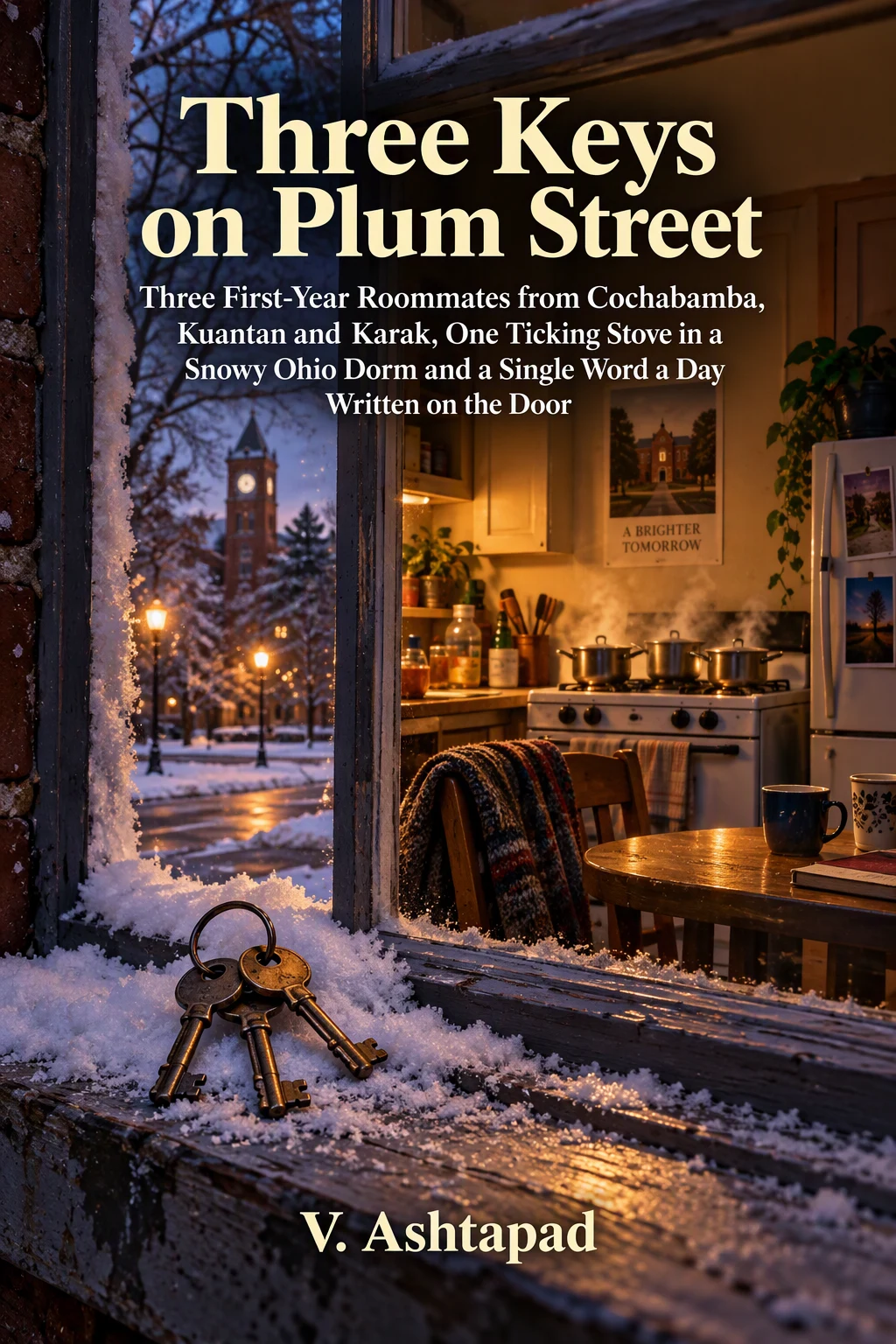
Three Keys on Plum Street
Three First-Year Roommates from Cochabamba, Kuantan and Karak, One Ticking Stove in a Snowy Ohio Dorm and a Single Word a Day Written on the Door
by V. Ashtapad
Foreword
This is a work of fiction. Salteñas, nasi lemak, mansaf and jameed, Bolivian New Year grapes and the other foods and customs in these pages are real traditions, described as faithfully as possible. The town of Garrow, Halloway College, the Plum Street house and its historical society, and every person and family in the story are invented.
For every student who arrived with a suitcase full of food and found someone to share it with.
Room 314
My mother packed two suitcases for me and one of them was mostly food.
I did not know this until the man at the Miami airport opened it. He lifted out a plastic tub of dried ají colorado, a bag of chuño my grandmother had insisted on, three packets of achiote, a jar of my aunt Rosa's llajua sealed with tape, and a wooden spoon with a burn mark on the handle that I had stirred with since I was nine. He looked at the spoon for a long time. Then he put everything back except the llajua, which had fresh tomato in it, and which he dropped into a gray bin with a sound I can still hear.
"Welcome to the United States," he said, and he meant it kindly.
So I arrived in Garrow, Ohio, with one jar fewer than I left Cochabamba with, and I was already counting losses on the bus from Columbus. The bus smelled of someone's orange and someone else's feet. Out the window the land was flat and green and enormous, corn standing in rows like a crowd waiting for an announcement, and every so often a white farmhouse with a flag and a barn the color of dried chili. I had seen Ohio in photographs on the college pages. I had not understood the sky. At home the mountains hold the sky up at the edges. Here nothing held it. It just went on.
Halloway College sits at the top of a small hill above the town, which is the only hill for miles, so everybody calls it the Hill as if it were a mountain. The buildings are red brick with white windows, and the trees on the quad are so old that their roots lift the sidewalks. A girl in a yellow shirt with a clipboard found my name, gave me a lanyard and a key, and said, "Wick Hall, third floor, you're in a triple, lucky you," in a voice that did not tell me whether lucky meant lucky.
A triple is a room built for two people with a third bed pushed in. I learned this by standing in the doorway of 314 with my suitcases and counting. Two beds against the long walls, one bed under the window, three desks, three narrow closets, a radiator painted so many times it looked soft. The window looked out on a parking lot and, past it, a water tower with HALLOWAY written on it in green letters.
Someone had already taken the bed by the left wall. On it was a quilt printed with small blue flowers. On the quilt sat a girl with her knees up, cupping her phone in two hands like a caught bird.
"Hi," she said, very quietly, and then louder, "Hi. Sorry. I'm Aisyah."
She said it *Ai-sha*, the stress at the front. She wore a soft gray scarf over her hair and a long cardigan the color of mint ice cream, though it was eighty-five degrees in that room. Her suitcase lay open on the floor. It was full of food too.
I saw that first. Before her face, before I saw she had been crying a little, I saw the food. A bag of dried red chilies. A dark block wrapped in three layers of plastic and then foil. Packets of coconut milk powder. A bundle of long, flat green leaves held with a rubber band.
"Ximena," I said, and pointed at myself. "From Bolivia. Cochabamba." Then I pointed at her suitcase. "They didn't take yours?"
She glanced at the suitcase, then up at me, and the corner of her mouth moved toward a smile. "They took my mother's sambal," she said. "They let me keep the chilies so I can make more. I think the man felt sorry."
"Mine took my aunt's llajua."
"What is llajua?"
"Hot sauce. Tomato, locoto, a little herb we have called quilquiña. You crush it on a stone." I made the motion, grinding, my fist on my palm. "Every table at home has it. It is not a meal without it."
"Sambal," she said, and made the same motion. "Same, same. *Lesung.* The stone."
That was the first word I learned from her, though neither of us called it trading yet. It was just two girls in a hot room making grinding motions with their hands.
She was from Kuantan, which she showed me on her phone: a city on the east coast of Malaysia, by the South China Sea, with a long beach and a river and a big blue mosque near the water. Her father was an engineer at a port. Her mother taught primary school. She had an older brother who worked in Kuala Lumpur and a younger sister who was, she said, the beautiful one, which I did not believe once I had seen her laugh. She was going to study chemistry. I was going to study environmental science, or maybe economics, or maybe both, I said, and she nodded as if this were a perfectly sensible amount of indecision.
"It's eight in the morning tomorrow in Kuantan," she said, looking at her phone. "Twelve hours. My mother is sleeping. I keep doing the math."
"I'm the same time as home," I told her. "Exactly. I checked on the plane."
She looked at me with real envy. "You can just call."
"I can just call," I said, and felt lucky for the first time since Miami.
We did not know who the third girl was. The housing letter had a name, Tala Qasem, and a country, Jordan, and nothing else. Aisyah had searched her name. She found a photograph of a girl in a white lab coat holding a ribbon from a science fair. "She looks serious," Aisyah said.
"Or she looks like someone who was told to look serious for the picture."
"Her flight was delayed," Aisyah said. "The girl with the clipboard told me. Frankfurt. She will come tomorrow, maybe."
The bed under the window was empty, the bare mattress striped blue and white. It looked like a question nobody had answered yet. I took the bed on the right wall because it was the only other choice, and I unpacked my clothes into the narrow closet. My mother had folded everything into little squares. When I lifted out my sweaters, a photograph fell from between them: my whole family at my grandmother's table in Tiquipaya, all eleven of us squeezed around one big plate of pique macho, my grandfather holding up his glass, my cousin Joaquín making horns behind my head. My mother had written on the back in pencil: *so you don't forget what noise sounds like.*
I sat on the bed and held it. Aisyah did not ask me anything. She just got up, went to her suitcase, and came back with a small packet of something wrapped in a printed paper.
"Kuih," she said. "Biscuit. My aunt made. Too sweet. Eat."
It was sweet and crumbly and tasted of coconut and something like smoke. I ate it over the photograph so no crumbs would fall. Then I ate another. Aisyah sat back down on her flowered quilt. We were quiet together, and it did not feel like waiting.
That evening we went to find the kitchen.
The housing letter said every floor of Wick Hall had a kitchen. It was true the way letters are true. At the end of the third-floor hallway, past the bathrooms and a board of flyers for a cappella auditions, was a room the size of my mother's pantry. A refrigerator with a sign in thick black marker: LABEL YOUR FOOD OR IT WILL BE THROWN AWAY SUNDAY. A microwave with a dark yellow stain inside the door. An electric stove with four coils. When Aisyah turned one on, it began to tick like a clock with something to say. A sink. One pot with no lid. A frying pan so thin you could see light through the scratches.
Aisyah and I stood in it the way you stand in a stranger's house.
"We can make this work," she said.
"With what?"
She opened the cabinet under the sink. Nothing. She opened the one above the microwave and found paper plates and a cheese grater. She held up the cheese grater. I started laughing and could not stop. Then she was laughing too, a high bright laugh that did not match her quiet voice. A boy walking past looked in at us and kept walking, fast.
"Tomorrow," Aisyah said when she could breathe. "We go to the town. We buy a pot."
"Two pots."
"Two pots. And a rice cooker."
"I don't know how to use a rice cooker."
She looked at me with an expression I would learn by heart before spring, a mixture of pity and delight. "Ximena," she said. "Everyone knows how to use a rice cooker."
That night I called my mother. It was nine thirty in Ohio and nine thirty in Cochabamba. Behind her the television was going, my father arguing with it, the dog barking at my father. My mother wanted to know everything. Was the room clean. Was the bed firm. Were there Bolivians. Had I eaten, and what. Was the roommate nice.
"One is nice," I said. "One hasn't come yet."
"What do they eat?"
"The nice one eats rice. She brought chilies."
My mother made a satisfied sound, as if this settled the girl's character. "Good," she said. "People who bring chilies across the ocean know what matters."
Last thing that night, I opened the family pages my aunt Rosa keeps for all of us. She had added a new photograph that day: my grandmother at the stove in Tiquipaya. Under it Rosa had typed, *Mamá Clara at the stove, 23 August, first Sunday without our Ximena.* My cousin had already commented: *Too much cumin.* My grandmother cannot type. She had dictated a reply to someone: *Never.*
Across the room Aisyah was whispering into her phone in Malay, the words soft and running together. It was morning there. I heard a word that sounded like *Mak*. She laughed. Then she was quiet, listening, for a long time.
The empty bed under the window caught the light from the parking lot. I fell asleep looking at it.
© 2026 CRUNOD LLC. All rights reserved.
Seven in the Morning, Seven at Night
In Kuantan my mother's call comes at the end of her day. In Garrow it comes at the start of mine. I learned to wake for it before my alarm. Seven in the morning in Ohio, seven at night at home. The sky outside my window goes from black to the gray of wet newspaper. On my phone the light behind my mother's head turns orange from the kitchen lamp.
That first week I could not sleep at the right times. My body was still on the other side of the world. At three in the afternoon a professor with a beard drew molecules on the board, and my head fell forward like a heavy flower. I jerked it back up. At three in the morning I was wide awake on my flowered quilt. I listened to Ximena breathe. I listened to the radiator knock, though it was not yet on. Ximena said that was the building remembering winter.
I would hold my phone and think about calling. I would do the math and not call. Three in the morning here was three in the afternoon there. My mother would be in front of her nine-year-olds, telling them about the life cycle of the frog.
So I would open the recordings instead.
Before I left, my brother Hakim sat with Opah, our grandmother, in her house in Pekan with the windows open to the river. He asked if he could record her making nasi lemak. She said yes, if he did not use the part where she complained about my aunt. He promised. He put the phone on the table beside the bowl of shallots and let it run for forty minutes. Then he added it to the family pages. My mother keeps photographs of all of us there, labeled with names and years, so the little cousins will know which great-uncle is which. Hakim titled it, in his terrible spelling, *Opah Nasi Lemak Masterclass Do Not Share.*
I had listened to it so many times on the plane that I knew where the pauses were. Where the rooster crowed outside her window. Where she stopped to shout at the cat. Where she said, in her soft Pahang voice, "The rice must smell like it is happy. If it smells sad, start again." I knew the small dry squeak of the pandan leaves being knotted. I knew the part where she laughed and said the sambal is the soul and the rice is just the body. The body can be any body. The soul must be correct.
At three in the morning in Wick Hall, my grandmother told me how to make the soul of something. Then I could sleep.
On Saturday, Ximena and I walked down the Hill into the town to buy pots.
Garrow is one long main street, a courthouse at one end and a grain elevator at the other. As if the town were a sentence and those were its capital letter and its period. In between: a hardware store with a wooden floor, a diner with red plastic booths, a bank, a stone library, a shop that sells only candles, a white steeple, a pizza place. And a small grocery called Hendley's, there since 1931, the sign says. The air was cut grass and something sweet and burnt. Ximena traced it to a kettle corn cart outside the courthouse.
In the hardware store we bought two pots, one with a lid. A wooden cutting board. A knife the old man at the register told us very seriously not to put in the dishwasher. And a gray granite mortar and pestle, the only one he had. He took it down from a high shelf and blew the dust off.
"Don't get many calls for these," he said.
"You will now," Ximena told him, and he laughed, a big laugh that shook his belly under his apron.
We found the rice cooker at a store out by the highway, a half-hour walk past a car wash and a field Ximena said was soybeans. It was white and small and had one button. Ximena kept pressing it to see what it did. I took it away from her.
Hendley's did not have pandan. It did not have belacan, the shrimp paste I had wrapped in three layers of plastic and then foil. That was on a shelf in our closet, still wrapped. Ximena had said, reasonably, that if it smelled the way I described, she would prefer to meet it outdoors. No dried anchovies. No tamarind. But it had coconut milk in cans, and I was so happy I bought six. It had shallots, small and pale beside ours but still shallots. It had eggs and cucumbers and peanuts in their red skins.
"What else?" Ximena asked, pushing the cart.
"Anchovies. Ikan bilis. Small dried fish."
She looked down the long aisle of cereal boxes, each one brighter than the last. "Aisyah," she said gently, "I don't think Ohio has small dried fish."
But there was a shop. A girl on our floor named Kenzie, who was from Dayton and had a nose ring and a laugh like a car horn, told us about it when she found us in the kitchen that night unpacking our bags. "There's an Asian market in Fairbridge," she said. "Twenty minutes. My mom goes for the dumplings. You could take the county bus, or I'll drive you, I don't care, I want dumplings."
So on Sunday Kenzie drove us in her mother's old car with the cracked dashboard. We stopped at a long low building between a tire shop and a tax office. Inside it smelled like home. There is no better way to put it. Dried shrimp and star anise and wet cardboard and the cold breath of the freezer section. Sacks of jasmine rice taller than my sister. A whole shelf of chili sauce. Pandan, frozen, in flat green packets. A bag of ikan bilis with the heads still on. And a small Malaysian flag stuck to the end of one shelf. The owner, a Vietnamese man named Mr. Tran, told me he had once had a Malaysian wife. He kept the flag up after she passed.
I bought the ikan bilis. I bought the pandan. I bought tamarind in a sticky brown block. I stood at the register and held the bag against my chest.
"You all right?" Kenzie asked.
"Yes," I said. "I am just very happy about fish."
Ximena put her arm through mine on the way back to the car. She had bought frozen corn she said was almost the right kind of corn, and a jar of yellow chili paste that was almost the right kind of yellow. She was humming under her breath in Spanish, a song with a rhythm that made you walk faster.
"What is that song?"
"A morenada," she said. "For Carnaval. My cousins dance it. You'd hate it, it's very loud."
"I don't hate loud."
"You whisper on the phone so you won't wake me."
"That is not the same thing."
She thought about it. "No," she agreed. "It isn't."
That night I held the phone up so my mother could see my desk. The coconut milk lined up like soldiers. The pandan in its packet. The fish. She pressed her fingers to her lips and kept them there. My father leaned in behind her, still in his work shirt from the port. "So she will survive."
"She will survive," my mother said, and then, to me, "Have you met the third one yet?"
"No, Mak. Her plane is late again. Maybe Tuesday."
"Be kind to her," my mother said. "She will be the one coming into a room where two people already know each other. That is the hardest place to come into."
I said I would. I meant it. But I did not yet understand what she meant, because I had not yet been the one walking in.
After the call I put the pandan in the freezer. I labeled it with tape and a marker: AISYAH, 314, PLEASE DO NOT THROW AWAY, IT IS A LEAF. Ximena read it over my shoulder and added underneath, in her slanting hand, *it is a very important leaf.*
© 2026 CRUNOD LLC. All rights reserved.
The Bed Under the Window
I arrived on a Tuesday at eleven at night, after thirty-one hours of traveling. The first thing I saw in my new room was two girls asleep and a jar of chili paste on my desk.
I want to be fair. They did not know my desk was my desk. Nothing in the room had my name on it. For five days I was stuck, first in Amman, then in Frankfurt, and the third desk had become a shared table. On it were the chili paste, a rice cooker, a stone bowl with a stone stick in it, chemistry handouts, two mugs, and a bag of red-skinned peanuts. I stood in the doorway with my suitcase and my backpack. My mother's voice was in my head. *Don't be difficult, Tala, be easy, people like girls who are easy to live with.* I did not move anything. I set my suitcase down quietly and sat on the bare mattress under the window. The parking lot lights came in orange through the blinds and made stripes on my knees.
One of them sat up. She had long dark hair tangled across her face and she pushed it back and squinted at me.
"Tala?" she said.
"Yes. Sorry. Hello."
"Oh," she said. Then she was out of bed and across the room and hugging me. No stranger had ever done that to me in my life. She smelled of coconut and fried onion. She said into my shoulder, "You made it. We were so worried. I'm Ximena. That's Aisyah. Aisyah. *Aisyah.* She's here."
The other one sat up slowly, a scarf around her shoulders like a shawl. "Hello, Tala." Her voice was soft. "Are you hungry? You must be hungry."
I had eaten a sandwich in Chicago that had tasted like a damp towel. I said I was fine.
Aisyah got up anyway. There was a small refrigerator under the window that I had not noticed. She took out a plastic container and put it in a microwave I had also not noticed, on a shelf in the corner. In two minutes she handed me a bowl of rice. It was pale and glossy and smelled of something green and sweet. There was a spoonful of dark red sauce on the side, and a few tiny fried fish arranged on top like decorations on a cake.
"Nasi lemak," she said. "Not good. The coconut milk was from a can. But it is food."
I ate it on the bare mattress at eleven at night in Ohio. The sauce was so hot my eyes ran. The rice was soft and rich. The little fish crunched like chips. I thought I might cry for the first time since Queen Alia airport. I did not. Two strangers were watching me, and my mother had said to be easy.
"It's very good," I said. "Thank you."
"She's lying," Ximena told Aisyah. "Look, she's crying from the sambal."
"I'm not crying."
"It's all right," Aisyah said. "Everyone cries from my sambal. My father cries every Sunday."
Later they helped me make my bed with the sheets my mother had packed. They were white and ironed and still smelled of our house in Karak, of soap and the cardamom my mother keeps in a jar by the stove. The lights went off again. They were both asleep within minutes. I lay looking at the ceiling.
It was seven in the morning in Jordan. My father would be drinking his coffee on the balcony, looking out at the castle on the hill. My brother Yazan would be pretending to be sick to get out of school. My grandfather, my sido, would already be awake. He always is. He would be in his chair at the front-room window with the radio murmuring, turning his prayer beads through his fingers. Not because he is praying. His hands like to have something to do.
I sent my mother a message saying I had arrived and the roommates were kind and there was food. She sent back a photograph of the castle in the morning sun and three hearts and the words *sleep now.*
I did not sleep. I listened to the building. American buildings make a great many sounds. Doors closing far away. Water in the pipes. A boy laughing somewhere below. And the two girls breathing, one slow and one fast. They were already a pair. Their things were already mixed together on the desk that was supposed to be mine. Ximena had said *we were so worried*, as if the two of them were a we and I was something that had happened to them.
That was not fair either. They had been kind. But I was the one who was late. In my family, if you are late to a gathering, you take the last seat and you listen.
In the morning they had already cleared the desk. The shower took me ten minutes to understand. When I came back, the chili paste and the rice cooker and the stone bowl were on a shelf above the window. The desk was wiped clean. A sticky note on it said, in two handwritings: *YOURS. SORRY.* and *we are animals.*
I laughed out loud in the empty room.
The first week was orientation for me, alone, because I had missed everyone else's. A woman in the international office named Mrs. Okafor sat with me for an hour and went through every form. She wore bright green glasses. Her desk was covered in photographs of students from every country I could name and some I could not. She pulled up the office's records and showed me where they kept everything. My arrival. My emergency contacts. The other international students on my floor. The dates of the host-family dinners for Thanksgiving. A sign-up list of volunteer drivers who took students to the grocery store on Saturdays. "And if you want," she said, turning the screen toward me, "there's a place where students record a short story about home, in their own voice, for the incoming class. Only if you want. Nobody has to."
"What kind of story?"
"Anything. What your street sounds like in the morning. What your grandmother cooks. One boy from Ghana last year just talked about his bicycle for six minutes." She smiled. "It was the most popular one."
I told her I would think about it.
I was studying biology. I wanted to be a doctor. My father wanted me to be a doctor. My grandfather wanted me to be a doctor and come home and treat his knees. Three of us wanted it, which in my family counts as a decision. My first class was at eight in the morning in a hall of three hundred people. The professor talked so fast I wrote half of every word. I filled in the rest at night at my clean desk with my headphones on, while Ximena talked to her mother on the phone and Aisyah whispered to hers.
I called my mother at noon, between classes. Noon in Ohio is seven in the evening in Jordan, the hour when everyone is home and the kitchen is full. I would find a bench on the quad under one of the old trees. I would hold the phone up, and my mother would turn hers around so I could see everyone. My father. Yazan. My aunt Nadia, who lives downstairs. Sometimes my cousin Hiba with her baby on her hip. And in the corner, in his chair, my sido.
"Where is the snow?" Sido asked every time. He had decided America was a place of permanent snow. Nothing I said could correct him.
"It's September, Sido. It's hot."
"It will come." He was satisfied, like a man told a war is coming who has already dug the trench.
On the fourth day I came back to the room and found Ximena and Aisyah on the floor, a sheet of paper between them, writing words. They looked up, guilty.
"We're making a list," Aisyah said. "Of words."
"In Spanish and Malay," Ximena said. "So we can say things to each other. Stupid things. *Hungry. Tired. Shut up.*"
"*Shut up* is very important," said Aisyah.
I stood over them and looked at the paper. Two columns. Ximena's slanting hand on the left, Aisyah's careful round one on the right.
"Do you want to add a column?" Ximena asked.
It was such a small question. I have thought about it many times since. She did not say it the way you offer a chair because you have to. She held the pen up to me and waited. Her face said she really did not know what I would say, and would accept it either way.
I sat down on the floor between them. I took the pen. At the top of a third column I wrote *Arabic*, and then I sat there, because I could not think of a single word.
"Start with *hungry*," Aisyah suggested.
"No," I said. "Start with *come.*" I wrote it, in English letters, the way my mother says it at seven in the evening when the food is on the table and everyone is still on their phones. "*Yalla.* It means come, hurry, let's go. It means everything."
Ximena tried it. "*Yalla.*"
"Not bad."
Aisyah tried it. "*Yalla.*"
"Better," I said, and Ximena threw a pen at her, and that was the start.
© 2026 CRUNOD LLC. All rights reserved.
A Word on the Door
Every door in Wick Hall has a small whiteboard screwed to it at eye level, so that people can leave messages. Most of them say things like *Jake call your mom* or have drawings on them that the resident advisor erases every Monday with a sigh. Ours, by the second week of September, had a word on it.
The first one was mine, because I had the marker.
*CHUTA*, I wrote, and underneath, smaller: *Bolivian. When you fumble your phone, when you miss the bus, when you see the price of strawberries at Hendley's. Not a bad word. Almost a bad word.*
The next morning there was a second word under it in Aisyah's round letters.
*LEPAK. Malay. To sit around with friends doing nothing, happily. Example: what we did all Saturday.*
The morning after that came Tala's handwriting. It is small and straight and leans a little backward, as if each letter were stepping away from the edge of a roof.
*SAHTEIN. Arabic. What you say to someone who is eating. It means two healths. The one who is eating has an answer, but the answer is two words and that is against the rule.*
We had made the rule the night before, lying in the dark. One word at a time. One word a day. No sentences. A sentence, Aisyah said, is a class. A word is a present.
People began to stop at our door. We had not expected that. Felix from the end of the hall stopped one morning with his coffee. He was tall, played the cello, and wore the same green sweater every day. "What's *lepak*?" Aisyah came out and explained. "I've been doing that my whole life and I didn't know it had a name." He walked away looking happier than I had ever seen a person look at eight in the morning.
Kenzie added a word without asking. Under *sahtein*, in purple marker, she wrote: *POP. Ohio. A soda. If you call it soda people will know you are not from here.*
Tala read it and frowned. "Is this true?"
"It's sacred," Kenzie said, leaning in her doorway across the hall. "My grandpa would disown me."
So we left it. It seemed right. It was her word, and her grandfather's.
What I remember most about the door, though, is not the words. It is how we chose them. Every night, one of us had to decide what to write the next morning, and it became a kind of listening. You had to pay attention to the other two all day to know what word they needed. When Tala came back from her chemistry lab with her shoulders up around her ears because her lab partner had done nothing and taken credit for everything, Aisyah wrote *GERAM* on the door the next morning. *Malay. The feeling of wanting to squeeze something very hard because you are angry. Or because it is very cute. Same word.* Tala stood in front of it in her bathrobe and laughed for so long that Kenzie came out to see.
When I failed my first economics quiz, which I had not believed was possible, and lay on my bed with my face in the pillow for an hour, Tala wrote *SABR* in the morning. *Arabic. Patience. The kind that holds on.* And underneath, smaller, not as part of the word, *you are better than the quiz.*
I took a picture of that one and sent it to my aunt Rosa, who added it to our family pages under a new heading she made for me called *Ximena in Ohio*, between a photograph of me at the Miami airport looking miserable and one of the rice cooker. My grandmother, Rosa told me later, made her read it out loud twice and then said that the Jordanian girl had good sense and should come to Tiquipaya and teach patience to my cousin Joaquín.
The words on the door changed every day. The list in the room grew. It lived on the wall above the third desk now, taped up in three long strips of paper, then four, then more, three columns climbing toward the ceiling. Some words we used so much they stopped feeling foreign. *Yalla* first of all. *Yalla* when we were late for the dining hall. *Yalla* when the microwave beeped. *Yalla* when one of us was taking too long in the bathroom. My *ya* became how all three of us said *fine, all right, I heard you, stop*. Aisyah's *sedap* became the only word anyone was allowed to use about food.
We did not learn languages. That was never what it was. We learned each other in small pieces, a piece a day, written on a door.
© 2026 CRUNOD LLC. All rights reserved.
What Went in the Trash
The worst thing I did that year, I did with good intentions and a paper towel.
It was the first Friday in October. The trees on the quad had started to turn, one at a time, as if each were making up its own mind. The maple outside our window had gone a red so bright it looked wet. Mornings now had a coldness that made my nose run on the walk to my eight o'clock. Aisyah had started wearing two cardigans. Ximena had started saying *invierno* with a dark look, like the name of a relative coming to stay.
I came back from the library at four wanting only something cold. In Karak, in my grandmother's time and still in my mother's, there is always a bowl of laban in the refrigerator, thin yogurt with a little salt. When you come in from the heat you drink a glass standing at the open door while your mother tells you to close it. I had found a plain yogurt at Hendley's that was almost right with water and salt stirred in. I had made a jar that morning. All I wanted in the world was that jar.
Our little refrigerator under the window was full. It was always full. It was the size of a suitcase, and the three of us had been fighting over it politely since September. My jar was wedged at the back behind a large plastic container I did not recognize.
I took the container out. Inside was something brown and pale and solid, with meat and potato and green peas trapped in it like insects in amber. The surface was cloudy. It wobbled when I tilted it. No label. It smelled of cumin and onion and something sweetish, and cold fat.
I want to explain what I thought, because I have explained it to myself many times. In my mother's kitchen, meat that has gone to jelly in the refrigerator is meat that has been forgotten. When I was eleven my sido ate a plate of leftover lamb that had sat too long, and he was sick for three days, and my mother, who is not a dramatic woman, stood by his bed and cried, and after that our house had a rule. Nothing older than two days. Nothing that has changed its shape. When in doubt, it goes.
This had changed its shape. I had never seen it before. I did not think of Ximena at all, or only as the person who was always leaving things in the refrigerator. I thought someone had forgotten it. I thought of my grandfather in bed. I tipped the whole thing into the trash bag by the door. I scraped the container clean with a paper towel and washed it in the bathroom sink. Then I drank my laban at the window feeling, I admit, a little proud of myself for taking care of things.
Ximena came back at six.
I heard her before I saw her, singing in the hallway, something with a lot of *ay* in it. She came in with her backpack over one shoulder and a bag from Hendley's. "Okay, tomorrow, nobody touch the oven in the kitchen from nine o'clock, I need it for two hours." She went straight to the refrigerator.
She knelt there for a long time.
"Where is it?" she said.
"Where is what?"
"The jigote. The filling. In the big container." She was taking things out now, Aisyah's coconut milk, my yogurt, a bag of carrots. "It was right here. In the front."
I felt the cold go through me then. It started in my stomach. "Was it brown?" I said. "With peas?"
She turned around on her knees and looked at me.
"I threw it away," I said. "I'm sorry. I thought it was old. It had no label. It had gone to jelly. I thought someone forgot it."
For a moment she was silent. Then she stood up fast and went to the trash bag by the door and looked in. I watched her see it. The brown mess at the bottom. My paper towels on top. The morning's coffee grounds. An apple core of Aisyah's.
"It's supposed to be jelly." Her voice was very quiet, much quieter than Ximena's voice ever was. "That is the whole point. You make the stew with gelatin so it sets in the cold. Then you can fold it into the dough. When you bake it, it melts again, and the inside is full of soup. That is what a salteña is. Soup inside bread. If it doesn't set you can't close them. I made it last night. It took four hours. I used my grandmother's recipe that my aunt wrote out for me. I went to Fairbridge on the bus for the ají. The beef was eleven dollars."
"I didn't know."
"Tomorrow is my grandmother's birthday. Eighty. Everybody is going to Tiquipaya. They are all going to eat salteñas at ten in the morning. That's ten in the morning here also, the same time, I checked. I was going to make them too, and we were going to eat them together on the phone. Me in the kitchen and them in her garden. I told her. She told everyone."
"Ximena. I'm so sorry."
"You didn't ask." She was not shouting. I almost wished she would. "There are three of us. You could have sent a message. Two seconds. *Whose is this?* You didn't even think it might be mine."
That was true. That was the part I could not answer. I had not thought of her. I had thought of my own house and my own grandfather and my mother's rule. I had not once looked up from my own life long enough to wonder whose life the container belonged to.
She sat down on her bed with her coat still on. She did not cry. She took out her phone, glanced at the screen, and put it away again.
I sat on my bed across from her. The radiator had finally been turned on that week. It clanked twice, like someone knocking to be let in.
My mother would have told me to apologize again, make her tea, move on. Be easy. But I had already apologized twice. My apology was not the thing she needed. It was the right word, but it was my word. It was a word that made me feel better.
So I did something I do not usually do. I waited. When the silence was almost unbearable, I said, "Will you tell me about it? The salteña. How your grandmother makes it."
She looked up at me with suspicion.
"I really want to know," I said. "I threw it away without knowing what it was. I don't want to not know anymore."
She was quiet. Then she said, slowly, "It starts the day before."
And she told me. Her grandmother Clara starts the jigote at noon on Saturday, in the big aluminum pot that is older than Ximena's mother. She browns the onions so slowly you think nothing is happening. Then the ají colorado, the cumin, the oregano, a little sugar. The beef is cut by hand, never ground, into pieces the size of your smallest fingernail. The potatoes are cooked separately so they hold together. The peas go in at the end. The gelatin is dissolved in the broth while it is hot. Then the whole pot is carried out to the cold back room and left overnight. In the morning it is a block you can cut with a knife. The dough is made with lard and a little sugar and colored with achiote so it bakes golden orange. Each salteña gets jigote, a slice of hard-boiled egg, one black olive with the pit in so you have to be careful, and one raisin. Always one raisin. You close them with a braid along the top called the repulgue, pinching and folding with your thumb. Her grandmother can do it in nine seconds. Ximena takes forty.
"And then you eat them in the morning," she said. "Never at night. Midmorning. Ten, eleven. Standing up, or at the table, holding it up in your hand like this." She held an invisible salteña upright between her fingers. "You bite the corner and you drink the soup out. If you spill on your shirt, your whole family laughs at you. If you use a spoon, they laugh more."
"Why is it the morning?"
"I don't know," she said. "Because it is. Because it's what Saturdays smell like."
I understood that. It is hard to explain how much, to anyone not from a family like ours. Mansaf is a Friday. It is a wedding, a funeral, a son home from the army, a guest you want to honor. It is every important thing. But in my head it is Friday. The smell of jameed boiling in the big pot in my aunt's kitchen downstairs, drifting up the stairwell while I do my homework. My father and my uncles in the front room arguing about football. If someone had thrown my mansaf in the trash on a day that mattered, I would not have been as quiet as Ximena was.
"Can we make it again? Tonight. Now. I'll pay for the beef. I'll do whatever you say. I'll cut the onions."
"It has to set overnight."
"It's six o'clock. We have the night."
"The ají is in the trash."
"Is there more in Fairbridge?"
She looked at the window, which was already darkening. "The bus stops at seven."
"Kenzie," I said. "Kenzie wants dumplings. Kenzie always wants dumplings."
Ximena looked at me for a long moment. I think she was weighing whether I meant it. Or whether I was just being easy, saying the polite thing so the bad feeling would stop. I tried to let her see that I meant it. I did not look away.
Aisyah came in then, her chemistry book against her chest. She saw us both on our beds in our coats with the trash bag open between us.
"What happened?" she said.
"Tala threw away my grandmother's birthday," said Ximena.
"I did," I said. "And now we're going to Fairbridge."
Aisyah's eyes went from my face to Ximena's and back. Then she put her book down, picked up her coat, said "*Yalla*," and went across the hall to knock on Kenzie's door.
We cooked until two in the morning in the third-floor kitchen. I cut a mountain of onions. Ximena stood at the stove with her wooden spoon, the one with the burn mark, and stirred. She told me when to add the cumin and when not to. Once she slapped my hand when I tried to taste too early. Aisyah boiled the potatoes in the pot with the lid and peeled two dozen eggs. Kenzie ate dumplings out of a bag and kept us company and fell asleep on the kitchen floor with her head on her backpack. At one point Felix came in for water and stayed an hour, peeling eggs. He told us about his grandmother in Toledo who made pierogi every Christmas and had never once written the recipe down.
"You should get her to," Aisyah said. "Record her, even. Just talking. If she doesn't mind."
"She'd love that." Felix said it slowly, like a man finding a room in his own house. "She'd talk for nine hours."
When the jigote was finished, Ximena poured it into the clean container I had scraped that afternoon. She wrote on a piece of tape, in big letters, *XIMENA. SALTEÑA FILLING. IT IS SUPPOSED TO LOOK LIKE THIS.* Then she handed me the marker.
I wrote underneath, *I promise.* I set it at the very back of the refrigerator myself. I moved my own jar of laban to the front.
© 2026 CRUNOD LLC. All rights reserved.
Salteñas at Ten
I set an alarm for six. When it went off, Tala was already awake on her bed with her knees up, watching the refrigerator as if it might run away.
"I checked," she whispered. "It's jelly."
"Good jelly or bad jelly?"
"I don't know. You have to tell me. I don't know the difference anymore."
We went down the hall in our socks, the container between us like something holy. The kitchen was cold and gray and smelled faintly of popcorn somebody had burned at midnight. Kenzie's backpack was still on the floor. I opened the lid and pressed a finger into the jigote. It held. It gave a little and came back, like the skin of a ripe fruit. The beef and potato sat suspended in it, golden brown, the way they sit in my grandmother's pot in the cold back room in Tiquipaya. I made a sound I did not know I was going to make.
"Good jelly," said Tala.
"Good jelly."
I had never made the dough alone. I had always been the one handing things to my grandmother. The egg, the flour, the bowl of warm lard. She worked and told me to stop eating the raisins. I had the recipe on my phone, the one Rosa wrote out from my grandmother's dictation. Rosa's notes were in the margins: *she says a little more sugar but she means a lot more* and *DON'T let the lard boil*. I melted the lard with the achiote until it turned the color of sunset. I made the well in the flour. I poured it in and it hissed. Aisyah came in at seven, hair still wet, sleeves already pushed up. The two of them kneaded beside me, taking turns. I watched the dough go from shaggy to smooth to something that felt, under my palm, like the inside of my grandmother's wrist.
At nine we rolled it out into circles the size of saucers. Nobody had a rolling pin, so we used a wine bottle Kenzie had found somewhere and washed. Then the filling. One spoon of jigote, cold and trembling, in the center of each circle. One slice of egg. One olive. One raisin. Tala put two raisins in her first one. I took one out. She looked at me. "Always one," I said. She nodded like a student and did not do it again.
Then the repulgue. My hands shook. Fold the dough over the filling. Press the edges together along the top. Then braid it, pinching and turning, so a little rope of dough runs along the seam like the spine of a dragon. My first took almost a minute and leaked at one end. My second was better. By my sixth I could feel my grandmother's hands in mine. Not because I remembered them. My fingers knew something my head had forgotten. Aisyah made a braid so neat and tight it looked machine-made. Tala made something that looked, she said herself, like a caterpillar that had been in an accident.
"It's perfect," I told her.
"It is not perfect."
"It's perfect because it's closed. Closed is all that matters. If it is closed, the soup stays in."
The oven in the third-floor kitchen was hot on the left side and not on the right. We found out at nine forty, when the first tray came out half dark brown and half pale. So we turned the tray every four minutes. Aisyah held the timer and called *turn*. Tala opened the oven door. I turned the tray with a dish towel around my hand. The kitchen filled with the exact smell of a Saturday in Cochabamba. I had to go out into the hallway for a minute and stand by the bulletin board and breathe.
When I came back in, there were people.
Felix in his green sweater. Kenzie, her hair flat on one side from the pillow. A girl named Priya from the second floor who said she had smelled it from the stairs. And Devon, our resident advisor, a tall thin junior with glasses who always worried we would set something on fire. He held a coffee and looked at the oven with suspicion and hope.
At nine fifty-eight, I called my family.
They were in my grandmother's garden in Tiquipaya under the big molle tree. All of them, more than all of them: uncles, cousins, cousins' children, two neighbors, the woman who sells flowers by the plaza. My aunt Rosa held the phone up high so I could see the long table with the blue tablecloth. On it were platters of salteñas, dozens, golden and glossy, standing upright in rows like little soldiers. In the middle, in a chair with a cushion, sat my grandmother. She wore a pink shawl I had never seen, and her hair was done up for the occasion.
"Mamá Clara," I said, and wished her a happy birthday in Spanish. That takes two words. That morning I didn't care about the rule.
"Where are yours?" she said immediately.
I turned the phone around. Our tray was on the counter, twenty-two salteñas, some dark, some pale, one leaking, one shaped like a damaged caterpillar. Behind them stood Tala and Aisyah and Kenzie and Felix and Priya and Devon, all crowded into a kitchen the size of a pantry, holding paper plates. My grandmother leaned forward. She looked for a long time. I waited for her to say something about the color, or the braid, or the leaking one.
"Who made the ugly one?" she asked.
Tala raised her hand.
"Good," said my grandmother. "Ugly ones taste best. Everybody knows. Now eat, before they get cold, *yalla*."
I stared at the phone. Behind my grandmother, my aunt Rosa was laughing so hard she had to lean on the tree.
"I told her," Rosa said. "About the door. The words. She's been saying it all week. She says it to the dog."
So at ten in the morning in Garrow, Ohio, and ten in the morning in Tiquipaya, Bolivia, two kitchens ate salteñas together. I showed everyone in ours how to hold them upright and bite the corner and drink. Felix spilled on his sweater immediately and everyone in both countries laughed at him. Kenzie used a spoon, and my cousin Joaquín, on the other end, put his face in his hands. Priya closed her eyes after the first sip of soup and said nothing at all, which my grandmother said was the correct response. Devon ate three and stopped worrying about fire.
Tala ate the ugly one. She held it up carefully, the way I had shown her. She bit the corner and drank and did not spill. Her eyes found mine over the top of it. I don't know what my face was doing.
"*Sedap*," she said, which was Aisyah's word, which she had borrowed for me.
My grandmother, on the phone, pointed at her and said to the whole garden, "That one. That one has sense."
Afterward my aunt put the recording of the call on the family pages, with the photographs Felix took. She labeled them carefully, *Mamá Clara 80, Tiquipaya and Ohio, 3 October*, with all our names, even Devon's, spelled right. My mother told me later that my grandmother asks to watch it every Sunday. She likes the part where Felix spills.
© 2026 CRUNOD LLC. All rights reserved.
The Night of the Sambal
There is a reason Opah makes her sambal in the yard.
I knew this. I had known it my whole life. In Pekan the sambal is made on a low gas ring on the cement behind the kitchen, under the rambutan tree. Toast belacan and fry ground chilies in oil, and the smoke goes into your eyes and your throat and your hair. Into the curtains, the neighbor's house, the neighbor's cat, the cat's kittens. In our apartment in Kuantan my mother makes it with every window open, the fan on high, a towel pushed under the door to the living room. Still my father coughs and says, with love, that he will smell it at work tomorrow.
I knew this. And still, on the twenty-second of October, at ten forty at night, I made sambal in the third-floor kitchen of Wick Hall with the door closed.
I want to say it was because of midterms. That is partly true. Tala had her organic chemistry exam at eight the next morning. She had eaten nothing all day but an apple and four cups of coffee. She was on the floor of our room surrounded by flash cards, like someone trying to hold water in her hands. Ximena had a paper due at midnight and was typing so hard the desk shook. I had finished my own exam that afternoon. I felt light and useless. I wanted to do something for them, and what I know how to do for people is feed them nasi lemak.
So I went to the kitchen with the bag from Mr. Tran's market. Rice in the rice cooker with the coconut milk, a pinch of salt, two knotted pandan leaves. I pressed the button. In ten minutes the kitchen smelled the way Opah said it should, like rice that is happy. I fried the peanuts in their red skins until they popped. I fried the ikan bilis until they curled and went golden and laid them on paper towels. I boiled eggs. I sliced cucumber. I did all this with the door open, and everything was fine.
Then I unwrapped the belacan.
It had been in our closet since August in its three layers of plastic and its foil. When I peeled the last layer back, the smell came out like an animal that had been waiting. The sea. A fish market at the end of a hot day. Something old and deep and salty. In a Malaysian kitchen it is the smell of a meal about to happen. In a kitchen in Ohio, I understood quickly, it was the smell of a problem.
Felix walked past and stopped in the doorway. "What," he said, and then just stood there with his mouth open.
"It's shrimp paste," I said. "It gets better."
He backed away down the hall. I closed the door so I would not bother anyone. That was the mistake. I set a dry pan on the ticking burner and toasted the belacan until it crumbled. I poured oil into the bigger pot. In went the ground chilies and the shallots, which I had pounded in the granite mortar until my arm ached. The mixture hit the hot oil with a roar.
The smoke was red. I have no other word for it. It rose out of the pot in a thick cloud and went straight for the ceiling. On the ceiling was a small white disk with a green light. The green light turned red.
The alarm in Wick Hall is not a beep. It is a long, rising, electronic scream. In between, a woman's recorded voice says calmly, *An emergency has been reported in the building. Please leave the building by the nearest exit.* It went off on every floor at once. Doors banged open all down the hall. Someone shouted. The woman's voice again. Then Devon, much less calm: *Everybody out, everybody, right now, leave it, leave it.*
I turned off the burner. I picked up the pot of sambal, because my hands decided before I did. I carried it down three flights of stairs and out the side door to the parking lot. Two hundred people stood there in the cold in pajamas and sweatpants and towels, looking up at the building. One by one, as the smell reached them, they looked at me.
It was thirty-eight degrees. Some people had no shoes. A boy from the second floor had shampoo in his hair. Tala came out with her flash cards still in her hand. Ximena came out clutching her laptop like a baby. They found me under a light pole holding a pot of red chili paste.
"Aisyah," said Ximena.
"I know."
"Aisyah, what did you do?"
"I made sambal."
Tala looked at the pot. She looked at me. She looked up at the building, where the alarm was still screaming and lights were coming on in every window. Then she started to laugh. She laughed so hard her flash cards fell all over the parking lot. Ximena bent to pick them up and started laughing too. I stood there with the pot, my face burning in the cold.
Two fire trucks came from Garrow with their lights going. A firefighter in a big coat went in and came out ten minutes later and spoke to Devon. Devon stood in front of everyone with his arms wrapped around himself, nodding and nodding. Then he turned and looked straight at me.
Not everyone laughed. I should say that plainly. A girl from the fourth floor named Brooke, who was in a nursing program and had a clinical shift at the hospital in Fairbridge at six in the morning, stood near me with her arms crossed and said, loud enough for me to hear, "Some of us have to sleep, you know. It's like this every week with the smells on that floor."
It was not every week. It had been twice. But I heard what was under it. She was tired. She was cold. She had to be up in seven hours to take care of sick people. I opened my mouth to say it was not every week, and then I closed it.
My mother says that when somebody is angry with you, the first thing is to find out what they are actually angry about, and the second thing is to let them finish.
So I went over to her. She looked surprised. I said, "I'm sorry. You have a shift in the morning?"
"Six," she said. "At the hospital."
"I didn't know. I'm sorry. It was my fault. I closed the door. At home we cook this outside."
She uncrossed her arms a little. "It's not just tonight," she said. "The smell comes up the stairwell. I don't even know what it is half the time. I'm not saying don't cook. I'm just, I get migraines. Strong smells. I can't always tell when it's going to happen."
That I had not known either. I thought of my aunt in Kuantan who gets migraines and lies in a dark room with a wet cloth over her eyes while the whole family tiptoes. I thought how I would feel if someone cooked something under her window without asking.
"What if," I said, slowly, thinking, "there was a list? On the kitchen door. When someone is going to cook something strong. A day and an hour. So you can close your door, or be out. And I will open the window and use the fan and never close the kitchen door again." I looked at the pot in my hands. "And maybe the very strong things, I will cook on the weekend, in the daytime."
She thought about it. "That would actually help," she said. And then, more slowly, looking at the pot, "What is it?"
"Sambal. It's for nasi lemak. Rice with coconut milk. You eat it for breakfast."
"Breakfast?"
"Breakfast. With an egg." I hesitated. "I can make you one. Without the sambal. Or with just a little. On a day you are not working."
Brooke studied me, her breath white in the cold. "Okay," she said finally. "Not tomorrow. But okay."
Devon made the list the next day. A laminated sheet on the kitchen door, a grid of days and hours, a dry-erase marker on a string. At the top, in his careful printing: STRONG SMELL SCHEDULE, PLEASE SIGN UP 24 HOURS AHEAD, THANK YOU, NO MORE FIRE TRUCKS. Within a week it had names from all over the floor. Priya signed up for a Saturday afternoon to make her mother's fish curry. A boy from Korea named Junho signed up for kimchi stew. Felix had a long call with his grandmother in Toledo and recorded it so he would not forget her instructions. He signed up to make pierogi with sauerkraut and fried onions. Next to his name he wrote, *not that strong but I want to be included.*
The alarm went off once more that year, and it was not me.
That night, when they finally let us back in at a quarter past midnight, we sat on the floor of our room and ate the nasi lemak out of paper bowls. I had wrapped one in a piece of banana leaf from Mr. Tran's freezer, folded into a little pyramid the way the women at the stalls in Kuantan wrap them, so that you open it like a present. I gave that one to Tala, for her exam.
The sambal was perfect. I can say that because it is true. Dark and sweet and sour and hot, and the soul was correct. Ximena ate it with tears running down her face and said she had never been so happy. Tala ate hers sitting on her flash cards and said nothing. Ximena told her that was the correct response. Tala said she knew. She had learned it from a grandmother in Bolivia.
At seven the next morning my mother called, as always, and I told her everything. She listened without speaking. At the end she sighed. "Opah will want to hear this herself."
So that evening in Pekan my brother held the phone up to my grandmother in her chair by the river. I told her again. The fire trucks, the parking lot, Brooke, the list. She listened with her eyes shut. At the end she opened them.
"Did the rice smell happy?" she asked.
"Yes, Opah."
"Then it was not a disaster," she said. "It was only smoke."
Tala got an A minus. She taped the banana leaf wrapping to the wall above her desk, next to the word list. It is still there.
© 2026 CRUNOD LLC. All rights reserved.
Eight Hours
On the first Sunday of November, the clocks in America went back an hour, and my family moved eight hours away from me instead of seven.
I did not think it would matter. It was only one hour. But now noon in Ohio was eight in the evening in Karak. When I called, the kitchen at home was no longer filling up. It was emptying. My mother was clearing plates. My father had his slippers on. Yazan had gone to his room. I had moved from the middle of their evening to the end of it. I felt it like a door closing slowly on its hinge.
Nine days later, my sido fell.
He fell in the front room, getting up from his chair by the window to turn up the radio. It was late afternoon in Karak, early morning in Ohio. Nobody called me until he was in the hospital and the doctors had looked at him. It was his hip. His heart was also not good. He was eighty-seven. They would see. My mother called at six in the morning my time. I was asleep. Aisyah woke me, because Aisyah wakes at six for her own mother. "Tala, your phone, it keeps ringing." When I saw it was my mother at that hour, I knew before I answered.
I do not remember the first part of the call. I remember sitting on my bed under the window with the blinds down and the parking lot lights still on. My mother's voice was very steady, the way it goes when she is frightened. Behind her were the sounds of a hospital corridor. They are the same in every country.
"Don't come," she said, before I could ask. "Your father says don't come. Exams. He says Sido would be angry."
"Mama."
"I know."
"I should be there."
"I know. Listen to me. Your aunt is here. Hiba is here. We are all here. He is sleeping now. You can't do anything from the airplane."
When she hung up, Ximena was sitting on the end of my bed. I don't know when she had come over. Aisyah was standing by the window with her phone in her hand, not on a call, just holding it. Neither of them said anything to make me feel better. I think that is why it helped.
The next week, I lived on Jordanian time.
The doctors in Karak made their rounds in the late morning, three in the morning in Garrow. My mother called after rounds and told me what they said. So I set my alarm for three. I went into the hallway so I would not disturb the others. I sat on the floor outside our door under the whiteboard, my back to the wall, and listened to my mother tell me numbers I did not fully understand. The hallway was very quiet at three in the morning. The light buzzed. Sometimes someone came back from somewhere, stepped over my legs, and said sorry.
On the second night, when I came back into the room, there was a mug of tea on my desk. It was still hot. It had cardamom in it. I had never told them about the cardamom. I had only, once, in September, opened the jar my mother packed and held it under Ximena's nose and said, *this is my house.*
On the third night Ximena came out into the hallway with me. She sat on the floor and did not talk. She read her economics textbook with a highlighter while I listened to my mother. When I hung up she closed the book. "Okay?" "Okay." We went back in.
On the fourth night it was Aisyah, wrapped in her flowered quilt like a tent, falling asleep against the wall with her mouth open.
I did not ask them to do this. They did not ask me if they should. They simply took turns, and I found out later that they had made a list, on a scrap of paper on Aisyah's desk, in two handwritings: *Mon X. Tue A. Wed X.* With a note at the bottom: *do not talk unless she talks.*
My cousin Hiba keeps our family tree. She is twenty-six, with a baby and a job at a bank in Amman. In the evenings she sits with her laptop and adds to it. Every marriage. Every baby. Every great-uncle who went to Kuwait in 1962, every great-aunt nobody remembers the name of. She asks the old people. She checks one memory against another. When my sido went into the hospital she sat by his bed and opened the tree to his branch. All the lines going down from his name to his children to us. He studied it. Then he said, she told me, *Too many. I didn't do all that.*
On the fifth day, he was well enough to talk.
Hiba held the phone close to his mouth. His voice was smaller than I had ever heard it, a voice made of paper. But it was his.
"Tala," he said. "Where is the snow?"
I laughed so loudly that someone across the hall banged on the wall. "There is no snow yet, Sido. Soon."
"Hmph. They lied to me." He coughed. "Are you eating?"
"Yes."
"What are you eating?"
So I told him. Salteñas at ten in the morning, and the girl's grandmother who said the ugly one was best. The night of the sambal and the fire trucks. The words on the door, and Felix finding out he had been doing *lepak* his whole life. I talked for a long time. Hiba told me afterward that he did not close his eyes once.
"These girls," he said, when I finished. "They know how to sit with a person?"
I thought of the hallway at three in the morning. "Yes," I said. "They know."
"Good," he said. "That is the only thing. The rest is rice."
Before he got tired, Hiba asked him if she could record him, for the tree, so that the little ones would know his voice. He thought about it, which is what he always does. My sido has never agreed to anything quickly in his life. Then he said yes, but only if he could tell the story the right way, from the beginning, and not the way my aunt tells it.
So over the next three days, in short pieces, when he had the strength, he told Hiba about the house where he grew up. The old stone house below the castle walls, with the flat roof where his mother dried the jameed. In summer the women strained the goats' yogurt through cloth bags until it was thick. They salted it and rolled it into balls with their hands and set them on cloth on the roof to dry in the sun, hard and white as stones. He was sent up with a stick to chase away the birds. In winter, for a wedding or a guest, his mother brought the jameed down and soaked it and broke it in a big bowl. She worked it with her hands until it was smooth again. That was the start of the mansaf. He could tell from the bottom of the stairs, by smell alone, whether the jameed was good.
Hiba added the recordings to his branch of the tree. I listened in the dining hall with my headphones on while my American pasta went cold. I closed my eyes and I could see that roof.
On the seventh day, my mother called at noon, my time, a normal hour, and said they were sending him home.
That night I went to Mrs. Okafor's office. The international building stayed open late for students who needed the printer. I asked if the recording place for new students was still there.
"Of course," she said. She pushed up her green glasses and looked at me carefully. "You want to do one?"
"Not about me," I said. "About my grandfather's roof. Is that allowed?"
She smiled. "That's exactly what it's for."
So I sat in the little room behind her office with the door closed and a small microphone on the desk. I talked for nine minutes. A stone house below a castle in Karak. A boy with a stick chasing birds off the jameed. How you can tell from the bottom of the stairs whether something good is being made. I did not cry. I wanted to. I wanted his roof to be heard clearly more.
When I came out, Mrs. Okafor was at her desk, typing, and she did not look up, which was kind.
The snow did not come for another two weeks. When it did, I filmed it for him. Hiba played it for him in his chair by the window. My mother said he watched it four times and then said, as if it had been his idea, "You see? I told you."
© 2026 CRUNOD LLC. All rights reserved.
A Table on Route 9
The international office keeps a list of families in the county who invite students for Thanksgiving. Mrs. Okafor showed it to us on her screen in the first week of November. Names, addresses, how many students each family could take. Dogs or no dogs. Allergies. A column of volunteer drivers with phone numbers and the times they were free. Beside some names were small notes. *Lovely, third year hosting. Tell them about the cat.*
"You three want to stay together?" Mrs. Okafor asked, and when we said yes at the same moment, she smiled and scrolled down and put her finger on a name. "The Brennans. Out on Route 9. They've got room for three. And a grandmother."
So on Thursday afternoon a retired mail carrier named Mr. Dale drove us out of Garrow in a van that smelled of pine air freshener, past the grain elevator, past the fields that had been green in August and were now brown stubble with a thin dusting of frost on them that the sun had not yet burned off. The sky was white. Crows sat on the wires. Ximena had her face pressed to the window the whole way, counting barns.
The Brennans lived in a yellow farmhouse with a porch that went all the way around, and a big red barn behind it that did not have animals in it anymore, Mr. Brennan told us, only an old tractor and his late father's woodworking tools and a family of barn owls who were not paying rent. His name was Rick and he was large and gentle with a white beard and hands like baseball gloves. His wife, Carol, had taught fourth grade in Garrow for thirty-four years. She met us at the door in an apron printed with KISS THE COOK, which Ximena photographed immediately for her aunt.
We had each brought something. Mrs. Okafor said we did not have to. But in all three of our families you do not arrive at a house with empty hands. On this, at least, Bolivia and Malaysia and Jordan agreed completely.
Ximena brought llajua, in a jar she had made the night before, crushing the tomatoes and locoto on the stone from the hardware store while Tala held the bowl. Tala brought ma'amoul, the little round cookies stuffed with dates that her mother makes for the holidays, pressed in a wooden mold that her mother had sent in a box with a letter and a bag of semolina. And I brought nasi lemak, twelve of them, each one wrapped in banana leaf in a little pyramid and tied with string, with the sambal in a separate container because I had learned my lesson.
"Oh, my word," said Carol Brennan, holding one of the pyramids in her palm. "Look at that. It's like a present."
"It is," I said. "That's why."
The house was hot and smelled of turkey and butter and sage. In the front room a fire burned in a woodstove. Beside it, in a recliner, with a blanket across her knees and a cardinal on the bird feeder outside the window, sat Rick's mother, Ruth.
She was ninety-one. She was tiny and sat very upright, white hair cut short, pale blue eyes. She looked at each of us in turn as though our faces had writing on them. "You're the girls from the college."
"Yes, ma'am," said Ximena, who had learned *ma'am* from Kenzie and used it constantly.
"Where are you from?"
We told her. Bolivia. Malaysia. Jordan.
She nodded slowly. "My mother came from Germany," she said. "From a little town near the Rhine. She came in 1921 on a ship and she didn't speak a word of English. She married my father, who was from right here, and they had this farm. She used to make a cake with plums in it, every September. *Zwetschgenkuchen*." She said the word carefully, the way you carry something that might spill. "I haven't had it in fifty years."
Carol spoke quietly to me from the kitchen doorway. "She'll tell you that again. Probably more than once. Her memory is going, a little. The old things are clear. It's the new things that slip."
"That's all right," I said.
And it was. Ruth told us about the plum cake three times that afternoon. The first time was before dinner. The second was at the table, between the turkey and the pie. She told it a little differently, with a detail about the red brick kitchen floor and her mother's hands always being cold. The third time was after. Rick and Carol were washing dishes, Tala and Ximena were drying, and I was sitting with Ruth by the woodstove.
I listened every time as if it were the first. I don't think I decided to. It is just what you do with Opah. Every Sunday in Pekan she tells us about the year the river flooded. She carried my mother, a baby, on her head through water up to her chest. Every Sunday we listen. She tells it a little differently each time, and one day she will not be there to tell it. My brother says the story is in the recordings now. I know. But the recordings cannot see your face while you listen.
"You're a good listener," Ruth said to me, after the third time.
"My grandmother says that too."
"What does she cook? Your grandmother."
So I told her about the rice that smells happy, and the soul and the body. She laughed, a dry little sound like paper. "The soul. That's right. That's exactly right. My mother would have liked her."
Dinner was in the dining room at a long table under a white cloth, lit by candles. Rick carved the turkey with great seriousness. Mashed potatoes. Green beans with crispy onions on top. Sweet potatoes with melted marshmallows, which Tala regarded with a face I could not read. A bowl of cranberry sauce that still had the shape of the can. Carol's rolls, the best bread I ate in America that year. Rick's brother Tom and his wife were there, and their son, home from the army. He was quiet and polite. He ate four of my nasi lemak with an enormous amount of sambal and did not cry once. That impressed me very much.
Before we ate, Carol asked if each of us would say what we were thankful for. I said my roommates. Tala said her grandfather coming home from the hospital. Ximena said the llajua, and then, seriously, the fact that we had a table to sit at. Ruth said, "Plums," and everybody laughed, and she looked pleased.
Everyone put llajua on everything. Rick put it on his turkey and his potatoes and his green beans and, at the end, on a slice of pie. Carol took the jar away from him. Ximena wrote the recipe on a card for Carol, who promised to add it to the family's recipe collection. Their daughter in Columbus kept it. Carol showed us on her phone. Hundreds of recipes, many of them photographs of old index cards in faded handwriting. Some were Ruth's mother's, in German, with a translation typed underneath by somebody's cousin. There was even the plum cake. *Mutti's Plum Cake, September*, someone had labeled it, with a photograph of the card itself, stained and soft at the corners.
"She's never made it," Carol said quietly. "None of us has. We always meant to."
Ximena looked at me and I looked at Tala, and none of us said anything, but I knew we were all thinking the same thing.
Mr. Dale came for us at eight. It was dark and very cold. The stars over the Brennans' fields were so many and so bright that we stood in the driveway with our heads back, not wanting to get in the van. Ruth had fallen asleep in her chair. Carol gave each of us a bag of leftover turkey and rolls and a hug that smelled of sage.
"Come back," she said. "In the summer. Rick will put you on the tractor."
"In September," Tala said. "For plums."
Carol was still for a moment, and then her eyes went bright. "September," she said. "Deal."
In the van, Ximena fell asleep on my shoulder. Tala looked out at the dark. My phone buzzed. It was seven in the morning in Kuantan, Friday already. My mother was calling to ask what Americans ate on this holiday.
"Bird," I said. "A very big bird. And potatoes with sugar and little white clouds on top."
"Clouds?"
"I will explain later, Mak," I said. "I don't understand it myself yet."
© 2026 CRUNOD LLC. All rights reserved.
First Snow
It came on the last night of November, while I was asleep, and Tala woke me up by pulling the blanket off my feet.
"Ximena. Ximena. Look."
I had seen snow before. You can see it from Cochabamba, on the peak of Tunari in a cold year, a white line far away at the top of the world, like a sentence someone wrote on the sky and forgot to finish. You can drive up toward it on a Sunday and stand in the wind and touch a little of it, gritty and gray, in a ditch beside the road. That was snow, I thought. Something you go to visit.
I had not seen it come to me.
Outside our window, the parking lot was gone. The cars were soft white shapes, like loaves of bread rising in a row. The water tower had a white cap. The light poles had white hats. And it was still falling, slowly, enormously, big flakes turning over in the orange light. So many, and so quiet. It seemed impossible that so much could move without a sound.
Aisyah was already at the window in both of her cardigans, with her hands flat on the glass.
"In Kuantan," she said, "it rains like the sky is angry. Like it wants to punish you. This is the opposite." She was whispering. "This is like the sky is apologizing."
I took a photograph through the glass and sent it to my aunt Rosa with Aisyah's words under it. An hour later it was on our family pages under *Ximena in Ohio*, labeled with great authority: *The Sky Over Garrow Apologizing, 1 December.*
We put on everything we owned. Two pairs of socks. Pajama pants under my jeans. The sweater my grandmother knitted me. My coat. A hat of Kenzie's with a pompom on top. No gloves. I had not bought gloves yet, because I had not believed in them. Tala filmed it all for her grandfather. At four in the morning we went out the side door into the parking lot. The snow came over the tops of our shoes. The cold was so sharp it stopped feeling like cold. It felt like being bitten by something very small all over.
I lay down in it. I don't know why. My body decided. I lay on my back in the middle of the parking lot and looked up at the flakes coming out of the dark toward my face. They landed on my eyelashes and my cheeks and melted. Aisyah lay down on one side of me and Tala on the other. We did not talk. Far off, a snowplow scraped along a road, a low grinding like a big animal clearing its throat.
"Rindu," said Aisyah after a while.
It was one of the first words she had put on the door, back in September. *Malay. To miss someone so much it aches. To long for.* I had thought, then, that it was a word for home.
"Who do you miss?" Tala asked her.
Aisyah was quiet. "Nobody right now," she said. "That's the strange thing. Right now I don't miss anybody."
When it began to hurt, we went in and made hot chocolate in the third-floor kitchen. We drank it on the floor of our room with the blinds open, watching. At six Aisyah's mother called. Aisyah turned the phone to the window. In Kuantan, at seven at night, her whole family crowded into the frame to see, and her little sister screamed.
At seven, I called mine. It was eight in the morning in Cochabamba now, one hour ahead of me since the clocks changed, and my mother was making coffee. I turned the phone to the window.
There was a pause. Then she said, "*Hija*, where are your gloves?"
Later that morning the sun came up and the whole world was white and blue and blinding. There was a letter in my campus mailbox from the financial aid office. I read it standing in the mailroom, snow melting off my boots into a puddle.
It said my scholarship would continue for my second year. I had known that. It said the housing portion, for sophomores, was offered through a resident advisor position. I had not known that. It said I had been recommended. RA rooms were singles, in the residence halls. I would need to accept by the first of March.
I folded it in thirds and slid it into the inside pocket of my coat. That afternoon Tala came back from the library with a printout of houses for rent in Garrow. She spread it on the floor of our room. "Look, there's one on Plum Street with three bedrooms and a porch." I looked at it and said it was very nice. I did not say anything else.
© 2026 CRUNOD LLC. All rights reserved.
Three Midnights
Tala flew home on the eighteenth of December, and Ximena and I stayed.
Ximena stayed because a ticket to Cochabamba in December costs more than her mother earns in two months. That was all she would say about it. I stayed because a ticket to Kuantan costs even more. On the phone my father had said, very gently, that it would be better to come in the summer, for longer, when I could see Opah properly. I heard in his voice how much he hoped I would say yes. So I said yes.
Wick Hall stayed open over the break for international students and athletes and a few others with nowhere to go, or no money to get there. Maybe thirty of us in a building for three hundred. The heat came up through the radiators in great clanking waves. The dining hall closed. The college gave us a list of places in town that were open and a small card with money on it for Hendley's. The hallways were so quiet you could hear snow sliding off the roof.
The first night, Ximena and I stood in the doorway of our room and looked at Tala's bed under the window. She had made it before she left, very neatly, with her white sheets folded down. On her desk was the jar of cardamom, which she had left on purpose, she said, so that the room would still smell like her house.
"It looks wrong," Ximena said.
"It looks like September."
"It looks like September," she agreed, "but worse, because now we know what's missing."
We made a rule for the break. Every night one of us cooked for the other, something from home. The other had to help but was not allowed to give advice. This was harder than it sounds. Ximena gives advice the way other people breathe.
The first night she made silpancho. It is what they eat in Cochabamba when they are very hungry, which, she said, is always. She pounded the beef so thin with the bottom of a pot that light came through it like paper. She pressed breadcrumbs into it and fried it in the big pan until it was wider than the plate. Under it went rice, under the rice fried potatoes. On top of the meat, a fried egg. On top of the egg, a salad of tomato and onion and locoto. It was a tower. It was absurd. Nothing had tasted that good since the nasi lemak in the parking lot.
"This is a meal for one person?" I asked.
"This is a meal for one person who is very sad and very far from home," said Ximena. "Eat."
The second night I made mee goreng, noodles fried with soy sauce and chili and egg and greens. The way the man at the stall near my father's port makes it, over his big black wok in the heat with a towel around his neck. My wok was a frying pan you could see light through, and the stove ticked. Ximena stood beside me with her hands behind her back, not allowed to speak, nearly bursting. At the end she ate two plates and said one word. *Sedap*. The only word anyone was allowed to say about food.
On Christmas Eve Ximena's whole family was at her grandmother's in Tiquipaya. They called at nine our time, ten theirs. The phone was on the long table under the molle tree. It was summer there and still warm, everyone in short sleeves. There was a roast pig. A hot drink with cinnamon. Cousins setting off firecrackers in the street behind the house. And her grandmother in the pink shawl, asking where the third girl was.
"In Jordan, Mamá," said Ximena. "Visiting her grandfather."
"Good," said her grandmother. "Tell her to come here next."
When the call was over, Ximena sat on her bed a long time with her phone in her lap. I did not ask her anything. I sat on mine. After a while she reached into her coat on the closet door, took out a folded paper, looked at it, and put it back.
I had seen her do this before. Three times. I had not asked. I thought about asking then, and decided not to. Her face had the look Tala's face had in the hallway at three in the morning. Not ready. My mother says some doors you knock on and some doors you wait outside.
But New Year's Eve was the best day of the whole winter, and I will tell it properly, because I think about it often.
It started at eleven in the morning, because at eleven in the morning on the thirty-first of December in Ohio, it is midnight in Malaysia.
We were in the kitchen, my phone propped against the rice cooker. In Kuantan my whole family was on the balcony of our apartment in the warm night, the sea in front of them. Over the sea were fireworks, red and gold and green, booming so loudly the phone shook. My sister was shrieking. My father wore the ridiculous paper crown he wears every year. My mother held a plate of kuih up to the camera. And my brother had joined the call from the house in Pekan with Opah. She had refused to stay up but agreed to be woken at a quarter to twelve. She sat in her chair by the river in her nightdress and glasses, blinking at the screen.
"Happy New Year, Opah," I said.
"Is it already the new year there?"
"No. Not for thirteen hours."
"Then you're still in the old one," she said, frowning. "Hurry up."
My mother saved a picture from the call and put it on our family pages that night. She labeled it with every name and the time in both places, *Kuantan 12:00 a.m., Garrow 11:00 a.m.* One day someone would understand why I was standing in a kitchen in my pajamas waving at fireworks.
At four in the afternoon, it was midnight in Jordan. Tala called from her grandfather's front room in Karak, where the whole family had squeezed in around his chair, and I saw him for the first time, an old man, white-mustached, with enormous ears and a gray wool cap, sitting very straight, holding a small glass of tea. There were no fireworks there, only a lot of people talking at once and a television in the background playing a concert, and Tala's mother leaning in to say hello to us both by name. Tala's grandfather studied the phone, unhurried. He said something in Arabic. Tala laughed.
"What did he say?"
"He asked if that is snow behind you."
Ximena turned the phone to the window, where it was snowing again, as it had every day for a week. Tala's grandfather leaned toward the screen. Then he sat back and said one word, which we both knew, because it was on the door.
"*Khalas*." Enough. Done. Satisfied. As if the snow had finally done what he had waited all autumn for it to do.
At eleven at night it was midnight in Bolivia. Ximena went into the bathroom and came out in yellow, a yellow sweater and yellow socks. In Bolivia, she told me seriously, you wear yellow at New Year for luck. There were other yellow things she was wearing that she would not discuss. She had bought green grapes at Hendley's. She counted out twelve for herself and twelve for me into two paper cups.
"One for each stroke of the clock," she said. "One for each month. You make a wish with every grape. You have to finish before the last stroke or the wishes don't count."
"Twelve wishes?"
"Twelve wishes. Fast."
Her family called from the street outside her grandmother's house under a sky full of fireworks, everyone shouting. When the clock in the plaza began to strike, Ximena and her cousins counted. She shoved grapes into her mouth one after another, chewing and laughing and choking. I did the same. I could not think of twelve wishes so fast. So I wished the same thing twelve times. I am not going to tell anyone what.
At midnight in Ohio there was no one to call. Everyone we loved had gone into the new year without us. So Ximena and I went down to the parking lot in our coats and stood in the snow. At twelve exactly, far away somewhere in Garrow, someone set off a single firework. It went up green and burst and fell. That was all.
We looked at each other and laughed.
"Three midnights," said Ximena. "Four, with this one."
"The best one was Opah's," I said. "She was the only one who told me to hurry."
Upstairs, before we slept, Ximena wrote the word for the first of January on the door, though there was no one in the hall to read it.
*AÑO.* *Spanish. Year. Be careful with the little mark over the n. Without it, it means something you should not say to your grandmother.*
© 2026 CRUNOD LLC. All rights reserved.
Jameed in a Suitcase
Karak in December is cold in a way that Ohio is not. It is a dry cold that comes down off the hills and gets into the stone of the houses, so that the walls are cold to touch even at noon. The castle sits on its hill above the town the way it has sat for nine hundred years, brown and enormous and patient, and in the mornings the clouds come right down and wrap around its towers, and you look up from the street and it is half gone.
I had been away four months. Everything was the same, and everything was smaller. Our kitchen, a big room in my memory, was a narrow room with a window over the sink. In the front room where my sido sits, you could touch both walls if you stretched. The stairwell down to my aunt Nadia's had nineteen steps, not the thirty I remembered. Only the smells were the right size.
My sido was in his chair by the window. He had a walker now, a metal one with tennis balls on the feet that Yazan had put there. He hated it. He called it *the donkey*. When I came in with my suitcase he did not get up, because he could not. He held out both his hands. I knelt on the floor and put my face in them.
"Thinner," he said, feeling my cheeks. "They don't feed you."
"They feed me too much, Sido. One of them makes soup inside bread."
"Soup inside bread," he repeated, unimpressed. "We'll see."
For the first week I did nothing but sit with him. My mother said I should go out, see my school friends, go to the malls in Amman with Hiba. I had no wish to. I wanted the cushion on the floor by his chair, the radio, his beads turning. He told me in pieces the things he had told Hiba in the hospital, and other things she had not thought to ask. The first time he saw a car. The winter it snowed so much the roads were closed for a week and his father walked to the next village for flour. His boyhood dog, Sultan. A very bad dog, he said, and a very good friend.
I did what I had learned to do in a hallway in Ohio at three in the morning. I did not talk unless he talked.
On the eighth day, my mother said, "Tomorrow we make mansaf. For you. For coming home. Your aunt is coming up, and Hiba, and everybody."
And then she said the thing I had not expected. "And you are going to make it."
I said I didn't know how. That was not completely true. I had watched her make it a hundred times. I had broken the jameed. I had stirred the pot. I had carried the big tray. But I had never been the one who decided, the one who tasted and said *more salt* or *not yet*, the one whose hands were responsible.
"Then tomorrow you learn," my mother said. "You think I'm sending you back to that cold country without it?"
So the next day my mother and my aunt Nadia stood in our narrow kitchen with their arms folded, like two judges. Yazan carried my sido's chair in from the front room and set it by the kitchen door so he could see. The donkey stood beside him. I made mansaf.
I started the night before, with the jameed. My aunt brought down four balls from her own store, dried hard and white and dusted with salt. A woman in a village outside Karak still makes it the old way, with her own goats. I broke them with a hammer wrapped in a cloth, the way my mother does, into pieces the size of walnuts. They soaked overnight in warm water. In the morning they were soft at the edges. I worked them with my hands in the water, squeezing and pressing, my fingers going white and sour-smelling, until the pieces came apart and the water turned thick and milky. My aunt watched. When I thought it was smooth, she put her hand in and felt it. "No." I kept going. When I thought it was smooth again: "No." The third time she held her hand there, took it out, wiped it on her apron, and said nothing. In my aunt's language, that means yes.
The lamb was cut by the butcher on our street into big pieces with the bones in, and I boiled it first in water with cardamom and bay leaf and onion, skimming the gray foam from the top. Then I strained the jameed through a cloth into the big pot, the old dented aluminum pot that is older than me and older than my mother's marriage, and set it on the fire.
"Now," said my sido from the doorway. "Now you stir. And you don't stop."
Jameed is like a temper. Heat it too fast or leave it alone and it breaks. The sauce goes grainy and sad, and nothing can save it. You stir the whole time it comes to the boil, always the same direction, slowly, a big wooden spoon going round the bottom of the pot. My mother says it is like rocking a baby who is almost asleep. I stirred for twenty-five minutes. My arm burned. Yazan offered to take over and my aunt slapped his hand. At last it came to the boil, smooth and white and steaming. It smelled of salt and sour milk and the roof where my sido chased the birds. I put the lamb in to simmer. My sido leaned forward in his chair and breathed in, long and slow, with his eyes closed.
"Good," he said.
That was all. It was enough.
I cooked the rice with butter and a little turmeric so it went the color of sand. Hiba fried the almonds and pine nuts in ghee until golden, her baby on her hip, because she would not let me take all the credit. Then we built it. On the big round tray, the shrak, bread so thin you can almost read through it, in overlapping circles, softened with a little sauce. On the bread, a mountain of rice. On the rice, the lamb, the best pieces on top. Over everything, more sauce from a small bowl. Then the almonds and pine nuts like gold coins, and a sprinkle of parsley.
My father and Yazan carried it into the front room. Everyone stood around it, as my family always has. You eat mansaf standing, with your right hand, from the side of the tray in front of you. Rice, a little meat, a little sauce, pressed together in your fingers into a ball. Roll it once against the tray. Put it in your mouth with your thumb. Do not lose any, or everyone laughs. When someone pours more sauce into your part of the rice, you say thank you. When someone puts a good piece of meat in front of you, you take it.
My sido could not stand. So I brought a bowl to his chair and made the balls for him myself, one at a time, and put them in his hand. He ate them slowly. Then he said to the room, loud enough for everyone, "She's ready."
Hiba filmed it all, from the jameed to the tray, with my sido's permission. That night she put it in the family tree under his branch, next to his recordings about the roof. She titled it *Tala, the first one she made, Karak, December.* The last thing in the video is his voice saying it again. *She's ready.*
That night I packed to go back. My mother came in with a bag. Six balls of jameed, wrapped in cloth, then plastic, then sealed in a box. Enough for one big mansaf in Ohio, she said, or two small ones if I was careful. She had taped a note to the top for the customs officers, in English, checked by Hiba: *DRIED YOGURT. FOR COOKING. MADE IN JORDAN.*
"Make it for your girls," my mother said. "For the Bolivian and the Malaysian. Make it right."
"I will."
"The Bolivian one," my mother said, looking down at the box. "The one who sat in the hallway with you."
"Ximena."
"Ximena. Make her the best piece of meat."
At the airport in Chicago the customs officer opened my suitcase, took out the box, and read my mother's note. He was older, gray-haired, with tired eyes. He considered the six white balls of jameed. Then he smelled one, and his eyebrows went up.
"Your grandmother make these?" he asked.
"A lady in a village. Near my grandfather's house."
He put the box back very carefully. He closed the suitcase. "My wife's Lebanese," he said. "Her mother used to make something like that. Haven't smelled that in twenty years." He waved me through. "Welcome back."
© 2026 CRUNOD LLC. All rights reserved.
The House on Plum Street
The housing office sent the email in mid-January. The snow on the quad had gone gray at the edges. The paths had been salted so often that everyone's jeans were white at the bottom. First-year students had two choices for next year. Enter the lottery for a room in the sophomore halls, across the street from Wick and exactly like Wick except older. Or sign a lease for a house or apartment in Garrow and tell the office by the fifteenth of February.
Tala had already decided. She had decided, I think, sometime around the night of the sambal, and she had been waiting for the email the way a runner waits for the gun.
"The house on Plum Street," she said, the same evening, standing in the middle of our room with her phone held out like evidence. "It's still there. Three bedrooms. A porch. A kitchen with a gas stove, Ximena. Gas. Not a stove that ticks. A real kitchen with an oven that is hot on both sides."
Aisyah came and looked over her shoulder. The photographs showed a narrow white house with green shutters and a porch with a swing on it, and a kitchen with yellow cabinets and a window over the sink, and three small bedrooms under a slanting roof. There was a maple tree in the front yard. There was a back step.
"It's beautiful," said Aisyah.
"It's eleven minutes' walk from campus," said Tala. "I timed it. In the snow."
They both looked at me. I was sitting at my desk with my economics book open to a page about supply and demand that I had been reading for an hour without understanding a single sentence.
"It's very nice," I said.
"We should see it this week," Tala said. "Before somebody else takes it. The woman who owns it lives next door. Mrs. Ostrander. I already emailed."
"This week I have a lot of reading."
There was a small silence.
"Okay," said Tala. "Next week."
"Next week," I agreed.
We did not see it next week. I had a lab report. The week after, I said I had a cold, which was almost true. Tala and Aisyah went without me on a Saturday afternoon, the sky low and gray, the snow coming down in a fine sharp powder. They came back pink-cheeked and talking over each other. Mrs. Ostrander was eighty-four. She had lived on Plum Street for sixty years. She had a cat named Walter and a front room full of boxes of old photographs from the town historical society. She had been its president, she said, since before either of their mothers was born. They told me about the gas stove and the cast-iron radiators. The back step looked over a garden that was all snow now. Mrs. Ostrander said it grew tomatoes the size of a fist.
Aisyah had already sent the photographs to her mother. Her mother keeps a map for the family with a pin in every town where one of them has lived. Pekan, Kuantan, Kuala Lumpur, a cousin in Perth. That night a new pin appeared on a street in Ohio none of them could pronounce, with a note: *Maybe.*
"She asked where you were," said Aisyah.
"What did you tell her?"
Aisyah looked at me for a long moment. "That you had a cold," she said.
I knew she knew. Aisyah always knows. She had seen me take the letter out of my coat on Christmas Eve, and on New Year's Day, and at least twice since. She had never once asked. I was grateful and I was ashamed. The two feelings were so tangled I could not tell which one was making me sick.
This is the part of the year I am least proud of.
I could have told them in December. I could have told them in the parking lot on New Year's Eve under the one green firework. It would have taken one minute. *My scholarship pays for my room only if I am an RA. RA rooms are singles in the dorms. I can't afford a house. I can't afford a third of a house. I'm not going to ask my mother, because my mother has already given me everything she has, and some things she doesn't.*
But I did not tell them. Every time I thought about saying it, I could see what would happen. Tala would say at once, *we'll pay the difference*. She is generous, and she was raised to give a guest the best piece of meat. Aisyah would nod, because she agrees with Tala about things like that, and because she would want to make it easy. And I would be the girl whose friends paid for her room. A guest in my own house, every month, for a year, every time the rent was due.
In Cochabamba, my mother cleans houses in the mornings and sells my aunt's salteñas at the stall near La Cancha in the afternoons, and in her whole life she has never let anyone pay for anything of hers. When I was ten and a neighbor offered to buy my school uniform, my mother thanked her with her whole heart and then went home and sold her own good shoes. I am not saying this was wise. I am saying it is how I was made.
So I said nothing. I went to the RA interview in early February in a borrowed blazer and answered questions about community-building and conflict resolution. The woman said I seemed like a natural. I walked back to Wick through the snow feeling like a liar.
And on the eighth of February, Tala found the letter.
It was not her fault. It had fallen out of my coat pocket onto the floor between our beds. She picked it up to give it back. It was open. She saw *resident advisor position* and *single room* and *accept by March 1*. She was standing there holding it when I came out of the bathroom, my towel around my hair.
She did not shout either. That is something about the three of us. None of us shouts when it matters.
"Is this why?" she said. "The cold. The reading. Next week."
I couldn't speak.
"You could have said you didn't want to live with us," Tala said. "You could have just said. I would have understood. I would have been sad, but I would have understood."
"That's not it."
"Then what is it?" Her voice cracked a little at the end, which I had never heard it do. "We've been planning. Aisyah's been telling her mother. I told my sido. I told him about the porch. I've been sitting there in that house with Mrs. Ostrander telling her about the three of us and you've had this the whole time."
Aisyah was standing by the window. She had put her book down. She did not come between us. She stood very still, the way she had stood holding her phone the morning Tala's grandfather fell.
"Tala," she said quietly. "Wait."
"I've been waiting. For weeks."
"I know," said Aisyah. "Wait a little more."
Tala looked at her. Then she put the letter on my desk, gently, like an egg. She picked up her coat and her keys and went out. Her footsteps went down the hall, down the stairs. The side door. Then nothing.
I sat on my bed with the towel on my head and cried, for the first time since Miami. Aisyah sat beside me and kept quiet. The radiator clanked. Outside the snow came down harder.
© 2026 CRUNOD LLC. All rights reserved.
Mansaf in a Blizzard
Tala came back at a quarter to midnight with snow on her shoulders and snow in her eyebrows and two hours of cold in her face, and she was carrying a tin of cookies.
Ximena had fallen asleep with her towel still around her head. I was awake. I had been awake the whole time at my desk, not reading, listening to the wind push at the window in long hard gusts. At eleven the college sent a message to everyone's phone. Winter storm warning. Eighteen to twenty-four inches by Tuesday morning. All classes canceled Monday and Tuesday. Stay indoors. Outside, the parking lot lights had become soft white smudges.
"Where did you go?" I whispered.
"Plum Street." Tala sat down on her bed without taking off her coat. "I didn't mean to. I just walked. And then I was there, and her light was on, and she saw me from the window standing in the road like a crazy person and she came out on the porch in her slippers and made me come in."
"Mrs. Ostrander?"
Tala nodded and opened the tin. Oatmeal cookies, thick and soft, with raisins. "She made me hot chocolate. Walter sat on my feet. She has a whole room, Aisyah, full of boxes. Photographs of Garrow from a hundred years ago. Letters. Old maps. Programs from the 1938 high school graduation. The historical society keeps it all in her house because the library has no room. She's putting it into the computer one at a time. Scanning, typing who everyone is, so families in town can see. Her grandson set it up. She's on 1952, and she says she'll be dead before 1960." Tala took a cookie and did not eat it. "Her hands shake. She can't hold the photographs still for the scanner. And she can't shovel her walk anymore. The boy who used to do it went to college in Michigan."
I did not say anything. I could see that she was thinking, and that she had been thinking for two hours in the snow, and that whatever it was she was thinking was not finished.
"I told her," Tala said. "About Ximena. I didn't mean to tell her that either. I told her my roommate wasn't sure, and maybe it was the money, and I was angry, and I didn't know why I was so angry."
"What did she say?"
Tala looked at the cookie in her hand.
"She said, *Have you asked her what she wants? Or have you only told her what you want?*" Tala laughed, a short, unhappy sound. "And I sat there in her kitchen with her cat on my feet, and I realized I had only told her. All year. *Plum Street, Ximena. The porch, Ximena. A gas stove.* I never once asked her."
The wind hit the window so hard the blinds rattled. Across the room Ximena stirred and turned over.
"Tomorrow," I said. "Ask her tomorrow."
"Tomorrow," said Tala, "I'm making mansaf."
By morning the world had disappeared. No parking lot, no water tower, no town at the bottom of the Hill. Only white, moving sideways past the window, and a sound like the whole sky breathing out. The snow had drifted so high against the side door that Devon had to go out the front. He came back looking like a snowman and announced the dining hall was open, but only for cereal.
Tala went down the hall to the kitchen at nine o'clock and wrote her name on the strong smell schedule for the whole day, from ten in the morning until eight at night, and next to it she wrote, *MANSAF. EVERYONE INVITED. BRING A PLATE IF YOU HAVE ONE.*
Brooke from the fourth floor saw it on her way to the vending machines and stopped. "Is this a strong one?" she asked me.
"It's sour milk and lamb," I said. "But Tala says it is not a smoke smell. It is a soft smell. And she will keep the window open even in the snow."
Brooke read the sign again. "Can I come?" she said. "I'm off today. The hospital's closed to everyone who isn't already there."
Tala had bought the lamb at Hendley's on Friday, at the butcher counter in the back. The butcher, a young man named Cody, had never cut lamb with the bones in for anyone. After a long conversation he disappeared into the back for twenty minutes and came out proud, holding a package in white paper. The jameed she had carried from Karak. She set one ball in warm water on Sunday night, before she went out walking. By Monday morning it was soft. She knelt on the kitchen floor with the bowl between her knees and worked it with her hands for forty minutes, her fingers going white.
Ximena came in at ten. She stood in the kitchen doorway with her hair still wild from sleep and her eyes red, and Tala looked up at her from the floor.
They did not speak for a moment.
"Can I help?" Ximena said.
"Can you stir?" said Tala. "For a long time? Without stopping?"
"I've been stirring jigote since I was nine."
"This is worse," said Tala, and held up a hand covered in jameed, and Ximena took her wrist and pulled her up off the floor.
I fried the almonds and pine nuts. I had learned from watching Tala's cousin, and Tala trusted me, and I did not burn one. Ximena stood at the stove with the wooden spoon with the burn mark. She stirred the jameed as it came up to the boil, slowly, always the same direction, for twenty-eight minutes. Tala stood beside her with her arms folded. *Slower.* *Don't stop.* *Slower.* Once, very quietly: *you're doing it right*. The smell was like nothing I knew. Sour and salty and rich, like a very old cheese shop, and also warm and soft, like bread. Tala kept the window open a crack. The snow blew in and melted on the counter. Nobody cared.
At three in the afternoon, while the lamb simmered in the sauce, Tala turned down the burner and sat down on the floor, leaning on the cabinets. She patted the floor next to her. Ximena sat down. I sat down on her other side. Outside the window, the snow kept falling.
"Tell me," said Tala. "I'm not going to say anything. I'm just going to listen."
So Ximena told her. The scholarship. The single room. The first of March. Her mother cleaning houses in the morning and selling salteñas in the afternoon. The neighbor and the uniform, and her mother's good shoes. The letter in her coat pocket all winter. How every time she took it out she saw what would happen: Tala offering to pay, and her saying yes because she wanted the house so much, and then being a guest in it every month for a year.
Tala listened. I watched her. Twice she opened her mouth and closed it again. I knew what she wanted to say. She had told me last night, her hands around a cup of Mrs. Ostrander's hot chocolate. *We'll pay. It doesn't matter. In my family we would never let a friend.* I watched her not say it. It cost her. I could see it in her jaw.
When Ximena finished, Tala was quiet for a long time.
"In Karak," she said finally, "when a guest comes, you give them the best of everything. The best piece of meat. The middle of the tray. My mother would sell her shoes too, but she would sell them to feed a guest. That's the opposite of your mother." Her eyes went to the pot on the stove. "And I think they're the same. I think they're both about not wanting to be small in front of someone."
Ximena wiped her eyes on her sleeve.
"I don't want to pay for you," said Tala. "I mean, I would. But I don't want to if you don't want me to. I don't want you to be a guest. I want you to live there." She hesitated. "So what would feel right? To you. Not to me."
Ximena thought about it. She thought about it for so long that the lamb began to bubble too hard and Tala had to get up and turn it down and sit back down again.
"Paying the same," Ximena said. "Exactly the same as you. Even if it's less. Even if we find a way for it to be less for everybody. But the same."
"Then that's what we look for," said Tala.
"There isn't a way."
"Maybe there is," I said.
They both looked at me. I had been quiet so long they had almost forgotten I was there, which is something that happens to me often and which I have learned to use.
"Mrs. Ostrander can't shovel her walk," I said. "She told Tala. And she has a room full of photographs she can't hold still. And she has no one to drive her to Hendley's in the winter, I saw that on Saturday, her refrigerator was nearly empty, there was only milk and some cheese and a pie. She's eighty-four." I looked at Ximena. "We could ask her. Not for a favor. A trade. Ask her what she needs and tell her what we need and see if they fit."
Ximena stared at me. Then, slowly, she started to laugh.
"What?" I said.
"You've been planning this," she said. "Since Saturday."
"Since Christmas Eve," I said. "The fourth time you took the letter out. I didn't know what was in it. But I knew it was something that needed a door you wait outside."
At seven the snow finally slowed, and the plows began to scrape along the road at the bottom of the Hill. We built the mansaf on the biggest thing we could find: a baking sheet from Devon's room and two of Felix's grandmother's pie plates side by side. Tala laid down the shrak. She had brought it from Karak in a plastic bag and kept it flat under her mattress for three weeks. Then the rice, gold with butter. The lamb. The sauce, poured from a mug. The almonds and pine nuts, scattered like coins.
People came. More people than the kitchen could hold. They stood in the doorway and out into the hallway, with plates, with paper bowls, with mugs. Kenzie and Felix and Priya and Junho. Devon. Brooke, in her slippers. A boy from the first floor none of us knew who said he had smelled it through the vent. Tala showed everyone how to stand around the tray and eat with their right hands, pressing the rice and lamb together into a ball and rolling it once against the tray. Most people dropped theirs. Felix dropped his on his sweater. Everyone laughed.
Then Tala reached into the center of the tray, where the best pieces were. She took the largest piece of lamb, the one that came off the bone when she touched it, and set it in front of Ximena.
Ximena looked at it. She looked at Tala.
"You're not a guest," said Tala. "You're the one who stirred."
Ximena took it. She ate it with her hand, standing, in a kitchen the size of a pantry in the middle of a blizzard. She did not lose any. When she finished, Tala said the word she had put on the door the first week of September, when the door was still new.
"*Sahtein*," she said.
And Ximena broke the rule the three of us had made. One night back in the fall, in the dark, she had made Tala teach her the answer. She had practiced it under her breath for months without saying it aloud. Now she answered in two words.
© 2026 CRUNOD LLC. All rights reserved.
Walter and the Year 1952
Mrs. Ostrander's front room smelled of old paper, furniture polish and cat.
We went on the first Saturday after the storm, the three of us, in our boots. Aisyah insisted on a bag of groceries from Hendley's. In her family, and in Ximena's, and in mine, you do not go to ask an old woman for something with empty hands. On Plum Street the plowed snow stood in walls along both sides of the road, higher than our heads in places. Walking down the middle felt like walking down a hallway in a white house. Mrs. Ostrander's walk was not shoveled. Her steps were not shoveled. There was one path, the width of one small person, from her door to the mailbox.
The door opened before we could knock. She was very small, in a red cardigan pinned with a little bird brooch. Her white hair was set in careful curls. Her glasses hung on a chain. Walter came out from behind her ankles, a huge orange cat with a torn ear. He sat in the doorway and looked at us as if we were late.
"There you are," she said to me. "And this must be the one with the cold."
"Ximena," said Ximena.
"Ximena." Mrs. Ostrander said it carefully, getting it right on the first try, the *X* soft like an *h*, the way none of our professors had managed all year. "Come in. Come in before Walter decides you're staying out."
Her front room was full, as I had said. Boxes on every chair but two. Boxes along the walls. Boxes on the dining table under the window. The labels were on masking tape, in a hand that had once been very neat and was now a little shaky. *GARROW HIGH 1930s. MAIN ST FLOOD 1913. HENDLEY FAMILY. CHURCHES. FARMS ROUTE 9.* In the corner was a desk with a computer and a flat scanner. Beside it, photographs in paper sleeves and a pad where she had been writing names.
"The year 1952," she said, seeing me look. "I've been on it since Thanksgiving. I scan every photograph. Then I try to find out who's in it. I call people. I ask at the diner. The families can see them all on the society's pages, and they write in when I've got someone wrong, which is often." She laughed. "It's the most useful thing I've done in twenty years, and I'm doing it at the speed of a turtle."
We sat at her kitchen table with coffee and the rest of the oatmeal cookies, and Walter on my feet again, and Aisyah, very politely, very simply, the way she does everything, explained.
She did not ask for anything. That was what I noticed. She told Mrs. Ostrander what was true. We wanted to live in the house next door. Together, the three of us, as equals, each paying the same. One of us could not pay the rent as it was, and would not let the others pay for her, and we respected that. Then she said, "We saw that you need someone to shovel. And someone to drive you to the store. And someone to help with the photographs. We thought perhaps we could find a trade that is fair for everybody. But only if it is fair for you too. If it is not, you must say."
Mrs. Ostrander listened to all of it without interrupting. When Aisyah finished, she put her coffee cup down and looked at each of us in turn, last at Ximena.
"What do you study?" she asked her.
"Environmental science," said Ximena. "And economics. Maybe."
"Economics." Mrs. Ostrander's mouth twitched. "Then you know there's no such thing as a free lunch."
"I know," said Ximena. "I don't want one."
"Good." Mrs. Ostrander folded her hands on the table. "My husband, Harold, built that house for his mother in 1961. She lived in it until she died. Then we rented it to college kids. Most were perfectly nice. Not one of them ever knocked on my door except to tell me the furnace was broken." She looked at the groceries on the counter. Aisyah had unpacked them without asking and put them in the right places. "You three came to my door with milk and eggs and coffee. And one of you came in the middle of a blizzard and sat in my kitchen and told me the truth about being angry."
I felt my face go hot.
"Here is what I need," she said. "I need the walk shoveled every time it snows, before seven in the morning, because I like to get my paper. I need someone to drive me to Hendley's on Saturdays and to my doctor in Fairbridge once a month. And I need someone with steady hands to help me with the photographs. Three afternoons a week. Somebody young who can work the scanner and type and doesn't mind listening to an old woman tell her who everybody's grandmother was."
"I can do the photographs," said Ximena immediately.
"I don't have a car," said Aisyah. "But Kenzie does."
"I'll shovel," I said. "I've been waiting all year for my grandfather's snow. I want to use it."
Mrs. Ostrander laughed, a real laugh this time. Then she named a number for the rent, and it was not the number on the listing. It was lower, much lower, low enough that when Ximena heard it, she laid her palm flat on the table as if to steady it.
"For each of you," Mrs. Ostrander said. "The same. That's the deal. You do the work together, all three, I don't care who does which part. You pay the same. And you knock on my door when it isn't about the furnace."
Ximena did the math. I watched her do it, her lips moving slightly. Her campus job at the library desk, ten hours a week. Her savings from the summer. The scholarship money for food. I watched the numbers come out, and I watched her face change, and she looked at me, and then at Aisyah.
"Yes," she said. And then, to Mrs. Ostrander, "Is that really fair for you? You're giving up money."
Mrs. Ostrander looked at the boxes in her front room. "Young lady," she said, "I am eighty-four years old and I am on the year 1952. You tell me what's fair."
Before we left, she showed us the house next door. It was cold, the heat turned low between tenants. It smelled of dust and old wood and, faintly, from somewhere in the walls, other people's cooking. The kitchen had yellow cabinets and a gas stove with four black burners. Aisyah turned one on. It lit with a soft blue *whump* and did not tick. She stood looking at the blue flame like a girl looking at the sea.
Upstairs were three small bedrooms under the slanting roof. One looked out over the front yard and the maple. One looked out over the back garden, all snow, with the tops of old tomato stakes sticking up through it in a row. The third, the smallest, had a round window, like a ship's porthole, that looked straight up the street toward the Hill and the college and the water tower with HALLOWAY written on it in green.
"I want the round one," said Ximena.
"You haven't even looked at the others," I said.
"I don't need to. From that one I can see where we started."
That night, I called my sido. It was four in the morning in Karak, and I knew he would be awake, because he always is. Hiba answered, sleepy, and carried the phone into the front room and set it on the arm of his chair, and I told him about the house, and the old woman, and the snow I would be shoveling every morning before seven, and the round window.
"So," he said. "You found a roof."
"Yes, Sido."
"Good," he said. "Now keep the birds off it."
© 2026 CRUNOD LLC. All rights reserved.
Three Keys
I turned down the resident advisor job on the last day of February, in person, in the office of the woman who had interviewed me. I had written out what I wanted to say on a card, and I did not need the card. I thanked her. I told her I had found a place to live where I could pay my own way. She studied me above her glasses and said, "That's a better reason than most," and shook my hand.
Then March came, and the snow went gray, and then it went to water.
Nobody had warned me about this part. In Cochabamba the dry season ends, the rains come, and everything turns green in a week. In Garrow winter does not end. It wears out. The snow shrinks back from the paths and leaves everything it had been hiding since November. A single glove. A soda can. A library card. A whole bicycle. The quad became mud with a crust of old ice that broke under your boots like a cracker. The plowed walls on Plum Street shrank and blackened and ran into the gutters. The gutters ran down the Hill toward the town in little brown rivers, singing.
Three afternoons a week, I sat in Mrs. Ostrander's front room with the scanner and the year 1952.
I learned more about Garrow, Ohio, in those afternoons than anyone at Halloway could have taught me. The diner on Main Street used to be a shoe store. Hendley's burned down in 1949 and the whole town rebuilt it in three weeks. Mrs. Ostrander's husband, Harold, was the best second baseman the high school ever had. He is in the photograph of the 1952 team, third from the left, cap pushed back, grinning. I held the photographs flat under the scanner glass, because my hands are steady. Then I typed what she told me about each one. When she did not know, she called people. Sometimes three people about one face. Sometimes they called back a week later. Once a woman in Columbus wrote to the society's pages. The girl on the end of a 1952 county fair photograph was her mother, ninety now and still in Fairbridge. Could she come and see the original?
She came on a Thursday with her mother in a wheelchair. The old woman held the photograph of herself at sixteen, in a white dress beside a prize calf. She was silent so long that her daughter touched her arm. Then she said, "That calf bit me." Mrs. Ostrander laughed so hard she had to sit down.
I typed that in too. *Calf bit her afterward, according to the subject.* I think it is the most important sentence I wrote all year.
At home, my aunt Rosa made a new page on our family's site, under *Ximena in Ohio*, called *Ximena's Work*, and put up a photograph I had sent her of me at the scanner with Walter asleep on the desk beside me. My grandmother asked what I was doing in the picture. Rosa told her I was helping an old woman remember her town.
"Good," said my grandmother. "That's what young people are for."
On the first of April, it snowed again, three inches, a soft wet snow that was gone by afternoon, and Tala got up at six and shoveled Mrs. Ostrander's walk in the dark even though we did not live on Plum Street yet, because she said she wanted to practice. Mrs. Ostrander watched her from the window in her bathrobe and then came out with coffee and a slice of toast and stood on the porch while Tala finished.
The next week Aisyah made Brooke her nasi lemak. She had been waiting since October. She cooked it on a Saturday morning, signed up on the schedule two days ahead, the window open, the fan on, the kitchen door propped with a chair. She wrapped it in banana leaf with a tiny cup of sambal on the side, only a little. Brooke came down from the fourth floor in her scrubs between shifts. She opened the leaf pyramid at the counter, looked at it, looked at Aisyah. She ate the whole thing. Then she dipped her finger in the sambal, and ate the rest of it, and her eyes ran.
"It's a migraine-free smell," she said, wiping her eyes. "I checked."
"Then I will make it on Saturdays," said Aisyah, "and leave one on your door."
We signed the lease on the twentieth of April, at Mrs. Ostrander's kitchen table.
It was the first warm day. The window was open and the air coming in smelled of mud and cut grass and the first lilac on the bush by her back step. There were crocuses in her front yard, purple and white, pushing up through the dead leaves. Walter lay in a square of sun on the floor and did not move.
The lease was four pages. Mrs. Ostrander had typed it herself. In the middle of page two, between the furnace and the rule about not painting without asking, was a section I have never seen in a lease since. *Other Terms*: *Walk to be shoveled before 7 a.m. when it snows. Groceries Saturdays. Photographs Monday, Wednesday, Friday afternoons. Tenants to knock on Landlord's door at least once a week for reasons other than the furnace. Rent to be the same for each tenant.*
There were three lines at the bottom.
Aisyah signed first, in her careful round letters. Then Tala, in her small straight hand that leans backward. Then I signed, with the pen that Mrs. Ostrander had used, she said, to sign the deed for the house in 1961. My hand was steady. I had been practicing on photographs.
Mrs. Ostrander signed last. Then she opened a drawer and took out three keys.
They were old brass keys, not new ones. They had been her husband's mother's, and then the college kids', and they were worn smooth at the edges from all the hands. She had put each one on its own ring, and on each ring she had hung a small paper tag, and on each tag, in her shaky handwriting, she had written a word.
On mine, she had written *YA*. On Aisyah's, *SEDAP*. On Tala's, *YALLA*.
We stared at them.
"Your floor-mate," Mrs. Ostrander said, looking pleased with herself. "The boy with the cello and the green sweater. He came by last week to bring a box of his grandmother's pierogi for my freezer. I asked him what the words on your door were. He knew all of them. He has a list."
I picked up my key. It was warm from the sun on the table. I closed my hand around it.
That night in Room 314 I called my mother. It was ten o'clock in Ohio and ten in Cochabamba, the same hour again since the clocks changed in March. My father was asleep in front of the television, and the dog was asleep on my father. My mother was in the kitchen washing the big aluminum pot for Saturday. I held up the key. I told her about the walk and the groceries and the photographs and the round window. I told her about *Other Terms*. I told her the rent was the same for each of us. Exactly the same.
She was quiet. She put down the pot and dried her hands and sat down at the table to look at the key on the screen.
"You paid your own way," she said.
"I paid my own way."
"With work."
"With work. And with them."
My mother nodded slowly. She understood the difference. I knew she would.
Across the room Aisyah was whispering into her phone. It was ten in the morning in Kuantan, her mother's break between classes. On the bed under the window Tala was already asleep, one arm over the side, her key on its ring on the floor by her hand where it had fallen. Above the third desk, the word list had climbed to the ceiling and started back down the other side.
In the morning I went out into the hallway before anyone else was up, and I erased the whiteboard on the door. For a long time I stood there with the marker, trying to decide. It was our last month in that room. I wanted the right word.
In the end, I didn't use Spanish, or Malay, or Arabic. I wrote the one word that all three of us had learned that year, the one word we had needed most and said least, in the language we had in common.
*HOME*, I wrote. And underneath, smaller: *English. See Plum Street. Bring a plate.*
© 2026 CRUNOD LLC. All rights reserved.
If this book stayed with you
Seven Curves of the Serpent
A Dental Assistant from Arlington, a Mask Workshop on Avenida La Paz in Oruro, an Old Mask-Maker Whose Hands Can No Longer Paint and One Carnival Season Stitched in Gold Thread
Another ECO Library story with Bolivian roots.
About this book
Ximena packed a wooden spoon and her grandmother's chili. Aisyah packed dried anchovies and a recording of her grandmother explaining the soul of a sambal. Tala arrived five days late, after thirty-one hours of travel, to find two strangers already sharing the desk that was meant to be hers.
In Room 314 of Wick Hall, on a small Ohio hill under an enormous sky, three first-year roommates from Bolivia, Malaysia and Jordan make one rule: a single word a day, written on the whiteboard on their door. No sentences. A sentence is a class. A word is a present.
From a tiny dorm kitchen with a stove that ticks, they cook salteñas at ten in the morning to match a grandmother's birthday in Cochabamba, set off every fire alarm in the building with a pot of sambal, and stand around a tray of mansaf in a blizzard. They take turns sitting in a hallway at three in the morning while one of them waits for news from a hospital eight time zones away.
But when the time comes to choose where to live next year, one of them is hiding a letter in her coat pocket, and the girls who have learned to listen to each other in three languages must find out whether they can hear what she has not said.
Members can react to this book and talk about it in the members' Library.
Ownership
© 2026 CRUNOD LLC. All rights reserved.
This book is owned by CRUNOD LLC. It is free to read on EternalCurrent.Online. No part of it may be copied, reprinted, sold, recorded or adapted, including as audio, film or translation, without written permission from CRUNOD LLC.
© 2026 CRUNOD LLC. All rights reserved.