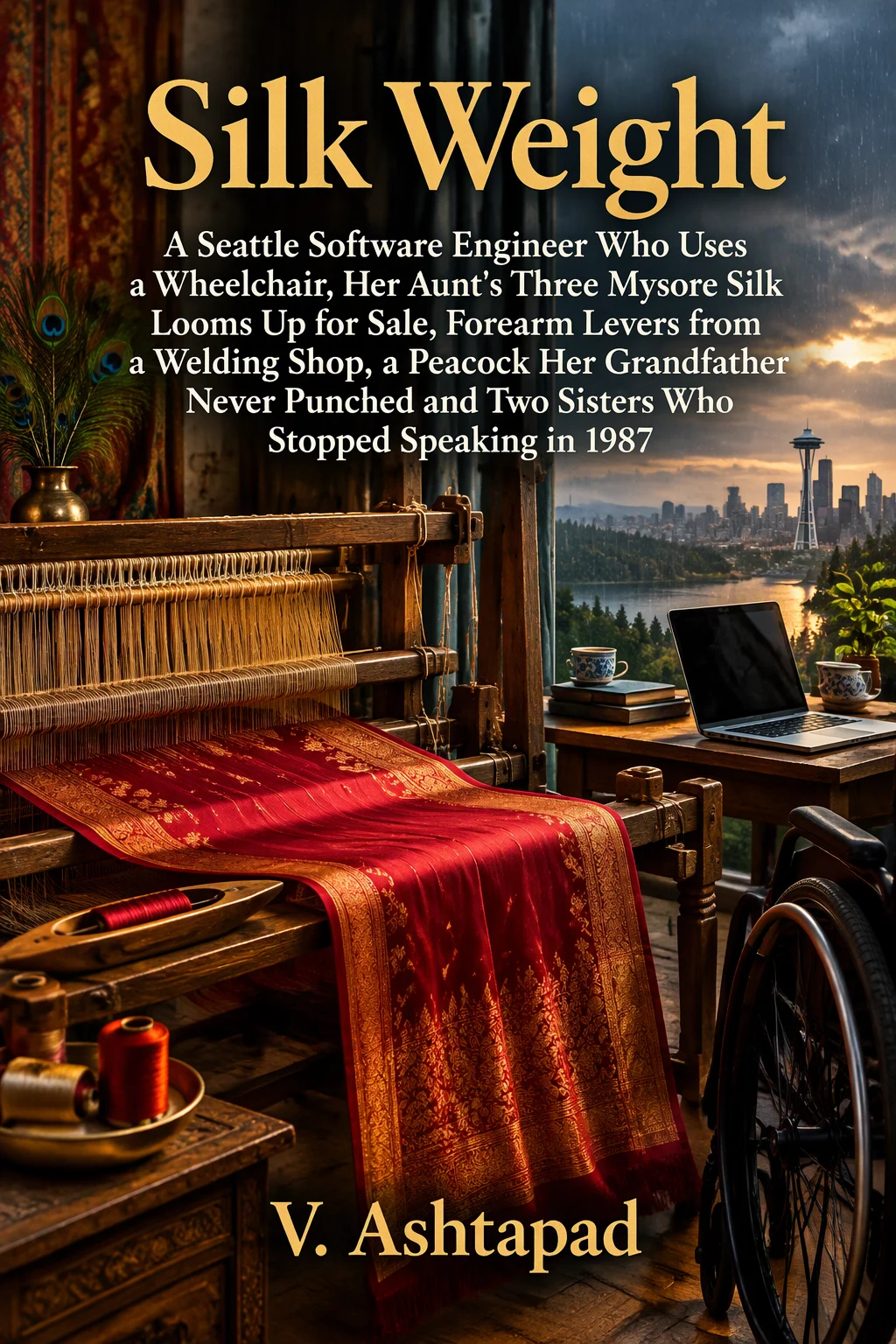
Silk Weight
A Seattle Software Engineer Who Uses a Wheelchair, Her Aunt's Three Mysore Silk Looms Up for Sale, Forearm Levers from a Welding Shop, a Peacock Her Grandfather Never Punched and Two Sisters Who Stopped Speaking in 1987
by V. Ashtapad
Foreword
This is a work of fiction. Mysore, its silk and crepe sarees, the jacquard loom and its punched cards, the Ramanagara cocoon market, Dasara and its elephant procession, Karnataka Rajyotsava, the old Devaraja Market and the Kannada community of the Seattle area are real. The family, the house, the looms, the peacock design and every named person in the story are invented, as are the shops, workshops and cooperatives they deal with.
For every weaver whose loom outlived the people who could work it, and for the ones who found another way to reach the treadles.
Twelve and a Half Hours
The call came at 6:40 on a Tuesday morning, which in Mysore is 7:10 in the evening, which is the hour my aunt Vimala considers the correct hour for any serious conversation, because the lights are on, the cooking is done, and my uncle is in the front room with the cricket loud enough that he can't hear her.
"I'm selling the looms," she said. No hello. Doddamma does not waste hellos on family. Hellos are for the gas cylinder man.
I was in bed. I was looking at the ceiling of my apartment on Capitol Hill, where there is a water stain shaped like Sri Lanka that my landlord has promised to fix since 2021. It was raining. In Seattle in August it is not supposed to rain, and everyone tells you that, and then it rains.
"Which looms?" I said, like an idiot, because there are only three, and I knew exactly which ones. They've been in the back room of the house on the lane behind the old Lansdowne market since before my mother was born. Two with a jacquard head. One plain. My grandfather's.
"All three. A man from Bangalore is coming on the twentieth. Ashfaq. He deals in old equipment. He gave a price."
"Have you told Amma?"
The line went quiet. So quiet I could hear the cricket in the front room, and a commentator saying something urgent about the run rate, and my uncle Nagaraj saying, "Aiyo, aiyo, aiyo," in the voice he uses for both cricket and death.
"I'm telling you," Doddamma said. "You tell her."
"That's not fair."
"Nothing is fair. I'm sixty-six. My knees are seventy-five. Puttaswamy is seventy-one and his eyes are eighty. Nobody has woven a full saree on those looms since February. They sit. The mice live in the warp beam. You want me to keep them for the mice?"
"I want you to tell your own sister."
"She'll shout."
"She'll shout at me if I tell her."
"She shouts at you anyway," said Doddamma, which is true, and then she hung up, because she had said what she called to say, and in her view the rest was my problem.
---
My mother lives eleven minutes from me by car. Fifteen in my car, because I park in the accessible spot in her building's garage and then wait for the elevator, which is slow and smells like somebody's pet rabbit. She lives in Redmond, in a two-bedroom condo she bought after my father died. Before that they lived in a split-level in Bothell with fourteen stairs, which is why I moved out at twenty, a year after the accident, instead of at twenty-six like a good Kannadiga girl.
I'll get the accident out of the way, because everybody wants to know and nobody asks, and then they look at my legs for the whole conversation as if the answer is printed on my shins.
I was nineteen. A friend was driving. Highway 2, near Stevens Pass, March, ice. The car rolled. My friend walked away with a broken wrist. I have a T10 spinal cord injury, which means I have full use of my arms, my hands and my mouth, and nothing reliable from about the belly button down. I use a manual chair, a rigid titanium frame with a seat I paid too much for. I have very strong shoulders. I can lift myself into a car, a bed, a bathtub, an airplane seat, and the back of a pickup truck if I'm angry enough.
I am thirty-one. I'm a backend engineer for a cloud company in South Lake Union whose name you've seen on the side of your delivery boxes. I write code that moves other people's data from one place to another very quickly without losing any. I'm good at it. I get paid more than I'm going to tell you.
My mother has never once said the accident wasn't my fault. She's never said it was, either. She says, "When you were walking," the way other people say, "When we lived in Bothell."
---
I went to her place that evening with a bag of mangoes from the Indian store in Bellevue, Alphonsos, twenty-two dollars a box, the bribe of choice in our family.
She opened the door and saw the mangoes and said, "What happened?"
"Nothing happened."
"Nobody brings Alphonsos for nothing."
I told her.
My mother is sixty-two. She is small and very straight, with gray hair she dyes black every second Sunday with a box from Walgreens, and she wears my father's old cardigan over her salwar kameez all year. She worked for thirty years as a pharmacist at a Bartell Drugs, which means she has a professional face for bad news. She put it on.
"She can't sell them," she said.
"She can. They're hers."
"They're Appa's."
Appa meaning her father. My Thatha. Dead twenty-one years.
"Amma, he left the house and everything in it to Doddamma. You were there. You signed."
"I signed because I was in America and she was there. I signed because she was taking care of him. Nobody said, sign so she can sell his looms to a scrap man from Bangalore."
"He's not a scrap man. He deals in equipment."
"What equipment? He'll take the jacquard heads off and sell them to a hotel lobby for decoration. He'll sell the frames for wood. I know these people."
"You don't know him."
"I know him," she said. "I've known him my whole life. Different name."
She cut a mango standing at the counter, the way her mother did, the knife coming toward her thumb. She didn't eat any of it. She put the cheeks on a steel plate and pushed it at me.
"Call her back," she said.
"You call her back."
"I'm not speaking to her."
"Since when?"
My mother looked at the clock on the microwave. "Since about four minutes ago."
---
I've thought a lot about why I went. People ask, and I give different answers depending on who's asking.
To my manager, a tall Swedish-American named Soderlund who runs ultramarathons for fun and therefore has no concept of fun, I said: family matter, elderly relatives, property decision, I can work remote from India on Seattle hours, my output won't change. He approved ten weeks. He said, "That's a brutal time zone." I said, "I'll be fine." I was not completely fine. More on that later.
To my friends I said: I've always wanted to learn to weave. Which is half a lie. I never wanted to learn to weave. I spent the summers I was four, six and eight in that house in Mysore being told to stay out of the loom room because I'd get my hair caught in the jacquard. But I always wanted to know what the loom room knew. I used to sit in the doorway and watch Thatha's feet go up and down on the treadles like a man running in place, and his hands throw the shuttle, and the cloth come toward him an inch at a time. That's different from wanting to weave. But it's close.
To myself, at three in the morning, I said: because if I don't go, those two women will never speak to each other again, and I'm the only person on earth who is related to both of them and isn't dead or seventy-five.
And because, if I'm honest, the word "sell" made something go cold in my stomach that I didn't expect. I don't own anything from that side of the family. I have a nose ring and a recipe for bisi bele bath I make wrong. I have my mother's accent when I'm tired. That's it. The looms were the only thing that was there before all of us and would be there after.
That's a lot of feeling about three wooden frames I'd been told my whole life not to touch.
---
I booked the flight. Seattle, Frankfurt, Bengaluru. Twenty-two hours. I booked the aisle seat in the bulkhead row and requested the aisle chair and the onboard chair and wrote three emails to the airline's disability desk, and I printed everything, because I know how this goes.
I told my mother the night before. She was ironing. She irons everything. Pillowcases. Dish towels. My father's handkerchiefs, still, four years after.
She said, "You're going to try to stop her."
"I'm going to look."
"You can't get into that house. There are three steps at the front and four at the back and the bathroom has a step down."
"I'll figure it out."
"You'll fall."
"I fall here. I fall in Seattle. There's a whole city of hills here, Amma."
She put the iron down on its heel. "Then you'll stay with her," she said, "and she'll tell you everything about me, all her side, and you'll come back believing her."
"Is there something to believe?"
My mother picked the iron back up. She did one more handkerchief. She folded it in quarters with the corners exact.
"Take the yellow sweater," she said. "October is cold in Mysore at night. Nobody believes me."
© 2026 CRUNOD LLC. All rights reserved.
The Ramp
Bengaluru airport at four in the morning is cleaner than any airport in America, and the people at the special assistance desk are kinder, and none of the bathrooms work for a wheelchair in the way the little blue sign promises. I'm not complaining. I'm reporting.
My uncle Nagaraj was at arrivals. He's seventy-five, retired from thirty-eight years at the State Bank of Mysore, the branch on Sayyaji Rao Road, which no longer exists because the bank was merged into another bank in 2017, a fact he brings up roughly once an hour as evidence of national decline. He was wearing a white shirt, pressed trousers, sandals, and a monkey cap, because it was twenty-one degrees Celsius, and to him that's winter.
He'd hired a car. A white Innova with a driver named Chandru who looked at my chair, looked at the back of the Innova, looked at me, and said in Kannada, "It'll go. Everything goes."
It went. Everything goes in India. That's the thing nobody in America understands. There is always a way. It's just that the way involves three men, a rope, and someone saying it's fine while it is visibly not fine.
---
The new expressway from Bengaluru to Mysore takes you there in under three hours, if the toll gates are kind. My uncle hates it. He says the old road had character: you stopped at Maddur for vadas, at Channapatna for the wooden toys, at the Kamat restaurant with the thali on a banana leaf. Now you fly past all of it on a concrete ribbon with high walls on both sides and see nothing but other cars.
"Development," he said, the way he says "merger."
Chandru stopped at Maddur anyway, at the service road, because my uncle insisted. Maddur vada, flat and crisp, onion and rava and curry leaves, the kind of thing that's ruined by being a minute old. He bought six. He ate four. It was 7:30 in the morning and he said vadas don't count before eight.
The sun was coming up over the sugarcane. Somebody's radio was playing an old Rajkumar song. I hadn't been back in nine years, not since my father's last trip, and I had a strange feeling in my chest, like an elevator dropping, and I told myself it was jet lag and the vada.
---
The house is in an old lane off Ashoka Road, not far from the market that half-collapsed in 2016 and that the city has been promising to fix ever since. My grandfather's father bought it in 1938. It's narrow and deep, single story, with a front verandah with two pillars, a hall, two bedrooms, a kitchen with a window onto a courtyard where there's a well nobody uses, and at the very back, through a low door, the loom room. Tiled roof. Lime-washed walls, yellow outside, gone a bit green at the bottom where the monsoon splashes up.
Three steps up to the verandah. Red oxide floor, the kind that's cool on your feet if your feet can feel it.
There was a ramp.
Plywood. Two sheets, screwed together, with strips of rubber matting nailed across for grip, propped against the steps at an angle I would call optimistic. A man I didn't know was squatting beside it, tightening a bolt with a spanner.
"Revanna," said my uncle. "From the welding shop. I asked him to come."
Revanna stood up and wiped his hands on his lungi and said, "Try."
I tried. I went up backwards, which is the right way on a steep ramp if you don't want to tip, with Revanna's hand hovering an inch behind my push handles in a way that he clearly thought was subtle. The plywood flexed in the middle. It held.
At the top, Doddamma was standing in the door.
She's shorter than my mother and wider, with the same nose. Her hair is completely gray and she doesn't dye it. She wears cotton sarees, always, starched, and reading glasses on a string around her neck. Her hands were white with atta.
She looked at me. She looked at the ramp.
"Revanna," she said, "it bends."
"It's fine, Amma."
"It bends in the middle. Put a support."
"It's fine."
"Put a support or I'm not paying."
Revanna sighed. He went to get a brick.
Then Doddamma looked at me again and said, "You're thin. Your mother doesn't feed you."
"I feed myself. I'm thirty-one."
"That's the problem," she said, and went back inside to finish the chapatis.
That was the welcome. In my family, that's a parade.
---
The bathroom had a step down, like my mother said. Six inches. My uncle had already had a second, smaller ramp made for it, from a slab of granite that he'd taken off the old washing stone in the courtyard. It was perfect. It was so perfect I had to sit in the bathroom for a minute with the door closed.
Then I had to figure out the toilet, which was Indian-style, a squat pan in the floor, and that was not going to work, and I came out and said so.
My uncle said, "Ah."
Doddamma said, "There's a Western one at the Iyengars' next door. They had it put in for her mother."
"I'm not going next door to use the toilet for ten weeks."
"No," Doddamma agreed. "Revanna will bring a commode. His wife's mother had one."
So that is how I found out that in this lane, every family's elderly and sick and broken are a shared resource. Everybody knows who had what. Everybody's chair and walker and commode and hospital bed has been through four houses. There's no paperwork. There's a woman two doors down who keeps track of it all in her head.
In Seattle I filled out eleven forms and waited six weeks for my last cushion.
---
The first evening, after the commode conversation, my uncle took me for a walk. That is, he walked, and I pushed, and we went about two hundred meters in forty minutes.
The lane has no footpath. It has a gutter on each side, open, about a foot deep, with slabs over it in some places and not in others, and the road between is a patchwork of tar and concrete and something that used to be tar. Every house has its own step down to the road at its own height. Two-wheelers come through at speed and honk at you as a courtesy, which here means "I see you and I will not slow down." A cow stood in the exact middle of the lane at the corner, chewing a marigold garland, and declined to move for anyone. My uncle addressed her by name. Kempi. She belongs to the milk booth.
At the corner there's a tea shack. Three benches, a glass case of biscuits and buns, a kettle on a kerosene stove, and a calendar. Five old men sat on the benches. They all stood up when my uncle arrived, as if he were a minister, and then they all looked at me, and one of them said, "This is the American one?"
"Bhavani's daughter," said my uncle.
"Ah," said all five of them at once, and that one syllable had my mother's entire life in it. I could hear it. Every rumor from 1987.
"She's an engineer," my uncle said. "Software. In the big company. The one with the boxes."
"Married?" said one.
"Don't start," said my uncle, and bought me a cup of tea in a glass so hot I had to hold it with the end of my dupatta, and a bun with a stripe of sugary coconut through the middle that tasted exactly like being eight.
On the way back the front caster of my chair dropped into a gap in a gutter slab and stopped dead, and I nearly went out of it face first onto the road. Two boys on a scooter stopped. A woman came out of a house with a broom still in her hand. My uncle said, "Aiyo." Within about four seconds there were six people lifting me out of the gutter, chair and all, all of them giving instructions, none of them the same.
Nobody asked if I wanted help. In Seattle that would have made me furious.
Here I said thank you. Then I said thank you again. Then the woman with the broom asked if I was married.
© 2026 CRUNOD LLC. All rights reserved.
Warp
The loom room is the coolest room in the house, because it's at the back and has a high ceiling and only one window, set high, with iron bars and no glass. Light comes in a long slab and lands on the floor between the looms. The rest is dim. It smells of dust and mustard oil, which they rub on the wooden parts, and of something I couldn't name for a week and then realized was silk. Silk has a smell. Faint and a little animal. Like the inside of an old wallet.
Three looms. You need to understand the shape of them.
Each one is a big wooden frame, roughly the size of a double bed stood on its side, with the warp, the long threads, stretched from a beam at the back to a beam at the front where the weaver sits. Between the beams, the threads pass through the heddles, which lift some threads and lower others to make an opening, the shed, and through the reed, a comb that beats each new line of weft into place. The weaver throws the shuttle through the shed, carrying the weft thread across, pulls the reed toward her to beat it in, changes the shed with her feet on the treadles, and throws again. One pick. Then the next. A Mysore silk saree is about a hundred and ten picks per inch. Six yards long. Do the math. I did. It made me feel sick.
On two of the looms, above the frame like a hat, sits the jacquard: a box with a chain of punched cards hanging off it, hundreds of them, laced together, each card controlling which warp threads lift for one pick of the pattern. That's how you get the paisleys and the peacocks and the little gopura shapes in the border without a person deciding every thread every time. The cards decide. Each hole is a yes. Each blank is a no.
I'm a software engineer. You see where this is going. I stood in the doorway on my first morning and looked at those cards and something in my brain lit up like a server rack. Binary. Punched in cardboard. Hanging in my grandfather's back room the whole time I was a kid.
Nobody in my family ever said, Lavanya, you know where your job comes from?
---
Puttaswamy came at nine. He's worked these looms for fifty-two years. Thatha hired him at nineteen. He's thin, very dark, with a white moustache and thick glasses, and he wears a half-sleeve shirt and a dhoti and carries a cloth bag that has his lunch, a newspaper, and a magnifying glass in it.
He looked at me in the doorway. He looked at the chair. He looked at the looms. He said nothing at all. He went in and sat at the plain loom, the one with a half-woven length on it, a dark green silk with nothing on it yet but a narrow gold edge, and he put his feet on the treadles and worked a few picks, slow, and then stopped.
"Eyes," he said to Doddamma, in Kannada, pointing at his glasses. "Can't see the broken threads anymore."
"I know," Doddamma said.
"I could do borders still. Not the fine body."
"I know, Puttaswamy."
He stood up. He picked up his bag. He said to me, "You're Bhavani's daughter."
"Yes."
"Your mother used to wind the bobbins. She was very fast. Faster than your aunt."
Doddamma said, "She was not faster."
"She was faster," Puttaswamy said, "but she broke more thread," and he went to sit on the back step with his newspaper.
---
That night, after dinner, which was ragi mudde, the gray finger-millet balls that you swallow without chewing, dunked in a saaru of horsegram so sour and hot that my eyes ran, I asked Doddamma why she was really selling.
She was washing the steel plates at the tap in the courtyard. My uncle was in the front room watching the news, which was about a flyover.
"I told you why."
"You told me knees."
"Knees. Eyes. Money." She held up a plate to the light from the kitchen to check it. "A Mysore silk saree with real zari, you know what it costs to make? The silk yarn alone, twenty-four thousand rupees for what goes into one. Zari, more. Two months of Puttaswamy's wages. I sell it to a shop on Devaraj Urs Road. They pay me fifty-eight thousand. They sell it for eighty-five. The government factory down the road sells theirs for less than that, with a certificate and a hologram. What am I doing?"
"Keeping it going."
"Keeping what going? For who? You?"
She said it without any meanness at all. She said it like she was asking me what I wanted for breakfast.
I didn't answer.
"You live in Seattle," she said. "You fly computers. Your mother is in Seattle. My husband and I, no children. Puttaswamy's sons drive Ola cabs in Bengaluru. When I die, who gets the looms? Nobody. They sit. Then someone comes and burns them for the wood. At least Ashfaq pays."
"Amma says he'll sell the jacquards to a hotel."
"Maybe. So what? Then people in a hotel will look at them."
"Amma says Thatha would—"
Doddamma turned off the tap.
"Your mother," she said, "left this house in 1987. She married your father and went to America and sent a card every Ugadi with twenty dollars inside it. When Appa got sick in 2003, I bathed him. I fed him. I sat up with him at Victoria Hospital in Bengaluru for eleven days. She came for four days at the end. She cried at the funeral louder than anyone. Then she went home."
She put the plate on the stack. Very carefully. A steel plate on a steel stack, and it barely clinked.
"So your mother," she said, "can tell me what Appa would want when she has wiped his bottom."
Then she said, "Do you want coffee? I'm making coffee," in exactly the same voice, and went inside.
---
I lay on the cot in the front bedroom that night under a mosquito net that smelled of camphor and stared at the ceiling. No water stain. Wooden rafters and terracotta tiles and a lizard holding very still near the bulb.
Then I opened my laptop, because in Seattle it was 10:30 in the morning and I had a design review at eleven.
Soderlund said, "You look like you've been hit by a truck."
I said, "A family," and we went over the latency numbers for the cache layer.
© 2026 CRUNOD LLC. All rights reserved.
Lever
Here's the problem, stated the way I'd state it in a design doc.
A handloom is a machine powered by a human body. The hands do the shuttle and the beater. The feet do the shed: press the left treadle and one set of heddles drops, press the right and the other set drops. On the jacquard looms there's a third treadle, a heavy one, that lifts the whole jacquard griffe and advances the card chain one card. You stamp on it every pick. It's like a gym machine. Puttaswamy's right calf is visibly bigger than his left.
I don't have feet that do anything on purpose.
So the requirements are: same shed changes, same jacquard lift, driven entirely by arms, without taking my hands off the shuttle and beater for so long that the rhythm dies. Because I'd learned in two days that weaving is rhythm. Throw, beat, change, throw, beat, change. If the change takes too long, your hands forget where the shuttle is.
I drew it on the back of a Mysore Sandal Soap carton. Two levers, one each side of the seat, mounted so that pushing down with a forearm does what a foot would do. A cable or rod from each lever down to the treadle bar. For the jacquard, a longer lever with a ratchet, so I can lift in two short pulls instead of one big stamp.
My uncle looked at the drawing for a long time over his glasses.
"Bicycle brake cable," he said finally. "From the cycle shop at Agrahara Circle. Steel. Strong."
"For the shed, maybe. Not for the jacquard. That's too much weight."
"Then Revanna."
---
Revanna's welding shop is on a lane in Bannimantap, between a tyre-retreading place and a man who fixes pressure cookers. It's a concrete box with a corrugated roof, open on one side to the street, with a welding machine that hums like a fridge and a calendar of a film actress from 2019 that nobody has changed. When he's welding, blue light jumps across the whole lane, and the stray dogs know to look away.
My uncle and I went in an auto rickshaw. Getting me into an auto is a whole performance. The auto is a three-wheeled metal box with a bench in the back and a step up and no doors. I transfer from my chair onto the bench, lifting myself with my arms, and then the driver folds my chair, which he's never done before, and ties it to the back of the auto with a rope, which he has done before, for goats.
My uncle sat in the front with the driver because he enjoys arguing about routes. They argued about routes. We went the long way.
Revanna studied the drawing. He turned it upside down, then right side up. He said, "Why the ratchet?"
"So I can lift in two pulls."
"Why not a counterweight?"
I stared at him.
"Here," he said, and took a stub of pencil from behind his ear and drew on the soap carton. A box hanging from a pulley on the back of the jacquard. Filled with stones, or sand. Heavy enough that it almost lifts the griffe by itself. Then the lever only has to give the last little push. Like a well bucket.
"That's better than mine," I said.
"Yes," said Revanna. He didn't say it proudly. He said it like he was telling me the time.
---
He made the parts in four days. The shed levers: two lengths of flat iron, bent at the end into a padded rest for the forearm, bolted to the loom frame with a pivot. The cables: steel brake cable from the cycle shop, in rubber sheaths, with turnbuckles so I could adjust the tension. The counterweight: an old paint bucket filled with river sand, hung on a pulley wheel from a bullock cart that he said had been sitting in his uncle's yard since the nineties.
Installing it took a whole Saturday. Revanna, my uncle, me, and Puttaswamy, who said nothing for six hours and then, at the very end, reached in and moved one turnbuckle half a turn without asking, and the left lever went from stiff to perfect.
Doddamma watched from the doorway with her arms folded.
"You're drilling Appa's loom," she said.
"Revanna's drilling it."
"You're making Revanna drill Appa's loom."
"Do you want me to stop?"
She considered it. She considered it for long enough that Revanna lowered the drill.
"No," she said. "It's sold anyway. Drill."
---
I'll tell you how the first try went, and I'll be honest, because I've read enough cheerful stories about people in wheelchairs overcoming things, written by people who've never had to empty a leg bag on a train.
It was bad.
Puttaswamy put me on the plain loom, the green saree with the narrow zari edge, and showed me the shuttle. It's a smooth boat-shaped piece of wood about a foot long, pointed at both ends, with a bobbin of weft inside that unwinds as it flies. You throw it through the shed from one hand to the other. Not throw. Slide. Flick. Your wrist does it. It should whisper across.
Mine clattered. It went halfway and stopped in the middle of the shed like a car stalled on a level crossing. I had to reach in for it. Puttaswamy made a sound in his throat.
Then I had to beat. The reed is mounted on a swinging frame called the batten, and you pull it toward you to pack the weft line against the cloth. Not too hard, or the cloth gets dense and stiff, like cardboard. Not too soft, or it's loose, like gauze. Mysore crepe needs a particular firmness. Puttaswamy could tell you by the sound. A dull tock is too soft. A crack is too hard.
Mine was a crack, then a tock, then a crack.
Then the shed change. Push the right lever down with my forearm. The heddles shifted. The cable creaked. The shed opened, but lopsided, and I threw the shuttle and it went under three warp threads that it should have gone over, and Puttaswamy reached across without a word and pulled out my weft line with two fingers, the way you'd pull a hair off someone's shoulder.
Again.
Again.
After forty minutes I had woven a little under one inch. Puttaswamy weaves that in four minutes with his eyes half closed.
I had sweat running down the inside of my kurta and my shoulders were burning. My neck had locked. I had a broken warp thread that Puttaswamy had to tie in with a weaver's knot so small I couldn't see it even when he showed me.
He leaned in. He looked at my inch through the magnifying glass from his bag. He took a long time.
Then he said, "Your mother's first inch was worse."
---
That night I emailed Soderlund that I'd be fifteen minutes late to standup. I wasn't late. I just needed to lie on the cot for fifteen minutes with a hot water bottle on my shoulders before I could look at a screen.
Doddamma came in with a steel tumbler of turmeric milk with pepper in it, the thing every Kannada grandmother has been forcing on every child with a cough since the beginning of time. She put it on the floor by the cot.
"Puttaswamy says you're stubborn," she said.
"Is that bad?"
"He says it like it's bad. He means it's good." She stood there a second. "Your mother wasn't stubborn about the loom. She was stubborn about everything else. About the loom she just stopped one day."
"Why?"
"Ask her."
She went out. The milk was too hot to drink and too sweet and exactly right.
© 2026 CRUNOD LLC. All rights reserved.
Cocoons
Doddamma said if I was going to weave silk I should know where it came from and what it cost, so she woke me at 3:15 on a Wednesday and we drove to Ramanagara.
Not to the town. To the cocoon market. The biggest in Asia, my uncle said, twice, in the car, in the dark. It's halfway back to Bengaluru, on the old road, which made my uncle happy. Chandru drove the same white Innova. He'd learned how to fold my chair. He'd started calling me Madam Engineer.
We got there at five. The market is a long shed, very long, with a high tin roof on iron pillars, open at the sides, and under the lights the whole floor is covered in cocoons. White and pale yellow, in heaps on flat round bamboo trays and in rows of plastic crates and spread on sheets, thousands of kilos, hundreds of farmers squatting beside their lot waiting. It sounded like a wedding hall before the ceremony: a high, nervous noise of people talking low and fast. And over it all a smell I'll never forget. Dry and sweet and faintly sick, like hay and old bread and something living.
The cocoons are the size of the top joint of your thumb. Each one is a single silk thread, maybe a kilometer long, wound around a pupa that would turn into a moth if it were left alone. It's not left alone. It's boiled, or steamed, or baked. The thread is reeled off. That's silk. I knew that intellectually. I'd never stood in it.
"A kilo of cocoons," Doddamma said, "is maybe four hundred, five hundred, six hundred rupees today. It goes up and down every hour. You need seven, eight kilos of cocoon to get one kilo of raw silk. A saree like Appa's is four, five hundred grams of silk after it's spun. Plus zari."
She walked between the lots. I rolled behind her. The floor was concrete and mostly level, which was a miracle, and there were cocoons rolling under my wheels and crunching, and every time it happened a farmer looked at me in a way that made me feel like I'd stepped on his child.
There's an auction. It happens on screens now. Government screens on pillars with lot numbers and bid prices in green digits. The reelers walk around with phones, looking at the cocoons, picking one up, squeezing it, holding it to their ear and shaking it to hear the pupa rattle, putting it back. Then the bids happen on the system and the farmer watches his number go up or not.
A farmer near the end of a row, a man in a towel turban with very cracked hands, saw me staring at the screens and said, "Thirty years ago it was a man with a chit book and a pencil. Now it's this."
"Is it better?" I said.
He shrugged. "The money comes into the bank in two days instead of two months. That's better. The price is the price. That's the same."
He held out a cocoon to me. It weighed less than a paper clip. Almost nothing. Like holding a moth's idea of a house.
"Rattle it," he said.
I shook it next to my ear. A tiny dry knock, very faint, from inside.
"Alive," he said. "Good one."
Not knowing where else it belonged, I tucked it in my kurta pocket. Doddamma saw. She didn't say anything. She bought two hot coffees from a man with an aluminum kettle on a bicycle, ten rupees each, in paper cups so small you could have used them for eye drops, and gave me one.
---
On the way back we stopped at a reeling unit near Channapatna that belonged to somebody's cousin. Doddamma's world consists of nothing but somebody's cousin.
It was a shed with twelve women at a long row of basins of hot water, steam coming up, their arms in it to the elbows, finding the end of each cocoon's thread with a little brush and feeding six or seven threads together onto a spinning reel overhead. The cocoons bobbed in the water. Their hands were red. Their saree ends were tucked tight in their waists. The radio was playing a Kannada film song and three of them were singing along, badly, and laughing.
The smell was the market smell, but boiled. Strong enough that I breathed through my mouth.
The owner, a man with a gold chain and a Bluetooth earpiece, gave us tea and complained about Chinese silk for twenty minutes. Chinese silk is cheaper. The powerloom units in Bengaluru buy Chinese silk and make sarees with fake zari and sell them as Mysore silk to tourists on the Palace road. The government factory has a GI tag and a hologram and charges what it wants. The handloom people are dying.
"Who's buying your yarn, then?" Doddamma said.
"The government factory," he said, and laughed, and so did she.
---
In the car back I got out my laptop and did a spreadsheet, because that's what I do when I'm anxious.
Cocoons to silk. Silk to yarn, with twisting for the crepe. Zari, which is silver thread with a little gold, priced by weight. Puttaswamy's wages. Electricity, which is almost nothing. My aunt's time, which she says is nothing, which is a lie. Shop margin. Raw cost of one saree, start to finish, as Doddamma does it: about forty-seven thousand rupees. Sale price to the shop: fifty-eight. Time: two and a half months.
Profit per saree: eleven thousand rupees. About a hundred and thirty dollars.
I spend more than that on coffee in a month in Seattle. I'm not proud of it. It's just true.
Doddamma looked over my shoulder at the screen.
"So," she said. "Now you know."
"It's not a business."
"No."
"It hasn't been a business since—"
"Since 1991," she said. "Appa knew. He kept it going anyway. He said a house with a loom in it is a house where something is being made. After he died I kept it going, because. Because." She looked out the window at the sugarcane. "Because I didn't know what else the back room was for."
I had the cocoon in my pocket. I could feel it against my hip, though I can't feel my hip. I mean I knew it was there. It's hard to explain.
© 2026 CRUNOD LLC. All rights reserved.
Night Shift
I worked Seattle hours from Mysore for ten weeks. Let me tell you what that's like.
Seattle is twelve and a half hours behind Mysore in the summer. Thirteen and a half after the clocks change in November. My working day in Seattle runs from about 9 to 6, which in Mysore is 9:30 at night to 6:30 in the morning. My team's standup was at 9:45 Pacific. That's 10:15 at night in Mysore. Design reviews were usually after lunch Pacific, which is about 2 in the morning in Mysore.
So my day was: wake at noon. Coffee. Breakfast that's really lunch, which Doddamma found morally offensive for the first week and then accepted as one of the strange afflictions of America, like tipping. Loom from one until about six, with Puttaswamy. Dinner. Sleep from seven to ten. Work from ten at night to six-thirty in the morning. Sleep from seven to noon.
Two sleeps. Neither one enough.
---
At night the house was a different house.
My uncle snored in the back bedroom with a sound like a pressure cooker almost ready to whistle. The lizard on the ceiling of my room came out and ate moths around the bulb. The street dogs had their meetings at around one in the morning, a loud political debate in the lane right outside my window that lasted twenty minutes and ended in what sounded like a vote. Around three, a man on a bicycle went by ringing a bell, every night, and I never found out why.
The internet was fiber, through a local company whose box blinked green on the hall shelf next to a framed photo of my grandparents' wedding. It was faster than my connection on Capitol Hill. It went down twice in ten weeks, both times because a cow had leaned on the junction box at the end of the lane.
I worked with the laptop on a wooden stool and my back against the wall, because the cot had no back and the only chair in the house with arms was my uncle's, and I wasn't going to take that from him.
On calls I used a blurred background so nobody in Seattle would see the calendar on the wall from a gold shop in Lashkar Mohalla with a picture of a baby in a crown. Soderlund saw it anyway once, when the blur glitched. He said, "Is that a baby king?" I said, "Yes." He didn't follow up. He's from Minnesota originally. They're trained not to follow up.
---
My mother called every day at 7 p.m. her time, which was 7:30 in the morning my time, which was precisely the moment between finishing work and falling into my second sleep, the only half hour of the day I was guaranteed to be awake and incapable of defending myself.
"Is she feeding you?"
"Constantly."
"What?"
"This morning? Akki rotti with dill and onion. Coconut chutney. Yesterday pongal with ghee and pepper. Doddappa bought Mysore pak from the old shop near the palace and ate half of it on the way home."
"He's diabetic."
"I know."
"She lets him?"
"She hits him with a newspaper."
A pause. Then, "Is she still selling?"
"Ashfaq came on the twentieth. She told him to come back in November. She didn't say why."
My mother made a sound I couldn't read. Satisfaction, maybe. Or the start of fear. In my family those two sound the same.
"You're weaving?" she said.
"I'm trying."
"On Appa's loom?"
"On the plain one. Puttaswamy won't let me near the jacquards yet."
"He's right," she said instantly. "You'll break the cards. I broke the cards once. I was eleven. Appa didn't speak to me for three days. Then he taught me to repair them. With rice paste."
This was more than my mother had said about the loom room in thirty-one years.
"Amma," I said. "Why did you stop?"
There was a long gap. On the video I saw her look away, out the window of her condo in Redmond, where it was evening, gray, raining, the parking lot below her and the line of fir trees that never change color.
"Go to sleep," she said. "You sound terrible," and she hung up.
---
The weaving got better. Not good. Better. By the end of the third week I could do about an inch an hour. Puttaswamy timed it. He had an old HMT wristwatch on a steel strap that he wound every morning before he sat down. He stopped making the sound in his throat at every pick and started making it only every fifth pick.
My shoulders adapted. I'd always had strong shoulders from pushing a chair up the hills on Capitol Hill, but this was a different strength. Not lifting. Small, repeated, exact. The forearm levers took most of the work off the shed, and the counterweight bucket did the rest on the jacquard, and when I finally graduated to the jacquard loom in week four, on a border, Revanna came to watch. He didn't say anything when the counterweight lifted the griffe with one push of my arm, and the card chain clacked forward one card, and the shed opened in the pattern of a tiny paisley.
He just nodded and went back to his shop.
But my uncle told me later that Revanna had told everyone at the tea shack at Agrahara Circle about it. Lever. Counterweight. A paint bucket of sand. Bullock cart pulley. And the tea shack had argued about whether his idea was better than mine.
The tea shack voted for Revanna. My uncle abstained, for family reasons.
---
One night around three, between a code review and a production alert that turned out to be nothing, I wheeled myself into the loom room in the dark.
I didn't turn on the light. The window was a gray square. The looms were black shapes. I sat in the middle of them and listened to the house.
The plain loom had my inches on it. Four and a half, now. Dark green. The zari edge gleaming a little even in no light. The jacquard loom had a border started, my paisleys, eleven of them, and then the warp going on, waiting.
I had the cocoon from Ramanagara in a matchbox on the windowsill. I'd heard it rattle every morning when I picked it up. That night I picked it up and shook it and it didn't rattle.
I sat with that for a while.
Then I opened the matchbox. The cocoon had a small, ragged hole in one end. On the windowsill, next to the box, holding very still on the iron bar of the window, was a moth. Fat and pale. Cream colored. Its wings stubby and useless, because they've been bred for five thousand years not to fly.
It just sat there on the bar. It had come all the way out, and it had nowhere to go.
I didn't write anything clever in my notes about that. I just went back to my code review.
© 2026 CRUNOD LLC. All rights reserved.
Cards
In the corner of the loom room, under a gunny sack and a broken table fan, there's a steel trunk. Black, with a hasp and a padlock that isn't locked. Painted on the lid in white, in Kannada and English: M. S. RAMANNA, MYSORE. My grandfather's name, and the address he gave the railway in 1962 when he took the trunk to a handloom exhibition in Delhi.
Inside were the cards.
Not the ones hanging on the jacquards now. Those are the working sets, laced together for the current border. These were the archive. Bundles and bundles, each wrapped in old newspaper and tied with jute string, each with a slip of paper tucked in the string with a name in my grandfather's handwriting. Mango border, 1968. Parrot and creeper, 1974. Rudraksha butta. Small checks for Bhavani's half-saree, 1980. Peacock, big, for the Maharaja's exhibition, never finished.
I spent an entire Sunday with the trunk. Doddamma brought me lunch on the floor of the loom room: chitranna, the lemon rice, yellow with turmeric, with peanuts and curry leaves and a green chili that I ate by mistake, and a heap of kosambari, soaked moong dal with cucumber and coconut and lime. She sat on the low stool and watched me untie the bundles.
"Appa punched all these himself," she said. "There was a man in Bengaluru who would do it for money. Appa didn't trust him. He said the man punched like a drunkard."
"How did he design them?"
"Graph paper. On the table in the hall, at night, with a pencil and an eraser. Each square on the paper is one thread, one pick. Fill a square, it's a hole. Then he'd sit with the punching machine, a small iron thing, and do the cards one by one. Weeks."
"So he was programming."
"He was punching cards."
"Doddamma, that's what programming was. In the beginning. That's literally how it started. The first computers took punched cards. Some guy in France made the jacquard loom in eighteen hundred and something and a hundred years later people used the same idea for machines that did census counts and then computers."
She looked at me over her glasses.
"So you're a weaver," she said.
"No. I mean. Sort of."
"So your job is weaving, but you don't make anything you can wear."
"I make systems."
"Can you wear a system?"
"No."
"Can you sell it at Devaraj Urs Road for fifty-eight thousand?"
"Actually, Doddamma, a system sells for a lot more than fifty-eight thousand."
"Then why," she said, standing up with the empty plate, "are you sitting on my floor in the dust?"
---
That was a fair question, and I had a bad answer to it, so I did what engineers do instead of answering questions. I started a project.
I photographed every card bundle with my phone, front and back, with the paper slip in Thatha's handwriting next to it. Four hundred and twelve photos. I sat at night, between work tasks, and wrote a caption for each one. What the pattern was, the year, what Doddamma or Puttaswamy said about it. Parrot and creeper, 1974: Puttaswamy's first big border, two years after Thatha hired him. He says he broke six warp threads the first day and Thatha didn't say a word, just tied them back in himself while Puttaswamy watched. Small checks, 1980: for Amma's half-saree for her cousin's wedding. Doddamma says Amma wore it once and then said it made her look like a tablecloth.
I put them in the family album, the private one my cousin Prashanth in Bengaluru set up two years ago after my father died, when everyone was passing photos around on WhatsApp and losing them. It has a family tree in it too, which Prashanth started and nobody has finished. My father's side goes back five generations because his brother is obsessed. My mother's side stopped at Thatha, with Ajji's name spelled wrong.
I fixed Ajji's name. I added Thatha's father, Subbanna, who bought the house in 1938. I added Puttaswamy, not on the tree, but in the album, in a folder of his own called Loom Room, with a photo of his hands on the shuttle that I took when he wasn't looking.
My mother saw it the next day. I know because the album tells you who looked at what. She looked at the small checks for nine minutes.
She didn't comment.
---
The broken peacock is the thing I couldn't stop thinking about.
Peacock, big, for the Maharaja's exhibition, never finished. The bundle was thicker than the others. Hundreds of cards. When I untied it I found the cards were punched only for the first third of the design. The rest were blank. A stack of blank cards with the lacing holes already done, waiting.
And under them, folded, the graph paper. The whole peacock, drawn in pencil, every square. The tail spread out in a fan across sixty columns. Fully designed. Just never punched.
"Why didn't he finish?" I asked Puttaswamy.
He took a long time. He took off his glasses and cleaned them on his dhoti and put them back on.
"The exhibition was in 1987," he said. "December. He was working on the cards in July. Then your mother got married in August and went to America."
"So?"
"So he stopped," Puttaswamy said. "He didn't punch another card for a year. Then he did the small things. Borders. Butta. Never anything big again."
I didn't understand.
"The peacock was for her," Puttaswamy said. "The wedding saree. For your mother. He was going to show it at the exhibition and then she'd wear it. A Mysore crepe with a jacquard peacock pallu. Nobody did that. It was very hard. He wanted to show them."
"And then she married someone else and left?"
"Then she married your father, a very nice boy," said Puttaswamy, "and wore a Kanjeevaram from a shop in Chickpet. Bought. Not woven. Because the wedding was arranged in five weeks, and the boy had to fly back to Seattle for his job."
He picked up his bag.
"Your Thatha never said anything about it," he said. "Not once in sixteen years. I'm telling you because nobody else will."
---
I sat with the graph paper on my knees for a long time.
I'm a backend engineer. I don't do fabric design. But I do know how to read a grid and turn it into instructions for a machine, and I have known that since I was fourteen and wrote my first Python script to automate my chemistry homework.
So I opened my laptop, and I took a photo of the graph paper, and I started writing a script that would read the squares and generate a punch map. Which card. Which hole. Every pick.
It took me four nights, between work. It's the most fun I've had in a year.
When I showed Doddamma the output, a long column of numbers and dots that looked like nothing, she said, "What is this?"
"The rest of the peacock."
She stood very still.
"You can punch it from this?"
"Somebody can."
She went to the hall. I heard her open a cupboard and close it. She came back with something wrapped in an old towel. She unwrapped it on the floor.
It was the punching machine. Small, iron, a little rusted at the edges, with a lever on top and a die plate underneath. Thatha's.
"Siddaraju," she said. "The card man in Lashkar Mohalla. He's eighty. He still punches for the government factory sometimes. He'll know how to oil this."
© 2026 CRUNOD LLC. All rights reserved.
Dasara
You cannot get a wheelchair anywhere near the Mysore Palace during Dasara. I want to say that clearly, for anyone thinking of trying. You cannot. It's not about ramps. It's about four hundred thousand people in a space meant for maybe forty thousand, all pushing toward the same lights.
The whole city is lit for ten days. The Palace itself, with ninety-something thousand bulbs on every edge and dome and arch, switched on at seven every evening and off at ten. The roads around it lit, the circles lit, the government buildings lit, the old Devaraja Market lit in yellow along its broken roofline. There are food stalls and giant wheels at the exhibition grounds and music on stages and an air show and a wrestling tournament and a book fair and a flower show and a film festival and the traffic is a solid object from Hardinge Circle to the railway station.
On the last day, Vijayadashami, there's the procession. The elephants walk from the Palace down Sayyaji Rao Road to Bannimantap. The lead elephant carries a golden howdah. Bands. Dancers. Folk troupes from every district. Floats from every department of the state government, which is the most Kannada thing imaginable: a parade float from the Department of Sericulture with a giant papier-mâché silkworm.
My uncle has watched the procession every year of his life except two. One was 1974, when he had typhoid. One was 2020.
"You'll watch it from the Iyengars' roof," he said.
---
The Iyengars' house is two doors down and has a flat terrace roof, three stories up, with a view straight down a side lane to the corner of Sayyaji Rao Road. You get there by an outdoor concrete staircase, very steep, with no rail on one side.
Here is how I got onto the Iyengars' roof.
Revanna and his nephew, a boy of about sixteen with a gelled fringe who wouldn't stop looking at his phone, carried me up in my chair. One at the front holding the frame, one at the back holding the push handles, me leaning back, all of us negotiating every step out loud. Doddamma came behind holding my cushion like it was a holy object. My uncle came last, carrying a plastic stool for himself and a flask of coffee and narrating the procession of last year.
At the top there were already twenty people. The Iyengar family, three generations. Neighbors. Somebody's cousins from Hassan. Kids sitting on the parapet with their legs hanging over in a way that made me want to scream. Everybody had brought something. A tiffin of puliyogare. A box of Mysore pak. Paper cones of spicy groundnuts. A thermos of tea and stacks of steel tumblers.
An old woman in a nine-yard saree came straight over to me and asked, in Kannada, very kindly and very loudly, what had happened to my legs.
I said, a car accident.
She said, how old.
I said, nineteen.
She said, are you married.
I said, no.
She said, aiyo, and patted my head, and gave me two pieces of Mysore pak.
This is a conversation I've had approximately four hundred times in my life. In Seattle the people who ask are rare and get embarrassed. In Mysore everyone asks, nobody is embarrassed, and then they feed you. I don't know which is better. I'm still deciding.
---
From the roof you could see the end of the side lane and a strip of the main road. When the elephants came, we heard them before we saw them. The bands first. Brass and drums, out of tune and enormous. Then a long cheer moving up the road like a wave. Then, at the corner, framed by the two buildings, for about ninety seconds, the lead elephant. Painted on the trunk and forehead in colors, a velvet cloth over its back, and on top, catching the afternoon sun so hard it hurt to look at, the golden howdah.
The kids on the parapet screamed. The old woman in the nine-yard saree folded her hands. My uncle stood up off his stool and stayed standing until the elephant passed out of the frame.
Doddamma sat next to me on a mat. She didn't stand up. She'd seen sixty-six of these.
"Your mother," she said, "loved Dasara more than anyone. She'd make Appa take her every night, all ten nights, to see the lights. She was the only one who'd go every night. I'd go once. She'd go ten times."
"She never told me that."
"She never tells anybody anything. You've noticed."
"I've noticed."
The bands went on. A float went by at the corner with a giant cardboard tiger.
"She was seventeen," Doddamma said, "when she told Appa she didn't want to weave anymore. She wanted to study. Pharmacy. In Manipal. Appa said what's pharmacy. She said medicine. He said, you'll be a shopkeeper selling pills. She said, better than a weaver selling sarees for less than they cost."
"Ouch."
"She was right," said Doddamma. "That's why it hurt. Appa didn't speak to her for a month. Then he paid her fees. She went to Manipal. Then she met your father at a friend's wedding in Udupi. Then she was gone. Five weeks. Like that."
"And the peacock."
Doddamma looked at me.
"Puttaswamy told you about the peacock."
"Yes."
"Puttaswamy talks too much."
"He talked for about four minutes."
"That's too much for Puttaswamy," she said.
---
I held up my phone. "Can I record this?"
She said, "Why?"
I said, "For the family album. Prashanth's thing. So it isn't only in my head. Or yours."
She looked at the phone the way she looks at a cockroach. Then she said, "Fine. But not my face. Point it at the elephants."
So the recording is ninety seconds of the corner of Sayyaji Rao Road, the end of the elephant procession going by, a float of Krishna Raja Sagar dam with a fountain that doesn't work, and Doddamma's voice telling the story of her sister going to every night of Dasara, ten nights, with their father, in 1983. It's all in Kannada. You can hear my uncle in the background shouting at a child to get off the parapet. You can hear the band.
I put it in the album that night under Thatha's name with a caption: Doddamma tells about Amma and Dasara, from the Iyengars' roof. Her face is not in it, by request.
My mother listened to it at 6:12 p.m. Pacific time. Three times.
She didn't comment on that one either.
But at 6:31 she texted me. One line.
"The tiger float is the same tiger float since 1983."
© 2026 CRUNOD LLC. All rights reserved.
Bhavani
My mother arrived on October 28 without telling anyone.
I mean she told my uncle, who picked her up from Bengaluru airport in the Innova with Chandru at four in the morning and drove her straight to Mysore without telling Doddamma or me, because he said if he told either of us, one of us would stop her, and he wanted to see what happened. My uncle is seventy-five, retired, and diabetic, and he is bored.
I was in the loom room at noon, just up, with coffee, doing the jacquard border with Puttaswamy beside me. Siddaraju had punched the first ninety cards of the peacock tail on Thatha's oiled machine the week before. I'd laced them into the chain myself. I was weaving the first section of the pallu. Seven inches. Blue-green crepe, gold zari, the first feathers of the fan spreading up from the bottom border.
I heard the front gate. I heard my uncle's voice, too cheerful. I heard Doddamma in the kitchen go completely silent, which in her case is a sound.
Then my mother was in the doorway of the loom room, in the yellow sweater she'd told me to bring, with her Bartell Drugs face on.
She looked at me at the loom.
She looked at the levers. The cables. The paint bucket of sand hanging off the back of the jacquard on its bullock-cart pulley.
She looked at the card chain and the cloth and the seven inches of peacock.
Her face came off. I watched it happen. The pharmacist went away and somebody else was standing there, somebody I'd never met, maybe seventeen years old, maybe younger, and she put her hand over her mouth.
Puttaswamy stood up. He said, "Bhavani."
She said, "Puttaswamy."
And then she said, in English, to no one, "Oh, he finished it," and I said, "No, Amma. He didn't. I'm finishing it," and she turned around and walked out to the courtyard and stood by the old well with her back to the house.
---
Doddamma came out of the kitchen with her hands wet.
The two sisters were in the courtyard, eight feet apart, my mother by the well and my aunt by the tap. My uncle had found an urgent errand involving his newspaper in the front room. Puttaswamy had gone to the back step. I was in the doorway of the loom room, which is up one step from the courtyard, which meant I couldn't go down without someone helping, which meant I was a spectator whether I wanted to be or not.
"You came," Doddamma said.
"You're selling Appa's looms."
"You didn't come for twenty years and you came for the looms."
"I came every two years. Every two years."
"You came to Bengaluru every two years. To Raghavendra's brother's house in Jayanagar. You came here for one afternoon. You sat in the hall and drank coffee and left before dinner."
"Because you made it so pleasant."
"I made it pleasant? I cooked for you every time. Holige. Your favorite. Every time. You ate one."
"I was on a diet."
"For twenty years?"
My mother turned around. Her eyes were very dry, which is how I know she was furious. When she's sad she cries. When she's furious she goes dry as paper.
"You told Appa I wasn't coming back," she said.
Doddamma's mouth opened.
"In 1988," my mother said. "When he wrote that he wanted to visit Seattle. You told him the flight would kill him. You told him I was busy, that I had no space, that Raghavendra's family would be ashamed of a weaver in the house. He wrote me a letter saying all that. Your words. I still have the letter. Appa never came."
"He was sixty-three with a bad heart. The doctor said—"
"The doctor didn't say anything. You said."
"I was the one here. You went to America. Somebody had to keep him alive and keep the looms going and keep this house standing. Somebody had to say no."
"He wanted to see my baby."
That stopped everything.
I was born in 1993. My mother had a miscarriage in 1988. I knew that. I'd known it since I was twelve. I had never once connected it to anything. To a letter. To my grandfather wanting to fly to Seattle.
Doddamma stood by the tap with her hands dripping. The tap was still running. Nobody turned it off.
"I didn't know about the baby," she said finally. "You didn't tell anyone. You didn't tell me."
"Because you'd have said I shouldn't be working. Shouldn't be in America. Shouldn't have married. You'd have had an opinion."
"I'd have come."
"You'd never have come."
"I'd have come," Doddamma said, and her voice cracked straight down the middle, and she turned off the tap.
---
They didn't hug. This isn't that kind of story. My mother went inside and lay down in the back bedroom with the door closed, and Doddamma started cooking dinner for four people as if nothing had happened, except that she made holige. Obbattu. The flat sweet bread stuffed with chana dal and jaggery and cardamom, rolled thin and cooked on the tava with ghee. It takes two hours. She made twenty.
My mother came out at seven-thirty. She ate three.
Nobody said anything about it.
---
That night I couldn't sleep, and it wasn't the time zone. I had the night off, a Saturday in Seattle. I lay on the cot and listened.
At about one in the morning I heard the kitchen door. Then the tap in the courtyard. Then low voices.
I got into my chair as quietly as you can get into a chair, which is not very quietly, and rolled to the door of the front room, which looks down the hall to the kitchen and through the kitchen window to the courtyard.
They were sitting on the edge of the old well. Both of them. In their nighties, with shawls. Doddamma had a flask. My mother had two steel tumblers. The light from the kitchen made a yellow square on the courtyard floor and they were just outside it, in the dark, so I could only see the shapes of them, and the shawls, and the flask catching the light when Doddamma poured.
I couldn't hear the words. I could hear the tone. It went up, and down, and up. Once my mother laughed, very short, the way she laughs when something isn't funny but is true. Once Doddamma said something that went on for a long time and my mother didn't answer at all.
Then for a long while they didn't say anything. They just sat on the edge of the well and drank coffee at one in the morning, two old women in shawls, with their backs to the house.
I went back to bed. I didn't want to be a spectator to that one. Some things you're allowed to see only from the outside, and only once.
In the morning, the flask was washed and upside down on the rack by the tap. Neither of them mentioned it. They argued about the dosa batter, which hadn't risen. Doddamma blamed the weather. My mother blamed the rice. My uncle ate seven dosas and said they were fine.
© 2026 CRUNOD LLC. All rights reserved.
The Offer
Ashfaq came back on November 2, as promised, at eleven in the morning, in a silver Honda City with a driver.
He was not what my mother had pictured. I know because I watched her picture him for four days, out loud, in great detail, at every meal. In her version he was a fat man with paan-stained teeth and a gold watch and a calculator in his shirt pocket who would rip the jacquards off with a crowbar.
Ashfaq was about forty. Slim, with a short beard and rimless glasses, in a gray linen shirt, with a laptop bag. He'd studied textile engineering in Coimbatore. His family had been in the silk trade in Bengaluru's Chickpet for three generations, wholesale, and then he'd started his own thing: buying old handlooms and jacquards from families who were closing, restoring them, and selling them on to design schools, museums, and a few new handloom studios run by young people from Bengaluru with money and Instagram accounts.
"And hotels," my mother said.
"Twice," Ashfaq said. "Two hotels. In Goa and Udaipur. I'm not proud of it. The jacquard heads only. The looms went to a college in Ahmedabad."
My mother didn't know what to do with an honest answer. She folded her hands and looked at the wall.
---
He went into the loom room. He stood in the middle and turned in a slow circle, the way I'd seen people in Seattle look at the inside of an old church they'd converted into condos. Then he walked to my loom, the jacquard one with the peacock, and stopped dead.
"What is that?"
He meant the levers. The cables. The paint bucket of sand.
I explained.
He crouched down and looked at the pivot bolts. He tested the left lever with his hand. He followed the cable down to the treadle bar. He looked up at the counterweight and the bullock-cart pulley for a long time.
"Who designed this?"
"I did the first version," I said. "Revanna did the counterweight. He's a welder in Bannimantap. Puttaswamy tuned it."
"It's very good," he said. "It's very, very good. There's a weaving cooperative in Kanchipuram where three of the older women have knee problems. They've been asking about something like this for two years. Nobody builds them. Can I photograph it?"
I looked at Doddamma. Doddamma looked at my mother. My mother looked at the ceiling.
"It's Revanna's design," I said. "Ask him."
"I will," said Ashfaq, and wrote down Revanna's name in a small notebook with a pen, which I respected.
---
Then he sat on the hall floor with all of us and drank Doddamma's coffee, and he made his offer.
All three looms. The two jacquard heads. The card archive in the trunk, which he'd only just seen and which made him visibly sweat. The warp beams, the reeds, the shuttles, the bobbin winder. He'd pay one lakh eighty thousand rupees. About twenty-one hundred dollars.
He said the two plain-frame parts would go to a new handloom studio in Bengaluru run by two women who'd quit their jobs at an IT company to weave. The jacquards would go, he hoped, to the textile museum at a design school in Ahmedabad, which wanted a working Mysore jacquard with its original cards. Working. Not decoration. Students would weave on it.
"And this one," he said, nodding at the loom room door. "The one with the levers. If the levers stay on it, I'd like that one to go to the Kanchipuram cooperative. For the women with knees. I'd sell it to them at cost."
My mother said, "And the cards? The trunk?"
"The museum would catalogue them. Scan them. Put them online."
"So anyone can see Appa's work."
"Yes."
"Strangers."
"Students," said Ashfaq. "Weavers. People who want to make that peacock someday."
"I'm making the peacock," I said.
Everybody looked at me.
---
Here's the thing about saying something out loud in my family. Once it's out, it's furniture. You can't take it back. You have to walk around it for the rest of your life.
"You live in Seattle," said Doddamma.
"I know."
"You have a job. A real job. With money."
"I know."
"Your visa—" my mother started, and stopped, because I'm a US citizen and so is she, and the word visa just came out of her the way it does in every Indian family regardless of the actual facts.
"I'm not saying I'm moving here," I said. "I'm saying I'm finishing the peacock. On this loom. With these cards. Before anyone sells anything."
"How long?" said Ashfaq, politely, as if this was a normal business variable, which, to be fair, it was.
I did the math. I'd woven eleven inches of the pallu in two weeks. The pallu is about a meter. Then the body. Then the other border.
"Six months," I said. "If I'm here. Which I won't be. My leave ends on the twentieth."
"So, never," said Doddamma.
"Not never."
"Never," she said. "I know never. I have been looking at never in that room for two years."
---
Ashfaq said he could wait until March. He said it in a way that suggested he'd done this before, sat on a floor with three generations of a family arguing in front of him over coffee, and that he'd learned to say a date and then leave.
He left. The Honda City backed all the way out of the lane because there's no room to turn around, and two children and a cow came out to watch.
---
After he left my mother did something I've never seen her do. She went into the loom room and sat down at the plain loom, the green one, where my first four and a half inches were.
She didn't use my levers. She put her feet on the treadles. Her real feet, in her Bata sandals. She took the shuttle in her right hand, and she threw it.
It whispered across. All the way. Into her left hand.
She beat. A tock. Not a crack. The right sound.
She changed the shed with her feet without looking down. She threw again.
She did nine picks. Then she stopped. She put the shuttle down very carefully in the groove on the batten, where it lives.
"Forty years," she said. "I haven't touched one for forty years."
Puttaswamy, on the back step, said through the door, "Still faster than your sister."
Doddamma, in the kitchen, said, "She is not."
© 2026 CRUNOD LLC. All rights reserved.
Weight
They weigh silk. It's how it's sold, bought, taxed, cheated. The yarn by the kilo. The zari by the gram. A finished Mysore saree goes on a scale at the government factory and gets a weight printed on its tag, because the weight tells you how much silk and how much real metal is in it, and that's most of what you're paying for.
Doddamma has a scale. A brass beam balance from the 1950s, hanging from a hook in the loom room ceiling, with two shallow brass pans on chains and a box of weights in a wooden case lined with faded red velvet. The weights are little brass cylinders with knobs on top, from a kilo down to one gram, and then flat brass leaves for the milligrams, which you pick up with tweezers.
She used it when she bought zari, to check the dealer. She used it to check the yarn. And she used it, my mother told me, to check her daughters.
"Every Ugadi," my mother said. "On the new year morning, before the oil bath. Appa would hang a big cloth sling from the hook and weigh us. Then he'd write it in a notebook. Bhavani, thirty-two kilos, 1975. Vimala, thirty-nine kilos, 1975. Every year."
"Why?"
"So he'd know we were growing," my mother said. "That's all. He was a weaver. He weighed things."
---
The notebook is in the trunk with the cards. I found it on my second-to-last Sunday. Thin, cloth-bound, school exercise book, the pages gone the color of tea. In it, in Thatha's handwriting, in pencil, a list.
Every Ugadi from 1964 to 1987. Vimala and Bhavani. Their weights. Their heights, too, measured against the loom room door frame, which I went and looked at, and yes, there are pencil marks there, very faint, under fifty years of lime wash, with initials.
1964 to 1987. Then my mother's name stops. Doddamma's goes on alone until 1990, when she was thirty-two and married, and then that stops too.
And then on the last page, by itself, in different ink, a ballpoint, much later:
Lavanya. 3.1 kilos. 1993.
My weight at birth. My mother must have written to him with it. He'd put me in the book.
I sat with that notebook in my lap in the loom room for most of the afternoon. Puttaswamy left me alone. At four o'clock Doddamma came in with coffee and looked at what I was holding and sat down on the stool next to me without saying anything for a long time.
"He never weighed you," she said finally. "He wanted to. He said, when the baby comes, we'll weigh her on the beam."
"I came when I was four," I said. "And six. And eight."
"At four you screamed when he put you in the sling. At six you said it was for babies. At eight you were too proud. He let you be proud."
"I remember the summer I was eight," I said. "He gave me a cocoon. In a matchbox. He told me to listen to it. I don't remember anything else. Just that."
Doddamma put the coffee down on the floor.
"That's Appa," she said.
---
My mother and Doddamma weren't speaking much. They were speaking. They were cooking together. They were going to the market together in the morning, the old Devaraja Market, the half of it that still stands, with its arched roof and its stalls of jasmine and banana leaves and chilies and turmeric and those enormous heaps of betel leaves and the old women who sell kumkum powder in every color in cones. My mother had been gone for so long that the vegetable sellers didn't recognize her and charged her the tourist price, and Doddamma had to step in and say, She's my sister, from America, don't be ridiculous, and then they charged her the American-sister price, which is only slightly better.
They argued about everything. Whether to put coconut in the saaru. Whether the boy at the milk booth was cheating on the measure. Whether my uncle's sugar was high because of the Mysore pak or because of his stress about the bank merger. Who was faster on the bobbin winder in 1977.
But they didn't argue about the looms. Not one word. Since Ashfaq left, nobody had said the word looms in the house. The looms were furniture now. Everybody walked around them.
---
One night in the second week of November, at around 2:40 in the morning, in a design review about a migration I'd been planning for six months, Soderlund stopped in the middle of a sentence and said, "What's that behind you?"
I'd forgotten the blur. I'd moved my stool into the loom room, because the fiber box reached and it was cooler, and behind me on the screen, over my shoulder, was the jacquard loom with the peacock on it, the gold zari catching the light from my laptop.
Six engineers on the call leaned toward their cameras.
I explained. Punched cards. Jacquard. My grandfather. The graph paper. My script.
There was a silence. Then one of the new hires, a kid from Pune who has never once spoken in a design review, unmuted and said, "Wait. You wrote a parser for your grandfather's peacock?"
"Yes."
"Can I see the repo?"
"It's not a repo. It's one file."
"Can I see the file?"
Soderlund let it go for four minutes, which for him is a sabbatical. Then he said, "Okay. Migration," and we went back to the migration. But the next morning there were three messages in my inbox from people on the team I barely know, asking for photos of the loom, and one from the kid from Pune that just said: my nani had a loom in Solapur. Nobody kept it.
---
On November 14 I cut the weft and took my peacock off the loom.
Not finished. Not even close. Thirty-one inches of pallu. Half the tail. The feathers stopping in a ragged line where the cards run out, with three loose ends of zari hanging off the last pick like loose wires.
But I needed to take it home. I couldn't leave it on the loom in a house where the loom might be sold. That was my thinking. It didn't make sense, technically, because I couldn't finish it in Seattle without the loom, but I wasn't thinking technically.
Puttaswamy showed me how to tie off the warp so it wouldn't unravel. A row of small knots, every eight threads. It took an hour. My hands were shaking by the end, and he took over and did the last third himself in ten minutes without his glasses.
Then Doddamma said, "Weigh it."
We hung it in the brass pan. My mother put on the weights. Her hands were better at the tweezers than Doddamma's. Arthritis. She put on a hundred grams, a fifty, a twenty, two tens, a five, and then the brass leaves one by one, until the beam stood exactly level.
One hundred and ninety-six grams and four hundred milligrams.
My mother wrote it in Thatha's notebook on the last page, under my birth weight. In pencil. She wrote: Lavanya's peacock. 196.4 grams. 2024.
Then she looked at it for a while and wrote, underneath: Unfinished.
© 2026 CRUNOD LLC. All rights reserved.
Rajyotsava
November 1 is Karnataka Rajyotsava, the state's birthday. I'd missed it because of Ashfaq. But Mysore keeps the flags up for the whole month, red and yellow, on every auto rickshaw and every bus and every shop front, and there are programs every weekend, and the radio plays the same five patriotic Kannada songs over and over, and taxi drivers will argue with you for half an hour about whether people in Bengaluru speak enough Kannada. They don't, according to every taxi driver. It's the end of civilization.
My uncle had started sending me a Kannada word every morning. He'd figured out how to do it on the family album. There's a little card that goes to everybody once a day, a word and what it means, and you can record yourself saying it. My cousin Prashanth set it up for his kids. My uncle took it over. Nobody gave him permission. He just started typing in words at six every morning and now forty-three people across three countries get them.
Nobody in our family had ever seen him so happy.
The words were very Doddappa. They were not the words a grandmother would pick.
Day one: saaku. Enough. Day two: haalu. Milk. Day three: bekilla. Not needed. Day four: vilīna, which he defined as "merger," and attached a two-minute voice note about the State Bank of Mysore that my cousin's eleven-year-old in New Jersey listened to all the way through and then asked her father what a bank was.
On November 15 the word was nēyige. Weaving.
He recorded my mother saying it. Then Doddamma. Then Puttaswamy, very grumpily, in the doorway. Then me. You can hear the difference. My mother's accent has a bit of Seattle in it now, around the edges. Doddamma's is pure Mysore. Puttaswamy sounds like a man being asked to say a word he's been saying for fifty-two years and finds the whole exercise ridiculous.
Mine sounds like a girl who learned the word last month.
---
My last week was a list.
Pack. Ship two boxes by sea, through the post office at the main office on Ashoka Road, which took an entire morning and three forms in triplicate and a man who wanted to see the inside of every box and who unwrapped my peacock, studied it under his desk lamp, and pronounced it very fine work and asked if I was selling. Say goodbye to Revanna, who gave me a small box. Inside it was a pivot bolt from my lever, polished, on a keyring. Say goodbye to the Iyengars, who fed me. Say goodbye to the woman two doors down who keeps track of everyone's commode. Return the commode.
Siddaraju came by. He's tiny, very old, with hearing aids in both ears and the steadiest hands I've ever seen. He'd punched the next sixty cards of the peacock from my script, on Thatha's machine, without being asked. He laced them himself into the chain. He said, through his hearing aids, very loudly, "For when you come back."
I said, "I don't know when I'm coming back."
He said, "Doesn't matter. Cards don't go bad. Paper is patient."
---
On my second-to-last night, I asked them. Both of them. At dinner. Bisi bele bath, which Doddamma made the right way, with the spice powder ground fresh that afternoon on the stone, and which I've been making wrong for my whole adult life in Seattle using a packet from Bellevue.
"What happens to the looms?" I said.
It was like dropping a plate.
My uncle reached for the pickle very slowly, to have something to do.
Doddamma said, "Ashfaq said March."
My mother said, "Ashfaq is a good man. He'll find good places for them."
I turned and looked at her. I couldn't believe it.
"You're okay with it now?"
"I didn't say okay," my mother said. "I said he's a good man."
"Doddamma," I said, "are you still selling?"
Doddamma looked at her sister for a while.
"My knees are seventy-five," she said. "Puttaswamy's eyes are eighty. And you're going back to Seattle on Thursday."
"That's not an answer."
"That," said Doddamma, "is the only answer there is."
My mother put down her spoon.
"I could stay," she said.
All of us stared at her.
"For a while," my mother said. "Three months. Six. I'm retired. I have nothing in Redmond but a condo and a parking spot. I could stay and weave the body. Not the peacock. I can't do the jacquard anymore, my hands, but the body is plain. Then Lavanya comes back in the summer and does the rest of the pallu."
"You'd stay here," said Doddamma. "With me."
"Six months."
"You hate it here. You told me in 1987 you hated it here. You said this house smells like a moth."
"It does smell like a moth," my mother said. "I've missed it."
Doddamma didn't say anything. She got up and went to the kitchen and stood there with her back to us. My uncle reached out and patted my mother's hand twice, like a man patting a dog he's not sure about.
Then from the kitchen, without turning around, Doddamma said, "And after the six months?"
My mother didn't answer.
None of us did.
---
On my last morning in Mysore I woke at five, not because of work but because I couldn't stand to sleep through it.
I went into the loom room. Puttaswamy wasn't there yet. The slab of light from the high window hadn't come in. It was blue dark and cool and smelled of mustard oil and moth.
I sat at the jacquard loom. I put my forearms on Revanna's lever rests. I didn't weave. There was nothing on the loom to weave. I just pressed the left lever and heard the heddles shift, and the cable creak in its sheath. Then the right. Then I pulled the jacquard lever, and the paint bucket of sand rose on its bullock-cart pulley, and the griffe lifted, and the card chain advanced with a clack, one card, and I heard Siddaraju's new cards settle into their places.
Then I just sat there in the dark and listened to the house wake up. The milk booth man's bicycle bell at the end of the lane. Kempi the cow complaining. The Iyengars' pressure cooker. My uncle's radio coming on with the news, very loud, and then very soft when Doddamma shouted at him. My mother, in the kitchen, grinding the coffee in the old brass hand grinder that's been on that shelf since before she was born, the sound of it going round and round.
I recorded that. Ninety seconds. No faces. Just the loom room in the dark and the house waking up around it. I put it in the album under Thatha's name, with the caption: The loom room, 5:10 a.m., November 20. Everybody's here.
© 2026 CRUNOD LLC. All rights reserved.
Silk Weight
It rains in Seattle in November the way it rains in Mysore in July, except colder and without the smell of earth, and without anybody being happy about it.
My apartment on Capitol Hill was exactly where I'd left it. The water stain shaped like Sri Lanka. The bathroom with the grab bars I installed myself. The kitchen counter at the right height. The building's elevator, which works. The street, which goes up at an angle I'd forgotten I could push. I did it in the rain on the first morning, to the coffee place on 15th, and I was so out of breath at the top that the barista asked if I was okay, and I said I'd been away, and she nodded as if that explained it. Maybe it did.
The peacock arrived by sea six weeks later, in the box wrapped in newspaper from the Star of Mysore, with the post office man's stamp on every seam. I unwrapped it on my kitchen table. One hundred and ninety-six point four grams. It smelled like the loom room for about a week. Then it smelled like my apartment.
I hung it on the wall over my desk, the unfinished end down, the loose zari ends hanging.
---
My mother is still in Mysore.
That's the update. She stayed. Not the way the movie would have it. She stayed in the front bedroom on the cot under the mosquito net, and she weaves the body of the saree on the plain loom for two hours every morning with Puttaswamy beside her, and then she and Doddamma argue until dinner. She's on the family album every day. She posts photos of the cloth with captions that are much longer than they need to be. Eight inches. Puttaswamy says my beat is uneven. He is wrong. Twelve inches. Vimala put coconut in the saaru again.
She calls me at 7 a.m. Mysore time now. Which is 5:30 in the evening in Seattle. Which is right when I'm finishing work and am incapable of defending myself. She's figured out the time zone the way she figures out everything, and she's using it.
"Is it raining?"
"Yes."
"It was raining when I lived there for thirty-seven years. Did you eat?"
"Not yet."
"Eat."
---
Ashfaq emailed me in January. He'd photographed the levers with Revanna's permission. Revanna had gone to Kanchipuram on a bus with his nephew and built four sets for the cooperative. The women with bad knees are weaving again. Ashfaq sent a video. Three of them sitting at their looms with Revanna's flat iron levers bolted to the frames, their forearms on the rests, their feet flat on the floor, the shuttles going back and forth. One of them looks at the camera and says something in Tamil, and laughs, and keeps weaving.
At the end of the email Ashfaq wrote: The March date still stands, if your aunt wants it. No pressure. I've told her the same.
---
I asked Doddamma about it on the phone in February. She was in the loom room. I could hear the shuttle in the background. My mother's. Throw, tock, change. Throw, tock, change. Not as fast as it used to be, I'm sure. I'm sure it's slower than it was in 1977. But steady.
"Did you tell Ashfaq?"
"Tell him what?"
"Doddamma."
"I told him I'm thinking."
"About what?"
"About my knees," she said. "About your mother's hands. About Puttaswamy, who's seventy-two now, and fell in the bathroom last month and is fine but is not fine. About who will be here when the six months are over, because your mother has already booked her ticket for June, did she tell you? No. She didn't tell you. She doesn't tell anybody anything."
The shuttle stopped in the background. My mother's voice, from far away: "I can hear you."
"Good," said Doddamma.
"So what are you thinking?" I said.
"I'm thinking," she said, "that I'm going to make coffee," and I heard her get up, and the shuttle started again.
---
In late February I went to a Kannada association event in a community center in Bothell. Rajyotsava is in November, but they hold a late-winter cultural program too. Kids in silk pavade doing a dance to a film song, a man doing standup about his in-laws in two languages, a woman selling holige from a folding table in the corner, eight for twenty dollars, not as good as Doddamma's.
I almost didn't go. I went because my mother told me, from Mysore, at 5:30 my time, "Go. Somebody will ask you. Answer them."
Somebody did ask. An aunty in a green Mysore silk saree, the real kind with the hologram, came up to me at the snack table and asked what happened to my legs. Then she asked if I was married. Then she asked what my family did.
I said my grandfather was a weaver in Mysore.
Her eyebrows went up. "Handloom? Real handloom?"
"Jacquard," I said. "Crepe. With a peacock pallu he never finished."
She looked down at her own saree, and touched the border, and said, "Is anyone still weaving? In your family?"
The pause went on so long she started to look worried.
"My mother," I said. "For now."
---
Here's what I know.
The plain loom has a saree body on it, about two-thirds woven, dark green, my mother's hands.
The jacquard loom has my levers on it and Revanna's paint bucket of sand, and Siddaraju's next sixty cards of the peacock laced in the chain, waiting, because paper is patient.
The third loom has nothing on it.
Ashfaq's offer is good until March. Then, he says, the design school in Ahmedabad has another family in Varanasi with a jacquard, and he'll go there.
My mother's ticket is for June.
I have twelve days of leave left this year.
Thatha's notebook is on Doddamma's shelf, with my peacock's weight on the last page, under my birth weight. Unfinished. In my mother's pencil.
I keep thinking about the scale. The brass beam. The way you add the weights one by one, the big ones and then the small, then the brass leaves with the tweezers, and the beam tips back and forth, back and forth, and you wait. And you wait. And it's not level yet.
What goes in the other pan?
© 2026 CRUNOD LLC. All rights reserved.
If this book stayed with you
Bobbin and Thread
A Detroit Autoworker's Widow, Her Mother's Lace Pillow and the Collar Left Unfinished
Another family craft facing the keep-give-or-toss question, told by a woman who has to decide what the tools are for.
About this book
Lavanya Hegde writes code that moves other people's data across the world without losing any. She has used a wheelchair since a car rolled on an icy highway when she was nineteen. And at 6:40 one August morning, her aunt calls from Mysore to say she is selling the three family silk looms to a man from Bangalore.
Her mother, who has not woven since 1987 and barely speaks to her sister, says she can't. Her aunt, who nursed their father to the end, says watch me.
So Lavanya flies to Mysore, works Seattle hours through the night, and spends her afternoons in the loom room learning to weave on a loom built for feet. A welder named Revanna fits forearm levers and a paint bucket of river sand as a counterweight. A seventy-one-year-old weaver times her inches on his wristwatch. In a steel trunk she finds her grandfather's punched cards, and a peacock he designed for her mother's wedding saree and never finished.
The looms have a buyer, a date, and three women who each want something different. Lavanya has twelve days of leave left. What goes in the other pan of the scale?
Members can react to this book and talk about it in the members' Library.
Ownership
© 2026 CRUNOD LLC. All rights reserved.
This book is owned by CRUNOD LLC. It is free to read on EternalCurrent.Online. No part of it may be copied, reprinted, sold, recorded or adapted, including as audio, film or translation, without written permission from CRUNOD LLC.
© 2026 CRUNOD LLC. All rights reserved.