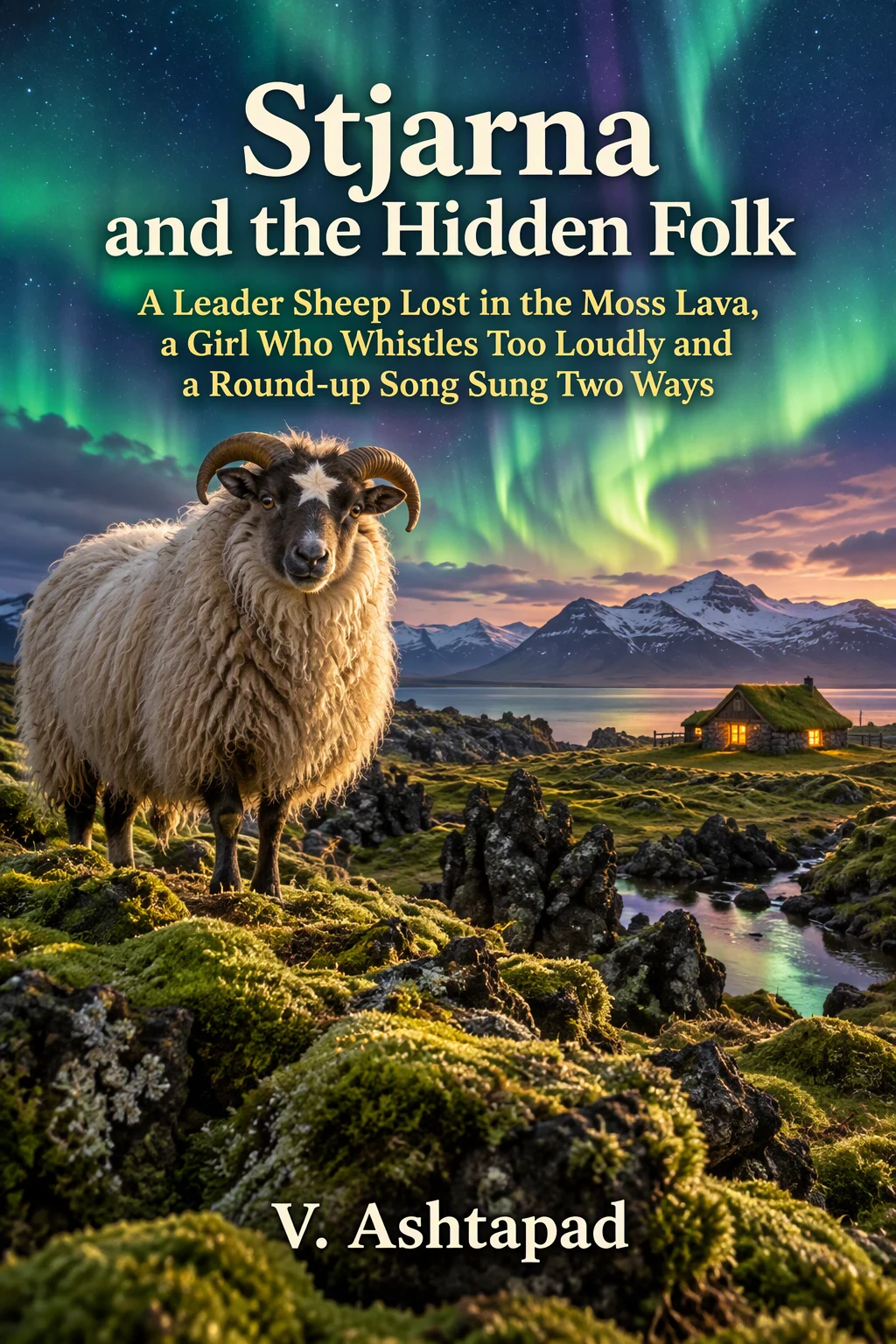
Stjarna and the Hidden Folk
A Leader Sheep Lost in the Moss Lava, a Girl Who Whistles Too Loudly and a Round-up Song Sung Two Ways
by V. Ashtapad
Foreword
This is a work of fiction. The Icelandic autumn round-up, the sorting pens, leader sheep, rye bread baked in hot ground, lamb soup, round-yoked wool sweaters and the old tales of the hidden folk who live in rocks are real traditions of Iceland. The farm of Mosabrekka, the Blue Rock, its valley and every person, sheep and song in this story are invented.
For every grandmother who never lost count of her stitches or her stories.
The Farm Where the Lava Ends
Far in the north, where the sea is cold and the mountains wear snow on their shoulders even in summer, there is a valley shaped like a cupped hand. At the top of the valley stands a mountain the color of old iron. At the bottom of the valley runs a river so clear you can count the stones. And between the mountain and the river, spilling down the slope like porridge that boiled over a very long time ago, lies the lava field.
The lava is not hot anymore. It has not been hot for a thousand years. It is black underneath and green on top, because the moss has been growing over it all that time, slowly, patiently, the way moss does everything. If you press your hand into that moss, it is as soft as a pillow and as cold as a cellar, and when you lift your hand away, the print of your fingers stays there for a long while, as if the moss is thinking about you.
At the place where the lava ends and the good grass begins, there is a farm called Mosabrekka. That means something like Moss Slope, and it is a sensible name, because that is exactly what it is.
On the farm at Mosabrekka there lived a girl named Sóley. She was seven years old. She had hair the pale yellow of dry hay, which her mother braided every morning and which came unbraided by lunchtime, every single day, no matter how tightly it was tied. She had a gap where her two front teeth used to be, and she could whistle through it louder than her father could whistle through his fingers, which made her very proud and made her father pretend to be very annoyed.
Sóley lived with her father, Einar, who was a sheep farmer and a fixer of things. He fixed fences and tractors and gates and the radio and, once, a kitchen chair that had been broken in three places, and when he was done it wobbled only a little.
She lived with her mother, Halla, who was a sheep farmer too, and who also drove the long road to the town by the fjord three days a week to work at the health center there. Halla could stitch up a cut on a knee and a tear in a coat with the same quick, neat fingers.
She lived with her little brother, Kári, who was four, and who believed that everything in the world was either a tractor or a dog. The cat was a dog. The kettle was a tractor. Sóley had tried to explain this to him many times, and had given up.
And she lived with her grandmother, Amma Gudrún, who was the oldest person Sóley knew and also the best at telling stories. Amma Gudrún had a face as creased as a walnut shell and a laugh that cawed like a crow's, and she knitted while she talked, and she talked while she knitted, and she never once, in Sóley's whole life, lost count of her stitches.
They lived in a white house with a red roof. But behind the white house, set into the side of the hill, there was an older house, a house made of turf. Its walls were built of strips of earth stacked like the layers of a cake, and its roof was covered with grass, so that in summer the house looked as though it had a green fur hat pulled down over its ears. Nobody slept in the turf house anymore. It was where they kept the potatoes and the rakes and the old wooden skis and the dried fish, and it smelled of earth and smoke and something sweet that Sóley could never name. Amma Gudrún had been born in that turf house, and so had her mother, and her mother's mother before that. Sometimes, when Sóley went in for potatoes, she stood very still in the dim light and tried to hear all those grandmothers breathing.
Now, there were a great many sheep at Mosabrekka. There were more sheep than Sóley could count, and she could count to two hundred if nobody interrupted her. In the summer the sheep went up into the high hills to eat the sweet mountain grass and grow fat and woolly, and the lambs went with their mothers, and nobody saw them at all from early summer until the autumn round-up.
But one sheep stayed behind.
Her name was Stjarna, which means Star, because she had a white mark on her forehead in the shape of a star with one point longer than the others. The rest of her was brown, the warm brown of a loaf just out of the oven, with patches of cream along her legs. She was taller than the other sheep and thinner, with long legs and a long neck, and she had a way of holding her head up high, like a lady at a party looking over everyone's heads to see who else had arrived.
Stjarna was a leader sheep.
Not every sheep can be a leader sheep. Most sheep, if you will forgive me for saying so, are content to follow the sheep in front of them. They put their noses down and their tails toward the wind, and they go where the flock goes. But a leader sheep is different. A leader sheep walks at the front. A leader sheep sniffs the air and turns her head and decides. When the snow is coming, a leader sheep knows it before the clouds do. When the river is too high to cross, a leader sheep stops at the bank and stamps her foot and will not move, not for any dog, not for any farmer, not for anyone.
Stjarna was the best leader sheep in the whole valley. Everyone said so. Even old Bjarni at the next farm said so, and he did not like to say nice things about anybody's sheep but his own.
That summer Stjarna had not gone up into the hills with the others. In the spring she had cut her foot on a sharp piece of lava, and though Halla had cleaned it and wrapped it and it had healed well, Einar said she should stay down by the farm where they could keep an eye on her. So all summer long Stjarna had grazed in the home field, between the white house and the lava, and every morning Sóley had gone out to say good morning to her, and every morning Stjarna had looked at Sóley over everyone's heads, the way she did, and Sóley had felt that she was being greeted by a queen.
On the family's shared pages, where all the cousins and aunts and uncles put their photographs, there was a whole album just for Stjarna. Halla had started it when Stjarna was a lamb. There was Stjarna at one week old, all legs, labeled in Halla's careful way with the year and the words "born in the late snow". There was Stjarna at the front of the flock coming down off the mountain, a tiny brown dot ahead of a river of white. There was Stjarna with Sóley as a baby, sniffing her bonnet. Sóley liked to scroll through it in the evenings, sitting on Amma's lap, and Amma would tell her what had happened on the day of every picture, even the ones Amma had not been there for.
"How do you know, if you weren't there?" Sóley asked once.
"I know Stjarna," said Amma Gudrún, "and I know your father. The rest is easy."
The autumn round-up was coming. Soon the men and women of the valley would saddle their horses and ride up into the high hills to gather in all the sheep, and they would drive them down in one great woolly river to the sorting pens by the bridge, and there would be shouting and singing and soup. And this year, because her foot was healed and strong, Stjarna was to do what she had done every year of her life but this one. She was to walk at the front of the Mosabrekka sheep on the last stretch of the road home from the pens, with her head held high and her star shining, and the whole valley would see her.
Sóley had been waiting for it all summer.
And that, as Amma Gudrún would say, is where the trouble begins.
© 2026 CRUNOD LLC. All rights reserved.
A Sheep Who Knows Things
You might think a sheep is just a sheep. You might think, if you have only ever seen sheep from the window of a car, that they are all more or less the same, like clouds or socks.
Sóley would have told you that you were wrong. And then she would have told you about the storm.
It had happened the winter before, when Sóley was six and three-quarters. The sheep had come down from the hills in autumn as they always did, and they were living in the sheep house through the dark months, eating hay and getting fat and complaining about it. But on fine days in early winter, Einar liked to let them out into the low pasture by the river, to stretch their legs and nibble at whatever grass was left under the frost.
One morning the sky was as clear and blue as a bowl. The sun came up late, the way it does in winter in the north, red and lazy, and hung low over the mountain as if it could not be bothered to climb any higher. Einar opened the sheep house door, and out the sheep went, down the track to the river pasture, with Stjarna at the front.
Sóley and her father went with them, and Kolur, the old black dog, who had one ear that stood up and one ear that flopped over, so that he always looked as if he were asking a question.
They had not been in the river pasture an hour when Stjarna lifted her head.
Sóley saw it happen. Stjarna had been grazing quietly near the fence, and all at once she stopped chewing. She raised her long neck. She turned her face toward the north, where there was nothing at all to see but blue sky and white mountain. Her nostrils opened wide. And she stood there, perfectly still, the way a person stands when they think they have heard their name called from very far away.
"Pabbi," said Sóley. "Look at Stjarna."
Einar looked. He looked at the sheep, and then he looked at the sky, which was still as clear as glass. He frowned.
"Hm," he said, which was what he said when he was thinking.
Then Stjarna turned around. She did not trot or hurry. She simply turned, walked through the middle of the grazing flock, and set off up the track toward the sheep house. And one by one, the other sheep lifted their heads, and looked at her, and followed. Within a few minutes the whole flock was moving up the hill in a long line, with Stjarna at the front, and Kolur running back and forth at the edges looking confused, because he had not been asked to do anything.
"Well," said Einar. "I suppose we're going home."
They had just pulled the sheep house door shut, with every sheep inside, when the first gust came. It came down off the mountain like a giant breathing out, and it brought the snow with it, so much snow, so suddenly, that Sóley could not see the white house from the sheep house door. Her father picked her up and carried her across the yard with his head down, following the fence with one hand, and when they got inside, Halla was standing at the window with Kári in her arms and her face as white as the snow.
The storm blew for two days. When it was over, the drifts were taller than Einar. Old Bjarni at the next farm had lost three sheep in the river pasture, and a farm on the far side of the valley had lost eleven.
Mosabrekka had not lost one.
"That," said Amma Gudrún, when the storm was over and they were all sitting in the kitchen eating pancakes with sugar to celebrate, "is what a leader sheep is for."
She told them, then, about the leader sheep of her own childhood, a big gray ewe called Grána, who had once refused to cross a frozen lake. The farmer had pushed and pulled and shouted, and Grána had planted her feet and would not move, and finally the farmer had given up and taken the long way around. The next day the ice on the lake had cracked from one side to the other.
"How did Grána know?" asked Sóley.
"How do you know when your mother is about to call you in for supper?" said Amma Gudrún.
Sóley thought about it. "I can smell the supper."
"Well, then," said Amma. "Grána could smell the ice. Stjarna can smell the storm. A leader sheep smells the whole world, and she pays attention to it. That is all. Most of us don't."
Sóley had gone outside after supper and stood in the deep snow and sniffed as hard as she could. She smelled snow, and cold, and the sheep house, and a little bit of pancake on her own sleeve. She did not smell anything coming. But she decided that she would practice.
After that, Stjarna was more than just a sheep to Sóley. She was something like a friend and something like a teacher and something like a weather report. When Stjarna lay down in the afternoon with her back to the east, Sóley knew to bring her raincoat to school the next day. When Stjarna stood at the top of the home field and stared at the lava, Sóley stood next to her and stared at the lava too, though she never saw anything there but moss and stone.
"What do you see out there?" she asked Stjarna, one evening in late summer, the summer that Stjarna stayed home.
Stjarna did not answer, of course. Sheep do not. But she turned her star-marked face and looked at Sóley for a long moment with her strange golden eyes, the ones with the flat black middles shaped like little doors, and then she looked back at the lava.
Halla, who was coming in from the sheep house with a bucket, stopped beside them.
"Your amma would say she's looking at the neighbors," Halla said.
"Bjarni's farm is that way," said Sóley, pointing down the valley.
"Not those neighbors," said Halla, and she smiled the small smile that grown-ups smile when they know a joke you don't, and she went inside.
Sóley stood there until the light went orange, and then pink, and then blue, and Stjarna stood beside her, and neither of them said a word.
© 2026 CRUNOD LLC. All rights reserved.
The Night the Sky Turned Green
Three nights before the round-up, the sky turned green.
It started small. Sóley was in her nightgown, brushing her teeth at the bathroom window, when she saw a pale stripe over the mountain. At first she thought it was a cloud with the moon behind it. But there was no moon that night, and clouds do not move the way that stripe moved. It rippled. It stretched. It bent in the middle like a ribbon someone was pulling through the air.
"Mamma!" Sóley shouted, with her mouth full of toothpaste. "The lights!"
Within a minute the whole family was on the front step. Einar had his coat on over his pajamas. Halla had Kári wrapped in a blanket like a sausage roll, with only his nose sticking out. Amma Gudrún had put on her good wool sweater, the gray one with the pattern of white and brown around the shoulders, and she had brought a cup of coffee with her, because Amma Gudrún did not believe in going anywhere without coffee.
And Sóley stood barefoot on the cold step and looked up.
The northern lights are hard to describe to someone who has never seen them, and I am not sure I can do it properly. They are not like fireworks, which are loud and quick and over. They are not like a rainbow, which stays in one place and keeps politely still. They are more like the sky is breathing. Long curtains of green light hang down from nowhere and swing, slowly, as if a wind were moving them that no one on the ground can feel. Sometimes the edges turn pink, or violet. Sometimes the whole sky goes quiet and dim for a moment, and you think it is over, and then it bursts out again brighter than before, rushing across the whole sky so fast you gasp.
That night they were the brightest Sóley had ever seen. They poured over the iron mountain and down into the valley and across the lava field, until the moss seemed to glow green from underneath, and every rock had a green shadow.
"Tractor," said Kári, pointing up from inside his blanket.
"Not a tractor," said Sóley.
"Dog," said Kári, after some thought.
"Close enough," said Amma Gudrún.
They stood and watched until their toes were numb. Halla held up her phone to take a picture, and then laughed and put it away, because the picture only showed a smudge. "Some things you just have to keep in your head," she said.
"My amma used to say," said Amma Gudrún, sipping her coffee, "that on nights like this, the hidden folk are out visiting. That the lights are their lanterns, swinging as they walk from house to house. That they are going to weddings and parties, and carrying news, and paying back what they borrowed."
"Do the hidden folk borrow things?" asked Sóley.
"Oh, all the time," said Amma. "A pot. A saddle. A cup of flour. And they always give it back, too, with something extra, if you were polite about it." She tapped her nose. "If you were rude about it, that's a different story."
Einar made a small grunting noise that could have been a laugh. "Mamma, don't fill her head before bed."
"Her head is already full," said Amma. "I am only rearranging the furniture."
Sóley looked out across the green-glowing lava. And there, at the very top of the home field, against the fence that ran along the edge of the moss, she saw a tall, thin shape with its head held high.
It was Stjarna. She was standing quite still, and she was facing the lava field, and her long neck was stretched out as far as it would go. The lights moved over her back and turned her brown wool green.
"Stjarna's watching," said Sóley.
"Stjarna's always watching," said Einar, and yawned. "Bed, all of you. We've got the trailer to fix tomorrow and the horses to shoe, and I am not doing it on no sleep."
So they went in. Halla put Kári in his bed, where he immediately fell asleep with one arm flung over his face. Amma Gudrún rinsed her coffee cup and went to her room at the end of the hall, humming. And Sóley lay in her bed under her heavy quilt and looked out of her window, which faced the home field.
She could still see Stjarna. The tall, thin shape had not moved.
Sóley kept watching. She watched the lights grow dim and then flare up again. She watched them turn from green to a silvery white, and then, just at the end, a deep and glowing pink, like the inside of a shell. And just as her eyes were closing, so that she was never afterward quite sure whether she had dreamed it, she saw Stjarna turn her head, as though someone had spoken to her. She saw Stjarna walk along the fence, unhurried, to the place where the old gate was, the gate that led into the lava, the gate with the wire loop that never quite closed properly.
And then Sóley was asleep.
© 2026 CRUNOD LLC. All rights reserved.
Gone
In the morning the frost was thick on the grass, and the home field was full of sheep, and none of them was Stjarna.
Sóley knew it the moment she looked out of her window. She did not even have to count. You can always tell when the tallest thing in a field is missing, the same way you can always tell when the tallest person in a room has left. Everything looks flatter.
She ran out in her boots and nightgown, with her coat flapping open, and she went up and down the fence calling. "Stjarna! Stjarna!" The other sheep looked at her with mild, silly faces and went back to chewing. Kolur came out of his kennel and followed her, his one floppy ear bouncing, and sniffed hard at the grass by the old gate, and then stood with his nose pointing at the lava, and whined.
The old gate was open. Not wide open. Just a crack, just enough for one thin sheep to squeeze through sideways, if she held her breath and thought thin thoughts.
"Pabbi!" Sóley screamed. "PABBI!"
Now, here is the thing about families. When something goes wrong, each person in a family goes wrong in their own particular way. I have noticed this many times.
Einar, when he heard, did not shout or run. He went very quiet. He walked up the field still holding his coffee cup and looked at the gate for a long time. He bent down and looked at the wire loop that never quite closed. Then he set his coffee cup on the fencepost, very carefully, and fixed the loop with a piece of wire from his pocket, twisting it tight, tighter than it needed to be, as if he were angry with the gate. It was only after that that he looked out over the lava and called her name, once, in his deep voice. "Stjarna." The lava did not answer.
Halla took out her phone and called old Bjarni at the next farm, and then the farm across the river, and then the farm at the head of the valley, and asked each of them, politely and quickly, whether they had seen a tall brown ewe with a star on her face. None of them had. Then she opened the family's map, the one with all the places that mattered marked on it, the birthplaces and the old fishing spots and the field where Einar had proposed, and she added a new pin and labeled it "Stjarna last seen, the old gate", and sent a note to all the cousins asking them to keep their eyes open if they drove through the valley. Halla believed that if enough people knew about a problem, the problem would get smaller.
Kári cried, because everyone else seemed upset and he did not want to be left out.
And Amma Gudrún sat down at the kitchen table, picked up her knitting, and knitted very fast for several minutes without saying a single word, which was the most alarming thing of all.
"She'll come back," said Einar finally, coming in and sitting down heavily. "She's a clever beast. Clever beasts come back. She's probably just gone off to find a bit of grass that she fancies."
"In the lava?" said Halla.
"There's grass in the hollows," said Einar. "Pockets of it. She knows where they are. She'll eat her fill and come home tonight, you'll see."
"And if she doesn't?" said Sóley.
Einar looked at her. He had the same yellow hair as she did, only shorter and with gray in it, and the same blue eyes, and just now they looked very tired.
"Sóley," he said, "the round-up starts tomorrow. I have to ride out at dawn with the others. We'll be in the hills for two days, gathering. I can't spend today walking the lava looking for one sheep. I have to fix the trailer, and shoe Brúnn, and pack the saddlebags, and that's before the sorting pen committee calls me about the gate on the bridge pen." He rubbed his face. "She'll come home. Leader sheep don't get lost. That's the whole point of them."
"Then why did she go?" said Sóley.
Nobody had an answer for that.
The phone in Halla's pocket buzzed. It was the round-up roster for the whole valley, the list that the farmers' committee kept every year, of who was riding which ridge and who was bringing the horses and who was in charge of the soup. Mosabrekka had its name in four places on it. Halla looked at it and sighed and turned the phone over on the table.
"I have to go into work this morning," she said. "Just until two. They're short a nurse. I'm sorry, my love."
Sóley looked from her mother to her father to her brother, who had stopped crying and was now driving a spoon across the table and saying "brrrm." Then she looked at Amma Gudrún.
Amma Gudrún had stopped knitting. She was looking at Sóley over the top of her glasses, very steadily, the way Stjarna looked at the lava.
"After breakfast," said Amma Gudrún, "you and I will have a little talk."
© 2026 CRUNOD LLC. All rights reserved.
Amma's Rules for the Lava
When the breakfast dishes were done, and Halla had driven off down the valley road toward the fjord, and Einar had gone out to the shed and started banging on the trailer in a way that was more about banging than about fixing, Amma Gudrún took Sóley's hand and led her out behind the white house, up the little path to the turf house.
Inside, it was dim and cool, with its smell of earth and dried fish. Amma sat down on the old wooden bench along the wall, the one that had been there longer than anybody could remember, and patted the place beside her. Sóley sat. Through the small, deep window, she could see a square of the lava field, green and black and gray, stretching away up the slope toward the iron mountain.
"First a story," said Amma Gudrún. "Then some rules. You must listen to both, because the story is why the rules matter."
Sóley nodded. She tucked her cold hands under her legs.
"When I was a girl, not much older than you," said Amma, "they came to build the road. The real road, the one that goes down the valley to the fjord, the one your mother drove on this morning. Before that there was only a track for horses. The men came with their machines, big yellow machines, the biggest things I had ever seen, and they began to cut the road through the valley, straight as a ruler. And the line they had drawn on their map went right through the lava field, just below the place we call the Blue Rock."
Sóley knew the Blue Rock. Everyone in the valley knew it. It was a great tall stone at the edge of the lava, bigger than the white house, and it was not really blue, but in certain lights, at certain times of day, it looked blue, a deep, cool blue like the shadow inside a snowdrift.
"Now, my own amma, your great-great-grandmother, lived in this turf house then," said Amma Gudrún. "And she went down to the men with their yellow machines, and she said to the foreman, politely, the way you would speak to a guest, that he could not put the road through there. And he asked why not. And she told him. She said, 'That is where the hidden folk live.'"
"What did he say?"
"He laughed," said Amma. "He was from the city, and he laughed, and he went on with his work. And the next morning, the biggest yellow machine would not start. They tried everything. They took it apart and put it together again. It would not start. And the morning after that, the second machine got stuck in a bog that had not been there the day before. And on the third day, the foreman's own boots went missing from outside his tent. Both of them. And they turned up, at noon, sitting very neatly side by side on the top of the Blue Rock, where no man could climb."
Sóley pressed both fists against her lips.
"So the foreman came up to the turf house, holding his hat," said Amma Gudrún, "and he asked my amma what he should do. And she gave him a cup of coffee and told him: go around. And they did. They bent the road. If you look at it, even today, it goes straight as a ruler down the valley until it comes near the Blue Rock, and then it curves, like a polite person stepping around someone in a doorway. And after that, all the machines started every morning, and no more boots went missing."
"Is that true?" whispered Sóley.
Amma Gudrún smiled. "Ask the road," she said.
Sóley thought about the curve in the road. She had been driven around it a thousand times. She had always thought it was just a curve.
"Now," said Amma, "the rules. Are you listening?"
"Yes."
"Really listening? With your ears and your middle?"
Sóley pressed her hand to her stomach and nodded.
Amma held up one knobby finger. "The first rule. If you go into the lava, you speak politely. You say good morning to the rocks. You say thank you to the moss for holding you up. It does not matter whether you see anyone. You are a guest there."
She held up a second finger. "The second rule. You never throw a stone in the lava. Not even a little one. Not even for fun. You do not know whose window it might hit."
A third finger. "The third rule. If anyone gives you something to eat, you may eat it, but you must give something back. A gift for a gift. That is how it works, among them and among us."
A fourth finger. "The fourth rule. You never, ever boast. The hidden folk cannot bear a show-off. If you are good at something, let them find it out for themselves."
A fifth finger, and that was a whole hand. "The fifth rule, and this is the most important one. If you make a promise, you keep it. Always. Even if it is hard. Even if you have to come back years later to do it. A promise in the lava is like a stone. It does not wear away."
Sóley counted the rules on her own fingers. Speak politely. No stones. A gift for a gift. No boasting. Keep your promises.
"Amma," she said slowly. "Do you think Stjarna went to the hidden folk?"
Amma Gudrún did not answer right away. She looked out of the deep little window at the green and black lava, and for a moment her face looked very old and very young at the same time, the way faces sometimes do in dim light.
"I think," she said, "that Stjarna has been looking at the lava all summer long, as if someone out there were calling her. And I think that last night the lights were very bright. And I think that a leader sheep does not leave her flock for no reason." She turned back to Sóley. "Your father is a good man and a fine farmer, and he believes in fixing things with wire. That is good. Most things can be fixed with wire. But not everything."
"Can I go and look for her?"
Amma Gudrún took a long breath through her nose, the way Stjarna did when she smelled the weather.
"You may go as far as the Blue Rock," she said. "That is in sight of this window. I will sit here and knit, and I will be able to see you the whole time. You will take Kolur. You will follow the rules. And if you are not back by the time the shadow of the mountain reaches the river, I will come out and get you myself, and I will not be pleased." She paused. "And you will not mention this to your father, because he is busy, and because he will say I am filling your head."
"Are you?" said Sóley.
"Oh, certainly," said Amma Gudrún, and her crow laugh rang out in the little turf house, and the dried fish swung gently on their strings.
That afternoon, before Sóley set out, Amma did something she had done only a few times before. She took out her phone, which she held at arm's length and frowned at, and with Sóley's help she found the family's recordings of the old stories. Amma had recorded a great many of them over the past few winters, at the kitchen table, with her coffee, giving her permission at the start of each one in a very formal voice, as though she were being interviewed on the radio. There was one called "The Road and the Blue Rock". Amma found it and played a little of it, and there was her own voice, saying "When I was a girl, not much older than you", exactly as she had said it that morning.
"There," said Amma, satisfied. "Now it's told twice. That's how you know a story is true. It comes out the same both times."
© 2026 CRUNOD LLC. All rights reserved.
Wool and Pockets
Getting ready to go into the lava field is not like getting ready to go to the shop. Amma Gudrún was very clear on this.
First there was the matter of the sweater.
Sóley had a sweater already, of course. Every child in the valley had a wool sweater, the thick, round-yoked kind that every grandmother in the north knows how to knit in her sleep, with a band of pattern around the shoulders like a necklace. Sóley's was red, with a white pattern of little trees, and it had been knitted for her when she was five, and the sleeves now stopped a good way above her wrists.
"That will not do," said Amma Gudrún, and went to the big carved chest at the foot of her bed.
The chest smelled of cedar and lanolin, which is the oily, sheepy smell that real wool has before it has been washed too many times. Amma lifted out layer after layer: a white christening blanket, a pair of tiny leather shoes, a stack of folded tablecloths, a fur hat that had belonged to her father. And then, from the very bottom, she brought out a sweater Sóley had never seen.
It was the color of moss. Not the bright moss of spring but the deep, gray-green moss that grows over the lava, the moss that has been there a thousand years. Around the yoke ran a pattern in brown and cream and black, and when Sóley looked closely at the pattern, she saw that it was not trees, and not snowflakes, and not any of the usual things. It was a row of sheep. Little stitched sheep, walking one after another all the way around the shoulders, and at the front of the line, right in the middle of the chest, one sheep was taller than the others, with a tiny white star on its forehead.
Sóley stared. "Amma. That's Stjarna."
"It is not Stjarna," said Amma. "I knitted this before Stjarna was born. Before your father was born, nearly." She shook out the sweater and held it up against Sóley. It was a little big. "My amma taught me this pattern. She said her amma taught it to her. They always put a leader sheep at the front, and they always gave her a mark of some kind, so she could be seen. My amma said it was so the sheep on the sweater would never get lost." She sniffed. "Probably she was filling my head."
"Probably," said Sóley, and put it on.
It was heavy and scratchy and warm, and it smelled of cedar and sheep and, very faintly, of Amma's coffee. The sleeves came down past her fingertips, so Amma rolled them twice. Then she stood back and looked.
"Good," she said. "Now you are wearing a flock. A girl with a flock on her shoulders cannot be all alone."
Next there were the pockets.
Amma Gudrún believed that a person going out into the world should have something useful in every pocket, and she made Sóley put on her old canvas trousers with the pockets down the sides, because they had six pockets altogether, which Amma said was about right.
In the first pocket went a little paper bag of twisted doughnuts, the kind called *kleina*, which Amma had fried two days ago in preparation for the round-up. They were golden and knotted and dusted with sugar, and they smelled of cardamom.
In the second pocket went a handful of raisins, loose, which Sóley thought was a bad idea and said so.
"Raisins are for horses," said Amma, "and for anyone you meet who is shy."
In the third pocket went a small glass bottle with a cork, full of milk from the morning. "In case you need to make a friend," said Amma, "or give a gift. The hidden folk have cows of their own, of course. But they say that milk from our side tastes different to them. Like food from abroad."
In the fourth pocket went a length of red ribbon, the one Sóley's mother had tied in her braids last Christmas. "For Stjarna," said Amma. "So you can lead her if she is willing. You never drag a leader sheep. You ask her to come, and you show her the way, and she will decide."
In the fifth pocket went a stub of pencil and a folded piece of paper. "In case you need to remember something," said Amma, "or in case someone needs to remember something for you."
And in the sixth pocket, the one on Sóley's left hip, Amma put nothing at all.
"Why is that one empty?"
"Because you never know," said Amma Gudrún, "what you will need to bring home."
Last of all she gave Sóley a little whistle on a string, made of bone, very old and yellowed. Sóley did not need it, of course, because she could whistle louder than anyone through the gap in her teeth. But she put it around her neck anyway, because when Amma gave you something, you took it.
Out in the yard, the trailer banging had stopped. Einar was in the stable now, with Brúnn, the big brown horse, and the clink of the farrier's tools came through the door. Kári was in the kitchen with a picture book, telling the pictures which of them were tractors. Kolur was stretched out on the step, chin resting on his paws, and when he saw Sóley come out in her moss-green sweater with all her pockets bulging, he stood up at once and shook himself and wagged his whole back end, the way old dogs do when they know they are going somewhere.
Amma Gudrún walked them as far as the old gate. She opened it, the gate with the newly twisted wire, and held it while Sóley and Kolur went through.
"As far as the Blue Rock," Amma said.
"As far as the Blue Rock," said Sóley.
"Speak politely. No stones. A gift for a gift. No boasting. Keep your promises."
"Speak politely. No stones. A gift for a gift. No boasting. Keep your promises."
"Good," said Amma Gudrún. She closed the gate. Then she walked back up the path to the turf house, and a minute later Sóley saw her face appear in the deep little window, with her glasses on and her knitting needles already flashing in her hands.
Sóley waved. Amma waved one needle back.
Then Sóley turned around, and there was the lava.
© 2026 CRUNOD LLC. All rights reserved.
Into the Moss
If you have never walked on a lava field covered in moss, I must tell you that it is not like walking on anything else in the world.
The first step is soft. Your boot sinks into the moss, an inch, two inches, and the moss sighs around it and holds it like a hand. The second step is soft too. And then on the third step, or the fourth, your boot comes down on a hidden edge of lava under the moss, sharp and hard and tilted, and your ankle twists, and you have to throw your arms out to keep from falling. And then the fifth step is soft again.
That is how the lava teaches you to walk slowly.
Sóley walked slowly. Kolur, who had four legs and had been doing this all his life, walked slowly too, but he made it look easy, picking his way from one lump to the next with his nose down and his floppy ear swinging.
"Good afternoon," said Sóley to the first big rock they passed. It was black and twisted and shaped a little like a man with his arms folded. "Excuse me. I'm looking for my sheep."
The rock did not answer. But Sóley felt better for saying it.
"Thank you for holding me up," she said to the moss, a bit later, after she had nearly fallen over and the moss had caught her.
The moss did not answer either. But it was very soft.
The lava field was full of shapes. There were rocks like trolls and rocks like boats and rocks like the heads of horses. There were cracks so deep and narrow that when Sóley peered into them she could see only darkness, and feel the cold air breathing up out of them, and hear, very far down, the tick of dripping water. There were bowls and hollows where the moss gave way to little circles of grass, bright green and tender, and in some of the hollows there were tiny flowers, purple and white, the last ones of the summer, nodding on their thin stems.
In one of those hollows Kolur stopped and sniffed hard, and whined, and wagged.
"What is it? What have you got?"
Sóley climbed down. The grass in the hollow had been nibbled short, in neat little bites. And there, in the soft earth at the edge, was a print. A small, split hoofprint, two halves of a heart pressed side by side.
"She was here!" said Sóley. "Kolur, she was here!"
Kolur agreed. He agreed so much that he ran in a circle three times and then sneezed.
They went on. Sóley looked back over her shoulder and could still see the white house with its red roof, small now, and the hump of the turf house behind it, and she thought she could see the little square window, though she could not be sure whether Amma's face was in it.
Ahead of them, getting bigger with every step, was the Blue Rock.
It stood up out of the lava like the prow of a ship. It was taller than any other rock in the field, taller than the house, taller than the big old rowan tree by the river. Its base was black and its crown was gray, and it was spotted all over with circles of lichen, orange and yellow and pale green, like coins someone had stuck on it. And just now, in the afternoon light, with the sun behind it, it was blue. Deep, cool, shadowy blue.
And from somewhere near the bottom of it, there was steam.
Sóley stopped. She knew about steam, of course. Everybody in the north knows about steam. There are places all over the country where the ground is hot underneath, where the earth breathes out clouds of white vapor that smell of rotten eggs, and where the water comes up boiling. There was a hot pool up at the valley's head, and the whole family went swimming there in winter, with snow falling on their heads. But Sóley had never seen steam here, by the Blue Rock, in all her seven years.
She went closer. Kolur went closer too, but behind her legs.
The steam was coming out of a crack in the ground at the foot of the rock. It rose in a lazy white plume and then bent sideways in the breeze and vanished. Around the crack, the moss had gone yellow and the stones were stained with streaks of orange and white. The air was warm. It smelled of eggs, a little, and of something else underneath, something that made Sóley's stomach rumble.
It smelled of bread.
Not just any bread. It smelled of the dark, sweet rye bread that Amma made once a year, the kind she packed into a milk can and buried in the hot ground by the swimming pool at the head of the valley, and left there for a whole day and a whole night, and dug up again, steaming, brown as a chestnut and as sweet as cake. Sóley loved that bread more than almost anything. She would eat it with so much butter that her mother said it was not bread with butter but butter with bread.
And it was here. Its smell came rising out of the crack by the Blue Rock.
Kolur sat down very suddenly and looked at something past Sóley's shoulder. His floppy ear lifted, and for once both his ears stood up at the same time.
Sóley turned around.
© 2026 CRUNOD LLC. All rights reserved.
The Girl at the Steam Vent
There was a girl sitting on a rock beside the steam, and she was digging.
She was about Sóley's size, maybe a little smaller, and she had hair so dark it was nearly blue, tied back in a single braid that hung all the way to her waist. She wore a long dress of some heavy brown cloth, with an apron over it, and on top of everything a short jacket of gray-green wool that was almost exactly the color of Sóley's sweater. Her feet were bare. She had a wooden spade in her hands, a small one, worn smooth, and she was digging very carefully in the warm earth beside the crack.
She did not look up. "If you are going to stand there," she said, "you could at least hold the bucket."
Sóley looked around. There was a wooden bucket beside the rock, with a rope handle.
Now, a lot of people would have screamed, I think, or run away, or asked a great many silly questions. And Sóley wanted to do all three. But she remembered the first rule, and so instead she said, "Good afternoon," very politely, and picked up the bucket, and held it.
The girl looked up then. Her eyes were very large and very dark, and they had a kind of shine to them, like water at the bottom of a well.
"Good afternoon," she said, and sounded surprised. "You have manners. Most of your kind don't, at first."
"My amma taught me," said Sóley.
"Then your amma is a sensible woman." The girl went back to her digging. "Hold it lower."
Sóley held it lower. The girl dug a little more, and then put down her spade, and reached into the hole with both hands, and pulled out something round and dark and steaming. It was a pot. An old iron pot with a lid tied on with wire. She lifted it out with her bare hands, which made Sóley gasp, because the pot was hissing, and set it in the bucket.
"Isn't that hot?"
"Of course it's hot. It's been in the ground since yesterday." The girl untied the wire, lifted the lid, and the smell of rye bread rolled out over both of them like a warm blanket. Inside was a dark brown loaf, round and glossy, filling the pot right to the brim.
Kolur moaned softly.
"Your dog has manners too," said the girl. "He hasn't jumped up once. My name is Blær."
"I'm Sóley."
"I know," said Blær.
Sóley's mouth fell open. "How?"
"Everyone knows the girl at Mosabrekka who whistles through her teeth," said Blær. "You're very loud. Grandmother says you frighten the plovers." She turned the loaf out of the pot onto a flat stone and looked at it critically. "It's a little dark on the bottom. That's because the ground is hotter here than last year. Everything is changing."
Sóley's legs had gone wobbly, so she sat down on a rock. The rock was warm.
"Are you," she began, and stopped, because she wasn't sure if it was polite to ask.
"Hidden?" said Blær. "Yes. Obviously. You can see me because I'm letting you. And because you're wearing that." She pointed at the moss-green sweater. "Who knitted that?"
"My amma. Well, she knitted it, but her amma taught her the pattern."
Blær leaned close and looked at the little row of stitched sheep walking around the yoke. She touched the tall one at the front, with the star, very gently with one fingertip.
"Hm," she said, exactly the way Einar said it when he was thinking.
Then she took a knife out of her apron pocket, a little knife with a bone handle, and cut two thick slices from the steaming loaf. She held one out to Sóley.
Sóley wanted that bread so badly that her mouth was watering like a tap. But she remembered the third rule.
"Thank you," she said. "May I give you something back?"
Blær's dark eyes went even wider. "You really do have manners," she said. "What have you got?"
Sóley reached into her pockets. She had the kleina in the first pocket, and she took out the paper bag and opened it and held it out. Blær looked into the bag, and sniffed, and her whole face lit up.
"Cardamom," she breathed. "Oh, we never have cardamom. It comes from so far away."
She took one twisted doughnut and Sóley took one slice of bread, and they sat on the warm rocks by the steam vent and ate. The bread was sweet and soft and still hot in the middle, and it tasted of the earth it had baked in, and Sóley thought it was even better than Amma's, though she would never have said so. Blær ate her kleina in very small bites, with her eyes closed, the way you eat the last piece of birthday cake.
Kolur sat very still and very politely and very hopefully. Blær broke off a corner of the bread crust and held it out to him, and he took it as gently as if it were an egg.
"Now," said Blær, licking sugar off her fingers. "You're looking for the leader."
Sóley nearly choked. "Stjarna! Have you seen her?"
"Everyone has seen her," said Blær. "She came through last night under the lights. She walked right past our door, and she didn't even stop to say good evening. Grandmother was most put out." She frowned. "Although Grandmother is put out about most things these days."
"Where did she go?"
"Up," said Blær, and pointed with her chin toward the mountain, the way people in the valley point when their hands are full. "Into the deep lava. Where the cracks are. Your kind don't go there, and mostly ours don't either."
Sóley looked up at the lava field stretching away toward the iron mountain, and it seemed to her suddenly enormous, much bigger than it had been that morning, a whole ocean of black and green with no edges.
"I'm only allowed as far as the Blue Rock," she said, in a small voice.
"Well," said Blær, "you're at the Blue Rock now. So you're allowed." She wiped her knife on her apron and put it away. Then she looked at Sóley very seriously. "But I can't take you up there. Not by myself. You'd need Grandmother's say-so. And Grandmother," she sighed, "is not in a good mood."
"Why not?"
Blær looked at the steam for a while, rising and bending and vanishing.
"Come and see," she said.
© 2026 CRUNOD LLC. All rights reserved.
Hidden Folk Are Particular
On the way to Blær's door, which was only a few steps but took quite a long time, Blær explained a great many things.
She explained that the hidden folk do not like to be called elves, because elves are something different and come from storybooks from other countries, with pointed hats.
"We don't wear pointed hats," said Blær. "Can you imagine? You'd catch them on everything."
She explained that the hidden folk do not like loud noises, sudden lights, or people who shout across the lava instead of walking over to talk properly.
"No offense," she said.
"None taken," said Sóley, who had been shouting for Stjarna all morning and felt her face go hot.
She explained that the hidden folk keep sheep and cows and horses, just like the farmers in the valley, and that their sheep are mostly gray, and that their cows are very small and very fat and give the sweetest milk in the world, and that their horses can walk over the moss without leaving a single footprint.
"So how do you find them, if they get lost?"
"They don't get lost," said Blær, with some pride. "Our animals always know where home is." Then she looked a little less proud. "Mostly."
She explained that the hidden folk do not mind human beings, in general, as long as they are polite, and that some of them are even rather fond of human beings, the way you might be fond of a noisy neighbor's dog.
"Grandmother says your kind are like weather," said Blær. "Loud and changeable and sometimes useful and you can't do anything about them."
"That's not very nice," said Sóley.
"No," agreed Blær. "Grandmother isn't very nice. But she's fair. That's better than nice, mostly."
She explained that the hidden folk had a rule against telling human beings their real names, and that Blær was only her everyday name, the way Sóley might have a nickname at school.
"What's your real name, then?"
Blær gave her a look.
"Oh," said Sóley. "Sorry."
She explained that the hidden folk had been watching the people at Mosabrekka for a very long time, longer than the white house had been there, longer even than the turf house. That they remembered Amma Gudrún as a little girl, and her amma, and the amma before that.
"Your great-great-grandmother," said Blær, "the one who stopped the road? She used to come out here and leave a bowl of milk on the Blue Rock every Christmas Eve. Every single year. Grandmother says she was the most sensible human being who ever lived."
Sóley tucked that away to tell Amma. She thought Amma would like it.
And she explained, last of all and in a low voice, what was wrong with Grandmother.
"She lost something," Blær said.
"What?"
"A song."
Sóley was not sure she had heard right. "A song? How do you lose a song?"
Blær stopped walking. They were standing in a little gap between two rocks, very near the foot of the Blue Rock, where the moss was thickest and the steam drifted past in slow white ribbons.
"The same way you lose anything," Blær said. "You stop using it. You put it away somewhere safe. And then one day you go to get it, and it isn't there." She scuffed one bare foot in the moss. "It's the round-up song. The one we sing when the flocks come home. All of us, together, the whole hidden village, when the gray sheep come down from the high ground. Grandmother is the one who knows it best. She's always the one who starts it, and everyone else joins in. Only this year she went to start it, at the first practice, and she couldn't remember how it goes. Not the tune. Not the words. Nothing. It was just gone."
"Can't somebody else start it?"
Blær shook her head so hard her long braid swung. "Nobody else knows the beginning. Grandmother always sang the beginning. We only know the parts after. It's like," she searched for it, "it's like knowing the middle of a road but not where it starts. You can't get on it."
"Oh," said Sóley.
"And without the song," said Blær, "the flocks won't come down. That's what Grandmother says. The gray sheep listen for it, up on the high ground, and when they hear it, they know it's time to come home. Without it they'll stay up there, and the snow will come." She looked at the mountain. "It's coming soon. I can smell it."
Sóley sniffed. She smelled steam, and moss, and bread, and Kolur. She did not smell any snow. But she believed Blær.
"So Grandmother's been sitting by the fire for a week," Blær went on, "and she won't talk to anyone, and she won't eat, and she says it's all the fault of the noise from your valley. The machines and the radios and the music in the cars. She says it got into her head and pushed the song out." Blær's voice got smaller. "She says she's getting old."
They stood quietly for a while. Somewhere up in the lava a raven called, the croaking, knocking call that ravens make, like someone tapping on a hollow log.
"My amma," said Sóley slowly, "is very old too."
"I know," said Blær.
"She forgets things sometimes. Where she put her glasses. What day it is. But she never forgets stories. Not ever."
"I know," said Blær again, and something in the way she said it made Sóley look at her quickly. But Blær had already turned away, and was walking toward the rock.
"Come on," she said. "And remember. Whatever she says to you, don't argue. Grandmother hates being argued with. And don't boast."
"I never boast," said Sóley.
"You whistle," said Blær darkly, "very loudly."
© 2026 CRUNOD LLC. All rights reserved.
The Door in the Blue Rock
There was no door in the Blue Rock.
Sóley looked very carefully. She looked at the black bottom of the rock and the gray top of it and all the lichen coins of orange and yellow and green in between. She looked at the crack where the steam came out. She looked at the moss growing around the base of it, thick and deep and soft. There was nothing that looked even a little bit like a door.
"Knock," said Blær.
"Where?"
"Anywhere. It doesn't matter. Just do it nicely."
Sóley lifted her hand, in its rolled-up green sleeve, and knocked three times on the cold stone, the way she would knock on the door of the principal's office at school. Gently. Politely. Knock, knock, knock.
And the Blue Rock opened.
It did not swing open like a door, or slide like a window. It was more as if the rock had always been open and Sóley had simply not been looking at it in the right way. One moment there was stone, and the next moment there was a low wooden doorway, with a carved lintel over the top and a step worn down in the middle by many feet, and golden light spilling out of it onto the moss, and a smell of woodsmoke and boiled milk and dried herbs.
"Wipe your feet," said Blær, and went in.
Sóley wiped her feet. She wiped them over and over, harder than she had wiped them in all her life, and then she told Kolur to wipe his, and he looked at her as though she were being silly, but he scraped each paw on the moss anyway. And then they went in together.
Inside, it was a turf house.
Not a turf house like the one at Mosabrekka, dim and cool and full of potatoes. A turf house as it must have been when people still lived in them. The walls were thick and earthy and warm, hung with woven blankets in blue and brown and red. The floor was beaten earth, swept clean, with sheepskins laid down on it. A long hall ran away from the door, with doorways off it on both sides, and from each doorway came light and sound: the clack of a loom, the hiss of a pan, the low murmur of voices, the squeak of a spinning wheel turning and turning. At the end of the hall was a big room with a fire burning in its center, and the smoke went up through a hole in the roof, and around the fire sat what seemed to Sóley like a great many people.
They were all looking at her.
They looked, if I am honest, very much like the people of the valley. There were old men with beards and young men without them. There were women in long dresses with their hair in braids, and some of them were knitting and some of them were carding wool and one of them had a baby on her lap, a baby with very large dark eyes that gazed at Sóley without blinking. There were children, too, two boys and a smaller girl, who stopped playing some game with knucklebones on the floor and stared.
But there was something different about all of them, though it took Sóley a while to notice what it was. They were all quite still. Not frozen, just still. When the people of the valley sat around a kitchen table, they fidgeted and scratched and tipped their chairs back and jiggled their feet. These people did not jiggle anything. They sat as quietly as the rocks outside, and they looked as though they could sit that way forever.
And their clothes were old. Not worn-out old. Old-fashioned old, like the clothes in the photographs on the family's pages from a hundred years ago, the ones Halla had labeled so carefully with the names of the great-great-aunts and great-great-uncles. Long skirts and buckled shoes and tasseled caps and embroidered belts.
"This is Sóley," said Blær to the room, "from Mosabrekka. She's looking for the leader. She's got manners. And she brought cardamom."
There was a little rustle around the fire, like wind in grass.
"She's also," Blær added, "got a sweater you should see."
Sóley stood in the doorway with her hands clasped and her heart thumping. She felt very small and very noisy and very human, and she was suddenly aware that her braids had come undone, as they always did, and that there was moss on her knees and sugar on her chin.
But she remembered the first rule.
"Good afternoon," she said to the whole room, as clearly as she could. "Thank you for letting me in. Your house is very beautiful. It smells like my amma's kitchen."
The rustle came again, and this time it sounded a little warmer.
Then someone by the fire stood up.
She was the oldest person Sóley had ever seen. Older than Amma Gudrún, older than old Bjarni, older than anyone. She was small and bent and wrapped in shawls, one on top of another, gray and brown and black, so many that she looked like a pile of wool with a face peeping out. Her face was so wrinkled it looked like the lava itself, all folds and cracks. Her hair was white as the steam outside and fell all the way to the floor. And her eyes were the darkest of all, so dark they seemed to have no bottom, and in each one there was a tiny point of light, like a star reflected in a well.
"So," said Grandmother. Her voice was dry and creaky, like a door whose hinges nobody has oiled for years. "The whistling girl."
Sóley swallowed. "Yes, ma'am."
"You are very loud."
"Yes, ma'am. I'm sorry, ma'am."
Grandmother studied her. She looked at her undone braids and her mossy knees and her sugary chin. She looked at Kolur, who had sat down on Sóley's feet and was trying to make himself invisible. And then she looked at the sweater, the moss-green sweater with the row of stitched sheep walking around the yoke, and the tall one at the front with the star.
And Grandmother's face changed.
I do not know how to describe it, exactly. It was as though something had moved under the surface of a still pond. The wrinkles did not go away, and the dark eyes did not soften, exactly, but they went very wide, and for just a moment they looked wet.
"Come here, child," said Grandmother. "Come here and let me look at that."
© 2026 CRUNOD LLC. All rights reserved.
Grandmother's Lost Song
Sóley walked across the room. It was a long way, past the loom and the spinning wheel and the children with their knucklebones and the woman with the baby, and every face turned to follow her, slowly, like sunflowers following the sun. Kolur came too, pressed so close against her legs that she nearly tripped over him.
When she reached the fire, Grandmother put out one hand. It was thin and brown and cool, and it felt like a dry leaf. She laid it flat on the front of the sweater, right on the tall stitched sheep with the white star.
"Who made this?" said Grandmother.
"My amma," said Sóley. "Amma Gudrún. But her amma taught her the pattern, and her amma's amma taught her, and I don't know before that."
"I know before that," said Grandmother.
She traced the row of little sheep around the yoke with one long finger, all the way around Sóley's shoulders and back to the front.
"I showed it to her," Grandmother said quietly. "The first one. A girl from the farm on the slope, a long time ago, when there was only the turf house and no road at all. She used to come and sit on the Blue Rock and knit, and she was very bad at it. Her stitches were all different sizes. Her sheep looked like potatoes." The corner of Grandmother's mouth twitched. "So one day I came out and sat beside her and showed her how. And I said, always put the leader at the front, and always give her a mark, so she can be seen. So the flock on your shoulders will never get lost."
Sóley could hardly breathe. "That's what Amma said. Exactly that."
"Of course it is," said Grandmother. "A thing told properly comes out the same each time."
She took her hand away and sat back down on her low stool by the fire, among her shawls, and suddenly she looked very tired.
"And the girl brought milk," said Grandmother. "Every Christmas Eve, a bowl of milk on the Blue Rock. A gift for a gift. And one year, I gave her something else in return. Because she had been faithful. Because she always came." Grandmother stared into the fire. "I gave her a song."
A murmur went around the room. The woman with the baby pressed her fingers to her lips.
"The round-up song?" whispered Blær.
Grandmother nodded. "I taught it to her one autumn, sitting on the rock, the way I taught her the sheep. So that her people could sing their flocks home too, as we sing ours. I thought it was a small thing. A song for a bowl of milk." She shook her head. "I didn't think I would ever need it back."
"But you sang it every year," said Blær. "Didn't you? You always started it."
"Every year," said Grandmother. "For longer than this valley has had its name. And this year I opened my mouth and it was gone." She tapped her own forehead with one knuckle, hard. "Old. Old and full of noise."
Sóley stood very still. In her head, something was knocking, the way she had knocked on the Blue Rock. Knock, knock, knock.
Every year, at the round-up, when the sheep came pouring down off the hills and into the sorting pens by the bridge, and all the farmers of the valley stood on the stone walls with their flasks of coffee and their red cheeks, and somebody started to sing, it was always the same person who started.
It was Amma Gudrún.
Amma always sang the first verse alone. Her voice was thin and cracked and not very loud, and it rose and fell in a funny old way that was not like any song on the radio, and people went quiet to listen to it. And then, when she got to the end of the first verse, everyone joined in, the whole valley, and the song got big and loud and rolled out over the pens and the river and the bleating sheep, and the children climbed on the walls and shouted it, and old Bjarni sang so hard his face went purple.
And Amma said, every single year, when people asked her where that first verse came from: "My amma learned it from a woman in the lava."
Everyone laughed when she said it. They thought it was a joke.
Sóley looked at Grandmother, small and bent among her shawls, staring into the fire. And then she looked at Blær, who was looking back at her with her huge dark eyes, and Blær's mouth was very slightly open, and Sóley understood that Blær had been waiting for this, maybe all along. Maybe ever since the steam vent. Maybe ever since she said "I know."
Now, right here, Sóley could have boasted. She could have put her hands on her hips and said, "Well, I know that song, I know it better than anyone, I can sing it louder than anyone in the whole valley." And all of that would have been true.
But she remembered the fourth rule.
So instead she stepped a little closer to the fire, and she said, as quietly as she could, which was not very quietly, because she was Sóley:
"Ma'am. I think my amma might still have it. The song you gave away. I think she sings it every year."
Grandmother's head came up slowly.
"I'm not very good," said Sóley. "And it might not be the same. But I could try. If you like."
The fire popped. The baby on the woman's lap gurgled. Nobody else made a sound. The whole hidden house held still, stiller even than before, which Sóley would not have believed was possible.
"Sing," said Grandmother.
© 2026 CRUNOD LLC. All rights reserved.
What Amma Sang
Sóley closed her eyes, because it was easier that way. She thought of the sorting pens by the bridge, and the stone walls, and the smell of wet wool and horses and coffee, and the sound of the river under everything. She thought of Amma standing on the wall in her gray sweater with her hand on Sóley's shoulder, and the whole valley going quiet. And she opened her mouth and sang.
Come down, come down from the high green places,
come down from the wind and the stone,
the light is going and the snow is coming,
and the long road leads you home.
Her voice wobbled on the high part, the way it always did. She did not do the funny up-and-down bits as well as Amma. But she got all the words right, and when she finished, she opened her eyes.
Grandmother was frowning.
"No," said Grandmother. "No. That is not it."
Sóley felt her face go hot again, hotter than the steam vent. All the hidden folk were looking at her. Kolur pressed against her legs.
"That's how Amma sings it," she said. "Every year."
"Then your amma sings it wrong," said Grandmother sharply. "There is no road in it. There was never a road in it. There were no roads, when I made it. Road! What sheep ever cared about a road?"
And here is the thing. Sóley wanted to argue. She wanted it very badly. She wanted to stamp her foot like Stjarna at the riverbank and say, "My amma does not sing it wrong. My amma has sung it at the round-up since before my father was born. Everyone in the valley knows it that way. You're the one who forgot it, not her."
It was all on the tip of her tongue. It was pushing at the back of her teeth.
But Blær had said: "Whatever she says to you, don't argue."
And Amma had said, so many times, sitting at the kitchen table with her knitting, when Sóley and Kári were squabbling over whose turn it was: "Listen first. You can always argue later. You can never listen later."
So Sóley shut her mouth. And she listened.
She listened to what Grandmother had said. "There were no roads, when I made it." And she thought about that. She thought about the girl from the turf house sitting on the Blue Rock, long before the road, long before the yellow machines, learning this song. And then she thought about that girl's daughter, and her daughter, and her daughter, all singing it every autumn at the round-up, for years and years and years. And then she thought about the road coming, and bending around the Blue Rock like a polite person in a doorway. And then she thought about all the farmers of the valley driving their sheep home along that road, every autumn, singing.
Of course there was a road in it now. The road was where the sheep walked home.
"Ma'am," said Sóley. "I think maybe it changed."
Grandmother's eyes narrowed. "Changed?"
"Because we have a road now. Because that's how our sheep come home. Along the road, from the pens by the bridge." Sóley twisted her hands together. "I think maybe somebody, a long time ago, one of the grandmothers, put the road in. Because it was true for them. Not because yours was wrong. Just because, well, theirs was a bit different." She took a breath. "I don't know how yours goes. I'd like to know. If you could remember it, I mean."
Grandmother said nothing. She looked at Sóley for a long, long time, so long that the fire burned down a little and the woman at the loom got up quietly and added another piece of dried sheep dung to it, which is what people burned for fuel in the old days in the north, and which smells, when it burns, not of anything bad but of grass and summer.
"Sing it again," said Grandmother at last. "Slowly. And leave the road out."
So Sóley sang it again, slowly. When she got to the last line she stopped and hummed instead of singing "the long road", just the tune, "hmm hmm hmm hmm home."
And Grandmother's lips began to move.
At first there was no sound at all. Then there was a sort of whisper, a creak, a breath, like wind finding a crack in a wall. And then, very faintly, so faintly that the whole room leaned forward to hear, Grandmother began to sing.
Come down, come down from the high green places,
come down from the wind and the stone,
the light is going and the snow is coming,
and the moss will carry you home.
Her voice was nothing like Amma's and nothing like Sóley's. It was deep and dry and strange, and it went up and down in exactly the funny old way that Amma's did, only more so, as if Amma's voice were a copy of this one, a very good copy, made a long time ago and handed down. And when she got to the end, the moss, not the road, all the hidden folk in the long room let out their breath together, a great soft sigh like a wave going out over sand.
Then Grandmother sang the first verse again, louder. And this time, when she got to the end, they all joined in. The woman at the loom, and the old men with beards, and the young men without them, and the children on the floor, and even the baby, who made a happy shrieking noise that was not quite in tune. And the song went on past the first verse into the second and the third, verses Sóley had never heard, about the gray ewes on the ridge and the cold coming down and the fires lit in the hollows, and it filled up the turf house and poured out of the door into the lava field, and Sóley stood at the heart of all that sound, open-mouthed, crying without knowing why.
When it was over, Grandmother wiped her own eyes with the corner of one of her shawls and looked up at Sóley.
"The moss," she said. "Not the road. The moss."
"Yes, ma'am," said Sóley. "But ours has the road."
"Yes," said Grandmother slowly. "Yours has the road." She seemed to taste the idea, the way you taste a new food. "Well. Perhaps that is right, for you. Your sheep walk on roads. Ours walk on moss. Perhaps a song should know which way its own flock goes home." She sniffed. "I still think mine is better."
"I think mine is better," said Sóley, before she could stop herself. And then she clapped a hand to her lips.
But Grandmother laughed. It was a sound like a stack of dry sticks falling over, and it went on for a long time, and when it stopped, she was smiling for the first time since Sóley had come in.
"Good," said Grandmother. "Then we will each keep our own. And neither of us will ever lose it again."
She held out her thin hand. "Now. Your paper and your pencil. I know you have them. Your amma never sent anyone into the lava without them."
Sóley dug into her fifth pocket and brought out the stub of pencil and the folded paper. Grandmother did not take them. Instead she sang the song again, all the verses, very slowly, and Sóley wrote down the words as fast as she could in her big wobbly seven-year-old letters, with the moss in it and not the road. Then she folded the paper and handed it to Grandmother, who tucked it somewhere deep in her shawls.
"In case I forget again," said Grandmother. "And you will tell your amma the moss verse. And the others. So that she has them too. It is foolish to keep a song in only one head."
"I'll tell her," said Sóley. "I promise."
The whole room went quiet again, but it was a different kind of quiet. A listening kind.
"You promise," said Grandmother. "In the lava."
Sóley remembered the fifth rule, and her stomach turned over, but she did not take it back.
"Yes," she said. "And," she added, because it seemed only fair, and because Amma would have wanted her to, "I'll come back. Every year. Before the round-up. I'll come to the Blue Rock and sing the beginning, so you can hear it, in case your head gets too full of noise. For as long as I live."
Blær made a small noise.
Grandmother considered her. Then, once, slowly, she nodded.
"A gift for a gift," said Grandmother. "You have given me back my song. Now I will give you back your leader."
© 2026 CRUNOD LLC. All rights reserved.
The Path of Lights
When they stepped out of the Blue Rock again, it was night.
Sóley stopped on the worn step and stared. When she had gone in, the sun had been shining behind the rock and turning it blue. Now the sky was black and deep and full of stars, more stars than she had ever seen, so many that they looked like sugar spilled on a dark tablecloth. And across the stars, rippling and swinging, hung the northern lights.
"How long were we in there?" she said. "Amma's going to be so angry. She said to come back before the shadow reached the river."
"Don't worry about that," said Blær, who had put on a pair of soft leather shoes, the kind tied with long laces wound around the ankles, and a little gray cap. "Time is different on our side of the rock. It's night here. On your side it's still the same afternoon. Grandmother says it's like being in two rooms of one house, with a clock in each, and the clocks don't agree."
"Which one is right?"
"Both," said Blær, which was not very helpful, but it was the kind of answer Sóley was beginning to expect.
Behind them in the doorway, Grandmother stood wrapped in her shawls. She was holding something in her hands, something that glowed.
It was a lantern. A small one, made of iron and thin horn instead of glass, and inside it there was no candle and no flame, but a light that moved and rippled, green and pale silver, exactly like the lights in the sky.
"Take this," said Grandmother, and put it into Sóley's hands. It was not hot at all. It was cool, and very light, and it hummed very faintly, the way a seashell hums when you hold it to your ear. "It will show you the way to your leader. When it goes bright, you are going the right way. When it goes dim, you are not. Do not let go of it."
"Thank you," said Sóley. "I'll bring it back."
"See that you do," said Grandmother. "It was my grandmother's."
And then Grandmother did something unexpected. She reached out and took one end of Sóley's undone braid between her fingers, and with quick, sure movements, so fast that Sóley could not follow them, she braided it again, all the way down, tight and neat, and tied the end with a strand of gray wool from one of her shawls. Then she did the other side. Sóley's head felt lighter and tidier than it had in her whole life.
"There," said Grandmother. "Now you look like somebody's granddaughter. Go on. And whistle quietly."
So they set off into the lava, Sóley holding the lantern before her in both hands, Blær walking beside her, and Kolur close at their heels with his nose to the moss.
The lava was different at night, under the lights. It was not frightening. Sóley had thought it might be, but it wasn't. It was more like walking through a dream you have had before. The moss glowed faintly green wherever the light from the sky touched it. The twisted rocks threw long, soft shadows. The cracks breathed out their cold, quiet air. Somewhere far off, an owl called, and somewhere farther off, another owl answered. And all the time, the lights in the sky swung and rippled, and the light in the lantern swung and rippled with them, as if the two were talking to each other.
When they went left around a big rock shaped like a sleeping dog, the lantern dimmed.
"Wrong way," said Blær.
They went right instead, and the lantern brightened, so that green light washed over Sóley's hands and up her sleeves and over the little stitched sheep on her sweater.
"Right way," said Blær.
They climbed. The lava got rougher here, and the moss got thinner, and the cracks got wider and deeper. Sóley had to give Blær the lantern sometimes, so she could use her hands to scramble up over a ridge of stone, and then Blær gave it back. Kolur found the easiest ways, mostly, and stood waiting at the top of each climb with his tongue out and his tail going.
"Blær," said Sóley, when they stopped to rest on a flat stone, "what will happen to the paper? With the words on it?"
"Grandmother will keep it in the chest with the important things," said Blær. "With her grandmother's wedding belt and the first fleece from the first gray ewe and the knife that never needs sharpening. She'll take it out once a year and read it. She'll pretend she doesn't need to." Blær kicked her heels against the stone. "She does that with lots of things. There's a whole bundle of drawings in there that I made when I was little. Every one has my name on the back and what it's a picture of, in her writing. 'Blær, a horse. Blær, another horse. Blær, possibly a cow.'"
Sóley giggled. "My mamma does that. With photos. She puts them all on our family pages, and she writes on every single one. Who's in it and where and when. There are hundreds. Some of them are just of sheep."
"Why does she do that?"
Sóley thought about it. "So nobody forgets who's who, I suppose. When they're old. Or when they're gone." She looked down at the lantern in her lap, rippling green. "Amma's in lots of them. She was young, once. She had a bicycle. She had black hair."
"Grandmother had black hair once too," said Blær. "I've seen it in a locket."
They sat for a while and looked up at the lights.
"Are you sad," Sóley asked, "that your grandmother's getting old?"
Blær was quiet for so long that Sóley thought she was not going to answer. Then she said, "We live a long time, on our side. But not forever. Nobody lives forever. Not even the rocks." She picked at a bit of lichen. "I think I'm sad that she was frightened. When she lost the song. I've never seen her frightened before. I didn't like it."
"Amma got frightened once," said Sóley. "When she couldn't remember my cousin's baby's name. She cried in the bathroom. I heard her. And then afterward she made Mamma write down every single person in the whole family, and their birthday, and who their parents were, and my cousin in the city put it all into a big tree with lines going everywhere. And Amma looks at it every morning with her coffee." Sóley shrugged. "I think it helps."
"Hm," said Blær. Then she stood up and brushed off her dress. "Come on. The light is getting stronger. We're close."
And it was. As they climbed the last ridge, the lantern in Sóley's hands blazed up so brightly that she had to squint, green and silver and a little bit of pink at the edges, so bright that it lit up the rocks all around them and threw their shadows huge across the moss.
And from somewhere just ahead, somewhere below them, there came a sound.
It was a bleat. A thin, high, frightened little bleat.
And then a second sound, deeper and steadier and calm. A sound Sóley would have known anywhere, in any dark, in any place in the world.
It was Stjarna.
© 2026 CRUNOD LLC. All rights reserved.
The Hollow
Beyond the ridge, the ground fell away into a hollow.
It was a deep hollow, deeper than any Sóley had seen that day, shaped like a bowl with steep sides of black lava and moss. At the bottom, in the light of the lantern, she could see a little round patch of grass, bright green and thick, and a trickle of water shining along one edge of it. And standing on the grass, with her long neck raised and her star glowing white in the lantern light, was Stjarna.
"Stjarna!" Sóley cried, and then remembered and said it again more quietly. "Stjarna."
Stjarna looked up at her. She did not bleat, or come running. She did not even move. She simply looked up the steep side of the hollow, over everyone's heads in her particular way, and Sóley felt herself being greeted by a queen.
"Why doesn't she come up?" said Sóley. "Is she hurt? Is it her foot again?"
"Look," said Blær softly, and pointed with her chin.
Sóley held the lantern out further and looked.
Behind Stjarna, at the bottom of the hollow, there was a crack in the lava. It was not a very wide crack. A person could have stepped across it. But it was deep, and its edges were steep and crumbly, and down inside it, about as far down as Sóley was tall, stuck between two sides of black stone, there was a lamb.
It was a little black lamb, with a white tip on its tail and a white sock on one back leg. It was standing on a small ledge, trembling, with its legs splayed out, and it was bleating, that thin, high, frightened bleat, over and over. It had clearly tried to climb out many times. The moss on the walls of the crack was scraped away in little patches where its hooves had scrabbled.
And Stjarna stood at the very lip of the crack, as close as she could get without falling in. Every time the lamb bleated, Stjarna answered it, low and calm. Meh-eh. As if she were saying: "I'm here. I'm still here. I'm not going anywhere."
"It's not one of ours," said Sóley slowly. She looked at the lamb's ear, which had a notch cut out of it in a particular shape, a little V on the top and a slit on the bottom. Every farm in the valley had its own ear mark, and every farmer knew all the others by heart, and so did their children. Sóley had been learning them since she was five, sitting at the kitchen table with the old book of marks that her father kept, and the new list that the farmers' committee sent out every year with all the changes. "That's Bjarni's mark. That's one of old Bjarni's lambs."
"It must have strayed down from the high ground," said Blær. "Ahead of the round-up. They do that sometimes, the young ones, when they lose their mothers. And then it fell in."
"And Stjarna heard it." Sóley's voice wobbled. "Last night. Under the lights. That's what she was listening for, all summer. Not the hidden folk. No offense," she added.
"None taken," said Blær. "Though I expect it was a bit of both. The lights carry sounds a long way. Grandmother says so."
"She heard it crying, and she went out to it. And she's been standing here all this time. Keeping it company." Sóley looked down at Stjarna, standing at the edge of the crack with her long legs braced and her head up. "So it wouldn't be alone."
"That," said Blær, "is what a leader is for."
It was so exactly what Amma had said, after the storm, that Sóley almost laughed. And then she almost cried. And then she decided that she did not have time for either.
"We have to get it out."
"Yes," said Blær.
"How?"
Blær looked at the hollow, and the crack, and the lamb, and Sóley, and the lantern, and Kolur, one after another, very carefully, the way Einar looked at a broken tractor before he started on it.
"Hm," she said.
© 2026 CRUNOD LLC. All rights reserved.
A Lamb Is Heavier Than It Looks
The first thing was to get down into the hollow, which was not easy, because the sides were steep and the moss was slippery with dew. Sóley went first, on her bottom, sliding, with the lantern held up high in one hand so it would not bump. Blær came after her, lightly, as though the slope were a staircase. Kolur stood at the top and whined and looked down, and then took a deep breath, the way a person does before jumping into cold water, and came skidding and scrambling after them in a shower of moss.
At the bottom, Stjarna turned her head and looked at Sóley.
Sóley went to her slowly. She did not throw her arms around Stjarna's neck, though she wanted to more than she had ever wanted anything. She remembered what Amma said about leader sheep, and she stopped a little way off and held out her hand, flat, the way you offer your hand to a horse. Stjarna stretched out her long neck and sniffed it. Her breath was warm and smelled of grass. And then, very gently, she pushed the top of her head against Sóley's palm, once, and stepped back to the edge of the crack.
"I'm glad you came," she seemed to say. "Now help."
Sóley knelt at the edge and looked down. The lamb looked up at her with its eyes white around the edges and bleated.
"It's all right," said Sóley. "It's all right, little one. We're going to get you out."
She tried reaching down. Her arms were not long enough. Not even close. She lay flat on her stomach on the cold moss and stretched as far as she could, and her fingertips just brushed the top of the lamb's woolly head, and the lamb panicked and scrambled and nearly slipped off its ledge altogether.
Sóley pulled back, her heart pounding.
"It's frightened of you," said Blær.
"I know it's frightened of me!" said Sóley, and then took a breath. "Sorry."
"You're loud," Blær reminded her.
"I know I'm loud."
Sóley sat up and thought. She thought very hard. And while she was thinking, her hand went into her pockets, the way your hand does when you are thinking, and found something small and wrinkled and sticky.
The raisins.
"Raisins are for horses," Amma had said, "and for anyone you meet who is shy."
Sóley lay down on her stomach again. This time she did not reach for the lamb. She held out her hand, palm up, as far down into the crack as she could, with three raisins on it. And she kept silent. She did not whistle or shout or tell the lamb it was all right. She just lay there and held her hand out and was still. As still as the hidden folk by the fire.
For a long time nothing happened. The lamb trembled on its ledge. Stjarna stood beside Sóley and made her low, calm sound. Meh-eh.
Then the lamb stretched out its neck. Very slowly. It sniffed. It sniffed again. And then it took one raisin off Sóley's palm with its soft, whiskery lips, and chewed, looking surprised.
Sóley put three more raisins on her palm, and held it out a tiny bit higher.
The lamb stretched up a tiny bit further.
Three more raisins. A tiny bit higher. The lamb put one front hoof on a knob of stone above its ledge, and reached.
"Now," whispered Blær. And she took the red ribbon, Sóley's Christmas ribbon, out of Sóley's fourth pocket, where Sóley had forgotten it, and made a loop in it, quickly and neatly, and leaned down over the crack beside Sóley, and slipped the loop very gently over the lamb's head and one front leg, so it went around its chest like a little harness.
"Pull," she said. "Slowly. Together."
They pulled together. Slowly. The lamb bleated and kicked, and its hooves scraped on the stone, and for one terrible moment it slipped back, and the ribbon went tight, and Sóley thought it would break. But it was a good ribbon, made of strong old-fashioned cloth, and it held. And then Kolur pushed his way between the two girls, and leaned down, and took a mouthful of wool at the back of the lamb's neck very carefully in his teeth, the way a mother dog lifts a puppy, and heaved.
And the lamb came up out of the crack all at once, like a cork out of a bottle, and landed in a heap on top of Sóley, and all of them went tumbling backward onto the soft moss together, girl and girl and dog and lamb, in a great tangle of legs and wool and ribbon.
Sóley lay on her back and laughed and laughed, with the lamb kicking on her chest and Kolur licking her face and Blær sitting up with her cap over one eye.
Stjarna came and stood over them all, looking down, and said, Meh-eh, in a way that sounded very much like "Well done", and also a little like "What a mess".
The lamb was not hurt. It had a scrape on one knee, and it was very hungry and very cold, but it could stand. And as soon as it could stand, it tottered over to Stjarna and pressed itself against her long cream-colored legs. Stjarna was not its mother. But she put her head down and sniffed it all over, and let it stay.
"Now," said Blær, brushing moss off her dress. "Home."
That was easier said than done. The lamb could stand, but it could not walk far, not over the lava, not in the dark. Its legs kept folding up. After it had fallen down for the third time, Sóley picked it up.
Now, I must tell you something that most people do not know about lambs, which is that a lamb is a great deal heavier than it looks. It looks like a cloud with legs. It feels like a sack of wet potatoes that kicks. Sóley staggered, and nearly fell, and got her balance, and hugged it to her chest with both arms, inside the front of the moss-green sweater where it was warmest. The lamb put its cold nose into her neck and was quiet.
"I can't carry the lantern," she said.
"I'll carry the lantern," said Blær.
"And I can't hold Stjarna's ribbon."
Blær took the red ribbon, which still had a loop in it, and held it out to Stjarna. Stjarna looked at it. She looked at Sóley. She looked at the lamb inside Sóley's sweater. And then, of her own accord, she put her long neck through the loop, so that the ribbon hung around her throat like a necklace.
"You never drag a leader sheep," said Sóley softly. "You ask her to come, and you show her the way, and she will decide."
"She's decided," said Blær.
And so they set out for home: Blær in front with the glowing lantern held high, and Stjarna behind her with the red ribbon around her neck, walking with her head up, and Sóley behind Stjarna carrying the black lamb inside her sweater, and Kolur at the back, with his one ear up and his one ear down, making sure nobody got left behind.
Above them, the northern lights swung across the sky, green and silver and pink, like lanterns carried by people walking from house to house.
© 2026 CRUNOD LLC. All rights reserved.
Home Before the Soup
They came down out of the deep lava the way they had gone up, following the lantern, and the lantern grew brighter and brighter, until at last, rounding a rock shaped like the prow of a ship, they saw the Blue Rock in front of them, and the white plume of steam bending sideways in the night breeze.
Blær stopped at the foot of the rock. The worn wooden step was there, and the carved lintel, and the golden light spilling out onto the moss. Somewhere inside, faintly, Sóley could hear singing. It was the round-up song, the moss one, with all its verses, and the voices were deep and dry and happy.
"They're practicing," said Blær. "Grandmother's making them do it over and over. She says they've all gotten lazy."
Sóley held out the lantern. "You'd better take this back to her. I promised."
Blær took it in both hands. Then she looked at Sóley for a moment with her huge dark eyes.
"You still have an empty pocket," she said.
Sóley looked down. It was true. The sixth pocket, the one on her left hip, was still flat and empty, the only one Amma had not filled.
Blær reached into her apron. What she brought out was small and soft and gray. It was a twist of wool, unspun, soft as smoke, a gray so pale it was nearly silver. She tucked it into the empty pocket and patted it flat.
"From the first gray ewe," Blær said. "Grandmother told me to give it to you. She says your amma will know what to do with it."
"Thank you," said Sóley. "Blær, will I see you again?"
"You promised to come back every year and sing," said Blær. "So yes. Obviously." She grinned suddenly, a quick, wide grin that showed a gap between her front teeth too, exactly like Sóley's. "Try to whistle quietly."
And then she stepped up onto the worn wooden step, and through the low door, and the golden light folded up behind her like a fan closing, and the Blue Rock was just a rock again, black below and gray above, with lichen on it like coins.
And it was not night.
Sóley blinked. The sun was out. It was low in the west, sinking toward the edge of the mountains, and the sky was the pale gold of late afternoon. The northern lights were gone. The stars were gone. The shadow of the iron mountain lay long across the valley, but when Sóley looked down toward the river, she saw that it had not reached the water yet. Not quite. There was still a thin bright strip of grass between the tip of the shadow and the riverbank.
"Two rooms," said Sóley, "with a clock in each."
Kolur sneezed in agreement.
Stjarna was standing beside her with the red ribbon around her neck. The black lamb was still inside Sóley's sweater, asleep, breathing small warm breaths against her neck. And up the slope, small and white and red, was the house, and the hump of the turf house behind it, and the deep little square of the window.
They walked home across the moss. It was a short walk, much shorter than the long dark climb into the deep lava, and Sóley did not twist her ankle once. When they came to the old gate, Sóley saw that her grandmother was already standing there, with her knitting still in one hand and her glasses pushed up on her forehead.
Amma Gudrún looked at Stjarna. She looked at the red ribbon. She looked at the lump in Sóley's sweater, which chose that moment to wake up and bleat. And she looked at Sóley's braids, which were tight and neat and tied at the ends with gray wool.
"Well," said Amma Gudrún. "Somebody has done your hair."
"Amma," said Sóley, and found she could not say any more, and burst into tears.
Amma opened the gate. Stjarna walked through it, unhurried, with her head high, and went straight to the middle of the home field, and stood there, and all the other sheep lifted their heads and looked at her, and then went back to chewing, as if to say: "Oh. There you are."
Then Amma put her arms around Sóley and the lamb together and held them, and Sóley cried into the gray sweater with the white and brown pattern, and Amma rocked her a little from side to side, silent, until the crying was finished.
When she was done, Amma pulled her glasses down from her forehead onto her nose and peered at the lamb.
"That is one of Bjarni's," she said.
"It fell in a crack," said Sóley, wiping her nose on her sleeve. "Up in the deep lava. And Stjarna heard it. Last night under the lights. And she went and stood by it the whole time so it wouldn't be alone."
"Of course she did," said Amma Gudrún.
"And I went into the Blue Rock, Amma, I went inside it, and there's a whole house in there, and a grandmother, and she's the oldest person in the world, and she'd lost the round-up song, and I sang it for her, and it was ours, Amma, it was hers first, and she gave it to your amma's amma's amma for milk, and there's a moss in it, not a road, and there are more verses, and I wrote them down, and I promised, and..."
"Slowly," said Amma. "Slowly. You have years to tell me this. Start at the beginning."
"Where's the beginning?"
Amma thought about it. "The beginning," she said, "is that you need a bath and a bowl of soup. Your father will be in from the stable in a moment. And your mother will be home from work. Come and help me with the rutabaga."
Just then Einar came around the corner of the sheep house, wiping his hands on a rag, and stopped dead.
He looked at Stjarna in the middle of the home field. He looked at his daughter with her mossy knees and her tear-streaked face and her very neat braids. He looked at the black lamb in her sweater. He looked at his mother.
"I fixed that gate," he said.
"You did," said Amma Gudrún. "Very well."
Einar came over slowly. He looked at the lamb's ear and saw the mark. He looked at Sóley. He opened his mouth, and closed it, and opened it again. And then he did something that Sóley had seen him do only a very few times. He sat right down on the cold grass, with his long legs sprawled across it like a boy's, and put his head back, and laughed. He laughed so long and so hard that tears came, and he wiped them with the rag, and the rag left a black smear of grease across his cheek.
"Bjarni," he said, when he could speak. "Bjarni is going to have to say something nice about our sheep. In front of the whole valley."
Halla's car came up the valley road just as the sun went down, and she got out and saw them all in the yard, and Stjarna, and the lamb, and she put her hand on her heart. Later that evening, after the lamb had been fed warm milk from a bottle by the stove, and old Bjarni had come over in his truck and stood in the kitchen doorway with his cap in his hands, turning it around and around, and said, in a rough voice, "That is a fine ewe, Einar. That is the finest ewe in this valley," and then gone very red and refused a cup of coffee and then accepted two, Halla went to the family's map and found the pin that said "Stjarna last seen, the old gate". She did not remove it. She added a second pin, far up in the lava, as near as Sóley could show her, and labeled it "Stjarna found, with Bjarni's lamb". And then a third pin, at the foot of the Blue Rock, which she labeled, after a moment's thought, only with the word Neighbors.
The soup that night was the soup that Amma made every autumn, the one written down in the family's recipe collection in Amma's own words, with notes added underneath over the years by aunts and cousins. Lamb on the bone, simmered for hours until it fell apart. Rutabaga and carrots and potatoes, cut in big rough chunks. An onion. A handful of rice, or oats if there was no rice. Dried thyme from the hills, and a little salt, and a lot of patience. One cousin in the city had written underneath, years ago, "I use a pressure cooker and it is fine", and Amma had written under that, "It is not fine", and nobody had dared to add anything since.
Sóley ate three bowls. Kári ate one and a half, and fell asleep with his face very nearly in the second half, and Halla carried him to bed.
And then Sóley sat on Amma's lap by the stove, although she had grown too big for it, and with the twist of silver-gray wool in Amma's palm between them, she told her grandmother everything, from the very beginning, slowly.
© 2026 CRUNOD LLC. All rights reserved.
The Riders Go Up
The riders went up into the hills before dawn.
In the dark, Sóley was woken by hooves in the yard, and by the creak of saddles, and the low voices of men and women who have been up since four and are pretending not to be cold. She pulled her quilt around her shoulders and went to the window.
The yard was full of horses. There was Brúnn, big and brown and patient, with Einar's saddlebags strapped on behind the saddle. There were Bjarni's two grays, and the chestnut mare from the farm across the river, and a whole string of shaggy, short-legged horses from farther down the valley, stamping and blowing steam from their noses. The riders wore thick wool sweaters under their waterproof coats, and wool hats pulled down to their eyebrows, and some of them had flasks tucked into their saddlebags and some of them had dogs running at their horses' heels, and all of them looked very cheerful in the particular way that people look cheerful when they are about to go and do something hard that they love.
Einar looked up at her window and waved. Sóley waved back. Then the riders set off in a long line up the track behind the house, toward the high hills, and the sound of hooves faded away into the dark, and Sóley went back to bed and lay awake listening to the silence they left behind.
For two days the riders would be up in the hills. They would sleep in the old stone huts that the farmers kept up there for the round-up, huts with turf roofs and bunks along the walls and a stove in the corner. They would ride out every morning in long lines across the slopes, calling and whistling, with the dogs running out wide, and gather the sheep from every gully and every ridge, until the scattered white dots of summer became one great flowing river of wool moving down toward the valley. And on the third day, they would drive that river down into the sorting pens by the bridge, and the whole valley would be waiting for them.
Those were long days for the people who stayed behind.
On the first day, Sóley and Amma Gudrún sat at the kitchen table with the twist of silver-gray wool, and Amma spun it. She had an old hand spindle, which was a stick with a round weight on the end, and she set it whirling against her knee and drew out the wool between her fingers, and it turned into a thread, fine and gray and shining, so fine that Sóley could hardly see it.
"What are you going to make?" Sóley asked.
"You'll see," said Amma.
Then Amma took the moss-green sweater, the one with the row of little stitched sheep walking around the yoke, and turned it inside out, and with a very small needle and the silver-gray thread she began to work, stitch by stitch, at the very back of the yoke, at the end of the line of sheep, behind the last one.
She would not let Sóley see until it was done.
On that first day too, Sóley taught Amma the new verses. The ones from the hidden house. She sang them from memory, because she had given her piece of paper to Grandmother, and Amma listened with her eyes closed and her needle still. When Sóley was done, Amma opened her eyes and asked her to sing them again. And then a third time. And on the third time, Amma sang along, very softly, and her thin cracked voice went up and down in the funny old way, and the moss verse came out exactly the way Grandmother had sung it.
"I always thought," said Amma, "that there must be more of it. It always seemed to end too soon."
"Are you going to sing it at the round-up? The moss part?"
Amma thought about that while her needle went in and out.
"No," she said finally. "I am going to sing it the way my amma sang it, with the road. Because that is our song now, and the valley knows it that way, and it would be like taking a stone out of a wall. But the other verses." She smiled. "I think I will teach those to Kári. When he is old enough to stop calling everything a tractor."
That evening, at Amma's request and with all due formality, they made a new recording. Amma sat at the kitchen table with her coffee, and Sóley held the phone, and Amma looked straight into it and said, in her radio voice, that she gave her permission for this to be kept with the family's stories, and for any of her grandchildren to play it. And then Amma sang the round-up song with the road in it, all the way through, and then the moss verse, and then the new verses after, the ones about the gray ewes on the ridge and the cold coming down and the fires lit in the hollows. And Sóley named the recording, after much thought, "The Round-up Song, both ways."
On the second day, it rained.
Not hard. Just a fine gray drizzle that hung in the air and beaded on the wool of the sheep in the home field and made the lava look black and shining. Sóley went out to see Stjarna in the morning, and Stjarna was standing at the top of the home field again, by the old gate with its tightly twisted wire, staring out at the lava.
But she was not staring the way she had all summer. She was not stretched out and listening. She was simply looking, calmly, the way you look out of a window at a view you know very well. And after a while she put her head down and began to graze.
Bjarni's black lamb was in the sheep house, in a pen of its own with clean straw, getting fat on bottle milk and Halla's attention. It had been decided, between Bjarni and Einar, over the second cup of coffee in the kitchen doorway, that the lamb would go to the sorting pens with the Mosabrekka sheep on the day of the round-up, and walk down the road with them behind Stjarna, and then be handed over to Bjarni there, in front of the whole valley. Einar had said this was so Bjarni would not have to drive over and collect it. Halla had said this was so that Bjarni would have to admit in public that Stjarna had saved one of his sheep. Amma had said it was both, and that men were simple creatures.
In the afternoon, Sóley sat on the step of the turf house in her raincoat and looked at the hills. She could not see the riders. The hills were hidden in cloud. But she knew they were up there, somewhere, her father and Brúnn and Bjarni and all the others, and the dogs, and the sheep, all those hundreds and hundreds of sheep, scattered across the high green places in the wind and the stone.
And she found she was humming.
Come down, come down from the high green places.
She was not sure which version she was humming. Maybe it was both.
© 2026 CRUNOD LLC. All rights reserved.
The Morning of the Round-up
On the third day, Sóley woke while it was still dark, and she did not wait for anybody.
She put on her canvas trousers with the six pockets. She put on the moss-green sweater, which Amma had finished the night before, and laid out on the chair at the foot of Sóley's bed with a piece of paper on top that said only "Look at the back." Sóley had looked, the night before, by the light of her bedside lamp, and had not been able to speak for some time afterward.
At the very end of the line of little stitched sheep walking around the yoke, behind the last brown one, there was a new sheep. It was tiny, smaller than all the rest, and it was stitched in a fine gray thread so pale it was nearly silver, so that in some lights you could hardly see it at all and in other lights it shone. It was a lamb.
"So the flock on your shoulders," Amma had said, from the doorway, "has somebody to bring up the rear."
Now Sóley crept along the hall in her socks with her boots in her hand, and found that Amma Gudrún was already in the kitchen, fully dressed in her gray sweater with the white and brown pattern, with two cups on the table and the coffee pot steaming.
"I thought you might be early," said Amma. "There is hot milk for you. Drink it. And then we will go."
"You're coming?"
"I would not miss it," said Amma Gudrún.
They went out together through the old gate, the woman and the girl, with Kolur at their heels. The sky was just beginning to go gray in the east, and the stars were going out one by one, and there was frost on the moss, so that every step crunched before it sank. The air was very cold and very clear and it smelled, Sóley thought, sniffing hard, of something new. Something sharp and clean and high up.
"Amma," she said. "I think I can smell the snow."
Amma sniffed too. "So can I," she said. "Tonight, perhaps. Or tomorrow. Up on the tops." She tucked Sóley's hand into the crook of her arm. "Just in time."
They walked slowly, because the lava teaches you to walk slowly, and because Amma was old, and because there was no hurry. When they reached the Blue Rock, the steam was rising from the crack at its foot, white and lazy against the gray sky, and the rock itself was black, not blue. There was no door. There was no golden light. There was no smell of bread.
Sóley stood at the foot of the rock and looked up at it.
"What do I do?" she whispered.
"You keep your promise," said Amma. "That is all."
So Sóley took a deep breath of the cold, sharp air, and opened her mouth, and sang. She did not whistle. She did not shout. She sang the beginning of the round-up song, the first verse, the one that only the grandmothers sang, as clearly and as quietly as she could.
Come down, come down from the high green places,
come down from the wind and the stone,
the light is going and the snow is coming,
and the moss will carry you home.
She sang the moss version. It seemed right, here.
When she finished, everything was very still. The steam rose and bent and vanished. A raven croaked somewhere, knock, knock, knock, like someone tapping on a hollow log. Nothing else happened.
And then, from somewhere inside the rock, or under it, or behind it, or just from somewhere very close that was not anywhere you could point to, a voice took up the song.
It was a deep, dry voice, like a door that has finally been opened. It sang the second verse, the one about the gray ewes on the ridge. And then other voices joined it, many voices, deep and high, old and young, and one of them, Sóley was sure, was a girl's voice, about her own age, a little bit out of tune. And somewhere among them all, there was a baby making a happy shrieking noise.
Amma Gudrún's hand tightened on Sóley's arm. Sóley looked up at her, and saw that her grandmother's walnut face was wet, and that her lips were moving with the words.
The song went on, verse after verse, and it rose up out of the lava and drifted up the slope toward the iron mountain, toward the high green places, toward the hills hidden in the last of the night cloud. And as it went, the sky in the east turned from gray to pink to gold, and the sun lifted itself above the rim of the world.
And far up on the mountain, on the high ridge above the lava, where no farmer from the valley ever went, Sóley saw them.
Sheep. Gray sheep. A long line of them, moving down the ridge in the first light, slowly, steadily, one after another, the gray of smoke and silver. They walked so lightly over the moss that they hardly seemed to touch it. At the front of the line walked one that was taller than the others, with its head held high. And at the very back, so small that Sóley could barely make it out, walked a tiny lamb.
Then the sun came fully up, and the light flooded over the mountain, and Sóley blinked against it. When she looked again, there was nothing on the ridge but moss and stone and the long blue shadows of morning.
The singing had stopped.
Amma Gudrún dried her cheeks on her sleeve.
"Well," she said, and her voice wobbled. "That's done, then." She cleared her throat. "And now, my girl, we had better go and get ready. There is a round-up to go to. And I am told someone is going to have to sing the beginning, and I am not getting any younger."
© 2026 CRUNOD LLC. All rights reserved.
Singing at the Pens
The sorting pens stood in a wide green field beside the river, just below the bridge, and they had been there for longer than anybody could remember. They were built of stone and turf, with wooden gates, and from above, if you were a raven flying over, they would have looked like a great wheel. In the middle was one huge round pen, the common pen, big enough to hold every sheep in the valley at once. And all around it, like the spokes of the wheel, were smaller pens, one for every farm. Each one had a gate that opened into the big pen in the middle, and each one had the name of its farm painted on a board above the gate. The Mosabrekka pen was on the north side, between Bjarni's and the farm across the river.
By the middle of the morning, the whole valley was there.
There were trucks and trailers parked all along the road. There were horses tied to the fence. There were grandparents on folding chairs and babies in prams and teenagers sitting on the stone walls pretending to be bored. There were dogs everywhere, all of them excited and most of them barking. There were long tables set up on trestles by the bridge, where the women and men of the farmers' committee had laid out flasks of coffee and jugs of hot chocolate and piles and piles of food: kleina and pancakes rolled with sugar, flatbread with smoked lamb, slices of dark rye bread thick with butter, and, in a great iron pot on a gas ring, steaming and fragrant, lamb soup.
On the committee's board by the gate, someone had pinned up the round-up roster, the same one that had buzzed on Halla's phone a few days ago, printed out large, with every name and every job, and someone else had drawn a smiling sheep in the corner of it in red pen.
Sóley stood on the wall of the Mosabrekka pen in her moss-green sweater, with Halla on one side of her and Kári on Halla's hip, and Amma Gudrún sitting on a folding chair just below with her coffee. Stjarna was not there. She was at home in the home field with the black lamb, waiting. That was the tradition. The leader would come down to the pens at the end, when the sorting was done, to lead the Mosabrekka flock home.
And then somebody shouted. "Here they come!"
Everyone turned toward the hills.
At first it was only a sound. A faint, high, many-voiced sound, coming down from the slopes behind the valley. It was the sound of hundreds and hundreds of sheep bleating all at once, and of dogs barking, and of people whistling and calling. And then, over the brow of the nearest hill, came the sheep.
They poured down the slope like milk out of a jug. White and brown and black and spotted, big ewes and fat lambs, all jostling and bouncing and bleating, flowing down the hillside in one great woolly river. Behind them and on either side came the riders, small and dark on their shaggy horses, waving their arms and calling, and the dogs ran out wide on the edges, turning back any sheep that tried to wander. Sóley saw Brúnn, big and brown, near the front on the left side, and on his back a figure in a wool hat who stood up in his stirrups and waved both arms over his head.
"Pabbi!" Sóley screamed, and whistled through the gap in her teeth, so loudly that three people nearby put their hands over their ears and a horse tied to the fence shied.
Halla laughed. Amma Gudrún said, "Quietly," and then laughed too.
The river of sheep came down the last slope and along the road and across the bridge, and the riders steered it toward the big gate of the common pen, and all at once the sheep were pouring in, more and more and more of them, until the big round pen was so full of wool that it looked like a bowl of whipped cream.
And then the sorting began.
Now, I must tell you about the sorting, because if you have never seen it, you cannot imagine it. Every farmer in the valley, and every farmer's wife and husband and son and daughter and grandmother and uncle, climbs down into the big pen, among all those hundreds of sheep. And every one of them starts looking at ears. Because every sheep has its farm's mark on its ear, and every sheep must go to its own farm's pen, and there is no other way to sort them out than to wade in among them, and look, and grab.
Sóley climbed down into the common pen with her mother. Immediately she was up to her chest in sheep. They pressed against her on all sides, warm and woolly and smelling of rain and grass and mountains, and they bleated in her ears, and they stepped on her feet. She saw a ewe with the Mosabrekka mark, the little half-moon on the left ear, and she grabbed it by the horns the way her father had taught her, and leaned back, and pulled. The ewe did not want to come. Sóley pulled harder. Halla came and helped, and together they steered it, bucking, toward the gate of the Mosabrekka pen, where Kári stood holding the gate open with enormous seriousness, and shoved it through.
"Sheep!" shouted Kári, triumphant.
"Not a tractor?" said Sóley.
"SHEEP," said Kári, and Sóley decided that this was the most important thing that had happened all year, after everything else.
All around them, the whole valley was doing the same thing. Old men and small children and teenagers who had stopped pretending to be bored were wading through the sheep, grabbing horns, reading ears, shouting to each other. "One of yours here, Bjarni!" "Is this the river farm's? No, it's the head-of-the-valley's, look at the slit!" "Get that big ram, somebody, he's sitting on my foot!" The noise was enormous. The sheep bleated, the dogs barked, the people laughed and called, and the river rushed under the bridge, and above it all the sky was bright and cold and blue.
Sóley found Einar in the middle of the pen, with his wool hat pushed back and his face red and wind-burned and grinning. He picked her up, sheep and all, and swung her around.
"How were the hills?" she shouted.
"Cold," he shouted back. "Wet. Wonderful." He set her down. "We got them all, Sóley. Every one. And there was snow on the tops this morning. Just a dusting. We came down just in time." He looked at her sweater, and stopped, and looked again. "Is that a new sheep on the back?"
"It's a lamb," said Sóley. "Amma put it there."
"Hm," said Einar, and looked at her for a long, thoughtful moment, the way he looked at a broken thing he could not quite work out how to fix. And then he decided, she could see him decide, not to try to fix it at all. He just smiled and ruffled her very neat braids and said, "It suits you."
The sorting went on for hours. By early afternoon, the big round common pen was nearly empty, and all the little pens around the wheel were full, each with its own farm's sheep inside. People sat on the walls, tired and muddy and happy, and drank coffee and ate kleina and passed around the soup. The bowls steamed in the cold air. The soup was thick and rich and full of rutabaga and potato and tender meat, and it warmed Sóley all the way to her toes.
And then, as the sun began to slide down toward the west, old Bjarni stood up on the wall of his pen.
"Gudrún!" he called. "Gudrún of Mosabrekka! Are you going to start us, or are we going to sit here all night?"
A cheer went up all around the pens. People turned toward the Mosabrekka wall. Amma Gudrún sat on her folding chair with her coffee cup in her hands, and looked up at all the faces, and then she looked at Sóley.
"Well?" said Amma quietly.
"You do it," said Sóley. "You always do it."
"I always have," said Amma Gudrún. "But I think this year we might do it together."
So Amma stood up, slowly, and Sóley climbed up beside her on the wall, and the whole valley went quiet. Even the sheep, it seemed to Sóley, went a little quieter. The river ran on under the bridge. A dog yawned.
And the two of them sang the beginning together, the old woman and the girl, Amma's thin cracked voice and Sóley's high wobbly one, going up and down in the funny old way that was not like any song on the radio.
Come down, come down from the high green places,
come down from the wind and the stone,
the light is going and the snow is coming,
and the long road leads you home.
They sang the road version. This was the valley, and this was the valley's song.
And at the end of the first verse, everyone joined in. The whole valley, every farmer and every child, the riders with their wind-burned faces and the committee by the soup pot and the teenagers on the walls, and Halla, and Einar, and Kári, who did not know any of the words and sang tractor to the tune with great feeling. And old Bjarni sang so hard that his face went purple. The song rolled out over the pens and the bleating sheep and the river and the road, and up the valley toward the lava and the Blue Rock and the iron mountain with its new dusting of snow, and Sóley sang it with all her heart, and she did not care at all how loud she was.
© 2026 CRUNOD LLC. All rights reserved.
The Long Road Home
When the singing was done, and the last of the soup was eaten, and the sheep were sorted, it was time to go home.
Some farmers loaded their sheep into trailers and drove them. But the farms close to the pens, like Mosabrekka, walked their sheep home along the road, the way it had always been done. And so, as the sun went low and gold over the valley, Einar opened the gate of the Mosabrekka pen, and the sheep came out onto the road in a jostling, bleating crowd, and milled about, and did not know which way to go.
Halla had slipped away while the soup pot was being scraped. And that was when her car came back down the road from the farm, very slowly, with its hazard lights blinking. Behind it, walking in the middle of the road with her head held high and a red ribbon around her neck, came Stjarna. And behind Stjarna, trotting to keep up on its short black legs, with a white sock on one back foot and a white tip on its tail, came Bjarni's lamb.
A murmur went around the pens. People stood up on the walls to see.
Stjarna walked right past the car, which had pulled over to the side, and stopped in the road in front of the Mosabrekka flock. She looked at them, over all their heads, the way she did. She sniffed the air. Then she turned around, and the lamb turned around with her, and the two of them began to walk, slowly and steadily, up the road toward home.
And one by one, the Mosabrekka sheep lifted their heads, and looked at her, and followed.
Except that first, at the edge of the road, Einar stopped the black lamb. He scooped it up in his big arms and carried it over to Bjarni's pen and held it out over the wall.
"I believe this is yours," said Einar, loud enough for everyone to hear.
Bjarni took the lamb. He looked at its ear. He looked at its scraped knee, which was healing nicely. He looked at Stjarna, walking up the road at the front of the Mosabrekka sheep with her star shining in the low sun.
"That," said old Bjarni, loudly and clearly and in front of the whole valley, "is the finest leader sheep I have ever seen. And I have seen a great many. And I would like everyone to know that I said so." And then he went very red, and climbed down off the wall, and was not seen again until the soup pot had been washed.
Einar laughed all the way back to Brúnn.
Then the Mosabrekka flock went home along the road. Stjarna walked at the front, with the red ribbon around her neck. Behind her came the sheep, all the hundreds of them, in a long, bobbing, bleating river of wool. Behind the sheep rode Einar on Brúnn, and behind Brúnn walked Halla with Kári on her shoulders, and Amma Gudrún walking slowly with her stick, and Kolur, his one ear pricked and his other ear flopping, making sure nobody got left behind.
And at the very front, right beside Stjarna, with her hand resting lightly on the leader's warm brown back, walked Sóley.
The road ran straight as a ruler up the valley, between the river and the lava, toward the white house with the red roof. And when it came near the Blue Rock, it curved, gently, like a polite person stepping around someone in a doorway.
Stjarna slowed as they came around the curve. She lifted her head and looked toward the Blue Rock, black and gray in the evening light, with its white plume of steam rising from the crack at its foot. Sóley looked too.
There was nobody there. Of course there was nobody there.
But on the top of the Blue Rock, where no person could climb, Sóley could see something small, sitting quite still in the last of the sunlight. She squinted. It was a bowl. A small wooden bowl, set very neatly on the highest point of the rock. And she knew, without having to go and look, that it was full of the darkest, sweetest rye bread in the world, still warm from the ground, and dusted, just a little, with cardamom.
Sóley did not shout. She did not whistle. She lifted one hand in its moss-green sleeve and waved, very quietly.
Then the road straightened out again, and the flock went on toward home, and above them, as the sky darkened from gold to violet to deep blue, the first faint green ribbon of the northern lights began to ripple over the iron mountain, like a lantern carried by somebody walking from house to house.
© 2026 CRUNOD LLC. All rights reserved.
Told Twice
Sóley kept her promise.
She kept it the next year, when she was eight, and the year after that, when she was nine and had grown so much that the moss-green sweater had to have its sleeves let down. She kept it the year she was twelve and had decided that she was far too old for stories about hidden folk, and went to the Blue Rock anyway, early, before anyone was awake, and sang the beginning, and stood very still afterward for a long time, and came home very quiet. She kept it the year she was sixteen and the snow came early and she had to wade to the rock through drifts up to her knees. She kept it the year Amma Gudrún could no longer walk across the lava, and so Sóley went alone, and came back and sat by Amma's bed and sang the moss verse for her, and Amma sang along with her eyes closed, very softly, and every word came out exactly the same as before.
Stjarna led the Mosabrekka flock down the road for many more autumns, until she was too old to lead, and then she spent her last summers grazing in the home field by the old gate, looking out at the lava with calm golden eyes, the way you look out of a window at a view you know very well.
Kári stopped calling everything a tractor. He learned the new verses, the ones about the gray ewes on the ridge and the cold coming down and the fires lit in the hollows, and he sang them badly and loudly, and he could never, ever whistle through his teeth, which made Sóley very proud and Kári pretend to be very annoyed.
And every autumn, on the evening after the round-up, someone at Mosabrekka would open the family's recordings and play the one called "The Round-up Song, both ways." And Amma Gudrún's voice would come out of it, thin and cracked and going up and down in the funny old way, first with the road and then with the moss. And everyone in the kitchen would stop what they were doing to listen.
Now, I have told you this story the way it was told to me. And the one who told it to me was a woman with yellow hair that never stayed braided and a gap between her front teeth, who was a grandmother herself by then, and who wore, when the nights grew cold, an old moss-green sweater with a row of little stitched sheep walking around the yoke. There was a tall one at the front with a white star. And there was a tiny one at the back, a lamb, stitched in a thread so pale it was nearly silver, so that in some lights you could hardly see it at all and in other lights it shone.
She told it to me sitting in a turf house, in the dim light, among the potatoes and the rakes and the old wooden skis. And when she had finished, she asked me whether I believed it.
I said I did not know.
And she laughed, a laugh like a crow, and said, "Then I shall tell it to you again tomorrow. That is how you know a story is true. It comes out the same both times."
© 2026 CRUNOD LLC. All rights reserved.
If this book stayed with you
Six Spokes
A Winter Ferry, a Sealed Vault on a Baltic Island, and the Letter Six Families Waited Eighty Years to Read
Another ECO Library story with Icelandic roots.
About this book
On the farm at Mosabrekka, where the old lava field ends and the good grass begins, seven-year-old Sóley has a best friend who happens to be a sheep. Stjarna is tall and brown, with a white star on her forehead, and she is the finest leader sheep in the valley. She can smell a storm before the clouds know it is coming.
Then, on a night when the northern lights pour green over the mountain, Stjarna slips through the old gate and vanishes into the moss lava, just days before the autumn round-up. Pabbi has horses to shoe and Mamma has a shift at the health center. But Amma Gudrún has five rules for the lava, a moss-green sweater with a flock knitted on its shoulders, and a pocket she leaves empty on purpose.
At the foot of the Blue Rock, where steam rises out of the ground and smells of warm rye bread, Sóley meets a girl with a braid down to her waist who says she has been expecting her. The hidden folk have lost something too, and it is not a sheep.
Can a very loud girl learn to be very quiet in time to bring her leader home?
Members can react to this book and talk about it in the members' Library.
Ownership
© 2026 CRUNOD LLC. All rights reserved.
This book is owned by CRUNOD LLC. It is free to read on EternalCurrent.Online. No part of it may be copied, reprinted, sold, recorded or adapted, including as audio, film or translation, without written permission from CRUNOD LLC.
© 2026 CRUNOD LLC. All rights reserved.