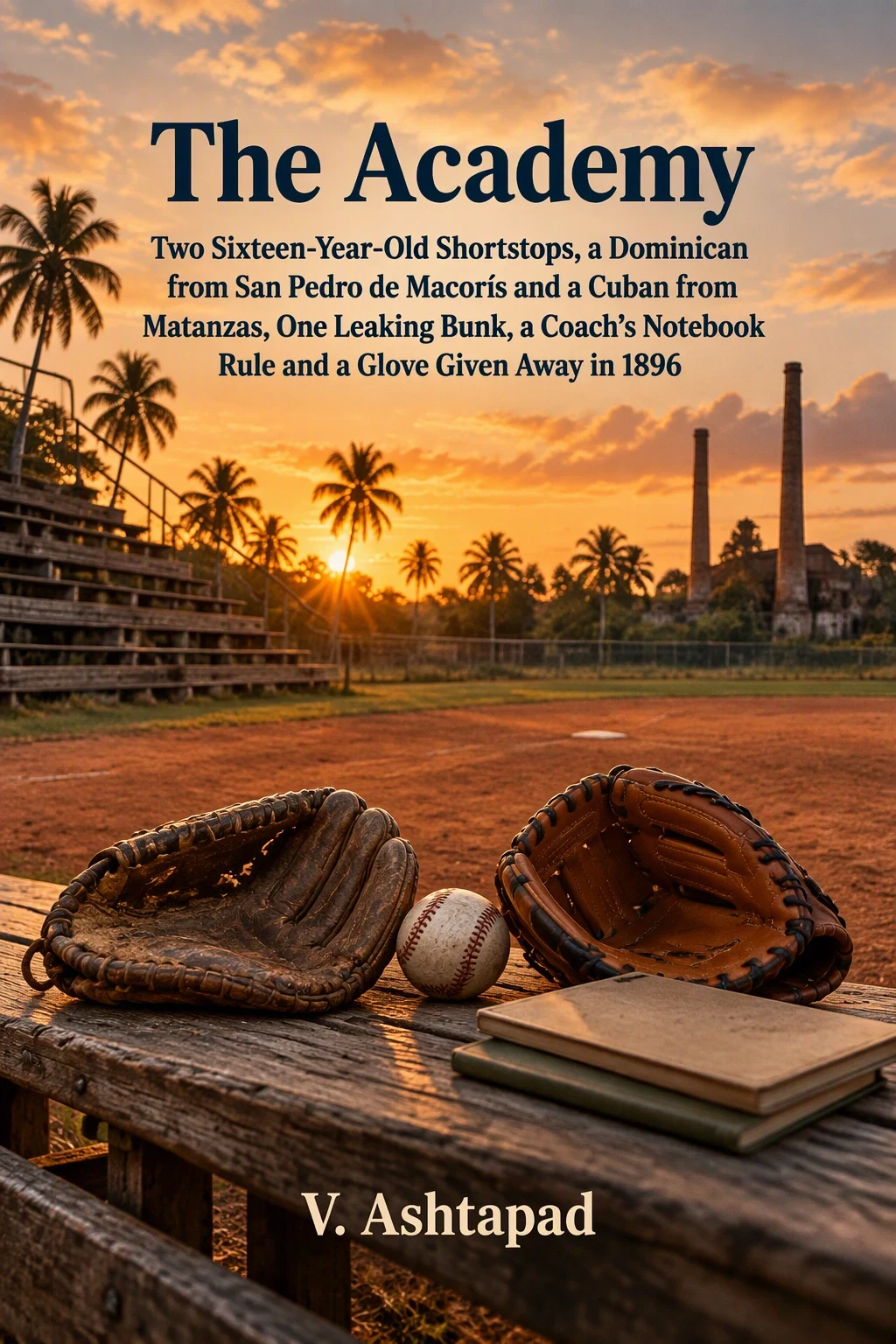
The Academy
Two Sixteen-Year-Old Shortstops, a Dominican from San Pedro de Macorís and a Cuban from Matanzas, One Leaking Bunk, a Coach's Notebook Rule and a Glove Given Away in 1896
by V. Ashtapad
Foreword
This is a work of fiction. San Pedro de Macorís and its sugar mills, the cocolo community and the guloya dancers, the Cuban role in bringing baseball to the Dominican mills in the 1890s, Dominican baseball academies, the January signing period and trainers known as buscones are real. The academy, the Porvenir mill team as described, the clubs, the letters and every named person in the story are invented.
For anyone who kept one and gave one away.
The Notebook Rule
COACH RAMÓN PEGUERO. MONDAY, AUGUST 4.
Rule one. Every boy who sleeps under my roof keeps a notebook.
I give it to them on the first day, with the uniform and the bunk and the list of what time we eat. Cheap school notebook, the kind with a cartoon on the cover, from the stationery store on Avenida Independencia. One hundred pages. They write in it every night before lights out. I don't care what. The game. Their mothers. A girl. The food, which they always complain about. What a coach said to them that made them want to quit. What their own body did that surprised them. Anything.
I don't read them. That's rule two. Nobody reads them. They're theirs.
The boys hate it. They're sixteen and they came here to hit a ball four hundred feet and sign a contract that will buy their mothers a house, and some old man in a straw hat is making them do homework. They complain for a month. Then they stop complaining. Then one day, usually about November, one of them comes and asks me for a second notebook, because the first one is full.
That's when I know he's going to make it. Not the arm. Not the bat. The notebook. The boy who fills a notebook is a boy who's paying attention to his own life. That's a boy who can take an instruction and turn it over in his head at night and come back the next morning different. The boys who leave the notebook empty, who write three lines a week, they have tools, maybe, they have bodies, but they're not listening. Not even to themselves. Those boys sign for big money and wash out in two years in a rookie league in Florida and come home and drink.
I've been doing this thirty-one years. I've had two hundred and twelve boys. Forty-four signed. Eleven made the big leagues. Every one of the eleven filled more than one notebook.
So I keep one too. To be fair. This is it.
---
This year I've got nine boys. That's a small year. San Pedro de Macorís used to be the only place, the cradle of shortstops, they called it, and every scout in America knew the road from the airport. Now every town in the country has an academy, and the big-league clubs have their own palaces in Boca Chica with swimming pools and dormitories with air conditioning and nutritionists, and they take the best boys at fourteen. What's left comes to old men like me, in a converted house at the edge of town, with a field we cut ourselves and a cinderblock batting cage and a roof that leaks over the third bunk.
What's left is usually good enough. You'd be surprised.
Two of my nine I want to write about.
The first is a shortstop from right here. Barrio Restauración, five blocks from the old sugar mill. Wander Mejía. Sixteen. Six feet and still growing, all arms and legs, like a heron that learned to throw. The fastest hands I've seen in ten years. He plays shortstop like the ball owes him money. His mother sells fried food from a cart outside the hospital. His father is gone. His grandfather cut cane at the mill for forty years and played on the mill team on Sundays, and the boy says his grandfather's people came from St. Kitts a hundred years ago to cut the cane, the ones they call cocolos here, and he says it like a challenge, like he's daring you to say something.
The second is a shortstop from somewhere else. Yasiel Ordóñez. Sixteen. Born in Matanzas, in Cuba. Came over to Santo Domingo with his grandmother when he was eleven, the two of them, nobody else, his mother and father still on the island. I didn't ask why. You don't ask why, with Cubans. You wait. He lives with his grandmother in a two-room apartment in Villa Consuelo in the capital, and she cleans offices at night, and an uncle in Miami sends money when he can. Five foot ten. Not as tall. Not as fast. But the best glove I've seen in twenty years. He doesn't play shortstop like the ball owes him money. He plays it like the ball is a bird and he's catching it to let it go.
Two shortstops.
One academy has room for one shortstop.
I've put them in the same room.
Bunk three. The one where the roof leaks.
---
I should say something about the town, since the boys won't. They think everybody knows.
San Pedro de Macorís sits on the south coast an hour east of the capital, where the Higuamo River comes down out of the cane fields into the sea. In 1900 it was the richest town in the country. The sugar did that. The mills went up along the river, one after another, with their chimneys, and the money came in, and the merchants built houses with iron balconies and columns along the malecón, and a fire station of carved wood that's still there, painted, and a cathedral of gray stone by the water, and a theater. The cocolos came on the boats from the islands and built their own neighborhoods with wooden houses on stilts and their own clubs. The Cubans came with the machines. The Arabs came, from Lebanon and Syria, and opened shops. The Italians came and opened bakeries.
Then the sugar went down, the way sugar does. And the mills closed, one after another, until there are only a couple left. And the town got poor. Not like the countryside. Poor like a man who used to be rich and still wears the suit.
What it kept was baseball.
Every boy in San Pedro has a glove. Even the ones who don't have shoes. You see them on every vacant lot at five in the afternoon, when the heat breaks, hitting rocks with sticks, fielding grounders on ground so hard and rough the ball takes bad hops into their faces, which is why San Pedro shortstops have the best hands in the world. Nobody planned it. It's the ground. Bad ground makes good hands.
I've been on that ground my whole life. I played short myself, for the Porvenir mill team, two years, in 1981 and 1982, before my knee went. Next to an old man at third who was already sixty and never let me forget I was slow.
That old man was Cirilo Bastardo. He's still alive. He still says I was slow.
© 2026 CRUNOD LLC. All rights reserved.
The Leak
WANDER MEJÍA. MONDAY, AUGUST 4.
Okay. Notebook. Coach says write. I'm writing.
There's a Cuban in my room.
I want to start with that because it's the most important thing that happened today. More important than the uniform, which is too small, or the food, which is rice and beans and chicken like my mother's but worse, or the field, which has a hole in left-center you could lose a goat in. There's a Cuban in my room. He's in the top bunk. He's a shortstop.
I'm a shortstop.
There's one shortstop on the showcase team in January. Everybody knows that. You don't send two shortstops to the showcase in Miami. The scouts want to see one. The best one. The other one plays second or third or goes home.
I'm not playing second. My grandfather played short for the Ingenio Porvenir team for twenty-two years. Every Sunday. In the dirt behind the mill. With a glove he made out of a cement sack. He told me the story a thousand times before he died. Twenty-two years at short and nobody ever moved him. I'm not going to be the first Mejía to get moved.
He doesn't talk much, the Cuban. He came in this afternoon with a backpack and a glove and a plastic bag with clothes in it and looked at the room and looked at me and said, "Ordóñez," and put out his hand. I shook it. It was a hard hand. Callused across the top of the palm where the bat sits. He's been swinging a long time.
Then he climbed up into the top bunk without asking which one I wanted and put his glove under his pillow.
Under his pillow. Like a little kid.
It rained tonight. At ten. The big kind, the August kind, that comes in off the sea all at once like somebody turned over a bucket. And the roof leaked. Right over the top bunk. Right on his face.
He didn't say anything. He didn't get up. He just turned over so it was dripping on his back instead and went to sleep. I lay there in the bottom bunk listening to it drip on him, plip, plip, plip, for an hour.
I don't know what kind of person lets the rain fall on him and goes to sleep.
I'm going to beat him.
---
YASIEL ORDÓÑEZ. MONDAY, AUGUST 4.
Notebook. My grandmother would like this. She keeps one. Not for baseball. For everything. Her whole life. She started in Matanzas in 1971 and she's on her fourteenth one now. She brought all thirteen from Cuba in a cardboard box tied with string and it was the only box she wouldn't let them put under the bus. She held it on her lap from Matanzas to Havana.
The boy in the bottom bunk is a shortstop. He's very tall and very fast and he looked at me when I came in like I'd stolen something from him. Maybe I have. There's only one shortstop at the showcase.
The roof leaks. On me. It's fine. In Matanzas our roof leaked on everybody.
I put my glove under my pillow. My grandfather's glove. The old one. From 1962. He played in the national series in Cuba for eleven years, second base, for the team from Matanzas, and he gave it to me when I was six and told me to sleep with it so it would learn the shape of my hand. I've slept with it every night for ten years. Even on the boat. I mean the bus.
The boy in the bottom bunk is watching the water fall on me. I can feel him watching. He hasn't said anything.
I'll beat him at short. Or I won't. Either way I'll learn something.
---
WANDER MEJÍA. WEDNESDAY, AUGUST 6.
Third day. Notebook again. My hand hurts from writing. Coach says that's normal. He says it's a muscle like any other.
Here's the schedule, in case anybody ever reads this, which they won't, because rule two.
Five-thirty, Tito bangs on the door with a frying pan. An actual frying pan. With a spoon. Five-forty-five, coffee and bread, standing up. Six, grounders. Two hundred. Seven-thirty, running. Sprints in the outfield until somebody throws up, which on the second day was a boy from Hato Mayor named Robinson. Eight-thirty, breakfast. Rice and eggs and salami and plantains. Nine-thirty, batting cage. Eleven, school, which is a teacher who comes from the high school three days a week and makes us do English and math at the kitchen table, and on the other days Coach makes us read the newspaper out loud. Twelve-thirty, lunch. Rice and beans and chicken. One-thirty, sleep, because it's too hot to do anything. Three-thirty, the field again. Situations. Bunts, relays, cutoffs, rundowns. Six, dinner. Rice and beans and something. Seven, the notebook. Nine, lights out.
The Cuban doesn't complain about any of it. Not the frying pan. Not the sprints. Not the food. Not the newspaper. He reads the newspaper out loud like a man on the radio. Coach made him read the sports page twice because he liked his voice.
At lunch today he ate everything on his plate and then he looked at the pot and Tito gave him more. I've never seen Tito give anybody more.
I asked him at the sink after, washing plates, why he eats so much.
He looked at me for the first time like I was a person and not a shortstop.
"Because in Matanzas sometimes there wasn't any," he said.
Then he went back to the plates.
I didn't know what to say. So I didn't say anything. I dried. He washed. We did all nine boys' plates and the pot and Tito's frying pan and didn't say another word.
© 2026 CRUNOD LLC. All rights reserved.
Grounders
COACH RAMÓN PEGUERO. FRIDAY, AUGUST 15.
Two weeks.
Every morning at six they're on the field. Before breakfast. Before the heat. All nine boys and me and my assistant, Tito, who played eleven years in the minor leagues in places like Kinston and Burlington and Quad Cities and came home with a bad knee and a vocabulary of English words I won't put in a notebook.
Grounders first. Always. Two hundred grounders a boy. I hit them with a fungo bat from home plate, one after another, and the boys rotate through short and second and third and first and back, and they field them and throw them to Tito at first, and then they do it again. It's the most boring thing in baseball. It's the most important. A shortstop who can't field two hundred grounders without thinking about it will make an error in front of a scout in January.
Mejía attacks the ball. Every one. He charges it like it insulted his mother. Comes in hard, bare-hands the slow ones, throws across his body on the run with that cannon of an arm, and the ball goes into Tito's glove at first like a gunshot. When he's right he's the most exciting thing I've seen on a dirt field in ten years. When he's wrong, he's on his face in the infield with the ball in left field.
Ordóñez waits for the ball. Every one. He reads it off the bat, gets his feet set, lets it come to him, takes it out in front with his glove low and his eyes on it all the way in, and throws to first with a short quick motion like a man flicking water off his fingers. Never hurries. Never on his face. Never in the highlight films either. A scout will watch Mejía and write down "plus plus arm, explosive." A scout will watch Ordóñez and write down "steady."
Steady doesn't sign for a million dollars.
They haven't spoken to each other in two weeks except to say "mine" on pop-ups. They eat at opposite ends of the table. In the batting cage they hit in different groups because I'm not a fool. At night, Tito tells me, they lie in their bunks in the leaking room and write in their notebooks and don't say a word.
Good. Let them hate each other a while. That's fuel. In September I'll do something about it.
---
WANDER MEJÍA. SUNDAY, AUGUST 17.
Went home today. Sunday's the day off.
Took the motoconcho from the academy to Restauración, ten minutes riding pillion behind a guy who drives like he's being chased. Our house is cinderblock, two rooms and a kitchen, painted green on the outside, which my mother did herself last year with paint she bought from a man who said it was left over from the new hotel in Juan Dolio. It's the brightest green on the street. You can see it from the end of the block. The neighbors complain it hurts their eyes. My mother says good.
She was at the cart. Sunday's her best day at the hospital because the families come to visit and they're hungry. Fried chicken, fried plantains, fried salami, fried cheese, fried dough with salt. Everything fried. She stands over a big pan of oil from six in the morning until six at night in the heat and she has burns up both arms like a pattern on a cloth.
I helped her. Like I do every Sunday. I fried the plantains, the green ones, smashed flat and fried twice so they're crisp, tostones, while she did the chicken. We didn't talk much. We never do at the cart. Too busy.
At four o'clock, when it slowed down, she asked about the academy.
I told her about the Cuban.
She was turning chicken with the long fork. Then she said, "Your grandfather played with Cubans."
I said, what?
"At the mill," she said. "On the Sunday team. In the sixties. There were Cubans at the mill still. Old ones. Their grandfathers came over in the 1890s, when there was a war in Cuba, and they came to San Pedro and built the sugar mills, the Cubans did, they had the money and the machines and they knew about cane. And they brought baseball." She flipped a piece of chicken. "That's how baseball got here, Wander. Didn't you know that? Cubans brought it. To the mills. The Cubans played it and the cocolos learned it from them and then the cocolos got better than them." She almost smiled. "Your grandfather always said that. Every time the Dominican team beat Cuba on the radio. He'd say, we learned it from them and now look."
I stood there with the plantain press in my hand.
I didn't know that. I've lived in San Pedro my whole life. I've played baseball since I could walk. Nobody ever told me the Cubans brought it.
"Who told you?" I said.
"Your grandfather. A hundred times. You weren't listening." She took the chicken out of the oil and put it on the paper to drain. "You never listen, Wander. You run at everything like it owes you money. You've been like that since you were three. Just like him."
---
YASIEL ORDÓÑEZ. SUNDAY, AUGUST 17.
Went home to Villa Consuelo. Two hours on two buses.
My grandmother was asleep when I got there. She cleans offices downtown at night, from nine until five, three buildings on Avenida Winston Churchill, the tall glass ones where the banks are. She sleeps from six until two and then gets up and cooks and goes again.
I made her lunch. Like I do every Sunday. Moros, the Cuban black beans cooked right into the rice, with cumin and oregano and a bay leaf, and fried sweet plantains, maduros, and a little piece of pork if there's money. There was money this week. My uncle sent some from Miami. She woke up at two and smelled it and appeared at the kitchen door in her housedress and stood in the doorway and said, "That smells like your grandfather's mother's kitchen," which is what she always says, and which I think is a compliment.
I told her about the tall boy in the bottom bunk. She listened. She always listens. She sat at the little table with her coffee and her notebook, number fourteen, open beside her, and listened, and at the end she wrote something in it.
"What did you write?" I asked.
"His name," she said. "Mejía. From San Pedro." She turned it toward me. In her neat old handwriting, under today's date. "Your grandfather's grandfather went to San Pedro de Macorís, you know. In 1895. From Matanzas. To build a sugar mill. During the war. He took his family and went because there was no work in Cuba and the Dominicans needed somebody who knew sugar." She closed the notebook. "He came back in 1904. But some of the family stayed. And he brought back stories. About the cocolos. The ones from the islands who came to cut the cane. He said they were the strongest men he ever saw, and they learned baseball faster than anyone he ever taught."
I put down my fork.
"He taught them baseball?"
"Somebody had to," said my grandmother. "Why not him?"
© 2026 CRUNOD LLC. All rights reserved.
The Pivot
COACH RAMÓN PEGUERO. TUESDAY, SEPTEMBER 2.
Today I did something about it.
The double play. Six-four-three. Shortstop to second to first. The most beautiful thing in baseball when it works and the ugliest when it doesn't. The ball's hit on the ground to the shortstop. He fields it and flips it to the second baseman coming across the bag. The second baseman takes the throw with his foot on the base for the first out, pivots, gets out of the way of the runner coming in from first to take him out, and fires to first for the second out. All of it in about four seconds. If the shortstop's flip is a little high, a little behind, a little late, the second baseman gets killed by the runner, or the ball goes into the dugout, or both.
It depends entirely on two men trusting each other. The shortstop has to put the ball exactly where the second baseman's hands are going to be, not where they are. The second baseman has to go to the bag believing the ball will be there, before it is.
I put Mejía at short. I put Ordóñez at second.
You'd have thought I'd shot their dogs.
---
Ordóñez didn't say anything. He just went to second base and stood there with his grandfather's old glove and his face like a closed door. Mejía went to short and kept looking over at me like he thought it was a trick.
I hit the first ground ball.
Mejía charged it. Of course he did. Fielded it on the run, came up throwing, and flipped it to second hard, sidearm, the way he throws everything, like a boy throwing a rock at a window. The ball went past Ordóñez's left ear so close he flinched, and into center field, and Tito at first threw his cap on the ground.
"Again," I said.
Second ground ball. Mejía charged it. Flipped it. Hard. Ordóñez caught it this time, barely, with his glove up by his face, off balance, and couldn't make the throw to first.
"Again."
Third. Fourth. Fifth. Twenty. Mejía throwing it like a rock. Ordóñez catching it like a bomb. Nothing turning. By the twentieth one Ordóñez had a red mark on his wrist where one caught him and Mejía was swearing under his breath.
On the twenty-first, Ordóñez threw his glove down.
He didn't yell. He's not a yeller. He just took his grandfather's glove off his left hand and dropped it on the dirt at second base and walked over to shortstop, to Mejía, and stood in front of him. Five foot ten in front of six feet and still growing.
"You're not throwing to me," he said. Quiet. "You're throwing at me."
"I'm throwing it where you should be."
"I'm not there yet. That's the point. You throw it where I'm going to be." Ordóñez pointed at second base. "I'm coming across the bag from there. Moving. You have to see where my hands are going and put it there. Soft. Underhand. Like you're handing me an egg."
"I'm not handing anybody an egg."
"Then you're never going to turn two," said Ordóñez, "and you're never going to be a shortstop. You're going to be a guy with a cannon who throws it into center field in front of a scout in January." He looked at Mejía's chest, the number on the practice shirt. "And I'll be standing at second with a red mark on my wrist watching you do it."
I thought Mejía was going to hit him. So did Tito. Tito started to walk over from first.
Mejía didn't hit him. He stood there breathing hard with the ball in his hand. Then he looked at second base. At the dirt where Ordóñez had been standing. At the bag.
"Show me," he said.
---
WANDER MEJÍA. TUESDAY, SEPTEMBER 2.
He showed me.
For an hour. After practice. In the heat. With everybody else gone to lunch. Coach Peguero sat in the dugout in his straw hat and watched and didn't say anything and Tito stood at first base and caught throws.
The Cuban walked me through it like I was six. Where to look. Not at the bag. At his hands. His glove. He held his glove out, chest high, a little in front of the bag, and said, there. That's where it's going to be when I get there. Not where I am. Where I'm going.
Then he made me flip it to him underhand from ten feet. Not throw. Flip. With my wrist. Soft. Like you're handing somebody an egg, he said, and I said if he said egg one more time I'd break his nose, and he said fine, a mango, like you're handing somebody a mango, and I laughed, and I didn't want to.
Then twenty feet. Then from short. Then on the move, him coming across the bag and me charging the ball and flipping it to where his glove was going to be.
The first fifty I got wrong.
The fifty-first, I didn't look at him. I looked at where he was going to be. And I flipped it. Soft. Underhand. To a place where there was nobody. And he came across the bag and his glove got there at the same moment the ball did, like they'd planned to meet, and he caught it with his foot on the base and pivoted and threw to Tito at first, and Tito caught it and stood there.
Coach Peguero in the dugout took his hat off.
I stood at short with my hands empty.
It was like the time I was eight and my grandfather took me to the beach at Juan Dolio and threw me in and I thought I was going to drown and then I didn't, I was floating. Like that.
The Cuban picked up his grandfather's glove off the dirt and walked off the field to lunch without saying anything.
At lunch he sat at my end of the table.
---
YASIEL ORDÓÑEZ. TUESDAY, SEPTEMBER 2.
He got it on the fifty-first. My grandfather said it took him two hundred, with his shortstop in Matanzas, in 1958.
I sat at his end of the table at lunch. I don't know why. He didn't say anything. He gave me his chicken skin. I don't know if that means something in San Pedro. In Matanzas it means you're family.
My wrist hurts.
© 2026 CRUNOD LLC. All rights reserved.
The Old Field
COACH RAMÓN PEGUERO. SATURDAY, SEPTEMBER 13.
I took them to the mill.
All nine. In the academy van, which has no air conditioning and a door that has to be tied shut with a rope, out the road east of town toward the old Ingenio Porvenir, through the cane.
You have to see the cane to understand San Pedro. It goes on forever. Both sides of the road, flat, green, taller than a man on a horse, rustling in the wind off the sea like a crowd whispering. In the harvest, December to May, the cutters go into it with machetes at four in the morning, and the trucks and the old oxcarts come out loaded so high they sway, and the smoke from the mill goes up over all of it, and the whole town smells of burnt sugar, sweet and black, like the bottom of a pan of caramel. It's been that way since 1879, when the Cubans came and built the first mills. Cubans and Americans and some Puerto Ricans and Dominicans with money. And the workers came from everywhere. From the mountains. From Haiti. From the English islands, St. Kitts and Antigua and Nevis and Anguilla, the ones they call cocolos, who came on boats for the harvest and stayed and built churches with English hymns and cricket clubs and mutual aid societies and the guloya dances at Christmas, the big costumes with peacock feathers and mirrors, dancing in the streets.
And they played baseball. On every mill. Every Sunday. In the dirt.
The Porvenir mill's field is still there. Behind the old warehouses, which are half fallen down now, rusted iron and broken brick, with the cane growing right up to the walls. A diamond of red dirt that somebody still keeps raked. A backstop of rusted chain-link. Bleachers of old railroad ties. A tamarind tree in left field, inside the line, that's been there since before anybody can remember, and that the old men say is in play. Hit it and it's whatever it does.
Don Cirilo Bastardo was waiting for us on the bleachers.
He's eighty-eight. He played third base on the Porvenir Sunday team from 1952 to 1974, next to Mejía's grandfather at short. He's small now, folded up like an old umbrella, with a straw hat and a cane and a white shirt done up to the collar and English in his mouth, the island English his grandfather brought from St. Kitts, that he slides into and out of in the middle of a Spanish sentence without noticing.
I didn't tell the boys why we were there. I just sat them on the railroad ties and told Don Cirilo to talk.
He talked for three hours.
---
WANDER MEJÍA. SATURDAY, SEPTEMBER 13.
I've been to that field a hundred times. My grandfather took me when I was small. I never listened.
Don Cirilo talked about my grandfather. Teodoro Mejía. Toyo. Short for the Porvenir team for twenty-two years with a glove made from a cement sack. He talked about how Toyo charged every ball like it owed him money. He laughed when he said that. He said, you, boy, you're the same. I saw you this morning, getting out of the van. You walk like him. Like you're about to fight the ground.
He talked about cutting cane. Dark until two. A machete in each hand. Then baseball at four, still in the work clothes, the dust from the cane on everybody's arms like flour. He said they played better tired. He said tired men don't think, they just play.
He talked about the Cubans.
He said in his boyhood, in the 1940s, there were still Cubans at the mill. Old ones. Engineers and managers and a few who'd just stayed, married Dominican women, cocolo women. He said it was the Cubans who taught the first mill teams in the 1890s. The Cubans brought the bats and the balls and the rules from Havana and Matanzas, where they'd learned it from the Americans, and they taught the cane cutters on Sundays on this field. And the cocolos picked it up faster than anybody, because they already played cricket, and cricket and baseball are cousins.
"So you see," Don Cirilo said, and pointed his cane at the Cuban boy, Yasiel, sitting two railroad ties down from me. "Your people taught his people. And his people taught the world. And now here you both are, on my field, a Cuban and a cocolo, both trying to play short." He laughed so hard he coughed. "God has a sense of humor."
Nobody said anything.
Then Yasiel stood up. He went down the bleachers to where Don Cirilo was sitting and he said something I didn't hear. And Don Cirilo stopped laughing and looked at him a good while and said, "Say that again."
"Ordóñez," Yasiel said. "My great-great-grandfather. Joaquín Ordóñez. From Matanzas. He came here in 1895 to build the boilers for a sugar mill. My grandmother says he taught baseball to the cane cutters on Sundays. She says he wrote about it in letters home. She has the letters." He swallowed. "Do you know which mill?"
Don Cirilo looked at him a while with his old wet eyes.
Then he lifted his cane and pointed it, very slowly, at the rusted iron and broken brick behind the backstop. At the old boiler house of the Ingenio Porvenir, half fallen down, with a tree growing out of the chimney.
"Ordóñez built that," he said. "The boilers. Everybody knows. There's a plaque. It fell off in 1979. My cousin has it in his kitchen."
I sat on the railroad tie and looked at the boiler house.
My grandfather played short on this field for twenty-two years. Next to the boilers. Built by a Cuban named Ordóñez who taught my grandfather's grandfather's people to play.
The Cuban was standing at the bottom of the bleachers looking at it too.
---
YASIEL ORDÓÑEZ. SATURDAY, SEPTEMBER 13.
I called my grandmother from the field. On Coach's phone.
I told her. The boilers. The plaque in somebody's kitchen. The field with the tamarind tree in left. The old man with island English.
She didn't say anything for a long moment. I could hear the radio in the apartment in Villa Consuelo, the Cuban station from Miami she listens to in the afternoons, playing a danzón.
Then she said, "Read me the letters."
I said, what?
"The letters," she said. "Joaquín's. I'll send you pictures of them. Tonight. Read them to the old man. Out loud. On that field. He should hear them. They're about his people."
---
COACH RAMÓN PEGUERO. SATURDAY, SEPTEMBER 13, LATE.
His grandmother sent the pictures at nine. Six letters. Photographed on her kitchen table in Villa Consuelo with her notebook beside them, the old paper brown and torn at the folds, the handwriting small and slanted, in Spanish with Cuban spellings.
The boy read them to Don Cirilo on the phone. I put it on speaker so the old man's grandniece, who looks after him, could hear too.
In the third letter, dated May 1896, Joaquín Ordóñez writes to his wife in Matanzas that the cane cutters from the English islands are the best ballplayers he has ever seen. That one of them, a young man named Mejía, who took a Dominican name when he married, catches ground balls like a cat catching birds. That he, Joaquín, has given this Mejía his own glove. Because the boy was playing with his bare hands, and Joaquín had two.
Don Cirilo's grandniece wrote it all down. She says she's going to put it on the family pages they keep for the old Porvenir families, the ones she set up with the old team photographs and the names. She says there's a picture of Wander's grandfather in 1960 on there with his cement-sack glove. She says she'll put the letter next to it.
I sat in the van afterward in the dark with the cane rustling all around and didn't start the engine a long while.
Thirty-one years. Two hundred and twelve boys.
I didn't plan this. I put them in the same room because there was only one room with two beds left. That's all.
© 2026 CRUNOD LLC. All rights reserved.
Chichí
WANDER MEJÍA. SUNDAY, SEPTEMBER 28.
There was a man at the cart today.
I knew who he was before he said anything. Everybody in San Pedro knows Chichí Tavárez. He drives a white pickup with tinted windows and a sound system and he wears gold on both wrists and a cap from a big-league team, a real one, not a fake, and he has a training camp out by the airport road where he takes boys from twelve years old and feeds them and trains them and takes them to tryouts. And when they sign, he takes his cut.
That's how it works here. Everybody knows. The man who finds you and feeds you and trains you is called a buscón. A finder. Some of them are good. Some of them are like a father. Some of them steal half your bonus and give you vitamins that aren't vitamins and lie about your age to the scouts.
Chichí is famous. He's had nine boys sign for more than a million dollars. He has a house in Juan Dolio with a pool. He has a picture of himself with a big-league star on the dashboard of his truck.
He bought six pieces of fried chicken from my mother and stood by the cart eating them and talking to her like they were old friends. They're not.
He said he'd seen me. At a tryout in Boca Chica in July. He said I had the best hands he'd seen in five years. He said the old man, Peguero, was a good man but small time, with a leaking roof and a field with a hole in left, and that he, Chichí, could get me in front of every club in the big leagues. Not one showcase. Every club. Private workouts. He said with my arm and my hands and my height I could sign for one point five. Maybe two.
My mother stopped turning the chicken.
He said all he wanted was thirty-five percent. And I'd move to his camp. And he'd take care of everything. My food. My training. My mother.
"Your mother," he said, looking at her arms, at the burns, "would never stand over a pan of oil again."
My mother didn't say anything. She just studied him. Then her eyes came to me. I was frying tostones. I'd stopped.
Chichí put a card on the cart, next to the salt. White. With gold letters. He said think about it. He said January fifteenth comes fast. He said the old man couldn't do for me what he could do. He got in his white truck with the tinted windows and the music came on so loud the cart shook and he drove away.
My mother picked up the card. She looked at it for some time. Then it went into her apron pocket.
We didn't talk about it. We finished the day. We cleaned the cart. We walked home to the green house.
At home she sat at the kitchen table, fished the card from her apron, and laid it between us.
"Two million," she said.
"Maybe."
"Thirty-five percent of two million," my mother said, "is seven hundred thousand." She can do numbers in her head faster than anyone I know. She's been making change at that cart for twenty years. "That leaves one million three hundred thousand. For you. Minus taxes. Minus everything." She looked at the card. "Peguero takes twenty."
"Peguero takes twenty," I said. "But Peguero doesn't have private workouts. Peguero has one showcase in Miami and he's got two shortstops."
My mother looked at me across the table. Her arms, with the burns.
"What does your notebook say?" she said.
---
COACH RAMÓN PEGUERO. MONDAY, SEPTEMBER 29.
Mejía came to my office this morning before grounders. He told me about Chichí. He showed me the card.
I knew it was coming. It always comes. Every year, the best boy gets a visit from a man with gold on his wrists. Sometimes the boy goes. Sometimes he signs for a lot of money and does fine. Sometimes he signs for a lot of money and they find out the man changed his birth certificate and he was actually nineteen, and the contract is canceled, and he's banned for a year, and he comes home with nothing, and the man with the gold keeps the training fees. I've seen it all.
I didn't tell the boy any of that.
I asked him what he wanted.
He looked at me like I was crazy. Like it was obvious. "To sign," he said. "For as much as I can. For my mother."
"I know," I said. "That's what you want for your mother. What do you want?"
He didn't answer.
I gave him a minute. Then I told him the truth, which is the only thing I've ever had to give these boys that a man with a white truck doesn't.
I told him Chichí was right. I'm small time. I have a leaking roof and a hole in left. I have one showcase in Miami and the scouts who come to it are the ones who come every year, not every club in the big leagues. I told him that with Chichí he would probably sign for more money than with me. Maybe a lot more. I told him I wasn't going to stop him and I wasn't going to be angry if he went.
Then I told him the other thing.
I told him I had two shortstops. And that the Cuban was going to the showcase at second base, because that's where I'd put him, and because the Cuban had agreed, two weeks ago, without being asked. And that the reason the Cuban had agreed was that Mejía had learned to turn two in fifty-one tries, and the Cuban wanted to be the one catching that when the scouts were watching.
"You'll sign for less with me," I said. "Maybe. But you'll sign as a shortstop who can turn a double play with a second baseman who trusts you. Scouts see that. It's rare. They'll see two boys who make each other better." I put the card back on my desk. "Chichí will get you in front of every club. Alone. With your cannon and your hands and your height. And you'll be very impressive. And you'll be alone."
He sat there a long time.
"Can I keep the card?" he said.
"It's yours."
He put it in his pocket and went out to grounders.
© 2026 CRUNOD LLC. All rights reserved.
Under the Leak
YASIEL ORDÓÑEZ. THURSDAY, OCTOBER 9.
It rained again tonight. The roof leaked again. On me.
Wander got up out of the bottom bunk at eleven and got the bucket from the shower and climbed up on the end of my bunk and held it up over me against the ceiling to catch the drips. Just stood there on the bed frame, in his shorts, holding a bucket over my head, with the rain coming down outside.
"What are you doing?"
"You can't sleep with water on your face," he said. "Nobody can. It's been two months. You're crazy."
"In Matanzas the roof leaked on everybody."
"This isn't Matanzas."
He held the bucket for twenty minutes. Until the rain stopped. Then he got down and emptied it in the shower and came back and lay in the bottom bunk.
I lay there looking at the wet place on the ceiling.
Then I told him. I don't know why. Maybe the bucket.
---
I told him I left Cuba at eleven, with my grandmother, on a plane to Santo Domingo, with two suitcases and the box of her notebooks on her lap. I told him my mother and father stayed.
My father is a doctor. In the hospital in Matanzas. A heart doctor. He's very good. He stayed because there are four heart doctors for the whole province and if he left there would be three. He said he couldn't do that. He said if he left, someone would die who didn't have to.
My mother stayed with him.
They sent me with my grandmother because there was a baseball school in Matanzas that wanted me and my father didn't want me to go to it. He didn't explain. He said he wanted me to play for myself, somewhere I could choose. My grandmother had a cousin in Santo Domingo. So we went.
I haven't seen them in five years. We talk on the phone. On Sundays, when the internet in Matanzas works, which is sometimes. My father always asks about my grandfather's glove. My mother always asks if I'm eating.
I told Wander that the glove under my pillow is the only thing I have that my grandfather touched. That I sleep with it so it will remember my hand, but also so I'll remember his. That some nights in the leaking room I take it out from under the pillow and put it over my face and smell it, the leather and the oil and something under that, like tobacco, like the kitchen in Matanzas, and I can see the street outside our house there, the colored houses and the old cars and the men playing dominoes on a table on the sidewalk under the lamp.
I told him I'm going to sign in January for as much as I can, and send most of it to my father's hospital, for the heart machines, which are from 1987. That's my plan. That's why I play.
Wander went so quiet I thought he'd fallen asleep.
Then he said, from the bottom bunk, in the dark, "I didn't know."
"Nobody knows."
"Why'd you tell me?"
I thought about it.
"Because you held the bucket," I said.
---
WANDER MEJÍA. THURSDAY, OCTOBER 9.
He told me about his father. The heart doctor. The machines from 1987.
I lay in the bottom bunk after and couldn't sleep. I had Chichí's card in my notebook, as a bookmark. I took it out and held it up in the dark and couldn't see it.
My mother wants a house. A real one, not cinderblock, with a second floor and a balcony, in a neighborhood where the street floods less. She's never said it. But I know. She looks at the houses in Juan Dolio when we take the bus past them, the new ones, white, with the balconies. She looks at them the way I once stared at the big-league players on television.
The Cuban wants heart machines for a hospital in a country he can't go back to.
I don't know what I want. Coach asked me and I didn't have an answer and I still don't.
But I know I held the bucket. I didn't think about it. I just got up and did it.
I put the card back in the notebook.
---
WANDER MEJÍA. FRIDAY, OCTOBER 10.
Morning. Couldn't sleep after. Got up at four-thirty before the frying pan.
I went out to the field in the dark. Nobody there. The grass wet. The cane rustling past the fence. The sky starting to go gray over the sea. I stood at short with no glove and no ball and just stood there.
I thought about a man in a white coat in a hospital in Matanzas with machines from 1987. About a boy on a plane with his grandmother and a box of notebooks on her lap. About how he lets the rain fall on him because the roof in Matanzas leaked on everybody and he doesn't think he's anybody special.
Then I thought about my mother at the cart with her burns.
They're not so different. The Cuban's father and my mother. Standing in one place every day doing a hot, hard thing for other people, not leaving. Four heart doctors in a province. One cart outside a hospital. Somebody has to stand there.
When the frying pan went at five-thirty I was still at short. Tito came out on the porch in his shorts with the pan and the spoon and saw me and stopped.
"Mejía," he said. "What are you doing?"
"Nothing."
He looked at me a while. Then he put the pan down on the porch rail and came out across the wet grass in his bare feet with his bad knee and stood at second base. He didn't say anything. He just stood there, at second, where the Cuban stands, in the gray light, with his hands out like a glove.
I flipped him nothing. The air. Underhand. Soft.
He caught it. The nothing. Pivoted on his bad knee. Threw it to first.
"Good," said Tito. "Now go eat. You look terrible."
© 2026 CRUNOD LLC. All rights reserved.
The Wrist
COACH RAMÓN PEGUERO. WEDNESDAY, OCTOBER 22.
Mejía jammed his wrist.
Sliding into second on a steal attempt in a scrimmage against the academy from La Romana. Headfirst, which I've told him a thousand times not to do. He came in hard, the way he does everything, and the La Romana second baseman came down on his left wrist with his knee, and Mejía lay on the dirt holding his arm against his chest with his face gray.
It's not broken. The doctor at the clinic in town X-rayed it and said it's a sprain. Bad. Two weeks with no throwing. Four weeks before he's back to normal. Six before I'd let him charge a ground ball the way he does.
Six weeks puts him at the beginning of December. The showcase is January eighth.
I sat with him at the clinic while they wrapped it. He didn't say anything. He looked at the wall.
"It's six weeks, Mejía," I said. "Not six years. You'll be ready."
"Chichí called."
I didn't say anything.
"This morning. Before the game. He said he heard I was hurt. He hadn't even happened yet when he called. He said he heard I was going to get hurt." Mejía laughed, not a nice laugh. "He said if I come to his camp, he's got a doctor. A sports doctor. From the capital. He said he'll have me back in two weeks. He said Peguero's clinic doctor is a pediatrician."
"She is a pediatrician," I said. "She's also the only doctor in town who'll see my boys on a Wednesday without an appointment."
He looked at his wrapped wrist.
"He said his doctor has shots," he said. "For the pain. To make it heal faster."
I put my hand on his good shoulder.
"Wander," I said. I don't usually use their first names. "Listen to me. I've been doing this thirty-one years. There's no shot that makes a sprain heal faster. There's a shot that makes it stop hurting so you play on it. And then it doesn't heal. And then in a rookie league in Florida in two years it goes, for real, and that's the end." I took my hand back. "Six weeks. Ice. Rest. Your notebook. Let the Cuban play short."
He turned his head and looked at me.
"What?"
"Let the Cuban play short. For six weeks. While you can't throw. You'll stand behind him. You'll watch him. You'll learn how he waits for the ball." I stood up. "And he'll learn what it's like to have the spot he wanted. And then you'll both have played both sides. That's never bad."
---
WANDER MEJÍA. WEDNESDAY, OCTOBER 22, NIGHT.
My mother came to the academy tonight. She's never come. She closed the cart early and took two motoconchos with a bag of fried chicken on her lap and walked in the door at seven while we were writing in the notebooks and everybody stood up like a teacher had come in.
She looked at my wrist in its brace. She didn't say anything. She sat on the bottom bunk next to me and took my hand, the hurt one, and turned it over in hers, gently, and looked at it. Her hands are rough. The burns. She ran her thumb over the bandage.
"Does it hurt?"
"Yes."
"Good," she said. "It's supposed to. That's how you know it's healing and not hiding."
The Cuban, in the top bunk, had stopped writing. I could feel him listening.
My mother looked up at him.
"You're Ordóñez," she said.
"Yes, señora."
"You're playing short now. While he can't."
"Yes, señora."
She looked at him for a while. I thought she was going to say something hard. My mother says hard things the way other people say good morning.
Instead she reached into the bag and took out a piece of fried chicken, a thigh, the best piece, wrapped in a paper napkin, and held it up to the top bunk.
"Play it well," she said. "Then give it back."
The Cuban took the chicken.
"Yes, señora," he said.
She stayed an hour. She sat on the bottom bunk and talked to the boys, all nine of them, who came in one by one from the other rooms because of the smell of the chicken, and she asked each of them where they were from and who their mothers were and whether they were eating, and they told her, and she listened, the way she listens at the cart to the families from the hospital, every word, while the oil hisses.
When she left, Coach walked her to the motoconcho. I watched from the window. They stood in the road under the one streetlight for a long time talking, and at the end Coach took off his straw hat, which he never does, and she put her hand on his arm, and then she got on the back of the motorbike and went away into the dark toward the old mill.
---
YASIEL ORDÓÑEZ. FRIDAY, OCTOBER 31.
Nine days at short.
It's strange. I wanted it so much. In August I wanted it so much I couldn't sleep. I lay in the top bunk with the rain on my face thinking, if he gets hurt, I'll get short. I thought that. I'm writing it down because Coach says the notebook is for the truth.
Now I have it. And Wander stands behind me every morning at grounders with his left arm in a brace, in the outfield grass behind shortstop, watching. Not saying anything. Watching my feet.
On the fourth day he said, "You wait too long."
I turned around. "What?"
"On the slow ones. The ones that die in the grass. You wait for them to come to you. They don't come. You have to go get them." He held up his good hand. "Charge it. Bare-hand it. Throw on the run. Like this." He did it. In the air. With no ball. With one hand. "Like you're angry at it."
"I'm not angry at it."
"Then pretend," said Wander. "The ball doesn't care if you mean it."
I tried. On the next slow roller. I charged it. I bare-handed it. I threw on the run across my body to first, the way he does, the way I've never done in my life, and it went into the dirt in front of Tito and kicked up into his chest and he said a word in English.
Wander, behind me in the grass, laughed so hard he had to sit down.
"Again," he said.
By today I can do it. Not like him. Never like him. But I can do it. I can charge a slow roller and bare-hand it and throw on the run and hit Tito's glove most of the time.
And Wander, behind me, in his brace, has started to wait. On the hard ones. The ones right at him. He's been watching how I set my feet and let it come and take it out in front, and in the afternoons, with his good hand, he's been doing it with a tennis ball against the wall of the batting cage. Waiting. Setting. Letting it come.
Coach says that's what he meant. Both sides.
© 2026 CRUNOD LLC. All rights reserved.
Juan Dolio
WANDER MEJÍA. SUNDAY, NOVEMBER 9.
Sunday. Wrist still in the brace. Coach says no throwing for another week. So I took the Cuban to the beach.
Juan Dolio. Twenty minutes west on the coast road on a guagua, the little bus, packed, with the radio playing bachata and a woman with a crate of chickens on her lap. The beach is long and white with palm trees all along it and the new hotels at the far end, the white ones with the balconies my mother looks at. And in the middle, the old part, where the fishermen pull their boats up on the sand, and the women sell fried fish and johnnycakes from shacks with tin roofs, and the water is green near the shore and then blue, very blue, and then dark.
My grandfather brought me here when I was eight. He threw me in. Off the end of the old pier. I thought I was going to drown. Then I didn't. I was floating.
I told the Cuban the story on the bus. I thought he'd laugh. He didn't.
When we got there he stood on the sand in his shorts looking at the water for a long time and didn't go in.
"Come on," I said.
"I don't swim."
I stopped.
"You're from an island."
"I'm from Matanzas. There's a bay." He looked at the water. "You don't go in the water in Matanzas. Not really. Not if you're a boy who might go in and keep going. They watch you. Everybody watches the water." He didn't say anything else. He didn't have to.
I stood there next to him on the sand.
Then I said, "Okay."
"Okay what?"
"Okay, I'll teach you." I took off my shirt. My wrist brace. "Like you taught me the flip. Fifty-one times if it takes fifty-one. I'm not going to throw you off a pier. My grandfather was crazy."
He looked at me. Then he took off his shirt.
---
It took most of the afternoon. In the shallow part, where the water comes to your chest, by the fishing boats. I held him under his back while he lay on the water, the way my grandfather didn't do for me, with my bad hand and my good hand, and told him to breathe, and look at the sky, and let the water do the work.
He sank about thirty times.
He came up every time coughing and spitting and swearing in Cuban, which has different words than Dominican, and I learned four new ones.
The fishermen on the beach watched us. One of them, an old man mending a net in the shade of his boat, laughed every time the Cuban sank, and then about the twentieth time he stopped laughing and got up and waded out to us in his shorts, an old man with a gray beard and a belly, and took over.
"You're holding him wrong," he said to me. "You're holding him like you're afraid he'll fall. Hold him like you know he won't."
He put one big hand under the Cuban's back. Flat. Not gripping. Just there.
"Now," he said to the Cuban. "Look at the sky. You see that bird? The frigate bird? The black one with the wings like a scissors? Look at him. Don't look at the water. The water doesn't care about you. Look at the bird."
The Cuban looked at the bird.
And the old fisherman took his hand away.
And the Cuban floated.
He didn't know. He was looking at the bird. He floated there on his back in the green water at Juan Dolio with his arms out and his face to the sky, and the old man stepped back, and I stepped back, and he just floated, by himself, for about a minute, before he noticed.
When he noticed he sank. Of course. And came up spitting.
But he'd done it.
The old fisherman went back to his net. He didn't say anything else. When we came out of the water he held out two johnnycakes from his wife's shack, hot, wrapped in paper, and wouldn't take money.
---
YASIEL ORDÓÑEZ. SUNDAY, NOVEMBER 9.
I floated.
I'm writing it down so I'll believe it. I floated. In the sea. At Juan Dolio. For about a minute. Looking at a black bird with wings like scissors.
My grandmother cried on the phone when I told her. She said my grandfather never learned. She said his whole life in Matanzas, sixty-eight years, looking at the bay from his window, and he never once floated. She said the old fisherman should be in a notebook.
He is now. I don't know his name. I've written him in anyway. An old man with a gray beard who said, hold him like you know he won't fall.
On the bus home Wander fell asleep against the window with his brace on his lap. I sat next to him with salt drying on my arms and watched the cane go by in the orange light and thought about the flip, the fifty-first one. How he had to stop looking at me and look at where I was going to be.
The old fisherman said the same thing. Don't look at the water. Look at the bird.
I think it's the same thing. I think everything's the same thing.
© 2026 CRUNOD LLC. All rights reserved.
The Second Notebook
COACH RAMÓN PEGUERO. MONDAY, NOVEMBER 17.
They both came this morning. Separately. Ten minutes apart.
Ordóñez first, at five-forty, before grounders, standing in the door of my office with his notebook in his hand. The cartoon on the cover worn off. The pages swollen from the rain that comes through the roof over bunk three. He held it up. It was full. Every page. Both sides. Small handwriting, in pencil, so it would fit.
"I need another one," he said.
I gave it to him. From the box on the shelf. He took it and nodded and went out.
Mejía at five-fifty. Same thing. Door. Notebook. Held up. His was full too, but differently. Big handwriting, slanting, pressing so hard into the page you could read it backward through the paper. Drawings in the margins. Diagrams of double plays, arrows, little stick figures at second and short. Chichí's card stuck in the back cover like a bookmark.
"Another one," he said.
I gave it to him.
He stood there in the door a second longer than he needed to.
"I called him," he said. "Chichí. Last night."
"And?"
"And I said no." He looked at the notebook in his hand. "I said I already have a man who feeds me and trains me and he has a leaking roof and a hole in left and that's fine. I said I have a second baseman. I said thank you." He almost smiled. "He said I'll regret it. He said I'm a fool. He said a lot of things. I hung up while he was still saying them."
"What did your mother say?"
"She said good." He tucked the new notebook under his arm. "She said she'd rather fry chicken for twenty more years than have her son owe seven hundred thousand dollars to a man with gold on both wrists. She said my grandfather would have hit him with the cement-sack glove."
---
Two boys. Two second notebooks. In November.
I've had eleven boys make the big leagues in thirty-one years. Every one of them filled more than one notebook.
I've never had two in the same year. In the same room. Under the same leak.
I went out to the field and hit two hundred grounders to each of them and didn't say any of this.
---
WANDER MEJÍA. MONDAY, NOVEMBER 17.
New notebook. First page.
I want to write down what I want. Coach asked me in September and I didn't know. I know now. I've been thinking about it for two months, in the bottom bunk, with the Cuban breathing up above and the rain.
I want to play short in the big leagues. Yes. Obviously. Everybody does. For the money. For my mother's house with the balcony. Yes.
But I want something else too. I want to turn two with somebody who trusts me. That's what I want. That feeling, the fifty-first time, when I flipped it to where he was going to be and he was there. Like the beach at Juan Dolio when I floated. I want that every day. With somebody. Not alone.
My grandfather played twenty-two years next to Don Cirilo at third and Felo Santana at second. Twenty-two years. The same three men. Don Cirilo told me they could turn two in the dark. He said one night in 1966 the lights at the mill went out in the eighth inning and they turned a double play anyway, by sound, and the other team didn't believe it and wanted the umpire to call it back.
That's what I want.
---
YASIEL ORDÓÑEZ. MONDAY, NOVEMBER 17.
New notebook. My grandmother says the first page of a new notebook is for something you want to remember forever.
So: my father called yesterday. The internet in Matanzas worked for once. Forty minutes. He was in his office at the hospital, in his white coat, with the window behind him and the bay of Matanzas in the window, blue, and the old fort on the point.
I told him about Wander. About the double play and the bucket and the boilers at the Porvenir mill that Joaquín Ordóñez built in 1895.
He didn't say anything a good while. Then he took off his glasses and rubbed his eyes.
"Joaquín's letters," he said. "Your grandmother read them to me when I was a boy. I didn't listen. I thought they were old stories." He put his glasses back on. "Read me the one about the glove."
So I read it to him. On the phone. From the pictures on my grandmother's notebook page. In my bunk at the academy in San Pedro, in the afternoon, while Wander lay in the bottom bunk pretending not to listen.
The one where Joaquín gives his glove to the cane cutter named Mejía because the boy had none and Joaquín had two.
When I finished my father was crying. In his white coat. In his office in Matanzas.
"He gave it away," my father said. "He had two. He kept one and gave one away. That's the whole thing, Yasiel. That's what I've been trying to tell you since you were six. You keep one and give one away."
The internet cut out.
© 2026 CRUNOD LLC. All rights reserved.
Guloyas
WANDER MEJÍA. THURSDAY, DECEMBER 25.
Christmas in San Pedro is the guloyas.
You have to see it. I can't explain it. But Coach says try, so I'll try.
The cocolos brought it. From St. Kitts and Nevis, a hundred years ago, with the cane boats. It's dancing, in the street, on Christmas and New Year's, by groups of men in costumes. The costumes are the thing. Bright colors, red and yellow and blue, with ribbons and little mirrors sewn on everywhere, so they flash in the sun, and on their heads huge crowns, tall, made of peacock feathers and more mirrors, and some of them in masks. They dance to drums and a flute and a triangle. Fast. Stamping and spinning. And they act out stories while they dance. Old stories, from the islands. David and Goliath, one of the groups does, the old giant-and-shepherd story, but they do it like a fight in a bar, with jokes. The Wild Indian. The Mummer. Stories nobody remembers where they came from.
My grandfather danced in the guloyas for forty years. In the Porvenir group. Don Cirilo too. Now Don Cirilo's grandnephew dances, and he's the one who keeps the family pages, with the old photographs of the costumes and the names, and the recordings of the old men singing the songs that go with each story, which only a few people still know all the words to.
This year he asked me to dance.
I said no. My wrist. But my wrist is fine now. He knew that. He said a shortstop with hands like mine should be able to hold a ribbon.
So I danced. In my grandfather's colors. In a crown of peacock feathers that weighed about five kilos and kept falling over my eyes. Down Avenida Independencia, past the old cocolo church with its English sign, past the cathedral, past the baseball stadium where the Estrellas Orientales play, in the hot sun, with the drums and the flute and a thousand people on the sidewalks.
And on the sidewalk by the stadium, at the cart, my mother. Frying. And beside her, in a folding chair, a little old Cuban woman in a white dress with a notebook on her lap. Writing in it.
And the Cuban, standing behind them, eating a fried chicken leg, laughing at me.
---
YASIEL ORDÓÑEZ. THURSDAY, DECEMBER 25.
My grandmother wanted to see San Pedro. She said she'd waited eight years and one hundred and thirty-one years. Eight years since she came to Santo Domingo. A hundred and thirty-one since Joaquín.
So I brought her. On the bus, two hours, with her notebook and a bag of pastelitos she made, the Cuban kind, with guava and cheese, as a present for Wander's mother.
Wander's mother didn't know what to do with her at first. They stood by the cart, two women. One tall, with burns up both arms, in a T-shirt and an apron. One very small, in a white dress, with a notebook. Neither of them said anything.
Then my grandmother held out the bag of pastelitos.
Wander's mother took one. She bit it. She stood there chewing.
"That's guava," she said.
"From the tree behind the building," said my grandmother. "In Villa Consuelo. I pick them myself."
Wander's mother chewed some more. Then she reached into her pan of oil with the long fork and took out a piece of fried salami, the Dominican kind, thick-cut, crispy on the edges, and put it on a paper napkin, and held it out.
My grandmother took it. She ate it. She stood there chewing too.
"Too much salt," said my grandmother.
"There's never too much salt," said Wander's mother.
And they both laughed, and I don't know why, and my grandmother sat down in a folding chair beside the cart, and Wander's mother gave her a cup of coffee, and they talked for four hours. In Spanish. Cuban Spanish and Dominican Spanish, which are not the same, they kept stopping to explain words to each other and then arguing about which was right. About their children. About their husbands, both gone, different ways. About cooking. About San Pedro. About Joaquín's letters, which my grandmother had brought in a plastic folder, the real ones, not pictures.
And at the end, when the guloyas came past and Wander was in the middle of them in the peacock crown, my grandmother stood up, and took one of the letters out of the folder, the one about the glove, the real one, from 1896, and put it in Wander's mother's hand.
"For your boy," she said. "It's his family's too."
Wander's mother looked at it. Old brown paper. Small slanted handwriting. A name in it. Mejía.
She didn't say anything. She put it inside her apron. In the pocket. Where Chichí's card used to be.
---
COACH RAMÓN PEGUERO. THURSDAY, DECEMBER 25.
I was at the stadium. I saw them. The cart. The two women. The boy in the peacock crown, dancing.
I didn't go over. It wasn't mine.
But Don Cirilo's grandnephew came and found me in the crowd afterward, still in his guloya costume with his crown under his arm, and showed me something on his phone. The family pages he keeps for the old Porvenir families. A new photograph. Taken this afternoon. Two women by a cart of fried food, one tall and one small, laughing, with a cup of coffee each.
Under it he'd typed: Mejía and Ordóñez. San Pedro, Christmas. 130 years later.
And beside it, the 1960 photograph of the Porvenir team. Toyo Mejía at short with his cement-sack glove. And the letter from 1896, scanned, about a Cuban who had two gloves and gave one away.
© 2026 CRUNOD LLC. All rights reserved.
New Year
COACH RAMÓN PEGUERO. WEDNESDAY, DECEMBER 31.
Last night of the year. The boys are home with their families. The academy is empty. I'm at the long table in the kitchen with the oilcloth with the lemons on it and a glass of rum from the bottle Tito left, and the notebook.
I'm going to write about Lourdes. I haven't written about her in the notebook in eleven years.
She bought this oilcloth. In 1998. At the market. She said the kitchen needed something yellow. She said the boys needed something to look at while they ate besides each other. She was right. They look at the lemons. Every boy who's ever sat at this table has looked at those lemons while I told him something he didn't want to hear.
She ran this place with me for twenty years. I did the field. She did everything else. The food, the laundry, the mothers on the phone, the doctors, the scouts who wanted to talk about money when the boys weren't old enough. She was the one who started the notebooks. Not me. I'll admit that now, here, where no one will read it. She came from a family of schoolteachers in Baní and she said in 1995, Ramón, these boys don't know who they are, they only know what they can do, give them something to write in. So I did. And I made it a rule. And everybody thinks it was my idea.
She died in 2015. The cancer. At home. In the room behind the kitchen.
At the end, she asked me to read her the notebooks. The boys' notebooks. I said I couldn't, rule two. She said she wrote rule two and she could unwrite it for one afternoon. So I asked the boys, the ones I had that year, if they'd let me read some pages to her. Every one of them said yes. Every one. Even the ones who didn't like me.
I read them to her for three days. Boys writing about their mothers. About their fear. About a girl in Consuelo. About a ground ball they missed. About wanting to quit. About not quitting.
On the last afternoon she said, "You see? They're all the same notebook. Every boy. It's always the same thing. Somebody to stand next to."
She died that night.
I've never read another boy's notebook. Rule two. But I know what's in them. She told me.
Tonight there are fireworks over San Pedro, from the stadium and the malecón and every rooftop in Restauración. I can hear them from the kitchen. And somewhere in a green house five blocks from the old mill, a boy from San Pedro and a boy from Matanzas are eating twelve grapes at midnight, one for each month, the way everybody does here and in Cuba too, and making twelve wishes, and I'd bet the academy that half of them are the same wish.
Happy new year, Lourdes. I put two of them in the same room. You'd have laughed.
---
P.S., written at two in the morning, after the fireworks.
The telephone rang at twelve-forty. It was the Cuban's grandmother, from the green house, on Mejía's mother's phone. I didn't know she had my number. She must have taken it from the boy.
She said happy new year. She said she was sorry to call so late. She said she wanted to tell me something and didn't want to wait a year.
She said, "Your wife's notebooks. The boy told me. He said she started them."
I said yes.
She said, "I've kept one since 1971. Fourteen of them. I thought I was the only one who knew. That if you write it down, you keep it. Even the bad things. Especially those." She was quiet. "Your Lourdes knew too. She gave it to two hundred boys. That's more than I ever did." Another pause. In the background I could hear Mejía's mother laughing at something, and the boys arguing about grapes. "I'm putting her in my notebook. Tonight. Lourdes Peguero, Baní. I thought you should know she's in one more."
The line hummed a while before I managed thank you.
She said, "Happy new year, Coach. Go to sleep. You sound like an old man."
I am an old man. I'm going to sleep now.
© 2026 CRUNOD LLC. All rights reserved.
Miami
YASIEL ORDÓÑEZ. THURSDAY, JANUARY 8.
I've never been on a plane except the one from Havana.
This one was bigger. Coach Peguero sat between me and Wander the whole way with his straw hat on his lap and his eyes closed, pretending to sleep, so we'd stop talking. We didn't stop talking. Tito sat across the aisle and drank three of the little bottles of rum and said he'd played in Miami in 1998 and the humidity was worse than San Pedro, which I didn't believe until we got off the plane and it hit us like a wet towel.
My uncle met us at the airport. My mother's brother, Ernesto. I hadn't seen him since I was eleven. He drives a truck for a company that delivers restaurant supplies. He has gotten fat. He hugged me so hard he lifted me off the ground in the middle of the airport in front of everybody and cried and said I looked like my grandfather, and Wander, behind me, said nothing, and Tito said something in English I'm sure was rude.
The showcase is at a college field in the suburbs. Two days. Forty boys from all over the Caribbean. Dominicans mostly, some Venezuelans, two from Panama, one from Curaçao, three Cubans who came the long way and don't talk to anyone. Sixty scouts in the stands, in polo shirts and baseball caps with no team names on them, with radar guns and stopwatches and laptops on their knees.
The first day is drills. Running. Throwing. Hitting off a machine.
Wander ran the sixty in six-point-five. That's fast. The scouts wrote it down. He threw from the hole at short and the radar gun said ninety-four. The scouts looked at each other. He hit three balls over the fence in batting practice. One of them landed in a parking lot.
I ran a seven-point-one. That's not fast. I threw from second and the gun said eighty-three. I hit line drives. No home runs. The scouts wrote things down. I couldn't see what.
At the end of the first day Wander flopped onto the bench beside me in the dugout with a towel on his head.
"They love you," I said.
"They love my arm." He took the towel off. "Tomorrow's the game. Tomorrow's the double play."
---
WANDER MEJÍA. FRIDAY, JANUARY 9.
I'm writing this in the hotel. It's two in the morning. I can't sleep. The Cuban's asleep in the other bed with his grandfather's glove under the pillow, of course, and his uncle's sandwiches from the restaurant supply truck in the little refrigerator.
The game.
They split us into two teams. Twenty and twenty. Five innings. Every boy gets an at-bat and plays the field. Coach Peguero told the man running the showcase, the night before, he wanted his two together. Short and second. Same team. The man said it wasn't usual. Coach said he knew.
Third inning. Runner on first. One out. Their batter, a big kid from Santiago with forearms like a sugar cane truck driver, hits a hard ground ball up the middle, to my left, a little behind second.
I don't think. I just go. Full speed. To my left. Backhand. On the run. In the dirt behind the bag.
I get it. Barely. On the edge of the glove.
And I don't have to look.
I know where he's going to be. I know because I've watched him come across the bag two thousand times since September. I know his feet. I know his glove. I know he's already coming.
I flip it. Backhand. Underhand. Out of my glove without ever taking it in my hand, which Coach says nobody can do. Soft. Like handing somebody a mango. To a place where there's nobody.
And he's there.
His glove meets the ball over the bag like they planned it. His foot on the base. The runner from first coming in hard, sliding, spikes up, a Venezuelan kid trying to take him out. And Yasiel goes up. Over him. Jumps straight up in the air with the ball in his bare hand and the runner going under him, and throws to first from the air.
On the line. Into the first baseman's glove. Before the big kid from Santiago is halfway there.
Double play.
Everybody in the stands stood up. Sixty scouts. Some of them dropped their radar guns. I'm not exaggerating. One of them, an old man in a straw hat like Coach's, whipped off his hat and waved it.
I stood behind second base with my glove empty. The Cuban landed on his feet beside me.
He didn't say anything. I didn't say anything. He held up his hand. I hit it with mine.
Then we ran off the field.
---
COACH RAMÓN PEGUERO. FRIDAY, JANUARY 9.
Fourteen scouts came to me after the game. Fourteen.
Every one of them asked about Mejía. The arm. The hands. The height. They asked his age and I showed them his birth certificate, the real one, from the hospital in San Pedro, and they took pictures of it. They asked about his family. They asked about Chichí, because everybody knows Chichí tried, and I told them the boy said no, and three of them raised their eyebrows.
And eleven of the fourteen asked about the second baseman.
"Who's the Cuban kid?" they said. "The one who went over the runner. Is he available? What's his situation? Can he play short?"
"He can play short," I said. "He's played short for six weeks. He can play second. He can play wherever you put him. And he's got the best glove I've seen in twenty years."
One, the old straw-hat scout, from a club I won't name in a notebook, stood there a long time looking at me.
"Ramón," he said. "I've been watching you bring kids to this showcase for twenty years. You always bring one. The best one you've got. Why'd you bring two shortstops?"
I thought about the room with the leaking roof. The bucket. The fifty-first flip.
"Because they're better together," I said. "That's all. I'm small time. I can't make one boy into something. But I can put two in a room and get out of the way."
The old man put his hat back on.
"I'll be at your field on the fourteenth," he said. "To talk. Both of them."
© 2026 CRUNOD LLC. All rights reserved.
The Fifteenth
COACH RAMÓN PEGUERO. THURSDAY, JANUARY 15.
The international signing period opens on the fifteenth of January. At midnight. Every year. From then on, any boy who has turned sixteen can sign a contract with a big-league club. The clubs have been watching some of these boys since they were twelve. They've had handshake agreements for a year. On the fifteenth, at midnight, the handshakes become signatures and the money becomes real.
I don't do midnight. I'm sixty-three. I do eight in the morning, at the academy, at the kitchen's long table, with coffee.
They came at eight. Three clubs. Two for Mejía. One for both.
---
I'm not going to write the numbers. That's for the boys and their families. But I'll say this.
The club that wanted only Mejía offered the most. A great deal of money. More than anyone from my academy has signed for in thirty-one years. It was more than Chichí promised, which Mejía noticed, I saw him notice. The scout who brought it was young and in a hurry and had another boy to see in Boca Chica at eleven.
The second club that wanted only Mejía offered a little less. Their scout was a Dominican, from Baní, who had played two years in their system and came home with a bad shoulder. He knew the boy's grandfather's name. He'd done his homework.
The old man in the straw hat offered for both.
Less for Mejía than the first club. Quite a bit less. And for Ordóñez, a number I'll only call fair. Not a lot. Not for a second baseman with a seven-point-one sixty and an eighty-three arm. But fair. And with it, a promise. That the two of them would start together, in the same rookie league, in the same complex in Florida, on the same team. Short and second. For at least the first year. After that it would be up to them.
"I can't promise forever," the old man said. "Nobody can. Boys get traded. Boys get hurt. Boys get better than each other. But I watched that double play. I've been in this business forty-four years and I've seen maybe six like it. I want to see what happens if you keep them together. That's all. That's my whole pitch. It's not a lot of money. It's a bet."
---
They asked for an hour. To talk to their families.
Mejía went out to the field with his phone to call his mother at the cart. Ordóñez went out behind the batting cage to call his grandmother in Villa Consuelo, who'd waited up all night with her notebook, and then, with his uncle's help on a second phone, his father in Matanzas, when the internet worked.
I sat at the kitchen table with the three scouts and poured them more coffee and didn't say anything.
---
WANDER MEJÍA. THURSDAY, JANUARY 15.
My mother answered at the cart on the first ring. I could hear the oil frying behind her.
I told her. All three. The numbers.
She didn't say anything a while. The oil hissed.
"Which one is more," she said finally.
"The first one. By a lot."
"Which one has the Cuban?"
"The third one."
The oil hissed.
"Wander," my mother said. "I'm going to tell you something your grandfather told me when I was eighteen. When your father asked me to marry him. I wanted to. Your grandfather said I could, he wouldn't stop me. But he said something first." I heard her take the chicken out of the oil. "He said, the man is not the thing. The thing is who you're going to be standing next to when the lights go out in the eighth inning."
I stood in the outfield grass with the phone against my ear.
"He was talking about the double play," I said. "In 1966. Don Cirilo told me."
"He was talking about everything," said my mother. "Your father didn't stay. I don't regret you. I regret that I didn't listen. I married the thing." The oil hissed. "Don't sign the thing, Wander. Sign who you're going to be standing next to. The money's more than I made in my whole life either way. All three. The house will get built either way. The balcony too."
"You never said you wanted a balcony."
"You never asked," said my mother. "Neither did your father. Go sign. I have customers."
---
YASIEL ORDÓÑEZ. THURSDAY, JANUARY 15.
My father said, "What did Joaquín do?"
I said, what?
"Joaquín," he said, on the bad connection from Matanzas, his face freezing and unfreezing in the little window on my uncle's phone. "In 1896. He had two gloves. What did he do?"
"He kept one and gave one away."
"Why?"
I thought about it. Behind the batting cage. In the heat. With the cane rustling beyond the fence.
"Because the boy had none," I said. "And he had two. And he wanted to see what the boy would do with it."
"So," said my father. "That old man in the straw hat. He's betting you'll make the tall boy better. And the tall boy will make you better. That's a bet on a glove given away." The window froze. Unfroze. "Take it, Yasiel. The machines will get bought. Maybe slower. They've been from 1987 for a long moment. They can wait another year." He smiled, frozen, unfrozen. "Sign with your friend."
"He's not my friend," I said. "He's a shortstop."
My father laughed so hard the internet cut out.
---
COACH RAMÓN PEGUERO. THURSDAY, JANUARY 15.
They came back in at nine-ten. Together. Mejía first. Ordóñez behind him.
Mejía sat down across from the old man in the straw hat.
"Both," he said.
The young scout, the one in a hurry, looked at his phone and stood up and shook my hand and said good luck and left for Boca Chica. The Dominican scout from Baní stayed a minute longer. He shook Mejía's hand. He said, "Your grandfather would have done the same thing," and left.
The old man in the straw hat took the contracts out of his briefcase.
Two contracts. Two pens. The long table in the kitchen of my academy, with the oilcloth with the pattern of lemons that my late wife bought in 1998 and nobody has ever replaced.
They signed.
I didn't watch. I went out to the field. I stood behind second base, in the dirt, where Ordóñez threw his glove down in September. I looked at the hole in left-center you could lose a goat in.
Thirty-one years. Two hundred and twelve boys. Forty-four signed. Forty-six now.
When I went back in they were sitting at the table with the contracts in front of them, side by side, not saying anything. The old man was putting his papers away.
"Coach," said Mejía.
"What."
"Can we fix the roof? Over bunk three?" He looked at the contract. "With some of this. For the next ones."
I didn't answer. I couldn't.
"I'll pay half," said Ordóñez.
© 2026 CRUNOD LLC. All rights reserved.
The Table
YASIEL ORDÓÑEZ. SUNDAY, JANUARY 18.
Sunday. The last one before Florida. We leave on the twenty-sixth.
Wander's mother invited everyone to the green house.
She closed the cart. She hasn't closed the cart on a Sunday in twenty years, Wander says. She cooked for two days. The whole street came to help. The table is three tables pushed together in the little yard in front of the green house, under the almond tree, with sheets for tablecloths and plastic chairs borrowed from the whole block.
And on it, everything.
Dominican food. Her food. Sancocho, the big soup with seven meats, which she started before dawn in a pot so huge she had to borrow it from the church on the corner. Rice with pigeon peas and coconut, the cocolo way, her grandmother's recipe from St. Kitts. Fried chicken, of course. Tostones. A whole roast pig that a neighbor did in a pit in his backyard. Habichuelas con dulce, a sweet bean dessert that's supposed to be for Easter but she made it anyway. And johnnycakes, the cocolo fried bread, that Don Cirilo's grandniece brought, from a recipe that came on the cane boats.
Cuban food. My grandmother's food. She came on the bus from Villa Consuelo on Saturday and stayed the night in Wander's mother's bed, the two of them, talking until three in the morning, Wander says, he could hear them through the wall laughing. She made moros. Ropa vieja, the shredded beef in tomato sauce, which means old clothes. Yuca with garlic and sour orange. And a flan, enormous, that she carried on her lap on the bus like the box of notebooks.
And Miami food. My uncle drove down from the airport in a rented car with a cooler of Cuban sandwiches from a place in Hialeah, and a cake from a bakery in Little Havana, and croquetas, and he cried when he saw my grandmother and she slapped him and told him he was too fat.
Everybody came.
Coach Peguero in his straw hat. Tito, who brought rum. Don Cirilo, in his wheelchair, with his grandniece and his grandnephew in his guloya crown, because why not. The seven other boys from the academy and their mothers. Half the street. The straw-hat scout from the club, who came because Wander's mother called him herself and said if he was going to take her son to Florida he was going to eat her food first.
---
WANDER MEJÍA. SUNDAY, JANUARY 18.
We ate for five hours.
At the end, as the sun slid behind the almond tree and the light was orange on the green house, so bright the neighbors complained, my mother stood up at the end of the table.
She doesn't make speeches. She's never made a speech in her life. She stood up anyway with her burned arms and her apron and she took something out of the pocket. The letter. From 1896. The one about the glove.
She didn't read it. She held it up.
"A hundred and thirty years ago," she said, "a Cuban man had two gloves. And a cocolo boy had none. And the Cuban man gave the boy one. And the boy played for twenty years, and the glove went down the line, father to son, until it reached mine." She looked at me. "And now my son has a glove. And a Cuban boy for a second baseman. And they're going to Florida together." She looked down the table at Yasiel's grandmother. "And I have a friend from Matanzas who says I use too much salt."
Everybody laughed.
"So that's all," my mother said. "That's my speech. Eat the flan. It's hers. It's better than mine."
She sat down.
Yasiel's grandmother, at the other end of the table, opened her notebook. Number fourteen. She wrote something in it. Then she tore the page out, which I've never seen her do, which Yasiel says she has never done in fifty-five years, and folded it, and passed it down the table, hand to hand, past Coach and Tito and Don Cirilo and the other boys and their mothers and my uncle-who-isn't-my-uncle from Miami, all the way to my mother.
My mother unfolded it. She read it. She put it in her apron with the letter.
I asked her later what it said. She wouldn't tell me.
---
YASIEL ORDÓÑEZ. SUNDAY, JANUARY 18.
I know what it said. My grandmother told me on the bus home.
It said: You keep one and give one away. Thank you for my grandson's shortstop.
---
Later, once the tables were cleared and the borrowed chairs were stacked and Don Cirilo had been wheeled home singing a guloya song in island English, my uncle got out his phone and called Matanzas.
The internet worked. For once. Twenty minutes.
My father and my mother, in our kitchen in Matanzas, at the table where my grandfather used to oil his glove. My mother was crying before the call connected. My father was in his white coat; he'd come straight from the hospital.
My uncle held the phone up so they could see everything. The yard. The almond tree. The green house, which my father said was the greenest house he had ever seen. The two grandmothers, sitting together on the step, in the dark, with a plate of leftover flan between them and one fork.
And Wander and me, at the end of the stacked tables, with our gloves.
His, the one Coach gave him in August. Mine, my grandfather's, from 1962.
"Show him," said Wander.
"Show him what?"
"The thing. The flip." He stood up. "In the yard. Right now. So your father can see."
So in the yard in front of the green house in Barrio Restauración, in the dark, with the streetlight and the light from the kitchen window and my uncle holding up a phone to Matanzas, Wander picked up an orange from the fruit bowl, because there was no ball, and threw it straight up in the air, and caught it on the way down, backhand, and flipped it to me underhand without looking, soft, like handing somebody a mango, to a place where I wasn't yet.
And I was there.
I caught it. My foot on the step of the green house like it was second base.
In Matanzas, on the little screen, my father stood up in his white coat and shouted.
---
COACH RAMÓN PEGUERO. SUNDAY, JANUARY 18, LATE.
I'm writing this at the academy. Alone. Everybody's asleep. The seven others in their bunks. Bunk three is empty. They're staying at the green house tonight, both of them, because Mejía's mother said so.
Tomorrow a man comes to fix the roof over bunk three. Paid for half by a boy from San Pedro and half by a boy from Matanzas, from their first checks, which haven't even arrived yet. I told them they didn't have to. They said Joaquín gave away a glove. They said this is a roof. They said it's the same thing.
In twelve days they'll be in Florida. Short and second. In the same rookie league. In the same complex. On the same team. For at least a year.
After that it's up to them.
I don't know if they'll make it. Nobody does. Two hundred and twelve boys and I've never known. Some of the ones I was sure of washed out in two years. Some of the ones I wasn't sure of made it all the way. That's baseball. That's anything.
But I know this. They filled their notebooks.
Both of them. In the same room. Under the same leak.
And on the first page of the second one, each of them, separately, without telling the other, wrote down what they wanted. I know because they both told me, separately, this afternoon, at the table, when they thought the other one wasn't listening.
And it was the same thing.
Rule three. I never told the boys this one. It's not in the list I give them on the first day.
Rule three: the notebook isn't about the game. It never was.
© 2026 CRUNOD LLC. All rights reserved.
If this book stayed with you
Bay Rum and Talc
One Summer on St. Nicholas Avenue, Told by the Men Who Never Leave
Another Dominican story about the men who stay in one place and the young ones who listen.
About this book
Rule one: every boy who sleeps under Coach Peguero's roof keeps a notebook. Rule two: nobody reads them.
This year there are two shortstops in bunk three, where the roof leaks. Wander Mejía from San Pedro charges every ball like it owes him money. Yasiel Ordóñez from Matanzas sleeps with his grandfather's 1962 glove under his pillow and lets the rain fall on his face.
One showcase in Miami. One shortstop. A man with gold on both wrists who wants thirty-five percent. A sprained wrist six weeks before January. An old third baseman on railroad-tie bleachers who knows who built the boilers behind the field.
Can two rivals learn to put the ball where the other is going to be?
Members can react to this book and talk about it in the members' Library.
Ownership
© 2026 CRUNOD LLC. All rights reserved.
This book is owned by CRUNOD LLC. It is free to read on EternalCurrent.Online. No part of it may be copied, reprinted, sold, recorded or adapted, including as audio, film or translation, without written permission from CRUNOD LLC.
© 2026 CRUNOD LLC. All rights reserved.