
The Ajrak Box
One Block-Printed Cloth from Hyderabad, Sindh, a Grandmother of Ninety-One in Ulhasnagar, and the Scattered Houses of a Trading Family from Kowloon and Manila to Las Palmas and Lagos
by V. Ashtapad
Foreword
This is a work of fiction. The ajrak and the many steps of its printing and dyeing, the Sindhi trading families who settled in Hong Kong, Manila, the Canary Islands and Lagos, the Ulhasnagar camps that grew out of the old Kalyan transit camp, the printers of Ajrakhpur in Kutch, Canarian calado and Yoruba adire are real traditions and histories. The family, the ship, the shops, the cooperative and every person named in the story are invented.
For the ones who stayed and read the boxes.
Camp Three, Barrack Nineteen
The box lived on top of the steel cupboard, behind a stack of wedding albums and a carton of spare ceiling-fan blades that nobody would ever use, and for most of Roshni Thadhani's life it was simply part of the ceiling. You did not look at it any more than you looked at the water stain over the door that her father swore was shaped like Gujarat and her mother swore was shaped like a hen.
It was taken down on a Tuesday in March, the week the mango sellers first appeared on the corner by the sweet shop with their crates lined in newspaper. Roshni was eighteen and had a portfolio due at a design college in Mumbai, an hour and twenty minutes away by the slow train if the slow train was in a good mood. The portfolio called for a project titled Material and Memory. Every other applicant, she was certain, would bring a grandmother's sari. Roshni had decided she would rather fail than bring a sari.
"Then bring the box," her Dadi said, from the cot by the window, without opening her eyes.
Jeevi Thadhani was ninety-one. She slept in the afternoons with a folded handkerchief over her face against the flies and the light, and she heard everything. She had heard Roshni on the phone with her friend Tanvi complaining about the project, and she had heard the word sari said in a tone of voice she did not approve of, and now she lifted the handkerchief with two fingers and looked at her granddaughter the way she looked at a vegetable seller who had put his thumb on the scale.
"Which box?"
"Get a chair," her Dadi said. "Not the plastic one. The plastic one is for people who want to break their hip."
So Roshni stood on the wooden chair from the dining table while her mother, Geeta, held the back of it and told her to be careful in the same voice she used for telling the pressure cooker to be careful, and she moved the albums and the fan blades and found it there in the dust. It was smaller than she had remembered. Teak, dark as a tamarind seed, with brass at the corners worn smooth and a brass hasp that had lost its lock long ago and was held shut with a twist of copper wire. When she brought it down it smelled of camphor and old paper and something else, like wet earth after the first rain.
"That is the indigo," her Dadi said. "It never stops smelling. Seventy-five years and it still smells like a dyer's yard. Open it."
Under a sheet of brown paper as soft as cloth lay the ajrak. Beneath it, at the very bottom of the box, flattened into the corner like a bookmark, was a narrow strip of some other blue cloth, paler, mottled, folded in four. When Roshni held it up her Dadi waved it away. "That came back from Lagos one time, inside the box. Your Lachman-chacha never said what it was. Leave it where it is."
She had seen it before, Roshni realized. Once, at her sister Meena's wedding, it had been laid across Meena's shoulders for a photograph and then taken off again quickly, and Roshni, who had been nine and busy with a plate of sweets, had not cared. Now she lifted one corner and the whole thing came up out of the box like water, heavier than she expected, cool, a little stiff at the folds. Stretched between her and her mother across the room, it was nearly three meters long. The ground was a deep, dark blue that went almost black where the light did not reach it, and over the blue ran a red like a pomegranate's inside, and through both of them ran lines of white so fine and so even they might have been drawn with a ruler and a single hair. Eight-pointed stars. Trefoils like small clouds. A border of tiny arches, hundreds of them, each one the same as the last and still somehow alive, the way a row of handwriting is alive. Roshni turned the edge over. The back had been printed too, the same pattern, matched so exactly that when she lifted it against the window the sun found both faces at once and they lay on top of each other with no gap at all.
"Both sides," she said.
"Both sides," her Dadi said. "That is how you know a real one. The cheap ones are printed on one face and they look at you like a man who has only shaved half his face. This was printed by a man who did not cheat. Hala, near Hyderabad. My mother bought it for my father, and then she gave it to me. Fold it the way it was. No, the other way. With the red inside."
"Why the red inside?"
"Because that is how it was folded when it was given to me." Her Dadi lay back and put the handkerchief over her face again. "Some things you do not improve."
Barrack Nineteen of Camp Three had stopped looking like a barrack before Roshni's father was born. When the first trains of families from Sindh had come in 1948, her Dadi said, the government had given them the old army transit camp outside Kalyan, long low buildings with tin roofs where soldiers had waited during the war, and each family had been given a share of a barrack with a sari hung across it for a wall. Now the barracks had grown second stories and third ones, balconies with potted tulsi and drying jeans, satellite dishes, shop shutters painted with the names of sons. Roshni's family lived over a stationery store. From the balcony you could see three tailors, a coaching class for engineering entrance exams, a wedding-card printer, the sweet shop, and a man who sold nothing but zippers. Ulhasnagar made things, and always had. Her father said that in the early days the small workshops had stamped their goods Made in USA, for Ulhas Sindhi Association, and that buyers in the city had believed them, and that was either a joke or the truth depending on who was telling it and whether there were guests.
That evening Geeta made sai bhaji, because the box had come down and some days call for the food your mother-in-law likes. Roshni sat on the kitchen floor with her back against the cool wall and watched. Later, on the family pages, she found the card her sister had typed up from her mother's dictation:
**SAI BHAJI, THADHANI HOUSE**
*Added by Meena. Photograph: Mummy's hands.*
Spinach, one big wet heap from the market. Dill, sorrel leaves, a handful of fenugreek, all chopped in with the spinach.
Chana dal, soaked since morning.
One brinjal, one potato, one carrot, one tomato, one onion. Green chilies, ginger, garlic.
Turmeric. A little salt.
Everything into the pressure cooker together. Four whistles. Open it (stand back, green steam) and mash with the wooden masher until it is neither soup nor solid.
For the top: ghee in a small pan, garlic in the ghee until the garlic goes gold and the kitchen smells like a Sunday. Pour it over while it is still hissing.
"Your Dadi taught me this the first week I married your father," Geeta said. "I made it the Thane way and she ate one bite and said, very kindly, that it was a good soup. Then she taught me."
"Is it in the collection?"
"It is in the collection. Your sister put it in with a photograph of my hands. My hands look like a man's hands in that photograph. I told her to take it out and she said the hands were the point."
Meena kept the family pages from Pune, between her job, her son and her husband's mother. There was a tree on it that went back seven generations on the Thadhani side, which Meena's cousin in Las Palmas kept correcting, and there were recipes in four houses' handwriting, and there were photographs from Hong Kong and Lagos and Manila with careful little labels under them, and once a month somebody in some time zone would add a picture of a wedding or a newborn or a fish, and the whole family would wake up to it at different hours. Roshni had added almost nothing. She thought of it as something for aunties.
They ate sai bhaji with plain rice and Sindhi papad, the peppery kind that blistered over the gas flame, and Dadi ate sitting up on her cot with the plate on a cushion on her knees. She ate slowly and only half of what she was given; that was her way. When she had finished, she wiped her fingers on the cloth Geeta held out, and looked at the box, which Roshni had set on the dining table, and said, "It cannot go to your college."
Roshni had seen this coming. "I would only photograph it."
"Photograph it for what? For a teacher to look at? For a teacher to say, very nice, good pattern, eight out of ten?" Dadi shook her head. "Listen. I know one corner of this cloth. I know the corner where my mother put it round my shoulders at the station in Hyderabad and told me not to cry in front of the neighbors. That is my corner. The rest of it is in other houses."
"What other houses?"
Her father, Hari, who had been pretending to read the newspaper, put it down.
"Every one of my children took it with them when they went," Dadi said. "Your Gobind-chacha to Hong Kong in sixty-six. Your Kamla-bua to the islands, the Canary ones, when she married. Your Lachman-chacha to Lagos. Each time I put it on their shoulders at the station, or at the airport when it was the airport, and each time they sent it back when they were settled, folded with the red inside, in a box from a shop I had never heard of. It has been to every house. It knows things I do not know. My children were very good at writing me letters that said nothing. Arrived safely. Business is fine. Weather is hot. So." She opened her hands. "Send it round. One more time. Let it stay one season in every house, and let every house tell what happened when it went there. Then it comes back here. Then you can photograph it."
"Ma," Hari said. "It is seventy-five years old. The post—"
"It went by post before. It went by post when the post was a man on a bicycle with a bag." Dadi turned her head to look at her youngest son. "It went by post from Lagos the year there were no telephones working. It will survive a courier."
"And if Gobind-bhai does not want to?"
There was a small silence in the room, the kind that settles when a family has argued about something for so long that the argument has become furniture. Roshni knew its outline; nobody had ever told her the inside. Her father and his eldest brother did not speak, except at weddings, and at weddings they spoke about traffic.
"Then he can say so," Dadi said. "He is a grown man. He is seventy-two. He can say no to his mother on the telephone like a grown man."
That was all she would say on the matter, and later, when the dishes were done and the balcony had cooled and the zipper man had pulled down his shutter with a long rattling sigh, Roshni sat on the edge of the cot with the phone in her hand.
"Dadi. Before it goes. Will you tell me your corner? I'll record it, if you let me. Only for the family."
Her Dadi thought about it. In the light from the street her face was mostly bones and creases, and her eyes had gone pale around the edges the way old eyes do, but she fixed the phone with the stare she gave everything, as if it owed her money.
"You ask permission," she said. "Good. Your cousins do not ask. They hold the thing in my face while I am eating and then I am on the computer with dal on my chin. Yes. I will tell you. Tomorrow, in the morning, when my voice is better. And you will not cut out the parts where I stop to think. The stopping is also the story."
"I won't cut anything."
"You will want to. The young always want to cut the stopping." She lay back. "Put the box under my cot tonight. I want to hear it there."
"Hear it?"
"You will understand when you are old," Dadi said, and put the handkerchief over her face, and that was the end of the conversation.
Roshni slid the teak box under the cot, next to the brass spittoon her grandfather had used and nobody had thrown away, and the slippers, and the tin of glucose biscuits Dadi kept for the night. Then she went to her own room and lay awake a long time, listening to the trains, the last fast locals going through to Karjat with their long horns, and to the dogs answering them, and somewhere under it all to nothing, to a box under a bed in the next room, which she was almost sure did not make a sound.
© 2026 CRUNOD LLC. All rights reserved.
The House with the Windcatcher
Is it on? The little red thing is going. Good. Sit there, not there, there, where I can see you. If I cannot see who is listening, I talk like a radio.
My name is Jeevi. Jivati, on the papers, but nobody called me that except the schoolmaster and the man who stamped our ration card. I was born in Hyderabad. Not this Hyderabad, not the one with the biryani that everybody in Mumbai thinks is the only Hyderabad. Hyderabad in Sindh. On the river. Near the river. The Phuleli canal ran past the end of our lane and in the hot months the boys swam in it and came home green.
Wait. I will start with the house, because if I start with the canal I will never get out of the canal.
Our house was three stories, narrow, the same as all the houses in our lane, all pressed together like books on a shelf. On the roof was the windcatcher. You do not know what that is. Nobody here knows. In Hyderabad every roof had one, a big wooden scoop, like a box with one side open, and all of them faced the same way, toward the sea, toward the southwest, because in the evening the wind came up from the sea and the scoop caught it and sent it down a chute into the house. From the top of our roof you could see a thousand of them, all facing the same way, like a crowd of people looking at the same thing. Like people at a cricket match. In the hottest months my brothers and I slept on the floor in the room at the bottom of the chute because it was the only cool place. My mother called it the wind's room. She said if you lay very still you could smell the sea in it, the sea which was more than a hundred miles away. I never could smell it. I pretended.
My father dealt in cloth. Not a big man, a medium man. He had a shop in the long bazaar, the Shahi Bazaar, that went through the old city like a spine, and he sold cotton by the yard and some silk for weddings, and he went every year to Karachi and once, when I was small, to Bombay, and he came back from Bombay with a clockwork bird for me that could walk six steps and then fell on its face. I loved that bird more than I have loved some people. It is true.
Stop. Let me think.
The ajrak. You want the ajrak.
In Sindh, the ajrak was what you gave to someone you respected. When a guest came, a real guest, you put an ajrak on his shoulders. When a boy finished his studies. When a man came home from a long journey. It was not a fancy thing, everybody had one, the farmers wore them on their heads against the sun and slept on them under trees, but a good one, a really good one, was for honor. My mother bought this one from a printer in Hala the year she married my father. Hala is a town north of Hyderabad, on the way up the river. The printers there were famous. She went with her own mother in a tonga, a horse cart, two hours on a dirt road, and she chose it from a pile in a courtyard where the cloths were drying in the sun, laid out on the ground in rows, blue and red, like a field of something growing. She told me about that courtyard a hundred times. She said the man who sold it to her had blue hands up to the wrist, both hands, and blue fingernails, and that when he gave her the change his coins were blue too. She said he told her it had been washed fourteen times and printed on both sides and that it would outlive her. He was right. She has been gone since nineteen seventy-one, and here it is.
She gave it to my father on their wedding day, on his shoulders. After that it lived in the big trunk in their room and came out for weddings and for important guests and once for a photograph that is lost now.
Now. Forty-seven.
I was sixteen. You think that is a child. I was not a child, in those days sixteen was nearly married. I do not want to tell you the politics. I was a girl, I did not understand the politics, and now that I am old I understand them less. What I understood was that the country was going to be two countries, and that our city was going to be in the other one, and that for some months all the grown-ups in our lane spoke in low voices on the roofs in the evening when the wind came, as if the windcatchers might carry what they said down into the houses where the children were.
My father did not want to go. Put that in. He said, this is our city, my grandfather's grandfather was born in this lane. Then his brothers went, one family after another. Then the man who owned the shop next to ours went to Bombay. Then our neighbors on the left, the Advanis, who had a gramophone and let us listen to it on Sundays, packed the gramophone in straw and took it with them, and their house stood empty with the windcatcher still facing the sea. And my mother looked at that empty house every morning when she went up to dry the clothes, and at last my mother was the one who said, enough. We go.
Nobody hurt us. I want that on your recording. Nobody hurt us. People were sad. People were frightened. Some people did very bad things and some people did very good things, and I saw only the good ones, because I was lucky, and I am not going to talk about the other kind because I did not see them and I will not tell stories I did not see.
Here is what I saw. The day before we left, the printer's son came from Hala. Not the man with the blue hands, he was old by then. His son. A young man, maybe twenty-five, thin, with a mustache that was not yet winning. He came on a bicycle, two hours on a bicycle. He came to our door, he knew our house because my father had bought cloth from his father for years, and he had in his arms a parcel wrapped in brown paper. He said his father had heard we were going. He said his father wanted my father to have something new for the road. And he opened the paper and it was two ajraks, new ones, still smelling of the dye.
My father stood in the doorway and said nothing for so long that my mother came out to see what was wrong.
Then my father did a thing I had never seen him do. He went inside, and he went up the stairs, and he opened the big trunk, and he took out this one, the wedding one, my mother's one, and he brought it down. And he put it on the young man's shoulders. And he said, keep this. Take it to your father. Tell him we will send for it.
And the young man took it off. Very gently. And folded it, red inside. And put it back on my father's shoulders. And he said, no. My father says, this one goes with you. Then it will know the way back.
Wait.
Stop it a minute. No. Leave it on. You said you would not cut the stopping.
He left the two new ones with us as well. We gave one to my uncle in Bombay later, I do not know what happened to it. The other one my mother cut up when I was having my first baby, your Gobind-chacha, and made diapers from it, because there was no money for cloth in the camp and it was the softest thing we owned. Imagine it. A Hala ajrak for diapers. Your uncle in Hong Kong has a very expensive bottom.
We left in February of forty-eight. A train to Karachi, and in Karachi a ship. I will tell you about the ship another day. My mother wore the ajrak at the station in Hyderabad, around her shoulders over her shawl, because she said she did not trust it in a trunk. And just before the train came she took it off and put it on my shoulders. She said: Jeevi, you are the eldest girl, you carry this one. And she said, do not cry in front of the neighbors. And I did not. I cried on the train, under it, with it over my head, from Hyderabad all the way to Kotri, which is not far. I was a very good crier in those days.
The windcatchers. I remember the last thing I looked at from the train was the roofs. All of them, all the scoops, facing the sea. And I thought, they are all looking the wrong way. They are all looking at the sea and we are going the other way, inland, to the station, and not one of them is turning to watch us go.
It is a silly thing for a girl to think. I thought it.
There. That is my corner. Stop the little red thing. My throat is dry. Bring me water, and not the cold water from the fridge, the water from the pot.
© 2026 CRUNOD LLC. All rights reserved.
Fitting Room, Nathan Road
The courier came up the stairs of the arcade at eleven in the morning, past the shop that sold phone covers and the shop that sold watches that were almost the right brand, and stood in the doorway of Thadhani Tailors with a parcel no bigger than a shoebox and a look of great suffering. The lift had not worked since April. Sheela signed for the parcel and gave him a bottle of water from the little fridge under the counter, and he drank half of it standing there under the rack of finished suits waiting to be collected, each in its clear plastic cover with a name pinned to the shoulder, and then he went back down the stairs to Nathan Road and the noise swallowed him.
Sheela knew what it was before she signed. Hari's girl had sent a message to everybody three weeks before, and a photograph of the box, and a recording of the old lady's voice that Sheela had listened to twice in the kitchen with the tap running so that Gobind would not hear her crying at the part about the windcatchers. She had not told Gobind she had listened to it. In fifty years of marriage she had learned which things he wanted to be told and which things he wanted to find out for himself, and the second list was longer than the first.
She set the parcel on the cutting table between the long shears and the tin of tailor's chalk and went to the back.
Gobind was in fitting room three with a customer. Fitting room three was hardly a room. It was a corner with a curtain on a rail and a mirror in three panels, which had been the best mirror in Tsim Sha Tsui in 1979 and was still, he said, better than anything they made now, because the glass was thicker and did not flatter. He was on his knees with pins in his mouth, marking a trouser hem on a young man who stood very straight and very nervous with his arms held a little away from his body, the way young men stand when they have been told not to move.
"It has come," Sheela said in Sindhi.
Gobind took the pins from his mouth singly and stuck them into the pincushion on his wrist. "What has come?"
"You know what has come."
"Then why do you tell me?"
He returned to the hem. The young man looked at Sheela in the mirror with polite alarm, as if he had walked in on something.
"Wedding suit," Gobind said to him in Cantonese. "My wife is excited. Do not worry. Stand still."
Sheela went back to the front and sat at the counter and looked at the parcel. Outside, through the window that looked over the arcade's inner court, she could see the old man from the herbal tea shop downstairs hosing the tiles, and the steam rising off them, and the pigeons waiting on the ledge. It was June, and the air in Kowloon in June was like the air inside a mouth. Even the shop, with the air conditioner groaning over the door and dripping into its little plastic tray, smelled of steam: the big iron on its stand, the wool and the canvas interfacing, mothballs from the storeroom, the faint vinegar of Gobind's tea that he forgot on every flat surface and left to go cold.
She had married into the shop in 1975. She had come from Pune with two suitcases and her mother's recipe for kadhi written on the inside flap of an envelope, and the first thing Gobind had shown her, before the flat, before the harbor, before the Peak, was the shop. Then it was half its size and belonged to his uncle's firm, and Gobind was the boy at the counter. He had come out at sixteen, in 1966, on a contract, the way Sindhi boys from trading families went out in those days to Hong Kong and Manila and Lagos and the islands, to sweep and carry and sleep in the shop and learn the business and send money home, and he had slept on the mezzanine above the storeroom for nine years with the bolts of cloth for a mattress. Somewhere in those nine years he had learned to cut, not from his uncle, who sold cloth and cared nothing for cutting, but from Mr. Tsang.
Sheela had met Mr. Tsang only twice before he died, a tiny man from Shanghai with round glasses and a cardigan in every season, who had come south in 1949 and set up as a tailor on the floor above, and who had taken one look at the lanky Sindhi boy carrying parcels up and down the stairs and decided, for reasons he never explained, that the boy had hands. Everything Gobind knew about a shoulder, he said, he knew from Mr. Tsang. Everything he knew about how to stand in a doorway and say nothing until the customer said what he really wanted, he knew from Mr. Tsang too.
She waited; she was good at it. She opened the parcel only enough to see that the box inside was teak and old and wound with copper wire, and then she closed it again and made tea.
The young man came out of fitting room three in his own clothes, jeans and a gray shirt, and paid the deposit at the counter, and while Sheela wrote the receipt Gobind came out after him and stood rolling a tape measure around two fingers, and the young man looked at the parcel.
"Something from India?" he said politely. He spoke English with the careful flat vowels of the international schools.
"From my mother," Gobind said.
"Ah. A present."
"It was a present," Gobind said. "Seventy-five years ago. Now it is a question."
Sheela looked at her husband. He did not say things of that kind. He said, the hem will be ready Thursday. He said, the lining is wrong, take it back. In fifty years he had not once, that she could remember, said a sentence to a customer that was not about cloth.
The young man's eyes went from Gobind to Sheela and back. He was perhaps twenty-eight. Ho, the receipt said. Ho Ka-lok. Wedding in September. A navy two-piece, half-canvas, horn buttons. "A question?"
"My mother," Gobind said, "wants every one of her children to tell what happened when we left home. Into the telephone. For the family." He unwound the tape from his fingers and wound it up again. "I left home in 1966. I was sixteen. I do not remember what happened. I remember that I worked."
Mr. Ho nodded, slowly. Then, instead of taking his receipt and going, as Sheela expected, he leaned his elbows on the counter.
"My grandmother came from Shanghai," he said. "In forty-nine. She was nineteen. She came with one suitcase and a sewing machine. A treadle machine, black, with gold vines stenciled on the arm. She carried it the whole way. My mother says she carried it on her lap on the train because she did not trust the luggage car."
"A sewing machine," Gobind said.
"She made dresses in Sham Shui Po for forty years. The machine is in my parents' flat. She does not use it now. Her eyes." Mr. Ho shrugged. "When I told her I was having my suit made by an Indian tailor, she asked me which one. When I said your name she said, the Sindhi boy who learned from Tsang. She knew Mr. Tsang. Everyone from Shanghai knew Mr. Tsang."
Gobind went very still.
"She asked me to ask you," the young man said, "whether you still turn the collar the Shanghai way. By hand. Or whether you have become lazy like everybody else."
For a moment Sheela thought her husband would take offense. Then he laughed. It was a short laugh, more like a cough, and it made the young man smile in relief.
"Tell her I am still not lazy," Gobind said. He put the tape measure down on the counter. "What did she carry? Besides the machine. When you asked her what happened when she left, what did she say?"
"I never asked her," Mr. Ho said. "Not like that." He considered. "She talks about the machine. She talks about the train. When she talks about Shanghai she talks about food. Little buns with soup inside. Hairy crabs in the autumn, with ginger vinegar. Her uncle's house had a courtyard with a tree in it. She does not say what kind of tree. I think she does not remember. I think she remembers the shade."
Gobind nodded, and Sheela watched him listen. He listened with his whole body tipped very slightly forward and his chin lowered toward his chest, as he did when a customer described the suit he wanted, the suit the customer could not quite name, and she understood that he was not being polite. He was taking measurements.
"Shade," Gobind said. "Yes. That is the part you remember."
"What did you carry?"
And Gobind told him.
Sheela did not move. Her pen was in her hand over the receipt book, and very quietly she began to write on the back of a blank receipt, then another, and Gobind either did not see or chose not to.
This is what she wrote, on the backs of receipts 4471 to 4473, in the shorthand she used for measurements:
*Sixteen. Too tall for his trousers.*
*Morning he left: Ma put the old cloth from Sindh on his shoulders at Kalyan station. All Camp Three there to see him off. Father, brothers, sister, neighbors, a man selling roasted chana.*
*Mortified. A village thing to do, and he was going to Hong Kong. April, hot as an oven. Hari (four) laughed at him.*
*Kept it on all the way into Bombay on the local, sweating. Ma said keep it on until you cannot see the station. Station visible a long time.*
*Ship to H.K. Nine days, deck class. Used it for a pillow.*
*Wharf, Kowloon. Uncle's man looked at the bundle under his arm: put that away, you are not in the village now.*
"So I put it away," Gobind said. "For one year. In the storeroom. In a box of linings."
"And then?"
"And then the first winter." Gobind looked at the window. "You do not have winters like this in Sindh. You do not have them in Bombay. Damp. The cold comes into the walls. In January the cloth in the storeroom grew spots. Mold. On the mezzanine where I slept there was no heater, only the window, and the window did not close. I had one blanket. So I took it out of the box of linings. The cloth from my mother. And I slept under it. Every night. The whole of January, February, March. Under the indigo." He smiled very slightly. "It smells, you know. It smells like a dyer's yard. Like wet earth. I lay under it on top of the bolts of cloth and I smelled Sindh, which I had never seen. My mother's country. I had never been there. I had only been to the camp. But I knew that smell."
Mr. Ho said nothing. He waited, and Sheela loved him a little for it, this young stranger who knew how to wait.
"One morning in March," Gobind said, "Mr. Tsang came down the stairs early, looking for my uncle, and he found me asleep on the mezzanine under it. He woke me up. I was frightened. He was a very serious man. He did not say good morning. He took the cloth off me and carried it to the window and studied the back and the front, so long that I began to shiver, and then he said, in Cantonese, which I barely spoke, that it was printed twice and matched both faces. He said, like a good lapel. Then he asked me if I wanted to learn to make a lapel."
He took up the tape measure again.
"That is what happened when I left," he said. "That is what happened when it came with me. Mr. Tsang saw it and decided I was worth teaching. He told me later. He said, a boy who sleeps under a thing like that knows what good work is, even if he does not know he knows. When I married my wife, I sent it back to my mother. In a box from the shop. Folded. Red inside."
Mr. Ho straightened up off the counter. He looked at Gobind, and at Sheela with her pile of receipts covered in handwriting, and at the parcel, and he said, "May I tell my grandmother this?"
"Yes," Gobind said. "Tell her Tsang turned the collar by hand until the day he died. Tell her I still do."
After the young man left, Gobind stood a while at the counter. Then he took the parcel to the cutting table, and unwound the copper wire, and opened the box, and lifted the ajrak out the way he lifted out a finished jacket, with both hands, by the shoulders. He lifted it toward the glass. The daylight came through. Sheela came and stood beside him and saw the two faces lie together exactly, star on star, line on line.
"I will not talk into the telephone," Gobind said.
"I know."
"You wrote it down."
"Yes."
"Every word?"
"Most of them. Not the Cantonese."
He nodded, folded the cloth again, red inside, and laid it in the box. Then he went to the shelf where he kept the silk linings and took down a bolt of dark red, heavy, the color of the madder in the cloth, and he measured and marked it with chalk and cut it with the long shears in four strokes, and that afternoon, between a waistcoat and a pair of trousers for a banker from Central, he made a sleeve. A soft quilted envelope with a padded lining and a flap, exactly the size of the folded ajrak, so that it could travel without rubbing on the teak. Inside the flap, in his small, square, slanting stitches, in gold thread, he sewed: Hong Kong. 1966. 2022.
"For the post," he said. "Boxes are hard. Cloth should travel in cloth."
That night Sheela typed out what she had written on the receipts and put it on the family pages under a photograph she took of the sleeve on the cutting table, beside the shears. She labeled the photograph carefully. Gobind's hands, the sleeve, the old ajrak, Thadhani Tailors, Kowloon. By the next morning there were messages under it from Las Palmas and Pune and Manila, where their son Naresh had written only, Dad, I never knew any of that, and then, an hour later, Why didn't you ever tell me.
Gobind read them on his phone at breakfast over a plate of Sheela's kadhi and rice, holding the phone at arm's length, frowning. Then he put it face down on the table.
"Nobody asked," he said.
He ate. Then he spoke, not to Sheela but to the window, to the harbor somewhere behind the towers, to the Star Ferry sounding its horn far off in the haze, "Hari did not write anything."
"Hari is in Ulhasnagar. Hari is the one sending it."
"Hari," Gobind said, "never writes anything," and he got up and went down to open the shop, and Sheela sat for a long time with her tea going cold, thinking about two brothers on a crowded station at Kalyan and a four-year-old boy laughing at his big brother in a cloth from a country neither of them had ever seen.
© 2026 CRUNOD LLC. All rights reserved.
High Water on España
Kabir Thadhani was fourteen and three-quarters, and his father had told him, in front of the whole shop, that he was responsible.
"It has never been to Manila," his father said. "Not once. Your Lolo Gobind sent it back to his mother before I was born. Your great-grandmother never sent it to me because I am a grandson and grandsons do not count. Now it is here, and you are taking it home, and you are going to carry it like it is your own head."
"Why can't you take it home?"
"Because I have a container coming in at the pier at six and the broker is a crook." His father took the parcel out of the courier's bag and put it into a second bag, a thick plastic one from the shop that said nothing on it, and then tied the handles in a knot. "Jeepney to Quiapo, then the other jeepney. Do not take a tricycle, the tricycle men here drive like they are being chased. Straight home. Text your mother when you get on."
The shop was in Divisoria, one flight up in a building that sold nothing but fabric, three floors of it, curtain voile and upholstery velvet and printed cotton for school uniforms, bolts stacked to the ceiling and spilling out into the corridors, so that walking through it was like walking through the inside of a rolled-up carpet. The air smelled of sizing and dust and the fried chicken from the stall at the bottom of the stairs. Kabir had spent every Saturday of his childhood there, sitting on a stool behind the counter doing homework, listening to his father bargain in three languages, Tagalog and English and the Sindhi he used on the phone with the suppliers in Hong Kong and Mumbai and that Kabir understood perhaps one word in five of. Kabir's mother said this was nobody's fault. His grandmother in Hong Kong said this was entirely his father's fault. His father said nothing, which meant he agreed with his mother.
It had rained for two days. Not storm rain, not the kind with a name on the news, just the southwest monsoon sitting on the city like a hen on an egg, warm and gray and patient, and the sky hung low and dull as an unwashed pot. By the time Kabir got down to the street with the bag in his arms, the gutters along Recto had already gone over their edges, and the water was moving along the road in a brown sheet, carrying plastic cups and leaves and a single flip-flop, and the jeepneys were going through it slowly with their headlights on in the afternoon, throwing up wings of spray.
He caught the first jeepney. He sat at the back with the bag on his knees and paid by passing his coins forward hand to hand to the driver, the way you did, and the coins came back as change the same way, hand to hand, nobody looking, and the windows were open and the rain came in sideways and a lady beside him in a nurse's uniform held her umbrella open inside the jeepney to keep it off them both. The jeepney had a painted horse on the hood and the name of somebody's daughter in silver letters across the back. It smelled of diesel and damp hair. At Quiapo he got off and waited for the second one under the overpass with a hundred other people, and the rain on the overpass roof was so loud it was like standing inside a drum.
His phone buzzed. His mother: *On the jeep?* He wrote back: *Yes.* Which was nearly true.
The second jeepney came full, but people moved their knees for him, and he squeezed in at the end with the bag pressed to his chest. He could feel the shape of the box through the plastic, and the softness of the red sleeve his grandfather had made around it. He had seen a photograph of the sleeve on the family pages, and he had read what his Lola Sheela wrote under it, the whole long story his grandfather had told a stranger about the cold mezzanine and the mold and Mr. Tsang, and he had read it twice on the bus to school and once more under the desk in math, because he had never heard his grandfather say more than four sentences in a row, and three of them were usually about Kabir's haircut.
On España Boulevard the jeepney quit.
Not a traffic stop. It quit. The engine coughed and died, and the driver said something that made the lady across from Kabir cover her mouth, and in the sudden quiet Kabir heard the water. It was all around them. It was higher than he had thought. It was over the step at the back of the jeepney and it was coming in, brown and warm, swirling around everybody's ankles, and people lifted their bags onto their laps and their feet onto the benches, and a man near the front laughed in the way people laugh at floods in Manila, which is half a laugh and half a sigh.
"Walk, walk," the driver said. "It will not start. Walk to the high side."
Passengers climbed down. Kabir sat with the bag in his arms and thought, very clearly, I cannot get this wet. Then he thought, I cannot sit here either. Then he climbed down.
The water reached his knees. It was warm as a bath and it pulled at his school trousers, and it smelled of the whole city, of gutters and rice and engine oil, and he held the bag above it with both arms, up against his chin, and walked toward the side of the road where the shop fronts were. The rain came down. The lady in the nurse's uniform was ahead of him with her umbrella, and she looked back once and saw what he was carrying, the way he was carrying it, and she came back and held the umbrella over the bag. Not over him. Over the bag.
"Baby?" she said, in English, joking.
"My great-grandmother's," he said.
She nodded as if that made sense, and they walked together to the curb, and up onto the step of a little store with a green metal grille, a sari-sari store selling cigarettes by the stick and shampoo by the sachet and candy in tall plastic jars, and a light bulb hanging inside on a wire. The nurse said something to the old woman behind the grille, and the old woman unlocked a side door, and the nurse put Kabir through it like posting a letter, and then she was gone, back into the rain, to wherever nurses go.
The old woman's name was Lola Remedios. He found that out later. First he found out that she had a plastic stool, and a towel, and a pot of champorado on a gas ring behind the counter, chocolate rice porridge thick as mud, and that she was not going to let him leave until he had eaten a bowl with evaporated milk poured over it and a piece of dried fish on the side, salty, the way his mother's mother made it for rainy days.
"Sit," she said. "The water goes down in two hours. Always two hours. Sometimes four."
He sat, took the bag off his chest for the first time in an hour, looked at it, and felt his stomach go cold.
The bottom of the bag was wet. Not torn, but the knot had not held, and somewhere on España the water had come in at the handles. He untied it with shaking fingers. The red sleeve inside was dark at one corner, soaked through, the gold stitching his grandfather had sewn inside the flap blackened with water. He opened the flap. He opened the box. The ajrak lay folded inside it, and at one edge, where the box had a hairline crack in the teak that nobody had ever noticed, a long stain of water had crept in and darkened a corner of the border.
"Oh no," he said, in English, and then in Tagalog, and then he did not know what language he was saying it in.
Lola Remedios came round the counter and looked.
He expected comfort. Instead she put on a pair of glasses that hung on a string around her neck and bent over the box and studied it with her lips pushed out, taking her time, the way his father studied a bolt of fabric a supplier swore was pure cotton.
"Indigo," she said at last.
"Yes."
"My mother's mother wove," she said. "In Ilocos. Up north. Blankets. Cotton. Blue and white, the old patterns, the ones that look like eyes and stars. She dyed with indigo from the leaves. Old style. She used to say indigo does not run. Bad dye runs. Good indigo, you can wash it in the river a hundred times." She touched the wet border very lightly with the side of one finger, and looked at her finger. It was clean. "You see? Nothing. Good dye. Somebody did this properly."
"It's from Sindh," Kabir said. "Pakistan, now. It's seventy-five years old. My great-grandmother's mother bought it from a printer."
"Then it has seen worse than España." Lola Remedios took her glasses off. "Do not dry it in the sun. Do not iron it. Flat, in the shade, with air. Like a blanket. You know how to dry a blanket?"
"No."
"Your mother knows." She went back behind the counter and filled his bowl again without asking. "Eat. Then call your mother. She is worried. All mothers in Manila are worried when it rains, it is the national sport."
He called his mother. She was worried, as predicted. Then she was angry that he had walked in the flood, and then she was relieved, and then she asked to speak to Lola Remedios, and the two of them talked for ten minutes in Tagalog about the water and the jeepneys and somebody's cousin who had a boat, and by the end of it Lola Remedios was calling his mother anak and his mother was promising to come by with a box of ensaymada when the rain stopped.
The water took three hours to go down. Lola Remedios's grandson, a skinny man with a motorbike, drove Kabir home along the high streets with the bag strapped to Kabir's chest under a raincoat.
At home his mother had cleared the dining table already. His father was still at the pier. His Lola Charing, his mother's mother, who lived with them and spoke English only when she wanted to make a point, was waiting with three clean bedsheets and a standing fan. Together, without talking, the three of them lifted the ajrak out of the box and unfolded it, red outward for the first time Kabir could imagine, and laid it flat across the sheets on the table, the whole three meters, and turned the fan on low. In the lamplight the blue went almost black and the red glowed and the white lines between them looked like they were lit from underneath. The wet corner was already lighter at the edges. It smelled, with the water in it, stronger than it had in the box: wet earth, iron, something like tamarind, something like smoke.
His Lola Charing bent over it a long while.
"Your father's grandmother," she said at last, in English, making a point, "kept this for seventy-five years. And you nearly gave it to España Boulevard in one afternoon."
"I know."
"Hm." She straightened. "Good. Now you have a story. Before, you had no story. Before, you had only your father's stories and your grandfather's stories. Now you have one."
His father came home at midnight, wet to the waist, and stood in the doorway looking at the cloth laid out on the dining table under the fan, and at Kabir asleep on the sofa with his school shoes still on, and he did not shout. He sat down at the table and gazed at the ajrak until the fan had turned its head twice. Then he took out his phone and, for the first time in Kabir's memory, called his own father after ten o'clock at night.
The sound of it woke Kabir. His father was speaking Sindhi, quietly, and then English, and then Sindhi again, and Kabir lay with his eyes shut and listened to the shape of it. He heard his own name. He heard España. He heard, in English, "No, Dad, it's fine, it's fine, the indigo doesn't run," and then a long silence on his father's side, and then his father laughing, a little, the way he laughed only with very old friends. "He walked through the water holding it over his head. Yes. Like you with the bolts of cloth in seventy-one. Yes. You never told me that either."
The ajrak took four days to dry properly, flat on the table in the shade under the turning fan. They ate standing up in the kitchen. On the third night his mother made sai bhaji from the family's collection of recipes, the one his great-aunt Geeta in Ulhasnagar had put in with a photograph of her hands, and because there was no dill or sorrel in the market in Paco she used malunggay leaves and kangkong instead, and it came out a different green, darker, and his father ate two bowls and said it was not right and it was perfect.
On the fourth night Kabir sat down at his desk and opened the family pages and found, in a corner nobody seemed to use much, the map. Somebody, probably his aunt Meena in Pune, had started it years ago and stopped. There was no pin for Manila. When he shut the laptop at midnight, the list of pins under the map read:
*Ulhasnagar. Added by Meena.*
*Hyderabad, Sindh (?). Added by Meena.*
*Kowloon. Added by Meena.*
*Las Palmas. Added by Meena.*
*Lagos. Added by Meena.*
*Manila. Added by Kabir.*
*España Boulevard, where the jeepney died. Added by Kabir. Note: This is where it got wet.*
*Sari-sari store, green grille. Added by Kabir. Note: This is where Lola Remedios said it had seen worse.*
*Hala, north of Hyderabad. Added by Kabir. Note: This is where it was made. Somebody did it properly.*
He had added the last one because no one had told him he couldn't.
When the cloth was dry they folded it, red inside, his father on one end and Kabir on the other, his father showing him how to bring the corners together so the border lay straight. His mother had washed his grandfather's red sleeve by hand and dried it on a hanger, and the gold stitching had come back bright except for one faint shadow along the last number. Kabir looked at it a while. Then he went and found his Lola Charing's sewing tin and threaded a needle with a length of plain blue cotton, and under his grandfather's neat gold letters, in stitches so crooked that his Lola Charing laughed out loud from the doorway, he sewed: Manila. First time. España.
© 2026 CRUNOD LLC. All rights reserved.
Eleven Pages from Calle Ripoche
I wrote eleven pages. I admit it at the start, so nobody can say I hid it.
Eleven pages, both sides, in the blue exercise book I keep under the till for the delivery notes, in my best handwriting, which is not very good because I learned to write in a camp school with one slate between three girls and the teacher shouting. My son Arjun counted the pages and said, Mama, Dadi asked for a story, not an encyclopedia. My son is forty-seven and still thinks he is funny. I told him to go and stand behind the counter and sell a watch to somebody.
The box came to the shop on a Thursday in October, from Manila, where my nephew's boy had nearly drowned it, which I knew already because I had seen the pictures. It came in a red silk sleeve my brother Gobind sewed, with his writing inside in gold and the boy's writing underneath in blue, crooked as a goat track. I sat in the back of the shop on the stool by the safe and held that sleeve and looked at my brother's gold letters for a long time. Gobind and I have not been close. Not unfriendly. Far. He is the eldest and he went first and once I was big enough to know him he was a voice on a telephone line that crackled like oil in a pan. But I knew those letters. He used to write my name like that on the slates at school when I was small, square and slanting, to show me how.
Let me tell you where I am, so you can picture it. Our shop is on Calle Ripoche in Las Palmas, on Gran Canaria, in the Canary Islands, which are Spain but are not Spain, the way Ulhasnagar is Maharashtra but is not Maharashtra. The street runs between the port and the Santa Catalina park, and on both sides there are shops like ours, many of them Sindhi, cameras and watches and electronics and perfume and linen for the tourists off the cruise ships, and the shop names are painted in Spanish but inside, at lunchtime, there is a smell of tadka coming from the back rooms. Sindhi families have been in these islands since before my grandfather was born. Hyderabad men came here by ship to sell silks and curios to the sailors when Las Palmas was a coaling port, when the British boats stopped on the way to Africa, and they stayed, and they sent for their wives, and their sons came out on contracts, and now we are on our fourth generation and my granddaughter Maya speaks Spanish like a Canarian, with the soft s, and English like an American, from the television, and Sindhi like a parrot that knows eight words, three of them rude.
You can smell the sea from the shop door. Two streets one way is the port and two streets the other is Las Canteras beach, with the reef that keeps the water quiet as a bath, and in the evenings the old men walk along the front in their good shoes and the young people sit on the wall and the sky over the sea goes the color of a ripe guava. That is an ordinary day. On a calima day the sky goes yellow and the wind comes from Africa, from the Sahara, which is only a hundred kilometers away across the water, and fine red dust settles on everything, the cars and the shop windows and the leaves of the palms and the counter of my shop, and you can taste it in your teeth. There was calima the day the box came. I wiped the dust off the sleeve with the end of my dupatta before I opened it.
Eleven pages. Fine.
I married in 1972, at nineteen. Prakash was twenty-six and came from a Las Palmas family, the Mansukhanis, three generations here already, and he came to Ulhasnagar to choose a wife in a white shirt with gold cufflinks and a Spanish accent in his Sindhi, and my mother, who was nobody's fool, said yes to the cufflinks and no to the accent and then yes to both. Two months later I was on an airplane to Madrid and then another to the island, and at the airport in Bombay my mother put the old cloth from Sindh on my shoulders over my wedding silk. Prakash's mother, who had come for the wedding, eyed it like a cockroach in the rice. At the airport in Las Palmas she took it off my shoulders herself, before we went down the steps, and folded it, wrong, with the blue inside, and put it in my handbag. She said, here we are modern.
I did not take it out for nearly two years.
They were not happy years. I want to be correct here, I do not want to be unfair to the dead. My mother-in-law was not cruel. She was a woman who had been brought here herself at seventeen to a family who thought she was a village girl, and she had made herself into a modern woman with lipstick and Spanish and a terrible temper, and she wanted me to do the same thing faster. I could not do it faster. I did not speak Spanish. I did not speak English well. I did not understand the money, which was pesetas then, or the food, or the way the women in the street shouted at each other from balconies and then laughed. Prakash was in the shop from eight in the morning until ten at night. I was in the flat on Calle Pérez Galdós with his mother and a sewing machine, and when the calima came I could not open the windows, and when the calima went I still could not open them because I did not know anyone outside them.
Across the street, on the second floor, a woman sat at a window.
She was perhaps fifty. She sat every afternoon at a table pushed up to the open balcony doors with a frame on her lap and a white cloth stretched on it, and she worked on it with a needle, and she never looked up. Every afternoon. I watched her for months. I did not know what she was doing. I could see only her hands moving and her gray hair in a knot and her black dress, because she was a widow, I thought then, or something like a widow. One afternoon the wind blew a little square of white cloth off her table and over the balcony rail and down into the street, and it landed on the roof of a car, and she stood up at the window and put her hands to her face, and I did not think. I went down three flights of stairs in my slippers and across the street and took it off the car and went up her stairs and knocked on her door.
She was called Pino. Doña Pino. Pino is a woman's name here, as common on this island as Kamla is in Camp Three.
The square of cloth was the corner of a tablecloth she was making for somebody's wedding. It was calado. You do not know calado. I did not know calado either. It is the work of these islands, the old work: you take a fine white cloth, linen or cotton, and you pull out threads, counting, so many this way and so many that way, until there is a grid of empty spaces, and then with a needle you tie and wrap and weave the threads that are left into patterns, stars and wheels and little flowers and spiderwebs, so that the cloth becomes partly air. It takes months. A big piece takes years. When you hold it up to the window the light comes through in a pattern. She held up the square I had brought back and the light came through it onto my face and I started to cry, and she did not ask why. She put the kettle on.
We had no language between us. I had perhaps thirty words of Spanish and she had no English and no Sindhi, obviously, why would she. So the next day I brought the ajrak.
I took it out of my handbag where it had been for a year and a half, folded wrong, blue inside, and I walked across the street and laid it on her table, on top of her frame, and unfolded it. And she looked at it the way I had looked at her calado. She removed her glasses, polished them on her sleeve and put them back. She turned it over and saw the back and said something very fast that I did not understand, and then she held the edge of it up to the balcony light, the way she had held up her square, and the light did not come through, of course, it is printed, it is solid, but she looked at the two faces matched exactly and she pressed a palm to her chest.
After that I went across every afternoon. She taught me the names of things in Spanish, pointing: thread, needle, blue, red, the kettle, the balcony, the sky. She taught me how to buy fish at the market without being cheated and how to say to my mother-in-law, in Spanish, very politely, that I would make the lentils my own way. She taught me the names of the potatoes, because in these islands there are a hundred kinds of potato and the old people are very serious about them, and she made me papas arrugadas, small potatoes boiled in their skins in water as salty as the sea until the water is gone and the skins wrinkle and go white with salt, with two sauces, a red mojo of dried peppers and garlic and a green one of coriander. And I took a deep breath and cooked for her aloo tuk, my mother's way, potatoes fried once, pressed flat with the bottom of a steel tumbler, fried again until they are crisp at the edges, sprinkled with dry mango powder and chili and salt. She ate one and closed her eyes and said, in Spanish, that they were much better than the island's potatoes, and then she looked over her shoulder at the window as if the whole island might have heard her.
That is what happened when the ajrak came to Las Palmas. A woman across the street became my first friend. She taught me the island and I taught her to fold the ajrak the right way, red inside. When my son Arjun was born she made a calado bonnet for him that I still have. When I sent the ajrak back to my mother in 1975, Pino helped me pack it, in a box from her own drawer, and she wrote my mother's address on it for me because my Roman letters were so bad.
That was most of the eleven pages. The rest was potatoes.
Now the part I want to get right.
My son Arjun is married to a Canarian girl, Nieves. They met at university in La Laguna, on Tenerife. Nieves is a schoolteacher, a good one, a quiet girl with a big laugh and short hair, and she is the granddaughter of Doña Pino. I did not arrange it. Nobody did. Pino had been dead for six years by the time Arjun brought her granddaughter home, and when Nieves came into my flat the first time and saw the bonnet in its frame on the wall, she stopped in the doorway and said, that is my abuela's work, I would know it anywhere. And then of course we were family before we were family.
So when I had finished my eleven pages I gave them to Nieves to read. I thought she would like them. I thought, here is her grandmother as I remember her, the kind woman at the window who saved a homesick girl.
Nieves read them at my kitchen table on a Sunday with a coffee going cold. She read slowly, all eleven pages, both sides, and she did not skip the potatoes. Then she closed the book and put both hands on it and sat for a while, and I could see she was deciding something.
"Kamla," she said, "can I tell you something about my grandmother that you will not like?"
I did not like that question. I said yes.
"She was not kind," Nieves said. "I mean, she was kind to you. But she was not a kind woman. She was a very sad woman, and a very angry one. Her husband went to Venezuela in 1958 to work, like half the men in these islands, and he sent money for three years and then he stopped sending money and he never came back. She was not a widow. Everyone in the street knew. That is why she sat at the window. She sat at the window for fifteen years because she was ashamed to go outside."
I said nothing.
"My mother told me," Nieves said, "that Abuela used to say there were only two good things that happened to her after he left. The first was that her daughter in Telde had a baby, which was my mother. The second was the Indian girl who came across the street in her slippers. She said you made her go out. She said, before Kamla, I went to the market once a week with my head down. After Kamla I had to go every day, because she needed to know what everything was called. She said you made her talk. She had not talked to anyone for years except to sell her work. She said you made her laugh about the potatoes."
I sat without moving. Outside, on the balcony, the calima had settled a fine red skin over the geraniums.
"You wrote that she saved you," Nieves said. "I think that is true. But she always said you saved her. I just think, if this is going to go to your mother and to the whole family, and to Maya one day, it should be both. Not only the kind lady at the window. Both of you at the window."
For fifty years, you understand, I had been telling myself the story one way. The poor homesick girl, the wise older woman. It was a good story. I liked myself in it. And this young woman who was my son's wife, who had every reason to want her grandmother to look good, was sitting at my table telling me, very gently, that I had it half right. She was not arguing with me. She did not say I was wrong. She held my eleven pages with both hands like something that mattered, and she waited to see whether I could hear it.
I did a thing I am not famous for in this family. I did not talk. I let her tell me the rest, about the husband in Caracas and the letters that stopped and the tablecloths Pino made for other women's weddings for thirty years, and I listened. When Nieves had finished I asked her one question, which was whether her grandmother had ever said what she saw when she held up the ajrak to the window that first day. And Nieves said yes, her mother remembered it. She had said it was the first thing in years that she could not see through.
So we did it again. Not eleven pages, one. Nieves and I wrote it together that week in the back of the shop, at the table where Arjun does the accounts, in Spanish and English both, with calima on the window and Maya doing homework on the floor and the cruise ship passengers wandering in and out asking about the price of cameras. Both of us at the window. Then Maya held up her mother's phone and recorded us reading it, the two of us, my bad Spanish and Nieves's bad Sindhi, which I taught her for the occasion, laughing at the hard parts, and we sent it to Ulhasnagar and put it on the family pages under the photograph of Pino's bonnet, with a label that Nieves wrote and I approved: Doña Pino and Kamla, Calle Pérez Galdós, 1973.
I put the eleven pages in the box anyway. Under the ajrak. A person is allowed to be wrong in writing as long as there is also a correct version beside it.
Nieves did one thing more. On the last Saturday before the box went on to Lagos, she came to the shop with a small square of calado, no bigger than my palm, a wheel of thread inside a frame of empty spaces. It was the square that had blown off Doña Pino's table in 1973. Her mother had kept it all these years in a biscuit tin with buttons. Nieves did not say anything about it. She just offered it on her open palm. I lifted it and raised it to the shop window, and the light came through, the pattern of the wheel fell across the counter and the glass case of watches and my hands, and the calima light made it gold.
It is in the box now, under the eleven pages, over the ajrak. Something you can see through, on top of something you cannot.
© 2026 CRUNOD LLC. All rights reserved.
Koki at Five in the Morning
Hari Thadhani got up at a quarter to five every morning of his life, because the workshop opened at seven and because his mother liked her koki hot and the gas cylinder in the kitchen was slow before dawn, as if it too had not quite woken up.
He did not turn on the light. He knew the kitchen in the dark the way he knew the stitching floor of the workshop, by the feel of the tiles under his feet and the places where they rocked. Wheat flour in the steel tin on the second shelf. Onion, one, chopped fine, so fine his late father used to say you could thread it. Two green chilies. A handful of coriander from the bunch in the water glass on the sill. A pinch of carom seed rubbed between the palms. Salt. Pomegranate seed powder, dried, which his mother insisted on and Geeta thought was old-fashioned. Then the ghee, a good spoon of it, more than a doctor would like, worked into the flour with the fingertips until the flour held its shape when squeezed in a fist. Then only a little water. Koki dough must be stiff. It must fight you a little. If it does not fight, his mother said, it is a paratha, and if I wanted a paratha I would have married a Punjabi.
He rolled it thick, the thickness of his thumb, and pricked it everywhere with a fork, then set it on the iron tava over a low flame, and while it cooked slowly, turning, brushed with ghee, the edges going gold and crisp and the inside staying soft and flaky, he stood at the window and looked at Camp Three in the blue hour. The streetlights were still on. A milk van was making its deliveries, the bottles chiming in their crates. Somebody's rooster that should not have been legal in a town this size was going off like an alarm clock two lanes over. Across the road, the zipper man's shutter was still down, and on the roof above it a line of jeans that had been washed in the night hung motionless in the still air, forty pairs, blue on blue, the color of the hour.
He had made his mother's koki every morning for twenty-eight years, since his father died. Before that his father had made it, and before his father, his mother, and the story was that his father had taken it over in 1985 when her hands began to ache, and Hari had taken it over when his father went, and nobody in the family had ever said a word about it, which was how they said things.
When the koki was ready he cut it in four and put it on a steel plate with a little bowl of yogurt and a glass of strong tea with milk and too much sugar, and carried it in to her. She was awake. She always was. She was lying on her back on the cot with the window open and her eyes on the ceiling, listening to the rooster.
"That bird," she said. "In Hyderabad we would have eaten that bird."
"Good morning, Ma."
She sat up and he arranged the cushion behind her and set the plate on her knees. She broke off a corner of koki and dipped it in the yogurt and chewed slowly, eyes half shut. Through the wall they could hear Roshni's alarm going off, and going off again, and being silenced.
"You listened to the Las Palmas one," his mother said.
"Yes."
"Twice. I heard you. At one o'clock at night. You think I do not hear you, you sit on the balcony with the little phone and you play it with the sound low, but I hear you, I hear everything. Your sister's Spanish is terrible."
"Her Spanish is fine."
"Her Spanish is terrible and her heart is good." His mother ate another corner. "And the Hong Kong one. You read the Hong Kong one. Sheela's typing. Gobind's story."
He did not answer, only sat on the edge of the cot.
"And you have not written anything," his mother said.
"Ma. What would I write? It never came with me. I never went anywhere."
"That is why I am asking."
"I am the one who stayed." He said it more sharply than he meant to, and he heard his own voice in the room, and lowered it. "Gobind-bhai went to Hong Kong and learned to make lapels from a man from Shanghai. Kamla went to the islands. Lachman went to Lagos. Something happened to them. They have stories. I went to the workshop. I came home. I made koki. Nothing happened to me. Nothing happened here."
His mother looked at him. Her eyes were pale at the edges but not soft.
"Nothing happened here," she said. "You think it was nothing, that your father died in this room and your brother was not here."
There it was, the furniture. Hari looked at the floor.
"He sent money," Hari said. "He sent money for the funeral, Ma. He sent a bank draft. As if we were a supplier who needed paying. And he did not come. He did not come for Bapuji and he did not come for a year afterward and when he came he stayed four days and went to see a man about a shipment in Bombay on two of them."
"I know."
"I did everything. I did all of it."
"I know you did."
"So what story would I write? That my brother sent a bank draft?" He stood up. He was a broad man, sixty years old, with a workshop of eleven stitching machines and two cutters and a contract with a garment exporter in Bhiwandi, and he was standing in his mother's room like a schoolboy called to the front. "I have to go. The cutting master is coming at seven. Eat your koki."
His mother let him go. She broke off another piece and dipped it in the yogurt.
"When it comes back from Lagos," she said, as he reached the door, "you will be the last house."
"I am not a house, Ma. I am here."
"Here is a house," his mother said. "This is the first house. You were the one who stayed in it. That is a story too, Hari. Sometimes it is the longest one."
He walked to the workshop. It was a ten-minute walk through Camp Three in the cool before the heat, past the tea stall where the cutting master was already standing with a glass in his hand, past the shop that sold only buttons, past the school where Roshni and Meena had both gone and the old banyan outside it that had been there when the soldiers were there. He unlocked the shutter and pushed it up with the long hook and went in, into the smell of the denim, raw and starchy and a little like hay, and the oil of the machines, and he switched on the tube lights one by one down the long room, and they flickered and hummed and caught, and he waited on the threshold of his own workshop and did not go in for a while.
At lunchtime his daughter Meena sent him a message from Pune, the way she did every day at lunchtime, a photograph of her son's tiffin box and a question about Dadi's blood pressure. Then a second message.
Papa. Roshni says you're not writing one. You don't have to write. You could just tell me and I'll type it. Or record it. Or don't. Only if you want.
He looked at it a long time, standing at the cutting table among the stacked blue panels of somebody's jeans.
Then he wrote back: Tell Roshni the koki recipe in the collection is wrong. Your Dadi uses pomegranate seed. Put the pomegranate seed.
It was not a story. It was not nothing, either. Meena fixed the recipe that afternoon. Under it, in the space where people put notes, she wrote: Papa has made this for Dadi every morning since 1994.
He saw it that night on the balcony, at one o'clock, with the sound low, and he did not take it out.
© 2026 CRUNOD LLC. All rights reserved.
Harmattan on Broad Street
I was the chief clerk of Thadhani and Sons (Nigeria) Limited for thirty-nine years, and before that I was the junior clerk for three, and before that I was a boy from Abeokuta with a school certificate and one good shirt who came to Lagos to find work in 1972 and found it on Broad Street, in a building that is now a bank. So when Mrs. Pushpa Thadhani's son telephoned me in January and said, Uncle Bami, please, my mother will not tell the story, and you are the only one who knows it, I did not ask what story. I knew what story. I had been waiting forty-four years for somebody to ask.
The harmattan was bad that week. You will not know harmattan. It is the wind that comes down from the Sahara in the dry season, December and January, and it brings the desert with it, so that Lagos, which is a wet city, a lagoon city, a city that smells most of the year of salt water and diesel and frying plantain, becomes for a few weeks a dry city, a gray city, a city in a fog that is not fog but dust. The sun is a white coin; you can look straight at it at noon. In the mornings it is cold, really cold, and old men like me wear sweaters and woolly hats and complain, and our lips crack, and the leaves of the almond trees are coated in a fine pale powder like the bloom on a grape. Some days the planes cannot land. You blow your nose and it is brown.
I took a taxi from my house in Surulere to Mrs. Thadhani's flat in Ikoyi, over the bridge, with the lagoon on both sides of us gone the color of milky tea in the haze and the fishermen in their canoes standing like shadows, and the driver playing old highlife on the radio, and I thought about the last time I had been inside that flat. It was the day of Lachman's death, in 2019, when I came with my wife to sit with the family. Before that, never. In forty years I had not once been inside his home. Lachman had been inside mine a hundred times. He had eaten my wife's egusi soup and danced at my daughters' weddings and fallen asleep on my sofa after Christmas. But his wife and I, we had been very correct with each other. Madam. Mr. Ogunleye. For forty years.
Deepak opened the door. He is a big man now, forty, with his father's laugh and his mother's careful eyes, and he hugged me in the doorway and took my hat and said, she is in the kitchen, she says she will not come out until the pakwan is done, she says you must not eat it soft.
The flat smelled of cumin and hot oil. On the dining table under the window, which was shut against the dust, the teak box sat in its red silk sleeve. I knew it. I had not seen it in forty-four years and I knew it from across the room the way you know the walk of somebody you loved.
Deepak brought me a glass of water and sat with me at the table while the generator hummed in the compound below. The electricity had gone that morning, he said. It always goes in the harmattan, as if the wires are thirsty. He opened the sleeve for me and lifted the box out and unwound the copper wire, and inside, on top, there was a blue exercise book full of a woman's handwriting, and a little square of white lace with holes in it, like a spiderweb, and under those the old cloth, folded, red inside. And at the very bottom, in the corner, something I had not thought about in forty-four years.
I asked Deepak to take it out, because my hands were not steady.
It was a strip of adire. Indigo cotton, pale blue on dark, hand-painted with cassava paste before the dyeing so the paste resisted the dye, the old Abeokuta way, the way my mother did it in our compound at Itoku in the days when the dye pits were behind every house and the whole quarter smelled of fermenting leaves. Rows of small circles. In each corner a little bird with its head turned back, looking over its shoulder. My mother's bird. She put it on everything. She said a bird that looks back knows where it came from and so it can fly anywhere.
"Uncle," Deepak said. "Uncle. What is it?"
So I told him the whole thing. And while I told him his mother came to the kitchen doorway in her apron with a slotted spoon in her hand and stood there and listened, and I saw her, and I did not stop.
Lachman came to Lagos in 1977, at twenty-one. He came out on a contract from his mother's cousin's firm, the way they all came, to sit on a stool in the shop and learn. I was twenty-eight. I was the junior clerk and they put the new boy at the desk beside mine, a skinny boy in a terrible brown suit with an old cloth over his arm that he folded under the desk like a dog that was not allowed in. I said, what is that, and he said, my mother made me bring it, and he was so ashamed of it, and so homesick, that I laughed, and then I felt sorry for laughing, and so I took him that weekend to Abeokuta to meet my mother. I cannot say why. It seemed right.
My mother looked at that cloth. She was a dyer herself. She had blue hands. Both hands, to the wrist, all her life, and blue under her fingernails, and when she counted out change in the market the coins were blue. She held his mother's cloth up in the sun in our compound and she said to me in Yoruba, this is somebody's very good work. Ask him who. And Lachman said he did not know, his mother's mother had bought it from a printer with blue hands. And my mother laughed and laughed and showed him her own hands and said, tell your mother there are people like that here too.
That was the beginning. From then on he was my brother. He was not an easy brother. He was proud, and he was a bad liar, and in 1979 he was in trouble. I will not say all of it, there are things that belong to the dead, but the business was very bad that year, the firm was cutting back, the cousin who owned the contract was talking of sending him home. Lachman was sending money every month to Ulhasnagar that he did not have. He was eating one meal a day and sleeping in the shop to save rent. And he was writing letters to his mother, every two weeks, that said: Business is fine. Weather is hot. I am well.
One night, it was harmattan then too, I found him at his desk at ten o'clock with the old cloth on his lap. He said, my mother asked me to send it back when I am settled. Everybody sends it back when they are settled. My brother sent it from Hong Kong, my sister sent it from the islands. If I send it, she will believe I am settled. And if I do not send it, she will know I am lying.
I said: then send it.
He said: but then I am lying.
I said to him, Lachman, you are not lying. You are here. You are working. You are sending money. You have a friend in Lagos who will not let you starve. That is settled enough for a mother. Send it.
He did not want to, so I did it for him. The next morning I took the cloth from his desk while he was at the bank, and I wrapped it in brown paper and put it in a box that had held invoice books, and before I closed the box I went to my own desk drawer, where I kept a piece of my mother's adire to put on the chair because the chairs at Thadhani and Sons were very hard, and I cut a strip from it with the office scissors. And I folded it and laid it at the bottom of the box, in the corner. So his mother would know. I did not write a note. I did not think she would understand a note from a stranger. I thought she would understand indigo. I thought she would understand: your son is among people who also have blue hands.
Then I posted it. Four months it took to reach India. When Lachman found out, he gave me silence for a week. Then he came to my desk and put down a packet of suya wrapped in newspaper, still hot, and sat down at his own desk and started work, and that was how he said sorry, and that was how I knew he was not angry anymore.
He never told his mother about the strip, or anybody. I think he forgot. I did not forget. Every year I thought, I wonder if it reached. I wonder if the woman with the cloth from Sindh found my mother's bird.
When I had finished, the flat was very quiet except for the generator. Deepak's eyes were wet and he was not hiding it. Mrs. Thadhani was standing in the kitchen doorway still holding the slotted spoon, and the oil was smoking on the stove behind her, and she paid it no attention.
"Mummy," Deepak said. "The oil."
She went back into the kitchen. We heard the gas turned down. Then nothing for a long while. Then she came back out with a steel plate in each hand and put them on the table, one in front of me and one in front of Deepak. Dal pakwan. The pakwan crisp and blistered, flaky as old paper, the size of a saucer, and the chana dal thick and golden in a bowl with chopped onion on top and green chutney and sweet tamarind chutney in two little steel cups on the side. She sat down across from me. She did not take a plate for herself.
"He told you everything," she said.
I did not understand her. So I waited.
"I came in 1981," she said. "Four years after. I was twenty-two. I married a man I had met three times, at his mother's house in Ulhasnagar, with everybody watching. I came to this city where I knew nobody, where the electricity went every day and the telephone went every week, and my husband went to the shop at seven in the morning and came home at nine at night. And when something was wrong in the business, he did not tell me. When something was right, he did not tell me. He told you." She was not shouting. She said it very evenly, looking at the old cloth on the table between us. "Forty years, Mr. Ogunleye. Forty years I knew that my husband said things at the desk next to yours that he did not say at home. Whatever they were, I thought they were about the business. And now I find they were about his mother, and this, and that he was hungry in 1979. He never told me he was hungry in 1979."
Then I understood. Not all of it. Enough. For forty years I had thought the Madam did not like me because I was a Nigerian clerk and her husband treated me like a brother, and that some Indian wives did not like that, and I had made my peace with it and been correct. And she had been thinking something quite different, and I had never asked, and she had never said.
"Madam," I said.
"Pushpa," she said. "Please."
"Pushpa. He did not tell me because I was better than you. He told me because I was not his wife. A man tells the friend at the next desk that he is frightened. He does not tell the woman he wants to see him as strong. That is a foolish thing about men. My wife will tell you. My wife knows every foolish thing about me and she knows it from my sister, not from me."
She studied my face, and I let her. I did not explain anything more. I have learned in seventy-four years that when a person is deciding whether to believe you, more words only make them suspicious.
"Eat," she said at last. "It is getting soft."
So I ate. I broke the pakwan and scooped the dal with it, and it was very good, crisp and hot and the dal rich with cumin and a little sour from dried mango, and I said so, and she nodded once as if I had confirmed a fact about the weather.
"Your mother," she said. "With the blue hands. Is she living?"
"She died in 1996. My sister has her dye pots. My sister's daughter still does adire in Itoku, for the tourists and for the fashion people from Lagos who come in their big cars. She does my mother's bird."
"I would like to see it," Pushpa said. "I would like to see where she did it."
Deepak looked at his mother as if she had said she would like to fly to the moon. In forty-two years in Lagos, he told me later, his mother had been to Abeokuta once, for a wedding, and had stayed in the car.
"Then come," I said. "When the harmattan is finished. My wife will cook. You will have to eat amala. You will not like it."
"I will not like it," she agreed, and for the first time in forty years I saw Lachman's wife smile at me, and it was a small smile, and it was crooked on one side, exactly the way his used to be, as if forty years of marriage had taught her face his shape.
Before I left, Deepak asked if I would let him record what I had told them, for the family. He asked very properly. He said, Uncle, only if you agree, and only the family will hear it, and if there is anything you want out, we take it out. I said yes. I said, leave in the part about the suya. And then Pushpa said, record me too. And she sat beside me at the dining table in the gray harmattan light, with the generator humming and the old cloth between us and my mother's bird on top of it, looking back over its shoulder, and she told her own story into her son's telephone. The day she arrived. The first market. How Lachman bought her a fan the first week and it was the only time he ever said he was sorry about anything without bringing suya. How the women in the next flat, Yoruba and Igbo and a Lebanese lady with seven cats, had come to her door with food the day she arrived, before she knew one word, and how she had been so frightened of them that she did not open the door, and how she had been ashamed of that for forty years.
"Put that in," she said. "That I did not open the door. My granddaughter should know I was not brave."
Deepak kept it in.
When the box went on to Ulhasnagar in February, Pushpa folded the cloth herself, red inside, very carefully. She put the blue exercise book from Las Palmas back on top, and the white lace square. And she took the strip of my mother's adire out of the corner where it had lain for forty-four years, and she held it up to the window, though the window was still gray with the last of the dust, and she looked at the little bird looking back. Then she did not put it in the corner. She laid it on top of everything, across the folded ajrak like a sash, where it would be the first thing anybody saw when they opened the box.
"It has been hiding long enough," she said.
© 2026 CRUNOD LLC. All rights reserved.
The Barrack with the Tin Roof
You came back with the little red thing. Good. Today my voice is better. Yesterday I was a frog.
Sit. Did you eat? Eat first. No, I will wait. Eat.
Now. The ship.
It was called the Indus Pearl, which was a joke, because it was neither a pearl nor anywhere near the Indus by the time we were on it. A cargo ship, old, with rust on it like freckles, and they had put people in every place a person would fit, on the deck, in the holds, on the stairs. We were on the deck. My father had a ticket for the deck and he was proud of that ticket, he kept touching his pocket to make sure it was still there, even after the ship had sailed and nobody was going to ask for it again. It was three days from Karachi to Bombay. Three days in February, which is not so hot, lucky for us. In May it would have cooked us like papad on a tava.
I remember how it smelled. Diesel and salt and a hundred families' food. Everybody had brought something, rotis wrapped in cloth, pickles in jars, dried dates, and by the second day everybody was sharing with everybody, because some people had not brought enough and some people had brought too much, and on a ship, you know, nobody can go home and get more. A woman from Shikarpur gave me a handful of roasted chana from her pocket. A boy from Larkana, smaller than me, played the same three notes on a little flute for the whole of the first night, the same three, over and over, until a man shouted at him to stop, and then he stopped, and then everybody missed it and somebody asked him to start again.
My mother sat propped on a coil of rope with the trunk between her knees, and she did not sleep for three days. The ajrak was in the trunk. I had it on my shoulders on the train, I told you, but when we came to the ship my mother took it back from me, folded it, laid it in the trunk and sat on the trunk. She said, on a ship things blow away. She said, on a ship you can lose a thing in one gust and it is in the sea, and the sea does not send things back. So she sat on it. Three days.
Then Bombay came. I will not tell you about Bombay, I do not remember Bombay, only the noise and the trams and a man selling bananas, and a policeman who was kind to my father and told him which train. And then the camp.
You have to understand there was no Ulhasnagar. There was nothing called that. There was a military camp outside Kalyan, the Kalyan transit camp, where soldiers had stayed in the war before they went to Burma and other places, and when the soldiers were gone it was empty, rows and rows of long buildings, barracks, with tin roofs and brick walls and no doors. Thousands of them. And the trains came from Bombay full of Sindhi families and the families got down and were given a number. We were given Camp Three, and half of a barrack. Half. The other half was a family from Hyderabad also, the Lalwanis, six children, a grandfather who snored, and between us, nothing. One long room, two families.
My mother looked at that room. My father looked at my mother. She went to the trunk and opened it and I thought she would take out the ajrak and hang it up, across the room, for a wall, because it was the biggest cloth we had. And she put her hand on it, I saw her hand on it, and she lifted her hand off it again. And she took out her second-best sari instead, a green one, and she and Mrs. Lalwani hung it on a string across the middle of the barrack, and that was our wall.
I asked her, why not the ajrak? It was bigger. It was thicker. You could not see through it.
She said: the ajrak is not a wall.
That was all. She was a woman of few words. Your Gobind-chacha gets it from her. But I have thought about it for seventy-five years and I think I know what she meant. A wall is a thing between people. She did not want our cloth to be a thing between us and the Lalwanis. She wanted it to be a thing for honoring people, like it was in Hyderabad, like it was on my father's shoulders on their wedding day. So the sari was the wall. You could see through the sari a little. You could see the Lalwani grandfather's shadow when he got up at night. You could hear everything. You know, after one month we were one family. You cannot keep a secret behind a green sari.
The roof was made of tin. When it rained, the first monsoon, in June, the noise was a giant beating a drum with us inside it. You could not hear yourself think. The little children cried. The grandfather snored through it. And the water came in where the tin was rusted and we put out every pot we had, and the pots filled, and we used the water for washing. There was one tap for forty families at the end of the row. Women stood in line at four in the morning with their pots, and that is where everybody met, at the tap, in the dark. That is where my mother made her friends. That is where I first saw your grandfather.
He was not at the tap; men did not go to the tap. He was in the last barrack of the row, the one that had become the school, teaching. There was no school, so some of the young men who had been to college in Sindh made one. No books. One slate for three children. And he stood at the front of that barrack in a white shirt that he washed every night and put on wet every morning so it would be clean, and he taught arithmetic to forty children by shouting, because the rain on the tin drowned everything. I heard him shouting multiplication tables from the tap. Seven sevens, forty-nine. Seven eights, fifty-six. All the women at the tap laughed at him. I did not laugh. I thought, here is a man who will not stop shouting even when it rains. That is a man.
He was called Tikamdas. He was from Hyderabad too, from a lane near ours, but we had never met, because in Hyderabad girls and boys from different lanes did not meet. In the camp everybody met. The camp was terrible and the camp was also the first place I was free.
My mother made papad. That is how we ate, the first year. My father tried to sell cloth from a handcart in Kalyan and nobody had money for cloth, so my mother made papad, the Sindhi kind, with black pepper, with lentil flour, and she rolled them out on the floor of the barrack on a board, a hundred a day, two hundred a day, thin as paper, and dried them on the roof, on the tin, in the sun, on old newspapers held down with stones. Mrs. Lalwani made them with her. Their daughters rolled. I rolled. The Lalwani grandfather sat and guarded them from the crows with a stick. Then my father took them to Kalyan and to the station and sold them, and later he sold them to a shop in Bombay, and later the shop in Bombay wanted more than we could make. That is how our family started trading again. With papad. Not with silk. Not with the shop in the Shahi Bazaar. With papad on a tin roof.
The women at the railway stations sold dal pakwan to the men going to work in the city. Early in the morning, the first trains. Hot pakwan out of a wok on a coal stove right there at the station, and the dal in a big brass pot, and they served it on a leaf. Everybody who went to Bombay in those years ate dal pakwan at Kalyan station. Some of those women became very rich. One of them had three sweet shops by the time she died. That is how the camp was. Everybody was making something.
In 1949 the camp got a name. Ulhasnagar. After the river, the Ulhas, that is not very far. A big man from Delhi came and gave a speech and gave it the name. I did not hear the speech. I was busy getting married.
We were married in the camp school. Not in a hall. There was no hall. In the barrack with the slates pushed to one side and the benches lined up, and the whole of Camp Three came, everybody, the Lalwanis, the woman from Shikarpur from the ship who had found us again, the boy with the flute, who was bigger now and could play more than three notes. The women sang the wedding songs, the old ones from Sindh, the ones that tease the groom about his mustache and his mother. My mother made sai bhaji in the biggest pot in the camp, borrowed from the man who ran the canteen, and every family brought what vegetable they had, one brinjal, two potatoes, a handful of spinach, so the sai bhaji was made from the whole camp. Then she went to the trunk.
That was the first time it had come out since the ship. She took it out and she unfolded it in the school barrack in front of everybody, and the red and the blue in that room with the tin roof and the bare brick walls, I cannot tell you. People stopped talking. It was like somebody had brought Sindh into the room and unrolled it. She put it on Tikamdas's shoulders. He was so surprised he forgot to stand still for the photograph and so in the only photograph of our wedding he is a blur with an ajrak on him. I have it somewhere. Meena put it in the computer. The blur is very handsome.
That is the second part, the ship and the camp. My mother sat on the cloth for three days so the sea would not take it, and she would not hang it up for a wall, and she put it on my husband at my wedding in a school with no books. That is what she did with it. When I gave it to my children, one by one, when they went away, I was doing what she did. I did not know that until now. Until I said it to you. You see? The stopping is also the story. If I did not stop, I would not have noticed.
Now stop the red thing and bring me the photograph album, the green one, from the cupboard. Not the wedding album. The green one. I want to show you the Lalwani grandfather. You will not believe his ears.
© 2026 CRUNOD LLC. All rights reserved.
Fourteen Washings
The box came home from Lagos at the end of February, and Roshni's Dadi had it put on the cot beside her and opened it herself, with her own fingers, unwinding the copper wire a quarter turn at a time. Her eyes stayed a long while on the strip of Nigerian indigo lying across the top like a sash, with its rows of little circles and its birds looking back over their shoulders, and she put one finger on the nearest bird.
"Forty-four years," she said. "Under my bed, and I never asked."
Then she lifted out the blue exercise book from Las Palmas and weighed it in her hand and said, "Eleven pages. That is Kamla." She held the calado square to the window and watched the light come through it onto the sheet. She ran her thumb over the gold letters inside the red sleeve, and the crooked blue ones under them, and about those she said nothing. Then she folded everything back in again, in the new order, adire on top, and closed the lid, and looked at Roshni.
"You are going to Kutch on Thursday," she said. "With your college."
"For the craft documentation. Two weeks. Bhuj and the villages."
"Take it."
Roshni gaped at her. "You said it couldn't go to my college."
"It is not going to your college. It is going to the printers." Her Dadi lay back against her cushions. "The printers in Kutch came from Sindh too, long ago, long before us, hundreds of years. The same families. The same blocks. It should see printers once more. It has seen Hong Kong and the islands and Lagos. It has seen a flood in Manila. It has never been home." She closed her eyes. "This is as close as it can go."
So Roshni carried it on the overnight train from Dadar to Bhuj, in Gobind's red sleeve, inside her backpack, inside her arms, on the upper berth of a second-class sleeper with her friend Tanvi snoring gently on the berth below and the rest of the class strung out down the coach eating chips and playing cards. She hardly slept. She lay with the backpack against her chest and listened to the wheels, and somewhere after midnight the train crossed into the salt country and the air coming in at the window changed, went dry and cold and sharp, and when she looked out at dawn the land was flat and pale and enormous, scrub and thorn and white salt pans going to the horizon under a sky with nothing in it.
Ajrakhpur was forty minutes from Bhuj by hired jeep, down a straight road between dry fields. The village itself was not old. The families had moved there after the earthquake of 2001, the guide told them, from Dhamadka, where they had printed for generations beside a river until the river's water changed and then the earth shook, and they had built new houses and new workshops on this bare stretch and named it after the cloth. The smell reached the jeep before the houses did, the same smell. Wet earth, iron, smoke, something sour like fermenting fruit. Roshni put her face against the jeep window and breathed it and felt her eyes sting.
Cloths lay everywhere. Laid out on the ground to dry in long rows across open yards, on the dirt, on the sand, blue and red and black and the raw yellow of half-finished ones, weighted at the corners with stones, so many that the village looked like a field planted with something that was not a crop. Women in bright skirts walked between the rows turning them. Boys on bicycles carried bundles of wet cloth on their heads, dripping. Behind the houses, in a long shed with its sides open to the wind, a line of men stood at low tables printing, each with a wooden block in his right hand, slapping it onto a pad of dye and then onto the cloth, a sound like a slow heartbeat all down the shed: pat, pat, thump. Pat, pat, thump.
The class had been assigned to a cooperative workshop run by a man named Salim Khatri and his daughter, Rukhsana, who was perhaps twenty-five and did the accounts and the printing both and had blue hands to the wrist. Roshni saw the hands and missed the first ten minutes of the introduction.
Salim Khatri was a man in his sixties, with a short gray beard and a cream kurta stained at the cuffs in every color the workshop made. He walked the students through the process standing in the yard with his arms behind his back. He spoke in Hindi and Kutchi and some English, and Rukhsana translated the hard parts, and Roshni wrote it all down in the notebook her college had given her, in a hand that kept slipping.
Her notebook page for that first morning, which she later scanned for her portfolio, crooked lines and all:
*AJRAKHPUR, DAY 1. Salim Khatri, process (R. translating hard parts)*
*1. Cloth comes raw. Cotton, gray, stiff with starch.*
*2. Soak overnight: camel dung + soda ash + castor oil. Dry in sun. Soak, dry, soak, dry, many days, till soft. "To open the cloth. To make it ready to listen."*
*3. Myrobalan bath (harde, dried fruit, powdered). Goes pale yellow, color of old teeth. Gets it ready to hold the mordants.*
*4. First printing: resist paste, lime + gum. Outline blocks, the finest ones. Keeps the lines white.*
*5. Mordants. IRON for black: rusted iron scraps fermented in water with jaggery, weeks. Sour black liquid. R. says it smells like the end of the world. ALUM for red.*
*6. Second resist: mud + millet flour + sawdust + gum, printed, then sprinkled with dung so no smudge. Over everything that must not go blue.*
*7. Indigo. Big vats sunk in ground. Dip, lift, dip. Comes out GREEN, turns blue in the air in front of you!!*
*8. Wash.*
*9. Boil in big copper pot over fire, alizarin etc. Alum wakes up, goes red. Iron goes black.*
*10. Wash again. Dry on the ground in the sun.*
*11. Sometimes all of it again, second side.*
*14, 15, 16 steps. 2 or 3 weeks if weather good.*
"Fourteen washings," Roshni said, without meaning to say it aloud.
Salim Khatri turned to her. "Who told you that?"
"My great-great-grandmother. The printer who sold it to her told her. In Hala."
He was silent a moment. Then: "Show me."
She had not meant to. She had planned to wait. She had thought she would ask permission at the end of the week, privately, when the class was busy. But he was looking at her, and Rukhsana was looking at her, and so she took off her backpack in the yard in front of everybody and opened the red sleeve and lifted out the teak box and unwound the copper wire, and the class went quiet, and Tanvi said, very softly, "Oh, Roshni."
Salim Khatri took the ajrak from her with both hands, but did not unfold it in the yard. He carried it into the shed, out of the wind, and laid it on a clean printing table and opened it out, slowly, the full length of the table and over the end, the red and the blue and the white lines catching the daylight that came in where the shed had no wall. At the other tables the printers stopped. One by one the heartbeat sound went silent down the line. Men came and stood behind him.
He looked a long time. He flipped it and examined the reverse. He put his face close to the border, so close his beard almost touched it, and traced the line of little arches with one stained fingernail without touching the cloth. He said something in Kutchi to the man beside him, an old man with no teeth who nodded and nodded.
"This is Hala work," he said finally, in Hindi. "Old Hala. Before Partition. You can tell from the border. We still have blocks something like this, my grandfather's, but not the same. And here." He pointed to the field, to the stars of eight points. "This is very fine. Look at the registration. Front and back. He printed the back by eye, matching it to the front, holding it up to the light, every block. Thousands of blocks. No mistakes."
He moved his finger along the cloth, a hand's width above it, until it reached a place near one corner of the border, and stopped.
"Except here," he said.
Roshni bent close. In the long row of white stars at the edge of the field, one star, only one, was not quite closed. A tiny gap in one of its points, where the white line did not meet. She had looked at the cloth a hundred times since March and never seen it.
"Some of the old printers," Salim Khatri said, "would leave one small mistake on purpose. In a very good piece. One. My grandfather used to say: only the river is perfect. A man who makes a perfect thing is showing off." He smiled. "Or perhaps he sneezed. It is seventy-five years, we cannot ask him. But I think it is on purpose. Look how small. If you sneeze it is bigger."
That night Roshni called home from the guesthouse in Bhuj. Her mother held the phone up to her Dadi's ear and Roshni told her about the star.
There was a long pause on the line, long enough that Roshni thought the call had gone.
"My mother knew," her Dadi said at last. "She told me once. I forgot. She said, there is one place where he stopped. She said, that is where you can get back in." Another pause. "I thought she meant something else. I thought she was being poetic. My mother was never poetic. She meant the star."
The next day Roshni asked Salim Khatri, very carefully, if she could photograph the workshop's old blocks for her documentation. He took her into the storeroom at the back, a dim narrow room lined floor to ceiling with wooden shelves, and on the shelves were the blocks, hundreds of them, carved from teak and sheesham wood, dark and oily with a hundred years of dye, each one with a handle on the back worn smooth by palms. He showed her the ones she could photograph, the new ones, the common patterns. Then he put his hand on a shelf at the end, where a dozen blocks lay wrapped in old cloth, and said, "Not these."
Her first impulse was to ask why not. It was a documentation project. Her professor wanted the old patterns. Everyone in the class would want the old patterns. She opened her mouth.
Then she looked at his face, and at Rukhsana, who had come to stand in the doorway with her blue hands folded, and she closed her mouth and waited.
"These are my grandfather's," Salim Khatri said. "Some of them came from Sindh with his grandfather. They are not secret, exactly. But they are ours. If they go in a photograph, the photograph goes to a college, and the college puts it in a book, and somebody in a factory in another country prints them by machine on polyester and sells them as ajrak for a hundred rupees. It has happened. It happened to my uncle's blocks." There was no anger in it. He said it the way her Dadi said things about the weather. "You understand?"
She thought about Lagos. About a strip of cloth in the corner of a box for forty-four years with nobody asking whose it was. About eleven pages and a correction. About Gobind-chacha who would not speak into the phone and whose story was on the family pages anyway because Sheela-chachi had been patient.
"Yes," she said. "I understand." She put the camera away. "May I draw them? Only for myself? Not for the college."
Salim Khatri looked at Rukhsana. Something passed between them. Rukhsana shrugged.
"Draw this one," he said, and unwrapped a single block, small, the size of his palm, carved with a star of eight points. "Only this one. It is like the star on your cloth. Draw it, and then print it. Rukhsana will show you."
So for the rest of the two weeks, while her class went on to the embroidery villages and the potters and the bell makers and came back in the evenings sunburned and full of stories, Roshni stayed in Ajrakhpur and printed one piece of cloth.
It was small, a square of cotton the size of a large scarf. Rukhsana showed her how to soak it in the dung and soda and oil, which smelled exactly as bad as she had expected and then, after the third day, stopped smelling bad and started smelling like the cloth in the box. She showed her how to hold the block, not by the handle alone but with the fingers spread over the top, and how to strike it, with the heel of the other hand, once, hard, so the dye would go in clean and not bleed. Her first fifty stars were terrible. Smudged, crooked, half of them double. Rukhsana laughed at every one of them and made her do another fifty. In the evenings they sat on the roof of the workshop with tea and Rukhsana did the cooperative's accounts on her phone, entering every meter of cloth and every order and the hours of every printer into the records the cooperative kept for all its members, and the roster for the dyeing shifts for the next month, and in between she asked Roshni about Ulhasnagar and Roshni asked her about her life, and Rukhsana said that when she was small, girls in her family did not print, they only did the washing, and her father had been the first to put a block in his daughter's hand, and some of the uncles had not spoken to him for a year.
"And now?"
"Now the uncles want me to do their accounts," Rukhsana said. "So."
On the eleventh day Roshni's square came out of the indigo green and went blue in the air in her hands, and she stood in the yard in the wind holding it up and watching it change, and did not care that the whole of the cooperative was watching her and laughing. On the thirteenth day it came out of the boiling with the red woken up in it. On the fourteenth day she gave it its final washing in the long concrete tank, and laid it on the ground in the sun among a hundred other cloths, weighted at the corners with four stones, and sat beside it in the dust until it dried.
It was not good. Her stars wandered. The registration was a disgrace. One corner was bluer than the others where she had held it too long in the vat.
But in the middle of the border, she had left one star open. On purpose. A small gap in one point, where the white line did not quite meet.
Salim Khatri came to look at it in the late afternoon, standing over it with his hands behind his back.
"Terrible," he said.
"I know."
"Fourteen washings?"
"Fourteen."
He nodded. He bent down, slowly, his knees cracking, and touched the open star with one fingertip. "Good," he said. "Now you can get back in."
© 2026 CRUNOD LLC. All rights reserved.
The Eldest Comes Home
Gobind's flight landed in Mumbai at four in the morning, and Hari did not go to meet it.
He told himself it was the workshop. There was an order going to Bhiwandi on the Monday, three thousand pairs, and the cutting master had flu, and somebody had to be there at seven. He sent Roshni instead in a hired car with a driver from the next lane, and he got up at a quarter to five and made his mother's koki in the dark the same as every morning, and when he carried the plate in she was sitting up already, dressed, in her good white cotton sari with the narrow green border, with her hair oiled and pinned and her reading glasses on, as if she were going somewhere.
"He will be here by eight," she said. "If there is no traffic at Thane."
"There is always traffic at Thane."
"Then nine." She took the plate. "You are going to the workshop."
"The cutting master has flu."
"The cutting master," his mother said, "has had flu every time your brother came to this house since 1995. It is a very loyal flu."
He went to the workshop regardless. He switched on the tube lights one by one and stood among the machines and did nothing, for an hour, with the radio on. At ten Roshni sent him a photograph without a message: her Dadi on the cot, and beside her, on a plastic chair that was much too small for him, a tall old man in a pale gray suit that fitted the way no suit in Ulhasnagar had ever fitted anyone, bent forward with both of his mother's hands in his.
Hari kept looking until his thumb had gone numb on the glass. Then he pocketed the phone and switched off the radio and walked home.
Gobind rose when he came in. He was taller than Hari remembered, or Hari had shrunk, and he was thinner, and his hair was entirely white now and cut very short, and his face had gone long and hollow at the cheeks like their father's had at the end. The two of them stood in the doorway of their mother's room with the ceiling fan going round over their heads.
"Hari," Gobind said.
"Bhai."
That was all for a while. Geeta came in with tea and looked at both of them and went out again. Roshni, cross-legged by the cot, got up and left without being asked, and Hari heard her in the kitchen, whispering furiously to her mother. Their mother sat on the cot between them and looked at the wall as if there were something very interesting on it.
"Sit," she said finally. "Both. You are making the room hot."
They sat, Gobind on the plastic chair, Hari on the edge of the cot by their mother's feet.
"The box is under the cot," their mother said. "Hari, take it out."
Hari drew it out. He set it on the floor between them and unwound the wire, and the lid came up, and there it all was. The strip of adire across the top with its birds. The calado square. The blue exercise book with Kamla's eleven pages. Two new things since Kutch: a small square of cotton, badly printed, with one star open in its border, which Roshni had laid over the ajrak; and a typed page from Lagos that Deepak had printed and posted, the words of the recording Bamidele and Pushpa had made, so that their mother could read it with her glasses instead of trying to hear it through the phone. And under it all, in Gobind's red sleeve, the cloth.
Gobind looked at the sleeve for a long time. At his own gold letters and the boy's crooked blue ones.
"Naresh's son," he said. "Did you see what he did?"
"I saw."
"He cannot sew," Gobind said. "At all. Look at that. Like a chicken walked on it." He touched the blue stitches. "I am going to teach him. If he lets me."
"He will let you."
"You do not know him."
"No," Hari said. "I don't know him. I don't know any of them, Bhai. I know them from photographs."
He had not meant to begin there. It came out on its own. Gobind looked up from the sleeve.
"Hari—"
"I read all of it," Hari said. "Every house. Hong Kong, the islands, Lagos. I listened to Kamla's at one o'clock in the morning. I read yours. Mr. Tsang. The mezzanine. Sleeping under it in the first winter." He stopped. "You never told any of us that. Not Ma. Not me. Fifty-seven years. You told a boy getting fitted for a wedding suit."
"He asked."
"I would have asked."
"Would you?" Gobind said. Not angrily. As if he really wanted to know.
Hari opened his mouth and shut it.
"Listen to me now," Gobind said. "And I want you to let me finish. I have been thinking how to say it on the airplane for nine hours and I have only one way, and it is not a good way, but if you stop me I will not start again. I know myself. I am Ma's mother's grandson. Few words."
Hari glanced at their mother. She was still looking at the wall. But her hand had moved on the sheet, very slightly, toward Hari's knee, and stopped there.
"All right," Hari said.
"December 1994," Gobind said. "Bapuji died on the ninth. You called me on the tenth, in the morning, Hong Kong time. Do you remember where I was when you called?"
"At the shop." He had always pictured it.
"At the hospital," Gobind said. "Queen Mary. On the fourth floor. Naresh was seventeen. He had meningitis. He had been in the hospital six days. On the night of the eighth the doctors told Sheela and me that they did not know if he would live, and if he lived they did not know what would be left of him. On the ninth he was in a coma. On the tenth you called. I was standing in the corridor outside his room with a telephone that took coins and you told me Bapuji was gone."
Hari sat motionless.
"I did not tell you," Gobind said. "I did not tell Ma. Ma had just lost her husband. How could I tell her, on the same telephone call, and also your grandson might die? How could I give her that? I said I could not come because of the business. I sent a bank draft because it was all I could do from the corridor. It was all the money we had. I had borrowed against the shop for the hospital. I sent it because somebody had to pay for the things that had to be paid for and I could not be there to carry anything." He looked at his hands. "Naresh woke up on the nineteenth. He was in the hospital until February. He is fine now, you know him, he is fat, he has a container at the pier, he has a son who cannot sew. He does not remember it. He was asleep for all of it. By the time it was over it was March and it was too late to say anything without it sounding like an excuse. And when I came in ninety-five, those two days I went to Bombay, I was not seeing a man about a shipment. I was seeing an ear doctor at a hospital on Peddar Road about Naresh's hearing, because he lost some of it in one ear and the doctor in Hong Kong said there was a man in Bombay who was the best. I did not tell you that either. I thought it would sound like an excuse also."
The fan went round. Outside on the balcony a crow landed on the rail and looked in at them and went away again.
"That is all," Gobind said. "I am finished."
For a long time Hari said nothing. He was aware of his mother's hand very close to his knee. He was aware of the box on the floor between his feet and his brother's, and the red sleeve, and the strip of cloth with the birds looking back. He was aware of twenty-nine years of a particular story he had told himself, the bank draft, the shipment, the four days, a story he had told so often that it had grown walls and a roof and he had lived in it. And his brother had just taken one brick out of the bottom.
He wanted to say, you should have told me. It was right there in his mouth. He held it back. He thought, if I say that, he will say, I know, and we will be back in the same room. He thought about Kamla's daughter-in-law at the table in Las Palmas, holding eleven pages in both hands, waiting. He thought about Pushpa in Lagos, forty years of Madam and Mr. Ogunleye. He looked at his brother, who was seventy-two and had flown nine hours and was sitting on a plastic chair too small for him with his long hands open on his knees like a man waiting to be measured.
"Ma knew," Hari said.
Gobind looked at their mother, who looked at the wall.
"Sheela told me," she said. "In ninety-six. On the telephone. She told me not to tell you." At last she turned from the wall to Gobind. "She was right, and you were wrong, and I kept her secret for twenty-seven years because she asked me to. I am very good at keeping secrets. Ask your father. Oh, you cannot. Well."
"Ma," Hari said.
"What? You think I would let my two sons not speak for thirty years and not know why? I knew why. I was waiting." She turned back to the wall. "I am ninety-one. I could not wait much longer. So I sent the box round."
The two brothers looked at each other. Then, for the first time Hari could remember since he was a small boy, Gobind laughed in front of him. Properly. His shoulders shook and he put his hand over his eyes.
"She sent the box round," Gobind said.
"She sent the box round," Hari said, and found that he was laughing too.
When they had stopped, and Geeta had come in with fresh tea because the first tea had gone cold, and gone out again, Gobind said, "Now you."
"Me what?"
"Your story. Your house. You have not told one."
"There is no story. I was here."
"Hari," Gobind said, "I just told you a story I have kept in a box for twenty-nine years. Do not tell me you were here. Tell me what here was."
Hari looked down at the box.
And then, because his brother was sitting there with his head tipped very slightly to one side, the way he must have stood in a doorway in Kowloon a thousand times waiting for a customer to say what he really wanted, Hari found that he could.
"I was the one who opened them," he said. "When it came back. Every time. Ma's hands were bad and Bapuji was at the school and Kamla was gone and Lachman was gone, so it was me. Seventy-five, from Hong Kong, when you married. I was thirteen. I opened it on the floor here. It smelled of mothballs, the whole box, and there was tailor's chalk in the folds, white, a line of it, from your cutting table. I knew from the chalk that you were not a shop boy anymore. You were cutting. Nobody had told us. I told Ma, Gobind-bhai is cutting cloth now, look, and she said how do you know, and I showed her the chalk." He touched the edge of the box. "Seventy-five also, from Kamla. There was red dust in it. Fine as face powder, in every fold, the dust that comes over the sea from Africa. And it was folded right, red inside, but folded by somebody who was not Kamla, because Kamla always folded the corners in and this was folded the corners out. So somebody had helped her. I thought, she has a friend there. Good. And I was right. Now I know her name. Pino."
Gobind did not move.
"Seventy-nine, from Lagos," Hari said. "Four months late. In a box from invoice books. The post office stamps were all crushed, the box had been sat on, and inside it was not folded by Lachman either. Lachman folded like you, square. This was folded by somebody careful who did not know how. And there was the blue strip. I was seventeen. I thought it was a cleaning cloth. I thought somebody had packed a cleaning cloth by mistake. But I put it back in the corner and I did not tell Ma, because I thought, Lachman did not pack this. Somebody else packed this. Lachman is in trouble and somebody is looking after him. And I did not want Ma to worry." He laughed a little. "I was right about that too. Mr. Ogunleye."
He was quiet a while.
"That is my story," he said. "I read the boxes. Every time it came back I read what was in the folds, because nobody wrote anything true in the letters. Arrived safely. Business fine. Weather hot. The boxes told the truth. I was here so that somebody could read them." He looked at his brother. "And in ninety-four nothing came. No box. Only a bank draft. And I read that too. And I read it wrong."
Gobind did not say anything. He leaned forward off the plastic chair and put one long hand on the back of his younger brother's neck, the way their father used to, and held it there.
Later, when the house was full of people and noise and Geeta was frying pakoras for half of Camp Three, Gobind brought out of his suitcase a parcel in tissue paper and gave it to Hari without a word. Inside was a jacket. Navy wool, light, half-lined, for the heat, with horn buttons and a collar turned by hand.
"I have never measured you," Gobind said. "I did it from the photographs. On the family pages. Meena's photographs. Weddings. Birthdays. You standing next to Ma. I measured your shoulders against the door frame in the photograph of the balcony. Twelve years of photographs." He shrugged. "Try it. If it is wrong, I will fix it tonight."
Hari put it on. The sleeve was very slightly long. Everywhere else it fitted the way nothing he owned had ever fitted, as if somebody had been paying attention to him for a long time from very far away.
"Long in the sleeve," Gobind said, and took a piece of chalk out of his pocket, and marked it.
© 2026 CRUNOD LLC. All rights reserved.
Ninety-Two
Meena came from Pune on the Saturday morning with her son, her husband, two suitcases, a cake in a box on her lap for four hours on the expressway, and a list. The list was on her phone and it had forty-one items on it. By noon she had done nineteen of them and her mother had undone six.
"The chairs go on the balcony," Meena said.
"The chairs go along the wall," Geeta said. "Your Dadi wants to see everybody's faces. If they are on the balcony she will see the backs of their heads and the zipper man."
"The television has to face the cot."
"The television is facing the cot. Your father moved it at six this morning. He moved it four times. Your uncle from Hong Kong supervised."
Meena halted between the sofa and the television with her phone in her hand and looked at her mother. "Papa and Gobind-chacha moved the television together?"
"Your uncle stood there with his arms folded behind him and said a little left, a little left, like a man fitting a coat," Geeta said, "and your father moved it a little left. Four times. Then they had tea on the balcony. Then they went to the market together to buy the spinach. They are still there. It has been two hours. It does not take two hours to buy spinach."
Meena sat on the arm of the sofa.
For twelve years she had kept the family pages. She had started them when her son was born, because she wanted him to know his great-grandmother's face and voice, and then because her cousin in Las Palmas had started correcting the tree, and then because once you start a thing like that it does not let you stop. She had scanned four hundred photographs. She had labeled every one she could and pestered aunties on four continents about the ones she could not. She had put in the recipes, the wedding songs her mother remembered, the old address in Hyderabad that her Dadi had written out from memory on the back of an envelope, the lane, the house number, the name of the man with the gramophone. She had kept the tree, and the map that Kabir in Manila had found and filled with pins. And in twelve years she had never once seen a photograph of her father and his eldest brother standing side by side, except at weddings, and in the wedding ones they were always at opposite ends of the row with a good many cousins between them.
She took her phone out, added nothing, removed nothing, and simply sat holding it.
By four o'clock the house was filling. The neighbors came first, because neighbors in Camp Three always came first, and the Lalwanis from Barrack Twenty, the grandsons and great-grandsons of the snoring grandfather with the famous ears, a whole carload of them, carrying a tray of sweets from the shop under the stationery store. Then cousins from Kalyan and Thane and Dombivli, aunties in silk saris and uncles in safari suits, the old man from the zipper shop in a clean shirt, Roshni's friend Tanvi with her mother, two of Hari's stitching men and their wives. The rooms filled and the balcony filled and the stairs filled. Somebody's child fell asleep on the shoe rack. The ceiling fans went round at full speed and made no difference at all.
And there was the food. The kitchen had been cooking since dawn and the smell had gone down the stairwell and out into the lane and brought people up who had not been invited. Sai bhaji in the biggest pot in the house, green and glistening under its garlic ghee. Koki, stacks of it, Hari's, made at five in the morning and kept warm in a cloth. Dal pakwan, the pakwan fried in batches by Geeta and Tanvi's mother side by side at the stove, crisp as glass. Sindhi kadhi, sour and yellow and thick with drumsticks and lotus root and okra. Aloo tuk, Kamla's way, which Meena had made from the recipe her aunt had put in the collection with the note: Pino said these were better than the island potatoes. Do not tell anyone in Las Palmas. Pakoras. Papad, the black pepper kind, blistered over the flame. And on the dining table, in its box, the cake from Pune, chocolate, which nobody touched, beside a slab of the bright orange Karachi halwa that the Lalwanis had brought, chewy and glassy and studded with cashews, which everybody touched.
At seven, when it was afternoon in the islands and in Lagos and night in Manila and Hong Kong, Meena turned on the television.
They came onto the screen one by one, in their small squares. Las Palmas first: Kamla-bua in a pink salwar kameez with her spectacles riding on top of her head like a hairband, and beside her Nieves and Arjun, and Maya, twelve, at the front, waving with both hands, and behind them the window of the shop on Calle Ripoche with a cruise ship's white wall filling the street outside. Then Lagos: Pushpa-chachi in a cream sari, very straight in a dining chair, and Deepak beside her, and beside him, after a moment's adjusting of the camera, an old man in a blue and white agbada and a woolly hat although it was not harmattan anymore, and Meena heard her Dadi on the cot say quietly, "That is him." Then Manila: Naresh and Liza and Lola Charing and Kabir, fifteen now, with his hair cut short in a way that had clearly been negotiated with his grandfather, and behind them, framed on the wall, a photograph of a sari-sari store with a green grille. And Hong Kong: Sheela-chachi alone, in the flat in Kowloon, because her husband was here.
Meena had expected it to be awkward. It was not. It was loud. Everybody talked at once. Kamla-bua talked the most. Maya asked her great-grandmother in Spanish and then in English and then in three words of Sindhi whether she was having a nice birthday, and Dadi answered in Sindhi that she would be having a nicer one if her great-granddaughter knew more than three words of Sindhi, and Kamla translated, and Maya shrieked with laughter. Pushpa-chachi and Kamla-bua, who had not spoken in eleven years for reasons nobody remembered, compared their pakwan through two screens and four thousand kilometers and agreed that Geeta's were the best and that Geeta must never be told.
Then Meena did what she had planned.
She had asked her Dadi first, a week ago, and her Dadi had said, ask everybody. So she had asked everybody, in one thread:
**Meena:** For Dadi's 92nd I want to play all the recordings, on the TV, for everyone in the room and on the call. Only family and whoever is with us. Is that OK with each of you?
**Gobind-chacha:** If Sheela agrees.
**Sheela-chachi:** Yes.
**Bamidele Ogunleye:** Yes. Please leave in the part about the suya.
**Nieves:** Yes.
**Kabir:** yes
**Kabir:** wait does it have the part where i nearly drowned it
**Meena:** Yes.
**Kabir:** fine. okay
She dimmed the lights. She turned off the fans, and the room was suddenly much hotter and much quieter, so quiet you could hear the trains. And she played, on the television, through the speakers Hari had borrowed from the wedding-card printer downstairs, the voices.
Her Dadi's first. The windcatchers. The printer's son on his bicycle. Do not cry in front of the neighbors. Then Sheela-chachi's typed pages, which Meena had asked Tanvi, who had a beautiful voice, to read aloud, and which Tanvi read in English while Gobind-chacha sat on the plastic chair with his eyes closed. Then Kabir, in Manila, short, embarrassed, very fast, about España Boulevard and the nurse with the umbrella and Lola Remedios. Then Kamla and Nieves, both of them, laughing at the hard parts. Then Bamidele, slow and deep, and Pushpa after him, saying, put that in, that I did not open the door.
No one moved. On the screens, in their little squares, the faces in Las Palmas and Lagos and Manila and Kowloon were listening too, and in the room the aunties in their silk saris and the Lalwani grandsons and the zipper man and Hari's stitching men stood along the walls with plates going cold in their hands and listened, and Meena, standing by the television, did not look at the screen. She looked at her Dadi. Her Dadi was sitting up very straight on the cot with her hands folded on the box, her eyes open, her lips moving slightly, and Meena realized she was saying the words along with the recordings. All of them. She had listened to them so many times she knew them all.
The last voice was her father's.
Meena had not known there would be one until that morning. Her father had come to her at six, before anyone else was up, with Gobind behind him, and said, put this in also, and handed her his phone, and on it was a recording he had made the night before on the balcony at one o'clock, with the sound low, twelve minutes, about the boxes. The chalk. The red dust. The strip of blue in the corner that he had thought was a cleaning cloth. She had listened to it in the bathroom with the tap running so that nobody would hear her, the way her aunt in Hong Kong had listened to her grandmother's. And at the end of it her father's voice said, That is my house. I was here. Somebody had to read the boxes.
When it ended no one spoke. Then, on the Lagos screen, the old man in the blue and white agbada stood up out of his chair and put his hand on his chest and bowed, slowly, to Hari, across eight thousand kilometers, and Hari, in the room in Camp Three, in a navy jacket that was still very slightly long in the sleeve, stood up and bowed back.
Then the Lalwani great-grandsons started a song, an old wedding song from Sindh that their grandmother had taught them, a teasing one about the groom's mustache, and the aunties joined in, and Kamla on the screen joined in, very loud and a little behind, and Maya clapped along without knowing any of the words, and somebody turned the fans back on.
Later, much later, when the cake had finally been cut and eaten mostly by children, and the neighbors had gone down the stairs carrying foil parcels of koki, and the little squares on the television had closed, each with promises, Meena's Dadi asked for the cloth.
Not the box: the cloth.
Hari and Gobind lifted it out together. They unfolded it between them, the full three meters, and held it up across the room by the corners, and the light from the tube light on the ceiling came down on it, and the indigo went dark and the madder went red and the white lines ran between them like the streets of a city seen from very high up. On the back, the same city, exactly. And near one corner of the border, if you knew where to look, one star with a gap in its point.
Her Dadi looked at it a long while.
"Arjun said on the telephone last week," she said, "that it should go to the eldest son's house. That is the old way. Deepak said it should go to a museum, in a glass case, with a light, so it does not fade. Meena said it should go in a special box with paper that has no acid in it. Kamla said it should go to whoever cries the most, which is Kamla." She looked at Gobind. "What does the eldest son say?"
Gobind looked at the cloth in his hands, and at his brother holding the other end of it.
"The eldest son says," he said, "that cloth should live where somebody knows how to read the folds."
Her Dadi nodded, as if that settled a question of fact. Then she turned her head on the cushion and looked across the room, past the two old men holding the ajrak and the cousins on the floor and the cake box and the plates, to the doorway, where Roshni was standing with her shoulder against the frame and a tray of empty tea glasses in her hands, and had been standing all evening, listening.
"Put that down," her Dadi said. "Come here."
© 2026 CRUNOD LLC. All rights reserved.
Every Fold
She put the tray down on the shoe rack, next to the sleeping child, and crossed the room.
It was not far. Ten steps, perhaps, between the cousins on the floor and the cake box and the plastic chair. It felt long. Everybody who was left in the house was watching her: her mother in the kitchen doorway with a dishcloth, Meena by the dark television, the two Lalwani great-grandsons who had stayed to help with the chairs, her two uncles holding the cloth up between them like a curtain at the start of a play. She kept her eyes off all of them. She looked at her Dadi, who was sitting up on the cot against her cushions with her hands folded on the empty box and her eyes very bright and very pale, the way they went late at night.
"Turn round," her Dadi said.
Roshni turned round. She stood with her back to the cot, facing the room, facing her uncles and the long blue and red cloth.
"Gobind. Hari. Fold it."
They folded it. Not the way it lived in the box, in its small square. The long way, in half lengthwise and in half again, the way you fold an ajrak to wear it, red inside. Gobind walked his end toward Hari's, matching the borders as he came, and the two of them brought it together in the middle and Gobind took it from his brother and turned and laid it on Roshni's shoulders.
It was heavier than it looked; it always was. It was cool against her neck, and stiff at the old folds, and it smelled, at this distance, so close to her face, of everything: the wet earth of the dyer's yard, the iron, the faint sourness, and under those, very faintly, the mothballs of a storeroom in Kowloon, and the dust of a Saharan wind, and floodwater, and the cumin of a kitchen in Ikoyi, and the camel dung and soda of Ajrakhpur, which she had not expected to recognize and did.
"There," her Dadi said behind her. "Now you are the station."
Roshni did not understand, and turned her head.
"Every time," her Dadi said, "I put it on somebody at the station, and they went. Now I am putting it on you and you are not going anywhere. You are staying. Like your father. So you are the station. The station is the place they come back to." She shrugged, a small movement of her thin shoulders in the white sari. "Somebody has to be."
Nobody in the room said anything. Then Gobind put his hand on his brother's shoulder, and Hari covered it with his own, and Geeta in the doorway put the dishcloth over her mouth, and one of the Lalwani great-grandsons, who was perhaps nineteen and had been told nothing about any of this, said, "Wow," very quietly, and his brother hit him.
After midnight, Roshni sat out on the balcony.
The house was asleep. Gobind-chacha was on the sofa under a sheet, too long for it, his feet in their socks hanging over the arm. Meena and her husband and son were in Roshni's room. Roshni had given up her bed without being asked and nobody had asked where she would sleep and she did not mind, because she had not been planning to. Her father was asleep in the chair in her Dadi's room, the navy jacket still on, the chalk line still on the sleeve.
Camp Three was quiet the way it was only for three hours a night. The streetlights hummed. The zipper man's shutter was down. On the roof across the road, the jeans had been taken in and the washing line hung empty. The last fast local to Karjat went through with its long horn, and a dog answered it, and then another, and then they stopped.
She had the box beside her on the balcony floor, and she had the ajrak still on her shoulders, because she had not wanted to take it off.
She opened the box. She took everything out, one by one, and laid it on the cool tiles beside her in the light from the street, in the order it had gone in. The red sleeve, with Gobind-chacha's gold letters and Kabir's blue ones. The blue exercise book with Kamla-bua's eleven pages, which she had read twice and which were mostly about potatoes. Nieves's page, and the calado square, which she held up to the streetlight so that a small wheel of light fell on her knee. The typed pages from Lagos. The strip of adire with the birds. Her own bad square from Ajrakhpur, with its wandering stars and its one open one. And her father's recording, which was on her phone, which she did not play, because she knew it now, because she had stood in the doorway and heard it with everybody.
She thought of her portfolio. Material and Memory. She had gotten in, in the end, with photographs of her Dadi's hands and a recording of the windcatchers, and the teacher who had interviewed her had asked her nothing about the cloth, nothing about the pattern, nothing about the technique. The teacher had asked, what did your grandmother stop to think about? And Roshni had said, everything, and the teacher had written something down.
She had thought, when she started, that the cloth was the thing. That it held its story in it the way a book does, and that if she could photograph it well enough, at the right resolution, in the right light, with a ruler beside it for scale, the story would come out. It did not come out. The cloth held nothing. The cloth was only cotton and indigo and madder and iron and fourteen washings. It was a very good cloth. Somebody had done it properly. But the stories were not in it. They were in a mezzanine in Kowloon and at a window on Calle Pérez Galdós and on España Boulevard in knee-high water and at a desk on Broad Street in the harmattan, and in a dark kitchen before five in the morning, and in a barrack with a green sari for a wall. The cloth had only gone there. It had gone there and come back and been opened by somebody who knew how to read the folds.
She sat with that a while.
Then she picked up her phone, and opened the family pages, and found the place under her Dadi's two recordings where there was room for more. She held the phone too far off, the way her Dadi had told her not to, and then remembered, and held it properly. She looked at the little red dot.
She thought: you will want to cut the stopping.
She did not cut the stopping. She sat on the balcony in the cool with the ajrak around her shoulders and told it, quietly, so as not to wake anybody: the box on top of the steel cupboard behind the fan blades, which she had thought was part of the ceiling. The chair that was not the plastic one. The smell when the lid came up. A star with a gap in it, which she had looked at a hundred times without seeing, until a man with a gray beard in a printing shed in Kutch put his finger a hand's width above it and stopped. The station. She stopped often. She let the stops stay in. When she had finished she listened to it once, and it was eleven minutes long, and nearly two of those minutes were silence, and she left every one of them where it was.
She gave it a label. Roshni. Camp Three. The last house, which is the first house.
Then she folded the ajrak. She took it off her shoulders and stood up and shook it out over the balcony rail, gently, into the night air, the whole length of it, and it hung there for a moment, blue and red under the streetlight, over the empty lane, and then she drew it back in and folded it the small way, the box way, corners in like Kamla-bua, edges square like Gobind-chacha and Lachman-chacha, matching the borders the way her father had shown her and the way his brother had shown him. Red inside. Some things you do not improve.
She put everything back in the box. The ajrak at the bottom, in its red sleeve. Her own square on top of it. Then the typed pages and the eleven pages and Nieves's page and the calado. And on top, across everything, like a sash, the strip of blue with the birds looking back over their shoulders, because Pushpa-chachi had been right, it had been hiding long enough.
She twisted the copper wire closed.
She went inside, past her uncle asleep on the sofa, into her Dadi's room, where her father was snoring very softly in the chair and her Dadi lay on her back with the handkerchief over her face, and she slid the box under the cot, next to the brass spittoon and the slippers and the tin of glucose biscuits. Then she lay down on the mat on the floor beside it, with a pillow from the sofa and a sheet from the cupboard, where her Dadi had said she could, a long time ago, when she was very small and afraid of the trains.
From under the handkerchief, her Dadi said, "Did you hear it?"
Roshni lay in the dark with her hand against the side of the cot, against the place where the box was. She listened. The trains. The dogs. Her father's breathing. Her uncle turning over on the sofa in the next room. The fan. Somewhere very far off, a rooster that should not be legal in a town this size, getting ready, long before it was time.
"Yes," she said.
"Good," her Dadi said, and was asleep.
© 2026 CRUNOD LLC. All rights reserved.
If this book stayed with you
Overheard in Philipsburg
A Cruise, a Sindhi Jeweler's Back Room and a Ninety-First Birthday in San Fernando
Another ECO Library story with Sindhi roots.
About this book
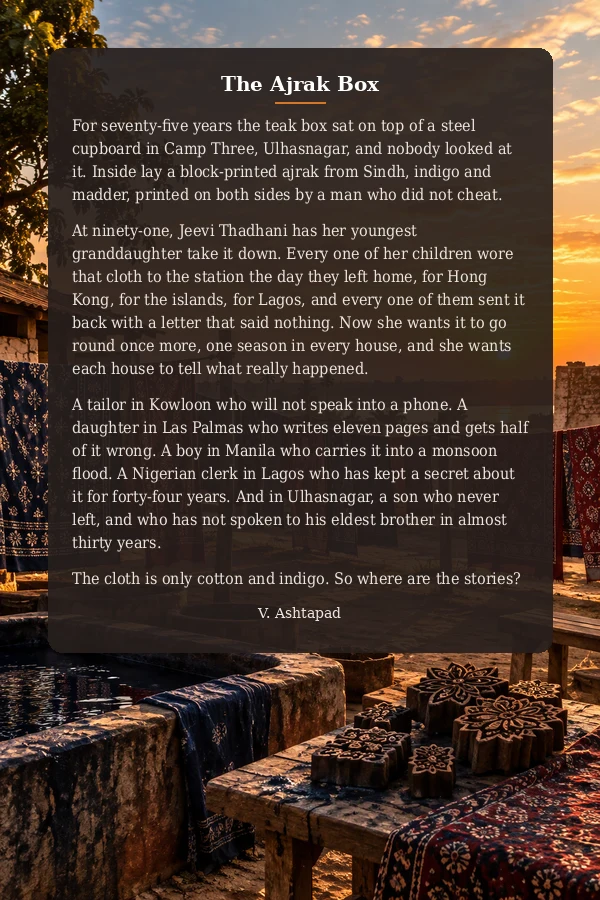
For seventy-five years the teak box sat on top of a steel cupboard in Camp Three, Ulhasnagar, and nobody looked at it. Inside lay a block-printed ajrak from Sindh, indigo and madder, printed on both sides by a man who did not cheat.
At ninety-one, Jeevi Thadhani has her youngest granddaughter take it down. Every one of her children wore that cloth to the station the day they left home, for Hong Kong, for the islands, for Lagos, and every one of them sent it back with a letter that said nothing. Now she wants it to go round once more, one season in every house, and she wants each house to tell what really happened.
A tailor in Kowloon who will not speak into a phone. A daughter in Las Palmas who writes eleven pages and gets half of it wrong. A boy in Manila who carries it into a monsoon flood. A Nigerian clerk in Lagos who has kept a secret about it for forty-four years. And in Ulhasnagar, a son who never left, and who has not spoken to his eldest brother in almost thirty years.
The cloth is only cotton and indigo. So where are the stories?
Members can react to this book and talk about it in the members' Library.
Ownership
© 2026 CRUNOD LLC. All rights reserved.
This book is owned by CRUNOD LLC. It is free to read on EternalCurrent.Online. No part of it may be copied, reprinted, sold, recorded or adapted, including as audio, film or translation, without written permission from CRUNOD LLC.
© 2026 CRUNOD LLC. All rights reserved.