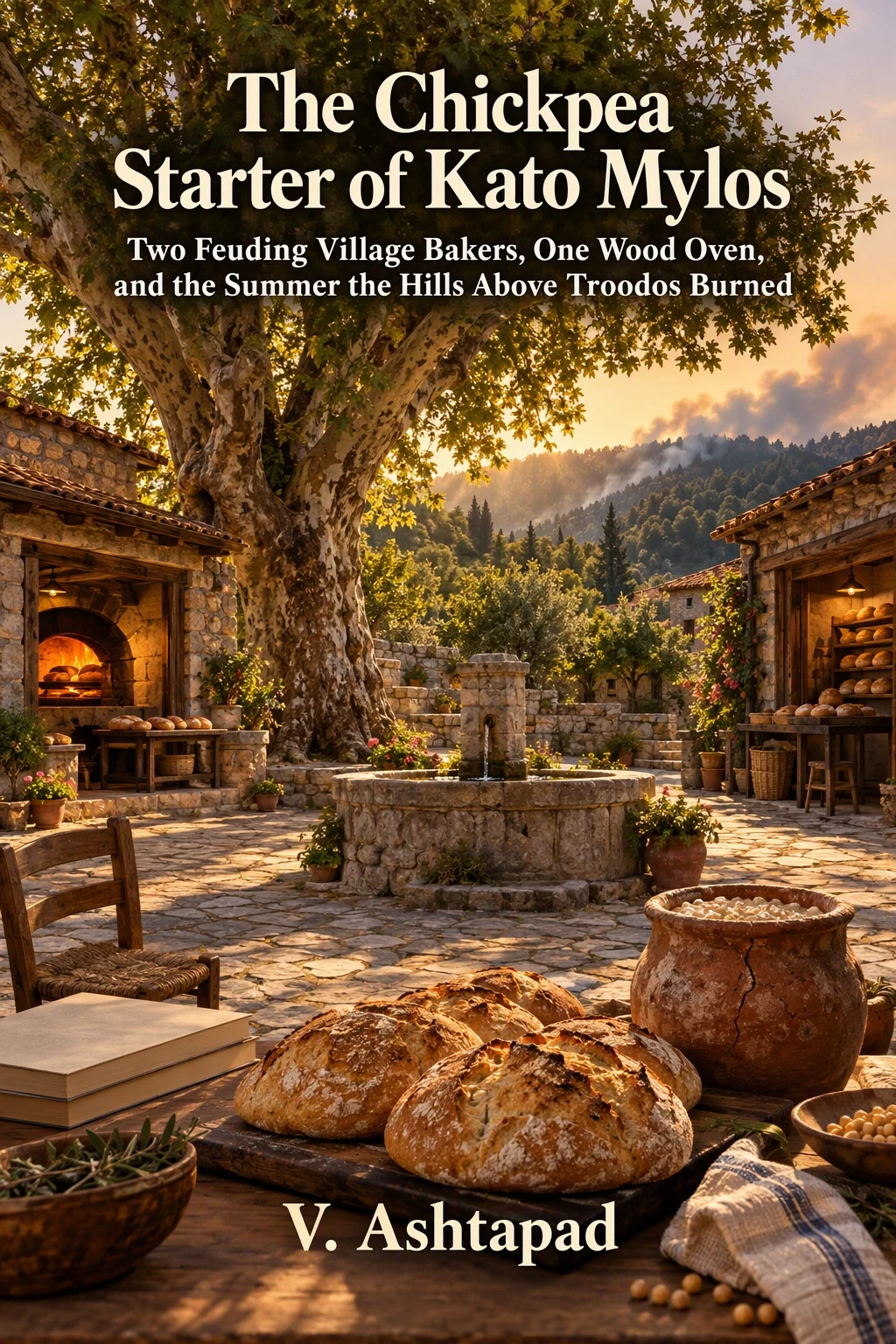
The Chickpea Starter of Kato Mylos
Two Feuding Village Bakers, One Wood Oven, and the Summer the Hills Above Troodos Burned
by V. Ashtapad
Foreword
This is a work of fiction. The Pitsilia hills of the Troodos range, arkatena bread raised with a chickpea starter, koulouria, palouzes, zivania, the forestry fire service and the summer wildfires of the island are real. Kato Mylos, its two bakeries, the fire in this story and every named person in it are invented.
For every baker who kept back a cupful.
The Plane Tree and the Two Doors
There were two bakeries in Kato Mylos and they faced each other across the square like two old cats on two walls.
The square was not big. It was the kind of square you find in every village in the Pitsilia hills, a flagstoned space the size of a tennis court, sloping slightly downhill to the south, with a plane tree in the middle so old and so wide that its roots had lifted the flagstones into small hills, and a stone water fountain under it that had not run since 1994. On the east side of the square was the coffee shop, the kafeneio, with its six tin tables and its television and its old men. On the west side was the community office, which opened on Tuesday and Thursday mornings, and beside it the shop that sold everything, from gas canisters to shoelaces to loukoumi. On the north side, uphill, with the best view down the valley to the sea when the haze was not in, was Fournos Pambos, the old bakery. And on the south side, directly opposite, downhill, was Fournos Myro.
Everyone in Kato Mylos had an opinion about which was better, and nobody ever said it out loud, because there are two hundred and eighty people in Kato Mylos and you would run out of friends.
Pambos Ioannou had been baking bread on the north side of the square since he was sixteen, when his father put him in front of the wood oven at four in the morning and told him not to come out until he could tell by smell when the koulouria were done. He was sixty-seven now. He was a short, round, bald man with forearms like loaves and a gray mustache he trimmed every Saturday with his wife's sewing scissors, and he had burned himself on that oven so many times that the backs of his hands looked like a map of the island. He made the village bread, the big round loaves, and the koulouria, the long braided rings rolled in sesame and scented with mahlepi and mastic, and eliopites, the olive pies, and halloumopites with mint, and in August, for the festival, palouzes, the grape-must pudding, and in winter, when the oranges were in, a sweet bread with peel that his mother used to make for New Year. And arkatena.
Arkatena was the thing. Arkatena was the reason people drove up from Limassol on Saturdays and parked crooked in the square and left their engines running.
It is a bread made without yeast. The rise comes from chickpeas. You crush dried chickpeas and steep them overnight in warm water with a pinch of salt and sometimes a little anise or mastic, and keep the jar warm, wrapped in wool, near the oven or in a bed, and by morning the water has turned cloudy and foamy and smells sharp and strange, like cheese and earth and something sour, and that is the starter, the prozymi. You make your bread from it and it rises slowly, slowly, and comes out of the oven heavy and white and dense, with a crust that cracks like old paint and a smell that people from the city say smells like their grandmother's house. You can make rusks from it, too, the paximadia, sliced and dried in the cooling oven overnight until they are hard as roof tiles, to dip in coffee or soak in oil and tomato. In the old days, Pambos's father said, the shepherds took arkatena rusks up the mountain for a week and they never went bad.
Pambos's starter was not made new each night from nothing. That was the secret, and also not a secret, because he told everyone. He kept a little of each night's starter back and added it to the next night's chickpeas, the way you would with a sourdough, so that every jar of arkatena prozymi in Fournos Pambos had in it a little of the jar before, going back night by night to 1971, when his father had started this one after the old one died in a cold snap. Fifty-three years. In a glass jar with a cracked lid, wrapped in a gray wool blanket, on a shelf in the storeroom behind the oven where it was always warm.
"It is older than you," Pambos told customers from Limassol. "It is older than your car. It is older than your marriage. Respect it."
© 2026 CRUNOD LLC. All rights reserved.
The Girl Who Learned the Koulouria
Myrofora Stylianou had worked for Pambos from the age of eighteen until the age of thirty.
She came to him because her mother asked. Her mother had been a widow with three daughters and a small field of vines and a temper, and Myro was the middle daughter, the one who would not stay in school and would not marry the boy from Agros and would not stop arguing, and her mother went to Pambos's wife Kyriaki and said, please, take her, put her in front of the oven, it is the only hot place she will not complain about.
So Kyriaki took her, and Pambos put her in front of the oven, and for twelve years she got up at three-thirty and walked up the hill in the dark and kneaded the dough and fed the fire and shaped the loaves, and Pambos stood beside her and corrected her. Too much water. Not enough water. Your braid is loose. Your braid is tight. You have to feel it. No, you have to feel it with the whole hand, not the fingers. Myro, you are kneading like you are angry at the dough. The dough did nothing to you.
She learned everything. She learned the koulouria and the eliopites and the round loaves and the orange bread. She learned to tell by smell when the oven was ready, and by the sound a loaf made when you tapped its bottom, and by the color of the sesame. She learned arkatena: how much to crush the chickpeas, how warm the water, how to wrap the jar, how to know in the morning, by the foam and the smell, whether the starter was alive or had turned. She learned to take a cupful back every night for the next.
She was very good. Everyone knew it. By the time she was twenty-five, people who came to Fournos Pambos asked whether Myro had made the koulouria that morning, and Pambos pretended not to hear.
When she was twenty-nine she asked him to make her a partner. Not half. A share. Her name on the sign, small, under his. Fournos Pambos & Myro.
He said no.
He said it kindly, he would say later. He said: you are a good baker, Myro, the best I have taught, but it is my father's bakery and my name, and my son will have it after me. He said: you have a good job here for life.
His son was in Limassol studying accounting and had not touched a loaf of bread since he was twelve except to eat it.
Myro said nothing. She finished the morning's baking. She cleaned the trough. She hung her apron on the hook. And that evening, when the bakery was closed and Pambos had gone home, she let herself in with the key he had given her ten years before, and went into the storeroom, and took a cupful of the arkatena starter from the jar with the cracked lid, and put it in a jam jar of her own, and wrapped it in her cardigan, and walked down the hill.
Eleven months later, after a bank loan and a fight with her mother and a summer of building, she opened Fournos Myro on the south side of the square, in what had been her uncle's olive store, with a wood oven she built herself with a mason from Pelendri, directly opposite.
On the first morning her arkatena came out of the oven heavy and white with a crust that cracked like old paint. And Pambos stood in the doorway of his bakery on the north side of the square with his arms folded and watched the people from Limassol park crooked and get out of their cars and stop, and look at both doors, and choose.
That was nineteen years ago. He had not spoken to her since. Not one word. Not at weddings. Not at funerals. Not when her husband's lorry went off the road at Platres and she sat in the hospital in Limassol for three weeks, and Kyriaki went every other day with a basket and he drove her there and sat in the car. Not when his own mother died and Myro sent a tray of koulouria to the house, the long braided rings, rolled in sesame, exactly the way he had taught her, and he ate one at the kitchen table at two after midnight when no one was looking and then put the rest out for the neighbors.
Nineteen years. The old men in the kafeneio had a bet on it, which had been running so long that two of the original bettors had died and passed their stakes to their sons.
© 2026 CRUNOD LLC. All rights reserved.
Thursday, Eleventh of July, Afternoon
The fire started on the Thursday in the second week of July, in the afternoon, on the slope across the valley.
It had been a hard summer already. No rain since March. The spring flowers had come and gone in two weeks and then everything had gone brown at once, the wild oats and the thistles and the fennel, the hillsides gold and dry and crackling, the pines on the high ridges gray with dust. For three weeks the thermometer outside the kafeneio had shown thirty-eight or thirty-nine every afternoon, which in Kato Mylos, at eight hundred meters, was not supposed to happen. The old men said it had never been like this. The old men said that every year. This year they said it more quietly.
Pambos was asleep. He always slept in the afternoon, from one to four, the bakery closed, the shutters down, because he had been up since three. He was asleep on the front-room sofa of the house behind the bakery, with the fan going and a cloth over his eyes, when Kyriaki shook him.
"Pambo. Pambo. Get up. Look."
He got up. He went to the window. Across the valley, on the long slope of pine and scrub that rose toward the next ridge, there was a column of smoke. Not a thin one. A thick, dirty, yellow-brown one, the color of a bruise, standing up and leaning over toward the east, toward them, with the afternoon wind. Under it, along the ridge, he could see flashes. Orange. Moving.
"Mana mou," he said.
In the square, people were coming out of their houses. The old men at the kafeneio had stood up from their tables and were standing in a row at the edge of the square with their coffee cups in their hands, looking. The television in the kafeneio was on, loud, and he could hear a man's voice saying the name of the next village, and then theirs. Across the square, in the doorway of Fournos Myro, Myro was standing with her hand over her eyes, shading them, looking at the smoke.
Her son Andreas came running up from the lower road. He was seventeen, tall and thin, with his mother's black curly hair and her way of moving as if everything were already late. He was a volunteer with the forestry fire service, a cadet, which mostly meant he washed the trucks at the station in the district town and went to trainings on Saturdays. He was wearing the cadet T-shirt now, the yellow one, and he ran across the square and into his mother's bakery and came out again with a bottle of water, and ran to his motorbike.
"Where are you going?" Myro shouted.
"Station!"
"You are seventeen!"
"They need people to fill the water!" And he was gone, the bike screaming down the hill toward the district town.
Myro stood in her doorway and watched him go. Then, for the first time in nineteen years, she looked up across the square, at the north side, at the doorway of Fournos Pambos, where Pambos was standing in his undershirt with his wife behind him.
They looked at each other.
Then they both looked back at the smoke.
© 2026 CRUNOD LLC. All rights reserved.
Thursday, Eleventh of July, Night
The mukhtar came round at seven with a loudspeaker on his car. His name was Kleanthis and he was seventy and had been the village president for twenty-two years, and he drove slowly through every street in his old white car with the speaker on the roof crackling, saying in his gravelly voice that the fire service and the police had told everyone in Kato Mylos to get ready to leave. Not to leave yet. To get ready. Pack your papers, your medicines, your photographs. Water for the animals. Close the windows and shutters. If they tell us to go, we go to the school in Agros. Do not wait. Do not argue. Kleanthis said the last part twice.
The sky had gone strange. The smoke from across the valley had spread out overhead in a high brown ceiling, and the sun coming down through it in the west was a small red disk you could look straight at, like a coin. Everything was lit orange. The plane tree was orange. The white walls of the houses were orange. Ash had begun to fall, very fine, gray flakes drifting down slowly like the first snow and settling on the tables at the kafeneio and on the windshields of the cars and on the old men's shoulders.
You could hear the fire now. A low rushing sound from across the valley, like wind in a tunnel, and under it, every so often, a crack like a rifle shot, which Pambos knew was a pine tree exploding.
He did not pack.
He went into the bakery and lit the oven.
"Pambo, what are you doing," said Kyriaki.
"Bread."
"There is a fire."
"There are a hundred men on that mountain," he said, splitting kindling with the hatchet, "who have been working since two o'clock and will work all night, and in the morning they will be hungry, and who will feed them? The government?" He threw the kindling in. "They will need bread. I am a baker. I am going to make bread."
Kyriaki looked at him for a long moment. She was a small, sharp, gray-haired woman who had been married to him for forty-four years and had never once lost an argument she cared about winning, and who had let him win all the others, which was why the marriage worked. She said: "Fine. Make the bread. I am packing the photographs." And she went.
He made bread. It is what he knew how to do. He mixed the dough in the big wooden trough by the light of the bulb over the oven and the orange light from the window, and he kneaded it with his whole hand, the way he had taught a hundred boys and one girl, and he shaped the round loaves, forty of them, and laid them on the long boards to rise.
Then, because it was nine o'clock and it was what he did at nine o'clock every night of his life, he went into the storeroom and crushed the chickpeas for tomorrow's arkatena, and put them in warm water, and took a cupful from the old jar with the cracked lid, and stirred it in, and wrapped the new jar in the gray wool blanket, and put it on the warm shelf behind the oven.
At ten-thirty Kleanthis came back with the loudspeaker. The wind had turned. The fire had crossed the valley floor in two places, jumped the road, and was climbing around the shoulder of the ridge above the village, behind the north side of the square. They had to go. Now.
Pambos took the forty round loaves out of the oven, baked, brown, smelling of home, and stacked them in crates in the back of his pickup, under a sheet. He looked at the storeroom. The jar was on the shelf in its blanket. It was not ready. It would not be ready until morning. And you do not move a starter in the middle of the night, in the heat, in a truck. It will die. Everyone knows that.
He left it.
He drove his wife and the photographs and forty loaves of bread down the hill in the dark, toward Agros, behind the mukhtar's white car, with the sky behind them glowing red as the inside of the oven.
© 2026 CRUNOD LLC. All rights reserved.
Friday, Twelfth of July, Before Dawn
The school in Agros had a gym with a basketball floor and folding beds along both walls and a smell of floor polish and fear. By midnight there were a hundred and sixty people in it from three villages, sitting on the beds with their bags between their feet, old women in black holding cardigans on their laps, children asleep in heaps, men standing at the windows looking north at the red sky. Somebody's goat had been brought in a pickup and was tied to the bicycle rack outside, complaining. The television on the wall of the canteen showed the fire from a helicopter, a long burning line across the dark hills like a necklace, and the men watched it with their arms folded and said the names of the places it was passing.
Pambos did not go into the gym. He left Kyriaki with the photographs and two cousins from Kato Mylos and drove the pickup with the forty loaves to the forward post the fire service had set up at the crossroads below Agros, where three trucks were parked under floodlights and men in yellow were coming and going, black-faced, with their helmets under their arms, drinking water from big plastic bottles and pouring it over their heads.
He backed the pickup up to the edge of the floodlight, got out, and pulled the sheet off the crates.
"Bread," he said to the first man who looked at him.
The man stared at him. He was young and his face was black with soot except for two pale rings around his eyes where his goggles had been, so that he looked like an owl. "What?"
"Bread. From Kato Mylos. Baked tonight." Pambos took a loaf and tore it in half and held one half out. The steam came out of it, white in the floodlight. "Eat."
The young man took it. He bit into it. Then he stood there with his mouth full and his eyes closed for a moment, chewing.
"Re, Michali!" he shouted over his shoulder. "Come here! There's an old man with bread!"
---
They came. Ten, fifteen, twenty of them, out of the dark, smelling of smoke and sweat and diesel, and Pambos stood at the tailgate and tore loaves and handed them out. Somebody found a box of tomatoes. Somebody else had halloumi in a cooler. The men stood around the pickup in the floodlight eating with their hands and drinking water and not saying much, and every so often the radio on one of the trucks would crackle and two or three of them would put down their bread and run.
At two-fifteen another pickup came up the road and backed up to the edge of the floodlight, beside his. A woman got out. She pulled the sheet off the crates in the back.
Thirty loaves. Round. Brown. And on top of them, in a basket, two dozen koulouria, long braided rings rolled in sesame, still warm.
Myro looked at Pambos. Pambos looked at Myro.
Neither said anything.
The young firefighter with the owl face looked from one to the other, a koulouri in each hand. "Are you two married?"
"No," they both said, at the same time, in the same tone, and the young man took a step back.
---
They stood at their two tailgates under the floodlight for three more hours, eight feet apart, tearing bread and handing it out, and did not speak to each other once. It was a remarkable thing to see, a firefighter from Paphos said later, telling the story at a wedding. Two old village bakers, side by side, completely silent, passing bread to a hundred men in the dark like two machines, and every so often, when one ran out of something, the other would push a crate across without looking. Not a word. Just the crate. He said it was like watching an old married couple who had been fighting for forty years and had forgotten what about.
At five, when the sky was beginning to go gray in the east under the smoke, Myro's son Andreas came up the road on the back of a forestry truck, filthy, his yellow cadet shirt black, and jumped down and ran to his mother and put his arms around her, and she held on to him so hard that he said "Mama, Mama, you're crushing me," and she did not let go.
Over his shoulder, Myro looked at Pambos.
Pambos looked away. He tore the last loaf in half and handed it to the owl-faced boy and said, "Take it. For later."
© 2026 CRUNOD LLC. All rights reserved.
Saturday, Thirteenth of July, The North Side
They let them back into Kato Mylos on Saturday at noon.
The fire had come around the shoulder of the ridge in the night and down the slope on the north side of the village, behind the houses at the top of the square, and the firefighters had stopped it there, at the last row of houses, with three trucks and a water plane that came over at dawn so low that the old men said they could have reached up and touched it. Then the wind had dropped and turned and pushed the fire back on itself, into what it had already burned, and it had starved.
The south side of the village was untouched. The square was untouched. The plane tree stood where it had always stood, covered in a fine gray dust of ash, the leaves curled at the edges from the heat. The fountain that did not run had a crust of ash in its basin. The kafeneio was fine. The community office was fine. The shop was fine. Fournos Myro, on the south side, downhill, was fine.
Fournos Pambos, on the north side, uphill, the oldest building on the square, was not fine.
The fire had come down the slope behind it and into the back of it, through the storeroom. The storeroom had a roof of old wooden beams and reeds and clay tiles, the way they built in the old days, and the beams had caught. The storeroom was gone. The back wall was standing, black. The roof had fallen in, and the tiles lay in a heap of broken red and black among the ash and the charred beam ends, still smoking in places, so that the whole back of the bakery smelled like a fireplace the morning after. The flour sacks had burned. The firewood stack had burned. The shelf with the jar on it was in there somewhere, under the tiles.
The front room, the shop, was black with smoke but standing. The oven was standing. But the heat from the storeroom had come through the shared wall into the oven chamber, and the old dome, which his grandfather had built of stone and clay and which had been fired every day for seventy years, had cracked. A long crack, from the top of the arch down one side, wide enough that you could put your finger into it. Pambos put his finger into it.
He stood in his bakery for a long time. Kyriaki stood in the doorway with her bag and did not come in.
Then he went out the back, into the ruin of the storeroom, and began to move the tiles.
"Pambo," said Kyriaki. "Leave it. Let the men from the council come."
He did not answer. He moved tiles. He threw them aside one by one, the broken red ones and the black ones, and when he came to a beam end he pulled it out with his bare hands, black, still warm, and threw it aside. After twenty minutes he found the shelf. It was an iron bracket, bent, black. Under it, in the ash, there were pieces of glass. Thick glass, melted at the edges, gone brown and cloudy. And a lump of something gray and crusted, like burned porridge, stuck to the glass.
That was the arkatena. Fifty-three years.
He sat down in the ash and held it in his hands.
---
The old men in the kafeneio saw him come out the front of the bakery an hour later, black to the elbows, with something wrapped in a cloth. They saw him stand in the middle of the square under the plane tree, in the ash, and look at the sky, which was blue again now, high and hard and empty, the smoke gone east toward Nicosia. They saw him look down the hill at the south side of the square, at the open door of Fournos Myro, where the smell of baking was already coming out, bread and sesame, and where a line of five people stood waiting, people from the village who had come home and had nothing in their kitchens.
They saw him turn around and walk home.
"Thirty euros he goes over there by Tuesday," said old Lefteris, who had been in the bet since 2005.
"Never," said Savvas, his cousin. "Not even if he's starving. Fifty."
"His wife will make him," said Lefteris.
They both considered this.
"Twenty, by Monday," said Savvas, and they shook on it.
© 2026 CRUNOD LLC. All rights reserved.
Sunday, Fourteenth of July, Kyriaki Crosses the Square
Kyriaki Ioannou did not ask her husband's permission to cross the square. She had not asked his permission for anything since 1981, when she had asked whether he minded if she cut her hair short and he had said yes and she had cut it anyway.
She crossed the square on Sunday morning at eleven, in her good blue dress, with her handbag, past the old men at the kafeneio, who stopped talking, under the plane tree, past the dry fountain, down the slope, to the door of Fournos Myro. She went in.
Myro was behind the counter, putting koulouria on the rack. There was nobody else in the shop. She looked up, saw Kyriaki, and put the tray down very slowly.
"Kyria Kyriaki," she said.
"Myro," said Kyriaki. "How is your son?"
"He's sleeping. He came home at four. He was on the mountain two nights."
"He is a good boy. I saw him at the post. He looked like a chimney sweep."
"He looks like his father," said Myro, and both of them almost smiled, because Myro's husband Christos was famous for never washing his lorry.
Kyriaki put her handbag on the counter. "The storeroom is gone," she said. "The oven is cracked. The dome. The man from the council came this morning and looked at it and said it can be fixed, a mason can fix it, but it will take a month, maybe two. The roof of the storeroom must be rebuilt first. They will help with the money, he says, maybe. Forms. You know."
"I heard."
"And the arkatena."
Myro said nothing.
"Burned," said Kyriaki. "The jar burst. He found it in the ashes. He brought it home in a cloth and put it on the kitchen table and he sat and looked at it all night. He did not sleep. He did not eat. This morning I found him still sitting. Looking at a lump of burned chickpeas."
Myro looked down at the tray of koulouria. Her face did something complicated.
"I'm sorry," she said.
"I know you are," said Kyriaki. "That is why I am here." She took a breath. "There are forty families in this village with no bread but yours. There are the people from Pano Mylos, up the hill, sixty of them, who cannot go home because their houses are gone, and who are sleeping in the school and in our houses. There are the firemen, still on the mountain, who will be there another week watching for it to start again, and the forestry men who will be there all summer. You cannot feed all of them with one oven and one pair of hands and your boy asleep."
"I know," said Myro. "I've been baking since Saturday noon. I've slept four hours."
"And my husband has hands," said Kyriaki, "and no oven."
Their eyes met over the marble.
"He would never," said Myro.
"He will," said Kyriaki.
"He hasn't spoken to me in nineteen years."
"He doesn't have to speak to you. He has to bake." Kyriaki leaned over the counter. "Myro. You have one oven. You bake from four in the morning. He bakes from one in the morning, he has done it his whole life, he does not know any other hours. Give him the oven from one to four. Then you come at four and it is hot and ready and you have three hours of bread already done. You both get to sleep. The village eats. The firemen eat." She straightened up. "He does not need to see you. You do not need to see him. He comes in the dark and leaves in the dark."
Myro was silent for a while. Behind her the oven ticked as it cooled.
"Does he know you're asking?"
"No," said Kyriaki. "I'll tell him when you say yes."
© 2026 CRUNOD LLC. All rights reserved.
Sunday, Fourteenth of July, Evening, The Terms
The negotiation took the rest of the day and was conducted entirely through intermediaries, which the old men at the kafeneio later agreed was the most entertaining thing to happen in Kato Mylos since the mukhtar's car rolled into the fountain in 2009.
The first intermediary was Kyriaki, who walked across the square six times between noon and eight o'clock. The second was Andreas, who woke up at three in the afternoon to find his mother sitting at the kitchen table with a pencil and a list, and was sent up the hill four times. The third, briefly, was the mukhtar, Kleanthis, who wandered into it by accident when he came to the kafeneio for his coffee and was asked by both sides, separately, to witness an agreement, and who said, firmly, that he was the president of the community and not a lawyer, and then witnessed it anyway.
The terms, as finally agreed, were written in pencil on the back of a flour company calendar and taped to the wall beside Myro's oven, where they remained for the rest of the summer. Andreas photographed them that night and put the photograph on the village page, the private one where the families of Kato Mylos kept their notices and their pictures, under the heading *Peace treaty*, and by morning everyone in the village had read them, including the people who had moved to Limassol thirty years ago.
The terms were these.
One. Kyrios Pambos has the oven from one o'clock in the morning until four o'clock in the morning.
Two. Kyria Myro has the oven from four o'clock in the morning onward.
Three. Kyrios Pambos will light the fire. Kyria Myro will supply the wood. (Kyrios Pambos's wood burned.)
Four. Kyrios Pambos brings his own flour, which the council is providing. He may use Kyria Myro's salt, water, sesame and trays.
Five. Kyrios Pambos does not touch Kyria Myro's dough, her trough, her starter, or her radio.
Six. Kyria Myro does not touch Kyrios Pambos's dough while it is rising, even if it is over-rising, even if she thinks it is over-rising.
Seven. The bread from one to four goes to the firemen and the forestry men and the families from Pano Mylos, free. The bread from four onward is sold in the shop as normal.
Eight. Kyrios Pambos leaves the oven clean.
Nine. There is no talking.
Under number nine, in different handwriting, Kyriaki's, someone had added: *unless necessary.*
And under that, in a third hand, Myro's, very small: *It will not be necessary.*
© 2026 CRUNOD LLC. All rights reserved.
Monday, Fifteenth of July, One in the Morning
Pambos came down the hill at twelve-fifty in the dark with a flashlight in one hand and a sack of flour over his shoulder and his own wooden peel, which had been in the house and not in the storeroom, under his arm like a rifle.
The square was black and silent. The kafeneio was shuttered. The plane tree was a darker darkness overhead, rustling a little in the night wind, which still smelled of smoke. Somewhere a dog barked and stopped. Across the valley, on the burned slope, three small orange lights glowed where the forestry men had a night watch and a fire going for their coffee.
The door of Fournos Myro was unlocked. That had been in the negotiations. She would leave it unlocked and the light on.
He went in.
He had not been inside it for nineteen years. He had walked past it perhaps twenty thousand times. He had seen the inside through the window, the counter and the racks and the woman behind them, from the corner of his eye, never turning his head. Now he stood in the doorway with his sack and looked.
It was smaller than his. Cleaner. The counter was marble, white, with gray veins, scrubbed. The racks were empty, waiting. Through the doorway at the back he could see the oven chamber, lit by a single bulb, and the oven. A wood oven, a dome of stone and clay, like his. Like his grandfather's. She had built it the same shape. The same size of door. The same little iron shelf on the right side for the peel. He had not known that. He stood in front of it and looked at it the way you would look at your own handwriting in a letter someone else had written.
The fire was laid. Kindling, then split olive wood, then two big pine logs, all stacked exactly the way he would have stacked it, the kindling crossed at the bottom like a little raft. Beside the oven, the wood for the night was stacked in a neat wall. Beside that, a wooden trough, scrubbed white. A bag of salt. A tin of sesame. A pile of baking trays.
On the wall beside the oven, taped up, the calendar with the terms. Number nine: There is no talking. *Unless necessary. It will not be necessary.*
And under the terms, a new piece of paper, taped, in Myro's handwriting:
*The left side of the oven is hotter. The flue draws to the left. Turn the loaves at twenty minutes.*
He read it twice. He took out the pencil from behind his ear. Under it he wrote:
*I know how to turn a loaf.*
Then he lit the fire.
---
By four o'clock he had made eighty round loaves, which he stacked in crates by the door for Andreas to take up to the forestry post and the school, and four trays of eliopites, because the olive pies keep for days in the heat and the firemen could take them up the mountain in their pockets. He had cleaned the trough. He had swept the floor. He had left the oven hot, the coals pushed to the back in a glowing heap, the way you leave an oven for the next baker.
He had turned the loaves at twenty minutes. The left side was hotter. The flue drew to the left.
At three fifty-five he heard footsteps in the square. He picked up his peel and his empty sack and went out the front door as Myro came in the back.
© 2026 CRUNOD LLC. All rights reserved.
The Notes
The notes went on for twelve nights.
Nobody was supposed to see them, but of course everyone did, because Andreas photographed every one of them when he came in at four-thirty to load the crates, and put them on the village page, under the peace treaty, with the date. Within the first week the families who had moved to Limassol were checking the page every morning before they checked the news.
Tuesday. Myro, on the wall, under his: *You used my sesame on the floor.*
Pambos, under it: *The sesame jumped.*
Wednesday. Myro: *Your loaves are too big. The firemen cannot fit them in their packs.*
Pambos: *The firemen are not complaining. I asked.*
Myro: *You talked to a fireman. Number nine.*
Pambos: *The firemen are not in the treaty.*
Thursday. Pambos, a new note, on the oven door itself, which was a violation, according to Andreas: *Your radio was on when I came in. It was playing music for young people. I turned it off.*
Myro: *That was the news.*
Pambos: *Then the news is for young people.*
Friday. Myro: *Who ate a koulouri off my rack?*
No answer.
Saturday. Myro: *I counted. Two koulouria.*
No answer.
Sunday. Pambos, small, at the bottom of the paper: *The mahlepi is too strong. Use less. And you twist them to the left. I taught you to twist to the right.*
Myro, under it, much larger: *I KNOW. I twist to the left ON PURPOSE.*
Monday. No note from Pambos. On the trough, at four o'clock, when Myro came in: a single koulouri, twisted to the right, on a clean cloth.
She studied it, chewing her lip. Then she ate it standing up.
---
The old men at the kafeneio followed the notes the way they followed football. Savvas had lost his twenty euros on Monday, because Pambos had gone over by Monday, but there was a new bet now, a larger one, in which half the village had a stake, on whether the two of them would ever actually speak.
"It's gone too far," said Lefteris, shaking his head over his telephone, where he was reading the koulouri note for the fourth time. "Nineteen years. You cannot walk back nineteen years."
"You can walk back anything," said the mukhtar, who had joined the table, "if someone gives you a reason."
"What reason?"
The mukhtar drank his coffee. "Bread," he said.
© 2026 CRUNOD LLC. All rights reserved.
The Jar
On the thirteenth night, Pambos came in at twelve-fifty and found a jar on the trough.
It was a big glass jar, a preserving jar, with a clamp lid, wrapped in a pale blue wool blanket. Beside it, a bag of dried chickpeas, already crushed. Beside that, a note in Myro's handwriting.
He did not read the note at first. He unwrapped the blanket.
He knew it before he opened the lid. He knew it from the blanket being blue wool and not anything else, and from the jar being warm, and from the faint smell that came through the clamp, sharp and sour, cheese and earth. He opened the lid and the smell came out into the oven room and he closed his eyes.
Arkatena prozymi. Alive. Foaming at the top, cloudy, a little gray. A good one. A strong one.
Then he read the note.
*This is your starter. I took a cupful from your jar the night I left. Nineteen years ago. I have kept it every night since. I never let it die. It is the same line as your father's. Take what you need for tonight and take a cupful back for your own jar.*
He read it three times. Then he sat down on the flour sack.
---
He was still sitting there at four o'clock when Myro came in the back door.
She stopped in the doorway. He had not made any bread. The fire was lit, the oven was hot, but there were no loaves, no trays, nothing in the trough. The crates by the door were empty. He was sitting on a flour sack beside the trough with the jar on his knees, wrapped in the blue blanket, with his hands around it as if it were a child.
"You haven't baked," she said.
It was the first thing she had said to him in nineteen years. It came out very ordinary.
He looked up at her.
"You stole it," he said.
"Yes."
"From my jar. In the night. With my key."
"Yes."
"And you kept it alive." He looked at the jar. "Every night. For nineteen years."
"Yes."
"Why?"
She came into the oven room and stood on the other side of the trough. She was wearing her work clothes, the old gray trousers and the white shirt, and her hair tied back in a cloth, and she looked tired, he thought, very tired, the way he must look. She had been baking every morning for three weeks without a day off.
"Because it was the best one," she said. "Because I couldn't make arkatena like yours from a new starter. I tried. It takes years for a starter to be that good. And because," she stopped. "Because I didn't want it to only be in your jar. In case something happened."
"In case something happened," he said.
"In case something happened."
He looked at the jar until the coffee went cold. Then he said, "Kyriaki knew."
"Of course Kyriaki knew. Kyriaki knows everything. She told me in 2011 that if I ever let it die she would come down here and break my arm."
Pambos laughed. It came out of him without warning, a short hoarse bark, and he put one hand over his eyes.
"My wife," he said. "My wife and my apprentice. Behind my back. For nineteen years."
"Your wife came to the hospital every other day when Christos was hurt," said Myro. "With a basket. You drove her. You sat in the car."
He took his hand away from his eyes.
"I saw you," she said. "In the car. In the parking lot. Every time. I looked out the window and you were sitting in the car with the engine running. For an hour. You never came up."
"I didn't know what to say."
"You could have said hello."
He looked at the trough. "It was not necessary," he said, very quietly, and after a moment she laughed too.
© 2026 CRUNOD LLC. All rights reserved.
Andreas
Andreas came in at four-twenty to load the crates and found his mother and the old baker sitting on two flour sacks on either side of the trough, with a jar of arkatena starter on the trough between them, not baking, and talking.
He stopped in the doorway. He did not move. He did not take out his telephone. He told the old men at the kafeneio afterward that it was the hardest thing he had ever done, harder than the fire, not to take out his telephone.
His mother was saying, "...and you never let me shape the big loaves. Twelve years. Only the small ones. You said I didn't have the hands."
"You didn't have the hands. At eighteen. At twenty-five you had the hands."
"You never told me."
"I told Kyriaki."
"That's not telling me."
"It's the same thing."
"It is not the same thing!"
Pambos was quiet. Then he said, "No. It is not the same thing."
Andreas came into the room, quietly, and slid down the wall to the floor, by the empty crates. Neither of them looked at him. He had been to a training once, at the station, about how to talk to people who were frightened, people who had lost their houses, and the instructor, a big woman from the civil defense with a voice like a trumpet, had said that the most important thing was not to talk. To let the other person talk until they were finished. Then to say back to them what you heard them say, so they knew you had heard it. Then, and only then, to say what you had to say.
He watched his mother do it now, without the training. He watched her let the old man talk. Pambos talked about his father, about the bakery, about his son in Limassol who did not want it and would never want it, about how he had known that when Myro asked to be a partner, he had known it already, his son had already told him, and he had said no to Myro anyway because saying yes would mean admitting his son was not coming back.
"So you said no to me," said Myro, "because you didn't want to say yes to that."
"Yes," said Pambos.
"And you didn't speak to me for nineteen years."
"Because every time I saw you," he said, "I had to admit it again."
His mother was quiet for some minutes.
Then she said, "Pambo, your son is a very good accountant."
He laughed. Andreas could see that the old man's eyes were wet.
"He is," said Pambos. "He is a very good accountant. He did the papers for the council money in one evening. Kyriaki sent him the forms and he did them in one evening and sent them back." He dragged the back of his black-scarred hand. "He said, Baba, you should have done this in 1990."
"You should have," said Myro.
"I know."
Andreas, on the floor, cleared his throat. They both turned and looked at him as if they had forgotten he existed.
"Excuse me," he said. "There are sixty people from Pano Mylos in the school and they're going to be awake in two hours. And twenty firemen. And nobody has baked."
His mother looked at the empty trough. Pambos looked at the empty crates. Then they looked at each other.
"How many?" said Pambos.
"Eighty round, forty koulouria, two trays of eliopites," said Myro.
"In two hours, with one oven?"
"With two bakers."
Pambos stood up. He put the jar of arkatena very carefully on the shelf beside the oven, wrapped in its blue blanket. He picked up the flour sack he had been sitting on.
"You twist the koulouria," he said. "I'll do the round. You twist them to the left if you want."
"I always do," said Myro, and tied on her apron.
© 2026 CRUNOD LLC. All rights reserved.
The Burned Slope
The fire had taken eleven square kilometers of pine and scrub, three houses at the top of Kato Mylos and nine in Pano Mylos, the storeroom of Fournos Pambos, two hundred olive trees, a chapel roof on the far ridge, four beehives belonging to old Savvas, and a goat that nobody would admit owning. It had not taken a single person. The forestry men said this was because Kleanthis had driven through the streets with his loudspeaker and refused to stop until everyone had gone. Kleanthis said it was because everyone in the village was too stubborn to die before they had won their argument with someone.
At the end of July, when the ground had cooled and the forestry service said it was safe, Andreas took Pambos up the burned slope.
It was Andreas's idea. He had been going up with the forestry crews every weekend to help with what they called the assessment, walking the burned ground in long lines, counting, marking, photographing. He told Pambos at four-thirty one morning, loading the crates, that he wanted to show him something, and Pambos, who had not walked uphill for pleasure in twenty years, surprised himself by saying yes.
They went on a Sunday at six in the morning, before the heat. They walked up behind the north side of the square, past the black back wall of the storeroom, through the gate in the stone terrace wall, and into the burn.
It was very quiet. That was the first thing. Pambos had grown up on this slope. He had picked wild asparagus here as a boy and set snares for thrushes, which is against the rules now, and lain under the pines in the afternoons with the cicadas shrieking so loud a man's thoughts went to pieces. Now there was no sound at all. No cicadas. No birds. The pines stood up black and bare against the white morning sky, hundreds of them, thousands, all the way to the ridge, their trunks charred to the height of a man and their needles gone, so that the whole hillside looked like a drawing in charcoal. The ground was gray ash, soft and deep, and every step sent up a little puff of it that settled on their boots and trousers. It smelled of cold fireplace and, under that, faintly, of pine resin, sweet, as if the trees were still bleeding.
"Mana mou," said Pambos again. It was all he could think to say.
Andreas led him up a path that the forestry men had cleared, to a big gray rock on a shoulder of the slope where you could see down the whole valley, the village below with its red roofs and the plane tree in the square like a green fist, and across to the far ridge, and the haze beyond where the sea was.
On the rock someone had painted a small yellow mark, a circle with a cross in it.
"This is one of our points," said Andreas. "There are twenty on this slope. Every month someone comes up and stands here and takes a picture. Same rock, same direction. North, east, south, west." He took out his telephone and showed Pambos. "This is the first one. Two days after the fire."
The picture was of the same slope, from the same rock, but still smoking, with gray haze lying in the hollows.
"And then every month," said Andreas, "we take another one, and it goes on the page next to the first one. So you can see." He shrugged. "So we can see what comes back. And when. And so if it starts to slide when the rain comes, we know where."
Pambos looked at the slope. "Nothing will come back," he said. "Look at it."
"Look down," said Andreas.
Pambos looked down. At his feet, at the edge of the rock, in the gray ash, there was a tiny green thing. A curl. A leaf no bigger than his thumbnail, bright green, almost shocking against the gray.
"Rock rose," said Andreas. "It comes back first. Its seeds need the fire to wake up. The forestry woman says in two years this whole slope will be covered in pink and white flowers. Then the pines come. The pines need the fire too. The cones open in the heat." He crouched down beside the little green curl. "The pines will take twenty years. But they come."
Pambos crouched down too, slowly, his knees cracking. He looked at the green curl for as long as it takes a loaf to cool.
"Twenty years," he said.
"Yes."
"I'll be eighty-seven."
"You'll be baking," said Andreas, and the old man laughed.
---
Before they went down, Andreas asked Pambos to take the picture. North, east, south, west. Pambos held the telephone in his scarred baker's hands as if it were an egg, and turned slowly on the yellow mark, and pressed the button four times, very carefully, and gave it back.
"Now your name is on it," said Andreas. "July. Pambos Ioannou."
"Why should my name be on it?"
"Because in twenty years," said Andreas, "when the pines are back, someone will look at these pictures and want to know who stood here. And they'll see it was the baker."
© 2026 CRUNOD LLC. All rights reserved.
The Mukhtar's Report
On the first Tuesday of August, Kleanthis the mukhtar held a meeting of the community council in the community office, which had six chairs and a portrait of a previous mukhtar on the wall and a fan that turned its head slowly from side to side like an old man watching tennis. Eleven people came, which meant five had to stand. Andreas came to take notes, because the community secretary was on holiday in Greece and because Andreas, the mukhtar said, was the only person in the village under fifty who could spell.
The notes are on the village page. Andreas photographed them afterward. They are reproduced here, with the mukhtar's permission, because he said they were the most important minutes in the history of the community and should not be lost in a drawer.
*Community of Kato Mylos. Council meeting. Present: Kleanthis (mukhtar), Lefteris, Savvas, Kyria Kyriaki Ioannou, Kyria Myro Stylianou, Kyrios Pambos Ioannou, Christos Stylianou, Sotiris from Pelendri (not a member, came for the coffee), Kyria Despo from Pano Mylos (guest), two members of the forestry service. Minutes: Andreas Stylianou.*
*1. The fire. The mukhtar reported that the fire of 11-12 July burned 11 square kilometers. No persons were lost. Three houses in Kato Mylos were damaged or burned, nine in Pano Mylos. The bakery of Kyrios Pambos lost its storeroom. The council thanked the forestry service, the fire service, the police, and the young cadets including the secretary. The secretary asked to remove the last part. The council refused.*
*2. Damage. Forms for compensation have been submitted for all damaged houses. Kyrios Marios Ioannou of Limassol completed the forms for six households in one evening without charge. The council thanked him. Kyrios Pambos said his son was a very good accountant. Kyria Kyriaki said he had said this eleven times this month.*
*3. Watching the slope. The forestry officer reported that the burned slope above the village is being photographed every month from twenty fixed points, and the pictures shared with the community. Rock rose is returning. Pine seedlings expected next spring. Risk of landslides when the rains come in October and November. The officer asked that anyone who sees cracks in the ground, or water running where it did not run before, or rocks moving, report it at once. The forestry officer said that the village page is now the fastest way to report this, faster than calling the office, because the office does not answer the telephone after two. The second forestry officer agreed. The mukhtar asked that this not be put in the minutes. The secretary put it in the minutes.*
*4. Firebreaks. The forestry officer said that the old terraces and goat paths around the village, which are no longer kept up since there are no more goats, were in the old days a natural firebreak. Overgrown terraces carry fire. Kept terraces stop it. Kyrios Savvas said his grandfather said exactly this in 1974 and nobody listened. The mukhtar proposed that the community organize work days in the autumn to clear the old terraces above the north side. Agreed. Christos Stylianou will bring the lorry. Kyria Despo asked whether pumpkins could be planted on the cleared terraces. The forestry officer said pumpkins do not burn easily. Agreed.*
*5. The bakeries. The mukhtar said that there had been concerns from the people of Limassol that there were now two bakeries with the same name, which was confusing. Kyrios Pambos said the people of Limassol were always confused. Kyria Myro said this was true. The mukhtar ruled that there were not two bakeries with the same name but two bakeries with two names each, and that he did not see what the problem was. No action.*
*6. The fountain. Kyria Kyriaki asked when the fountain under the plane tree would be repaired, as it has not run since 1994. The mukhtar said it was on a list. Kyria Kyriaki asked which list. The mukhtar said the list. Sotiris from Pelendri said he could look at the pipe if someone bought him lunch. Kyrios Pambos and Kyria Myro both offered lunch at the same time. There was an argument about whose lunch. The mukhtar ruled that Sotiris would have both lunches. Sotiris agreed.*
*7. Any other business. Kyrios Lefteris asked whether the council would rule on the bet. The mukhtar said the bet was not council business. Kyrios Lefteris said everything in Kato Mylos is council business. The mukhtar said he would rule on the bet at the festival.*
*Meeting closed at 20:40. The fan was still turning.*
---
Sotiris fixed the fountain in the second week of September. It was a pipe, as he had said, cracked under the flagstones by the roots of the plane tree, and he dug it up with Christos and Andreas in one morning and replaced it with a new one and covered it over. At noon he turned the old brass tap at the back of the basin and for a moment nothing happened, and the old men at the kafeneio laughed, and then there was a cough in the pipe, and a sputter, and a thin stream of brown water, and then clear water, cold, from the spring above the village, falling into the stone basin with a sound that nobody under thirty in Kato Mylos had ever heard.
The children put their hands in it. The old men came over from the kafeneio and stood around it and did not say anything. Despo, from Pano Mylos, filled her husband's old tin cup and drank it, and said it tasted the same as the spring at Pano Mylos, because it was the same spring, the same mountain.
Sotiris ate both lunches. He said they were equally good. Nobody believed him, and he would not say which one was better, and the old men opened a new bet on it that same afternoon.
© 2026 CRUNOD LLC. All rights reserved.
The Masons
The storeroom was rebuilt in August by eleven men, four women, a mason from Pelendri named Sotiris who was seventy-eight and had built Myro's oven nineteen years before, and a lorry driver named Christos Stylianou, Myro's husband, who brought the stones.
Pambos had not asked for any of them. He had stood in the square on the first of August with the forms from the council in his hand, which his son Marios had filled out in one evening, and read the line that said the money for rebuilding would come in four to six months, and said a word that made the old men at the kafeneio put down their cups. Then he had gone home.
The next morning at seven there was a lorry in the square, unloading stone. Christos was driving it. He was a huge, slow, gentle man with a belly and a gray beard and a cigarette that he never lit, because Myro had made him stop smoking in 2015, and he had been hauling stone and gravel and building sand on the island's mountain roads for thirty years and knew every quarry in the Troodos. He got out of the cab, walked across the square to the north side, and knocked on the door of the house behind the bakery.
Pambos opened it in his undershirt.
"Kyrie Pambo," said Christos. "I have six tonnes of stone from the quarry at Kyperounta. The good gray kind. My wife says the storeroom needs a new back wall. I have it on the lorry. Where do you want it?"
Pambos stared at him.
"Your wife," he said.
"She says if I don't bring it she'll put me on the night shift."
Behind him, in the square, the old men at the kafeneio were standing up to look.
---
They built it over three weeks. Not every day. The men came when they could, after work, on Saturdays, early in the mornings before the heat. Sotiris the mason directed, sitting on an upturned crate in the shade of the plane tree with a cold coffee and a long stick, pointing. "That one. No, the other. Turn it. Turn it. Is that a wall or a salad?" Christos lifted the big stones that nobody else could lift. Kleanthis the mukhtar mixed mortar, badly, and was told so. Andreas and three of his friends from the fire cadets hauled the burned tiles and beams to a skip and swept the ash. Savvas, who had lost his beehives, came every day and did nothing except sit beside Sotiris and argue with him, which Sotiris said was the most useful thing anyone did, because it kept him awake.
The women brought food. That is how it is done. Kyriaki brought trays of koupepia, vine leaves stuffed with rice and pork, and loukanika, the village sausages, grilled on a little charcoal grill in the square. Lefteris's wife brought a pot of louvi, black-eyed peas with chard, and a bowl of olives cracked with coriander seed and garlic. A widow from Pano Mylos who was still sleeping at the school brought a tray of kolokotes, pumpkin pastries, which she had made in the school kitchen, and cried when people ate them, and laughed, and cried again. Someone produced a bottle of zivania at the end of each day, clear and fierce as lamp fuel, and small glasses were handed round, and Sotiris drank his in one swallow and said it was the only medicine he trusted.
And Myro brought bread. Every day. Round loaves, still warm, and koulouria twisted to the left, and on Saturdays a basket of arkatena, white and heavy, with the crust that cracks like old paint.
Pambos was there every day too. He was not allowed to lift. Kyriaki had forbidden it, and Sotiris had backed her up, and Christos had simply taken stones out of his hands. So he did what he could. He handed things. He held the end of the string line. He fetched water. And on the third Saturday, when the back wall was up to shoulder height and Sotiris was arguing with Savvas about whether the new roof beams should be pine or cypress, he walked down the square to the south side, and into Fournos Myro, where she was alone behind the counter with the afternoon trays.
"Myro," he said.
She looked up.
"Thank you for the stone."
She was quiet a moment. "Thank Christos. It's his lorry."
"I thanked Christos. He said to thank you. He said you threatened him with the night shift."
"I did."
"The night shift," said Pambos, "is not so bad."
She laughed. Then she said, "Is the roof going to be pine or cypress?"
"Cypress," said Pambos. "Savvas will win. He always wins. He is the most stubborn man in the district."
"Second most," said Myro.
© 2026 CRUNOD LLC. All rights reserved.
Marios
Pambos's son came up from Limassol on the ninth of August with his wife and his two little daughters, for the festival and to see the damage, and to talk his father out of rebuilding the oven.
Marios was forty-two, slim, neat, with a short dark beard, an accountant at a firm in Limassol that did the books for hotels. He drove a gray car that he kept very clean, and when he got out of it in the square and saw the storeroom with its new stone wall and its new cypress beams and its new roof half tiled, he stood, hands deep in his pockets, and said, "Baba. What are you doing?"
"Rebuilding," said Pambos.
"I can see that."
"Then why do you ask?"
They went into the house. Kyriaki took the girls into the kitchen to make loukoumades, the little fried honey puffs, which the girls loved because they got to spoon the dough into the hot oil with a spoon and watch it swell up and turn gold. Marios and his father sat in the front room with two cups of Cypriot coffee, metrio, medium sweet, in the small white cups, with the thick dark grounds at the bottom.
"You're sixty-seven," said Marios.
"I know how old I am."
"The oven is cracked. The mason says another month. The council money won't come till spring. You're baking at one in the morning in someone else's oven." He leaned forward. "Baba. This is the moment. You can stop. You and Mama can come down to Limassol. There's a flat in our building. On the ground floor, with a garden. The girls could see you every day."
Pambos drank his coffee.
He wanted to say: no. He wanted to say: this is my father's bakery and his father's, and you never wanted it, and now you want me to give it up. He wanted to say all the things he had not said to Myro for nineteen years.
He thought about Andreas sitting on the floor of the oven room, listening. He thought about Myro letting him talk until he was finished.
So instead he said, "Tell me why."
Marios blinked. "Why what?"
"Why you want me to stop. Not the oven. Not my age. You."
His son looked at him for a long moment. Then he looked down at his coffee.
"Because I was on the phone with Mama," he said, "the night of the fire. At eleven at night. She was in the truck with you, driving down to Agros. She called me from the truck. And I could hear it, Baba. On the phone. I could hear the fire. Behind her voice. Like a train." He stopped. "And I was in Limassol, in my kitchen, and there was nothing I could do. Nothing. I couldn't even drive up, the roads were closed. I sat at my kitchen table until four in the morning waiting for her to call again." He looked up. "I don't want to do that again."
Pambos put down his cup.
He had not known. Kyriaki had not told him. He had been at the forward post, tearing bread, side by side with Myro, not speaking. He had not known his son was sitting at a kitchen table in Limassol until four in the morning.
"I didn't know," he said.
"I know you didn't."
They sat for a while. In the kitchen, the girls were shrieking with delight as the loukoumades puffed up in the oil.
"I'm not going to stop," said Pambos at last. "Not yet. But I'll tell you what I'll do."
"What?"
"I'll get a telephone that does the pictures. Like Andreas has. And I'll put the pictures on the page you made for the family. The bakery. The oven. The bread. Every week. So you can see I'm alive." He paused. "And I'll do the thing your mother keeps asking. The recording. I'll say how to make the arkatena. All of it. The chickpeas, the water, the blanket, how it should smell. So it's not just in my hands." He looked at his son. "So it's not just in one jar."
Marios looked at him for a while.
"Who taught you to talk like this?" he said.
"Myro's boy," said Pambos. "He had a training."
© 2026 CRUNOD LLC. All rights reserved.
The Recording
He did the recording on the eleventh of August at nine in the evening, at Myro's trough, because his own oven was still cold and the dome still cracked and he said he could not explain arkatena in a kitchen. It had to be where the bread was.
Marios held the telephone. His two daughters, Eleni who was eight and little Androniki who was five, sat on flour sacks in their nightdresses with their knees up, because they had begged to stay. Kyriaki stood in the doorway. Myro was not supposed to be there, because it was not her shift, but she came in at nine-fifteen with a bag of chickpeas, saying she had forgotten something, and stayed, leaning against the wall by the wood stack with her arms folded.
"Begin, Baba," said Marios.
Pambos looked at the telephone as if it were a hedgehog.
"What do I say?"
"Say what you do. Like you're teaching."
He cleared his throat. He picked up the bag of dried chickpeas and held it up to the telephone. "These are chickpeas," he said, and Eleni giggled, and he glared at her, and she put her fingers to her lips.
Then he began, and once he began he did not stop for forty minutes.
He said that the chickpeas must be good ones, from the island, small and hard, not the big soft ones from the supermarket in tins, which are useless. He said you crush them, not grind them, in a stone mortar or with the bottom of a heavy pot, so that they break into pieces the size of lentils, not powder. Powder makes a muddy starter. He showed them, crushing a handful on the trough with the bottom of a copper pot, crack, crack, the yellow pieces jumping. He said you put the crushed chickpeas in a jar with water that is warm, warm like a baby's bath, not hot, you test it on your wrist, and a pinch of salt, and if you like, one small piece of mastic or a few anise seeds, but his father never did, so he never did. He said you add a cupful of last night's starter, and he took the blue-wrapped jar from the shelf and opened it, and the smell filled the room, and Androniki said "Pooh!" and held her nose, and everybody laughed, including Pambos.
"Yes," he said. "Pooh. It smells like that. That is how you know it's alive. If it smells sweet, it's dead. If it smells like cheese and feet and the inside of a shepherd's boot, it's good."
He said you wrap the jar in wool. Only wool. Not cotton, not plastic. His mother used to take it to bed with her in winter, under the blankets, against her stomach, and his father complained that he had married a woman who slept with chickpeas. He said you leave it overnight in a warm place, nine hours, ten, and in the morning you look. There should be foam on top, a white crust of foam, thick, like the head on a glass of beer, and the water underneath cloudy and yellow, and when you lift the lid the smell should come out at you and make your eyes water. If there is no foam, it has failed, and you start again. "And you never," he said, looking straight into the telephone, at Marios, at the girls, at someone in twenty years he could not see, "never use all of it. Always keep back a cupful. Always. For the next night. That is the whole secret. That is the only secret. You keep back a cupful."
He showed them how to strain the liquid through a cloth, squeezing the chickpeas until they were dry, and mix it with flour, a little at first, into a soft paste, a sponge, and leave the sponge to rise, two hours, three, and then add the rest of the flour and the salt and knead. He showed them how to knead it, with the whole hand, not the fingers. He made Eleni come and try. She kneaded with her fingers. He put his big scarred hand over her small one and pressed. "Like that. With the whole hand. Like you are pushing a door." She pushed. "Good. Now you are a baker."
At the end he said, "And when it comes out of the oven, you knock on the bottom. Like this." He picked up a loaf from the morning, one of Myro's, and turned it over and knocked on it with his knuckle, and it made a hollow sound, like a drum. "If it sounds like that, it's done. If it sounds like a stone, it's not." He put the loaf down. "That's all."
Marios stopped the recording.
No one spoke. Then Myro, from the wall by the wood stack, said, "You forgot the rusks."
Pambos turned around and looked at her.
"The paximadia," she said. "You slice the loaf and put it back in the oven overnight when the fire is dying, and in the morning they're dry. You forgot."
"I didn't forget," said Pambos. "I was getting to it."
"You said 'That's all.'"
"It was a pause."
"Do the rusks," said Kyriaki, from the doorway.
So Marios started the recording again, and Pambos did the rusks. And then, because he could not help it, he did the koulouria, and then the eliopites, and then the orange bread his mother made for New Year, and by the end it was eleven-thirty and Androniki was asleep on the flour sack with her thumb in her mouth and Eleni was asleep against her, and Myro was sitting on the trough with her legs crossed, correcting him every few minutes, and he was arguing back, and Marios had stopped holding the telephone up and simply left it on the shelf beside the jar, recording everything.
When they finally stopped, Marios played back the last few minutes. There was Pambos's voice, saying the orange peel should be candied for three days, and Myro's voice saying two, and Pambos saying three, and Myro saying his mother used two, she had told her so herself, in 1999, and a long silence, and Pambos saying, very quietly, *Did she?*, and Myro saying *Yes*, and another silence.
"Keep that part," said Pambos.
Marios put it on the family page that night, the private one Kyriaki had made years ago with the old photographs of the bakery and Pambos's father in his apron and his grandfather in a fez, and the family tree that went back to someone called Ioannis the Miller in 1860, after whom, it was said, Kato Mylos had been named. He called the recording *How to make arkatena, by Pambos Ioannou (and Myro Stylianou)*. Under it he wrote the date, and then: *Keep back a cupful.*
© 2026 CRUNOD LLC. All rights reserved.
The Sign
The dome was repaired in the third week of August by Sotiris the mason, who climbed inside the cold oven on his back with a lamp and a bucket of special clay mixed with chopped straw and goat hair, and lay there for two days patching the crack with his fingers, singing old songs to himself in a cracked voice that echoed out of the oven door. When he came out, gray with clay from head to foot, he said the oven was good for another seventy years, which was longer than any of them would need it.
They fired it slowly over three days, a small fire first, then a bigger one, then a bigger one, to dry the clay without cracking it again. On the evening of the third day Pambos stood in front of his own oven for the first time in six weeks and put his hand flat on the outside of the dome and felt it warm, warm all over, warm like a living thing, and stood there a long time.
Kyriaki found him there at midnight.
"Come to bed."
"Soon."
"You have to be up at one."
"I know."
She stood beside him. She put her hand on the dome too.
"Tomorrow you bake here," she said. "Your own oven. Your own shift. You won't need hers anymore."
"I know."
"So it's over," said Kyriaki. "The treaty."
He said nothing for a while. Then he said, "Kyriaki. In the cupboard in the storeroom, in the old storeroom, before the fire, there was a sign. A little wooden one. Do you remember? My father made it. For when I came into the business, when I was twenty. It said *& Son*. To go under the big sign. Fournos Pambos & Son. We never put it up, because my father died that winter and then it was only me."
"I remember."
"It burned."
"Yes."
He took his hand off the oven. "I want a new one," he said.
---
The new sign went up on the twenty-fourth of August, a Saturday, at noon, which was the busiest hour in the square because the people from Limassol had come for the weekend.
It was small. Christos made it, in his garage, from a piece of cypress left over from the storeroom roof, sanded smooth and painted white with the letters in blue, and he brought it up the hill under his arm and handed it to Pambos without a word and went to sit at the kafeneio with the old men. Pambos stood on a chair in front of his bakery, with Kyriaki holding the chair and Marios, who had come back up for the weekend, holding the hammer, and he nailed it up under the old big sign, the one that said FOURNOS PAMBOS in faded blue capitals that his father had painted in 1958.
The small sign said: *& MYRO*
The square went silent. The old men at the kafeneio stood up. The people from Limassol, who did not know the story, stopped and looked around to see why everyone else had stopped.
Across the square, on the south side, the door of Fournos Myro opened, and Myro came out, wiping her hands on her apron, to see what the silence was.
She saw the sign.
She stood in her doorway until the coffee went cold, looking up the slope at it. Then she turned around and went back inside.
Pambos, still on the chair, felt his heart sink into his shoes.
Then she came out again with a hammer and a chair of her own and a small white sign with blue letters, the same size, the same paint, and set the chair down in front of her door, and climbed onto it, and nailed the sign up under her own big sign, the one that said FOURNOS MYRO in letters she had painted herself nineteen years ago.
Her small sign said: *& PAMBOS*
The square erupted. The old men at the kafeneio were shouting. Somebody's car horn was going. Lefteris was pounding Savvas on the back, and Savvas was saying he had lost forty euros and didn't care. The people from Limassol were clapping without knowing why. Kleanthis the mukhtar was standing at the community office door with his hands on his hips, laughing so hard he had to lean on the wall.
On their two chairs, on the two sides of the square, the two bakers looked at each other across the plane tree and the dry fountain and the whole length of the flagstones.
"Christos," shouted Pambos, across the square, over the noise. "You made two."
At the kafeneio Christos took the unlit cigarette out of his mouth.
"She told me to," he called back. "She said you'd be stubborn and she wanted to be ready."
"She was right," shouted Pambos. "I am stubborn."
"Everybody knows that, Kyrie Pambo," said Christos, and put the cigarette back.
© 2026 CRUNOD LLC. All rights reserved.
Thursday, Fifth of September, One in the Morning
The arrangement that replaced the treaty was never written down. It did not need to be. Everyone in Kato Mylos knew it by the end of the first week, and the people from Limassol knew it by the second, and by October a food writer from Nicosia had driven up to put it in a magazine, and Pambos had refused to be photographed, and Myro had refused to be photographed without him, so the magazine printed a picture of the plane tree instead.
The arrangement was this. Six days a week, each baker baked in their own oven on their own side of the square at their own hours, Pambos from one and Myro from four, and sold their own bread to whoever came to their door, and when the people from Limassol stood in the middle of the square and looked from one door to the other, trying to choose, the old men at the kafeneio told them that it did not matter, they were the same bakery now, look at the signs, and the people from Limassol were more confused than before.
And on Thursdays they made arkatena together.
On Thursdays at one in the morning Myro walked up the hill with her blue-wrapped jar to Fournos Pambos and set it on the warm shelf beside Pambos's new jar, which he had started in August with a cupful from hers, wrapped in a new gray wool blanket that Kyriaki had knitted for the purpose. They crushed the chickpeas together, and argued about the size of the pieces. They strained the starter together, and argued about how hard to squeeze. They mixed the sponge and set it to rise, and while it rose they sat on two flour sacks by the oven and drank coffee from the small white cups and talked, which was the part neither of them would have admitted was the point.
They talked about the bread. They talked about Pambos's father, whom Myro remembered only as a very old man who used to sit outside the bakery in a chair in the afternoons and tell the children that the plane tree was older than the island. They talked about Myro's mother, who had died in 2016 and whom Pambos had been terrified of. They talked about Andreas, who had decided in August that he wanted to join the forestry fire service properly when he finished school, and Myro was frightened and proud in exactly equal amounts, and Pambos said that was the correct way to feel about a son. They talked about Marios, who now telephoned every Sunday and asked his father to describe the week's bread, every loaf, and wrote it down. They talked about the slope.
At four o'clock they shaped the loaves. Pambos let Myro do the big ones.
At five they came out of the oven, heavy and white, with a crust that cracked like old paint. And Myro knocked on the bottom of each one with her knuckle, the way he taught her, and it sounded like a drum.
---
The festival had happened in the middle of all of it, on the fifteenth of August, the way it does every year, and it had been, everyone agreed, the strangest and best one in memory, though nobody could quite say why. There had been the usual things. The long tables in the square under strings of yellow bulbs. The band from Agros with the violin and the laouto, the long-necked lute, playing the old tunes, the slow dances and the fast ones, and the old men getting up to dance the zeibekiko alone in the middle of the flagstones with their arms out like hawks while everyone clapped the rhythm. The loukanika and the souvla, big pieces of pork and lamb turned on spits over charcoal for five hours, dripping. The halloumi grilled until it squeaked. The watermelon with halloumi. The bottles of zivania. The children running between the tables with their faces sticky.
And the palouzes. That was the difference.
Every year the two bakeries had each made palouzes for the festival, the grape-must pudding, from the first pressing of the village's own black grapes, boiled down in big copper pans for hours with a little flour until it turns thick and dark and shining, purple-black, and is poured into shallow dishes to set, and cut into squares and dusted with cinnamon, and eaten with almonds. And every year the village had quietly divided at the festival into those who took Pambos's palouzes and those who took Myro's, and nobody took both, because you would be seen.
This year there was one table of palouzes. One copper pan. Andreas and two of his fire cadet friends had stirred it in the square all afternoon in shifts, under the plane tree, over a charcoal fire, with the two bakers standing over them arguing about whether it was thick enough. When it was poured, there was one long row of dishes on one table with one sign, which Eleni had made, in crayon, and which said: *Palouzes from the bakery.* Not which bakery. The bakery.
The old men at the kafeneio had settled the bet that night. It was the largest bet in the history of the village, nineteen years of stakes, passed from fathers to sons, and when they counted it up on the kafeneio table it came to four hundred and sixty euros and a goat, the goat being a long-standing joke that nobody could remember the origin of. The question was who had won, since nobody had bet on the signs. In the end Kleanthis, as mukhtar, ruled that nobody had won and everybody had won, and that the money would go to Savvas, who had lost his beehives in the fire, and to the widow from Pano Mylos who had made the kolokotes and who was moving into a rented house in Agros until hers was rebuilt. Savvas cried. Nobody had ever seen Savvas cry. He said it was the zivania.
The goat they could not locate.
---
In September the rains had not come yet, but the nights were cooler. On the burned slope behind the north side of the square, the rock rose had spread from the little green curl at Andreas's yellow mark to a scattered green fuzz across the whole gray hillside, so that from the village, in the early morning, when the sun came in low over the far ridge, the slope looked no longer black but dark gray-green, like the skin of an olive. Every month Andreas went up and stood on the twenty marks and took the pictures, and put them on the page next to the ones before. Every month, since July, the first picture at the big gray rock had been taken by Pambos, who walked up now on the first Sunday morning of every month with a stick and a bottle of water and a heel of arkatena in his pocket, slowly, stopping to breathe, and stood on the yellow mark and turned north, east, south, west, and pressed the button four times with his scarred thumb.
The pictures were in a row on the page. July, gray and smoking. August, gray. September, gray with a green shadow.
Underneath each one, his name.
"In twenty years," said Myro, on a Thursday at three in the morning, sitting on the flour sack with her coffee, looking at the pictures on Andreas's telephone, which he had left on the shelf, "you will be eighty-seven, and you will be climbing that hill with a stick, and somebody will have to carry you down."
"Andreas will carry me down," said Pambos. "He is a fireman."
"He will be a forestry officer. He says they don't carry bakers."
"Then you will carry me."
"I will be sixty-nine."
"You are strong," said Pambos. "You knead like you are angry at the dough."
Myro laughed, and put down her cup, and got up to look at the sponge, which was rising, slowly, slowly, the way it does, with the smell coming off it sharp and sour and alive, cheese and earth and the inside of a shepherd's boot. She lifted the cloth and looked at it and put it back.
"Another hour," she said.
"Another hour," Pambos agreed. And they sat in the warm dark by the oven, with the two jars on the shelf in their two blankets, the gray and the blue, one line of starter going back night by night to 1971, kept in two places now, in case something happened.
© 2026 CRUNOD LLC. All rights reserved.
Despo
Of the sixty people from Pano Mylos who had lost their houses, eleven were still sleeping in the classrooms of the school at Agros by the last week of July, and the rest had gone to relatives in Limassol and Nicosia and the villages round about. One of the eleven was a widow named Despo Charalambous, who was eighty-one, and who had been born in Pano Mylos, and married there, and widowed there, and had expected to die there, and who had come down the mountain on the night of the fire in the back of a police car with nothing but her handbag, her husband's photograph and a plastic bag of pumpkin seeds.
Kyriaki found her on the twenty-second of July.
Kyriaki had been going up to the school every morning with Andreas and the crates, at five, when the night bread came out of Myro's oven, to help hand it out. That morning she noticed that one old woman did not come to the table. She sat on her folding bed at the end of the classroom, which had been the room for the third class, with the children's drawings of the sea still on the walls and the little chairs stacked in the corner, and turned to the window and the mountain, and did not move.
Kyriaki took her a loaf and a koulouri and a cup of coffee and sat down on the edge of the bed.
"Kyria," she said. "You must eat."
"I am not hungry," said Despo.
"Eat anyway. It's from Kato Mylos. Two bakers made it."
The old woman looked at her. "Two?"
"Two who have not spoken to each other for nineteen years," said Kyriaki. "Now they share an oven and leave notes. One of them is my husband." She broke the loaf and put half in the old woman's hands. "So you see, you're not the only one with troubles."
Despo looked at the bread. Then, slowly, she began to laugh. A dry, cracked little laugh, like a hinge. She ate the bread. She ate the koulouri. She drank the coffee.
Then she said, "I had a pumpkin patch. Behind my house. The best pumpkins on the mountain. Every October I made kolokotes for the whole village, the pastries with the pumpkin and the raisins and the cracked wheat, and the pastry so thin you could read through it. Two hundred. Every October. For forty years." She opened her handbag and took out the plastic bag of seeds. "When the policeman came to get me I took these. From the kitchen. They were drying on the windowsill. I didn't take my clothes. I took the seeds." She held them up. "Stupid old woman."
Kyriaki looked at the seeds.
"Not stupid," she said.
---
That afternoon Kyriaki came home and told Pambos about Despo, and Pambos, who was trying to sleep before his shift, listened with his eyes closed and then said, "Bring her here."
"Here? To our house?"
"We have Marios's old room. It has a bed. It has a window that looks at the mountain. She can look at the mountain from here as well as from a school." He opened his eyes. "And we have a kitchen. And a garden."
"Our garden has tomatoes."
"Then it will have tomatoes and pumpkins," said Pambos, and closed his eyes again.
So Despo came to live in Marios's old room in the house behind Fournos Pambos, with the window that looked at the mountain, and her husband's photograph on the chest of drawers beside Marios's old football trophies, which she dusted every morning as if they were her own. In the first week she did not do much. She sat in the garden under the vine in the afternoon and watched Kyriaki cook. In the second week she started telling Kyriaki how to cook. In the third week, which was the week of the masons, Pambos came home at four-thirty in the morning from the night shift and found the kitchen full of steam and a tray of kolokotes on the table, golden, with the pastry thin as a bus ticket, and Despo at the stove in Kyriaki's apron, frying the next batch, singing.
"Pumpkins?" he said. "Where did you get pumpkins in July?"
"Lefteris's wife had them. From last year. In her cold room." Despo did not turn around. "They're old. They're dry. I added more raisins." She flipped a pastry. "Sit. Eat. You smell like a fireplace."
He sat. He ate.
---
On the first of August she planted the seeds.
She planted them in the corner of the garden behind the house, where Pambos's tomatoes had been, which Pambos pulled up for her without being asked. It was too late in the year, she said, for good pumpkins. They would be small. They might not ripen. It did not matter. She dug the holes herself with a trowel, on her knees, in the hard dry earth, which Pambos watered for her every evening with a hose, and put three seeds in each hole, and patted the earth down with her flat hand, and said something over each one that Kyriaki did not catch and did not ask about.
In ten days, they came up. Little green curls, two leaves each, bright green against the brown earth, like the rock rose on the burned slope.
Andreas photographed them for the village page, next to his monthly pictures of the slope. He put the pumpkins and the rock rose side by side. Under them he wrote: *Pano Mylos pumpkins, from seeds Kyria Despo carried out of the fire. Planted in Kato Mylos, 1 August.*
When Despo saw it, on Kyriaki's telephone, she held it very close to her face for a while.
"Will they see this?" she said. "The people from Pano Mylos? In Limassol, in Nicosia?"
"Everyone in both villages can see it," said Kyriaki.
Despo nodded slowly. "Good," she said. "Then they will know the pumpkins are alive." She gave the telephone back. "Tell them in November there will be kolokotes. Late, because the pumpkins are late. Two hundred. Same as always. Here, in the square in Kato Mylos, for anyone from Pano Mylos who wants to come." She turned her eyes to the window and the mountain. "Tell them the house is gone but the pumpkins are not."
---
In November there were kolokotes. Not two hundred. One hundred and forty, because the pumpkins were small, as she had said they would be. She made them in Pambos's oven, on a Sunday, when the bakery was closed, with Kyriaki and Myro and Lefteris's wife and three women from Pano Mylos who drove up from Limassol for it, all of them in the hot little oven room at once, rolling the pastry thin enough to see the lamp through and arguing about the raisins. Pambos was not allowed in. He sat at the kafeneio with the old men and pretended not to mind.
People came from Pano Mylos. Not everyone. Forty, maybe. They came up the mountain road in cars and stood in the square in Kato Mylos under the plane tree and ate kolokotes from paper napkins, and the old ones cried, and the children ran around the dry fountain, and Despo sat on a chair in front of Fournos Pambos & Myro in her black dress with her husband's photograph in her lap, and every person from her village came and kissed her on both cheeks.
At the end of the day she gave Andreas the plastic bag.
It had new seeds in it. From the little pumpkins. She had dried them on the windowsill of Marios's old room.
"For when they rebuild my house," she said. "You keep them. You're young. You'll be here."
Andreas took the bag. He had no words ready. So he did what he had learned. He said, "You want me to keep them safe until Pano Mylos is rebuilt, so the pumpkins can go home."
"Yes," said Despo. "That's what I said."
"I'll keep them," said Andreas. "I'll keep back a cupful," he added, and Despo, who did not understand, looked at him strangely, and Pambos, at the kafeneio, who did, laughed so hard he spilled his coffee.
© 2026 CRUNOD LLC. All rights reserved.
If this book stayed with you
The Oven at Bourj Hammoud
An Armenian Baker in Glendale, a Lebanese Baker Two Miles Away, a Grandmother's Notebook in Three Languages and a Door Closed on a Staircase in 1976
Two other bakers, far from Troodos, who learned to share an oven.
About this book
There are two bakeries in Kato Mylos and they face each other across the square like two old cats on two walls. Pambos has baked on the north side since he was sixteen. Myro, his former apprentice, opened on the south side nineteen years ago with a cupful of his arkatena starter in a jam jar. He has not spoken to her since.
Then the hills above the village burn. Pambos's storeroom goes, and his cracked jar of chickpea starter, fifty-three years old, with it. Sixty people from the next village are sleeping in a school. The firefighters are hungry. And there is one oven left in Kato Mylos.
A peace treaty is written on the back of a flour calendar. Notes go back and forth on the oven wall. The old men at the coffee shop raise their nineteen-year bet. And somewhere in Myro's back room, wrapped in blue wool, the starter is still alive.
A warm, funny village novel about bread, fire, pride and two people who finally say what they meant.
Members can react to this book and talk about it in the members' Library.
Ownership
© 2026 CRUNOD LLC. All rights reserved.
This book is owned by CRUNOD LLC. It is free to read on EternalCurrent.Online. No part of it may be copied, reprinted, sold, recorded or adapted, including as audio, film or translation, without written permission from CRUNOD LLC.
© 2026 CRUNOD LLC. All rights reserved.