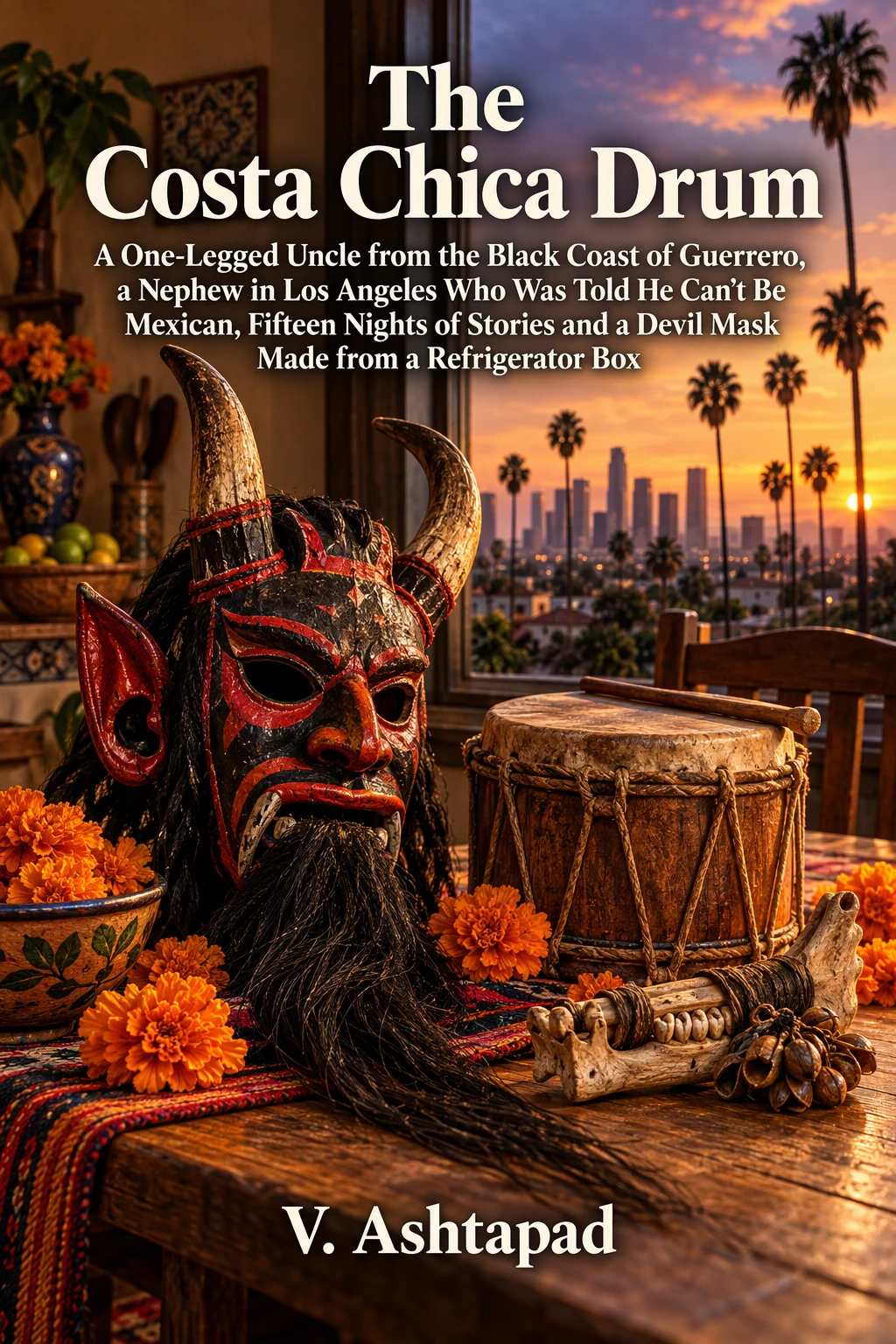
The Costa Chica Drum
A One-Legged Uncle from the Black Coast of Guerrero, a Nephew in Los Angeles Who Was Told He Can't Be Mexican, Fifteen Nights of Stories and a Devil Mask Made from a Refrigerator Box
by V. Ashtapad
Foreword
This is a work of fiction. The Afro-Mexican communities of the Costa Chica of Guerrero and Oaxaca, the Danza de los Diablos, the bote friction drum and the charrasca, the round houses called redondos, pescado a la talla and the 2019 recognition of Afro-Mexicans in the Mexican Constitution are real. The village of Lagunilla del Mar, the family and every named person in the story are invented.
For every child who was told what they could not be, and danced anyway.
First Night: The Leg I Left in Acapulco
Sit down, Chuyín. No, not on the arm of the couch, your mother will kill both of us. On the floor. Here, by the chair, where I can reach you with my cane if you fall asleep.
You see this? Look. Don't be shy. Everybody looks and then pretends they didn't look. You might as well look properly.
That's where my leg used to be. From here down. The left one. The doctors in Acapulco took it off last March, because of the sugar, the diabetes, because your Tío Nemesio ate too many sweet tamales and drank too much Coca-Cola for sixty years and thought he was a horse. Now I am a horse with three legs. One of them is aluminum. You can knock on it. Go on. Knock.
You hear that? Like knocking on a pot. Tock tock. I call it La Comadre. My girlfriend. She goes everywhere with me. She doesn't talk much, but she holds me up, which is more than I can say for most people.
Now. Your mother tells me you came home from school on Tuesday and threw your backpack at the wall and said you are not Mexican.
Don't look at her. Look at me. She's in the kitchen. She can't hear us over the pozole.
She says a boy in your class, what's his name, Brayden, Brandon, some name like a brand of jeans, he said you can't be Mexican because you're Black. And you said you are Mexican because your mama is from Guerrero. And he said, then why do you look like that? And the other kids laughed. And you came home and threw the backpack.
Is that right?
Okay.
Well. I'm not going to tell you that Brandon is stupid, even though he is a little stupid, because all boys are a little stupid at ten. I'm not going to tell you to ignore him. Ignoring doesn't work. I tried it for sixty years.
What I'm going to do is tell you a story. Fifteen nights, from tonight to the night of the dead, when the whole family comes back to eat. One story every night. And on the last night, if you listen properly, you will know exactly what to say to Brandon. Deal?
Shake. Not like that, like a man. Good.
---
So. First you have to know where we come from.
You know Acapulco, because it's on all the postcards, the cliff divers and the hotels and the beach shaped like a smile. Go south from Acapulco along the coast, past where the tourists stop going. Past the coconut plantations and the lagoons full of herons, past the mangroves where the water is brown and warm and the roots stand up out of it like the legs of a thousand old men wading. Go south until the road gets bad and then worse, until Guerrero turns into Oaxaca and you don't even notice the line. That stretch of coast, about two hundred kilometers, is called the Costa Chica. The Little Coast.
And on the Costa Chica live people who look like you.
Like me. Like your mama. Like your Abuela Chela, may she rest. Dark skin, hair like this, noses like this. Black Mexicans. Afromexicanos. We have been there a very long time, Chuyín, longer than this country has been called Mexico. Longer than the United States has been anything.
How did we get there? That's tomorrow's story. Tonight I just want you to see it.
Our village is called Lagunilla del Mar. Little Lagoon by the Sea. It's not on your map, don't bother looking. It's six hundred people and three hundred chickens and one road and a lagoon on one side and the Pacific on the other, and in between, palm trees and houses with walls made of mud and sticks and roofs made of palm leaves, which we call redondos, round houses, with the roof coming down to a point like a hat. Not so many redondos now. Mostly concrete. But your Abuela Chela was born in a redondo, and so was I, on a mat on the floor, with the lagoon frogs singing so loud my mother said she couldn't hear herself scream.
In the morning in Lagunilla, the first sound is the roosters. The second sound is the women patting tortillas, slap slap slap, every house. The third sound is the sea. You can hear the sea all day, even inside, even asleep. It's like a big animal breathing in the next room. When I came here to Los Angeles to see the doctors, the first night at your mama's apartment I couldn't sleep at all, because it was too quiet. Just the freeway. The freeway is not the sea. It breathes wrong.
And money? There isn't any. Not much. The men fish, or they go to Acapulco to work construction, or they go north. The women make tortillas to sell, or sew, or sell fish in the market in Cuaji. My mother sold tamales de tichinda on Sundays, little tamales with mussels from the lagoon, wrapped in corn husks, the best on the coast. Twenty pesos for five. She sold them from a bucket on her head, walking from house to house, shouting ¡Tamales! in a voice you could hear at the beach. With that money she sent your mama and me and Rafa to school in Cuaji, the big town, on the bus, every day, until we were fifteen. Then she couldn't anymore.
There's a clinic in Lagunilla with one nurse who comes on Tuesdays. There's a school with three rooms and two teachers. There's a dance hall with a tin roof that nobody uses except for weddings and a basketball court everybody uses every night. There's Doña Toña's store, which sells everything: eggs, soap, Coca-Cola, phone cards, rope, nails, candles, gasoline in old soda bottles, and the gossip of the whole coast for free.
Poor, Chuyín. We were poor. But we never once went hungry. Not with the lagoon on one side and the sea on the other. My father used to say a man with a net is never poor; he's just not rich yet.
What do we eat? Fish. Always fish. Your Abuelo Chon was a fisherman. Every morning before the sun he went out in his canoe, a long one carved from one parota tree, and came back with red snapper and huachinango and sometimes, if the sea liked him that day, a big jack. And your Abuela Chela split the fish down the back and opened it like a book and rubbed it with red chile paste and garlic and orange and cooked it on a grill of sticks over coals. Pescado a la talla. The skin goes black and crispy and the inside stays white and wet and you eat it with your fingers wrapped in a hot tortilla, and you burn your fingers, and you don't care.
And the light. I miss the light. In Lagunilla, at five in the afternoon, the sun goes down over the sea and everything turns orange, the walls, the palm trunks, the dogs, the faces of the old men playing dominoes under the almond tree in front of Doña Toña's store. The lagoon goes pink, then purple. The herons fly home in a line, low over the water, so close you can hear their wings, whup whup. The bats come out. Somebody's radio plays chilenas, the coast songs, the ones with the harp and the guitar that go round and round like a dancer with a handkerchief. And somebody's mother calls a name down the street, long, like a song, Ra-faaa-el, and somebody's son answers from the beach, ¡Voy!, and doesn't come.
In Los Angeles, at five in the afternoon, the sun goes down behind a Food 4 Less.
I'm not complaining. I'm just telling you.
That's what I miss. Not my leg. The fish.
One more thing before you go. You hear that? Outside? The helicopter, the one that goes around every night? In Lagunilla, at this hour, it's the fishermen's motors coming back across the lagoon, one by one, putt putt putt, and the women standing at the edge of the water with buckets, calling out to ask who caught what. You could tell whose boat it was by the sound of the motor. Every motor had its own cough. When I was little I knew them all. My father's canoe had no motor. You knew it by the silence, and then by the splash of his pole.
Okay, enough for tonight. Your mama is calling. Help me up. No, the other side, the side with La Comadre. Good. Tomorrow, Chuyín. Tomorrow I tell you about the ship.
© 2026 CRUNOD LLC. All rights reserved.
Second Night: The Ship and the Swamp
Your apartment is too small, you know that? Don't tell your mama I said it. Two bedrooms. You and your little sister Yareli in one, with the bunk bed. Your mama and papa in the other. Your papa's mother, Doña Inés, on the fold-out in the living room, except now I'm on the fold-out and Doña Inés is in with you kids on a mattress on the floor, snoring like a truck with no muffler. And your cousin Dani and his mama sleep here three nights a week when her shift at the hospital laundry ends too late for the bus to Compton.
That's eight people, Chuyín. Nine with me. In a place made for four.
In Lagunilla, my mother's family had fourteen people in two redondos and a kitchen with no walls. So I'm used to it. And you know what? I like it. I like hearing everybody breathing at night. I like that somebody is always awake. A house with too many people is a house where nobody gets lost.
You came back. Good. I was worried you'd rather play the video game with the zombies.
Sit. Here, I brought you something.
This is a charrasca. Don't make that face. Yes, it's a jawbone. Yes, from a donkey. Yes, with the teeth still in. Look how they rattle when I hit it. Like this. Tchika tchika tchika. When you scrape a stick down the teeth, it sings. Grrrrrrr. That's music, Chuyín. That's Costa Chica music. Your Abuelo Chon played it at every wedding for forty years. This one was his. It came with me on the bus from Acapulco to Tijuana and then in your mama's car across the border. The border guard opened my bag and found a donkey's head and almost called the army.
Hold it. Don't drop it. It's older than your mama.
---
Now, the ship.
Five hundred years ago, the Spanish came to Mexico. You learned this in school? Cortés, the horses, Tenochtitlan, the big fall. Okay. What they don't tell you in school, or maybe they tell you in one sentence and then move on, is that the Spanish didn't come alone.
They brought Africans. In chains. On ships. From the coasts of Africa, from places with names like Angola and Congo and the rivers of Guinea, to Veracruz on the other side of Mexico, and to Acapulco, which was a big port then, where the treasure ships came from the Philippines. They brought them to work. In the mines, in the sugar fields, on the cattle ranches, in the houses of the rich.
A lot of them, Chuyín. More than you think. In some years, in some parts of New Spain, there were more Africans than Spanish.
That's where we come from. Not all of us, not all the way back. We are also Indigenous, Amuzgo and Mixtec, and we are also Spanish, a little. We are mixed like a good mole, a hundred things ground together until you can't pick out one chile from another. But the African part is real. It's in your hair. It's in the drum. It's in the way your Abuela Chela danced.
I'll tell you something the people in the city got wrong for a long time, Chuyín. For a long time, nobody in Mexico City wanted to count us. Every ten years the government counts all the people, how many Indigenous, how many speak which language, and for two hundred years there was no box for us on the form. No Afromexicano. Nothing. As if we were a rumor. People in Mexico City would tell me, there are no Black people in Mexico. And I would say, then who am I? And they would say, you must be from Cuba.
In 2019, finally, after the old people on the coast marched and wrote letters for thirty years, they changed the Constitution. They put us in. Afromexicanos. A line in the most important paper in the country. And the next year, for the first time, the census had a box for us. Two and a half million people checked it. Two and a half million! In a country that said we didn't exist.
Your Abuela Chela was dead by then. But Yesi went to the town hall in Cuaji and asked for the census form and took a picture of the box and put it in the family archive, next to the post with the notches. She wrote under it: For Mamá Chela, who always knew.
Now here is the story my grandmother told me.
A long time ago, a ship was sailing along the coast of the Costa Chica. A Spanish ship, with Africans chained in the bottom. And a storm came. Big storm, the kind we still get every September, when the sky goes green and the palm trees bend all the way down and the sea comes up over the road. And the ship broke on the rocks near the mouth of the lagoon.
The Spanish sailors drowned, or ran. But the Africans, some of them, got their chains off in the confusion, or the chains broke, or they helped each other. And they swam. They swam into the mangroves, into the swamp, where the water is brown and the roots stand up like old men's legs, where no Spanish horse could follow them. And they hid. And they lived. And they made villages. And those villages became Lagunilla and the other towns of the Costa Chica.
Is it true? Who knows. Some old people say yes. Some professors from the university in Mexico City came to Lagunilla once with notebooks and said no, it's a legend, most of our people came through the ports and the haciendas. And my grandmother listened to the professors very politely and gave them coffee and fried plantains and then, when they left, she said, "They know what's in their books. I know what's in my blood."
Here's what I think, Chuyín. I think both are true. Some came on ships and worked on ranches and slowly, slowly, over a long time, got free, or ran, or were freed. And some, maybe, swam. And the story of the swimmers is the story we tell, because it's the one that makes us brave. A story you tell at night to your nephew doesn't have to be a history book. It has to be a rope. Something to hold on to when the water is deep.
Here. Hold the charrasca again. Hit it. Scrape it.
Grrrrrrr.
That's the ship breaking.
Tchika tchika.
That's the people swimming.
Good. You're a natural. Tomorrow I'll tell you about the devils.
© 2026 CRUNOD LLC. All rights reserved.
Third Night: The Devils Come Out in November
You know why I came this month? Not for the doctors. The doctors I could have seen in Acapulco. I came for this. For the Day of the Dead. Because your mama hasn't danced the devils since she was seventeen, and you have never seen it at all, and I'm sixty-seven years old and I have only one leg, and I said, Nemesio, if you don't go now, maybe nobody goes.
The dance is called La Danza de los Diablos. The Dance of the Devils.
Don't make that face. They're not devils like in the movies. Not evil. They're something else. Listen.
Every year, from the end of October to the beginning of November, when the dead come back to visit, the devils come out in the Costa Chica. Young men, mostly, sometimes now young women too, which your Abuela Chela would have loved. They wear masks. Big masks, Chuyín, as big as your whole chest, carved from wood or made from cardboard and paper, painted black and red, with long horns from a real goat or a real bull, and long beards and long eyebrows made from horsehair, so they swing when you move. And the masks have teeth. Big white teeth. Sometimes real animal teeth stuck in.
And they wear old clothes. Rags. Tied with rope. And they dance through the streets of the village in a long line, stamping, kicking, jumping, going from house to house, from the houses to the cemetery, and back. And they make noise. They shout. They whistle. They crack whips. They scare the little kids, and the little kids scream and run and come back to be scared again.
And the music. Oh, Chuyín, the music.
There's a harmonica, sometimes. There's a charrasca, this one, the donkey jaw. And there's the bote.
The bote is a drum. But not like a drum you hit. It's a friction drum. You take a wooden barrel, or a clay pot, or now sometimes a plastic bucket, and you stretch a goat skin across the top, and through the middle of the skin you put a stick. And then you rub the stick with a wet hand, up and down, up and down. And it doesn't go boom. It goes oooooommm, oooooommm, like a bull, like a big animal growling deep down in its chest.
When I was your age, the sound of the bote coming down the road at night made my hair stand straight up. Even now. Even here, in Los Angeles, in your mama's living room, just talking about it. Look at my arm. Look. You see? The hair is standing up.
And the leader of the devils is called the Minga. That's a man dressed as a woman, the devil's wife, with a dress and a doll in her arms, a baby doll, and she flirts with everybody and bothers everybody and makes everybody laugh. And there's also the Tenango, the devil boss, who cracks the whip and keeps the dancers in line.
So. Why devils?
Here's what the old people said. In the time of slavery, the masters were Spanish, and they had their own ceremonies and their own feast days. And the slaves were not allowed to keep their own ceremonies, or their own dances, or their own drums. So when the slaves danced, they had to hide what it meant. They put on masks. They called themselves devils, because that's what the masters called them anyway. And inside the mask, behind the horns and the horsehair and the teeth, they were dancing for the ancestors. For Africa. For the dead who came back every year to see if their children remembered them.
So the devils are not evil, Chuyín. The devils are the people who were told they were nothing, dancing anyway. Dancing so hard the ground shook. Dancing so loud the dead heard it.
That's what we are. That's what your mama is. That's what you are.
One more thing about the devils, and then you can go to bed.
In Lagunilla, the devils don't just dance in the street. They go into the houses. Every house that has someone who died that year, the devils go in, all of them, crowding into the little room, stamping on the dirt floor, and they dance in front of the altar the family made, with the photograph and the candles and the food the dead person liked. And the family gives them something. Tamales. A cup of mezcal for the grown-ups. Bread. And then the devils go out again, to the next house.
When my father died, I was nineteen. The devils came into our redondo that November. My mother stood in the corner with her arms crossed, very straight, not crying, while thirty devils stamped in front of my father's photograph and his old fishing net that she had hung on the wall. And then Tío Félix, the old Tenango, took off his mask, which the devils never do inside a house, never, and he put his hand on the photograph of my father, and he said, "Chon. The fish are waiting." And put his mask back on and went out.
My mother cried then. I'd never seen her cry. She cried for an hour, sitting on the floor, with the drum still going down the road. And I sat with her and didn't know what to do, so I held her hand.
That's what the devils are for, Chuyín. They come into your house in the worst year of your life and they make noise so you don't have to.
Next time Brandon says you can't be Mexican, you think about that. You think about the bote. Oooooommm.
But don't say anything yet. Not yet. We have twelve more nights.
© 2026 CRUNOD LLC. All rights reserved.
Fourth Night: Abuela Chela and the Redondo
Tonight I want to tell you about my mother. Your mama's mother. Your Abuela Chela.
You met her once, when you were three. You don't remember. She held you on her lap in her yard in Lagunilla under the tamarind tree and you pulled her earring and she laughed so hard she cried. Her laugh was a pot boiling over. She died two years after, in her sleep, in the redondo she was born in. Eighty-nine years old. Never once in her life left the state of Guerrero except to go to Pinotepa in Oaxaca for a wedding, which she said was far enough.
She was the best devil dancer in the whole Costa Chica.
You don't believe me? Ask your mama. Go ahead. Mama! Tell Chuyín who was the best devil dancer on the coast. See? She says it from the kitchen. She says it without turning around.
In those days women didn't dance the devils. It was men only. The women cooked and watched and held the babies. But my mother, when she was fourteen, put on her brother's rags and his mask with the bull horns and tied her hair under a cloth and went out in the line with the boys. And nobody knew. All night she danced. Stamping, kicking, jumping, house to house, to the cemetery and back. And at the end, at dawn, when the devils take off their masks at the edge of the lagoon and wash their faces, she took off her mask.
And the whole village saw.
Some men were angry. Her father was furious. He didn't speak to her for a month. But the old Tenango, the devil boss, a very old man named Tío Félix who had danced for fifty years, he walked up to her, with his whip in his hand, and everybody thought he was going to hit her.
And he gave her the whip.
"You dance better than any of these boys," he said. "Next year you lead."
She didn't lead the next year, because her father locked her in the redondo. But the year after, she did. And every year for twenty years. And now, in Lagunilla, half the devils are girls. Because of your Abuela Chela.
---
Let me tell you about the redondo.
It's round, like the name says. The walls are made of sticks woven together, and then mud is pressed into the sticks, mud mixed with grass and cow dung so it holds, and painted white with lime. The roof is palm leaves, layered and layered, very thick, tied to a frame of poles, coming up to a point. Inside, it's cool even when outside is forty degrees. Dark. Smells like smoke and earth and the palm roof, a dry sweet smell like hay.
In the middle of my mother's redondo was a post. The main post that held up the roof. And on that post, every year, my mother cut a little notch with a knife. One notch for every year she danced. Twenty notches. And below them, in a row, more notches. One for every grandchild born.
Yours is there, Chuyín. The last one at the bottom. I watched her cut it.
When she died, the redondo was going to fall down. Nobody lives in redondos anymore. The concrete houses are easier. The palm roof needs to be replaced every few years. So my brother Rafa, your other uncle, the one in Oregon picking apples, he wanted to pull it down and build a concrete room for his kids when they visit.
I said no.
We fought about it. On the phone. For a long time. He said, Nemesio, it's mud and sticks, it's falling apart, it's dangerous. I said, Rafa, it has our mother's notches in it. He said, take a photo of the notches. I said, a photo is not a post.
In the end, we did both. We took the photo. Your cousin Yesi did it, the smart one, she's studying computers in Puebla. She took photos of every part of that redondo, inside and out, every notch, every crack, and she put them online in a family place that only we can see, a family archive, with your Abuela's voice too, because Yesi had recorded her singing the year before she died. You can go in there and click on the post and see the notches and hear your Abuela singing the song for the devils. Tonight, after, I'll show you on your mama's phone.
And the redondo? We kept it. The village helped. Every year now, in September, before the devils, the young people come and put a new palm roof on it. It's a museum now, kind of. The village calls it La Casa de Chela. The kids go inside and look at the notches. Some of the girls put their hands on the post before they dance, for luck.
So, Chuyín. You see how it works. Brandon says you're not Mexican? You have a notch in a post in a round house by the sea that your grandmother cut with a knife. That's how Mexican you are. That's how long.
© 2026 CRUNOD LLC. All rights reserved.
Fifth Night: Abuelo Chon's Canoe
Tonight I want to tell you about your Abuelo Chon. My father. Your mama's father. The one standing in the canoe in the photograph with the fish as big as you.
His real name was Concepción. Don't laugh. Lots of men on the coast have names like that. Concepción, Guadalupe, Rosario. Names that sound like girls' names here. Nobody on the coast thinks anything of it. He was Chon to everybody, Chon Salinas, and everybody from Lagunilla to Cuajinicuilapa knew him, because he was the one who could find fish when nobody could.
He fished from a canoe carved from one trunk of parota. You don't know parota. It's a big tree, enormous, with a trunk like a barn door and branches that spread out like an umbrella over half a field. Its wood is light and hard and doesn't rot in the water. My grandfather cut the tree in 1940, in the hills behind the village, with an axe and his three brothers, and it took them six weeks to carve it, and they pulled it down to the lagoon with oxen. Eight meters long. You could fit four men in it, or two men and a hundred kilos of fish. My father inherited it. He fished from it for fifty years. He painted the inside blue every two years and the outside red, and he named it La Negra, which is what he called my mother when she wasn't listening.
Every morning at four, he went out. Through the lagoon first, poling, in the dark, through the mangroves, with a lantern on the bow, so the fish would come up to see the light. Then out through the mouth of the lagoon, where it meets the sea. That's the dangerous part. The waves come in there big, especially in the season of the storms, and the sand bar moves, and the canoe can roll over. Every year somebody from the village drowned at the mouth. My father went through it ten thousand times.
He took me with him from when I was seven. I sat in the middle and bailed with a gourd cut in half. He said nothing, the whole morning. He didn't like to talk on the water. He said the fish could hear. He just pointed. There. A shadow under the water. A bird diving. A change in the color of the sea. And he'd throw the net, a big round net with lead weights on the edge, and it would spread out in the air like a flower opening, perfect, every time, and fall, and he'd pull it in, slow, hand over hand.
When I was twelve, he let me throw it. It went into the water like a wet shirt. Clump. He laughed so hard he almost fell out. It was the only time I ever heard him laugh on the water.
---
He died in the water. You should know that.
Not in the canoe. On the beach. He was sixty-one. He came back one morning with a good catch, huachinango, eight big ones, and he pulled La Negra up on the sand, and he sat down next to it to untangle the net, the way he did every morning. And he didn't get up.
The doctor in Ometepec said his heart. My mother said he was tired of being on land. I don't know. I was nineteen. I found him. He was sitting against the canoe with the net in his lap and his eyes closed and the fish still flopping in the bottom of the boat.
I took the fish home first. Then I went back for him. I don't know why I did it in that order. I think he would have wanted it that way. You don't waste fish.
---
La Negra is still in the village. Under the almond tree behind my mother's redondo, upside down, on two logs, so the rain doesn't fill it. Nobody fishes from it anymore. The young men have fiberglass boats with outboard motors now, the government gave them, fast and loud. But every year in September, when the young people put a new roof on the redondo, they also paint La Negra. Blue inside, red outside. And the little kids sit in it and pretend to fish.
When you go to Lagunilla, Chuyín, and you will go, you sit in it. In the middle. Where I sat. And you put your hand on the side, the wood, smooth and warm from the sun.
That wood was a tree in 1940. Then a boat. Then fifty years of fish and four o'clock mornings and one old man who didn't like to talk.
Then you.
© 2026 CRUNOD LLC. All rights reserved.
Sixth Night: How Your Mama Crossed
First, let me tell you about the bus, because your mama never will. The bus from Cuaji to Acapulco, four hours, on the coast road, with chickens in a box on the roof and a man selling chicharrones and a woman nursing a baby in the seat behind. Then the big bus from Acapulco to Mexico City, all night, nine hours, up through the mountains, the road twisting so much that half the bus threw up. Then from Mexico City, two days north, through the desert, past cities she'd only heard of on the radio. Querétaro. San Luis Potosí. Zacatecas. Torreón. Hermosillo. The desert so big and so empty and so dry she thought the bus had driven off the edge of the world. She had never seen a place with no water. On the coast, water is everywhere. In the desert, she said, even the sky looked thirsty.
She called me from a pay phone in Hermosillo. She had ten pesos in coins. She said, "Nemesio, there are no trees." Then the coins ran out.
Tonight is a hard story. Your mama said I could tell it. She said, Nemesio, he's ten, he's old enough. So I'm telling it.
Twenty years ago your mama was twenty. In Lagunilla, there was no work. The fish were going away, the big boats from the cities were taking them all. The coconut prices fell. The hurricane in 1997 broke half the houses in the village and the government sent a truck with water and blankets and then forgot us for five years. And people started leaving. North. To the United States. To pick fruit in California, to cook in restaurants in Chicago, to clean buildings in New York. The village got old. Only grandmothers and little kids.
Your mama wanted to go. Your Abuela Chela said no. They fought. Oh, they fought. Two devil dancers fighting is something to see. Plates. Words. Doors.
In the end your mama went. With a cousin. On a bus to Tijuana. And then, I won't tell you everything, but it was hard. It was dark. They walked a long way. Some people they were with got caught and sent back. Some got hurt. Your mama got through.
And here is the part I want you to hear, Chuyín.
In Tijuana, waiting to cross, in a small room with twenty people from all over Mexico, your mama met a man from Michoacán. Older man. He looked at her and he said, "Where are you from? Cuba? Honduras?"
And she said, "Guerrero."
And he laughed. He said, "There are no Black people in Guerrero. Where are you really from?"
And your mama, twenty years old, scared, tired, in a small room in the dark, she stood up. And she did the devil dance. Right there. In front of everybody. The stamping. The kicking. She sang the bote sound with her mouth. Oooooommm. Oooooommm.
And an old woman in the corner, from Oaxaca, from near Pinotepa, started crying. And said, "Ay, my niña, you're from the coast. You're from the Costa Chica. I haven't seen that dance in thirty years."
And the man from Michoacán didn't say anything after that.
The old woman from near Pinotepa sat with your mama the rest of that night. She gave her half an orange and a blanket. She told her about her own village and her own devils, and they found out that the woman's sister was married to a man from Lagunilla, a cousin of ours, three times removed, the way everybody on the coast is your cousin three times removed. In the morning, when the coyote came to take them, the old woman pressed something into your mama's hand. A little cloth bag on a string. Inside, a pinch of sand from the beach at Corralero. "So the coast goes with you," she said.
Your mama still has it. In her jewelry box. I saw it last night when she was looking for earrings.
You see? Your mama had the same problem as you. Twenty years ago. In a room in the dark. And she didn't have words. So she danced.
---
Your mama got to Los Angeles. She cleaned houses. She cooked in a restaurant, a Oaxacan restaurant on Pico, and she learned to make the moles there, all seven of them, and the tlayudas. She met your papa there, he was the guy who fixed the refrigerator. You know the story, he says she was the hottest thing in the kitchen and the kitchen was a hundred degrees. Ugh. Don't tell him I told you.
She got her papers, slowly. It took a long time. Now she has her own little catering business, and her own apartment, and you. And a brother with one leg sleeping on her couch.
But you know something, Chuyín? She never danced the devils again. Not since that night in Tijuana. Not once in twenty years. Not at the parties, not at the Day of the Dead events at the community center, nothing. I asked her why, on the phone, a few years ago.
She said, "Nemesio, I used it up. I used up all the devil I had in one night in Tijuana."
I don't believe that. I think there's more devil in her. I think it's hiding in the kitchen. Under the pozole.
That's one of the reasons I came.
© 2026 CRUNOD LLC. All rights reserved.
Seventh Night: Making the Mask
No story tonight. Tonight we work.
Your mama got me the things I asked for. Look. Cardboard, from the boxes the new refrigerator came in. Newspaper, a lot of newspaper. Flour and water, for the paste. Black paint, red paint, white paint. And this.
Don't touch it. Okay, touch it. Gently.
That's horsehair. From a real horse. Your mama got it from a man in Pico Rivera who keeps horses for the charreada, the rodeo. Black and long. For the beard and the eyebrows.
And these. Goat horns. Real ones. From the carnicería on Florence where your mama buys goat for the birria. The butcher said, "What do you want with the horns?" Your mama said, "My son is going to be a devil." The butcher laughed out loud and gave them to her for free.
Okay. Here's how it works. First, we make the shape. We cut the cardboard, see, a big oval, bigger than your face, and we bend it, like this, so it curves around. Hold it. Hold it on your face. Okay, here, and here, I'll mark where your eyes go. And your mouth.
Now the nose. Devils need a big nose. We roll up newspaper like a sausage and tape it on. Bigger. Bigger. Okay, that's a good devil nose.
Now the paste. Mix the flour and the water in the bowl. No, not like that, you're making pancakes. Thicker. Like mud from the lagoon. Good. Now tear the newspaper in strips. Dip them in the paste. Wipe off the extra with your fingers. And lay them on the cardboard. Over the nose. Over the eyebrows. Over and over.
Messy? Yes. Devils are messy.
When I was your age, my father taught me to make a mask out of wood. He carved it from a piece of parota, the same tree they make the canoes from. It took him a week. He did it sitting outside the redondo in the evenings, with a little knife, with the shavings falling on his feet like snow. When he finished it was beautiful. Black and red with teeth from a real dog that had died. Long horns from a bull. It smelled of the wood for years.
I can't carve wood anymore. My hands shake, the sugar does that too. So we use cardboard. That's okay. Lots of the kids in Lagunilla use cardboard now. A mask is not about what it's made of. A mask is about who's inside it.
You know what my father said while he carved, when I was your age, sitting next to him outside the redondo? He said, "Nemesio, every mask has two faces. The one you carve, and the one that wears it. The carved one stays the same forever. The one that wears it gets older." He held up the half-finished mask. "When I'm dead, somebody else will wear this one. Maybe you. And the mask will remember my face and learn yours."
Thirty years I wore it. Then it went to Rafa's son. Then he grew up and went to Oregon too, and now it hangs on the wall of the redondo, next to the post, with my father's face and mine and my nephew's in it.
This one we're making is cardboard. It won't last thirty years. Maybe five, if your mama doesn't throw it out. That's okay. You'll make another one. And another. Every year, a new face. And every one of them will remember yours.
Keep going. Another layer. Now another one. Now we let it dry. Tomorrow, the paint. The day after, the horns and the hair. And then you put it on, and you look in the mirror, and you see who you really are.
---
Hey. Chuyín. Look at the kitchen door.
Don't turn around too fast. Just look.
You see your mama? In the doorway? Watching us with the wooden spoon in her hand?
She's been there five minutes. She thinks we don't see her.
Okay. Don't say anything. Go back to the paste.
Sometimes, Chuyín, you don't call the devil out. You just leave the door open, and you wait.
© 2026 CRUNOD LLC. All rights reserved.
Eighth Night: The Leg
Tonight you asked me a question. Before I could even start. You said, "Tío, how are you going to dance with one leg?"
That's a good question. That's the best question anybody has asked me since I got here. Everybody else asks if it hurts, or what happened, or they don't ask anything and just look at La Comadre and then look away fast like they saw something dirty.
You asked how I'm going to dance.
Here's the answer: I'm not.
I'm going to play the bote. I'm going to sit in a chair at the front of the line with a drum between my knees, my knee and La Comadre, and I'm going to rub the stick, and I'm going to make the sound that makes the hair stand up on everybody's arms in Los Angeles. And the devils are going to dance to me.
Yesterday I went to the clinic for the new leg. The good one. Your mama drove me to the big county rehabilitation hospital in Downey, the one with the long name, Rancho something, where they have a whole building just for people like me, missing legs, arms, people who can't walk after accidents, soldiers, old men with the sugar. You came with me, remember? You skipped school. Your mama said it was education.
They have a room there, Chuyín, with parallel bars, like in gymnastics, and you walk between them holding on, with the new leg, while a lady in blue pajamas watches your hips. Her name is Yolanda. She's from Puerto Rico. She's built like a refrigerator and laughs like a parrot. She looked at La Comadre and said, "Ay, who sold you this antique? This is from the stone age." And she went to a closet and brought out a leg so shiny you could see your face in it, with a foot that bends, a real ankle almost, and a socket made from a mold of my own stump.
I put it on. I walked between the bars. Ten steps. I sweated like I was carrying concrete up the hotel stairs in Acapulco.
And you, sitting in the plastic chair by the wall, you said, out loud, so everybody heard, the man with no arms and the soldier with the metal legs and the old lady in the wheelchair and Yolanda: "Tío! You're walking like a devil!"
Yolanda laughed so hard she had to sit down. The soldier with the metal legs gave you a thumbs-up. The old lady in the wheelchair said, "What devil? Where?" and her daughter had to explain.
I'm keeping La Comadre, though. For the house. The new one is for going out. Yolanda calls it El Compadre. So now I have a comadre and a compadre, Chuyín. I'm a very well-connected man.
You know, when I first lost the leg, I thought I was finished. Not just with dancing. With everything. I'm a man who worked with his body his whole life. I was a fisherman like my father. Then a builder, in Acapulco, for the hotels, carrying concrete up and down stairs. Then, when I got older, I drove a taxi on the coast road, which is maybe more dangerous than anything. I never sat still. My mother used to say I had ants in my pants since I was a baby.
And then the doctors took my leg. And I lay in a hospital bed in Acapulco in a room with five other men, two of them also missing legs from the sugar, and one missing an arm from a boat motor, and I thought, Nemesio, you're done. You're a bag of rice now. People will have to carry you.
And the man missing the arm, in the bed next to me, an old fisherman from a village near ours, a man named Don Pancho, said, "Nemesio. Can you still rub a stick?"
I said, "What?"
He said, "Can you rub a stick. With your hand. Up and down."
I said, "Of course I can rub a stick."
He said, "Then you can still play the bote. The bote doesn't need legs. The bote needs a man who knows when to growl."
And he laughed. He laughed so hard the nurse came in and told him to be quiet. A man with one arm, laughing at a man with one leg, because the two of us were sitting around feeling sorry for ourselves and there was a whole drum waiting.
I should tell you the other part too, because you're old enough. The sugar didn't come from nowhere. On the coast, when I was a boy, we ate fish and tortillas and beans and fruit from the trees. Mangoes, tamarind, coconut, papaya. We drank water from the well and coconut water and atole. Then, when I was about twenty, the road got paved. And the trucks came. Coca-Cola, Pepsi, chips, cookies, white bread in plastic bags. Cheap. Cheaper than fish some days. And everybody started drinking soda instead of water, because the water from the well tasted of iron and the soda tasted like a party.
Now half the old men in Lagunilla have the sugar. Half the old women too. Don Pancho. Me. My cousin Toño, who lost both feet. The nurse who comes on Tuesdays says it's the soda. Everybody knows it's the soda. Everybody still drinks it.
So when your mama gives you agua de jamaica instead of Coca-Cola, and you complain, you think about La Comadre. Okay? Not because I want you to be scared. Because I want you to keep both your legs for dancing.
That's the thing, Chuyín. People think when you lose something, you're less. You're smaller. And it's true, you lose some things. I can't run. I can't swim in the lagoon like I used to. I can't go up the ladder to fix the palm roof on my mother's redondo. That makes me sad. Some nights it makes me very sad.
But I'm not less. I'm different. La Comadre and me, we're a new kind of horse. And this horse can still growl.
---
Let me tell you about Don Pancho. When we both got out of the hospital, he went back to his village and I went back to mine. And that November, for the devils, he played the bote with his one arm, the drum held against his chest by a strap. And I played the charrasca, sitting in a chair in the plaza, scraping the donkey's teeth with a stick until my hand was numb. Two old broken men, making the music for thirty young devils.
People took videos. One of them went around on everybody's phones. Your mama saw it here in Los Angeles. That's when she called and said, "Nemesio, come. Come in November. Bring the charrasca. Come see the doctors here, and come teach Chuyín."
Don Pancho calls me every Sunday. On WhatsApp, video. He holds the phone with his one hand so I mostly see his chin and the ceiling of his house. He says the fish are bad this year. He says the government promised a new clinic and sent a sign that says New Clinic Coming Soon and nothing else. He says, "Nemesio, when are you coming back? Nobody here growls like you." I say soon. He says, "You're getting fat in Los Angeles." I say, "It's the Coca-Cola Zero." He says, "That's not Coca-Cola. That's water that lies."
He's going to play the bote for the devils in his village this year with a new strap his granddaughter made. He sent me a photograph. Purple, with sequins. He says it's very elegant.
So here I am.
© 2026 CRUNOD LLC. All rights reserved.
Ninth Night: The Paint
The mask is dry. Look how hard it is. Knock on it. Tock tock. Like La Comadre.
Tonight we paint.
Black first, the whole face. Every bit. Don't miss the edges, the edges are where the light gets in and shows the newspaper underneath. Good. Now let it dry. While it dries, I'll tell you about colors.
In the Costa Chica, the devils are black and red. Black for the face. Red for the mouth, the tongue, the inside of the ears, the lines around the eyes. Some people say the black is for Africa and the red is for the blood that was spilled. Some people say the black is for the night and the red is for the fire. My father said it was because black and red paint were the cheapest at the market in Ometepec.
All three are true.
While we wait, let me tell you about the market in Ometepec, where my father bought the paint. Ometepec is the big town in the hills above the coast, an hour on the bus, with a market every Sunday that fills the whole center. When I was a boy, my father took me twice a year. We left in the dark and came back in the dark.
The market, Chuyín. You can't imagine it. Amuzgo women from the mountains in white huipiles embroidered with red birds, selling the huipiles off their backs. Mixtec men with straw hats and machetes, selling coffee and honey in old bottles. Black women from the coast, like your Abuela, selling dried fish and tamales de tichinda and coconut candy from baskets on their heads. Old men selling live turtles, which you're not supposed to sell anymore. Kids selling iguanas tied by the tail. A man with a loudspeaker selling medicine for everything, for worms and for sadness and for love, all in one bottle. Pots of pozole the size of a bathtub. Mountains of chiles. Mountains of mangoes. Mountains of people, all the people of the Costa Chica, Amuzgo and Mixtec and Black and mestizo, pushing and shouting and bargaining in three languages, and nobody asking anybody where they were really from, because everybody knew. You were from here.
My father always went to the same paint stall, a little old man named Don Celso who sold paint in tin cans and brushes made of horsehair and, in November, horns. My father would hold up a can of black and a can of red and say, "Celso, for the devils," and Don Celso would give him a discount every time, because his grandson danced too.
That's where the black and the red come from, Chuyín. Africa, and blood, and night, and fire, and Don Celso's discount.
Okay, it's dry enough. Now red. Here, take the small brush. Around the eyes, like this. Big circles. Devils have big eyes, so they can see everything, so they can see the dead coming down the road.
Your hand is shaking a little. That's okay. Mine shakes all the time now. A shaking line is a living line.
Now the mouth. Big. Open. Like the devil is shouting. And then, here, white paint, for the teeth. Big square teeth. No, bigger. Like a horse. Good. Good!
Look at that. Look at this face.
You know who that is?
That's you. Inside. That's the part of you that wants to throw the backpack at the wall. The part that's angry at Brandon. That's okay, Chuyín. That part is allowed. That part is part of you. But a devil doesn't throw his backpack. A devil dances. A devil takes all that angry and puts it into his feet and stamps the ground until the dead wake up and say, who is that? Who is that boy making all that noise?
And the dead look, and they see you, and they say: ah. That's Chela's grandson. That's Chon's. That's one of ours.
---
Hey. Your mama is in the doorway again.
She's holding the horsehair.
She's coming over. Don't look at her. Keep painting.
She's sitting down. On the floor. Next to you.
She's taking the scissors.
Chuyín. Hold still. Your mama is going to do the beard. Nobody in the whole Costa Chica could do a devil's beard like your mama when she was sixteen. She used to do them for the boys who couldn't. They paid her in mangoes.
Okay. Don't say anything. Just let her.
© 2026 CRUNOD LLC. All rights reserved.
Tenth Night: What Your Mama Said
I'm not telling a story tonight. Your mama is.
She asked me. She said, "Nemesio, tonight is mine." So I'm going to sit here in my chair with La Comadre and my Coca-Cola, Zero, don't tell the doctors, and I'm going to be quiet. Which is very hard for me. You know that.
Go ahead, Lupe.
---
Chuyín, mi amor.
I'm going to tell you something I never told anybody. Not your papa. Not your Tío.
When I came to Los Angeles, I was so scared. Everything was big. Everything was fast. Nobody looked like me. In the kitchen at the restaurant on Pico, the other cooks were Oaxacan, from the mountains, Zapotec and Mixtec. Good people. Kind to me. But they called me la Cubana. The Cuban girl. Because they thought I must be from Cuba. And I didn't correct them. For two years. Two years, I let them call me la Cubana.
Because I was tired. Because I'd already danced once in Tijuana and I didn't have any more. Because it was easier to let them think I was from somewhere they understood than to explain the Costa Chica, and the ship, and the swamp, and the devils, and the redondo, and my mother and the whip. It was too long. I was too tired. I let it go.
And then, after a while, I started to believe it a little. Not that I was Cuban. But that maybe I wasn't really Mexican. Maybe I was something in between. Something that didn't have a name in this country. And I got quieter and quieter about where I came from. I stopped going to the Mexican parties. I stopped speaking about the coast. I made the moles from Oaxaca because that's what I learned in the kitchen, and I never made pescado a la talla, never, not once, in twenty years. Not for your papa. Not for you.
When you came home on Tuesday and threw your backpack, I wanted to cry. Because I saw myself. I saw me in that kitchen on Pico, letting them call me la Cubana. And I thought: I did this. I didn't give him the words. I didn't give him the dance. I didn't give him the fish. I gave him nothing to hold on to when Brandon pushed.
So I called your Tío. And I said, come.
That's why he's here, Chuyín. Not for his leg. For me. For you. He came to give us back what I put down in a room in Tijuana twenty years ago.
And tomorrow.
Tomorrow I'm going to make pescado a la talla. Your Tío is going to show me again how my mother split the fish. And you're going to eat it with your fingers and burn them. And you're not going to care.
One more thing, Chuyín. Then I'll go.
You know the catering? My little business? When I started it, eight years ago, I named it Sabor Oaxaqueño. Oaxacan Flavor. Because that's what I learned to cook, on Pico, and that's what people here know and pay for. Tlayudas, moles, chapulines for the brave ones.
Tomorrow I'm going to change the name. I already called the man who made the sign for the van. It's going to say Sabor de la Costa Chica. Flavor of the Costa Chica. And under it, small: Afromexican Coastal Cooking.
Your papa says nobody will know what that is. I said, then they'll ask. And I'll tell them.
Okay. That's all. I'm going back to the kitchen. Don't look at me. I'm not crying. It's the onions.
---
...
She went back in the kitchen, Chuyín.
That's the devil coming out.
You see? I told you. You leave the door open. And you wait.
© 2026 CRUNOD LLC. All rights reserved.
Eleventh Night: The Phone Call to Lagunilla
Tonight we called home.
Your mama's phone, propped on the sugar bowl on the kitchen table, everybody crowded around. You and Yareli on the bench. Your mama and papa standing behind. Doña Inés in her robe. Dani on the floor because there was no room. Me at the end with El Compadre stretched out under the table like a dog.
It was nine o'clock here. Eleven o'clock there. Nobody in Lagunilla goes to bed at eleven in November. It's too hot. And it's the week before the devils, so everybody's out.
Your cousin Yesi answered. From the plaza in front of Doña Toña's store, under the almond tree, where the only good signal in the village is. You could see the light from the store behind her, the one bulb, and moths around it, and behind her, in the dark, kids running and screaming. The screen was full of noise. Roosters, even at eleven at night. Dogs. A motorcycle with no muffler. The sea, under everything, breathing. And from somewhere, faint, getting louder, a sound.
Oooooommm.
The bote. They were practicing.
You sat up so fast you hit your knee on the table.
Yesi turned the phone around. And there they were. Thirty devils, in the dark, in the plaza, by the light of the store and one streetlight and somebody's motorcycle headlight. Masks black and red. Horns. Horsehair swinging. Rags. Stamping on the dirt so hard the dust came up in clouds in the light. Right, right, left. Right, right, left. And at the front, the Tenango, a tall girl of maybe sixteen with a whip, and at the back, the Minga, a big man in a flowered dress with a baby doll, bothering the old ladies on the benches.
Your mama put her hand over her mouth.
Then Yesi shouted something, and the devils stopped. And they all came running toward the phone, thirty of them, crowding, pushing, and suddenly the whole screen was full of masks. Black faces, red eyes, white teeth, horns, all of them shouting at once.
"¡Chuyín! ¡Chuyín! ¡Chuyín!"
They knew your name, Chuyín. Yesi told them. The whole village knows about the boy in Los Angeles who's going to dance the devils for the first time.
And then the tall girl, the Tenango, took off her mask. Right there. She had braids and a face shiny with sweat. And she said, "Chuyín, I'm your cousin Xiadani. Rafa's granddaughter. I lead this year." She held up her whip. "Your Abuela Chela gave this whip to Tío Félix's grandson, and he gave it to me. When you come, I'll teach you the turn. The real one. Okay?"
You couldn't say anything. You just nodded at the phone.
Then she said, "Tía Lupe! Is that you? Are you dancing Saturday?"
And your mama, in the kitchen in Los Angeles, with her hand still over her mouth, took it down. And said, "Yes."
And thirty devils in Lagunilla del Mar screamed so loud that the phone made a noise like it was breaking, and Doña Inés grabbed her chest and Yareli started crying because she was scared, and Dani said, "Tía Lupe, you're a devil?", and your papa started laughing and couldn't stop.
---
Before Yesi hung up, your Tío Rafa called in from Oregon. On the same call, a little square in the corner of the screen. He was in an orchard, in the dark, in a work jacket, with frost on his breath and a ladder behind him. Six in the evening there, nine at night here, eleven in Lagunilla. Three time zones. One family.
"Chuyín!" he shouted. "I hear you're dancing! Make sure the devils know Rafa says hello!" Then he looked at me. "Nemesio, you look terrible."
"I have one leg."
"You looked terrible with two."
They laughed. All the faces on the phone. Your mama, in the kitchen in LA. Yesi under the almond tree. Rafa in the apple orchard in the frost. Thirty devils crowding in behind Yesi, horns knocking. Me at the end of the table.
I thought: this is what's left of the village. And it's everywhere. Oregon. Los Angeles. Lagunilla. A phone on a sugar bowl.
After, Yesi walked the phone over to the redondo. In the dark, with the flashlight. She went inside. She pointed the light at the post.
The notches. Twenty at the top for Abuela Chela's years. Then the row of grandchildren.
She moved the light down to the last one. Small, clean, near the dirt floor.
"That's you, Chuyín," she said.
You leaned in so close to the phone your nose touched the screen.
Then Yesi did something. She took a knife out of her pocket. A little one, a fishing knife. And she said, "Tía Lupe. Abuela always cut one more. For the first year somebody dances. Can I?"
Your mama couldn't talk. She nodded.
And Yesi cut a new notch. Next to yours. A little higher. Fresh wood, white in the flashlight.
"For Saturday," she said. "In advance. So you have to."
© 2026 CRUNOD LLC. All rights reserved.
Twelfth Night: Pescado a la Talla
We didn't tell a story tonight. We cooked.
Your papa found red snapper at the fish market in San Pedro. Two of them, big, with clear eyes, which is how you know they're fresh. Your mama split them down the back, like a book, the way Abuela Chela did. Her hands remembered. She said she didn't remember and then her hands did it without her, like they had been waiting twenty years.
And I sat at the kitchen table with La Comadre stretched out under it and made the chile paste. Guajillo chiles, toasted on the comal until they smell like smoke and raisins, then soaked in hot water, then blended with garlic and orange juice and a little vinegar and salt and black pepper and a little cumin and a little oregano. Red like the devil's mouth. Your mama said, "More garlic." I said, "Lupe, that's already a lot of garlic." She said, "Mamá always put more." She was right. We put more.
Then your papa took the fish out on the little balcony to the grill, the one that's meant for burgers, and the smoke went all over the building and the old lady upstairs, Mrs. Kim, came down to complain, and smelled it, and stopped complaining, and stayed for dinner. She ate with her fingers. She said it reminded her of fish her mother cooked on the beach in Busan when she was a girl. She said, "Coast people. Same everywhere." And she clinked her can of Coca-Cola, the real one, against mine, the Zero, and said, "Cheers, one-leg."
I liked her.
Your little sister Yareli ate one bite and spat it out and said it was too spicy and had a quesadilla instead. That's okay. She's six. When she's ten, she'll eat it. When she's twenty, she'll make it. When she's sixty, she'll be the one at the table in some kitchen in some city telling some kid how her great-grandmother split the fish down the back like a book.
Doña Inés, your papa's mother, who is from Puebla and thinks the coast is a place where people don't wear shoes, ate two whole pieces and asked for the recipe. She pretended it was for a neighbor.
Your papa, Rigo, sat back in his chair with his belt open and looked at your mama for a long time while she was laughing at something Mrs. Kim said. Then he looked at me. And he said, very quietly, so she wouldn't hear, "Twelve years married. I never saw her like this."
I said, "That's the coast, Rigo. It was always in there. Somebody just had to light the coals."
You ate three tortillas full of fish. You burned your fingers on the first one. You didn't care.
And your mama, at the end, when everybody was full and leaning back and the balcony was still smoking, your mama put her fingers in her mouth and whistled. The way the Tenango whistles to start the devils. Long and high. Everybody jumped. Mrs. Kim dropped her can.
And your mama said: "Chuyín. The dance is at the park on Saturday. The community center is doing a Day of the Dead. There's a stage. I already called them."
And you said: "What dance?"
And your mama said: "Ours."
© 2026 CRUNOD LLC. All rights reserved.
Thirteenth Night: Practice
Your mama got four more kids from the building and the school. Your cousin Dani, who is twelve and thinks he's too cool for everything. The two Jiménez sisters from the second floor, Marisol and Anahí, whose family is from Pinotepa, from the Oaxaca side of the Costa Chica, and who said, when your mama asked, "We know the devils! Our abuelo was a devil!" And a boy from your class named Kofi, whose papa is from Ghana and whose mama is from Jalisco, who asked if he could be a devil too and your mama said, "You, especially."
Mrs. Kim came down the first night to see what the noise was, in her slippers and a padded jacket, and stayed. She lives alone on the third floor. Her husband died two years ago. Her son is a dentist in Irvine and comes on the second Sunday of every month with a box of Korean pears and stays one hour exactly. She watched the whole practice from a lawn chair she brought down herself, with a thermos of barley tea, and at the end she said to your mama, "In my village, near Andong, there is a mask dance too. Hahoe. Wooden masks. Very old. The masks make fun of the rich people and the monks. You can say anything in a mask."
Your mama said, "Same here."
Mrs. Kim said, "Of course. Masks are for telling the truth."
Five devils. Not thirty. That's okay. Five is a line. Five is a start.
And Brandon came.
Don't look so surprised. You invited him. Remember? At school, on Thursday. You told me. You said, "Tío, I asked Brandon to come and watch on Saturday." And I said, "Why?" And you said, "Because he doesn't know." And I said, "Know what?" And you said, "Anything."
That was a good answer.
And then Brandon's mama called your mama, and said Brandon wants to be in it. Not watch. Be in it. And your mama said, "Is Brandon Mexican?" And Brandon's mama said, "Well, his dad's family is from Sonora, a long time ago, but we don't really... he doesn't really..." And your mama said, "Bring him."
So now we have six devils. And one of them is Brandon. In a cardboard mask that your mama made in one night, with horns from a plastic Halloween costume, because the butcher only had two goat horns and they're on yours.
I talked to Brandon, the first night of practice. While the others were stamping. He was sitting on the curb by the dumpster with his plastic horns in his lap, looking like he wanted to go home.
I sat down next to him. That takes a while with El Compadre. He watched me do it, very carefully, the way kids watch when they're trying not to stare.
"You can look," I said. "Everybody looks."
He looked. Then he said, "Does it hurt?"
"Sometimes. At night."
He nodded. Then he said, "My grandpa has one too. A fake leg. From the war. Iraq. He doesn't talk about it."
I didn't know that. Chuyín, you didn't know that either. Brandon's grandpa lives with them, in a house in Bellflower, and he sits in the garage most of the day with the door open, listening to the radio, and he doesn't talk to anybody. Brandon said his grandpa is from Hermosillo, in Sonora, but came to Los Angeles when he was five and doesn't speak Spanish. Brandon said, "He says he's American. Period. He gets mad if you ask."
I said, "Maybe he's tired. Like Chuyín's mama was tired. Maybe somebody laughed at him once in a small room and he decided to stop explaining."
Brandon thought about that for a long time.
Then he said, "Can I bring him? On Saturday? To watch?"
I said, "Bring him. Tell him there's a one-legged man playing the drum. Tell him he can sit next to me."
We'll see if he comes, Chuyín. We'll see.
He's not very good. He stamps too soft. He's scared of the bote. The first time I rubbed the stick and it went oooooommm, he jumped a meter in the air and hid behind Marisol.
But he's trying, Chuyín. He's inside a mask, trying.
---
The parking lot is not a plaza. There's no almond tree. There's no sea. There's a dumpster and a broken shopping cart and a Honda up on blocks that belongs to a man named Chuy who has been fixing it for three years. There's the back wall of the laundromat with a mural of a sunset that somebody painted over with a Lakers logo. There's the hum of the freeway, always. And the one light, orange, buzzing, with moths.
But when the bote starts, Chuyín, I swear to you, for a second, it's the plaza. I can smell the lagoon. I can feel the dirt under my foot, the one I still have, instead of asphalt. The sound does that. It carries the place inside it, like a shell carries the sea.
The neighbors came out to watch. From the balconies, from the windows, from the doors. The Salvadoran family from the first floor with their baby. The two old Armenian men from 2B who play backgammon on the stairs. The Nigerian nurse from the fourth floor, coming home from a night shift, who stopped with her bag on her shoulder and watched the whole thing and at the end clapped and said, "In my village, we have masquerades too! Egungun! For the ancestors!" And she showed you a video on her phone of dancers in tall costumes made of a hundred colored cloths, spinning, and you watched it with your mouth open.
Everybody's ancestors, Chuyín. Everybody has a dance for them. Some people just forgot where they put theirs.
Here's what we practiced tonight in the parking lot behind the building, under the one light that works:
The line. You walk in a line, one behind the other, close. When the Tenango whistles, you stop. When he cracks the whip, you jump.
The stamp. Right foot, right foot, left foot. Right foot, right foot, left foot. Hard. Like you're stamping out a fire.
The kick. Out to the side, high, with your arms up like you're scaring a bird.
The turn. Spin, all the way around, and shout. Not a word. Just a sound. From the belly. Hoooo!
The Minga. Who's the Minga? Kofi wanted to be the Minga. He's wearing your mama's old flowered dress and a scarf and carrying your baby doll from when you were two, the one with one eye. He's very good. He makes everybody laugh. He flirts with Mrs. Kim when she comes down to watch with her folding chair.
And the Tenango, the boss. That's your mama. With a whip she made from a rope and a broom handle. And a mask she made last night by herself, while you were sleeping. I saw it this morning. Black and red with real horsehair and the second pair of goat horns, which she went back and bought from the butcher with her own money.
She's going to dance, Chuyín.
For the first time in twenty years.
And I'm going to play the bote, and Mrs. Kim is going to play the charrasca, because she asked, and because she has a good sense of rhythm, and because, she said, in Busan when she was a girl they had a dance with masks too, and devils, and drums, and she wants to play.
Coast people. Same everywhere.
© 2026 CRUNOD LLC. All rights reserved.
Fourteenth Night: The Kitchen at Two in the Morning
You were asleep. Everybody was asleep. Doña Inés snoring like the truck. Yareli talking in her sleep in English. Dani on the floor with his mouth open. And I couldn't sleep, because the new leg makes the stump ache at night, a deep ache like a toothache in a bone that isn't there anymore. The doctors call it phantom pain. I call it my leg saying goodbye very slowly.
So I got up and went to the kitchen for water. And your mama was there.
Sitting at the table, in the dark, with only the light from the stove clock, green. In her old robe. With the Tenango mask in front of her on the table, the one she made. Just looking at it.
I sat down. I didn't turn on the light. We sat there.
After a while she said, "Nemesio. Do you think Mamá forgave me?"
I didn't answer right away. Your mama and your Abuela Chela didn't speak for three years after she left. Three years. Then a phone call at Christmas, short. Then a letter. Then photographs of you, when you were born. Then, when you were three, your mama got her papers, and she flew home for the first time, with you, and walked into the yard under the tamarind tree, and your Abuela Chela was sitting there in her plastic chair, and she looked up, and she didn't say anything. She held out her arms for you. Not for your mama. For you.
Your mama put you in her arms. And stood there. And your Abuela held you, and you pulled her earring, and she laughed so hard she cried, and your mama stood there the whole time, not crying, with her arms empty.
That was the last time she saw her.
"Lupe," I said. "You know what she did the night after you left? Twenty years ago? The night the bus went to Tijuana?"
She shook her head.
"She went into the redondo," I said, "and she cut a notch in the post. Not for a year of dancing. Not for a grandchild. Just one notch, by itself, on the other side of the post, where nobody would see it unless they looked. And she never told anybody what it was for. I found it after she died, when Yesi was taking the photographs."
Your mama was very still.
"I asked Yesi to zoom in," I said. "Under the notch, very small, cut with the point of the knife, there were two letters."
"What letters?"
"L. V." I said. "Lupe. Viva."
Your mama put her hands over her face.
"Lupe, alive," I said. "That's what she cut. The night you left. She didn't know if you'd make it across. She didn't know if you'd die in the desert like the Ramírez boy did the year before. So she cut it. Lupe is alive. And she left it there for twenty years, where she could see it every morning when she made the coffee."
Your mama cried for a long time, Chuyín. Very quietly, so she wouldn't wake anybody. I sat with her. I held her hand, the way I held my mother's the night the devils came for my father.
Then she wiped her face on the sleeve of her robe and picked up the Tenango mask and put it on. Right there, at two in the morning, in the kitchen, in her robe.
She looked at me through the eye holes.
"Saturday," she said, through the mask.
"Saturday," I said.
---
Then, because we were both awake, and because there's nothing else to do in a kitchen at two in the morning, she made us quesadillas. With the cheese from Oaxaca, the stringy kind, and epazote, and the hot salsa she makes for the catering, the one with chile de árbol that the office people in Downtown pay twelve dollars a jar for. We ate them standing up at the counter, in the green light from the stove clock, burning our mouths.
"How's the business?" I asked her.
"Good," she said. "Not good. Okay. Three offices a week. A wedding sometimes. A quinceañera. I rent the kitchen at the church hall on Slauson by the hour. I drive the van myself." She shrugged. "Rigo says we should save for a house. I say what house? In LA? With what? We'll be in this apartment until Chuyín goes to college. If he goes to college."
"He'll go," I said.
"With what money?"
"With devil money," I said. "You'll see. Next year the whole building dances. The year after, the whole neighborhood. You'll do the catering. Tamales for five hundred people. You'll be rich."
She laughed with her mouth full. "Nemesio. You're crazy."
"I'm a horse with three legs," I said. "Of course I'm crazy."
© 2026 CRUNOD LLC. All rights reserved.
Fifteenth Night: The Devils in Los Angeles
Before the dance, at six o'clock, in the parking lot behind the stage, your mama painted my face. Black, with red around the eyes. I'm not a devil anymore, I'm too old and too broken. But the bote player paints too. That's the rule. My father painted when he played. Tío Félix painted. Don Pancho, with one arm, painted.
She did it slowly, with her finger, the way Abuela Chela used to do it for the boys, the black paint cold on my skin, her face very close to mine. She didn't say anything. She just painted. Her hand was steady. When she finished, she held up her phone so I could see myself.
An old Black man from the coast with one leg and a devil's face, in a parking lot in Los Angeles, behind a community center, with the smell of tamales and copal and car exhaust and marigolds.
I looked like my father.
I didn't say that. I just said, "Good, Lupe. Good."
She knew.
---
It's over now, Chuyín. You're asleep on the couch with the mask still on the floor next to you and black paint still on your ears. I'm sitting in the chair. Your mama is sleeping in the kitchen chair with her head on the table and the Tenango whip in her lap. Your papa went to bed an hour ago, laughing.
I'm going to tell this last story anyway. To you, asleep. And maybe to the dead, who came tonight. I'm sure they came. I heard them.
---
The park was full. More people than your mama expected. The community center put up a stage, with an altar on it, an ofrenda, full of marigolds, orange and yellow, a whole mountain of them, and candles and sugar skulls and pan de muerto and photographs of everybody's dead. Your mama put your Abuela Chela's photograph there, the one from the redondo, with the tamarind tree behind her. And your Abuelo Chon's, standing in his canoe with a fish as big as you.
There was a mariachi group. There was a folklórico group from a high school, girls in big skirts from Jalisco spinning like flowers. There were Aztec dancers with feathers and shell rattles on their ankles. Everybody's Mexico. All the Mexicos at once.
And then, at seven o'clock, when it was dark, the announcer said: "And now, from the Costa Chica of Guerrero and Oaxaca, La Danza de los Diablos."
And people looked at each other. Because most of them had never heard of it.
And I sat in my chair at the side of the stage with the bote between my knee and La Comadre. And I wet my hand. And I rubbed the stick.
Oooooommm.
The whole park went quiet. Like somebody turned off a radio. I saw the hair stand up on the arms of a man in the front row. I saw a little girl grab her father's leg.
Oooooommm. Oooooommm.
And Mrs. Kim scraped the charrasca. Grrrrrrrrr. Tchika tchika.
And your mama whistled. Long and high.
And the devils came out.
---
Before you went on, while the folklórico girls were still spinning, I saw you behind the stage, holding your mask in your two hands, looking at it. Not putting it on. Just looking.
I said, "Chuyín. What's wrong?"
You said, "What if they laugh?"
I said, "Who?"
You said, "Everybody. What if they think it's weird. What if they think we're not real Mexicans dancing a fake dance."
I thought about what to say. I thought about my father carving, and Tío Félix with the whip, and Abuela Chela at fourteen in her brother's rags, and your mama in the dark in Tijuana. I thought about the two letters in the post.
And I said, "Chuyín, they might laugh. Some of them. Brandon laughed, didn't he? And now he's wearing horns. People laugh at what they don't know. Then they learn it. Then they stop laughing. Then they want a mask." I pointed at Mrs. Kim, who was sitting on a folding chair behind the stage with the charrasca on her knees, practicing, tchika tchika, with her eyes closed. "Then they want to play the donkey."
You looked at Mrs. Kim. You laughed, a little.
Then you put on the mask.
Six of you. In a line. Stamping. Right, right, left. Right, right, left. Masks black and red, horns and horsehair swinging, rags flying. Kofi in the flowered dress at the back, flirting with the whole front row, waving the one-eyed baby doll. Marisol and Anahí kicking so high. Dani, too cool for everything, stamping harder than anybody. Brandon, in his plastic horns, getting it wrong, getting it right, getting it wrong again, but doing it.
And you. In front. Right behind the Tenango. In the mask we made, with the goat horns from the carnicería and the beard your mama cut and the red eyes so big they could see the dead coming down the road.
And in front of you, the Tenango. Your mama. With her whip.
She danced, Chuyín.
She danced like she was fourteen and wearing her brother's rags and nobody knew. She danced like she was twenty in a room in Tijuana in the dark. She danced like Abuela Chela. Better. She kicked so high the horsehair flew. She cracked the whip and you all jumped. She spun and shouted from her belly and the sound went out over the whole park, over the marigolds, over the freeway, over the city, all the way to the sea.
Hoooooooo!
And then, at the end, the way it's done at the lagoon at dawn, she stopped. And all six of you stopped behind her. And the bote stopped. And the charrasca stopped. And there was a big silence in the park.
And your mama took off her mask.
And she looked out at all those people. All the Mexicos. The mariachis and the folklórico girls and the Aztec dancers and the families from Michoacán and Jalisco and Puebla and Oaxaca, and the families from nowhere, and the families from everywhere.
And she said, into the microphone, loud and clear:
"We are from the Costa Chica. We are Black. We are Mexican. Our grandmothers danced this for five hundred years. And now our children dance it here."
And for one second, nothing.
And then the old woman in the third row stood up. Small, grey hair, a shawl. And she started to clap. Slow. And the man next to her stood up. And then everybody.
I didn't see the rest, Chuyín. My eyes weren't working right. Something in them. Probably smoke from the candles.
---
Afterward, Brandon came to you. I saw it. He had his plastic horns in his hand and his cardboard mask under his arm and he was sweaty and his face was red.
He said, "That was the coolest thing I ever did."
And you said: "Now you know."
And he said: "Know what?"
And you thought about it. I watched you think about it. You thought about it for a long time, with all that paint on your face.
And then you said:
"That I'm Mexican. And you are too. A little. We all are, a little."
And Brandon said, "Okay."
And that was all. You know what? That was enough. Sometimes the right words are very short. Sometimes it takes fifteen nights to find four.
---
Before your mama woke up, I did one more thing.
I took out my phone, the old one with the cracked screen, and I opened the family archive that Yesi made. The page for Abuela Chela. The photographs of the redondo, the post, the notches, the new one Yesi cut for you. Her voice, singing the devil song. The census box.
And I added a video. The one Dani took tonight from the side of the stage, shaky, with his thumb in the corner. Six devils in a park in Los Angeles. The Tenango taking off her mask. The old woman in the third row standing up.
Under it, I typed, with one finger, very slowly, because my eyes were still not working right:
*Mamá. Lupe danced. Chuyín danced. The notch is real now.*
Then I put the phone down on La Comadre, which was leaning against the chair, and closed my eyes for a minute.
I want to tell you about the people who came up to us after, too. Because you were busy with Brandon and missed it.
A man from Oaxaca, from the mountains, a Mixtec man in a cowboy hat, who shook my hand for a long time and said, "My grandfather sold mangoes in Pinotepa. He used to talk about the Black devils. I thought he made it up."
A young woman with a little boy on her hip, very dark, with braids like your mama's, who said she was from Veracruz, from a town on the other coast, the Gulf coast, where they have their own Black Mexicans and their own music, the son jarocho with the little guitars and the wooden platform for stamping. She said, "Nobody here believes me when I say where I'm from. Now I can say, like the devils. Like the Costa Chica." She took a photograph of your mama's mask.
A teacher from your school, Mr. Okafor, who teaches the fifth grade next door, who said he wants your mama to come to his class and teach the kids about the Costa Chica. With the mask. With the bote. He said, "They're learning about Mexico in social studies. The book has one paragraph about Africans in Mexico. One paragraph. Your family can be the rest of the chapter."
Your mama said yes before he finished the sentence.
And an old couple, very small, holding hands, from Guerrero, from the mountains near Chilpancingo, who didn't say anything at all. They just stood in front of me and looked at the bote between my knees for a long time. Then the old woman reached out and touched the goat skin, very softly, the way you'd touch a sleeping baby. And they walked away.
Brandon's grandpa came, Chuyín. You didn't see him because you were in your mask. An old man in a wheelchair, in a baseball cap that said VETERAN, with a face like a closed door. Brandon pushed him right up next to my chair at the side of the stage. He didn't say anything the whole time. Not one word.
But when the bote started, oooooommm, I saw his hand. On the arm of the wheelchair. His fingers started tapping. Right, right, left. Right, right, left. Like he knew it. Like his body knew it from somewhere a long time ago, from Sonora, from his own grandmother, from some fiesta in some plaza he forgot he remembered.
At the end, when everybody was standing and clapping, he didn't stand, he couldn't. But he took off his VETERAN cap and held it over his chest. And he looked at me. And he nodded once.
That's all. One nod. From a man who doesn't talk.
That's a lot, Chuyín.
That's all. That's everything I remember.
Your mama is waking up. She's looking at me. She's smiling. She has paint on her nose.
"Nemesio," she's saying. "Next year, you're coming back."
"With one leg?"
"With one leg. Or none. You're coming back. And we're going to do it again. Bigger. The building wants to do it. The school wants to do it. Mrs. Kim wants a mask."
"Lupe," I'm saying. "Next year, you should come to Lagunilla. Bring Chuyín. Put his hand on the post in Mamá's redondo. Let the village see him dance."
She's quiet for a while.
"Maybe," she's saying. "Maybe yes."
And then she's getting up, and putting a blanket over you, and taking the mask from the floor, carefully, and putting it on the table by the window, where the streetlight comes through, so the red eyes are looking out at the city.
At the dead coming down the road. At the freeway, breathing wrong. At the sea, so far away, breathing right.
Tomorrow we make the altar here, in the living room, on the table by the window. Your mama already bought the marigolds, two buckets, from the flower market downtown at five in the morning, and the whole apartment smells like them, bitter and sweet, like the yards in Lagunilla in November. We'll put out Abuela Chela's photograph and Abuelo Chon's. A plate of pescado a la talla for him. Tamales de tichinda for her, if your mama can find mussels in Los Angeles, which she says she can't, so she'll use shrimp, and Abuela Chela will complain, and eat them anyway. A glass of water, because the dead are thirsty after the long road. A candle. The charrasca. And your mask, Chuyín. Next to their pictures. So they can see whose it is.
Sleep, Chuyín. Tomorrow is the day of the dead. They're coming to eat. We cooked enough for everybody.
Even Brandon.
© 2026 CRUNOD LLC. All rights reserved.
If this book stayed with you
Mariposa Mail
Citlali, a Monarch and a Map from Michoacán to San Antonio
Another Mexican family keeping its traditions alive across the border, one season at a time.
About this book
A boy in ten-year-old Chuyín's class says he can't be Mexican, because he's Black. Chuyín throws his backpack at the wall.
So his great-uncle Nemesio, sixty-seven, with one leg left to diabetes and an aluminum one he calls La Comadre, settles into a chair in the crowded apartment in South Los Angeles and makes a deal: one story every night until the Day of the Dead. A shipwreck and a swamp. A grandmother who danced the devils at fourteen in her brother's rags. A fisherman's canoe carved from one tree. A post in a round house by the sea with a notch cut for every year.
And a mother in the kitchen who hasn't danced since one night in a room in Tijuana twenty years ago.
Out of cardboard, newspaper, goat horns from the butcher and horsehair from a rodeo man, Nemesio and Chuyín build a devil mask. Can six kids, a Korean neighbor with a donkey's jawbone and an uncle on a drum bring the Costa Chica to a park in Los Angeles?
Members can react to this book and talk about it in the members' Library.
Ownership
© 2026 CRUNOD LLC. All rights reserved.
This book is owned by CRUNOD LLC. It is free to read on EternalCurrent.Online. No part of it may be copied, reprinted, sold, recorded or adapted, including as audio, film or translation, without written permission from CRUNOD LLC.
© 2026 CRUNOD LLC. All rights reserved.