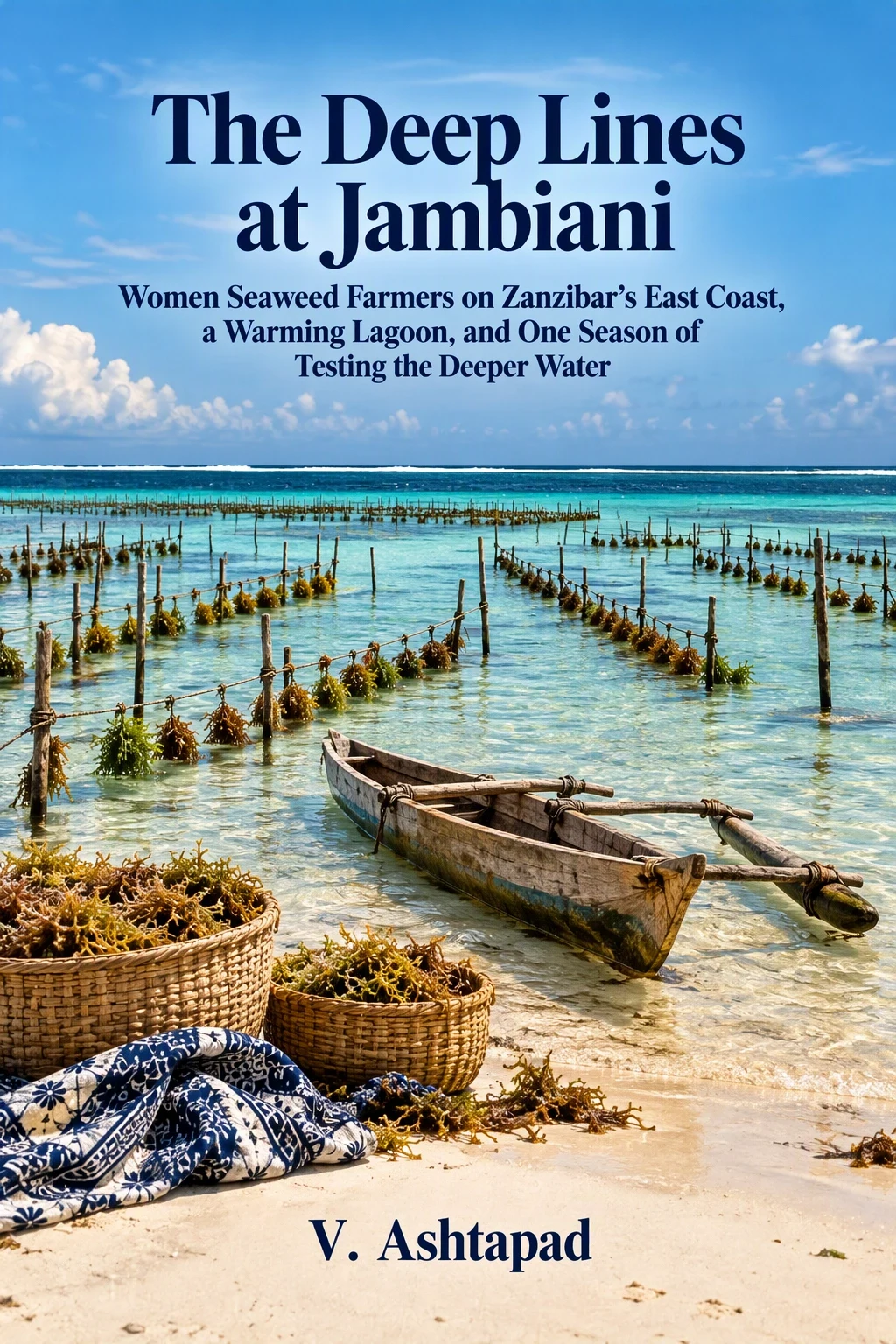
The Deep Lines at Jambiani
Women Seaweed Farmers on Zanzibar's East Coast, a Warming Lagoon, and One Season of Testing the Deeper Water
by V. Ashtapad
Foreword
This is a work of fiction. Jambiani and the seaweed farms of Zanzibar's east coast, the die-off of cottonii in warm shallow water, deep-water floating-line and tube-net trials, women's swimming programs, the monsoons, kangas and taarab are real. The farmers' group, the trial, the scientist, the meeting in Stone Town and every named person in the story are invented.
For the women who walked out at low tide for thirty years, and the one who learned to swim.
Low Water, Eleven Forty, Point Three Meters
*Kanga: Haba na haba hujaza kibaba. Little by little fills the measure.*
At low water on a spring tide the sea at Jambiani goes out so far that the village seems to have been left on a shelf. From the sand in front of the houses to the white line of the reef where the waves break, two kilometers away, there is nothing but the flat floor of the lagoon, shining, wet, pale gold and pale green, with long silver puddles lying in the dips and a wide band of dark weed where the shallow water stays, and the light coming off all of it so hard at midday that you have to narrow your eyes to slits. The fishing boats lie tipped on their sides in the sand, outriggers in the air, waiting for the water to come back. The children walk out a kilometer to catch octopus in the rock pools with sticks. The wind comes off the reef warm and smelling of salt and iodine and something rotten and sweet.
And the women go out to the farms.
Mwanahawa Juma had been walking out to the farms at low water since she was nineteen. Twenty-two years. She knew the way the way your tongue knows your teeth: across the hot dry sand first, where the crabs run sideways into their holes at your shadow, then the cool wet sand, firm and rippled, then the first ankle-deep water, warm as a bath, over sea grass that tickles, then the bare rock flats with the sharp coral heads you must not step on, then the farms. Rows and rows of wooden pegs knocked into the lagoon floor, each row ten meters long, with nylon lines strung tight between them a hand's width above the sand, and tied along each line, every twenty centimeters, a little bundle of seaweed. Hundreds of rows. Thousands of pegs. Each woman's plot marked with a different colored rag tied to the first peg. Mwanahawa's rag was orange. Her mother's had been orange before her.
On the eleventh of March, at eleven-forty in the morning, she walked out to her orange rag and stood in the warm water to her shins, and looked down at her lines, and knew.
White.
The seaweed on her lines should have been brown and red, thick fingers of it, fat and rubbery, branching, as long as her forearm by now, four weeks after planting. That was mwani mkubwa, the big seaweed, the cottonii, the one the buyers paid three times as much for. Instead the bundles were thin and pale. The tips had gone white, bleached white like old bones, and soft. When she touched one it came apart in her fingers. It smelled bad. A sour, fishy, rotten smell.
She walked along the line. White. The next line. White. The next.
All of it.
She stood in the water with the dead seaweed in her hand and the sun burning the back of her neck through her headscarf and looked across at the other plots. Green rag, white. Blue rag, white. The red rag of Mwajuma, who had been farming the lagoon for thirty-one years and whose lines were the best in Jambiani, white. Women were standing at their lines all across the flats, bent over, in their bright kangas, yellow and purple and green, not working. Just standing. Looking down.
Somebody started to wail. A thin high sound across the water. Then it stopped.
Mwanahawa put the dead seaweed in her basket, because you do not leave it on the line to rot and spread, and began to pull the bundles off one by one.
© 2026 CRUNOD LLC. All rights reserved.
High Water, Seventeen Fifty, Three Point Nine Meters
*Kanga: Maji yakimwagika hayazoleki. Spilled water cannot be gathered up.*
"It was the heat," said Mwajuma. "It is always the heat."
They were sitting on the mats outside Mwajuma's house in the late afternoon, eleven of them, the women of the group, with their feet tucked under them and their kangas pulled over their heads against the flies. The sea had come back while they were sleeping through the worst of the afternoon, as it does, all at once, the way a mouth closes, and now the lagoon was full and turquoise and calm, lapping right up to the line of coconut palms in front of the houses, and the boats were floating, and the boys were swimming off the end of the sand, screaming. You could not see the farms. They were under three meters of water. You would not know they were there.
"Every year it is worse," said Mwajuma. She was fifty-eight, small and very dark, with a gap between her front teeth and a voice like a stick hitting a pot. She had started the group in 1998, when the buyers first came to the village from the mainland with their sacks and their scales and their contracts. "When I started, the big seaweed grew all year. Every month you planted and every month you harvested. Then it started to die in the hot months. Only in Kaskazi. February, March. Now it dies from December." She shook her head. "And it doesn't only die. It gets the white sickness. And the white sickness spreads to everything."
"So we plant the small one," said Bi Mize, who was sixty and Mwajuma's oldest friend and always said what everyone was thinking. "Mwani mdogo. The spinosum. The small one doesn't die."
"The small one pays nothing," said Fatma, who was thirty and had three children and a husband who fished. "Three hundred shillings a kilo. The big one was a thousand. You can't feed children on the small one."
No one spoke. That was the truth. Everyone knew it.
Mwanahawa sat at the end of the mat with her basket of dead seaweed beside her. She had not said anything since the farms. She had come back from the lagoon at one o'clock and gone into her house and sat on her bed and not moved until her daughter came home from school at four and found her and made her tea. Her daughter was sixteen. Her name was Mwanaidi. She was in Form Three at the secondary school in Makunduchi and wanted to be a doctor, or a pilot, or the president, depending on the day, and she had stood in the doorway of her mother's room with the tea and looked at the basket of white seaweed and said, "All of it?" And Mwanahawa had said, "All of it." And Mwanaidi had put the tea down beside her and gone out without another word and come back with her schoolbag, and sat down on the floor of her mother's room and opened a book.
"Look," she said. "Biology. Form Three."
It was a picture of a seaweed. Under it, in English, a paragraph. Mwanahawa could not read English. Mwanaidi read it to her, translating as she went.
"It says the big seaweed is sensitive to temperature. It says it likes water between twenty-five and twenty-nine degrees. It says above thirty, it gets stressed, and when it is stressed it gets sick."
"So it's the heat."
"So it's the heat," said Mwanaidi. "In the shallow water. On the flats. At low tide, in the hot season, the water on the farms is like a cooking pot. Thirty-four, thirty-five degrees." She turned the page. "But it says here, in deeper water, the temperature doesn't change so much. Deeper water stays cooler."
Mwanahawa looked at her daughter.
"How deep?"
Mwanaidi looked at the book. "It doesn't say."
---
Now, sitting on the mat outside Mwajuma's house, Mwanahawa said it.
"The deep water," she said.
The women turned and looked at her.
"Outside the farms," she said. "Past the rocks. Where the channel is, before the reef. Where the boats go out. It's deep there even at low tide. Two meters. Three. The water is cooler. You can feel it, when you walk out to the edge. It's cold on your legs." She looked around at them. "What if we farm there?"
There was a silence.
Then Bi Mize laughed. Not unkindly. A tired laugh.
"Farm there how? You can't knock pegs into the floor at three meters. You can't stand on the bottom. You can't walk out at low tide and tie the bundles. You'd need a boat." She shook her head. "You'd need to swim."
And that was it. That was the thing nobody in the group could do. Not one of the eleven women on that mat could swim. Not Mwajuma, not Bi Mize, not Fatma, not Mwanahawa. Women in Jambiani did not learn to swim. The boys swam. The men swam, and fished, and went out beyond the reef in the boats. The women walked out on the flats at low tide and came back before the water came in. Every year, somewhere along the coast, a woman did not come back in time.
"Then we learn," said Mwanahawa.
Nobody laughed this time.
© 2026 CRUNOD LLC. All rights reserved.
Low Water, Twelve Fifteen, Point Four Meters
*Kanga: Akili ni nywele, kila mtu ana zake. Wisdom is like hair; everyone has their own.*
The scientist came at the end of March. She was not there because of the women. She was there because of the seaweed. A team from the marine science institute in Stone Town was going up and down the east coast that season, village by village, looking at the die-off, taking samples, measuring the water, asking questions. In Jambiani the team was one woman with a cool box and a clipboard and a pickup truck that was mostly rust, who arrived on a Tuesday and asked for the chairwoman of the seaweed group, and was sent to Mwajuma's house, and found eleven women on a mat.
Her name was Dr. Upendo Mushi. She was thirty-three, from Moshi on the mainland, in the shadow of the big mountain, and she had a doctorate from a university in Norway that she did not mention for the first three weeks, and her Swahili was mainland Swahili, fast and flat, which made the women laugh behind their hands. She wore trousers and a T-shirt and a wide straw hat, and a headscarf under the hat out of politeness, and rubber boots that were absolutely useless on the coral flats, which she discovered on her first morning, when she walked out with Mwajuma at low tide and fell over four times.
"You walk like a goat on a roof," said Bi Mize.
"I'm from the mountains," said Dr. Upendo, on her knees in a pool, soaked. "We don't have a sea."
"Then why do you study the sea?"
Dr. Upendo got up and rubbed her palms down her trousers and looked at the old woman. "Because when I was nine I saw it for the first time, in Dar es Salaam," she said, "and I cried, and I've wanted to know what's in it ever since." She looked down at her boots. "Also, I need different shoes."
Bi Mize looked at her for a long time. Then she took off her own plastic sandals, the kind with the straps across the toes that every woman on the flats wore, and held them out.
"Take these. I have more. Walk on the flat parts, not the sharp parts. Look where you put your feet. You're not in the mountains."
---
Dr. Upendo stayed two weeks. She walked out with the women every day at low tide. She measured the water on the farms with a little electronic thermometer on a string, and wrote it down: thirty-three point eight, thirty-four point one, thirty-five point two at one-thirty in the afternoon on the hottest day. She took samples of the white seaweed and put them in little plastic bags in her cool box. She asked the women questions and wrote down what they said. Not just about the seaweed. About the tides, the wind, the rain, the moon, when they planted, what they noticed. She asked Mwajuma about 1998, and Mwajuma talked for an hour. She asked Bi Mize about her mother, who had lived in Jambiani before the seaweed came, and fished octopus on the reef with a spear, and Bi Mize talked for two hours, and at the end Dr. Upendo had filled half a notebook.
On the ninth day Mwanahawa asked her about the deep water.
They were standing at the edge of the farms, where the flats ended and the channel began, a dark blue band of deeper water running parallel to the shore between the farms and the reef, two hundred meters wide, where the fishing boats went in and out. The water came up to Mwanahawa's thighs and then the bottom fell away, and you could see it go down, the sand sloping into blue, and little striped fish moving over it.
Dr. Upendo put her thermometer in. She held it at the surface. Then she waded out as far as she could go and held it down at arm's length.
"Thirty point two at the surface," she said. "Twenty-eight point nine down there. And this is the edge. Out in the middle it'll be cooler."
"Twenty-nine is good," said Mwanahawa. "The book said under twenty-nine is good."
Dr. Upendo turned and looked at her. "Which book?"
"My daughter's. Form Three biology."
Dr. Upendo was quiet for a moment. Then she said, "Your daughter's book is right." She looked out at the channel. "There are people who've tried it. Deep-water farming. In other places. In the Philippines, in Indonesia, on the mainland near Tanga. Floating lines. Rafts. Tubes of net, like long socks, that you fill with seaweed and hang in the water from floats. The seaweed grows well. It stays cooler. It doesn't get the white sickness so much." She paused. "But it needs boats. And anchors. And ropes. And people who can swim. And it's dangerous."
"I know," said Mwanahawa.
"Do you swim?"
"No."
Dr. Upendo looked at her for a while, the way Bi Mize had looked at her over the sandals.
"Then that's the first experiment," she said.
© 2026 CRUNOD LLC. All rights reserved.
High Water, Sixteen Twenty, Three Point Six Meters
*Kanga: Pole pole ndio mwendo. Slowly, slowly is the way to go.*
The swimming teacher came from Nungwi, at the northern tip of the island, where there was a program that had been teaching women and girls to swim for a few years. She was called Bi Nasra. She was twenty-eight, broad-shouldered and short, with a laugh that carried to the road, and she arrived in Jambiani in the second week of April on the back of a motorbike taxi with a big bag of swimming clothes, long ones that covered the arms and legs, in dark blue and black, and a sack of orange floats.
"Who's first?" she said, standing on the sand in front of Mwajuma's house at high tide on the first afternoon, with the eleven women of the group sitting in a row on the mat looking at her as if she had come to sell them a crocodile.
Nobody moved.
Then Mwanahawa stood up. Because it had been her idea. Because if she did not go first, nobody would go.
---
Mwanahawa's mother did not come to the beach. Her mother was called Bi Tatu, which means the third, because she had been the third daughter, and she was seventy and had farmed seaweed for twenty years and then stopped because of her back, and she lived in the house with Mwanahawa and the children and spent her days on the step in the shade of the almond tree, grating coconut and watching the road. When Mwanahawa told her about the swimming, the night before, Bi Tatu had put down the coconut and the grater and gone inside the house without a word and shut the door of her room.
Mwanahawa sat outside the door until a wave had come and gone. Then she said, through it, "Mama."
Nothing.
"Mama, I'm sorry."
The door opened. Her mother stood in the doorway in the dark with her face very still.
"My sister," she said. "Mwanamisi. You never met her. She was fifteen. She went out on the flats with my mother at low tide to collect shells. The spring tide. The water came back early, the way it does sometimes, in the Kusi, when the wind is behind it. My mother came home. Mwanamisi didn't." She stood there. "I was twelve. I watched from the sand. I watched the water come in over the place where she was. I watched the men go out in the boats. They didn't find her until the next day." She stopped. "You don't remember me telling you."
"No," said Mwanahawa. "You never told me."
"No," said her mother. "I never told you." She looked at her daughter. "Because if I told you, I would have had to say why I never let you go near the deep water. And then you would have asked why I didn't teach you to swim. And then I would have had to say I didn't know how."
They stood in the dark. Outside the frogs were going and somewhere a radio was playing taarab, the slow sweet songs with the violins and the drums, a woman's voice rising and falling.
"So now you want to learn," said Bi Tatu.
"Yes."
"In the sea."
"Yes."
Her mother was quiet for a very long time. Then she said, "Go. Learn. And when you can swim," she put her hand on her daughter's face, "come back and teach me."
---
So now Mwanahawa stood in the water to her waist in long black swimming clothes that clung to her like a second skin and felt completely naked, with an orange float in her arms, holding it so tight her knuckles were white, and Bi Nasra standing beside her in the water saying, "Lie down."
"I can't."
"Lie down. On the float. Put your face down."
"In the water?"
"Where else? Put your face in the water and blow bubbles. Like a fish."
"I'm not a fish."
"Not yet," said Bi Nasra.
Mwanahawa put her face in the water. It was warm and salty and filled her nose and she came up choking and spluttering and grabbing for Bi Nasra's arm, and on the sand ten women screamed with laughter, and Bi Mize laughed until she tipped sideways on the mat.
"Again," said Bi Nasra.
Again. And again. Face in. Blow. Face up. Breathe. Face in. Blow. By the end of the first afternoon Mwanahawa could put her face in the water for the count of five without panicking, holding the float. Within the first week she could lie on the float with her face in the water and kick her legs and move forward, slowly, slowly, like an old boat, across ten meters of shallow lagoon, with Bi Nasra walking beside her. By the end of the second week she let go of the float for the first time and floated on her back on her own, with her arms out and her ears under the water and the sky above her enormous and blue, and the sound of her own breathing very loud inside her head, and Bi Nasra's hand under her back, and then not under her back.
She was floating. On her own. On the sea.
She started to cry. You cannot tell, when your face is wet with seawater, whether you are crying. But she was.
© 2026 CRUNOD LLC. All rights reserved.
Low Water, Ten Fifty, Point Two Meters
*Kanga: Kidole kimoja hakivunji chawa. One finger cannot kill a louse.*
By the end of April, seven of the eleven could float. By the end of May, five of them could swim, a little, a clumsy splashing breaststroke with their heads held high out of the water like turtles, ten meters, twenty, out to where they could not touch the bottom and back again, with Bi Nasra treading water in the middle and shouting at them.
Bi Mize could not swim. Bi Mize, at sixty, could float. She floated like a log. She lay on her back in the lagoon with her arms out and her eyes closed and her kanga tied over the swimming clothes, which Bi Nasra said was not allowed and Bi Mize said was not negotiable, and she floated for half an hour at a time, completely still, singing to herself, while the others splashed around her. The children came down from the village to watch her. They called her Bi Gogo, Mrs. Log. She liked it. She said it was the first nickname she had had since she was a girl.
Mwajuma would not try. Mwajuma was the chairwoman. Mwajuma sat on the mat and watched and wrote down who came to the lessons in the group's notebook, the one where they kept the records of the harvests and the money from the buyers and who owed what. She said someone had to be on land in case the swimmers drowned. She said it with a straight face. Everyone knew she was frightened. Nobody said so.
Fatma swam best. Fatma was thirty and strong and stubborn and had three children who could all swim, because her husband had taught them, and she said she was not going to be the only one in the house who couldn't. By the end of May Fatma could swim out to the edge of the channel, where it dropped away to blue, and dive down and touch the bottom, and come up with a handful of sand and hold it up over her head, and the women on the beach would cheer.
Mwanahawa was not the best. She was steady. She learned slowly, the way she learned everything, and once she learned a thing she did not forget it. By the end of May she could swim fifty meters without stopping. She could tread water. She could put her face in and look underwater with the goggles Bi Nasra gave her, and see the floor of the lagoon, the sea grass waving and the little fish and the shadows of the seaweed lines, the whole world under the farms that she had walked over for twenty-two years and never seen.
On the last day of May she swam out, with Bi Nasra beside her, to the edge of the channel. Then over it. Out into the deep water, where the bottom dropped away under her into blue, three meters, four, and she could see it going down, down, and her heart was beating so hard she could hear it through the water, and she kept swimming. Ten strokes. Twenty. Then she stopped and trod water, in the middle of the channel, in the deep, cool water, much cooler than the lagoon, so cool it made her gasp, and looked back at the shore.
The village was very small. The palms. The houses. The boats on the sand. The women on the mat, standing up now, all of them, shading their eyes.
And her mother.
Her mother was standing at the edge of the water. Bi Tatu, who had not come to the beach once in seven weeks. Standing in the shallows in her kanga with the water around her ankles and both fingers pressed to her lips.
Mwanahawa lifted one arm out of the water and waved.
Slowly, her mother's hand came up.
© 2026 CRUNOD LLC. All rights reserved.
High Water, Fifteen Ten, Three Point Seven Meters
*Kanga: Penye nia pana njia. Where there is a will there is a way.*
In July the Kusi came, the southern monsoon. The wind swung round to the south and southeast and blew hard and steady off the Indian Ocean for weeks at a time, cool and strong, so that the palms all leaned the same way and the sea outside the reef was gray and white and heaving and the fishing boats stayed in. The water in the lagoon was cooler. The seaweed grew well in Kusi. It always did. Even the big seaweed grew on the shallow lines in Kusi.
Which was the problem, Dr. Upendo said. If you want to know whether deep water is better, you have to test it in the season when shallow water is bad. You have to test it through Kaskazi. Through the heat.
She came back in July with a grant. Not a big one. Enough, she said, for one season. Enough for ropes, floats, anchors, a scale, three temperature loggers, a little money for the women's time, and one boat, if they could find one. She came to Mwajuma's house with a sheet of paper that had a drawing on it, and the women sat on the mat and looked at the drawing.
There were three kinds of farm on the paper.
The first was the old way. Pegs in the lagoon floor, lines a hand's width above the sand, on the shallow flats. Nothing new. Just like always. Dr. Upendo called it the control. "So we have something to compare to," she said.
The second was floating lines in the channel. Long ropes stretched across the deep water between two anchors, held up near the surface by floats, like the lines of a fishing net, with the seaweed tied to them every twenty centimeters, exactly like the old lines, only hanging in two or three meters of cool water instead of sitting on the hot sand.
The third was tubes. Long tubes of plastic netting, two meters long, like a stocking for a giant, stuffed full of chopped seaweed and tied at the ends, and hung from the floating lines in the channel, a meter under the surface. Dr. Upendo said that in some places they were finding the tubes better than the lines, because the seaweed inside was protected from fish that ate it and from waves that tore it.
"So," she said. "Three farms. Same seaweed, same day, same weight. Every two weeks, we weigh. We see which grows. We see which dies. We see which survives Kaskazi." She looked around the mat. "That's the experiment."
"Who weighs?" said Mwajuma.
"You do."
"Who writes it down?"
"You do."
"In what?"
Dr. Upendo looked at Mwanaidi, who was sitting at the end of the mat beside her mother, doing her homework, pretending not to listen.
"Your daughter," she said to Mwanahawa, "can she use a spreadsheet on a phone?"
Mwanaidi put down her pen.
© 2026 CRUNOD LLC. All rights reserved.
Low Water, Eleven Twenty-Five, Point Three Meters
*Kanga: Usipoziba ufa utajenga ukuta. If you don't fill the crack, you will build a wall.*
They needed a boat.
Nobody in the group had a boat. The boats belonged to the men. And the men of Jambiani had been watching the women's swimming lessons all through April and May from under the almond trees and the boat sheds with their arms folded, and had opinions.
Some of the opinions were kind. Fatma's husband Haji was proud of his wife, and said so, loudly, at the boat sheds, to anyone who would listen, which got him teased for a month. Some of the opinions were not kind. A man called Juma Shaabani, who was no relation to Mwanahawa despite the name, said in the hearing of half the village that women swimming was a fashion from the hotels, and that the sea was for fishermen, and that if the women wanted to farm in the channel they would get in the way of the boats and cut the nets and somebody would drown, and it would not be him.
Mwanahawa heard about it from Bi Mize, who heard about it from everyone.
She did not go and argue with Juma Shaabani. She went to see Mzee Vuai.
Mzee Vuai was seventy-four and had fished outside the reef for fifty-five years and had the only ngalawa in Jambiani that was still made the old way, the dugout canoe with the two outriggers like arms, carved from a single mango trunk by his own father, with a patched cotton sail the color of tea. He did not fish much anymore. His sons did. He sat in the shade of his boat on the sand most afternoons, mending nets with a wooden needle, his fingers going in and out of the mesh without him looking, the way the women's fingers went in and out of the seaweed lines.
Mwanahawa sat down on the sand beside him. She brought nothing. She did not want him to think she was buying.
"Mzee," she said.
He did not look up from the net. "You're the one who swims."
"Yes."
"I saw you go over the channel. In May." He tied a knot. "You swim like a cow."
"I know."
"A cow that wants to live, though." He tied another knot. "That's something."
She waited.
"You want my boat," he said.
"I want to borrow your boat. Two afternoons a month. At slack water. To go out and tie the lines in the channel and weigh the seaweed. The scientist will pay for the fuel. We'll pay you for your time from the grant." She paused. "And we need someone who knows the channel. Where the boats go. Where the current is strong. Where we won't be in anyone's way."
He mended. In, out, pull, knot.
"Juma Shaabani says you'll cut the nets."
"Juma Shaabani doesn't know where we're putting the lines."
"Neither do you."
"No," said Mwanahawa. "That's why I'm asking you."
He stopped. He put down the net and the needle and looked at her for the first time. He had very pale eyes in a very dark face, faded by the sun, like the sea at low tide.
"My wife farmed seaweed," he said. "Twenty years. Before she died. On the flats. She always said the big seaweed was like a spoiled child. Wants everything just right. Not too hot, not too cold, not too much sun. She said the small seaweed was like a donkey. Ugly and tough and pays nothing." He looked out at the channel, at the dark blue band beyond the farms. "She used to say, if I could take my lines out there, to the cold water, the big one would be happy." He was quiet. "She couldn't swim."
Mwanahawa said nothing.
"Two afternoons a month," said Mzee Vuai. "Slack water only. I drive. You don't touch the sail. And you put the lines where I tell you, not where the scientist from the mountains tells you." He picked up the net again. "And when you weigh it, you tell me how much. Before you tell anyone else."
"Why?"
"Because I want to know if my wife was right," he said.
© 2026 CRUNOD LLC. All rights reserved.
Slack Water, Thirteen Forty
*Kanga: Mvumilivu hula mbivu. The patient one eats the ripe fruit.*
They planted the deep lines on the fourteenth of August, at slack water after the morning low, when the tide stops going out and has not yet begun to come in and the sea goes still for half an hour, as if it is thinking.
Mzee Vuai brought the ngalawa round from the boat sheds with his youngest son, Ali, poling it along the channel with a long pole, the outriggers skimming the surface. In it were two concrete anchors the size of cooking pots that Haji had made in an old bucket, coils of blue rope, a sack of orange floats, a bag of seaweed bundles tied that morning on the beach by the whole group in two hours of fast, careful work, a bag of the netting tubes stuffed fat with chopped seaweed, and Dr. Upendo's scale in a plastic box. Dr. Upendo was in the front with her clipboard and her straw hat and Bi Mize's sandals. Mwanahawa and Fatma were in the middle, in their swimming clothes, with goggles pushed up on their foreheads and orange floats tied to their waists with string, because Bi Nasra had made them promise.
Behind them, on the beach, the rest of the group stood in a row in the shallows. And behind them, under the almond trees, half the village.
Mzee Vuai stopped the boat in the middle of the channel at the place he had chosen, after three days of looking. Not in the middle where the fishing boats went, but along the inside edge, near the farms, where the bottom was sand and not rock, and the current at slack water was gentle, and the line of the channel bent a little so the boats coming in had to swing wide and would not cut across. He looked over the side for some minutes. He put his hand in the water. He looked at the sky, at the sun, at the reef, where the waves were breaking white and small.
"Here," he said.
His son Ali dropped the first anchor. It went down through the blue water trailing its rope, slowly, turning, a gray shape going smaller and smaller until it hit the sand three meters down in a little puff, and lay there.
"Now," said Mzee Vuai. "Swim."
---
Mwanahawa sat on the edge of the ngalawa with her feet in the water. It was cold. Much colder than the lagoon. She looked down. She could see the bottom, far down, sand and a few rocks and the anchor lying on its side, and a fish going past, a big one, silver, and the light coming down through the water in long wavering bars.
She thought about her mother's sister. Fifteen years old. The spring tide coming back early in the Kusi with the wind behind it.
She pulled the goggles down over her eyes and slid off the side.
The cold hit her all at once and her breath went and she went under, all the way, and came up gasping, and Fatma was beside her, holding her arm, saying, "Breathe. Breathe. Bi Nasra says breathe," and she breathed. The float at her waist held her up. She was treading water. In the channel. Three meters deep. With the boat above her and the cold all around her and the sun on her face.
"The rope," said Mzee Vuai from the boat.
Ali passed down the end of the first line. Long blue rope, with the floats already threaded on it every two meters and the seaweed bundles tied along it, brown and red, dripping. Mwanahawa took one end. Fatma took the other. And they swam it out, slowly, kicking, holding the rope above the water with one hand, like two women carrying a long piece of washing between them across a yard, while Ali paddled the boat alongside, and Mzee Vuai watched, and Dr. Upendo leaned over the side with her clipboard, and the women on the beach went completely silent.
Fifteen meters. Mwanahawa tied her end to the anchor rope. She had practiced the knot a hundred times on the beach on a coconut palm. Two half hitches, then pull. Fatma swam back the other way with the other end to the second anchor, which Ali dropped where she pointed, and tied hers.
The line floated. A long straight row of orange floats on the blue water, and under it, hanging down a hand's width below the surface, thirty bundles of big seaweed, swaying a little in the slack water, brown and red, in the cool deep.
From the beach, the women started to ululate. A high, rolling, trilling sound, the sound for weddings, coming across the water, and the men under the almond trees turned and looked at them, and the boys on the sand started cheering, and Mzee Vuai in the stern of the ngalawa said, not to anyone, "Hm."
They did two lines that day and four tubes. It took two hours. When they came back to the beach Mwanahawa's fingers were white and wrinkled and so cold she could not undo the string of her float, and Bi Tatu came down to the water's edge with a kanga and wrapped it round her daughter's shoulders and rubbed her arms, hard, the way you rub a child, without saying anything.
Mwanaidi wrote it down on the spreadsheet on her phone, that evening, sitting on the step with the lamp. *14 August. Deep lines: 2 lines, 30 bundles each, 100 grams each. Tubes: 4 tubes, 2 kg each. Shallow control: 2 lines, 30 bundles, 100 g. Water temperature: lagoon 26.1, channel 24.8. Swimmers: Mama, Fatma. Boat: Mzee Vuai.* Then she added a line at the bottom. *Mama was very brave.* Then she erased it. Then she typed it again.
© 2026 CRUNOD LLC. All rights reserved.
Low Water, Twelve Ten, Point Four Meters
*Kanga: Asiyefunzwa na mamaye hufunzwa na ulimwengu. Whoever is not taught by her mother will be taught by the world.*
Every fourteen days they weighed.
On the shallow lines they did it the old way, at low tide, walking out to the plot with the orange rag and untying ten bundles and putting them in a basket and carrying them back to Dr. Upendo's scale on the beach, and weighing them, wet, and tying them back on. On the deep lines they did it at slack water from Mzee Vuai's boat. Mwanahawa or Fatma swam out and untied ten bundles from the line and passed them up into the boat, and Dr. Upendo weighed them in the boat on the scale, which swung about and had to be held steady with two hands, and Mzee Vuai watched the numbers, and then the bundles went back.
By September Dr. Upendo had gone back to Stone Town. She came once a month. The rest of the time, the women did it.
That was the part nobody had expected. Not the swimming. The numbers.
Mwajuma, who could not swim and would not try, turned out to be the best at the scale. She was patient. She did not rush. She shook the water off each bundle exactly three times before she put it on, so they were all equally wet. She read the scale to the gram and said the number out loud twice, and made Mwanaidi say it back before she wrote it down. When Fatma once tried to weigh a bundle before it had stopped dripping, Mwajuma slapped her hand.
Bi Mize was the best at the temperature loggers. There were three little gray plastic cylinders, the size of a finger, one tied to a shallow peg and one on a deep line and one on a tube, and every two weeks you took them out and Mwanaidi held them against her phone and the numbers came out, every hour, day and night, for two weeks, a long wavy line on the screen. Bi Mize could not read. But she learned to read the line. She would sit with Mwanaidi on the step in the evening and look at the wavy line for the shallow peg going up, up, up every afternoon at low tide and down at night, and the line for the deep water staying flatter, lower, calmer, and she would put her old finger on the screen and say, "There. Look how the shallow one gets a fever every afternoon. Like a child. And the deep one stays calm. Like an old woman."
Mwanaidi put a photograph of each farm on the group's page every time they weighed, from the same spot, so you could see them side by side over the weeks. The shallow pegs from the rock with the white mark. The deep lines from the boat, with the reef behind. She set it up so the photographs went next to the numbers, and anyone in the group could look at them on their own phone, and the scientist in Stone Town could look too, and nobody else. Mwanahawa did not understand how it worked. She understood that her daughter knew, and that her daughter was good at it, and that every evening when the women sat on the mat they passed the phones around and looked at the pictures and the wavy lines, and argued.
---
August. Shallow and deep grew about the same. It was Kusi. Everything grew.
September. The deep lines grew a little faster. A little. Fourteen percent, Mwanaidi said, after she worked it out. The tubes grew faster still. Twenty-two percent. Juma Shaabani said that was luck.
October. The wind began to ease. The sea outside the reef went from gray to blue. The days got hotter. The shallow lines were fine.
November. Hotter. The wavy line for the shallow peg started going higher every afternoon, thirty, thirty-one, thirty-two. The shallow seaweed was fine. Slower. But fine.
December. Kaskazi. The northern monsoon. The wind swung round to the north and northeast and dropped to almost nothing, and the sun stood straight overhead at noon, and the sand burned your feet at ten in the morning, and the lagoon at low tide was as hot as bathwater, and the line for the shallow peg on Bi Mize's screen went to thirty-four at one o'clock in the afternoon, and stayed there for three hours, every day.
On the twenty-second of December, the first white tips appeared on the shallow lines.
© 2026 CRUNOD LLC. All rights reserved.
High Water, Seventeen Twenty, Three Point Five Meters
*Kanga: Mchagua jembe si mkulima. The one who fusses over the hoe is not the farmer.*
In October Juma Shaabani's net went into the deep lines.
It was not his fault, exactly. He came in from beyond the reef at dusk with the tide running, later than he should have, with a squall coming up behind him from the north, and the light going, and he cut the corner of the channel to get in before the rain, and the long trailing end of his drift net, which he had not hauled in properly in his hurry, swung wide behind his boat and wrapped itself around the second deep line and pulled two of the floats under and tangled in the seaweed bundles and stopped his boat dead in the water with a jerk that nearly threw him out.
Mwanahawa saw it from the beach. She was bringing in washing. She saw his boat stop in the middle of the channel, in the dusk, with the rain coming, and she saw him standing up in the stern, pulling at the net with both arms, shouting at it, and the orange floats of her line going under and coming up and going under.
She dropped the washing on the sand and ran for Fatma's house.
---
They swam out in the rain. Mwanahawa and Fatma, in their swimming clothes, with their orange floats on string, with the water going gray and choppy around them and the drops of rain hitting the surface so hard they bounced. Juma Shaabani's boat was a dark shape in the gray, pulling at its anchor of tangled net, swinging. He was in the stern trying to cut the net free with a knife, and every time he cut a strand the boat swung and pulled another strand tight around the line.
"Stop!" shouted Mwanahawa, treading water beside his boat. "Stop cutting! You're making it worse!"
He looked down at her over the side. He was a big man, forty-five, with a gray beard and a face shut like a boat shed, and he looked at the two women in the water in the rain with his knife in his hand and his mouth open.
"Give me the knife," said Fatma.
He did not move.
"Juma," said Mwanahawa. "If you cut it, you lose your net and we lose our line. If you let us untangle it, nobody loses anything. Give her the knife and hold the boat still."
He stared at her for a moment longer. Then he put the knife in the bottom of the boat, and picked up his paddle, and held the boat still against the pull of the tide.
They untangled it in the rain, in the dusk, in the channel, in twenty-five minutes. Mwanahawa went under to follow the net down along the line, the way she had followed the line down to the anchor a dozen times, feeling with her hands in the gray water, finding where it had wrapped round the rope, unwinding it one loop at a time, coming up to breathe, going down again. Fatma held the floats up and passed the freed net up into the boat, and Juma pulled it in, hand over hand, without a word. When it was done they had lost one bundle of seaweed and four meters of his net, which had torn on the anchor rope. Everything else was whole.
He sat in the stern with the net piled in front of him, wet through, the rain running off his beard.
"Why did you do that?" he said.
"Because your boat was stuck," said Fatma, hanging on to the gunwale, "and it was raining."
He kept quiet.
"Mzee Vuai put the line on the inside of the bend," said Mwanahawa. "So the boats coming in swing wide and don't cross it. You came in on the inside, in the dark. In a hurry. Before the squall." She looked up at him. "Next time, come in on the outside. Or put a light on your net. We'll put a light on our line. Then nobody gets caught."
He looked at her as long as a slack tide.
Then he said, "Get in the boat. You're cold. I'll take you in."
They got in. He paddled them to the beach without a word. When they got out, the whole village was on the sand in the rain, watching.
The next week there was a small battery light, blinking, on the end float of each deep line. Haji put them on. The money came out of the group's notebook. And on the end of Juma Shaabani's drift net, there was a small blinking light too, the same kind. Nobody asked him where he got it. Nobody had to. He never said anything about women swimming again, not where anyone could hear.
© 2026 CRUNOD LLC. All rights reserved.
High Water, Twenty-One Ten, Three Point Six Meters
*Kanga: Mapenzi ni kikohozi, hayafichiki. Love is like a cough; it cannot be hidden.*
In November there was a wedding in Jambiani, and Dr. Upendo came.
The bride was Fatma's cousin, who was nineteen, and the groom was a boy from Paje who worked at one of the hotels as a cook, and the wedding was three days, the way weddings are, and on the second night there was taarab. A band came from Stone Town in a minibus, six men and one woman, with a qanun, the big flat zither with eighty strings that you pluck with metal picks on your fingers, and an oud, and two violins, and an accordion, and drums, and the woman singer, who was perhaps fifty and very large and wore a dress of gold and green and had a voice that went up into the night like smoke. They set up on a stage of planks under a string of colored lights between the palm trees in front of the bride's family's house, and the women of the village sat on mats in front of them in their best clothes, all of them, three hundred women in every color, with their hands and feet painted with henna in patterns of flowers and vines, and the men stood at the back in the dark, and the children ran everywhere.
Taarab is love songs. Old ones and new ones. The words are poems, full of hidden meanings, and the women in the audience know every word and sing along, and when a line is especially clever, or especially sad, or especially rude, which happens more than you would think, a woman will get up from the mat and go to the front and give the singer a little money, folded, and the singer will sing that line again, looking at her. Everyone knows that a woman who pays for a line is sending a message to someone. Everyone watches to see who looks back.
Mwanahawa sat with Dr. Upendo at the edge of the mats. Dr. Upendo had come in a borrowed kanga, wrapped wrongly, which Bi Mize had fixed. She had henna on her hands that Mwanaidi had painted that afternoon, a vine with little fish swimming along it. She had never been to a taarab before.
"In Moshi we don't have this," she said. "We have choirs and the radio."
The singer began a slow song. A song about a woman waiting on the shore for a sailor who had gone across the sea to the islands and not come back, and how the tide went out and came in, went out and came in, and still the boat did not come.
Dr. Upendo was quiet for a while. Then she said, "I was in Norway for five years. For the doctorate."
"I know," said Mwanahawa. "Mwanaidi found it on the phone. She was very impressed."
"It was very cold," said Dr. Upendo. "And very dark in the winter. The sun came up at ten and went down at three. I didn't know anyone. I worked in a laboratory with ice-cold seawater from a pipe and seaweed in tanks, and I went home at night to a room, and I didn't talk to anyone for days." She looked at her hennaed hands. "I used to call my mother in Moshi every Sunday and cry, and she would say, come home, come home, and I would say, I can't, I have to finish. And I finished." She smiled a little. "And then I came home, and I got a job at the institute, and now I'm thirty-three and everybody in my family asks me every time they see me when I am going to get married, and I say, I'm married to seaweed."
Mwanahawa had no answer. She thought about Bi Nasra waiting, in the water, until she put her face in. She waited.
"I like it here," said Dr. Upendo after a while. "In Jambiani. With you. Sitting on the mat. Being told I walk like a goat on a roof." She laughed. "It's the first place since Norway where I don't feel like a stranger."
"You're not a stranger," said Mwanahawa. "You're the scientist from the mountains. Everyone knows who you are."
"That's a stranger."
"No," said Mwanahawa. "A stranger is someone nobody has a name for. You have a name." She looked at the singer, who had come to the end of the slow song and was starting a fast one, and the women were getting up from the mats to dance, in a long line, with their hands up and their hips going, laughing. "Come. Dance."
"I can't dance."
"You couldn't walk on the flats either," said Mwanahawa, and pulled her up.
---
Halfway through the fast song, Bi Mize got up from her mat, very slowly, and went to the front, and gave the singer a folded note. Everyone stopped. Everyone looked. Bi Mize was sixty and a widow and had not paid for a line at a taarab in twenty years.
The singer smiled and sang the line again.
It was a line about a log. *Gogo la baharini, linaelea milele, halizami.* The log in the sea floats forever and never sinks.
The whole wedding screamed with laughter. Bi Mize stood at the front of the mats with her hands on her hips and turned round slowly to face them all, very dignified, and bowed. Then she went back to her mat and sat down and folded her hands and did not smile at all, and the band played the line a third time, and three hundred women sang it with them.
© 2026 CRUNOD LLC. All rights reserved.
High Water, Eighteen Fifteen, Three Point Eight Meters
*Kanga: Mtoto umleavyo ndivyo akuavyo. As you raise a child, so it grows.*
In the middle of December, Mwanahawa's former husband came to visit.
His name was Abdallah. They had been married eleven years. He was a tour guide, a good one, with good English and a good smile, who took visitors from the hotels in Paje and Jambiani out to see the dolphins in the south and the red monkeys in the forest and the spice farms in the middle of the island, and he had always been better at talking to strangers than at talking to his wife. Six years ago he had met a woman in Stone Town who worked in a hotel there, and he had asked Mwanahawa for a divorce, very politely, with papers, and married the other woman and moved to Stone Town, and he sent money for the children, most months, and came to see them twice a year.
He came on a Sunday, in a clean white shirt, on a motorbike, with a bag of oranges and a new schoolbag for Shaabani, who was nine, and a phone for Mwanaidi, which she did not need, because she had one. He sat on the step in the shade of the almond tree with Bi Tatu, who was polite to him in the way you are polite to a man you have decided not to forgive, and the children, who were pleased to see him and a little shy, and he asked about school and about Bi Tatu's back. And then Mwanaidi showed him the spreadsheet.
She did it on purpose. Mwanahawa could see. Mwanaidi took her phone out and sat down next to her father and said, "Baba, look," and showed him the pictures, the wavy lines, the numbers, the photographs of her mother in the channel in swimming clothes, treading water beside the blue rope.
Abdallah looked at the photographs a good while.
Then he looked up at Mwanahawa, who was standing in the doorway of the house with her arms folded.
"You're swimming," he said.
"Yes."
"In the channel."
"Yes."
He looked back at the photograph. "I tried to teach you," he said. "When we were first married. Do you remember? At the beach in Paje. You wouldn't go past your knees."
"I remember."
"Who taught you?"
"A woman from Nungwi," said Mwanahawa. "And the sea."
He sat with the phone in his hands. Shaabani was looking from one to the other. Mwanaidi was looking at her father. Bi Tatu was grating coconut, very fast.
And then Abdallah said something Mwanahawa did not expect.
"Can I bring them?"
"Who?"
"Visitors. The hotels. They ask me all the time about the seaweed. They see the women on the flats and they want to know. They want to see the farms. They want to buy the soap and the oils from the seaweed center in Paje. If I brought them, at low tide, to the shallow farms, and then to the beach to see the boat come in from the deep lines, and you told them what you're doing. The experiment. In your words." He paused. "They'd pay. Not much. But each visitor pays a little to the group."
Mwanahawa did not answer for a while.
She thought of what Dr. Upendo had said, when they asked her about the men who did not like the swimming. Don't argue first. Ask them what they want. Listen. Then say what you need.
"Why?" she said. "Why do you want to do this?"
He looked at her. Then he looked at his daughter.
"Because she showed me," he said. "Because she's proud of you. And I want my visitors to know that the women in my village do this." He shrugged, a little embarrassed. "And because it's a good tour. People like a story."
Mwanahawa looked at Mwanaidi. Mwanaidi was looking at the ground, but her face was very red.
"Ask Mwajuma," said Mwanahawa. "She's the chairwoman. If the group agrees, you can bring them. But they don't go in the boat. And they don't touch the lines. And they don't take pictures of the women without asking first. Every woman. Every time."
"Agreed," said Abdallah.
"And the money goes in the group notebook," said Mwanahawa, "and Mwajuma counts it."
"Agreed."
"And you bring Shaabani with you," she said, "to the beach, every time you come. So he can see what his mother does."
Abdallah looked at his son, who was holding the new schoolbag in his lap, staring at the photograph of his mother in the channel.
"Agreed," he said.
© 2026 CRUNOD LLC. All rights reserved.
Low Water, Thirteen Five, Point One Meters
*Kanga: Dalili ya mvua ni mawingu. The sign of rain is clouds.*
January was the worst month anyone could remember.
The Kaskazi wind died completely for eleven days in the middle of the month. No wind at all. The palms stood still. The sea inside the reef went flat as oil and so clear you could see every shell on the bottom from the beach, and the sun came down on it from straight overhead, and the shallow lagoon at low tide was a pan of hot water. The wavy line on Bi Mize's screen for the shallow peg went to thirty-six point four on the fourteenth of January at one-twenty in the afternoon. Dr. Upendo, when Mwanaidi sent it to her, telephoned from Stone Town at once to ask if the logger was broken.
It was not broken.
By the end of January there was no big seaweed left on the shallow flats of Jambiani. None. Not on Mwanahawa's control lines with the orange rag. Not on anyone's. The women who had kept planting cottonii in the shallow water, hoping, pulled it all off in baskets, white and soft and stinking, and carried it up the beach and burned it, and the smoke went straight up in the still air in thin gray columns all along the shore. The ones who had switched to spinosum, the small tough seaweed, the donkey, still had crops. Thin crops. Selling for nothing.
Mwanahawa did not want to look at the deep lines.
She had not been out for a week, because there was no slack water at a good hour, and because she was afraid. She dreamed about it. She dreamed of swimming out to the blue rope and finding it hanging empty in the water, or hung with white rags. She woke at four in the morning and lay listening to the sea and could not sleep again.
On the thirty-first of January, Mzee Vuai brought the ngalawa round at slack water. She sat on the edge with her goggles on her forehead and could not make herself go in.
Fatma went in first. She swam out along the line of orange floats, slowly, looking down through her goggles, and Mwanahawa sat in the boat and watched her and did not breathe. Fatma stopped at the first float. She put her face in the water and stayed there for some time. Then she lifted her head and turned round in the water and looked back at the boat.
She did not shout. She did not wave. She just looked at Mwanahawa across the flat blue water, with her goggles pushed up and the water running down her face.
Then she held up her hand. And in it was a bundle of seaweed she had untied from the line. Brown and red. Thick. Branching. As long as her forearm.
---
The deep lines had not all survived. Mwanahawa found that out when she went in. About one bundle in four had pale tips. Some had the white sickness and had to come off, and she pulled them and put them in a bag. One of the four tubes had come loose from its float in a squall in early January and sunk, and they never found it. And the seaweed on the deep lines had not grown as fast in January as in September. It had slowed down. The water out there was warm too, Dr. Upendo said later, warmer than it should have been. Thirty point one, at its worst. Just over the line.
But three bundles in four were alive. Alive and brown and growing. Hanging in the cool blue in the middle of the channel in the worst month anyone could remember, while every bundle of big seaweed on the flats of Jambiani had died.
They weighed them in the boat. Mwajuma had insisted on coming, for the first time, to do the scale herself. She sat in the bottom of the ngalawa in her kanga with an orange float tied round her waist like a belt, which Bi Nasra had made her promise, holding on to the outrigger pole with one hand so hard her knuckles were gray, and with the other hand she held the scale and shook each bundle three times and weighed it and said the number twice. Mwanaidi, who had come too, because it was a Saturday, wrote it down.
When it was done, Mwanaidi did the sums on her phone, sitting in the middle of the boat in the sun with her tongue between her teeth, and then she looked up.
"Since August," she said, "the deep lines have grown three point one times their starting weight. The tubes, three point four. The shallow lines," she looked at her mother, "zero. They're gone."
Nobody in the boat said anything.
Then Mzee Vuai, in the stern, cleared his throat.
"You said," he said to Mwanahawa, "you would tell me first."
"I'm telling you, Mzee. Three point one times. In the deep."
He looked out at the channel, at the line of orange floats on the flat water, and the reef behind it, and the sea beyond the reef, blue and quiet in the Kaskazi.
"She was right," he said, very quietly. "My wife. She was right."
Then he picked up the pole and pushed the boat round toward the beach.
© 2026 CRUNOD LLC. All rights reserved.
High Water, Sixteen Forty-Five, Three Point Seven Meters
*Kanga: Maneno matamu humtoa nyoka pangoni. Sweet words bring the snake out of its hole.*
In February Dr. Upendo asked the women to come to Stone Town.
There was a meeting. At the government office for fisheries and the sea, in an old building near the port with tall wooden shutters and a ceiling fan that had given up, there would be people from the ministry, and from the institute, and from two of the companies that bought seaweed, and from an organization that lent money to farmers, and a man from the mainland who was writing a report. They were meeting to talk about the die-off. All along the east coast, village after village, the big seaweed had died again in January. Some villages had stopped farming it altogether. Some women had stopped farming. Some had gone to work in the hotels, cleaning rooms. The buyers were worried. The ministry was worried.
Dr. Upendo wanted to present the results from Jambiani. She wanted the women to come and present them with her.
"Why us?" said Mwajuma, on the mat. "You're the doctor. You present."
"Because it's your experiment," said Dr. Upendo. "I drew the picture. You did everything else. You swam. You weighed. You recorded. You found the boat. You knew where to put the lines. It's your data." She looked around at them. "And because when I present it, they'll say, that's very interesting, Dr. Mushi, and write it down, and nothing will happen. When you present it, they'll have to look at you."
There was a silence.
"I'm not going," said Bi Mize. "I'm sixty and I float like a log. They'll laugh."
"I'll go," said Fatma.
Everyone looked at Mwanahawa.
---
They went on the bus. The daladala, the minibus with the wooden benches and the radio playing bongo flava as loud as it would go and twenty-two people in a space for fourteen, an hour and a half from Jambiani to Stone Town through the middle of the island, past the forest and the villages and the spice farms and the fields of cassava. Mwanahawa and Fatma and Mwajuma, who had changed her mind at the last minute, and Mwanaidi, who was supposed to be at school and had told her teacher she was going to a science conference, which was true. They wore their best kangas, new ones, bought for the day. Mwanahawa's had a pattern of blue fish and a saying printed along the border that she had chosen very carefully in the market in Makunduchi.
Stone Town was hot and loud and smelled of cloves and diesel and the sea and frying cassava and incense from the shops. The streets were so narrow that the old houses leaned together overhead and shut out the sun, and the wooden doors were carved with flowers and chains and fish and had brass spikes on them, and men pushed carts of coconuts and mangoes through the lanes shouting, and bicycles and motorbikes squeezed past, ringing. Mwanahawa had been to Stone Town only four times in her life. She held Mwanaidi's hand like a child, and Mwanaidi let her.
The meeting room had a long table with a green cloth on it and bottles of water and fourteen people sitting around it, mostly men, mostly in suits, two women from the ministry in good headscarves, Dr. Upendo at the end with a laptop. When the women from Jambiani came in, everyone turned and looked at them. Mwanahawa felt the looks like heat on her skin.
Dr. Upendo stood up. She introduced them. She said they were the seaweed farmers of the Jambiani women's group and that they had carried out a six-month field trial of deep-water cultivation methods and would now present their results.
She sat down.
Mwanahawa stood up.
---
She did not remember, afterward, what she said at the beginning. Something about who they were. Something about Jambiani. Her voice was shaking. She could hear it shaking. She looked at the table and saw a man from one of the buying companies looking at his phone.
Then Mwanaidi, beside her, put the pictures up on the screen from Dr. Upendo's laptop.
The photographs from the group's page. The shallow farm from the rock with the white mark, in August, thick and brown. September. October. December, with the first white tips. January, bare lines, nothing. And next to them, the deep lines from Mzee Vuai's boat, in August, September, October, December, January. Brown. Brown. Brown. Thinner in January, but brown.
The man looked up from his phone.
And Mwanahawa stopped being afraid. She did not know why. Maybe because the pictures were her pictures. Maybe because she had stood in the channel in the cold water with her heart going like a drum and this was not that. This was only a room.
She told them about the white sickness on the eleventh of March. About her daughter's biology book. About the women who could not swim, and Bi Nasra from Nungwi, and floating for the first time on her back with her ears under the water and the sky enormous. About Mzee Vuai's wife, who said the big seaweed was a spoiled child. About Mwajuma shaking each bundle three times. About Bi Mize reading the wavy lines and saying the shallow one had a fever every afternoon like a child. About the fourteenth of January and the thirty-six degrees.
Then she gave them the numbers. Three point one. Three point four. Zero.
Then she told them what it cost. The boat. The fuel. The time. The ropes and the anchors and the floats. The danger. The lost tube. The swimming lessons. The fact that out of the eleven women in the group, only five could swim well enough to work in the channel, and that in the whole of Jambiani, out of three hundred women who farmed seaweed, perhaps fifteen could swim at all.
"So it works," she said. "In the deep water, the big seaweed lives. But you cannot just tell the women, go and farm in the deep. You have to teach them to swim. You have to give them boats, or share boats with the men. You have to pay for the ropes. You have to let them decide where the lines go, with the fishermen, so nobody's nets are cut. And you have to buy the big seaweed from them at a price that pays for all of it." She stopped. "Otherwise we will all farm the donkey, and the donkey pays nothing, and the women will go and clean rooms in the hotels, and in ten years there will be no seaweed farmers in Jambiani at all."
She sat down.
No one spoke.
Then one of the women from the ministry, the older one, put down her pen.
"Bibi," she said. "What does your kanga say?"
Mwanahawa looked down at the border of her new kanga, at the saying printed along it in blue letters among the blue fish.
"*Bahari haiogelewi kwa maneno,*" she said. "You don't swim the sea with words."
The woman from the ministry laughed. Then she looked around the table at the men in suits, and stopped laughing, and said, "No. You don't."
© 2026 CRUNOD LLC. All rights reserved.
Low Water, Ten Thirty, Point Two Meters
*Kanga: Mgema akisifiwa tembo hulitia maji. When the palm-wine maker is praised, he waters the wine.*
Bi Mize's soap began as a joke and became, by the end of March, the only part of the seaweed group that made money every single week.
The joke was this. In the worst week of January, when the shallow farms were bare and the women were burning the white seaweed in piles on the beach, and nobody was laughing, Bi Mize sat on the mat outside Mwajuma's house with a basket of the donkey, the small tough spinosum that nobody wanted to buy, and said, "Well. If we can't sell it, we'll have to wash with it."
Nobody laughed. So she said it again, louder, and then she went home and did it.
She did not know how to make soap. Nobody in Jambiani made soap; you bought it in the shop in bars, green or white, wrapped in paper. But there was a place in Paje, along the coast, a seaweed center run by women from the villages, where they made soap and oils and creams from seaweed and sold them to the visitors from the hotels, and Bi Mize had a niece who had worked there for two years. The niece came on a Sunday with a bag of things. A big aluminum pot. A wooden spoon as long as your arm. Bottles of coconut oil, pressed in the village. A bag of caustic soda, which you had to be very careful with, the niece said, and wear gloves and keep away from the children, because it burns. And molds, long wooden boxes lined with plastic, made by her husband.
They made the first batch in Bi Mize's back yard under the mango tree, with half the group watching and the other half saying it would never work.
You dry the seaweed first, the niece said. The small one, the donkey, laid out on mats in the sun for two days until it is crisp and pale. Then you grind it, in a wooden mortar, the big kind you use for pounding grain, until it is a coarse green-gold powder that smells of the sea. Then you heat the coconut oil, slowly, in the big pot over charcoal. You mix the soda with water, very carefully, outside, away from your face, in a plastic bucket, and it gets hot by itself, so hot you cannot touch the bucket. Then you pour the soda water into the oil, slowly, slowly, and stir, and stir, and stir, a good while, with the long wooden spoon, until it thickens like custard. Then the seaweed powder. And then anything else. Ground cloves, from the farms in the middle of the island. Cinnamon bark. Lemongrass from the garden. A spoonful of honey. Grated ginger. Each one makes a different soap. Then you pour it into the molds, and cover them with a cloth, and wait. Two days to set. Then you cut it into bars with a wire. Then you wait four weeks, on a rack in the shade, turning the bars, while they cure and harden and lose their bite, before anyone can use them.
"Four weeks?" said Bi Mize.
"Four weeks," said the niece.
"I'm sixty," said Bi Mize. "I could be dead in four weeks."
"Then you'll be the only dead woman in Jambiani with her own soap," said Fatma, and that time everybody laughed.
---
The first batch was a disaster. Bi Mize poured the soda water in too fast, and it bubbled up and spat, and a spot of it landed on her arm and burned a small round mark that she showed everyone for a week like a medal. The second batch did not set. It stayed soft and greasy in the molds for four days, like a pudding, and they had to scrape it out and start again. The third batch set, but it was the color of mud and smelled of burned coconut.
The fourth batch was perfect.
Clove and seaweed. Pale green, flecked with darker green and little brown specks of clove, firm and smooth, with a smell that came up out of the box when you lifted the cloth that made you think of the spice farms and the sea at the same time, warm and sharp and clean. Bi Mize cut it into bars with a wire, very slowly, very carefully, her tongue between her teeth, forty-two bars, and laid them out on the rack in her front room in rows like loaves of bread, and every morning for four weeks she went in and turned every bar over, and sniffed it, and turned it back.
On the day the four weeks were up she brought one to the mat.
She gave it to Mwajuma. Mwajuma, who was the chairwoman, held it in her two hands and smelled it, and turned it over, and looked at it for a while. Then she said, "I'll test it."
"It's soap," said Bi Mize. "You don't test soap. You wash."
"I'll wash," said Mwajuma, "and then I'll tell you."
The next morning Mwajuma came to the mat with her hands held out in front of her like a surgeon. "Smell," she said. Everybody smelled. Cloves and the sea. "Soft," said Mwajuma. "Like a baby. Thirty-one years in the salt water, my hands have never been soft." She looked at Bi Mize. "It's good."
Bi Mize said nothing. But she went home that afternoon and started the next batch, cinnamon and seaweed, and the one after that, lemongrass, and the one after that, ginger and honey, which was the best of all and which the children kept trying to eat.
---
When Abdallah began bringing his visitors at low tide, in March, after the meeting in Stone Town, the soap was on a table on the sand under the almond tree. Bi Mize sat behind it on a plastic chair in her best kanga with the bars laid out in rows on a cloth, green and gold and brown and cream, each one tied with a strip of kanga cloth and a little card that Mwanaidi wrote by hand in English and Swahili with the name of the soap and what was in it and, at the bottom, *Made by Bi Mize, Jambiani, from seaweed grown by the women of the Jambiani seaweed group.*
The visitors came back from the flats sunburned and amazed, having seen the farms and the deep lines in the channel with the orange floats and heard Mwajuma explain the experiment through Abdallah, who translated, and they stood in front of Bi Mize's table and picked up the bars and smelled them and asked her questions, which Abdallah translated too.
"How do you make it?"
Bi Mize told them. All of it. The drying, the grinding, the oil, the soda, the stirring, the four weeks. She told them about the first batch and the spit of soda on her arm, and showed them the mark. She told them about the soft one like a pudding and the mud one. She told them that she was sixty and floated like a log and that the children called her Bi Gogo. Abdallah translated everything. The visitors laughed in all the right places. They bought every bar on the table.
"How much?" said one of them, a young man with very red shoulders, after he had bought six. "For a box? To send home?"
Bi Mize looked at Abdallah. Abdallah looked at Bi Mize.
"Tell him," said Bi Mize, "it takes four weeks. Tell him a box is fifty bars. Tell him I will make it, and Abdallah will bring it to his hotel in Stone Town in five weeks, and he will pay half now and half then, and Mwajuma will write it in the notebook." She folded her hands. "And tell him the price is twice what he thinks."
Abdallah told him. The young man thought for a moment. Then he laughed and took out his wallet.
That evening, on the mat, Mwajuma counted the soap money in the notebook. Then she counted it again. Then she put her pen down and looked at Bi Mize.
"It's more than the big seaweed paid in November," she said. "In one afternoon."
Bi Mize shrugged. "The donkey," she said, "is a very good donkey. Nobody ever asked it to wash."
© 2026 CRUNOD LLC. All rights reserved.
Slack Water, Seven Twenty
*Kanga: Fimbo ya mbali haiui nyoka. A stick far away does not kill the snake.*
Nothing happened after the meeting. That is to say, a great many things were said, and written down, and promised, and none of them had happened by the end of March.
The woman from the ministry said she would put the Jambiani results in a report to the minister, with a recommendation for a pilot program of swimming lessons and shared boats for women seaweed farmers in three villages on the east coast. The report would go to the minister in April. The minister would consider it. There might be money in the next budget, or the one after. The man from the organization that lent money to farmers said they could lend the group enough for a second boat, at their rate, to be paid back over three years, if the group could show a contract with a buyer. One of the two buying companies said they would pay a little more for big seaweed grown in deep water, if it was clean and dry and of good quality, a hundred shillings more a kilo, for one season, to see. The other company said nothing. The man from the mainland writing the report took photographs of Mwanahawa and Fatma and Mwajuma standing outside the building in their new kangas, after asking each of them first, and said they would be in his report, on the cover, perhaps.
Dr. Upendo said the institute would apply for another grant to continue the experiment for a second season, through another Kaskazi, and to add two more villages. She said she was hopeful. She said it in the voice of a woman who has applied for many grants.
"So we wait," said Bi Mize, on the mat, when the women came back and told her.
"We wait," said Mwajuma.
"I'm sixty," said Bi Mize. "I don't have time to wait. I'll be dead before the minister reads his report."
"You'll float," said Fatma. "Like a log. Forever."
And they laughed. But it was a tired laugh, and everybody knew it.
That night Mwanaidi sat on the step under the almond tree with her schoolbooks and the lamp, and her mother sat beside her, and neither of them was working.
"Mama," said Mwanaidi. "Dr. Upendo says there's a scholarship. At the university in Dar es Salaam. For marine science. For girls from the coast. She says if I get the marks in Form Four she'll write me a letter."
Mwanahawa looked at her daughter. Sixteen, with her school shirt still on and ink on her fingers and the phone beside her that held every number the group had collected since August, every wavy line, every photograph of the lines in the channel.
"Marine science," she said. "The sea."
"The sea. And the seaweed. Dr. Upendo says I could come back and do what she does. But for Jambiani. From here." Mwanaidi looked at her hands. "If I get the marks."
Mwanahawa kept quiet for a while. She thought about her daughter's Form Three biology book, open on the floor of her room on the worst day of her life, and her daughter's voice translating the English. She thought about the meeting in Stone Town, and her daughter's finger on the laptop, putting up the photographs.
"Then get the marks," she said.
Mwanaidi laughed. "That's all? Get the marks?"
"Little by little," said her mother, "fills the measure."
---
There was the question of what to do now.
The second boat. Mwajuma did not want to borrow. She had seen too many people borrow. Fatma wanted to borrow, because her husband Haji had said he would build the boat himself with his brother if the group paid for the wood, and then the men would see the women had their own boat, and Juma Shaabani could go and cut his own nets. Bi Mize wanted to stop farming the big seaweed altogether and put all the group's time into making soap and oils from the small seaweed, the donkey, and selling them to the visitors that Abdallah was bringing every week now, a little group of six or eight people in sun hats who came at low tide and walked out to the flats with Mwajuma and asked a great many questions and bought every bar of soap the women had. Mwanahawa did not know what she wanted.
They argued for three evenings on the mat. Not angrily. In the way you argue when everyone is a little right.
On the third evening, Mwajuma said, "We'll do both."
Everybody looked at her.
"The deep lines. Another season. With Mzee Vuai's boat. Two afternoons a month. No borrowing until we hear from the minister and the buyers put the price in writing. And the soap. Bi Mize is in charge of the soap. Abdallah's visitors buy the soap, and the money goes in the notebook." She looked round the mat. "And Bi Nasra comes back in April and teaches six more women to swim. Including," she paused, and looked down at her own hands, "the chairwoman."
There was a silence.
Then Bi Mize said, "You?"
"Me," said Mwajuma. "I was in the boat. In January. When Fatma held up the seaweed." She folded her hands. "I was so frightened I couldn't feel my legs. I held on to the pole so hard I couldn't open my hand for an hour afterward." She looked up. "I'm fifty-eight. I started this group. I don't want to sit on the beach anymore while the young ones swim. I want to go and see."
Bi Mize looked at her oldest friend until a wave had come and gone. Then she said, "You'll float like a log too."
"Then there will be two logs," said Mwajuma, "and the children can call us Bi Gogo and Bi Gogo Mkubwa." Big Mrs. Log. And this time everybody laughed properly.
© 2026 CRUNOD LLC. All rights reserved.
Low Water, Eleven Fifty, Point Three Meters
*Kanga: Ahadi ni deni. A promise is a debt.*
Mwanahawa taught her mother to swim in the first week of April.
She had promised. Her mother had said, in the dark, by the door of her room, a year ago almost: when you can swim, come back and teach me. A promise is a debt. Mwanahawa had not forgotten. She had been waiting for her mother to ask. Her mother had not asked. So on a Sunday at high tide in the afternoon, when the lagoon was full and warm and calm, Mwanahawa went to the step under the almond tree where her mother sat grating coconut and stood in front of her with a pair of long black swimming clothes over her arm and an orange float.
Bi Tatu looked up at her. She looked at the swimming clothes. She looked at the float.
"I'm seventy," she said.
"I know, Mama."
"I have a bad back."
"The water will hold your back."
Her mother looked at her for some minutes. Then she put down the grater and the coconut and stood up, one hand on the tree, slowly, and took the swimming clothes, and went inside.
---
They went in at the end of the beach, away from the boats and the boys, where the sand sloped very gently into the lagoon and the water was shallow and clear. Mwanaidi came, and Shaabani, who was home from Stone Town for the school holiday, and Bi Mize, who came to supervise and sat on the sand with her feet in the water. Bi Tatu walked in slowly, one step at a time, holding Mwanahawa's arm. Ankles. Knees. Waist. At the waist she stopped.
"This is where Mwanamisi was," she said.
"Not here, Mama. Out on the flats."
"I know. I mean this deep. When the water came. It was this deep, and then it was deeper." She stood there with the warm water around her and the sun on her face and her hand gripping her daughter's arm. "I watched from the sand."
"I know."
"I'm not on the sand now."
"No, Mama. You're in the water."
Her mother looked down at the water. Then she looked at her daughter.
"Show me," she said.
So Mwanahawa showed her. The way Bi Nasra had shown her. Hold the float. Put your face in. Blow bubbles. Like a fish. Her mother put her face in and came up spluttering and furious and said that the sea tasted terrible, and Shaabani laughed so hard he fell over in the shallows, and Bi Mize shouted from the sand, "Again, Tatu! Like a fish!" And her mother did it again. And again.
By the end of the afternoon, Bi Tatu could lie on her back in the warm lagoon with her daughter's hand under her and her ears under the water and look up at the sky.
Then Mwanahawa took her hand away.
And her mother floated.
She floated for some time. Seventy years old, in long black swimming clothes, on her back on the sea at Jambiani, with her arms out and her eyes open, looking at the sky. She had no answer. Neither did anyone else. The boys at the other end of the beach had stopped shouting. A ngalawa was coming in from the reef, its tea-colored sail filling, and on it, in the stern, Mzee Vuai lifted one hand.
When she finally put her feet down and stood up, the water running off her, Bi Tatu turned to her daughter and said only, "Your aunt would have liked that."
Mwanahawa did not trust herself to answer.
Shaabani, standing in the shallows, said, "Mama, can I learn too?"
"You can already swim."
"Better," said Shaabani. "I want to swim to the deep lines. Like you."
© 2026 CRUNOD LLC. All rights reserved.
Slack Water, Six Fifty
*Kanga: Haba na haba hujaza kibaba.*
On the last morning of the story, which is not the end of anything, Mwanahawa got up before dawn and walked down to the beach alone.
It was the end of April. The Kaskazi was finishing. The wind had begun to shift, the way it does at the change of the monsoons, uncertain, coming from one direction and then another, the sky full of high streaky clouds lit pink and gold from underneath by a sun that had not come up yet. The sea was at slack water. The lagoon was half full, silver and still. The fishing boats lay at anchor on the bright water with their outriggers out like arms. Nobody was on the beach except a dog and a man far down the sand raking up seaweed for the goats.
She had come to check the deep lines. Mzee Vuai would bring the boat later, at the afternoon slack, for the weighing. But she wanted to see them now. On her own. Before anyone.
She put on her goggles and walked into the water and swam.
Out over the shallow flats where her orange rag still hung on the first peg of her old plot, with nothing on the lines now but a few bundles of the donkey, thin and tough. Over the rocks, where the coral heads showed dark under the surface and the little striped fish moved. To the edge, where the bottom fell away. And over it, into the blue, into the cool deep water of the channel, where her heart still beat hard every time but no longer like a drum, only like a person walking quickly.
The line of orange floats was where it should be. She swam along it, slowly, with her face in the water, looking down.
New seaweed. They had replanted in March, from the bundles that survived January, and it was growing, brown and red and branching, thick fingers of it hanging in the clear water a hand's width below the floats, swaying a little in the slack. Healthy. Alive. Below it the blue went down to the sand, and the anchor lay on its side where Ali had dropped it nine months ago, furred now with weed and small shells, and a big silver fish was hanging in the water beside it, not moving, looking at her.
She did not know what would happen next season. She did not know whether the minister would read the report, or whether the buyers would put the price in writing, or whether the institute would get its grant, or whether the group would borrow for a boat, or whether next January would be worse than this one, as Dr. Upendo said it probably would be, and the water in the channel would go over thirty for weeks and the big seaweed would die even in the deep. She did not know whether Mwanaidi would get the marks for the university in Dar es Salaam, where she wanted now to study marine science, or whether Shaabani would come back from Stone Town to live, or whether Mwajuma would learn to swim, or whether Bi Mize would float forever.
She knew that last March there had been nothing here, and now there was this.
She raised her face from the water and looked back at the shore. The sun was coming up behind her, over the reef, and the light was running across the lagoon toward the village, turning the water gold, and it reached the beach and the palms and the houses, and on the sand at the edge of the water there were people now, small, walking down. She could see her mother's kanga, yellow. Mwanaidi's school uniform, white. Two women coming from Mwajuma's house in bright colors. Fatma, already in her swimming clothes, waving both arms.
Mwanahawa trod water in the channel in the cool blue deep and waved back.
Then she put her face in the water and swam home, little by little, the way you fill a measure.
© 2026 CRUNOD LLC. All rights reserved.
If this book stayed with you
The Logbook at the Vigia
A Retired Whale Lookout, a Widowed Brazilian Biologist, and Six Months Sharing a Tower Above the Sea on Pico
Another woman of science on a small island, sharing a lookout and a log.
About this book
On the eleventh of March, Mwanahawa Juma walks out to her seaweed lines at low tide and finds them white. All of them. All across the lagoon at Jambiani, the big seaweed that pays three times the small has died in the heat.
Her daughter's biology book says deeper water stays cooler. The deeper water is past the farms, in the channel, where you cannot stand. Not one of the eleven women in the seaweed group can swim.
So they learn. With a swimming teacher from Nungwi, an old fisherman's dugout, a scientist from the mountains who walks the coral like a goat on a roof, and a teenage girl with a spreadsheet, the women run a season-long trial of floating lines and tube nets through the worst hot season anyone remembers.
A tidal, tender novel about science done by the people who know the water best, and a mother who keeps a promise to teach her own mother to float.
Members can react to this book and talk about it in the members' Library.
Ownership
© 2026 CRUNOD LLC. All rights reserved.
This book is owned by CRUNOD LLC. It is free to read on EternalCurrent.Online. No part of it may be copied, reprinted, sold, recorded or adapted, including as audio, film or translation, without written permission from CRUNOD LLC.
© 2026 CRUNOD LLC. All rights reserved.