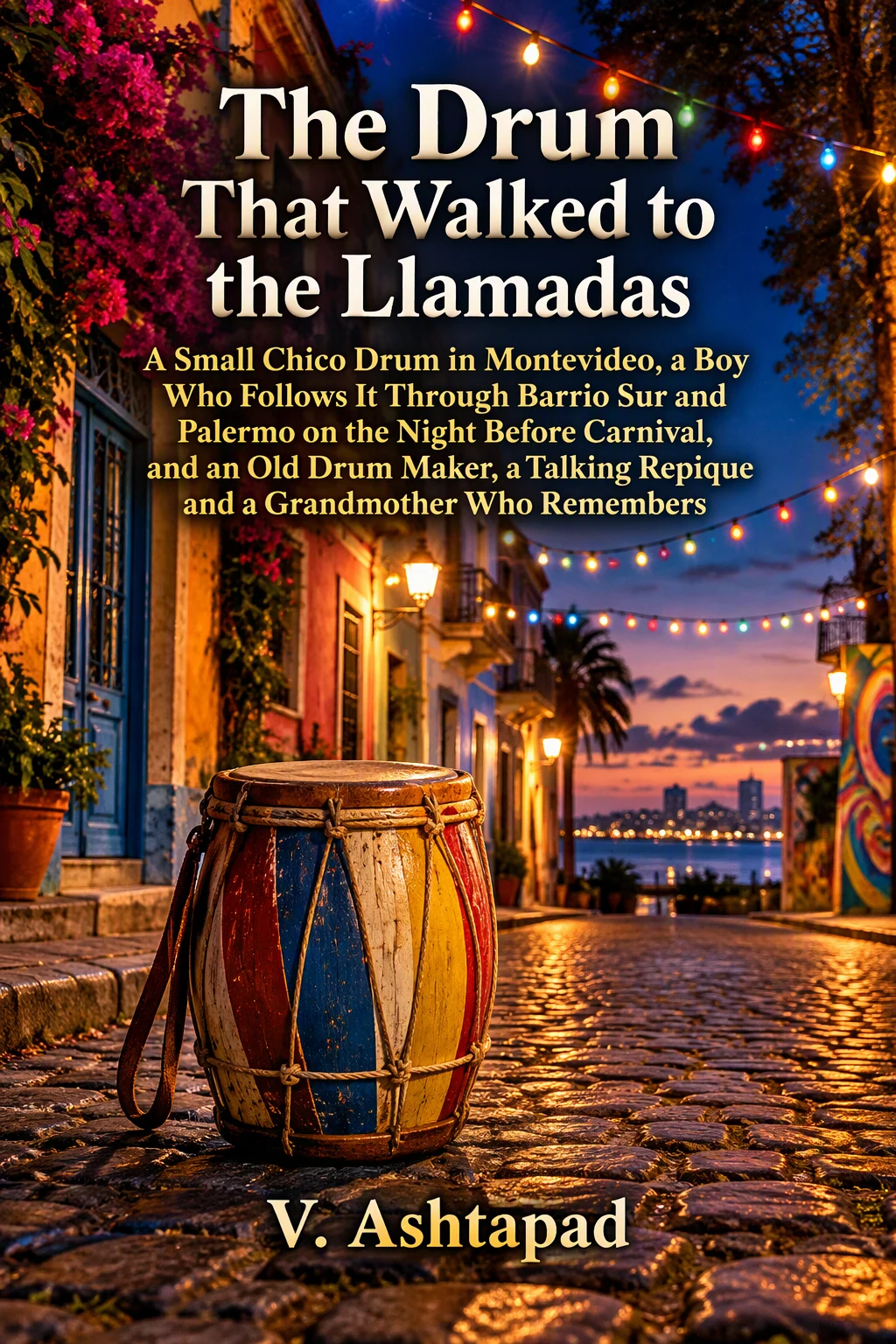
The Drum That Walked to the Llamadas
A Small Chico Drum in Montevideo, a Boy Who Follows It Through Barrio Sur and Palermo on the Night Before Carnival, and an Old Drum Maker, a Talking Repique and a Grandmother Who Remembers
by V. Ashtapad
Foreword
This is a work of fiction. Candombe, its three drums (the chico, the repique and the piano), the tuning of drumheads by fire in the street, the comparsas and the Llamadas parade through Barrio Sur and Palermo are real traditions of Afro-Uruguayan Montevideo, as are the old conventillos Mediomundo and Ansina, tortas fritas, the chivito and mate. The comparsas, the workshop, the food cart and every person named in this story are invented.
For every child at the front of the line, keeping time so the old ones can see.
The Smallest Drum in Barrio Sur
Now, I am going to tell you about a drum that walked, and you may decide for yourself whether you believe it. I will only say this before we start. In the old neighborhoods of Montevideo, where the streets are made of round gray stones and the houses lean their painted shoulders together like aunts at a wedding, people have been listening to drums for a very long time. When you listen to something that long, it starts to listen back.
The boy in this story was named Lalo Pereira. He was eight years old, with knees that were always scraped and a front tooth that had come out the week before and left a window in his smile. He lived on the second floor of a narrow yellow house on Calle Cuareim, in Barrio Sur, three blocks up from the Rambla, where the river is so wide that everyone in the city calls it the sea and nobody bothers to argue about it.
Lalo had a drum.
It was a chico. If you do not know the drums of candombe, let me tell you about them, because you will need them for this story. There are three. The biggest is the piano, round and deep as a soup pot for a giant, and it goes *boom* in a way you feel in your stomach before you hear it with your ears. The middle one is the repique, which is the clever one, the talker, the one that shouts out calls and answers and cracks jokes in rhythm. And the smallest is the chico.
The chico is high and quick and bright. It plays the same pattern over and over, ki-TAK, ki-TAK, ki-TAK, all night long, while the piano rolls and the repique shows off. A chico does not get the solos. A chico does not get the cheers. But here is the thing nobody tells you until you are old enough to understand it: if the chicos stop, the whole line of drums falls apart, like a fence when you pull out the posts.
Lalo's chico was the color of honey, made of curved wooden boards that the drum maker called staves, held in a ring with metal hoops. The top was stretched leather, pale and smooth, nailed all around the edge with little brass-headed tacks that shone like a row of tiny moons. It had a strap of braided cotton so Lalo could hang it from his shoulder, and a stick, which in candombe is called a palo, for his right hand to strike the skin and the side.
Its name was Pichón.
Pichón means a baby bird, a chick still too young to fly. Lalo's father had named it the day it came home, because it was so small and because, he said, it peeped. "Listen," he had said, tapping it. "Pi-pi-pi. A pichón."
That was two years ago. Now Pichón lived in the corner of Lalo's room beside the window, sitting on a folded blue towel so it would not touch the cold tiles. The leather did not like cold. Drums are fussy that way.
And tomorrow was the Llamadas.
If you have never been to Montevideo in February, I will tell you that February is summer there, hot and sticky, with jasmine in the evenings and the smell of the river coming up the streets after dark. And in February comes carnival, and in carnival comes the Llamadas, the great parade of the drums. For two nights the comparsas, which are the drum groups with their dancers and flags and characters, march down the streets of Barrio Sur and Palermo, one after another, hundreds of drums, thousands of people on the sidewalks and balconies, so loud that the windows hum.
Lalo's father, Rubén, played piano drum in a comparsa called Luna del Sur. He had played in it since he was a boy. His father had played in it. His grandfather had played in a comparsa that did not exist anymore, back in the days when the families of the barrio lived in the big old tenement houses called conventillos, before those were torn down.
This year, for the first time, Lalo would march too. Not in the big line of grown men and women with their great drums, but in the children's group that walked near the front, little drummers with little drums, keeping the beat.
He should have been happy about it.
He was happy about it. Mostly. But that afternoon, while his father rubbed oil into the strap of the big piano drum on the kitchen table, Lalo had said something he would wish later that he had not said.
"Papá," he had said, "why do I have to play the chico?"
His father looked up. "What do you mean, why?"
"It's a baby drum. It just goes ki-TAK, ki-TAK, the whole time. Nobody even hears it. Martín gets to play repique and he's only nine."
"Martín has been playing since he was five."
"I've been playing since I was six! That's almost the same."
His father laughed, which did not help. "Lalo. The chico is the clock. Without the chico, the piano doesn't know where it is and the repique gets lost in its own jokes."
"A clock is boring," said Lalo. "I want to be the one that talks."
He said it loudly. And Pichón was right there, on its blue towel, by the window, listening.
His mother, Celeste, was home from her shift at the hospital, stretched out on the sofa, shoes kicked off, eyelids shut, and she said without opening them, "Every drum talks, my love. Some of them just say one thing very well."
Then she sat up, because she had remembered something, and took out her phone. Earlier that week she had taken a picture of Lalo standing on the front step with Pichón on his shoulder, squinting into the sun with his missing tooth showing. She opened the family's shared pages, where his aunts and cousins in Buenos Aires and in Spain kept their photos, and she added it to the album called Carnival, under the picture of Lalo's father at eight years old holding his own first chico, and under that one, a faded brown picture of a man Lalo had never thought to ask about, in a white shirt, holding a drum on the steps of a building that was not there anymore.
She typed under Lalo's picture: *Lalo and Pichón, first Llamadas, Luna del Sur.*
"There," she said. "Now it's official."
Lalo looked at the three pictures, one under another, the brown one and the faded color one and the bright new one with his own face in it. Then he went to his room and sat on his bed and looked at Pichón in the corner.
"You're a good drum," he told it, because he felt a little bad. "It's not your fault you're small."
Pichón said nothing. Drums mostly don't, when you are looking at them.
That night he went to bed early, because his mother said a drummer needs sleep the night before the Llamadas the way a fish needs water. Outside, the barrio was not sleeping at all. He could hear somebody practicing a repique two streets away, and a radio, and laughter from a balcony, and a bus groaning up the hill. He could smell smoke, the friendly kind, from the little fires people light in the street to tune their drums.
He fell asleep listening to all of it.
And sometime later, when the moon had climbed above the rooftops and slid its white light across his floor, Lalo woke up because he heard a sound.
Ki-TAK.
Very soft. Very close.
Ki-TAK. Ki-TAK.
© 2026 CRUNOD LLC. All rights reserved.
The Empty Towel
Lalo lay still with his eyes open and his blanket up to his nose.
The sound came again, and this time it was not in the corner by the window. It was by the door.
Ki-TAK.
He turned his head slowly, the way you do when you are not sure you want to know.
The blue towel in the corner was empty.
And there, by his bedroom door, in a stripe of moonlight, stood Pichón.
I say stood, because I do not know a better word. A drum does not have legs. But Pichón was standing on the bottom rim of its wooden body, tipped a little to one side, and as Lalo watched, it rocked to the other side, and then back, and each time its rim touched the tiles it made a small hard knock. Rock, knock. Rock, knock. It looked, Lalo thought later, exactly like his great-uncle Hugo walking with his bad hip, rolling from one side to the other and getting there anyway.
The braided strap trailed behind it on the floor like a tail.
"Pichón?" Lalo whispered.
The drum stopped rocking.
Then the skin of it, all by itself, with no hand and no palo touching it, went *pi*. Just once, a tiny high note, like a question.
Lalo sat up so fast his blanket slid off the bed.
Pichón turned. I mean it rocked itself around in a half circle, knock, knock, knock, until its brass tacks were facing the hallway. Then it went out the door.
For a moment Lalo did not move at all. His heart was going faster than any chico pattern. Then he heard, from the hallway, the knock-knock-knock of a drum bumping its way downstairs, step after careful step, and he thought of the front door, which his father never locked until he came home from rehearsal, and of the street, and of the cars, and of the river at the bottom of the hill.
He jumped out of bed.
He did not stop to change out of his pajamas, which were green with orange soccer balls on them and a little too short in the legs. He did stop to put on his sneakers, because the floor was cold, and he did stop, at the kitchen table, to grab the pencil by the grocery list and write on the back of an envelope, in his biggest letters:
GONE TO GET PICHÓN. BACK SOON. LALO.
He looked at his mother's door. It was closed, and behind it he could hear her breathing the slow, deep breathing of a nurse who has worked twelve hours and earned every minute of sleep. He thought about waking her.
Then he heard the front door creak downstairs.
He ran.
Out on the step the night air was warm and thick and smelled of wood smoke and fried dough and the river. The street lamps were orange, and the round stones of Calle Cuareim shone in their light like the backs of a thousand turtles all crowded together. And halfway down the block, rocking along the cobblestones, knock, knock, knock, its strap bumping behind it, went Pichón.
It did not hurry. It did not look back. It went the way a drum goes when it knows where it is going.
"Pichón!" Lalo called. "Come back!"
The drum paused at the corner. Its skin went *pi*, once, and Lalo could have sworn it sounded like *come on, then*.
Then it turned the corner and was gone.
Now, I want you to understand something about the barrio that night, so you are not worried for Lalo more than you need to be. The night before the Llamadas is not a quiet night. It is not a night when the streets are empty and dark. It is a night when half the neighborhood is out on the sidewalks with their doors open, and grandmothers sit on kitchen chairs in the street fanning themselves, and drummers stand around little fires tuning their skins, and children who should be asleep are not asleep, and dogs follow everyone. It was nearly midnight, and Barrio Sur was as awake as a market at noon.
So when a small boy in soccer-ball pajamas ran around the corner of Cuareim, nobody screamed or called the police. Somebody on a balcony called down, "Lalo! Where are you going so late?" and Lalo called up, "My drum ran away!" and the somebody on the balcony laughed and said, "Mine too, in 1987, I never caught it," and went back to her conversation.
Lalo ran on.
© 2026 CRUNOD LLC. All rights reserved.
Tortas Fritas at Señora Elvira's
At the next corner a light rain began.
It was the soft summer kind of rain that does not really fall so much as hang in the air and settle on you, so that in two minutes your hair is wet and you are not sure how it happened. It made the cobblestones shine even more, and it made the orange street lamps wear little fuzzy halos, and it made the air smell, all at once, like wet stone and wet leaves and, very strongly, like hot oil and flour.
Because when it rains in Montevideo, somebody makes tortas fritas. This is not a law, exactly. But it is very close to one.
On the corner, in the open doorway of a blue house with a tin awning, sat Señora Elvira Núñez on a wooden stool, with a big black pan of oil on a gas ring in front of her and a bowl of dough on her knees. She was a large woman with a gray bun stuck through with a pencil and a flowered apron and arms that had been pulling dough for sixty years. Beside her on a chair was a paper bag of sugar and a stack of folded newspaper. Already three teenagers and an old man with a cane were standing under the awning waiting, and steam was rising from the pan and curling out into the rain.
Señora Elvira pinched off a lump of dough, flattened it between her palms into a round as big as a saucer, poked a hole in the middle with her thumb, and laid it in the oil. It hissed and puffed and turned gold at the edges.
"Lalo Pereira," she said, without looking up. "In your pajamas."
"Señora Elvira, did you see my drum?"
"Did I see your drum." She flipped the torta frita with a fork. "A little chico with brass tacks and a strap like a cat's tail? Walking by itself, down the middle of the street?"
"Yes!"
"No."
Lalo's face fell.
Señora Elvira laughed so hard the pan shook. "Of course I saw it! You think a drum walks past my door and I don't notice? I have eyes. It came right up here, under my awning, out of the rain, and stood there next to my pan like it was waiting in line. Ask Julio."
The old man with the cane nodded slowly. "It stood right there," he said, pointing his cane at a damp spot on the step. "Very polite. Didn't push."
"And then," said Señora Elvira, "it went *pi*. Like that. And I said, 'Little drum, I don't sell tortas fritas to drums, you have no money and no mouth,' and it went *pi* again, very sad. So I held one out to it, a good one, with sugar. And you know what it did?"
"What?"
"It stood there and smelled it. I swear it. It leaned over, like this." She leaned her whole big body toward the pan. "And it smelled it for a long time. And then it went on down the street toward Calle Ejido, where the boys are tuning by the fire."
Lalo was already turning to run, but Señora Elvira caught the back of his pajama shirt with two greasy fingers.
"Wait. You don't run into the rain on an empty stomach. Your grandmother would never forgive me."
She lifted a torta frita out of the oil with her fork, let it drip, tapped it in the paper bag of sugar, rolled it in a square of newspaper, and handed it to him. It was so hot it hopped between his palms like a frog. It smelled like every rainy afternoon of his life.
He took a bite. The crust crackled, the middle was puffy and tender, salty from the dough and sweet from the sugar, and the heat went all the way down to his toes.
"Why do you think Pichón stopped here?" he asked, with his mouth full.
Señora Elvira pulled another lump of dough off the ball and thought about it while she patted it flat.
"My mother made these the same way," she said. "Same pan, if you can believe it, this pan is older than your father. Flour, a little fat, salt, water, warm. Her hands moving like this. When I was small I thought the rain came because she was frying. I thought she called it." She laid the dough in the oil. "Maybe your drum wanted to smell something old. Some things in the barrio smell exactly like they did a hundred years ago. Tortas fritas in the rain. Wood smoke from the tuning fires. The river." She shrugged. "Maybe a drum gets homesick for a smell, same as a person."
"But Pichón's home is in my room."
"Is it?" said Señora Elvira, and she gave him a long look over the steam.
One of the teenagers, a tall girl with braids, held up her phone. "Señora, my sister wants to know, is it really just flour, fat, salt and water? She's making them in Barcelona and they keep coming out flat."
"Tell her she's in a hurry," said Señora Elvira. "Tell her to let the dough rest. Tell her to listen to it."
"She says she has your recipe already, the one Cami wrote down with your voice talking on it. She just can't make it come out the same."
"Of course she can't. My voice can't put the rain in Barcelona." Señora Elvira laughed. "Tell her to put her hands in the dough and stop reading."
Her granddaughter Camila, Lalo knew, had spent a whole Sunday last winter with a notebook and a phone, writing down every one of Señora Elvira's recipes and recording her talking through each one, the jokes and the complaints included, and putting them all in a collection the family shared with cousins in Spain and Brazil and Australia. Señora Elvira pretended to find the whole thing silly. But Lalo had seen her, once, sitting on her step in the afternoon, listening to her own voice explaining how to make dulce de leche, and smiling at it like it was an old friend.
Lalo finished his torta frita and licked the sugar off his fingers.
"Thank you, Señora Elvira."
"Go. Catch your drum. And Lalo." She pointed her fork at him, very serious. "When you catch it, don't grab. A drum that's been grabbed won't sing for a week."
He ran off into the shining rain toward Calle Ejido, where he could already hear the first drums talking around a fire.
© 2026 CRUNOD LLC. All rights reserved.
The Fire on Calle Ejido
You can find a tuning fire in the barrio the same way a moth finds a lamp. You follow the light, and then you follow the sound, and then you follow the smell, and then you are there.
This one was in the middle of a narrow side street off Ejido, where cars do not bother to go on the night before the Llamadas because they know they will not get through. The rain had thinned to almost nothing. In the center of the street, on the cobblestones, somebody had built a small fire out of newspaper and broken fruit crates and the ends of old boards, and around it, in a wide loose ring, stood about fifteen drums.
They were standing on their bottoms with their skins tipped toward the flames, the way you hold your hands toward a fire on a cold night. There were pianos, big and round. There were repiques, middle-sized and handsome. There were chicos, little and bright. Some were painted in the colors of their comparsas, red and white, blue and yellow, green and black, with stars and moons. Some were plain wood, dark with years of hands. Behind them, sitting on the curb and on overturned buckets and on the hood of a parked car, were the drummers, talking and laughing and passing a mate gourd from hand to hand.
Every few minutes one of the drummers would get up, lift a drum away from the fire, tap the skin with two fingers, listen, frown or nod, and either set it back closer or move it away.
And there, in the ring of drums, between a tall green repique and a big red piano, warming its skin at the fire like it had every right to be there, was Pichón.
Lalo stopped at the edge of the light, breathing hard.
He remembered what Señora Elvira had said. *Don't grab.* So instead of lunging, he walked, very slowly, around the outside of the ring of drummers, the way you walk toward a pigeon you want to feed. Pichón did not move. Its brass tacks winked orange in the firelight. Lalo got closer. Closer. He was three steps away. Two.
"Careful, careful, careful," said a voice beside him. "You'll knock over my repique."
A big man with a shaved head and a gray beard was sitting on a bucket next to the fire. He wore a white undershirt and a gold chain and he had the biggest hands Lalo had ever seen, hands like baseball mitts, and in one of them he held a mate gourd with a metal straw sticking out of it, and a thermos was tucked under his arm.
"Sorry," Lalo whispered. "I'm trying to catch my drum."
The man looked at Pichón. Then he looked at Lalo's pajamas. Then he looked at Pichón again.
"That's your chico?"
"Yes."
"It came here by itself. I thought somebody's kid left it." He sipped from his mate. The straw gurgled. "It got in line very nicely, though. Pushed in right between Horacio's piano and my repique, like it was saving a spot."
"I'm Lalo. Rubén Pereira's son."
"Rubén! Of course. You have his ears." The man held out an enormous hand. "Néstor. I play repique for Los Hijos del Puerto. Your father and I have been tuning at the same fires since we were your size." He nodded at the flames. "You know why we do this?"
Lalo did know, a little. But he shook his head, because Néstor looked like a man who wanted to explain it, and because, while Néstor talked, Lalo could keep an eye on Pichón.
"The skin," said Néstor, "is leather. Cowhide, mostly, these days. When it's cold and damp, like tonight with this rain, it goes soft and loose. Lazy. You hit it and it says *bluh*." He made a sad, flat face. "But you hold it near the fire, the heat pulls it tight. Dries it. Wakes it up. Then you hit it and it says—" He reached over, lifted his green repique from the ring, and struck it once with the flat of his hand.
*PAK.*
It rang out over the street like a bell, sharp and bright, and a dog on the corner barked back at it.
"That," said Néstor, setting it back, "is a drum that's awake."
"Why not just tighten the nails?" Lalo asked. "Or put screws in it like the drums in the music store?"
Néstor put his hand on his heart as though Lalo had insulted his mother.
"Some people do," he admitted. "Some drums have tuning screws now. That's fine. A drum is a drum. But on the night before the Llamadas, in this barrio, you tune by fire. Because your grandfather tuned by fire, and his grandfather tuned by fire, back when there were no music stores and no screws and nothing but a barrel and a hide and a fire on the stones in front of the conventillo. You tune by fire so that when you stand here, you are standing with all of them." He passed his mate to the woman on the curb beside him. "And also because it sounds better. Don't let anybody tell you different."
The woman laughed. "It does sound better."
"How do you know when it's ready?" asked Lalo.
"You listen. That's all. There's no number. You tap it, you listen, you tap it again. When it's ready, it tells you." Néstor pointed with his chin at Pichón. "Yours is probably ready right now. Go on. Tap it."
Lalo stepped into the ring of drums. The fire was hot on his face and his wet pajamas started to steam. He crouched down beside Pichón, slowly, and he did not grab. He reached out one finger, and he tapped the skin, very lightly, in the center.
*Pi.*
Higher than he had ever heard it. Clear and bright and ringing, like a spoon on a glass.
"There," said Néstor softly. "Awake."
And Pichón, with its skin still singing that one bright note, rocked itself up onto its rim, slipped between the red piano and the green repique, and went knock, knock, knock out of the firelight and down the dark side street toward the river.
"Hey!" said Lalo.
Néstor let out a roar of laughter, and the drummers on the curb laughed with him, and the woman holding the mate laughed so hard she had to set it down.
"Well," said Néstor, wiping his eyes. "That one has somewhere to be."
"It's not funny."
"No, no. You're right." Néstor stopped laughing, mostly. "Listen, Lalo. Before you go running after it. You see this one?" He put his big hand on top of his green repique, almost tenderly. "Ask him. He's been talking all night. He'll know where your chico is headed. Repiques know everybody's business."
Lalo looked at the green repique. Then at Néstor. "Drums can't talk."
"Mine never shuts up," said Néstor. "Go ahead. Ask him."
© 2026 CRUNOD LLC. All rights reserved.
The Repique Who Never Shut Up
I will tell you exactly what happened next, and you can believe it or not.
Néstor got up from his bucket and went to refill his thermos from a kettle inside somebody's doorway, and the other drummers went back to their arguing about which comparsa would have the best flags this year, and for a moment nobody was paying any attention to Lalo or to the green repique.
So Lalo knelt down in front of it, on the warm wet stones, and he felt very silly, and he said, "Excuse me. Do you know where my chico is going?"
And the repique said:
*Ta-ka-TA! Ta-ka-ta-ka-TA-TA!*
It did not use words. That's important. It used drum. But the strange thing, the thing Lalo never could explain afterward to anyone's satisfaction, is that he understood it anyway, the way you understand your mother is angry from the way she sets down a plate, without her saying a single word.
What the repique said was something like this:
*Well, well, well! A little Pereira! Look at those pajamas! Soccer balls! Very bold, very bold. And you've lost your chico, have you? Ha! I'm not surprised. I'm not surprised at all.*
"Why not?" said Lalo.
*Ta-TA-ka-ta!* said the repique, which meant, roughly, *Because I talked to it, that's why. It pushed in right next to me, all serious, all quiet, the way chicos are, and I said, "Little one, what are you doing out so late?" And do you know what it said?*
"What?"
*It said it wanted to know what it was for.*
Lalo sat back on his heels.
*Imagine!* said the repique, rattling its rim with excitement. *A chico, asking what it's for! I told it. I said, "You're for keeping the beat, little clock, so the rest of us can have fun." I said, "You're for going ki-TAK, ki-TAK, ki-TAK, so I can go ta-ka-TA-ka-TA-ka-TAAA!" Very important job. Very important. Not as important as mine, of course.*
"Of course," said Lalo.
*But it didn't like that answer,* said the repique, in a lower voice, a few soft taps on its side. *It said somebody had told it that a clock is boring.*
Lalo felt his ears go hot. He looked down at his sneakers.
The repique was quiet for a moment, which, I am told, is very rare for a repique.
Then it said, a little more gently: *Ta-ka. Ta-ka.* Which meant: *Somebody you know, I suppose.*
"It was me," said Lalo. "I said it. This afternoon. I said I wanted to play repique instead. Because the repique gets to talk."
*Ha!* said the repique, and it was back to its loud self at once. *Of course you did! Everyone wants to be me! I'm wonderful! I'm the best! I do the calls! I do the breaks! I make the dancers spin! When I go ta-ka-TA, the whole street goes WOO!*
"See?" said Lalo miserably.
*But listen to me, little Pereira,* said the repique, and it tapped out something slow and careful, slower than Lalo had ever heard a repique play. *Here is a secret that every repique knows and none of us ever say out loud, because it would ruin our reputation. You ready?*
"Yes."
*When I go off on one of my wonderful, brilliant, magnificent runs, ta-ka-ta-ka-ta-ka-TA-TA-TAAA, all over the place, upside down and backward, do you know how I find my way back?*
Lalo shook his head.
*I listen for the chico,* said the repique. *Every time. I'm out there in the middle of my solo, I'm lost, I'm flying, I don't know where the beat is anymore, and I listen, and there it is. Ki-TAK. Ki-TAK. Little clock. Always there. Same place. I follow it home like a sailor follows the lighthouse.* A pause. *Don't you dare tell anybody I said that.*
"I won't."
*Especially not Néstor.*
"I promise."
*Good.* The repique rattled itself. *Now. Your chico. It asked me what it was for, and I gave it my answer, and it didn't like my answer, so I sent it to ask somebody older. Somebody slower. Somebody who's been in the barrio longer than I have.*
"Who?"
*The old piano,* said the repique. *Down by the Rambla, at the bottom of Calle Gaboto, where the comparsa of Los Lunares keeps its drums under the stairs. The oldest piano in the barrio. Slow as a turtle and twice as wise, and it never stops reminding you about it. If anybody knows what a chico is for, that old pot of thunder does.*
"Thank you," said Lalo. He stood up. Then he hesitated. "Repique?"
*Yes, yes, what?*
"You're very good. At talking, I mean."
*I know,* said the repique, delighted. *Ta-ka-ta-ka-TAAA!*
Néstor came back with his thermos just then and found Lalo standing in front of his drum, and the drum still faintly humming as though somebody had just struck it.
"Did he tell you?" Néstor asked, with a little smile.
"He said to go to the old piano at Los Lunares. Down by the Rambla."
Néstor raised his eyebrows. He looked at his drum. He looked at Lalo.
"Huh," he said, after a while. "Well. Then that's where you go."
© 2026 CRUNOD LLC. All rights reserved.
The Oldest Piano in the Barrio
Calle Gaboto runs downhill toward the water, and the closer you get to the bottom, the more you can smell the river: salt and mud and something green, and under that, the faint sweet rot of the fish market that closed hours ago. The rain had stopped completely now. The stones were shining, and a breeze was coming up the street from the Rambla and pushing at Lalo's wet pajamas so they flapped.
At the bottom of the street, in a building with a peeling pink front and a big painted sign that said LOS LUNARES in white letters with polka dots around them, there was a wide wooden door standing half open, and a yellow light inside.
Lalo peeked in.
The room inside was long and bare-floored, and it smelled of leather and varnish and old cigarettes and floor polish. Along one wall hung costumes on a rack, long white dresses with ruffles, gold capes, top hats. Along the other wall were flags, rolled up and leaning in a corner, and a long table covered with plastic cups and a half-eaten cake. At the far end was a staircase going up to a second floor, and under the staircase, in the shadows, stood the drums of Los Lunares, all in a row.
And there was Pichón, standing in front of the biggest one.
Lalo had never seen a drum like it. It was a piano, but it was larger than any piano he had ever seen, nearly as tall as Lalo himself, round as a rain barrel. Its wood was nearly black with age and polished by a hundred years of hands until it shone like a horse. The hoops were old iron, rusted in places, and the skin was dark and thick and covered with tiny marks and scratches. Somebody had painted it once, long ago, in white polka dots, but most of the dots had worn away, and now it looked like a night sky with only a few stars left.
Nobody else was in the room. From upstairs came the sound of a television and somebody laughing.
Lalo tiptoed across the concrete, remembering not to grab, and he stood beside Pichón, and they both looked up at the old piano together.
"Excuse me," Lalo said, very quietly. "The repique at the fire on Ejido sent us. My drum wants to know what it's for."
For a long time, nothing happened.
Then, from somewhere deep inside the old piano, so deep it seemed to come from under the floor, there came a sound.
*Boooom.*
It was not loud. It was low. It was so low that Lalo felt it in his knees before he heard it, and the plastic cups on the table rattled, and the costumes on the rack swayed.
And again, slow as the tide: *Boooom.*
The old piano spoke the way old people speak when they have plenty of time and know it. It took its time between words. It let each one settle before it sent out the next. And Lalo understood it the same way he had understood the repique, without words, all the way through.
*So,* said the old piano. *A small one. And a smaller one.*
"I'm Lalo," said Lalo. "This is Pichón."
*Pichón,* said the old piano, and it seemed to like the name, because it said it again. *Pi-chón. Good. A name you can grow out of. Like a shoe a little too big.* A long pause. *The repique sent you. The green one. The one who talks.*
"Yes."
*He always sends them to me,* said the old piano. *When he doesn't know the answer himself. Which is often. He talks so much he forgets to listen.* Another deep, slow boom, which Lalo understood to be a laugh. *Sit. Sit, sit. Nobody ever asks a question standing up and hears the answer.*
So Lalo sat down on the cold concrete floor, cross-legged, in front of the old piano, and Pichón rocked itself over and settled beside his knee, close enough that Lalo could feel the warmth still in its skin from the fire.
*I was made,* said the old piano, *before your great-grandfather's grandfather was born. I was made in a conventillo, a big old house where forty families lived around one courtyard, with one water tap and one long hallway and laundry hanging over everybody's heads. I was made from a barrel that once held wine from Spain. A carpenter named Estanislao cut me and bent me and nailed me together on the stones of that courtyard, and the first time anybody played me, it was a Sunday, and the whole house came out to listen.*
"Is the conventillo still there?"
*No,* said the piano. *Torn down. Long ago. All the big houses. Mediomundo. Ansina. The families went everywhere, all over the city, some far away. But the drums came out with them. The drums always come out.* Boom. *That is one thing a drum is for. To carry what the house can't.*
Lalo thought about that.
*Your little one,* said the piano, *asked the repique what it was for. And the repique said: to keep time so he could have fun.* A slow, heavy boom, and Lalo understood it to be the old piano rolling its eyes, if a piano had eyes. *That's not wrong. But it's a repique answer. Everything is about him.*
"Then what is a chico for?"
The old piano was quiet for so long that Lalo thought it had fallen asleep. Upstairs, the television laughed. A truck rattled past on the Rambla. Pichón's tacks gleamed.
*When I was young,* said the old piano at last, *and the comparsas went out from the conventillos on a Sunday, or on the sixth of January, or at carnival, the children walked at the front. Little ones. Your size. Some smaller. They carried little drums, chicos made from tin cans and scraps, made from cheese boxes, made from anything. And they went ki-TAK, ki-TAK, ki-TAK. And behind them came the big drums, and the grown men and women, and the dancers and the flags and the old ones.*
*And do you know why the children walked at the front?*
Lalo shook his head.
*So that the old ones could see them,* said the piano. *So that every person in that parade, every grandmother, every grandfather, every tired man coming home from the port, could look up the street and see the little ones going first, and know: it will go on. The drums will go on. We will go on.*
*That is what a chico is for. A chico is the drum that says: we are still here, and we are not finished.*
Lalo sat very still. Beside him, Pichón made a sound. Not *pi*. Something lower, softer, almost like a sigh.
*But,* said the old piano, *that is my answer. An old drum's answer. Your little one asked me, and I told it, and it listened very nicely. But I don't think my answer was enough either.*
"Why not?"
*Because,* said the piano, *your Pichón is not only asking what a chico is for. It is asking what it is for. This chico. This one. With its brass tacks and its honey wood.* A pause. *That is a different question. And for that question you will have to go to the one who made it.*
"Don Washington," said Lalo. "Don Washington made it. On Calle Durazno."
*Washington Silva,* said the old piano, and it sounded fond. *He fixed my skin in nineteen eighty-two. Took three days. Very gentle hands. Tell him the old Lunares piano says hello and that the new skin is wearing thin on the left side, he'll know.*
Pichón was already rocking toward the door.
"Wait," said Lalo, scrambling up. He turned back to the old piano. "Thank you. Really."
*Boom,* said the old piano softly, which meant *you're welcome*, and also *go*, and also, Lalo thought, something like *good luck, small one*.
He ran out after Pichón into the windy dark, and behind him the costumes on the rack swayed a little, though nobody had touched them.
© 2026 CRUNOD LLC. All rights reserved.
A Chivito at Midnight
Now, Calle Durazno was back up the hill. Lalo knew that. Any child in Barrio Sur could have told you so. But Pichón did not go back up the hill.
Pichón went straight across the wide street at the bottom of Gaboto, knock, knock, knock, past a bus stop and a parked taxi with its driver asleep at the wheel, and onto the Rambla.
The Rambla, if you have never seen it, is the long, long road that runs along the edge of Montevideo beside the water, mile after mile, with a wide sidewalk on the river side where people walk and jog and fish and sit on the low stone wall and drink mate and watch the sunset. In the daytime it is full of bicycles and dogs and old couples holding hands. At midnight before the Llamadas it was full of something else: families coming home from rehearsals, teenagers sitting on the wall with their sneakers dangling over the rocks, a man selling balloons shaped like stars, lovers, fishermen, a group of girls in sequined dresses practicing dance steps in the light of a lamp post.
And, on the corner, a food cart.
It was a little silver trailer with a striped awning and a hand-painted sign, and from it came the smell that, if you are from Montevideo and you are hungry at midnight, will make you forget almost anything else, even a runaway drum. Beef on a hot griddle. Ham. Onions. Melting cheese. Eggs.
The sign said GUSTAVO'S. Under that, smaller: THE BEST CHIVITO ON THE RAMBLA. Under that, smaller still, somebody had added in marker: ACCORDING TO GUSTAVO.
And there, right in front of the cart, sniffing the air (yes, sniffing, a drum, I saw no better word for it), stood Pichón.
Lalo stopped at a safe distance and did not grab.
"Is that your drum?" said Gustavo, leaning out over the counter. He was a short man with an enormous mustache and a spatula in each hand and a white paper hat that said nothing on it at all. "It's been standing there five minutes. I thought it wanted a sandwich."
"It's mine," said Lalo. "Sorry. It ran away."
"It ran away to the right place." Gustavo flipped a thin steak on the griddle with a sizzle that made Lalo's stomach growl so loud that Gustavo heard it. He looked down at Lalo, at the pajamas, at the sneakers, at the sugar still stuck to his chin from Señora Elvira's tortas fritas.
"When did you last eat something real?"
"I had a torta frita."
"That's not food, that's dessert with an attitude. Sit." Gustavo pointed his spatula at an upside-down crate beside the cart. "On the house. A drummer the night before the Llamadas has to eat."
Lalo sat. Pichón stood beside the crate and did not run, which Lalo took to mean that Pichón, too, thought this was a good idea.
I must tell you about a chivito, because if you have never had one, you are missing something important in your life. A chivito is a sandwich. But calling a chivito a sandwich is like calling the Rambla a sidewalk. You start with a soft round roll, split open and toasted on the griddle. On the bottom you lay a thin, tender steak, cooked fast and hot. On top of the steak, a slice of ham. On top of the ham, melted cheese, mozzarella, bubbling. On top of that, a fried egg, with the yolk still soft. Then lettuce, and tomato, and a strip of bacon if Gustavo likes you, and mayonnaise, and maybe olives, and maybe roasted red pepper, and then the top of the roll, and then you need two hands and a napkin and a promise not to wear anything white.
Gustavo built one for Lalo, layer by layer, humming to himself, and cut it in half with one chop, and handed it across on a paper plate.
"Half for you," he said, "and half for your father, when you see him, because he will want to know where you got it."
Lalo bit into it. The egg yolk ran down his wrist. It was so good he forgot to chew for a second.
"My grandmother," said Gustavo, wiping his griddle, "used to say the chivito was invented by accident. A lady came into a restaurant in Punta del Este a long time ago and asked for goat meat, chivito, like they have in Argentina, and they didn't have goat, so the cook gave her a steak in a bun with everything he had in the kitchen piled on top, and he called it a chivito so she wouldn't complain. And she didn't. And now there's no goat in it at all." He shrugged. "Is it true? Who knows. That's the story they tell. Everybody in Uruguay will tell you a slightly different one."
Gustavo had a little screen taped up inside his cart beside the order slips, and on it, as Lalo watched, a photo slid past of an old woman in a kitchen with a frying pan, and then another of the same woman much younger, on a beach, laughing, and then one of a little boy with a huge mustache drawn on in marker.
"That's you," said Lalo, pointing.
"That's me, age seven. My sister did that with a permanent pen. It didn't come off for a week." Gustavo grinned. "My niece puts all the old family pictures on our pages and writes who everybody is underneath, and this little screen shows me a few every night, so I'm never working alone. That's my grandmother. The one with the chivito story. She's been gone twelve years, but she still gets to see the Rambla every night."
He tapped the screen, and for a moment an old woman's voice came out of it, small and crackly and full of laughter, saying something about too much salt.
Lalo listened. Then he finished his half of the chivito, and wiped his chin on the napkin, and wrapped the other half carefully in paper to save for his father.
"Gustavo," he said. "What do you think a drum is for?"
Gustavo stopped wiping the griddle.
"That's a big question for midnight."
"My drum wants to know. It's been asking everybody."
Gustavo looked down at Pichón for a long moment. Then he leaned on his counter and looked out at the dark water past the wall, where the lights of a ship were moving slowly along the horizon.
"My father was a fisherman," he said. "Not a drummer. Couldn't keep time if you nailed the rhythm to his boots. But every year he took me to the Llamadas, and every year, when the drums came round the corner on Isla de Flores, he cried. Every single year. Big tough man with hands like rope. He said, 'Gustavo, that's the sound of everybody's grandmothers walking down the street at once.'" He shrugged, a little embarrassed. "I don't know. That's all I've got. I'm a chivito man."
Pichón rocked forward a little, toward the cart, and its skin went *pi*, very softly.
"I think that means thank you," said Lalo.
"Tell it it's welcome," said Gustavo. "Tell it to come back next year and bring money."
And Pichón turned, and rocked across the wide sidewalk toward the stone wall at the edge of the Rambla, where the water was.
© 2026 CRUNOD LLC. All rights reserved.
The River That Thinks It Is the Sea
The wall along the Rambla is low enough that a grown-up can sit on it with their feet on the sidewalk, and wide enough that a child can walk along the top of it if a grown-up is holding their hand. On the other side of it are big tumbled rocks, and then the water, brown in the day and black at night, going out and out and out until it meets the sky.
They say it is a river. On a map it is a river, the Río de la Plata, where two other great rivers come together and pour into the ocean. But it is so wide that you cannot see the other side, not even on the clearest day, not even from the top of the tallest building in the city. It has waves. It has tides. It smells of salt. So the people of Montevideo look at it and say, "Well, it says it's a river. But we know better." And they call it the sea.
Pichón had stopped right at the foot of the wall, facing the water.
Lalo came up slowly behind it, the half-chivito in its paper tucked under his arm, and he did not grab. He climbed up onto the wall instead, and sat on it, with his sneakers dangling over the rocks on the far side, and he looked out at the water too.
The wind was coming in off the river-sea, cool and wet, and it blew Lalo's hair back off his face. Far out, a ship's lights moved slowly along. Closer in, the waves came up over the rocks below him, and pulled back, and came up again.
Lalo listened.
The waves came in: *shhhhh.* They hit the rocks: *TAK.* They pulled back: *shhhh.* And then again. *Shhhhh. TAK. Shhhh.*
He listened for a long time. He was tired, and he was full of chivito, and the clocks of the city had long since struck twelve, and the sound of the water was very steady.
*Shhhhh. TAK. Shhhh. Shhhhh. TAK.*
"It's a chico," he said out loud, and he was surprised to hear himself. "The river is playing chico."
Below him, at the foot of the wall, Pichón's skin trembled. Just a little. Just enough to hum.
Lalo kept listening. And the longer he listened, the more he heard. The waves did not hit the rocks all at the same moment, because the rocks were all different shapes. Some waves hit the big rock, *TAK*. Some hit the small rocks, *ki-ki*. Some rolled in deep, *boom*. And all of it, underneath, kept the same long steady pattern, in and out, in and out, like breathing.
"It's all three," Lalo said. "It's piano and repique and chico, all at once."
He swung his legs and thought about the old Lunares piano under the stairs, and about the repique with its secret, and about Gustavo's father crying every year on Isla de Flores. He thought about how he had told his father, only that afternoon, that a clock was boring.
The river-sea did not think its clock was boring. The river-sea had been keeping the same time for longer than there had been a city on its edge.
A bus went by on the Rambla behind him, its headlights sweeping across the wall, and its horn blared once, long and loud, at a car that had stopped in its lane.
Pichón jumped.
I mean that. It jumped, all of it, an inch off the sidewalk, and came down with a clatter. And before Lalo could get his legs back over the wall, it was off, rocking as fast as a drum can rock, knock-knock-knock-knock, across the Rambla in the gap between two cars, and up the hill toward the barrio.
"PICHÓN!" Lalo yelled, and he scrambled down off the wall, and looked both ways three times like his mother had taught him, and ran across after it.
At the top of the first block, he saw it turn left.
Left, toward Calle Durazno.
He stopped running for a second to catch his breath, and that is when he realized something. Every time he had come close to Pichón, it had let him come. At Señora Elvira's. At the fire. At the old piano. On the Rambla. It had waited for him. It had only run when something startled it, or when it had finished with a place.
"You're not running away from me," Lalo said to the empty street. "You're taking me somewhere."
And from around the corner, very faintly, came one small note: *pi*.
© 2026 CRUNOD LLC. All rights reserved.
The Workshop on Calle Durazno
Don Washington Silva's workshop was in the front room of a low, old house on Calle Durazno, with a green door and green shutters and a window so dusty you could hardly see through it. On the wall beside the door somebody had painted, a long time ago, a picture of three drums, a piano and a repique and a chico, standing side by side like a family, with a moon above them and stars around.
The green door was open. The light inside was on. And from inside came a sound Lalo had heard many times before, walking past on his way to school: *tok, tok, tok*. A small hammer on a small nail.
Pichón was standing on the doorstep, waiting.
Lalo walked up beside it, slowly, and did not grab, and the two of them looked in together.
If the Lunares hall had smelled of leather and varnish, the workshop smelled of leather and varnish multiplied by ten. It smelled of sawdust and glue and wood shavings and the sharp clean smell of linseed oil, and underneath all of that, something warm and animal, like a barn, from the hides. There were drums everywhere. Drums on shelves, drums on the floor, drums hanging from hooks on the ceiling, drums without skins showing their empty insides, drums in pieces, curved staves of wood waiting in bundles like the ribs of some enormous fish. On the long workbench lay hammers and chisels and a jar of brass tacks, hoops of metal, a coil of rope, and a big pale skin of leather stretched on a frame to dry.
And bent over the workbench, in a pool of yellow light from a lamp on a long metal arm, was Don Washington.
He was the oldest man Lalo knew. He was small and thin and brown and bald on top, with a fringe of white hair around the sides like a cloud that had caught on him, and round glasses pushed down to the end of his nose. He wore a gray cardigan with holes in both elbows, even in February, and on his feet a pair of slippers. In one hand he held a tack hammer, and in the other a tiny brass tack, and he was nailing a new skin onto a repique, one tack at a time, *tok, tok, tok*, so carefully that he did not look up when they came to the door.
"I see you," he said, without looking up. "Both of you. Come in. Don't touch anything sharp."
Lalo came in. Pichón came in behind him, knock, knock, knock, across the sawdust.
Don Washington set down the hammer. He pushed his glasses up his forehead, blinked twice, let them slide back down his nose, and looked first at Lalo, in his damp soccer-ball pajamas with chivito on his wrist, and then at Pichón, standing on the floor of the workshop.
"Well," he said. "Hello, Pichón."
*Pi*, said Pichón.
"You've been out walking." Don Washington nodded slowly, as if this were not strange at all. "I wondered when you'd come back to see me."
"You knew it could walk?" said Lalo.
Don Washington smiled. He had only a few teeth, and the smile went all the way up to his eyes and folded them into a hundred wrinkles.
"Every drum I make can walk, little Pereira. Most of them just never get a good reason." He pulled a three-legged stool out from under the bench with his foot. "Sit. You've come a long way. Elvira's, I'd guess, from the sugar. Then the fire on Ejido. Then the Lunares piano. Then Gustavo's. Then the Rambla. Am I right?"
Lalo's mouth fell open. "How did you know?"
"Because that's the way I'd go," said Don Washington, "if I were a young drum on the night before the Llamadas, trying to find out who I am." He sat down on his own stool across the bench. "Now. Tell me what the old piano said. It always says something."
So Lalo told him. He told him about the repique and the lighthouse, and about the old piano and the conventillo and the children who walked at the front so the old ones could see them. He told him about Gustavo's father crying on Isla de Flores. He told him about the river-sea playing all three drums at once. He even told him, with his ears going hot again, about what he had said that afternoon to his father, about the chico being boring and wanting to play repique.
Don Washington heard the whole tale out with his lips pressed shut. He did not nod along or interrupt or look at the clock. He just listened, with his chin in his hand and his old eyes on Lalo's face, and once or twice he closed his eyes as though he were listening even harder. When Lalo got to the part about the chico being boring, he did not frown or laugh. He just let it sit there in the air of the workshop between them, and waited to see if Lalo had more to say.
Lalo didn't. He looked down at his sneakers.
"The old piano says hello," he added, remembering. "It says the new skin is wearing thin on the left side."
Don Washington laughed, a dry little laugh like leaves. "New skin! I put that skin on before your father was born. That piano thinks everything after nineteen fifty is new." He shook his head. "I'll go look at it after carnival."
Then he reached up, felt along the high shelf, and brought down a thick old notebook with a cracked leather cover, and set it in front of Lalo, and beside it, a small tablet with a cracked screen and a rubber band around it to hold it together.
"You know what this is?"
Lalo shook his head.
"This," said Don Washington, laying his hand on the old notebook, "is every drum I ever made. Sixty-one years. Every one. Who it went to, what wood, what skin, what day. My handwriting is terrible, so my grandniece Yanina's mother went through the whole thing last year, page by page, and put it all into this." He tapped the tablet. "With photographs. Every drum I could find, with its family. And on a map, where they all live now. Here. Look."
He turned on the tablet, and there, on the screen, was a map of the city, and on it, scattered all over Barrio Sur and Palermo and Ciudad Vieja and out across Montevideo, and some even farther, in Buenos Aires and Porto Alegre and one, astonishingly, in Sweden, were hundreds and hundreds of tiny dots. Each dot was a drum.
"That's mine?" said Lalo, pointing at one on Calle Cuareim.
"That's Pichón," said Don Washington. He tapped it. A picture came up: Lalo, at six, holding Pichón for the very first time in this very workshop, with his father behind him grinning, and a line of Don Washington's terrible handwriting, scanned in from the old notebook. "Chico. Staves of cedar and old oak. Skin of calf. Brass tacks. For Lalo Pereira, son of Rubén, grandson of Dora." He looked up. "But that's not the whole story. You want to know what Pichón is for? Then you have to know where it came from. And it didn't come from a tree in a lumberyard. Not all of it."
He leaned forward, and the lamp light caught his glasses.
"Some of Pichón's staves," said Don Washington, "are old. Much older than you. Much older than me. Some of them came from another drum. A drum that belonged to your great-grandfather, Aurelio Acosta, who lived in the conventillo Mediomundo, and played chico in a comparsa that doesn't exist anymore, and walked at the front of the line when he was your age."
Lalo stared at him.
"That drum broke," said Don Washington. "Long ago. It fell down a staircase in nineteen seventy-eight, when Mediomundo was being emptied out and everybody was moving their things. The skin split and the hoops bent. Your grandmother Dora kept the pieces. In a box. For forty-six years. And when your father came to me and said, 'Washington, my boy is six, he needs his first chico,' your grandmother came with him, and she brought the box, and she set it on this bench, right here." He laid his palm flat on the scarred wood. "And she said, 'Use what you can.'"
He picked up one of the loose staves from the bundle on the bench and turned it in his hands.
"I used four of Aurelio's staves. The best ones. I planed them and soaked them and bent them again and fitted them in with new wood around them, so you can't see which are old unless you know." He reached out a crooked finger and touched Pichón's side, very gently, in four places. "Here. And here. Here. Here. Darker grain. Feel."
Lalo knelt down on the sawdust and put his hand where Don Washington had touched. The wood was smoother there, and a little darker, and when he pressed his palm against it, it was warm, as though it had been sitting in the sun.
"So that's why it walked," said Lalo slowly. "It's looking for Aurelio."
"Maybe," said Don Washington. "Or maybe it's looking for the part of itself that remembers walking. Aurelio walked those streets with it, you know, every carnival, for years, before it broke. Ki-TAK, ki-TAK, down Isla de Flores, in front of everybody. A drum doesn't forget a thing like that." He set down the stave. "And then you go and tell it a clock is boring."
Lalo hung his head.
Don Washington reached across the bench and lifted his chin with one dry finger.
"No, no. Don't do that. I'm not scolding. You're eight. When I was eight I told my father that fixing drums was the most boring job in the world and I was going to be a soccer player." He laughed. "Look at me now. Sixty-one years of boring."
He held out his hand, palm up, and Lalo looked at it, and after a moment, put his own small hand in it.
"Now," said Don Washington. "Let me show you something about the chico that nobody showed you yet. Not even your father, because your father plays piano and pianos think they know everything."
He took Lalo's right hand, the palo hand, and turned it over, and laid it flat along the scarred edge of the workbench.
"You think the chico is the same thing over and over. Ki-TAK, ki-TAK. Right?"
"Right."
"Wrong. Listen." He tapped on the bench with Lalo's fingers. "Ki-TAK. The ki is soft. The TAK is strong. But the soft one is where the music lives. That's the one that breathes. You hit them both hard, it's a clock. You let the ki be soft, let it lean, like this—" He moved Lalo's hand, lighter, then firmer. "Ki-TAK. Ki-TAK. Now it's not a clock. Now it's walking."
Lalo felt it. Under his fingers, against the wood, something changed. The beat was the same. But it had a lean to it now, a little forward tilt, like a person walking downhill.
"You don't beat a chico," said Don Washington. "You walk it."
Ki-TAK. Ki-TAK. Ki-TAK.
On the floor of the workshop, Pichón's skin began to hum along.
"There," said Don Washington softly. "Now it knows you're listening."
Lalo looked down at the drum, and back up at the old drum maker, and he said, "Can I take it home now?"
Don Washington shook his head. "Not yet, I think. I don't think it's finished. Look."
Pichón had turned toward the door again. Its strap was trailing out across the sawdust and over the doorstep, pointing up Calle Durazno, toward the east, toward Palermo.
"There's one more person it wants to see," said Don Washington. "And I think you know who."
Lalo did know. His heart did a little skip.
"Abuela Dora," he said.
© 2026 CRUNOD LLC. All rights reserved.
Yanina and the Flag
Before Lalo could get out the door, a voice from the back of the workshop said, "Uncle Washington, who are you talking to at one in the morning?"
A girl came through the curtain that separated the workshop from the rest of the house. She was about ten, tall and skinny, with her hair in two puffs like clouds and an enormous old T-shirt for a nightgown that came down past her knees. In one hand she held a toothbrush. Over her shoulder, rolled up on a long pole, she carried a flag.
"Lalo Pereira," said Don Washington, "this is my grandniece Yanina. Yanina, this is Lalo Pereira and his chico, who has been walking around the barrio by itself since before midnight."
Yanina looked at Pichón. Pichón stood on the sawdust and looked, if a drum can look, back at her.
"Okay," said Yanina, as if this happened every week. She pointed her toothbrush at Lalo. "You're in the children's line for Luna del Sur tomorrow. I'm carrying the little flag in front of it. Third year. I'm very good."
"I know," said Lalo, who had seen her last year and thought she was the best flag carrier he had ever seen, though he would not have said so for a million pesos.
"Where's it going?"
"To my grandmother's. In Palermo."
"Alone?" said Yanina, scandalized. She looked at her great-uncle. "You're letting him go alone? In his pajamas?"
"I was going to walk with him," said Don Washington, beginning to stand, and his knees made a sound like two sticks breaking. He sat back down. "In a minute."
Yanina rolled her eyes so far back Lalo was afraid they would get stuck. She went to a hook by the door, took down a big gray sweatshirt, and threw it at Lalo. It landed on his head.
"Put that on. You're shivering. I'll take him, Uncle. It's only six blocks. Everybody's out anyway." She was already stuffing her feet into a pair of rubber sandals. "And I'm bringing my flag, because I need to practice the corner turn, and the corner of Isla de Flores and Minas is the hardest one."
Don Washington sighed the sigh of a man who has lost many arguments with ten-year-olds. "Fine. Straight there. Straight to Doña Dora's door. And you call your mother from there."
"Yes, yes." Yanina turned to Lalo. "Come on, Pereira. Your drum's leaving without you."
It was. Pichón was already out the door and knocking its way up Calle Durazno. Lalo pulled the sweatshirt on over his pajamas. It smelled of sawdust and came down to his knees, and the sleeves hung so far past his hands that he had to roll them up four times.
At the door he turned around.
"Don Washington. Thank you."
The old drum maker waved his tack hammer. "Walk it, Lalo. Don't beat it. Walk it."
Then Lalo and Yanina and Pichón went out together into the warm dark, a drum, a boy and a girl with a flag, and if anyone on Calle Durazno thought this was strange, nobody said so.
© 2026 CRUNOD LLC. All rights reserved.
The Mama Vieja and the Gramillero
You should know that the comparsas of the Llamadas are not only drums.
In front of the drums, every comparsa has its flag carriers, like Yanina, waving great banners painted with stars and half-moons, so that people can see who is coming from blocks away. There are the dancers, in feathers and sequins and long ruffled skirts. There is the escobero, who spins a broom so fast it blurs, tossing it up into the air and catching it behind his back. And there are two characters who walk together, slowly, arm in arm, and who are the oldest characters of all.
One is the mama vieja, the old mother. She wears a long, full dress, often white or in the comparsa's colors, with a scarf on her head and a parasol or a fan in her hand, and she walks with great dignity, swaying, bowing to the crowd.
The other is the gramillero, the old healer. He wears a black suit and a top hat, and a white beard, and round spectacles, and he carries a cane and a leather bag full of herbs and roots. He walks bent over, trembling, as if he is a hundred years old, and every few steps he seems about to fall over, and then he does a little dance instead, with his knees shaking, and the crowd cheers.
They are the grandparents of the comparsa. They walk to show where everybody came from.
And on the corner of Isla de Flores and Minas, under a street lamp, the mama vieja and the gramillero of Luna del Sur were rehearsing.
"Doña Teresa!" called Yanina, waving her rolled flag. "Don Ricardo!"
The mama vieja was a short round woman of about seventy, in a pink housecoat with a striped scarf tied around her head, holding a paper fan. The gramillero was a tall man of perhaps forty, which surprised Lalo very much, in jeans and a T-shirt, holding a cane and a plastic grocery bag, with a white cotton beard hooked over his ears and nothing else of his costume at all.
"Yanina, child, what are you doing out?" said Doña Teresa, and then she saw Lalo. "And is that Rubén's boy? In a sweatshirt to his ankles?"
"His drum ran away," said Yanina. "We're following it."
They all looked down at Pichón. Pichón had stopped right beside the gramillero's sneakers and was standing very still, as though it were listening to something.
"Well, it has good taste," said Don Ricardo, through his cotton beard. "It came to the oldest man in the comparsa."
"You're forty-one," said Doña Teresa.
"I'm a hundred and three," said Don Ricardo, and he bent over his cane, and his knees began to tremble, and his back began to shake, and his whole body went wobbly and ancient, and he took three slow, tottering steps across the cobblestones, so convincing that Lalo actually reached out to catch him.
And then, on the fourth step, the gramillero's knees did a quick little jig, flick-flick-flick, and he spun on his cane, and came back upright, and bowed.
Lalo laughed until he had to hug the lamp post to stay upright.
"That's the trick," said Don Ricardo, straightening up and pulling his beard down to his chin. "Everybody thinks the gramillero is about to fall. And he never does. He's been about to fall for two hundred years. That's the whole point of him."
"Why?"
Don Ricardo looked at Doña Teresa. Doña Teresa fanned herself and nodded, as if to say, *go on, you tell him.*
"Because the old ones," said Don Ricardo, "the ones who came over on the ships, the ones who lived in the conventillos, the ones who kept the drums when nobody wanted to hear them, they were always about to fall. Always. Tired. Poor. Far from home. Everybody expected them to fall. And they never did. They danced instead." He tapped his cane on the stones. "So I walk like I'm a hundred and three, and I don't fall, and I dance. And all the grandparents in the crowd see it, and they know what I'm saying."
"My grandmother taught me the mama vieja walk," said Doña Teresa. "And her grandmother taught her. You have to sway, like this, from the hips, slowly, as if you are carrying a basket of laundry on your head and a baby on your hip and you are tired but you are also the queen of the street." She swayed. She fanned. She bowed to an invisible crowd. Even in her pink housecoat, she looked like a queen. "You can't hurry it. A mama vieja who hurries is just an old lady late for the bus."
Yanina snorted.
"Last week," said Doña Teresa, "I went to Carmen's apartment, my old teacher, she's ninety-four now, she can't come to the Llamadas anymore. And her great-grandson sat with her and recorded her telling how she learned to walk this way, for the family, with her saying yes it's all right, go on, record it. And then he played it for the whole comparsa at the last rehearsal, on the big speaker, and everybody stopped and listened, even the repiques, and you know how hard it is to get the repiques to stop."
"Very hard," said Lalo, who now knew this personally.
"And Carmen's voice said, 'Teresita, don't you dare hurry.'" Doña Teresa laughed, and her eyes were wet. "So I won't."
All this time Pichón had been standing very still at Don Ricardo's feet. Now, as Doña Teresa finished, it rocked once, gently, toward her, and once toward him, and its skin went *pi*, *pi*. Two notes.
"It's saying goodbye," said Yanina.
"No," said Lalo, slowly, because he was beginning to understand Pichón. "I think it's saying thank you. It wanted to hear about the old ones. That's what it's been doing all night. Asking everybody about the old ones."
Don Ricardo peered down at him through his round spectacles, considering.
"Then it's a wise drum," he said. "Where's it going next?"
"To my grandmother's."
"Dora Acosta? On Isla de Flores, the house with the iron balcony and the geraniums?"
"Yes."
"Then go," said Don Ricardo, and he pulled his cotton beard back up over his chin and bent over his cane again. "And tell Dora that the gramillero of Luna del Sur says she was the best mama vieja this barrio ever had, and Teresa can fight me if she wants."
"I agree with him," said Doña Teresa. "Tell her that too."
Lalo stared at them. "My grandmother was a mama vieja?"
Doña Teresa stopped fanning. She looked at Don Ricardo, and Don Ricardo looked at her, and they both looked at Lalo.
"Nobody ever told you?" said Doña Teresa.
Lalo shook his head.
"Well," said Doña Teresa. "Then I think your drum knows what it's doing."
Pichón was already rocking away down Isla de Flores, knock, knock, knock, toward a house with an iron balcony and geraniums, where a light was still burning in the window.
Yanina unrolled her flag and swung it once, a great swoop of blue and white with a golden half-moon on it, and it snapped in the night air like a sail.
"Corner turn," she said, mostly to herself, and she practiced it, perfectly, on the corner of Isla de Flores and Minas, and then the two of them ran after the drum.
© 2026 CRUNOD LLC. All rights reserved.
The Grandmother Who Remembers
Abuela Dora was sitting on her front step in the middle of the night, as if she had been waiting.
She was a small woman, smaller than Lalo's mother, with skin the color of dark coffee and short white hair as soft and curly as lamb's wool. She wore a cotton house dress with tiny blue flowers on it and a white cardigan, and on her feet a pair of old leather sandals, and on her lap, sitting perfectly still, as though it had always been there, was Pichón.
Beside her on the step sat a thermos and a mate gourd, dark and polished, with a silver straw. Above her, on the iron balcony, red geraniums spilled out of their pots and hung down in the lamplight.
"Lalo," she said. "Yanina. Sit down before you fall down."
They sat, one on each side of her, on stone that still held the sun of the afternoon. Yanina laid her flag across her knees.
"Abuela," said Lalo, "how did Pichón get here before us?"
"Same way you did," said Abuela Dora. "It walked." She poured hot water from the thermos into the gourd, very slowly, so the green tea leaves inside did not get soaked all at once, and she sipped from the silver straw, and then refilled it and handed it to Lalo. "Small sips. It's hot."
Lalo had been drinking mate with his grandmother since he was five, the way all the children in the family did, sitting on this same step. He sipped. It was bitter and green and hot, and it tasted like her kitchen and her garden and her voice. He handed it back. She filled it again and handed it to Yanina, and Yanina sipped, and handed it back, and that is how mate goes, around and around, one gourd and one straw for everybody, so that nobody is a stranger by the time it comes back to you.
"Yanina," said Abuela Dora, "call your mother. Then call Lalo's father. I already called his mother, she woke up and found a note on the kitchen table and nearly had a heart attack, poor girl. She's on her way."
Lalo winced. Yanina took the phone from Abuela Dora's cardigan pocket and went down the step to call.
Abuela Dora stroked the skin of Pichón with one finger, gently, the way you stroke a cat that is asleep.
"It came knocking," she said. "About ten minutes ago. Knock, knock, knock, on my door. I thought it was a drunk. I opened it with the broom in my hand." She laughed, a soft wheezy laugh. "And there it was, on my mat. And I knew it right away. I'd know those staves anywhere."
"Because of Great-Grandpa Aurelio," said Lalo. "Don Washington told me."
Abuela Dora looked at him sideways, with her eyebrows up.
"Did he."
"He said you kept the pieces in a box. For forty-six years. And then he used four of them to make Pichón."
"Washington talks too much," said Abuela Dora. But she was smiling.
Lalo leaned against her shoulder. She smelled of mate and lavender soap and the little bit of geranium that always got on her hands.
"Abuela," he said. "Will you tell me about him? Aurelio? And about being a mama vieja? Doña Teresa and Don Ricardo said you were the best one ever and I didn't even know."
Abuela Dora was quiet for a long time. She refilled the mate, sipped, refilled, sipped. Down on the sidewalk Yanina was saying, "No, Mamá, I'm fine, we're at Doña Dora's, yes, I have the flag, no, I didn't forget to brush my teeth, I have my toothbrush right here."
"My father," said Abuela Dora at last, "was born in Mediomundo. You know Mediomundo?"
"The old piano told me. A big house. Forty families. One courtyard."
Abuela Dora looked at him strangely, then decided not to ask.
"Not forty," she said. "More. I don't know how many. It was a huge old building, like a ship made of rooms, three stories, with a courtyard in the middle and balconies all around it looking in, and washing lines strung from one side to the other. Everybody's washing, everybody's sheets and shirts and underwear, flapping over everybody's head. When I was little I thought the sky was made of laundry." She laughed. "You heard everything. Every baby crying, every couple fighting, every radio, every pot banging. And on Sundays, and holidays, and every night in carnival, you heard the drums."
"In the courtyard?"
"In the courtyard first. Then in the street. They'd tune by fire, right out on the cobblestones in front of the door, the way they still do. Big fires, then, made of anything, old chairs, old crates. And when the drums were ready, my father would put his chico on his shoulder and stand at the front of the line, and the old men would come out behind him with their pianos and their repiques, and they'd go."
She closed her eyes. Her fingers, on Pichón's skin, began to move. Very softly. Ki-TAK. Ki-TAK.
"He started when he was six, my father. Same as you. On a drum made from a cheese box, the first one. Then a real chico, when he was eight, made by a man in the conventillo named Estanislao, a carpenter."
"Estanislao made the old Lunares piano!" said Lalo.
Abuela Dora opened her eyes. "How do you know that?"
"The piano told me."
His grandmother looked at him for a long, long moment.
"Well," she said finally. "I suppose it would know."
She went on. She told him how her father, Aurelio, had walked at the front of the children's line for six years, and then, when he was fourteen and too big for the children's line, had kept walking with his chico in the grown-up line, all his life, even when he could have played repique, even when the other men teased him for it.
"They'd say, 'Aurelio, you're a grown man, play something with some meat on it.' And he'd say, 'Somebody has to hold the rope.'"
"The rope?"
"That's what he called the chico. The rope. Like the rope that ties the boat to the dock. All the other drums can go wild, he said, they can toss and roll and splash all they like, as long as somebody's holding the rope." She sipped her mate. "He was a dockworker. Down at the port. Unloading ships. So everything was ropes and boats to him."
Lalo thought of the repique, out in the middle of its solo, listening for the chico like a sailor for the lighthouse. He thought of the river-sea, keeping time against the rocks.
"And you?" he said. "The mama vieja?"
Abuela Dora laughed out loud.
"Oh, that. That was later. When I was a grown woman. When we'd left Mediomundo. When they emptied it out, everybody had to go, all the families, all at once, some to one part of the city and some to another and some so far away we never saw them again. That was a hard year. A lot of things got broken. Not only drums." She was quiet for a moment, stroking Pichón. "My father's chico fell down the big staircase, the day we carried everything out. Somebody bumped it, it went tumbling all the way down, bang, bang, bang, every step. Split the skin. Cracked the hoops. Popped the staves out like teeth. I was nineteen. I sat at the bottom of those stairs and picked up every piece of it. Every single one. I put them in a shoe box, and then when they didn't fit, I put them in a bigger box. And I carried that box with me everywhere I lived for forty-six years."
"Why didn't Great-Grandpa Aurelio fix it?"
"He was getting old. And his hands were tired. And he said, 'Leave it, Dora, I'll get another one.' And he did. But he never loved that other one the way he loved the first." She sighed. "He died when your father was a baby. He held your father once, on this step, and tapped ki-TAK on his little stomach, and your father laughed."
Lalo had never heard that story. He felt something warm and heavy in his chest, as if he had swallowed a whole cup of hot mate at once.
"And then," said Abuela Dora, brightening, "when the comparsa needed a mama vieja, because old Doña Julia had retired, they asked me, and I said no, I'm too young, I'm only forty-five, and they said, 'Dora, you were born old,' and I was so offended I said yes just to show them." She stood up from the step, and lifted Pichón off her lap and set it gently down on the step beside Lalo, and smoothed her house dress. "Twenty years I did it, until my knees said enough. Watch."
And there, on the sidewalk on Isla de Flores at one in the morning, Abuela Dora walked.
She swayed from her hips, slowly, side to side, the way Doña Teresa had shown them, but more slowly still, as though she were moving through water. Her chin came up. Her shoulders went back. She lifted one hand, as if it held a fan, and fanned herself, once, twice, with tremendous dignity. She turned her head to one side of the street and bowed, very slightly, to an invisible crowd, and then to the other side, and bowed again. She was sixty-seven years old and she was wearing a house dress and sandals, and she was the most beautiful thing Lalo had ever seen.
On the sidewalk, Yanina had stopped talking on the phone, and stood with her mouth open.
When Abuela Dora came back to the step, she was a little out of breath.
"That's how," she said. "Never hurry. A mama vieja who hurries—"
"Is just an old lady late for the bus," said Lalo and Yanina together.
Abuela Dora laughed so hard she had to sit down.
When she had stopped laughing, and wiped her eyes on her cardigan sleeve, she took the phone back from Yanina and opened something on it and held it out to Lalo.
"Your cousin Fabián came over in the winter," she said, "with his little microphone, and sat right here on this step with me, and asked me questions all afternoon. He asked me first, very proper, 'Abuela, can I record you, for the family pages,' and I said, 'Only if you don't put in the part where I talk about your uncle's terrible singing.' He put it in anyway." She found what she was looking for. "Here. I never listen to it. It's strange to hear yourself. But you should."
She pressed it, and her own voice came out of the phone, a little younger sounding, a little crackly, speaking in the quiet of an afternoon months ago:
*"My father used to say, the chico is the rope. Somebody has to hold the rope. And I used to think that was the saddest thing, to be the one holding the rope while everybody else had fun. But I was wrong. When I got old enough, I understood. The one holding the rope is the one who gets to feel the whole boat. Every wave. Every pull. The repique only feels himself. The chico feels everybody."*
The recording went on, talking about something else, about soup, and Abuela Dora switched it off.
Lalo sat on the step without moving.
Beside him, Pichón's skin was humming, very softly, all by itself.
© 2026 CRUNOD LLC. All rights reserved.
Why the Chico Walked
For a while the three of them sat on the step together, the old woman and the boy and the girl, and the drum sat beside them, and none of them spoke. Somewhere down the street a repique was still practicing, and a dog was barking at it, and from far off came the long low hoot of a ship on the river-sea.
Then Lalo said, very quietly, "It's my fault Pichón ran away."
Abuela Dora did not say *no it isn't*, the way grown-ups usually do. She waited. Lalo liked that about her. She always waited to hear the whole thing.
"I told Papá I didn't want to play chico," he said. "I said it was a baby drum. I said it was boring. I said I wanted to play repique because the repique gets to talk." He swallowed. "And Pichón was right there. It heard me."
"Hm," said Abuela Dora.
"So it went to find out if it was really boring. It went to ask everybody. Señora Elvira, and Néstor's repique, and the old piano, and Gustavo, and the river, and Don Washington, and Doña Teresa and Don Ricardo, and you." He counted them on his fingers, and then on Yanina's. "And all of them said it wasn't. All of them said the chico was important. But it didn't come home. It kept walking."
"Why do you think that is?"
Lalo turned the question around in his head, slowly, like a stone in his pocket. Abuela Dora sipped her mate and did not hurry him.
"Because," he said slowly, "it didn't need to find out. It already knew. It's made out of Great-Grandpa Aurelio's drum. It already knew what a chico was for. It was holding the rope for years before I was born." He looked down at Pichón. "It wasn't asking for itself. It was asking for me. So I would follow it and hear everybody say it."
Abuela Dora set down her mate.
"I think," she said, "that's about right."
Lalo turned toward Pichón. He did not grab it. He did not even touch it at first. He just looked at it, at its honey wood, at the four dark staves, at the row of little brass tacks like moons, and he said:
"I'm sorry. I'm sorry I said you were boring. You're not a baby drum. You're not a clock. You're the rope." He stopped, and then he said it the other way, the way it was really true. "I mean, I'm the one who gets to hold the rope. If you'll let me."
For a moment nothing happened.
Then Pichón rocked itself, very slowly, across the step, and leaned its side against Lalo's knee, and stayed there.
Abuela Dora picked up the braided strap where it lay trailing on the step. She ran it once through her fingers and laid it gently across Lalo's lap.
"Forgiven," she said. "That's what that means, when a drum leans on you. I'd know. Your great-grandfather's chico leaned on me plenty."
Yanina, who had been very quiet for some time, which was unusual for her, wiped her nose on the back of her hand.
"That," she said, "is the weirdest thing I ever saw. And I saw a man at the Llamadas last year juggle three brooms on fire."
"Was that real?" said Lalo.
"Totally real. He burned his eyebrows off."
Abuela Dora began to laugh, and Lalo began to laugh, and Yanina began to laugh, and they were all still laughing on the step when a car came speeding up Isla de Flores much too fast for the narrow street, and stopped with a squeal, and both front doors flew open at once.
© 2026 CRUNOD LLC. All rights reserved.
Home Before the Sun
Out of the driver's side came Lalo's father, Rubén, still in his rehearsal clothes, a sweaty Luna del Sur T-shirt and shorts, with a drumstick sticking out of his back pocket. Out of the other side came Lalo's mother, Celeste, in her hospital scrubs, which she had pulled on over her nightgown, with her hair sticking up on one side and the envelope with Lalo's note still crushed in her fist.
"LALO," they both said, together, in one single voice, as if they had practiced it.
Now, I could tell you that Lalo was not in trouble. But that would not be true, and I promised to tell you this story the way it happened. Lalo was in trouble. He was in the kind of trouble where your mother hugs you so hard your ribs creak, and then holds you out at arm's length and looks at you, and then hugs you again, and then says, "Do you have ANY idea," and does not finish the sentence, and then hugs you again.
"I left a note," Lalo said, muffled, into her scrubs.
"You left a note," said his mother, "that said you were going to get your drum. At midnight. In your pajamas. I thought you meant it was downstairs. I went downstairs. You weren't downstairs. I went out in the street. You weren't in the street. Lalo Pereira, I have been a nurse for fourteen years and I have never been so frightened in my life."
"I'm sorry, Mamá."
"Señora Elvira told me you'd been there. Then Néstor called your father. Then somebody at Los Lunares called somebody else. Then Gustavo called. The whole barrio has been calling us for an hour to tell us where you were ten minutes ago." She held him out at arm's length again. "Is that a chivito on your sleeve?"
"It's Don Washington's sweatshirt," said Lalo. "The chivito is on my pajamas. Underneath." He held out the paper package, a little squashed. "I saved half for Papá."
His father, who had been standing behind his mother with his hands on his hips trying to look stern, made a strange sound, and turned around, and looked very hard at the geraniums for a moment.
"Rubén," said Abuela Dora from the step. "Sit. Have some mate. The boy's fine. The drum's fine. Everybody's fine."
"Mamá," said Rubén, turning back around, and his eyes were a little red, "he's eight years old and he walked halfway across the barrio in the middle of the night."
"Six blocks," said Yanina. "And I walked him the last part. With my flag."
"And everybody in the barrio had their eye on him the whole time," said Abuela Dora. "You think anybody in this neighborhood lets a child in soccer pajamas walk by without watching where he goes? Every grandmother on every step from Cuareim to here was watching him. I got three calls before he even turned onto Isla de Flores." She held out the mate. "Sit."
Rubén sat. Celeste sat. They sat on the step all together, squeezed in, five people on a step built for three, and Pichón, and the mate went around.
Lalo told them everything. He did not leave out anything, not even the part where the drums talked, though he saw his mother and father look at each other over his head when he got to that part. He did not leave out the part about what he had said that afternoon, either.
When he finished, his father was quiet for a long time.
Then Rubén reached over and laid his big hand on top of Pichón's skin. Not tapping. Just resting.
"Your great-grandfather Aurelio," he said slowly, "held me on this step when I was a baby."
"I know," said Lalo. "Abuela told me. He went ki-TAK on your stomach and you laughed."
His father looked at his grandmother.
"That one you kept to yourself," he said.
"Nobody asked me," said Abuela Dora, and sipped her mate.
His father laughed, a short surprised laugh, and then shook his head, and then laughed again. He took his hand off Pichón and put it on Lalo's head instead and messed up his hair.
"I'm sorry I laughed at you," he said, "this afternoon. When you said you wanted to play repique. That's a fair thing to want. You can learn repique next year. And the year after that, piano. And you can play whatever you want for the rest of your life." He paused. "But tomorrow—"
"Tomorrow I'm playing chico," said Lalo. "I want to. I want to hold the rope."
His father looked at Abuela Dora sharply.
"Mamá," he said. "Did you tell him about the rope?"
"No," said Abuela Dora. "Your grandfather did." And she held up her phone with the recording on it, and smiled.
They went home when the sky over the river-sea was turning the color of a peach. Lalo fell asleep in the back seat of the car with Pichón on his lap and Don Washington's sweatshirt around both of them, and his father carried him up the stairs and put him in his bed, and his mother set Pichón back on its blue towel in the corner by the window, and the last thing Lalo heard, before he went to sleep for real, was his mother saying softly in the hallway:
"Rubén. Did that drum just lean on the wall?"
And his father saying, "Go to bed, Celeste. It's carnival."
© 2026 CRUNOD LLC. All rights reserved.
Fire Again
Lalo slept until two in the afternoon, which had never happened before in his life.
When he woke up, the apartment was full of people. His aunts were in the kitchen. His cousins were on the balcony. Somebody had brought a whole tray of tortas fritas from Señora Elvira, who had apparently fried all morning, though it had not rained, which everyone agreed was a very serious sign. Gustavo had sent a message to his father that just said *how was the chivito*, and his father had sent back a picture of the empty paper.
And in the corner, on the blue towel, sat Pichón, exactly where it was supposed to be, as if it had never moved.
Lalo went over and crouched down beside it.
"Hi," he whispered.
Pichón said nothing. It was the middle of the afternoon, and there were people everywhere. But when Lalo laid his hand on the four dark staves, they were warm.
That evening, as the sun was going down, the whole of Luna del Sur gathered at the corner of Cuareim and Isla de Flores to tune.
There were sixty drums. There were thirty dancers in long blue and white skirts and sequined tops and feathered headdresses. There were eight flag carriers with great banners painted with gold half-moons and silver stars, and Yanina at the front with the small flag, practicing her corner turns, again and again, perfectly. There was an escobero named Fernando twirling his broom so fast it whistled. There was Doña Teresa, the mama vieja, in a great white ruffled dress with a blue scarf on her head and a white lace parasol, looking like a queen. And there was Don Ricardo, the gramillero, now in his full black suit and top hat and spectacles and cotton beard, leaning on his cane and trembling, and every few minutes doing his sudden little jig to make the children scream with laughter.
Down the middle of the street, on the cobblestones, burned three fires.
The drummers stood in rings around them, holding their drums toward the heat, tapping, listening, moving them closer, moving them away. The smoke went up into the warm evening air in long gray ribbons, and it smelled of burning crates and newspaper and hot leather, and Lalo breathed it in and thought it smelled, exactly as Señora Elvira had said, like something a hundred years old.
The children's line was at the smallest fire. There were twelve of them, the youngest five and the oldest eleven, with chicos and a few little repiques and one tiny piano that a girl of ten could barely carry. Martín was there, with his repique, looking very grown up. Lalo stood among them in his costume, which was a blue and white striped shirt and white trousers and a blue sash, with Pichón on its strap over his left shoulder and the palo in his right hand.
His father came over from the big fire, with his piano drum on its strap, and crouched beside him.
"Let's tune it together," he said.
So they did. They held Pichón out toward the flames, the two of them, Lalo's small hands and his father's big ones, and they turned it slowly so the heat reached every part of the skin. Every minute or so, Lalo tapped it.
The first time it said *pih*, soft and dull.
The second time, *pi*.
The third time, *PI*, bright and ringing, like a spoon on a glass, exactly as it had sounded the night before at Néstor's fire.
"There," said his father. "Awake."
Lalo looked up, and across the street, at the edge of the crowd, he saw Abuela Dora.
She was standing on the sidewalk in a white dress and a blue scarf, very straight, with her hand resting on the shoulder of an old, old man in a gray cardigan with holes in the elbows, who was leaning on a cane that was not a costume. Don Washington. Behind them, Lalo's mother was holding up her phone, and he knew without asking that she was recording, and that tomorrow this would be in the album called Carnival, under the picture of him on the front step, and the picture of his father at eight, and the faded brown picture of the man nobody quite remembered on the steps of a building that was not there anymore.
Only now Lalo knew who that man was. That was Aurelio. Those were the steps of Mediomundo. And that drum on his shoulder was Pichón, before it was Pichón.
Abuela Dora saw him looking, and lifted one hand, as though it held a fan, and fanned herself, once, twice, with tremendous dignity.
Lalo grinned so wide the window in his front teeth showed.
Then, from the front of the comparsa, the lead repique player raised his palo high over his head, and the whole street went quiet, all sixty drums, all the dancers, all the crowd on the sidewalks and balconies, and he brought it down on his drum in three sharp strokes.
*TA. TA. TA.*
The Llamadas had begun.
© 2026 CRUNOD LLC. All rights reserved.
The Llamadas
I wish you could have been there. I really do. I can tell you about it all day, but it is not the same as standing on the sidewalk of Isla de Flores on the first night of the Llamadas with ten thousand people around you and the drums coming.
You hear them first from far away, from blocks off, a sound like weather, like thunder that does not stop. Then you feel them in the stones under your feet. Then the flags come round the corner, huge and slow, stars and moons and suns waving against the lights strung across the street, and the crowd begins to cheer. Then the dancers come, spinning, feathers and sequins flashing in the light. Then the escobero, his broom a blur. Then the mama vieja and the gramillero, arm in arm, slow and swaying and trembling and proud.
And then, at last, the drums. Rows of them, ranks of them, filling the street from wall to wall, the pianos booming and the repiques cracking and the chicos ringing, all together, a sound so big that you cannot hear yourself think and you do not want to.
And at the front of the drums of Luna del Sur, in a row of twelve children, in a blue and white striped shirt, went Lalo.
For the first block he was so nervous he could hardly breathe. The crowd was so close on both sides that he could have reached out and touched people. Lights were strung overhead in zigzags, red and gold and blue, and there were people on every balcony, and people sitting on the roofs, and people holding up babies to see, and grandmothers in chairs on the sidewalk fanning themselves, and everybody was shouting and singing and clapping. He kept his eyes on Yanina's flag in front of him, swooping blue and white with its golden moon, and he played.
Ki-TAK. Ki-TAK. Ki-TAK.
For the second block, it went well. Pichón rang out bright and clear, and Lalo could hear it among the other chicos, he was sure he could, and behind him the big drums rolled like the sea.
But by the third block, his arm began to hurt.
You have to understand that the Llamadas is long. Very long. The comparsas march slowly, step by step, down the whole length of Isla de Flores, and it takes more than an hour, and you play the entire time. You never stop. Not once. A chico does not get to stop.
Lalo's right arm ached from the shoulder down. His left hand, the one that strikes the skin, stung. The strap dug into his shoulder. Sweat ran down into his eyes. He was hot and thirsty and tired, more tired than he had ever been, and there was so much noise, so much, that he started to lose track of where the beat was. He hit one TAK too early. Then one too late. He felt the boy next to him glance at him. He felt his face go hot.
Ki-TAK. Ki-ta-TAK. Ki—TAK.
He was losing it. He was losing the rope.
And then he heard, in his head, as clearly as if somebody had said it into his ear, a dry little voice like leaves.
*You don't beat a chico, Lalo. You walk it.*
He took a breath.
He stopped thinking about his arm. He stopped thinking about the crowd. He thought about his feet instead, on the cobblestones, left and right, left and right, and the little forward lean you feel when you walk downhill, and he let the ki go soft, the way Don Washington had shown him on the workbench, soft and leaning, and let the TAK land where his foot landed.
Ki-TAK. Ki-TAK. Ki-TAK.
It came back. Just like that. It was not a clock anymore. It was walking.
And Pichón, on his shoulder, began to sing.
I have tried for years to find better words for it. The sound that came out of that small honey-colored drum was brighter than it had ever been, brighter than at the fire, so bright that the girl with the tiny piano turned and looked at him in surprise, and Martín with his repique turned and looked too. It rang out over the children's line and back into the big drums behind. And Lalo felt, he swore later that he felt it, the whole line of the big drums settle in around that bright sound, the way a boat settles when somebody pulls the rope tight.
Behind him, his father's piano went *BOOM*, deep and pleased.
And somewhere back in the lines, he could have sworn he heard a green repique crack out a run, ta-ka-ta-ka-TA-TA-TAAA, and then come home, right onto his beat, like a sailor to the lighthouse.
They turned the corner at Minas. Yanina, in front of him, swung her flag in the hardest corner turn of the whole parade, a great looping swoop that went all the way around her head and down and up again, perfectly, and the crowd on the corner roared.
And there on the curb, in a kitchen chair someone had carried out for her, in her white dress and blue scarf, sat Abuela Dora.
She was not fanning herself now. She sat without moving, fingers folded, chin up, and her eyes were on Lalo, and on Pichón, and they were shining in the colored lights.
Lalo knew what she was seeing. He knew it as surely as he had ever known anything. She was seeing a little boy at the front of the line, going ki-TAK, ki-TAK, so the old ones could see him and know.
*We are still here. We are not finished.*
Next to Abuela Dora, Don Washington had both hands folded on top of his cane, and he was nodding along to the beat, slowly, the way he must have been nodding to the beat of the Llamadas for seventy years.
Next to Don Washington, Señora Elvira was holding up a torta frita in a napkin like a flag.
Next to Señora Elvira, a short man with an enormous mustache was crying, openly, wiping his eyes on his white paper hat, and Lalo knew that Gustavo's father had been right after all.
It was the sound of everybody's grandmothers walking down the street at once.
Lalo played all the way to the end of Isla de Flores. He played until his arm was numb and his hand was red and his shirt was soaked through. He never lost the beat again. And when, at last, the comparsa came to the end of the route and the lead repique raised his palo for the final three strokes, *TA, TA, TA*, and all sixty drums stopped at once, so suddenly that the silence rang in everybody's ears, Lalo stood in the middle of the street with Pichón on his shoulder and his chest going up and down, and he found that he was laughing, and that he could not stop.
© 2026 CRUNOD LLC. All rights reserved.
What the Drum Said
It was almost three in the morning when they got home. The barrio was still awake around them, as it would be for days yet. Music was still playing somewhere. A fire was still burning on a corner. A repique was still talking to itself two streets away.
Lalo sat on the floor of his room in his striped shirt, too tired to take it off, with Pichón in front of him on its blue towel.
His mother sat on his bed with her phone, adding the video she had taken to the album called Carnival, and the pictures from the fires, and one picture Yanina's mother had sent of Abuela Dora and Don Washington side by side on the curb, looking up the street at the drums. Under that one she typed, carefully, the names of both of them, and the date, and then she stopped, and thought, and added: *Watching Aurelio's chico walk again.*
His father leaned in the doorway, rubbing his shoulder where the strap of the piano drum had worn it raw.
"You were good tonight," he said.
"Pichón was good," said Lalo.
"You were both good." His father looked at the drum for a moment. "You know, when I was your age, I played chico for three years. And I hated it."
Lalo looked up at him, astonished.
"I did," said his father. "I thought it was boring. I wanted to play piano so badly. And I never told anybody, because I thought they'd be disappointed in me." He crouched down and rested his hand on Lalo's head. "So I'm glad you said it out loud. Even if it did start all this."
"Me too," said Lalo, and yawned so hugely his jaw cracked.
His mother put away her phone. His father kissed him on the top of the head. They said goodnight, and turned out the light, and went out, and left the door open a crack, the way they always did.
Lalo lay in his bed and looked across his dark room at the corner where Pichón sat on its towel in a stripe of moonlight.
"Pichón," he whispered. "Are you awake?"
For a long moment, nothing.
Then, very softly, all by itself, with no hand and no palo touching it, the drum spoke.
*Pi.*
Only one note. But Lalo understood it, the same way he had understood the repique and the old piano, without any words at all. It was not a question this time.
It was the sound a small drum makes when it is home.
Now, you may not believe that a drum can walk. That is your business. But if you are ever in Montevideo in February, go down to Barrio Sur on the night before the Llamadas. Walk along the cobblestones of Isla de Flores while the fires are burning and the drummers are tuning. Buy a torta frita if it rains. Sit on the wall of the Rambla and listen to the river-sea playing all three drums against the rocks.
And if you hear, down some side street, very small and very bright and very steady, a little sound going ki-TAK, ki-TAK, ki-TAK, don't go grabbing for it.
Just follow it, and see where it takes you.
© 2026 CRUNOD LLC. All rights reserved.
If this book stayed with you
The Culebra Cut
Mola Pattern Books in Panama City, Ñandutí Lace in Itauguá and a Drum That Speaks in Montevideo
Another ECO Library story with Uruguayan roots.
About this book
Lalo Pereira is eight years old, and tomorrow night he will march in his first Llamadas, the great drum parade of Montevideo's carnival. He will play the chico, the smallest of the three candombe drums, the one that goes ki-TAK, ki-TAK all night long while the big drums get the glory.
That afternoon, Lalo tells his father that the chico is boring. And that night, his little drum Pichón gets up off its blue towel, rocks itself out the door and walks away down the cobblestones of Barrio Sur.
In soccer-ball pajamas, Lalo follows. Past tortas fritas frying in the rain, past drummers tuning their skins at a street fire, to a repique that will not stop talking, an ancient piano drum under a staircase, a chivito cart on the Rambla and an old drum maker who knows exactly where Pichón's wood came from.
Every neighbor has seen the drum go by. Every one has something to tell him. But Pichón is still walking, and it seems to know someone Lalo has not yet thought to ask.
Members can react to this book and talk about it in the members' Library.
Ownership
© 2026 CRUNOD LLC. All rights reserved.
This book is owned by CRUNOD LLC. It is free to read on EternalCurrent.Online. No part of it may be copied, reprinted, sold, recorded or adapted, including as audio, film or translation, without written permission from CRUNOD LLC.
© 2026 CRUNOD LLC. All rights reserved.