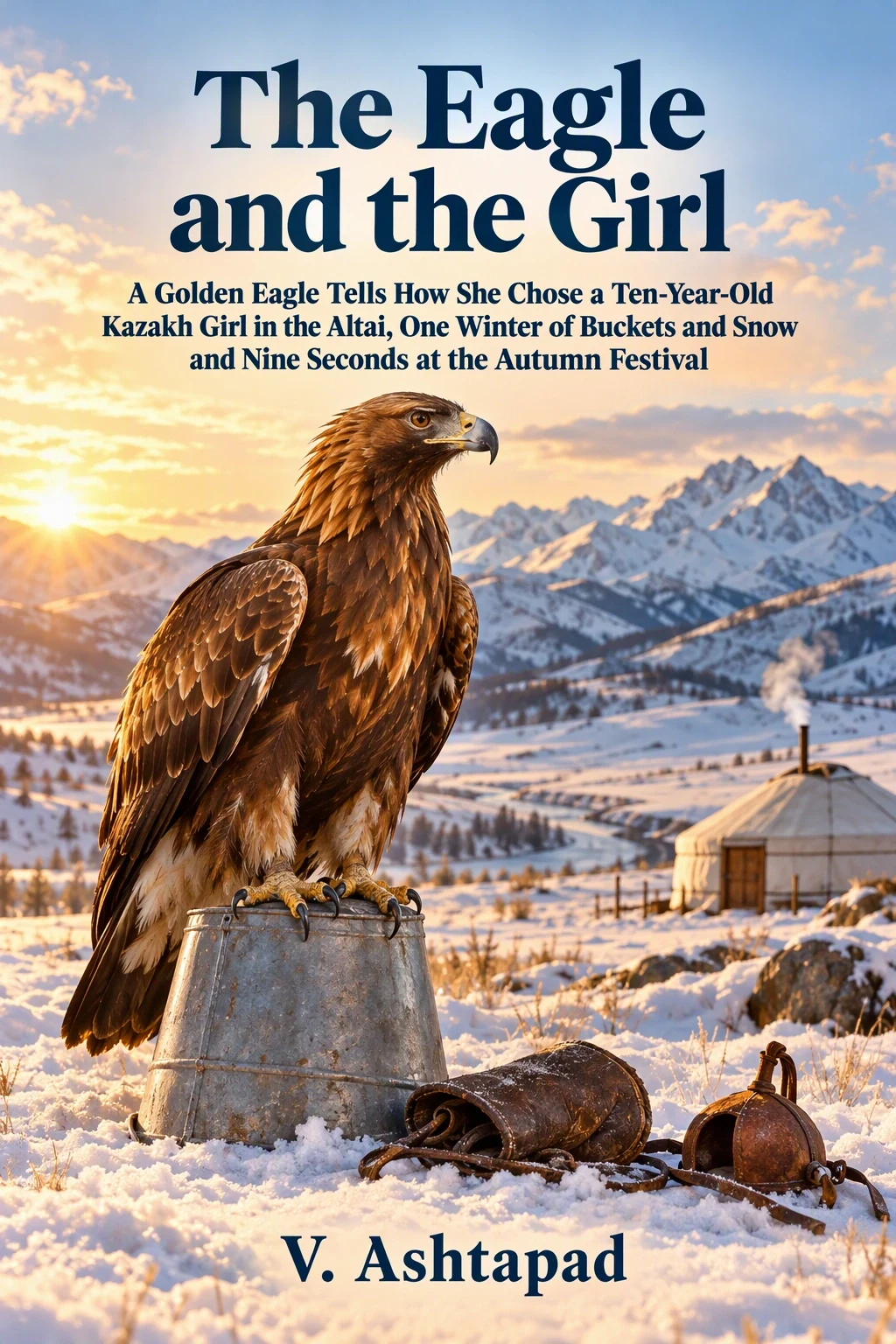
The Eagle and the Girl
A Golden Eagle Tells How She Chose a Ten-Year-Old Kazakh Girl in the Altai, One Winter of Buckets and Snow and Nine Seconds at the Autumn Festival
by V. Ashtapad
Foreword
This is a work of fiction. Bayan-Ölgii in the Altai Mountains of western Mongolia, Kazakh eagle hunting, the hood, glove and arm rest, Nauryz, and the autumn golden eagle festival are real, and young women hunters have taken part in it. The family, the camp, the eagle Sholpan and every named person and animal in the story are invented.
For every child who sat down and waited to be chosen.
I Am Sholpan
Let me begin by saying that I am magnificent.
I am not boasting. I am reporting. I am a golden eagle, female, four years old, with a wingspan of two meters and eleven centimeters, which is longer than the tallest man in our valley lying down, and I have measured this, because one afternoon he lay down in the snow to have a nap after lunch and I stood beside him and compared. My feathers are the color of a fox at the end of autumn, dark brown on my back and wings, gold on the back of my head and neck where the sun catches me. My eyes can see a marmot blink from a kilometer away. My feet can close with the force of a door slamming. My beak is a hook made for one purpose and it is not for kissing.
I live in the Altai Mountains, at the far western edge of Mongolia, where it pokes into Kazakhstan and China and Russia like a thumb, in a province called Bayan-Ölgii. It is very high and very cold and very windy, and in winter the snow lies on the brown hills like flour on a table, and the rivers freeze so hard that trucks drive on them, and the sky is a blue that stings, even me, and I am an eagle.
The people here are Kazakh, mostly. They came over the mountains a long time ago with their horses and their sheep and their felt houses and their eagles, and they have stayed, and they speak Kazakh at home and Mongolian at school and a little Russian when they want to be rude to each other, and they do the thing with the eagles that they have been doing for a thousand years, or two thousand, or three, depending on which old man you ask.
The thing with the eagles is me.
I mean: they catch a young one, a female, because the females are bigger and braver and smarter, which everybody knows, from a nest in the cliffs, when she is just old enough to leave it. They take her home. They tame her. They feed her and talk to her and carry her on their arm until she trusts them, which takes a very long time, because we are not stupid. And then they hunt together, in the winter, the man and the eagle, the man on his horse and the eagle on his arm, foxes and hares across the snow. And after ten years or so, when the eagle is grown and the man is older, he carries her up to a high place and takes off her hood and lets her go back to the mountains, to find a mate and lay eggs and raise daughters of her own.
That is the thing with the eagles. It is a good thing, I think. Most of the time.
The man who caught me is named Kanat. He is sixty-eight. He has a white mustache that goes down past his chin on both sides like the horns of a ram and a face as brown and creased as an old saddle. He caught me when I was a fat, furious baby with fluff on my head, from a nest on a cliff above the Sagsai River, by climbing down a rope that his son held from the top. I bit him. He still has the scar on his thumb. He says it was a love bite. It was not.
For four years he and I have hunted together. Every winter. Across the snow.
And then, this autumn, he fell off his horse.
---
Let me tell you about a day with Kanat, before the fall, so you know what I had.
He came out of the mud-brick house at first light, always, in his long sheepskin coat with the collar up and his dead-animal hat, and stood in the yard for a moment looking at the sky. He did this every morning of his life. Ajeh says he did it on their wedding day. He looked at the sky to see what kind of day it would be, and then he looked at me, on my perch, to see what kind of eagle I would be.
Then he took off my hood and said good morning. In Kazakh. To me. Every day.
Then he fed me. Meat from a bowl, on his glove, a piece at a time, and while I ate he talked. About the weather. About the sheep. About his son, who drove too fast, and his nephew, who was a fool, and his granddaughter, who was the cleverest child in the province, though she would never hear it from him. About his wife, who had been right about everything for forty-six years and was insufferable about it.
He never asked me anything. He knew I wouldn't answer. He just told me things, the way you'd tell things to a friend on a long ride.
Then, if it was winter, we hunted. If it was summer, we sat. If it was spring or autumn, we did whatever needed doing, which was mostly riding around the hills looking at sheep while I sat on his arm and looked at everything else.
At night he put on my hood and said good night. In Kazakh. To me. Every night.
Four years. That was what I had. A man who looked at the sky every morning and told me things.
I did not know it could end.
© 2026 CRUNOD LLC. All rights reserved.
The Fall
Let the record show that it was not my fault.
It was the horse's fault. The horse is named Kara, which means black, which she is, and she is old and bad-tempered and frightened of plastic bags, and on a cold morning in September, as we were coming down the hill above the winter camp, a plastic bag blew out of nowhere across the path, and Kara jumped sideways like a cat, and Kanat went off the other side.
He landed on his shoulder. The right one. The one I sit on, or rather the arm below it, where he wears the big leather glove that goes to his elbow, and where I ride.
I went up into the air, of course. I was not going to go down with him. I circled. I watched. He lay in the brown grass on the hillside a good while not moving, and Kara stood over him looking embarrassed, as well she should, and the wind blew, and the plastic bag went on across the hill and caught on a rock and flapped there like a flag.
Then he moved. He sat up. He held his right arm against his chest with his left hand and said a number of words I will not repeat, because this is a book for children.
Then he looked up at me, circling, and held up his left arm. No glove. Just his arm in its sheepskin coat.
I came down. I landed on it. I am very careful when I want to be. I did not put my talons through his coat, although I could have, and he would have deserved it, for falling off a horse because of a bag.
"Sholpan," he said, through his teeth. "My beauty. My star. Get me home."
I could not get him home. I am an eagle, not a horse. But I sat on his left arm while he walked, slowly, leading Kara, down the hill to the camp, and I did not make it worse, which for me is a great deal.
---
The doctor in Ölgii said the shoulder was broken. Not badly. Not so it would not heal. But he said a man of sixty-eight with a broken shoulder should not, for at least a year, and possibly ever again, be carrying a six-kilogram eagle on his arm for hours at a time across the snow.
Kanat said he would do what he liked.
His wife said he would do what the doctor said.
His wife is named Gulzhan, and everyone calls her Ajeh, which means grandmother, even people who are not her grandchildren, even the doctor, even me, privately. She is small and round and has hands that can milk a goat, sew a coat, slap a grandson and make bread at the same time. She has been married to Kanat for forty-six years and has won every argument.
She won this one.
And that is how, on a Saturday morning in October, I found myself sitting on a perch in the yard of the winter camp, on a block of wood with a rope tied to my leg, with a hood over my head, listening to a committee of men decide who was going to carry me next.
---
That night, the first night after the fall, nobody fed me.
Not because they forgot. Because they were all in Ölgii at the hospital, all of them, Ajeh and Marat and the girl, in Marat's truck, and the neighbor who was supposed to come over from the next camp got the day wrong.
So I sat on my perch in the yard in the dark with my hood on and the wind coming down off the mountains and no voice saying good night.
I am an eagle. I can go days without food. In the wild we sometimes go a week. Hunger is not a problem for me.
The silence was a problem.
I sat there all night in the cold and listened to the camp. The sheep shifting in their pen. The dog, Akbas, who had been left behind too, whining at the door of the house. The wind in the felt of the felt house, which makes a sound like someone breathing. A truck, once, very far away, on the road to the border. An owl.
No Kanat.
In the morning the truck came back. Ajeh got out, and Marat, and the girl, all of them with gray faces from no sleep. And Kanat did not get out. He was still in the hospital. Two more days, the doctor said.
The girl came straight across the yard to my perch. She didn't go into the house. She didn't take off her coat. She stood in front of me with her face gray and her braids coming loose.
"Good morning," she said. In Kazakh. To me.
I did not know she knew he said that.
She went and got the bowl. She stood on the bucket so she could reach. She held out the meat, a piece at a time, in her bare fingers, not on a glove, which was very foolish, and very brave, and I took it from her as gently as I have ever taken anything from anybody.
© 2026 CRUNOD LLC. All rights reserved.
The Committee
There were four of them. I could hear them, though I could not see, because of the hood. The hood is made of leather and shaped like a little helmet and it goes over my head and my eyes so that I cannot see, which keeps me calm, the men say. It does not keep me calm. It keeps me in the dark, which is different.
The first one was Kanat's son, Marat. He is forty. He drives a truck between Ölgii and the border, carrying flour and fuel and sheep and anything else that needs carrying. He is very strong. He is also hardly ever home, and when he is home he is asleep.
"I can take her," Marat said. "On weekends."
"Eagles don't have weekends," said Kanat.
The second one was Kanat's nephew, Erzhan. He is twenty-two. He has a phone that he looks at all day and a motorbike he rides too fast and a haircut I would not wish on a vulture. He has always wanted an eagle. He has asked Kanat for me three times.
"I'll take her," Erzhan said. "Uncle. I'll take her. I'll take her to the festival. We'll win."
"You'll take her to the festival and she'll take your face off," said Kanat.
"She likes me."
"She does not like you. Nobody likes you. Your own mother says so."
The third one was a neighbor, an old man from the next valley named Bekzat, who has had eagles for fifty years and who said, in a voice like stones rolling in a stream, that he would take me and train me with his own two birds, and I would be fine.
Kanat said nothing to this a while. Then he said, "Thank you, Bekzat. You are a good man. She would be fine." And I could hear in his voice that he did not want me to be fine. He wanted me to be his.
The fourth one did not say anything. The fourth one was not in the committee at all. The fourth one was sitting on an upside-down bucket by the door of the felt house, outside the circle of men, peeling a carrot with a knife.
She was ten. I knew her. She was Kanat's granddaughter. Marat's daughter. Her name was Aiganym.
I knew her the way you know the weather. She was always there. Every summer, every winter holiday, every weekend she could get away from the school in Ölgii. She was there when Kanat brought me home as a fat furious baby, and she was six then, and she sat outside my perch for a whole afternoon staring at me through the slats with her mouth open, until I screamed at her, and she screamed back, and her grandmother came out and smacked her for teasing the eagle. She was there when I caught my first fox. She was there every morning when Kanat fed me, holding the bowl.
She was small for ten. Thin. A round face like her grandmother's and black hair in two braids and a pink coat with a hood with fake fur that I despised on sight. She talked to me. Every day. About school and her friends and her mother in the city and the boy in her class who ate paste. I never answered. I am an eagle.
She was peeling the carrot very slowly, listening to the men.
"Then it's Bekzat," said Kanat finally, heavily. "Until my shoulder is better. Until next year."
"Next year you'll be sixty-nine," said Ajeh, from inside the felt house.
"Until next year," said Kanat.
And then the girl put down the carrot.
---
I should tell you what the hood is like, since I spent that whole committee meeting inside it.
It is dark. Not black. Dark brown, like the inside of a closed fist. It smells of leather and of me and, very faintly, of Kanat's hands, because he made it himself, eleven years ago, for his first eagle, and has refitted it for me. It sits snug over my head and my eyes, with a little opening at the bottom for my beak so I can breathe and eat, and a tassel on top, red, for decoration, which I find ridiculous.
With the hood on, the world is only sound.
I could hear the committee. I could hear the wind across the yard and the sheep in their pen and the dog snoring and Ajeh banging pots in the felt house. I could hear the creak of Erzhan's leather jacket every time he shifted. I could hear Bekzat's breathing, which was slow and whistly, the breathing of an old man who has smoked for fifty years. I could hear Kanat's breathing, which was tight, because of the shoulder.
And I could hear the carrot.
The girl on the bucket by the door. The knife going down the carrot. Scrape. Scrape. Scrape. Very slow. Stopping every time one of the men said something. Starting again when they finished. She was not peeling that carrot at all. She was listening. The knife only moved when she was waiting.
I listened to her listen. I didn't know then that's what I was doing. I know now.
© 2026 CRUNOD LLC. All rights reserved.
The Choosing
This part must be told exactly right, because people tell it wrong.
People say I flew to her. People in the valley, and in Ölgii, and once on a radio program out of the capital. They say the old man's eagle flew to the little girl's arm. They say it as if it were magic. Like in a story.
It was not magic. Let me tell you what happened.
The men stood up from their circle. Bekzat came over to my perch. He untied the rope from the block. He held up his arm in its big leather glove to lift me. And he reached up and took off my hood so that I could see him and get used to him.
And I saw the yard.
The winter camp. The felt house, white, round, with the smoke going up from the stovepipe in the roof. The wooden pen for the sheep. The low mud-brick house where Kanat and Ajeh live in the coldest months. The brown hills all around, going up into the snow. The sky, so blue. The four men. The horse Kara, tied to the post, looking at the ground with shame. The dog, Akbas, asleep in the sun.
And the girl. On her bucket. In her pink coat. With the knife and the carrot in her lap. Looking at me.
Not at Bekzat. Not at her grandfather. At me. The way she had looked at me through the slats when she was six. With her mouth closed this time.
I looked back.
Here is a thing you should know about eagles. We do not like people. Not as a rule. We tolerate them. We work with them, if they feed us and keep us warm and take us hunting. We can come to trust one. Usually only one. But we do not like them, the way a dog likes people, all wags and licks. We are not dogs. We are much better than dogs.
But sometimes, very rarely, an eagle will look at a person and know something.
I looked at the girl on her bucket and I knew that she had been watching me for four years. Every day. Not the way Erzhan watched me, wanting. Not the way the tourists watch me at the festival, with their cameras. The way you watch the sky to know what the weather will be. She knew when I was hungry before Kanat did. She knew when I was cross. She knew which foods I liked and which I didn't. She had never once tried to touch me.
Bekzat raised his glove. He said, "Come, beauty."
I did not go to his glove.
I jumped off the perch. Not flying. Just a big flapping hop across the yard, three meters, which is not very dignified, but I was on a rope and Bekzat was holding it and he was so surprised he let go. And I landed on the bucket. Next to the girl. On the edge of it. With my talons gripping the rim, and the bucket tipping, and the girl sitting very, very still beside me with the carrot in her hand.
Nobody moved.
Then the girl, very slowly, very carefully, holding her breath, put out her arm. Her left arm. In its pink coat. With no glove.
I looked at it.
It was thin. Much too thin. I could have gone straight through that coat to the bone without trying.
I stepped onto it anyway.
Very lightly. With my talons closed. The way I had stepped onto Kanat's arm on the hill when he fell. I stood on that thin pink arm and I did not grip at all. I balanced. Like a bird on a branch in the wind. And the girl's arm shook, because I am six kilograms, and she is ten, and her face went red, and her eyes went wide, and she did not let me fall.
"Oh," said Kanat.
---
Afterward, when the men had gone into the felt house to drink tea and argue some more, the girl sat on her bucket in the yard with me still on her arm.
Her grandfather had made her put me down after a minute, onto the perch, because her arm was shaking so badly. But as soon as the men went in, she held her arm up again, and I stepped back onto it.
We sat there. Her arm shook. I balanced. She put her other hand under her elbow.
"Why me?" she whispered.
I didn't answer. I am an eagle.
"Erzhan wants you so much," she said. "And Bekzat has had eagles for fifty years. And my father is so strong. Why did you come to me?"
I looked at her.
I could not tell her, because I do not speak. But I will tell you, since you've read this far.
I came to her because she was the only one who had never tried to make me come.
© 2026 CRUNOD LLC. All rights reserved.
Too Small
Of course, it was impossible.
Everyone said so. Bekzat said so, gently, rubbing his beard. Marat said so, loudly. Erzhan said so in a sulk and went off on his motorbike in a cloud of dust. Ajeh said nothing, but she came out of the felt house and stood in the doorway with her hands in her apron and looked at her granddaughter with an eagle on her arm and her face did something complicated.
"She is ten," said Marat. "She weighs thirty kilos. The bird weighs six. That's a fifth of her. Would you carry a fifth of yourself on one arm for six hours on a horse in the snow?"
"Girls don't hunt with eagles," said Bekzat, kindly. "Not usually. Not in my day."
"In my day," said Ajeh, from the doorway, "girls didn't go to school in Ölgii. Now they do. Your day is over, Bekzat. So is mine."
Everybody turned to look at her.
"There was a girl in the newspaper," Ajeh said. "Two years ago. A girl from Sagsai, thirteen, who won at the festival. And another one last year, from Altantsögts. With her father's bird. The foreigners came with their cameras and made a film." She sniffed. "If they can do it, so can ours."
"Those girls were thirteen," said Marat. "She's ten."
"Then she has three years to get ready," said Ajeh. "That's longer than they had."
I was still on the girl's arm while they argued. Her arm was shaking very badly now. She had put her other hand under her elbow to hold it up. Her face was bright red and there was sweat on her forehead in the October wind, and she did not put me down. I did not grip. I balanced. We stayed like that, the two of us, while the grown-ups talked, until finally Kanat, who had not said anything since "oh," came across the yard with his right arm in its sling and put his left hand under the girl's elbow to help her hold me up.
"Aiganym," he said.
"Yes, Ata." Ata means grandfather.
"Do you want this?"
The girl looked at me. I looked at the girl. Her eyes were very dark brown, almost black, like a marmot's, like mine.
"She wants it," said Aiganym. "I'm only saying yes."
Kanat looked at her for a long moment. Then he looked at me. Then he made a sound under his white mustache that I had heard only a few times in four years. It was the sound he made when I came down to his arm out of a high wind with a fox in my feet. It was not a laugh exactly. It was more like a door opening.
"Then we'll need a smaller glove," he said.
---
That night the girl did not sleep in the mud-brick house. She brought her quilt out to the yard and slept on the felt carpet in the little shelter beside my perch, where Kanat keeps the saddles, with the dog curled against her back.
Ajeh came out twice to tell her to come in. The second time she brought another quilt instead.
I sat on my perch above her in the dark with my hood on. I could hear her breathing. I could hear the dog's breathing, slower. I could hear the cold coming down off the mountains, which has a sound, if you are an eagle, a thin ringing like a wire pulled tight.
At about midnight she whispered.
"Sholpan. Are you awake?"
I was. I am always awake, a little.
"I'm scared," she said. "Everybody thinks I can't. Papa thinks I can't. Bekzat thinks I can't. Erzhan definitely thinks I can't. I think I can't." The quilt rustled. "My arm still hurts from five minutes. How am I going to hold you for five hours?"
I shifted on my perch.
"Ata says when he was small he was scared of his father's eagle," she went on. "She was called Kökshe. Bluish. She was so big she knocked him down once in the snow and stood on his chest and looked at him. He said he thought she was going to eat his face. He said he cried. And his father laughed and said, now she knows you. Now you've met." A pause. "Did you knock him down?"
I had. Once. When I was very young and very angry, in my first winter. I'd forgotten.
"I bet you did," said the girl. "I bet you knocked him right over."
Then she was quiet a long while, and I thought she was asleep.
"I'll carry the bucket," she whispered, finally. "Whatever he says. As many times as he says. And you have to promise not to knock me down. Not too much. Okay?"
I didn't promise. I am an eagle. But in the morning, when Kanat came out to look at the sky, he found the girl asleep on the felt carpet in the saddle shelter with the dog against her back, and me on my perch above her, and he told Ajeh later that I had moved along the perch in the night, all the way to the end, as close to the girl as the rope would let me.
© 2026 CRUNOD LLC. All rights reserved.
The Glove
Ajeh made the glove.
It took her three evenings, by the stove in the mud-brick house, with the lamp on and the radio playing Kazakh songs from the station in Ölgii and Kanat in his chair with his arm in its sling telling her she was doing it wrong. She was not doing it wrong. Ajeh has never done anything wrong in her life, according to Ajeh.
She made it from the old leather of a saddlebag that had belonged to her father, which was thick and dark and soft as butter from a hundred years of being rubbed by horses. She cut it in pieces on the table with a knife so sharp it whispered. She sewed it with sinew, the old way, with a big curved needle, pulling each stitch tight with her teeth. It went from Aiganym's fingertips to above her elbow. On the back of the hand she stitched a pattern in red thread. A ram's horn, curled. The pattern that is on the felt carpets and the chests and the wedding hangings of every Kazakh family in the valley.
"For luck," she said, when she put it on the girl's hand.
"Does it work?" asked Aiganym.
"It worked for me," said Ajeh. "I got your grandfather."
"That's luck?"
"Some days," said Ajeh, and Kanat in his chair made a noise like an offended camel.
---
Then the training began. And let me tell you, it was not the eagle's training. It was the girl's.
Because I already knew everything. I am four years old and I have hunted with Kanat for three winters. I know how to sit on an arm on a galloping horse. I know how to come down out of the sky to a glove. I know how to hit a fox at sixty kilometers an hour and hold it. I do not need training.
The girl needed training. The girl could not hold me up.
So for the first month, Kanat did not let her hold me at all. Not for more than a minute. He made her carry other things instead.
A bucket of water. Full. On her left arm, bent at the elbow, the way you hold an eagle. Across the yard and back. Twenty times. Then thirty. Then fifty. Every morning before school and every evening after. The bucket weighed eight kilos, more than me. The first morning she carried it four times across the yard and on the fifth her arm gave out and the bucket fell and soaked her boots, and she sat down in the mud and cried.
Kanat stood over her with his arm in its sling.
"Again," he said.
She got up. She filled it again. She did it again.
By the end of October she could carry it fifty times. By the middle of November she could carry it fifty times with a stone in it. Her left arm, which had been as thin as a stick, was not as thin. She had a hard little lump of muscle above her elbow that she showed to everyone, including me. I was not impressed. I have muscles in my chest that could lift her off the ground.
But I noticed.
---
Kanat also made her a prop.
This is a thing the Kazakh eagle hunters use. A wooden stick, about as long as your forearm, with a little cradle at the top. You fix the bottom of it to the front of the saddle, and you rest your elbow in the cradle at the top, so that the horse carries some of the eagle's weight instead of your arm. Kanat had one, old and black and worn smooth, that had been his father's. He made Aiganym a new one out of a piece of larch, sitting by the stove one-handed with his knife between his knees, carving very slowly.
"Grown men use these," he said. "Strong men. Bekzat uses one. I use one. There is no shame in letting the horse help."
"Then why do I have to carry the bucket?" asked Aiganym.
"Because the horse is not always there," said Kanat. "Sometimes you have to stand on the ground on a hill in the wind and hold her up yourself. And then there is no stick. There is only your arm. And you'd better be ready."
© 2026 CRUNOD LLC. All rights reserved.
School
Here is the problem with ten-year-old girls. They have to go to school.
I did not know this. I had never thought about it. When Kanat had me, he was there every day. Every morning he came out of the house at dawn and took off my hood and fed me. Every afternoon he took me out on the hill or on the horse. Every evening he sat by my perch and talked. Every day. For four years.
The girl was not there every day.
On Sunday evening, at the end of October, a car came. A van, really, a white one, old and rattling, with a man from the next valley driving it who takes all the children from the camps along the river into Ölgii on Sunday nights and brings them back on Friday afternoons. Aiganym got into it with her backpack and her pink coat and her braids, and leaned out of the window as it pulled away, and called something to me across the yard.
"I'll be back Friday! Don't eat anybody!"
I screamed at the van all the way down the hill.
---
I did not understand. You must remember that. I am an eagle. I do not know about weekdays and school dormitories and the education ministry. I know that the girl was there and then she was not there. And I had chosen her. In front of everybody. On a bucket.
I was very angry.
I would not eat on Monday. Kanat brought me meat from the pot, good meat, a piece of marmot he had been saving, and I turned my back on it. On Tuesday I ate a little, because I am not stupid. On Wednesday I screamed at the dog for an hour. On Thursday Kanat sat by my perch in the evening with his arm in the sling and his phone in his good hand.
"Sholpan," he said. "Listen."
And he played something on the phone. A voice. Tinny. Small. The girl's voice.
"Hello, Sholpan. It's me. It's Wednesday. I'm in the dormitory. My bed is by the window. I can see the mountains from here, the white ones, the big ones. I think you're over there. I hope you're eating. Ata says you're not eating. You have to eat. I have to eat too. The food here is terrible. They make us eat soup with cabbage in it. I'll be back Friday. Okay. Bye."
I listened. I tilted my head. I did not know what a phone was. I knew that voice.
Kanat played it again.
"She records them every night," he said. "On the family pages. Her mother set it up. So we can hear her at the camp and her mother can hear her in the city and her father can hear her in his truck. She records one for you every night. She doesn't know I'm playing them to you. I thought you should hear." He put the phone back in his coat. "I record them too. For her. What you did today. What you ate. What to remember when she comes on Friday. She listens to them in the dormitory under her blanket, her friend Tengis says. She plays them over and over."
I looked at him.
"So you see," he said. "She's here. Just not here."
On Friday afternoon, when the white van came rattling up the hill, I heard it a kilometer away. Before the dog did. And I screamed. But it was a different scream.
---
Her friend Tengis came with her, the second Friday.
He is Mongolian. Not Kazakh. His family keeps cattle in the next valley over and his father works at the province office in Ölgii, and he is in Aiganym's class and is the best in it at mathematics and the worst at sitting still. He is small and round and has a cowlick that stands straight up no matter how much his mother wets it.
He had never seen an eagle up close.
He hung back by the yard fence, fists jammed in his pockets, mouth open, the way Aiganym used to stand when she was six, and stared at me on my perch.
"She's huge," he said in Mongolian.
"She's magnificent," said Aiganym in Mongolian. Then in Kazakh, to me: "This is Tengis. He's my friend. Don't eat him."
I looked at the boy. The boy looked at me.
"Can I touch her?" he said.
"No," said Aiganym and Kanat at the same time, in two languages.
"Can I watch?"
"Yes," said Kanat, in Mongolian, which surprised everyone. Kanat speaks Mongolian like a man carrying something heavy up a hill, slowly and with complaints. "You can watch. Watching is how you learn. Sit there. Don't talk."
So the Mongolian boy sat on the bucket by the felt house, the way Aiganym had for four years, and watched Aiganym carry the bucket of water across the yard fifty times, and watched her put on the glove with the red ram's horn and hold up her arm, and watched me step onto it, lightly, without gripping, and balance. And he didn't talk. For the whole afternoon. Which Aiganym said afterward was the longest he had ever not talked in his life.
When the van came on Sunday to take them both back, he leaned out of the window beside her.
"Next Friday?" he said to Kanat.
Kanat considered him.
"Bring your own bucket," he said.
© 2026 CRUNOD LLC. All rights reserved.
The City
Aiganym's mother is named Kuralai, and she lives in Ulaanbaatar, which is the capital of Mongolia and is sixteen hundred kilometers east of our valley, which is farther than I have ever flown in my life, and I am an eagle.
She works in a bank. She counts other people's money in an office on the ninth floor of a glass building with a view of a highway and a power plant. She has lived there for three years, since the bank offered her the job, because the money is better than anything in Ölgii and because Marat drives the truck and is never home and somebody has to pay for things. She comes home twice a year. At Nauryz in March, for the spring festival, and for two weeks in August.
The rest of the time she is a face on a phone.
Every Sunday evening, before the van comes, Aiganym sits on the bed in the mud-brick house with Ajeh's phone and talks to her mother. I can hear it from my perch in the yard, through the open door. Her mother's voice, very far away, coming out of a little box, asking about school and the dormitory and whether she is eating and whether she is wearing her hat.
And then, in November, asking about me.
"Your grandfather told me," the voice said. "About the eagle."
"Her name is Sholpan."
"I know her name, Aiganym. I've known her name for four years." The voice was quiet for a while. "Your father says you carry her on your arm."
"Sometimes. For a little bit. Ata won't let me for long."
"She's a wild animal."
"She's not. She's an eagle."
"Aiganym." The voice in the box sounded tired. "An eagle is a wild animal. She could hurt you. She could take out your eye. I've seen what they do to foxes. I don't want you doing this."
The girl didn't say anything.
"I want you to study," said the voice. "I want you to go to university. In the city. Or abroad. I want you to have choices. Not spend your life in a felt house in the mountains freezing on a horse with a bird on your arm. That's your grandfather's life. It's not yours."
The girl didn't say anything for so long that I turned my head and looked through the open door.
She was sitting on the bed, phone in her lap, face very still and her left hand, the one with the hard little muscle above the elbow, curled into a fist.
"Mama," she said finally. "Can I show you something?"
"What?"
"Wait."
And she got up off the bed, and came out of the house, and came across the yard to my perch with the phone in her right hand, and put on the glove with the red ram's horn with her teeth, because her other hand was busy, and held up her left arm.
I stepped onto it.
She turned the phone around so the box could see.
"Mama," she said. "This is Sholpan."
The voice in the box made a small sound.
I looked into the phone. I could see, very small, a face. A woman with Aiganym's round face and Ajeh's dark eyes, in a room with white walls and a window with lights behind it, the lights of a city at night. I had never seen a city. I looked at the face a long while.
The face looked back at me.
"She's beautiful," said the voice in the box finally, very quietly.
"She's magnificent," said Aiganym. "She chose me. In front of everybody. Ata says eagles almost never do that."
The face in the box didn't say anything for a while.
"Is she heavy?" it said at last.
"Very."
"Does your arm hurt?"
"All the time."
Another long silence. In the box, behind the face, somewhere far away in the city, a car horn honked.
"Wear your hat," said the voice. "It's going to snow on Tuesday. I checked."
© 2026 CRUNOD LLC. All rights reserved.
The Fox on a String
It snowed on Tuesday. Her mother was right. Mothers usually are, even sixteen hundred kilometers away.
By December the whole valley was white. The river froze. The sheep came down from the hills and crowded into their pens behind the mud-brick house and steamed like kettles. Kanat's shoulder was out of its sling, but he still could not lift his right arm above his chest, and in the mornings it hurt him so much he had to sit by the stove with a hot stone wrapped in cloth on it for an hour before he could get dressed.
"Now," he said, on the first Saturday in December, when Aiganym got out of the van. "Now we start the real work."
The real work was the lure.
Here is how a young eagle learns to hunt, or how an old eagle learns to hunt with a new person, which was me. You take a fox skin. An old one. Stuffed with straw so it has a shape. You tie it to a long rope. And then somebody drags it across the snow, fast, so it bounces and jumps like a running fox, and the eagle comes down out of the sky and hits it, and holds it, and the person runs to the eagle and gives her a piece of meat as a reward, and takes the fox away.
Then you do it again. And again. Until the eagle and the person are one thing. Until the eagle knows that when this person calls, this person has meat, and when this person's horse runs, there is a fox somewhere ahead.
"Who drags it?" said Aiganym.
"I'm not running," said Kanat. "I'm sixty-eight with a broken shoulder."
"Tengis can run."
"Tengis is ten and has legs like a goat. The fox has to be faster than a goat."
And that is when we all heard the motorbike.
Coming up the hill in a spray of snow, too fast, of course, with the engine screaming and the haircut I would not wish on a vulture flattened by a helmet. Erzhan. Kanat's nephew. Twenty-two. Who had wanted me three times and been told no three times and had gone off in a sulk in October.
He skidded into the yard and nearly hit the dog. He pulled off his helmet.
"Uncle," he said. "I heard you need somebody to drag the fox."
Kanat looked at him for some time. So did I.
"Who told you?" said Kanat.
"She did." Erzhan jerked his chin at Aiganym. "On the family pages. She posted a recording. She said, We need somebody with a fast motorbike, and if Erzhan wasn't such a sulker he'd come." Erzhan shrugged. "So here I am. Not sulking."
Aiganym, in her pink coat, with her glove on, was smiling a very small smile.
"She did not say I was a sulker," said Erzhan.
"I said it twice," said Aiganym.
---
So that was how we did it, the whole winter. Erzhan tied the rope to the back of his motorbike. Aiganym and I went up on the hill above the camp. Tengis and Kanat stayed down in the flat white valley to watch. Ajeh watched from the doorway of the house with her hands in her apron.
And Erzhan rode.
Across the snow, the fox skin bouncing behind him on its rope, the engine screaming, the snow flying up in a white wave behind the wheels. And the girl on the hill took off my hood, and held up her arm, and pointed, and said the word Kanat taught her. It is not a word in any language. It is just a sound. A sharp, rising call, like a whistle made with your throat. It means: there. Go.
And I went.
I want to tell you what that is like. I will try. I have been doing it for four years and I still do not have the words, but I will try.
You come off the arm. The arm pushes you a little, up, into the wind. You open your wings. All two meters and eleven centimeters of them. The cold air takes you. You are not flying yet. You are falling, forward and down, off the hill, toward the white valley, and the wind is coming up the hill into your face and you tilt your wings to it and it lifts you, and now you are flying. And you can see everything. The valley like a white sheet. The river, frozen, a gray ribbon. The camp, the felt house with its smoke, the dog, the boy and the old man, tiny, looking up. And there, below, running across the white, the fox.
You tuck your wings. You fall. Very fast. Faster than anything. The air screams. Your eyes are on the fox and nothing else in the world exists. You open your feet at the last moment, wide, every talon spread. And you hit.
And then you are on the ground in the snow holding the fox in your feet, panting, your wings spread over it like a tent so nobody else can take it, and you look up. And here comes the girl. Running down the hill. Falling in the snow. Getting up. Running. Her pink coat. Her braids flying. Her face red. Shouting your name.
That is what it is like.
The first time, I hit the fox and held it and looked up and the girl came running and fell in the snow four times on the way down, and when she got to me she was laughing so hard she couldn't open the meat bag, and Erzhan had to come back on his motorbike and open it for her.
The second time she only fell twice.
By the tenth time she did not fall at all.
© 2026 CRUNOD LLC. All rights reserved.
The Calling
There is a test at the festival. The calling.
The hunter's friend stands on top of a hill with the eagle. The hunter rides on a horse below, on the flat, three hundred meters away, maybe more. Then the friend takes off the eagle's hood and lets her go. And the hunter, below, calls. With the throat-whistle sound. And holds up the glove, with meat on it. And the eagle has to come.
Not to the friend on the hill. Not to the crowd. Not to the cameras. Not to the fox skins lying around from the last test. To the hunter. Her hunter. Down the long slope, through the air, to that one arm.
It is the hardest test, Kanat says. Because it is not about skill. It is about trust. The eagle has to choose, in the air, with the wind and the crowd and the noise, to come to you. And nothing can make her. If she doesn't want to, she won't. She'll go and sit on a rock and look at you. And everyone will laugh.
The first time we tried it, I went and sat on a rock.
It was January. Bitter. Kanat stood on the hill above the camp with me on his good arm, his left, holding me up for a few seconds, the longest he was allowed, while Aiganym rode down the hill on Kara, the black mare, who has a bad temper but does not run away, and went out onto the flat. Three hundred meters. A little pink shape on a black horse on the white snow.
Kanat took off my hood.
I saw everything. The valley. The sky. The wind. The girl, far away, a speck.
She held up her arm and called.
I heard her. I want you to know that. I heard her. But the wind was coming from the wrong direction and it was very cold and Kanat's arm was right there, the arm I had sat on for four years, the arm that had pulled me out of a nest on a cliff, and the girl was so far away and so small.
I went and sat on a rock. Halfway between them. I sat there and looked at the girl.
She called again. And again. She waved her arm with the meat on it. Kara, the black mare, shifted her feet and snorted. Tengis, at the bottom of the hill, said something in Mongolian that I am sure was rude. Erzhan, on his motorbike, laughed.
I sat on my rock.
After ten minutes the girl stopped calling. She put her arm down. She sat on the black mare in the middle of the white flat and looked at me on my rock. I couldn't see her face. Too far even for me, with the wind blowing the snow.
Then she got off the horse.
She left Kara standing. She walked across the snow. Not toward me. Away from me. Out into the middle of the flat, alone, where there was nothing at all, only white, and she sat down. Right in the snow. In her pink coat. With her arm with the glove on it in her lap.
And she didn't call.
She just sat there.
Kanat, beside me on the hill, made a small sound.
"Clever girl," he said quietly. "Oh, clever girl."
I didn't understand. I sat on my rock. I looked at her. She was so small out there. Sitting in the snow. Alone. Not calling. Not waving meat. Not asking. Just sitting.
She looked like she did when she was six, on the bucket by my perch. Watching.
And I came off my rock.
I didn't decide. I want to be truthful. I just found I was in the air. And then I was going down the slope, low, over the snow, toward the little pink shape sitting in the middle of all that white. And she didn't move. She didn't hold up her arm. She didn't call. She just watched me come.
And I landed in the snow beside her.
Not on her arm. Beside her. On the ground, in the snow, so close my wing touched her knee.
We sat like that for a while.
Then she held out her arm, very slowly, without looking at me, and I stepped onto it.
---
"Why did you sit down?" Kanat asked her that evening, by the stove.
Aiganym thought about it. She had her left arm in a bowl of warm water with salt in it, because it hurt, and her face was still red from the wind.
"Because she didn't want to be called," she said finally. "She wanted to come. If I called her, it was me making her. If I sat down, it was her choosing." She swirled her arm in the water. "She chose me once already. On the bucket. I think she doesn't like being asked twice."
Kanat looked at her a good while over his tea.
"That," he said, "took me eleven years to learn."
© 2026 CRUNOD LLC. All rights reserved.
Forty Below
In the middle of January, the cold came.
Not the ordinary cold. The other kind. The kind the old people call the white death. It came down out of Siberia over the mountains on a Tuesday night and by Wednesday morning it was forty degrees below zero in the valley and the air was so cold it hurt to breathe and the snow squeaked under your boots like a frightened mouse.
The school in Ölgii closed. Too cold for the van. So Aiganym was home all week.
Nobody hunted. Nobody went out. Kanat brought me inside, into the mud-brick house, on a perch by the door, because even eagles can freeze in that kind of cold. My feathers puffed up so I was twice my size. Ajeh said I looked like a brown cloud with a temper. I did not appreciate this.
We stayed inside for six days. All of us. Kanat and Ajeh and Aiganym and me and the dog and, on the fourth day, a newborn lamb that Kanat brought in from the pen wrapped in a blanket because its mother wouldn't feed it, and Ajeh fed it with milk from a bottle by the stove, and it slept in a box by my perch and I watched it the whole time with great interest and Ajeh told me if I so much as looked at it hungrily she would turn me into a hat.
---
That week, Ajeh told stories.
She told them by the stove in the evenings, with the lamp on and the lamb in its box and the wind screaming outside like a thousand eagles. Aiganym sat on the felt carpet at her feet. Kanat sat in his chair. I sat on my perch.
She told about her own grandmother, who came over the mountains from Kazakhstan in 1920 on a camel, at eight years old, with her family's felt house folded on the camel's back and a baby goat in her lap.
She told about the winter of 1945, the worst anyone remembered, when the snow came up over the roofs of the houses and the sheep died in the thousands and her father dug a tunnel from the house to the pen so he could feed the ones that were left.
She told about her mother, who sewed. Who sewed everything. Coats and boots and felt carpets and wedding hangings and hats. Who made a hat for Ajeh's wedding out of the fur of a fox that Ajeh's father's eagle caught, with owl feathers on top, the way brides used to wear.
"Do you still have it?" asked Aiganym.
Ajeh got up. She went to the big painted wooden chest at the back of the room, the one with the red and blue patterns on it, and opened it, and took out a hat.
It was tall, and red, and covered in embroidery, gold thread and silver, and trimmed at the bottom with fox fur that had gone pale with age. On top, a little bunch of white feathers.
"My mother made this in 1979," said Ajeh. "From the fox your great-great-grandfather's eagle caught. Her name was Akkus. White Bird. She was the best eagle in this valley for twelve years. And then my father took her up to the top of the mountain above the Sagsai and let her go."
"Let her go?" said Aiganym.
"That's what you do," said Ajeh. "After ten years. Twelve. You take her up high. You take off her hood for the last time. You give her a piece of meat. And you let her go back to the mountains, to have daughters of her own. My father cried for a week. He said it was like giving away a daughter at a wedding." She looked at me on my perch. "Kanat will do the same with that one. One day."
Aiganym turned around and looked at me.
I looked back at her.
"I didn't know that," she said quietly.
"Now you know," said Ajeh. "That's what stories are for."
---
Kanat recorded it. All of it. Every story that week. On his phone, propped against the teapot, with the wind screaming in the background and the lamb bleating and the stove ticking. He put them on the family pages, in a folder Aiganym made, with a name in Kazakh letters: Ajeh by the stove, the cold week.
Her mother listened to them in the city. Her father listened to them in his truck, stuck at the border for three days by the cold, sleeping in his cab with the engine running. Erzhan listened to them, he said, on his motorbike, which was not possible in that cold, so he was lying, but nobody minded. Tengis listened to them in his family's house in the next valley and called Aiganym on the sixth day to ask whether Akkus was a real eagle and where exactly on the mountain above the Sagsai she was let go.
"Why?" said Aiganym.
"Because I want to go there," said Tengis. "When it's summer. To see if she's still around. Eagles live a long time. Forty years, my father says. She could still be there."
Aiganym thought about this.
"She'd be fifty-nine," she said. "In eagle years that's very old."
"Ajeh is very old," said Tengis, "and she's still around."
From the stove, Ajeh threw a slipper at the phone.
© 2026 CRUNOD LLC. All rights reserved.
The Real Fox
When the cold broke, at the end of January, we went hunting.
Real hunting. Not the fox skin on a string behind Erzhan's motorbike. A real fox, alive, somewhere out there in the white hills, with a red coat and a white-tipped tail and a nose for trouble and no idea that a girl in a pink coat and an eagle were coming for it.
I should tell you something now, because this is a book for children and I do not want anyone to be surprised.
Eagles hunt. That is what we are for. We are not pets. We are not decorations for photographs at the festival. In the mountains, without people, an eagle catches marmots and hares and foxes and, sometimes, if she is very hungry and very brave, a young wolf. She kills them with her feet. She eats them. That is how she lives. It is not cruel. It is not kind. It is what is.
And Kazakh hunters, for a thousand years, have hunted foxes with eagles in the winter because the fox fur keeps them alive in the forty-below cold. The hats. The coats. The collars. Not for fashion. For not freezing. Ajeh's wedding hat. Kanat's winter hat, which he has had since 1989 and which looks like a dead animal sitting on his head, because it is.
So we went hunting.
---
We rode out at dawn. Kanat on his gray gelding his right arm bound flat under his coat so he wouldn't be tempted to use it. Aiganym on Kara, the black mare, with the larch prop fixed to the front of her saddle and her elbow resting in it and me on her glove with my hood on. Erzhan on a borrowed horse, because Kanat said if he brought the motorbike he'd scare every fox from here to Kazakhstan. Tengis behind Erzhan, holding on, because he had begged for three weeks and his father finally said yes.
We rode for two hours up a long valley north of the camp, where the hills close in and there are rocks and gullies and places for foxes to hide. The sun came up and turned the snow gold and then white and then so bright that everyone had to squint, except me, because I had my hood on, and anyway I don't squint, I am an eagle.
Kanat stopped at the top of a ridge. He looked down into the next valley a while. I could hear him breathing.
"There," he said quietly. "Below the black rocks. By the frozen stream."
Aiganym looked. She couldn't see anything. Neither could Erzhan or Tengis. I could have, if I'd had my hood off, but Kanat had taught her: you don't take the hood off until you're ready, or the eagle will go after a crow or a raven or a plastic bag and you'll spend all day getting her back.
"I don't see it," Aiganym whispered.
"You don't have to see it," said Kanat. "She will. Get ready."
Aiganym's hand was shaking on the hood. I could feel it through the leather.
She took it off.
And I saw it.
A fox. Red. On the white. Below the black rocks, by the stream, exactly where the old man said, nosing at something under the snow. Two hundred meters. Maybe less. It hadn't seen us. Its tail was up. Its ears were forward. It was very beautiful.
Aiganym pointed. She made the sound. The throat-whistle. There. Go.
I went.
---
I will not describe everything. This is a book for children, and some of you are very young, and some of you have dogs. I will say that the fox heard me at the last moment and ran, and it was very fast, faster than the fox on Erzhan's string, and it jinked left and right across the snow like a sewing needle, and I missed it the first time. And I went up, and came around, and it went into the rocks, and I waited on top of the rocks, and it slipped out at the far end, and I came down.
And I held it.
And then the girl was there. Off the horse. Running through the snow. Not falling at all. And she knelt down in the snow beside me, and she looked at the fox.
And she cried.
I did not understand. I had done exactly what I was supposed to do. Exactly what Kanat and I had done a hundred times. I was very pleased with myself. I spread my wings over the fox so nobody else could take it, and I looked at her, and she was crying.
Kanat came down the slope on his gray horse, slowly. He got off. He came and stood over her with his strapped arm and his dead-animal hat.
"Ata," said Aiganym. "It's dead."
"Yes."
"It was so beautiful. It was looking for its breakfast. Under the snow. And now it's dead."
"Yes," said Kanat.
He didn't tell her to stop crying. He didn't tell her it was only a fox. He knelt down in the snow beside her, slowly, because of his shoulder, and put his good hand on the back of her neck.
"Listen to me," he said. "This is the most important thing I will ever tell you about eagles. Are you listening?"
She nodded. She was still crying.
"Every time she catches one," said Kanat, "you say thank you. To the fox. Not to the eagle. To the fox. Out loud. You say, thank you for your coat, I will keep warm in it, I will not waste any of it. And then you take it home and you use every part. The fur for a hat. The meat for the eagle. Nothing thrown away." He looked at the fox under my wings. "My father did that. His father did that. For a thousand years. If you stop crying, if you ever stop feeling sad when she catches one, that's when you should stop hunting. That's the day you give her back to the mountains. You understand?"
Aiganym looked at the fox for a long moment.
Then she put her bare hand, the right one, the one without the glove, on its red side, very gently.
"Thank you for your coat," she said. "I'll keep warm in it. I won't waste any of it."
I lifted my wings. I let her take it.
---
Ajeh made a hat from it. In February, by the stove. A small one. For a girl. Fox fur all around the bottom, red, with the white tail tip sewn on at the back like a little flag, and embroidery on the crown in red and gold, the ram's horn, the same pattern as on the glove.
Aiganym wore it to school. Every day. In the dormitory she put it on the windowsill at night, facing the mountains.
Tengis said it was the coolest hat in Ölgii.
© 2026 CRUNOD LLC. All rights reserved.
Nauryz
In March the sun comes back.
Not all at once. A little more every day. The snow starts to go gray at the edges and then thin and then there are brown patches on the south sides of the hills, and the river starts to groan and crack under its ice like a grandfather hauling himself up from the floor. The sheep start lambing in the pens, dozens of them, tiny wobbly things with long legs, and the whole camp smells of lanolin and hay and milk. The days get long enough that Aiganym and I can go out on the hill after school on Friday and still have an hour of light.
And on the twenty-second of March, the whole valley celebrates Nauryz.
Nauryz is the new year. The spring new year. The old one, from before anybody counted years, from when people first watched the sun come back over the mountains and decided that was worth a party. Everybody cleans their house. Everybody puts on new clothes. Everybody visits everybody. And everybody makes nauryz kozhe, which is a soup with seven things in it, for luck, one for each of something, nobody can agree on what. Meat and water and salt and milk and rice and wheat and some kind of bean, or barley, or millet, depending on whose grandmother you ask.
And, that year, Aiganym's mother came home.
---
She came in a car from Ölgii, a taxi, on the twentieth. I heard it a kilometer away. I knew before the dog. I didn't know what I knew, exactly. Just that the girl, in the yard, stopped carrying her bucket and stood very still and listened, and then dropped the bucket, and water went everywhere, and ran.
The woman from the box got out of the taxi. She was smaller than I thought. The face on the phone had been so big. She was wearing a long gray city coat and boots that were not made for mud, and she stood there in the yard of the winter camp with her suitcase, and the girl hit her at a run and nearly knocked her over.
They stood there holding on to each other a long while.
Then the woman looked over the girl's shoulder at me on my perch.
I looked back.
She didn't come over. She stayed where she was, with her arms around her daughter. But she looked at me for some time. And I let her.
---
At Nauryz everyone came. Marat came home from the border in his truck. Erzhan came on his motorbike with his mother, who is Kanat's sister and talks even more than Tengis. Tengis came with his whole family, his mother and father and two little sisters, Mongolian, in their best clothes, carrying a big pot of their own Mongolian dumplings because Tengis's mother said she wasn't going to come empty-handed to a Kazakh party. Bekzat came from the next valley with his wife. Half the camps along the river came.
They sat on the felt carpets in the big room of the felt house, which Ajeh had set up again for the day in the yard, white and round with the door painted red and the smoke going up. They ate nauryz kozhe from big bowls. They ate beshbarmak, which is the Kazakh party food, noodles and boiled mutton and onion broth, eaten with the hands. They ate Tengis's mother's dumplings, which Ajeh said were very good, in a voice that meant they were better than hers and she wasn't going to admit it. They drank milk tea, salty, with butter in it, until they couldn't move.
And someone, Bekzat, took down Kanat's dombra from the wall, the long-necked two-stringed lute that every Kazakh family has, and played, and people sang.
I was on my perch outside the door. I could see in. The light from the stove. The faces. The girl sitting between her mother and her grandmother on the carpet, in her fox-fur hat, which she would not take off even indoors.
Then Kanat said something to her, and she got up, and came outside.
"Ata says to bring you in," she said. "He says everyone wants to see."
So she put on her glove with the red ram's horn and held up her arm, and I stepped onto it, and she carried me in through the red door of the felt house into the light and the warmth and the smell of mutton and milk tea and thirty people.
The room went quiet.
Aiganym stood in the middle of the felt carpet with me on her arm. Her arm did not shake. I want you to know that. Five months of buckets. It didn't shake at all.
Her mother, on the carpet, put down her bowl.
"Mama," said Aiganym. "Do you want to hold her?"
Everybody looked at Kuralai.
She looked at me. I looked at her. A woman who counts money on the ninth floor of a glass building sixteen hundred kilometers away and has a face like a marmot's when she's frightened, which she was.
"I don't have a glove," she said.
"Ata does. His old one. You can wear it."
Kanat held it out. The big black one that had been his father's, that goes past the elbow. Kuralai looked at it. Then she took off her city ring and put it in her pocket and put on the glove.
"Hold your arm up," said Aiganym. "Bent. Like you're carrying a bucket. Don't move. Don't be scared. She can tell."
"I am scared," said Kuralai.
"Then don't let her tell."
Kuralai held up her arm in the big black glove. Her arm was shaking.
Aiganym brought me close. I looked at the shaking arm. I looked at the girl. The girl nodded at me, very slightly.
I stepped across.
Very lightly. With my talons closed. Balancing. The way I had stepped onto the girl's thin pink arm in October, on the bucket. The way I had stepped onto Kanat's arm on the hill when he fell.
Kuralai's arm dropped about ten centimeters under my weight and then held.
The whole felt house was silent. Even Tengis.
Kuralai looked at me. Very close. Her face a foot from my beak. I looked at her.
"Oh," she said.
Exactly the way Kanat said it in October. The same word. The same sound.
Then she started to laugh. And cry. Both together. With an eagle on her arm in the middle of the felt house at Nauryz with thirty people watching.
"She's so heavy," she said. "Aiganym. She's so heavy. How do you carry her?"
"Buckets," said Aiganym.
© 2026 CRUNOD LLC. All rights reserved.
Summer Pastures
Eagles do not hunt in summer.
This surprises people. The tourists, especially, who come in July in their rented jeeps from Ölgii with their big cameras and their sunburns and want to see an eagle catch a fox. In July. When it is thirty degrees in the afternoon and the foxes have their thin summer coats that nobody would make a hat out of, and their kits in their dens, and the eagles are molting.
Molting is when you lose your feathers. Not all at once. A few at a time, all summer, the old ones falling out and new ones growing in. It is very uncomfortable. It itches. You look terrible. Half your tail is missing and there are bald patches under your wings and you are in a very bad mood, and the last thing you want is a tourist in a hat pointing a camera at you and asking if you can do a trick.
I do not do tricks.
So in summer we rest. Kanat says it is the eagle's holiday. The family moves up to the summer pastures, higher in the mountains, where the grass is green and thick and the sheep get fat, and they put up the white felt house beside a stream with a view of the snow peaks, and the girl doesn't go to school, and nobody hunts anything.
And the girl and I just sat.
---
Every morning at the summer pasture, Aiganym took me out of the felt house on her glove and carried me up a little hill above the stream, and sat down on a rock with me on her arm, resting her elbow on her knee, and we looked at the mountains.
That's all. We just looked.
The mountains at the summer pasture are the big ones. The Five Kings, the Kazakhs call them, the highest peaks in Mongolia, white all year round with glaciers hanging off them like frozen waterfalls. Below them, green slopes going down to the valleys, dotted with white felt houses like mushrooms and the brown and white specks of sheep and goats and the black specks of yaks. Rivers, silver, braided across the valley floors. Marmots standing up on their hind legs outside their burrows, whistling at each other. Hawks, lower than me, small, hunting voles. Once, very high, very far, a vulture, circling. Once, even higher, an eagle. Wild. Not anybody's. Going over the Five Kings toward Russia.
I watched her go.
"Do you miss it?" said Aiganym.
I didn't answer. I am an eagle.
"Ata says you were only a baby when he took you. Before you could fly properly. He says you don't remember the mountains, not really." She was quiet. "But I think you do. I think you remember."
I watched the wild eagle until she was a dot, and then nothing.
"Ajeh says one day Ata will take you up high and let you go," said Aiganym. "Like Akkus. White Bird. When you're ten or twelve. And you'll go back to the mountains and have babies and never come back." Her voice was very small. "I'll be eighteen. Or twenty. I'll be at university. Mama wants me to go to the university in the city."
I turned my head and looked at her.
"I don't know if I'll be here," she said. "When he lets you go. I might be in the city. Counting money in a glass building. Like Mama." She swallowed. "So I'm telling you now. In case I'm not. I'm telling you thank you. For choosing me. On the bucket."
I looked at her a good while.
Then I did something I have never done for anyone.
I leaned down. I put the top of my head against her cheek. Just for a moment. My hard, flat, feathered head, the gold part, against her round soft cheek. The way eagle mothers do with their chicks in the nest. I don't know how I knew it. I had never had a mother after I was a baby. Kanat took me first.
But I knew it.
The girl sat absolutely still. She didn't breathe. She didn't move. When I lifted my head again, she was crying, but quietly, the way you do when you don't want to frighten something.
"Okay," she whispered. "Okay. Okay."
---
Her mother had gone back to the city in April. She called every Sunday. But she called differently now. She asked about me first.
"How is she? Is she molting? Your father says she looks like a broom."
"She looks like a broom that fought a dog," said Aiganym.
"Send me a picture."
"She doesn't like pictures in summer."
"Then send me a picture of you."
And her mother sent pictures too, now. Of the city. Her office window. The highway, the power plant. The park where she walked at lunch. A shop that sold Kazakh felt slippers that she'd found in a market and bought for Ajeh. And once, in June, a picture of a page on a screen with Kazakh and Mongolian and English on it, from the university in the city. A list of courses. Veterinary science. Wildlife biology.
"They have a program," said Kuralai's voice, on the phone. "For people who want to work with animals. Wild ones. Birds. Eagles, even. There's a professor who studies golden eagles in the Altai. She puts little trackers on them to see where they go." A pause. "I'm not saying you have to. I'm saying it's there. In the city. If you wanted something in the city that wasn't a glass building."
Aiganym didn't say anything for a while. She was on the hill above the stream, with me on her arm.
"Would she let me bring Sholpan?" she said. "To the city?"
"No," said her mother. "But she'd let you come back to her. Every summer. To study her." Another pause. "That's the thing about the city. You can come back from it. I'm learning that. I'm coming back in August. For two weeks. And again at Nauryz. And maybe, if the bank lets me work from Ölgii part of the time, which I've asked, more than that."
Aiganym sat up straight.
"You asked?"
"I asked," said her mother. "In April. After I held her. I went back to my glass building and I sat at my desk and I looked at the highway and I thought, my daughter carries an eagle and I count other people's money. And I asked." Her voice wobbled. "They're thinking about it."
© 2026 CRUNOD LLC. All rights reserved.
Akkus
In August, Tengis organized an expedition.
He had been planning it since January, since the cold week, since Ajeh's story about Akkus, White Bird, who was let go from the top of the mountain above the Sagsai River in 1979 by Ajeh's father. He had looked at maps. He had asked Ajeh fourteen questions, which she answered, and then a fifteenth, which she threw a slipper at. He had asked his own father, who works at the province office, to find out where exactly on the mountain an old man would have climbed to let an eagle go. His father found an old herder who remembered. A rock, the herder said. A big flat one, at the top of the north ridge, where you can see three valleys. Everyone used it. For a hundred years.
"We have to go," said Tengis.
"Akkus is not there," said Aiganym. "She'd be fifty-nine. That's very old. Even for an eagle."
"Maybe her daughters are there," said Tengis. "Or their daughters. Eagles go back to where they came from. My father read it. They nest on the same cliffs for generations." He had his cowlick wetted down for the occasion. It was standing up anyway. "We should go and see. And take Sholpan. So she knows where it is."
Aiganym looked at Kanat.
Kanat, by the stream, mending a bridle, did not look up.
"It's a long climb," he said.
"You can ride most of it," said Tengis. "My father said. And then walk the last bit."
"I'm sixty-nine."
"Ajeh is older and she climbs to the summer pasture every year."
Ajeh, in the doorway of the felt house, said nothing, but she didn't throw anything either, which in Ajeh's language is a yes.
---
So in the second week of August, before Kuralai came home, the four of them went. Kanat and Aiganym and Tengis and Erzhan, on horses, and me on the girl's arm with my hood on, because I did not know where we were going and Kanat didn't want me getting ideas.
We rode for four hours. Up out of the summer pasture, along a stream, then up a long green slope with marmots whistling on every side, then up through rocks, steep, the horses blowing and slipping. The air got thin and cold even in August. The grass got short and then stopped. Then it was only rock, gray and orange with lichen, and a wind that came from everywhere at once.
They left the horses with Erzhan at the bottom of the last ridge. Kanat walked the rest of the way. Slowly. With Tengis on one side holding his good arm, and Aiganym on the other with me on her glove, and nobody saying anything, because there wasn't enough breath.
At the top was the rock.
A big flat one, gray, the size of a felt-house floor. On it, scratched into the surface with knives, generations of them, little marks. Initials. Dates. Some in Kazakh letters, some in the old Arabic letters the Kazakhs used before, some in letters nobody could read anymore. A few drawings. A horse. A sun. An eagle with its wings spread.
And from the top you could see three valleys. Just as the herder said. The Sagsai, going west, silver. A valley to the north, green, with white felt houses like grains of rice. A valley to the east going down toward Ölgii, brown and wide. And beyond all of them the mountains, blue and white and endless, going away in every direction.
Kanat stood on the rock and looked at it all a while.
"My grandfather let his go here," he said. "And his father. And my wife's father let Akkus go here. In 1979. I was twenty-one. I came with him. I carried the meat." He was breathing hard. "I'd forgotten. I'd forgotten I came."
Aiganym took off my hood.
And I saw it.
I don't know how to tell you what I saw. The whole world. Three valleys and a hundred mountains and a sky so big it went on past the edges of my eyes. And the wind coming up from all three valleys at once, warm from the south, cold from the north, and lifting at the edge of the rock like a hand under a wing.
I knew this place.
Not because I had been there. I never had. But because every eagle in that valley had come from this. From cliffs like this. From wind like this. And somewhere, in the part of me that is not a girl's eagle or an old man's eagle but just an eagle, I knew it the way your feet know home in the dark.
Then Tengis said, very quietly, "Look."
Far below us, on the cliff face under the north edge of the rock, in a crack in the gray stone, there was a nest. A big one. Sticks and branches piled up as big as a car tire. Old. Used for years. Empty now, in August; the chicks had flown.
And above it, circling, very high, two golden eagles.
Wild. A pair. Their wings two meters across, gold on their heads in the sun. Going round and round in the warm air coming up from the valleys, not doing anything, just riding it, the way eagles do when the work is done for the year and the young ones are gone.
"Akkus's family," whispered Tengis. "I told you. I told you."
"You don't know that," said Aiganym.
"I know it," said Tengis.
Kanat said nothing. He was watching the two eagles. And I was watching them. And they, very high, were watching us. I know they were. I would have been, if I were them. A girl and a boy and an old man and an eagle on a rock where people have been letting eagles go for a hundred years.
One of them called. A high thin sound, like a whistle in the wind.
I didn't answer. Not then.
But I heard it.
© 2026 CRUNOD LLC. All rights reserved.
The Festival
The Golden Eagle Festival in Ölgii is the first weekend in October, on a big flat plain outside the town, below the mountains, and that year there were eighty-two eagles there, and eighty-two hunters, and about three thousand people watching, and one of the eagles was me, and one of the hunters was eleven years old.
She had a birthday in September. I forgot to mention. She was eleven. Tengis gave her a book about eagles in English, which she couldn't read, and her mother gave her a real camera, and Erzhan gave her a ride on his motorbike, which Ajeh had forbidden, and Ajeh gave her a coat.
A real hunter's coat. Not the pink one. A long coat of dark red wool, quilted, lined with sheepskin, with a high collar and embroidery down the front in gold thread, the ram's horn pattern again, the same as the glove and the fox-fur hat. Ajeh had been sewing it since Nauryz, at night, by the stove, in secret, and had hidden it in the painted chest under her wedding hat.
"For the festival," Ajeh said. "No granddaughter of mine is going to the festival in a pink coat with fake fur. The other grandmothers will talk."
---
So on the first Saturday in October, in the cold bright morning, with the frost still on the grass and the mountains white all around and the sky that blue that hurts, Aiganym rode Kara out onto the festival plain in her red coat and her fox-fur hat and her glove with the red ram's horn, with me on her arm with my hood on, and eighty-one other hunters rode out with her.
Eighty-one men. Mostly. And three girls. Two of them thirteen, one fifteen. And her.
I could hear the crowd through my hood. Three thousand people. Kazakh families from every valley in the province, in their best clothes. Mongolians from Ölgii and Khovd. And tourists, hundreds of them, from everywhere, in their bright jackets with their enormous cameras, shouting in languages I didn't know. Music from a stage. The smell of mutton frying and horses and dust and diesel from the jeeps. Children running. Dogs barking. Somewhere, a man with a microphone announcing things in Kazakh and then in Mongolian and then in very bad English.
And her mother. Kuralai. In the crowd, at the rope line, with the bank's permission to work from Ölgii two weeks a month, which had come in September. And her father, Marat, beside her, who had not driven to the border that week. And Ajeh, in a folding chair with a blanket, and Kanat beside her with his good arm around her shoulders. And Tengis and his whole family. And Erzhan on top of his motorbike for a better view.
Everyone.
---
First was the parade. The hunters ride past the judges one by one, and the judges look at the eagle and the horse and the clothes and the way the hunter sits, and give points. I sat very straight. I am magnificent. Aiganym sat very straight too. The judges, three old men with beards, looked at her for a long moment. One of them wrote something down. One of them smiled.
Then the calling.
The hard test. The trust test.
Kanat took me up the hill himself. He wasn't supposed to; you're supposed to have a younger friend do it. But he said he'd done it for his father and his father had done it for him and he was going to do it for his granddaughter and anybody who wanted to argue could argue with Ajeh. Nobody argued with Ajeh.
So the old man carried me up the slope on his good left arm, slowly, the long way, while three thousand people watched, and stood at the top beside the judge with the stopwatch.
And below, three hundred meters away, on the flat, on a black mare, in a red coat, the girl.
The man with the microphone said her name. Her age. He said she was the youngest hunter at the festival. He said it in Kazakh and Mongolian and bad English. The crowd made a sound.
Kanat bent his head close to mine.
"Sholpan," he murmured, for me alone. "My beauty. My star. I'm giving you to her now. Properly. In front of everybody. You understand? You go to her. Not to me. Never to me again."
He took off my hood.
The world. The plain. The crowd, a great dark ring. The mountains. The sky.
And far below, the little red shape on the black horse.
She didn't call.
She didn't hold up her arm.
She got off the horse. In front of three thousand people. She left Kara standing. She walked out to the center of the flat, alone, away from the horse and the crowd and the judges, and she sat down on the frozen grass in her red coat and her fox-fur hat with her gloved arm in her lap.
And she didn't do anything.
The crowd went silent. Three thousand people. You could hear the wind. The man with the microphone said something, confused, and somebody near him told him to shut up.
Kanat, beside me, made the door-opening sound under his mustache.
I came off his arm.
I didn't decide. I want to be truthful. I just found I was in the air. Going down the long slope low over the frozen grass, faster than I have ever flown to anybody, past the judges and the cameras and the ring of three thousand faces, to the little red shape sitting alone in the middle of all that space, watching me come.
I landed on her arm. In her lap. Not beside her this time. On her arm. Before she had even lifted it.
The judge on the hill with the stopwatch looked at it and then looked at it again and then showed it to the judge beside him.
Nine seconds.
The fastest at the festival that year. The fastest, the old men said afterward, anyone could remember.
---
She did not win. I want to tell you that, so you don't think this is the kind of story where everybody wins. There were other tests. The fox skin on the rope, dragged by a rider, which I hit very well, and the riding test, which Kara did badly because a tourist's plastic bag blew across the field, and the costume test, where a man of seventy from Sagsai in a wolf-skin coat that his great-grandfather wore got more points than anybody.
The girl came fourth. Out of eighty-two.
The man in the wolf coat won. He came and found her afterward in the crowd and took off his hat and bowed to her, which old men in Bayan-Ölgii do not do to eleven-year-old girls.
"Nine seconds," he said. "I've been doing this fifty years. My eagle has never come in nine seconds. Not once." He put his hat back on. "Whatever you're doing, girl, don't stop."
"I'm not doing anything," said Aiganym. "I just sit down."
The old man looked at her a long while.
"That's what I mean," he said.
© 2026 CRUNOD LLC. All rights reserved.
What I Know
I am Sholpan. I am five years old now. I am still magnificent.
Kanat's shoulder has healed, mostly. He can lift his arm above his head, slowly, in the mornings, with a hot stone on it first. He could carry me again, probably, for a little while, on his good days. He doesn't ask to. He sits by my perch in the evenings in the yard of the winter camp and talks to me about the old days, and I listen, and when Aiganym gets out of the white van on Friday afternoons he goes inside and lets her have me.
Her mother is in Ölgii two weeks a month now. She bought a little apartment in the town near the school so Aiganym doesn't have to stay in the dormitory those weeks. On Fridays they drive out to the camp together in a car that Kuralai bought from a man at the bank, a small gray one that is very bad in snow. Kuralai has learned to hold me. On her own arm, in Kanat's old glove. For a few minutes. Her arm doesn't shake anymore. She says it's the buckets. She has been carrying a bucket of water across the yard on the weekends, secretly, she thinks, while Aiganym is at the hill with me. Everybody knows.
Tengis is going to be a wildlife biologist. He has decided. He emailed the professor in the city who puts little trackers on golden eagles in the Altai and she wrote back, to a twelve-year-old boy, and said when he's older he can come and help. He has printed her email and stuck it on his bedroom wall. He wants to put a tracker on me. Kanat says over his dead body. Tengis says that can be arranged. Ajeh throws a slipper.
Erzhan has his own eagle now. A young one, a fat furious baby with fluff on her head, from a nest on a cliff above the Sagsai, that Kanat helped him take in June, holding the rope at the top while Erzhan climbed down. She bit him. He says it was a love bite. It was not.
---
And Aiganym.
Aiganym is eleven. She is going to the university in the city when she is eighteen. To study wildlife biology, with the professor who answers boys' emails. She says so. Her mother says so. Her grandfather says nothing, which in Kanat's language means he is very proud and doesn't want anyone to see.
She says she'll come back every summer. To the pastures. To me.
And one day, when I'm ten, or twelve, she says, she'll be the one to carry me up the long ridge to the big flat rock where you can see three valleys. Not Kanat. Her. She has made him promise. She'll take off my hood for the last time. She'll give me a piece of meat. And she'll let me go back to the mountains, to the wild pair circling over the Sagsai, to find a mate and have daughters of my own.
She tells me this on the hill above the camp, in the evenings, with me on her arm and her elbow on her knee and the sun going down red over the Five Kings.
"I'll cry for a week," she says. "Like Ajeh's father. Everyone will laugh at me."
I look at her.
"But I'll do it," she says. "Because that's the thing with the eagles. You don't keep them. You borrow them. And then you give them back." She is quiet. "Like Ata gave you to me. In front of everybody. Like Mama gave me back to the camp."
The sun goes behind the mountains. The sky goes from gold to pink to the deep blue that comes before stars.
And somewhere very high, very far, over the ridge toward the Sagsai, a wild eagle calls. A high thin whistle in the wind.
I hear it. I always hear it now.
I don't answer. Not yet.
But one day I will. And when I do, I'll know the way. Because a girl in a red coat will have carried me there, up the long ridge to the rock with all the names on it, and taken off my hood, and sat down, and not called me, and let me choose.
That is what I know.
I am Sholpan. I chose her first.
She'll let me choose last.
---
On the night before I finish telling you all this, there is a dinner.
Not a festival. Not a party. Just Friday dinner at the winter camp, in the mud-brick house, by the stove. Kanat and Ajeh. Kuralai and Marat, both home the same weekend, which almost never happens. The girl. Tengis, who has stayed over, and is sleeping on the floor by the stove in a sleeping bag that his mother says smells like a goat. Erzhan, who came to borrow meat for his young eagle and stayed for three bowls of soup.
Me, on my perch by the door, because it is November and cold.
They eat beshbarmak with their hands. They drink milk tea. They talk about the festival and the bank and the price of flour and Erzhan's young eagle, who bit him again on Tuesday. Kanat tells the story of the fall, the plastic bag and the black mare, and everyone laughs, and Kara, outside in her shelter, can't hear it, which is lucky for Kara.
Then, at the end, Ajeh gets up and takes the dombra down from the wall and hands it to the girl.
"Play," she says.
"I can't play."
"Bekzat taught you at Nauryz. Two songs. I heard you."
"Badly."
"Badly is fine," says Ajeh. "Badly is how everyone starts. Play."
So the girl plays. Badly. The two-stringed lute, the long neck, her fingers too small for the frets. A song about a horse. Then a song about a girl waiting at the edge of the summer pasture for a rider who is coming home. And everybody sings, the Kazakh words, even Tengis, who has learned them, with his Mongolian accent, and even Erzhan, who has a terrible voice and doesn't care.
Kanat sings too. Very quietly. Looking at his granddaughter with the dombra.
And Kuralai, who counts money in a glass building and holds an eagle on the weekends, puts her phone on the table between the teapot and the bread and records it, all of it, and that night puts it on the family pages for the aunts in Almaty and the cousins in Ulaanbaatar and an uncle in Turkey, under a label in Kazakh letters: Friday, the winter camp. Aiganym plays. Everybody sings. Sholpan listens.
I do listen. That is the truest thing about me.
© 2026 CRUNOD LLC. All rights reserved.
If this book stayed with you
The Shyrdak That Woke Up
A Felt Carpet Flying Over the Summer Pastures, a Girl of Nine Who Would Rather Be on a Horse, and a Burned Corner Waiting Sixty Years for Someone to Answer It
Another Central Asian granddaughter, a felt carpet and an eagle hunter's family across the mountains.
About this book
My name is Sholpan. I am a golden eagle. I am magnificent. I am reporting, not boasting.
For four years I hunted with Kanat across the snow. Then a plastic bag blew across the path, his black mare jumped, and the doctor in Ölgii said no more eagles on that shoulder.
The men held a committee to decide who would carry me next. I did not go to any of them.
I went to the girl on the bucket.
She is ten. She weighs thirty kilos. I weigh six. She has to go to school in town. Her mother counts money in a glass tower sixteen hundred kilometers away and is afraid of me. And there is a test at the festival that no one can make an eagle pass.
Can a girl who is too small learn the one thing no one can teach?
Members can react to this book and talk about it in the members' Library.
Ownership
© 2026 CRUNOD LLC. All rights reserved.
This book is owned by CRUNOD LLC. It is free to read on EternalCurrent.Online. No part of it may be copied, reprinted, sold, recorded or adapted, including as audio, film or translation, without written permission from CRUNOD LLC.
© 2026 CRUNOD LLC. All rights reserved.