
The Shyrdak That Woke Up
A Felt Carpet Flying Over the Summer Pastures, a Girl of Nine Who Would Rather Be on a Horse, and a Burned Corner Waiting Sixty Years for Someone to Answer It
by V. Ashtapad
Foreword
This is a work of fiction. Kyrgyz felt making (the cut-and-sewn shyrdak and the pressed ala-kiyiz), the summer pastures, kumis, boorsok, the komuz and the manaschi singers of the Manas epic are real traditions, and Issyk-Kul is a real lake that does not freeze. The family, the talking animals, the singer and every named person and place in the story are invented.
For every grandmother who said go more slowly, and every child who finally did.
How the Story Begins
Come closer to the stove, all of you. Not that close, Emil, your eyebrows are not made of felt. There. Now everybody can see the fire and everybody can see me, and that is how a story likes to be told.
Elnura, you are holding up your telephone again. You want to record me? Ask me properly, then. Good. Yes, you may. Record every word, and when I say something foolish, keep that too, because a storyteller who is never foolish is only a teacher in a tall hat.
This story happened in the mountains, in summer, which is the only time anything important happens in the mountains. In winter the mountains are busy being cold. In summer they open their hands, and the grass grows long and sweet in the high valleys, and the families bring their sheep and horses and cows up from the villages to the summer pastures, which in our language is called the *jailoo*. You all know that word. You have eaten it and slept on it and fallen off horses into it.
Now, in a certain valley, with a river running down the middle of it the way a part runs down the middle of a girl's hair, there lived for one summer a family. There was a father named Talant, who could fix anything with wire and patience, and a mother named Gulnara, who could find anything anyone had lost, including tempers. There was a boy named Bakyt, twelve years old, who thought he was a grown man because he could gallop. There was a small boy named Emil, five years old, who thought he was a horse. There was the grandmother, Kalipa, whose hands were brown and strong and covered in fine lines like the map of a river country. And there was a girl.
The girl's name was Aiperi, and she was nine.
Aiperi was the kind of girl who ran instead of walking and walked instead of sitting. She had two black braids that were always coming loose, and a scratch on one knee that was always healing and never healed, because she was always giving it a new reason. She loved horses more than anything under the sky. She loved the sky itself, and the hawks in it, and the clouds that came over the peaks like sheep coming over a hill. What she did not love, and I am sorry to tell you this at the very start, was sitting still.
They came up to the jailoo in her father's old truck, which coughed on every slope and complained on every bend, with the yurt folded up in the back. A yurt folds, did you know that? Not like paper. More like an accordion that has been taught good manners. The lattice walls fold up into bundles. The long roof poles lie together like a handful of arrows. The round crown, the *tunduk*, the wheel at the very top where the smoke goes out and the sky looks in, rides on top of everything, wrapped in a blanket, because it is the most precious piece. If the walls of the yurt are its arms, the tunduk is its eye.
On the first day they put the yurt up. Her father spread the lattice walls in a circle, and her mother tied the door frame into the gap, and Bakyt held the roof poles one by one while Grandmother Kalipa told him he was holding them wrong. Up went the tunduk on the ends of the poles, and the poles slid into their holes, and suddenly there was a round house standing in the grass where there had been no house before. Then came the felt, the great gray-white sheets of it, wrapped around the walls and laid over the roof and tied down with bands of woven wool, so that the yurt looked like a fat white mushroom that had sprung up overnight beside the river.
Aiperi helped. She helped by carrying things, and by running back to the truck for things that had been forgotten, and by chasing Emil, who had decided to be a runaway horse at exactly the moment everyone needed him to be a boy who would hold a rope. Her father kept a paper map of the valley folded in the glove box of the truck, the old way, with pencil circles on it for every place the family had camped since before he was born. He kept the same map on his telephone, too, with little colored pins, and a pin for the spring with the coldest water, and a pin for the rock where his own father had carved his initials when he was a boy. Aiperi liked the map. She liked to think of all the places folded up inside it.
By evening the yurt was standing, and smoke was climbing out of the tunduk, and the smell of mutton and onions came out of the door. The horses were hobbled in the grass. The sheep were muttering to each other on the slope. The river made its sound, which is the sound a river makes when it has been talking for ten thousand years and sees no reason to stop.
And inside the yurt, on the floor, folded up in a corner where nobody had yet thought to look at it, lay a carpet.
It was not a woven carpet. It was a felt carpet, a *shyrdak*, which is the kind our grandmothers make by cutting shapes out of two colors of felt and fitting them together like pieces of a puzzle, and sewing every edge with a cord. This one was red and deep blue and cream, with a border of white mountain peaks running all the way around it like a fence, and curling ram's horns inside the border, and in the very center a round blue shape like a lake.
It was old. Its colors had gone soft, the way the colors of the evening go soft. Its edges were worn. And one corner of it, the corner nearest the door, had a hole in it, ragged and black at the rim, where some spark, some long-ago winter, had jumped out of the stove and bitten it.
That carpet, children, is the one this story is about. Elnura, is your little red light still on? Good. Then we shall begin properly.
© 2026 CRUNOD LLC. All rights reserved.
The Carpet With the Missing Corner
On the second morning, Grandmother Kalipa unfolded the shyrdak.
She did it slowly. Everything Grandmother Kalipa did, she did slowly, except scolding, which she could do as fast as a sparrow can eat a seed. She took the carpet out of its corner and shook it once in the door, so that the dust flew off into the sunshine and hung there glittering. Then she laid it down on the floor of the yurt, in the place of honor, at the back, across from the door, where the guests would sit.
"There," she said. "Now the house is a house."
Aiperi was sitting by the door pulling on her boots, because she had heard her brother saddling the bay mare outside and she meant to be on that mare before he was. But her grandmother said, "Aiperi. Come and look," in the voice that is not loud and is not soft and is not to be argued with, and so Aiperi came and looked.
"What do you see?" asked her grandmother.
"A carpet," said Aiperi.
Her grandmother waited.
"A red and blue carpet," said Aiperi. "With a hole in it."
Her grandmother waited longer. Grandmothers are very good at waiting. They have been doing it for so many years that they have grown waiting muscles, the way blacksmiths grow arm muscles.
"Mountains," said Aiperi, giving in. "Around the edge. And those curly ones. And a blue round thing in the middle."
"The curly ones are ram's horns," said her grandmother. "You know that. Every shyrdak in every yurt from here to the Chinese border has ram's horns on it, because the ram is strength and the ram is wool and the ram is a family that has enough to eat. And the blue round thing is a lake. It is Issyk-Kul."
"How do you know?"
"Because my grandmother told me, and her name was Kanyshai, and she made this carpet with her own hands the summer she was married. She was sixteen. She cut every piece and sewed every seam. Look." Grandmother Kalipa ran her finger along one of the edges, where the red met the blue. Between them ran a fine twisted cord of wool, sewn down with tiny stitches, so many and so small that Aiperi could not have counted them in a week. "Every one of those, her needle went in and her needle came out. Do you know how many stitches are in a carpet like this?"
"A hundred?"
Her grandmother laughed. This was rare, and when it happened it surprised everybody, including the sheep.
"Tens of thousands," she said. "A whole winter of stitches. Two winters, maybe. She sewed by the stove while the snow came down outside, and she sang while she sewed, and her mother sat beside her and sewed the other half."
Aiperi looked at the carpet with more respect. It is one thing to look at a carpet. It is another thing to look at two winters.
"And the hole?" she asked.
"The hole came later. When I was a girl. A bad winter, a cracked stove, a spark, a smell like burning hair. My mother put it out with her hand. She burned her palm. She always said the carpet was worth it." Grandmother Kalipa touched the black rim of the hole very gently. "I have meant to mend it for sixty years."
"Why haven't you?"
"Because the mending must match. The corner had a pattern in it, and I do not remember what the pattern was. I was small. Nobody photographed carpets then. And a shyrdak is not a coat. You cannot just sew any old patch on a shyrdak. Every piece must speak to the piece beside it."
Outside, the bay mare whinnied, and Bakyt shouted something about being first. Aiperi's feet twitched. Her grandmother saw them twitch.
"Go," said Grandmother Kalipa. "Go on. But tomorrow is wool day, and on wool day, you are mine."
Aiperi was already out the door.
That afternoon, Elnura arrived. Elnura was Aiperi's cousin, fifteen years old, who lived in the city and had come up on the bus to Kochkor and then in a neighbor's truck the rest of the way, with a backpack and a great deal of opinion. She was the one in the family who kept the shared pages, the private ones that only relatives could open, where Aunt Damira in Moscow put photographs of the new baby and Uncle Nurlan put the songs he had played at weddings and everybody argued gently in the comments about who was standing where in old pictures. Elnura kept the family tree there too, and she kept it the way a shepherd keeps a flock, counting every head.
"Grandmother," said Elnura, the minute she had been fed, "can I photograph the shyrdak? Every part of it? I want to put it in our pages and write what each pattern means, so nobody forgets."
Grandmother Kalipa considered this. She looked at the telephone in Elnura's hand as if it were a young horse that might or might not be trustworthy.
"You may," she said at last. "But you write the names I tell you, and you write that Kanyshai made it, and you write the year, and you do not put it where strangers can see."
"Only us," said Elnura. "I promise."
So Elnura photographed the carpet, kneeling over it, piece by piece, while Grandmother Kalipa told her what each piece was called. Mountain border. Ram's horns, the big kind. Ram's horns, the small kind, curling the other way, which is called something else. Wings. Something like spots, which Grandmother Kalipa said her own grandmother had called the leopard's footprints, though she had never seen a leopard leave a footprint like that. The blue lake in the center. And the corner.
"What do I write for the corner?" asked Elnura.
Grandmother Kalipa was quiet for a while.
"Write that it is waiting," she said.
© 2026 CRUNOD LLC. All rights reserved.
Wool Day
Wool day began before the sun had finished climbing over the eastern ridge.
Wool day, children, is not a holiday. Nobody gives you sweets on wool day. Wool day is the day when the fleeces that were sheared in spring, and that have been sitting in sacks smelling of sheep, are opened and spread out on the grass and beaten. Beaten with sticks. Not because the wool has done anything wrong, though it smells as if it has, but because wool that comes off a sheep is matted and tangled and full of seeds and burrs and little bits of the mountain, and before it can become felt it must be opened up and fluffed and loosened until it is soft as a cloud.
Grandmother Kalipa spread an old canvas on the grass. On the canvas she spread the wool. Then she gave Aiperi a stick. It was a long, thin, springy stick of willow, peeled white, and Grandmother Kalipa had one too, and so did Aiperi's mother, and so did Aunt Cholpon from the yurt across the river, who had crossed the river to help and to talk, mostly to talk.
"Like this," said Grandmother Kalipa, and she raised her stick and brought it down on the wool, and the wool jumped. She raised the other stick, because she had two, one in each hand, and brought it down, and the wool jumped again. Whap. Whap. Whap-whap. The wool began to rise up from the canvas as if it were breathing.
Aiperi tried. Whap. The wool did not jump. It lay there. Whap. A little jump. Whap-whap. Her stick bounced off and hit her own shin.
"Ow."
"Not so hard," said her grandmother. "You are not killing a snake. You are waking up a sleepy child."
"I have never woken up a sleepy child with a stick."
"Then you are lucky to learn now."
Aunt Cholpon laughed so hard she had to sit down.
So they beat the wool. They beat it and turned it and beat it again. The seeds flew out of it. The burrs came loose and Aiperi picked them out with her fingers, little brown hooks that clung to her and would not let go. Dust rose up and made her sneeze. The sun climbed higher and grew hot on the back of her neck. Her arms began to ache, first a little ache and then a big ache, and then an ache that seemed to have moved into her shoulders and set up a yurt of its own.
And while they beat, the women sang. Not a loud song. A working song, with a rhythm that matched the sticks. Whap, and a word, whap, and a word. It was a song about a girl who made felt so fine that a prince wore it to his wedding, and when Aiperi asked if it was true, her grandmother said all songs are true while you are singing them.
Down by the river, Bakyt was riding the bay mare in circles, showing off. Up on the slope, her father was mending a fence for the lambs. Even Emil was having a better time than Aiperi. Emil was being a horse, which looked like an excellent thing to be.
"Grandmother," said Aiperi. "How much longer?"
"Until the wool is ready."
"How will we know?"
"The wool will tell us."
Aiperi looked at the wool. The wool said nothing. The wool, in Aiperi's opinion, was the least talkative thing in the whole Tian Shan.
"I need to go to the toilet," said Aiperi.
"Go, then."
She went. She went the long way, behind the yurt and down along the river, and somehow the long way became the very long way, and the very long way came out near the horses, and Bakyt was just getting off the bay mare, and the bay mare was standing there, saddled, warm, looking at Aiperi with her big wet eye. What would you have done? I know what you would have done, Emil, you would have climbed on her backwards.
Aiperi climbed on her forwards. She rode up the valley and back. She rode with the wind in her face and her braids coming loose and the river shining at her side, and for a whole half hour she did not think about wool at all.
When she came back, the wool was finished. It lay on the canvas in a soft white heap, light as the clouds, and Grandmother Kalipa and her mother and Aunt Cholpon were sitting in the shade of the yurt drinking tea, and nobody scolded her. That was worse than scolding.
Her grandmother only looked at her, and then looked at the wool, and then looked at the carpet through the open door of the yurt, at its corner with the hole in it.
"Kanyshai's mother taught her," said Grandmother Kalipa, to nobody in particular. "My mother taught me. I taught your mother, though she makes felt the way a cat takes a bath, quickly and with complaining."
"I heard that," said Aiperi's mother.
"I meant you to." Grandmother Kalipa sipped her tea. "I would like, before I go up the long road where grandmothers go, to have somebody to teach."
Aiperi said nothing. She went and stood by the wool and touched it with one finger. It was very soft. It was softer than she had expected. It was softer than anything.
That evening, Uncle Nurlan came over from his own yurt with his *komuz*. The komuz is our instrument, children, three strings and no frets, and its body is carved from one piece of apricot wood, and they say a hunter named Kambar first heard its music when the wind played through the gut of a squirrel stretched between two branches. Uncle Nurlan played, and the strings spoke like water and then like hooves and then like a woman laughing. Then he put the komuz down and took out his telephone, and he said, "Listen to this. Elnura found it."
It was a recording, scratchy and thin, of Aiperi's great-grandfather playing the same tune, many years ago, before Aiperi was born, before even her father was born. Somebody had recorded it on a cassette once, and the cassette had sat in a drawer in the village, and Elnura had found it and asked the old man's son for permission and had it copied, and now it lived in the family pages, where anybody in the family could play it.
The old man's music filled the yurt. Grandmother Kalipa closed her eyes. Uncle Nurlan picked up his komuz again, very quietly, and played along with his own grandfather, the two of them together, the living and the gone, and Aiperi felt the hair stand up on her arms.
Then everybody ate *boorsok*, the little puffed pieces of fried dough, golden and hot from the pot, piled high on the cloth in the middle of the floor, with butter and with jam made from the sea buckthorn berries, and with tea with milk, and with *kumis*, the sour fizzing mare's milk that tastes like a joke you only understand when you are older.
And then everyone went to sleep.
Almost everyone.
© 2026 CRUNOD LLC. All rights reserved.
The Night the Carpet Sneezed
It was late. The fire in the stove had sunk to a red glow. The tunduk above was a round window of stars. Everybody was asleep on their felt mattresses along the walls of the yurt, under their quilts, breathing their different breaths. Her father snored like a truck on a slope. Her mother breathed like the river. Bakyt muttered about horses. Emil kicked. Grandmother Kalipa slept on her back with her hands folded, perfectly still, like a queen in a story.
Aiperi was not asleep. Her arms still ached from wool day, and her conscience ached from the bay mare, and between the two aches she could not get comfortable.
She lay looking at the carpet.
From where she lay, by the wall, she could see it spread out in the place of honor, its colors gone dark in the dim light. She could see the white mountain peaks of the border, gray now. She could see the ram's horns curling. She could see the blue lake in the middle, which in the starlight from the tunduk looked almost silver.
She was thinking about Kanyshai, who had been sixteen and had sewn two winters of stitches. She was thinking about the family tree that Elnura kept, where Kanyshai's name sat at the very top, on the oldest branch, with no photograph beside it, only her name and the word "felt-maker", which Elnura had added because Grandmother Kalipa had insisted. She was thinking that Kanyshai must have had aching arms too.
Then the carpet sneezed.
I am not making this up. Well, I am making it up, because I am a storyteller and that is my work, but in the story, it happened. The carpet sneezed. It was a small sneeze, a felt sneeze, a sort of soft *fffth*, and a little puff of dust rose up from the middle of it and hung in the starlight.
Aiperi sat up.
The carpet sneezed again. *Fffth.* The corner with the hole in it lifted a little off the floor, the way a dog's ear lifts when it hears its name.
"Hello?" whispered Aiperi.
Nothing happened. Then, very slowly, the white mountain peaks of the border began to move. They did not move far. They rippled, the way the real mountains ripple in the heat of a summer afternoon when you look at them across a long valley. The ram's horns curled tighter and then uncurled. The blue lake in the center shimmered, as if a wind had passed over it.
Aiperi looked at her family. Her father snored. Her mother breathed. Nobody woke.
She crept out from under her quilt. The floor was cold under her feet. She crept across the yurt, between the sleepers, around the stove, and knelt at the edge of the carpet. She put out one hand and touched the border. The felt was warm. Not warm like a carpet that has been near the stove. Warm like the side of a horse.
The carpet shivered under her hand.
"Are you alive?" whispered Aiperi.
The carpet, naturally, did not answer. Carpets do not have mouths. But the ram's horn nearest her hand curled up and then curled down, which, if you are a carpet, is a way of nodding.
"Why?"
At that, the carpet did something even stranger. The ragged corner, the one with the hole in it, lifted up off the floor and turned toward her, the way you might hold out a hurt hand to your mother. Aiperi looked at the hole. In the starlight, the edges of it seemed to be fraying. A thread came loose as she watched, a fine red thread from the old cord, and it lifted and floated up, and drifted toward the stove and the tunduk and the stars, and was gone.
"You're coming apart," she whispered.
The carpet lowered its corner. Its colors seemed to dim a little.
Aiperi did not know what to do. She was nine. Nobody had ever told her what to do when a carpet is coming apart in the middle of the night. She did what you would have done, I think. She stroked it, the way she would stroke the bay mare's neck, and she said, "It's all right. It's all right."
And then the carpet did the strangest thing of all. It rose. Not all of it at once. First the far edge lifted, and then the sides, and then the whole of it was hanging a hand's width above the floor of the yurt, rippling softly, like a sheet hung out to dry when there is no wind at all.
It slid itself, very politely, under her knees.
Aiperi grabbed hold of the border with both hands. "Wait," she said. "Wait, I can't go anywhere, I'm in my nightclothes, I haven't got my boots, my grandmother will..."
The carpet paused. Then one corner reached out, as delicate as a cat's paw, and hooked her boots from beside the door and slid them across to her, and then hooked her coat from its peg, and the big woolen shawl that Grandmother Kalipa wore in the evenings, and dumped them all in her lap.
"Oh," said Aiperi. "Well. All right."
She put on her boots. She put on her coat. She wrapped the shawl around herself, and it smelled of her grandmother, of smoke and wool and the cream she rubbed on her hands.
And the carpet rose up, past the lattice walls, past the roof poles, toward the round crown of the tunduk, which was really much too small for a carpet to fit through. Aiperi shut her eyes. She felt the carpet fold itself, just a little, the way a bird folds its wings to go through a gap in a hedge.
When she opened her eyes, she was outside, above the yurt, above the valley, and the whole of the night was around her.
© 2026 CRUNOD LLC. All rights reserved.
Along the Mountain Border
Have you ever been in the mountains at night, children, really at night, away from the village lights? Then you know. The stars are not little. The stars are big and close and so many that they crowd each other, and the great white road of the sky runs from one side of the dark to the other. The peaks stand up black against them, and you can tell where the mountains are only by where the stars stop.
Aiperi held on to the carpet's border and looked down.
There was the yurt, a pale mushroom shape with a thread of smoke coming out of its top. There was the river, a silver line. There were the horses, little dark shapes in the gray grass. There was the truck, which looked much less embarrassing from above. And the carpet carried her up, and up, past the top of the valley, past the place where the trees gave up, toward the ridge where the real mountains began.
It flew, if you can call it flying, in a way that I can only describe as rippling. The front edge would rise, and then the middle, and then the back, like a caterpillar walking on the air, and with each ripple it slid forward. It was not fast. It was not a horse. But it was steady, and it was warm, and every time Aiperi thought she might slip, a ram's horn would curl around her wrist and hold her.
They came to the ridge. The air up there was thin and cold, and it smelled of snow and stone and something sharp, like a knife that has just been sharpened. Ahead of them, the ridge climbed toward a pass, a notch between two peaks, and the path up to it was steep.
The carpet sank down onto the path and lay there.
"What's wrong?" said Aiperi. "Keep going."
The carpet did not keep going. It lay on the path in the starlight. Then the white peaks on its border began to glow, softly, one by one, all the way around, until the whole border was shining like a line of snowy mountains with the moon on them.
And Aiperi understood, the way you understand things in dreams, all at once and without words. This was the border. This was the place in the carpet that was the mountains, and the carpet had brought her to the mountains, and now it was waiting for her to do something.
She got off. The carpet stayed lying on the path.
"You want me to walk," she said.
A ram's horn curled. Yes.
"Up there? To the pass?"
Yes.
"Why can't you fly up?"
The carpet lifted the corner with the hole in it and showed her how the threads were fraying. And Aiperi saw that the carpet was tired. It was old, and it was coming apart, and it had used a great deal of itself getting her up here.
"All right," said Aiperi. She did not want to. Her legs were short, and the path was long, and she was wearing her nightclothes under her coat. But she rolled the carpet up, which it allowed, and put it over her shoulder, which it also allowed, and she began to climb.
Now, here is the thing about climbing to a high pass, which every shepherd knows and every nine-year-old has to learn. If you run at it, you will be breathing like a bellows in twenty steps and sitting on a rock in thirty. Aiperi ran at it. Of course she did. She ran at it for twenty steps, and breathed like a bellows, and sat on a rock at thirty.
The carpet on her shoulder twitched.
"I know," she said. "I know."
She got up and tried again, and this time she went slowly. One step. Breathe. One step. Breathe. Her grandmother's voice came into her head, from wool day: "Not so hard. You are waking up a sleepy child." She did not know why it came, but it fit the rhythm of her feet. Not so hard. One step. Waking up. One step. A sleepy child. One step.
The stars wheeled overhead. The path climbed. Every time she looked up, the pass seemed no closer, and so after a while she stopped looking up and only looked at the next stone, and the next, and the next. Her breath went in and out. Her legs burned and then stopped burning and simply worked, the way the stick in her grandmother's hand had simply worked, raising and falling, raising and falling.
And then, quite suddenly, there was no more path going up. There was only the pass, a flat saddle of stone and old snow between the two peaks, and on the other side, the whole world opened.
Aiperi stood on top of the pass with the carpet on her shoulder and looked.
Below her lay valley after valley, ridge after ridge, folding away into the dark, all silver with starlight, and far, far away, so far that it might have been a cloud, something glimmered, long and pale, at the bottom of the world.
She unrolled the carpet on the snow of the pass. The white peaks of its border glowed once more, very brightly, and then the glow faded and settled into the felt, and the peaks looked brighter than before, as if somebody had washed them.
Aiperi sat down beside it, breathing hard.
"Slowly," she said. "Slowly gets you to the top. That's the lesson, isn't it."
The carpet curled a ram's horn around her ankle.
Aiperi thought of her father's map, the one with all the pins in it. "I will tell Elnura," she thought, "and she can tell Papa, and he can put a pin here. This pass. The one I climbed." And then she thought, "But how will I explain why I was here?" And then she laughed, out loud, on top of the mountains in the middle of the night, because it was all so ridiculous and so wonderful, and her laugh went out over the valleys and came back to her, small and silver, from the far peaks.
The carpet, which had been resting, rose a hand's width off the snow and slid under her again.
They went on.
© 2026 CRUNOD LLC. All rights reserved.
Old Gray-Shoulder
They came down the other side of the pass as the sky began to change, black giving way to the dark blue of a ram's horn on a new carpet. In the east, behind them, a thin gray line appeared over the ridges, and the stars began to go out one at a time, the way lamps go out in a village when people go to bed, except backward, because this was morning.
The carpet set her down on a high shelf of rock above a deep gorge. It was a strange place, wild and steep, with a cliff falling away below and another cliff rising above, and between them a long narrow ledge covered with old twigs and white splashes. It smelled of feathers and something else, something meaty, which I will not describe because some of you have just eaten.
On the carpet, the pattern that Grandmother Kalipa had called wings was glowing. It was a shape on the left side of the carpet, between the border and the ram's horns, like two curved feathers back to back, and it was shining a soft gold.
"Wings," said Aiperi. "Is this where the wings are?"
Something above her said, "Who is that?"
It was not a person's voice. It was a voice like a dry branch creaking, very old and very cross. Aiperi looked up.
On the cliff above her, on a knob of rock, sat an eagle.
Now, children, you have seen golden eagles. Some of you have seen the eagle hunters at the festivals, with the great birds on their arms and the leather hoods over their eyes. Aiperi had seen them too. Her great-uncle had been an eagle hunter, long ago, and in the family pages there was a photograph of him, a young man with a fur hat and a bird bigger than a dog on his fist, and Elnura had written under it his name and the eagle's name, which was Ak-Tumshuk, and the year, and the valley. But a photograph is one thing. This eagle, sitting above her in the gray dawn, was another.
It was enormous. Its feathers were dark brown, nearly black, except at the back of its neck, where they were the color of old gold, and on its shoulders, where they had gone gray, as if the bird had been out in the frost for a hundred winters. Its beak was a hook. Its feet were wrapped around the rock, and the claws on them were as long as Aiperi's fingers. And its eyes were the most terrible and the most beautiful thing she had ever seen, gold with a black center, and they were looking right at her.
"I said, who is that," said the eagle.
"Aiperi," said Aiperi. "Talant's daughter. Kalipa's granddaughter."
"Never heard of them."
"We're from the valley over the pass."
"Never heard of it." The eagle shifted its great feet. "What are you doing on my ledge, Aiperi-Talant's-daughter-Kalipa's-granddaughter-from-over-the-pass? Do you have any idea what time it is? It is too early for anything except mice, and you are not a mouse. You are too big and you smell of smoke."
"The carpet brought me," said Aiperi.
The eagle looked at the carpet. Its head turned all the way to one side, as birds' heads do, and then all the way to the other side.
"Ah," said the eagle, in a different voice. "Kanyshai's carpet."
Aiperi nearly fell off the ledge. "You knew her?"
"I knew her grandmother's grandmother's eagle's grandmother," said the eagle, which was not exactly an answer, but eagles live a very long time and remember things in their own way. "Every eagle in these mountains knows that carpet. That is our wing on it. She asked us, you know. Kanyshai. She came up here when she was a girl, with her father, who hunted with one of us, and she asked if she could put our wing on her carpet, and we said yes, if she would do it properly." The eagle looked at the carpet with its terrible eyes. "She did it properly."
"It's coming apart," said Aiperi. "There's a hole."
"I can see the hole. I can see a beetle on a rock from the top of that peak, child, I can certainly see a hole in a carpet." The eagle shuffled along its knob of rock. "Well. You had better learn the wing, I suppose. That is why it brought you."
"How do I learn a wing?"
"Look," said the eagle.
"I am looking."
"You are not looking. You are seeing. Seeing is what you do with your eyes. Looking is what you do with your whole self. Look down there."
Aiperi looked down into the gorge. It was still mostly dark down there. She saw rocks and a stream and some bushes.
"What do you see?"
"Rocks. A stream. Some bushes."
"Look longer."
Aiperi looked longer. Her eyes began to water from the cold wind. The gray light grew. And slowly, the gorge began to fill up with things. There was a marmot sitting up beside its burrow, fat and golden, with its little hands folded on its belly like a grandfather after dinner. There was a second marmot, smaller, behind it. There was a path, a thin one, made by animals, winding along the stream. There was a place where the water ran faster over white stones, and a place where it slowed into a pool, and in the pool, a fish, flicking. There was a bush with red berries, and a bird in the bush eating them, and a feather on the ground below the bush where another bird had been less lucky.
"Oh," said Aiperi.
"Yes," said the eagle. "Oh. Most people never get past the rocks and the stream and some bushes. They look at a mountain and they say, a mountain, and they go home. They look at a carpet and they say, a carpet. When I look at a mountain, I see every mouse on it. That is the wing. Now look at your carpet."
Aiperi turned and looked at Kanyshai's carpet, spread out on the ledge. She studied it as she had studied the gorge, patiently, until her eyes watered again.
And she began to see things she had never seen. Along the edge of every piece, where the cord was sewn, the stitches were not all the same. In some places they were tiny and tight and perfectly even. In other places, they were a little bigger, a little looser, as if a different hand had made them. She saw that the red was not one red but three reds, as if Kanyshai had run out of one dye and used another. She saw that one of the ram's horns had a tiny mistake in it, a curl that went the wrong way, and that somebody had cleverly turned the mistake into a little extra curl, so that it looked as if it was meant.
And she saw that near the burned corner, at the very edge of the hole, there was a scrap of pattern left. Only a scrap. A tiny curve of blue against cream, cut off by the black rim of the burn.
"There's something there," she said. "In the corner. A bit of the old pattern."
"Is there," said the eagle, who obviously already knew.
"What is it?"
"How should I know? I am an eagle. I know wings." It ruffled its gray shoulders and looked away down the gorge, where the marmots had gone back into their burrow. "You will have to ask the others."
"What others?"
But the eagle had spread its wings, and they were so wide that they blotted out half the dawn, and with one great beat it lifted off its rock and slid down into the gorge, not flapping, just falling and gliding, and its shadow went over the stream and the marmot burrow and the bush with the red berries. And on the carpet, the wing pattern glowed gold once more, very bright, and then settled back into the felt, and the cream around it was a little cleaner than before, and the edges of it a little sharper.
"Look longer," said Aiperi, to herself. "That's the wing."
She sat for a minute more on the eagle's ledge, watching the light come up. Then the carpet slid under her knees, and they went on.
© 2026 CRUNOD LLC. All rights reserved.
A Short Chapter About Being Cold
This is a short chapter, because being cold is not very interesting, except when it is happening to you, and then it is the most interesting thing in the world.
After the eagle's ledge, the carpet carried Aiperi down the gorge and up the other side, and then across a high bare plateau where nothing grew but tiny tough flowers and a gray-green moss. The sun had come up, but it was a thin white sun, and up there it gave no heat at all. A wind came across the plateau. It was not a large wind or a dramatic wind. It was a small, mean, sneaking wind that found every gap in Aiperi's coat and every gap in her grandmother's shawl and went straight in through them like a thief through a window.
Aiperi's teeth began to chatter. Her nose went numb. Her fingers, holding the carpet's border, turned white and then a sort of bluish color, the color of the ice on the edge of the river in October.
"I'm c-c-cold," she said.
The carpet rippled under her. Then, slowly, it began to curl up at the edges, the way a leaf curls in the heat, until the sides of it were folded up around her like the walls of a little boat, or a little yurt. The wind came over the top, but it could not get in at the sides. And the felt was warm, warm as the side of a horse, warm as a stove.
Aiperi pulled her knees up to her chin and huddled inside the carpet and let it carry her across the plateau.
"Thank you," she said.
The ram's horns near her face curled softly.
You see, children, this is why we make felt. People in the cities forget, because they have radiators and concrete walls, but felt is how our people have lived through the winters for longer than anybody can count. Felt is the yurt's walls and the yurt's roof and the floor you sleep on and the boots on your feet and the hat on your head. Wool is warm, but felt is wool that has decided to be warm together, all the hairs tangled into each other so tightly that the wind cannot find a way through. One hair of wool is nothing. A million hairs of wool, rolled and pressed and wet and dried, will stand against a blizzard.
Aiperi did not think all of this, sitting inside the carpet. She was nine and she was cold. But she did think, "Kanyshai made this warm," and she thought of Kanyshai sitting by her stove in the winter with the snow coming down and her needle going in and out, and she thought that maybe the warmth had gone into the carpet with the stitches. And she found that she was humming, very quietly, the working song that the women had sung on wool day. Whap, and a word. Whap, and a word. Elnura had recorded it, too, she remembered, on wool day, Grandmother Kalipa's voice singing over the sound of the sticks, so that next summer anybody who had forgotten the words could find them again.
She hummed, and the carpet carried her, and the small mean wind went over the top and found nobody to bother.
That is the end of the short chapter. You may all go and put another piece of dung on the fire. Not you, Emil. Bakyt. Thank you.
© 2026 CRUNOD LLC. All rights reserved.
The Ram's Horns
On the far side of the plateau, the land fell away again into a green valley, a valley so green and so wide that it made Aiperi's eyes hurt after the gray of the high places. And in the valley, spread across it like a spill of salt on a dark cloth, were sheep.
There were more sheep than Aiperi had ever seen. More than all the sheep in her own valley put together. White and brown and black and spotted, fat-tailed and thin-tailed, ewes and lambs and rams, all grazing, all muttering, all moving slowly across the grass the way clouds move across the sky.
On the carpet, the ram's horns were glowing.
Not one or two of them. All of them. All the curls and all the hooks, the big ones and the little ones, the ones that went one way and the ones that went the other. The whole middle of the carpet was alight with them, shining red and cream, as if the carpet were blushing.
The carpet set Aiperi down on a little rise above the flock. Near the rise, there was a yurt, an old yurt, its felt gone brown with smoke and weather, and beside the yurt, there was an old woman.
The old woman was sitting on an upturned bucket with a ewe between her knees, and she was shearing it. She had a pair of shears, the old kind, two blades joined by a spring of metal at the back, and she was cutting the fleece away in long smooth strokes, close to the skin, so that it came off all in one piece like a coat being taken off. The ewe did not struggle. It lay with its eyes half closed, as if this were a perfectly ordinary thing to happen on a summer morning, which, for a sheep, it is.
"Good morning," said Aiperi.
The old woman looked up. Wrinkles ran every which way across her brown cheeks, fine as the cracks in a dried apricot, and her black eyes were very bright, and on her head she wore a white scarf tied at the back.
"Good morning," said the old woman. "You are very early. And you have come a long way, by the look of you."
"Over the pass," said Aiperi. "And past the eagle. And across the cold place."
"Ah." The old woman did not seem surprised. She went on shearing. "Sit down. There is tea in the pot by the door. Pour me some too."
Aiperi found the pot and two bowls and poured tea, and the old woman finished the ewe and let it go, and it trotted off looking naked and embarrassed, the way sheep do when they have just been sheared, as if they had walked into a room and found everybody looking. The old woman rolled the fleece up, inside out, and set it on a pile of other fleeces beside the yurt. Then she took her tea and drank it in one long swallow and held out the bowl for more.
"Now," she said. "You will want to know about the horns."
"How did you know?"
"Because every child that carpet brings, it brings here." The old woman nodded at Kanyshai's carpet, lying on the grass, its ram's horns still glowing. "And you all want to know about the horns."
"Every child? There've been others?"
"Not many. A few. Once in a long while." The old woman looked at her with those bright eyes. "Your grandmother's grandmother came, a long time ago. Before she made that carpet, she came here, and sat on that very spot, and drank my mother's mother's tea. Or so I was told."
Aiperi was quiet for a while.
"What about the horns?" she said at last.
"Look at them," said the old woman.
Aiperi looked. She had learned, from the eagle, to look for a long time, and so she did.
"They're all joined," she said slowly. "The horns. I thought they were separate, but they're not. Each one curls into the next one. They go on and on."
"Yes."
"Like the sheep." Aiperi looked out at the flock. "They're all together."
The old woman smiled. She had only four teeth, and they were all in different places, and her smile was the friendliest thing Aiperi had seen since leaving home.
"One sheep," said the old woman, "is a meal. Many sheep, together, is a family that can live through the winter. That is what the horns are. Not one ram. All the rams, all the ewes, all the lambs, all the wool, all the felt, all the yurts, all the families, curling into each other, holding on to each other. My grandmother used to say the ram's horn on a carpet is a wish. You put it there so the family will always have enough."
She stood up, creaking, and went to the pile of fleeces and took one and unrolled it and held it out to Aiperi. "Feel."
Aiperi put her hands in the fleece. On the outside, it was dirty and matted and full of bits of grass. But on the inside, where it had been against the sheep, it was clean and soft and slightly greasy, warm, and it smelled of sheep and sun and something like candle wax.
"That is the beginning of felt," said the old woman. "Not the sheep. Not the stick. Not the needle. This. And this came from that." She pointed at the ewe, which was eating grass now and had forgotten to be embarrassed. "And that ewe came from her mother, and her mother from her mother. Everything comes from something."
From the far side of the yurt came a whinny, and Aiperi turned and saw a line of mares tied along a rope between two posts, with their foals tethered nearby. A girl a little older than Aiperi was milking one of them, crouching beside it with a pail balanced on her knee, quickly, because mares do not hold still for long and give only a little milk each time, so that in summer they must be milked again and again all day long.
"My granddaughter," said the old woman. "Come and have kumis. You cannot go on an empty stomach."
So they went around the yurt, and inside it there was a great leather bag hanging from the lattice, fat and dark and shiny with years of use, and the old woman's granddaughter poured the fresh milk into it and then took up a long wooden paddle with holes in its end and began to churn it, up and down, up and down, a thousand times, because kumis must be stirred and stirred for it to turn. The old woman poured some of yesterday's kumis into a wooden bowl and gave it to Aiperi. It was cold and sour and fizzy and it went straight up her nose and made her cough, and the old woman's granddaughter laughed.
"First time?" she said.
"No. My family drinks it. But it always does that."
"It always does that to me too," said the girl. "Grandmother says that's how you know it's good."
The girl's name was Gulzat, and she lived in the town in winter and came up to help her grandmother every summer, and she told Aiperi that she wrote down the names of all her grandmother's sheep in a notebook, and on her telephone she kept little recordings of her grandmother telling stories about each one, because her grandmother had said she could, as long as nobody laughed at the parts where she talked about sheep as if they were people.
"She talks about them like people?"
"She says they are people," said Gulzat. "Just very simple ones."
Aiperi drank the rest of her kumis, slowly, so that it did not go up her nose. Then she went back to the carpet, where the ram's horns were still glowing, and she knelt down and ran her hand along the horns, from one to the next, the way you would run your hand along a row of sheep's backs, and she said, "All together. Everything comes from something."
The ram's horns blazed up red and cream, and settled, and the carpet looked fuller than before, the way a family looks fuller when everybody has come home.
The old woman watched from her bucket.
"Wait," she said, as Aiperi climbed back onto the carpet. "Take this." She held out a small bundle of fleece, the cleanest, whitest part, tied up with a bit of string. "For later."
"For what?"
"You will know."
And Aiperi put the bundle inside her coat, against her chest, and the carpet rose, and the old woman and her granddaughter and her sheep and her mares grew small below, and Aiperi waved until they were only spots.
© 2026 CRUNOD LLC. All rights reserved.
Hush
Now we come to the leopard, and for the leopard, children, you must be quiet. I mean it, Emil. A snow leopard is the quietest creature in all the mountains. If you are noisy in this part of the story, she will not come into it at all, and then where will we be?
That is better.
The carpet carried Aiperi up again, out of the green valley of sheep, up and up into the high rocks, where the grass gave way to stone and the stone was broken into great gray blocks, piled on each other as if giants had been building something and had grown bored and gone home. There was snow up here in the shadows, old summer snow gone gray and grainy. The sky was very blue and very close. The sun was high now and bright, and the rocks threw short black shadows.
On the carpet, the pattern Grandmother Kalipa had called the leopard's footprints was glowing. It was in the right-hand side of the carpet, a scatter of small round shapes in dark blue on cream, each one like a flower with four petals, or like a paw. In the family pages, Elnura had written beside the photograph of it: "Leopard's footprints. Name from Kanyshai. Grandmother says she never saw a leopard track like that." Now the little shapes shone silver, like frost on a window.
The carpet set her down on a flat rock among the boulders and lay still beside her.
Aiperi waited.
Nothing happened.
She waited longer. She had learned from the eagle to look, so she looked. She looked at the rocks, and at the shadows of the rocks, and at the snow in the shadows, and at the lichen on the rocks, which was orange and green and gray, in round patches, like the patterns on a felt. She looked for a long time. She saw a little brown bird hopping between the stones. She saw a beetle. She saw nothing else.
"Hello?" she said at last. "Is anybody here?"
Her voice went out among the rocks and came back to her, thin and small.
Nothing.
"I know you're here," said Aiperi. "The carpet brought me. It brought me to the eagle and to the sheep, and the eagle talked to me, and the old woman talked to me. I know there's someone here."
Nothing.
Aiperi began to get impatient, which, as you know by now, was the thing she was best at. She stood up on the rock. "Hello! Leopard! Are you there? I need to ask you something! It's about the carpet!"
Her voice bounced off the boulders, and the little brown bird flew away in alarm, and somewhere far off a stone rattled down a slope. And then there was silence, and the silence was bigger than before.
Aiperi sat down. She was cross. She folded her arms. She thought about how much easier it was to talk to horses, who come when you rattle a bucket of oats. And because she was cross, and because she was tired, and because she had been up all night, she stopped trying, and simply sat.
And sat.
The sun was warm on the rock. The air was very still. And after a while, as she sat there not trying, Aiperi began to hear things.
She heard the wind, very faintly, high up, moving over the peaks. She heard a trickle of water somewhere underneath the boulders, where the old snow was melting. She heard the little brown bird, which had come back, scratching among the stones. She heard her own heart, slowing down. She heard the carpet beside her, and that was the strangest thing of all, because the carpet was humming. It was very faint. It was so faint that she had never heard it before, not once, not in all of last night or all of this morning. A low, soft, steady sound, like somebody singing with her mouth closed, far away, in another room.
It was the working song. The felt song from wool day. Whap, and a word.
Aiperi listened to it with her whole self, the way the eagle had taught her to look.
And when she raised her eyes, the leopard was there.
She was lying on a boulder not ten steps away, as if she had always been lying there, as if she had grown out of the rock like the lichen. She was the color of smoke and of old snow, gray-white, with dark rosettes all over her, and a tail as long as her body and as thick as Aiperi's arm, wrapped around her feet. Her eyes were pale green-gold. She was looking at Aiperi with an expression of great patience, and slight amusement, the way Grandmother Kalipa looked at people who were trying very hard to pretend they had not been on a horse.
"You heard it," said the leopard. Her voice was very soft, so soft that Aiperi had to lean forward. "Finally."
"Have you been there all along?"
"All along."
"Why didn't you say something?"
"Because you were not listening. You were shouting. People who shout cannot hear anything. They hear only themselves." The leopard blinked slowly, which, in a cat, is a kind of smile. "I am called Hush. The ones who named me thought it was funny."
Aiperi looked at the leopard's great soft paws, folded in front of her. They were broad and round, with fur growing up between the toes. And on the underside, where the pads were, she thought she could see shapes. Four petals and a center.
"The footprints," said Aiperi. "On the carpet. They're yours."
"They are my mother's mother's," said Hush. "But yes. Kanyshai sat on this rock, a long time ago, and was very loud for a very long time, and then she was quiet, and when she was quiet, she saw. Then she asked if she could put the footprints on her carpet."
"What did your grandmother say?"
"She said yes, on one condition. That whoever sleeps on the carpet must learn to listen." Hush stretched one paw out in front of her, and the claws came out, very long and very white, and went back in. "Do you know what the hardest thing in the world is, small loud girl?"
"Climbing a pass?"
"No."
"Sitting still on wool day?"
The leopard huffed softly through her nose, which may have been laughing. "Close. The hardest thing in the world is to listen to somebody when you already think you know what they will say. Most people listen only long enough to find the gap where they can start talking again. That is not listening. That is waiting."
Aiperi thought about this. She thought about her grandmother, on wool day, saying "I would like to have somebody to teach," and about how she had not said anything back, and had gone to stand by the wool instead.
"Can I ask you something?" said Aiperi.
"You can ask."
"Will you come with me? The carpet's coming apart. There's a hole in the corner, and it's fraying, and I don't know what the pattern was, and I don't know how to fix it. You could come. You're so quiet. You'd hear things I can't."
The leopard was silent for a long time. And Aiperi, who was learning, did not fill the silence.
"No," said Hush at last. "I will not come."
Aiperi felt her face go hot. She opened her mouth.
Then she shut it again. She made herself be quiet, and she looked at the leopard, really looked, the way the eagle had taught her, and listened, the way the leopard herself had taught her, not only to the word no but to everything around it.
"Why not?" she asked. And she asked it not to argue, but because she truly wanted to know.
"Because these are my rocks," said Hush. "Because there are two cubs under the big stone over there, and they are hungry, and their father is three valleys away. Because if I go down into your valley, your father will see me and be frightened for his sheep, and your neighbors will see me and want to photograph me, and someone will want to catch me. Because I belong here. You belong there. The carpet belongs with you. It is your carpet, small loud girl. Not mine. Kanyshai did not make it for leopards."
Aiperi was quiet. She thought about the cubs under the big stone. She thought about her father, who would certainly be frightened for his sheep. And she found, to her surprise, that the leopard's reasons were good ones, better than her own wish.
"All right," she said. "I understand. Thank you for teaching me."
Hush's pale eyes rested on her, unblinking.
"That," said the leopard, "is the first thing you have said that I could not have guessed." She stood up, and she was much bigger standing than lying, and she poured herself off the boulder like water, without any sound at all. "Go to the singer. He is camped below, at the edge of the meadow. He will tell you about the corner. He likes to talk. Unlike me."
And she was gone, so quickly that Aiperi never saw where she went. One moment there was a leopard on the rock, and the next moment there was only rock.
On the carpet, the footprints flared silver and settled, and the blue of them was deeper and the cream around them was clean as new snow. Aiperi knelt and put her ear to the felt. Very faintly, she could still hear the humming.
"Listen," she said. "Even when you think you know."
The carpet slid under her. Below, far down the mountain, she could see a meadow, and at the edge of the meadow a thin line of smoke going up into the afternoon.
Elnura, how is your battery? Half? Good. The next part is long.
© 2026 CRUNOD LLC. All rights reserved.
The Manaschi at the Edge of the Meadow
By the time the carpet came down into the meadow, the sun had gone behind the western peaks and the sky had turned the color of apricots, and then the color of the inside of a pomegranate, and then a deep velvet blue. The first stars came out. And at the edge of the meadow, beside a small fire, sat an old man.
He was a very old man. Older than Grandmother Kalipa, older than the old woman with the sheep, maybe older than the eagle, though that is hard to say. He wore a long quilted coat of dark green velvet, faded at the elbows, and on his head a tall white felt hat, an *ak-kalpak*, with its black brim turned up and its black embroidery going up the sides like vines. He had a white beard, thin and long, and a face so lined that the lines had lines.
He was sitting on a felt mat with his legs crossed, and he was not doing anything. He was looking at the fire.
There were other people around the fire too. A few herders, men and women, in their coats and boots, and some children, and a young man with a komuz across his knees. They were all sitting very quietly, waiting, the way people wait in a yurt before the bride comes in.
Aiperi got off the carpet and rolled it up, and came to the edge of the firelight, and stood there not knowing whether she should come in.
The old man did not look up. But he said, "Sit, Kanyshai's girl. You're late. We were about to begin."
Aiperi sat. A woman beside her, without saying anything, put a bowl of hot tea into her hands and a handful of boorsok into her lap, and Aiperi found that she was very hungry indeed, and ate all the boorsok, and they were not as good as her mother's, but they were very good.
"Who is he?" she whispered to the woman.
"He is a manaschi," the woman whispered back.
And Aiperi understood, and felt her skin prickle.
You know what a manaschi is, children. I know you do. A manaschi is a singer of the *Manas*, our great epic, the story of the hero Manas and his forty companions and his son and his grandson, the longest poem in the whole world, so long that nobody has ever counted all its lines, though people have tried, and some say it is half a million lines and some say more. A manaschi does not read it. A manaschi does not memorize it, exactly, either. A manaschi carries it inside, the way a river carries water, and when he begins to sing it, it comes pouring out of him, and he sways, and his voice goes up and down, and his hands move in the air, and sometimes he sings for a whole night without stopping. People say that the true manaschis are called to it in a dream, when they are young. People say the story chooses them.
The old man lifted his face from the fire. His eyes were half closed. He began.
I cannot do it here the way he did it there, not with Emil kicking my knee. But listen, and I will try to give you the sound of it. It began low, almost a murmur, like the river, and then it rose. His voice was cracked and dry and old, and it was also enormous, so big that it seemed to come out of the whole meadow and not just out of one old man. He sang about a time long ago, when the people were scattered and their enemies were many. He sang about the birth of a hero. He sang about a great feast, with horses racing across the plains and wrestlers in the dust and tables of meat so long that a rider could not see the end of them. He swayed on his mat. His hands moved, and with his hands he drew the horses running and the armies gathering and the mountains standing up. His face changed with every person in the story, so that sometimes he looked like a young warrior and sometimes like an old mother and sometimes like a horse.
The young man with the komuz played very softly underneath him, not the tune exactly, but the feeling.
Aiperi forgot that she was cold. She forgot that she was tired. She forgot about the carpet, rolled up beside her. She sat with her mouth open and her bowl of tea going cold in her hands, and the story came out of the old man and went into her, and she did not know how long it lasted, only that the stars moved a long way across the sky.
When he stopped, it was very sudden. He was singing, and then he was not, and he opened his eyes and looked around the fire as if he had just woken up, and he looked tired and small and old again. Somebody gave him tea. He drank it with both hands.
The herders began to talk quietly among themselves, and to stretch, and some of the children had fallen asleep. And the old man looked across the fire at Aiperi and crooked a finger.
She went and sat beside him.
"Show me," he said.
She unrolled Kanyshai's carpet in the firelight. The old man bent over it, and his eyes went slowly to the mountain border and the eagle's wing and the ram's horns and the leopard's footprints, all of them cleaner and sharper than they had been the night before. He looked at the blue lake in the center. And he looked at the burned corner, and the hole, and the little scrap of blue curve at the edge.
"Yes," he said. "Yes. I see."
"Do you know what the pattern was?"
"No."
Aiperi's heart sank.
"I do not know what it was," said the old manaschi. "But I know what it is for. Let me tell you something about stories, Kanyshai's girl. You heard me sing tonight."
"Yes."
"Do you think I sang it exactly as my teacher sang it?"
Aiperi thought. "Yes?"
He laughed, a dry little laugh like a cough. "No. Never. Not once. My teacher sang it his way, and his teacher sang it his way, and I sing it my way. The bones are the same. Manas is always Manas. The horses always run. The feast is always enormous. But the flesh on the bones, the words, the way the voice goes, that is mine. If I sang it exactly the way my teacher did, it would be dead. It would be a stone. A story that cannot change is a story that has stopped breathing."
He touched the edge of the burned corner, very lightly, with one long finger.
"A carpet is a story too," he said. "Felt. Pattern. It is the same. Your grandmother's grandmother put her bones into this, and her flesh. But a carpet is not a stone either. It wears out, and it gets mended, and every mender puts a little of herself in. That is how it stays alive. Your grandmother is waiting for somebody to tell her what the old pattern was, so she can copy it. But nobody will tell her. Because the old pattern is gone. The spark took it. What the corner needs now is not the old pattern. It needs the next one."
"But she said every piece has to speak to the piece beside it."
"So it does. So it does. And the next piece will speak to the old pieces, the way my song speaks to my teacher's song. That is not copying. That is answering." He looked at her with his tired old eyes. "Who will answer?"
Aiperi looked at the hole in the carpet. She did not say anything. But she put her hand inside her coat and felt the little bundle of clean white fleece that the old woman had given her.
The old manaschi nodded slowly, as if she had spoken.
"When I was young," he said, "nobody wrote us down. The stories lived in us or they died with us. Now the young ones come with their little telephones and ask, very politely, if they may record me, and I say yes, and they take it down to the village office, where the people keep their records and the old ones' stories all together, so that anybody from the village can come and listen. My teacher would have hated it." He smiled. "I do not hate it. It does not sing for me. It only remembers. I still have to sing."
He yawned enormously, showing very few teeth.
"Go on, now. The lake is waiting. And be careful of the wind tonight. The wind on this side of the mountain likes loose threads."
© 2026 CRUNOD LLC. All rights reserved.
The Wind That Liked Loose Threads
The manaschi was right about the wind.
The carpet rose out of the meadow in the dark, carrying Aiperi east, toward the place where the morning would come. Below, the fire grew small, a red spark, and then went out behind a hill. The air was calm at first. The stars were thick. Aiperi lay flat with her chin propped on her hands and looked down at the dark land sliding by, and she thought about Manas and his forty companions, and about the old man's cracked enormous voice, and about answering.
Then the wind came.
It did not come the way the small mean wind on the plateau had come, sneaking in through gaps. This wind came all at once, out of a gorge to the north, with a roar like a river in spring. It hit the carpet from the side and spun it around, once, twice, so that the stars went whirling and Aiperi's stomach went whirling with them. She grabbed the border with both hands and held on.
The carpet bucked like a young horse. It tipped this way and that. And the wind got its fingers into the burned corner.
Aiperi felt it happen. She felt the carpet shudder under her, a long hurt shiver from one end to the other. She looked back and saw the wind pulling at the frayed edge of the hole, pulling, pulling, the way Emil pulls at a loose thread on a sweater just to see what will happen. A red thread came loose and streamed away into the dark. Then a blue one. Then a long piece of the old cord, the one Kanyshai had sewn down so carefully, unwinding itself from the edge of the corner and flying out behind them like the tail of a kite.
"No!" shouted Aiperi. "Stop it! Leave it alone!"
The wind did not stop. The wind did not care. The wind, children, has never cared about anything in its life. That is what makes it the wind.
More threads came loose. The hole in the corner was growing. The ram's horn nearest to it, the one with the clever extra curl, was beginning to lift at its edge.
Aiperi wanted to scream. She wanted to kick the wind. She wanted to grab the threads and yank them back, all at once, with both hands. She very nearly did. She had one hand off the border, reaching.
And then she remembered the leopard. "People who shout cannot hear anything."
She shut her mouth. She put her hand back on the border. She lay flat and still on the bucking carpet and made herself breathe, slowly, the way she had breathed going up the pass. One breath. Another.
And as she lay still, she began to hear the wind properly. It was not one wind. It came in gusts. There was a big push, and then a little lull, and then a big push again, like somebody breathing in and out. In the lulls, the threads stopped streaming and simply floated, for a moment, in the air behind the carpet.
Then she remembered the eagle. "Look longer."
She looked. In the dark, at first, she could see nothing. But she kept looking, and her eyes grew used to the starlight, and she began to see the threads, fine red lines and fine blue lines and the long pale coil of the cord, hanging in the air behind the carpet in the lulls and whipping away in the gusts.
She waited for a lull. Then she reached back, not grabbing, but slowly, the way you reach for a butterfly, and caught the end of one red thread between her fingers.
The gust came. She held on. The thread pulled, but it did not break.
The next lull, she caught a blue thread. The next, another red one. One at a time. Slowly. Slowly gets you to the top. She did not try to catch them all at once. She did not look at how many were still loose. She only looked at the next one, and the next, the way she had looked at the next stone on the path.
And as she caught them, she did what she had seen the women do in the evenings by the stove, when they made cord for the edges of a shyrdak. She twisted them together. Red with blue. Blue with red. The single threads were nothing, thin as hairs, the wind could snap them. But twisted, they held. She twisted and twisted, the way the old woman's ram's horns curled one into the next, and a cord grew in her hands, short at first, then longer, red and blue spiraling around each other. "All together. Everything comes from something."
Last of all came the long piece of Kanyshai's own cord, still trailing from the corner. She waited for the lull. She reached. She caught it. And she did not pull. She simply held it, gently, and let the carpet's own rippling bring the end of it back to her, little by little, until she had it all.
The wind went on roaring for a while, then grew bored, the way winds do, and went off south to bother some other mountain.
The carpet steadied. It rippled once, a long tired ripple, and then flew on, slower than before, but level.
Aiperi lay on her stomach and looked at what she had in her hands. A short new cord of red and blue, twisted by her own fingers, a bit lumpy, a bit uneven. And a coil of old cord, Kanyshai's cord, faded and soft.
She took the little bundle of white fleece out of her coat, the one the old woman had given her, and she wrapped the cords carefully in the fleece and put it all back inside her coat, against her chest.
Then she put her cheek down on the warm felt and said, "Sorry. I'm sorry. I caught as many as I could."
Under her cheek, faintly, the carpet hummed.
She thought of Elnura's photographs, every piece of the carpet labeled, the corner marked "waiting". Even if the wind had taken every thread, she thought, the pictures would still be there, in the family pages. It was not the same as the carpet. But it meant the carpet could not be lost all the way. That made her feel braver, and she was surprised by how much.
© 2026 CRUNOD LLC. All rights reserved.
Blue
Dawn came up behind the mountains to the east. First a gray line, and then a pale yellow line, and then a pink one. And below the carpet, as the light came, Aiperi saw the lake.
She had seen pictures. Everybody has seen pictures. In the family pages there was a photograph of Grandmother Kalipa and Grandfather Asylbek, young, younger than Aiperi's own parents, standing on a beach of gray pebbles with their trouser legs rolled up and their shoes in their hands, laughing at whoever was holding the camera, with the water behind them. Under it, in Elnura's careful writing: "Issyk-Kul, the summer they were married. Grandmother says the water was warmer than the air." Aiperi had looked at that photograph a hundred times. She had thought she knew what the lake looked like.
She did not know.
It was enormous. It was so big she could not see the other end of it. It lay in a great bowl between two ranges of mountains, white-topped mountains on both sides, the northern range and the southern range, standing up into the morning like the two halves of a shyrdak border. And the water was blue. Not one blue. Every blue. Near the shore, where it was shallow, it was a pale clear blue like the sky in early spring. Farther out, it was the blue of a bird's egg, and farther out, it was the deep strong blue of the dye in the center of Kanyshai's carpet. And the morning light lay across it in a long gold road.
On the carpet, the blue lake in the center was glowing. It glowed so brightly that the whole carpet seemed to be made of light.
The carpet came down. It did not set her on the shore. It sank, slowly, slowly, toward the water, and Aiperi held her breath, because she thought, "a felt carpet in a lake, it will get soaked and sink." But the carpet touched the water and lay on it as lightly as a leaf, and floated, and rocked very gently on the little waves.
Aiperi knelt up and looked over the edge.
The water was so clear that she could see straight down, down past the reflection of her own face, down into the lake. She could see stones on the bottom, round and smooth, and little silver fish moving between them. She put her hand in. The water was cool, but not cold. Not cold like the river at home, which made your fingers ache in seconds. This was a softer cool, almost kind.
"It doesn't freeze," she said aloud, remembering. "Papa told me. Even in winter, when the whole country is frozen, Issyk-Kul doesn't freeze. That's why they call it the warm lake."
You all know this, children, but it is true and it is a marvel, so I will say it again. The lake is very high up, and the winters there are very cold, and still the great lake does not freeze. There is something in it that keeps it warm. Some say it is the salt, a little salt, not like the sea. Some say it is the deep water. Some say it is warm springs under the bottom. And some say it is the memory of all the cities that are sunk beneath it, for there are stories of old towns drowned under the water, and in calm weather, fishermen say, you can see walls down there, and hear bells. Whatever it is, the lake keeps its warmth inside it all winter, under the snow and the wind and the cold stars, and gives it back in spring.
Aiperi sat on the floating carpet in the middle of the gold road of morning light, and looked at the blue lake in the center of the carpet, and then at the blue lake all around her, and she understood something.
"It's the heart," she said. "The lake in the middle. It's what keeps the carpet warm."
The carpet rocked.
"The mountains are the edge. The wings and the horns and the footprints are all in the middle. But the lake is the very center, and it's the warm part, the part that doesn't freeze. Like..."
She did not finish. She was thinking of Grandmother Kalipa's hands. She was thinking of how her grandmother sat by the stove every evening, even in summer, and of how everybody in the family came to her, Aunt Cholpon to talk and Uncle Nurlan to play and Elnura to ask what things were called, and even Bakyt, when he had fallen off a horse and did not want anyone to see him cry. Everybody came to the center to get warm.
She leaned over the edge again and looked down into the water.
And this time, her own face was not the only face in it.
Beside her reflection, wavering a little on the gentle waves, there was another face. A young woman's face, a girl's face really, sixteen or so, with a round chin and dark serious eyes and two black braids, just like Aiperi's. She wore a white scarf over her hair, and a little embroidered vest. She was not looking up at Aiperi. She was looking down at something in her lap, frowning a little, the way people frown when they are concentrating very hard.
Aiperi did not turn around. She knew, the way you know things in dreams, that if she turned around there would be nobody there. So she stayed very still, and kept looking down into the clear blue water, and watched.
© 2026 CRUNOD LLC. All rights reserved.
Kanyshai's Hands
Under the water, the picture grew clearer, the way a valley grows clearer when the mist burns off.
Aiperi saw a yurt, an old one, lit by a stove and a single small lamp. It was winter. She could tell, because snow was piled against the lattice where the felt walls met the ground, and frost was glittering on the inside of the tunduk, and the people inside wore their heavy quilted coats even beside the fire.
The young woman with the braids sat by the stove. Beside her sat an older woman, her mother, with the same round chin. Between them, across both their laps, lay two great pieces of felt, one red and one deep blue, laid one exactly on top of the other.
The mother had a piece of chalk, and with it she had drawn a pattern on the top layer of felt. Ram's horns, curling. And now the young woman had a knife, a small sharp curved knife, and she was cutting along the chalk lines, through both layers at once, slowly, so slowly, her tongue between her teeth.
Aiperi watched. She had seen her grandmother do this, a few times, with smaller pieces, but she had never really watched. She watched now, the way the eagle had taught her, and the way the leopard had taught her to listen, and she heard what they were saying, though their voices came up through the water faint and blurry.
"Slowly," said the mother. "If you hurry the knife, the edges will be ragged, and they will not fit."
"I am going slowly."
"Go more slowly."
The young woman, Kanyshai, sighed, exactly the way Aiperi sighed on wool day, and went more slowly.
When the cutting was done, they lifted the pieces apart. And here is the clever thing, children, the thing that makes a shyrdak a shyrdak. Because they had cut both colors together, every red piece had a blue twin of exactly the same shape. So they took the red ram's horns and fitted them into the blue spaces, and the blue ram's horns into the red spaces, like pieces of a puzzle, until they had two carpets, each one the mirror of the other. One for Kanyshai's new yurt, and one, the mother said, for her sister's.
Then came the sewing. The mother laid the fitted pieces on a backing of plain felt, and the two of them began to sew. They sewed every edge, where red met blue, and over every seam they laid a cord, a twisted cord of wool, and sewed that down too, with tiny stitches, so that the seam was covered and strong and the pattern stood out bold. In and out. In and out. Kanyshai's needle and her mother's needle, going in and coming out, while the snow came down outside, and while they sang.
Aiperi heard the song coming up through the water. It was the working song. Whap, and a word. It was the same song.
The picture in the water shifted, as pictures in water do. Now it was later. The carpet was nearly done. The mountain border was on, and the wings, and the footprints, and the blue lake in the center. Only one corner was left, the corner that would lie nearest the door.
Kanyshai was holding a scrap of blue felt, and she was looking at the empty corner, and she was not cutting.
"What will you put there?" asked her mother.
"I don't know," said Kanyshai. "All the other pieces are things I have seen. The mountains. The eagle. The sheep. The leopard. The lake. I went to all of them." She turned the scrap of blue in her fingers. "But the corner by the door is where people come in. I don't know who will come in."
Her mother laughed, a laugh so much like Grandmother Kalipa's laugh that Aiperi nearly laughed with her.
"Then put that," said the mother.
Kanyshai looked at her, puzzled. And then she began, slowly, to cut. Aiperi leaned so far over the edge of the floating carpet that her nose nearly touched the water, trying to see. Kanyshai was cutting a ram's horn. But not a ram's horn like the others, curling inward, curling into the next one, holding on. This one curled outward. Its tip pointed away from the carpet, toward the edge, toward the door, toward whoever might be coming. It was a horn reaching out, the way you reach out a hand.
"That is the one for the ones who come after," said Kanyshai. "I don't know their faces. But I can leave them a place."
And Aiperi, kneeling on the carpet in the middle of Issyk-Kul, understood that the little curve of blue at the edge of the burned hole was the very end of that horn, the very tip, the only part of it the spark had left.
She looked at Kanyshai's face in the water, the round chin and the serious eyes. There was no photograph of her in the family pages. There never had been. Only her name at the top of Elnura's tree, and the word "felt-maker". "But I can tell Elnura," Aiperi thought. "I can tell her what Kanyshai looked like. Braids, like mine. A chin like Grandmother's. Her tongue between her teeth when she cut. Elnura can write that beside her name, and then she won't be only a name."
Under the water, Kanyshai finished cutting the horn that reached out, and held it up to the lamp to look at it. And then, for a moment, only a moment, she lifted her eyes from her work and looked up, straight up, through the water and the years, as if she had heard something. As if somebody had leaned over the edge of the world and looked at her.
She did not say anything. She only looked, and her face was curious, and then a little shy, and then she smiled.
Then the water rippled, and the picture was gone, and there was only Aiperi's own face, and the stones on the bottom, and the little silver fish.
The blue lake in the center of the carpet blazed up, brighter than all the other patterns had blazed, so bright that Aiperi had to shut her eyes. When she opened them, the blue had gone deep and rich and new, as if it had been dyed that morning.
But the corner was still burned. The hole was still there. That was not something the carpet could mend by itself.
"I know," said Aiperi. "I know. That part's for me."
© 2026 CRUNOD LLC. All rights reserved.
The Way Home
The carpet was very tired.
Aiperi could feel it as they rose off the lake. It rippled slowly, and every ripple seemed to cost it something. The patterns were bright, brighter than they had ever been, but the carpet itself flew low, close to the ground, and when they came to the first ridge it barely got over, and its back edge brushed the tops of the juniper bushes.
"You can rest," said Aiperi. "I'll walk. Put me down, and I'll walk."
The carpet would not put her down.
So she did the only thing she could think of. She lay flat on it, to make herself as light as possible. And she sang to it. She sang the working song, the felt song, whap and a word, because it was the only song she knew all the way through, and because she thought it might be the song that was stitched into the carpet, and that it might help.
She sang it over the first ridge and the second. She sang it over the high plateau, where the small mean wind tried to bother them and gave up. She sang it past the meadow where the manaschi's fire had been, though there was no fire now, only a black ring in the grass. She sang it past the high rocks where the leopard lived, and she thought she saw something gray and smoky on a boulder, watching, though when she looked again it was only rock. She sang it past the valley of sheep and the old woman's brown yurt. She sang it past the eagle's ledge, and a great dark shape with gray shoulders lifted off the cliff and glided beside them for a little way, not saying anything, and then peeled off and was gone.
And strangely, though she knew she had been traveling a whole night and a whole day and another night, the sky behind her did not get lighter. It got darker. The sun, which had been up over the lake, seemed to slide back down behind the eastern mountains, and the stars came back out, and the moon, which had set, came back up. It was as if the carpet, flying home, were rolling the hours back up behind it, the way you roll a felt back up into its reed screen.
They came over the last pass, the one Aiperi had climbed so slowly. Below was her own valley. The river was a silver line. The horses were little dark shapes. There was the truck. There was the yurt, the pale mushroom with a thread of smoke going up from its crown.
The carpet came down toward the tunduk, folded itself a little, the way a bird folds its wings, and slid through.
It settled onto the floor in the place of honor, at the back, across from the door, exactly where Grandmother Kalipa had laid it two days before. Aiperi rolled off it onto the floor. Her father snored like a truck on a slope. Her mother breathed like the river. Bakyt muttered about horses. Emil kicked. Grandmother Kalipa lay on her back with her hands folded.
The carpet lay still. It did not sneeze. It did not ripple. It was a carpet, red and blue and cream, with a hole in one corner.
Aiperi took off her boots and her coat and her grandmother's shawl and put them back where they belonged. She took the little bundle of fleece, with the cords inside it, out of her coat, and she put it under her pillow.
Then she crawled under her quilt. As her eyes closed, she thought of her father's map with all its little pins, and of how many new pins she would need, and of how she could never, ever ask him to add them. She was asleep before she had finished pulling the quilt up.
© 2026 CRUNOD LLC. All rights reserved.
Morning, and a Great Deal of Explaining
She woke because Emil was sitting on her.
"You're a horse," said Emil. "Get up, horse."
"I'm not a horse. Get off."
"Everybody's a horse in the morning. Grandmother says you have to get up. She says you slept like a stone and the tea is cold and the sheep are already on the hill."
Aiperi sat up, and Emil slid off her onto the floor and galloped away out the door. The yurt was full of light. The felt door flap was rolled up, and the morning came in, gold and green, and smelled of grass and smoke and milk. Her mother was at the stove, frying boorsok in the big black pot, and the little pieces of dough were puffing up in the hot oil and turning golden, and her mother lifted them out with a slotted spoon and piled them in a bowl. Her mother's recipe for boorsok was in the family pages, in the section where everybody kept their recipes, but Aunt Damira in Moscow had written under it, "Gulnara, you left out how long you let the dough rest," and her mother had written back, "Until it is ready," and they had been arguing politely about it for a year.
Aiperi looked at the carpet.
It lay in the place of honor, perfectly still. A carpet. But the colors were brighter. Anybody could see it. The red was a strong deep red, and the blue of the lake in the center was so clear it looked wet. The white peaks of the border stood out as if they had been freshly cut. And in the corner by the door, the burned hole was still there, black at the rim, with the tiny curve of blue at its edge.
Grandmother Kalipa was sitting beside the carpet with her tea. She was looking at it.
Her eyes stayed on it while the tea steamed and cooled. At last they came round to Aiperi.
"Come here," she said.
Aiperi came.
"Sit."
Aiperi sat.
Her grandmother kept quiet. She drank her tea. She looked at the bright colors of the carpet. She put out one hand and touched the eagle's wing, which shone gold-cream against the red, and then she touched the leopard's footprints, and then the blue lake. Her hand was shaking a little.
"It took you, then," she said.
Aiperi stared at her.
"It took me too," said Grandmother Kalipa, very quietly, so that Aiperi's mother at the stove could not hear. "When I was nine. The year after the spark. It sneezed, and it rose, and it carried me up to the pass. I climbed the pass. And then it took me to the eagle, and the eagle frightened me so badly that I cried and begged to go home. And it brought me home." She was looking at the corner. "I never went farther than the eagle. I never told anybody. Who would have believed me? I told myself it was a dream."
"It wasn't a dream," said Aiperi.
"No," said her grandmother. "I don't suppose it was." She looked at Aiperi, and her old eyes were wet. "How far did you go?"
So Aiperi told her.
She told her about the pass, and going slowly. She told her about the eagle, Old Gray-Shoulder, who was cross and who taught her to look. She told her about the cold, and about the old woman with the sheep and the kumis that went up her nose, and Gulzat, who said sheep were people, only simple ones. She told her about Hush, who was quiet, and who said no, and why. She told her about the manaschi and his cracked enormous voice, and about answering. She told her about the wind and the threads. She told her about the lake, the real lake, and the warm water, and the face in the water, and the little curved knife, and the horn that reached out.
Grandmother Kalipa listened. There were no interruptions. Not once did she say "that is impossible" or "you are making it up" or "you must have been dreaming." She listened the way the leopard had listened, with her whole self, her tea going cold in her hands.
When Aiperi got to the part about Kanyshai's face, her grandmother put the tea down.
"Braids," she said. "Like yours."
"Like mine. And your chin."
"My mother always said I had her grandmother's chin." Grandmother Kalipa laughed, and it was a wet laugh. "Nobody knew what she looked like. Nobody. There was no picture."
Aiperi reached under her pillow and took out the bundle of white fleece, and unwrapped it, and showed her grandmother what was inside. The coil of old faded cord, Kanyshai's cord. And the short lumpy new cord, red and blue, that Aiperi had twisted herself on the back of a bucking carpet in the dark.
Her grandmother picked up the new cord and turned it over in her fingers.
"Too loose here," she said. "Too tight there. You twisted it in the wrong direction at the end." She weighed it in her palm. "It's not bad. For a first one. It's not bad at all."
At that moment, Elnura came in from outside with a bucket of water and stopped in the doorway.
"Why is Grandmother crying?" said Elnura. "And why is the carpet so bright?" She put the bucket down and got out her telephone and found the photographs she had taken two days ago, and held them up, and her eyes went from the screen to the carpet and back. "It's different. It's completely different. Look at the blue. What did you do to it?"
"Aiperi," said Grandmother Kalipa, wiping her eyes, "is going to learn to make felt. Starting today."
Aiperi opened her mouth. She thought of the bay mare. She thought of Bakyt galloping in circles by the river. She thought of the sun, and the wind in her face, and her braids coming loose.
Then she looked at the burned corner, and the little curve of blue.
"Yes," she said. "Starting today."
Elnura looked from one of them to the other.
"Somebody," said Elnura, "is going to explain this to me properly. And I am going to write it down."
"Later," said her grandmother. "First, boorsok."
© 2026 CRUNOD LLC. All rights reserved.
Felt
Now, you cannot make a shyrdak until you have felt, and you cannot have felt until you have made it, and so the first thing Aiperi learned was not cutting or sewing at all. It was making felt itself. Plain felt, and then the patterned kind, the *ala-kiyiz*, which is made not by cutting but by laying colored wool into the white before it is pressed, so that the pattern grows inside the felt like a picture inside a stone.
You need many hands to make felt. Grandmother Kalipa sent word across the river to Aunt Cholpon, and Aunt Cholpon sent word up the valley to the other yurts, and by that evening there was a list in the neighbors' shared calendar, who would come on which morning to help roll, and who would bring the hot water, and who would bring the bread. Aunt Cholpon kept the list. Aunt Cholpon liked lists almost as much as she liked talking.
They began two mornings later. They chose a flat place on the grass beside the yurt and unrolled a long reed screen, the kind made of thin straight stems of grass bound together with wool, which every family keeps for felt-making and nothing else. Grandmother Kalipa knelt at one end of it, and Aiperi knelt beside her, and around them knelt Aiperi's mother and Aunt Cholpon and two neighbor women and Elnura, who had her sleeves rolled up and her telephone in her pocket for once.
"First, the pattern," said Grandmother Kalipa.
They had dyed wool, in baskets. Red, and deep blue, and a yellow from some flower, and a brown from walnut shells. Grandmother Kalipa took a handful of red and pulled it apart with her fingers into a thin soft rope, and laid it down on the reed screen in a curve. A ram's horn. Then another. Then she put a handful of red into Aiperi's hand.
"You do the next one."
Aiperi pulled the wool apart. It tore unevenly, lumpy here, thin there. She laid it down. It looked like a worm that had been stepped on.
"Again," said her grandmother.
Aiperi picked it up and tried again. It looked like a worm that had been stepped on twice.
"Again."
Aunt Cholpon opened her mouth to laugh, and Grandmother Kalipa gave her a look, and Aunt Cholpon shut her mouth.
Aiperi tried again. And this time, before she started, she stopped and looked at her grandmother's horn, the one lying on the screen. She gave it the eagle's kind of looking, slow and whole. She saw how her grandmother had pulled the wool thin at the tip of the horn and thicker at the root. She saw how the curve went round, not in one sweep, but in three little bends. Then she pulled her own wool, slowly, thin at one end, thicker at the other, and laid it down in three little bends.
It looked like a ram's horn. A wobbly one. But a ram's horn.
Grandmother Kalipa did not say anything. She only nodded, and passed her the blue.
When the pattern was all laid out, they covered it with white wool, the soft white wool that they had beaten on wool day, laying it on in thin even layers, one layer going one way and the next layer going the other way, crosswise, so that the hairs would catch each other. Layer on layer, until the pattern was hidden under a deep white cloud.
Then came the water.
Aiperi's mother brought it in a big kettle from the stove, steaming hot, and Grandmother Kalipa sprinkled it over the wool with her hand, scooping it up and flicking it, so that it fell like rain. The wool hissed a little and sank and darkened. It smelled, oh, children, it smelled of wet sheep, a great warm cloud of wet sheep smell, so strong that Emil, who had come to watch, held his nose and ran away shouting.
Then they rolled the reed screen up, with the wet wool inside it, tight, tight, like rolling up a great long dumpling, and tied it around with rope.
"Now," said Grandmother Kalipa, "we roll."
And they rolled. All of them, kneeling in a row, pushing the bundle away with their forearms and pulling it back, pushing and pulling, back and forth, back and forth, on the grass. It was heavy. It was hot. The sun climbed. Their arms ached. And they sang. The same song. The working song. Whap and a word, only now it was push and a word, pull and a word, and Aiperi knew all the words now, and she sang them louder than anybody, and when she got one wrong, Aunt Cholpon sang it right, and nobody minded.
When the women's arms were tired, Aiperi's father came with the bay mare, and they tied a long rope from the bundle to her saddle, and Bakyt rode her slowly up and down the meadow, and the bundle of felt rolled along behind her through the grass, bumping and turning. Bakyt pretended he was doing everybody a great favor. Aiperi did not mind. For once, she did not even want to be on the horse. She wanted to see what was happening inside the bundle.
Then they unrolled it, and sprinkled more hot water, and rolled it again. Then they unrolled it, and took the felt out of the reed screen, and it was not a cloud of wool anymore. It was something. It was soft still, and floppy, but it held together. The women rolled it up again without the screen, and knelt in a row, and pushed it with their forearms, hard, harder, singing, and unrolled it, and turned it, and rolled it again. Over and over. All afternoon.
And when they finally unrolled it for the last time, in the long gold light of evening, and spread it on the grass, it was felt. Real felt. Thick and white and firm. And in it, rising up from inside the white like shapes coming up through clear water, were the ram's horns. Red and blue. Grandmother Kalipa's horns, sharp and sure. And among them, in one place, a little wobbly one, with three bends in it.
Aiperi knelt over her wobbly horn and could not stop looking.
"That's mine," she said.
"That's yours," said her grandmother. "It will be there as long as this felt lasts. Fifty years. Maybe a hundred."
Aiperi touched it. It was warm from the sun and still a little damp, and it smelled of wet sheep, and nothing she had ever made, not one thing, had been so beautiful.
Elnura took a photograph of it. Then she took one of Aiperi kneeling beside it, and one of Grandmother Kalipa, and one of all the women together, tired and laughing, with their sleeves pushed up and their arms red from rolling. And that evening, she put them in the family pages, and under the one of the wobbly horn, she wrote: "Aiperi's first ram's horn."
Within an hour, Aunt Damira had written from Moscow: "It is a very good ram's horn."
And Grandfather Asylbek's brother, who was eighty-two and lived in Talas and wrote only very rarely and always in capital letters, wrote: "IT HAS THREE BENDS. THAT IS CORRECT."
© 2026 CRUNOD LLC. All rights reserved.
The Horn That Reaches Out
The shyrdak took longer.
I will not tell you every day of it, because there were many days, and many of them were the same. Kneeling by the stove. Holding a needle. Pushing it in. Pulling it out. A shyrdak is not made in an afternoon. A shyrdak is made the way a mountain is climbed, one stitch at a time.
First, Grandmother Kalipa cut away the burned part of the corner. She did it herself, with her own small curved knife, which she said had been her mother's and her mother's mother's, and Aiperi held her breath while the black rim of the burn came away, leaving a clean edge. A clean, empty edge, and a space.
"Now," said Grandmother Kalipa. "What goes here?"
She did not say it the way she had said it before, when she had told Elnura to write "waiting". She said it as a real question. And she waited, and she listened, as if whatever Aiperi said would truly matter.
Aiperi told her about the horn that reached out. She drew it in chalk on a scrap of felt, as well as she could, curling outward toward the door, its tip pointing away. Her grandmother studied it.
"Kanyshai's horn," said Grandmother Kalipa slowly. "For the ones who come after. You want to cut it the same."
Aiperi had thought so. She had thought about it for days. But now she looked at the chalk shape, and at the empty corner, and she thought about the manaschi, swaying by his fire, saying "That is not copying. That is answering."
"Not the same," she said. "Almost the same. The horn reaching out, the way she made it. But I want to put something at the root of it. Where it joins the carpet." She took the chalk and drew, very small, at the root of the horn, a shape like two feathers back to back. "A wing. For the eagle. Because the eagle was the one who taught me to look. And that's how I found the bit of her pattern that was left."
Grandmother Kalipa studied the drawing, her lips moving a little, as if she were reading it.
Aiperi waited. She did not fill the silence. She was getting better at that.
"My grandmother," said Grandmother Kalipa at last, "would have liked that very much."
So they cut it. Grandmother Kalipa laid a piece of red felt on a piece of blue, exactly on top, and Aiperi drew the horn and the little wing on the top piece, in chalk, again, carefully, three times until it was right. Then her grandmother put the small curved knife in her hand, and put her own old brown hand over it, and together they cut.
"Slowly," said Grandmother Kalipa.
"I am going slowly."
"Go more slowly."
And Aiperi laughed, out loud, so suddenly that her grandmother jumped. Because it was exactly what Kanyshai's mother had said to Kanyshai, under the water. Exactly. Word for word. She tried to explain this, and could not, because she was laughing too much, and in the end her grandmother began laughing too, without knowing why, and they had to put the knife down until they could stop.
When the cutting was done, they lifted the pieces apart, and fitted the red horn into the blue space, and the blue horn into the red space, the two mirror pieces, like Kanyshai and her mother. The red one, with the blue around it, would go in the corner. The other one, Grandmother Kalipa said, they would keep, and one day Aiperi could put it in a carpet of her own.
Then came the sewing.
Grandmother Kalipa showed her the stitch. She did it slowly, so slowly, with Elnura's telephone propped up against a bowl beside them, recording, because Elnura had asked if she might, and Grandmother Kalipa had said yes, but only my hands, not my face, my face is not interesting. "The needle goes in here, at the edge of the red. It comes up here, through the cord. Then down again, close. Close. Closer than that. If you can fit a grain of barley between two stitches, they are too far apart."
Aiperi took the needle.
She sewed the new piece into the corner. She sewed it with the old cord, Kanyshai's faded cord that she had caught in the wind, all along the side where the new piece met the old carpet, so that the old cord joined the old and the new together. And on the other side, the outer side, the side toward the door, she sewed down her own cord, the lumpy red and blue one she had twisted on the back of the bucking carpet in the dark. It was too loose in one place and too tight in another. It was twisted the wrong way at the end. Grandmother Kalipa did not make her change it.
Her stitches were too big at first. Her grandmother pulled them out, gently, and made her do them again. And again. Her fingers were sore. She pricked herself, and a bead of blood came up, and she put her finger in her mouth and went on. On the third day, her stitches were smaller. On the fifth, Grandmother Kalipa stopped pulling them out. On the seventh, Aunt Cholpon came over and looked at the corner and said, "Who did these? These are good," and Aiperi went red to the tips of her ears.
Some afternoons, she went riding. Her grandmother told her to. "A felt-maker who never goes outside," said Grandmother Kalipa, "only knows how to make felt of the inside of a yurt." So Aiperi rode the bay mare up the valley and back, with the wind in her face and her braids coming loose. And then she came home and sat by the stove and sewed. And she found, to her great surprise, that she liked both. That the riding made the sewing better, and the sewing made the riding better, the way salt makes tea better and tea makes salt better.
On the last evening of the summer, she put in the last stitch.
She tied it off. She bit the thread, the way her grandmother did. Then she leaned back on her heels to see the whole of it.
There, in the corner by the door, where the hole had been for sixty years, was a ram's horn curling outward, reaching toward the door, toward whoever might come in. Red on blue. At its root, a small wing. Around it, on one side, an old faded cord, and on the other side, a new lumpy one.
It did not match perfectly. You could see it was newer. The red was a little brighter than the old reds. But it spoke to the pieces beside it. Anybody could see that. It answered them.
Grandmother Kalipa put her hand flat on the new corner, and held it there.
"There," she said. "Now the house is a house."
© 2026 CRUNOD LLC. All rights reserved.
What the Storyteller Saw
That is nearly the end, children. Nearly. Put another piece on the fire, Bakyt. Thank you.
That night, the last night of the summer, before they took the yurt down and folded it into the truck and drove back down to the village for the winter, Aiperi lay awake again. Not because her arms ached, though they did a little, and not because of her conscience, which was perfectly comfortable. She lay awake because she was waiting.
She lay looking at the carpet in the place of honor, with the stars coming in through the tunduk.
And at last, very softly, the carpet sneezed.
*Fffth.*
Aiperi sat up. The carpet did not rise. It did not ripple its border or curl its ram's horns. But the corner by the door, the new corner, lifted just a little off the floor, the way a dog's ear lifts when it hears its name. The horn that reached out seemed, in the starlight, to reach just a little farther toward the door.
Then it settled back down, and was still, and Aiperi heard, very faintly, the humming. The working song. And then that stopped too, and the carpet was a carpet, and she lay back down and slept.
It never rose again. Not for Aiperi. She did not mind. She did not need it to. She had the pass and the eagle and the sheep and the leopard and the singer and the wind and the lake, all inside her, folded up like a yurt, ready to be put up again whenever she wanted.
Down in the village that winter, Elnura put the whole story in the family pages. All of it, the way Aiperi told it, and Grandmother Kalipa told her own part too, about the year she was nine and only got as far as the eagle, which she had never told anybody, and now she told everybody. Beside Kanyshai's name, at the top of the tree, Elnura wrote: "Two braids. A round chin. Put her tongue between her teeth when she cut." And under the photograph of the mended corner she wrote: "The horn that reaches out. Cut by Kanyshai, about 1900. Answered by Aiperi, nine years old."
At New Year, when the whole family came together in the village, in the warm house with the stove going and the windows white with frost and the long cloth on the floor heaped with boorsok and plov and dried apricots and pieces of sugar, Uncle Nurlan played the old recording of his grandfather's komuz, and then played along with it himself. And then Elnura played the recording of Grandmother Kalipa's hands, showing the stitch, with Grandmother Kalipa's voice over the top saying "Closer. Closer than that." And Aunt Damira, who had come all the way from Moscow, cried, and said she was going to learn, and everybody laughed, because Aunt Damira had said that every New Year for twenty years.
But the next summer, she came up to the jailoo. And she learned.
And Emil, who was six by then and only sometimes a horse, sat beside Aiperi by the stove and watched her sew, with his chin on his fists, and after a while he said, "Can I do one?"
And Aiperi, who was ten, handed him a needle, and showed him where it went in, and where it came out, and said, "Slowly."
"I am going slowly."
"Go more slowly," said Aiperi, and did not laugh, though she wanted to very much.
And there the story ends. Now. Who wants to know how I know all of this?
Elnura knows. Look at her smiling. Turn off your little red light, Elnura. Thank you.
I know some of it, children, because I was there. By a fire at the edge of a meadow, on the far side of the mountains, a girl came out of the dark with a carpet rolled under her arm, and sat down, and ate all of somebody's boorsok, and listened to me sing with her mouth open. And I asked her who would answer. The rest of it she told me herself, this very summer, when I came over the pass with my hat and my bad knees and found her family's yurt, and she made me promise to tell it properly, with the foolish parts left in.
And look. There is the carpet, under your feet. There is the corner, by the door, with its horn reaching out. And there is Aiperi, by the stove, pretending not to listen, with her tongue between her teeth because she is cutting.
Go and sit with her. She has a needle for each of you.
© 2026 CRUNOD LLC. All rights reserved.
If this book stayed with you
The Stone House of the Caravans
Stolen Felts in Kochkor, a Road over the Pamirs to Khorog and a Lost Book of Golden Horses in Ashgabat
Another ECO Library story with Kyrgyz roots.
About this book
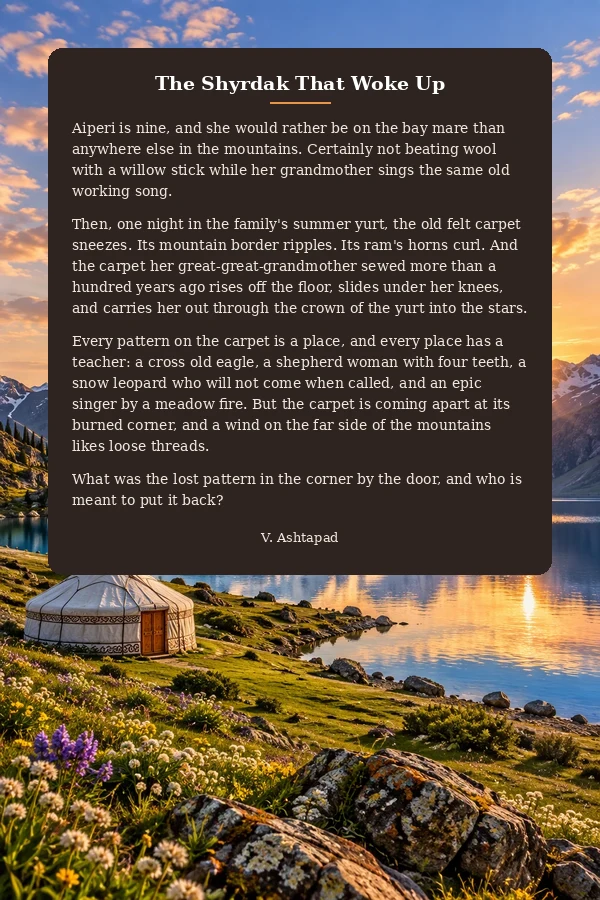
Aiperi is nine, and she would rather be on the bay mare than anywhere else in the mountains. Certainly not beating wool with a willow stick while her grandmother sings the same old working song.
Then, one night in the family's summer yurt, the old felt carpet sneezes. Its mountain border ripples. Its ram's horns curl. And the carpet her great-great-grandmother sewed more than a hundred years ago rises off the floor, slides under her knees, and carries her out through the crown of the yurt into the stars.
Every pattern on the carpet is a place, and every place has a teacher: a cross old eagle, a shepherd woman with four teeth, a snow leopard who will not come when called, and an epic singer by a meadow fire. But the carpet is coming apart at its burned corner, and a wind on the far side of the mountains likes loose threads.
What was the lost pattern in the corner by the door, and who is meant to put it back?
Members can react to this book and talk about it in the members' Library.
Ownership
© 2026 CRUNOD LLC. All rights reserved.
This book is owned by CRUNOD LLC. It is free to read on EternalCurrent.Online. No part of it may be copied, reprinted, sold, recorded or adapted, including as audio, film or translation, without written permission from CRUNOD LLC.
© 2026 CRUNOD LLC. All rights reserved.