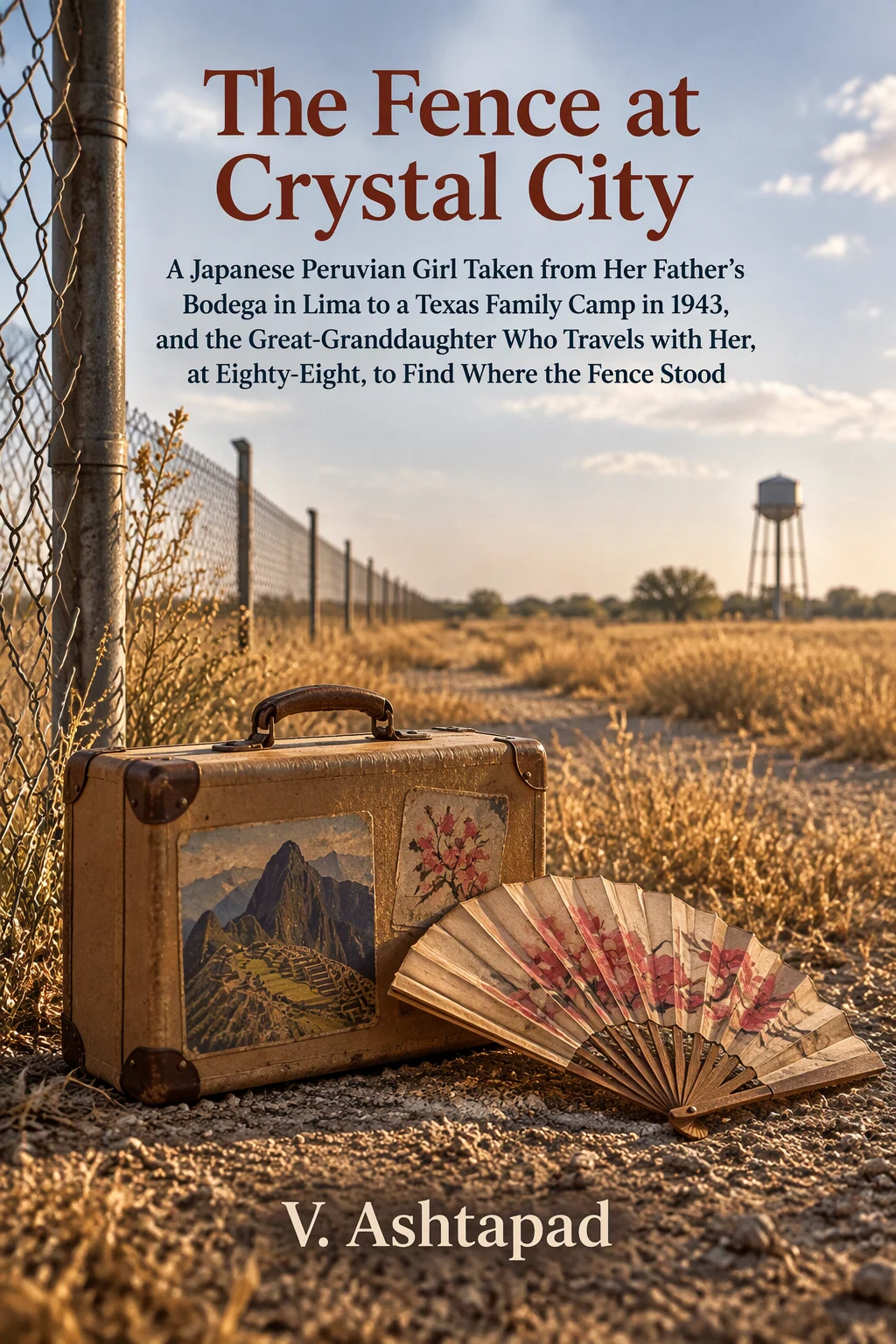
The Fence at Crystal City
A Japanese Peruvian Girl Taken from Her Father's Bodega in Lima to a Texas Family Camp in 1943, and the Great-Granddaughter Who Travels with Her, at Eighty-Eight, to Find Where the Fence Stood
by V. Ashtapad
Foreword
This is a work of fiction. The 1940 attacks on Japanese shops in Lima, the wartime arrest and shipment of Japanese Peruvians to the United States, the seizure of their passports and their classification as illegal aliens, the Crystal City Family Internment Camp in Texas with its Japanese and German families, its cardboard scrip and its swimming pool, the Popeye statue in Crystal City, the postwar deportations to Japan and Germany, the lawyer who fought those deportations, the Seabrook Farms plant in New Jersey and the Battle of Okinawa are real. The Tokeshi family, their friends and every named person in the story are invented.
For the ones who were born behind a fence, and the ones who carried them out.
Now: The Box from New Jersey
The box came on a Tuesday, and my bisabuela would not let anybody open it but her.
It was a brown box with American tape around it three times. The tape said PRIORITY in blue letters. The man from the courier company carried it up the stairs to the third floor because the elevator in my bisabuela's building on Avenida Salaverry had been broken since August. He was breathing hard when he got to the top. He said it was not heavy, it was only big. My mother gave him two soles for a drink and he went back down.
My bisabuela's name is Emiko Tokeshi. On her identity card it says Rosa Emiko Tokeshi Higa, but nobody calls her Rosa. She is eighty-eight. She is the smallest grown person I know. When she stands next to me, the top of her head comes to my ear, and I am ten.
"Leave it on the table," she said. "Fiorella, bring the scissors. The small ones. Not the kitchen ones."
I brought the small ones from the drawer by the television. My mother stood in the doorway of the kitchen with her arms folded. She was still wearing her work clothes, the blue blouse from the bank. She had come straight from Miraflores on the Metropolitano and then a combi, because my bisabuela had called her and said, *The box from Cheryl is here.* That was all she said. My mother left work early.
Cheryl is my bisabuela's niece. She lives in New Jersey. She is the daughter of Tío Yasuo, who was my bisabuela's little brother, and who died in May.
I never met Tío Yasuo. He came to Lima once, in 2009, before I was born. There is a photograph of him in my bisabuela's hallway, standing on the beach at Agua Dulce in a white shirt with his trousers rolled up, laughing at somebody we cannot see. He has a round face and big ears. My mother says he had a loud laugh for such a quiet man.
When he died, my bisabuela did not cry in front of us. She went into her bedroom and closed the door. In the afternoon she came out and made tea and asked me about my math test. The next day she went to the Asociación on Gregorio Escobedo to play cards like always on Wednesdays. My mother said that is how people of her generation do it. I said, do what? My mother said, carry it.
Now the box was here.
My bisabuela cut the tape slowly, one strip at a time. She folded each strip and put it in a little pile, the way she does with the strings from bakery boxes. Inside there was newspaper, American newspaper, with pictures of cars for sale. Under the newspaper there were things wrapped in dish towels.
One at a time, she unwrapped them and set them on the lace cloth.
A wooden bird. It was the size of my thumb. It was painted red, with a black face, and a crest on its head like a little hat. There was a safety pin glued to the back, so it was a brooch. Some of the paint had come off the tail.
A round piece of cardboard, stiff, with numbers printed on it. The number said 5. Under the five it said something in English I could not read fast enough.
A photograph, small, with a white border cut in zigzags. Children in bathing suits standing at the edge of a lot of water. Behind them, flat land and a sky with nothing in it.
A tin box that used to hold tea. Inside the tin box, letters.
And an envelope, a new one, with a letter from Cheryl on top.
My bisabuela did not open the letter from Cheryl. She picked up the wooden bird and held it in her palm and kept looking at it.
"What kind of bird is that?" I said.
"A cardinal," she said. "There are no cardinals in Peru."
"Where are there cardinals?"
She put the bird down on the lace. She put her finger on the zigzag photograph, on one of the children. A girl with short hair cut straight across, squinting.
"That's me," she said. "In Texas."
My mother came out of the kitchen doorway then and sat down at the table, which she never does in her work clothes because she says the chairs leave lint.
"Abuela," she said. "You don't have to do this today."
"I'm not doing anything," my bisabuela said. "I'm looking."
I looked too. The girl in the photo was thin, with knees like knots. She had her arms crossed over her chest as if she were cold, even though it looked hot. Everyone in the photo looked hot. The light was very white.
"How old were you?" I said.
"Ten," said my bisabuela. "When we got there, nine. That summer, ten. Like you."
That night my mother and I took the combi home to Pueblo Libre. It was full and I had to stand, holding the bar, with my face near a man's backpack that smelled of fried chicken. The cobrador hung out the door shouting *Brasil, Brasil, Bolívar, sube, sube, hay sitio,* even though there was no sitio. The sky was the same gray it is every night from June to November, the color my father calls panza de burro, donkey's belly. The garúa was coming down, not real rain, just wet air that makes the windows sweat.
"Mamá," I said. "Why was Bisabuela in Texas?"
My mother looked out the window for a while.
"She'll tell you," she said. "If she wants to. It's hers to tell."
"Do you know?"
"Some," she said. "Not all. Nobody knows all of it. Maybe not even her."
I thought about the wooden bird all the way home. A red bird from a place with no cardinals. A girl with her arms crossed in the heat.
© 2026 CRUNOD LLC. All rights reserved.
Then: The Bodega on Jirón Huánuco
My father's store sells everything.
Rice from a sack with a tin scoop. Sugar in a sack. Noodles. Kerosene in a can with a little tap, ten centavos a bottle, and people bring their own bottles. Candles. Soap in long yellow bars that my father cuts with a wire. Bread comes at five in the morning from the bakery on the corner, in a big basket, and by seven it is gone. Matches. Cigarettes one at a time, for the men who cannot pay for a pack. Chancaca, the brown sugar in round cakes wrapped in dry leaves. Dried shrimp from a jar that I am not allowed to open. Pisco in a big glass jug.
The store is on Jirón Huánuco, in La Victoria. It has a counter of dark wood worn pale where people lean. Behind the counter there are shelves to the ceiling, and a ladder on wheels, and my father goes up the ladder like a cat.
My father is Tamotsu Tokeshi. He came from Okinawa when he was sixteen, on a ship that took fifty days. His uncle had a store in Callao. My father worked there for nine years and then he had his own.
My mother is Shizue. She came from Okinawa too, later, to marry him. She had a photograph of him and he had a photograph of her. She says when she got off the ship he was shorter than in the photograph. He says she was prettier.
I have a brother, Shoichi. He is thirteen. He has a bicycle that used to be the bread man's. He delivers kerosene with it and gets paid in centavos and keeps them in a sock.
I am Emiko. At school I am Rosa. At school there is Señorita Ana for reading and Señorita Delia for arithmetic. Everyone in my class is Peruvian except me and Chela Miyashiro, but we are Peruvian too. We were born here. We have the papers. My father keeps them in a tin box under the floor of the back room, with the money.
We live behind the store and upstairs. Upstairs is two rooms. My mother's sewing machine is by the window. On the wall there is a calendar from the Banco Italiano with a picture of a mountain in the snow.
In the morning I wake up to the bread basket. I wake up to the sound of the street. The water man with his donkey. The tamale woman on Sundays calling *tamaleeees.* The streetcar on the avenue, the bell. The radio in the barbershop across the street, which is a Japanese barbershop, Señor Oyama's, playing música criolla because his customers like it.
My father says good morning to everyone in Spanish. He says it in Japanese only to my mother. To Shoichi and me he says it in both, and then something in Okinawan that is only for the family, like a password.
---
The windows in the front of our store are new. That is because of 1940.
I was six. I don't remember all of it. I remember noise, like a football match. I remember my mother pulling me by the arm up the stairs. I remember the sound of glass. A lot of glass. I remember the smell of kerosene in the street, because they broke the can with the tap.
They broke the whole store. Not just ours. All the Japanese stores on the street, and on the avenue, and in other parts of Lima. They took the rice and the sugar and the soap and the candles. They took the ladder on wheels. A neighbor brought the ladder back two days later and said he found it in the street. My father thanked him. My mother didn't say anything.
Afterward, my father fixed the store. It took a long time. He borrowed money from the tanomoshi, which is when Japanese families put money in together every month and one family takes it. That's how he bought the glass.
Señora Celedonia from the house next door brought us a pot of chicken soup the day after. She is not Japanese. She is from Ayacucho. She sat in our back room and cried and said *qué vergüenza, qué vergüenza,* what a shame, what a shame. My mother made her tea.
I don't talk about 1940 at school. Nobody does.
---
Now it is 1943. January. Summer.
In summer in Lima the gray goes away. The sun comes out. The sea at Chorrillos is cold even in summer and my brother says if you stay in more than a count of fifty your feet turn blue.
My father has been listening to the radio at night with the volume very low. He listens to the news in Spanish, and when the news is about Japan, he sends me upstairs.
There is a list. I am not supposed to know about the list but everyone knows. The Americans made a list, and the Peruvian police use it. Names of Japanese men. When your name is on the list, they come.
They came for Señor Oyama from the barbershop in December. Two men in suits and a policeman. They let him take a suitcase. His wife closed the barbershop for three days. Then she opened it again and cut hair herself. She is good at it. Shoichi went to her for his haircut and said she was faster than Señor Oyama and didn't talk as much.
Where did they take him, I asked my father.
To Callao, he said. To a ship.
Where does the ship go?
My father cut a bar of yellow soap with the wire. The wire went through and the piece fell.
To the United States, he said.
Why?
He did not answer. He wrapped the piece of soap in newspaper and put it in front of a woman who was waiting with her coins on the counter.
---
They come for my father on the eighth of February.
It's in the morning. The bread has not finished selling. I am doing my school copybook at the end of the counter, letters, a line of capital Rs.
Two men in suits and one policeman. Same as for Señor Oyama.
One of the men in suits says my father's name. He says it wrong. Toque-shi. Like a hat.
My father takes off his apron. He folds it on the counter. He says, can I get a suitcase.
They say yes.
My mother comes down the stairs. She doesn't run. She walks. Her face is like a plate.
My father goes upstairs with her and one of the men goes with them. I hear the wardrobe door. I hear the drawer. Shoichi is out on the bicycle with the kerosene.
The policeman stays in the store. He is young. He has a mustache that is not finished growing. He looks at the shelves. He looks at me.
"What are you writing?" he says.
"Rs," I say.
"Your R is very good," he says.
I don't say thank you.
My father comes down with the brown suitcase from on top of the wardrobe. He is wearing his suit, the gray one for weddings and for the Okinawan association, and his hat. He looks like he is going to a wedding.
He puts his hand on my head.
"Be good to your mother," he says in Japanese. Then in Spanish, louder, so the men can hear: "Take care of the store."
Then he says the family word. The one in Okinawan. Only to me.
They take him out to a black car. The bread basket is still half full. A woman comes in after the car goes and says she wants a pan francés and a candle. I don't know what to do. I give them to her. She gives me the coins. I put them in the drawer.
When Shoichi comes back, the bicycle bell ringing, he sees our mother sitting on the bottom stair with her hands in her lap, and he knows. He doesn't even get off the bicycle. He just stands there with his feet on the ground and the bicycle between his legs and the empty kerosene can tied on the back.
© 2026 CRUNOD LLC. All rights reserved.
Now: Bisabuela's Rules
My bisabuela has rules.
You take off your shoes at the door and put on the slippers from the basket. There are slippers in all sizes, even for the plumber.
You do not put your bag on the table.
You do not leave rice in the bowl. Not one grain.
You do not say *I'm bored.* If you say it, you get given something to do. Last time I said it, I had to sort her buttons by color.
You do not ask her about Texas unless she starts.
That last one isn't a real rule. Nobody said it out loud. But my mother made a face at me on Tuesday when I asked, so I know.
---
On Saturday I went to her apartment by myself for the first time. My mother walked me to the corner of Salaverry and Húsares de Junín and watched me cross. I waved from the other side. She stayed there, small, until I went into the building. The guard downstairs, Don Eusebio, said *buenos días, señorita* and opened the gate. He sits on a plastic chair all day and listens to a radio station that plays only cumbia. When the elevator is broken, he tells you before you push the button, so you don't waste your time.
"Elevator?" I said.
"Still dead," he said. "Like my ex-wife's heart."
I climbed to the third floor.
My bisabuela was in the kitchen making the Saturday lunch. On Saturdays she makes sopa seca, which is not soup and is not dry. It is noodles cooked in a sauce of ají panca and onions and basil until the noodles drink it. She makes it with chicken. With it, she makes a small bowl of something that is from her mother, which is pork cooked slowly in soy sauce and sugar until the fat turns clear. She calls it rafute. It is from Okinawa. Nobody else in my class has eaten it. I asked once.
"Wash your hands," she said. "Then cut the cucumber."
I washed my hands. I cut the cucumber thin, the way she likes, so you can see light through it. She watched me do three slices. Then she went back to her pot.
The things from the box were on the shelf in the living room now. Not in the box. On the shelf, next to the photograph of my bisabuelo Alberto, who died before my mother was born. The wooden bird was lying on its side in a little dish. The cardboard circle with the number 5 was leaning against the photo. The tin of letters was closed.
"You put them out," I said.
"Things shouldn't live in boxes," she said.
We ate at the table by the window. Outside, the gray sky. Down on the street, the buses going by toward the Campo de Marte. The noodles were hot and a little spicy. The pork was so soft it fell apart when I touched it with the chopsticks. I use chopsticks at her house. At home, my father says, *aquí no somos chinos,* and gives me a fork, and my mother says, *ya, Piero,* and he laughs.
After lunch my bisabuela made tea and sat in her chair, the one with the green cushion. I sat on the rug, leaning on the sofa. Usually after lunch she sleeps and I watch videos with the sound off.
She didn't sleep. She looked at the shelf.
"Cheryl's letter," she said. "Bring it to me. And my glasses. The ones for reading, not the ones for television."
I brought them. She read the letter. It was two pages, printed. Her lips moved a little while she read. She reads English slowly but she reads it. She lived in the United States for fifteen years, until she was twenty-four. My mother told me that. It was the only thing my mother told me.
When she finished, she folded the letter and held it on her knee.
"They are going to Crystal City," she said. "In October."
"Who?"
"Cheryl. Some people. Children of people who were there. Grandchildren. Some people who were there, still alive. There are not many of us left." She tapped the letter. "There is a ceremony. A gathering. Cheryl says Yasuo wanted to go. He was going to go this year. He bought the ticket already."
"What's Crystal City?"
She looked at me over the reading glasses. She has eyes that are almost black and very small, with folds at the corners like a fan that has been closed.
"A town in Texas," she said. "With a fence."
I waited. She didn't say anything else for a while. A bus honked down on Salaverry, a long honk, and somebody shouted.
"Yasuo was born there," she said. "Inside. In the hospital, which was a wooden building. He was an American, because he was born in Texas. The rest of us were not anything. They took our passports on the ship. So when we got there we were illegal. You understand? They brought us there and then said we came illegally."
I didn't understand. I said, "Oh."
She laughed. It was a short laugh, through her nose.
"No," she said. "Nobody understands that. It's all right."
She put the letter on the little table beside her and took off her glasses.
"Cheryl says I should go," she said. "In Yasuo's place."
"Are you going to?"
"I'm eighty-eight," she said. "I have a heart that the doctor at the Rebagliati says is like an old clock. I have knees. I have a granddaughter who will say no."
The granddaughter is my mother.
"Are you going to?" I said again.
She closed her eyes. I thought she was going to sleep. Then she said, with her eyes closed:
"Bring me the bird."
I brought it. She held it in her fist, on her knee, and went to sleep holding it. I sat on the floor and watched her sleep. Her mouth fell open a little. Her hand stayed closed.
© 2026 CRUNOD LLC. All rights reserved.
Then: The Ship
My mother says we are going.
She says it at night, upstairs, with the light off, so the neighbors can't see us talking through the window.
The letter came from my father in April. It came through the Spanish embassy, which is now the people who carry letters for the Japanese, because the Japanese embassy is closed. The letter has holes in it. Square holes, where someone cut out words with scissors. My mother holds it up to the lamp and the light comes through the holes.
What my father wrote that they didn't cut out:
He is in Texas. He is well. He eats. It is very hot. Families can come. The Americans say families can come and live together in a camp for families. He says it is up to her. He says the store. He says Shoichi's school. He says Emiko's school. Then there is a hole. Then he says: *I leave it to you.*
My mother folds the letter into a small square.
"The Americans will take us on a ship," she says. "They said so at the embassy. We can go with him or stay here."
"What about the store?" says Shoichi.
"Señor Arce wants to buy it," she says.
Señor Arce has the hardware store two blocks down. He is a fat man with a gold tooth who sits in front of his store in a chair and says *buenos días, japonesita* to me, which I hate.
"For how much?" says Shoichi.
My mother says a number. Shoichi makes a sound like somebody hit him in the stomach.
"That's nothing," he says. "That's nothing, Mamá. The glass alone."
"I know," she says.
"Then don't sell it."
"If we go, the government will take it anyway," she says. "That is what happened to the Nakamuras. They went, and the government took it. Señor Arce will give us something. The government will give us nothing."
"Then don't go."
My mother doesn't answer. Out the window there are dogs barking far away, the way they bark at night in Lima, one dog and then all the dogs.
I lie on my mat and think about Texas. I know Texas from the movies at the Cine Victoria. Cowboys. Horses. Men in big hats shooting at each other. I don't know where my father would fit.
---
We leave on the twentieth of April. From Callao.
We can take one suitcase each and one bundle. My mother sews money into the hem of her coat. I watch her do it. She does it at night with the curtain closed. She sews my father's family's photographs into the lining of the bundle. She sews a little bag of soil from the yard into my pocket. I don't know why. She doesn't say.
I pack: my school dress. My other dress. My shoes, which are on my feet. My copybook. My doll, which is a cloth doll that Señora Celedonia made me with black wool hair, called Pochita. A comb. The wooden spinning top Shoichi gave me when he got too old for it.
Señora Celedonia comes to the door in the morning with a paper bag. In the bag there are alfajores, the round cookies with manjar blanco in the middle, and powdered sugar on top. Twelve. She kisses my mother on both cheeks. She cries again. My mother doesn't.
"You'll be back," says Señora Celedonia. "You'll see. Six months."
Señor Arce comes with the key. My mother gives it to him. He puts it in his pocket. He doesn't look at her face. He looks at the shelves.
We go to Callao in a truck with other families. The truck is open in the back and we sit on our suitcases. The sun is out. It is still almost summer. We go past the Plaza Dos de Mayo and past the long walls of the factories and past the fields where they grow vegetables for Lima, and people on the street look at us. Some people wave. Some people shout. I don't hear what they shout. Shoichi puts his hand over my ear, the one that faces the street.
At the port there are a lot of us. Mothers with babies. Old women. Children with bundles. Everyone is Japanese. Everyone has a suitcase. We stand in lines. Peruvian soldiers stand at the end of the lines. American soldiers stand behind them. The American soldiers are very tall and very pink and they chew gum and their hats are like boats.
A man at a table asks for our papers. My mother gives him the papers. The papers that say I was born in Lima, on Jirón Huánuco, at the Maternidad. That say I am Peruvian.
He takes them. He doesn't give them back.
"Mamá," I whisper. "He kept them."
"I know," she says. "Keep walking."
---
The ship is gray. Everything on the ship is gray. The walls, the stairs, the beds, which are canvas hanging from chains, three on top of each other. The water is gray. The sky over the sea, once Lima is gone behind us, is very blue, and then for days it is just blue and gray.
The women and children sleep in one place. The men in another. There are some men on the ship too. Men from Huancayo, from Trujillo, from Chiclayo. I don't see them much.
I am sick for four days. I lie on the canvas and the canvas swings. My mother holds a pan for me. The smell down there is vomit and diesel and too many people. A baby cries all night. Another baby answers it.
On the fifth day I can eat. The food is bread and stew with beans in it and canned meat that is pink and salty and is called Spam. Shoichi likes it. He says he could eat nothing else forever. My mother eats the bread and gives her meat to Shoichi.
We go through Panama. Through the canal. I stand at the rail with Shoichi and watch the ship go up, inside the big box of water, the locks, and the walls are higher than our house. Green hills. Birds I don't know the names of. Men on the edge of the locks watching us. Black men, and white men, and a boy fishing who waves.
I wave back. A soldier says something in English and points at me. Shoichi pulls my hand down.
"Don't," he says.
"Why?"
"Just don't."
---
We get to New Orleans on the third of May. It smells like wet dirt and coffee. It is so hot that my dress sticks to me before I even get off the ship.
They take the women into one building and the men into another.
In the building there is a woman in a white uniform. She tells us, with her hands, to take off our clothes. All of us. All the women. All the girls. My mother puts her hand on my shoulder and doesn't let go.
They spray us with something. White, like powder, cold. It goes in my nose. It goes in my hair. It smells like medicine and like the stuff Señora Celedonia puts on the cockroaches.
My mother stands with her eyes closed. Her coat with the money in the hem is on a hook somewhere with all the other coats.
Afterward, we get dressed. My mother finds her coat. She puts her hand on the hem and feels along it. Her face doesn't change. But she lets out her breath.
Then a man asks for our passports.
My mother says, through a woman who speaks Spanish: they took them in Callao.
The man writes on a paper.
The woman who speaks Spanish tells my mother what he wrote. My mother repeats it to Shoichi later, on the train, in Japanese, with her lips tight.
It says we have entered the United States without a visa or passport. It says we are illegal aliens.
Shoichi laughs, a horrible laugh, and the woman across from us on the train looks at him.
"They brought us," he says. "They brought us on their own ship."
"Shh," says my mother.
I look out the train window. Flat land. Water in the fields. Trees with gray stuff hanging off them like old men's beards. Then cotton, I think. Then nothing. Flat and flat and flat.
I take out the paper bag from Señora Celedonia. There are seven alfajores left. They are a little crushed. The powdered sugar has gotten all over the inside of the bag. I give one to my mother, one to Shoichi, and eat one. Four left. I fold the bag closed. I am saving them for my father.
© 2026 CRUNOD LLC. All rights reserved.
Then: The Fence
The train stops at a place with no station. Just a platform and a water tower and dirt.
The air comes in the door like the air from an oven when my mother opens it to look at the bread. I put my hand on the metal of the seat and take it away again fast.
They put us in buses. The buses go down a straight road. On both sides there are fields, flat, green, with rows. Spinach, says a woman behind us, who reads the English signs. This place grows spinach. The rows go all the way to the edge of the sky.
Then the fence.
It is very tall. Taller than two of my father standing on each other. It is wire, the kind with points, and it goes up and then at the top it bends inward, toward the inside, so if you were inside and tried to climb, the top would lean over you. There are towers. Wooden towers on tall legs, at the corners, with a little roof, and a man in each one. The men in the towers have guns.
The bus goes through a gate. A man in a green uniform closes the gate behind us. I hear it close. A clank and then a chain.
Inside the fence, there are rows of houses. Small houses, all the same, pale, like boxes. There are paths of dirt between them. There are a few trees but they are small and look thirsty. There are children. A lot of children. They stop playing and look at our bus.
Shoichi is next to the window. He is looking at the towers.
"Do they shoot?" I ask.
"I don't know," he says.
---
My father is waiting.
He is standing by a building with a sign, with other men. He is thinner. His face is brown from the sun. He is wearing a work shirt I don't know, khaki, too big, and trousers that are not his, and a hat that is not his, a straw hat with a wide brim. He doesn't look like he is going to a wedding anymore.
He sees us get off the bus. He doesn't move for a second. Then he walks fast. He doesn't run. My father never runs.
He puts his hand on my head the way he did in the store. He puts his other hand on Shoichi's shoulder. He looks at my mother. She looks at him. They don't hug. They are not people who hug in front of other people. But my mother's chin shakes, and she presses her lips together to stop it, and my father nods at her once, like, yes, I know, and that's all.
"You're tall," he says to Shoichi.
"You're thin," says Shoichi.
My father laughs. "The food here is American," he says. "Everything is sweet. Even the bread."
I take the paper bag out of my pocket. Four alfajores, crushed, with sugar all over them.
"From Señora Celedonia," I say.
He takes the bag. He opens it. He looks inside for a long time. Then he folds it closed again and puts it in his shirt pocket and buttons the pocket.
"Later," he says. "We'll eat them later. Together."
---
Our house is half of a house. They call it a duplex. The other half has a family from Huancayo, the Kikuchis, with four children and a grandmother who coughs.
We have two rooms. In one room there is a stove that burns kerosene, a table, four chairs, a sink with cold water. In the other room, four cots with gray blankets. There is one window in each room with a screen. There are flies on the outside of the screen. The bathroom is not inside. The bathrooms and showers are in a building down the path, for everybody, and you walk there with your towel.
The walls are thin. I can hear the Kikuchi grandmother coughing. I can hear the Kikuchi baby. I can hear Señora Kikuchi saying in Spanish to her son, *Jorge, ¡ya basta!*
My mother puts down the bundle. She looks at the room. She opens the cupboard. Inside, there are four plates, four cups, a pot, a pan. Tin.
She takes off her coat and hangs it on the nail behind the door. She runs her finger along the hem of it once.
Then she rolls up her sleeves and fills the pot with water at the sink.
"Tamotsu," she says. "Where is the rice?"
"There is a store," my father says. "With money from here. I'll show you."
---
That night, after everyone is asleep, I get up to go to the bathroom building. I take the flashlight my father gave me, which is from the camp store and smells new.
It is not dark outside. That is the first thing.
There are lights. Big lights on tall poles all along the fence. They shine down and make the dirt white and the shadows black. The lights buzz. Insects go around them in clouds. And from the towers, every little while, a light swings across the camp. Slowly. Over the roofs. Over the paths. Over me.
I stand still when it passes over me. I don't know why. It goes on.
The sky above the lights is black. In Lima the sky at night is never black. It's gray, or brown from the city. Here it's black and there are more stars in it than I have ever seen. But I can only see them if I stand in the shadow of the bathroom building where the big lights don't reach.
I stand there a long time. It's still hot, even at night. Something is singing in the grass by the fence, a hard dry sound like somebody shaking seeds in a gourd. A man in the tower is smoking. I can see the red end of his cigarette go bright and then dim.
I think: the fence is to keep us in.
Then I think: or to keep somebody out.
I don't know which. I go to the bathroom. I go back to bed. Shoichi is awake on his cot with his arm over his eyes.
"Emi," he says. "Did they shoot?"
"No," I say.
"Good," he says.
© 2026 CRUNOD LLC. All rights reserved.
Now: The Embassy
My mother said no. Then my grandmother said no. Then my aunt in Arequipa called on video and said no, with her face too close to the camera so all we could see was her nose and her eyebrows.
My bisabuela said, "I'm not asking."
---
It was Sunday lunch at our house in Pueblo Libre. Everyone comes to our house on Sundays because we have the patio. My father grills. He makes anticuchos, beef heart on skewers, which he marinates the night before in vinegar and ají panca and cumin and garlic, and the whole street smells it. He also makes chicken for my cousin Matías who won't eat heart. My mother makes the rice and the salad and my grandmother Kiyomi brings a causa, which is yellow potato mashed with lime and ají amarillo, in layers, with tuna and avocado in the middle. My grandmother Kiyomi is my bisabuela's daughter. She is sixty-four and works at a pharmacy in San Isidro and talks very fast.
They waited until after the anticuchos. My father says you never argue before the anticuchos.
"Mamá," said my grandmother Kiyomi to my bisabuela. "It's three days of traveling. Lima to Houston is seven hours. Then the drive. Your heart."
"My heart has been to Houston before," said my bisabuela. "In 1985. To Cheryl's wedding."
"In 1985 you were fifty-one."
"Fifty-two."
"You can't even walk to the market."
"I walk to the Asociación every Wednesday. That is eleven blocks."
"With Fiorella," said my mother. "With Fiorella holding your arm."
Everyone looked at me. I looked at my plate.
"And the visa," said my father. He was standing at the grill turning the chicken. "They give appointments for next year now. I saw on the news. Two years in some places. People camping out in Surco."
"Then I'll go next year."
"Next year the ceremony is over."
"Then I won't go," said my bisabuela. She put down her fork. She folded her napkin in half and then in half again. "Then I'll stay here and Yasuo's ticket will stay in a drawer in New Jersey and nobody from our family will be there. Fine. You decide. You're the young people."
Nobody said anything. My cousin Matías asked if there was more chicken. My father gave him more chicken.
Afterward, in the kitchen, my mother washed the plates very hard.
"She's doing it on purpose," she said to my father. "The napkin. The *you decide.* She knows exactly."
"I know," said my father.
"She's eighty-eight, Piero."
"I know." He dried a plate. "Giuliana. When my father wanted to go back to Cajamarca, to see the house he was born in, before he died, I said no. Too far, too high, his lungs. You remember? I said no. And then he died anyway. In the hospital in Lima, with a tube in his nose, looking at the ceiling."
My mother stopped washing.
"That's not fair," she said.
"No," he said. "It's not."
---
It turned out about the visa that my father was wrong.
My mother found out on the internet, at night, with her glasses pushed up on her head. For people over seventy-nine, there is no interview. You fill out the form, and you take the papers to a place, and they look at them, and if they like them, they give you the visa. No line in Surco. No standing in the sun.
"Because they think we're too old to be dangerous," said my bisabuela when my mother told her.
"Because they don't want you fainting in their lobby," said my mother.
"Same thing."
The form was long. My mother did it at the table in my bisabuela's apartment on a laptop, and I sat next to her and read the questions out loud.
"Have you ever been arrested?" I read.
"No," said my bisabuela.
"Have you ever been in the United States?"
"Yes."
"Have you ever been refused entry to the United States, or deported?"
My bisabuela didn't say anything.
My mother looked at her.
"Abuela?"
"Write no," said my bisabuela. "I left on my own feet. With a ticket. In 1958. On a Panagra plane, from Miami."
"And before?" said my mother carefully.
"Before, they brought me." She looked at the laptop as if it were a person. "There's no box for that. Look. Look at the boxes. Is there a box that says, *Have you ever been put on a ship by the United States and taken there against your will and kept behind a fence and called illegal?*"
My mother scrolled. "No," she said.
"Then write no."
My mother wrote no.
---
We took the papers to the place in San Isidro on a Thursday. It was an office on the fourth floor with a fake plant and chairs bolted together. We waited one hour and forty minutes. A woman behind glass took the passport and the form and the photograph, which was a photograph we took at a shop on Avenida Brasil where the man made my bisabuela take off her earrings and said *don't smile, abuelita,* and she said *I wasn't going to.*
The woman behind glass looked at my bisabuela's date of birth.
"Nineteen thirty-four," she said, in Spanish, but with an accent from somewhere else. "And you've been to the United States before?"
"Yes."
"When?"
My bisabuela looked at her. My mother put her hand on her arm.
"Many times," said my bisabuela. "First time when I was nine."
"Purpose of this trip?"
"A ceremony," said my bisabuela. "For my brother."
The woman wrote something. She stamped something. She gave back a paper with a number on it and said the passport would come back by courier in ten working days.
When we got outside, the sun had come out. Sometimes in Lima in October the sun comes out in the afternoon, just a little, like it's checking. My bisabuela stood on the sidewalk on Avenida Javier Prado with the trucks and the buses going by in a roar and lifted her face up into it.
"Ten working days," she said. "In 1943 it took six weeks for a letter. With holes in it."
"What holes?" I said.
She looked down at me. She took my arm.
"Come," she said. "I'll buy you a picarón. And I'll tell you about the holes."
© 2026 CRUNOD LLC. All rights reserved.
Then: Tokens and Ice
Money here is not money.
It is round pieces of cardboard, stiff, a little shiny, with numbers on them. One cent, five cents, ten, twenty-five, a dollar. They have holes in the middle of some of them. You can only spend them inside the fence. Outside the fence, they are nothing.
My father earns them. He works in the vegetable gardens, which are outside the houses but inside the fence, big fields of tomatoes and onions and cabbages and eggplant that the Japanese men planted. He earns ten cents an hour. Shoichi works at the bakery in the mornings before school and earns less. My mother works in the sewing room, making clothes for everybody, and earns the same as my father but she says it's not the same work.
With the cardboard money we buy things at the store. The store is a big building with shelves like my father's store in Lima, but bigger, and with things I don't know. Peanut butter. Corn flakes. Soap that smells like flowers. There is rice. Not good rice, my mother says. American rice that goes soft. But rice.
The first time we go to the store, my father stands in the aisle and looks at the shelves for a long time. He doesn't buy anything for a while. He just looks. He touches the cans. He reads the prices.
"Papá," says Shoichi. "What are you doing?"
"Counting," says my father. "How much they buy. How much they sell. Who orders."
"You can't have a store here."
"No," says my father. He picks up a can of peaches. He puts it in the basket. "But I can know how one works."
---
Every morning the ice man comes. The ice comes in a truck from town, from outside, and the ice man is a man from outside too, a Mexican man named Señor Rangel, very brown, with a hat with a leather band. He has a big pair of tongs. He carries the block on his shoulder on a burlap sack and puts it in the icebox in our kitchen. One block a day. It is gone by the afternoon.
Señor Rangel speaks Spanish. When he hears me speak Spanish to Shoichi, he stops with the tongs in his hand and looks at me.
"¿Y tú? ¿De dónde eres, mija?"
"De Lima," I say.
"¿De Lima, Perú?"
"Sí."
He shakes his head. He says, half to himself, *pues mira nada más.* Then he winks at me and puts the ice in the box.
After that, every morning, he says something to me in Spanish. *Buenos días, limeña. Hace calor, ¿verdad? ¿Ya desayunaste?* And once, when nobody else is in the kitchen, he takes a sliver of ice that broke off the block and gives it to me, wrapped in a corner of his sack. I hold it until it melts down my wrist.
He lives in Crystal City. The town. Outside. He says it has a statue of Popeye in the middle of it. Popeye, from the cartoons, with a can of spinach, because of all the spinach. I don't believe him. He says, *te lo juro, limeña, en la plaza.*
I think about the statue of Popeye a lot. I think about it at night. A town on the other side of the fence, with a cartoon in the plaza, and Señor Rangel's house, and his children, who he says are four, and his wife, who makes tortillas every morning by hand. I can see the water tower of the town from our window. That's all I can see.
---
There are two schools.
There is the Japanese school, where the teachers are Japanese men and women from inside the camp and everything is in Japanese. And there is the American school, where the teachers are American women from outside who come in through the gate every morning, and everything is in English.
Most of the children from Peru go to the Japanese school. Most of the children from California and Hawaii and Seattle go to the American school. My mother says I go to the Japanese school. My father says I go to the American school. They argue about it in low voices, in the next room.
My father wins. I don't know why. My mother says nothing for two days.
On the first day at the American school, the teacher says something to me and I don't understand anything. Not one word. She says it again slower. I still don't understand. She looks at a paper on her desk and says, "Ro-sa?" and I nod.
The other children laugh. Not all of them. Some.
At recess a girl comes over to me. She has two braids pinned up on her head and freckles on her nose, which I have never seen on a Japanese girl. She has a skirt with a pattern of pineapples on it. She is from Hawaii.
"You're from Peru?" she says. In English. I understand *Peru.*
"Sí," I say. "Lima."
She points at herself. "Leontyne," she says. "Leontyne Nakata. Hilo."
"Emiko," I say. Not Rosa. "Emiko Tokeshi."
"Tokeshi?" Her eyes get big. She says something fast. Then, slowly: "Okinawa? Tokeshi, Okinawa?"
I nod. She points at herself again. "Nakata, Okinawa! My grandpa!"
She says a word. A word in Okinawan. The word that my father says to us. The family word.
I stare at her.
She says it again and laughs and grabs my hand.
That's how I learn English. From Leontyne Nakata from Hilo, who speaks Hawaiian English that the teacher says is not correct, with words in it from Japanese and Portuguese and Hawaiian and Okinawan, so when I speak English the way she teaches me, nobody understands me either. Leontyne doesn't care. Leontyne says, *Emi, no make li'dat,* when I'm sad. I don't know what it means but I know what it means.
I teach her Spanish. She says *chévere* about everything. The teacher doesn't know what it means. Leontyne tells her it means *very good, ma'am.*
© 2026 CRUNOD LLC. All rights reserved.
Then: The Pool
In the summer of 1944 the men build a swimming pool.
Not exactly build. There is a big round tank in the ground at the edge of the camp, for water for the fields. The men make it into a pool. They dig. They pour concrete. They make steps. They build a little wooden house next to it for changing and a tower for a lifeguard. The Germans help, from the German side. The Germans are on the other side of the camp, in their own houses, with their own school. I don't go there. But the men from both sides work on the pool together, in the heat, with their shirts off, and they don't talk much because they don't speak the same language, but they point and they nod and they share the water bucket.
My father works on it. He comes home with his back red and peeling and my mother puts on it the cream that smells like lard.
When it is finished, it is the biggest water I have seen since the sea at Chorrillos.
It's very hot that summer. The kind of hot where the air shakes over the dirt. Where the tar paper on the roofs gets soft and smells. Where if you touch the metal handle of the door at the bathroom building you burn your hand. The pool is the only cool thing for a hundred miles. Everyone goes. Japanese children in the morning. German children in the afternoon. Or the other way around, I forget. Leontyne and I go every single day we're allowed.
I can't swim. Nobody taught me. In Lima the sea is too cold and too rough. Leontyne teaches me. She holds me under my stomach and says *kick, kick, kick, Emi!* and I kick and swallow water and come up coughing, and she laughs so hard she goes under too.
By August I can swim across. Not fast. But across.
---
The German girl is named Liesl Gerdes. She is from Lima too.
I find this out at the pool. She is sitting on the edge with her feet in the water, waiting for her turn, and she says to another German girl, in Spanish, *ay, qué calor, me muero.* Oh, how hot, I'm dying. With an accent from Lima. From Miraflores, I think. The way the rich girls talk.
I swim over to her. I hold onto the edge.
"¿Eres de Lima?" I say.
She looks down at me. She has hair so pale it is almost white, and her nose is burnt pink and peeling, and her eyes are blue like the medicine bottles in my father's store.
"De Miraflores," she says. "¿Y tú?"
"La Victoria. Jirón Huánuco."
She makes a face. Not mean. Just a face, like, oh, La Victoria, because nobody from Miraflores goes to La Victoria except to the market.
Then she says, "My father had a pharmacy on Avenida Larco."
"My father had a bodega."
"Had," she says.
"Had," I say.
The lifeguard blows his whistle. It's the Germans' turn. I have to get out. Liesl gets in.
After that, when I see her at the pool, we say *hola.* That's all. Sometimes she says something about Lima, the beach at Herradura, the ice cream at a place on Larco, the trolley, and I say something back. We never visit each other's side. Our mothers would not like it. The Japanese mothers don't talk to the German mothers. Leontyne asks me why I talk to the haole girl and I say, she's from Lima, and Leontyne says, *so what, you're from Lima too,* like that settles it, and it does.
---
My mother is going to have a baby.
She has a belly that gets bigger all summer. She walks slowly. She sits in the doorway in the evening, when the heat breaks a little, with a wet cloth on the back of her neck. She makes me bring her ice from the icebox and holds it on her wrists.
My father is worried. I can tell because he talks more. When he is worried he talks about the store. About the right way to stack cans so the labels face out. About how to weigh rice so the customer sees the scale go just a little over, so they feel lucky. He talks about it at dinner, and my mother says, *Tamotsu,* and he stops.
The baby is born on the second of September, in the hospital, which is a long wooden building at the edge of the camp with fans in the ceiling. A boy.
My father brings Shoichi and me to see him. He is red and wrinkled and has black hair that sticks straight up. He is wrapped in a blanket that says U.S. on the corner.
"Yasuo," says my mother. She is very tired. She has dark circles under her eyes. But she smiles. "His name is Yasuo. It means peaceful."
"He's American," says Shoichi.
My father and mother look at him.
"He was born here," says Shoichi. "In Texas. So he's American. That's the law. A boy in my class told me. Everybody born here is American. Even here. Even behind the fence."
Nobody says anything. The fan in the ceiling goes around. Somewhere outside a truck is backing up, beeping.
Then my father starts to laugh. Quietly at first. Then more. He puts his hand over his mouth. His shoulders shake. My mother looks at him like he is crazy, and then she starts to laugh too, holding her belly where it hurts, saying *ay, ay, don't, it hurts,* and Shoichi and I stand there not knowing what's funny.
"The only one of us," my father says, wiping his eyes. "The only one of us who's allowed to be here."
Yasuo opens his mouth and yells.
That night, my father takes the paper bag out of his shirt drawer. Señora Celedonia's bag. The four alfajores. They have been there since May of last year. They are hard as stones. The manjar blanco inside has gone dark. The sugar has turned to a crust.
He gives one to my mother, one to Shoichi, one to me, and takes one himself. We sit on the cots in the dark, with the light from the tower going over the window every little while, and we try to eat them. They're terrible. They crack. They taste like the paper bag.
We eat every crumb.
© 2026 CRUNOD LLC. All rights reserved.
Now: The Holes
The picarón cart was on the corner of Javier Prado and Las Begonias, under a tree, where a woman with a white apron and a white hat fried them in a big black pan of oil. Picarones are rings of dough made with squash and sweet potato, and you eat them hot, with syrup poured over them from a bottle. The syrup is chancaca syrup, dark, with orange peel and cinnamon and clove in it. Four picarones cost eight soles. My bisabuela paid with a ten and told the woman to keep the change.
We sat on a bench by the bus stop. My bisabuela ate one picarón very slowly, holding the paper plate under her chin so the syrup didn't go on her blouse. I ate three.
She told me about the holes in my bisabuelo Tamotsu's letter. The square ones, cut by somebody with scissors. How she held the letter up to the lamp.
"What did they cut out?" I said.
"We never knew," she said. "My father said afterward he couldn't remember what he wrote. Maybe the name of the camp where they put him first. Maybe the weather. Maybe that he was afraid." She wiped her fingers on the paper napkin. "Once I asked him. When I was grown. In New Jersey. He said, I probably wrote that I missed the bread."
"Why would they cut out the bread?"
"Exactly," she said.
---
That night I asked my mother if I could use her old phone.
My phone is a phone but it has no plan, only wifi, and the camera is bad. My mother's old phone has a better camera and a crack in the corner that doesn't matter.
"For what?" she said.
"For Bisabuela."
My mother studied my face. Then she went to the drawer in the kitchen where she keeps the phone chargers and the batteries and the takeout menus and gave me the phone.
"She might say no," my mother said.
"I'll ask."
---
On Saturday, after the sopa seca, I asked.
"Bisabuela, can I record you? When you talk about it?"
She was in her chair. She looked at the phone in my hand.
"What for?"
"For me. For later. For Cheryl." I thought. "For when I'm old."
She laughed through her nose. "When you're old, phones will be inside your head."
"Then I'll put it in my head."
She didn't say yes. She didn't say no. She took the bird out of the dish on the shelf and held it the way she does, in her fist on her knee.
"Turn it on," she said. "But don't put it in my face. Put it on the table. I don't want to look at it."
I put it on the little table next to her tea. I pressed the red button. The time started counting.
At first she didn't say anything. The phone counted. Ten seconds. Twenty. A car alarm went off down on Salaverry and stopped.
Then she said, in Spanish:
"My name is Emiko Tokeshi. I was born on Jirón Huánuco in La Victoria, in January of 1934. My father had a bodega."
And then she talked for forty-one minutes.
She talked about the bread basket in the morning. About the kerosene can with the tap. About the glass, in 1940. About Señora Celedonia from Ayacucho and the alfajores. About the men in suits saying *Toque-shi, like a hat.* About the ship and the spray in New Orleans. About Señor Rangel and the ice.
Sometimes she stopped for a long time. Sometimes she said *no, wait, that's wrong, it was the other way,* and said it again. Sometimes she said a word in English, or in Japanese, or in the Okinawan words that she says are almost gone, that her father used to say only to the family. When she said one of those, she said it twice, slowly, and then said what it meant, as if she knew somebody would need it.
When she stopped, she said, "That's enough. Turn it off. I'm tired."
I turned it off. Forty-one minutes and twelve seconds.
---
That night at home, my mother helped me put it in the place where our family keeps things.
It's a private space online that my mother set up after my grandfather Oscar died, so the photos wouldn't get lost in everybody's phones. Only our family can see it. There are albums in it. My mother's wedding. My first birthday at the chifa on Capón street, with my face covered in cake. My grandfather Oscar holding a fish at Pucusana. Each photo has a little line under it saying who and where, because my mother says a photo without a name is a photo of a stranger.
There is also a tree. A family tree. My mother started it and my grandmother Kiyomi added things, and my aunt in Arequipa added things, and now it has eighty-three people in it. Most of them I don't know. On my bisabuela's side, the tree goes back to Tamotsu Tokeshi and Shizue Higa, and then stops. Above them there are two empty boxes with question marks. Okinawa, it says. Nobody knows more.
Under my bisabuela's name, there was a place to add a recording. I added it. I wrote a title. I wrote: *Bisabuela Emiko, part 1. La Victoria, the ship, Texas.* I wrote *part 1* because I knew.
Then I went to Tío Yasuo's box in the tree. He has a photo, the one from the beach at Agua Dulce. It says: *Yasuo Tokeshi, born Crystal City, Texas, 1944. Died Bridgeton, New Jersey, 2022.*
I looked at the word *born* for a long time.
Then I went to bed. In bed, I said one of the Okinawan words my bisabuela said, the one that means something like *take care of yourself, eat well, come back.* I said it twice, slowly. I said it to the ceiling. I didn't know if I was saying it right. There was nobody to check except her.
© 2026 CRUNOD LLC. All rights reserved.
Then: The End
In the spring of 1945 the war in Europe ends.
We know because the German side is very quiet one day, and then very loud, and then very quiet again. The Germans have a radio. Everybody has a radio. The Americans let us have them now. But we don't understand the German side's news, only that something happened. Then the American teacher at school says, Germany has surrendered, children, and some of the children from California clap, and some don't.
Liesl is not at the pool for a week. When she comes back, she doesn't say anything about it. Neither do I.
---
In August the war with Japan ends.
That is different. The whole camp goes still. It's like the moment before the fan comes on in the hospital, when the air stops moving.
The men stand together on the paths at night and talk in low voices. Some of them don't believe it. Some of them say it's American lies. There are men who say Japan won. They say it at the bathhouse, and in the gardens, and some of them believe it so much they get into fights. My father doesn't say what he believes. He goes to work in the gardens. He comes back. He eats. He goes to sleep.
I hear my mother crying in the night. Not loud. Just breathing wrong.
"What's wrong with Mamá?" I ask Shoichi.
Shoichi is fifteen now. He's taller than my father. He has a mustache that is not finished growing, like the policeman in our store. He reads the English newspaper that comes in from outside, the San Antonio paper, even though he doesn't understand all of it.
"Okinawa," he says.
"What about Okinawa?"
He doesn't want to tell me. I make him. He tells me.
There was a battle there. On the island. In the spring. A big battle. Very big. The newspaper says a lot of people died. Soldiers and not soldiers. Farmers. Families. Old people. Children. The newspaper says a number and Shoichi won't tell me the number.
My father's mother lived there, in a village by the sea. My mother's two sisters.
There's no way to know. No letters go there. No letters come back.
I don't know what to do. I go outside and sit in the shade of the house and hold my knees. Yasuo is in his basket in the doorway, sleeping, with a cloth over the basket for the flies. He is almost one. He doesn't know anything about Okinawa. He just knows the inside of the fence.
---
Then the Americans say we have to leave.
The war is over. The camp is closing. Everyone has to go somewhere.
The people from California and Seattle can go home, or what's left of home. The people from Hawaii can go back to Hawaii.
The people from Peru can't go back to Peru.
Peru says no. Peru says we're not wanted. Not even the ones born there, with papers. Not even me. The papers that the man in Callao took — they're gone, or in a file somewhere, and Peru says we're Japanese, so go to Japan.
The Americans say: go to Japan.
My father says: we have never lived in Japan. Okinawa is not even Japan, not really. And Okinawa is gone.
They say: Japan.
---
Leontyne leaves in November.
There is a ship to Hawaii from California. Her family takes the train. They've packed for a week. Her mother sold everything they couldn't carry to the families who are staying, and my mother bought a little iron pot from her for ten cents in cardboard money.
On the last day, Leontyne comes to our door. She's wearing the skirt with pineapples on it, which is too short now, and a coat, even though it's not cold, because it doesn't fit in the suitcase.
"Emi," she says. "No cry, eh."
I'm already crying.
"I write you," she says. "You write me. Hilo, Hawaii. Just Nakata, Hilo, Hawaii. Everybody know us."
"I don't know where I'll be."
She thinks about that. "Then you write me first," she says. "Then I know."
She takes something out of her coat pocket. A little wooden bird. Red. With a black face and a crest on its head like a hat. There's a safety pin glued on the back.
"My grandpa made," she says. "Is a cardinal. They have here, in Texas. We don't have in Hawaii. So you keep. You going be the one stay longer."
I hold the bird. It's the size of my thumb. I can feel where the knife made each little cut.
"I don't have anything for you," I say.
"Say the word," she says.
I say the family word. The Okinawan one. She says it back. Then her father calls her from the truck and she runs.
I pin the bird on my dress. Right over my heart. My mother sees it and doesn't say anything, just reaches over and straightens it, because it's crooked.
© 2026 CRUNOD LLC. All rights reserved.
Now: Houston
The plane left Lima at one in the morning.
We went to the airport at nine at night in my father's car, all of us: my father, my mother, my grandmother Kiyomi, my bisabuela, me. The suitcases were in the trunk. My bisabuela's suitcase was small and blue and had a ribbon tied to the handle so she could find it, a red ribbon, from a box of chocolates.
At the airport, my father hugged me and said, "Take care of the two of them."
"I'm ten," I said.
"That's why," he said.
Only three of us were going. My bisabuela, my mother and me. My grandmother Kiyomi couldn't get the days off at the pharmacy. She stood at the barrier where only travelers can pass, and held my bisabuela's hands for a long time, and said things I couldn't hear, and my bisabuela nodded and nodded.
We had a wheelchair. An airport man pushed it. My bisabuela said she didn't need it, and then she sat in it, and then she was asleep before we got through security.
---
On the plane, I had the window. My bisabuela had the middle. My mother had the aisle so she could get up.
It was dark the whole way. I couldn't see anything out the window except a red light blinking on the wing. My bisabuela slept with her mouth open and her hand on the armrest. I put my hand on top of her hand. It was very light, like paper over sticks.
Somewhere over Central America I woke up. My bisabuela was awake. She was looking past me out the window.
"Panama," she said. "We're over Panama."
"How do you know?"
"I don't," she said. "But we must be."
She didn't say anything else. I thought about the canal, the big box of water, the walls higher than a house, the boy fishing who waved. I thought about her waving back and Tío Shoichi pulling her hand down.
---
Houston was hot. Not like Lima. Lima in October is gray and cool and wet. Houston was hot like a bathroom after somebody took a long shower.
Cheryl was waiting at the arrivals. I knew her from the screen, from video calls on Christmas. She was big and soft, with gray hair cut short, and glasses on a beaded chain, and a T-shirt that said BRIDGETON HIGH CLASS OF '81 REUNION. She was crying before we even got to her.
"Auntie Emi," she said, and bent down to the wheelchair and hugged my bisabuela for a long time.
My bisabuela said something into her shoulder. In English. I didn't catch it.
Cheryl stood up and wiped her face and looked at me.
"And you're Fiorella," she said. She said it Fee-oh-*rella*, wrong, but nice. "Oh honey. You look just like her. You look just like the picture."
"What picture?" I said, in English, which I speak well because of the English school on Saturdays.
"The pool picture," she said. "Dad had it on his desk my whole life."
---
We stayed one night in a hotel by the airport, where everything smelled like carpet cleaner, and the next morning Cheryl drove us in a rented car that was very big and white. It took five hours. Across Houston on highways with five lanes going one way. Then the highway to San Antonio, straight and flat, with billboards for lawyers and for fireworks and for a water park, and gas stations as big as the supermarket on Avenida Brasil. My bisabuela sat in the front because of her legs. I sat in the back with my mother.
After San Antonio, the land changed. Flatter and drier. Brush, gray-green, low, with thorns. Cactus with flat paddles. Fields with nothing in them, the earth plowed in rows. Cows standing under a single tree to share its shade. Oil pumps going up and down slowly in the middle of fields, like birds drinking.
Nobody talked much. Cheryl played music from the seventies on the radio. My bisabuela looked out the window.
At one point she said, "There."
Cheryl slowed down. "What, Auntie?"
"Spinach," said my bisabuela. "Those rows. That's spinach."
It looked like any green to me. Low and flat, in long rows, going to the edge of the sky.
"Maybe," said Cheryl. "They still grow some here. Not like before. Mostly the onion and the cabbage now, I think. And the oil."
"That's spinach," said my bisabuela again, quietly, to herself.
---
Crystal City was small. Smaller than Pueblo Libre. Smaller than Jesús María. Low buildings, a lot of them closed. A Dollar General. A taquería with a hand-painted sign. A tire shop. A water tower that said CRYSTAL CITY on it in blue.
My bisabuela saw the water tower and sat up very straight.
And in front of the city hall, in a little square with a patch of grass, there was Popeye.
A statue of Popeye. Painted. Red and white and blue and black, with a pipe and the big arms with anchors on them, standing on a base. Holding a can of spinach. It was a little faded. Somebody had put a tiny Halloween pumpkin at his feet.
My bisabuela started to laugh.
She laughed so hard she couldn't breathe. She held onto the car door. Cheryl pulled over and stopped. My mother leaned forward from the back seat and said, "Abuela? Abuela? Are you okay?" and my bisabuela waved her hand, *I'm fine, I'm fine,* and kept laughing, and tears ran down her face, and Cheryl started laughing too without knowing why, and so did I.
"Señor Rangel," said my bisabuela finally, wiping her eyes with the back of her wrist. "He told me. *Te lo juro, limeña.* I never believed him. Seventy-nine years. I never believed him."
© 2026 CRUNOD LLC. All rights reserved.
Then: The Last Swim
It's 1946. The pool is still there but it's half empty. They don't fill it anymore. There's green stuff on the bottom and frogs.
The camp is half empty too. Every few weeks, more people leave. Trucks to the train. Trains to the ships. Ships to Japan. Last December, a big group from Peru left for Japan, more than a thousand people from all the camps, and the Kikuchis next door went with them. Señora Kikuchi gave my mother her good knife. The Kikuchi grandmother with the cough didn't go. She died in the hospital in the summer.
Now in the other half of our duplex there's nobody. Just the wind coming through the screen. At night I can hear the door bang.
---
My father didn't go to Japan.
There was a lawyer. An American lawyer from San Francisco, a man with glasses who came to the camp and sat at a table in the school building with a pile of papers. He said the Peruvians could not be deported to a country they had never lived in. He said it was against the law. He said he would fight it.
My father went to see him. He came back and sat at the table with his hands flat on it.
"He says wait," said my father.
"Wait for what?" said my mother.
"For the courts."
"How long?"
My father turned his hands over. Palms up. Empty.
My mother looked at Yasuo, who was asleep on the cot, two years old, with his thumb in his mouth. She looked at me. At Shoichi, who was sixteen and had stopped going to the American school because there was almost nobody left in his class.
"Then we wait," she said.
---
Liesl goes in December.
The German side is emptying faster than ours. The Germans are going to Germany. Even the ones who've never been there. Even the ones from Lima, from Costa Rica, from Guatemala.
I find out from the pool. The pool is closed now, there's a padlock on the gate, but I go anyway and stand at the fence of it and look at the green water. Liesl is there. She's standing on the other side, the German side, holding the wire.
She's taller. Her hair is in a bun like a grown woman's. She has a coat on.
"Mañana," she says. "Nos vamos mañana."
"¿A dónde?"
"A Bremen. On a ship. My father says it's all destroyed there. My father says we'll live with my aunt in a city that's all broken."
"You've never been there."
"No," she says. "I don't even speak it well. I speak it like a Peruvian. My cousins are going to laugh at me."
We stand there. Across the pool. The water between us is green and still and has leaves in it.
"Do you remember the ice cream on Larco?" I say.
"D'Onofrio," she says. "Lúcuma. In a cone."
"I never had it. We didn't go to Miraflores."
She looks at me. Then she laughs, a short laugh. "When you go back," she says, "go to Larco. Order lúcuma. Say Liesl Gerdes sent you."
"They won't know who you are."
"Then tell them."
She lets go of the wire. She waves. Not a big wave. Just her hand, up and down. And then she walks back toward the German houses, and I walk back toward ours, and I don't see her again.
---
In the spring of 1947, a man comes from a farm in New Jersey.
The farm is called Seabrook. It is very big. It grows vegetables and freezes them in a factory and sells them all over America. It needs workers. It has hired Japanese from the other camps before. It will hire us. It will give us a house. A real house, with a door that closes and nobody on the other side of the wall. And the lawyer says that if we work there, we can stay in America while the courts decide.
My father listens to the man. He asks questions. How many hours. How much money. Real money, not cardboard. Where do the children go to school. How far is the store.
Then he comes home and says, "We're going to New Jersey."
"Where is New Jersey?" I say.
"Far," says my father. "Near New York. It's cold there."
"Cold?" I can't imagine it. I haven't been cold in four years.
"It snows," says Shoichi, who has read about it.
---
On the last day, I go to the fence.
Not the gate. The fence. The back part, behind the hospital, where it's quiet. I put my hand on the wire. It's hot from the sun. I put my fingers through the holes. On the other side there's dirt and brush and a road and, far away, the water tower of Crystal City.
I think about Leontyne. Hilo, Hawaii. I've written her three letters. She's written two back. Her family has a new house. Her grandpa is sick. She has a dog named Kimo.
I think about Liesl. Bremen. No letters. I don't know the address.
I think about Señor Rangel, who stopped coming with the ice when the trucks changed. His four children. The tortillas. The Popeye.
I touch the cardinal on my dress.
Then I take my hand out of the fence and wipe it on my skirt and go back to help my mother tie up the bundle. The same bundle. The one with the photographs sewn into the lining. There's a new one too, now: Yasuo, in the arms of my mother, in front of the duplex, squinting. My father took it with a camera he borrowed. On the back, my mother wrote in pencil: *Crystal City, Texas. 1946. Yasuo, 2 years.*
She sews it in with the others. Small stitches. Very even. She doesn't look up.
© 2026 CRUNOD LLC. All rights reserved.
Now: Where the Fence Was
There is no fence.
That was the first thing I understood, and I understood it from my bisabuela's face before I understood it from looking.
Cheryl parked the big white car on a street at the edge of town. On one side there was a school, a real school, brick, with a parking lot and a sign that said the name of the school district and a football field with lights. On the other side there was a field of dry grass and some trees, and a few slabs of concrete in the grass, cracked, with weeds coming up through the cracks. Far off, a water tower.
"Here?" said my mother.
"Here," said Cheryl. She had a map printed on paper, from the people who organized the gathering. She turned it around twice. "The school is on part of it. The rest is just — this."
My bisabuela got out of the car by herself. She didn't wait for the wheelchair. My mother jumped out the other side and came around, but my bisabuela was already standing, holding onto the open car door with one hand, looking.
It was hot. October, and hot. The sky was the white kind of blue, with no clouds at all. Grasshoppers jumped out of the grass when we walked, clicking. There was a smell of dry dirt and something sweet, some plant I didn't know.
My bisabuela walked into the grass. Slowly. My mother on one side holding her elbow, me on the other holding her hand. Cheryl behind with the umbrella, a big golf umbrella, black, which she held over my bisabuela's head so the sun wouldn't hit her.
We walked to one of the slabs of concrete. My bisabuela stopped and looked down at it.
"A house?" I said.
"Maybe," she said. "Maybe the laundry. Maybe the store." She turned around slowly, all the way, a full circle, looking at the trees, the school, the water tower. "I don't know. I can't tell. It was all the same. All the houses the same. And it was so many people. And now there's nothing."
She turned back toward the water tower.
"From our window," she said, "you could see that. Just that. The top of it. So we were — " She lifted her hand and pointed, then moved her hand a little, then a little more, measuring something only she could see. "Over there. Maybe. By those trees."
We walked to the trees. They were mesquite, Cheryl said. Low and twisted with little leaves and long thorns. Under them it was a little cooler. There was nothing there. Dirt. A beer can, old, faded to pink. Ants.
My bisabuela stood under the mesquite and didn't say anything for a long time.
Then she let go of my hand and my mother's arm and took a few steps by herself, to where the shade ended and the sun began, and stood at that line, exactly at that line, half in the shade and half in the sun, with her hands at her sides.
"Here," she said. "The fence was here. Behind the hospital. Here, I think."
I looked. There was no fence. There was no post. There was no hole in the ground where a post had been. There was just a line where the shade stopped.
"How do you know?" I said.
She didn't answer. She lifted her right hand and held it out in front of her, in the air, with the fingers spread a little, as if she were putting them through wire.
She held it there.
Cheryl made a sound and turned away. My mother put her hand over her mouth.
I didn't make any sound. I just watched my bisabuela's hand. It was shaking, a little. The sun came through between her fingers.
After a while she put her hand down and wiped it on her skirt, as if it had something on it.
"All right," she said. "That's enough. I'm hot."
---
The gathering was at the community center, in the afternoon, a big room with folding chairs and a table at the front with flowers on it. There was air conditioning that rattled. There were maybe eighty people. Old people in wheelchairs. Middle-aged people with name tags. Some young people, students, with cameras. There were Japanese American people from California and Washington and Hawaii, and Japanese Peruvian people from New Jersey and Chicago and Los Angeles and two families from Lima, and German American people, and some people from the town, Mexican American families, who came with plates of pan dulce and a big cooler of agua de jamaica.
There were speeches. A woman from a university talked about the history, with a slideshow. The photographs on the screen were black and white. Rows of houses. The towers. The pool, full of children. My bisabuela watched the screen without blinking.
Then they read names.
People came up to the microphone one at a time and said the name of somebody who had been there, who was gone. Their mother. Their grandfather. Their aunt. Some people said one name. Some said five.
When it was our turn, Cheryl went up. She had a piece of paper in her hand that she didn't look at.
"Yasuo Tokeshi," she said. "Born here. September 2, 1944. My father."
Then she looked at my bisabuela.
My bisabuela got up. My mother started to stand to help her, and she pressed her hand down on my mother's shoulder, *no,* and walked to the front by herself, slowly, holding the backs of the chairs as she went.
Cheryl lowered the microphone for her.
My bisabuela looked out at the room for a while. The air conditioning rattled.
"Tamotsu Tokeshi," she said. "Shizue Tokeshi. Shoichi Tokeshi." She stopped. "And Leontyne Nakata, from Hilo. And Liesl Gerdes, from Lima. And Señor Rangel, who brought the ice."
Then she said the family word. The Okinawan one. She said it twice, slowly, into the microphone, so it went all over the room.
She went back to her chair and sat down. Somebody in the back said the word back to her. An old man in a Hawaiian shirt, with a cane. He said it loud, and laughed, and some other people laughed, and my bisabuela turned around in her chair and looked for him and lifted her hand.
---
Afterward, at the table with the pan dulce, my bisabuela asked everybody she could about Liesl.
She asked the German American people. She asked the woman from the university. She asked an old man who had been a German boy from Costa Rica, who was ninety-one, with a hearing aid. She said it in English and in Spanish: Liesl Gerdes. From Miraflores. Her father had a pharmacy on Avenida Larco. They went to Bremen in December of 1946.
Nobody knew.
The old man from Costa Rica held her hand and said, in Spanish, *lo siento, señora, éramos tantos,* I'm sorry, ma'am, there were so many of us. And then he told her about his own sister, who went to Germany on the same kind of ship, and he never saw her again either, and they stood there by the agua de jamaica, two very old people holding hands and talking about people who were not there.
The old man in the Hawaiian shirt came over. He was from Hilo. He didn't know Leontyne Nakata. He knew some Nakatas. He said Leontyne was a common name then, and Nakata was a common name, and Hilo was not so small as people thought.
"But you say it right," he said to my bisabuela, about the word. "Nobody says it right anymore. Just us old folks."
"Teach her," said my bisabuela, and pushed me forward by the shoulders.
He bent down to me with his hand on his cane. He said it. I said it. He said it again, slower, with his mouth very round. I said it again.
"Ho," he said. "That's it. That's it, girl."
© 2026 CRUNOD LLC. All rights reserved.
Then: Snow
In New Jersey there is a house. A real house. Wood, with a porch, two rooms downstairs and two rooms upstairs, and a stove, and a door that closes, and nobody on the other side of the wall. There are other houses in rows, with Japanese families in them and Estonian families and Black families from the South and Italian families. Everybody works at the plant, where the vegetables come in on trucks and go out frozen in boxes.
My father works on the line with the lima beans. My mother works on the line with the spinach.
"Spinach again," she says, the first night. She sits at the kitchen table with her shoes off and her feet in a pan of hot water with salt in it. "We came all this way. Spinach again."
My father laughs. It's the first time I've heard him laugh since the alfajores.
---
In December it snows.
I'm at the window in the morning when it starts. At first I think it's ash, like from a fire. Little gray pieces floating down. Then they get bigger and whiter and come down faster, and the ground turns white, and the porch rail turns white, and the road disappears.
I run outside in my socks. It's cold. Colder than anything. The cold goes up my legs like water. I put my hands up. The snow lands on them and turns into water right away.
Yasuo comes out behind me, three years old, in his pajamas, with his mouth open.
"¡Emi!" he says. "¿Qué es?"
He speaks Spanish. He speaks Japanese. He speaks English now too, from the other children. He mixes them all up in one sentence and nobody minds.
"Nieve," I say. "Snow."
He holds out his tongue like he's seen the other children do. A snowflake lands on it. His face does something surprised and offended, and then delighted.
My mother comes out in her coat with the money still in the hem, because she's never taken it out, even now, even here. She stands on the porch and looks at the snow. She looks at it for a long time. Her breath comes out white.
"Like in the photographs," she says. "From the north of Japan. My mother had a calendar."
Then she says, "Come inside. Both of you. Socks. You'll get sick. Inside."
We go inside.
---
That night I write to Leontyne.
I write my new address at the top in my best letters. The Rs are very good. I write: *Dear Leontyne. You said for me to write first so you would know. Now you know. It snows here. Yasuo ate some. I still have the bird.*
I think about what else to write. I want to write about Liesl, and the green water in the pool, and the old Kikuchi grandmother. I want to write that I can swim across. I want to write that I don't know how long we'll be here, or if Peru will ever say yes, or where my papers are.
I don't write that. I write the family word at the bottom, in letters, the way it sounds. And then I fold the letter in three and put it in the envelope and address it: *Leontyne Nakata, Hilo, Hawaii.*
Just that. Everybody know them.
© 2026 CRUNOD LLC. All rights reserved.
Now: Lúcuma
We came back on a Sunday. The plane landed in Lima at six in the morning and the sky was gray, the donkey's-belly gray, low and wet and soft, and when we walked out of the airport into it my bisabuela stopped and took a deep breath, like someone coming up from under water.
"Ah," she said. "There it is."
"There's what?" I said.
"The garúa," she said. "Nobody can be hot here."
My father was waiting with the car, and my grandmother Kiyomi, who had taken the day off after all. My grandmother hugged my bisabuela and then held her away by the shoulders and looked at her face, very close, like a doctor.
"You look terrible," she said.
"I am terrible," said my bisabuela. "I'm eighty-eight. I've been on a plane all night. Take me home."
---
She slept for two days. My mother went over every day after work and I went after school and we sat with her. She woke up to eat a little, rice with egg, and drink tea, and to go to the bathroom with my mother holding her arm, and then she went back to sleep.
On the third day, the doctor from the Rebagliati came to the apartment, because my grandmother Kiyomi knows him. He listened to her heart with his stethoscope for a long time. He took her blood pressure twice.
Afterward, in the kitchen, he said to my grandmother and my mother, in a low voice, but I was in the hall and I heard, "She's tired. It's the trip. It's also — she's eighty-eight. The clock is old. It's still running. But it's old."
"Should she not have gone?" said my mother.
The doctor zipped up his bag.
"Señora," he said. "If my grandmother had wanted to go somewhere at eighty-eight and I had said no, I would still be thinking about it."
---
On the fourth day, she got up.
She put on her good blouse, the cream one with little buttons. She put on her earrings. She put the cardinal on, pinned over her heart, where it goes. Then she called my mother at the bank and said, "Saturday. Bring Fiorella. We're going to Miraflores."
---
On Saturday we took a taxi to Avenida Larco. My bisabuela paid. She wouldn't let my mother.
Larco was full of people. Tourists with backpacks. Families walking toward the Parque Kennedy. A man selling lottery tickets in a vest. Kids on scooters. Cars honking at the corner of Benavides. Down at the end of the avenue, you could see the gray sea and the gray sky meeting, and the paragliders in the gray, small and bright, turning above the cliffs.
We walked slowly. My bisabuela held my arm. She looked at everything. At the shops, the banks, the restaurants, the pharmacy with the green cross. She stopped in front of the pharmacy for a minute. It was a chain pharmacy. Glass and white light and music.
"Here?" I said.
"I don't know," she said. "Maybe. Somewhere here."
Then we went to a place on the corner that sold ice cream, a modern place, with a long glass case full of colors. The girl behind the counter had a cap and a ponytail and a bored face.
"Three lúcuma," said my bisabuela. "In cones."
The girl scooped. Lúcuma is orange-yellow, like a squash, and it tastes like caramel and like sweet potato and like nothing else in the world. My father says you can't get it anywhere but Peru, not the real one.
When the girl gave my bisabuela her cone, my bisabuela said:
"Liesl Gerdes sent me."
The girl looked at her.
"¿Perdón, señora?"
"Liesl Gerdes," said my bisabuela. "She sent me. She told me, *when you go back, go to Larco and order lúcuma and say Liesl Gerdes sent you.*"
The girl looked at my mother. My mother smiled and shrugged a little. The girl looked back at my bisabuela.
"Okay, señora," she said, kindly. "Tell her thank you."
"I can't," said my bisabuela. "But I'm telling you."
The girl nodded, as if this were a normal thing people said to her every day. Maybe it is. Then she rang us up. Twenty-seven soles.
---
We sat on a bench in the Parque Kennedy and ate our ice cream. There were cats everywhere, the way there always are in that park, cats on the benches and under the benches and in the flower beds, fat and lazy, and people feeding them. One of them came and sat at my bisabuela's feet and looked at her cone.
"No," she told it. "This is mine."
She ate very slowly. The garúa came down, so fine you could only see it against the dark trees. It didn't melt the ice cream. Nothing melts in Lima in October.
"Was it like you thought?" I said. "Crystal City?"
She thought about it. She took a long time. The cat gave up and walked away.
"No," she said. "Nothing is like you think." She looked at her cone. "I thought there would be something. A piece of fence. A post. Something to put my hand on. And there was nothing. It made me angry, at first. Like they had erased it."
"And then?"
"And then I thought, good. Good. Let there be nothing. Let there be a school with a football field." She licked the side of the cone where it was dripping. "But somebody has to remember where it was. Or else it's like it never happened, and it happened."
I thought about the recording on my mother's old phone. Forty-one minutes and twelve seconds. Part 1.
"Can we do part 2?" I said.
"Part 2 of what?"
"The recording. New Jersey. The snow. And when you came back to Lima. And how you met Bisabuelo Alberto."
She laughed through her nose. "Alberto," she said. "That's a long story. That's a stupid story. He stepped on my foot at a dance at the Asociación and didn't say sorry for twenty minutes."
"Then it's part 2."
She finished her cone. She wiped her fingers on the paper napkin, one at a time, and folded the napkin in half and in half again.
"Next Saturday," she said. "After the sopa seca. If I'm not tired."
"And if you're tired?"
"Then the Saturday after." She put her hand on top of mine, on the bench. Her hand was cold from the ice cream, light, like paper over sticks. "There's time, Fiorella."
I didn't say anything. I knew there wasn't all the time. She knew I knew. We sat there in the garúa with the cats and the noise of Larco and the gray sea at the end of the avenue, and she held my hand, and I let her think I believed her.
That night, at home, I opened the family space on my mother's phone. I found the photograph from the box. The girl at the edge of the pool with her arms crossed and her knees like knots, squinting in the white light. Under it, where it said *add a caption,* I wrote:
*Emiko Tokeshi, 10 years old. Crystal City, Texas, 1944. She could swim across.*
© 2026 CRUNOD LLC. All rights reserved.
If this book stayed with you
The Ink Seller's Daughter
Nine Notebooks from Little Tokyo, 1941–1946
Another Japanese family's wartime removal, remembered by an elder and carried forward by a younger woman in the family.
About this book
In February of 1943 two men in suits come into a bodega on Jirón Huánuco in Lima and say Emiko's father's name wrong. Two months later she is on an American ship with her mother and brother, her Peruvian birth papers in a stranger's hands, headed for a family camp in the spinach fields of south Texas.
Inside the fence there is cardboard money, an ice man who calls her limeña, a girl from Hilo who knows her family's secret word, and a German girl from Miraflores on the other side of the pool. Her baby brother is born there, an American, the only one of them allowed to be in the country.
Seventy-nine years later, a box arrives from New Jersey after that brother's death. Inside is a red wooden bird. Emiko is eighty-eight, her heart is an old clock, and her family says no. Her great-granddaughter Fiorella, ten, holds the phone while she talks for forty-one minutes.
What is left of a place that was built to be forgotten?
Members can react to this book and talk about it in the members' Library.
Ownership
© 2026 CRUNOD LLC. All rights reserved.
This book is owned by CRUNOD LLC. It is free to read on EternalCurrent.Online. No part of it may be copied, reprinted, sold, recorded or adapted, including as audio, film or translation, without written permission from CRUNOD LLC.
© 2026 CRUNOD LLC. All rights reserved.