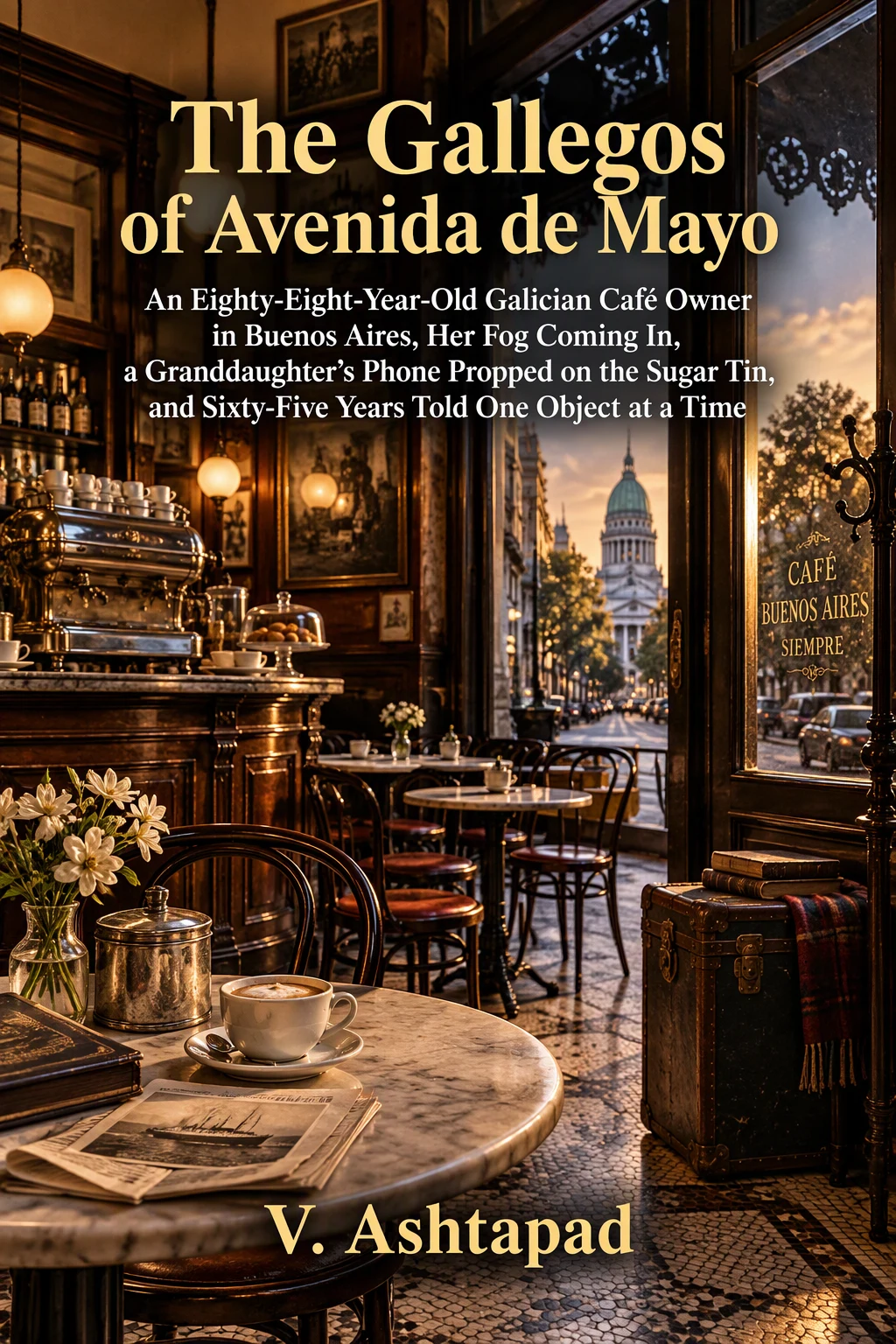
The Gallegos of Avenida de Mayo
An Eighty-Eight-Year-Old Galician Café Owner in Buenos Aires, Her Fog Coming In, a Granddaughter's Phone Propped on the Sugar Tin, and Sixty-Five Years Told One Object at a Time
by V. Ashtapad
Foreword
This is a work of fiction. The Galician emigration to Buenos Aires, Avenida de Mayo and its cafés, the Palacio Barolo, the Teatro Avenida, the A line of the subte and its Belgian wooden cars, the Centro Gallego de Buenos Aires, the bombing of the Plaza de Mayo on June 16, 1955, the dictatorship of 1976 to 1983, the hyperinflation of 1989, the convertibility of 1991 and the corralito and cacerolazos of December 2001 are real. The Café Mondariz, the Rial family and every named person in the story are invented.
For the waiters who carried the trays, and the women who counted the drawer at midnight.
The Italian Machine
The machine came first, before the tables, before the clock, before half of you were born, so I start with the machine. Agustina says start wherever I want, Abuela, the phone doesn't care, it records everything, even the parts where you stop. She has it propped against the sugar tin with a folded napkin under it so it won't slide on the marble, and the little red dot is on, and she says the dot means it is listening. Fine. Let it listen. I have been listening to people in this café for sixty-five years, it is only fair that something listens back.
It is a Faema, from Milan, green enamel gone the color of a pear left too long in the bowl, with an eagle on top that Constantino polished every Saturday with a rag and a little ash from the stove, because he said ash was better than any product they sold in the shops on Rivadavia, and he was right about that and wrong about almost everything else. We bought it in 1962 from a Genoese on Calle Perú who was going back to Italy because his wife couldn't stand the humidity anymore. Two levers. You pull the lever down, the spring goes tight, and then the lever comes back up by itself, slow, and the coffee comes out into the cup like a thin brown rope. If you put your hand on the side when it is working you feel it breathing. Tino used to say the machine was the only one in the house who never answered back.
Agustina says, Abuela, tell them where we are.
Where are we. We are on Avenida de Mayo, nena, the thirteen hundred block, on the side of the street that gets the sun in the afternoon, between the Barolo and the corner of Salta, under the arcade where the pigeons sit on the cornices and leave their compliments on the awning. The café is called the Mondariz, after the water, the spa water from home that comes in a green bottle, because Tino said a Galician café should have a Galician name and Mondariz was the only one the porteños could pronounce without spitting. Below the floor runs the subte, the A line, the oldest one, and for a hundred years it had wooden cars from Belgium that shook the cups in their saucers every four minutes, and when they took the old cars away in 2013 I woke up at night for a month because the floor was too quiet. Now the new cars are Chinese and they go by like a sigh. Everything goes by like a sigh now.
I am Balbina Castro Lema de Rial. I was born in a parish of Carballo, in Bergantiños, in the province of A Coruña, in March of 1938, which makes me eighty-eight, Agustina, is that right? Eighty-eight. Ochenta y ocho. Two fat ladies, as the English say at bingo, the English at the bingo on Bernardo de Irigoyen who used to come in for the tostado and leave no tip.
My memory, she wants me to say this too. All right. My memory has holes in it now, like the oilcloth on my mother's table where the hot pot sat. The doctor at the Centro Gallego, a boy with a beard and very clean shoes, he calls it by its name and I won't say the name because names have a way of moving in and taking the good bed. I call it the fog. Some days the fog sits on the river and the whole city is fine. Some days it comes up Avenida de Mayo like it did in the winter of 1959 when you couldn't see the Cabildo from the door. On those days I know the machine and I know the smell of the coffee and I know that the man at table four takes his cortado in a glass and not in a cup, but I don't know if it's Tuesday, and I don't know if the man at table four is Don Ernesto who comes every morning or Don Ernesto's son, who looks the same and has been dead nine years. Agustina tells me which one. That is why she is here. One of the reasons.
So. The machine.
The first morning we had it, Tino didn't know how to work it. He was a waiter, not a barman, he had carried trays in the Café Iberia and the Los Galgos for nine years before we had the money for our own place, and carrying a tray is one science and pulling a coffee is another, and anyone who tells you different has never burned the inside of his wrist on a steam pipe. He pulled the lever and nothing came. He pulled it again and the coffee came out the color of tea. He pulled it a third time and the steam wand went off like a train whistle and a woman at the window table screamed and dropped her medialuna into her lap.
I was at the register. I was twenty-four, I had Nélida on my hip, nine months old, chewing the edge of a menu. I put Nélida in the bread basket under the counter, which is where she spent her first two years, between the medialunas de manteca and the medialunas de grasa, and I went around and I took the lever from Tino's hand, and I said, Home, go and say sorry to the señora, and let me look at this thing.
Home. That's how you say man, in Galician, when you are tired of one. Not hombre, home. Like home in English, but meaning the opposite.
I looked at it. I had never seen one before either. But I had grown up on a farm where everything was a machine you had to understand by looking: the mill on the stream, the cart, the hand pump, my father's bad leg. I saw the little screw on the side, the one that tightens the grind, and I saw that the coffee was ground for the old cloth filters, too coarse, and I went to the Genoese on Calle Perú that same afternoon with Nélida on my hip and made him show me. He showed me. He also tried to sell me a second machine, used, for parts. I said no. Then I said yes, for half. We used those parts for forty years.
By the end of the week I could pull a ristretto with crema on top as thick as the cream on milk in Carballo when the cow had good grass. Tino never learned. Tino carried. Tino talked. Tino sang the gaita songs badly under his breath in the kitchen and called every customer by a nickname they hadn't asked for. The man at table four in 1962 he called El Ministro, because he wore a vest. The ministro was a shoe salesman. Everybody in this café was somebody else in Tino's mouth.
Agustina says, Abuela, you're smiling.
Of course I'm smiling. You asked me about the machine.
What I want to say, and I want this recorded, nena, because I might not get to it twice: the machine still works. Sixty-four years. Darío had the gaskets changed in 2019 by a man from Lanús who knew the old Faemas and charged us like he was doing surgery on the Pope. Since then it breathes fine. On cold mornings, when the radiator under the window takes forever, I still come and put my hand on its side. Librada scolds me. She says, Doña Balbina, you'll burn yourself, and then what will I tell your daughter. And I say, Tell her I knew the machine before I knew her.
Which is true. Nélida came in May of '61. The machine came in March of '62. So that's not true. I knew Nélida first. You see? That's how the fog comes in. It doesn't knock. It moves the furniture a little to the left and waits to see if you notice.
Turn it off now, nena. A customer.
---
That was Tuesday, Agustina tells me. Now it's Thursday and the phone is back on the sugar tin and she wants the next thing. She has a list in her notebook in her small straight writing, with the objects on it, one per line, the way I used to write the orders for the bakery on Chacabuco. She says each object is a chapter. She says the whole family will have them, in the private place she made on the internet where only the family can go in, with my voice, and the photographs she's been taking of each thing, and a little label on each photograph so that in fifty years some child with Rial in his name will know what the eagle on the coffee machine was for.
It's for nothing. It's an eagle. It's for looking at.
She writes that down too.
© 2026 CRUNOD LLC. All rights reserved.
The Marble Tables
There are fourteen tables. There were sixteen, but two cracked in the heat wave of 1984, when it was forty-one degrees in the shade and the iron legs expanded and the marble couldn't stand it and broke right down the middle with a sound like a pistol, one at ten in the morning and one at four in the afternoon, and both times Alcides dropped his tray. Alcides is our waiter. He has been our waiter since 1979. He is seventy-four years old, from Corrientes, very thin, with a white jacket that he irons himself every night because he doesn't trust anyone else's iron, and a moustache he has been dyeing the same black since the Malvinas. When the tables broke he said, Doña, the café is telling us something. I said, It's telling us it's forty-one degrees, Alcides, pick up the cups.
The marble is from Carrara, the Genoese said, but the Genoese said a lot of things. Constantino bought the tables in 1961 from the widow of an Asturian who had the café before us, when it was called La Covadonga and served cider that nobody wanted because porteños don't drink cider except at New Year, when they drink it out of the bottle and spit the cork into the street. The Asturian died at the counter, the widow told us. Just put his head down on the zinc like he was tired. She didn't want anything in the place except the money. We paid her in three parts. The first part was Tino's savings from nine years of carrying trays. The second part was a loan from the Centro Gallego mutual fund that took us six years to pay. The third part was my mother's gold earrings, the long ones with the little coral drops, which I had carried in my coat lining from Vigo, and which I sold to a Jewish jeweler on Libertad who weighed them and then, because I was crying, weighed them again and gave me more.
Don't put that I was crying. Put that I sold them.
Agustina says it's recording whether she puts it or not.
Then put it. What do I care. I was twenty-three.
Each table had a story. Mirá: table one, by the door, that was the newspaper table. The men from La Prensa and Crítica, when Crítica still existed, and later the radio people from Radio Belgrano, they came at eleven and stayed until the afternoon editions, and they shouted at each other about Frondizi, about Illia, about the military, about Boca, and Tino stood by the table with the coffee pot and agreed with everyone. Table six, under the mirror, that was the singers' table, because the Teatro Avenida is three doors down and in those years it was all zarzuela, the Spanish operettas, La verbena de la Paloma, Doña Francisquita, and the tenors came over between rehearsals and ordered tea with honey for their throats and then ordered caña and ruined the honey. Table nine, at the back by the stairs to the toilet, was where the couples sat who shouldn't have been sitting together. You learn quickly in a café which table is for that, and you put the sugar down and you don't look.
And table eleven. Table eleven was Tino's. When the place was empty at three o'clock, between lunch and the merienda, he sat at eleven with the racing paper and a glass of white wine with soda and his feet on the other chair, and the whole Avenida could see him through the window, the owner of the Mondariz with his shoes off, and he didn't care, and I cared, and we fought about it for forty-seven years. Now Darío sits there with his laptop doing the accounts. He keeps his shoes on. I don't know which is worse.
The marble keeps rings. That's the thing about marble, people think it's hard, it's not hard, it's soft as bread for anything wet. A glass of vermouth left an hour leaves a ring you can't get out with anything, not lemon, not salt, not the paste Alcides makes with bicarbonate. So the tables are full of rings. Thousands. Agustina photographed table one under the lamp and you can see them all over each other, like when you throw a stone in the lagoon at home and then another stone and another, and the circles cross. She put the photograph in the family place and under it she wrote, Table one. Sixty-five years of glasses. She asked me what else to write. I said write: Every ring is somebody who was thirsty.
She wrote it. Then she cried a little and pretended it was the onions from the kitchen. There are no onions on Thursday. Thursday is the tortilla on Friday's list, I peel the potatoes Thursday night. Peeled. I peeled them. Who peels them now? I don't know who peels them now.
Librada. Librada peels them. Her hands are faster than mine ever were. She's from Caaguazú, in Paraguay, and she talks to the potatoes in Guaraní, and Agustina says I'm not to put Guaraní in my chapters because it isn't mine, it's hers. All right. I don't know any Guaraní anyway except the word for bread and I always get it wrong.
---
What else about the tables. In 1974 we had them all re-polished by an Italian with one eye who came with a machine that screamed like a pig, and he took off the rings, all of them, every one, and the tables were white like teeth. Tino walked around them for a week like a man in a museum. Then he said, I don't like them. They look like nobody ever sat here. And by Christmas the rings were back. I think that's the best thing I can say about any table.
Before I forget: under table seven, on the underside of the marble, somebody scratched a name with a key in 1968. ROQUE + ELVIRA? No, not Elvira. I can't see the second name. Agustina got under there with a flashlight and photographed it. The second name is scratched out. Someone came back and scratched it out. We never knew who Roque was. He might still be alive. He might have married whoever it was and scratched her out himself on their anniversary, as a joke. That's the kind of thing a porteño would do.
© 2026 CRUNOD LLC. All rights reserved.
The Trunk from Vigo
My mother packed the trunk on the floor of the kitchen in Carballo in October of 1951 and it smelled of the smoke from the lareira for the whole crossing and for two years after in a room on Calle Chile. I'm going to tell this the way I told it to Nélida when she was small, because it's the only way I know it. I don't know it any other way.
We were eleven at home, and the house had stone walls and a floor of beaten earth in the kitchen and the animals lived underneath, the two cows and the pig, and in winter their heat came up through the boards and so did their smell, and if you grew up with that you never mind anybody's smell again, which made me a good café owner. There were fields of potatoes and corn and grelos, the turnip tops, which here they don't know, they think a grelo is a kind of insult. There was the hórreo, the little stone granary up on its legs so the rats couldn't climb it, with a cross on one end and a little stone point on the other, which my father said was to keep off the lightning and my mother said was to keep off my father. There was rain. There was always rain. In Bergantiños the rain is not a thing that happens. It is a thing that is. You don't say it's raining, you say it stopped, when it stops, which is about four times a year.
My father had a bad leg from the war, and he had been on the wrong side, or the right side, depending who's asking, and there was no work and less food, and in 1951 if you were a girl of thirteen from Carballo you had three futures: the fields, the fish factory in Malpica, or América. America meant here. Nobody said Argentina. They said Buenos Aires, or they said America, and they meant here. My mother's brother, tío Manuel, had a hardware store in Avellaneda and wrote every Christmas with a photograph of himself in a suit in front of the shop, and that photograph sat on our shelf like a promise. He sent the money for one ticket. One.
There were three girls old enough. My older sister Generosa, fifteen, and me, thirteen, and Pura, twelve. Generosa was the pretty one and the strong one and my mother needed her for the fields. Pura was the clever one and the sickly one and my mother couldn't let her go. So it was me. Nobody asked me. I didn't expect to be asked. I was the one who wasn't needed and wasn't worried about, and that is a kind of freedom too, although I didn't know it for twenty years.
My mother put in the trunk: two dresses, one good, one for every day. Wool stockings she knitted. A wool shawl, black. Four pairs of drawers. A comb. Her gold earrings in the lining of my coat. A photograph of the family in front of the hórreo, taken by a man with a camera on a donkey who came through the parish that summer. A small cheese, a tetilla, the soft one shaped like a breast, wrapped in a cabbage leaf, which I ate on the third day out of Vigo and was sick over the rail. A jar of honey from our hives. And on top, last, folded in brown paper, a piece of lacework from Camariñas that her own mother made, with the bobbins, a little runner for a table, with a pattern of fish.
She said, This is for your table. When you have one.
I said, I'll have a table?
She said, In America everybody has a table.
---
The ship was the Cabo de Buena Esperanza, from Ybarra, out of Vigo, with the gulls following us out past the Cíes islands, and I stood at the back and watched Galicia go into the rain and it didn't take long. Galicia goes into the rain very easily. That's its gift. We were three weeks. Third class, under the waterline, with forty women and girls in one room in bunks of three, and a toilet that you could smell from the stairs, and food that was chickpeas and more chickpeas and on Sundays a piece of meat that somebody always said was horse. There was a girl from Lalín called Maruxa who sang every night until a woman from Ourense threw a shoe at her. There was a widow from A Estrada going to her son in Rosario who taught me to play brisca with a Spanish deck and took all my sweets. I cried for Generosa the first week, and for my mother the second week, and the third week I didn't cry because we crossed the line, the equator, and the sailors made a party and the sea was flat and blue as a plate and flying fish came onto the deck and I picked one up and it looked at me.
That is morriña. Agustina, write the word. Morriña. You can't translate it, people say, but you can. It means you are sick for a place. That's all. You are sick for a place the way you are sick for a person, and there is no medicine, and you don't die, you just carry it, like a stone in your shoe that you stop noticing until you take off the shoe at night.
I had morriña for nineteen years. Then one day I didn't. I don't know which day. I wasn't paying attention.
We came into the river on a morning in November, the water brown like coffee with milk, wide as the sea, and nobody told me it was a river, I thought it was still the ocean until a man said, That's Montevideo, and then, a day later, That's Buenos Aires, and I saw it lying flat across the water with the towers and the cranes and the smoke, and it was the biggest thing I had ever seen and it was flat. That's what I remember. Flat. Where I came from everything goes up or down. Here it just goes.
Tío Manuel was not at the port. His wife was, tía Herminda, with a hat with a feather and a face like she'd swallowed a nail. She took me on the tram to Avellaneda and put me in the room behind the hardware store and the next morning I started working in her kitchen and her shop and her laundry, and I didn't go to school one day in Argentina, not one, and I didn't see tío Manuel smile once in two years except in that photograph on our shelf at home. That's all I'll say about Avellaneda. I'm not going to make a tango out of it. A lot of girls had it worse. Maruxa from Lalín, the singer, ended up in a house in La Boca that I won't describe, and I saw her once in 1958 on Corrientes in a fur coat and she pretended not to know me, and I let her.
The trunk is in the back room now. The storeroom, behind the kitchen, under the shelves of cans. Agustina dragged it out into the light. The brass is green. The leather straps are gone. Inside are my account books from 1961 to 1990, all of them, in my handwriting, and on top, in brown paper, the runner from Camariñas with the fish. It's never been on a table. Not one day. I was saving it.
For what, Abuela?
I don't know, nena. For a table good enough.
She put it on table eleven. Right there, this morning, under the window, in the sun, with the pigeons looking in. I didn't stop her. I'm telling you that so you know I didn't stop her.
© 2026 CRUNOD LLC. All rights reserved.
The Clock
The clock over the door has said twenty past four since August of 2023 and Darío keeps saying he'll call the man and I keep saying leave it. Twenty past four is a good hour in a café. Lunch is gone and the merienda is coming, the light is long on the Avenida, the ladies come in from the shops on Florida with their bags and order café con leche and three medialunas between two of them and a glass of water each and they stay an hour and a half and you love them anyway. Twenty past four is the hour when nothing bad happens. So I like it there. Let it stay.
Besides, I don't need the clock. I have the subte. The A line goes under us every four minutes in the morning and every seven in the afternoon and every twelve at night, and I've felt it through the soles of my feet for sixty-five years, and when it stops at night, around eleven, then I know it's time to close.
Except I don't close anymore. Darío closes. Or Agustina. I go home at six with Librada, in a taxi, three blocks, because my hip. Three blocks in a taxi. My mother walked to the market in Carballo with fifteen kilos of potatoes on her head. I tell the taxi driver this every time. Most of them say, Qué bárbaro, señora, and some of them say, My grandmother too, from Lugo, and once a Senegalese boy said his grandmother carried water on her head every day for sixty years and was still alive, and I gave him a tip I couldn't afford.
Here is something about the clock that is true and I want it in. It's the only thing in the café that came from Galicia. Not the machine, not the tables, the clock. Tino's father sent it in 1963 in a crate on a ship from Coruña, when we wrote that we had our own café at last. It's from a clockmaker in Santiago, round, with a brass rim and a white face and black numbers and two little doors underneath that never open. Tino's father was a carpenter in Ordes and he made the crate himself, and Tino kept the crate in the storeroom for ten years and wouldn't let me burn it, and then the year of the floods, 1985, I burned it in the parrilla behind the kitchen to cook chorizos for the neighbors, and he didn't speak to me until Thursday. Then on Thursday he ate a chorizo and said it tasted of Ordes. So.
Tino's father never saw the café. He never saw any of us again. He died in 1971 and the letter came two months later and by then the funeral was so far away it was like a story about somebody in a book. That's what the ocean does to a death. It turns it into mail.
Agustina wants to know what the two little doors are for.
I don't know. In some clocks, there's a little figure that comes out at the hour. A bird or a man with a hammer. In ours, nothing ever came out. Tino used to say there was a Galician in there, waiting for good weather.
---
The fog, I want to talk about it a little here, because of the clock. It's a clock thing. Agustina reads me things from the doctors on her phone and they say it's about time, the first thing to go is time. Not the old time, the new time. I know the price of a cortado in 1962 (eighteen pesos moneda nacional, and the paper said it was a scandal) but I don't know if I had lunch. I know the date Nélida was born and the hour and the weather (May 3rd, 1961, at five in the morning, raining, the midwife's name was Doña Etelvina and she smelled of anise) but I don't always know Nélida when she comes in the door. Not that I don't know her. I know her. I know she's mine. But for a second I think she's my mother. She's sixty-five and she has my mother's face now, the long face, the eyebrows, and she comes in out of the rain in her raincoat from Rapsodia that cost too much and shakes her umbrella and for one second my mother is in the doorway of the Mondariz in Buenos Aires shaking water off an umbrella, and I want to say, Mai, what are you doing here, who's with the cows. And then she says, Mamá, did you eat. And she's Nélida again.
That second. It's a funny second. It's not all bad. I get to see my mother.
Nélida doesn't like it when I say that. She says it scares her. She's a notary, Nélida, very correct, she has an office on Tucumán with her name on a bronze plate and two girls who type for her, and she likes things in their order. She was always like that. As a baby in the bread basket under the counter she lined up the medialunas by size. She was the first Rial to go to the university, the UBA, law, and when she graduated Tino closed the café for the whole afternoon, the only time in forty-seven years he closed it in the daytime except for the bombing and the funerals, and put a sign on the door in his terrible handwriting: CERRADO POR ABOGADA. Closed for lawyer.
She still has the sign. Agustina photographed it. I'm watching her write the caption with her tongue out the corner of her mouth, the way she did her homework at table nine at the age of eight, while I made her a submarino, the hot milk with the bar of chocolate sinking in it. She's thirty-four now. She does sound for films and the theater, she puts microphones on actors and fixes the hum in the speakers, and she works when the work comes and doesn't when it doesn't, and Nélida worries about that too. Agustina is Darío's daughter, not Nélida's. Nélida has two boys, both in Madrid, both engineers, both married to Spanish girls, and they come every other Christmas with their children who speak like the people on the television from Spain, with the th, and I laugh every time, because their great-great-grandparents left Spain so their children could stop being poor, and now the children's children went back to Spain so they could stop being Argentine and poor. What goes around. Like the subte. Every four minutes.
Agustina, how many great-grandchildren do I have?
Seven, Abuela.
Seven. She'll tell me their names later. She has them all in the tree she made, on the phone, with the little squares and the lines, going back to my grandparents in Carballo and Tino's in Ordes, and some cousins in Malpica who wrote to her last month when they found her. Generosa's grandchildren. They put their pictures in too. A boy with a surfboard. A girl in a lab coat. They look like Generosa. I keep looking at the little squares. My sister has been dead since 2004 and she is in a square on my granddaughter's telephone with a line going to me.
Twenty past four. Leave the clock.
© 2026 CRUNOD LLC. All rights reserved.
The Radio
The radio was a Philco, brown, the shape of a loaf of bread, with a gold cloth over the speaker and a dial that lit up orange, and it sat on the shelf above the register between the bottle of Fernet and the bottle of Cinzano, and it was on from the moment Tino lifted the shutter until the moment he pulled it down, every day, for thirty years, until the transistors came and a Japanese one replaced it, and then the Philco went into the storeroom and stayed there with the trunk and the crate and the dead mice.
What did it play. Everything. The news on Radio El Mundo. The football on Sundays, the whole café shouting at a box. The tangos in the afternoon, Troilo, Pugliese, D'Arienzo for the old men who still danced in their heads, and Tino turning it down when Gardel came on because he said Gardel made the customers cry into their coffee and then they didn't order a second. The Galician hour on Saturday mornings, from the Centro, with the gaitas and the news from home read by a man with a voice like a wet blanket, deaths in Lugo, weddings in Pontevedra, the price of cattle at the fair in Silleda, and all the gallegos on the Avenida came in to listen with their hats on the tables and their eyes on the floor.
And the sixteenth of June, 1955.
Agustina has read about it. Everybody has read about it now. In school they teach it. Then, nobody said anything. For years nobody said anything. It was a Thursday. A grey day, cold, the kind of June day with a sky like the underside of a pot. I was seventeen and I didn't own the café, I didn't know it existed, I was waiting tables at a place on the Plaza de Mayo itself, right on the corner, a little bar that isn't there anymore, they made it a bank, everything here becomes a bank. I had left Avellaneda by then. I left tía Herminda one night in 1953 with my trunk on a handcart and a girl from Ribadeo who had a room. That's another story.
At about twenty to one the planes came. Navy planes. They came low over the river and over the Casa Rosada, which is pink, Agustina, write that it's pink, people who've never seen it think that's a figure of speech, and they dropped bombs on the plaza at lunchtime, on the people, on a trolleybus full of people. They wanted to kill Perón. They killed everyone else. I was carrying four coffees to a table by the window and the window came in. That's what I remember. Not the sound. The window coming in, like water, very slow, and the coffees going up off my tray, and then lying under a table with the bar owner's wife, a fat Asturian lady, Doña Pepa, who held my head against her chest so hard I couldn't breathe, and she smelled of fried garlic and talcum, and she was saying a word over and over in Bable that I didn't understand, and the planes came back. They came back. Three, four times.
That's all I can tell. Afterward I walked. I don't know why I walked, I walked up Avenida de Mayo away from the smoke, and the people were running the other way, toward it, to help, or to see, and I walked through them like a fish going up a river, with glass in my hair, and I sat down on the step of a café because my legs stopped, and the step was this step. The Mondariz. Except it wasn't the Mondariz yet. It was the Covadonga, the Asturian's place, and a waiter came out with a glass of water and a little glass of caña and said, Drink the water first, nena, then the other one, and it was Constantino.
That's how I met him. On this step. With glass in my hair. He picked the glass out of my hair with his fingers, one piece at a time, very slowly, on the step, and put each piece in his apron pocket so nobody would step on it, and the radio inside was saying nothing, only music, they played music all afternoon like nothing was happening, a march, then a waltz, and he picked the glass out of my hair and asked where I was from and I said Carballo and he said, I'm from Ordes, we're neighbors, which is a lie, it's forty kilometers, but in Buenos Aires forty kilometers of Galicia is the same house.
Six years later we bought the place. We bought the step.
Agustina, turn it off a minute.
---
All right. On.
I want to say the other thing about the radio, so it doesn't sound like a love story only. In September of the same year the military took over properly, and then for eighteen years you weren't allowed to say Perón's name on the radio or in the papers or in a café out loud, they had a law, they called him the Fugitive Tyrant, and half the customers were for him and half were against, and the radio was the only one who didn't take sides, it played Troilo. Tino was for Perón, quietly, because Perón gave the waiters the union and the Christmas bonus. I was against, quietly, because I'd been under that table. We never discussed it. Forty-seven years we never discussed it. We discussed his feet on table eleven instead. That's a marriage, nena. You choose which fight is the fight.
Darío was born in 1965. He's sixty-one now. He found the Philco in the storeroom when he was eleven and took it apart on table nine with a screwdriver and couldn't put it back together, and Tino gave him a hiding with his belt and then sat with him till two in the morning and they put it back together, the two of them, and it played. It played a little crackly, like it had a cold. Darío became an electrician because of that radio. Then he became nothing for a while. Then he came back to the café. That's Darío. I'll tell about him at the shutter.
The Philco plays. Agustina plugged it in this morning. The light came on orange, the old light, the color of a sunset in a postcard, and there was a sound like the sea, and then a man on AM talking about the price of the dollar. Blue dollar, official dollar, the card dollar, the tourist dollar. Eleven kinds of dollar. In 1955 there was one dollar and we had none. Now there are eleven and we have none of any of them.
She's recording it. The radio talking into her telephone. The telephone listening to the radio. One machine telling another machine about money.
© 2026 CRUNOD LLC. All rights reserved.
The Gaita
Tino's gaita hangs on the wall over table six, the singers' table, on two hooks that he screwed into the plaster himself in 1964 crooked, so it's been hanging a little sideways for sixty-two years, and nobody has played it since he died except once, which I'll get to. It's a Galician bagpipe, Agustina, write that it's not Scottish. People come in, tourists from the hotels on the Avenida, and they see it and they say Oh, Scotland, and Alcides, who has heard this four thousand times, says in his Correntino Spanish, No, señor, Galicia, the Scots copied us, and they laugh, and he doesn't.
It's made of boxwood, the drone and the chanter, with silver rings on the joints, and the bag is goat, covered in a cloth with a pattern of little red and green squares that Tino's mother sewed in Ordes, and the bag has been patched four times with inner tube from a bicycle because good goatskin you can't get here. It has one drone over the shoulder, the long one, the ronco, that goes HMMMMMMM under everything like a cow thinking. You blow into the bag with a pipe and squeeze it under the arm and the air goes out through the chanter and you play the tune with your fingers.
Tino learned in the Centro Gallego, in the gaita school in the basement on Avenida Belgrano, from an old man from Lalín who'd been playing since before the Republic. Tino played every Saturday night for thirty years, and he wasn't good. I want to say this so nobody makes him a hero later. He wasn't good. He played the muiñeiras too fast because he got excited and the alboradas too slow because he got sentimental, and he never once in his life tuned the drone properly, and he played anyway, at every wedding, every first birthday, every fiesta of every Galician society in Buenos Aires, and there were hundreds of them then, every parish in Galicia had a society here, the Sons of Carballo, the Residents of Ordes, the Sociedad Hijos del Partido de Lalín, each one with a rented hall and a ball once a year and a raffle for a ham.
That's where we danced. Not here. At the Sons of Ordes, in a hall in Constitución that smelled of floor wax and wet coats, in the winter of 1956, the first time. The Ordes people let me in because I was with him. Carballo people would've let him in too. We were all of us, the Galicians here, one big parish with the hall split down the middle by forty kilometers of nothing.
You dance the muiñeira with the arms up, like you're holding a basket over your head, and you turn and you turn, and the woman turns the man, it's not like the tango where the man pushes the woman around the floor like a vacuum cleaner. In the muiñeira the woman decides. I decided. I decided that night. He played and then he put down the gaita and someone else played and he danced with me, and he danced as badly as he played, too fast and then too slow, and I liked it. I liked that he did everything wholeheartedly and badly. I had been around a lot of people who did things carefully and meanly. He was the opposite. He was too much. He was always a little too much.
We married in April of 1958, at the civil registry on Calle Uruguay, and the party was at the Sons of Ordes, with caldo gallego in a pot big enough to bathe a child in, and empanada of cod with raisins that the Ordes ladies baked in the oven of a bakery on Chacabuco that belonged to a Ribadeo man who owed Tino money, and pulpo a la feira, the octopus with paprika and oil and salt on wooden plates, which in Buenos Aires in 1958 cost the earth because the octopus came frozen from Spain or nothing, and there was a queimada at the end, the drink you set on fire in a clay pot, which I'll tell about later, maybe, if I remember, and Tino played at his own wedding because the gaitero we hired got drunk on the queimada and fell asleep on a pile of coats.
---
The once. After.
Tino died in July of 2009. Fifty-one years married. His heart, at home, in the chair, with the television on, River losing to somebody. Agustina was seventeen. Agustina, you were seventeen.
Seventeen, Abuela.
At the wake, which was here, in the café, because where else, we pushed the tables to the walls and everybody came, the Avenida, the gallegos who were left, the Ordes society, which by then was nine old men and a raffle, Alcides in his white jacket at the door crying like a tap, the newspaper sellers, the pharmacist, the Korean girl from the photocopy shop, the two hotel doormen, the man who washed the sidewalk every morning with a hose, all of them, and nobody said anything about the gaita. It hung on the wall, crooked. And at about two in the morning, when it was just the family and Alcides and the pharmacist, who was a little drunk, Darío stood up and took it down off the hooks.
Darío couldn't play. Darío had never played. Darío had spent his whole life saying the gaita sounded like a goat being killed slowly. He was forty-four then, divorced, working nights at a parking garage on Paraná, nothing in his life where he wanted it, and he took his father's gaita off the wall and put the pipe in his mouth and filled the bag. The drone came in, HMMMMM, out of tune, of course out of tune. And he couldn't make a tune. He just made the one note. He stood in the middle of the café at two in the morning with his eyes closed and his face red and made one note, the drone, for as long as he had breath, and then he filled it again and made it again. Four times. Nobody stopped him. The glasses on the shelf behind the register hummed with it.
Then he hung it back up crooked on the hooks and sat down, and the next week he quit the parking garage and came to work in the café.
That's the only time. I want it in.
© 2026 CRUNOD LLC. All rights reserved.
The Tortilla Pan
Nobody touches my pan.
This is a law of the Mondariz older than the Argentine Constitution in my opinion, and the Constitution has been touched plenty. It's iron, black, thirty centimeters across, heavy as a sin, with a handle that's been wrapped in wire and then in tape and then in a strip of leather from an old belt of Tino's, and it lives on its own hook over the stove and it is never washed with soap, never, only hot water and coarse salt and a rag and a little oil rubbed in afterward with your fingers while it's still warm. If you wash it with soap the tortilla sticks for a month. A girl from Jujuy who worked for us in 1996 washed it with soap and I nearly sent her back to Jujuy on foot.
Agustina is laughing. That's fine, nena. Laugh into the phone.
The tortilla. Every Friday since 1962. Spanish tortilla, potato and egg and onion, thick as a dictionary, and here it's a matter of war whether you put onion, the porteños fight about it like they fight about Boca and River, and I put onion, because my mother put onion, and anyone who wants a tortilla without onion can go to the Basque place on Moreno and pay double. You slice the potatoes thin, not too thin, and the onion in half-moons, and you cook them slowly in the pan in a lot of oil, a lot, more than you think, not frying, more like a bath, until the potatoes are soft and the onion is gold and sweet, and that takes forty minutes, and you can't hurry it, and then you drain the oil off into a jar for next week, and you beat the eggs in the big bowl, nine eggs, ten if they're small, with salt, and you put the potatoes and onion into the eggs while they're hot and let them sit together for ten minutes so they get to know each other. That's the secret. People think there's a secret. There isn't. There's patience and too much oil.
Then you put the pan back on the fire with a spoon of oil, very hot, and you pour it all in and you shake it so it doesn't stick and you lower the flame and wait, and then the turn. The turn. You put a plate on top, a flat plate bigger than the pan, and you hold the plate with one hand flat on top and the handle of the pan with the other, and you say something under your breath, I used to say my mother's name, and you flip it over, all at once, no thinking, and the tortilla falls onto the plate cooked side up, and then you slide it back into the pan to do the other side. If you think, you drop it. I dropped it the first time in 1962 and the whole thing went on the floor and Tino ate it off the floor anyway, kneeling, with a fork, laughing, and said it was the best one he ever had.
Since about two years ago I can't do the turn. My wrists. And something else. My hands don't remember the order. Plate. Pan. Hold. Flip. I stand there with the plate and the pan and I can't remember which comes first. It's not like forgetting a name. It's like the floor has moved six centimeters.
Agustina asks, so who makes it now, on Fridays?
Nélida. Can you believe it? The notary. She comes in on Friday mornings before her office opens, at seven, in her good suit with an apron over it, Tino's old apron with the burn on the pocket, and she makes the tortilla in my pan. She learned at nine years old on a stool. She hadn't made one in thirty years, she buys them frozen at the Coto for her own house, she said so herself, and then two years ago, the first Friday I stood with the plate and couldn't, she came round the counter and took the plate out of my hand and said, Mamá, sit, and she did the turn. Perfect. First time. Not a crumb on the stove. And she said my mother's name under her breath when she did it. I heard her. She never even knew my mother. She learned the name from me, from me saying it in the kitchen when she was nine. The pan taught her.
Then she washed the pan with soap. Not perfect, then.
---
What we serve, so it's written somewhere. In the morning: café con leche, cortado, lágrima (which is milk with a tear of coffee, for children and old ladies and people with stomachs), medialunas de manteca which are sweet and shiny and medialunas de grasa which are flat and salty and made with lard and better, tostadas with butter and jam, a tostado de jamón y queso pressed in the iron. At noon: the milanesa with fries, or with a fried egg on top which is called a caballo, on horseback. Tortilla on Friday. Puchero on Wednesday in winter, the boiled meat and corn and squash and chickpeas and morcilla, the blood sausage, and a bowl of the broth first with a little rice. Caldo gallego on Tuesday in winter, with white beans and the grelos when you can get them, which is never, so we use chard and nobody from Galicia complains because they've all been here sixty years and forgotten what grelos taste like. Except me. I haven't forgotten. Bitter. Green. A little like iron. Like the rain had a taste.
In the afternoon: the merienda. Tea or coffee and the medialunas again and the alfajores from a woman in Boedo who makes them with too much dulce de leche, and a submarino for children. At night, when we were open at night, until the eighties, vermouth with soda and a little plate of olives and cheese and salami cubes, the picada, and the gin fizz for the ladies after the theater, and the empanada gallega, the big flat one, with tuna or with cod and raisins, that Tino's sister in Ordes taught me by letter. By letter. Six letters, one each month, 1963. I still have them. Agustina has photographed them, with captions. In the third one Tino's sister says, the dough must be soft like the earlobe of a child. I didn't know what that meant. Then Nélida's ear was in front of me every morning for years and I knew.
How much does a tortilla cost now? I don't know. Agustina says a portion is six thousand pesos. Six thousand pesos. For a piece of tortilla. In 1962 six thousand pesos was a month's rent on this whole building. Not the café. The building. Six floors. With the elevator.
Don't put that I said that. Every old woman says that. Put that I make it with onion.
© 2026 CRUNOD LLC. All rights reserved.
The Shutter
It's iron, the shutter, the persiana, rolled slats like a tin of sardines, painted green every five years and rusty every four, and it comes down from a box over the door on a crank that takes forty-one turns, and the noise of it coming down is the noise of the end of every day of my life. A long iron cough. Then the padlock at the bottom, into a ring in the sidewalk. Tino did it for forty-seven years, then Darío. I never did it once. Not because I couldn't. Because it was the only job in the place that was only his, and a man needs one.
I said I'd tell about Darío at the shutter. All right.
In 1976 the military came again, the last time, the worst time, and it wasn't like the bombing, where you saw the planes. This time you saw nothing. That was the point. Ford Falcons, green, without plates, at night. People went to work and didn't come home. You didn't ask. On the Avenida, at the café, you heard things in pieces at the tables, a name, a whisper, a cousin of somebody's, and then the person talking would look at the door and change the subject to Boca.
We had a boy who came in the mornings. A student, from the Faculty of Engineering on Paseo Colón, very tall, with glasses he pushed up with one finger, and long hair, too long, which in those days was enough. He ordered a café con leche and two medialunas de grasa and did his calculations at table nine with a slide rule and paid in coins he counted out on the marble, and Tino called him El Ingeniero, which he wasn't yet. Darío was eleven. Darío adored him. The boy showed Darío how the slide rule worked and drew him a bridge on a napkin, the forces going down and across with little arrows, and Darío kept the napkin in his school bag for a year.
One morning in August of 1977 he didn't come. Nor the next. His mother came instead, a month later, a small woman in a grey coat from Mataderos, and she had a photograph, and she went table to table on the Avenida, café to café, asking had anyone seen him, and when she came in here Tino took the photograph, held it under the lamp by the register, handed it back and said, No, señora. No. I'm sorry.
That's all. That's all he said.
That night, at closing, Darío asked him why he lied. Darío had seen the boy every day for a year. Darío was eleven and he knew Tino was lying because Tino's ears went red when he lied, they always did, it was the only lie detector in the house. And Tino didn't answer. He went out and cranked down the shutter. Forty-one turns. And he padlocked it, and came in, and said, Some things you don't say in a café, and Darío said he was a coward. Eleven years old. To his father. A coward.
Tino didn't hit him that time. He sat at table eleven in the dark with his shoes off and didn't say anything.
I've thought a long time about that night. Fifty years. Was Tino a coward? Yes, a little. We had a café with our name on the license and two children and a waiter from Corrientes with a family, and the Falcons went up and down the Avenida, and the boy's mother could have been anyone, she could have been sent. That's how we thought then. That's what it did to people, it made you look at a small woman in a grey coat holding a photograph of her son and think, she could have been sent. And what would it have changed, to say, Yes, señora, he came every day and drew bridges on napkins? It would have changed that she knew somebody remembered him. That's what it would have changed. That's not nothing. That's a lot. Tino knew that. That's why he sat in the dark.
Darío didn't forgive him for a long time. Darío went to the technical school instead of the university, became an electrician, married at twenty-three, divorced at thirty, had Agustina in between, drank more than he should for a while, nothing dramatic, I'm not going to make it dramatic, just a man whose life didn't sit right on him, like a jacket bought by somebody else. And then after his father died he came and took over the shutter.
In 2006, a year or so before Tino's heart, the boy's name was on a list. One of the lists they made after, when the trials started again. Agustina found it for me on the computer. His name and the date and the place they took him, which was an engineering faculty storeroom, of all places, the same faculty. They never found him. His mother died in 1999. She walked on Thursdays in the Plaza de Mayo with the white scarf with the other mothers, for twenty years, three blocks from here, every Thursday afternoon at three-thirty, and I saw them walk past the end of the Avenida in their scarves and I never went. Not once. I sent Alcides with a thermos of coffee one winter and he came back and said they thanked him. That's all I did. A thermos.
Darío has the napkin still. The bridge. It's in a frame now in the back, by the storeroom door. Agustina photographed it. She asked me what to write under it, and I couldn't think, and Darío was standing there drying glasses and he said: The Ingeniero drew this for me at table nine in 1977. His name was. And he said the name. And that's what's written.
I won't say it here. Darío said it there. That's the right place.
Do you want to know the strange thing? Every night when Darío pulls the shutter down, after the forty-one turns, before the padlock, he knocks twice on the iron with his knuckles. I asked him once why. He said, so they know we're closed. I said who's they. He said, nobody, Mamá, it's a habit. His father never knocked. I don't know where he got it. I didn't ask again.
© 2026 CRUNOD LLC. All rights reserved.
The Cash Register
The register is a National, from Ohio, Agustina says, it's written on the back, brass all over with a marble shelf for the coins, which it shares with the tables, and keys like a typewriter that you push down with your whole finger and the numbers jump up in a little glass window at the top on tin tabs, and when you push the big key at the side the drawer shoots out and a bell rings. Ding. In sixty-four years that bell has rung, Darío worked it out once on a napkin, about four million times. It sounds like a bicycle. Tourists photograph it. Every week some boy with a beard and a tote bag offers to buy it for a restaurant in Palermo and Alcides tells him it's not for sale and charges him for the cortado he didn't drink.
It's in pesos. Not today's pesos. The tabs only go up to ninety-nine pesos and ninety-nine centavos, because when it was made, that was a fortune, so it's been useless since about 1975, and since 1975 we've used it as a drawer, for the bills, and done the sums in my head and on the back of the order pad, and now on Darío's laptop, and Agustina's telephone, which takes cards and QR codes and some kind of wallet that isn't a wallet.
I'm going to tell the money. Somebody has to tell the money and it might as well be the one who counted it.
When we opened, it was pesos moneda nacional. A cortado eighteen, then twenty, then twenty-five, then a hundred. Then in 1970 the government took two zeros off and called them pesos ley, and a cortado was one peso again, and everybody felt rich for a week. Then it went to five. Then fifty. Then in 1983 they took four zeros off and called it peso argentino. Then in 1985 they took three more off and called it the austral, with a little crown on the note, and a cortado was half an austral and then one and then ten. Then 1989.
Agustina, you weren't born. 1989, the hyperinflation. Prices went up every day. Every morning. Some days at noon again. In July of '89 it was two hundred percent in one month. I had a blackboard, I'll tell about the blackboard, and I changed the prices on it at seven in the morning with a chalk and a rag, and at one o'clock Darío would come in from the bank and say, Mamá, the dollar, and tell me the number, and I'd go and wipe it and change it again. People paid for their lunch and by the time they finished the dessert the lunch cost more. The supermarkets put on prices with stickers, sticker over sticker over sticker, like the bark of a tree. The Coto on Carlos Calvo got looted that May, and Chinese shops in the provinces. We didn't close. We brought the shutter half down, at night, like a bad eyelid, so people could still duck under for a coffee.
How do you run a café when money is melting in the drawer like butter in a pan? I'll tell you. You don't keep it. Every afternoon, I'd take what was in the register and go out, before the banks closed, and buy things. Not dollars, we couldn't get dollars. Things. Sugar. Coffee beans, sacks of them, from the importer on Alsina, they're stacked to the ceiling in the storeroom and Tino and Darío carried them on their shoulders down the stairs. Flour. Cans of tomato. Bottles of oil. Toilet paper. One week I bought a whole pig from a man in Cañuelas who brought it in a Ford truck, and we ate that pig for a month, puchero and milanesas de cerdo and chorizos in the parrilla in the back. Money was a hot potato and you passed it on before it burned you. The café became a pantry. The neighbors came in to buy sugar from us by the kilo because the supermarket was empty.
Then 1991. The convertibility. One peso, one dollar, by law. Like magic. Overnight a cortado was one peso and it stayed one peso for ten years. Ten years! You can't imagine what that was. Nobody in Argentina under fifty had ever lived in a country where the price of a thing on Monday was the price of the thing on Friday. Old men wept at the counter, I'm not exaggerating, I saw Don Ernesto, the first one, the father, cry because he paid a peso for his cortado on the first of the month and a peso on the thirtieth. We put a sign up. UN PESO. In gold paint. Agustina has a photo of it. It's in the storeroom, the sign. Behind the trunk.
And then the sign was a lie. But that's the cacerola. That's later.
---
I want to say something about counting. I counted that drawer every night for forty-seven years. In the kitchen, at the steel table, with a lamp, after the shutter. Tino brought me a glass of white wine with soda and sat across from me and read the racing paper and pretended not to watch. The bills in stacks of ten, the coins in towers, the slips from the bank, the book, my book, the account books in the trunk. And the fiado.
Fiado is credit, Agustina. It's an old word. You write the name and what they owe in a little book, and they pay when they can. Every café had its fiado book. Ours was a black oilcloth notebook in the drawer of the register, under the tray. The newspaper sellers, the shoeshine man, the man who washed the sidewalk, the actors from the Avenida between shows, students. Pensioners on the twentieth of the month when the pension ran out. Alcides himself, for his children's school shoes, one year. Nothing written there was ever large. A coffee. A tostado. A week of coffees. And most of it got paid.
The book is still in the drawer. Agustina asked could she photograph the pages, and I said yes, but not the names. Photograph the pages from far away so you can't read the names. They paid or they didn't, and either way it's nobody's business, and now most of them are dead, and you don't follow the dead around with a bill.
She did it like that, from far away. You see the columns of my handwriting going down and down and the little crossings-out where somebody paid. Hundreds of little crossings-out.
That's the most beautiful thing in the café, if you ask me. The crossings-out.
© 2026 CRUNOD LLC. All rights reserved.
The Cacerola
It's a pot. An ordinary aluminum pot, with a dent on one side the shape of a wooden spoon, and the bottom all scratched, and one handle loose, and Agustina wanted to throw it out of the kitchen last month because it's too damaged to cook in, and I said, Not that one. That one's for the shelf. And she looked at it and she remembered, and she put it on the shelf over the register, where the Philco used to be.
December 2001. You remember, nena. You were nine.
The convertibility was finished, everybody knew it, the country had borrowed and borrowed to keep the peso at a dollar and then nobody would lend us any more, and the people with money took it out in suitcases, and at the beginning of December the government closed the banks. Not closed. Froze. The corralito, the little pen, like for a baby. You could take out two hundred and fifty pesos a week from your own account. Your own money. Two hundred and fifty. People with savings from forty years of work, from a café, from a hardware store in Avellaneda, from a pension, couldn't touch them. We had our savings in the Banco Galicia, of course in the Banco Galicia, what else would a gallego use. A Galician bank for Galicians, founded by gallegos, very solid, very serious, with marble floors. Frozen like a fish.
And on the nineteenth of December at night, the president came on the television and announced a state of siege. Tino and I were at home, upstairs from the bakery on Chacabuco, the apartment where we lived then. Fourth floor. And he finished speaking and there was a silence of maybe ten seconds. And then from a window across the street, a woman started banging a pot with a spoon.
Then another one. Then the building next door. Then ours. Then the whole street. Then you could hear it coming from far away, from Boedo, from San Cristóbal, from Congreso, a sound like rain on a tin roof, like hail, the whole city banging pots out the windows. Old ladies in nightgowns on balconies. Children. The doorman of our building in his undershirt with two lids like cymbals.
Tino looked at me. I went into the kitchen and got this pot and the wooden spoon. I didn't ask him. I was sixty-three. I went out on the balcony and I banged it. I don't know how long. Until my arm hurt. Then I banged it with the other arm. Then Tino took it and banged it, and he was laughing, and crying, both, and I was too, and it wasn't happy and it wasn't sad. It was just, enough. That's the word. Enough. Everybody in the whole city at once saying with a pot: enough.
Then people went down into the street. Thousands. They walked to the Plaza de Mayo, down Avenida de Mayo, past the café, banging pots. The next day it was worse, the police, the horses, the tear gas, people killed on the Avenida itself, in front of the Barolo, in front of here. Young men. The president left in a helicopter from the roof of the Casa Rosada. That's true. In a helicopter. Like a film.
Darío had opened the café that morning, the twentieth, because Darío always opens. I said, close it. He said, Mamá, where are people going to go to wash the gas out of their eyes? He filled every jug with water and put out every towel we had, and the bar rags, and the tablecloths from the storeroom, and the people came in off the Avenida with their eyes streaming, and he poured water over their faces at the sink behind the counter, and over the tables, one after another, kids with t-shirts over their faces, a lady from the bank on the corner with her stockings torn, a policeman too, at one point, a young one, from Santiago del Estero, crying from his own gas, and Darío washed his eyes like everybody else's and the policeman said thank you and went out again. Darío didn't knock on the shutter that night. He didn't pull it down. He left it up all night.
---
Then, after. Four presidents in two weeks. The peso went from one dollar to four. Our savings, which were in dollars, came back to us in pesos at one-forty each, which means the bank stole from us, legally, two thirds of forty years. People lost everything. People killed themselves. The middle class, Agustina, the people who sat at these tables, the notaries and the teachers and the clerks, went through the garbage at night. I saw men in good coats, men I knew, who'd sat at table one with the newspaper, going through the bags at the corner of Salta with flashlights. The cartoneros. Whole families pulling carts of cardboard. A man who used to sell insurance came in and asked if we needed someone to wash dishes. We didn't. We hired him anyway, for two months.
How did the café survive? The fiado book. Ha. People paid us back. Mirá, I don't know how. In 2002, people who owed for one coffee in 1987 came in and paid. Like they'd been waiting for the right moment to be decent and this was it. And we gave fiado to everybody who asked, again, for that year, and most of them paid that too. The crossings-out, nena. That's how.
And the neighborhood assemblies, on the corner, in the evenings, people standing around with pots and folding chairs talking about how to run the country, and they came in for coffee afterward, thirty at a time, and argued until midnight at the tables pushed together, and Tino walked around them with the pot of coffee agreeing with everybody just like 1962.
The UN PESO sign Darío took down himself in January and put behind the trunk. He said we shouldn't throw it away. He said: someday it'll be funny.
It isn't yet.
© 2026 CRUNOD LLC. All rights reserved.
The Photograph of the Hórreo
Agustina found it in the trunk, the photograph my mother put in on top of the drawers. The family in front of the hórreo, 1951, the summer before I left. It was so faded you could hardly see it, brown and yellow like the inside of a tea cup, and cracked across the corner where it got bent in my coat, and she took it to a man on Calle Bolívar who has a scanner as big as a table, and he did something with the computer, and now it's on her telephone and it's clear. It's clearer than it ever was. I can see the buttons on my father's jacket. I can see the mud on Pura's knees. I can see Generosa's hand on my shoulder, which I didn't know. I didn't know she had her hand on my shoulder. For seventy-five years I didn't know.
Agustina printed it big and put it in a frame on the wall over table eleven. Next to the mirror.
Let me tell you who everybody is, so it's written down. Agustina's putting a little label under each face on the telephone copy, so you can touch them and the name comes up. Mirá:
The tall man at the back with the cap and the stick, that's my father, Ramón. The stick's for the leg. He's not smiling because nobody smiled in photographs then, it was a serious thing to have your picture taken, it cost a dozen eggs.
Next to him, the woman with the black scarf on her head and the apron with the hands crossed on it, that's my mother, Dorinda. She was forty-one in that picture. She looks seventy. She had eleven children and buried two, and she did the fields and the animals and the house and the bread, and she could read, a little, which was rare then, and she read us the letters from tío Manuel out loud by the lamp, and she knitted those stockings in the trunk by the same lamp. She lived to eighty-nine. I never saw her again after that summer. Not once. We wrote. Every two months for thirty-eight years. I have her letters too, Agustina has them, she's photographing them one by one, the same as the tortilla letters.
In front, the boys: Xosé, Manolo, Andrés, Benito. All gone now. Benito went to Switzerland in the sixties to work in a hotel and stayed, and his children are Swiss and send chocolate. Andrés went to Germany, to a car factory in Stuttgart, came back. Xosé kept the farm. Manolo went to sea, to the cod off Newfoundland, nine months a year, and died in a storm in 1974 and they never found him, and my mother got the letter about that, too, by the lamp.
The girls: Generosa on the left with her hand on my shoulder, me in the middle in the good dress that went in the trunk, and Pura with the muddy knees. The two little ones in front sitting on the ground, Carmiña and Lola. The baby on my mother's hip, Antonio. That's eleven minus the two that died, so that's nine, plus mother and father. Agustina's counting on her fingers.
Generosa married a fisherman from Malpica and had six children and wrote me every month and sent me in 1987 a box of grelos packed in ice and newspaper, by air, which cost more than the grelos were worth by about forty times, and they arrived in Buenos Aires rotten and black, and I cooked them anyway and ate them by myself in the kitchen of the café at midnight and they were the best thing I've ever put in my mouth.
---
Agustina has done something. I don't completely understand it but I'll say it. In that family place on her phone, the private one, she put the photograph, and the tree with the squares, and Generosa's grandchildren found it. She had looked for them, I think. One is called Iria, she's a biologist in Vigo, studying the octopus, of all the animals. The lab coat girl. And Iria sent a video, on the phone, of her grandmother's, my sister's, kitchen in Malpica, which is her kitchen now, she lives there, and Iria walked around the kitchen with the phone showing me, and she said, in Galician, Tía Balbina, this is the window where the avoa sat to write to you. And she showed me a window, with rain on it, and a table under it.
A table. With an oilcloth. And on the oilcloth a burn mark in the shape of a pot.
Carallo, I said. That's my mother's table. That's the table from Carballo. Generosa took it when the house was sold.
And Iria said, yes, Tía, it's the same table, the avoa always said so.
I don't know what I felt. Agustina says I didn't say anything for a long time and she was afraid it was the fog. It wasn't the fog. It was the opposite of the fog. It was everything at once, very clear, like the photograph after the man on Bolívar.
There's a word they put on the telephone now, every day, for Nahuel, Agustina's boy, who is seven. A word in Galician. One a day. Agustina set it up for him so he'd know something of it. The telephone says the word in a lady's voice and he repeats it. Yesterday the word was choiva. Rain. He said it in the kitchen to me, choiva, with a porteño accent, like a little Italian, and I laughed until I had to sit down, and then I said, again, again. He said it again.
Choiva.
The table's in Malpica, in the rain. Of course it is.
© 2026 CRUNOD LLC. All rights reserved.
The Mate Gourd
This one's not mine. It's Tino's, and it's Librada's now, and it lives on the steel table in the kitchen next to the electric kettle with the little dial that stops at eighty degrees, because if the water boils it burns the yerba and makes it bitter, everybody knows that, and I didn't know it for twenty years because Galicians don't drink mate. We drink coffee. We drink wine. We drink the queimada once a year when somebody sets it on fire. But mate is for here.
Tino learned it from Alcides. In 1979, the first week Alcides worked here, the boy from Corrientes, twenty-seven, thin as a rake, with a gourd in the pocket of his white jacket and a thermos under the counter, and at four o'clock every afternoon in the dead hour he made his mate in the kitchen and drank it standing up looking out the back door at the airshaft. Tino said, What's that, the grass you people drink? And Alcides offered him the gourd. And Tino, who was Tino, who said yes to everything too fast, took it, and burned his mouth on the metal straw, the bombilla, and swore in Galician, and drank it anyway, and then sat down on an upside-down crate next to Alcides and they passed the gourd back and forth for an hour and didn't say anything.
They did that for thirty years. Four o'clock, the crate, the airshaft, the gourd going back and forth. A gallego and a Correntino. Tino bought his own gourd in 1985 from a man in the market in Corrientes city when we went up for Alcides's daughter's fifteenth, a real calabash, dried and cured, with a silver rim and a little silver foot, and he cured it himself the way Alcides showed him, with the wet yerba left inside for three days to seal the inside. He loved it more than me, some weeks. That's a joke. Write that it's a joke.
You know about the mate, how it goes, Agustina, but write it anyway for somebody in fifty years. One person makes it, the cebador. He fills the gourd two-thirds with the yerba, the dry green leaves, and shakes it with his hand over the top so the dust goes up, and tilts it so the yerba makes a slope like a hill, and pours a little warm water into the bottom of the slope, and then puts in the bombilla, and then the hot water, and drinks the first one himself because the first one's bitter and dusty. Then he fills it again and hands it to you. You drink all of it, until it makes the noise in the straw, the sucking noise, and hand it back. Don't say thank you. If you say thank you it means you don't want any more. That's the rule. People from Europe always say thank you and then sit there wondering why nobody's offering them another.
---
July 2009. He died in the chair with River on the television. I said that. I'm not going to tell it twice. What I want to tell is the gourd.
The day after the funeral, at four o'clock, Alcides went into the kitchen and sat on the crate by the airshaft with his thermos and his own gourd and Tino's gourd too, both, on the floor next to him. And he made Tino's, the first one, bitter, and drank it, and filled it again and held it out. To nobody. To the airshaft. And then he drank it himself. And then the next one. He did that for a week. Then he stopped. Then he put the gourd on the shelf over the steel table and nobody used it for fifteen years.
Then the fog came. That started maybe 2020. During the pandemic, when the café was closed for months and I was home in the apartment alone with the television, Darío bringing groceries and leaving them at the door, and I talked to Tino in the kitchen. Out loud. Nélida heard me on the phone once and that was the beginning of the doctors. The boy with the beard at the Centro Gallego, the hospital, the one on Belgrano, with the tests, draw a clock, Doña Balbina, put the hands at ten past eleven. I drew a beautiful clock. I put the hands at twenty past four. He looked at it for a long time.
So they gave me Librada. Not gave. I'm not a parcel. Nélida found her, through a woman at the notary office who had a mother with the same thing. Librada Benítez. Fifty-two, from Caaguazú, in Paraguay, with three children grown there and one here, a son who drives a colectivo, the 86, which goes from La Boca to somewhere far away near the airport, and she sends money home every month from the Western Union on Avenida de Mayo two blocks down, and on the day she sends it she's quiet all afternoon. She's been with me four years. She sleeps in the apartment, in Nélida's old room. She cooks chipa, the little cheese breads, on Sundays, and I eat seven. She takes me to the café every morning, three blocks, in a taxi, because my hip, and sits me at table eleven, and goes into the kitchen to help with the potatoes, and at four o'clock she makes mate.
And one day last year she found the gourd. On the shelf. Dusty. And she asked whose, and Alcides told her. And she asked could she use it, and Alcides looked at me. And I said, It's a gourd, nena. Gourds are for using.
So now at four o'clock Librada and Alcides sit on two crates by the airshaft, a Paraguayan and a Correntino, and they pass Tino's gourd back and forth, and they talk in Guaraní, the two of them, because it turns out Corrientes and Paraguay have the same Guaraní more or less and Alcides hadn't spoken it in forty years since his mother died, and it came back out of him like water out of a cracked pipe. And sometimes they call me in and hand me the gourd. And I drink it. I drink it all, to the noise. And I don't say thank you.
Agustina has a photograph of the three of us, on the crates, with the airshaft behind and the pigeon droppings and the clothesline from the hotel next door with the white sheets, and the light coming down from six floors up in a long grey column. She says it's the best picture in the whole archive. I look like a crow on a crate. I look like my mother.
She wrote under it: The four o'clock mate. Since 1979.
I said write: Since 1979, Tino and Alcides, and since 2025, Librada and Alcides, and Balbina when they let her.
She wrote that.
© 2026 CRUNOD LLC. All rights reserved.
The Blackboard
It's real slate, from a school in Barracas that was knocked down in 1965, Tino bought it from the demolition man for a bottle of caña, with a wooden frame painted the green of the Mondariz bottle, and it hangs on the wall behind the counter, and every morning since 1965 somebody has written on it in chalk what we have today. The menu. Café con leche. Medialunas. Tostado. Tortilla on Fridays. Puchero on Wednesdays. And the prices, which in 1989 I wiped twice a day, and which now Darío wipes every two weeks, because the inflation's bad again, not like '89, but bad, a hundred percent a year, two hundred one year, and then they say it's coming down, and it comes down, and the rent doesn't.
The rent. Let me tell about the rent. We never owned the building. We owned the café, the business, the furniture, the machine, the name, the license, the fourteen tables, but not the walls, the walls belong to a family who live in Punta del Este and come to Buenos Aires twice a year to raise the rent and complain about the pigeons. Old money. Spanish too, Basque, from the twenties. We've had the lease since 1961, renewed every three years, and the grandfather who signed with Tino was a gentleman and the father was a businessman and the grandson is a boy in a quilted vest who calls Darío by his first name and talks about square meters.
The boy in the vest wants to sell the building. To a company that does hotels. A boutique hotel. Agustina has explained boutique to me three times. It means small and expensive with a shop that sells soap. They want the ground floor for the lobby. They would keep the café, the boy says, as a concept. A concept. They would keep the tables and the clock and the machine, as decoration, and the menu, as a concept, and they'd hire a manager and a barista from Palermo with tattoos, and they'd pay us. For the name, and for the furniture, and for leaving. A lot. More money than the café has made in twenty years. Dollars. Real dollars, in an account in Montevideo.
Nélida wants to take it. Darío doesn't.
That's the fight. That's been the fight for a year, at the steel table in the kitchen on Sunday nights after closing, with the lamp and the account books and Librada pretending to wash up and listening to everything, and me at the far end with a cup of lágrima, half milk, being the reason.
Nélida says: Mamá's eighty-eight. Mamá needs to be with family full time, in a proper apartment with an elevator, not three blocks from a café she can't work in anymore. Darío is sixty-one with a bad back and no pension to speak of because he paid into nothing for twenty years. The café made a profit of almost nothing last year after the rent and the wages and the gas. The boy in the vest will sell the building anyway, and then we'll lose the lease in three years and get nothing. Take the money now. Mamá can come and live with me in Caballito. Darío can retire. The café will still be there, with its name on the door, and we can come and have a coffee in it like anybody.
Darío says: Like anybody.
That's all he says, mostly. He says it, and he looks at the slate. Like anybody.
Nélida says: Darío, be reasonable, you're not twenty-five.
Darío says: I'm not twenty-five. Neither is the machine.
And then they look at me. Every Sunday, they look at me, the two of them, from either side of the steel table. Sixty-five and sixty-one. The notary in her good blouse and the electrician in his sweater with the hole in the elbow. The bread-basket baby and the boy who called his father a coward. And I'm supposed to decide. They want me to decide. And I can't, nena. I can't, because some Sundays I don't know what year it is, and they both know that, and they both still look at me, and that's love, I suppose, or it's being afraid to decide yourself, or both.
---
What I said, last Sunday. I want it on the phone so they can't argue later about what I said.
I said: The café isn't the walls. And it isn't the tables. It isn't even the machine, God help me, and I love the machine.
No, take that out, Agustina. Not God. Tino would laugh at me. Put: and I love the machine.
I said: The café is somebody at that door at seven in the morning lifting the shutter with forty-one turns, and somebody at the stove on Friday doing the turn with the plate, and somebody at the register who knows who's good for a coffee till the twentieth. That's all it is. Whoever does that, that's the Mondariz. If nobody does that, then it's a lobby with old furniture, and they can have it, and I'll go to Caballito and eat Nélida's frozen tortilla and not complain more than twice a day.
And Darío said: I'll lift the shutter.
And Nélida said, You can't lift it forever.
And then Agustina, who was at the sink with Librada, drying, turned round with a dish towel over her shoulder and said: I'll learn the register.
Everybody looked at her. Thirty-four. Sound for films. Works when the work comes. A seven-year-old at home and a husband who teaches geography at a secondary school in Flores, who earns, Agustina says, the price of two tortillas a day. She said: I'll learn the register. I'll do mornings, and keep my sound work for the evenings, like a bartender, everybody in this country has two jobs anyway. Papá does the shutter and the machine. Tía Nélida does Fridays like she does now. Librada does the four o'clock and the potatoes and whatever else she wants. And we tell the boy in the vest we'll buy the ground floor.
We'll buy it with what? said Nélida. With what, Agustina?
And Agustina said: With the crossings-out.
Nobody understood except me.
© 2026 CRUNOD LLC. All rights reserved.
The Chair by the Window
I've been sitting in it for this whole telling, so it should be the last thing. It's a bentwood chair, Thonet, or a copy of a Thonet made in Villa Crespo, Tino never knew, black, with a round seat of woven cane that's been replaced four times, at table eleven, under the window, under the photograph now of the hórreo, facing the Avenida. From here I see the arcade and the pigeons on the cornices and the Barolo across the street going up and up into its lighthouse at the top. I see the people going to the subte steps, and the people coming up. The jacaranda in November, which is now, purple flowers on the sidewalk like somebody spilled ink. The heat coming. The sudestada in winter, the wind off the river that blows the rain sideways under the arcade and floods the corner of Salta so the colectivos send up a wave. The tourists photographing the clock that says twenty past four. The man who washes the sidewalk with his hose at seven, a new man now, Bolivian, the old one's son-in-law.
This is the last morning I sit here every day.
I'm going to Caballito. To Nélida's. It's decided. Not by the café. The café is staying. Wait, I'll get to it. Me. I'm going to Nélida's because of the fog. Last month I went out. By myself. Librada was in the bathroom for four minutes and I put on my coat and went out the door of the apartment and down in the elevator and out on the street and I walked. I didn't know where. I was going to the café, I think, to open. To lift the shutter. At three in the morning. And I walked the wrong way, toward Constitución, and a policewoman found me on a bench on Avenida Garay in my nightgown and my good coat, and I told her I was from Carballo, and she said, Where's Carballo, abuela, and I said, Forty kilometers from Ordes, and she took me to the station and gave me a coffee that tasted of the paper cup.
So that's that. Nélida has the room ready. With the bed by the window, she says, so I can see the trees in the plaza. Librada's coming with me. Nélida pays her, now, and Darío pays half, and they fought about that too and then they didn't.
And the café. I promised. Mirá, I'll tell it short, before the fog takes it.
They went to the boy in the vest, the three of them, Darío and Nélida and Agustina, in Nélida's notary office on Tucumán, with the bronze plate, and Nélida put on her good suit and did the talking, because if there's one thing my daughter can do it's make a boy in a vest feel like he's in front of a judge. And they couldn't buy the ground floor. Of course they couldn't. But they got a lease. Ten years. Signed and stamped by a notary, which the boy in the vest didn't realize was a bad idea until afterward. And if the hotel comes, the hotel comes upstairs, and the Mondariz stays downstairs, the Mondariz, with its own door and its own shutter and its own blackboard, and the hotel guests can come down and drink a cortado like anybody.
Like anybody. Darío laughed when Nélida told him that part. Then he went and wrote the new prices on the slate.
Where did the money come from for the lease and the deposit, which was a lot, which was too much? From the customers. Agustina put a little sign on the register. Not asking. Just saying. The Mondariz is staying. Sixty-five years. If we ever gave you a coffee on credit, you know. And they came. Not all. Enough. Old men's sons. The pharmacist's widow. A lady I didn't know at all, a professor of something, with grey hair cut short, who came in with an envelope and said her father had sold newspapers on this corner in the sixties and drunk his coffee here every morning on fiado for six years and paid it off in 1972, and she'd found his old receipt in a drawer, in my handwriting. In my handwriting. She showed me. Café, cortado, cortado, café con leche, little crossings-out. She wanted to pay it again. Darío wouldn't take it. She left the envelope on table one under a saucer anyway and walked out.
And somebody from the Centro Gallego. And Iria in Vigo sent something, a little, in euros, which caused Darío a whole morning at the bank. And Alcides. Alcides, seventy-four, from Corrientes, who has worked here forty-seven years, the same as Tino, put an envelope on the steel table and wouldn't say how much, and I'm not going to say either.
---
So. The last morning. Agustina's recording. Nahuel is here, it's a school holiday, he's at table nine with a submarino, sinking the chocolate bar with the spoon and watching it go down. Librada's in the kitchen with the potatoes. It's Friday, so Nélida's at the stove in Tino's apron with the burn, with my pan, and in a minute she'll do the turn and say my mother's name. Darío lifted the shutter at seven. Forty-one turns. Alcides is wiping the marble on table one, the rings, the thousands of rings, with the same rag he's used for a month. The Philco's playing on the shelf over the register. The subte went under my feet just now. Number four minutes. The machine is breathing.
I'm not sad, Agustina. Write that. Write that she said she wasn't sad.
I'm a little sad.
Here's what I want at the end. When I'm in Caballito and the fog comes up the river, and I don't know you, nena, and I call you by your great-aunt's name, or my mother's, or I don't call you anything, then you come and play me this. The phone. These chapters. My own voice telling me about the machine. And the trunk. And the step where Tino picked the glass out of my hair. I'll listen. I may not know it's me. That's all right. It'll be somebody nice talking about a café.
What's the word today, Nahuel? On the phone. The Galician word.
He's looking. He's reading it slowly. He's seven.
Mañá.
Tomorrow. That's a good word to stop on. It means tomorrow, in Galician, and here, in Buenos Aires, it's what you say when someone asks you to do something you don't want to do. Mañá. Tomorrow. It means maybe never and it means of course. It's the most hopeful word I know and the laziest.
Nélida's doing the turn. Listen.
She said it. My mother's name. Dorinda.
There. It didn't stick.
Turn it off now, nena. I want to eat a piece while it's hot.
© 2026 CRUNOD LLC. All rights reserved.
If this book stayed with you
The Round Letter
Letters and Messages Between Buenos Aires, Montevideo, Asunción, Caracas and Quito, and the Packet That Waited Fifty-Nine Years on a Shelf
Another Buenos Aires story of things kept in boxes for decades, and the letters and objects that carry a family across the River Plate and the ocean.
About this book
Balbina Castro Lema de Rial came to Buenos Aires alone at thirteen with a trunk that smelled of peat smoke. She met her husband on a café step with glass in her hair, the day the planes bombed the Plaza de Mayo, and six years later they bought the step.
Now she is eighty-eight, the café still stands on Avenida de Mayo, and a fog has started moving the furniture in her head a little to the left. Her granddaughter Agustina props a phone against the sugar tin and asks her to tell the Mondariz one object at a time.
The Italian coffee machine. The marble tables full of rings. The radio that played waltzes through the bombing. The tortilla pan nobody may wash with soap. The iron shutter, forty-one turns. The black notebook of everything ever sold on credit.
And upstairs, a boy in a quilted vest wants to turn the building into a boutique hotel. When an old woman can no longer lift the shutter, who keeps a café alive?
Members can react to this book and talk about it in the members' Library.
Ownership
© 2026 CRUNOD LLC. All rights reserved.
This book is owned by CRUNOD LLC. It is free to read on EternalCurrent.Online. No part of it may be copied, reprinted, sold, recorded or adapted, including as audio, film or translation, without written permission from CRUNOD LLC.
© 2026 CRUNOD LLC. All rights reserved.