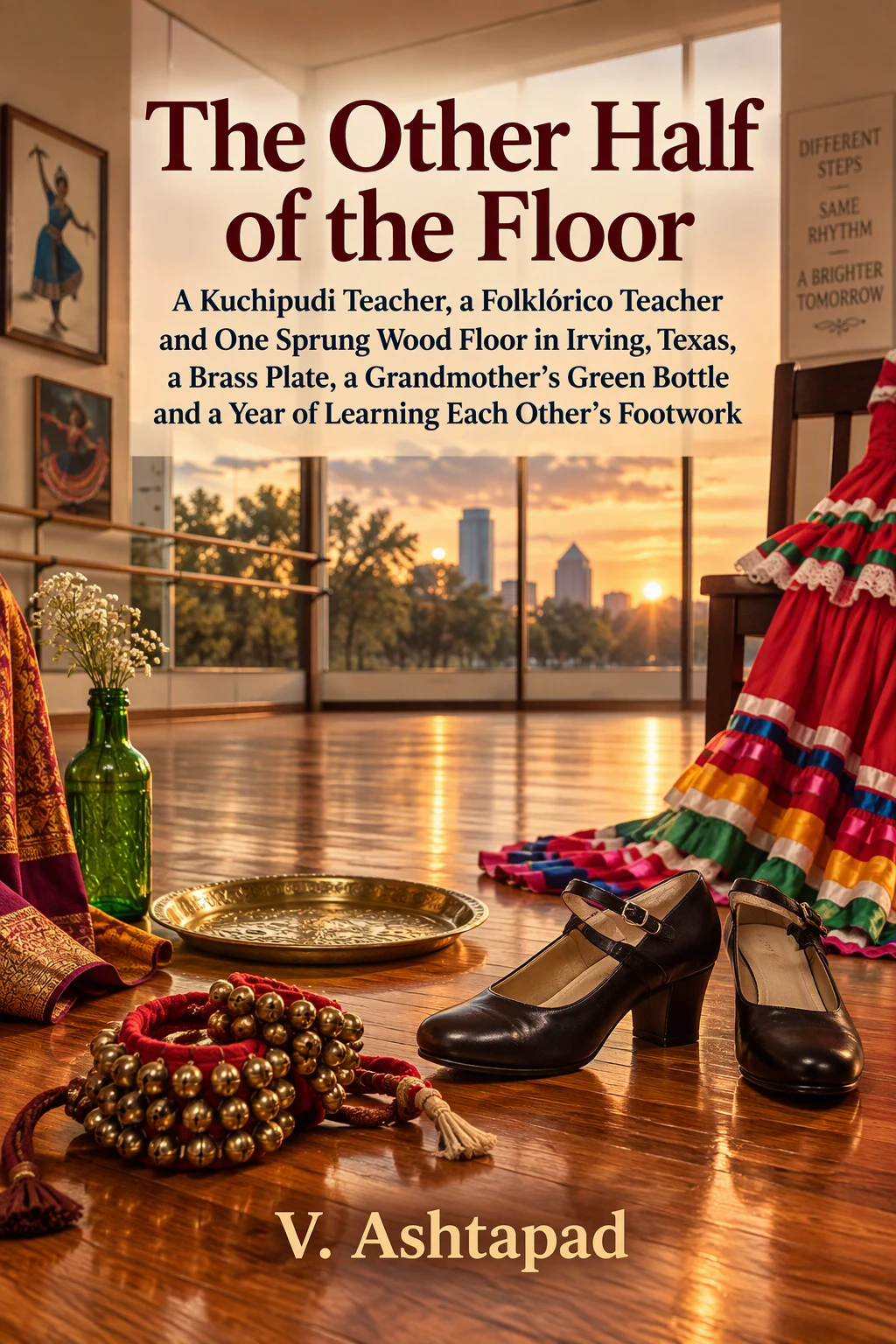
The Other Half of the Floor
A Kuchipudi Teacher, a Folklórico Teacher and One Sprung Wood Floor in Irving, Texas, a Brass Plate, a Grandmother's Green Bottle and a Year of Learning Each Other's Footwork
by V. Ashtapad
Foreword
This is a work of fiction. Kuchipudi, the classical dance-drama of Andhra Pradesh, with its tarangam danced on the rim of a brass plate, and Mexican ballet folklórico, with its regional dances, nailed shoes, zapateado and the wooden tarima of the son jarocho, are real traditions, as are the Telugu and Mexican holidays, foods and customs described here. The dance schools, the strip center, the fall festival and its showcase, and every person in the story are invented.
For every teacher who ever shared a floor and listened to the noise on the other side.
The Wall That Folds
The accordion wall came with the lease. In eleven years Sravani Kondapalli had never seen it fully open.
It ran down the middle of the unit like a beige spine. Vinyl over steel, hinged every two feet. On the far side, for most of those years, a karate school had thumped and shouted through its evening classes. She had taught around the shouting. She taught her students to hold a pose of longing while someone beyond the wall screamed a count in Japanese. She had told them, honestly, that a dancer who could keep her eyes soft through that could keep them soft through anything. Then in June the karate master had moved his school to a bigger place out past the highway. The other half of the unit sat empty and hot, and the landlord had sent a letter.
The letter was still on her desk in the little office by the front door, under a brass cymbal she used as a paperweight. It was polite. Glen Whitaker was always polite. He wrote that he understood the studio had been a good tenant and a quiet one, that he regretted the timing. That from the first of September he would need her to take on the full unit or find someone to share it with. Because he could not carry half a space through another Texas summer with nobody paying for its air conditioning.
She read it again on the first Monday in August with the door propped open and the parking lot shimmering. The strip center sat on Belt Line Road. On one side, a tax preparer open only in spring. On the other, a shop that had sold saris and steel cookware until the owners retired to Hyderabad. Beyond the lot was a car wash, a taco stand painted bright orange, a bus stop with no shade. Then the low roofs of apartment complexes. Half her students' grandparents spent their summers there, watching television in languages their grandchildren pretended not to understand.
Inside, the studio smelled the way it did every August. Floor cleaner. Coconut oil. Jasmine that had dried in someone's hair the week before. The floor was the reason she had taken the space at all. It was a sprung wooden floor laid by the karate master's predecessor, a ballet teacher who had gone bankrupt, and when Sravani had first walked across it barefoot eleven years ago she had felt it give under her heel, the faintest answer, and she had signed the lease that afternoon.
She was forty-five. She had danced since she was five, in a two-room school in Vijayawada. Her teacher sat on a mat with a pair of cymbals. She could hear a late foot from across a courtyard. She had taught in Irving since she was thirty-one. She had sixty-two students. Not enough to pay for the whole unit. Too many to fit well in half. She had a recital in October. She had a daughter of sixteen. She had a husband who said, every few weeks, that she could always teach out of a community center like other teachers did.
"Community centers have carpet," she said to the empty room, which was how she talked to Prakash when he was not there.
That evening she wrote the listing herself. She did not want an agent. She did not want a gym. She did not want a group that would put mats on her floor or drag folding tables across it. She wrote: "Half of a dance studio available, approximately 1,400 square feet, sprung wood floor, mirrors on one wall, shared restroom and entry, evenings and weekends preferred. Suitable for dance, music, or quiet instruction." She read the word quiet several times and left it in.
Four people called. The first wanted to run a daycare. The second wanted to store furniture. The third was a young man who taught hot yoga and asked if she would mind if he turned the thermostat up to a hundred and five, and she laughed before she could stop herself, and he hung up. The fourth was Yolanda Ibarra. She taught Mexican folk dance, ballet folklórico. Her group had rehearsed for nine years in the multipurpose room of a recreation center off Irving Boulevard. That the center was closing for eighteen months of renovation starting the week after Labor Day.
"I have forty-one kids," Yolanda said on the phone. "Some adults. A few moms who dance with their daughters. We practice Tuesday, Thursday, Saturday mornings. We need wood. Carpet kills us. Concrete kills our knees."
"Wood is the main thing I have," Sravani said.
"Then I want to see it."
She came the next afternoon in a white pickup. Ladder rack. Car seat in the back. She was a few years younger than Sravani, compact and quick. Hair pulled up off her neck. Gold hoops. The sun-browned face of someone who coached outdoor sports. She wore jeans and a faded festival T-shirt from some year long past. She walked into the studio and stopped inside the door and looked down.
Then she did a thing that Sravani would think about later. She slipped off her right sandal. She put her bare foot flat on the boards and pressed, the way you test the water in a lake.
"Oh," Yolanda said. "That's nice."
"It gives a little," Sravani said.
"I can feel it." Yolanda put her sandal back on. "Can I see the other side?"
They went through the narrow gap where the accordion wall met the mirror. The far half was darker. Blinds against the west sun. Holes in the drywall where the karate master had hung his weapons rack. The floor there was the same wood, but scuffed in a long oval where for years students had circled in their bare feet.
Yolanda walked the oval. Then, at the center of the oval, she lifted her heel and brought it down, once, hard, in her sandal, and the floor rang.
Sravani flinched before she could help it.
Yolanda noticed. "Sorry," she said. "I should have asked. That's what I do, though. That's the whole thing. We wear shoes with nails in the heels and toes. Little ones, like tacks. It's loud."
"How loud?"
Yolanda looked at the accordion wall, and then at Sravani, and she seemed to decide something. "Loud," she said. "I'd rather you hear it from me now than hate me in October. Forty kids doing zapateado is like a hailstorm on a tin roof. My grandmother used to say it was supposed to be heard in the next town. I've had complaints at the rec center from the senior aerobics class. I'm telling you now."
Sravani thought of her Thursday class of older girls working on expression. The slow pieces. One voice and a drone, the room held still, so a dancer could show you in her eyes that she was waiting for someone who was not coming home.
"What I teach is Kuchipudi," she said. "It is a classical dance from Andhra Pradesh, from the south of India. We dance barefoot. There are bells on the ankles. Some of what we do is very fast with the feet, and some of it is very slow and quiet, and the quiet parts are the hard parts."
"So you need quiet," Yolanda said.
"Sometimes."
"And I need noise."
"Always, it sounds like."
Yolanda laughed, a short surprised laugh. Then she said, "What's your rent for this side?"
Sravani told her. Yolanda winced and then nodded, and Sravani understood that this was a woman doing arithmetic in her head with forty-one families in it.
"I'd have to raise my fees," Yolanda said. "Some of my families can't do that. I'd have to find a sponsor."
"I could lower it a little for the first three months," Sravani heard herself say. It surprised her. She did not take it back.
They stood in the hot half-dark room. Out on Belt Line a bus sighed at the curb. Yolanda looked down again at the scuffed oval.
"Can I ask you one thing," she said, "before either of us says yes. What do you do before you start? Like, you personally. When you walk out on the floor."
It was an odd question and an exact one, and Sravani answered it honestly. "I touch the floor," she said, "and then I touch my eyes. My teacher taught us. You are about to stamp on the ground, so you ask its pardon first. It is a habit. Most of my students do it without thinking now."
Yolanda nodded. "My grandmother crossed herself and spat on her hands," she said. "I don't do either one. I just tap my heel twice. Like knocking on a door." She tapped it, twice, softly this time. "Okay," she said. "I think we should try it."
---
Prakash came home at eight with a bag of mangoes from the Indian grocery on MacArthur. She was at the kitchen table with the lease, a calculator. The family's shared photo pages open on her laptop. She had been scrolling through the studio's folder without meaning to. Recital pictures back to the first year. Her students as little girls with braids pinned up and faces painted. Then as teenagers. Then a few of them grown and married and dancing at their own weddings in pictures someone had added with captions in two languages. Her cousin in Guntur had labeled half of them. Her cousin labeled everything.
"You found someone," Prakash said, reading her face.
"A folklórico teacher. Mexican dance. With shoes."
"With shoes," he repeated.
"With nails in them."
He put the mangoes in the bowl and turned the ripest to the top. He did this without knowing he did it. "On your floor," he said.
"On the other half of my floor."
"It's the same floor."
"I know it's the same floor, Prakash."
He sat down across from her. He was a mild, careful man. He worked in network planning for a telecom company in Las Colinas. He had married her, his mother always said, knowing she would spend every weekend of their lives in a room full of ankle bells. He picked up the calculator and looked at the number on it.
"Can you afford it without her?" he asked.
"No."
"Then," he said, and spread his hands.
Upstairs, Divya was practicing. Sravani could hear it through the ceiling. Bells ticking. The thud of a heel. A phrase from the October recital's opening piece, over and over, with a stumble on the same turn. She listened to it the way she always listened to her daughter dancing, with half her mind correcting and the other half simply glad.
"She's rushing the turn," Prakash said, who could not dance a step but had been married to a teacher for nineteen years.
"She's sixteen," Sravani said. "Everything is rushed."
© 2026 CRUNOD LLC. All rights reserved.
Heels
The first Tuesday in September, the hailstorm arrived at six-fifteen.
Sravani had her beginners on the near side. Nine girls between six and eight, in practice saris pinned up between their legs into trousers. Her own teacher had pinned hers the same way. She was teaching them the first adavus, the basic units of footwork. Flat stamp, heel strike, sliding step. She counted aloud in syllables while a recorded drum played from the corner speaker. Tai ya tai hi. Tai ya tai hi. The girls watched their own feet. One of them, Harini, a solemn child with enormous eyes, watched Sravani's feet instead, which was correct.
Then from the far side of the accordion wall came a sound like a truckload of gravel tipped onto a steel bridge.
The girls froze. Two of them screamed, delighted. Little Anvi grabbed Harini's arm. The drum recording went on playing, small and faraway now, utterly overwhelmed. Through the hinges of the wall Sravani could hear a woman's voice counting in Spanish, one two three, one two three. Then music, a violin and trumpets and a guitar strummed hard. Then the gravel again. Forty pairs of nailed heels on wood, fast and exact, like rain on a car roof. Under it, faintly, laughing.
"What is that, Auntie?" Anvi said.
"That is our new neighbor," Sravani said. She turned the drum recording up. It did not help. She turned it off.
"Why are they so loud?"
"Because that is how their dance is made." She heard herself say it and it sounded more patient than she felt. "Come. Sit in a circle. We are going to practice counting with our hands."
They sat. She clapped the rhythm and they clapped it back. Beyond the hinges, the music stopped and started, stopped and started, and the woman's voice called for it again, and the heels came down again. Harini sat straight and clapped the Kuchipudi rhythm with Sravani. Then, in the pause, she tapped the other rhythm on her knee. She seemed not to notice. Three quick strikes and a rest. Three quick and a rest.
Sravani saw it and said nothing.
---
By Thursday she had three emails from parents. By the following Monday she had a phone call from Padma Rao.
Padma Rao was the mother of two of her older students and the unofficial head of the parents' group. She kept the volunteer roster for every recital in a shared sheet that she updated more faithfully than the school's own records, and she had a way of saying "Sravani garu" on the phone, with the respectful ending tacked onto the name, that warned you a complaint was coming in a silk wrapping.
"Sravani garu, I don't want to make a fuss," she said. "But the girls cannot hear the music. Meghana says on Thursday you could not even do the slow piece. She says you sat them down and talked about the story instead."
"We did talk about the story," Sravani said. "It was useful."
"It was useful for one week. October is not far. They have to rehearse with the music."
"I know when October is, Padma."
"And the mothers are asking whether this is a permanent arrangement. Some of them are asking whether we should be sharing at all." Padma paused. "With a group like that."
Sravani stood in the studio office with the door shut. Through the glass front she could see Yolanda's white pickup parked beside her own gray sedan. Yolanda's back bumper had a sticker from a youth soccer league and another, peeling, that said only *Zacatecas* in red letters.
"A group like what," Sravani said.
Padma had the grace to hesitate. "A loud group," she said finally. "I meant a loud group."
"I'll fix it," Sravani said, and hung up. She stood there a long minute. She did not know how.
That evening she stayed late. The near side was empty, the mirrors dark. On the far side, through the wall, she could hear Yolanda's adult class, eight or nine women and two men. The music this time was something with a harp and fast plucked strings. The zapateado had changed, gone lighter, like someone shaking dried beans in a gourd. There was laughter. Someone kept missing a step and someone else kept teasing her for it in Spanish.
Sravani went to the gap in the wall where it met the mirror and stood there in the narrow shadow, not looking through.
The far room was full of light. Yolanda had pulled the blinds up and the evening sun came gold and level through the dirty windows. The dancers were in practice skirts, long circles of cotton. They held the hems out in both hands and swept them up and down as they stamped. So that the skirts opened and closed like wings. The men wore boots. One of the women was heavy and moved lightly. All the noise came from her heels. None came from the rest of her. Yolanda stood at the mirror with her back to them and watched them in it. Sravani watched her own students that way. Yolanda called corrections without turning around.
And on the floor, the beautiful sprung floor, there were marks. Little crescent scuffs in a dozen places, gray against the honey of the wood, where the nailed heels had struck.
Sravani stood over them until the class next door ended. Then she went home and did not sleep well.
© 2026 CRUNOD LLC. All rights reserved.
What the Floor Is For
She went to talk to Yolanda on Saturday morning, early, before either of their classes. She had rehearsed what she would say in the car. She would be reasonable. She would mention the lease and the clause about damage. She would suggest rubber caps on the heels. She had read about them the night before. Or a schedule that kept the schools from overlapping, even if it cost her Thursday hours. She would not mention Padma Rao.
Yolanda was already there. The far half of the studio was open to the morning, the back door propped with a cinder block. A man was carrying something in from the pickup. He was old, seventy-five or more, sun-dark, white-mustached, under a narrow-brimmed straw hat. He moved slowly but without stopping, the way men move who have carried heavy things their whole lives. What he was carrying was a sheet of plywood. There was a stack of them leaning against the tailgate.
"This is my dad," Yolanda said. "Ernesto. Papi, this is Sravani. It's her floor."
The old man set down the plywood, took off his hat, and said something in Spanish, formal and rolling. Yolanda translated it. "He says good morning and he's sorry about the marks."
Sravani looked at the plywood. "What is that for?"
"I was going to call you," Yolanda said. "I saw the scuffs Thursday night. I felt sick. I know you saw them too, I saw your car still here." She rubbed her forehead. "My dad builds tarimas, wooden dance boxes. It's from Veracruz, the son jarocho tradition. People dance on a wooden box at a party. The box is part of the music. It's like a drum you stand on. He's been building them since he was a kid. I asked him if he could make us something we could lay down over your floor for practice. So we're on our own wood and not yours."
The old man was watching Sravani's face. He said something else.
"He says the floor is very good and it would be a crime," Yolanda said. "That's his word. A crime."
Sravani found that all her rehearsed sentences had left her. She looked at the stack of plywood. At the old man's hands, broad and scarred across the knuckles. At Yolanda, who looked tired.
"Can I ask you something," Sravani said. "Why do the heels have to be so hard? I read about caps. Rubber. Some schools use them."
Yolanda did not answer at once. She fetched her own practice shoes from a towel by the wall. Black leather, low heel. She turned one over to show the sole. There were small nails driven in a tight pattern around the toe and a thick cluster in the heel, their heads worn shiny.
"Some schools do," she said. "For practice, sometimes. I get why. But here's the thing." She tapped the heel with a fingernail and it clicked. "In folklórico the feet are an instrument. Not like a decoration on top of the music. They're in the music. In some of the dances, the son jarocho especially, the dancers are playing with the band. The jarana is strumming and the harp is going and the zapateado is the drum. If you cap the heels, you're telling a kid to play the drum with a sock on the stick. They learn to make the shape and not the sound. And then when they get on a real stage, they don't know how to listen to themselves."
Sravani was quiet.
"My grandmother was from a ranch outside Jerez, in Zacatecas," Yolanda went on. "She used to dance at weddings on a door. A door they took off the hinges and laid on some bricks in the yard. She said you could tell who the good dancers were from the next house over, just by the sound. She said a dancer who couldn't be heard wasn't finished yet." She smiled a little. "She said a lot of things."
She took out her phone. On her family's private pages was a small faded print someone had scanned. A yard of packed earth. A wooden door laid flat across bricks. A young woman in a full skirt on top of it with her arms out and her heels a blur. Under it a cousin had typed "Remedios, wedding of her brother, Jerez, around 1958.".
She set the shoe down. "So that's me being stubborn. I'm sorry. I don't mean to make it your problem. Tell me about your floor. Why it matters so much. I want to understand it."
It was the second time she had asked a real question and waited for the answer. Sravani was not used to it. People who did not dance asked what the hand gestures meant. Or whether the makeup took long. Or whether it was like Bollywood. They did not ask about floors.
"In Kuchipudi," she said, "we are barefoot, so the floor is the skin of the foot. Everything goes through it. We do a lot of jumping, more than some of the other classical dances. We land on the heel and the ball of the foot, flat. On a hard floor you damage your knees in five years. On a sprung floor you can dance until you are old." She hesitated. "There is also a part of the repertoire where you dance on the rim of a brass plate. Standing on the edge of it. You move it across the floor with your feet, like a boat. It is called tarangam. It means wave. If the floor is uneven, if it is scratched, the plate catches. I have seen girls fall. And it is the floor my teacher would have wanted me to have. In Vijayawada we had a mud floor painted with cow dung and lime, swept every morning. It was very hard. She used to say, one day you will have a floor that answers you."
The old man had sat down on the tailgate. He spoke, and Yolanda listened, and laughed in surprise.
"He says his mother's kitchen floor was the same. Dirt and lime. He says he's going to build you something that answers."
"I don't need anything built," Sravani said.
"He's not asking," Yolanda said. "I'm sorry. He's like this."
---
They worked it out that morning on the tailgate, in the building's shade. Yolanda bought two coffees from the taco stand across the lot. The coffee was thick and sweet with cinnamon. Yolanda's schedule went into Sravani's phone and Sravani's into Yolanda's. The overlap was only two hours a week. Tuesday and Thursday, six to seven. Sravani's older girls did their slow work then. Yolanda's main group did its loudest.
"I can move my Thursday to the second hour," Yolanda said. "Seven to eight-thirty. The little ones will be tired, but okay."
"I can do my slow pieces on Tuesday at seven-thirty," Sravani said. "And on Thursday I will do footwork during your loud hour. Then it doesn't matter." She surprised herself, again. "Then we can be loud together."
Yolanda grinned. "Like a war."
"Like a monsoon," Sravani said.
The old man had been listening without understanding much, his hat in his lap. Now he said something, and Yolanda said, "He wants to know what music you use."
"Carnatic music. South Indian classical. A singer, a drum called the mridangam, a violin, a flute sometimes. And the teacher keeps the rhythm with small cymbals and speaks the syllables of the footwork aloud. We call it nattuvangam."
"Speaks the syllables?"
"Like a drummer saying the drum strokes out loud. Ta ka dhi mi, ta ka jha nu. The dancer's feet answer."
Yolanda translated. The old man's eyebrows went up. He tapped on the tailgate with his knuckles, slow at first, ta ka dhi mi, and then faster, getting it. Sravani, before she could think about it, spoke the next phrase, and he tapped it back. He laughed and said something.
"He says," Yolanda said, "your syllables are like a horse at a trot."
© 2026 CRUNOD LLC. All rights reserved.
Ammamma's Knees
Her mother arrived from Vijayawada at the end of September with two suitcases, and the second held only pickles.
Saroja was seventy-two. She was small and round and upright, with gray hair in a long thin braid and spectacles on a chain. She came through the doors at the international terminal in a turmeric cotton sari. She walked with a cane she pretended was only for airports. She had a six-month visa and a list. The list was in Telugu in her own careful hand. It included Divya's posture, Prakash's blood pressure, the condition of Sravani's kitchen, and the October recital, in that order.
"Your daughter is taller than you now," she said in the car, in Telugu, looking at Divya in the back seat.
"She's been taller than me for a year, Amma."
"On the video it does not show."
At home she unpacked the pickle suitcase jar by jar. The mango avakaya, oily, red, fiery with mustard. The sour green gongura her own sister had made; a lime pickle. A jar of tamarind paste so dark it was nearly black. A cloth bag of chili powder from one shop in the old market. It could not be found in America, she said. Sravani bought the same chili every month on MacArthur Boulevard. The kitchen filled with the smell of mustard oil and fenugreek. Sravani stood in it and felt, as she always did when her mother came, nine years old and fifty years old at once.
Divya ate gongura on hot rice with ghee that night with her eyes closed. "Ammamma," she said, "I'm going to marry this."
"You will marry a nice boy who likes it also," Saroja said.
---
Saroja had danced. That was the thing about her that her granddaughter did not believe, though there were photographs to prove it, three small square black-and-white prints in a tin box that had been scanned years ago and posted to the family's private pages, where Sravani's cousin had labeled them: "Saroja, age 11, Kuchipudi recital, Vijayawada, 1965. Saroja, age 13, tarangam. Saroja with her teacher, 1966." In the second one a girl with fierce eyebrows stood on the rim of a brass plate with a pot balanced on her head, and her arms were out, and she was not smiling.
She had stopped at fifteen. She had married at nineteen, and her husband's family had not wanted a daughter-in-law who danced in public, and that had been the end of it. She told it without bitterness. She told the story of the cyclone that took her grandfather's roof the same way. Weather. A thing that happened in those days.
But her knees were bad now, both of them. On her first Saturday she sat in the studio office on a cushioned folding chair, cane hooked on the desk. Through the open door she watched Sravani teach the older girls. Her hand on the head of the cane kept time. Once, when a girl landed a jump badly, Saroja said "*Aiyyo*" under her breath in exactly the tone Sravani's own teacher had used, and Sravani, across the room, nearly laughed.
At the break Saroja called Divya over.
"You are landing on your toes," she said. "Your heel is afraid. Why is your heel afraid?"
"It's not afraid, Ammamma."
"It is afraid of the floor. Your mother's floor is soft, so you have become lazy. On a hard floor you would have to mean it." She tapped the ground with the cane. "Mean it."
Divya rolled her eyes, but she went back and did the jump again. This time her heel came down flat and sure. The bells rang all at once instead of in a scatter.
From the other side of the accordion wall came, as if in answer, a single tremendous stamp, and then laughter.
Saroja looked at the wall. "What is that?"
"Our neighbors. I told you. The Mexican dance."
Saroja was quiet for a moment, listening to the stamping start up again, fast and furious. The music, a brass band now, bright as tin. Then she said, "They are not afraid of the floor."
---
That week Sravani started recording her mother.
It had been Divya's idea, oddly. Divya had a school project on family history for her English class, an interview with an elder. She set her phone on the kitchen table between the pickle jars. In her careful, limited Telugu she asked Saroja to talk about being a girl. Saroja had looked at the phone suspiciously.
"Who will hear this?"
"Just my teacher. And us. And the family pages, if you say yes. Only family can see."
"Your cousin Kiran in Guntur will put it on the pages and label it wrong."
"I'll label it myself," Divya said.
Saroja considered. "Then yes," she said, and adjusted her spectacles, and began.
She went on for forty minutes. She described the dance school in Vijayawada, which had been in the courtyard behind a cloth merchant's shop. About her teacher, a widow with a voice like a brass bell. She smoked hand-rolled cigarettes behind the well when she thought the girls were not looking. About the summer she learned the tarangam. She practiced on an old brass plate from her mother's kitchen until her arches bled. About her first stage with electric lights. She could not see the audience at all. Only a great dark that breathed. She talked about the famous dance-dramas of the village of Kuchipudi itself, where for hundreds of years the men of certain families had performed the whole stories, playing all the parts, kings and demons and queens, and how she had been taken as a girl to see one in a village square that went on all night under the stars, the actor playing the proud queen Satyabhama so convincing in his sulking and his vanity that the women in the audience shouted advice at him.
Sravani stood at the stove making pesarattu, the green gram crepes her mother liked. She poured the batter in spirals and spread it thin with the back of a ladle. She listened, and some of it she had never heard before.
When Saroja finished, Divya stopped the recording and sat looking at the phone.
"Ammamma," she said in English, "why did you stop?"
Saroja understood the question. She answered it in Telugu.
"Because nobody asked me not to."
Divya looked at her mother. Sravani turned the crepe over and said nothing, and the pan hissed.
© 2026 CRUNOD LLC. All rights reserved.
Harini Counts in Spanish
In the second week of October, two weeks before the recital, Sravani came out of the office. Harini was standing in the gap in the accordion wall, doing zapateado.
She was barefoot. She was eight years old, in a pink practice sari pinned between her legs. She was standing in the shadowed gap where the wall met the mirror and watching through it, and her feet were moving. Heel, toe, heel. Heel, toe, heel. Then the quick triple strike, a flam, a little roll, and stop. She was not making much noise, because she had no shoes and the floor was sprung, but the pattern was exact. Sravani could hear the same pattern on the other side, magnified forty times, under the brass and the violins.
"Harini," Sravani said.
The child jumped and turned around. Her face went from absorption to guilt in an instant.
"Sorry, Auntie."
"What are you doing?"
"Nothing."
"It did not look like nothing."
Harini looked down. Then she said, in a small voice, "It's the same as ours. Kind of. That one." She pointed through the gap. "They do three and then a rest. Like ta ka dhi. Then they do it backwards."
Sravani came and stood beside her and looked through the gap. Yolanda's intermediate group was there, fifteen kids between ten and fourteen in practice skirts and boots. At the front of them was a boy of twelve or so, thin and serious, the only boy in the row. He was doing the step Harini had been copying, and he was good. Yolanda was calling the count in Spanish, one and two and three.
"In our dance," Sravani said, "what would we call that?"
Harini thought. "Ta ka dhi, mi," she said. "Ta ka dhi, mi. But theirs has a little extra at the end. Like a ki ta."
"Show me."
Harini showed her, slower now, reciting the syllables under her breath. Ta ka dhi mi, ta ka dhi, ki ta. Sravani watched her small bare feet and then looked through the gap at the boy's nailed heels and saw that she was right. The two patterns were not the same, but they were cousins. They had the same bones.
On the other side the music stopped. Yolanda turned around. Over the heads of her students she saw Sravani and Harini in the gap, and she lifted her hand.
"She's been watching for two weeks," Yolanda called. "I didn't want to tell on her."
"Mine too," said a voice. The thin boy at the front was pointing at the gap himself, embarrassed and defiant. "I mean, I watch them too. The little ones do this thing with their eyes."
"Mateo," Yolanda said, "go back in line."
"It's cool, though," Mateo said. "The thing with the eyes. And when they count out loud. Can we learn the counting?"
Yolanda looked at Sravani across the room. Sravani looked back. Neither of them, she thought later, knew who was supposed to answer first.
"Come," Sravani said at last, to the whole room. She pushed back the first panel of the wall. It squealed on its track like a startled bird. "Come through. Ten minutes. Harini, show them."
They came through, fifteen kids in boots and practice skirts, onto the near side. Sravani's beginners, who had been waiting for class to start, scooted back against the mirrors with their eyes huge. Harini stood alone in the middle of the floor, small, fifteen older children around her. For a moment Sravani thought she would cry.
Then Harini put her palm flat on the floor and touched her eyes, the way she had been taught, and stood up, and began to count. Tai ya tai hi. Ta ka dhi mi. Her feet answered. And Mateo, watching her, listened once all the way through. Then he began, in his heavy boots, to try.
It sounded terrible. It sounded like a horse falling down a staircase. Everyone laughed, Mateo hardest of all. He tried again. By the third time he had the shape. By the fourth he had something more. It was neither a Kuchipudi adavu nor a zapateado. The boot heel rang where a bare heel would have thudded. Harini, beside him, clapped her hands once, delighted, the way her grandmother might have.
Yolanda was standing in the gap now, arms folded, smiling.
"Okay," she said. "Okay. Now ours."
That night Harini's mother sent Sravani a clip from the bench by the mirror. The boy in boots and the girl in the pink sari, trading phrases. Could it go in the school's shared folder with the other class videos? Sravani added it herself and typed under it the date and both children's names, and then, after thinking, the words "first conversation".
© 2026 CRUNOD LLC. All rights reserved.
Don Ernesto's Tarima
The recital went well, mostly. It was held, as it was every year, in the auditorium of a high school in Valley Ranch that rented its stage on Saturdays. The hall was full. Four hundred people in silk and gold. Babies asleep on shoulders. Grandfathers in white shirts filming on tablets held high. Sravani sat at the side of the stage with her cymbals and spoke the syllables into a microphone for the pieces that needed them. The singer and the drummer and the violinist she hired every year sat beside her on a white sheet. Her students went out one after another into the hot lights.
Divya danced the opening invocation and did not rush the turn. Harini's group did their first little piece, all nine of them in matching blue, and one of them stopped dead in the middle to wave at her father, and the audience loved it. Meghana Rao did the slow piece, the one about the woman waiting. Her eyes were soft the whole way through. Her mother Padma cried in the third row. It was a good recital.
At the back, near the doors, Sravani saw Yolanda. Ernesto was with her, and two students: Mateo and an older girl with a long black braid. They had come in quietly halfway through and they stayed to the end. Divya came back out for the final piece, fast pure dance full of jumps. Sravani glanced up from her cymbals. Under his chair, Mateo's feet were moving.
Afterward, in the crush in the lobby, Yolanda found her.
"That was incredible," she said. "That last one. I've never seen anything like that. How do they jump like that and come down so quiet?"
"Years," Sravani said. "And a good floor."
"Papi wants to say something." Yolanda stepped aside.
Ernesto had his hat in his hands. He spoke in Spanish and Yolanda said, "He says your daughter dances like his mother. He says it as a compliment. His mother was very proud and nobody could tell her anything."
Sravani laughed, and then, unexpectedly, found her eyes stinging. "Tell him," she said, "that my mother says the same thing about Divya. Not as a compliment."
---
He began building the tarima in November.
He did it in the lot behind the strip center, under the live oak by the dumpsters, on two sawhorses from the pickup. He came on weekday mornings when neither school was in session. Sravani did her accounts and costume orders at the office desk in the mornings. Now she heard a circular saw whine through the back wall. Then the slow tap of a hammer. After the second morning she went out with two cups of chai.
He was not building one tarima. He was building sixteen. Each was a square of good plywood, three feet on a side, over a frame of two-by-fours. A lip on two edges let them lock together. He showed her with his hands how they fit, four by four. A floor twelve feet square. Carry it in, lay it over the sprung wood, carry it out again. Underneath each one, in the hollow of the frame, he was gluing strips of old carpet.
"For your floor," he said in English, pointing at the carpet, and then pointing at the plywood. "For our feet." He made a fist and knocked on the top of a finished square. It boomed, a deep, full, wooden sound, like knocking on the side of a barrel.
She gave him the chai. He tasted it, looked at it, tasted it again.
"Canela?" he said.
"Cardamom," she said. "And ginger. And a little cinnamon."
He nodded, considering, and drank the whole cup.
They had few words in common. He had come from Zacatecas to Texas at nineteen to work in construction. He had worked construction for fifty years. Dallas, Fort Worth, Arlington, then Irving. Framing houses, then cabinets. In retirement, tarimas, and now and then a guitar for his grandsons. His English was good for work and poor for everything else. Her Spanish was fourteen years of Texas and a Mexican supermarket on Irving Boulevard. Gracias, hola, cilantro, bonito. But on the third morning Saroja came with her. Because she was bored at home and wanted to see the parking lot, and that changed everything.
Saroja settled under the live oak on a folding chair, cane across her knees. Ernesto sawed. After a while Saroja began to recite.
It was what she did when she was bored, Sravani knew. She had done it all through Sravani's childhood. At bus stops, in waiting rooms, in power cuts. The dance syllables of her girlhood, under her breath, the way other women hummed film songs. Tha dhi gina thom. Tha ka dhi mi. Tha ka jha nu. Ernesto stopped sawing. He listened. Then he picked up his hammer and, on the edge of a finished square, tapped it back.
Saroja's eyebrows rose above her spectacles. She recited a longer phrase, harder, with a turn in it. He tapped it back, with one mistake. She corrected him, sharply, in Telugu, and repeated it, and he tried again and got it. She nodded once, the nod Sravani remembered from her own childhood, the nod that meant acceptable, barely.
Ernesto set his hammer aside. He began to tap something else, with both hands, on the hollow tarima. It took Sravani a moment. He was playing zapateado with his fingers. Quick, syncopated, with a catch in it like a hiccup. He played it twice. Then he looked at Saroja.
Saroja frowned at the tarima as if it had personally offended her. She lifted her cane and tapped the rhythm back on the asphalt. Once, badly. Twice, better. Ernesto laughed out loud and clapped.
They spent the whole morning like that. Sravani went back in to do the accounts. She could hear them through the wall. Knuckles on wood. A cane on asphalt. Telugu syllables, then Spanish counts, arguing in rhythm.
At noon Yolanda arrived to pick up her father and stood at the back door with her keys in her hand, watching.
"What is happening," she said.
"I have no idea," Sravani said. "I think they are friends."
That night Divya made a new folder on the family pages. "Ammamma and Don Ernesto." Inside was a short video shot from the studio's back door. An old woman in a turmeric sari with a cane. An old man in a straw hat with a hammer. They tapped at each other across a sheet of plywood, both scowling. Under it Divya had written: "Recorded with both their permission. Ammamma says to tell everyone she won."
© 2026 CRUNOD LLC. All rights reserved.
Lamps and Marigolds
Diwali fell in early November that year. The Day of the Dead came at the start of the month. For a week the studio smelled of marigolds from both sides.
Yolanda's group was preparing a small performance for a community celebration at the public library on the first of the month. Her families had built an ofrenda in a corner of the far half. A table in three tiers under a white cloth. Framed photographs of grandparents and great-grandparents. Glasses of water. Pan de muerto with its sugared crossbones. Orange soda for someone's uncle who had loved it. Candles. Marigolds everywhere, in jars, in strings, in loose petals laid in a path along the floor.
"For remembering," Yolanda said when Sravani asked. "The idea is the people you lost come back to visit for a night. You put out what they liked. It's not sad, exactly. Well. It's a little sad. Mostly it's like a party you throw for people who can't come."
Sravani looked at the photographs. A woman in a black rebozo standing in front of an adobe wall. A man in a cowboy hat holding a baby. A young soldier in a uniform from long ago. A grandmother at a kitchen table with her hands in a bowl of masa. Under each one somebody had taped a card with a name and the years.
"This is my grandmother," Yolanda said, touching the frame of the woman at the table. "The one who danced on the door. Remedios. She died when I was fourteen. She taught me the Jarabe in her kitchen in Oak Cliff with a wooden spoon for a sombrero."
"She looks strict."
"She was terrifying." Yolanda smiled. "I miss her every day."
Sravani went back through the gap to her own side. The next week her families came in on a Saturday afternoon with clay lamps and rangoli powder. The girls drew muggulu on poster boards on the floor. White rice-flour loops and dots and lotus petals, filled in with color. Because Sravani would not allow powder on the wood itself. Saroja supervised from her chair. She had drawn muggulu every morning of her life outside her front door in Vijayawada, a fresh pattern each dawn swept away each night. She sent half the girls back to start over because their dots were uneven.
Someone's mother brought marigold garlands for the doorway, orange and yellow, strung with mango leaves. Someone brought sweets. Coconut barfi, boondi laddus, a plate of ariselu, the dense fried rice-flour cakes with sesame. Saroja declared them too hard.
Mateo came through the gap in the wall with his cousin and stood looking at the marigold garlands.
"We use those too," he said. "Cempasúchil. My grandma says the smell helps them find the way."
"In India we use them for everything," Divya said. She was sitting on the floor drawing the border of a muggu in pink. "Weddings. Doorways. Every celebration. My grandma says they're the flower that never complains about the heat."
"That's true," Mateo said. "They don't."
Harini looked up from her poster board. "So it's the same flower," she said.
"Same flower," Mateo said.
That afternoon Saroja's voice was played aloud in the studio for the first time. Divya had finished her school project. After the lamps were lit and the sweets passed, she connected her phone to the corner speaker. She played five minutes of the kitchen recording. The part about the all-night dance-drama in the village square. The families sat on the floor among the poster boards and listened. Most of the girls had never heard their teacher's mother speak more than three sentences together. They heard her now. Dry, fast, amused. The actor who played the vain queen. The women who shouted at him. The older girls laughed at the right places. The younger ones watched Saroja in her chair. She sat still, hands folded on her cane, face to the window.
Afterward a mother came up to Sravani. Could Divya show her how to record her own father? He was eighty-three. He had acted in dramas in Rajahmundry in the 1960s. He had never told the family the stories.
"Ask Divya," Sravani said. "She does it better than I do."
Beyond the wall someone had put on music. An old song, guitar and a woman's voice, slow. Through the gap Sravani saw Yolanda's families laying the last petals on the path to the ofrenda. Ernesto sitting in a chair by the photographs with his hat on his knee.
© 2026 CRUNOD LLC. All rights reserved.
Divya Wants the Skirt
It was the second week of December when Divya asked.
They were sitting in the car outside the studio at eight-forty at night, after Divya's advanced class. The heater was running. The taco stand across the lot was lit up orange against the dark, and there was a line. The smell of grilled onions and charred corn came faintly through the closed windows. Divya held her phone face down on her knee.
"Mom," she said. "Yolanda said I could come to her Saturday class. If you said okay. Ximena asked her."
Sravani had both hands on the wheel. She did not start the car. "Ximena is the girl with the braid," she said.
"She's a senior. She's the lead in their Jalisco suite. She's amazing." Divya was talking fast now, the way she did when she had rehearsed something. "She's been coming over to our side on Thursdays after her class to watch the end of mine. She asked me to teach her the tarangam footwork, just the basic part, without the plate. And she wants to show me the faldeo, the skirt work. It's so hard, Mom, you have to move the skirt like it's a separate person. And the zapateado is, it's like, it's math. It's like jathis but with shoes."
"I know what it is like," Sravani said.
"So can I?"
There were a great many things Sravani could have said. She thought of several of them in the space of three seconds. She could have said that Divya had a debut solo planned for next fall. Her first full-length program. Eight pieces, ninety minutes. They had been building toward it since Divya was six. She could have said that Saturdays were for practice, that the solo needed every hour, that Divya was not as far along as she thought. She could have said that Kuchipudi was a classical form with centuries behind it. You did not dabble in it. Her own teacher would have thrown a student out for this. She could have said: is mine not enough?
She did not say any of them. She held the wheel. She thought of her mother at the kitchen table saying nobody had asked her not to. How it had sounded. What it had cost.
"Why do you want to?" she said instead.
Divya looked at her, surprised. She had been braced for a no. Sravani could see her bracing dissolve and uncertainty come up in its place.
"I don't know exactly," Divya said. "Because it's fun? Because Ximena's my friend now?" She looked out the window at the taco stand. "Because when I watch them, it's like the floor's part of it. Like they're not dancing on it. They're dancing with it. And I think if I learned that, I would understand something about ours. About Ammamma saying my heel is afraid." She paused. "And because I've only ever had one teacher. Ever. I love you. But I've only ever had you."
Sravani let go of the wheel.
"I had only one teacher until I was twenty-two," she said. "Then I went to Madras to study with another. She undid half of what the first one taught me. I cried for a month. Then I was a better dancer." She looked at her daughter. "I did not know you thought about it this way."
"I think about it all the time."
"Ask me questions, then. Tell me what you see when you watch them. Tell me what you think it would teach you."
So Divya told her. Twenty minutes, in the dark car, the heater ticking. She talked about Ximena. Her upper body almost still while her feet went like machinery. The opposite of Kuchipudi, where the whole body sang with the feet. And about the way folklórico dancers smiled the entire time, always, even in the hardest steps. The dances were mostly about parties and courtship. You were supposed to look like it was the best night of your life. And about how Yolanda had told her that each region of Mexico had its own dances and its own costumes. So that the white lace of Veracruz and the ribboned skirts of Jalisco and the leather fringe of Tamaulipas were as different from each other as the north and south of India. She talked about how Mateo had asked her what the hand gestures meant, the mudras. She had realized she knew forty of them by name and could not explain why any of them looked the way they did.
Sravani listened to all of it. She did not interrupt. Twice she wanted to correct something. Once Divya said folklórico was "more free." Sravani felt a hot flare on behalf of her own discipline. It was not unfree. It was exacting. She let the flare go by. She weighed what her daughter was saying under the words. Not that she wanted to leave. That she wanted to understand where she stood.
"Saturday mornings," she said finally. "Yolanda's class is nine to eleven?"
"Nine to eleven-thirty."
"Then your solo practice moves to Saturday afternoon. And Sunday. And you keep every hour of it. If your solo work slips, we talk again."
Divya stared at her. "Really?"
"Really." Sravani started the car. "And you ask Yolanda what she wants in exchange. A teacher's time is not free, even when it is given. You find out what her students want to learn from us."
"I already know," Divya said. "They want the eyes. Ximena says they want to learn the thing with the eyes."
In bed that night Sravani could not sleep. She opened the records Yolanda's company had shared with her at the sublease. Every recital since the first. Each video labeled with the dance's region and the dancers' names. She found Ximena at eleven, a small furious girl in a white Veracruz dress. She watched her grow up across six Octobers. She understood a little better what her daughter had seen.
At home, Sravani told Prakash in the kitchen while Divya ran upstairs to call Ximena. He was eating a late dinner of rice and pappu and avakaya standing up at the counter. He listened and nodded, and when she finished he put his plate down.
"You said yes," he said.
"I said yes."
"Without me." But he was smiling a little.
"You would have said yes faster."
"I would have," he admitted. Then, more seriously: "Are you all right?"
She thought about it. Upstairs Divya was laughing on the phone. In the next room her mother watched an old Telugu film too loud. Weeping and a brass band.
"I think I was afraid of something for a long time," she said, "and tonight I found out what it was, and it was smaller than I thought."
© 2026 CRUNOD LLC. All rights reserved.
The Letter From the City
The kites came out in January.
Sankranti fell in the middle of the month. In Andhra it was the biggest harvest festival of the year. Three days of new rice and sugarcane and sesame sweets and kites. Every year Sravani's families held a picnic by the lake in Las Colinas, under the bare pecans. Folding tables of food. An old man named Subbarao, a retired engineer who played mridangam on all the school's recordings, sent up a fish-shaped kite. The women made bobbatlu, flat sweet breads stuffed with jaggery and lentil, griddled in ghee until they blistered. The children ran on the brown winter grass. Somebody always brought a speaker, and somebody's father always sang an old film song too loudly near the water.
This year Yolanda's families came too. Divya had invited Ximena, and Ximena had brought her mother and her two little brothers. Mateo brought his grandmother and a cooler of tamales left from the family's Christmas tamalada. Eleven women and two men, he explained. A kitchen. Nine hours of spreading masa on corn husks. The stories got less suitable as the afternoon went on. The tamales were pork in red chile and chicken in green. There were sweet ones too, pink with raisins. Saroja ate a pork one with deep suspicion and then asked for another.
Yolanda came late, after a morning rehearsal, with Ernesto and her own son Luis, who was nine and who immediately joined the kite children. She sat down on the bench beside Sravani with a paper plate of bobbatlu and pulihora and a cup of Ernesto's coffee from a thermos. She had an envelope in her jacket pocket.
"Did you get one of these?" she said.
Sravani had. It had come the week before, from the city's cultural arts office. The fall festival. The big October weekend that took over old downtown along Main Street. Food trucks, a carnival, a car show, three stages of music. This year there would be a ninety-minute cultural dance showcase on the main stage, Saturday evening. The first one the festival had programmed. Local schools and companies could apply. There were seven slots of approximately twelve minutes each. Applications were due February first.
"I got one," Sravani said. "I have filled it out three times."
"Me too," Yolanda said. "And then I thought about it. And I thought, there's seven slots and there must be forty dance schools in this city. And there's going to be one Indian slot and one Mexican slot, probably, because that's how these things go. And there are six Indian classical schools in Irving and twelve folklórico groups that I know of. And we're both small. We're not the big school in Plano with the professional costumes. We're two people in half a strip mall each."
"So we probably don't get in," Sravani said.
"So we probably don't get in," Yolanda agreed. She bit into a bobbatlu and closed her eyes. "Oh, wow. What is this."
"Bobbatlu. Sweet lentil inside."
"This is like a pan dulce had a baby with a tortilla." Yolanda chewed. "Okay. So here's what I was thinking. What if we apply together."
Sravani turned and looked at her.
"One application," Yolanda said. "One slot. Two schools. Twelve minutes is nothing anyway, it's two dances. But if we did it together, we'd have a story to tell the committee. Two schools sharing one floor. That's a thing nobody else has. And our families would show up. All of them. Yours and mine. That's six hundred people they're bringing to the festival instead of three. Committees like that."
Sravani watched the kites. Subbarao's fish was high over the lake, tilting and flashing silver in the low winter sun. Luis and Harini were chasing a smaller kite along the shore, a red diamond with a long tail. Mateo was trying to untangle it from a bush.
"What would we dance," she said.
"I don't know yet," Yolanda said. "That's the fun part."
Sravani thought about it. She thought about her plan for Divya's solo. About Padma Rao and the mothers. About her mother tapping rhythms with her cane on the asphalt behind the studio. She thought about the gap in the accordion wall, and how in the last three months it had stopped being a gap and become a door.
"We would need to agree on everything," she said. "The music. The costumes. Who goes first."
"We'd fight," Yolanda said cheerfully.
"We would fight."
"So? I fight with my dad every day. He's my best friend." Yolanda held out her hand. It was sticky with jaggery. "Partners?"
Sravani shook it. Her hand came away sticky too.
That night they wrote the application together. Yolanda at her kitchen table near Irving Boulevard. Sravani at hers. One shared document, one paragraph at a time, arguing in the margins. Yolanda wanted to lead with the floor. Sravani wanted to lead with the history of both forms. They compromised on the floor, the history in the second paragraph. Under Name of Company they wrote both names, side by side. Under Proposed Title of Piece, after an hour, Sravani typed the only thing that seemed honest, and Yolanda wrote back in the margin: "Yes. That one."
The title was *The Other Half*.
© 2026 CRUNOD LLC. All rights reserved.
No Mixing
They got the slot.
The letter came the third week of February. They were the fifth act of seven, between a Korean drum troupe and a group of Ethiopian dancers from Garland. They had twelve minutes, plus two minutes for changeover. A stage forty feet wide and thirty deep. Professional sound. Lights. An expected audience, the letter said, of fifteen hundred to two thousand.
Yolanda called Sravani the minute she read it and screamed into the phone for some time.
Then the work started, and so did the trouble.
The trouble began, as Sravani would admit later, with her. She had spent February nights awake thinking about the piece. She came to the first joint planning meeting with a plan. A Sunday afternoon in the near half, the wall pushed all the way open for the first time in eleven years. It was a good plan. She had drawn it on graph paper. Her dancers and Yolanda's would start on opposite sides of the stage, each in their own costumes and music. Over twelve minutes they would move to the center and blend. The music would fuse too. Carnatic violin over mariachi guitar. Ankle bells with nailed heels. At the end, one shared choreography in the middle. A new thing.
She laid the graph paper out on the floor between them. Yolanda sat cross-legged and studied it, tracing the arrows with one finger.
"No," Yolanda said.
Sravani waited.
"I'm sorry," Yolanda said. "I know you worked hard on it. I can see that. It's beautiful on paper. But I can't do this."
"Tell me why."
Yolanda lifted the graph paper off the floor and held it between her palms. "Because the thing I'm trying to do," she said, "my whole thing, the reason I teach, is so these kids know the dances right. The real ones. Their grandparents' ones. Half of my kids' parents were born here. Some of their grandparents were born here. A lot of them don't speak Spanish at home anymore. They don't go back to Mexico. They don't know where their family's from except it's a word on a bumper sticker." She looked up. "The Jarabe Tapatío is maybe the one thing they have that's exactly the same as what their great-great-grandmothers did. Same steps. Same sones. When they do it right, they're standing in the same footprints. If I put that in a blender with something else, even something I love, even yours. Then I'm telling them it's okay to lose the footprints. And I can't. I'm sorry."
Sravani was quiet.
She felt the old flare in her chest, the one from the car with Divya. The reflex to explain. To insist this was about art, not betrayal. She let it rise and she let it pass. She made herself listen again to what Yolanda had said. Not to defend her plan. To hear it, the way she would want to be heard. As she listened she understood. Yolanda was describing, almost word for word, why Sravani had refused for eleven years to teach the fusion pieces some parents asked for. The Bollywood medleys for weddings. The "contemporary Kuchipudi" with pop songs that a school in Frisco did every year to standing ovations.
"You are right," she said.
Yolanda blinked. "I am?"
"You are right. I would not let anyone do this to my students' pieces either. I don't know why I thought I could ask you." She took the graph paper back and folded it. "I wanted to make something new. But I think you are telling me the new thing is not a blend. It is the two of them side by side. Whole."
"Side by side," Yolanda said. "And maybe, like, they talk to each other. In the middle. But they don't become each other."
"A conversation," Sravani said.
"A conversation." Yolanda leaned back on her hands. "Like your mom and my dad in the parking lot."
---
It was not the end of the trouble. Two weeks later Padma Rao called a meeting of the parents.
It was held, at Padma's request, in the near half of the studio on a Wednesday evening, with the accordion wall shut. Twenty-three mothers and four fathers came. Padma had printed an agenda. She was not hostile, exactly; she was frightened. Sravani, sitting at the front with her hands in her lap, could see that the fright was real.
"We are not against anyone," Padma said. "Please understand this. The Mexican families are lovely people. My Meghana is friends with their girls now. That is all fine. But we have been with Sravani garu for many years because she teaches the real Kuchipudi. Not the mixed-up version. When we tell our families in India that our daughters are learning, we are proud because it is the real one. Now there is this festival, and we are hearing that our girls will be dancing with Mexican dancers. In the same piece. We are worried that the classical form is being—" she searched for the word in English and then gave up and said it in Telugu, a word that meant something like diluted, watered down, the way you water down milk to cheat a customer.
There was a murmur of agreement. A father in the back said, "My mother asks me on the phone, is it still Kuchipudi."
Sravani let them talk. She let every one of them speak who wanted to, which took forty minutes. She did not argue. She wrote things down on a pad of paper on her knee. When a mother said her daughter came home doing the Mexican stamps in the kitchen, Sravani wrote that down. When a father said he was worried about the shoes on the floor, she wrote that down too. At last Padma said it. She had come to America twenty years ago. Her daughters were the only thing she had made here that was hers and her mother's. Sravani wrote nothing down. She looked at her for a long moment.
Then she stood up.
"I want to tell you two things," she said. "And then I want to show you something."
She told them about the graph paper. She told them she had wanted to blend the dances and that Yolanda had refused. She told them why, in Yolanda's own words as closely as she could remember them, the footprints and the grandmothers and the blender. The mothers listened. Several of them looked startled.
"She said no to me," Sravani said, "for the same reason you are afraid. And she was right, and you are right. So nothing in this piece will be mixed. Our girls will dance Kuchipudi, correctly, in our costumes, to our music, the way my teacher taught me and her teacher taught her. Yolanda's students will dance their dances correctly in theirs. In the middle there will be a section where the two groups speak to each other with their feet. Our girls will speak in Kuchipudi. Theirs will answer in zapateado. Nobody will pretend to be anybody else."
She went to the accordion wall and pushed back the first panel. It squealed. On the other side, by arrangement, Yolanda's intermediate group was waiting in their practice skirts and boots, quiet for once, Mateo at the front. And Harini was standing in the middle of them in her pink practice sari.
"Harini," Sravani said. "Mateo. Show them the conversation."
The two children faced each other on the bare wood. Harini touched the floor and her eyes. Mateo tapped his heel twice.
Then Harini spoke a phrase in syllables and danced it. Eight counts of a Kuchipudi adavu. Crisp. Bells ringing, arms correct, eyes following her hand. Mateo listened all the way through, still. When she stopped, he answered with eight counts of zapateado. Built on the same bones as hers, but his. Jaliscan. Boots ringing on the wood. Harini answered him. He answered her. They went back and forth six times, each phrase a little faster, each one picking up something from the one before without becoming it, and on the last exchange they both stopped on the same count and looked at each other, and Harini laughed out loud, and Mateo grinned.
The room was silent.
Then Padma Rao, at the front, pressed her fingers to her lips. "It is still Kuchipudi," she said. "She did it exactly right."
"She did," Sravani said.
Later that week she typed up her notes from the meeting. Every worry in the parents' own words. She filed them in the school's records beside the plan. Any parent could read them and see each one answered.
© 2026 CRUNOD LLC. All rights reserved.
Six Tastes
Saroja's visa ran out at the end of March, and she went home the week after Ugadi.
Ugadi was the Telugu new year, which came in spring. The most important thing about it, Saroja told Mateo, who had asked, was a chutney. She made it in Sravani's kitchen on the festival morning, as she had every year of her life. Raw mango cut small for sour. Jaggery for sweet. Tamarind water, a pinch of salt, green chili. The bitter little flowers of the neem tree, which Sravani had found frozen at the Indian grocery and which Saroja examined critically before deciding they would do. Six tastes in one bowl, she explained, sweet and sour and salt and bitter and hot and astringent. Because the year would bring all of them and you should taste them all on the first day so none of them surprised you.
She explained in Telugu to Sravani. Sravani explained in English to Yolanda. Yolanda explained in Spanish to Ernesto, who had come with Mateo to say goodbye. They were all crowded into Sravani's kitchen with the steam from the rice cooker and the smell of the mango leaves strung over the doorway. Ernesto took a spoonful of the chutney and held it in his mouth with an expression of great concentration.
"Amargo," he said finally. Bitter. Then: "Dulce." Then he laughed and said something to Yolanda.
"He says it's like being married," Yolanda translated.
Saroja, when this was explained to her, laughed so hard she had to sit down.
---
The last week was a week of recording. Saroja had decided. If she was going back to Vijayawada, she would leave her rhythms behind. All of them. Every evening after dinner she sat at the kitchen table with Divya's phone against the pickle jar and recited. She did the basic adavus, all of them, in order, at three speeds. She did the jathis from the pieces of her girlhood. Sravani had never learned some of them. Long phrases her teacher had composed. As far as anyone knew, they lived only in Saroja's memory. She did the counts for the tarangam then fast. Then at the speed she said her own teacher would have demanded, which was faster than any of them could follow.
Between the recitations she talked. Divya labeled each recording as it went into the family pages: the date, the piece. A note, in Saroja's words, about where it came from: "Taught to Saroja by her teacher in the courtyard behind the cloth shop, Vijayawada, 1964. Teacher said this jathi was a gift from her own teacher's wedding." At the end of each session Divya played the recording back and asked, "Is it okay if I keep this one?" and Saroja nodded, or, twice, said no, and Divya erased it without arguing. Because Saroja had not liked her own voice in it.
On the last night Saroja asked to go to the studio.
They went at nine o'clock, Sravani and Saroja and Divya, and let themselves in through the dark office. Sravani turned on the lights on the near side only. Beyond the open wall the far side was dark. In the shadows sat Ernesto's tarima, sixteen panels locked together on carpet runners over the wood.
Saroja leaned her cane against the mirror. She took off her sandals.
"Amma," Sravani said.
"I am not going to jump," Saroja said. "I am not a fool."
She walked to the center of the near floor barefoot, her knees stiff. She bent, with difficulty, and touched the floor and touched her eyes. Then she stood with her feet together and her hands in the first position and began,, to recite, and her feet, barely, moved. Flat, flat, heel. Flat, flat, heel. Nothing she could hurt herself with. The shape of the first adavu, the one every child learned in the first week, the one she had learned at five in the courtyard behind the cloth shop.
The sprung floor answered her. Sravani could hear it, the faint give and return under her mother's heel.
Divya had her phone up. Then she lowered it without recording, and watched.
Saroja did the adavu eight times. Then she stopped and stood breathing, and put her hand on Sravani's arm.
"Your floor is good," she said. "My teacher was right. You have a floor that answers."
"Come back for the festival, Amma," Sravani said. "In October. Prakash will buy the ticket."
Saroja looked across the open wall into the dark half, at the old man's tarima.
"I will come," she said. "Someone has to tell that man his timing is wrong."
© 2026 CRUNOD LLC. All rights reserved.
Brass Plate, Glass Bottle
The idea for the middle of the piece came from Ximena, in April, and it came from her grandmother's closet.
She brought it in on a Thursday wrapped in a dish towel. An old green glass soda bottle. Narrow neck. Heavy round base gone cloudy with age.
"My great-grandma's," she said. "From the ranch. She used to do La Botella with this. It's one of the old Jalisco sones. You dance with a bottle on your head and you can't touch it. The zapateado has to be so smooth from the waist up that it doesn't fall." She set the bottle on the floor between Divya and Sravani. "Divya showed me a picture of her grandma on the brass plate. With the pot on her head."
"The tarangam," Divya said.
"So I was thinking," Ximena said. "What if that's the middle. The conversation part. One of yours on the plate, with the pot. One of ours with the bottle. Doing it at the same time."
Sravani looked at the bottle. She looked at Ximena. Seventeen. In four months she had learned to recite twenty jathis and hold her eyes right for the abhinaya of longing. Her questions were so good Sravani had started writing them down.
"Who would dance the tarangam?" Sravani asked.
"Divya," said Ximena, as if it were obvious.
"I've never done it with the pot," Divya said. "Only the plate. And only for like five minutes at a time."
"So you have six months," Ximena said. "I've never done La Botella in front of anybody but my grandma. We'll learn together."
She played them what she had learned it from. A recording her cousin made two summers before in a Fort Worth kitchen. An old woman humming the son and clapping the steps. Then saying, in Spanish, laughing, that if the bottle fell you had to buy the next round.
---
They learned together. It was harder than either of them had expected.
The tarangam was the most famous thing in Kuchipudi, Sravani told Yolanda one evening as the girls practiced. In some ways the least understood. Audiences loved it because it looked like a circus trick, a girl standing on the knife-edge rim of a brass plate and walking it across the stage, but the trick was not the point. The point was balance. In the middle of all the rhythm and color, the dancer went still and level, like a boat on a wave. The footwork had to stay exact even when the floor beneath her feet had become a thing she could not trust. The pot on her head proved she had not cheated. If the water spilled, everyone knew.
"Same with the bottle," Yolanda said. "If you're bouncing even a little, it's on the floor. Ximena's grandma says the women on the ranch used to bet on it."
Divya practiced with the brass plate on the near side, at first with no pot, then with an empty pot. Then with a pot holding a cup of water, then two cups. Ximena practiced with the bottle on the far side, standing on Ernesto's tarima, first with her hand hovering above it, then with her hand at her side. They fell. They spilled. Divya cut her arch on the rim of the plate in May and had to dance for a week in a bandage. Ximena broke two cheap bottles bought at a dollar store before she trusted herself with her great-grandmother's.
Ernesto came on Saturdays and watched from a folding chair. In June he did something that nobody had asked him to do: he built a panel for the brass plate. It was a seventeenth square of plywood, exactly matched to the others. So it would lock into the tarima, and on top of it he had laid a thin sheet of hard maple, sanded and oiled so smooth it shone. He set it down at the center of the tarima and pointed at it and then at Divya and then at the brass plate.
"Ola," he said, and made a rolling motion with his hand. Wave.
Divya stepped onto the plate on the maple. She walked it across, with the pot on her head. The plate rang on the wood, a long clear hum. Under it, through the hollow tarima, came a deeper sound. A bell from a long way off.
Ximena, on the next panel with the bottle on her head, heard it and began,, to stamp in answer.
Yolanda, standing by the mirror, pressed both fists against her mouth. Sravani reached for her phone without thinking and then lowered it and watched, the way Divya had watched her grandmother. Because some things you did not record the first time.
---
That evening, after the girls left, she sat on the lip of the tarima beside Yolanda. They ate cold elotes from the taco stand. Mayonnaise, cotija, chili. The long June light came through the west windows.
"Can I ask you something," Yolanda said.
"You always ask me something."
"Why do you touch your eyes? After the floor. I get the floor. You're apologizing to it. But why your eyes?"
Sravani considered. In thirty years no one had asked. "I think," she said, "it means: what I am about to do with my feet, I will also see. Do you understand? I will not stamp on anything without looking at it first. My teacher said a dancer who does not look at the ground is only making noise."
Yolanda was quiet. Then she said, "My grandmother said a dancer who can't be heard isn't finished yet."
"So they would have argued."
"Oh, they would have fought like cats." Yolanda licked chili off her thumb. "But I think they were saying the same thing."
© 2026 CRUNOD LLC. All rights reserved.
The Landlord's News
The air conditioning failed on the fourth of July, which in Irving was like a ship losing its rudder in a storm.
It went in the late afternoon, during Yolanda's adult class. A grinding from the roof, then silence. Within an hour the studio was ninety-four degrees. Glen Whitaker sent a repairman. He went up to the roof and came down shaking his head. The compressor was gone. The part was back-ordered three weeks. Then, on the Monday after, Glen Whitaker himself came by.
He was tall and soft-spoken, in his sixties. He owned four strip centers in Irving and Grand Prairie. Most had come from his father. He stood in the studio office mopping his forehead with a handkerchief and apologized for the air conditioning, and then he apologized for something else.
"I've had an offer on the property," he said. "For the whole center. A developer. They want to put up apartments and some retail on the ground floor. It's a good offer, Sravani, I won't pretend otherwise, and I'm getting old. My kids don't want to manage strip malls." He folded the handkerchief carefully. "Your lease is up in December. I can't renew it. I wanted you to hear it from me."
She sat with the news a long time after he left. The office was hot. The cymbal on the desk. Eleven years of recital photographs on the wall.
Then she went through the open accordion wall to find Yolanda.
Yolanda already knew. Glen Whitaker had told her first, since her sublease ran through Sravani's lease. She was sitting on Ernesto's tarima in the hot half-dark with her shoes off and her feet flat on the plywood.
"So," she said.
"So."
"We have until December."
"We have until December."
They sat together on the tarima and said nothing at all for some minutes. Outside, a car went by on Belt Line with its windows down and music pouring out, a cumbia, and faded.
"I've been thinking," Yolanda said finally.
"So have I."
"You go first."
"No. You go first. You always ask the questions."
Yolanda laughed. "Okay. I've been thinking that I don't want to go back to the rec center when it reopens. Even if they let me. I don't want carpet. I don't want the senior aerobics class. I want wood. I want your floor, honestly, but I can't have your floor because a guy is going to build apartments on it." She looked at the scuffed oval of the old karate floor, where the panels of the tarima did not reach. "I want to look for something together. A real space. With two rooms. Or one big room with an actual wall. Something we lease together, in both our names."
Sravani had been thinking the same thing for two days. She had told no one, not even Prakash. Hearing it said aloud by someone else was strange. It was like hearing your own phrase of footwork danced by another body.
"Two rooms," she said. "A real wall. Soundproofed."
"Soundproofed," Yolanda agreed. "Mostly. Maybe with a door we leave open on Thursdays."
"And a floor."
"Papi says he will put in the floor himself if he has to. He's been looking at sprung floor plans on his phone. He's very worried."
---
Until the compressor came, they rehearsed in Ernesto's garage.
It was a two-car garage behind a small brick house near Irving Boulevard and Shady Grove. Old Irving. Big pecans, chain-link fences, roosters at dawn. Ernesto's workshop took one side. Pegboard walls of tools. A bench with a half-finished guitar. On the other side the family had cleared space for the tarima. He had brought it over in the pickup in four loads. He ran two box fans and a swamp cooler off an extension cord. He kept a cooler of agua fresca. Horchata. Jamaica, the red hibiscus water that stained everyone's lips. His wife Rosa, a small fierce woman who had been a seamstress for forty years, sat on a lawn chair at the open door and sewed costumes.
There were a great many costumes. Ximena's Jalisco skirt alone took six weeks, a full circle of satin with rows of ribbon in graduated colors along the hem. So that when she swept it up in both hands it opened like a huge flower. Rosa sewed the ribbons on by machine and then went over every one by hand. The Kuchipudi costumes Sravani ordered from a tailor in Vijayawada, as she always did, through her cousin, who sent pictures of every stage of the work to the family pages so Sravani could approve the pleats: silk in deep green and gold for the girls, with the pleated fan that opened between the knees in the deep sitting position, and a separate costume for Divya in crimson. The jewelry came in a box from the same cousin, the gold-plated pieces for the forehead and the braid and the ears and the waist. Rosa, who had never seen anything like it, turned the braid ornament this way and that under the bulb, studying the joins.
"Fino," she said. "Very fine. Who makes this?"
"A family in the old city," Sravani said. "The same family has made them for a hundred years."
Rosa nodded, seamstress to seamstress, and went back to her ribbons.
The children loved the garage. They loved the roosters and the guitar and the swamp cooler and Rosa's cookies, small crumbly ones dusted with sugar that dissolved on the tongue. They loved most of all that on Thursday evenings, when the heat broke a little, the whole street could hear them. Neighbors came out onto their porches. An old man two doors down brought out a chair and sat in his driveway every week with a beer and his dog. Once a carload of teenagers slowed and rolled down the windows. Twenty girls in pinned-up saris and practice skirts, stamping in a garage. They drove off honking.
Yolanda kept the rehearsal roster in a shared sheet that both schools' parents could see. So that every family knew whose turn it was to bring water and whose to drive which children home, and by August Padma Rao, who had once called the folklórico families a group like that, was the person who updated it most often. She drove four of Yolanda's kids home every Thursday because they lived near her. She had learned to say see you Saturday in Spanish with a perfect Texas accent that made Mateo laugh every time.
© 2026 CRUNOD LLC. All rights reserved.
Run-Through
Saroja came back on the second of October, a Thursday. One suitcase this time. No pickles. There were still four jars in Sravani's refrigerator, she said. She had counted them on the video call.
She came straight from the airport to the studio. The compressor had long since been replaced and the near half was cool and bright. The accordion wall was pushed back as far as it would go, folded into a tight beige stack against the side wall. Ernesto's tarima lay across the far half like a wooden stage. All seventeen panels. Both schools came for the first full run-through in costume. Twenty-six dancers, eleven of Sravani's and fifteen of Yolanda's. Mothers sewing last hooks. Fathers holding phones. Little brothers and sisters underfoot. Subbarao had come with his mridangam, and Yolanda's cousin Tomás with a jarana, the small eight-stringed guitar of Veracruz. A young violinist who played in both kinds of music and had grown up, she told Sravani, in an apartment in Irving with a Telugu family on one side and a Salvadoran family on the other.
Saroja came in on Prakash's arm, leaning on her cane, and stopped inside the door.
Ernesto saw her from across the room. He stood up from his folding chair and took off his hat.
"Señora," he said.
Saroja looked at him over her spectacles. "Your timing," she said, in English a sentence she had obviously practiced on the plane, "is still wrong."
Ernesto, who understood perhaps one word in three, understood that one perfectly, and laughed until he had to lower himself back into the folding chair.
---
The piece was twelve minutes long and they ran it four times that night.
It opened in darkness, with a single sound: Divya on the near side of the stage, alone, in crimson, striking her heel once on the floor. Ximena on the far side, alone, in her ribboned skirt, striking hers once on the tarima in answer. Then the light came up on both halves at once. On the near side Sravani's girls in green and gold began a pure-dance Kuchipudi piece. Leaps, turns, glances. Subbarao's drum, the violin, Sravani speaking the syllables over the cymbals. On the far side Yolanda's dancers began the Jalisco suite. Girls sweeping their skirts. Boys in charro suits with silver buttons. Tomás and two of Yolanda's cousins on guitars and trumpet. For four minutes the two dances ran side by side. Each whole. Each in its own music. Never touching, like two rivers in one valley.
Then the conversation. The music fell away to drum and jarana only. Harini and Mateo came to the center, where the edge of the tarima met the floor, and spoke to each other with their feet, the way they had for the parents in February, but longer now and harder. After them came two older girls, then two more, each pair a little faster.
Then the wave. Divya stepped onto the brass plate on Ernesto's maple panel with a brass pot of water on her head. Ximena, three feet away on the plywood, set her great-grandmother's green bottle on her own. The two of them danced, slowly at first, the plate humming and the heels ringing, neither the pot nor the bottle moving at all.
And then the ending: both groups together on the full width of the stage, not blended, not mixing. But each finishing its own dance at the same time, Sravani's girls in the final pose of their piece and Yolanda's in the final cry and stamp of the Jarabe. So that the last sound of the piece was both a bell and a heel at once.
The first run-through was a disaster. The violinist came in late on the conversation. Mateo's boot came loose. Divya spilled the water on the second turn of the tarangam and slipped and had to step off the plate, and her face, in the mirror, went white.
The second run-through was better. The third was worse. By the fourth it was nearly ten o'clock and the younger children were asleep on the folded wall, and the mothers were tired. Divya, coming off the plate dry for the first time all night, sat down at the edge of the tarima and burst into tears.
Sravani went to her. She did not tell her it was fine. She did not tell her she had done well. She sat down beside her daughter on the edge of the old man's tarima and waited until the crying had slowed.
"Tell me," she said.
"I'm going to spill it," Divya said. "In front of two thousand people. I know I'm going to. My foot shakes on the second turn. I can feel it. Ammamma came all the way from India and I'm going to spill it."
Saroja had come over with her cane. She lowered herself onto the tarima beside them with a small groan.
"I spilled it," she said in Telugu. "At my first recital. In 1966. All over the stage. My teacher's face." She made a face, a grim old woman's face, and Divya laughed through her tears. "And then I got back on the plate and finished. And afterward a man in the audience came to my father and said that a girl who spilled it and got back on would be a real dancer. That was the best thing anyone said to me about my dancing my whole life."
Divya wiped her face. "Really?"
"Really," Saroja said. "And I have it on the recording. The one on the family pages. Go and listen. Your mother has not heard it either, because she is too busy to listen to her old mother's stories."
"Amma," Sravani said.
"It is true," said Saroja serenely.
© 2026 CRUNOD LLC. All rights reserved.
The Other Half
The festival filled Main Street from the railroad tracks to the old water tower. By five on Saturday all of downtown Irving smelled of funnel cakes, turkey legs, kettle corn. Brisket smoke drifted from a dozen food trucks. The carnival rides were turning against a sky going orange in the west. The main stage at the end of the street was lit white. Speaker scaffolds on either side. Two thousand folding chairs on the closed-off asphalt, most already full.
The schools had a tent behind the stage for changing. It was crowded and hot and smelled of hairspray and the jasmine strings the mothers were pinning into the girls' braids. Rosa sat in a corner with a sewing kit on her knees, fixing hems. Padma Rao had the roster on a clipboard. Name by name she called each child. Costume. Boots. Shoes. Restroom. The little ones were in a state of electric excitement. Harini had her eyes painted for the first time with the long dark lines that swept up at the corners. She kept going to the small mirror propped on a table to look at them.
Sravani stood at the flap of the tent and looked out at the audience.
She had expected her own families, and she saw them, in the third and fourth rows and spreading back, grandmothers in silk saris and grandfathers in white kurtas and fathers holding up tablets to film, already, though nothing had started. She had expected Yolanda's families, and she saw them too, in the rows across the aisle, grandmothers in embroidered blouses and men in cowboy hats and boots and a whole row of teenage cousins in matching T-shirts that said ALAS on the front, for the name of Yolanda's company. What she had not expected was how the two groups had already spilled into each other, the rows not separate but mixed. So that Padma's husband was sitting next to Mateo's grandmother and helping her figure out the zoom on her phone. Subbarao's wife was passing a foil packet of something to a man in a straw hat, and three of her own students' little brothers were sitting on the curb with Yolanda's son Luis, sharing a bag of kettle corn.
Behind the seated audience, the standing crowd was growing too, people coming over from the carnival and the food trucks with corn dogs and lemonades in their hands, drawn by the lights.
"Look," Yolanda said, beside her.
"I see."
"That's double. That's double what they'd have gotten for either of us."
"More."
Yolanda put an arm around her shoulders, briefly, and squeezed. "Okay," she said. "I'm going to go throw up. I'll be right back."
---
The Korean drummers ended to enormous applause. In the changeover the crew carried Ernesto's seventeen panels onstage. They locked them together in two minutes, as practiced. Ernesto directed in Spanish and gestures. The panels covered half the stage. On the other half the bare boards of the stage itself were left for the Kuchipudi dancers, swept clean by Divya and Ximena with a borrowed broom.
The stage went dark.
From the darkness, Divya's heel struck once on the bare boards. From the far side, Ximena's struck once on the plywood. Then the lights came up white and gold on both halves. The music began, Subbarao's drum and the violin on one side and the guitars and trumpet on the other, and twenty-six dancers began.
It went beautifully for four minutes.
Then, as the music fell away for the conversation. Harini and Mateo walked out to the center of the stage in the hush, the sound system died.
It happened all at once. There was a crackle, loud, from both towers of speakers, and a thump, and then nothing. The mics went dead. The amplified drum and jarana went dead. The lights, on a separate circuit, stayed on. So that the stage was still blazing white and the two children stood in the middle of it under two thousand pairs of eyes in a silence that was large.
Out in the audience, someone said "Oh no" clearly. A baby began to cry.
Sravani was at the side of the stage with her cymbals and her dead microphone. She saw the crew running behind the speaker towers. She saw Harini's face, small and painted and terrified, turn toward her across the stage. And for a moment she had nothing in her at all, no instruction, no count.
Then, from behind her, a voice began to recite.
It was not loud. Dry, quick, an old woman's, unamplified, carrying across the stage only because the silence was so total. Tha ka dhi mi. Tha ka jha nu. Saroja sat in the wings where they had put her to watch, her cane across her knees. She was speaking the syllables of the conversation, the phrase Harini was supposed to dance first, exactly at tempo, exactly as she had recorded it in Sravani's kitchen in March.
Sravani lifted her cymbals and struck them together, once, and picked up the count with her mother.
Harini heard it. Her face changed. She bent and touched the floor and her eyes. White lights. Two thousand strangers. She stood and danced the first phrase. Her bells rang out, small and clear, into the silence. Every one of them was audible. Every heel strike on the bare boards could be heard from the last row.
Mateo listened. Then, on the far side of the center line, he tapped his heel twice on Ernesto's tarima and answered. And the tarima rang out across Main Street. The hollow wooden drum the old man had built in a parking lot under a live oak. Booming, round, loud and clear in the silence. A man at the back, holding a turkey leg, told his wife later he felt it in his chest.
Subbarao, on his white sheet at the side, put his hands back on the mridangam and played, acoustic, the drumhead giving its deep warm voice into the night. Tomás picked up the jarana and strummed. The violinist lifted her bow.
The audience had gone so quiet that Sravani could hear the carnival rides behind them, the clank of the Ferris wheel turning and a child shrieking happily on the swings, and the sizzle of the food trucks.
The conversation went on, six exchanges, then eight, the pairs coming out one after another. Without the speakers, the music was smaller and nearer and the feet were enormous. You could hear everything. You could hear the difference between a bare heel and a nailed one, the thud and the ring. You could hear the bells and the bones of the two rhythms and how they spoke to each other without either becoming the other. You could hear a girl breathing.
Then Divya stepped up onto the brass plate on the maple panel. Her mother handed her the pot of water, and she lifted it onto her head. Ximena, a step away, settled the green bottle on her crown and took her hand away.
They danced the wave in near-silence, to a drum and a small guitar and an old woman's voice.
The brass plate hummed on the maple. Sravani had never heard it properly before, under the studio music. A long, pure hum, like a finger on the rim of a glass. It rose and fell as Divya walked the plate across the panel in tiny steps. Under it, through the hollow wood, the deeper answer. A bell far away. Ximena's heels ringing beside her. The bottle still. The pot still.
On the second turn, Divya's foot shook. Sravani saw it. She saw the water in the pot tilt to the rim. A thin silver line spilled over. It ran down the pot, down Divya's temple, down her cheek, shining in the white light like a tear.
Divya did not stop. She did not step off. She held the plate, and her feet found the next phrase, and the water settled.
Somewhere in the third row, an old man in a white kurta said, aloud, in Telugu, that she would be a real dancer, and several people around him laughed. Saroja in the wings did not miss a syllable.
---
The sound came back for the last thirty seconds, with a crackle and a thump. The crew must have expected the music to pour out again, and the musicians must have expected it too. But Sravani lifted her hand and Yolanda, at the other wing, lifted hers, and the musicians understood and kept playing small. Twenty-six dancers came back out, on the bare boards and the old man's tarima. They finished their two dances, each its own way. Sravani's girls landed in the deep sitting pose, silk fans spread. Yolanda's threw back their arms with the last great cry of the Jarabe and the last stamp. So that the last sound was a bell and a heel together, ringing.
The silence afterward was so long that Sravani, for an instant, thought something had gone wrong.
Then the noise came. It came from the front rows first, from her families and Yolanda's. Then it rolled back through the folding chairs and into the standing crowd, people who had come for one half and stayed for the other and people who had come for neither and stopped with their corn dogs and their children on their shoulders, until it was a sound larger than the speakers had ever made, two thousand people on their feet on Main Street, and it went on and on.
In the wings, Ernesto was on his feet, hat pressed over his heart. Saroja, beside him, had not moved; her hands still rested on the head of her cane. She was not clapping. She was looking at the stage, at her granddaughter standing on the brass plate with water running down her face and her chin up. Her lips were moving slightly, still counting.
© 2026 CRUNOD LLC. All rights reserved.
A Wall That Stays
They signed the new lease on the ninth of December.
It was for a building in old downtown, three blocks from the festival stage. A long brick storefront. Fifty years a furniture store, then a thrift shop, then nothing. It had high tin ceilings and tall front windows and a back room the size of a basketball court. It was too big and too expensive for either of them and exactly right for both. They signed in both names at the real estate office, Prakash and Ernesto as witnesses. Afterward the four of them crossed the street for enchiladas and coffee. They argued about where the wall should go.
The wall would be real. Ernesto had decided that. It would be framed in wood and packed with insulation and finished in plaster, with a wide double door in the middle of it that could be propped open on Thursday evenings. The floor on both sides would be sprung. A basket-weave of wood on rubber pads. Ernesto and three old friends from the construction years would build it over the winter. Mateo and Luis would carry boards.
The last class in the old studio on Belt Line was on the twentieth of December. It was a Saturday. Both schools came, all of them, and the parents brought food, pulihora and tamales and pan dulce and bobbatlu and an enormous pot of Rosa's pozole. They ate it sitting on the old sprung floor with the accordion wall folded back for the last time.
Then Ernesto's crew lifted the tarima out, panel by panel, and carried it to the pickup. Then the mirrors came down. Then the photographs above the desk.
At the end, when the room was nearly empty, Sravani walked out to the center of the floor alone, barefoot. The floor had the scuffed oval of the karate students on the far side. A scatter of small gray crescents from that first week in September when Yolanda's dancers had danced on it in their nailed heels before the tarima, and in the middle of the near side the faint pale wear of eleven years of bare feet in the same places.
She bent and touched the floor and touched her eyes.
Then she struck her heel on it once. The floor answered.
From the open back door, where the last of the sun lay long across the parking lot, someone answered with two quick taps of a heel on the threshold, the way you knock on a door before you come in. It was Yolanda, with her keys in her hand.
"Ready?" she said.
"Ready," said Sravani, and picked up her sandals, and went.
That night Divya put the festival video on the family pages. All twelve minutes, silence and all. She labeled it the way her grandmother would want. The date. The place. Every dancer's name. Then, under it, she added the short recording from the kitchen in March, the old woman's voice saying the count, and wrote only: "Ammamma kept time."
© 2026 CRUNOD LLC. All rights reserved.
If this book stayed with you
The Avakaya Miles
A Godavari Farmer's Diary from Irving to the Oregon Mist
Another ECO Library story with Telugu roots.
About this book
For eleven years Sravani Kondapalli has taught Kuchipudi on half of a sprung wood floor in a strip center on Belt Line Road, with a folding wall down the middle and a karate school on the other side. Then the karate school leaves, the rent letter comes, and the only tenant who wants the other half is Yolanda Ibarra, whose forty-one folklórico dancers wear shoes with nails in the heels.
The first Tuesday sounds like a hailstorm on a steel bridge. The parents complain. The floor gets scuffed. And Yolanda's father, a retired framer from Zacatecas, starts building something out of plywood under the live oak behind the dumpsters.
Soon an eight-year-old in a pink practice sari is copying zapateado through the gap in the wall, a twelve-year-old boy in boots wants to learn to count the syllables out loud, Sravani's daughter wants to learn to dance with a skirt, and Sravani's mother, back from Vijayawada with a suitcase full of pickles, is trading rhythms with the old man in the parking lot.
When the city offers one twelve-minute slot at its fall festival, the two teachers apply together. But they will have to agree on what it means to share a stage without losing what each of them came to keep.
Members can react to this book and talk about it in the members' Library.
Ownership
© 2026 CRUNOD LLC. All rights reserved.
This book is owned by CRUNOD LLC. It is free to read on EternalCurrent.Online. No part of it may be copied, reprinted, sold, recorded or adapted, including as audio, film or translation, without written permission from CRUNOD LLC.
© 2026 CRUNOD LLC. All rights reserved.