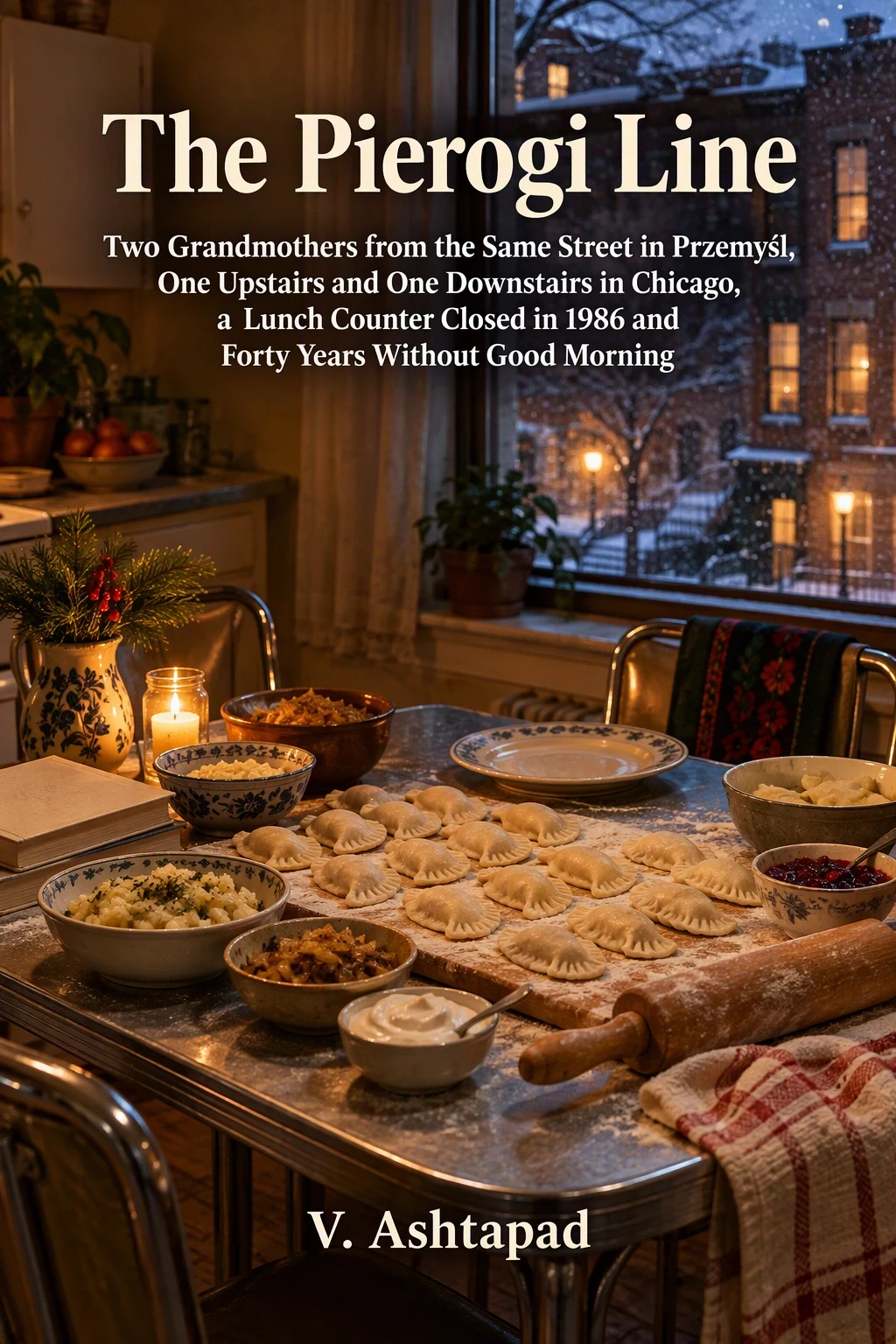
The Pierogi Line
Two Grandmothers from the Same Street in Przemyśl, One Upstairs and One Downstairs in Chicago, a Lunch Counter Closed in 1986 and Forty Years Without Good Morning
by V. Ashtapad
Foreword
This is a work of fiction. Przemyśl and its Polish and Ukrainian history, the 1947 deportations, Chicago's Ukrainian Village, pierogi ruskie and varenyky, Wigilia and Sviat Vechir, kutia, the didukh and the 2023 change of the Ukrainian Christmas date are real. The Pierogi Line, the three-flat, the bakery, the newspaper article and every named person in the story are invented.
For the women at the steel table at five in the morning, and the two who swept the landing.
Danuta: The Woman Downstairs
I wish to begin, my dear, by stating for the record that I have nothing whatsoever against the woman downstairs.
I have not spoken to her in forty years. That is a different matter. One may have nothing against a person and still decline, for four decades, to say good morning to her on the stairs, to hold the street door when she is carrying her shopping, to acknowledge her at the funeral of the man who owned the corner bakery, at which we stood eleven feet apart in the second row and both cried into our own handkerchiefs and did not once look across. One may have nothing against her and still, on Christmas Eve, set the table with twelve dishes and the extra plate for the wanderer, as my mother did in Przemyśl and her mother before her, and know that if the wanderer were to come knocking it would not be the woman downstairs, because she would sooner eat her own shoe.
That is not having something against her. That is history. There is a difference, and at eighty-six I have earned the right to know it.
My name is Danuta Kubiak. I live on the second floor of a three-flat on Iowa Street in the Ukrainian Village of Chicago, which is a name I have objected to since 1961 on the grounds that half the people who lived here were Polish, and the other half were Ukrainian, and a few were Belarusian and Slovak and one, on the corner, was a Greek who sold shoes. But they did not ask me. They never ask me. I have lived in this flat since my husband Kazimierz carried me over the threshold in March 1962, and I intend to be carried out of it in a box, and not one day before.
The woman downstairs is named Solomiya Bondar. She lives on the first floor. She has lived there since 1965. She is eighty-four, which she will tell you is younger than me, as if two years were an accomplishment.
We were friends once. I suppose that must be said too. For twenty-one years. From 1965 until the spring of 1986. We were, if I am to be truthful, and I am always truthful, it is my great burden, the best of friends.
We ran a lunch counter together. On Chicago Avenue. Four blocks east. For eleven years.
It was called the Pierogi Line.
---
You will want to know what happened. Everyone does. My granddaughter Maja has been asking since she was seven. I have told her a number of versions, depending on my mood and the weather, and none of them was the whole of it, because the whole of it is my business and the woman downstairs's business and the business of two dead men and a newspaper reporter, God rest him, who should have stuck to writing about the Cubs.
I will tell it eventually. Perhaps. If I decide you are worth it.
For now I will tell you only that on the second Tuesday of November, this year, at eleven in the morning, while I was standing at my kitchen window watching the sparrows in the gutter and waiting for my dough to rise, I saw my granddaughter Maja, who is twenty-nine and teaches history to sixteen-year-olds at a high school on the West Side and should know better, walk up the front steps of this building, not to my door, but to the door of the woman downstairs.
And knock.
And go in.
And stay for three hours.
I stood at my window the entire time. My dough rose and fell. I did not care. I stood there like Lot's wife, if Lot's wife had been Polish and had a bad knee.
When she came out, Maja was carrying a plastic container. I could see it from the second floor. Through the lid. I know what was in it. I would know it from the moon.
Varenyky.
Ukrainian dumplings. Potato and cheese. With fried onions on top.
My granddaughter had gone downstairs to the woman I have not spoken to in forty years and come back up the street with a box of her dumplings.
I sat down at my kitchen table. I put my head in my hands. And I said, out loud, to my dead husband's photograph on the wall, a word that I learned from him which stays off this page, because you are a person of quality.
---
I should tell you what the Pierogi Line was, since you are young and will not have seen it.
It was a storefront on Chicago Avenue between Oakley and Western, eleven feet wide and forty feet deep, that had been a barbershop. We kept the barber's mirror on the back wall because it was too heavy to take down, and so every customer at the counter could see himself eating, which Solomiya said was good for their manners. There was a counter of red Formica with twelve red stools that spun. There were three small tables by the window. There was a kitchen in the back with a long steel table and two stoves and a sink you could bathe a child in, and we did, once, Solomiya's son, when he fell in a puddle of pierogi dough at the age of four.
We opened at six in the morning for the men going to the factories. Coffee and a sweet roll and two pierogi fried in butter for a dollar. We closed at three in the afternoon. In between, we fed the neighborhood. Polish and Ukrainian and Slovak and Mexican and Puerto Rican and Italian and two Chinese brothers who ran the laundry on Damen and ate a dozen each every Friday. Factory men and nurses and policemen and old women with shopping carts and children after school with a quarter. We made three hundred pierogi a day. On Fridays, five hundred. On the Friday before Christmas, eleven hundred, and we did not sleep.
We had a sign in the window, painted by a boy from the art school who paid for his lunches that way for a whole winter. It said THE PIEROGI LINE in red letters, and under that, in smaller letters, POLISH AND UKRAINIAN, and under that, smaller still, because the boy ran out of room, SINCE 1975.
The sign came down in June 1986. I have it. It is in my basement storage cage, behind the Christmas boxes, wrapped in a blanket. I have not unwrapped it since.
© 2026 CRUNOD LLC. All rights reserved.
Solomiya: A List of Facts
1. I did not invite the girl. She came.
2. I recognized her at once. She has her grandmother's chin, which is a chin that enters a room four seconds before the rest of the person. She also has her grandfather's eyes, which were kind. Kazimierz Kubiak was a kind man. I attended his funeral in 1998. I stood in the third row. Not the second. The woman upstairs has the rows wrong, as she has most things wrong. I was there, and she was there, and we did not speak, and she cried more loudly than was necessary.
3. The girl said, Mrs. Bondar, my name is Maja Kubiak, I'm Danuta's granddaughter, I teach history, I'm doing a project with my students about immigrant women's businesses in Chicago in the 1970s and 80s, and I found an article in the library archive about a lunch counter on Chicago Avenue called the Pierogi Line, and it has a picture, and you're in it.
4. I said, I know who is in it. I was there.
5. She showed me the article on her phone. The Chicago newspaper, March 1986. A half page in the food section. A photograph of the counter, the long Formica one with the red stools, and behind it two women in white aprons and hairnets, one tall and one short, both laughing, holding up plates. The short one is me. The tall one is the woman upstairs.
6. The headline reads: Polish Pierogi Done Right on Chicago Avenue.
7. I invited the girl in. Why, I cannot say. Perhaps because she said please. Nobody under fifty says please anymore.
8. I made her tea. Real tea, in a glass, with lemon and a spoonful of my sour cherry preserves stirred in, the way my mother made it in Przemyśl before the war, and her mother before her. I gave her a plate of my varenyky from the freezer, fried in butter with onions. She ate eleven. She said they were different from her grandmother's. I said yes. She asked how. I said that is a very long answer.
9. She said she had time.
10. I said, nobody your age has time. You only think you do.
11. She stayed three hours.
12. When she left, I gave her a container of varenyky for the road. Why I did that, I also cannot say. I suppose I wanted the woman upstairs to see it. I am eighty-four. I am permitted a small cruelty now and then. It keeps the blood moving.
13. Here is what I did not tell the girl, because it is not her business: that the headline in that newspaper is the reason I have not spoken to her grandmother since 1986.
14. Not because of what it says. Because of who said it.
---
15. Since the girl asked, I will also write down the morning we opened. March 3, 1975. A Monday.
16. It was snowing. Wet snow, the March kind. We had been up since three. Danka had borrowed money from the bank by going back in her best dress after they said no. I had borrowed money from Ostap's cousin in Hamtramck, who made me sign a paper. We had painted the walls ourselves the week before, yellow, because Danka said a lunch counter should feel like a kitchen in summer.
17. At five-thirty we had two hundred pierogi on trays. One hundred with the fork. One hundred with the braid.
18. At six we unlocked the door.
19. Nobody came.
20. At six-thirty, nobody.
21. At seven, a man. One man. A big man in a factory jacket with snow on his shoulders. He sat on the first stool. He looked at the menu, which was a piece of cardboard Danka had written in Polish and I had written in Ukrainian and the art school boy had written in English underneath both. He studied it. Then he said, in English, "Which ones are better?"
22. Danka said, "Mine."
23. I said, "Mine."
24. The man looked at us. Then he said, "Give me four of each."
25. He ate all eight. He paid. He left.
26. At seven-thirty he came back with five men from his shift.
27. By noon there was a line out the door into the wet snow. That is how it got its name. Not from us. From the men from the factory, who told the other men, go to the pierogi line on Chicago Avenue, the one with the two women who argue.
28. We argued every day for eleven years. It was the best thing either of us ever did.
© 2026 CRUNOD LLC. All rights reserved.
Danuta: Dough
My dough, for the record, has been the same since 1952, when my mother taught it to me in the kitchen of our apartment on Grodzka Street in Przemyśl, which is a city on the San River in the southeast of Poland, very old, very beautiful, with a castle on the hill and churches with green copper domes and a market square with arcades, and in those days, before and after the war, half Polish and half Ukrainian, though nobody liked to say so.
Flour. Warm water. One egg. A spoonful of sour cream. A pinch of salt. You mix it with your hand, one hand, the right, in a wide bowl, and you knead it until it is soft as an earlobe. That is how you know. You touch your own earlobe and then you touch the dough and they should be the same. My mother said that. Her mother said it. I said it to my daughter, who did not listen, and to Maja, who did.
Then you rest it under a towel for half an hour while you make the filling.
Ruskie. That is the filling. Potato and farmer's cheese and onion fried slowly in butter until it is gold, and black pepper, and salt. Ruskie, which means, depending on who you ask, Russian, which it is not, or Ruthenian, which is an old word for the people of the region, for the Ukrainians of Galicia, which is where Przemyśl is.
So there you have it, my dear. The most Polish dumpling in the world, the one every Polish grandmother in Chicago makes on Christmas Eve, the one I served three hundred a day at the Pierogi Line for eleven years, is named after the Ukrainians.
I did not know this when I was young. My mother never told me. I found out in 1984, from the woman downstairs, who told me at the counter at eleven in the morning on a Wednesday in front of a customer, a reporter from the newspaper, who was eating his lunch and taking notes.
---
Maja came up to see me the next day.
She had the courtesy to come to my door first. She brought flowers. Yellow chrysanthemums from the Mexican grocery on Chicago Avenue. She knows I like them. She sat at my kitchen table and drank my coffee and ate two of my poppy seed rolls and did not mention the woman downstairs for forty minutes, which I will say for her shows a certain intelligence.
Then she put her phone on the table between us. The newspaper article. The photograph. The two of us in our hairnets.
"Babcia," she said. "I need to know what happened."
"Nothing happened."
"Forty years of nothing?"
"Forty years," I said, "is how long nothing takes."
She looked at me with her grandfather's eyes.
"My students," she said, "are almost all from somewhere else. Mexico. Guatemala. Puerto Rico. Ukraine. A few from Poland. Two from Syria. One from the Congo. Their parents run businesses. Taco trucks. Hair salons. A Ukrainian bakery on Chicago Avenue that opened in 2022, two blocks from where the Pierogi Line was. They work sixteen hours a day. Some of them work with people they don't like. People from places their families have been fighting for a hundred years." She tapped the phone. "I want to show them two women who ran a business together for eleven years. A Pole and a Ukrainian. From the same city. In 1975. I want to show them it's possible."
"It was possible," I said. "For eleven years. Then it was not."
"Why?"
I looked at the photograph on her phone. At the tall woman in the hairnet, laughing. At the short one beside her, laughing too.
I had forgotten we laughed.
"Ask her," I said. "Downstairs. She has a whole list, I'm sure. She always had lists."
"I did ask her," said Maja. "She said to ask you."
---
I will tell you a thing about the steel table, since we are on the subject of dough.
It was eight feet long. Kazimierz found it at a hospital that was closing on the North Side and brought it in his truck and carried it in through the back door with Ostap. Two men. Two kind men. Sweating and swearing in two languages. They set it down in the kitchen of the Pierogi Line and stood there with their hands on their hips and looked at it, and Ostap said in Ukrainian that it was a good table, and Kazimierz said in Polish that it was a very good table, and then they shook hands, which they did not usually do, and went to the bar on the corner together and did not come home until nine.
That table was the line down the middle of our kitchen. My side. Her side. My bowls on the left, hers on the right. In eleven years neither of us ever once reached across it for the other's flour.
But in the mornings, at five, before anyone came, we sang.
I had forgotten that until this week. Maja asked me if we talked, at the table, and I said of course we talked, we argued, and then I remembered. We sang. Under our breath. While our hands were busy. Old songs from Przemyśl. Polish songs and Ukrainian songs. Often the same tunes with different words, because in Przemyśl the songs went back and forth across the street like the children did. A song about a girl who went to the forest and met a hunter. She sang it in Ukrainian and I sang it in Polish, at the same time, the same tune, two languages, across the steel table, at five in the morning with the snow coming down outside on Chicago Avenue.
I had forgotten.
© 2026 CRUNOD LLC. All rights reserved.
Solomiya: Filling
1. My filling is not ruskie. I want that understood.
2. My filling is potato and farmer's cheese and onion fried in butter. And dill. A great deal of dill. Chopped fine. My mother used dill. Her mother used dill. Every Ukrainian woman in Przemyśl used dill. The Polish women did not. That is the difference.
3. Also the dough. Mine has no egg. Flour, warm water, oil, salt. That is all. It is softer. It is better. It is also more difficult to work, which is why the Polish women put an egg in it. To make it easier. I do not say this to be cruel. I say it because it is true.
4. Also the shape. I pinch the edge in a braid, a little rope, all the way around. The woman upstairs presses hers with a fork. Like a pie. Like an American.
5. Also the name. I call them varenyky. She calls them pierogi. They are the same thing. They are not the same thing. Both of these are true.
6. Here is what happened on the Wednesday in 1984, since the girl will not stop asking and I am too old to keep anything in a drawer anymore.
7. A reporter came to the Pierogi Line. A young man. Tall. Glasses. A tie with ducks on it. He ate at the counter three days running. The third day he said he was writing an article about the best pierogi in Chicago. He asked which of us made them.
8. The woman upstairs said, I do.
9. This was not true. We both made them. Every morning, five o'clock, side by side at the steel table in the back, her dough and my dough, her filling and my filling, in two separate bowls, two piles, side by side. Hers with the fork. Mine with the braid. We sold them both. On the menu they were the same. Customers did not know the difference. Some of them did. The old ones. They would ask for the braided ones by name. Pani Solomiya's, they would say.
10. So I said, to the reporter, at the counter, in front of her: We both make them. Hers are Polish. Mine are Ukrainian. Hers are called ruskie, which means Ukrainian, by the way, so in a sense they are both mine.
11. I meant it as a joke. She knew I meant it as a joke. We joked like that every day. She would call me the Cossack and I would call her the Countess.
12. The reporter wrote it down.
13. He did not write it as a joke.
14. Two years later, in March 1986, he wrote the article. The one in the girl's phone. The headline says Polish pierogi. The article says Danuta Kubiak, from Przemyśl, Poland, makes the finest Polish pierogi in Chicago at her lunch counter on Chicago Avenue. And then one paragraph near the end. Her partner, Solomiya Bondar, who is Ukrainian, insists the dumplings are really Ukrainian and says the Polish name is borrowed from her people. And a quotation. My joke. Without the joke in it.
15. Her husband read it first. Kazimierz. He was a kind man, but he had a brother who had been in Przemyśl in 1945, and something had happened to that brother, which I will not write about here, because it was during a bad time, when people on both sides did things, and it is not my story to tell. Kazimierz read my quotation in the newspaper and put the paper down on the breakfast table and went out of the house and did not come back until night.
16. My husband read it second. Ostap. He was also a kind man. He had a father who had been sent away from Przemyśl in 1947, with the whole family, put on a train in the night and sent west to the old German lands with all the other Ukrainians, because the new government did not want Ukrainians near the border anymore. He was eight. Ostap read the article and saw that the headline said Polish, and that the only time his wife's name appeared was in one paragraph near the end being difficult. And he put the newspaper down on the breakfast table and said, Solomiya, she has taken your name off your own food.
17. That is what happened. Two kind men at two breakfast tables, one floor apart, reading the same newspaper. And two women at a lunch counter who used to joke.
18. We closed the Pierogi Line in June 1986.
19. We have not spoken since.
20. I have the article in a frame. In my bedroom. I do not know why.
© 2026 CRUNOD LLC. All rights reserved.
Danuta: On the Stairs
I must now tell you about the other granddaughter, since she has arrived, uninvited, like weather.
Her name is Daryna. She is the woman downstairs's son's daughter. She is twenty-seven. I have watched her grow up through my kitchen window for twenty-seven years, from a baby in a stroller on the front walk to a little girl with braids on a pink bicycle to a teenager with black lipstick and a skateboard who scraped the front steps of my building every afternoon for two years until I believed I would lose my mind. Then she went away. To Ukraine, I was told by the man at the bakery, who tells everyone everything. To the university in Lviv. To study cooking, of all things, as if one needed a university for that. Then she came back. Four years ago. And now she cooks at a restaurant downtown, in the old meatpacking district, where people pay forty dollars for a plate of dumplings that a grandmother would make for nothing.
I had never spoken to her. Naturally. One does not speak to the granddaughter of a person one does not speak to. That is simply manners.
On the Thursday after Maja's visit downstairs, I came down the stairs at nine in the morning with my shopping bag to go to the market, and I found them on the landing.
The two of them. My Maja and that Daryna. Sitting on the stairs between the first and second floors, side by side, with a laptop on their knees and two cups of coffee from the Ukrainian bakery on the step below them, and their heads together like schoolgirls.
They looked up.
I stood there with my shopping bag.
"Babcia," said Maja.
"Good morning, Mrs. Kubiak," said the other one. In Polish. Very good Polish, with an accent from the east, from the border, the way people in Przemyśl spoke when I was a girl. I had not heard Polish spoken that way in fifty years.
I did not answer her. I looked at Maja.
"What is this?" I said.
"A project," said Maja.
"What kind of project needs to happen on my stairs?"
"They're everybody's stairs, Babcia."
"They are my stairs from the second floor up," I said, "and her grandmother's stairs from the first floor down, and this landing is no one's, which is why it has not been swept since 1986." I shifted my shopping bag. "What project?"
The other one, Daryna, closed the laptop.
"We're going to open the Pierogi Line again," she said.
---
I did not fall down the stairs. I want that noted. I am eighty-six with a bad knee and I was standing on a narrow landing with a heavy bag, and I received a shock that should have killed a woman half my age, and I did not fall.
I went to the market. I bought my potatoes and my farmer's cheese and my onions and my flour, as I had intended. I bought a cabbage I did not need. I stood in front of the pickles for ten minutes without seeing them.
When I came home they were gone from the landing. But there was something on my doormat.
An envelope. Inside, a piece of paper, printed. A drawing, done on a computer, of a storefront. A long counter with red stools. A sign above it in red letters.
The Pierogi Line. Saturdays. Reopening December.
And underneath, smaller: Polish pierogi. Ukrainian varenyky. Both. From the grandmothers' recipes.
And underneath that, in handwriting, Maja's: Babcia, will you teach me the dough? The earlobe one. Please.
And underneath that, in a different handwriting, in Polish, with a Ukrainian accent you could hear in the letters: And will you let me watch? I've never seen anyone make pierogi with an egg. I'm curious why it works. Daryna B.
I sat at my kitchen table with the paper a good while. Kazimierz looked down at me from his photograph on the wall.
"Well," I said to him. "What would you have me do?"
He did not answer. He never does. That is the great advantage of photographs over husbands.
---
That evening Maja telephoned. She did not mention the paper. She talked about her students for twenty minutes, the way she does, and I let her, the way I do.
There is a boy in her class, she said, from Ukraine. Fifteen. Came in 2022 with his mother. His father stayed. He does not talk in class. He sits at the back by the window and draws. Every day.
And there is a girl from Poland. Sixteen. Born in Chicago, but her parents are from a town near Rzeszów, not far from Przemyśl, and they speak Polish at home and run a cleaning business and work very hard and do not like Ukrainians very much, the girl told Maja once, after class, because of things that happened in her great-grandmother's village, long ago, and because of the new people coming now and taking the cleaning jobs.
"I put them in a group together," Maja said. "For the project. The boy and the girl. On purpose."
"That was cruel."
"It was," Maja agreed. "They wouldn't look at each other for a week. Then the girl found the newspaper article in the archive. The Pierogi Line. She brought it to the boy. She said, look, my grandmother would have eaten here. And the boy looked at the photograph for a long time, and then he said, my grandmother makes varenyky with a braid. And the girl said, mine uses a fork." Maja was quiet a moment. "That was the first time they talked."
I held the telephone against my ear in my dark kitchen.
"What are they doing now?" I said.
"Arguing," said Maja. "About egg. In the dough." She laughed. "Every day. In the back of my classroom. It's driving me crazy."
I did not laugh. I sat there with the telephone.
"Babcia?"
"Tell them," I said, "that egg makes it easier to work. Tell them that's not a weakness. Tell them easier is not the same as worse."
"I'll tell them."
"And tell the boy," I said, "that the braid is harder. And more beautiful. And that his grandmother is right to keep it." I laid my palm on the table. "But don't tell him I said so."
© 2026 CRUNOD LLC. All rights reserved.
Solomiya: Dill
1. My granddaughter is a professional cook. She has worked in four restaurants. She has a certificate from a culinary institute in Lviv. She can make things with foam and smoke and tweezers that I do not understand and would not eat.
2. She cannot braid the edge of a varenyk.
3. I discovered this on the Saturday after the stairs. She came to my kitchen at seven in the morning with an apron and a notebook and said, Baba, teach me.
4. I said, I taught you when you were six.
5. She said, I was six. I made a mess and you sent me to watch cartoons.
6. This is true. I did.
7. So I taught her. At my kitchen table, the same one I have had since 1965, with the oilcloth with roses on it that is not the same oilcloth, it is the fourth, but the same roses, I buy it from the same store on Chicago Avenue that has been selling it since 1965 to every Ukrainian woman in this neighborhood. I made the dough without egg. Flour, warm water, oil, salt. I showed her how it should feel, soft and a little sticky, like the inside of your wrist. I made the filling. Potato and farmer's cheese and onion fried in butter until it is the color of an old wedding ring. And dill. A whole bunch. Chopped so fine it is almost a powder. The whole kitchen smells green.
8. Then the braid.
9. You take a circle of dough in your left palm. A spoonful of filling goes in the center. You fold it over into a half moon. You press the edges together with your fingers, lightly, to seal. And then with your right thumb and finger you pinch the edge and fold it over itself, and pinch, and fold, and pinch, and fold, all the way around, a little rope, a little braid, like the edge of an embroidered towel.
10. My granddaughter, the professional, the one with the certificate, tried it nineteen times.
11. On the twentieth she got it.
12. She held it up on her palm. A small varenyk, the braid a little crooked at one end but holding.
13. She studied it.
14. Then she said, Baba, why does yours have the braid and Mrs. Kubiak's has the fork?
15. I said, because her mother used a fork and my mother used her fingers.
16. She said, but why? Why did their mothers do it differently? They lived on the same street.
17. I opened my mouth to answer and found I did not know.
18. I have been making varenyky with a braid for seventy-eight years. The woman upstairs has been making pierogi with a fork for eighty. We stood shoulder to shoulder over steel for eleven years doing it differently. And I never once asked her why.
---
19. My granddaughter went upstairs that afternoon. To the woman upstairs. With the twentieth varenyk on a saucer. I watched from my window as she went up the outside steps to the second-floor door. I have a window that looks at the steps. The woman upstairs has a window that looks at the street. Between us we see everything.
20. She was up there two hours.
21. When she came down she was carrying a plastic container. Inside, through the lid, I could see them. Pierogi. With the fork marks.
22. I sat down at my kitchen table and said to Ostap's photograph, in Ukrainian, a word I learned from him, which I will not write.
---
27. Since we are writing things down, I will write down why my granddaughter went to Lviv.
28. She went in 2016. She was eighteen. She said she wanted to learn to cook properly, the old way, from the source. She said Chicago Ukrainian food was Ukrainian food from 1950, frozen, like a fly in amber, and she wanted to taste what it had become.
29. She lived there four years. In a rented room in an old building near the market with a view of a bell tower and a pigeon who came every morning to her windowsill and whom she named after me, which I did not appreciate.
30. She came home in 2020 with a certificate and a cookbook in Ukrainian that she had written herself, by hand, in a school notebook, from every grandmother she met in every market in western Ukraine. Two hundred recipes. Two hundred grandmothers. She asked each one for one recipe and the story of who taught it to them.
31. She showed me the notebook on her first night home. At my kitchen table. Under the roses.
32. Page forty-one. A varenyk. Potato and farmer's cheese and onion and dill. With a braid. From a woman of ninety in a village near the Polish border. Who said her mother taught it to her in Przemyśl. On a street called Franciszkańska.
33. I asked my granddaughter what the woman's name was.
34. She told me.
35. It was my mother's cousin. I thought she had died in 1947.
36. She died in 2019. My granddaughter met her eleven months before. She said the old woman made her braid the edge nineteen times before she let her stop.
© 2026 CRUNOD LLC. All rights reserved.
Danuta: Kazimierz
I suppose I must tell you about Kazimierz, since the girls have made it necessary.
He was a mechanic. He had a garage on Western Avenue for thirty-four years and could fix anything with an engine, and also a toaster, a radio, a sewing machine, a broken chair, a broken heart, I used to say, though he would roll his eyes. He was tall and slow-moving and gentle, with enormous hands always black with grease that he scrubbed every evening at the kitchen sink with a brush and a bar of gritty soap until they were pink, and then put on a clean shirt and sat down to supper.
We met in 1958 at a dance at the Polish hall on Milwaukee Avenue. I was eighteen. He was twenty-four. He stepped on my foot. Twice. He apologized so beautifully the second time that I let him step on it a third.
His family was from Przemyśl too. That is how we knew each other at once, across the dance floor, before we had said a word. You could tell. Something in how people from there stand. As if they are always listening for something on the other side of a river.
He had an older brother. Józef. Who did not come to America. Who stayed in Przemyśl. Who was there in the bad years after the war, when the Poles and the Ukrainians in that region did terrible things to each other, village by village, family by family, and then the government came and put all the Ukrainians on trains and sent them away. I will not write what happened to Józef. I do not entirely know. Kazimierz never told me all of it. He told me once, in 1967, at two in the morning, after his mother's funeral, and then he never spoke of it again, and when I asked him he would rise and go out to the garage.
So you see, my dear. When Kazimierz read in the newspaper in 1986 that his wife's partner, a Ukrainian woman from Przemyśl, had said in print that the Polish dumplings were really Ukrainian and their name was borrowed from her people, he did not read it as a joke about dumplings. He read it as Józef.
He went out of the house and did not come back until midnight. He went to the garage. He sat in the dark, I found out later, in the cab of a truck he was fixing, all day, without fixing it.
When he came home he said one thing.
"Danka. Please. Not her. Anyone but her."
I had been married to him for twenty-four years. He had never once asked me for anything. Not once. Not money, not children, which we had one of, not a different apartment, not a vacation, not to give up my work. He asked me that night.
So I gave it.
---
I want to be fair to myself. I am always fair, it is my other great burden.
I did not only give it for Kazimierz. I gave it because I was hurt. Because the newspaper had put my name in the headline and hers in one paragraph near the end, and I knew how that looked, and I knew she would think I had arranged it, and I had not, the reporter had done what reporters do. And because when I went down the stairs the next morning to talk to her, to explain, to laugh about it, the way we laughed about everything, her husband Ostap opened the door.
Not her. Him.
And he gave me a long look. The kind Kazimierz gave the newspaper.
And he said, in Polish, very politely, "She is not available."
And he closed the door.
I went back up the stairs. I sat at my kitchen table. And I decided that if she would send her husband to the door, then I would never knock on it again.
That was forty years ago.
Both of them are dead now. Kazimierz in 1998. Ostap in 2004. Two kind men. Two breakfast tables. And two old women still standing at our separate windows, keeping a promise to men who are not here to hold us to it.
© 2026 CRUNOD LLC. All rights reserved.
Solomiya: Ostap
1. I did not send Ostap to the door.
2. I want that written down, since the woman upstairs, I am informed by my granddaughter, believes I did.
3. I was in the bathroom. That is all. It was seven in the morning and I was in the bathroom and Ostap answered the door and I heard her voice on the landing and I heard him say what he said and I heard the door close.
4. I came out of the bathroom. I asked him who it was. He said, nobody.
5. I knew it was not nobody.
6. I did not go after her.
7. That is the thing I have carried for forty years. Not the newspaper. Not the joke. Not the headline. I did not go after her. She came down the stairs to explain and my husband closed the door and I stood in my own hallway in my bathrobe and did not open it again.
8. Ostap was eight years old in 1947. He lived in a village near Przemyśl, in the hills to the south, with his parents and his grandparents and four sisters, in a wooden house with a thatched roof and a garden with plum trees. In April soldiers came and told them they had two hours. They could take what they could carry. They put them on a train. Cattle cars. They did not know where they were going. They went for nine days. They were put off in a village in the west, in the old German lands near the sea, in a house that had belonged to Germans who had been sent away the year before, with the dishes still in the cupboards. They were told they could not go back. Ever. They were told not to speak Ukrainian in public.
9. Ostap's grandmother died on the train.
10. He came to America in 1962. He met me in 1964. At a dance at the Ukrainian hall on Chicago Avenue. He did not step on my foot. He was an excellent dancer.
11. He was a quiet man. He worked thirty years at a factory in Cicero that made parts for telephones. He played the bandura, the Ukrainian lute, with many strings, on Sunday afternoons in our front room, old songs from the hills south of Przemyśl, songs about rivers and plum trees and girls waiting for soldiers to come home. He was kind to everyone. He was kind to the woman upstairs, for twenty-one years. He fixed her kitchen faucet. He carried her Christmas tree up the stairs every December.
12. Then he read the newspaper.
13. I understood. That is what I need to write. I understood why he closed the door. When he read that Danuta Kubiak from Przemyśl made the finest Polish pierogi in Chicago and his wife's name appeared only in one paragraph near the end, being difficult, he did not read a food article. He read his grandmother on the train. He read the soldiers in the garden. He read the government telling him he could not speak his own language in public. He read his wife's name being taken off her own food. That is what he said, the morning after. Solomiya, she has taken your name off your own food.
14. She had not. I know that now. I think I knew it then.
15. But I was married to him. And he had never once asked me for anything. And that morning, in the hallway, with the door closed, he did not ask. He just looked at me. And I did not open the door.
16. So you see, it was the same. Upstairs and downstairs. Two kind men. Two breakfast tables. Two women who did what they were not asked to do because they loved them.
17. I told all this to my granddaughter last night. At my kitchen table. Under the roses.
18. She did not say anything a while.
19. Then she said, Baba, does Mrs. Kubiak know about the train?
20. I said, I don't know. I never told her.
21. She said, does she know Ostap fixed her faucet?
22. I said, she knows. She watched him do it.
23. She said, then she knows he was kind. She just doesn't know why he closed the door.
24. I said, and I don't know why her husband went to the garage.
25. My granddaughter, the professional cook with the certificate who could not braid a varenyk, looked at me for a long moment.
26. Then she said, Baba. Maybe you should ask each other.
© 2026 CRUNOD LLC. All rights reserved.
Danuta: The Kitchen on Chicago Avenue
The Ukrainian bakery on Chicago Avenue opened in 2022, as Maja said, two blocks from where the Pierogi Line used to be, in a storefront that was a shoe repair, then a cell phone store, then empty for six years. It is run by a family from Kharkiv. A mother and two daughters and a son-in-law, who came over in the spring of that year with four suitcases and a recipe for a honey cake that has eleven layers and takes two days. They work, I am told by the man at the corner, who tells everyone everything, from four in the morning until eight at night, seven days a week. They have a line out the door on Saturdays. People come from the suburbs.
They have a kitchen in the back that they do not use on Saturday afternoons after two.
That is the kitchen the girls have borrowed.
I went to look at it on the Tuesday after Thanksgiving. Alone. I did not tell Maja. I put on my good coat and my hat and walked the four blocks east on Chicago Avenue in the cold with my bad knee, past the Ukrainian cathedral with its golden domes and the Polish deli and the Mexican grocery with the yellow chrysanthemums out front and the new coffee shop where young people sit with their computers and do not talk to each other, and I stood outside the bakery and looked through the window.
The mother was behind the counter. About fifty. Tired. A kerchief on her hair. Selling bread to a line of people, sweet rolls and black bread with coriander and the honey cake by the slice, and talking to each customer in Ukrainian or Russian or Polish or English, whichever they spoke, switching between them without seeming to notice.
She saw me through the window. She came to the door.
"Pani Kubiak?" she said. In Polish.
I was so surprised I said yes.
"Come in. Please. It's cold." She held the door. "Your granddaughter showed me your photograph. From the newspaper. In the hairnet. Come in. I want to show you something."
---
She took me into the kitchen in the back. Past the ovens, which were enormous and roaring, and the racks of cooling loaves, and the long steel table where the son-in-law was rolling out the thin layers of the honey cake, one after another, like pages. And on the wall by the back door, taped up with masking tape, was a photocopy. The newspaper article. March 1986. The photograph of the two women at the counter in hairnets, laughing.
"Your granddaughter brought it," said the woman from Kharkiv. "And the other one. Daryna. They told me the story." She looked at it. "My mother had a friend in Kharkiv. Fifty years. A Russian woman. From the next apartment. They cooked together every Sunday. Their children grew up together. My mother taught her borscht and she taught my mother pelmeni." She stopped. "They have not spoken since 2022."
I did not say anything.
"I put it on the wall," said the woman from Kharkiv, "because I wanted my daughters to see that it can be done. Eleven years. A Polish woman and a Ukrainian woman, from a city where terrible things happened between their people, standing side by side making the same dumpling two different ways." She looked at me. "And I wanted them to see that it can end. Over a newspaper. Over two husbands. Over a door." She shrugged. "Both. They should see both."
The son-in-law, at the steel table, had stopped rolling the honey cake layers.
"My mother is eighty-one," said the woman from Kharkiv. "She is in Kraków now, with my sister. She calls her old friend every Sunday. The friend does not pick up. My mother lets it ring ten times and hangs up and calls the next Sunday." She looked at the photocopy on the wall. "Every Sunday. For three years."
---
I walked home in the cold.
I did not go to the market. I did not go up to my flat. I stood at the bottom of the front steps of my building on Iowa Street with my bad knee aching and my good coat buttoned to the neck and looked at the door of the first floor.
It was painted green. It has always been painted green. Ostap painted it in 1966. He said that green was the hills south of Przemyśl in May. Nobody has painted it since. It is chipped and faded now, the color of an old leaf.
I did not knock.
But I stood there a long while. Longer than I had stood there in forty years.
And I saw the curtain in her front window move.
© 2026 CRUNOD LLC. All rights reserved.
Solomiya: The Curtain
1. I moved the curtain. I admit it.
2. I saw her from the kitchen. Planted at the foot of the steps in that coat, the camel one with the big buttons she has had since the Carter administration, with her hat on and her bag on her arm, looking at my door.
3. I went to the front room and moved the curtain an inch. To see better. My eyes have gone soft.
4. She saw it move.
5. We looked at each other. Through the window. Through an inch of curtain. For perhaps a minute.
6. Then she went up the outside steps to the second floor and went inside.
7. I stood at the window with the curtain in my hand for some time after.
8. Here is what I saw, in that minute, that I had not seen in forty years of not looking.
9. She is old.
10. I knew it, of course. I have heard her on the stairs. Slower every year. I have heard her knee. I have heard her stop on the landing to breathe. But I had not looked at her face in forty years. Not straight on. At funerals, at the market, on the street, I looked past her, or at the ground, or at the side of her head.
11. Her face is old. It is folded. It is soft. Her mouth turns down at the corners, the way her mother's did, I remember her mother. Her eyes are still the same. Gray. Like the San River in the morning.
12. She looked frightened.
13. I have never in my life seen Danuta Kubiak look frightened. Not in 1965 when she came down the stairs with a pot of soup the day we moved in and stood in our doorway and said, I'm Danka, from upstairs, from Przemyśl, Grodzka Street, and you're from Przemyśl too, I can tell by your accent, so you'll eat this, it's żurek, it's sour, it's good. Not in 1975 when the bank refused the loan for the Pierogi Line and she put on her best dress and went back to the bank alone and came out an hour later with the loan. Not in 1979 when a man came into the lunch counter with a knife and asked for the money and she hit him over the head with a frying pan and then gave him a plate of pierogi while they waited for the police.
14. She looked frightened at the bottom of my steps.
15. So was I.
---
16. My granddaughter came at six with the woman upstairs's granddaughter. The two of them. In my kitchen. They have been in my kitchen together four times now. They are planning the Pierogi Line. They have lists. I approve of the lists.
17. They want to open on the second Saturday of December. In the back kitchen of the bakery from Kharkiv. From two in the afternoon until they run out. Polish pierogi and Ukrainian varenyky. Side by side. On one menu. With both names.
18. My granddaughter says, Baba, we need you. Not to cook. To taste. To tell us if they're right.
19. The other one says, my grandmother has to taste too. Both of you. Or it isn't the Pierogi Line.
20. I said, I will not be in the same kitchen with her.
21. My granddaughter said, you don't have to be. You can taste at home. We'll bring them.
22. The other one said, but you'll have to come to the opening. Both of you. That's the whole point. It's for my students. For the project. They need to see you. Both. Or it's just two girls making dumplings.
23. I said, I'll think about it.
24. When they left I sat at my kitchen table under the roses and thought about it.
25. I thought about Danuta's face at the bottom of my steps.
26. Then I went into the bedroom and took the newspaper article down off the wall, in its frame, and took it out of the frame, and turned it over. On the back, in pencil, in Ostap's handwriting, there is something I have not read in twenty years. He wrote it in 1987. A year after. At two in the morning. I found it in the morning on the kitchen table and I put it in the frame with the article and hung it in the bedroom and did not look at it again.
27. It says, in Ukrainian: I was wrong to close the door. I was not closing it on her. I was closing it on the train. Forgive me. Go up the stairs. O.
28. I did not go up the stairs.
29. He died in 2004. I never told him I had read it.
---
30. That night I could not sleep. I got up at two and made tea and sat in the front room in the dark with the cloth off the bandura for the first time in twenty years.
31. I cannot play it. I never learned. Ostap tried to teach me in 1966 and I said my fingers were for dough. But I sat with it on my lap in the dark, the long neck against my shoulder, the round body on my knees, the strings cold, and I ran my thumb across them once. All of them. Sixty-three strings.
32. It made a sound like rain on a window.
33. And above me, through the ceiling, I heard something.
34. Footsteps. In the kitchen upstairs. Slow. A chair scraping. A kettle.
35. She was awake too.
36. She had heard the strings.
37. I sat there in the dark with my hand flat on the bandura to stop it ringing, and listened to her make tea above my head, at two in the morning, the way I had listened to her above my head for sixty-one years. The kettle. The cup. The chair. And then nothing. She was sitting at her table. Directly above me. Four meters up. Listening for the strings.
38. I ran my thumb across them again.
39. Above me, very faintly, a spoon tapped against a cup. Once. Twice.
40. I do not know if it was an answer. I have decided that it was.
© 2026 CRUNOD LLC. All rights reserved.
Danuta: The Opening
The second Saturday in December was very cold. Eleven degrees, the radio said, with the wind off the lake, which in Chicago in December is not wind so much as a personal insult.
I was not going.
I told Maja this on Friday night on the telephone. I told her my knee was bad, which was true, and that I had a cold coming, which was not, and that I would taste the pierogi at home if she brought them, and that two girls making dumplings in a borrowed kitchen did not need an eighty-six-year-old woman standing in the corner like a lamp.
Maja said, "Okay, Babcia."
That was all. Okay, Babcia. She did not argue. She did not beg. She said okay and she said she loved me and she hung up.
That is how I knew I was going.
---
I put on the camel coat. And my hat. And my good gloves, the leather ones Kazimierz gave me in 1990 that I have only worn to funerals. And at a quarter to two I went down the stairs, slowly, because of the knee, holding the rail.
And on the first-floor landing, at the bottom of my stairs, by the green door, in black wool and a fur hat I remember from 1979, with a cane I had never seen her use, was the woman downstairs. Going out.
We stopped. Both of us. She at the bottom of the stairs with her hand on her doorknob. Me three steps above her with my hand on the rail.
We looked at each other. Not through a window. Not through an inch of curtain. Straight on, in the cold hallway under the bare bulb that has needed replacing since 1986, at a distance of perhaps four feet.
She was old. Her face was small and lined and very pale. Her mouth was set. Her eyes, black, like her mother's, were looking at me the way they looked at me across the steel table at five in the morning for eleven years. Daring me to say something.
I did not say anything.
She did not say anything.
Then she opened the street door and went out, with her cane, into the eleven degrees.
And I came down the last three steps and went out after her.
---
We walked to Chicago Avenue. Four blocks. Not together. She was ahead, perhaps ten feet, going slowly with her cane on the icy sidewalk, and I was behind, going slowly with my knee, and neither of us looked at the other, and neither of us walked faster or slower than we had to. Past the Ukrainian church with its golden domes. Past the Polish deli. Past the Mexican grocery, where the chrysanthemums had been taken in for the cold. Past the coffee shop with the young people.
And at the bakery from Kharkiv there was a line.
Down the block. Fifty people at least. In the cold. In coats and hats and scarves, stamping their feet, their breath going up like smoke. Old people and young people. Polish grandmothers from the old neighborhood, I recognized some of them, women I had not seen in years, Pani Wiśniewska and the two Nowak sisters and old Mrs. Kowalczyk from Western Avenue. Ukrainian women from the cultural society. Young families with strollers. A group of teenagers, Maja's students, I suppose, Mexican and Guatemalan and Syrian and Polish and Ukrainian, with a sign they had made on cardboard that said THE PIEROGI LINE / VARENYKY TOO / 1975-1986-2026.
And in the window of the bakery, taped up, the photograph from the newspaper. Blown up very large. The two women at the counter in hairnets. Laughing.
The woman downstairs stopped on the sidewalk in front of it.
So did I. Ten feet behind her.
We stood there in the cold looking at ourselves at thirty-five and thirty-seven, laughing, holding up plates, in hairnets, in a photograph in a bakery window on Chicago Avenue with fifty people in line behind us.
Then a voice from the line said, "Pani Danuta? Pani Solomiya? Is it you?"
It was old Mrs. Kowalczyk. From Western Avenue. Ninety-two. In a wheelchair pushed by her grandson. She had eaten at the Pierogi Line every Tuesday for eleven years.
"It's you," said Mrs. Kowalczyk. "Both of you. Oh. Oh, I never thought. Come. Come here." She held out her hands. One to each of us.
We could not refuse her. She was ninety-two. She was in a wheelchair. She was holding out her hands.
So I went and took one. And the woman downstairs went and took the other.
And there we were. On the sidewalk on Chicago Avenue in eleven degrees. On either side of old Mrs. Kowalczyk's wheelchair. Each holding one of her hands. Not looking at each other.
"The braided ones," said Mrs. Kowalczyk to the woman downstairs, "were always my favorite." She turned to me. "And yours were always my husband's. He said they were like his mother's. With the fork." She squeezed both our hands. "So every Tuesday we ordered six of each. Six and six. And we shared. Fifty-one years we were married. Six and six."
Neither of us said anything.
"I came today," said Mrs. Kowalczyk, "to order six and six. One more time. My grandson says I'm crazy to come out in this cold. I said, if those two can do it, I can do it." She let go of our hands. "So. Go in. Both of you. You're holding up the line."
© 2026 CRUNOD LLC. All rights reserved.
Solomiya: Six and Six
1. We went in.
2. Not together. One after the other. Through the front of the bakery, past the counter and the mother from Kharkiv, who did not say anything, only nodded, and into the back kitchen.
3. Where our granddaughters were.
4. At a long steel table. Side by side. In white aprons. In hairnets. Making dumplings.
5. Two bowls of dough. Two bowls of filling. Two piles. One with fork marks. One with a braid.
6. Exactly as we had stood. Every morning. At five o'clock. For eleven years.
7. They looked up when we came in.
8. My granddaughter had flour on her nose. The other one had flour in her hair. They had been at it since seven in the morning. There were trays of dumplings everywhere. On every surface. On the racks. On the windowsill. Hundreds. Maybe a thousand.
9. Nobody said anything.
10. Then my granddaughter said, Baba, taste this, and held out a varenyk on a fork. Fried in butter. With onions. And dill.
11. I tasted it.
12. It was not mine. It was close. The dough a little thick. The braid a little loose. Too much salt.
13. It was very good.
14. The other one, the woman upstairs's granddaughter, held out a pierogi to her grandmother. With the fork marks. Fried. With onions.
15. The woman upstairs tasted it.
16. She chewed a good while.
17. Then she turned around. To me. For the first time in forty years she turned around and looked straight at me and opened her mouth and said something.
18. She said, in Polish: "Too much egg."
19. I said, in Polish: "You always used too much egg."
20. She said: "I used exactly enough egg. It's the girl. She's heavy-handed. She gets it from her mother."
21. I said: "Mine used too much salt."
22. She said: "Yours always used too much salt. You salt like a Cossack."
23. I said: "And you press like a Countess."
24. And then the woman upstairs, Danuta Kubiak, eighty-six, in her camel coat and her funeral gloves, in the back kitchen of a bakery from Kharkiv on Chicago Avenue, began to laugh.
25. Not a small laugh. The laugh from the photograph. The one I had forgotten.
26. And so did I.
27. And our granddaughters stood at the steel table in their hairnets with flour on their noses and watched us, two old women laughing so hard in a kitchen that one of us had to sit down on an upturned flour bucket and the other had to hold on to the steel table, and the son-in-law from Kharkiv came in from the front with a tray of honey cake and stopped in the doorway and stared.
28. When we could breathe again, I said, "Six and six."
29. She said, "For Mrs. Kowalczyk."
30. I said, "You do the six with the fork. I'll do the braid."
31. And we washed our hands, at the same sink, one after the other. And we put on aprons, which the girls handed us without a word. And we took a circle of dough each from our granddaughters' bowls, mine from hers and hers from mine, because they were standing in the wrong places. And we stood at the steel table side by side and made six and six for old Mrs. Kowalczyk from Western Avenue, who had been married fifty-one years and ordered both every Tuesday.
32. My hands remembered. Her hands remembered. We did not have to talk.
33. My granddaughter's phone was on the windowsill, recording. The other one had set it up. She said it was for the students. For the project. She said they would put it on the families' private pages, both families, so that everyone, the cousins in Lviv and Kraków and Toronto and Kyiv, could see.
34. I do not care who sees.
© 2026 CRUNOD LLC. All rights reserved.
Danuta: The Back of the Frame
She invited me in on the Monday.
Not in words. She did not knock on my door. She did something much more like her. She left her green door open. Open, at nine in the morning, in December, with the cold coming into the hallway, wide open, so that when I came down the stairs with my shopping bag I could not pass it without seeing in.
And on the kitchen table, under the oilcloth with the roses, visible from the hallway, the newspaper article. Out of its frame. Face down.
I stood at the bottom of the stairs.
"Well?" she called from inside. "Are you coming in or are you letting all the heat out of the building?"
---
I went in.
I had not been inside her flat since June 1986. Some of it had changed and most of it had not. The same front room, the same long sofa under the window, though not the same sofa, it was the third one, but the same color, a kind of green. The same embroidered towels hung over every picture frame on the walls, white with red and black stitching, the way Ukrainian women do. The bandura in its corner, which Ostap played on Sunday afternoons and which I used to hear through the floor, the many strings, old songs about rivers. Nobody had played it in twenty-two years. It had a cloth over it.
The kitchen was the same. Smaller than mine, because of the stairs. The window over the sink that looks at the outside steps. The stove. The table. The roses.
She was at the table. In a housedress and a cardigan, with her glasses on, and two glasses of tea with lemon and sour cherry preserves, the way her mother made it, steaming.
"Sit," she said.
I sat.
She turned the newspaper article over. On the back, in pencil, faded, a few lines in Ukrainian.
"Can you read it?" she said.
"My Ukrainian is not what it was."
"Nobody's is." She pushed it across the table toward me. "Try."
I tried. I put on my glasses and held it to the window light and read it slowly, the way I used to read the Ukrainian signs on the shops in Przemyśl when I was a girl, sounding out the letters.
I was wrong to close the door. I was not closing it on her. I was closing it on the train. Forgive me. Go up the stairs. O.
I read it twice.
Then I put it down on the table and took off my glasses and looked at her.
"What train?" I said.
---
She told me.
The village south of Przemyśl in the hills. The plum trees. The two hours. The cattle cars. Nine days. The grandmother who died on the train. The village in the west near the sea with the German dishes still in the cupboards. Not to speak Ukrainian in public. Ostap at eight years old.
I did not know.
I had lived above that man for thirty-nine years. He had fixed my faucet. He had carried my Christmas tree up the stairs every December for twenty-one years. He had played his many-stringed instrument on Sunday afternoons and I had listened through my floor and never once asked what the songs were about.
I did not know about the train.
When she had finished I sat at her kitchen table a while with the glass of tea in my hands going cold.
Then I told her about Józef.
Not all of it. I do not know all of it. But what Kazimierz told me once, in 1967, at two in the morning, after his mother's funeral, and never again. The village where Józef was in 1945. What happened there. Who did it. What was done back. Kazimierz's face when he told me, in the kitchen upstairs, with his black mechanic's hands flat on the table.
And then the garage, in 1986, the morning of the newspaper. Kazimierz sitting all day in the dark in the cab of a truck he did not fix.
"Danka," I said. "Please. Not her. Anyone but her."
She did not say anything for a long moment.
"So," she said finally. "Your husband went to the garage because of a village in 1945. And my husband closed the door because of a train in 1947."
"Yes."
"And you and I stopped speaking for forty years because of a joke about egg in dough."
"Yes."
"And neither of us ever asked the other why."
"No."
She took off her glasses. She rubbed her eyes with a wrist, the way a cook does with floury hands, though they did not.
"I was in the bathroom," she said.
I did not understand.
"The morning you came down. In 1986. To explain. I was in the bathroom. Ostap answered the door. I heard you. I heard him. I came out and asked who it was and he said nobody." She put her glasses on the table. "I did not send him. Hear me on that. I did not send him to the door. I was in the bathroom in my bathrobe brushing my teeth."
I sat there.
Forty years. I had believed, for forty years, that she had sent her husband to the door to tell me she was not available. I had built forty years on it. Every not-good-morning on the stairs. Every not-holding-the-door. Every funeral at eleven feet.
She had been brushing her teeth.
"But I did not go after you," she said. "That part is true. I came out of the bathroom and I knew it was you and I did not open the door. That part is mine."
"And I did not knock again," I said. "That part is mine."
We sat at her kitchen table under the roses with the cold tea.
"Well," she said. "We are a pair of fools."
"We are two old women," I said, "who listened to their husbands. That was what you did, then."
"They were good husbands."
"They were very good husbands," I said. "They were wrong about this. Both of them."
"Ostap knew he was wrong," she said. She touched the pencil on the back of the newspaper. "A year later. He wrote it. Go up the stairs. I never went."
"Kazimierz never wrote anything," I said. "He wasn't a writer. But on his last day, in the hospital, in 1998, he asked me if you had come to the funeral. His own funeral, he meant. He was confused. He thought he had already died. He asked me, did Solomiya come? And I said, Kazik, you're not dead yet. And he said, when I am, ask her to come. Ask her to sit in the second row. With you."
She looked at me.
"I sat in the third row," she said.
"I know. I didn't ask you."
"You didn't ask me."
"No," I said. "I am asking you now. Forty years late. Twenty-eight years late. For him. Would you have sat in the second row?"
She did not answer a long while. The tea was cold. Outside the window the outside steps were white with frost and a sparrow was sitting on the railing.
"Yes," she said.
© 2026 CRUNOD LLC. All rights reserved.
Danuta: The Reporter
The girls found him in January. The reporter. From 1986.
His name is Leonard Pietrowski. He is eighty-one. He lives in a retirement building in Evanston by the lake, in a small apartment with a view of the water and a wall of books, and he wrote about food for the Chicago newspaper for thirty-four years and then about obituaries for six, which he says is the same beat, only shorter.
He asked to see us. Both of us. Together.
So on a gray Thursday in January, Maja drove us up Sheridan Road along the lake in her little car, Solomiya in the front because of her knee and me in the back because of mine, which Solomiya said was unfair, and we argued about it the whole way, and Maja turned up the radio.
He was waiting in the lobby. A small man, bent, with a cardigan and a cane and a tie with ducks on it. The same tie. I would swear to it.
He looked at us. Two old women in winter coats in the lobby of his building.
"Mrs. Kubiak," he said. "Mrs. Bondar." And then he did a thing I did not expect. He bowed. A small bow, from the waist, with his hand on his cane, the way men did in the old country.
---
He had his notebook.
That is the thing I want to tell you. He had kept it. Forty years. A reporter's notebook, the long narrow kind that flips up from the top, with a brown cover gone soft, from March 1984 to March 1986. He had a box of them, he said, one for every two years he worked, and he had looked through the box when the girls called him, and found it.
He opened it on the table in the lounge of the retirement building, with the gray lake outside the window, and turned it around so we could see.
His handwriting. Small. Fast. Shorthand, mostly, which neither of us could read. And then, on a page dated Wednesday, March 14, 1984, in plain English, three lines:
Mrs. B: "Hers are Polish, mine are Ukrainian, hers are called ruskie which means Ukrainian so in a sense they're both mine."
Mrs. K laughs. Mrs. B laughs. Both laughing.
JOKE. Don't use without context.
He had underlined the last line twice.
Solomiya sat very still.
"I wrote the article in 1986," said Leonard Pietrowski. "Two years later. From the notebook. I used the quote. I didn't use the next two lines. I meant to. The editor cut it for space. He cut the paragraph where I said you'd been partners eleven years and finished each other's sentences. He changed the headline. I wanted it to say Polish and Ukrainian. He said Polish was better for the readers. More of them." He closed the notebook. "I was thirty-nine. I needed the job. I didn't fight him."
Nobody said anything.
"I came by the lunch counter in June," he said. "To bring you each a copy. Framed. As a gift. It was closed. There was a sign on the door. I asked at the bakery on the corner. The man told me what happened." He laid a palm on the notebook's cover. "I've had a lot of years to think about the paragraphs I let somebody cut. That's the one I think about most."
Solomiya reached across the table and opened the notebook again. To the page. She ran her finger along the three lines. Both laughing. Joke.
"You wrote it down," she said.
"I wrote it down."
"For forty years it has been in your box."
"In my closet," said Leonard Pietrowski. "Behind my winter coats."
Solomiya looked at me across the table.
"Danka," she said. "We were laughing."
"I know," I said. "I told you."
"You told me. But it's written down."
© 2026 CRUNOD LLC. All rights reserved.
Solomiya: Przemyśl
1. The girls went to Przemyśl.
2. Not because of us. They had planned it before. A trip for the history project, for the students, two weeks over the winter holidays, Kraków and Lviv and the border. But when they told us, at my kitchen table on the Wednesday, the two of them, Danka said, in Polish, very quietly, "Go to Grodzka Street."
3. And I said, "And to Franciszkańska. Number eleven. Third floor. The window with the balcony."
4. They went.
5. They called us from there. On the Saturday before Christmas. On a video. On Danka's granddaughter's telephone, which was propped on my kitchen table against the sugar bowl, with Danka on one side of the table and me on the other, the way we have sat every day this week.
6. It was snowing in Przemyśl. Real snow. Big flakes coming down past the camera. The girls had on hats and scarves and their faces were red.
7. They walked us up Grodzka Street.
8. I had not seen it since 1961. Danka had not seen it since 1959. The cobblestones under the snow. The old houses, three and four stories, painted yellow and pink and green and gray, with their tall windows and their wooden doors. The arcades on the market square. The town hall with its tower. The castle on the hill above, white with snow. The churches with their domes. A man shoveling the sidewalk outside a bakery. A dog.
9. Danka pressed her fingers to her lips.
10. Number nine Grodzka Street. Her building. The girls stood in front of it. A yellow building, four stories, with a carved wooden door, and a little shop on the ground floor that sells mobile phones now. Danka's granddaughter turned the telephone up toward the second-floor windows.
11. "Which one, Babcia?"
12. "The left," said Danka. "With the iron railing. My mother grew geraniums there. Red ones. Every summer." She leaned toward the telephone. "Is there a railing?"
13. There was a railing. Iron. Rusted. No geraniums. It was December.
14. Then they walked us to Franciszkańska. Four minutes. Up a small hill, past a green copper dome, around a corner. Number eleven. A gray building. Older. Three stories. With a balcony on the third floor.
15. I did not put my hand over my mouth. I am not like Danka. I sat at my table and looked at the balcony on the telephone and did not say anything.
16. My granddaughter said, "Baba?"
17. I said, "My mother hung the laundry there. And in the winter, the varenyky. She froze them on the balcony on a tray in the snow, before there were freezers. Two hundred at a time. For Christmas Eve."
18. My granddaughter said, "Should we knock?"
19. I said, "Don't be ridiculous. It's nineteen-sixty-one."
20. Danka laughed.
---
21. They did knock. The girls. They are not afraid of anything.
22. A woman answered. On the third floor. About sixty. Polish. In a housecoat, with flour on her hands, because it was the Saturday before Christmas and every woman in Poland is making something. She looked at two strange young women and a telephone on her landing and said, in Polish, what do you want?
23. My granddaughter explained. In her eastern Polish. That her great-grandmother had lived there. Before. A Ukrainian woman. That her grandmother was on the telephone. In Chicago.
24. The woman looked at the telephone for some time.
25. Then she said, "Wait," and went inside.
26. She came back with something in her floury hands. A tray. A metal baking tray. Old. Dented. Rusted at the corners. With a pattern stamped in the bottom, a little flower, that I knew.
27. "It was on the balcony," the woman said. "When my parents moved in. In 1961. Under the snow. Somebody left it. My mother used it for forty years. For freezing pierogi. In the snow." She held it up to the telephone. "Is it yours?"
28. I could not answer.
29. Danka answered for me. In Polish. Leaning toward the telephone on my kitchen table.
30. "It's her mother's," Danka said. "Keep it. Use it. Make pierogi on it. With an egg in the dough." She paused. "And put dill in the filling. A lot of dill. That's how they did it on that balcony."
31. The woman in Przemyśl looked at the tray. Then at the telephone. Then she laughed.
32. "My mother always put dill," she said. "I never knew why. Everybody else on the street made fun of her."
---
33. After the call I sat at the kitchen table for a long time. Danka sat across from me. Neither of us said anything.
34. Then Danka said, "Do you remember the river?"
35. I said, "The San."
36. She said, "In summer. The children swam. Below the bridge. Polish children on one bank and Ukrainian children on the other. Shouting at each other. Splashing." She smiled. "Throwing mud."
37. I said, "I threw mud at you. In 1949. I remember. You had a yellow dress."
38. She stared at me. "That was you?"
39. I said, "You threw it back. You hit my brother in the eye. He cried all the way home."
40. Danka put her hand flat on the table. "I remember the brother," she said. "I didn't know it was you."
41. "Nobody knew anybody," I said. "We were children. We were all just the other bank."
42. She went quiet.
43. "Seventy-seven years," she said. "I've been angry at you for forty. And you threw mud at me seventy-seven years ago and I never knew."
44. "I was aiming at your friend," I said. "The one with the braids. I missed."
45. Danka laughed until she had to wipe her eyes on the dish towel.
© 2026 CRUNOD LLC. All rights reserved.
Danuta: Twelve Dishes
Christmas Eve, in Przemyśl, when I was a girl, was the most important night of the year. More than Christmas Day. More than Easter. More than anyone's birthday or name day.
You did not eat all day. Not a crumb. Then at dusk the youngest child stood at the window watching for the first star. When the star came out, you sat down at the table. White tablecloth. Hay under it, a little, for the manger, my mother said, though by my time it was mostly for the smell, the smell of summer in the middle of winter. An extra plate at the table, always, set, with a chair, for the wanderer. For whoever might knock. A stranger, a traveler, a soldier, a beggar, a lost soul. You must never turn away someone who knocks on Christmas Eve.
And twelve dishes. No meat. Twelve. One for each month, or each apostle, depending who you asked; my mother said each month.
Barszcz, the clear red beet soup, with little mushroom dumplings floating in it like ears. Herring, three ways. Carp, fried, because the carp had been swimming in the bathtub for a week. Mushroom soup. Cabbage with peas. Cabbage with mushrooms. Kutia, the wheat berries with poppy seeds and honey and nuts. Dried fruit compote. Poppy seed cake. Gingerbread. And pierogi. Two kinds. Ruskie, with potato and cheese. And sauerkraut and mushroom.
The woman downstairs's family, on Franciszkańska Street, four minutes away, did the same thing. The same night. Almost the same twelve dishes, with different names. The star. The hay. The extra plate.
Except that they did it on a different night. Two weeks later. The sixth of January. Because the Ukrainians kept the old calendar, the Julian one, and the Poles kept the new one, and so for three hundred years in Przemyśl, Christmas Eve came twice, two weeks apart, in two languages, four minutes from each other, and the Polish children and the Ukrainian children each got to watch the other's feast through the window and feel superior about it.
That is what Solomiya says. I say it was the Poles who felt superior. She says it was the Ukrainians. We have been arguing about it since Tuesday.
---
But here is the thing, my dear. Here is the thing the girls told us at the kitchen table on Wednesday, the week before Christmas, which neither of us knew, because neither of us reads the newspapers anymore except for the obituaries.
Three years ago, in 2023, Ukrainian Christmas changed its calendar.
Most of it. The main one. They moved Christmas. To the twenty-fifth of December. Like the Poles. Like the Catholics. Like everyone in the West. For the first time in centuries, the Ukrainians in Ukraine, and many of them in Chicago, celebrate Christmas Eve on the same night as the Poles.
The twenty-fourth.
The same night.
Solomiya did not believe it. She said nobody on Chicago Avenue had changed anything. Daryna showed her on the telephone. It had changed on Chicago Avenue too. Two years ago. Solomiya had not kept up with any of it since Ostap's funeral and did not know.
She sat at my kitchen table with the telephone in her hand.
"The twenty-fourth," she said.
"The twenty-fourth."
"The same night as you."
"The same night as me."
She put the telephone down.
"Then whose table?" she said.
---
We had one more argument, about the hay.
Solomiya said it went under the tablecloth. I said it went under the tablecloth. We agreed, which surprised us both. Then she said a sheaf of wheat stood in the corner of the room, the didukh, the grandfather spirit, the old Ukrainian way, made from the last stalks of the harvest, for the ancestors to come and sit in. And I said the Poles did not do that. And she said the Poles in Przemyśl did, the ones on Grodzka Street, her mother saw them through the windows. And I said that was impossible. And she said ask your granddaughter to look it up.
Maja looked it up. On her telephone. At the kitchen table.
The Poles in the southeast did it too. A sheaf in the corner. They called it something else. They did it the same.
That sat in me a while.
Eighty years I have set a Christmas Eve table, and I did not know that my own grandmother on Grodzka Street put a sheaf of wheat in the corner for the dead, the same as the Ukrainians four minutes away, and called it by a different name.
So we made one. The girls bought the wheat from a florist on Division Street who looked at them strangely. Solomiya tied it with red thread, the way her mother did, and I tied it with white thread, the way I suddenly remembered my grandmother did, the memory coming up out of nowhere like a fish out of dark water, and we stood it in the corner of my kitchen behind the two empty chairs.
For the ancestors. Both kinds.
© 2026 CRUNOD LLC. All rights reserved.
Solomiya: The Extra Plate
1. Her table. Upstairs. That was decided at once. Her kitchen is bigger. And she has the good tablecloth, the white linen one from her mother in Przemyśl with the drawn-thread work around the edges, and I have only roses.
2. But my dishes. Half of them. That was also decided. Six and six. Like Mrs. Kowalczyk.
3. We cooked for three days. In both kitchens. Up and down the stairs. Our granddaughters carrying pots. The stairs between the first and second floor, the landing that is no one's, that had not been swept since 1986. Danka swept it on the twenty-second. With her own broom. Then I mopped it. With mine.
4. Her dishes: barszcz with the little mushroom ears. Herring in cream. Fried carp, which she bought from a man on Milwaukee Avenue who still sells them live in a tank, and which swam in her bathtub for three days and which her granddaughter named Kazimierz, to her great annoyance. Cabbage with peas. Poppy seed cake. Pierogi ruskie, with the fork.
5. My dishes: kutia, with wheat and poppy and honey and walnuts, the most important, the first thing you eat, my mother said, a spoonful for each person, and then one thrown at the ceiling, and if it sticks, the year will be good. Mushroom soup with barley. Herring under a coat of beets. Holubtsi, the little cabbage rolls with rice and mushrooms. Uzvar, the smoked dried fruit drink, which makes the whole house smell like a fire in an orchard. Varenyky, with the braid. Potato and cheese and onion. And dill. A great deal of dill.
6. Twelve. Six and six.
7. And the extra plate.
8. That was the only argument. Whose plate it was. Hers or mine. Polish or Ukrainian. Her mother's plate with the blue rim or my mother's with the red flowers.
9. We stood in her kitchen on the twenty-third, the two of us, eighty-four and eighty-six, with a plate each in our hands, and argued for twenty minutes.
10. Then her granddaughter came in with mine behind her and said, "Babcia. Baba. Use both. Set two extra plates."
11. We both turned around.
12. "Two wanderers," said my granddaughter. "Why not? It's a big table."
13. Danka looked at me. I looked at her.
14. "Two," said Danka.
15. "Two," I said. "One for Kazimierz. One for Ostap."
16. Danka put the plate with the blue rim on the table. I put the plate with the red flowers beside it. Side by side. Two empty chairs.
---
17. On Christmas Eve, at dusk, the youngest one watched for the star.
18. That was Mrs. Kowalczyk's great-grandson, who is seven. Because Mrs. Kowalczyk came. In her wheelchair, pushed up the outside steps by her grandson and Danka's granddaughter and my granddaughter and the son-in-law from Kharkiv, which took four people and a great deal of shouting. Because the family from Kharkiv came, the mother and the two daughters and the son-in-law, with their eleven-layer honey cake, which is not one of the twelve dishes but which nobody refused. Because the mother from Kharkiv brought a telephone, and at seven o'clock, before we sat down, she went into Danka's bedroom and closed the door and called her own mother in Kraków.
19. And her mother, in Kraków, was on another call.
20. With her friend. The Russian woman from the next apartment in Kharkiv. Who had picked up, for the first time in three years, on the Sunday before. After the tenth ring.
21. The mother from Kharkiv came out of Danka's bedroom with her face wet and sat down at the table without a word.
22. And the little boy at the window said, "There! There it is!" and pointed at a light in the sky over the roofs of the Ukrainian Village, which may have been a star or may have been an airplane coming in to O'Hare. Nobody checked.
23. We sat down.
24. Sixteen people. Two empty chairs.
25. Danka stood at one end of the table, with the opłatek, the thin white wafer, that the Poles break and share on Christmas Eve, each person with each person, making a wish for the other. And I stood at the other end with the kutia.
26. And Danka came down the table, breaking the wafer with every person, wishing them a good year, the girls and the boy and Mrs. Kowalczyk and the family from Kharkiv. And I came down the table from the other end, giving every person a spoonful of kutia, wishing them a good year, in Ukrainian.
27. And in the middle, by the two empty chairs, we met.
28. She held out the wafer. I held out the spoon.
29. She broke off a piece of the wafer and gave it to me. I gave her a spoonful of kutia.
30. "Wesołych Świąt," she said. Merry Christmas. In Polish.
31. "Khrystos Rodyvsya," I said. In Ukrainian. Which is what you say.
32. And then she said something else. In Ukrainian. With a terrible accent, the accent of a girl from Grodzka Street who had learned it from the Ukrainian children through the window seventy-five years ago.
33. She said, "Forgive me."
34. And I said, in Polish, with a worse accent: "Go up the stairs."
35. She did not understand. Then she did.
36. Then I took the spoon and threw a spoonful of kutia at Danka Kubiak's white ceiling, the way my mother did on Franciszkańska Street, and it stuck.
---
37. Later, after the dishes, after the honey cake, after Mrs. Kowalczyk had been carried down the outside steps again by four people and a great deal more shouting, Danka and I sat at her kitchen table with the last of the uzvar and the two empty plates still on the table, the blue rim and the red flowers, side by side.
38. The girls were washing up. Talking in English, very fast, about the Pierogi Line, about whether to open on Sundays too. The little boy was asleep on Danka's sofa under her mother's shawl. Outside the snow was falling past the window onto Iowa Street, onto the outside steps, onto the green door.
39. Danka said, "Do you remember the song? At the steel table. In the mornings."
40. I said, "Which one?"
41. She said, "The girl who went to the forest."
42. I said, "In which language?"
43. She said, "Both."
44. So we sang it. Very quietly. At her kitchen table. She in Polish and I in Ukrainian. The same tune. The girl going to the forest and meeting the hunter. My voice has thinned. Hers has thinned further.
45. The girls stopped washing up.
46. We sang it all the way through, five verses, and at the end we did not look at each other, and Danka got up and took the two empty plates off the table, the blue rim and the red flowers, and put them in the cupboard, together, one on top of the other.
© 2026 CRUNOD LLC. All rights reserved.
Danuta: The Line
It is February now. Of the next year. I am eighty-seven. She is eighty-five, which she mentions.
The Pierogi Line is open every Saturday in the back kitchen of the bakery from Kharkiv on Chicago Avenue from two o'clock until they run out, which is usually by four. The girls run it. Maja and Daryna. Side by side at the steel table. In hairnets. Two bowls of dough. Two bowls of filling. Fork marks and braids. On one menu. With both names. Polish pierogi. Ukrainian varenyky. And at the bottom of the menu, in small letters that Maja insisted on: Two recipes from Przemyśl. Same street. Four minutes apart.
The line goes around the block.
Solomiya and I go every Saturday. We do not cook. We are too old to stand at a steel table for six hours. We sit at a little table by the back door, which the mother from Kharkiv puts out for us with two chairs and a pot of tea with sour cherry preserves, and we taste. Every batch. And we tell the girls what is wrong with them.
Too much egg. Too much salt. The braid is loose. The fork is too deep. The onions are not brown enough. The dill is chopped too coarse.
The girls roll their eyes and change nothing and the line goes around the block anyway.
---
The students made their project. Maja's students. They put it on a private page for the school, with the photographs and the recordings and the old newspaper article and the new one. Because there was a new one. The newspaper came back. A young woman this time, with a tattoo of a mushroom on her wrist, who sat at our little table by the back door for two hours and wrote down everything we said, and read it back to us before she left, every word, and asked us if it was right.
The headline says: Same Street, Two Recipes, Forty Years.
Both our names are in the first paragraph.
Solomiya has it on her wall. In the frame. The new article in front. The old one behind it. And on the back of the old one, Ostap's pencil.
I have it on my refrigerator. Under a carp-shaped magnet. Maja bought it for me. She thinks it's funny.
---
We sweep the landing now. The one between the first and second floors. On Mondays. She sweeps and I mop, one week. I sweep and she mops, the next. It takes four minutes.
On Sunday afternoons I go down to her flat and she takes the cloth off Ostap's bandura and sits in the front room under the embroidered towels and tries to play it. She cannot. She never learned. She plucks at the strings and makes a sound like a cat walking on a harp, and we both laugh, and then Daryna comes and takes it from her and plays, because Ostap taught her when she was small, two songs, before he died. A song about a river. A song about plum trees.
I sit on the green sofa and listen. With my eyes shut.
On Sunday evenings she comes up to my flat and we watch the Polish television program on the satellite, the one about the country doctor, and argue about whether he should marry the schoolteacher or the veterinarian. She says the veterinarian. I say the schoolteacher. Kazimierz looks down from his photograph on the wall and says nothing.
---
On the last Saturday of January, Mrs. Kowalczyk came to the Pierogi Line for the last time. She was ninety-three by then. She knew. Everyone knew. Her grandson pushed her in her wheelchair to our little table by the back door, and she ordered six and six, and she ate one of each, slowly, and gave the rest to her great-grandson.
"Fifty-one years," she said to us. "Six and six. Every Tuesday." She wiped her mouth with a napkin. "You know what my husband said, the first time? In 1975? He said, why does a Polish woman and a Ukrainian woman make the same thing two different ways? And I said, because they're from the same place and they don't want anyone to forget it." She looked at us. "He said that was the stupidest thing he'd ever heard. And then he ordered six more."
She died on the eleventh of February. At home. In her bed on Western Avenue. With her family around her.
We went to the funeral. Solomiya and I.
We sat in the second row. Together.
Neither of us cried more loudly than was necessary.
© 2026 CRUNOD LLC. All rights reserved.
If this book stayed with you
The Chess Table
Four Old Men, Four Chess Clocks and a Library Reading Room in the Sacramento Heat
Another set of old Ukrainian neighbors who keep each other company over a table.
About this book
Danuta Kubiak lives on the second floor. Solomiya Bondar lives on the first. They grew up four minutes apart on two streets in Przemyśl, ran a lunch counter together on Chicago Avenue for eleven years, and have not said good morning on the stairs since 1986.
Then Danuta watches her granddaughter knock on the door downstairs, stay three hours, and come back up the street with a box of varenyky.
A newspaper headline. A joke without the joke in it. Two kind husbands at two breakfast tables. A garage in the dark and a train in 1947. A door closed while someone was brushing her teeth. And two granddaughters at a borrowed steel table with fork marks and braids.
Can two grandmothers share one Christmas Eve table when their calendars finally agree?
Members can react to this book and talk about it in the members' Library.
Ownership
© 2026 CRUNOD LLC. All rights reserved.
This book is owned by CRUNOD LLC. It is free to read on EternalCurrent.Online. No part of it may be copied, reprinted, sold, recorded or adapted, including as audio, film or translation, without written permission from CRUNOD LLC.
© 2026 CRUNOD LLC. All rights reserved.