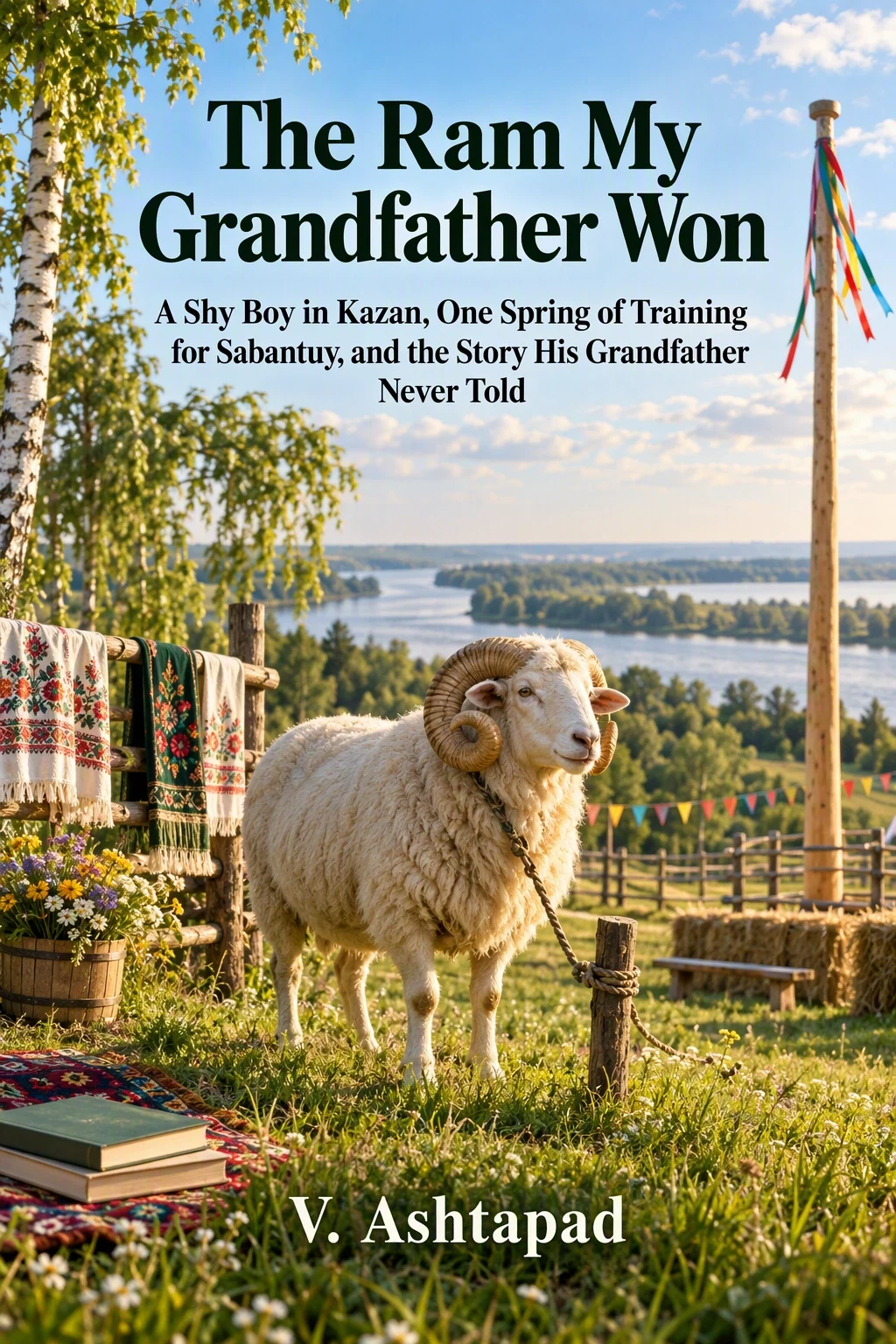
The Ram My Grandfather Won
A Shy Boy in Kazan, One Spring of Training for Sabantuy, and the Story His Grandfather Never Told
by V. Ashtapad
Foreword
This is a work of fiction. Kazan, the Kazanka's spring ice, Sabantuy and its contests, kuresh belt wrestling and the ram for the batyr, the greased pole, the riders who collect embroidered towels as prizes, chak-chak, gubadia and echpochmak are real. The village of Olo Kibak, the Gimadiev family, the coach, the wrestlers and every named person are invented.
For the grandfathers who watched from the bench and knew where every foot should go.
The Ice on the Kazanka
The ice on the Kazanka broke on the ninth of April, at night, and I heard it.
Nobody believes me. My sister Alsu says you can't hear the river from our flat because we live on the seventh floor of a building in Azino, which is a long way from the river, behind three other buildings and a shopping center and the ring road. She says what I heard was the garbage truck.
It was not the garbage truck. It was a long low crack, like a door in a very big house being opened by someone very slow, and then a sort of groan, and then nothing. I was lying in bed in the dark with the window open a little, because the radiators in our building are always too hot in April, and I sat up.
In the morning my grandfather said, "The ice went last night. On the Kazanka." He said it at breakfast, reading the news on his phone with his glasses on his forehead. "Ninth of April. Late this year."
I looked at Alsu.
Alsu put a whole piece of bread in her mouth so she wouldn't have to say anything.
---
My name is Ilnur Gimadiev. I am twelve. I am the shortest boy in 6B at School Number 39 except for Timur Sadykov, who is shorter but louder, so nobody notices.
I live in Kazan, which is the capital of Tatarstan, which is in the middle of Russia on the Volga, where the Kazanka comes into it. I live with my mother, who teaches Tatar language and literature at a different school, Number 112, and my sister Alsu, who is sixteen and knows everything, and my grandmother, Äbi, and my grandfather, Babai, who moved in with us two years ago when Äbi's knee got bad and they couldn't manage the stairs in the village house anymore. They have the small room. Alsu and I share the other one. My mother sleeps on the sofa in the big room and says she likes it, which I don't believe.
My father is in Surgut. In the north. In the oil. He works on a rig, two weeks there and two weeks home. When he's home he sleeps a lot and fixes things. When he's there he calls on video every night at nine, and his face is on my mother's phone on the kitchen table against the sugar bowl, and behind him there is a little room with a bunk and a window that is always dark, even in summer, because of the time, or white, because of the snow.
This year his two weeks home are in June. For Sabantuy.
---
Sabantuy is the festival of the plow.
That's what the word means. Saban is the plow and tuy is a feast, a celebration, like a wedding. A thousand years ago, my mother says, when everybody in our villages was a farmer, the people would finish the spring sowing in the fields, and then they would have a festival, to thank the earth, and rest, and show off. And they still do. Every village. Every town. Every district of Kazan has its own, in a park, on a Saturday in June, after the planting. And the big one, the one on television, in Mirny, outside the city, where a hundred buses come from every district and everybody wears their best clothes and there are a hundred thousand people.
There are contests. Running, horse races, sack races. Egg-and-spoon, but you hold the spoon in your mouth. Breaking a clay pot with a stick when you're blindfolded. Two men sitting on a log hitting each other with pillows until one falls off. Climbing a pole. A very tall pole, smooth, with a prize at the top, and the pole is greased, so you slide down.
And kuresh.
Kuresh is wrestling. Our wrestling. Tatar wrestling. Two boys or two men stand facing each other on the grass, and each one has a towel, a long towel, which he puts around the other one's waist and holds with both hands at the back, like a belt. So you're holding each other close, very close, chest to chest, with your hands on each other's backs. And you have to throw the other one. Lift him off the ground with the towel and throw him onto his back. You can't use your legs to trip. You can't grab his clothes. Only the towel, and your arms, and your back, and your stomach, and how much you want it.
The one who wins every round, all day, until there's nobody left, is the batyr. The hero. The strongest man in the village.
And the batyr wins a ram.
A real, live ram. With horns. And he carries it around the field on his shoulders while everybody cheers.
---
There is a photograph of my grandfather holding a ram.
It's on the wall in the small room, above the bed, in a frame, between a picture of Äbi when she was young and a calendar from the pharmacy. It's black and white and the corners are brown. It was taken in 1968 in the village where Babai and Äbi grew up, which is called Olo Kibäk, which is in the Arsk district, a hundred kilometers from Kazan, where they lived until two years ago.
In the photograph, my grandfather is sixteen. He's very thin. Thinner than me. He's wearing a white shirt with no collar and dark trousers and boots. His hair is black and sticking up. He's standing in a field, with people behind him, a lot of people, blurry, and some trees, and he's holding a ram in his arms. A big ram, white, with a black face and curly horns, and the ram is looking at the camera like it would like to bite it.
My grandfather is not smiling. He's looking at the ram.
That's Babai the batyr, everybody says. Babai who won the ram at the Sabantuy in Olo Kibäk in 1968 when he was sixteen. The youngest batyr in the history of the village. Everybody in our family knows the story. My father knows it. My mother knows it. My uncles in Naberezhnye Chelny know it. Alsu knows it, and pretends she's bored by it, and isn't. The neighbors in Olo Kibäk know it. Babai tells it at every family dinner, every New Year, every birthday, every Sabantuy, always the same way.
"I was sixteen," he says. "Small. Like Ilnur. Nobody thought I would win anything. The men laughed when I went into the circle. And I threw them. One, two, three, four, five. Six. Seven. The last one was Gabdulla Shäyhetdinov, the blacksmith's son, who was twenty-two and as wide as a door. And I threw him too." He holds up his hands. "Like this. And they gave me the ram. His name was Akbash. White Head. I carried him around the field on my shoulders. Three times."
And then everybody claps. Every time. Even Alsu.
---
This year I'm going to wrestle.
I decided on the night the ice broke. I lay in the dark after I heard it, and I thought about the river, all that ice, all winter, so thick that men sit on it with little drills and fish through holes, and then one night it just cracks and goes. And I thought, I'm twelve. In June I'll be twelve and a half. There's a kuresh for boys at the Sabantuy in Olo Kibäk, for boys from ten to fourteen, in the morning, before the men. Babai was sixteen when he won. I've got four years.
And I'm small. Like Babai.
I kept it to myself. Not at breakfast, when Babai said about the ice. Not at school. I told myself. I said it out loud in the bathroom with the water running so nobody would hear.
"I'm going to wrestle at Sabantuy."
The face in the mirror didn't look like a batyr. It looked like a boy who was going to be very embarrassed.
© 2026 CRUNOD LLC. All rights reserved.
Ildar Abyi
There's a kuresh section at the sports school on Chistopolskaya Street. My mother found it in the city's list of sports sections on her phone the day after I told her. Because I did tell her, in the end, the next evening, in the kitchen, while she was marking notebooks, because she looked up and said "What?" before I'd even said anything, the way she does.
She looked at me over the notebooks.
"Kuresh," she said.
"Yes."
"You."
"Yes."
"Ilnur, last year you cried when Timur Sadykov pushed you in the snow."
"I didn't cry. I had snow in my eyes."
"You had snow in your eyes for forty minutes." She put down her red pen. "Why kuresh?"
The words wouldn't line up. So I pointed through the wall. Toward the small room. Toward the photograph.
My mother looked at the wall. Then she looked at me. Then she picked up her phone.
"Tuesdays and Thursdays," she said. "Five to seven. The coach is called Ildar Galiullin. Wear a T-shirt you don't care about."
---
Ildar abyi is about forty, I think, though it's hard to tell with men who have no hair. His head is completely bald and shiny like a melon and his neck is as wide as his head, so he looks like a thumb. He has small eyes and big ears and one of the ears is flat and crumpled like a cabbage leaf, which he says is from wrestling, which happens to wrestlers, it's called cauliflower ear, and if I keep wrestling I'll get one too, and I should be proud.
We call him Ildar abyi. Abyi is what you call a man older than you who isn't your father or your grandfather. It means elder brother, more or less. It's polite. You call your teacher abyi, or your uncle, or the man at the shop. Women are apa. My mother is Rezeda apa to her students.
The sports school is an old building, yellow, with columns at the front, and the kuresh hall is in the basement, down some stairs, a big room with mats on the floor, green, and mirrors on one wall, and windows high up near the ceiling where you can see people's feet going past on the pavement. It smells of feet and rubber and the cleaning stuff they use on the mats. There are eighteen boys in the section, from nine to fifteen, and two girls, who are better than most of the boys and know it.
On the first day Ildar abyi gave me a towel.
Not a towel for drying. A kuresh towel. Long, white, cotton, about as long as I am tall, folded in half lengthwise. He showed me how to wrap it around my partner's waist, under his arms, and hold the two ends together at his back, in my fists, one fist over the other. And my partner did the same to me.
My partner was a boy called Danis. He was eleven. He was taller than me. He was wider than me. He was, I found out in about four seconds, much stronger than me.
"Begin," said Ildar abyi.
Danis lifted me off the ground with the towel, held me there for a second like a bag of shopping, and put me down on my back on the mat.
"Again," said Ildar abyi.
Danis lifted me off the ground and put me down on my back on the mat.
"Again."
---
I was thrown forty-one times on the first day. I counted. In bed that night I hurt in places I didn't know were places. My back. My stomach. My fingers, from holding the towel. The tops of my feet, from the mat.
But at the end of the class, when the others were going, Ildar abyi called me over to the corner where he keeps the medicine balls and the jump ropes. He was sitting on a bench. He looked me over with his small eyes, the way you check a melon.
"Gimadiev," he said. "How old are you?"
"Twelve."
"How tall?"
"One forty-four."
"How heavy?"
"Thirty-six kilos."
He nodded slowly, like I'd told him the price of something.
"You're small," he said. "You know that."
"Yes."
"In kuresh, small is not the end. In kuresh you don't win with your arms. Arms are tired after one minute. You win with here." He slapped his stomach. "And here." He slapped his lower back. "And here." He tapped his bald head. "And with your feet. Not tripping. Standing. Where you put your feet. How low you are. A small boy who is low and has his feet in the right place can throw a big boy who is high and has his feet in the wrong place. Did you see where Danis put his feet?"
"No. I was in the air."
Ildar abyi laughed. It was a big laugh, much bigger than his eyes. "Next time," he said, "look at his feet. Before you go in the air."
He stood up.
"Thursday," he said. "Five o'clock. Bring a T-shirt you don't care about."
"This one's already ruined," I said.
"Good," said Ildar abyi. "Then you're a wrestler."
© 2026 CRUNOD LLC. All rights reserved.
The Photograph
On Saturday I asked Babai how he threw Gabdulla Shäyhetdinov.
We were in the small room. Babai was sitting on the bed in his slippers, with his reading glasses on, doing a crossword in a Tatar newspaper, and Äbi was in the kitchen making gubadia for Sunday, a big round pie with rice and dried curd and raisins and eggs in layers, I could smell the butter, and I was standing in the doorway looking at the photograph on the wall.
"Babai," I said. "When you threw Gabdulla. The blacksmith's son. How did you do it?"
He looked up from the crossword over his glasses.
"How?" he said.
"What throw. Which way. Ildar abyi says small boys have to be low and put their feet in the right place. Did you go low? Did you go to the side? Did you lift him?"
Babai looked at me a while. Then he looked at the photograph. Then he looked back at the crossword.
"It was a long time ago," he said. "Fifty-eight years. I don't remember."
"You remember the ram's name."
"Akbash."
"And Gabdulla's name. And that he was twenty-two and wide as a door."
"Everybody remembers Gabdulla. He was the blacksmith's son." Babai wrote something in the crossword. "Seven letters. A Tatar poet. Begins with T."
"Tukay," I said. "Babai. Please. Just show me. Stand up and show me the throw."
He put down his pen.
He took off his glasses. He folded them. He put them in his shirt pocket, very slowly. He looked at the photograph.
"I can't stand up and show you," he said. "My back."
And then Äbi called from the kitchen that the gubadia needed someone to taste the raisins, and he got up quite quickly, for a man with a back, and went out past me to the kitchen.
---
I stood and looked at the photograph by myself.
The thin boy in the white shirt, with his hair sticking up. The ram. The crowd behind, blurry. The trees.
I'd looked at it a thousand times. I'd never really looked.
Babai's face. Not smiling. Looking at the ram. Not like you'd look at something you just won. Like you'd look at something somebody handed you, and you weren't sure what to do with it.
And behind him, in the blurry crowd, on the left side, there's one person who isn't blurry. Because he's closer. A big young man, much bigger than Babai, in a dark shirt with the sleeves rolled up, with his hands on his hips. He's looking at Babai. He's smiling. A big smile. Like he's the one who's happy.
I'd never noticed him before.
---
At dinner on Sunday, with the gubadia, my father called from Surgut, on video, on my mother's phone against the sugar bowl, and everybody said hello to him one by one, and he asked me how the kuresh was going, because my mother had told him, and I said fine, and he said how many times did you get thrown, and I said forty-one, and he laughed so hard the phone fell over.
"Forty-one," he said, when my mother picked it up. "That's good. That's very good. I got thrown a hundred my first day. Ask Babai. He was there."
"You did kuresh?"
"For one year. When I was ten. In Olo Kibäk. Babai took me to the club in Arsk." My father looked at Babai, through the phone. "Remember, Ätí? You took me every Saturday on the bus. And you sat on the bench and didn't say anything. And when I came home thrown a hundred times you said, never mind, Rustem, wrestling isn't for everybody."
Babai was looking at his plate.
"I remember," he said.
"And then I quit," said my father. "And did football. And then the oil." He looked at me. "So it's you, Ilnur. You're the next batyr. Like your grandfather."
Everybody looked at Babai. That's what happens when anybody says the word batyr at our table. Everybody looks at Babai, and waits for the story. Sixteen. Small. Seven men. Gabdulla Shäyhetdinov. Akbash. Three times around the field.
Babai didn't tell it.
He cut a piece of gubadia with his fork. He ate it. He said, "Very good, Rauza," to Äbi. "The raisins are just right."
There was a little silence. My mother looked at Äbi. Äbi looked at her tea.
And Alsu, who knows everything, who notices everything and pretends not to, looked at me across the table and raised one eyebrow, very slightly, which in Alsu language means: Something's going on.
© 2026 CRUNOD LLC. All rights reserved.
Alsu
Alsu says she will help me train on one condition, which is that I never tell anyone at her school that she knows anything about wrestling.
"Why do you know anything about wrestling?"
"I don't," says Alsu. "That's the condition."
---
Here is what Alsu knows about wrestling. She knows it because she has watched every video on the internet of Tatar kuresh from the last ten years, because last year she was in love with a boy from Naberezhnye Chelny who won the junior championship of the republic in the under-seventy kilos. She saw him once at the Sabantuy in Mirny, from a distance, and then she watched all his videos, and then she watched all the other videos, to understand what he was doing, and then she stopped being in love with him because he did an interview on television and said he liked his mother's cooking better than any girl's, and Alsu said a man who says that in public has no future.
But she kept watching the videos.
"You're doing it wrong," she says, on Wednesday, in our room, after school. She is sitting on her bed with her feet up and her phone, and I am standing in the middle of the floor with a towel wrapped around a pillow, which is wrapped around a chair, which is my partner, because Danis doesn't come to our flat. "You're going up too fast. Look." She holds up the phone. On the screen two big men in green and blue shirts are standing in a circle on the grass in a stadium, holding each other's towels, chest to chest, not moving. Not moving at all. For a while. "You see? Nobody moves. They're waiting."
"For what?"
"For the other one to move. The first one to move, loses. Usually. Because when you move, you go up a little, and the other one feels it, in the towel, and he goes under you. Watch." On the screen the man in green shifts his weight, just a little, and the man in blue drops, all at once, low, and turns, and the man in green goes over his hip and lands on his back on the grass with a thud I can hear through the phone. "You see? Blue waited. Green went first. Green's on his back."
I look at the chair with the pillow and the towel.
"So I just wait."
"You wait," says Alsu. "You're good at waiting. You waited three years to ask Diana Khamitova if you could borrow her ruler."
"That's not waiting. That's being afraid."
"In kuresh," says Alsu, very wise, scrolling, "it's the same thing."
---
So we train. In our room. In the evenings. When Äbi is watching her programs in the big room and Babai is doing his crossword and my mother is marking notebooks.
Alsu makes me stand low, with my knees bent and my back straight and my bottom out, which she says I look ridiculous in, and hold the towel around the pillow on the chair, and wait. For five minutes. Then ten. My legs shake. My arms shake. She times it on her phone.
"Again," she says. Like Ildar abyi.
Then she makes me practice going under. Dropping fast, low, turning, putting my hip in, lifting. Against the chair. Over and over. The chair falls over. Every time. Babai bangs on the wall from the small room. Alsu bangs back. Babai bangs again. It's like a conversation.
"What's he saying?" I ask.
"He's saying you're doing it wrong too," says Alsu.
---
On Friday she makes me wrestle her.
I don't want to. She's sixteen and taller than me and she does volleyball at school, so she's strong. But she takes the towel off the pillow and wraps it round my waist and I wrap my towel round hers, and she says, "Begin," and we stand there in the middle of our room, chest to chest, holding each other's towels, with our heads on each other's shoulders, which is how you stand in kuresh, which is very strange with your sister.
Her hair smells of the shampoo she steals from my mother.
We stand there. We wait. Nobody moves. My legs shake. I can feel her breathing, through the towel. I can feel her get bored, which with Alsu takes about forty seconds.
And she moves. Just a little. Her weight goes up, onto her toes, to see what I'll do.
And I go under her.
I don't know how. I didn't think about it. I felt her go up in the towel, the way Ildar abyi said, the way the blue man on the video felt it, and I dropped, low, and turned, and put my hip in, and pulled on the towel, and lifted.
And my sister went over my hip and landed on her back on my bed.
---
She lay there looking at the ceiling.
I stood in the middle of the room with the towel in my hands, and my heart going like a drum, and I thought, she's going to kill me.
Then she started to laugh.
Lying on my bed with her hair everywhere and her feet in the air, she laughed so hard she couldn't breathe, and I started too, and we were both laughing, and Babai banged on the wall, three times, very hard.
And then the door opened and it was Babai, in his slippers, with his crossword in his hand and his glasses on his forehead.
He looked at Alsu on the bed. He looked at me with the towel.
"Who threw who?" he said.
"He threw me," said Alsu, from the bed, still laughing. "Babai, he threw me. Over the hip. Like the men on television."
Babai looked at me. For some time. I braced for a lecture about the noise. Or the bed. Or the chair, which was on its side.
He said, "Show me."
So I showed him. Slowly. With Alsu standing up again, still laughing, and the towels. How I waited. How she went up. How I went under. The hip. The lift.
Babai watched with his glasses on his forehead and his crossword in his hand. When I finished, he nodded. Once.
"Your feet were wrong," he said. "Your left foot should have been further in. Here." He pointed with his slipper. "Between hers. Then you're under her center, and she goes over like a sack. With your foot there, she went over like a chair. You see? A chair you have to push. A sack, it falls by itself."
I stared at him.
"Babai," said Alsu, very slowly. "How do you know that?"
And Babai looked at her, and looked at me, and looked at the chair on its side on the floor, and went out of the room without saying anything, and closed the door.
© 2026 CRUNOD LLC. All rights reserved.
Danis
Danis Valiev is eleven and he is the best wrestler in the section under forty kilos and he knows it.
He is from Derbyshki, on the other side of the city, and his father brings him to the sports school in a black car with tinted windows and waits outside in it with the engine running for two hours. His father was a wrestler. A real one. Champion of the republic in 1999, in kuresh and in freestyle, and there is a picture of him on the wall in the corridor of the sports school, younger, with more hair, holding a ram. Danis points it out to everyone. Every day.
"That's my papa," he says. "He won a ram."
"My grandfather won a ram," I said, on the first Tuesday.
Danis looked at me. Up and down. Thirty-six kilos. One forty-four.
"When?" he said.
"1968. In Olo Kibäk. He was sixteen."
"What's Olo Kibäk?"
"A village. In Arsk."
"Oh," said Danis. "A village." The way you'd say: a puddle. "My papa won at Mirny. In front of a hundred thousand people. And television."
And he walked away.
---
Since then he throws me every Tuesday and every Thursday. Ildar abyi pairs us up because we're the same age, nearly, and he says it's good for me to wrestle someone better, and good for Danis to wrestle someone who won't stop getting up.
I don't stop getting up. That's the only thing I'm good at so far. Danis throws me and I get up. He throws me and I get up. In April he threw me thirty-eight times in one class. In the first week of May, thirty-one. Ildar abyi writes it down in a little notebook. "Getting better," he says. I don't know if he means me or Danis.
But since the night with Alsu, something is different.
I wait now. When we take the towels and stand chest to chest, I don't try to throw him. I don't go up. I stand low, with my knees bent and my bottom out like Alsu made me, and I hold the towel, and I wait. I put my left foot further in, between his, like Babai said. And I wait.
And Danis gets angry.
Because he's used to boys who try to throw him, and when they try, they go up, and he goes under them. That's what he's good at. He's very fast. But I don't try. I just stand there. Low. Waiting. Like a stump.
"Do something," he hisses in my ear, chest to chest, with his chin on my shoulder.
I don't do anything.
"Wrestle, village boy," he says.
I don't say anything. I wait.
And after forty seconds, like Alsu, he gets bored, and he moves.
---
I didn't throw him. I'm saying that so nobody thinks I'm boasting. The first time I felt him go up, I tried to go under, and I was too slow, and he came down on top of me and we both went over, and Ildar abyi said it was nobody's point, and Danis said it was his, and Ildar abyi said nobody's.
But the second time, the following Thursday, in the third week of May, when the windows high up near the ceiling were open and you could smell the lilac from the courtyard and hear the feet going past on the pavement, I felt him go up, in the towel, and my left foot was where Babai said, and I dropped, and turned, and put my hip in.
And Danis Valiev went over my hip and landed on his back on the green mat.
Like a sack.
---
The whole hall stopped.
The other boys, the two girls, who'd been wrestling on the other mats, stopped. Ildar abyi, who'd been writing in his notebook, stopped writing. Everybody looked at Danis, on his back, on the mat, staring at the ceiling.
And at me, standing over him, with the towel.
Nobody said anything. Then one of the girls, Liliya, who is thirteen and the best in the section and never says anything, said very loudly, "Finally."
And everybody laughed. Except Danis. Danis got up very fast, red, and went to the corner, and stood there with his back to everyone, and his shoulders went up and down.
Ildar abyi came over to me. He put his big hand on my head, on top, like you'd put your hand on a dog.
"Feet," he said. "Who taught you the feet?"
"My grandfather."
"The batyr," said Ildar abyi. "The one from 1968."
"Yes."
Ildar abyi nodded slowly. "He knows his feet," he said. "Your grandfather. That's an old way. A village way. They don't teach it like that anymore." He looked at the corner, where Danis was. "Go and say something to him."
"What?"
"Anything. Not sorry. You don't say sorry in kuresh. Say something."
So I went over to the corner. Danis had his back to me. I stood behind him for a while. He didn't turn round.
"Your papa," I said. "In the picture. In the corridor. With the ram."
"What about him," said Danis, to the wall.
"What did he do with it? The ram. After."
Danis turned round. His face was red and wet and furious. He looked at me like I was an idiot.
"He gave it to his grandmother," he said. "In Derbyshki. She kept it for nine years. It ate her roses. Everybody knows that."
And then, I don't know why, he laughed. Just a little. Wiping his nose with his wrist.
"It ate all her roses," he said. "Every single one. She called it the batyr. She said it was the only batyr in the family who did any work."
© 2026 CRUNOD LLC. All rights reserved.
Nine O'Clock
My father calls at nine every night from Surgut.
It's nine o'clock in Kazan and eleven o'clock in Surgut, because Surgut is two hours ahead, which is something I learned in the second grade and still don't understand, because the sun is the same sun. My mother props her phone against the sugar bowl on the kitchen table, and we sit around it, whoever's there, and my father's face comes up, a little square, with his room behind him.
His room on the rig is very small. A bunk, with a gray blanket. A little table with a kettle on it and a jar of instant coffee and a packet of the biscuits my mother sends him in a box every two weeks. A window. In winter the window is black, always, because in Surgut in December the sun comes up for about four hours and he's working all of them. In May the window is white, always, because now the sun hardly goes down at all. He has a piece of cardboard he tapes over it to sleep. Behind him on the wall there's a calendar with the days crossed off in red, and a photograph of us, from New Year, all of us at this table, with the chak-chak.
He works twelve hours a day. Fourteen days. Then he flies home, three hours on a plane to Kazan, and sleeps for two days, and then fixes everything in the flat that's broken, the tap, the door of the wardrobe, the light in the bathroom, my bicycle, and then he's home for twelve days, and then he goes back.
He's done this since I was four. I don't remember him not doing it.
---
On the Thursday I threw Danis, I couldn't wait for nine o'clock.
I sat at the kitchen table from eight with the phone against the sugar bowl, even though it wasn't ringing, and Äbi made me tea twice, and Alsu walked past three times and said "He's not going to call earlier because you're staring at it," and I said I know, and stared at it.
At one minute past nine it rang.
"Ätí," I said, before he could say hello. "I threw Danis."
His face on the screen. Tired. He'd just come off the shift. There was a mark across his forehead from his hard hat. He looked at me for a second like he didn't know who Danis was.
Then he remembered. "The one from Derbyshki? The champion's son?"
"Over the hip. Low. Left foot in. Like a sack."
My father's face did something slowly. It went from tired to something else.
"You threw the champion's son," he said.
"Like a sack. Ildar abyi said it was the old way. The village way. He said they don't teach it like that anymore."
My father didn't say anything for a while. Behind him, through the cardboard on his window, the white light of the north was coming in at the edges, at eleven o'clock at night.
"Who taught you?" he said.
"Babai," I said. "He told me where to put my left foot. He came in our room in his slippers."
---
My father looked past me. At the doorway of the kitchen. Where Babai was standing, in his slippers, with his crossword, because he'd heard. Because everybody in our flat hears everything. The walls are like paper.
"Ätí," said my father, to Babai, through the phone. "You taught him the feet?"
Babai came into the kitchen. Slowly. He sat down at the table, beside me, in front of the phone. He looked at his son's face in the little square.
"I told him where to put his foot," said Babai. "That's all."
"You never told me," said my father.
He didn't say it angrily. He said it the way you'd say it's raining. Just a thing that's true.
"I took you to Arsk," said Babai. "Every Saturday."
"You took me to Arsk every Saturday on the bus," said my father, "and you sat on the bench and didn't say anything. For a year. And I got thrown every Saturday, by every boy in the district. And I came home and you said, never mind, Rustem. Wrestling isn't for everybody." He rubbed the mark on his forehead. "I thought you were ashamed of me. The batyr's son. Who couldn't throw anybody. I thought that's why you didn't say anything."
The kitchen was very quiet. Äbi had stopped washing the cups. Alsu was in the doorway. My mother was at the end of the table with her notebooks, not marking.
Babai sat looking at the phone.
"I wasn't ashamed of you, Rustem," he said. "Never. Not once."
"Then why didn't you tell me?"
Babai opened his mouth. And closed it. And I saw his hands, on the table, on his crossword. They were shaking. Just a little.
"I should have," he said. "I'm sorry."
That's all he said. He didn't say why. He didn't tell the story. He got up, slowly, and went back to the small room, with his crossword, and closed the door.
---
My father looked at the closed door on his screen for a while. Then he looked at me.
"Well," he said. And then he laughed. Just a little. Tired. "Well, Ilnur. You threw the champion's son. That's more than I ever did. Tell me again. Slowly. Where was your left foot?"
So I told him. I stood up in the kitchen and showed him, with Alsu as the partner, holding the towels, in front of the phone against the sugar bowl, so he could see. Low. Wait. Left foot in. She goes up. Under. Hip. Lift.
Alsu went over my hip onto the kitchen floor and landed on the cat, who screamed, and Äbi screamed, and my mother laughed so hard she knocked her notebooks off the table, and on the phone, on the rig in Surgut, at eleven at night, in the white light, my father was laughing too, with his forearm across his eyes.
"Again," he said, when he could. "Do it again. I want to see the feet."
---
Before he hung up, he said one more thing. I was holding the phone, by then. Everybody else had gone. Only the hood light over the stove was on.
"Ilnur," he said. "The tree. On the family pages. The one your mother made. With all the names."
"Yes."
"Look at your great-grandfather. Babai's father. Shäkir. Look at the dates."
"Why?"
"Just look," said my father. "I've been looking at it on my phone up here at night. I never asked about it. I've been thinking I should have asked."
So after he hung up I took my mother's phone and opened it. The family pages. The private ones, that my mother keeps, for us and the cousins in Chelny and Moscow and Tashkent and the aunt in Kazan who never calls. The tree, going back and back, little boxes with names in Tatar and Russian, with dates, and some with photographs. My mother's side going one way. My father's going the other.
Rustem Gimadiev, 1981. Ravil Gimadiev, 1952. And above Ravil, two boxes.
Shäkir Gimadiev, 1921–1968.
Fatima Gimadieva, 1926–2003.
1968.
The year of the ram.
I sat in the dark kitchen looking at the little box a while. Then I put the phone down against the sugar bowl, and went to bed, and lay there, and didn't sleep, and in the morning I didn't ask anybody about it, because nobody had ever told me, and I was starting to understand that in our family, the things nobody tells you are the ones that are holding everything else up.
© 2026 CRUNOD LLC. All rights reserved.
Planting Potatoes
The May holidays we go to Olo Kibäk to plant potatoes.
We go every year. Even since Babai and Äbi moved to Kazan, because they still have the house there, and the garden, and Babai says a man who doesn't plant his own potatoes is a man who buys potatoes, and that is the beginning of the end. So on the first of May we all get into my mother's car, which is small and silver and very old, my mother driving, Äbi in the front with her knee, Babai in the back with Alsu and me and a sack of seed potatoes on his lap and a bucket of tomato seedlings on the floor, and we drive out of Kazan, past the ring road and the shopping centers and the new apartment buildings going up in rows like teeth, out onto the Arsk road going north and east, into the country.
And the country in May is the best thing I know.
The snow's gone. All of it, even in the forests, where it stays longest in the shade under the fir trees. The fields are black and brown, plowed, wet, steaming a little in the sun. The birches along the road have little leaves on them, very small, very green, so green they look like they've been painted, and the trunks are white and black and the light comes through them. There are rooks in the fields walking behind the tractors, black and gray, looking for worms. There are storks on the telegraph poles in the villages, on their big nests of sticks, standing on one leg. Every village we pass through has wooden houses painted blue and green and yellow, with carved window frames, white, like lace, and fences, and gates painted with suns and flowers, and a well with a long wooden arm, and old women on benches outside the gates in headscarves and cardigans, watching the road, the same old women in every village, like the storks.
And then Olo Kibäk.
---
Olo Kibäk is a village of two hundred houses on a long hill above a little river called the Kibäk, which means, I think, nothing, it's just a name, and Olo means big, so it's Big Kibäk, and on the other side of the river there's a smaller village called Kechkenä Kibäk, Little Kibäk, and the two villages have been arguing about which one is better for four hundred years.
Babai's house is at the top of the hill, on the street called Tukay Street, like every village's main street, after the poet. It's wooden, painted green, with white carved window frames and a green gate with a yellow sun on it, and a big garden behind going down the hill toward the river, with apple trees and a bathhouse and a shed and the potato field, and at the bottom of the garden, a fence, and on the other side of the fence, the garden of Fänis babai.
Fänis babai is Babai's best friend. They were born in the same month in 1952, in houses next door to each other, and they went to school together, and to the army together, and drove tractors on the farm together for forty years, and when Babai moved to Kazan, Fänis babai cried, Äbi says, though Fänis babai says he had something in his eye.
He's huge. He's the biggest old man I've ever seen. Taller than my father. Wider than a door. With hands like shovels and a face like a potato and white hair cut very short and a laugh you can hear from the river. He lives alone now. His wife died in 2019 and his children are in Kazan and Moscow. He has a dog called Akbay, a big white shaggy dog with a black ear, who lives in a kennel by the gate and barks at everyone except Babai.
When we pull up outside the green gate on the first of May, Fänis babai is already there, leaning on our fence, with Akbay beside him, waiting. He's been waiting, Äbi says, since six.
"Ravil!" he shouts, before Babai can even get out of the car. "You're late! The potatoes have started planting themselves!"
And Babai gets out of the car, slowly, with the sack of seed potatoes, and walks over to the fence, and the two old men look at each other over it a while without saying anything.
Then Fänis babai reaches over the fence and puts his huge arms around my grandfather, sack and all, and lifts him off the ground.
"Put me down, you bear," says Babai, in the air.
"Never," says Fänis babai.
---
We plant potatoes for two days.
You don't plant potatoes in Olo Kibäk with a machine. You plant them with your family. Babai and my mother dig the rows, with spades, long straight trenches in the black earth going down the hill toward the river. Alsu and I go along behind them with buckets of seed potatoes, old potatoes from last year, wrinkled, with white shoots coming out of their eyes like little fingers, and we put one in the trench every thirty centimeters, which Babai measures with a stick he's had since 1975. Eye up. Always eye up. Then Äbi comes behind us with a little rake, slowly, sitting on a stool, moving the stool along the row, and covers them. And Akbay comes behind Äbi and digs them up again, and Fänis babai shouts at him over the fence, and Akbay runs back under the fence to his own garden with a potato in his mouth.
"That dog," says Babai, "has eaten more of my potatoes than I have."
"That dog," says Fänis babai, over the fence, "is the only one in this village who appreciates them."
In the evening we have a bath in the bathhouse at the bottom of the garden. The banya. A little wooden house with a stove inside, made of stones, and you heat it for three hours with wood until the room is so hot you can't breathe, and you throw water on the stones and the steam comes up like a cloud, and you sit on the wooden benches in the steam and sweat, and Babai hits you with a bundle of birch twigs with the leaves on, which you soak first in hot water, which sounds terrible and isn't, it smells like a forest and makes your skin go red and tingle. And then you run out and jump in the cold water in the barrel, or in winter you roll in the snow. And then you sit in the little room outside the steam room, in a towel, and drink tea from the samovar, with jam, and you feel like a new person.
Babai and Fänis babai sit in the little room in their towels, two old men, one very thin and one very big, red as boiled crayfish, drinking tea, not saying anything.
And I sit on the bench in my towel and look at them.
And I want to ask.
I want to ask Fänis babai about 1968. Because he was there. He must have been there. He was born next door. He's the same age. He was sixteen. He must have seen Babai throw Gabdulla Shäyhetdinov, the blacksmith's son, wide as a door. He must have seen Babai carry Akbash around the field three times on his shoulders.
But I don't ask. Because when I open my mouth, Babai looks at me. Over his tea. Just for a second. A look I've never seen on his face before.
And I close it.
© 2026 CRUNOD LLC. All rights reserved.
The Pole
On the second day of the May holidays, in the afternoon, when the potatoes were in and Babai was asleep in the house with his newspaper over his face and Äbi was on the bench outside the gate with the other old women watching the road, Fänis babai called me over the fence.
"Ilnur. Come here. Bring the ladder."
I brought the ladder. It was Babai's, wooden, very old, with one rung missing in the middle that you had to step over.
Fänis babai was standing in his garden beside a pole.
It was a tall straight pole, a pine trunk with the bark taken off, gray and smooth with age, about as thick as my leg, stuck in the ground in the middle of his garden between the apple trees and the bathhouse, and going up, and up, much higher than his roof. Six meters. Seven. At the top there was a little wooden ledge, the size of a stool, nailed on, with nothing on it.
"What is it?" I said.
"It's a pole," said Fänis babai.
"I can see it's a pole. Why is it in your garden?"
"Because I put it there," said Fänis babai. "In 1971. It's the old pole. From the Sabantuy. When they got a new one, a metal one, for the village, in 1990, nobody wanted the old one. So I took it. I like it. My wife hated it. She said it looked like I was trying to talk to the moon." He put his huge hand flat on the pole and looked up it. "Every Sabantuy from 1955 to 1989 the men of Olo Kibäk climbed this pole. Every one of them. Some of them got to the top. Most of them didn't."
"Did you?"
"Eleven times."
"Did Babai?"
Fänis babai looked at me. Then he looked up the pole again.
"Climb it," he said.
---
I couldn't climb it.
I don't mean I didn't try. I tried for an hour. I put my arms around it and my legs around it and pulled, and went up about a meter, and slid down. And again. And again. The wood was so smooth and so old it was like glass. My hands slid. My knees slid. My sneakers slid. I got splinters in my palms. Fänis babai stood with his arms folded and watched and didn't say anything.
"It's impossible," I said, after an hour, sitting on the ground at the bottom with my hands burning.
"It's not greased," said Fänis babai. "At the Sabantuy, they grease it. With soap and oil. Then it's impossible."
"Then how does anybody get up?"
He sat down on the ground beside me, slowly, like a hill sitting down. Akbay came and lay on his feet.
"Four ways," said Fänis babai. "I'll tell you. The first way is to be strong. Very strong. In the arms. And go up fast before your arms know what's happening. That's the way the young men try. It works for one in twenty."
"I'm not strong in the arms."
"No. The second way is the trick with the sand. You fill your pockets with sand. Or ash, from the stove. And when your hands are slippery, you put them in your pocket and rub, and then you grip. The grease mixes with the sand and it's like sandpaper. You go up a bit. You rub again. Up a bit." He rubbed his huge hands together. "Some villages, it's cheating. In Olo Kibäk it's tradition."
"What's the third way?"
"The third way is the rope. A little loop of rope, or your belt, around your feet. Like this." He showed me with his hands. "So your feet are tied together around the pole and you can push up with them like a caterpillar. The hunters in the forest use it to climb for honey. That's definitely cheating."
"And the fourth way?"
Fänis babai was quiet for a while.
"The fourth way," he said, "is to go up second."
"Second?"
"After someone else. Someone who goes up first and doesn't make it. Who slides down. Every time someone slides down, he takes some of the grease with him. On his clothes, his hands, his legs. So the pole is less greasy. The next one gets a little higher. And slides down. And takes more grease. And the next one higher. And so on. By the end of the day, the pole's dry, nearly, and anybody can climb it." He looked at me. "So the one who wins the prize at the top is usually the one who waits. Who lets the others go first. Who watches where they slide. And goes up last, on their grease."
"That's not fair."
"It's completely fair," said Fänis babai. "Everybody can see it happening. Everybody knows. Nobody's hiding anything. The first ones want to be first. The last one wants to be last. They each get what they want." He laughed, his big laugh, so loud that Akbay jumped. "But you have to be able to stand there. All day. While everybody else goes. While people laugh at you for not trying. While the girls watch. While your friends say you're afraid. You have to stand there and wait."
"I'm good at waiting," I said. "My sister says."
"I know," said Fänis babai. "I saw you plant potatoes. You put every one eye up. Even when your sister was throwing them at you."
---
We practiced the sand trick. With dry earth from the potato field in my pockets. And the pole, dry, not greased, and the ladder for the first two meters so I could start higher, and Fänis babai underneath with his arms out, ready, like a man under a falling sack.
I got to four meters.
At four meters I looked down and saw Fänis babai's white head very small and Akbay looking up at me with his black ear, and the apple trees, and the roof of Babai's house, and the long hill going down to the river, and the river shining, and the other village on the other side, Little Kibäk, and the fields beyond, black and brown and green, and the forest, and the sky, very big, with rooks in it.
And I slid down.
Fast. All the way. Into Fänis babai's arms. He caught me like a sack.
He put me down. He looked at my face. I was laughing. I didn't know I was laughing.
"Four meters," he said.
"Four meters," I said.
"Ravil only ever got to three," said Fänis babai.
And then he stopped, the way grown-ups stop when they've said something they meant to keep, and looked toward Babai's house, where Babai was asleep with the newspaper over his face.
© 2026 CRUNOD LLC. All rights reserved.
Chak-Chak
The week before Sabantuy, Äbi makes chak-chak.
She makes it every year. Not for us. For the Sabantuy. For the table at the back of the field in Olo Kibäk where the women of the village put out food for everyone on the big day, on long tables under the birch trees, with white cloths: pies and pastries and fried things, and a samovar as big as a boiler with a little teapot on top, and honey, and tea all day. Every woman brings something. Äbi always brings chak-chak, because, she says, nobody else's is as good, which everybody else says about theirs.
Chak-chak is the most Tatar thing there is. More than kuresh. More than Sabantuy. You go to someone's house, there's chak-chak. Someone gets married, chak-chak. Someone has a baby. Someone dies. A guest comes from far away. You give them tea and chak-chak.
It's dough. Flour and eggs and a little milk, kneaded hard, rolled out thin, and cut into little strips and then into little pieces, smaller than your fingernail, like peas. Thousands of them. And you fry them in hot fat, a handful at a time, until they puff up and go golden. And then you boil honey with sugar until it's thick and amber and smells like the whole summer at once, and you pour it over the little golden pieces in a big bowl, and stir, and then, while it's still hot, with wet hands, very fast, before it sets, you pile it up into a hill. A mound. Like a haystack. And let it go hard.
And then you break pieces off with your fingers and eat it with tea and get honey all over everything.
---
Äbi makes it in our kitchen in Kazan, on the Saturday, the week before. She makes me help. Alsu helps too, though she says she has homework. My mother marks notebooks at the end of the table and pretends not to watch.
Äbi rolls the dough. She's seventy-three and her knee is bad and she sits on a stool to do it, at the table, with the rolling pin that was her mother's, wooden, black from a hundred years of hands. She rolls so thin you can see the oilcloth pattern through it. Then she cuts it, with a knife, in strips, and then the strips into little pieces, so fast her knife is a blur.
I cut too. Mine are too big. Alsu's are too small. Äbi says ours are fine, which means they're not.
"Äbi," I say, while we're cutting. "Did you see Babai win the ram?"
She doesn't stop cutting.
"1968," she says.
"Yes."
"I was fourteen," says Äbi. "I lived in Kechkenä Kibäk then. The other village. Across the river. We went to their Sabantuy, the girls, to look at the boys. That's what the girls did."
"So you saw him?"
"I saw him with the ram," says Äbi. "Afterward. In the field. Holding it. The photograph."
"But did you see him wrestle?"
The knife stops.
Äbi looks at the little pile of dough pieces. She looks at me. Then she looks at my mother at the end of the table, who has stopped marking.
"I saw him with the ram," she says again. "He was so thin. He was standing in the middle of the field holding this big white ram with a black face, and everybody was shouting, and he was looking at the ram like it was a baby somebody had handed him in the street. And I thought, that's a nice boy. That's a boy who would be kind to a ram." She starts cutting again. "I married him four years later."
"But—"
"Ilnur," says my mother, from the end of the table. Very quietly.
I stop.
Äbi keeps cutting. Then she says, not looking up:
"Some stories, kuyashim, are for the person who tells them. You let them tell it. You don't ask how. You ask why."
Kuyashim means my little sun. It's what she calls me when I'm being stupid.
---
That night, when the chak-chak is a big golden hill on a plate on the kitchen table, under a cloth, for next Saturday, and everybody's asleep, I get up and go into the small room.
Babai is asleep on his back, snoring. Äbi is asleep on her side, with her hand under her cheek like a girl.
The photograph is on the wall above them. In the light from the street, through the curtain, orange.
The thin boy. The ram. The blurry crowd. The trees.
And the big young man on the left side, not blurry, in the dark shirt with his sleeves rolled up, with his hands on his hips, looking at Babai, smiling a big smile.
I look at him.
Wide as a door.
A face like a potato.
© 2026 CRUNOD LLC. All rights reserved.
Fänis Babai's Story
I didn't ask Fänis babai. I want that to be clear. I promised myself I wouldn't. Äbi said ask why not how, and I didn't even ask why. I didn't ask anything.
He told me himself.
It was on the Thursday before Sabantuy. We'd come to Olo Kibäk early, on Wednesday, because my father had come home from Surgut on Tuesday and wanted a few days in the village before the festival, to fix the fence and sleep, and Babai wanted to see his potatoes, which were up now, in long dark green rows down the hill. And on Thursday afternoon, my father and Babai went to Arsk in Fänis babai's old blue car to buy nails and a part for the bathhouse stove, and Fänis babai stayed behind, because, he said, his back. And he called me over the fence.
He was sitting on a bench by his pole, in the sun, with Akbay asleep on his feet.
"Sit," he said.
I sat.
He didn't say anything a while. A cuckoo was calling somewhere down by the river. Cuckoo, cuckoo. In Tatar you count the calls and that's how many years you have left. I counted nineteen and then it stopped.
"You've been looking at the photograph," said Fänis babai.
I didn't say anything.
"Rauza told me. Your äbi. On the telephone, last week. She said, Fänis, the boy has been standing in front of the photograph at night. She said, he's seen you in it." He looked at his huge hands. "So."
---
"In the spring of 1968," said Fänis babai, "your great-grandfather died. Ravil's father. Shäkir. A tractor accident. In April. In the mud, in the field, by the river. The tractor went over. It was a bad spring, very wet, and it went over on the slope, and he was under it."
I hadn't known that. Nobody ever told me how my great-grandfather died. I only knew his name, from the tree my mother made, with all the names going back, the one she keeps on the family pages where the cousins in Chelny and Moscow and Tashkent can see it. Shäkir Gimadiev, 1921–1968. I'd never asked about the dash.
"Ravil was sixteen," said Fänis babai. "Oldest of four. His mother had nothing. No money, nothing. The farm gave a little. Not much. Ravil left school. He went to work on the farm, in his father's place. On the tractor. A boy of sixteen. He was very thin. Thinner than you. He couldn't eat. Every day after work he came here and sat on that bench." He pointed at the bench we were sitting on. "That bench. My father made it. And he didn't say anything. He just sat. For two months. I sat with him."
The cuckoo started again by the river.
"And then Sabantuy came," said Fänis babai. "In June. And Ravil didn't want to go. He said, how can I go to a festival. My father's dead two months. And I said, you're going. Everybody's going. And he said, I'm not going to wrestle. And I said, fine, don't wrestle. Come and watch me."
He looked at me.
"I was the strongest boy in the village. Sixteen, like him. But big. Like this." He held up his huge arms. "I'd been wrestling since I was seven. I wanted to be batyr. That year I was going to be batyr. Everybody said so. Everybody knew."
---
"And you were," I said.
Fänis babai nodded slowly.
"I threw seven men that day," he said. "One after another. The last one was Gabdulla Shäyhetdinov, the blacksmith's son, who was twenty-two and as wide as a door. Wider than me. And I threw him. Over the hip. Low. With my left foot between his." He looked at me. "The old way."
"Babai's way."
"No," said Fänis babai. "Ravil's way. Ravil taught it to me. When we were ten. He couldn't wrestle, Ravil. He was too thin and too shy, he'd go red if a girl looked at him, he'd shake. He never once went in the circle. Not in his life. But he watched. He watched every bout, every Sabantuy, from when we were six. And he understood it. Better than any of us. He'd come to me after, every year, and say, Fänis, your feet were wrong, Fänis, you went up too soon, Fänis, wait. And I'd say, how do you know, you've never done it, and he'd say, I've watched you do it wrong for four years. He was like your Ildar. With no cauliflower ear."
He laughed. Then he stopped laughing.
"So I threw Gabdulla Shäyhetdinov with Ravil's feet," said Fänis babai. "And they gave me the ram. Akbash. White Head. And I carried him around the field three times on my shoulders. And everybody cheered. And then I put him down."
The cuckoo had stopped. Akbay was awake now, looking up at him.
"And I walked across the field," said Fänis babai, "with the ram, on his rope, to where Ravil was standing. At the edge. By the trees. In his white shirt. His only white shirt, his father's funeral shirt. Looking at the ground. And I put the rope in his hand."
I didn't say anything.
"I said, take it home to your mother. I said, you can eat it in the winter, or sell it, or keep it for breeding, it's a good ram. I said, you taught me the feet. It's half yours anyway. More than half. And he said no. And I said yes. And we argued. In front of everybody. And then his mother came across the field, Ravil's mother, in her black headscarf, with the three little ones, and she looked at the ram. And she looked at me. And she started to cry. And Ravil stopped arguing."
"And the photograph," I said.
"There was a man from the district newspaper," said Fänis babai. "From Arsk. With a camera. He came over to take a picture of the batyr with the ram, for the paper. And Ravil was holding it. And I was standing back, by then, with my hands on my hips. And the man said, who's the batyr? And before Ravil could open his mouth, I said: him."
He looked at me with his small eyes in his potato face.
"And Ravil looked at me," he said, "like I'd hit him with a stick. And the man took the photograph. And it went in the district newspaper. Ravil Gimadiev, 16, of Olo Kibäk, batyr. With the ram."
---
"Why?" I said. My voice came out wrong. "Why did you say him?"
Fänis babai thought about it. For a while. He looked up his pole, all the way to the top, to the little wooden ledge with nothing on it, against the sky.
"Because his father was dead," he said. "Because he hadn't eaten for two months. Because he was sixteen and he'd left school and he was going to drive a tractor for forty years in the place where his father died. Because his mother was crying. Because he taught me the feet." He shrugged his enormous shoulders. "Because I was going to win again. I won the next year, and the next. Four times, in the end. I had plenty of rams. He had one photograph. I thought, let him have one thing. One thing that's his."
He put his huge hand on my head, the way Ildar abyi does.
"And he told it," said Fänis babai. "The story. For fifty-eight years. To his son, to his grandchildren, to everybody. Gabdulla, the seven men, three times around the field. And I never said anything. Because it was his story. I gave it to him. You don't take back what you give." He took his hand away. "And because, kuyashim, it was true. All of it. Except the part about who was in the circle. And that part doesn't matter."
"It does," I said.
"Does it?" said Fänis babai. "Who taught me to throw Gabdulla?"
© 2026 CRUNOD LLC. All rights reserved.
What I Didn't Say
I kept it to myself.
Not my father, who came back from Arsk that evening with the nails and the part for the stove and fixed the bathhouse and said I looked pale. Not Alsu, who looked at me across the table at supper with one eyebrow up and said nothing, because she knew something had happened and she was waiting for me to tell her, and I didn't. Not my mother, who sat on my bed that night and asked if I was nervous about Saturday and I said yes, which was true but not the reason.
Not Babai.
Babai sat at the head of the table that night, in the house in Olo Kibäk, with his potatoes up in the garden, and his son home from the north, and his grandchildren, and Äbi, and Fänis babai, who came over the fence for supper as he always does when we're there. And Äbi made peremech, little round pies with meat, fried, with a hole in the top for the juice. And my father, who was very happy to be home and had had a little vodka with Fänis babai, said:
"So, Ätí. Saturday. Your grandson in the circle. In Olo Kibäk. Like you. Tell him about Gabdulla."
And everybody looked at Babai.
And I looked at Fänis babai.
And Fänis babai looked at his plate.
And Babai put down his fork. And looked at his son, my father, who was smiling. And at me. For some time. And I knew he knew. I don't know how. Maybe Fänis babai told him in the car to Arsk. Maybe he saw it in my face. Maybe Äbi. But he knew that I knew.
And he said: "Not tonight, Rustem. The boy needs to sleep. Let him wrestle first. Then I'll tell it."
And he picked up his fork again.
---
I lay in bed that night in the little room at the top of the house in Olo Kibäk, under the roof, where I sleep when we're there, with Alsu in the other bed, and the window open, and the sound of the frogs from the river, thousands of them, like a motor, and a dog somewhere, and the smell of the lilac in Fänis babai's garden, and I couldn't sleep.
I thought about the photograph. The thin boy in his father's funeral shirt. Looking at the ram like a baby somebody had handed him in the street.
I thought about Babai never going in the circle. Too thin and too shy. Going red if a girl looked at him. Shaking.
Like me.
I thought about him watching. Every bout. From when he was six. Understanding it. Better than any of them. Fänis, your feet were wrong. Fänis, wait.
I thought about him in the doorway of our room in Kazan in his slippers, with his crossword. Your left foot should have been further in. A sack falls by itself.
And I thought about my father. Who did kuresh for one year when he was ten. Who Babai took to Arsk every Saturday on the bus and sat on the bench and didn't say anything. Who got thrown a hundred times and quit. Never mind, Rustem. Wrestling isn't for everybody.
Babai never told my father the feet.
Fifty-eight years he told the story of Gabdulla Shäyhetdinov. And he never once told anybody how to throw him. Because he couldn't stand up and show it. Because if he showed it, someone would ask how he knew. And he'd have to say: I watched. I never did it. I watched and I knew and I taught my friend and my friend gave me the ram.
---
"Ilnur," said Alsu, in the dark, from the other bed. "Are you asleep?"
"No."
"Are you going to tell me?"
I didn't say anything. The frogs went on.
"No," I said.
"Is it about the photograph?"
"Yes."
"Is it bad?"
I thought about it.
"No," I said. "It's the opposite of bad."
Alsu was quiet. Then she said, "Okay," and turned over to face the wall, and I heard her pull the blanket up. And then, after a while, very quietly, so quietly I almost didn't hear it over the frogs:
"Wait for him to go first. In the circle. Whoever it is. Let him go up."
"I know."
"Left foot in."
"I know."
"You'll still probably lose."
"I know," I said, and I laughed, in the dark, and so did she, into the wall.
© 2026 CRUNOD LLC. All rights reserved.
The Towels
On Friday, the day before Sabantuy, the riders come for the towels.
This is a very old thing, my mother says. Older than anyone knows. In every village, the day before the festival, young men ride through the streets on horses, or now sometimes on motorbikes, or on the back of a tractor, with a long pole, and they stop at every house, and the women of the house come out and tie something to the pole. A towel. An embroidered one, the kind every Tatar grandmother has in a chest, white linen with red and green and gold flowers worked along the ends. Or a scarf. Or a shirt. Or a piece of cloth. And the riders go on to the next house, and the next, shouting and singing, and by the end of the street the pole is covered in towels like a tree in flower, flapping in the wind.
And those are the prizes. For the Sabantuy. For the winners of the races and the contests. The towels from every house in the village. So that every winner wins something that somebody's grandmother made.
---
They come down Tukay Street at eleven in the morning. Four young men from the village on two horses and a motorbike, and a tractor behind them, old, red, with a trailer, and children running alongside, and dogs, and Akbay going mad at the gate. One of the young men is carrying the pole, long, birch, with towels already tied all the way up it, white and red and green, flying. Another one has an accordion, on the horse, and is playing it, badly, singing a song about a girl from Arsk who wouldn't look at him.
They stop at our gate. Babai's gate, the green one with the yellow sun.
And Äbi comes out of the house.
She's in her best dress, dark blue, with a white apron and a headscarf, also white, with little flowers, and her best shoes, and she walks down the path to the gate very slowly, because of her knee, holding something folded over her arm. Everybody waits. The young men on the horses wait. The accordion stops. The children stop.
She unfolds it at the gate.
It's a towel. A long one. White linen, very old, gone a little yellow, soft as skin, with embroidery along both ends. Red and green and gold. Tulips and leaves and a bird, a little bird, in the middle, with a long tail, all done in tiny stitches so fine you'd think it was printed.
"My mother made it," says Äbi to the young man with the pole. "In 1950. For her chest. For my wedding."
The young man looks at it. He's about nineteen and he has a mustache that isn't working yet. He looks at it like it might break.
"Apa," he says. "This is too good. This is for a museum."
"It's for the Sabantuy," says Äbi. "Tie it on."
And he leans down from his horse and she ties it to the pole herself, near the top, with her old hands, very tight, with a knot she learned from her mother. And the young man straightens up and lifts the pole, and Äbi's towel opens in the wind at the top of it, the tulips and the bird, red and green and gold against the blue sky, and the accordion starts again, and the children cheer, and the young men go on down Tukay Street to the next gate.
Äbi stands at the gate and watches them go.
"Who will win it?" I say.
"Someone," says Äbi. "That's the point."
---
That afternoon the whole village gets ready.
On the field at the edge of the village, by the birch grove, where the Sabantuy has been since anybody can remember, the men put up the stalls. Wooden frames with canvas over them, in rows, for the food and the tea and the toys and the things for sale. They put up the stage, a floor of planks on barrels, for the singers and the speeches. They mow a big circle in the grass in the middle of the field, for the kuresh, and mark it with lime, a white line. They put up a rope for the horse race. They bring the big samovar from the school on the tractor, a samovar as big as a boiler, copper, with a little teapot on top.
And at the edge of the field, by the trees, the pole.
The new pole. Metal. Gray. Tall, taller than Fänis babai's old one. Eight meters, the man from the village council says. Smooth, shiny. With a crossbar at the top, and on the crossbar, tomorrow, they'll hang the prizes.
And two men from the village with a bucket and a big brush, painting it. Up and down. With something gray and shiny and slippery from the bucket.
"What is it?" I ask one of them.
"Soap," he says. "And sunflower oil. And something my grandfather put in that he won't tell anybody."
"Fat," says the other one. "Mutton fat."
"It's not fat," says the first one. "It's a secret."
They paint the whole pole. Up as far as they can reach from a ladder, and then they get on the tractor and drive it to the bottom of the pole and stand on the roof of the cab and paint the top. It shines in the sun like a fish.
I stand at the bottom and look up.
Eight meters. Greased.
I got four meters on Fänis babai's dry wooden pole, with the ladder for the first two.
---
That night I don't sleep at all.
© 2026 CRUNOD LLC. All rights reserved.
Sabantuy Morning
You wake up on Sabantuy morning and the whole world smells of grass.
That's the first thing. Even inside the house, even upstairs in the little room under the roof, with the window open. The grass on the field, mowed yesterday, drying in the sun. And woodsmoke from the stoves in every house, because every woman in the village has been up since four baking. And lilac. And somewhere already, coming up the hill on the wind from the field, the smell of meat on fire. Shashlik.
And music. Somebody's already testing the speakers on the stage. Accordion music, very loud, then a whine, then nothing, then a man's voice saying "One, two, one, two" in Tatar and Russian, then the accordion again.
Alsu is already up and dressed and doing her hair in the mirror. She's wearing a dress. Alsu never wears a dress. It's white, with red embroidery at the neck, Äbi's sister's, from the chest.
"Don't say anything," she says to the mirror.
I don't say anything.
---
The field at nine o'clock is the whole world.
Everybody's there. Everybody from Olo Kibäk and everybody from Kechkenä Kibäk across the river and everybody from the other villages around, and people from Arsk in cars, and people from Kazan, the ones who were born here and come back for the day, the way we do, so the edge of the field is lined with cars, and buses, and tractors, and three horses tied to a fence. Thousands of people. In their best clothes. The old women in headscarves and long dresses and the little velvet vests embroidered with gold. The young women in white dresses like Alsu's, with red at the neck. The men in white shirts and the round flat embroidered caps, the tübätäy, black velvet with flowers stitched on in gold and green. The children in everything. And everybody talking at once, in Tatar, and Russian, and the two mixed together, the way they are in our family, so you're halfway through a sentence in one before you've noticed you started in the other.
The stalls are open. Shashlik on long metal skewers over charcoal, the smoke going up blue. Echpochmak, the little triangle pies with meat and potato and onion that every grandmother makes and every grandmother's is the best. Kystybyi, flat breads folded over mashed potato with butter. Belish, big round pies, cut in pieces. Chak-chak in mounds, on every table, Äbi's among them, her golden hill on her blue plate with a cloth over it to keep the wasps off. Tea from the samovar, black, with milk, in glasses. Katyk, sour milk, cold, in a bucket with a ladle. Kumis, mare's milk, for the old men, which smells of horse. Ice cream for the children. Plastic toys. Balloons. A man selling Tatar flags, green and red with a white stripe. A man selling honey from the hives in the forest, in jars, dark and pale, buckwheat and linden and wildflower.
And the contests. Already. Everywhere.
Over by the trees, men in a sack race, falling over. Children in front of the stage doing the egg race, a wooden spoon in your mouth and an egg on it and your hands behind your back, running, the eggs falling, everybody screaming. Two young men on a log, a long log on two trestles, sitting astride it facing each other, hitting each other with pillows until one falls off into the straw underneath, and the crowd shouting. A girl, blindfolded, with a stick, spinning around three times and then walking toward a clay pot on the grass to break it, and walking the wrong way, toward the crowd, and the crowd scattering.
And in the middle of it all, the white circle in the grass. The kuresh. Empty. Waiting.
---
At ten o'clock they call the boys.
A man on the stage with a microphone, the head of the village council, a round man in a white shirt and a tübätäy, says in Tatar and then in Russian that the kuresh for boys from ten to fourteen will begin now, in the circle, and all boys who wish to wrestle should come and give their names.
My father puts his hand on my shoulder.
"Go on," he says.
My mother doesn't say anything. She squeezes my hand. Alsu, in her white dress, punches my arm, hard, which in Alsu language means good luck.
Äbi kisses me on the forehead.
And Babai.
Babai is standing at the edge of the crowd by the circle, with Fänis babai. The two of them, side by side, the thin one and the huge one, in their white shirts and their tübätäy, like the photograph, but old. Babai has his hands behind his back. Fänis babai has his on his hips. The same as 1968.
Babai looks at me.
He doesn't say anything. He just looks at my feet. And then he nods. Once.
And I go into the circle.
© 2026 CRUNOD LLC. All rights reserved.
Kuresh
There are twenty-three boys in the kuresh for ten to fourteen. They put us in pairs by weight, the man from the council with a clipboard, and the judge, an old man with a whistle and a stick, who has been the judge of the kuresh in Olo Kibäk, my father says, since before my father was born.
My first bout is against a boy from Kechkenä Kibäk called Ainur. He's ten. He's smaller than me, which I didn't think was possible. He's so nervous he's shaking. We stand facing each other in the circle in the grass, with the crowd all around, so close I can see faces, everybody shouting, and the judge gives us each a towel, and we wrap them around each other's waists, and hold them, and put our chins on each other's shoulders.
He smells of soap and fear.
I think: this is how Danis felt, the first day.
The judge blows the whistle.
I wait. I stand low. Knees bent. Bottom out, which Alsu would laugh at. Left foot in. And Ainur, who has never wrestled before, I can tell, who has been pushed into the circle by an older brother, tries to lift me. Straight away. Goes up on his toes and pulls on the towel.
And I go under him.
He goes over my hip like a sack. Like Babai said. Falls by himself. Onto his back in the grass.
The judge's stick comes down. Point.
The crowd cheers. I hear Alsu. I hear Fänis babai's laugh, from the river, I'd know it anywhere.
Ainur lies on his back in the grass looking at the sky. He's about to cry. I can see it.
I lean down and hold out my hand.
"Your feet were wrong," I say. "Next time, wait."
He looks at me like I'm mad. But he takes my hand.
---
My second bout is against Danis.
Of course it is. I didn't know he'd be here. Derbyshki is the other side of Kazan. But his father is from Arsk, it turns out, and his grandmother, the one with the roses, lives in the next village, so the whole family came to the Olo Kibäk Sabantuy, and there's the black car with the tinted windows at the edge of the field among the tractors, and there's his father, the champion of 1999, standing at the edge of the circle with his arms folded.
Danis looks at me across the circle.
He doesn't say village boy. He doesn't say anything. He just nods, very slightly. Like Babai.
The judge gives us the towels.
---
I want to tell this properly. Because it matters. Because I've thought about it every day since.
We stood in the circle in the grass. Chest to chest. Towels. Chins on shoulders. Danis was breathing slowly. So was I. The crowd went quiet, the way crowds go quiet for kuresh, all of a sudden, like a wind dropping. I could hear a lark, very high up over the field. I could hear the samovar hissing at the women's table. I could smell the grass, and Danis's shirt, and the shashlik smoke.
The judge blew the whistle.
And nobody moved.
I waited. Low. Left foot in. Danis waited. Low. His left foot in too. Between mine. I felt it. He'd been watching. Since the day I threw him. He'd been practicing the feet. He'd been waiting too.
We stood there. Ten seconds. Twenty. Thirty. Forty. Someone in the crowd shouted "Do something!" Someone else shouted "Shut up!" My legs started to shake. His did too. I could feel it through the towel.
A minute.
And then Danis did the thing I didn't know you could do.
He went up. Just a little. On purpose. His weight up, onto his toes. Like he was about to move.
And I felt it, in the towel, the way I'd been trained, the way Babai said, and I went under him.
And he wasn't there.
Because he'd gone up on purpose, to make me go, and as soon as I dropped, he dropped too, lower, faster, and turned, and his hip was under mine, and I was in the air.
And then I was on my back in the grass, looking at the sky, and the lark.
---
The judge's stick came down. Point. The crowd roared. Danis's father, at the edge of the circle, shouted something and threw his cap in the air.
I lay there.
I'd been thrown four hundred and some times since April. I'd stopped counting at three hundred. It had never felt like this. It didn't hurt. It was grass. It was the opposite of hurting. It was like falling into a bath.
Danis stood over me. He was breathing hard. His face was red and wet. He held out his hand.
"Your feet were right," he said. "So I went first. On purpose. To make you move." He was still holding his hand out. "My papa taught me that. After you threw me. He said, Danis, when you meet someone who waits, you have to make them think you've stopped waiting."
I took his hand. He pulled me up.
"That's a good trick," I said.
"It's a terrible trick," said Danis. "It only works once. Next time you'll know."
And then he did something I didn't expect. He looked across the circle, at the edge of the crowd, at the two old men in their white shirts and their caps. The thin one and the huge one. And he looked back at me.
"Is that the batyr?" he said. "Your grandfather? The thin one?"
I looked at Babai.
Babai was looking at me. With his hands behind his back. He wasn't smiling. He wasn't frowning. He was looking at me the way he'd looked at the ram in the photograph. Like I was something someone had handed him in the street, and he didn't know what to do with it, and he was going to be kind to it anyway.
"Yes," I said. "That's the batyr."
---
Danis went on to the final. He lost it, to a boy from Arsk who was fourteen and enormous and had a mustache that was working. He came second. He got a towel from the pole. A green one, with yellow flowers. He showed it to me afterward at the shashlik stall. He said it was the best one on the pole. I said it wasn't. I said the best one was white, at the top, with tulips and a little bird.
"Who got that one?" said Danis.
"Nobody yet," I said. "It's for the pole."
© 2026 CRUNOD LLC. All rights reserved.
The Pole and the Ram
At three o'clock in the afternoon, when the kuresh for the men had started in the white circle and the whole crowd was there, shouting, and the horse race was over and the egg race and the sacks and the pillows, and the old women were on their third samovar, and the sun was very hot, and the smell of grass and smoke and honey and horses was so thick you could lean on it, the pole began.
The prizes hung from the crossbar at the top, eight meters up, against the sky. A pair of boots, new, in a plastic bag. An electric kettle in its box. A rooster in a little cage, alive, red and gold, very angry, crowing at the crowd. And Äbi's towel, white, with the tulips and the bird, tied to the crossbar by the young man with the mustache that wasn't working, flapping in the wind.
The first one up was a young man from Kechkenä Kibäk in a sleeveless shirt with big arms. He ran at it. He went up fast, two meters, three, using his arms, the first way, the strong way. And at three and a half his arms knew what was happening, and he slid all the way down into the straw at the bottom with grease all over his shirt and his face and the crowd laughing.
Then another one. Two and a half meters. Slid.
Then a boy of fifteen. One meter. Slid.
Then a man of forty, who everybody said had climbed it in 2004, and who got to four meters and stopped, and hung there, and the crowd shouted, and then he slid, slowly, all the way, like honey down a spoon.
And then another. And another. Every one sliding. Every one taking a little of the grease with them, on their shirts and their hands and their legs, so the gray shine on the pole got duller, lower down, where they'd been, and you could see it, like a tide line.
I stood by the trees.
---
I stood there for an hour and a half.
My pockets were full of dry earth from Babai's potato field. I'd filled them that morning. Fänis babai said earth was better than sand, it was from home.
I stood there while nineteen men and boys went up the pole and slid down. I watched where each of them slid. Where the grease came off. Which side. How high.
People started to look at me. A boy, small, standing by the trees with his hands in his pockets, not going.
"Go on, then!" someone shouted. "Are you scared?"
"He's waiting for it to dry!" someone else shouted, and everybody laughed.
I didn't say anything. I waited. Alsu was standing behind me with her arms folded. Every time someone shouted, she turned round and looked at them, and they stopped.
At half past four, the twentieth man slid down. From five meters. The highest yet. He took a lot of grease with him. The pole above five meters was still shiny. Below, it was dull, almost dry, like old wood.
Nobody went next.
The crowd waited. The man with the microphone on the stage said, "Is there anyone else? Anyone? The prizes are still there. The rooster's getting angry."
And I took my hands out of my pockets.
---
I won't tell all of it. I couldn't if I tried. I don't remember most of it. I remember the pole was warm from the sun and from twenty men's hands. I remember the grease was thin, low down, like Fänis babai said, and I went up the first two meters fast, faster than I'd ever gone up his wooden pole, with my knees and my feet. I remember putting my right hand in my pocket at three meters, rubbing the earth into it, gripping. Then the left. Up. Then the right. Up.
I remember four meters. Where I'd slid on Fänis babai's pole. I looked down and saw the crowd very small, all faces, all looking up at me, and the white circle in the middle of the field where the men were wrestling, and the stalls, and the samovar, and the birches, and the village on the hill with its blue and green houses, and the river shining, and the fields going away green and gold and brown to the forest.
And I thought: Babai only ever got to three.
And I didn't slide.
I remember five meters. Where the twentieth man stopped. Where it got shiny again. I remember my hands slipping and my heart stopping and the crowd going "Ohhh" all together, like the wind, and putting my hand in my pocket and there was no earth left, I'd used it all, and I put my hand on my shirt instead, my old T-shirt from the kuresh section that I didn't care about, which was covered in grass and dirt from Danis throwing me, and rubbed my hand on the dirt, and gripped.
And went up.
I remember the crowd. I couldn't hear words anymore. Only the noise. Like the river in April. Like the ice going.
And I remember the top. The crossbar. Cold metal under my hand. The rooster in its cage, right next to my face, screaming at me. The boots. The kettle. And Äbi's towel, white, with the tulips and the little bird, flapping against my cheek in the wind.
You only get one. That's the rule. You take one thing and come down.
---
I took the towel.
I don't know why. I'd been planning to take the rooster. I'd thought about it every night. I was going to take the rooster and give it to Fänis babai, because Fänis babai gave Babai the ram.
But when I got there, the towel was against my face, and it smelled of Äbi's chest, of lavender and old wood and something else, something very old, and I untied it from the crossbar with one hand, Äbi's knot, which was very hard to undo, and I put it around my neck, and I slid down.
All the way. Eight meters. Into the straw. Into the noise.
---
The crowd was all around me. People I didn't know hitting me on the back. My father picking me up, I'm twelve and a half and my father picked me up like I was four. My mother crying. Alsu in her white dress with grease all over the front of it because she hugged me, saying "You idiot, you idiot, you idiot," which in Alsu language is the best thing she's ever said to me. Danis with his green towel, shaking my hand. Ildar abyi, who I didn't know was there, who'd come all the way from Kazan to see his section wrestle, standing at the back with his bald head shining, giving me a thumbs up.
And then the crowd moved apart.
Babai and Fänis babai were standing there.
---
I walked to them across the grass with Äbi's towel around my neck. I wasn't thinking about anything.
I stopped in front of Babai. I took the towel off my neck.
And I held it out. Not to him. To Fänis babai.
Fänis babai looked at it. Then at me. His potato face did something I'd never seen it do.
"I was going to take the rooster," I said. "For you. Because you gave Babai the ram. But I couldn't carry the rooster down with one hand. So I took this. It's Äbi's mother's. From 1950. It's the best thing on the pole."
Fänis babai didn't take it.
He looked at Babai.
And Babai, my grandfather, Ravil Gimadiev, seventy-four, who was sixteen in a field in 1968 in his father's funeral shirt holding a ram that wasn't his, put his thin hand on my shoulder. And left it there. And turned to the crowd. To the people standing around us, the village, the people from Kechkenä Kibäk and Arsk and Kazan, and my father, and Ildar abyi, and Danis and his father the champion, and Alsu in her greasy dress, and Äbi, who had come over from the women's table with her knee, slowly, and was standing at the back with her fingers pressed to her lips.
And he said, in Tatar, quite loudly, in a voice I'd never heard him use, not the story voice:
"In 1968 I didn't win the ram. I never went in the circle. Not once in my life. I was too afraid. Fänis won it. He threw Gabdulla Shäyhetdinov with the feet I taught him, and he gave me the ram, because my father was dead. And for fifty-eight years I have been telling you it was me."
---
There was a very long silence.
Somewhere in the white circle the men's kuresh went on. You could hear the judge's whistle. A horse whinnied by the fence. The rooster at the top of the pole crowed, very loud, as if it was offended to be left.
And then my father said, from beside me, very quietly: "Ätí."
Just that.
And Babai looked at him. At his son. Who got thrown a hundred times when he was ten, in Arsk, while his father sat on the bench and said nothing. Never mind, Rustem. Wrestling isn't for everybody.
"I should have shown you the feet," said Babai. "I'm sorry. I couldn't. If I showed you the feet, you'd ask how I knew."
My father didn't say anything. He stepped forward and put his arms around his father. In front of everybody. And Babai's thin shoulders shook.
And Fänis babai took the towel from my hand. Äbi's mother's towel. And looked at it. And then he put it around Babai's neck. Over his white shirt. And tied it, with a knot, and patted it.
"There," said Fänis babai, to the crowd, in his voice like the river. "Now you've won something. Fifty-eight years late. From your grandson. Off the pole. That's a real one. Nobody can say it isn't."
And then, because he's Fänis babai, he laughed. His huge laugh, so loud that Akbay, somewhere at the back of the crowd, started barking. And the crowd laughed. And then everybody was laughing. And Äbi came through the crowd, slowly, with her knee, and hit Babai on the arm, hard, and said, "Fifty-eight years. I knew in 1972. Fänis told me at the wedding. You fool. You absolute fool." And kissed him.
---
The batyr that year was a man from Kechkenä Kibäk. A tractor driver, thirty-one, enormous. He threw everybody, the last one a man from Arsk, at six o'clock, when the sun was going down gold over the birch trees. They gave him the ram. A big white one, with a black face, like Akbash. He carried it around the field three times on his shoulders, with everybody cheering.
I watched from the edge of the field. By the trees. With Babai.
He still had the towel around his neck. He hadn't taken it off.
"Babai," I said, while the batyr went past us on his second time round, with the ram's legs over his shoulders, kicking. "Are you sad? That you told?"
He thought about it. The ram went past. The crowd cheered.
"No," he said. "I'm sad I waited so long. That's different."
He watched the batyr go round the third time.
"You know what, kuyashim," he said. "Fänis is right. You were right. Your äbi's right. The ram doesn't matter. Who was in the circle doesn't matter. I know what matters. I watched it for seventy years. It's the feet."
He looked down at my sneakers, in the grass, covered in grease and earth from the pole.
"Your left one," he said. "Next year. Two centimeters further in."
© 2026 CRUNOD LLC. All rights reserved.
If this book stayed with you
The Eagle and the Girl
A Golden Eagle Tells How She Chose a Ten-Year-Old Kazakh Girl in the Altai, One Winter of Buckets and Snow and Nine Seconds at the Autumn Festival
Another child of the steppe peoples who earns an elder's skill one season at a time.
About this book
Ilnur is twelve, the second-shortest boy in 6B, and he decides on the night the ice breaks on the Kazanka that he will wrestle at Sabantuy.
On the wall above his grandfather's bed is a photograph from 1968: a thin boy holding a white ram. Babai, the youngest batyr in the history of the village. Everyone knows the story.
So why won't Babai show him the throw? And who is the big young man smiling at the edge of the photograph?
A spring of towels and falls, a sister who knows too much about wrestling, a father on video from the oil fields, and a greased pole that only the patient can climb.
Members can react to this book and talk about it in the members' Library.
Ownership
© 2026 CRUNOD LLC. All rights reserved.
This book is owned by CRUNOD LLC. It is free to read on EternalCurrent.Online. No part of it may be copied, reprinted, sold, recorded or adapted, including as audio, film or translation, without written permission from CRUNOD LLC.
© 2026 CRUNOD LLC. All rights reserved.