
The Rock at the End of the Beach
A Phuket Grandmother's List, a Daughter in Melbourne, and One Night of Sirens on the Andaman Coast
by V. Ashtapad
Foreword
This is a work of fiction. Phuket's west coast, its tsunami warning towers, evacuation drills and phone alerts, Songkran, mee hokkien and moo hong, the Urak Lawoi community of Rawai, and Melbourne are real. Laem Sai, the earthquake and warning in this story, and every named person in it are invented. The tsunami of 2004 is referred to only as the families in the story remember it, and none of its victims are portrayed.
For everyone who keeps the list, and everyone who calls forty-one times.
Laem Sai, Saturday, 19:10
The siren tower at Laem Sai stands at the north end of the beach where the sand runs out against the rocks, a white steel pole twenty meters high with a cluster of gray horns at the top facing the sea and the village, and a solar panel, and a small locked box at the bottom painted with the words in Thai and English that nobody reads anymore: TSUNAMI WARNING TOWER. The tourists photograph it at sunset because it looks good against the orange sky. The children climb the fence around it on dares. Once a year in December the province tests it, at the same time all along the coast, and for three minutes it plays a long rising and falling wail and then a recorded woman's voice saying, in five languages, that this is a test, and everyone on the beach stops and looks up and then goes back to their beer.
Ladda Saetang had looked at the tower every evening for twenty years. She did it the way you check that the gas is off before you go to bed. She walked down the lane from her house to the beach at seven o'clock, after the dishes, in her flip-flops and her old blue sarong and the T-shirt from her grandson's school sports day, and stood at the top of the sand where the coconut palms began, and looked at the sea, and looked at the tower, and looked at the sea again. Then she walked back.
Her husband Somsak called it her inspection. He said she was the general of Laem Sai and the sea was her army and every evening she had to make sure it was standing in a straight line.
Tonight the sea was standing in a straight line. Flat and pink and gold, almost no wave at all, just a lazy fold of white along the edge of the sand that came up and slid back with a sound like someone turning the page of a book. The tide was halfway in. The longtail boats were anchored off the beach in a row, bows to the west, their long engines cocked up clear of the water, the colored ribbons tied to their prows hanging still in the windless air. Out on the horizon two fishing boats were heading out for the night with their green squid lights already on, and further out, very small, a cruise ship lit up like a birthday cake. The sun was down behind the headland. The sky above the sea was the orange of a cut mango.
On the beach, under the umbrellas of the beach bar her son Daeng ran, the tourists were having their sundowners. Swedish, mostly, this month. Big pale families on long holidays, with babies. And a group of young Russians and a couple of Chinese girls taking pictures of each other with the tower behind them. Daeng's daughter Jaew, who was seventeen, was carrying a tray of coconuts with straws in them across the sand, barefoot, in her school shorts.
Ladda looked at the sea. She looked at the tower. She looked at the sea.
Then she looked at the water's edge, where it met the sand, and checked where it was, against the black rock at the end of the beach that she always checked it against. Halfway up the second band of barnacles. Right for this time of the tide. Right for January.
She went home.
© 2026 CRUNOD LLC. All rights reserved.
Laem Sai, Thursday, 16:20
The man from the province came to check the tower on the Thursday before, in a white pickup with the provincial disaster office's blue seal on the door, and Ladda was waiting for him at the fence.
His name was Khun Anan. He was perhaps thirty, thin, in a pale blue uniform shirt with the sleeves rolled up and a lanyard round his neck with a laminated card on it, and he had come to Laem Sai every three months for four years to check the battery and the solar panel and the horns and the radio receiver in the little locked box at the foot of the tower, and every three months for four years Ladda had been standing at the fence when he arrived.
"Mae Ladda," he said, getting out of the pickup, with the resigned politeness of a young man who knows exactly what is going to happen next. "Sawasdee ka. You're well?"
"I'm well. Show me."
He unlocked the fence. He unlocked the box. Ladda stood beside him in the heat in her blue sarong with her arms folded and watched every single thing he did. He opened the battery compartment and put his meter on the terminals and showed her the number. He climbed the ladder halfway up the tower to look at the panel and called down that it was clean. He ran the self-test on the receiver, which made a small light go green, and pointed at it. He checked the cable that ran up the pole to the horns.
"Everything's fine, Mae Ladda," he said. "Same as September."
"The battery was thirteen point one in September," said Ladda. "Today it's twelve point eight."
He looked at her.
"You remember the number from September?"
"I wrote it down."
He looked at the meter again. Twelve point eight. He looked at her. Then he took out his own notebook from the back pocket of his uniform trousers and flipped back through it to September, and found the entry, and looked at it for a while.
"Thirteen point one," he said slowly. "You're right." He scratched his head. "It's still fine. It's well within the range. But it's dropping a little. It could be the heat. It could be the battery getting old. It's four years old." He made a note. "I'll put in a request for a new one. For next quarter."
"Put it in for this quarter."
"Mae Ladda, the budget—"
"Khun Anan," said Ladda. "Last time the sea came, there was no tower. Now there is a tower. It is your tower. And my village. If it doesn't work on the one night in twenty years when it has to work, then it was a very expensive pole for the tourists to photograph." She unfolded her arms. "This quarter."
He held her eye. Then he laughed, a little helplessly, and wrote something in his notebook and underlined it twice.
"This quarter," he said.
---
Afterward she gave him a bottle of cold water from Kaew's shop and a bag of the dried shrimp that her sister-in-law made, and they sat on the low wall by the fence in the shade of the coconut palms for a few minutes, looking at the sea, because it was too hot to do anything else.
"Mae Ladda," said Khun Anan. "Can I ask you something?"
"Ask."
"Every other village on my route, I come, I check, I go. Nobody watches. In some villages nobody even remembers there's a tower. The kids have stolen the solar panel twice in one village. In another one they hang washing on the fence." He drank his water. "Here, you're always at the fence. Every three months. For four years. You write down the battery." He looked at her. "Why?"
Ladda looked at the sea. Flat and green and glittering in the afternoon sun, with the longtails rocking at anchor and the Swedish children at the north end of the beach, again, where Rit had told them not to go.
"Because one night," she said, "it will have to work. And on that night I'll be standing in the lane with my list, and I won't have time to wonder if you checked the battery."
He said nothing.
"Also," said Ladda, "I don't trust young men from the province."
He laughed so hard he spilled his water.
The new battery came the next afternoon, on the Friday, the day before the earthquake. Khun Anan brought it himself, in the white pickup, and installed it, and showed her the meter. Thirteen point six. She wrote it down.
© 2026 CRUNOD LLC. All rights reserved.
Melbourne, Saturday, 19:30
That night, before the flights and the laptop and the four hours on the edge of the bed, they had dinner at Yiayia's.
Dimitri's mother lived in Northcote, ten minutes away, in the same weatherboard house with the lemon tree and the grapevine over the back pergola where Dimitri had grown up, and every second Saturday the whole family went there to eat, because Yiayia Eleni was eighty-one and had had the hip and was not allowed to cook for more than four people and did it anyway for eleven. Dimitri's sisters came, and their husbands, and the cousins, and an uncle who had come from Thessaloniki in 1965 and still talked about it as if it had been last week. The table went from the kitchen through the doorway into the lounge. There was always too much food. Lamb with lemon and oregano and potatoes roasted in the pan underneath so they soaked up the fat. Spanakopita, the spinach pie, in a big square tray. Horiatiki, the village salad, tomatoes and cucumber and onion and olives and a slab of feta on top with oil and oregano. Gigantes, the big white beans baked in tomato. Bread. Wine from a cask. And, every second Saturday, because Yiayia Eleni had decided this fourteen years ago, a dish of something Thai that Wannisa had brought, which the Greek family ate with great politeness and enormous enthusiasm and too many questions.
That night it was moo hong. The Phuket pork belly, braised for three hours with garlic and black pepper and dark soy and palm sugar until it is soft enough to cut with a spoon and the sauce goes thick and black and shining. Her mother's recipe. She had made it that afternoon in the kitchen in Brunswick with her mother on the phone on speaker, as she always did, her mother telling her what she was doing wrong from six thousand kilometers away.
"Fai," said Yiayia Eleni, at the end of the table, with a piece of moo hong on her fork, "this is your mother's?"
"My mother's."
Yiayia Eleni ate it. She chewed, and chewed. Then she put down her fork and said, in her heavy accent, to the whole table, "This woman, Fai's mother, I have never met her. But I know her. From her pork." She pointed her fork at Wannisa. "You should go and see her. How long since you went?"
"Two years, Yiayia."
"Two years!" Yiayia Eleni put both hands flat on the table. "Two years! Dimitri, two years she hasn't seen her mother!"
"Mama," said Dimitri.
"I came from Kalamata in 1966," said Yiayia Eleni, "with a suitcase, on a ship, twenty-eight days, and I didn't see my mother again for eleven years. Eleven! Because there was no money. Because there were children. Because, because, because." She picked up her fork again. "And then she died. And I went to the funeral. And I stood in the kitchen in Kalamata and her pots were all there on the stove, the same pots, and I thought: Eleni, you stupid girl. Eleven years." She ate a piece of potato. "Go and see your mother, Fai. Before you are standing in her kitchen looking at her pots."
No one spoke. The uncle from Thessaloniki nodded slowly.
Then Lukas, who was nine, said, "Yiayia, can I have more of the Thai pork?" And the table laughed, and the moment went by, and Wannisa went home that night and stood in her kitchen with the laptop and looked at the flights until eleven, and did not book them.
© 2026 CRUNOD LLC. All rights reserved.
Melbourne, Saturday, 23:10
At ten past eleven on Saturday night in Brunswick, four hours ahead, Wannisa Saetang-Papadakis was standing in the kitchen of a narrow brick terrace house on Albert Street with her laptop open on the bench beside the sink, looking at flights.
She had been looking at flights for three weeks. Every night, after the kids were in bed, after Dimitri had gone up to mark essays, after the dishwasher was on. She opened the laptop and typed MEL to HKT and looked at the prices for April, for Songkran, for the Thai New Year, when everybody goes home and the whole country throws water on each other for three days, and her mother cooks for forty people, and her father sits in the shade with his radio and pretends not to be happy. She had not been home for Songkran in six years. She had not been home at all in two. There had been the kids' school and Dimitri's mother's hip and her own job, which was in the accounts department of a hospital in Parkville, which did not believe in April, and there had been the money, which was always the money.
Four of them. Melbourne to Phuket, return, in April. Four thousand three hundred and twelve dollars. Australian. Not including the hire car or the presents or her mother's annual quiet hint about the roof.
She looked at it. She closed the laptop. She opened it again.
On the fridge, held by a magnet shaped like a souvlaki that her son had bought at the Greek festival on Lonsdale Street, there was a photograph of her mother. Taken two years ago on the beach at Laem Sai by her daughter Elena, who was ten then and had insisted. Ladda in her blue sarong at the top of the sand at sunset, with her hand shading her eyes, looking out at the sea, and the white tower behind her, and her face very serious, like a general inspecting an army. Elena had called it *Yai Watching the Sea* and printed it at school and given it to Wannisa for Mother's Day.
Wannisa looked at the photograph.
Her mother's message from that afternoon was still on her phone, which was on the bench beside the laptop. A voice message, the way her mother always sent them, because she said typing was for young people with good eyes. Forty-seven seconds. In Thai. In her mother's voice, which was low and quick and southern and full of the little bending tones from Phuket that people in Bangkok laughed at. Wannisa had listened to it on the tram home. She played it again now.
*Fai. It's Mae. Nothing important. The rain didn't come. Your father's back is the same. Daeng's bar is full of Swedish people, they drink like fish. Jaew got a hundred in her mathematics test, she says to tell her aunty in Australia. The tower guy from the province came to check the battery on Thursday and I made him show me. It's fine. I'm going to make mee hokkien tomorrow for the volunteers' meeting, if you were here I'd make you eat it. That's all. Kiss the children. Tell Dimitri to eat more. Bye-bye.*
The tower guy from the province came to check the battery on Thursday and I made him show me. That was her mother. Twenty years since the sea came, and she still made the tower guy show her the battery.
Wannisa typed back, in Thai, with her thumbs: *Mae, I'm looking at flights for Songkran. Maybe. I'll tell you tomorrow.* She looked at it. She erased *Maybe.* She looked at it again. She put *Maybe* back.
She sent it. It was eleven-fourteen. In Laem Sai it was seven-fourteen. Her mother would be walking back up the lane from the beach.
She went up to bed.
© 2026 CRUNOD LLC. All rights reserved.
Laem Sai, Saturday, 21:40
There were nine of them at Ladda's house that night for the volunteers' meeting, which was not really a meeting, because it was Saturday and nobody wanted to work, but which happened anyway on the first Saturday of every month on Ladda's front porch, with food.
Ladda had been on the village disaster volunteer committee since it was started, a year after the sea came, when the government and the people from the foreign aid groups came and went through every village on the coast and said: you need a plan, you need a list, you need people who know what to do. Most villages had a committee for a year or two and then let it go. Laem Sai's had not let it go, because Ladda would not let it.
She kept the list. A real list, on paper, in a plastic folder, and also on her phone, where Jaew had put it for her two years ago on the village's private page, which was a thing the volunteers used now to send each other messages and photographs and keep the list, and which Ladda did not understand but used every day. Every household in Laem Sai. How many people. Who was old. Who was sick. Who was a baby. Who could not walk fast. Who had a motorbike and who had a pickup and who had nothing. Which guesthouses had how many tourists in them this week. Which tourists did not speak English, which was more and more of them. The list had a hundred and sixty-two households and eleven guesthouses and the beach bar and the school and the clinic. Ladda updated it every first Saturday. She knew it by heart.
"Pa Wan's daughter had the baby," said Kaew, who ran the shop at the top of the lane. "A boy. Last week. They're staying at Pa Wan's until he's a month."
Ladda wrote it down. *Pa Wan's house: +1 baby (boy, born 6 Jan). Mother staying.*
"The German couple at Somchai's guesthouse left," said Jaew, from the top step, where she was sitting with her phone and a bowl of mee hokkien, the thick yellow noodles fried with pork and squid and greens in the dark sweet sauce, with a fried egg on top, that her grandmother made every first Saturday because it was what the volunteers expected. "New ones came. Korean. A family. The grandmother's in a wheelchair."
Ladda wrote it down. *Somchai GH: Korean family, 5, grandmother wheelchair. Ground floor?* She looked at Jaew. "Ground floor?"
"I'll check."
"Check tomorrow."
"Yai, I said I'd check."
Somsak, in his chair at the end of the porch with his radio on low playing the old luk thung songs he liked, the country songs with the slow sad voices, laughed. "Your grandmother doesn't believe in tomorrow."
"I believe in tomorrow," said Ladda. "I just don't trust it."
---
They talked until half past nine. About the baby. About the roof of the school, which leaked. About the new resort being built on the headland by a company from Bangkok, which had promised the village a road and given them a sign. About Daeng's bar, which was too full of Swedish people, and about the Swedish people, who were very nice and very loud and tipped well and did not understand that you cannot swim off the north end of the beach in the afternoon because of the current, and who had to be fished out by Daeng and his friend Rit on the jet ski at least once a week.
Rit was there. He was sitting on the steps below Jaew, eating his second bowl of noodles. He was thirty-two, a dive guide and boat driver who worked with Daeng, broad and quiet, with a gold chain and a scooter and a tattoo of a sea turtle on his calf. He was Urak Lawoi, from Rawai at the south end of the island, where his family had lived on the shore for generations, and he had grown up in the water the way some people grow up in a car, and he knew the currents on the west coast of Phuket better than anyone Ladda had ever met, including her husband, who had fished them for forty years. He did not talk about it. He had a tide chart on his phone that showed the tides and the swell and the wind for every beach on the coast, and he checked it every hour, and if a tourist asked him how he knew the sea so well, he showed them his phone.
"Rit," said Ladda. "The Swedish children. The ones who were at the north end on Tuesday. You told their parents?"
"I told them," said Rit. "I showed them the current on my phone. The father said, wow, and took a photograph. Then the next day the kids were at the north end again."
"Then tell them again."
"Yes, Mae Ladda."
She called him that. Mae Ladda. Mother Ladda. He had started it the year he came to work for Daeng, when he was twenty-four, and she had made him eat at her house every night for a month because he was too thin, and it had stuck. She did not mind. She had decided long ago that the village had more children than the ones she had given birth to.
At nine thirty-eight her phone buzzed with her daughter's message. *Mae, I'm looking at flights for Songkran. Maybe. I'll tell you tomorrow.*
Ladda read it. She read it again. She kept quiet. She put the phone face down on the plastic folder with the list in it, and picked up the ladle, and gave Rit a third bowl of noodles that he had not asked for.
"Who was that?" said Somsak, from his chair.
"Fai."
"What did she say?"
"Maybe," said Ladda.
© 2026 CRUNOD LLC. All rights reserved.
Laem Sai, Saturday, 22:47
Somsak was asleep in his chair with the radio on his stomach when every phone on the porch went off at once.
Not a ring. A sound Ladda had heard only twice before, both times in drills: a harsh electronic shriek, like a car alarm, rising and falling, coming out of nine phones at the same moment, so that the whole porch screamed. Kaew dropped her bowl. Jaew stood up so fast her head struck the hanging orchid basket. Rit was already on his feet with his phone in his hand, reading.
Ladda did not look at her phone. She looked at the sea.
You could not see it from the porch in the dark. You could only hear it, two hundred meters down the lane, past the coconut palms, past the shop and Somchai's guesthouse and the beach bar, that slow lazy page-turning on the sand. It sounded the same. It sounded exactly the same.
"Earthquake," said Rit. "Seven point eight. Off Sumatra. North Sumatra. Simeulue." He looked up. "Twenty-eight minutes ago. Warning for the Andaman coast. All of it. Phang Nga, Phuket, Krabi, Trang, Satun, Ranong."
"Watch or warning," said Ladda.
"Warning. Evacuate."
Somsak woke up. He looked at his phone, which was still shrieking on his stomach under the radio. He looked at his wife.
Ladda had already picked up the plastic folder with the list.
"Kaew," she said. "Top of the lane. The shop. Start the motorbike horn and go down every house on the north side and knock. Don't wait for anyone to come to the door, knock and shout and go to the next one. Jaew. Somchai's guesthouse. The Korean grandmother in the wheelchair. Ground floor or not, she goes up the hill in Somchai's pickup, now, first. Then the rest of the guesthouse. Rit. The bar. Your father," to Jaew, "will be at the bar. Get the tourists off the beach and up the lane. Don't let them stop to film it. Somsak."
"I know," said Somsak.
"Pa Wan's. The baby."
"I know," said her husband, and went.
---
At eleven-oh-five, eighteen minutes after the phones, the tower started.
Ladda was halfway down the lane by then, at the corner by the shop, with her flashlight in one hand and the folder under her arm, ticking off houses as people came out of them. She heard the tower before she heard anything else, a sound that came out of the dark at the end of the beach and went up and up and filled the whole sky. Not the December test. The real one. A long wail, rising and falling, over and over, so loud it pushed at her chest, and under it, between the wails, the recorded woman's voice, calm and clear, in Thai and then English and then Chinese and then Russian and then German: *This is a tsunami warning. Evacuate to high ground immediately. This is not a test.*
All along the lane, doors were opening. Lights coming on. People coming out in sarongs and shorts and pajamas, with children on their hips and bags in their hands and dogs, getting on motorbikes, three to a bike, four, a grandmother on the back holding a baby, starting the engines, the headlights coming on one after another and swinging round toward the hill road. Nobody screamed. Ladda noticed that. Twenty years of drills. Nobody screamed. People called to each other, short and loud, *Go, go, go, the hill, take Grandma*, and went.
The tourists were different.
They came up the lane from the beach in a stream, in their swimsuits and sundresses and flip-flops, the big pale Swedish families and the young Russians and the Chinese girls, holding their phones up in front of them like lanterns, filming the dark, filming each other, filming the tower. Some of them were laughing. Some of them were walking very slowly. One young man was walking backward, filming the beach behind him.
"Up," said Ladda, stepping into the middle of the lane in front of them, with her flashlight, in her blue sarong and her grandson's sports day T-shirt, five foot one. "Up the hill. Now. Don't walk. Go." She pointed with the flashlight. "Hill. Up. Fast."
A Swedish father with a baby in a sling on his chest looked down at her. "Is it real? Is it a drill?"
"Real," said Ladda. "Go."
He looked at her face. He went.
The young man filming backward walked into her. She took his phone out of his hand, turned it off, gave it back, and pointed. He opened his mouth. She pointed again. He went.
© 2026 CRUNOD LLC. All rights reserved.
Melbourne, Sunday, 03:09
Wannisa woke at nine minutes past three because her phone was buzzing on the bedside table, over and over, the way it never did at night, and she knew before she picked it up.
There is a way you wake up when you have family in a place that has been hit before. She had learned it at nineteen, in a student dormitory in Bangkok, on a Sunday morning in December, when her roommate shook her awake and said *Fai, your home is on the television*, and she had sat on the edge of the bed in her pajamas and watched it and called her mother's number forty-one times in two days and never got through. She had learned it, and then over twenty years she had let herself forget it, because you cannot live like that. And now, at nine minutes past three on a Sunday morning in Brunswick, in the dark, with Dimitri asleep beside her and the tram rattling past on Sydney Road and a possum on the roof, she woke up that way again, all at once, cold, before she had even read the screen.
*Jaew: Aunty Fai tsunami warning here. Earthquake Sumatra 7.8. We're ok we're evacuating. Yai is running everything. Don't worry. Will message.*
Then: a news alert. *Strong earthquake off Indonesia; tsunami warnings issued for Thailand, Indonesia, Myanmar, India, Sri Lanka.*
Then: *Jaew: sirens going. Going up the hill now with Yai's list.*
Then nothing.
She called her mother. It rang and rang. She called her brother Daeng. It went to his voicemail, his cheerful recorded voice in Thai and English saying he was probably on a boat. She called her father. His phone was off, which it always was, because he said phones were for people who had something to say. She called Jaew. It rang twice and then a message came instead: *can't talk aunty helping the korean grandma. ok. ok. ok.*
Dimitri woke up. He sat up in bed and looked at her, perched at the side of the bed in the dark with the phone lit up in her hand and her face lit up by it.
"Fai?"
"There's a warning. At home. A tsunami."
He was out of bed and had the light on and was beside her with his arm around her before she had finished the sentence. He had no words stupid. That was the thing about Dimitri, after fourteen years: he let it sit stupid. He did not say *I'm sure it's fine*. He did not say *it's probably a false alarm*. He just sat beside her with his arm around her and looked at her phone with her.
"What can we see?" he said.
She did not know at first what he meant. Then she did. She opened the family's private page, the one that Jaew had made two years ago for all of them, for the Saetangs in Laem Sai and in Phuket Town and the cousins in Hat Yai and her in Melbourne, where everyone put photos of the children and her mother's recipes and the recording of her grandfather singing the old fishing songs before he died. Jaew had added something to it last year that Wannisa had looked at once and forgotten. A map of the village. With every one of them on it, if they chose. And a button you could press that said *I'm safe*, and a place to say where you were.
She opened the map.
Jaew's dot was moving. Up the hill road from the village, slowly, toward the ridge. Beside it, a little note in Thai: *with Korean grandma in Somchai's pickup.*
Daeng's dot was on the beach. At the bar. Not moving.
Her mother's dot was in the lane. At the corner by the shop. Not moving either.
Her father had no dot. Her father never had a dot.
© 2026 CRUNOD LLC. All rights reserved.
Laem Sai, Saturday, 23:20
The school on the ridge road was the evacuation point for Laem Sai and had been for twenty years. It was a long, low, concrete building painted cream and blue, at the top of the hill above the village, thirty-two meters above the sea, which was written on a sign by the gate, with an arrow pointing down at the bay. In the drills the village came up here in its pickups and on its motorbikes and stood in the playground under the floodlights while Ladda read the list. In the drills, people complained, and made jokes, and the children ran around, and somebody always brought a cooler of drinks.
Tonight nobody complained.
They stood in the playground under the floodlights in their sarongs and pajamas, holding their children, a hundred and sixty households and the tourists from eleven guesthouses, the Swedish families and the Russians and the Korean family with the grandmother in her wheelchair under a blanket, very small and very still, holding her son's hand. A dog was barking. A baby was crying, Pa Wan's daughter's new boy, eight days old, wrapped in a towel in his mother's arms. The motorbikes were parked in rows along the fence with their engines ticking as they cooled. Below them, in the dark, the village was empty, every light still on in every house, the way people had left them, and beyond the village the bay was black, and the tower at the end of the beach was still wailing, still repeating, *This is not a test.* From up here the coast curved away in lights to the north and south, the lights of the next villages and the resorts and the town further down, and you could hear the other towers too, faint, all along the shore, wailing together, out of time with each other, like animals calling across a valley.
Ladda stood on the step of the school with the folder and a flashlight and read the list.
She read it the way she read it in the drills. Every household. Every name. Out loud. And for each one, someone in the playground shouted back: *here*. Or: *here, all four*. Or: *here, Grandma's in the pickup*. And she ticked it with a pen.
"Pa Wan's house," she read. "Five, and the new baby."
"Here," said Pa Wan. "All here. Somsak brought us."
Ladda looked up. She looked around the playground.
"Where is Somsak?" she said.
Nobody answered.
She read the next name. She read the next one. She read all of them, one hundred and sixty-two households and eleven guesthouses and the beach bar. Every one. She read them in a steady voice and ticked them with her pen, and Jaew stood beside her holding the flashlight on the page, and when she reached the last line she had ticked every line on the list except one.
Her own house. *Saetang, Somsak, 72. Ladda, 68.*
"Daeng," she said.
Her son was at the gate with Rit, both of them soaking wet to the waist from getting the last of the tourists off the beach. He came over. He was forty-four, large and gentle and kind, with his father's face and his mother's way of standing with his feet planted. He looked at the list in her hand. He looked at the one line that was not ticked.
"Mae," he said. "He took the boat."
Ladda held her tongue.
"He took Pa Wan's family up in his pickup," said Daeng, "and came back down, and I saw him on the beach. He was getting into the longtail. Him and Pa Lek and Uncle Chai. The three old ones. I shouted at him. He shouted back. He said the boats are safer out deep than in the bay. He said that's what they teach now, take the boats out past the islands where the water's deep and the wave is small. He said he was not going to lose another boat." Daeng swallowed. "Mae. He was gone before I could get to him."
The tower wailed. The recorded woman said *This is not a test*.
Ladda looked at the bay, black, far down below, past the empty lit-up village.
"Old fool," she said.
Then she turned around and read the list again, from the beginning, out loud, every name, because that was what she knew how to do.
© 2026 CRUNOD LLC. All rights reserved.
Melbourne, Sunday, 04:02
At two minutes past four, every dot on the map was up on the hill except two.
Wannisa had watched them go. For fifty minutes she had sat at the side of the bed with the phone in her hand and Dimitri beside her and watched the little colored dots of her family and her mother's whole village move up the hill road on the map of Laem Sai, one by one, two by two, slowly, and gather in a cluster at the place where the school was, the way you would watch the pieces of a game. Her cousins in Hat Yai were watching too. She could see their messages coming in on the family page, one after another. *Where is Por? Where is Ta? Has anyone heard from Ta?* Her aunt in Phuket Town, who was on high ground already, had sent a photograph of her own television, showing a map of the Andaman Sea with red lines along every coast.
Jaew had pressed *I'm safe* at the school at 23:24, Thai time. 03:24 in Melbourne. Then Daeng. Then, at 23:31, someone had pressed it for her mother, because her mother would not have known how, and the little note beside it said, in Jaew's words: *Yai at school, reading the list. She's fine. She's angry.*
The two dots not on the hill were her father's, which did not exist, and Pa Lek's, which was out on the black water of the map beyond the bay, beyond the little island at the mouth, moving very slowly west.
Then her mother's voice message came. Eleven seconds.
*Fai. Your father has taken the boat out to the deep with Lek and Chai. Old fools. They say it's safer out there. They may be right. Don't call. I'm reading the list.*
Wannisa put the phone down on the bed.
"He's on a boat?" said Dimitri.
"They take the boats out. Past the islands. Where it's deep. A tsunami in deep water is only a little hump, you don't even feel it go under you. It's only big when it gets to the shallow water near the shore." She was explaining it in her accountant's voice, very level. "They teach it now. In the drills. After last time. The fishermen who were out at sea last time were fine. It was the ones in the bay."
"So he's safer out there."
"He's seventy-two," said Wannisa. "He has a bad back. He's in a longtail boat in the dark in the Andaman Sea with two other old men and a phone that's switched off."
Dimitri gave no answer stupid. He just held her.
---
At twenty past four Elena came in.
She was twelve and slept like a stone and Wannisa had not expected her to wake. But she stood in the doorway in her oversized T-shirt with her hair everywhere, squinting at the light, and said, "Why are you awake? Is it Yiayia?" meaning Dimitri's mother, who had had the hip.
"No, koukla," said Dimitri. "It's Yai. In Thailand. There's a warning."
Elena came in and sat on the bed on her mother's other side and looked at the phone.
She had been to Laem Sai four times. She had stood on the beach at sunset and photographed her grandmother with her hand over her eyes. She had climbed the fence of the tower on a dare from Jaew and been shouted at by her grandmother in two languages. She had learned to say *hello* and *thank you* and *I'm full* and *Yai, you are the boss*, which Jaew had taught her and which made Ladda laugh every time.
"What kind of warning?" she said.
"A tsunami."
Elena was quiet. She knew what a tsunami was. They had done it at school, in geography, with a video. She also knew, in the way children know the things their parents do not say, that something had happened at her mother's home a long time ago, before she was born, that nobody talked about at dinner.
"Like the one before?" she said. "When you were at uni?"
Wannisa looked at her daughter.
"Maybe," she said. "We don't know yet. Maybe it will be small. Maybe nothing. The earthquake was far away. The warnings are much better now. Everyone's up on the hill." She pointed at the cluster of dots. "That's everyone. At the school. Yai's reading the list."
"What list?"
So she told her. About the list. About her mother on the porch every first Saturday with the plastic folder, writing down every baby and every grandmother and every tourist in a wheelchair. About the tower and her mother checking it every night. About the black rock at the end of the beach and the barnacles.
"Why does she do that?" said Elena.
Wannisa thought about how to answer. She thought about the morning in December twenty years ago, which she had never told her children about. About her mother, who had been at the morning market in Phuket Town buying fish for the restaurant they had then, on the beach, that the sea took, and who had come home at noon to a village that was not there anymore and a husband and a son on the roof of the school, and who had walked through the mud and the wreckage for three days looking for the neighbors, and who had found some of them, and who had never spoke of it, not once, not to Wannisa, not to anyone, but who had joined the committee the first week they started it, and had written the list, and had read it every month since.
"Because last time," she said slowly, "nobody knew what to do. Nobody had a list. Nobody knew who was where. And afterward, Yai decided that it would never be like that again in Laem Sai. Not while she was there." She looked at the cluster of dots on the hill. "So every month for twenty years, she's been getting ready for tonight."
Elena looked at the screen for a while.
"Then she's ready," she said.
© 2026 CRUNOD LLC. All rights reserved.
Laem Sai, Sunday, 00:14
Ladda went down to the viewpoint because she could not stand in the playground any longer.
The viewpoint was a little concrete lookout with a railing on the side of the ridge road, two hundred meters below the school, where the tourists stopped in the daytime to photograph the bay. It was not in the evacuation zone. It was thirty meters up. You could see the whole beach from there, and the tower, and the black rock at the end of the sand, and the bay beyond, and the little island at the mouth.
Rit came with her. He did not ask. He just came, with his phone and a pair of binoculars from Daeng's bar, and stood beside her at the railing.
The tower had stopped wailing at midnight. The recorded woman had stopped. The silence afterward was enormous. Ladda could hear the frogs in the rice field below the road. She could hear the sea. The same slow page-turning sound on the sand. She could hear a motorbike far away on the other side of the hill. Behind her, up the road, the murmur of the playground.
"What does your phone say?" she asked.
Rit looked. "The first waves were expected at Phuket at 00:20. That was the estimate. Maybe small. Maybe half a meter. The buoys out west saw something go past but small. They're watching." He looked up. "The boats are fine. Pa Lek's phone is on. They're past Koh Kaew in the deep. He says the sea is like a mirror."
Ladda let out a long slow sound through her nose, which was the closest she came, these days, to crying.
"Old fool," she said.
"Yes, Mae Ladda."
She took the binoculars from him and looked at the black rock.
---
She had been looking at that rock every evening for twenty years. She knew it better than her own face. It stood at the north end of the beach where the sand met the headland, a big dark knuckle of stone with the water lapping round its foot, and on its seaward side, from the sand up, there were bands. The bottom band was green with weed and always under water except at the lowest tides. The next was gray with barnacles, a hand's width. The next was gray with barnacles, wider, two hands. The next was bare and dark and wet. Then dry rock.
At seven o'clock this evening the water had been halfway up the second band of barnacles. Right for the tide. Right for January.
Now, at twelve-fourteen in the morning, by the light of the floodlight on the tower, the water was at the bottom of the second band.
She looked at it until the frogs started again.
Twelve-sixteen. The bottom of the first band.
"Rit," she said.
He took the binoculars.
Twelve-seventeen. The green weed band was showing. Glistening wet in the floodlight. Water running off it.
Twelve-eighteen. The sea was going out.
Not fast. Not like the photographs from before, that everyone has seen and nobody talks about, where the whole floor of the bay was suddenly bare and the fish flapping on the sand. Not like that. Slowly. Smoothly. The way a tide goes out, only much too fast for a tide, much too far. Ladda watched it slide back off the foot of the black rock and back off the beach, the white edge of the water moving down the sand, down, down, ten meters, twenty, leaving the sand dark and wet and shining in the floodlight, with the anchored longtails in the bay that the three old men had not taken swinging round on their ropes and tipping, one, two, three, as the water went from under them and they settled on the sand.
The bay went quiet. The page-turning sound stopped.
"It's pulling back," said Rit. His voice was very calm and very quiet. "Mae Ladda. It's pulling back."
"I can see."
She was not frightened. She noticed that. She had expected to be frightened, and she was not. She was something else. She was standing at a railing on a concrete lookout thirty meters above the bay with a young man beside her, watching the sea pull back off her beach in the dark, and she was very cold and very clear, and every part of her was watching.
"It's coming back," said Rit.
It came back.
Not a wall. Not a wave like the wave in the photographs. A rise. A long swelling of the whole bay, black and smooth, that came in over the dark wet sand faster than any tide, not breaking, just coming, the water climbing the beach and lifting the longtails off the sand and swinging them round, and climbing the black rock, past the weed, past the first band, past the second, past the third, onto the dry rock, and up the beach, past the line of the evening tide, past the high-tide line, to the edge of the coconut palms. Into Daeng's bar. Ladda watched it go in among the plastic chairs and the umbrellas and the tables, and lift them, and carry them, slowly, in a jumble, up toward the lane, and set them down, and then, just as slowly, start to go back.
It went up the lane perhaps ten meters. To the corner where Ladda had stood with her flashlight two hours before. A foot deep, maybe. Rit said later, looking at the marks on the walls, sixty centimeters at the bar and thirty at the corner.
Then it went back out.
And the bay was the bay again. Black and calm. The page-turning sound came back. The longtails swung on their ropes. The black rock stood with the water at its foot.
Ladda looked at it through the binoculars.
Halfway up the second band of barnacles.
"That's all," she said. "That's all."
Rit did not answer. He had his hand on the railing, and it was shaking, and she put hers over it.
© 2026 CRUNOD LLC. All rights reserved.
Melbourne, Sunday, 04:31
The video came at four thirty-one. From Jaew. Thirty-eight seconds, shaky, taken from the playground of the school, zoomed all the way in on the bay so that it was mostly black and grain and the orange of the tower's floodlight. You could see the beach. You could see the water go out, a dark line sliding back down the sand. You could hear the playground behind Jaew go silent, all at once, a hundred and sixty households holding their breath. You could hear someone say, in Thai, very quietly, *it's going out*. You could hear a baby. You could see the water come back in, a long slow swell, up the sand, into the bar, the chairs lifting. You could hear someone start to cry. Then you could hear, very clearly, close to the phone, a woman's voice that Wannisa would know anywhere, low and quick and southern, saying: *That's small. That's small. That's all.*
And then Jaew's voice, high and shaking: *Yai says that's all.*
Wannisa played it four times. Then she put the phone face down on the bed and put both palms pressed to her cheeks and sat like that for some minutes, and Dimitri sat with her, and Elena sat on her other side and held her arm and did not say anything, because she was twelve and knew enough not to.
When she took her hands away, Elena said, "Was that Yai? At the end?"
"Yes."
"How did she know it was all?"
Wannisa thought about it.
"She watches the rock," she said. "At the end of the beach. Every night. She knows where the water should be." She scrubbed at her eyes with her wrist. "She knows that sea the way you know your own room in the dark."
© 2026 CRUNOD LLC. All rights reserved.
Laem Sai, Sunday, 01:50
They stayed on the hill until the warning was lifted. That was the rule. You do not go down when the water goes back. You do not go down when it looks calm. You wait until they say. Ladda had made that rule, on the committee, nineteen years ago, and she had made the whole village practice it until they hated her, and tonight, when the Swedish father with the baby in the sling came to her in the playground at ten to two and asked if they could go back to the guesthouse now, because it was finished, wasn't it, the wave had come and gone, she said no.
"There can be more than one," she said. "Sometimes the second is bigger. Sometimes the third. We wait."
He studied her face. Then he nodded and went back and sat down on the concrete beside his wife under a blanket from the school.
They waited.
It was a strange night, after the water. The fear had gone out of the playground and something else had come in, a kind of tired, loose, giddy calm. People started talking again. The children fell asleep in piles on the blankets the school had brought out. Kaew from the shop opened the cooler she had brought, because of course she had brought a cooler, and gave out drinks. Somebody's uncle had a guitar. The Korean family's grandmother in her wheelchair asked for tea, and Jaew found the school's electric kettle and made it for her, and the grandmother cupped the tea in both hands and gazed out at the black bay and said something in Korean to her son, and her son translated it to Jaew in English, and Jaew translated it to Ladda in Thai.
"She says," said Jaew, "that she was a girl in Busan in a war, and she remembers being carried up a hill at night with her whole village, and she never thought she would be carried up another one, and she wants to thank whoever made the list."
Ladda had no words. So she went over to the grandmother and sat down on the edge of the concrete beside the wheelchair and put her hand on the old woman's hand on the arm of the chair, and they sat like that for a while, two old women, looking at the bay, not able to say anything to each other in any language, which was fine.
---
At two-fifteen Pa Lek's phone sent a photograph. Jaew showed it to her. It was black, mostly. A smear of stars. The silhouette of a longtail's prow with its ribbons. And in the bottom corner, lit by the green glow of the phone, a man's face, old and grinning, with no teeth on one side, in a woolly hat. Somsak. Holding up a flask.
Under it Pa Lek had written: *All fine. The sea went under us like a big slow breath. We didn't even spill the coffee. Somsak says tell Ladda he's not coming back till it's light because he knows she'll shout.*
Ladda looked at the photograph a good while.
"He's right," she said. "I'll shout."
"Yai," said Jaew. "Should I write back?"
"Write back," said Ladda, "that the list says *Saetang, Somsak, 72*, and that it is not ticked, and that I will not tick it until I see him with my own eyes on the sand, and that if he spills the coffee on the way back I will put him in the list of the dead myself."
Jaew looked at her grandmother. "Yai, I'm not writing that."
"Write the first part."
© 2026 CRUNOD LLC. All rights reserved.
Melbourne, Sunday, 07:15
The warning was lifted at 03:12, Thai time. Seven-twelve in Brunswick. Jaew messaged the family page at 07:13: *WARNING CANCELLED. Everyone safe. Wave was 60 cm at the bar. Ta is still out on the boat having coffee. Yai is going to kill him.* And everybody on the family page, from Hat Yai and Phuket Town and Melbourne, sent hearts and crying faces and laughing faces, all at once, for three minutes, like fireworks.
Wannisa had not slept. She was in the kitchen, in her robe, holding a mug of coffee that had gone cold an hour ago, standing at the bench where the laptop still was, open, from last night. On the screen, still there, where she had left it: MEL to HKT, April, four passengers. Four thousand three hundred and twelve dollars.
Dimitri came down in his T-shirt and stood in the doorway. Elena was asleep on the front-room sofa under a blanket, where she had gone at five. Lukas, who was nine, had slept through the whole thing, and would be furious.
"Fai," said Dimitri.
"I know."
"You don't have to decide now."
"I know."
She looked at the photograph on the fridge. *Yai Watching the Sea.* Her mother at the top of the sand at sunset with her hand over her eyes, and the tower behind her.
For six years she had been not going home for Songkran, and for two not going home at all. There had always been a reason. A good one. The kids' school. Dimitri's mother. The money. Her job, which did not believe in April. All of them were true. None of them were the reason. She knew the reason. She had known it for twenty years and never said it to anyone, not to Dimitri, not to herself. The reason was that every time she went home to Laem Sai, she stood on the beach at sunset and looked at the sea, and she was nineteen again, in a dormitory in Bangkok, calling her mother forty-one times. And then she would come back to Melbourne and be fine for a year, and then it would be time to go again, and she would find a reason.
Last night she had perched at the side of her bed in Brunswick for four hours and watched a map of her mother's village climb a hill. She had watched her mother's dot in the lane at the corner, not moving, while everyone else went past it. She had listened to her mother's voice on a phone in a playground on a hill in the dark say *That's small. That's all.*
She had been afraid of the sea for twenty years. Her mother had been watching it.
She took the laptop and clicked *Book*.
"Four," she said. "April. For Songkran."
Dimitri came over and stood behind her and put his chin resting in her hair.
"Your mother will make me eat," he said.
"She'll feed you until you burst," said Wannisa. "She'll put you on the list."
© 2026 CRUNOD LLC. All rights reserved.
Laem Sai, Sunday, 06:05
The three old men came back at dawn.
Ladda was on the beach. She had come down from the hill at three-thirty, when the warning was lifted, with everyone else, in a long slow procession of pickups and motorbikes down the ridge road in the dark, and the village had gone back into its houses and turned off its lights, one by one, and gone to bed. She had not gone to bed. She had gone to the bar, with Daeng and Rit and Jaew, and they had picked up the plastic chairs and the umbrellas and the tables that the water had carried into the lane and put them back, and swept the wet sand out of the bar, and Daeng had found his cash box under a table, soaked, and his cat on the roof, furious. Then the others had gone to sleep, and Ladda had walked down to the top of the sand where the coconut palms began, and stood there.
The sky was going gray over the hills behind her. The bay was flat and pale and still, like a sheet of tin. The black rock stood at the end of the beach with the water halfway up the second band of barnacles, right for the tide, right for January. The tower stood at the end of the beach, white, silent, with its gray horns pointing at the sea. The longtails rocked at anchor. A dog came down the sand and sniffed at the line of wrack that the water had left in the night, a long tangle of weed and plastic and coconut husks and somebody's flip-flop, at the edge of the palms, much higher than any tide, and then lifted its leg on it and went away.
At six-oh-five she heard the engine.
It came round the point from the west, past the little island, low and slow, a longtail with its long shaft and its propeller churning a white tail behind it, and three old men in woolly hats sitting in it in a row, and the ribbons on the prow fluttering. It came across the bay toward the beach in the gray light, very slowly, as if they were not in any hurry at all.
Ladda stood at the top of the sand with her arms folded.
They ran the boat up onto the beach and cut the engine. Pa Lek got out. Uncle Chai got out. They looked at Ladda standing at the top of the sand and they looked at each other and they very quickly found something to do with the anchor rope at the other end of the boat.
Somsak got out last. Slowly, because of his back. He stood on the sand in his woolly hat and his old fishing jacket and his bare feet, with his flask in one hand, and looked at his wife.
"Ladda," he said.
She said nothing.
He walked up the sand toward her. Slowly. Thirty meters. She did not move. He stopped in front of her. He was a head taller. He smelled of diesel and salt and coffee.
"The sea went under us," he said, "like a big slow breath. We didn't feel anything. Lek said, was that it? And I said, yes. And then we just sat there in the dark, the three of us, and drank the coffee, and looked at the shore. We could see the lights on the hill. We could see the school." He looked at her. "I knew you were reading the list."
She did not answer.
"Twenty years ago," said Somsak, "I was on the roof of the school with Daeng, and you were at the market in town, and I didn't know if you were alive for six hours. I didn't have a boat anymore. I had nothing. I sat on the roof and looked at where the restaurant was and there was nothing there." He stopped. "Last night, when the phones went, I thought, I am not going to lose the boat. I am not going to sit on a roof again. I am going to take the boat out where it's deep and sit on the water and look at you on the hill." He held out the flask. "That's all. I'm sorry I frightened you."
She looked at him without blinking.
Then she took out the plastic folder from under her arm and opened it and took the pen out of the clip and, standing there on the sand in the gray light with her husband in front of her, ticked the last line.
*Saetang, Somsak, 72.*
"Old fool," she said.
"Yes," said Somsak.
She took the flask from him and drank what was left of the coffee, which was cold and very sweet, and gave it back, and they walked up the lane together toward the house.
© 2026 CRUNOD LLC. All rights reserved.
Laem Sai, Sunday, 10:30
The morning after, the village met on the beach.
Not a meeting. Nobody called it. People just came down, the way they came down after the first big rain of the monsoon to see what it had done, or after a storm to see what it had brought. They stood at the top of the sand in the hot morning sun in their ordinary clothes, the night's pajamas and sarongs gone, and looked at the line of wrack along the edge of the palms, much higher than any tide had ever reached in their memory except once. Weed and coconut husks and plastic bottles and a child's sandal and a Swedish beach towel and a great tangle of fishing net and, for some reason, a perfectly intact plastic chair from a resort further up the coast, standing upright at the edge of the palms as if someone had put it there to watch.
Daeng's bar was open. Of course it was open. He had swept it out and dried the tables and hung up the cushions to air and put a hand-lettered sign on the bar that said, in Thai and English, *WE GOT A LITTLE WET. COFFEE IS FREE TODAY.* The Swedish families came down from the guesthouses with their babies and their hats and sat at the tables and drank the free coffee and looked at the sea, and the Bangkok-registered pickup of a television crew from Phuket Town arrived at ten and filmed the line of wrack and the chair and the tower, and interviewed Daeng, who said it was fine, everyone was fine, his mother had made a list, and the reporter did not understand what he meant.
At half past ten the Swedish father with the baby in the sling came to find Ladda.
She was at the shop, with Kaew, going through the list on the counter, because there were things to change. She looked up. He was standing in the doorway, very tall, very pink, with the baby asleep on his chest and his hat in his hand.
"Excuse me," he said. "I'm sorry. I wanted to say thank you. For last night. For telling me to go."
Ladda looked at him.
"And I wanted to ask," he said, "if I can help. With the list. I noticed, last night, at the school, when you were reading it, that you had all the guesthouses, how many people, but not the languages. Half the people in our guesthouse didn't understand the siren. The recorded voice did English and Thai and Chinese and Russian and German. Not Swedish. Not Korean. Not Norwegian, Danish, Finnish. There were eleven Swedish families up there and the Korean family and nobody could tell them anything except by pointing." He shrugged, embarrassed. "I'm a translator. In Malmö. I could write it down for you. What to say. *Go to the hill, now, this is not a test.* In Swedish. And I could ask the others, the Norwegians at the other guesthouse, the Finns. And you could put it on a card. For each guesthouse."
Ladda looked at him for a while.
Then she turned the list round on the counter so he could see it, and held out her pen.
"Write," she said.
---
By the end of the week there was a laminated card on the wall of every guesthouse room in Laem Sai, by the door, in eleven languages, that said the same thing in every one: *If the siren sounds or your phone alarms, go up the hill to the school on the ridge road. Now. Do not wait. Do not film. Ask anyone. This is the way.* And an arrow. And a small map, drawn by Jaew. And at the bottom, in Thai only, very small, which the tourists could not read but which everyone in the village could: *Ladda's list.*
The Korean family's son wrote the Korean. The Swedish father did the Swedish and the Norwegian and the Danish. A Finnish woman who had been coming to Laem Sai every winter for nine years and whom nobody in the village had ever spoken to did the Finnish. Rit did the Urak Lawoi, his own language, the one his grandmother spoke at home in Rawai, which he said was not necessary because everyone in the village who spoke it also spoke Thai, but which he wanted on the card anyway, at the top, first.
"Why first?" said Jaew.
"Because we were here first," said Rit, and grinned, and put it at the top.
The Korean family left on the Thursday. Before they went, the son wheeled his mother down the lane to Ladda's porch, bumping over the ruts, and the old woman held out a small package wrapped in a silk cloth, pale green, with a knot on top. Inside was a little ceramic dish, white, with a blue crane painted on it, that she had brought from Busan for her own tea. She said something in Korean. Her son said, in English, to Jaew, and Jaew said, in Thai, to her grandmother: "She says it's for the person who made the list. She says to use it for your tea when you check the tower."
Ladda took it in both hands. She kept quiet. She bowed, very low, the way you bow to an elder, though the Korean grandmother was perhaps only a few years older than she was. The old woman in the wheelchair bowed back from her chair, as far as she could.
The dish is on the porch now, on the shelf above the plastic folder. Ladda drinks her evening tea from it every night after she comes back from the rock.
© 2026 CRUNOD LLC. All rights reserved.
Melbourne, March, 20:10
In March, every Sunday night at eight, Elena called her grandmother.
It had been her own idea. Nobody had asked her. On the Sunday after the warning she had come downstairs at eight o'clock with the tablet and sat on the couch and said, "I want to learn Thai. Properly. Not just *I'm full.* Yai can teach me." And Wannisa, who had spent twelve years trying to make her children learn Thai and giving up, had stared at her daughter and then handed her the phone.
So every Sunday at eight in Brunswick, which was four in the afternoon in Laem Sai, Elena sat on the couch with the tablet on her knees and her grandmother's face on it, very close, too close, the way old people hold a phone, so that all you could see was Ladda's nose and her glasses and the blue sky behind her and the edge of the porch roof, and for half an hour they talked. Or rather, Ladda talked, and Elena repeated, and Ladda corrected her, and Elena repeated again.
Not lessons out of a book. Ladda did not believe in books. She taught her the words for things. The things on the porch. The things in the kitchen. The fish Somsak brought home. The names of the boats on the beach. The names of the winds. The words for the sea when it was calm and when it was rough and when it was doing something it should not do. The names of everyone on the list. Every household. Every one.
"Why do I need to know everyone's name?" said Elena, on the third Sunday.
"Because you're on the list now," said her grandmother. "If you're on the list you know the list."
Wannisa, at the kitchen bench, cooking, pretended not to listen.
On the fourth Sunday, her mother taught Elena to make mee hokkien. Over the phone. Wannisa had bought the noodles at the Asian grocer in Footscray, the thick yellow ones, and the pork and the squid and the greens, and set it all out on the bench, and propped the tablet up against the toaster, and stood back. Elena cooked. Ladda told her what to do. Too much oil. Not enough oil. The noodles go in after the pork, not before. Don't stir it like that, you're not washing clothes. More soy. The dark one. The egg goes on top at the end. Crack it in the pan, not in a bowl, who taught you to crack an egg in a bowl?
"Mama did," said Elena.
"Then your mama is wrong," said Ladda, and Wannisa laughed until she had to sink down onto the kitchen floor.
It was not very good, the mee hokkien. The noodles were too soft and the sauce was too salty and the egg broke. Dimitri ate two bowls of it and declared it the finest meal of his life. Lukas ate one and asked for the Greek pork instead. Elena held her bowl up to the tablet so her grandmother could see it.
On the screen, very close, Ladda looked at it until the frogs started again.
"Not bad," she said finally. "Next time, less salt. Now. Where's the water at your rock?"
"Mama's taking us to find one," said Elena. "In May. When we get back from Songkran."
"Good," said Ladda. "Find it."
© 2026 CRUNOD LLC. All rights reserved.
Laem Sai, April, 07:40
Songkran in Laem Sai starts with water and does not stop.
It is the Thai New Year, the middle of April, the hottest week of the year, when the air at noon is like the inside of a mouth and the sea is so warm it is no use for cooling off, and for three days the whole country goes out into the streets and throws water on each other. Buckets. Bowls. Hoses. Water pistols the size of rifles, bought from the stalls that appear on every corner the week before. In the cities it is chaos. In Laem Sai it is a village chaos, which means everyone knows exactly who threw what at whom and will remember it until next year.
The first morning, before the water, is for the old people. You go to your parents and grandparents and pour scented water gently over their hands, a little, from a silver bowl, with jasmine petals floating in it, and they bless you. That is the quiet part. Then the children get the hoses.
Wannisa poured the water over her mother's hands on the porch at seven-forty on the first morning, kneeling on the tiles, the way she had done every year of her life until she was twenty-two and every year she had come home since. From a silver bowl that had been her grandmother's. Water with jasmine and a little perfume in it that her mother bought every year at the market in town. Her mother sat in her chair with her palms held out over a plastic basin, very straight, in a new pink blouse, with her hair done, and let the water run over her fingers, and looked at her daughter.
She had no words. She did not say *you came*, or *finally*, or *six years*. She said the blessing, the old one, quickly, the way she always did, for health and long life and luck and good work and children. Then she took her daughter's wet hands in her own wet hands and held them for a moment.
"You look tired," she said. "Australia doesn't feed you."
"Mae."
"Dimitri is too thin. The children are too thin. I'll make kanom jeen."
Then Lukas, who was nine and had been waiting in the yard for this moment since the plane landed, turned the garden hose on his grandmother from behind the water jar, and the whole porch screamed, and the holiday began.
© 2026 CRUNOD LLC. All rights reserved.
Laem Sai, April, 13:10
On the second day of Songkran, while the village was still throwing water at itself in the lane, her father took her out in the boat.
He did not ask. He just came to the porch at one o'clock, in his old fishing jacket and his woolly hat, which he wore in every weather because he said the sun was worse for his head than the cold, and waited at the foot of the steps and said, "Fai. Come." And she went. Down the lane, through a crossfire of water pistols, past Kaew's shop, where Lukas and Jaew and three of the neighbor's boys were defending the corner with a garden hose and a dustbin full of water, and her father walked straight through it all without flinching and got soaked and did not seem to notice, and she followed him and got soaked too, and laughed for the first time in what felt like a very long while.
His boat was at the north end of the beach, by the black rock, pulled up on the sand. A longtail, nine meters, painted blue and white with a red stripe, with a garland of fresh jasmine and marigolds tied to the prow for the New Year and three colored ribbons, pink and green and yellow. The long engine was tipped up at the stern on its swivel. Painted on the bow, in Thai letters, the name he had given it eighteen years ago, when he finally had the money for a new boat after the old one went: *Second Life.*
He pushed it into the water. She helped. They climbed in, wet, and he pulled the cord and the engine started on the first pull, a hard rattling roar, and he swung the long shaft down into the water and they went out across the bay, the bow lifting, the spray coming back over them, warm, salt, the village falling away behind them with its noise and its water fights and the white tower at the end of the beach getting smaller.
He took her past the island at the mouth of the bay. Out into the open water, where the sea went from green to blue, deep blue, so dark it was almost purple, and the swell came long and slow and lifted the boat and set it down. Then he cut the engine.
The silence was enormous. Only the water slapping on the hull. A seabird somewhere. The wind.
"Here," he said.
---
She looked around. Nothing. The open sea, blue, heaving gently, and the island behind them, green and rocky with a white beach on one side, and the coast beyond it, the long line of Phuket's west shore, the hills and the beaches and the resorts and, very small, at Laem Sai, the white tower.
"This is where we sat," said her father. "That night. Lek and Chai and me. Right here. Past Koh Kaew where it's deep."
"Por."
"I'm not apologizing," said Somsak. "Your mother's already made me apologize nine times. I'm telling you."
He took a flask out of his jacket. Coffee. Very sweet. He poured some into the lid and gave it to her and drank from the flask himself.
"You could see the lights on the hill from here," he said. "The school. All the floodlights. And the lights of the village, every house, because everyone left them on. And the tower, the floodlight on the tower. And we sat here in the dark and drank this coffee and looked at it." He drank. "Lek said, do you think they're all up there? And I said, Ladda's up there. If Ladda's up there, they're all up there. She'll have read the list twice." He smiled, the lopsided smile with no teeth on one side. "Three times. She read it three times. Daeng told me."
"Por," said Wannisa. "Why did you really go?"
He looked at the coast for some minutes.
"Last time," he said, "I was on the roof of the school with Daeng. He was twenty-four. I was fifty-two. We'd gone there because I'd seen the sea go out, from the restaurant, and I said, that's not right, and I took Daeng by the arm and ran. We got to the school. We got on the roof. We watched." He stopped. "I won't tell you what we watched. I've never told your mother. I watched the boat go. My first boat. The one before this. Smashed against the wall of the shop like a matchbox. I watched the restaurant go. I watched the beach go. I watched the houses. I sat on the roof with my son and I couldn't do anything. For six hours I didn't know if your mother was alive. I sat there and I was useless." He looked at the flask. "For twenty years I've thought about that. Sitting on that roof. Useless."
She let it sit.
"So when the phones went," he said, "I thought: not again. I'm not sitting on a roof. I'm not watching. I know what to do now. They taught us. Take the boat out where it's deep. Get the boat safe and get yourself safe and then you can come back and help. So I took Pa Wan's family up the hill first. Then I went down and got Lek and Chai and we went." He shrugged. "Maybe it was stupid. Your mother says it was stupid. Maybe I should have gone up the hill with everyone. But I sat here, Fai, and I looked at the lights on the hill, and for the first time in twenty years I wasn't useless. I'd done the thing they said. The boat was safe. I was safe. I wasn't on a roof." He drank the last of the coffee. "That's all."
---
They sat there a long time. The boat rocked on the long blue swell. Far off, toward the coast, the sound of the water fights drifted out to them, faint, shrieks and laughter, carried on the wind.
"Por," she said. "I was in Bangkok. Last time. I called Mae forty-one times."
"I know," said her father. "She told me. Last week. For the first time." He looked at her. "Twenty years, and she told me last week."
"She told me two nights ago."
"Your mother," said Somsak, "keeps everything on a list. Except the things that hurt. Those she keeps somewhere else." He put the flask back in his jacket. "You're the same. You know that? You went to Australia and you put it somewhere else. I'm not angry. I'm saying it."
"I know."
"Every year when you don't come, she goes down to the rock and stands there a little longer."
Wannisa looked at the coast. At the tower, very small. At the end of the beach where the black rock was, too far to see.
"I know, Por," she said. "I'm here now."
"You're here now," her father agreed. "And next week you'll go back. And that's right. That's your life. It's a good life. Dimitri's a good man, even if he eats like a bird. The children are good children, even if they're too thin." He pulled the starter cord on the engine. It caught. He had to raise his voice over it. "Only come home more. That's all. Not to live. To visit. So your mother doesn't have to stand at the rock so long."
He swung the long shaft down into the water and turned the boat toward the shore, and they went back across the blue toward the island and the bay and the village, with the jasmine on the prow shedding its petals in the wind behind them, and the spray coming back over them warm and salt, and Wannisa sat in the bow of *Second Life* and let it soak her and did not wipe her face.
When they came round the island into the bay, she could see her mother. A small figure at the north end of the beach, by the black rock, in a pink blouse, with her hand shading her eyes, looking out at the sea.
Her father lifted one arm and waved.
At last the small figure lifted its hand.
© 2026 CRUNOD LLC. All rights reserved.
Laem Sai, April, 18:50
On the third evening, Ladda took her grandchildren to the rock.
Not the beach. The rock. The black rock at the north end of the sand. She had never taken anyone there. Not Wannisa. Not Daeng. Not Jaew. She went there every evening for twenty years and looked at it from the top of the sand, and nobody came with her, and nobody asked, and she never offered. But on the third evening of Songkran, when the water fights had finished and the village was sitting on its porches in wet clothes eating and drinking and the sun was going down behind the headland, she came out of the house in her blue sarong and her grandson's T-shirt and said to Elena and Lukas and Jaew, "Come," and walked down the lane.
Wannisa followed, a little way behind. Her mother did not tell her to go back.
They walked along the beach in the low gold light, past Daeng's bar, where the Swedish families had been replaced by Thai families from Bangkok on holiday, who had brought their own water pistols, past the anchored longtails, to the north end, where the sand ran out against the rocks. The tower stood above them, white against the orange sky, its gray horns facing the sea. The black rock stood at the water's edge with the small waves folding at its foot.
Ladda stopped in front of it. She did not explain anything. She just stood there with the children around her and looked at it.
"Yai," said Elena. "Is this the rock?"
"This is the rock."
"Mama said you look at it every night."
"Every night."
"Why?"
Ladda thought about it. Wannisa watched her think. Her mother did not like to explain things. She liked to do them. But she was looking at Elena, who was twelve, and very serious, with her father's eyes and her grandmother's mouth, and something in her mother's face changed.
"Look," said Ladda. She pointed. "You see the green? At the bottom? The weed?"
The children looked. The bottom band of the rock, just above the water, green and slick.
"Then the gray. The barnacles. One band." Her finger moved up. "Then another band. Wider. Then dark rock. Then dry." She looked at them. "Where is the water now?"
They looked.
"Halfway up the second gray," said Jaew.
"Good. Now. What time is it?"
Lukas looked at his watch, which had a dinosaur on it. "Six fifty-four."
"What month?"
"April," said Elena.
"In April, at six fifty-four in the evening, three days after the full moon, where should the water be?"
None of them knew.
"Halfway up the second gray," said Ladda. "Right where it is. That means it's right. That means the sea is where it's supposed to be." She lowered her hand. "Every night I come and look. And every night, the sea is where it's supposed to be. And I go home and sleep."
"And if it's not?" said Elena.
Ladda was quiet for a moment.
"If it's not," she said, "if it's too far down, too fast, if the green is showing when it shouldn't, if you can see the rock coming out of the water when it's not the tide for it, then you don't wait. You don't stand and look. You don't take a picture. You don't go down to see the fish on the sand. You turn around and you go up the hill. Fast. And you shout to everyone on the way. And you don't come down until the people with the radios say."
"Even if there's no siren?" said Lukas.
"Even if there's no siren. The siren is good. The phones are good. Rit's phone with the tides is good. But the sea comes first. The sea doesn't wait for the siren." She looked at the rock. "Twenty years ago, there was no siren. There was no list. There was nobody watching the rock."
The children did not say anything. Wannisa, standing behind them on the sand, found that she could not say anything either.
Then Ladda said, "Now. Each of you. Look at the rock. Tell me where the water is. Every night while you're here. Before dinner."
"Every night?" said Lukas. "Even on holiday?"
"Especially on holiday," said Ladda. "And when you go home to Australia, there will be a rock there too. Or a post. Or a step. Something on your beach. Find it. Learn where the water should be. Look at it every night." She looked at Elena. "That's all. That's it. That's everything I have."
© 2026 CRUNOD LLC. All rights reserved.
Laem Sai, April, 21:30
Later, on the porch, after the children were asleep under the mosquito nets in the back room, Wannisa sat with her mother on the step, the two of them, with the lamp, and the frogs going in the field behind the house, and the sea turning its pages on the sand at the end of the lane.
Her mother was mending something. A net. A small one, a cast net of her father's, with a tear in it. Her fingers moved in and out of the mesh with the wooden needle without her looking.
"Mae," said Wannisa.
"Mm."
"I'm sorry I didn't come for so long."
Her mother's fingers kept moving.
"I was afraid," said Wannisa. "Of coming back. Of the sea. Every time I came, I stood on the beach and I was nineteen again. In Bangkok. Calling you. Forty-one times." She looked at her hands. "I never told you. I counted. Forty-one."
Her mother's fingers stopped.
They sat for a while. The frogs went on.
"I didn't have my phone," said Ladda finally. "That day. It was in the restaurant. On the counter. When I came back from the market, the restaurant was gone, and the counter, and the phone." She started the needle again, slowly. "I didn't know you were calling. I found out two days later, from your aunt in town. She said, Fai has been calling and calling. She said you were crying on the phone to her." She tied a knot. "I didn't call you back for another day. Because I didn't know what to say. Because I was walking in the mud looking for Pa Wan's mother." She tied another knot. "I'm sorry too."
Wannisa did not trust her voice.
"When you were small," said her mother, "you used to sit on the black rock. Did you know that? Before the tower. Before everything. You were four, five. Your father used to take you down to the beach in the evening and put you on top of the rock, and you sat there like a queen while he fished off the end, and you watched the water come up around you. You were never afraid of it. You used to tell me, Mae, the sea is talking to me." She shook her head. "I was the one who was afraid. Even then."
"I don't remember."
"No. You were small." Her mother bit off the thread. "That's why I tell you."
---
On the last night before they flew back to Melbourne, Ladda gave her daughter something.
A copy of the list.
Not the whole list. The family part. On one page, in a clear plastic sleeve, in her mother's careful handwriting. *Saetang, Somsak, 72. Ladda, 68.* Then Daeng and his wife and Jaew, at the guesthouse behind the bar. Then the aunt in Phuket Town and the cousins in Hat Yai. Then, at the bottom, in a different ink, new: *Saetang-Papadakis, Wannisa, 39. Dimitri, 44. Elena, 12. Lukas, 9. Albert Street, Brunswick, Melbourne.*
"You're on the list now," said her mother. "The family list. Jaew put you on the map on the page too. With the dot. So when the phones go, here or there, I can see where you are."
"Mae. There are no tsunamis in Melbourne."
"There's a sea in Melbourne," said Ladda. "I saw it on the map. A bay. With beaches." She looked at her daughter. "Find the rock."
Wannisa took the plastic sleeve and held it in her lap.
She knew, sitting there, that she would go back to Melbourne in the morning, and that she would stay there. That her home was a narrow brick terrace on Albert Street, with a souvlaki magnet on the fridge and a husband who did not say stupid things and two children who were too thin, and a job that did not believe in April. She knew that she would not come back to Laem Sai to live, ever, and that her mother knew it too, and had known it for twenty years, and had never once asked. She knew that one night, maybe not for some time, her phone would buzz at three in the morning, and she would wake up all at once, cold, and open the map, and her mother's dot would not be there.
She held the list.
"I'll find the rock," she said.
"Good," said her mother. "Now go to sleep. You look tired. Australia doesn't feed you."
© 2026 CRUNOD LLC. All rights reserved.
Melbourne, May, 18:40
In May, on a Sunday evening, in a cold southerly wind, Wannisa took Elena and Lukas to the beach at Williamstown, on the bay, where the old stone breakwater runs out into the water past the yacht club, and walked them along it to the end.
The bay was gray and choppy, with whitecaps, and the city was across the water, all its towers lit up in the dusk, and container ships moving slowly toward the port, and the gulls going over, and the wind so cold that Lukas complained the whole way. At the end of the breakwater there was a navigation post, a steel pole painted green and white, with a light on top that blinked, and at its foot, on the stones, where the water came up and went back, a band of green weed and then a band of small gray mussels and barnacles and then dry stone.
"There," said Elena, pointing. "That's our rock."
"It's a pole," said Lukas.
"It's the rock," said Elena. "Yai said a post would do."
They stood and looked at it. The water was at the bottom of the mussels. Wannisa took out her phone and looked at the tide chart for Williamstown, the way Rit had shown her at Laem Sai, and checked. Low water at 19:52. An hour to go. It was right. The sea was where it was supposed to be.
"It's right," she said.
Elena took a photograph of it. Then she opened the family page, and Wannisa watched her daughter, twelve, with cold red hands, find the picture of the black rock at Laem Sai that Jaew had put up, with the note *Yai's rock, halfway up the second gray, April*, and put the picture of the green and white pole beside it, and write in Thai, slowly, with mistakes, the way she had been practicing with her grandmother on the phone every Sunday: *Our rock in Melbourne. Bottom of the mussels. Right for the tide.*
Then she pressed send.
In Laem Sai it was a quarter to four in the afternoon. Wannisa imagined her mother on the porch, in the heat, with the plastic folder, and the phone buzzing on the tiles, and her mother putting on her glasses and picking it up and looking at the picture of a green and white pole in a cold gray sea on the other side of the world.
The reply came eleven minutes later. A voice message. Four seconds.
*Good. Now go home. It's cold. You'll get sick.*
They walked back along the breakwater in the wind, the three of them, toward the lights.
© 2026 CRUNOD LLC. All rights reserved.
If this book stayed with you
The Petal and the Fold
A School Year of Knives, Hollywood Boulevard to Chiang Mai
A Thai grandmother's knives, a Los Angeles kitchen and Chiang Mai.
About this book
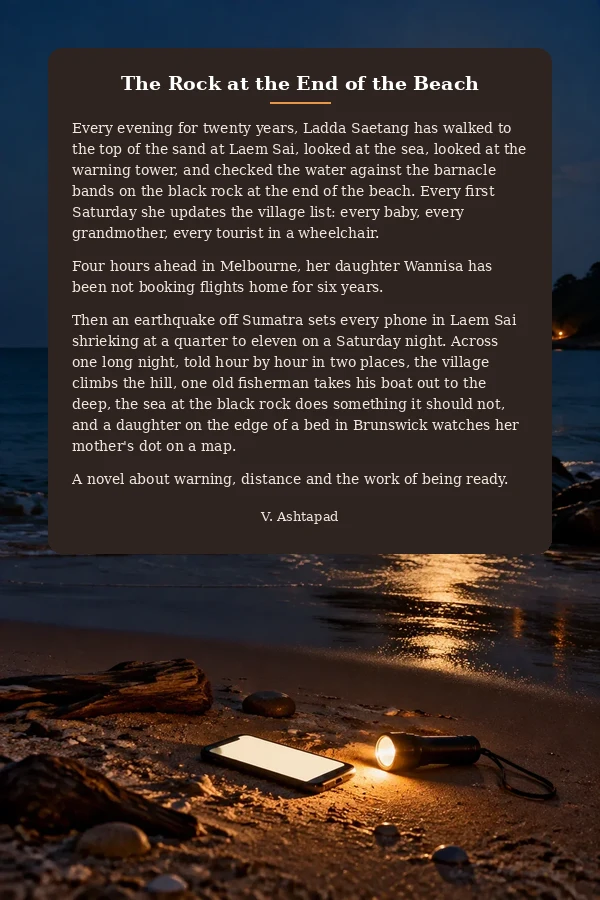
Every evening for twenty years, Ladda Saetang has walked to the top of the sand at Laem Sai, looked at the sea, looked at the warning tower, and checked the water against the barnacle bands on the black rock at the end of the beach. Every first Saturday she updates the village list: every baby, every grandmother, every tourist in a wheelchair.
Four hours ahead in Melbourne, her daughter Wannisa has been not booking flights home for six years.
Then an earthquake off Sumatra sets every phone in Laem Sai shrieking at a quarter to eleven on a Saturday night. Across one long night, told hour by hour in two places, the village climbs the hill, one old fisherman takes his boat out to the deep, the sea at the black rock does something it should not, and a daughter on the edge of a bed in Brunswick watches her mother's dot on a map.
A novel about warning, distance and the work of being ready.
Members can react to this book and talk about it in the members' Library.
Ownership
© 2026 CRUNOD LLC. All rights reserved.
This book is owned by CRUNOD LLC. It is free to read on EternalCurrent.Online. No part of it may be copied, reprinted, sold, recorded or adapted, including as audio, film or translation, without written permission from CRUNOD LLC.
© 2026 CRUNOD LLC. All rights reserved.