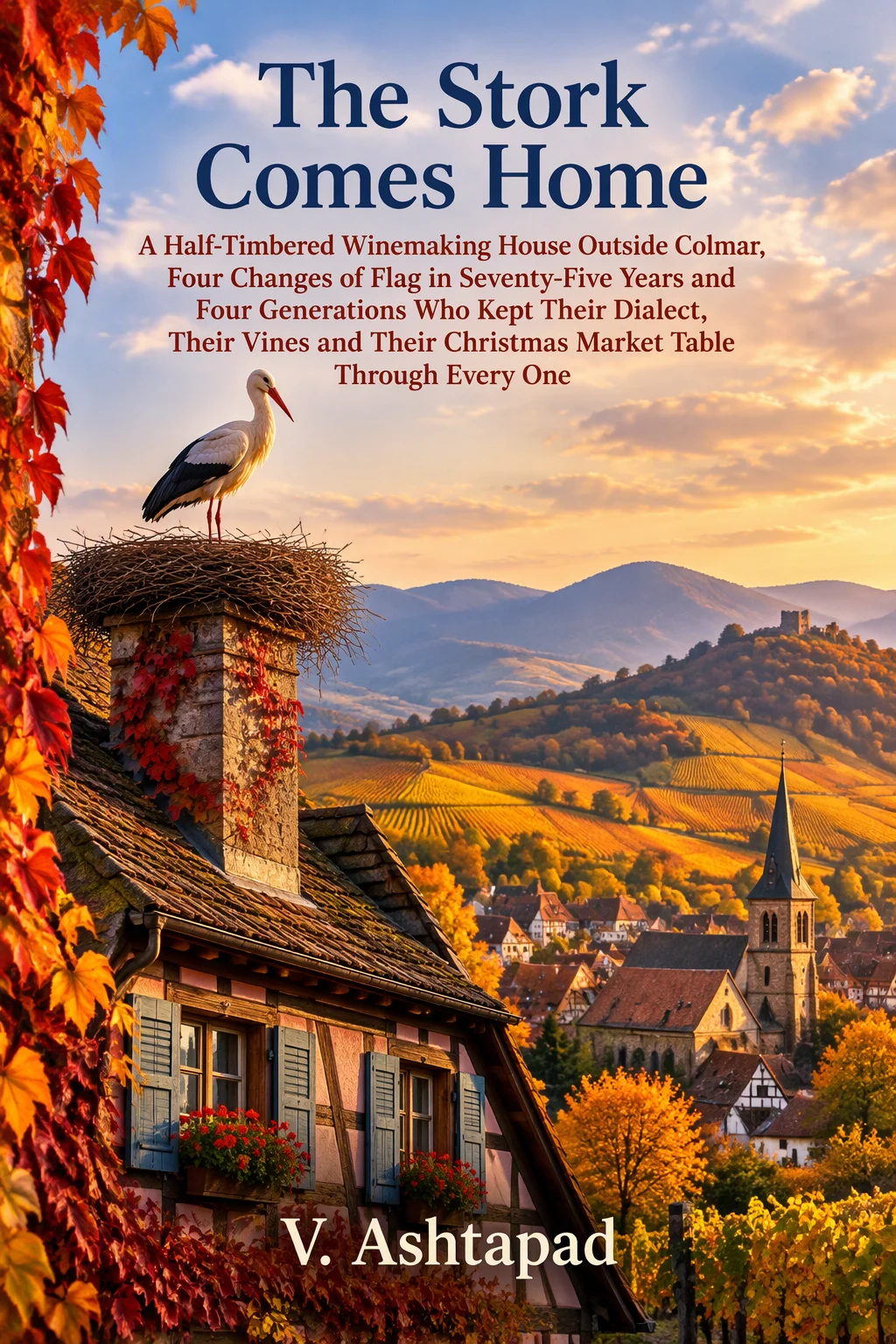
The Stork Comes Home
A Half-Timbered Winemaking House Outside Colmar, Four Changes of Flag in Seventy-Five Years and Four Generations Who Kept Their Dialect, Their Vines and Their Christmas Market Table Through Every One
by V. Ashtapad
Foreword
This is a work of fiction. The changes of nationality in Alsace in 1871, 1918, 1940 and 1945, the 1918 identity cards, the storks of the Rhine plain and their return, the Christmas markets of Colmar, Strasbourg and Freiburg, bredele and the wines of Alsace and the Kaiserstuhl are real. The village of Rotenbach, the Sutter, Ritter, Haller, Muller and Wendel families, the Rotenbach vintners' union and the Two Banks cooperative are invented.
For every family that was told it belonged somewhere else and stayed home anyway.
Odile: The Stork on the Chimney
The stork came back to our chimney on the ninth of March in the year 1870. My grandmother Barbe wrote the date in the cellar book before she wrote anything about wine.
That was the rule in our house. The cellar book was a long ledger bound in green cloth, its corners worn to the board. It lived on a shelf beside the stair that went down under the courtyard. My great-grandfather had started it. Every cask was in it, every barrel sold, every bottle traded to the innkeeper in Colmar for salt or coffee or a pair of boots. But the first line of each spring was always the stork, and the first line of each autumn was always the day we began to pick.
"Ninth of March," Grandmother said, the pen scratching. "Early. That means a warm summer, or it means nothing. Either way, write it down."
I was sixteen that spring. I stood at the kitchen window with my hands in a bowl of bread dough and watched the bird settle. Her nest was a great untidy wheel of sticks that sat on our chimney like a hat. She clacked her beak at the sky, a sound like a stick run along a fence. Her mate answered from the roof of the Ritter house across the lane. All down the street the shutters opened. People came out in their aprons to look up. In our village of Rotenbach, a stork on your roof meant luck. No one would light a fire under a nest without first making sure the chimney drew well enough to keep the smoke off her.
Our house stood at the top of the lane where the cobbles gave out and the vineyards began. It was built in 1683. The year was carved into the stone above the cellar door, with a heart and two sets of initials no one could read anymore. The upper floors were half-timbered, dark oak beams crossing and recrossing over plaster. My mother painted it every few summers in a soft ochre, the color of a pear just before it turns. The shutters were blue. There were geraniums in the window boxes from May until the first frost. Red ones, because my mother said white geraniums looked like a house that had given up.
Behind the house the land climbed. You could step out of our back door, cross the little kitchen garden with its cabbages and leeks and the plum tree, and be in the vines. Twenty paces. They went up the slope in rows that followed the hill like the lines of a hand. Riesling on the steep part where the stone was close to the surface. Sylvaner lower down. And a long strip of the spicy pink-skinned grape the old people called the Traminer, which we pressed for weddings and for Christmas. Above the vines the forest began, dark fir and beech. Above the forest were the Vosges, round-shouldered and blue in the mornings, gray in the afternoons, white on their tops from November to April.
On a clear day, from our highest row, you could see the whole plain spread out to the east. The steeple of Colmar. The patchwork of hemp and tobacco and wheat. The lines of poplars along the roads. Beyond all of it, a silver thread that was the Rhine. On the far side of the Rhine was another set of mountains, the Black Forest. On very clear evenings the sun caught their slopes and turned them copper.
"That side and this side," Grandmother used to say, pointing with her chin, "same grapes, same storks, same weather. Only the river between."
She said it the way she said most things, without any idea that it might one day matter.
My father, Joseph Sutter, had hands like roots. He had worked the slope since he was a boy. He could tell the age of a vine by the bark the way a farmer tells the age of a horse by its teeth. My mother, Catherine, kept the house and the garden and the accounts that were not wine accounts. She sang while she worked, always the same three or four songs in our dialect. The one about the girl who lost her shoe at the dance. The one about the cuckoo who would not leave the clock. My brother Anselme was two years older than I was and wanted very badly to be anywhere else. He read every newspaper that came up from Colmar. He talked about Paris the way old women talked about the summers of their youth.
That spring we did what we did every spring. We pruned the last of the canes and tied the fruiting wood down to the wires with strands of willow we had soaked in the trough. We hoed between the rows. We hauled baskets of earth back up the slope that the winter rains had washed down. My father carried the heavy hod on his back. Anselme and I followed with smaller ones, grumbling. The cellar was quiet and cool. It smelled of oak and old wine and the faint sharp tang of the sulfur candles my father burned in the empty casks to keep them sweet.
In June the vines flowered, and for a week the whole hillside smelled like honey and green apples. I remember standing in the rows at dusk with the bees going home. I thought I would be happy to stand there for the rest of my life.
In July the newspapers Anselme read were full of the word war.
I will not write much about that summer and autumn. Other people have written it, people who were in it. For us it was a sound. In August, when the wind was from the north, we heard a low muttering like thunder. It did not come and did not go away. My mother stopped singing for a while. Soldiers in red trousers went along the road below the village and then, later, soldiers in dark blue went along the same road the other way. Some of them stopped at our pump to drink. One of them, a boy with yellow hair no older than Anselme, asked my mother in a cracking voice whether we had any bread. She gave him a whole loaf and a piece of cheese. She did not ask which side he was on.
The grapes did not care. They ripened. In late September my father walked the rows chewing berries and spitting the seeds. On the first of October he said, "Tomorrow." Grandmother wrote it in the cellar book under the stork.
We picked with the whole lane. That was how it was done. The Ritters picked with us, and we picked with them. The Muller widow and her three daughters picked with both of us. In return we pressed their few rows in our press, because the widow had none. Grandmother kept a list on the back page of the cellar book of who owed whom a day. No one ever argued with it. Everyone knew she was fair, and everyone knew she would remember anyway.
Xavier Ritter, the cooper's son, nineteen, carried the full tub down the slope on his back. He tipped it into the cart and came back grinning, his shirt purple to the elbows. He did it more often than anyone. I noticed. Grandmother noticed me noticing and said nothing, which for her was a long speech.
At night we ate in the courtyard at a table made of planks on trestles. My mother made a great pot of sauerkraut with smoked pork and sausages and potatoes. The steam rose into the cold air with the smell of juniper and wine. There was new wine to drink, still cloudy and sweet and fizzing. The old people called it the young one. It gave the children stomachaches and the men songs. There was onion tart, and walnut bread, and a cheese from the valley above us that smelled like a stable and tasted like butter.
When the eating was done, the singing started. And that year, for the first time, someone at the end of the table sang a song in French, a marching song. Someone at the other end answered with a German song his grandmother from across the river had taught him. For a moment the two songs tangled in the air over the plates. Then old Muller's widow began the one about the cuckoo in the clock. It was ours. It belonged to neither of them. Everyone sang that one together until the candles guttered.
© 2026 CRUNOD LLC. All rights reserved.
Odile: A Notice in Two Languages
The notice went up on the door of the town hall in the middle of May 1871. It was printed in two columns, German on the left and French on the right. The German column was a little longer, as German columns always are.
I went down to read it with my mother. Grandmother's eyes were not good enough anymore for small print, and my father said he would not walk down the hill to read about himself. A crowd had gathered. The baker was there with flour on his forearms, and the blacksmith's wife. So was our schoolmaster then, Monsieur Paquet, from Lorraine. He read the French side aloud in his thin careful voice for those who could not read.
When he had finished, there was a silence, and then the blacksmith's wife said, in our dialect, "So what are we now?"
"Germans," Monsieur Paquet said. "As of this month. Alsace and part of Lorraine. By the treaty."
"I was a German before I was a Frenchwoman?" she asked. "Or after?"
He did not know how to answer that, and neither did anyone else. The blacksmith's wife had been born in Rotenbach, as had her mother and her mother's mother. None of them had ever lived anywhere else. The notice on the door told her that the country around her had moved while she stood still.
Walking back up the lane, my mother held my arm. We passed the Ritter house, where Xavier's father was hammering hoops onto a cask in the yard, the iron ringing. He lifted his hammer to us in greeting and went back to work. We passed the pump and the stone trough with its green moss. We passed the place where the cobbles gave out. And there was our house with its blue shutters, the stork standing on one leg on the chimney. My father was in the courtyard washing a cask with a brush and a bucket of boiling water.
"Well?" he said.
"We're German," my mother said.
He looked at the cask. He looked up at the slope. Then he looked at the stork.
"Tell her," he said, and went back to scrubbing.
Grandmother Barbe took it differently. She lowered herself onto the bench and laced her fingers over the oilcloth. She listened to the whole notice as my mother repeated it, every clause. Then she said, "Get me the book."
I brought her the cellar book. She opened it to the page for that spring, under the stork, and in her slanting old hand she wrote: *May. Told we belong to Germany now. Vines in flower in two weeks. Sulfur the Sylvaner Thursday.*
"That's all?" Anselme said. He had come in from the yard, pale. He had been in Colmar the day before. Young men in the cafés were talking about leaving, about Paris, about Algeria, about never speaking a word of German as long as they lived.
"What else should I write?" Grandmother said. "That's what happened. And Thursday we sulfur the Sylvaner."
"It changes everything," Anselme said.
"Does it change the Sylvaner?"
He went out and slammed the door, and she sighed and turned to me. "Your brother thinks a country is a thing you are," she said. "I think it's a thing that happens to you, like weather. The thing you are is here." And she pressed her palm against the open page.
Later I understood she was not only talking about the book. She meant the house, the slope, the cellar, the way we spoke, the way we cooked. She meant the cuckoo song and the sauerkraut and the stork. But at sixteen I thought she meant the ledger, and I took it very seriously. From that day I was the one who wrote in it. Her hand was shaking, and she said mine was good enough.
In September of that year the new schoolmaster came.
Monsieur Paquet had already gone back to Lorraine, to the part that was still French. He went with a cart of books and a bird in a cage and he shook every child's hand at the school door before he left. For a few weeks there was no school at all, and the children ran wild in the vineyards, eating grapes they had no business eating. Then the mayor came up the lane with his hat in his hand. Might we lodge the new teacher? We had the empty room over the press house, and my mother was known to be a good cook.
"A German?" my father asked.
"From Württemberg," said the mayor, as if that made a difference. "Near Stuttgart. A young man. They pay for his board."
My father thought about it for the length of time it took him to fill and light his pipe. Then he said, "They pay in what?"
"Marks."
"Marks spend," said my father, and that was that.
His name was Friedrich Lenz. He arrived on a wet afternoon with one trunk, a violin case and a box of books tied with string. He stood in the courtyard in his good gray coat with the rain dripping off his hat. He bowed to my mother, then to Grandmother, and then, after a moment's hesitation, to me.
He was twenty-four. He had a round, earnest face and spectacles that fogged when he came in from the cold. He spoke the High German of books and schools. In our ears it sounded like a man reading a contract aloud. He could understand our dialect perhaps one word in three. The first evening at supper, my father said something about the weather in the Munster valley. Herr Lenz nodded seriously. "Yes, it is very important to keep the children in order." Anselme choked on his soup and fled to the yard.
But here is a thing about Herr Lenz. He did not pretend. When he did not understand, he said so. He would put down his spoon. "Please, again, slowly." My mother would repeat it, and he would say it back to her, badly, and she would correct him, and he would say it again. Within a week he could ask for the salt in our way. Within a month he could tell a joke, although not a good one.
"Why are you learning it?" I asked him once. We were in the press house. I was writing up the sale of four barrels to the innkeeper at Turckheim. He was correcting copybooks at the other end of the table by the same lamp. "You're supposed to teach the children proper German. That's why they sent you."
He took off his spectacles and rubbed them on his sleeve. "I will teach them proper German," he said. "They will need it. There will be forms and offices and soldiers and newspapers, and they should not be afraid of any of it. But the children speak to their mothers in this," and he waved his hand at the room, at the casks, at the window where the lane lay in the dark, "and if I cannot understand what they say to their mothers, I don't understand anything about them. In my village we have our own way of talking too. Schoolmasters from the city laughed at it. I swore I would never be that kind of schoolmaster."
I studied his round fogged spectacles. Then I said, in our dialect, slowly, "That's the first sensible thing I've heard a teacher say." He worked it out word by word. When the last word landed he laughed out loud.
He brought other things with him besides his violin. He brought a way of keeping a vine nursery that his uncle in Württemberg had taught him. The young grafted cuttings went in beds of sand in neat rows, labeled with little tin tags. My father had always kept his young plants in a heap in the corner of the garden. He watched with great suspicion. The next year he quietly copied it. He brought songs. On Sunday afternoons, when the work was finished, he took out the violin and played in the courtyard. Folk tunes from the Swabian hills, slow and sweet. The children of the lane came and sat on the edge of the trough to listen. He started a singing group for the young people of the village. On winter evenings the schoolroom was full of voices learning to sing in four parts. None of us had ever done it. I had not known a song could be built like a house, with each voice a beam holding up the others.
Anselme would not go. He said singing in German was a betrayal. Herr Lenz did not argue with him. He only said, "Then teach me a French one, and we'll sing that too." Anselme could not resist being asked to teach anything. He came the next week with a song about a shepherdess and a river. The group learned it and sang it, and the sound of it in four parts made the hair on my arms stand up.
That winter my grandmother said to me, sitting by the stove with her feet on the warm stone, "That young man is all right."
"He's German," I said, testing her.
"So are we, according to the door of the town hall," she said. "And he's all right."
© 2026 CRUNOD LLC. All rights reserved.
Odile: The Option
The treaty gave us a choice, and the choice had a date on it.
Anyone born in Alsace who wished to stay French could declare it, in writing, before the first of October 1872. But if you declared it, you had to leave. You had to take your things and cross the new border into France and make your life there. If you did not declare it, you stayed where you were, and you were German.
Anselme declared it in July.
He did not tell us first. He went to Colmar with a neighbor's cart, on the pretext of buying a new strap for the press. He came back that night with a paper in his pocket and his jaw set like a gate. He laid the paper on the oilcloth beside my father's plate without a word.
My father read it. He was not a fast reader, and he read it twice. Then he put it down and pushed it gently back across the oilcloth to his son.
"Where will you go?" he asked.
"Nancy. There's work there. People are going. Jean-Baptiste from Ammerschwihr went in the spring and he's found a place in a brewery."
"A brewery," my father said. There was no unkindness in it. He spoke the word as he might have spoken of *the moon*, a place he had heard of and would never see.
My mother cried. Grandmother did not. From her place by the stove she studied Anselme until the clock had ticked a good while, and then she said, "You'll take a cutting."
"What?"
"From the old Riesling. The row by the wall. You'll take a cutting and you'll put it in a pot and when you have a garden in Nancy, you'll plant it."
"It won't grow there. It's too cold. The soil's wrong."
"Then it won't grow. Take it anyway."
He took it. In September, when the time came, he went down the lane with a carpetbag and a basket my mother had packed. Bread and ham and pears and a stone bottle of wine. And a clay pot wrapped in sacking with a stick of old vine in it. Half the village walked him to the bottom of the hill. He was not the only one going. There were a dozen carts on the Colmar road that week, and people on foot. The station at Colmar was crowded with families and trunks and birdcages and even a goat.
At the bottom of the lane, he turned and looked back up at the house. I was standing beside him. I could see the house as he saw it. The ochre walls, the dark beams, the blue shutters, the geraniums. The stork's nest empty now, because the birds had already left for the south. The slope rising behind it, gold and green and rust, the vines heavy with fruit we would pick in two weeks without him.
"Come with me," he said to me, quietly, so the others wouldn't hear.
I had known he would ask. I had thought about my answer for a month.
"Who'd write in the book?" I said.
He laughed, or tried to. "It's a ledger, Odile. It's barrels and dates."
"It's the stork," I said, "and the picking, and who owes who a day. If I go, nobody writes the stork."
He hugged me, very hard, and smelled of the soap my mother made and of the road dust already on his jacket. Then he went.
Here is what I did, that autumn, instead of going to France. I am writing it down because I want whoever comes after me to know it was a choice and not just a staying.
After the harvest, with the new wine in the casks and the leaves turning, I went to my father. I asked him for the strip at the very top of our land. The old vines there had died out years before and the stone wall had half fallen down. It was the worst piece we had. It was so steep you had to work it bent double, and the soil was thin and full of pink sandstone that broke your hoe.
"What for?" he said.
"I want to plant it."
"With what?"
"Riesling. From the cuttings Herr Lenz has in his sand beds."
He gave me the look he gave a vine he was deciding whether to keep. "That's ten years of work before it gives you a decent glass."
"I know."
"You'll be twenty-six."
"I know."
He knocked his pipe out against his boot heel and looked up at the top of the slope, at the broken wall and the brambles. "Then you'd better start with the wall," he said.
I started with the wall. Xavier Ritter helped me, on the days his father could spare him from the cooperage. We hauled stones up from where they had tumbled and set them back in place. Dry, no mortar, the way the old people did it. Big flat ones at the bottom, smaller ones fitted between so tightly you could not slip a knife into the gaps. It took us all of that autumn and half of the next spring. My hands bled and then hardened. Xavier's hands were already hard, and he showed me how to lift with my legs and how to read a stone for its good face.
When the wall was done, we dug the holes. Herr Lenz brought up his tin-tagged cuttings in a wheelbarrow, sixty of them. We planted them in a row along the top of the hill, each with a stake beside it and a little mound of earth around its foot. The day we finished, it rained, a soft spring rain that came in over the Vosges and soaked everything. The three of us stood at the top of the new row in the wet. We looked down at the house and the village and the plain beyond. Nobody had to say anything.
In the cellar book that night I wrote: *April 1873. New row at the top, sixty Riesling. Wall rebuilt by Odile Sutter and X. Ritter. Cuttings from F. Lenz. Anselme writes from Nancy that his vine is alive.*
That last part was true. It had come in a letter that morning. The cutting had put out two leaves on a windowsill in a rented room over a bakery. It would not live long, and it would never make a grape. But it was alive in France, and the rest of it was alive in Germany, and it was all the same vine.
© 2026 CRUNOD LLC. All rights reserved.
Odile: Bredele for the Square
In our part of the world, the weeks before Christmas belong to the bakers.
From the first week of Advent, every kitchen in Rotenbach smelled of butter and cinnamon and anise. The women baked the little cookies we called bredele, a dozen kinds. Each house had its favorites. Each grandmother had her own secret about how thin to roll the dough. There were the anise ones that you left out overnight to dry so that they rose up with a little white foot under them like a mushroom. There were the spiced ones cut in stars and hearts. There were the butter ones pressed through a tin with a star-shaped hole so they came out in long ridged ropes you bent into rings and S-shapes. There were cinnamon stars with a white glaze of egg and sugar. Coconut ones that only the rich houses could make, because coconut came from far away. Ones with ground almonds and lemon peel. They went into tins, and the tins went onto the top shelf of the pantry. The children were forbidden to touch them. The children touched them.
And in the square below the town hall, on the three Sundays before Christmas, there was the market.
It was not a big market then. It was not like the great one in Strasbourg, held for three hundred years in front of the cathedral. People traveled to that one from all over the province. Ours was a dozen tables under the chestnut trees with lanterns hung in the branches. The blacksmith sold little iron hooks and trivets. The Muller daughters sold knitted stockings and mittens. A man came over from the valley with a cart of fir trees, and another with a cart of honey and beeswax candles. Someone always brought roasted chestnuts in a pan with holes in the bottom over a brazier, and the smell of them burned on the cold air.
The Christmas tree, I should say, is ours. People think it belongs to the Germans, and the Germans love it more than anyone. But in the old library at Sélestat, a few hours' walk north of us, there is a record from the year 1521 that mentions trees bought for Christmas. Herr Lenz was astonished when I told him. He went to Sélestat on a Saturday in December to see the old books for himself. He came back with snow on his hat. "It's true. You gave it to us. We only made it famous." I believe that was the day he stopped being homesick for Württemberg.
In the winter of 1873, I decided I would have a table.
My mother had always given her bredele away, to neighbors and the midwife and the poor family at the bottom of the lane. Grandmother said selling your Christmas baking was vulgar. But Grandmother had died that autumn, in her chair by the stove, between one sentence and the next. I had her recipe for the anise cookies on a card in her hand. I had the cellar book. And I had a plan.
"We'll sell wine at it," I told my father. "Hot. With spices. Like the inns in Colmar do."
"Mulled wine at a Christmas market," he said. "In a village. Who'll buy it?"
"Everyone who's cold," I said. "Which is everyone."
I used our plainest red, from the little patch of Pinot Noir by the road. It never ripened properly and made a thin pale wine nobody wanted in summer. I heated it in the big copper pot with cinnamon bark, cloves, a star anise from the grocer in Colmar, orange peel and sugar. I tasted it. I added more sugar and tasted it again. My mother made bredele with me, every evening for a week, and the tins piled up on the pantry shelf higher than they had ever been. Xavier made me a little wooden stand with a shelf for the tins and a hook for a lantern. He carved a stork on the front of it. Not well, but you could tell what it was meant to be.
On the first Sunday of Advent I carried the copper pot down the lane, Xavier holding the other handle. We set it on a brazier under the chestnut tree nearest the town hall door. I sold my first cup of hot wine to the blacksmith for five pfennigs. By the end of the afternoon the pot was empty and the bredele were gone. My pocket was heavy with German coins and my face so cold I could not feel my nose.
Herr Lenz brought his singers to the market on the third Sunday. They stood on the town hall steps in their coats and scarves, twenty young people of the village. They sang in four parts, their breath rising white over their heads. They sang German carols he had taught them, the one about the fir tree whose leaves stay green, and the one about the rose that blooms in winter. They sang the French one about the shepherds that Anselme had taught them before he left. And then, because I had asked Herr Lenz to, they sang the cuckoo song, in our dialect, arranged in four parts, which no one had ever heard before. The people in the square stopped what they were doing. Old women put down their baskets. When it was over, there was a little silence. Then the blacksmith's wife, the one who had asked at the notice what we were, began to clap with her big red hands. Everybody joined her.
"There," Herr Lenz said to me afterward, blowing on his fingers by my brazier. "That's what you are. That song."
I married Xavier Ritter in the spring of 1876, the year our sixty Riesling vines at the top of the slope gave their first small crop. Herr Lenz played the violin at the wedding. We served the spicy Traminer, the way we always did for weddings. My mother made a kugelhopf, the tall ring-shaped cake baked in a fluted clay mold, almonds pressed into the top and raisins soaked in brandy. The stork was on the chimney looking down at all of us. Anselme came from Nancy for three days, with a wife and a little boy who spoke only French. The boy hid behind his mother's skirt from all the strange people talking in dialect. Then Xavier's father showed him how to make a cask hoop ring like a bell, and after that he would not leave the cooperage.
Herr Lenz married too, eventually, a girl from Turckheim who sang alto in his choir. They had five children who spoke German at school and dialect at home. They spoke French when their grandmother from the Turckheim side visited, which was every Thursday. When he was old he was still in Rotenbach, still teaching, still playing the violin at weddings. The village had long since stopped calling him the German. They called him the schoolmaster, which in a village is a higher title than any country can give.
My son Lucien was born in the summer of 1880 in the room over the press house where Herr Lenz had once lodged. In the cellar book, under the stork, I wrote his name and the weight of him and the state of the Riesling flowering, which was good.
I kept the table at the Christmas market for forty-seven years. In time it was not one copper pot but three, and the bredele came from four kitchens. A woman from the valley sold our wine by the bottle beside it with a painted sign. But it was always under the same chestnut tree and it always had Xavier's carved stork on the front, worn smooth by forty winters of hands.
That is what I have to say. A country came to our door with a notice in two languages. I answered it with a row of vines, a copper pot and a song in our own way of talking. I don't know if that was the right answer. It was the one I had.
© 2026 CRUNOD LLC. All rights reserved.
Lucien: Cards with Letters on Them
I was thirty-eight years old in November 1918 when I was told I was French. I could not have ordered a loaf of bread in the language.
That is not quite true. I could order a loaf of bread. My mother had made sure of that much. She spoke French with Xavier's family and in her brother's letters from Nancy. When I was small she counted the bottles in the cellar with me in French so I would have the numbers. But I had gone to the village school when Herr Lenz was the master and German was the only language allowed in the classroom. I had done my military service in a German regiment in Strasbourg. For thirty years I had sold our wine to merchants from Mainz and Frankfurt and Mannheim. They came down the Rhine in autumn to taste in our cellar and argue about prices in their flat northern voices. I read a German newspaper. I thought about money in marks. When I swore at a stuck cart I swore in dialect, and when I added up a column of figures I did it in German, under my breath.
On the twenty-second of November French soldiers came up the Colmar road in blue-gray uniforms with flowers in the muzzles of their rifles. Rotenbach emptied down the lane to watch them pass. There were flags everywhere. Tricolor flags people had kept folded at the bottom of chests for forty-seven years, faded and creased. New ones sewn in a hurry out of whatever red and blue cloth anyone had. Little girls in the old Alsatian costume, the black dress and the great black bow on the head like a pair of wings, stood at the side of the road with baskets of flowers. My daughter Marthe was one of them. She was six. She threw a chrysanthemum at a soldier with a mustache, and it hit him on the nose, and he laughed and saluted her.
My mother stood beside me at the bottom of the lane with her hand through my arm. She was sixty-four. Her hair was white under her black cap, and her hands, which had built a wall at the top of the slope, were knotted at every knuckle.
"Well," she said, in dialect. "Here we go again."
I want to tell that day plainly, because people tell it now as if everyone in Alsace was weeping with joy, and many people were. The old ones who remembered being French were weeping. The young men who had been sent to fight in German uniforms and had come home, the ones who had come home, were mostly silent. I was not weeping and I was not silent. I was standing in the road trying to understand what the soldiers were shouting to us, and understanding about half of it.
What I understood was that everything with a German name was going to get a French one. The street signs. The town hall. The railway station. The forms. The schools.
What I did not yet understand was the cards.
In December the officials came. They set up a table in the schoolroom. Every person in the village had to come before them and give their name, their date of birth, and the birthplaces of their parents and grandparents. Then they were given an identity card. The cards were marked with letters. If you were born in Alsace of parents and grandparents born in Alsace, before the German time, you got a card with an A on it. You were simply French, as if the forty-seven years had never happened. If one of your parents had come from Germany, you were given a B. If you were from some other country, a C. If both your parents were German, you got a D. In the eyes of the new officials you were a foreigner in the house you had grown up in.
I was an A. My mother was an A. My children were A's.
My wife Hélène was a B.
Her father had been a baker from Freiburg, across the Rhine. He came to Colmar in 1885 because there was work, married a Colmar girl, and never left. Hélène had been born over his bakery in the rue des Boulangers. She had spoken dialect from the cradle and German at school and enough French to read a recipe. She had lived her whole life within ten miles of where she sat at the table in the schoolroom with her hands in her lap. The official was a thin man from somewhere in the south of France who did not speak a word of German or dialect. Monsieur Kuntz the notary had to translate everything. He looked at her papers, wrote a B on her card, and slid it across the table without looking up.
She did not say anything until we were outside. It was snowing a little, a few dry flakes blowing across the schoolyard. She held the card in her gloved hand and looked at it.
"What does it mean?" she said. "B."
"It doesn't mean anything," I said. "It's a letter."
"Then why did they give it to me?"
I didn't have an answer. I knew, because everyone knew, that some of the D's were being sent away across the Rhine. Thirty kilos of luggage each and a few hours' notice. Families who had lived in Colmar and Mulhouse for forty years. Some of them had never been to Germany in their lives except as children on a visit. Old Herr Lenz was a D, and he was frightened. He had gone to Monsieur Kuntz, to the mayor, and to the new French sub-prefect in Colmar. He carried a petition signed by every family in Rotenbach saying he had taught their children to read for forty-five years. They let him stay. Not everyone was so lucky.
The B's were not sent away. But a B was not an A.
That night Hélène sat in the kitchen after the children were in bed and did not knit and did not mend and did not read. She just sat, with the lamp turned low, and the card on the oilcloth in front of her.
My mother came in from the next room in her shawl. She looked at Hélène, and at the card, and then she went to the shelf by the cellar stair and took down the cellar book. It was the third volume by then. The first two were on the shelf beside it, the green one worn almost white. She put the third book on the table and opened it to the page for that year. She pushed the pen and the ink over to Hélène.
"Write it," she said.
"Write what?"
"What happened. Today. Write it in the book."
Hélène looked at her. "In what language?"
My mother sat down heavily on the bench. "Child," she said. "My grandmother wrote in that book in French and a little German and a great deal of dialect spelled however she liked. I wrote in it in French the first year. Then in German, because the wine merchants wanted German receipts. Then in whatever came out of the pen. My son writes it in German. That book has never cared what language it was written in. It only cares that someone writes the stork."
Hélène picked up the pen. She wrote for a long time. I didn't read it until years later. When I did, it said: *December 1918. They gave me a card with a B. My father's bread was French bread for thirty years and nobody asked it for a card. Lucien's mother says write the stork. The stork is in Africa. I will write it in March.*
She did. On the fourteenth of March 1919, in her round baker's daughter's hand, the first entry of the spring: *Stork back. Same chimney. She does not have a card either.*
© 2026 CRUNOD LLC. All rights reserved.
Lucien: Across the Rhine with an Empty Cask
In the spring of 1919 I crossed the Rhine with a borrowed cart and an empty cask to bring my brother-in-law his father's bread trough.
It is a strange errand to remember, but it was the reason for the journey, and I have never forgotten it. When Hélène's father died in 1912, he left his old oak kneading trough to his son Konrad. He had brought it from Freiburg as a young man. Konrad had stayed behind across the Rhine and taken over the family bakery there. But Konrad had never come to collect it. First there was no time, and then there was the war, and the trough sat in our barn under a tarpaulin for seven years. Now there was a border again, a real one, French customs men on one end of the bridge and German ones on the other. "If we don't take it now," Hélène said, "we'll never take it."
It was not easy to get the papers. I went to Colmar three times. I stood in lines. I spoke my bad French and was answered in fast French. I stood there blinking until a clerk with a kind face, a woman from Lyon, took pity on me. She wrote out what I needed on a slip of paper so I could show it at the next window. I took a cask too, an empty one. Xavier's cooperage had made it for a vintner in Breisach before the war and it had never been delivered either. If I was going to cross a river with a trough, I might as well cross with a cask.
We went in April, Hélène and I, with Marthe sitting on the cask in the back of the cart in her school pinafore. We went east across the plain, through Neuf-Brisach with its star-shaped walls, and over the long bridge to Breisach on its rock above the water. The Rhine was high and green with snowmelt from the mountains, wide and fast, full of eddies and floating branches. There were storks on the chimneys on both banks. Marthe counted them. Eleven on the French side, nine on the German side. She said this proved the French side was better. Hélène said it proved the storks didn't care.
The customs men looked at the trough for a long time. They looked at the cask for longer. A German one tapped it with his knuckles to hear if it was really empty. It boomed like a drum. Marthe giggled, and he winked at her and waved us through.
Freiburg is not a big city, but after Rotenbach it felt like one. The streets are steep, and the old town is full of tall houses with painted fronts. Little stone channels run down the sides of the streets with clear water from the mountain streams. The Freiburgers call them their brooklets. Children float paper boats in them and old people cool their feet in them on hot days. There is a saying there that if you step in one by accident, you will marry someone from Freiburg. Marthe stepped in one deliberately, the first hour, and Hélène pulled her out by the collar.
Konrad's bakery was in a narrow street below the great red sandstone tower in the middle of town. The market was there every morning in the square around the tower. Farmers' wives from the Black Forest sold eggs and butter, smoked ham, cherry brandy, and rye bread in loaves as big as wheels. The noise of it came in through the bakery windows with the smell of the bread. Konrad was a big, quiet man with flour in his eyebrows. He looked a little like Hélène around the eyes. He had not seen his sister in nine years.
They stood in the bakery door and looked at each other. Then he wiped his hands on his apron and put them on her shoulders. "You've gotten old," he said, in the Baden dialect, which is very like ours.
"So have you," she said. "And fat."
"Bakers are supposed to be fat," he said. "Otherwise nobody trusts the bread."
We carried the trough in through the back. Konrad ran his hand along the inside of it, where the wood was worn smooth and pale by forty years of his father's knuckles. His throat worked, but no words came. Hélène went to look at the loaves on the shelves so as not to watch him.
That night we ate in his kitchen above the shop. His wife Liesel made a meal I have never forgotten. A soup of liver dumplings. Then roast pork with a dark gravy and soft egg noodles she made by pushing dough through a board with holes in it straight into boiling water. Red cabbage cooked with apples. For dessert, a cake of chocolate and cherries and cream so tall that Marthe had to stand up to see over it. Konrad poured a white wine from the Kaiserstuhl, the volcanic hill north of Breisach that you can see from our slope on clear days. I tasted it, and tasted it again. "This is good," I said.
"Of course it's good," he said. "Same sun as yours."
"Different soil," I said. "Yours is ash. Ours is sandstone and granite. You can taste it."
"Can you?" He poured me more. "Tell me what you taste."
I told him. It took a long time, because I had to find words, and I found them in German. He listened the whole way through, nodding. Then he poured me a glass of the wine I had brought from our top row, my mother's sixty vines, and asked me to tell him about that one too. I talked for an hour. Hélène said later that she had never heard me say so much in my life.
At the end of it Konrad said, "You know, before the war, before all of it, the merchants used to buy your wine and blend it with ours from the Kaiserstuhl and the Ortenau. They sold it in Hamburg and Berlin as Rhine wine. Nobody up north knew which side of the river it came from."
"I know," I said. "I sold it to them."
"And now?"
"Now it's French," I said. "Now I sell it to Paris. Or I will, when I can speak to Paris."
He laughed. "You'll learn. You're stubborn. Hélène always said all the men in your family are stubborn as goats."
"Only the women," Hélène said. "The men are stubborn as vines."
We slept that night in the attic room above the bakery, under a feather bed so thick Marthe disappeared into it. At four in the morning the ovens were lit below us. The whole house filled with the smell of baking bread and the sound of Konrad singing over the dough. He sang an old song from the Black Forest about a miller's daughter. Hélène lay awake beside me in the dark listening to it with tears running into her hair, and I did not ask her why.
On the way home, at the bridge, the German customs man was the same one who had tapped the cask. He tapped it again. It boomed again. Then he looked at the back of the cart. Liesel had loaded a smoked ham, two loaves of rye, a bottle of cherry brandy and a box of Black Forest cake for my mother. He looked at Marthe sitting on the cask with chocolate on her chin. He sighed.
"Go on," he said. "Before I get hungry."
© 2026 CRUNOD LLC. All rights reserved.
Lucien: Grafted Roots
The tiny insect that ruined half the vineyards of Europe reached our slope in the years after 1900. By the time the French came back in 1918, we had replanted almost everything.
I tell this because it is the thing I think about when people ask me what I am.
The pest lives on the roots. It came from America, on vines brought over by collectors. The American vines did not mind it because they had grown up with it. Our vines had never met it and had no defense. It sucks at the roots until the plant starves. You see the leaves yellow in midsummer, and then the vine is dead, and then the one beside it.
The cure, when they found it, was strange. You take a root from an American vine, which the insect cannot kill. You take a cane from your own vine, your old Riesling or your Sylvaner or your Traminer. And you join them, the cane on top of the root, with a cut like a key fitting a lock. You bind them. You bury the joint in damp sand and wait. If you have done it right, the two grow into one. The root is American. Everything above the ground is Alsatian. The grape that grows on it is exactly the same grape your grandmother pressed.
My mother learned grafting from Herr Lenz's old sand-bed method. I learned it from her. For fifteen years, every winter, I sat in the press house with a sharp knife, a basket of rootstocks and a basket of canes. I made the cuts, bound them with raffia, set them in the sand. Thousands of them. My thumb still has a groove in it from the knife.
When the French officials asked me what I was, I wanted to show them a grafted vine. I wanted to dig one up and put it on the table in the schoolroom and say, *What is this? Is it an American vine? Is it an Alsatian vine? Tell me which letter to give it.* I never did. I was not that kind of man. But I thought it every time I filled in a form.
In 1920 our village formed a vintners' union, as Ribeauvillé and Eguisheim had. The small growers could share a press and a cellar and sell under one name. There were twenty-two families in it at the start. The meetings were held in the back room of the inn. The minutes were written in French because now they had to be. Every word of the arguing was in dialect. I was the secretary. I wrote the minutes in French with a dictionary open beside me, slowly, my lips moving. My spelling was terrible. Nobody minded. Old Muller the widow's grandson, who had been in the French army, corrected them afterward with a red pencil and initialed every page.
We decided, at the second meeting, that the union's label would have a stork on it.
There was a long argument about whether the stork should be standing on one leg or two. My mother was not a member, because women could not be then. She sat at the back of the room with her knitting and listened for an hour. Then she said, loudly, "One leg. She's resting. She's home." And they voted one leg, unanimously, and I wrote it in the minutes in French, and Muller's grandson corrected the spelling of *leg*.
At home I began to write the names of our wines on our own labels in two languages and then, a few years later, in neither. Just the grape and the slope and the stork. *Riesling, the top row. Traminer, the wall.* A man from a Paris shop who came to buy in 1925 asked why the label had no village name in big letters. The Burgundians did it that way.
"Because the village has had three names in my lifetime," I told him in my bad French. "The slope has had one."
He bought forty cases. He wrote to me every year after that and always asked for the top row.
© 2026 CRUNOD LLC. All rights reserved.
Lucien: Odile's Last Market
My mother kept her table at the Christmas market until the winter of 1920. She was sixty-six, and her knees would no longer carry her down the lane. That year she sat in a chair beside the brazier with a rug over her legs and a cup of her own hot wine. She told Marthe how to do everything.
"Not so much clove. It goes bitter. More orange. Stir from the bottom."
Marthe was eight. She stood on a crate to reach the pot. The square was full of people, more than ever, because it was the first Christmas market under the French flag and everybody wanted to be there. There were tricolor ribbons on the chestnut trees among the lanterns. The town hall had its new French sign over the door, in very fresh paint. Someone had brought a phonograph and was playing French songs, scratchy and far away, and the young people danced to them on the cobbles in the cold.
There was Xavier's carved stork on the front of the stand, worn smooth. The same tins of bredele from four kitchens. The anise ones with their little white feet, made from my grandmother's card.
Herr Lenz came, very old, leaning on a stick. He was seventy-three. He had been allowed to stay. He taught no longer, because the new school wanted a French master. But he still played the violin on Sundays and still ran a singing group in the schoolroom on winter evenings. He brought them to the town hall steps, as he had every year for forty-seven years. There were older voices now among the young ones, his own children and grandchildren among them. They sang a French carol, and a German one, and then the cuckoo song in four parts, in dialect.
My mother put her cup down on the edge of the stand and closed her eyes to listen.
When it was over, Herr Lenz came to the stand. My mother held out her hand to him without opening her eyes, and he took it.
"Well, schoolmaster," she said. "What are we this time?"
"The same as we were," he said. "Freezing."
She laughed. It was a good laugh, a young one. I remembered it from when I was a boy and she and my father worked the top row together.
She died in February, before the stork came back. The last thing she wrote in the cellar book, in a hand so shaky it is almost a drawing, was the date of the last Sunday market and the words: *Sold out by four. Marthe stirred.*
On the ninth of March the stork came back, the same day as in 1870. Marthe was the one who saw her first, from the kitchen window, with her hands in a bowl of bread dough. She ran to get the book. She wrote it herself, in a child's square French letters, the first thing she ever wrote in it: *The stork is home.*
© 2026 CRUNOD LLC. All rights reserved.
Marthe: Before You Press the Button
Is it on? The little red light. Yes, I see it.
No, wait. Léa, put it down a moment. Before you press anything, I want to say something, and I want you to hear it first and not the machine.
You asked me if you could keep my voice. For your school, you said, and for the family pages your cousin Thierry keeps. Your mother put the pictures of the harvest there, and the old wedding photograph with everyone's name written underneath. You asked me properly. You sat down and looked at me and said, *Grandmother, may I record you, and may I keep it, and may other people in the family listen to it someday?* And I said yes. I want that part on the recording too. I want whoever listens to know that I said yes, and that you asked. In my day nobody asked anybody anything. They just told you what you were.
All right. Now you can press it.
My name is Marthe Haller. I was born Marthe Ritter in this house in 1912, in the room over the press house, the same room my father was born in. I am ninety-four years old. It is October 2006. The picking finished two days ago and my great-nephew's boys have the new wine going in the cellar. I can smell it from here, and it smells right.
My great-granddaughter Léa is sixteen. She is sitting at the kitchen table with her feet on the rung of my mother's chair. I have told her a thousand times not to do that. She wants me to talk about the war. She is studying it at school.
I'm going to tell you something about the war first, Léa, and then I'm going to tell you what I actually remember, and they're not the same.
What you'll find in your schoolbooks is armies and maps and dates. That's all true. I'm not going to argue with your schoolbooks. But in this house, for us, the war was mostly a list of things we were told to stop doing. And a list of things we kept doing anyway, quietly, in the cellar. That part is mine to tell. The rest belongs to people who were in it, and some of them never talked, and I won't talk for them.
Is that all right?
Good. Pour me a little of the Sylvaner, there, the open one. Not that much. You're as bad as your grandfather.
© 2026 CRUNOD LLC. All rights reserved.
Marthe: Hélène Becomes Helene
When the Germans came back in June 1940, they did not put up a notice in two languages. They put it up in one.
I was twenty-eight. I had been married three years to Paul Haller, who was a carpenter from Kaysersberg, and we had a daughter, Anne, who was two. My father was sixty and still worked the slope every day. My mother was fifty-five and had gray in her hair and flour on her hands, always, because she baked for half the lane.
That summer there was no stork. I don't mean that as a sign. The birds were already getting fewer, every year, because the marshes along the Rhine were being drained and there were power lines now that they flew into. But that summer I noticed the empty nest on our chimney more than I ever had, and I couldn't stop looking at it.
The rules came one at a time, the way rain comes, and by autumn we were soaked.
French was forbidden. Not just in school, everywhere: in the shops, on the street, in letters. There were fines for saying *bonjour*. The street signs were changed again, back to German. All the French books were to be handed in. You could not wear a beret, because a beret was French. I am not making this up, Léa, look it up. A beret.
And our names were changed. Any first name that sounded French had to become a German one. My mother Hélène became Helene, without the little mark over the e. You might think that's nothing, one little mark. But she looked at her new card for a long time. Her own father had come from Freiburg, which in 1918 had made her a B, a not-quite-French person. Now the same father made her a good German, and they were very pleased with her. She sat in the kitchen with the new card and laughed until she cried.
"Twenty-two years they've been telling me my father was the wrong kind of baker," she said. "Now he's the right kind. And he's been dead since 1912. He'd be so confused."
I became Martha. My daughter Anne didn't need changing, because Anne works in both. My husband Paul was already Paul. The village itself was renamed, a little, the spelling of it. Even the vintners' union had to change its name. My father had to rewrite the whole register in German, the register he had kept in French for twenty years with a dictionary open beside him. He did it without complaint. He sat at this table every evening for a month, copying, his pen scratching, the way his grandmother used to.
"I learned French at forty," he said, "to write these. Now I'll write them in the German I learned at six. If they change it again when I'm eighty, I'll write them in Latin."
What did we do?
I'll tell you what my mother did. On the night the order came about the French books, she went through the house and gathered every book in French we had. It was not many. A cookbook. A book of poems my father had bought in Colmar to practice with. A French dictionary. My school reader. The letters from my great-uncle Anselme in Nancy, tied up with red ribbon. She took them down into the cellar. She took the bung out of a big empty cask, one of the old oval ones that held a thousand liters. She wrapped the books in oilcloth and slid them in through the bunghole one at a time, which is not easy with a cookbook. Then she put the bung back.
"Nobody looks inside an empty cask," she said, "except a cooper. And the coopers are all on our side."
I'll tell you what my father did. He kept the cellar book. He kept writing it exactly as he always had, the dates and the casks and the weather. But he wrote it in dialect, our own way of speaking. It was not French and not German either, and no official from outside could read it. Every entry. For five years.
And I'll tell you what I did.
The Christmas market was still held, under the chestnut trees. That wasn't forbidden. The new people liked Christmas markets very much. But it was different. There were new flags, the red ones, hung where the lanterns had been. There were songs on a loudspeaker from the town hall, not the cuckoo song, not anything we knew. Herr Lenz's old singing group had been taken over by a man from the new party office, and he only allowed certain songs. Half the stalls didn't come, because their families had gone away or the men had been taken. The square was gray and very quiet.
My grandmother Odile's table was there, with her husband's carved stork on the front. I kept it up. I had kept it since I was a girl, after she died. But that first winter, 1940, I didn't want to stand in the square and sell hot wine under those flags. And I didn't want to not be there either. If I wasn't there, it would be the first Advent since 1873 that the table was empty.
So I did both.
I sold in the square on the three Sundays. I sold the hot wine and I sold the plain bredele, the butter rings and the cinnamon stars, the ones that every house made. I smiled at everybody and said nothing in French.
And on the evenings before each market Sunday, I made the anise cookies from my great-great-grandmother Barbe's card, the ones with the little white feet. I took them down into the cellar. And whoever wanted them came down to the cellar to get them. Not to buy them. To eat them there, in the cold, among the casks, by candlelight, standing up. Neighbors. The Muller girls, grown now. Paul's mother. The old cooper who had made my father's casks. Monsieur Kuntz the notary, who was very old. There were nights when there were twenty people down there, wrapped in coats, holding a cookie and a little glass of the Traminer, breathing white.
And someone always started the cuckoo song, very softly, in dialect, in four parts, the way old Herr Lenz had arranged it. He had died in 1931. But his granddaughter was there, and she knew all the parts.
That's what I did. I made a market under the ground. It wasn't brave. Nobody was ever arrested for eating a cookie. But I want you to know about it, Léa, because you asked me what we did, and it was that.
In 1942 Paul was taken into the army. Their army. They took all our young men that year and the next, willing or unwilling, and nearly all were unwilling. They sent them east, very far away, to places none of us could have found on a map. I'm not going to say more than that. Paul never did, so I won't.
The book in the cellar, my father's dialect book, says for the twenty-fifth of August 1942: *Paul left for the station at six. Sylvaner looking well. Rain needed.* Then nothing for three days. Then: *Rain.*
© 2026 CRUNOD LLC. All rights reserved.
Marthe: The Winter in the Cellar
The last winter was the worst, and it was not the cold.
In late 1944 the armies came back across the plain. You've read this. The Americans and the French came from the west. The Germans dug in all around Colmar, in a great bulge of land along the Rhine. For two months, December and January, the fighting was all around us. The vineyards on the slope above the village were where it was. Our slope. My grandmother's top row.
I'll tell you what it was like in the house, and only that.
We lived in the cellar. All of us. My father, my mother, me, Anne who was six. Paul's mother, who had come from Kaysersberg because her house was gone. The Muller widow's granddaughter Lisette and her baby. And old Monsieur Kuntz, who had nowhere else to go. Nine people. We slept on straw mattresses between the casks. It was cold down there but not as cold as above. The earth keeps the cellar the same temperature all year round, winter and summer, which is the whole point of a cellar. It's the temperature wine likes. It turns out that it's also the temperature people can survive.
We had the casks. We had wine, a lot of it, more than we had water some days. We had sauerkraut, a whole barrel from the autumn. Potatoes in the sand bin, onions on a string, a ham hanging from the beam, and flour. My mother baked bread in the kitchen oven upstairs in the early mornings, when it was quieter. She came running down with it hot, wrapped in her apron. We ate sauerkraut with potatoes every day for two months. Anne still won't eat sauerkraut. Ask her.
The noise was the thing. It was never quiet. Sometimes it was far off. Sometimes the whole house shook and dust came down from the vaulted ceiling onto our faces in the dark. Anne would put her hands over her ears, and the baby would scream.
When that happened, my father would start telling stories.
He knew all the stories of the house. He knew the one about the year 1683 when it was built, and the heart carved over the cellar door, and the initials nobody could read. He knew about his grandmother Barbe and the cellar book. He knew about his mother Odile building the wall at the top of the slope with his father the cooper. He knew about Herr Lenz arriving in the rain with a violin, and the singing group, and the cuckoo song. He knew about the journey to Freiburg with the bread trough and the customs man who tapped the cask. He told them over and over in the dark, in dialect, in his slow voice. The baby would stop screaming to listen. Anne would take her hands off her ears.
"Tell the one with the trough again," Anne would say.
And he would.
My mother sang. She sang the songs her father had sung over the dough in Freiburg, the Black Forest ones, the miller's daughter. She sang the French carols. She sang the cuckoo song. Monsieur Kuntz was eighty-six and had been a notary for sixty years. He turned out to have a beautiful bass voice. None of us had ever known.
In the middle of January the chimney fell. I heard it, all of us heard it, a long rumbling crash over our heads and then a pattering of stones on the courtyard. When it was quiet in the morning, I went up to look. The top of the chimney was gone, broken off at the roof line, and the stones lay in the courtyard among the snow. The stork's nest was scattered in pieces across the lane. That great wheel of sticks had been up there as long as anyone could remember, longer than the cellar book.
I picked up a stick from it, for no reason I could have given, and slid it into my apron pocket. I still have it. It's in the drawer of the hall table, Léa, in the left side, with the string and the candle ends. You can have it when I'm gone.
On the second of February the fighting stopped in Colmar. A few days later it stopped around us. We came up out of the cellar into the snow, nine people blinking like moles. The house was still standing. Some of the roof was gone, and every window on the east side, and the chimney. The slope behind the house was torn up all along the top. My grandmother Odile's stone wall had a great gap in the middle. Half of her sixty vines were gone.
My father stood in the courtyard and looked up at the slope for a long time.
Then he said, "Well. We know how to build a wall."
That spring, with French flags on the town hall again, he and I went up to the top of the slope with baskets. We started picking up the stones.
The cellar book for February 1945, in dialect: *Came up. House standing. Nine of us. Chimney down, nest gone, wall broken. Wine all safe. Mother's books safe in the oval cask.* And then, the next week, in French, for the first time since 1940: *The stork will not come back this year. There is nowhere to land.*
© 2026 CRUNOD LLC. All rights reserved.
Marthe: Chic to Speak French
We were French again, and so of course now we had to stop speaking German.
I'm laughing, Léa, but it wasn't funny then. They put up posters everywhere after the war, in the schools and the town halls and the railway stations. A girl in a bonnet with a bow, and the words underneath in big letters, *It's smart to speak French*. Chic. That was the word. As if our own way of talking were a hat that had gone out of fashion.
In the school, the children were punished for speaking dialect. Not beaten, by then, but they had to wear a little card or a badge, or stay after, or write lines. My daughter Anne came home one day in 1946 in tears. She had asked a friend for a pencil in the only language she had ever used on the playground. The teacher, a young woman from Normandy, had made her stand in the corner.
My father was sixty-six. He had been told he was German as a baby, French at thirty-eight, German at sixty, French at sixty-five. He sat at this table and listened to Anne cry. Then he put her on his knee and said to her, in dialect, very slowly, "Child, your great-great-great-grandmother wrote in a book in three languages and spelled all of them wrong. Your great-grandmother built a wall with her own hands. Your grandmother put French books in a wine cask. You will learn French. You will learn it well, because you're clever, and because it is a beautiful language with beautiful poems in it, and because you'll need it. And at this table, in this house, you will speak to me the way you speak to me now. Both. Not one instead of the other. Both."
Anne learned French very well. She became a schoolteacher herself, in Colmar, for thirty-five years. She never once made a child stand in a corner for speaking dialect. And she speaks to me at this table, still, the way she spoke to her grandfather.
Paul came home in October 1945.
He came up the lane on foot from the bus. I was in the courtyard washing casks for the harvest, which was late that year and very small, because so many vines were gone. I looked up and saw a man at the bottom of the lane in a coat too big for him. He was standing very still, looking up at the house. I didn't know him. Then I did.
I'm not going to say more. You know what I've said about Paul. He never talked about where he'd been, not to me, not to anyone. He went back to carpentry. He rebuilt the roof of this house with his own hands, every beam, oak from the forest above the slope, half-timbered as it had been. He rebuilt the chimney, stone by stone, taller than before. And he set an iron ring on top of it with crossbars, the kind they put up for storks.
"There aren't any storks," I said. "They're almost all gone."
"Then it'll wait," he said.
We had a son, your grandfather Bernard, in 1946. Paul lived until 1979. The iron ring on the chimney stood empty for forty-one years.
What else do you want to know? You want to know about the Germans after. Fine.
In the spring of 1947 a letter came from Freiburg. It was from Gretl, the daughter of my uncle Konrad the baker, who had been a little girl with braids the year I stepped in the water channel. She was thirty-five now, a widow, with two boys. The bakery was gone. Half of Freiburg was gone; the old town had burned in 1944. The great red tower in the middle had survived, she said. Everything around it was rubble.
She wasn't asking for anything. She was writing to say that she was alive, and her boys. Her father had died in his sleep in 1943, before the worst. In his last year he had talked a great deal about his sister Hélène and the bread trough coming home across the river. She had the trough, she wrote. It was in her cousin's barn in the Black Forest, safe.
My mother read the letter at this table and then went straight to the kitchen and began to pack a box.
I'll tell you what was in it, because I packed it with her. A ham. Two kilos of flour, which was hard to get then. A jar of sauerkraut. Six bottles of the Riesling from 1937, the last good year before. A bag of walnuts from our tree. Socks I'd knitted for Paul and he had never worn. And a tin of my great-great-grandmother's anise bredele, with the little white feet, which my mother made fresh that night. And a card with the recipe copied out in German, so Gretl could read it.
We sent boxes for three years. And then, in 1950, the borders loosened enough, and Gretl came over the bridge at Breisach with her two boys to help with the picking. The boys were twelve and fourteen. They had never seen a vineyard close up. They ate so many grapes they were sick. They carried the tubs down the slope with Bernard on their shoulders. At night in the courtyard, at the plank table, the singing started. Gretl sang her grandfather's miller's daughter song, and my mother cried. Then Gretl stood up and started the cuckoo song, in dialect, the way my mother had taught it to her father across a kitchen table in 1919. Everyone stared. She'd learned it from him. He used to sing it to her over the dough.
They came every September after that, for twenty years. Then Gretl's grandsons came. One of them married a girl from Ammerschwihr. There are cousins all up and down both sides of the river now that I couldn't name for you. Your cousin Thierry has them all on the family tree, he says. More than three hundred people. I've never seen it. He says I'm on it, near the top.
The storks? Yes. I'll finish with the storks.
By the 1970s there were almost none left in all of Alsace. Nine pairs, they said, in the whole province, when there had been hundreds. People started a park for them near Hunawihr, a few kilometers from here. They raised young storks and kept them a few years so they lost the habit of flying south and dying on the way. And then they let them go.
In the spring of 1987, on the eleventh of March, a stork came down out of the sky. It landed on the iron ring Paul had put on top of our chimney in 1946.
I saw her from the kitchen window. I had my hands in bread dough. I was seventy-four years old, and I stood there with dough up to my wrists and couldn't move. Then I went and got the book. It's the fifth volume now. It's on the shelf by the stair. I wrote it myself.
*Eleventh of March. The stork is home. Paul, it waited.*
That's enough. Stop the machine now. No, wait. Léa. Come here.
You'll do this. You'll be the one who writes the stork. I can see it. You're stubborn as a vine. Don't let anybody tell you what you are. Just write it down.
Now you can stop it.
© 2026 CRUNOD LLC. All rights reserved.
Léa: The German One
The first time anyone in Rotenbach called me the German, it was my own father, and he meant it as a joke.
I had been home three days. It was the end of February 2025. I had come back across the bridge at Breisach in a rented van with everything I owned in boxes. Eight years of Freiburg. Two degrees from the viticulture institute there. A bicycle, a cello I did not play well, a box of German cookbooks. And a small potted grafted Riesling vine I had kept alive on a balcony for six years, because a grandmother in my family once made her grandson carry one to Nancy, and I have a weakness for family gestures.
My father, Étienne Haller, met me in the courtyard. He is fifty-eight and broad and gray, and he has the Ritter hands, the root hands, though he is a Haller by name. He took one look at the van, the bicycle and the box marked KÜCHE in my thick black marker, and said, in dialect, "Look at this. They've sent us a German."
"Funny," I said.
"I'm only saying. You park like one. Very straight."
I laughed, because it was funny, and because teasing is how my father says hello. But that evening at the union meeting in the back room of the inn, I stood up and proposed what I had come home to propose. Old Gérard Muller at the end of the table said the same thing in a different voice. It was not a joke.
Here is what I proposed. For three years, while I was working at an estate on the Kaiserstuhl and teaching part-time at the institute, I had been talking with a man named Jonas Wendel. He grows grapes on the volcanic terraces of the Kaiserstuhl, the hill north of Breisach you can see from the top of our slope on a clear day. My great-great-grandfather Lucien drank its wine at a bakery table in 1919. Jonas's family had been small growers there for six generations. Like us they belonged to their village cooperative cellar. Like us they were watching it shrink every year. Old members retiring with no children who wanted the work. Young people leaving for Freiburg and Strasbourg and Basel. Small parcels on steep ground, too much work for too little money, bought up by bigger estates or let go to brambles.
What if, Jonas said once, after ten hours of picking, sitting on an upturned crate with a bottle between us, we put the small ones together? Both sides. Share a press, share a bottling line, share the marketing, share the picking crews so that we're not all hunting for pickers in the same two weeks. Make wines from both banks under one name and sell them as what they are: the same sun, different stone.
It is legal. I had checked. There are cross-border agreements for everything now, buses and hospitals and fire brigades and trams across the Rhine at Strasbourg. Nobody had done it for a wine cooperative, as far as we could find, but nobody had said you couldn't.
So I stood up in the back room of the inn and explained it. I had prepared. I had figures, and maps, and the names of seven Kaiserstuhl families who were interested. I spoke in French because the union's business is in French, and switched to dialect when I saw the old men's eyes glazing.
When I sat down, there was a silence. Then Gérard Muller put his glass down. He is eighty-seven, and his family has picked with ours since before the cellar book began. He said, quietly, in dialect:
"Eight years over there and she comes back and wants to sell the village to the Germans."
My father said, "Gérard."
"No, Étienne, I'll say it. My father was taken in their army. I was punished at school for speaking the way we're speaking now. And your daughter, and I say this kindly, she's clever, she's got degrees, she wants to put our name next to theirs on a bottle. We've been everybody's. We've been French, German, French, German, French. The one thing we've had that was just ours was that cellar door downstairs, and the union, and the wine. And now she wants to share it."
There was a murmur around the table. Not everyone agreed with him. But not everyone disagreed.
I could feel my face burning. I wanted to argue. I had arguments, good ones. Instead, for some reason, I thought about my great-grandmother Marthe at our kitchen table in 2006 with a glass of Sylvaner. Telling me to turn off the recorder. Then telling me not to.
I said, "Thank you, Gérard. I'd like to talk to you about it again, if you'll let me."
He looked at me, surprised. "Talk about what?"
"About your father. And your school days. I don't know those stories. I'd like to."
He picked up his glass again and looked into it. "Maybe," he said.
Walking home up the lane in the dark, my father was quiet. The cobbles were wet. Somewhere a dog was barking. We came to the place where the cobbles give out and the house rose up in front of us. Ochre in the light from the kitchen window, the dark beams crossing, the chimney tall against the stars with its iron ring on top, empty, waiting for March. He stopped.
"He's not wrong," he said. "About the rest of it. Being everybody's."
"I know."
"And he's not right either."
"I know that too."
"So? What now?"
I looked up at the chimney. "Write it down," I said. "And then listen to him."
That night I sat at the kitchen table where Marthe had sat, with the sixth volume of the cellar book in front of me. It is a ledger like the others, bound in green cloth to match the first one, because my grandfather Bernard had it made that way on purpose. The five older volumes are on the shelf by the cellar stair. My cousin Thierry photographed every page of all of them a few years ago and put them on the family's private pages. Every scan is marked with its date and whose hand wrote it. The cousins in Nancy and Freiburg and Montreal can read them. People leave little notes on the pages. A cousin in Nancy, a descendant of Anselme, wrote under the 1873 entry about the cutting: *We still have a vine in our garden that my grandfather said came from Alsace. It has never made a grape.*
I wrote: *27 February 2025. Proposed the cooperative to the union. G. Muller said no. Will ask him for his family's stories. Stork not back yet.*
The stove ticked. Eventually I added a line under it, in German, because it was what came out of the pen: *It will be a long winter.*
© 2026 CRUNOD LLC. All rights reserved.
Léa: Ash and Sandstone
The Kaiserstuhl is a volcano, or was, sixteen million years ago. Now it is a cluster of soft round hills rising out of the flat Rhine plain on the German side, covered in terraces. The terraces are cut into a fine yellow dust called loess that the wind blew there in the ice ages, laid over dark volcanic rock. From the air they look like the contour lines on a map made solid. The rows of vines run along them in stripes. Between the stripes the banks are thick with wildflowers in spring, orchids and wild thyme. There are lizards on the warm stones and hoopoes in the hedges. The whole place feels slightly southern, as if a piece of Italy had wandered north and got stuck.
Jonas Wendel's family has eleven terraces above a village called Oberbach, on the north slope. His grandmother Anneliese is eighty-eight and still prunes. She does it with a pair of shears older than I am, in a padded vest and a wool hat with a bobble on top. She moves down the row at a pace that would embarrass most twenty-year-olds, muttering to the vines.
"She tells them what she thinks of them," Jonas said, the first time I watched her. "Whether they've been good this year."
"Have they?"
"They're never good enough."
I went over to the Kaiserstuhl in the middle of March to talk about Gérard. I drove the half hour across the plain and over the bridge at Breisach. The Rhine under the bridge was high and the color of jade. Swans rode the current in the slack water by the bank. On the German side the signs change language and nothing else does. The fields look the same. The farm villages look the same. The storks look the same; there were two on the town hall roof at Breisach, clattering their beaks.
Jonas was in his family's cellar, which is under a half-timbered house painted pale green, with geraniums, not unlike ours. He is my age, thirty-four, tall and serious and slow-spoken, with a farmer's tan that stops at his sleeves. He was racking wine from one tank to another and listened to me tell him about the union meeting while the hose gurgled.
When I had finished, he said, "And what does Gérard want?"
"He doesn't want it to happen."
"No. That's what he doesn't want. What does he want?"
I hadn't thought of it like that. I sat on a step and thought about it. "He wants it to still be ours," I said slowly. "Something that's only ours. After everything."
Jonas nodded. He turned off the pump. The cellar went quiet except for a slow drip somewhere in the dark.
"My grandmother doesn't want it either," he said.
I looked up. "You never told me that."
"I'm telling you now. She doesn't say it like Gérard. She says, the French make sour wine and sell it to people in restaurants who are afraid to say they don't like it." He smiled a little. "She likes her wine with some sweetness left in it. Our old customers do too. They're used to it. A good Kaiserstuhl Pinot Gris with a little sugar, with roast pork, that's what they've been drinking at weddings for a hundred years. And now the young sommeliers in Freiburg tell them it's old-fashioned, that the dry wines are the serious ones, the French way. She thinks we'll lose what we are."
"Our wines aren't sour," I said, stung.
"I know that. I'm telling you what she thinks."
We argued about it for an hour. It was the argument we'd been having, in one form or another, for three years. I make my wines dry, the way my father makes them and his father made them, the way most good Alsace wines have been made for decades. The fruit fermented all the way, so you taste the stone and the slope, not the sugar. Jonas makes some of his dry and some of his off-dry, a little sweetness left, rounder, softer, the way his grandmother and her customers like them. When we had talked about the cooperative, I had always quietly assumed that we would make the wines my way, because it was the right way.
That afternoon, Anneliese came in from the terraces with her shears in her vest pocket and her cheeks red from the wind. She made coffee in a dented pot on a gas ring in the corner of the cellar, very strong. She cut three slices from a cake she had brought in a tin. A cheesecake of soft quark and lemon, pale yellow, with a thin buttery crust. She sat on an upturned box across from me and looked at me over her cup.
"So you're the French girl," she said.
"I'm Alsatian," I said.
"Same thing."
"It's not."
She lifted her eyebrows. "No? Explain it to me."
So I did. I told her about the house with the blue shutters, built in 1683. I told her about the stork on the chimney and the cellar book. About my ancestor Barbe writing *Thursday we sulfur the Sylvaner* on the day she was told she was German. I told her about the sixty vines at the top of the slope and the wall built by hand. The schoolmaster from Württemberg with his violin and his sand beds. The trough going home to Freiburg. The books in the oval cask. The chimney falling, and the stork landing on Paul's iron ring after forty-one years. It took a long time. She listened to all of it, without interrupting, drinking her coffee, and when I had finished, she said nothing for a while.
Then she said, "My mother was from Colmar."
I stared at her.
"Born there, 1908. German, then. Married a boy from here in 1931, came over the bridge with a suitcase. She said when she got to this side, they called her the Alsatian. And when she went back to visit her sisters, they called her the German. All her life." Anneliese put her cup down. "She made a cake like this, but with fromage blanc instead of quark. The Alsatian way. I never could get it right. Mine's always too dry."
"It's not too dry," I said. It wasn't.
"It's too dry," she said. "My mother's was better. Listen. I don't like dry wine, French girl. I'll never like it. But I understand why you make it. You want to taste where it comes from. I want to taste the wedding. Those are both good things to want."
"Yes," I said. I had never thought about it like that. That her way was a way of remembering too.
"So make both," she said. "Under the same name. What's the problem?"
Jonas and I looked at each other.
"There's no problem," he said slowly.
"Good," said Anneliese, standing, brushing crumbs off her vest. "Then I'm going back to the terraces before the light goes."
That evening, before I drove home, Jonas and I walked up to the top of his highest terrace. From there you could see the whole plain spread out to the west, the poplars and the fields and the river. Beyond it, a long blue line on the horizon, the Vosges. A tiny white glint that might have been a village on its slope.
"That's you," Jonas said, pointing. "Somewhere there."
"And this is you," I said. "From our top row."
"Same sun."
"Different stone."
On the drive back, I thought about how Anneliese had listened. Not waiting for her turn. Taking each part of the story, turning it over, the way you turn over a stone looking for its good face. And then answering not with her own story, at first, but with a question about mine.
I thought about Gérard.
When I got home, I went down to the cellar and opened the sixth volume of the book and wrote: *15 March. Kaiserstuhl. Anneliese W. says make both kinds. She's right. Her mother was from Colmar.* And then: *Must listen to Gérard the way she listened to me.*
The stork was back. I saw her from the courtyard when I got out of the van. A white shape on the iron ring against the stars, her head under her wing. I'd missed the day. My father had written it already, on the line above mine: *14 March. She's home.*
© 2026 CRUNOD LLC. All rights reserved.
Léa: Two Banks
I went to see Gérard Muller every Tuesday afternoon from April to July.
He lives at the bottom of the lane, in the house his family has lived in as long as ours has stood at the top. It is narrower, with beams painted dark red and a vegetable garden that is the envy of the village. The first Tuesday, he let me in but did not offer coffee. The second, he offered coffee. The third, he took down a cardboard box from the top of a wardrobe and put it on the kitchen table and opened it.
Inside were photographs, papers, a few letters, a schoolboy's copybook, and a little enamel badge.
"Mine," he said. He picked up the copybook. The cover was cracked. Inside, in a child's careful hand, were lines written over and over: *I must speak French at school. I must speak French at school.* Two full pages of it. "1946," Gérard said. "I was eight. They heard me say good morning to a friend in dialect."
He showed me his father's picture, a young man in a uniform that was not French, with a face that looked like Gérard's own. "He came back," Gérard said. "In 1946. He was one of the lucky ones. He never talked about it. Never one word. And all his life, when people in Colmar heard where he'd been, some of them looked at him like he'd chosen it."
I listened. I asked if I could record what he told me. He chewed on that across two cups of coffee. Then he said yes, but only for the family, and only after he was gone. I wrote that down on a piece of paper and he signed it. We recorded on four Tuesdays. He talked about his father and his mother, and his mother's garden during the war. He talked about the winter of 1945, which his family spent in their cellar just like Marthe's, three hundred meters down the lane. He talked about the picking crews of the 1950s. Gretl's boys came over from Freiburg, and the village children fought them with grape bunches and then became their friends. He talked about the wine of 1959, which he said was the best he had ever drunk.
He talked about the union. How it was started in 1920 by twenty-two families in the back room of the inn, with my great-great-grandfather Lucien as secretary writing minutes in bad French. How they had argued for an hour about whether the stork on the label should stand on one leg or two.
"One," I said. "Odile said she was resting. She was home."
He looked at me, startled. "How do you know that?"
"It's in the cellar book," I said. "My great-great-grandfather wrote it."
"Is it." He was quiet for a moment. "My father told me that story. I didn't know anyone else knew it."
On the last Tuesday in July, I brought him the tablet with Marthe's recording on it. Years ago I had moved it from the little recorder to our family's private pages, with the photographs and the scanned cellar books and Thierry's family tree. The cousins could hear it there. I asked him if he wanted to hear what she said about the winter in the cellar, and he did.
He listened to the whole thing. Forty minutes. Marthe got to the part about the anise cookies in the cellar during the war, twenty people among the casks in the cold. He put his hand over his eyes.
"I was there," he said. "I was four, the first winter. My mother took me. I don't remember it. But she told me. She said Marthe Haller gave me a cookie with a white foot and I wouldn't eat it, I kept it in my pocket for a week."
The recording ended with Marthe saying *Now you can stop it*. Gérard sat back in his chair and looked out of his kitchen window at the garden for a long time.
Then he said, "What would you call it? This cooperative."
"I don't know yet."
"Not something German."
"Not something French either."
"Something in dialect, then."
"Maybe."
"Hm," he said. And after a while: "I'm not saying yes."
"I know."
"I'm saying come back next Tuesday and tell me what Wendel's grandmother thinks about the sugar."
We founded the cooperative in the press house at the top of our lane on the eleventh of November 2025. On our side of the river it is a holiday for an old armistice. For the Germans across the river it is the day their carnival season starts. Jonas pointed that out. We thought it was a good day for both.
There were sixteen families. Nine from Alsace, seven from the Kaiserstuhl. The press house was crowded. We set out benches and the old plank table on trestles. My father built a fire in the stove. There were bottles from both sides of the river, dry and off-dry, side by side. Anneliese's lemon cheesecake. My mother's kugelhopf in its fluted clay mold. And a plate of pretzels from Gretl's grandson's wife, the real Baden kind, glossy brown with coarse salt, thin and crisp at the arms and soft at the belly.
The meeting was conducted in three languages. That was the first thing we voted on. French for the paperwork on our side, German for theirs. Dialect for the arguing, since the Baden dialect and ours are close enough to sing the same songs. A lawyer from Strasbourg and a lawyer from Freiburg had drawn up the documents together, which had taken six months and two very long lunches. A young woman from the cross-border office in Kehl had set up the shared records, members and parcels and pickers, so that both sides could see everything. Thierry made a map for the families. Each member's parcels were marked on both banks of the river, with names and the year each family first planted there.
I had made a picking roster for next September. It was pinned to the wall. Every family had its days and every picker had a name. Gérard insisted that every family on the list owe every other family at least one day, both directions, across the river.
"Like Barbe's list," he said. "In the back of the book. Who owes who."
We voted on the name. It was Gérard who proposed it. He stood up, very slowly, with one hand on the table, and said it in dialect: *The Two Banks.* It is the same in Baden as it is in Alsace. It was unanimous.
Then we voted on the label. There had been eleven designs. There was a long argument. Then my father stood up and said, "There's a stork on the union label. Has been since 1920. Why not that one?" And Jonas's cousin from Oberbach said, "There are storks on our side too," and an old man from Rotenbach said, "Fine, but one leg or two?" And there was a silence, and everyone in the room who was from our side of the river looked at Gérard Muller.
"One," said Gérard. "She's resting. She's home."
It was unanimous.
At the end, before we opened the wine, I asked if I could play something. I had asked Gérard first, and he had said yes. I put the tablet on the table and turned up the little speaker, and the press house went quiet. My great-grandmother's voice came out into the room. Ninety-four years old, from 2006, with that year's new wine fermenting in the cellar under her.
*You asked me properly*, she said. *In my day nobody asked anybody anything. They just told you what you were.*
The Kaiserstuhl families listened. Anneliese listened with her eyes closed, the way Odile used to listen to the singing group on the town hall steps. Some of the younger ones understood only half, because Marthe spoke a thick old dialect and switched in and out of French. They listened anyway. When they didn't understand, they leaned over and asked someone, and someone told them.
When it ended, Anneliese opened her eyes and said, "Play the part about the cookies in the cellar again."
© 2026 CRUNOD LLC. All rights reserved.
Léa: Write the Stork
This is the sixth volume of the cellar book, and I have filled forty pages of it.
I keep it on the shelf by the cellar stair, with the five green volumes before it. My cousin Thierry still photographs every page at the end of each month and puts it on the family pages. There are more notes on them now, from cousins on both sides of the Rhine, from Montreal and Nancy and the Black Forest. A great-great-grandson of Herr Lenz's lives in Stuttgart. Under the entry about the singing group he wrote: *He sang in four parts to his children until he died. My grandmother sang them to me. I didn't know the third song was from Alsace.*
The first vintage of the Two Banks came in this autumn, 2026. We picked from the twentieth of September to the ninth of October. The weather was dry and warm. The Riesling on our top row came in clean and gold. These are the descendants of Odile's sixty cuttings, replanted by Lucien and Marthe on the same spot after the fighting. They smelled of lime and white peaches and the faint sharp struck-flint smell of the pink sandstone underneath.
The crews crossed the bridge every morning. The picking roster on the press house wall worked, mostly. There were the usual arguments about lunch. Our side wanted to sit at a table for a proper meal with soup and a hot dish and wine. Their side wanted sandwiches standing up between the rows and to be home by four. Jonas and I listened to both sides argue it through two lunches and settled it by alternating. On Alsace days we ate sauerkraut with smoked pork and sausages at the plank table in our courtyard, steam rising from the pot. My family has done it that way since before anyone could write it down. On Kaiserstuhl days we ate bread and smoked ham, sharp mountain cheese and pickles on the terraces. Standing up, the sun on our necks, the lizards watching. Everyone complained about the other side's lunch and ate it anyway.
On the last night of picking, in our courtyard, someone at the end of the table started a song in French. Someone at the other end answered with one in German. For a moment the two songs tangled in the air over the plates. Then Gérard Muller, eighty-eight now, who had picked every day of the harvest from a stool, slowly started the cuckoo song in dialect. Both sides of the table sang it together, in four parts, the way Herr Lenz had arranged it. I had never heard it sung by so many people at once. My father's eyes were wet. I pretended not to see.
The first cuvée of the Two Banks will be a blend: Riesling from our top row and Pinot Gris from Jonas's terraces, both bottled dry. The second will be Anneliese's, an off-dry Pinot Gris from the Kaiserstuhl with a little Traminer from our wall, round and soft, for weddings. She tasted it from the tank in October and said it was too dry. Jonas said it was exactly the same sweetness as her own. She said, "Then mine is too dry too," and asked for another glass.
The label has a stork on it, on one leg.
In December we had two market stalls.
One was in Colmar, where the Christmas market now fills six squares of the old town with wooden huts strung with lights and fir branches. The half-timbered houses along the canal in the quarter they call Little Venice are lit blue and pink and gold. Over everything rises the smell of hot wine and gingerbread and roasted chestnuts and flammekueche, the thin onion-and-bacon tart baked in a wood oven. Buses come from all over Europe. Our hut was in the square by the old customs house. On its front, refinished, was Xavier Ritter's carved stork from 1873, from the first table Odile ever set up under the chestnut tree in Rotenbach. My father carried it down from the barn himself.
The other stall was in Freiburg, in the square around the great red tower. The tower survived everything. The market there is smaller than Colmar's and quieter. Real fir garlands, wooden toys, candles. A long red sausage from the grill in a roll with mustard and onions. The little water channels run cold and clear along the edges of the streets with a skin of ice on them in the mornings. Jonas ran that stall, with Anneliese on a chair beside him under a blanket, telling him how to stir the hot wine.
"Not so much clove," she said. "It goes bitter."
At both stalls we sold the hot wine and the Two Banks bottles and anise bredele from Barbe's card, the ones with the little white feet. My mother and I made them, and Anneliese, and Gretl's great-granddaughter in Freiburg, and Gérard's daughter-in-law. They came out the same in every kitchen on both sides of the river. Barbe's card is in the shared recipe collection now, photographed, her handwriting enlarged so you can read it. Underneath is a note from my mother: *Leave them out overnight to dry. Don't skip this. They won't get their feet.*
On the last Sunday before Christmas, I left my father at the Colmar hut and drove over the bridge to Freiburg in the late afternoon. The Rhine was dark and fast under the lights of the bridge. On the far side, the signs changed language, and nothing else did.
In the square around the red tower, Jonas's stall was crowded. Anneliese had fallen asleep under her blanket. A choir from one of the city schools was singing on the steps, German carols, the fir tree one and the rose in winter. I stood warming my fingers on a cup of our own wine. Then they sang a song I knew and most of the square didn't, in a dialect from across the river, in four parts.
I found out afterward that the music teacher was the great-great-grandson of Herr Lenz from Stuttgart. He had found the arrangement on the family pages, under the entry for December 1873. Thierry had photographed the old schoolmaster's handwritten score tucked into the back of the second volume.
Anneliese woke up for it. She looked over at me, and I raised my cup to her.
"Well, French girl," she said. "What are we this time?"
"The same as we were," I said. "Freezing."
She laughed, a young one, the kind of laugh that belonged to a girl on a terrace a long time ago.
It is March now. The sixth volume of the cellar book lies open on the oilcloth under my elbows. My hands still smell of the bread dough I left in the bowl by the window. The Two Banks has sixteen families and a press on each side of the river and a waiting list of nine more. Jonas and I are its two directors. We argue about everything, slowly, in dialect, and we have never yet made a decision before each of us could say the other's reasons back out loud. It takes longer that way. Anneliese says it is the only way anything worth drinking ever got made.
I know what Gérard would say about all of this, because he said it at the last meeting. We have been everybody's. Now, at least, we have decided to be everybody's on purpose.
A moment ago I looked up from the dough, and there was a white shape coming in over the slope from the south, low, with its long legs trailing, and it came down on the iron ring on top of the chimney that Paul Haller put up in 1946, and stood there on one leg, and clattered its beak at the sky. Across the lane, from the roof of the house the Ritters once lived in, another one answered.
I wiped my hands. I took the pen.
*Ninth of March. The stork is home. Same day as 1870. Tomorrow we begin pruning the top row, both banks.*
© 2026 CRUNOD LLC. All rights reserved.
If this book stayed with you
Broken in the Right Place
Nine Appliqué Panels from Abomey
Another ECO Library story with French roots.
About this book
In the spring of 1870, the stork returns to the chimney of a half-timbered house above Colmar, and sixteen-year-old Odile Sutter writes the date in the family's cellar book, the way her grandmother taught her. A year later a notice on the town hall door tells the village it is German now.
It will not be the last notice. Odile's son Lucien is told he is French at thirty-eight, in a language he can barely speak. His daughter Marthe is told she is German again at twenty-eight, and hides the family's French books inside an empty wine cask. Through every change the family keeps three things: its own way of talking, its vines on the slopes of the Vosges and a table at the village Christmas market with a carved stork on the front.
Then Marthe's great-granddaughter Léa comes home from eight years across the Rhine in Freiburg with a plan to join small growers from both banks of the river. To one old neighbor it sounds like giving away the only thing that was ever theirs.
What does a family belong to, when the border keeps moving and the slope never does?
Members can react to this book and talk about it in the members' Library.
Ownership
© 2026 CRUNOD LLC. All rights reserved.
This book is owned by CRUNOD LLC. It is free to read on EternalCurrent.Online. No part of it may be copied, reprinted, sold, recorded or adapted, including as audio, film or translation, without written permission from CRUNOD LLC.
© 2026 CRUNOD LLC. All rights reserved.