
The Talking Drum of Notsé
A Thirteen-Year-Old in Atlanta, Deaf in One Ear, Learns His Grandfather's Ewe Drum Language Over Video Calls, a Borrowed Microphone and His Bare Feet, and Plays It at Hogbetsotso in Anloga
by V. Ashtapad
Foreword
This is a work of fiction. The Ewe people of Ghana's Volta Region, the town of Anloga and its shallot farms, the coastal erosion at Keta, the story of the escape from Notsé under King Agokoli, the Hogbetsotso festival, the Ewe drum ensemble and the use of drums to speak a tonal language are real, as is the percussionist Evelyn Glennie and her barefoot playing. The families, the Atlanta association, the school and every named person in the story are invented, and the drum phrases in the story are the author's own.
For the ones who listen with their hands.
Who Is Talking
ELIKEM: Okay. Is it on? The red dot is on. Okay.
My name is Elikem Kpodo. I'm thirteen. I'm in eighth grade at a middle school in DeKalb County, Georgia, which is basically Atlanta if you're not from Atlanta, and basically not Atlanta if you are. This is my oral history project for Ms. Haverty's elective, which is called Voices, and which I took because the other elective was Robotics and Deontae said Robotics was mostly building a cardboard arm that doesn't work.
The assignment is: pick something that happened in your family and interview everybody who was there. Record them. Type it up. Let them tell it. Ms. Haverty said, "The point of oral history is that nobody gets to be the narrator. Everybody's the narrator." Which sounds deep until you try to do it and everybody wants to be the narrator at the same time.
So this is the story of the year I learned to play my grandfather's drum over WhatsApp video, from seven thousand miles away, with one ear.
I should explain the ear.
I had meningitis when I was four. I don't remember it. My mom remembers it. She'll tell it. The short version is I didn't die, which was the main thing, but I lost most of the hearing in my left ear. Like, it's not totally gone. If you put a phone right on it and turn it all the way up, I can tell something's happening. But in a regular room, that side is basically a wall. Everything comes in on the right.
This means some things. It means if you're sitting on my left at lunch and you say something, I'm not ignoring you, I just didn't hear it. It means in a loud place, like the cafeteria or a party, I can hear that people are talking but I can't always tell what they're saying, because my brain can't separate the voices without two ears. It means I can't tell where sounds are coming from. If my phone rings in the house, I have to walk around turning my head like a dog trying to find a squirrel. It means when someone yells my name in a parking lot I spin in a full circle.
It does not mean I'm stupid, which a kid in sixth grade thought, and which Deontae corrected, and which got Deontae suspended for one day, which he says was worth it.
I have a hearing aid. It's the kind that picks up sound on the bad side and sends it to the good side. I don't wear it most of the time. That's a whole other thing. My mom will tell you about it. She has opinions.
Okay. Who else. Everybody's going to introduce themselves. That's how Ms. Haverty said to do it.
DZIFA: Is it recording? Elikem, is it recording? The little red thing.
ELIKEM: It's recording, Mom.
DZIFA: Okay. My name is Dzifa Dogbe. I am forty-one. I am Elikem's mother. I am a respiratory therapist. I work nights, three twelve-hour shifts a week, at a hospital I am not going to name because this is going on the internet.
ELIKEM: It's not going on the internet. It's for school.
DZIFA: Everything for school goes on the internet. I came to the United States in 2007 from Ghana, from the Volta Region, from a town called Anloga, which is on the coast, between the sea and a big lagoon. I came to study. I stayed. I met Elikem's father in Atlanta. We are not together. That is also going to be in this, I am told.
ELIKEM: Only if you want.
DZIFA: I don't want. But I will.
TOGBUI KWAMI: Hello? Hello? Akpene, it is not working.
AKPENE: Papa, it is working. Talk.
TOGBUI KWAMI: The boy cannot hear me.
AKPENE: He can hear you. He is recording. Talk.
TOGBUI KWAMI: Elikem! Can you hear me?
ELIKEM: I can hear you, Togbui!
TOGBUI KWAMI: He can't hear me.
ELIKEM: That's my grandfather. Togbui means grandfather. It also means chief, kind of, but he's not a chief, he's just my grandfather. His name is Kwami Dogbe. He's seventy-nine. He lives in Anloga, in the same house where my mom grew up, with my aunt and my cousin. He was a fisherman for forty years and then he mended nets for twenty years, and the whole time, he was a drummer. Not like, a guy who plays drums. A master drummer. In Anloga that's like a job title. People call him to play at funerals and festivals and weddings and outdoorings, which is when they bring a new baby out of the house the first time. He's been playing since he was eight.
He's also pretty deaf. Sixty-one years of standing next to drums will do that.
So when we talk on video, it's two deaf guys yelling at each other across the Atlantic Ocean. My aunt has to hold the phone. That's her.
AKPENE: Good evening. My name is Akpene Dogbe. I am Dzifa's elder sister. I am forty-seven. I trade in shallots, which is what Anloga is famous for, we grow the best shallots in Ghana, everybody knows it, write it down. I live with my father and my son. I am the one who holds the phone. Every session. For one year. My arm is tired. Write that down also.
SENYO: Senyo. Fifteen. I'm the cousin.
ELIKEM: That's it? That's your whole introduction?
SENYO: What do you want me to say?
ELIKEM: Say something about yourself.
SENYO: I play football. Left wing. I'm better than you at everything except English, and that's because you're American and it's not fair.
ELIKEM: Okay.
SENYO: Also I can drum. Better than you. Write that.
ELIKEM: I'm not writing that.
SENYO: You have to. Your teacher said everybody tells their own story.
DEONTAE: Can I go? Is it my turn? Okay. Deontae Williams. Thirteen. Best friend. Trumpet, second chair, which is a political situation. I've known Elikem since we were in kindergarten and he was the kid who couldn't hear on one side so I always sat on his right. Now it's just habit. If I sit on his left I feel weird. Like I'm on the wrong side of the car.
I'm in this because I was there for a lot of it. Including the night the neighbors called the front office of the apartments about the drum. Which, in my opinion, was a hate crime against culture.
ELIKEM: It was not a hate crime.
DEONTAE: It was a noise complaint against culture.
MS. HAVERTY: Oh, me? Okay. I'm Ms. Haverty. I teach band and the Voices elective. I've been at the school for eleven years. I'm in this because Elikem asked me to be, and because I helped with one small technical thing, and he says it mattered. I want it on the record that he did all the work.
ELIKEM: Okay. There's one more person. He's not here yet. He comes in later.
DZIFA: You don't have to put him in.
ELIKEM: Ms. Haverty said everybody who was there.
DZIFA: He was not there. That is the whole point. He was not there.
ELIKEM: He was there at the end.
DZIFA: ...
ELIKEM: Mom?
DZIFA: Fine. At the end, he was there.
ELIKEM: So here's how it started.
TOGBUI KWAMI: It started with my hands.
ELIKEM: Togbui, I'm doing the intro.
TOGBUI KWAMI: You asked how it started. It started with my hands. Akpene, tell him.
AKPENE: It started with Papa's hands. Last year, in the rainy season, his hands began to swell. The joints. The doctor at Keta said it is arthritis, it is age, it is sixty years of hitting a drum and pulling a net. He gave him tablets. The tablets help a little. But some mornings Papa cannot close his hand.
TOGBUI KWAMI: Some mornings I cannot close my hand. And I thought: who will play my drum?
AKPENE: He thought this out loud. At the dinner table. Every night. For two months.
TOGBUI KWAMI: Senyo plays football.
SENYO: I can drum!
TOGBUI KWAMI: Senyo drums like a man beating a goat. He has no patience. He wants to go fast. The drum is not fast. The drum is talking. You cannot talk fast if you have nothing to say.
SENYO: That's not fair.
TOGBUI KWAMI: It is fair. You are fifteen. Everything is fast at fifteen. In five years you will be patient, and then we will see. But in five years, maybe my hands are finished. So.
ELIKEM: So he called me.
TOGBUI KWAMI: So I called Dzifa.
DZIFA: He called me at two in the morning my time. I was at work. I was in a patient's room, adjusting a ventilator. My phone was buzzing in my pocket, buzzing, buzzing. When I finally called him back on my break, he said, "I want to teach Elikem the drum." I said, "Papa, it is two in the morning." He said, "Not now. Saturday."
ELIKEM: And I said no.
DZIFA: He said no.
ELIKEM: I said no for like three reasons. One, I'm in America. Two, I don't really speak Ewe. I understand some, when my mom's on the phone, but mostly I speak it like a baby. Three, the drum. I can't hear on one side. In band, Ms. Haverty put me on bass drum, and you know why? Because it's the one where it doesn't matter if you can hear the other instruments, you just watch the conductor and hit it. I'm not a musician. I'm a guy who hits a thing when a lady waves a stick.
MS. HAVERTY: That is not why I put him on bass drum.
ELIKEM: Why did you put me on bass drum?
MS. HAVERTY: Because you have the best time of anyone in the section. Your timing. You're never late and you're never early. You're right on it. That's rare. That's actually very rare.
ELIKEM: You never told me that.
MS. HAVERTY: I'm telling you now. On the record.
ELIKEM: Huh.
Anyway. I said no. And then my grandfather sent me a video.
AKPENE: I filmed it. On my phone. In the yard, under the neem tree, in the evening.
ELIKEM: It's forty seconds. He's sitting on a stool with the big drum in front of him. It's tall, like up to his chest, and it leans against a wooden stand, and it's painted in stripes, red and green and black, kind of faded. He's got a stick in one hand and his other hand is flat on the drum skin. And he plays this thing. This pattern. Like, BOM, ba-dom, ba, ba-DOM. And then he looks up at the camera and he says, in Ewe, "Did you hear it? The drum just said your name."
And I watched it like twenty times. With my good ear right on the phone speaker.
And I was like: that's not my name. That's just a drum.
TOGBUI KWAMI: It was his name.
ELIKEM: It was not my name.
TOGBUI KWAMI: E-li-kem. High, low, high. The drum said it. He did not hear it because he does not know how to listen yet.
ELIKEM: So I texted my aunt, can you tell Togbui that drums can't say names?
AKPENE: And I showed Papa the message.
TOGBUI KWAMI: And I laughed so hard I had to lie down.
AKPENE: He really did. He lay down on the mat. He laughed for ten minutes.
TOGBUI KWAMI: Then I sent a message back.
ELIKEM: The message said: Saturday. Two o'clock my time. Ten o'clock your time. Do not be late. The drum does not like lateness.
And I was going to not show up. That was my plan.
DZIFA: That was not his plan.
ELIKEM: That was my plan, Mom.
DZIFA: Then why did you set an alarm?
ELIKEM: ...
DEONTAE: He set an alarm. He told me. On Friday at lunch he was like, "I'm not doing it," and then he showed me his phone, and it said, "SATURDAY 9:45 DRUM."
ELIKEM: That alarm was for something else.
DEONTAE: What else?
ELIKEM: Something else.
DEONTAE: Bro.
© 2026 CRUNOD LLC. All rights reserved.
Session One
ELIKEM: Okay, so I have the actual recording of the first session. My mom said I should record all of them, so we'd have them. She made a folder for it. It's a private family folder online where she keeps stuff like my baby pictures and Togbui's old photos and her nursing license. Only family can see it. So I recorded every session on her old phone, on a little tripod from the dollar store, and saved them in there.
Here's the first one. I'm just going to type what people said. Ms. Haverty said I can put notes in brackets for stuff you can't hear, like what's happening.
[SESSION ONE. Saturday, September 14. 10:02 a.m. Atlanta, 2:02 p.m. Anloga. Recorded at the kitchen table of our apartment. Mom is asleep because she worked last night. I am wearing a hoodie. On the screen: a blurry ceiling.]
AKPENE: Hello? Hello? Elikem?
ELIKEM: Hi, Aunty. I can see the ceiling.
AKPENE: Wait. Wait. Papa, hold this. No, I will hold it. Wait.
[The screen spins. A chicken. Sky. A wall. The neem tree. Then Togbui's face, very close, from below, so you can see up his nose.]
TOGBUI KWAMI: Elikem!
ELIKEM: Hi, Togbui!
TOGBUI KWAMI: You are late.
ELIKEM: It's 10:02.
TOGBUI KWAMI: Two minutes late. The drum is angry.
ELIKEM: The drum is not angry.
TOGBUI KWAMI: What?
ELIKEM: THE DRUM IS NOT ANGRY.
TOGBUI KWAMI: Why are you shouting?
ELIKEM: Because you can't hear!
TOGBUI KWAMI: I can hear perfectly. You are the one who cannot hear. Akpene, move the phone. He cannot see the drum.
[The screen spins again. A child runs through the shot. A goat. Then the drum, on its stand. It's even bigger than in the video. Next to it there are three smaller drums and a metal bell thing and a gourd with beads on it.]
TOGBUI KWAMI: You see it?
ELIKEM: I see it.
TOGBUI KWAMI: This is atsimevu. The mother drum. The big one. The one who talks. These others, these are her children. Sogo. Kidi. Kagan. Smallest one, kagan, it is the baby, it says the same thing over and over like a baby. The bell is gankogui. The bell is the most important. Everybody listens to the bell. If you lose the bell, you are lost.
ELIKEM: Okay.
TOGBUI KWAMI: Say them back.
ELIKEM: Atsi... atsimay... the big one. Sogo. Kidi. The baby one.
TOGBUI KWAMI: Kagan.
ELIKEM: Kagan.
TOGBUI KWAMI: Good. Now. Do you know why the drum can talk?
ELIKEM: Togbui, drums can't talk.
TOGBUI KWAMI: Senyo! Come here. Your cousin says drums cannot talk.
[Laughing off screen. Senyo's face appears. He's wearing a Chelsea jersey.]
SENYO: Hi, American.
ELIKEM: Hi.
SENYO: He's going to do the thing.
TOGBUI KWAMI: Listen. When you speak Ewe, every word has a tune. You know this?
ELIKEM: Kind of?
TOGBUI KWAMI: You say a word, and the voice goes up, or down, or stays. High, low, middle. The same word with a different tune means a different thing. Your mother knows. Dzifa! Where is Dzifa?
ELIKEM: She's sleeping. She worked last night.
TOGBUI KWAMI: Ah. Sorry. Let her sleep. Listen. In English, if you say "dog" with your voice up, "dog?", it is still a dog. You are only asking. In Ewe, if you change the tune, maybe it is not a dog anymore. Maybe it is a different thing completely. You understand?
ELIKEM: I think so.
TOGBUI KWAMI: So. The drum cannot say the sounds. It has no mouth. But it can say the tune. High, low. Center of the skin, low. Edge of the skin, high. Hand open, it rings. Hand pressing, it stops. If you know the tunes of the words, and you hear the drum, you hear the words. Like when someone hums a song you know, and you hear the words in your head, even though they are only humming.
ELIKEM: Oh.
TOGBUI KWAMI: Oh! He says oh. Akpene, he says oh.
AKPENE: I heard, Papa.
TOGBUI KWAMI: Now. Your name. E-li-kem. How does it go? Say it.
ELIKEM: Elikem.
TOGBUI KWAMI: No, say it like your mother says it when you are in trouble.
ELIKEM: E-li-KEM!
TOGBUI KWAMI: Yes! Did you hear the tune? Now listen.
[He plays. It's hard to describe. The stick hits the middle and then the edge and then the middle, and his hand does something on the skin. It sounds like BOM-ba-BOM. Then he does it again.]
TOGBUI KWAMI: You hear it?
ELIKEM: I... hear a drum.
TOGBUI KWAMI: Listen again.
[He plays it again.]
ELIKEM: Togbui, I'm sorry, I can't... it's the phone. The sound is weird on the phone. It all sounds the same.
TOGBUI KWAMI: What?
ELIKEM: IT ALL SOUNDS THE SAME.
TOGBUI KWAMI: Turn your good ear to the phone.
ELIKEM: It is turned!
[Long pause. Togbui is looking at the screen. Akpene says something to him in Ewe, fast, I don't catch it.]
TOGBUI KWAMI: Okay. Okay. We will find a way. Not today. Today you just watch. Watch my hands. Don't listen. Watch.
[He plays for about four minutes. Not just my name. A whole thing. The stick and the hand going everywhere on the drum, and his face doing this thing where his eyes are almost closed and his mouth moves a little. Senyo picks up the bell and plays along. I don't know what any of it means. But I watch.]
TOGBUI KWAMI: Enough. My hand is tired. Next Saturday. Ten o'clock. Do not be late.
ELIKEM: Okay.
TOGBUI KWAMI: Elikem.
ELIKEM: Yes?
TOGBUI KWAMI: Your mother said you have very good time. Your band teacher said it. Is it true?
ELIKEM: I guess?
TOGBUI KWAMI: Good. Time is the hardest thing. Tunes, anyone can learn. Time is in you or it is not in you. If it is in you, we can do the rest.
[End of recording. 38 minutes. My mom says the data cost on Aunty's side was like eight cedis.]
ELIKEM, LATER: So that was the first session. I was honestly kind of depressed after. I sat at the kitchen table for a long time. I'd watched his hands, but I didn't get anything, and the sound on the phone was so flat and tinny, like a drum inside a soda can. And I was thinking, this is stupid. I can't even hear the regular things. How am I supposed to hear a drum talk through a phone with one ear?
DZIFA: I woke up at noon and he was still sitting there. With the phone in front of him. Watching the recording again with no sound.
ELIKEM: I wasn't watching it with no sound.
DZIFA: The sound was off. I looked.
ELIKEM: I was watching his hands. He said watch.
DZIFA: I know. I'm only saying. I came into the kitchen and he was watching it with the sound off, over and over, and I stood in the doorway in my scrubs and I thought, oh. Oh no. He's going to do it.
© 2026 CRUNOD LLC. All rights reserved.
The Drum in the Garage
ELIKEM: So the problem after Session One was: I didn't have a drum.
You can't learn a drum by watching. Togbui said that in Session Two. He said, "Watching is the first step. The second step is your hands." And I was like, "Togbui, I don't have a drum." And he was like, "Find one." Like it was easy. Like there's a drum store on every corner in DeKalb County.
DEONTAE: There is not a drum store on every corner. We looked.
ELIKEM: We looked online first. You can get African drums on Amazon. They're djembes, mostly. Which, Togbui said, is a different drum, from a different place, and you play it with your hands, and it's fine, it's a good drum, but it's not his drum. It doesn't talk the same. The atsimevu is tall and skinny and you play it with a stick and a hand, and you can't really get one on Amazon. I found one for sale on a website from a shop in Accra for four hundred dollars plus shipping, which was going to be like another two hundred and fifty dollars, and it would take two months.
DZIFA: Six hundred and fifty dollars. For a drum. I said absolutely not.
ELIKEM: She said absolutely not.
DZIFA: I want to explain, because people think single mothers are always saying no to things because we are mean. I am not mean. I make decent money. I work nights because nights pay a differential, an extra few dollars an hour, and it adds up. But I pay rent on a two-bedroom apartment, and I pay for my car, and I pay for Elikem's hearing aid, which insurance covered half of, which still left fourteen hundred dollars, which I am still paying. I send money to my father every month. I pay for Elikem's phone and his shoes, and he grows out of his shoes every four months like they are made of paper. Six hundred and fifty dollars for a drum that might come in two months, for a thing he might quit in three weeks? No.
ELIKEM: I wasn't going to quit.
DZIFA: You quit karate.
ELIKEM: I was seven.
DZIFA: You quit chess club.
ELIKEM: Chess club was in a room with a broken AC. In August.
DZIFA: I am just saying, I had reasons.
So I did what you do. I called the association.
ELIKEM: There's an Ewe association in Atlanta. Like a club. They have meetings once a month in a community room at the library in Clarkston, and they do parties, and when somebody dies they collect money, and when somebody's having a baby they collect money, and when somebody's daughter graduates they collect money. My mom says it's ninety percent collecting money and ten percent arguing about how to collect money.
DZIFA: That is an exaggeration. It is maybe seventy percent.
ELIKEM: And they have a drumming group. That plays at the parties. And the main drummer is Uncle Fafali.
UNCLE FAFALI: Yes, okay. I am Fafali Gbeho. Fifty-three. I'm a mechanic for MARTA, the buses. Twenty-two years. I'm from Keta, which is next to Anloga, I grew up five minutes from where Dzifa grew up, and I knew her father when I was a boy. Everybody on that coast knows Kwami Dogbe. When I was small, we would follow him to funerals, just to hear him play.
So Dzifa calls me and says, "Fafali, do you have an atsimevu?" And I laugh. Because I have three.
ELIKEM: He has three. In his garage. In Lithonia.
UNCLE FAFALI: I have three atsimevu, four sogo, two kidi, I don't know how many kagan, five or six bells, and a box of rattles. Some I brought from Ghana. Some people gave me when they went back home. One I made myself, from a tree that fell in my neighbor's yard after a storm, a big oak. It is not the right wood. In Ghana we use a different wood. But it sounds okay. It sounds American.
ELIKEM: He gave me that one.
UNCLE FAFALI: I lent him that one.
ELIKEM: He lent me that one.
UNCLE FAFALI: The American one. It is right for him. He is American.
DEONTAE: Can I tell about picking it up? Because this is the funniest part.
ELIKEM: Go.
DEONTAE: So Elikem's mom drives a Corolla. A 2014 Corolla. And the drum is like four and a half feet tall. And it doesn't fit in the trunk. And it doesn't fit in the back seat lying down. So we had to put it in the back seat diagonally, sticking out the window, and Elikem had to sit in the back with it and hold it, with his arms around it, like he's hugging a person. And Uncle Fafali tied a red rag on the end sticking out the window, because that's the law, apparently, if something's sticking out of your car. So we're driving down Covington Highway with a drum hanging out the window with a red rag on it, and Elikem's hugging it in the back seat, and his mom is driving like twenty-five miles an hour with her hazards on.
DZIFA: Thirty miles an hour.
DEONTAE: And this dude in a truck pulls up next to us at a light and looks at the drum and looks at Elikem and yells, "Y'all good?" And Elikem's mom yells back, "We are fine, thank you!" Like he asked her for directions.
DZIFA: He was being polite. I was being polite.
ELIKEM: Then we got home and we had to carry it up to the third floor. Our building doesn't have an elevator.
DEONTAE: I carried the bottom.
ELIKEM: I carried the top.
DEONTAE: The bottom is heavier.
ELIKEM: The top has the skin. You have to be careful with the skin.
DEONTAE: Okay, Mr. Drum Expert.
ELIKEM: So we got it into my room. And Uncle Fafali also lent me a stand, and a stick, which is like a curved piece of wood, and a bell, for practice. And I set it up in the corner of my room by the window, and I stood there looking at it.
And then I hit it.
DZIFA: Once. He hit it once.
ELIKEM: I hit it once. In the middle. With the stick.
And it was so loud. It was so much louder than I thought. It went right through the floor and the walls and into my chest. I felt it in my teeth.
And then somebody downstairs banged on their ceiling.
DEONTAE: With a broom. You could hear the broom. Bang bang bang.
ELIKEM: That was the guy downstairs, I don't know his name, he works at the airport and he sleeps during the day.
DZIFA: His name is Mr. Strozier. He works for one of the airlines, on the ramp. He works nights like me. I know exactly how he felt.
ELIKEM: So that was the first problem.
The second problem was the next day. When the office of the apartment complex left a note on our door.
DZIFA: A written warning. Excessive noise, in violation of section something of the lease. "Percussion instruments." They wrote "percussion instruments." I didn't know that was in my lease. I went and looked. It was in my lease.
ELIKEM: So I couldn't practice at home. Not with the stick. Not loud.
DEONTAE: This is when he started practicing with towels.
ELIKEM: I put a towel on the drum. A folded bath towel. So when I hit it, it was like, thup. Thup thup. Instead of BOM. And it was quiet enough. But it also didn't sound like anything. It was like practicing piano on a table.
TOGBUI KWAMI: He told me this. At Session Three. He said, "Togbui, I have to put a towel on it." And I said, "A towel?" And he showed me. On the phone. The drum with a towel on it, like it had just come out of the bath.
AKPENE: Papa laughed so hard. Again.
TOGBUI KWAMI: I laughed. But then I thought. And I said, "Elikem, when I was a boy, my teacher made me practice on my thigh."
ELIKEM: On his thigh.
TOGBUI KWAMI: On my leg. Here. Sitting down. With my hand and with a small stick. Because we did not have extra drums. One drum for the whole group, and the master drummer did not let a small boy touch it. So for one year I practiced on my thigh. In the house, in the canoe, everywhere. My mother said I was going to bruise myself to death.
ELIKEM: So I practiced on my thigh too. And on the towel. And in the car, on the dashboard, till my mom made me stop. And at lunch, on the table.
DEONTAE: Every day. Every single day at lunch. Thup thup thup on the table. Thup-a-thup.
ELIKEM: But I still had the main problem. The real one. The towel wasn't really the problem.
TOGBUI KWAMI: The problem was the ear.
ELIKEM: The problem was the ear.
© 2026 CRUNOD LLC. All rights reserved.
High, Low
ELIKEM: Okay, so I need to explain this part really clearly, because it's the important part, and when I tell people about it they usually get it wrong.
The drum talks with high and low. Center is low. Edge is high. There's also open, which is when you hit and lift so it rings, and closed, which is when you press with your hand so the sound stops short. And there are like, in-between ones. So when Togbui plays a phrase, the meaning is in the pattern of highs and lows, and how long each one rings.
On a phone speaker, through WhatsApp, on bad internet, all the highs and lows get squished. They kind of all become the same middle sound. That's bad for anybody. But for me it's worse. Because one thing about having one ear is, it's harder to tell pitch when there's other noise. And there's always other noise in Anloga. Chickens. Kids. Motorbikes. The sea, which you can hear from Togbui's yard if the wind is right. Senyo yelling.
SENYO: I don't yell.
ELIKEM: You yell.
So in Sessions Two, Three, Four and Five, Togbui would play a phrase, and say, "What did it say?" and I would guess. And I was wrong. Almost every time. Like, ninety percent.
TOGBUI KWAMI: Ninety-five percent.
ELIKEM: Ninety percent.
TOGBUI KWAMI: He guessed his own name, wrong. I played his name, and he said it was "Akpene." I played "Akpene," and he said it was "the chicken is under the table."
AKPENE: That one was close. The tune is close.
TOGBUI KWAMI: It is not close.
ELIKEM: And I got frustrated. Like, really frustrated. After Session Five I told my mom I was done.
DZIFA: He came into my room. I was asleep. He woke me up. That is not allowed on Saturdays. He stood next to my bed and said, "I can't do it. I can't hear it. I'm not going to be able to hear it. It's not possible with my ear."
And I sat up. And I was angry. Not at him. At the ear. At the meningitis. At the four-year-old him in the hospital in Atlanta with a needle in his back, which I watched them put in. At the doctors who said "most of the hearing in the left ear" like it was a weather report. At everything.
And I said a thing I should not have said.
ELIKEM: She said, "Then wear the hearing aid."
DZIFA: I said, "Then wear the hearing aid."
ELIKEM: And I said, "It doesn't help with this."
DZIFA: And he said, "It doesn't help with this." Which, it turns out, he was right. But I didn't know that then. I said, "How do you know if you never wear it?" And he walked out.
ELIKEM: The hearing aid thing. Okay. I'll explain it.
The hearing aid I have takes the sound from my left side and sends it to my right ear. So I can hear stuff on the left. Which is good, in class, if the teacher's standing on the left side of the room. But it doesn't fix the problem of not being able to separate sounds in noise. It sometimes makes it worse. Because now everything from both sides is coming into one ear, all mixed together, and it's like trying to listen to two radios at once in the same speaker. It also makes a little hiss. And it's a thing behind my ear that people can see. And in sixth grade a kid called it my "Bluetooth" and asked if I was talking to the mothership.
DEONTAE: That was the kid I punched.
ELIKEM: That was the kid he punched.
DEONTAE: Allegedly.
DZIFA: I know all of this. I knew it then. I'm his mother and I'm a medical professional. I know the device is not magic. But I paid for it. And when your child is struggling with something, and there is a thing you paid fourteen hundred dollars for sitting in a drawer, you say "wear the thing." You can't help it. It's the only thing you have.
ELIKEM: So I didn't do a session the next Saturday. That was Session Six. I didn't log on.
TOGBUI KWAMI: He didn't come. I sat by the drum from two o'clock to three. Akpene held the phone. Nothing.
AKPENE: My arm was not tired that day. But I was sad.
TOGBUI KWAMI: Then I said, "Akpene, call Dzifa."
DZIFA: My father called me at three-ten his time, which was eleven-ten my time. I was awake. I'd been awake since Elikem left my room. I was sitting at the kitchen table, with my coffee, doing nothing. I picked up.
He said, "Where is the boy?"
I said, "Papa, he can't hear it. It's the ear. It's the phone. He's frustrated. I said something stupid about his hearing aid."
And my father went silent. Just the line hissing, and a rooster somewhere behind him. Finally he said, "Dzifa. When you were small. Who taught you to dance agbadza?"
I said, "Mama."
He said, "And did she teach you with her mouth? Did she say, 'Put your foot here, put your arm there'?"
I said, "No."
He said, "How did she teach you?"
And I remembered. I remembered my mother, in the yard, in the evening, with the drums going. She stood behind me. She put her hands on my shoulders. And she moved. And I felt it. Through her hands, into my shoulders, down into my back. The bend, and the arms going back, like a bird, like wings. I learned it from her body. Not from her mouth. Not from my eyes.
My father said, "The boy is trying to learn with his ear. Tell him to stop."
ELIKEM: My mom came into my room. I was lying on my bed with my headphones on. Not listening to anything. Just wearing them.
She sat on the bed. And she told me what Togbui said.
And I said, "How am I supposed to feel it from Ghana?"
DZIFA: And I didn't have an answer.
MS. HAVERTY: This is where I come in. A tiny bit.
ELIKEM: Not tiny.
MS. HAVERTY: A tiny bit. On Monday, Elikem came into the band room at lunch. He did that sometimes, he and Deontae, to eat their lunch in there, which is technically against the rules, which I technically allow. And he was quiet. He's not usually quiet. And I asked what was going on. And he told me. The drum, his grandfather, the phone, the ear, all of it.
And I'm a band teacher. Not an audiologist. But I've been doing this for eleven years, and I've had deaf and hard of hearing kids in band before. More than you'd think. And one thing I know is that sound isn't only in your ears. It's vibration. It goes through the floor and through your hands and through your bones. Evelyn Glennie, the Scottish percussionist, she's profoundly deaf, and she performs barefoot so she can feel the music through the stage.
ELIKEM: She showed me a video of her. Playing a marimba. Barefoot.
MS. HAVERTY: So I said, "What if you could feel the drum instead of hearing it?"
And he said, "It's in Ghana."
And I said, "Your drum's not."
ELIKEM: So here's what we figured out. And this took like two weeks, and a bunch of tries, and Deontae almost broke a bass drum.
DEONTAE: I did not almost break it. It was already loose.
ELIKEM: Ms. Haverty had this little thing. It's called a contact mic. It's like a little disk you stick on an instrument with putty, and instead of picking up the sound in the air, it picks up the vibration of the instrument itself. Band people use them for recording. And she had a cheap one in a drawer that someone had donated.
And she had another thing, a little speaker that's called a transducer. It's like a speaker with no cone. You stick it on something, like a table or a board, and it makes the whole thing vibrate.
MS. HAVERTY: Shakers, some people call them. Gamers put them on their chairs.
ELIKEM: So the idea was: what if Togbui put the contact mic on his drum, in Anloga, so the phone got the actual vibration of the drum, not the sound in the air with the chickens and stuff? And what if I put the transducer on my drum, in Atlanta, and plugged it into the phone? So when he hit his drum, my drum would shake. And I could feel it. With my hand on it. High and low. Through the wood.
TOGBUI KWAMI: When Dzifa explained this to me, I said it was the craziest thing I ever heard. A drum in Anloga making a drum in America shake.
AKPENE: Then he said, "Send it."
ELIKEM: Ms. Haverty ordered a second contact mic, a better one. Like thirty dollars. She paid for it herself. Then she wouldn't let my mom pay her back.
MS. HAVERTY: It was thirty dollars. I've spent more on reeds in a week.
DZIFA: I sent it with a man from the association who was flying to Accra. With a printed sheet of instructions, which Elikem wrote, with drawings, and which Akpene translated for Papa. And a phone adapter. And some putty.
AKPENE: The man brought it to Accra. Then I sent my cousin's son to collect it, on the bus, three hours each way. Then we had to find someone in Anloga who knew how to plug it in. In the end it was Senyo.
SENYO: In the end it was me. Write that down. Without me, nothing.
ELIKEM: It took a month. It was November when it got there. And then the first session we tried it, it didn't work.
TOGBUI KWAMI: It made a noise like a sick goat.
ELIKEM: Feedback. The mic was too close to the phone. And the second session, the putty fell off because it was too hot in Anloga and the putty melted.
AKPENE: It was thirty-three degrees. In the shade. The putty became soup.
ELIKEM: And the third time, it worked.
[SESSION ELEVEN. Saturday, November 23. 10:00 a.m. Atlanta, 3:00 p.m. Anloga. My room. Drum unwrapped. No towel. I got permission from Mr. Strozier downstairs. My mom gave him a plate of jollof. My hand is flat on the drum skin. The transducer is stuck to the side of the drum with tape. The phone is on the stand.]
TOGBUI KWAMI: Elikem. Are you ready?
ELIKEM: I'm ready.
TOGBUI KWAMI: Close your eyes. Don't look. Don't listen. Just your hand.
[He plays. I can hear it on the phone, kind of flat. But that's not it. Under my hand, the drum goes. Not loud. Like a hum. Like a cat purring. But I can feel it. Low in the middle. And then a different thing, sharper, quicker, when he hits the edge. I can feel the difference. In my palm.]
TOGBUI KWAMI: What did it say?
ELIKEM: ...
TOGBUI KWAMI: Elikem?
ELIKEM: Low. Then high. Then low, long.
TOGBUI KWAMI: Yes. And what is that?
ELIKEM: That's... is that "Dzifa"? Is that Mom's name?
[Long silence on the recording. I can hear Togbui breathing, and the chickens, and the sea.]
TOGBUI KWAMI: Akpene. Akpene, did you hear?
AKPENE: I heard, Papa.
TOGBUI KWAMI: Again. I play another one. Close your eyes.
ELIKEM, LATER: He played four more. I got three. The one I missed was "Senyo is a lazy boy," which I think he did on purpose to see if I'd get it, and I didn't, and Senyo got really mad, and Togbui laughed so hard Aunty almost dropped the phone.
That was the first time I heard the drum talk. Except I didn't hear it. I felt it. In my hand. Like the drum was a phone and somebody was calling me through the wood.
© 2026 CRUNOD LLC. All rights reserved.
The Wall at Notsé
ELIKEM: In December, Togbui said I couldn't just learn words. I had to learn what the drum was for. So Session Fourteen was a story session. No drumming. Just talking. He said, "Before you can play the drum of the Anlo people, you have to know why the Anlo people have drums."
I'm going to put his version first, because he's the oldest. Then everybody else's. Because it turns out everybody has a different version, and they all think theirs is right.
TOGBUI KWAMI: A long time ago, three hundred, four hundred years, more, our people did not live here. We lived in a city called Notsé. It is in Togo now. Inland. Far from the sea. It was a big city with a big wall all around it. And there was a king called Agokoli.
At first, the king before him was fine. Then Agokoli came. And Agokoli was cruel. He was very, very cruel. He made the people work for him like donkeys. He killed the old men, because the old men gave advice and he did not like advice. He made the people build the wall higher and higher, so nobody could leave, and he made them mix the mud with thorns and broken pots, so when they worked it with their hands and their feet, they bled.
So the people decided to leave. But how? The wall was high. The gates were watched. If the king heard them, he would kill them all.
So the women had a plan. Every day, when the women washed, the clothes, the pots, the children, they took the dirty water and they poured it on the wall. Always the same place. Every day. Every day. For a long time. Months. And the water went into the mud, and the mud became soft. Soft, soft, like this. Like bread.
And then one night, the drummers started to play. All the drummers in the city. Loud. Very loud. All night. Dancing, singing, a big festival. And the king's men thought, ah, they are celebrating, let them celebrate. And under the noise of the drums, the people went to the soft place in the wall, and an old man, there was one old man they had hidden, he took a sword and he pushed it into the wall, and the wall opened. And everybody went through. In the dark. Quiet, quiet. While the drums played to cover them.
And here is the clever part. They walked out backwards.
ELIKEM: Backwards?
TOGBUI KWAMI: Backwards. Facing the city. Walking away from it. So in the morning, when the king's men came and looked at the footprints in the sand, the footprints were pointing toward the city. Coming in. Not going out. And the king's men said, "Nobody left. People came in." And they were confused. And by the time they understood, our people were far away. They walked, and walked, for many days, and some went this way and some went that way, and the ones who walked the farthest came to the sea. And they found the lagoon and the sea and the sand between, and they said, "Here." And that is Anlo. That is us.
And every year, in November, we have Hogbetsotso. The festival of the leaving. We remember. The chiefs come in their cloth, in their umbrellas, and there is drumming and dancing, and we remember the walls and the women and the water and the drums, and we remember that we walked out backwards and nobody could catch us.
ELIKEM: That's so cool. Why did nobody ever tell me that?
DZIFA: I told you that. I told you that when you were five.
ELIKEM: You did not.
DZIFA: I told you at bedtime. Many times. You fell asleep in the middle every time. Usually around the wall with the thorns.
ELIKEM: Okay, but Mom's version is different.
DZIFA: My version is not different. My version is correct. In my version, the important part is the women. Papa always tells it like the drummers are the heroes. The drummers played some drums. Okay. Thank you, drummers. But the women poured water on that wall every day for months. Do you know how heavy a basin of water is? Do you know how many basins? And they had to do it without anybody noticing. Every day. While doing all their other work, and caring for the children, and being slaves of a crazy king. That was the plan. That was the hard part. The drums were one night. The water was every single day.
ELIKEM: She has a point.
TOGBUI KWAMI: She always has a point. She has had a point since she was two.
SENYO: In my version, the best part is the backwards walking. My teacher says it's the first example of military deception in West African history.
ELIKEM: Your teacher said that?
SENYO: Something like that. And also, in my version, it wasn't a sword. It was a special knife. And the old man was the king's own uncle. Who the people hid in a pot.
TOGBUI KWAMI: He was not in a pot.
SENYO: Some people say he was in a pot.
TOGBUI KWAMI: Which people?
SENYO: People.
UNCLE FAFALI: In Keta, my grandmother said the drums were not only to cover the noise. She said the drums were talking. All night, while the people walked, the drummers in the city were telling them which way to go. Left, right, stay together, the children in the middle. And the last drummers to leave, they had to stop playing and run, and they were the last ones out, and some of them did not get out. That is why, she said, at Hogbetsotso, the drummers play the longest. For the ones who stayed behind playing.
ELIKEM: Togbui, is that true?
TOGBUI KWAMI: ...
ELIKEM: Togbui?
TOGBUI KWAMI: I have heard it. From some people.
ELIKEM: Is it true though?
TOGBUI KWAMI: Elikem. It was three hundred years ago. Nobody had a phone. Nobody was recording like you. Some things, you keep the story. You don't ask if every piece is true. You ask what it is telling you.
ELIKEM: So what's it telling me?
TOGBUI KWAMI: You tell me.
ELIKEM: I didn't know. That session, I didn't know. But I thought about it. For like a week. And this is what I came up with. And Ms. Haverty said I'm allowed to put my own analysis in, as long as I say it's mine.
So in the story, the drum is for hiding. It makes noise so nobody can hear the people leaving. It covers stuff up. That's kind of the opposite of what I thought a talking drum was. I thought the talking drum was for saying stuff. Telling stuff. Being heard.
But in Uncle Fafali's grandmother's version, it's both. It's covering up the sound for the king, and at the same time it's telling the people where to go. The same drum. The same noise. The king hears noise. The people hear directions. It depends who's listening and if they know how.
Which is kind of what it's like having one ear. In the cafeteria, everybody else hears conversations. I hear noise. It's the same sound. It depends what your ears can do with it.
And then with the contact mic, I'm hearing my grandfather's drum in a way nobody else in the room can hear it. Through my hand. So now I'm the one who knows the code.
MS. HAVERTY: I want to say I did not help with that paragraph. That's all him.
DEONTAE: I helped.
ELIKEM: You did not help.
DEONTAE: I said "that's deep" when you read it to me. That's support.
ELIKEM: Also, I looked it up. Notsé is a real town. In Togo. It's still there. You can see it on Google Maps. There's a road and a gas station. There are parts of the old wall still there too, in some places, kind of worn down. I showed Togbui on the screen.
TOGBUI KWAMI: He showed me. On the phone. A satellite picture. He said, "Togbui, this is Notsé." I said, "I have never been." He said, "It's only like a day's drive." I said, "Why would I go? We left."
AKPENE: Everybody laughed. Papa didn't laugh. He meant it.
© 2026 CRUNOD LLC. All rights reserved.
The Other Kpodo
ELIKEM: Okay. This is the chapter about my dad.
I've been putting it off. I wrote the other chapters first. Ms. Haverty said that's allowed. She said a lot of real oral historians do the hard interviews last.
MS. HAVERTY: I did say that. I also said he didn't have to include anything he didn't want to.
ELIKEM: I want to. I think. Mostly.
My last name is Kpodo. That's my dad's last name. My mom's last name is Dogbe, which is Togbui's last name. So when people ask why my name is different from my mom's, I have to explain. Or I don't explain. Mostly I don't explain.
My dad's name is Selorm Kpodo. He's Ewe too. Not from Anloga. From Kpando, which is up north in the Volta Region, by the big lake. He lives in Charlotte, North Carolina. He works in IT for a bank. He's married to a lady named Rochelle, who's from Charlotte, who's nice, I've met her three times. They have two daughters. My half-sisters. Zuri is five and Kennedi is three. I've met them twice.
I'm going to let my mom tell the part before I can remember.
DZIFA: I met Selorm in 2009, at Georgia State. I was finishing my respiratory therapy degree. He was doing a master's in information systems. We were both Ewe, both from the Volta, both far from home, both broke. We met at a party for Ghana's Independence Day, March sixth, in somebody's apartment off Ponce, with a pot of jollof on the stove and a speaker playing highlife too loud. He was funny. He was very funny. He could imitate anybody. He did my father on the phone, his voice, his shouting, perfectly, and he had never even met my father. I laughed so much that night.
We married in 2010. Elikem was born in 2012. For four years it was good. Not perfect. Normal. Two people working, a baby, a small apartment in Decatur, not enough sleep.
Then Elikem got sick.
I don't want to tell all of it. He was four. It was a Tuesday. He had a fever and he was sleepy, and then he was very sleepy, and I am a respiratory therapist, I work in a hospital, I know what it looks like when a child is too sleepy. I put him in the car. By the time we got to the emergency department his neck was stiff. They did the spinal tap. Bacterial meningitis. He was in the PICU for nine days. There was a night when they told us to call family.
Selorm could not be in the room. That's the simplest way to say it. He could not be there. He would come and stand in the doorway and look at Elikem with the tubes and the monitors and he would go white, and he would leave. He would go to the cafeteria. He would go to the parking garage and sit in the car. He would say he was getting coffee. I was in that room nine days. He was in that room maybe nine hours.
I know now it was fear. I knew then. I didn't care then. I was angry. When Elikem came home, with his hearing gone on one side, with the audiologist appointments and the speech therapy and the special school meetings, I did everything, and I was angry, and Selorm knew I was angry, and he stayed later at work, and later, and later. And in 2018 he got the job in Charlotte. And he took it. And we were not going to come with him. We both knew that, without saying it.
The divorce was in 2019. He pays child support. Every month, on time, never late, not once. I want that on the record. He is not a bad man. He is a man who could not be in the room.
ELIKEM: I remember some stuff. I remember him doing voices. I remember he used to do the voice of the GPS lady in the car, and make her say crazy stuff, like "In four hundred feet, turn left into the ocean." I remember him leaving, kind of. I remember a suitcase. I was six.
After that, he called on my birthday. And Christmas. And sometimes randomly, like every couple months. And it was weird. He'd ask about school and I'd say "good" and he'd ask about sports and I'd say "I don't really play sports" and he'd say "oh right" and then there'd be this long silence. And then he'd say "Well, I love you, man," and I'd say "Okay," and that was it.
Then when I was ten I went to Charlotte for a weekend. Mom drove me halfway, to a Cracker Barrel in South Carolina, and he picked me up. And we went to his house, which is big, in a subdivision with a pool, and I met Rochelle and Zuri, who was two, and Kennedi wasn't born yet. And it was fine. It was fine. Everybody was super nice. And I spent the whole weekend feeling like a guest. Like I was visiting somebody's family. Which I was.
And he never asked about my ear. The whole weekend. Not once. He talked to me on my left side twice, and I didn't hear, and he thought I was ignoring him. And I didn't tell him. I don't know why I didn't tell him.
DZIFA: Because you were ten.
ELIKEM: Yeah.
TOGBUI KWAMI: Elikem asked me what I think of his father. For this project. I said I would not answer.
ELIKEM: He said he wouldn't answer.
TOGBUI KWAMI: I will say only this. In our family, in Anloga, a man does not speak against the father of his grandson. Not in front of the grandson. Whatever he thinks. Because the boy has that man's blood also, and that man's name, and if I speak against the father, I speak against half of the boy.
What I think, I keep. Akpene knows. Dzifa knows. The boy does not need to know.
AKPENE: I know. Papa is not happy with him. But Papa also knew his family, Selorm's people, in Kpando. His grandfather was a drummer too. Papa met him once at a big funeral, in the eighties. They played together. Papa said he was very good.
ELIKEM: Wait. What?
AKPENE: You didn't know?
ELIKEM: Nobody told me that. Togbui, is that true?
TOGBUI KWAMI: Akpene talks too much.
AKPENE: I am holding the phone for one year. I can talk.
TOGBUI KWAMI: It is true. Old man Kpodo. From Kpando. He played the big drum for his town. He had a way of playing, very sharp, very fast on the edge. I remember. I was a young man. He was old. He played next to me for one whole night, at a funeral of a big chief, near Ho. In the morning he said to me, "You have good time." That is all he said. "You have good time." I was very proud.
ELIKEM: So my dad's grandfather was a drummer.
TOGBUI KWAMI: Your father's grandfather was a drummer.
ELIKEM: Does my dad know how to drum?
TOGBUI KWAMI: You must ask your father.
ELIKEM: I didn't ask him. Not then. I wasn't talking to him much that year. I didn't tell him about the drum lessons. I didn't tell him about the contact mic. I didn't want him to know. I'm not totally sure why. I think I didn't want him to have it. Like it was mine and Togbui's and Mom's and nobody else's.
DZIFA: I told him to tell his father. I said, "This is something your father would want to know." He said no.
ELIKEM: I said no.
DZIFA: So I didn't push. Okay. I pushed a little.
ELIKEM: She pushed a lot.
DZIFA: I pushed a medium amount.
© 2026 CRUNOD LLC. All rights reserved.
Word of the Day
ELIKEM: In January, my mom started this thing on her phone.
There's a family space we use online. The private one, where the recordings are. And it has this feature where every day it shows you a word in a language you pick. With how to say it, and you can press a button and hear somebody say it. My mom picked Ewe. Because she said if I'm going to drum in Ewe I need to know more than baby Ewe.
DZIFA: His Ewe is very bad. That is my fault. I spoke English to him when he was small, because of the speech therapy after the meningitis. The therapists said one language at a time, to make it easier with the hearing. I don't know if that was right. A lot of people say now it was not right. But I did what they said. And then he was five and six and seven and the Ewe never came back.
ELIKEM: So every morning, she sends me a screenshot of the word. When she's coming off her shift. Like seven-thirty in the morning, when I'm getting on the bus. And I have to say it back in a voice message. And she corrects me.
DZIFA: Every morning. Seven-thirty-two. I'm in the parking garage at the hospital, in my car, with my coffee, before I drive home. That is my favorite part of the day.
ELIKEM: Here are some of the words from January. I wrote them down.
Akpe. Thank you. That one I knew.
Tsi. Water. Short. Like you're spitting out a seed.
Woezor. Welcome. That's what everybody says when you come into a house. Aunty Akpene says it every single session before anything else, even though I'm not coming into her house, I'm coming into her phone.
Atsiaƒu. Sea. With a weird f in it. It's like an f but you blow it out with both lips, like you're blowing out a candle.
Nɔvi. Sibling. Brother or sister.
That one I was like, oh. Because I have two of those in Charlotte. That I don't really know.
DZIFA: I didn't pick that word. It just came up.
ELIKEM: I know, Mom.
So the thing about the words is, I started drumming them. Every morning, when I got the word, I'd say it out loud on the bus, quietly, to hear the tune. And I'd tap it on my leg. High, low. Then at lunch I'd drum it on the table for Deontae.
DEONTAE: Every single day. "Deontae, what's this?" Thup-a-thup. And I'm like, "Bro, I don't speak drum." And he'd be like, "It's the sea." And I'm like, "It's a table."
ELIKEM: Then at Session Sixteen I showed Togbui. I said, "Togbui, I'm going to drum a word, and you tell me what it is."
TOGBUI KWAMI: He played on his drum, in America. And it came through the little machine onto my drum, in Anloga, so I could feel it in my hand. Like I did for him, but the other way around. Senyo set it up so it goes both ways.
SENYO: I set it up. Two-way. I'm basically an engineer now.
TOGBUI KWAMI: And he played. Four strokes. And I felt it.
And I said, "Atsiaƒu. The sea."
And he was so happy. He stood up. He knocked the phone off the stand. Dzifa had to call back.
ELIKEM: I didn't knock it off. It fell.
DZIFA: You knocked it off. I heard it from the bathroom.
ELIKEM: The thing about school that winter. I want to say this, because Ms. Haverty said oral histories should have the boring parts too, not only the big moments.
School was hard that winter. Not the drum stuff. Regular stuff. We had a new science teacher, Mr. Bertram, who walked around the whole room while he talked. Like he was doing laps. And every time he was on my left side I'd lose him. Like half of every sentence. And I'd miss instructions and do the wrong lab, and he thought I wasn't paying attention.
And I didn't want to tell him. Because every time you tell a new teacher, they get this look. And then they talk to you super slow and loud for the rest of the year, like you're a grandma.
DZIFA: He got a C on his progress report in science. He has never gotten a C in science. I called the school.
ELIKEM: She called the school.
DZIFA: I called the school, and I went in, on a day I'd worked the night before, with no sleep, and I sat in the counselor's office, and I said, he has a 504 plan, it says right here, preferential seating, the teacher must face him when giving instructions, and this teacher is walking around the room like a goat looking for grass.
ELIKEM: She said "like a goat looking for grass." To the counselor.
DZIFA: It's a saying.
ELIKEM: It's not a saying in English.
DZIFA: It is now.
ELIKEM: So Mr. Bertram had to stop doing laps. Or at least stop doing laps during instructions. And he was kind of annoyed about it for like a week, and then he was okay. And then one day after class he asked me, "So what's it like? With the one ear?" Which nobody ever asks. And I told him about the cafeteria, and the radios, and the drum. And he said, "That's actually really interesting, about the vibration," and he did a whole thing in class the next week about sound waves through solids versus air. With a tuning fork on a desk. And he used me as an example. With my permission.
That was kind of cool, actually.
And then, okay. The hearing aid.
I started wearing it. Some of the time. Not because my mom said. Because of the drum.
Here's why. When Togbui plays, and I feel it with my hand, I get the highs and lows. But there's other stuff in it. Like the ring of the open strokes. How long they last. That changes the meaning too, sometimes. And with the hearing aid on, in my quiet room, with no other noise, I could hear the ring a little better on the phone. Not perfect. But better. So I put it on for sessions. And then I just kind of forgot to take it off one Saturday, and wore it to the grocery store with my mom, and it was okay.
DZIFA: I didn't say anything. I want that on the record. I saw it behind his ear in the grocery store, at the Kroger, by the plantains, and I didn't say anything. It was the hardest thing I've ever done.
ELIKEM: She didn't say anything. She just bought me a mango. A really expensive one. Like three dollars.
DZIFA: It was two-ninety-nine.
ELIKEM: That's three dollars.
© 2026 CRUNOD LLC. All rights reserved.
The Party in Clarkston
ELIKEM: The association has a big party every year on March sixth, for Ghana's Independence Day. It's in a rented hall in Clarkston that's usually for weddings. There's a DJ, and food, and speeches that go on way too long, and then there's drumming and dancing.
This year, Uncle Fafali said I should play.
UNCLE FAFALI: I said he should play bell. Gankogui. The bell is where everyone starts. The bell keeps the time. The whole group listens to the bell. Kwami said the boy has good time. So. Bell.
ELIKEM: I wanted to play the big drum.
UNCLE FAFALI: He wanted to play the big drum. Every child wants to play the big drum. I said, you play the bell. If the bell is good, at the end, maybe one phrase on the atsimevu. One. Like a taste.
ELIKEM: So I practiced bell for three weeks. The bell is two metal bells joined together, one bigger and one smaller, and you hit them with a stick. And the pattern is long. It's like twelve beats, with some hit and some not, and it goes around and around. And you can't stop and you can't speed up and you can't slow down. Everyone's counting on you. If you lose it, the whole thing falls apart.
TOGBUI KWAMI: The bell is the heartbeat. Everyone else can make a mistake. If the bell makes a mistake, everybody dies.
ELIKEM: He said that. "Everybody dies." In Session Nineteen. To make me feel calm.
TOGBUI KWAMI: It worked?
ELIKEM: No!
The night of the party, I had a problem I didn't think about until we got there. The hall was loud. Really loud. Like two hundred people, and a DJ, and kids running around, and aunties yelling across the room. And the drummers set up in a corner, in a half-circle, and Uncle Fafali put me on the end. On the left. So everybody was on my right side.
UNCLE FAFALI: I did that on purpose. Dzifa told me about the ear. So the group was on his good side.
ELIKEM: Which was smart. But even so. In that room, with all that noise, I couldn't really hear the other drums. It was all one big sound. Like being inside a washing machine.
So I did a thing. I took off my shoes.
DEONTAE: He took off his shoes. In the middle of the party. And his socks. And put them under his chair. And this auntie at the table next to us was like, "Eh! This boy!"
ELIKEM: Because of Evelyn Glennie. Ms. Haverty's video. The floor in the hall was wood. A stage, kind of, a little raised platform. And when Uncle Fafali hit the atsimevu, I could feel it come up through the boards into my feet. And the sogo and the kidi, smaller, sharper. I could feel them all. Different places in my feet.
And I had my bell. And I played.
DZIFA: I was standing at the back of the hall, by the food tables, with a plate of waakye that I did not eat. And I could see him. In the corner. Barefoot. In his good shirt, the kente-print one I bought him for the party, which was too big in the shoulders. With his eyes almost closed. Hitting the bell. And I knew that face. That was my father's face. When he plays. That exact face. With the mouth moving a little.
I had my phone up. I was recording for Papa. Papa was watching live, actually, on Akpene's phone, on a video call. I had the call going on one phone and was recording on the other.
TOGBUI KWAMI: I watched. On the small screen. It was very dark and the sound was terrible. But I could see the boy's hand on the bell. And I could see the time.
He did not drop it. Not once. Forty minutes.
ELIKEM: Forty-three minutes. I didn't drop it. My arm was dying.
And then at the end, Uncle Fafali looked at me, and nodded, and stood up from the atsimevu.
UNCLE FAFALI: I gave him the stick. I said, "One phrase."
ELIKEM: And I put down the bell, and I went and stood at the big drum. And somebody else picked up the bell. And everybody kind of looked over, because a kid was at the big drum, barefoot.
And I played the phrase Togbui taught me first. My name. But not just my name. The whole thing he'd been teaching me since January. It goes, like: "Elikem, child of Dzifa, grandchild of Kwami, I greet you." It's the greeting phrase. Drummers play it to greet each other, or to say hello to somebody important who just came in. Togbui had taught me how to put any name in it.
And I put in Togbui's name, at the end. Because he was watching.
TOGBUI KWAMI: He greeted me. On the drum. From America. In front of everyone.
AKPENE: Papa stood up from his chair. In the yard. He stood up. With his bad knee. And he held the phone in both hands, close to his face.
TOGBUI KWAMI: He made one mistake. In the middle. On "child." He played it too long. The tone was wrong. "Child" became something else.
ELIKEM: I made a mistake. I know. I felt it as soon as I did it. "Child" came out kind of like... it's hard to explain. It came out kind of like the word for "chicken."
UNCLE FAFALI: He said, "Elikem, chicken of Dzifa."
DEONTAE: The aunties lost it. They were screaming. One of them fell into a chair.
ELIKEM: The whole older half of the room was laughing. Everyone who understood drum. And I was standing there with the stick, like, oh no. Oh no. I just called myself my mom's chicken in front of two hundred Ghanaians.
DZIFA: And I was laughing too. I'm sorry. I was laughing so hard I was crying. With the plate of waakye in one hand and two phones.
ELIKEM: But then. This is the part. Uncle Fafali sat back down at the sogo, the second drum. And he played something back to me. Quick. On the edge. And the aunties who were laughing stopped and went "Ohhh!" And started clapping.
UNCLE FAFALI: I played, "The chicken has good time."
ELIKEM: I didn't understand it. I mean, I felt it in my feet, but I didn't catch it. I asked him after. And he told me. "The chicken has good time."
And then Togbui, on the phone, in Anloga, at like one in the morning his time, started clapping. And Aunty Akpene held the phone up so everybody could see him. So Mom held her phone up, so the hall could see it. And everybody in the hall waved at Togbui on this little phone screen. Two hundred people waving at a phone.
TOGBUI KWAMI: Two hundred people. In America. Waving at me. I waved back. Then I went to sleep. Best sleep of my year.
ELIKEM: Somebody posted the video on the association's page. The chicken part. And the clapping. It got like eight hundred views, which for the association page is basically viral.
And that's how my dad saw it.
© 2026 CRUNOD LLC. All rights reserved.
Selorm
ELIKEM: I asked my dad if he would do an interview for this. I asked him in December, when I was putting it together. I thought he'd say no. He said yes in like four seconds.
So this is him. I did it on a video call. He was in his car, in a parking lot outside his job in Charlotte, on his lunch break. He said it was the only place he could be alone.
SELORM: Okay. Hi. I'm Selorm Kpodo. I'm forty-four. I'm Elikem's father.
I want to say first, I'm grateful he asked me. I know he didn't have to.
So. March. I'm on my phone at night, in bed, scrolling, and I'm in a bunch of Ghanaian groups on Facebook, Charlotte ones, Atlanta ones, alumni groups, a Volta Region one. You know how it is. And this video comes up from the Atlanta Ewe association. Somebody shared it. And the thumbnail is a kid at a drum.
And I almost scrolled past. And then I thought, that shirt. I know that shirt. Not the shirt. The shoulders. The way he's standing. Because he stands like me. Like my father. Kind of leaning back from his hips.
So I played it.
And it's him. Barefoot. At a big atsimevu. And he plays the greeting. And I know the greeting. Of course I know it. I heard it a thousand times when I was small. And he puts in Dzifa's name, and Kwami's name, and the aunties are screaming because he says chicken. And I'm lying in bed in Charlotte, and Rochelle's asleep next to me, and I've got my hand over my mouth so I don't wake her, because I'm laughing. Because it's so funny. Because the chicken thing is exactly the kind of mistake you make when you're learning. I made that exact mistake. When I was nine. In Kpando. With my grandfather.
And then I wasn't laughing.
Because I didn't know. I didn't know he was drumming. Nobody told me. And I knew why nobody told me. And that was worse.
ELIKEM: He texted my mom that night. At like one in the morning.
DZIFA: He texted, "Is that Elikem? On the drum? Since when?"
I didn't answer until the morning. I was at work. When I got off my shift I sat in my car in the parking garage, with my coffee, and I looked at that text for a long time. And then I wrote back, "Since September. Papa is teaching him on video. You should ask him about it yourself."
SELORM: So I called him.
ELIKEM: He called me. On a Tuesday after school. And it was the most awkward phone call in the history of phone calls.
SELORM: It was bad. I was bad at it. I said, "Hey, man, I saw your video," and he said, "Oh," and I said, "That was really something," and he said, "Thanks," and then nothing. Silence. Like always. And I could feel him waiting for me to say, "Well, I love you, man," and hang up, like always.
And I almost did. I'm being honest. That's what I do. I almost did.
But instead I said, "Did you know my grandfather was a drummer?"
ELIKEM: And I said, "Yeah. Togbui told me."
SELORM: And that surprised me. That Kwami had said it. That he knew. I didn't know they'd ever met.
ELIKEM: So I told him the story. About the funeral near Ho. In the eighties. And his grandfather saying to Togbui, "You have good time."
SELORM: And I had to pull the car over. I was driving. I pulled over into a Bojangles parking lot.
Because my grandfather said that to me too. Exactly that. When I was nine. "You have good time." It was the highest compliment he gave. He gave it maybe five times in his life. I heard about every one.
ELIKEM: And then he told me about his grandfather. For like forty minutes. In the Bojangles parking lot. And I just listened.
SELORM: I told him how my grandfather was the main drummer for our town, Kpando, for forty years. How he played very sharp, very quick on the edge of the skin. How I followed him everywhere when I was small. How I sat next to him at funerals all night and fell asleep against the side of the drum, so I could feel it. How I learned the greeting, and some of the war drumming, and the funeral pieces. And then, how when I was twelve, my father got a job in Accra, at the electricity company, and we moved. And in Accra there was no drumming like that, not for a boy in a flat in a city. There was school, and football, and later computers. And my grandfather died when I was fifteen, and I didn't go back for the funeral, because we had exams. And I never touched a drum again.
I told Elikem, "You're doing the thing I stopped doing."
ELIKEM: That was a weird thing to hear.
SELORM: And then he said something that I've thought about every day since.
ELIKEM: I said, "I couldn't hear you when you came to visit. On my left. You talked on my left, and I couldn't hear you, and you thought I was ignoring you."
SELORM: And I couldn't get a word out.
Because that weekend in Charlotte, I did think he was ignoring me. I thought he didn't like me. I thought, he's ten and he's angry and Dzifa has told him things. And I was hurt. And I didn't ask. I didn't think about the ear. I didn't think about it at all. His own father. I'd forgotten which side.
So I told him the truth. I told him about the hospital. When he was four. How I couldn't be in the room. How every time I looked at him with the tubes, I saw my grandfather at the end, in the hospital in Ho, with the tubes, the one I didn't go see. How I was so afraid that I left. Again. And kept leaving. How it wasn't his fault, and it wasn't his mother's fault, and it wasn't the ear's fault. It was mine.
ELIKEM: He said that. In the parking lot. "It was mine."
And I didn't know what to say. So I said, "Okay." Which is what I always say.
SELORM: And I said, "Okay." And then he said, "I have to go, I have homework." And I said, "Okay." And then before he hung up he said, "Do you still know the greeting?"
And I said, "I think so."
And he said, "Play it for me sometime." And he hung up.
ELIKEM: Two weeks later a box came. From Charlotte. Small, long. Like a box for a fishing rod.
And inside there was a stick. A drumstick. Curved, the way the atsimevu sticks are. Dark brown, almost black, and really smooth, like somebody had held it for a really long time. With a little piece of cloth tied at the end, red and faded.
And a note. Handwritten. It said:
This was my grandfather's. My mother gave it to me when he died. It has been in a drawer for 29 years. It should be in a hand. —S.
DZIFA: He came into the kitchen holding it. I was making breakfast. Eggs. He held it up and said, "Mom. Look."
I knew what it was before he said anything. I've seen a lot of those sticks. My father has three. This one was older than any of them. The wood was worn down in the middle where the fingers go.
I put the spatula down. The eggs burned. I didn't care.
TOGBUI KWAMI: He showed me on the phone. The stick. And I asked him to bring it close to the camera. Close. Closer.
And I said, "That is the old man's stick."
ELIKEM: He recognized it. From one night. Forty years ago.
TOGBUI KWAMI: I recognized it. The red cloth. He had the red cloth on it then. At the funeral near Ho. I remember the red cloth going up and down in the lamplight all night.
Elikem. Play with it. Next Saturday. I want to feel it.
ELIKEM: So I did. Session Thirty. And I played the greeting with my great-grandfather's stick on Uncle Fafali's American drum, and it shook Togbui's drum in Anloga, and he put his hand on it.
TOGBUI KWAMI: It felt the same. That is what I want to say. The stick does not play. The hand plays. But the stick knows things. It has been there before. You can feel that it has been there.
© 2026 CRUNOD LLC. All rights reserved.
The Ticket
ELIKEM: In June, Togbui said a thing in a session that changed the whole plan.
TOGBUI KWAMI: I said, "Come for Hogbetsotso."
ELIKEM: Hogbetsotso is the festival. From the Notsé story. It's in November, the first Saturday. All the Anlo chiefs come to Anloga, and there's a big durbar, which is like a gathering, with the chiefs sitting under big umbrellas in their kente, and speeches, and dancing, and drumming groups. Togbui's group plays every year. He's played at Hogbetsotso for, like, sixty years.
TOGBUI KWAMI: Sixty-two.
ELIKEM: Sixty-two years. And he said, "This year, my hand is not good. Maybe I can play for ten minutes. Maybe five. I want you to be there. I want you to play the end."
AKPENE: When he said that, I almost dropped the phone. For real this time. He had not told me he was going to say it.
DZIFA: I said, "Papa, do you know how much a ticket to Accra costs?"
ELIKEM: She said that before she even said hi.
DZIFA: Fourteen hundred dollars. Atlanta to Accra, direct, round trip, in November. Each. Two of us, twenty-eight hundred. Plus the transport from Accra to Anloga, plus the things you have to bring, because you cannot go home with nothing, everybody expects something, my sister, my nephew, my aunties, my old neighbors, the people in the association who will give me envelopes to carry for their families. Plus I lose two weeks of shifts. That's maybe four thousand dollars, when you put it together. I don't have four thousand dollars sitting somewhere. I have about eleven hundred in savings, and that's for emergencies, and an emergency, to me, is the car or the teeth.
ELIKEM: So I said I'd get a job.
DZIFA: He said he'd get a job. He's thirteen. He offered to mow lawns. We live in an apartment complex. There are no lawns.
ELIKEM: Deontae's uncle has a lawn.
DEONTAE: My uncle has one lawn. It's like ten feet. He pays me five dollars and he does it himself after because he says I do it wrong.
ELIKEM: So that didn't work. But I did make some money. Uncle Fafali started paying me twenty dollars to play bell at parties. The association has a lot of parties. Graduations, engagements, outdoorings. In the summer it was like every weekend. Plus one funeral in July where they gave me forty.
UNCLE FAFALI: The boy earned it. A good bell player is rare. Most young people get bored after twenty minutes and start doing their own thing. He never gets bored. He just goes, like a clock.
ELIKEM: By August I had six hundred and forty dollars. In an envelope. In my sock drawer.
DZIFA: And I picked up extra shifts. Eight extra over the summer. Nights. I was so tired. I was so, so tired. I fell asleep in the Kroger parking lot once, in the car, with the groceries in the back, for an hour, with the windows up, in August. In Georgia. I woke up soaked. The ice cream was soup.
ELIKEM: She didn't tell me that. I'm finding that out right now. In this interview.
DZIFA: Now you know.
ELIKEM: And then my dad called.
SELORM: I called Dzifa. Not Elikem. I wanted to ask her first.
I said, "I heard about Hogbetsotso. Kwami wants him to play."
She said, "Who told you?"
I said, "Elikem told me." Because he did. We'd been talking more. Not a lot. Every week or so. Short calls. He'd tell me what he learned, and sometimes I'd remember something my grandfather did, and tell him. It was the most I'd talked to my son in seven years.
And I said, "I want to pay for his ticket."
DZIFA: And I said no.
SELORM: She said no.
DZIFA: I said no because of pride. I'm being honest. Because for seven years I did everything. Every doctor, every school meeting, every night in the emergency room with an ear infection, every 504 plan, every new hearing aid, every everything. And he sent money. On time. Every month. But he didn't come. And now my son is doing something beautiful, and suddenly he wants to pay for the beautiful part?
I said, "You don't get to buy the end of the story."
SELORM: She said that. And she was right. I didn't argue.
I said, "Okay. Then what can I do?"
DZIFA: And I didn't have an answer for that. I hung up. I sat in my kitchen. And I thought about what Papa said. About the father being half of the boy.
And I thought about what I would want, if it were me. If I were thirteen. If I were standing at a drum in Anloga in front of all the chiefs of Anlo, playing the greeting, with my great-grandfather's stick in my hand. Who I would want to be there.
And I called him back.
SELORM: She called back an hour later. And she said, "You can pay for his ticket. On one condition."
ELIKEM: What was the condition?
DZIFA: I'm not telling you. That was between me and your father.
SELORM: I'll tell you when you're older.
ELIKEM: That's so annoying.
DZIFA: It was a good condition.
SELORM: It was a fair condition.
ELIKEM: So he paid for my ticket. And my mom used my six hundred and forty dollars, plus her savings, plus the extra shifts, for her ticket and the rest. And we booked it. Delta, Atlanta to Accra, leaving October twenty-fourth, coming back November ninth.
And I didn't know until later that my dad was going to be in Ghana too.
SELORM: My mother lives in Kpando. She turned seventy in October. Everybody was going home for it. I'd booked the ticket in May. Before any of this. That's the truth. I didn't plan it.
Kpando's about three hours from Anloga by road. Maybe four. It depends on the trotro.
DZIFA: I knew. When I said yes, I already knew he'd be in Ghana. I didn't tell Elikem.
ELIKEM: Why not?
DZIFA: Because it was your choice. Whether to invite him. Not mine.
ELIKEM: So in October, two weeks before we left, I had to decide.
I talked to Deontae about it. At lunch. On the table.
DEONTAE: He was drumming on the table and I was like, "What's that one say?" And he said, "It doesn't say anything. I'm thinking."
And I said, "About your dad?"
And he said, "Yeah."
And I said, "Do you want him to come?"
And he said, "I don't know." And then he said, "If he comes and I mess up, he'll see. If he doesn't come and I play good, he won't see."
And I said, "Bro. You called yourself a chicken in front of two hundred people and it was the best thing that ever happened to you."
ELIKEM: That was actually helpful.
DEONTAE: I'm very wise. It's not in my grades but it's in my heart.
ELIKEM: So I texted him. I texted, "Hogbetsotso is November 1. If you want to come. Togbui's group plays in the afternoon."
And he texted back in about four seconds again. "I'll be there."
And then like a minute later, another text. "What side should I stand on?"
And I looked at that one for a long time.
And I wrote back: "Right."
© 2026 CRUNOD LLC. All rights reserved.
Woezor
ELIKEM: Okay, so I'd been to Ghana once before. When I was two. I don't remember any of it. So this was basically my first time.
Here are the things nobody tells you.
The heat. You get off the plane in Accra at like nine at night and you walk out of the airport and it's like walking into a mouth. Like the whole country breathed on you. It's not even daytime. It's night, and it's hotter than Atlanta in August.
The drive. Aunty Akpene hired a car and a driver, a man named Mr. Agbenu who knew my mom from when they were kids, and he picked us up at the airport and drove us to Anloga. It's about three hours. You go out of Accra on this big road, past Tema, past all these factories and then out into green, and then you cross the Volta River on a long bridge at a place called Sogakope, and it was the middle of the night so I couldn't see the river, I could just feel the car go up the bridge and hear Mom say, "That's the Volta," in this voice like she was saying the name of somebody she loved.
Then the road goes along between the lagoon and the sea. It's a really thin strip of land. On one side, the lagoon. On the other side, the sea. And it's so flat. And there are coconut palms, and these fields that look like they're made of little bumps, with water channels in between. Those are the shallot beds. Aunty Akpene's whole business. In the morning you can see people bending over them, watering with these big watering cans, two at a time, one in each hand.
AKPENE: The shallot is the gold of Anloga. Write that.
ELIKEM: I'm writing it.
The smell. Salt, and smoke, and fish. Everywhere, fish. People smoke fish over these clay ovens, and dry it on racks, and the whole town smells like it. At first it was kind of a lot. By day three I didn't notice it anymore. On the plane home I missed it.
The food. Okay. First morning, Aunty made kenkey with fried fish and pepper. Kenkey is like a ball of fermented corn dough wrapped in a corn husk, kind of sour, and you break pieces off with your hand and dip them in the pepper, which is ground fresh with onion and tomato on this clay bowl with ridges inside, and it's spicy enough to kill a man. And the fish was these little fried fish, crispy, you eat the whole thing. Head and everything.
Second night, akple and fetri detsi. Akple is like a soft corn dough, smooth, and fetri detsi is okra soup, with fish and crab and smoked fish all in it, and it's slimy in a good way, and you pinch off the akple and drag it through the soup and it comes up with strings of okra on it. Senyo showed me how. He laughed at me for ten minutes because I kept losing the okra.
SENYO: He kept losing the okra. Like a baby. Okra all down his arm.
ELIKEM: Then red-red, which is beans in palm oil with fried plantain. That was my favorite. I ate it like four times.
DZIFA: He ate red-red every day. Every day. The woman who sells it by the junction knew him by the third day. She called him "Red-Red Boy."
ELIKEM: Also mosquitoes. I got forty-one bites. I counted.
Also I got sunburned. On my neck. Everybody laughed because they said Black people don't get sunburned, and I said I'm from DeKalb County, I'm basically indoor, and Aunty laughed so hard she had to sit down.
The sea. The sea at Anloga is not a nice beach like in movies. It's rough. Big waves, all brown and white, coming in hard and loud. You can't really swim. My mom said when she was a girl they weren't allowed to go in past their knees. And down the coast at Keta, which is where Uncle Fafali's from, the sea has been eating the land for like a hundred years. There are houses half in the water. Walls standing on the beach with nothing behind them. They built a big sea wall to stop it, with rocks, and it helps, but you can still see where whole streets used to be.
TOGBUI KWAMI: When I was a boy, there was a road there. Houses, a market. Now it is the sea. The sea takes. The sea takes and takes. We live with it.
ELIKEM: And Togbui's house.
It's in the old part of Anloga, near the lagoon side. It's a compound, which is like a bunch of rooms around a yard, with a wall around the outside. Concrete walls, painted a kind of faded green. Tin roof. The yard is sand. Real sand, like beach sand, you walk barefoot in it. There's the neem tree, the one from all the videos. And chickens. So many chickens. They walk right through the house. Nobody cares.
And under the neem tree, on its stand, there was the drum.
AKPENE: When we came in, it was nearly one in the morning. Papa was supposed to be asleep. He was not asleep. He was sitting on his stool by the drum. Waiting. In the dark. With a kerosene lantern.
DZIFA: My father. Seventy-nine years old. One o'clock in the morning. Waiting by his drum.
I hadn't seen him in person in four years. He was smaller. He'd gotten small. His hands were on his knees and I could see the joints, swollen, like knots in a rope.
ELIKEM: He stood up. Slowly. And he looked at me in the lantern light.
And he said, "Woezor."
And I said, "Akpe, Togbui."
And he hugged me. And he smelled like smoke and soap and something sweet, like a cough drop. And he was so much shorter than on the phone. I'm taller than him. That was so weird. On the phone he's huge.
TOGBUI KWAMI: He is taller than me. Nobody told me. Dzifa, why did nobody tell me?
DZIFA: Papa, the phone is small. Everybody looks the same size on the phone.
ELIKEM: And then Aunty Akpene put her phone in her pocket. And held up both her arms. And said, "My arm is free!"
AKPENE: One year. One year I held that phone. Now he is here. My arm is free!
ELIKEM: Everybody laughed. Even Senyo. Then we went to sleep. I slept on a mat in Senyo's room. It was so hot. There was a fan, but the power went off at three in the morning and the fan stopped and I woke up in a pool of sweat and a rooster was screaming right outside the window like it was being murdered.
Welcome to Anloga.
The next morning was the first time I played with Togbui in person.
It was early, like six-thirty, before it got hot. Everybody was still asleep except Togbui and me and the chickens. He sat on his stool at the atsimevu. He gave me a stool next to him, at the sogo, the second drum. He gave me the bell first. Then later the sogo.
And here's the thing. I want to explain this really clearly because it's the most important thing in this whole oral history.
In person, it was completely different.
On the phone, through the contact mic, I could feel the highs and lows in my hand. Kind of. Like a buzz. Like reading something with gloves on.
In person, it went everywhere. It went into the sand. I was barefoot, and the yard is sand, and when Togbui hit the center of the atsimevu, I felt it come up through the sand into my feet and up my legs and into my stomach. When he hit the edge, it was sharper, and it went into my chest. And with my hand on the sogo, I felt his drum come into mine. Like the two drums were talking to each other through the air, and my drum was listening, and I was listening through my drum.
And with my right ear, in the quiet morning, with no phone in between, I could hear it. I could hear the highs and lows. Really hear them. The ring of it. How long each one lasted.
I had my hearing aid in too. I'd decided before we came. I wanted all of it.
And Togbui played a phrase. And I heard it. With my ear. And felt it. With my feet and my hands. All at once.
TOGBUI KWAMI: I played, "The boy has come home."
ELIKEM: And I knew. Right away. I didn't have to guess.
And I played back on the sogo. Not very good. But clear.
TOGBUI KWAMI: He played back, "Yes, the boy has come."
He did not play "chicken." I was listening for it.
ELIKEM: Ha ha.
And then we played for two hours. Until the sun came up over the wall and it got too hot. Until Togbui's hand got too tired. And then we sat under the neem tree and Aunty brought tea with a lot of milk and sugar and bread with margarine, and Togbui sat with his hands in his lap, rubbing the knuckles, and was silent a while.
And then he said, "Now I know you can do it."
© 2026 CRUNOD LLC. All rights reserved.
What the Drum Said
ELIKEM: Hogbetsotso was the first Saturday in November. We'd been in Anloga for a week.
I'm going to let everybody tell this part. Because everybody was there.
AKPENE: The durbar ground is a big open field near the center of Anloga. By morning there were thousands of people. Thousands. Every family in Anlo, and people from Accra, and people from abroad, from London, from America, from Germany. Kente everywhere. Every color. The chiefs came in palanquins, carried on men's shoulders, with their big umbrellas spinning above them, red, gold, green, purple. Every chief has his umbrella. When they spin them, it means "I am here."
UNCLE FAFALI: I was there too. I flew in from Atlanta for the festival. I go every three or four years. My wife says I spend all our money on Hogbetsotso. She's right.
DZIFA: The heat that day. Thirty-four degrees. No shade except under the umbrellas, and the umbrellas are for the chiefs. Everybody had a handkerchief. Everybody was fanning. The children were selling cold water in little sachets, and Fan Ice, the ice cream in the little packets, and the Fan Ice boys were making a fortune.
SENYO: I sold Fan Ice also. For my cousin's business. I made eighty cedis. Write that.
ELIKEM: The drumming groups were in a big circle around the edge. Each one played for a while, then the next one. And there was dancing, the war dances, men in costumes with these fierce faces, jumping and pointing. And speeches. A lot of speeches. The speeches were in Ewe, through a sound system that was so loud and so fuzzy I couldn't understand anything. But I didn't need to.
Togbui's group went at like three in the afternoon. There were nine of them. Most of them old men, like Togbui. A couple of younger ones. Senyo played kagan, the baby drum. Uncle Fafali played sogo. I was on bell to start.
And I put the group on my right side. And I took off my sandals. Everybody in the group was barefoot already. The ground was dirt, packed hard. I could feel everything.
TOGBUI KWAMI: I played first. For eight minutes. I counted. My hand was bad that morning. I soaked it in hot water with salt before we came, and Akpene rubbed it with the cream from the pharmacy, and it was still bad. But I played the opening. The call to the group. The greeting to the chiefs.
AKPENE: When he played, people turned around. People who were talking, people who were selling, people who were listening to the speeches. Because they knew that drum. Everybody in Anloga knows Kwami Dogbe's drum. Sixty-two years. Old people started to come closer. Old women. Clapping.
TOGBUI KWAMI: Then my hand stopped. Like this. Closed. I could not open it.
So I looked at the boy.
ELIKEM: He looked at me. And he nodded. And he stood up from the atsimevu and held out the stick.
But I shook my head. And I took the other stick out of my bag. The old Kpodo stick, with the red cloth.
And Togbui saw it and nodded again.
And I sat down at the big drum. And somebody else took the bell.
And I could feel it. All of it. Through my feet in the dirt. Through my hands on the skin. Through my hearing aid and my good ear. Uncle Fafali's sogo on my right, and the kidi, and Senyo's kagan, and the bell going around, around, the heartbeat. I was inside it. Not watching it. Inside.
And I played.
DZIFA: I was in the crowd. In front. With my phone up. Recording.
He played for eleven minutes. My son. At Hogbetsotso. On my father's drum.
I don't remember the eleven minutes, exactly. I have the recording. I've watched it maybe two hundred times. But I don't remember being there. I remember crying so much I couldn't see the phone screen. I remember Akpene holding my arm.
AKPENE: I held her arm with my free arm. My phone arm.
ELIKEM: I played the parts Togbui taught me. The dance pieces, so the dancers could dance. And I didn't mess up. Not big. A couple of small things. Togbui told me after. He said, "Two small things," and held up two fingers, but he was smiling.
And then at the end, I played the greeting.
I played it like I practiced. "Elikem, child of Dzifa, grandchild of Kwami, I greet you." And then I kept going. Because there was more I wanted to say.
And this is the part where I looked up.
SELORM: I was standing on his right side. Like he told me. About ten feet away, behind the drummers. I'd driven down from Kpando that morning. Four hours on the trotro. My mother came with me. She's seventy. She insisted. She said, "I want to see the boy play."
And she was holding my arm. And he played the greeting. And I knew it, every beat, like I knew my own name. And then he kept going.
ELIKEM: I played, "Elikem, child of Selorm, great-grandchild of Kpodo of Kpando, I greet you."
With his grandfather's stick.
SELORM: ...
ELIKEM: Dad?
SELORM: Give me a second.
ELIKEM: He's crying. On the call. In his car. I'm going to wait.
SELORM: Okay.
I'm okay.
When he played my name, everybody near us turned and looked at me. Because they knew. Everybody around there understood the drum. And they looked at me, and at my mother, and my mother started ululating, that high trilling sound, like she was at a wedding. And the old women near us joined in.
And Kwami turned around on his stool and looked straight at me. I'd never met him. Not in person. Only on phone calls, at the wedding, years ago. And he looked at me. And he didn't smile, exactly. He nodded. Once.
TOGBUI KWAMI: I nodded. That is all. A man does not speak against the father of his grandson. Also a man does not speak for him. The boy had already spoken. On the drum. What else was there to say?
ELIKEM: And then I did one more thing. I don't know where it came from. I didn't plan it.
I played, "The chicken has good time."
UNCLE FAFALI: He played it! "The chicken has good time!" I nearly fell off my stool.
DZIFA: The people who were at the Clarkston party, the ones who'd come from Atlanta, there were maybe twenty of them in the crowd, they screamed. And then they had to explain it to everybody else around them. And then everybody was laughing. All down the line.
AKPENE: They were explaining it for an hour. Everywhere you went at the festival afterward, you heard people telling it. The American boy. The chicken. Kwami Dogbe's grandson.
SENYO: Okay. I'll say it. He played good. Better than me on the big drum. For now.
ELIKEM: For now?
SENYO: For now. I'm patient now. Togbui says in five years. We'll see.
ELIKEM: After, everybody came up. Old men shaking my hand. Old women touching my face. A chief's assistant came over and said the chief wanted to greet me, so I had to go over to the chief, who was sitting under a huge gold umbrella in so much kente, and I didn't know what to do, so I bowed kind of, and he laughed, and shook my hand, and said in English, "The drum is in safe hands." And then he said something in Ewe to Togbui that I didn't catch, and Togbui laughed.
My dad came over. With his mother. My grandmother. My other grandmother. Who I'd never met. She's tiny. She's even shorter than Togbui. She took my face between her hands and studied me for a long time, and said something in Ewe, fast, and my dad translated.
SELORM: She said, "You have his hands. You have my father's hands."
ELIKEM: Then she said, "Your time is good." In English. She'd practiced it. My dad told me after. She'd practiced it all the way down on the trotro.
And then my dad and I stood there. Next to each other. In the heat. And we didn't say anything. And it was the good kind of not saying anything. Not the phone kind.
And then he said, "Can I tell you something about that condition? The one your mom made?"
DZIFA: Selorm.
SELORM: He's earned it, Dzifa.
DZIFA: ...Fine.
SELORM: The condition was: I pay for the ticket. But I have to come to the spring band concert. At his school. In Atlanta. In person. And sit where he can see me. And not leave before the end.
ELIKEM: That's it? That's the condition?
DZIFA: That's it.
ELIKEM: That's so... Mom.
DZIFA: What? It's a good condition.
ELIKEM: Anyway. The concert's in April. He already bought a hotel room.
SELORM: Bought it in November. Nonrefundable.
ELIKEM: Okay. This is the end. Ms. Haverty said oral histories don't need a big ending. They just stop when people stop talking. But she said I could ask everybody one last question. So I asked everybody: what did the drum say?
UNCLE FAFALI: It said, "The young ones are coming." Finally. I've been waiting twenty-two years in Atlanta for a young one.
AKPENE: It said, "Akpene, your arm is free."
SENYO: It said, "Senyo is the best on kagan." Which is true.
DEONTAE: I wasn't there. But on the video, it said, "Bro, you did it." Which, for the record, I said first.
MS. HAVERTY: It said, "Listen with everything you have." That's what I'm going to tell my students from now on.
SELORM: It said my grandfather's name. In a place he never heard it. In my son's hand. That's what it said.
DZIFA: It said what my mother used to say to me. When I was small and I was learning to dance, and she put her hands on my shoulders. She'd say, "Don't think. Feel it. It's already in you." That's what it said.
TOGBUI KWAMI: It said, "The drum has someone now." That is all. That is everything. The drum has someone now.
My hand is not so bad today. Elikem, Saturday. Ten o'clock. Your time. You are back in America, so we use the machine again. Don't be late.
ELIKEM: I won't be late.
And me. Okay. What the drum said.
It said my name. It always did. Togbui was right in the very first video. High, low, high. E-li-kem. I just didn't know how to listen yet.
Okay. The red dot's still on. I'm turning it off.
Woezor. Akpe. That's it.
© 2026 CRUNOD LLC. All rights reserved.
If this book stayed with you
The Drum of Gitega
One Summer, Thirteen Performances, a Red Barn on Lake Champlain and the Children Who Learned to Carry the Drums
Another African drumming tradition carried by a young drummer in an American city, and the family that hands it down.
About this book
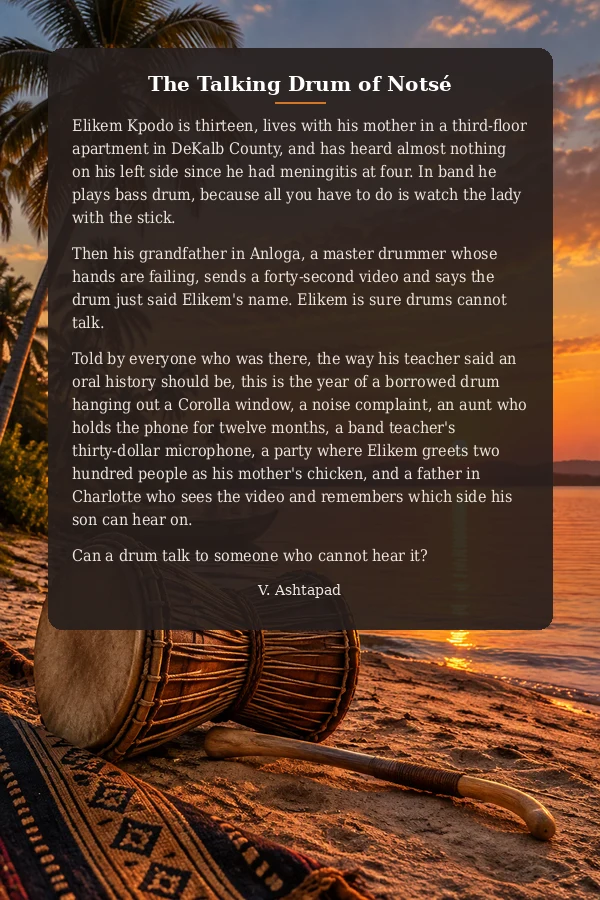
Elikem Kpodo is thirteen, lives with his mother in a third-floor apartment in DeKalb County, and has heard almost nothing on his left side since he had meningitis at four. In band he plays bass drum, because all you have to do is watch the lady with the stick.
Then his grandfather in Anloga, a master drummer whose hands are failing, sends a forty-second video and says the drum just said Elikem's name. Elikem is sure drums cannot talk.
Told by everyone who was there, the way his teacher said an oral history should be, this is the year of a borrowed drum hanging out a Corolla window, a noise complaint, an aunt who holds the phone for twelve months, a band teacher's thirty-dollar microphone, a party where Elikem greets two hundred people as his mother's chicken, and a father in Charlotte who sees the video and remembers which side his son can hear on.
Can a drum talk to someone who cannot hear it?
Members can react to this book and talk about it in the members' Library.
Ownership
© 2026 CRUNOD LLC. All rights reserved.
This book is owned by CRUNOD LLC. It is free to read on EternalCurrent.Online. No part of it may be copied, reprinted, sold, recorded or adapted, including as audio, film or translation, without written permission from CRUNOD LLC.
© 2026 CRUNOD LLC. All rights reserved.