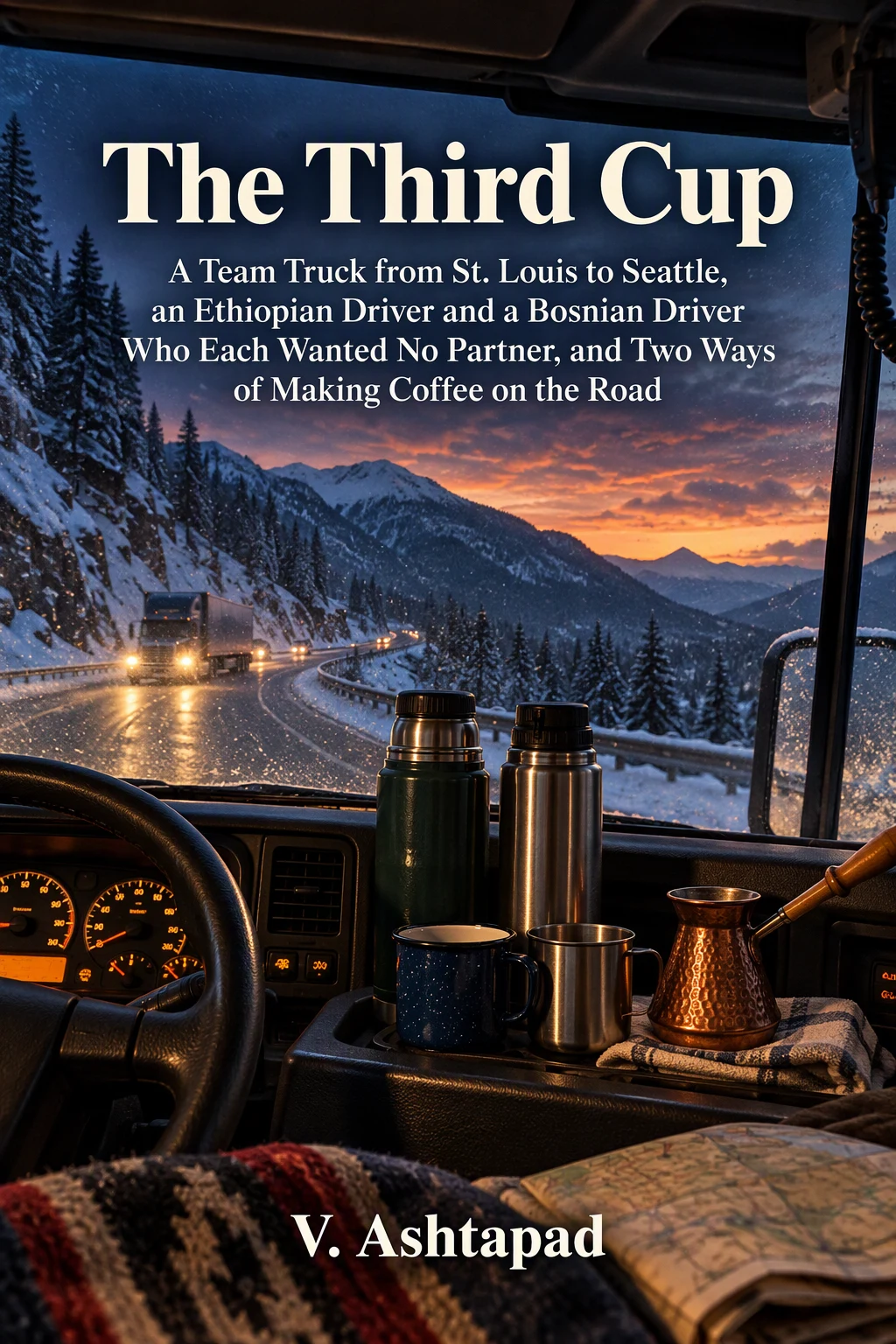
The Third Cup
A Team Truck from St. Louis to Seattle, an Ethiopian Driver and a Bosnian Driver Who Each Wanted No Partner, and Two Ways of Making Coffee on the Road
by V. Ashtapad
Foreword
This is a work of fiction. The Ethiopian coffee ceremony with its three rounds, Bosnian coffee in a džezva, the foods of both kitchens, the federal hours-of-service rules for truck drivers and the roads, passes and closures along the route are real. The trucking company, the dispatcher, the drivers, their families and every business and community office named in the story are invented.
For the drivers who keep a second cup on the dash for someone.
Missouri: The Yard on Hall Street
The dispatcher told me about the partner the way a doctor tells you about a stitch, quickly, looking at something else and already reaching for the next thing.
"You're running team on the Kent load," Carla Pruitt said. She had a headset pushed back into her gray hair and a cup of cold coffee that had left a brown ring on every page of the board. "Expedited. Two thousand and some miles, St. Louis to the receiver in Kent, Washington. They want it there Friday morning, and one driver can't do that legally. So you're two drivers."
"I'm one driver," I said.
"Today you're half of two." She tapped her screen with the cap of a pen. "Mirsad Begić. Truck four-eleven, the old blue one at the end of the fence. He's been here longer than the fence. Go introduce yourself."
"Does he know?"
"He knows," she said. "He said the same thing you said, only with more consonants."
I had driven solo for six years, six years of my own seat and my own bunk and my own silence, with my own little bag of dried chickpea flour and berbere tucked in the drawer under the microwave where nobody would ask me what the smell was. I had nothing against people. I have a wife, a daughter, and a mother on the other side of the world who sends me her voice twice a week, and I like people very much at a table; I did not want one in the bunk above my head, breathing, while the road ran under us.
But the team lanes paid more per mile, even split, and Hiwot and I had a number written on the inside of a kitchen cabinet door, the number for a house with a yard big enough for Liya to have a dog, and that number was not getting smaller by itself.
The Gateway Line yard sits in north St. Louis between a scrap metal lot and the levee, close enough to the Mississippi that on hot days you smell the river, mud and diesel and something green. It was not a hot day but the second week of November, with the wind coming off the water hard enough to rattle the chain-link, and the sky had that low flat lid that means the weather in the west is already deciding things for you.
Truck four-eleven was blue the way old jeans are blue, a long-nose tractor with a sleeper and a chrome bumper polished so carefully you could have shaved in it, and on the dash, before I even reached it, I could see a thermos, steel and dented, the kind with a cup for a lid.
A man was walking the trailer tires with a short wooden club, thumping each one and listening, thump and listen, thump and listen. He was shorter than me and wider, with a gray mustache and gray stubble and a flat wool cap pulled down to his eyebrows, and he wore a brown canvas work coat whose elbows had been patched in a darker brown, the patches sewn by hand in small even stitches.
"You are Tesfaye," he said without turning around. Thump. "Carla said tall. You are tall."
"Mr. Begić."
"Mirsad." Thump. He listened to that one longer, then moved on. "You check your own tires on your own truck?"
"Every morning."
"With what?"
"A gauge."
He grunted, and it was neither approval nor disapproval but the noise of a man filing something away to look at later. He finished the last tire on the trailer, stood up with one hand on his lower back, and finally looked straight at me with eyes that were light, a washed blue-green, and very steady.
"I will tell you my rules," he said, "and then you tell me yours, and then we see if we can drive to Seattle without one of us walking."
"All right."
"One. I drive first. I know this truck. She pulls left when the trailer is light, and this trailer is light. Two. No music in the cab when the other one is in the bunk. Radio for weather only. Three. Shoes off before the bottom bunk. Four." He held up four thick fingers, and the fourth one had a white scar across the knuckle. "My thermos is my thermos."
"I have my own thermos."
"Good. Then we have no problem with number four." He looked at me. "Your rules."
I had not prepared rules; I had prepared to be annoyed. So I said the first thing that came into my head. "I keep food in the cooler that smells strong. I'm not going to apologize for it."
Something moved at the corner of his mustache. "My wife packed me burek this morning," he said. "Meat and onion. Twelve hours in a cooler. You will not apologize to me, and I will not apologize to you."
That was the first conversation, and for nearly three hundred miles it was also the last one.
We pulled out at ten minutes after three with fifty-three feet of boxed machine parts, printed circuit boards for some plant up north of Kent, and pallets of something lighter that rode high in the back, forty-one thousand pounds gross with the tractor, which is light for a winter run. Mirsad drove, as he had said he would, and I sat in the passenger seat with my log open on the tablet in the dash, watching the little bar of my off-duty time tick along in gray.
The federal clock is the third partner in any truck: eleven hours of driving inside a fourteen-hour window, then ten hours off, and a half-hour break before you pass eight hours behind the wheel. For a team it becomes a kind of dance, one driving while the other rests in the sleeper and the electronic log records both of them to the minute, so that the truck keeps rolling while the two clocks pass the wheel back and forth like a bucket in a fire line. The plan was simple. Mirsad would take us across Missouri and up past Kansas City to St. Joseph, and I would take it from there into the night.
I should have gone to the bunk, because the smart thing on a team is to sleep when you can, even at three in the afternoon, since nobody will let you sleep later. But I sat there, partly out of courtesy for the first hour and partly because I wanted to see how he drove.
He drove like a man pouring water into a narrow glass, every shift on that old ten-speed coming at exactly the right engine note, with no grind and no jolt. Through the merge at the Blanchette Bridge, where the cars come at you from three sides and nobody signals, he did not touch the brake once, and he watched the mirrors more than the road. He kept the speed four miles under the posted limit, and when a pickup cut in front of us with a trailer of firewood he only lifted his foot and said, in a voice almost gentle, "Okay, okay, okay."
We crossed the Missouri there, wide and the color of cardboard, with a few barges pushing upstream, and the city fell behind us into strip malls and then into fields of brown corn stubble, cattle standing with their backs to the wind, a billboard for fireworks and a billboard for a cave, and water towers with the names of small towns painted on them like signatures.
My phone buzzed against my leg. I turned it face down and then up again, because it was Hiwot, who had put a new photo on our family pages, the private ones my cousin Dawit set up years ago so that all of us scattered from Addis to Silver Spring to Melbourne could see each other's children grow. It was Liya in her school play with a cardboard crown on her head, her mouth open in the middle of a line, and under it Hiwot had typed: *She did not forget a single word. She asked if you saw.*
I typed back that I saw, and that I was proud, and then I sat looking at the photo for a long time. Liya is nine. She has her grandmother's forehead, my mother's, high and serious, and when she concentrates her eyebrows pull together the way my mother's do when she is checking the salt in a pot.
"Your child?" Mirsad said without turning his head; he had seen it, I suppose, in some corner of his eye.
"My daughter."
"How old?"
"Nine."
He nodded slowly. "Nine is a good age. They still tell you everything." And then he said nothing more for forty miles.
At Boonville I finally went to the back. The sleeper on four-eleven had two bunks, the lower one wide enough for a man my size if he did not mind his feet touching the wall and the upper one folded flat with a strap, and everything in it was clean, not clean like a rental but clean like a kitchen in a house where a grandmother lives. There was a small curtain on a rod, washed and ironed, a hook with a single coat hanger, and a narrow shelf holding a bottle of lotion, a paper calendar of a lake with mountains behind it, and a small brass coffee pot with a long handle, wrapped in a dish towel and tied with string so it would not rattle.
I took my shoes off, as he had asked, and lay down on my back on top of the blanket with my jacket on.
You do not sleep well the first time in another man's truck, because every sound is a stranger. The heater fan had a tick in it, and the trailer behind us made a long hollow boom over every expansion joint, light freight jumping, and under all of it was the engine, which I could hear him managing: up a gear, hold, down a gear before the hill and not on it.
Somewhere past Columbia I must have slept, because I dreamed of my father's classroom, the big pull-down map of the world over the blackboard with its oceans faded to the pale blue of a shirt washed too many times, and my father with his pointer, tapping places. Lagos. Lima. Leningrad, because the map was old. He would tap a place and wait, and you had to say the capital and the river and one thing they grew there, and if you said it right he did not smile but only moved the pointer to the next place, which was how you knew.
I woke when the truck slowed and the light outside had gone orange and then gray. We were in the long tangle of interchanges around Kansas City, and Mirsad was taking the belt loop north while signs flashed past for the airport and for Iowa and for places with names like Platte City and Dearborn.
At St. Joseph he pulled into a truck stop off the interstate, parked between a cattle hauler and a tanker in one smooth backward swing, and set the brakes with a hiss. It was 7:40, and he had been driving four and a half hours.
"Your turn," he said. "Thirty minutes. Then you go."
I climbed down into the cold. The cattle hauler beside us was full and steaming, and the smell of it hit me square, warm animal and manure and wet straw, so that a sound came out of me before I could stop it, half a laugh.
"What?" Mirsad said. He was by the front tire, bent over, working the stiffness out of his back.
"My grandfather kept cows outside Debre Markos," I said. "That's the smell of every summer I was a boy."
He breathed in through his nose, considering it. "For me it is sheep," he said. "My uncle had sheep. Same summer, different animal."
Then he went inside to use the restroom, and I did my walk-around in the dark with my flashlight, checking the lights, the tires with my own gauge, and the gladhands where the air lines meet the trailer. When I climbed up into the driver's seat he was already in the passenger seat with his cap off and his eyes closed and his thermos in his lap, both hands around it, like a man warming himself at a small fire.
I adjusted the mirrors, moved the seat back three notches, and put the truck in gear.
"She pulls left," he said, without opening his eyes.
"I know," I said. "I was watching."
He opened one eye at that and closed it again, and he did not go to the bunk until we crossed into Iowa.
© 2026 CRUNOD LLC. All rights reserved.
Iowa: Fifty-Three Miles in the Dark
I do not sleep the first night with a new driver. I tell myself I will, and I lie down and take off my shoes and fold my socks into them and pull the curtain and close my eyes, and then I lie there and drive the truck from the bunk.
This one shifted early. The young ones mostly shift late and let the engine scream a little, because they learned on automatics and think the noise means power, but this one shifted early and soft, like he was afraid of waking somebody, and I suppose he was, and I suppose that somebody was me.
Iowa is a short state on this road. Interstate 29 runs up the western edge of it along the Missouri, from Hamburg to Council Bluffs, maybe fifty-three miles, and at night there is nothing to see anyway but a few farm lights very far apart and the glow of a grain elevator. The river is out there on the left somewhere past the fields, but you never see it; you feel it in the fog that comes up in low places, a softness in the air that gets on the windshield so that the wipers have to come on for one swipe and then go off again.
I heard him do that, one swipe and then off, without leaving them running. A man who leaves the wipers running on a dry windshield, I do not trust him with a load of eggs.
Dale used to leave them running. Dale was my partner for nine years, a big man from Poplar Bluff with a beard like a sheep dog and a voice that could fill a stadium, and he talked from Missouri to California and back, about his ex-wives and his bass boat and the price of tomatoes and a cousin of his who had seen a mountain lion in a supermarket parking lot. I want to be fair: it was not bad, the talking, and after a while I listened to it the way you listen to rain. Then Dale's knees gave out and he retired to a lake in the Ozarks, and he sends me a photo of a fish every few weeks, and I drove solo for two years and found that I liked the quiet more than I had ever liked anything. I liked hearing my own thoughts, which are mostly not interesting but are mine.
So when Carla said team, I said no. And Carla said the Kent customer pays double for expedited, so the company has to put two drivers in a truck to make the clock work, and I am the senior driver with the clean record and the truck the customer asks for by number. She said the other driver had also said no, and I said, "Then why are you doing this to two men who said no?" And she said, "Because you both said it the same way."
I did not know what that meant then, but lying in the bunk listening to this man drive, I think I know now.
In the cooler under the bottom bunk, against my knees, there was a foil pan with the rest of Senada's burek. She gets up at four on the day I leave, without saying anything about it, and I hear her in the kitchen with the flour and the long thin rolling pin her mother brought from home, the oklagija, as long as my arm and thin as a broom handle. She rolls the dough on the tablecloth until it hangs over the edges of the table like a bedsheet and you can read the newspaper through it, and she brushes it with oil and lays the meat and onion in a line and rolls it up and coils it in the round pan like a snake asleep. When I come into the kitchen at five it is coming out of the oven and the whole house smells of it, the onion and the black pepper, the crust shattering when she cuts it.
My daughter Amra has been trying for three years to get this recipe written down. She keeps a collection of the family recipes on the shared pages, my mother's and my mother-in-law's and the ones she remembers from her own childhood in Germany, in the German years, when the three of us had two rooms above a baker's shop in a town outside Stuttgart, and she types everything carefully, with photos. But Senada's burek she cannot get, because Senada says, "A glass of water. A little more flour. Until it feels right." Amra types *one glass* and then asks, "What kind of glass, Mama?" and Senada holds up the glass, a little one with a gold rim that she uses for everything, and Amra takes a photo of it. So it is on the page now: the recipe says "one glass (this glass)," and then there is the photo of my wife's hand holding it up against the kitchen window.
He was smoother at the interchange in Council Bluffs than I thought he would be. The ramp from 29 to 80 West is tight and badly lit and comes up fast, and a trailer as light as ours will step out on you if you take it with any speed, but he slowed early and took it like a man going down stairs carrying a tray.
Then we were on I-80 with the river under us, the bridge into Omaha, and I felt the change in the road surface and I knew we were in Nebraska.
I turned on my side to face the wall, where I keep an old photo taped up, gone a little green: two boys in short pants sitting on the front bumper of a big, square, old truck with a round nose, the kind they built in my country before I was born. The boys are squinting into the sun, and the bigger one has his arm around the smaller one's neck, and the smaller one is laughing so hard his eyes are closed. That is me with my eyes closed. The other one is Kemal.
I do not look at it often. It is just there, like the calendar and the hook for the coat.
I heard the passenger seat creak, no, not the passenger seat but the driver's seat, him leaning forward, and then a small sound I did not recognize, a cap unscrewing. Then came the smell, very faint, through the curtain: coffee, but not my coffee, something darker with a smoke in it, almost like the air outside a bakery that roasts its own beans.
I lay there smelling another man's coffee in my truck in the dark of Nebraska, and I will say this honestly, my first thought was that he should ask. My second thought was that he had his own thermos, and my rule was about my thermos, not his. My third thought was that it smelled very good.
I slept, I think, around Lincoln. I know I was awake at Lincoln, because I heard the tick of the turn signal for nothing, a lane change to give room to a car on the shoulder with its flashers going, a small courtesy that nobody would ever know he did, except that I knew.
After that I remember nothing until the light came.
© 2026 CRUNOD LLC. All rights reserved.
Nebraska: Crosswind
The wind found us west of Lincoln, as I had known it would.
It came out of the north and a little west, across hundreds of miles of nothing, and hit the side of that light trailer like a hand slapping a door. The first gust pushed us a foot toward the shoulder rumble strip before I had the wheel back, and the second I was ready for, and after that it was a long conversation between me and the weather the whole night, the wheel never quite still under my hands, correct and wait, correct and wait. You do not fight a crosswind; you lean against it the way you lean against a friend who has had a bad day.
Nebraska at night on Interstate 80 is the straightest thing I know, mile after mile of road like a gray ribbon in the headlights with the dark fields on either side, and once in a while the red blinking lights of wind turbines far away, all of them blinking together as if they were keeping time for something. A rail line runs beside the highway almost the whole way across the state, and coal trains pass in the opposite direction, a hundred cars, a hundred and twenty, the headlight coming at you for minutes before the engine finally goes by with its roar and its blast of air, and then the cars, black and humped and endless, each one a little thump of wind against the cab.
I drank my coffee from the cap of my thermos at sixty-two miles an hour. Hiwot fills it at the house with the beans we buy from the Ethiopian grocery on South Grand, already roasted dark, which she grinds fine in the little hand grinder that was a wedding present from her aunt, and she brews it strong and pours it hot into the thermos with a pinch of something she will not tell me, cardamom, I think, or a very small amount of the spiced butter. When I ask, she only says, "That is between me and the coffee."
The smell filled the cab, and I wondered if it would wake him.
I thought about my mother's voice. She had sent me a message the night before, while Mirsad and I were still standing in the yard pretending not to look at each other, recording it on her phone slowly, holding it in front of her face as if it were a mirror. Since my father's memory started to go, she records the things she wants us all to keep. The first time, she asked him if he minded, and he said, "Who would want to listen to an old teacher," and she said, "Your son," and he said nothing, which in my father's language is yes. So she records him telling about the old school and about his own father and about the year the rains came early, and she puts the recordings on the family pages labeled with the date and what he talked about, in a section Dawit built for them under my father's name, with his photo from the year he retired: gray suit, narrow tie, and chalk dust on one sleeve that nobody noticed until the picture was printed.
There are thirty-one recordings now, and I have not listened to one of them. My mother's messages to me I listen to every time, but my father's I scroll past the way you walk past a door in a house where you once broke something.
At Grand Island the wind got worse and I came down to fifty-five. A pickup passed me with a mattress tied to the roof, the mattress lifting at one corner like a wing, and I watched it until it was gone and wished a good night to whoever was going to sleep on it.
Near Kearney there is a strange building that crosses over the whole interstate, a bridge with a museum inside it, built to look like a covered wagon trail through the sky, brown and wooden, with lights along it, and at four in the morning it rose from the dark like a ship. I had seen it before on other runs, but always in daylight and always in a hurry, and at night, alone with the wind and the coffee, it was almost beautiful. All those people who went west in wagons along the Platte River went right here, under where I was driving, and they walked most of it; the wagons were for the things.
I pulled off at the truck stop just past it at 4:35. The lot was three-quarters full, trucks idling in rows with their running lights on like little cities of amber and red, and I found a spot near the back between a car hauler and a flatbed carrying a single enormous tractor tire chained down like a prisoner, set the brakes, and let the engine settle.
From the bunk, not asleep, as clearly as if he had been sitting beside me the whole time: "You stopped at the wagon bridge."
"Kearney. I have three hours left on my clock. You have about an hour until your ten."
"I know." The curtain slid, and he was sitting up with his socks on and his cap already on his head; I do not know if he took it off to sleep. "Go shower. I will make breakfast."
The showers at a truck stop are a small mercy that nobody outside the trucking life knows about. You walk in at four in the morning past the racks of beef jerky and phone chargers and souvenir mugs, past the guy mopping the floor who nods at you because he has seen a thousand of you, and you give the counter your card and they give you a receipt with a number on it. Then you wait with your little bag, soap and razor and the clean shirt, looking at the cell phone cases, until a woman's recorded voice says through the ceiling, "Customer number sixty-two, your shower is now ready. Shower number four." You go down the hall and punch your code into the door, and inside it is a whole private room with a tile floor and tile walls, a toilet and a sink and a showerhead the size of a dinner plate, clean towels folded on a shelf, a bath mat and a rubber stopper for the drain, because somebody mopped it and wiped it down and put out fresh towels for you, a stranger, at four in the morning in Nebraska.
I stood under that water for a long time, and the wind that had got into my shoulders went out of them.
When I came back across the lot with my hair wet and my jacket zipped to the chin, the east had gone from black to a deep blue and there was a light on in four-eleven, the window steamed, and when I opened the door and climbed up the smell inside was onion and black pepper and hot pastry.
He had a small electric oven on the floor between the seats, plugged into the inverter, a toaster oven really, but very clean, with its own little rack. On the passenger seat, on a dish towel, sat the foil pan with what was left of a coiled pie, golden and blistered and cut into wedges, and he had two paper plates with a wedge cut for each.
"Burek," he said. "Sit."
I sat in the driver's seat, and when he held one plate out to me I took it and then said, "Wait," and reached behind the seat for my cooler.
Hiwot had packed me what she always packs me: injera rolled in a cloth inside a plastic bag, the gray-brown sour bread, thin and spongy and a little cold from the cooler, which does not matter; a container of misir wat, red lentils cooked down with onions and berbere until they are almost a paste, dark red and shining with oil; a smaller container of shiro; and a little jar of the hot powder, mitmita, for if I need to wake up.
I unrolled two pieces of injera onto the dash on a clean cloth and spooned the misir wat into the center of one and shiro into the center of the other, and then I tore a piece off the edge and held it out to him with the lentils folded inside it.
He looked at it. He looked at me.
"With the hand," I said. "This is the fork."
He took it and ate it, chewing slowly with his eyes fixed on the windshield, where the sky was turning gray-pink behind the car hauler.
"It is sour," he said finally.
"It is supposed to be sour. It ferments three days."
"And then this." He pointed his chin at the misir wat. "This is hot, but it is slow. It comes after."
"That's the berbere. Chili, garlic, ginger, fenugreek, a lot of things. Every family's is a little different. My mother's has more korarima. My wife's has more ginger. We do not discuss which is better."
He actually laughed at that, not much, a short sound through his nose, and tore off another piece, larger this time, and went for the shiro, while I picked up the wedge of burek from my plate and bit into it.
I want to describe it correctly. The outside shattered, there is no other word, into a hundred thin flakes that went down my jacket, and inside the flakes were soft, almost wet with the juice of the meat, which was beef and lamb together, ground, with so much onion it had become sweet, and black pepper, and nothing else, no other spice, because it did not need anything. It tasted like somebody's kitchen early in the morning.
"Your wife made this at four o'clock," I said.
He stopped chewing. "How do you know?"
"Because mine made this," I said, holding up the injera, "at nine last night after she put our daughter to bed, so it would be fresh."
He nodded. He looked at the pan. "In this country they put cheese in it and call it burek," he said. "Spinach, potato, and they call it burek. It is not burek. Burek is meat. With cheese it is sirnica. With spinach, zeljanica. With potato, krompiruša. Anybody who tells you cheese burek, they are not from Bosnia. They may be good people. They are not from Bosnia."
"In St. Louis," I said, "you can buy injera at the store that is half wheat flour. It is lighter, it is easier, the Americans like it. My mother would not call it injera. She would call it a pancake with a bad attitude."
That time he laughed for real, his shoulders going, and a piece of burek went down the wrong way so that he had to cough into his fist, and I handed him my water bottle without thinking, and he drank from it and gave it back.
We ate everything, and the sky became day while we ate, a white winter day with the wind still pushing at the cab and the flag at the truck stop entrance standing out straight from its pole as if it were made of sheet metal. Out past the lot you could see the fields running away flat to the edge of the world, brown and pale gold, the dead grass bent all one way.
My phone buzzed, and when I looked, Dawit had updated the family tree, the way he does every time anybody in our family has a baby or gets married or dies. My second cousin in Melbourne had had a son three days ago, and Dawit had added him, the baby's name in its own little box under his parents' boxes with a new line drawn down, and a photo of the baby red and furious in a striped hospital blanket.
"Another child?" Mirsad said. He was wiping his hands carefully on the dish towel, each finger.
"My cousin's grandson. In Australia. My cousin in Maryland keeps the tree. All of us, back seven generations. Every time someone is born, he adds them. Every time someone dies, he adds the date." I turned the phone toward him so the shape showed, the branches going out and out. "He says if we don't write it down, in one more generation the children won't know who they are related to."
Mirsad studied the screen without taking the phone; he only looked.
"Seven generations," he said.
"On my mother's side. My father's side goes back further. My father knew it all by heart. Names, villages, who married who. He could recite it." I stopped. I put the phone away.
Mirsad folded the dish towel in quarters and put it on the dash, and then he looked at his watch. "Ten hours," he said. "I am legal. You go to the bunk."
"The wind is bad past North Platte."
"I have driven in wind," he said. "Go to bed, Tesfaye."
It was the first time he had said my name without making it sound like a question.
I went, and took off my shoes before the bottom bunk, and lay down, and I heard him outside in the wind thumping the tires with his little club one after the other, thump, listen, thump, listen, and before he had finished the trailer I was asleep.
© 2026 CRUNOD LLC. All rights reserved.
Nebraska, Later: The Little Pot
The radio said it before the signs did. Out of Ogallala the weather channel came in strong, a man with a flat calm voice reading the conditions for Wyoming the way a man reads the scores at the end of the news: winter storm warning in effect for the Interstate 80 corridor from Laramie to Rawlins, snow totals six to ten inches, wind gusts to sixty, closures likely, extreme blow-over risk for light, high-profile vehicles.
I turned it down, because behind the curtain he was sleeping. I could hear it, the slow breathing with a small hitch as each breath turned over, like a drawer that sticks.
Light, high-profile vehicle: that was us. Forty-one thousand pounds sounds like a lot until you know that a loaded truck is eighty, and the wind in southern Wyoming does not care how much you paid for your tractor; it lifts an empty trailer like a sail. I have seen trucks on their sides in the median at Arlington, three in one mile, like dominoes some child left on the floor.
I called Carla from the rest area at the Sutherland reservoir, standing outside in the wind with my cap pulled down and my collar up, because I do not like to talk on the phone in the cab when someone is sleeping.
"I see it," she said before I said anything. "The receiver knows. I already told them Saturday is possible. They said they would rather have it Saturday than in a ditch."
"They said that?"
"I said that. They agreed." I heard her drink something. "How's your partner?"
"He is a driver," I said.
"Mirsad."
"He shifts early," I said. "He drives in wind like it is his job. Which it is."
"That's the nicest thing you've said about anybody since Dale."
"Dale talked too much."
"And this one?"
I looked at the truck, at the window with the curtain behind it. "This one listens," I said, and the words were out before I had decided on them, and then I was a little embarrassed, and I said goodbye.
Western Nebraska is not flat the way eastern Nebraska is. Past North Platte, past the giant railroad yard where a thousand cars stand in rows on a hundred tracks, the land starts to roll and break, with bluffs coming up on the right, tan and crumbling, and the trees going away except along the river while the sky gets bigger. By Sidney you can feel the ground climbing under you, a slow tilt toward the mountains you cannot see yet, the engine working a little harder for the same speed.
I had my break due at Sidney, with eight hours of driving close and the clock in the dash counting down in orange, so I pulled into the truck stop at the east exit, the big one with the cattle pens out back that nobody uses anymore, and parked facing the wind so the cab would not rock.
He was awake; I heard the curtain go just as I set the brakes, and he came forward in his socks with his hair standing up on one side.
"Thirty minutes," I said. "Then you drive to Laramie. Then we see."
"I heard the radio."
"I turned it down."
"I heard it anyway." He rubbed his face. "The wind was talking to the trailer all night. Now the man on the radio is also talking. Everybody has an opinion about Wyoming."
I got up and went to the back and untied the string around the dish towel on the shelf, and inside the towel was my džezva, a small brass pot, narrow at the neck and wide at the bottom, with a long straight handle, the inside tinned silver and the outside dark with years. It was my mother's, and she had it from her mother, and it is the only thing from that house that came with me, besides the photo and my own two hands.
I set the little electric burner on the floor between the seats, filled the džezva with water from my jug to just below the neck, and put it on the burner. While it heated I took down the tin of coffee, ground so fine it is almost flour, finer than espresso, and the small tin of sugar cubes, and the little box Senada packs me every trip with rahat lokum in it, the soft sweet cubes dusted in powdered sugar.
He sat in the passenger seat and watched me and kept quiet, and I noticed that first. Dale would have been talking already; Dale would have asked, "Is that the Turkish coffee?" and I would have had to explain, and Dale would have nodded and then called it Turkish coffee again the next day.
When the water came to a boil I took the pot off and poured a little out into my cup, maybe two spoons' worth, and set the cup aside. I put three heaping spoons of coffee into the water in the pot without stirring it and set it back on the burner, low, where the coffee sat on top of the water like a brown blanket until slowly, slowly, it started to sink and darken and the foam began to rise at the narrow neck, a pale brown crown, and just before it came over the top I lifted the pot off.
I poured the little bit of water I had saved back onto the foam, which settles it, and then I let it sit.
"In my country," he said quietly, "you would call this Turkish coffee."
"In my country," I said, "you would not call it that twice."
He did not take offense. He waited.
"It is close," I said. "It came from there, a long time ago, everybody knows. But we make it different. A Turkish man boils the coffee and the sugar together in the cold water. We boil the water first. Then the coffee. No sugar in the pot. The sugar you hold." I took a sugar cube from the tin and put it on the saucer. "You dip it in the coffee, and you put it in your mouth, between the teeth, and you drink the coffee through it. Or you eat the lokum. Or both. It is not a drink you drink running. It is a drink you sit with. You talk. If someone pours you a second cup, he wants you to stay."
I poured, and the coffee came out of the narrow neck thick and black with the foam on top. I had only the one small cup, a white porcelain fildžan with a blue band around it and no handle, and my own steel cup from the thermos, so I gave him the fildžan.
He cradled it in both hands like an egg. He looked at the foam. "Why no handle?"
"You hold it like that. Like you are doing. So you know when it is cool enough. If your hand can stand it, your mouth can stand it."
He dipped a sugar cube the way I had shown him, put it between his teeth and drank, and his face did the thing that faces do the first time with Bosnian coffee, a small surprise, the bitter and then the sweet coming in from the sugar, with the grounds just there at the edge of the tongue like sand on a beach.
"You leave the last of it," I said. "The grounds. Don't drink to the bottom."
He nodded and set the cup down a third full. Then he said, "Can I ask about the pot?"
I had not expected that. I had expected, if anything, a question about the coffee, where to buy it, what brand. "My mother's," I said. "And hers."
"From your home."
"From the house. It is the only thing." I did not say more, but picked up my steel cup and drank and looked out at the wind pushing the flag on the pole by the fuel islands.
He did not ask the next question. I could see the question in him, sitting right there, and he let it sit, and picked up a cube of lokum and ate it in two bites and licked the powdered sugar off his thumb. "My mother does a coffee ceremony," he said. "Every day. At home in Addis. She roasts the beans herself, in a pan, over charcoal. It takes an hour. I have the small pot for it in my bag. The jebena. I bring it every trip and I have never once used it in a truck. I always think it would take too long."
"Too long for what?"
He thought about that. "For the clock," he said.
The clock in the dash said I had nineteen minutes left of my break. Outside the wind leaned on the trailer, and a man in an orange vest was walking across the lot with his head down, holding his hat on.
"In Wyoming," I said, "they will close the road. Then the clock will not be our problem. Then we will have a lot of time."
He looked at me. "You think they will close it?"
"I have been driving that road twenty-eight years," I said. "If the radio man says closures likely, the radio man is being polite."
I washed out the džezva in the little sink with water from my jug, dried it, wrapped it in the towel and tied the string while he watched. When I put it back on the shelf in the sleeper I saw him look at the photo on the wall, the two boys on the bumper of the old truck, and I saw him decide not to ask about that either.
He took the wheel and I took the bunk, and before I pulled the curtain I said, "Wyoming line is forty miles. After the line, Cheyenne. After Cheyenne, the hill. Watch the hill."
"I've crossed it."
"Not with this trailer," I said. "Not in this."
© 2026 CRUNOD LLC. All rights reserved.
Wyoming: Three Rounds at Laramie
The hill he meant is the one between Cheyenne and Laramie, the highest point on the whole interstate at more than eight thousand feet, a long climb up through red rock and pine and the bones of old snow fences, wooden slat walls standing in the fields at angles to catch the drift before it reaches the road. At the summit rest area there is a great bronze head of a president, enormous, looking out over the trucks with a patient expression, and I have always thought he looks like a man waiting for a bus.
The snow started at the summit, not falling but blowing, coming across the road from right to left in long white ropes, low to the ground and snaking, so that the pavement looked as if it were moving under us. The sky above was clear in places, ragged blue, while the ground below was a river of white going sideways, and the wind gauge on the overhead sign said forty-eight.
I came down to forty-five and then forty, and the trailer behind me moved like something alive; I could feel it in my back and in the seat, the little shove and recover, shove and recover. I kept my hands loose and did not look at the median.
Mirsad was not in the bunk. He had come forward when we passed the bronze head and taken the other seat, cap on, thermos between his knees, and said not a word all the way down the hill into Laramie, and I understood only later that he had not been watching me but keeping me company.
At the bottom of the hill, in Laramie, the gates were already down.
Wyoming has real gates, big orange-and-white arms like at a railroad crossing across the on-ramps, with lit signs over the road: I-80 CLOSED WEST OF LARAMIE. ALL TRAFFIC EXIT. A highway patrol car sat with its lights going at the ramp, and everybody got off, every truck in America that wanted to go west, it seemed, getting off at Laramie and finding a place to put itself.
The truck stops were full by four in the afternoon, and we drove slowly through two of them, looking, past trucks parked on the access roads and along the frontage, in a church lot, in the lot of a tire store that had closed for the day, until Mirsad pointed at a space at the far end of a lot behind a diner, beside the snow piled from the last storm, a space so tight I would not have tried it in daylight on a calm day.
"You can do it," he said.
I did it in three tries, and he did not say a word during any of them, and when the brakes hissed he only nodded once and unscrewed his thermos cap.
Then the clock stopped being our problem, exactly as he had said. We both went off duty and the logs turned gray, and the engine idled for heat while the wind rocked the cab and the snow began to fall properly, big flakes drifting through the yellow glow of the diner's sign, settling on the hood, melting on the warm glass in front of the engine and piling up everywhere else.
We ate in the diner, hot turkey sandwiches with gravy, because it was the special and because the waitress said in a voice like a warning that the kitchen might close if the power went. Everybody in that diner was a driver, which you could tell by the way they sat half turned toward the windows, and a man at the counter was on the phone to his wife, saying, "No, honey, they closed it, no, I'm fine, they closed it."
Back in the cab Mirsad took off his boots and set them side by side under the passenger seat. He looked at me. "Now you have time," he said.
I knew what he meant, though I had not said anything about it since Sidney. I sat there for a minute with my hands on my knees, and then I stood, ducked into the sleeper and found my bag.
My mother had wrapped the jebena for me herself eleven years ago, when I went back once and she understood I would not live there again. It is a round clay pot with a fat belly and a long thin neck, a spout and a handle, black from the fire, the clay so thin in places you could almost see light through it, and it sits on a little woven ring of grass so it will not tip. She wrapped it in an old netela, a thin white cotton shawl with a narrow colored border, and I have never unwrapped the netela since, except to look. With it I had a small flat pan for roasting, a paper bag of green beans from the grocery on South Grand, pale and hard like little stones, a small brass mortar and pestle, and six tiny cups with no handles, white with a gold rim, packed in a sock.
"No incense," I said. "My mother burns incense with it. In a truck, I would set off something."
"I don't have a thing that goes off," Mirsad said.
"Still."
I set up his burner on the floor where he had set it up for the džezva, and washed the beans in a bowl, rubbing them between my palms, twice, three times, the way my mother does, until the water ran clear, and then I put them in the flat pan on the burner and began to shake.
It takes time; that is the first thing, and you cannot rush the roast. The beans start pale green and go yellow and then tan, and the smell is grassy and wet at first, almost like cooking peas, until they start to crack with little pops like twigs breaking far away. The color goes to brown and darker brown, and the oil comes up on the surface so that they start to shine, and then the smoke comes, a thick fragrant smoke that filled the whole cab, so thick that Mirsad cracked his window an inch and the snow blew in on him and he did not close it.
When they were dark and shining I took the pan off the burner and stood up, crouched under the roof of the cab, and carried it to him, holding it under his face and moving my hand over the beans to send the smoke toward him.
He looked at me, not understanding.
"You breathe it," I said. "This is how you are welcomed. My mother carries the pan to every guest. You breathe it in, you say it is good."
He leaned forward, closed his eyes and breathed, and the smoke went around his face and into his cap and the snow on his shoulder.
"It is good," he said, and his voice was rough, and I do not think it was from the smoke.
I ground the beans in the mortar, which rang like a bell with each stroke in that small cab, and I tried to be quiet and could not. I boiled the water in the jebena, which my mother would say is wrong on an electric burner, since a jebena belongs in coals, but the clay held, and when it boiled I poured some out, put the ground coffee in through the neck with a paper funnel, put the water back and let it boil up again. Then I took it off and set it on its ring with the spout tilted up, so the grounds would settle.
I had no popcorn, and my mother always serves popcorn, so I poured a bag of roasted peanuts from the truck stop in Sidney into a paper bowl and set it on the dash.
"Popcorn," I said. "Imagine it is popcorn."
"It is popcorn," Mirsad said gravely.
I set two of the little cups on the dash in front of us, side by side, next to his steel thermos and mine, and lifted the jebena and poured from high up, a long thin stream from the spout into the cup without stopping and not one spill on the dash. My mother can pour a whole row of cups that way in one movement, her arm moving down the line without a spill on the tray, and I am not my mother, but I did not spill.
"This is the first round," I said. "Abol. It is the strongest."
He took it in both hands, the way he had held his own fildžan at Sidney, and we drank. The coffee was thick and dark and a little bitter and very smooth, the smoke of the roast still in it, and I could taste my mother's kitchen and the charcoal and the little window over the sink that looks out on the neighbor's eucalyptus, so that I had to look away from him for a minute, at the snow.
"There are three rounds," I said. "Abol. Then tona. Then the third, baraka. Each one I make with the same grounds and new water, so each one is weaker than the one before. You do not leave before the third. It is rude. In my house, if someone stands up after the first cup, my mother would remember it at their funeral."
"Then I will stay," he said.
We drank the first round and I poured the second. Outside it was full dark now, the snow coming so heavily that the diner sign had become a soft yellow blur, and the trucks around us had settled into the long idle of a closure night, with somewhere a driver running his generator and somewhere else a dog barking inside a cab, and a woman's voice coming through the dark from an open window, laughing at something on a phone.
On the second round, he asked.
"Why did you come here?" he said. Just that. Not how long, not from where. Why.
I held the little cup. I had answered that question a hundred times in a hundred different shorter ways, *for work, for opportunity, for my family*, words that are true and that close the door.
He waited without filling the silence, holding his cup and looking out the windshield at the snow as if he had all night, which he did.
"I won the lottery," I said.
He turned his head.
"The visa lottery. The government here gives out a certain number every year to countries that don't send many people. You fill out a form. Millions of people fill out the form. I filled it out when I was twenty-three, as a joke, almost. My friends were doing it. I had just finished at the university. Civil engineering. Roads, actually." I laughed a little, at that. "I was going to build roads."
"And you won."
"I won. A letter came. I had six months to go." I turned the cup in my fingers. "My father is a teacher. Was a teacher. Geography, thirty-five years, the same school in Addis. He was very proud when I went to the university. He was very proud that I would be an engineer, that I would build roads in Ethiopia, that his son would be part of making the country. He said I was the first one in our family to do something with numbers instead of with words."
I stopped. Mirsad did not say anything.
"When I told him about the letter," I said, "he said that the country had spent four years teaching me, and now I was going to give that to a country that did not need it. He said I was taking something that wasn't mine. He said—" I stopped again. The second cup was getting cold in my hand. "He said a man who leaves his father to go chasing money in America should not expect his father to be waiting at the airport when he comes back."
The wind hit the trailer. The cab rocked.
"Was he?" Mirsad said. "At the airport."
"I went back once. Six years later, for my grandmother's funeral. My mother and my sister met me. My father was at home. He shook my hand." I drank the cold coffee. "He asked me what I was doing. I told him I was driving a truck. He nodded. He asked if I had ever used my degree. I said no. They don't accept it here, not without more school, and I was sending money home and there was no time for more school. He said, 'So you are not building roads. You are driving on them.' And he went to his room."
I poured the third round with hands that were not quite steady, so that a few drops went on the dash and I wiped them with my thumb.
"Baraka," I said. "The last one. It is the weakest, but people say it is the most important. It is the blessing. The word means blessing."
"Then we drink it," he said.
We drank it. It was thin and soft and only just bitter, more like the memory of coffee, and I sat with the empty cup and he sat with his.
"He's sick now," I said. "My father. His memory. It started two years ago. Some days he knows everybody. Some days he asks my mother when I am coming home from the university." I put the cup down on the dash beside the others. "My mother records him. Telling stories, the old ones. She puts them where the family can hear them. There are thirty-one. I haven't listened to any of them."
Mirsad nodded slowly and turned the little gold-rimmed cup in his thick fingers, and then he set it down, very carefully, beside mine.
He did not tell me I should listen to them. He did not tell me my father loved me, or that my father was wrong, or that I was wrong; he did not tell me anything, but looked at the two little cups on the dash and the two thermoses behind them and the snow piling on the wipers.
"Thank you for the coffee," he said finally. "That was a long time to make three cups."
"It's supposed to be."
"I know," he said. "I understand now." He was quiet. Then: "At home, the second cup. When someone pours you the second cup, it means stay. I told you this."
"You did."
"You poured me three," he said. He did not smile, but something in his face had gone easy. "That means a lot of staying."
My phone buzzed with a message from the volunteer coordinator at our community association in St. Louis, a woman named Tigist who organizes everything, the language classes on Saturday mornings for the children, the meals when someone has a baby, the soccer team in summer. She had put up the roster for the December coffee hour, the one where the elders come and tell stories and the young ones serve, and she wanted to know which Sunday I could carry tables, and when I looked at the little grid of names and dates, Hiwot had already put my name in two of the boxes.
I showed Mirsad. He read the little grid slowly, box by box.
"You carry the tables," he said. "And the elders talk."
"And the children serve the coffee. They learn to pour. Liya is still bad at it. She gets it all over the tray."
"Everybody spills first," he said. "Then they don't."
I washed the cups in his little sink, dried them, put them back in the sock, and wrapped the jebena in my mother's netela again. When I turned around he had climbed into the top bunk, which he had never used, and was lying up there on his back with his socks on and his hands folded on his stomach.
"The bottom is yours tonight," he said. "You are taller. Your feet."
I lay down, taking off my shoes first. The wind rocked us and the snow ticked against the windshield while the engine idled and the heater fan ticked, and somewhere in the night I heard him say something very quietly, not to me, in his own language, a few words, like a man saying goodnight to someone who was not in the room.
© 2026 CRUNOD LLC. All rights reserved.
Wyoming, Morning: The Plow Train
They opened the road at 9:20 in the morning, but I was awake at five, because at my age you wake at five whether you went to bed at nine or at one.
I lay in the top bunk with my hands folded and listened to him sleep. He sleeps very quietly, Tesfaye, not like Dale, who slept like a chainsaw, but like a man who learned to be quiet in a small room with other people.
I was thinking about what he told me, about the father at home shaking his hand, and I was not thinking about it the way you think about someone else's trouble but the way a driver remembers a road he has driven himself, in a different country, in a different year, so that you know where the curves are.
At six I got down quietly, put on my boots in the front, and went out into the snow to the diner. It was ten degrees, and the air hurt to breathe, clean and hard, and the snow had stopped and lay everywhere a foot deep, blown into ridges like the sand on a beach after the tide. The trucks in the lot were white mountains, and some drivers were already out with brooms sweeping off their hoods and mirrors, while the exhaust rose straight up from all the stacks now that there was no wind, a hundred little gray columns going up into a sky that was turning pale blue.
I bought two coffees in paper cups and two breakfast sandwiches with egg and sausage, and I carried them back and knocked on my own door.
He was sitting in the driver's seat already with the log open, and he looked at the paper cups.
"It is not good coffee," I said. "But it is hot. Your coffee is too much work for breakfast. My coffee is too much work for breakfast. This coffee is no work."
"No work," he agreed, and took it.
We listened to the radio. The road was closed from Laramie to Rawlins; then at 8:10 they said it would open to commercial traffic only behind a plow escort, and at nine they said the escorts were forming, and every driver in that lot started his engine within the same five minutes, as if somebody had blown a whistle.
"I drive this," I said.
He started to say something about the clock, and then he looked at me and didn't. "You drive this," he said.
I have driven Elk Mountain in snow more times than I can count, and it does not get easier. Past Arlington the road runs through open country with nothing to break the wind, and the mountain sits off to the south, a big white shoulder of a thing that makes its own weather, so that you can have clear sky at Laramie and a whiteout at the mountain, with the wind coming down off it and across the road at you from the left, and there are no trees, nothing, only the snow fences standing in their long lines out in the fields like old men waiting in a queue.
The plows went first, three of them staggered across the lanes, big orange trucks with blades that threw the snow off the shoulder in a long white wave, their lights going yellow, yellow, yellow, and behind them a patrol car, and behind the patrol car us, the trucks, a long line of us at thirty miles an hour like a train with no tracks.
I kept a good distance and an even speed, and I kept my hands loose. The snow on the road under us was packed hard, white and gray, with black stripes where the plows had scraped down to the asphalt, and in places the wind had already put new drifts across in low wave shapes, so that when we hit them the whole truck shuddered and I felt the tires look for the road and find it.
He sat in the passenger seat with his paper cup and did not say anything, which was right, because that was what I had done for him.
In the median past Arlington there were two trailers on their sides from the night before, red ones from the same company, both empty, lying in the snow with their wheels in the air like dead animals. Nobody was in them; the cabs had been towed, and the trailers would wait for the wind to stop.
"Empty," he said.
"Empty is the worst," I said. "They put no weight in, they come over the hill thinking it's a nice day, and the mountain says no."
A mile went by. Then he said, "You said you have driven this road twenty-eight years."
"Twenty-eight in this country. Before that, other roads."
"Other roads," he said. He did not ask; he said it the way you set a cup down on the table in front of someone, so that it is there if you want it.
I drove for a while. The plows ahead turned their blades and threw the snow while their lights went around, and behind us in the mirrors the line of trucks went back as far as I could see, all of us in a row, and I could feel him not asking.
I thought, he gave me three cups, and he told me about his father in a truck in a snowstorm with the clock stopped, and if I do not say it now, behind a plow on Elk Mountain, I am not going to say it anywhere.
"My father drove a truck," I said. "In Bosnia. A big old truck, round nose, the kind they made there. That is him in the photo you looked at, his truck. The boys are me and my brother. Kemal. He was older by two years."
He turned his head but did not say anything.
"My father drove for a transport company. Long routes, all over the old country, to Germany sometimes, to Austria, carrying furniture, carrying apples. When I was sixteen I started riding with him. When I was twenty I had my license. Kemal did not want to drive. Kemal wanted the house. We had a house outside Zenica, on a hill, with plum trees. Thirty plum trees. My grandfather planted them. Kemal loved the trees. He would walk out every morning before school and look at every tree, like a doctor. In September we picked them, all of us, and my mother made pekmez, the plum butter, in a big copper pot over a fire in the yard, all day, stirring. You stir it eight, ten hours, until it is black and thick, and if you stop stirring it burns. We took turns. Kemal always took the most turns."
The plows ahead slowed for a drift, and I slowed, and behind me the whole line slowed.
"Then there was the war," I said.
I will not say more about that part than I said to him, and I did not say much to him. I did not need to, because he had his own country and his own years, and he knew that a war is not one thing that happens but ten thousand small things: a road you drive every week is closed one morning, a neighbor does not come to the door, your bread costs a week of wages and then there is no bread, you stand in a line for water, you hear sounds at night and you do not look out the window.
"I had a wife and a little girl," I said. "Amra was three. One day there was a chance to get out. A convoy, trucks going to Croatia, and a man I knew, a driver, said there was room for three. Not four. Not my mother, not Kemal. Three. I said yes."
Elk Mountain was behind us now on the left, going white into white, and the wind had dropped a little while the snow fences went past.
"Kemal would not come anyway," I said. "I want to say that. Even if there had been room. He said he would not leave the house and the trees and our mother. He said a man who leaves his house in a bad time does not get to come back in a good time and call it his house. He said that in the yard, by the copper pot, which was cold, and the trees were all bare. I said some things also. I said he was a fool who would die for plum trees. That's what I said to my brother. Those were the last words before I left."
The plows ahead turned off at the exit for Elk Mountain town, and three new ones pulled out from a side road and took their places like fresh runners in a relay, and the patrol car flashed its lights, and we kept going.
"We went to Germany," I said. "Five years, in two rooms over a bakery. Then Germany said, the war is over, go home. Many of us they sent home. Some of us they let come here. We came to St. Louis. You know St. Louis. You know Gravois, the Bevo Mill. Half of Bosnia came there. Senada's sister was already there. We came. I got my license again. I drove."
"And Kemal," Tesfaye said. Very quietly.
"Kemal stayed. My mother died in 1999. I did not go. I had no papers to go. Kemal buried her. He wrote me a letter, three lines, to tell me. I wrote back. He did not answer. For eleven years we did not talk." I drove. "Then his son, Haris, my nephew, when he got old enough, he started sending me photos. He put them on the family pages, the ones my daughter keeps. The house. The trees. My mother's grave. Every September, the plums. Kemal standing by the copper pot, stirring. He did not know Haris was taking the pictures, or maybe he knew. I went back once, in 2008. Kemal and I sat in the yard and drank coffee. We talked about the trees. We talked about our father's truck. We did not talk about anything else. It was polite. It was like two men at a bus stop."
The sun came out suddenly, as it does in Wyoming, the clouds just opening and the whole world going white and gold and blue, so bright that I had to put on my sunglasses, and the snow on the fields was so bright it had no shape.
"He died in 2021," I said. "His heart. In the spring, in the orchard. Haris found him. The borders were closed then for the sickness, and I was driving, and I did not go to that either." I let out my breath slowly. "So now it is Haris and the trees. Haris still sends the photos. He made a map on the family pages, with pins in it. The house. The orchard. My mother's grave, Kemal's grave. The bus station in Zenica where our father used to park the truck. The road where we left. He did it for his children, he said, so they would know. I look at the map sometimes. I look at that last pin."
"The road where you left."
"He put a pin there. He wrote under it, *Uncle Mirsad went from here.* Nothing else. Not angry. Not anything. Just that." I drove. "I don't know if Kemal ever forgave me. And I never told him that I forgave him either. For what he said. I don't know which one is worse."
Tesfaye did not answer for a long time, while we came down out of the high country toward Rawlins, past the old prison on the hill and past the turn for the Continental Divide, where the sign says that from here the water runs to the other ocean.
Then he said, "When you went back. In 2008. When you sat in the yard and talked about the trees."
"Yes."
"Who made the coffee?"
I thought about it, and I could see it, the little table under the oldest tree and the white plastic chairs. "Kemal," I said. "He made it in our mother's other džezva, the big one. The one I have is the small one. She gave me the small one when I left, she put it in my bag in the night, I didn't know until Croatia."
"Did he pour you a second cup?"
The sun was so bright on the snow that I could not see well, and I took my sunglasses off and wiped them on my shirt and put them back on.
"Three," I said. "He poured me three. We sat there all afternoon. Senada was asking where I was."
Tesfaye nodded slowly and did not say anything more, because he did not have to. I had said it to him last night in Laramie, that three cups means a lot of staying, and now he had handed it back to me without saying it, the way you hand back a tool you borrowed, cleaned.
We stopped at Little America for fuel and showers. It is a whole little town by itself out there on the high empty plain past Rock Springs, a hotel and a truck stop and a restaurant under a big green sign, and they sell famous ice cream cones for almost nothing, so that every driver buys one even in a blizzard. We bought two and ate them standing beside the truck in the cold sunshine, with the wind starting to come up again from the west, licking the drips off our wrists like boys.
© 2026 CRUNOD LLC. All rights reserved.
Utah: Echo Canyon
I took the wheel at Little America with the ice cream still cold in my chest. Mirsad had driven three hours behind the plows and was gray in the face from it, the kind of tired that sits in the jaw, and he went to the bunk without being asked. Before he pulled the curtain he said, "Evanston, then the canyon. The canyon is red. You will like the canyon," and then I heard his boots hit the floor, one, two, and then nothing.
West of Little America the land goes empty in a way that is hard to describe to someone who has not seen it, not desert and not prairie but a high gray-brown plain with sagebrush low to the ground and, far off on every side, a line of flat-topped hills, with nothing moving except the antelope, which stand in small groups by the fence lines and lift their heads as the trucks go past, white rumps and brown backs and black horns curved like the handle of a jebena. They are not afraid, because they have seen every truck in America.
The snow thinned out, and by Evanston it was only in the ditches and on the north sides of things, and the sky had gone a hard blue, and the wind came back, but it was a wind I could live with.
I kept thinking about the pin. *Uncle Mirsad went from here.*
My father has a map, not on a screen but a real one, paper, a road map of Ethiopia that he bought in 1979 from a man selling them on a blanket outside the post office. He kept it in his desk at school and later in the drawer of the table by his chair at home, and it was soft as cloth from folding. Over the years he had drawn on it in pencil all the places our family came from, his mother's village near Debre Markos and his father's near Ambo, the school, the church where he married my mother, the house in Addis, little pencil dots with tiny letters beside them in his neat teacher's hand.
When I was eight I added my own dots with a red pen, every place I had been, which was not many places: my grandparents' villages, the lake at Bishoftu, Nazret once for a wedding. I drew the roads between them in red, thick, going over his thin pencil lines, and then I drew roads to places I had never been, to Gondar, to Lalibela, to the border with Kenya, and to the sea, though we have no sea, so I drew a road to Djibouti. On each road I marked where I would stop for coffee with little red cups.
He found it when I was finished, and I thought he would be angry, since I had drawn all over his map. He studied it without a word, then folded it up very carefully along its old soft folds and returned it to the drawer, and said, "Every road on that map is a road somebody built. You will build some too."
I had not thought about that map in years, but now, crossing into Utah, it came up into my mind complete, every red line.
The canyon starts a little past the state line. In Echo Canyon the road drops down off the high plain and the walls come up on the right, red rock, the deep red of a fired clay pot, carved by the wind into columns and shelves and great rounded shoulders, with caves high up that I have always wanted to climb to and never will. A small quick river runs beside the road with bare cottonwoods along it, white branches against the red, and on the other side an old railroad cut into the cliff, and the afternoon light came in low from the southwest and set the whole north wall on fire.
I slowed down, not for safety but for the canyon.
At the bottom of Echo the interstate splits, one road going on to Salt Lake and the other, the one we wanted, going north and west through Weber Canyon, eighty-four, toward Ogden and Idaho and the Pacific Northwest. I took the split and the road went down again between steep walls with a bigger river beside us now, and on the left the strange gray rock that stands up out of the hillside in two long parallel walls like a slide for giants, which is what they call it, the Devil's Slide, though it looks to me more like two fingers of the earth pointing at the sky.
My phone buzzed in the cup holder, and I pulled it out at a red light in Morgan, which is the only red light I can remember on that road. It was my mother.
It was not a recording of my father but her own voice. She says the date first, always, the Ethiopian date and then the other one, as if I might have forgotten what day it is, and then she says, "Tesfaye. Your father had a good morning. He knew me. He asked for the map." She stopped. You can hear the house behind her in her messages, a radio, a pot on the stove, the neighbor's rooster that never learned what time it is. "I recorded him. It's on the pages. Number thirty-two. I labeled it with your name."
The light turned green, and someone behind me tapped his horn, and I put the phone back in the cup holder face down.
Through Weber Canyon and out of the mountains, the whole valley of the Great Salt Lake opened up on my left, Ogden spread out flat at the foot of the Wasatch and the mountains standing up behind it white with fresh snow, so steep and sudden they seemed painted on the sky, and out west, far off, a long line of silver-gray that was the lake itself, so flat and bright in the evening sun that it looked like a strip of metal laid down at the edge of the world.
I called Hiwot from a rest area north of Brigham City, standing outside by the truck, because Mirsad was sleeping.
"Where are you?" she said.
"Utah. Almost Idaho."
"They said on the news about Wyoming. I was worried."
"We were stuck one night in Laramie. It's all right. He drove it in the morning. He drives very well."
"He," she said. I could hear her smiling. "Last time you called he was 'the other driver.'"
"His name is Mirsad."
"I know his name. I looked it up on the company page. He looks like a farmer."
"His family had plum trees," I said.
Liya came on, because she had heard me; she takes the phone without asking, and has since she was three. "Baba, is he nice?"
I thought about it while the wind came down off the mountains, cold, and the sky over the lake went orange and rose.
"He is careful," I said.
"Is careful nice?"
"Careful is better than nice," I said. "He makes coffee in a tiny gold pot. I made him buna, the whole ceremony, in the truck."
"In the truck?" She was scandalized. "Did you spill?"
"I didn't spill."
"Did he drink three?"
"He drank three."
"Good," she said, very serious, exactly like my mother. Then: "Mama says I should tell you I recorded my line from the play for Grandma. For the pages. So she can hear it. Grandma said she would play it for Grandpa."
I stood with the wind in my face and my daughter in my ear, and for a moment I could not say anything.
"Baba?"
"That's very good," I said. "That's very good, my heart. What is the line?"
She said it to me. It was a line from a play about a girl who becomes a queen, and the line was, "I will not go until everyone has eaten." I do not know who wrote the play, some teacher in St. Louis, but I laughed so hard that Hiwot took the phone back to ask what was wrong.
Mirsad was awake when I climbed back in and had come forward to the passenger seat, his hair flat on one side.
"Your daughter," he said.
"How did you know?"
"You laughed like a father." He looked out at the mountains, black now against a last strip of green-gold sky. "At this time of night, in September, at home, the plums are on the trees and the sky is this same color behind them. Kemal used to say the trees were waiting for us to finish work."
We drove north while the lights of the small Utah towns came on one by one, scattered across the valley, and at Tremonton the road turned west and the land went dark and wide again until, at the top of a long rise, a sign in the headlights said: *Welcome to Idaho*.
© 2026 CRUNOD LLC. All rights reserved.
Idaho: Burek in Boise
We traded at Burley, because he had driven six and a half hours since Little America and his eyes were red.
I drove the Snake River plain in the dark. It is lava country, old lava, though at night you cannot see it but only feel it in the road, which runs very straight over ground that is hard and broken underneath, past farms out there in the black, potato farms and sugar beets, and processing plants lit up like cities with steam coming off them white into the cold. You can smell them when you pass, a sweet wet earth smell like the inside of a root cellar.
I had called my cousin Jasmina from Burley. She is my mother's sister's daughter, younger than me by ten years, a little loud and a very good baker, and when we came to St. Louis she went to Boise, as a lot of Bosnians did in those years, because the refugee office there was good and the people were kind and there was work, and you could see mountains from the city, which mattered to people who had grown up in valleys. She married a man from Tuzla who makes furniture, and she has a small bakery on a street near the fairgrounds with a sign she painted herself, where she sells somun, burek, pita and baklava, and the round flat bread with the little squares pressed into the top.
"I'm coming through tonight," I said. "Nine thirty, maybe ten. The big truck stop on the east side."
"I close at seven," she said. "I will be there at nine thirty. You will not leave without eating."
"I have a partner."
"So he eats too. Is he Bosnian?"
"Ethiopian."
There was a pause. "So he eats too," she said again. "I'll bring extra kajmak. Nobody outside home gets kajmak."
"Jasmina."
"What? It's true. Nobody gets kajmak outside of home. It's a compliment."
The plain went on and on. I passed Twin Falls, the exit, and thought of the canyon there and the bridge over the Snake so high up that people jump off it with parachutes, which I have never seen though I have passed that exit a hundred times. I thought, someday, and then I thought that is what you say for thirty years until you can't.
Tesfaye did not go to the bunk but stayed up front with his thermos, and somewhere past Twin Falls he took out his phone and a pair of small white earbuds and held the phone a while without touching it, the screen lighting his face from below, before he put the earbuds in.
I did not look at him but kept my eyes on the road, because a man listening to something private in a truck is in a room by himself, and you do not walk in.
But I could see him in the corner of my eye, sitting very still with the phone held in his lap in both hands. Once he pressed something on it, I think to go back and hear a part again, and once he pressed his knuckles hard against his lips, and then he lowered the fist to his knee and sat looking out at the dark potato fields.
After maybe fifteen minutes he took the earbuds out and put them in his pocket and put the phone face down on his knee.
Neither of us said anything, and I drove. About twenty miles later, near Mountain Home, he reached forward and unscrewed his thermos and poured the last of his wife's coffee into his cup, and then, without asking, he reached over and unscrewed mine, the steel one with the dent, and poured a little of mine into his cup too, and mixed them, and drank.
I looked at him.
"Rule number four," I said.
"I know," he said. "I'm sorry."
"How is it?"
He thought about it. "Strange," he said. "Good. Strange."
"Like a Bosnian and an Ethiopian in a truck," I said, and he laughed, a short surprised laugh, and dragged a wrist across his eyes, and I did not ask why his eyes needed wiping.
Boise appears in the dark like a handful of coins thrown on a table, the city spread at the foot of the hills with the hills dark behind it and the sky behind them a little paler where the moon was coming. I took the exit to the truck stop on the east side, and Jasmina was in the lot already, standing beside her little car with the trunk open in a long purple coat and a knitted hat topped with a pom-pom, waving both arms at me as if I might miss a woman in a purple coat waving both arms in an empty parking lot at night.
We parked and got down, and she hugged me so hard my cap fell off, and then she turned to Tesfaye and looked up at him, way up, and said, "You are very tall. Are you hungry?"
"Yes," he said.
"Good answer," she said, and took his arm.
She had brought enough food for a wedding: two burek, still warm, wrapped in towels in a basket; a sirnica, the cheese one, "for variety," she said, looking at me as if daring me to call it burek; a big round somun, soft and white inside with the crust brown and pressed in squares; a plastic container of kajmak, the thick salty cream, pale yellow, almost like butter that has not quite decided; a paper bag of ćevapi her husband had grilled that evening on the little grill behind the bakery, small sausages of beef and lamb, fingers of meat, still hot and smelling of smoke and garlic; a container of chopped raw onion; and a jar of ajvar, the red pepper spread her neighbor makes every fall.
We ate on the tailgate of her car, under the lights of the truck stop, with the trucks rumbling past to the fuel islands and the pavement's cold climbing into our feet.
I showed Tesfaye how. You tear the somun open like a pocket and spread a lot of kajmak inside, and you put in five ćevapi, or ten for a hungry man, with onion on top, and you eat it with your hands while the juice of the meat soaks into the bread and the kajmak melts, and you do not talk for a minute because you cannot.
He ate it with his eyes closed and said something in his own language, a short word, and Jasmina said, "What did he say?"
"I think he said it is good," I said.
"I said," Tesfaye told her, "that it is like coming into a house where someone has been cooking all day for you, and you didn't know they were expecting you."
Jasmina stared at him, then turned to me. "Where did you find this man?"
"Carla found him," I said.
"Who is Carla?"
"The dispatcher. She found him and she put him in my truck and I said no."
"And now?"
I did not answer. I put more onion on my somun.
Jasmina talked; she always talks. She told us about the bakery and about her son at the university studying to be an engineer, and Tesfaye's head came up at that, and she told us about the community center in Boise where the Bosnian families go, which had moved to a bigger building with a hall for weddings and a room for the old people to play cards, and an office in the back with a long table and two computers where the volunteers keep everything: membership lists, the schedule for the hall, and the photos from every event going back twenty-five years, scanned. And now they were collecting the stories too, the older people recorded telling how they came and what they remembered about home, the names of their villages, the songs.
"They recorded Uncle Hasib last month," she said. "Ninety-one. He sang the whole thing, the old sevdah about a girl waiting at her window. Forty minutes. Nobody knew he could still remember it. They played it at the hall Saturday, at the dinner. Everybody was crying, the young ones also. His great-granddaughter asked for a copy for her phone." She looked at me. "We want you next time you come through. You and your stories about Papa's truck."
"I don't have stories."
"You have the most stories of anybody," she said. "You just don't open your mouth."
"I opened my mouth in Wyoming," I said. It came out on its own.
She stopped talking and looked at Tesfaye, who was looking at the somun in his hands.
"Next time," I said to Jasmina. "When I come through. I'll sit for them."
"You promise."
"I'm saying it in front of a witness," I said, and nodded at Tesfaye, and Tesfaye nodded back, very seriously, like a man accepting a load.
She packed the rest of the food into the cooler for us and hugged me again, and she hugged Tesfaye too, which surprised him, I could see it in his arms rising slowly as if they had to be told, and then she stood back and looked at both of us.
"Two men in one little truck for two thousand miles," she said. "And neither one of you killed the other. Mama would say that is a miracle."
"Your mama would say we should be married by now," I said.
"She would," Jasmina agreed. "She'd have the date picked."
We left at 10:40, and Tesfaye finally went to the bunk, having been awake almost seventeen hours. I heard him take off his shoes and lie down, and then I heard him say through the curtain, "Mirsad."
"Yes."
"My father talked about me. In the recording."
I drove. The road ran west out of Boise toward the Oregon line and the river. "What did he say?"
No answer came for so long that I thought he had fallen asleep.
"I'll tell you in the morning," he said. "I have to keep it for a while first."
"Okay," I said. "Keep it."
At Ontario we crossed the Snake into Oregon, the river black and wide under the bridge with the lights of the town on it, and I stopped at the port of entry and rolled across the scale, and the light said green, and I went on. On my phone, at a red light by the scales, there was a message from Amra, my daughter: *Tata, Jasmina sent me a picture of you eating ćevapi on her car. You have onion on your chin. I put it on the pages. Who is the tall one?*
I typed with one finger, *My partner,* and then looked at it a minute and did not change it.
© 2026 CRUNOD LLC. All rights reserved.
Oregon: Cabbage Hill
He had parked us at Baker City a little after one in the morning, at a truck stop at the edge of town under a hill with a water tower on it, and gone to the top bunk without a word, and when I woke at 4:20 the cab was cold and dark and I could hear him sleeping above me, while outside the window the stars were thick as salt over the mountains.
I made the coffee that morning in his džezva. I asked him first in my head, and in my head he said yes, and then I boiled the water and poured off the little bit and put in the fine powder and let the foam rise, the way he had done it and the way I had watched with my mouth shut in Sidney, without letting it boil over. I poured the saved water back on the foam and poured the coffee into his fildžan with the blue band and into my own small gold-rimmed cup, and I left his on his side of the dash on a paper napkin, with a sugar cube beside it and one of Jasmina's pieces of baklava.
Then I started the truck and pulled out into the dark.
The Blue Mountains are not high like the Rockies but old and round and covered in pine, ponderosa and fir, and the road climbs up into them out of the Baker valley and then out of the Grande Ronde valley in long grades with the trucks crawling in the right lane, flashers going. Fog sat in the hollows and frost lay white and furred on the guardrails, and my headlights went into the fog and came back to me.
I thought about the recording. It was number thirty-two, and my mother had labeled it simply, About Tesfaye's map; it was eighteen minutes long, and I had listened to it twice in the dark outside Mountain Home with Mirsad driving and pretending not to watch me.
At the beginning you can hear my mother setting the phone down on the table, the chair creaking, the radio being turned off, and then my father's voice. It is thinner than I remember and moves slower, with spaces between, like a man crossing a river on stones, but it is his voice, the teacher's voice, and when he says a word he wants you to remember he still says it a little louder and then waits.
He talks about the map, about buying it outside the post office in 1979 from a man with one shoe, and about marking the villages. Then he says, "And my son drew on it."
My mother asks him, "Which son?" because I have a brother too, younger, in Addis, a pharmacist.
"Tesfaye," he says. "The tall one. The one who went." And then a long pause, the radio clicking somewhere in the house, and I thought he had lost the thread, and my mother says, "Alemu?" softly, and he says, "I'm here."
Then he tells it. How he came home and found me on the floor of the sitting room with his map spread out and a red pen, and red lines going everywhere, over everything, and little red cups drawn on the roads. "I was angry," he says. "For one minute. Then I saw what he had done. He drew roads to Gondar. To Lalibela. To Djibouti. Places he had never been. And on every road, a place to stop for coffee, with a little cup. He was eight years old. He had already thought, if a man is going to go somewhere, he will need to stop and rest. He will need someone to make him coffee." My father laughs, on the recording. A small dry laugh I had not heard for seventeen years. "I put the map away. I never told him I kept it. It is in the drawer. Etenesh, it is still in the drawer?"
"It's in the drawer," my mother says.
"Good," my father says. And then he says the thing I had to keep for a while before I could tell anyone. He says, "I told him a road is only good if it brings you home. And he said—he was eight—he said, 'Baba, every road goes both ways.' And I had nothing to answer. A schoolteacher, thirty-five years. An eight-year-old, and I had nothing to answer." He is quiet. Then: "I was angry when he went. I said things. You remember, I said things."
"I remember," my mother says.
"He was right," my father says. "It goes both ways. I should have told him he was right." And then he says, as if he has just thought of it, "Is he coming home from the university today? I want to tell him."
And my mother says, very gently, "I'll tell him, Alemu," and then you hear her reach for the phone, and it stops.
I drove up the Blue Mountains in the fog with that in my chest like a stone I had swallowed.
At the top, just past the summit, the road comes out of the trees onto the edge of the mountains and the whole world drops away in front of you. This is the place they call Cabbage Hill, though I have never seen a cabbage on it, six miles of six-percent grade switching back and forth down the face of the mountains, with runaway ramps every so often going up into the hillside, steep gravel lanes like ski jumps for a truck whose brakes have gone, and the signs start before the top: TRUCKS USE LOWER GEAR. CHECK BRAKES.
The sun was just coming up when I got there, and the fog was below me and all around, a white sea filling the valley with the tops of the lower hills sticking up through it like islands, the sun coming up out of the east behind me, pink and gold on the top of the fog, and far off to the west a long white shape standing alone in the sky that I knew was a mountain, a volcano with snow on it, a hundred miles away.
I put it in low gear and set the engine brake, and the engine roared and held us, and we went down the hill at thirty, at thirty-five, in long smooth curves, the trailer quiet behind me and the brakes cool. You do not ride the brakes on Cabbage Hill; you choose the gear at the top and let the engine do it, and you trust the gear you chose, and you do not change your mind in the middle.
Halfway down I heard the curtain move in the bunk above me.
"You chose seventh," Mirsad said. He was lying on his stomach in the top bunk with his head out through the curtain looking down at the road.
"Yes."
"I would choose sixth with this trailer. But seventh is good. Seventh is fine." He watched a while longer. "You made coffee."
"In your pot. I hope that's all right."
He did not answer, but I heard him climb down and take his boots from under the passenger seat, and then he sat down in the passenger seat and picked up the fildžan, which had gone cold an hour ago, and dipped the sugar cube in it, and drank.
"You put the water back," he said.
"I watched you."
He drank and ate the baklava in two bites. "It's good," he said. "It's cold. It's good."
We came down off the hill into the fog, and the whole world went white and close and the headlights came back on, and then suddenly we came out under the fog into gray daylight, and there was Pendleton below us at the bottom of the hill, small and brick, with its river and its grain elevators and the wheat fields all around going away pale gold and brown into the mist, rolling like the backs of sleeping animals.
I pulled into a truck stop at the bottom of the hill, saying I needed to stop, though I did not need to stop, and he did not say that I did not need to stop.
It was seven in the morning, and in Addis it was six in the evening; my mother would be making dinner, and my father would be in his chair.
I stood outside the truck by the fuel islands in my jacket in the cold, with the smell of diesel and the sound of the trucks pulling in and out, and I called my mother's number, not a message but a call.
She answered on the third ring. "Tesfaye?" Frightened. I never call at this hour. "Is something wrong?"
"Nothing is wrong, Emaye. I heard number thirty-two."
The line went quiet, a quiet that ran all the way around the world.
"Is he there?" I said. "Can he come to the phone?"
"He's in his chair," she said. "Wait." And I heard her walk, and I heard her say something to him, and I heard him say, "Who?" And then she said my name again, slowly, and he said, "Give it to me."
"Hello," my father said.
"Baba," I said. "It's Tesfaye."
The wind came down off the Blue Mountains across the lot and into my collar, and a truck pulled out beside me with a long hiss of air.
"Tesfaye," he said. Then: "Are you at the university?"
I could have said yes. My mother told me later some days she says yes, it's easier.
"No, Baba," I said. "I'm in Oregon. In America. On the road."
A pause. "Are you building the roads?"
I looked out at the interstate going up into the fog on the mountain behind me, and the other way, west, down the long valley toward the Columbia. "No, Baba," I said. "I'm driving on them. Somebody has to see if they're any good."
And my father laughed. The same dry small laugh from the recording, but alive, in my ear, nine thousand miles away. "And are they?" he said.
"Some of them," I said. "This one is good. There's a hill, a big one, six miles down. I chose seventh gear."
"I don't know what that means," my father said.
"It means I got down safe."
"Good," he said. "That's good." And then he said, in the teacher's voice, the one that goes a little louder on the word he wants you to remember: "Every road goes both ways. You told me that. Did I tell you you were right?"
For a while I could not say anything, and I stood there by the diesel pump with my hand over my eyes.
"You told me, Baba," I said. "You told me just now."
"Good," he said. "Then I don't have to say it again." And then he gave the phone back to my mother, just like that, as if he had finished a lesson, and I heard him say something to her about the rice.
My mother was crying a little, and so was I, and we did not talk about it. She asked if I was eating, and I said a Bosnian woman in Idaho had fed me enough for a week, and when she wanted to know what kind of food and I told her, she said, "Cream? On meat?" and I said, "On bread with meat," and she said, "That is something to think about," the way she says it about any new thing, which means she will think about it for a year.
When I climbed back into the truck Mirsad had moved over to the driver's seat with his log on, and he had washed the džezva and the cups and wrapped them and put them away, both his and mine.
"I will drive now," he said. "You have had a long morning."
I did not argue but sat in the passenger seat, and he pulled us out onto the interstate, west, toward the river.
He did not ask about the call. We drove for twenty minutes along the valley with the wheat fields going by and the hills bare and folded and gold, and then I told him all of it, the map and the red pen and the cups, and what my father said on the recording and what he said on the phone. I told it badly, out of order, going back, and he listened with his hands steady on the wheel and his eyes on the road and did not interrupt once.
When I finished he nodded slowly.
"Both ways," he said.
"Both ways."
He drove a while. Then he said, "Your father is a good teacher. Even now. He remembered the one thing. The one thing that mattered, he remembered."
At Hermiston we turned north off eighty-four onto eighty-two, and the land went flat and sandy, with irrigation circles out in the fields like huge green and brown disks, until the Columbia River was in front of us, enormous, wider than the Mississippi at St. Louis, gray-blue with whitecaps standing up on it in the wind, and the long bridge at Umatilla going across it on tall concrete legs.
Halfway across the bridge, in the middle of the river, a sign: *Washington State Line*.
"Last one," Mirsad said.
"Last one," I said.
He kept his eyes on the road. "Last state," he said. "Not last one."
© 2026 CRUNOD LLC. All rights reserved.
Washington: Chains at Snoqualmie
There is a thing I have not told anybody, not Senada, not Amra, not Carla. When I was twenty and driving with my father, the last year before I had my own license, we were caught by snow on a pass in the mountains near Kalinovik, a narrow road with no guardrail and a sheer fall on one side that went down into fog, and we had to put on chains. My father and I knelt in the snow on that road at night with a flashlight between my teeth and the chains so cold they burned our hands, and I was clumsy and dropped the hook three times. My father did not shout. He took my hands and set them on the chain the right way and held them there for a second, his hands over mine, and said, "Slowly. The mountain is not in a hurry. Why are you?"
I thought of that kneeling in the snow at the chain-up area on Interstate 90, east of Snoqualmie Pass, with Tesfaye kneeling on the other side of the tire.
We had come up out of the dry country in the early afternoon, through Yakima in its brown valley with the orchards in long rows, the apple trees bare now and the fruit picked and the props still leaning against the branches, and Ellensburg, with the wind coming down from the north so hard it tipped the dead weeds flat, and then west onto ninety and up into the Cascades, where the pines came in close and the clouds came down. At Cle Elum it was raining, and by Easton the rain was snow.
The signs said it before the radio did: CHAINS REQUIRED ON ALL VEHICLES OVER 10,000 GVW. State troopers in their yellow coats stood in the chain-up lane waving us in to a long pullout beside the highway full of trucks, where men in reflective vests and headlamps lay in the slush beside their wheels amid the sound of chains clanking and men swearing in four languages.
"We chain," I said.
"I know," Tesfaye said. He was already pulling on his gloves.
I had chained this truck alone a hundred times. On a light trailer like ours you chain the four drive tires, and for this pass on this day it is the law, and the troopers walk down the line and look. You lay the chains out flat behind the tire and drape them up over the top, and you pull the truck forward a little so the chain goes under, and you hook the inside first, which is the hard one, lying on your side in the slush with your arm up behind the tire, and then the outside, and then the tighteners, and then you drive a hundred feet and get out and tighten them again.
We did it together, I on the left side and he on the right, and then we met at the back and did the outer duals, him holding the chain up while I hooked it and me holding while he hooked. The snow came down on us in big wet flakes and went down my collar, and it went on his eyebrows and stayed there white, so that for a while he looked like an old man, like my father.
He dropped a hook, and I watched him reach for it and miss and swear softly in his own language, the cold making his fingers stupid.
I put my hands over his, just for a second, and set them on the chain where the hook goes.
"Slowly," I said. "The mountain is not in a hurry."
He looked at me through the snow, and then he hooked it, and it caught, and he pulled it tight.
"Who told you that?" he said.
"My father," I said. "On a mountain. A long time ago."
He nodded and moved on to the next tire.
When we climbed back into the cab we were soaked to the knees, and he turned the heat all the way up, and we sat there shaking and dripping and steaming. He unscrewed his thermos, and it was empty, and I unscrewed mine, and it was empty too, both thermoses empty on the dash: two thousand miles, two thermoses.
"Little America," he said. "We should have filled them."
"In Kent there will be coffee," I said. "Bad coffee. No work."
"No work," he agreed.
I drove us over the pass at forty miles an hour, then thirty, then twenty-five through the snow at the summit, past the ski slopes beside the road with their lights on and the chairlifts going up into the cloud empty and swinging, and the snow piled twenty feet high on either side where the plows had thrown it. Over the top we went and down the long descent on the west side to the chain-off area at the bottom, where we knelt in the slush again and took them all off and threw them in the box, and then down, down, out of the snow into rain, real rain, the Seattle kind, gray and soft and endless. The trees on the west side are different, giant firs and cedars, dark green and dripping, with moss on the trunks and ferns underneath, everything wet and alive.
At North Bend he made a small sound.
"What?"
"It's green," he said. "Everything is green. We have been in brown for three days."
The receiver in Kent was a long low warehouse in a valley full of long low warehouses, all of them gray, all of them with the same blue doors in rows, all of them in the rain, with the hills going up behind them into cloud. I backed us into door nineteen, and the receiving clerk, a young woman with a nose ring and a clipboard, said, "You're the guys from Wyoming? We heard. They told us Saturday." She looked at her watch. "It's Friday."
"We're early," I said.
"You're early," she agreed, and signed the bills, and the forklifts came, and the lift drivers in their yellow vests unloaded fifty-three feet of circuit boards and the light, high, mysterious pallets that had made us a sail in Wyoming. We never did find out what was in them; Tesfaye asked the forklift driver, who shrugged and said, "Boxes."
Then the trailer was empty, and we pulled out of the door, and I parked us at the edge of the lot by a chain-link fence with blackberry vines grown all through it and shut off the engine, and it was very quiet, with rain on the roof and rain on the windshield and two empty thermoses on the dash.
"Carla will call," Tesfaye said.
"Carla will call," I said. "She will have a load out of Tacoma or Seattle going east. Maybe Chicago. Maybe back home."
"She'll put us on separate trucks for the reload," he said. "That's how she does it, usually, when the team was only for one load. You'd take four-eleven back. I'd fly home or deadhead in someone else's cab."
"That's how she does it," I agreed.
We sat. The rain came down.
I took out my phone, and there was a message from Haris, my nephew, from Bosnia, sent at three in the morning his time: a photo of the orchard in November, bare, the branches black against a gray sky and wet with rain like here, and under it he had written, *Amra says you are in Seattle. It is raining here too. Same rain.*
I kept my eyes on the photo. The oldest tree is in it at the left side, the one Kemal used to touch first every morning, with the white plastic chairs stacked against the trunk for winter.
I typed, and because my thumbs are too big for the phone it took a long time.
*Haris. In September I will come for the plums. I will stir the pekmez. I will take Kemal's turns.*
I looked at it a long time before I sent it, and then I sent it.
Then I thought for a while, and I typed one more: *And put a new pin on your map, at the house. Write, Uncle Mirsad came back here.*
I sent that too, and then I laid the phone on my knee, screen down, and watched the rain.
Tesfaye had picked up his phone and was holding it up toward the dash to take a picture of the two thermoses, mine with the dent and his with the faded sticker of a coffee cup his daughter had put on it when she was five, side by side on the dash with the rain on the windshield behind them and the blackberry vines blurred in the chain-link beyond.
"For the pages," he said. "My cousin will want to know what I did this week."
"Send it to me," I said. "Amra will want it."
He sent it, and a minute later Amra wrote back, because she is fast; she had already put it on our family pages under my name with a label, and I read it out loud to him.
"*Tata and his partner, Kent, Washington. Two thousand miles. Two thermoses.*"
He laughed quietly, and then my phone rang, and it was Carla.
"You're early," she said.
"Yes."
"The receiver called me. They said you were early and polite and you didn't track mud in the office. Nobody ever says that." Paper moved. "I have a reload. Tacoma, Monday morning. Paper goods, heavy, heavy, at last, going to Indianapolis. One driver could do it in six days. Two drivers do it in three, and the customer pays for three. I can put you on it solo, or I can put a team on it."
I looked at Tesfaye, who was looking out the window at the blackberries and not listening, very carefully not listening, the way a man does who wants something and has decided not to ask for it. I knew that way, because I had been sitting in it for thirty years.
"Carla," I said. "Put me on it team."
"You said no team."
"I said no team. Now I say team."
"With who?" she said. "I've got a guy in Portland who—"
"No," I said. "Same partner."
There was silence on the line, and then I heard Carla put her cup down, the little click of it on the desk with all those brown rings.
"Mirsad," she said. "Are you asking me for Tesfaye?"
"I am asking for the same partner," I said. "Next run. And the one after, if he wants. He makes coffee in three rounds. You have to stay for all three or it's rude. I have not finished staying."
Tesfaye had turned from the window and was looking at me.
"I'll ask him," Carla said.
"He is sitting right here," I said. "Ask him."
I held out the phone, and he took it and held it to his ear and listened to Carla while he looked at me, and I do not know what Carla said, but I watched his face, the high serious forehead like his mother's and his daughter's, and I watched it go easy, the way mine had gone easy in Laramie in the snow.
"Same partner," he said into the phone. "Yes. Same truck. He drives first. Shoes off before the bottom bunk." He listened. "No. I'll take the top this time. He's older. His back."
He gave me back the phone, and Carla was laughing on the other end, a sound I had not heard from her in nine years. "Monday," she said. "Tacoma. Six a.m. Don't be early, they hate early." And she hung up.
We sat while the rain kept coming.
"We have to go to the store," Tesfaye said after a while. "There's an Ethiopian market in Seattle on Rainier Avenue. I need beans. Green ones. And there's a Bosnian bakery in Tukwila, I looked it up. Twenty minutes. They have burek. Meat."
"Only meat?"
"I asked," he said. "In the message. Only meat."
I started the engine, and it caught and rumbled, and the heater came on and the wipers came on, and I let them go once across the glass and then turned them off again.
"Fill the thermoses first," I said.
"Bad coffee," he said. "No work."
"No," I said. "Not this time. Good coffee. Work." I looked at the two thermoses on the dash, side by side. "We have the whole weekend. We have all the time it takes."
© 2026 CRUNOD LLC. All rights reserved.
If this book stayed with you
The House of Ras Tesfaye
One Field, Five Generations
Another ECO Library story with Ethiopian roots.
About this book
Tesfaye Alemu has driven solo for six years and likes it that way. Mirsad Begić has driven for longer than the fence around the yard has stood, and since his last partner retired he has liked the quiet even more. When an expedited load needs two drivers from St. Louis to Seattle, the dispatcher puts them in the same old blue truck anyway.
They start with rules: shoes off before the bottom bunk, no music while the other one sleeps, and each man keeps his own thermos. Then come the coolers from home, injera and red lentils on one side, a coiled meat pie baked at four in the morning on the other, and a small brass pot and a round clay one that neither man expected to unwrap.
Across the prairie wind of Nebraska, a closed interstate in a Wyoming snowstorm and the long grades of the Blue Mountains, two men who came to America from very different places learn to wait through three rounds of coffee and to let the other one finish talking.
But a father in Addis Ababa is losing his memory, a plum orchard in Bosnia is waiting for someone to take a brother's turn at the pot, and the run ends in Kent, Washington, where the dispatcher always splits a team after one load.
Members can react to this book and talk about it in the members' Library.
Ownership
© 2026 CRUNOD LLC. All rights reserved.
This book is owned by CRUNOD LLC. It is free to read on EternalCurrent.Online. No part of it may be copied, reprinted, sold, recorded or adapted, including as audio, film or translation, without written permission from CRUNOD LLC.
© 2026 CRUNOD LLC. All rights reserved.