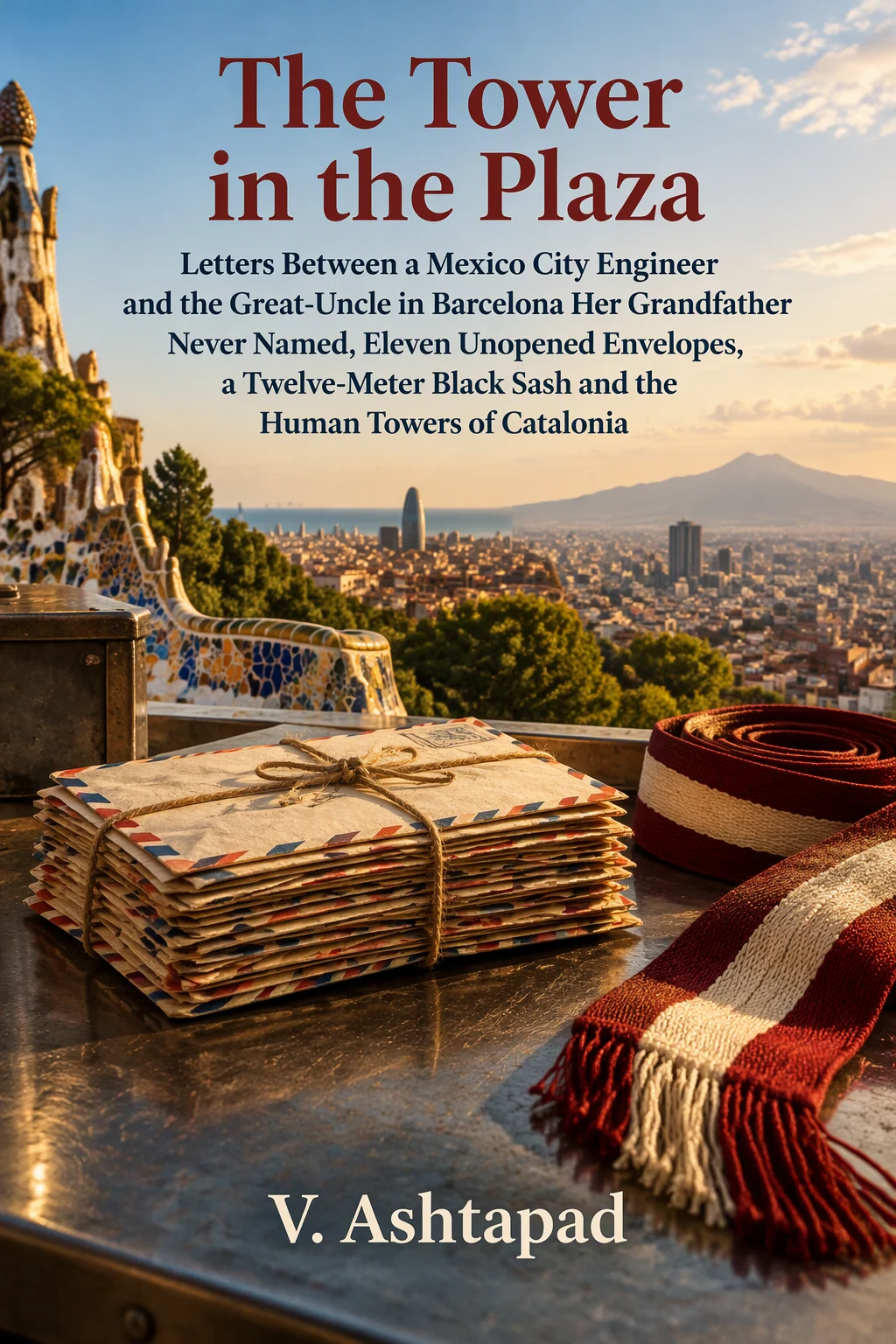
The Tower in the Plaza
Letters Between a Mexico City Engineer and the Great-Uncle in Barcelona Her Grandfather Never Named, Eleven Unopened Envelopes, a Twelve-Meter Black Sash and the Human Towers of Catalonia
by V. Ashtapad
Foreword
This is a work of fiction. The Spanish Republican exile to Mexico, the camp at Argelès-sur-Mer, the ship Sinaia and its arrival in Veracruz in June 1939, the Colegio Madrid, the Model prison in Barcelona, the human towers (castells) of Vilafranca del Penedès and Gràcia, the Festa Major de Gràcia, and the Mexico City earthquakes of 1985 and 2017 and the national drill held on September 19 are real. The Puigvert family, the letters, the sash and every named person in the story are invented.
For everyone standing in the crowd at the bottom, whom nobody sees.
The Bundle Tied with String
*Mexico City, Colonia Narvarte, April 14, 2026*
Dear Mr. Jaume Puigvert Casals,
You do not know me, and I must begin by apologizing for the manner of this letter, which arrives on paper and by ordinary post because the only address I have for you is the one written on the outside of eleven envelopes, and I do not know whether you still live at it. If you do not, I hope whoever receives this will return it, or burn it, and in either case forgive the intrusion.
My name is Mireia Puigvert Ramos. I am thirty-three years old. I am the granddaughter of Ferran Puigvert Soler, who was born in Vilafranca del Penedès in 1932 and who left Catalonia in February of 1939, at the age of six, with his mother, Elisenda Soler, across the border into France, and from there, in May of the same year, on the ship Sinaia from Sète to Veracruz. He lived in Mexico City for eighty-seven years. I am writing to tell you that he died on the second of March, at home, in his apartment on Calle Pestalozzi, two streets from mine, of heart failure, after a short illness. He was ninety-three. He was not in pain at the end, and he was not alone. I was with him, and my father, Arnau, who is his only son, arrived from Guadalajara the following morning.
I believe, from what I have found in his papers, that you are his brother. His half-brother, I should say, to be exact. I know very little more than that, and what I know I have pieced together in the last six weeks from documents, because he never once spoke your name in my hearing. I will tell you plainly how I found you, so that you may judge what I know and what I do not.
My grandfather was a typesetter and later a printer. He worked for forty years at a press in Colonia Doctores that printed books for the exile publishing houses and then, as those closed, for the university and for the government ministries and finally for anyone who would pay. He was an orderly man. His papers were in labeled folders in a steel cabinet: taxes, the apartment, my grandmother's medical file (she died in 2011), his pension from the press, his naturalization of 1946, his correspondence with the Ateneo Español, and so on. In the bottom drawer, under the folder for the apartment, there was a bundle of letters tied with white cotton string. Eleven envelopes. All addressed to him at Calle Pestalozzi, in the same hand, with Spanish stamps. All postmarked from Barcelona, between November of 1977 and March of 1990. The sender's name and address are on the back of each: J. Puigvert Casals, Carrer de Verdi, Gràcia, Barcelona.
None of them has been opened.
I want to be careful in how I say the next thing. I did not open them. They are not addressed to me, and the person to whom they are addressed did not open them during forty-nine years in which he could have done so at any moment. I have thought a great deal about whether I have the right. I have concluded that I do not, unless you, who wrote them, give it.
So this letter has two purposes. The first is to inform you of my grandfather's death, which I believe you have a right to know. The second is to ask you, if you are willing, what you would like done with your letters. I can return them to you unopened. I can destroy them, if you prefer. Or, if you allowed it, I would read them. I will do whichever you say. I will not do anything until I hear from you.
If I do not hear from you, I will keep them, unopened, in the steel cabinet, where he kept them.
I am including my postal address and also my email and telephone number, in case those are easier, although I imagine they may not be.
With respect,
Mireia Puigvert Ramos
---
*Notes kept by Mireia, written the same evening*
I posted it at the Correos de México office on Avenida Cuauhtémoc at a quarter to six, after work, in the first rain of the season, which came down at five as it does, in a single block, as if somebody had turned over a basin. The clerk weighed it and said it would take three to five weeks to Spain, perhaps more, and asked if I wanted to pay for registered post, which was four hundred and twenty pesos. I paid it. Then I worried that a man of eighty-two would not like having to sign for a letter from a stranger at his door, and I almost asked for it back.
I should record why I care, since I have asked myself this all week. I am a structural engineer. I assess buildings. Since the earthquake of September 2017 I have worked almost entirely on retrofits: old apartment buildings in Roma, Condesa, Narvarte, Del Valle, the ones that survived but with cracks in the columns and the façades held up by habit. My work consists of determining what is carrying what. Where the load goes. Which wall that looks like a wall is in fact doing nothing, and which wall that looks like nothing is holding up six floors. It is a habit of mind. I could not look at eleven unopened envelopes in a drawer and not ask what they were holding up.
My grandfather was the person I was closest to in my family, and I did not know him as well as I believed. That is the other reason.
I should also record the apartment, because my father wants to sell it and I do not know how long it will stay as it is. Third floor, no elevator, a building of 1949 with a stair that has settled two centimeters toward the street, which I measured when I was twenty-two and he laughed at me. Two bedrooms. In the second one, the press: not the real press, which was sold for scrap in 1998, but a small tabletop proof press he bought from the shop when it closed, cast iron, painted green, with a case of lead type in the drawers underneath, Bodoni and a Caslon with half its capital letters missing. On it, the last thing he set, still locked in the frame: my name and address, backward, for a set of envelopes he never printed. In the kitchen, a jar of the Spanish paprika he bought at the Mercado de San Juan, a tin of saffron, a bag of beans from Tolosa that a cousin of the press foreman used to bring him, which are past their date by four years. A radio tuned to the university station. On the refrigerator, under a magnet shaped like a sardine, the receipt for his last haircut, from the barber on Avenida Cuauhtémoc, ninety pesos, dated the week before he died.
I have not moved any of it. I go on Sundays and sit at the desk and look at the drawer.
© 2026 CRUNOD LLC. All rights reserved.
A Reply from Carrer de Verdi
*Barcelona, Gràcia, May 22, 2026*
Dear Miss Puigvert,
Your letter reached me yesterday. The postman, who has served this street for twenty-six years, carried it up the four flights himself because I am slow on the stairs now, and waited while I signed for it, and asked whether it was bad news, because, he said, registered letters from América usually are. I told him I did not yet know. That was true.
I thank you for informing me of the death of Ferran Puigvert Soler. I was not aware of it. I will not pretend to a grief that I have not had time or cause to feel. But I recognize the courtesy of your writing, and the care you have taken in your manner of doing so, and I ask you to accept my condolences for your loss, which I understand from your letter is considerable.
I confirm that I am Jaume Puigvert Casals, born in Vilafranca del Penedès in 1944, son of Isidre Puigvert Roig and Berta Casals Miró. Isidre Puigvert was also the father of Ferran. Ferran's mother, as you say, was Elisenda Soler. I am therefore, as you correctly state, his half-brother. I was a teacher of mathematics at a secondary school in Sant Andreu for thirty-six years and I retired in 2009. I was married for forty-four years to Remei Ballart, who died in 2016. I have one son, Marçal, who is fifty-four and lives in Sabadell, and one granddaughter, Meritxell, who is nineteen and studies at the university here and lives with me during the term, as it is cheaper than any room in this city, which is now let out by the night to people who arrive with suitcases on wheels and leave without learning the name of the street.
I have read your letter four times. On the question you ask, I find I am not able to answer it at once. I wrote those letters, the eleven, over thirteen years. I remember writing them. I remember the first one well and the last one well, and some of those in between less well. I do not remember everything I said. I was a different man at thirty-three than at forty-six, and both of those men are, in some respects, strangers to me now.
I would ask you to keep them as they are for the present. Unopened, in the drawer where you found them. I will write again when I have decided.
You say you are a structural engineer. I will tell you that this interested me, and I will tell you why, because I think you have a right to know something about me if I am to ask you to wait. In my youth I was a casteller. You may not know the word. In Catalonia, and particularly in the Penedès, where your grandfather and I were both born, there is a tradition of building human towers in the town squares at festivals. Men, women, and children stand on one another's shoulders, in levels, six, seven, eight, nine, sometimes ten levels high, and the smallest child climbs to the top and raises one hand, and then they all come down again. A tower is only counted complete when it has gone up and come down without falling. I was a casteller in Vilafranca from the age of eleven until I was thirty-one, when I injured my back. Our father, Isidre, was a casteller before the war. I am not certain whether Ferran knew that. I suspect he did not.
I tell you this because it is the only thing I know a great deal about other than mathematics, and because the problem of what carries what is one I spent twenty years thinking about with my body before I ever thought about it with a pencil.
I do not have email. Meritxell has offered many times to make me an account and I have refused, because I have nothing to say in a hurry. You may write to this address.
With respect,
Jaume Puigvert Casals
---
*Postscript, written in a different pen*
The postman's name is Ramon and he wished me to tell you that the stamp you used, with the monarch butterfly, is very beautiful. He collects them.
---
*Notes kept by Mireia, June 2, 2026*
The letter came on a Tuesday, in the afternoon storm. The doorman of my building, Don Faustino, who has been the doorman since before I moved in and treats the mail as his personal responsibility, held it up when I came in dripping from the Metro and said, España, with an expression of great seriousness, as if it might explode. I read it on the stairs.
He writes the way my grandfather wrote. I did not expect that. The same order, the same long careful sentences that set out each fact and then the next, as if the reader might be a lawyer, the same refusal to say more than is needed. My grandfather wrote to the gas company in this manner. He wrote to me in this manner, on my birthdays, a card in an envelope even when we lived two streets apart, with a sentence about my age and a sentence about my work and a sentence about the weather, and at the bottom, "Your grandfather, F. P." I kept every one. I am realizing that the style was not his. It was something older. Something taught in the same schools, perhaps, or at the same kitchen table, by a father who wrote letters from prison and had to fit everything into a page the censor would allow.
I read the part about the towers three times. Then I did something I am a little ashamed of. I went into my grandfather's apartment, at eleven at night, with my key, and I stood in his bedroom and looked at the wall above his bed, where there has always been a small framed print, black and white, that I had never looked at closely because it had always been there. A crowd in a square. Something rising out of the middle of it that I had always taken, as a child, for a statue or a monument, blurred. I took it down and held it under his reading lamp.
It is a tower. A human tower. Seven levels, perhaps. A child at the top with one arm raised.
He slept under it for forty years.
© 2026 CRUNOD LLC. All rights reserved.
What Carries What
*Mexico City, June 11, 2026*
Dear Mr. Puigvert,
Thank you for your reply, and please thank Ramon for me as well. I am enclosing three more butterfly stamps, unused, for him, in a separate small envelope. They are from a series of 2024. I had to go to the philatelic counter at the Palacio Postal on Tacuba to find them, which is a building I had not entered since I was a child on a school visit, and which has a staircase of bronze and marble that I spent some time examining for professional reasons before I remembered why I had come.
I will keep the letters as they are. I will not ask again until you write.
I would like to answer your question about my work, since you were kind enough to tell me about yours. And I would like to say at once that I did not know the word casteller. I have now watched, I am embarrassed to say, perhaps four hours of videos, at night, at my kitchen table, after work. I watched a tower in Vilafranca that the caption said was a 3 de 10 amb folre i manilles, three persons on each level, ten levels high, with two extra rings of support, and I watched it rise and stand and then come down, and I sat at my table with my hand over my mouth like my grandmother used to do when she watched the news.
I watched it as an engineer, you understand. I am not able to watch anything any other way. And I want to tell you what I saw, and you will tell me if I am wrong.
What I saw is that the base, the crowd at the bottom, which the commentator called the pinya, is not a crowd. It looks like a crowd. It is a foundation. Hundreds of people, packed shoulder to chest, arms up, hands pressed under the backsides and thighs of the people above them, so that the weight of the tower does not go only down through the legs of the first level but also outward and down, into the crowd, the way the weight of a building goes from its columns into a mat footing and from the footing into the soil. Each person in the crowd is taking a fraction. Many of them are not even touching the tower. They are touching someone who is touching someone who is touching it. And if they are removed, the tower falls.
That is what I spend my days looking for in Mexico City. Which members are carrying load that nobody can see. In this city it is the soil that is the problem. We are built on the bed of a lake. The Aztecs built on islands in it and the Spanish drained it and built on the mud, and the mud is still mud, and the city sinks, in some places, by forty centimeters a year. When an earthquake comes from the Pacific coast, three hundred kilometers away, the lake bed shakes like a bowl of gelatin, and the waves arrive with a period, I am sorry, a rhythm, that matches the natural rhythm of buildings of six to ten stories, and those are the buildings that fall. In 2017, on the nineteenth of September, I was twenty-four years old, in my first year at a firm in Polanco, and at 1:14 in the afternoon the floor moved, and the alarm on the speakers in the street did not sound until the shaking had begun, because the epicenter was too close. Thirty-eight buildings collapsed in this city. I spent the next six weeks in a hard hat, on a team going street by street in Roma and Condesa marking façades with spray paint, green, yellow, red. Red meant nobody goes in. I painted my first red X on a building where a family I had known since school had lived on the fourth floor. They were not hurt. They never lived there again.
Forgive me. I did not intend to write that much about it.
What I meant to say was that I have spent nine years thinking about how things stay up and why they come down. And then my grandfather died, and I found eleven letters in a drawer with a string around them, and I realized that I had never once asked how my own family stayed up, and why it came down, and who had been standing in the crowd at the bottom that I could not see.
---
May I tell you some of what I know, so that you know what I do not?
My grandfather told me almost nothing about Catalonia. He spoke Catalan with his mother until she died, in 1979, when I was not yet born, and after that he spoke it only to himself, and to the radio when a Barça match was on, and to me when I was very small, a few words, which I have mostly lost. He called me reineta, which my father says is a kind of apple. He told me about the ship. He told me about the camp at Argelès, on the beach, in France, in February, where they slept in holes in the sand with a blanket over them and the wind came off the sea, and his mother traded her wedding ring for a tin of condensed milk. He told me about arriving in Veracruz and the crowd on the dock and a band playing and a man handing him an orange, and that it was the first orange he had eaten in two years. He told me about the Colegio Madrid, the exile school, where he went for three years before he had to leave and work. He told me about the press, a great deal about the press, about lead type and the smell of ink and how to set a page backward and upside down in a composing stick so fast that the foreman could not see your fingers.
About his father, nothing. When I asked, as a child, he said, "My father stayed." When I asked again, as a teenager, he said, "My father stayed and then he made other arrangements." That was all. I do not know what was meant by other arrangements, and I think now I did not want to know.
About you, nothing. You were not in any story.
I tell you this not to wound you. I think it is better that you know where I begin.
Respectfully,
Mireia
© 2026 CRUNOD LLC. All rights reserved.
Permission
*Barcelona, July 3, 2026*
Dear Mireia,
I will call you by your first name if you will allow it, as your letters are signed so, and I will ask you to call me Jaume. I have been Mr. Puigvert to children for thirty-six years and I am tired of him.
Ramon has received his stamps and has put them in an album with a green cover. He sends his thanks.
You may open the letters.
I have thought about this for the five weeks since your last, while the summer came in and the heat with it, so that I now sleep with the balcony doors open and hear every motorcycle on Carrer de Verdi until three in the morning and every delivery van after six. I do not think I was ready to have them read. I am not sure that I am now. But you described my brother's drawer, the steel cabinet and the folders and the bundle under the apartment papers, and it came to me that if I tell you to leave them closed, then I am asking you to do what he did, and I would rather not ask anyone to do that again. Not for my sake. For yours.
Read them in order, please. Meritxell tells me that this is the first thing an engineer would do in any case.
I ask one thing. When you have read them, write to me what you think, but do not write to me what you think he would have thought. I have spent enough of my life imagining that.
---
You have watched the towers, and you have understood the pinya better in four hours of videos than most foreign journalists understand it in a lifetime. I am not flattering you. I taught for thirty-six years and I do not flatter. So I will explain the rest, more exactly, since you will need it.
A castell is named by two numbers. The first number is how many people stand on each level. The second is how many levels there are. A 3 de 8 has three people on each level and eight levels. A 4 de 9 has four people on each level and nine levels. A 2 de 7 has two people on each level, which is much harder than it sounds, because two people cannot make a stable ring, they make only a line, and they must hold each other with their arms across each other's shoulders and the tower stands or falls on the strength of their grip. There is also a pilar, one person on each level, a column of single bodies standing on single shoulders, which is the most beautiful and the most frightening thing I know.
The levels have names. At the bottom is the pinya, which you have seen. Above that, for the largest towers, comes the folre, a second crowd standing on the shoulders of the first, and above that sometimes the manilles, a third. Then the trunk, which we call the tronc: the levels of the strong men and women, the baixos, the segons, the terços, each on the shoulders of the last. Then at the top, the pom de dalt, the head of the tower, which is all children: the dosos, two children; then the acotxador, one child, crouched; and then the enxaneta, the smallest of all, a child of six or seven or eight, who climbs over all of them and stands for one second on the very top and raises one hand. That gesture is called the aleta. When the enxaneta does it, the tower is loaded, carregat. Then the enxaneta climbs down the other side, and every level comes down in order, and when the last of the trunk has reached the ground without falling, the tower is unloaded, descarregat. Only then is it complete. A tower that is loaded but falls coming down is counted, but it is counted as a lesser thing. People forget the coming down. It is the harder half.
There is music. The gralla, a kind of wooden oboe, very loud, and a drum, play a particular tune, always the same tune, from the moment the trunk begins to rise. The tune is in sections and the sections tell the crowd in the plaza how far the tower has come. Old people in Vilafranca who are nearly blind can tell you where the enxaneta is by the music.
Every casteller wears a faixa, a long sash of black cloth, wound tightly around the waist many times, to support the back, and to give the climbers something to hold and step on. A good faixa is perhaps ten meters long. Putting it on requires two people: one holds the end and turns, the other holds the roll and pulls. I wore mine for twenty years. I was a segon, on the second level of the trunk. I stood on the shoulders of a baker named Quimet who weighed a hundred and ten kilos and had the steadiest feet I have ever stood on. Above me, a terç, on my shoulders, a carpenter from Les Cabanyes. I carried him and those above him on my shoulders on four hundred and twelve occasions, by my own count. I did not count to boast. I counted because I am the kind of person who counts.
In 1975, in the autumn, at a festival in Vilafranca, a tower of nine levels fell on its way down and I was at the bottom of the falling part. I injured two discs in my back. I was in bed for eleven weeks. I could not stand in a tower again. I watched from the pinya after that, which is what the old and the injured do. You stand in the crowd at the bottom, at the edge, with your hands up, and you take your small fraction of the weight, and nobody sees you.
I was in bed with my back when Ferran came, in 1976. I will tell you about that when you have read the first letter. It describes it, I think, better than I could now.
With regards,
Jaume
PS: You asked nothing about Gràcia, but you will want to picture where your letters arrive, as I picture Calle Pestalozzi, which Meritxell has found for me on her telephone, with its jacaranda trees and its parked cars and a shop on the corner selling something called tortas.
I live on the fourth floor of a building of 1890 on Carrer de Verdi, which is a long narrow street running uphill toward the park, with a cinema at the bottom that shows films in their original language and a great many bars. When I came here in 1972 with Remei it was a street of workshops: a man who repaired umbrellas, a printer of wedding invitations, a carpenter, a dairy where you brought your own jug, two old women who sold coal from a cellar. Now it is a street of bars and of shops that sell one thing each: one sells only socks, one sells only tea, one sells second-hand records to young men with beards. The umbrella man's son sells sandwiches. I do not object. Streets change, as towers do; the people in them change position. But the rent on the flat below mine was raised last year from nine hundred euros to fourteen hundred, and the family who had lived there for thirty years, a bus driver and his wife and their daughter who plays the gralla, went to live in Cerdanyola, and now there are suitcases on the stairs every Thursday and every Sunday, and people who say hello in English and leave pizza boxes on the landing.
In August, for the Festa Major, the neighbors of each street decorate it from one end to the other, with whatever they can make by hand: paper, plastic bottles cut into flowers, cardboard, wire, old fabric. Each street chooses a theme and works on it at night, all year, in a garage or a ground floor, and for one week the whole of Gràcia becomes a series of rooms, one for each street, roofed in paper. One year our street was the bottom of the sea, and Remei made four hundred fish out of the lids of yogurt pots. The castells are in the Plaça de la Vila on the main day, among all of this. When you hear the gralles from the street, everyone stops what they are doing and walks toward the square, and the old men leave their glasses on the bar.
Our father would have liked Gràcia. He was a Vilafranca man and considered Barcelona a city of people who talked too much. But he would have liked the paper fish.
© 2026 CRUNOD LLC. All rights reserved.
The First Envelope
*Mexico City, July 26, 2026*
Dear Jaume,
I opened the first envelope on the evening of the twenty-third, at my grandfather's desk in the apartment on Pestalozzi, which my father and I have not yet emptied. I used his letter opener, a flat brass one in the shape of a fish, which was given to him by the press when he retired. I want you to know that. I did not tear it.
I am going to copy your letter here, in full, so that you have it in front of you as I had it in front of me. You told me you do not remember everything you wrote, and it seemed to me unfair that I should know what you said at thirty-three and you should not. I have typed it on my computer and printed it, because my handwriting is the handwriting of an engineer, which is to say that it is legible only in capital letters. The original I have returned to its envelope and the envelope to the drawer.
---
*Vilafranca del Penedès, 6 November 1977*
Ferran,
Our father died on Sunday the 30th of October, at a quarter past four in the morning, at home, in the bed by the window, of the same illness he had when you were here. My mother was with him, and I was with him. He knew us until the Friday. On the Saturday he did not know anyone. He was buried on the 1st, in the cemetery here, in the niche next to his own father. Many people came. The colla came, the Castellers, in their shirts, the old ones who had stood with him before the war and the young ones who had only heard of him, and they did not build anything, because you do not build at a burial, but they stood in two lines at the gate in their red shirts, and that is the highest thing they can do for a man.
I have to write to you because he asked me to. On the Thursday, when he still knew me, he asked me to write to you and tell you three things. I promised. I am writing them exactly as he said them.
The first thing. He said: Tell him I never stopped writing.
The second thing. He said: Tell him the faixa is his. Mine. The old one. Tell him it is his and he is to have it.
The third thing. He said: Tell him his mother was right to go.
I do not understand the third thing. I asked him what he meant and he did not answer, and on the Saturday he did not know me, so I will never understand it. I am telling it to you anyway because I promised.
Now I am going to say something for myself.
When you came last year in March and sat in the chair by my bed, I said things about your mother that I am ashamed of. I had been in a brace for five months with my back and I was not myself, but that is not an excuse, I was myself enough. I said she had stolen you and then refused every letter he sent so that he would think you were dead, and that she had done it out of pride, and that she had broken him. I said worse than that. I do not want to write the worse things again. You know what they were. I did not know your mother. I have no right to say what she did or why. I knew only the box of envelopes that came back from Mexico with "unknown at this address" written on them in a woman's hand, which my father kept in the wardrobe and which I had found when I was fourteen, looking for his old faixa. I built a story around that box for nineteen years. When you came, you had built your own story for thirty-seven years. They did not fit. You said what you said about my mother, and I said what I said about yours, and you left.
I am sorry for what I said. Not for being angry. For what I said.
The box of returned letters is yours too, if you want it. There are forty-one of them. Our father wrote them from 1941 to 1953. The first ones are from the Model, the prison, in Barcelona, where he was held until 1943. You can see the censor's stamp. I have not opened them. They are not addressed to me.
He asked about you every week for a year after you left. Then he stopped asking, but he did not stop wondering. I could see him wondering. He would sit at the window and turn his ring.
If you want the faixa and the letters I will send them, or I will keep them for you, whichever you say.
Your brother,
Jaume
---
That is the letter.
You asked me to write what I think, and not what I imagine he thought. I will try. It is harder than I expected, because for fifty days I have been imagining what he thought, and it is a habit now.
What I think is this. I think the young man who wrote that letter was very brave. I do not say that to flatter you either. I have read it eleven times. I have read the sentence "I am sorry for what I said. Not for being angry. For what I said." more times than that. I have never been able to make that distinction in my own life, not once, not with my father, not with my mother when she remarried, not with the man I was going to marry in 2022 and did not. I have always either apologized for everything or for nothing. You separated it with a full stop.
What I think, also, is that there were three boxes of unopened letters in our family, and not one. There were the forty-one my great-grandfather wrote to Mexico and that came back. There were the eleven you wrote to my grandfather and that stayed. And there was a third, which I have not told you about because I found it only on Tuesday, after I had read yours. In the same cabinet, in the same drawer, under the folder of the apartment, under your bundle, flat at the bottom, a single envelope addressed to you. At Carrer de Verdi, Gràcia, Barcelona. In my grandfather's hand. With Mexican stamps from 1978. Stamped, addressed, sealed, and never posted.
It is on my desk now. Next to the brass fish.
I will not open it. It is yours. I will send it to you if you want it.
I will not say what I imagine is in it.
Mireia
© 2026 CRUNOD LLC. All rights reserved.
Meritxell
*From: Meritxell Puigvert Bosch*
*To: Mireia Puigvert Ramos*
*Date: August 2, 2026, 23:48*
*Subject: Hello from your other family (I think)*
Hi Mireia,
I hope it's all right that I'm writing like this. My avi gave me your email from the bottom of your first letter. He said, and I quote him exactly because he is always exact, "You may write to her, since you are of the generation that writes without paper, but be correct." So I'm being correct. Mostly.
I'm Meritxell, I'm Jaume's granddaughter, I'm nineteen, I study biomedical engineering at the UB (so we're nearly colleagues, I think? Avi was very pleased to tell me you are an engineer, he said it three times), and I live with him in the flat on Verdi during the year because rent in Barcelona is a joke that nobody laughs at anymore. A room in a shared flat in Gràcia is six hundred and fifty euros now. My dad lives in Sabadell, which is forty minutes on the train, which I did for my first year, and I'm never doing again.
I'm writing for three reasons.
One. Avi read me your letter about the first envelope. He doesn't read me things usually. He read it at the kitchen table with his glasses on the end of his nose, the whole thing, including his own letter from 1977 that you copied, and when he got to the part he wrote about being sorry, he stopped, took his glasses off, and rubbed them with the corner of his shirt for about a minute, and then put them back and kept reading. Then he folded it and went to bed at nine-thirty, which he never does in August because it's too hot to sleep before one. I'm telling you because he won't tell you. He's fine. He went to the market at the Abaceria the next morning at eight like always and bought peaches and argued with the fish man about the price of the sardines. But I wanted you to know that the letter landed.
Two. About the envelope from your grandfather to him. He hasn't said anything to me about whether he wants it. I think he's deciding. He decides slowly. He took two years to decide whether to change his bathroom tiles. When he's ready he'll write to you himself, so please don't send it until he does, if that's okay.
Three. I've been making a family tree. Not for any special reason, I started it last year after my àvia's anniversary, I wanted to see her family's side, she was from the Ebre delta and had about a thousand cousins. It's online, it's private, only the people I invite can see it, it's the kind where you can put photos and documents and little recordings and everyone in the family can add things. I had our side going back to Isidre and Berta, and Isidre's parents, and a gap. I knew there was a Ferran. Avi told me, years ago, very briefly, the way he tells things he doesn't want to talk about. "My father had a son in Mexico. We do not speak." That's all. So there was a little square on the tree with "Ferran Puigvert Soler, b. 1932, Mexico" and a question mark, and nothing under it.
Would you be willing to fill in his side? I mean, only if you want. You'd have your own login and you could put in whatever you want, or nothing. His dates, his wife, your dad, you. Photos if you have them. I'd really like to see what he looked like. Avi has one photo of him from 1976, from the visit, but it's blurry, somebody took it on the street in Vilafranca with a cheap camera, and he's turning his head away.
Also, I'm in the colla. The Castellers de la Vila de Gràcia. Not Vilafranca like avi was, I'm a Gràcia girl, born in the hospital here. I've been climbing since I was six. I was an enxaneta from six to nine, I did the aleta on top of a 3 de 8 in the Plaça de la Vila at the Festa Major when I was eight, avi was in the pinya and he says he heard me laughing all the way up, which is not true, you can't hear anything but the gralles up there. Now I'm too big for the top, obviously, so I climb in the tronc, I'm a quint, fifth level. Avi hates it. He watches from the pinya with his hand on somebody's back and doesn't breathe for four minutes.
The Festa Major de Gràcia is this month. The castells day is the 16th. If you've watched the videos you've probably seen the Plaça de la Vila, it's the square with the clock tower. You'd see me. Well, you'd see a girl in a red-and-white checked shirt about fifteen meters up. That's me.
I know Mexico City is very far. I'm just saying.
Correctly,
Meritxell
PS: Avi says you watched four hours of videos. He was impressed. He won't say that either.
---
*From: Mireia Puigvert Ramos*
*To: Meritxell Puigvert Bosch*
*Date: August 3, 2026, 07:12*
*Subject: Re: Hello from your other family (I think)*
Dear Meritxell,
Thank you. I read your message at five this morning, because I wake at five, and then I read it again on the Metrobús, on Line 2 along Eje 4, standing up holding the strap with one hand and my phone with the other, and the woman next to me asked if I was all right.
Yes, I would like to be added to the tree. I will do his side carefully, with the dates checked against documents. I have his naturalization papers, his marriage certificate, my grandmother's, my father's birth certificate, the passenger list of the Sinaia with his name and his mother's on it, which I found at the national archive in the old Lecumberri prison, which is a strange place to keep the papers of refugees but there it is. I will scan them properly.
I have many photographs of him. In most of them he is looking at the camera as though it owes him money. I will choose the good ones.
I cannot come in August. I am in the middle of a retrofit on Calle Bajío, a six-story building from 1958 with a soft first floor and a dentist on the ground level who does not want us to close his practice for even one day. I cannot leave.
I am sorry. Please send me a photograph of the girl in the checked shirt.
Mireia
© 2026 CRUNOD LLC. All rights reserved.
The Sinaia
*Mexico City, August 19, 2026*
Dear Jaume,
Meritxell sent me a video. I have watched it perhaps thirty times. A 4 de 8 in the Plaça de la Vila on the sixteenth, in the late afternoon, the light coming low across the square and the clock tower in the corner of the frame, the gralles going, the trunk rising level by level, and at the fifth level a girl with her hair in a tight braid, in a red-and-white shirt, climbing onto the shoulders of the level below and turning to face out, and settling her feet, and holding. I could not see her face. I saw her hands, on the shoulders of the others in her ring. And at the bottom, at the left edge of the crowd, in the pinya, a man in a white shirt with his hand flat on someone's back and his head turned up. I believe that was you. I have the frame paused on my computer as I write this.
It loaded and it unloaded. I watched the coming down, as you told me to. You were right. It is the harder half.
I have now read all eleven of your letters. I am going to write to you about the Sinaia, and about my grandfather's life after, because I think it is owed, and because you have told me about your father and your back and your granddaughter, and I have told you mostly about buildings.
Elisenda Soler, my great-grandmother, was a schoolteacher in Vilafranca. You may know that. She taught in one of the new schools of the Republic, a girls' school, and she was a member of the teachers' union and wrote for a small newspaper, and she was twenty-nine when the war ended. In January of 1939, when the Nationalist army came into Catalonia, she took my grandfather, who was six, and a single suitcase, and walked to the French border with half a million other people. Isidre had gone ahead with his unit. I do not know whether they had planned to meet in France. My grandfather said only that they did not meet.
The camp at Argelès-sur-Mer was a beach fenced with barbed wire. No buildings. They dug holes in the sand. It was February. My grandfather told me the wind came off the sea and put sand in everything, in their bread, in their eyes, in their ears, in the blanket, and that for the rest of his life he could not go to a beach. I took him to Acapulco once, when I was nineteen and had a car, as a gift. He sat in the hotel lobby for three days and would not go outside.
In May, the Mexican government under President Cárdenas sent ships for the Spanish refugees. Elisenda got onto the list for the first one, the Sinaia, because she was a teacher and Mexico wanted teachers. The ship left from Sète on the twenty-fifth of May with about sixteen hundred people and arrived in Veracruz on the thirteenth of June. There was a band on the dock, and crowds, and a man who handed my grandfather an orange.
In Mexico City, Elisenda taught at the Colegio Madrid, the exile school, from 1941 until she retired. She lived in two rooms in Colonia Juárez, and later in an apartment on Pestalozzi, the same one. She did not remarry. My grandfather said she had suitors, refugees, Mexicans, a widowed doctor from Asturias who brought flowers every Sunday for two years, and she turned them all away. As far as anyone in Mexico knew, she was a widow. She wore black for a husband who, I now understand, was alive in Vilafranca and writing to her from prison.
My grandfather left the Colegio at fifteen and went to work at the press as an apprentice. He married my grandmother in 1960, Teresa Llorens, who was also the daughter of exiles, from Valencia, and they had one son, my father, Arnau, in 1962. My father grew up speaking Spanish with the Mexican children in the street and Catalan with his grandmother and something in between with his parents. He became an accountant. He married my mother, Rebeca Ramos, who is from Puebla and whose family has no connection to Spain at all except that her grandfather sold sugar to Spanish shopkeepers. They divorced when I was eight. My father moved to Guadalajara and married again and has two daughters there, my half-sisters, who are nineteen and seventeen and whom I see at Christmas. My mother married again, to Eugenio, a pharmacist from Tlaxcala, who is the kindest man I know and who taught me to ride a bicycle in the Parque Hundido, and they have a son, Leonel, who is eleven and who believes I am the greatest engineer in the world because I can calculate how much weight his bunk bed can hold.
So you see I am also from a family where a father made other arrangements. I have been half of a blended family since I was eight. I have a half-brother on one side and two half-sisters on the other, and none of them have met each other. I did not see the shape of this until I read your 1977 letter. My grandfather's father had another son. My father has other daughters. I have been angry at my father for twenty-five years in a way that I see now I learned from somewhere.
---
The ten letters after the first one I will not copy. You wrote them. I will say only what I noticed, as an engineer.
They become shorter. The first is four pages, the last is half of one page. They become less about the past and more about the present: the colla, Remei, Marçal's birth in 1972, which you describe in the third letter, the death of Franco and the first elections, a strike at your school, the first time you saw a tower of nine levels loaded in Vilafranca after the transition, the Barcelona Olympics, which were being planned. In the sixth letter, in 1982, you stop asking him to answer. In the seventh, you stop mentioning the returned letters and the faixa. From then on they are letters to a brother who is simply far away. As though you had decided to write to the brother you would have liked to have, rather than the one you had, and see if he answered.
In the last one, in March of 1990, you tell him that Berta, your mother, has died. You say she asked after him at the end. You say you are going to stop writing now, because you think the letters may be causing him pain, and you do not wish to cause pain. You say: "If you ever want them, the faixa and the box are in my wardrobe. They will be there as long as I am."
Are they still there?
Mireia
© 2026 CRUNOD LLC. All rights reserved.
The Faixa
*Barcelona, September 4, 2026*
Dear Mireia,
They are still there. They were. As of this morning, the faixa is not, because Meritxell and I took it to the post office on Carrer de Sant Antoni Maria Claret and sent it to you by courier, and the clerk charged me sixty-eight euros and asked me to declare its value for customs, and I did not know what to write. I wrote: "Textile. Used. No commercial value." Which is true. You should receive it in eight to ten days, if Mexican customs is as Meritxell says it is.
I have kept the box of forty-one returned letters. I will tell you why at the end of this.
Now let me tell you about the faixa, so that when you open the parcel you will know what you are holding.
It is black cotton, very heavy, the old kind, woven on a hand loom in Igualada sometime in the 1920s. It is twelve meters long and about thirty centimeters wide. Modern faixes are lighter and shorter. This one is heavy because it was made for a man who stood at the bottom of the trunk, a baix, who carries the most weight of anyone in the tower. Our father was a baix. He stood on the ground with the pinya around him and carried on his shoulders the whole tower above him, every level, every child. He did that from 1927, when the colla in Vilafranca was revived, until 1936, when the war took everyone.
There are stains on it, near one end. I do not know what they are. Some of them may be from the tower. Some of them may be from the war. He wore it under his uniform, rolled at the waist, for the whole war. He said it kept his back straight on the marches. When they took him prisoner at the border in February of 1939, it was the one thing the guards did not take from him, because they thought it was a bandage.
He kept it through four years in the Model. The Model is the old prison in Barcelona, in the Eixample, a building in the shape of a star, which was closed in 2017 and is now a kind of museum. Meritxell took her school class there. He was held in a cell built for one man with eleven other men. He told me once, only once, when I was twenty, that at night they slept in shifts, and he folded the faixa under his head for a pillow, and that the smell of it, of the plaza and the sweat of the tower, was the only thing that let him sleep.
In 1943 he was released, as many were, because the prisons were too full. He came back to Vilafranca. Nobody would employ a Republican. He worked in the vineyards at harvest and carried sacks at the station the rest of the year. He found that Elisenda and Ferran had gone. He was told, by a cousin, that they had both died at Argelès. He believed it for three months. Then a letter came through the Red Cross with an address in Mexico. He began to write. You know the rest. The letters came back.
My mother, Berta Casals, was a seamstress. She worked in a room behind a shop on the Rambla de Sant Francesc, sewing trousseaux for girls who were getting married. She mended our father's shirt in 1943, the one he came out of prison in, and that is how they met. They could not marry. He was married to Elisenda, and in the Spain of those years there was no divorce; the regime had cancelled the divorces of the Republic. So my mother lived with him for thirty-four years as his wife without being his wife, and I was born in 1944 as his son without being his son, legally, until a law changed in 1981. Everybody in Vilafranca knew and nobody said. That is how things were. You learned what not to say in the plaza.
I tell you this so that you understand what I was, in 1976, when your grandfather sat by my bed. I was a man of thirty-two who had been called a bastard in the schoolyard until he was old enough to hit back, and who had seen his mother called worse at the market, and who believed, because it was easier to believe, that all of it was the fault of a woman in Mexico who would not open her husband's letters. And into my room walked her son. He was forty-three. He looked like our father, more than I do. He had the same hands. He sat down in the chair and looked at me in my bed with my back in a brace and said, in a Catalan that was forty years old and had a Mexican sound under it, "So you are the other arrangement."
That is all I will say about it now. I have said the rest into Meritxell's telephone, last week, at the kitchen table. She asked me to. She says it will go into the place on the internet where she keeps the tree, the private one, where only the family can listen. She says she will send it to you. I asked her to wait until you had the faixa.
---
Why I have kept the box.
Because I have decided to open them.
Not all at once. One every Sunday morning, after the market. I have never opened one. They are not addressed to me. But they are not addressed to anyone living now, and you have taught me, without intending to, that a thing kept closed for long enough begins to hold up something it was never meant to carry.
Meritxell will sit with me when I do. She will photograph each one, and the envelope, for the tree. I asked her to give each one a caption with the date and nothing else. No interpretation. She agreed, although she is nineteen and has opinions about everything.
I would like you to have copies. I would like you to tell me, when you have read them, what you think. Not what you imagine Elisenda thought.
Your great-uncle,
Jaume
PS: Ramon asks whether there is a stamp with an axolotl. Meritxell says this is a Mexican salamander that does not grow up. I told him I would ask.
© 2026 CRUNOD LLC. All rights reserved.
A Letter from Guadalajara
*Guadalajara, Jalisco, September 9, 2026*
Mireia,
I am writing you a letter because you will not answer the telephone when I call about this, and because your grandfather taught me that when a thing must be said carefully it should be said on paper, where you cannot interrupt and I cannot raise my voice. I am aware that this is the method you have been using with the man in Barcelona. I am aware that you learned it from the same person I did.
Your mother tells me that a parcel is coming for you from Spain. She tells me it is some kind of belt that belonged to my grandfather. She tells me you are in correspondence with Jaume Puigvert and his granddaughter and that you have been putting my father's documents on a website. I would have preferred to hear this from you.
I want to say first that I am not angry with you. I am tired, and I am sixty-four, and my father has been dead six months, and I have not finished sorting his apartment because every time I go into it I sit down in his chair and do not get up again. I know that you have been doing most of the work there and I am grateful. Your mother says you go every Sunday. I go once a month and leave after an hour. That is the truth and I will not dress it.
But I want you to understand something about your grandfather that I do not think you understand, because you were his favorite and he showed you a different face than he showed me.
He was not a man who forgot things. He did not leave those letters in the drawer because he could not be bothered. He left them in the drawer because he had decided. Your grandfather made decisions the way he set type: once, backward, upside down, and fast, and then he locked the frame and it did not move. He decided in 1976, when he came back from Spain, that he had no father and no brother there, and he never changed it. He told me so. I was fourteen. He sat me down at the kitchen table on Pestalozzi when he came home from the airport, with his suitcase still in the hall, and he said, Arnau, my father is dead to me and so is his son, and you will not ask me about them again. And I did not, for fifty years.
You are now undoing his decision. You are opening his drawer. You are sending his photographs to the son of the woman who replaced his mother.
I am not telling you to stop. You are thirty-three and an engineer and you have never once in your life stopped because I told you to. I am telling you that you are doing something he did not want, and that I do not know if I will ever be able to look at it. When you put him on that tree, beside that man, you put me there too, and nobody asked me.
There is one other thing. Your mother says you found an envelope addressed to Jaume, in my father's handwriting, from 1978, never sent. If that is true, I ask you not to send it. Not to him and not to anyone. It belongs to my father and therefore to me. Please bring it to Guadalajara at Christmas, sealed, and I will decide what to do with it.
Your half-sisters send their love. Regina has been accepted to study architecture at the ITESO. She asked me to tell you, because she wants to ask you questions and is afraid you will think they are stupid.
Your father,
Arnau
---
*Mexico City, September 13, 2026*
Papá,
Thank you for writing. You are right that I would not have answered the telephone.
I will not send the envelope to anyone. It is on my desk. I will bring it at Christmas. It was always going to be yours or his, and I did not know which, and I am glad one of you has decided, even if it is not the one I hoped.
I am not going to take Abuelo off the tree. I have put in his dates, his parents' names, his wife, you, me. I have put in four photographs. I have put in the passenger list of the Sinaia and his naturalization papers. Nothing private. Nothing about you except your name and your year of birth. If you want your name removed I will remove it. If you want your daughters' names added, they will need to say so themselves.
I am not undoing his decision. He made his decision. It will be there forever, in the drawer, in the fact of eleven unopened envelopes and one unsent one. I cannot change that and I do not want to. What I am doing is making a different decision of my own, about my own great-uncle, whom I did not choose to have and who did not choose to have me.
Tell Regina to write to me. Tell her there are no stupid questions about load paths. Tell her that the first thing she should learn is that nothing is ever held up by only one thing, no matter how it looks.
And Papá. When you go to the apartment and sit in his chair and cannot get up, call me. I am two streets away. I will come and sit on the floor.
Mireia
---
*From: Regina Puigvert Lomelí*
*To: Mireia Puigvert Ramos*
*Date: September 15, 2026, 22:03*
*Subject: dumb question (Papá said there aren't any)*
Hi Mireia,
Papá said I could write you and that you said there are no dumb questions about load paths. So here is my dumb question. In the first week at ITESO they made us build a tower out of spaghetti and marshmallows and put a book on top and mine fell over and the boy next to me who has never done anything in his life except play FIFA built one that held three books. Why? Mine was taller and I used more spaghetti.
Also, a not-engineering question. Papá came home from Mexico City last month and sat in the car in the garage for twenty minutes before he came inside. Mamá says it's because of Abuelo. He doesn't talk about Abuelo with us. I only met him like six times. Was he nice? I remember he gave me a little block of metal with my name on it, backward, and I didn't understand it, and I was six, and I lost it.
You don't have to answer the second one.
Regina
---
*From: Mireia Puigvert Ramos*
*To: Regina Puigvert Lomelí*
*Date: September 16, 2026, 05:40*
*Subject: Re: dumb question (Papá said there aren't any)*
Regina,
Yours fell because it was taller and had more spaghetti. A tall thin tower is not strong, it is only tall. His was probably short and wide at the bottom, with triangles. Look at any tower that stands: the width is at the bottom, and the triangles are everywhere. Next time spend half your spaghetti on the lowest third. Nobody will look at it. It will do all the work.
He was nice, with conditions. He was nice the way a good table is nice: it holds what you put on it and it does not tell you how it feels about it. The block of metal was a piece of type. He set your name in lead, backward, because that is how type is, so that when it is printed it comes out the right way round. He did that for every grandchild. I have mine on my desk. I will make you another one. There is a proof press in his apartment and half a case of letters, and I think I can find a V.
Papá sits in the car because he does not know where to put it yet. Leave him there. Bring him a coffee.
Mireia
© 2026 CRUNOD LLC. All rights reserved.
Into the Telephone
*Transcript of a recording made on August 28, 2026, at Carrer de Verdi, Gràcia. Recorded by Meritxell Puigvert Bosch on her telephone and saved to the family's private space with the tree. Translated from Catalan by Meritxell for Mireia, with some words left as he said them. Pauses marked.*
MERITXELL: It's on. You can start, avi.
JAUME: Start where?
MERITXELL: Wherever you want. March of '76.
JAUME: The telephone does not mind if I start somewhere else?
MERITXELL: The telephone does not mind anything.
JAUME: Good. Then I will start with the weather, because that is how I remember it. It was raining. Not hard. The thin rain that comes up from the sea in March in the Penedès and makes the vines black. I was in bed in the house on Carrer de la Parellada, the back bedroom, the one that looked onto the courtyard with the fig tree, because the front one was too noisy and I could not move to close the shutters. I had been in the brace since October. Your àvia came twice a day from her parents' house to read to me. We were not married yet. She read me Pla, Josep Pla, the long book about the year he was twenty, and I would fall asleep and she would keep reading.
That afternoon my mother came in and said there was a man downstairs asking for Isidre. She said he had come from Barcelona by train and walked from the station. She said he spoke Catalan strangely. She said, I think it is him.
I knew who she meant. Everyone knew there was a boy in Mexico. Nobody said it. My mother went pale as flour.
Our father was not at home. He was at the doctor in Vilafranca, the first time, about the stomach. So the man came up to me instead. My mother brought him up the stairs. I heard him on the stairs before I saw him. He had a heavy step. Like our father's.
He was forty-three. He was wearing a suit, a grey suit, too warm for March, and he had a raincoat over his arm, wet, and he held a hat. Nobody wore hats anymore in Spain in 1976 except old men. He looked like a man from a film from 1950. He looked like our father when our father was young, in the one photograph we have from before the war, in the plaza, in his faixa, with his arms around the baixos on either side.
He stood at the end of the bed and looked at me, in the brace, and I looked at him. My mother left. I do not know how long we looked. Then he sat down in the chair by the bed, the wicker one, and put the wet raincoat on his knees, and said what he said.
MERITXELL: Which was?
JAUME: You know which.
MERITXELL: For the recording, avi.
JAUME: He said, Així que tu ets l'altre arranjament. So you are the other arrangement.
[pause]
JAUME: I want to say for the recording that he was not being cruel. I thought so for forty years. I do not think so now. I think it was the only sentence he had prepared. I think he had sat on the airplane for fourteen hours and the train for one hour and walked from the station in the rain practicing a sentence, and that was the one, and he said it because it was the only thing in his hand. Like a man who comes to a door with one key.
What did I say. I said, And you are the one who left.
He said, I was six.
I said, Your mother was not six.
And then it began.
[pause]
MERITXELL: You don't have to say the rest.
JAUME: I have said it to nobody for fifty years. Your àvia knew. Nobody else. I will say it once. Then the telephone can keep it and I do not have to.
He said our father had abandoned them. That Elisenda had waited in Mexico for a letter for ten years and none had come. That she had worn black. That she had raised him alone on a teacher's pay in two rooms. And that meanwhile our father had made other arrangements. With a seamstress. And a son. He said seamstress in a certain way.
I said that was a lie. I said our father had written for twelve years and every letter had come back with unknown at this address in Elisenda's own hand, and that I had found the box of them when I was fourteen, and that she had done it out of pride, out of politics, because our father had been taken in the war and she had got out, because she would not have her son raised under Franco by a man who had lost, and that she had let our father believe for twelve years that his son did not want him.
He said I was lying. He said his mother would never.
I said, I can show you the box.
And he said, I do not want to see a box. I want to see my father.
And then I said the thing about his mother. I will not say it now. It was the worst thing I have ever said in my life. It was about why a woman alone in Mexico City might have wanted a husband to stay dead. It was low. I knew it was low while I was saying it. I was thirty-one and in a brace and in pain for six months and I had been called the son of a whore in the schoolyard for being the son of the other arrangement, and I gave all of it to him at once.
He stood up. He put on his raincoat. He did not shout. He said, very quietly, the thing about my mother. Which I will also not say. It was the same thing. He gave it back to me exactly.
Then he went downstairs, and out, and our father came home from the doctor twenty minutes later, and my mother said, He was here. And our father put his coat back on and went to the station, in the rain, with his stomach, and the train had gone.
[long pause]
JAUME: They met the next day. In Barcelona. Our father went on the first train. I do not know where they met or what they said. Our father came home that night and sat at the window and turned his ring and did not tell us. Ferran flew back to Mexico two days later. That is all I know.
MERITXELL: Avi.
JAUME: The photograph. The blurred one. Somebody's cousin took it in the street outside the station in Vilafranca, by chance, because he was a stranger in a hat. He is turning away. I have kept it in my wallet since 1976. That is also all.
MERITXELL: Do you want to stop?
JAUME: Yes. Turn it off.
[recording ends]
---
*From Meritxell, appended below the transcript:*
Mireia, he asked me to send you this after the faixa arrived, and Ramon tells us the parcel was delivered on the 15th, so I'm sending it today. He asked me to add one thing that he didn't say in the recording. He says: tell her that her grandfather met our father the next day in Barcelona, and I do not know what was said, and I believe now that the third thing our father asked me to write in 1977, that his mother was right to go, was something he said to Ferran in Barcelona that day, and I believe Ferran answered it in the envelope that he did not send. He says he does not want you to send it. He says it should go to your father. He says your father is its owner now, the way the faixa is yours.
He went to bed at nine-thirty again. He's fine. He's making me buy sardines in the morning.
M.
© 2026 CRUNOD LLC. All rights reserved.
The Rains
*Mexico City, September 21, 2026*
Dear Jaume,
The faixa arrived on the fifteenth. The courier rang at seven in the morning, in rain, and I signed for it on the stoop of my building with water running off the edge of the awning onto the parcel, and I carried it upstairs and did not open it until the evening.
I want to tell you what it was like to open it. I want to tell you exactly, since you are a man who counts.
It was wrapped in brown paper and inside the brown paper in a cotton pillowcase, white, with a border of blue embroidered flowers, which I imagine was Remei's, or Berta's, and I have not washed it. Inside the pillowcase the faixa was rolled, tight, the way you must have rolled it, like a bandage, a cylinder about the size of a large loaf of bread. It is heavier than I expected. I weighed it on my kitchen scale because I could not help myself. It weighs two kilos and three hundred grams.
I unrolled it on the floor of my apartment. My apartment is not large. Twelve meters is longer than my apartment. I unrolled it from the kitchen down the hallway and through the living room and out onto the balcony, where the end of it lay on the wet tiles, and I left it there. I sat on the floor in the middle of it. It smells of something old and dry. Of a cupboard. Under that, if I put my face close to it, very faintly, I believe I can smell something like salt, like a person. I know that is not possible after a century. I am telling you what I believe, not what is possible.
I found the stains you mentioned. Near one end. Brown, faded. I did not try to interpret them.
Then my half-brother, Leonel, who was staying with me for the weekend because my mother and Eugenio had gone to a wedding in Tlaxcala, came out of the bathroom and saw his sister sitting on the floor in the middle of a twelve-meter black cloth and said, in a tone of great respect, "Güey, what is that." I told him. I showed him the videos. I showed him Meritxell in the checked shirt at fifteen meters. He watched them for two hours. He is eleven and does not watch anything for two hours that is not a game.
Then he asked me to wind it on him.
I did not know how. Meritxell sent me a video at midnight her time of how it is done. One person holds the end of the faixa against the waist and turns slowly in place, while the other holds the roll at a distance and pulls it tight. Leonel held the end at his waist and turned, and I stood in the hallway with the roll, and he turned and turned toward me, and the faixa wound around him, tighter and tighter, and he was laughing because it squeezed, and then he stopped laughing, because it was holding him up. He said so. He said, "It's holding me up." He stood very straight. He is a slouching child. I have never seen him stand that straight.
He wore it for an hour. He walked around the apartment in it. Then he asked me to take it off, and I unwound it, which is harder, and rolled it back up, and he went to bed and asked me, with the light off, whether the towers had a word of the day, like his school app has an English word of the day and Eugenio has a Nahuatl, sorry, not Nahuatl, Eugenio has a word from his grandmother's town in Tlaxcala on his phone every morning, which he reads out at breakfast.
I said I would find out. Meritxell found out. There is an app from the Catalan government, she says, that gives you a word a day with a recording. Leonel has it now. The word on Thursday was pluja. Rain. He said it at breakfast with a Mexican accent and Eugenio repeated it and my mother laughed. It has rained in Mexico City every afternoon for four months.
---
I want to say two other things.
The first is that I have read the transcript of the recording. I have listened to the recording itself, in Catalan, which I mostly cannot understand, perhaps one word in five, but I listened to your voice for twenty-three minutes and that was something. I will not tell you what I imagine my grandfather felt in that chair. You asked me not to. I will tell you what I think. I think that the sentence he had prepared on the airplane was the wrong sentence, and he knew it the moment he said it, and that for fifty years he could not forgive himself for having had only one sentence. I think that is what the unsent envelope is. A second sentence. Too late.
I think that is also what your eleven letters are.
The second thing. Today is the twenty-first of September. Two days ago, on the nineteenth, at noon, the whole city did the national earthquake drill, as we do every year now on that date, because two great earthquakes struck on that date, in 1985 and in 2017, thirty-two years apart. The alarms went off on every corner, the long wailing alarm, and everybody in my office walked down the stairs, eleven floors, in order, and stood in the street. In the drill nobody hurries and nobody speaks. You stand in the street for ten minutes with your colleagues in their good shoes and look up at the buildings. It is the only ten minutes of the year in which this city is quiet.
I stood in the street on Calle Bajío, where my retrofit is, and I looked at my building, the one from 1958 with the dentist on the ground floor. We have finished the new steel braces on the first level. Diagonal, in pairs, two on each face, painted grey so that the residents will not complain. From the street they look like nothing. They look like somebody's mistake. They will carry the whole building sideways if the ground moves.
And I thought of the pinya. Of you in the crowd at the bottom with your hand on someone's back.
I have bought a ticket. Barcelona, the second week of November. I know it is the end of the season. Meritxell says the colla will do one more performance, in the Plaça de la Vila, on a Sunday, a small one, for the end of the year, nothing like August. She says the old men will be in the pinya. She says I can stand in it, if I wear dark trousers and a white shirt and take off my watch and my earrings. She says nobody will expect me to know anything. She says you have not been told.
I am telling you. I do not want to arrive as a surprise. Our family has had enough of people arriving in doorways with only one sentence.
Mireia
© 2026 CRUNOD LLC. All rights reserved.
Instructions for the Plaza
*Barcelona, October 7, 2026*
Dear Mireia,
I have been told now. By Meritxell and by you, in that order, which I am informed by Meritxell is the order she wished it to be, so that I could be angry at her and not at you. I was not angry. I want you to know that I read your letter at the kitchen table and then I went out onto the balcony and stood there for some time, looking at Carrer de Verdi, at the bar opposite with its tables out in the October sun and the young people drinking vermouth at noon as if it were a reasonable thing to do on a Wednesday, and then I came back inside and began this.
You will need instructions. I am a teacher. I will give them in order.
One. The performance is on Sunday the fifteenth of November, at noon, in the Plaça de la Vila. It is the closing of the season for the Gràcia colla. It is small, as Meritxell says. Two or three towers of seven levels, perhaps an eight if the weather is good and the trunk is confident. There will be perhaps four hundred people in the plaza: the colla, the families, the neighbors, the old men from the bar on the corner who come out with their glasses, and a few tourists who have wandered up from the Passeig de Gràcia and do not know what they are seeing and film it on their telephones anyway.
Two. Wear what Meritxell told you. Dark trousers. A white shirt with long sleeves that you do not mind being pulled. Shoes you can stand in for an hour that have soft soles; nobody in the pinya wears hard shoes, because the people in the lowest level of the trunk sometimes need to step back onto feet. No watch. No earrings. No rings. No belt with a buckle. Nothing in your pockets that is hard. Tie your hair back. Anything hard on your body may injure someone who falls against it.
Three. Meritxell will meet you at the colla's premises, which are in a former garage on Carrer del Torrent de l'Olla, at ten. She will introduce you to the cap de pinya, the person who directs the base. His name is Toni and he is a plumber and he will look at you for three seconds and decide where you stand. Do whatever Toni says. Toni has been building the pinya for twenty years and has never let a tower fall through the bottom. If he tells you to stand in the fourth ring with your arms up and your face against the back of a large man from Badalona, then that is where you stand, and you do not ask why.
Four. In the pinya, there are three things you must do, and nothing else. Put your arms up and your hands flat against the back or shoulders of the person in front of you. Push forward and up, not hard, steadily, the whole time. And keep your head down. Never look up. The tower is not for you to see. If someone falls, they will fall onto the crowd, and if your head is down they will fall onto your shoulders and your back and not onto your face. Every person in the pinya is a cushion as well as a foundation. That is the arrangement.
Five. You will not see anything. I want you to understand this before you come so you are not disappointed. You will be in the crowd with your face against a stranger's back and your arms up, and you will hear the gralles begin the tune, and you will feel the weight come, very slowly, down through the bodies in front of you and into your hands, and you will not see the tower rise, or the enxaneta make the aleta, or the coming down. You will only feel it. You will know it is loaded when the crowd shouts. You will know it is unloaded when the weight goes and the person in front of you turns round and puts their arms around you, which they will, even though they do not know you, because that is what is done.
Six. I will be there. I am eighty-two and my heart has a small machine in it since February which a doctor at the Hospital del Mar installed in forty minutes and which Meritxell checks every evening on her telephone, but I am still in the pinya. I stand in the outer ring, on the left side as you face the town hall, with the old men. We are not much use. We are there because it is our place. Toni lets us stay because he says that a pinya with no old men in it is a pinya that has forgotten how to fall.
I do not know where Toni will put you. If he puts you near the outer ring I will see you. If he puts you deeper in, I will not, and I will look for you afterward.
---
Seven. This one is not an instruction. It is a thing I have been told to tell you by my son, Marçal, who telephoned me last night from Sabadell after Meritxell had told him. Marçal does not telephone much. He is a quiet man, an electrician for the railways, and he took after his mother rather than me. He asked me whether I was going to talk to you about the box.
I have now opened all forty-one of our father's letters to Elisenda. One each Sunday, as I said, after the market. Meritxell beside me with her telephone. Then, because I am impatient and old, the last twenty-two in one week.
What is in them I will keep for now. I will say that they are love letters and that they are also not. That the first ones, from the prison, are about bread and about the color of the light in the yard and about Ferran's teeth, whether they have come in. That later ones are about vineyards and about the price of things. That he never once mentions my mother. That the last one, from 1953, is two lines long.
And I will say this. There is no letter from Elisenda. There is only the envelope. The envelopes are what came back, with unknown at this address written on each, in a woman's hand, forty-one times. I have looked at them under the lamp with a magnifying glass, as a teacher looks at handwriting on an examination. The hand is the same on every one. It is a schoolteacher's hand. Very correct. Very upright. It does not shake on the first and it does not shake on the forty-first.
I do not know why she did it. I will never know. I have decided, at eighty-two, that this is acceptable. I would like to have known. But there is a difference between a thing I do not know and a thing I have decided, and for fifty years I treated them as one.
Meritxell has photographed every envelope. She has put them in the private space with the tree, with captions: date, and the word "returned," and nothing else. Elisenda's square on the tree is next to our father's, and next to my mother's, Berta's, on the other side. Three squares in a row. Meritxell says the program draws a line from our father to each of them. Two lines. She asked me whether that was correct. I said it was correct.
Your great-uncle,
Jaume
PS: Ramon has been sent an axolotl by somebody in Mexico. He did not tell me who. He came up the four flights to show me.
© 2026 CRUNOD LLC. All rights reserved.
Plaça de la Vila
*Barcelona, Gràcia, Sunday, November 15, 2026, 8:10 a.m. Written in a notebook at a table outside a bar on the Plaça de la Vila. Never sent; there is no address for it.*
Avi,
It is cold. Nobody told me Barcelona would be cold. I am wearing dark trousers and a white shirt with long sleeves under my jacket and soft shoes, and I have taken off my watch and my earrings and put them in an envelope in my hotel room on Carrer de Bonavista, and my hair is tied back, and my hands are cold around a cup of coffee that cost one euro and eighty cents and is better than any coffee in Narvarte, I am sorry to tell you.
The square is almost empty. A man is hosing the stones. The clock tower says ten past eight. There is a smell of wet stone and of bread from a bakery somewhere behind me and of the bleach the man is using. Pigeons. A woman walking a very small dog in a coat. The balconies around the square have their shutters closed. On one of them somebody has hung a flag, red and yellow stripes, and on another a towel, and on another a cage with a canary in it, singing at nobody.
I arrived on Wednesday. I have not seen him yet.
That is not exactly true. I have seen him from a distance. Meritxell took me on Thursday evening to the colla's rehearsal in the garage on Torrent de l'Olla, and he was there, on a bench at the back by the wall where the old men sit, in a grey cardigan, with a plastic cup of water. He did not get up. She did not take me to him. We had all agreed, it seems, without saying it, that the first time would be today, in the square, in the pinya. I watched him for two hours across the garage while the trunk practiced and the children climbed in their helmets and Toni the plumber shouted. He watched me once, for perhaps four seconds, and then looked at the children again.
He has your hands. I saw them on the cup.
Meritxell walked me back to my hotel afterward, through the streets, which are narrow and full of small shops selling things that are mostly closed at night, a cobbler, a shop for bicycle parts, a shop that sells only olives, and the bars all open with the people standing outside them in coats talking very loudly, and she told me that he had asked her, that evening, in the kitchen, before she left, whether I looked like you. She did not know what to tell him. She had only seen the photographs on the tree. I told her yes. I told her I have your forehead and your temper and nothing else.
---
I brought something. I should tell you, since you cannot stop me.
Not the envelope. The envelope is in Guadalajara. I did not wait for Christmas. In October I drove it there myself, six hours on the highway through Querétaro and the long dry stretch past León, and put it in his hand at his front door and drove back the next morning. Papá called me last week. He has not decided to open it. He said he has put it in his own desk, in his own drawer, under his own papers. I did not say anything. I am learning, avi, from all of you, that some things you put down and leave for the next person.
What I brought is the faixa. Rolled in Remei's pillowcase. It is in my bag on the chair next to me now. I do not know what I am going to do with it. I cannot wear it. I am not a baix, I am a structural engineer of sixty-one kilos with a weak left wrist. Meritxell says I could give it to him to hold. She says he could put it on, under his cardigan, for the pinya, if he wanted, the way Isidre wore it under his uniform. She says it would be the first time in ninety years it has been in a tower. I do not know if that is something to do or a sentimental idea of a granddaughter who has watched too many videos. I have been sitting here for half an hour deciding and I have not decided.
Perhaps I will give it to him and let him decide. That seems to be the arrangement.
---
8:40. The square is filling. Families with strollers. A man selling roasted chestnuts from a cart at the corner of the square, the smoke from his brazier blowing across, which makes everything smell of November. The colla is arriving in groups, in their checked red-and-white shirts, carrying their faixes rolled under their arms like loaves. The children in their helmets, chasing each other around the base of the clock tower. Somebody is testing a gralla behind the town hall, three notes, very loud, which made the canary stop singing.
I can see Meritxell. She is standing by the door of the town hall with a boy who is holding the end of her faixa while she turns. Around and around. She is laughing.
I have not seen him yet.
---
9:05. I see him.
He has come in from the corner by the bakery, slowly, with a man of about fifty-five who I think is Marçal, his son, holding his elbow, which he is shaking off. He is wearing a white shirt. No cardigan. Dark trousers. He has stopped at the edge of the square and is looking around it, at the balconies, at the clock, the way an engineer looks at a building he has been told is sound.
He has not seen me. I am at the bar on the far side, under the awning. I could raise my hand. I could stand up.
Avi, I had a sentence prepared. I practiced it on the airplane for twelve hours and on the train from the airport. It is in Catalan. Meritxell helped me with it. I am not going to tell you what it is, because I have just decided not to say it. It is a good sentence. It is the only one I have. And I have learned, from your fifty years, what happens when you go to a door with only one sentence.
So I am going to go without one.
The gralles have started. Not the tower tune yet, the walking tune, the one they play to bring the colla into the square. Toni is shouting names. The pinya is beginning to form at the center, people pressing in, arms up. He is walking toward it, toward the outer ring, on the left side as you face the town hall. Where he said he would be.
I am putting this notebook in my bag next to the faixa. I am going to take off my jacket and leave it on this chair, and I am going to walk across the square with the bag. I do not know what I will say. I do not know if Toni will put me near him or deep inside where I cannot see anything at all, with my face against the back of a large man from Badalona. I do not know if the tower will stand. I do not know if, when it comes down and the weight goes and the person in front of me turns around, it will be him.
He has seen me. He is standing still.
The tune has changed.
© 2026 CRUNOD LLC. All rights reserved.
If this book stayed with you
A Different Voice
A Barcelona Inspector, a Painted Maltese Clock and the Ninety-Year-Old Witness Nobody Heard, from the Andorran Mountains to Valletta, Rome and San Marino
Another family story rooted on Carrer de Verdi in Gràcia, where an heirloom carried between countries brings relatives who stopped speaking back into the same room.
About this book
When her grandfather dies at ninety-three, Mireia Puigvert finds a bundle of eleven letters in his steel cabinet, tied with string, sent from Barcelona between 1977 and 1990. None of them has ever been opened.
Mireia is a structural engineer who has spent nine years since the 2017 earthquake asking which wall in a Mexico City building is really carrying the weight. So she writes to the sender, an eighty-two-year-old retired math teacher on Carrer de Verdi, and asks his permission before she reads a word.
His name is Jaume. He is her grandfather's half-brother, the son of what her grandfather called "the other arrangement." In his youth he stood on the second level of the human towers of Vilafranca, and he explains them to her in letters as carefully as a lesson: the crowd at the base, the child at the top, and the coming down, which is the harder half.
Between them are three sets of letters nobody opened, a black sash wound around a prisoner's waist through a war, and a sentence spoken in 1976 that neither family has forgiven. If a family can be rebuilt one level at a time, who will stand at the bottom?
Members can react to this book and talk about it in the members' Library.
Ownership
© 2026 CRUNOD LLC. All rights reserved.
This book is owned by CRUNOD LLC. It is free to read on EternalCurrent.Online. No part of it may be copied, reprinted, sold, recorded or adapted, including as audio, film or translation, without written permission from CRUNOD LLC.
© 2026 CRUNOD LLC. All rights reserved.