Two Counts of the Same Herd
A Sami Grandmother's Tally, Her Grandson's Collars and Drone, and the Winter the Pasture Turned to Glass
by V. Ashtapad
Foreword
This is a work of fiction. Reindeer herding on the Finnmark plateau near Karasjok, earmarks, GPS collars and drones in modern herding, rain-on-snow winters that lock the lichen under ice, hanging tree lichen, supplementary feeding, the polar night and the return of the sun, February 6 and everyday gakti are real. The Somby and neighboring families, the cabin, the winter land and every named person are invented.
For the herders who count in pencil and those who count by satellite, and for the winters that need both.
Skábma
The count, 2 December. Winter land, the cabin at Ávžejohka. Minus 19. Calm. Snow 40 cm, soft, good digging. Herd by the lake and up the east slope. Bell female with the torn ear seen. The gray with the white face seen, and her calf. Saw 611 from the hill with the glasses. The rest in the trees. Niillas came.
---
The sun had not come up for six days and would not come up again until the middle of January, and Niillas Somby drove the last forty kilometers from Karasjok to the winter cabin in the blue noon light with four plastic crates strapped to the sled behind his snowmobile, and the crates held forty GPS collars, and he had paid for twenty-two of them himself.
The light in the polar night is not dark. People who have never been north think it is dark. It is blue. For three or four hours in the middle of the day the sky to the south goes pale, a deep cold blue at the top and something like pink at the bottom, at the edge of the land, where the sun is, just below, not coming. The snow takes the light and gives it back blue. The birches stand in it gray and black. The plateau goes away flat and white and blue in every direction to the low hills, and there is no shadow anywhere, because there is nothing to make one.
He had grown up in this light. He had been away from it for five years, in Tromsø, at the university, studying engineering, and then in Trondheim for the master's, and every December he had come home to it for Christmas and been surprised again by how blue it was.
The cabin was where it had always been, at the edge of the birches above the lake, red, with a white door and a metal chimney and a woodshed and an outhouse and two old sheds and the feeding fence behind, a long enclosure of mesh and posts that his father had built in 1997, the bad winter. Smoke was coming out of the chimney straight up. There was a light in the window.
His grandmother was in the window.
He could see her from the lake. A small dark shape against the yellow light, at the table, with something in front of her. Not looking out. Writing.
---
"You're late," said Risten Somby.
She did not get up. She was seventy-nine, and she had been sitting at that table in that window every winter of his life, and every winter of his father's, with her notebook and her binoculars and her coffee. She was very small and very upright in a blue wool sweater with a white pattern around the neck that she had knitted in 1983, her hair white and cropped close, her face was brown and lined from fifty winters of wind, and her eyes were very pale gray, almost colorless, the color of the light outside.
"The road was bad from Karasjok," said Niillas. "Ice at the bridge."
"The road is always bad from Karasjok." She closed her notebook. She looked at the crates on the sled through the window. "So. Those are the collars."
"Forty."
"Your father said you were bringing collars. He said twenty. Now you've brought forty."
"I bought twenty-two myself."
She looked at him. A long time. With the pale eyes.
"With what?"
"My savings. From the job in Trondheim. The summer job."
"So you've spent your savings," said his grandmother, "on necklaces for reindeer."
He had prepared for this. He had prepared for it in Trondheim, in his rented room above the bakery, with his laptop, and on the plane to Lakselv, and on the bus to Karasjok, and on the snowmobile. He had a list. He had numbers. He had the reports from the herders in Sweden and in Finnmark who were using them already, and the graphs, and the maps.
He looked at his grandmother in her blue sweater at the table and forgot all of it.
"Yes, áhkku," he said. "Necklaces for reindeer."
And Risten Somby laughed. Short, surprised, like a dog barking once.
"Take off your boots," she said. "There's bidos. Your father's in the shed with the machine. Sit down and eat before you start telling me why I don't know how to count."
---
The bidos was in the pot on the stove where it had been, as far as he could tell, since he was born. Reindeer meat, in chunks, boiled a long time, with potatoes and carrots and onion, and nothing else, and salt, and the broth gone thick and dark. He ate two bowls standing up by the stove with his coat still on. It tasted like every winter. Like being nine and coming in from the corral with no feeling in his feet.
His father came in from the shed with oil on his hands and frost in his beard. Áslak Somby, fifty-four, wide, quiet, in the blue and red of the snowmobile suit, with the hat with the ear flaps pushed back.
"You brought them," his father said.
"Forty."
"Your áhkku said." His father went to the sink and washed his hands with the green soap, slowly, the way he did everything. "Per Isak will be up tomorrow. He doesn't think much of it."
"I know."
"I don't think much of it either," said his father. "But your áhkku told him to shut up and let you try. So." He dried his hands. He looked at his son. "So try."
---
That night Niillas lay in the bunk in the small room off the kitchen, the one he had slept in every winter since he was a baby, under the slope of the roof, with the stove ticking through the wall, and opened his tablet, and opened the map.
Nothing on it yet. No collars. Just the plateau, gray and white on the screen, the lake, the river, the road forty kilometers south, the district line, the neighbors' land to the east. Contours. Satellite images from last summer, green and brown. A little blue dot that was him, in the cabin, in the bunk.
Tomorrow there would be forty dots. One on each lead female. Every four hours each collar would wake up, find itself in the sky, and send its position to the satellite, and the satellite would send it to the server in Stavanger, and the server would send it to him, and the forty dots would move on the map, and he would see, for the first time in the history of the Somby family, where the herd was when nobody was looking.
Through the wall he could hear his grandmother in the kitchen. The scratch of her pencil. She was still at the table. She was writing in the notebook.
He knew what she was writing. She was writing the count.
She had written it every day of every winter since 1968. Fifty-eight winters. Every evening, at that table. Where the herd was, how many she had seen, which ones, the weather, the snow. In pencil, in a blue-covered exercise book from the school shop, one book a winter, fifty-eight of them, in a cardboard box in the cupboard in the house in Karasjok, under his mother's sewing machine.
He had never read them. Nobody had ever read them, except her.
He lay in the dark with the empty map glowing on his chest and listened to the pencil, and thought: two counts. Mine and hers. Starting tomorrow.
© 2026 CRUNOD LLC. All rights reserved.
Forty Collars
The count, 3 December. Minus 22. Light wind from the north. Snow the same. Herd in the same place, drifting up the slope. 640 seen. The boy put the collars on. 40. All on females. He chose some wrong ones. I didn't tell him.
---
You put a collar on a reindeer the way you do everything with a reindeer, which is with three people and a great deal of shouting.
They did it at the feeding fence. His father and Per Isak had driven a group of about two hundred into the enclosure in the morning with the snowmobiles, slowly, the herd moving ahead of them through the birches in a gray-brown flowing crowd, heads down, antlers like a forest walking, the sound of them, the clicking. Reindeer click when they walk. It is a tendon in the foot, sliding over a bone, and every step makes a small dry tick, and two hundred reindeer walking through snow make a sound like hail on a shed, like a thousand clocks.
Inside the fence, they milled in a circle. Counterclockwise. Always counterclockwise, his grandmother said, nobody knows why.
Niillas had chosen the forty on his tablet the night before. Not individually; he didn't know them individually. By category. Adult females, the older ones, the ones that lead. Because the herd follows the females. If you know where forty lead females are, you know where the herd is, roughly, give or take.
He stood at the edge of the moving circle with a lasso coiled in his hand and a crate of collars at his feet and tried to see which ones were adult females.
They were all brown and gray. They all had antlers. Female reindeer have antlers too, the only deer where they do, and in December the females still have theirs and the big males have already dropped theirs after the rut, so in winter the ones with antlers are the females and the young ones. He knew that. Everyone knew that. But two hundred animals going round and round in a circle in the blue light with their breath steaming, all of them brown and gray, all of them with antlers, and he could not tell one from another.
His uncle Per Isak, beside him, lit a cigarette.
"Well," said Per Isak. "Which ones?"
---
Per Isak was fifty-one. Thinner than Niillas's father, with a narrow face and a short black beard going gray and quick eyes, and he did not think much of anything that had been invented after 1995. He had a snowmobile from 2002 that he kept running with wire and spite, and a telephone that could only make telephone calls, and he had been against the collars from the beginning, at the family meeting in the summer, at the kitchen table in Karasjok.
"We know where the herd is," he had said then. "We go and look."
"In the dark," Niillas had said. "In a storm. Fifty kilometers. You can't see them."
"Then we wait for the light," Per Isak had said. "That's what we've always done."
His grandmother had said nothing at that meeting. She had sat at the end of the table with her coffee and listened. Then at the end she had said: "Let the boy try." And Per Isak had stopped arguing. Everyone stopped arguing when Risten Somby said something at the end of a meeting.
---
Now Per Isak smoked and watched him not know which ones.
And then his grandmother came out of the cabin.
She came slowly, in her old reindeer-fur coat and her boots and her hat, across the snow to the fence, with her stick, and stood beside them at the edge of the circle, and looked at the herd going round.
"That one," she said, and pointed with the stick.
A gray female with a white patch on her face, middle of the circle, going round with the others. Niillas would never have picked her out.
"She leads. She's eleven. She's the one the others follow down to the lake in the spring."
He threw the lasso. He missed. Per Isak laughed. He threw again. It caught on her antlers, and she pulled, and he dug in his heels, and his father came and took the rope behind him, and the two of them pulled her out of the circle to the fence, where Per Isak held her head and Niillas, with frozen fingers, fitted the collar.
A gray band, wide as his hand, with a little black box on it, the size of a matchbox, at the throat. He buckled it. He checked it. He took off his glove and tapped the tablet. A blue dot appeared on the map. In the right place. At the fence.
"One," said Niillas.
"Thirty-nine," said his grandmother, and pointed with her stick again. "That one. The one with the torn ear. She has the bell. You'll hear her. And that one, the dark one, she's the gray one's daughter. She'll lead when her mother's gone. And that one, no, not that one, that one's sick, look at her hips. The one behind."
---
It took all day. Six hours in the blue light at minus twenty-two, his fingers so cold they would not do the buckles, so that he had to warm them inside his coat against his stomach every four collars. His grandmother stood at the fence the whole time with her stick, pointing. She did not sit down. She did not go back to the cabin for coffee. She pointed, and named, and explained, in short sentences, the way she talked about everything.
That one leads the group that goes east.
That one's mother was the one that fell through the ice in 2011.
That one's old, don't waste a collar, she'll be gone in two winters.
That one's clever. She opens gates.
That one has a bad foot. She walks last. Don't put it on her, she'll tell you where the last one is, not where the herd is.
Niillas fitted forty collars on forty females that his grandmother chose. Not the ones on his tablet. Hers.
At four o'clock, in the dark, when the herd was let back out of the fence and went flowing back into the birches with the clicking sound, and the forty dots on his tablet went with them, moving, in the right places, he stood by the fence and looked at the screen and felt very tired.
"How many of the ones I chose last night did you choose?" he said.
His grandmother was already walking back to the cabin, slowly, with her stick.
"Eleven," she said, without turning around.
© 2026 CRUNOD LLC. All rights reserved.
The Earmarks
The count, 5 December. Minus 17. Wind from the southwest, light. Cloud. Snow beginning to pack a little on top. Herd spreading up the east slope and toward the old fence. The boy's dots and my eyes agree on the east group. They don't agree on the lake group. I saw 70 at the lake. He saw 40. I'll look again tomorrow.
---
His grandmother kept her notebooks in a plastic bag in her backpack and the backpack never left her.
On the fifth night, after supper, when his father and Per Isak had gone out to the shed to look at Per Isak's machine, which had made a noise on the way back from the lake like a cat being sat on, and the stove was ticking, and the dog, Čuoika, a small black herding dog with a white chest and brown eyebrows and one ear that stood up and one that didn't, was asleep under the table with her nose on his grandmother's boot, Niillas asked if he could see one.
His grandmother looked at him over her coffee.
"Why?"
"I want to see how you count."
"I look," she said. "And I write down what I see."
"But how do you know which ones you've seen? How do you know it's the same one as yesterday?"
She put her coffee down. She looked at him with the pale gray eyes. Then she reached down into the backpack under her chair, and took out the plastic bag, and out of the plastic bag a blue-covered exercise book from the school shop, soft at the edges, and put it on the table between them.
On the cover, in pencil: 2025–2026. Ávžejohka. R.S.
"This winter's," she said. "Read it. Ask me what you don't know."
---
He didn't know any of it.
It was not a list. He had expected a list. Numbers, in rows. It was not that. It was pages and pages of small dense pencil writing in Sámi, in her careful old schoolteacher hand, and little drawings. Drawings of ears.
Every reindeer in Finnmark has an earmark. Every herding family has its own mark, registered with the government, a pattern of cuts in the ears, which the owner makes on the calves in summer, at the calf marking, with a knife. Two notches on the left, one slit on the right. A V cut out of the tip. A hole. A piece taken off the top. The combinations are endless, and every family's is different, and every herder in Finnmark can look at a reindeer's ears from fifty meters away and know whose it is.
The Somby mark was a notch on the inside of the right ear and two small cuts on the outside of the left. His grandfather's mark, from his grandfather. Niillas had made it himself on calves since he was twelve.
But his grandmother's drawings were not of the Somby mark. They were of the other cuts. The ones that happened afterward. The ones nobody made.
A tear in the left ear, from a fight, or a fence. A piece missing from the edge. A white spot. A crumpled tip from frostbite. A scar.
Next to each drawing, a few words. The gray with the white face. Eleven. Leads east. The dark one, her daughter. Seven. The one with the bell, torn left ear. The one with the crooked antler, the left one goes forward. The clever one who opens gates.
And next to each one, every day, a mark. A small tick. Seen.
---
"How many are there?" he said. "In here. With drawings."
"About four hundred."
"Out of how many?"
"Seven hundred and eighty-six, the last count in the autumn," said his grandmother. "Ours. Your father's and mine and Per Isak's. The rest of them look alike. I count them by the group, not one by one. But the four hundred, I know."
"You know four hundred reindeer by their ears."
"By their ears. By how they walk. By where they stand in the herd. By who their mother was." She shrugged. "You know four hundred people. From the school, from Tromsø, from your telephone. I've seen you. You say, that's so-and-so, before you even see their face, from how they stand. It's the same."
He looked at the page. The little drawings of ears. The ticks.
"And the ones you don't see," he said. "On a day. The ones with no tick."
"Then I look for them tomorrow."
"And if you don't see them tomorrow?"
"Then I look the day after." She picked up her coffee again. "And if I don't see one for a week, I go and find her. Because she's in trouble. Or she's dead. Or she's with the neighbors. Or she's in the ravine by the old fence, which is where they go when they're sick, the old ones, to be alone."
She looked at his tablet, on the table beside the notebook, glowing, with its forty dots.
"Your necklaces tell you where forty of them are," she said. "My book tells me which four hundred of them I haven't seen today."
"They're not the same thing."
"No," said Risten Somby. "That's what I've been trying to tell your father since July."
---
He opened the tablet. He showed her the map.
She had not looked at it yet. Not once. She had stood at the fence for six hours pointing at reindeer for him to collar and had not looked once at the screen.
Now she put on her reading glasses, which she kept on a cord around her neck, and leaned over it.
The plateau. The lake. The river. The birches. The forty dots, blue, in two clusters, one on the east slope, one at the edge of the lake, with a few scattered between.
"That's the gray one," said Niillas, and touched a dot. A little window opened with a number. "She's here. On the slope. As of six o'clock. And these are the ones with her. And here's the lake group."
His grandmother looked at the map a while.
"You said forty at the lake," she said. "This morning."
"There were four dots at the lake. Each one has about ten with her. So, forty."
"I saw seventy at the lake. This morning. From the hill."
"Maybe some of them are with a female that doesn't have a collar."
"Maybe," she said. She tapped the map with a fingertip, the way you would test thin ice. On the edge of the lake. On the north shore. Where there were no dots at all. "Here. There's a group here. Thirty. The ones with the old one who walks last. I saw them. You put no necklace on any of them."
"You told me not to put one on her. Because she'd tell me where the last one is."
"Yes," said his grandmother. She took off her reading glasses. "And now you know where the last one is."
She closed the notebook and put it back in the plastic bag and the plastic bag back in the backpack, and got up, slowly, and went to the stove to put more wood in, and Čuoika woke up and followed her.
"Seventy," she said, with her back to him, putting a log in. "Not forty. Write it down."
© 2026 CRUNOD LLC. All rights reserved.
Rain on the Seventh
The count, 7 December. Plus 3. Plus three in December. Wind from the southwest, strong, warm. Rain from noon. Rain on the snow. The herd came down off the slope toward the trees. They know. 702 seen. I didn't sleep.
---
The forecast said plus two. It said it on Niillas's tablet and on his phone and on the Sámi radio in the morning, the woman's calm voice reading the weather for inner Finnmark in Sámi and then in Norwegian. Plus two in Karasjok, plus three on the plateau, wind from the southwest, rain spreading from the coast in the afternoon. It said it the way it said everything. As if it were ordinary.
It was not ordinary. On the plateau in December, in the middle of the polar night, it should be minus twenty. Minus thirty. The cold should be so hard the snow squeaks under your boots and the hair in your nose freezes when you breathe in.
At ten in the morning, in the blue light, the snow on the roof of the cabin was dripping.
His grandmother stood at the window with her coffee and watched it drip and said nothing.
"Áhkku."
"I heard the radio."
"It might not be much. A few hours."
She didn't answer. She watched the drops come off the edge of the roof, one after another, and make little holes in the snow underneath. Then she put her cup down on the windowsill and went and got her coat.
---
They went up the hill behind the cabin, her on the back of his snowmobile, her arms around his waist, her stick across her knees. The hill was a low round dome of rock and snow above the birches where she had stood every morning of every winter with her binoculars. From the top you could see the whole winter land: the lake, white, a long oval, with the black line of the river running out of it to the south; the birches around it, gray, and then the open plateau going away to the north and east, white and blue, and the low hills on the horizon.
And the herd. Coming down.
She saw them before he did. She always did. Even with the tablet in his hand. A gray-brown smudge on the east slope, moving, flowing down off the open snow into the birches by the lake, the way water goes downhill.
"They're coming into the trees," she said. "All of them. Look. The gray one's leading. She knows."
"Knows what?"
The wind was from the southwest, strong now, and warm. Warm on his face. Wet. It smelled of the sea. He had never smelled the sea on the plateau in winter in his life.
"Knows what's coming," said his grandmother.
The first rain hit his face at noon. Fine at first. Then not fine. Then hard, slanting in on the warm wind, on the snow, on the birches, on the herd, on the two of them on the hill. Rain. In December. On the plateau. In the dark.
He looked at his grandmother. She was standing very straight on the top of the hill with her stick, in her old fur coat with the rain running off it, looking at the herd going into the trees.
She was crying.
He had never seen her cry. Not at his grandfather's funeral. Not ever.
"Áhkku."
"It's the rain," she said. "Take me back."
---
It rained for nineteen hours.
He watched it on the tablet all night. The temperature on the plateau weather station that the university ran, eleven kilometers north: plus 2.8. Plus 3.1. Plus 2.4. The rain gauge: four millimeters. Nine. Eighteen. Twenty-six. The snow depth sensor: forty-one centimeters. Thirty-eight. Thirty-three. Twenty-nine. The snow was melting from the top and the water was going down through it, into it, down to the ground. To the lichen.
And the forty dots. All of them. In the birches. Close together. Not moving. Waiting.
His father sat up with him at the kitchen table. Neither of them said anything much. His father drank coffee and looked at the window, at the rain running down the black glass. Per Isak was asleep in the other room, snoring. His grandmother had gone to bed early, which she never did.
At three in the morning his father said, "Your áhkku was eighteen."
"When?"
"The winter of goavvi. 1967. The one she talks about. The one in the first book." His father turned his cup around on the table. "Your great-grandfather lost half his herd. Half. They went from twelve hundred to six hundred in three months. Starved. Standing up. You'd go out in the morning and find them standing there dead in the snow with their heads down, frozen, like they were still looking for something to eat. She went out with him every morning to count the dead ones. That's why she started the book. That spring. To count."
Niillas looked at his father.
"I didn't know that."
"Nobody knows that," said his father. "She told me once, when I was twenty. She never told anybody else. She'll kill me for telling you." He drank his coffee. "She started counting the dead. That's what the book is. It's a count of the dead, that turned into a count of the living, because after that winter she couldn't stop."
The rain ran down the window.
"How long did it rain?" said Niillas. "In 1967?"
"Two days," said his father. "In November. Then it froze. Then it snowed on top. And they couldn't get through."
© 2026 CRUNOD LLC. All rights reserved.
Glass
The count, 9 December. Minus 14. Calm. Clear. Stars. The northern lights in the north, green, a curtain, very bright, the brightest this winter. Everything is ice. 690 seen. I walked to the lake shore and it took an hour. The snow is glass.
---
It froze on the eighth.
The rain stopped at seven in the morning and the wind went round to the north and the temperature fell, through the morning, like a stone in water. Plus one. Minus three. Minus eight. By noon it was minus fourteen and everything that had been wet was ice.
Niillas went out into it at noon in the blue light and did not recognize the world.
Every birch was glass. Every twig, every branch, every trunk, coated in clear ice, so that the trees were like chandeliers, and when the faint wind moved them they rang, very softly, a sound like someone tapping a glass with a fork, all around him, the whole forest. The cabin roof was glass. The woodshed. The feeding fence, every wire of the mesh coated in ice like a necklace. The snowmobile, glass. The outhouse.
And the snow.
The snow was not snow anymore. On top, where the rain had melted it and it had refrozen, there was a crust of ice, hard, shining, thick as his thumb in some places and thick as his hand in others. He stamped on it with his boot and it didn't break. He stamped harder and it cracked, a sharp report like a gunshot, and his boot went through into the soft wet snow below and then he hit something else, further down, hard again.
He knelt. He took off his glove. He dug with his hand.
Under the crust, a layer of wet heavy snow, gray, the meltwater that had soaked into it. And under that, at the bottom, on the ground, on the lichen, another layer of ice. Clear. Like glass. Sealing the lichen in. He could see it through the ice, pale green-gray, the reindeer lichen, the food, the only food, frozen into a sheet of glass on the ground like a pressed flower in a book.
A reindeer can dig through snow. They dig with their front feet, pawing, scraping, a hole in the snow down to the lichen, a crater, and put their heads down into it and eat. They can dig through a meter of snow. They can dig through a crust.
They cannot dig through glass.
---
His grandmother came out behind him and stood on the doorstep in her coat and looked at the glass trees a while.
"Goavvi," she said.
He didn't say anything. He was kneeling in the snow with his bare hand on the ice over the lichen.
"That's the word," she said. "There isn't a word for it in Norwegian. The Norwegians say 'locked pasture.' That's not it. Goavvi is when it's all wrong. The snow and the ice and the lichen, and the animals can't get to it, and the cold is coming, and there's nothing you can do. It's the word for a winter like this. My grandmother used it. Her grandmother. You only need it every twenty years. Thirty. Some herders go their whole lives and never say it."
"Have you said it before?"
"Three times," said Risten Somby. "1967. 1997. 2020." She looked at the trees. "This is the fourth."
---
He went back inside and opened the tablet and looked at the dots.
They were moving. All forty. Spreading out. Away from the birches where they'd waited out the rain. Away from the lake. In every direction. North, east, south, toward the river. Fast. Faster than he'd seen them move. The collar on the gray one with the white face had moved four kilometers in four hours, northeast, across the open plateau, toward the district line.
"They're looking," said his grandmother, behind him, over his shoulder. "For a place where they can dig. Every one of them. On their own. That's what they do in goavvi. They go everywhere. They break up. The herd stops being a herd." She put her finger on the screen, very lightly. On the gray one. "She'll go to the line. Where the neighbors' land starts. There's a ridge there where the wind takes the snow off. She knows. She went there in 2020. But she'll take a hundred with her into Jovsset's district, and Jovsset will be angry."
"And the others?"
His grandmother looked at the dots.
"The others don't know anything," she said. "They're just going."
---
That night the northern lights came out over the plateau, brighter than he had ever seen them. Not the faint green smudge you get most nights. A curtain. A great hanging curtain of green light, moving, folding, from one side of the sky to the other, with red at the top edge and violet at the bottom, rippling as if a wind were going through it, so bright that the glass trees shone green and the ice on the snow shone green and his own hands, when he held them up, were green.
He stood outside the cabin in it, alone, at midnight, with the tablet in his hand.
The forty dots were scattered across fifty kilometers of plateau.
He had never felt so far from his grandmother's book.
© 2026 CRUNOD LLC. All rights reserved.
The Drone at Night
The count, 11 December. Minus 24. Calm. Clear. Cold coming. 611 seen, all near. The others I can't see. They're out on the plateau in the dark. The boy flew his bird.
---
The drone was in a black case the size of a suitcase and it had cost more than his snowmobile, and the department in Trondheim had lent it to him, with the thermal camera, for one winter, for his thesis, on condition that he did not crash it.
He had not yet flown it on the plateau. He had flown it in Trondheim, on a field behind the university, in the summer, in daylight, looking at cows.
At four in the afternoon on the eleventh of December, in the dark, at minus twenty-four, he unfolded it on the snow outside the cabin, and his father and Per Isak and his grandmother and Čuoika stood in a half circle and watched him.
"Will it fly in this?" said Per Isak. "The cold?"
"The batteries are rated to minus twenty," said Niillas.
"It's minus twenty-four."
"Then it'll be a short flight."
Per Isak lit a cigarette, in silence, the way he did when he wanted you to know he was being silent.
---
The drone went up with a whine like a very large mosquito. Čuoika barked at it. It rose straight up into the dark, its little red and green lights blinking, until it was a star among the stars, and then Niillas turned it north and sent it out over the plateau.
On the tablet, the thermal camera.
The world in thermal is a strange place. Everything cold is black. Everything warm is white. Or the other way round; you can switch it. He had it with warm white. And the plateau at minus twenty-four in the polar night was black. Pure black. The snow, the ice, the rocks, the frozen lake, all black, all the same.
And then the warm things. White.
A fox, crossing the lake. A small white shape like a match flame, trotting, stopping, looking up at the sound of the drone, trotting on.
A ptarmigan in a birch. A white dot.
And then, at six kilometers, at the edge of the battery, at the edge of what the camera could see, in a fold of the land below a ridge where the GPS had shown nothing, because none of the dots were there:
White shapes. Many. Lying down, close together, in the snow.
Fifty. Sixty. Seventy. He couldn't count them. They were too close, too white, they ran together like milk.
Reindeer. In a ravine. With no collar among them.
---
"Where?" said his father, over his shoulder.
Niillas zoomed. The white shapes. The ravine. He switched to the map. Six point two kilometers northwest. A small steep valley below the ridge called Gávpi, where a stream ran in summer.
"The old fence," said his grandmother. "That's the ravine by the old fence. Where the old ones go."
She was standing behind him, between his father and Per Isak, with her reading glasses on, looking at the tablet. At the white shapes in the black.
"They're lying down," she said. "That's bad. They've stopped looking. Those are the ones that walk last. The one with the bad foot. The old one. The ones I didn't see. I've been looking for them for three days."
She looked at the screen for some time.
"How many?" she said.
"I can't count them. They're too close. Sixty? Seventy?"
"Seventy-three," said Risten Somby. "Seventy-three that I haven't ticked since the rain. That's them."
The battery alarm went on the tablet. Twenty percent. Fifteen.
"Bring it back," said his father.
Niillas brought it back. The little star came down out of the dark, whining, and landed on the snow in front of the cabin, and he picked it up and it was so cold it burned his hand through the glove.
---
Per Isak dropped his cigarette in the snow and stood on it.
He didn't say anything. He looked at the drone in Niillas's hands, steaming a little in the cold. He looked at his mother. He looked at his brother.
Then he went to his snowmobile, the 2002 one, held together with wire, and pulled the starter cord, three times, until it caught, and the engine coughed and roared in the dark, and he turned on the headlight.
"Gávpi," he said, over the engine. "The ravine. Six kilometers. In the dark. Over the glass." He looked at Niillas. "You coming, or are you going to send your toy?"
Niillas looked at his grandmother.
"Go," said Risten Somby. "Take the hay. Take the pellets. Take Čuoika. And bring me back seventy-three."
© 2026 CRUNOD LLC. All rights reserved.
Money
The count, 14 December. Minus 28. Calm. Clear. The cold is here. The seventy-three are at the fence. Fourteen are weak. Two died at Gávpi before the men got there. The boy's bird found them. Without it they'd all be dead. I'm writing that down. 682 seen, near.
---
The family meeting was in Karasjok, in the kitchen of the house, on the Sunday, because his mother said she was not climbing on the back of a snowmobile for forty kilometers in minus twenty-eight to have an argument, and if they wanted to argue they could come to her.
The house was on the hill above the river, at the edge of town, a yellow wooden house with a red roof and a big garage that was mostly sleds and snowmobile parts, and a kitchen with a long table and a window looking down at the bridge and the river, frozen, and the lights of Karasjok in the dark, the school and the shop and the long low wooden building of the culture center and the petrol station, and the road going south toward Finland, and the hills.
His mother, Kirsten, was a nurse at the health center. She had a nurse's way of sitting at a table, very upright, with her hands folded, listening, as if everyone else at the table were a patient describing symptoms. She had made coffee and set out gáhkku, the flat round bread, and butter, and a plate of dried reindeer meat sliced very thin, and a block of coffee cheese, the squeaky one, which you cut into cubes and put in your coffee cup until it goes soft, and then eat with a spoon.
His sister Máret was there, seventeen, home from the upper secondary school where she boarded in the week, with her phone face down on the table, which meant she was serious.
His grandmother was at the end of the table. His father. Per Isak.
And the numbers.
---
Niillas had the numbers on his tablet. He had made them the night before at the cabin with the stove ticking.
Seven hundred and eighty-six animals, the autumn count. Seventy-five dead or missing since the rain, counting the two at Gávpi and the ones his grandmother had not ticked. Seven hundred and eleven left. The pasture locked under ice from the lake to the district line, everywhere except the ridges where the wind took the snow, and those were in Jovsset's district.
The weather: cold. Minus twenty-five to minus thirty-five for the next ten days at least. Then more snow, probably. On top of the ice.
"They can't eat," said Niillas. "Not enough. Not until the spring. Unless we feed them."
"How much?" said his mother.
He showed them. Pellets, the commercial reindeer feed, in sacks, from the cooperative, delivered to the cabin by the big tracked vehicle from town. Hay, from the farmers down in the valley, the few who still had it, at whatever they wanted to charge for it in a goavvi winter, which would be a lot. For seven hundred animals, for three months, at the ration the advisers recommended.
He said the number.
Nobody said anything.
It was more than the herd had made in two years. It was more than the meat from the autumn slaughter, all of it, every carcass. It was more than his father had in the bank. More than Per Isak had. More than both of them together.
---
"We can't," said Per Isak.
He said it quietly. He wasn't angry. He was looking at the table.
"We can't feed seven hundred for three months. Nobody can. It'll bankrupt us. We'll feed them all to April and then sell them all in June to pay for the feed. That's what happened to the Bals family in 2020. They fed everything. They had nothing left by summer. They sold the snowmobiles."
"Then what?" said Niillas.
"Then we choose," said Per Isak. "We feed the young ones. The breeding females. The ones that'll have calves in May. And the old ones, the weak ones, the ones that walk last—" He stopped. He looked at his mother. "We let them go. Or we slaughter them now, while there's still meat on them, and sell it, and use the money for the feed for the others."
"No," said Máret.
Everybody looked at her. She was turning her phone over and over on the table.
"No," she said again. "You can't. The ones that walk last are áhkku's."
"They're not áhkku's, Máret. They're the family's."
"They're in her book," said Máret. "Every one of them. With drawings. She knows them. She knows their mothers." Her voice was going high. "You can't just—"
"Máret," said her mother. Very quietly.
Máret stopped. She put her phone down. She was very red.
---
And then everybody looked at the end of the table.
At his grandmother. Who had not said anything. Who was sitting with her coffee, with a cube of coffee cheese going soft in it, and her backpack under her chair, and her pale gray eyes on the window, on the frozen river, on the lights of Karasjok.
"1967," said Risten Somby.
Nobody said anything.
"I was eighteen," she said. "Your grandfather's father had twelve hundred. In three months it was six hundred. We had no money for feed. Nobody did. There wasn't feed. You couldn't buy it. There was no road to the winter land, no tracked vehicle, nothing. We went out every morning and counted the dead. I started the book to count the dead." She turned her cup around on the table. "That was the first page. The dead. Three hundred and eleven pages of the dead, that winter. With their ears. So I would know which ones."
Máret was crying, very quietly, looking at the table.
"And in the spring," said his grandmother, "the ones that were left had calves. And the calves grew. And by 1975 we had a thousand again. Because the ones that lived were the strong ones, and the clever ones, and they taught the calves where to go." She looked at Per Isak. "The ones that walk last are not the weak ones, Per Isak. That's what the Norwegians think. The ones that walk last are the old ones. They walk last because they know where they're going and they don't need to hurry. The young ones run ahead and go the wrong way. The old ones come behind and bring them back."
"Mother—"
"I'm not finished," said Risten Somby.
Per Isak stopped.
"Per Isak is right," she said. "We can't feed seven hundred for three months. Nobody can. So we don't feed seven hundred." She took a pencil out of her sweater pocket, a little stub of a pencil, the one she used for the book, and pulled the plate of gáhkku toward her, and turned over a piece of paper, the electricity bill, and started to write. "We feed the ones that need it. Not all of them. We know which ones. I know which ones. Four hundred of them by the ears. The rest by the group." She looked at Niillas. "And you know where they all are. With your necklaces and your bird. So you tell me where they are, and I tell you which ones they are, and we take the hay to the ones that need it, and not to the ones that don't. And the strong ones we move to where they can dig."
"Where?" said his father. "There's nowhere. It's glass from the lake to the line."
"There's the ridge," said his grandmother. "In Jovsset's district. Where the gray one is going. Where the wind takes the snow off. In 2020 Jovsset let us use it for a month. He'll be angry. He'll let us again."
"And if he won't?"
"Then," said Risten Somby, "we'll go and sit at his kitchen table and drink his coffee until he does."
She put the pencil down.
His mother, at the other end of the table, unfolded her hands.
"How much?" she said. "Your way, Mother. How much feed?"
His grandmother looked at Niillas.
He opened the tablet. He did the numbers again. Feed for two hundred and fifty, the weak ones, the breeding females in poor condition, the old ones, for three months. The rest moved to the ridge, if Jovsset agreed, and fed only if the ridge failed.
It was still a great deal of money.
It was a third of the first number.
His mother looked at it on the screen. She looked at her husband. At her brother-in-law. At her mother-in-law. At her daughter, crying into her coffee cheese.
"I have savings," said Kirsten Somby. "From the health center. Eleven years. For Máret's university." She looked at Máret. "Máret?"
Máret wiped her face with her sleeve.
"I'll get a loan," said Máret. "For university. Everybody does. Feed áhkku's book."
And Per Isak, who did not think much of anything invented after 1995, who had been against the collars from the beginning, put his narrow face in his hands at his brother's kitchen table and laughed, a short, helpless, cracked laugh, and said through his fingers:
"Feed áhkku's book. Máret, honestly."
And his grandmother picked up her coffee, with the cheese gone soft in it, and drank it, and said: "Good. Then it's decided. Niillas, call the cooperative in the morning. And tell them the hay from the Mathisen farm, not the Isaksen farm. Isaksen's hay is full of thistles."
© 2026 CRUNOD LLC. All rights reserved.
Jovsset's Kitchen
The count, 16 December. Minus 31. Calm. Clear. The ice holds. The gray one is on the ridge in Jovsset's land with 140. The boy's dots say so and I saw her from the line with the glasses, with the torn-ear bell one behind her. 680 seen and placed.
---
Jovsset lived on the other side of the district line in a cabin very like theirs, blue instead of red, eleven kilometers east across the plateau, with his wife Sire and his two sons and his son's wife and a baby and four dogs and a herd of about nine hundred, and he had been arguing with the Sombys about the line since 1982.
Not loudly. That was not how it was done. Jovsset and Niillas's grandfather had been friends since boyhood, had gone to school together in Karasjok, had worked the same corrals, had married women who were cousins. But the line between their winter lands was a line on a map drawn in an office in Alta in the 1970s, and the reindeer could not read maps, and every winter some of the Somby animals went east and some of the Jovsset animals went west, and every spring at the separation there was a day of sorting at the corral and a day of drinking coffee and a week of not speaking.
"He knows," said his grandmother, on the back of Niillas's snowmobile, in the blue noon, on the way across. "He'll have seen them. He'll have seen the gray one on his ridge on his own machine. His son has the necklaces too. Since 2023."
"Then what are we going to say?"
"Nothing," said his grandmother. "We're going to drink coffee."
---
Jovsset's kitchen was hotter than theirs and smelled of drying socks and frying blood. There were two babies, not one, it turned out, his son's and his daughter's, and a television on with the sound off showing a ski race somewhere in the south in daylight, which looked like another planet, and the four dogs, all asleep in a pile by the stove, and Jovsset at the table.
He was eighty-one. Older than Niillas's grandmother. Very thin, very straight, with a long face and long white hair tied back and a gákti, the old blue tunic with the red and yellow bands at the collar and the hem, that he wore every day, not just on feast days, because, he said, he was too old to change his clothes for anybody. He had big hands, knotted, and a pipe he didn't light anymore, and he sat with it in his teeth.
"Risten," he said.
"Jovsset."
"Sit down."
She sat. Niillas sat. Jovsset's wife Sire brought coffee, boiled, in the old way, in a pot on the stove, with the grounds in it, so you poured it slowly to leave them behind, and the cubes of coffee cheese in a bowl, and a plate of blood pancakes, varragáhkku, dark and thin, fried, with lingonberry jam.
They drank the coffee. Nobody said anything about reindeer. Jovsset talked about his knee. Niillas's grandmother talked about Máret's school. Sire talked about the price of petrol in Karasjok. The television showed a man in a red suit falling over on the snow somewhere in the south, in the sun.
Niillas waited. He had learned that from his grandmother at the fence. You wait.
He waited forty minutes.
---
"Your gray one is on my ridge," said Jovsset, finally, into his cup.
"Yes," said Risten Somby.
"With a hundred and forty."
"A hundred and thirty-eight. Two are yours. They followed her."
Jovsset looked at her over the cup with his pale old eyes.
"My son says a hundred and forty," he said. "On his necklaces."
"His necklaces count the ones with necklaces," said Niillas's grandmother. "And the ones near them. Your two are near her. So they're counted. But they're yours. One with your mark and a white blaze. One young bull with your mark and a short tail." She took the notebook out of her backpack. She opened it. She turned it around on the table so he could see. The drawings of ears. "There."
Jovsset put on his glasses. He looked at the page.
"The short tail," he said. "He's always with your animals. Every spring. He thinks he's a Somby."
"He's welcome," said Niillas's grandmother. "He's no use to me. He eats too much."
Jovsset laughed. A dry crackle, like a stick in a fire.
Then he stopped laughing.
"Risten," he said. "It's goavvi. I have nine hundred. The ridge is the only open ground for twenty kilometers. If your hundred and forty are on it, that's a hundred and forty of mine that aren't."
"I know."
"In 2020 I gave you a month."
"I know. I remember. I wrote it down."
"So what are you asking?"
---
And his grandmother didn't answer. She looked at Niillas.
Niillas had not been told this would happen. He sat in the hot kitchen with the drying socks and the dogs and the babies and the man in the red suit falling over on the silent television and looked at his grandmother and at Jovsset, and understood that she had brought him across eleven kilometers of glass at minus thirty-one to say something, and that she was not going to tell him what.
So he opened the tablet.
He put it on the table between the coffee cups and the blood pancakes, and turned it round so Jovsset could see.
"These are ours," he said. "Forty collars. Blue. And these—" he touched a button, and more dots came up, red, many, to the east "—are yours. Your son gave me access. I asked him at the cooperative on Monday. He said yes if I gave him ours."
Jovsset looked at the screen. The blue dots and the red dots, on the gray and white plateau.
"These are where the animals are digging," said Niillas. "Or trying to. You can see. Where the dots stop a while, they're digging. Where they move fast, they're not finding anything." He touched the screen. "Your animals are mostly here. On the south end of the ridge. And in the valley below it, by the river. Ours are on the north end. The gray one. They're not in the same place. Not yet."
He took a breath.
"And this—" he opened another window, the satellite image from the morning, which the university's service sent him, in false color, blue and white and pink "—is the snow. The pink is where the ice is thinnest. Where the wind took the snow off before the rain, so the crust is thin. It's not just the ridge. There's a strip along here, on the north side of the river valley, below the old fence, on our side. Pink. It's small. Four kilometers long. Half a kilometer wide. But it's ours."
Jovsset leaned over the screen.
"There's nothing there," he said. "That's the old fence. Nothing grows there."
"Not on the ground," said Niillas's grandmother. "In the trees."
Everybody looked at her.
"Hanging lichen," said Risten Somby. "On the old birches. Below the fence. The black kind, the long hair, that hangs from the branches like an old man's beard. The animals can reach it if they stand up. Nobody uses it because it's slow, they have to stand and pull. But it's there. It's always there. Goavvi or no goavvi. My father moved the herd there in 1967, at the end, in February, the ones that were left. That's why there were any left."
She looked at Jovsset.
"I'll take my hundred and thirty-eight off your ridge," she said. "Tomorrow. To the old fence. To the trees. Your two can stay with the gray one, if they want, they think they're Sombys. And you have the whole ridge for your nine hundred."
Jovsset looked at her.
"And if the trees aren't enough?"
"Then we feed them," said his grandmother. "We've got pellets coming Thursday. Kirsten's savings. Máret's university."
Jovsset took the pipe out of his mouth.
"Máret's university?"
"She said, feed áhkku's book."
Jovsset looked at the tablet with its blue and red dots, and at the notebook with its drawings of ears, side by side on his kitchen table between the coffee cups. Then he looked at Niillas.
"Your grandfather," he said, "would have taken the ridge and sent me a bottle at Christmas."
"I know," said Niillas.
"Your grandmother," said Jovsset, "brings me a screen and a book and a strip of trees nobody remembers and takes my coffee." He clamped the cold pipe between his teeth again. "Sire. Give the boy more pancakes. He's going to need them."
© 2026 CRUNOD LLC. All rights reserved.
The Old Fence
The count, 18 December. Minus 27. Calm. Snow beginning, fine, from the north. We moved 138 from the ridge to the old fence. It took nine hours. They're in the trees. The gray one went first. She remembered. She stood up on her back legs and pulled the long lichen off the first birch like she'd been there yesterday. She was there in 2020. 678 seen and placed.
---
You don't drive reindeer. That's what the tourists think. That you get behind them on a snowmobile and push them where you want, like sheep with a dog. You can't. Reindeer go where reindeer want to go. What you do is you persuade the ones they follow.
So Niillas and his father and Per Isak went out at ten in the morning, in the beginning of the blue light, on three snowmobiles, across the glass to the ridge in Jovsset's land, eleven kilometers, with Čuoika running beside, and found the gray one with the white face on the north end of the ridge in the wind with her hundred and thirty-seven, and did not go near her.
They went round. Wide. Two kilometers wide. Slowly. On the east side, between the gray one's group and Jovsset's animals at the south end, a long way off. And they stopped there. A line of three snowmobiles, engines off, in the cold, three men and a dog. Like a fence.
And waited.
The gray one looked at them. For a while. Across two kilometers of ice. With her head up.
Then she looked west. Toward the old fence. Toward the strip of birches on the north side of the river valley that was pink on the satellite image.
And she started to walk.
---
"How did she know?" said Niillas, that night, at the table, so tired he could barely hold his cup.
"She didn't know," said his grandmother. "She remembered."
"Six years ago?"
"Reindeer remember everything that matters." She was writing in the book. "Where the good digging is. Where the ice is. Where the wolves were, in 1987, though there haven't been wolves since. Where the people with the snowmobiles stand when they want you to go somewhere." She didn't look up. "You stood where I told your father to stand in 2020. The same place. Exactly. She saw three snowmobiles in the same place and she thought, ah, the old fence. And she went."
"So the tablet didn't do anything."
His grandmother stopped writing. She looked at him over her reading glasses.
"The tablet told you where she was," she said. "On a ridge in the dark, eleven kilometers away, with a hundred and thirty-seven. In the old days I'd have sent your father out for two days to look for her. Maybe he'd have found her. Maybe not." She went back to writing. "And your satellite told you the pink. I'd forgotten the pink. I remembered the trees, but I'd forgotten that the snow is thin there, at the edge of the valley, because of the wind off the river. Your machine reminded me. So."
"So."
"So we both did something," said Risten Somby. "Drink your coffee."
---
It took nine hours. The herd walked. Slowly, the way the old ones walk, in a long line, the gray one at the front with her head down and the torn-ear one with the bell behind her, clanking, a deep tin sound in the cold, and the others behind in single file, stepping in each other's tracks on the crust so they wouldn't break through, and the young ones running ahead and stopping and running back, and the old ones at the end, the slow ones, the one with the bad foot last of all. Eleven kilometers across the plateau in the blue light and then the dark, with the three snowmobiles following far behind, a long way back, their headlights off, so as not to hurry them.
Niillas followed on the tablet and with his eyes. When he couldn't see them in the dark, the dots told him where they were. When the dots went too close together to read, he looked up and saw them against the snow, a gray line moving.
And at seven in the evening, in the dark, in the falling snow, fine, from the north, the gray one came to the first birch at the edge of the old fence, a tall old twisted one with long black hair-lichen hanging from every branch like the beard of a troll, and she stood up.
On her back legs. Like a dog begging. And reached up with her nose into the branches and pulled. A long strand of black lichen came away. She came down. She ate it.
And behind her, one by one, down the long line, the others came into the trees, and stood up, and ate.
---
Per Isak, beside him on his snowmobile in the dark with the engine off, lit a cigarette. The flame showed his face for a second, narrow, black beard, tired.
"I didn't know they did that," said Per Isak. "Stand up."
"Neither did I."
"Fifty-one years," said Per Isak, "and I've never seen a reindeer stand up to eat."
He smoked.
"Your áhkku knew," he said.
"Yes."
"She never told me." He looked at the dark birches, where the herd was. Then he looked at Niillas. "She told you."
"No," said Niillas. "She told Jovsset. I was at the table."
Per Isak laughed. Short and cracked, like at the kitchen table in Karasjok.
"That's how she does it," he said. "She never tells you. She tells somebody else when you're in the room."
© 2026 CRUNOD LLC. All rights reserved.
Christmas at Ávžejohka
The count, 24 December. Minus 22. Snow. Wind light from the north. Christmas Eve. Everyone is here. 676 seen and placed. Two more gone, old ones, at the feeding fence, in the night. I knew them. I drew their ears in 2009. Máret cried. So did I. Then we ate.
---
They had Christmas at the cabin because his grandmother would not leave the herd, and if his grandmother would not leave the herd, nobody would leave his grandmother, so on the twenty-third his mother and Máret came up from Karasjok on the back of Per Isak's snowmobile with a sled full of everything, and Jovsset's wife Sire sent a box with a cake in it, and the cabin, which was built for four, held seven and a dog.
Niillas had always liked Christmas at the cabin better than Christmas in town.
In town there was the tree in the square and the lights on the bridge and the shop full of people and the television and the presents and the long dinner at the table with the cousins from Lakselv. Which was fine. Which was nice. But at the cabin there was the stove, and the dark, and the snow on the window, and the smell of the bidos, and nothing else to do.
His mother made the Christmas bidos. Not the everyday one. The festive one. With the best meat, from the shoulder, and marrow bones, and the broth cooked for six hours on the stove until it was thick and dark and shining, and potatoes and carrots, and a little bit of something his mother would not tell anyone, which Máret said was juniper and his mother said was love. They ate it at the table by the window with the snow coming down outside in the light from the lamp, all seven of them, elbow to elbow, with bread and butter, and the coffee after, and Sire's cake, which was cloudberry, with cream.
Cloudberries are the gold of the plateau. They grow in the bogs in August, one berry on each little plant, orange-gold, soft, sour and sweet at once, and every family has its places where they pick, and nobody tells anyone else where. Sire's cloudberries were from a bog near the district line. Jovsset's family had been picking there since 1890. His grandmother had been trying to find out where it was since 1967.
"It's near the ridge," said his grandmother, eating the cake. "I know it's near the ridge."
"It's nowhere near the ridge," said Per Isak.
"How do you know?"
"Because Jovsset told me in 1999 that it's nowhere near the ridge."
"Then it's near the ridge," said his grandmother.
Everybody laughed. Even his father. Even Máret, who had been crying all afternoon about the two old ones at the fence.
---
After dinner, they did the thing they did every Christmas, which was nothing.
His father and Per Isak went out to check the fence and smoke. His mother washed up and Máret dried and they argued about Máret's boyfriend in Kautokeino, who his mother had never met, quietly, in the corner by the sink. Čuoika lay on her back by the stove with her legs in the air. And his grandmother sat at the table by the window with the book, and Niillas sat across from her with the tablet, and they did the count.
Together. For the first time.
He read her the dots. The collar numbers and the positions. She told him which animal each collar was on, without looking at anything, from memory, the gray one, the torn-ear bell, the dark daughter, the clever one, the one with the crooked antler, and he wrote her names next to the collar numbers in a column in the program, which he had never done, which had never occurred to him to do until that night. And she ticked them in the book.
Then she told him which ones she had seen that day, at the feeding fence and the old fence, without collars, the ones she knew by their ears. And he put them on the map. Approximately. Where she said. A cluster of small gray marks around each blue dot. Her animals, in his map.
It took two hours.
At the end, the map on the tablet was full. Not forty dots. Six hundred and seventy-six marks. Each one with a name or a description, in Sámi, in her words, next to a number.
And the book, open on the table, had a new column. In her pencil. Down the side of the page. The collar numbers. Next to her drawings of ears.
"There," she said.
"There," said Niillas.
She closed the book. She took off her reading glasses. She looked at the snow on the window for some time.
"Your grandfather," she said, "would have thrown that machine in the lake."
"I know."
"And then," said his grandmother, "he'd have gone out in the dark and fished it out again, and dried it on the stove, and sat up all night with it, trying to make it work." She put her hand flat on the book. "He was like that. Afraid of everything new for a week. Then he couldn't stop."
She got to her feet in two stages, one hand braced on the oilcloth.
"Merry Christmas, Niillas," she said.
"Merry Christmas, áhkku."
She went to bed. He sat at the table by the window with the map on the tablet and the six hundred and seventy-six marks on it, and outside the snow came down in the lamplight, and somewhere out in the dark, at the old fence, the gray one with the white face was standing up in the birches, pulling the long black lichen off the branches, in the place she remembered.
© 2026 CRUNOD LLC. All rights reserved.
The Road
The count, 2 January. Minus 33. Wind from the north, strong, then stronger. Storm at night. The eastern group of 60 is moving toward the road. The boy saw it at three in the morning. I didn't. I was asleep. 674 seen and placed before the storm. After, I don't know.
---
The alarm was a sound he had programmed himself, in Trondheim, as a joke. A cowbell. It woke him at five past three in the morning in the bunk under the roof, and for a moment, in the dark, with the wind screaming round the cabin, he didn't know what it was.
Then he did. He had set it for the road.
The main road south from Karasjok to the Finnish border ran along the river valley thirty kilometers east of the cabin, two lanes, plowed, with the big trucks going down to Finland and Sweden all night, timber and fish and petrol, at eighty kilometers an hour, with their headlights on full. And around the road, in the program, he had drawn a line. A fence that wasn't a fence. Two kilometers out from the asphalt on either side. If any collar crossed that line, the cowbell.
He fumbled for the tablet. One collar. Number 19. Moving east, fast, two point one kilometers from the road. One point nine.
He looked at the name he had written next to it on Christmas Eve, in his grandmother's words.
The clever one. Opens gates.
---
They went in the storm. There was no choice.
His father on one machine, Niillas on the other, with Čuoika in a box on the back of the sled because in that wind she would have been blown into Finland. Per Isak stayed with his mother, because someone had to, and because Per Isak's snowmobile, the 2002 one, had finally died for good on New Year's Day halfway back from the feeding fence and been towed home in silence.
Thirty kilometers. In the dark. In a north wind so strong the snow came sideways across the plateau in a white river at the height of his chest, so that his headlight lit up nothing but a wall of moving white, and he could not see his father's light ten meters ahead, and he could not see the ground, and he could not see anything at all.
He drove by the tablet.
It was strapped to the handlebar in a plastic case, glowing. His own dot, blue, moving east. His father's, beside it. And ahead, the collar, number 19, the clever one, and around her, the gray marks his grandmother had put there on Christmas Eve, sixty of them. All moving east. Toward the line around the road.
One point five kilometers.
One point two.
---
Afterward, his father said he'd thought they were both going to die. He said it at the table, the next afternoon, in his slow voice, while he ate. He said he'd been sure of it. He said he'd followed Niillas's light the whole way because his own machine had nothing on its handlebar but a compass that had stopped working in 2016, and that if Niillas had driven into the river he'd have followed him in.
Niillas didn't think they were going to die. He didn't think anything. He drove by the blue dot and the gray marks with the wind trying to tear his hands off the handlebars and the snow coming in under his visor and freezing on his eyelashes so that he had to keep reaching up and breaking the ice off with his glove, and he didn't think anything at all.
At four forty in the morning, at point six kilometers from the road, the wind dropped for a moment, the way it does in a storm, a gap, a breath, and the snow fell back to the ground, and in his headlight, very close, fifty meters, gray-brown shapes, many, moving, heads down, going east.
And beyond them, through the falling snow, very far, the yellow lights of a truck on the road.
---
You don't drive reindeer. You persuade the ones they follow.
He couldn't see the clever one. He didn't know which one she was. In the dark, in the snow, sixty animals, all gray-brown, all with antlers. His grandmother would have known. His grandmother was thirty kilometers away in a cabin, asleep.
He looked at the tablet. The collar. Number 19. Forty meters ahead. At the front of the group. Leading.
He drove past them. Wide. Fast. The way he'd seen Per Isak do it. Out round the side of the group in the dark, at the edge of his headlight, and round the front, between them and the road, and stopped. Engine running. Light on. Facing them. His father came round the other side and stopped beside him. Two lights. In a line. Between sixty reindeer and the road.
And waited.
The group stopped. They stood in the snow in his headlights, sixty pairs of eyes shining green, and looked at the two lights.
And then one of them came forward.
A female. Middle-sized. Gray, with a dark stripe down her back, and a collar on her neck, the gray band, the little black box at the throat, catching his light. She came forward out of the group and stood ten meters from his snowmobile and looked at him. At the light. At the man behind it with ice on his eyelashes.
The clever one.
He looked at her. She looked at him.
He didn't know what to do. He didn't have a book. He didn't have sixty years. He had a tablet that said she was number 19 and a note in his grandmother's words that said she opens gates.
So he did what his grandmother did. He waited.
---
It was eleven minutes. He counted them on the tablet's clock. Eleven minutes, at minus thirty-three, in the dark, with the wind coming back, with his father beside him on the other machine, not moving, and the truck lights going by on the road behind him, and the clever one standing ten meters away looking at him.
And then she turned around.
She turned her back on the light and on the road and walked back through the group, west, into the dark, toward the plateau, toward the old fence, toward home, and one by one, the sixty turned and followed her.
His father, on the other machine, put his head down on his handlebars.
---
They got back to the cabin at nine in the morning, in the blue light, with the storm gone and the sky clear and the cold so hard the snow screamed under the runners.
His grandmother was at the window. At the table. With the book. She had been there, Per Isak said, since four, when she woke up and found them gone.
She didn't say anything when they came in. Niillas stood in the door with his eyelashes still white and his face burned by the wind and the tablet in his hand.
"The clever one," he said. "Number 19. She was leading them to the road. Sixty. We turned them. She turned them. She looked at me for eleven minutes and then she turned them."
His grandmother looked at him with her pale gray eyes.
Then she opened the book. She found the page. The drawing of an ear, a left ear, with a small round hole in the tip, like a bullet hole, from a fence in 2014. The clever one. Opens gates.
And next to it, in the column she had added on Christmas Eve, where the collar numbers were, she wrote, in pencil, very small: 19. And then, beside it, a word.
He leaned over to read it.
Giitu.
Thank you.
© 2026 CRUNOD LLC. All rights reserved.
The Weak Ones
The count, 9 January. Minus 29. Calm. The light is coming back, a little. Pink in the south at noon, longer every day. 671 seen and placed. Three gone since the storm. 41 at the feeding fence that need feeding. I showed the boy their hips.
---
Every morning his grandmother went to the feeding fence.
She went at ten, in the first blue, on the back of his snowmobile, a hundred meters from the cabin, and he helped her off, and she walked along the outside of the fence with her stick, slowly, looking, while he and his father put out the pellets in long troughs made from split plastic drums, and the hay in piles, and the forty-one weak ones came crowding in, and ate.
She didn't help. She watched.
"Look," she said, on the ninth of January, and pointed with her stick. "That one. Look at her hips."
Niillas looked. A brown female, eating at the trough, with her head down.
"What about them?"
"You can see them," said his grandmother. "The bones. At the top, at the back, on either side. Like two stones under a blanket. A reindeer in good condition, you can't see the hip bones. The fat covers them. When you can see them, she's using up the fat. When you can see them like that, she's using up the muscle." She moved the stick. "And her back. Look along her back. The spine. You see the line of it? Like a fence under the snow?"
He saw it.
"She's in trouble," said his grandmother. "She's eating, but not enough. She's at the back of the trough because she's weak and the strong ones push her out. Tomorrow, you put a bucket by the gate. Just for her. Before the others come."
---
He learned the hips.
It took a week. At first they all looked the same. Brown and gray, heads down, eating. And then one morning, without knowing how, he saw it. The two stones under the blanket. The fence under the snow. On one, and then on another, and another, and he could see them across the enclosure, from the snowmobile, without getting off, without looking for it. The way his grandmother saw them.
He told her. That morning, at the fence. He pointed. That one. And that one. And the one at the back with the dark face.
She looked where he pointed.
"Yes," she said. "And that one."
He looked. A gray one, eating at the front of the trough with the strong ones. He couldn't see anything wrong with her.
"She's pregnant," said his grandmother. "Look at her belly. She's carrying a calf. She's eating for two. She looks fine because the calf is filling her out. But her hips are starting. And in March the calf will take everything she has." She lowered the stick. "That one we feed by hand. Every day. Until May."
---
He made a column in the program that night. Condition. One to five. Five for good, fat, healthy. One for dying. And he went down the list of the forty-one at the feeding fence and the six hundred and thirty outside it, and gave each one he could a number, from what his grandmother had told him and what he had seen.
Then he thought of something.
He opened the collar data. Not the positions. The other thing the collars measured. Each one had a little sensor inside that measured how much the animal moved. Steps, more or less. Activity. Every hour. He had been ignoring it. He'd thought it was for the scientists.
He looked at the activity of the collared females that his grandmother had said were in trouble. The brown one with the hips. The dark-faced one. Four others.
And their activity was different. Not lower. Higher. In the night. Much higher. They were moving all night, digging, walking, digging. Burning energy they didn't have, looking for food under the ice. While the healthy ones, the strong ones, lay down at night and rested.
He looked at the activity of all forty collars. And there were three others with the same pattern. Moving all night. Three that his grandmother had not pointed at, because they were out at the old fence, in the trees, and she hadn't seen them for four days.
He showed her in the morning. At the table. Before coffee.
She settled her reading glasses and studied the little lines on the screen, going up and down.
"These three," he said. "They're moving all night. Like the ones with the hips."
She looked a while.
"The one with the crooked antler," she said slowly. "And the gray one's sister. And that one, the old one, I haven't drawn her, she's from Per Isak's mark." She took off the glasses. "I haven't seen them since Sunday. At the old fence. In the trees."
"So are they in trouble?"
"I don't know," said his grandmother. "I can't see them from here." She put her hand on the tablet, flat, the way she put it on the book. "Your necklace thinks so."
"Should I go and look?"
"Go and look," said Risten Somby. "And bring them to the fence if their hips say so. And Niillas."
"Yes."
"Put that in my book. What you just did. The moving at night. Draw it. The little lines." She pushed the book across the table to him. And a pencil. Her pencil. The stub. "I want to remember how you knew."
---
He went. He found them. At the old fence, in the trees, standing up, pulling at the lichen. Three of them. With the hips. He brought them in.
That night, at the table, he drew the little lines in her book. In pencil. Next to the drawings of their ears. Up and down, the activity at night, like a heartbeat.
It was the first thing in that book in fifty-eight years that was not in her hand.
© 2026 CRUNOD LLC. All rights reserved.
January Light
The count, 16 January. Minus 21. Calm. Clear. The sun came back. At 11:50 the top of it came over the hills in the south for eleven minutes. Red. Then gone. 669 seen and placed. The gray one is still at the old fence. She saw it too. She lifted her head.
---
The sun comes back to Karasjok in the middle of January, and on the day it comes back, everyone who can go outside goes outside.
Not for long. It's only a few minutes, the first day. The very top edge of it, over the low hills in the south, a thin red line on the horizon, and then a curve, and then, if you are lucky and it's clear, the whole top half of the sun, red, huge, sitting on the edge of the world like a coal on the rim of a pot. And then it goes back down. And it's another day, and another, before it comes up properly, all the way, and stays an hour, and then two, and then by March it's up all day and the snow is so bright you need dark glasses.
But the first day. Everyone goes out.
---
His grandmother went up the hill behind the cabin at half past eleven. On the back of his snowmobile, with her stick, in her fur coat, and they stood on the top in the cold, in the blue that was getting paler every minute, looking south.
His father came up on his machine. Then Per Isak, on foot, because his machine was still dead, with Čuoika. They stood in a row on the hilltop. Nobody said anything.
The sky to the south went from blue to pale yellow to pink to orange, a band of color along the edge of the land, getting brighter. The snow on the plateau caught it. The long crust of ice from the rain, still there, under the new snow, shone where the wind had uncovered it, pink and orange, in long streaks across the white, all the way to the hills. The birches at the lake went from gray to gold at the tips.
At eleven fifty, the sun.
A thin red line. Then a curve. Then the top of it, red, enormous, sitting on the hills.
Niillas felt it on his face. Not warm. Nothing is warm at minus twenty-one. But felt. A pressure. A light on the skin that he hadn't felt in six weeks.
He looked at his grandmother.
She had her eyes shut. Her face turned to the sun. The red light on her lined brown skin, on her white hair under the hat, on her hands on the stick.
He took out his phone and took a photograph of her. Without asking. She didn't see. Or she pretended not to.
---
"In 1967," she said, with her eyes still shut, "on the day the sun came back, my father and I went up on the hill by the old cabin, the one that's gone, and counted. From the hill. With his glasses. The ones that were left. The ones still standing. It took all of the eleven minutes. Six hundred and two. I wrote it down."
The sun was going back down. The top curve, the thin line.
"And then my father said: they'll live now. Because the sun's back. And I said, how do you know? And he said: because they've seen it. They know it's coming. They'll hang on."
The sun was gone. The sky stayed orange and pink after.
His grandmother opened her eyes.
"The gray one lifted her head," she said. "Down at the old fence. Did you see? With the glasses? When the sun came. She was standing up in a birch eating and she came down and lifted her head and looked at it."
He had not seen. He'd been looking at his grandmother.
"She's seen it," said his grandmother. "She knows it's coming. She'll hang on."
---
That night he looked at the photograph. His grandmother on the hill with her eyes shut and the red sun on her face. He studied it.
Then he did something he had never done. He opened the family's private pages. The ones his mother kept, for the Sombys, with the tree his cousin had made, going back to 1820, with all the names, and the photographs the cousins sent in from Alta and Tromsø and Oslo and the one in Canada. He had a login. He had never put anything on it.
He put the photograph on it. In the folder for the winter. With a line under it.
Áhkku, 16 January, the sun comes back. Ávžejohka. Goavvi winter.
And then, because she wasn't there to stop him, he scanned three pages of her book from that day with the tablet's camera. The page with the count, 669. The page with the drawings of the ears of the three he had brought in from the old fence, with his little heartbeat lines in pencil beside them. And the page from Christmas Eve with the column of collar numbers.
He put them in the folder too.
In the morning, there were fourteen messages under them. From the cousins. From his mother's sister in Alta. From Máret, at school, who wrote one word, in capitals, which he would not repeat to his grandmother. From a cousin in Canada he had never met, who wrote, in English: Is that her book? Has she been doing that the whole time?
He showed his grandmother at breakfast.
She read them all. Slowly. With her reading glasses.
Then she said, "Who's the one in Canada?"
"Elen's grandson. Your cousin Elen. In Saskatchewan."
His grandmother took off her glasses.
"Elen went to Canada in 1961," she said. "She married a man from the wheat country that she met at a dance in Oslo. I wrote to her for thirty years." She looked at the screen. "Tell her grandson yes. The whole time. Since 1968. Tell him I'll send him a page."
© 2026 CRUNOD LLC. All rights reserved.
The Sixth of February
The count, 6 February. Minus 14. Snow. Our day. We went to town for the morning. 667 seen and placed before we went. The gray one is fat again. Her hips are gone.
---
The sixth of February is the Sámi people's day, and his grandmother had not missed it in town since 1993, and she was not going to start now for a goavvi.
So on the morning of the sixth they left the herd with Per Isak, who said he didn't care for crowds, and Niillas drove her down to Karasjok, forty kilometers, on the snowmobile, in the snow, in the pale morning that was not quite blue anymore and not quite light, and she sat behind him in her gákti.
Her best one. Blue wool, dark, banded in red, yellow and green at the collar and the cuffs and the hem, the ribbons and the braid that the women of the Karasjok families wear, sewn on by hand, in her own pattern, which she had worked out when she was twenty and had not changed. A silver brooch at the throat, round, with little discs hanging from it that chimed when she moved. A shawl, fringed, crossed over her chest. A belt with a silver buckle. The high red hat, the four-cornered one. The boots of reindeer fur, with the turned-up toes, and the bands wound around her ankles in red and blue.
He had seen her wear it every sixth of February of his life. He had never seen her wear it on the back of a snowmobile.
---
In town, there were flags everywhere. The Sámi flag, the circle of red and blue on a ground of red, blue, green and yellow. On the school. On the shop. On every flagpole at every house. On the bridge over the frozen river. On the snowmobiles. On a dog.
There were people everywhere, in gákti, every color, every pattern, the Karasjok blue and the Kautokeino blue and the dark ones from the coast and the ones from Sweden and Finland, with different hats, different collars, so that you could tell from across the street, if you knew, which valley someone's family came from. Children in small gáktis, running. Old men in theirs, standing in groups on the corner outside the shop, talking, in Sámi, loudly. Young women in theirs with their phones, taking photographs of each other. A man from the television in a parka with a camera, filming everything.
There was a program at the school. Speeches, which his grandmother didn't listen to. Singing, by the school choir, which she did. A play, by the little ones, about a reindeer calf who got lost and found his mother, which made her laugh. Cake in the school hall, a long table of cakes, and coffee, and the women of every family standing behind their own cakes, watching who took what.
And everybody came up to his grandmother.
He hadn't expected that. He'd thought she'd sit in the corner of the school hall with her coffee, the way she sat in the corner of every room. She didn't. People came to her. Old people, first, who had known her for fifty years, who stood with her and talked about the goavvi, about 1967 and 1997, and who had lost how many, and where they'd taken them, and what they'd fed. And then younger people. Herders his father's age. And then herders his age, who he'd been at school with, who'd gone to Tromsø and Alta and Oslo and come back, or not.
"Is it true, Risten?" said a man his age, from a family in the next district, who he'd sat next to in the eighth grade and had not spoken to since. "That you put the GPS numbers in your book? Máret says you put the collar numbers in your book."
His grandmother looked at him.
"Máret talks too much," she said. "Yes."
"And Niillas puts your ear drawings on the map?"
"Yes."
The young man looked at Niillas. Then at his grandmother. Then he said, a little embarrassed, in the way people from the next district are always a little embarrassed when they have to ask a Somby for something:
"Would you show my mother? She has a book too. She's been doing it since 1979. Nobody's ever looked at it."
---
On the way back, in the snow, in the dark that came early, on the back of the snowmobile, with her silver brooch chiming against his back every time they went over a bump, his grandmother said, in his ear, loudly, over the engine:
"Four."
"What?"
"Four people asked me. To show them. Their mothers' books. Their grandmothers'. Four."
He slowed down so he could hear her.
"There are books in every family," said Risten Somby. "Every one. In every cupboard in Karasjok. Under every sewing machine. Old women counting their reindeer in pencil since before you were born. And nobody's ever looked. And now everybody wants to know if their mother's book can go on the map."
"Can it?"
She didn't answer. The snowmobile went on through the dark.
"You tell me," she said. "You're the engineer."
© 2026 CRUNOD LLC. All rights reserved.
The Count
The count, 14 March. Minus 6. Sun. Bright. Snow melting a little at noon on the south slopes. At the corral for the spring count and the sorting, before the move to the coast. I counted 652 through the gate. The boy counted 655. We will argue about it.
---
The spring count is at the corral at the edge of the winter land, in March, before the long move north to the coast for the summer, when the herd is gathered and driven in, all of it, every animal from every corner of the plateau, and sorted. Somby from Jovsset. Jovsset from the other neighbors. Calves from mothers. The ones to keep from the ones to sell. The ones that are well from the ones that are not.
It takes three days. It is the most important three days of the year. And every animal goes through the gate.
The gate is narrow. One animal wide. At the end of a long funnel of fence. The herd comes down the funnel in a gray-brown flood, clicking, steaming, the bell clanking, and at the gate they go through one at a time, fast, so fast you can barely see them, and on the other side the men catch them, look at the ears, and push them into the right pen.
His grandmother stood at the gate. She had stood at that gate every March since 1968. Her stick in one hand. A little metal counter in the other, the kind with a button that clicks, which she had bought in Alta in 1974 and which still worked. And she counted.
Niillas stood on the other side of the gate. With his tablet. Each of the forty collars, as it went through, sent its number to him, and the drone over the corral, quiet, high up, with its camera, was counting heads with a program he had written himself in January in the cabin at night. And he counted.
---
It took eleven hours on the first day. They did not stop. Coffee was brought to them at the gate. Bread. Dried meat. They ate standing up. His grandmother's hand on the counter. Click. Click. Click. His screen.
At the end of the first day, at seven in the evening, in the twilight that went on now until nearly eight, with the sun gone pink behind the hills in the west and the snow blue, the last animal went through the gate, a young bull, Jovsset's, with the short tail, who thought he was a Somby, and was pushed into Jovsset's pen, and stood there looking betrayed.
His grandmother looked at her counter.
"Six hundred and fifty-two," she said. "Ours."
Niillas looked at his screen.
"Six hundred and fifty-five."
They looked at each other across the gate.
---
His father and Per Isak and Jovsset and Jovsset's sons and the neighbors and a man from the cooperative and three teenagers who had come to help and Máret, who had come up from school for the count, all of them stood around the gate in the twilight and waited to see what would happen.
"Three," said Per Isak. "Three reindeer."
"You've counted wrong," said his grandmother to Niillas.
"The drone doesn't count wrong," said Niillas. "It's a program. It counts heads."
"Then it's counted three heads twice."
"Or you missed three."
"I've never missed three," said Risten Somby. "In fifty-eight years. I've missed one. In 1988. Because I sneezed."
Jovsset laughed, his dry crackle like a stick in a fire.
"Then maybe," said Jovsset, "there are three of mine in your count. My short tail went through twice. He went through with yours and then he came back and went through again with mine. I saw him."
"He's in your pen," said his grandmother.
"He's in my pen now," said Jovsset. "He was in yours at two o'clock. Ask your necklace."
Niillas looked at the tablet. He went back through the drone footage, frame by frame. And there, at 14:07, going through the gate into the Somby pen: a young bull, Jovsset's mark, short tail. And at 18:51, going through again, into Jovsset's pen, the same one.
"One," said Niillas. "He's one. The drone counted him twice. And he's not ours."
"So six hundred and fifty-four," said his grandmother.
"So six hundred and fifty-four on mine. And six hundred and fifty-two on yours. And six hundred and fifty-three on yours if he was in your count, and you'd have to take him out."
"He was not in my count," said his grandmother. "I know his ears. I didn't click him."
"Then we're still two apart."
---
Everyone looked at them. In the twilight. Across the gate. The old woman in the fur coat with her metal counter from 1974. The young man with the tablet.
And his grandmother started to laugh.
Not a short laugh. Not the dog bark. A long one. A real one. Leaning on her stick at the gate of the corral with her shoulders shaking and her pale gray eyes wet, laughing, so that Jovsset started, and then Per Isak, and then Máret, and then all of them, the whole corral, the neighbors and the cooperative man and the teenagers, standing in the snow in the blue evening laughing at nothing, at two reindeer, at the end of the worst winter in thirty years.
"Two," said Risten Somby, when she could. "Two reindeer. Fifty-eight years, and the first time I count against a machine, I'm two short."
"Or I'm two over," said Niillas.
"Or you're two over," said his grandmother. She dragged the back of a glove across her eyes. "Which is it?"
He looked at the tablet. He looked at her counter. He looked at the pens. The Somby pen, full, six hundred and fifty-something reindeer standing in the twilight, steaming, clicking, the gray one with the white face at the front, fat again, her hips gone, and the clever one, and the torn-ear bell, clanking, and the dark daughter, and the forty-one from the feeding fence, every one of them alive.
"I don't know," he said.
His grandmother nodded slowly.
"Good," she said. "Neither do I."
---
They counted again on the third day, after the sorting, the ones they were keeping, before the move to the coast. Her counter and his screen.
They were one apart.
Neither of them would say which way.
---
He did not go back to Trondheim in the spring. He wrote to the department and asked for a year. They said yes, if he wrote up the winter. He said he would. He has started. It's called, for now, Two Counts. His supervisor says the title is not scientific enough. His grandmother says it is the only true thing in it.
In April she gave him her pencil. The stub. Not to keep. To use. For the book. She said her eyes were getting tired, and she would tell him what she saw, and he could write it, and she would check his spelling.
He writes it every evening at the table by the window. The count. Where the herd is. How many. Which ones. The weather. The snow.
He writes it in her book, in pencil, in Sámi, under her last line. And next to it, in the column she drew at Christmas, the numbers from the collars.
Both. On the same page.
Last night, the twentieth of April, the snow going soft, the herd already moving north toward the coast, he wrote: 649 seen and placed. Áhkku says 648. We will argue about it.
© 2026 CRUNOD LLC. All rights reserved.
If this book stayed with you
Same Days
Two Sixteen-Year-Old Herders Trade Homes Across the Top of the World, a Reindeer Corral in Finnmark and a Snow House on Hudson Bay, and One Long Winter of Reading Snow, Ice and Wind
Another Sami herding winter, seen by two young people trading what they know.
About this book
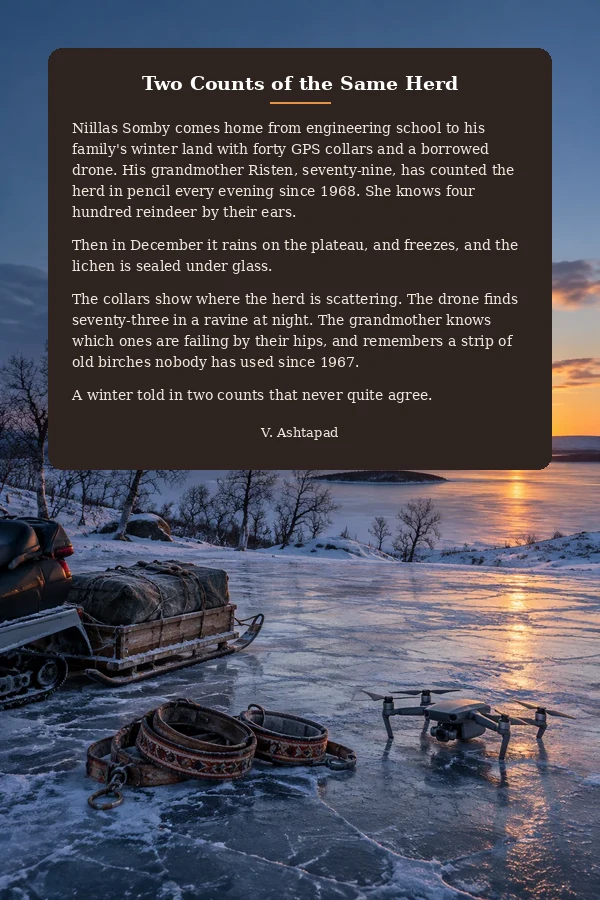
Niillas Somby comes home from engineering school to his family's winter land with forty GPS collars and a borrowed drone. His grandmother Risten, seventy-nine, has counted the herd in pencil every evening since 1968. She knows four hundred reindeer by their ears.
Then in December it rains on the plateau, and freezes, and the lichen is sealed under glass.
The collars show where the herd is scattering. The drone finds seventy-three in a ravine at night. The grandmother knows which ones are failing by their hips, and remembers a strip of old birches nobody has used since 1967.
A winter told in two counts that never quite agree.
Members can react to this book and talk about it in the members' Library.
Ownership
© 2026 CRUNOD LLC. All rights reserved.
This book is owned by CRUNOD LLC. It is free to read on EternalCurrent.Online. No part of it may be copied, reprinted, sold, recorded or adapted, including as audio, film or translation, without written permission from CRUNOD LLC.
© 2026 CRUNOD LLC. All rights reserved.